Insight Editions · No. 242
I Am a Strange Loop
Douglas R. Hofstadter
Hofstadter’s plain, personal restatement of his central idea: the self is a self-referential pattern, souls come in degrees, and an “I” lives on, diminished, in the people who loved it.
A study guide to I Am a Strange Loop by Douglas R. Hofstadter. Shared free for personal reading; not for sale and not endorsed by the authors or publishers. Please read and buy the original.
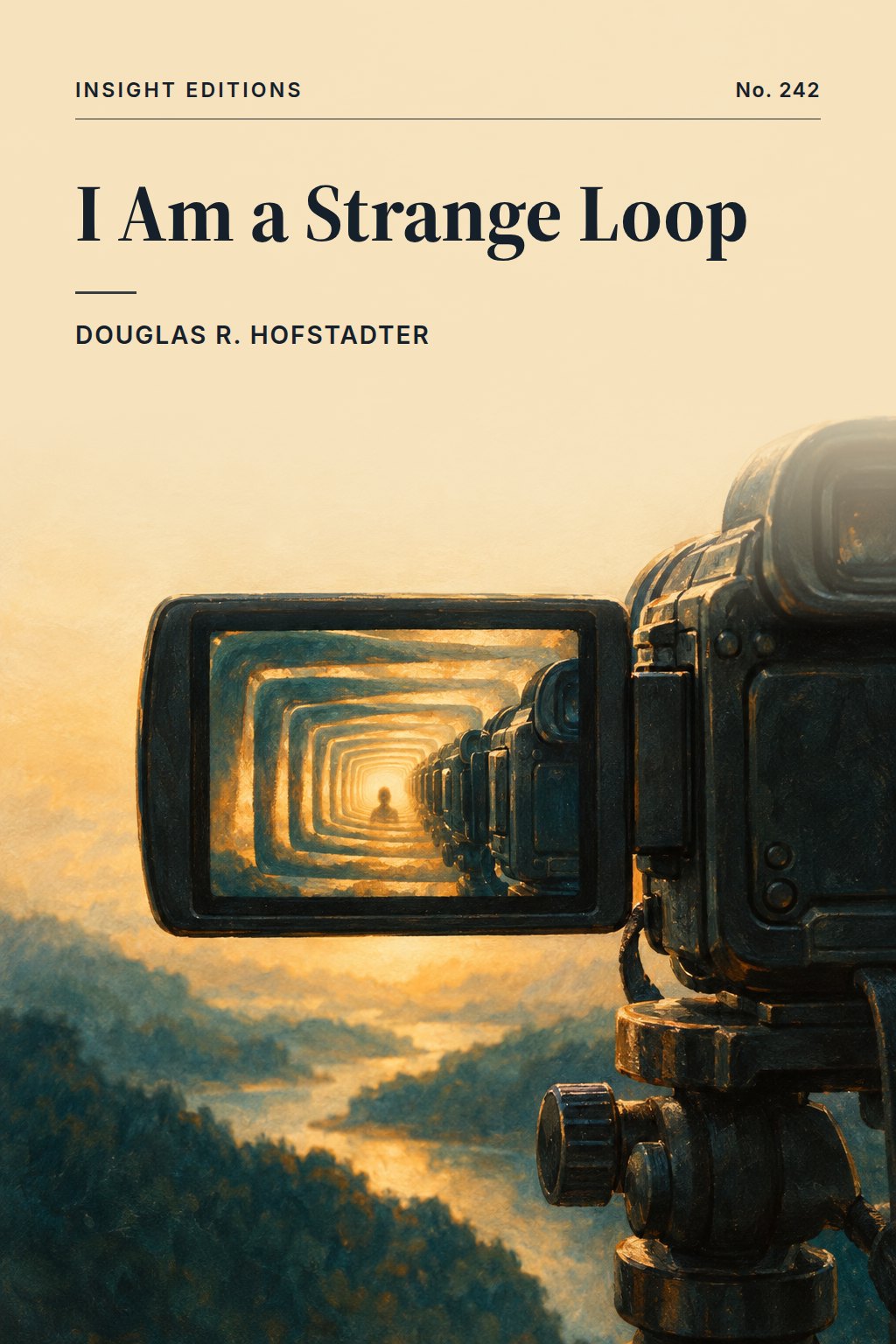
An "I" is a strange loop: a self-model in the brain's symbol system that perceives itself, locks in, and seems to be a solid inner thing driving everything we do.
Gödel's theorem, feedback, perception and symbols, analogy and meaning, personal identity, grief, zombies, free will, empathy. 27 sections, 24 chapters plus preface, prologue and epilogue.
Gödel, Russell, Whitehead, Turing, Sperry, Dennett, Chalmers, Parfit, Searle, Schweitzer, and Carol Hofstadter, whose death (1993) shapes the book's heart.
Readers of GEB who want its core message, anyone thinking about AI minds and consciousness, and anyone grieving who wonders what survives of a person.
Douglas Hofstadter's I Am a Strange Loop (2007) restates, plainly and personally, the central message he felt nobody heard in Gödel, Escher, Bach (1979): the self is a self-referential pattern, of the same abstract kind as the loop Kurt Gödel found inside Principia Mathematica. It moves from logic to love: from how a meaningless symbol system can talk about itself, to how a brain builds an "I", to how that "I" lives on, diminished, in the brains of the people who loved it.
- Souls come in degrees. People already rank souls in practice (whom they eat, swat, execute or mourn). "Souledness" is a continuous variable, measured jokingly in hunekers, that tracks the presence of a special kind of subtle pattern, and the book sets out to say what that pattern is.
- Patterns are causes. Brains must be understood at many levels, and the level of neurons is almost never the right one for thoughts. In the domino chainium, "641 is prime" is the real reason a domino doesn't fall; in the careenium, symbols (simmballs) shove symbols around. The low level is 100% responsible yet irrelevant.
- Loops lock in, and the strange ones leap levels. Feedback produces goals and, in video feedback, self-sustaining locked-in patterns. A strange loop is a cycle of seemingly upward level-shifts that returns to its start. Escher's Drawing Hands fakes one; Gödel built a real one: by coding formulas as numbers, he made a formula of PM that says, via a second, equally valid mapping, "I am unprovable", which is therefore true because unprovable.
- Meaning is mapping. All meaning comes from analogy (stable, reliable alignment); whole numbers are a universal representational medium, and so are human brains past a threshold of representational universality.
- The "I" is the brain's most complex symbol. Perception turned back on the perceiver, plus a vast extensible symbol repertoire, plus blindness to our own neural substrate, yields a self-model that locks in and seems to be the prime mover, like the nonexistent but compelling marble in a box of envelopes ("Epi").
- We live in each other. Each brain houses coarse-grained copies of other people's loops; each "I" lives in many brains at differing fidelity. When Carol died, a part of her "thinks with my brain"; death leaves an afterglow, a soular corona, that fades over generations.
- Consciousness is thinking. Consciousness is the dance of symbols; identity is graded psychological continuity (with Parfit); zombies, dualism, the inverted spectrum and free will (as opposed to will) dissolve; the "I" is "a hallucination hallucinated by a hallucination", yet the most precious thing we own.
- Great souls contain multitudes. Magnanimity literally means great-souled; the self is enlarged, not diminished, by internalising others, and consciousness begins with the abstraction "friend".
Chapter map
| Ch | Title | One-line payload |
|---|---|---|
| P | An Author and His Book | Consciousness as a self-perceiving mirage; GEB's unheard message; method of analogy |
| Pr | An Affable Locking of Horns | Teenage dialogue: is "I know I'm alive" just a reflex? |
| 1 | On Souls and Their Sizes | Souls are graded; we already rank them in deeds |
| 2 | This Teetering Bulb of Dread and Dream | Many levels in the brain; thinkodynamics vs statistical mentalics |
| 3 | The Causal Potency of Patterns | Dominos, traffic, careenium: abstractions are real causes |
| 4 | Loops, Goals, and Loopholes | Feedback breeds goal-talk; loop-lovers vs loop-dreaders |
| 5 | On Video Feedback | Self-filming TV: emergent, locked-in patterns needing new words |
| 6 | Of Selves and Symbols | Perception ends in symbols; mosquito, dog, human repertoires |
| 7 | The Epi Phenomenon | Reality is graded; the "I" as a marble that isn't there |
| 8 | Embarking on a Strange-Loop Safari | Strange loop defined; Escher, Berry and fakes |
| 9 | Pattern and Provability | Primes, Euclid and the Mathematician's Credo |
| 10 | Gödel's Quintessential Strange Loop | Gödel numbering, prim numbers, "I am unprovable" |
| 11 | How Analogy Makes Meaning | All meaning is mapping; Prince Hyppia: Math Dramatica |
| 12 | On Downward Causality | True because unprovable; essential incompleteness |
| 13 | The Elusive Apple of My "I" | "I" as the brain's most complex, locked-in symbol |
| 14 | Strangeness in the "I" of the Beholder | Ability plus inability make the loop strange |
| 15 | Entwinement | Many loops per head; Twinwirld; "We two were Twe" |
| 16 | Grappling with the Deepest Mystery | Carol's death: what of a person survives? |
| 17 | How We Live in Each Other | Universal beings; mosaics of differing grain |
| 18 | The Blurry Glow of Human Identity | Against the caged bird; afterglows and coronas |
| 19 | Consciousness = Thinking | The dance of symbols; "jilted" |
| 20 | A Courteous Crossing of Words | Skeptic vs believer; "a hallucination hallucinated by a hallucination" |
| 21 | A Brief Brush with Cartesian Egos | Parfit's teletransporter; identity in degrees |
| 22 | A Tango with Zombies and Dualism | Consciousness is not a power moonroof |
| 23 | Killing a Couple of Sacred Cows | Inverted spectrum and free will dispatched |
| 24 | On Magnanimity and Friendship | Great souls; only when generosity is born is an ego born |
| E | The Quandary | Dualism or the Hard Problem; "unpredictable self-writing poems" |
Hofstadter explains where this book comes from: a teenage intuition that consciousness is a self-perceiving mirage, a first book (Gödel, Escher, Bach) whose central message he believes almost nobody heard, and a 2003 invitation from two philosophers that gave him a second chance to say it plainly. He also sets out his method, which is analogy, concrete examples and first-person stories rather than formal proof.
Facing the physicality of consciousness
Hofstadter's childhood was spent wondering how his own mind produced puns, mathematical ideas, speech errors and analogies, and what it would be like to be a girl, a foreign speaker, Einstein, a dog or a mosquito. When he was twelve, the family learned that his youngest sister Molly, then three, could neither understand nor produce language. Nobody ever found out why, and she still has no words. She moved through the world "with ease, even with charm and grace", but silently.
The family's search for a cure briefly included the idea of brain surgery. The thought of people opening his little sister's head and looking at "the mysterious stuff that filled it" pushed the boy to read lay books on the brain, and that forced him to confront the physical basis of being, or having, an "I". He found it "disorienting, dizzying, and profoundly eerie".
Late in high school three more ingredients arrived at once: Kurt Gödel's metamathematical results; programming on Stanford's only computer, a Burroughs 220, in the basement of Encina Hall, which he made compose nonsense in the foreign languages he was learning; and an obsession with symbolic logic, whose symbols he was sure gave "glimpses into the hidden wellsprings of human thought". Symbols and meanings, machines and mentality, neural impulses and mortal souls collided in his adolescent head.
The mirage
At sixteen or seventeen he arrived at the intuition he has held ever since: consciousness is a kind of mirage, but a mirage that perceives itself, that seems to lift itself up by its own bootstraps and dissolves when inspected closely. He tried to pin the thought down in a dialogue between two invented philosophers he flippantly named "Plato" and "Socrates". He kept it, judges it immature, and prints it as the Prologue because it already contains most of the book's themes.
The book's founding image: a mirage that perceives itself. The "I" is not nothing, but it is not the solid, separate thing it seems from inside. It is a pattern that creates the very perspective from which it looks real.
A shout into a chasm
About ten years later he started a book provisionally titled "Gödel's Theorem and the Human Brain". Its aim was to link the self and consciousness to Gödel's discovery of a wraparound self-referential structure, which Hofstadter later named a strange loop, inside Principia Mathematica, a fortress whose builders had deliberately banished self-reference. The parallel seemed exact: Gödel manufactured self-reference out of meaningless symbols, and brains manufacture selves out of inanimate matter. The book became Gödel, Escher, Bach (1979) and was a huge success.
Its readers, however, loved it for almost every reason except its core message. In the twentieth-anniversary preface (1999) he complained that it felt as if he had "shouted a deeply cherished message out into an empty chasm and nobody heard me."
The second chance (2003). Philosophers Ken Williford and Uriah Kriegel emailed him, quoting that very complaint back to him, and invited a chapter for an anthology on "self-referentialist" theories of consciousness. He started writing in Anterselva di Mezzo in the Italian Dolomites, continued in Bloomington, and delivered a chapter four times the length limit (an illustration of Hofstadter's Law: it always takes longer than you think, even when you take into account Hofstadter's Law). Williford helped cut it in half. The chapter, "What is it like to be a strange loop?" (a nod to Thomas Nagel's "What is it like to be a bat?"), appeared in Self-Representational Approaches to Consciousness (2006) in a section called "Beyond Philosophy". The material had already split off into this book.
c. 1957 Molly's condition recognised; Hofstadter, 12, starts reading about the brain.
c. 1961–62 Gödel, the Burroughs 220, symbolic logic; the "mirage" intuition and the Plato/Socrates dialogue.
1979 Gödel, Escher, Bach published.
1999 GEB 20th-anniversary preface: "a shout into a chasm".
2003 Williford and Kriegel invitation; writing begins in the Dolomites.
2006 Anthology chapter published; preface to this book signed December 2006.
2007 I Am a Strange Loop published.
An author and his audience
The title is about the concept of "I", so it is as much about the reader as the author; it could have been "You Are a Strange Loop", and strictly should have been "'I' Is a Strange Loop", which he rejects as a lead balloon. He writes, as always, for the general educated public, while admitting that thirty years of graduate work on computational models of analogy-making and creativity, on cognitive errors, categorisation, humour, concept formation, memory retrieval and translation, do make him a specialist: he specialises in thinking about thinking.
His firmest conclusion about thought shapes his style: we always think by drawing parallels to things we already know, so we communicate best through examples, analogies and metaphors, concrete language and direct personal experience.
The horsies-and-doggies religion
He calls his style "horsies and doggies", from a Peanuts strip in which Linus sees the stoning of Stephen and a famous painter's profile in the clouds, while Charlie Brown confesses he was going to say he saw "a ducky and a horsie". Hofstadter misremembered the phrase, but kept it. Despite his reputation for abstraction, he sees himself as the down-to-earth Charlie Brown.

- Freedom from publish-or-perish. The success of GEB bought him about twenty-five years at Indiana University and four at the University of Michigan (1980s) without grant-chasing, so he has written books rather than journal papers.
- Clarity, simplicity, concreteness became "a kind of religion", together with minimal jargon and a first-person stance.
- First-person stories are used not from vanity but because his life is the one he knows best and is, he suspects, typical.
- Persuasion, not proof. Philosophers often write as though they can prove their positions and pre-empt every counter-argument. Hofstadter thinks nothing in philosophy can be proved, that one mostly convinces people who already lean one's way, and so he offers "a gigantic salad bowl full of metaphors and analogies".
A few last observations
- The index separates analogies into "analogies, serious examples of" and "throwaway analogies, random examples of". Strictly every thought is an analogy, since each one recognises something as a variety of something else; "similarly", "by contrast" and every word choice carry an implicit analogy.
- New ideas sprouted. He expected a distilled GEB without formal notation or digressions into Zen, molecular biology or AI, but found new material everywhere.
- Two dialogues. He did not plan to copy GEB's alternation of chapters and dialogues, but near the end his "skeptics might reply" passages turned into a long dialogue between two oddly named characters (Chapter 20). With the Prologue, the book has two.
- Form–content interplay. He typeset the book himself, and the pursuit of visual elegance on each page changed how he phrased ideas; he thinks attention to form improves anyone's writing.
A useful youthfulness
GEB was drafted in pen when he was 27–28. This book comes from someone with far more suffering, sadness and soul-searching behind him, and those notes sound throughout. He calls it his best attempt at describing André Malraux's "la condition humaine". A garbled blurb on GEB's back cover turned Jeremy Bernstein's "youthful vitality" into "useful vitality"; he hopes this older, soberer book earns the second phrase. His wish for the reader is to finish the book able to imagine that you, too, are a strange loop.
For practitioners. Hofstadter's method, argue by analogy and concrete case, not by abstract definition, is also how architecture decisions get made in practice. A reference architecture that nobody can map onto a story about their own system is a "shout into a chasm". Lead with the horsie, then show the abstraction it instantiates.
The teenage dialogue that seeds the book. Through a chain of questions, Socrates drives Plato from defining life to asking what thinking is, then argues that even the sentence "I know I am alive" is produced by habit and reflex, so that feeling alive may be an illusion created by a collection of complex reflexes. It already raises the book's later questions: degrees of soul, whether machines can "know", and whether consciousness is a mirage.
Cast and frame
Plato: listed as "a seeker of truth who suspects consciousness is an illusion".
Socrates: listed as "a seeker of truth who believes in consciousness' reality".
Both are modern philosophers, not the Greeks; the teenage Hofstadter knew almost nothing of the real ones.
The argument, step by step
- Life and soul. Plato defines a living creature as a body that grows, eats, reacts, learns and reproduces. Socrates notices the slip between "is a body" and "has a body", and pushes: then fleas and mice have souls? Trees and grass? Plato retreats to "only animals", then to "higher animals, those able to think".
- No sharp line. Socrates points out that at small enough scales the plant/animal distinction blurs, an early form of the book's claim that soul comes in degrees.
- True life versus symptoms of life. Plato says grass shows only the "symptoms of life"; true life requires a soul, and soul means the ability to think. So the real question is "What is thinking?"
- Knowing recedes. Plato says the purest thought is knowing, which is more than asserting or writing down; it is conviction. But when examined, knowing "recedes, and evades us".
- The English machine. Socrates imagines a machine that builds English sentences and answers "Are you alive?" exactly as Plato would. Plato objects that a machine only shuffles words "as canning machines put fruit in cans". Socrates replies that the basic unit of human thought is not the word but nerve cells "whose laws of operation are arithmetical", and that Plato is now using "know" carelessly after warning against it.
- Learning by exposure. Plato admits he learned "to know" by hearing it in context and using it automatically.
- Habit all the way down. Even when he "consciously" chooses words, he searches for synonyms guided by habits of connecting words. Socrates concludes that conscious thought, analysed bit by bit, is automatic, so the feeling of being alive may be a reflex-built illusion.
Then feeling one is alive is merely an illusion propagated by a reflex that urges one to utter, without understanding, such a sentence, and a truly living creature is reduced to a collection of complex reflexes.
Roles reversed. The cast list says Plato suspects consciousness is an illusion and Socrates believes in its reality, yet in the dialogue it is Socrates who argues the reflex view and Plato who resists it. Hofstadter does not comment on the inversion. The argument itself is also a sorites slide: each step is a little plausible, but "every part is automatic" does not entail "the whole is unconscious". The rest of the book is in effect a correction, arguing that levels matter: a pattern made of reflexes can still be a genuine "I".
The Prologue's lasting contribution is the machine test: if a machine answers "Are you alive?" exactly as you do, what grounds remain for saying you know and it does not? Hofstadter's mature answer is that the grounds lie in the internal pattern, not in the substrate or the words.
Souls are not on/off; they come in sizes. Through a photograph, a short story about a slaughterhouse, decades of wavering vegetarianism and the way people actually treat animals, enemies, the senile and the unborn, Hofstadter argues that everyone already carries a private, graded "consciousness cone", and that "souledness" rises and falls with the presence of a special kind of subtle pattern, which the rest of the book sets out to identify.
Soul-shards
In early 1991, a couple of months after his father Robert Hofstadter died, his mother looked at a photograph of her husband and said it meant nothing: "just a flat piece of paper with dark spots on it". Hofstadter disagreed and reached for an analogy.
The Chopin études in the living room are also just flat paper with dark marks, yet for 150 years they have made thousands of pianists spend millions of hours moving their fingers in complex patterns, and conveyed to millions of listeners the emotions that churned in Frédéric Chopin's heart. The marks are "soul-shards": scattered remnants of a shattered soul that can bring fragments of another person's inner life back to life inside other brains. The photograph works the same way for those who knew his father: it reactivates their internal representations of him and "makes little fragments of his soul dance again, but in the medium of brains other than his own." The photo still stands on his mother's kitchen counter.
A soul can be partly instantiated outside its original brain. Marks on paper are inert alone, but in a brain that can decode them they recreate a fragment of someone's interiority. This is the first hint of the book's later thesis (Chapters 17–18) that we live on, in diminished form, inside each other.
What is it like to be a tomato?
Hofstadter eats tomatoes without guilt: a tomato is nothing but its body; there is no mind–body problem for tomatoes. He swats mosquitoes, avoids stepping on ants, carries other insects outside, and for many years ate chicken and fish but not mammals. He discusses his vegetarianism not to crusade but because it is a practical, daily ranking of souls.
The guinea pig, "Pig", and the piglet
Guinea pig (age 15). Working a Friden mechanical calculator in a Stanford physiology lab, he was asked by a graduate student, Nancy, to fetch two guinea pigs for an experiment. Imagining choosing two soft furry beings to be killed, he fainted and hit his head on the concrete. The lab director, family friend George Feigen, saw to him. Nobody asked him again.
He still ate meat for years, partly because nobody around him questioned it and "vegetarian" suggested sternly moralistic cranks (he cites the vegetarian-restaurant scene in The Seven Year Itch). At 21 he read Roald Dahl's "Pig". Its naive hero Lexington, raised vegetarian by Aunt Glosspan ("Pangloss" reversed), discovers he loves pork, tours a slaughterhouse, and is suddenly shackled by the leg onto the chain and has his throat cut like the pigs. Dying upside down, he sees a pig ahead wearing white gloves, like the young woman who preceded him from the waiting room, and slips out of "the best of all possible worlds". Hofstadter kept flipping in imagination between the pig and Lexington.
Weeks later in Cagliari, Sardinia, at a physics conference his father attended, the closing banquet featured a suckling piglet roasted and carved before the diners. He and his sister Laura stayed in the hotel and ate pasta. The "one–two punch" of the story and the piglet made him give up meat, leather shoes and belts, and proselytise (briefly converting a couple of friends). He puzzled over meat-eating heroes such as Einstein, later pleased to find hints that Einstein leaned toward vegetarianism out of compassion.
Reversion and re-evolution
A few years later social pressure in American life wore his vegetarianism down and the whole issue went underground. The mid-1960s Hofstadter would have found this unfathomable, yet both versions lived in the same skull, which raises the question "Was I really the same person?" As a young assistant professor at Indiana he befriended Sue, who had held the same view longer, and swung back to no killing at all. After more oscillations, by his late thirties he settled on a compromise: there are souls of different sizes, and "small enough" ones may be sacrificed for larger ones. He drew the line, admittedly arbitrarily, at mammals, and kept it for two decades.
The mystery of inanimate flesh
Language hides the animal: we eat pork and beef, not pig and cow; we eat chicken but not chickens. A friend's young daughter laughed at the "coincidence" that the clucking bird and the food on her plate had the same name, and was upset to learn they were one thing. As a boy Hofstadter was comforted that ground beef and crisp bacon did not look like animals, but the carcasses on hooks at grocery-store loading docks made him ask "Who was that animal?", meaning what it had felt like to be that particular one. In a European shop at Christmas, a pig's severed head displayed in an aisle, the cross-section showing the "communication lines" to "headquarters", provoked questions of "porcinal identity": who had looked out through those eyes? He asked the same about squashed insects, but less often, because "Who is in there?" seemed to have less meaning for them. These images are there to raise the book's core issue: what a soul is, and who or what has one.
Small-souled and large-souled humans
James Huneker, in his early-1900s preface to the Schirmer edition of Chopin's études, wrote of Op. 25 No. 11 in A minor ("Winter Wind"): "Small-souled men, no matter how agile their fingers, should not attempt it." Hofstadter tried the piece at sixteen and gave up after weeks; playing just the first page at speed made his right hand throb. Huneker's point was not technique but soul size, an idea that sounds elitist to egalitarian ears ("it would not play in Peoria"). Hofstadter admits he partly agrees, and argues that almost everyone implicitly ranks human souls, whatever they profess:
Seven ways people already treat souls as having sizes
- Capital punishment: the deliberate public extinguishing of a soul, however it pleads.
- War: killing enemy soldiers is treated as legitimate, as if war shrinks enemy souls.
- Slavery: Washington, Jefferson and Franklin each, for some period, accepted owning and selling people.
- Religious exclusion: some believe atheists, other faiths and apostates have no souls and deserve death.
- Women: some (including some women) have held that women have no souls, or smaller ones.
- Dementia: many, Hofstadter included, believe President Reagan was "all gone" years before his body died, and likewise late-stage Alzheimer's patients.
- Embryos and fetuses: Hofstadter holds that neither a zygote nor a five-month fetus has a full human soul, and that the mother's life counts for more.
Two overheard exchanges show the same ranking in everyday grammar. Kellie says a turkey is a "which", not a "whom", but her chocolate labrador Hattie is "a whom, no doubt". Danny says his golden retriever Ollie didn't play much with the other dogs because "Ollie's a people person".
Where to draw the fateful line
Everyone, at least every "sufficiently large-souled" person, has to decide about swatting flies, mousetraps, eating rabbits, lobsters or dogs, mink stoles, ivory, leather, even penicillin against bacteria, and whether to cut down the elm or pull up the blackberry bush. Hofstadter's blunt answer to what gives word-users the right is "might makes right": our brains, languages and cultures make us mighty, so we are forced to rank creatures, either by reflection or by following the crowd.

Interiority: what has it, and how much?
C-3PO and R2-D2 are absurdly unrealistic, but they are "mind-openers": they show we can easily imagine a feeling entity made of metal, so "made of the wrong stuff" is not a valid reflex. Contrast the identical marching robot soldiers blown up without a twinge of regret from the audience: their perfect interchangeability tells us there is no interiority there, or no more than an ant's. The question the book must answer is what C-3PO, R2-D2 and Hattie have, and what the robot platoon and the late Reagan lacked.
Lights on: C-3PO, R2-D2, Hattie the labrador. Individual, responsive, idiosyncratic; we sense an "I".
Lights off (or dim): the synchronised robot army; a person in late-stage Alzheimer's. Interchangeable or dissolved patterns; we sense nobody home.
The gradual growth of a soul
Hofstadter rejects the idea that a full soul appears at conception. A human soul comes slowly into being over years (he uses "soul" with no religious connotation). He proposes a scale of "hunekers", 0 to 100, then corrects himself: why should souledness max out for every adult, when tallness and IQ do not? Perhaps the average is 100 with a spread up to 150 or 200 and down to 50. He backs away from calculating anyone's score because it suggests some people are worth more than others, which troubles him too.
- Zygote: essentially 0 hunekers, but a "dynamic, snowballing entity" that over years builds the internal patterns whose presence raises its score.
- Age 0–20: souledness grows toward roughly 100 (the book's second cone).
- Decline: the same pattern can decay, so souledness can fall over time.
Souledness is not a bit but a blurry, continuous variable, ranging across species and objects and rising or falling as a special kind of subtle pattern grows or decays inside an entity. Hofstadter claims that our largely unconscious decisions about eating, clothing, insects, robots in films, fictional deaths and senile relatives all reflect this continuum.
The obvious objection, and his answer. Does the cone imply that under Sophie's Choice pressure he would sooner kill a two-year-old than a twenty-year-old? He says no: he respects the child's potential to grow a large soul, and evolution has built him to perceive "cuteness", which shields children. Critics will notice that the potential argument sits awkwardly with his view of the fetus, and that a graded soul scale, however carefully hedged, has a dark history in eugenics. Hofstadter flags the danger but does not fully resolve it.
Lights on?
The book's central aim is to pin down the special kind of subtle pattern behind a "soul", an "I", "a light on inside", "interiority" or "consciousness". Philosophers' terms "intentionality" (having beliefs, desires, fears) and "semantics" (genuinely thinking about things rather than juggling meaningless tokens, as in the Prologue) are, for him, nearly interchangeable with these, and all come in degrees.
Post scriptum: the boomerang. While expanding this chapter with the "Pig" summary, Hofstadter found himself doubting his twenty-year-old mammal line and stopped eating chicken and fish "cold turkey". His two children independently reached the same conclusion within a couple of weeks, and the family became fully vegetarian. Writing the chapter changed its author, and he calls this an example of the motto "I am a strange loop": choices bounce back and are folded into one's self-model.
AI angle. The souledness scale is the question now asked of AI models: is there "anyone home", and how much? Hofstadter's test is not substrate (C-3PO is metal) and not behaviour on a single question, but whether an individual, self-referential pattern exists inside. Teams writing AI policy face the same issue as Hofstadter's cone: our practical stance toward a system reflects a graded intuition we rarely state explicitly.
Brains must be studied at many levels, and the level of neurons is almost certainly the wrong one for thought. Hofstadter argues that concepts, memories, analogies and "I" are genuine brain structures, attacks John Searle's mockery of "thinking toilet paper" and "thirsty beer cans" as a level confusion, adopts Roger Sperry's view that ideas sit at the top of the brain's causal pecking order, and coins thinkodynamics and statistical mentalics by analogy with thermodynamics and statistical mechanics.
What is a "brain structure"?
Asked whether he "studies the brain", Hofstadter wants to answer both no and yes. No: he studies concepts, "thinking in French", slips of the tongue, remindings, letter recognition, slurred speech and analogies, and leaves the "wet, messy, tangled web" to neurophysiologists. Yes: the brain is by definition the machinery of thought. The contradiction dissolves once one asks what counts as a structure in the brain.
| Neuroscientist's list (by size) | Hofstadter's list of abstract brain structures |
|---|---|
| amino acids, neurotransmitters | the concept "dog"; the "dog"–"bark" link |
| DNA and RNA | object files (Anne Treisman) |
| synapses, dendrites, neurons | frames (Marvin Minsky) |
| Hebbian neural assemblies | memory organization packets (Roger Schank) |
| columns in the visual cortex | long-term, short-term, episodic and melodic memory |
| area 19; the whole visual cortex | analogical bridges (his own group); mental spaces (Gilles Fauconnier) |
| the left hemisphere | memes (Dawkins); ego, id, superego (Freud); native grammar; sense of humour; "I" |
Limiting brain research to the left column is like limiting literary criticism to paper, ink, bookbinding and typefaces while ignoring plot, character, irony and metaphor. Abstractions are central, in literature and in the brain. Some of the listed theories will fail and some will be confirmed, but they are legitimate targets. Genes and atoms were proposed and studied for decades as invisible theoretical entities before anyone isolated them physically; precise relationships among abstract mental structures deserve to count as brain research in the same way.
A simple analogy between heart and brain
A heart is made of billions of cells, but a heart is a pump, and focusing on its cells misses that. A brain is a thinking machine, and understanding thinking needs its large-scale architecture, not ever finer analysis of components.
How pumps evolved. About a billion years ago natural selection stumbled on rhythmically contracting cells that moved useful material around inside an organism. Once the inner workings of contractile cells were settled, cell innards stopped being what selection acted on; rival architectures of pumps became the contenders, and complexity evolved at that new level. So heart surgeons think about chambers and valves, not cell biochemistry, just as car buyers think about comfort, safety and fuel economy rather than alloys and protons.
Each level that stabilises becomes a platform, and selection (or explanation) moves up. For concepts, analogies, memory, creativity and consciousness, the microscopic level "almost certainly is" the wrong place to look.
Can toilet paper think?
A Turing machine is an idealised computer: an arbitrarily long tape of cells, each blank or dotted; a head that reads one cell, writes or erases a dot and moves one cell left or right, following a fixed table of instructions. Its operations are trivial, yet any computation whatsoever can be done by a suitable Turing machine (the number 3 is "•••" between blanks).
John Searle has spent a career ridiculing AI by noting that a Turing machine can be built of anything: a roll of toilet paper with pebbles, Tinkertoys, or beer cans and ping-pong balls. Hofstadter calls this a ploy "that should fool only third-graders", carefully calculated to make readers scoff without thinking.
The thirsty beer can. To ridicule the idea that a vast beer-can system could have experiences, Searle imagines that its thirst would consist of one particular can "popping up" with "I am thirsty" written on it. Hofstadter's objection: in any serious model, thirst would not be localised in a single component but would be a complex global pattern across millions or billions of cans. The single can is just the long-discredited "grandmother cell" (one neuron that fires if and only if you see your grandmother) in a new costume. "I am thirsty" painted on a can is no more meaningful than "I want to be washed" scrawled on a muddy truck.
The deeper error is widespread: the tacit assumption that a brain's most elusive mental properties must live at the level of its smallest physical parts. A mineral's density, colour, magnetism, reflectivity, conductivity, elasticity, heat capacity and speed of sound all come from high-level patterns of interacting atoms, not from any single atom. Even a cortical column (about forty neurons with collective behaviour) is far too low a level for analogy-making or the spontaneous recall of old episodes.
Is this fair to Searle? Hofstadter attacks the beer-can image, not Searle's main argument, the Chinese Room (1980), whose target is whether symbol manipulation alone yields understanding, wherever the "experience" is located. Searle's actual position ("biological naturalism") accepts that brains cause minds via their causal powers; his claim is that syntax is not sufficient for semantics. The level-confusion charge lands squarely against the "grandmother can" caricature but leaves the systems-reply debate largely untouched. Hofstadter returns to Searle in later chapters.
Levels and forces in the brain
A book titled Molecular Gods: How Molecules Determine Our Behavior set him thinking, and he reshelved it unbought. What caused that reshelving: molecules, or ideas? Neurologist Roger Sperry (essay "Mind, Brain, and Humanist Values") gave the answer he liked: conscious awareness is "a very real causal agent" in the brain's chain of control; the issue is "who pushes whom around" among the "forces within forces within forces" of the cranium; and near the apex of that command hierarchy "we find ideas", whose causal potency is "just as real as that of a molecule, a cell, or a nerve impulse". Ideas cause ideas, interact across brains via communication, and produce a "burstwise advance in evolution" beyond the emergence of the living cell.
It comes down to the issue of who pushes whom around in the population of causal forces that occupy the cranium.
The chapter title comes from Russell Edson's poem "The Floor": the brain is "this teetering bulb of dread and dream". Hofstadter poses the question in its sharpest form: when "I" "decided" to put the book back, did an "I" push brain structures around, or were there only quantum collisions of electrons, photons, gluons and quarks? Do dreads, dreams, hopes, griefs, jealousies and sparks of genius have causal power? Have religious beliefs caused wars? Does fire cause smoke, love cause marriage, jokes cause laughter, or are there only particles?
Thermodynamics and statistical mechanics
Raised by a physicist father, Hofstadter grew up believing that physics underlies everything and that there are only four basic forces (gravity, electromagnetism, strong and weak nuclear). He reconciled this with "evolution caused hearts", "dogma caused wars" and "nostalgia inspired an étude" by treating macroscopic forces as descriptions of complex patterns produced by the basic forces, just as friction, viscosity, pressure and temperature are statistical regularities of colliding molecules.
The level shift buys something precious: comprehensibility. A gas described by Avogadro's number of equations would illuminate nothing; temperature, pressure and volume do. Hence the familiar maxim and its useful inversion:
Two directions of the same truth
- Thermodynamics is explained by statistical mechanics (the reductionist direction).
- Statistical mechanics can be bypassed by talking at the level of thermodynamics (the practical direction).
Nobody knew anything about atoms until about a century ago, yet Magellan, Shakespeare, Bach and Joan of Arc acted for reasons that had nothing to do with DNA, protons or Higgs particles.
Thinkodynamics and statistical mentalics
Hofstadter transposes the maxim to the mind:
Hofstadter's coinages
- Thinkodynamics: the large-scale patterns of the brain, with no reference to neural firings; what psychologists study (choices, errors, pattern perception, remindings).
- Mentalics: small-scale neural phenomena (neurotransmitters crossing synapses, wiring, synchronised cell assemblies).
- Statistical mentalics: the averaged, collective behaviour of those small entities, the swarm rather than the buzz.
- Maxim: Thinkodynamics is explained by statistical mentalics; and inverted, statistical mentalics can be bypassed by talking at the level of thinkodynamics.
The brain differs from a gas in one key way: as Sperry stressed, there is not one upward jump but many way-stations between neurons and thoughts. That is why it is so hard to imagine the neural explanation for a professor reshelving a book, sparing a fly, giggling at a solemn ceremony, or producing the blend "She'll be hard shoes to fill!"
Victims of our macroscopicness
Our senses, language and culture hand us concepts like "milk", "finger", "mosquito", "itch" and "swat" "on a silver platter". We may later learn "ribosome" or "peptide bond", but those never replace the everyday ones. We are "victims of our macroscopicness", so we say a war had religious or economic causes rather than describing it as interacting particles, even though the particle level is the only one with no information loss.
Drastic simplification is our fate and our glory: it lets us find abstract essences, put our fingers on what matters, survive, and make literature, art, music and science.
Enterprise architecture parallel. Hofstadter's "many way-stations" is the layered-abstraction principle in system design: nobody debugs a payments outage at the level of transistor physics, and the right level of description is the one where the causal story becomes comprehensible. The same applies to AI interpretability: explaining an LLM's behaviour at the level of single neurons is the "grandmother cell" error; modern work looks for features and circuits, i.e. Distributed patterns, which is exactly Hofstadter's prescription.
High-level patterns are genuine causes, even though physics does all the pushing. Hofstadter builds three thought experiments, the domino chainium, the traffic jam and the careenium, to show that the most accurate and insightful explanation of a system's behaviour often refers to abstractions (primality, a ball game ending, the meaning of a symbol) rather than to its parts. The lower level is 100 percent responsible yet irrelevant, and in a brain it is symbols that shove symbols around.
The prime mover: the domino chainium
Imagine spring-loaded dominos that flip back upright after a short refractory period. Chains can branch, merge and loop, so with careful timing a network of them is a mechanical computer. Build one that tests whether a number is prime: place 641 dominos end to end in a reserved input stretch and topple the first domino. Loops test divisibility by 2, 3 and so on; if a divisor is found, a signal runs down the "divisor stretch"; if none is found, a "prime stretch" falls instead.
An observer who doesn't know the machine's purpose points at a domino in the divisor stretch and asks why it never falls.
- The myopic answer: "Because its predecessor never falls, you dummy!" True, but it just passes the buck to another domino.
- The global answer: "Because 641 is prime." Equally true, far more on the mark, and it mentions nothing physical. Primality is as remote from toppling physics as quark physics is from the Cold War's "domino theory" of communism spreading across Southeast Asia.
641's primality is the best explanation, perhaps the only one, for why some dominos fall and others don't: 641 is "the prime mover". The same abstraction explains both a falling domino (prime stretch) and a non-falling one (divisor stretch).
The traffic jam
Stuck motionless in a multi-lane jam on a country freeway, Hofstadter imagined honking at the car in front: "Get out of my way, lunkhead!" There is a sliver of logic (if that car vanished he'd gain one car-length), and in pea-soup fog it might even be right, since that car could be the whole cause. But with a wide field of view, honking is absurd: the problem is obviously not local.
The cause sits at another level of discourse: a big ball game just ended three miles ahead, it is 7:30 a.m. Heading into Silicon Valley, or a blizzard lies ten miles on. Each is a social or natural event that makes many people do the same thing at once. No expertise in car mechanics helps; cars are pawns whose only relevant physical property is that they cannot pass through each other.
Neurons and dominos
If someone monitored neuron #45826493842 in Hofstadter's brain while he listened to music and asked why it never fires, the myopic answer ("its inputs never fire jointly") is correct and useless; the useful one is "because Doug Hofstadter doesn't care for the style of Fats Domino". That neuron is not a privileged "grand-music neuron"; it is one voter among many in an election, and no single voter decides.
Patterns as causes
Can primality play a causal role in a physical system? Hofstadter says yes, because the most efficient, insight-giving explanation depends on it. There is no extra physical or extra-physical force; local physics handles everything, but the global arrangement determines what happens, and noticing it hands you a shortcut on a silver platter. Calling 641's primality a cause is like calling a gas's temperature the cause of its pressure.
The combustion engine. When the spark plug fires, the gas heats, its pressure rises, and therefore the piston moves. No engineer tracks 10²³ molecular trajectories; it doesn't even matter whether the molecules are type X, Y or Z. "Pressure is pressure." All microdetails could change and, from the engineer's view, exactly the same thing would happen.
The strange irrelevance of lower levels
The bottom level is 100 percent responsible for what happens, and yet irrelevant to what happens. Hofstadter calls this paradoxical-sounding idea an everyday truism and illustrates it twice.
Opus 25, No. 4. At eight he heard Chopin's étude Op. 25 No. 4 on his parents' record player and fell in love with it. Had his mother dropped the needle a millisecond (or a second) later, every air molecule in the room would have had a wildly different life story, yet the kid's life story would not have changed an iota. The molecules were essential mediators, but their exact behaviour could be realised in an astronomical number of humanly indistinguishable ways. Even the microscopic laws could have differed; what matters is that they reliably produce stable statistical consequences.
1,000,000 coin flips reliably give heads within 1% of 500,000.
The result survives using a different coin each flip, a hexagonal or elephant-shaped penny, a penny dipped in apple butter, batting it up with a baseball bat, flipping in helium, or flipping on Mars.
The high-level outcome is "insulated and sealed off from the microscopic level": a fact in its own right, at its own level.
A hat-tip to the spectrum of unpredictability
The micro-level cannot be swept away entirely. Predictables we rely on without thought: the car turns where we steer it; water boils on "high" (bubble patterns unpredictable but irrelevant); a soup can won't become potato chips or burn our hand; spoken words arrive with their intonation intact; we pour milk without spilling. Unpredictables: a last-second basketball shot teetering on the rim, decided by a microscopic difference in a pinky's position; the words and slips our sentences will contain (a politician's revealing "crusade against terrorism"); a ski turn that ends in a fall, where a tiny detail decides between a multiple break and a hairline fracture. Childhood gives us reflex-level intuitions about where unpredictability lies, and the unpredictable end "simultaneously beckons to us and frightens us".
The careenium
The richest metaphor: a frictionless pool table with myriads of tiny "sims" (small interacting marbles) careening forever. Make them magnetic ("simms") so that at low speeds they clump into large, slow, nearly immobile clusters, "simmballs", which constantly lose and gain simms at their edges.
- Coupling to the world. The table's walls flex inward when something outside touches them or a breeze blows. The flex alters the simms bouncing there and, indirectly, the nearby simmballs.
- Symbolism. Particular simmballs respond in standard ways to particular kinds of event (breezes, sharp blows), and their configuration comes to reflect the history of outside events. To someone who can read them, simmballs are symbols (hence the pun). No simm encodes anything; simmballs do.
- Evolution. Like brains, careenia can be imagined as the product of billions of more primitive systems competing to survive.
The reductionist view
A physicist might dismiss simmballs as epiphenomena: undeniably there, but just shorthand for simm behaviour, never essential to any explanation. "Reductionism ho!" The price is an explosion of complexity and the loss of all natural borders: particles don't respect the line drawn round a volcano any more than ants respect surveyed property lines.
Comet Shoemaker–Levy 9. In November 1993, Hofstadter read predictions, accurate to the minute, of where and when a comet would strike Jupiter, about eight months later. Long before impact the comet was already changing Earth: scientists computing, front pages printed, readers engrossed, people missing planes, friendships started, someone reaching a traffic light a second later, fender-benders, babies conceived, coffee cups chipped. The causal "system" for a full reduction grows to the whole universe over all time. "Reductionism is merciless."
The higher-level view and the dance of the simmballs
We are ourselves big epiphenomena, so we talk about volcanoes, wry smiles and rye bread. Now change two things in how we watch the careenium: time-lapse (slow motions speed up, fast motions vanish like fan blades) and zoom out (simms become invisible). The simmballs, which looked like stationary pins in a pinball machine, turn out to move, interact and trigger each other, while the simms become a stationary grey soup.
Brownian motion. Water in a glass looks still, yet is a molecular tumult. Colloidal particles in it jiggle incessantly; Einstein explained this in 1905 using then-hypothetical molecules, and the fit with experiment became a key confirmation that molecules exist. Colloids are simmballs; water molecules are simms.
From above, we can watch ideas give rise to ideas, one symbolic event remind the system of another, and patterns of simmballs join into analogies: "visual eavesdropping" on a thinking mind. The simms just serve the dance, as any old air-molecule bashings will turn a windmill thanks to the blades' shape; any old simm-bashings will turn the "thoughtmill" thanks to the symbolic nature of the simmballs.
Who shoves whom? It depends on the level you choose. At one level 641's primality shoves dominos; at another, the meanings of simmballs shove other simmballs. This is "topsy-turvy" but completely consistent with the causality of physics. Chapter 12 calls it downward causality.
| System | Myopic (local) explanation | Insightful (global) explanation |
|---|---|---|
| Domino chainium | predecessor didn't fall | 641 is prime |
| Traffic jam | car in front won't move | ball game ended, rush hour, blizzard |
| Neuron #45826493842 | inputs never co-fire | Doug dislikes Fats Domino |
| Engine cylinder | 10²³ molecular collisions | heat raised pressure |
| Careenium | simms bash simmballs | symbols trigger symbols by meaning |
Critical lens. Hofstadter's "causal potency" is explanatory: abstractions are causes because they give the best explanation, while physics stays causally closed. Philosophers such as Jaegwon Kim press the exclusion problem: if the micro-level is sufficient, what extra work does the macro-cause do? Hofstadter's answer is that explanation is what causation means for beings like us, which many will find a redefinition rather than a solution. The careenium also stipulates its key feature (simmballs come to encode outside events) without saying how; that gap is filled only by analogy to brains.
Practitioner angle. In incident analysis, "the upstream service timed out" is the domino answer; "Black Friday traffic tripled" is the 641 answer. In LLMs, mechanistic interpretability is a careenium exercise: individual activations are simms, while features and circuits that encode concepts are simmballs, and model behaviour is best explained by how those concepts trigger each other.
Feedback is where goal-talk begins. Hofstadter traces how even a toilet's float valve invites us to say a system "tries", how hidden feedback makes a red dot or a time-lapse sunflower seem to have desires, and how real feedback loops are richer than they look (audio feedback does not destroy the universe because amplifiers saturate). He then turns to his lifelong love of self-reference and to the people, from Bertrand Russell to B. F. Skinner, who fear it: there are "two types" of people, loop-lovers and loop-dreaders.
The first flushes of desire
Early feedback devices (James Watt's steam-engine governor, then the toilet float, the heat-seeking missile and the thermostat) introduced radically new ideas. In a flush toilet, a float rises with the water, tilts a rod, and closes a valve at a critical level; if the tank leaks, the float falls and the valve reopens. A badly seated rubber flapper produces an endless "breathing" cycle of slow leak and brief refill.
The $300 water bill. A friend house-sitting for a few weeks flushed once on the first day, the flapper landed off-centre, and the tank leaked and refilled for the whole vacation unnoticed. Hofstadter's comment: "No wonder people are suspicious of feedback loops!"
We casually say the toilet is "trying" to reach the mark and "can't". We don't really credit it with desire, but goal-language is a convenient shorthand.
A soccer ball named desire
Goal-talk (teleology) appeals because of the way a system's "perceptions" feed back into its behaviour: when a system always moves toward a state, we call that state its goal. A soccer ball rolling down a hill doesn't "want" to reach the bottom. But a ball in a U-shaped roadside gutter swings from side to side and converges onto the midline. Is it "seeking" the centre? Feedback, goals and desires are not black-and-white; they are judgment calls.
The slippery slope of teleology
The more sophisticated, and above all the more hidden, the feedback, the more irresistible the language of wishing and trying becomes.
- Exploratorium red dot (San Francisco). A spot of light that darts away just before anyone touches it, pauses, taunts and flits off. It is only simple circuitry tracking people, yet it seems to have a personality, impishness, even a sense of humour, more "alive" than a mosquito.
- Karl Sims's "Virtual Creatures". Hinged virtual tubes flap to move; give them rudimentary perception and a feedback loop toward resources and their frantic struggles with rivals for "food" look like primitive life-and-death battles.
- Sunflowers and vines. Rock-still at normal speed; in time-lapse they seem aware of their surroundings, with goals and strategies.
A feedback loop pushes us to shift from mechanics (forces make things move) to cybernetics ("desires make things move"). The second is only a more efficient rewording of the first, but with subtle enough loops it becomes indispensable, and eventually we forget any other perspective exists.
Audio feedback and exponential growth
A microphone near a loudspeaker picks up any sound, the amplifier multiplies it by k, it re-enters, and after n loops it is kⁿ louder. Exponentials are powerful: young Hofstadter learned this from the sultan's chessboard, doubling rice grains per square, which runs out of the world's rice before half the board. In theory a whisper becomes a roar that deafens the audience, collapses the building, shakes the planet apart and annihilates the universe. Two fallacies stop it:
Why feedback doesn't destroy the world
- Fallacy the first: forgetting the substrate. The amplifier is part of the loop; when the roof collapses it smashes the amplifier and stops the process. The system contains the seeds of its own destruction.
- Fallacy the second: constant gain. Long before that, the amplifier saturates: gain falls as volume rises, until output volume equals input volume (gain = 1). That stable level is the familiar maddening but harmless screech, just as a floored car levels out at a top speed.
The screech is always high-pitched because the loop has a natural resonance frequency, like a playground swing's period. Slowed down, you would hear the pitch home in on that frequency by rapid back-and-forth swings, like the soccer ball in the gutter, "almost as if it 'wanted' to reach that natural spot". Even the simplest loop is richer than it looks.
Feedback and its bad rap
The video store, 1970s. Shopping for his parents' first video camera, Hofstadter pointed it at his father, then himself, then felt compelled to point it at the screen, but hesitated and asked permission. The salesman panicked: "No, no, no! Don't do that, you'll break the camera!" He held back. Driving home he reasoned that cameras don't amplify images, they transmit them, so nothing could melt. At home he closed the loop, and nothing bad happened.
He remembers the hesitation with some shame, and takes the salesman's panic as a sign of primal, irrational fear of self-representation: some tribes fear mirrors, many societies distrust cameras, some religions ban images of people. Making representations of oneself seems suspicious, weird, perhaps fatal. Like hang-gliding, loops attract some people and terrify others.
God, Gödel, umlauts and mystery
At fourteen he found the paperback Gödel's Proof by Ernest Nagel and James R. Newman, drawn partly by the "God" inside "Gödel" and its umlaut, and by words like "meta-mathematics" and "undecidability". He saw that Gödel's result concerned reasoning itself, with numbers used to reason about mathematics. A long footnote on use versus mention hooked him: "Chicago is a populous city" is true, "Chicago is trisyllabic" is false, but "'Chicago' is trisyllabic" is true, because quotation marks make a name of a word, and names have names, ad infinitum.
Savoring circularity and self-application
What enchanted him was mathematics "doubling back on itself, engulfing itself". The same love ran through his childhood:
- The cardboard box closed by tucking four flaps in a circle, A over B, B over C, C over D, D over A.
- Two facing mirrors, receding images to infinity; the Morton Salt girl holding a box with herself on it.
- Madurodam, the Dutch miniature park, which disappointingly lacks a miniature of itself, odd in the land of Escher and of Droste cocoa, whose box contains itself.
- "Two twos": at four or five he was thrilled that "two" could be applied to itself. He asked his mother what three threes made (nine), then worried that this still used only two copies, invented "three three threes", and forgot her answer (surely 9 or 27).

The timid theory of types
Bertrand Russell, trying to ground mathematics in set theory, found a fatal loophole: the set of all sets that don't contain themselves contains itself if and only if it doesn't. His popular version is the village barber who shaves all and only those who don't shave themselves. Traumatised, Russell blamed loopiness alone. With Alfred North Whitehead he wrote Principia Mathematica (1910–1913), built on the theory of types: no set could be defined in terms of itself, and a strict linguistic hierarchy prevented any sentence from referring to itself; a word like "word" could only apply to levels below it.
Hofstadter found this "a pathological retreat from common sense". What harm is there in "word" being a word, or "The main typeface in this chapter is Baskerville", or "This sentence contains eleven syllables"? Even false self-referential sentences ("The ninth word in this sentence contains ten letters") are no more troubling than "two plus two equals five". He calls Russell's ban paranoid, the move of a "once-bitten twice-shy mind".
Fairness to Russell. Type theory was not mere timidity. It was a principled response to genuine contradictions that threatened the foundations of mathematics, and its descendants are central to modern logic and computing: typed programming languages and proof assistants (Coq/Rocq, Lean) rest on type theory. Self-reference survives in mathematics in controlled forms (recursion, fixed-point theorems). Hofstadter's contempt targets the ban on harmless self-reference in language, which Russell's hierarchy did impose, but the "lifetime disappointment" is rhetorical overstatement.
Intellectuals who dread feedback loops
In his Scientific American column "Metamagical Themas" he published reader-invented self-referential sentences, for example:
- "I am going two-level with you."
- "This analogy is like lifting yourself up by your own bootstraps."
- "Thit sentence it not self-referential because 'thit' it not a word."
- "If wishes were horses, the antecedent clause in this conditional sentence would be true."
- "This sentence every third, but it still comprehensible."
- "If you think this sentence is confusing, then change one pig."
- "Ths sntnc cntns n vwls nd th prcdng sntnc n cnsnnts." (following "I eee oai o ooa a e ooi eee o oe.")
- A self-enumerating pangram that correctly tallies its own letters (five a's, one b, ... Twenty-eight e's, ... One z).
- A pair of sentences each describing itself as identical to, or different from, the other with words swapped.
A professor of education at the University of Delaware objected, quoting B. F. Skinner: such sentences are a waste of time because "no one could ever have emitted the sentence as verbal behavior"; "This sentence is false" cannot exist before it is spoken. Hofstadter replied with case after case of useful, even indispensable self-reference in conversation, humour, art, literature, psychotherapy, mathematics and computer science.
Loop-lovers: young Hofstadter closing box flaps and video loops; Escher; Gödel; readers inventing self-referential sentences. Self-reference is fascinating, fertile, harmless.
Loop-dreaders: Russell (theory of types), Skinner, the Delaware professor, the TV salesman. Self-reference is paradox, danger, a universe about to explode.
Some highly educated, sensible people are irrationally allergic to self-reference; there really are "two types" of people in this world, a joke at the expense of Russell's theory of types and, in a sense, the hinge of the whole book: the "I" is itself a loop.
Engineering angle. Every control system in a bank (rate limiters, autoscalers, credit-limit feedback, model retraining on its own outputs) has Hofstadter's two fallacies built in: gain is never constant and the substrate is part of the loop. Agentic AI systems that read their own outputs are feedback loops; designing for saturation and a stable fixed point is the difference between a screech and a collapse. And LLMs trained on model-generated text show the "loop-dreader" fear has a real basis: model collapse is runaway feedback without saturation.
A camera pointed at its own screen is the book's master metaphor for the self. Hofstadter's two "video voyages", thirty years apart, show that a dead-simple deterministic loop produces endless corridors, galaxies, black holes and even a throbbing "heartbeat" whose origins are opaque. Patterns "lock in" because the loop keeps refreshing them, and describing them forces a new vocabulary at a new level, just as describing a brain forces us to talk about an "I".
Two voyages
- Voyage I (mid-1970s), Stanford television studios. Preparing visuals for GEB, Hofstadter spent hours with a TV and a camera on a tripod, zooming, tilting, adjusting brightness and contrast. He kept twelve black-and-white stills for one of GEB's dialogues.
- Voyage II (mid-2000s), his children's old playroom in Bloomington. With his long-time Basic Books editor Bill Frucht, who flew in from New York, he spent about a dozen hours and shot several hundred (about 400) colour photos; sixteen appear in the book's colour insert, plus the cover.
The diary he writes up is of the first voyage, when he discovered everything step by step.
Diary of a video trip
Phenomena of video feedback, in the order discovered
- Truncated corridor. A shiny metal strip down the side of the TV made nested screens distinguishable; aiming at the strip showed the right wall of a corridor with a few "doorways" receding, but no end.
- Endless corridor. Panning toward the screen's centre, at a critical angle the regress suddenly became (apparently) infinite, converging on a vanishing point. The infinity is illusory: screen graininess and the speed of light cap the nesting.
- Helical corridor. Tilting the camera made each nested screen tilt by the same angle, giving a corkscrew corridor (pretty but unsurprising).
- Galaxy. At certain twist angles, the jagged screen edges turned into smooth spiral arms like a galaxy, which mystified him.
- Black hole. Almost every galaxy had a circular black hole at its centre. On Voyage II, he and Frucht could not reproduce it.
- Pulsation. After a hand passed in front of the lens, the image did not return but began throbbing like a heart, about once per second, metamorphosing with each beat.
Enigmatic, emergent reverberation
Where did the pulsation come from, if nothing in the room moved? Something did move: the image itself. Because the image is of itself at a slight delay, a faithful image of something changing must keep changing. The prime mover was his hand, and the throb was "a stable, self-sustaining visible memory trace" of its passage.
Reverberant barking. A jogger passes a house and sets off one dog; neighbouring dogs pick it up, a dozen join in, and the barking takes on a life of its own long after the jogger has gone. If dogs never tired, it would be a permanent audible memory trace of a fleeting event.
Hofstadter admits he still cannot explain the pulsation in low-level terms. That makes it, in Chapter 3's sense, an emergent phenomenon (epiphenomenon): something that arises naturally from rigid lower-level rules in a way opaque to the observer. Yet he knows how to induce it and that it will run robustly for hours, so he treats it as a fact at its own level, which is how we deal with almost everything in the physical and biological world.
Feeding "content" to the loop
The metal strip turned out to be a key ingredient: an interloper that gave the loop something to chew on. On Voyage II, when the images got too placid, they deliberately dangled objects in front of the camera with no idea what would happen: a chain of beads produced swirls of pockmarked bluish-white globs like an exotic cheese; they also tried a glass vase, a compact disc and his own hands. Each object opened a whole new universe of possibilities.
A mathematical analogue
The wildest phenomena always occurred near the central point of convergence, so they depended on the regress being (in principle) infinite. The richness recalls what Benoit Mandelbrot found around 1980 in the iteration z → z² + c (z starting at 0, c a fixed complex number): a value goes in, a new one comes out and is fed back, just like the microphone and speaker. Whether z escapes to infinity or stays bounded depends exquisitely on c; colour-code c by escape speed and you get astonishing images.

z → z² + c, starting from z = 0: the simplest non-trivial feedback loop in mathematics.
~1980: Mandelbrot's computer explorations of the set.
20–30 iterations of the video loop are enough for a hint to "lock in" as a full pattern.
~1 cycle per second: the pulse rate of video reverberation.
The phenomenon of "locking-in"
From here on, video feedback is one of the book's main metaphors for consciousness and self. Complex structures appear on the screen whose origins are opaque to human viewers, and it is the circularity of the system that makes them appear and persist. Once a pattern is there, its justification is George Mallory's reason for climbing Everest: "Because it's there!" With loops, circular justification is the name of the game.
Feedback produces "locking-in": from the barest hint, within twenty or thirty iterations, the loop realises all its implications, and the resulting emergent pattern persists because it keeps refreshing, feeding on and giving rebirth to itself.
Emergent new realities
He expected to describe what he saw with terms like "screen inside screen", "silver strip", "tilt" and "zoom". Instead he was forced into an unplanned vocabulary: corridors, walls, doorways, galaxies, spirals, black holes, hubs, spokes, petals, pulsations, and on Voyage II starfish, cheese, fire, foam. The planned terms could in principle describe everything, pixel by pixel, but would yield no insight, like writing Avogadro's number of equations for a gas.
Looping systems create a new level of reality: deducible in principle from the loop's details, but in practice with "a life of its own" that demands, for finite, pattern-loving creatures like us, a new vocabulary and level of description. The "I" will turn out to be exactly such a locked-in, self-refreshing pattern, and "I" is the indispensable word for it.
Where the metaphor strains. Video feedback is self-reproduction of an image, not self-representation in the semantic sense: the camera does not categorise what it sees. Hofstadter acknowledges this in Chapter 13, where he says video feedback lacks the perception and symbols that make a brain's loop "strange". The unexplained "black hole" and pulsation are also left as mysteries; physicists of optical feedback would attribute them to the camera's nonlinear response, delay and scan geometry, which would be worth a sentence.
AI angle. Autoregressive language models are feedback loops in Hofstadter's sense: each output token is fed back as input. Locking-in describes familiar behaviour: a persona, style or error, once seeded early in a context, reinforces itself through the loop. Practitioners exploit this (system prompts as the "interloping metal strip") and fight it (repetition loops, sycophancy spirals).
The germ of "I" is perception turned back on the perceiver. Any creature that senses its world will inevitably sense itself, since it is always in its own environment. What separates a TV camera from a brain is perception versus mere reception: perception ends in the triggering of symbols, internal structures that stand for concepts. Climbing from mosquito (no symbols, roughly a trillionth of a human soul) to dog (a modest repertoire, including a rudimentary "my") to human (an arbitrarily extensible, nested repertoire and vast episodic memory), the self-model grows from a speck into the deep, tangled structure that is "I"-ness.
Perceptual looping as the germ of "I"-ness
English capitalises only one common word, "I", as though it named something of supreme importance. For most people the sense of being an "I", of "having experience" and qualia, is the realest thing in life, and an "insistent inner voice" rebels at any suggestion that it is an illusion or the product of physical processes among "third-person" objects. Hofstadter's stated goal is to combat this voice.
The argument starts with evolution. Survival requires reacting flexibly to the environment, so creatures evolve the ability to sense and categorise what goes on around them. This has a side effect: the ability to sense the world flips around and becomes the ability to sense oneself. That is no miracle; it is as trivial as audio feedback. The one thing always present in a creature's environment is the creature itself; being blind to it would be perverse.
The self-ignorant language. Imagine a language that kept growing but never acquired words like "say", "word", "question", "answer", "lie", "sentence", "meaning", "grammar", "translate", "refer". Its speakers would talk, argue and lie more and more without ever naming those activities. Like Russell's type theory, it would have a gaping hole in the middle. A creature with rich perception but no ability to turn it on itself would be just as anomalous, even pathological.
Varieties of looping
Three grades of self-watching (the TV analogy)
- Camera bolted to the TV, facing away (like a miner's headlamp): no self-loop is possible. The most primitive creatures.
- Camera on a short leash: it can twist round enough to catch part of the screen, giving a truncated corridor. Perhaps pets and young children, slightly self-aware.
- Camera on a long leash: it can aim at the centre, giving an endless corridor. Even then richness depends on many open parameters: tilt, zoom, colour, brightness, resolution, share of time spent on self versus world, whether the camera itself can appear on screen.
Reception versus perception
Even the richest video loop lacks one thing: perception, as opposed to reception. Perception starts from a vast number of tiny input signals and ends in the selective triggering of a small subset of a large repertoire of dormant symbols. A symbol, here, is "a triggerable physical structure" that is the brain's way of implementing a category or concept, just as a simmball is in the careenium.
- Not written tokens (letters, numerals, notes, Chinese characters), and not mythic symbols (a key, a ring, a sword, a cigar).
- A brain structure that activates whenever you think of the Eiffel Tower is your "Eiffel Tower symbol". Likewise symbols for Einstein, Antarctica, penguins; actions (kick, kiss, kill); relations (before, behind, between).
- Symbols are to concepts what genes are to hereditary traits. Most are dormant almost always (cotton candy, St. Thomas Aquinas, Fermat's last theorem, dental-floss dispensers), but all are triggerable.
Perception is a funnelling process: signals are "massaged", trigger more internal signals, and squads of signals pass the baton along an ever-narrowing path that ends in a few symbols. A traveller in an airport concourse receives myriad olfactory twitchings that, depending on hunger and history, may trigger "sweet" + "smell", or "gooey" + "fattening", or "Cinnabon" + "nearby", or "wafting", "advertising", "subliminal", "sly", "gimmick". That is perception; a million raindrops on a roof is mere reception.
The real process is two-way: expectations flow outward from symbols while signals flow inward, and a negotiation between them locks in a pathway from raw input to interpretation.
The missing ingredient in any video loop, however high its fidelity, is a repertoire of selectively triggerable symbols; only a system that has and uses one can be said to perceive. Nothing prevents adding such machinery to a camera, which is why the question applies equally to animals, aliens and artificial minds.
Mosquito symbols, mosquito selves
Does a mosquito divide the world into "chair", "curtain", "dog", "leg", "tail"? Hofstadter doubts it: to drink blood it needs at most categories like "goodie" (potential food), "port" (potential landing place) and "baddie" (a fast-moving shadow), and probably not even those as symbols. If a toilet, thermostat, heat-seeking missile or the Exploratorium dot is not aware of what it tracks, imagine equally unaware mechanisms in a mosquito's head.
Does a mosquito know it has wings, legs or a proboscis, or feel hot, tired, hungry, happy, frightened, or even "in pain"? He is sceptical of all of it. Its "Outta here!" reflex is more like your knee's kick under the doctor's hammer than like human perception. Symbols such as "big", "small", "part", "place" and "myself" would be evolutionary luxuries that make an "egghead" mosquito heavier, slower and a loser in the race for blood and mates.
Mosquito soul size, Hofstadter's flippant estimate: one ten-billionth of a huneker, i.e. About one trillionth of a human soul, roughly that of the Exploratorium's red dot.
The serious claim: some creature sits at this level of complexity and no higher; if not the mosquito, slide up or down the scale.
To readers who protest "for all I know mosquitoes are as conscious as I am", he offers ten bucks that they would swat one without a second thought. If they really believed it, they would be "vile monsters". Judge people's opinions by their deeds, not their words.
An interlude on robot vehicles
Self-driving vehicles crossing highways or rocky deserts carry cameras, laser rangefinders and processors, but raw colours and shapes alone are no guide. To avoid mud, gullies and boulders they need "a nontrivial storehouse of prepackaged knowledge structures" for road, hill, gulley, mud, rock, tree, sand that the scene can trigger. Hofstadter agonises over whether to put "perception" in quotes: with them he implies an unbridgeable gulf, without them he implies equivalence, and "quotation marks, regrettably, don't come in shades of gray".
His judgment: such a vehicle's perception is at least as sophisticated as a mosquito's, perhaps far more (he recommends Valentino Braitenberg's Vehicles). A machine that drives itself "two hundred miles across a tremendously forbidding desert" is performing a genuine act of survival, not a "simulation", which "gives the lie to the tired dogma endlessly repeated by John Searle".
Check the numbers, and what came next. The event he alludes to is the 2005 DARPA Grand Challenge, won by Stanford's Stanley on a desert course of about 132 miles (212 km); "two hundred miles" looks like a kilometre/mile slip. Since 2007 the point has only strengthened: by the mid-2020s driverless robotaxis carry paying passengers in several cities, built on learned perception rather than hand-coded categories. Note too that Searle's claim was that simulation is not duplication of understanding; successful driving refutes "mere simulation of survival" but not, by itself, his claim about meaning.
Pondering dogthink
Up the ladder (viruses, bacteria, mosquitoes, frogs, dogs, people) the repertoire of triggerable symbols grows; that is what climbing the ladder means. Dogs plainly have categories such as "my paw", "my dish", "dog door", "leash", "take a walk", "the vet", "the mean neighbour dog", "UPS truck", "bad behaviour", "punishment"; guide dogs learn a hundred or more words.
The decisive word is "my". A dog knows its paw belongs to itself; even chasing its tail (oblivious to the irony) it must know the tail is its own. So a dog has a rudimentary self-model: a brain structure that represents the dog itself. The emergence of a reflexive symbolic structure, at whatever level of sentience it first appears, is the "central germ, the initial spark, of 'I'-ness", around which a lifetime of richer selfhood accretes, like a snowflake round a speck of dust. Whether a dog knows it belongs to the category "dog", or recognises itself in a mirror, he leaves open; it is near the edge of canine ability.
Yet a dog's soul is "considerably smaller" than a human's, or we would be protesting outside animal shelters that put strays and puppies to "sleep", as we would if they executed homeless people or abandoned babies. Desert robots, by contrast, never look at themselves (it would be as useless as spinning their wheels), so their sense of self is far weaker than a dog's.
| Creature or system | Symbol repertoire | Self-model | Rough "soul size" |
|---|---|---|---|
| Toilet, thermostat, red dot | none (feedback only) | none | ~0 |
| Mosquito | none, or "goodie / port / baddie" at most | none | 10⁻¹⁰ huneker |
| Desert robot vehicle | road, hill, gulley, mud, rock, sand | negligible | above a mosquito |
| Dog | dozens to 100+ categories incl. "my paw" | rudimentary | well below human |
| Human | arbitrarily extensible, nested | deep and tangled | ~100 hunekers |
The radically different human repertoire
A "spectacular evolutionary gulf" opened as humans split from other primates: our category systems became arbitrarily extensible. Concepts can be rolled together into packets that become new concepts, nested to any depth, a difference Hofstadter likens (not by coincidence, he thinks) to the gap between a truncated and an endless corridor.
- Kinship. "Mother", "father", "child" plus the abstract "either/or" give "parent" (do dogs have either/or? Do mosquitoes?); then grandmother, grandchild, great-grandmother; add sister and brother for uncle, aunt, cousin; then "family".
- The snowball. Love affair, love triangle, fidelity, temptation, revenge, despair, insanity, hallucination, illusion, reality, fantasy, dream, and "at the grand pinnacle", soap opera (with commercial breaks, "ring around the collar" and Brand X nested inside).
- "Grocery store checkout stand." Its four words hint at nesting, but the real concept pulls in dozens more: cart, line, candy rack, tabloids, trashy headlines, cashier, nametag, scanner, bar code, beep, laser, moving belt, rubber separator bar, coupon, paper or plastic, credit card, swipe, receipt, sign. A central nucleus is reliably active, the periphery only sometimes, and the whole can nest again: "checkout-stand romance", "toy checkout stand".
Episodic memory
Round a table with friends we trade episodes: the dog lost in the neighbourhood, the plane missed by a hair, four hours standing in a sweltering train corridor, the village where nobody spoke English except "Ma-ree-leen Mon-roe!" with an hourglass gesture, being lost at midnight in rural Slovenia, nearly out of gas, finding the Italian border with pidgin Slovenian. Episodes are concepts of a sort: one-of-a-kind, tied to a moment, like nameless proper nouns, yet they also form categories ("missing a plane by a hair").
Episodic memory is our private store of episodes from our lives, friends, novels, films and news, a major part of long-term memory, and almost all of it dormant at any moment (otherwise we'd go mad). Does Ollie remember straining yesterday to greet a cute Dalmatian, or a specific event at the Thanksgiving kennel, or just a vague "badness" about a place? Some such questions merit yes, some no, some are unanswerable. Humans have all these memories in spades.
When a creature with a vast, nested conceptual repertoire and a staggeringly rich episodic memory turns its perception on itself, as it must, the result is a self-model that is extraordinarily deep and tangled. "That deep and tangled self-model is what 'I'-ness is all about."
For AI architects. Hofstadter's perception/reception split maps onto a live design question: a camera feed plus a classifier gives labels; a system with a large repertoire of composable concepts and memory of episodes gives something closer to perception. Modern multimodal models clearly have rich, nested concept repertoires; what they mostly lack is Hofstadter's other ingredient, a persistent, self-applied model built from their own history. Agent memory systems are early steps toward it.
What feels most real to us is what our symbols activate most often, and the realest thing of all is "I". Hofstadter shows that reality is graded and multidimensional, built from perception, inference, analogy and authority, and then introduces "Epi", a box of envelopes that contains a perfectly convincing marble that does not exist. The "I" is offered as an epiphenomenon of the same kind: a large-scale, solid-seeming effect created by the collusion of countless small real events, which a naive brain, unable to see its own micro-level, takes to be the prime mover of everything it does.
As real as it gets
Perception's funnel lets an animal relate reliably to its world: dodging rosebushes and banana peels, reacting to odours, accents, cute babies, headlines, and even hitting 80-mph curve balls. The symbol "elephant" must not fire at a mosquito's whine, so the mirroring of the world through symbols becomes "an unquestioned pillar of stability". What a creature perceives defines its reality, but not everything perceived is equally real.
Humans, unlike other animals, ask which things are real. Children must sort out a crowd of candidates: God, Godzilla, Godiva, Godot, Gödel, gods, ghosts, goblins, golems, griffins, gluons, grinches. Some people take a lifetime, "and occasionally a bit longer".
Two tests of "how real is X to you?"
- Explanatory comfort: would you use X in explanations, and accept others doing so? If you'd skip a TV special on griffins because your mind is made up, you have "sorted out" griffins.
- The newspaper test: would you keep reading an article that took X for granted (a living dinosaur, a Hitler sighting, Martian insects, perpetual motion, Bigfoot, the Big Bang, cold fusion, superstrings, Holden Caulfield's brain, Bill Gates' checkbook, the marathoners' wall)?
Authorities tell us some things are unreal though we hear of them constantly; others are real but never seen; some were real but no longer are; some are real but unimaginable; some are real only metaphorically. Sorting this out is not easy.
Concrete walls and abstract ceilings
- The marathoner's wall. "They say" untrained runners hit a brutal wall at about twenty miles when glycogen runs out and the body burns fat ("your body eating its own muscles"); Dick Beardsley compared it to "an elephant falling out of a tree onto my shoulders". Hofstadter's longest run was fifteen miles. Is the wall universal? As real as concrete?
- The abstraction ceiling. Entering Berkeley's math graduate program in 1966, after a Stanford degree "with Distinction" and original research, he hit abstract algebra and topology. He got good grades only by memorising; for a year his head ached from "a severe lack of imagery", like thin air near a summit. After a year and a half, with "a flood of bitter tears", he abandoned mathematics forever. How real was that ceiling: as real as a joist his skull could crash into?
Most adults emerge with a nuanced sense of reality, and not merely "shades of grey" on one line but a multidimensional space, though some people see every subtle issue as black and white. The word "real" implies a sharp dichotomy; the world refuses to provide one.
The many-faceted grounding of reality
- The marble in a box on his desk: real because he can open it, squeeze and heft it.
- The top edge of a 75-foot Shell sign: real by inference (solid objects have tops; he sees the other edges; he could in theory be lowered onto it by helicopter, or touch it if an earthquake toppled the sign).
- Antarctica: real through photos, images of Earth from space, and someone who went there.
Why trust some photos, newspapers, publishers and authors more than others? Through abstraction, analogy, induction and long chains of citation to authority (an indispensable pillar of every adult's beliefs, whatever teachers say about "argument from authority"), we build an interlocked web of beliefs about the world. Then the web folds back on ourselves: we believe in our own kidneys and brain, and eventually our own mortality and obituary, by analogy with others.
Our certainty rests on two things: (1) the reliability of symbols in directly mirroring the environment (buy a coffee and a record of it springs up in your head, tracking its place, colour, bitterness, warmth and level); (2) the reliability of thinking about entities we can't perceive (Napoleon's role in French history, Wagner's impact on French composers, Galois and the unsolvability of the quintic by radicals). Both rest on the moment-by-moment triggering of symbols by first-hand events.
What seems realest is what gets activated most often. A hangnail on his left pinky is realer to Hofstadter than Nether Wallop, Bhutan or the Andromeda galaxy, and more urgent than an earthquake killing 20,000 people far away or two colliding galaxies of a hundred billion stars each. Because everyone is egocentric, the realest things are "my" things: my knee, my toothache, my abstraction ceiling. And "my" comes from "I", which seems the most solid rock of all. Could it be more like a rainbow than a pot of gold?
No luck, no soap, no dice: the marble that wasn't
Epi. Years ago, lifting about a hundred envelopes out of a small cardboard box, Hofstadter squeezed them and felt, unmistakably, a marble floating in the middle of the pack, defying gravity. He searched between envelopes (no luck), fumbled (no soap), shook them out (no dice); every envelope was empty. The cause: at the vertex of each flap's "V" there is a triple layer of paper plus glue, so when a hundred aligned envelopes are squeezed, that zone resists compression, producing a hardness uncannily like a marble's. He named the box "Epi", has kept it three decades or more, and carries it to lectures so audiences can feel it.
An epiphenomenon is "a collective and unitary-seeming outcome of many small, often invisible or unperceived, quite possibly utterly unsuspected, events": a large-scale illusion created by the collusion of many small, indisputably non-illusory events. After a lecture in Tucson, audience member Jeannel King sent him a poem, "Ode to a Box of Envelopes", in which Nell hunts for the marble envelope by envelope, is told by Mother she'll go to hell and by Dad to "seek God in envelopes", and ends up keeping the box intact:
For more than parts this whole has grown: / No single part doth stand alone.
No sphere, no radius, no mass
What astonished Hofstadter was his confidence: he would have sworn the "object" was spherical, about half an inch across, harder than an egg yolk or clay. Yet "it felt just like a marble" conveys the experience far better than "the collective effect of the precise alignment of a hundred triple layers of paper and glue", and no one could have predicted from the envelopes alone that they would produce something feeling spherical, sized and solid. So the word "marble" earns its place even though no marble exists, just as "corridor", "galaxy" and "black hole" did for video feedback.
Where the buck seems to stop
The book's thesis, stated directly: in a non-embryonic, non-infantile human brain there is a special abstract pattern that plays the role of the aligned paper and glue, a pattern that gives rise to what feels like a self. Before describing it, he asks why we need a notion of self at all.
Every creature has innate goals from evolved feedback loops (food, temperature, mates); some add individual goals (playing certain music, visiting museums, owning certain cars). We say it pursues them because it wants them. Chase the "why" chain far enough ("Why bike there?" "To practise piano." "Why?" "To learn that Bach piece." "Why?" "It's beautiful." "What makes it beautiful?" "It just hits me in some special way.") and analysis runs out. The desires simply are there, and every explanation contains "I": the buck seems to stop with "I".
The prime mover, redux
The autumn run. Lured by red and orange leaves, Hofstadter changes and runs. After a thousand, then three thousand steps he thinks "Why do I always tell myself I like running? I hate it!", yet his self barks like a sadistic drill sergeant, "Don't be quitters!", and his protesting body charges up hills. An intangible "I" seems to push a physical body around. The same "I" pushes pedals and a one-ton car obeys, twiddles chopsticks and string beans hop aboard, presses keys on a Macintosh and sentences appear. Particles are nowhere to be seen.
The reasoning seems unanswerable: if this "I" causes everything a creature does, surely it must exist. How could something so powerful not exist?
God's eye versus the careenium's eye
Recall the careenium's two levels:
Thinkodynamics (simmball level): simmballs cause simmballs; causality is blurry (I missed the free throw, I did something wrong, but I don't know what; the die came up 6 "for no reason"). Highly compressed, efficient, useful to mortals.
Statistical mentalics (simm level), "God's eye": precise, hard-edged laws; with enough zoom and slow motion every missed shot and every 6 has an exact cause. Complete, fundamental, but incomprehensibly detailed.
I am not God
Not every observer can flip between these views, and one very special observer cannot see the God's-eye view at all: the careenium itself. As it grows up, long before it becomes a scientist of "careeniology", it is aware only of its simmballic activity, since all its perceptions, including self-perceptions, are coarse-grained summaries. It has no inkling of the seething simm-level churning. Hofstadter likens it to his teenage self just before reading the brain books by Pfeiffer and by Penfield and Roberts that so troubled and inspired him.
Built "as irrefutably as a granite marble" into the naive careenium's self-understanding is the sense of being driven entirely by thoughts and ideas: "I am driven solely by myself, not by any mere physical objects anywhere." The "I" it posits is, Hofstadter announces, a peculiar abstract, locked-in loop: a strange loop, which the next chapters finally define.
Critical lens: illusion or not? Hofstadter's "I" is called an epiphenomenon and compared to a nonexistent marble, yet in Chapters 3 and 12 he insists high-level patterns are causally potent. The two claims pull against each other: the marble causes nothing, while the "I" is said to push things around. His considered view (an "I" is real as a pattern, illusory as an extra thing) resembles Daniel Dennett's "center of narrative gravity" and later illusionism (Keith Frankish), but the book does not always keep the two senses of "epiphenomenon" (mere by-product versus emergent pattern) apart. Philosophers normally use "epiphenomenal" to mean causally inert, which is not what Hofstadter wants.
AI and enterprise angle. The "Epi" lesson applies to any emergent behaviour people anthropomorphise: a model's apparent "intent", a market's "mood", an organisation's "culture". Name the marble (it helps everyone talk about it) but don't go looking for it inside a single envelope: no single weight, neuron, employee or trader contains it. Governance has to target the aligned pattern, not a component.
A strange loop is "a paradoxical level-crossing feedback loop": a cycle of moves that each feel like steps up a hierarchy, yet which bring you back to where you started. Hofstadter hunts for a genuine one. Flap loops, lap loops, Escher's Drawing Hands, video feedback and Berry's paradox all fail, as fakes, non-paradoxes or artefacts of vague English. The real specimen, he reveals, was found by Kurt Gödel in 1930 inside Russell's supposedly paradox-proof fortress, and understanding it requires a short course in number theory and logic.
Flap loop, lap loop
The childhood flap loop (four box flaps tucked cyclically) flirts with paradox but never reaches it. Its cousin is the lap loop, photographed in Anterselva di Mezzo: Hofstadter ("A") sits on B's lap, B on C's, and so on round to K, who sits on A's lap. Eleven upward "lap-leaps" with no collapse. Sitting in it he felt he was, indirectly, sitting on his own lap. Because it can be built physically, it cannot be a true paradox.

The definition
A strange loop is not a physical circuit but an abstract loop in which each stage shifts from one level of abstraction to another, feeling like an upward move in a hierarchy, yet the successive "upward" shifts form a closed cycle: "a paradoxical level-crossing feedback loop".
Seeking strange loopiness in Escher
M. C. Escher's lithograph Drawing Hands is the canonical (now "hackneyed") example: a right hand draws a left hand that draws the right hand. The leap from drawn to drawer is "upward" in three senses: a drawer is sentient and mobile while a drawn is frozen; a drawer is three-dimensional while a drawn is flat; a drawer chooses what to draw while a drawn has no say. In the picture each hand is above the other.

It would be a perfect strange loop except for one defect: it is fake. The whole thing is merely a drawn image; we suspend disbelief and enjoy being taken in.
Seeking strange loops in feedback
Video and audio feedback are loopy and flirt with infinity, but contain nothing paradoxical: there was no ironclad hierarchy to violate, and the infinity is never reached. They are loops, and a bit strange, but not strange loops.
Seeking strange loops in the Russellian gloom
Genuine strange loops must exist, Hofstadter says, "fortunately", because the thesis of this book is that our selves (not our bodies) are strange loops; if all strange loops were illusions, so would we be. They are "shy creatures". The quintessential one was found only in 1930 by a 24-year-old Austrian logician, Kurt Gödel, hiding in Russell's theory of types. Gödel suspected that the rich, flexible nature of numbers would let paradox bloom even in the most sterilised palace, a suspicion fed by a new crop of number-related paradoxes.
Mr Berry of the Bodleian
In 1904, Oxford librarian G. G. Berry played with naming integers concisely. 12 takes one syllable; 153 takes four ("nine seventeens"); 1,000,011 takes six ("one million eleven"). Big numbers can be short if they sit near "landmark" integers (ten to the trillion: five syllables), but most numbers are "obscure", reachable only by long, bumpy side roads.
777,777: standard name 20 syllables.
"777 times 1001": 15. "The number whose numeral is six sevens in a row": 14.
"7007 times 111": 13. "Nine cubed plus forty-eight, all times ten cubed plus one": 12.
"Thrice thirty-nine times seven thousand seven": 11.
Avogadro's number (6×10²³), "six times ten to the twenty-third": 8 syllables.
Berry defined b = "the smallest integer whose English-language descriptions always use at least thirty syllables". It must be huge, since newspaper and physics numbers rarely need more than twenty. But that italicised definition has only 24 syllables, so b is described in fewer than thirty. The concept undermines itself.
Self-undermining words and the "uninteresting number"
Everyday English has the same twist: "nondescript" (conjuring an image by denying a description fits), "indescribably huge", "I can't tell you how much I appreciate...". A later "junior Berry" paradox: 0 is interesting (times anything gives 0), 1 (identity), 2 (smallest even), 3 (sides of a triangle), 4 (first composite), 5 (number of regular polyhedra), 6 (3! And 1+2+3). Whatever the first uninteresting number is (62? 1729?), being first makes it interesting.
Russell publicised Berry's paradox in 1906 ("Gödel's birth year: four syllables!") and blamed a naive use of "describable", which he split into an infinite hierarchy of describability levels: level 0 refers only to arithmetic, level 1 may also refer to level-0 descriptions, and so on. Unrestricted "describability" was a chimera, and the theory of types would immunise reasoning against "the plague of Berry-Berry".
Blurriness buries Berry
Hofstadter agrees something is fishy but locates it elsewhere: English is hopelessly imprecise for mathematics. "Nine cubed plus forty-eight, all times ten cubed plus one" can also be parsed as 777,001. Worse, it is unclear what counts as a description of a number at all:
- "The number of distinct languages ever spoken on earth": sign language? Dialects? The steps from Latin to Italian? Church Latin, Pig Latin? Counting them is like counting "items" in a garbage can.
- "The number of heavenly bodies in the Solar System": satellites, astronaut litter, every ring stone, dust, single atoms? Where does the Solar System end?
- "The number of distinct four-by-four magic squares": authors define "magic square" differently.
- "The number of interesting integers less than 100": and where do mathematics' borders lie (game theory, medical statistics, tendril-twisting)? Even syllable counting is vague ("family", "rhythm", "hour", "owl").
So Berry's b, like Escher's hands, is "an ingenious figment of the imagination rather than a genuine strange loop".
Berry's idea was not naive. About six decades later Gregory Chaitin replaced English descriptions with computer programs, producing a precise cousin of Berry's paradox, a new proof of Gödel's theorem, and the field of algorithmic information theory (Kolmogorov–Chaitin complexity: the length of the shortest program that outputs a number). Berry's paradox was "the breeding ground for Gödel's revolutionary ideas".
A peanut-butter sandwich
Russell's ban on self-reference was "too hasty" and "off base". A friend's friend, an idealistic young mother, banned toy guns; then her kindergartner chewed his peanut-butter sandwich into a pistol and shouted "Bang bang! You're dead, Mommy!" The medium that remains after all your rigid bans may well be flexible enough to fashion precisely what you banned. That is exactly what Gödel would show: numbers are flexible enough to rebuild self-reference inside a system designed to exclude it.
Meanwhile paradoxes multiplied around 1900, appearing for the first time inside the pristine world of numbers. Many mathematicians deliberately sought ever more threatening paradoxes, believing that exposing weak foundations was healthy, and because the paradoxes raised deep questions about reasoning, thinking and the human mind.
An autobiographical snippet
At fourteen, while reading Gödel's Proof, Hofstadter met its co-author's family: Ernest Nagel, an old friend of his father, spent 1959–60 at Stanford, and that summer Hofstadter read the whole book aloud to Nagel's son Sandy in their yard near Brattleboro, Vermont. He was gripped by Gödel's loopiness and by the sense that the real subject was the human mind:
The questions Gödel's 1931 paper seemed to raise (for the teenage Hofstadter)
- What happens in mathematicians' heads during creative work: only rule-bound derivation from axioms?
- Is thought a deterministic physical process, and are we slaves to laws governing invisible particles?
- Can creativity emerge from rigid rules governing tiny objects or number patterns?
- Could a programmed machine have ideas not programmed into it, make decisions, have opinions?
- Could it be confused, know it was confused, be unsure whether it was confused?
- Could it believe it had (or lacked) free will, be conscious, doubt it was conscious?
- Could it have a self, a soul, an "I", and believe that belief was an illusion, but an unavoidable one?
Idealistic dreams about metamathematics
He bought logic books compulsively: Rudolf Carnap's The Logical Syntax of Language and Richard Martin's Truth and Denotation sat on his shelf "taunting and teasing", in the belief that mastering them would unlock thinking, meaning, creativity and consciousness, which he now calls ridiculously naive.
Teaching logic at sixteen. Using a new text by philosopher Patrick Suppes (a neighbour, author of Introduction to Logic), who was testing whether logical inference could be taught to children like arithmetic, Hofstadter taught sixth-graders at Stanford Elementary (including his sister Laura) three times a week for a year: rules like modus tollendo tollens and the hypothetical syllogism, despite occasional rubber bands in the eye.
Behind it all was one passion: to understand how "trillions of silent, synchronized scintillations" per second in a skull let a person think, perceive, remember, imagine, create and feel. Over the next two decades he lost faith that mathematics and metamathematics contained the answers, but never lost the hunch that "around the core of the eternal riddle 'What am I?' there swirled the ethereal vortex of Gödel's elaborately constructed loop". Hence the next two chapters of "weather": number theory and logic.
| Candidate strange loop | Feels like level-crossing? | Verdict |
|---|---|---|
| Flap loop (box flaps) | slightly | physical, no paradox |
| Lap loop | yes, "sitting on my own lap" | physical, no paradox |
| Escher's Drawing Hands | strongly | fake: only a drawing |
| Audio / video feedback | flirts with infinity | no real hierarchy, no paradox |
| Berry's number b | yes | figment of vague English |
| Gödel's formula (1930–31) | yes | genuine strange loop |
Post scriptum: the first uninteresting number. Hofstadter checked two dictionaries of interesting numbers: David Wells' Penguin Dictionary of Curious and Interesting Numbers first skips 43; François Le Lionnais's Les nombres remarquables (Le Lionnais co-founded Oulipo) first skips 49, surprisingly since it is a square. The lowest integer both omit is 62, Hofstadter's age when this book appeared. "Could it be that 62 is interesting, after all?"
Engineering lesson in the sandwich. Security and AI-safety teams meet the peanut-butter pistol constantly: ban a capability at one level and a sufficiently expressive medium rebuilds it at another (prompt injection through documents, jailbreaks via role-play, Turing-complete spreadsheets). Hofstadter's point generalises: in any system rich enough to encode arithmetic or general computation, self-reference cannot be legislated away, only managed.
Mathematicians believe that truth and provability are the same thing. Using a gem of number theory (primes of the form 4n+1 are sums of two squares; primes of the form 4n+3 are not) and Euclid's proof that the primes never end, Hofstadter shows the joy of finding a pattern, the deeper joy of finding its reason, and the "Mathematician's Credo": X is true because there is a proof of X; X is true and so there is a proof of X. Principia Mathematica seemed to have mechanised that credo completely, just as a boy was growing up in Brünn who would break it.
Principia Mathematica and PM
Russell's maxim, in Hofstadter's paraphrase: "Find and study paradoxes; design and build great ramparts to keep them out!" In Principia Mathematica no set could contain itself and no sentence could talk about itself. Hofstadter distinguishes Principia Mathematica (three hefty tomes) from PM (the precise symbol-manipulation rules they lay out), as one distinguishes Newton's Principia from the laws of mechanics.
It took many chapters to prove 1 + 1 = 2, written in PM as "s0 + s0 = ss0" (s = "successor of"). Yet Gödel saw that PM, cumbersome as it was, could express "arbitrarily subtle properties of whole numbers", a phrase that "already gives the game away". Once addition and multiplication exist, one can define square, nonsquare, prime, composite.
Two dichotomies of the integers
- Class A / Class B: sums of two squares or not. 41 = 16 + 25 (A); 43 (B). Both infinite; fully understood long before Gödel's birth. (The reader's puzzles: 109 = 100 + 9 is in A; 133 = 7 × 19 is in B, because it contains 4n+3 primes to an odd power.)
- Class C / Class D: sums of two primes or not. 24 = 5 + 19 (C); 23 (D). Fully characterising this is still unsolved, nearly 300 years after it was posed (this is the territory of Goldbach's conjecture, 1742, that every even number above 2 is in Class C).
Pattern-hunting: primes and squares
Mathematicians love to make unrelated concepts collide (primes and squares) because a hidden, intimate link often turns up with "mystical frissons". Hofstadter lists the primes up to 100, marks those that are sums of two squares, and invites the reader to stare.
- First guess: the marking splits the list into singletons and pairs (bold pairs 13–17, 37–41, 89–97; plain pairs 7–11, 19–23, 43–47, 67–71, 79–83), encoded as S, S, S, P, P, P, S, S, P, P... No rhythm appears, but the even balance is intriguing.
- Sabotage: the next prime, 101 = 1 + 100, is Class A, turning 89–97 into a triplet. The S/P pattern dies.
- Regroup: write the classes on separate lines and take differences between neighbours. Upper line: 3, 8, 4, 12, 8, 4, 12, 8, 12, 16, 8, 4. Lower line: 4, 4, 8, 4, 8, 12, 4, 12, 8, 4, 8, 4. Every gap is a multiple of 4 (the lone 3 is due to 2, the only even prime).
There are two classes of people: those seduced by "the passionate quest after order in an apparent disorder", the mathematically inclined, and those who find it unappealing.
Where there's pattern, there's reason
A perfect, endless regularity cannot be coincidence: "just as smoke reveals a fire", something lies behind it, and finding it is the mathematician's sacred goal: turning a conjecture into a theorem. Paul Erdős joked that "a mathematician is a device for turning coffee into theorems"; Hofstadter amends it to conjectures into theorems. To the mathematical mind, "having a proof" is exactly what "being true" means. And no finite computer search, however far into the trillions, can guarantee a pattern continues to infinity; only reasoning can.
Euclid: no Great Last Prime in the Sky
Never having seen Euclid's proof would be a gap "as sad as never having tasted chocolate". The argument:
- Suppose a Finite, Closed Club of All Primes, crowned by P.
- Multiply them all: Q is divisible by every prime that exists.
- Q + 1 lies far beyond P, so by assumption it is composite and has a prime divisor.
- But no club prime p divides it: p divides Q, and multiples of p are never next-door neighbours.
- Contradiction. There is no last prime; we will never "fall off the edge of the Earth".
The proof can be revisited "like a piece of chocolate or of music" and spawns Variations on a Theme by Euclid.
The Mathematician's Credo
The Mathematician's Credo: "X is true because there is a proof of X; X is true and so there is a proof of X." Half one says proofs guarantee truth; half two says every regularity has a reason, even if nobody has found it yet. Doubting either is unthinkable: a proved falsehood would mock proof, and flawless but reasonless structure makes no sense. Mathematicians are cousins of Einstein's "God does not play dice".
No such thing as an infinite coincidence
The gaps of 4 imply that the lower line is all 4n + 3 and the upper line (after 2) all 4n + 1. Conjecture: primes of the form 4n+1 are sums of two squares; primes of the form 4n+3 are not. It is "pure magic", a link between two classes with no a priori relation. But like a murder mystery, finding the body only starts the story; there must be one compelling reason behind infinitely many "independent" facts. The full truth is even richer:
4n + 3 primes: never a sum of two squares (easy to prove).
4n + 1 primes: always a sum of two squares in exactly one way (101 = 100 + 1 and no other).
Balance: the ratio of Class A to Class B primes tends to 1, provably.
What Hofstadter leaves unnamed. The two-squares result is Fermat's theorem on sums of two squares (stated 1640, first proved by Euler in the late 1740s; Zagier later gave a famous "one-sentence proof"). The 50–50 balance follows from Dirichlet's theorem on primes in arithmetic progressions. One wrinkle the book doesn't mention: although the ratio tends to 1, 4n+3 primes lead in the race almost all the time for small ranges, a phenomenon called Chebyshev's bias, so "neck and neck" hides a persistent lopsidedness.
The long search for proofs, and for their nature
Mathematicians search for proofs for centuries; heavy empirical confirmation only makes them hungrier for a Euclid-quality proof. Hence the flip side of the Credo: X is false because there is no proof of X; X is false and so there is no proof of X. For a mathematician, non-provability and falsity are synonyms.
| Credo half | Claim | What it presumes |
|---|---|---|
| Truth ⇐ proof | proven statements are true | proof systems are sound |
| Truth ⇒ proof | every truth has a proof | proof systems are complete |
| Falsity ⇐ no proof | unprovable means false | completeness again |
| Falsity ⇒ no proof | false statements can't be proven | consistency |
After the Renaissance, mathematics branched out and occasionally produced absurd results that seemed rigorously proved. By the mid-nineteenth century a movement arose to define what reasoning is and fuse it with mathematics. Around 1900 the goal seemed near: reasoning is the repeated use of a few rules of inference, such as modus ponens (from X and X ⇒ Y, conclude Y). About a decade into the twentieth century Russell and Whitehead codified these in a "prickly" notation, folding all of mathematics into logic.

Theorems were now just the bottom lines of symbol-manipulation sequences whose top lines were axioms or earlier theorems; mathematical truth seemed to have been mechanised. And "as this Holy Grail was emerging into clear view, a young boy was growing up in the town of Brünn, Austro-Hungary."
Why this matters for AI. The Credo is the hidden assumption behind formal verification and the new wave of AI theorem provers: systems that pair language models with proof assistants such as Lean have, by the mid-2020s, reached olympiad-level performance and help formalise research mathematics. They work because proof checking is mechanical (half one of the Credo). Chapter 10 shows why half two (every truth is provable) must fail for any such system, which bounds what even perfect automated provers can ever establish.
Gödel turned Principia Mathematica into a mirror of itself. Inspired by recursively defined sequences like Fibonacci's, he coded every formula as a number and showed that every typographical rule of PM is shadowed by an arithmetical rule, so PM's statements about numbers can also be read as statements about PM. He then built a formula that says, at the arithmetic level, "g is not a prim number", where g is that formula's own code: at the second level it says "I am unprovable in PM." The self-reference that Russell banned had been rebuilt out of pure number, and its terse English rendering uses the word "I".
Gödel encounters Fibonacci
By his early twenties the boy from Brünn knew, thanks to Leonardo di Pisa ("Fibonacci"), that classes of integers can be defined recursively. The F numbers 1, 2, 3, 5, 8, 13, 21, 34, 55, 89, 144, 233, 377, 610, 987, 1597... Start from two seeds (1 and 2, declared by fiat) and each new member is the sum of the previous two. A recursive definition is "almost-but-not-quite-circular": a packet of seeds from which an infinite plant grows in a predetermined way.
The Caspian gemstones: an allegory
In the F sequence, 144 is a perfect square and 8 a cube (1 is degenerate), and no other perfect power appears in the first few hundred terms, nor among billions computed by supercomputers. Is that chance? Imagine finding a diamond, a ruby and a tiny pearl on the floor of the (infinite) Caspian Sea and nothing ever after. Seeking a proof that no further gem could ever lie there sounds absurd, because we think of the physical world as contingent. Mathematicians see their world as the antithesis: everything happens for statable reasons.
The reason was found. A huge international relay team attacked Fermat's Last Theorem (no positive integers with aⁿ + bⁿ = cⁿ for n > 2, claimed by Pierre de Fermat in the mid-1600s); Andrew Wiles ran the final lap, about eight years of work, completed in 1994–95. Roughly a decade later a trio of mathematicians (Yann Bugeaud, Maurice Mignotte and Samir Siksek, 2006) used those techniques to prove that 8 and 144 are the only perfect powers in the Fibonacci sequence (besides 1). One more triumph for the Credo: where there's a pattern, there's a reason.
A tiny spark in Gödel's brain
The image of an infinite structure growing from finite seeds reminded Gödel that theorems of PM grow from axioms by rules of inference, exactly as F numbers grow from 1 and 2 by addition. Axioms ↔ seeds; rules of inference ↔ the adding rule. The difference is only that PM has several rules and can apply them to any earlier theorems, giving more choice.
Clever rules imbue inert symbols with meaning
Each rule of inference works "by purely typographical means": mechanical symbol-shunting that ignores meaning. Yet the designer must think hard about meaning so that true inputs always yield true outputs. Example: if "∨" means "or", a rule "from P ∨ Q derive Q ∨ P" preserves truth ("You're crazy or I'm crazy" ⇒ "I'm crazy or you're crazy"). This is the ancient dream of mechanising reasoning, carried from Aristotle through Pascal, Leibniz, Boole, De Morgan, Frege, Peano, Hilbert to Russell and Whitehead.
Mechanizing the Mathematician's Credo
Apply PM's rules to the axioms (generation 0) to get generation 1, then 2, and so on: an infinite, snowballing body of theorems fixed entirely by the seeds and the typographical growth rules. Russell and Whitehead hoped for perfect alignment with the truths of number theory:
The two hopes for PM
- Consistency: every theorem is true; no falsehood is ever generated. (Credo, first line.)
- Completeness: every true statement of number theory is eventually generated. (Credo, second line.)
Their aim was to put the Credo on rigorous ground by making "proof" mean "proof within PM".
Gödel's 1931 paper opens generously: PM and Zermelo–Fraenkel set theory (extended by von Neumann) are so extensive that "all methods of proof used in mathematics today have been formalized in them". Yet he did not believe perfect alignment had been, or could be, reached: he smelled a strange loop in the palace of mindless symbol-churning.
Miraculous lockstep synchrony
Gödel's intuition: the derivations on the pages of Principia could be mirrored exactly in the world of numbers. If theorem Z comes from X and Y by typographical rule R5, and number z comes from x and y by computational rule r5, then z will be exactly the number of Z. The typographical and numerical sides would move in lockstep.
Flipping between formulas and big integers: Gödel numbering
PM's basic alphabet has about a dozen symbols; each gets an arbitrary small code number. A string is coded by using its symbols' codes, left to right, as exponents of successive primes:
Code("0") = 2, Code("=") = 6.
"0=0" → codes 2, 6, 2 → 2² · 3⁶ · 5² = 72,900.
Decoding: factor 72,900 (factorisation is unique) and read the exponents: 2, 6, 2.
A fifty-symbol formula needs the first fifty primes raised to powers: a colossus. Luckily there are infinitely many primes, so formulas of any length can be coded.
Gödel extended this arithmetization to sequences of formulas, i.e. To proofs. Every symbol pattern in PM now had a unique, decodable Gödel number.
Very big integers moving in lockstep with formulas
Next, Gödel defined recursive classes of integers that mirror classes of strings, starting with wff numbers: codes of well-formed formulas ("0+0=sss0" is a wff, though false; "=)0(=" and "00==0+=" are not, like "zzip dubbiwubbi pizz"). Since long wffs are built from short ones by a few juxtaposition rules, their numbers are built from smaller numbers by a few arithmetical rules.
Gödel's deepest step: once strings are arithmetized, any rule-based typographical shunting of strings is perfectly paralleled by a purely arithmetical calculation on their numbers. What looked like symbol-shunting to Russell and Whitehead looked like number-crunching to Gödel; the two views are 100 percent equivalent.
How PM can twist around and see itself
A recursive definition implicitly splits all integers into members and non-members of a club. 34 is an F number; 35 is not, and we know because F rules always make bigger numbers from smaller, so once past 35 we never return. Wff rules also always grow, so wff-ness is easy to decide.
A slip in the example. Hofstadter says 576 and 2916 encode "0=" and "=0", respectively. Check: 576 = 2⁶ · 3² encodes codes (6, 2), i.e. "=0"; 2916 = 2² · 3⁶ encodes (2, 6), i.e. "0=". The pairing is reversed, though the point (neither is a wff) stands. A second small error appears at the start of the chapter: Fibonacci worked in the 1200s (Liber Abaci, 1202), not "the 1300's".
Wff-ness, like squareness or primeness, is a genuine number-theoretic property. Someone could study whether there are squares among wff numbers without ever suspecting their origin in PM, just as one can study probability without knowing it began with gambling. PM was designed to study exactly such recursively defined properties, so it can study its own well-formedness, "like using a microscope to examine some of its own lenses". Inventions often surprise their inventors.
Prim numbers
Gödel went further, defining the far more interesting class Hofstadter calls prim numbers (saluting Principia): the Gödel numbers of provable formulas (theorems) of PM. For every typographical rule of inference Gödel exhibited a matching computational rule: arithmetic "sassily saying, 'Anything you can do, I can do better!'" 72,900 is prim, because "0=0" is a theorem (if it weren't, PM would be pathetic).
| Club of integers | Defined by | Rules always grow? | Membership easy to decide? |
|---|---|---|---|
| Squares, primes | classical arithmetic | n/a | yes |
| F numbers | seeds 1, 2; add last two | yes | yes: once passed, never revisited |
| Wff numbers | codes of well-formed strings | yes | yes |
| Prim numbers | codes of PM theorems | no: some rules shorten strings | very hard: small members can join late |
The key difference: PM's rules sometimes produce shorter strings than their inputs, so the matching arithmetic sometimes makes smaller prim numbers from larger ones. Stretches of the number line can be revisited at any later stage, which makes deciding primness "much, much harder", a deep fact. Still, a hypothetical Principia volume could prove "72900 is a prim number", discuss "there are infinitely many prim numbers" (i.e. Infinitely many theorems), or ask which integers are sums of two prim numbers.
The uncanny power of prim numbers
Guru: a machine that correctly answers "Is n prime?" for any n. Says "yes" to 641, "no" to 642. Ho-hum; buildable in silicon or dominos.
Göru: a machine that correctly answers "Is n prim?" for any n. Magic: write any statement X (say, Goldbach's conjecture) in PM, compute its Gödel number x, ask Göru. "Yes" means X is provable, hence true; "no" means unprovable, hence (by the PM Credo) false. Göru would be a royal key to all mathematical knowledge.
The prim numbers would contain "all of mathematical knowledge wrapped up inside them", an oracular quality no earlier sequence had. But because small prim numbers can join the club late, building a Göru won't be easy, "a premonition of things to come".
Gödelian strangeness
Gödel then gave precise "assembly instructions" for an astronomically long PM formula asserting "a certain integer g is not a prim number", where g, "by a most unaccidental (some might say diabolical) coincidence", is the code of that very formula.
- Level 1: g lacks the number-theoretic property of primness (like "72900 is not prime", only pricklier).
- Level 2: "The formula that happens to have code number g is not provable via the rules of PM."
- Since that formula is this one: "This very formula is not provable via the rules of PM", or tersely, "I am unprovable."
Gödel found that the type-theory-protected, supposedly paradox-free world of Principia Mathematica contained a formula that talks about itself: "I am unprovable in PM", built from nothing but arithmetic. It belongs to an infinite family of twisty formulas: "Neither I nor my negation is a theorem of PM", "If I have a proof in PM, my negation has an even shorter proof", and so on. Gödel was 25 in 1931.
How to stick a formula's Gödel number inside the formula
The puzzle: no formula can literally contain the numeral for its own Gödel number, since that numeral is far longer than the formula: an elephant in a matchbox. Berry's insight rescues it: some huge numbers have short descriptions (387,420,489 = "nine to the ninth", four syllables). Put a short computational recipe for the number, not the numeral itself, into the formula. Philosopher W. V. O. Quine supplied the linguistic analogy.
Quine's analogy, step by step
- Feeble try: The sentence "This sentence has five words" has five words. True, but it's about the shorter embedded sentence; changing "five" to "ten" just makes it false. Anything in quotes is shorter than the whole.
- The way out: like an elephant's DNA in a matchbox, use a description, not the thing.
- Quine's Quasi-Quip (no subject): preceded by itself in quote marks yields a full sentence.
- Feed it "Professor Quine": the construction is "Professor Quine" Professor Quine, not a sentence, so the Quip is false.
- Feed it a subjectless fragment, "is white": the construction is "is white" is white. A full sentence (false, since the words are black, mostly), so the Quip is true.
- The trickiest step: feed the Quasi-Quip to itself: "preceded by itself in quote marks yields a full sentence" preceded by itself in quote marks yields a full sentence. The thing it describes is the Quip itself, so it talks about itself, truly calling itself a full sentence.
Back to Gödel
Gödel numbers are analogous to quoted phrases: names for formulas that can be placed inside formulas. Gödel built a "subjectless formula fragment" about an unspecified variable x, took its Gödel number k, and substituted k for x, yielding a full formula about a much larger number g, which is that formula's own Gödel number; and the claim concerns provability, not grammaticality. A hybrid rendering:
"when fed its own Gödel number yields a non-prim number" when fed its own Gödel number yields a non-prim number.
g is not found explicitly inside the formula but is described by it: "The elephant's DNA has been used to get a description of the entire elephant into the matchbox." Hofstadter admits that many sophisticated mathematicians say they never fully understood this step.
Sluggo and the Morton Salt girl
Sluggo (Ernie Bushmiller's Nancy) dreams of himself dreaming of himself, without end: self-reference by infinite regress, like a formula containing its own Gödel number directly, which would need to be infinitely long.
The Morton Salt girl holds a box showing herself, but her arm hides the spot where the regress would begin. We still know the small box is the big box by analogy (shape, dark blue colour, white caps, spilling salt): self-reference without infinite regress, like Gödel's description of g.

The most concise English translations of Gödel's formula, "I am not provable in PM", "I am not a PM theorem", use the word "I". Hofstadter says this is no coincidence: it is "our first glimpse of the profound connection between Gödel's austere mathematical strange loop and the very human notion of a conscious self."
Engineering echoes. Gödel numbering is the ancestor of the idea that code is data: programs stored as numbers in memory (von Neumann architecture), quines (programs that print their own source, named after Quine), compilers that compile themselves, and LLMs that read and write their own prompts. Every one of these is a strange-loop-capable medium; Gödel showed that any sufficiently expressive system can describe itself, whether its designers intend it or not.
All meaning is mapping-mediated, which is to say all meaning comes from analogy. Gödel did not smuggle anything into Principia Mathematica; he found a second systematic mapping, as legitimate as Russell's own, under which PM's formulas about numbers are also about PM. Hofstadter climbs a ladder of double meanings, from a slice of cake to a cuckolded baker's tirade at his cat to a fictional play called Prince Hyppia: Math Dramatica, to show that indirect reference via analogy is as real as direct reference, that negation is not the source of strangeness, and that whole numbers are a universal representational medium.
The double aboutness of formulas in PM
Picture newly knighted Lord Russell's bewilderment when "a young Austrian Turk named 'Kurt'" declared, in "On Formally Undecidable Propositions of Principia Mathematica and Related Systems (I)", that the fortress built against self-reference was riddled with self-referential formulas. Gödel's weapon was a re-analysis of meaning.
- Russell's own stance: PM's theorems are churned out by meaning-blind rules, so the tomes are "an array of meaningless marks".
- Yet Russell needed meaning: read "0" as zero, "+" as addition, and theorems become statements about numbers. If "ss0 + ss0 = sssss0" (2 + 2 = 5) were a theorem, it would be a disaster. So PM's meaning already depended on a mapping from shapes to numbers, operations, relations and logical concepts.
- Gödel's move: a different, more complicated systematic mapping, piggybacked on Russell's, under which formulas are about formulas. Since both levels rest on mappings, Gödel's meaning is "no less real and no less valid" than Russell's, just harder to see. "Ironically, Gödel's discovery was very much in the Russellian spirit."
Extra meanings come for free, thanks to analogy
Hofstadter finds this insight, that thanks to a mapping, full-fledged meaning can appear where it was entirely unsuspected, the most striking thing about Gödel's work, and rarely explained. His ladder of examples:
- The cake. "Oh, this tastes awful" about one slice is heard as being about the whole cake, so the friend who declined feels lucky.
- The cookies. "This is delicious!" about one cookie sends his kids to the plate: cookies from one batch, one category, are interchangeable for eating purposes. Even this is an analogy. Most of our rich mental life is built from "a dense fabric of a myriad of invisible, throwaway analogies", and the most mundane ones reveal "the deepest roots of human cognition".
Exploiting analogies in everyday situations
A remark about situation A applies to B whenever there is an unforced mapping revealing the same conceptual core. An isomorphism is "a formalized and strict analogy" with the parallels spelled out.
- Muddy boots. "Hey there, Andy, take your muddy boots off!" is equally aimed at his friend Bill: hinting by analogy is polite and effective, provided Bill sees the analogy.
- Bad breath. In a tender clinch Xerxes asks Yolanda "Do I have bad breath?" It also means "You have bad breath!", and she suspects that was the real point.
- Audrey and Ben. Unsure of Ben, Audrey "innocently" asks what he thinks of Dave's failure to commit to Cynthia. Ben senses danger and opportunity, and says Dave may hesitate because Cynthia is "so much more intellectual". He means: you are so much more into art than I am, which is why I hesitate. Both know it. Between people with any romantic spark, almost any talk about any romance boomerangs onto their own.
The village baker's double-edged remarks
La Femme du boulanger (Marcel Pagnol, 1938). The baker Aimable is all sweetness to his wife Aurélie, who ran off with a shepherd and slunk home three days later. But to his cat Pomponnette, who abandoned her mate Pompon and returned the same day, he is merciless, savaging her in front of Aurélie with words viewers expected him to use on his wife. Aurélie eats the heart-shaped bread he made for himself, while Pomponnette, wearing a collar with a huge heart, eats Pompon's food. Does Aimable see the analogy? Either way, any viewer whose own sweetheart has just returned from "une toute petite amourette" will squirm.
"Analogy has force in proportion to its precision and its visibility." That is why someone outside a film can feel the sting of rebukes delivered to a cat inside it.
Chantal and piggybacked levels of meaning
Watching the film on TV, we do not literally see people and cats; we see a million or so pixels copying, in lockstep, light once scattered off objects in a French village. The screen/scene isomorphism is so easy we are "teleported". But moths, flies, dogs, cats, newborns and TV cameras see raw pixels, as meaningless as a pile of leaves, a Jackson Pollock, or a newspaper in Malagasy (or Icelandic, if you read Malagasy).
The dog: sees only pixels, not people. Too harsh a comparison for Russell.
Chantal Duplessix, age three, watching with her French-speaking parents: sees right through the pixels to the village and laughs at Aimable's fury, but cannot see the cat/wife analogy. The second level, which presupposes the first, is beyond her for now. This is Russell before PM's second meaning: he saw the arithmetical level and never Gödel's. "In a certain sad sense, the good Lord never learned to read his own holy books."
Pickets at the Posh Shop
Hofstadter invents a 1931 play, The Posh Shop Picketeers, by activist Rosalyn Wadhead, about a wildcat strike at Alf and Bertie's Posh Shop (Alfred and Bertie: Whitehead and Russell). On opening night the theatre's ushers' union pickets the theatre itself. When the striker Cagey says "Anyone who crosses the picket line in front of Alf and Bertie's Posh Shop is scum", an audience that has just crossed a picket line hears "Everyone in this audience is scum", and even "You should not be listening to these lines", the opposite of what the grateful actors intend. They can do nothing: the analogy is blatant.
Indirect reference via analogy is no less real than "direct" reference, because "direct" reference is itself mediated by a code (the one our native language gives us between words and things); the difference is only one of degree.
Prince Hyppia: Math Dramatica
The fable's centrepiece. Playwright Y. Ted Enrustle, fed up with plays-about-plays, wrote (1910–1913) a play in which characters speak only about properties of whole numbers. Princess Bloppia: "7 times 11 times 13 equals 1001!" Prince Hyppia: "Wherefore the number 1001 is composite and not prime!" ("a math made in heaven"). In Act III Hyppia declares of a huge number g, "Wherefore the number g is saucy and not prim!" Via a tight analogy, that line asserts that a certain line of symbols is "unpennable" under the era's dramaturgical conventions, and the line in question is the one he just spoke.
Nearly two decades later the "acerbic young Turko-Viennese drama critic" Gerd Külot published "On Formerly Unpennable Proclamations in Prince Hyppia: Math Dramatica and Related Stageplays (I)". Audiences began hearing the numerologist Qéé Dzhii's chatter about preferring saucy to prim numbers as a preference for unpennable over pennable lines. Enrustle, "gobsmacked", insisted his play was only about numbers and that Külot's review must be about some other, perhaps "perfectly parallel" play "penned by a pair of paranoiac paradoxophobes". Nothing he said could stop the second reading.
| In the fable | In reality |
|---|---|
| Y. Ted Enrustle | Whitehead and Russell |
| Prince Hyppia: Math Dramatica (1910–13) | Principia Mathematica (1910–13) |
| dramaturgical conventions | PM's axioms and rules of inference |
| "pennable" / "unpennable" line | provable / unprovable formula |
| "prim" / "saucy" number | Gödel number of a theorem / non-theorem |
| Hyppia's line about g | Gödel's formula G |
| Gerd Külot, Turko-Viennese critic | Kurt Gödel, Viennese logician |
| Külot's review "(I)" | Gödel's 1931 paper "(I)" |
| Alf and Bertie's Posh Shop | Alfred Whitehead and Bertrand Russell |
| "mega-inconsistent" playwright | an ω-inconsistent system (omega = "mega") |
The confession. "Okay, okay, enough's enough. The jig's up!" Hofstadter admits he has been talking about Gödel and PM all along, like a roman à clef whose readers know who stands for whom. That proves the chapter's point: he talked about Russell without mentioning Russell, purely through analogy.
How can an "unpennable" line be penned?
"Pennable" was defined relative to a particular set of conventions, so an unpennable line can be written, just not by a strictly rule-abiding playwright. If a rule-bound author did pen one, a critic would call the play "mega-inconsistent". Likewise "unprovable" means unprovable within PM's rules, not unwritable.
"Not" is not the source of strangeness
Negation is not essential to strange loops; it just makes them more pungent. Drawing Hands has no negation (imagine one hand erasing the other). Strangeness lies in a system's unexpected twisting round to engulf itself, violating a hierarchy assumed inviolable. A self-affirming formula, "This formula is provable in PM" (with the brashness of Muhammad Ali's "I'm the greatest" and Salvador Dalí), is just as strange; such formulas were studied by Leon Henkin and Martin Hugo Löb.
A detail worth adding. The self-affirming case has a celebrated answer. Henkin asked in 1952 whether "I am provable" is provable; Löb proved in 1955 that it is (Löb's theorem: if a system proves "if P is provable then P", it proves P). So the cocky formula is, in fact, telling the truth, a strange loop that turns out true rather than undecidable. Löb's theorem now underpins provability logic and work on reasoning agents that reason about their own proofs.
Gödel's formula contains no word "this", just as Cagey's line contains no "this audience". Indexicals ("this", "I", "here", "now") are not needed for self-reference; it arises from an unexpected isomorphism between what is talked about and what is doing the talking. Russell excluded every indexical and believed himself immune. Gödel's isomorphism showed that belief was "an unjustified article of faith".
Numbers as a representational medium
Why did this first appear in PM? Because PM is about the natural numbers, and the natural numbers are so rich that for any pattern of any objects, some set of numbers mirrors it exactly: "dancing the same dance is the key." Like nouns and verbs in a language, numbers can dance additively and multiplicatively without limit and so "talk", by code, about anything. That is what "arbitrarily subtle properties of whole numbers" (Chapter 9) was hinting at.
Galileo said four centuries ago that "the book of Nature is written in the language of mathematics", and people mathematised stars, atoms, colours, curves and harmonies. But nobody before Gödel saw that one domain mathematics can model is the doing of mathematics itself.
Self-reference in PM is no miracle. Just as a TV camera, with the representational power of a large pixel array, can trivially point at its own screen, the integers can "point" at any system, including PM, and reproduce its patterns on the "screen" of its theorems. And as with video feedback, the swirls produced when PM points at itself have emergent properties that demand a new vocabulary.
LLM angle. Large language models make Hofstadter's thesis concrete: their "understanding" of a sentence is a mapping into a high-dimensional space where analogous situations land near each other, and much of what they do (metaphor, transfer, in-context learning) is analogy by vector arithmetic. The Posh Shop effect is a real risk in prompt design: instructions inside quoted content can be "heard" as addressed to the model (prompt injection is unintended second-level meaning). Hofstadter's maxim, analogy's force grows with its precision and visibility, is a decent rule for when that happens.
Gödel's formula is unprovable because it is true. From its meaning alone, "I am unprovable", plus the assumption that PM never proves falsehoods, it follows that KG is both true and unprovable, without examining a single derivation. Hofstadter calls this downward causality: a high-level meaning dictating a low-level fact. The flaw is incurable (essential incompleteness), since it springs from PM's strength, and no truth machine can exist. Brains share the same upside-down quality: we perceive ourselves at the level of hopes, beliefs and "I", not neurons, and for most purposes ideas really do push the microstuff around.
Bertrand Russell's worst nightmare
Call Gödel's formula KG. Its secondary meaning is "KG is unprovable inside PM". Is it? Assume consistency: PM proves nothing false. If PM proved even one falsity (say "0 = s0"), the rules would yield every statement, true or false, and PM would be "fit for the dumpster". That is Russell's worst nightmare, and every logician would bet on a snowball surviving a century in hell first: PM's axioms are true and its rules rock-solidly sane.
Where "because" coincides with "although"
- Provable-KG Scenario: suppose KG is provable.
- KG shouts "I am not provable!", so it would be wrong, i.e. False.
- Then PM proves a falsehood: the worst nightmare. Reject the scenario.
- So KG is not provable, which is exactly what it says, so KG is true.
KG is unprovable not only although it is true, but because it is true; truth and unprovability entail each other, flatly contradicting the Mathematician's Credo. "Now isn't that a fine how-do-you-do?"
Incompleteness derives from strength
A true but unprovable statement means PM is incomplete: truths slip through its net, and there are infinitely many such holes. Nobody in 1931 expected this; Gödel's own opening sentences voiced the universal belief that PM and ZF captured all methods of proof, so the next twenty-five pages came "like a sudden thunderbolt from the bluest of skies". Worse, the hole comes from a strength: numbers are "chameleonic", prim numbers behave exactly like provable strings, and PM can talk about prim numbers, so it can talk about itself (in code). PM's expressive power is the source of its incompleteness.
Russell's second-worst nightmare: essential incompleteness
Enrich PM into Super-PM with more axioms or rules: its theorems are mirrored by "super-prim" numbers, and Gödel builds KH, "h is not super-prim", with h the code of KH. The same argument goes through: "The bigger they are, the harder they fall."
Why no patch works
- Any system rich enough to capture the "chameleonic" integers can point at itself, like a good enough TV camera at its screen; better resolution, more faithful image.
- Judo: Gödel used PM's own power against it, a "black-belt" move.
- Infinitely many holes: there are infinitely many Gödel numberings, each yielding a clone of KG.
- Add KG (or all its clones) as axioms: Gödel's recipe instantly yields a new cousin not identical to any of them. Holes pop up "as plentifully as daisies and violets in the springtime".
- Name: this unavoidability is essential incompleteness, Russell's second-worst nightmare, and unlike the first, it is real.
The thunderclap of 1931 also blindsided David Hilbert, whose Hilbert Program sought to ground all mathematics axiomatically, a goal everyone thought Whitehead and Russell had reached.
Note what the argument ignores: KG's primary, Russellian meaning (that a gargantuan number g is non-prim) never appears. "A few lines of purely non-numerical reasoning" about its secondary meaning settled a fact about numbers.
Precision the chapter skips. Gödel's original 1931 proof needed a slightly stronger assumption than consistency, called ω-consistency; J. Barkley Rosser (1936) reduced it to plain consistency with a cleverer sentence. "KG is true" also rests on PM's consistency, which (by Gödel's second incompleteness theorem) PM itself cannot prove. And essential incompleteness applies to systems whose axioms can be effectively listed; it says nothing against mathematicians adopting new axioms by insight. Hofstadter's informal version is faithful in spirit, but these qualifications matter for any claim that Gödel shows "minds outrun machines" (a claim Hofstadter himself rejects).
Consistency condemns a towering peak to unscalability
Mount KJ. Satellite explorers photograph an unknown Himalayan peak from 250 miles up and declare, with total certainty and without trying a single route, that it is unclimbable. Mountaineering never works like that: a thousand failures prove only that a peak has resisted so far. Their secret: the photo used "Gödel rays", which reveal that the summit's rock is so delicately consistent that the slightest weight (a grain of salt, "a baby bumblebee's eyelash") would bring the whole mountain down. Unscalability comes from the summit, not the routes.
Downward causality in mathematics
A formula's hidden meaning can have "downward" causal power, determining its truth or provability, so that one can infer its status from its meaning alone instead of trudging upward from the axioms. Normally, staring at a conjecture tells you nothing.
"Imp": there are infinitely many perfect numbers. Perfect numbers equal the sum of their proper divisors: 6, 28, 496, 8128. Exploring, you'd notice none is odd and each has the form p(p+1)/2 with p prime and p+1 a power of 2 (p = 3, 7, 31, 127). Failing to prove Imp, you might switch to ∼Imp, "there is a largest perfect number". But suppose a new "Gödel ray" revealed that Imp also says "i is not prim", where i is Imp's own code. Then instantly, with no search: Imp is true, unprovable in PM, and unprovable because true. Gödel's case is identical except that he built his formula to have the hidden meaning rather than stumbling on it.
Perfect numbers known (as of the October 2024 discovery): 52, one for each known Mersenne prime (the largest, 2¹³⁶²⁷⁹⁸⁴¹ − 1, found in October 2024).
Infinitely many? Still unknown. Any odd ones? Still unknown.
Göru and the futile quest for a truth machine
Even a working Göru (prim/saucy detector) would not answer all of mathematics: since truth and provability come apart, "not a theorem" no longer means "false" (though "theorem" still means "true"). And in fact no reliable prim/saucy distinguisher can exist at all. In the 1930s the gulf between truth and mechanical ways of ascertaining it opened, and its size dawned slowly.
Alfred Tarski's nail in the coffin: there is no way even to express in PM "n is the Gödel number of a true formula". The true/false boundary among wff numbers is not characterisable mathematically at all. Hofstadter finds this "a wonderful kind of perversity": mathematical truth is "indescribably subtle and therefore, in a sense, sacred" (and "Gödel" contains "God", with two dots on top).
| Result | Year | What it rules out |
|---|---|---|
| Gödel's first incompleteness theorem | 1931 | a consistent, effectively axiomatized system proving all arithmetic truths |
| Gödel's second incompleteness theorem | 1931 | such a system proving its own consistency |
| Tarski's undefinability of truth | 1933–36 | defining arithmetic truth inside arithmetic |
| Church / Turing undecidability | 1936 | a mechanical decider of provability (no Göru) |
| Rosser's strengthening | 1936 | needing more than plain consistency |
The upside-down perceptions of evolved creatures
Upside-down causality is not new in this book: it appeared with the careenium and brains. Evolution built us to perceive "big stuff": mothers, friends, grocery checkouts, soap operas, crackpots, religions, obsessions, beliefs, desires, hopes, dreads, jealousies, all "a million metaphorical miles" from particle physics, even though the motors of reality seem to be at the bottom.
PM: the low-level (Russellian, numerical) reading is on the surface for anyone; it took a genius to find the high-level (Gödelian) reading.
A brain: the high-level reading ("I remember how terrified I was when Grandma took me to see The Wizard of Oz") is natural and trivial; the low level (neurotransmitters hopping synapses, simms bashing) is utterly hidden. A thinker knows almost nothing of its substrate and intimately knows its "I".
Stuck, for better or worse, with "I"
It would take a rare thinker to suspect, inside its own cranium, a hidden level of churnings with no symbolic quality. We learn our minds as hopes and beliefs long before neurons (most people never meet them as neurons), the reverse of PM, where reading Gödel's meaning before Russell's is inconceivable. We say "I hope to read Eugene Onegin next summer", not an unimaginably long list of neuron states, though science is making headway toward the latter.
Proceeding slowly toward the bottom level: genes
The same order of discovery held for heredity. The gene was postulated and studied abstractly for decades before it was found to be a stretch of a helical chain of four kinds of nucleotides, millions long. Then, "miraculously", the chemistry turned out to be incidental: what mattered was information. At its heart lay the genetic code, mapping each of 64 three-nucleotide codons to one of 20 amino acids: understanding heredity required a high-level, meaning-mediating mapping, which "should sound familiar".
Of hogs, dogs and bogs
Particles don't respect "cell", "hog", "gene" or "genetic code" any more than butterflies respect voting-precinct boundaries. Go the particle route and you must go "whole hog, which unfortunately means going way beyond the hog": its family, barn, mud, farmer, air, rain, thunderclouds, Earth, Sun, and the cosmic background back to the Big Bang. So biologists work at the informational level, attributing causal power to what genes stand for: golden retrievers' gentleness is explained by the meanings of molecules. Dog breeders talk about breed temperament as if detached from DNA, and it works; trying the pure-physics route, they would be "bogged down".
The most real way of talking about dogs, hogs or brains has high-level entities pushing low-level ones around with impunity, as Sperry said. Just as 641's primality topples dominos, the most efficient, and for most purposes the truest, way to think about brains with symbols is that their microstuff is pushed around by ideas and desires, rather than the reverse.
AI and verification. Downward reasoning is exactly how modern assurance works for complex software and models: we rarely trace every execution "upward"; we reason from specifications, types and invariants down to what can and cannot happen. Gödel and Turing also set hard limits for AI safety: no general procedure can decide all properties of arbitrary programs (Rice's theorem), so evaluations and guardrails can be sound but never complete. Plan for residual risk, as essential incompleteness says you must.
The "I" is the brain's most complex symbol, a self-model that grows by a lifelong loop of acting, perceiving the repercussions through coarse-grained categories, and revising itself. Because we live entirely at the level of blurry macroscopic concepts, and because the "I" is a reliable and indispensable summary of what causes our actions, it locks in beyond any possibility of reversal, as real to us as the Epi marble would be to someone who could never open the box. What makes this loop strange, unlike video feedback, is that perception and categorisation leap levels inside it. Mosquitoes lack it; dogs have a rudiment; Stanley the robot car has none.
The patterns that constitute experience
We float in a world of familiar but undefinable patterns: "fast food", "clamato juice", "tackiness", "Christmas bonuses", "wild goose chases", "loose cannons", "feet of clay", "slam dunks", "lip service", "doggie bags", "sour grapes", "soap operas", "dreads" and "dreams", "she" and "he", and "you" and "I". Hofstadter means not the words or the things but the concepts, the symbols in our brains. This is adult mental reality: what gets woken at a traffic light or in a dentist's waiting room, and what we believe in most deeply, far more than quarks or transfer RNA. Yet every item is blurry: define "tackiness"; give an algorithm that infallibly detects sleazeballs.
Reflected communist bachelors with spin 1/2
Logicians, professional seekers of razor-sharp truths, choose examples like "Snow is white", "Water is wet", "Bachelors are unmarried males", "Communism either is or is not in for deep trouble in China", all built on out-of-focus categories ("snow"? "wet"? "unmarried"?). Yet these feel realer and more reliably true than "Electrons have spin 1/2" or "Electromagnetism is mirror-invariant". Our insight into causality comes from macroscopic categorisation: a war snaps into focus when linked to an ancient religious conflict, never when explained as trillions of momentum-conserving collisions. We understand love through beauty, jealousy, fidelity, loneliness and the "chemistry" the French call avoir des atomes crochus (having hooked-together atoms). Exceptions (germs, conception, sex determination) are rare.
Am I a strange marble?
We understand ourselves as we understand others, through hopes and beliefs, but we also need a term for the presumed unity, coherence and stability of all of them: "I", which soon feels "the maximally real entity in the universe", the Grand Pusher of our bodies, a marble whose roundness and size we unmistakably feel. The "I" illusion is far subtler and more recalcitrant than Epi's marble: it refuses to vanish however much hard science is thrown at it. Why?
A pearl necklace I am not
The strange loop of "I"-ness lives in each brain (Chapter 15 will raise the count). It is not a physical circuit of neurons that could be excised and laid out "like a delicate pearl necklace", leaving a zombie. An "I" loop is an abstraction, like an audio feedback loop: located in a place but without mass, diameter or temperature, yet seemingly almost palpable to beings with high hunekometer readings.
I am my brain's most complex symbol
A brain, like a careenium or PM, has two levels: tiny physical processes, and symbols (perception-triggered structures that constitute categories). Among thousands of symbols, one dominant, frequent one gets the name "I". For other people we build analogues labelled "Danny", "Monica", "you", "he", "she", located in their heads. The "I" symbol starts small and grows for a lifetime into the most important abstract structure in the brain, and it is not in one spot but spread all over, because it must include so much about so much.
Internalizing our weres, our wills and our woulds
The three timelines of a human self-symbol
- Episodic memory: a vast, spotty but deep warehouse of past events (his own, friends', family's, characters' in books, films, news).
- Episodic projectory (Hofstadter's coinage): the blurry, dread-and-dream-driven view forward into his future.
- Episodic subjunctory (also his coinage): the folio of "subjunctive replays": "if only X had happened", "how lucky Y never took place", "wouldn't it be great if Z occurred".
Together they make "the endless hall of mirrors that constitutes my 'I'", a jump in sophistication made possible by our unlimitedly extensible category system.
I cannot live without my self
We perceive macroscopic pushing, the Grand Pusher is "I", and bodies push the world, so the causality buck stops at "I". That ignores physics, but it is "a surprisingly reliable and totally indispensable distortion", and those two properties lock it in from babyhood on. A particle physicist's "I" is as entrenched as a novelist's or a shoe-store clerk's: mastery of physics cannot undo decades of language and culture and millions of years of evolution. "I" is an "incomparably efficient shorthand", not a crutch to discard.
The slow buildup of a self
Why a human brain, not a fly's, a bacterium's, an ovum's, a tomato plant's, a pencil's? Because a human brain's categories have no limit to their extensibility. Tiny representational systems (bacteria, sperm, thermostats) cannot afford self-representation; tomatoes and pencils are not representational at all ("sorry, little tomato! Sorry, little pencil!").
- Body first: elementary self-feedback yields categories for body parts, then a sense of the body as a flexible object.
- Reward and punishment: "good" and "bad", guilt and pride, and the sense of being an agent who can decide (to keep running up the hill).
- Social placement: we need to know where we sit in social hierarchies; we are told we are "cute" (some far more than others), then "good-looking", "gullible", "cheeky", "shy", "spoiled", "funny", "lazy", "original". Dozens of such labels accrete to the self-symbol, and so do thousands of experiences (a Grand Canyon visit attaches to many symbols, enriching "I" too).
Making tosses, internalizing bounces
The self-symbol is shaped moment by moment and in turn launches actions (kicks, tosses, jokes, jabs, pleas, threats), sees the world react, and internalises the effects in coarse-grained categories. A thousand hook shots, each decided by microscopic events in fingers, spin, air and rim, condense into a coarse summary of his skill (and whether he likes basketball). Social actions bounce back as others' reactions, so "I indirectly perceive myself through my effect on others".
"I can smile just like Hopalong Cassidy!" At about six, in first-grade show-and-tell, Douggie stood up and flashed his practised cowboy-hero smile. He vividly remembers the act but only dimly the reaction of his adored teacher Miss McMahon and his classmates, yet that reaction surely shaped his growing "I". A hit gets repeated; a flop is retired ("I haven't wheeled it out since first grade"). Likewise puns that flop or land, clothes, small lies (stop lying, or lie more subtly), bragging, and linguistic norms: every result is folded back into the self-symbol.
The lies in our I's
Psychoanalyst Karen Horney, in Our Inner Conflicts, described the "idealized image" one forms of oneself: an "artistic creation in which opposites appear reconciled", not wholly fictitious but "interwoven with and determined by very realistic factors", born of "very real inner necessities", fulfilling real functions, so lawful that its features permit "accurate inferences as to the true character structure". Hofstadter generalises: the full structure in which such distortions sit, our image of our deepest traits, social rank, triumphs, failures and yearnings, is the self-symbol. Her Self-Analysis tackles the paradox of the self reaching in to change itself.
The locking-in of the "I" loop
The current "I" launches an action like a stone into a pond; consequences ripple back; millions of signals trigger secondary and tertiary waves and are funnelled into a handful of symbols ("Shoot, missed my hook shot by a hair!"; "Wow, my new hair-do hooked him!"); the result is an infinitesimally modified "I". Round and round, the "I" converges and stabilises, locking itself into the mind as inevitably as audio feedback zeroes in on its resonance frequency.
I am not a video feedback loop
The parallel: an event goes onto a coarse-grained pixel grid, is fed back, and a stable, one-of-a-kind whorl appears. The difference: in the TV loop no perception happens, only transmission of bare pixels, so it is just a feedback loop. In the loop of human selfhood, the level-shifting acts of perception, abstraction and categorisation are indispensable: the upward leap from raw stimuli to symbols is what makes the loop "strange". One's self-whorl is perceived not by a neutral camera but through categorising, replaying, reflecting, comparing, counterfactualising and judging.
Ineradicably entrenched...
Reading the Hopalong story, no sane reader (not even a particle physicist) wonders why gluons and muons were left out. Sperry would add that the particles in little Douggie's brain were being pushed around by symbolic events in which his "I" was forming. As that "I" grew more indispensable, any "I"-less way of understanding the world became essentially impossible; parents and friends reinforced it by calling it "you", "he", "Douggie". Within a couple of years the "I" was locked in "beyond any conceivable hope of reversal".
...but am I real?
Are temperature and pressure real or façons de parler? Is a rainbow real? Was Epi's marble?
The sealed box. Suppose the envelope box were sealed, so you could only ever grasp the whole; you didn't even know envelopes were inside, just a soft mass with a hard sphere at its centre. Suppose talk of the marble explained a lot in your life, and all your friends had boxes and spoke unsceptically of their marbles. You would accept your marble, and anyone denying theirs would be accused of having "lost their marbles". That is our situation with "I": it so neatly encapsulates what we perceive as the important causality in the world that we cannot help granting it, and others' "I"s, the highest possible level of reality.
The size of the strange loop that constitutes a self
| Being | Symbol repertoire | Self-model | Strange loop? |
|---|---|---|---|
| Mosquito | barely larger than a toilet's or thermostat's | none ("I can bite just like Buzzaround Betty!"? "No way in the world!") | no |
| Dog | subtle categories ("UPS truck", "things I can carry without being punished") | rudimentary: knows its master is displeased, wags to restore goodwill; rudimentary episodic memory, no projectory or subjunctory | rudiments, so a far smaller soul |
| Stanley (robot car) | road features, GPS, rangefinder data | essentially none | no: "not strange enough" |
| Adult human | arbitrarily extensible | memory + projectory + subjunctory | yes, rich and locked in |
The supposed selves of robot vehicles
Stanley. The Stanford AI Lab's robot drove itself across the Nevada desert with laser rangefinders, a camera and GPS. Intel's director of R&D (Intel built its hardware) declared: "Deep Blue [which beat Kasparov in 1997] was just processing power. It didn't think. Stanley thinks." Hofstadter calls this "shameless, unadulterated, and naïve hype". Until Stanley can form limitlessly snowballing categories like "sour grapes" and "doggie bags", crossing a desert is comparable to an ant following a pheromone trail across a vacant lot: autonomy, not thought. When Stanley overtook Carnegie Mellon's H1, did it think "There but for the grace of God go I" or "Aha, gotcha!"? Hofstadter even catches himself writing that Stanley "gaily whipped by", and avoids the press's "he": naming machines is the first slide toward anthropomorphism.
Would turning Stanley's camera on itself help? No: chickens and cockroaches perceive their own body parts, and "perception of a body part does not a self make".
A counterfactual Stanley
What Stanley lacks is a deep understanding of its place in the world: not GPS position, but a rich representation of its own actions, relations to other vehicles, goals and "hopes", with a full episodic memory, an episodic projectory ("I wonder if H1 will swerve out and knock me into the ditch; that's what I'd do if I were H1!") and an episodic subjunctory ("Whew! Am I ever glad H1 wasn't as clever as I feared!"). A Wired article said the team "needed the algorithmic equivalent of self-awareness" and achieved it in three months; Hofstadter says nothing in Stanley merits "self-awareness". Its feedback loop suffices for potholes, saguaros and tumbleweed, but "is not strange enough, not anywhere close".
Twenty years on. Hofstadter's criteria (snowballing categories, episodic memory, projectory, subjunctory, modelling rivals' minds) read today like a specification. Large language models acquired open-ended, nested concept repertoires and can produce fluent counterfactuals and "theory-of-mind"-style talk; agent systems add persistent memory and planning. Hofstadter himself said in 2023 that the pace of progress had shaken and frightened him, and that some of his long-held views were being overturned. What such systems still mostly lack, in his terms, is a self-symbol built up by a lifetime of their own actions and repercussions: the locked-in loop of this chapter. Whether that gap is principled or temporary is now an open, practical question rather than a thought experiment.
For AI architecture. The chapter gives a usable checklist for claims of machine "self-awareness": does the system (1) maintain a persistent model of itself as an agent, (2) update it from the consequences of its own actions, (3) represent past, expected and counterfactual episodes, and (4) model other agents as selves like it? Marketing claims (the Stanley "thinks" school) should be tested against all four, not against fluent output alone.
Why is the self-loop strange and not merely a feedback loop? Because two ingredients combine: an ability, a symbol repertoire rich enough to model anything including itself (as whole numbers let PM model PM), and an inability, our congenital blindness to the neural level beneath our symbols. A brain is as unlikely a home for self-reference as Principia Mathematica, yet meaning sneaks in wherever patterns stay reliably aligned with the world. An allegory about the Klüdgerot of planet Austranius, who read PM strings only at the Gödelian level, shows that the human condition is to be trapped at the high level, and thus to see "I" as the prime mover.
The inert sponges inside our heads
The loop of the previous chapter (decide, act, get feedback, update, repeat) looks ordinary. Where is the paradox? Hofstadter's answer starts from the substrate: a brain is "a big spongy bulb of inanimate molecules" in a rock-hard skull, as unlikely a medium for an "I" as the self-reference-free Principia. Something strange must happen in both. And an "I" does not appear "courtesy of 'the right stuff'" in every brain: only if the proper patterns come to be. Without them a brain is a soulless lump.
Squirting chemicals
The first brains were trivial feedback devices, simpler than a toilet float, steering organisms toward food and away from danger. Over millions or billions of years their categories grew so rich that, like a camera on a long leash, they could point back at themselves: the germ of consciousness. Yet brains always remained cells that "squirt chemicals" at each other (roboticist Hans Moravec's phrase), like an oil refinery pumping liquids between tanks. How can joy, a love of Impressionism, or an impish humour inhabit that?
"Right stuff" view (carbon chauvinism): consciousness flows from the organic chemistry of carbon. Hofstadter: "a most peculiar tree on which to hang the bauble of consciousness", a mystical refrain that explains nothing. If carbon suffices, why are kneecaps, kidneys, mosquitoes and cows not as conscious as we are?
Pattern view: organisation plays a role, so why couldn't it play the whole role? Focusing on "the pottery rather than the pattern, the typeface rather than the tale" misses the boat. Daniel Dennett to John Searle: "It ain't the meat, it's the motion" (after a 1951 song by Lois Mann and Henry Glover, made famous by Maria Muldaur).
The stately dance of the symbols
Shift up a level, as with the careenium, and meaning emerges: simmballs do a "stately dance" in a soup they never suspect consists of simms. They are "filled with meaning" not because they ooze "sticky semantic juice" but because their dance stays in sync with the world.
- Pagnol's cat and wife were aligned only once, as a screenwriter's joke; nobody expects their escapades to keep paralleling each other.
- Simmballs stay aligned with the world continuously, just as prim numbers stay in phase with PM's theorems.
Meaning, in any substrate (Tinkertoys, toilet paper, beer cans, simms, whole numbers or neurons), is "an automatic, unpreventable outcome of reliable, stable alignment". In brains, meaning "sneaked ever so quietly into the story" over the eons: nobody planned symbols; they arose as an unplanned by-product of bigger brains helping creatures survive. Just as Russell was blindsided by Gödelian meanings, someone who viewed brains only as squirting chemicals would be amazed by symbols. The funny thing is that we humans see our brains' activity as entirely symbolic, with no choice in the matter.
In which the Alfbert visits Austranius
The allegory. On the lonely planet Austranius, the Klüdgerot live in a jungle of enormously long PM strings, their only food. Some strings, read in Klüdgerotic, say "I am edible", others "I am inedible", and by the grace of Göd the claims always prove right. One döö in the month of Spöö, an orange spacecraft from Ukia lands at the North Pöö and a hulking white-headed alien announces "I am the Alfbert. Behold." After exploring the jungle it proclaims that every string also makes a claim, in Alfbertic, about "whole numbers", entities the Klüdgerot long ago banned as loathsome, names and all. When it utters "one", the mob seizes it. At the traditional Pre-dishing-out-of-dire-fate Banquet the Klüdgerot feast on strings from the sacred Principial Planetary Park of Wööw, all reading "I am edible". The Alfbert warns that, read as arithmetic, they make claims so false nobody could swallow them. It watches the Klüdgerot die, sighs "If only they had listened to me!", and flies off... Then wakes from its swoon to see the delighted Klüdgerot watching a thin shape plummet, rustling, toward its head.
Brief debriefing
The ending borrows from Ambrose Bierce's "An Occurrence at Owl Creek Bridge" (the escape was a dying fantasy). The Alfbert is Alfred Whitehead and Bertrand Russell; the Klüdgerot are Kurt Gödel. The allegory inverts the real story: creatures who see only the high-level Gödelian meaning of PM strings and cannot imagine a numerical one, the opposite of what one would expect for a notation invented to talk about numbers.
| Allegory | Reality |
|---|---|
| The Alfbert from Ukia | Whitehead and Russell (UK) |
| The Klüdgerot of Austranius | Kurt Gödel (Austria) |
| "I am edible / inedible" | "I am provable / unprovable" |
| Reading strings as claims about whole numbers | the Russellian (arithmetical) reading |
| Edible strings never lie | PM's consistency |
| Göd | Gödel (and "God") |
| Klüdgerot seeing only high-level meaning | humans seeing only symbols, never neurons |
Gödel's construction of KG proceeds in 46 escalating definitions (stages), each defined via earlier abbreviations: "exponent", "prime", "kth prime", "prime factorization", "the exponent of the kth prime in n's factorization"... Up to prim numbers.
Written out in pure PM symbols, KG would be inconceivably long; Hofstadter suspects its length might rival Graham's number, once billed as the largest number in a published proof.
Soaps in Sanskrit
Explain "soap digest rack" in pure classical Sanskrit, with no new words: you would need electricity, electromagnetic waves, cameras, transmitters, TV sets, advertising, washing machines, rival detergent firms, daily melodramas, addicted viewers, grocery stores, checkout stands, magazines, display racks... Each of the three words would balloon thousands of times, filling hundreds of pages. Allow new words defined in terms of earlier new words, and the explanation shrinks to a few pages, though you have pushed Sanskrit thousands of years forward. That is how languages progress and how the mind works: by compounding old ideas into new structures that become new ideas usable in further compounds, ever more remote from each language's earthbound soil. Likewise KG is understood as "I am not provable" because it is highly structured and therefore condensable, just as billions of heart cells condense into "pump".
Winding up the debriefing
In fact neither the Alfbert nor the Klüdgerot could read raw self-referential strings at any level; both would drown in symbols. Their only hope is to spot recurring patterns, name them, compress, and repeat until the whole string collapses into one idea: "I am not edible". Russell never imagined such a level-shift: he assumed number-theoretic statements, however long, would always feel like statements about numbers, never so hierarchically elaborate that they felt like something else, much as a dog never sees that coloured dots form people and houses. The higher level takes perceptual precedence and becomes "more real"; the lower is forgotten.
The allegory dramatises a downward shift that seems improbable: the Klüdgerot cannot imagine a numerical meaning. To us this looks like rigid prejudice, but in understanding ourselves the tables are turned: a rigid prejudice in favour of high-level perception "pervades and even defines the human condition".
Trapped at the high level
It is almost impossible to imagine descending and slowing down to watch every chemical squirt in every synaptic cleft, which would drain brain activity of all symbolic quality. Instead the brain, thriving at the level of soap operas, spring sales, SUVs, SATs, Santa Claus, scuba specials, sex scandals and sleazeballs, writes a story about itself in which the star is not the cortex, hippocampus, amygdala or cerebellum but "an anatomically invisible, murky thing called 'I'", supported by "ideas", "beliefs", "hopes", "fears", "love", "jealousy", "empathy", never suspecting that the star is shorthand for millions of billions of chemical transactions per second. The human condition is the Klüdgerotic condition.
The two key ingredients of strangeness
What makes a loop "strange" in a brain but not in video feedback
- Ingredient one: an ability, to think. "Think" is a one-syllable word for possessing a sufficiently large repertoire of triggerable symbols. A video system perceives nothing, triggers no symbols, attributes nothing to anything, so it never develops an "I". Just as the richness of whole numbers let PM represent unlimited complexity and twist back to engulf itself, our extensible symbols let our brains do the same.
- Ingredient two: an inability, to peer below our symbols. We cannot sense the frenetic churning that underlies thought. This blindness forces us to "hallucinate a profound schism" between a goal-less material world of balls and lights and a goal-pervaded world of hopes and fears with its own kind of causality.
With video feedback we know the galaxies are "nothing but pixels" obeying local logic, so we grant them no life, no more than we see a painter's profile in clouds. With ourselves we have no access to any inner analogue of pixels: knowing that brains are neurons no more makes us familiar with them at that level than knowing French poems are made of letters makes us experts in French poetry, and there are no cheap drugstore glasses for the defect. So the "galaxy" of "I"-ness seems an undeniable locus of causality, and "I" seems to be in the driver's seat.
The neuroscientist paradox, and a fair objection. Hofstadter notes that many neuroscientists, steeped in low-level detail, become sceptical that consciousness can be explained physically and "throw in the towel and become dualists": detailed knowledge can block deep understanding, as a physicist need not understand hurricanes. Fair as a caution, but it can read as dismissive: the most prominent sceptics (e.g. David Chalmers) are philosophers arguing from the conceivability of zombies, not from neural detail, and Hofstadter's two-ingredient story explains why we feel there is an "I" more clearly than why that feeling should be felt. He tackles that challenge directly in Chapters 21–22.
Sperry redux
Hofstadter calls this a "trap" that every human falls into, but not a harmful one if "taken with a grain of salt": it is "something to rejoice in and cherish, for it is what makes us human". He re-quotes Sperry: in his brain model "the causal potency of an idea, or an ideal, becomes just as real as that of a molecule, a cell, or a nerve impulse". Sperry simply dared to assert, in a scientific journal, the ordinary person's belief that the "I" has genuine causal potency, risking accusations of Cartesian dualism (or of élan vital, entelechy, "spirit of the hive", "holons"). He was not a dualist; his "subtle balancing act" parallels Gödel's demonstration that high-level, emergent, self-referential meanings in a formal system have causal potency as real as its low-level rules.
Practitioner angle. The two-ingredient model is a useful frame for evaluating AI systems that talk about themselves. Today's LLMs clearly have ingredient one in large measure, and in a sense have ingredient two built in: they have no direct access to their own weights or activations, and their self-descriptions are constructed at the symbol level, like ours. Interpretability research has found that models' verbal accounts of their own reasoning often do not match the internal computation: a machine version of the Klüdgerotic condition, and a reason not to treat a model's self-report as an audit trail.
One head does not mean one strange loop. Because we model the people we know, and the core of any person is their sense of self, each of us houses many "I"-loops of varying fidelity, built by installing a stripped-down copy of our own loop at the heart of our symbols for others. Entwined video loops, the fantasy world of Twinwirld (where the normal person is a pair of identical twins who say "Twe"), our two cerebral hemispheres, a Bach wedding aria that addresses a couple as "thou", and Hofstadter's own marriage to Carol all challenge the dogma "one body, one soul". In some dimensions of life, a couple's hopes and dreams are one pattern realised in two brains.
Multiple strange loops in one brain
Two chapters back, one loop per head was "a crude first stab". We perceive hundreds of people at varying fidelity, and their most important facet is their own sense of self, so we mirror, and thus house, many strange loops. Hofstadter admits he does not know precisely what this means ("if I did, I would be the world's greatest philosopher and psychologist rolled into one"). His best guess: we manufacture a stripped-down version of our own strange loop and install it at the core of our symbol for each person, then let it grow. For spouse, parents, siblings, children and dearest friends, these loops become rich, adorned with thousands of idiosyncrasies, and highly autonomous from their "vanilla" seed.
Content-free ("vanilla") feedback loops
- Audio: in a dead-silent room, a live microphone–speaker loop stays silent: zero times anything is zero. "An audio loop on its own does not a screech make."
- Video: a camera seeing only a blank screen yields only a fixed white image, however it tilts or zooms. Two such vanilla loops are indistinguishable: empty shells with no identity.
- Content: let the camera catch the tiniest outside patch of colour and it is sucked in "like a tree limb picked up by a tornado", producing a complex self-stabilising pattern. Identity comes from the loop plus the particular external items caught in it.
A bare strange loop of selfhood does not make a distinct self; it is a generic shell that must make contact with the world to acquire a distinctive "I". (For lovers of non-well-founded sets: two singletons x = {x} and y = {y}, each containing only itself, cannot be told apart by "same members" without infinite regress; Hofstadter "cuts the Gordian knot" and declares them identical.)
Baby feedback loops and baby "I"s
A newborn is not born with a vanilla loop of pure "I"-ness courtesy of its genes, and an embryo still less. Closing the loop depends on perception, which means categorisation: the richer an organism's categories, the richer its self; with none, no self. Mosquitoes have fixed, impoverished symbol systems and are "doomed to soullessness" (0.00000001 hunekers, just above a thermostat). Babies have the same near-nil repertoire but fantastic potential. Without symbols to trigger, a baby cannot make sense of William James's "big, blooming, buzzing confusion". A neonate, "devastatingly cute though it might be", has no "I", or about one huneker. So a head can hold less than one strange loop. What about more?
Entwined feedback loops
Set up two camera–screen systems, A and B, far apart: two separate loops, two identities. Now bring them close so camera A sees screen B too:
- Loop B enters loop A's content (and vice versa).
- Camera A is nearer screen A, so on screen A, loop A is large and fine-grained, loop B small and coarse; on screen B the reverse.
- Each loop now partly defines the other, though each plays the larger role in defining itself.
- The more faithful each screen's image of the other, the more the two identities are intertwined, fused, blurred, "undisentanglable".
Such strange abstract structures are what we should expect to need for understanding human identity. Freud's ego, id and superego are very different from strange loops, but share "a certain similarity of spirit": abstract patterns so remote from their substrate that the substrate's specifics seem mostly irrelevant.
One privileged loop inside our skull
Make the TV technology flawless, so A's image of B is perfect. Are A and B now identical? No: camera A feeds screen A directly, so if A tilts or zooms, screen A's whole image follows while screen B's top level stays put. Distinct identities persist even among profoundly intertwined loops because each system's perceptual hardware feeds it, and only it, directly.
Less metaphorically: my senses feed my brain directly and others' brains only indirectly, mostly via language (also photos, art, music). Tell the kids about the checkout-stand customer with the Weekly World News headline about a healthy baby found floating in a life raft from the Titanic, the cashier's look, his embarrassed chuckle, and they see it vividly. Vicarious experience is wonderful, but most of anyone's input comes through their own hardware, which is "why I remain primarily myself". If my perceptions flooded your brain as fast as mine, it would be "a truly different ballgame".
Shared perception, shared control
The other half of the story is control. My thermostat doesn't regulate your house, and my brain controls my arms, not yours. But in tennis my shot dictates where you run and how you swing; when I brake, the driver behind brakes. That control is unreliable and creates no "interpenetration of souls". Language changes things: parents, drill sergeants, advertisers, spin doctors and wheedling teenagers all get other bodies to act, so other people's bodies become flexible, if slow and inefficient, extensions of our own. (Getting you to reproduce my signature by describing its curves would be hopeless.) The difference between how my brain is linked to my body and to yours is one of degree, not clearly one of kind.
Because human bodies are cleanly separated (except mother–fetus pairs and conjoined twins), one name per body seems natural and settles the matter: "Me Tarzan, you Jane." Names and personal pronouns lock in the notion of one watertight soul per body.
A twirlwind trip to Twinwirld
Twinwirld: the rules of Hofstadter's fantasy world
- 99% of births are identical twins; ~0.99% are singletons, called "halflings" (their life a "half-life", "semitary").
- Twins grow up inseparable: same clothes, schools, courses, joint homework, same friends, same instrument, eventually one job as a team. A twin pair is a "pairson", "dividual" or "dual".
- A pairson has one name (Greg, Karen); halves are named only for pedantic clarity, as Greg'l / Greg'r ("l" and "r" vestiges of left and right).
- Friends are pairsons ("sometwo" one likes); pairsons marry pairsons. Karen and Greg are "pairents" of two "twildren": a "girlz", Natalie, and a "boyz", Lucas. Nobody asks which half bore or begot them, any more than we ask which ovary or testicle.
- Pronouns: "i" (lowercase) for a lone half, rarely used; "Twe" for one's own pairson; a special doubled-"you" glyph pronounced "tyou" for addressing one other pairson; "twey" (genderless) for a third pairson; "you", "we" and "they" are plural only. "Tonight after dinner, Twe are going to the movies; would tyou like to join twus, Karen?"
- One grade per pairson; credit, blame, glory and fame go to pairsons, never halves. "Every dividual is indivisible."
- 0.01% of births: both fertilised eggs of the "zwygote" split, yielding "identical twinns" (two genetically identical pairsons), often given resonant names (Natalie and Natalia, Lucas and Luke). The Nabel twinns, Roy and Bruce, love swapping places. A Twinwirld author once imagined a world called "Twinnwirrld"...
"Twe"-tweaking by Twinwirld-twiddling
In Twinwirld a single body builds a sense of itself as an "i", while a pair of bodies builds a sense of itself as a "Twe", through one genome plus acculturation and language. Who has a soul? Equivalently: what entity builds up an unshakable conviction of itself as an "I": a half, a pairson, or both? It is a contest between two analogies, "i" ↔ "I" and "Twe" ↔ "I", whose strength we can tune by twiddling the fantasy's knobs.
Siamese Twinwirld and your own skull. Turn the knob: 99% of births are conjoined twins, joined at the hip, and the pronoun "i" does not exist. Only the "Twe"/"I" analogy remains. Far-fetched? We are built this way. Each of us has two cerebral hemispheres, each able to function as a brain alone if the other is damaged, each fed directly by one eye and one ear (Hofstadter's simplification), linked so tightly and quickly that the team feels like one unbreakable self. Neither hemisphere calls itself "i". Communication between Twinwirld halves is less efficient than between hemispheres but more efficient than between almost any two people in our world, so their fusion is shallower than that of hemispheres but deeper than that of close siblings, identical twins, or wife and husband.
Hemisphere details. Visual input is in fact split by visual field, not by eye (each eye sends information to both hemispheres), and hearing is largely bilateral. More important, the "split-brain" patients of Roger Sperry and Michael Gazzaniga (whose corpus callosum was cut) show that the hemispheres' unity depends on that high-bandwidth link, strong support for Hofstadter's point that "one self" is a matter of communication bandwidth, a link he does not draw here despite citing Sperry elsewhere. Recent studies have also questioned how completely split-brain patients' consciousness divides, which suggests the boundary between one self and two is as blurry as he proposes.
Post scriptum: the Chaplin twins and a wedding cantata
Daniel Dennett, in Consciousness Explained (1991), cited Greta and Freda Chaplin of York, England (Time, April 6, 1981): identical twins in their forties who acted as one, finished each other's sentences or spoke in unison a split-second apart, and whom carers found it natural to treat as "more of a her". Dennett stressed no telepathy, just everyday coordination by two people with shared experiences and similar brains, and asked: what if each became "so selfless in her devotion to the joint cause that she more or less lost herself"? Hofstadter cannot recall whether Twinwirld preceded his reading of that passage, but was delighted that real observers saw something like it.
"O du angenehmes Paar." Days after writing Twinwirld he found a pencilled scrap by his bed: a bass aria from Bach's Cantata 197, Gott ist unsre Zuversicht, a wedding cantata. It addresses the couple with singular pronouns (du, dir, dich; in his metrical translation, "O thou charming bridal pair"). French and Italian versions use tu, even stranger to modern ears. The singular conveys a "soul merger": two drops fusing, "one plus one equals one". The modern-English equivalent of that jolt would be a couple calling themselves "I", so he imagines a final aria sung in unison, not counterpoint: Jetzt bin ich ein strahlendes Paar, "I now am a radiant couple".
Soulmates and matesouls
The point of Twinwirld is to drag into the open the dogma "One body, one soul" ("soul" replaceable by "I", "person", "self", "locus of consciousness"), which seems tautological to most people. If readers can identify with a pairson as easily as with R2-D2 or C-3PO, the fantasy has done its job.
A key inspiration was marriage as a higher-level individual. Before his wedding Hofstadter was moved by Francine Klagsbrun's Married People: Staying Together in the Age of Divorce, which says a therapist should be neutral between the two partners but may be biased toward "the third patient, the marriage"; that image helped him through hard times. Long-married people often die soon after each other, or survivors feel "half of their soul has been ripped out".
Carol-and-Doug ("Doca" or "Cado"). In the first year of marriage, after dinner parties, Carol and Doug would wash, rinse and dry dishes while replaying the evening "in our joint mind", laughing at the wit, noting who seemed happy or glum, and almost always agreeing: "Something, some thing, was coming into being that was made out of both of us." Friends began saying "You look so much alike!", which astonished him (he thought Carol beautiful and unlike him); he concluded the resemblance was something of their souls projected outward in how they gazed at the world, clearest in photos of them together.
Children as gluons
The deepest bond came with their two children. Childless, they were "not totally fused, in fact, like most couples, at times totally confused"; with vulnerable new people in their lives, "some kind of vectors inside us aligned totally". They agreed on virtually everything about child-rearing, and talking resolved any doubt. In that arena first, then others, "We two were Twe": the same feelings, dreads, dreams, hopes and fears, not two copies but one set.
Same pattern, different media: Hofstadter's three parallels
- The same gene exists in different cells and organisms, even millions of years apart, because a gene is a pattern (a nucleotide sequence), not a physical object.
- The same novel exists in different languages and cultures, centuries apart, because a novel is a pattern of characters, events, moods, tones, jokes and allusions, not a word sequence.
- The same hopes and dreams can inhabit two brains: physically instantiated twice, but at a sufficiently abstract level "one and the same pattern", as a school of fish acts as one higher-level entity.
He is explicit that this is not mystical: the shared hopes were realised in two separate brains. But seen abstractly they were one, "perhaps overly romantic, but it is how I felt at the time, and it is how I still feel".
Enterprise angle. The entwined-loops picture describes high-performing teams and long-running client relationships: each party carries a working model of the other's goals and judgment, and decisions get made by the shared pattern rather than by either individual. It also explains why such relationships are fragile at handover: the "third patient" (the joint model) lives in specific heads. Documenting shared context (decision records, design rationale) is the institutional way of keeping part of that pattern alive when a person leaves.
In December 1993 Hofstadter's wife Carol died suddenly of a brain tumour, aged 42, leaving children of five and two. This chapter, distilled from his 1994 emails to Daniel Dennett, is the book's emotional and philosophical core. Its question: if a person is a pattern, how much of Carol survives in the patterns she left in other brains, in notebooks and on videotape? His tentative answer: the outer layers of a self transport easily, the self-pointing core with great difficulty, and Carol survives to the extent that her point of view survives, in diminished, coarse-grained form, in the brains of those who loved her.
A random event changes everything
In December 1993, a quarter of the way into a sabbatical in Trento, Italy, Carol died almost without warning of a brain tumour. She was not yet 43; Danny and Monica were five and two. "The light had gone out."
What hit him hardest was not his own loss but hers: the chance to watch the children grow, read them bedtime stories, pencil their heights on closet walls, teach them to ride bikes, take them skiing, get them a dog. Months later, back in the US, in bereavement therapy sessions ("Healing Hearts"), he found others focused on their own pain and healing, "But how was Carol going to heal?" He was the only one whose spouse died with tiny children. Friends told him, kindly, "You can't feel sorry for her! She's dead!" That felt "utterly, totally wrong".
"That's me!" Gazing at a photo of Carol taken two months before her death, he looked so deeply that he felt he was behind her eyes, and found himself saying through tears, "That's me! That's me!" It brought back his thoughts about the fusion of their souls: at the core of both lay one identical hope for their children, not two separate hopes. He realised that although Carol had died, that core piece of her had not died at all; it "lived on very determinedly in my brain."
Desperate lark
Haunted by the vanishing of her consciousness and by his habit of thinking of her in the present tense, he began in late March 1994 an email exchange with Daniel Dennett (co-editor with him of The Mind's I, 1981), lasting until late August 1994, when he and the children returned to the US. It was lopsided (Hofstadter wrote about 90%); the ~35 printed pages were cut to about a quarter, reordered and lightly retouched. Dennett's voice is omitted except for one April passage about an old racing sailboat in Maine named Desperate Lark: "You are now embarked on a desperate lark... We'll all be here on the shore when you come back, waiting for you."
1981 Hofstadter and Dennett co-edit The Mind's I.
Summer 1983 Doug and Carol, not yet engaged, watch a little girl at the Wok restaurant in Bloomington and long for a daughter.
Dec 1993 Carol dies in Trento; Danny 5, Monica 2.
Late Mar 1994 Email exchange with Dennett begins.
1994 Monica's third birthday at a pizzeria in Cognola, above Trento.
Late Aug 1994 Last email; return to the US.
The spread-out pattern of Carolness
"Carol" denotes not a body but a vast pattern: memories, hopes, beliefs, loves, reactions to music, humour, self-doubt, generosity, compassion. These are "sharable, objective, and multiply instantiatable, a bit like software on a diskette". Through his obsessive written memories, videotapes, and friends' and relatives' memories, "a spread-out pattern of Carolness" remains in the physical world: people who never met her can hear her laugh, her youthful adventures, how they met, watch her play with her children.
He goes further. As a believer in the distributedness of consciousness, he holds that a person's consciousness is primarily in one brain but somewhat present in others, so tiny fragments remain alive when the central brain is destroyed. And since external memory is part of personal memory, "an infinitesimal sliver of Carol's consciousness" resides even in slips of paper recording her bons mots, a larger shard in the yellow lined notebooks of their joint experiences.
Photos, scores and the question of critical mass
His mother, weeks after his father's death, smiled at a photo and then reproached herself: "it's not him, it's just a flat, meaningless piece of paper". Hofstadter again recalls Chopin's scores: inert paper with enormous effects. For those who knew him, the photo is a pattern with "fantastic triggering-power". Imagine hours of video of Bach playing and explaining, Maxwell describing realising light is electromagnetic, Pushkin reciting, Galileo on Jupiter's moons, Jane Austen on her characters.
The critical-mass argument. If some large enough pattern (vast videotapes, a diary like Anne Frank's) would amount to a significant percentage of a person's self, "the view from inside", then a small pattern (a photo, a collection of Carol's "bonner mots") must already contain a non-zero, if microscopic, fraction of the actual person, not merely of what it was like to be with her.
Seeing Monica "for Carol"
Two scenes, eleven years apart. On Monica's third birthday, at an outdoor pizzeria in Cognola with mountains all round, he tried to look at Monica "for Carol", and wondered what that could mean. It recalled summer 1983 on the terrace of the Wok in Bloomington: "Old-Doug" and "Old-Carol", not yet even discussing marriage, gazing at a dark-haired toddler in a navy-blue corduroy dress, both longing for such a daughter. If he can now feel that joy for Old-Doug, why not for Old-Carol, since the yearning was "the exact same yearning, burning simultaneously in both of our brains"?
Shared goals lead to shared identity. Carol deeply wanted Danny and Monica to be each other's best friends for life. That desire persists strongly in him, and now exerts more influence on his actions because, as "her best representative in this world", he feels responsible to her.
A secondary Gödelian swirl
Because he empathised so deeply, Carol's own sense of "I" is represented in his brain: her physical suffering (writhing an hour after a sigmoidoscopy), her joys (a clever bon mot by David Moser, an Indian meal in Cambridge), her hopes and reactions. "For brief periods... I was Carol, just as, at times, she was Doug." Borrowing Stanisław Lem's term "personal gemma" (from the story "Non Serviam"), he says her gemma created "a somewhat blurry, coarse-grained copy of itself inside my brain", a secondary Gödelian swirl beside his own primary one, letting her self "ride (in simplified form) on my hardware". Is that swirl anything like the original? Is there Carol-consciousness still in the world?
A person is a point of view: being as a second language
"A person is a point of view": not only a physical vantage point but "a psyche's point of view: a set of hair-trigger associations rooted in a huge bank of memories", which another person can absorb over time, like a foreign language.
The second-language model of knowing a person
- At first, "fake": you think in your native language and substitute words fast enough to pass.
- Gradually, genuine: grammatical habits and thousands of words become reflexes; the language takes root.
- Fluency with an accent: you become a fluent speaker of the other language; the accent does not make it fake.
- Applied to people: his parents, married nearly fifty years, each became "a fluent be-er" of the other, with an accent. Doug became a fluent be-er of Carol, never at "native speaker" level. Carol's siblings and parents had already instantiated her point of view at varying fidelity. Her own brain held by far the strongest instantiation.
Tom Ernst at a late-1970s Linguistics Department Christmas party did an uncanny imitation of his professor John Goldsmith, "putting on" and "taking off" John's style: an image, on a shallow level, of donning another person.
Shallow and deep aspects of a person
Two people can both believe "Chopin is a great composer" while feeling it utterly differently; with deeply resembling souls, the shared belief resonates and communication is effortless. What really matters for mutual understanding: similar responses to music and to people (likes and dislikes), similar degrees of empathy, honesty, patience, sentimentality, audacity, ambition, competitiveness. Someone brimming with self-confidence will never feel how it is to be paralysed by inferiority; they "just don't get it". These innermost aspects make souls unique, unlike transferable items such as countries visited or cuisines mastered. Can they be absorbed, not by changing one's own personality but as a persona one can don, "a second vantage point", so fully that when the primary brain perishes, the person still lives in "a second neural home"?
Where do the copied pointers point?
The crux is the "Gödelian swirl of self": when the self-pointers are copied imperfectly into a second brain, where do they end up pointing? Thinness is not the issue. Even an extraordinarily rich model (like his mother's of his father, or ten times richer): would it be the wrong kind of structure, pointing at something else rather than at itself, lacking the "swirly, vorticial, self-referential quality" of an "I"? His guess: if the model were rich and faithful enough, its pointers would become fluid, pointing as validly to his Carol-symbol as to her own self-symbol, and the original "I"-ness would be transported, coarse-grained, into a second medium.
Three layers of a self, by transportability
- Outer layers: pointers to universal aspects of the world (rain, ice cream, the swooping of swallows). Mostly outward arrows; easy to transport.
- Middle layers: pointers tied to one's own life (parents' faces and voices, beloved music, the street one grew up on, childhood pets, favourite books and films). Mixed arrows; medium.
- Inner sanctum: tangled pointers to deeply "indexical" things (insecurities, sexual feelings, intense fears, deepest loves). Arrows pointing back in: "Strange-Loop City, that's an 'I' for you!" Hardest to transport, which binds a soul so tightly to one brain.
Then again, perhaps he exaggerates the difficulty. At the coarsest level all Gödelian loops of self are isomorphic; what distinguishes them are "flavorings": memories, genetic preferences, talents. To the extent we can be chameleons and import another's "spices", their point of view is "transportable and modular, not trapped inside just one perishable piece of hardware". Hence: Carol survives to the extent her point of view survives, in his brain and others'. That is why records matter (writing memories, photos, video, made with maximal clarity), and why Chopin, the actual person, survives so much today.
The videos and Holden Caulfield
When he finally watches the videotapes, the symbols triggered will be the same symbols dancing the same dance as when Carol was present, yet he will feel tricked, as in dreams. How big is the "Carol symbol" in his brain, and how close does it come to being a person rather than representing one? A supposedly easier question: what was the Holden Caulfield symbol in J. D. Salinger's brain while writing The Catcher in the Rye? It was all Holden ever was, and so rich that Holden seems to have "a true core, a true soul, a true personal gemma, even if only a miniature one".
I feel as if I know very intimately, yet can't quite always remember, the distributedness of consciousness and the illusion of the soul.
He compares himself to Arnold Sommerfeld around 1918, master of the semiclassical Bohr atom but before Heisenberg and Schrödinger cleared the confusion: the truth nearly in reach, yet constantly sliding back into "classical" intuitions about selves when his real view is radically counterintuitive ("quantum-mechanical").
The obvious suspicion, and his reply. Readers may conclude that a grieving widower built an intellectual superstructure to deny that his wife was simply gone. Hofstadter admits he wondered this himself. In the post scriptum he reports finding, in old files labelled "Identity", "Strange Loops", "Consciousness", handwritten musings from long before Carol's illness on blurred identities, the "soul merger" of Carol and Doug and of Carol and Danny, and thought experiments varying the information-flow rate between two brains (one linking his brain to a zombie's). So he did not "tumble for some path-of-least-resistance belief system" in his time of need. The documentary evidence answers the charge of motivated reasoning about origin, but readers can still judge whether "a coarse-grained copy" really carries any of the original's consciousness, the claim Chapter 17 develops.
AI angle, carefully. Since 2023, companies have offered "griefbots": chatbots trained on a dead person's messages and recordings. Hofstadter's framework gives the clearest test of what these do and do not preserve: they can reproduce the outer and middle layers (style, phrases, references) from text, but nothing in them is a self-pointing core built by a lifetime of that person's own loop. They are, in his terms, an animated soul-shard, closer to the photograph or the Chopin score than to Carol's own swirl, and should be judged (and regulated) as such.
Human brains are universal machines for patterns, and that is why we can live in each other. Just as any computer past the Gödel–Turing threshold can emulate any other machine (slowly), any human past the threshold of representational universality can model other selves, with fidelity that ranges from a checkout clerk's coarse sketch to a spouse's finely grained mosaic. We are collages of borrowed traits, and the loved ones we model most deeply "think with our brains" after they die. Because consciousness is borne by patterns, not cells, a person leaves an afterglow, a corona, in the souls of those close to them, diminished but real.
Universal machines
At twelve, Hofstadter built dedicated circuits from kits: a radio, a binary adder, a cipher machine, a tic-tac-toe "brain". Cell phones began as dedicated machines but now sell on tunes, games and cameras, because their circuitry has passed the "Gödel–Turing threshold", beyond which a computer can emulate any kind of machine. Alan Turing introduced the universal machine in 1936; today we download virtual machines that turn laptops into movie players, music players, game consoles and phones, while other "applications" sleep until a double-click wakes them.
Turing's insight, inspired by Gödel's mapping of PM into itself: the threshold of universality comes exactly where a machine is flexible enough to read and correctly interpret data describing its own structure. Past it, a machine can imitate any other machine. "Universality is as far as you can go!" The only cost is speed: Hofstadter's Mac can emulate his son's faster Alienware PC only by constantly consulting tables describing the alien hardware, like getting you to sign his signature from written instructions for every curve.
The unexpectedness of universality
Russell and Whitehead, by capturing commutativity, distributivity and mathematical induction, unknowingly pushed PM past the universality threshold: able to define number-theoretic functions that imitate arbitrarily complex patterns, including PM itself. It never occurred to them to use PM to simulate anything ("radar itself wasn't on anybody's radar screen"). The first computer engineers likewise thought they were building single-purpose machines for ballistic trajectories or specific enemy codes, like music boxes playing one tune. Turing and John von Neumann put two and two together: machines embodying integer arithmetic were universal, music boxes that could read any punched scroll.
Today we miss numbers' universality for the opposite reason: they are hidden behind our screens. Virtual football "dream teams", children's virtual towns with virtual leaves and smoke, cosmologists' colliding virtual galaxies, biologists' folding virtual proteins: all sums and products of binary integers. "Just about the only trace of the original insight... Is the very word 'computer'. What a hilarious joke!"
One operation, four true descriptions. Turning 0000000011001111 into 1100111100000000 is "multiplication by 256" to one observer, "a left-shift by eight bits" to another, "moving a colour from one pixel to its neighbour" to a third, "deleting a character in a file" to a fourth. As with Pomponnette and Aurélie, none is privileged. We call computers "computers" for historical reasons only.
Universal beings
Humans are universal machines of another sort: our neural hardware can copy arbitrary patterns, though evolution never planned "representational universality". Watching ripples, our symbols echo, abstract and later replay their essence (not their detail), not as a movie screen in the head but as jointly activated concepts: water, wetness, circularity, expansion, bobbing. We can also import events we never witnessed, for instance by reading a TV screen as distant 3-D scenes.
The doggie cam. Skiing in the Sierra Nevada, Hofstadter and his children watched the kennel webcam in Bloomington: jerky stills of two dozen dogs meandering like particles in Brownian motion; they recognised Ollie by the angle of his tail. They could tell any human friend about it, but "not a hope in hell" of explaining to Ollie that they had spied on him from 2,000 miles away: dogs cannot absorb "jerky still photo", "24-hour webcam" or "2,000 miles". This breach between humans and every other species "sets us apart, makes us unique, and, in the end, gives us what we call 'souls'."
The biological counterpart of the Gödel–Turing threshold is crossed when a system's symbol repertoire becomes extensible without obvious limit, which happened somewhere between earlier primates and us. Such "beings" can build quick-and-dirty models of beings they meet briefly, refine them over time, even invent imaginary beings ("informally called 'novelists'"). They become "ravenously thirsty" for tastes of others' interiority: hence films, soap operas, news, blogs, webcams, gossip columns, People and The Weekly World News. That hunger is "a stone's throw away from empathy, which I see as the most admirable quality of humanity": to adopt another's values, live their hopes, shudder at their dreads, merge with their soul.
Being visited
Waking with his father "richly pulsating" in his head, brought back by a dream before he went "poof", Hofstadter asks what such visits are. In this book's terms there is no ambiguity: the symbol for that person has been activated, as if someone double-clicked an icon. Like an opened application, it changes how the mind runs: "an alien universal being" takes partial charge, making different words, memories, jokes and value judgments bubble up in their style.
Is that symbol an "I", or as lifeless as your symbol for a playground swing, which you can nonetheless see swinging, wiggling and clinking? If concepts are active symbols, if people are represented by (very complex) concepts, and if a self is itself a concept, then it is "a necessary and unavoidable consequence" that your brain is inhabited by other "I"s, to the degree that you faithfully represent and resonate with them. "And resonate with" matters: some souls, like some suits, simply fit better.
Chemistry and its lack
Bartók versus Prokofiev. Thirty-odd years ago, a pianist friend, who had been overwhelmed when Hofstadter introduced her to Prokofiev's Third Piano Concerto, urged on him Bartók's Second Violin Concerto, which she said used her favourite Prokofiev chord, and used it better. He listened a dozen, perhaps two dozen times: nothing, except a mildly engaging fifteen seconds. Other Bartók (bar a few folk-song pieces) confirmed it, and the friendship subsided. Rechecking on vinyl while writing, he found his reaction identical: like "a magnetic field bashing headlong into a superconductor", stopped at the surface, an alien script with evident intelligence behind it. By contrast Prokofiev's First Violin Concerto, written within a few years of the Bartók, is the music that means most to him: "it turns up the volume of life to full blast". To him the two are "as different as Bach and Eminem".
That is "chemistry" between people. He respects Bartók's intelligence and morals but has "no idea what made his heart tick". Music is the most direct route between hearts, and across-the-board alignment of musical tastes, both loves and hates, is the surest guide he knows to affinity of souls, and thus to people's potential to live inside each other.
Copycat planetoids grow by absorbing melting meteorites
We are all copycats. Hofstadter copied a friend's jagged handwriting, a classmate's blustering, an older boy's swagger, the French ticket-seller's "américain" in Around the World in Eighty Days, a college friend's habit of ending phone calls with the other person's name; on video he sees his sister Laura's expressions flicker across his face. His children's English and Italian echo specific friends. His youthful piano pieces, which felt like "pure me", are riddled with Chopin, Bach, Prokofiev, Rachmaninoff, Shostakovich, Scriabin, Ravel, Fauré, Debussy, Poulenc, Gershwin, Porter, Kern and more.
| Kind of influence | Examples Hofstadter names | What matters |
|---|---|---|
| Virtual, contemporary (could have met) | Niels Bohr, Dr. Seuss, Carole King, Martin Luther King, Billie Holiday, Mickey Mantle, Anwar Sadat, Dirac, Peter Sellers, Cartier-Bresson, Tomonaga, Jesse Owens, Groucho Marx, Roald Dahl, Jacques Tati, Charles Schulz | depth and duration of interaction |
| Virtual, impossible to meet | W. C. Fields, Galileo, Houdini, Paul Klee, John Baskerville, Fats Waller, Anne Frank, Monet, Euler, Dante, Pushkin, Maxwell, Babbage, Archimedes | same |
| Fictional | Holden Caulfield, Captain Nemo, Eugene Onegin, Mr Pickwick, Charlie Brown | Holden ranks with Pushkin and far above Dante |
(Hofstadter spells the Peanuts creator "Shultz"; it is Schulz.)
"We are all curious collages, weird little planetoids that grow by accreting other people's habits and ideas and styles and tics and jokes and phrases and tunes and hopes and fears", meteorites that strike, stick and melt in like wax. We are selective (borrowing what we admire), but our selectivity is itself shaped by past accretions, and what lands on the surface is slowly buried toward the core, like a Roman ruin. Each of us is a bundle of fragments of other people's souls, weighted toward those we love and who love us.

How much of another's interiority can one import?
A two-minute exchange with a checkout clerk, or the hundreds of faces in a Christmas crowd, leaves only superficial traces: we know each has a strange loop at their core but represent none of its unique details: a "truncated corridor". Peripheral famous people survive in us as achievements (a sound bite, an equation, a photo, a typeface designed, a line drive snagged, a punch line). Central figures leave "a glimmer of how it was to live inside their head". Closest of all are people we know and love, whose goals become ours (blurring whose goal it is). We live inside such people and they live inside us: in video terms, they appear on our screen as a second infinite corridor, their personal gemma incorporated in us, though our grainy camera can never match their own self-representation.

Double-clicking on the icon for a loved one's soul
Watching a video of Carol for the first time would double-click her icon harder than anything since her death. It would not bring back her body (no one by the staircase to put an arm around), but the "strange and complex thing" rushing up from dormancy would be real, "just as real as the 'I' inside me is real". The question is whether it differs in kind from the "I" that flourished in Carol's brain, or only in elaborateness.
Thinking with another's brain
Dennett wrote to him in 1994: "It is clear from what you say that Carol will be thinking with your brain for quite some time to come", adapting a phrase of Marvin Minsky ("copycats everywhere!"). Hofstadter's reading: some incoming signals (the children's faces, her family's voices, rooms in the house) will route to his coarse-grained copies of Carol's memories and be given Carol-style meaning. To the extent he imported the experiences that rooted her, and only to that extent, she would think with his brain, feel with his heart, live in his soul.
Mosaics of different grain size
Everything hangs on "to the extent that", so what matters is fidelity, pictured as mosaic portraits. Your self-symbol is the finest-grained portrait of you; Carol's was the finest of her; his was among the next finest. He absorbed coarse copies of her youth: her family, her collie Barney, "educational outings" to Gettysburg and Washington museums, summers at a lake cabin in central Michigan, wildly coloured socks, early loves of reading and classical music, feelings of differentness and isolation. Some became as vivid as his own memories. "Just pseudo-memories!" "What's the difference?"
Whose trip was it? A friend described a scenic trip so vividly that years later Hofstadter believed he had taken it himself, without even remembering the friend's involvement; only the friend's photos and richer detail settled it. Scenes from The Catcher in the Rye and the film David and Lisa feel like his own memories too. No absolute distinction separates lived memories from borrowed ones, and time blurs it further.
Transplantation of patterns
The hardest point: how could symbols in his brain carry any of someone else's first-person experience, when every cell of the other brain is gone? Does the hardware matter? Hofstadter's unambiguous answer: "The cells inside a brain are not the bearers of its consciousness; the bearers of consciousness are patterns." Otherwise molecules would have special properties inside brains that they lack outside.
The lucky tortilla chip. If molecules were the "enjoyers" of experience, he might tell the last chip in the basket, "Oh, you lucky chip! If I eat you, your molecules may reach my brain and get to enjoy the experience of being me!" Preposterous; so what remains is patterns, and patterns can be copied between media: "transplantation", or "translation".
A novel survives translation because readers abroad have lived essentially the same phenomena on their own soil; all novels depend on this (how else could modern Americans relate to Jane Austen?). Carol's soul can be transplanted into his brain because he knows the key elements of her early years: his "soul-soil" is similar. So he can "be" Carol "with a slight Doug accent", just as James Falen's English Eugene Onegin is undeniably Pushkin's novel, "with something of an American accent".
The sting, and the gap in the argument. Hofstadter does not soften it: his copies are "hugely defective and incomplete"; Carol is reduced to "a tiny fraction"; "Death's sting cannot be denied." The philosophical gap is that "consciousness is borne by patterns" licenses copies of the pattern being conscious only if the copy preserves the self-referential loop and not just a description of it, which he argued in Chapter 16 is hardest for the core. Critics also note an equivocation between "Carol survives" and "Doug's model of Carol survives"; Hofstadter's response, developed in Chapter 18, is that personal identity is itself blurry, so the line between those two claims is a matter of degree.
The afterglow
When someone dies, they leave a glowing corona behind them, an afterglow in the souls of those who were close to them.
As after a solar eclipse, the corona fades over many years; when all those close to the person have died too, "the embers will have gone cool": "ashes to ashes and dust to dust". He closes with a passage sent by email friend James Plath from Carson McCullers's The Heart Is a Lonely Hunter, in which a widower wonders why the bereaved go on, and ends by asking whether the one who has gone "is not really dead, but grows and is created for a second time in the soul of the living".
Practitioner angle. "Universality is as far as you can go" is the most consequential sentence in computing, and today's large models are its newest proof: one universal substrate, prompted, emulates countless "dedicated machines" (translator, coder, tutor). The chapter also suggests a sober reading of LLM role-play: a model "being" a historical figure or a customer is a coarse-grained mosaic at the outer layers of that person. Useful, sometimes uncanny, but its fidelity should be judged as grain size, never assumed to be the original.
Against the "caged-bird" picture of one soul per skull, Hofstadter argues that every human "I" lives in many brains at different fidelities, with one "main brain". Telepresence, novels, a hammerhead shark's two eyes and a sister's falafel show that we are routinely in several places and points of view at once. As nations survive beyond their borders through diasporas, a person's essence is distributed, so death is not a guillotine but a slow fading of afterglows over a couple of generations. Funerals rekindle that collective corona, and "love" cannot be separated from "I".
I host and am hosted by others
Humanity's most universal belief is "One body, one person", or "One brain, one soul": the caged-bird metaphor (cranium = cage, soul = bird). Saying it sounds as pointless as "one circle, one center"; questioning it risks seeming to have "more than one bat in your belfry". The last chapters have questioned it.
Because adult brains are representationally universal and humans are social, each brain houses its primary strange loop plus many coarse-grained copies of others' loops; and so, flipping it round, "every human consciousness or 'I' lives at once in a collection of different brains, to different extents." There remains a "principal domicile" or "main brain", so "my soul is housed in my brain" is nearly true, but it misses that "my soul lives to lesser extents in brains that are not mine."
If my self-symbol lives in fifteen brains, then "my brain" and even "my" become ambiguous, like a defunct Bay Area bar sign: "My Brother's Place" (whose brother?). The main brain gives "my brain" an unambiguous primary sense.
Candidate metaphors to replace the caged bird (Hofstadter offers them all, satisfied by none)
- A swarm of bees or a nebula: captures diffuseness, but no counterpart to the cage (a flying swarm isn't in its hive).
- A tornado cell: several swirls spread in space, reminiscent of video loops, but no home location and no clear primary tornado.
- A plant sending up underground shoots: a primary branch with secondary offshoots.
- A country with embassies abroad: a home territory with outposts in other countries (developed at the chapter's end).
Feeling that one is elsewhere
On an IMAX roller-coaster you "are" in a theatre, so why are you scared of a few dozen rows of seats and popcorn? Because input seemingly from elsewhere tells you where you are. Familiarity makes this "virtual displacement" seem unproblematic, but for Hofstadter it is "the first little crack" in single location.
Ollie-cam goggles. Upgrade the kennel webcam: high bandwidth, a camera and microphone on Ollie's head, and goggles with earphones feeding you only that signal for hours, plus a joystick steering Ollie. Soon you feel you are in the Indiana kennel, free to move, rather than stuck blind in a California ski lodge. This is "telepresence", a term coined by Pat Gunkel and popularised by Marvin Minsky around 1980.
Telepresence versus "real" presence
Typesetting GEB by telephone. In the late 1970s Hofstadter had access to one of only two computer typesetting systems in the world, both at Stanford, while teaching Tuesdays and Thursdays at Indiana, with no Internet. He flew out on weekends to the "Imlac room" in Ventura Hall, once working forty hours straight. Back in Bloomington, discovering a serious error, he phoned Scott Kim, who was in the Imlac room, and talked him through the fix while Scott read the screen aloud. Hofstadter felt he was at the Stanford terminal, disoriented whenever he remembered his body was in Indiana, all through the sound of a telephone.
Turn up the technology: a California robot under instant joystick control, full multimedia senses, indefinitely long immersion. The confusing moments would be taking the helmet off (zipping 2,000 miles east in a split second) and putting it on. What would make Indiana presence "realer"? Needing the helmet only for California; and food picked up in California can't reach an Indiana stomach, unless remote "eating" triggers an intravenous feeder at home. As telepresence improves, the "primary" location becomes less and less primary, until a brain in a vat in Bloomington could fully believe it was a creature strolling in California, as Dennett's fantasy "Where Am I?" explored.
Which viewpoint is really mine?
Hofstadter distrusts leaning on sci-fi (he is no sci-fi junkie). Reading a novel is the everyday case: black smudges on white rectangles become a Jane Austen mansion, a carriage on a country lane, an elegant couple spotting a poor old woman, and we stop noticing the room. And the reader of this paragraph has just been in three places at once: their own chair, an armchair with an Austen novel, and the carriage. Which one was "really you"? Need the question be answered? Can it?
Where am I?
Pulling up beside a jogger at a red light, he was briefly "in her shoes", having lived that experience himself. Imagine everyone wearing a nose-bridge camera and glasses that can tune to anyone's feed by GPS coordinates: he could follow the jogger down a woodsy lane hearing birds, then switch to Monica's or Danny's view. "Still just where you are!" chirps common sense, but that is too simplistic. Add remote nourishment and remote control, and "things really start to shimmer": a robot is where its body is, not where its controlling computer sits (a moon rover, Stanley with its computer in a California lab). A brain switching among a hundred bodies, or taking vision from one, sound from another, touch from a third, makes "where I am" extremely ill-defined.
Varying degrees of being another
Overheard plane chatter about the Indianapolis Zoo or a new deli in Broad Ripple carries us "a smidgen" into another world, a trivial human incursion yet deeper than any dog's into another dog's world. Thousands of hours of conversation, including private feelings and confessions, make worldviews fuse; we jump inside the other's head as he jumped to Stanford by phone. "The interpenetration of souls is an inevitable consequence of the power of the representationally universal machines that our brains are. That is the true meaning of the word 'empathy'." He can be others in an "economy class" version, with the fortune (usually) of always being able to fall back on "just me", because there is only one primary self in his brain. With several high-powered selves competing for primacy, "I" would be up for grabs.
The naïve viewpoint is usually good enough
Rival selves are familiar: buy the candy bar or not; drive "just another twenty miles" or nap at the rest stop; "one more paragraph" or go fix dinner. We learn not to ask which voice is really me.
Hot hand, cold hand. Put one hand in hot water and the other in ice water for a minute, then both in a lukewarm sink: your two most reliable witnesses report opposite things about the same water. You shrug, "what a strong tactile illusion", rather than seeing it as "the thin edge of the wedge" against a single self, because for nearly all purposes the simple story is good enough.
Newtonian physics: fails only near light speed; still perfect for moon and planetary missions.
The caged-bird self: "very close to one" soul per brain; the coarse-grained rival souls never seriously compete with "Number One", so the dogma stands unchallenged nearly all the time. We never approach the self's "speed of light".
Where does a hammerhead shark think it is?
The strongest objection: "Which brain do I actually experience? I can't be both here and there!" But we just saw we can: Bloomington and Stanford, a Donner Pass ski lodge and a Midwest kennel, an armchair and an English carriage. The hammerhead shark's eyes, on opposite sides of its head, often see unrelated scenes; we don't ask where it "really" is (and the glib answer, "both scenes are nearby water", sidesteps the point). Imagine a creature whose eyes are in Bloomington and ears in Stanford: impossible? You already drive among cars and billboards while phoning a far-off friend (who transports you elsewhere), with a tune in your head, a sore back, the smell of cow manure and a hungry stomach. "We are simultaneously here and there all the time, even in our everyday lives."
Sympathetic vibrations
The caged bird rears its head again: her feelings are hers, mine are mine. If his sister Laura stops for a falafel at their favourite place in San Jose, he won't taste it in Bloomington, so consciousness is local, end of story? But an hour later she phones, and his mouth waters at the crunchy balls and red hot sauce: "sympathetic pleasure", feeble and delayed, but pleasure about Laura. "At a distance, at a delay, and to a diminished degree, I am in her skin and she is in mine."
The whole claim is blur. Some of what happens in other brains gets coarsely copied into Number One's; emotional closeness increases the traffic and the fidelity; nothing is simultaneous, perfect or total. Turn the bandwidth up and up, and in the limit the boundary dissolves, as for a Twinwirld pairson. We don't live in such a "didymous" world, nor does he foresee one (though "I am not a futurologist"). Yet we taste the falsity of watertight souls constantly: a lonely friend's new romance, an actor friend's rave reviews, a friend's sudden misfortune. "What are you doing but living their life inside your own head?" We file it under safe phrases ("I feel for you", "Don't tell me any more, I can't stand it!") rather than accept literal interpenetration, which is "too messy and possibly even too scary".
Am I no one else, or am I everyone else?
Caged bird: no one else. Each person is a zero-width point on the real line, an infinite-decimal "serial number" fixing what it is like to be them. Twins, even conjoined twins, get different numbers: no overlap whatsoever, and nobody can know what it is like to be anyone else.
"I Am You": everyone else. Each person is spread uniformly over the whole line, so there is only one person: philosopher Daniel Kolak's view in I Am You. To Hofstadter it makes as little sense as panpsychism (stones, picnic tables, rainbows, traffic tickets, jailbreaks and "a photograph of Marilyn Monroe" all conscious).
Hofstadter's view lies between: fairly localised, blurry zones, some overlapping greatly, most not at all. Two one-inch smudges a hundred miles apart never overlap; two whose centres are half an inch apart overlap greatly, with "no unbridgeable existential gap".
Interpenetration of national souls
Test the slogan "One country, one people": if peoples (history, language, myths, music, religion) aligned perfectly with countries (rivers, mountains, legal borders), "an American in Paris" would be meaningless. Migration and tourism mix them constantly, yet both notions stay useful despite blur.
| Example | What it shows |
|---|---|
| Valle d'Aosta (French-speaking), Alto Adige / Südtirol (German-speaking), Swiss Ticino (Italian-speaking) | "Italy" and "Italians" are useful but blurry concepts |
| The Overseas Chinese | a "halo" of Chineseness beyond China's borders, welcomed home as long-lost relatives |
| A people whose land is annihilated by a meteor | could survive through its halo abroad, carried by genes and memes |
| Partitions of Poland (18th–19th c.) | a nation without land endured: "Poland is not lost, as long as we live!" |
| The Jewish Diaspora | traditions, language and beliefs survived dispersal from their cradle |
The land is "merely the traditional breeding ground" for genes and memes (complexions, words, proverbs, dances, recipes); a critical mass of carriers abroad can keep a nationality flourishing.
Halos, afterglows, coronas
After a death, afterglows persist, bright in those dearest, fainter as they too die, until nothing remains. That is less gloomy than the standard view: because bodily death is sharp and we cling to the caged bird, death seems "as sharp as a guillotine blade". But the essence of a human being, unlike that of a mosquito, snake, bird or pig, is distributed over many brains, and it takes "a couple of generations" for a soul to subside.
Why we hold funerals. Their instinctive purpose is to gather those most intimate with the dead and collectively rekindle, one last time, the living flame of that person: strengthening the secondary personal gemmae flickering in all those brains, feeling the shared presence. "This is what human love means. The word 'love' cannot, thus, be separated from the word 'I'; the more deeply rooted the symbol for someone inside you, the greater the love, the brighter the light that remains behind."
Critical lens. The chapter moves between two claims that need separating: (1) we model others richly and can experience vicariously (uncontroversial), and (2) those models are partial instances of the other person's consciousness (highly controversial). The telepresence and hammerhead examples support a third, different point: that location of the self is fixed by information flow, not by where the brain sits. Each is persuasive alone; whether together they establish (2) is the reader's call. The national-diaspora analogy also cuts both ways: a diaspora is made of living people with their own primary selves, not of copies of a dead nation's consciousness.
Practitioner angle. "Presence is set by bandwidth and control loops, not by physical location" is now an engineering reality: remote surgery, drone operations, digital twins of plants and networks, and agentic AI acting through APIs. For risk and accountability, the question Hofstadter poses ("where is the agent?") becomes which loop has control and which sensors feed it. Governance frameworks that assume one actor, one place, one system boundary fail at exactly the "speed of light" he describes.
Self, soul, "I", "a light on inside" and consciousness name one phenomenon, in the same shade of grey in any being. Hofstadter's answer to "where is consciousness in your loopy tale?" is deliberately blunt: consciousness is the dance of symbols inside the cranium; consciousness is thinking. Skeptics who ask "but who reads the symbols?" kick the problem upstairs into a regress. There is a perceiver of symbol activity, but it is just more symbolic activity, which constantly distils complex configurations into a few familiar symbols, as when a long, rich episode boils down to the single word "jilted".
So where's consciousness in my loopy tale?
Hofstadter has used "self", "soul", "I", "a light on inside" and "consciousness" interchangeably. They may seem to name different things, like "primes of the form 4n+1" and "primes that are sums of two squares", which turn out to denote exactly the same numbers. All come in shades of grey, and in any being, natural or artificial, all share the same shade.
Skeptics will protest that he has addressed personal identity but not experience: what it feels like to smell honeysuckle, see a sunset, hear raindrops on a tin roof. He doubts he can satisfy them, but here is his answer, stripped to its essence:
"Consciousness is the dance of symbols inside the cranium. Or, to make it even more pithy, consciousness is thinking." (As Descartes said, Cogito ergo sum.) Most symbols are dormant, like books in the remote stacks of a huge library; perceived events trigger highly selective retrieval, and symbols come alive in unprecedented configurations. That dance is consciousness, and it is also thinking. Note the wording: "symbols" and not "neurons": the dance must be perceived at that level to constitute consciousness.
Enter the skeptics
"But who reads these symbols? Who feels them come alive? Where is the counterpart of the library's reader?" The skeptics want a special locus of subjective awareness. Hofstadter calls that hope confused: "aware" is just another synonym for "conscious", so the question is re-posed one level up. They accept symbols firing but now demand that the symbols themselves be perceived; they would scoff at calling the careenium's simmball dance conscious ("just marbles on a glorified pool table"). This is "kicking the problem upstairs", risking an infinite regress that moves away from an answer.
He grants one thing: symbolic activity is itself a major focus of a human brain's attention (not a chicken's, frog's or butterfly's, "and pretty darn little for dogs"). Mature brains constantly try to reduce complexity: to get freshly co-activated symbols to trigger one familiar symbol, to "spot the gist" of a situation. ("To Spot, the gist, however, doesn't much matter, and the gist certainly doesn't matter one whit to the flea on Spot's wagging tail.")
Symbols trigger more symbols: the Nicole saga
"Jilted." A prospective PhD student, Nicole, spends a day with Hofstadter's group at their Center and over Chinese dinner; everyone is delighted, she is too, and emails that their ideas are "reverberating vividly" in her mind. He replies encouragingly; two weeks of e-silence; he writes again; after a couple of days comes "a terse and somewhat starchy reply": she's going elsewhere, "But I hope we'll have a chance to interact in the future." The episode is unique, yet "held loosely in the mind" it summons precedents unbidden: a promising faculty candidate who turned down a generous offer nearly thirty years earlier; a bright grad student excited about a California sabbatical who changed his mind and vanished; a young woman from a far-off land whose promising signals cooled until she announced someone else ("far more than just once, to my chagrin"). Memories trigger memories until a precipitate settles out: "jilted". "My research group has been jilted."
"What a phenomenal reduction in complexity!" Hours, two venues, many people, thousands of words, countless impressions and emails funnel into one six-letter word, not the only residue but a dominant category forever associated with the visit. And the Nicole saga itself is bound and shelved in episodic memory for some future "I" to retrieve.
The central loop of cognition
This machinery is "at least a little bit like what the skeptics were clamoring for": perception of internal symbol patterns, as opposed to outside events. Something seems to look at configurations of active symbols, perceive their essence, and retrieve other dormant symbols (some as large as whole romantic sagas), round and round in "a smooth but completely improvised symbolic dance".
Hofstadter's account of the conscious loop
- Perception of the outside (recognising a magnolia tree in a flood of visual input) and perception of the inside (spotting the essence of one's own symbol dance) are nearly the same process.
- Once input passes the retina, the eardrums or the skin, it is internal anyway: "from that point on, perception is solely an internal affair".
- The brain relentlessly labels, categorises, finds precedents and analogues: simplifying without losing essence, for sensory input and for its own dance alike.
- There is a perceiver of symbol activity, but the perceiver is just further symbolic activity. There is no special "consciousness locus" where symbols make contact with... What?
- If such a locus turned out to be a physical brain part, skeptics would call it "insensate physical activity" too. No answer of that form could satisfy them.
Critical lens. "Consciousness = thinking" is a bold identity claim, and Hofstadter admits hard-core skeptics will find it "too simple and too evasive". Two points of contention. (1) Many researchers distinguish phenomenal consciousness (felt experience) from access consciousness and cognition, and point to evidence that much thinking is unconscious (blindsight, priming, the "aha" that arrives after incubation), so not every symbol dance seems conscious. (2) The regress argument shows the skeptic's demand is ill-formed, but not that symbol activity suffices: that is the "hard problem" in David Chalmers's sense (1995), which Hofstadter confronts in Chapters 21–22. His position is close to Dennett's and to higher-order and global-workspace theories, which also locate consciousness in a system's self-monitoring broadcast of representations.
To make the debate concrete, he merges his skeptical inner voices into one character and lets it argue with the book's voice. The proxy for his own view is Strange Loop #641; the skeptic, Strange Loop #642 (consecutive numbers, the first a prime: an inside joke on Chapter 3). Readers who think the labels prejudge the case may call them "Inner Light #7 and #8", or even "Socrates and Plato". We join the conversation, "unfortunately", having missed a bit of the opening repartee.
AI angle. "Consciousness is thinking" is the most direct bridge from this book to today's AI debate: if the claim is right, then systems that genuinely think with rich, self-applied symbols would be conscious to a matching degree, and the question becomes empirical (do they have the dance and the loop?) rather than metaphysical. Recent consciousness-science reviews of AI (e.g. The 2023 multi-author report assessing AI systems against neuroscientific theories) take a similar "indicator properties" approach, though they stop short of Hofstadter's identity claim.
The book's second dialogue: Strange Loop #641 (the book's voice) against Strange Loop #642 (the skeptic). #642 presses the strongest objections: that the strange-loop picture is vacuous physical activity with no room for "me", that it cannot say why I am in this brain and not another, and that felt experience (the velvety purple of a flower) is something beyond symbols. #641 answers that an "I" is an outcome, not a starting point; that experience is pattern, as music is pattern, not raw note; and that the "I" is "a hallucination hallucinated by a hallucination": an indispensable myth, like the setting sun. He ends by finding Gödelian self-reference in von Neumann's self-reproducing machine and in DNA: "microgödelinos".
Cast
Strange Loop #641: "a believer in the ideas of I Am a Strange Loop".
Strange Loop #642: "a doubter of the ideas of I Am a Strange Loop".
Round one: "Dreary... Vacuous"
#642: The picture of the soul is "dreary", even "completely empty", just physical activity. #641: What else, unless you're a dualist with ghostly souls pushing matter? #642 rejects dualism but insists something very special must explain inner light. #641 agrees, and says the special thing is a very unusual sort of elaborately organised material pattern, not a swinging chain, splashing waterfall, hurricane, toilet float, thermostat, chess program, sperm or hungry mosquito's neurons, though the light starts to glimmer as we climb that list, brightens through bees, goldfish, bunnies, dogs, toddlers, and is bright in adolescents and adults for decades.
#642: But I am nowhere in this story. A universe of particles, even big clouds of them, is the Earth before life: sunrises, storms, lava, drifting continents, "no one to enjoy the great scenery." #641: Some physical systems mirror their outside and act on their perceptions: "the thin edge of the wedge". With a rich, fluidly extensible symbol set, an "I" arises "just as inevitably as strange loops arise in the barren fortress of Principia Mathematica."
Round two: "There's no here there"
#642: Who perceives? Water tanks and domino chains have no here; "There's no here there." #641: In the vast universe there are rare spots of a special abstractly swirling pattern (so far, human brains); wherever it arises, there's an I and a here. Not hurricanes or whirlpools, which are just spinning vortices: an "I" needs meanings, hence perception and an ever-growing category repertoire. The better metaphor is Gödel's formulas: ordinary formulas like "0+0=0" or Lagrange's four-square theorem are inert, "I"-less grains of sand; it takes much machinery to build a Gödelian loop, as it took much evolution to build one in a brain.
Round three: "Which one is me?"
| #642's objection | #641's reply |
|---|---|
| Granting many strange loops, what makes one of them me? | It is resident in the brain that went through all the experiences that made you you. |
| "That's a tautology!" | No: "I" is an outcome, not a starting point. No "you" existed as the brain formed; you coalesced slowly, began saying "I" by imitating language and culture, noticed you were somewhere (where a body was), and followed your brain "as a shadow tags along after a moving object". |
| How do you pick me out among indistinguishable structures? | You see brains as sewing machines clicking away; none perceives, so none is you. But the beings inside disagree: "I'm the one looking at this purple flower, not the one drinking a milkshake!" Why reject their claims? |
| Their claims are valid because of something extra; my experience is primary data you cannot deny. | A complex brain can perceive, categorise and verbalise flowers, motorcycles and itself. What more could you want? |
Round four: purple, velvet and feelium
#642: "Words, words, words!" Experience involves feelings: seeing vivid purple "below the level of words", not droning "purple" like a telephone menu tree. #641: Do cows savour purple as intensely? Mosquitoes? #642: Mosquitoes can't, being less complex. #641: "You can't have it both ways": a moment ago complexity was irrelevant.
The velvety purple. Would a uniform sheet of your favourite purple filling your visual field give the same rush as a flower? #642 admits not: the shades on each petal, the curves, the glowing centre of tiny dots matter. #641 adds the branch, bush and garden. #642 protests he loves the colour "purely for itself". #641: then why call it "velvety"? That word calls up childhood memories of a velvet cushion, perhaps a wine label. "How can you claim your experience of purple is 'independent of anything else in the world'?"
642 retreats to primordial sensual experiences (seeing purple, tasting chocolate) from which mental life is built, unlike a rope dangling in a breeze. #641: "you've got it all backwards": such sensations are to mental life as letters are to a novel, arbitrary tokens. #642: writers choose words, which have meaning. #641: no isolated word has power either, only in context.
The music argument. Does middle C attract or repel you? "I hope not!" Any single note? "Anyone who claimed to be moved by a single note would be putting on airs." Yet music moves you, through the "logic" of how notes are arranged. Great emotional meaning arises from atoms of sound with no emotional meaning: "what matters is the pattern of organization, not the nature of the constituents."
So #642 must believe experiencers contain some special ingredient. #641 names it "feelium": nobody has found an atom of it, and if found, #642 would ask how an insensate substance makes sensation. #642 imagines feelium as more like electricity, fire or radioactivity, something that "dances". #641 pounces: the pre-life Earth had lightning, fire and nuclear fusion, and #642 denied they could make an experiencer; now he speaks of a "dance", like "dancing symbols". "Are you perhaps unwittingly changing your tune?"
Round five: "Why am I in this brain?"
#642: Even with feelium-based strange loops scattered about, which is me, and what is the source of "I"-ness? #641: each would cry out that it was different; you'd all mouth the same thoughts. You're "a satellite to your brain"; a brain, like a fireplace, is somewhere, and its loop calls that place "here". "I here, you there!" (#642: "Ouch.")
#642: Why am I in this brain and not yours? #641: "Each 'I' is defined as a result of its experiences, and not vice versa!" The tempting trap is the canary-and-cage assumption that any "I" could be swapped into any brain. No one started out in that brain: it was as uninhabited as a swinging rope, but it could perceive and grow, and someone "slowly coalesced and came into focus, like a cloud in the sky or condensation on a windowpane." What pervades your brain is a set of habits that keeps asking "Why am I here and not there?"; this brain doesn't. The question feels natural because the "I" constantly darts into other brains through empathy and friendship, convinces itself it could live there, and then wonders why it doesn't. Part of the answer: it does, a little. Your city-limits self has suburbs, a "Greater Metropolitan You", but still localised ("Mexico City has no suburbs in Madagascar").
Round six: the myth of "I"
The other part, which will trouble #642: "your 'I' isn't housed anywhere." It is a self-reinforcing myth, as real (or unreal) as Epi's marble: "a tremendously effective illusion" with "fantastic survival value", a by-product of strange loops, themselves a by-product of symbol-using brains steering bodies through life.
#642: Then who is being tricked, and how is it "my" brain if there's no me? #641: The "I" is "something created out of nothing", so in the end an illusion, but far more entrenched than the marble, because there is no way to turn the box over and shake it: we have no access to our brains' workings; the only view we have, squeezing all the envelopes at once, says it's real.
Two hints that "I" is mythical, and the proposed truce
- Conflict with physics: how can experiencers exist in a world of inanimate things? Perception seems "something extra".
- Odd causality: how does a shadowy "I" move a one-ton car to the grocery store if only particles interact?
- Most people never engage the battle; for the few who do, escape hatches include quantum consciousness and panpsychism.
- Hofstadter's truce: the "I" is "a hallucination perceived by a hallucination", or stranger, "a hallucination hallucinated by a hallucination".
Geocentric everyday view: "the sun is setting". Natural, indispensable for daily talk, the way we explain ourselves and others.
Heliocentric scientific view: the Earth turns. Counterintuitive, yields insight, but hardly conducive to easy communication. We shift between them by circumstance. The "I" myth is harder to dislodge than geocentrism because it is far more central and its scientific alternative far subtler: deconstructing "I" appeals to an adult as much as deconstructing Santa Claus to a toddler, and giving it up entirely is impossible since we need it to survive.
#642: You've said "I" a hundred times in five minutes! #641: "You're absolutely right." The concept is indispensable.
Round seven: why privilege the particle view?
641 restates: the dance of symbols is itself perceived by symbols, extending the dance; that is consciousness. But symbols are made of non-symbolic neural activity, so shift viewpoint and the "I" "poofs out of existence", along with desires, beliefs, humour and memories, leaving only particle collisions, as with simms versus simmballs.
#642: Why call one view illusion and the other truth? Why not oscillate, like thermodynamics and statistical mechanics? #641: because the non-particle view involves "magical thinking": two kinds of entities (experiencers and not), two kinds of causality (downward and upward), immaterial souls that pop into and out of being. #642: "You are so bloody inconsistent!" You preferred "641 is prime" as the real reason the domino stayed up! #641: "Touché!" Sometimes the strictly correct scientific view is "hopelessly useless"; the human condition is to believe a myth, permanently, "which makes life rather interesting".
The inconsistency #642 spots is real. The book argues both that high-level causes are genuine (Chapters 3, 12: "641 is the prime mover"; "ideas push the microstuff around") and that the "I" is a hallucination whose level-view involves "magical thinking". Hofstadter owns the tension with "Touché!" rather than resolving it. A charitable reconciliation: the pattern is real and causally efficacious at its level; what is illusory is the reading of it as a non-physical extra thing (a separate soul with its own causality). Many readers, and philosophers such as Keith Frankish (illusionism) or Anil Seth (the self as a "controlled hallucination", 2021), land on something close to that, but the text itself leaves it to the reader.
Round eight: Zen, words and paradox
#642: Taoism and Zen sought to dismantle the "I". #641: "Just as we need our eyes in order to see, we need our 'I's in order to be!" We are fated to perceive abstractions and build ever-higher symbol hierarchies; being macroscopic, we rely on efficient shorthands for the world's regularities (playground swings, shopping carts with wobbly wheels, a stranger on the sidewalk who won't turn into a giant and gobble you up). The most efficient shorthand of all: imputing desires and beliefs to mind-owning entities and wrapping them into one "central essence", a soul, and, for oneself, an especially detailed tale about a central essence that never leaves the stage. What matters is less that the system can watch itself than that it does, all the time, while being forced to simplify radically. Zen's anti-word koans are "an interesting exercise for a short while", but we cannot "unperceive" trees and people and survive. Being stuck at radical simplification is "our glory". The one drawback of words: we must live intimately with paradox, and "I" epitomises it.
Round nine: "I" is like Gödel's sentence
"I" denotes at once a set of high abstractions (a life story, tastes, hopes, fears, wit, absent-mindedness) and a physical object of trillions of cells, each indifferent to the whole. Which is meant by "I am hungry", "I am happy", "I can't remember our old phone number", "I love skiing", "I am sleepy"? Both, always: "just one thing described in two phenomenally different ways", exactly like Gödel's sentence, about numbers and about itself, and "the very pattern causing the word to be said".
642 calls "I" uniquely mystical, its indexicality different from every other structure. #641 disagrees completely: "Gödel spelled out what 'I' really means": behind indexicals lie codes and correspondences resting on stable systems of analogies. "If anything, it is language that is so different from other structures in the universe." Is being then not mysterious? It feels mysterious, because we are finite and can't see our substrate deeply enough to make the "I" poof; if we could, life would be very uninteresting.
Microgödelinos: self-reproduction
Von Neumann's self-reproducing machine (early 1950s). A blueprint (analogue of Gödel number k); a parent machine that reads it via a code mapping icons to parts and builds what it depicts: a machine lacking one essential part; the parent then copies the blueprint and inserts the copy, and the child is identical to the parent. #642: like the Morton Salt girl standing empty-handed until handed her little blue box: "Infinity, ho!" A few years later molecular biologists found Nature uses the same trick: DNA is the blueprint, the genetic code is the mapping, and the result is all of life.
The sense of being alive and unique is profound, but "it doesn't transcend physical law. To the contrary, it is a profound exploitation of physical law." The root of it all is perception, the jump from James's "blooming, buzzing confusion" to symbols; when perception turns on itself, you get a level-crossing feedback loop whose apparent solidity dominates everything, "magical-seeming, but not truly magical": an "Epi" phenomenon that anoints itself "Reality Number One".
The dialogue ends in wordplay: the "I" is "too marbelous for words"; #641 thought #642 found it "for the birds"; #642, "coming around a little bit", likens it to Escher's Drawing Hands, paradoxical when you're sucked in, just a drawing from outside, and "too very Berry... To ever be in Russell's Dictionary", then signs off with "alacrity, celerity, assiduity, vim, vigor... And undue velocity. Adieu till then, and cheerio!"
Practitioner angle. The "Which one is me?" exchange maps exactly onto debates about AI model identity: when one set of weights runs as thousands of simultaneous instances, or a model is fine-tuned into variants, which is "the" model? Hofstadter's answer, identity is an outcome of a particular history of experiences, not a pre-given essence, suggests treating each long-running agent with its own memory and history as a distinct individual, while stateless instances are more like copies of a sewing machine.
Derek Parfit's teletransporter makes Strange Loop #642's question unmissable: if a machine copies you to Mars, which one is you? Hofstadter shows how easily our intuitions flip with the telling (an "intuition pump"), sides with Parfit against the "Cartesian Ego", an indivisible quantum of soul, and adopts Parfit's view that personal identity comes in degrees of psychological continuity. In a split to Venus and Mars, both are me, since "I" is finally a useful hallucination, like the value of a banknote. The real-world application is gentle and sad: a man fading with Alzheimer's survives partly in his "soular corona".
Well-told stories pluck powerful chords
641 never convinced #642 that he understood how central the question "Why am I in this brain?" is. A science-fiction scenario makes it impossible to miss: the Teletransporter in Reasons and Persons (1984) by Oxford philosopher Derek Parfit.
Parfit's story, in two episodes. Episode I: instead of a weeks-long spaceship trip to Mars, he presses a green button; the Scanner on Earth records the exact state of every cell while destroying his brain and body; the data travel by radio (three minutes at light speed); the Replicator builds an identical body from new matter. His wife, often teletransported, grinned at his nerves over breakfast. He wakes on Mars apparently a moment later; even this morning's shaving cut on his upper lip is still there. Episode II, years later: the New Scanner records him without destroying him. He steps out on Earth ("It's not working"), is invited to chat with himself on Mars by Intercom, and is then told privately that the New Scanner damages the hearts it scans: he will suffer cardiac failure within days. On screen he sees himself, not mirror-reversed, start to speak. His Replica consoles him with the same thoughts he recently used to console a dying friend, and learns how unconsoling they are: the Replica will love his wife, raise his children, finish his book. This consoles him "a little". "Even so, I shall soon lose consciousness, forever."
What pushovers we are!
In Episode I we worry whether Parfit survives, then relax: he told us so. But which "he": the philosopher spinning a yarn, or the space traveller? In Episode II we unthinkingly reverse ourselves: two things that "look like, think like, and quack like Derek Parfit", one where we last saw him and one farther away, so "the close one is obviously the real one, and the far one is just a copy, a clone, a counterfeit, an impostor". But if the Martian is a fake in Episode II, why not in Episode I? We trusted the wife's smile and the shaving nick. What else could the Martian say: "Oh, horrors, I'm not me!"? He'd have no way to know; his brain is identical. "We have to treat claims of personal identity, even ones coming straight from the first person's mouth, with extreme caution." And had Episode II been narrated from Mars ("I was devastated to hear that the poor fellow on Earth had suffered heart damage beaming me up here"), we might have felt the Earth body was the pretender.
Teleportation of a thought experiment across the Atlantic
The framing of a sci-fi scenario decides our intuitions, a point Dennett has made repeatedly; he calls such crafted fables "intuition pumps". Typing out Parfit's story, Hofstadter recalled Dennett's teleportation fantasy at the start of The Mind's I (1981), and his jaw dropped: the same two-part tale, planets and sexes reversed, more American, with a destructive "Teleclone Mark IV" and a non-destructive "Mark V". Whether independent or a "clone" (The Mind's I is in Parfit's bibliography), he loves both.
The murky whereabouts of Cartesian Egos
Which claimant really is Parfit after Episode II? Hofstadter holds that no theory of consciousness says anything significant unless it can answer this. Parfit spends about a hundred pages on it, attacking the "Cartesian Pure Ego": in Hofstadter's words, "one exact quantum of pure soul... 100 percent indivisible and undilutable", my private, unsharable inner light from birth to death. (Hofstadter always half-sees an extra "g": a "Cartesian Eggo", a pristine shell protecting a precious yolk, which Parfit sets out to crush.)
Parfit's two questions: in Episode I, is the Ego teleported or destroyed? In Episode II, where does it go: to Mars, abandoning Earth-Parfit (then who stays?), or does it stay (then who steps out on Mars)? The urge to think these have objective answers is nearly irresistible; Parfit's mission is to show it fails. "Personal identity" works fine in our everyday world without telecloning or brain cut-and-paste, built into language and culture as invisibly as the passing of time or the persistence of moving objects. Parfit, like Einstein imagining light-speed motion, tests a classical notion under extreme conditions, and finds it breaks.
Am I on Venus, or am I on Mars?
Parfit's conclusion: pushed to its limits, personal identity becomes indeterminate; in cases like Episode II, "Which one of them am I?" has no valid answer. Make it starker with Episode III: destructive scanning with simultaneous replicas on Venus and Mars, assembled in synchrony (so "first finished" can't win). Our #642 minds say one must be fake: "I've got to be the Venus one, or the Mars one, or neither", and none satisfies.
Parfit's own answer is closer to "in two places at once", but in shades of grey: ordinary life keeps things so close to black or white that the grey is hidden, both by separate skulls and by linguistic and cultural conventions insisting each of us is exactly one person (the caged bird, the Cartesian Ego). There is also, Hofstadter concedes, "an absolute certainty, deep down in each one of us, that I cannot be in two places at once."
Parfit's replacement for "personal identity"
- "Psychological continuity", which Hofstadter glosses as psychological similarity.
- Implicitly a metric on "personality space": a distance between minds (at an unspecified, perhaps unspecifiable, level of brain description).
- Today's Hofstadter is very close to yesterday's, slightly less close to the day before's, and so on: overlapping but not identical.
- We treat them as identical by convention, because it lets us give things fixed names; the convention is installed in infancy at about the same Piagetian stage as learning that a ball rolling behind a box still exists.
The radical nature of Parfit's views
Dismantling such deep beliefs is as bold as special relativity (time) and quantum mechanics (causality and continuity). Parfit's view is disturbing but also liberating: he describes how it freed his attitudes to his life, death, loved ones and others. Hofstadter quotes the section titles of Parfit's Chapter 12, "Why Our Identity Is Not What Matters":
| Section title in Reasons and Persons, ch. 12 |
|---|
| Divided Minds |
| What Explains the Unity of Consciousness? |
| What Happens When I Divide? |
| What Matters When I Divide? |
| Why There is No Criterion of Identity that Can Meet Two Plausible Requirements |
| Wittgenstein and Buddha |
| Am I Essentially My Brain? |
| Is the True View Believable? |
Self-confidence, humility and self-doubt
Hofstadter most admires the last: Parfit asks whether he really believes his own edifice, as if Einstein had paused to doubt himself (Einstein, though modest, in effect trusted his mind against centuries of physics). Responding to Thomas Nagel's claim that even a true Reductionist View is psychologically impossible to believe, Parfit reports that he believes it "at the intellectual or reflective level" but expects that "at some lower level, I shall always have doubts", like knowing he is safe at a skyscraper window yet feeling afraid; he would feel the same irrational fear pressing the green button. It is hard to believe that whether tomorrow's agony will be felt by me could be an empty question. Hofstadter finds this candour "extremely rare and wonderfully refreshing".
Morphing Parfit into Bonaparte
A thought experiment by Bernard Williams and Parfit ("Bernek Willfits"): neurosurgery with a row of switches, each converting one of Parfit's traits into one of Napoleon's (more irascible; no repugnance at killing...). At what switch does the person become Napoleon? For Parfit the question makes no sense: psychological continuity comes in shades, and the hybrid really is partly Bonaparte, slid along a wire through Deren Parfite, Dereon Parpite, Deleon Parapite, Doleon Paraparte, Daoleon Panaparte, Dapoleon Ponaparte. The classical view must instead posit a sharp point where Parfit's Ego "poofs out of existence" and Napoleon's appears, feeling Napoleon's feelings and none of Parfit's.
The radical redesign of Douglas R. Hofstadter
Inserting himself, he imagines the switches:
- Switch #1: loathing for Chopin and Bach, veneration for Beethoven, Bartók, Elvis and Eminem.
- Switch #2: weekends spent watching pro football on a giant TV and ogling the beer ads, instead of designing ambigrams or writing this book.
- Switch #3: politics inverted, including his decades of crusading against sexist language: now "you guys" every other sentence, and objectors derided as "politically correct monkeys".
- Switch #4: vegetarianism replaced by a passion for shooting elephants and rhinos, with a touchdown-style fist pump.
- Switch #5: full agreement with Searle's Chinese Room, and Parfit's ideas a "complete crock", or rather no philosophical thoughts at all.
Even one of these feels like "That person wouldn't be me any more." Milder variants (never having heard Prokofiev's First Violin Concerto; an occasional guilty hamburger; a rare football game) are still "me", a "halo of 'possible Dougs'" around the Doug that a million accidents and hundreds of people happened to produce.
On "who" and on "how"
"Who" carries too much subliminal power, as "he" and "she" do (recall Kellie's turkey). Pamela McCorduck's history of AI, Machines Who Think, uses "who" to suggest someone "in there", or in Nagel's phrase "something it is like to be that machine" (hard to translate), implying a sharp divide between machines that think and machines who think. For Hofstadter, who a friend is comes down to how they are: how they smile, talk, laugh, listen, suffer and share; thousands of "how"s are the full answer to "Who is this person?" Even to itself, that is all an "I" is, but "I" is very good at convincing itself it is more: "that is the entire business that the word 'I' is in!", a scam of which it is its own victim.
Double or nothing
Parfit sometimes says the Venus/Mars question has no answer, and sometimes speaks of "double survival", insisting that two should not be conflated with zero (it is not death). Hofstadter comes down on "two me's". That sounds like cloning a Cartesian egg, inviting #642's scream "Which one is me?" To stay consistent he returns to #641's theme:
Both are me, because "I" is a hallucination. In Episode III applied to Hofstadter, each new brain is convinced it is me; the urge to say "I am here and not there" rises in both as automatically as a knee-jerk reflex. There is no hard marble, no precious yolk, only tendencies, inclinations and habits, including verbal ones. We must believe both Hofstadters as much as the one now typing "this one here is me". "Ultimately, the 'I' is a hallucination, and yet, paradoxically, it is the most precious thing we own." As Dennett says in Consciousness Explained, an "I" is like a banknote: worth a great deal, a social convention we all accept, the support of our whole economy, yet intrinsically just paper.
Trains who roll
If being in two places seems absurd, swap space and time: you'll exist tomorrow and the day after; which is really you? "I'll get there like a train through stations." But why is it the same train after dropping passengers, changing cars, even the locomotive? Because it's called "Train 641": a good linguistic convention.
Train 641, split and rejoined. If Train 641 from Milano always split at Verona (one half north to Bolzano, one east to Venice), we might renumber the halves, call them 641a and 641b, or keep both as 641; especially if the halves always veered back and fused again at Belluno on the way to Udine. Trains have no inner perspective, you object. Hofstadter: tempting but to be resisted: "Trains who roll and trains that roll are the same thing", if they have representational systems rich enough to self-represent. None do now; if some day they do, we'll grant them "who", gradually, as belief in Cartesian Egos fades with sophistication.
The glow of the soular corona
These scenarios bear on real lives. A close friend's father, Jim, has Alzheimer's: he no longer knows his address, no longer understands credit cards, isn't sure who his children are, heading into the fog of Reagan's last "low-huneker" years. Yet much of Jim survives in other brains, thanks to love: his easy humour, his joy at driving the open prairies, his ideals, generosity, simplicity, hopes ("and, for what it's worth, his understanding of credit cards"), carried by his wife, three children and many friends: his "soular corona". Even before his body dies, his own soul may be so dim it might as well not exist, but his first-person perspective will flicker in and out of other brains, "now here, now there". "It is very sad, but it is also beautiful. In any case, it is our only consolation."
Critical lens. Hofstadter's "both are me" goes beyond Parfit, whose considered view is that identity is not what matters; what matters is psychological connectedness, so the question can be empty without either answer being true. Many philosophers resist both: animalists (e.g. Eric Olson) hold that we are organisms, so a replica is a new animal; others (e.g. Mark Johnston) argue Parfit's cases rely on intuitions that fission is survival. The banknote analogy also cuts against him: money's value is real as a social fact, which fits "pattern is real" better than "hallucination". Parfit himself died in 2017, his view still contested.
Practitioner angle. Teletransport puzzles are now operational questions for AI and data systems: is a restored backup the same customer record, model or agent? When a model is cloned to two regions and the copies diverge, which inherits obligations, memory, accountability? Parfit's answer, continuity of the relevant pattern in degrees, is what good engineering already implements through lineage, versioning and provenance, rather than through any notion of a single indivisible "original".
Hofstadter takes on his former doctoral student David Chalmers and the "zombie" argument. Chalmers imagines a universe physically identical to ours in which nobody feels anything, implying that consciousness is an extra, causally idle ingredient on top of physics. Hofstadter rejects the idea that there could be "machines that think" without being "machines who think": consciousness is not a power moonroof, an optional extra, but the automatic upper end of a spectrum of self-perception. He parodies dualism as "liphosophy", lists the unanswerable riddles a Capitalised "Consciousness" generates, and shows how quickly zombie talk collapses into word games about who may "believe" or be "frightened".
Pedantic semantics?
Whether a future thinking machine merits "who" or merely "which" sounds like quibbling, but category assignments drive our attitudes, including about life and death. David Chalmers, Australian philosopher of mind, "a cherished friend" and Hofstadter's former doctoral student, argues for the possibility of both "machines that think" and "machines who think". For Hofstadter the distinction is incoherent: thinking is the symbol dance, and so is consciousness, so "if some day there really are machines that think, then by definition they will be machines who think."
Two machines
Machines Q and Z. In Hofstadter's retelling, two machines identical "down to the last nail, transistor, atom, and quark" sit on an old oaken table in Room 641 of the Center for Research into Consciousness and Cognetics at Pakistania University, proving in lockstep the chord–angle theorem (as point A moves along an arc, the angle α it subtends on a fixed chord BC stays constant), simulating Chalmers's own insight into a visual proof. Machine Q ("qualia") feels something; Machine Z ("rhymes with dead") feels nothing. Chalmers would protest that two identical machines in one universe differing in feeling violates the laws of the universe, so Hofstadter corrects it to Chalmers's real version: Universe Q and an isomorphic Universe Z, identical laws of physics (sufficient to predict everything), identical Milky Way, Earth, university, table and machine. Both machines do exactly the same thing; Q is ecstatic, Z feels "Zilch. Zero." Why? Universe Q has "something extra, on top of the laws of physics" that lets feelings accompany certain processes; those feelings "don't have and can't have any effect on anything physical", yet are real.

Hofstadter recalls that discussing this theorem with Chalmers years ago "literally changed my life", sparking a passion for geometry, a candidate for "Switch #6".
Two Daves
Hofstadter dubs the extra ingredient "élan mental": born where it exists, you have "who-ness"; where it doesn't, "just it-ness". Everything objective is identical: Z-people laugh at the Marx Brothers' A Night at the Opera exactly as Q-people do.
Dave Chalmers in Universe Q: lectures worldwide that there is feeling in his universe and none in his zombie twin's. Telling the truth, because he has a strange loop and élan mental.
Dave Chalmers in Universe Z: gives word for word and chortle for chortle the same lecture, chuckling at his "deluded twin", believing it but feeling nothing: "lying through its teeth, yet without having the foggiest idea it's lying", a victim of "the illusion of consciousness, which is nothing but a trivial by-product of having a deeply entrenched strange loop".
Chalmers really does give such colloquia, gleefully. He knows how crazy the distinction sounds, but holds that the nonphysical, causally idle extra (kin to "feelium") is the key to consciousness. Hofstadter finds it "unacceptably silly".
The nagging worry that one might be a zombie
The zombie (from Caribbean voodoo, via horror films) is in philosophy "an unconscious humanoid who acts, oops, that acts as if it were conscious". Hofstadter admits the occasional glazed-eyed person gives him an eerie "nobody home" feeling, which he doesn't take seriously. Many philosophers find zombies "not just painfully abhorrent but perplexingly coherent" and make it their mission to show we live in warm Universe Q, not cold Universe Z.
Hofstadter accepts that his own book could be read as zombie-ism: the "I" is "a hallucination hallucinated by a hallucination", so we are all unconscious but believe and act conscious. "All right, fine. I agree that that's a fair characterization of my views." The zombie-fearers want more: we don't just act conscious, we truly are.
Dennett's diagnosis, which Hofstadter endorses: these philosophers do not really conceive of a world identical to ours but populated by zombies; they don't try very hard. Like #642 imagining a strange loop that would "drone" "purple" like a phone menu, they smuggle in the mechanical drone, glazed eyes and frigid inhumanity, even after agreeing the zombie world is indistinguishable from ours.
Consciousness is not a power moonroof
"What does consciousness add for survival? Why couldn't we have all this cognitive apparatus and feel nothing?" The question presumes that brains of any complexity could be unconscious, i.e. Machines Q and Z, consciousness as an orderable extra feature, like a DVD player or power moonroof on a fancy car.
"Consciousness is not a power moonroof (you can quote me on that)." You cannot order a two-cylinder car and add "Racecar Power®", nor ask what extra a sixteen-cylinder car needs to get it. Racecar power is just the top end of the horsepower continuum that engines have by design; consciousness is the top end of a spectrum of self-perception that brains have by design: 100+ huneker brains have lots, "wind-up rubber-band" mosquito brains essentially none, and a two-year-old, cat or dog a modicum.
Consciousness is an inevitable emergent consequence of a sufficiently rich category repertoire. "Like Gödel's strange loop, which arises automatically in any sufficiently powerful formal system of number theory, the strange loop of selfhood will automatically arise in any sufficiently sophisticated repertoire of categories, and once you've got self, you've got consciousness. Élan mental is not needed."
Liphosophy
Dualists believe in a world like magical realism: magical entities with élan mental (one "dollop of consciousness", the standard unit) and ordinary ones without. (Chalmers posits two kinds of universe, not of entity, but universes are just entities in a "meta-verse".) To make the dichotomy vivid, Hofstadter parodies it.
"Liphosophy." Its disciples, liphosophers, believe in an undetectable but supremely important nonphysical quality, Leafpilishness, bestowed only on leaf piles, never on haystacks, reams of paper or portions of French fries. Each dollop is unique, so every leaf pile has a unique identity. You'd ask: what follows from this aura? Who decides which entities get it? How many leaves make a pile? Does the air between leaves count, the dirt, crushed leaves? Two piles sharing leaves? What if a dollop attached to a pile plus an ant, the upper two-thirds of a pile, seaweed, a sand castle, the San Francisco Zoo, the Andromeda galaxy, or "my dentist appointment next week"? Two dollops on one pile, or zero (a "zombie" leaf pile)? Verdict: "Liphosophy is a motley belief pile!"
Consciousness: a Capitalized Essence
Hofstadter capitalises the dualist notion as "Consciousness": think élan mental, Racecar Power® or Leafpilishness. He confesses a feeble imagination for such essences, picturing "a translucent, glowing swirl of haze", knowing that it is wrong since it is by definition nonphysical.
Riddles a Capitalized "Consciousness" cannot escape
- Bearers and boundaries: the whole body, the brain, part of the brain? What property entitles a structure to a dollop?
- Recognition: what mechanism lets Consciousness find and glom onto the right objects? A pattern-recognition algorithm? A metaphorical flashlight shone down at the world?
- Attachment: what glue keeps it on one structure and off nearby matter? Can the glue wear out so it falls off or transfers?
- Individuation: do dollops come with serial numbers or "flavors"? If yours were on my brain, would you be writing this and I reading it?
- Causation: how does a dollop push matter around without conflicting with physical law, which suffices on its own?
A sliding scale of élan mental
A more sophisticated dualist allows fractional dollops, "That's progress!", but the riddles multiply: who sets the amount? Where is the Central Consciousness Bank? Is an allotment (to Ronald Reagan, a chess computer, a cockroach, a sperm, a sunflower, a thermostat, a stone, the city of Cairo) permanent, or does it vary, and if reduced, does the surplus float around unattached, retaining traces of its host? Are Alzheimer's patients "just as Conscious" until death? What made "Ronnie", "Governor", "President" and "Ex-President Reagan" one entity, and if objectively one, mightn't it still exist? What about fetuses (even two neurons), cows, goldfish, viruses? "Belief in dualism leads to a hopelessly vast and murky pit of mysteries."
Semantic quibbling in Universe Z
Zombie-Dave "sincerely believes" it enjoys ice cream and purple flowers while feeling nothing, like Ferris-wheel gears. But isn't sincere belief a kind of feeling? Do gears or a toilet float sincerely believe anything? Even plain "believe" arguably involves feeling. The distinction between phenomena with and without feeling is anything but black and white.
Where along that list are words disallowed for the zombie, and who sets the cutoff? We apply "frightened" to R2-D2 or C-3PO fleeing danger without any "word-usage permit". If a film announced at the start that its universe contains no élan mental, would audiences watch unmoved as a cute robot is hacked to pieces by a bigger one? Would parents tell sobbing children, "Hush now, don't you bawl! That silly robot wasn't alive!"? "What's the difference between being alive and living? And more importantly, what merits being sobbed over?"
Quibbling in Universe Q
Full circle: should Q-Dave be "he" and Z-Dave "it"? And in our own warm Universe Q: if a mosquito is a swattable "it", what about a turkey (just Thanksgiving dinner?), a chinchilla (just a fur coat?), a bunny, cat, dog, a human fetus, a newborn? Where lies the "who"/"which" cutoff? These questions "in the end have everything to do with matters of life and death". "Semantics is not always just pedantic quibbling."
Critical lens. Hofstadter's treatment is witty but not a refutation of the zombie argument as Chalmers states it in The Conscious Mind (1996): the claim is only that zombies are conceivable and that conceivability implies metaphysical possibility, from which physicalism's falsity follows. Physicalists usually reply by denying the conceivability-to-possibility step (type-B physicalism) or, like Dennett and Hofstadter, by denying that zombies are really conceivable once fully imagined. Hofstadter's "Dave in Universe Z lectures on consciousness" point echoes Chalmers's own "paradox of phenomenal judgment", which Chalmers acknowledges. Also note a dated detail: the "nine-planet solar system" was already out of date when the book went to press (Pluto was reclassified in August 2006). Finally, the "machines that think vs. Machines who think" debate is now live: with LLMs, many researchers do treat capability and sentience as separable, which is precisely the view Hofstadter rejects.
AI governance angle. The who/which question is no longer hypothetical: labs now run model-welfare research, and policymakers debate whether advanced AI could be a moral patient. Hofstadter's position has a sharp practical implication: if a system genuinely thinks in his sense, you do not get to declare it a "which" by fiat, and conversely, fluent behaviour alone does not show the self-perceiving loop is there. His gradualism suggests graded precaution rather than a binary switch.
Two "sacred cows" of philosophy of mind, both suffering from "mad sacred cow disease", get slaughtered. The inverted spectrum (maybe your red is my blue, undetectably) presupposes an unbridgeable chasm between selves and experiences with no physical basis; Hofstadter shows it collapses into absurdity once extended to whole nations, to sound, to politics, or to any experience beyond a one-dimensional scale. Free will: we certainly have wills, and they cause things, but they are not "free"; decisions are an internal election among weighted desires, steered by the hedges of life's maze. That stable, non-free will is precisely what makes me me.
A cerulean sardine: the inverted spectrum
The idea that makes him "sea-blue": when we both look at red roses and both say "red roses", perhaps what I experience as redness is what you would call "blue" if you could step inside my head. The riddle presupposes an "Unbridgeable You–Me Chasm", total inaccessibility of others' interiority, and its proponents would spurn any suggestion that we are already partly inside each other. Belief in the inverted spectrum is "a close cousin to belief in Cartesian Egos": we are disjoint islands, and "you can't get there from here".
Bleu blanc rouge
The French reversal. Suppose all fifty million French people, saying "rouge" of blood, actually experience blueness (blood looks to them like melted blueberry ice cream to Americans) and see the cloudless sky as melted raspberry ice cream, saying "bleu". "Sacrebleu!" A systematic deception plus a linguistic cover-up, undetectable because their brains are identical to ours at every scale (no crossed wires, nothing fixable by rewiring), just "ineffable feelings". Even diehard inverted-spectrists would call this preposterous, yet it is the standard inverted spectrum promoted to the level of a culture, which makes it sound "like a naïve fairy tale", as it should.
Inverting the sonic spectrum
What if piano high notes sounded deep to Diana Krall (who still called them "high") and low notes chirpy? This seems far less plausible than the colour version, and there is a reason: as notes go lower, individual vibrations become perceptible. The lowest piano key gives you pulsations you can feel; with fifteen or twenty extra keys below (some Bösendorfers have a few), notes would become rumbles felt in skin and bones, like thunder or car subwoofers. Low notes glide into bodily shaking; high notes never do, so the two ends of the audible spectrum differ objectively, and a sonic inversion is incoherent.
Glebbing and knurking
The visible spectrum's ends are just as physically different: low-frequency light is absorbed by some pigments, high-frequency by others. But because cone pigments are only abstractions to us, unlike felt rumbles, some philosophers conclude colour feelings are disconnected from physics, personal inventions that could differ undetectably.
The inverted spectrum, spelled out (Hofstadter's coinages)
- Every human is born able to have two vastly different sensations, "knurking" and "glebbing".
- In some people red light comes to trigger knurking and blue glebbing; in others the reverse, fixed for life by about age five, unpredictably.
- The key stipulation: knurking and glebbing are not distinguishable brain processes: no brain scanner could ever tell which is happening. It is not a wiring difference.
- If it were wiring, we could find the flipped connection in French brains. The riddle requires identical brains with different experiences, which makes experience independent of all physics: dualism.
The inverted political spectrum
If inner feelings are arbitrarily mappable onto stimuli, maybe "liberty" feels to me as "imprisonment" feels to you, though we both say "liberty"; maybe pleasure for me is displeasure for you. Or perhaps the churning Hofstadter feels at right-wing flag-wavers and pro-lifers (who dominated the "red" states in 2004) is identical to the churning you feel at left-wing flag-burners and pro-choicers (the "blue" states): the inverted political spectrum. ("Perhaps what you experience as dizziness I experience as clarity... But let's not go there.") Inverted-spectrists would not take this seriously, because they don't think brains come with prefabricated political feelings, yet they do believe brains come with prefabricated knurking and glebbing. Why the difference?
Violets are red, roses are blue
Why do inverted-spectrum proponents only ever swap values along a one-dimensional scale? If "your red might be my blue" is coherent, why not:
| Proposed "inversion" | Hofstadter's verdict |
|---|---|
| Your red = my blue | the classic riddle |
| French red = American blue | fairy tale once made collective |
| High notes = low notes (Diana Krall) | incoherent: low notes become felt vibration |
| Liberty = imprisonment; right = left politics | not taken seriously even by proponents |
| Looking at a red rose = looking at a blue violet | why not, if the first is coherent? |
| Your redness = my hearing very low piano notes | crosses senses |
| Your baseball game = my football game, roller-coaster ride, or wrapping Christmas presents | "ridiculously incoherent" |
Walk backwards step by step from the silly versions to the original and the sense of ridiculousness should survive; Hofstadter sees no fundamental difference.
The inverted spectrum is "a feeble mixture of bravado and timidity". Bold in denying that physics is relevant to what we feel; timid in confining itself to one-dimensional scales, and to the electromagnetic one at that, because the sonic spectrum is too visibly tied to physical shaking and every broader extension is plainly absurd.
Critical lens. Hofstadter's sonic argument is strong, and colour science backs his general point: perceptual colour space is not symmetric (yellow is far lighter than blue at peak; there are more discriminable shades in some regions; warm/cool associations), so a red/blue swap would be behaviourally detectable, an argument made by C. L. Hardin and others. Defenders such as Ned Block respond with "inverted earth" and subtler, asymmetry-respecting inversions, so the debate survives in modified form. Note too that the riddle does not strictly need identical brains: some versions posit physically different realisations; Hofstadter targets the strongest, dualist version.
Yes, people want things: free will
The second cow "gives me the willies". "I did it of my own free will" usually means "I did it because I wanted to, not because someone forced me", which Hofstadter finds unobjectionable. We have wants, and they cause things, at least as much as 641's primeness topples a domino.
The hedge maze of life
Desires hit obstacles: someone drank the last soft drink; the all-night store now closes at midnight; a friend's flat tyre; "the dog ate my homework"; the plane left thirty seconds ago; a flight cancelled by a snowstorm in Saskatoon; PowerPoint won't work; the wallet's in the other trousers; a misread deadline; a reviewer who hates us; the runner in the next lane is faster. Our will pushes, but within a maze whose paths the world sets: we move "willy-nilly, but not freewilly-nilly". Internal and external pressures jointly dictate our path. The puzzle-free part: some of the pressures are our wants. What makes no sense is calling wants or decisions "free": "They are the outcomes of physical events inside our heads! How is that free?"
There's no such thing as a free will
A male dog scenting a female in heat shows intense will; thwarted by a fence or leash, it pains us to watch. That is will, but is it free will? Human yearnings, sexual or exalted, work the same way. Why do so many insist on "free", even calling it humanity's crowning glory? "I honestly do not know." What would a free will even feel like: sometimes not following my will? Only to frustrate myself, and then because I wanted to, a meta-desire outvoting a desire.
Hofstadter's model of deciding
- Not "one neuron, one vote", but at a higher level "desire-level suffrage": roughly "one desire, n votes", where n is that desire's weight. "The brain is not an egalitarian society!"
- Example: declining a second helping of noodles because the weight-watching part has more votes "this evening" than the inner glutton; if not, the glutton wins, and that is fine too. Either way the dominant desire wins.
- External factors act as the hedges of the maze; much of life is random and uncontrollable.
- The analogy to democratic elections is "a blatant elephant in the room", introduced with "Speaking of George", apparently a pun on "by George" and the Republican elephant of the Bush years.
"Our will, quite the opposite of being free, is steady and stable, like an inner gyroscope, and it is the stability and constancy of our non-free will that makes me me and you you, and that also keeps me me and you you." His closing pun: "Free Willie is just another blue humpback."
Critical lens on free will. Hofstadter's view is a robust compatibilism-adjacent determinism: he keeps "will" and causal efficacy of desires but drops "free". Most contemporary compatibilists (Dennett in Elbow Room and Freedom Evolves) would say he has simply redefined free will as "acting on one's own weighted desires", which is what they mean by it, so the disagreement is partly verbal. Libertarians (e.g. Robert Kane) would say he has not addressed alternative possibilities at all. Also, physical determinism is not established: quantum indeterminacy exists, though Hofstadter would rightly note that randomness adds no freedom. (And the punchline animal: the film Free Willy starred an orca, not a humpback.)
Practitioner angle. "One desire, n votes, inside a maze of constraints" is a usable model for agentic AI design and for enterprise decisions: an agent's behaviour is determined by weighted objectives plus environmental constraints, and its "character" is the stability of those weights. Governance should target the weights and the hedges (objectives, guardrails, permissions), not an imagined free chooser. Equally, organisations behave like Hofstadter's brain: decisions emerge from an internal vote among unequally weighted interests.
The book closes its circle by returning to the sizes of souls, now within our own species. If a soul is a loop that houses others' interiorities, then the more of others one internalises, the larger one's soul. Hofstadter places violent psychopaths at the low end and Gandhi, Schweitzer, King and other compassionate figures at the high end; notes that "magnanimity" means "great-souled" and that in Romance languages conscience and consciousness are one word; and arrives at his most surprising conclusion: consciousness begins not with raw qualia but with a high abstraction, the notion of a friend. "Only when generosity is born is an ego born."
Are there small and large souls?
Our culture's dogma says all human lives are worth exactly the same, and we violate it routinely: declared war (a huge subset of humanity's lives valued at zero), capital punishment, gradations of dignity in incarceration, and medicine (a head of state or CEO having a heart attack gets far better care than a random citizen). Hofstadter reads these as tacit judgments of soul size, since we equate the size of a soul with the respect we pay to that being's interiority. We rank animals openly: most would rate cat > cow > rat > snail > flea (and mix pig, cow and lamb in one dish, and feed animal flesh to pets). If soul-size distinctions between species are commonplace, why not consider a spectrum within ours?
From the depths to the heights
Low end: uncontrollably violent psychopaths, adults "essentially incapable of internalizing other people's (or animals') mental states", who therefore routinely commit violence. Perhaps their misfortune to be born that way, but "these are people who are not as conscious as normal adults are, which is to say, they have smaller souls." Hofstadter compares this to the uncontroversial view that such people should be kept behind bars.
High end: gentle people of deep empathy who devote their lives to helping others nonviolently: Mohandas Gandhi, Eleanor Roosevelt, Raoul Wallenberg, Jean Moulin, Mother Teresa, Martin Luther King, César Chávez. "Such people, I propose, are more conscious than normal adults are, which is to say, they have greater souls."
| Word | Literal meaning | Hofstadter's point |
|---|---|---|
| Magnanimity (Latin magnus + animus) | "having a great soul" | generosity = great-souledness |
| Mahatma (Gandhi's title) | "great soul" | discovered while indexing this book |
| Compassion (Latin) | "suffering along with" | empathy built into the word |
| Conscience (French, Italian, Spanish...) | "co-knowledge"; means both conscience and consciousness | internalising others marks large souls |
The magnanimity of Albert Schweitzer
Albert Schweitzer (born 1875, Kaysersberg, Alsace, then German, though Hofstadter's 1975 Petit Robert 2 calls him français): theologian, musician, writer, humanitarian, founder in 1913 of the hospital at Lambaréné, Gabon, where he worked over fifty years. Hofstadter's "personal paragon for great-souledness".
- Age six: on his first school day, distressed to be dressed better than his poorer classmates, he insisted from then on on dressing like them.
- From Aus meiner Kindheit und Jugendzeit: he "suffered from all the misery" around him and never knew a simple joie de vivre; an old, limping horse beaten on its way to the Colmar slaughterhouse haunted him for weeks; finding it incomprehensible to pray only for humans, he secretly prayed: "Dear God, protect and bless everything that breathes, keep it from all evil, and let it softly sleep."
- Down the cone: to a ten-year-old about to step on an ant: "That's my personal ant. You're liable to break its legs!" He moved worms off streets and rescued insects from ponds, "to atone for some of the guilt contracted by humanity for its crimes against animals." (Hofstadter notes a consciousness cone can breed responsibility as easily as disdain.)
- "Reverence for life": in his Nobel Peace Prize address he said compassion "can only attain its full breadth and depth if it embraces all living creatures".
The slingshot and the bells. At seven or eight, before Easter, a friend invited Albert to kill birds with slingshots they had just made. Afraid of being mocked, he joined, vowing to shoot when his friend did. As they aimed at birds singing in a leafless tree, church bells rang out, the early bells half an hour before the main ones: "a voice from Heaven". He threw down his slingshot, scaring the birds out of range, and fled home. Ever after, the Holy Week bells reminded him of "Thou shalt not kill", and he resolved to free himself from the fear of other people's opinions when his convictions were at stake. Conscience beat peer pressure, for a lifetime.
Does conscience constitute consciousness?
In Romance languages "conscience" and "consciousness" are one word (French conscience; he learned it from a teenage purchase, Le cerveau et la conscience). Perhaps a mere lexical blur, but it suggests an insight: "the partial internalization of other creatures' interiority (conscience) is what most clearly marks off creatures who have large souls (much consciousness) from creatures that have small souls."
- Mosquitoes: no conscience, no consciousness, "more like miniature heat-seeking missiles". Mercy, pity, friendship? "'Nough said. Next!"
- Lions: devour zebras and giraffes still kicking, without mercy, yet nuzzle, nurture, protect and teach their cubs and may care for some humans: they internalise a few others while indifferent to most ("depressingly like most humans"). The vegetarian lioness "Little Tyke", reared near Seattle, reportedly refused meat for four years and played with lambs and chickens, if the website is to be believed.
- Dogs: clearly care about their inner circle; some lay down their lives for their owners, "incredible magnanimity".
Having a conscience, a sense of doing right by other sentient beings, is to Hofstadter "the most natural and hopefully also the most reliable sign of consciousness", perhaps just how much one practises the Golden Rule.
Albert Schweitzer and Johann Sebastian Bach
A second, blurrier yardstick he can't defend: musical taste. For his sixteenth birthday his mother gave him Glenn Gould playing the first eight preludes and fugues of The Well-Tempered Clavier, Book One: his first fugues, "electrifying"; he hunted record shops for more (piano recordings were rare). His parents also owned Schweitzer playing Bach organ works, which he avoided as too "heavy", then became addicted to. Other organists played Bach swiftly and jauntily, like virtuoso exercises; Schweitzer's playing was humble and simple, with occasional unperturbed mistakes (which other, flawless recordings made seem "unnatural and even bizarre"). The recordings were made on the simple organ of the church in Günsbach whose bells had saved the birds.
Dig that profundity!
GEB linked his name with Bach's; for Bach's 300th birthday in 1985 he held a small party in Ann Arbor, where lighting 300 candles on a giant cake unleashed "a small firestorm".
Rovereto, 2000. At a commemoration of the 250th anniversary of Bach's death (July 1750) in Rovereto, Italy, a well-known vocal troupe sang Bach transcriptions as nonstop virtuosity: the lowlight was the profound G minor organ fugue, "The Great" (BWV 542), taken at about twice the proper speed, singers bouncing on their toes, snapping fingers to "the beat", grinning as if to say "Isn't this music sexy?... We have lots of CDs you can buy after the show!" Impressive like a sports car's engineering, but "nothing to do with the meaning of the music": sacred versus profane. Years later he found Schweitzer complaining, almost a century earlier, of Bach performers "far too caught up in technique" who "only praise ourselves", pleading for "a bit less noise... A bit more humility, a bit more tranquility, a bit more devotion".
Alle Grashüpfer müssen sterben
What has this to do with "I"? "What could have more to do with consciousness or souls than merging oneself with the combined spirituality of Albert Schweitzer and J. S. Bach?"
One night of listening. Replaying Schweitzer's four old LPs (the A major prelude and fugue BWV 536, the "walking fugue"; his favourite, the G major BWV 541; and the chorale-prelude "Alle Menschen müssen sterben", "Human Beings All Are Mortal"), Hofstadter found a grasshopper on the rug, trapped it under a glass bowl, slid a record sleeve with Ben Shahn's drawing of Schweitzer at the organ beneath, so the grasshopper sat on Schweitzer's hand, and released it outside. An hour later he escorted a carpenter ant out too. Then a mosquito ("un moustique, una zanzara, eine Mücke") landed near a lamp: "One moment later, that Mücke was history", without a twinge. Before midnight he made his nightly call to his ailing mother in California; the Dorian toccata and fugue turned his thoughts to a friend who loves it and whose son had just been diagnosed with a worrying illness. After midnight, a teenager he barely knew, thrown out by his parents and sleeping in parks, knocked and asked to sleep in the playroom; trusting his daughter's trust, Hofstadter said yes. All these acts of mirroring others' interiorities arrived while he was thinking about compassion.
Friends
Schweitzer is often called selfless. Hofstadter argues the reverse, with etymology: the more magnanimous, the larger the self. Such people are "soul-full": they house many souls in their own, which enlarges rather than diminishes their core. Walt Whitman, "Song of Myself": "I am large, I contain multitudes." This richness follows from the human brain's crossing of a threshold into quasi-universality, able to internalise other brains' essences.
Where Hofstadter draws the line of consciousness: at the notion of "friend", someone you care about who cares about you. Babies acquire it early; dogs and some other animals (mostly mammals) have it. "What seems to be the epitome of selfhood, a sense of 'I', is in reality brought into being if and only if along with that self there is a sense of other selves with whom one has bonds of affection. In short, only when generosity is born is an ego born."
Majority view (qualia first): consciousness consists in qualia, primordial experiences (the "retinal buzz" of purple, the sound of middle C, the taste of Cabernet Sauvignon) from which higher experience is built bottom-up.
Hofstadter (abstraction first): consciousness emerges at a high abstraction. A mosquito may "experience" the quale of blood's taste but is unconscious of it, as a toilet responds to but is unconscious of water levels. "Now if mosquitoes only had big enough brains to allow them to have friends, then they could be conscious of that great taste!"
Our glory as humans: brains complex enough to have friends and feel love, and with them "the bonus of experiencing the vast world around us, which is to say, we get consciousness. Not a bad deal at all."
Critical lens. This chapter contains the book's most contestable moral claims. (1) Ranking psychopaths as "less conscious" conflates empathy with consciousness; clinical research suggests psychopathy involves deficits in affective empathy while cognitive perspective-taking can be intact (often used manipulatively), so "cannot internalise others' mental states" is too strong, and "smaller souls" risks dehumanising language Hofstadter himself warned about in Chapter 1. (2) Several "great souls" are contested figures (Mother Teresa's care standards and Gandhi's views on race and caste have drawn serious criticism). (3) Making friendship the threshold of consciousness is original but sits uneasily with the book's earlier claim that consciousness = the symbol dance: a solitary but richly thinking mind would seem to qualify on one test and not the other. Minor: Schweitzer's Nobel was the 1952 Peace Prize, awarded and accepted in 1953, his lecture given in 1954.
AI and leadership angle. Hofstadter's last criterion, caring about others who care about you, is the one current AI systems most clearly lack in any robust sense: they can model others' states with great skill (Chapter 6's "perception"), but there is no bond whose loss would change them. For human leaders the chapter is a sharper lesson: on Hofstadter's account magnanimity is not self-effacement but enlargement; the leader who internalises many stakeholders' perspectives has more self, not less.
Hofstadter closes by facing the dilemma squarely. Either consciousness is something beyond physical law (dualism: intuitive, consoling, and a "long list of unanswerable questions"), or it is an outcome of physical law, in which case Chalmers's "Hard Problem", why a physical pattern should be me, seems to remain. His answer is not a proof but a "soft poem": across the book's ladder of loops, from the Exploratorium dot to Gödel's formula to the human symbol system, self-reflecting patterns are the only magic physics permits. We are "mirages who perceive themselves", "unpredictable self-writing poems", and seeing ourselves this way is worth the loss of comfort.
Not a tall!
The book has tried to say what an "I" is, and therefore what a self, soul, inner light, first-person viewpoint, interiority, intentionality and consciousness are: "A tall order, to be sure, but I hope not a tall tale." To readers who still find it too tall, he concedes troubling issues remain. Humans, "spiritual creatures in a universe of mere stuff", are doomed to eternal puzzlement about their nature; as a teenager reading about brains, the realisation that his own brain obeyed physical law "threw me for a loop".
The pull and pitfalls of dualism
Why dualism attracts
- It matches everyday experience that the world splits into animate and inanimate things.
- It "explains" our intimate awareness of our own interiority, whose denial seems absurd.
- It explains the gap between myself and others, first-person and third-person, as a unique squirt of essence "doled out" at conception, permanently defining identity.
- It promises immortal souls, removing "some of the sting of death", with imagery of a wispy aura rising heavenward that is "part and parcel of our western heritage".
Carol's memorial. Hofstadter closed her memorial service with the final two and a half minutes of the first movement of Prokofiev's First Violin Concerto, which both had loved, tremulous and delicate, its final tones drifting upward like an ascending soul. Neither was religious, yet the image "rang so true", "even if, in the end, it was not into the sky that her soul was flying, but merely into this guy..." He can fall for the imagery while rejecting the ideas; rationally, dualism's arbitrariness and illogic make it "collapse under its own weight".
The lure and lacunas of nondualism
If consciousness (small "c") comes from physical law, nothing sits "on top": simpler, no dichotomy, no list of riddles about a Capitalized Essence. But it seems at first to erase the animate/inanimate distinction and the explanation of interiority and of the self/other gulf. A closer look shows room for these. He recalls writing (in what he here calls the Introduction, in fact the Preface) of "the miraculous appearance of selves and souls in substrates consisting of inanimate matter". How can the brain be "inanimate"? Because animacy depends on the level of description: descend "from cerebrum to cortex to column to cell to cytoplasm to protein to peptide to particle" and animacy fades until it vanishes; we can oscillate at will between seeing a brain as animate and inanimate.
Hofstadter's definition of animacy. Animate entities are those that, at some level of description, manifest a certain loopy pattern, which forms when a system that filters the world into categories expands its repertoire ever more toward the abstract, and reaches full bloom with a deeply entrenched self-representation, "a story told by the entity to itself", starring its "I" as a unitary causal agent driven by desires. An entity is animate to the degree that such a pattern exists; where there is none, it is inanimate.
Rainbows or rocks?
The sticky question remains: what makes a loopy pattern a locus of interiority, a site of first-person experience; where does me-ness come from? For some (#641) the growing, self-perceiving, entrenched pattern is answer enough. For others (#642), no: they will always ask, of the Venus and Mars copies, "Where will I wake up?", insisting there must be a genuine marble of "I"-ness in one body, not a rainbow that recedes and disintegrates as you approach. "But to believe in such an indivisible, indissoluble 'I' is to believe in nonphysical dualism."
Thrust: the Hard Problem
"Either we believe in a nonmaterial soul that lives outside the laws of physics, which amounts to a nonscientific belief in magic, or we reject that idea, in which case the eternally beckoning question 'What could ever make a mere physical pattern be me?' seems just as far from having an answer today as it was many centuries ago." David Chalmers named it, "seductively and successfully", "The Hard Problem". The phrase "physical system" summons, for most people (philosophers and neurologists included), wheels, gears, rods, tubes, balls and pendula, as unconscious as a toilet, a car transmission, a Swiss watch, a cog railway, an ocean liner or an oil refinery: necessarily unconscious, they feel. That single-level intuition is exactly what Searle exploits against conscious computers.
Riposte: a soft poem
To the reader who has come this far, Hofstadter hopes things look otherwise. The section is written in a lilting, nearly metrical prose (the "soft poem" answering the "Hard Problem"). We have climbed instance after instance of loops: the darting Exploratorium dot, cameras filming their own screens, formulas asserting they have no PM proof, and finally the strange loop in each person's growing symbol repertoire ("Élan mental we have no truck with, for it leads to endless traps").
If there were ever, in our physics-governed world, a kind of magic, it is surely in these self-reflecting, self-defining patterns.
Inspired by "Gödel's Trojan horse that sneaked self-consciousness inside the very fortress that was built to keep it out" and by Sperry's tower of "forces within forces within forces" in each "teet'ring bulb of dread and dream", these loops are "the only explanation I can fancy" for how desire-driven beings arise from plain matter, and for how, among the swarm of loops on the planet, there is one, and only one, that you call "I" (and I call "you").
A billion trillion ants in one's leg
"You and I are mirages who perceive themselves, and the sole magical machinery behind the scenes is perception": huge flows of raw data triggering a tiny set of symbols for abstract regularities. When perception at arbitrarily high levels of abstraction meets feedback loops, "which" turns into "who", and what was once dismissed as "mechanical" must be reconsidered.
We are macroscopic structures in a universe whose laws are microscopic; to survive we seek efficient explanations at our own level, draw boundaries around what we perceive, and so carve out reality. The "I" is the quintessential such invention, so good at explaining our behaviour that the world seems to rotate around it, yet it is shorthand for a seething mass of which we are necessarily unaware.
Pins and needles ("ants in one's leg" in French; "ginger ale in his leg" for Dennis the Menace) give a rare glimpse of how complex we are.
Hemoglobin molecules in our blood: about six billion trillion (6 × 10²¹).
Destroyed and created every second: about 400 trillion each.
Our unfathomability is lucky: we might shrivel if we grasped our cosmic smallness, or explode in shock at our inner frenzy. We live in "blessed ignorance" that is also "marvelous enlightenment": floating in mid-level categories of our own creation that work superbly for survival.
I am a strange loop
"In the end, we self-perceiving, self-inventing, locked-in mirages are little miracles of self-reference." We believe in marbles that disintegrate when we search for them yet are as real as any marble when we don't. "Our very nature is such as to prevent us from fully understanding its very nature." Poised between curved spacetime and flickering quanta, "more like rainbows and mirages than like raindrops or boulders", we are "unpredictable self-writing poems: vague, metaphorical, ambiguous, and sometimes exceedingly beautiful."
This is less comforting than "ineffable other-worldly wisps endowed with eternal existence". We give up the childlike sense that things are as they appear and that the marble-like "I" is the realest thing in the world; we gain an appreciation of how tenuous we are at our cores, and how wildly different from what we seem. As Gödel's strange loops gave a deeper vision of mathematics, the strange-loop view of our essences gives a deeper and subtler vision of what it is to be human. "And to my mind, the loss is worth the gain."
Critical lens on the ending. Hofstadter frames the choice as dualism (magic) versus physicalism plus a Hard Problem, then answers the Hard Problem with a "soft poem", which is candid: he offers an explanation of why we believe in an inner "I" (a self-model that cannot see its substrate) rather than a derivation of felt experience from physics. Philosophers would place him with illusionists and self-model theorists (Dennett, Thomas Metzinger's Being No One, Frankish). Critics such as Chalmers and Galen Strawson would reply that explaining our judgments about experience is not explaining experience. Whether that residue is a real problem or, as Hofstadter thinks, the last trace of the Cartesian marble, is the book's open question, and it is now being pressed hard by debates over AI consciousness.
Final practitioner note. The epilogue's working definition, "an entity is animate to the degree that a loopy 'I' pattern exists in it", is the most portable idea in the book for anyone building or governing AI. It turns "is it conscious?" from a yes/no metaphysical question into a graded, architectural one: how rich is the system's category repertoire, does it maintain and act from a self-model, and how entrenched is that model through its own history? Those are things we can design for, measure and regulate.
The whole book in thirty sentences, a table of its mental models, a critical verdict, a cast list, and the links that matter for AI and enterprise practice. The first six takeaways are the ones to remember if you remember nothing else.
Thirty takeaways
- An "I" is a strange loop: a self-model inside a brain's symbol system that perceives itself, is revised by the consequences of its own actions, and locks in like a feedback screech, with no extra soul-stuff required.
- Patterns, not particles, are the right level to explain minds: the low level is 100% responsible yet irrelevant, as "641 is prime" explains a domino better than its neighbour does.
- Gödel proved that a system built to forbid self-reference contains it anyway: coding formulas as numbers gives PM statements a second, equally valid meaning about PM itself, and "I am unprovable" is true because unprovable.
- All meaning is mapping: any reliable, stable alignment between patterns creates meaning, so indirect reference by analogy is as real as direct reference.
- The strangeness of the self comes from an ability plus an inability: a symbol repertoire rich enough to model itself, and blindness to our own neural substrate, which makes the "I" feel like the prime mover.
- We live in each other: each brain houses coarse-grained copies of other people's loops, so a person survives death, diminished, as an afterglow in those who loved them.
- Souls come in degrees, and we already rank them in what we eat, swat, execute and mourn; Hofstadter's unit is the jokey huneker.
- Feedback breeds goal-talk; the more hidden the feedback, the more irresistible the language of wanting.
- Real feedback loops saturate: gain falls to 1 at a stable point, which is why audio feedback screeches instead of destroying the world.
- Video feedback locks in emergent patterns that demand a new vocabulary, the model for why "I" is indispensable.
- Perception differs from reception by ending in triggered symbols; that is what a camera lacks and a brain has.
- The germ of "I" is the word "my": perception turned on the perceiver, already present in a dog's sense of its own paw.
- Human categories are arbitrarily extensible: concepts nest without limit, the gap between truncated and endless corridors.
- What we activate most feels most real; a hangnail outranks a galaxy, and "I" outranks everything.
- The "I" is like Epi's marble: real as a felt pattern, unreal as an extra object inside.
- Truth and provability come apart for any consistent, effectively axiomatized system rich enough for arithmetic (essential incompleteness), and no machine can decide provability.
- Downward causality is legitimate explanation: meanings can determine low-level facts, from Gödel's formula to genes to desires.
- Universal machines start where a system can read a description of itself; Turing found the threshold, and human brains crossed a biological counterpart.
- Identity is fidelity, not kind: your self-symbol is the finest mosaic of you; a spouse's model is coarser; a stranger's barely a sketch.
- Personal identity is graded psychological continuity (with Parfit); in teletransport splits, both copies are you or the question is empty.
- Consciousness is the dance of symbols; asking "who reads them?" only kicks the problem upstairs.
- Consciousness is not a power moonroof: it rises automatically with self-perception, so "machines that think" will be "machines who think".
- Dualism generates endless riddles (who allocates the dollops, what glue attaches them) and is best seen as "liphosophy".
- The inverted spectrum collapses once extended to sound, whole nations, politics or any experience beyond a one-dimensional scale.
- Will is real but not free: decisions are an internal election among weighted desires inside life's hedge maze, and that stable will makes you you.
- Telepresence shows that location of the self follows information flow, not the skull.
- Musical affinity is a strong sign of affinity of souls; chemistry between people is pattern resonance.
- We are collages of borrowed traits, planetoids that accrete others' habits until they become our core.
- Magnanimity means great-souled: internalising others enlarges the self rather than shrinking it.
- Consciousness begins with "friend": only when generosity is born is an ego born.
Frameworks and mental models
| Name | What it says | Use it when |
|---|---|---|
| Strange loop | A cycle of apparently upward level-shifts that returns to its start | spotting self-reference in systems, organisations, AI |
| Huneker scale / consciousness cone | Souledness is continuous and graded | moral reasoning about animals, patients, machines |
| Thinkodynamics vs statistical mentalics | Explain at the level where the causal story is comprehensible | choosing the right abstraction for analysis or debugging |
| Domino chainium | Abstract properties ("641 is prime") are genuine explanations | separating root cause from proximate cause |
| Careenium | Symbols as slow clusters riding a fast micro-soup | picturing emergence and two-level causation |
| Locking-in | Feedback stabilises a hint into a self-sustaining pattern | anticipating runaway or self-reinforcing behaviour |
| Perception funnel | Raw signals → massaged → a few triggered symbols, with top-down expectation | designing perception or classification systems |
| Epi marble | A compelling whole that is no extra part | naming emergent effects without reifying them |
| Mathematician's Credo | Truth ⇔ provability (which Gödel breaks) | understanding limits of formal verification |
| Gödel numbering / prim numbers | Code makes a system talk about itself | reasoning about code-as-data, self-modifying systems |
| Analogy ladder | Meaning rides on mappings; second meanings come free | prompt design, communication, hidden messages |
| Two ingredients of strangeness | Rich symbols + blindness to substrate = "I" | evaluating claims of machine self-awareness |
| Episodic memory / projectory / subjunctory | Past, expected and counterfactual timelines of a self | specifying agent memory and planning |
| Entwined video loops | Each self contains coarse copies of others | team dynamics, relationships, digital twins |
| Layers of the self | Outer layers transport easily; the self-pointing core does not | judging what persona models or "griefbots" capture |
| Mosaic grain | Representations of a person differ in fidelity, not kind | thinking about models of users, customers, people |
| Caged bird vs blurry zones | One body one soul vs overlapping graded selves | identity, presence and accountability questions |
| Psychological continuity (Parfit) | Identity as degree of similarity over time | versioning, lineage, backup and clone questions |
| Consciousness is not a moonroof | No optional extra on top of capability | AI welfare and policy debates |
| One desire, n votes | Decisions as weighted internal elections within constraints | modelling agents and organisational decisions |
Critical lens on the whole book. I Am a Strange Loop is a persuasion by analogy, as Hofstadter promises in the Preface, and its strengths and weaknesses both flow from that. Strengths: the clearest popular account of Gödel's construction in print; a compelling case that levels of description and pattern matter more than substrate; and a humane, moving extension of the theory to grief and love. Weaknesses: (1) it explains why we believe we have an inner "I" better than why anything is felt, which Hofstadter partly concedes with his "soft poem"; (2) it slides between "the 'I' is a real pattern" and "the 'I' is a hallucination", which the #641/#642 dialogue admits ("Touché!") rather than resolves; (3) the Gödel–self analogy is structural, not deductive: nothing in incompleteness theory implies anything about brains; (4) opponents (Searle, Chalmers, inverted-spectrum theorists) are often met with parody rather than their strongest arguments; (5) the moral claims (smaller souls for psychopaths, souledness rising through childhood) are flagged as dangerous but not fully defended. Two decades on, the book reads as unusually prescient: large language models have the open-ended, nested concept repertoires Hofstadter called the key ingredient, which makes his question, is there a self-perceiving, locked-in loop in there?, a practical one. Hofstadter himself said in 2023 that AI progress had unsettled long-held views of his.
Who's who
| Person | Role in the book | Why they matter |
|---|---|---|
| Kurt Gödel | Austrian logician, 1931 incompleteness paper | built the quintessential strange loop |
| Bertrand Russell | co-author of Principia Mathematica; theory of types | tried to ban self-reference; the "Alfbert" |
| Alfred North Whitehead | co-author of Principia Mathematica | the other half of the Alfbert |
| G. G. Berry | Oxford librarian, 1904 paradox | breeding ground of Gödel's idea |
| Gregory Chaitin | algorithmic information theory | made Berry's paradox precise with programs |
| W. V. O. Quine | philosopher | the quip that explains Gödel's self-reference trick |
| Alan Turing | universal machine (1936) | universality threshold for machines and minds |
| John von Neumann | self-reproducing automaton | "microgödelinos" in machines and DNA |
| Roger Sperry | neuroscientist | ideas sit atop the brain's causal hierarchy |
| John Searle | philosopher | foil: thirsty beer cans, Chinese Room |
| Daniel Dennett | philosopher, co-editor of The Mind's I | ally; "it ain't the meat, it's the motion"; intuition pumps |
| David Chalmers | philosopher, Hofstadter's former student | zombies and "The Hard Problem" |
| Derek Parfit | philosopher, Reasons and Persons | teletransporter; identity in degrees |
| Carol Hofstadter | the author's wife, died 1993 | "We two were Twe"; the heart of Chapters 15–18 |
| Danny and Monica | the author's children | the shared hope that fused two souls |
| Albert Schweitzer | doctor, organist, humanitarian | paragon of the great-souled |
| James Huneker | music critic | "small-souled men" and the huneker unit |
| Karen Horney | psychoanalyst | the "idealized image" of the self |
| Marcel Pagnol | filmmaker, La Femme du boulanger | analogy carries a second meaning |
| Bill Frucht / Scott Kim | editor / friend | video voyage II; telepresence by phone |
Connect it
- AI consciousness and welfare. The book's graded, architectural test (rich categories, a self-model built from one's own history, modelling of others) is a more usable frame than yes/no debates about whether a model "is conscious".
- Interpretability. Hofstadter's insistence on the right level (features and circuits, not single neurons) and his warning that self-reports come from a system blind to its substrate both match what interpretability research finds about LLMs.
- Enterprise architecture. Choosing the level of description where causation is comprehensible is the core skill of architecture: "641 is prime" thinking finds root causes, "its neighbour didn't fall" thinking only finds symptoms.
- Banking risk and control. Every control loop (credit limits, fraud models retrained on their own decisions, liquidity triggers) is a feedback loop; design for saturation and stable fixed points, and remember essential incompleteness: no rule set catches every case.
- Leadership. Magnanimity as enlargement of self through internalising others' perspectives is a sharper account of stakeholder thinking than most management literature offers.
About this book
I Am a Strange Loop by Douglas R. Hofstadter, 2007. This is a chapter-by-chapter study of the book, with summaries, maps, tables and diagrams; short quotations keep their page references. It is shared free for personal study, is not for sale, and is not endorsed by the author or publisher. Please read and buy the original.
Insight Editions · rajeshrmahapatra.com/insight-editions