Insight Editions · No. 74
Hyperspace
A Scientific Odyssey Through Parallel Universes, Time Warps, and the Tenth Dimension
Michio Kaku
Michio Kaku traces the development of higher-dimensional physics, from Riemann and Einstein to string theory, while examining its implications for cosmology, wormholes, time travel, and parallel universes.
A study guide to Hyperspace by Michio Kaku. Shared free for personal reading; not for sale and not endorsed by the authors or publishers. Please read and buy the original.
The laws of nature become simpler in higher dimensions: light is a vibration of a fifth dimension, and ten-dimensional superstrings may unify all four forces, open wormholes and give intelligence an escape from cosmic death.
From Riemann's 1854 lecture, Flatland, Hinton's tesseracts, Cubism and Lenin, through Kaluza-Klein, supergravity and strings, to black holes, time machines, parallel universes and Kardashev civilisations; every 1994 claim checked against 2026.
10 dimensions (26 bosonic); 15 = 10 + 4 + 1; 10⁻³³ cm; 10¹⁹ GeV Planck energy, a quadrillion times our machines; 24 + 2 and 8 + 2; Type I/II/III at ~10¹⁶ / 10²⁶ / 10³⁷ W.
Readers who want the history of the fourth dimension and the hyperspace argument for unification in full, with the speculative leaps labelled and the record since 1994 (Higgs, no SUSY, LIGO, DESI, M-theory, ER = EPR) set beside it.
The Book in Brief
Kaku's single organising claim is that the laws of nature, fragmented and ugly in three dimensions, become simple and unified when written in higher dimensions, "their natural home". He tells the story as a long struggle between geometry ("marble") and matter ("wood"), and argues that ten-dimensional superstring theory may finally turn wood into marble, then asks what a civilisation could do with that knowledge.
- Part I, entering the fifth dimension (Chapters 1–4). Riemann (1854) founded the geometry of curved space in any number of dimensions and recast force as crumpled geometry, but lacked a physical principle. For fifty years the fourth dimension drifted into séances (Slade, Zöllner), satire (Flatland), art (Cubism), revolutionary politics (Lenin) and Hinton's tesseracts, which taught the world to "see" it. Einstein made time the fourth dimension and Riemann's metric the field of gravity. In 1919 Kaluza showed that gravity in five dimensions contains Maxwell's light automatically (15 = 10 + 4 + 1); Klein curled the fifth dimension to 10⁻³³ cm.
- Part II, unification in ten dimensions (Chapters 5–9). Quantum theory unified three forces without geometry in the Standard Model, which Kaku calls ugly: three spliced symmetries, three families, 19 constants, no gravity. Curling up N dimensions produces the Yang-Mills fields; supersymmetry and supergravity put matter into the metric; superstrings make gravity compulsory and loops finite, but consistency fixes ten dimensions through Ramanujan-like modular functions. The Big Bang becomes the tunnelling of an unstable ten-dimensional universe into our four dimensions and a curled-up six-dimensional twin. The catch: the theory lives at the Planck energy, a quadrillion times beyond any machine, and nobody can solve it.
- Part III, wormholes (Chapters 10–12). Einstein's equations hide Einstein-Rosen bridges behind black holes; Kerr's spinning hole might be passable. Gödel, NUT and Thorne's traversable wormhole show general relativity permits time machines if negative energy (the Casimir effect) can be had; world lines may loop but never be cut. Hawking's wave function of the universe and Coleman's wormholes add colliding bubble universes and a zero cosmological constant.
- Part IV, masters of hyperspace (Chapters 13–15). Mastering hyperspace needs a Type III galactic civilisation; growth is exponential, but civilisations may die at the uranium barrier and ecological collapse. Facing the death of the universe, intelligence might flee into the six-dimensional twin at the Big Crunch. Philosophically, higher-dimensional geometry reconciles reductionism and holism, and understanding nature "gives meaning enough to life".
- The 2026 verdict. The history and the geometry stand. The physics forecasts mostly have not: the LHC found the Higgs but no supersymmetry, extra dimensions or micro black holes; strings have no unique prediction and some 10⁵⁰⁰ solutions; the cosmological constant is not zero; the universe accelerates, undercutting the Big Crunch escape unless DESI's weakening dark energy is real. Wormholes returned in a new form, as entanglement (ER = EPR).
| Ch | Title | In one line |
|---|---|---|
| Pref | Four Themes of Hyperspace | Laws simplify in higher dimensions; unification, wormholes, mastery. |
| 1 | Worlds Beyond Space and Time | Carp, caged cheetah, four forces; preview of the whole programme. |
| 2 | Mathematicians and Mystics | Riemann's metric tensor; force as crumpled space; Slade and Zöllner. |
| 3 | The Man Who "Saw" the Fourth Dimension | Flatland, Wells, Cubism, Lenin; Hinton's tesseract and three ways to see 4D. |
| 4 | The Secret of Light | Special and general relativity; Kaluza's fifth dimension; Klein's tiny circle. |
| 5 | Quantum Heresy | Quanta, Yang-Mills, the ugly Standard Model, GUTs and proton decay. |
| 6 | Einstein's Revenge | Symmetries from hidden dimensions; supersymmetry; 11D supergravity. |
| 7 | Superstrings | Particles as notes; gravity forced; 10D from Ramanujan's functions. |
| 8 | Signals from the Tenth Dimension | Untestable? SSC, cosmic rays, history of "untestable" ideas. |
| 9 | Before Creation | God proofs, Big Bang evidence, COBE, orbifolds, symmetry breaking. |
| 10 | Black Holes and Parallel Universes | Stellar death, Einstein-Rosen bridges, Kerr gateways, dimensional windows. |
| 11 | To Build a Time Machine | Paradoxes, world lines, Gödel and NUT, Thorne's wormhole, Casimir energy. |
| 12 | Colliding Universes | Wave function of the universe, anthropic principle, many worlds, Coleman. |
| 13 | Beyond the Future | Energy history, Kardashev types, SETI, the uranium barrier and other hurdles. |
| 14 | The Fate of the Universe | Ice or fire; heat death; escape into the 6D twin; Asimov's last question. |
| 15 | Conclusion | Experiment, reductionism vs holism, maths, God of Order, meaning. |
Four Themes of Hyperspace
Kaku opens by naming the deepest common-sense prejudice of all, that the world has three spatial dimensions, and announces a revolution that overturns it. His organising claim is that the laws of nature become simpler when written in higher dimensions, and that ten-dimensional superstring theory may at last unify them. The preface sets out the four themes that structure the book's four parts.
Science against appearances
Kaku starts from a general rule: scientific revolutions defy common sense. If appearance and essence were the same, there would be no need for science. The most entrenched of all appearances is that space is three dimensional; infants and animals are born with that intuition, and with time added, four numbers suffice to record any event. Every instrument, from inside the atom to galactic clusters, has so far found only those four. The theory of hyperspace says there are more. Technically it goes by the names Kaluza-Klein theory, supergravity and, in its most advanced form, superstring theory, which fixes the number exactly: ten (three of space, one of time and six more spatial dimensions).
He is careful on one point and breezy on another. The theory is not experimentally confirmed and would be "exceedingly difficult to prove"; yet it has generated, by one count, over 5,000 research papers, while almost nothing had been written for lay readers.
The four themes (and four parts) of the book
- Part I, simplicity. The laws of nature become simpler and more elegant in higher dimensions. Light and gravity, incompatible in four dimensions, fit together like jigsaw pieces in five; light becomes a vibration of the fifth dimension.
- Part II, unification. Hyperspace may unify all four forces and the jumble of subatomic particles: matter itself becomes vibrations rippling through space-time. This would be the "theory of everything" that eluded Einstein.
- Part III, wormholes. Under extreme conditions space may stretch until it tears, giving wormholes, time machines (seriously proposed at Caltech) and a web of tubes linking bubble universes, and perhaps a refuge from the death of the universe.
- Part IV, mastery. When could a civilisation harness hyperspace? The equations give the energy needed to twist space-time, and it is about a quadrillion (10¹⁵) times the energy of our largest atom smashers.
Seeing the weather from space
The preface's teaching example is the ancient Egyptian weather problem. From a flat, two-dimensional vantage point the seasons, the warmth of the south and the prevailing winds are mysteries. Lift the Egyptians into orbit and the answers are obvious: the earth's axis is tilted about 23 degrees, so each hemisphere gets less sunlight for part of the year; the equator gets more sunlight than the poles; and the earth's spin deflects moving air masses so winds blow in characteristic directions. Going up one dimension turns a heap of unrelated rules into one picture, and Kaku claims the same happens to light and gravity when a fifth dimension is added. A four-dimensional theory is "too small": forces must be squeezed together clumsily, and the resulting hybrid is wrong.
The book's single recurring argument is dimensional economy: what looks like several unrelated forces in four dimensions may be one geometry seen from too low a vantage point. Every later chapter is a variation on that move.
History as mastery of the forces
Kaku previews Part IV's thesis that history can be read as the progressive mastery of the four forces:
| Force mastered | Who and when | Consequence Kaku draws |
|---|---|---|
| Gravity | Newton's mechanics | Machines, the Industrial Revolution, the fall of feudal dynasties |
| Electromagnetism | Maxwell, mid-1860s | The Electric Age: dynamo, radio, TV, radar, computers, lasers |
| Nuclear forces | Mid-1940s | Atomic and hydrogen bombs, nuclear power |
| Unified hyperspace | Future | Whoever masters it becomes "lord of the universe" |
He also defends his method: hypothetical stories scattered through the text. The inspiration was Isidore I. Kaku positions the book against his earlier Beyond Einstein (with Jennifer Trainer): that book was about particles and strings, the visible universe; this one is about the invisible universe of geometry and space-time, where space stops being a passive stage and becomes the central actor. The book was written at the Institute for Advanced Study, Princeton, and signed New York, May 1993.
Two dated anchors in the preface. The age of the universe given as 15 to 20 billion years is now measured at 13.8 billion years (Planck). And the preface frames cosmic doom as a Big Crunch; since 1998 the expansion is known to be accelerating, so the standard forecast is a cold big freeze, unless the dark-energy evolution hinted at by DESI in 2024–25 proves real. Kaku also says "Because we are not on the verge" of unification where the sense requires "now that we are"; the slip inverts his meaning.
Worlds Beyond Space and Time
Kaku uses two childhood memories, carp in a pond and Einstein's unfinished desk, to introduce the whole programme: forces may be the visible ripples of unseen dimensions, and Kaluza-Klein theory and its descendant, ten-dimensional superstring theory, may finish Einstein's work. The laws of physics are a caged cheetah: broken and dissimilar in our three-dimensional laboratories, simple and unified in their natural home, hyperspace. The chapter previews wormholes, time travel, baby universes, a ten-dimensional origin of the Big Bang and an escape from cosmic death.
The carp in the Tea Garden
As a boy in San Francisco's Japanese Tea Garden, Kaku watched carp and imagined their world. The parable carries four lessons that recur throughout the book.
The carp scientists. Fish living their lives in a shallow pond take the pond to be the universe. Their "scientists" scoff at any fish who suggests a world above the lilies, because only what can be seen or touched is real.
- Invisible medium, invented force. When rain ripples the surface, lilies move with nothing visibly pushing them. Carp scientists invent a "force", action at a distance, to cover their ignorance of waves on an unseen surface.
- Vanishing and reappearance. Lift one carp out and throw it back: to the others it simply disappears from the universe and reappears from nowhere, a "miracle".
- The returning witness. The carp tells of a nether world of blinding light and a finless creature that moves anyway; nobody believes him.
Punchline: we are the carp. If physicists invent "forces", Kaku says, perhaps it is because we cannot see the vibrations of the empty space around us, and our scientists sneer at higher dimensions because they cannot be measured in a lab.
The second memory: aged 8, Kaku heard his teachers describe a great scientist who had just died (Einstein, 1955) with his unfinished papers on his desk. The unfinished work was the unified field theory, one theory covering everything from atoms to galaxies.
The education of a physicist
The biography is compressed but makes a point about determination and about antimatter as Einstein's legacy.
- Sodium-22: a radioactive source of positrons (antielectrons), photographed in a homemade cloud chamber.
- 2.3 million electron volts: the energy of the betatron he built in his parents' garage to make a beam of antielectrons.
- 22 miles of copper wire wound on the high-school football field over Christmas, on the 50-yard line.
- 300 pounds, 6 kilowatts: the machine blew every fuse in the house.
- 20,000 times the earth's magnetic field: what it produced.
- 4-year Harvard scholarship: arranged through Edward Teller's wife after his science-fair awards.
At Harvard his interest in higher dimensions "gradually died out": each force was taught in isolation, and an instructor looked at him "as if I were a bit cracked" when he asked what an electrodynamics solution would look like if space were curved in a higher dimension. The nineteenth-century puzzle of how light, a wave, crosses a vacuum with nothing to wave had been patched with the aether, which experiment then ruled out. At Berkeley, as a graduate student, he stumbled on the untaught Kaluza-Klein theory: light is a vibration of the fifth dimension, and the vacuum can carry light because the vacuum itself vibrates. The shock, he says, was like hearing of Kennedy's assassination; young physicists discover the theory "quite by accident" because it was never taught.
The old Kaluza-Klein theory was "useless for over half a century" because of technical problems. Supergravity and above all superstring theory (from 1984) removed the inconsistencies, and higher dimensions moved from crank territory to the centre of theoretical physics: several thousand papers, more than 200 conferences, active research at the Institute for Advanced Study. Steven Weinberg (Nobel 1979) remarked that theoretical physics was coming to resemble science fiction.
Why we cannot see higher dimensions
Three numbers locate any point (two street coordinates and a floor; latitude, longitude and altitude for a pilot), and Einstein added time as a fourth for any event: lunch at 12:30 P.M. in Manhattan. Infants show an innate grasp of up and down by crawling to a cliff edge and backing away.
Kaku fixes a naming convention: following historical custom he calls the extra spatial direction the fourth dimension, although physicists, counting time, call it the fifth. Nobody can visualise it. Hermann von Helmholtz compared the attempt to explaining colour to a blind man; working mathematicians simply retreat into equations. Two partial aids exist: the projection tricks of Charles Hinton, the turn-of-the-century mathematician and mystic, and the computer graphics of Thomas Banchoff (Brown University), which rotate higher-dimensional objects and project their shadows onto a screen, like Plato's cave dwellers seeing only shadows.
Why the blindness? An accident of evolution: brains were selected to react instantly to a lion or charging elephant in three dimensions; "lions and tigers do not lunge at us through the fourth dimension", so no selection pressure ever favoured four-dimensional intuition.
The laws are simpler in higher dimensions
Peter Freund (Enrico Fermi Institute, University of Chicago), an early hyperspace pioneer, supplies the chapter's master image.
The natural habitat of the laws of physics is higher-dimensional space-time.Peter Freund
The caged cheetah. On the savanna a cheetah is the fastest, most graceful animal on earth. Caged in a zoo, it is a broken, pitiful exhibit. The laws of physics are the cheetah; our three-dimensional laboratory is the cage. We only ever see the laws after their grace has been stripped away, which is why the four forces look so fragmented. Put them back in hyperspace and they become simple and powerful.
Two further illustrations of simplification by adding a dimension:
- Seize the high ground. Roman wars on many fronts were fought blind, amid rumour; generals won by brute strength. From a hill, the third dimension, the confusion of the separate battlefields integrates into one coherent picture.
- Special relativity. Einstein made time the fourth dimension and unified space and time; that forced the unification of everything measured with space and time, including matter and energy, in E = mc².
The four forces
The central challenge of theoretical physics is to unify four forces that look nothing alike.
| Force | What it does | Kaku's examples |
|---|---|---|
| Electromagnetic | Electricity, magnetism, light | Power grids, radio, TV, radar, computers, lasers; more than half of world GNP depends on it |
| Strong nuclear | Fuels the stars | Sunlight and life; the hydrogen bomb could end it |
| Weak nuclear | Radioactive decay | Heats the earth's interior and drives volcanoes; radioactive iodine against thyroid tumours; Three Mile Island, Chernobyl, waste lasting millions of years |
| Gravitational | Holds planets, the solar system and galaxy together | Without it the atmosphere would diffuse away and the sun would detonate "like trillions upon trillions of hydrogen bombs" |
The sun, Kaku notes, is a balance between gravity, which crushes it, and the nuclear force, which blasts it apart.
Two slips in the force sketches. Kaku attributes the dinosaur extinction (65 million years ago, now dated 66 million) to darkness after a comet impact, and offers it as an example of the strong force, though the point only shows what happens when sunlight is blocked. And he credits the weak force with radioactive heat inside the earth; the heat comes from decays of uranium, thorium and potassium, which include alpha decays driven by the strong and electromagnetic forces as well as weak beta decays.
Unification and the lion's tail
Nature shows us only the tail of the lion.Albert Einstein
Kaku's gloss: the four forces are the tail; the lion is higher-dimensional space-time. The radical move is to reverse the traditional priority in which matter (stars, atoms, quarks, gluons) was the star of the show and space-time a passive, empty stage. Funding went to cataloguing particles, not to geometry. Hyperspace theory says matter and forces may be nothing but different vibrations of hyperspace.
- 1919–1926 Kaluza-Klein theory: gravity in five dimensions, light as a fifth-dimensional vibration; generalised later to N dimensions, where particle theories acquire striking symmetry, but N is undetermined and the particle content goes wrong.
- 1976 onward Supergravity: a more advanced version, still with problems.
- 1984 Michael Green and John Schwarz prove the consistency of superstring theory, which fixes space-time at ten dimensions.
Ten dimensions give "enough room" for all four forces and a simple picture of the hundreds of particles found over 30 years in atom smashers, which physicists had catalogued like bug collectors.
Appleworld, wormholes and multiply connected space
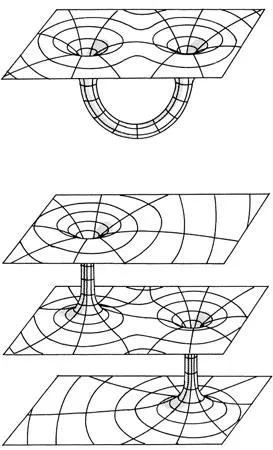
Columbus the flatworm. Flatworms living on an apple think their world is flat. One, Columbus, insists it is curved in an invisible third dimension and coins "up" and "down". He travels off over the horizon and returns to his start, proving the curvature. He then finds a shortcut: burrow through the apple. These wormholes show that the shortest route between two points is not always a straight line. Some tunnels deliver him into the past, because they join regions where time runs at different rates; some worms think they can be made into time machines. Finally he learns his apple is one of hundreds in an orchard, and that rare journeys between apples may be possible.
Punchline: each discovery maps onto a research programme in the book: curved space, wormholes, time machines, parallel universes.
Kaku claims our universe's curvature in an unseen dimension "has been experimentally verified" through the bending of starlight. The existence of wormholes, by contrast, is controversial.
Simply versus multiply connected space
- Simply connected: any lasso can be shrunk to a point. Our everyday assumption: opening the window shows the front yard, not the pyramids of Egypt or a lunar crater.
- Multiply connected: a lasso around a wormhole mouth cannot be shrunk; it goes into the hole. Regions of space and time are spliced together. Riemann studied such spaces first; Alice's looking glass and the White Rabbit's hole are literary wormholes.
- Paper model: cut two holes in a sheet and join them with a tube. Ordinary geometry holds everywhere except inside the tube.
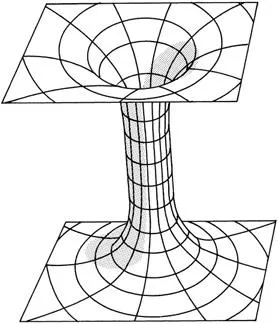
"Experimentally verified" overstates what starlight bending shows. Light deflection confirms that four-dimensional space-time is curved, as general relativity says. Curvature is an intrinsic property (Riemann's whole point, as Chapter 2 explains) and needs no extra dimension to curve into. It gives no evidence at all for a higher spatial dimension.
Time travel and baby universes
Causality (every effect preceded by its cause) is foundational, yet in wormhole physics "acausal" effects keep appearing, and strong assumptions are needed to forbid them.
- Thorne's claim (1988). Kip Thorne of Caltech and collaborators argued in Physical Review Letters that time travel is possible under certain conditions, because a wormhole can join two regions in different time periods and transit is nearly instantaneous. Unlike H. G. Wells's dial-twisting machine, it would need energy beyond technology for centuries.
- Guth's baby universe. Alan Guth (MIT) suggested that concentrating intense heat in a chamber might open a wormhole as an umbilical cord to a new, small universe.
Mystics, artists and the fourth dimension
The idea of nearby, unseen worlds is old; what was missing was any way to express or test it mathematically.
- Henry More: seventeenth-century British philosopher whose Enchiridion Metaphysicum (1671) placed ghosts and spirits in the fourth dimension.
- Arthur Willink: nineteenth-century theologian who put God in infinite-dimensional space, beyond the three planes of earth, heaven and hell.
- Charles Dodgson (Lewis Carroll): Oxford mathematician whose Wonderland and looking glass smuggled strange geometry into children's literature, probably inspired by Riemann.
- Linda Dalrymple Henderson: art historian who documents the fourth dimension's impact on modern art, comparable only to relativity after 1919.
The fourth-dimension craze peaked between 1870 and 1920. It shows up in Oscar Wilde, Dostoyevsky, Proust, H. G. Wells and Joseph Conrad; in music by Scriabin, Varèse and Antheil; in the thought of William James, Gertrude Stein and Lenin; and in Picasso and Duchamp, feeding Cubism and Expressionism. Science fiction uses hyperspace as the shortcut between stars (Star Wars, Star Trek: Deep Space Nine); Asimov's Foundation empire rests on hyperspace travel; mystery writers invoked it for the Bermuda Triangle and the loss of Flight 19, the torpedo bombers that vanished in December 1945 (Kaku's "30 years ago" is out by nearly two decades).
The mystics lacked two things that modern physics supplies. The physical principle: hyperspace simplifies the laws of nature and unifies the forces geometrically. The mathematical principle: field theory, the universal language of physics.
Field theory: the language of physics
Michael Faraday, a blacksmith's son and self-taught experimenter, imagined lines of force spreading from magnets and charges like vines and measured their strength and direction at every point. The totality of these numbers he called a field, by analogy with a farmer's field. A field is a set of numbers defined at every point of space that fully describes a force there: three numbers for the magnetic field, three for the electric, six in all for electromagnetism.
Faraday and Gladstone. Asked by a visitor what his work was good for, Faraday replied: "What is the use of a child? It grows to be a man." When William Gladstone, then Chancellor of the Exchequer, asked sarcastically what use the machines could be to England, Faraday answered that one day "you will tax them". A large share of English wealth now rests on his discoveries.
Fields need field equations, and the past century of theoretical physics is a search for them.
Why do the Yang-Mills equations of the subatomic world look so different from Einstein's? Kaku's answer: the great minds who failed were "trapped by common sense", confined to four dimensions. In hyperspace, Maxwell's, Einstein's and the Yang-Mills fields fit inside one hyperspace field like jigsaw pieces, and field theory also lets us compute the energies at which space and time would form wormholes.
The secret of creation
No safaris to the Mesozoic: Thorne, Guth and Freund agree the energies are out of reach.
- A quadrillion (10¹⁵) times the energy of our largest atom smasher is needed to probe the tenth dimension (Freund).
- 1,000 trillion trillion degrees (10²⁷ degrees) is Guth's temperature for creating a baby universe, far above any stellar core.
- Doubling every 10–20 years: the rate of growth of scientific knowledge since World War II.
The only time such energy was freely available was the instant of Creation. So hyperspace theory is really a theory of Creation, and it suggests a specific origin story.
In this picture the expansion of the universe is "a rather minor aftershock" of the cracking of ten-dimensional space-time, and our universe still has a dwarf twin: a six-dimensional ball too small to observe.
Evading the death of the universe
Kaku's cosmology of doom in 1993 is the Big Crunch: gravity reverses the expansion, stars and galaxies fall together, temperatures soar and all life is crushed. Charles Darwin and Bertrand Russell wrote mournfully about this futility. The late Gerald Feinberg (Columbia) proposed the one hope: an intelligence that has mastered higher dimensions over billions of years could, in the final moments, when the sister universe reopens, tunnel into hyperspace and watch from safety as the crunch ignites a new Big Bang.
The Big Crunch has lost its place as the default ending. Supernova surveys in 1998 found the expansion accelerating; Planck put the universe at 13.8 billion years and spatially flat, with about 68% dark energy. That points to a cold, dilute big freeze, which makes Feinberg's "tunnel out at the crunch" scenario moot as stated. The DESI survey's 2024–25 data releases prefer dark energy that weakens with time, at roughly 2.8–4.2 sigma depending on the supernova sample; if confirmed, a distant recollapse is possible again, so the question has reopened.
Masters of hyperspace
Two questions close the chapter. How long until a civilisation growing exponentially in knowledge can harness hyperspace? Serious scientists have tried to quantify such long-run progress (Chapter 13). Kaku ends with a falsifiability pledge, "we are physicists, not philosophers": because hyperspace theory is a genuine field theory, it must eventually yield numbers, and if they disagree with data it must be discarded however elegant. If it succeeds, the revolution would rank with Copernicus and Newton. The story begins with the mathematician who first said nature's home is higher-dimensional geometry: Georg Bernhard Riemann.
Thirty years on, Kaku's falsifiability pledge is the sharpest test of the book. Superstring theory has not produced a unique prediction that experiment could confirm or refute: its solutions number something like 10⁵⁰⁰, and none has been singled out as ours. Critics (Smolin, Woit, Hossenfelder) argue this is exactly the outcome Kaku says would require discarding a theory; defenders point to its mathematical yield and to holography. Read the confident "will produce numerical answers" as a 1993 hope, not a result.
Mathematicians and Mystics
On 10 June 1854 Georg Bernhard Riemann dethroned Euclid with a lecture that founded the geometry of curved spaces in any number of dimensions and recast force as the effect of crumpled geometry. Riemann's metric tensor, a grid of numbers at every point describing how space bends, is the mathematical seed of everything from general relativity to ten-dimensional strings. But without a physical principle to guide it, the fourth dimension drifted into séance rooms, as the Slade trial and Zöllner's experiments show.
A lecture that toppled Euclid
Riemann's Göttingen lecture, "On the Hypotheses Which Lie at the Foundation of Geometry", Kaku ranks among the most important public lectures in the history of mathematics. Its consequences unfolded on a clear schedule:
The kernel, in Kaku's reading, is the book's theme: physical laws simplify in higher-dimensional space.
Brilliance amid poverty
Riemann was the least likely revolutionary: pathologically shy, prone to nervous breakdowns, poor and tubercular.
- 1826 Born near Hanover, second of six children of a poor Lutheran pastor who had fought in the Napoleonic Wars; most siblings died young of undernourishment, and his mother died early.
- School Aims for theology to earn a pastor's salary for the family; tries to prove Genesis mathematically. Given Legendre's Theory of Numbers (859 pages) to keep him busy, he masters it in 6 days and answers the principal's obscure questions months later.
- Age 19 Enters Göttingen, meets Carl Friedrich Gauss, the "Prince of Mathematicians" (with Archimedes and Newton, one of the three greatest).
- 1848 Revolution interrupts his studies; in the student corps he spends 16 hours guarding the frightened king in Berlin.
- 1854 Breakdown while preparing the lecture; delivers it to acclaim.
- 1857 Another breakdown.
- 1858 Announces a unified theory of light and electricity: "I am fully convinced that my theory is the correct one."
- 1859 Finally gets the coveted Göttingen chair once held by Gauss.
- 1866 Dies of consumption aged 39, his geometric theory of gravity and electromagnetism unfinished.
Minor corrections. Riemann was born in Breselenz, a village in the Kingdom of Hanover. The chair he won in 1859 was Gauss's old chair, but it came to him as Dirichlet's successor (Dirichlet held it from 1855). Gauss's word for the conservatives, "Boeotians", alludes to the ancient Greeks' proverbial jibe at the Boeotians' dullness; Kaku's gloss on the tribe is unfair to them.
Beyond Euclidean geometry
After the Bible, Euclid's Elements was probably the most influential book ever written; cathedrals were built on its principles and, revered for 2,300 years, it hardened into something like a religion. Its weakness was hidden in plain sight: the flat-space theorems (circumference is π × diameter; a triangle's angles sum to 180°) were not provable from logic alone, and on curved surfaces they are simply false. Riemann also found Euclid sterile: mountains, waves, clouds and whirlpools are never perfect circles and triangles.
The case against a fourth dimension, from the ancients to Wallis
- Euclid: a point has no dimension, a line one, a plane two, a solid three, and there it stops.
- Aristotle, On Heaven: "the three are all", the first categorical denial of a fourth spatial dimension.
- Ptolemy, On Distance (c. A.D. 150): the first "proof". Draw three mutually perpendicular lines, as at the corner of a cube; a fourth line perpendicular to all three cannot be drawn, so it is "entirely without measure and without definition".
- John Wallis (1685): a fourth dimension is "a Monster in Nature, less possible than a Chimera or Centaure".
Ptolemy proved only that a three-dimensional brain cannot visualise a fourth dimension. Mathematics is full of objects that cannot be pictured but provably exist. For millennia mathematicians repeated the "simple but fatal mistake" of equating unimaginable with impossible, and Ptolemy ended up on the wrong side of two great ideas: the sun-centred system and the fourth dimension.
Force equals geometry
Gauss set Riemann the lecture topic "foundation of geometry". Gauss himself had privately doubted Euclid for decades and spoken of "bookworms" living on a two-dimensional surface, but never published, fearing the Boeotians. Riemann, terrified of public speaking, was simultaneously tutoring for money and assisting Wilhelm Weber in experiments on electricity. The new facts of the day (a current spins a compass needle; a moving magnet induces a current, Faraday's law, the basis of every generator and transformer) convinced him electricity and magnetism were one force. He broke down in 1854, writing to his father that he had become "so absorbed in my investigation of the unity of all physical laws" that he could not tear himself away.
Bookworms on crumpled paper. Put Gauss's two-dimensional bookworms on a crumpled sheet. Their bodies crumple with it, so they still think their world is flat. But when they try to walk straight, they are shoved left and right at every wrinkle, as if by a mysterious unseen force. Now crumple our three-dimensional world in a fourth dimension: we would walk like drunkards, tugged by "forces".
Punchline: a force has no independent life; it is the apparent effect of distorted geometry. This was the first serious break with Newton's action at a distance in 200 years.
Riemann concluded that electricity, magnetism and gravity are caused by the crumpling of three-dimensional space in an unseen fourth dimension.
The metric tensor: a new Pythagorean theorem
The technical core starts from Pythagoras: for a right triangle, a² + b² = c². For a box, a² + b² + c² = d². For an N-dimensional hypercube, a² + b² + c² + … = z². Writing the formula for a cube we cannot picture is no harder than for one we can.

Riemann then generalised to spaces that may be curved:
| Curvature | Example surface | Triangle angles | Parallels through a point off a line |
|---|---|---|---|
| Zero | Plane | Exactly 180° | Exactly one (never meets) |
| Positive | Sphere | More than 180° | None: "parallel" great circles always meet |
| Negative | Saddle, trumpet | Less than 180° | Infinitely many |
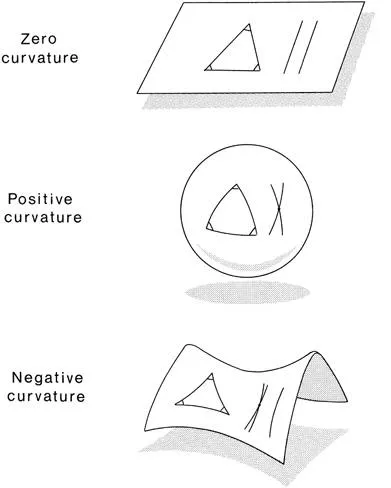
To describe any surface, however complicated, Riemann revived Faraday's field: a set of numbers at each point, now saying how much space bends there. A two-dimensional surface needs 3 numbers per point; a four-dimensional space needs 10. Labelled g₁₁, g₁₂, …, g₄₄, they form a 4 × 4 symmetric array: 16 entries, but g₁₂ = g₂₁ and so on, leaving ten independent components. This is the Riemann metric tensor. Flatten the sheet and the metric reduces to the Pythagorean formula. In N dimensions it is an N × N checkerboard, and Riemann found all such spaces self-consistent: no contradictions lurked in the forbidden dimensions.
| x₁ | x₂ | x₃ | x₄ | |
|---|---|---|---|---|
| x₁ | g₁₁ | g₁₂ | g₁₃ | g₁₄ |
| x₂ | g₂₁ = g₁₂ | g₂₂ | g₂₃ | g₂₄ |
| x₃ | g₃₁ = g₁₃ | g₃₂ = g₂₃ | g₃₃ | g₃₄ |
| x₄ | g₄₁ = g₁₄ | g₄₂ = g₂₄ | g₄₃ = g₃₄ | g₄₄ |
The secret of unification, previewed here: expand Riemann's metric to N dimensions and chop it into rectangular blocks, each block a different force. The forces then slot into one metric like jigsaw pieces. "Enough room" in hyperspace means, concretely, enough room in the metric tensor.
Kaku's shorthand that "the greater the value of the metric tensor, the greater the crumpling" is wrong as stated. Large metric components can describe perfectly flat space in stretched coordinates. Curvature lives in how the metric changes from point to point (its derivatives, packaged in the Riemann curvature tensor). Note also that the count "three numbers for a surface" is the number of independent metric components (n(n+1)/2); the curvature of a surface is a single number per point (Gauss's curvature).
Riemann's cuts: the first wormholes
Riemann was also among the first to discuss multiply connected spaces. Lay two sheets of paper together, cut a short slit in each and glue the sheets along the slits. A bug walking around the cut stays in its world; one walking through it lands on the other sheet where everything is in the wrong place, and can only get home by walking back through. A Riemann cut is a wormhole of zero length. Carroll's looking glass is one, joining England to Wonderland. The cuts survive in every graduate course on electrostatics and conformal mapping, and in The Twilight Zone; Riemann himself never saw them as routes between universes.
Riemann's three anticipations of modern physics
- Higher dimensions simplify the laws: electricity, magnetism and gravity are effects of the crumpling of hyperspace.
- Wormholes: Riemann cuts are the simplest multiply connected spaces.
- Gravity as a field: the metric tensor, describing curvature at every point, is Faraday's field concept applied to gravity.
What he lacked: the field equations saying what makes the sheet crumple and by how much. Those were left to Maxwell and Einstein.
Living in a space warp: Helmholtz and Flatland biology
Riemann broke Euclid's spell, and his metric became the weapon with which young mathematicians defied the Boeotians. Hermann von Helmholtz, the most famous German physicist of his generation, popularised beings on a sphere who would find Euclid's theorems useless, since "geometrical axioms must vary according to the kind of space inhabited". In Popular Lectures on Scientific Subjects (1881) he warned that picturing the fourth dimension is as impossible as colours to one born blind.
How does a Flatlander eat? Its mouth must face sideways; draw its gut and the tube runs straight through its body, splitting it in two. Any tube joining two openings severs a two-dimensional creature. Either Flatlanders eat as we do and fall apart, or their biology obeys different rules.
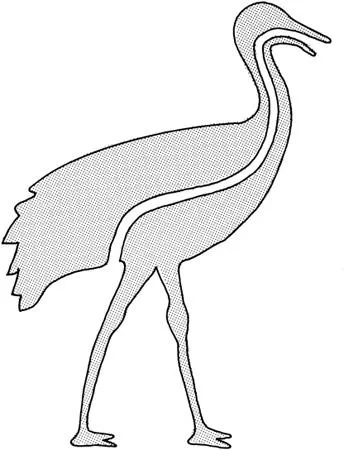
Kaku's lesson: Riemann's mathematics outran nineteenth-century physics, which offered no principle to guide it; "we would have to wait another century for the physicists to catch up".
To be a god
A being with access to a fourth spatial dimension would seem omnipotent to us, just as we would to Flatlanders.
The god-like powers of a four-dimensional being
- Walk through walls, mountains and locked car doors, or reach into a refrigerator without opening it.
- Vanish and reappear at will: no commuting, no traffic.
- X-ray vision: see inside closed rooms and under rubble.
- Reach inside closed objects: take segments from an unpeeled orange; perform surgery without cutting skin.
- Perfect crime: empty a sealed vault and stroll out as bullets pass through; no prison could hold such a criminal.
- Mirror-reverse a body: flip it in the higher dimension so the heart ends up on the right.
The mechanism is shown in Flatland. A Flatland jail is a circle drawn round the prisoner; we spring him by lifting him "up", a word the jailer cannot understand, and setting him down elsewhere. We see all his internal organs at once, as on a microscope slide, and can operate without incision, or peel him off, flip him and put him back with heart and organs reversed. What looks like magic is only a better vantage point.
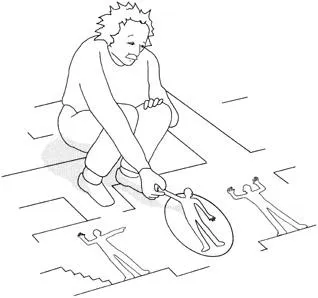
The caution recurs: such manipulation of space-time would need energy a quadrillion times that of our biggest machines, and may be open only to extraterrestrial civilisations far beyond ours. For the Victorian public, though, the obvious beings that walk through walls and obey other laws were ghosts.
Ghosts from the fourth dimension: the Slade affair
The trial of Henry Slade. The American medium Henry Slade held séances with prominent Londoners and was arrested for "using subtle crafts and devices, by palmistry and otherwise" to deceive clients. What made it a sensation was that eminent physicists came to his defence, claiming his feats showed he could summon spirits living in the fourth dimension. The ringleader was Johann Zöllner, professor of physics and astronomy at Leipzig. Slade was convicted of fraud but offered to prove himself before scientists; Zöllner ran controlled tests in 1877 and published them in the Quarterly Journal of Science and in Transcendental Physics. Slade reportedly amazed observers but also flunked some controlled tests.
Zöllner's tests of Slade (each trivial in four dimensions, impossible in three)
- Interlink two unbroken wooden rings without breaking them.
- Convert a right-handed sea-snail shell into a left-handed one, and vice versa.
- Tie a knot in a closed loop of dried gut rope without cutting it.
- Untie a sealed right-handed knot (ends sealed in wax with Zöllner's seal) and retie it left-handed without breaking the seal.
- Remove the contents of a sealed bottle without breaking it.
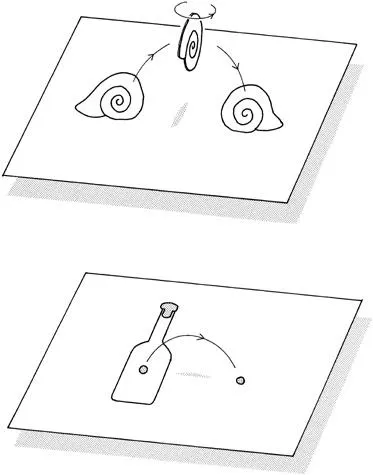
Zöllner was right about the geometry even if wrong about Slade. In four dimensions there is "more room": rings can be lifted out, passed through each other and returned, and knots in a closed loop can always be undone without cutting. Three is the only dimension in which knots stay knotted. Likewise a rigid left-handed object can be turned right-handed only by rotating it through a fourth dimension, as August Möbius pointed out in 1827; no surgeon can move a human heart to the right side.
Why a fourth dimension unties knots. A knot holds because one strand cannot pass through another. In four dimensions, lift a small piece of one strand slightly "up" in the extra direction; the other strand passes underneath without ever touching it, and the piece drops back. Every crossing can be switched this way, and any knot falls open. It is the same trick as stepping over a line drawn on the floor, which a Flatlander cannot do.
The cast and the claim need tightening. Zöllner's circle that actually backed Slade was Weber, William Crookes (whose "Crookes tube" was an ancestor of, not the same as, the television cathode-ray tube, which was Braun's 1897 design) and Gustav Fechner. Lord Rayleigh (Nobel 1904) and J. J. Thomson (Nobel 1906, not "Thompson") were members of the Society for Psychical Research but were not Slade's defenders, so "many went on to win the Nobel Prize" inflates the story. Slade's London prosecution was in 1876; Zöllner's Leipzig sittings came in 1877. Finally, "knots stay knotted only in three dimensions" holds for one-dimensional loops; two-dimensional spheres can knot in four dimensions.
Polarising the scientists
Zöllner's supporters were seasoned observers; his critics answered that scientists are the worst judges of a magician. They are trained to trust their senses, which is precisely what a conjurer deceives: you watch the right hand while the left does the trick, and only another magician can catch one. A savage review in Bedrock said of Sir W. F. Barrett and Sir Oliver Lodge's telepathy work that, short of idiocy, "the will to believe" had made them accept evidence they would have rejected with training in experimental psychology. The same debate replayed a century later when Uri Geller convinced two scientists at the Stanford Research Institute that he bent keys by mind alone. Populus vult decipi, ergo decipiatur: people want to be deceived, so let them be.
The chapter's moral: after Riemann's death scientists lost sight of his physical goal, simplifying nature's laws. Without a physical motivation or guiding picture, pure mathematics drifts into speculation. The decades were not wasted, though: mystics such as Charles Hinton invented ways to "see" the fourth dimension that physics would later reuse.
The Slade affair is a template for evaluating any extraordinary demonstration, from séances to AI product demos: experts in a domain are not experts in misdirection; insist on controls designed by someone who knows how the trick could be faked, and treat "the will to believe" as a risk factor in the evaluators, not only the presenter.
The Man Who "Saw" the Fourth Dimension
Between 1884 and 1910 the fourth dimension became a household word: Flatland satirised Victorian prejudice, H. G. Wells turned it into time and class war, Cubists painted from its vantage point, Lenin fought it in a philosophical tome, and Charles Hinton taught the public to "see" it. Hinton's three methods (unravelling, shadows and cross sections) remain how physicists picture higher dimensions, and his guess that the extra dimension is too small to notice is essentially today's answer. Yet the era produced no physics, because it forgot Riemann's two essentials: simplification of natural law and field theory.
Flatland: satire in two dimensions
In 1884, after a decade of acrimony over Slade, the clergyman Edwin Abbott Abbott, headmaster of the City of London School, published Flatland: A Romance of Many Dimensions, "by A Square". It went through nine reprintings by 1915. Its novelty was to use the fourth-dimension controversy for social satire: Gauss's bookworms became Flatlanders; the feared Boeotians became High Priests who persecute anyone mentioning a third dimension "with the vigor and impartiality of the Spanish Inquisition".
Flatland's social geometry
- Women are mere lines, the lowest rank.
- Gentlemen and nobility are polygons; the more sides, the higher the rank.
- High Priests are circles, the limit of infinitely many sides.
- Rule: any mention of a third dimension is punished severely.
The hero, the smug and conservative Mr. Square, is visited by a Sphere from Spaceland, which appears to him as a circle that grows and shrinks. Words fail to convince him, so the Sphere peels him off Flatland. Floating in space, Mr. Square sees only cross sections: objects change shape, appear and vanish. Back home, the High Priests treat him as a seditious maniac, and the book ends with him in solitary confinement for life.
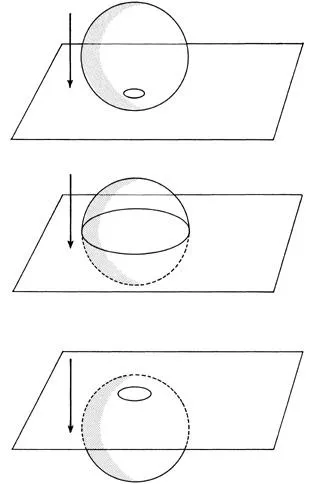
A dinner party in the fourth dimension. Float Mr. Square past a standing human. He sees two leather circles (shoes) that turn to cloth (trousers), merge into one circle (waist), split into three (shirt and arms), shrink to a circle of flesh (neck and head), become hair and vanish. A human is a nightmare of changing circles. Throw us into the fourth dimension and we would see blobs appear from nowhere, change colour, size and composition, then vanish. At a four-dimensional dinner party we could only tell guests apart by their characteristic sequences of changing blobs.
Punchline: Abbott's account is mathematically correct, and far stranger than the swirling-light clichés of film hyperspace.
Wilde, Wells and class struggle in the fourth dimension
- Oscar Wilde, "The Canterville Ghost" (1891). A spoof of credulous "Psychical Society" ghost hunters (a dig at the Society for Psychical Research); the harassed ghost escapes the American tenants by "hastily adopting the Fourth Dimension of Space" and vanishing through the wainscoting.
- H. G. Wells, The Time Machine. Wells popularised the idea that the fourth dimension could be time: any real body has "Length, Breadth, Thickness, and Duration", and the distinction we draw is an artefact of consciousness moving one way along it.
- The class war of 802,701. The traveller finds England not a positivist utopia but a class struggle gone wrong: workers forced underground have mutated into brutish Morlocks, the debauched rich into useless, elflike Eloi. Wells, a Fabian socialist, adds a twist to Marx: the workers do not break the chains of the rich, they eat them.
- "The Plattner Story." A chemistry teacher blown into another universe returns mirror-reversed: heart on the right, left-handed. He refuses post-mortem dissection, postponing the proof "perhaps forever".
- The Invisible Man. Invisibility via "a geometrical expression involving four dimensions", the analogue of a Flatlander vanishing when lifted out.
- "The Remarkable Case of Davidson's Eyes." A "kink in space" lets Davidson see a South Sea island from England: light takes a hyperspace shortcut, a Riemann wormhole as plot device.
- The Wonderful Visit. An angel falls from a heaven located in a parallel dimension into an English village.
- George MacDonald, Lilith (1895). A friend of Lewis Carroll; heaven in the fourth dimension, reached through a dimensional window made of mirror reflections.
- Conrad and Ford, The Inheritors (1901). Cruel supermen from the fourth dimension take over the world.
Two ways to reverse a Flatlander. Lift him out, flip him and put him back; or let him live on a Möbius strip (a strip given a 180° twist and glued). Walking once round the strip returns him mirror-reversed, with no lifting at all. The strip has only one side, and cut down the middle it stays in one piece: "For it stays in one piece when divided."
Punchline: handedness can be reversed either by a higher dimension or by a twisted, non-orientable topology; Wells knew both.
Small corrections: the author is Abbott (Kaku alternates with "Abbot"), and Mr. Square's visitor is simply "A Sphere". The Time Machine appeared in book form in 1895 (serialised 1894–95). Kaku spells George MacDonald as "McDonald".
The fourth dimension as art
Kaku treats 1890–1910 as the Golden Years of the Fourth Dimension, when Gauss and Riemann reached the avant-garde and Theosophy absorbed higher dimensions. Scientists winced at tabloid Riemann, but the metaphor enriched culture. Linda Dalrymple Henderson (The Fourth Dimension and Non-Euclidean Geometry in Modern Art) argues it shaped Cubism and Expressionism: "it was among the Cubists that the first and most coherent art theory based on the new geometries was developed". To the avant-garde the fourth dimension was a weapon against positivism and vulgar materialism: more scientific than the scientists, yet mysterious.
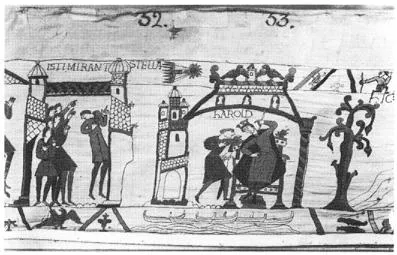
- Medieval flatness. Religious art lacked perspective because an omnipotent God sees all parts equally. In the eleventh-century Bayeux embroidery, Harold II's soldiers point at a comet in April 1066 (later named Halley's comet), an omen before Hastings; their bodies look pressed flat under glass.
- Renaissance perspective. Man-centred art took the view of one human eye: in Leonardo's Last Supper every line converges to one vanishing point; Michelangelo's figures leap out of the plane. Renaissance art "discovered the third dimension".
- Cubist revolt against perspective. Picasso shows faces from several angles at once, as a four-dimensional being would see them (Portrait of Dora Maar). Duchamp's Nude Descending a Staircase treats time as the fourth dimension, superimposing successive moments.
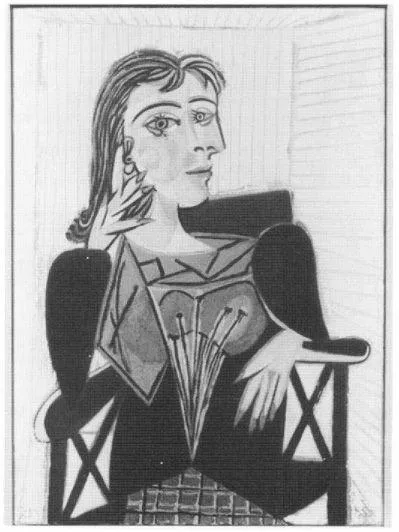
Picasso on the train. A stranger complained that Picasso distorted people. Picasso asked for a snapshot of the man's family, studied it and asked: "Oh, is your wife really that small and flat?" Every picture, however "realistic", depends on the observer's perspective.
Meyer Schapiro (1937): as non-Euclidean geometry made mathematics independent of existence, abstract painting "cut at the roots" of artistic imitation. Henderson: the fourth dimension is among the most important themes unifying much of modern art.
The Cubism link is real but looser than Kaku implies. Henderson documents that the fourth dimension reached Picasso's circle through the actuary Maurice Princet and through Theosophical writers, and that Duchamp studied it seriously. But Picasso himself denied any mathematical programme, and Portrait of Dora Maar (1937) dates from long after Cubism's peak (1907–1914), so it illustrates simultaneity rather than proving four-dimensional intent.
Bolsheviks and the fourth dimension
The mystic P. D. Ouspensky brought the fourth dimension to Russian intellectuals, and it ended up in a fight that shaped Soviet science for 70 years.
- 1896 Henri Becquerel discovers radioactivity; matter, eternal since the Greeks, seems to disintegrate, and energy appears from nowhere.
- 1905 The Czar crushes the revolution; inside the Bolsheviks a faction Kaku calls the Otzovists, or "God-builders", argues peasants must be prepared for socialism through religion and spiritualism, citing Ernst Mach on the fourth dimension and radioactivity.
- 1905 Einstein's E = mc² supplies the conservation principle that unites matter and energy, unknown to the disputants.
- 1908 In exile in Geneva, Lenin writes Materialism and Empirio-Criticism.
- Before 1917 Lenin finally roots out the faction, shortly before the October Revolution.
| Mach | Lenin |
|---|---|
| Rejects materialism: space and time are products of sensation | Defends dialectical materialism against mysticism |
| Writes on n-dimensional space and radioactivity; hopes "nobody will defend ghost-stories" with his work | Disappearing matter proves not spirits but a new dialectic in which matter and energy are two poles of one unity, needing a new conservation law |
| Treats a fourth dimension as conceivable | Praises Mach for raising "a space of n dimensions as a conceivable space", but insists only three dimensions are experimentally verified: mathematics may explore the possible, but the Czar can be overthrown only in the third dimension |
Three errors here. Ouspensky (born 1878) cannot have influenced Dostoyevsky, whose Brothers Karamazov (1880), with Ivan's musings on non-Euclidean geometry, appeared when Ouspensky was two. The Otzovists ("recallists", who wanted Bolshevik deputies withdrawn from the Duma) and the God-builders (Lunacharsky, Gorky, with Bogdanov's Machism nearby) were overlapping but distinct currents, not one faction. And Marie Curie discovered radium in 1898, not 1896.
Charles Hinton: bigamist, inventor, seer of the fourth dimension
The fourth dimension's messenger to America was Charles Howard Hinton, who worked at the U.S. Patent Office in Washington while Einstein worked at the Swiss one in 1905.
- Background Son of James Hinton, a celebrated ear surgeon turned religious philosopher, advocate of free love and open polygamy and cult leader ("Christ was the Savior of men, but I am the savior of women").
- 1877 Graduates from Oxford; becomes a master at Uppingham School; starts trying to visualise the fourth dimension through cross sections and unravellings.
- 1880s Writes "What is the Fourth Dimension?" for the Dublin University Magazine and Cheltenham Ladies' College Magazine, reprinted in 1884 subtitled "Ghosts Explained".
- 1885–86 Tried for bigamy: married to a Boole, he had also fathered twins with Maude Weldon and then married her too. Fired from Uppingham, jailed 3 days; his wife declines to press charges and they leave for the United States.
- Princeton Instructor in mathematics; invents a baseball-pitching machine firing balls at 70 mph, ancestor of every modern pitching machine. Later fired.
- U.S. Naval Observatory Hired through a director who championed the fourth dimension.
- 1902 Joins the Patent Office.
Kaku has Hinton's wife wrong. Hinton married Mary Ellen Boole, the eldest daughter of George Boole and Mary Everest Boole, not the widow herself. The bigamy conviction came at the Old Bailey in 1886, and the Hintons spent years in Japan before Princeton (1893). Hinton died in 1907, which matters for the 1909 contest below.
Hinton's cubes and the tesseract
Hinton designed coloured cubes that, with enough practice, let devotees assemble a hypercube in the mind. He coined tesseract for an unravelled hypercube. The cubes were advertised in women's magazines and used in séances; society meditators claimed glimpses of the dead and "the highest state of nirvana".
Hinton's three ways to see the fourth dimension (still the professionals' toolkit)
- Unravelling. A cube unfolds into a cross of six squares; a Flatlander cannot fold it back because the joints are rigid in two dimensions, and if we fold it he sees all squares but one vanish. A hypercube unfolds into a cross of eight cubes, the tesseract; a four-dimensional being could fold it up, and we would see the cubes disappear one by one.
- Shadows. A cube's shadow on a plane is a square within a square; a hypercube's shadow in three dimensions is a cube within a cube. Rotate the object and the shadows move in ways that look impossible.
- Cross sections. Mr. Square sees an apple as a red circle that appears, grows, shrinks, turns into a small brown circle (the stem) and vanishes. A four-dimensional object passing through our space would appear as a solid that materialises, changes shape and colour, and vanishes.
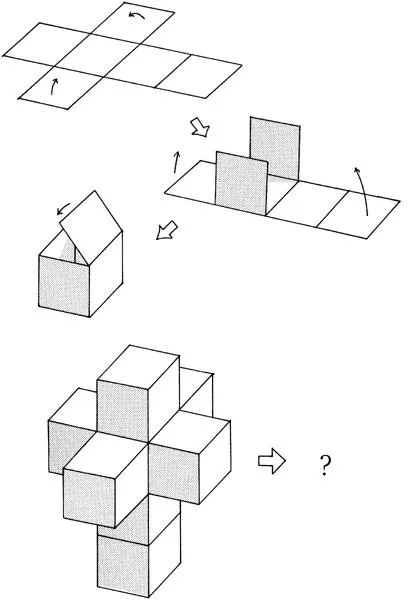
The dimensional ladder behind Hinton's analogies can be counted exactly: each new dimension doubles the vertices and drags every element through the new direction.
| Object | Dimension | Vertices | Edges | Square faces | Cubic cells |
|---|---|---|---|---|---|
| Point | 0 | 1 | 0 | 0 | 0 |
| Segment | 1 | 2 | 1 | 0 | 0 |
| Square | 2 | 4 | 4 | 1 | 0 |
| Cube | 3 | 8 | 12 | 6 | 1 |
| Hypercube | 4 | 16 | 32 | 24 | 8 |
Build a hypercube by dragging. Drag a point to get a segment; drag a segment sideways to sweep a square; drag the square up to sweep a cube. Now drag a cube a short distance ana, in a direction perpendicular to all three of ours. The start and end cubes plus the six cubes swept by its six faces give 8 cells; its 8 corners double to 16; its 12 edges double to 24, plus 8 new edges traced by the moving corners, for 32. You have built a tesseract by bookkeeping alone, no visualisation required: exactly Ptolemy's mistake reversed.
Hinton's influence reached Salvador Dalí, whose painting at the Metropolitan Museum of Art shows Christ crucified on an unfolded hypercube.
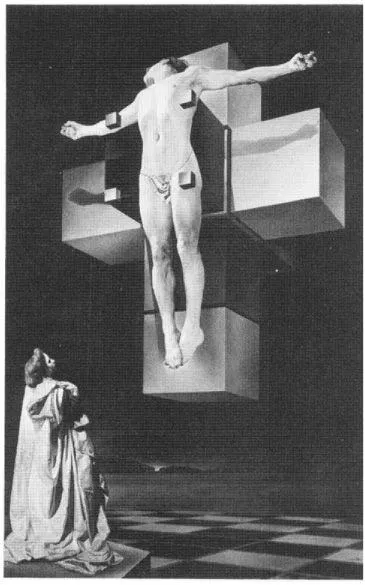
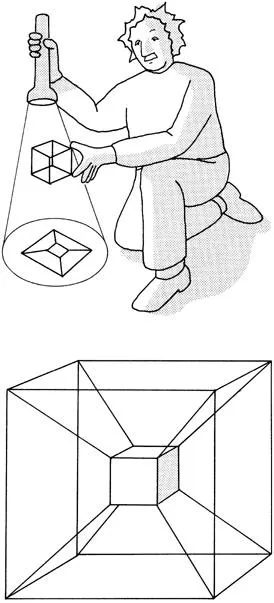
Dalí's painting is Corpus Hypercubus (1954), not "Christus Hypercubus", and the painter's name is Salvador, not "Salvadore".
The contest on the fourth dimension
Hinton had answers for everything. Directions in the fourth dimension he named ana and kata, counterparts of up and down. Asked where it is, he gave an argument that anticipates modern physics.
Hinton's smoke test. Release cigarette smoke in a closed room. By thermodynamics the molecules diffuse into every accessible region, and observation shows no hidden pockets of ordinary space that the smoke misses. So if a fourth spatial dimension exists, it must be smaller than the smoke particles, even smaller than an atom.
Punchline: everything in our world extends a tiny way into the fourth dimension, too little to detect. That is precisely the compactified extra dimension of Kaluza-Klein and string theory. Hinton also held, following Riemann, that light is a vibration of the unseen fourth dimension.
Hinton single-handedly sparked American interest: Harper's Weekly, McClure's, Current Literature, Popular Science Monthly and Science all ran fourth-dimension pieces.
The 1909 Scientific American contest. A $500 prize for "the best popular explanation of the Fourth Dimension" in at most 2,500 words, so that "the ordinary lay reader could understand it". Entries came from Turkey, Austria, Holland, India, Australia, France and Germany. Many essays credited Hinton and lamented that Zöllner and Slade had tarnished the subject with spiritualism. Not one mentioned Einstein, and not one treated time as the fourth dimension: in 1909 it was still unclear that Einstein had cracked space and time. The contest could not settle whether higher dimensions exist, only what higher-dimensional objects might look like.
Monsters and crooked houses
Two science-fiction stories dramatise the two directions of contact.
Nelson Bond, "The Monster from Nowhere": a higher being visits us. Adventurer Burch Patterson leads a zoo-funded expedition into Peru's Maratan Plateau and vanishes; two years later he returns alone. The expedition met black blobs that hovered, changed shape and size, vanished and reappeared, killed most of the men and lifted others screaming into thin air. Patterson, remembering Flatland, realised the blobs were limbs of a higher-dimensional beast poking through our space, as fingers through Flatland look like pulsating rings of flesh. A net would fail (the creature just withdraws its "finger"), so he drove a spike through its "foot", impaling it in our universe, and shipped it to New Jersey. At the unveiling a reporter's flash enraged it; it tore free, slaughtered the audience and dragged Patterson into the fourth dimension. A survivor burned the evidence.
Robert Heinlein, "...And He Built a Crooked House...": we visit a higher space. Architect Quintus Teal builds a Los Angeles house shaped as an unfolded tesseract, eight cubes in a cross, and sells it to the Baileys. An earthquake folds it up in the fourth dimension: from outside only one cube remains, yet the other rooms are visible through the windows. Stairs up lead back to the ground floor; the front door opens into another room; every window faces another room. Four Venetian blinds open onto the top of the Empire State Building, an upside-down ocean, absolute Nothing, and a desert, probably Mars. A second quake; they leap out of a window and land in Joshua Tree National Monument. The house is gone, drifting somewhere in four dimensions.
The useless fourth dimension
Why did 1860–1905 produce no breakthrough? Two missing ingredients:
- No simplification principle. Nobody used hyperspace to simplify natural law; Riemann's idea that force is crumpled geometry was forgotten.
- No field theory. Nobody used Faraday's field or Riemann's metric tensor to find the field equations of hyperspace, so the mathematics became a province of pure mathematics and could predict nothing.
By 1900 the cynics could say, fairly, that there was neither experimental evidence nor physical motivation, only ghost stories. The change came from the fourth dimension of time, through an obscure physicist named Albert Einstein, and it would yield both the atomic bomb and a theory of Creation.
The contest has a sad footnote Kaku omits: Hinton died suddenly in 1907, two years before the competition his work inspired. The winning essay was by Graham Denby Fitch, an army officer.
The Secret of Light: Vibrations in the Fifth Dimension
Einstein applied the hyperspace principle twice: making time the fourth dimension unified space with time and matter with energy (E = mc²), and borrowing Riemann's metric as the field of gravity gave general relativity, where matter-energy curves space-time. His third attempt, a unified field theory, failed because he abandoned higher dimensions. In 1919 Theodor Kaluza showed that Einstein's equations written in five dimensions contain Maxwell's theory of light for free: light is a ripple of a fifth dimension curled into a circle too small to see. Quantum mechanics then buried the idea for half a century.
The failure who asked children's questions
Kaku opens with the legend of Einstein's early failures, set out to dramatise the patent-office breakthrough.
- Slow and disruptive. His mother worried he was slow to talk; a teacher asked him to leave the class.
- Exams and rejections. He left school without a diploma, failed the college entrance exam once, was rejected by the Swiss army for flat feet, and after graduating could not get an academic post, tutoring for about 3 francs an hour (he told Maurice Solovine that playing the violin in public would be easier).
- The patent office. Through a friend's influence he became a clerk at the Swiss patent office in Bern, supporting a young wife and baby, working on physics in between applications. "By the mere existence of his stomach, everyone is condemned to participate in that chase."
The "series of failures" is partly myth. Einstein excelled at mathematics and physics; he sat the ETH entrance exam at 16, two years under age, passed the science sections and failed the general ones, then completed school at Aarau and was admitted. The academic job hunt after 1900 genuinely failed, and Marcel Grossmann's father secured him the patent-office post in 1902.
Jacob Bronowski (The Ascent of Man) located the genius: Newton and Einstein "ask transparent, innocent questions which turn out to have catastrophic answers".
Chasing a light beam: special relativity
At 16 Einstein asked what a light beam would look like if you caught up with it: a frozen, stationary wave? Overtaking a train in a car, you see the passengers at rest. But Maxwell's equations allow no frozen electromagnetic wave, and experience shows none. Light is a ghost ship that can never be caught. In 1905 he made the principle a postulate: the speed of light is the same in all uniformly moving frames.
The 100-mph light beam. Pretend light moves at 100 mph. A pedestrian clocks your car at 99 mph chasing the beam; common sense says you see it pull ahead at 1 mph. Relativity says you see it pull ahead at 100 mph, as if you were parked. Floor it to 99.99999 mph: still 100 mph ahead. Two conclusions follow: you can approach but never exceed 100 mph, and everyone measures the beam at the same speed.
Punchline: the only escape is that the pedestrian sees your clocks running slow and your car squashed along its motion, exactly enough that you measure the same speed of light. You notice nothing, because your brain slows and your body flattens too: "slow-witted pancakes".
Kaku's subway fantasy makes the scale vivid: if light moved at 30 mph, an arriving train would be a slab of metal a foot thick, its passengers paper-thin statues, expanding to fill the platform as it stopped, while the riders noticed nothing.
Time as the fourth dimension
The essence of special relativity, Kaku says, is rarely stated: time is the fourth dimension, and laws simplify in higher dimensions. Rotating an object turns length into width; if time is a dimension, there are four-dimensional "rotations" that turn space into time, and these are exactly the relativistic distortions. Space and time become one quantity, space-time. Newton's universal clock, beating at the same rate on Earth, Mars or a distant star, is gone: how fast a clock ticks depends on how fast it moves, as atomic clocks flown in orbit confirm.
Kaku notes that Zöllner and Hinton bet the next dimension would be spatial, and H. G. Wells bet on time. Wells won; the spatial fourth dimension had to wait decades.
The twentieth high-school reunion. Classmates arrive grey at the temples and thicker at the waist, all assuming time beat uniformly for everyone. Now one walks in looking exactly as on graduation day. Panic. He had taken a near-light-speed rocket: twenty years passed on Earth, a few minutes for him.
Punchline: our shock comes from the hidden assumption of a universal clock, the assumption relativity removes.
Maxwell's equations collapse. Students labour over eight opaque equations for electricity and magnetism (Kaku still checks the signs). Treat time as the fourth dimension and they collapse into one relativistic equation, ∂ₘFᵐⁿ = Jⁿ (with a companion identity), symmetric under rotating space into time like a snowflake under rotation. That single line governs dynamos, radar, radio, TV and lasers: Kaku's first lesson in beauty as symmetry.
Matter as condensed energy
If rulers shrink and clocks slow, everything measured with them must be recalibrated, including energy. Einstein found that a car's mass increases as it approaches light speed, with the extra mass coming from energy. The two nineteenth-century conservation laws (mass and energy separately) merge into one: the sum of mass and energy is conserved. On this point, Kaku says, the God-builders were wrong and Lenin was right: matter vanishes only by releasing energy.
At 26, Einstein derived E = mc². Since c² is huge, a little matter holds more than a million times the energy of a chemical explosion: matter is condensed energy. Its most direct legacy is the hydrogen bomb.
| Hinton, the mathematician | Einstein, the physicist |
|---|---|
| Spent his life trying to visualise a fourth spatial dimension | Took the fourth dimension to be time |
| No interest in a physical interpretation | Guided by the conviction that higher dimensions have a purpose: to unify |
| Produced cubes, tesseracts, popular essays | Produced space-time, matter-energy, E = mc² |
Modern physics no longer speaks of mass "increasing" with speed. Mass is now reserved for the invariant rest mass; what grows without limit near light speed is energy and momentum (E = γmc²). Kaku's popular "relativistic mass" picture gives the right intuition for why light speed cannot be reached, but it is not how physicists state the theory.
"The happiest thought of my life": the equivalence principle
Special relativity left holes: what links space-time to matter-energy, what of acceleration, what of gravity? Max Planck warned Einstein off: "you will not succeed; and even if you succeed, no one will believe you."
The falling elevator. A child asks what happens if the elevator cable snaps. You and the elevator fall at the same rate, so you float, weightless, as in deep space. In 1907, in his chair at the Bern patent office, Einstein realised: "If a person falls freely he will not feel his own weight." Conversely, an astronaut pressed into his seat by an accelerating rocket (measured in g's) could believe gravity was pulling him.
Punchline: the equivalence principle: the laws of nature in an accelerating frame are the same as in a gravitational field.
Two applications:
- The helium balloon. Holding a helium balloon in a car that swerves left, you lurch right. Which way does the balloon go? Replace the swerve with gravity pulling to the right; the balloon floats "up", against gravity, so it moves left, into the turn, against common sense.
- Light bends. A light beam crossing an accelerating rocket strikes lower on the far wall, because the floor rises during the crossing. By equivalence, gravity bends light. Since light follows the least-time path (Fermat's principle, which also explains refraction in glass), a bent light path means the shortest route between two points is curved: space itself is curved.
Space warps: force as geometry, again
Einstein independently rediscovered Riemann's programme.
- Merry-go-round. Walking across a spinning platform you feel a "force". The rim moves faster than the centre, so by special relativity it contracts; a disc with a shrunken circumference is curved, and light on it no longer runs straight. The force is the curvature.
- Rock on a bedsheet. A rock sinks into a stretched sheet; a marble rolled nearby circles it. A distant observer posits an instantaneous force from the rock; up close, the rock has warped the sheet. The planets orbit because the sun curves space; we stand on Earth because Earth warps the space around us.
This gave a test. Photograph stars at night, then photograph the same field near the sun during a total eclipse; the sun's gravity should shift their apparent positions.
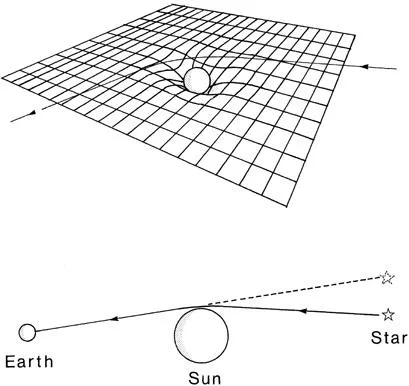
Einstein's guiding idea, which Kaku labels Mach's principle: the presence of matter-energy determines the curvature of space-time around it. This is the physical principle Riemann never found. Kaku's shorthand for the field equation:
Matter-energy → curvature of space-time (the arrow means "determines"). In full: G_μν = (8πG/c⁴) T_μν, curvature on the left, matter-energy on the right. From it flow the motions of stars and galaxies, black holes, the Big Bang and perhaps the universe's fate.
Two corrections. Mach's principle properly says that inertia arises from the distant matter of the universe; it inspired Einstein, but general relativity only partly embodies it, and "matter determines curvature" is simply the content of the field equations. And the first light-bending confirmation came from Eddington and Dyson's May 1919 eclipse expeditions, announced in November 1919, not "in 1921".
The field theory of gravity: Grossmann finds Riemann
Riemann had the mathematics without the physical principle; Einstein had the principle without the mathematics. From 1912 to 1915 he searched desperately ("Grossmann, you must help me or else I'll go crazy!"). His friend Marcel Grossmann found that the problem "had already been solved by Riemann, Ricci, and Levi-Civita". Riemann's metric tensor, ignored by physicists for 60 years, was precisely the Faraday field for gravity: ten numbers at each point. Almost line for line Riemann's 1854 lecture found its home in general relativity, Einstein's proudest work.
The most beautiful theory there ever was.Subrahmanyan Chandrasekhar on general relativity
Victor Weisskopf (MIT) confessed puzzlement at why it works so well: like the peasant who follows the engineer's explanation of the steam engine and still asks, "but where is the horse?"
Living in curved space
Kaku's hockey game makes the point that space can be a player, not a stage. On a flat rink, the ice only marks boundaries. On a rink with hills and valleys, the curvature acts like a force and the puck snakes. On a cylindrical rink, fast players skate upside down and ambush opponents from "above". Once the rink is curved, space decides the motion.
Life in a small hypersphere, hyperdoughnut and hyper-Möbius strip.
- Hypersphere (a sphere in four dimensions; many cosmologists then thought our universe might be one). Looking ahead, you see someone's unkempt back of the head; you reach out and touch a real shoulder; an infinite line of identical people stretches ahead, and a hand grabs your shoulder from behind. Every one is you, light and arm having gone round the universe.
- Hyperdoughnut. Light circles in two independent directions, so you see infinite lines of yourself ahead and to both sides. Stretch out your arms and you grab your own hands; you never see a face, because the copies turn as fast as you do. Fire a gun at the copy ahead and the bullet circles the universe into your own back.
- Hyper-Möbius strip. Ahead is someone with the parting on the wrong side; your right hand on his shoulder makes him place his left on the next shoulder, alternating forever. Walk once round the universe and return mirror-reversed, with rings and organs on the other side. Your friends think you have been reversed; you think they have. Who is right has no answer.
Punchline: topology is physics: the shape of space dictates what you can see and do.
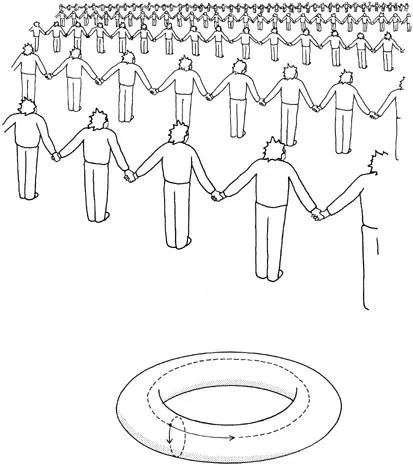
Einstein completed Riemann's programme and went beyond it twice: he found the physical principle (matter-energy curves space-time) and the field equations the metric obeys.
A universe made of marble and wood
By the mid-1920s Einstein was Newton's successor. But his third great attempt, a unified field theory of gravity and light, failed over 30 years; he died with manuscripts on his desk. The trouble lay in his own equation.
Marble versus wood
- Marble = the curvature side of the equation: geometric, clean, like Greek architecture.
- Wood = the matter-energy side: an ugly jumble of particles, atoms, polymers, crystals, rocks, trees, planets.
- The gnarled tree in a marble plaza: architects lay a marble floral pattern around a real tree, so the tree determines the marble (Mach's principle restated). Einstein wanted an all-marble plaza with a marble statue of the tree: matter with a purely geometric origin.
Kaku's diagnosis of Einstein's failure: he had used the higher-dimension principle successfully twice but abandoned it on his third try, chasing matter as kinks and knots in four-dimensional space-time, with too little known about atomic and nuclear matter to guide him.
The birth of Kaluza-Klein theory
In April 1919 Einstein received a letter from an obscure mathematician, Theodor Kaluza of the University of Königsberg (now Kaliningrad). In a few pages Kaluza wrote Einstein's field equations in five dimensions and showed they split into Einstein's four-dimensional gravity plus an extra piece that was exactly Maxwell's theory of light. The theory was "pure marble". In the park analogy, Kaluza saw that you can build a marble tree if you can lift the marble into another dimension.
Light and gravity look like oil and water: one powers every machine on Earth, the other steers planets. Faraday himself had searched for a laboratory link between them (his apparatus survives at the Royal Institution), and failed, though he remained confident in unification. Mathematically, Maxwell needs 4 fields, Einstein 10.
Kaluza's counting: 15 = 10 + 4 + 1
- A 5 × 5 symmetric metric has 15 independent components.
- The upper-left 4 × 4 block (10 components) is Einstein's metric: gravity.
- The fifth row and column (4 components, A₁ to A₄) are Maxwell's field: light.
- The corner component (1) is a scalar field, the leftover.
- Light emerges as geometry: the warping of the fifth dimension, Riemann's crumpled paper made precise.
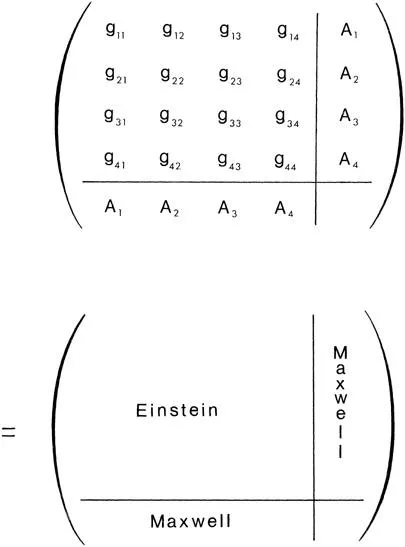
Kaluza claimed "virtually unsurpassed formal unity", too beautiful to be "the mere alluring play of a capricious accident". Einstein, shaken, sat on the paper for two years, then submitted it to the Prussian Academy's Sitzungsberichte as "On the Unity Problem of Physics" (1921). For the first time someone had found a use for a fourth spatial dimension: Einstein's four dimensions were "too small" for two forces.
Kaku's cultural thesis. Historians call Kaluza's idea a bolt from the blue. Kaku argues it was not: thanks to Hinton and Zöllner, higher dimensions were the most popular quasi-scientific idea in the arts, and Hinton's notion that light is a vibration of the fourth dimension was widely known. Riemann pollinated art and letters, which then cross-pollinated physics. Supporting evidence, via Freund: Gunnar Nordström, Einstein's rival, published a five-dimensional theory first (1914), too primitive to contain both theories.
The cultural thesis is suggestive but undocumented: Kaku offers no evidence that Kaluza or Nordström read Hinton or the occult literature, and both had purely technical routes to the idea (Nordström from his own scalar gravity theory). Treat it as a plausible conjecture, not established history.
The fifth dimension and Freund's infinite bid
Bucharest, 1953. Stalin has just died; freshman Peter Freund hears George Vrănceanu lecture on Kaluza-Klein theory. Freund objects that unifying light and gravity achieves nothing while the nuclear force (the force of the hydrogen bomb) is left out, and blurts "What about adding more dimensions?" "How many?" asks the lecturer. Not wanting to be scooped by a bigger number, Freund answers: an infinite number. (That turns out not to be physically possible.)
Life on a cylinder: where is the fifth dimension?
Kaluza's answer echoed Hinton's: the fifth dimension is real but has collapsed to a circle too small for even atoms. Walk in that direction and you return to your start; the universe is topologically a cylinder.
Freund's Lineland. Beings on a line insist their world is one-dimensional. A heretic says it is really two-dimensional, the second dimension curled into a tiny circle: they live on a long, extremely thin cylinder. If the radius were larger, they could step off their line and meet infinitely many parallel line-worlds before circling back home. A Flatlander rising into a curled third dimension would likewise see a parade of parallel Flatlands before returning to his own.
Punchline: curl our fifth dimension into a circle 10 feet round: a leap into it makes you vanish from our universe, and after 10 feet you are back. Interdimensional travel and parallel worlds are just motion around a compact dimension.
In 1926 Oskar Klein improved the theory, suggesting quantum theory explains why the dimension curls up, and estimating its size at the Planck length, about 10⁻³³ cm. That made the theory consistent with experiment, and also untestable. Wolfgang Pauli's jibe fits: "It isn't even wrong."
The death of Kaluza-Klein theory
- 10⁻³³ cm: Klein's radius for the fifth dimension.
- 10¹⁹ billion electron volts (10²⁸ eV): the Planck energy needed to probe it.
- 100 billion billion (10¹⁹) times the energy locked in a proton.
- 60 years: how long the theory lay dormant.
By the 1930s the theory was dead, for two reasons: the fifth dimension was untestable, and physicists fled in droves to quantum mechanics, which replaced smooth geometric forces with discrete packets of energy. Kaku ends Part I asking whether Riemann and Einstein's programme was simply wrong.
Extra dimensions since 1994. In 1998 Arkani-Hamed, Dimopoulos and Dvali (and in 1999 Randall and Sundrum) showed extra dimensions could be far larger than the Planck length, even sub-millimetre, if only gravity leaks into them. That made them testable two ways. Torsion-balance tests of Newton's inverse-square law by the Eöt-Wash group (University of Washington) now probe separations down to 52 micrometres (2020) and find no deviation, limiting the largest extra dimension to below roughly 40 micrometres. The LHC has found no Kaluza-Klein gravitons or microscopic black holes, pushing the relevant scales to several TeV. Meanwhile general relativity has passed every test: Gravity Probe B, GPS clock corrections, the 2015 LIGO detection of gravitational waves and the 2019 Event Horizon Telescope image of a black hole shadow.
Quantum Heresy
From 1925 quantum mechanics conquered physics with a picture opposite to Einstein's: forces are the exchange of discrete quanta on a passive stage, not curvature. Through the Yang-Mills field, made workable by 't Hooft in 1971, it produced the Standard Model, the most successful theory in history. Kaku's charge is that the Standard Model is ugly: three symmetries taped together, three redundant families and 19 arbitrary constants, with no account of where its symmetries come from and no room for gravity. Grand Unified Theories tidied the symmetry but failed the proton-decay test, leaving the stage set for "Einstein's revenge".
A universe made of wood
In 1925–26 Schrödinger, Heisenberg and others described the hydrogen atom almost completely from pure mathematics, when some scientists still doubted atoms existed. By 1930 Paul Dirac claimed all of chemistry followed from first principles: chemistry became "applied physics". Einstein was eclipsed. Young physicists at the Institute for Advanced Study whispered he was over the hill; its director J. Robert Oppenheimer privately called his work hopelessly behind the times; Einstein called himself an "old relic".
In the marble-and-wood parable, Einstein wanted to turn the tree into marble. The quantum physicists wanted to smash all the marble and pave the park with wood. Quantum theory is a theory of the microcosm, with particles exchanging forces on a sterile, empty stage; general relativity is a theory of the cosmos made of smooth, dynamic space-time. For 60 years, until the mid-1980s, the quantum picture buried the geometric ideas of Riemann and Einstein under its successes: the first serious challenge to the book's theme, unification without geometry.
The four tenets of quantum theory
Matter is about 100 elements; atoms are electrons orbiting nuclei of protons and neutrons. Kaku states the quantum creed in four principles.
Quantum theory in four statements
- Forces come from exchanging discrete packets of energy, quanta. Light is chopped into photons; two electrons repel because they swap a photon, not because space curves. Quantum effects scale with Planck's constant, ħ ≈ 10⁻²⁷ erg·s, so tiny they are negligible in everyday life and dominant in the atom.
- Different forces come from different quanta. The weak force exchanges W particles; the nuclear force between protons and neutrons exchanges π mesons; quarks are held by gluons. Three forces are unified by a common mechanism, with no geometry.
- Position and velocity cannot both be known. The Heisenberg Uncertainty Principle: we can only compute probabilities, given by a wave obeying the Schrödinger equation; the larger the wave, the likelier the particle is there. Newton's clockwork universe is replaced by chance.
- Particles can tunnel through impenetrable barriers. The probability wave seeps through walls, so there is a calculable chance of emerging on the other side.
The double-slit experiment. Fire electrons at a screen with two slits and you get not two spots but an interference pattern of bright and dark bands, like criss-crossing waves in a bath. Kaku's reading: each electron is a point particle passing one slit, but its wave function passes both and interferes with itself. Sir James Jeans: asking how much room an electron takes up is like asking how much room a fear takes up. A German bumper sticker: "Heisenberg may have slept here."
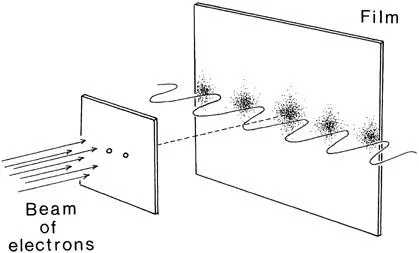
Tunnelling is the secret of the tunnel diode and much of electronics. Without quantum theory, atoms would collapse: by Maxwell's equations orbiting electrons should radiate away their energy and spiral into the nucleus in a tiny fraction of a second. "The fact that we exist is living proof" of quantum mechanics.
Tunnelling to Hawaii. Quantum theory assigns a finite, calculable probability that Kaku will vanish from New York, tunnel through the earth and reappear in Hawaii. The expected wait is longer than the lifetime of the universe.
Punchline: "impossible" in quantum physics means astronomically improbable, which is all the room later chapters need for tunnelling between universes.
The Yang-Mills field, successor to Maxwell
After triumphs in the 1930s and 1940s, quantum physics stalled in the 1960s: accelerators spewed hundreds of particles. Enrico Fermi: "If I could remember the names of all these particles, I would have become a botanist." The half-life of a subatomic theory was said to be 2 years.
The scientist and the flea. A scientist trains a flea to jump at a bell, then anaesthetises its legs one by one; it keeps jumping until the last leg goes numb. Conclusion from "irrefutable data": fleas hear through their legs. Particle physicists in the 1960s often felt like that scientist: data without understanding.
The candidate theory was the Yang-Mills field (C. N. Yang and R. L. Mills, 1954): a generalisation of Maxwell's field with more components whose quanta can carry charge (the photon cannot). Its quanta: the W (charge +1, 0, −1) for the weak force, the gluon for the strong. The obstacle was renormalisability. Physicists calculate with perturbation theory: a first Feynman diagram (an electron and neutrino swap a W) gives a rough fit, and loop diagrams add quantum corrections that should be small. For Yang-Mills they came out infinite.
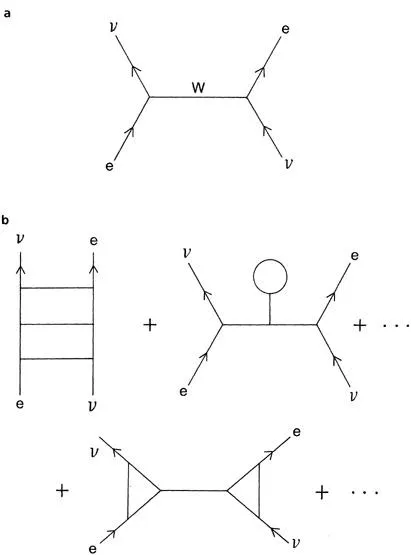
In 1971 a Dutch graduate student in his twenties, Gerard 't Hooft, using methods of his adviser Martinus Veltman, showed that when symmetry breaking gives the Yang-Mills field a mass, the theory stays finite: the infinities cancel or are shuffled into harmlessness. Sheldon Glashow's reaction: "Either this guy's a total idiot, or he's the biggest genius to hit physics in years!" The 1967 Weinberg-Salam theory of the weak force was quickly shown correct, and by the mid-1970s Yang-Mills fields described the strong force too.
The Standard Model
The Standard Model fits all data up to about 1 trillion electron volts, the reach of 1993 accelerators, which makes it, Kaku says, the most successful theory in the history of science.
| Force | Theory | Quanta | Matter acted on | Symmetry |
|---|---|---|---|---|
| Strong | Quantum chromodynamics (QCD) | 8 gluons | Quarks: 6 flavours × 3 colours | SU(3) |
| Weak | Electroweak (Yang-Mills) | W⁺, W⁻, Z | Leptons and their neutrinos | SU(2) |
| Electromagnetic | Quantum electrodynamics (QED) | Photon | Charged particles | U(1) |
- The strong force. Protons and neutrons are made of quarks, which come in 3 colours and 6 flavours, plus antiquarks: 3 × 6 × 2 = 36. Gluons condense into a sticky taffy that binds them permanently: quark confinement. A proton is like three steel balls on a Y-shaped bola string; a π meson is a quark and antiquark on one string. Kick the bola and it vibrates; each allowed vibration is a different particle, explaining why strongly interacting particles are endless.
- The weak force. Governs leptons (electron, muon, tau and their neutrinos) via W and Z bosons, also Yang-Mills quanta, too weak to bind leptons into towers of resonances.
- Electromagnetism. QED, confirmed to one part in 10 million in 1993.
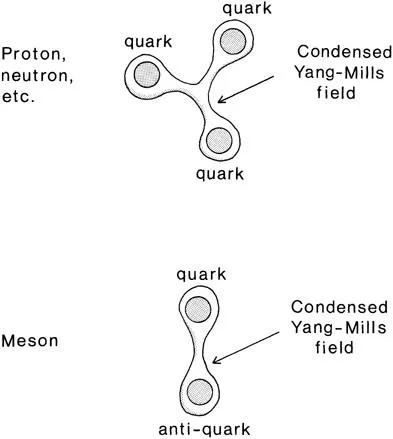
Fifty years and several hundred million dollars reduce to one sentence: all matter is quarks and leptons exchanging quanta described by the Maxwell and Yang-Mills fields. Steven Weinberg recalled the long-held belief that the strong interactions were "too complicated for the human mind".
Two slips. The tau is a lepton, not a "tau meson". And the Standard Model needs one Higgs field, not "a large number of mysterious Higgs particles"; extra Higgs bosons belong to extensions such as supersymmetry. Classically, a hydrogen electron would spiral into the nucleus in about 10⁻¹¹ seconds, far quicker than the "microsecond" Kaku quotes.
Symmetry in physics
The details of the Standard Model, Kaku says, are "rather boring"; what matters is that it rests on symmetry: preserving the shape of an object after you deform or rotate it (Blake's "fearful symmetry"; Carroll's Snark, boiled and salted yet keeping "its symmetrical shape").
Two kinds of symmetry
- Space-time symmetry: rotating through a dimension of space or time. A snowflake is unchanged by a 60° turn; kaleidoscopes, flowers, starfish; special relativity's rotations of space into time.
- Internal (reshuffling) symmetry: permuting objects. A shell game with 3 shells has 6 arrangements that look identical (the group S₃). Shuffle three coloured quarks with the equations unchanged and you have SU(3); rotate electron into neutrino for SU(2); rotate the Maxwell field into itself for U(1).
The Standard Model "unifies" by splicing: SU(3) × SU(2) × U(1) is just the product of three separate symmetries, three jigsaw pieces held together with Scotch tape. An ultimate theory should put all particles in one multiplet.
Beyond the Standard Model: the case for ugliness
Nobody, not even its creators, thinks the Standard Model is final. Two reasons: it omits gravity (splice in Einstein's theory and an electron's deflection by gravity comes out infinite: quantum gravity is non-renormalisable), and it is ugly, like crossing "a mule, an elephant, and a whale".
Kaku's inventory of the Standard Model
- 36 quarks: six flavours, three colours, with antimatter partners.
- 8 Yang-Mills fields for the gluons.
- 4 Yang-Mills fields for the weak and electromagnetic forces (W⁺, W⁻, Z, photon).
- 6 leptons: electron, muon, tau and three neutrinos.
- Higgs particles to "fudge" the masses.
- At least 19 arbitrary constants (masses and coupling strengths) put in by hand.
- Three families, near-exact copies of each other: a threefold redundancy, and more "elementary" particles than all subatomic particles known in the 1940s.
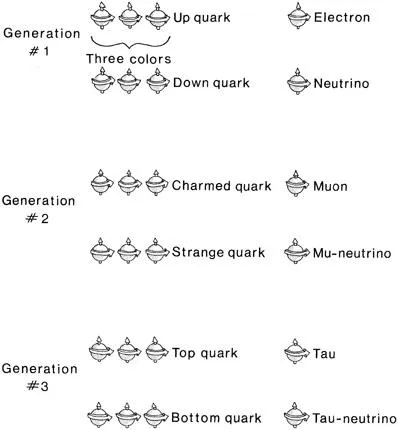
What physicists mean by beauty
- A unifying symmetry.
- Economy: explaining vast amounts of data with the fewest mathematical expressions.
Einstein's equations take about an inch; the full Standard Model would fill two-thirds of a page with a blizzard of symbols. It fails both tests.
Is beauty necessary?
A Beethoven score looks like squiggles to the untrained eye but sings to a musician; a haiku is more than "a short collection of words organized according to some principle". Equations are like that for physicists.
You can recognize truth by its beauty and simplicity... the truth always turns out to be simpler than you thought.Richard Feynman
Henri Poincaré: the scientist studies nature because it is beautiful, and if it were not, "life would not be worth living". C. N. Yang spoke of deep respect for "the power of the symmetry laws". Maxwell's eight equations are ugly, the working tools of every radar and laser engineer; with time as a fourth dimension they become one tensor equation, meeting both criteria. Again: more dimensions, simpler laws.
The deepest failure of the Standard Model is explanatory: it does not say where its symmetries come from. Rutherford: "All science is either physics or stamp collecting." By that standard the Standard Model is stamp collecting; physics needs an On the Origin of Symmetry to do for particles what Darwin did for species.
"Ugly, so wrong" is an aesthetic argument, and Kaku leans on it heavily here and later as evidence for string theory. Sabine Hossenfelder's Lost in Math (2018) argues that the beauty criterion has a poor recent track record: the "natural", elegant extensions it favoured (SUSY at the TeV scale, simple GUTs) are the ones experiment has disfavoured. Beauty guided Einstein and Dirac; it has not yet guided anyone to the next theory.
GUTs and the search for proton decay
Grand Unified Theories (late 1970s) replaced the taped product with one larger group: SU(5), O(10) or E(6). The simplest, SU(5), uses 24 Yang-Mills fields in one symmetry and puts three coloured quarks, the electron and the neutrino in one multiplet that rotates into itself. The forces merge near 10¹⁵ billion electron volts, just below the Planck energy and hopeless for accelerators. But GUTs made one testable prediction: since quarks and leptons share a multiplet, quarks can turn into leptons, so the proton decays and every atom will eventually dissolve into radiation.
Catching a 10³⁰-year event in a year. Americans live about 70 years, yet with 250 million of them someone dies every few minutes. Likewise SU(5) predicted a proton half-life of roughly 10²⁹ years, about ten billion billion times the age of the universe. But a ton of water holds over 10²⁹ protons, so a big enough tank should show a handful of decays a year.
Punchline: a huge population of patient objects turns an absurdly rare event into a measurable rate; the trick also underlies dark-matter and neutrino detectors.
The proton-decay hunt. By the late 1980s six detectors were running, holding 60 to 3,300 tons of ultrapure water or cleaning fluid, buried deep against cosmic rays. The IMB detector (Irvine, Michigan, Brookhaven) filled a 20-metre cube in a salt mine under Lake Erie near Cleveland, watched by 2,048 phototubes; Kamioka ran in Japan. Tens of millions of dollars and several Nova programmes later: no clear decay. The lifetime had to exceed 10³² years, ruling out the simplest GUTs; public interest fizzled.
GUTs had the Standard Model's other defects too: no gravity (and their energy scale is where gravity should matter), still three families, no prediction of the quark masses. "Ultimately, it appeared that GUTs were also stamp collecting." The Yang-Mills "wood" could not glue all four forces; after half a century, it was time for Einstein's revenge.
Einstein's Revenge
By the 1980s the Standard Model was "being killed by its own success" while quantum gravity remained hopelessly infinite, so physicists revived Kaluza-Klein theory. Curling up N extra dimensions produces not only Maxwell's field but the Yang-Mills field: the symmetries of particle physics ("wood") turn out to be the symmetries of hidden dimensions ("marble"), inherited the way clay inherits the shape of its mould. Supersymmetry then let matter itself join the geometry in 11-dimensional supergravity, until it too proved infinite and too small for the Standard Model.
The greatest problem of all time
The quantum theory of gravity has been called the Holy Grail of physics; whoever solves it will win the Nobel Prize. Gravity, the first force understood classically, is the last understood quantum mechanically. Every giant has failed: Einstein spent 30 years; Heisenberg wrote a book on his unified theory.
"I can paint like Titian." In 1958 Heisenberg announced on radio that he and Wolfgang Pauli had found the unified field theory, with only technical details missing. Furious, Pauli sent friends a blank sheet captioned: "This is to show the world that I can paint like Titian. Only technical details are missing." At Pauli's lecture on the theory, Niels Bohr rose: "We are all agreed that your theory is crazy. The question which divides us is whether it is crazy enough." Julian Schwinger diagnosed the whole genre as the itch "to have all the fundamental questions answered in their own lifetimes".
Meanwhile the Standard Model had turned conferences into rubber stamps; Kaku recalls half an audience dozing through chart after chart of agreement, and imagined decades spent tuning 19 parameters like radio dials, as physicists around 1900 had filled tables of spectral lines.
Why gravity resists quantisation
- A comb beats a planet. The whole earth's mass holds paper to Kaku's desk; a comb charged by brushing hair lifts it. Electric forces dwarf gravity.
- A gravitational atom (electrons held only by gravity) would be the size of the universe.
- 10¹⁹ billion electron volts: the Planck energy, where quantum corrections to gravity become important.
The brute-force method treats gravity like any other force. Split the metric into flat space plus a small ripple, g = 1 + h, and call h the graviton field, a spin-2 quantum; objects attract by exchanging trillions of gravitons. Einstein would have been horrified: it is smashing marble with a sledgehammer. Worse, it fails. The loop diagrams diverge, and unlike Yang-Mills theory, no renormalisation trick removes the infinities. Half a century of effort was in vain.
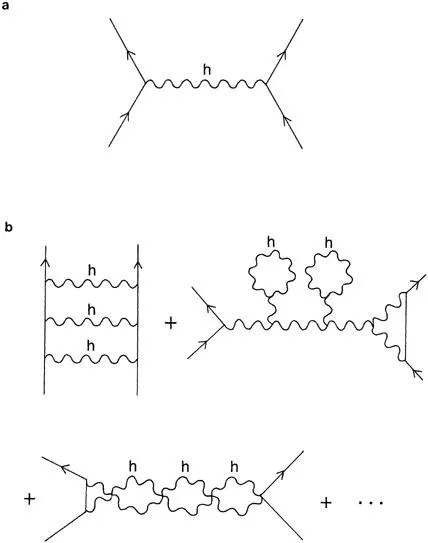
The resurrection of Kaluza-Klein
Frustration overcame prejudice, and Kaluza-Klein returned. Heinz Pagels: physicists now wanted to unify gravity with the weak and strong forces too, which "requires even more dimensions, beyond the fifth". Steven Weinberg joined in; Howard Georgi (Harvard) answered in verse:
But the extra ones all / are rolled up in a ball / so tiny it never affects us.Howard Georgi, on Weinberg's dimensions
The task was now precise. The Standard Model had revealed the secret of wood (quarks and leptons, Yang-Mills fields, SU(3) × SU(2) × U(1)). Could these SU(N) symmetries, which come from shuffling point particles, possibly come from geometry?
Turning wood into marble: symmetry from shape
The vibrating beach ball. A beach ball can be rotated about its centre without changing shape: its symmetry is O(3), rotations in three dimensions. Shake it the right way and it rings with resonances at definite frequencies, like vocal cords, eardrums, telephone diaphragms, speakers and drums, and those vibrations are catalogued by O(3). A hypersphere has symmetry O(N); a "complex hypersphere", built with √−1, has symmetry SU(N).
Punchline: a particle whose wave function vibrates on such a curled-up surface inherits its symmetry. The SU(N) of the quarks becomes a by-product of vibrating hyperspace.
Clay and mould. Matter is formless clay; press it into a symmetric mould and it inherits the mould's symmetry. Space-time is the mould. Write Kaluza-Klein theory in 4 + N dimensions and curl up N of them: the equations split into Einstein's gravity plus Yang-Mills theory. If the hidden dimensions have SU(5) symmetry, SU(5) GUT becomes a Kaluza-Klein theory.
In metric-tensor terms: in five dimensions, slicing off the fifth row and column releases Maxwell; in 4 + N dimensions, slicing off N rows and columns releases Yang-Mills. Einstein, Maxwell and Yang-Mills fields fit one checkerboard like jigsaw pieces.
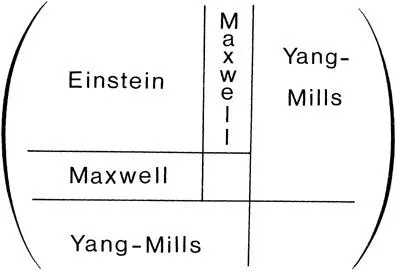
Yang-Mills was a Kaluza-Klein discovery. Bryce DeWitt (University of Texas) found extracting Yang-Mills fields from N-dimensional gravity so easy that he set it as homework at Les Houches in 1963. And Peter Freund revealed that Oskar Klein had found the Yang-Mills field in 1938, at a Warsaw conference on "New Physical Theories", by generalising Maxwell's theory to the symmetry O(3), sixteen years before Yang and Mills. War and the quantum stampede buried it. The irony: Kaluza-Klein was killed by a quantum theory whose central field was first found inside Kaluza-Klein theory.
Supergravity: the spinning problem
Producing the symmetries was step one; step two was making matter itself from geometry. The obstacle was spin.
| Family | Spin (units of ħ) | Examples | Role | Named after |
|---|---|---|---|---|
| Fermions | ½, 3⁄2, 5⁄2 … | Quarks, electrons, neutrinos | Matter ("wood") | Enrico Fermi |
| Bosons | 0, 1, 2 … | Photon and Yang-Mills quanta (1), graviton (2) | Forces ("marble") | Satyendra Bose |
Quantum theory had always kept the two apart; SU(N) shuffles quarks with quarks, never with force carriers. Supersymmetry does exactly that: a supersymmetric multiplet has equal numbers of bosons and fermions, and the equations survive swapping them. Abdus Salam: "Supersymmetry is the ultimate proposal for a complete unification of all particles."
Super numbers that would drive a teacher insane. Supersymmetry runs on numbers where a × b = −b × a. Then a × a = −a × a, so a × a = 0, even though a ≠ 0. For ordinary numbers this collapses arithmetic; for these Grassmann numbers it yields a consistent "super calculus".
Punchline: the rule a × a = 0 is the algebraic form of the Pauli exclusion principle: two identical fermions cannot occupy the same state.
In 1976 Daniel Freedman, Sergio Ferrara and Peter van Nieuwenhuizen wrote down supergravity: the spin-2 graviton and its spin-3⁄2 partner, the gravitino. Every particle acquires a superpartner, a sparticle. Too few particles for the Standard Model, so the theory was enlarged, most simply by writing it in 11 dimensions, where a super Riemann tensor holds Einstein's field, Yang-Mills fields and the quark and lepton fields in one superforce. Wood merges with marble into "supermarble".

It is the most beautiful gauge theory known, so beautiful, in fact, that Nature should be aware of it!Peter van Nieuwenhuizen
The mood was euphoric. At a Moscow meeting toasts were drunk to supergravity; people joked about "Einstein's revenge". On 29 April 1980, taking the Lucasian chair once held by Newton and Dirac, Stephen Hawking had a student read his lecture "Is the End in Sight for Theoretical Physics?", which saw grounds for "cautious optimism" of a complete theory within the lifetimes of some present. The Transcendental Meditation movement printed a poster of the full 11-dimensional supergravity equations, labelling terms "harmony", "love" and "brotherhood"; it hangs at the Stony Brook theory institute.
A night of minus signs. The super metric tensor has hundreds of components against Riemann's ten. Van Nieuwenhuizen (a Veltman student like 't Hooft) calculated in microscopic handwriting on oversized artist's sketch pads, shelved like journal volumes, and graduate students copied the fad. Kaku, van Nieuwenhuizen and Paul Townsend once checked a calculation of several hundred pages in which several thousand terms had to sum to zero. Around Kaku's dining table each did the same chunk; usually two of three agreed and the third hunted his error. Past midnight the last term gave zero. Van Nieuwenhuizen then forgot where his wife's new Manhattan apartment was, knocked on wrong doors, snapped a clutch cable and pushed his car into Stony Brook at 5 a.m. Weinberg: supergravity's workers were brighter than anyone he knew in his early years.
The decline of supergravity
Why supergravity stalled
- No sparticles. Not one has been seen; the spin-½ electron has no spin-0 partner at accessible energies. The faith was that perfect supersymmetry reigned only at the energies of Creation.
- Still infinite. It could not be quantised consistently: fewer infinities than Kaluza-Klein, but still non-renormalisable.
- Too little symmetry. Its largest internal symmetry, O(8), cannot contain SU(3) × SU(2) × U(1).
Supergravity cured one disease (making matter geometric) and caught others, just as the strangest and most powerful theory yet arrived: the ten-dimensional superstring.
Small corrections. Ferrara was at CERN and Frascati, not Stony Brook (Freedman and van Nieuwenhuizen were there). The 11-dimensional theory itself is due to Cremmer, Julia and Scherk (1978), whom Kaku does not name. And a further fatal problem he omits: Witten (1981) showed that compactifying 11-dimensional supergravity on a smooth manifold cannot produce chiral fermions, the left-right asymmetry of the weak force, a key reason the field moved to strings.
Superstrings
Superstring theory replaces point particles with tiny vibrating strings: each particle is a resonance, the graviton is the lowest vibration of a closed string, and Einstein's equations fall out of the string's self-consistency. Strings are the missing link between wood and marble, the first quantum theory of gravity with finite corrections, but consistency fixes space-time at ten dimensions (26 for the bosonic string) and nobody knows how to solve the theory. Kaku tells the story through Witten, the theory's backward, accidental history, his own work on string field theory, and Ramanujan, whose modular functions hide the magic numbers 24 and 8.
Witten, leader of the pack
Edward Witten of the Institute for Advanced Study sets trends as Picasso did in art. Samuel Treiman: "We shouldn't toss comparisons with Einstein around too freely, but when it comes to Witten…"
- Edward Witten: son of relativist Leonard Witten (who calls his son his greatest contribution to physics); married to physicist Chiara Nappi. A history major at Brandeis with a passion for linguistics, he worked on George McGovern's 1972 campaign and wrote for The Nation and The New Republic. Then a Princeton PhD, Harvard, a full Princeton professorship at 28, a MacArthur award and the 1990 Fields Medal. He calculates in his head; physics, he says, is "about concepts".
- John Schwarz (Caltech) and Michael Green (Queen Mary College, London): proved in 1984 that superstrings can meet all consistency conditions, starting the "gold rush".
- David Gross, Jeffrey Harvey, Emil Martinec, Ryan Rohm: the "Princeton string quartet", inventors of the heterotic string. Gross is the booming, feared questioner at Princeton seminars.
What is a particle?
The particle zoo numbers several hundred. String theory says each "elementary" particle is a mode of vibration of a string about 10²⁰ times smaller than a proton (about 10⁻³³ cm), so small that from afar a resonance and a point are indistinguishable.
Singing in the shower; bowing a violin. In a shower, sound waves that fit between the walls are amplified (resonances) and the rest cancel, so a thin voice sounds operatic. A violin string bolted at both ends supports only waves that fit a whole number of times; it can play infinitely many notes, and no note is more fundamental than another; the string is. Understand the string and you understand every note.
Punchline: an electron is no more fundamental than a neutrino; both are notes. Physics is the harmony of the string, and the universe a symphony.
Strings also explain space-time. A moving string splits and joins, and all the resulting quantum loop corrections are finite: the first quantum theory of gravity in history to achieve this, where Einstein's theory, Kaluza-Klein and supergravity all failed. Demanding that a string move self-consistently places strict conditions on the space-time it moves in, and those conditions are Einstein's equations, derived rather than assumed.
Einstein thought marble (geometry) would produce wood (matter); quantum physicists thought marble could be smashed into wood (gravitons). The string reconciles the two: its vibrations give matter, and its consistent motion gives geometry. From one string Kaku claims you recover general relativity, Kaluza-Klein theory, supergravity, the Standard Model and GUTs: "the entire progress of physics for the past 2 millennia".
Why strings?
| A Nobel laureate's objection (over sweet-and-sour pork) | Kaku's reply |
|---|---|
| Nature repeats themes like Bach: orbits from galaxies to atoms; fields for gravity, light, Yang-Mills | Nature does reserve a theme for strings: the building block that stores information |
| Strings are "too alien, too orthogonal" to previous physics | DNA is a double string that unwinds and copies itself; our bodies are draped in protein strings |
| "We do not see strings anywhere"; why not vibrating blobs or solids? | A string is one of the most compact, replicable ways to pack vast information, exactly what both life and matter need |
The heterotic string and E₈ × E₈
The quartet's heterotic string is a closed string whose two directions of vibration are treated differently, hence the name, from the Greek for hybrid vigour:
- Clockwise vibrations live in 10 dimensions (the superstring).
- Counterclockwise vibrations live in 26 dimensions (the bosonic string), 16 of which are compactified.
- The 16-dimensional compact space has the enormous symmetry E₈ × E₈, far larger than any GUT group, and every vibration inherits it, as clay inherits its mould. That is ample room for SU(3) × SU(2) × U(1), where supergravity's O(8) was too small.
Gross: string theory builds "matter itself from geometry". The graviton is the smallest vibration of the closed string, and dropping it makes the theory inconsistent: GUTs avoided gravity, strings demand it. Witten read a 1982 Schwarz review and felt "the greatest intellectual thrill of my life": "gravity is forced upon us". He even calls general relativity's prior discovery "a mere accident of the development on planet Earth"; other civilisations might have found strings first and derived relativity as a by-product.
The chain of inheritance: snowflakes and crystals get their hexagonal shapes from molecular geometry, set by electron shells, set by the O(3) rotational symmetry of quantum theory, which belongs to the Standard Model's symmetries, which in turn come from compactifying the heterotic string. Rainbows, flowers and crystals become "fragments of the original ten-dimensional theory".
Twenty-first-century physics, discovered backward
| General relativity (forward) | String theory (backward) |
|---|---|
| Physical principle (equivalence, 1907) | Principle still unknown |
| Field theory (Riemann's metric, 1915) | String field theory (1974, 1985) |
| Classical solutions (black holes, Big Bang) | String picture (1970) |
| Quantum theory (still sought) | Started here: a formula (1968) and its loops (1969) |
- 1968 Gabriel Veneziano and Mahiko Suzuki, independently leafing through maths books at CERN, find that Euler's beta function fits the strong interactions. A senior physicist tells Suzuki that Veneziano got there weeks earlier and discourages publication; the "Veneziano model" spawns thousands of papers. Kaku's moral: "Never take too seriously the advice of your superiors."
- 1969 Kikkawa, Sakita and Virasoro (KSV, Wisconsin) propose adding loop corrections to restore unitarity (conservation of probability).
- 1970 Yoichiro Nambu (Chicago) and Tetsuo Goto (Nihon University) show a vibrating string underlies the formula.
- 1970 Kaku and Loh-ping Yu, under Stanley Mandelstam at Berkeley, compute explicit expressions for all known loop diagrams.
- 1974 Kaku and Kikkawa complete the field theory of strings.
- 1971–74 Claude Lovelace's result that the bosonic string is consistent only in 26 dimensions (the superstring in 10) finally sinks in, and from 1974 the field enters a ten-year hibernation; Schwarz and the late Joel Scherk keep it alive and show it is a theory of all forces, not just the strong force.
- 1984 Green and Schwarz show the superstring is self-consistent; the stampede begins.
- 1985 Witten derives string field theory in fully relativistic form using cohomology.
Witten: no one invented string theory on purpose; "By rights, twentieth-century physicists shouldn't have had the privilege of studying this theory."
Loops, topology and the world-sheet
A bumblebee's path is a wiggly line; a drifting piece of string sweeps a sheet; a closed string sweeps a tube. Strings interact by splitting and joining: two tubes come in, one fissions, they exchange a tube and leave. Evaluated, the simplest such diagram gives back the Euler beta function. KSV's programme was to sum all such diagrams, with ever more holes, the string version of perturbation theory. The diagrams have two-dimensional conformal symmetry: they can be stretched like rubber without changing the answer. Even with infinitely many holes, no infinities appear.
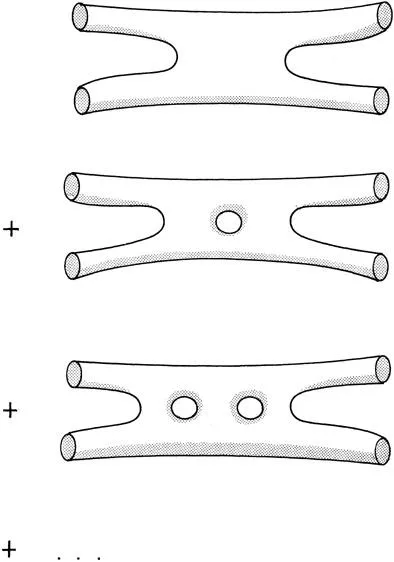
Physics under machine-gun fire. When President Johnson revoked graduate deferments, Kaku went from Harvard graduation to the U.S. Army three days later: Fort Benning (the world's largest infantry training centre) and Fort Lewis, while about 500 GIs a week were dying in Vietnam. Friends fled to Canada, taught high school or vowed to go to jail (one asked for copies of Physical Review in his cell). Throwing live grenades, he thought of Karl Schwarzschild, who found the basic black-hole solution and died on the Russian front in World War I. Crawling under live tracer fire, he carried the KSV paper and, lacking pencil and paper, learned to manipulate the topology of loops in his head: Möbius strips and Klein bottles entering physics for the first time. The result became his Berkeley PhD: several hundred notebook pages.
The field theory of strings
Since Faraday every physical theory had been a field theory, except strings. Two objections from giants stood in the way:
- Causality. Yukawa and Heisenberg had tried field theories of extended "blobs"; shake a blob at one point and the effect spreads faster than light, violating relativity. Many concluded only point-particle (local) field theories could be consistent.
- Duality. The Veneziano model's magical property of duality contradicts Feynman's rules for counting diagrams in any field theory, so a field theory of strings seemed impossible.
Kaku and Keiji Kikkawa generalised Faraday: a field defined not at each point but for every possible configuration of a string. The free equation reproduced the infinite tower of resonances, and disturbances run along the string slower than light, answering Yukawa and Heisenberg. Interactions then failed to reproduce Veneziano's amplitude.
3 a.m., Sherlock Holmes and Faraday's lines. Stuck, Kaku recalled Holmes: when you have eliminated the impossible, whatever remains, however improbable, must be the truth. The only remaining option was to break duality. The insight: the Veneziano-Suzuki formula splits into two pieces, each a Feynman diagram violating duality, whose sum restores every property. Five hours of checking confirmed it. The last piece, a four-string interaction, came while teaching freshman electricity at City University of New York: the lines of force his students drew around charges had the same topology as colliding strings. By winter 1974 the field theory was complete, though its relativistic symmetry was hidden until Witten's 1985 reformulation.
No one is smart enough
In principle string field theory should yield the mass of the proton from first principles; if the numbers are wrong, out goes the theory. After the euphoria of the late 1980s (Nobel Prizes "by the dozen"), realism set in: the theory is well defined, but nobody can solve it. Kaku quotes Cassius: "The fault, dear Brutus, is not in our stars, but in ourselves", here in "our primitive mathematics".
Why string theory stalled (1993)
- Perturbation theory fails to choose. Physicists hoped for one four-dimensional Veneziano-like formula matching the real particles; they found millions upon millions.
- Some fit, most do not. The Standard Model can be extracted as one vibration with modest assumptions; other solutions have no quarks, too many quarks, or no possible life.
- Only non-perturbative methods can pick, and 99% of high-energy physics knowledge is perturbative.
- Hope: in simpler theories most solutions are unstable and tunnel to a stable one; perhaps the true vacuum is selected the same way.
A laptop in 1893. Give nineteenth-century physicists a portable computer. They learn the buttons, play games, store all known science, astonish colleagues. Then they open the case: transistors and microprocessors with nothing in their experience to compare. The machine works in front of their noses and they cannot explain it.
Punchline: string theory is that laptop. Turn a few dials and out pop supergravity, Kaluza-Klein and the Standard Model; but "twenty-first-century mathematics hasn't been invented yet".
Why ten dimensions? Ramanujan's magic numbers
Compute how strings break and rejoin in N dimensions and destructive terms appear, multiplied by (N − 10). Only N = 10 kills them: string theory is the only known quantum theory that fixes the dimension of space-time. Why ten? The answer sits in modular functions.
From Ramanujan to ten dimensions
- Ramanujan's function (the modular discriminant) contains a term raised to the 24th power.
- Each of the 24 modes is a physical vibration of the bosonic string; relativity adds 2 more dimensions: 24 + 2 = 26.
- The generalised function for the superstring has 8 in place of 24: 8 + 2 = 10.
- The identities that make the cancellations work are Ramanujan's identities; they protect the string's conformal symmetry (stretching and deforming its world-sheet) from quantum corrections.
Kaku amends his theme: the laws of nature simplify when self-consistently expressed in higher dimensions. Self-consistency forces Ramanujan's functions, which force ten dimensions. To Einstein's question whether God had any choice in creating the universe, string theorists answer: no.
Ramanujan: reinventing a century of mathematics
- 1887 Born in Erode, near Madras, to a destitute family; his father was a clerk in a cloth merchant's office. As a boy he rederives Euler's identity linking trigonometric and exponential functions.
- Youth George Carr's obscure compendium of results becomes his only exposure to Western mathematics; each formula he proves is original research. He says the goddess of Namakkal gives him formulas in dreams. Loses his scholarship for neglecting other subjects, runs away, fails exams again.
- Madras Clerk at the Port Trust for £20 a year, his patent office.
- 1913 Writes to three British mathematicians; two discard the letter, and G. H. Hardy first does too. Over dinner Hardy and John Littlewood reread it: 120 theorems, some of which "defeated me completely"; only "a mathematician of the highest class" could have written them.
- 1914 Arrives in Cambridge: three intense years at Trinity College.
- 1919 Ill, he returns to India and dies a year later.
- Hardy's scale: himself 25, Hilbert 80, Ramanujan 100.
- 1729 = 1³ + 12³ = 9³ + 10³: the "dull" taxi number, the smallest expressible as a sum of two cubes in two ways.
- 4,000 formulas on 400 pages in three notebooks, without proofs.
- 130 pages: the "Lost Notebook" of his last year, found in 1976 in a box at Trinity.
Richard Askey: the work of that one dying year equals a lifetime's work for a very great mathematician; "If it were a novel, nobody would believe it." Jonathan and Peter Borwein: no redaction "of this scope or difficulty has ever been attempted"; reading him is "like watching somebody at a feast you haven't been invited to". Thousands of terms cancelling are never an accident: they signal a symmetry, here conformal symmetry.
Several facts need fixing. Ramanujan died on 26 April 1920 aged 32, not 33, and modern re-diagnosis points to hepatic amoebiasis rather than tuberculosis. His famous letter is dated 16 January 1913; Hardy received and discussed it with Littlewood later that month, so the "dinner that night" date is wrong. Lovelace's 26-dimension result dates from 1971 (the no-ghost proofs followed in 1972–73), not 1974. Green and Schwarz (1984) showed anomaly cancellation for the gauge groups SO(32) and E₈ × E₈; they did not prove superstrings "the only self-consistent theory of quantum gravity". And string loops are finite order by order as far as checked, but a rigorous all-orders proof was still being completed decades later.
The critics' rejoinder closes the chapter: a theory defined at the Planck energy, 10¹⁹ billion electron volts, is untestable, so "not really a theory at all". Kaku concedes the main problem is theoretical, but agrees physics must look for signals from the tenth dimension.
String theory after 1994. Within a year of the book, the "second superstring revolution" transformed the subject. In 1995 Witten showed the five ten-dimensional string theories (Type I, IIA, IIB and the two heterotic theories) are limits of one eleven-dimensional M-theory, linked by dualities that supply exactly the non-perturbative tools Kaku said nobody had; Polchinski identified D-branes. In 1996 Strominger and Vafa derived the entropy of certain black holes by counting string states. In 1997 Maldacena's AdS/CFT correspondence equated a string theory in a curved space with an ordinary quantum field theory on its boundary, now the field's most productive idea. The "millions of solutions" became an estimated 10⁵⁰⁰ vacua (Bousso-Polchinski 2000; KKLT 2003), and the response split physicists: some accept an anthropic multiverse; others pursue the swampland programme (Vafa, from 2005), which asks which low-energy theories cannot come from strings at all and has argued that a stable positive cosmological constant may be forbidden, a claim given new interest by DESI's hint of evolving dark energy. No experimental confirmation of strings exists in 2026.
Signals from the Tenth Dimension
Superstring unification happens at the Planck energy, a quadrillion times beyond any accelerator, so the theory faces the charge of being untestable. Kaku surveys the camps (Glashow's scorn, Weinberg's defence), the doomed Superconducting Supercollider, cosmic rays, and the history of "untestable" ideas (the composition of stars, atoms, the neutrino) that were tested indirectly after all. His verdict: the problem is theoretical, not experimental; someone clever enough to solve string field theory will confirm or kill the ten-dimensional theory.
Is beauty a physical principle?
David Gross: there is not enough money "in the treasuries of all the countries in the world put together" to reach the Planck energy, 10¹⁹ billion electron volts. If experiment is impossible, can beauty stand in for it?
| The sceptics | The defenders |
|---|---|
| Sheldon Glashow (Harvard, Nobel 1979) calls it "theatrical physics" and "recreational mathematics", likens the craze to an incurable epidemic and to Reagan's Star Wars: both complex, decades long, maybe never working, costly in talent, "and the Russians are trying desperately to catch up" | Steven Weinberg: "String theory provides our only present source of candidates for a final theory; how could anyone expect that many of the brightest young theorists would not work on it?" |
| Glashow's verse: "The Book is not finished, the last word is not Witten"; he vowed (in vain) to keep strings out of Harvard and calls himself "a dinosaur in a world of upstart mammals" | Murray Gell-Mann and Weinberg back the programme; beauty has historically marked the right answer, and there is no rival |
The parable of the gemstone. A perfectly symmetric three-dimensional gemstone bursts (the Big Bang) and its fragments rain onto Flatland. Flatlanders sort them: pieces polished on one side ("marble"), which one camp slowly assembles into a partial structure called relativity; and jagged pieces ("wood"), which another camp assembles into an ugly clump called the Standard Model. The two never fit. Then a Flatlander shows by computer that if both are moved "up" into a third dimension, the marble pieces are the outer faces and the wood pieces the inner ones of one dazzling gem. But hoisting the real pieces would take a quadrillion times Flatland's largest energy source.
Punchline: beauty and experiment now pull apart, and Joseph Joubert's maxim applies: "It is better to debate a question without settling it than to settle a question without debating it."
Hume's problem and the Superconducting Supercollider
David Hume held that experiment requires reproducibility; Creation happened once, so no theory of Creation can be verified. The modern version: only the Big Bang reached string energies. The best indirect hope was the Superconducting Supercollider (SSC), which could not reach the Planck scale but might find supersymmetry, the string's signature.
- 50 miles of tunnel near Dallas, Texas (centred on Manhattan it would reach Connecticut and New Jersey).
- 40 TeV proton-proton collisions, "a window on creation".
- 3,000 scientists and staff; completion planned around 2000.
- 100,000 times Earth's magnetic field in superconducting magnets cooled near absolute zero and reinforced against their own forces.
- $11 billion projected cost, against $4 billion a year for Star Wars and about $1 billion each for a carrier refit, a shuttle mission or a B-2 bomber.
- 1988 Texas wins the site (the president-elect and the Democratic vice-presidential candidate were both Texans); 1993 the House votes to cancel.
Site selection was always political: Illinois got Fermilab in Batavia, reportedly because Lyndon Johnson needed Senator Everett Dirksen's vote on Vietnam. Congress saw the SSC either as a jobs plum or a boondoggle with no consumer benefits.
What it might have found: the Higgs particle, the source of symmetry breaking and so of the quark masses, the "origin of mass"; even odds of physics beyond the Standard Model (technicolor particles; axions for dark matter); and above all sparticles: the gravitino (partner of the graviton), squarks and sleptons. Supersymmetry was first found in superstring theory in 1971, before supergravity, and strings may be the only fully consistent marriage of supersymmetry and gravity. Sparticles would not prove strings, but would silence the claim of "not one shred" of evidence.
Signals from outer space: cosmic rays
If machines cannot reach the energy, nature might. Cosmic rays are like a rainstorm versus a fire hose: more powerful, but uncontrolled and unpredictable.
- Discovery. Kaku credits the Jesuit Theodor Wulf, measuring with electrified jars atop the Eiffel Tower; balloonists and mountaineers carried on until the 1930s, when Ernest Lawrence's cyclotron beat most cosmic rays with controlled beams.
- Modern arrays. A Chicago-Michigan array of 1,089 detectors over about a square mile at the Dugway Proving Grounds, 80 miles south-west of Salt Lake City, records air showers. Cygnus X-3 and Hercules X-1 had been identified as sources: probably neutron stars or black holes eating companions.
- Record energy. 10²⁰ eV, 10 million times the SSC's design energy but still 100 million times below the Planck energy. The galactic centre, perhaps "millions of black holes", might approach it.
Corrections. Wulf measured radiation on the Eiffel Tower in 1910, but the discovery of cosmic rays is credited to Victor Hess's balloon flights in 1912 (Nobel 1936). The 1980s claims that Cygnus X-3 and Hercules X-1 emit very-high-energy cosmic rays were never confirmed and are now considered spurious. And the galactic centre is not "millions of black holes" but one supermassive black hole, Sagittarius A, of about 4 million solar masses, established by stellar orbits (Nobel Prize 2020, Genzel and Ghez) and imaged by the Event Horizon Telescope in 2022*.
Cosmic rays today. The record 3.2 × 10²⁰ eV "Oh-My-God particle" (Fly's Eye, Utah, 1991) was joined in 2023 by the Amaterasu particle (about 2.4 × 10²⁰ eV, Telescope Array). The Pierre Auger Observatory in Argentina, spread over 3,000 km², showed in 2017 that the highest-energy cosmic rays come from outside the Milky Way. Even so, their collision energies with air nuclei correspond to a few hundred TeV in the centre-of-mass frame, nowhere near the Planck scale.
Testing the untestable
Kaku's main argument is historical: "untestable" claims have repeatedly been tested by indirect signals that nobody foresaw.
| "Untestable" claim | Who said so | How it was tested |
|---|---|---|
| Composition of the stars | Auguste Comte: stars would forever be mere points of light | Spectroscopy: each element's light has a fingerprint ("I know that you are hydrogen") |
| Existence of atoms | Ernst Mach and others: a calculating device | Einstein's 1905 Brownian motion paper: dust jiggles from atomic impacts |
| The neutrino | Pauli, 1930: "I have predicted the existence of a particle that can never be observed" | Reactor and accelerator beams, deep-mine detectors, the 1987 supernova neutrino burst |
| The tenth dimension | Critics: Planck energy is out of reach | Kaku: signals from cosmic rays, low-energy "shadows" in accelerator data, the echo of Creation |
Comte's mistake was to think reaching the stars required energy (rockets). The decisive step needed only signals (starlight through a prism). Likewise, probing the tenth dimension may need not Planck-scale machines but a photograph of its shadow in low-energy data.
Neutrinos pass through a lead block light-years thick; trillions from the sun pass through us even at night, from below. John Updike's "Cosmic Gall" mocks their aloofness ("They have no charge and have no mass / And do not interact at all"). Within three decades they became workhorses of physics, and supernova 1987A made neutrino detectors astronomical instruments.
Kaku's examples need tidying. Comte wrote his remark in the Cours de philosophie positive in 1835, not 1825. Fraunhofer mapped the dark solar lines (from 1814) but did not decode stellar composition; that was Kirchhoff and Bunsen (1859), and hydrogen's dominance in stars was shown by Cecilia Payne in 1925. Atoms have been imaged directly since the scanning tunnelling microscope (1981), so "we are still unable to take direct pictures" was already outdated. And Updike's line "they have no mass" is now wrong: neutrino oscillations (1998) prove they have small masses.
The problem is theoretical, not experimental
Witten: no nineteenth-century physicist could have believed water's boiling point at 100° would become calculable; "good ideas always get tested". Arthur Eddington: nobody actually bases belief on observation alone; theory shares the work. Paul Dirac: "It is more important to have beauty in one's equations than to have them fit experiment." John Ellis (CERN), quoting a candy wrapper: "It is only the optimists who achieve anything in this world."
Kaku agrees with the sceptics that only indirect tests are plausible this century, since the theory is about Creation. But he predicts that "within the lifetime of today's physicists" someone will solve string field theory (or another non-perturbative formulation) and settle the matter. The obstacle is mathematics, not machines.
Two routes to harnessing hyperspace
- Grow: master energies trillions of times today's.
- Meet an extraterrestrial civilisation that already manipulates hyperspace.
Lead times so far: about 70 years from Faraday and Maxwell to Edison's practical electricity; the nuclear force, known since about 1900, still not tamed in fusion reactors 80 years later.
Asking strings about everyday energies is making the caged cheetah dance. Their natural habitat is the instant of Creation, and one laboratory may still reach it: the echo of Creation, the cosmic background radiation.
Kaku's prediction has not come true. Thirty years on, nobody has solved string theory non-perturbatively in a way that singles out our universe; the dualities and AdS/CFT of the late 1990s gave powerful partial definitions, but they multiplied rather than eliminated the candidate vacua. Meanwhile the experimental route he discounted has advanced: fusion reached ignition at the National Ignition Facility in December 2022, a reminder that the timescales in his lead-time box can shorten.
Before Creation
Children ask whether God had a mother; theologians answered with proofs of God's existence, and physics now answers with the Big Bang, which only moves the question back: what came before? Kaku reviews the evidence for the Big Bang (red shift, helium, ages, the microwave echo, COBE) and proposes that the Big Bang was the tunnelling of an unstable ten-dimensional false vacuum into our four dimensions and a curled-up six-dimensional orbifold. The history of the universe is the book's theme run backward: as it cooled, a perfect ten-dimensional symmetry broke in stages into the separate forces we see.
Did God have a mother?
If God made the world in seven days, what happened before the first? If God had a mother, so did she, forever; if not, where did God come from? Painters faced the problem in miniature: should God, Adam and Eve have belly buttons? Michelangelo's answer on the Sistine ceiling, and museums' generally: no, because they were first.
Proofs of the existence of God
Aquinas's proofs (thirteenth century), in his own summary
- Things are in motion, hence there is a first mover.
- Things are caused, hence there is a first cause.
- Things exist, hence there is a creator.
- Perfect goodness exists, hence it has a source.
- Things are designed, hence they serve a purpose.
Lines 1–3 are the cosmological proof, line 4 the moral proof (the weakest, since morality can be read as evolving custom), line 5 the teleological proof.
Two illustrations.
- Infinite wagons (cosmological). In a park a wagon moves; you expect a child pushing it, but find a second wagon pushing the first, then a third, then an endless line to the horizon, with no child. Can an infinite chain of wagons push itself? Aquinas: no, so there is a First Pusher.
- The camera on Mars (teleological). On wind-scoured Martian sands you find a precision camera and infer a maker. Then you find a rabbit, whose eye is far more complex than the lens; its maker must be far greater. Hence God.
St. Anselm, archbishop of Canterbury, offered in 1078 the ontological proof, from pure logic: define God as "that being nothing greater than which can be conceived". A God who exists is greater than one who does not; so the definition picks out an existing God.
| Proof | Core move | Kaku's refutation | Comment |
|---|---|---|---|
| Cosmological | Every motion needs a prior mover; no infinite regress | Conservation of mass-energy: gas molecules can bounce forever with no first push | Answers only the motion version; why anything exists at all is untouched |
| Teleological | Complex design implies a designer | Evolution by natural selection; Stanley Miller's sparks through methane and ammonia make amino acids | Origin of life remains unsolved, but design is no longer the only explanation |
| Ontological | Existence makes a being greater, so the greatest must exist | Kant: existence adds no perfection; the same logic would prove a perfect unicorn exists | The standard critique: existence is not a property |
Corrections and caveats. The first critic of Anselm was the monk Gaunilo, who in the same decade parodied it with a "perfect island", the ancestor of Kaku's unicorn; Kant's objection came seven centuries later. The Miller-Urey experiment was 1952–53, not 1955, and it produced amino acids, not "protein molecules". And Kaku's energy-conservation rebuttal misses the strongest form of the cosmological argument, which asks why there is a universe at all, a question the Big Bang sharpens rather than removes, as Kaku himself admits.
Kaku's assessment: "yes and no". Physics has replaced proofs with thermodynamics and particle physics, but swapping God's act of Creation for the Big Bang trades one problem for another: what happened before it? Einstein's equations break down at 10⁻³³ cm, so the question belongs to the ten-dimensional theory. The Big Bang may be the breakdown of a ten-dimensional universe into four and six dimensions: the book's theme in reverse.
Four pillars of evidence for the Big Bang
The evidence (as of 1993, for an age of 15–20 billion years)
- Red shift. Starlight from receding galaxies is shifted to the red, a Doppler effect; Hubble's law (1929): the farther the galaxy, the faster it recedes. No distant blue shifts.
- Element abundances. Big Bang fusion predicts about 25% helium, 75% hydrogen, as observed.
- Ages. No object is older than the Big Bang. Carbon-14 (half-life 5,730 years) dates artefacts; uranium-238 (over 4 billion years) dates moon rocks; the oldest rocks and meteorites are 4–5 billion years old; the oldest stars about 10 billion.
- The cosmic echo. Gamow, with Ralph Alpher and Robert Herman, predicted after World War II a leftover blackbody glow, now in microwaves. Found by accident in 1965 by Arno Penzias and Robert Wilson (Nobel 1978).
Blackbody radiation: any hot object glows with a colour set by its temperature, as iron turns red in a furnace, and keeps radiating in the infrared when cool; hence night-vision goggles, hot parked cars, and the greenhouse effect of carbon dioxide. Gamow reasoned that about 300,000 years after the Big Bang the universe cooled enough for electrons to settle into atoms; before that it was an opaque fog of ionised plasma, afterwards it became transparent and "black", and the freed radiation cooled into the microwave band.
Bird droppings or Creation. At Holmdel, New Jersey, Penzias and Wilson found a uniform hiss in their new horn antenna; they blamed contamination, dismantled and cleaned the antenna (including the pigeon droppings), and the static stayed. At Princeton, Robert Dicke and James Peebles were redoing Gamow's calculation. Once the two groups compared notes, the joke went that they had found either a pile of bird droppings or the creation of the universe. The signal matched a blanket of radiation cooled to about 3 K.
COBE: "the face of God"
- 1970s Galaxy surveys show that within 1 billion years matter had clumped into galaxies, clusters of billions of galaxies, and voids millions of light-years across.
- 1989 COBE (Cosmic Background Explorer) launched to map the background in detail.
- 1990 Press stories (even the New York Times) wrongly claim the Big Bang is in trouble because the background looks too smooth to seed such lumpiness.
- 23 April 1992 George Smoot's team announces COBE's results; journalists write about "the face of God".
- 10%: the smoothness Penzias and Wilson could establish.
- 1 part in 100,000: COBE's sensitivity to temperature variations.
- 370 km/s: the solar system's drift through the background, which had to be subtracted.
- 0.1%: agreement between the measured spectrum and Gamow's blackbody prediction.

COBE delivered three results: the perfect blackbody spectrum (shown to about a thousand astronomers, who gave the graph a standing ovation); tiny ripples in the background, exactly the seeds needed for clusters and voids; and consistency (not proof) with Alan Guth's inflation, an explosive early expansion that makes our visible universe a tiny part of a much larger one. Jeremiah Ostriker: fossils settled the origin of species; "COBE found its fossils."
Credit and physics corrections. The spectrum and its standing ovation (January 1990) came from John Mather's FIRAS instrument; Smoot's DMR instrument found the ripples announced in 1992. They shared the 2006 Nobel Prize. The law linking a body's colour to its temperature is Wien's displacement law; the Stefan-Boltzmann law gives the total power radiated.
Before Creation: orbifolds
COBE gives confidence back to a fraction of a second. Before that, quantum effects dominate gravity, and only a quantum theory of gravity (for Kaku, the superstring) can say how a ten-dimensional universe split. Cumrun Vafa (Harvard, born in Iran, himself "torn between two worlds") studies the six-dimensional twin.
The video-game universe. A rocket that flies off the right of the screen reappears on the left at the same height; off the bottom, it reappears at the top. The screen is a closed universe. Glue top to bottom and you have a tube; bend the tube and glue its ends and you have a doughnut. The game world is the surface of an inner tube.
Punchline: a flat world with wrap-around edges is a torus: compact, finite and borderless. Vafa's six-dimensional twin is a twisted six-dimensional torus.
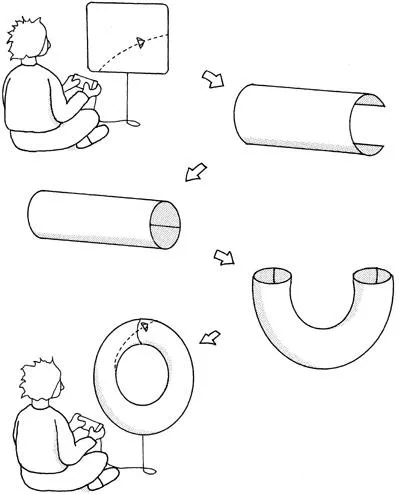
An orbifold generalises a cone. Dance around a maypole and you return after 360°; on a cone you return to the same place after less than 360°. Flatlanders on a Z-orbifold, shaped like a square bean bag, live normally until they discover four special points where walking round just 180° brings them back.
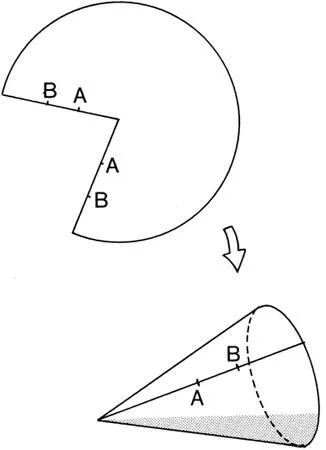
Because particles inherit the symmetry of the curled-up space (Chapter 6), Vafa's orbifolds yield many features of quarks with few assumptions, and may explain why there are three generations. A century of Poincaré's topology, once "useless", becomes physics. But the theory has been too successful: millions of orbifold solutions, some close to the Standard Model, others disastrous, and no way to choose. David Gross: "slightly embarrassing that we have so many solutions but no good way of choosing among them".
Perturbation theory cannot break ten dimensions down to four and six; only non-perturbative methods can, and "no one is smart enough". Kaku's history-student roommate predicted computers would put physicists out of work. Kaku's reply: a computer is "an impeccable idiot", fast but unable to invent theories, and deciding among millions of tunnelling vacua might take infinite computer time.
Tunnelling and symmetry breaking
Kaluza's question (where did the fifth dimension go?) returns in a deeper form, with Klein's answer: quantum theory. Tunnelling gives a finite probability to waking with your bed in the Amazon. It explains radioactive decay: nuclei that "should" be stable escape their binding barrier. Kaku's claim: the ten-dimensional universe, likewise unstable, tunnelled and exploded into four and six dimensions.
Kaku says energy conservation is "briefly violated" as neutrons tunnel out of uranium. In alpha decay (explained by Gamow in 1928) it is an alpha particle that tunnels, and energy is conserved throughout: tunnelling works because the particle's wave extends through a barrier it classically could not cross, not because energy is borrowed.
Chaplin and the fitted sheet. Charlie Chaplin stretches an undersized fitted sheet over a bed, corner by corner. Smooth and taut, it is highly symmetric (rotate the bed 180° about any axis and nothing changes) but under strain: a false vacuum. One corner pops and the sheet curls up into a lower-energy, less symmetric state. There are four ways it can curl, depending on which corner goes.
Punchline: the original ten-dimensional space-time was the taut sheet, with all forces unified in one string multiplet and travel possible in all ten dimensions. It tunnelled to a lower state, six dimensions curled up, and the symmetry broke, but there are millions of ways to curl, and only solving string field theory can say which.
Phase transitions everywhere (Kaku's analogies)
- Life stages: Gail Sheehy's Passages; Erik Erikson's stages, each defined by a conflict; Jean Piaget's abrupt jumps in children's understanding (object permanence arrives in a month).
- Dialectics: conflict within a stage resolves into a synthesis; small quantitative changes accumulate into a qualitative rupture, as in the storming of the Bastille.
- Dam burst: a full reservoir is a false vacuum; the true vacuum is the water downstream.
- Atomic bomb: uranium is a false vacuum holding a million times chemical energy; it occasionally tunnels (radioactive decay) and neutrons release it all at once.
Abdus Salam's banquet table: guests at a round table have a glass on each side, a left-right and rotational symmetry; when one guest picks up the glass on the right, all must, and the mirror image now shows everyone taking the left, so left-right symmetry is broken. The princess on the crystal sphere: perfectly balanced at the top, every direction is equivalent, but the slightest move sends her down, say to the west, singling out one direction. Maximum symmetry is often unstable: the false vacuum.
The vacuum-decay bubble. Suppose our universe is not the true vacuum, and the real ground state of the string is one of the millions of orbifolds without the Standard Model. Then a tiny bubble of true vacuum could appear anywhere; inside it chemistry and physics would change, matter would disintegrate, and the bubble would expand at light speed, swallowing stars, galaxies and clusters.
Punchline: "We would never see it coming." Nothing can warn of a wall moving at the speed of light.
Is our vacuum stable? This scenario became concrete physics in 2012. With the Higgs at about 125 GeV and the top quark at about 173 GeV, Standard Model calculations put our universe in a metastable state: the Higgs field's true minimum lies elsewhere, and a bubble of it could in principle nucleate. The expected lifetime is enormous, estimated at well over 10¹⁰⁰ years, and new physics at high energy could change the verdict either way.
From ice cubes to superstrings
Heat an ice cube in a pressure cooker and symmetry is restored stage by stage.
Plasma, "the fourth state of matter", is the most common state in the universe; a gas of nucleons resembles a neutron star interior. At 10³² K so much energy fills the cooker that space-time itself may distort and change dimension: "it may be advisable to leave the kitchen".
Cooling the Big Bang
Reverse the process and you get the history of the universe.
| Time after Creation | Kaku's 1994 event | Temperature | Since publication |
|---|---|---|---|
| 10⁻⁴³ s | 10D splits into 4D + 6D; 6D shrinks to 10⁻³² cm; 4D inflates | 10³² K | Speculative; no data reach this era |
| 10⁻³⁵ s | GUT force breaks; SU(3) splits off; a speck inflates by 10⁵⁰ | Inflation's timing and scale still unknown | |
| 10⁻⁹ s | Electroweak symmetry breaks into SU(2) and U(1) | 10¹⁵ K | Confirmed by Higgs discovery (2012) |
| 10⁻³ s | Quarks condense into protons and neutrons | ~10¹⁴ K (sic) | Actually about 10¹² K, around 10⁻⁵ s |
| 3 minutes | Stable nuclei form; space still opaque | Matches helium and deuterium abundances | |
| 300,000 years | Atoms form; universe becomes transparent; space turns black | Now 380,000 years | |
| 3 billion years | First quasars | Quasars exist by ~700 million years | |
| 5 billion years | First galaxies | JWST galaxies at ~300 million years | |
| 10–15 billion years | Solar system born; life a few billion years later | Sun formed 4.6 billion years ago, about 9.2 billion years after the Big Bang |
That "intelligent apes on the third planet of a minor star" can reconstruct the universe nearly to its birth is the triumph of quantum field theory. Stranger still, Kaku says, is the next question: whether wormholes can be gateways to other universes, and time machines.
The ten-dimensional "cracking" is not established physics. No version of string theory has derived why six dimensions curled and three expanded, nor shown that the split drove inflation; Kaku's earlier chapter states as a result ("This would explain the origin of the Big Bang") what is here admitted to be an assumption physicists "cannot yet prove". The temperature in his 10⁻³ s line is also inconsistent with his own 10⁻⁹ s line (it should have fallen to roughly 10¹² K).
Black Holes and Parallel Universes
Part III asks whether space can tear. Kaku builds up from how stars live and die, through the binding-energy curve, to the black hole, then shows that Einstein's equations hide a bridge to a mirror universe behind every black hole. Schwarzschild's bridge is impassable, but Roy Kerr's spinning black hole collapses to a ring that a probe might pass through along its axis into another universe, making a black hole a possible gateway, provided quantum effects do not slam it shut.
The life of a star
A star forms when a hydrogen cloud many times the size of the solar system contracts under gravity and heats up. At 10 to 100 million K protons overcome their electric repulsion and fuse into helium: a star is a nuclear furnace burning hydrogen to helium "ash", balanced between gravity crushing and fusion blowing apart.
The binding-energy curve is the master key. Plot the average "weight" of each nuclear particle against atomic weight: it falls steeply from hydrogen to a minimum at iron, then rises slowly to uranium. Moving down the curve releases the mass difference as energy by E = mc²: fusion from the light end, fission from the heavy end. Iron, at the bottom, can yield nothing.
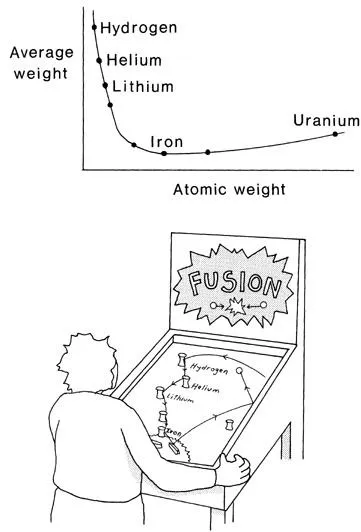
- The sun. A middle-aged yellow star about 5 billion years old with about 5 billion to go. When its hydrogen runs out it becomes a red giant, its atmosphere swelling perhaps to the orbit of Mars, vaporising the earth (born from the same cloud, it returns to the sun). Then it shrinks to a white dwarf the size of the earth and fades to a dark cinder.
- Massive stars. Several solar masses or more fuse ever heavier elements down to iron, where the furnace dies; the core collapses, temperatures soar, and a supernova outshines a galaxy of 100 billion stars. What remains is a neutron star "about the size of Manhattan", its neutrons touching, seen as a flashing pulsar (over 400 known by 1993, first found in 1967).
- Stardust. Supernovae forge elements heavier than iron and scatter them; second-generation stars like the sun form from the enriched gas, with planets. The heavy elements in our bodies came from a nameless supernova that exploded before the sun formed.
- Bombs. The same curve explains why only fission and fusion bombs exist: oxygen or iron sit too near the bottom to release energy, and "neutron bombs" are variants of the two.
Stellar evolution can be checked because the sky shows stars at every stage: supernova 1987A matched collapse of an iron core, and the 4 July 1054 supernova seen by Chinese astronomers left a neutron star (the Crab pulsar). Kaku's astronomy roommate "put a star in the oven" each morning, letting a computer evolve it from known fusion and thermodynamic equations.
Some stellar physics is muddled. Helium burns to carbon and oxygen (the triple-alpha process), not lithium, which stars destroy rather than make. A massive star does not pass through a white-dwarf stage before its supernova; it builds an onion of burning shells around an iron core, and it is that core that collapses. The red-giant sun will swell to roughly Earth's orbit, not Mars's. Our bodies are mostly hydrogen, oxygen, carbon and nitrogen, made in ordinary stars; only trace elements are heavier than iron. And since 2017 the neutron-star merger GW170817 and its kilonova have shown that much of the heaviest matter (gold, platinum) comes from neutron-star collisions, not only supernovae.
Black holes: escape velocity and space torn
Stars of roughly 10 to 50 solar masses keep collapsing past the neutron-star stage: with fusion exhausted, nothing known resists gravity. The star comes full circle, born and killed by gravity.
- 25,000 mph (11.2 km/s): Earth's escape velocity. Voyager exceeded the sun's.
- Escape velocity grows with mass and shrinks with radius, which explains why Earth keeps oxygen and Jupiter keeps primordial hydrogen.
- 1783: John Michell computes that a massive enough star would have an escape velocity equal to light speed and look black; ignored as crazy.
- r = 2GM/c²: the Schwarzschild radius. For the sun it is about 3 km; for the earth about 9 mm.
Two ways to see the blackness. Newton's: the pull is so strong that light's path bends into a circle. Einstein's: space itself is bent round, so a piece of space-time has pinched off; space has "ripped".
The Einstein-Rosen bridge
In 1916, months after Einstein's equations, Karl Schwarzschild solved them exactly for a massive, stationary star.
| Solution | Year | Describes | Interior | Passable to another universe? |
|---|---|---|---|---|
| Schwarzschild | 1916 | Non-rotating, uncharged | Point of infinite curvature; horizon is the point of no return | No: crushed, and crossing needs faster-than-light travel |
| Einstein-Rosen bridge | 1935 | Schwarzschild's geometry extended | Joins our universe to a mirror universe | A mathematical quirk, unreachable |
| Reissner-Nordström | 1916–18 | Charged black hole | Also contains a bridge | In principle |
| Kerr | 1963 | Rotating black hole | Collapses to a ring; curvature finite along the axis | Perhaps, along the axis |
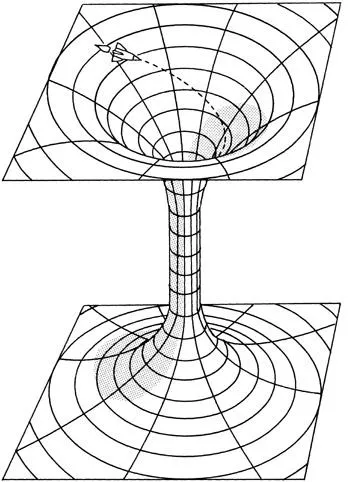
Roy Kerr, a New Zealand mathematician, assumed collapsing stars spin, speeding up like a skater pulling in her arms. The star flattens into a ring. Approach the ring from the side and it is a "ring of death" with infinite curvature; fall in along the axis and the gravity is enormous but finite. A probe might pass through the ring and the Einstein-Rosen bridge into a mirror universe: the Kerr black hole is a gateway. Approaching it, radar fills with images of light that has circled the hole many times, a cosmic hall of mirrors.
This "shuddering before the beautiful"... beauty is that to which the human mind responds at its deepest and most profound level.Subrahmanyan Chandrasekhar, on the Kerr solution
Chandrasekhar called the realisation that Kerr's purely mathematical solution exactly describes "untold numbers of massive black holes" the most shattering experience of his 45-year scientific life.
Warp factor 5: crumpling the carpet
Curvature is set by matter-energy, so Star Trek's dilithium crystals must be colossal stores of energy that bend space into pretzels. The Enterprise does not fly to Alpha Centauri; Alpha Centauri comes to it.
Lassoing the table. Sit on a rug on a slick floor and lasso a table several feet away. Pull hard enough and the carpet folds under you, the table arrives, and the distance vanishes into a heap of crumpled carpet; you hop across. You have hardly moved: the space between you has contracted.
Punchline: faster-than-light travel in relativity means moving space, not moving through it: a warp or a wormhole.
Warp drives after 1994. Months after Hyperspace appeared, Miguel Alcubierre (1994) wrote down an exact space-time in which a bubble of flat space is carried along by contracting space ahead and expanding it behind, at any speed. Like traversable wormholes it requires negative energy density, originally more than the mass-energy of the observable universe; later refinements cut this to stellar masses, and 2021 papers claiming "positive-energy" warp solutions were found to need either subluminal speeds or energy-condition violations after all. No known physics supplies the required exotic matter in bulk.
A window on Fifth Avenue
The dinosaur window. Strolling down Fifth Avenue, you meet a floating window. From the front you see a Tyrannosaurus rex's head, but no body below the window, only the street. Walk round: from the back you see a brontosaur's head; from the side, nothing at all. In the other universe, the two dinosaurs face off across the same window: the tyrannosaur sees a frizzy-haired little mammal's head, the brontosaur sees Fifth Avenue. Your hat blows through and vanishes from the street; the tyrannosaur sees a hat appear from nowhere, then a disembodied hand groping for it. Reach in from both sides at once and you seem to have no hands, while the dinosaurs see two tiny hands dangling from either face of the window with no body.
Punchline: a wormhole mouth is a two-faced dimensional window: each side opens on a different place, and seen edge-on it disappears.
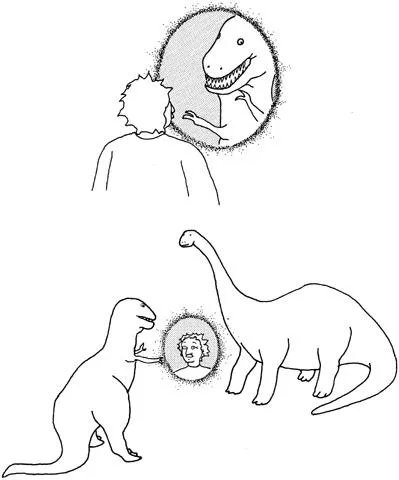
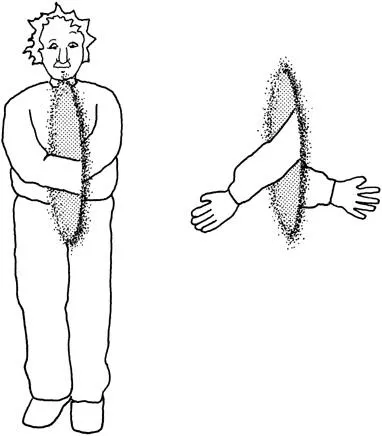
Closing the wormhole
The matter-energy needed to open a gateway is so large that quantum effects must dominate, and quantum corrections may close the throat. Neither relativity nor quantum theory alone can settle it; that waits for the ten-dimensional theory. But the same multiply connected spaces that allow gateways also allow time travel, the subject of the next chapter.
Black holes became observational science. On 14 September 2015 LIGO detected GW150914, two black holes of about 36 and 29 solar masses merging 1.3 billion light-years away (Nobel Prize 2017). The LIGO-Virgo-KAGRA network's fourth run ended on 18 November 2025 with about 300 candidate events in that run alone; the GWTC-4 catalogue (2025) brought confirmed compact-binary mergers past 200, and the loud GW250114 signal confirmed Hawking's area theorem to high precision. The Event Horizon Telescope imaged the shadow of M87 (2019) and of the Milky Way's Sagittarius A (2022). Every observation so far fits the Kerr solution outside the horizon. What happens inside, including any bridge to another universe, remains untestable. Known pulsars now number over 3,500**.
To Build a Time Machine
Special relativity forbids time travel; general relativity, it turns out, does not. Kaku classifies the time paradoxes, resolves them with Einstein's world lines (which can loop but never be cut), then traces the flood of solutions with closed timelike curves: Gödel (1949), NUT (1963), van Stockum-Tipler, Kerr. In 1988 Thorne, Morris and Yurtsever designed a traversable wormhole time machine that an "arbitrarily advanced civilization" could build, if it can obtain negative energy, which the Casimir effect suggests quantum theory allows. Whether quantum gravity closes the wormhole is left to the ten-dimensional theory.
Why special relativity is not enough
Superman, grieving for Lois Lane, flies faster than light to make time run backward. In special relativity this is impossible: time slows as you speed up, but reaching light speed would need infinite energy (Kaku says infinite mass). A. H. R. Buller's limerick in Punch captures the point: a lady "whose speed was far faster than light" "returned on the previous night". General relativity is the wider theory, covering acceleration and strong gravity, and it reopens the question: matter-energy can bend time into a circle, but the concentrations needed are so vast that quantum corrections take over. The verdict therefore belongs to a theory uniting both: hyperspace.
The collapse of causality
If time machines were as common as cars, history would dissolve: crowds from the future jostling at Ford's Theater to save Lincoln; tourists with cameras botching Normandy; mercenaries with rockets routing Alexander at Gaugamela (331 B.C.), where his victory over Darius III opened the way for Western culture; someone forever trying to kill Grant or give the bomb to the Germans. History books could never be written. Hawking's "experimental" argument: time travel is impossible, given "the fact that we have not been invaded by hordes of tourists from the future".
The two classes of time paradox
- Meeting your parents before you are born (altering the past). In Back to the Future the hero blocks his parents' romance and his young mother falls for him; if he cannot undo it, he should vanish.
- The man with no past (events with no origin). A rich old man gives a poor basement inventor the plans and money for a time machine; the inventor gets rich betting on known outcomes and, old, goes back to give his younger self the plans. Where did the idea come from?
Heinlein's "All You Zombies". A baby girl, Jane, is left at a Cleveland orphanage in 1945. In 1963 she falls for a drifter, becomes pregnant, is abandoned; at the birth doctors find both sets of sex organs and surgically make her a man; a stranger kidnaps the baby. As a drunk drifter he tells his story to a bartender at Pop's Place in 1970; the bartender recruits him into the time travelers corps, drops him in 1963 (where he seduces a young orphan), goes forward nine months to kidnap the baby, delivers her to the 1945 orphanage, and drops the drifter in 1985. The drifter rises in the corps and, disguised as a bartender, keeps his date in 1970. Girl, drifter, bartender and baby are one person: Jane is her own mother, father, son and daughter, an entire family tree curled into a circle.
World lines: you can fulfil the past but not change it
Plot distance horizontally and time vertically. Lying in bed from 8:00 to 12:00 traces a vertical world line (four hours into the future, no distance). Walking to work slants the line; driving slants it more. A forbidden region lies beyond the 45° light lines, since entering it would require exceeding light speed.
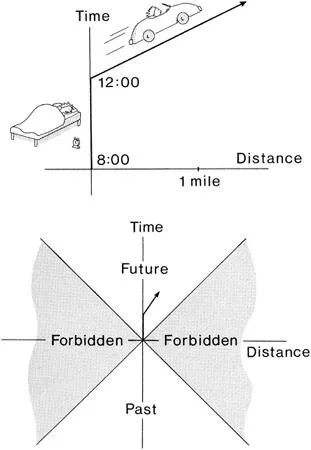
World lines never begin or end. At birth the world lines of molecules from the mother coalesce; at death they disperse ("from world lines to world lines"). Gamow titled his autobiography My World Line. Hence: in Back to the Future, vanishing would cut a world line, which relativity forbids, so the past cannot be altered. But a world line can loop: the inventor and Jane fulfil the past rather than change it. You may meet your younger self, and remember being met. Time travel in relativity is self-consistent loops, never rewrites.
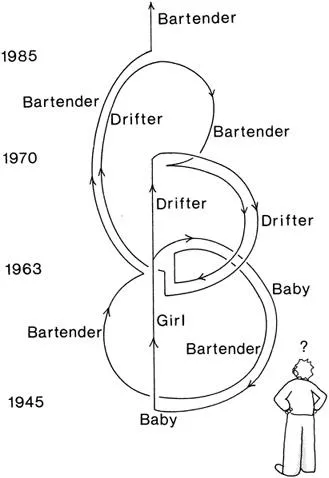
These loops, closed timelike curves (CTCs), are only pictured in special relativity; whether they exist is a question for general relativity and quantum theory.
Gödel: spoiler of arithmetic and of relativity
Kurt Gödel, Einstein's friend at the Institute for Advanced Study, was already famous as a spoiler. In 1931 he showed that arithmetic will always contain statements that can be neither proved nor disproved from its axioms: arithmetic is incomplete, and its consistency cannot be proved within itself. The proof built on liar-type sentences ("This sentence is false") to construct "This sentence cannot be proved", which, if true, is unprovable. It wrecked the dream of deriving all mathematics from a small consistent set of axioms.
In 1949 he found a solution of Einstein's equations for a universe of slowly rotating dust in which a rocket on a wide enough loop can "travel into any region of the past, present, and future, and back again": the first CTC in general relativity. It also showed Mach's principle incomplete (two solutions for the same matter). Einstein could not fault it and dismissed it on experimental grounds: the universe expands but does not visibly rotate.
| Newton | Einstein | Gödel |
|---|---|---|
| Time is a straight arrow, undeflectable | Time is a meandering river, bent by matter but never reversing | The river can curl into whirlpools and eddies that loop back |
A zoo of time-travel solutions
| Solution | Year | Source of the time loop | Status in 1994 |
|---|---|---|---|
| van Stockum (reanalysed by Frank Tipler, early 1970s) | 1936 | Infinitely long rotating cylinder | Unphysical: infinite length |
| Gödel | 1949 | Rotating universe of dust | Ruled out: universe does not rotate |
| Newman-Unti-Tamburino (NUT) | 1963 | Black-hole-like; circling 360° lands you on another "landing", like a spiral staircase | Pathological |
| Kerr | 1963 | Passage through the ring of a spinning black hole | Interior possibly causality-violating |
| Wormholes generally | Any wormhole can be made into a time machine | Need exotic matter |
Tipler: "solutions to the field equations can be found which exhibit virtually any type of bizarre behavior". Einstein's equations were a Trojan horse: a gift of bent starlight and a cosmology, with demons inside that threaten two cherished beliefs, that space is simply connected and history unalterable.
To build a time machine: Thorne's traversable wormhole
Wormholes had never been taken seriously as transport for five reasons.
Five objections to wormhole travel, and the Thorne design's answers
- Tidal destruction at the centre of a black hole. Answer: not a black hole at all; forces never exceed 1 g.
- Instability: the bridge collapses at the slightest disturbance, such as a ship. Answer: the throat is held open permanently by exotic matter.
- Faster-than-light travel needed to cross. Answer: no horizon, so ordinary speeds suffice.
- Quantum effects: radiation at the mouth kills travellers and may close it. Answer: contested (Hawking versus Thorne).
- Time freezes at the centre; millions of years pass at home. Answer: the trip takes "a total of about 200 days, or less".
From a novel to Physical Review Letters. In summer 1985 Carl Sagan sent Kip Thorne the draft of his novel Contact, asking for a scientifically acceptable way round the light barrier. Thorne worked backward: instead of starting from a star and solving for curvature, he specified the wormhole he wanted (no crushing tides, stable, short trip) and only then computed the matter needed. The answer came easily; Sagan used it, and that autumn Thorne set the solution on a Caltech final exam without saying what it was (the students analysed it without noticing it allowed time travel). In 1988 Thorne, Michael Morris and Ulvi Yurtsever published in Physical Review Letters, asking not "what are the laws?" but "What constraints do the laws of physics place on the activities of an arbitrarily advanced civilization?"
Thorne found that the CTCs in his wormhole seem to fulfil the past rather than produce paradoxes, and concluded that "from a single wormhole an arbitrarily advanced civilization can construct a machine for backward time travel". The catch: the throat needs exotic matter.
A second design: a cylinder of exotic matter with a person at its centre, sucked through to another place and time under no more than 1 g. Disappointing to readers of Wells: no dials, no panorama of history.
Negative energy and the Casimir effect
All ordinary matter has positive energy, and the vacuum by definition has zero. A time machine needs regions with less energy than the vacuum: the averaged weak energy condition (AWEC) must be violated. Relativists have long shunned negative energy, since it would also allow antigravity.
Two plates in empty space. Place two large, uncharged, parallel metal plates close together in a vacuum. Classical physics says nothing happens. Quantum physics says the vacuum seethes with virtual particle-antiparticle pairs appearing and vanishing under the uncertainty principle; between the plates fewer wave modes fit than outside, so the energy between them is lower than the vacuum, and the plates are pushed together.
Punchline: negative energy is not fantasy; it is a measured force (Casimir, 1948; first seen by M. J. Sparnaay, 1958). Put plates at each wormhole mouth and you have, in principle, exotic matter.
Thorne is careful: "It may turn out that the average weak energy condition can never be violated, in which case there could be no such things as transversible wormholes, time travel, or a failure of causality." Hawking argued that radiation at the mouth would feed back into Einstein's equations and close the wormhole; Thorne disagreed. Kaku's resolution: superstring theory, as a full quantum theory containing general relativity, can compute the corrections, decide whether AWEC violation is realisable, and so settle time travel. Ironically, Hawking himself proposed wormholes "even more fantastic": links to infinitely many parallel universes.
Corrections and omissions. The papers' word is "traversable", not "transversible". Sparnaay's 1958 measurement was crude and only "not inconsistent" with Casimir's prediction; precise confirmation came from Steve Lamoreaux in 1997. Gödel proved that a consistent system cannot prove its own consistency, not that arithmetic's consistency cannot be proved at all. Kaku also omits that Hawking had already published his Chronology Protection Conjecture (1992): the laws of physics conspire to prevent CTCs, because quantum vacuum fluctuations pile up without limit as a time machine is switched on. And his "you can fulfil but not alter the past" is what Igor Novikov formalised in 1990 as the self-consistency principle, tested by Thorne's group with billiard balls sent through wormholes into their own past (they always found consistent, if odd, trajectories).
Time machines in 2026. No law forbids CTCs outright, but the obstacles have hardened. Quantum energy inequalities (Ford and Roman, 1990s) show negative energy must be small, brief or confined to thin regions, so a macroscopic wormhole would need its exotic matter in a band perhaps a Planck length thick. The averaged null energy condition has since been proved for ordinary quantum field theory in flat space (Faulkner and colleagues 2016; Hartman and colleagues 2017), ruling out the simplest traversable designs. Calculations of quantum fields near a forming time machine (Kay, Radzikowski and Wald, 1997) support Hawking's view that semiclassical physics breaks down exactly at the chronology horizon. Other routes found since, such as J. Richard Gott's pair of passing cosmic strings (1991), need infinite or unphysical ingredients. On the positive side, Gao, Jafferis and Wall (2016) and Maldacena, Milekhin and Popov (2018) built genuinely traversable wormholes in quantum gravity using quantum entanglement, but these are slower than going the long way round, so they permit no time travel or faster-than-light shortcut. Chronology protection remains a conjecture, widely believed and unproved.
Colliding Universes
Stephen Hawking quantised the whole universe: there is a wave function of the universe, spread over all possible universes, peaked on ours, with Planck-sized wormholes joining them like touching soap bubbles. The idea revived two old debates, the anthropic principle and Schrödinger's cat with Everett's many worlds, and gave Sidney Coleman a striking result. Summing over wormholes to infinitely many parallel universes, Coleman found the cosmological constant should be exactly zero, the most probable value, turning wormholes from fantasy into a possible explanation of a measurable fact.
Hawking and quantum cosmology
Kaku visited Hawking near Cambridge and saw the devices (a page-turning book stand among them) that let him work with almost no movement or voice. Lucasian Professor, like Newton, Hawking had left black holes, "by now passé", for unification. Where string theorists start quantum and absorb gravity, Hawking and James Hartle start with Einstein's classical universe and quantise the entire universe: quantum cosmology.
Your wave function reaches Mars. A wave function is like a thundercloud: darker where the particle is likelier. Kaku in his Princeton chair has a wave function shaped like his body, but with a faint tail spreading to Mars and beyond the galaxy. So he is very probably in his chair, with a vanishingly small chance of being in another galaxy.
Punchline: replace "particle" with "universe". The wave function of the universe is large on ours and tiny on lifeless others, so "universe" no longer means "all that exists" but "all that can exist".

In Hawking's picture, universes are soap bubbles, each a whole ten-dimensional universe with its own space and its own time; between them there is no space and time at all. They collide, merge and split, joined by wormholes. Most are dead, with physical laws unfriendly to life. The task of proving the wave function peaks on our universe (making it unique and stable) was unsolved.
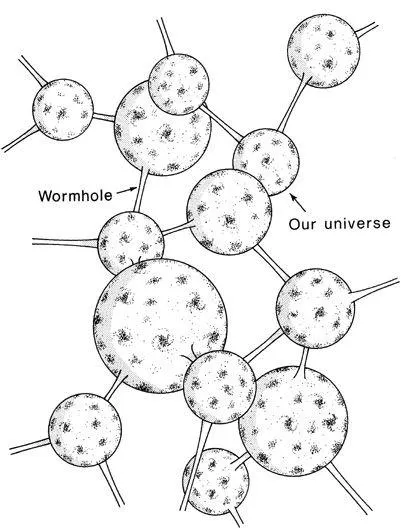
Putting God back in the universe? The anthropic principle
Science has fought anthropomorphism, from pet owners to Hollywood aliens; Xenophanes noted that Ethiopians' gods are black and flat-nosed, Thracians' red-haired and blue-eyed. The anthropic principle seemed to readmit it, though it rests on a real fact: change the constants slightly and life becomes impossible.
| Weak anthropic principle | Strong anthropic principle |
|---|---|
| Our existence is an experimental fact that constrains the constants | The constants were chosen (by God or a Supreme Being) so that life is possible |
| Weinberg: "the world is the way it is, at least in part, because otherwise there would be no one to ask why it is the way it is" | Freeman Dyson: "it almost seems as if the Universe must in some sense have known that we were coming" |
| Hard to argue with | Controversial, because it invokes a deity |
Kaku's examples of fine-tuning: alter nuclear physics slightly and stars could not forge the heavy elements; shrink the proton's lifetime to a few million years and the 1–2 billion years life needed in the oceans would never pass. Existence constrains the universe's age, composition, temperature and size.
The anthropic argument is the old "God put the earth at the right distance from the sun" argument in new dress. Its fallacy: millions of planets sit at the wrong distance and are lifeless; a few are right by chance, and we live on one. Hawking's many universes do the same for constants: most are dead, ours supports life, no designer needed, and the weak principle returns.
The critics: Heinz Pagels called it "completely foreign" to physics: untestable and so "not a scientific principle". Alan Guth: "something that people do if they can't think of anything better to do." Feynman: a theorist's job is to "prove yourself wrong as fast as possible". Weinberg: "although science is clearly impossible without scientists, it is not clear that the universe is impossible without science."
Life's molecules (DNA, proteins) are built from carbon, hydrogen, oxygen, nitrogen, phosphorus and sulphur, all lighter than iron, so Kaku's claim that life "depends on the heavy elements (elements beyond iron) for the creation of DNA and protein" is wrong; the fine-tuning concern is about forging carbon and oxygen at all (Hoyle's carbon resonance). The anthropic principle's later history is also ironic: in 1987 Weinberg used it to predict a small but non-zero cosmological constant, and in 1998 one was found.
Schrödinger's cat revisited
Quantum theory says a particle exists in a sum of all possible states until measured. Einstein asked whether the moon exists only because a mouse looks at it; Bohr once snapped, "You are not thinking. You are merely being logical!"; Schrödinger regretted "I ever had anything to do with it".
The cat in the box. Seal a cat in a box with a gun wired to a Geiger counter beside a lump of uranium. If a nucleus decays, the counter fires the gun and kills the cat. Before you open the box, quantum theory describes the cat as the sum of a dead cat and a live cat.
Punchline: Schrödinger meant it as a reductio; every experiment has nonetheless confirmed quantum theory, so physicists, like Alice with the Cheshire cat, have grown used to "queer things happening".
Three responses to the cat
- Consciousness (God). Observation implies an observer, so some cosmic consciousness must exist; Eugene Wigner held quantum theory implies it.
- Ignore it. The working majority's choice: a mindless camera can also measure. Feynman: "no one understands quantum mechanics… Nobody knows how it can be like that." Its one virtue is that it is "unquestionably correct".
- Many worlds. Hugh Everett (1957): the universe forks at every quantum event; the cat dies in one branch and lives in another.
Many worlds
Bryce DeWitt recalled the "shock" of realising that every quantum transition on every star splits our world into myriads of copies. Frank Wilczek: warts can come from single-cell mutations triggered by ultraviolet light, so there are many worlds "in which Helen of Troy did have a wart at the tip of her nose". Borges' "Garden of Forking Paths": time "forks perpetually toward innumerable futures". Albertus Magnus had called the plurality of worlds "one of the most noble and exalted questions in the study of Nature".
Everett's theory is mathematically equivalent to the standard interpretation, but Occam's razor cuts against it: the branches cannot communicate, so cannot be tested, like the aether (which Einstein made irrelevant rather than disproved) or unrepeatable miracles. Everett's mentor John Wheeler rejected it as "too much metaphysical baggage". Hawking's version differs in a way Kaku stresses: it involves whole universes, not particles, and wormholes that allow tunnelling between them. Solving it was beyond anyone's mathematics.
Quantum foundations since 1994. The cat problem has been transformed by decoherence (Zeh, Zurek): a system's entanglement with its environment rapidly suppresses interference between macroscopic alternatives, explaining why we never see superposed cats without settling which interpretation is right. Laboratories now create ever-larger "cat states" in superconducting circuits and mechanical oscillators. Loophole-free Bell tests (2015) confirmed quantum non-locality, honoured by the 2022 Nobel Prize (Aspect, Clauser, Zeilinger). Many-worlds has become one of the leading interpretations among cosmologists and quantum-information researchers, alongside QBism, pilot-wave and objective-collapse theories; none has been experimentally singled out.
Parallel worlds: "Random Quest"
Hawking's wormholes constantly connect us to billions of universes but are Planck-sized (about 10²⁰ times smaller than a proton) and big transitions take longer than the age of the universe; you will not come home to a family that calls the police. Still, a near-twin universe split by one small event is consistent with physics.
John Wyndham's "Random Quest". British nuclear physicist Colin Trafford survives a 1954 lab explosion and wakes, unhurt, in a London where World War II never happened and the atomic bomb was never built. In shop windows he finds best-sellers by himself: his counterpart became the writer he once considered becoming. At "his" flat he meets "his" wife, a beautiful stranger embittered by her husband's affairs; Trafford falls in love with her and they have the best weeks of their lives, until he is wrenched back home. Reasoning that the worlds diverged around 1926–27 and that most people have counterparts, he traces birth records and family trees, spends his savings, finds her double in his own world and marries her.
Attack of the giant wormholes: Coleman and the cosmological constant
Sidney Coleman of Harvard (part Woody Allen, part Einstein, Chaplin moustache, oversized sweatshirt; co-founder of the science-fiction critics' imprint Advent Publishers) claimed wormholes give a measurable result now.
- 1917 Einstein adds a cosmological constant to hold the universe static.
- 1929 Hubble shows the universe expanding; Einstein calls the constant "the greatest blunder of my life".
- 1970s Symmetry breaking in the Standard Model and GUTs dumps vast energy into the vacuum: predicted vacuum energy exceeds observation by 10¹⁰⁰, "unquestionably the largest" discrepancy in physics.
- 1988–89 Coleman sums over Hawking's web of wormholes and finds the wave function of the universe peaks sharply at zero cosmological constant.
Balancing the books to the penny. Spend millions of dollars over ten years without ever checking your salary, then compare income and spending: they balance to the penny. That is how improbable a cosmological constant cancelled to one part in 10¹⁰⁰ looks without a mechanism.
Punchline: Coleman's wormholes were the mechanism: "Batman swinging in on his rope". Zero was simply the most probable outcome, and the same mechanism might fix the other constants of nature.
Too large a negative constant and the universe would be a few feet across (reach out and grab yourself); too large a positive one and everything would fly away faster than its light could reach you. Leonard Susskind: "When Sidney came out with this work, everyone jumped." Coleman hedged: "It is always possible that unknown to myself I am up to my neck in quicksand and sinking fast." The main objection was that he summed only Planck-sized wormholes and ignored large ones; he replied with the paper "Escape from the Menace of the Giant Wormholes" ("If Nobel Prizes were given for titles, I'd have already collected mine"). If right, wormholes to dead universes keep ours from curling into a ball or flying apart. Final judgement, as always in this book, awaits a finite quantum gravity: strings.
Nature answered Coleman differently. Einstein introduced the cosmological constant in 1917, not "the 1920s". More importantly, in 1998 supernova surveys found the cosmological constant is not zero: dark energy makes up about 68% of the universe, with a vacuum energy about 10¹²⁰ times smaller than naive estimates (the usual figure, larger than Kaku's 10¹⁰⁰). A mechanism that forces Λ to exactly zero is now ruled out as the full story, and Euclidean "baby universe" wormholes fell from favour in the 1990s. Weinberg's anthropic reasoning, which Kaku files with the untestable ideas, made the successful prediction.
Wormholes as entanglement. Wormholes returned to the centre of physics by another road. In 2013 Maldacena and Susskind proposed ER = EPR: an Einstein-Rosen bridge is the geometric form of quantum entanglement (Einstein-Podolsky-Rosen pairs). Replica wormholes in the gravitational path integral (2019) reproduced the Page curve, showing how information escapes evaporating black holes, a striking echo of Coleman's sums over wormhole geometries. In November 2022 a Nature paper (Jafferis and colleagues) reported "traversable wormhole dynamics" simulated on 9 qubits of Google's Sycamore processor, and headlines said physicists had "made a wormhole". They had not: the experiment simulated a small, highly simplified model whose dual description resembles a wormhole, and a 2023 critique (Kobrin and colleagues) argued that the learned model did not reproduce genuinely gravity-like dynamics. No physical wormhole has been created, and none could carry anything but quantum information.
Beyond the Future
When could anyone harness hyperspace? Manipulating ten-dimensional space-time needs the Planck energy, a quadrillion times beyond the SSC, but technology grows exponentially. Kaku traces humanity's energy history, adopts Nikolai Kardashev's classification of civilisations by power (Type I planet, Type II star, Type III galaxy, where hyperspace becomes masterable), and asks why we see no one else. His answer is that most civilisations may die young at a series of hurdles, above all the "uranium barrier", where technology outruns social development, and that the most dangerous era is the one we are in.
Lords of the universe, eventually
Paul Davies: controlling the superforce would let us "tie our own knots in nothingness, and build matter to order... Truly we should be lords of the universe." Indirect verification may come this century; manipulation is centuries or millennia away. In 1993 the largest accelerators reached about 1 trillion electron volts (CERN, run by 14 European nations); hyperspace needs 10¹⁹ billion eV, perhaps requiring machines billions of miles long or entirely new technology.
The bacterium that outweighs the earth. A bacterium splitting every 30 minutes, unchecked, produces within a few weeks a colony weighing as much as the planet.
Punchline: exponential growth makes "impossibly large" factors like 10¹⁵ reachable in centuries, and the same bacteria, in a real dish, choke on their own waste. Both halves of the parable return later in the chapter.
Scientific knowledge grows in proportion to what is already known, doubling about every 10 to 20 years; more was learned after World War II than in the previous 2 million years.
The exponential rise of civilisation
- Muscle power, about 1/8 horsepower. Hunters and foragers for most of human existence.
- Hand tools, 1/4 hp. Spears extend arms, clubs fists, knives jaws (last 100,000 years).
- Agriculture and domestication, about 1 hp. After the Ice Age, settled villages, horses and oxen; then slave societies, where one owner commands hundreds and builds pyramids and temples.
- Steam, tens to hundreds of hp. Newton's mechanics leads to machines, railways and steamships; the U.S. industrialised in a century where Europe took 10,000 years.
- Electricity. Maxwell's force electrifies cities; dynamos replace steam.
- Nuclear, a millionfold jump. Chemical reactions release electron volts, fission and fusion millions of electron volts.
For 99.99% of our existence we were "one step above" animals in energy; all the rest happened in the last few centuries.
Futurology's poor record
Futurologists extrapolate linearly while knowledge grows exponentially: 1920s polls foresaw fleets of transatlantic blimps. In the short run progress is quantitative; over decades, qualitative breakthroughs dominate. John von Neumann, father of the electronic computer, predicted computers would become so huge only governments could own them, and that they would predict the weather. Both failed: chips went into every appliance, and weather is chaotic (a sneeze might eventually trigger a hurricane).
Kaku's confident "computers... have failed to predict the weather" has aged badly. Five-day forecasts in the 2020s are as accurate as one-day forecasts were in 1980, and since 2023 machine-learning models (DeepMind's GraphCast and GenCast, ECMWF's AIFS) match or beat physics-based models at medium range. Chaos still caps useful deterministic forecasts at roughly two weeks, so both von Neumann and Kaku were half right.
Type I, II and III civilisations
Kardashev's classification (1964), as Kaku presents it
- Type 0 (us): just beginning to tap planetary resources; runs on fossil fuels and, in much of the world, human labour; cannot predict the weather, let alone control it.
- Type I: controls the energy of an entire planet: weather, earthquakes, deep mining, ocean harvests; has explored its solar system. Within a few centuries for us.
- Type II: controls the power of its sun, not passively but by mining it; begins colonising nearby stars. About 1,000 years after Type I. Kaku's example: Star Trek's Federation, with antimatter engines and wormhole travel.
- Type III: controls the power of an entire galaxy, billions of stars and perhaps the black holes of the galactic nucleus; masters space-time; warp drive is routine commerce. Several thousand years or more after Type II (Asimov's Foundation timescale). Here manipulating energies "a million billion times" today's, and so the tenth dimension, becomes possible.
The scheme's strength is that it predicts only what physics constrains, energy supply, and ignores social details that are bound to be wrong.
| Type | Power source | Approximate power | Kaku's timeline from Type 0 |
|---|---|---|---|
| 0 | Fossil fuels, muscle | ~10¹³ W (humanity today, about 2 × 10¹³ W) | Now |
| I | Whole planet | ~10¹⁶–10¹⁷ W (sunlight falling on Earth) | A few centuries |
| II | Whole star | ~4 × 10²⁶ W (the sun's output) | ~1,000 years more |
| III | Whole galaxy | ~4 × 10³⁷ W | Several thousand years or more |
Kaku's markers of Type 0 status: our biggest controllable energy source is a hydrogen bomb we can only detonate, while a single hurricane releases the power of hundreds of them; and space milestones come in decades (he quotes NASA's earliest crewed Mars landing as 2020, with colonisation 40–50 years later).
The Kardashev scale today. Carl Sagan turned the types into a continuous index, K = (log₁₀P − 6)/10 with P in watts. Humanity's roughly 2 × 10¹³ W gives K ≈ 0.73, not "Type 0". Searches for the scale's signatures have found nothing: Breakthrough Listen (from 2015) has surveyed over a thousand nearby stars and, in 2023, 97 nearby galaxies for radio technosignatures, without detections; infrared surveys for the waste heat of Dyson spheres (WISE/Ĝ, and 2024 candidates from Gaia, 2MASS and WISE) have produced only ambiguous objects most likely explained by dusty galaxies. Kaku's dates have slipped: no crewed Mars landing is now expected before the late 2030s at the earliest, and NASA's Artemis programme is still working to return astronauts to the Moon.
Astrochicken: Freeman Dyson's view
Over lunch at the Institute, Freeman Dyson, who confessed he could not, like Bohr and Feynman, concentrate for years on one question, criticised a space programme of ever-heavier payloads and ever-longer gaps between launches.
Astrochicken. Dyson's alternative probe weighs a kilogram instead of Voyager's ton; "will not be built, it will be grown"; is "as agile as a hummingbird with a brain weighing no more than a gram". Part machine, part animal, it would be bred to eat ice and hydrocarbons in the rings of the outer planets, digest them into fuel in a genetically engineered stomach and hop to the next moon. It needs genetic engineering, artificial intelligence and solar-electric propulsion, which Dyson expected by 2016.
- 10 billion: Dyson's factor in size and power between successive civilisation types.
- 1% a year: a sluggish growth rate that still crosses that factor in about 2,500 years.
- A few thousand years for an expansionist society to go from planet to star; a few million from star to galaxy (Dyson). Past Type II, a species is "invulnerable to extinction".
Dyson's caution: the speed of light makes the Type II-to-III step hard, and the Planck length may be "a natural barrier facing all civilizations".
No Astrochicken flew by 2016, but its spirit did: shoebox-sized CubeSats (the MarCO pair relayed InSight's Mars landing in 2018), solar-electric propulsion on missions such as Psyche, and Breakthrough Starshot's study of gram-scale light-sail probes for Alpha Centauri. Dyson died in 2020.
Where is everybody?
If someone has already mastered hyperspace, we might simply meet them. But we see nothing: Viking (1970s) found Mars barren, Voyager (1980s) found the outer planets lifeless; Venus proved a hell of carbon dioxide, 800°F and sulphuric-acid rain; Mars, object of fascination since Orson Welles's 1938 broadcast, shows ancient riverbeds but no ruins. Dyson argued that any advanced civilisation must, by the second law of thermodynamics, radiate waste heat; none is seen. Our own radio and TV leak forms a sphere about 50 light-years in radius.
- 1978 Paul Horowitz scans 185 sunlike stars within 80 light-years: nothing.
- 1979 Donald Goldsmith and Tobias Owen report a search of over 600 systems: nothing.
- 1992 Congress funds $100 million over ten years for NASA's High Resolution Microwave Survey, using the 305-metre Arecibo dish for targeted stars within 100 light-years and a 34-metre Goldstone antenna for sky sweeps. Frank Drake is cautiously optimistic.
Kaku's Drake-equation estimate
Start with 200 billion stars in the galaxy and apply six factors of 10% each: sunlike stars; with planets; with earthlike planets; with life-compatible atmospheres; with life; with intelligence. One star in a million qualifies: 200,000 stars with intelligent life. Slightly more optimistic values put the nearest within 15 light-years.
George Wetherill's simulations at the Carnegie Institution found earth-sized planets form easily from a dusty disk, often at 80–130% of Earth's distance, and that a Jupiter is needed to sweep away comets that would otherwise hit about 1,000 times more often (a sterilising impact every 100,000 years). With a galaxy perhaps 10 billion years old, Type II and III broadcasters should fill spheres hundreds to thousands of light-years across. Why the silence?
Three explanations Kaku offers (perhaps all partly true)
- Timing. Drake's equation says how many, not when. Life on Earth is 3–4 billion years old, intelligence a million years, radio a few decades: thousands of civilisations may have lived and died before us or will arise after us.
- Indifference. Civilisations millions of years ahead may hide or ignore us, as we ignore an ant colony rather than asking to see its leader.
- Self-destruction. Many arise from the swamp but fail to pass a series of natural and self-inflicted catastrophes.
"I hope not." Asked if we would soon contact aliens, Dyson said he hoped not. Kaku reads British history behind it: the empire was only centuries ahead of the civilisations it conquered. Dyson welcomed the light barrier as a blessing that keeps Type II civilisations apart ("At least, one can evade the tax collector"). The Aztec precedent: an advanced civilisation, a few centuries behind Spain in gunpowder and ships, crushed in 1521 by a band of about 400 conquistadors; millions enslaved, treasuries looted, history erased. An Aztec account: the Spaniards seized on gold "as if they were monkeys... as if they were pigs". A civilisation a million years ahead would probably find us uninteresting, and Star Trek's evenly matched Klingons and Romulans are astronomically unlikely.
The Aztec story needs its missing half: Cortés won with tens of thousands of indigenous allies (above all Tlaxcalans) and with smallpox, which killed a large share of Tenochtitlan's population during the 1520–21 siege; technology alone did not do it. Kaku also never names the puzzle he is discussing, the Fermi paradox (Enrico Fermi's 1950 "Where is everybody?"), and Wetherill's "Jupiter as shield" was later questioned by simulations suggesting Jupiter may send as many comets inward as it deflects. Finally, HRMS never ran its ten years: Congress cancelled it in October 1993, and the Arecibo dish collapsed in December 2020.
The search in 2026. Planets are no longer hypothetical: more than 6,000 exoplanets are confirmed (NASA's archive passed that mark in 2025), and Kepler data suggest a sizeable fraction of sunlike stars host roughly Earth-sized planets in their habitable zones. Biosignature claims remain contested: JWST's 2025 hint of dimethyl sulphide on K2-18b did not survive reanalysis, and NASA's Perseverance rover's "leopard spot" rocks at Cheyava Falls (reported in a 2025 Nature paper) are a "potential biosignature" that abiotic chemistry may also explain. SETI has moved to wide-band surveys (Breakthrough Listen, China's FAST dish, the Allen Telescope Array) and to "technosignatures" of every kind. Frank Drake died in 2022. Silence continues.
The rise and fall of civilisations: the hurdles
Kaku's third explanation becomes a programme: identify the barriers a Type 0 civilisation must pass, aeon by aeon. Humanity, he suggests, behaves like a teenager who believes it is invulnerable, with a "Peter Pan complex".

| Hurdle | Timescale | Kaku's 1993 view | 2026 status |
|---|---|---|---|
| Uranium barrier | Decades to centuries | ~50,000 warheads; 20 nuclear states by 2000 | About 12,200 warheads; 9 nuclear-armed states |
| Ecological collapse | Decades | CO₂ up 25% since 1958; +0.6°F per decade | CO₂ about 425 ppm; 2024 first year above 1.5°C |
| New ice age | Tens of thousands of years | Cause unknown | Milankovitch cycles; next glaciation delayed by CO₂ |
| Asteroids, supernovae | Thousands to millions of years | ~150 of 1,000–4,000 large NEOs tracked | Over 90% of km-sized NEOs found; DART deflection (2022) |
| Nemesis | 26-million-year cycle | Periodic comet showers | Nemesis ruled out by WISE |
| Death of the sun | ~5 billion years | Red giant engulfs Earth | Earth uninhabitable in ~1 billion years as the sun brightens |
| Galaxy collision | 5–10 billion years | Andromeda devours the Milky Way | Merger only about 50% likely in 10 billion years (2025) |
The uranium barrier
Jonathan Schell's The Fate of the Earth documented how close we came to annihilation; even after the Soviet collapse about 50,000 nuclear weapons remained. Nuclear winter: as little as 100 megatons might start firestorms whose soot blots out the sun. Proliferation: India (first test 1974, about 20 bombs), Pakistan (four, built at Kahuta), Israel (a Dimona worker saw material for 200), South Africa (admitted seven; the Vela satellite's double flash off its coast), with North Korea, South Korea and Taiwan "at the brink".
Why element 92 is a universal trap. Fire can be harnessed by a tribe; metallurgy needs a village of thousands; the internal-combustion engine needs a nation-state of millions. But the same nation-state that builds car engines can refine uranium, which releases a million times the energy of chemical explosives. Destructive technology suddenly outruns social organisation, while the cohesive unit is still the hostile nation-state. Every industrial civilisation in the galaxy must meet element 92, and many may have died there, which is why radio civilisations may appear as brief spikes in galactic history.
Heinz Pagels: our knowledge of cosmic energies "must be met by the creation of a moral and political order which will accommodate these forces or we shall be destroyed."
Proliferation details: South Africa built six devices (a seventh was unfinished) and dismantled them by 1991. The Vela incident was a single double flash, on 22 September 1979, still unexplained officially. Kaku's "20 nations by 2000" did not happen: today nine states have nuclear weapons, with Pakistan (tests 1998) and North Korea (2006) joining India and Israel, while Taiwan and South Korea stayed non-nuclear.
Ecological collapse
Bacteria in a dish grow exponentially, then die in their own waste. Our oceans and air are "ultrathin films". Since 1958 carbon dioxide had risen 25% (Kaku's figure), mostly from oil and coal (the U.S. and former Soviet Union giving 45%). Warming took a century from 1880 to reach 1°F, then ran at about 0.6°F per decade, implying 1–4 feet of sea-level rise by 2050, threatening Bangladesh, Los Angeles and Manhattan, the Midwest's farms and the rain forests. The fault is again a mismatch: pollution comes from millions of factories, but remedies must be planetary, while the governing unit is the nation-state. Long-term answers: solar, fusion and breeder reactors, with solar and fusion most promising.
A Type I civilisation is by definition planetary: harnessing a whole planet needs a cohesive social unit of billions. Like an infant whose most dangerous months are the first, a civilisation's most dangerous period is the first few centuries after it acquires nuclear capability; once it achieves planetary political organisation, the worst may be over.
Climate since 1993. Atmospheric CO₂ has climbed from about 357 ppm to about 425 ppm (2025), roughly 50% above pre-industrial. 2024 was the first calendar year more than 1.5°C above pre-industrial temperatures. Sea level is rising about 4 mm a year and accelerating, slower than Kaku's 1–4 feet by 2050 but on track for well over a foot by then. His solar forecast came true faster than anyone expected (solar is now the cheapest new electricity in most of the world); fusion achieved ignition at NIF in 2022 but no power plant exists, and ITER's full operation has slipped to the late 2030s. Breeder reactors remain marginal.
A new ice age
Kaku attributes ice ages to tiny variations in Earth's rotation that accumulate to divert polar jet streams; they wiped out many mammals and isolated human populations. Computers, he says, cannot yet predict them; fifth-generation parallel machines may help. A civilisation reaching Type I first will either change the weather or leave.
Ice ages are paced by the Milankovitch cycles, slow changes in Earth's orbit (eccentricity, about 100,000 years), axial tilt (41,000 years) and precession (about 23,000 years), amplified by CO₂ and ice-albedo feedbacks; this was firmly established from ocean cores in 1976 (Hays, Imbrie and Shackleton). Human greenhouse emissions are now expected to postpone the next glaciation by tens of thousands of years. Japan's "fifth-generation computer" project ended in 1992 without its promised breakthroughs; parallel computing arrived instead via GPUs.
Astronomical close encounters
- Toutatis: two rocky lobes about 2 miles across, radar-imaged as it passed 2.2 million miles away (late 1992).
- 23 March 1989: an asteroid about half a mile across passed 0.7 million miles away, about three times the Moon's distance.
- 14 August 2126: Brian Marsden's late-1992 warning that comet Swift-Tuttle (period about 130 years, parent of the Perseids) might hit, odds 1 in 10,000; he retracted weeks later ("We're safe for the next millennium").
- 1,000–4,000 Earth-crossing asteroids larger than half a mile (NASA panel, January 1991); only about 150 tracked; about 300,000 larger than 300 feet.
- H-bomb rockets: deflecting an asteroid tens of millions of miles out has been proposed.
Kaku's own encounter: as a Harvard senior in winter 1967, a friend at the observatory secretly told him a several-mile-wide asteroid might hit in June 1968, at graduation; twenty years later he read it had missed by about a million miles. A nearby supernova is rarer and worse: an X-ray burst producing a huge electromagnetic pulse that blacks out electronics, and at worst sterilisation. Sagan speculated a supernova 10–20 light-years away 65 million years ago burned atmospheric nitrogen into oxides that stripped the ozone layer. There would be little warning; the only precaution is to watch nearby stars close to exploding.
The 1968 object was Icarus, about 1.4 km across (not several miles), which passed about 4 million miles away, not one million. Toutatis's closest approach was on 8 December 1992.
Planetary defence became real. NASA's DART spacecraft struck the moonlet Dimorphos in September 2022 and shortened its orbit by about 33 minutes, the first demonstration that an asteroid can be deflected by impact, with no H-bomb needed. Surveys have found well over 90% of near-Earth asteroids larger than a kilometre and about 38,000 near-Earth asteroids in all. The Vera C. Rubin Observatory began its survey in 2025, and NEO Surveyor is due to launch around 2027. The system was tested in early 2025 when asteroid 2024 YR4 briefly showed about a 3% chance of hitting Earth in 2032 before further observations ruled out an Earth impact.
Nemesis and the extinction cycle
- 1980 Luis Alvarez, his son Walter, Frank Asaro and Helen Michel (Berkeley) find excess iridium, an extraterrestrial marker, at the 65-million-year boundary: an impact killed the dinosaurs.
- Energy: a 5-mile comet at 20 miles per second releases 100 million megatons, 10,000 times the world's nuclear arsenal, digging a crater 60 miles wide and 20 deep.
- 1981 Pemex geophysicists report circular gravity and magnetic anomalies near Chicxulub Puerto, Yucatán: a 110-mile crater.
- 1992 The crater dated to 64.98 ± 0.05 million years; glassy tektites in Mexico, Haiti and Florida to 65.07 ± 0.10 million: the "smoking gun".
There have been five mass extinctions; the end-Permian (250 million years ago) killed 96% of species, including the trilobites. David Raup and John Sepkoski found extinctions recurring every 26 million years over ten cycles (two missing) back 260 million years, including the end-Eocene (35 million years ago). Nothing known has that period, so Richard Muller proposed Nemesis, an unseen companion star that every 26 million years plunges through the Oort cloud and sends a shower of comets inward; iridium layers at other extinction boundaries were cited in support. We are midway, with over 10 million years to the next pass, by which time, Kaku says, we will be Type III.
The death of the sun and the galaxy
The sun, about 5 billion years old, has about 5 billion more as a yellow star; then a red giant swallows the earth and "our molecules will eventually return to the sun". Sagan: "there will be a last perfect day on Earth"; ice caps melt, oceans boil, the atmosphere evaporates. So the earth ends in fire, with ample warning, unlike a supernova.
We live in the Orion arm; the visible stars are a tiny part of the Milky Way's 200 billion. Andromeda, about 2 million light-years away and "two to three times larger", approaches at 125 km/s and should collide in 5–10 billion years. Lars Hernquist: "analogous to a hostile takeover. Our galaxy will be consumed and destroyed." Because stars are so widely spaced, collisions between stars would be rare, and the sun might survive. Beyond lies the death of the universe itself, open (cold) or closed (Big Crunch), a threat even to Type III. The Aztecs foresaw a sun that "falls from the sky" "when the Earth has become tired".
Revised fates. The sun brightens about 10% per billion years, so Earth's oceans will be lost to a runaway or moist greenhouse in roughly 1 billion years, long before the red-giant phase, which may or may not engulf Earth's (by then wider) orbit. Andromeda is about 2.5 million light-years away, closing at about 110 km/s, and recent mass estimates make it roughly comparable to the Milky Way rather than two or three times larger. A 2025 analysis using Gaia and Hubble data found only about a 50% chance that the two galaxies merge within the next 10 billion years. Direct star-on-star collisions in a galaxy merger are expected to be essentially nil, not "several per century".
The Fate of the Universe
Even a Type III civilisation faces the death of the universe, in ice (endless expansion to an entropy death) or fire (a Big Crunch), depending on whether the cosmic density is below or above about 10⁻²⁹ g/cm³, a question that in 1993 hinged on dark matter. Kaku surveys the frozen future of dying stars, decaying protons and evaporating black holes, then offers the hyperspace escape: if the universe recollapses, the curled-up six-dimensional twin may reopen, and intelligence could flee the crunch through a higher dimension. Barrow and Tipler's self-replicating colonisation and Asimov's "The Last Question" close the chapter.
Unyielding despair
Charles Darwin found it "an intolerable thought" that ever-improving humanity and all sentient beings are "doomed to complete annihilation". Bertrand Russell went further: all "the noonday brightness of human genius" is "destined to extinction in the vast death of the solar system", and the soul's habitation can be built only "on the firm foundation of unyielding despair". Kaku's reply on the solar system: space travel, unimaginable to Russell, means the sun's red-giant phase need not doom humanity. The death of the universe is another matter: no space ark escapes it.
Russell's passage comes from "A Free Man's Worship", published in 1903, not 1923.
Ice or fire: the critical density
General relativity offers two endings in the 1993 picture: an open universe expanding forever to near absolute zero (the "Cosmic Whimper"), or a closed one collapsing into the Big Crunch. The deciding number is the average density.
- 10⁻²⁹ g/cm³: the critical density, about 10 milligrams of matter spread through the volume of the earth.
- Below it: endless expansion, a cold lifeless space.
- Above it: gravity reverses the Big Bang into a fiery crunch.
- Up to 90% of a galaxy's mass is invisible dark matter, revealed by Newton's laws applied to orbital speeds; counting stars gives far too little.
Counting stars and multiplying by average mass says the universe is open, but omits dust, black holes and cold dwarfs; orbital dynamics says galaxies are far heavier. Until the missing mass is understood, Kaku concludes, the fate cannot be decided.
Entropy death
Sir James Jeans foresaw a "heat death" in which temperature falls too low for life. The engine is the second law of thermodynamics.
C. P. Snow's version of the three laws of thermodynamics
- You cannot win: matter and energy are conserved; nothing comes from nothing.
- You cannot break even: disorder (entropy) always increases, so you never return to the same energy state.
- You cannot get out of the game: absolute zero is unattainable.
Cream poured into coffee never unmixes; cigarette smoke never returns to the cigarette; a house takes a year to build and an hour to burn; 5,000 years of building toward the Aztec civilisation fell to Cortés in months. Stars, too, run down the binding-energy curve.
| Kaku's timeline of a cold universe | When (Kaku) | Modern estimate |
|---|---|---|
| All stars become black holes, neutron stars or cold dwarfs | 10²⁴ years | Star formation ends ~10¹⁴ years; galaxies evaporate by ~10¹⁹–10²⁰ |
| Protons and neutrons decay (GUTs); life must rebuild itself from electrons, neutrinos and energy | 10³² years | Proton lifetime is over 10³⁴ years, if it decays at all |
| Universe near absolute zero; black holes the last warm hearths | 10¹⁰⁰ years (a googol) | Stellar black holes evaporate by ~10⁶⁷ years, the largest by ~10¹⁰⁰ |
| Quantum tunnelling to another universe becomes possible | Beyond 10¹⁰⁰ | Still speculative |
Hawking radiation makes black holes the last energy sources: civilisations "like shivering homeless people huddled next to a fading fire". After that, John Barrow and Joseph Silk say, physics may have no answer, except that "Where there is quantum theory there is hope... for in an infinite quantum future anything that can happen, eventually will", including tunnelling into a new universe.
Escape through a higher dimension
Now suppose the density exceeds critical. Within tens of billions of years expansion halts; starlight turns blue-shifted as galaxies close in; oceans boil and atmospheres become furnaces; refugees flee in giant ships with heat shields; atoms ionise into plasma, nuclei break apart, nucleons dissolve into quarks. "As in a black hole, the Big Crunch devours everything."
The only exit is to leave space-time itself. Kaluza-Klein and superstring calculations show that after Creation our four dimensions expanded at the expense of the six-dimensional twin; their fates are linked. As our universe collapses, the twin may re-expand from the Planck scale, and in the final moments matter and energy, and intelligence "smart enough to calculate the dynamics of space-time", might escape into it. Gerald Feinberg: today "no more than a science fiction plot", but if other dimensions exist, intelligence will have billions of years to find out "how to take advantage of it".
Colonising the universe: Barrow and Tipler
Most writers treat intelligence as a passive victim. John Barrow and Frank Tipler (The Anthropic Cosmological Principle) assume instead that technology keeps growing exponentially for billions of years, and that intelligence plays an active role at the end, even without hyperspace travel, using only near-light rockets (for example photon engines driven by large lasers).
The Barrow-Tipler colonisation argument
- Time is plentiful: centuries per interstellar hop is nothing over billions of years.
- Von Neumann probes: self-programming, self-repairing, self-replicating automata (the idea is John von Neumann's) land on planets, mine rock, build factories and launch copies, needing no instructions from home; far more efficient than Star Trek's crewed starships.
- Exponential spread: the more systems colonised, the faster colonisation proceeds; eventually vast regions of the visible universe.
- Recollapse helps: in a contracting universe galaxies draw closer, so colonisation accelerates until the entire universe is occupied.
- The final heat: no living being survives it, but sufficiently heat-resistant robots might.
They even suggest alien von Neumann probes might already be in our solar system; perhaps 2001's monolith was one.
Two problems. Von Neumann worked out the theory of self-reproducing automata and the stored-program architecture, but the first general-purpose electronic computer was ENIAC (Eckert and Mauchly, University of Pennsylvania, 1945); his Princeton IAS machine ran in 1951–52. More seriously, Barrow and Tipler's scenario, and Tipler's later "Omega Point" theology, require a recollapsing universe, which the 1998 discovery of accelerating expansion appears to rule out unless dark energy decays. The same is true of Kaku's escape into the six-dimensional twin.
Asimov's "The Last Question"
Asimov's story assumes death by ice, and traces one question through ever-greater computers.
| Era | The computer | Humanity | The question | The answer |
|---|---|---|---|---|
| 2061 | Vast computer that built a solar power satellite; technicians barely understand it | Earth-bound; two drunk technicians, a $5 bet | Can the sun's death, and the universe's, be avoided? | INSUFFICIENT DATA FOR A MEANINGFUL ANSWER |
| Centuries later | Covers hundreds of square miles per planet, services itself, guides hyperspace ships | Colonising thousands of stars; children cry "Don't let the stars die" | Can entropy be reversed? (The father hides the reply) | INSUFFICIENT DATA |
| Thousands of years | Redesigns its own circuits; no one understands it | Galaxy colonised; immortals on the Galactic Council | Is the universe running down? | INSUFFICIENT DATA |
| Millions of years | Mostly housed in hyperspace | Minds freed from bodies roam the galaxies; humanity's home star long dead | Can the death of the universe be avoided? | INSUFFICIENT DATA |
| Billions of years | Fused with humanity's single collective mind | A trillion trillion trillion immortal bodies, then one mind | Is this cold and darkness death? | "I HAVE BEEN DOING SO FOR A HUNDRED BILLION YEARS... ALL THE DATA I HAVE REMAINS INSUFFICIENT" |
| After the end | Alone in hyperspace, it finally finds the answer | Gone | It gathers cold gas and dead stars into a ball: LET THERE BE LIGHT! |
Asimov's ending is Kaku's theme in parable: a sufficiently advanced intelligence, operating from hyperspace, becomes indistinguishable from a creator and restarts the cycle with a new Big Bang ("And on the seventh day, He rested").
Detail: in Asimov's original (1956) the 2061 computer is Multivac, succeeded by Microvac, Galactic AC, Universal AC and Cosmic AC; Kaku calls it "AC" throughout.
The fate of the universe in 2026. The question Kaku left open was answered in a way he did not foresee. Dark matter is real (about 27% of the cosmos) but not enough to close the universe; the total density is very close to critical (the universe is flat), and the largest share, about 68%, is dark energy, discovered in 1998, which makes the expansion accelerate. With a true cosmological constant the future is the cold branch, but faster and lonelier than the "Cosmic Whimper": galaxies beyond our Local Group recede beyond the horizon within about 100 billion years, and Freeman Dyson's 1979 strategy for eternal slow-thinking life was shown by Krauss and Starkman (2000) to fail. DESI's 2024–25 data, however, prefer dark energy that is weakening; if it keeps fading, or turns negative, a recollapse becomes possible again (one 2025 fit by Tye and colleagues even puts a Big Crunch about 20 billion years ahead). The fire branch that Kaku's escape plan needs is therefore not dead, just unproven.
Conclusion
Kaku steps back to weigh what the ten-dimensional theory means for experiment, philosophy, mathematics and religion. He concedes physics may face a long dry spell in which theorists must lead without experimental footholds. His central philosophical claim is that higher-dimensional geometry dissolves the war between reductionism and holism: the same geometry can be approached from the parts (quarks in a Kaluza-Klein space) or from the whole (the shape of the curled-up space), and string theory itself was born of holistic S-matrix theory yet contains the reductionist Standard Model. He ends with the God of Order, and with meaning found in the act of understanding.
Nature is simpler than anyone thought
The deepest lesson of the century, Kaku says, is that nature at bottom is simple: the mathematics has soared, but the driving ideas (higher dimensions, strings) are geometric. As Copernicus simplified the solar system and dethroned the earth, the ten-dimensional theory may simplify the laws and dethrone three-dimensional space: a three-dimensional description such as the Standard Model is "too small", and cramming four forces into it gives something "ugly, contrived, and ultimately incorrect".
Ten dimensions and experiment
"Gray is the dogma, but green is the tree of life" (Goethe): beautiful theories die when experiment disagrees, however prestigious their backers.
- Helmholtz versus Maxwell. Helmholtz's fame made his electrodynamics more popular in Germany than Maxwell's; experiment vindicated Maxwell (decisively through Heinrich Hertz, Helmholtz's own student, who produced radio waves in 1887–88).
- Lenard versus Einstein. Powerful Nazi-era scientists such as Nobel laureate Philipp Lenard hounded Einstein until he left Berlin in 1933; relativity survived.
- Weisskopf's three kinds of physicist. Machine builders are Columbus's captains and shipwrights; experimentalists are the sailors who leapt onto the new islands and wrote down what they saw; theorists "stayed back in Madrid and told Columbus that he was going to land in India".
Now we have no idea how large the mountain is, nor where the summit is.David Gross, on theorists forced to lead
Each generation of accelerators used to bring a generation of theories; that era may be closing. Gross's image: experimentalists used to lead up the mountain, kicking down stones that bounced off the heads of "lazy theorists"; now theorists must climb alone. The SSC might have found the Higgs, superpartners or a sub-quark layer, but Kaku expected only larger fragments of E₈ × E₈. Witten's "twenty-first-century physics that fell accidentally into the twentieth century" means the dialectic of theory and experiment was broken in 1968; the price of a "forbidden sneak preview" may be waiting for twenty-first-century technology, and the danger is that ten-dimensional research becomes pure mathematics as the experimental soil dries.
Gross's lonely climb is exactly what happened. The LHC found the Higgs (2012) and nothing else new, confirming the Standard Model to the TeV scale. The field's experimental surprises came instead from cosmology (dark energy, Planck's precision maps, DESI) and from gravitational waves, not from the high-energy frontier. Whether to build a Future Circular Collider costing about 15 billion Swiss francs for its first stage is now as fraught a question as the SSC was in 1993.
Reductionism versus holism
Great theories reshape philosophy: general relativity created cosmology and drew cosmologists to an audience at the Vatican; quantum theory gave us the transistor and fed debates on free will and predestination that touched both the Catholic and Presbyterian churches. Most physicists, though, are pragmatists who distrust philosophy; Feynman made almost a career of puncturing pompous philosophers. One university president's note: physicists need expensive equipment; mathematicians need only paper, pencils and wastebaskets; "the Department of Philosophy is still better. It doesn't even ask for waste paper baskets." The greatest physicists (Einstein, Heisenberg, Bohr) did argue philosophy late into the night.
| Reductionism | Holism |
|---|---|
| "Reduces complex data or phenomena to simple terms" (Webster's) | "The determining factors esp. in living nature are irreducible wholes" |
| Triumph: the Standard Model explains hundreds of particles from quarks, leptons and Yang-Mills fields | Ant colony: centuries dissecting ants into molecules reveal nothing about colony behaviour |
| AI: build intelligence from elementary digital circuits (early success in the 1950s, then failure at simple tasks like recognising patterns in a photograph) | AI: model the brain as a whole; neural networks build in error tolerance, weighing of uncertainty and creative association |
| James Trefil's "Triumph of Reductionism": the 1970s vindicated Western science against Fritjof Capra's The Tao of Physics | Unification, physics' greatest theme, is holistic, pioneered by Einstein while reductionists snickered; reductionists dodge Schrödinger's cat, so their success "is based on sand" |
Taken to extremes, Kaku says, the quarrel becomes belligerent science against know-nothing science:
- Belligerent science wins every skirmish with data and PhDs but comes across "as a new Spanish Inquisition", alienating the public it needs to persuade.
- Know-nothing science rejects experiment for fashionable philosophy: if facts do not fit, so much the worse for the facts.
The split began in the Vietnam era and flares over health. Food and agribusiness lobbyists in the 1950s–60s blocked scrutiny of cholesterol, tobacco, animal fats, pesticides and additives; the Alar affair (NRDC's warning that pesticide residues in apples could kill upward of 5,000 children, using federal data, implying the FDA tolerated the risk) and lead in drinking water eroded trust in science and fed faddish diets.
The Alar episode (1989) is a poor example of establishment cover-up: the NRDC's risk figure was itself widely criticised as an overestimate, and the case is often cited as a media scare. The left-brain/right-brain description is also garbled: each hemisphere receives the opposite visual field from both eyes, not the opposite eye.
The AI half of Kaku's contrast resolved decisively. The "holistic" neural-network approach he favoured won: deep networks broke through in image recognition in 2012 and now underpin speech, translation and large language models, while symbolic, rule-built AI became a niche. Yet the winning systems are thoroughly reductionist in construction (billions of simple identical units trained by one simple rule), which fits his synthesis better than either camp's slogans.
A higher synthesis in higher dimensions
Geometry is neither reductionist nor holist. You cannot understand a whole surface from a tiny patch, so geometry demands the global view; but knowing only that a curled-up space is "spherical" will not give the quarks' properties, because exactly how the dimensions curl determines the symmetries. Building quarks and gluons in a Kaluza-Klein space (bottom-up) and deriving them from the shape of the space (top-down) are two sides of one coin.
The choice of route is historical or pedagogical. Beyond Einstein (with Jennifer Trainer) went from the visible universe of particles toward geometry; Hyperspace starts from the invisible universe of geometry. Both reach the same place. The neurologists' complaint about pop psychology's "holistic" and "reductionist" hemispheres makes the same point: the brain works by both halves in synchrony. Kaku tests the synthesis on two cases.
Two cases where ten dimensions bridge the philosophies
- Schrödinger's cat. Holists invoke cosmic consciousness because measurement needs an observer. In quantum gravity there is only the wave function of the entire universe, with no split between observer and observed. That is reductionist (standard quantum mechanics, no consciousness) and holistic (the ultimate whole). Ten-dimensional finiteness makes the cosmic wave function meaningful at last. The solution is partial: the universe's wave function is itself a sum of all possible universes, so the dead cat lives in one and the live cat in another, "both in the same home".
- S-matrix theory. In the 1960s, with field theory riddled with infinities, Heisenberg's and then Geoffrey Chew's (Berkeley) S-matrix programme treated scattering as an irreducible whole: individual particles are nothing, self-consistency alone fixes the scattering matrix. Like studying a strange machine by running it rather than unscrewing it. 't Hooft (1971) swung victory to reductionism; then GUTs stalled; and string theory, which Veneziano and Suzuki found in 1968 precisely by seeking the whole S matrix, absorbed both. String theory was born a child of holism and grew up containing reductionism.
The S-matrix philosophy has had a second revival. The modern amplitudes programme computes scattering directly, often bypassing Feynman diagrams (the "amplituhedron", 2013), and the conformal and S-matrix bootstraps determine theories from consistency alone, exactly Chew's dream, now with computers. These methods produced the multi-loop supergravity results mentioned in Chapter 6.
Ten dimensions and mathematics
No theory uses such powerful mathematics at so fundamental a level: a unified theory must absorb Einstein's Riemannian geometry and quantum field theory's Lie groups, and then a still higher mathematics, topology, to reconcile them and abolish quantum gravity's infinities. John Ellis (CERN) confessed to touring bookshops for encyclopaedias to "mug up" on homology and homotopy.
Newton and his contemporaries were "natural philosophers"; Gauss, Riemann and Poincaré treated physics as the main source of new mathematics. After Einstein and Poincaré the fields drifted apart for 70 years: mathematicians built algebraic topology, physicists probed the nucleus with nineteenth-century mathematics. Strings suddenly put a century of abstract theorems to physical use; Isadore Singer (MIT) suggested string theory might be treated as mathematics regardless of its physics.
- Dirac: mathematics "can lead us in a direction we would not take if we only followed up physical ideas".
- Whitehead: at the deepest level mathematics and physics are inseparable.
- Galileo: the book of the universe is written in mathematics. But that begs the question why.
- Einstein: "pure thought can grasp reality, as the ancients dreamed."
- Heisenberg: forms of great simplicity and beauty "reveal a genuine feature of nature".
- Eugene Wigner: "The Unreasonable Effectiveness of Mathematics in the Natural Sciences".
Physical principles versus logical structures
Kaku's dialectic of physics and mathematics. Physics rests on a few physical principles, statable in plain English. Mathematics is the set of all self-consistent structures, far more numerous, which is why mathematicians are so fragmented. To solve one physical principle, physicists need many structures, so a principle that unifies physics automatically unifies branches of mathematics.
| Physical principle | Who | Mathematics it forged or united |
|---|---|---|
| Universal gravitation (the moon is always falling, the earth curving away beneath it) | Newton | Calculus: analytic geometry, differential equations, derivatives, integrals |
| Constant speed of light; equivalence principle | Einstein | Riemann's tensor calculus, differential geometry, Lie groups |
| Unknown | Strings | Riemann surfaces, Kac-Moody algebras, super Lie algebras, finite groups, modular functions, algebraic topology |
String theory unites more branches of mathematics than any physical theory, which is why, by Kaku's logic, its unknown principle will bring new mathematics with it, and why it cannot yet be solved. Some structures, such as number theory, have never entered physics, though there are signs strings will absorb it too.
The Newton story is reversed in time: Newton developed his calculus ("fluxions") in 1665–66, two decades before the Principia (1687); there was no "30-year quest" to build calculus after formulating gravitation, and he presented the Principia largely in classical geometry. Singer's name is Isadore M. Singer. Kaku's forecast about number theory was, however, borne out: monstrous moonshine (proved by Borcherds using string-theory ideas, Fields Medal 1998), Kapustin and Witten's 2006 link between gauge theory and the Langlands programme, and the 2024 proof of the geometric Langlands conjecture all knit number theory, geometry and physics together.
Science and religion: the God of Order and the God of Miracles
Critics call hyperspace a new theology: Latin chants replaced by superstring equations, faith in God by faith in untestable theories of Creation. The debate is old: Thomas Huxley defended Darwin against the church; quantum physicists debated Catholic representatives on radio about whether the uncertainty principle frees the will (and so decides heaven or hell).
Einstein's childhood reading of science convinced him most religious teaching was false, yet he believed all his life in a divine Order and wanted to know whether God "had any choice" in creating the universe. Most scientists believe in some cosmic order; nonscientists usually mean the God of Miracles. Miracles are by definition not reproducible, so they lie outside science, which does not mean they cannot happen.
E. O. Wilson's evolutionary theory of religion. Religion is universal: every tribe has an origin myth that separates "us" from "them", binds the group and shields the leader from criticism. Pack animals obey the strongest; about a million years ago, as our ancestors grew intelligent, individuals could reason their way out of obedience, threatening the tribe's cohesion. Selection therefore favoured the ape who reasoned about tools and food but suspended reason when it threatened the tribe. This would explain faith over common sense, the ferocity of holy wars, and why the God of Miracles always favours the victor. The God of Miracles has one advantage: it explains our purpose, on which the God of Order is silent.
Our role in nature
Barely off our planet, with crude probes and a few instruments, we have deciphered matter billions of light-years away and the furnaces inside stars and nuclei: "intelligent apes" on the third planet of a minor star, in a minor arm of a minor galaxy near the Virgo supercluster, and, if inflation is right, inside an infinitesimal bubble of a vaster cosmos.
- Isidor Rabi's turning point: library books on the planets, and the wonder that a human mind can know such cosmic truths.
- Heinz Pagels at the Hayden Planetarium: single galaxies hold more stars than all humans who ever lived, an "existential shock".
- Kaku's alternative to shock: we are children of the stars; our atoms were forged in a supernova before the solar system and are "older than the mountains", and they have become minds that understand the laws that made them. The laws found on our small planet hold everywhere, and a civilisation on the farthest star would also find three dimensions "too small" for its forces.
We do not ask for what useful purpose the birds do sing.Johannes Kepler
Thomas Huxley (1863) called man's place in nature "the question of all questions". Hawking: a complete theory should in time be understood "by everyone, not just a few scientists", and answering why we and the universe exist "would be the ultimate triumph of human reason, for then we would know the mind of God."
Kaku's last word on meaning: some find it in gain, relationships or experience, but being blessed with the intellect to divine the ultimate secrets of nature "gives meaning enough to life."
Our cosmic address has been revised since 1993: the Virgo supercluster is now understood as part of a larger flow structure, Laniakea (2014), containing about 100,000 galaxies. And the "children of the stars" line has a refinement: the gold and platinum in us were forged mostly in colliding neutron stars, as the 2017 kilonova GW170817 showed.
Main Points
Hyperspace is two books in one: a superb history of an idea, the fourth dimension, from Riemann's lecture to Kaluza's letter, and a 1994 manifesto for ten-dimensional unification and its wildest consequences. The history and the geometry have aged well; the physics forecasts have mostly not, but the questions Kaku posed (why three dimensions, whether space can tear, what intelligence can do with cosmic energy) are still open.
- Adding a dimension can turn many laws into one. Seasons from orbit, battlefields from a hill, Maxwell's eight equations collapsing into one when time becomes the fourth dimension: Kaku's master principle, later sharpened to "simpler when self-consistently expressed in higher dimensions".
- Force can be geometry. Riemann (1854) saw that creatures on crumpled paper would feel "forces"; Einstein made it exact for gravity; Kaluza (1919) showed that five-dimensional gravity contains Maxwell's light (15 = 10 + 4 + 1).
- Hidden dimensions can be real yet invisible if they are tiny. Hinton's smoke argument and Klein's 10⁻³³ cm circle are the same answer to "where is it?"; experiments now confine large extra dimensions below about 40 micrometres.
- The symmetries of particles may be the shape of curled-up space. Curl up N dimensions and Yang-Mills fields appear; matter inherits the symmetry of space like clay in a mould.
- String theory makes gravity compulsory and fixes the dimension of space-time, through modular identities (24 + 2 = 26; 8 + 2 = 10), but has never been solved or confirmed, and its 10⁵⁰⁰ solutions have not been narrowed to ours.
- General relativity permits wormholes and time machines, but only with negative energy. World lines can loop but not be cut, so the past could be fulfilled, never changed; quantum constraints on negative energy make chronology protection likely though unproved.
- Unimaginable is not impossible. Ptolemy proved only that a 3D brain cannot picture 4D; counting and shadows (16 vertices, 8 cubes) let anyone reason about a tesseract.
- Without a physical principle, mathematics drifts. Fifty years of fourth-dimension enthusiasm produced séances, satire and art, but no physics, because it lacked Riemann's simplification principle and field theory.
- The Standard Model is spectacularly right and explanatorily thin. Three spliced symmetries, three families and 19+ arbitrary constants: "stamp collecting" in Rutherford's sense, yet unbroken by every experiment to 2026.
- "Untestable" has repeatedly become testable by unforeseen signals: starlight spectra, Brownian motion, neutrino detectors, and now gravitational waves and the cosmic microwave background.
- The Big Bang is the theme run backward: as the universe cooled, unified symmetries broke in stages; a false vacuum's tunnelling may even have split ten dimensions into four and six.
- Hawking's wave function of the universe turns "universe" from "all that exists" into "all that can exist", reviving the anthropic principle and many worlds.
- Coleman's zero cosmological constant failed; Weinberg's anthropic estimate succeeded. The 1998 discovery of dark energy is the cleanest refutation of a hyperspace prediction in the book.
- Civilisations can be ranked by the power they command: Type I planet, II star, III galaxy; humanity is about K = 0.73, and only a Type III could manipulate the Planck scale.
- The uranium barrier is a mismatch between technology and social organisation: a nation-state that can build engines can refine uranium; the most dangerous era is the first centuries after nuclear capability.
- The fate of the universe now depends on dark energy, not dark matter. Kaku's ice-or-fire decision tree has a third branch (acceleration), and his escape-at-the-crunch plan needs DESI's weakening dark energy to be real.
- Geometry reconciles reductionism and holism: you need the global shape and the local detail; strings were born of holistic S-matrix theory yet contain the reductionist Standard Model.
- Physical principles unify mathematics: gravitation forged calculus, relativity adopted Riemannian geometry, strings knit together a dozen branches; an unknown principle may bring new mathematics.
- Scientists and believers often mean different Gods: the God of Order, reachable by reason, and the God of Miracles, which lies outside reproducible science.
Frameworks & mental models
| Name | What it says | Use it when |
|---|---|---|
| Dimensional economy | Laws look simpler from a higher vantage point | Several rules seem unrelated; look for one structure seen from too low |
| Marble and wood | Geometry (clean) versus matter (messy); Einstein wanted all marble | Judging whether a theory explains or merely catalogues |
| Flatland analogy | Reason about N+1 dimensions through N-dimensional beings | Explaining any unseen extra structure |
| Hinton's three methods | Unravelling, shadows, cross sections | Visualising high-dimensional objects or data |
| Metric-block unification | Slice an N × N metric into gravity, Maxwell and Yang-Mills blocks | Seeing how Kaluza-Klein packs forces into geometry |
| Caged cheetah | Laws are broken and dull in their 3D cage, elegant in their natural habitat | Asking whether a problem is being studied outside its natural setting |
| Beauty criteria | A unifying symmetry plus economy of expression | Comparing theories, while remembering beauty is not evidence |
| World lines | Histories cannot be cut, only looped | Untangling time-travel paradoxes |
| False vacuum and symmetry breaking | Maximum symmetry is often unstable; tunnelling breaks it | Thinking about phase transitions, from cosmology to institutions |
| Kardashev scale | Rank civilisations by power used: planet, star, galaxy | Long-range thinking about energy and capability |
| Uranium barrier | Destructive technology can outrun social organisation | Assessing any dual-use technology |
| Belligerent versus know-nothing science | Arrogant certainty and fact-free philosophy both lose the public | Communicating contested science |
The whole book. Three cautions. First, Kaku presents a research programme as a near-certainty: "hyperspace theory", the 10D origin of the Big Bang, and the escape into a six-dimensional twin are speculation with no experimental support, then or now, and his falsifiability pledge ("if the theory produces nonsensical answers... it must be discarded") sits awkwardly with a theory that has produced no unique answers at all. Second, the book leans on beauty as evidence and on appeals to authority (Witten, Gross, Weinberg) more than on data; the critics (Glashow then; Smolin, Woit and Hossenfelder later) get a fair hearing only in Chapter 8. Third, the history is vivid but loose with facts: wrong dates (Comte, Russell, Lovelace, Miller), conflated people (Hinton's wife, the Otzovists), and stellar physics that needs correcting. The cultural history of the fourth dimension and the clarity of the geometric explanations remain the book's lasting value.
Who's who
| Person | Dates | Role in the story | Chapter |
|---|---|---|---|
| Georg Bernhard Riemann | 1826–1866 | Founded N-dimensional curved geometry; metric tensor; force as crumpled space; Riemann cuts | 2 |
| Carl Friedrich Gauss | 1777–1855 | Riemann's mentor; private doubts about Euclid; "bookworms"; feared the Boeotians | 2 |
| Hermann von Helmholtz | 1821–1894 | Popularised beings on spheres; 4D is like colour to the blind | 1–2, 15 |
| Henry Slade | 1836–1905 | American medium tried for fraud; supposed 4D feats | 2 |
| Johann Zöllner | 1834–1882 | Leipzig astronomer who tested Slade with rings, knots, shells | 2 |
| Edwin Abbott Abbott | 1838–1926 | Wrote Flatland (1884), social satire in two dimensions | 3 |
| H. G. Wells | 1866–1946 | Time as the fourth dimension; Morlocks and Eloi; "The Plattner Story" | 3 |
| Charles Howard Hinton | 1853–1907 | Tesseract, Hinton's cubes, three ways to see 4D; bigamist; pitching machine | 3 |
| Vladimir Lenin | 1870–1924 | Materialism and Empirio-Criticism: n dimensions conceivable, but the Czar falls only in 3D | 3 |
| Albert Einstein | 1879–1955 | Special and general relativity; marble and wood; failed unified field theory | 4 |
| Theodor Kaluza | 1885–1954 | Five-dimensional gravity contains Maxwell's theory (1919/1921) | 4 |
| Oskar Klein | 1894–1977 | Curled the fifth dimension to the Planck length; found Yang-Mills field early (1938) | 4, 6 |
| Peter Freund | 1936–2018 | Caged-cheetah image; Lineland; "infinite dimensions" | 1, 4 |
| C. N. Yang and R. L. Mills | 1954 paper | Yang-Mills field (1954), basis of the Standard Model | 5 |
| Gerard 't Hooft | b. 1946 | Proved Yang-Mills renormalisable (1971) | 5 |
| Freedman, Ferrara, van Nieuwenhuizen | Supergravity (1976) | 6 | |
| Edward Witten | b. 1951 | Leader of string theory; Fields Medal 1990; M-theory 1995 | 7 |
| Green and Schwarz | b. 1946; b. 1941 | Anomaly cancellation (1984) launches the string revolution | 7 |
| Veneziano and Suzuki | 1968 discovery | Found Euler's beta function for strong interactions (1968) | 7, 15 |
| Srinivasa Ramanujan | 1887–1920 | Modular functions whose magic numbers fix 26 and 10 dimensions | 7 |
| Sheldon Glashow | b. 1932 | Leading critic: strings as "theatrical physics" | 8 |
| Cumrun Vafa | b. 1960 | Orbifolds for the six-dimensional twin; later the swampland | 9 |
| Roy Kerr | b. 1934 | Spinning black-hole solution (1963), a possible gateway | 10 |
| Kurt Gödel | 1906–1978 | Incompleteness (1931); rotating universe with time loops (1949) | 11 |
| Kip Thorne | b. 1940 | Traversable wormhole time machine (1988); Nobel 2017 for LIGO | 1, 11 |
| Stephen Hawking | 1942–2018 | Wave function of the universe; chronology protection | 12 |
| Sidney Coleman | 1937–2007 | Wormholes set the cosmological constant to zero | 12 |
| Nikolai Kardashev | 1932–2019 | Type I/II/III classification (1964) | 13 |
| Freeman Dyson | 1923–2020 | Astrochicken; waste-heat SETI; "I hope not" | 13 |
| Barrow and Tipler | 1952–2020; b. 1947 | Colonising the universe with von Neumann probes | 14 |
About this book
Hyperspace: A Scientific Odyssey Through Parallel Universes, Time Warps, and the Tenth Dimension by Michio Kaku, 1994. This is a chapter-by-chapter study of the book, with summaries, maps, tables and diagrams; short quotations keep their page references. It is shared free for personal study, is not for sale, and is not endorsed by the author or publisher. Please read and buy the original.
Insight Editions · rajeshrmahapatra.com/insight-editions