Insight Editions · No. 453
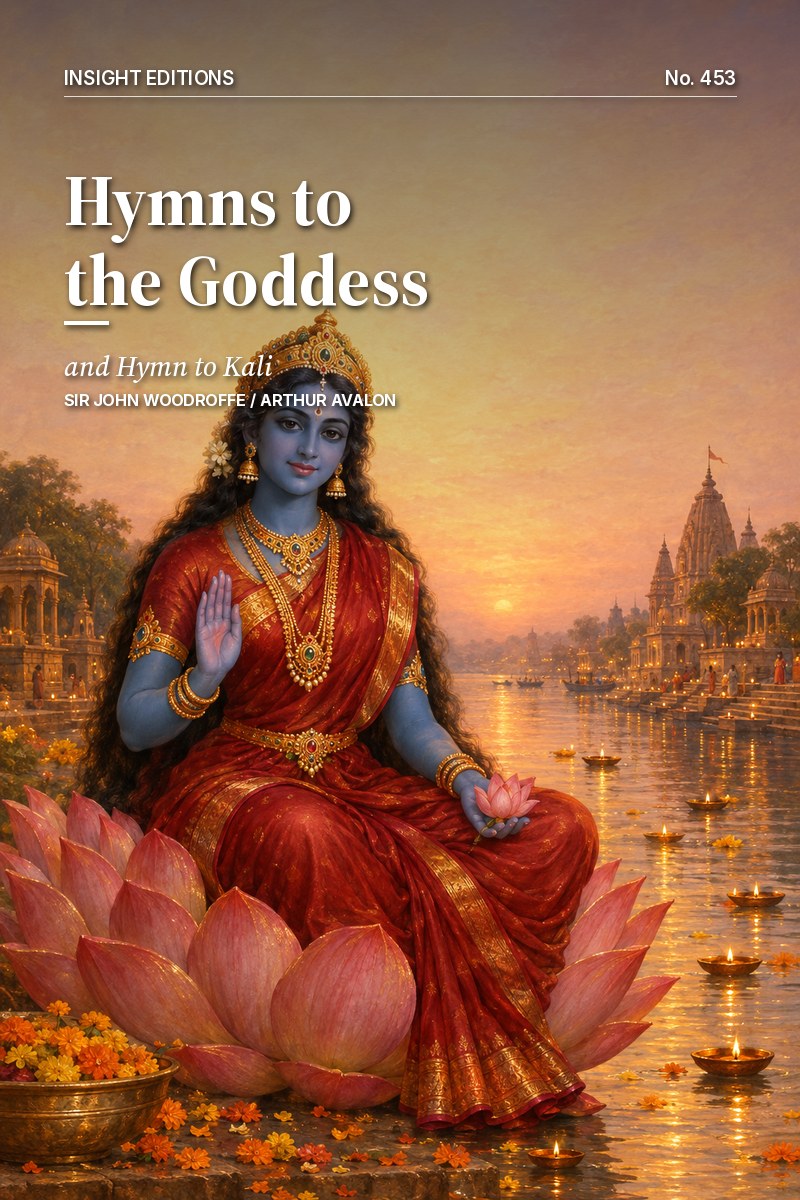
Hymns to the Goddess and Hymn to Kali
Stotras of the Devi and the Karpuradi Stotra
Sir John Woodroffe (Arthur Avalon)
Arthur and Ellen Avalon's translations of about thirty Sanskrit hymns to the Devi from the Tantras, Puranas, Mahabharata and Sankara, followed by the Karpuradi Stotra to Kali with Vimalananda's essay and inner-sense commentary. Every list in full, with critical notes.
A study guide to Hymns to the Goddess (1913) and Hymn to Kali: Karpuradi Stotra, by Arthur Avalon (Sir John Woodroffe), with Ellen Woodroffe, first published by Luzac and Co., London. Shared free for personal reading; not for sale and not endorsed by the publishers. Please read and buy the original.
CORE CLAIM
God may be addressed as Mother with as much truth as Father. The hymns praise the Devi as Sakti, the power that is Brahman: nirguna yet taking every form, mother of Brahma, Visnu and Rudra, giver of both enjoyment and liberation. The Karpuradi hides Kali's mantra in letter-puzzles and its meaning under worldly promises, which Vimalananda reads as yoga and jnana.
SCOPE
The Preface and Introduction, every hymn in Hymns to the Goddess (Tantras, Candi, Devibhagavata, Mahabharata, Harivamsa, Sankara and others), and Hymn to Kali: Woodroffe's preface, Vimalananda's Introduction, the Prayer, and all 22 verses with literal and inner readings, plus a synthesis and glossary: about 30,000 words.
KEY FIGURES
Sir John Woodroffe (Arthur Avalon), Ellen Woodroffe, Sankaracarya, Vimalananda Svami and his guru Ramananda Svami, the commentators Durgarama Siddhantavagisa and K.B., Mahakala as the hymn's speaker, and the Mahanirvana, Yogini, Gandharva, Kularnava and Niruttara Tantras.
BEST FOR
Readers who want the devotional side of Tantra in its own words: what each hymn asks of the Goddess, what Kali's image means feature by feature, and how the most controversial verses were read, with notes where the translators write as advocates.
How to Use This Edition
Hymns to the Goddess and Hymn to Kali brings together two books by Arthur Avalon (Sir John Woodroffe). The first, Hymns to the Goddess (preface dated 1 March 1913), translates about thirty Sanskrit hymns (stotras) to the Devi, drawn from the Tantras, the Puranas and Mahabharata, and Sankaracarya and others; the Sankara hymns were translated with Ellen Woodroffe. The second, Hymn to Kali, translates the celebrated Kaula hymn Karpuradi Stotra, with Woodroffe's long preface, the commentary of Vimalananda Svami and notes on its secret meaning.
This edition follows the books' order. For each hymn it gives:
- Source and setting: which Tantra or Purana it comes from, who speaks it and why.
- The movement of the hymn: its verses grouped by theme, with every list of names, forms, weapons and attributes in full.
- Notes: Woodroffe's explanations of terms, mantras and images.
- Insight, model and critical-lens boxes.
Long verse passages are paraphrased, not quoted.
The Shape of the Book
| Part | Contents |
|---|---|
| Preface and Introduction | Why God is addressed as Mother; Sakti as Brahman; the three forms of the Devi; the ten Mahavidyas; the pithas |
| Hymn to Kalabhairava | Sankara's eight verses to the Devi's spouse, as an opening |
| Hymns from the Tantras | Bhairavi, Bhuvanesvari, Adya-Kali, Laksmi, Tara, Mahisamardini, Annapurna, Sarasvati, Durga's hundred names, Triputa |
| Hymns from the Puranas and Mahabharata | Ambika, Candika, Mahadevi (all from the Candi), Jagadambika (Devi-bhagavata), Durga (Virata and Bhisma Parvans), Arya (Harivamsa) |
| Hymns by Sankara and others | Tripurasundari, Ganga (three hymns), Waves of Bliss, Yamuna, Forgiveness, Manikarnika, Narmada, Annapurna, Mahalaksmi |
| Hymn to Kali | Preface, Vimalananda's invocation, prayer, and the 22 verses of the Karpuradi with commentary |
Preface: Why "Mother"
God as Mother is no more and no less accurate than God as Father. Neither set of terms strictly fits the Deity as the source of forms. Navaratnesvara: the Devi who is existence, consciousness and bliss may be thought of as female, male, or pure Brahman; in reality "She is neither male nor neuter." Woodroffe suggests that calling the feminine attribution "heathenish" implies a belief that one's mother's sex is inferior. Hindus, he says, place mother before father: "by bearing and nourishing, the mother is greater than the father."
The tantrika's view of woman:
- The Devi manifests in his own mother, in his wife (his prakrti), and in all women.
- Kubjika Tantra: "Whosoever has seen the feet of woman let him worship them as those of his guru."
- Mundamala Tantra: "Wherever there is a sakti (female), there I am." Because Sakti is more revealed in the female form, women are called Sakti.
- But Sakti is no less present in Siva, Krsna and others. Tantra Tattva: a worshipper of Krsna who wishes to see him as Kali will be granted that form.
Why "Devi": the word means prakasatmika, "by nature Light and Manifestation", and is feminine because the One, as Sakti and Prakrti, bears and nourishes all as Mother: Brahman revealed as Srimata, creatrix and nourisher. Saktanandatarangini says she is worshipped for her "soft heart"; the deeper ground is this.
Beyond sect. One who truly knows sakti-tattva (without which nirvana-moksa is unattainable) passes beyond "Sakta," "Vaisnava," "Saiva." The Vaisnava may see her as Visnu in the form of Sakti; the Sakta, Sakti in the form of Visnu. Ramaprasada: she takes five principal forms for different worship, "but how can you escape the hands of him who has dissolved the five and made them into one?"
Ritual is not to be scorned. Sankara was "the incarnation of devotion" (bhaktavatara) as well as a philosopher, and the protagonist of so-called "idolatrous Hinduism." Stava (hymn) and puja belong to the first stage of an ascent that leads away from them, but are as necessary as the higher stages. Even the "mere student of religions" will understand the great sayings (mahavakya) better through ritual than through theory alone; lovers of literature will find "tenderness and splendour."
On translating: earlier versions existed of the Mahabharata hymns (Protap Chandra Roy, Muir) and the Candi (Pargiter); the Adya-kali hymn was in his own Mahanirvana Tantra. A dictionary is not enough: he used commentators (Nilakantha on the Mahabharata and Devi-bhagavata; Gopala Chakravarti and Nagoji Bhatta on the Candi) and oral help from tantrika gurus and pandits, "the authorized custodians." Texts: Tantrasara (Rasik Mohun Chatterjee's edition, corrected from manuscripts); Brhat-stotra-ratnakara for Tara, Valmiki and Indra.
Introduction: Who the Devi Is
Sakti is Brahman
- Brahman is sakala with Prakrti, niskala without: kala is Prakrti. To say Sakti is "in or with" Brahman is an accommodation to speech: they are one.
- Sakti is eternal, Brahman-formed, both nirguna and saguna: caitanya-rupini, who manifests all beings, and ananda-rupini, by whom Brahman manifests itself. Sarada-tilaka: she pervades the universe "as does oil the sesamum seed."
- Even the Vedic "He saw" (sa aiksata) was a manifestation of Sakti.
How creation begins
- From the parasakti-maya issued nada, and from nada bindu.
- Kamakala, a subtle state, is the root of mantra (hence the Devi is mulamantratmika).
- The parama-bindu: a circle whose centre is the brahmapada (Prakrti and Purusa) and whose circumference is maya. It sits in Nirvana-kala, inside Ama-kala, in the moon-circle above the sun-circle, the guru and hamsah, in the thousand-petalled lotus.
- It is like a grain of gram (canaka): under one sheath, a divided seed, Prakrti-Purusa. This is Sabda-Brahman.
- Polarisation: the Devi becomes unmukhi, her face turned to Siva; the shell bursts.
- Bindu, bija, nada appear; an indistinct sound arises. Nada has three states (the three gunas). Sabda-Brahman shows as jnana, iccha, kriya.
Vamakesvara Tantra: Tripura is threefold as Brahma, Visnu, Isa. Parasiva is a septenary: Sambhu, Sadasiva, Isana, Rudra, Visnu, Brahma. The last five are the five great corpses (mahapreta): four are the legs and the fifth the seat of the bed on which the Devi unites with Paramasiva, in a room of cintamani stone on a jewelled island of kadamba trees in the ocean of nectar (Anandalahari v. 8).
Sakti as maya and nature
| Guna | Nature as |
|---|---|
| Sattva | Revelation of spirit |
| Rajas | The passage down from spirit to matter, or up |
| Tamas | The dense veil of spirit |
- She is gunanidhi, treasure-house of the gunas; Mulaprakrti, the womb into which Brahman casts seed (Gita XIV.3 to 4). Rajas stirs, and under Siva's light the universe unfolds.
- In man, Siva-Sakti are the svayambhu-linga and Kundalini coiled about it. As Kundalini, Sabda-Brahman is all breathing creatures, and as letters, all prose and verse: jiva-sakti, showing as prana.
- Kubjika Tantra: "Not Brahma, Visnu, and Rudra create, maintain, and destroy, but Brahmi, Vaisnavi, Rudrani. Their husbands are but as dead bodies."
- She is maya and Mahamaya (its Lord: nirguna without maya, saguna with it); avidya, because she binds, and vidya, because she frees; Prakrti; adya-sakti; vacaka-sakti (cit shown in Prakrti) and vacya-sakti (cit itself). "The atma should be contemplated as Devi." Kali in Yogini Tantra: "I am Sat-Cit-Ananda; I am Brahman, of shining light."
Terrible and beautiful
She is Ambika, Lalita, "She who plays," whose eyes, playing like fish, open and shut as countless worlds appear and vanish. She is also terrible as Kali, Tara, Chinnamasta. Saktas hold that sweet, complete surrender to such forms marks a higher stage: the Mother is terrible only to those who live in the illusion of separateness, the cause of all fear. Ramaprasada: "Though the Mother beat him, the child cries 'Mother!'... and clings still tighter to her garment."
Her three forms
| Form | Nature |
|---|---|
| Para (supreme) | "None knows" it (Visnu Yamala) |
| Suksma (subtle) | Mantra |
| Sthula (gross) | Hands, feet and so on, as in the hymns, because the mind cannot settle on the formless |
She has male and female forms ("there is no eunuch form of God") but is chiefly contemplated as female, since female beings are in a special sense parts of her. Linga Purana: "All things indicated by words in the feminine gender are manifestations of Devi."
The litanies (Lalita-sahasranama) describe her head to foot: hair with flowers and gems; brow like the eighth-day moon; ruby cheeks; teeth like "buds of the sixteen-syllabled mantra"; brows arched like the gates of Kamaraja's palace; breasts "offered in return for that priceless gem which is the love of Kamesvara"; a waist girdled with jewelled bells; knees "like the sapphire-studded quiver of the God of Love"; lotus feet that dispel darkness. Her full breasts and hips are "emblematic of Her great Motherhood." Her face, torso and lower body stand for the vagbhava and other kutas of her mantra.
Her colours by action (Bhaskararaya on Lalita v. 170):
| Action | Colour |
|---|---|
| Granting liberation | White |
| Controlling women, men, kings | Red |
| Controlling wealth | Saffron |
| Creating enmity | Tawny |
| Love (srngara) | Rose |
| Slaying | Black |
Her many forms
- As Mahadevi: Sarasvati, Laksmi, Gayatri, Durga, Tripurasundari, Annapurna, and all Devis who are avataras of Brahman.
- As spouse of Siva: Sati, Uma, Parvati, Gauri.
The ten Mahavidyas (dasa-mahavidya), shown by Sati to Siva before Daksa's sacrifice (to display her power when he refused permission to attend):
- Kali
- Bagala
- Chinnamasta
- Bhuvanesvari
- Matangi
- Sodasi
- Dhumavati
- Tripurasundari
- Tara
- Bhairavi
The pithas. At the sacrifice Sati gave up her life in shame at her father's insult to her husband. Siva carried her body, distraught; with his control withdrawn, evil grew. Visnu's discus cut the body into fifty-one pieces (variously 50, 51, 52), which fell at the maha-pitha-sthanas, where the Devi is worshipped with her Bhairava:
| Place | Part | Devi | Bhairava |
|---|---|---|---|
| Jalandhara and Ramgiri | Right and left breasts | Tripuramalini | |
| Kamarupa (Assam) | Yoni | Kamakhya | Ramananda |
| Kalighat | Toes (some) | Kalika | Nakulesvara |
Others received throat, shoulders, nose, hands, eyes, tongue, lips, navel, feet, ears, hair, forehead and more. At Kamakhya the earth's menstruation is believed to occur in Asadha; during the three days of ambuvaci no cooked food is eaten by women.
One and many: "one moon reflected in countless waters." Saktanandatarangini: Para-Brahman, Devi, Siva and all gods are one; to think them different "goes to Hell." Devi-bhagavata: to worship gods as other than her is to be like a man with a lamp in his hand who still falls into a dry well.
The ladder of worship
External worship is not to be despised: "The ladder of ascent can only be scaled by those who have trod all, including its lowest, rungs." Saktirahasya: one attains kaivalya by worshipping
- by ceremonies,
- by images,
- by mind,
- by identification,
- by knowing the self.
Puja-bhava leads through hymn and prayer to dhyana-bhava, then brahma-bhava. After external and sadhara worship (Devi as mantra, per the guru) comes niradhara: Pure Intelligence worshipped as the Very Self, the Witness, by direct experience of Mahesvari as the Self.
A devotional introduction with an argument inside. Woodroffe writes partly to rebut Western contempt for goddess worship and "idolatry," and his case (that gendered language is equally inadequate either way, that ritual is a necessary rung) is well made. Two cautions. His claim that the Tantrika "more than all men recognizes the divinity of woman" describes an ideal in the texts; social practice in Bengal in 1913 was another matter, and the ritual use of women in some Kaula rites raises questions he does not address here. And the frank bodily descriptions of the Devi, which he defends as emblems of motherhood, read differently to modern eyes; both readings are worth holding.
Key terms: stotra, stava, Devi, prakasatmika, Srimata, sakti-tattva, bhaktavatara, mahavakya, sakala, niskala, caitanya-rupini, ananda-rupini, nada, bindu, kamakala, mulamantratmika, brahmapada, canaka, Sabda-Brahman, unmukhi, mahapreta, cintamani, gunanidhi, Mulaprakrti, jiva-sakti, Mahamaya, avidya, vidya, vacaka-sakti, vacya-sakti, Lalita, para, suksma, sthula, kuta, dasa-mahavidya, Sati, Daksa-yajna, maha-pitha, Bhairava, ambuvaci, puja-bhava, dhyana-bhava, brahma-bhava, sadhara, niradhara, kaivalya.
Reflect: Woodroffe argues that calling God "Mother" is no less accurate than calling God "Father." What changes in your own sense of the sacred when you try the other word?
Kalabhairava and the First Tantric Hymns
The collection opens with Sankara's eight verses to Kalabhairava, the Devi's spouse, and then turns to hymns from the Tantras: Bhairavi and Bhuvanesvari from the Tantrasara, the hundred K-names of Adya-Kali from the Mahanirvana Tantra, and the twelve names of Laksmi.
Hymn to Kalabhairava (Kalabhairavastaka)
Eight verses, each ending with the refrain "I worship Kalabhairava, Lord of the city of Kasi." Kalabhairava is Siva as such; Kasi is Benares. Sankara's Kasi-pancaka: the pure Ganges is the flow of knowledge, and Kasi is Siva's own mind.
His epithets, verse by verse:
| Verse | Epithets |
|---|---|
| 1 | Feet worshipped by Indra (Devaraja); compassionate; sacred thread of serpents; moon on his forehead (hence Candrasekhara); naked (digambara, "clothed with space"); adored by Narada and yogis |
| 2 | Blazing like a million suns; saviour across the ocean of the world; blue-throated (he swallowed the poison from the churning of the ocean); three-eyed (the third the eye of wisdom); death of death (mrtyunjaya); holds a rosary of human bone (even of Candalas, for he protects all) and the trident |
| 3 | Primeval cause (all causes lie in his destructive energies, the prelude of re-creation); holds trident, axe, noose, staff (sula, tanka, pasa, danda); black-bodied as Kalabhairava (usually white with ashes, "like a mountain of silver"); first of devas (Mahadeva); loves to dance wonderfully |
| 4 | Great, beautiful body; giver of enjoyment and liberation (bhukti-mukti); smiles on devotees; body is the whole world; golden bells at his waist |
| 5 | Protector of the bridge of dharma; destroyer of adharma; liberator from karma; golden body with serpent coils |
| 6 | Feet bright with gems; stainless, eternal ista-devata; one without a second; frees from the jaws of Death |
| 7 | His laughter broke many an egg of Brahma (brahmanda), each world being such an egg; his glance breaks the net of sin; giver of the eight siddhis; serpents garland his shoulders |
| 8 | Saviour of all; all-pervading; purifies the people of Kasi of both sin and virtue; ancient Lord; wise in all moralities |
The dance. Siva as Nataraja dances in the forest (vanam), which is the body and the world, "on account of the multitude of its components." As the inner atman he makes all things dance into and out of life: "the unseen Lord of the stage."
The eight siddhis:
- Anima: becoming very small;
- Mahima: vast;
- Garima: heavy;
- Laghima: light;
- Prapti: reaching anything;
- Prakamya: irresistible will;
- Isitva: lordship, creation;
- Vasitva: control over worlds and their lords.
They are powers of the all-pervading atma, gained by Siva-yogins as they realise their unity with it.
"Both sin and virtue": to the liberated there is neither; they are qualities of the phenomenal jivatma only.
Bhairavi (Bhairavistotra, Tantrasara)
Bhairavi is the feminine of Bhairava; she is addressed as Tripura. Sixteen verses.
Movement of the hymn:
- A prayer to Tripura to attain the Laksmi worshipped by the devas.
- Origin of the world without origin; Brahma, Visnu and Mahesvara cannot know her even with hundreds of hymns. "We worship Thy breasts, Mother of all Sastras, shining with fresh saffron."
- Her form: a thousand rising suns; book and rudraksa rosary in two hands; vara and abhaya gestures with two others; three lotus eyes; a necklace of large pearls.
- How can the ignorant, restless with doubt and dispute, know her vermilion form, reached only by merit from previous births?
- Munis describe her physical form; Sruti, her subtle form; others call her deity of speech or root of the worlds; "we think of Thee as the untraversable ocean of mercy, and nothing else."
- Contemplated in the heart: three-eyed, crescent moon, white as the autumn moon, made of the fifty letters, holding book, rosary, jar of nectar, making the vyakhya-mudra.
- She is Sambhu with Parvati (Ardhanarisvara), Visnu embraced by Kamala, Brahma of the lotus, the Devi of speech, and the energy of all these.
- Refuge in the four bhavas born of the vagbhava bija.
- The blessed, having conquered the six enemies, drawing in breath, gaze at the nose-tip and contemplate her moon-crested form in the head.
- She creates the world having taken half the body of Siva; otherwise "the multitude of worlds would never have been."
- Kinnara and siddha women, eyes reddened by wine, worship her with celestial flowers in her pitha in the caverns of Sumeru.
- Kundalini: moist with nectar, like lightning, going from her abode to Siva's, opening the lotuses on the way of susumna.
- Refuge at her feet, source of the Vedas, origin of prosperity, body of intelligence itself.
- As moon she creates the world of sounds and meanings; as sun she maintains; as fire she destroys at the end of ages.
- Her names: Narayana; saviour from the ocean of hell; Gauri; allayer of grief; Sarasvati; three-eyed giver of knowledge.
- Fruit: whoever worships with twelve verses gains all powers of speech and the supreme abode.
Woodroffe's notes
The four bhavas (states of sound in Kundalini):
| Bhava | Seat | Nature |
|---|---|---|
| Para | Muladhara | Tamasic sound |
| Pasyanti | Svadhisthana or Manipura (sources differ) | With manas |
| Madhyama | Anahata | With buddhi |
| Vaikhari | Visuddha, through the throat | The fifty letters |
The gross-minded know only vaikhari.
- The three divisions of the Pancadasi: vagbhava (jnana-sakti, liberation), kamaraja (kriya), sakti (iccha); the Devi is "three-syllabled." Her bija here is Aim, Sarasvati's.
- Her two aspects (Vamakesvara Tantra): "Tripura is Her real form. She who is of a red colour is the manifested one": prakasa and vimarsa.
- Vara and abhaya mudras: for vara, hand forward, palm up, fingers together, thumb across to the fourth finger; for abhaya, the same held upright, palm outward.
- The six enemies: kama (lust), krodha (anger), lobha (greed), moha (delusion), mada (pride), matsarya (envy).
- Sun, moon, fire (Raghava Bhatta): moon = iccha, "eternal precursor of creation"; sun = kriya, "which makes all things visible"; fire = jnana, which "burns up all actions."
- Gauri's story: Siva teased Parvati, "I am white as the moon and thou art dark"; she went to the forest and by austerity gained a golden complexion.
- The susumna text is corrupt; Woodroffe suggests a misprint.
Bhuvanesvari (Tantrasara)
Bhuvanesvari is the Devi as Lord and Ruler of the world: "cause and Mother of the world", Sabda-Brahman in form, bliss in substance. Twenty-six verses.
Movement of the hymn:
- Praise of her power (vv. 1 to 7):
- Primordial, Mother of countless creatures, creatrix of the bodies of Brahma, Visnu and Siva.
- Cause of Siva's world-destroying energy, Siva who manifests in earth, water, fire, ether, the sacrificer, sun and moon (his eight forms: Sarva, Bhava, Rudra, Ugra, Bhima, Pasupati, Isana, Mahadeva) and burned Manmatha.
- The Ganga is worshipped only because she shines in Siva's hair, purified by the dust of the Devi's feet. (Three Gangas: Mandakini in heaven, Alakananda on earth, Bhogavati below.)
- Moon delights the night lotus, sun the day lotus; she delights the whole universe by her glances.
- Paradoxes: primordial yet ever young; daughter of the mountain yet tender; mother of the Vedas yet beyond them; to be meditated on yet beyond mind.
- To gain human birth and full faculties and not worship her is to climb to the top of the stairs and fall.
- Worship and yoga (vv. 8 to 12):
- Worship with flowers, sandal ground with cool water, camphor gains sovereignty of the world.
- As the sleeping serpent in the first lotus she created the universe; she rises like lightning to the ethereal region, and, moist with nectar, returns by the same way; those in whose heart she glitters are never reborn.
- As Gauri: hanging hair, full breasts, slender waist, rosary, pitcher, book, jnana-mudra.
- Yogis see her with noose and goad, vara and abhaya.
- Her forms (vv. 13 to 15):
| Form | Description |
|---|---|
| Laksmi | Molten gold, two lotuses, vara and abhaya, four elephants pouring nectar from jars |
| Durga | On a lion, colour of durva grass, eight hands of dreadful weapons, destroying the enemies of the gods |
| Matangini | Dark, swayed by passion, face moist with the sweat of love-play, necklace of gunja berries, clad in leaves |
- The head-to-foot litany (vv. 16 to 25): blue lotus feet followed by the Vedas as swans follow anklet bells; ankle to knee, which made Siva grow a third eye to see more; thighs that shame an elephant's trunk and the plantain; a waist so slender its substance seems moved into breasts and hips; the navel, "a secure inviolate pool"; breasts with sandal and Siva's ashes, like an elephant's painted temples flecked with foam; arms like Kama's nooses for Siva's neck; a neck like a shell; the face, eyes, brow, nose, bimba-red lips ("he has not been born in vain" who recalls it); hair like bees round flowers, lit by the crescent moon, whose contemplation frees one of ancient fetters.
- Fruit (v. 26): all wealth, as the Laksmi who attends kings.
Notes on colour
Woodroffe's note lists the Mahavidyas' colours (after Prasanna Kumar Sastri):
| Devi | Colour |
|---|---|
| Kali | Black like collyrium (anjana) |
| Tara | Dark blue (nila) |
| Matangini | Black or dark green |
| Sodasi (Sri), Bhuvanesvari | The rising sun |
| Bhairavi | A thousand rising suns |
| Chinnamasta | A million suns |
| Dhumavati | Ashen |
| Bagalamukhi | All yellow |
| Kamala | Like lightning |
Durga is normally golden yellow; the durva-green belongs to other forms of the one Devi.
Kama's story: the gods needed a son of Siva and Parvati to defeat Taraka; Kama shot his flower arrows at Siva in tapas; Siva burned him with his third eye; Kama was reborn as Pradyumna at Rati's request. His bowstring is a line of bees, his arrows flowers.
Adya-Kali: The Hundred K-names (Mahanirvana Tantra)
From Mahanirvana Tantra, seventh ullasa: a hundred names of the primordial Kali, all beginning with "K." Tantraraja: "The syllable 'Ka' is in Thy form, and that Sakti confers all siddhis."
The hundred names, in order (grouped):
| Nos. | Names (meaning) |
|---|---|
| 1 to 3 | Hrim, Kali (destroyer of time); Srim, Karali (terrific); Krim, Kalyani (beneficent) |
| 4 to 10 | Kalavati (possessor of the 64 arts); Kamala; Kalidarpaghni (destroyer of Kali Age's pride); kind to Kapardisa (matted-haired Siva); Kalika (devourer of the devourer, Mahakala); Kalamata (mother of time); bright as the fires of dissolution |
| 11 to 21 | Kapardini (Siva's spouse); formidable face; ocean of the nectar of compassion; merciful; vessel of mercy; mercy without limit; reached only by her mercy; Krsanu (fire); Kapila (tawny); Krsna (black); increaser of the supreme Lord's joy |
| 22 to 31 | Kalaratri (night of darkness); Kamarupa (form of desire); liberator from desire's bonds; Kadambini (dark as a rain cloud); bearing the crescent; destroying the sin of the Kali Age; pleased by kumari-puja; refuge of virgin-worshippers; pleased by the feasting of virgins; in the form of the virgin |
| 32 to 35 | Wanders in the kadamba forest; pleased by its flowers; dwells there; wears kadamba garlands |
| 36 to 42 | Kisori (youthful); soft low voice; voice like the cakravaka bird; drinks kadambari (mead); pleased by it; skull for a cup; garland of bones |
| 43 to 48 | Pleased by the lotus; seated on it; in its centre; delighted by its scent; moves with the hamsa's swaying gait; destroyer of fear |
| 49 to 57 | Takes all forms at will; dwells at Kamarupa; plays at the Kamapitha; beautiful; kalpa-creeper giving every desire; beauty her ornament; adorable as all tenderness; tender-bodied; slender-waisted |
| 58 to 63 | Karana (purified wine) names: pleased by its nectar; gives success to those it gladdens; deity of those who worship joyed by it; gladdened by worship with it; immersed in its ocean; protectress of those who keep vrata with it |
| 64 to 70 | Kasturi (musk) names: gladdened by its fragrance; musk tilaka; attached to musk-worshippers; loves them; mother to those who burn it; fond of the musk-deer; pleased to eat musk |
| 71 to 77 | Karpura (camphor) names: gladdened by its scent; camphor garlands; body smeared with camphor and sandal; pleased by camphor-flavoured wine; drinks it; bathed in an ocean of camphor; dwells there |
| 78 to 79 | Pleased by the bija Hum; threatens with Hum (her roar against demons) |
| 80 to 85 | Kulina (embodiment of Kulacara); adored by Kaulikas; their benefactress; observant of Kulacara; joyous; revealer of the Kaula path |
| 86 to 90 | Queen of Kasi; allayer of suffering; giver of blessings, pleasure, and love to the Lord of Kasi |
| 91 to 94 | Toe-bells' melody; girdle-bells' tinkle; dwells on the golden mountain (Sumeru); like a moonbeam on it |
| 95 to 100 | Gladdened by Klim; is the kama-bija itself; destroyer of evil inclinations; and of Kaulikas' afflictions; Lady of the Kaulas; by Krim, Hrim, Srim, destroyer of the fear of death |
Notes on the names
- Bijas: Hrim = maya-bija; Srim = Laksmi's; Krim: Ka = Kali, Ra = Brahma, I = Mahamaya; the half-circle of candrabindu is the universal Mother, the dot the destroyer of misery.
- Kumari: kumari-puja (worship of virgins by men) is common in Bengal; sadhava-puja (married women) is done by women. Bhaskararaya: she is Kumari because she destroys (marayate) the ground (ku) of illusion; "the enjoyer and not to be enjoyed."
- The kadamba forest: around the cintamani palace is a gallery of gems, then a kadamba grove between walls of gold and silver; the five yonis of the Sri-cakra are the divine trees.
- Wine: karana is the technical term for purified wine in the panca-tattva. Bhaskararaya, on Tripura Upanisad: those permitted wine and flesh must first dedicate them to Brahman and reduce the habit by degrees (as Manu and the Bhagavata also teach).
- Kula and akula: kula = Sakti, akula = Siva; their union is Kaula, the essence common to both, both in the sahasrara. Kulacara is the way of Kaula worshippers.
- Klim: remove ka and la, and Im remains: kamakala, in the turiya state.
- Sumeru: Durvasa's Lalitastavaratna: three peaks for Brahma, Visnu, Siva, and a middle peak of 400 yojanas where she dwells.
Laksmi: The Twelve Names (Tantrasara)
Laksmi (Sri), Devi of prosperity and beauty, Visnu's Sakti, rose from the sea at the churning and reclined on Hari's breast. As her Lord takes many forms, so does she. "As Thou art constant to Visnu, be Thou constant to me."
The twelve names:
- Isvari: the ruler;
- Kamala: she appeared from the lotus;
- Laksmi;
- Cala (Cancala): the fickle one, "for nothing is so fickle as wealth";
- Bhuti: prosperity;
- Haripriya: beloved of Hari;
- Padma: lotus;
- Padmalaya: dwelling in the lotus;
- Sampat: wealth;
- Uccaih: the exalted, "for prosperity exalts";
- Sri: beauty and prosperity;
- Padmadharini: holding the lotus.
Fruit: with one who reads them, his wife and children, Laksmi ever abides.
One Devi, many names. These hymns move between the universal (Sabda-Brahman, origin of the world, beyond even the gods' knowledge) and the intimate (head-to-foot descriptions, scents of musk and camphor, bells at the ankle). The Adya-Kali hymn shows the method most clearly: a hundred names from one syllable, spanning terror (skull-cup, bones), tenderness (soft voice, slender waist), ritual (wine, musk, camphor, bija Hum) and doctrine (kula and akula). Each name is a door; all open into the same room.
Kaula ritual in plain view. The Adya-Kali names celebrate purified wine, musk and Kaula practice openly. Woodroffe's notes frame this through Bhaskararaya's rule: dedicate to Brahman and reduce by degrees. That is one authoritative reading, but the hymn itself is less restrained, and readers should notice where the commentary moralises the text. Likewise the sensuous litanies to Bhuvanesvari follow classical Sanskrit poetic convention (Kalidasa is cited) and carry theological weight; they are also plainly erotic, and Woodroffe's framing as "emblems of motherhood" is only part of their effect.
Key terms: Kalabhairava, Kasi, Candrasekhara, digambara, mrtyunjaya, sula, tanka, pasa, danda, Nataraja, bhukti-mukti, brahmanda, anima, mahima, garima, laghima, prapti, prakamya, isitva, vasitva, Bhairavi, Tripura, rudraksa, vara, abhaya, vyakhya-mudra, Ardhanarisvara, bhava, Para, Pasyanti, Madhyama, Vaikhari, vagbhava, Pancadasi, prakasa, vimarsa, Bhuvanesvari, asta-murti, Trisrotah, jnana-mudra, Matangini, gunja, Adya-Kali, Kalaratri, Kamarupa, kumari-puja, kadamba, kadambari, karana, panca-tattva, kasturi, karpura, Kurca-bija, Kulacara, Kaulika, kula, akula, Klim, kamakala, Laksmi, Cancala, Haripriya.
Reflect: The Bhuvanesvari hymn says that to gain a human life and not use it to worship is like climbing to the top of the stairs and falling. What would "the top of the stairs" mean for you, and what keeps you there?
Tara, Mahisamardini, Annapurna, Sarasvati
Four more hymns from the Tantras: Tara the saviour (from the Nila Tantra), Durga as slayer of the buffalo demon, Annapurna the giver of food, and Sarasvati of speech. Each closes with a phala (fruit) passage naming what the reciter gains.
Tara (Tarastaka, Nila Tantra)
Tara (Tarini), one of the Mahavidyas, is called Tara because she delivers (tarakatvat); Ugratara because she saves from horrible calamities; Nilasarasvati, "the blue Sarasvati," because she playfully gives speech and is "in the form of all languages." She gives both pleasure and liberation. Sources: Matsyasukta, Tararnava, Nila Tantra.
The curse of Vasistha: the sage cursed this vidya, then lifted the curse so siddhi could be gained by japa of Hrim Strim Hum Phat.
Her mantras:
| Mantra | Gives |
|---|---|
| Hrim Strim Hum Phat | Liberation |
| Srim Hrim Strim Hum Phat | Wealth and beauty |
| Hrim Hrim Strim Hum Phat | All desires |
| Aim Hrim Strim Hum Phat | Speech |
Her yantra: an eight-petalled lotus in a circle, an inverted triangle at the centre with Hum; on the petals Hrim, Strim, Srim, Hum. Another, Tara-satkona, is two triangles forming a star.
Her dhyana: in four blazing funeral pyres; right foot on Siva's breast, left on his thigh; short, big-bellied, tiger skin, youthful, four-armed, tongue out; knife, skull, lotus, sword; the sage Aksobhya as a serpent on her head; body like moonbeams; three eyes blazing like the morning sun.
The eight verses:
- Refuge: standing on Siva, smiling lotus face, three lotus eyes, knife, skull, lotus, sword.
- Devi of speech, wish-granting creeper, giver of siddhis and the power to write verse and prose, ocean of compassion.
- Sarabha (Siva's spouse): remove fears. Garments bright with serpents, tiger skin, bells at the waist, two freshly severed demon heads dripping blood, a girdle of demon heads.
- Hard to reach; amorous and charming; bindu and half-moon; substance of Hrim and Phat; mantra and shelter of all; three forms (gross, subtle, supreme); beyond the Veda.
- Serving her feet gives sayujya; she is spouse of the Lord who is Brahma, Visnu and Siva. To serve Indra and other devas instead, themselves "plunged in the ocean of samsara," is ignorance.
- Devas who take the pollen of her feet on their crowns win their battles; those who boast "none is equal to me" perish.
- Bhuta, Preta, Pisaca, Raksasa, Daitya, Danava, Yaksa, Naga lords, wrathful Dakini, great birds, tigers flee at the thought of her name.
- Her servant gains siddhi, surpasses Brhaspati in speech, gets Kama's beauty, can charm and paralyse elephants in battle, stop the flow of water, and controls siddhas and prosperity.
Phala: recited pure and self-controlled, morning, noon and evening: power to write prose and verse, knowledge of all Sastras, lasting fortune, all enjoyments, fame, beauty, wealth, the love of all, and at the end liberation.
Notes
The four forms of qualified liberation:
| Form | Meaning |
|---|---|
| Salokya | Same world as the deity |
| Sarupya | Same form |
| Samipya | Nearness |
| Sayujya | Union, becoming one with the deity |
Those who know Brahman reject all four as imperfect and seek kaivalya, but they must be passed through first.
- Devas are samsarins too: they have wives and children, fight demons, and when their merit is spent, descend to earth again.
- Bindu and half-moon: in Hrim there are eight varnas above the bindu, from ardhacandra to unmani, the third being nada; there the Devi is to be contemplated (Mahasvacchanda Tantra).
- "Paralyse" (stambhana) and "stay water" (jala-stambha) belong to the six magical acts (satkarma).
Mahisamardini (Tantrasara)
Mahisamardini is Durga as slayer of Mahisa, the buffalo demon. Candi is the form she took to destroy Canda and help kill Raktabija (Markandeya Purana). Fourteen verses; vv. 9 to 12 are "a free rendering" of a corrupt text.
Movement of the hymn:
- Candi, wander in my heart: destroy the calamities of malice and fear, so my swan-like mind may swim in the ocean of bliss.
- What fear has her worshipper? The devas, abandoning Narasimha (whose mane reached Sumeru as he tore Hiranyakasipu), now worship her lion.
- When syllables naming her reach their ears, Brahma and the devas sing the truth of Purusa and Prakrti.
- If following her Kula way brings reproach, better to be without fame; not the worship of Kesava and Kausika, but meditation on her feet.
- If rightly contemplating her feet, what matter if I know no other holy places? Her feet are "the wealth of our wounds."
- Even Siva would have perished, maddened by the embrace of his own self, had he not enjoyed the honeyed fragrance of her feet.
- Shower devotion on me, drowning in the ocean of illusion, without the bliss of Brahman.
- Her glory, dark as a collyrium cloud, from which were born the three devas who create, maintain, destroy.
- Victory to Mahisamardini, who severed Mahisa's head as he, by magic a buffalo, bellowed, ran, lowered his head, fell, and vanished.
- The battlefield: dancing weapons and streamers, clouds of discus, fire flashing from arrows, giant proud enemies, "swept by a tempest," strewn with limbs, birds slaking their thirst.
- Meditate on her rushing about the field with eight companion Matrkas, earrings of eight-petalled lotuses bearing the eight syllables "Mahisamardinyai namah," amid Mahisa's tossing black horns.
- Her dhyana: auspicious, black; holding discus, lance, axe, shield, arrow, bow, trident, making abhaya; matted hair like a cloud bank, screaming, laughing, threatening the daitya heroes.
- Fruit: attack enemy cities, win kingdoms, the nectar of poetry, power to arrest, banish and slay.
- In the palms of all who recite: wealth, desire fulfilled, liberation.
Notes
- Sarabha: after killing Hiranyakasipu, Visnu's wrath would not cool. Siva took the Sarabha form, a winged lion with eight feet, tossed Visnu into the air until he was powerless; the lion then went to Durga's feet, and accompanies her still.
- Kula is Kulacara, "the highest" division of Tantric worship, "often misunderstood, and therefore subject of reproach," set against conventional worship of Kesava (Visnu) and Kausika.
- Siva without Sakti: Kubjika: "Without their Saktis the husbands are but preta"; Jnanarnava: "Sadasiva without Sakti is without motion like a corpse."
- The three satkarma of v. 13: stambhana (arrest), uccatana (banishment), marana (slaying).
Annapurna (Tantrasara)
Annapurna is the Devi who bestows food: her devotees never want rice. She holds a rice bowl and a spoon for stirring. Refrain: "Annapurne namo'stu te."
Her epithets in twelve verses:
- Dispenser of blessings, beloved of Sankara, dear to devotees.
- Form assumed by maya. (Woodroffe: all forms of deities are mayik, "but to the worshipper none the less real.")
- Mahamaya, dharma-patni of Hara (wife by religious rite), giver of the fruit of desire, queen of the suras.
- A thousand rising suns, three-eyed, crescent-crested.
- Fine garment, ever giving rice, sinless, delighting in Siva's dance.
- Fulfils devotees' desires, destroys worldly pain, bending under her breasts.
- In the six-petalled lotus (svadhisthana), the sixfold sakti, Brahmani and all the Matrkas.
- All empires are her gifts; delight of Sarva.
- Worshipped by Indra, takes the form of Rudra and the devas, giver of wealth.
The sixfold sakti = the six anga-nyasas:
| Nyasa | Place |
|---|---|
| Hrdaya | Heart |
| Siras | Head |
| Sikha | Crown-lock |
| Netra | Eyes |
| Kavaca | Body (armour) |
| Astra | Closing gesture of the palms, with Phat |
Phala: devout reading at worship keeps Laksmi in the house; reciting the mantra and the hymn at dawn brings wealth of rice. It must not be revealed to the unworthy: ills fall on one who does.
On phala passages: every devotional work has one. Invoking the Devi by a particular name (Annada) brings the matching fruit. Suta Samhita: all names are given to Brahman by his maya, but some apply specially by Siva's wish; repeating them, one becomes the Lord, and Sadasiva dances with his spouse before him.
Sarasvati (Tantrasara)
Sarasvati: Devi of speech, eloquence, knowledge and learning, Sakti of Brahma (in Puranic account formerly Visnu's spouse), fair, two- or four-armed, on a lotus with a vina. Bharadvaja Smrti: she "ever resides in the tongue of all beings and causes speech." Name: she possesses (vati) the flow (saras) of nectar from the brahmarandhra. Brahma Purana: the Devi created Sarasvati from her tongue, and the science of love from her shoulders.
Her whiteness: white vina, white flowers, white rosary, white sandal, white raiment.
The eight verses:
- Hrim is her favourite bija; moon-like beauty among lotuses; forest fire of evil thoughts; lotus seated on a lotus; destroyer of ignorance; substance of the world (the reality behind samsara's unreal show).
- Aim (vagbhava) her mantra; form and formless; wealth of Brahma's face; all gunas yet without attributes; neither gross nor subtle; none know her nature; the whole universe and within it; partless, full everywhere; ever pure.
- Pleased by japa of Hrim (which includes mental and inaudible japa); crown white as snow; hands at the vina. "Burn, burn my sloth and grant me great intelligence." Knowledge itself, sung by Vedanta and Sruti; way to liberation; white necklace.
- Intelligence (dhi) three times; her names are memory, resolution (dharana, dhrti), mind (mati), and hymn; eternal and fleeting; new and old; current of virtue; the subtlest element (matra), "even the very half thereof" (matrardha); joy of Madhava.
- As Hrim, Ksim, Dhim, Hrim: book in hand, joyful, smiling, "current of charm," power of arrest (stambhana). Burn my sin. She is gih, gauh, vak, bharati (all words for speech); she gives success to the tongue of the greatest poets.
- "Come to my tongue and never leave me": may my intelligence never stray, sins go, sorrow end, no bewilderment in peril, mind flow freely in Sastra debate and verse.
- Phala: one who lives chaste (brahmacarin), silent (maunin), keeping vows (vratin), abstaining from flesh and fish on the thirteenth day (trayodasi), and praises her each morning surpasses Brhaspati; sins are swept away; she protects him as her own child; poetry flows from his mouth.
- Reading the hymn twenty-one times on the thirteenth, in both halves of the month, meditating on her in white, gains all desires. Made by Brahma himself; daily reading gives immortality (amrtatva, liberation).
Four faces of one power. Read together, these hymns map the Devi onto four human needs: protection (Tara saving from calamity, Mahisamardini from enemies), sustenance (Annapurna's rice), and speech and learning (Sarasvati, and Tara again as Nilasarasvati). Each has its own bija, image and phala, yet each hymn insists the form is maya and the reality is Brahman. The worshipper approaches through need and is led, by the same hymn, to its end: liberation.
Magic and liberation side by side. The phala verses promise power to paralyse elephants, stop water, banish and slay enemies, alongside knowledge and moksha. Woodroffe notes these as the satkarma without comment. They belong to a real strand of Tantric practice that sits uneasily with its highest teaching, and the tradition itself often warns against them. The Mahisamardini hymn's defence of Kula against reproach also hints at how controversial that path already was.
Key terms: Tara, Tarini, Ugratara, Nilasarasvati, tarakatva, Hrim, Strim, Hum, Phat, Tara-satkona, Aksobhya, salokya, sarupya, samipya, sayujya, kaivalya, samsarin, ardhacandra, unmani, stambhana, jala-stambha, satkarma, phala, Mahisamardini, Candi, Mahisa, Raktabija, Narasimha, Hiranyakasipu, Sarabha, Kulacara, Matrka, uccatana, marana, Annapurna, dharma-patni, anga-nyasa, hrdaya, kavaca, astra, Annada, Sarasvati, vina, vagbhava, Aim, japa, dhi, dharana, dhrti, mati, matrardha, bharati, brahmacarin, maunin, vratin, trayodasi, amrtatva.
Reflect: Sarasvati is asked to "burn my sloth" and to come to the tongue and never leave. What would you ask of the power behind your own speech?
The Hundred Names of Durga and the Triputa Hymn
The last two Tantra hymns: a litany of Durga's names from the Visvasara Tantra, and the Triputa stotra, which spells its bijas in code and lays out a full worship.
Durga's Hundred Names (Visvasara Tantra)
Durga is Siva's Sakti in warrior form, destroyer of beings hostile to devas and men. Two origins: she slew the asura Durga, son of Ruru (Skanda Purana); or the combined tejas of all devas, "like a mountain," became Durga to kill Mahisa (Candi). The name also means she who removes durgati (distress).
Isvara (Siva) speaks: "I shall tell thee the hundred names of Durga."
The names, grouped:
| Group | Names |
|---|---|
| Wife and fidelity | Sati (faithful), Sadhvi (chaste), Bhavaprita, Bhavani, Sambhavi, spouse of the Pinaka-holder |
| Brahman | Arya (Brahman made accessible), Satya (real), Satyananda-svarupini, Ananta, Sadagati (all-pervading), Utkarsini (essence of all), Vimala |
| Liberation | Bhavamocini (frees from samsara), Durga (removes distress) |
| Mind | Manas, Buddhi, Ahamkara, Cittarupa, Cinta (contemplation), Buddhida |
| Knowledge | Citi, Jnana, Kriya, Sarvavidya, Sarvamantramayi, Sarvasastramayi |
| Form | Trinetra, Citra (wonderful), Anekavarna, Patala (red-pink), silk-clad, delighted by anklets, Sundari, Purasundari |
| Power | Jaya, Adya, Sula-dharini, Candraghanta (whose bell sounds fearfully), Krura (terrifying), Amita-vikrama, Balaprada |
| Austerity | Mahatapah, Aparna (ate not a leaf), Yati (ascetic) |
| Daksa | Daksakanya, destroyer of Daksa's sacrifice |
| Shaktis | Brahmi, Mahesvari, Aindri, Kaumari, Vaisnavi, Camunda, Varahi, Laksmi |
| Places, peoples | Vanadurga, Matangi, worshipped by Matanga |
| Demon-slayer | of Sumbha and Nisumbha, Mahisa, Madhu and Kaitabha, Canda and Munda, all asuras and danavas |
| Weapons | holder of all astras, many sastras in hand |
| Ages | Kumari, Kanya, Kaisori, Yuvati, Apraudha, Praudha, Vrddhamata |
| Others | Citā (pyre), Bhavini, Bhavagamya, Bhavya, Devamata, Ratnapriya, Purusakrti, Bahula-bhuma, Bahula-prema, riding a bull |
Woodroffe's count: the Tantrasara litany stops at the 87th name, short of the number promised. "Hundred" means 108, and "thousand" 1,008: zero is inauspicious.
Notes worth keeping
- Sadhvi: Bhaskararaya cites Saundaryalahari: "How many poets share the wife of Brahma? Cannot everyone by wealth become the Lord of Sri?", but the Devi's breasts are touched only by Mahadeva. Learning and riches are shared by all; she is faithful to one.
- Arya: per Nilakantha, "the own form of the accessible Brahman" as against Nirguna Brahman beyond thought. "The very nature of the Devi is manifestation, and She is near to us in the world."
- Citā, two pyres: one burns the body, the other is "the fire which consumes passion" (Niruttara Tantra).
- Satya, used three times: real, eternal, best, and whose nature is to exist; what persists through past, present, future.
- Bhavini: commonly a word for an emotional woman (Amarakosa lists it with pramada, kanta, lalana, nitambini), but here it means she in whom the three bhavas (pasu, vira, divya) are.
- Krura, "cruel": not truly, for (Candi) she slew demons "for their own happiness," so that slain by her they might go to heaven.
- Vanadurga: foresters worship her before entering the woods.
- Kaumari: the Devi is mother of Kumara and Ganesa. Varaha Purana: Purusa (Visnu or Siva) and Avyakta (Uma or Laksmi) interact; from them comes ahamkara, which is Guha (Skanda), leader of the army.
- Purusakrti: Purusa and Prakrti are one in their ground, so she is Purusa too; Krsna once appeared as Kali to screen his acts from Radhika.
- Astra and sastra: astra is thrown, sastra is held.
- The four bodies of mind (antahkarana): buddhi (determining), manas, ahamkara, cinta.
The ages of woman:
| Name | Age |
|---|---|
| Kaisori | Up to 15 |
| Bala | Up to 16 |
| Taruni | About 31 |
| Apraudha | Adult, under 55, no longer bashful before her lord |
| Praudha | 55 |
| Vrddha | Above 55 |
Phala:
- Daily reading: nothing impossible in the three worlds; wealth, crops, sons, wife, horses, elephants; the caturvarga (dharma, artha, kama, moksa); lasting liberation.
- Worship Kumari, meditate on Suresvari, do puja, then read: siddhi of the devas, kings as servants, a kingdom.
- Write the mantra with saffron, gorocana, red lac, camphor and the three sweets (ghee, honey, sugar) and wear it: one becomes Purari (Siva).
- Write and read it on a Tuesday at amavasya (new moon night, when savasana rites are done), with the moon in Satabhisa (24th of 27 lunar mansions, "a hundred stars"): all wealth.
The Triputa Hymn (Tantrasara)
Triputa is distinct from Tripura but antargata, included within her as a particular manifestation, as Ekajata, Nilasarasvati, Ugratara and Mahogra are within Tara.
The guru and the bijas
- Meditate on the guru who is Light itself (prakasa), with his sakti in the head lotus (sahasrara), two-armed, gracious, making vara and abhaya.
- Srim, her golden first bija: all fortune.
- Hrim, second bija: all prosperity.
- Klim, lustrous as the sun: charms the three worlds; reciters become like Isvara.
- Contemplating her body thrice and reciting the three bijas: enemies are silenced, Laksmi in the house, Kama to women.
- Sarasvati gives poetry and prose; beasts do no harm; suras salute them; their feet on kings' heads; siddhis in hand; malign planets leave them.
Bijas in code. Tantric texts often do not state a mantra; it must be spelt out from symbolic names:
| Bija | Code in text | Letters |
|---|---|---|
| Srim | vakam + vahni + trimurti + sasanka | S + r (fire) + i (trimurti) + m (the moon "with the hare") |
| Hrim (maya bija) | nabhas + vahni + vamanetra + moon | H + r + i (left eye) + m; also the bija of Ekavaktra, Bhairava of Bagalamukhi |
| Klim | virinci + ksiti + vamanetra + moon with nada | K + l (earth) + i + m |
The full Triputa bija: Srim Hrim Klim, Hrim Srim Klim, Klim Srim Hrim, the three "thrice." Woodroffe also corrects his printed sources (vayu should be vahni; mitram should be misram).
The dhyana
- An eight-petalled lotus (the heart lotus where the istadevata is worshipped, not the anahata) on a jewelled throne, on an altar in a jewelled house in a forest of parijata trees.
- Two yonis (sakti angles) in the lotus (the Sricakra has five). She is molten gold, kundala earrings, three-eyed, moon-faced, bending under her breasts.
- In many arms: two lotuses, noose, bow, golden goad, flower arrows. Per Yoginihrdaya: noose is iccha, goad jnana, bow and arrows kriya. Slender-waisted, moon-pendant girdle.
- Anklets, crowned, holding two white yak-tail whisks, a mirror, jewel case, camphor box (for betel).
- Creatrix, destructress and ruler, ever blissful, "half of the letter Ha", threefold bindu, threefold sakti. Half Ha means she is Kamakala; the half Ha resembles a bindu, and Kamakala has three bindus.
The worship
- Contemplate her long on a yantra, welcome her with avahana ("Come here, come here! Stay here, stay here! Accept my worship"), worship with svayambhu flower (a technical term, explained only in Sanskrit by Matrkabheda Tantra): even the lowest gains the caturvarga.
- Worship Sri, Sripati, Parvati, Isvara, Rati, Kamadeva and the six attendant (avarana) devatas, then japa on the yantra: king among men.
- Worship the two nidhis, sankha and padma, on either side of the lotus, the Saktis (Mahisis), the lokapalas and their weapons: even the vilest gains Siva's eight siddhis.
Kubera's eight nidhis: padma, mahapadma, makara, kacchapa, mukunda, nila, nanda, sankha; Laksmi presides over the Padmini vidya they support (Markandeya Purana).
The eight lokapalas: Indra, Yama, Varuna, Kubera, Vivasvat, Soma, Agni, Vayu.
The praise
- She is earth (Vidhatri, creatrix), water (as Visnu, preserver), fire (as Rudra, destroyer), air, and aisvarya.
- Spouse of Sambhu, moving in the brahmarandhra of the world, support of all, herself unsupported, pure, like ether. Refrain: "O Bhavani! be gracious to me."
- She humbled the rishis' pride by plunging them into the world. "Intelligence and bliss and light itself. How, then, can I know thee?"
- Even a dull man reciting a lakh (100,000) times gains all poetic power.
- Support (adhara) and supported; pervader and pervaded; both negation (abhava) and existence (bhava).
- The atom (anu) and all-pervading (vibhu); no praise suffices, yet her qualities prompt praise.
- Morning, noon, evening: nothing impossible; he attains her nature (svarupya mukti).
The six aisvaryas (making her Bhagavati): sri (beauty), virya (power), jnana, vairagya (dispassion), kirti (glory), mahatmya (greatness).
Abhava: the seventh category of Kanada's Vaisesika: darkness is the abhava of light. The Devi is even absence.
The name as a door. The Durga litany works by saturation: wife, Brahman, mind, weapon, maiden, old mother, pyre. No single name fits; together they say she is everything that can be named, then the commentary adds that she is near (Arya) yet beyond. Triputa works the other way, by compression: the whole Devi in three syllables, hidden in code and opened only through a teacher.
Secrecy and the reader. The Triputa hymn hides its bijas, and its "svayambhu flower" note is left untranslated, a choice that reflects Woodroffe's caution about sexual or menstrual elements in rite. Readers should know the text has layers deliberately veiled. The repeated promise that even the "vilest" (pamara) gains siddhi also cuts two ways: generous in its grace, but harsh in its view of the person.
Key terms: Durga, durgati, Ruru, tejas, Isvara, Sati, Sadhvi, Bhavani, Sambhavi, Arya, Satya, Bhavamocini, Cittarupa, Citā, Citi, Sarvamantramayi, Candraghanta, Aparna, Krura, Vanadurga, Matangi, Purusakrti, Kumari, Kaisori, Praudha, Vrddha, antahkarana, astra, sastra, Niruttara Tantra, caturvarga, gorocana, madhutraya, amavasya, Satabhisa, Triputa, Tripura, antargata, prakasa, Srim, Hrim, Klim, vahni, sasanka, Ekavaktra, Bagalamukhi, istadevata, parijata, yoni, Yoginihrdaya, Kamakala, tribindu, avahana, avarana, nidhi, lokapala, Vidhatri, brahmarandhra, adhara, abhava, bhava, anu, vibhu, svarupya, aisvarya, Bhagavati.
Reflect: The litany names Durga as maiden, mother and old woman in one breath. Which stage of life do you most readily see as sacred, and which do you overlook?
Hymns from the Candi: Mother of All, Ambika, Candika, Mahadevi
The book now turns from the Tantras to the Puranas and Mahabharata. This file covers a short Devibhagavata verse and three great hymns of the Candi (the Devi Mahatmya of the Markandeya Purana), sung by the devas after each victory or in their distress. Woodroffe leans on two commentators: Nagoji Bhatta (N.B.) and Gopala Chakravarti (G.C.), and often corrects earlier translations.
Mother of the Whole Universe (Devibhagavata I.2)
A five-verse argument, spoken by Suta, for why the Mother, not Brahma or Visnu, is the first cause:
- She created the world, "real and unreal," protects it by her three gunas, destroys it, and then plays.
- Brahma "creates," yet was born from Visnu's navel lotus: dependent.
- Visnu sleeps on Ananta at dissolution: supported, so how can he lead creation?
- Even ocean needs a container, and that needs support: so refuge in her who is in all things as Power (Saktirupa).
- Brahma, seeing Visnu asleep (yoganidra), prayed to the Devi to rouse him.
Notes:
- "Real and unreal": per Nilakantha, the world is real (sat) for practical life, unreal (asat) for one who has realised Advaita.
- "Plays" (ramate): she plays in herself, hence Lalita, "She who plays." Padma Purana: "having passed beyond the worlds, She plays." Mahasakti, who is Paramasiva, dwells in Mahakailasa as Lalita and Kamesvari.
- Adhara-sakti: since everything needs a support, puja begins by worshipping the Adhara-sakti, the Mother of all.
Ambika (Candi, Eleventh Mahatmya)
After the great asura lord was slain, Indra and the devas, Agni at their head, praised Katyayani. 33 verses.
Opening praise (vv. 1 to 5)
- Remover of suppliants' pain; Isvari of all moving and unmoving things.
- Sole support of the world as earth; pervader as water.
- Vaisnavi Sakti, seed of the universe, supreme Maya: all is bewitched by her; pleased, she saves.
- "All sciences are parts of Thee, as also all women without exception."
- No words suffice.
On "all women": Nagoji glosses sakala as women "endowed with the sixty-four arts" and devoted to husbands. Woodroffe: "not happy." The Devi is "in all women, however ignorant of the arts or low born they may be."
The Narayani litany (vv. 6 to 21)
Refrain: "Narayani, all reverence to Thee." She is Narayani as support of all beings.
| Verse | Form |
|---|---|
| 6 | Buddhi in every heart; giver of heaven and liberation |
| 7 | Moments and fractions of time, cause of change; all-powerful at dissolution |
| 8 | Auspicious, three-eyed, Gauri |
| 9 | Energy of creation, maintenance, destruction; abode of the gunas, yet beyond them |
| 10 | Saviour of the poor and suffering |
| 11 | Brahmani, in a swan-yoked car, sprinkling kusa water |
| 12 | Mahesvari: trident, moon, serpent, great bull |
| 13 | Kaumari: cock and peacock, sakti spear |
| 14 | Vaisnavi: conch, discus, mace, bow |
| 15 | Varahi: lifting the earth on tusks |
| 16 | Narasimhi: man-lion slaying daityas |
| 17 | Aindri: diadem, thunderbolt, thousand eyes, slayer of Vrtra |
| 18 | Sivaduti: terrible voice, destroyer of the daitya host |
| 19 | Camunda: fearsome teeth, garland of heads, slayer of Munda |
| 20 | Laksmi, modesty, great knowledge, faith, nourishment, svadha, truth, great night of dissolution, great nescience |
| 21 | Medha, Sarasvati, Bhuti, spouse of Babhru, Tamasi, primeval Sakti (Niyati) |
Commentary points:
- Sakti and its possessor: "there is in reality no difference," though speech makes one.
- Gunas: they inhere in her, but she is not affected as the jiva is.
- Sivaduti: she sent Siva himself as her messenger (duta) to Sumbha and Nisumbha.
- "Destroyer of Munda": not, as one translation had it, "who grindest shaven heads."
- "Great knowledge" is adhyatma-vidya, Upanisadic self-knowledge, not "wide knowledge."
- She is both vidya and avidya.
- v. 21 maps the gunas: Bhuti = sattva, Babhru's spouse = rajas, Tamasi = tamas. Niyati is mulasakti, not "self-controlled Queen": "She controls others, not Herself."
The protection prayers (vv. 22 to 33)
- Durga: protect from every cause of fear.
- Katyayani: guard from all formidable beings. Name: born in the hermitage of Katyayana (G.C.); or she attained by the brahmanistha (katya) (Vedantists).
- Bhadrakali: may her flaming trident protect.
- Her bell guards as a mother protects her children; her sword, smeared with asura fat and blood, be for our welfare, Candika.
- Pleased, she destroys disease; displeased, all longed-for desires. Her refugees become a refuge themselves.
- Who but she makes the universe revolve again and again in the dark pit of delusion? The pit is samsara; "delusion" is mamatva, "the sense of ownness in a thing not one's own": taking the body for the self, "I am white, I am tall."
- Where there are raksasas, serpents, enemies, robbers, forest fire and the submarine fire, there she guards.
- End the sins of the world and the dangers of portents (earthquakes, comets, hurricanes); grant boons to the three worlds (bhuh, bhuvah, svah).
The fourteen vidyas: four Vedas, six Angas, Mimamsa, Nyaya, Dharmasastra, Purana.
Candika (Candi, Fourth Mahatmya)
The Sakradi hymn: after victory, Sakra (Indra) and the devas, "hair erect with exultation," praise her. 24 verses.
Who she is (vv. 1 to 9):
- The form of the combined powers of countless devas.
- Ananta, Brahma and Hara cannot describe her majesty.
- Good fortune in the homes of the virtuous, ill fortune in the sinful's, reason in the intelligent, faith in the good, modesty in the high born.
- Her form transcends thought.
- Cause of all worlds; made of gunas, yet without fault; "The whole world is but a part of Thee"; unmanifest (avyakrta), supreme Prakrti.
- Svaha (satisfying devas at sacrifice) and svadha (satisfying the pitrs).
- Supreme knowledge, cause of liberation, sought by munis who have controlled their senses.
- Sound itself: Rg, Yajus, Saman with the Udgitha; the three Vedas; Varta (agriculture, cattle, trade) for the world's upkeep.
- Medha that grasps all Sastras; Durga, the boat across the world's ocean; unattached; Sri in Visnu's heart; Gauri in Siva.
On "part of Thee": Woodroffe corrects a rendering that made her "the entire world composed of parts." "The world is but a part of Her. Hindu belief is not pantheistic in the ordinary European sense." Avyakrta = free of the six forms of change.
Mahisa and mercy (vv. 10 to 21):
- Strange that Mahisa could strike her lovely moon face; stranger that, seeing it wrathful, he did not die at once, "for who can live after beholding the wrathful King of Death?"
- Her grace brings esteem, wealth, fame, the four aims undiminished, heaven, then (N.B.) liberation.
- Remembered in fear, she removes fear; remembered in health, she gives a good mind.
- Why she kills: so the asuras will not keep sinning into hell, but, dying in battle, go to heaven. Why not burn them with a look? She throws her weapons so that, purified by them, even enemies reach heaven.
- Their eyes survived her flashing sword only because they gazed on her moonlike face.
- "In Thee only are seen both kindness of heart and relentlessness in battle."
Woodroffe again corrects a translation that had the Devi wishing her foes "to descend to Hell for long."
The prayer (vv. 22 to 24): protect us with spear, sword, bell, bow-string, east, west, south, north; by gentle forms and terrible ones; by weapons in her "soft and supple" (leaf-like) hands.
Afterward: the devas worship her with celestial flowers, perfumes, unguents and incense; she says "Choose what ye desire." They ask that she come whenever called and that all who praise her with this hymn prosper. Bhadrakali: "Be it so," and vanishes.
Mahadevi (Candi, Fifth Mahatmya)
Sumbha and Nisumbha have robbed the devas of their dominion; they pray. Mahadevi here means "Devi of the great" (Brahma, Visnu, Siva), not "Great Goddess" (N.B.).
The opening (vv. 1 to 5), with commentators' readings:
| Name | Meaning |
|---|---|
| Prakrti | Power of creation |
| Bhadra | Power of maintenance (Vaisnava) |
| Raudra | Power of dissolution (tamasic) |
| Dhatri | Creator-upholder (rajasic) |
| Indurupa | Moon form (sattvic) |
| Siddhi | The eight siddhis |
| Nairrti | Demonic power, misfortune |
| Durga | Known with difficulty; or whose abode no time or place knows |
| Khyati | Knower of the difference between Purusa and Prakrti (Samkhya viveka-khyati; not "fame") |
| Krsna and Dhumra | Black (tamasic) and smoky (the sacrificial rite) |
| Atisaumya and Atiraudra | Most gentle (as vidya ending samsara) and most terrible (as avidya causing it) |
| Jagat-pratistha | Material cause of the world |
Alaksmi: on the fifth day after Vijayadasami, at Laksmi's worship, Alaksmi is worshipped as a misshapen figure, then thrown away.
"Ya devi sarva-bhutesu"
The great litany. Refrain: "Namas tasyai, namas tasyai, namas tasyai namo namah." The Devi who exists in all beings in the form of:
| Visnumaya | Consciousness (cetana) | Buddhi |
| Sleep | Hunger | Shadow (chaya) |
| Energy (sakti) | Thirst | Forgiveness |
| Race and species (jati) | Modesty | Peace |
| Faith | Beauty | Prosperity |
| Calling (vrtti) | Memory | Mercy |
| Contentment | Mother | Error (bhranti) |
Then: she presides over the senses of all, pervades all, and as consciousness (cit) pervades the world.
Glosses:
- Cetana: she is nirvikalpa cit-sakti, appearing as savikalpa in beings.
- Sleep: dreamless (susupti) (N.B.); dreaming too (G.C.).
- Chaya (shadow): coolness from the flame of samsara (N.B.); or absence of light, so avidya (G.C.).
- Thirst: desire for what is not one's own.
- Forgiveness: not returning evil though able to.
- Peace: control of senses and renunciation.
- Faith: astikya, belief in God and Veda.
- Mercy: wish to remove others' pain. Contentment: satisfaction with what one has.
- Error (bhranti): "a thoroughly Indian conception"; the stock case is mother-of-pearl taken for silver.
Close (vv. 29 to 30): praised by devas, worshipped by Indra on days of victory, may the Isvari do good and destroy our calamities now.
How the Three Candi Hymns Fit
| Hymn | Occasion | Speaker | Main move |
|---|---|---|---|
| Fourth (Sakradi) | After Mahisa's fall | Indra and devas | Her nature, and mercy even to foes |
| Fifth (Mahadevi) | Devas dispossessed by Sumbha and Nisumbha | Devas in distress | She is in all beings as every state |
| Eleventh (Ambika) | After the great asura's death | Devas led by Agni | The Saktis of all gods are hers; protection |
Pattern: each hymn moves from who she is to what she has done to what we ask, and each ends with a boon granted. The devas themselves, powerful as they are, appear as dependants: their weapons and powers are lent forms of her energy, so their praise doubles as an admission of their own limits.
Error is also the Goddess. The Mahadevi litany places hunger, sleep, thirst and error beside faith, mercy and peace, and bows to each as the Devi. This is the Sakta answer to the problem of evil and ignorance: nothing falls outside her. Avidya binds and vidya frees, and both are her forms. The practical point: what troubles you is not alien to the sacred, and the way out runs through the same power that binds.
Violence made merciful. The Candika hymn explains the slaughter of asuras as kindness: they die to reach heaven. This is a theological move common to many traditions, and it can sit uneasily with modern readers, since it can also be used to justify killing. Woodroffe's repeated corrections of other translators are valuable but also partisan: he consistently reads the text toward a coherent, non-pantheist, philosophically tidy Sakta Vedanta.
Key terms: Devibhagavata, Suta, yoganidra, Ananta, Saktirupa, sat, asat, Lalita, Mahakailasa, Kamesvari, adhara-sakti, Candi, Devi Mahatmya, Markandeya Purana, Nagoji Bhatta, Gopala Chakravarti, Katyayani, Narayani, Vaisnavi, Brahmani, Mahesvari, Kaumari, Varahi, Narasimhi, Aindri, Sivaduti, Camunda, adhyatma-vidya, vidya, avidya, Medha, Bhuti, Niyati, mulasakti, Bhadrakali, mamatva, Sakradi, avyakrta, svaha, svadha, pitr, Udgitha, Varta, Mahadevi, Raudra, Dhatri, Nairrti, Alaksmi, viveka-khyati, Dhumra, jagat-pratistha, Visnumaya, cetana, susupti, chaya, jati, vrtti, astikya, bhranti, cit.
Reflect: The litany bows to the Devi in the form of error. What would change if you treated your own mistakes as part of the sacred rather than outside it?
Jagadambika and the Epic Hymns to Durga
Four more Puranic and epic hymns: Jagadambika from the Devibhagavata (a sharp polemic for the Devi over all other gods), Yudhisthira's and Arjuna's prayers to Durga in the Mahabharata, and the Arya hymn of the Harivamsa, spoken by Visnu himself. The commentator throughout is Nilakantha (N.K.).
Jagadambika (Devibhagavata V.19)
"Mother of the world." 32 verses sung by the devas after Mahisa's death.
The claim
- Brahma creates, Visnu maintains, Siva destroys only by her power; powerless without her, so she alone is creatrix, maintainer, destructress. As great cause (mahakarana) she is also the effect.
- Her names: fame, mind, remembrance, the mountain-born, kindness, faith, patience, earth, Kamala, health, the arts, victory (Vijaya), Uma, Rama, true knowledge, highest buddhi, medha. She is "the abode wherein all men dwell" (adhara-sakti).
- Were she not upholder, how could the tortoise and serpent uphold the earth, or the earth rest on ether?
The polemic
The hymn is a sustained argument against worshipping the gods instead of their source:
- Those who, deluded by her maya, pray to Brahma, Visnu, Rudra, Fire, Moon, Yama, Vayu, Ganesa are "ignorant": "can these do anything without Thy power?"
- Those who make homa to the devas are "of small intelligence": "if Thou art not svaha, how can they make sacrifice?"
- In the Kali Age, "men cunning and skilled in the Puranas" have turned people to Hari and Sankara, "who are but Thy creatures." They worship the creature, not the Creatrix.
- Worshipping devas harassed by asuras is like holding a clear lamp and falling into a dry well.
- Visnu, cursed by Bhrgu, became Fish, Tortoise, Boar, Man-lion, Dwarf: how can his worshippers escape death?
- Siva's linga fell to earth by Bhrgu's curse: how can worshippers of the skull-bearer be happy?
- Those who shelter with Ganesa, born of Mahesa, shelter in vain.
- Even Brahma, Hara and Hari, "from pride," know not her power.
- Munis who worship sun and fire, though they read hundreds of Srutis, miss the supreme object.
- Her gunas turn men to Visnu, Isa, Bhaskara, Ganesa "by Agamas of their own devising." Yet she is not angry with those skilled in "the mantra of delusion," and even makes them prosper.
- In the Satya Age, sattva was strong, so there were no Asad-agamas (bad scriptures); in Kali, the learned hide her and adore gods "imagined by them."
Woodroffe's reading of "imagined": this does not deny the devas exist. The verse is stutivada, praise that treats its object to the exclusion of all others. Kalpana is mistaking one thing for another, as the world for the real, mother-of-pearl for silver, rope for snake: people take devas as the final object when they are her manifestations.
Asad-agama: a term some apply to the Tantra of the "downward current," but here it means all dualistic scriptures, Tantric or not.
The positive teaching
- She nourishes all, devas and others alike. Good people do not cut even bitter, leafless forest trees for pleasure; so she protects the daityas. (Kumarasambhava: none can cut even a poisonous tree he planted.)
- She kills asuras knowing their wish for celestial women, so that in another (heavenly) body they may have it. Daityas perform no rites, so cannot reach heaven except by her hand.
- She took a body to kill the danavas when her will alone would do: "the cause of this is Thy play (lila) and nothing else."
- She is vidya (giving happiness) and avidya (giving unhappiness).
- Candi from cadi, "the wrathful one"; Sruti calls Brahman "great fear and a ready thunderbolt."
- Devata of speech for devas and asuras: without her, even the foremost devas are mute.
- Munis of pure sattva who meditate on her never again suffer in the womb.
- Cit-sakti is in Paramatma and manifests in the world in name and form. Can the 24 tattvas, "lifeless things," create without cit? Can the indriyas bear fruit without her?
- Without her as svaha, devas receive nothing from homa; since devas are her agents of maintenance, she maintains the world.
Speech in four stages (note to v. 16): sound rises from Kundalini in the muladhara: para (seed), pasyanti (sprouting), madhyama (first two leaves, unseparated), vaikhari (leaves separated, joined only at the base).
The indriyas:
| Knowledge (jnanendriya) | Action (karmendriya) |
|---|---|
| Eye, ear, nose, tongue, skin | Speech, hand, feet, anus, genitals |
"Easy of worship": Lalita calls her sukharadhya, worshipped without bodily pain by fasting, and ksipra-prasadini, "quickly pleased."
Bewilderment: Kurma Purana, Siva: "This maya is dear to me by which the world is bewildered." Markandeya: Mahamaya "forcibly draws away the minds of even the sages."
The four ages: Satya, Treta, Dvapara, Kali; dharma falls by a quarter each age, leaving a quarter in Kali.
Durga (Mahabharata, Virata Parvan)
Sung by Yudhisthira on the way to Virata's city, having lost his kingdom.
Her image:
- Dark (Krsna), Virgin (Kumari), vowed to chastity; rising-sun form, full-moon face; four arms and faces.
- Wide-hipped, full-breasted, emerald and sapphire bangles, resplendent as Padma (Laksmi).
- Dark as a blue-black cloud; arms like Indra's banner poles (a flagged bamboo raised on 1 Asadha for rain).
- In six other arms: vessel, lotus, bell, noose, bow, discus.
- Earrings, crown, braid; serpent-like body; girdle like the snake round Mount Mandara (the churning of the ocean); peacock feathers on her head.
- By her vow of virginity she has kept heaven.
Prayers and praise:
- Slayer of Mahisa, worshipped for the three worlds. Jaya and Vijaya (her two companions): give me victory.
- Her abode: the Vindhya. "O Kali! O Kali! O Mahakali!" Delighting in wine, meat and animal sacrifice.
- Durga because she saves from difficulty: in dangerous lands, the ocean, among robbers, crossing rivers, in forests, those who remember her are never lost.
- She is fame, prosperity, constancy, success, modesty, intelligence, offspring, the two twilights, night, sun and moonlight, sleep, beauty, forgiveness, mercy.
- She destroys ignorance, fetters, loss of children and wealth, disease, fear of death.
- "I who have lost my kingdom seek Thy protection." "O Thou who art truth itself, be true to us."
Thus praised, the Goddess showed herself to him.
Arya (Harivamsa)
From chapter 58 of the Harivamsa, sequel to the Mahabharata, "sung in ancient times by rishis." Spoken by Visnu, about to be born as Krsna, to the Devi who will be born as Yasoda's daughter.
Who she is, in a long catalogue:
| Theme | Forms |
|---|---|
| Virtues | Liberation (siddhi), prosperity, life, fame, modesty, learning, reverence, intelligence, contentment, nourishment, forgiveness, mercy |
| Time | Twilight, night, day, sleep, Kalaratri (night of dissolution); the 9th of the dark fortnight, 11th of the light |
| Names | Arya, Katyayani, Kausiki, Jaya and Vijaya, Raudri, mother of Skanda, eldest sister of Yama |
| Form | Blue silk, many forms, formless, red half-open eyes (Virupaksi), dishevelled hair, bark and fine cloth |
| Places | Mountain peaks, rivers, caves, forests, groves; the Vindhya, amid fowls, goats, sheep, lions, tigers, and ringing bells |
| Krsna's family | Sister of Baladeva, daughter of the cowherd Nanda |
| Ritual | Savitri (Gayatri), mother of mantras, daksina of the priest, altar, arani fire-sticks, svaha, Om and vasat, brahmavidya |
| Society | Plough of farmers, success of sea merchants, virginity of maidens, fortune of women, Arundhati among wives, "difference of disputants" |
| Others | Laksmi and Alaksmi, Aditi of devas, Surasa of Nagas, yaksi of yaksas, Rohini of planets, Sarasvati in Valmiki, memory in Vyasa, Suradevi, Sakuni, Putana, Revati |
Remarkable line: "greatly worshipped by the Savara, Varvara and Pulinda", non-Aryan forest tribes, as Woodroffe points out.
"Many forms, formless": Devibhagavata: "formless because supreme, many forms because of her activity." She is "the sakti of the countless Rudras." Raudri is Camunda, of whom there are "nine crore."
Grammar note: ugracari should be ugracarini, but the text is arsa, composed by rishis, "to whom the rules of grammar do not apply."
Phala: reading at dawn, pure and controlled: three or six months, desired fruit; nine months, celestial vision; a year, all siddhi. "As Dvaipayana said, Thou art the supreme divine Brahman."
Close: Visnu: "Having deluded Kamsa, Thou enjoyest the whole world, and I also shall live as a cowherd among kine." She consents: "So be it."
The eight Vasus: Apa, Dhruva, Soma, Dhara, Anila, Anala, Pratyusa, Prabhasa.
Durga (Mahabharata, Bhisma Parvan)
Arjuna's hymn before the battle (section 43).
- Leader of yogis (Siddhasenani), Arya (accessible Brahman), dweller in Mandara forest, Kumari, Kali, Kapali, tawny, Bhadrakali, Mahakali, Candi, Tarini, Varavarnini.
- Katyayani, Karali (dreadful), Vijaya, Jaya, peacock banner, spear, sword, shield; younger sister of Krsna, born in Nanda's family; delighting in Mahisa's blood; Kausiki in yellow.
- Auspicious smile, mouth that devoured demons (fighting Raktabija), delighter in battle, Uma, Sakambhari (giver of vegetables in famine), Sveta and Krsna (forms of Mahesvara and Vasudeva, not "white" and "black"), destroyer of Kaitabha, golden-eyed, half-closed eyes, cat-grey eyes, Veda, Sruti, Jatavedasi (fire), present in the shrines of Jambudvipa.
- Brahmavidya, liberation of embodied beings (mahanidra, not "great sleep"), mother of Skanda (that is, all the devas), svaha, svadha, kala, kastha, Sarasvati, Savitri, mother of Vedas and Vedanta. "Let us be victorious in battle." She lives in fearful places, devotees' houses, patala; drowsiness and slumber.
- Maya (power to show the world wonderfully), modesty, beauty, sandhya of creation and dissolution, Savitri, Mother, contentment, nourishment, constancy, light, support of sun and moon, power of the powerful (aisvarya of Mahesvara); perceived in samadhi by siddhas and caranas.
The birth exchange: to defeat Kamsa, the Devi is born as Yasoda's ninth child on the same night Krsna is born Devaki's eighth; Krsna is carried to Yasoda, she to Devaki.
Caitya: commonly a Buddhist shrine, of which it was said one should not enter it "even if pursued by an elephant." Here it means any devalaya. Woodroffe also corrects a translation that put her "near mountain precipices and sepulchres."
Time units: kala = 1 minute 48 seconds; kastha = one thirtieth of that.
Siddhas and caranas: siddhas are jivanmuktas; caranas are siddhas from birth.
Comparing the Four Hymns
| Hymn | Singer | Situation | Main request | Distinctive note |
|---|---|---|---|---|
| Jagadambika | Devas | After Mahisa's death | Protection by mercy | Polemic against worship of other gods |
| Virata Durga | Yudhisthira | Exiled, entering Virata's city in disguise | Shelter, kingdom restored | Vindhya, wine and meat offerings |
| Arya | Visnu | About to be born as Krsna | Her help against Kamsa | Tribal worship, social roles |
| Bhisma Durga | Arjuna | Before the Kuruksetra battle | Victory | Corrections of earlier translators |
Three threads run through all four:
- Kumari, the Virgin, whose vow of chastity upholds heaven; yet she is also Mother of Skanda and spouse of Siva. The paradox is intended: she is self-contained power, not dependent on any partner.
- The Vindhya and the wild: forests, caves, rivers, robbers, tribal peoples. The epic Durga is a goddess of margins and danger, the one you remember when far from home.
- The Krsna link: born the same night as Krsna, exchanged for him, sister of Baladeva. The Vaisnava and Sakta stories are braided at Krsna's birth.
Jagadambika's closing: the devas confess "even the Vedas know Thee not as Thou really art" and, "small of intellect," ask her to protect them by mercy. Vyasa adds that the Devi answered "in soft, sweet voice": what harder task would they have her do?
Wide catalogues, one claim. The Harivamsa and Bhisma hymns pile up ritual, social, tribal and cosmic roles until nothing human is left out: plough, ship, wife, bandit's forest, tribal shrine, Vedic altar. Jagadambika makes the same point as argument: every god is a channel and she is the source. Both forms aim at one recognition, that the power behind any act, sacred or ordinary, is the Devi.
Sectarian heat. Jagadambika is openly polemical, calling Vaisnava and Saiva worshippers ignorant and their scriptures man-made. Woodroffe softens this as stutivada, praise that exalts its object by excluding others, and that is a fair traditional reading, but the hymn also records real rivalry among sects. Mirror-image texts in Vaisnava and Saiva Puranas subordinate the Devi in the same way. Read it as devotional rhetoric, not as neutral theology.
Key terms: Jagadambika, Devibhagavata, Nilakantha, mahakarana, Kamala, Vijaya, Rama, medha, adhara-sakti, homa, svaha, Kali Age, Bhrgu, linga, stutivada, kalpana, Asad-agama, lila, Kumarasambhava, cadi, para, pasyanti, madhyama, vaikhari, jnanendriya, karmendriya, sukharadhya, ksipra-prasadini, Satya, Treta, Dvapara, Virata Parvan, Yudhisthira, Kumari, Mandara, Jaya, Vindhya, Mahakali, sandhya, Harivamsa, Kalaratri, Kausiki, Raudri, Virupaksi, Savara, Pulinda, arsa, Savitri, daksina, arani, vasat, brahmavidya, Arundhati, Vasu, Kamsa, Yasoda, Bhisma Parvan, Siddhasenani, Tarini, Varavarnini, Karali, Sakambhari, Jatavedasi, caitya, Jambudvipa, mahanidra, kala, kastha, patala, jivanmukta, carana.
Reflect: Yudhisthira prays, "O Thou who art truth itself, be true to us." When you have lost something important, what truth do you ask to stay faithful to you?
Sankara's Hymns I: Tripurasundari, Ganga, Waves of Bliss, Yamuna
The final section of the Hymns gathers verses ascribed to Sankaracarya and others. These are more literary than the Tantra hymns: lush images of the Devi's body and dwelling, and river hymns where the Devi flows as Ganga and Yamuna.
Tripurasundari
Name: Tripurasundari, "beauty of the three cities," as spouse of Siva who destroyed the tripura of the asuras Kamalaksa, Tarakaksa and Vidyunmali. Kalika Purana: Parasiva is Tripura since his body became triple when Brahma, Visnu and Siva manifested in it; she is his Sakti.
The eight verses, refrain: "I seek refuge with Tripurasundari":
- Wandering in the kadamba forest, spouse of the Three-eyed, a bank of cloud for sages (quenching their spiritual thirst), lotus eyes, dark as a fresh rain-cloud, served by celestial women.
- Large-eyed, golden vina, gem necklace, face glowing with wine, merciful to devotees.
- Breasts rising and gem-garlanded, cheeks flushed with wine, ever singing, playful (lila), compassionate to all.
- Seated in the golden circle, dwelling in the six lotuses, flashing like lightning the latent siddhi of devotees, colour of the jaba (scarlet hibiscus), full moon on her brow.
- Sweet-voiced, daughter of Matanga, vina on her breast, curling hair, lotus-dwelling (as Kamala), destroyer of the wicked, wine-reddened eyes, charmer of Siva, the enemy of Kama.
- Meditate on her "in the first flush of her nubile youth," blue garment stained with drops of blood, wine cup in hand, eyes rolling, heavy, high, close-set breasts, dark, hair dishevelled.
- At recitation remember the Mother, lustrous as hibiscus, saffron and sandal, musk in her hair, smiling eyes, red garland and raiment, arrow, bow, noose, goad, charmer of countless men.
- Served by celestial women: Indrani plaits her hair, Brahmani anoints her with sandal, Laksmi adorns her.
Commentary
- Kadamba: a tree with orange fragrant blossoms under which Krsna played. Kadamba also means "multitude": the kadamba forest is the universe she permeates.
- Tryambaka: Siva is "three-eyed" and also father of the three devas.
- Wine: "Here and in following verses the divine ambrosia (amrta) is referred to."
- Lila: "Play is the mark of a deva"; she is lilamayi and Lalita; "the Creation is also Her play."
- The six lotuses are the six cakras, where she is Kundalini (see The Serpent Power).
- v. 6 "first flower": the first menses, celebrated at the Puspotsava. Woodroffe's reading: as this shows a woman is ready to bear, so the blue sky, her garment, shows signs heralding creation.
- "Close-set breasts": Kalidasa: "Even the filament of a lotus could not be passed between them."
- The smile (caruhasa) points to prabodha, a state of highest bliss.
- Her weapons, two readings:
| Weapon | Tantraraja | Yoginihrdaya |
|---|---|---|
| Sugar-cane bow | Mind | Kriya sakti (with arrows) |
| Noose | Desire | Iccha sakti |
| Goad | Anger | Jnana sakti |
| Five flower arrows | Five tanmatras | Kriya sakti |
Woodroffe's remark on translation: nitamba literally means buttocks, which "reads rather absurdly in English," so he renders "hips."
Ganga (Gangastaka)
Ganga, the river in whom the Devi manifests. Eight verses.
- "Playful garland on the head of Hara." One drop of spray sends a person to Amaravati (Indra's city), free of Kali Age fear.
- She separates earth and heaven; gladdens Siva's matted hair; oozes from the cave of Sumeru; as Mandakini purifies the devas' city.
- Elephants and calves play in her; bees swarm on the ichor from their temples; her stream is browned with sandal from siddha women's breasts; kusa and flowers thrown by sages morning and evening.
- Her stages of descent: water in Brahma's kamandalu → water from Visnu's feet → gem in Siva's hair → daughter of the sage Jahnu.
- Falling on Siva's hair, from Himalaya, winding like a serpent to the ocean, past Kasi (Benares), dispeller of fear.
- Who has seen her wave cannot be bound by illusion; drinking her gives a home in Vaikuntha; when bodies fall into her lap at death, even Indra's grandeur is small.
- "On Thy bank I drink Thy water only. I worship Krsna, all thirst for worldly enjoyment having gone."
- At death on her banks, hands folded on my head, remembering her name and Narayana's feet, may devotion to Hara and Hari endure "at the festival of life's departure."
Phala: freed of all sin, goes to Visnu's world.
The descent story: Bhagiratha, of the solar race, prayed her down to win heaven for his kinsmen, hence Bhagirathi. Siva caught her in his hair until her anger at being called down cooled; she fell into Bindu Lake, source of seven sacred streams. One branch followed Bhagiratha and flooded the sage Jahnu's fire; he drank it up, then released it from his thigh: hence Jahnavi, Jahnu's daughter.
Fearlessness is the Devi's special gift: Taittiriya Upanisad: "By knowing the bliss of that Brahman none fear anything."
Waves of Bliss (Anandalahari)
Twenty verses attributed to Sankara.
The Devi beyond praise (vv. 1 to 8)
- Brahma (four heads), Siva (five), Skanda (six), Ananta (a thousand) cannot worship her: who else can?
- Her qualities, beyond any Nigama, are like the sweetness of ghee, milk, grape, honey: known only by the tongue; her beauty is seen only by Paramesvara's eyes.
- Gauri: betel in her mouth, collyrium, saffron on her forehead, pearls, silk, gold girdle on her hips.
- Sati, sparkling lotus eyes, mandara garland, vina-sound earring, stooping, gait of a female elephant.
- Aparna: gold and gems like the rising sun, doe's eyes, "of whom Siva is a part," lightning-gold, yellow garments, anklets.
- Born of the Himalaya; hands like red leaves; hair like a swarm of bees on a lotus face; Siva shelters with her; "tender creeper of Intelligence and Bliss."
- "Others worship the plant with leaves... but I know that Aparna alone should be worshipped." Then old Siva, clad in space, gives full liberation (kaivalya).
- Mother of Vedas, regulator of dharma, root of wealth, worshipped even by Kubera; cause of desire; victrix of Kandarpa; seed of liberation; spouse of Para-Brahman.
The pun in v. 7: a-parna, "without leaf": as Himavat's daughter she gave up even leaves as food. Other derivations: apa + rna, "remover of debt" (Bhaskararaya teases her: "why are you not ashamed to bear the name Aparna" while my debt stands?); Nirukta: "free from falling."
Latika, "creeper": woman clings to her husband as a creeper to a tree; hence Tantric worship with woman in the Pancatattva is called latasadhana.
The devotee's plea (vv. 9 to 13)
- My mind is fickle, yet look on me kindly: the cloud gives water to the cataka (said to live on raindrops) though it cannot pray. Whatever grace comes must be from undisclosed past merit.
- "Cast a glance of kindness." I have taken refuge in your initiation. A wish-granting creeper that does not grant is no different from any creeper.
- Though I have sought other gods, my trust is in your feet: if you do not turn to me, where shall I go, Mother of Ganesa?
- As iron touched by the touchstone becomes gold, as road water mixed with Ganga becomes pure, so my soiled heart, joined to you.
- Other gods give only the fruit asked; she gives more.
Her glory (vv. 14 to 20)
- Her abode: walls of gems and crystal reflecting her image; moonlight on its summit; Mukunda and Brahma live there.
- On Kailasa, worshipped by Brahma and Indra; the siddhis join their palms; Siva is her lover: "nothing is equal to Thy fortune."
- Siva's assets: an old bull, poison for food, space for a home, the cremation ground for a playground, serpents for jewels. "The wealth of all this is due to the greatness of Thy fortune."
- The ash-smeared Lord of pasus held the poison in his throat out of compassion: "I see the fruit of his companionship with Thee."
- Ganga saw her beauty, was afraid, and turned to water; Siva, pitying her sad face, gave her a home on his head.
- Brahma took her bathing water, with sandal, musk, saffron, flowers and the dust of her feet, and created the lotus-eyed women of heaven from it.
- Contemplate her at play with her maidens in spring, by a lotus lake with geese, breezes from the Malaya: all fevered ills pass away.
Daksa's insult: in the Bhagavata Purana Daksa calls Siva one who "roams about in dreadful cemeteries... like a madman, naked," "pretending to be Siva (auspicious), but in reality Asiva." Woodroffe's reply: the cremation ground is his abode "for there the passions are burnt away."
Yamuna (Yamunastaka)
Yamuna, sacred for memories of Krsna and the gopis. Refrain: "Dhunotu me manomalam Kalindanandini sada", "May the daughter of Kalinda ever cleanse my mind of its impurity."
- Waters dark as Krsna's body; Indra's heaven is straw beside them; destroyer of the three worlds' sorrow.
- Overflowing, dark as night, like nectar, black from contact with Nanda's son.
- Her waves wash away sins; the cataka is devoted to her freshness; swans on her banks.
- Breezes on her banks refresh those tired from play (after the rasalila); her current purifies all rivers, male and female.
- White sandy banks, blossoms like autumn moonlight; her water is fit for Siva's worship; white dispels the dark of impurity.
- Coloured by Radhika's unguents; she alone possesses Krsna's body; fills the seven "sleeping oceans."
- Gopis roused by the scent of Krsna's unguents; campaka from Radhika's hair; in her waters "neither is one the servant nor the other master."
- Groves where Krsna played; kadamba and mallika (jasmine); carries bathers across the ocean of the world.
Notes:
- Male and female rivers: nada (male: Sone, Sindhu) and nadi (female: Ganga, Narmada, Gandaki).
- "Sleeping oceans": the Kalakeya asuras hid in the ocean and killed rishis by night; Agastya drank all the oceans at a sip; they stayed empty until Ganga came down. The deed is credited here to Yamuna, both rivers being forms of one Devi.
- Equality: her waters dissolve the distinction of master and servant; all are equal there.
The body as theology. Tripurasundari and the Waves of Bliss describe the Devi's body in sensual detail: breasts, hips, flushed cheeks, wine. Woodroffe reads each image symbolically (wine as amrta, the kadamba forest as the universe, the first flower as creation's sign). The method is consistent: the beautiful form is the doorway, and the meditator is asked to hold the image until it opens onto Sakti as consciousness and bliss.
Attribution and symbolism. Many hymns ascribed to Sankaracarya are later compositions in his name; Woodroffe accepts the traditional ascription without discussion. His symbolic glosses of wine, blood and sexuality are also defensive, written for a colonial audience that mocked such imagery. The glosses are often traditional, but readers should notice where literal ritual practice may also lie behind the words.
Key terms: Tripurasundari, tripura, Kamalaksa, Tarakaksa, Vidyunmali, Parasiva, kadamba, tryambaka, Matanga, jaba, amrta, lila, lilamayi, Lalita, Kundalini, Puspotsava, caruhasa, prabodha, tanmatra, nitamba, Ganga, Mandakini, Amaravati, kamandalu, Jahnu, Jahnavi, Bhagiratha, Bhagirathi, Bindu Lake, Kasi, Vaikuntha, Anandalahari, Nigama, Gauri, Aparna, mandara, latika, latasadhana, Pancatattva, cataka, kalpalatika, Kailasa, Kubera, Kandarpa, Pasupati, Kalyani, Malaya, Yamuna, Kalinda, gopi, rasalila, Radhika, Acyuta, nada, nadi, Kalakeya, Agastya, campaka, mallika.
Reflect: The Yamuna hymn says that in her waters "neither is one the servant nor the other master." Where in your life do status and rank fall away, and what does that place feel like?
Sankara's Hymns II: Pardon, Kasi, the Rivers, Annapurna, Mahalaksmi
The last seven hymns of the collection: a famous prayer for pardon, three hymns of Kasi and Ganga, the Narmada octave, Annapurna of Benares, and Indra's Mahalaksmi hymn.
May the Devi Grant Me Pardon (Devi-aparadha-ksamapana)
The best-loved hymn of the set, built on one refrain: "A bad son may sometimes be born, but a bad mother never" (kuputro jayeta kvacid api kumata na bhavati).
- "I know not Thy mantra or yantra," nor how to welcome (avahana), meditate, pray, make mudra, or tell my griefs. But to follow Thee is to remove all pain.
- Ignorance of her commands, poverty and sloth kept me from worship: forgive.
- She has many worthy sons; I am worthless; yet she should not abandon me.
- I have neither worshipped nor given wealth, yet her affection is beyond compare.
- I gave up other gods because of the confusion of their injunctions. "I am no more than eighty-five years of age." Without her, what shelter, Mother of Ganesa?
- Her mantra in the ear makes even a dog-eater perfect and lets a beggar walk fearless with crores of gold: who can tell the fruit of its japa, Aparna?
- Siva, ash-smeared, poison-swallowing, sky-clad, matted, serpent-garlanded, Lord of pasus and ghosts, skull in hand, owes his lordship to taking her as spouse.
- "No desire have I for liberation, nor for wealth, nor knowledge, nor happiness." Only that life pass in repeating "Mrdani, Rudrani, Siva, Sive, Bhavani."
- I have not worshipped with the proper articles; what have I not done wrong in meditating on Brahman? Still, Syama, be kind.
- I remember you only in danger: "think not this deceit," for hungry, thirsty children always remember their mother.
- A mother does not abandon a son "even if he hath a hundred faults."
- "There is no such great sinner like me, there is no such destroyer of sin as Thou." "It remains for Thee to do what may seem fitting."
Notes
- Mantra: sabda is Brahman and mantra its manifestation. Man from manana (reflection), tra from trana (liberation). Mantra "calls forth" (amantrana) the four aims and is the svarupa of the devata.
- Yantra: worshipped in place of the image. Kaulavaliya Tantra: "The substance of yantra is mantra. Devata is mantra. As there is a distinction between body and atma, so between yantra and devata."
- Mudra: "giver of pleasure to devas, therefore it should be done with care."
- "Eighty-five years": Woodroffe asks how this fits Sankaracarya, who died at thirty-two, a quiet doubt about the attribution.
- Japa has three grades: vacika (spoken), upamsu (whispered), manasa (mental, the highest).
- Mrdani is spouse of sattvic Siva (Mrda); Rudrani of the countless Rudras in whom tamas prevails.
- The name Durga: Devi Purana: she delivered devas in difficulty and battle; Markandeya and Laksmi Tantra: "I shall kill a great daitya named Durgama. Hence my name shall be Durga."
The sixteen upacaras (articles of worship he confesses he omitted):
| 1 Asana (seat) | 2 Svagata (welcome) | 3 Padya (foot water) | 4 Arghya (water, durva, rice) |
| 5, 6 Acamaniya (sipping water, twice) | 7 Madhuparka (honey, ghee, milk) | 8 Snana (bath) | 9 Vasana (cloth) |
| 10 Abharana (jewels) | 11 Gandha (scent) | 12 Puspa (flowers) | 13 Dhupa (incense) |
| 14 Dipa (lamp) | 15 Naivedya (food) | 16 Vandana (salutation) |
Manikarnika
Manikarnika is the cremation ghat at Benares where the jewel of the Devi's earring fell. Sankara's Kasipancaka: where the mind ceases (manonivrtti), there is supreme peace; that peace is the best tirtha and Manikarnika.
- On her bank Hari and Hara disputed at someone's death; Hari said "Let him be like me," and from the body came forth Siva on Garuda, in yellow, with Bhrgu's footprint: the two are one.
- Indra and the Thirty fall from heaven when merit ends, reborn as men, beasts, birds, worms; those who bathe here become Narayana in sayujya, crown and kaustubha gem.
- Kasi, city of vimukti; mukti is Manikarnika's servant. When Brahma weighed heaven against Kasi, Kasi, heavier, stayed on earth; heaven rose.
- All Ganga's banks are good, Kasi's best, Manikarnika's best of all, reached only by merit of past births.
- Brahma built Varanasi for beings drowning in pain. Seeking heaven is "small desire," since one falls back; Kasi gives all four aims.
- Krsna (flute, Govardhana, srivatsa) and Siva (blue throat, Ganga on head) "are one and the same"; bathers become Rudras and Haris, so how can they differ?
- Death on her banks is praised by devas; Indra watches with a thousand eyes, the sun welcomes the soul; it rides bull or Garuda wherever it will.
- Brahma in a hundred of his years cannot describe the purity of a midday bath here; Siva knows it by yoga, and makes the one who dies here himself or Narayana.
- Its purity equals millions of horse sacrifices (asvamedha); the reader crosses the world's ocean "as if it were but some little pool."
Bhrgu's test: the rishis sent Bhrgu to test the three gods. Brahma and Siva showed resentment when slighted. Visnu, kicked on the chest while lying with Laksmi by day, rubbed Bhrgu's foot and hoped it was not hurt: the palm went to Visnu, who still bears the footprint.
Seven mukti cities: Ayodhya, Mathura, Gaya, Kasi, Kanci, Avantika, Puri; "but Kasi gives nirvana mukti."
Rudrayamala: "Though three they are one": all devas and devis are manifestations of the one Brahman.
Ganga (Gangastotra, attributed to Sankara)
In the "sweet Pajjhatika metre," rhymed in Sanskrit ("Devi Suresvari Bhagavati Gange, tribhuvana-tarini tarala-tarange").
- Saviour of the three worlds, restless waves, circling Siva's head: may my mind rest at her feet.
- Bhagirathi, renowned in Nigama; sprung from Visnu's feet, waves white as snow, moon, pearl.
- Yama cannot see her devotee; her drinker reaches the supreme abode.
- Jahnavi, cleaver of Himalaya, mother of Bhisma.
- Like the kalpa tree: by her favour "the woman who looked coldly now casts her loving glances."
- Her bather is never reborn; she is protectress from hell.
- Bhagirathi, dispel illness, melancholy, pain, sin, folly; "necklace on the breast of Earth."
- Alakananda, supreme bliss: dwelling on her banks is living in Vaikuntha.
- "Better were it to be a fish or tortoise in thy waters, or a feeble lizard upon Thy banks, or a poor dog-eater within two kos of Thy stream, than to be a noble king and yet far away from Thee."
- Bhuvanesvari, "Devi in liquid form."
Bathing mantra: Ganga is "dharma in liquid form" (dharma-dravi).
Narmada (Narmadastaka)
Refrain: "Tvadiya pada-pankajam namami Devi Narmade", "I salute Thy lotus feet, O Devi Narmada."
- Feet bathed by ocean breakers (the ocean is husband of all rivers); water that destroys rebirth and fear of Yama's messenger.
- Gives heaven even to fish; foremost tirtha; destroys Kali's sin; welfare to fish, tortoise, alligators and ruddy geese (cakravaka).
- Washes the world's sins; comfort to Markandeya at the dissolution.
- Worshipped by Markandeya, Saunaka; armour against the pain of the world.
- Worshipped by lakhs of devas, asuras, kinnaras; banks loud with "the fearless song" of birds; joy of Vasistha, Pippala, Kardama.
- Held in the minds of the "bees": Sanatkumara, Naciketas, Kasyapa, Atri, Narada; blesses sun, moon, Rantideva, Indra.
- Weapon against sins known and unknown; enjoyment and liberation to all.
- Sprung from Siva's hair; removes the sin of hunter, mixed-caste singer, learned and fool; unaffected by the submarine fire.
- Phala: three times daily: no misfortune, never see Raurava hell, no rebirth, reach Siva's abode "by this body so easily gained."
Woodroffe's own memory: the cakravaka, famed for devotion to its mate, pairs call to each other from opposite banks at night, "as I have heard them do on the reaches of the lonely Malia River in northern Orissa."
Notes:
- Stuti convention: in every hymn the deity praised is "the greatest of all." Tirtha means a sacred river too (Amarakosa).
- The birds are "fearless" because men have not become "enemies to their brother creation" there.
- Sista: one who governs himself by his own wisdom, not external restraint.
- Animals receive bhukti (enjoyment), and by merit may gain human birth.
- Submarine fire: after Siva wrecked Daksa's sacrifice, it became a mare (vadava) and plunged into the sea, producing fire. Narmada's water is too pure to be touched by it.
- "Easily gained body": not that human birth is easy ("the state of a man is difficult to attain"), but easy compared with reaching Siva.
Annapurna of Kasi
Twelve verses; refrain: "O vessel of mercy, grant me aid!" Annapurna presides over Kasi.
- Isvari, giver of happiness, boons and fearlessness, washer of sin, purifier of the mountain range (Himalaya, undestroyed at pralaya), Mahesvari.
- Cloth of gold, gems, breasts like water jars with pearl necklace, Kashmir aloe fragrance.
- Bliss of yoga, destroyer of enemies (sin), inspirer of dharma and artha, lustrous as sun, moon, fire, giver of all lordship.
- Dwelling in Kailasa's cave (esoterically the sahasrara, where Kundalini goes), Gauri, Uma, Sankari, Kaumari, giver of understanding of Nigama, the letters of Om, opener of liberation's door.
- Support of the seen and unseen, her belly the vessel of the universe, revealer of her own drama, fount of wisdom.
- Blue-black hair like plaits, ever giving food, advancing all people.
- Gives instruction from initiation (diksa), cause of Siva's threefold work, triple-waved (Ganga, Yamuna, Sarasvati), night of dissolution.
- Daughter of Daksa, pleasing the world with the milk of her left breast (Ganesa and Skanda suck the right).
- Millions of suns, moons, fires; rosary, book, noose, goad.
- Protectress of ksatriyas, "made Daksa weep."
- "O Annapurna, ever full, dear to the life of Sankara, O Parvati, give me aid!"
- "My mother is Devi Parvati, my father is Deva Mahesvara, my friends and relatives are those devoted to Siva, and the three regions are my fatherland."
Notes:
- Uma: at sixteen she began austerities to win Siva; her mother cried "U, Ma" ("O, do not"), so Kalidasa says she got the name Uma. A sutra: "the energy of will is Uma the unmarried." Its commentary: a yogi who reaches vismaya and Bhairavata gains the iccha sakti Parabhattarika, Kumari.
- Nigama: the Tantra in which the Devi is guru and Siva disciple: from Girija's mouth to Girija's ear (Siva), approved by Vasudeva.
- Om: a + u + m, Brahma, Visnu, Siva, "in appearance three, yet one."
- Diksa: third birth (after mother and upanayana); the Tantras list thirty-two diksas, from suddhavidya to anuttara.
- Two Daksas: Prajapati and a human king, his incarnation.
Ganga (attributed to Valmiki)
Eight verses from the Brhatstotraratnakara.
- Co-wife with Parvati; necklace on Earth's dress; banner staff to heaven. May my body perish on her banks, having drunk, swung on her waves, remembered her name.
- A bird in a hollow tree on her bank, a fish or tortoise in her water, are greater than a king whose enemies' wives fear the bells of his maddened elephants.
- No bull, bird, horse, serpent or elephant at Kasi suffers rebirth and redeath; they are better off than a raja fanned by courtesans.
- When shall I be fanned by heavenly women, and "see my body pecked by crows, devoured by dogs, drawn along the earth by jackals," tossed by her currents?
- Fresh lotus stem of Visnu's feet, jasmine garland on Siva's head, victory banner of Laksmi of liberation.
- Waters under palm, tamala, sala, pine (marking her descent from Himalaya to Bengal), white as conch, moon, water lily, stirred by the breasts of bathing gandharva, siddha and kinnara women.
- Fallen from Krsna's feet, wandering on Siva's head.
- Roaring through Himalayan caverns, "stealer of the dust from Hari's feet."
Phala: at dawn, body cleansed and mind purified: never again into the ocean of the world; liberation.
Mahalaksmi (by Indra)
Eight verses and a phala, from the Brhatstotraratnakara.
- Mahamaya (author and victrix of maya) and Sripitha (abode of wealth and beauty); conch, discus, mace (Visnu's implements).
- On Garuda; terror of the asura Kola; removes all sin; all-knowing.
- Giver of boons, terror to the wicked, remover of sorrow.
- Intelligence and success, enjoyment and liberation, self of mantra (mantratmika).
- Without beginning or end, primeval power, born of yoga.
- Gross and subtle, terrible, great-bellied (Mahodari), "for all things are in Her."
- Supreme Brahman, all-pervading Atman, Mahesvari, Mother of the world.
- Clad in white: usually Laksmi wears red, Sarasvati white, but the supreme Sakti has all attributes.
Phala: once a day, freed from sin; twice, abundance of paddy and wealth; thrice, enemies perish and all boons.
Paddy rite: at Laksmi puja, the image is placed on paddy, kept a year in the Thakurghar, then thrown into the Ganges.
The child's plea. The pardon hymn models a relationship, not a technique. The devotee admits he lacks mantra, ritual, wealth and even the wish for liberation, and stakes everything on one fact: a mother does not abandon her child. Sakta devotion here sets aside the elaborate rites of the earlier hymns. Grace is not earned by correct worship; it flows from relation.
Death and the river. The Ganga hymns long for death on the riverbank, even for the body to be torn by dogs and jackals. This reflects real devotional practice at Kasi and Manikarnika, but modern readers should note the cost: such beliefs fed practices of bringing the dying to the ghats and disposing of bodies in the river. The same hymns also preach equality in the water, while using "dog-eater" (candala) as the image of the lowest life.
Key terms: Devi-aparadha-ksamapana, kuputra, kumata, avahana, mudra, sabda, manana, trana, amantrana, yantra, Kaulavaliya Tantra, japa, vacika, upamsu, manasa, Mrdani, Rudrani, Syama, Durgama, upacara, arghya, madhuparka, naivedya, Manikarnika, Kasipancaka, manonivrtti, tirtha, sayujya, kaustubha, vimukti, Varanasi, srivatsa, Bhrgu, asvamedha, nirvana mukti, Pajjhatika, dharma-dravi, Alakananda, kos, Narmada, cakravaka, Markandeya, kinnara, sista, bhukti, vadava, Raurava, Annapurna, Kasi, sahasrara, Nigama, Uma, vismaya, Parabhattarika, Om, diksa, upanayana, suddhavidya, anuttara, sapatni, Brhatstotraratnakara, tamala, Mahalaksmi, Sripitha, Kola, mantratmika, Mahodari, Thakurghar.
Reflect: The pardon hymn's devotee asks for nothing, not even liberation, only to keep repeating the Mother's names. What would it mean to want relationship more than any result?
Hymn to Kali: Woodroffe's Preface
The second book bound into this volume is Karpuradi Stotra, the "Hymn to Kali," a celebrated Kaula hymn attributed to Mahakala himself, here translated from Sanskrit for the first time. Woodroffe's preface, dated Puri, 30 May 1922, sets out its sources, its hidden mantras, the classes of worshipper it is for, and the three levels of meaning at which it must be read.
Sources and Commentators
| Source | Contribution |
|---|---|
| Calcutta edition, 1899 (Sanskrit Press Depository) | Base text, with Sanskrit commentary by Mahamahopadhyaya Krsnanatha Nyaya-Pancanana (notes marked K.B.) |
| Ganesa Candra Ghosa's edition, 1891 | Bengali translation by Gurunatha Vidyanidhi, commentary by Durgarama Siddhantavagisa |
| Vimalananda Svami | Svarupa-vyakhya, an inner (subtle) commentary, first published here, from the teaching of his guru Ramananda Svami Siddhanta-Pancanana |
Krsnanatha's integrity: he refused a government post offered by a Lieutenant Governor "on the ground that he would not accept money for imparting knowledge."
The Hidden Mantra
Chief feature: the hymn gives the mantroddhara (extraction of the mantra) of Daksina-Kalika, besides her dhyana, yantra, sadhana and svarupa. Verse 21 calls the hymn "the means of extracting Thy mantra."
The vidyarajni: the greatest of her mantras, twenty-two syllables (dvavimsaksari), "the fullest and the truest symbol of the svarupa of Her." It is laid out across the first five verses:
| Verse | Syllables | Count |
|---|---|---|
| 1 | Krim Krim Krim | 3 |
| 2 | Hum Hum | 2 |
| 3 | Hrim Hrim | 2 |
| 4 | Daksine Kalike | 6 |
| 5 | Krim Krim Krim Hum Hum Hrim Hrim Svaha | 9 |
| Total | 22 |
Verse 6 then gives lesser mantras of one, nine, fifteen, twenty-one syllables and so on.
The dispute: other commentators read verse 1 as a one-syllable mantra, verses 2 and 3 as two-syllable ones, verse 5 as nine, and so on. Vimalananda rejects this, citing Kalika-sruti (Kalikopanisad), Niruttara Tantra, Purnananda Giri's gloss, and the Kramastava. Supporting sign: Mahakala wrote exactly twenty-two verses. Vimalananda adds that the hymn also hides mantras and secret worship of Tara and Tripurasundari.
Map of the Hymn
| Content | Verses |
|---|---|
| Dhyana | 1 to 8, 11 |
| Yantra | 18 |
| Sadhana | 10, 11, 15 to 20 |
| Madya (wine) | 13 |
| Mamsa (meat) | 19 |
| Maithuna | 10 |
| Stuti only | 9, 12, 14 |
| Phalasruti | 21, 22 |
Verses 10, 15 to 18 and 20 concern viracara, the ritual for vira-bhava sadhakas who have received abhiseka. To followers of pasvacara it is "strictly forbidden."
Who May Do What
The pasu is still bound by pasa (desire and the rest), so he is not adhikari for rites that would only tighten those bonds if done by the unfit. Rules for him:
- No night worship: Nitya Tantra: never worship the Devi in the late afternoon, evening or night.
- Avoid the eight forms of maithuna (astanga maithuna): thinking of it, talking of it, play with women, looking at women, private talk with women, wish, resolve, and the act.
- Svatantra: the pasu does a lakh of japa by day; the vira, a lakh by night.
Vimalananda's correction: Woodroffe had said the first half of verse 20 was for pasus. Vimalananda says the whole verse concerns vira or divya sadhakas. The Svatantra line means the vira does day japa "following the acara of the pasu" and night japa by his own acara. Woodroffe "fully accepts the correction."
Why day restraint: several texts (Kaulavali, Kalikopanisad) say the initiate is a brahmacari by day and worships by Kulacara at night. The reason is concealment: viracara "cannot be understood aright by the common people" and must be hidden.
Kali is not for pasus: Niruttara Tantra: worship of Kali without divya or vira bhava brings pain at every step and hell; the pasu who worships her goes to Raurava until the dissolution. Vimalananda: Kali worship without wine, though common, is Pauranic, not Tantric.
What the pasu may use: verses 1 to 8, 11, the first part of 20, and 21 (except at midnight): japa and dhyana. Verses 9, 12 to 14 are praise; 22 is the phala.
Lata Sadhana and the Sakti
Verses 10, 15 to 18 and part of 20 treat lata sadhana. Woodroffe's account:
- The sakti is ordinarily the sadhaka's own wife, married by Vedic rite: the svasakti or adyasakti. "One's own wife is adyasakti and sadhana should be done with her aid."
- The aim is self-control: checking the outward current and setting the sadhaka on the path of nivrtti.
- Kaulikarcanadipika: "Without adyasakti worship is but evil magic."
- Parasakti ("another woman") is allowed only to the siddha, one with complete control of passion. Pranatosini: gain siddhi with your own sakti, then do japa with parasakti.
- Parasakti has a double sense: a woman other than one's wife, or the Supreme Woman, Kundalini within the body.
- Mahanirvana: a parasakti must be married by Vedic or Saiva rite.
- Intention decides the moral character of an act. Kaulavaliya: when intention is foul the act is faulty, otherwise not. Illustration: "a wife is kissed with one feeling and a daughter's face with another."
- The lustful mantri goes to Raurava (Tantrasara).
- Woman is devata, embodiment of the Supreme Sakti; as pujya sakti she is "never the subject of enjoyment."
- Equal competence: Mahakala Samhita: as the sadhaka, so the sadhika; otherwise no success in ten million years. Man and woman "together make one whole," but this "does not necessarily mean" sexual union; "quite the contrary." In Vedic rite too, the wife is sahadharmini.
- Saktisangama Tantra: even a knower of past, present and future, controller of the three worlds, should not break worldly rules of conduct "were it only in his mind."
The fruit: such sadhana seeks to destroy "the last vestiges of the most powerful" of bonds, and with it the seed of karma and rebirth. The sadhaka becomes like Siva, destroyer of Smara (Kama), and Siva himself. Others gain mastery on earth, and at death the siddha goes to the Supreme Feet, nirvana.
Two cremation grounds (Niruttara Tantra): the funeral pyre (cita) and yoni, which in its subtle sense is the Devi; smasana in that sense is dissolution. "Union without right disposition (japa, dhyana) is the animal maithuna of a pasu."
Sacrifice
Verse 19 speaks of animal and human sacrifice. Kalika Purana mentions it; Tantrasara allows a substitute man made of cereal paste, and says human sacrifice brings prosperity and the eight siddhis, but it is not for all: a brahmana may not offer it and goes to hell if he does; per K.B., citing a Yamala, only a king may.
Three Levels of Meaning
"In Brahmanism everything has three aspects: supreme (para), subtle (suksma) and gross (sthula)." In the subtle sense, verse 19's victims stand for six great sins, from lust (the goat) to pride (the man): these are what the Mother's knowers must sacrifice, "the age of material sacrifice... having passed away."
Maithuna misread: the line "by maithuna the mahayogi is equal to me" does not mean sexual intercourse makes one God. "This is on its face absurd." A mahayogi has no connection with women. Maithuna means "action and reaction," "coupling": the lips couple in mantra; in yoga the active and changeless principles couple. The mahayogi who unites Kundalini with Paramasiva becomes Siva.
The "alarming verse" quoted by Tarkalamkara: literally it praises incest and placing one's foot on the guru's head as the way to liberation. Woodroffe decodes it as yoga:
| Literal term | Yogic meaning |
|---|---|
| Matr-yoni ("mother's yoni") | The triangle in the muladhara with the svayambhu linga |
| Linga | The jivatma, placed there |
| Sister | Kundalini, "sister" of the jivatma as both are in one body |
| Foot on the guru's head | Rising above the twelve-petalled lotus (seat of the guru) to the sahasrara, where guru and disciple relation ends |
Matr-yoni is also the finger segments between joints where japa is not counted; read that way, the line forbids rather than permits. Tantra has many such technical terms; an intending disciple may be tested with them, and a gross-minded man's answer will show it.
Beyond Rule
"On the attainment of siddhi, ritual ceases." No sacrifice, worship, yoga, purascarana, vrata, japa: sadhana ends when it bears fruit. "The Siddha-Kaula is beyond all rules."
Plan of the book that follows: notes on the gross (sthula) sense, then Vimalananda's inner (suksma) commentary, preceded by his essay introducing the "Lord of Hymns," written for liberation-seeking worshippers of Srividya who meditate not on the gross form but on the svarupa of Brahmavidya-Kalika.
Three readings of one text. Woodroffe's key tool is the triple sense: sthula, suksma, para. A verse that seems to order animal sacrifice or sexual union can at the same time be read as the giving up of inner vices, or as Kundalini meeting Siva. The method guards against two mistakes: the outsider who sees only scandal, and the literalist who acts out the symbol without the inner change it points to.
Apologetic framing. The triple-meaning method is traditional, but Woodroffe also uses it to defuse Western attacks. He admits human sacrifice texts and parasakti rites exist, then stresses restrictions and inner meanings. Readers should hold both facts: the gross practices were real in parts of the tradition, and the inner readings are also authentic. Neither fully cancels the other. His insistence that "woman is devata" coexists with rites in which women's own aims are rarely asked about.
Key terms: Karpuradi Stotra, Kaula, Mahakala, Krsnanatha Nyaya-Pancanana, K.B., Vimalananda Svami, Svarupa-vyakhya, mantroddhara, Daksina-Kalika, vidyarajni, dvavimsaksari, Krim, Kalikopanisad, Purnananda Giri, Kramastava, madya, mamsa, maithuna, viracara, vira-bhava, abhiseka, pasvacara, pasu, pasa, adhikari, astanga maithuna, Svatantra, Kulacara, Niruttara Tantra, Raurava, lata sadhana, svasakti, adyasakti, nivrtti, parasakti, siddha, Kaulavaliya, pujya sakti, sadhika, sahadharmini, Saktisangama Tantra, smasana, cita, bali, sthula, suksma, para, mahayogi, matr-yoni, svayambhu linga, jivatma, purascarana, Siddha-Kaula, Srividya, Brahmavidya-Kalika.
Reflect: Woodroffe says intention decides the moral character of an act: "a wife is kissed with one feeling and a daughter's face with another." Where in your own life does the same outward act carry very different meanings?
Hymn to Kali: Vimalananda's Introduction
Before his inner commentary on the Karpuradi Stotra, Vimalananda Svami writes an essay of his own. It is a compact defence of Tantra as the scripture of the Kali Age: its eternity, its relation to the Veda, its practical non-dualism, the ten Mahavidyas, the role of the gross image, and, most daringly, the panca-makara. Woodroffe presents it as "an admirable little essay."
Invocation
Aim. Obeisance to the guru, "the wish-granting tree of suras," eternal Consciousness and Bliss, Brahman, Siva himself; and to her who by her Sakti of three gunas creates, maintains and withdraws the world, "and then alone is."
Mahakala and Mahakali
Paramesvara, without beginning or end, is nirguna yet the support (adhara) of the gunas; formless, he makes and unmakes the world by the avarana (veiling) and viksepa (projecting) saktis of his own maya, "which can make that possible which seems impossible." Hence he is Adinatha, Mahakala, Paramasiva, Parama Brahman.
Time. Undivided Mahakala, imagined as limited by sun, moon and planets, gets the names of time units:
kala, kastha, muhurta, yama, day, night, paksa, month, season, half-year, year, yuga, kalpa.
As vyasti (individual) he is these divisions; as samasti (whole) he is "the Endless Supreme Greatness."
Witnesses gathered:
| Source | Claim |
|---|---|
| Visnu Purana | Kala is without beginning or end; the limited appears from him |
| Atharvaveda | Kala created beings; he is Prajapati; from him came Kasyapa and tapas |
| Kurma Purana | Supreme, imperishable, all-pervading, independent, atma of all |
| Visnudharmottara | Called kala from kalana, "dissolving" all beings |
| Mahabharata, Santiparva | Through kala women bear, birth and death come, seasons turn, seeds sprout |
| Visnu Samhita | Even devas who create and withdraw the world are withdrawn by kala |
Mahakala is nirguna and niskriya, yet his sakti makes the lights of heaven rise, stay and set, and carries jivas from womb to old age and death. Even Brahma, Visnu and Rudra appear and vanish through it.
Mahakali: he is called Mahakali "because He is one and the same and not different from His eternal Sakti." She is Mahavidya, Mahadevi, Mahamaya, Parabrahmarupini. As Mahakala is the first creator, Mahakali is the first guru (adi guru). Yogini Tantra: one with Mahakala, as shown in Ardhanarisvara.
How the Agamas Came
Three appearances of the same brahmavidya:
- At the start of this kalpa, a bodiless voice from the sky told Brahma, Visnu and Mahesvara to do tapas for their creative powers (Yogini Tantra).
- In the Satya Yuga, she appeared as a brilliant yaksa before the proud devas, crushed the pride of Agni and Vayu, then as Uma taught Brahman to Indra (Kena Upanisad).
- For the Kali Yuga, compassionate to "sensuous and short-lived jivas," she revealed the sambhavi vidya: dialogues of Devi and Isvara, kept "as concealed as a lady of high family" through three ages, in three sets of sixty-four Agamas.
Rudra's vision (Yogini Tantra): pleased by Rudra's tapas on the Causal Waters, she took the viraj (cosmic) form. In her susumna he saw millions of universes, each with its Brahma, Visnu, Mahesvara. In her heart lotus he saw the body of Sabda-Brahman:
| Part of the body | Scripture |
|---|---|
| Paramatma | Agama |
| Jivatma | Four Vedas with their Angas |
| Senses | Six darsanas |
| Gross body | Maha- and Upa-Puranas |
| Hands and limbs | Smrtis |
| Hairs | All other Sastras |
On the petals: the fifty matrkas (letters), blazing with tejas; in the pericarp: the Agamas, "brilliant as millions of suns and moons." Rudra mastered all, then passed it to Brahma and Visnu; Brahma gave Smrtis and Puranas to the devarsis in the Satya Yuga.
Conclusion: as Brahman is eternal, so are the Agamas and Nigamas that speak of it.
Why Tantra seems recent
- In the first three ages, only devarsis, brahmarsis and rajarsis who had conquered passion and knew Advaita were entitled to the Agama. By Siva's command they kept it secret in their hearts. Karma-devoted sadhakas did not know it, "for this reason many people nowadays think the Tantrasastra to be of recent origin."
- Parallel: the Veda was oral until Vyasa divided and wrote it at the end of the Dvapara; that does not make the Veda recent.
- At the end of Dvapara and start of Kali, Siva divided Tantra into three sets of sixty-four by adhikara, told them to Ganapati and Karttikeya, who told the rishis of siddhasramas. Chief Agama rishi: Dattatreya, an incarnation of Visnu.
Tantra's worshippers in every age
| Age | Ordinary worship | Worshippers of brahmavidya as full Sakti |
|---|---|---|
| Satya | Vedic: Indra, Agni, Vayu, Surya, Soma, Varuna for wealth and progeny | Desire-free brahmarsis; the Devisukta (Rgveda X), spoken through Ambhrni's daughter |
| Treta | Yajnas by Smrti of Manu | Vasistha (in Cinacara), Visvamitra, Janaka, Parasurama, Ramacandra |
| Dvapara | Puranic rites | Krsna, the five Pandavas, Bhisma, Vyasa, Sukadeva, Asita, Devala, Durvasas |
| Kali | Vedic samskaras and sraddha; Smrti for law; Puranas for Durga Puja | Initiation, worship of Brahman with Sakti, yoga: by the Agama |
Three kinds of Agama by guna: Tantra, Yamala, Damara. 192 Agamas: 64 each in Asvakranta, Rathakranta, Visnukranta. Many were lost "in Buddhist and Mahommedan times"; owners show them only to disciples, so these too are vanishing. Rasika Mohana Chattopadhyaya saved some, "and the Englishman Sir John Woodroffe has done the same."
Veda and Agama
Yogini Tantra: the difference between Veda and Agama is like that between jiva and atma: jiva covered by avidya versus Isvara full of vidya.
- Indra and the Vedic devas, worshipped as Isvaras in the karmakanda, become in Tantra presiding devatas of the dikpalini saktis of her who is all saktis.
- Brahma, Visnu, Rudra become presiding devatas of her creative, preserving and dissolving saktis, the supports of her couch. Devigita: "Brahma, Visnu, Rudra, Isvara, Sadasiva are the mahapretas at my Feet," made of the five bhutas; "I, however, am unmanifested consciousness."
The great saying and its contradiction. The Veda says "All this is verily Brahman," yet keeps distinctions of caste, of men and women (a brahmana man may say Vedic mantras, a brahmana woman may not), even of Ganga water versus well water. "All such distinctions are wholly opposed to the Spirit of the Great Word." Tantra acts on the saying:
| Vedic or Smrti rule | Tantric reversal |
|---|---|
| Wine "not to be taken" | Purified, offered into the mouth of Kulakundalini, Consciousness itself |
| Food from a candala is impure | Offered food (mahaprasada) is holy even if brought by a candala or fallen from a dog's mouth |
| Touching low castes requires bathing | A candala who knows Kula and Brahman is superior to a brahmana who does not |
| Caste rules at meals | "During the cakra all castes are equal"; hence no caste rules at Viraja-ksetra of Vimala Devi |
| No worship after eating | Do not worship Kalika hungry or thirsty, or she is angered: Siva and jiva are one |
| Only brahmanas touch the salagrama | The bana-linga may be touched by sudras, candalas and women |
Gita support: the Vedas deal with the three gunas; Krsna tells Arjuna to rise above them.
Common ground: no liberation without tattvajnana (Nirvana Tantra). The Vedic path: the fourfold sadhana (faith that Brahman alone is eternal, no desire for earthly or heavenly joy, the six virtues sama, dama and the rest, longing for liberation), then vicara on "That thou art," reaching "He I am" (so'ham).
Non-dualism in Practice
Tantra mixes jnanakanda with karmakanda. It takes the dualist pasu through vira-bhava, where dualism and non-dualism mingle, toward jivanmukti. Manu: "Know dualists to be pasus. Non-dualists are brahmanas." Rudrayamala: vira-bhava is revealed to develop jnana.
The charge against Vedantins: their books are full of non-dual argument but give no practical path; so Vedantic pandits still think it unclean to touch a sudra and keep "endless distinctions" about food. Tantra demands that bhavadvaita (non-dual feeling) go with kriyadvaita (non-dual action). Yogavasistha: to the muni non-dual in feeling, action and objects, the world seems but a dream.
The daily non-dual practice:
- On waking, seated on the bed: "I am the Devi and none other. I am that Brahman who knows no grief. I am a form of Being, Consciousness, Bliss, whose true nature is Eternal Liberation."
- At noon worship, bhutasuddhi: merge the 24 tattvas into paramatma, think "He I am."
- In every dhyana, the Devi is one with the sadhaka's atma: Kali Tantra, Kubjika, Nila Tantra (for Tara), Gandharva (for Tripurasundari: "She I am," sa'ham).
- Kularnava: "The body is the temple of devata and the jiva is Deva Sadasiva." Offer ignorance as the discarded nirmalya.
- In eating and walking too: Gandharva Tantra: "I am both the deva and the food offered to Him, the flower and perfume and all else."
- Taking wine (karana): offer it to the fire of consciousness in the heart, imagining Kundalini reaching the tongue: "The liquid shines. I am the Light. I am Brahman. She I am. I offer ahuti to my own Self, svaha."
- Mahanirvana's mantra for the dravya: the ladle, offering, fire and offerer are all Brahman (echoing the Gita).
Result: viracara done with advaita-bhava leads by her grace to divya-bhava, liberation while living, and at death oneness with the Mahadevi. Devigita: "He becomes Myself because both are one."
Siva-Sakti in All Sects
Five Tantric communities: Sakta, Saiva, Vaisnava, Ganapatya, Saura. Only the first are all dvijas, since all worshippers of Savitri (Gayatri) are Saktas. Matrkabheda: Savitri was born from the sweat of Kali's body.
The others pair their god with Sakti:
- Saivas: Uma-Mahesvara, Siva-Durga, Kali-Sankara, Ardhanarisvara.
- Vaisnavas: Radha-Krsna, Laksmi-Narayana, Sita-Rama, Sri-Hari. Krsna (Nirvana Tantra): those who say Radha first, then Krsna, get a happy lot "even now and here." Sita-Rama (Sita first) utters the Tara of the Mahadevi: hence Taraka-Brahma.
- Sauras: "Obeisance to Sri Surya with the sakti who reveals."
- Every sect adds the maya bija Hrim, the Devi's pranava, to its mula mantra.
So all five worship Brahman as Siva-Sakti. Kaivalya Upanisad speaks of the three-eyed blue-throated Lord with Uma. Siva and Sakti are inseparable (avinabhava-sambandha); "fatherhood and motherhood are merely distinctions of name." "Male, female, neuter are verbal and not real distinctions."
Why the Mother? In Saccidananda she is neither female, male nor neuter; Yamala: like the feminine word kalpavalli (wish-tree), feminine terms are applied to her. But in the world the mother aspect is most fully shown:
- The mother is the main cause of birth and nourishment; fathers are helpers (sahakari).
- Every jiva lives on her milk and gets its first initiation with the mantra "ma."
- The mother is the first guru, the visible devata.
- The Earth feeds all like a mother: "the world is full of the Mother."
The Ten Mahavidyas
The zero image: zero alone is empty, formless, indicating infinity; joined to 1 it makes 10. So formless Brahman joined to her own prakrti, "the unborn one, red, black and white," takes ten forms differing by guna proportion.
| Mahavidya | Guna | Gives |
|---|---|---|
| Kali | Pure sattva, changeless, revealer of nirguna Brahman | Kaivalya directly |
| Tara | Sattva | Knowledge of tattva |
| Sodasi (Mahatripurasundari), Bhuvanesvari, Chinnamasta | Rajas with sattva | Gauna mukti: heaven, aisvarya |
| Dhumavati, Bagala, Matangi, Kamala | Tamas | Used in satkarma, such as causing death |
| Bhairavi | (listed among the ten) |
Some Tantras list eighteen, variants of the ten. All give enjoyment and liberation, directly or indirectly.
Two families (Niruttara Tantra):
| Kalikula | Srikula |
|---|---|
| Kali, Tara, Raktakali, Bhuvana, Mardini, Triputa, Tvarita, Durga, Pratyangira | Sundari, Bhairavi, Bala, Bagala, Kamala, Dhumavati, Matangi, Svapnavati, Madhumati |
| For jnanis in divya and vira bhava | For karmins in divya, vira and pasu bhava |
"Of all the Siddhavidyas Daksina is the cause."
Kali's primacy, gathered from many Tantras:
- Yogini: "There is no Brahman-form higher than this."
- Kamadhenu: "In the void is Kali who grants kaivalya."
- Nigama Kalpataru: of sadhakas the Sakta is highest; of Saktas, he who does japa of the Kali mantra.
- Picchila: "Even the vilest can become jivanmukta simply through this mantra."
- Kamakhya: of seven lakh Mahavidyas, Sodasi is most sublime, but Kalika is mother even of her.
- Yamala: Kali, Tara, Chinna and Kulluka together are her form.
- Mundaka Upanisad: the Vedic fire has seven tongues, the first named Kali, then Karali, Manojava, Sulohita, Sudhumravarna, Sphulingini, Visvaruci.
Secrecy and the Guru
Though Tantra ignores caste in practice, it repeatedly orders concealment from ignorant pasus. Of Kaulas: "at heart Saktas, outwardly Saivas, in gatherings Vaisnavas."
Gandharva Tantra's qualifications for the sadhaka: a believer, pure, self-controlled, without dualism, living in, speaking of, devoted to and sheltering in Brahman, free of enmity, doing good to all beings. Not for pasus, the insincere, or the shallow.
So Siva used symbols in every dhyana, mantra and yantra, known only to the sadguru. Kularnava: many gurus know Veda and Sastra, "rare is the guru who knows the meaning of the Supreme tattva."
Gross Form and True Form
Ignorance of devata makes subtle brahmavidya seem gross: even the learned say she who is Purnakama (wholly fulfilled) likes blood and flesh.
Jnanasankalini Tantra: "Agni is the deva of the twice-born. The devata of munis is in their hearts. Men of small intelligence worship images. To the wise, devata is everywhere."
The map analogy: as a teacher shows small globes and maps so children grasp the earth, gurus give sthula images to still wandering minds. Unfortunately the ignorant take the image for the deity. Kularnava: learn from the guru what each limb stands for, then meditate on the subtle, "otherwise the gross form will itself become for him mere earth or stone." Kubjika: meditate on the formless along with the form.
The svarupa of Kalika, from many sources:
- Mahabhagavata: Supreme Light, subtle, partless, nirguna, all-pervading, non-dual, Saccidananda, beyond mind and speech.
- Markandeya: niskala, nirguna, endless, unthinkable, formless, eternal and transient.
- Kamada Tantra: "one without a second, either male or female," no form, support or upadhi.
- She has no loka: Brahma has Brahmaloka, Visnu Visnuloka, Rudra Kailasa, Krsna Goloka, but the Mahadevi is everywhere equally.
- Kularnava: "It neither rises nor sets, nor grows nor decays; It shines Itself and makes others shine." Beyond waking, dream and sleep.
Two analogies for sadhana:
- Fire pervades things but gives no heat or light until produced by friction: so the all-pervading Cinmayi becomes visible only through sadhana.
- The sun, motionless, draws moisture by its rays: so the changeless Devi creates by her eight saktis (Brahmani, Vaisnavi, Mahesvari and the others).
The Kali yantra (Kalikopanisad): 15 saktis in the 15 corners, 8 saktis (Brahmi and others) on the 8 petals, 8 Bhairavas and Vatukas at their edges, 4 devatas (Visnu and others) at the corners, 10 dikpalas in ten directions, all as rays of Kalika, "a mass of pure light"; in the central bindu, Siva-Sakti.
The Defence of Panca-makara
Many despise Tantra for viracara and kulacara, some deny it is dharmasastra at all. If they learned from true sadhakas, they would see it is "the only means of liberation for the undisciplined, weak-minded, and short-lived."
His central question: wine, flesh, fish and sex occur everywhere in the world; "Do these acts become blameable only if made a part of worship?"
The medical analogy:
- Ghee nourishes, but too much kills; snake poison kills, but purified and given rightly saves a dying man.
- Vaidyanatha, the Great Physician (Siva), prescribed the Adyasakti mantra and panca-makara as medicine for bhavaroga, "the malady of Existence," in the Kali Age.
- Doctors prescribe measured wine, fish and meat for the weak; medicine is not hated for it.
Limits Siva set:
- Siva never said sadhakas should always drink, kill and enjoy women; he checked excess by making these acts worship.
- Mahanirvana: "Wine is Tara the Saviour in liquid form", but drunk against rule it destroys intelligence, reputation, wealth and life. A Kaula a hundred times consecrated who drinks to excess is a pasu.
- Kularnava: killing animals for self-satisfaction against rule means hell for as many days as the animal has hairs.
- Public disgust is caused by "degraded conduct of a number of great pasus who pretend to be sadhakas."
The purpose:
- Viracara is only for nivrtti sadhakas who long for liberation.
- As one who knows not sweetness is given sugar, the sadhaka tastes the fleeting bliss of the makaras, controlling his six enemies for a time, to get a notion of brahmananda.
- Having reached natural (sahaja) brahmananda, he no longer wants the makaras and turns to divyacara.
- Measured, purified wine weakens the outgoing senses, stills the mind, fits it for subtle dhyana: hence wine is called karana, "cause."
- Kularnava: "ananda is the Self of Brahman and that exists in the body. Wine is its revealer." Taken for self-gratification, it is sin. "One reaches heaven by the very things which may lead to Hell."
The fifth makara. Sexual union is the root of the world of jivas. Every male is an individual aspect of Siva; Candi: all females are part of Mahasakti. Gandharva: male form, female form, any good form: all is her supreme form. One Brahman becoming two as Siva and Sakti, and their blissful union, is why all creatures seek happiness. The ignorant at that moment only gratify passion; Kula sadhakas meditate on the yogananda form of Siva and Sakti in both hearts and do japa of the istadevata's mantra. "The consort of Siva should be worshipped by becoming Siva."
True Sakti sadhana: treat all girls and women, old and young, of every caste, as forms of one's istadevata; honour them with gifts, bow to them as mothers, never neglect or scorn them. Kaulavali: bow to any woman, young or old, beautiful or ugly, good or wicked; never deceive, slander, harm or strike a woman: such acts block siddhi.
His remark on the West: measured use of wine and meat and respect for woman "as for the devata" are "particularly seen in the civilized society of the West"; pleased, the Mahadevi has given it science and world sovereignty.
Close: Mahakala in this Svarupa-Stotra has briefly given Daksina-Kalika's mantra, yantra, dhyana and sadhana. "Neither Dhata nor Isa nor Hari knows Thy Supreme tattva." The commentary, Vimalanandadayini, follows the teaching of his paramaguru Ramananda Svami.
Feeling and action must match. Vimalananda's sharpest point is that non-dual belief without non-dual behaviour is hollow. The Vedantin who preaches "all is Brahman" but will not touch a sudra has the doctrine and lacks the practice. Tantra's answer is to train action itself, in eating, walking, worship and even sex, until "He I am" is lived. Whatever one makes of the panca-makara, this test of consistency applies to any philosophy.
Strong claims, partial evidence. The essay asserts the eternity of the Agamas and lists Rama, Krsna and the Pandavas as Tantric worshippers, which historians would not accept; most surviving Tantras date from the later first millennium CE. The medical analogy for panca-makara is clever but leaves open who judges "measured" use. His praise of the West's "respect for woman" and its "sovereignty over the whole world" reads now as an artefact of colonial India. His caste critique, though, is direct and remains striking.
Key terms: Vimalananda Svami, Vimalanandadayini, Paramesvara, avarana, viksepa, Adinatha, Mahakala, muhurta, yama, paksa, vyasti, samasti, kalana, niskriya, Mahakali, Ardhanarisvara, adi guru, Kena Upanisad, sambhavi vidya, viraj, Sabda-Brahman, matrka, siddhasrama, Dattatreya, Devisukta, Ambhrni, Cinacara, Tantra, Yamala, Damara, Asvakranta, Rathakranta, Visnukranta, dikpalini, mahapreta, Devigita, mahavakya, Kulakundalini, mahaprasada, candala, cakra, Vimala Devi, salagrama, bana-linga, tattvajnana, so'ham, sa'ham, bhavadvaita, kriyadvaita, bhutasuddhi, nirmalya, karana, ahuti, dvija, Taraka-Brahma, avinabhava, kalpavalli, sahakari, Mahavidya, Sodasi, Chinnamasta, Dhumavati, Bagala, gauna mukti, Kalikula, Srikula, Purnakama, Jnanasankalini, svarupa, upadhi, Goloka, Cinmayi, Vatuka, panca-makara, bhavaroga, Vaidyanatha, sahaja, brahmananda, divyacara, yogananda, paramaguru.
Reflect: Vimalananda argues that non-dual belief must show in how one eats, walks and treats others. Where does your own stated belief and your daily practice most diverge?
Hymn to Kali: The Prayer and Verses 1 to 11
Vimalananda's closing Prayer reads each feature of Kali's image as a teaching. Then the Karpuradi Stotra begins: twenty-two verses ascribed to Mahakala, with Vimalananda's "inner sense" commentary (Vimalanandadayini) and Woodroffe's notes, drawing also on the older commentators Durgarama Siddhantavagisa and K.B. Verses 1 to 6 build the mantra letter by letter; verses 7 to 11 give the dhyana and the night practice.
The Prayer: Reading the Image
Each feature and its meaning:
| Feature of Kali | Meaning given |
|---|---|
| Called Kalika | Without beginning or end |
| Blue body | Like the blue sky she pervades the world; she is Cidghana, compact pure consciousness |
| Black | Colourless, above the coloured gunas |
| Dishevelled hair (Muktakesi) | Binds countless jivas by maya; also frees (mukta) kesa = Ka (Brahma) + A (Visnu) + Isa (Rudra) |
| Three eyes: sun, moon, fire | As the viraj she witnesses past, present and future |
| Two boys' corpses as earrings | The childlike, unperturbed sadhaka is very dear to her |
| Yoni, full breasts, terrible face | Creation, preservation, withdrawal |
| Large teeth, lolling tongue, skull cup | She drinks the sadhaka's tamas-born delusion using sattva-led rajas |
| Garland of heads | She is Sabda-Brahman; the heads are the fifty letters |
| Right hands: abhaya and vara mudra | Removes danger and grants desires to sakama (desiring) sadhakas |
| Upper left: sword | Cuts the bonds of illusion for the niskama (desireless) |
| Lower left: human head | Grants tattvajnana |
| Digambari (space-clad) | Free of the covering of maya, unconcerned |
| Girdle of human hands | Hands are the chief tools of karma; at the kalpa's end all jivas and their karmas merge in her avidya sakti |
| Standing on corpse-like Siva | The supreme state is nirguna and changeless |
| Viparita union with Mahakala | At a kalpa's start, ever blissful, she delights in creation, bringing changeless Parasiva under her sway |
| Lives in the cremation ground | At dissolution all things from Brahma to a blade of grass dissolve in Mahakala; she is one with him; at a jiva's death she is present as its jivatma |
| Yantra: circle, 8-petal lotus, 3 pentagons, bindu | Maya; eightfold prakrti; fifteen avayavas; Siva-Sakti, since she is paramatma in bodies of 3 gunas and 24 tattvas |
| Bija krim | Queen of mantras, pure sattva, consciousness, grants enjoyment and liberation |
| Called Daksina | She alone gives the full fruit of all worship and yajna |
Notes worth keeping:
- Ghana means both "mass" and "dark cloud": she is colourless yet Meghangi (cloud-bodied), as a colourless cloud looks white or blue in the sun's rays (Devi Purana).
- Teeth, tongue, delusion: white sattva, red rajas, tamas. She first destroys tamas by raising rajas, then suppresses rajas by raising sattva, leading to the nirguna state.
- Kamalakanta's Sadhakaranjana: "Of the formless Brahman, understand maya to be the form." The void has no form until encircled by maya.
- Vimalananda notes the kr sound of krim also in "Christ" and the Muslim "Karim."
The plea: "Sambhu with his five mouths is unable to relate Thy qualities." He asks pardon for "childishness," protection of life, repute, wife, sons, wealth, and liberation at death.
Method of the Stotra
Coded letters. The hymn never states its mantra directly. It gives puzzle-names for letters, so only the initiate can assemble them. Woodroffe calls the work "untainted by worldly desire" in the colophon, though its surface promises wealth, eloquence and women. The commentary's job is to show that every promise has an inner sense.
"Recite" (japa): Woodroffe notes the English word is inexact: in manasa japa the act is wholly mental; in upamsu japa lips move without sound. Vimalananda glosses nearly every "recite" as "meditate upon."
Verse 1: Krim
The verse: those who thrice recite the bija formed from "karpura" by omitting the middle and last consonants and the vowels, adding vamaksi (long i) and bindu, speak poetry or prose with ease, like siddhas. She is addressed as Mother, spouse of the Destroyer of the three cities, beautiful as a dark rain cloud.
Decoding: karpuram minus p, r(am), the vowels a, u, a → k + r; add long i and nada-bindu → krim, called mantraraja.
Inner sense:
- Mother (matr): from ma, "to measure": she who measures out enjoyment or liberation by the sadhaka's desire.
- Three cities: gross, subtle, causal bodies. She is the sakti of him who frees from them (Kaivalya Upanisad).
- Recite: meditate on her as one with the sadhaka's atma. Kalika Sruti: "One should always think of atma as Kali." Todala Tantra: K gives dharma, R kama, I artha, M moksa; together nirvana.
- Karpura = saguna Brahman, the fashioner (kalpaka). Omitting = removing rajas (U) and tamas (M) from prakrti, leaving pure sattva.
- Tantra Kalpadruma: K is citkala, jnana; with fiery R, full of tejas; as I, grants desires; as bindu, grants kaivalya.
- Dark cloud: she is cidakasa; Yogavasistha: "Because Siva is vyoma (space), she is seen as black."
- Woodroffe's note: as dark clouds cool the parched earth, her grace cools those burnt by the three pains (adhyatmika, adhibhautika, adhidaivika).
Verse 2: Hum Hum
The verse: even one of poor mind, reciting once the doubled bija of isana (ha), vamasravana (long u, "left ear") and bindu, becomes all-powerful, outdoing Brhaspati (lord of speech) and Kubera (wealth giver), and charms lotus-eyed women. She wears the crescent moon and formidable earrings.
Decoding: h + u + m = hum, twice.
Inner sense:
- "At any time" (kadacit): Durgarama: unlike other rites, Kali's japa needs no state of purity; do not stop worship for a birth or death in the house; walking, standing or lying.
- Hum = her causal aspect; dual because Siva and Sakti together generate the king of mantras.
- Isana: Katha Upanisad's thumb-sized Purusa, "like smokeless fire."
- Moon on her forehead: immortality (Mahanirvana).
- Earrings: two sadhakas, simple as boys. Vivekacudamani: the wise play happily like a child with toys, heedless of hunger. Alternative reading (Durgarama): earrings of frightful arrows (bana).
- The worldly promises translate: eloquence, riches, beauty.
Verse 3: Hrim Hrim
The verse: O auspicious Kalika with dishevelled hair, two streams of blood at the corners of her mouth: those reciting the doubled bija of Isa (ha), Vaisvanara (ra, fire), Vamanetra (long i, "left eye") and bindu destroy enemies and subdue the three worlds.
Decoding: h + r + i + m = hrim, twice.
Inner sense:
- Kalika by letters (Tantrabhidhana): ka Brahma, a Ananta, la atma of the universe, i subtle: the subtle, endless atma of all. Durgarama: Kala dissolves the world; she who plays with him is Kalika.
- Dishevelled hair: free from vikaras such as the vanity of arranging hair.
- Blood: red rajas, which she is beyond, being pure sattva. Woodroffe: on the surface, she has devoured demons (Mahanirvana).
- Hrim (Devigita): h gross body, r subtle body, i causal body; "I am hrim, the turiya."
- Why "Daksina" (three answers):
- Nirvana Tantra: Death (Yama, the sun's son) lives in the south (daksina); her name sends him fleeing.
- Kamakhya Tantra: like the fee (daksina) that makes a rite fruitful, she gives the fruit of all karma.
- Purusa on the right (daksina), Sakti on the left: the left conquers the right.
- Durgarama also parses the phrase as "she who places the three-lettered one (Om, Siva) beneath her."
Verse 4: The Ten-Syllable Form
The verse: O Daksine, destroyer of the sins of three worlds: upper left hand a sword, lower left a severed head, upper right the fear-dispelling gesture, lower right the boon-giving one. Those who recite her name and meditate thus on her mantra's greatness hold the eight siddhis of the Three-Eyed One in their palm.
The mantra so far: krim krim krim hum hum hrim hrim + "Daksine" = ten syllables.
Inner sense:
| Element | Meaning |
|---|---|
| Sword | Jnana that cuts ignorance of the desireless |
| Severed head | Seat of detached tattvajnana |
| Gaping mouth / large teeth | White sattva teeth bite red rajas tongue: sattva suppresses rajas and tamas |
| Three krim | Cidghana aspect |
| Two hum | Sattva aspect |
| Two hrim | Rajas-led sattva aspect |
Eight siddhis: anima, laghima, garima, prapti, prakamya, isitva, vasitva, kamavasayita (becoming small, light, heavy, reaching, irresistible will, lordship, control, fulfilling desire). Woodroffe: by realizing the Self, the divine powers inherent in Isvara manifest. Suresvara's simile: one who carries a flower enjoys its scent without seeking it.
Tryambaka, three readings: three eyes; three mothers (Kalika Purana); or delighting in the Devi in heaven, earth and netherworld (Todala).
Fear: she is "remover of fear" for devotees but "terror of pasus," those lacking non-dual knowledge, since "fear comes when there is duality" (Brhadaranyaka 1.4.2).
Verse 5: The Nine-Lettered Vidya
The verse: those who recite thrice the first letter of the group (ka) on vahni (ra) with rati (long i) and vidhu (bindu), then kurca (hum) twice, then lajja (hrim) twice, then "the two thas" (svaha), and contemplate her true form, become as beautiful as Kama.
Result: krim krim krim hum hum hrim hrim svaha, the nine-lettered vidya, a feminine mantra ending in svaha.
Inner sense:
- "Whoever": even the most sinful. Kalikularahasya: whoever remembers Durga, with or without reverence, is delivered.
- Ka: consciousness, beginning of creation; on vahni: full of tejas; thrice: sattva, rajas, tamas.
- Kurca = Sabda-Brahman; lajja ("modesty") = Brahman with maya; svaha = fire's revealing sakti.
- Spouse of Smara's destroyer: she destroys lust and anger in sadhakas.
- True form: not different from the jivatma. Yogini Tantra: "He who thinks even for a moment 'I am Brahman'" gets endless fruit; think of your body as the istadevata's body, and the whole world as hers.
- Durgarama, Varada Tantra letter meanings:
| Bija | Letters |
|---|---|
| krim | k Kali, r Brahma, i Mahamaya, nada matrix of universe, bindu dispeller of sorrow |
| hum | h Siva, u Bhairava, nada the Supreme, bindu dispeller of sorrow |
| hrim | h Siva, r prakrti, i Mahamaya, nada generatrix, bindu dispeller of pain |
"Japa of mantra without knowing its caitanya is useless."
Verse 6: Speech and Fortune
The verse: O full-breasted Devi garlanded with heads: those who, meditating, recite one, two, three or all of her secret bijas with her name have Sarasvati wandering in their face and Kamala (Laksmi) playing in their eyes.
Inner sense:
- Devi: from div, "to shine."
- Full breasts: her milk feeds the world and is the drink of immortality for sadhakas. Woodroffe lists many hymns (Durga, Annapurna, Bhuvanesvari, Sarasvati, Lalita) where breasts and hips signify motherhood, since she is Srimata.
- Garland: the fifty letters (Niruttara, Kamadhenu, Visvasara).
- Bijas as states: individual Prajna, Taijasa, Visva (causal, subtle, gross) and collective Isa, Sutra, Viraj.
- Eyes: their very sight gives wealth to others; Bhairava Tantra: Kamala and Sarasvati stay with them three generations.
- Full mantra options (Woodroffe): the nine-lettered form; or the twenty-two-syllable mantra with "Daksine Kalike" between the bija groups.
Verse 7: The Dhyana
The verse: even a dullard becomes a poet who meditates on her space-clad, three-eyed, creatrix of three worlds, girdled with dead men's arms, on a corpse's breast in the cremation ground, enjoying Mahakala.
Inner sense:
| Phrase | Meaning |
|---|---|
| Dullard | A mind smitten with worldly passion |
| Poet (kavi) | A great jnani |
| Girdle of arms | At kalpa's end jivas keep subtle bodies with their karmas, merged in her causal avidya until freed; arms were their tools of work. Saktanandatarangini: "With karma a jiva is born, with karma he dies." |
| Space-clad | Above maya |
| Three-eyed | Knows past, present, future |
| Creatrix | Gives birth to jivas by their sancita karma |
| Corpse | Nirguna Brahman as her support; Gayatri Tantra: "corpse" means Brahman as preta |
| Cremation ground | The Great Ether where all are corpses in mahapralaya |
| Enjoying Mahakala | With no creation, inseparate from Parasiva, she knows herself as unbroken bliss |
Woodroffe's Samkhya note: Siva is the corpse because inactive; she is kartri (actor), he bhokta (unacting enjoyer). Kubjika Tantra: "Not Brahma but Brahmani creates; Vaisnavi, not Visnu, protects; Rudrani, not Rudra, takes back. Their husbands are like dead bodies." Sometimes two corpses are pictured: quiescent Siva below, creative Siva above; or a couch of five mahapretas: Sadasiva, Isana, Rudra, Visnu, Brahma.
Verse 8: The Burning Ground
The verse: those who truly meditate on Hara's spouse seated in the cremation ground with pyres, corpses, skulls, bones and howling female jackals, very youthful, in full enjoyment above her spouse, are revered everywhere and never humiliated.
Inner sense:
- Hara: removes the threefold pains.
- Flaming pyre: cit-sakti, self-manifest (Candi: she pervades the universe as cit).
- Jackals (siva): the mahabhutas before quintuplication (pancikarana), still auspicious.
- White skulls and bones: sattva of jivas dissolved in mahapralaya.
- Ever youthful: unchanging, unwasting. Saradatilaka: "Though primordial, Thy youth is ever fresh."
- Above her spouse: having subdued Paramasiva, she delights in creation. Nirvana Tantra: the Vama (left) conquers the Daksina (right). Niruttara: when nirguna Kali becomes saguna she is in viparita union. Yogavasistha: natural unity is Siva; creation is, by comparison, unnatural.
- Never humiliated: in no birth: they escape rebirth.
Verse 9: Confession of Ignorance
The verse: what can we dull minds say of her whose true being not even Dhata (Brahma), Isa or Hari know? Devotion makes us talk. O Dark One, forgive.
Commentary support:
- Devi Sukta: Visnu asks "Who am I, Visnu, and who is Siva, that we should praise Thee?"
- Markandeya: Brahma: "When Visnu, Isvara and I owe our appearance to Thee, who can praise Thee?"
- Visnuyamala: none knows her supreme aspect, so devas worship the gross form of Kali and the rest.
- Mahakala Samhita: when there was no Brahma, Visnu, Kala or bhuta, she alone was.
- "Asite": Vimalananda: "unlimited", not limited by gunas.
- K.B.: as one is not angry with animals (pasus) for doing wrong, do not be angry with ignorant us.
Verse 10: The Night Practice
The verse: if by night her devotee, unclothed, hair loose, meditating on her, recites her mantra when with his Sakti, he commands all powers and lives on earth ever a seer (kavi).
Two readings:
| Gross reading (notes, K.B.) | Inner reading (Vimalananda) |
|---|---|
| A vira sadhaka, after abhiseka, doing kula-puja with a woman partner; mind fixed on Kali and her mantra, thinking of nothing else | A divya yogi practising laya-yoga |
| Night literally | Awake in brahmavidya, which is night for others (Gita: "the self-controlled man wakes in what is night to all") |
| Naked | Stripped of maya |
| Loose hair | Mind free of restlessness (cikura means both hair and restless) |
| Sakti, youthful, full-breasted | Kundalini, ever youthful, all-pervading, creative and nourishing |
Supporting texts: Gheranda Samhita: do yoni-mudra, become saktimaya, unite with Brahman; Goraksa Samhita: raise Sakti with the jiva to the head lotus, unite with Siva; Tantra Kalpadruma: meditate on Kundalini as sixteen, dark, subtle.
Rules quoted: Kalikrama: the pasu recites a lakh by day; vira and divya a lakh by night. Kubjika: pasus should not touch a rosary or recite at night. Niruttara: Kali's mantra does not become siddha without kulacara. Phetkarini: if without a Sakti, recitation with loose hair gives the same siddhi.
Verse 11: A Year of Japa
The verse: O Hara's spouse, whoever daily for a year recites her mantra, meditating with knowledge of its meaning on her intent on union with Mahakala, above him, has every pleasure he wills and holds the great siddhis in his hands.
Inner sense and rules:
- Kaulavali: mental japa is a hundred times more effective than spoken.
- Narasimha Purana: manasa japa = repeating the mantra in the mind letter by letter, meditating on its meaning.
- Durgarama: without the artha, caitanya and yoni-mudra of a mantra, a million repetitions give no siddhi.
- Kularnava: in japa be calm, pure, sparing in food, reverent, self-controlled, beyond the opposites, steady, silent.
- Kaulavali: meditate before japa, then japa, then meditate again: japa and dhyana together succeed quickly.
- Reading dispute: Durgarama reads viparitah (describing the sadhaka, in reversed union with his Sakti); Vimalananda reads viparitam (describing the Devi as meditated on).
- Great siddhis: salokya, sarupya, sayujya, nirvana.
What the First Half Builds
| Verse | Adds to mantra | Promised fruit | Inner fruit |
|---|---|---|---|
| 1 | krim ×3 | Eloquence | Pure sattva, oneness of atma and Kali |
| 2 | hum ×2 | Power, wealth, charm | Childlike knower |
| 3 | hrim ×2 | Conquest | Turiya beyond three bodies |
| 4 | "Daksine" | Eight siddhis | Jnana cutting ignorance |
| 5 | svaha | Beauty like Kama | Destroying lust |
| 6 | Any or all bijas | Learning and wealth | Speech as Sabda-Brahman |
| 7 to 11 | Dhyana and practice | Poetry, fame, powers | Jnana, no rebirth, laya |
Two layers on one text. The Karpuradi works as a cipher in two senses. Its letters are coded so only the initiated can assemble the mantra; and its promises of wealth, women and power are coded so only the trained reader sees jnana, the end of lust and freedom from rebirth. Vimalananda consistently picks the inner layer. Woodroffe's notes and K.B. keep the outer. A reader should hold both rather than assume either is the "real" one.
Whose reading prevails? The older commentators K.B. and Durgarama read verses 10 and 11 as literal ritual with a woman partner, and Woodroffe's notes report this plainly. Vimalananda's laya-yoga reading is elegant, but he writes in 1915 under reformist pressure to make Tantra respectable. Both readings have textual support; the hymn itself does not settle it. Also, the promise of "charming countless women" sits awkwardly beside the Introduction's call to see every woman as the Devi.
Key terms: Karpuradi Stotra, Vimalanandadayini, Durgarama Siddhantavagisa, Cidghana, Meghangi, Muktakesi, kesa, viraj, abhaya-mudra, vara-mudra, sakama, niskama, Digambari, avidya sakti, viparita, avayava, krim, Daksina, Sadhakaranjana, manasa japa, upamsu, vamaksi, mantraraja, matr, Kalika Sruti, Todala Tantra, kalpaka, citkala, cidakasa, vyoma, hum, isana, vamasravana, kadacit, hrim, Vaisvanara, Vamanetra, turiya, Tryambaka, anima, laghima, garima, prapti, prakamya, isitva, vasitva, kamavasayita, kurca, lajja, svaha, caitanya, Varada Tantra, Prajna, Taijasa, Visva, Sutra, kavi, sancita, kartri, bhokta, mahapreta, mahapralaya, pancikarana, laya-yoga, yoni-mudra, saktimaya, kula-puja, kulacara, salokya, sarupya, sayujya.
Reflect: The hymn hides its mantra in puzzles and its meaning under worldly promises. What does it gain by hiding, and what does it risk?
Hymn to Kali: Verses 12 to 22
The second half of the Karpuradi Stotra turns from building the mantra to praise, offering and promise. Verses 12 to 14 are pure praise: she is Brahma, Visnu, Siva and all things. Verses 15 to 20 describe the most controversial rites of the Kali cult: offerings in the cremation ground, offerings of flesh, and japa in union with a Sakti. Verses 21 and 22 state the fruit of the hymn itself. Throughout, Vimalananda gives a yogic inner sense, while Woodroffe's notes and the commentator K.B. record the literal ritual reading.
Verse 12: She Is the Trimurti
The verse: she gives birth to the world, protects it, and at dissolution withdraws it; so she is Brahma, the Lord of three worlds, the spouse of Sri (Visnu), Mahesa, and all beings. "How then shall I praise Thy greatness?"
Inner sense:
- Withdraws: makes the world lose itself in her causal body.
- She is the creative sakti of Brahma, the preserving sakti of Visnu, the dissolving sakti of Rudra.
- She is both the material and the instrumental cause of the world.
- Triputa Stotra: she is earth, Brahma and creatrix; water, Visnu and preserver; fire, Rudra and dissolver; as air, aisvarya.
- Another hymn: Brahma, Visnu and Rudra are her vikrtis (modifications), since the world is made of the three gunas.
Woodroffe's footnote on "destroy": "It is commonly said that She destroys but not so. Devata does not destroy. Man does. She takes back what She has put forth."
Visvarupini: she is the objective world (jadatmika) as well as its cause (Lalita).
Verse 13: Against Other Gods
The verse: some worship other devas; they are greatly ignorant of the high truth. I, from uncontrollable desire for thee, approach the Adya (primordial power), who enjoys the great bliss of union with Siva, worshipped by Hari, Hara, Virinci (Brahma) and all devas.
Inner sense:
- Deluded: lacking discrimination. K.B.: they think other devas give greater boons.
- "Uncontrollable": a bhakta controlled by his longing, unable to control it.
- Adya: before and the beginning of the world.
- Worshipped by the gods: Bagala Stotra: worshipped by Krsna and by the Lord of Himalaya's daughter. K.B.'s point: why pray to Brahma, Visnu and Siva when they worship her?
- Bliss of union: Woodroffe: the physical bliss of union is the counterpart on that plane of the ecstatic union that produced the universe, and a reflection of the higher bliss of Siva-Sakti uniting in the sahasrara. Matrkabheda: nothing in the three worlds equals that form of supreme bliss.
- Compare Sankara's Devyaparadha-ksamapana verse 4 on other gods.
Verse 14: Earth, Water, Fire
The verse: O Kali, spouse of Girisa, thou art earth, water, fire, air, ether; thou art all, one and beneficent. Show favour to me, helpless; by thy grace may I never be reborn.
Inner sense:
| Word | Meaning |
|---|---|
| Kali | Dispeller of the fear of kala (death) |
| Earth and the rest | Guptarnava: earth, water, fire, air, ether, manas, ahamkara, mahat, prakrti, and atma |
| One (eka) | Without a second |
| Beneficent (Kalyani) | Grants nirvana; Padma Purana: worshipped as Kalyani on Malaya |
| Girisa | Siva, or he in the "peak" (kuta): Kutastha Brahman |
| All | Sruti: "All this is verily Brahman" |
| Helpless | Liable to rebirth despite sadhana |
Rgveda Devisukta quoted: one and many, subtle and gross, birthing millions of universes. Changeless yet appearing as the 24 tattvas through maya. Linga Purana: she becomes ksetra (matter) known by the ksetrajna.
Verse 15: Flowers in the Cremation Ground
The verse: O Mahakali, whoever in the cremation ground, naked, hair loose, meditates intently on thee and recites thy mantra, offering with each recitation a thousand akanda flowers with seed, becomes a lord of the earth without effort.
The flower: arka = akanda, not the English "sunflower" (Woodroffe).
Literal reading (notes): the seed is the sadhaka's own (nija-galita-virya), not plant sap; Durgarama and Mahakala Samhita describe a Kaula in the cremation ground offering sun-flowers mixed with it. Phetkarini promises wealth, strength, eloquence, intelligence and the love of women.
Vimalananda's inner sense (for divya sadhakas):
| Term | Inner meaning |
|---|---|
| Cremation ground | Para-Brahman, into which all beings go as corpses at mahapralaya: "devoted to Para-Brahman" |
| Naked | Free of maya, consciousness untainted |
| Meditates | On her saccidananda aspect (Rudrayamala: bright as millions of lightning flashes) |
| Arka (sun) flowers | Flowers of feeling: compassion, forgiveness, functions of mind, "the sun in the brahmarandhra" |
| Self-produced seed | Nectar naturally flowing from the thousand-petalled lotus |
Inner puja (Mahanirvana): heart-lotus as seat; sahasrara nectar for washing her feet; mind as arghya; citta as flowers; prana as incense.
Ten flowers (Jnanasankalini): compassion, wisdom, forgiveness, sense control, charity, religious merit, non-injury (ahimsa), bliss, worship itself; "whoever offers these ten flowers attains to the feet of the Liberatrix." The verse indicates savikalpa samadhi.
Verse 16: The Tuesday Midnight Offering
The verse: O Kali, whoever on Tuesday at midnight, having uttered her mantra, offers once with devotion a hair of his Sakti in the cremation ground becomes a great poet, lord of the earth, and rides on an elephant.
The text is disputed. Woodroffe records at least three readings of the key phrase (grhe sammarjanya parigalita bijam cikuram samulam):
- "At home" versus the cremation ground: rejected, as the sadhana is in the cremation ground.
- Calcutta edition / Durgarama (a): grhe = wife ("the wife is the home"); sammarjani = comb; the offering is the wife's hair, combed straight, with its root.
- K.B. / Durgarama (b): a sexual reading: hair with seed from the union itself; Vimalananda too takes the union with one's own wife (svasakti) as the gross sense.
Woodroffe says his English is abbreviated to give only what all readings agree on, and that "in practice" most take virya literally: "this is the gross meaning."
Kakarakutarahasya describes homa on Tuesday midnight in the cremation ground with hair, nails, seed and sweepings.
Vimalananda's inner sense (divya sadhaka):
| Term | Inner meaning |
|---|---|
| Midnight / midday | Text reads madhyahne ("noon"); taken as midnight |
| Devotion | Parabhakti |
| Offers | Merges in her: nirvikalpa samadhi, by suppressing the mind's vrttis (Patanjali) |
| Cremation ground (cita) | Her as cit |
| Seed | Nectar from the union of Kulakundalini and Paramasiva (Gandharvamalika: "like the juice of lac", used for tarpana) |
| Home | The sahasrara |
| Hair with root | The mind with its functions |
Two kinds of smasana (Niruttara): the pyre and the yoni.
Verse 17: The Abode of Kama
The verse: the devotee who places before himself and meditates again and again on the flower-strewn abode of the god with the flower-bow (Kama), reciting her mantra, becomes lord of gandharvas, an ocean of the nectar of poetry, and after death dwells in her supreme abode.
Literal reading (notes): a vira sadhaka with a Sakti before him, gazing on her yoni while doing japa ten thousand times. Svapuspa (self-flower) is a Tantric term for menstrual flow; texts differ on whether of an unmarried or married girl. Tantra Kalpadruma: such japa charms all with poetry.
Vimalananda's inner sense:
- Devotee: a yogi on the divya path.
- The abode: the triangular yoni-mandala in the muladhara. Nirvana Tantra: in the triangle, the abode of Kama, the linga is Mahesvara.
- Its flowers: the Svayambhu-linga. Goraksa Samhita: "He is truly wise who knows the supreme tejas in the yoni called Svayambhu-linga. Others are but beasts of burden."
- Lord of gandharvas: a great singer; "nothing is better than a song." Like Tumburu in music.
- Ocean of poetry: like Kalidasa.
- Supreme abode: nirvana, merged in saccidananda. Devigita: in whom parabhakti arises merges in pure consciousness.
Verse 18: The Fifteen-Angled Yantra
The verse: he who at night, when in union with his Sakti, meditates with centred mind on her gently smiling, on the breast of corpse-like Siva, on a fifteen-angled yantra, deep in love-play with Mahakala, becomes himself Siva, destroyer of Kama.
Inner sense: the body as yantra.
| Yantra part | In the sadhaka's body |
|---|---|
| Encircling circle | Avidya |
| Eight petals | Eightfold prakrti: earth, water, fire, air, ether, manas, buddhi, ahamkara (Gita) |
| Fifteen triangles | Five jnanendriyas, five karmendriyas, five pranas |
| Bindu | Consciousness reflected in pure-sattva maya |
Gandharva Tantra: "The yantra which is one's own body should be considered the best of all yantras." And: meditate on the nirguna atma of Tripura as not different from your own and become one with her.
Other points:
- Brhannila: at midnight or early dawn one sees her supremely blissful aspect.
- On Siva's breast: she divides herself in two like a grain of gram into Siva and Sakti through icchha, kriya, jnana, while remaining nirguna.
- Love-play: her viparita union with saguna Paramasiva. Gandharva Tantra: when she, putting Purusa down, appears as the universe, she rises upon Bhairava and heightens her bliss.
- The sadhaka's own enjoyment: laya with paramatma by yoni-mudra (Gheranda).
- Destroyer of Kama: the advaita sadhaka attains kaivalya. Woodroffe: or "excels Kama in beauty."
- Kali Tantra's yantra: triangle within triangles, baindava cakra with the maya bija, circle, eight petals, bhupura (the gross body of five bhutas).
Verse 19: Offerings of Flesh
The verse: O Dark One, wondrous success at every step comes to worshippers who freely offer in worship the flesh, with hair and bone, of cats, camels, sheep, buffaloes, goats and men.
Literal notes:
- Readings: pratipadam ("at every step") or pratidinam ("every day"), preferred by K.B. since it is daily puja. "Sheep" (maisam) or "rat" (mausam).
- Syamarahasya: to him who offers cats, sheep, camels and buffaloes with bone, hair and skin, Daksina is kind like a mother.
- Human sacrifice: K.B. says only kings may make it, citing Yamala: "The king should give human sacrifice, no other."
Vimalananda's inner sense: the six enemies.
| Animal | Vice (ripu) | Proverb cited |
|---|---|---|
| Goat (chaga) | Lust (kama) | "Lustful as a goat" |
| Buffalo (mahisa) | Anger (krodha) | "Angry as a buffalo" |
| Cat (marjara) | Greed (lobha) | "Greedy as a cat" |
| Sheep (mesa) | Delusion (moha) | "Stupid as a sheep" |
| Camel (ustra) | Envy (matsarya) | "Envious as a camel" |
| Man (nara) | Pride (mada) | "The pride of man" |
- Anandakalpa: "Worship should be done by offering lust as goat, buffalo, and so forth."
- Offering vices to her who is cit rids one of them.
- "With hair and bone": the whole, omitting nothing.
- Brhannila: into the fire of atma flaming with the ghee of dharma and adharma, by the susumna path, with mind as ladle, I offer all functions of the senses, svaha.
- Asita ("dark") parsed as "not bound" (a-sita): eternally liberated. Amarakosa: sita = bound.
- Five liberations (Sivagita): salokya, sarupya, sarsti, sayujya, kaivalya.
Verse 20: Day and Night Japa
The verse: he who, controlling his passions, eats havisyanna, skilled in meditating on her feet, recites her mantra a hundred thousand times by day, and afterwards naked at night, united with his Sakti, another hundred thousand, becomes like Siva on earth.
Structure (K.B.): the first half is pasvacara: puruscarana vow, pure havisya food. "Afterwards" means after abhiseka into viracara. So the verse describes a progression of stages.
Inner sense:
- Naked: free of maya, nirvikara.
- Love-play: the union of atma and parasakti. Kularnava: "That is maithuna in which there is the bliss of the union of atma and parasakti. Others are but enjoyers of women."
- Becomes like Siva: jivanmukta.
- Tantra Kalpadruma gives the same two-part programme and promises lordship of the earth.
Verse 21: The Hymn Itself
The verse: this hymn is the source of thy mantra, sings of thy real self, and teaches the worship of thy feet. Whoever reads it at midnight or at worship, even his random talk becomes nectar of poetry.
Inner sense:
- Source of the mantra: mantroddhara, the "extraction" of the mantra; then mantra-caitanya, impressing it with life.
- Real self (svarupa): dhyana of both gross and subtle aspects. Hence its other name Svarupa-stotra.
- Reads: aloud. Visuddhesvara Tantra: reading a hymn mentally, or reciting a mantra loudly, is "as ineffectual as water in a broken jar."
- Random talk: even fever-speech (K.B.).
- Kalikulasarvasva: dangers vanish like flies in a flame; speech flows like the Ganges.
Rule of thumb from the two halves:
| Kind of utterance | Best mode |
|---|---|
| Mantra | Mental (manasa), 100 times stronger (verse 11) |
| Stotra (hymn) | Aloud (verse 21) |
Verse 22: The Final Promise
The verse: large-eyed women follow him; kings obey him; he is like Kubera; enemies fear him like a prison; living in continuous bliss he is jivanmukta and never reborn.
Commentary:
- Continuous bliss: kelikala, the sixty-four playful arts.
- Jivanmukta, then videhamukti at death; nirvana in Brahman.
- Mahakala Samhita: constant reading frees from danger, disease and death and gives kaivalya.
- Two readings of pratijanuh:
| Reading | Meaning | Outcome |
|---|---|---|
| "Cessation of birth" (adopted) | Never reborn | Full liberation |
| "Birth after birth" | Direct experience of the devata, reborn life after life as her devotee | A lower though happy state |
Colophon: hymn by Sri Mahakala, Karpuradi Stotra, also called Svarupastotra of Daksina-Kalika. Vimalananda wrote his commentary in Saka 1837 (1915 CE). "Mayest Thou reside in the throat of him who reads it." Om tat sat om.
The Closing Obeisance
To Kali, spouse of Kala, who destroys all sin and is kala; Tara the saviour, supreme Brahmavidya, adored by Brahma; Srividya, to whom Hari and Hara bow. May the Mother who appears as all things bring benefit to all who sing her praises. Woodroffe's note: the first kala is Mahakala, the second is produced time.
The Two Readings Side by Side
| Verse | Literal ritual | Vimalananda's inner sense |
|---|---|---|
| 15 | Cremation ground, flowers with seed | Para-Brahman, flowers of virtue, sahasrara nectar: savikalpa samadhi |
| 16 | Hair and seed offered on Tuesday midnight | Mind with its functions merged: nirvikalpa samadhi |
| 17 | Gazing on a Sakti's yoni during japa | Muladhara triangle and Svayambhu-linga |
| 18 | Japa in union, meditating on Kali | Body as yantra; laya by yoni-mudra |
| 19 | Animal and (for kings) human flesh | Offering the six vices |
| 20 | Day japa as pasu, night japa in union as vira | Union of atma and parasakti |
Ritual as a ladder of stages. Verse 20 states the structure openly. First comes self-control and pure food by day (pasvacara), then initiation and night practice (viracara), then the inner union (divyacara) the commentary keeps pointing to. On this reading, the literal and inner senses are steps on one ladder rather than rival meanings: the gross rite trains the sadhaka toward the subtle, and the subtle explains why the gross rite exists.
Allegory can tidy up history. The six-vices reading of verse 19 is attractive, but K.B.'s note that "only kings" may offer human sacrifice shows the literal sense was a live tradition, not a mere figure of speech. Woodroffe admits he shortened the English of verse 16 to avoid the disputed sexual details. Readers should treat the inner sense as one commentator's spiritual interpretation, written in 1915, and not as proof of what the hymn's earliest users practised. The text still says what it says.
Key terms: trimurti, vikrti, Visvarupini, jadatmika, Adya, Virinci, Bagala Stotra, Girisa, Kutastha, Kalyani, ksetra, ksetrajna, arka, akanda, nija-galita-virya, brahmarandhra, arghya, citta, savikalpa samadhi, nirvikalpa samadhi, Kakarakutarahasya, sammarjani, svasakti, madhyahne, parabhakti, vrtti, Gandharvamalika, tarpana, smasana, svapuspa, yoni-mandala, Svayambhu-linga, gandharva, Tumburu, tripancara pitha, jnanendriya, karmendriya, bhupura, baindava cakra, ripu, kama, krodha, lobha, moha, matsarya, mada, Anandakalpa, Asita, sarsti, havisyanna, puruscarana, pasvacara, viracara, divyacara, maithuna, mantroddhara, mantra-caitanya, Svarupastotra, kelikala, videhamukti, pratijanuh.
Reflect: Vimalananda reads the flesh offerings as offering up one's own lust, anger and pride. Which of the six "animals" would be hardest for you to give up, and why?
Master Synthesis and Glossary
This closing section gathers the two books on one page: the hymns by source, the recurring images and names, the Karpuradi mantra, the two readings of the Kali rites, and a glossary of terms used across the edition.
The Hymns at a Glance
| Group | Hymn | Source | Central idea |
|---|---|---|---|
| Opening | Kalabhairava | Sankara | The Devi's spouse as lord of time, guardian of Kasi |
| Tantras | Bhairavi | Tantrasara | The fierce Mother as source of all |
| Bhuvanesvari | Tantrasara | Queen of the worlds | |
| Adya-Kali | Mahanirvana | Her hundred names beginning with "Ka" | |
| Laksmi | Tantrasara | Fortune as Sakti | |
| Tara | Nila Tantra | The saviour across the ocean of existence | |
| Mahisamardini | Tantrasara | Slayer of the buffalo demon | |
| Annapurna | Tantrasara | Giver of food | |
| Sarasvati | Tantrasara | Speech and learning | |
| Durga's hundred names | Visvasara | Every name a power | |
| Triputa | Tantrasara | The threefold Devi | |
| Puranas, Epic | Ambika, Candika, Mahadevi | Candi (Markandeya) | Devas praise her after victories |
| Jagadambika | Devibhagavata | Mother of the world | |
| Durga | Virata and Bhisma Parvans | Yudhisthira and Arjuna seek her aid | |
| Arya | Harivamsa | Her many forms and haunts | |
| Sankara and others | Tripurasundari | Sankara | Beauty of the three cities |
| Ganga (three), Yamuna, Narmada, Manikarnika | Sankara, Valmiki, others | Rivers and tirthas as the Devi | |
| Anandalahari | Sankara | Waves of bliss | |
| Aparadha-ksamapana | Sankara | "A bad son may be born, never a bad mother" | |
| Annapurna of Kasi, Mahalaksmi | Sankara, Indra | Food, fortune, grace | |
| Hymn to Kali | Karpuradi Stotra | Ascribed to Mahakala | Mantra, dhyana and rites of Daksina-Kali |
Recurring Teachings
- God as Mother is no less true than God as Father; Sakti is Brahman in its active aspect.
- She is nirguna and saguna: beyond form, yet taking forms for worshippers.
- She is the trimurti: Brahma, Visnu and Rudra are her powers, and they worship her.
- Her fierceness protects: she removes fear for devotees and terrifies only ignorance.
- Bhakti outranks ritual: forgiveness is asked for every lapse in worship.
- The world is her body: rivers, cities, food, speech and fortune are the Devi.
- Liberation and enjoyment (bhukti and mukti) are both her gifts.
The Image of Kali Decoded
| Feature | Meaning |
|---|---|
| Black or blue | Beyond colour and guna; all-pervading like sky |
| Naked (Digambari) | Free of maya |
| Loose hair | Binds by maya; frees Brahma, Visnu, Rudra |
| Three eyes | Sun, moon, fire; past, present, future |
| Garland of 50 heads | The fifty letters; Sabda-Brahman |
| Girdle of arms | Karma of jivas merged at dissolution |
| Sword and head | Jnana and tattvajnana |
| Abhaya and vara | Fearlessness and boons |
| Teeth and tongue | Sattva subduing rajas and tamas |
| Blood at the mouth | Rajas, which she transcends |
| On Siva as a corpse | Nirguna Brahman as her support |
| Above Mahakala in union | Sakti active, Siva passive in creation |
| Cremation ground | Mahapralaya, the Great Ether, Para-Brahman |
| Boy-corpse earrings | Childlike sadhakas dear to her |
The Karpuradi Mantra
| Verse | Code | Bija |
|---|---|---|
| 1 | Karpura minus consonants and vowels, plus long i and bindu | krim (×3) |
| 2 | Isana + left ear + bindu | hum (×2) |
| 3 | Isa + Vaisvanara + left eye + bindu | hrim (×2) |
| 4 | Her name | Daksine |
| 5 | Two thas | svaha |
Forms: ten-syllable (with "Daksine"), nine-lettered vidya (ending svaha), and twenty-two-syllable (with "Daksine Kalike" between the bija groups).
Vimalananda's Argument in Brief
- Mahakala is Time; Mahakali is one with him, the first guru.
- The Agamas are eternal, revealed through Rudra's vision and given out for the Kali Age; their late appearance is due to secrecy.
- Veda is to Agama as jiva to atma.
- Tantra acts on "All is Brahman": caste and gender barriers fall in worship.
- All five sects worship Siva-Sakti.
- Zero joined to one makes ten: the ten Mahavidyas as guna-graded forms.
- Images are maps for unsteady minds; the svarupa is formless.
- Panca-makara is medicine: measured, purified, sanctified, aimed at tasting brahmananda and then leaving the makaras behind.
- Every woman is the Devi, to be honoured and never harmed.
The Three Acaras
| Acara | Sadhaka | Practice in the Karpuradi |
|---|---|---|
| Pasvacara | Dualist "pasu" | Purity, havisya food, japa by day (verse 20, first half) |
| Viracara | Initiated "hero" | Night japa, kula rites with a Sakti (verses 10, 16 to 20 on the literal reading) |
| Divyacara | Divine, yogi | Inner union of Kundalini and Siva; offering vices; samadhi (Vimalananda's reading) |
One goddess, three registers. Across both books the same Devi is addressed in three ways: as a mother who forgives (the Sankara hymns), as a cosmic power the gods themselves praise (the Candi hymns), and as the fierce ground of dissolution who is also pure consciousness (Kali). The editions read best when each hymn is placed in its register, rather than flattened into one theology.
Translator as advocate. Woodroffe and Vimalananda both wrote to defend Tantra against Western and reformist critics. That gives their notes great value as insider explanation, and also a bias toward the most philosophical reading. Datings (eternal Agamas, ancient worshippers), the inner sense of the flesh and sexual rites, and claims about women's status should be checked against modern scholarship and against what practitioners actually did.
Glossary
| Term | Meaning |
|---|---|
| Abhaya / vara mudra | Gestures of "fear not" and "boon" |
| Acara | Mode of practice: pasu, vira, divya |
| Adya | The primordial one, Kali |
| Agama / Nigama | Tantra taught by Siva to Devi / by Devi to Siva |
| Ahimsa | Non-injury |
| Ardhanarisvara | Siva half-woman, unity of Siva-Sakti |
| Avidya / vidya | Ignorance / knowledge, two faces of maya |
| Bhakti | Devotion; parabhakti, supreme devotion |
| Bhukti / mukti | Enjoyment / liberation |
| Bija | Seed syllable such as krim, hum, hrim |
| Bindu | Point; Siva-Sakti in the yantra |
| Cakra (ritual) | Circle of worshippers, where caste is suspended |
| Cit / Cidghana | Consciousness / compact consciousness |
| Daksina | Kali as giver of fruit; also "south" and "right" |
| Dhyana | Meditation on a form |
| Digambari | Space-clad |
| Divya / vira / pasu | Divine / heroic / bound temperaments |
| Gunas | Sattva, rajas, tamas |
| Istadevata | One's chosen deity |
| Japa | Repetition of mantra: spoken, whispered (upamsu), mental (manasa) |
| Jivanmukta | Liberated while living |
| Kaivalya | Final aloneness, liberation |
| Kala / Mahakala | Time / Great Time, Siva |
| Kaula / Kulacara | Practitioner / practice of the Kula path |
| Kundalini | Coiled power at the base of the spine |
| Laya-yoga | Yoga of dissolution, raising Kundalini |
| Mahapralaya | Great dissolution |
| Mahapreta | Great corpse: Brahma, Visnu, Rudra, Isana, Sadasiva as her couch |
| Mahavidya | One of the ten wisdom goddesses |
| Maithuna | Union; the fifth makara |
| Mantra-caitanya | The "awakened" life of a mantra |
| Maya | Power that veils (avarana) and projects (viksepa) |
| Nirguna / saguna | Without / with attributes |
| Panca-makara | Five Ms: madya, mamsa, matsya, mudra, maithuna |
| Pitha | Seat; sacred site of the Devi |
| Ripu | One of six inner enemies: lust, anger, greed, delusion, envy, pride |
| Sabda-Brahman | Brahman as sound |
| Sadhaka / sadhana | Practitioner / practice |
| Sahasrara | Thousand-petalled lotus at the crown |
| Sakti | Power; the Devi; also a ritual partner |
| Salokya, sarupya, sarsti, sayujya | Grades of liberation: same world, same form, same powers, union |
| Samadhi (savikalpa / nirvikalpa) | Absorption with / without mental form |
| Smasana | Cremation ground |
| So'ham / sa'ham | "He I am" / "She I am" |
| Stotra | Hymn of praise |
| Svarupa | True form |
| Tattva | Principle of reality; 24 or 36 |
| Tirtha | Sacred crossing place |
| Turiya | The fourth state beyond waking, dream, sleep |
| Viparita | Reversed union, Sakti above |
| Viraj | Cosmic body |
| Yantra | Diagram of a deity |
| Yoni-mudra | Yogic seal used in laya |
Key terms: stotra, Devi, nirguna, saguna, trimurti, bhukti, mukti, Karpuradi, krim, hum, hrim, Daksine, svaha, acara, pasvacara, viracara, divyacara, panca-makara, Mahavidya, Sabda-Brahman, Mahakala, mahapralaya, svarupa, yantra.
Reflect: Of all the hymns in this edition, which image of the Devi (forgiving mother, cosmic victor, or fierce Kali) speaks most to you, and what does your choice say about what you seek?