Insight Editions · No. 326
Hellenistic Philosophy
Stoics, Epicureans, Sceptics
A. A. Long
A. A. Long's classic study reconstructs the three great schools after Aristotle, setting out the Epicurean, Sceptic and Stoic accounts of knowledge, nature and the good life.
A study guide to Hellenistic Philosophy by A. A. Long. Shared free for personal reading; not for sale and not endorsed by the authors or publishers. Please read and buy the original.
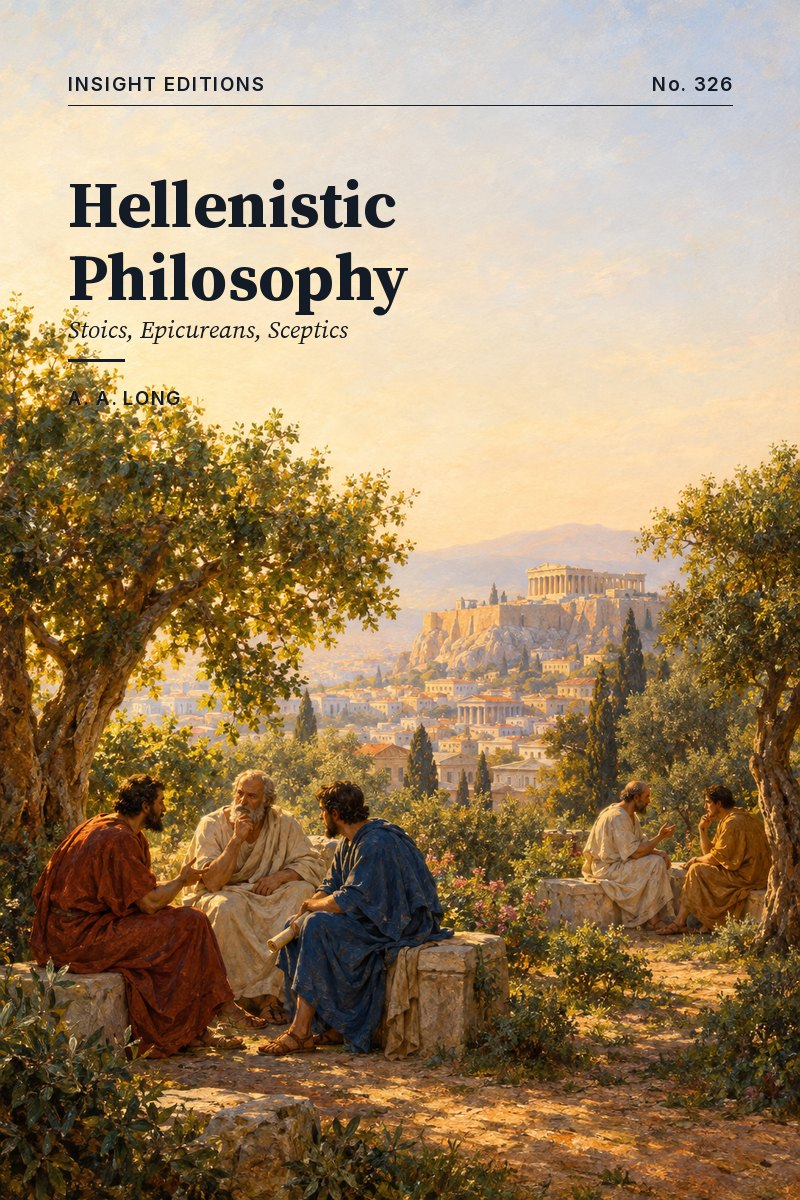
Hellenistic Philosophy
Stoics · Epicureans · Sceptics
Source-grounded independent analysis of A. A. Long’s second edition (1986). All 43 indexed reading units integrated without duplicating source units. Original studies restored where archival material was previously unavailable.
The 43-unit source and argument index
A navigational map of original reading order and the current study; only the first four original units received a direct-source retrospective review. Final comprehensive paragraph audits remain pending.
- Introduction · unit 01
- Epicurus and Epicureanism: orientation · unit 02intro
- Life and works · unit 02a
- The scope of Epicurus’ philosophy · unit 02b
- Theory of knowledge · unit 02c
- The structure of things · unit 02d
- The motion of atoms and formation of compound bodies · unit 02e
- The gods of Epicurus · unit 02f
- The soul and mental processes · unit 02g
- Freedom of action · unit 02h
- Pleasure and happiness · unit 02i
- Justice and friendship · unit 02j
- Pyrrho and Timon: early Pyrrhonism · unit 03a
- Academic Scepticism: Arcesilaus · unit 03b
- Academic Scepticism: Carneades · unit 03c
- Stoicism: introductory orientation · unit 04intro
- The Stoa, personalities and sources · unit 04I
- Stoic philosophy: scope and presentation · unit 04II
- Stoic logic: introduction · unit 04IIIintro
- Theory of knowledge · unit 04IIIa
- Grammatical and linguistic theory · unit 04IIIb
- Statements, methods of inference and arguments · unit 04IIIc
- The Stoics and Heraclitus · unit 04IIId
- The Stoic philosophy of Nature: introduction · unit 04IVintro
- Historical background · unit 04IVa
- The structure of things: body, pneuma, elements · unit 04IVb
- Mixture · unit 04IVc
- Categories · unit 04IVd
- Causation: determinism, human action, cosmic evil · unit 04IVe
- The soul and human nature · unit 04IVf
- Human rationality and the passions · unit 04IVg
- Stoic ethics: introduction · unit 04Vintro
- The part and the whole · unit 04Va
- From primary impulse to virtue · unit 04Vb
- The good and the preferable (natural advantages) · unit 04Vc
- The content of virtue: perfect and intermediate actions · unit 04Vd
- The Stoic sage: tests of virtue · unit 04Ve
- Later developments: introduction · unit 05intro
- Panaetius · unit 05a
- Posidonius · unit 05b
- Antiochus · unit 05c
- Cicero · unit 05d
- Hellenistic Philosophy and the Classical Tradition · unit 06
Chapter One. The making of Hellenistic philosophy
Why this period forms a philosophical subject
A historical period does not usually begin with the precision of a dated political battle. Philosophical ideas have ancestors, overlap with rivals, and survive political regimes. Long nevertheless argues that the Greek intellectual world after the death of Alexander in 323 BCE presents a sufficiently distinct constellation to justify treating it as a subject. The conventional Hellenistic period ends at Actium in 31 BCE, when Octavian defeated Antony, but neither date describes the sudden birth or disappearance of philosophical arguments. The periodization is an interpretive tool, not a claim that thought follows the calendar of rulers. In Long's deliberately limited usage, the central movements are Epicureanism, Stoicism, and Scepticism. The choice does not mean that Plato or Aristotle ceased to matter. It identifies a change in the schools that dominated intellectual debate.
This terminological choice needs two further qualifications. The schools continued to shape the Roman empire and later European traditions long after Actium. Conversely, Platonism began to revive and attention returned to Aristotle's specialized treatises before the first century BCE had ended. That return produced an environment in which philosophical authors combined inherited doctrines more freely. Long ends his detailed inquiry near that shift because the once predominant Hellenistic systems no longer organize the whole field. A system's loss of institutional dominance should not be mistaken for a loss of philosophical influence. A Stoic concept can remain decisive inside the writing of someone who does not teach as a professional Stoic.
The transformed Greek world: expansion and institutional continuity
Alexander's military conquests did not yield a stable single kingdom. His successors fought over territories, founding dynastic powers including the Ptolemaic kingdom in Egypt and the Seleucid monarchy in Syria. Yet the fragmentation of political authority was accompanied by a durable extension of Greek-speaking communities. Military settlers, administrators, and commercial networks carried Greek practices into Asia and Egypt. A shared Greek language, usually called koinē, enabled communication across regions while local circumstances generated differences. Alexandria and Antioch were political and cultural foundations of this transformed geography.
Alexandria became especially important for letters and the sciences, with royal patronage attracting researchers and scholars. Antioch, Pergamum, and Smyrna competed in the support they gave intellectual work. Athens retained its special standing as the center of philosophical schools. The contrast matters: the spread of Greek culture did not simply move the old Athenian Academy intact to new royal capitals. Distinct institutional settings cultivated distinct sorts of expertise.
The broader world also made new inquiries more pressing. Historical, geographical, philological, astronomical, and physiological work flourished. Authors who wrote literature were often learned investigators. At the same time, specialized subjects began to be distinguished more sharply. Aristotle and members of his immediate circle had treated biological research, logic, physics, ethical thought, and aspects of literary study as belonging to an extraordinarily broad philosophical enterprise. Many leading Hellenistic philosophers concentrated their professional activities on three connected domains: logic, ethics, and the nature of the universe. This division was never absolute. Strato of Lampsacus, who led the Peripatetic tradition into the third century, concentrated on subjects that modern readers might classify as natural science. Much later, the Stoic Posidonius drew mathematics, astronomy, history, and geography into his philosophical practice. Precisely because these figures are exceptions, they clarify the general institutional separation.
Long notes a suggestive geographical asymmetry. Epicurus, Zeno, Arcesilaus, and Chrysippus came to Athens from elsewhere, whereas Archimedes, the astronomer Aristarchus, the anatomical investigators Herophilus and Erasistratus, and other leading scientific figures were not comparably tied to Athenian philosophical schools. It would be misleading to treat that distribution as a proof of mutual indifference. It shows that philosophical training and specialized research increasingly acquired different centers of gravity. The later Stoic willingness to defend inherited astronomical or physiological claims against newer findings must be evaluated against this institutional division.
| Setting or tradition | Principal interest in Long's historical account | Why the contrast matters |
|---|---|---|
| Athens and its established schools | Sustained dialectical, ethical, and physical debate | Philosophy retains an institutional base even as the wider Greek world changes. |
| Alexandria under the Ptolemies | Literary learning, natural inquiry, collection and criticism | Scholarly vitality is not identical with leadership of a philosophical sect. |
| Antioch, Pergamum, Smyrna | Rival intellectual patronage and regional cultural networks | Greek intellectual life is polycentric rather than simply Athenian. |
| Strato in the Peripatos | Natural investigation alongside philosophical inheritance | The emerging division of specialties has significant exceptions. |
| Posidonius in later Stoicism | Reconnection with observational and mathematical investigation | The boundary between philosophy and science can be renegotiated. |
Was philosophy a response to the collapse of the city?
One widely repeated explanation presents the post-Alexandrian schools as desperate remedies for a society bewildered by the collapse of the autonomous city-state. On this account, people who could no longer depend on collective political security turned inward and asked philosophers to provide consolation. Long allows this explanation some force but rejects it as an adequate origin story. Political upheaval may illuminate why particular ethical programs were attractive. It does not demonstrate that Stoic and Epicurean philosophy was assembled hurriedly from anxiety, nor does it explain the full content of their physics and epistemology.
The challenge is partly comparative. Greece had experienced profound devastation during the Peloponnesian War long before Alexander's successors. Athens at the end of the fourth century BCE also retained considerable prosperity, visible in major public activity and investment. There is no compelling evidence that the early philosophical texts simply express a new, generalized panic. The loss of traditional civic self-confidence is a real phenomenon, but its intensity, distribution, and relevance to every school cannot be stipulated in advance.
Consider two apparently opposite responses. Epicurus recommended a protected circle of friendship and limited political exposure. Stoics developed a view of the entire ordered universe as a community to which rational human beings belong. These might both be intelligible under expanded and unstable political horizons, but their difference shows why a single social cause cannot explain their substantive commitments. A theory of atoms, a theory of cognitive impressions, and a cosmopolitan ethic need separately reconstructed arguments. Historical circumstances can affect the audience and urgency of a claim without explaining why the claim follows logically.
Long places beside the crisis hypothesis an alternative interpretation that sees heightened confidence in the power of human agency. The two narratives have different rhetorical force, and neither may be used as an automatic substitute for evidence. Historical background provides explanatory possibilities; doctrinal continuities and transmitted arguments determine which possibilities are defensible.
Alexander, Aristotle, and Diogenes: three kinds of conquest
Long makes continuity concrete by placing Alexander, Aristotle, and Diogenes the Cynic alongside one another. They died within a few years during the interval surrounding the formal opening of the period. Alexander had studied under Aristotle in Macedonia. Ancient biography also preserves a memorable reported remark connecting Alexander with Diogenes, whose self-sufficiency symbolically rivals political supremacy. This anecdote should be handled as a reported ancient story, not as a secure transcript of royal intention.
Alexander sought external dominion; Diogenes confronted conventions that made people dependent on property, social approval, status, and fear. Aristotle developed systematic accounts of reality, nature, politics, and the good life within a setting that could still take the Greek city as an ordinary social framework. The three lives illustrate three incompatible measures of achievement. A conqueror's reach, an investigator's explanatory ambition, and an ascetic's independence need not coincide.
The Cynic challenge was already underway before the conventional Hellenistic transition. Diogenes rejected the idea that moral standing should be defined by citizenship in Sinope, Athens, or any other locality. He used conspicuous behavior, the example of animals, and conjectures about simpler human life to attack elaborate social conventions. His claims about nature were not an empirical zoological science. They served as a polemical comparison between an allegedly sufficient natural life and the artificial needs constructed by society.
Long finds in this posture a genuine Socratic concern with the condition of the individual soul, even though Diogenes lacked the same allegiance to civic institutions that Socrates displayed. The distance from Aristotle is starkest in inherited social hierarchy: Aristotle's defence of slavery in the Politics shows how far social status could be integrated into a philosophically articulated civic order. Diogenes instead treated the human being's natural capacities as morally prior to rank or nationality.
The early Stoics would discipline and systematize many Cynic insights, especially the thesis that an agent's own rational constitution rather than fortune must supply the foundation of a good life. Other self-styled Cynics continued their distinctive public preaching in the Hellenistic and Roman worlds. But it would be inaccurate to say that Stoicism simply restates Cynicism. Stoicism eventually develops elaborate logic, a doctrine of cosmic reason, and an account of rational social attachment. The contribution of the Cynics is best described as a formative challenge to accepted standards of value.
The central continuity is the search for a form of flourishing that cannot be confiscated by civic loss, social rank, or external misfortune. The philosophical difficulty lies in explaining what makes the proposed inner resource genuinely sufficient.
The schools that Zeno and Epicurus encountered
Athens was not a philosophical vacuum when the founders of Stoicism and Epicureanism began teaching. Plato had founded the Academy before the middle of the fourth century BCE. Long warns against projecting the modern notion of a broad research university onto the Academy. Senior associates pursued intellectual work, but the structure of regular teaching is not fully recoverable. Mathematical preparation and the dialectical training envisioned in the Republic provide clues, not a surviving course catalogue. The numbers, composition, and precise formal procedures of the early membership are uncertain. Plato's dialogues themselves enabled an audience much wider than any small circle of pupils.
Aristotle joined the Academy as a young man from Macedonia and remained in close intellectual relation to it for many years. After Plato died in 347 BCE, leadership passed to Speusippus, then Xenocrates, and later Polemo. Aristotle's own departure from Athens after Speusippus's succession has several possible explanations; Long does not turn a conjectured personal quarrel into a demonstrated fact. Aristotle worked elsewhere in Asia Minor and Macedonia, returned in 335 BCE, and taught in the Lyceum. Theophrastus became central to that enterprise and led its work after Aristotle's death in 322, continuing until his death in the early third century. These chronologies show coexistence and competition rather than a succession in which each school displaces the previous one immediately.
The later Academy transformed Plato's inheritance. Speusippus and Xenocrates developed principles associated by later testimony with Pythagorean-style mathematics and metaphysics, modifying Plato's account of Forms. Their doctrines cannot simply be equated with Plato's own dialogue-based investigations. Both also wrote about ethics, retaining a commitment to the relation of virtue and flourishing. Speusippus is reported to have rejected pleasure as a good and opposed the hedonism associated with Aristippus. Later material attributed to Xenocrates contains therapeutic language about philosophy alleviating disturbances in life, but Long calls attention to a textual problem: the philosopher's name in the relevant Galenic passage depends on a scholarly correction from a different name. That evidence is therefore suggestive, not unassailable.
Polemo's transformation from a disorderly youth under the influence of Xenocrates belongs to ancient biographical tradition. His school appears to have emphasized ethical training over abstract dialectical exercise. The testimony attributed to Polemo favoring practical preparation is important because it makes intelligible a competitive landscape in which schools offered alternative visions of happiness. Yet Long resists the notion that these visions dispensed with theory. Epicurus wrote extensively about physical nature; Stoics constructed technical arguments about language, inference, and the material universe. Their moral programs are anchored in what they take to be knowable about humans and the cosmos.
| Athenian institution | Changes in leadership or emphasis | Evidential reservation |
|---|---|---|
| Plato's Academy | From Plato to Speusippus, Xenocrates, then Polemo; transformations of Forms and ethics | Curricula and institutional organization remain incompletely known. |
| Aristotle's Lyceum | Aristotle's broad research; Theophrastus's critical continuation | An author's views cannot be reduced to loyalty to a single founder. |
| Arcesilaus's later Academy | Major turn toward sceptical criticism around the mid-third century | The later sceptical program is not already present in precisely that form under Polemo. |
| Garden and Stoa | Rival accounts of knowledge, nature, and flourishing | Ethical appeal coexists with substantial specialist investigation. |
Other descendants of Socrates and the danger of tidy pedigrees
The familiar pairing Plato and Aristotle can conceal the many Socratic movements that rivaled them. Long insists that philosophical history must attend to those whose texts were lost, including Cynics, Cyrenaics, and Megarians. Ancient compilers often prefer neat genealogies in which a teacher begets a pupil who founds a recognizable sect. Such sequences can be illuminating, but the underlying relations may be disputed or retrospective. A school's later vocabulary may be projected backward onto an older thinker who never endorsed it.
Antisthenes was an associate of Socrates and a figure whom the Cynic tradition later connected with Diogenes. The extent of a direct educational relation is difficult to establish. Aristotle attacks some Antisthenean positions as philosophically crude, while later testimony also portrays Antisthenes as a prolific, stylistically respected writer. A man can criticize intellectual pretension without being ignorant of dialectic. The titles attributed to him show wide interests in poetry, knowledge, belief, and rational argument. Long's strongest reason for including him is ethical: fragments ascribed to him anticipate theses about the teachability, stability, and sufficiency of virtue that Stoic philosophers later developed systematically. The evidence supports a philosophical affinity; it does not establish a fully formed Stoic ethical theory before Stoicism existed.
Aristippus of Cyrene represents a strikingly different interpretation of Socratic concern with living well. Ancient discussions link him with the claim that pleasure is the goal of life, understood especially through immediate bodily gratification. His followers describe pleasure and pain by opposing kinds of bodily motion, with an absence of both as a neutral condition rather than pleasure itself. On their account bodily enjoyment has a priority that mature Epicurean doctrine will not reproduce unaltered. It is therefore not enough to call both Aristippus and Epicurus hedonists and treat their ethics as identical. A theory must specify what counts as pleasure, how pleasures are compared, whether mental life matters, and how immediate experiences relate to whole-life flourishing.
The relevant source tradition frequently fails to distinguish Aristippus from later Cyrenaics, especially Theodorus and Hegesias. Aristotle's account of Aristippus dismissing mathematics for not asking about good and bad suggests an ethical emphasis, but Long properly leaves open how far a sceptical position about external reality belonged to Aristippus himself. Ancient reports associate him with a lack of interest in physical speculation; connecting this securely to a developed epistemology requires more evidence than the report supplies.
Eucleides of Megara and his successors form another lineage. His reported claim of a single good with multiple descriptions suggests a mixture of Eleatic unity and Socratic valuation, but the actual reasoning is unrecoverable in detail. Parmenides and Zeno of Elea had pioneered argumentative attacks on ordinary assumptions about plurality and change. Later Megarians cultivated technical dialectic and were important to the formation of Stoic logic. Zeno of Citium studied with Stilpo and Diodorus Cronus, according to the tradition Long cites. What passed between them should be reconstructed from particular arguments rather than inferred wholesale from a teacher-pupil chain.
| Lineage | Claim or practice emphasized in ancient reports | Distinction required for understanding later schools |
|---|---|---|
| Antisthenes and Cynic precedents | Practical virtue, self-sufficiency, critical distance from social custom | A moral orientation is not yet the systematic Stoic physics and logic that later defend it. |
| Aristippus and Cyrenaics | Immediate pleasure, especially bodily experience, and pain as contrary motion | Epicurean tranquility and the removal of pain cannot simply be substituted for Cyrenaic pleasure. |
| Eucleides and Megarians | Unity of the good and dialectical argument | A disputed monistic thesis must be separated from later detailed Megarian logical techniques. |
| Plato and early Academy | Mathematical-metaphysical and moral inquiry in changing forms | Plato's dialogues, Xenocrates' dogmatic expositions, and Arcesilaus's scepticism require separate treatment. |
Theophrastus, the Peripatos, and the problem of Aristotle's manuscripts
The Lyceum remained intellectually productive well into the third century BCE. Theophrastus continued Aristotelian research while also criticizing Aristotle. His surviving work called Metaphysics probes difficulties inside Aristotle's system. In logic he refined inherited approaches; in botany and geological study he emphasized the systematic gathering and comparison of observations. His Inquiry into Plants and On the Causes of Plants make empirical controls visible. By all signs his practical philosophy remained comparatively close to Aristotle's ethical outlook. Long has no need to invent personal hostility toward the newer systems to identify serious doctrinal tension: an account that allows external circumstances a significant place in flourishing differs from one that makes virtue independently sufficient.
Epicurus wrote against Theophrastus, but the work's contents do not survive. The title alone cannot tell us the point-by-point debate. This illustrates the broader problem of unequal evidence. We sometimes know that a disagreement existed while lacking the reasons in its original form. We must not fill such gaps with arguments that happen to sound plausible to modern readers.
A famous narrative reported by Strabo says that Aristotle's books passed through Theophrastus to Neleus at Skepsis, were concealed for safety, and emerged again in the first century BCE for editing. Some scholars inferred that almost nobody knew Aristotle's technical writings for roughly two centuries. Long rejects that strong conclusion. A story about one collection is not evidence that all other copies disappeared from the schools, libraries, or the writings of Aristotle's associates. Theophrastus and fellow researchers had already engaged with these ideas, and Long cites evidence associating Epicurus with works of Aristotle on analytic reasoning and nature. He also considers it plausible that knowledge of the specialized writings diminished after the Lyceum weakened in the later third century.
The distinctions are evidential, not merely chronological. Manuscripts may circulate incompletely, be known by report, or survive only in copies we have lost. The fact that one copy emerges at a later date tells us about that copy's history; it cannot measure a tradition's total intellectual access. Conversely, rejecting a narrative of total disappearance does not prove that Epicurus knew every Aristotelian technical argument in the form familiar to modern editions.
Surviving evidence, unfair comparisons, and the historian's responsibility
Modern readers possess a vastly different archive for Plato and Aristotle than for early Epicurus, the original Stoa, and Academic scepticism. Little of Epicurus's extensive writing is preserved directly. No complete philosophical book by an early Greek Stoic survives. Carneades's methods must be reconstructed from later reports. By contrast, many works of Plato and Aristotle remain available in substantial form. A comparison that measures argumentative richness only in extant pages risks mistaking unequal textual survival for unequal intellectual achievement.
The historian relies extensively on compendia compiled centuries after the arguments they record. Their authors often abbreviate, reorganize, criticize, or harmonize philosophical positions. If one spends every page enumerating manuscript defects, the subject becomes lifeless; if one ignores them, a tidy but false doctrinal system emerges. Long argues for a more demanding middle course: distinguish secure foundations, alternative reconstructions, and open difficulties, then bring the actual philosophical problems into focus.
The influence of Eduard Zeller's great nineteenth-century history is one backdrop to the familiar claim that later Greek thought is an impoverished sequel to Plato and Aristotle. Long does not deny the exceptional achievement of the latter figures. His point is that Stoic and Epicurean projects were extended, philosophically argued criticisms of inherited theories of matter, knowledge, human nature, and happiness. Carneades displays considerable logical force in challenging dogmatic criteria. Judging these systems from fragmentary anthologies against comparatively complete Platonic dialogues and Aristotelian treatises demands explicit adjustment for archival asymmetry.
The philosophical schools also evolved in different ways. Epicurus became a revered founder and his teachings were treated as canonical, but there were later developments in Epicurean logical analysis. Stoic thinkers such as Chrysippus and Diogenes of Babylon expanded logic and other subjects with a degree of technical complexity that a simplistic picture of ethical consolation misses. Academic sceptics possessed no fixed positive physical system to defend and therefore developed distinctive critical methods, though the negative shape of the project created its own limitations. Under Panaetius and Posidonius Stoic doctrine underwent modifications, but the precise extent of those changes should not be exaggerated.
Professional depth and public accessibility
Both Stoics and Epicureans created teachings accessible at more than one level. Epicurus's summaries condensed a much larger corpus of physical and ethical writings. The Letter to Herodotus provided a memorable overview for students who could not devote themselves to technical books, while concise principal doctrines supported recollection and practice. This was not a confession that philosophy contains only slogans. It was an educational strategy that separated the introductory form from the depth of the underlying argument.
The Stoics developed exhortations, warnings, and practical counsels useful before a pupil had mastered logic and nature. Long compares such beginnings with the path of Lucilius through Seneca's letters, from elementary moral reflections toward difficult inquiries into the meaning of goodness. A student under Chrysippus would also confront substantial formal logic and systematic physics. A practical saying about accepting what happens can have a sophisticated causal and ethical theory beneath it; without that theory the saying may be misunderstood as passive resignation.
There is a tension between stable doctrine and philosophical freedom. An organized school protects and transmits an ambitious body of argument, but loyalty to founders can impede revision. Epicurus's adherents idealized their founder. Stoicism similarly acquired recognizable orthodoxy despite sustained internal discussion. Long sees the schools as more open to professional questioning than the word dogmatism alone suggests, yet their public success rewarded repeatable teaching that a broad audience could understand. The original question is not whether a school offers memorisable advice, but whether advanced inquiry remains free to challenge the assumptions on which the advice depends.
Philosophy's popular and technical forms should be read together. The maxim is an entrance; the argument about knowledge, causation, and value must establish what permits the maxim to guide a life.
Religion, science, and the costs of a complete worldview
The schools served functions that may also be served by religious or political communities: providing interpretation, standards of conduct, and a way of understanding misfortune. Traditional Olympian worship faced new cultural circumstances, while religious influences from eastern Mediterranean regions were increasingly visible. Stoics interpreted divine stories as allegorical representations of physical processes and cosmic causes. Epicureans denied that gods intervene in nature or regulate human affairs. The two positions are not versions of the same disenchantment: the Stoic cosmic order is providential, while the Epicurean account removes divine supervision from physical explanation and from fear of punishment.
Long offers a pointed criticism of the relation between philosophical orthodoxy and scientific change. Epicurus could be strikingly confident in speculative physical explanations; Stoics retained astronomy and physiology that sometimes conflicted with advances associated with Aristarchus and Erasistratus. The Academic sceptics, for their part, were not obvious allies of systematic scientific construction. Posidonius represents an important attempt to reintegrate mathematics and observational inquiry into philosophy. This assessment should be treated as Long's historically situated judgment, not as a claim that any school had nothing to teach about observation or inference.
A complete ethical system requires a supporting worldview, and that requirement both enriches and endangers it. If tranquility depends on a theory of nature, scientific errors may contaminate the ethical argument. If virtue requires allegiance to a providential whole, the evidence for providential order becomes morally consequential. Conversely, a theory that treats fear of the gods as destructive may motivate careful inquiry into natural explanations. The convergence of ethics and physics creates a formidable explanatory ambition but also a broad surface of possible failure.
As philosophy became attached to advanced education, its practitioners could enjoy respect and even perform diplomatic work on behalf of cities. Stoicism secured more public standing than Epicureanism, which at times found influential Roman supporters but retained a contested civic reputation. Roman elites adopted important Greek teachings without necessarily generating comparable innovations in the period Long examines. Athens and eastern Mediterranean centers continued to supply much of the specialized intellectual impetus. The history is neither one of unbroken Athenian isolation nor a clean Roman takeover.
Conclusion: what the introduction commits us to test
Three projects emerge, not three interchangeable remedies for political fear. Epicureans must show how empirical knowledge and an atomistic universe can secure pleasure, remove terror, and support justice and friendship. Stoics must show how the order of nature, correct assent, and virtue fit together under universal causation. Sceptics must expose whether either school can legitimately claim the secure knowledge required by its way of life, and whether inquiry can continue without dogmatic certainty. The philosopher who seeks a good life cannot evade the epistemic question of why a proposed remedy should be believed.
Long's introductory argument is thus about method as much as period. Study the changed world without using its politics as a substitute for reasoning. Recover Socratic and Aristotelian antecedents without erasing what later schools invented. Evaluate rival ethical ideals without forgetting their conflicting physical and logical foundations. Treat late evidence as evidence, with identifiable interests and limitations. Finally, distinguish the historical success of a school from the validity of its claims. A tradition can appeal to thousands because it responds to human needs; whether its explanation is true remains a further philosophical question.
Introduction: historical explanation and evidential limits
Ancient evidence
Diogenes Laertius transmits an anecdote joining Alexander's admiration for Diogenes with the Cynic's rejection of conventional goods. He also preserves testimony concerning Antisthenes, Aristippus's successors, the Megarians, and the training of Polemo's Academy. These reports do not have the standing of direct fourth-century transcripts. The evidence concerning Xenocrates's therapeutic conception of philosophy is especially delicate because the name in the Galenic passage depends on an editorial emendation. Strabo's later story of Aristotle's books reaching Neleus and becoming inaccessible concerns a purported manuscript history, not the ascertainable disappearance of every copy or report of the treatises.
Long's interpretation
The historical category Hellenistic philosophy is deliberately centered on Stoics, Sceptics, and Epicureans; political turning points in 323 and 31 BCE serve as conventional boundaries rather than doctrinal causes. Long tests the popular explanation that social dislocation alone caused a sudden philosophical turn to consolation. The earlier Peloponnesian War and the ongoing prosperity of Athens count against a simple panic model. Diogenes's already mature criticism of polis convention establishes a striking moral antecedent. The Academy, Lyceum, other Socratics, and new founders coexisted within a highly competitive intellectual setting. Specialized sciences, scholarship, and school philosophy were institutionally differentiated, with Strato and later Posidonius notable qualifications. Later source survivals cannot justify treating systematic Hellenistic reasoning as inferior because fewer original treatises happened to remain extant.
Original editorial audit and corrections
The previous study covers the majority of these argumentative transitions with appropriate caveats. One small but consequential distinction should be made more explicit. Reports about the Cyrenaic school describe pleasurable bodily experiences as relatively smooth movements and painful experiences as rough motions, while a mere absence of both is classified as neutral rather than positively pleasant. These reports cannot automatically be ascribed in all details to Aristippus personally. Later Epicurean valuation of stable freedom from pain is therefore not a synonym for the Cyrenaic model, even though both traditions assign fundamental ethical significance to pleasure.
The Megarian inheritance also needs to be kept in two layers. Eucleides's report of the good as one is partly intelligible through Parmenidean and Socratic precedents. The subsequent work of Stilpo and Diodorus in dialectical arguments matters for early Stoic logic, but it does not follow that all later technical devices were deduced from Eucleides's reported metaphysical claim. The ancient story that Stilpo drew pupils away from prestigious schools is evidence of the competitive scene as represented in later biographies, not an independently counted enrollment figure. This reinforces Long's challenge to the mistaken supposition that Plato and Aristotle monopolized contemporary thought.
The reappearance of Aristotle's technical writings should similarly be treated as a problem of degrees and channels of access. Rejecting total disappearance does not license an inference that every early Stoic had read every relevant treatise. Conversely, early knowledge of Aristotelian doctrines cannot be dismissed merely because a later witness tells an engaging story about manuscripts hidden in a cellar. The role of Theophrastus's active scholarly school makes total suppression particularly implausible.
Editorial decision: Preserve the existing full independent study and its original archived bytes. Add this correction rather than rewriting the largely adequate reconstruction. The earlier study contains a stale note that the historical archive had not been found; physically recovered and verified that archive, and the note is corrected in the new reader while the immutable historical text remains preserved.
Chapter Two. Epicurus and the aim of philosophical explanation
Long opens with Epicurus's distinction between merely appearing to practice philosophy and obtaining its genuine benefit. The comparison is medical: understanding must change the human condition rather than decorate speech. What counts as this benefit? Epicurus identifies ordinary misery not only with hunger, injury, or bad luck, but also with pervasive mistaken beliefs. People fear that the gods interfere in daily affairs; they imagine an afterlife of punishment or deprivation; they compete for goods that cannot provide stability. A philosophy that revises those beliefs may transform the quality of a life even when external circumstances remain unchanged.
Epicurus is therefore rightly called a moral philosopher in the broad sense of seeking an effective way to live. Yet Long is careful not to equate moral purpose with indifference to argument. Epicurus wants his listeners to believe truths, not simply comforting stories. His attack on a frightening picture of heaven has to be supported by a competing account of natural causes; his understanding of happiness requires a defensible psychology of desire and pleasure. The followers who praised him as a deliverer of light did not make him a figure whose doctrines should be interpreted solely as preaching. Moral persuasion and inquiry into reality are in his project inseparable.
The order of Long's investigation reflects this explanatory dependence. He begins with the theory of knowledge and turns through physical structure, movement, gods, soul, agency, and related issues before treating ethics directly. This order does not imply that ethics is less important. The ethical question is the destination that makes the intervening inquiries urgent. A good conclusion without an account of how it can be known remains unsupported; an account of atoms without consequences for fear and desire may not yet explain why Epicurus considered philosophy indispensable.
One should avoid forcing every physical paragraph to end in an explicit moral slogan. The value of the connecting argument emerges across the whole system. For example, it is not enough to tell a fearful person that thunder should not alarm them. A naturalistic account must make clear why the weather is not a personal communication from a supernatural judge. Equally, a claim about the soul's mortality matters ethically because it challenges the supposed experience of suffering after death. The issue is not the immediate rhetorical effectiveness of a teaching but how one part of the theory warrants the others.
Epicureanism proposes to alter human life by correcting beliefs about the world. Its intellectual credibility depends on the strength of those corrections, not on the appeal of the happiness they promise.
The ancient record is also distinct from Long's ordering. Epicurus produced letters and treatises with different instructional purposes, not one surviving complete textbook organized exactly as a modern commentator would choose. Long offers a coherent reconstruction of the system's explanatory dependencies, while remaining alert to the fact that a method of exposition is not a recoverable record of a founder's original lecture sequence. The reader should carry that distinction into every subsequent part of the edition.
The purpose and architecture of Epicurean inquiry
Ancient evidence and Long's interpretation
The Epicurean maxim contrasting nominal philosophy with a life genuinely improved by it sets the therapeutic aim. Long does not infer that a thinker with a moral purpose can dispense with theory. The intellectual instrument is reasoned persuasion supported by claims about nature, knowledge and value. The cult-like praise of Epicurus as a benefactor is a fact about reception, not a valid substitute for arguments or proof. Long explicitly chooses an order beginning with epistemology and culminating in ethics. This is a scholar's exposition of connections within a fragmentary corpus, not a recovered timetable of the founder's lectures.
Original editorial audit
The current study preserves the distinction between therapeutic aim and evidence. Its example of interpreting thunder as nonpersonal is a legitimate illustration of the system, not a recovered example from the short opening source passage. The source itself contains no detailed proof of atoms or of the mortality of the soul at this stage. The study's forward-looking examples should therefore remain marked as exposition of later doctrines. All named arguments of this brief orientation are represented. No substantive rewrite is currently justified.
Chapter Two (a). Epicurus: life, community, transmission, and sources
New original source-grounded study of the complete section on life and works, printed pages 14–19. Not a recovered manuscript.
From Samos to an independent school
Epicurus was born on Samos in 341 BCE, into an Athenian family established on the island. The Athenian citizenship of his father matters because it helps explain the later importance of Athens in his intellectual itinerary, but no straight path from birthplace to philosophical doctrine follows from it. Long distinguishes several encounters with philosophy that our sources report imperfectly. Pamphilus, a Platonist based on Samos, may have introduced the young Epicurus to intellectual questions, yet the mature Epicurean system opposes central Platonic metaphysical and epistemological commitments. Learning from someone does not entail permanent allegiance to the teacher's philosophical school.
The more consequential possible influence is Nausiphanes, associated with Democritean atomism and located on nearby Teos. Long thinks it likely that Epicurus encountered the basic atomic approach through this contact. Surviving reports also preserve extraordinarily hostile language directed by the mature Epicurus against Nausiphanes. The combination warns against treating polemical rejection as proof that intellectual influence never occurred. A philosopher may attack a predecessor most vigorously precisely where he needs to establish an independent account. Equally, likeness of doctrine does not allow an exact reconstruction of a conversation we cannot hear. The source reports provide connections and probabilities, not a transcript of how the atomic theory entered Epicurus's mind.
At eighteen Epicurus went to Athens for the ordinary service required of young Athenian citizens. The comic playwright Menander was associated with the same period. This does not by itself establish a philosophical friendship or systematic joint education. Long then notes a long stretch in Epicurus's life for which evidence is sparse. He may have worked as a schoolteacher at Colophon, where his family later lived. He established philosophical communities first in Mytilene on Lesbos and then in Lampsacus near the Hellespont. His return to Athens around 307/6 BCE, at approximately thirty-four, signaled confidence that his teaching could compete in the city already home to major philosophical institutions. He remained there for the rest of his life.
| Place and period | What the ancient tradition supports | What remains uncertain |
|---|---|---|
| Samos, from 341 BCE | Birth into an Athenian family and an early environment for philosophical encounter | How decisive Pamphilus was for specific later doctrines. |
| Teos and Nausiphanes | A plausible route through Democritean atomism | Precise dates, content of instruction, and cause of later hostility. |
| Athens, about age eighteen | Civic service and presence in an intellectual capital | The content of early learning during this interval. |
| Colophon, then Mytilene and Lampsacus | A possible teaching post followed by organized philosophical followings | Detailed activities during the poorly documented intervening years. |
| Athens, from around 307/6 BCE | Founding a durable association linked to a residence and garden | The exact daily teaching timetable, membership numbers, and internal offices. |
The Garden as a community rather than a lecture institution
Epicurus purchased a residence and garden between Athens and Piraeus. The garden became the identifying name of his school, but its character was not simply that of the Academy or Lyceum under another proprietor. Long sees it primarily as a durable circle of friends adopting shared beliefs and a coordinated style of living. Philosophical training took place within a community whose members hoped to realize the ethical importance of friendship directly. Women and enslaved persons were admitted, a feature that deserves notice in relation to more restricted elite educational settings, without assuming that every social hierarchy thereby vanished.
The difference between the Garden and a formal institution should not be exaggerated into a rejection of study. Members read, memorized, argued, copied texts, and communicated with believers elsewhere. The surviving fragment of book twenty-eight of Epicurus's On Nature preserves discussion involving Metrodorus, a leading associate, on questions about language and knowledge. The text is evidence of technical philosophical work within a circle often caricatured as a society of people who preferred simple pleasure to difficult ideas.
Epicurus prepared brief statements of doctrine, some apparently intended for memorization, while other works demanded sustained attention. In a letter addressed to Pythocles, preserved through later transmission and not free of authenticity questions, Epicurus responds to a request for an accessible summary of celestial phenomena. Long treats the letter's pedagogical attitude as broadly representative even while noting textual debate. The distinction between a compact summary and a detailed treatment is essential. A student may learn a principle in a few lines yet need many arguments to see why it is justified and how it should be applied.
Friendship, leadership, and the problem of authority
Members of the Garden were bound together partly through personal regard for Epicurus. His letters preserve affection and concern for followers. Seneca later transmitted advice to act as though Epicurus were an attentive witness. Long rejects a sinister reading of this as institutional surveillance. In its original ethical setting the injunction represents admiration for a person whose habits were taken to embody the philosophy. Nevertheless, one may reasonably identify a tension: affection for a teacher may support moral discipline while also making it harder to question his principles. The historical record requires us to treat the affectionate community and its strongly founder-centered intellectual identity together.
The Garden's withdrawal from competitive civic ambition was not equivalent to political insurrection or permanent avoidance of shared public life. Long notes testimony that Epicurus participated in traditional festivals. Epicurus's preference for a modest circle rather than public celebrity served his understanding of stable satisfaction. The doctrine of living without ostentation was intended to reduce exposed and unnecessary needs, not to declare every civic interaction inherently corrupt.
Hostile writers depicted Epicurus as an indulgent pleasure-seeker. That picture fits poorly with reports of simple daily food, contentment with modest resources, and the priority placed on reliable friendship. This does not settle whether Epicurus's theory of pleasure is philosophically sound. It prevents an opponent's caricature from being substituted for the theory to be examined. A conception of pleasure as a stable absence of disturbance is distinct from an instruction to maximize expensive sensations. It must be reconstructed in its proper section rather than inferred from gossip about the founder.
At his death, in 271 BCE according to Long's account, Epicurus provided for Hermarchus and the community through arrangements connected with his house and garden. Followers celebrated regular occasions commemorating Epicurus and Metrodorus. These practices sustained collective memory across generations. They also helped anchor a specific philosophical identity: remembering a founder is a way of transmitting criteria for conduct, a written canon, and a network of loyalties. It can deepen the continuity of a school while contributing to the conservatism of its doctrines.
A Mediterranean movement with an uneven public reputation
Long describes Epicureanism as unusually missionary among Greek philosophical traditions, drawing on an earlier historian's pointed characterization. Before settling in Athens Epicurus had already recruited followers at Lampsacus and Mytilene. The movement expanded through personal networks, travelling supporters, manuscript circulation, and new communities across the Mediterranean. Antioch and Alexandria were among its early important settings; later it spread into Italy and Gaul. The details and timing of individual cells cannot always be recovered, but the geographical breadth is clear.
Epicureanism's Roman reputation fluctuated. Around the last decades of the Republic, figures such as Calpurnius Piso and Cassius were associated with the school, while Cicero's friend Atticus followed it. Julius Caesar may have been sympathetic, although a suggestion of sympathy should not be strengthened into an assertion of formal membership. Cicero complained that Epicurean writing had attracted extensive Italian readership, and his irritation is itself evidence that the movement was not confined to hidden Athenian gardens.
The school encountered criticism from Stoics and other rival philosophers and later from Christian polemic. Yet the moral distance between officially Stoic writers and Epicurean teaching should not be exaggerated. Seneca repeatedly cites Epicurean maxims with approval, separating the usefulness of an insight from allegiance to a sect. Literary and philosophical reception need not match institutional membership: a moral maxim may cross boundaries that a physical doctrine does not.
Lucian's Alexander supplies later evidence for religious and philosophical antagonism involving Epicureans around the southern Black Sea. Long also emphasizes Diogenes of Oenoanda, who had a massive stone inscription engraved in a city in Asia Minor around the late second or early third century CE. Its fragments provide extended material about Epicurean doctrine and its claimed benefit to humanity. A public inscription intended for fellow citizens is especially important evidence against the assumption that Epicurean life necessarily ended in complete withdrawal from society. It also demonstrates the school's durability many centuries after its founder, without requiring the conclusion that Epicurean doctrines stood still throughout that time.
The scale of Epicurus's writing and the problem of survival
Ancient bibliography credits Epicurus with an unusually large output. Diogenes Laertius lists dozens of leading titles and reports a total running into hundreds of book rolls. This ancient count indicates scope rather than a secure modern count of uniformly sized volumes. The central corpus included a thirty-seven-book series On Nature, an account of criteria for judging truth, ethical investigations of the end of life and the conduct of different kinds of life, and argumentative works directed against other philosophers and schools. Epicurus also wrote shorter explanations and letters suitable for different audiences.
Only a small proportion survives directly. Diogenes Laertius preserved three important letters: one addressed to Herodotus summarizing atomistic principles; one to Pythocles treating heavenly and meteorological questions; and one to Menoeceus explaining major ethical views. Long notes that the last is comparatively accessible but simplifying, while the summary to Herodotus is compact and difficult despite its instructional purpose. A collection of forty principal doctrines and another surviving set of maxims complement them. They do not give us a complete replacement for the lost books, nor should their aphoristic format be mistaken for the entirety of Epicurus's reasoning.
The Herculaneum papyri transformed the possibilities of reconstruction. Excavations exposed charred scrolls from the collection of a wealthy Roman, including writings of Philodemus of Gadara, an Epicurean poet and philosopher of Cicero's era, and fragments of Epicurus's On Nature. The damaged state of the scrolls makes their reading a painstaking exercise. Long stresses their value while observing that much interpretation remains uncertain and unfinished. The fragments permit the recovery of technical discussions otherwise invisible in concise summaries, but missing lines should not be silently repaired by supplying conjectures as though they were secure ancient words.
| Surviving route | What it supplies | Principal source-critical caution |
|---|---|---|
| Diogenes Laertius, book ten | Three letters, biographical traditions, principal doctrines | A late compiler transmits material of different origins and literary forms. |
| Vatican collection of maxims | Additional concise ethical formulations | Isolated maxims may not express the full qualifications of longer treatises. |
| Herculaneum scrolls | Philodemus and damaged portions of Epicurus's major investigations | Physical loss and reconstruction decisions can control the apparent argument. |
| Lucretius, On the Nature of Things | Extensive connected reasoning across six poetic books | A philosophically faithful presentation is still a later creative work. |
| Cicero and Plutarch | Critical presentations and objections | Antagonism can sharpen legitimate difficulties but may distort emphasis. |
| Seneca and Sextus Empiricus | Cross-school reception and empiricist material | Agreement on one thesis does not establish agreement on the entire system. |
| Diogenes of Oenoanda | A later public exposition inscribed in stone | Later reception documents persistence, not necessarily identical founder wording. |
Lucretius: a later author who preserves the structure of a philosophy
Lucretius wrote more than two centuries after Epicurus and produced the great Latin poem De rerum natura. Long warns that it can be reductive to describe him as merely secondary. The work is an independent literary achievement whose six books articulate an elaborate Epicurean vision of atoms and compounds, sensory experience, psychological processes, human civilization, and physical events. A reader who only encounters moral aphorisms may never appreciate the explanatory architecture that the poem brings into view.
The poem is also strongly devoted to Epicurus as a liberator of humankind from fear. Lucretius's admiration affects its rhetoric and priorities, but Long sees no strong basis for ascribing to him significant new philosophical doctrines. Where his account matches Epicurus's extant writings, the poet can clarify compressed statements. Where it reports an important theory without an extant direct Epicurean parallel, such as the atomic swerve, Long considers it likely that Lucretius drew from fuller Epicurean sources now lost. That likelihood is a reconstruction, not an independent recovered passage proving precisely what Epicurus wrote. A poem can transmit arguments with great fidelity while shaping them through the demands of verse, persuasion, and Roman culture.
The literary form creates a special methodological task. We should attend to the conceptual argument rather than discounting it as poetry; but we should not treat poetically vivid elaboration as if it were an exact Greek quotation. Neither a low ranking of Lucretius as secondary nor an uncritical identification of his every sentence with Epicurus does justice to the evidence. The independent edition needs both the physical explanations and the differences in genre.
Later investigation and what counted as orthodoxy
Long describes Epicurus's immediate successors as less celebrated for fundamental innovations. That does not mean the school produced no later philosophy. The partial treatise On Signs by Philodemus preserves discussion associated with Zeno of Sidon, whose work may extend the treatment of inductive or sign-based inference beyond anything securely assignable to Epicurus himself. The exact degree of novelty remains open because so much founder material has vanished. A claim of development must be judged against surviving evidence, not merely against the length of a list of successors.
From among later witnesses, Cicero and Plutarch were conspicuous critics. Their writings provide both hostile interpretation and arguments a sympathetic reader needs to face. Seneca cites Epicurean moral precepts despite his Stoic commitments, while Sextus Empiricus supplies testimony especially useful for Epicurean empiricism, though his sceptical standpoint must not be erased. Diogenes of Oenoanda records a much later believer's public commitment. Together these witnesses establish a layered intellectual history, not a single transparent window onto the Garden in the fourth century BCE.
Conclusion: a school of practical life and ambitious explanation
The Garden joined friendship and a disciplined way of living to extensive speculative and argumentative labor. Its founder moved across the Greek world before establishing a lasting Athenian center; his followers carried the movement well beyond it. The school treated his writings as authoritative yet transmitted them through many forms: letters, mnemonic doctrines, intense discussions, philosophical poems, damaged papyri, hostile dialogues, and a civic inscription. The absence of most original books makes those later witnesses indispensable while imposing constant obligations of comparison and caution.
The central philosophical question introduced by the biography is whether such a community can justify its confidence. Friendship can make a life more secure, but the school's claim that fear arises from mistaken beliefs depends on its epistemology and physics. If the natural account fails, the therapeutic ambition does not by itself rescue the argument. If the account succeeds, the modest life cultivated in the Garden becomes a rigorous practical expression of a coherent theory, rather than a stereotyped pursuit of indulgence.
The founder, the Garden, transmission, and sources
Ancient testimony
Biographical claims reach us principally through later compilers, Cicero, Strabo, Seneca, papyri and school traditions. Pamphilus offers a possible Platonic early encounter, Nausiphanes a plausible Democritean line of contact; neither is a secure transcript of intellectual apprenticeship. Epicurus's sharp hostility to Nausiphanes is not proof of no influence. The founder's travel from Samos to Athens, Colophon, Mytilene, Lampsacus and back to Athens is unevenly documented. Seneca's maxim about imagining Epicurus's scrutiny is not evidence of coercive surveillance. The surviving letter to Pythocles, with its disputed authenticity, illustrates mnemonic and instructional practice. Epicurus's own role at festivals qualifies any claim that he rejected all public life.
Long's scholarly reconstruction
Long regards the Garden as a community of friends, not an Academy-style university. Nevertheless it involved copied books, intensive discussion, the training of Metrodorus and correspondence across communities. Its regular commemorative practice and continuing headship anchored doctrinal identity. The diffusion of Epicureanism from Greek-speaking cities to Italy and beyond is supported by varied testimony, with the monumental inscription of Diogenes of Oenoanda powerful evidence of much later persistence. The founder's supposed three hundred book rolls and listed titles establish extraordinary literary scope but not a surviving complete set. Direct letters, maxims, Herculaneum papyri, Lucretius, hostile witnesses, Seneca, Sextus and Oenoanda must each be evaluated in their own evidential class.
Original editorial audit
The existing study correctly distinguishes Lucretius's enormous philosophical and literary importance from a hypothetical guarantee of exact Greek wording. The atom swerve, as Long notes, is a particularly important case where fuller Epicurean sources may have existed without being extant. Zeno of Sidon's sign-inference work reported by Philodemus shows why the school's subsequent intellectual development cannot be reduced to simple recitation of the founder. The study accurately preserves Oenoanda as evidence of dissemination, while declining to transform later reception into proof of absolute continuity. It also preserves the difference between simple dietary habits and the logical validity of hedonism.
Further precision: The Garden's admission of women and enslaved persons is a significant feature of its membership, but it is not by itself evidence for complete equality of status or for identical access to every philosophical activity. The anniversary celebration of Epicurus and Metrodorus and the inheritance arrangements specify institutional continuity; their philosophical importance is not that memory proves a doctrine, but that affective allegiance may aid training and discourage independent revision. These points should remain as explicit qualifications, not compressed into an unqualified claim of an egalitarian utopia.
Chapter Two (b). What Epicurus wants philosophy to accomplish
One philosophical project, three kinds of work
Epicurus combines an uncompromising appeal to experience, a detailed account of invisible material structure, and practical instruction about fear, desire and happiness. These are not three disconnected interests. The person who trembles at a celestial sign, fears that death is a punishment, or treats wealth as an inexhaustible requirement of life needs both an account of what happens and an account of what matters. Physics displaces particular explanations that create unnecessary fear; epistemology identifies the observations and inferences by which physics should be assessed; ethics explains why dispelling the fear is valuable. Yet the connection is not a deduction of an ethical principle from a physical theory. Long's important qualification is that some links between the components of the system are considerably tighter than others.
The conceptual centre is empiricism, understood as the requirement that claims ultimately answer to sensation and feeling. That is more precise than saying Epicurus trusted everything anybody happened to perceive. Sensation supplies the material to which judgment must answer; the method by which an interpretation goes beyond what is immediately given is a separate problem. A metaphysical theory is legitimate for Epicurus only if he can give an empirical rationale for adopting it, even when its most important objects are themselves unobservable. This creates the main methodological tension in his philosophy, rather than providing an easy inconsistency to be dismissed.
Ancient position as Long reconstructs it: Epicurus sets immediate sensations and feelings against abstract logical constructions that cannot be connected back to experience. Long's interpretation: Empiricism is the clearest common thread linking his physics, theory of knowledge and ethics, but it does not render all three branches logically dependent on one another. Editorial inference: The system should be assessed as a network of differently strong explanatory connections, not as a single premise yielding every conclusion by syllogism.
Rejecting the reification of universals without rejecting concepts
The dispute with Plato and Aristotle concerns philosophical method as well as the contents of metaphysics. Plato's theory gives certain universals or Forms an ontological status independent of particular sensible objects. Aristotle rejects separately existing Platonic Forms but gives substantial explanatory work to classification, substance, form and the principles by which one describes a thing as an instance of a kind. Epicurus accepts that discourse distinguishes the universal from the particular, but rejects an independent world of universals and shows little interest in constructing a classificatory science of genera and species in Aristotle's manner. A common term such as cat has a legitimate role because experience has equipped people to recognise particular cats; it does not require an entity called Catness to exist beyond them.
This is not the denial that language has rules, that thoughts are general, or that reasoning can connect propositions. Long mentions the fragment traditionally registered as Usener 219 precisely to resist such a caricature. Epicurus uses words and logical reasoning as instruments. What he opposes is the idea that manipulation of expressions, unsupported by attention to things experienced, can establish reliable information about the world or teach us how to live well. In his eyes a sophisticated verbal distinction may produce the appearance of discovery while adding nothing to a person's grip on reality.
Plato's categories of same and different, and Aristotle's analysis through matter or substrate and form, exemplify what Epicurus suspects. One must distinguish his objection to metaphysical hypostatisation from the narrower and defensible claim that linguistic distinctions cannot by themselves establish empirical existence. A sentence can be grammatically impeccable and still fail to describe the world. This principle is valuable even if Epicurus's own dismissals of Aristotelian analysis are overbroad. Logical analysis is not thereby useless: it exposes contradictions, makes inference explicit and can reveal what evidence a claim requires. Long is describing a thinker who undervalues some forms of analysis, not someone unable to reason.
Consider the proposition that every visible object is made of tiny, invisible constituents. No dictionary definition of object or constituent could prove it. The question is what observed phenomena would be hard to explain without such constituents, and whether competing explanatory models fare equally well. Epicurus's demand for contact with experience is sound as a constraint; his ability to meet that demand for every component of his atomic physics needs independent examination.
The metaphysical reach beyond what is seen
Ordinary perception presents organised, coloured, resonant and moving things: animals, vegetation, water, soil, built objects. None of us directly sees the atoms and void that Epicurus takes as their ultimate constituents. His theory therefore goes beyond the immediate sensory record. Long is clear that atomism constitutes a metaphysical assertion in the literal sense of a claim about what exists and what underlies appearances. Epicurus cannot establish it simply by pointing at an atom, and the experimental resources available to him do not directly verify the proposed microstructure. He relies instead on starting principles, arguments about change and movement, and forms of inference from manifest effects to hidden conditions.
Leucippus and Democritus had proposed an atomic account more than a century before Epicurus. Epicurus did not merely inherit their framework without argument. He believed that the case could be strengthened, made more adequate to physical observations and given a distinctive ethical bearing. Its economy is attractive: if combinations of material units and empty space explain the world, no additional cosmic manager need be invoked to explain ordinary natural events. A hailstorm can be investigated as a natural process rather than interpreted as a rebuke from the gods. A person's physical life can be understood as a contingent organisation of material constituents rather than a soul awaiting punishment in an otherworldly tribunal.
The removal of the supernatural cause is both explanatory and therapeutic. The move requires care. If atoms and void suffice to describe how a storm forms, that undercuts a need for direct divine intervention in its formation; it does not constitute a simple logical proof that no gods can exist. Epicurus in fact retains gods while depriving them of the functions popularly attributed to them. Likewise, the assertion that Platonic Forms, a Demiurge, World-Soul, Aristotelian heavenly movers or other intellects are superfluous should be understood as part of his naturalistic programme, not as a theorem already secured by an appeal to sensation. Long identifies the striking consequences such a programme has for the life of someone who fears the gods' anger.
The ethical importance of physics explains why Epicurus invests so heavily in a speculative picture whose elementary components are invisible. A patient suffering from a persistent fear does not need to memorise names of cosmic entities for their own sake. She needs good grounds for abandoning the terrifying belief that natural events are messages about her own guilt or future punishment. Epicurean explanation offers grounds of that kind if its causal model is adequate. Whether the model is adequately demonstrated remains open to examination in the subsequent sections.
The connection that must not be overstated: atoms do not entail pleasure
Epicurus insists that philosophical inquiry is worthless unless it assists happiness. It is tempting to reason: first atomism, therefore no providential punishment, therefore bodily pleasure as the only good. Long blocks the last step. A fully naturalistic cosmos does not logically entail ethical hedonism. One might accept atoms and empty space and nevertheless adopt an ethic of achievement, duty, courage, contemplation or communal solidarity. The thesis that pleasure is the only intrinsic good requires its own experiential and philosophical defence. Epicurus presents arguments from the way living creatures respond to pleasant and painful experience, and from the conditions of a life free from distress. Their merit cannot be established by showing that matter is atomic.
This point marks a deep difference from Stoicism. For the Stoics, practical rationality and virtue are conceptually bound to the rational, providential organisation of the entire cosmos. Their interpretation of Nature is integral to the content of ethical rightness. For Epicurus the chief role of cosmology is to remove impediments to tranquillity; ethical valuation is grounded more directly in feeling and experience. The contrast is one of philosophical structure, not a claim that Epicurean physics has no impact on conduct or that Stoics never appeal to human experience.
Imagine two people convinced that thunderstorms emerge from impersonal natural interactions. One takes delight in scientific understanding but regards virtuous public service as the highest end. The other prizes freedom from bodily pain and mental disturbance. Their shared cosmology does not settle the dispute about final value. Conversely, two people might both identify pleasure as the end while disagreeing fundamentally about whether gods administer the universe. This double independence is the reason Long calls the link between atomism and hedonism contingent rather than necessary.
The unresolved burden of proof
Three philosophical burdens result. First, Epicurus must show how sensory evidence can constrain reliable inference about imperceptible atoms, empty space and cosmic events. Second, he must explain how words and concepts can be grounded in experience without reducing all fruitful thought to immediate perception. Third, he must justify pleasure as the intrinsic end without pretending that atomism has supplied the justification in advance. The theory of knowledge will address the first two, albeit with weaknesses Long exposes; the ethics will address the third.
Critical thesis. Empiricism gives Epicurean philosophy its unity of method, not a deductive unity of conclusions. Its disciplinary ideal is to return claims to what can be observed or felt, while recognising that the invisible structure of the world and the purpose of a life are different objects of inquiry. This is why Long calls Epicurus an empiricist without mistaking that useful designation for a complete explanation of the system.
| Element of the philosophical project | What observation contributes | What additional argument is needed | Primary practical function |
|---|---|---|---|
| Knowledge and language | Repeated sensations and feelings | Distinguish reliable interpretation from mistaken identification | Protect inquiry from groundless assertions |
| Atoms and void | Change, movement, generation and decay | Justify inference to hidden physical constituents | Replace punitive divine explanations with natural causes |
| Gods and cosmic explanation | Phenomena that require explanation | Show why divine government is dispensable without assuming the conclusion | Reduce religious terror |
| Pleasure and happiness | Experienced pleasure, pain and desire | Establish the normative claim that pleasure alone is intrinsically good | Guide choice and the cultivation of a tranquil life |
| Relation to Stoicism | Shared attention to what human beings experience | Differentiate independently defended Epicurean ends from cosmic Stoic normativity | Clarify why apparently similar ethical advice arises from different foundations |
Empirical criteria, invisible reality and independent ethical argument
Ancient position
Epicurus gives epistemic priority to sensations and feelings, rejects independently existing universals and disputes the explanatory primacy of Platonic and Aristotelian abstractions. He does not forbid using words or arguments. His atomic ontology extends beyond any direct sensory impression, so its validation requires inference to hidden causes. A claim that atomism makes divine cosmic supervision explanatorily redundant is different from a proof that gods do not exist.
Long's reconstruction
Empiricism, rather than one deductive proof deriving every school doctrine from the others, furnishes the strongest methodological connection among logic, physics and ethics. The physical theory may remove religious fear and thus serve the pursuit of happiness. But a physical account of atoms and void cannot by itself establish the normative proposition that pleasure is the only intrinsic good. For this latter claim Epicurus has separate experiential arguments. This separates his system's interdependencies from the stronger Stoic relation between providential nature and practical normativity.
Original editorial audit
The study carefully separates metaphysical assertions, the evidence available for them, their therapeutic role, and the independent argument required for pleasure. It avoids the contradictory inference that empiricism cannot theorize about imperceptibles. Its illustrations of storms and living creatures are explicitly editorial examples, not purported ancient quotations. Its overall coverage is robust and more extensive than the short original source section. Retain the original replacement with its historical provenance clearly identified.
Chapter Two (c). Epicurean knowledge: from impressions to invisible causes
Why the senses cannot be treated as enemies
The central Epicurean demand is not to make every interpretation automatically true, but to preserve a non-arbitrary standard against which interpretations are tested. Principal Doctrine 23 argues that rejecting all sensations deprives one even of a means to identify alleged sensory mistakes. The argument has the form of a challenge: when somebody says that experience deceives, how did that person acquire a dependable standard of truth with which to make the accusation? If the standard is another judgment, its claim to authority also requires explanation. Epicurus locates the beginning of this explanatory sequence in sensation itself.
Long begins from an assumption that Epicurus does not prove: sensation is caused. A felt hunger has a cause internal to a living body, whereas a perceived sound or colour is usually attributed to something outside. It is a further, far more controversial assertion that an external visual impression is explained by an object possessing the appearance it seems to disclose. The two statements are easily conflated. From the fact that an experience occurs because of something, it does not follow that the world contains an object exactly as the perceiver identifies it. Long's motor-horn example brings out that missing inferential step. One may hear a sharp sound without being entitled to say what produced it. Epicurus's physical theory is designed partly to explain the distinction.
Effluences as causal intermediaries
According to the Epicurean account reconstructed from the Letter to Herodotus and related testimonies, objects send off exceptionally thin atomic configurations from their surfaces. These streams, sometimes called effluences or films, enter receptive sense organs and produce impressions. In a favourable case their configuration has remained sufficiently unchanged during transit and thus resembles the surface from which they came. In an unfavourable case it is disturbed by interaction along its route. The perceiver then receives a genuine impression of the altered incoming configuration without receiving a faithful representation of the more distant originating object.
The account inherits elements of a much older Greek discussion, particularly Democritus and, in a different form, Empedocles. Epicurus did not devise the entire notion of transmitted material likenesses. His contribution lies in embedding it in a more extensive theory of knowledge and error. The impression has a real causal origin; the judgment about the remote object may be false. These are distinct claims and neither can be substituted for the other.
Think of a tower whose true outline is angular. From a long distance the traveller receives a less distinct visual appearance and identifies it as round. Epicurus's account places the primary mistake in the inference from appearance to the external tower's shape, not in an experience which never occurred. Closer inspection can correct the judgment. But this does not prove that all appearances originating nearby are true to their objects. It states a practical hypothesis about when transport-induced alteration is less likely. Long records the ancient example and points to the need for a further criterion.
The notion of an infallible sensation is therefore both weaker and stranger than an assertion that whatever one sees is true. It is weaker because the sense cannot by itself certify an identification of a distant object. It is stranger because its immediate object, on the physical model, is an incoming atomic structure of which ordinary people are not directly aware as atoms. If sensations are guaranteed reliable evidence only of the effluences that happen to cause them, how can an investigator distinguish the faithful from the distorted effluence without access to an external object independent of sense-perception? This is Long's decisive pressure point.
The distinction between perceiving and judging
The testimony collected by Diogenes Laertius X.31–32 and in the Letter to Herodotus supports a separation between the unreflective occurrence of a sensory impression and the act of identifying what it indicates. A sensation does not reason, choose its content or endorse an interpretation. In that limited sense one sensory occurrence is not disqualified by a second simply because they differ. A visual appearance of the tower at a distance and another appearance close up are both episodes that happened. Judgment brings an additional claim: that a particular external object has a particular determinate property.
Long treats this distinction as an important intellectual achievement rather than as a complete rescue of Epicurean certainty. To infer from there is a visual impression of roundness to the tower is round is precisely the kind of move that needs evidence. Saying that sensations themselves do not lie leaves the burden of demonstrating the reliability of judgments unanswered. Epicurus cannot consistently obtain that demonstration by assuming an independently accessible object and then measuring perception against it; the object is made known through perception in the first place.
The available evidence associates reliable judgment with enargeia, the clarity or manifest distinctness of a sensory presentation. Loud and faint sounds, sharp and blurred sights, and closer versus farther inspection are familiar contrasts. Epicurus gives clear appearances a privileged role in evaluating tentative beliefs, and unclear ones must wait for confirmation. Long makes a methodological point about circularity: the criteria by which a perception counts as clear are not specified with precision, possibly because Epicurus thought an attempt to define them would itself demand further criteria without end. The practical fact that human beings often tell vivid from indistinct impressions does not yield a universally reliable truth test.
The notorious claim about the apparent size of the sun exposes the weakness. Epicurus made what Long judges to be a significant error by allowing visual appearance to constrain the sun's physical size too strongly. An impression may be clear as an experience and misleading as a measurement of the object's dimensions. The mistake reveals that clarity and correspondence need to be established separately. This is not a retrospective license to mock ancient astronomy. It is a controlled counterexample to the exact epistemic principle being proposed.
Preconceptions make recognition and language possible
No impression, however vivid, tells a viewer that the object is a tree, a person or a cat without some ability to identify kinds. Epicurus explains this ability by prolēpseis, preconceptions or anticipations. Repeated clear encounters produce relatively stable general mental representations that survive after each encounter has ended. Encountering another person is then intelligible because the new impression can be compared with a memory-grounded conception of what a person is. Diogenes Laertius X.33 connects preconceptions with recognition and the formation of words; Long notes a significant resemblance to Aristotle's statement that a universal concept develops out of repeated experiences.
The resemblance must not conceal the disagreement over philosophical work. Aristotle builds a systematic treatment of classification, causal definition and demonstration upon concepts derived from experience. Epicurus is far less willing to allow that abstract structure to become an independent engine of empirical discovery. For him general ideas are useful because they register and coordinate sensible encounters. Language makes these records sharable and lets speakers judge whether the present experience belongs to a familiar kind. A word can mislead when its established preconception does not match the appearance or when the word is itself ambiguous.
Long's source-critical distinction matters. A repeated series of similar impressions can establish a representation without showing that everyone forms precisely the same preconception or that two people employing the same word carry indistinguishable mental content. Epicurus requires enough intersubjective stability for communication and dispute. Long observes that he does not supply an adequate argument for this needed agreement. Nor does the surviving evidence show in detail how every concept with no direct sensible instance can be built from empirical preconceptions. Some are presumably combined or extended, but the limits of this process remain obscure.
The surviving fragments from On Nature book 28 are crucial here. They show Epicurus examining difficulties of signification, ambiguity, universal and particular, and the designation of individuals. These topics are inconsistent with the popular claim that he merely pronounced definitions worthless. One must distinguish his rejection of autonomous verbal metaphysics from a rejection of linguistic precision. Cicero's polemic against his dialectical competence has to be assessed against these fragments, not accepted as neutral biographical data.
A second pathway: fine images entering the mind
A major complication enters with mental images that supposedly bypass ordinary sensory organs. Long turns to the Epicurean explanation of dreams, hallucinations, imagined animals and divine visions. Lucretius describes exceptionally tenuous atomic formations capable of directly affecting the mind. They may originate in real objects, consist of combinations of separate streams, or be assembled by chance in the surrounding material environment. An imagined centaur can consequently be understood as a physical image without supposing that a living centaur exists somewhere and without describing the vision as a nonphysical invention of the mind.
This model preserves Epicurus's causal materialism at a considerable cost to epistemic discrimination. If a nightmare, a remembered lion and a sensible encounter with a lion can each be caused by incoming material images, what independently determines which one reports an enduring external object? Lucretius offers distinctions between streams that persist and single images or succession of rapidly vanishing images, and Long likens the latter to the discontinuity of early moving pictures. This is at most a partial discriminant. Dreams can be continuous; waking perceptions can be fleeting. The availability of a material cause does not give a certificate that the represented object exists as imagined.
The divine case sharpens the difficulty. Epicurus describes fine material presentations of the gods that reach the mind and treats divine beings as real while denying that they govern human fate. Cicero's On the Nature of the Gods I.43–55 preserves an important portion of the discussion, although the reporting is argumentative and the physical interpretation of the surviving texts is difficult. Long holds that supposing divine presentations does not adequately verify the entities they seem to portray. Widely distributed belief in gods adds a fact about belief, not necessarily evidence about the cause of the belief. A method founded on ordinary perceptual checks has been extended to a region where the checking procedure is obscure.
The editorial critique should remain modest in one respect. Epicurus is not inconsistent simply because he has a model of dreaming that contemporary science would reject. The philosophical weakness is the absence of sufficient discriminating evidence within his own model to establish the connection between an atomic mental image and the external existence of its purported subject. His commitment to the physical reality of all mental causes does not repair that inferential gap.
Does attentive intelligence supply independent certainty?
Long examines a scholarly disagreement over the expression epibolē tēs dianoias, sometimes translated as apprehension or attention of the mind. Cyril Bailey treated it as a faculty that could grasp clear non-sensory objects and scientific concepts, parallel to the sensory attention by which empirical objects become evident. On such a reading Epicurus would rely upon an intuition-like faculty to certify matters ranging from divine beings to atoms and void, compromising his declared empiricism.
Long rejects the weight Bailey places on the wording. Nothing in the evidence demands an infallible intellectual intuition. Attention or concentration on an image or thought is a plausible and much less extravagant interpretation. The physical mind needs to attend to what reaches it if an impression is to become the object of conscious awareness. That does not transform the impression into a guaranteed scientific truth. The disagreement is not over whether Epicurus sometimes discusses mental apprehension. It concerns what epistemic authority, if any, that act was supposed to carry. Long reserves further treatment of the psychology for his later section on the soul.
Two principles governing empirical inference
Long reconstructs two methodological commitments that he calls axioms for clarity, although Epicurus does not himself give them that formal name. The first concerns positive sensory confirmation: a clear impression is evidence for a claim about the characteristics of an observed object. The second concerns what is not directly accessible to observation: a hypothesis about a hidden thing may be admitted so long as it is not contradicted by the clear appearances that would bear against it. Ancient evidence including Sextus Empiricus, Against the Mathematicians VII.212–213 and Epicurus's letters supports the distinction.
These principles have very different inferential force. Confirmation raises confidence by supplying expected observed evidence. Non-contradiction preserves a possibility by noting the absence of defeating evidence. The former, properly used, is stronger than the latter. If a field is wet, rain may be one explanation, but no rain has yet been confirmed simply because it would be consistent with the wet field. An irrigation system, a broken pipe and a flood might be equally compatible. Long's formal exposition of the Epicurean doctrine is helpful exactly because it prevents mere compatibility from being confused with logical entailment.
Sextus reports an illustration concerning void. If there were no empty space and if an entirely full, impenetrable world made motion impossible, the manifest fact of motion would count against the denial of void. Long points out that this inference depends on a suppressed premise: motion would be impossible in a completely full world. Aristotle and the Stoics reject the premise that void is required for movement. The appearance of motion is not itself a decisive demonstration of Epicurean void until the competing explanations have been ruled out. As an instance of indirect or counterfactual reasoning, however, it shows how Epicurus can try to infer an unobservable condition from observable effects.
The next step is explanatory plurality. When several descriptions of a hidden cause survive the checks that observation can presently supply, the theorist should not demand one uniquely correct answer without additional evidence. In the Letter to Pythocles, Epicurus offers different possible accounts of lunar changes, including motion or rotation, atmospheric arrangements and intervening bodies. The precise astronomical explanations are historically conditioned and need not be adopted. What matters is the policy against unwarranted exclusivity when an astronomical phenomenon does not discriminate among candidate causes.
Long values the discipline of admitting underdetermination but criticises its limitation. Repeated observations, records accumulated over time and mathematical modelling can produce discriminating evidence even where a single glance cannot. Some ancient astronomers were developing such methods. The contemporary scientific comparison Long makes in 1986 is period-specific, not a timeless statement that rival cosmologies remain equally acceptable today. The wider lesson is stable: underdetermination by current evidence recommends suspended exclusivity, not permanent equality of explanations. An Epicurean commitment to what is observationally secure need not in principle exclude better instruments or repeated measurements, yet the source presents Epicurus as too resistant to the power of such additional constraints.
From the seen to the unseen: induction and analogy
Philodemus's On Signs supplies a record of Epicurean and Stoic argument concerning empirical generalisation. An observer encounters finite, mortal human beings and infers that humans elsewhere are mortal too. The Stoic objection is penetrating: the inference treats unseen cases as sufficiently like seen cases and cannot obtain this similarity merely from the logical form of the argument. The Epicurean reply appeals to the lack of any known counterexample and to the reliability of the accumulated instances. It does not profess an innate universal definition of humanity that already contains mortality.
This is not deduction. From a finite body of observations alone, the universal conclusion does not follow with logical necessity. But science needs empirical generalisations to construct hypotheses and to supply premises for future deductive reasoning. Long therefore resists the idea that Stoic requirements of valid deduction are sufficient for scientific knowledge. Deductive inference transmits consequences from premises; it does not establish the empirical premises out of nothing. Epicurus's defence of analogical inference identifies a genuine methodological problem that survives his own loose treatment of confirmation.
The structure of analogy is to take reliable features of accessible items and cautiously extend those features to inaccessible items. Epicurus compares the smallest visibly discriminable magnitude with an indivisible minimal part of the unseen atom. What has been observed about one scale is treated as a constraint at another. The transition assumes that the relevant structure persists across the scales. Philodemus appeals to this kind of similarity in his debate with Stoic critics, at one point describing a thing with nothing in common with what experience makes known as inconceivable. Long does not find an independent third Epicurean axiom for analogy. The first two principles, positive evidence and the admissibility of what experience does not contradict, are meant to provide the support.
Long's appraisal is deliberately two-sided. The absence of known counterexamples does not logically prove a universal proposition about unseen cases. Conversely, a demand for demonstrative certainty everywhere would obstruct an enormous amount of legitimate scientific reasoning. We can rationally form a defeasible expectation that future cases will resemble established cases, while keeping the conclusion open to revision if contrary evidence emerges. There is a difference between an inference whose limits are acknowledged and one whose uncertainty is ignored.
Lucretius's cultivated earth: how indirect proof is meant to work
Lucretius's On the Nature of Things I supplies Long's concrete model of indirect demonstration. Suppose objects could arise without any pre-existing constituents or conditions. Then generation would have no need to follow distinctive biological and environmental patterns. But cultivated ground reliably produces certain kinds of growth under conditions that uncultivated ground does not, and living things regularly arise in characteristic ways. The hypothesis of arbitrary generation conflicts with these observations. Lucretius uses the conflict to motivate the claim that productive matter contains underlying seeds or first bodies whose arrangement explains regularity.
The argument is not a demonstration of every detail of atomism. It refutes, or at least challenges, one alternative account of generation; further work must distinguish atoms from other possible material principles. Long's attention to its logical form lets a reader appreciate both the empirical ingenuity and the incompleteness. The fact that ploughing changes what grows is evidence of dependence on physical conditions. It is not independent proof that those conditions ultimately consist of indivisible bodies with every property Epicurus assigns to them.
The comparison with modern scientific reasoning should not hide a historical asymmetry. Lucretius is presenting a sophisticated argument in poetry derived from Epicurean physics, not reporting a controlled agricultural trial. The language of seeing and the counterfactual structure of his reasoning can be examined philosophically without misdescribing the ancient literary form as a modern laboratory protocol.
Epicurus did not simply abandon reasoning
Long's final correction to a common stereotype is particularly valuable. Epicurus sometimes disparages study, specialised learning and clever discussion because he thinks they can generate false needs and empty competition. This rhetoric does not justify the claim that his school lacked arguments about logic or scientific method. The damaged text of On Nature book 28 gives direct evidence that he considered induction under the technical term epagōgē, examined ambiguity and problems of reference, distinguished individuals from universals, and engaged puzzles associated with Megarian dialectic. Exactly how he resolved all these puzzles cannot be fully recovered because the surviving papyrus is fragmentary.
Cicero, On Ends I.22, offers a hostile catalogue of alleged Epicurean omissions in definition, division, construction of arguments, sophisms and ambiguous language. Long rejects the catalogue as substantially misleading in light of the recovered material. This source-critical confrontation matters more than a contest of personal reputations. A surviving fragment from a large, mostly lost technical corpus carries evidentiary weight against a sweeping judgment by an opponent. Epicurus reportedly wrote thirty-seven books On Nature. A philosopher cannot be assessed only from compact letters designed to transmit the most important conclusions to non-specialist students.
Long's criticism remains sharp. Epicurus tends to underestimate the independent discipline that formal analysis can bring to observation, especially where mathematics and accumulated evidence outstrip a person's immediate sensory clarity. But to say he undervalued that discipline is very different from saying he never reasoned or analysed meaning. The surviving testimony presents an ambitious, empirically anchored theory of inference whose own grounds of certainty are insufficiently articulated.
The exact epistemic balance
The reader should now be able to keep six claims separate. Having a sensation is an occurrence. Identifying an external object is an interpretation. An unaltered effluence is a proposed physical mechanism of accuracy. Clarity is a proposed practical mark of reliable presentation. A preconception is an acquired resource for recognition and language. Non-contradiction is a permissive test for hypotheses about what cannot be directly observed. None of these is identical to the others, and arguments fail when they slide from one to another without warrant.
Epicurean knowledge is most defensible when experience controls hypothesis and least defensible when absence of contradiction is promoted into independent proof of existence. Long preserves the virtue of the enterprise even while showing how its rules can be overextended to divine visions, the apparent size of the sun or a unique cosmic explanation. That differentiated assessment is better supported by the full source section than either unqualified praise of ancient empiricism or a caricature of Epicurus as indifferent to method.
| Epistemic layer | What Epicurus proposes | Evidence in the original section | The unresolved issue |
|---|---|---|---|
| Sensory occurrence | Impressions occur from physical causes | Diogenes Laertius X.31–32; Letter to Herodotus | A cause does not guarantee a matching remote object |
| Fidelity of a presentation | Clear, relatively undisturbed impressions have priority | Tower example; Letter to Herodotus 49–52 | Clarity is not identical with truth about size or structure |
| Recognition | Acquired prolēpseis coordinate new experience | Diogenes Laertius X.33; Aristotle comparison | Shared meanings and nonempirical concepts need explanation |
| Mind-directed images | Fine atomic presentations reach thought without ordinary sense organs | Lucretius IV; divine-image testimony | Dream, apparition and object must be discriminated |
| Intellectual apprehension | Long favours attention rather than intuitively guaranteed knowledge | Bailey interpretation and Long's reply | The evidence does not settle every psychological detail |
| Indirect physical proof | Non-evident hypotheses are examined through observable consequences | Sextus Empiricus; motion and void | Auxiliary premises and alternative causes matter |
| Multiple explanations | Observation may leave several accounts admissible | Letter to Pythocles | Mathematical and cumulative data can narrow possibilities |
| Inductive generalisation | Unseen cases may resemble all relevant observed cases | Philodemus, On Signs | Similarity is useful but not logically guaranteed |
| Theory of argument | Fragmentary Epicurean technical writings treat induction and language | On Nature XXVIII versus Cicero | Lost context prevents exhaustive reconstruction |
Chapter Two (d). Body, void and the minimum structure of the world
An economical but strongly metaphysical theory
Epicurus begins from the thesis that the world contains bodies and empty space. That statement is more radical than it first appears. Ordinary people distinguish numerous kinds of entity: a sheep, a sound, the light of the sun, a memory, a river and a stone. Epicurus does not deny the presence of these phenomena, but claims that they can be accounted for through only two fundamental kinds of reality: material bodies and the unoccupied extension that permits them to move and be arranged. The contrast between visible complexity and a minimal set of principles defines the ambition of atomism.
Leucippus and Democritus developed the atomic programme during the fifth century BCE, long before Epicurus. He inherits their basic distinction between the full and the empty but changes important details, particularly the analysis of atomic size and structure. His self-presentation as an independent philosopher should therefore be distinguished from a claim to have invented atomic explanation. Long reconstructs the core reasoning principally from Letter to Herodotus 38–44 and the elaboration supplied by Lucretius. The surviving texts are condensed arguments, not a laboratory report demonstrating the atoms themselves.
The question the theory attempts to answer is precise: which unobservable principles would suffice to account for changes, motion and the persistent diversity of sensible objects? Epicurus's answer is a boundless distribution of solid, indivisible bodies in boundless empty space. A household object persists temporarily as one arrangement of constituents; it ceases to exist in that form when the arrangement disperses. Its disappearance does not entail that the underlying material has become nothing. The distinction between an organised thing and its enduring elements makes generation and dissolution intelligible within an uncreated world.
Three starting claims and their very different roles
Long separates three main propositions in Epicurus's abbreviated presentation. The first prohibits generation out of sheer nothing. The second prohibits dissolution into sheer nothing. The third maintains that the total universe does not undergo an alteration that takes it outside its fundamental condition. It is important not to treat these as interchangeable principles or as equally obvious inferences from experience.
The principle against creation from nothing is motivated by the observed regularity of generation. Seeds and appropriate circumstances are needed for particular kinds of living things to develop. If an absence of antecedent constituents and conditions sufficed, the distinctive connections between causes and products would require a new explanation. Lucretius later gives the point a vivid agricultural form: cultivation, season and soil matter. A world of arbitrary origination would not exhibit such relatively stable dependencies. The principle therefore finds indirect support in experienced patterns of coming-to-be, though it reaches further than those patterns strictly entail.
The prohibition on destruction into nothing complements it. A compounded object dissolves, but the material involved must survive in some transformed arrangement. Epicurus infers that if matter were able simply to vanish without any surviving constituent, the persistence of an organised world would be inexplicable. Long identifies the inferential structure as a reconstruction through the Epicurean method of resisting hypotheses that clash with experienced regularity. It is not a measurement of all the matter that has ever existed. The argument relies upon a global extrapolation from how destruction ordinarily appears to work.
The third claim concerns the universe as a whole. Because the universe is understood to embrace everything whatsoever, Epicurus argues that nothing beyond it could alter its nature from outside. Long points out a gap: a total system might undergo dramatic changes because of its internal dynamics. The absence of an external cause does not entail sameness of condition through all time. This objection is logically distinct from disputes about whether atoms themselves can perish. One could suppose indestructible elementary bodies and still imagine large-scale transformations of the world they compose.
These principles are explanatory commitments selected to make intelligible the observed world. Their boldness should neither be concealed by calling them simple facts nor dismissed merely because they transcend direct observation. Many scientific theories postulate unseen structures. The philosophical test is whether the postulates actually earn their place through explanatory adequacy, independent constraints and discrimination among alternatives.
The case for void and why it remains disputable
Epicurus takes the existence of bodies as immediately evident. Movement is equally familiar: things change location, pass one another, assemble and separate. Void is proposed as the space in which movement can take place and bodies can be situated. If the universe were solidly full in every location, Epicurus asks, what would allow one body to move into a position from which another was displaced? Empty extension offers a simple answer. Its simplicity makes it an attractive postulate, not a logical inevitability.
Aristotle rejected the need for a void, and Stoic physics likewise explored bodies and motion without accepting Epicurean empty space inside the cosmos. Their disagreement is central to Long's point. It reveals the supplementary premise concealed by the inference from motion to void: every possible motion requires an unoccupied place into which some body can move. If alternative accounts of displacement, continuity and spatial structure are available, observing motion cannot decide the argument alone. What is presented as indirect proof depends on a prior theory of movement.
Epicurus next maintains that independent existence belongs only to body and void. Qualities, motions, combinations and other familiar features arise from how bodies are configured, located and related. Long's account sometimes uses terms such as substrate and properties to help modern readers reconstruct this claim, although Epicurus rejects the Aristotelian system that gives some of these terms a specialised explanatory role. A hot thing is not made from heat-atoms as a third fundamental substance; its heat belongs to a particular organisation and behaviour of atoms. A sounding object need not contain atoms that are inherently sonorous.
Compounds require permanent ultimate constituents
Epicurus divides bodies into compounds and the underlying constituents that form them. Compounds come into existence and pass away. His reasoning demands that dissolution stop at constituents that remain impervious to disintegration, otherwise the persistence of matter through changing compound structures lacks its proposed foundation. The solid atoms are not tiny versions of familiar coloured objects. Their essential features are shape, extension, weight and motion; sensible properties emerge from configurations rather than inhering in every constituent.
Here Long stresses an issue with Epicurus's abbreviated argument. If one simply assumes that endlessly dividing material must end in non-existence, the conclusion is invalid. A magnitude can be divided indefinitely in thought without the total magnitude becoming nothing. The mathematical idea of continuing subdivision does not by itself prove that the substance vanishes. Epicurus therefore needs a stronger argument for physical indivisibility than a verbal opposition between infinite divisibility and enduring existence.
Lucretius I.503–535 provides one such stronger reconstruction. Body and empty space are the two ultimate, mutually exclusive terms. An object that contains void within itself is a compound and may be separated where the empty space intervenes. But a solid body that contains no void cannot be divided by opening a gap within it, on the assumption that material separation requires internal empty space. If compounds exist and are divisible, they must be built out of absolutely solid elements that are not themselves such compounds. The proposed atomic stopping point follows from the hypothesised mechanics of division.
The argument is considerably more elaborate than the invalid suggestion that infinite subdivision equals annihilation. It remains dependent on an auxiliary premise: every physical division requires pre-existing internal void. The premise is not a principle of pure logic. A critic might ask whether solid matter could be separated or transformed without containing literal pockets of emptiness beforehand. Long presents the argument as philosophically stronger than the elementary fallacy, not as a demonstration that no alternative theory of matter is conceivable.
Infinity and the possibility of an ordered plurality
From the spatial structure of the universe Epicurus argues that it lacks an outer boundary. A boundary would have to separate the universe from something outside it, yet the universe has been defined as everything. Epicurus also proposes infinitely extended void and an unlimited number of atoms. Long reports an explanatory argument for the latter: a finite collection of particles diffused through boundless emptiness would not sustain the multiplicity of compound bodies we encounter, whereas unlimited atoms could not be contained in finite space. The force of the argument depends on assumptions about distribution, encounter and concentration; it is not simply a theorem from the definition of the infinite.
The distinction between an unbounded whole and an unlimited number of constituents deserves care. A spatial continuum could in principle be unlimited in extent without containing infinitely many discrete bodies. Epicurus's claim about atomic number therefore requires more than the assertion that there is no boundary around the whole. It is linked to his explanatory project of accounting for abundant compound formation across an unlimited world. Long's treatment makes clear where the appeal to experience ends and the cosmological extrapolation begins.
Epicurus supposes an enormous range of atomic forms but not an infinite variety of shapes. Infinitely many atoms can instantiate a restricted, though extraordinarily numerous, set of possible shapes. The distinction lets the model accommodate recurrent structural possibilities without reducing every constituent to a single uniform kind. Shapes, sizes and weights belong to atoms themselves. Their arrangements give rise to the many qualitative properties that characterise perceptible compounds. The later question of how moving atoms assemble and persist belongs to the next source unit on motion, and should not be prematurely answered as if this section had already proved all the dynamics.
Physical atoms, geometrical minima and the concept of a part
Long gives particular attention to Epicurus's doctrine of minimal parts. The atom is physically indivisible: no operation can separate it into two independent smaller bodies. It is nevertheless extended and has shape. Epicurus treats that extension as analysable into a finite number of minimum units that are not themselves detachable bodies and, on his account, are not further divisible in thought. Atomic size and form are correlated with the number and arrangement of these minimal parts.
Physical indivisibility and conceptual indivisibility must remain distinct. A physical atom might be impossible to split while still possessing geometrically distinguishable regions. Epicurus wants a stopping point not only for bodily separation but for the theoretical partition of a magnitude. Long describes the minima as components of extension without independent existence. Calling them components does not mean that they are hidden miniature atoms which could be released if a sufficiently powerful instrument appeared.
A spatial analogy helps without proving the theory. Picture a small cube whose visible surfaces have been partitioned into the least distinguishable squares permitted by a conceptual rule. The squares remain inseparable from the whole cube; they are units by which its dimensions and boundaries can be described. In Epicurus's proposal the smallest theoretical segments belong to an atom as spatial conditions for its extension, not as independently movable particles. Long's use of a cube of metal divided into millimetre-scale intervals is explanatory only. The modern unit of measurement does not make a millimetre a true minimum of nature.
The doctrine is obscure for reasons the analogy cannot remove. What exactly makes a magnitude no longer divisible even in thought? How do minimum parts combine to yield different shapes without the familiar assumptions of continuous geometry? How can an extended boundary be formed by conceptually indivisible units? Long does not pretend that the surviving summary settles such mathematical and metaphysical questions. He uses it to show why Epicurus judged a theory of bodily indivisibility by itself incomplete.
Why Democritus and the Eleatics matter
Long places the innovation within the earlier debate between Parmenides, Zeno and the fifth-century atomists. Parmenides had denied genuine generation, destruction, motion and change within the fully real. Zeno's arguments expose puzzling consequences of describing a magnitude or movement as indefinitely partitionable. One cannot explain atomism adequately merely by saying that ancient Greeks imagined material grains. Atomism attempts to preserve the Eleatic demand for stable what-is while allowing the sensible diversity and changes that strict Eleatic reasoning seems to exclude.
The solution is to locate strict changelessness at the level of ultimate constituents, not at the level of every organised object. The constituent atoms remain permanent and solid; their combinations and spatial relations change. Empty space makes movement intelligible without attributing coming-to-be or annihilation to the stable basic bodies. This philosophical inheritance is essential for appreciating why Epicurus is interested in indivisibility rather than simply in the smallness of matter.
Simplicius distinguishes Epicurus from Leucippus and Democritus. According to the report, the earlier atomists stressed smallness and absence of parts alongside changelessness, whereas Epicurus gave his primary bodies minimal parts while retaining their indestructibility. Long cautiously takes the earlier atoms to have been in all probability theoretically partless, as well as physically unbreakable. This is a historical inference from later evidence, not a surviving direct statement of a fully specified Democritean mathematics. The interpretation of the original Eleatic paradoxes and their influence upon atomist design remains disputed.
Epicurus's minimal-parts doctrine may also respond to arguments in Aristotle's Physics VI about the relationship between continuity, indivisible units and motion. Long refers to passages including 231b25–232a17 and 240b8–241a6 without pretending that their influence is demonstrated. A finite set of conceptual minima offers one way of explaining how atoms can differ in size, shape and weight while remaining bodily indivisible. The conjecture is plausible within a history of debate, but incomplete source survival places a limit upon the precision of historical explanation.
Two separate assessments of Epicurean atomism
Epicurus's programme scores highly on explanatory economy: a compact set of elementary principles can account for diverse observable transformations without positing a fresh supernatural cause for every event. It also takes seriously the philosophical difficulty of reconciling change with material persistence. The inference that unseen stable constituents exist behind observable alteration is a substantive theoretical proposal rather than an arbitrary fantasy. One should recognise the ambition even when rejecting the detailed account.
The shortcomings are equally important. The move from stability of experience to absolutely indestructible bodies is underdetermined. The move from motion to void relies on a controversial premise. The move from boundlessness to infinitely many bodies is less automatic than it appears. The exclusion of all but body and void rests on a further ontological reduction. The case for literal theoretical minima remains deeply obscure. Long exhibits these weaknesses within a historically situated reconstruction instead of evaluating Epicurus solely by what modern particle physics later discovered.
Epicurean atomism aims to make change intelligible without allowing its ultimate ingredients to change into nothing. The price is a cluster of strong assumptions about solidity, extension and division that observation alone does not settle.
| Claim | Ancient argumentative route | Long's key reservation | What must not be inferred |
|---|---|---|---|
| No generation from sheer nothing | Regular origins and causal conditions, elaborated by Lucretius | Empirical regularity supports but does not entail a universal rule | No alternative physical theory exists |
| No absolute destruction | Compounds change while underlying matter persists | Extrapolates beyond individually observed cases | Perceptible objects are indestructible |
| Unchanging cosmic totality | Nothing outside the totality could change it | Internal causes could still change the whole's condition | No global transformations are possible |
| Void exists | Motion seems to require open space | Aristotle and Stoics dispute the necessity | Movement directly proves empty space |
| Atoms are physically indivisible | Stable solids terminate separation of void-containing compounds | Depends on the premise that separation requires pre-existing void | Mathematical division of magnitude destroys matter |
| Infinity of atoms and space | Unlimited cosmos and need to sustain compounds | Number and distribution require additional arguments | Infinite extent alone entails infinitely many bodies |
| Atoms differ in shapes and weights | Varied constituents explain compound diversity | Shape forms are numerous but not infinitely varied | Atoms themselves are coloured or warm |
| Every atom has conceptual minima | Shape and boundary allegedly require non-detachable minimal units | Geometry and historical motivation remain difficult | Each minimum is a freely moving smaller atom |
02(e). Atomic Motion, Collision, and Compound Bodies
From Democritus' moving atoms to Epicurus' weighted atoms
Atomic theory cannot explain a visible world merely by identifying its ultimate constituents. Atoms and void may be necessary to describe what exists, yet the explanatory work starts when one asks how atoms move, why they meet, why their combinations persist, and how the qualities of bodies emerge. Democritus and Epicurus agree that atoms never cease moving, but Long treats their accounts of motion as significantly different. The evidence for Democritus largely describes atomic motion produced by collisions. What Democritus held about an atom before any collision is difficult to establish; the surviving testimony is indirect. His infinite void has no privileged center, upper boundary or lower direction. Long infers that a fixed downward tendency would therefore have seemed inappropriate, and suggests that the necessity of atomic motion may have remained a basic unexplained fact. It is important not to upgrade that cautious historical reconstruction into a preserved Democritean pronouncement.
Epicurus instead assigns weight to every atom. This is not something Long can prove from a surviving Epicurean argument establishing why atoms must be heavy. He proposes a likely background: Aristotle had made weight and lightness explanatory features of the naturally directed motion of bodies. Aristotle's On the Heavens speaks of bodies moving toward or away from a cosmic center; Epicurus rejects the idea that infinite space contains any absolute center, but allows an observer to speak of a relative up and down. Relative direction does not require an absolute cosmic floor. Epicurus' atoms therefore tend in one direction because of weight, while collisions and other factors account for changes of direction. The proposal retains the Aristotelian appeal to weight as a source of movement without accepting Aristotle's bounded and hierarchically ordered cosmos.
One should distinguish three explanatory claims often collapsed into the phrase falling atoms: weight is an intrinsic atomic feature; a free atom has a characteristic line of travel relative to a point of reference; and an actual history of travel may be disrupted by contact or deviation. None of these implies that an atom reaches some ultimate lower place. The ancient theory takes place in unlimited void, not inside a container with a bottom. The modern image of falling rain can illuminate the problem of parallel trajectories, but it is not a literal depiction of the ancient cosmos.
Equal speed, atomic minima, and discrete time
Epicurus makes an observation about the consequences of resistance: in a void, without an obstruction, a heavier atom does not outrun a lighter one simply because of its weight. Long connects this to the uniform motion of unimpeded atoms. An atom moving without collision preserves speed and direction, although the later swerve doctrine complicates any interpretation of its entire career as invariant. The ancient expression comparing atomic movement with the quickness of thought supplies an image, not a measured number. We must not read an experimentally established modern law of gravitational acceleration into this ancient hypothesis. Epicurus is drawing conclusions within his own ontology of body, void and minimal extension.
His theory of spatial and temporal minima generates a second, much less intuitive result. Earlier discussion has distinguished the complete physical indivisibility of an atom from the minimal theoretical parts necessary to articulate its shape and boundaries. Epicurus also treats time as reaching units which cannot themselves be traversed by a process occupying a smaller interval. Long reconstructs the corresponding view of motion: at a minimal instant an atom is appropriately described as having reached another minimal place, rather than as taking part in a continuous passage through infinitesimal positions. The resulting succession resembles a series of transitions between discrete addresses. Aristotle had already objected to versions of discontinuous motion in Physics VI. The difficulty is not that the atom moves too quickly; it is that the theory leaves no smaller interval within which a transition can occur.
This problem arises because Epicurus treats infinite divisibility as though it inevitably demanded an actually infinite collection of constituents. Long objects that a magnitude can be continuously divisible in principle without being composed, as a completed aggregate, of infinitely many separately existing physical pieces. Epicurus chooses discrete theoretical minima to avoid that prospect and accepts the consequences for temporal structure. The editor should preserve Long's evaluative voice here: he does not merely report a neutral alternative atomist convention, but argues that Epicurus' reasoning commits him to a defective account of continuous movement.
Thought experiment: a moving pixel. Imagine a point that may occupy only successive numbered cells and a clock that advances only in unit steps. At step five it is in one cell, at step six another. The mathematical description gives the earlier and later locations, but cannot specify the point's intervening path. This is an analogy for the ancient conceptual pressure, not an assertion that Epicurus proposed a digital simulation or a modern computational ontology. If the point could traverse smaller intervals, the very minima intended to prevent endless division would no longer be minimum.
How a visible object has its own velocity
If unimpeded atoms possess a common constant speed, why do observable bodies travel at different rates, remain stationary, or suddenly turn? Epicurus' response, as Long reconstructs it with reference to the Letter to Herodotus 47 and 62, lies in the collective relation of atomic movements inside a compound. Individual atoms rebound, meet their neighbours and travel in diverse directions. Their many internal motions need not cancel evenly. A preponderance aligned in one direction permits the compound to move in that direction; balanced internal movement can sustain an object whose overall location changes little. Visible velocity therefore depends on organized trajectories and collisions, not an atom's possessing a different private speed.
The contrast between constituent motion and aggregate movement is essential. A body which looks unmoving is not an aggregate of immobile atoms, and a body which visibly changes location does not require each constituent to travel in an exactly straight line from the initial position to the final one. Long is careful to state this as an Epicurean response to an Aristotelian challenge, not as a mathematical derivation of how arbitrary compound velocities follow. The modern editorial question is whether a theory with fixed atomic speed and discrete transitions can specify the spatial and temporal averaging rigorously enough to generate the appearances it invokes.
| Scale | Movement described in the ancient scheme | What must not be inferred |
|---|---|---|
| Single unobstructed atom | Its weight-related tendency proceeds without ordinary resistance. | Distinct atom weights automatically imply distinct speeds in void. |
| Atom after impact | A collision changes direction by rebound. | A collision creates or destroys the atom itself. |
| Dynamic compound | Numerous internal trajectories combine to yield net movement or apparent rest. | Apparent rest proves its atoms have stopped moving. |
| Visible speeds | Different patterns of internal movement can produce differences in aggregate travel. | The explanation is a completed quantitative mechanics. |
The swerve and the first collisions
Uniform parallel descent poses an origin problem. If atoms all traveled in the same direction at constant speed without any other perturbation, they could never overtake or encounter one another in the way needed to assemble a world. Epicurus' own surviving letter does not provide a complete direct account of the crucial remedy. Our principal explicit witness is Lucretius, supported on its general outline by Cicero: atoms deviate very slightly at indeterminate places and times. The indeterminacy is not a second fixed mechanical trajectory whose precise onset we can calculate in advance. Lucretius' purpose in this part of On the Nature of Things II is to make collisions and hence natural compounds possible in a rain of otherwise parallel atoms.
Long notes that later readers have been fascinated by this innovation because it inserts a qualified indeterminacy into an atomist universe. A departure from predictable straight motion can alter subsequent collisions, and those collisions can alter further collisions. But the inference must be kept modest. Ancient testimony here does not establish a measurable probability distribution, a contemporary stochastic process, or a modern physical model of randomness. It presents an undetermined deviation, rather than a complete theory explaining why each specific deviation takes place. The swerve later enters the account of voluntary action, where additional questions arise; for the moment its task is cosmological.
Solid atoms striking one another do not interpenetrate or dissolve. Their ordinary response is rebound, after momentary interruption, in altered directions. In some combinations atoms may become interlocked by shape or constrained by the course of neighbouring atoms. A collection of such constituents becomes a compound. A compound is stable by a pattern of activity, not by the cessation of atomic activity. The difference between an atom and a compound is ontological: the atom is ultimate and imperishable; the compound is conditional, rearrangeable and destructible. Thus an object can endure for some interval while every atom in it continues to move and react.
Lucretius explains differences of density with the varying proportion of atoms and intervening void. Iron has a tight atomic configuration and relatively little room for extended rebounds; air has substantially more void between constituents. This gives the reader a mechanism for solidity and looseness without treating weight, resistance and density as identical notions. It remains a qualitative model: neither Epicurus nor Lucretius supplies a contemporary microscopic measurement of iron's internal structure. The specific numerical microphysics of materials belongs to much later science and cannot be silently inserted here.
Secondary qualities are not merely fantasies
Epicurus separates the atoms' primary characteristics, notably size, shape, weight and movement, from properties that arise only when atoms form a compound. Redness, sound and the visible features of a human body are not free-floating independent things, and one cannot manufacture a person by combining a detached color with a detached leg. Such characteristics become attributes of the structured compound. Long stresses that Epicurus does not simply adopt Democritus' more radical contrast between atoms as reality and sensible qualities as convention. An emergent quality can be a genuine feature of a composite physical object without being an intrinsic feature of a solitary atom.
Consider the difference between saying that colour exists independently of any object, and saying that a particular configuration gives an object its colour. The first is denied; the second fits Epicurus' position. The distinction also makes room for errors in classification: a person's mistaken belief about which object is present need not entail that every sensory property of the encountered compound is unreal. Long admits that the surviving account in the Letter to Herodotus 68 to 71 is compressed and difficult. Accordingly, a precise latter-day theory of emergent qualitative properties cannot be attributed to Epicurus on this evidence alone.
There may also be intermediate structural stages. Lucretius refers to seeds of fire and water, perhaps signifying organized small compounds from which larger things are assembled. Long regards it as probable but not certain that Epicurus thought of something equivalent to molecules of water. Atoms and void remain the final constituents if any such intermediate structure is dismantled. This must not be recast into a claim that Epicurus discovered modern chemical molecules. The point is that an ultimate two-category ontology still allows a complex hierarchy of temporary combinations, and it decisively excludes the four fixed, primordial elements of Empedoclean and Aristotelian traditions.
Persistence, replacement, and the films of perception
Epicurean compounds do not invariably contain the exact same individual atoms throughout their duration. Atoms leave an object's surface while incoming atoms replenish its structure. To a person viewing from a distance, the object may retain its familiar shape, size and apparent solidity. This is compatible with continuing microscopic exchange, as long as the supply and loss roughly counterbalance. Long points to the explanation in Letter to Herodotus 48 for why a body can emit streams of surface images without promptly vanishing from sight. In this model the surface film, or eidolon, is a genuine configuration of material atoms capable of traveling from the object to the sensory organ.
The theory thus joins three topics often treated separately: the ontology of compounds, the persistence of ordinary visible objects, and the earlier epistemological claim that perception results from contact with external images. The same constant exchange which threatens a compound's numerical permanence supplies the physical basis of seeing it. The connection is not optional embellishment. Without an account of replenishment, the ceaseless emission needed for perception seems liable to consume the thing being perceived.
Why Epicurus rejects final causes
Having derived matter, motion and assemblage without divine craftsmen, Epicurus rejects the explanation of a phenomenon by the good or purpose it is supposed to realize. Plato's Socrates in the Phaedo asks why things are arranged as it is best for them to be. Epicurus reverses the assessment: a physical account earns its strength by identifying the motions and interactions from which a phenomenon results, without inserting an intended benefit behind it. Lucretius objects to the argument that human organs must have been intentionally designed for their later uses. Epicurus also denies that the observable imperfection of the universe warrants the description of its formation as intelligent craftsmanship. Infinitely many atoms with varied shapes can yield many worlds, some similar and some unlike ours, without a single directive cosmic plan.
This is not merely rejection of superstitious mythology, although the terror of lightning, ritual pollution and divine punishment are major targets. Long insists that the more sophisticated teleologies of Plato and probably Aristotle stand in Epicurus' sights as well. The choice is philosophical: explanations by natural constituents and arrangements compete with explanations by purposive order. Epicurus also treats this choice as therapy. The removal of unnecessary divine agencies can diminish the fear that a thunderstorm expresses the anger of a personal god.
Yet Long offers an important reservation. Atomistic rearrangement may explain too little about regular biological development, such as why a species consistently reproduces its characteristic form. Lucretius proposes that generative seed carries the species' characteristics and often appeals to stable natural regularities. The remaining issue is whether Epicurean atomic principles sufficiently ground those specific regularities. A refusal of cosmic purpose is not yet a full explanation of biological organization. Long's criticism is internal and historical, not the assertion that the ancient thinkers should have possessed modern genetics.
Later developments, including Gassendi's revival of atomism in the early modern period, demonstrate the intellectual afterlife of the mechanical orientation. Long writes from a 1986 historical vantage when discussing the subsequent success of criticism of final causes; the present edition should not turn that retrospective judgment into an unqualified claim that every legitimate explanatory question about biological function disappeared. Above all, Epicurus' own stated purpose in natural inquiry is selective: understanding the natural events whose misunderstanding causes the deepest human distress. Theology and psychology are the next tests of whether this machinery can provide that promised liberation.
In the Epicurean world a thing persists not because its atoms are motionless, but because their continuous movements sustain a temporarily recognizable structure.
02(f). The Gods of Epicurus: Blessedness Without Providence
Belief in gods and the rejection of divine supervision
Epicurus does not make the familiar choice between the old gods of popular religion and total disbelief in the divine. He accepts the reality of gods while rejecting the functions that ordinary worship, astral theology and civic anxiety so often assign them. Gods, on his view, neither manufacture worlds nor organize celestial motion, punish the guilty, grant victory, regulate weather or reward sacrifices. They are immortal beings of unsurpassed happiness, and their excellence excludes irritation, rivalry and management of human events. The first Principal Doctrine connects divine blessedness with an absence of trouble: those who are completely tranquil have no need to create anxiety in others and cannot be stirred by partiality or anger.
The famous Epicurean therapeutic ambition is clearest in astronomy. Eclipses, the motions of stars and recurring celestial events must not be treated as evidence of a divine worker continuously attending to a machine. In the Letter to Herodotus 76 to 77, the forbidden inference is not merely that a particular god causes a particular eclipse, but that purposeful governing activity can coexist with unlimited happiness. A celestial body, even if composed of impressive and fiery material, is not thereby conscious or blessed. Epicurean physical explanation and Epicurean theology converge on the same exclusion: celestial regularity is not proof of celestial providence.
Long situates this argument against real religious pressures. The language of good and bad fortune could literally associate flourishing with a favorable deity and suffering with an adverse one. Mystery rituals, fears of ritual pollution and images of postmortem punishment made the possibility of divine intervention emotionally urgent. He invokes Theophrastus' satirical portrait of the superstitious person not as a statistical survey but as evidence that anxieties of this sort had intelligible counterparts in ordinary Greek experience. A temple ritual, an alarming omen and a civic cult obligation did not all mean the same thing, and it would be a mistake to imagine one uniform Greek theology. Epicurus nonetheless treats the common fear of offended or unpredictable divine agents as a substantial obstacle to tranquillity.
Plato's reformed astral religion and Aristotle's first cause
The deepest opposition is philosophical. In Plato's Timaeus, observing the mathematical order of celestial revolutions assists the human mind in recovering its own order. In the Laws, celestial regularity supports the view that good souls or divine intelligences control the stars. The same dialogue places the universe and humanity within the gods' authority and gives providence a comprehensive reach. For Plato, the divine is not to be freed from government; it is to be understood as excellently governing. Epicurus regards this as a refined version of the very fear he hopes to cure. A celestial guardian who knows and evaluates one's behaviour may be nobler than an unpredictable Olympian, but it still makes happiness depend on supernatural oversight.
The Epinomis extends the Platonic tradition by identifying astronomical observation, number and divine intelligence with the formation of moral understanding. Long does not treat the attribution to Plato as settled. The work was doubted even in antiquity and may be the composition of an Academic successor, perhaps Philip of Opus. The distinction matters: a reconstruction of the broader Academic theological milieu need not be presented as an uncontested claim about Plato's own pen. Epicurus' rejection of the astral-divine pattern remains intelligible regardless of that attribution.
Aristotle requires a different comparison. The Metaphysics presents an eternal unmoved actuality whose contemplation relates to cosmic motion and the celestial intelligences. Unlike a god issuing decrees about individual human fortunes, this prime principle need not administer everyday affairs. Yet it remains the ultimate explanatory foundation for movements that make terrestrial life possible. Long also recalls evidence of earlier Aristotelian popular teaching concerning divine and intelligent heavenly bodies. Aristotle's views developed, and the surviving treatises do not straightforwardly attribute the assignment of personal fortunes to the stars. Epicurus nevertheless severs the link between cosmic explanation and a divine ultimate mover. A deity that does not think about humans may still be causally central in Aristotle's world; Epicurus' gods are not.
| Question | Popular or cultic anxiety | Plato's late cosmic theology | Aristotle as Long describes him | Epicurus |
|---|---|---|---|---|
| What explains heavenly motion? | Potentially divine intervention or signs. | Rational divine souls and cosmic order. | Eternal intelligible causes and celestial intellects. | Physical processes not overseen by gods. |
| Can the divine be affected by human requests? | Often a practical concern of worship. | Providence and universal moral order are central. | The first cause is not a personal fortune-dispenser. | Prayer cannot alter divine treatment of us. |
| What demonstrates excellence? | Power and favorable or unfavorable intervention. | Intelligent governance and regularity. | Perfect actuality, thought and cosmic causality. | Immortality and uninterrupted freedom from trouble. |
| What follows for fear? | Placating supernatural powers may feel necessary. | Judgment may be woven into moral cosmic order. | The universe remains grounded in divine causality. | There is no divine supervisor to placate. |
The argument from the meaning of blessedness
Epicurus reasons from the attributes that any genuinely divine life must possess. First, gods exist. Second, gods are immortal and supremely happy. Third, complete happiness is conceived as freedom from painful disturbance. The conclusion is that gods are wholly free of occupations involving the uncertainties and conflicts of the world. When a being must supervise, reward, resent, react to danger or answer a petition, its life is no longer the life Epicurus calls wholly blessed. An important asymmetry follows: it is not first established that the gods ignore people and then hoped that ignoring people makes them happy. Rather, the thesis that they are perfectly happy restricts the very activities we can consistently assign to them.
Long deliberately postpones full justification of this particular theory of happiness until the ethical section. At this stage, tranquillity functions as a premise whose eventual defense is still owed. This creates a structural relationship between theology and ethics: Epicurus' account of pleasure constrains what gods could be, and the gods in turn appear as exemplars of an entirely undisturbed life. It also creates a question about the argument's persuasive reach. Someone who regards moral care for others as compatible with, or even integral to, a blessed life will not accept the exclusion of all providential concern merely on the basis of divine excellence. The inference is valid only through Epicurus' specific account of blessedness, not through the word 'god' considered in isolation.
Why retain real gods?
An Epicurean atheist could avoid supernatural punishment without solving difficult questions about immortal beings. Long therefore asks why Epicurus accepts actual gods at all. The answer begins with a claimed universal and untaught conviction that divine beings exist. Epicurean testimony preserved through Cicero presents this shared belief as a natural prolēpsis, a preconception, rather than an invention transmitted only by local convention. Epicurus draws on a broadly Aristotelian principle linking widespread human agreement with truth. Yet an agreement can also be widespread and mistaken, and the premise demands independent scrutiny.
He further claims that humans commonly take the gods to be anthropomorphic, immortal and happy. The alleged source of such conceptions is experience, including exceptionally vivid dream images. On Epicurean physical assumptions, impressions must arise from some real configuration of fine atoms which enters the mind. If a divine image repeatedly reaches persons across communities, the mind is responding to something external. Thus the apparent universality of divine images is folded into the atomist account of how we form preconceptions.
Long finds a weakness in the circular structure. Epicurus begins by treating an allegedly universal belief as true, then explains that universality by postulating physical images of the very gods whose existence was at issue. The evidence does not establish that cultures have uniform divine concepts, and images in dreams could have other psychological sources. It is crucial not to confuse three propositions: humans have mental images of divine beings; these images have some physical cause; and that cause consists of real immortal gods. Even accepting the first two within Epicurean epistemology does not establish the third without further argument.
Lucretius' reconstruction adds a historical psychology of belief. Early humans see imposing divine figures in dreams, attribute permanent existence to the apparently recurring forms, infer effortless power, then use the supposed gods to explain celestial and meteorological phenomena they do not understand. Lucretius' criticism of creation also appeals to the imperfections of the world: a universe containing obvious harmful features is ill explained as the project of a perfectly benevolent architect. The history of superstition and the reality of gods are distinct claims in Epicureanism. Lucretius attacks humans' causal and emotional additions to an initial belief while retaining the ideal of tranquil divine existence.
Epicurus also defends human form by arguing that the most excellent nature should possess the finest visible shape. This is more anthropomorphic than the strictly universal-consensus claim alone can support, as Long recognizes. In addition, the Epicurean principle of balancing numbers and preservation, reported by Cicero as isonomia, suggests there can be very many immortals corresponding to the countless mortal and destructive things. Long records this argument as an additional ancient consideration, not a demonstration that actual immortal bodies have been observed. The different arguments reveal how several assumptions prop up the doctrine: common conceptions, mental perception, excellence of human shape and a supposed infinite cosmic balance.
The central metaphysical difficulty: how is an immortal god material?
Atoms and void do not perish. Ordinary bodies, however, are collections of atoms liable to disruption by impacts and continuous leakage. If gods possess a normal compound body, what exempts their organized material from this fate? The contradiction is acute precisely because Epicurus' theology refuses an exception to natural causation. It cannot simply give the gods supernatural durability and then claim that every physical structure is subject to atomic forces. Long therefore reconstructs an unusual account from Cicero, technical fragments and later Epicurean testimony: the gods do not have the same kind of solid numerical continuity as ordinary objects.
In the difficult Ciceronian evidence, divine appearance consists in an ongoing flow of extremely similar atomic images, not an enduring solid body which retains its own constituent atoms. The repeated arrangement can preserve a recognizable divine form even if what constitutes it at successive moments is numerically different. Long compares this with the enduring shape of a waterfall whose water is perpetually changing. Form persists through regulated replacement. The familiar Epicurean account of perceptual eidōla gives a conceptual model: a fine configuration can have an intelligible image without the solidity of a normal compound object.
This is a historical reconstruction, not an unambiguous surviving technical treatise by Epicurus. Cicero's terminology is obscure. Scholars have doubted how to read the language of an influx of images; Long argues that the difficulties can be reduced if 'image' means a comparatively tenuous organization of atoms rather than a copy necessarily emitted from a substantial original god. There is no solid human-shaped source from which divine images must be detached in the same sense as the films of an ordinary visible object. The gods themselves can be constituted by a continuing, similarly patterned stream. The result is a kind of formal rather than numerically fixed identity.
A waterfall analogy solves only one problem. Why should the appropriate new images always arrive, and why should destructive configurations never overwhelm them? Long suggests that Epicurus might appeal to the infinite supply of matter and to the alleged persistence of religious images as evidence of uninterrupted forms. But unlimited atoms do not by themselves entail uninterrupted delivery of a narrowly specified configuration at a particular place. The editorial objection is one of explanatory sufficiency. Invoking infinity makes a sustained pattern conceivable, but does not yet disclose the mechanism that guarantees its continued realization.
Philodemus' fragmentary On the Gods, preserved partly through Herculaneum papyri, points toward a more active solution. The gods' own intellectual excellence may enable them to take in appropriate atoms and repel harmful disturbances without toil. Long regards this reconstruction as reasonable and is willing to attribute it cautiously to Epicurus, but acknowledges the difficulty of the textual evidence. Other scholars differ over whether the divine powers should be understood as automatic capacities or as involving some exercise of choice. One must not resolve that dispute by filling gaps in the papyri with imagined speeches or by claiming the gods work hard to protect themselves. An untroubled nature must remain effortless on Epicurean premises.
The distinction between an ordinary body and a divine quasi-body, and between blood and quasi-blood, reflects this attenuated structure in Ciceronian reports. Epicurean gods have form and a kind of material reality, but are not ordinary organisms whose life depends on flesh, digestion, labor, injury or blood circulation. This also explains why dreams have an unusually prominent evidential role. A dream image can present a coherent living shape while lacking the palpable resistance of a waking encounter. Calling a god 'dreamlike' describes the proposed mode of manifestation, not Long's admission that Epicurus secretly meant gods to be fictional.
Where the gods live, and what they do not do
The gods inhabit spaces between worlds, the intermundia, rather than the terrestrial region or an astronomical sphere whose movements they direct. There they are untroubled by the weather, injuries and human misery. Long recalls literary elaborations, including Tennyson's poetic depiction of these interspaces, but poetry must not be treated as independent ancient philosophical evidence. On the central Epicurean claim, the gods have no business that could produce anxious need. Their freedom from pain and disturbance embodies the highest possible pleasure.
Later Epicurean writers could attribute somewhat fuller social qualities to gods. Philodemus, for example, reports features that make divine life more recognizably interpersonal, even proposing that gods speak Greek. Long marks the distance between such later anthropomorphism and what can securely be credited to Epicurus. The theological core is neither a celestial bureaucracy nor a pantheon employed in supervising the human world. The gods' importance derives from their manner of existence, not from a power to impose outcomes.
Why worship beings who cannot respond?
The final and most delicate question asks whether religion retains any meaning after Epicurus has severed gods from causally affecting human affairs. Epicurus allows certain rituals and private devotion, apparently because reflection upon an image of complete divine tranquillity can benefit the worshipper. In Lucretius' account, the resulting state of mind matters: a person consumed by rage and fear will not encounter the idea of deity as an untroubled ideal. For the person whose own disposition approximates serenity, contemplation of blessed beings strengthens the orientation toward a life without irrational distress.
The effect runs from the person's apprehension of a model to the person's own condition, not from an answered prayer to an altered external fate. A ritual performed as moral contemplation is therefore distinct from one performed to persuade a divine agent to grant wealth or avert a storm. Philodemus portrays the appeal to the supremely happy as a way of strengthening one's own happiness. Long regards this as an intelligible reconciliation of Epicurean theological realism with religious practice. The editor should still note a tension: if the gods have no providential role and their physical existence is supported by contentious inferences from images, the ethical usefulness of their example may survive even where the argument for their actual existence fails.
Epicurean divinity is a perfected form of untroubled existence, not an office of cosmic administration. That claim brings theology under the very theory of happiness the system must subsequently defend.
02(g). Soul, Consciousness, Memory, and the End of Death Anxiety
A psychological theory with a moral destination
Epicurus' psychology is not an isolated speculation about the components of human consciousness. It is designed to abolish the terrifying expectation that the person survives death and may be subjected to endless punishment or deprived of an indefinitely prolonged future. His second Principal Doctrine denies that death can be a harm which anyone experiences after the dissolution of the person. The argument requires a claim about the constitution of the soul, not merely a comforting instruction to stop thinking about dying. If a subject remains to suffer after bodily death, the therapeutic assurance fails. Hence the Epicurean doctrine that the soul is material, vulnerable to dissolution, and dependent upon the living body is central rather than peripheral.
Long begins by distinguishing the varieties of fear at issue. Greek mystery cults and tales of postmortem recompense promised benefits or threatened punishments. Plato himself criticizes religious salesmen who exploit fear of the dead through paid purification, yet his philosophical myths in the Republic, Phaedo and Gorgias preserve visions of postmortem judgment. Cephalus in the opening of the Republic exemplifies how a person's old age may awaken anxiety about deserved punishment. Long allows that Epicurus could have exaggerated the prevalence of explicit eschatological fear. What matters is that such fear was historically intelligible, and Epicurus also addresses the person who believes consciousness ends at death but still dreads the condition of being dead.
Lucretius develops a symmetry between the absence of any felt experience before birth and the absence after death. The argument does not deny that dying can be painful, nor that contemplating one's mortality can provoke distress while one is alive. It distinguishes such present experiences from harm supposedly undergone by a person after that person has ceased to exist. A harm experienced at a time requires a subject existing at that time. If soul and consciousness have disintegrated, there is no postmortem subject for pain, humiliation, deprivation or punishment to happen to. This is a theory of the temporal conditions of experience, rather than a general denial that bereavement and dying matter to surviving people.
A modern objection asks whether death might harm someone by depriving the life that person previously had of future possibilities, even if there is no unpleasant experience after death. Long's source discussion is concerned primarily with the Epicurean requirement that harm reach a sentient subject. The deprivation question is a legitimate editorial test of the argument, not a preserved ancient quotation from Epicurus. It shows that nothing is felt after death and death is never bad for the one who dies are not automatically identical propositions unless a theory connecting welfare with experience is supplied. Epicurus' hedonistic ethics supplies that connection, but its full defense belongs in the later ethical units.
No life apart from the body
Epicurus joins many Greeks in speaking of a psychē as the condition of animation, while rejecting the Platonic doctrine that the soul can have an independent life, travel between bodies or recollect a prenatal existence. Birth and death delimit the existence of this person. When the union of living body and soul is broken, no further personal sensation remains. Long sees a limited point of comparison with Aristotle: many psychic functions depend on the organism and cannot operate without it. The similarity ends quickly. Aristotle's notion of soul as the form or actuality of a living organized body draws on the conceptual distinctions of matter, form, potentiality and actuality; Epicurus instead identifies a special physical constituent composed of atoms. Aristotle also reserves a difficult exception for intellect, whereas Epicurus offers no such path for an immortal rational subject.
The materialist argument begins from the Epicurean disjunction between body and void. Empty space permits motion, but it cannot itself strike, perceive or be affected. A soul which produces movement and undergoes impressions therefore cannot be void or a wholly incorporeal active principle. The soul consists of very fine atoms distributed through the body, making contact with bodily atoms and undergoing changes as part of the living complex. Epicurus describes it by resemblance to breath and heat. Lucretius develops the account with fine, rounded, mobile atoms and an explanatory blend corresponding to heat, air and breath. The spherical shape is inferred from the speed of psychic response: a tiny impulse can set these mobile constituents in motion. Such inference is ancient theorizing within atomism, not a modern observation of neuronal chemistry.
The unnamed fourth constituent
Lucretius concludes that familiar breath, heat and air cannot by themselves explain sensing. They are present as aspects of living function and absent, in characteristic form, from dead bodies, but further mobility is needed to account for the delicate beginnings of sensation. He therefore introduces an unnamed fourth constituent, composed of atoms finer and more responsive than those supplying the recognizable ingredients. Long insists this is not an optional decorative element. It allows an account of life to escape the simple assertion that warmth plus air automatically produces mind, and it marks the soul's distinctively sensitive organization.
The ingredients do not occupy four segregated chambers inside a person. Lucretius insists their powers interpenetrate as capacities of one organized material compound. Thus a sensory disturbance can engage the unnamed constituent, then the other constituents, and finally wider structures of the organism. Long interprets this as an attempt to explain the graduated spread of physical influence. The model avoids reducing life to the ancient familiar elementary substances, but it leaves much unanswered about what specific organization and process constitute feeling. Long recognizes a real explanatory limit and does not claim that naming a fourth ingredient solves the problem of consciousness.
| Ancient proposal | Explanatory purpose | Long's interpretation | Open problem |
|---|---|---|---|
| Very fine, round soul atoms | Account for fast psychic response. | Motion and contact are basic to life. | Geometry alone does not identify experience. |
| Heat, breath and air | Relate living vitality to observable changes at death. | Familiar features are relevant but inadequate by themselves. | A warm, breathing mixture is not necessarily sentient. |
| Unnamed fourth constituent | Initiate the most delicate motions needed for sensation. | Acknowledges that life is not exhausted by ordinary elements. | Still does not state why movement is felt. |
| Organization in a body | Allow psychic and bodily atoms to act upon one another. | Soul and organism function as one living complex. | The exact relation of local motion to unified awareness remains obscure. |
What body and soul contribute to sensation
Neither an isolated soul nor a body deprived of soul is a living sentient animal. The soul supplies the primary capacity to sense, but this capacity requires containment within a suitable bodily arrangement. The body thereby acquires its share in sensation. Epicurus uses amputation to clarify the distinction: removing a limb does not remove all sensation from the organism, yet removing or dispersing the soul destroys life even if much of the body's external structure remains. The argument is directed against an account on which soul alone is an independently sentient traveller and the body merely a temporary instrument. The two components are mutually necessary for the actual life of this individual, even though soul supplies the proximate source of sentience.
Lucretius distinguishes the animus, the mind associated with thought and emotions and placed in the chest, from the wider anima, distributed through the body. The division describes differentiated functions within one material soul, not two unrelated souls with separable destinies. Long cautiously compares the broader soul to the transmitting functions of nerves, while noting that Epicurus had no knowledge of the nervous system. The history of Hellenistic medicine is important here: anatomical findings associated with Herophilus and Erasistratus are not evidence that Epicurus already possessed their discoveries. Long speculates that Epicurus might have accepted a brain-centered version had the relevant physiology been available, but this is plainly a counterfactual judgment rather than ancient Epicurean testimony.
Bodily injury, development and the mortality of mind
Lucretius presents evidence from the intimate dependence of mental activity on bodily condition. A severe blow can cause fainting, disorientation, a struggle to stand and psychic disturbance even when the person survives. Children begin with weaker powers of judgment as their bodies develop; maturity often strengthens both; old age may bring physical deterioration and cognitive decline. Lucretius uses these associations to argue that mind originates, changes and perishes with the body. He adds the difficulty of imagining an independent ghost capable of sensation without bodily eyes, ears, nose, tongue or touch organs. These are arguments from embodied function toward bodily dependence, not clinical evidence that all persons decline in one fixed biological sequence.
Long treats the poetry seriously as testimony to acute observation of behaviour. Nevertheless, the inference from dependence to ultimate extinction needs separating from the observation. A mental capacity can be disrupted by physical injury, but an ancient dualist might claim that the soul remains despite an impaired instrument. The Epicurean reply depends on the broader atomic account of what mind is and how it functions, not solely on a list of injuries. The physiological examples become philosophically decisive only within the premise that consciousness is the activity of the vulnerable bodily soul complex. The editor can respect their historical acuity without mistaking them for a complete independent proof of that premise.
Sensation as an organized sequence of contacts
The Epicurean account of perception begins outside the person. External objects release very fine configurations of atoms that reach the relevant bodily openings or, in some cases, the mind. In this respect sight, hearing and other experiences are ultimately forms of contact. The invisible surface film affects a sensory organ in a manner dependent on the film's dimensions and structure; corresponding motions of the adjoining soul atoms permit the body to experience the event. Epicurus' earlier argument that sensation has external causes is thus connected with a specific theory of physiological mediation.
Long emphasizes that Lucretius does not say the central mind literally sees on the eye's behalf: the eye itself has its role in seeing. The animating soul makes its contribution within the body, while the central mind coordinates a more general mental life. The unnamed constituent starts a chain of disturbances; the other constituents transmit it through blood and internal structures, in stronger cases even to bone and marrow. A mild sensation may remain comparatively localized, while a violent disturbance can compromise the entire living organization. The account provides a hierarchy of physical transmission, but cannot specify modern sensory pathways or detailed electrical mechanisms.
This is where Long raises a philosophical question stronger than the question of missing anatomy: does an atomic movement constitute sensation or merely produce sensation as an additional feature? Even when every collision is specified, the ancient narrative may leave unexplained what it means for a disturbance to be felt. Long explicitly acknowledges that the sources do not tell us how Epicurus answers this. The present editorial distinction is between a causal account of the circumstances producing sensory awareness and a constitutive account explaining why those circumstances are subjective experience. Treating the former as already equivalent to the latter would overstate what the texts establish.
Thought as perception of extremely fine images
Lucretius extends the image theory from ordinary sensing into many episodes of thinking. Finer configurations than those intercepted by the eyes move through bodily pores and impinge upon the mind itself. He invokes impossible mixed creatures and departed persons to explain how apparently nonexistent things can become objects of thought: material images may combine from different sources or continue to circulate even where their original objects no longer exist. The relevant source is not an actual centaur or an enduring ghost. It is the physical configuration whose arrival and apprehension present a centaur or dead person to consciousness.
Long resists an easy assumption that images account only for fantasy and dreaming. Lucretius also describes the thought of an ordinary lion as caused by the arrival of a lion-image. The sharp contrast between seeing a lion and thinking of a lion does not imply separate and wholly different kinds of mental object on this Epicurean explanation. Both involve physical image traffic, though images reaching the mind can be much finer than those reaching the visual organ. This continuity is part of Epicurus' attempt to avoid invoking an incorporeal faculty of thought.
How does one think of a specific thing at will if images are continually passing through and arriving from outside? Lucretius appeals to the abundance and speed of available images and to the mind's direction of attention. Many tiny intervals may elapse unnoticed within one interval a person can perceive. The mind selects or prepares to receive the representations pertinent to the intended topic; other images fail to become sharply distinguished. Long compares this to attending to a visible feature already falling within one's field of vision. The mind does not necessarily manufacture the corresponding object each time it thinks about it; it selectively apprehends the incoming data.
The theory is surprising because it makes external image supply do explanatory work which later philosophers commonly assign to memories and representations stored internally. Some scholars have therefore reconstructed persistent internal configurations left by former impressions. Long refuses to treat such reconstruction as established doctrine. It may be an attractive way to repair the system, but the preserved Lucretian passage does not require a private warehouse of images. The editorial obligation is to preserve the difference between a text's positive description and a contemporary interpreter's proposal for rendering it more plausible.
Memory, dreams, and voluntary movement
Long suggests a more cautious reading of memory. Repeated exposure to a class of images might form a disposition of the soul to recognize or attend to relevant images later. Memories of dead people need not require their souls to be alive; images may continue or combine even after a person has ceased to exist. This reading does not answer every question about how a specific past event is remembered, and Long does not pretend the missing Epicurean discussion has survived. It gives, at best, a possible bridge between external image supply and retained cognitive organization.
Voluntary bodily movement also begins with the mind's encounter with an image, as Lucretius' example of imagining a walk suggests. A representation of walking comes to mind; volition initiates the appropriate motion within the soul; movement passes into the rest of the body, eventually affecting the limbs. The picture preserves a causal place for intention within a thoroughly material process. It does not yet settle whether intentions are causally predetermined or free, a further debate introduced by the atomic swerve and explored in the next original source unit. Dreams involve a similarly open channel for fine images but lack the ordinary coordination with deliberate bodily motion. Long's discussion anticipates freedom without prematurely treating it as solved.
Inference is not just watching a mental film
The most consequential qualification arrives at the end. Images cannot directly represent every subject of legitimate Epicurean thought. No sensory film presents atoms as individually visible atoms, nor the void as a positively colored thing. General rules of confirmation, inference and noncontradiction are not ordinary pictures floating toward the mind. Long therefore distinguishes direct apprehension of images from what Epicurus calls a theoretical component of cognition. Its work is to reason about what cannot be immediately presented: hidden constituents, explanatory relations, unobserved causes and general conceptual structure.
General preconceptions acquired through repeated experience must also be organized cognitively. There is no single external generic horse whose film could be received in the same way as an image of a particular horse. To move from repeated particulars to universal concepts requires some internal formation or disposition. Long conjectures that Epicurus may have explained such operations through patterns of soul-atomic motion, but explicitly marks the absence of a preserved account. The source permits the existence of theoretical thought; it does not hand us a detailed original Epicurean algorithm for generalization.
| Cognitive operation | What the evidence permits | What remains uncertain |
|---|---|---|
| Direct sensory awareness | Material images or effects of contact influence suitable organs. | The exact transition from motion to subjective experience. |
| Mental imagery | Extremely fine images can reach the central mind, including dream and fantasy images. | How individual image selection is controlled at every step. |
| Memory | Repeated experience can alter dispositions to apprehend recurring images. | Whether Epicurus posited persistent internal pictures. |
| Intention | An apprehended action-image can initiate movement through soul and limbs. | How agency relates to physical necessity. |
| Theoretical reasoning | The mind can infer atoms, void and explanatory principles without direct images of them. | The precise material operations behind abstract inference. |
The resulting Epicurean position is both stronger and more incomplete than a crude statement that thoughts are merely atoms in motion. It grounds psychic operations in a material organism, refuses a disembodied surviving person, and allows different modes of knowing. Yet it leaves difficult questions about how awareness emerges, what exactly stores or shapes memory, and how a universal concept can arise without a universal image. Long's disciplined treatment makes the missing explanatory links part of the study's historical truth, rather than filling them with unsupported mechanisms.
The Epicurean soul is corporeal and mortal, but that does not make Epicurean psychology a completed reduction of consciousness to collisions. Long's unresolved questions are essential to understanding both the force and the limits of the ancient system.
(viii) Freedom of action
The atomic swerve is meant to interrupt necessity, but interruption by itself is not responsibility. Long treats the relation between the Epicurean swerve and voluntary action as one of the most demanding problems in Hellenistic thought, because the surviving texts show a physical claim and a moral claim without displaying every connecting premise. An agent is composed of atoms and responds to external images, yet seems able to initiate, withhold or redirect movement. Epicureans want this capacity to be genuinely the agent's, not the inevitable end of an uninterrupted chain of external pushes. The challenge is to explain freedom without making choices arbitrary.
For Long, the swerve is a proposed physical condition permitting a new act of will; it is not, on its own, a sufficient explanation of a rational choice.
What is directly attested, and what has to be reconstructed
The strongest surviving detailed discussion appears in Lucretius, On the Nature of Things II 251–293. Lucretius speaks of atoms deviating minutely from their course and connects this departure to the capacity of living creatures to start movement from within. Cicero, in De fato 22 and De natura deorum I 69, also associates the swerve with the defense of free action. Diogenes of Oenoanda later treats the possibility of such deviations as important to the effectiveness of moral guidance. These sources make the Epicurean attribution plausible, but Long is clear that an explicit explanation of atomic swerving in Epicurus's own surviving words was not then available.
Epicurus does, however, attack the necessity of certain natural philosophers in the Letter to Menoeceus 134. Long also discusses a difficult Herculaneum papyrus containing part of Epicurus's treatment of action. Although damaged, the passage distinguishes three different factors: the individual's initial constitution, the automatic necessity of the surrounding environment and incoming influences, and a cause within the individual. This is indispensable evidence that Epicurus did not simply equate every human action with an imposed collision or inherited configuration. It is not a recovered full theory of free will; the papyrus has serious gaps, and neither the frequency nor the exact function of the swerve can be read securely from it.
The historical interpretation therefore needs layers. Textually secure: Epicurus resists strict necessity and recognizes something internal to the agent; Lucretius describes the swerve and relates it to volition; later Epicureans preserve the association. Long's reconstruction: swerves among the atoms of the soul can correspond to the beginnings of particular voluntary actions, while ordinary causes and the agent's character continue to influence their direction. Unsettled: whether Epicurus himself drew exactly Long's causal picture, and how chance atomic deviations acquire the organized purposiveness of willing.
The logical argument Lucretius actually makes
Long begins by noticing that Lucretius's immediate subject is atomic motion, not a demonstration that human agency exists. The poet assumes our experience of freely starting and resisting movement, then uses it to argue for a third kind of atomic movement beyond weight and collision. It is therefore misleading to quote Lucretius as if he had already established the freedom of the will and then merely supplied an illustration.
The reasoning can be reconstructed explicitly. Premise A: if every motion were linked to a preceding motion by a fixed and unavoidable chain, with no departure from ordinary atomic trajectories, no independent beginning of movement would occur. Premise B: voluntary action requires a possible beginning of motion not wholly fixed by that prior chain. Premise C: living agents in fact exercise such freedom. Conclusion D: atoms must be capable of the minute swerve that permits new beginnings. The conclusion follows only given these substantive premises. In particular, C assumes what a determinist disputes, and B builds a particular concept of freedom into the reasoning.
This is closer to an inference from experienced agency to a proposed physical condition than to a direct experiment demonstrating an irregular trajectory of invisible particles. Its historical importance lies partly in the direction of the inference: Lucretius begins with a familiar feature of living conduct and demands that physics leave room for it. Philosophically, the argument invites scrutiny of both what we observe when we act and what kind of explanatory gap a departure from determinism can really close.
| Stage | Long's reconstruction | Why it matters |
|---|---|---|
| A: universal necessity assumed | Every motion follows from prior motions in an uninterrupted fixed sequence unless a new beginning is possible. | Sets up the deterministic hypothesis Lucretius wants to reject. |
| B: condition of freedom | Free willing requires some movement not exhaustively necessitated by that chain. | A substantive definition of freedom, not something proved from observation. |
| C: experienced freedom | Animals visibly initiate motion and people consciously resist outside compulsion. | The premise the poem takes as evident and uses against physical determinism. |
| D: atomic swerve | Atoms sometimes deviate from a fixed course at no determined time or position. | Provides the proposed new physical beginning, not a complete account of decision. |
| Further ethical problem | Voluntary acts must respond intelligibly to desire, character and training. | Excludes the claim that sheer unpredictability alone creates responsibility. |
Racehorses at the opened barrier: desire, will and delay
Lucretius's first example is racehorses awaiting release. The horses are eager to run. When the barrier rises, however, the motion of the whole animal does not instantaneously equal its desire. A movement begun in the governing mind must be conveyed through its bodily organization, and that takes a brief interval. The visible result is an animal that starts forward on its own initiative once it is no longer externally restrained. The example links the internal initiation of an action with the earlier account of animus, anima and motion transmitted to limbs.
The distinction between desire and will is important. Desire is the attraction of a prospective object of pleasure, or an impulse to avoid suffering. Lucretius seems, on Long's reading, to reserve voluntas for the agent's capacity to proceed toward satisfying that desire. A horse can be eager before it moves, and a person may be aware of an appealing possibility without immediately acting. Thus a motive can exist without the corresponding movement being underway. Will appears where movement is initiated.
The horses are not evidence that an isolated atom spontaneously decides which race to run. The story establishes a contrast between the presence of an inner initiating source and the mere mechanical release of something that was being pushed. The additional inference from such action to an atomic swerve remains a philosophical claim about the movement's deepest physical conditions.
A person pushed against their will: resisting rather than starting
The second example reverses the starting situation. A person is physically pushed by another, and the body may begin moving immediately through the outside force, without prior internal authorization. The person can nevertheless oppose the movement, slow it or stop it. What matters is not a human power to float outside physical law. It is the possibility that a person's own organizing activity can alter motion imposed externally.
Long reads the paired scenes as showing one faculty in two situations. With the horses, will begins movement where external restraint has been lifted. With the pushed person, will redirects or suppresses movement where external force already operates. Both are cases in which the behavior of a living agent is not described adequately by the last push received from the outside. They help articulate the distinction between a body being moved and an agent doing something.
Neither case rules out the role of physical inputs. Epicurean mental images prompt the awareness of desirable possibilities; atomic weight remains a property of the soul; external impacts provide some of the circumstances of action. Long explicitly rejects the assumption that Lucretius wishes to delete those causes. The point is that weight and blows are necessary background features but not, in the Epicurean explanation, sufficient conditions for voluntary conduct. Volition is the additional organizing factor.
Horse at barrier: desire is already present; internal willing begins the bodily motion once external restraint ends. Person forcibly pushed: external motion is already happening; internal willing initiates resistance. The cases are intentionally different, but they identify the same proposed faculty: an agent can originate a modification of bodily movement that is not simply the externally imposed trajectory.
Where the swerve enters the act
The swerve was introduced earlier to explain why atoms falling along parallel routes can collide and form compounds. Its role in psychology is more controversial. Long suggests that a swerve among atoms composing the mind can be the physical occurrence corresponding to an agent's new decision to act. The ordinary continuity of consciousness does not preclude the relatively distinct beginnings of actions: a person may be continually aware, yet start walking, stop, turn or resist at particular times. A new voluntary movement need not be simply the inevitable continuation of previous material movement.
There is no reason, however, to imagine that a swerve erases memory, habits or character. A person who has learned to value a quiet life can perceive an invitation to a noisy amusement and decide not to accept it. In Long's reconstruction, the agent's education and preferences shape what the new action is for, while the swerve is the proposed condition that prevents initiation from being wholly imposed by an antecedent causal chain. The swerve is thereby placed within a continuing personality, not in a characterless atom in isolation.
This is where the physics-to-psychology transition has to be stated carefully. A random deviation of an atom is, considered by itself, not a reason or an intention. Long's more ambitious thought is that when it occurs as a constituent event in the physically organized will, it may belong to the agent's initiation of action without being externally necessitated. The same kind of deviation outside a conscious context has no moral meaning. There is thus a difference between calling the swerve a necessary enabling event and mistaking it for a sufficient explanation of why a particular choice was made.
The model distinguishes initial constitution, incoming influences, character and a possible indeterministic beginning; intention and conduct are organized outcomes, not synonyms for an uncaused collision.
David Furley's alternative: one swerve changes a disposition
David Furley, in Two Studies in the Greek Atomists, offers a different interpretation. He worries about making each voluntary act directly dependent on a random microscopic event. A person's ability to become a different kind of person might be secured, instead, by some deviation in the development of their psychological disposition. On the most economical version of this suggestion, a single swerve in one soul atom could prevent a character from being the inevitable result of heredity and environment. Once a disposition is no longer strictly predetermined, the person's later voluntary activity need not itself repeatedly rely on swerving atoms.
This proposal addresses an important objection: if every decision were triggered entirely by an atom's accidental veering, responsible conduct would look like roulette, not like cultivated judgment. Furley aims to safeguard the adaptability of character without requiring an indeterministic interruption at every moment of willing. Long grants the force of the objection and the value of Furley's treatment. But he doubts that the proposed one-time liberation of disposition accounts for what Lucretius actually illustrates: particular new beginnings of movement in the horses and the resisting person.
Long prefers to suppose that swerves may occur frequently, including during sleep or at moments without any noticeable conscious result. On occasions when an organism is physically able to act, and a desire, perception, memory or disposition is already engaged, swerving in the soul can be implicated in the new voluntary movement. The outcome's specific orientation then depends on the agent's stable dispositions and circumstances. He is not claiming that every microscopic swerve causes a publicly visible choice or that every choice can be matched by a detectable atomic event.
The distinction can be drawn sharply. Furley emphasizes the indeterministic opening in the formation of character. Long emphasizes the indeterministic opening in the initiation of an action by a character already formed to some degree. Both are attempts to make sense of damaged and indirect ancient evidence, and the reader should not confuse either scholar's reconstruction with an explicit preserved statement of Epicurus explaining a laboratory mechanism.
Furley: a relatively rare swerve can remove strict determination of disposition, making character development open to change; particular actions need not each have a swerve. Long: the better reading of Lucretius puts swerves into the beginnings of particular free acts; stable character, reasons and circumstances still influence what those acts accomplish. Both reject swerve alone = complete rational choice.
Why moral advice provides a test of the theory
The issue is not restricted to locomotion. Epicurus offers guidance concerning desires, friendship, moderation and the pursuit of long-term tranquillity. Such guidance is meaningful only if a learner's future conduct can be affected by reflection and education. Diogenes of Oenoanda associates the swerve with making moral exhortation effective, but this creates a constraint on interpretations of the swerve itself. If a decision were governed entirely by unpredictable accidents in the soul, teaching would be no more effective than an appeal to a coin toss.
Long uses a concrete example. An Epicurean walking through a London street with companions may encounter the prospect of a nightclub. The invitation presents an object of immediate pleasure. Through philosophical training, this person has also learned to care about freedom from disturbance and to consider the possible pain following a fleeting delight. The resulting decision may be to continue walking without entering the club. An untrained person facing much the same sensory prospect may choose differently. On Long's explanation, swerving allows the initiation of the action, while learning and character help explain its content.
The example should not be misconstrued. Epicurus does not condemn every pleasant evening as morally wicked. The next section will insist that not every pleasure is choiceworthy, because its consequences may produce greater distress. The philosophical result here is that responsible freedom must be sensitive to reasons: two persons may share the general capacity to initiate action and still choose differently because their understanding of pleasures, pains and goods differs.
Two distinct threats: necessity and chance
It is tempting to state the problem as if determinism were the sole enemy of freedom. Long shows a second threat. An action completely necessitated by a fixed causal sequence appears to leave no fresh originating contribution to an agent. But an action caused simply by random atomic deviation appears to have no intelligible relation to what the agent wants or understands. To escape the first threat by accepting the second without qualification would weaken moral responsibility rather than secure it.
Long's suggestion is to distinguish conditions of action from sufficient explanations of action. Incoming images, a person's atomic constitution, inherited tendencies and previous experiences are causally relevant; none need be dismissed. The swerve is an additional physical possibility that may prevent a fixed sequence from determining the moment of initiation. Yet the full explanation of why the person walks, stops or refuses a tempting invitation has to include the organized will and character. The swerve becomes one aspect of willing rather than a disruptive accident simply imposed on willing from outside.
Whether such an integration is coherent remains open. If the physical departure has no determining cause, why should it fit a reason-sensitive intention? If it is guided by the will, how can that guidance avoid placing the will back inside a preceding chain that fixes the result? Long does not resolve these questions through a hidden appeal to modern quantum indeterminacy, and the text supplies no evidence for equating the ancient swerve with a contemporary physical process. Its value is as a precise ancient attempt to coordinate physics, causation and agency.
A model in which some event cannot be predicted has not thereby identified a deliberating subject or explained why that subject's considerations make a difference. The additional claim that a swerve occurs within a coherent willing capacity, and not as an alien disturbance, is Long's philosophically motivated reconstruction from incomplete testimony. It cannot be read straight from the bare definition of atomic deviation.
Did Stoic determinism help provoke Epicurus's proposal?
Long adds a historical conjecture. The problem of free action can arise both from divine omniscience and predestination and from the idea that all physical events form a necessitated sequence. The developing Stoic school, founded by Zeno, adopted a strongly ordered view of nature in which causal necessity plays a major role. Epicurus and Zeno taught in Athens during overlapping decades, and Long thinks it unlikely that Epicurus's opposition to necessity developed without reference to this contemporary debate. The swerve may have been intended, at least partly, to preserve human self-direction against a rival physics.
The claim must remain labeled as conjecture, not historical documentation of a specific recorded argument between the founders. The surviving evidence does not show precisely when Epicurus adopted each doctrine. Nor is the Stoic theory yet fully explained at this point in the book. Long's discussion prepares the reader for the later chapters on Stoic causal order, responsibility, and the relation between rational consent and external events. The Epicurean emphasis falls on an interruption within physical necessity; the Stoic solution will have to be understood on its own terms, not anticipated by attributing to Zeno a doctrine yet unexamined.
Long's resolution and what remains unresolved
Long's preferred reading is a proposal with specific commitments. The swerve is an indispensable physical possibility for an agency that is not a captive of universal antecedent necessity. It belongs to some particular beginnings of action, not merely to a prehistoric adjustment of temperament. It does not suffice by itself to generate any intentional deed. Images, desire, learned judgments, habits, character and the functioning body remain important explanatory contributors. Finally, one should avoid supposing that an atomic deviation randomly abolishes the continuity of a person's commitments.
The conclusion is not a proof that Epicurus solved the free-will problem. Long acknowledges the unavoidable difficulty of joining unpredictable physical micro-events to responsible macro-level action, and the gaps in the surviving Greek evidence. His analysis establishes why the problem arises inside atomism and why neither an account of free action as mere indeterminacy nor an account of it as only a past-caused disposition easily satisfies the principal Lucretian passages.
Moral advice is possible only if a person's understanding can help shape future conduct; the swerve has to leave room for such understanding, not replace it with chance.
The swerve matters to the physical possibility of initiating a voluntary act. The coming theory of pleasure, desire, prudent calculation and friendship determines how a good Epicurean should use that power. Treating both questions together prevents a partial physics of unpredictability from being mistaken for a complete account of human flourishing.
Toward the ethics of pleasure
With an agent who can recognize desired objects, consider outcomes and begin actions, Long can turn to the criterion used to select among actions. The next section reconstructs the differences between pleasure in movement and stable freedom from pain, the classification of desires, the calculation of consequences, and the role of prudence. This transition is necessary: the theory of freedom explains why an action may belong to a person, while the theory of pleasure explains what that person has reason to pursue.
Primary source coverage: A. A. Long, second edition, Chapter 2(viii), original printed pages 56–61; complete source section read for this study. Source evidence and Long's modern reconstruction have been distinguished throughout.
(ix) Pleasure and happiness
Epicurus makes pleasure the final criterion of a successful life, but he gives pleasure a deliberately demanding meaning. He does not ask the prospective philosopher to accumulate agreeable sensations. He asks what condition of body, mind, and desire makes an entire life satisfactorily secure. Long's reconstruction shows why the doctrine can appear alternately austere and permissive: pleasure is the sole ultimate good, yet the pleasures of excitement are subordinate to the stable condition of freedom from physical suffering and mental disturbance. The section's governing problem is whether such stability can legitimately be called both pleasure and its maximum.
Epicurus treats pleasure as the end of life, yet teaches that the best way to pursue it is to reduce needs, calculate consequences, correct fearful beliefs, and acquire the virtues.
The ethical inheritance: four different answers to the same problem
Aristippus and the Cyrenaics furnish Long's first contrast. The earlier Socratic school gives bodily satisfaction the foremost place and counts the absence of pain as a state between pleasure and pain. It is therefore plausible within the Cyrenaic scheme to seek another enjoyable experience when the present episode ends. For Epicurus, a painless and undisturbed state is already a positive good, and pursuit of stimulation after attaining it need not make one's life better. The philosophers disagree about the structure of well-being, not simply about what sorts of meals or amusements they happen to prefer.
Democritus enters as a possible source for the positive importance of calm. The earlier atomist is associated in the surviving biographical tradition with happiness understood as mental repose, although Long refuses to project a complete Democritean moral system onto fragmentary evidence. Epicurus may have combined a doctrine of bodily constitution with an inherited interest in tranquillity. The historical influence is a possibility, while the finished Epicurean pairing of bodily freedom from pain and mental repose is a distinctive system.
The comparison with Plato and Aristotle cuts deeper. All three ask what makes human life good and all attend carefully to pleasure. But Plato and Aristotle locate the essential good in the excellent activity or condition of the soul, treating pleasures as better or worse partly according to their connection with virtue and worthwhile activity. Epicurus reverses the order of dependence: pleasure is intrinsically good, whereas prudence, moderation, courage and justice matter because of what they contribute to that good. A conventional ethical virtue can be indispensable without being valuable as a separate end. Long identifies precisely this distinction between constituent and instrument as one of the decisive departures from the classical tradition.
Plato's Philebus is especially pertinent because it examines pleasure as the restoration of a disturbed natural condition. Aristotle's Nicomachean Ethics likewise supplies material that may have influenced Epicurus's distinction between pleasures associated with movement and states of rest. Such connections cannot be converted automatically into proven borrowing. Long's claim is that the conceptual problems were available and the later philosopher offered an unusually systematic response.
| Philosopher or school | What primarily makes a life good? | Status of pleasure | Status of an absence of pain |
|---|---|---|---|
| Aristippus / Cyrenaics | Enjoyable bodily experience, especially present episodes | Positively pursued, bodily gratification prioritized | Neither pleasure nor pain: an intermediate condition |
| Plato | Ordered excellence of soul and right activity | Some varieties help, others corrupt | Can be a third neutral state in Philebus |
| Aristotle | Excellent activity across a life | May complete worthy activity, but cannot define its value alone | Not automatically positive pleasure |
| Epicurus | A life whose bodily and mental condition is pleasurable | Sole intrinsic end of choice | The highest stable form of pleasure |
The initial evidence: nature seems to seek pleasure
Epicurus appeals to newborn animals, immediate feeling, and the common fact of seeking what gratifies while avoiding what hurts. Experience of pleasure seems to announce its goodness without requiring a prior syllogism. In Diogenes Laertius X.137, the argument is formulated as an appeal to living creatures before deliberation or education has taught them a theory. Cicero's De finibus presents pleasure as immediately recognizable in a way comparable to a directly felt sensory quality. Long also notes Eudoxus, whose inference from universal pursuit to the supreme good appears in Aristotle's discussion.
This is a move from psychological description to ethical prescription, and Long isolates its vulnerability. Even if every living creature pursues pleasure, the proposition pleasure is pursued does not entail pleasure ought to be the sole good. G. E. Moore's distinction between what is desired and what is desirable gives the philosophical objection a crisp form. Furthermore, the generalization itself needs care: persons appear to seek knowledge, companionship, honour, justice or fulfilment even where an expected pleasant feeling is not their conscious aim. To redescribe all such aims as pleasure risks removing informative content from the doctrine.
Long does not therefore flatten Epicurus into the claim that every instinct is good advice. Epicurus can hold that natural desire supplies the end while human deliberation supplies the means. The moral 'ought' is then primarily conditional: given that one aims at the fullest pleasurable life, one ought to prefer the acts that deliver it most securely. The difference between a good end and a wise choice becomes essential. Natural impulses can be misdirected toward objects that are pleasant now but harmful later.
Stage one, criterion: immediate enjoyment and aversion disclose the natural target, pleasure rather than pain. Stage two, practical reasoning: compare a choice's total and enduring consequences, because not every pleasure should be taken and not every pain should be avoided. The first stage identifies an ultimate end; the second governs the selection of means. Long's objection concerns both the inference from pursuit to value and the breadth of 'pleasure' as the supposed single end.
Choosing pleasure can require refusing pleasure
In the Letter to Menoeceus 129–130, Epicurus allows that an attractive experience may be refused because it brings greater distress, and that an unpleasant undertaking may be accepted because it leads to a larger benefit. Long reads this as a calculation of consequences, not a religious condemnation of bodily enjoyment. A person might decline excessive drinking because illness, regret or loss of control would follow; another might endure a demanding effort that brings substantial later relief. These are illustrative applications of Epicurus's rule, not independent utilitarian axioms about numerical aggregation.
There are several steps here. First identify a felt lack or disturbance. Next consider the proposed pleasure as a possible remedy, rather than assuming it is intrinsically suited to the lack. Then compare short and long time horizons, including bodily effects and the mind's anticipation of trouble. Finally choose the option that most reliably increases the stability of a good life. An intense short episode can have a lower practical value than a quiet condition maintained without anxiety. The choice is not judged by sensory intensity in isolation.
The distinction matters for Epicurus's attitude toward luxury, sex, and festivities. In Principal Doctrine X, the complaint against lavish indulgence is conditional: if it genuinely eradicated the fears and pains that spoil human life, there would be little reason within the Epicurean system to criticize it. The actual objection is that these pleasures commonly fail to cure the most serious sources of misery and can generate fresh dependencies. Long stresses that Epicurus is not a puritan, because he has not adopted an independent law that bodily enjoyment is dirty or blameworthy.
Why pleasure and pain are not simple opposites
Epicurus advances the striking claim that when pain has been wholly removed, one is in a state of pleasure. He does not leave a third condition of complete affective neutrality. Long distinguishes two possible logical relationships: contraries can admit an intermediate, whereas contradictories exhaust the alternatives. Epicurus appears to classify pleasure versus pain in the stronger, exhaustive fashion. If no pain is present, pleasure is present; if pain is present, full pleasure is absent.
Taken as an account of sensations, this looks implausible. A person can read, walk or sit without feeling either an episode of delight or a recognizable pain. Long gives Epicurus a more charitable formulation: ordinary language can describe being well, enjoying one's health, or having an undisturbed mind as positive satisfactions even when no sensory excitement is occurring. The claim rests on an account of a living being's normal condition as enjoyable, rather than a statement that some pleasant nerve signal must always be firing. This partly defends Epicurus from the accusation of mere verbal invention.
But the defense has a limit. Indifference toward an event can itself be a real attitude. A person may have no present trouble and still find a particular circumstance emotionally flat. Long thinks that Epicurus has failed to allow sufficient room for such neutral states of mind. This is a genuine philosophical criticism of the proposed universal classification, not evidence that Epicurus never noticed differences of feeling in daily life.
Pain, restoration and the two modes of enjoyment
The physical background of the theory is consistent with Epicurean atomism. Pain accompanies disruption in the normal constitution and movement of the bodily aggregate. Relief follows a return toward an appropriate atomic arrangement. Long relates this to Lucretius II.963–968, without suggesting that the ancient mechanism is a modern physiology. The ethical account accordingly begins with a disturbed condition, then identifies a pleasurable process of remedy, and finally a stable well-being when the lack no longer exists.
The familiar example is hunger. While hungry, a person experiences want. Eating is delightful partly because it progressively remedies that want: this is kinetic pleasure, associated with change or activity. Once hunger is fully satisfied, a second form of enjoyment appears: static or katastematic pleasure, the felt condition of no longer needing food. A fuller stomach is not automatically a more pleasant life if additional eating produces discomfort. The distinction is between pleasure in the remedy and pleasure in the achieved condition.
Long carefully marks a disputed interpretive point. On his own reading, the kinetic enjoyment of satisfying a need is a necessary route to at least some static pleasures. Other interpreters, notably J. M. Rist, emphasize kinetic pleasure as variation of a stable pleasure already attained. The two readings make different claims about the temporal order and dependency of the experiences. Readers should retain the disagreement instead of presenting a single modern gloss as if it were a verbatim ancient definition.
Plato's Philebus supplies a rival map. For Plato, the restorative movement may be pleasurable, but an undisturbed third state need not be pleasurable at all. Epicurus rejects this neutral middle and calls the completed well-being a pleasure. The disagreement concerns whether a goal state must be accompanied by an active experience to qualify as enjoyable. It also affects how one can compare an agreeable process with a condition whose attraction lies mainly in security.
The two forms of pleasure fit into a temporal decision process. The same individual can be drawn toward immediate enjoyment yet reason toward a more durable condition.
Epicurus makes being free of a need a positive condition, rather than treating the pleasant episode that removes need as the only valuable event. Long believes this distinction explains the appeal of Epicurean moderation, even while asking whether it justifies ranking tranquillity above every richer kind of experience.
A limit to the amount of pleasure
Principal Doctrines III, XVIII, XIX and XX repeatedly connect the greatest pleasure with the removal of pain and contend that beyond that condition pleasures may be varied but not increased in magnitude. This is not a mathematical measure in units supplied by a surviving Epicurean calculus. It is a structural statement: once a relevant lack has been removed, the criterion of need does not allow a further increase of that kind of satisfaction. A special meal may change the texture of enjoyment without increasing its maximum possible status as a painless condition.
Epicurus attributes an important work to reason here. The body, considered only as an impulse toward repeated gratifying sensations, does not reliably recognize a natural finishing point. Deliberation establishes which demands have an actual limit and which pursuits are sustained by imagining endlessly expandable goods. Long notes that the ability to understand these limits is part of the mind's own satisfaction: a clear view of desires protects against continual fear of what one might lack tomorrow.
The limitation thesis also exposes a difficulty. If an untroubled person smells a flower and takes genuine additional delight in it, why must this be called only a variation rather than an addition? Long will return to this example as a criticism of the theory. It is important not to confuse the practically attractive thought that one need not keep acquiring things to be happy with the stronger philosophical claim that no distinct pleasure can augment a painless state.
The actual taxonomy of desire
The Letter to Menoeceus 127–128 distinguishes first natural from empty or pointless desires. Within the natural group, it distinguishes necessary from merely natural ones. Necessary desires are further related to continued life, bodily equilibrium, and happiness. These levels are not separate unrelated lists; they are a classification meant to explain why some needs have finite, dependable solutions and other pursuits generate anxiety. The hierarchy is a practical instrument for applying the central claim that not all objects of attraction contribute equally to well-being.
| Level of desire | Distinguishing feature | Exemplary concern | Practical test | Source caution |
|---|---|---|---|---|
| Natural and necessary for life | Lack threatens basic continued existence | Food, drink and essential shelter | Can a simple adequate provision remove the lack? | The source offers a classification, not a complete medical inventory. |
| Natural and necessary for bodily equilibrium | Lack disturbs the functioning or comfort of the body | Rest, warmth, bodily relief | Does the remedy restore a stable condition? | The boundaries with life-preserving needs can overlap. |
| Natural and necessary for happiness | Needed for an undisturbed, secure life | Wise understanding, freedom from debilitating fear | Does its attainment quiet a persistent disturbance? | Here the remedy may be intellectual or relational. |
| Natural but not necessary | Enjoyable, yet dispensable without distress | A more elaborate rather than sufficient meal | Is the pleasure available without dependency or larger cost? | Epicurus does not necessarily forbid enjoyment. |
| Empty / pointless | The object is projected as indispensable by mistaken opinion | Endless status, luxury as a prerequisite for worth | Does obtaining it actually remove a natural pain? | 'Empty' diagnoses the governing belief, not the mere existence of the object. |
Food and clothing make the contrast concrete. The general wish not to be hungry or exposed is natural; insistence on this expensive food or that prestigious garment when a simple alternative already remedies the need is another matter. A person can sometimes enjoy the finer object, but treating it as indispensable invites new forms of insecurity. The distinction is not identical to poverty as an ideal or wealth as a sin. It rests on the degree of dependence that a desire creates.
Self-sufficiency as a learned capacity
The discipline of simple living follows from the taxonomy. Epicurus values the ability to take pleasure in modest provisions because that ability makes flourishing less vulnerable to fortune. One need not live permanently on the fewest conceivable things. Rather, occasional luxury is safer and more enjoyable for someone who is not dependent on receiving it. Long uses the Letter to Menoeceus 130–131 to show that moderation here is a form of preparedness for change: necessity is easier to meet, deprivation less terrifying, and choice less dominated by imaginary scarcity.
The argument has both a positive and a defensive side. Positively, simple satisfaction counts as genuine pleasure rather than an inferior substitute for the real thing. Defensively, reducing requirements shrinks the range of circumstances capable of producing fear. Wealth, status and costly habits can certainly bring episodic enjoyment, but they also multiply conditions of continued possession. A mind persuaded it cannot be happy without them becomes vulnerable even before anything has been lost.
Compare someone who is hungry and satisfied by ordinary food with someone who must arrange a costly banquet before feeling fully content. Epicurus would count the first person's recovered ease as no lesser static pleasure. The banquet may add interesting kinetic variation, but its cost, planning, social anxieties and the expectation that every future meal must match it can decrease total tranquillity. This is a philosophical model of dependency, not a claim that every rich meal actually causes pain.
Mind and body do not have identical time horizons
Epicurean psychology permits a powerful refinement to ordinary hedonism. Bodily enjoyment is tied to a present feeling; mental enjoyment can also concern remembered past pleasures and anticipated future ones. Long reports the tradition, including Diogenes Laertius X.137, according to which mental pleasures and pains can be greater precisely because thought spans time. A person may undergo a present discomfort while taking consolation in a meaningful past friendship or expecting a future return to safety.
This is more than a minor embellishment to a doctrine of the stomach. The mind can make a single past pleasure recur in recollection, and it can either magnify anxiety through imagination or moderate anxiety through correct understanding. Long notes Epicurean testimony that memory can mitigate suffering. The pleasure of an uninterrupted good disposition is therefore partly maintained by correct prospective and retrospective judgment, not solely by present sensory conditions.
The double classification applies to mind as well as body. Meeting a friend, discussing ideas or discovering an answer may bring the movement-like enjoyment of joy; an enduring absence of fear produces a corresponding mental repose. Thus the system has at least four analytically separable regions: kinetic bodily pleasure, static bodily pleasure, kinetic mental pleasure, and static mental pleasure. These are not rival ultimate ends but distinguishable manifestations of the same overarching valued condition.
Prudence makes the pleasant life possible
Epicurus does not promote rationality to an independent metaphysical good, but he attributes to prudence (phronēsis) extraordinary importance. A person who cannot tell which desires are worth satisfying may destroy later tranquillity in pursuit of present gratification. Wisdom identifies false beliefs about gods and death, determines the limits of need, and calculates which present inconveniences are worth tolerating. Long reports a tradition in which prudence can be called even more valuable than philosophy, because philosophy only fulfils its practical purpose when its insights guide the conduct of life.
Torquatus, speaking for Epicureanism in Cicero's De finibus I.42–43, compares prudence with a practical art such as medicine. We value medicine for the health it makes possible, not merely for possessing the name of an admired art. Analogously, prudence is the skill of discovering and preserving pleasure. Virtues acquire their moral importance through their reliable contribution to a pleasant life: moderation curbs attractions that lead to greater costs; courage keeps fears from dominating; justice reduces retaliation and uneasy expectation; prudence directs the whole evaluation.
The Letter to Menoeceus 132 nevertheless treats the virtues and happy living as inseparable in practice. This is not a contradiction if one distinguishes instrumental value from dispensability. Something can be pursued for the sake of another good and still be indispensable to attaining that good. To say that prudence is a means to happiness is not to suggest that a genuinely happy life can be sustained by remaining foolish. Long insists that the causal and conceptual dependence points toward pleasure: the virtues do not silently become independent supreme ends.
Platonist / Aristotelian orientation: excellent rational and moral activity helps constitute the good life. Epicurean orientation: prudent and just conduct is necessary because it creates and protects the agent's pleasurable bodily and mental condition. Stoic orientation, developed later in Long's book, will make virtue alone the genuine good. These positions can recommend similar conduct while offering fundamentally different accounts of why it is worth choosing.
Why this is not Bentham's social hedonism
Although Epicurean arguments balance pains and pleasures, Long warns against equating the doctrine with Jeremy Bentham's maximization of total aggregate welfare. The Greek theory is directed toward the individual's good. Epicurus does not articulate a general instruction that a decision-maker should optimize the pleasures of everyone equally or always give another person's needs priority. Friendship and justice will certainly matter, but they enter through the life of the chooser rather than through an independent sum of population-wide utility.
One may call this an egoistic hedonist orientation without interpreting it as indifference to every other person. Epicurus can hold that making another person happy is itself an intense joy, and he can support reliable mutual aid. The philosophical question is whether this leaves someone else's welfare with any independent authority when self-interest and another's good finally diverge. Long postpones fuller treatment of social life until the next section.
What Long finds impressive, and what he thinks fails
The strengths are considerable. Epicurus treats human misery as responsive to argument, connects desire with a testable conception of need, insists that pleasure has consequences over time, and makes rational self-command an effective rather than ornamental virtue. The resulting ideal of a person not enslaved to prestige or abundance was striking against Greek conventions of wealth, status and political honour. The great explanatory achievement is that tranquillity is tied to physics, beliefs, choice and character, not merely recommended as a pleasant temperament.
Yet Long's critical questions remain unavoidable. First, natural preference for pleasure does not establish its exclusive moral value, and not every worthwhile aspiration is clearly a disguised search for pleasant feeling. Second, the theory seems to combine positive delight with the absence of suffering even though the experiences may be psychologically different. Third, the claim that no further pleasure can be added to an undisturbed state may discount richer, genuinely new joys. Fourth, an account of happiness centered on the chooser's pleasurable condition needs a more explicit defense of obligations to other persons where no reassuring self-benefit is available.
The central insight survives these objections in a more modest form: many desires become self-defeating when their objects are mistaken for prerequisites of peace. That is different from proving that all happiness is a single kind of pleasure, or that the absence of pain must be the greatest imaginable human good. Long makes this difference visible without depriving the ancient system of its sophistication.
The theory's strongest practical claim is that wise selection matters more than the sheer accumulation of attractive experiences; its weakest universal claim is that all forms of fulfilment reduce to pleasurable consciousness.
Primary source coverage: Long, Chapter 2(ix), printed pages 61–69. This section is an independent analytic study; references to Epicurus, Cicero, Diogenes Laertius, Plato and Aristotle report the ancient evidence Long discusses. Specific objections are identified as Long's critical assessment or as explicit editorial thought experiments, not as newly discovered ancient testimony.
(x) Justice and friendship
Epicurus's theory of the pleasant life reaches its sharpest social test when another person's interests enter the calculation. An individual may be relatively self-sufficient in food, possessions and public recognition, but human beings encounter one another as potential sources of injury, protection, companionship and joy. Long closes his discussion of Epicureanism by showing how the school joins two apparently different commitments: justice as a mutually advantageous compact and friendship as an exceptional source of happiness. Both are explained under a theory in which pleasure remains the ultimate good of the person whose life is at stake.
Epicurean justice protects persons through reciprocal non-injury, whereas Epicurean friendship transforms the same concern for security into a sustained source of positive attachment and pleasure.
A deliberate break with the civic ideal
Aristotle characterizes the human being as naturally oriented toward political association. Plato understands a properly ordered community as connected to the good of its members, rather than a mere emergency device for avoiding attack. Epicurus refuses to make participation in a city or the fulfilment of a political role an inherent requirement of happiness. Long places this departure alongside, though not identical with, the more radical rejection of conventions by the Cynics. Epicurus accepts that organized social life can be useful without treating the polis as humanity's natural fulfilment.
His basic account is historical and functional. People have needs, are exposed to external dangers, and possess enough intelligence to learn practices that make life easier. Useful arrangements develop through experience, innovation and accommodation. Long makes an important evidential distinction: the surviving writings of Epicurus give us fuller direct discussion of the development of language, whereas much of the elaborated story of early human culture comes from Lucretius, De rerum natura V. We should not assign every episode in the Roman poem to an extant passage of the founder.
In Lucretius's sequence, humans devise shelters and clothing, learn to employ fire, establish families, and gradually learn to coexist with neighbours. A central transition occurs when those nearby recognize the advantage of not injuring one another. The result is neither a timeless Platonic Form called justice nor a divine command. It is a regularity of mutually understood restraint that emerges because human beings learn they are more secure when they avoid violence and receive the same consideration in return.
The chronological story and the normative justification should be separated. A conjecture about how cooperation first arose does not by itself show why a present practice deserves to count as just. Epicurus connects them by making justice depend on mutual advantage within actual dealings. The story explains why human agents came to develop compacts, while the evaluative rule specifies when those arrangements continue to serve their function.
Justice is a relation of mutual advantage, not an independent substance
In Principal Doctrines XXXI and XXXIII, justice is associated with a compact to refrain from harm and to avoid being harmed. Long calls attention to Epicurus's denial that justice exists in itself, an implicit rejection of a position resembling Plato's independent moral realities. An arrangement becomes just through its role in relations among agents. This is a relational and practical characterization, not an eternal property waiting to be discovered apart from the circumstances of human coexistence.
This makes the social rule specific. I forgo injuring you, not because an abstract object has issued a command, but because both of us have reason to enter and sustain a way of life in which neither injures the other. The benefit to another person is recognized, yet the justification is reciprocal. There is an important difference between saying others count as fellow participants in an agreement and saying their welfare has equal independent priority regardless of consequences for me. Epicurus clearly permits the first and Long doubts that his principles provide the second.
The ancient compact should not be flattened into a modern signed contract. The agreement can be understood as a standing pattern of coordination and mutual expectation. Its value depends on the reduction of danger, retaliation, fear and suspicion. Consequently a rule can remain necessary even when its observance is inconvenient on a particular occasion. What matters is the reliable benefit of living under an order of reciprocal restraint, not simply the immediate pleasure of complying with one sentence of law.
The compacts of justice and the voluntary bonds of friendship solve different problems within Epicurus's single account of a secure and pleasurable life.
Participants: persons vulnerable to causing or suffering injury. Rule: a practical understanding of mutual restraint. Benefit: safer interactions and reduced fear. Continuing test: whether the arrangement remains advantageous in the relevant relationships. Failure case: a rule that no longer confers that benefit loses its claim to justice in the Epicurean sense. This framework is drawn from Long's treatment of Principal Doctrines XXXI–XXXVIII, not from a supposed written constitutional contract in Epicurus's Garden.
Law can change its moral status when its effects change
Principal Doctrine XXXVII provides an unusually flexible criterion. A practice or law counts as just insofar as it produces advantage in the necessary dealings of human beings. What is useful can vary among places and conditions; different communities need not possess identical laws to exhibit justice. Equally, a law that once served its purpose may cease to be genuinely just when it no longer supports mutually beneficial relations.
This does not amount to the view that any currently enacted decree is right just because officials promulgated it. On Epicurus's account, the existence of an enacted rule and its actual protective usefulness are different matters. Nor should the position be made into a complete modern theory of democratic consent or rights. Long describes a functional social ethic, and its resources for criticizing exclusion, domination or unequal bargaining need examination. It offers a powerful question about actual mutual benefit, but it does not spell out a universal procedure for resolving disputes over what counts as advantage.
Glaucon's challenge in Republic II is relevant because he too treats conventional justice as connected to agents avoiding injury. But the purpose of his argument within Plato's dialogue is to force a defense of justice as more than prudent calculation. Epicurus accepts the practical foundation that the Platonic argument makes problematic. Long is also careful to distinguish the resulting account from Rousseau's social contract: Epicurus is not deriving present duties from a binding prehistoric political agreement made by imaginary ancestors.
| Question | Epicurean answer reconstructed by Long | What it does not establish |
|---|---|---|
| Why do people form associations? | External need, trial and error, and the benefits of restraint and cooperation | That membership in a city is every person's natural moral goal |
| What makes restraint just? | It serves a mutually advantageous arrangement against harm | A Platonic self-existing Form of justice |
| Must all cities adopt the same rule? | No. Utility can vary with circumstances | That any local custom automatically merits approval |
| Can a law cease to be just? | Yes, if it ceases to benefit necessary relations | A complete independent account of universal human rights |
| Why should an individual avoid wrongdoing? | Because fear, retaliation and compromised security disturb life | That wrongful conduct is a separate intrinsic evil |
| What makes friendship special? | Reliable help, affection, joy, and a shared pattern of life | That each relationship can be reduced to an immediate transaction |
The psychological cost of injustice
In Principal Doctrines XXXIV and XXXV, wrongful action is harmful above all through fear of discovery, punishment and the inability to know that one has permanently escaped notice. Even someone who believes a particular misdeed has passed undetected cannot secure an absolute guarantee that it will remain undiscovered. The person is thereby forced to live under a shadow of possible exposure. On Epicurus's scale of goods, a reward that buys continuing fear is a poor bargain.
Lucretius III relocates the torments of the underworld to ordinary life. The sinner need not wait for Acheron or supernatural judges to suffer. Conscience, fear of human punishment and uncertainty can constitute a real present affliction. This completes an argument begun in Epicurus's earlier theology: replacing the fear of divine intervention does not make wrongdoing harmless. It reveals human and psychological consequences as the primary reasons not to injure others.
But a difficult limiting case remains. Epicurus reportedly asks in a work called Problems whether the wise person would break the law if certain of escaping detection, and acknowledges that a simple reply is difficult. Long does not suppress the problem. If the only reason to avoid injustice is loss of one's peace, and there really were no fear, guilt, damage to friendship or threat of reprisal, the theory needs to explain what would still make the act unacceptable. Its usual answer is that such certainty is unavailable in practice. That is plausible as prudential advice, but it leaves a philosophical gap concerning a hypothetically undetectable injury.
A further issue is that a harmful act can cause real suffering to its victim independently of the wrongdoer's anxiety. Epicurus's reciprocal-advantage framework can account for much of this through stable rules of protection; it does not obviously prove that harm is morally wrong for its own sake. This objection need not be used to claim that Epicurus lacked sympathy. It asks what follows strictly from the value theory when sympathy and personal security cannot be assumed to converge.
Ancient question: may the wise person injure another if detection is impossible? Epicurean practical answer: lasting certainty about concealment is normally impossible, so wrongdoing carries anxiety. Philosophical residue: the first claim addresses human risk but does not independently show why an undetectable harm would be intrinsically wrong. Long keeps this difference visible rather than silently treating prudence as a full deontological morality.
Political ambition as a false guarantee of security
Epicurus's recommendation of retirement from political competition is intelligible against the preceding account. People may seek office, public recognition and command because these seem to provide protection from the actions of others. Yet public life often exposes its participants to rivalry, dependency, retaliation and anxious calculations of status. The attempted cure can perpetuate the very insecurity it seeks to remove. The famous preference for quiet living is thus a thesis about effective means to safety, not a blanket judgment that neighbours or fellow citizens should be despised.
Long cites the language of political life as a confinement and relates the Epicurean withdrawal to a broader Greek critique of unending ambition. The connection to the previous section is exact: if a person's desires for esteem and authority have no natural limit, they can become endlessly renewable sources of want. A person who accepts that basic human necessities are usually modest can redirect effort from the competitive acquisition of political superiority toward settings where dependable enjoyment is easier to achieve.
The position has a consequence that deserves scrutiny. Participation in public affairs can create shared protection that neither a household nor a circle of friends can maintain alone. Epicurus's diagnosis of political ambition need not deny the practical benefits of public institutions, but the theory gives fewer affirmative reasons to accept costly civic responsibilities when they bring little satisfaction to the agent. One should not confuse a wise refusal to pursue status for its own sake with a general proof that politics is unnecessary to communal justice.
The Garden as a practical test of Epicurean ethics
Friendship receives extraordinary status within this ostensibly self-directed philosophy. Epicurus's Garden was a sustained community built around shared learning, affection and mutual assistance; it was not an ideal of solitary withdrawal from all human bonds. The central saying in Principal Doctrine XXVII ranks friendship above other benefits secured by wisdom for a happy life. Torquatus in Cicero's dialogue repeats that high estimate, and Long emphasizes that it is consistent with the actual conduct of Epicurus and his associates.
Long's account of the Garden elsewhere notes that its way of life included women and enslaved persons, which challenged important exclusions in Greek educational and social culture. Here the point is ethical: the recommended good is not restricted by ancestry, public office or social prestige. People from positions that the city conventionally rates unequally can enter the sphere of affection and philosophical benefit. This does not automatically make the school a modern egalitarian political movement, but it is a noteworthy refusal to ground happiness in familiar hierarchies.
Epicurus's own conduct supplies an especially moving piece of evidence. Facing painful illness near death, he is reported to have written to Idomeneus that memories of their philosophical conversations sustained happiness despite bodily suffering. Long uses the testimony to make earlier claims about the mind's ability to recall pleasure concrete. Physical ease matters, but friendship, remembrance and reflection can preserve enjoyment even when the body is not comfortable. The episode also prevents the Garden from being caricatured as an association of pleasure-seekers interested only in banquets.
Does friendship have to begin in advantage?
The apparent paradox is this: friendship is treasured for itself, yet pleasure is the only intrinsic good. Long resolves much of the tension by distinguishing two ways a friend is valuable. A friend offers practical assistance, making misfortune less dangerous, and the activity of loving, helping and spending time with the friend is itself enjoyable. A person can gladly perform a costly service without calculating an immediate material repayment, because the relationship and the act of helping already provide real gratification.
That explanation is not equivalent to saying that every kind action is secretly a financial bargain. Epicurus's friendship permits the pleasure of giving, gratitude for another's flourishing and a stable community of shared ends. Long notes the Epicurean assertion that it can be more pleasing to confer a benefit than to receive one. Reciprocity may establish the relationship, but lived friendship can become a source of pleasure that is not measured out in equivalent transactions.
At the same time, Long does not pretend that the deepest problem of egoistic hedonism has vanished. If I help because helping delights me, the explanation still connects the act's ultimate value to my own pleasure. Can I give another person's need independent authority if acting on it leaves me permanently worse off? Epicurus's surviving statements about friendship may reveal generous moral character without providing a separately articulated answer to every conflict between personal satisfaction and impartial obligation.
A friend needs support during a difficult period. Providing it costs time and effort, and the helper expects no equivalent favour tomorrow. The account still fits Epicurus if the helper experiences genuine joy in caring and the relationship supplies long-term security and belonging. A transactional interpretation would miss this immediate affection. The unresolved ethical question arises only where nothing whatsoever in the relationship benefits the helper and assistance still appears morally required.
How friendship transforms the earlier desire taxonomy
In the previous section, Long described natural needs and a mental capacity to remember or anticipate joys. Friendship gathers these claims into an enduring practice. Friends help each other respond to bodily needs; the expectation of assistance reduces future anxiety; conversations supply active mental pleasure; and shared memories enrich happiness over time. When uncertainty threatens security, a reliable relation becomes a kind of social protection against fear.
It is therefore revealing that the benefits of friendship are simultaneously instrumental and experiential. A friend can bring water when illness prevents self-care, but the friendship is more than the transaction of delivering water. It can organize a life in which learning, affection, trust and consolation are continually available. Its value does not require political prominence, abundant possessions or a theory of abstract civic destiny. That is why Epicurus can be skeptical of public ambition without being a misanthrope.
There is also a distinction between friendship and a compact against mutual injury. Justice establishes a minimum expectation: neither person will deliberately harm the other. Friendship supplies a positive relation in which each can enjoy the other's company and well-being. Security may make affectionate community possible, but the community then exceeds bare non-injury through shared pleasures and meaningful support. This makes the ending of Long's treatment more generous than the image of a solitary pleasure calculator would suggest.
Historical achievement and social limitation
Long reads Epicurus against a society that ranked wealth, status, male privilege, Greek identity and political power very highly. The claim that ordinary human happiness depends on freedom from fear and pain, and that most needs can be met simply, challenges the promise that the privileged alone possess a genuinely desirable life. A person excluded from public distinction is not thereby excluded from the good. The doctrine is practically humane even though its philosophical justification is primarily concerned with the interests of the individual.
The achievement must not be overstated. A model of friendship among committed members does not itself abolish the institution of slavery; the possibility of quiet personal happiness does not solve unequal exposure to hunger or violence. Epicurean self-sufficiency may offer a discipline for agents who have enough freedom to choose their associations, while social coercion and material deprivation can limit that choice. These are editorial implications of the theory, not historical claims that Long documents a later Epicurean programme of political reform.
Long admires the lack of moral pretension, the compassion shown to anxiety, and the consistent attempt to use evidence and reasoning to free people from fear. He also finds the philosophy self-regarding in an ethically serious sense. Its social ideal is admirable insofar as it generates generosity, but the foundational theory of pleasure risks reducing every other person's good to its contribution to the happiness of the individual agent. It is possible to praise the character of Epicurus more highly than the completeness of his moral justification.
Three criticisms that Long refuses to evade
The concluding assessment returns to issues raised under pleasure. First, Epicurus's statement that every pursuit aims at a gratifying consciousness seems too simple an explanation of all human action. Treating pleasure as merely another word for whatever people happen to want empties the theory of substance; treating it as a specific state of enjoyment leaves counterexamples. Second, a single criterion of absence of pain cannot easily rank all forms of joy. Long's example of delight in the scent of a rose asks why fresh pleasure should be discounted as mere variation when one is already free of suffering.
Third, the phrase static pleasure appears to gather together unlike phenomena. The immediate delight of recovering health after illness is closely connected to prior suffering; an experienced philosopher's established and durable equanimity after years of practice seems psychologically different. A single name may be useful for Epicurus's ethical reasoning without giving a sufficiently fine-grained account of these experiences. Long also notes the weakness of the sweeping claim that intense pains must be short and prolonged pains mild. The existence of enduring severe suffering casts obvious doubt on such reassurance.
The objections do not erase the practical achievement. Epicurus has described a viable discipline of freedom from needless desires, intellectual independence from frightening speculation, and affectionate companionship, and has integrated it with an ambitious explanation of the physical world. The analytic question remains whether that admirable way of life follows from an adequate theory of the sole good, or whether some of its best features require further grounds of value.
Lucretius's final image: the vantage of philosophy
Long gives the closing word of Chapter 2 to Lucretius, De rerum natura II.1–35, whose opening scene contrasts the person safe from a dangerous sea with someone struggling amid its storms. The comfort in viewing danger from safety is not, the poet insists, enjoyment of another's suffering. It is awareness of the suffering from which wisdom has liberated oneself. The image expands from literal peril to the spectacle of humans exhausting themselves in contests for influence, rank and riches.
The poem then turns away from the magnificent interiors of the wealthy, the precious metals and elaborate displays that demand maintenance and admiration. Lucretius locates satisfaction instead among companions resting outdoors by water, their ordinary needs met without a costly apparatus of social distinction. The aesthetic contrast is doing philosophical work. Artificial status goods are costly, competitive and indefinite; the limits set by nature are comparatively modest and stable. One is not asked merely to despise the rich but to re-examine which objects can genuinely relieve human suffering.
The scene also offers a corrective to the stereotype of Epicurean seclusion. The enviable life is shared with others, open to the enjoyment of nature and conversation. Its depth comes from the capacity to evaluate desires instead of surrendering to them. Long lets the poem retain this force after presenting serious objections to the ethical system, because an intellectually flawed theory can still contain an important insight about the sources of anxiety and the possibilities of contentment.
The lasting Epicurean social proposal is that dependable relations, limited needs and freedom from fear can offer a happier life than competition for status, even when its pleasure-only explanation of justice leaves hard cases unresolved.
Justice makes coexistence safer by stabilizing expectations of non-injury. Friendship makes a life richer through shared confidence, care and pleasure. Epicurus grounds both in personal happiness, which accounts for their appeal but also leaves an unresolved issue about duties to other people when self-interest offers no return. The contrast sets up the coming confrontation with sceptical approaches to moral knowledge and Stoic accounts of universal rational duty.
Primary source coverage: Long, Chapter 2(x), printed pages 69–75, including the concluding assessment of Epicureanism and Long's exposition of Lucretius II. This is original analytic commentary, not a reproduction of Lucretius's poem. Epicurus, Lucretius, Plato, Aristotle, Cicero and the doxographical witnesses are distinguished from Long's interpretive judgments and from expressly editorial implications.
Chapter 3. Scepticism
Scepticism introduces a third answer to the problem that organized the Epicurean and Stoic schools: how a fallible person can live well when truth appears difficult to secure. Epicurus treats suitably clear experience as a foundation for knowledge and then uses natural philosophy to remove fear. The Stoics will defend a distinctively reliable kind of cognitive impression. Pyrrho and his successors challenge the assumption shared by both schools that an experience can certify the real nature of the object encountered. Their answer is a discipline of withholding judgments that outrun appearances, joined to a practical ambition: freedom from the disturbance caused by conflicting claims to certainty.
The Pyrrhonist does not have to deny that anything appears; the central refusal is to infer from an appearance that the object possesses the apparent property independently of the circumstances of perception.
(i) Pyrrho and Timon: early Pyrrhonism
The distinctive problem: what can be known without taking the standard for granted?
Long opens with the much later Sextus Empiricus, whose account of scepticism sets two opposing considerations against one another until neither has an evident superiority. The resulting condition is called equipollence, or equal strength of opposing considerations. From this, the investigator comes to epochē, suspension of judgment. Ataraxia, mental freedom from disturbance, is described as following the suspension rather than being established by a demonstration that sceptical doctrines are true. The order matters: if tranquillity were derived from a proven theory about the universe, scepticism would become another philosophical system claiming exactly the certainty it questions.
The word skepsis originally indicates examination or inquiry. The sceptic is not defined simply by a settled negative conviction that everything is false. A negative conviction that nothing can be known would itself require justification. Instead, the practice puts contradictory claims and their grounds into comparison, attending to what seems persuasive, to equally credible counterconsiderations, and to the difference between undergoing an experience and assenting to an account of independent reality. Long's historically oriented treatment makes this procedure intelligible without assigning every formulation surviving from Sextus to the original Pyrrho.
Sextus, a Greek medical writer active around the late second century CE, stands many generations after Pyrrho. His surviving writings discuss the sceptical approach and mount extensive attacks on dogmatic philosophy. His major historical dependency is thought to be Aenesidemus, a later organizer or reviver of Pyrrhonism whose own books are lost. Consequently, the neat definition with which Long begins is a late witness to a philosophical tradition, not a transcript of a lecture given by the fourth-century founder. That distinction governs every reconstruction that follows.
(1) A person experiences an appearance. (2) The appearance corresponds to an objective property of its apparent object. (3) The person can know that this correspondence holds. The sceptic can accept (1) while disputing the proposed evidence for (3), and thereby withholding assent to (2). A failure of warranted certainty must not be rewritten as a demonstrated proof of universal falsehood.
The historical layers cannot be collapsed into one founder
Pyrrho of Elis, born approximately 365 BCE, belongs to the generation that also produced Epicurus and Zeno, but he founded no securely documented institutional school and, so far as our evidence indicates, wrote nothing. His follower Timon of Phlius did write, in prose and especially in satirical verse directed against rival philosophers. Timon's surviving fragments are among the closest witnesses to Pyrrho's actual attitudes. Much of what is taught under the name of Pyrrhonism, however, can be documented most fully only from later authors, several centuries removed from Pyrrho.
The succession of evidence therefore needs a distinction between historical attribution and later philosophical development. Aristocles, a Peripatetic writer of the second century CE, summarizes Timon's report of Pyrrho; his text survives in a quotation by Eusebius of Caesarea. Diogenes Laertius, also much later than the early Hellenistic period, preserves anecdotes and quotations, some plausibly dependent upon Timon. Sextus presents the elaborated methods of a mature sceptical tradition. Cicero, closer in time to the founder than Sextus, supplies an apparently conflicting description that cannot merely be dismissed as inconvenient.
| Witness or stage | Relation to Pyrrho | What the evidence can support | Main limitation |
|---|---|---|---|
| Pyrrho of Elis, c. 365 to c. 270 BCE | Historical philosopher | His association with practical self-command and a sceptical tradition | No surviving writings by him; anecdotes are late. |
| Timon of Phlius | Direct follower and defender | Early ideas about appearance, non-assertion and criticism of dogmatism | Surviving works are fragmentary, often satirical. |
| Cicero, first century BCE | Later Roman observer | An independent ancient tradition about Pyrrho's moral strictness | His information may confuse Pyrrho with Ariston, and he seems poorly acquainted with Timon. |
| Aenesidemus, probably first century BCE in Long's judgment | Reviver and systematizer | A bridge from early attitudes to elaborated modes of opposition | The dating and exact innovations are uncertain; books do not independently survive. |
| Aristocles, through Eusebius | Transmits Timon's three-question report | Principal reconstructed statement of an early Pyrrhonist program | Multiple stages of quotation; disputed wording and interpretation. |
| Sextus Empiricus, late second century CE | Developed Pyrrhonist theorist | The fullest method, classification and practical defense | Must not automatically be projected backward onto Pyrrho. |
| Diogenes Laertius, later Imperial era | Biographer and collector | Timon fragments, moral anecdotes, critiques and practical qualifications | Reported stories vary in reliability and philosophical precision. |
The ten modes of the later tradition exhibit different sources of variation in the way things appear: differences among animals and human observers, sensory organs, bodily conditions, positions, mixtures, frequency of encounters and social habits. In the accounts cited by Long, Aenesidemus is associated with their formulation. A further five modes, attributed to Agrippa, address disagreement, regress, relativity, hypothesis and circularity. They are historically important extensions of the sceptical challenge, but Long explicitly refuses to treat them as direct evidence that Pyrrho himself devised every such argument. His immediate subject is the earlier philosophical stance, reconstructed cautiously from the later evidence.
The Cicero problem: a dogmatic moralist or the founder of scepticism?
The sharpest historical difficulty appears before the detailed epistemology. Cicero sometimes associates Pyrrho with the view that virtue alone is good, which sounds like firm moral dogmatism. Diogenes Laertius, by contrast, reports that Pyrrho rejected the claim that things are good or bad by nature, assigning ordinary conduct to convention and custom. If both are read as full, literal statements of identical scope, they appear inconsistent. Long does not erase the discrepancy; he tests the routes by which the testimony reached us.
Cicero's proximity in date is a reason to listen seriously. Nevertheless, his account of the Academy relies heavily on Academic traditions associated with Clitomachus, Philo of Larisa, and Antiochus of Ascalon. Those philosophers claimed their method descended from Socrates and Plato, not from Pyrrho; Long finds little evidence that Cicero had personally worked through Timon's writings. An author may be temporally nearer to an event yet depend on narrow or biased transmissions of it. Date alone does not rank a witness above all later evidence.
A particularly revealing clue is Cicero's habit of grouping Pyrrho with Ariston of Chios. Ariston, an unconventional Stoic, rejected moral distinctions among things classified as indifferent, whereas orthodox Stoicism treated some non-good externals as preferable to others. Pyrrho's indifference may concern the epistemological inability to establish an intrinsic property in an object; Ariston's concerns moral ranking once virtue alone is made the good. The doctrines share a surface vocabulary while arising from different questions. Long suggests that Cicero may have assimilated the less familiar Pyrrho to the better-known Ariston.
A limited reconciliation remains possible. Suppose aretē, virtue, designated for Pyrrho a certain stable disposition of mental peace, rather than an independently real moral property present in the things philosophers normally evaluate. Someone might doubt that external objects are good or bad in themselves, while acknowledging from personal experience that being tranquil rather than agitated makes a difference. This would give a role to something called virtue without necessarily abandoning scepticism about the external world's nature. Long presents this as a hypothetical reconciliation, not a recovered definition supplied by Pyrrho. Its weakness is evident: if tranquillity is unconditionally pronounced good, the sceptic must explain why this judgment escapes the criticisms aimed at other value judgments.
Cicero's virtue-only report, Diogenes' convention-based report, and the later sceptical portrayal are not interchangeable statements. Long considers both a possible Ariston confusion and a possible subjective meaning of virtue. Neither is decisively proved. The study of early Pyrrhonism must retain this unresolved tension rather than using the clean late system to overwrite the difficult historical testimony.
The philosophical ancestry: shared problem, incompatible answers
Pyrrho did not invent human distrust of the senses. Xenophanes observed that a person might utter a truth without possessing a secure way of recognizing it as such. Heraclitus, Parmenides, Empedocles, and Democritus each, in different ways, questioned the authority of ordinary appearances. But agreement that perception is imperfect does not lead inevitably to scepticism. It can lead to a theory of reason, an account of hidden reality, or a distinction between reliable and unreliable experiences. The distinctive Pyrrhonist move is to withhold a proposed objective criterion when its warrant is itself disputed.
Parmenides argues that rigorous reasoning discloses the nature of what exists, despite the changing testimony of the senses. Plato develops a contrast between unstable sensible appearances and intelligible Forms, whose unchanging character makes them apt objects of knowledge. Protagoras, in the interpretation Long favors, accepts the irreducible relation between a perceived thing and a particular perceiver: the wind may feel cold to one person and not another. Long does not read this as a proof that nothing exists outside observers; it is a challenge to claims that one person's sensation automatically establishes how the thing is independently of observers.
The nearest conceptual predecessor to Pyrrho in Long's account is consequently Protagoras, not Plato's distinction between opinion and eternal intelligible realities. Yet Pyrrho's practical aim transforms the inherited problem. The possibility of tranquillity through suspended claims was an innovation, not merely another example of ancient disagreement over sensory evidence. Epicurus and the Stoics developed claims that certain perceptual contacts provide a dependable test for truth. Pyrrho's discipline stands as a direct type of challenge to those claims, although Long carefully notes there is no sound evidence that Pyrrho himself explicitly attacked either Zeno or Epicurus. Diogenes even reports that Epicurus admired him.
| Earlier or contemporary position | What it says about appearances | Answer to the search for knowledge | Relation to Pyrrhonism |
|---|---|---|---|
| Xenophanes | Correct speech need not amount to recognized certainty. | Human knowing has difficult limits. | A precedent for questioning epistemic self-certification. |
| Parmenides | Ordinary becoming and plurality mislead. | Follow rigorous reason about what exists. | Shares concern with error, rejects sceptical non-assertion. |
| Plato | Perceived particulars change and invite unstable belief. | Know stable Forms through philosophical understanding. | The sceptic doubts the proposed bridge to certainty. |
| Protagoras | Sensation is conditioned by the perceiver. | Restrict claims to the conditions of individual experience. | Long's closest conceptual precursor. |
| Epicurus | Clear impressions support judgment; preconceptions organize experience. | Ground claims in sensory confirmation and non-contradiction. | The sceptic asks how clarity proves a hidden match to reality. |
| Early Stoicism | Some impressions are allegedly self-certifying. | Give assent to the cognitive impression. | Later Academics will attack the self-certifying feature explicitly. |
| Pyrrhonist practice | What appears may be reported, but need not be asserted as independent fact. | Suspend the unwarranted additional claim. | A disciplined alternative to both dogmatic knowledge systems. |
Life, teachers and eastern travels: plausible connections are not proof of influence
Biographical fragments locate Pyrrho in Elis, in the northwestern Peloponnese. A claim that he studied under Bryson son of Stilpo is probably textually garbled; Long suggests the underlying report may have named Bryson or Stilpo, two philosophers associated with the Megarian tradition. The possible association helps explain the availability to Pyrrho of careful dialectical training and reasons to scrutinize sensory evidence. Yet the Megarians themselves developed positive doctrines influenced by Parmenides, notably Eleatic monism. Pyrrho cannot be treated as automatically endorsing those doctrines merely because he may have studied in their milieu.
Stilpo's interest in the Cynic way of life supplies another plausible connection: anecdotes associate Pyrrho with simple habits, personal endurance and freedom from conventional ambitions. These are affinities, not a certificate that Cynicism generated the sceptical critique. The two traditions can produce outwardly similar conduct from different explanations. The Cynic might positively assert that conventional honors lack value; the sceptic might decline the claim that any such good can be established by nature. Long distinguishes similar behavior from identical underlying argument.
A further association is reported with Anaxarchus, an associate of Alexander the Great and a man from Abdera, Democritus's city. Sextus says Anaxarchus rejected a criterion, and Diogenes connects him with Democritean thought. If that pedigree is sound, Pyrrho could have encountered skepticism about the senses in a particularly direct atomist context. Both Anaxarchus and Pyrrho are reported to have joined Alexander's eastern campaign, and Diogenes mentions contact with Indian gymnosophists and Persian Magi. These contacts are part of the ancient biographical tradition; they do not allow us to infer a specific borrowed Indian or Iranian doctrine. Long explicitly judges such a hypothesis unnecessary to explain Pyrrho's philosophy.
The historical lesson is methodological. Possible teacher, possible encounter, and documented doctrine answer different questions. Where an attribution depends on a damaged name, a late biography or a journey that lacks philosophical detail, the responsible exposition offers it as a source of possible influence and leaves the philosophical content to be argued from more pertinent testimony.
The three-question testimony: from a claim about things to a way of life
The most compact early program comes by an indirect chain: Timon reports Pyrrho, Aristocles recounts Timon, and Eusebius preserves Aristocles. It begins not with a technical list of sceptical tricks, but with three questions for anyone who wishes to be happy. What is the nature of things? How ought a person to be disposed toward them? What will follow from that disposition? The sequence joins a theory of what can be known to a pattern of action and a proposed human outcome. Even the sceptical life is presented as an answer to the philosophical question of how to live.
The first answer uses three difficult Greek descriptors, often rendered as indistinguishable, unmeasurable, and indeterminable. Long prefers a reading expressing incapacity for determinate knowledge, rather than a straightforward description that things actually have no differences, magnitudes or properties. His linguistic point is that the adjective formations plausibly carry a sense of possibility or necessity. If the words meant that all objects were positively proved indistinct, Pyrrho would seem to be making a confident metaphysical claim. Read epistemically, the claim instead concerns our inability to establish their independent character.
From this the reported teaching proceeds to the insufficiency of sensory experiences and judgments as tests of their objects' independent natures. The recommended attitude is non-commitment: neither affirm nor deny a theory of what things really are. Its familiar formulas express that one alternative has no greater claim than its competitor. The final consequence is described as non-assertion, followed by mental tranquillity. The progression presents a striking reversal of a common philosophical hope: peace comes not from possession of a final explanatory system, but from ceasing to treat contested explanations as necessary commitments.
The upper track shows Long's reconstruction of Pyrrho's three questions; the lower test identifies the additional claim about independent properties that the sceptic declines to certify.
Inquiry: establish what, if anything, can be asserted concerning a thing's nature. Finding: neither sensory appearance nor the available reasoning secures a uniquely warranted answer about it. Response: retain the lived appearance, suspend the additional objective judgment. Practical outcome: no longer suffer the particular conflict created by insisting upon an undecidable claim, with ataraxia described as a possible consequence. Evidence caution: the statement survives through Timon → Aristocles → Eusebius, not as an autograph by Pyrrho.
The argument is not free of difficulty. To announce dogmatically that things are unknowable might seem to require knowledge of a universal fact about them. Long's reconstruction sometimes describes Pyrrho's conclusion in categorical terms, reflecting the tenor of the transmitted passage. Later Pyrrhonist practice is particularly alert to this danger and treats its suspensive expressions as reports of how inquiry stands, not as newly established doctrines that nothing is knowable. The early source does not entirely settle how Pyrrho himself managed that tension. A careful reader should distinguish the logical problem from any unproved claim that the historical Pyrrho supplied the sophisticated late solution.
Appearance and the thing independently of appearance
Long's central analysis begins with a simple perceptual case. A person encounters something that appears yellow, sweet and viscous, and naturally calls it honey. At least two questions are concealed in that ordinary statement. Does the person actually undergo an appearance with those qualities? And does that appearance establish that the external thing possesses the stated properties regardless of observers and conditions? The sceptic need not doubt the occurrence of the experience to doubt that the second question has been settled.
Let E(s,x,P) abbreviate the report object x appears P to observer s, and P(x) the assertion x is P independently of that perceptual circumstance. These letters are an editorial explanatory notation, not a formula found in Timon's writings. The Pyrrhonist accepts that there is evidence for E(s,x,P), while rejecting the inference E(s,x,P) therefore P(x) unless a separate, adequate ground for the transition can be supplied. But if that separate ground is another sense-experience, the original worry recurs: why should its own appearance establish how things are in themselves?
This is especially important because the sceptic is not simply replacing material objects with little private sense-data. When Timon discusses honey, the topic is the honey as encountered, not a supposedly independent mental patch of sweetness. If the object of discussion were only a datum defined as a sweet sensation, there would be no reason to suspend judgment about whether that sensation was sweet. The difficulty arises precisely because our experience is ordinarily directed toward objects, yet it places them under a relation to a perceiver that may not display their properties independently of that relation.
Long uses to phainomenon, the apparent, to mean roughly the object as perceived. This contrasts with the phantasia vocabulary favored by Stoics and Epicureans for impressions or presentations, though the historical texts are not perfectly uniform. The difference does philosophical work in this discussion. An object can appear a certain way without its intrinsic character being identical with how it appears. The sceptic's concession to a report of appearance preserves meaningful ordinary talk about honey, cats, printed pages and chairs, while suspending the claim that the object's mind-independent properties have thereby been established.
Appearance report: A jar's contents taste sweet to me now. This describes how an encountered object presents itself under current conditions. Objective assertion: The substance is intrinsically sweet, independently of perceivers or conditions. Additional problem: If observers disagree, merely restating the first report more confidently does not supply the missing criterion of objective correspondence. This does not imply that one should refuse to eat or identify ordinary food; it specifies what is not established by experience alone.
Relativity is a challenge to certification, not a denial of sensation
The later ten modes make vivid the dependence of appearance on physical and psychological conditions. A standard type of case contrasts someone becoming warm in shade with someone shivering in sunlight. Ordinary expectations classify the sun as warming and shade as cooling; the exceptional experience is used to show that such labels are not a direct view into an invariant property of the environment. The sceptic is not required to claim the exceptional observer falsely reported what they felt. The trouble is that the different experience is just as much an experience as the familiar one.
The result is not a demonstrative proof that the sunlight possesses no thermal properties. Rather, the observer's present sensations and another person's contrary sensations are insufficient by themselves to settle the disputed property as it belongs to the object independently of perceptual circumstances. Long's account asks the sceptic to attend to involuntary susceptibility: an observer does not first vote on what to perceive. The organism, situation and medium jointly condition the result. A theory that appeals to the clarity of an isolated image must explain how clarity can rule out systematic perceptual error.
Diogenes also preserves a sceptical technique that begins with sources of assent: widespread agreement, stable habit, customary law, pleasure, admiration and experiences that rarely change. Sceptics then assemble opposing examples to show that an initially persuasive consideration has a competitor. Their target is the transition from many people presently believe P to P is established as an objective truth. Customs differ; what seems permanently settled in one community may seem incredible in another. The deliberate formation of balanced alternatives makes a normally unnoticed step in reasoning visible.
Yet it is not enough simply to find two differing reports and announce that no evidence ever matters. Long ultimately presses this weakness against the Pyrrhonist. A careful account of circumstances can often explain the difference between the reports, allowing a more reliable judgment. The sceptic is strongest when exposing an overclaim to indefeasible certainty; the sceptic is weaker when the possibility of an error is made to erase the distinction between better and worse tested ordinary claims.
Involuntary appearance, assent and the discipline of withholding
A person reading a page cannot always decide at will whether it looks like a printed page. The report that it so appears is not the same type of move as signing a philosophical assertion that the external object certainly has a particular nature. Long uses this difference to explain why the sceptic need not declare war on the occurrence of perception itself. The act of being affected by a perceived thing is not, in the later accounts, an act of voluntary intellectual commitment.
One apparent complication deserves separate attention. An everyday statement such as a cat appears here may naturally be called a judgment. Long grants this point; it need not involve the deliberate philosophical inference criticized by Pyrrhonism. The later school uses the word judgment more narrowly for the assent that claims something about what exists in itself. A report about appearance can be verbally mistaken or insincere, but the sceptic refuses to treat it as the same sort of assertoric thesis about independent reality. This distinction explains why the literature sometimes says sceptics make no judgments, while clearly recording that they make informative reports and perform ordinary activities.
For action the sceptic uses appearance as a practical criterion, not as a theoretical guarantee of truth. The individual can move away from a barking dog because it appears threatening and because ordinary experience and social practice prompt avoidance. Nothing in the refusal to pronounce an ultimate metaphysical verdict entails immobility. Later sources' lurid stories that Pyrrho required companions to keep him out of pits or away from dogs should accordingly be treated with skepticism themselves. Long finds them inconsistent with the practical significance of the appearance-based criterion.
The resulting practice is not a theory that every appearance should be acted on rashly. Perceived objects, normal routines, customary standards and learned skills still structure conduct. The sceptic's distinctive restraint concerns assent to a non-evident objective characterization. Everyday precautions are compatible with declining a philosophical guarantee that appearances always reveal objects exactly as they are independently of experience.
The formulas of non-assertion, and the threat of self-refutation
Later Pyrrhonists use expressions often rendered no more this than that, I determine nothing, and I suspend. Their form can mislead. A sentence that mentions both P and not-P need not assert that both are true. Its intended force is to refuse to confer superior warrant on either proposition. When applied to snow's whiteness, for example, the stance leaves unresolved whether a property experienced as white characterizes the object independently of every experience. It does not proclaim the logically inconsistent theory that snow is definitely white and definitely not white in the same respect.
The logical problem becomes especially evident with I determine nothing. If that is asserted as a universal truth, the statement appears to determine something after all. Long recalls the late school's answer: suspensive expressions are self-cancelling instruments or descriptions of a current intellectual disposition, rather than exceptionless propositions demanding unconditional assent. On this use, the words mark the absence of a settled determination and do not issue a new determination that must be defended. The metalinguistic function of these formulas matters more than their grammatical resemblance to declarative theories.
This produces a genuine interpretive difficulty, not merely a simple trick. Language normally carries truth claims, and a sceptic must speak and teach to explain the practice of non-assertion. Whether all such discourse can consistently be restricted to appearances and suspensions remains debatable. Long records the linguistic strategy without pretending that it proves the impossibility of self-refutation. It is most charitable to understand it as a discipline intended to stop the sceptic from turning a useful refusal of dogmatism into a new dogma of unknowability.
The gate blocks a claimed inference, not an experience, a report, or an ordinary action.
Moral judgment meets the same epistemological restriction
The critique extends beyond whether a material object is sweet, hot or white. The same question arises when one philosopher identifies pleasure as the good while another treats it as a bad or inferior pursuit. Diogenes' report contrasts Epicurus with Antisthenes, offering a characteristic sceptical pattern. Either every judgment of something as good must be accepted, producing conflicting assignments of value to the same thing, or some judgments must be selected as correct by a criterion. But if arguments on both sides remain of equal strength, the criterion has not been supplied. The proposed conclusion is that goodness by nature is not knowable through the competing evaluations.
There are several logically different steps in this argument. Disagreement is evidence that not everybody is right in the same sense; it is not by itself proof that nobody is right. Equal persuasiveness to the investigator is not identical with equal evidential support under every method of examination. The sceptic therefore needs the fuller case against proposed criteria to give suspension a rational basis. Long's reconstruction treats the moral argument as an application of the more general problem of warranted judgment, not as a simple deduction from social diversity to the unreality of values.
This also clarifies why Pyrrho can be connected with living according to convention without holding that all conventions are intrinsically just. The person follows customary practice for practical purposes, while declining to establish the custom as a natural moral fact. Such a stance can be socially accommodating, but it raises a challenge where norms conflict or become harmful. Long asks what following convention could mean when the old values of Greek civic life were themselves changing. Social practices are neither uniform nor always mutually compatible, and scepticism supplies no automatic principle by which to choose the morally better one.
The doctrine of tranquillity creates a second tension. If mental tranquillity is regarded as valuable, does this reintroduce a positive ethical standard despite the refusal to certify moral goods? The response depends on whether tranquillity is an experienced preference, a psychological consequence, or a claim about objective goodness. Long's suggested reconciliation of the Cicero puzzle treats it as closer to the first two. A thorough exposition must preserve the distinction: reporting that one experiences peace as agreeable is not the same as demonstrating that peace is the one true good for every human being.
Two communities follow different customs about the distribution of shared resources. Each calls its established practice just. The sceptic may record those convictions and may personally obey a local rule, but the variation alone does not settle which rule, if either, is just by nature. To resolve a concrete dispute one still needs attention to actual harms, responsibilities and evidence. The thought experiment illustrates both the reach and the limit of the skeptical method: it prevents easy appeals to inherited certainty but does not itself furnish a complete public ethics.
From the senses to reason: why mere deduction cannot rescue a damaged basis
The Aristocles testimony challenges reason as well as sensory evidence, but direct evidence for Pyrrho's own arguments about rational demonstration is limited. Long therefore turns carefully to later Pyrrhonist reasoning. Suppose a dogmatic philosopher accepts that the contents of reasoning ultimately obtain their terms and factual premises from perception. The sceptic argues that if the perceptual basis is unable to certify objective truth, deductions built from those premises cannot magically acquire a reliable factual basis merely through formally correct reasoning.
This reasoning should be stated precisely. Valid deduction can secure that a conclusion follows from its premises, but it does not on its own establish that the empirical premises are true. If the available empirical premises are systematically open to incompatible appearances and no independent criterion selects the correct reading, the argument's validity does not supply missing evidence. Sextus makes a version of this charge against demonstrative reasoning. Its force depends on the dogmatist's premises about the dependence of intelligible knowledge upon sense perception. It does not by itself refute every possible a priori or non-empirical rational system.
The sceptic's success is therefore often dialectical. He provisionally accepts the opponent's claimed route to knowledge, demonstrates that it needs a standard not yet vindicated, and withholds assent pending a better account. This point anticipates the Academic Sceptics, who will use Stoic premises with particular care. It is different from announcing by independent metaphysical proof that reason is intrinsically worthless. Long is attentive to the absence of founder-level direct testimony and avoids claiming to know the exact reasoning Pyrrho would have offered in every later sceptical exercise.
What does a sceptic actually do?
The tradition's famous warnings about Pyrrho's alleged inability to avoid hazards need to be measured against its own practical descriptions. The individual need not establish metaphysical certainty about a road, an approaching vehicle, or an animal's teeth before behaving according to what appears and to learned ordinary practice. Nature's involuntary promptings, habit, established techniques, and custom can function as practical guides without being elevated to indefeasible knowledge of hidden reality. The epistemic rule is narrower than a refusal to participate in daily life.
Timon's praise of Pyrrho presents release from compulsive allegiance to disputing philosophers' systems. A person who is not trying to settle the hidden causes of every wind may still dress, eat, talk, avoid danger and take part in communal life. This reorientation resembles the Epicurean aim of tranquillity but reaches it by nearly opposite means. Epicurus seeks freedom from fear through a positive physical account of the world; the Pyrrhonist seeks relief from an anxious commitment to unsettled physical accounts. Both have practical aims, but one maintains certainty about atoms and void while the other puts certainty itself under examination.
The therapeutic result, however, is a claim of the tradition, not an experimentally established law of psychology. Disentangling oneself from one intellectual controversy may reduce distress; living amid unresolvable practical disputes can also be distressing. Long reports the goal of ataraxia sympathetically while seeing that suspension can be evasive when a choice among conflicting customs or duties is unavoidable. The freedom it promises is not a universal recipe that excuses carelessness about harm or responsibility.
Long's substantive critique: uncertainty is not the same as practical incapacity to know
Long finally grants Pyrrhonism an important philosophical accomplishment: sense-perception is relative to the percipient and to circumstances, and it cannot by itself furnish an incorrigible view of a thing detached from all perceptual relations. A person's experience of temperature, distance, color or shape can change under altered light, bodily state, position or surrounding conditions. A theory that treats sensory confidence as infallibility is exposed by even a possible false appearance. This is a lasting philosophical constraint on the dogmatic epistemologies with which Long has been contrasting the Sceptics.
Yet he finds a gap between the truth of that warning and unrestricted suspension. Human observers are often remarkably successful at distinguishing and reidentifying perceptible objects. We correct distance judgments, compare shapes, learn the effects of lighting, communicate descriptions and test impressions against independent-looking observations. Error is real, but successful discrimination is also real. The sceptic needs to explain why fallibility, even when universal, should entail that no ordinary assertion can be warranted as true or false in any practically useful sense.
The requirement that perception certify an object's nature apart from all possible relations to observers may be too strong a requirement for ordinary knowledge. An object's appearance under a specified condition can be a genuine, corrigible fact without being an exhaustive account of the object's independent constitution. Long points toward contemporary philosophical acknowledgment that the world as perceived may differ from the world under other descriptions, while continuing to insist that truth and falsity have a role in everyday judgments. Physics can investigate the structure of matter by methods far beyond a first visual appearance. The Pyrrhonist is strongest against the aspiration to incorrigibility, not necessarily against all objective inquiry.
A small example exposes the issue. If two observers disagree about the color of an object in different lighting, the conflict does not force us to refuse every claim about it. We can specify the light, inspect the object together under alternative conditions, and explain the effect of the surroundings on vision. These operations may not prove a transcendental fit between experience and things in themselves. They can nevertheless improve a fallible judgment enough for reliable practical classification. More evidence can be relevant even if no impression is a perfect self-authenticating certificate.
Long also notices a complication in the sceptic's seemingly harmless statement that something appears white. Such a report requires a history of linguistic learning and prior experiences in which the word white acquired use. In ordinary exchange, people rely on a considerable shared history of successful comparison. The Pyrrhonist is right that this history is not itself an incorrigible proof of noumenal whiteness, yet a sweeping refusal to credit it leaves the success of meaningful reports insufficiently explained. Epicurus, for all the limitations of his epistemology, had appreciated the role of preconceptions formed through repeated experiences.
The conclusion points deliberately toward Carneades, a later Academic sceptic. One need not preserve the Stoic claim to a perfectly reliable impression to develop graded, examined, corrigible grounds for action and judgment. Long's criticism is therefore not a simple rejection of sceptical reasoning. It is a proposal to retain the sceptic's discipline against excess certainty while rejecting the view that only absolutely indefeasible perception could justify useful distinctions of truth and falsity.
Pyrrhonism's durable insight: the appearance of an object is conditioned by perception and does not self-certify its correspondence with independent reality. Long's reservation: this limitation does not establish that carefully compared, revisable judgments about perceptible objects lack all claim to truth. Open question: how far the early founder himself went toward universal suspension, rather than a practical suspension toward disputed non-evident properties, remains dependent on fragmentary and late sources.
Source-guided synthesis and transition
This section develops a specific argument rather than a generic celebration of doubt. Pyrrho's historical position must be reconstructed, not assumed from Sextus. Cicero's seemingly dogmatic portrait must be confronted, not silently discarded. The source's three questions connect the human pursuit of happiness with refusal to assent to unverifiable descriptions of things. Perceptual relativity explains the temptation toward suspension, while ordinary action and linguistic practice prevent that discipline from being mistaken for paralysis or silence.
Its unresolved issues are equally specific. How can an investigator non-dogmatically articulate a universal warning about knowledge? Why should the successful equalization of arguments in some controversies oblige suspension in others? How should people choose among conflicting conventions when morality has been deprived of intrinsic standards? And why does the possibility of perceptual error require discarding fallible but progressively tested judgments? These questions lead naturally to the next stage of Hellenistic scepticism. Arcesilaus transforms Plato's Academy through a disciplined examination of Stoic assent and knowledge, and Carneades will distinguish what cannot be established with certainty from what may nevertheless justify a practical judgment.
Pyrrho's lasting challenge is not that inquiry must stop, but that any philosopher who claims certainty must explain what licenses the passage from an experience to knowledge of an object's independent nature.
Academic scepticism: Arcesilaus and the reconstruction of philosophical inquiry
Historical evidence. Arcesilaus left no philosophical writings. Cicero, Diogenes Laertius and Sextus Empiricus preserve a history assembled through other people's descriptions of his arguments. A careful account must distinguish an argument presented in his name from a doctrine he can securely be shown to have accepted.
The most significant change introduced by Arcesilaus was not the addition of one more position to the competing doctrines of Athens. It was a challenge to what it means to hold a philosophical position. His predecessors in the Academy had continued the school of Plato, including its interest in moral improvement. Arcesilaus asked whether the life of philosophical inquiry had been too quickly replaced by the possession and transmission of conclusions. He placed a Socratic question at the centre of the institution: what right does a person have to affirm that a claim has been conclusively established?
A philosophical school can lose the force of its founding questions even while venerating its founder. The Academy had become an established institution, with leaders, students, practical teaching and recognisable intellectual commitments. By forcing purported experts to explain the conditions of their own certainty, Arcesilaus restored the disruptive possibility that an inquiry may remain genuinely open. There is a difference between seeking truth and declaring it secured, and the second cannot be inferred simply from the seriousness of the first.
Two sceptical inheritances, not one continuous school
Figure 1. Institutional history and methodological inheritance are not a proof of shared private doctrine.
Pyrrho, who died around 270 BCE, did not establish the sort of organised philosophical school that Plato had. Much of the diffusion of his reputation depended on Timon and oral reports. Arcesilaus took control of the Academy at about 265 BCE, after Pyrrho's lifetime overlapped his early and middle years. These overlapping dates invite comparison, but a common sceptical tendency does not make their philosophical histories interchangeable. A later sceptic, Sextus Empiricus, saw a striking similarity between their positions, while Long cautiously regards Pyrrhonian influence as highly probable rather than proven in detail.
Arcesilaus had a formal and varied education. Ancient biography locates his birth at Pitane and mentions mathematical training with Autolycus, musical studies associated with Xanthus, and study under Theophrastus. The source text gives the geographical descriptor Aetolia for Pitane. The identification is historically troublesome because the town is also commonly placed in Aeolis; a conscientious edition preserves Long's printed wording as testimony about his text rather than quietly correcting it or manufacturing geographical certainty. In Athens Arcesilaus moved from the Peripatos to the Academy during the leadership of Polemo, alongside such figures as Crantor and Crates. Crantor's treatise on bereavement illustrates the Academy's investment in practical moral formation. Long does not infer from Arcesilaus' later dialectical emphasis that he opposed such moral education.
Ariston's hostile or playful description of Arcesilaus assembled Plato, Pyrrho and the Megarian Diodorus Cronus into a single composite philosopher. It is evidence of how contemporaries perceived his affiliations, not a secure map of three doctrines that he systematically combined. The Megarian contribution invites attention to formal disputation; Plato and Socrates point to the question-and-answer method; Pyrrho signals reluctance to claim knowledge. Long finds the proposed derivation of his scepticism from the Peripatetic school unpersuasive. A historical reconstruction must leave room for convergence without demonstrated direct borrowing.
| Figure or setting | Secure role in the account | Inference that needs caution |
|---|---|---|
| Pyrrho and Timon | An earlier sceptical reputation and its transmission | That Arcesilaus inherited a complete Pyrrhonian doctrine |
| Autolycus, Xanthus, Theophrastus | Diverse early educational associations | That mathematics, music or the Lyceum caused his scepticism |
| Polemo, Crantor and Crates | The Academic setting he entered | That he simply repudiated the school's practical ethics |
| Plato's early dialogues and Socrates | Powerful model of inquiry through examination | That Plato authorised every conclusion attributed to Arcesilaus |
| Stoics and Megarian argument | Intellectual opponents and dialectical context | That he accepted their premises outside a particular argument |
The Socratic form of the challenge
Consider what happens in an early Platonic dialogue when someone supplies a confident definition of courage, friendship or piety. Socrates requests a definition adequate to the subject. The proposed answer is tested with cases and consequences, reveals trouble, is revised and fails again. Socrates' own suggestions, when offered, are not protected from the same criticism. What survives is neither indifference nor a definitive new moral doctrine. The interlocutors come to see why they are not entitled to the certainty with which they began. Long specifically invokes the Euthyphro, Ion, Laches and Lysis, together with Socrates' stance in the Apology. At the end of an inconclusive dialogue a failure to find a satisfactory account is itself philosophically informative, though not proof that no satisfactory account exists.
Arcesilaus adapted this procedure to the third-century dispute between fully developed schools. It is important to keep methodological resemblance distinct from doctrinal inheritance. One report says that he learned from Socratic conversations and Plato that neither mind nor senses provide certainty. Long doubts that a reader of Plato's complete philosophical work could straightforwardly derive such a global doctrine, and does not assume that Arcesilaus himself appealed to Plato as the guarantor of his scepticism. Diogenes Laertius instead reports a disruptive return to argumentative exchange within the Academy. The emphasis is on how assertions are tested, not merely which author supplies a school's authority.
This method is best understood as an investigation conducted from inside an interlocutor's assumptions. A critic need not begin by announcing a rival theory. He can ask whether the other's own propositions can coexist, and what follows if one takes those propositions seriously. This has an unusually demanding ethical consequence for the dialectician: the same pressure must be applicable to his own favoured conclusion. Otherwise the sceptic would simply join the dogmatists under a different name.
Central thesis. The Academic dialectician need not prove that knowledge is impossible in order to expose that a claimed criterion of knowledge has not met its own conditions.
Three Stoic cognitive statuses and one unstable criterion
Figure 2. The suspension conclusion is conditional on Stoic principles about infallible assent and wisdom.
Arcesilaus' most detailed surviving argument is directed against the Stoic theory of cognition, principally preserved by Sextus (Against the Mathematicians VII 150–157), with relevant reports in Cicero's Academica. The Stoics distinguished opinion (doxa), apprehension or cognitive grasp (katalepsis), and knowledge (episteme). In the reconstructed theory, an ordinary non-sage may achieve particular accurate apprehensions, while the sage's cognitive state has an exceptional stability that no argument can overturn. Opinion belongs to the non-sage because it involves a fallible or unwarranted act of assent. Full knowledge belongs to wisdom because the grasp is secure within a rational system. The doctrine does not simply say that the sage has sharper eyes: it asserts a difference in the standing of judgments.
Stoic cognitive apprehension turns upon assent to an impression of a privileged kind. This cognitive impression is meant to originate in what exists, correspond with it as it is, and possess a character which cannot be reproduced by an impression arising from something unreal or misrepresented. The last condition matters most. One can have a true impression without being capable of distinguishing it from an indistinguishably vivid false one. A theory of a reliable criterion must tell the perceiver not only when an impression happens to be right but how its reliability could be known from its own presentation.
Arcesilaus first turns the school's division between sages and fools against its apparently intermediate cognitive state. If every person is either sage or non-sage, and if the sage's stable apprehension counts as knowledge while the non-sage's assent remains in the sphere of opinion, what independent criterion is contributed by an additional state called apprehension? Long formulates the criticism as an attack on its status as an independent test: on the Stoic division of persons the supposed middle either takes the rank of knowledge or is absorbed into fallible belief. This is an internal critique, not necessarily a decisive refutation of every conceivable three-tiered epistemology. A Stoic could contest the identification of a non-sage's correct perception with opinion, or clarify a distinction between the truth of a cognitive event and the strength of a whole system of belief. What matters historically is that Arcesilaus made that clarification urgent.
A second challenge concerns the object of assent. The sceptic presses the point that assent is directed at something with propositional content, something capable of being asserted, rather than at a bare occurrence of sensation considered in isolation. Ancient philosophers were not always precise about the distinction between the truth of a proposition and the trustworthiness of an impression. Long marks this as a secondary but useful objection. The deeper criticism is the demand for a unique recognisable signature of truth. No true impression, Arcesilaus argues, has been shown to possess a character that a false impression could not also present. We must not misread this as the assertion that every impression is false. The argument allows true impressions in abundance while denying that their correctness can be certified by the Stoic mark.
| Stoic commitment taken provisionally | Arcesilaus' challenge | What is actually at stake |
|---|---|---|
| Every human is sage or non-sage | How does apprehension remain independent of their knowledge or opinion? | Taxonomy and criterion are not automatically the same |
| A cognitive impression reveals its accuracy | Specify a feature no plausible false impression could share | Recognition of truth, not the mere existence of truth |
| The sage never holds a mere opinion | Without assured apprehension, what can the sage assent to? | Whether Stoic wisdom forces suspension |
| Practical reasoning must guide action | What guidance survives without certified cognition? | Action under uncertainty and the role of good reasons |
The Stoic sage compelled toward suspension
The critical argument can be reconstructed without treating all of its premises as Arcesilaus' convictions. First, the Stoics say that a wise person must avoid opinion. Second, an act of assent that cannot be grounded in a genuinely cognitive impression would count as opinion or its equivalent. Third, Arcesilaus challenges the availability of any reliably recognisable cognitive impression. If the Stoic grants the third step, the sage cannot assent to any impression without forfeiting the condition of wisdom. The conclusion is universal suspension of assent, but it is drawn from the Stoics' valuation of their sage and their rule for assent. It is a result that a Stoic must confront within an exchange, not automatically a dogmatic doctrine being imposed by Arcesilaus on everyone.
The move has a striking self-defensive logic. Imagine a critic who announces, with absolute assurance, that all knowledge is impossible. He appears to claim to know that knowledge is impossible. Arcesilaus' position as reported by Cicero goes further: even the celebrated Socratic consciousness of ignorance is not to be presented as certain knowledge. The sceptic's thesis must remain examinable. One should distinguish: (i) it has not been shown that we can identify a necessarily true impression, (ii) no impression is in fact true, and (iii) one knows for certain that there is no possible knowledge. Only the first claim is required for the immediate objection. The stronger two claims do not follow, and the third would defeat the discipline of critical self-limitation.
Suspension therefore has two faces. As a dialectical consequence it is imposed on the Stoic sage by the opponent's commitments. As a practical recommendation it expresses an unwillingness to outrun available reasons. Cicero's picture of the New Academy repeatedly stresses restraint from rash approval; Long, following von Arnim, identifies freedom from error as a more appropriate marker of wisdom than possession of a catalog of unshakeable propositions. Yet freedom from error itself must not become a new infallible boast. If inquiry remains open, the aim is not to declare that truth is permanently hidden; it is to refuse to label as established whatever has not been established.
Arcesilaus' method also changes the burden of proof. The sceptic does not need to inspect every perception that has ever occurred. The Stoic has claimed a class of impressions whose truth-bearing character is infallibly identifiable. A successful case in which an apparently unimpeachable impression could be false threatens the exclusiveness of that class. Later Academics would develop detailed examples of mistaken likeness, dreams and perceptual confusion; their work extends rather than replaces the critical framework found here.
Is a search for truth compatible with withholding assent?
A frequent objection says that if every judgment is withheld, all discussion becomes idle. But inquiry can compare arguments, reveal failures and improve alternatives without presupposing that a final proof has already been reached. Cicero describes Academic argument on both sides as a means of approaching truth or what is nearest to it. The practice resembles a rigorous examination of competing hypotheses, while resisting any inference from practical credibility to metaphysical certainty. This distinction should not be modernised into a claim that Arcesilaus anticipated a contemporary statistical method. It is the more elementary distinction between the strength of available reasons and an infallible guarantee.
Long's caution matters when reconstructing what Arcesilaus actually taught. Sextus attributes an action guide called the reasonable (to eulogon) to a person who suspends assent. It might refer to courses of action for which adequate, though defeasible, justifications can be supplied. For example, in a familiar case one can judge that a road is safe enough to travel because ordinary checks disclose no warning signs, while admitting that travel might nevertheless go badly. The procedure makes action intelligible without granting an unrevisable truth-marker to the initial impression. But Long observes that Sextus places the remark immediately after a Stoic-directed argument, and much of the wording has a Stoic cast. Arcesilaus may be demonstrating how the Stoics would have to reformulate right action once their infallible criterion is withdrawn, rather than offering a settled Academic rule of conduct.
That alternative reading matters greatly. A textbook statement that the first Academics positively endorsed reasonable action as their personal doctrine gives unwarranted finality to the evidence. Conversely, saying that they offered no way of acting ignores the point of the dispute. The sources support the existence of a question and a possible argumentative answer; they do not securely disclose Arcesilaus' private commitments. Carneades' later account of persuasive impressions addresses a related practical problem but should not be projected backwards as if Arcesilaus had already developed it.
Evidence caution. To eulogon is attested in a later witness, but whether it was Arcesilaus' adopted ethical criterion or a concession extracted from Stoic premises remains disputed. Long favours careful attention to the Stoic context.
Neither hidden Platonism nor an empty denial
A later interpretive tradition sometimes portrayed the Academy as maintaining secret orthodox Platonic commitments while using sceptical arguments only against outsiders. Augustine, Sextus and some Ciceronian passages have been used to support this hypothesis. Long's evaluation is severe: the best testimony gives no adequate reason to treat Arcesilaus as a covert dogmatist, and the influential scholarship he discusses generally rejects the concealed-Platonism narrative. The supposed hidden doctrine is especially hard to demonstrate when the philosopher in question wrote nothing, and when the evidence we possess depicts public, persistent suspension as honourable.
There is also no good reason to assume that his critique of empiricism committed him to Platonic Forms as an alternative theory of infallible knowledge. A critic can show that one source of claimed certainty fails without installing a rival source. That point is important for reconstructing relations between schools: rejecting a Stoic claim does not constitute evidence that a critic privately endorsed its Platonic opposite. A later writer's wish for a coherent secret school orthodoxy is not itself proof of such an orthodoxy.
Long's judgment is not that Arcesilaus supplied a comprehensive new logic, physics and ethics of scepticism. Our access is far too narrow to say so. Rather, he made the activity of criticism a central public vocation of philosophy at a moment when powerful doctrinal schools were competing for authority. The Academy under his leadership regained intellectual stature because it tested foundational claims rather than merely repeating inherited formulas. His successors inherited an example of methodological courage, but also the unfinished problem of how to evaluate action, evidence and assent without an unanswerable truth criterion. The later career of Carneades will make that problem both more technical and more politically consequential.
A worked dialectical test
Suppose a Stoic says that an impression before him is unmistakably accurate. Instead of denying that its object exists, Arcesilaus would ask what identifies it as incapable of false replication. If the answer is vividness, a vivid hallucination is a challenge. If the answer is coherence with other impressions, another cluster of mutually supporting appearances could still deceive. If the answer is that a wise person recognises the mark, the test threatens to become circular unless wisdom is identified independently of possessing the very cognition at issue. We should not attribute this exact sequence of modernised questions to a lost speech by Arcesilaus. It is an editorial reconstruction of the pressure generated by the attested objection.
A successful response must do more than insist that true perception sometimes occurs. Arcesilaus does not require that every perception be defective. He asks how one can distinguish a true perception as true with the specific infallibility claimed. Until that burden is met, suspension is not intellectual paralysis but the refusal to convert a possibility of being right into a purported right to certainty.
Takeaway. The distinction between being right and being entitled to know that one is right is the decisive pressure point in the Academic attack on the Stoic cognitive impression.
Carneades: truth without an infallible sign, action without dogmatic certainty
The central separation. An impression may correspond to the world without displaying an unmistakable mark that proves the correspondence. Carneades makes this difference between being true and being recognisably true the foundation of an extensive challenge to Stoic epistemology.
Carneades turned the scepticism of the Academy from a primarily disruptive dialectical posture into a more elaborated practice of reasoning under uncertainty. This should not be misunderstood as an abandonment of Arcesilaus' question about certainty. His claim is that a person may possess exceptionally strong reasons for trusting an appearance while lacking a criterion that can demonstrate that the appearance corresponds to reality in the Stoic sense. The result is a distinctive philosophical architecture: resist the infallible criterion, examine the credibility of appearances in relation to the observer, vary the depth of investigation with the decision at stake, and remain alert to contradictions in rival theories. Long portrays him not as an opponent of everyday reasoning, but as one of its unusually acute analysts.
The speaker, the witnesses and the Roman scene
The immediate Academic successors of Arcesilaus are scarcely documented. Carneades rose to prominence roughly a century later and died in 129 BCE. In 155 BCE he travelled to Rome as one of three ambassadors representing Athens, alongside Diogenes of Babylon, a Stoic, and Critolaus, a Peripatetic. The occasion acquired philosophical fame because he reportedly presented speeches in favour of justice and against it on successive days. That double performance prefigures the relation between his technical criticisms of dogmatism and the social and political questions they expose. Our evidence comes through later literary mediation, not a transcript of the speeches.
Like Pyrrho and Arcesilaus, Carneades composed no philosophical books. Yet his arguments are relatively well documented because followers recorded them. Clitomachus, his devoted associate and eventual successor at the Academy, was credited with an enormous output of treatises, and Cicero repeatedly names him as a source. Long considers Clitomachus an especially conscientious mediator of Carneades' reasoning. This assessment increases confidence that there is a sustained tradition, but it does not eliminate interpretation at every stage: Carneades speaks through Clitomachus; Clitomachus often speaks through Cicero; Sextus, Lactantius and other later authors preserve further selections shaped by their own purposes. A report that Carneades argued for a proposal cannot automatically tell us that he personally accepted it.
Ancient biographies depict a demanding and engrossed intellectual life; Diogenes Laertius even uses the state of his hair and nails to illustrate intense concentration. Such anecdotes help explain a reputation, not validate a philosophical conclusion. More illuminating is the relationship to Chrysippus. The famous saying that Stoicism owed its existence to Chrysippus was inverted by Carneades into an acknowledgement that his own critical achievement required Chrysippus as its great adversary. Stoic epistemology, theology, ethics and causation supplied rigorously articulated targets. Carneades' method can thus look parasitic if one counts positive doctrines, yet its philosophical power depends precisely on revealing problems inside a developed theory.
| Witness or mediator | What this account draws from the tradition | Limit of the testimony |
|---|---|---|
| Clitomachus through Cicero | Extensive reports of epistemological and methodological arguments | Interpretive organisation after an unwritten oral career |
| Cicero's Academica and De fato | Probability, the criterion, future propositions and causality | Latin choices and dialogue contexts can affect emphasis |
| Sextus Empiricus, Against the Mathematicians VII | Detailed graded scrutiny of persuasive impressions | Later sceptical classification is not Carneades' own manuscript |
| Lactantius summarising Cicero's lost Republic | Carneades' arguments on justice and Roman power | A Christian writer transmitting fragmentary Roman debate |
| Diogenes Laertius, Plutarch and later reports | Chronology, embassy and biographical reputation | Anecdotes cannot establish a private doctrinal commitment |
How Carneades disarms the cognitive impression
The Stoic claim requires more than the occurrence of accurate sensations. A judgment is guaranteed only if two conditions hold. First, the impression accurately represents what is the case. Second, the perceiver can identify that reliability by attending to the impression. The cognitive impression, in Stoic theory, is supposed to satisfy both. Carneades grants what his argument needs: some perceptions are undoubtedly, or at least may be, genuinely accurate. He disputes the proposed bridge from their actual accuracy to a discriminating, infallible awareness of their accuracy.
It is easy to lose that point by saying simply that Carneades denied true perceptions. Such a claim would weaken the argument, because his principal case rests on the possibility of confusing a true impression with a false one that appears the same. If true impressions never occurred, a theory contrasting the two kinds would have to be reconstructed very differently. Long explicitly rejects the reading that Carneades believed no impression is true. The sceptic's argument is subtler and more effective: nothing in the apparent character of an individual impression guarantees its correspondence with the world.
The familiar examples make the distinction exact. Two people may be nearly indistinguishable twins; eggs may lack perceptible identifying differences; an intense dream or hallucination may impress the subject with the same conviction as waking sight. One need not show that such mistakes always occur. If a purported class of cognitive impressions is defined by a presentational character that can never accompany falsity, a single plausible counterexample threatens the universality of the identifying rule. It is not enough for the Stoic to respond that the real twin is nonetheless the real twin, or that a waking impression might in fact be accurate. Those admissions concern truth of the represented event and leave unanswered how the perceiver recognises the truth infallibly.
A modern example helps without being historical evidence. A laboratory measurement can be numerically correct while its operator has not excluded an undetected instrument defect. More measurements, calibration and independent observers may improve confidence, but the improvement is itself fallible. The analogy does not establish that Carneades devised a contemporary theory of instrumentation. It merely illuminates his separation between truth as a relation to the object and credibility as something an inquirer can responsibly assess.
Long also traces an important logical delicacy: Carneades does not have to deny the principle that statements can be true or false. What he denies is an infallible empirical recognition of their truth values. Some impressions conform to their objects, while others do not. All, however, fall into the class whose exact correspondence cannot be established from their own presentation. Their practical classification proceeds along a different axis, persuasive versus unpersuasive. The two axes must not be collapsed into a single line in which the most persuasive is automatically proved true.
An alternative criterion: persuasive appearance, not mathematical probability
Figure 3. The inference from credibility to certainty is precisely what Carneades refuses.
Cicero's Latin probabile can mislead a modern reader who associates probability with numerical frequencies or a settled calculus of uncertainty. The Greek term relevant here more directly conveys what is credible, persuasive or worthy of trust in the circumstances. Carneades asks what a responsible person can use as a guide when certainty is unavailable. The answer does not require that all judgments be equally plausible. Instead, the sceptic differentiates appearances in relation to the person experiencing them. One impression is clearer than another; its surrounding impressions either cohere or conflict; the conditions of perception are more or less dependable.
The first level is clarity. A form glimpsed at night by an exhausted traveller does not command the same ordinary confidence as a figure seen in adequate daylight by an alert observer. A clear impression is still not a Stoic cognitive impression; exceptional vividness can occur in illusion. Clarity is a reason to examine an appearance more favourably, not a device for ending inquiry.
The second level is uncontradicted concurrence. The apparent person's voice, gait, clothing, associates and setting may support identification. The example of recognising Socrates illustrates that a seemingly single visual judgment is partly a comparison among several signs. Each additional mutually consistent appearance increases credibility without placing the whole cluster outside the possibility of error. Long's reconstruction does not portray concurrence as a simple count of agreeable votes. Independently relevant signs matter because they can expose discrepancy and provide context.
The third level is careful scrutiny of the conditions under which the converging impressions were received. Was the perceiver capable of discriminating? Is the object large or distinct enough? Is the medium clear or deceptive? Have the companion impressions themselves been tested? Sextus preserves an analogy with the official investigation of candidates for civic office: a judgment is made more responsible by inspecting not only the candidate but also the reliability of the means and setting of assessment. The point is not that a magistrate and a visual image share one identical property; it is that credibility emerges from examining the circumstances of evaluation.
| Stage of appraisal | Question asked | What improves | What it does not supply |
|---|---|---|---|
| Persuasive and clear | Does the appearance present itself distinctly under ordinary favourable conditions? | Initial practical credibility | An infallible sign of objective correspondence |
| Uncontradicted by associated appearances | Do relevant independent circumstances reinforce or conflict with it? | Contextual convergence | Proof that all appearances could not be mistaken |
| Examined from several sides | Have the perceiver, object, medium, time, setting and supporting impressions been scrutinised? | Stronger grounds for responsible action | Conversion of warranted belief into Stoic certainty |
No fixed checklist settles every case in advance. Scrutiny is sensitive to purpose. A trivial choice can reasonably be made after a brief look; a decision affecting another person's safety merits wider testing. Long emphasises that ordinary life already depends on quick trust in familiar circumstances. Carneades' theory explains how such quick judgments can be defended if challenged, not why everyone must transform each minute act into a protracted formal procedure.
The voyage from Bauli to Puteoli offers a compact thought experiment. A passenger has a suitable crew, an experienced pilot and favourable weather. The wise person may judge arrival likely enough to embark, although no one possesses an infallible intuition that the voyage will conclude safely. The future does not become guaranteed because present conditions are reassuring. Conversely, the lack of guarantee is not a reason never to board a vessel. The action occupies a middle field between blind confidence and paralysis.
Thesis. Credibility is a property of how an appearance stands within an inquiry, while correspondence with reality is a different question. Good inquiry improves the former without pretending automatically to settle the latter.
What is Carneades' own doctrine?
An unfamiliar reader may think that a three-stage theory of persuasive appearances amounts to a full new dogmatic epistemology. Long allows that it is an epistemological theory in a limited sense, but stresses its express refusal of certainty. In historical reconstruction a further distinction is essential. A philosopher may argue that a position is more defensible than its competitor while declining to offer it as an unshakeable report of the universe. Carneades' graded procedures are presented as guides for agents living among appearances. They need not postulate a truth-marker whose success they cannot establish.
This restraint is especially important when interpreting Carneades' debates about the human good. Ancient reports sometimes assign to him a goal consisting in possessing the natural advantages initially sought by living beings. The Stoics admitted those advantages have preliminary value but denied that health, strength or wealth are components of the final good. By adopting their starting point and treating it as the final aim, Carneades could ask why they conferred worth on natural goods only to detach them from the end. Cicero expressly identifies such presentations as arguments made for debate rather than reports of Carneades' conviction. In another exchange the combination of virtue and pleasure is defended with such force that an observer might mistake a tactical position for an endorsement. Clitomachus' inability to specify his master's private view is an important warning against exactly that mistake.
The editorial distinction is sharp. Carneades attacked the coherence of Stoic accounts of the end; the fact that he proposed various rival definitions does not establish that he personally adopted any of them. Long finds insufficient evidence for the suggestion that he possessed a positive ethical code beneath a merely defensive sceptical surface. One may reconstruct the ethical dilemma without attributing the conclusion as his belief: if primary natural advantages are initially sought because they fit human nature, why should the final end exclude them? A Stoic has an answer, namely that rational selection becomes the defining good, but must explain how the value of the selected objects can remain real without being constituent of happiness. Carneades' dialectical interventions expose the cost of that answer.
The heap, divine boundaries and providential failures
Carneades' criticism of theology employs more than a broad complaint about suffering. One device is the sorites, the reasoning that reveals how difficult it can be to defend a sharp boundary for a category apparently used in a graded or conventional manner. If a collection counts as a heap, after which removal does it cease to count? The challenge is not that ordinary language is useless. It is that a disputant may be claiming a precision which the criteria do not support. Applied to divine beings, Carneades presses the Stoic to identify the principled difference between various mythic classes. Why should a nymph count as divine, but a satyr or Pan not? If civic temple dedication is decisive for some beings, can it be ignored for apparently adjacent cases? Long treats this as an attack on the consistency of Stoic classifications, not automatically an effort to abolish religion.
The argument is more than wordplay because the Stoics couple their divine taxonomy to the claim that the cosmos exhibits rational providential organisation. Epicurus had argued that the world's imperfections speak against divine governance. The Stoics inferred divine intelligence from cosmic order and treated human rationality as a special sign of provident design. Carneades turns familiar contrary evidence against them. The virtuous suffer, the vicious prosper, and the capacities supposedly bestowed for human good are often instruments of harm. The possession of reason is advantageous only when reason is used well. If a gift becomes destructive under common conditions, then the mere fact that it is granted does not prove benevolent care by the supposed giver.
This challenge must be kept logically separate from the stronger conclusion that no gods exist. A failure to prove providence from human rationality is not a demonstration of atheism. The historical argument operates inside Stoic natural theology and examines whether its proofs survive the cases it must acknowledge. It also prepares for a recurrent issue in the Stoic ethics chapter: the claim that every event belongs to a providential whole cannot simply settle the moral question of how to treat an individual subjected to suffering. One needs an actual explanation, not only repetition of a metaphysical commitment.
Source distinction. Cicero reports that the attack on divine classification was meant to expose weak Stoic theology rather than serve as a campaign against religious practice. A report of the argument is not evidence of Carneades' final theology.
Fate: from future truth to a chain of causes
Figure 4. A proposition can be true before the predicted event without causing it.
Long gives Carneades' treatment of determinism special philosophical weight. The background is a dispute between Epicureans and Stoics about uncaused motion. Epicurus invokes atomic deviation in a theory of voluntary initiative. Stoic critics insist that every event must have an antecedent cause and connect this principle to fate. Chrysippus tried to support universal causal determination with an apparently logical premise: every proposition is either true or false. If an event's occurrence in the future is already accurately stated, then, he reasoned, it must have the causes required to make it happen. Universal truth-aptness of propositions becomes the first link in a proof of causal destiny.
Carneades attacks two separate transitions. The first is a semantic conflation between absence of an antecedent cause and absence of a cause of any kind. If an empty vessel is empty of wine or water, it is not necessarily empty in the physicist's sense of containing absolutely nothing. Likewise, an action not forced by a prior external event need not be a causeless occurrence. Its explanation may include the agent's own power of initiating or choosing. Long does not use this as proof of modern libertarian freedom. Rather, the distinction blocks an easy inference from non-antecedent action to unintelligible chance.
The second transition concerns logical truth versus causal necessity. Suppose that at a past time the proposition predicting Scipio's capture of Numantia was true. From the fact that Scipio later did capture it, we can call the prediction true. But a sentence's truth at an earlier date does not by itself show that the sentence caused the event or that the event unfolded under a universal deterministic chain. It would be strange to treat the true statement made after an event as the event's cause; why assume that its earlier date adds causal powers to a true statement? Long draws on Gilbert Ryle to articulate the dangerous slide from a truth being dependent on an occurrence to a truth being responsible for that occurrence.
The issue is clearer when two kinds of necessity are placed side by side. Logical necessity concerns what must be accepted given propositions or their truth conditions. If an event occurs, the statement that it will occur is vindicated under suitable temporal reference. Causal necessity concerns whether the event's production was necessitated by antecedent features of the world. One cannot infer the second simply from the first. Carneades' treatment is important because the debate had often run together propositions about what would happen, the facts that make them true, and the network of efficient causes that produce events.
This distinction invites a further caution about the word must. If someone says, after the fact, that a predicted event must indeed have occurred for the prediction to count as true, the modal force is not yet the physical necessity that would exclude alternative causal histories. Long regards the separation of these ideas as a significant philosophical advance. It does not require us to claim that Carneades supplied a complete modern semantics of future contingents. The surviving texts report an incisive objection to an inference, not an elaborate independently written metaphysical system.
| Claim | What the claim can establish | What it does not establish by itself |
|---|---|---|
| A future-tense prediction is true | A relation between the proposition and the eventual event | That the proposition produces the event |
| Every proposition is true or false | A principle of truth-value classification | Universal antecedent causal necessity |
| An act is not imposed by an antecedent external cause | That one particular sort of causal explanation is absent | That the act has no explanation whatever |
| An agent experiences a decision as within their power | A fact about practical self-experience | A complete theory of the external universe's causal structure |
Long reports the category of contingent causes for particular future events, as opposed to causes whose necessity is fixed by the entire cosmos. The reconstruction does not establish that Carneades thought some future events are metaphysically uncaused. His point is that accepting causes does not commit one to every causal chain being externally predestined. The further question, whether dependable prediction is possible only in genuinely necessary cases, is left difficult by the ancient evidence. Long notes that we cannot be certain Carneades believed such necessary predictions occur.
A preserved argument also starts from the premise that something is within our power and infers that not everything happens through destiny as Stoics define it. Did Carneades assert this as a positive metaphysical creed? Long is careful: perhaps the premise was advanced to challenge the Stoic. Alternatively, understood as the immediate experience of exercising choice, it is a subjective datum compatible with his sceptical restraint about external ontology. Neither reading authorises a flat declaration that Carneades proved free will. The argument identifies what must be explained and why the familiar Stoic deduction does not suffice.
The Roman speeches and the problem of justice
Figure 5. An argument made to test justice is not automatically Carneades’ private endorsement.
The famous Roman embassy gave the Academy's double-sided reasoning a civic stage. The surviving story of consecutive speeches in praise and criticism of justice is filtered through Cicero's damaged Republic and summaries preserved by Lactantius. Because the Republic is fragmentary, the exact original sequence and rhetoric cannot be reproduced with confidence. The central structure, however, is intelligible. A defence says that justice distributes what is due and upholds a fairness beneficial to all. The opposite speech asks whether the institution of laws and the habits of political communities actually aim at universal benefit, or whether they principally secure advantage for those who control them.
Carneades' unsettling example concerns imperial expansion. A Roman citizen can call conquest useful and honourable for Rome, because it increases land and power. The neighbouring people may lose the same land by coercion. Thus an action praised as justice by the victorious polity appears as injury to the conquered. The contrast is between justice within a state and a universal account of what it would mean to treat other peoples justly. The point does not depend on pretending Rome had no internal legal order. It questions the inference from the presence of laws to the existence of impartial justice, especially when the advantages created for members are inseparable from imposed disadvantages for outsiders.
The challenge remains philosophically sharp because different standards of good are competing beneath one vocabulary. If justice means obeying the laws that maximise a city's power, imperial gain can be just. If it means a universal fairness applicable without regard to political membership, the same acts may be condemnable. The opponent cannot maintain both without an explanation of how the standards are connected. This is the same dialectical form as the debate over the cognitive impression: a term is claimed to perform several jobs, and examples expose where those jobs conflict.
The subsequent case concerns a sale in which the seller knows a grave undisclosed defect. The historical version involves a person held in slavery and a dangerously defective or unhealthy house. The example belongs to ancient institutions that treated enslaved people as property; presenting it faithfully as evidence must not be mistaken for endorsing those institutions. The ethical question is whether a vendor should reveal the defect, thereby sacrificing expected profit, or conceal it and protect their bargaining advantage at the purchaser's expense. One response calls disclosure just but financially imprudent. Concealment appears prudent in a narrow bargaining sense but unjust in relation to the buyer.
Carneades' opponents could refuse that narrow definition of prudence. Plato, Aristotle and the Stoics held that practical wisdom and justice are virtues of a good life, so cheating cannot be genuinely prudent even if it yields money. Epicurus could offer another route by emphasising the risks created by wrongdoing and exposure. These replies show why Carneades' argument is a challenge rather than a conclusive refutation. The critical task is to explain how justice benefits an agent when advantage is defined by everyday transactional success, and why the philosophical account of advantage should displace that usage. The sceptic can win dialectical force even when the opponent rejects his initial use of the word.
| Site of conflict | Narrow interest considered | More demanding moral question |
|---|---|---|
| Roman territorial expansion | A city's power and holdings | Can a community's benefit justify injury to nonmembers? |
| Private sale with concealed defects | Seller's money or bargaining advantage | Can profitable deception be consistent with prudence and justice? |
| Philosophical account of happiness | Momentary gain or loss | Is good character constitutive of the agent's genuine welfare? |
| Academic double-sided speech | Force of the opposing argument | Which premises survive when both sides are examined? |
Carneades' performance should not be rewritten as a confession that he hated justice or believed exploitation is good. Lactantius reports that the critical speech sought to expose insecure defences of justice. Nor should we assume that defending just conduct on the first day proves that he accepted the optimistic account. The method is to test both the moral ideal and the explanations offered in its name. A life guided by persuasive appearances can take moral arguments seriously without pretending that every received definition of justice has escaped contradiction.
An intellectual inheritance, not a new settled orthodoxy
Long values Carneades for distinctions that remain indispensable: being true is different from being proved true; warranted practical trust is different from certainty; a future truth is not a cause of a future event; absence of prior determining causes is not identical with absolute absence of causation; a moral theory must reconcile its account of good character with competing uses of advantage. These distinctions bring extraordinary breadth to a philosopher often described merely as a destructive sceptic.
Yet the evidence also establishes limits. Nothing survives in Carneades' own hand. Clitomachus sought to systematise his methods, and the Academy moved through Philo of Larisa toward Antiochus of Ascalon, who rejected much of the sceptical programme and assembled elements of Stoic, Platonic and Aristotelian teaching. Cicero maintained affiliation with the sceptical Academic tradition, while later Pyrrhonism was revived under Aenesidemus and ultimately documented extensively by Sextus. The chronology must not be flattened into an uninterrupted succession of people holding the same doctrines. Schools changed direction, sources were lost, and ancient interpreters disagreed over what Carneades personally accepted.
A familiar modern temptation is to classify Carneades as an early probabilist, a voluntarist about agency, a relativist about law, or an atheist about providence. Each label mistakes the kind of evidence we possess. He offers an anti-infallibilist account of graded confidence without numerical probability; he attacks an invalid deterministic inference without conclusively demonstrating an ontology of choice; he challenges inconsistent defences of justice without requiring that all justice is merely local convention; he attacks Stoic arguments about gods without furnishing a finished theology. The positive achievement is the discipline of discriminating between what an argument establishes and what people wish it established.
A complete thought experiment: how three uncertainties interact
Imagine an Athenian magistrate receiving a warning that a merchant's ship may carry damaged cargo. He has a vivid report from a credible sailor, two supporting observations about the ship's condition and one contradictory account from another observer. A Carneadean investigation would not ask whether the first witness has the Stoic's unmistakable stamp of truth. It would examine the clarity of the report, the degree to which independent evidence agrees, the competence and possible interests of the observers, and the seriousness of the consequences. The official might delay departure pending inspection, or allow the vessel to proceed with conditions, depending on the evidential balance. He still cannot prove with certainty what will happen.
Now consider someone who predicts that the ship will founder. If the ship does founder, the prediction was accurate; that accuracy does not, by itself, make the earlier statement a cause of the loss or establish that the accident was unavoidable. Finally, if the ship has concealed structural defects, the owner may profit by hiding them but injure others. The moral question is not resolved by asserting that hiding the defect was financially advantageous. It requires an account of prudence that can be defended against the claims of justice. This editorial example, not an ancient Carneadean story, shows how the original source's three themes meet: graded evidence, the distinction between future truth and destiny, and the friction between advantage and virtue.
Final thesis. Carneades does not replace Stoic certainty with another concealed certainty. He investigates how finite agents can reason and act responsibly without pretending their strongest arguments are immune from revision.
Chapter 4. Stoicism
The question changes when Long turns from Epicurus and the Sceptics to the Stoics. Epicurus tries to make a human life safe from supernatural interference by understanding a world of atoms. Pyrrhonist and Academic critics dispute the claim that experience can ever certify a doctrine as known with certainty. The Stoics defend a more ambitious synthesis: the world is rationally structured, human thinking participates in that structure, and happiness depends upon rational agreement with events and with one's own nature. Logic, natural philosophy and ethics are therefore distinct analytical entries into one connected account of reality, not three detachable specialisms.
Stoicism's strongest and most demanding claim is structural: the same reason that governs valid inference and an excellent human decision also orders the causal sequence of the cosmos.
4.0. Orientation: from the rational cosmos to the rational life
What the opening quotation is doing
Long begins with Cato's presentation of Stoicism in Cicero's De finibus III.74. The speaker celebrates a doctrine in which changing one element appears to disturb the rest. This is philosophical advertisement as well as a clue to the school's self-understanding. Coherence here has a stricter meaning than a smoothly written textbook: claims about how words relate to truth, how events relate by causes, and how human actions can be good are expected to support one another. If any one part is independently discarded, much more than one isolated thesis may have to be reconstructed.
The useful way to read the opening is to ask whether the claimed connections actually work. It is possible for several beliefs to be mutually consistent yet false. It is also possible for a person to act excellently without accepting a Stoic theory of cosmic providence. Long's program is to make the integrations intelligible before evaluating them. A reader should neither accept the system's unity on its own declaration nor disassemble it into modern slogans about resilience.
A compressed but precise map of Stoic reason
The Greek logos covers an important cluster of meanings including reason and articulate speech. In Stoic philosophy it also belongs to the explanation of nature. Human beings can speak, infer, deliberate, make commitments, and account for their reasons because rationality is characteristic of their constitution. The universe, according to the school, is not merely a place where reason accidentally arises in a few animals. Reason is present in the ordering of the whole.
The consequences are not trivial. If cosmic and human rationality were wholly unrelated, the best human way of living might have to be determined independently of cosmology. The Stoics deny that separation. A human individual is a constituent of Nature, in the large sense encompassing everything that exists, and exercises a specifically human capacity to understand some of the ordering principles in which he participates. Wisdom is consequently more than ordinary cleverness. A person may reason instrumentally about unjust objectives; the sage must use understanding so that judgment, impulse and action agree with rational nature.
Long makes a striking identification visible: the Stoic account uses Nature, cosmic reason and God as profoundly connected descriptions of the ordering source of events. This does not authorize importing the ordinary idea of a separate supernatural ruler whose interventions suspend natural causality. The Stoic divine is part of a distinct physical and theological system to be explained in later sections. Nor should the familiar modern phrase accept what you cannot control be allowed to replace the historical argument. The question is why the rational course of the universe is supposed to supply an authoritative standard of what people should will.
What a complete account must connect
The essential chain is: the cosmos is ordered by reason; human beings share rational capacity; accurate judgments disclose relevant features of the whole; wise action is action in agreement with the ordered whole. Each arrow carries a philosophical burden. The fact that a person is part of the cosmos does not alone prove that what happens is morally admirable. The capacity to reason does not alone guarantee that every judgment is correct. And a proposition that describes what nature does is not automatically a prescription for what someone ought to do. The later Stoic discussions of cognitive impressions, causation, impulse, value and virtue are attempts to make these links more than verbal similarities.
The same proposed rational order is examined as valid inference, physical causation and human judgment. Arrows are philosophical commitments to be defended, not established modern scientific results.
Logic asks what an impression or statement warrants and how one proposition follows from another. Physics asks what exists, what causes events, and whether nature is itself rational and providential. Ethics asks how a rational human being should assent, choose and act. The system is coherent only if these accounts can operate together without changing the meaning of rationality opportunistically.
The system's long transmission is not the history of one unchanged doctrine
Long judges Stoicism the most consequential development in Hellenistic philosophy, citing the devotion it commanded over more than four centuries and its survival into subsequent cultural traditions. Ancient advocates include Cicero, who was not simply a school member but supplied elaborate representations of Stoic arguments, and Stoic authors such as Seneca and Marcus Aurelius. Their continuing circulation is a principal reason Stoicism remained visible even when foundational Greek treatises disappeared.
The route into Christianity involved selective borrowing, not wholesale acceptance of pagan theology. Teachings on duty, character and endurance could be recast within a different religious framework. Subsequent readings by early modern scholars and political figures, along with Stoic influence discussed in relation to Spinoza, Bishop Butler and Kant, form part of the reception Long sketches. His claim of influence is broad, and no direct one-to-one derivation of each later doctrine should be assumed merely from naming a thinker. The distinction between conceptual resemblance, direct borrowing, and cultural dissemination through Roman literary texts matters.
The familiar lower-case adjective stoical marks both longevity and distortion. Fortitude under adversity is an authentic feature of the tradition, but a temperament that endures pain silently does not imply mastery of ancient Stoic semantics, cosmology or moral psychology. Long is correcting precisely this reduction. The reader who understands only composure has yet to meet much of the school.
Why intellectual history misjudged the Stoa
Long contrasts substantial French and German scholarship with long-standing comparative neglect in Britain and the United States as he understood the situation in 1986. That observation belongs to Long's scholarly moment, not a description of every later decade. One reason for the imbalance is the survival problem: Plato and Aristotle are represented by extensive works, whereas early Stoicism is known largely through extracts, paraphrases, criticisms and later practitioners. Historical evaluations can become biased by textual survival rather than philosophical achievement.
The claim that the death of Alexander extinguished serious Greek philosophy compounds the error. The philosophical disputes of the third and second centuries BCE are substantial contributions to epistemology, language, inference, causation and ethics. Long therefore moves from a general argument for Stoic seriousness into the history of its school and the quality of its sources. The right method is to reconstruct what an early Stoic view might have meant and separately assess what the evidence permits us to assign to a named philosopher.
Stoic coherence is a doctrine to be examined, not proof that all its claims are correct. Later moral influence does not establish that modern readers have preserved early Stoic theology. Long's 1986 scholarly comparison is historically situated. A detailed reader must therefore keep systematic validity, reception history and manuscript survival apart.
4.I. The Stoa: personalities, institutions, inheritances and surviving evidence
Athens around 301/300 BCE: a public school with a public name
Zeno of Citium began teaching in the Painted Colonnade in Athens around 301/300 BCE, according to the chronology Long derives from ancient testimony, especially Diogenes Laertius VII.5. The physical setting matters. It overlooked Athens's major public space, with the civic buildings and the Acropolis close at hand. Instead of choosing a garden community oriented toward withdrawal, Zeno addressed people in a civic setting. The school took its name from the stoa in which its founder taught.
A public inscription honoring Zeno suggests that young people were among his followers and that the city recognized his character as an exemplary life, not merely his argumentative skill. Long draws a parallel with the historical image of Socrates as someone who taught in the company of younger citizens and through a displayed manner of living. We should not infer that a public teaching location necessarily dictated a complete political philosophy. It does, however, fit the school's subsequent insistence that wise people should normally participate in public life.
Reconstructing Zeno's life without turning biography into folklore
Long follows a cautiously preferred chronology: born about 333/332 BCE in Citium, Cyprus; arrived in Athens at approximately twenty-two, around 311 BCE; and died in 262/261 BCE at about seventy-two. The ancient authorities disagree on some details. The witness Persaeus, younger than Zeno and associated with the school, receives particular weight in Long's reconstruction. On these dates Zeno spent roughly a decade learning in Athens before emerging as the founder of his own school.
The famous merchant-and-shipwreck story is less secure. One ancient version has a trading voyage interrupted on the way from Phoenicia to Piraeus. The newly arrived Zeno encounters Xenophon's writing about Socrates in a bookseller's shop and asks where he might find a living philosopher of that kind. As the story goes, Crates the Cynic passes by and becomes the bookseller's answer. Long treats the dramatic incident as possibly fictional; the connection with Crates, however, is independently plausible. The instructive historical lesson is not that a shipwreck invented Stoicism. It is that the tradition remembers the founder's Socratic and Cynic formation.
A key test of historical discipline is to distinguish a reliable relationship from a memorable anecdote used to illustrate it. We can defend the likelihood of Zeno's study with Crates while withholding assent from the perfectly staged encounter at the bookshop. In just this way Long often uses a doubtful ancient narrative to identify a philosophical influence without endorsing its incidental detail.
The Cynic inheritance: radical freedom under examination
Diogenes of Sinope and the Cynic tradition supplied a demanding idea of the human good. Physis, a person's nature, is centrally connected with rationality, and the freedom of an excellent life should not depend upon a favorable distribution of wealth, status, beauty or political power. Much of this originates in a Socratic concern for the condition of the soul. What the Cynics contributed was a conspicuously ascetic and deliberately confrontational interpretation of it.
The Cynic question is not simply whether private pleasure is more satisfying than a public career. It is whether anything a person needs for happiness can be taken away by strangers, institutions or fortune. If the answer is yes because happiness requires a high position, expensive possessions or favorable public judgment, independence has not been secured. Diogenes therefore emphasizes self-discipline, a minimal dependence on external goods, and the capacity for practical intelligence even under deprivation. Long cautiously suggests that Cynic logos is intelligible partly as phronesis, practical wisdom, but warns that the surviving evidence does not define Diogenes' use with precision.
Two senses of the word natural meet here. First, a simple life supposedly relies on little beyond basic bodily requirements. Second, the capacity to reason belongs to people across national and class divisions. Appeals to animals and imagined early humans served Cynic criticism of convention. A philosopher who makes the good dependent upon citizenship, inherited power or Greek cultural prestige cannot claim to have articulated something equally accessible to rational people everywhere. This moral universalism is one source of later Stoic cosmopolitanism.
The inheritance also brought problems. Fragments of Zeno's early Republic appear to endorse startling departures from convention, including rejecting coinage, temples and conventional marriage and redefining the genuine community as one constituted by the wise. Long takes seriously the possibility that the work was written while Zeno was close to Crates and perhaps directed partly against Plato's political ideals. Later Stoics reportedly inherited provocative Cynic discussions about cases involving incest and cannibalism. Such cases require historical explanation, not modern endorsement. The challenge they pose is whether conventional prohibitions are grounded in reason or whether alleged rational exceptions can erode important protections.
A responsible treatment must distinguish the questioning of inherited norms from a demonstrated license to inflict harm. The evidence for some notorious positions is fragmentary and polemical, and Long notes the embarrassment they caused later adherents. Yet suppressing them would hide the extremity of early Stoic and Cynic experiments in moral independence. The school eventually developed the more differentiated doctrine of preferred and dispreferred indifferents, which prevents indifference from being equated with treating every external situation as interchangeable.
Cynic starting point: the wise person's happiness should be insulated from possessions, status and the conventions of a particular city. Stoic transformation: retain the primacy of rational excellence while developing extensive theories of knowledge, language, causation, cosmic providence, natural social attachment and differentiated practical choice. The continuity is real, but the later school cannot be reduced to Cynic austerity.
The Socratic propositions that bind character to understanding
Long singles out three fundamental Socratic themes inherited by Zeno. Knowledge and goodness belong together: the genuinely good person is wise, while moral failure has a cognitive dimension. Right action follows knowledge rather than depending solely on a fragile preference to behave well. And the most serious harm to a person is a bad condition of the soul, not an unlucky loss of money or position. Taken together, these propositions explain why rationality can be treated as the moral center of a human life.
They also generate a demanding problem that will recur in the ethics chapters. Ordinary experience seems full of people who can describe a morally right choice and nonetheless act otherwise. A Stoic who wishes to retain the thesis that genuine knowledge issues in right action must distinguish stable, fully integrated knowledge from recitation of an ethical formula. The sage is not simply someone who correctly answers examination questions. Stoic epistemology will ask what it would mean for a judgment to be secure, while Stoic psychology will investigate impulses and emotions when judgment goes wrong.
The theoretical expansion is thus connected to the original practical ambition. Zeno did not abandon ethics when he studied abstract argument; he sought the intellectual conditions of the Cynic and Socratic ideal of dependable character. This is an important distinction between saying that Stoics became scholastic and seeing that they attempted a detailed account of what wisdom must consist in.
Zeno's formation in several schools
Zeno was not content to remain within Crates' circle. Long reports associations with the Megarians Stilpo and Diodorus Cronus and with Polemo, head of Plato's Academy. This historical network helps explain how a moral project grew into a technically ambitious system. The Megarian tradition emphasized dialectical problems, linguistic distinctions and forms of argument. Zeno's surviving book titles point toward logical inquiry, including works on solutions, disputatious arguments, signs and modes of speech. Their titles do not license us to reconstruct the precise contents of lost treatises, but they refute the claim that the founder disdained theory.
Epictetus, writing much later, attributes to Zeno the thought that philosophical investigation requires knowing the elements of logos, how they fit and what follows from them. Long accepts the sentiment as appropriate without certifying that these are the founder's exact words. Detailed Stoic propositional logic is principally associated with Chrysippus, not securely with Zeno, but Zeno must already have been concerned with the intelligibility of connected arguments. Long also notes a possible line from Parmenidean unity, through Megarian traditions, to the Stoic thesis of a single ordered cosmos. Intellectual connection is here more probable than an exact chain of doctrine.
The Academy matters for a different reason. Long identifies affinities between the Stoic organizing principle of creative cosmic reason and Platonic themes of the world-soul, divine craftsman and providence. Plato's Laws gives particularly relevant reasons to regard the world as subject to divine rational direction. Yet the Stoic universe is not merely Plato's universe given another name. Differences concerning incorporeal Forms, physical agency and the organization of soul must be established by examining the doctrines themselves. Too little survives of Polemo's teaching to specify how each element entered Zeno's thought.
The influence of the Peripatetics, including Aristotle and Theophrastus, is an additional inference. Ancient testimony does not directly establish that Zeno studied with the Lyceum or with its head. Long nevertheless judges some acquaintance with Aristotelian texts and ideas highly likely: philosophical institutions overlapped, terminology is shared, and themes resembling Aristotelian accounts recur in early Stoicism. The celebrated ancient story of Aristotle's writings being wholly unavailable for generations should not be used to close this question prematurely. The boundary between probable reading and attested personal study must be maintained.
Heraclitus supplied still further material, which Long reserves for detailed treatment under Stoic logic and natural philosophy. A reference to him here should not become an independent exegesis of every Heraclitean fragment. Its present significance is methodological: early Stoicism was a new synthesis of several philosophical inheritances, not a secret teaching sprung fully formed from its founder. That Stoicism borrowed concerns and vocabulary is compatible with originality in the way it integrated them.
Four prior traditions contribute to Zeno's program, while later Chrysippean systematization changes its technical reach.
Literary culture, intellectual labor and public responsibility
Long contrasts Stoic intellectual interests with Epicurus's cultivated outsider posture. This is a contrast of emphases, not a claim that Epicurus did no technical work. The Stoa devoted serious attention to literature, grammar, logical form and linguistic theory, treating expression as a proper object of rational scrutiny. The Stoics' work in classifying language was a contribution to Greek intellectual culture as well as to philosophical method.
The public role of some adherents makes the ethical contrast tangible. Sphaerus, associated with both Zeno and Cleanthes, served as tutor or adviser to Cleomenes, who sought to reform Sparta. Later Cato the Younger, Seneca and Marcus Aurelius illustrate different forms of Stoic engagement with Roman public affairs. Their political settings and individual conduct should not be treated as interchangeable, nor does philosophical allegiance exempt them from historical criticism. What the cases establish is that active civic participation was compatible with, and often supported by, Stoic teaching. Long sees this as closer to the classical political ideal of Plato and Aristotle than to Epicurean preference for withdrawal.
The early school's reputation was also political. Zeno received a golden crown, publicly funded burial arrangements in the Kerameikos, honors in the Academy and Lyceum, and notable regard from Antigonus. Long uses these observations as evidence of civic prestige. They do not prove the truth of Stoic metaphysics, but they rebut the impression that early Stoicism was simply a private consolation for powerless individuals.
Cleanthes and Chrysippus: succession is not uniform doctrine
After Zeno's death around 262/261 BCE, Cleanthes and then Chrysippus became the decisive early figures. Their backgrounds were in Asia Minor, but Long explicitly rejects deriving an alleged Semitic component of Stoicism merely from the founders' places of origin. Geography is not a mechanism of doctrinal transmission. Any stronger claim would require evidence that a particular non-Greek religious or philosophical idea actually influenced a recognizable Stoic theory.
The surviving profile of Cleanthes places particular emphasis on nature and theology. His Hymn to Zeus survives in quotation, offering a more direct witness to the school's religiously charged cosmic rationality than a later generic paraphrase. Yet the extent of Cleanthes' technical innovations cannot be comprehensively recovered. Chrysippus, head of the school from approximately 232 BCE until 208/204 BCE, became the greatest systematizer and dialectician. Ancient catalogues attribute 311 works in logic alone to him, a figure Long cites as an indication of extraordinary intellectual production rather than an archive now recoverable in full.
The familiar ancient compliment that Stoicism would scarcely have existed without Chrysippus is a claim about consolidation, not a license to erase Zeno or Cleanthes. He clarified, defended and sometimes probably changed earlier doctrines. Because later sources frequently report the Stoics say, Long regards many such statements as likely to reflect Chrysippean orthodoxy, but this is a working presumption, not proof for every proposition. Attributing every attractive Stoic idea directly to Zeno or every technical position uniquely to Chrysippus would conceal both school development and evidential gaps.
What survives of Chrysippus is particularly vulnerable to distorted sampling. A critic chooses a brief contradiction, not necessarily the best argument in its original full context. Philosophical fragments isolated from hundreds of lost treatises rarely disclose how a thinker defined terms earlier, defended premises later, or differentiated a seeming inconsistency. Long does not ask us to refrain from criticism; he asks us to identify the selection mechanism of the evidence before deciding that a damaged quotation proves intellectual incompetence.
Controversy with the Academy produced change
Early Stoics argued against Epicureans and Academic Sceptics. The best-known first conflict is the Academic critique of Zeno's claimed criterion of accurate cognition. Arcesilaus challenged the possibility that any impression could display an infallible marker distinguishing it from deceptive appearances. Later Carneades pressed objections against Stoic knowledge, ethics, divinity and fate. Chrysippus did not survive to answer Carneades directly, so a chronology of response must pass through his successors rather than construct an imaginary personal debate between the two.
Diogenes of Babylon and Antipater of Tarsus belong to the successive second-century stages described by Long. Antipater is especially important because Academic criticism led to adjustments in Stoic ethics. Long regards some of these as uneasy compromises: they could weaken the school’s earlier insistence on an almost unattainable ideal without producing a completely satisfying account of everyday choice. That tension later motivated attention to conduct by people who were still progressing toward wisdom. The full disagreement must be assessed where Long explains the distinction between perfect and intermediate actions, not guessed from the compressed historical outline here.
Panaetius of Rhodes (roughly 185–109 BCE) took a notable practical turn. Cicero's De officiis draws on his work concerning obligations and conduct. Long describes it as addressing the second-best level of practical guidance for those who have not achieved the perfect knowledge of a Stoic sage. This distinction helps explain why Roman practical Stoicism need not repeat early paradoxical formulations on every page. Panaetius also spent important years in Rome and was associated with Scipio Africanus. Historical influence here passed through conversation and civic networks as well as written doctrine.
Posidonius of Apamea (roughly 135–50 BCE) studied with Panaetius and established teaching in Rhodes. Cicero, who visited in 79–77 BCE, admired him. Unlike an image of Stoicism confined to short ethical instructions, Posidonius made notable efforts in history and geography and reconsidered the psychology of Chrysippus. Long reports a turn toward a Platonic division of the soul and notes Galen's approval. This change matters because a strictly Chrysippean treatment of passions as judgments may need a different explanation if conflicts among parts of the soul are recognized. Posidonius also gave more attention to scientific inquiry in ways Long connects with Aristotle. Evidence remains incomplete, so the degree of other departures from orthodoxy should not be overstated.
Why early, middle and late cannot be conflated
The conventional historical labels Early, Middle and Late Stoicism are useful but conceal unequal preservation. Early stretches approximately from Zeno through Antipater; Middle includes Panaetius and Posidonius; Late is most familiar from Seneca, Epictetus and Marcus Aurelius. No complete philosophical work by a figure in the first two groupings is preserved. Much later writing is known directly, but it comes from a period when Stoic doctrines were substantially established and much philosophical writing served practical moral training.
That inversion creates a methodological trap. The sources most accessible to modern readers are least representative of the exploratory, technical development that shaped the school. Epictetus and Marcus Aurelius tell us much about what commitment to Stoicism could mean in practice, but comparatively little about the detailed inferential systems, grammatical investigations and early disagreements that preceded them. They are not writing histories of Zeno, and Long notes that their division or treatment of psychological capacities can differ from the methodology attributed to Chrysippus.
The right conclusion is neither to discard the Romans nor to treat their passages as verbatim statements of a third-century BCE founder. Late practice can illuminate early doctrine where independent evidence supports continuity, and late divergence should be recorded where the same concepts changed. Long's priority in this chapter remains the earlier technical system rather than a book of inspirational sayings.
c. 311 BCE: Zeno probably arrives in Athens. c. 301/300 BCE: teaching at the Painted Stoa begins. 262/261 BCE: death of Zeno, succession by Cleanthes. c. 232 to 208/204 BCE: Chrysippus directs and systematizes the school. 155 BCE: Academic criticism is publicly prominent at Rome through Carneades. Second century BCE: Antipater's revisions, then Panaetius' greater attention to ordinary practical duty. c. 135–50 BCE: Posidonius develops theology, psychology and broader scientific interests. Roman imperial centuries: Seneca, Epictetus and Marcus Aurelius supply the richest surviving demonstrations of practiced Stoic ethics.
Four forms of source, and four distinct risks
Long now classifies the evidence for early and middle Stoicism into four overlapping groups. This classification is itself one of the chapter's central analytical tools. A treatise copied in full gives access to arguments in sequence; a hostile quotation conveys selected words; a handbook summary can condense several generations into one school doctrine; and an unattributed idea inside another writer may be mixed with non-Stoic materials.
| Evidence class | Witnesses and material Long identifies | What it can establish | Principal interpretive risk |
|---|---|---|---|
| Papyri and original fragments | Damaged Herculaneum Chrysippus fragments; Hierocles, Elements or Foundations of Ethics, on psychology and ethics. | More direct access to otherwise lost language and some arguments. | Severe textual damage, incomplete context, uncertain representativeness. |
| Attributed quotations | Cleanthes' Hymn to Zeus; quoted Chrysippus in Plutarch; Chrysippus/Posidonius in Galen. | Particular wording and some named doctrinal positions. | Critics select passages to exhibit contradictions or refute an opponent. |
| Second-hand reports | Aulus Gellius on pleasure as indifferent; Sextus Empiricus, Clement, Simplicius, numerous doxographers. | A reported thesis, sometimes linked to a particular Stoic. | Paraphrase can lose qualifications and confuse a target of criticism with an author's settled view. |
| General or inferred Stoic teaching | Cicero's De finibus, Diogenes Laertius, Stobaeus; material in Philo or Plotinus without direct attribution. | Broad school positions and traces of earlier systems. | School labels mask variation; Jewish, Platonic and Aristotelian elements can intermingle with Stoicism. |
A surviving Herculaneum papyrus may preserve Chrysippus's own words while providing little context because it is damaged. Hierocles, a Stoic associated with the period of Epictetus, illuminates the relation between ethical development and psychology; its consistency with early accounts does not make it a lost treatise of Zeno. Cleanthes' hymn carries a direct poetic witness, but poetry is a distinct form from a technical proof. Plutarch and Galen preserve precious quotations precisely because they often take issue with the doctrines quoted. Source value and authorial hostility are not mutually exclusive.
The case of Alexander of Aphrodisias adds a warning about anonymity: his On Fate contains passages Long regards as recognizably Stoic in content and style, but he does not always name the author whose reasoning is being reconstructed. Aulus Gellius supplies a concise example of a named report: Zeno classifies pleasure as morally indifferent, neither good nor bad in itself. A short statement of this sort identifies a doctrinal contrast with Epicurus, but it cannot alone explain the entire Stoic ranking of objects of choice.
Long then notices the influence of handbooks or doxographies. Arius Didymus, who taught Augustus, compiled summaries of Stoic and Peripatetic ethics. Stobaeus, centuries later, preserves material that may ultimately depend on such works. Diogenes Laertius also appears to have drawn on collections of this kind. Cicero is the earliest major indirect witness and sometimes relied on actual Stoic writing, including Panaetius for De officiis. A chain of transmission must be acknowledged even when it is impossible to identify every intermediate copy.
Philo of Alexandria illustrates the attribution problem most sharply. His effort to relate Jewish traditions to Greek philosophy brought him into contact with Plato, Aristotle and Stoicism, and Long suspects particular influence from Posidonius. It would be methodologically unsound to find a concept of cosmic reason in Philo and declare it automatically a verbatim Chrysippean definition. Plotinus creates similar difficulties because philosophical ideas can pass into an entirely different metaphysical context. When an author uses Stoic concepts but does not identify them, the editor must report an inference, not a quotation from a named Stoic.
The source ladder distinguishes original fragments, selected quotations, doxographic reports and reconstructed unattributed influence.
Long's explicit attribution rule
Long's own method is restrained. He concentrates on early Stoicism, from Zeno to Antipater, while discussing Panaetius, Posidonius and later eclectic revisions separately. When there is evidence for an identifiable change or an individual opinion, he names the philosopher. When the evidence supports a general school position without secure personal attribution, he writes the Stoics. In many such cases a position probably corresponds to Chrysippean orthodoxy, but the name Chrysippus should not be attached automatically if the witness does not justify it.
This principle is especially important for an exhaustive study edition. Exhaustiveness does not mean inventing details to fill the loss of ancient books. It means explaining precisely what each source says, what Long reasonably infers from it, what remains disputed, and why a conclusion is limited. Where only a generalized doxographic report survives, a source-faithful exposition should preserve the general attribution. A falsely precise personal attribution is not an improvement in depth.
Survival bias: full late ethical texts cannot substitute for lost early technical works. Polemical selection: adversaries such as Plutarch and Galen can preserve accurate quotations while framing them negatively. Attribution uncertainty: an anonymous doctrine consistent with Chrysippus is not thereby certainly his. Cultural origin fallacy: a philosopher's birthplace does not demonstrate the origin of his arguments. Long's cautious language is part of the philosophy, not dispensable scholarly etiquette.
4.II. Stoic philosophy: scope and presentation
The names logic, physics and ethics are broader than their modern counterparts
Long now turns from a school's history to the structure of the knowledge it claimed. Following a division associated with the Academic philosopher Xenocrates, Stoics commonly described philosophy under three headings: logic, physics and ethics. Translating these words into modern department names would make the system incomprehensible. Logic includes the analysis of reasoned speech, epistemology, semantics, grammar, argument and style. Physics encompasses everything natural, including human and animal bodies, the divine, causation and providence. Ethics explains the good life through virtue, natural impulse and appropriate activity.
The dual sense of logos as speech and reason explains the breadth of Stoic logic. Speech has a sound or phonetic dimension, but it also has meaning. An account of inference investigates the consequences of propositions, while an account of the parts of language investigates the symbols by which propositions are expressed. Stoic inquiry into knowledge then asks what conditions warrant the assertion of a true proposition, not merely the production of a psychologically compelling image. These are different topics joined by a shared concern with what can be rationally said or thought.
Stoic physis is likewise not identical with a modern natural science understood chiefly through experimental techniques and quantitative measurement. Long emphasizes that early Stoics did not replace the work of scientists such as Strato and Archimedes. Their philosophy of nature is often speculative, though informed by observations. Because God and the soul belong within the account of what exists and how causal agency works, theology and psychology are part of physics in this enlarged sense. One must not infer from the word physics that a Stoic theory had the empirical status of contemporary physical science.
Stoic ethics is not restricted to defining moral words. It seeks to disclose the basis of human flourishing and guide the conduct of those aspiring to wisdom. The school analyzes virtue, impulse, and appropriate acts because it treats them as phenomena whose connection with rational nature can be explained. A definition of virtue is preparatory; the philosophical task is to show why the ideal is warranted and how it relates to choices made in imperfect circumstances.
Three perspectives on one rational universe
The division into three fields is a teaching arrangement, not a partition of independent realities. A statement that is logically well formed concerns the very world that physics tries to explain. Ethical action occurs in the same causal world and depends on the agent's capacity to reason about it. Long stresses that Stoicism offers no separate refuge for moral value after its account of natural order fails. It is committed to a unified rational universe described and lived under different aspects.
The school's analogies are deliberately physical. In an animal, logic is compared with bones and sinews, ethics with the flesh, and physics with the soul. In an egg, logic is the shell, ethics the white, and physics the yolk. In a fertile field, logic resembles its enclosing wall, ethics the crop, and physics the ground or productive setting. None of these images should be treated as a literal mechanism. They dramatize the claim that the whole requires support, productive order and completion. Their differences are instructive: each picks out a different way in which the parts cooperate.
| Ancient comparison | Logic | Ethics | Physics | What the analogy makes memorable |
|---|---|---|---|---|
| Living animal | Bones and sinews | Flesh | Soul | Structures operate together in one living organization. |
| Egg | Shell | White | Yolk | Apparent divisions exist within one complete item. |
| Fertile field | Enclosing wall | Fruit | Soil and productive vegetation | Protection, natural conditions and cultivation jointly produce a harvest. |
A common mistake is to use these illustrations to rank the fields. Long explicitly resists reading them as proofs that one discipline alone is the real philosophy. The ethical aim of living well is plainly important, but the Stoics maintain that adequate rational conduct demands knowledge of nature and the principles of correct thinking. Conversely, understanding nature and logic as a perfected activity is not something independent of having an excellent character. Wisdom, not specialization, is the complete standard.
The role of one logos across propositions, causes and decisions
Long draws attention to Émile Bréhier's compact characterization of Stoicism. The same reason that structures logical consequence is held to underlie causal connection and the harmony of deliberate conduct. What makes this thesis philosophically distinctive is that a correspondence is being proposed among three kinds of order that modern thinkers often keep apart: formal inference, events in the world, and prescriptions for rational action. It remains a Stoic thesis that needs defence, not a demonstrated identity among those orders.
The attempt to connect them explains why a Stoic must care about all three. If the goal is to live in accordance with experience of natural events, as a definition attributed to Chrysippus expresses it, one must be able to distinguish events and beliefs about them. If the universe possesses rational order, understanding its causes should inform how an agent forms expectations. If a human action is excellent only when a rational impulse is correctly aligned with nature, an isolated rule such as endure pain is plainly insufficient.
The formula that conduct and language should correspond with actual events is a useful summary, provided it is not misunderstood as the advice to obey every social practice or celebrate every disaster. Stoic ethics must explain what counts as rational assent and virtuous intention amid imperfect circumstances, rather than affirm that every existing institution is morally right. Its account of providence, value and evil will carry substantial interpretive burdens later in Long's chapter.
Stoic philosophy treats the same universe as what can be stated, what happens and what can be willed wisely.
Does the curriculum disclose philosophical hierarchy?
Long notes an apparent disagreement among ancient witnesses about the order of instruction. Diogenes Laertius VII.40 reports that Zeno and Chrysippus proceeded from logic to physics to ethics. Plutarch, however, reports a Chrysippean sequence of logic, ethics, physics. This need not amount to evidence for two irreconcilable systems. A preliminary account of nature could be taught before ethics even if specialized physical questions were reserved for advanced students. The order of topics in a lecture series is not identical to the order in which concepts logically depend on one another.
The point is best tested by asking what the pupil must know before doing something adequately. An initial treatment of valid reasoning may prepare the pupil to distinguish genuine evidence from persuasive error. A first account of natural constitution can then ground ethical concepts. Detailed analysis of cosmic physics might appropriately follow only after the pupil understands the moral point of the inquiry. Thus different pedagogical sequences need not reject the mutual dependence of philosophy's parts. Long explicitly leaves room for differences among teachers' abilities, interests and students.
Nor does the existence of moral exhortation in the Roman texts prove that early Stoics restricted their time to moral lessons. Chrysippus and Posidonius pursued demanding theoretical research. Stoic contemplation is not unrelated to living well: studying nature can be understood as an exercise of rational participation in the same order that an ethical life aims to follow. Long compares this in a qualified way with Aristotle's treatment of contemplation as the exercise of humanity's best element. The schools disagree in significant respects, but neither reduces excellent human activity to mechanical compliance with a behavioral checklist.
The Stoic distinction among logic, physics and ethics is a way to expose an integrated argument. It is not a claim that the universe consists of three independent regions or that moral exhortation can be separated from reliable reasoning and a defensible conception of nature. The three ancient analogies illuminate cooperation rather than rank.
An argument map for the rest of Long's Stoic chapter
With the history and structure established, the next parts of Long's book can now be read without confusing their subject matter. Stoic epistemology must specify which impressions warrant assent and what distinguishes the sage's secure knowledge from opinion. Theory of language and propositional inference must disclose what is asserted and how an argument is valid. Physics must explain matter, the active principle, divine reason, pneuma, causation, determinism and the place of human action in nature. Psychology must connect the rational soul, impulse and passions. Ethics must explain the relation of natural attachment, preferred indifferents, appropriate action and perfected virtue.
The earlier Hellenistic chapters now supply genuine dialectical tests. Epicurus gives an alternative account of nature without divine direction and treats pleasure as the ultimate end. Academic Sceptics challenge the claim that a true impression can carry an infallible identifying mark. Pyrrhonists press the broader risk of transmuting appearance into an objective guarantee. Stoicism responds with a highly organized account that is at once more confident about nature and more exacting about cognition and virtue. The comparisons belong inside an analysis of precise propositions, not in a contest over whose life advice sounds most agreeable.
Long's Stoic section should be read as a sequence of interlocking philosophical tests, with the fullest pressure falling on how claims of reason in language, nature and choice can genuinely support one another.
Ancient testimony: the three-part classification and analogies appear through Diogenes Laertius and other witnesses; the competing instructional sequences are reported by Diogenes and Plutarch. Long's interpretation: the tripartition is methodological rather than a hierarchy, and the various sequences may be pedagogically compatible. Editorial reconstruction: the explicit series of inferential burdens and the contrast with a modern departmental division are explanatory aids, not additional ancient fragments.
Source study completed from the entire unmodified mapped 04intro, 04I and 04II source texts of Long's second edition. As with earlier units, these are independently written earlier studies awaiting the final paragraph-by-paragraph comprehensive audit. Source printed pages approximately 107–121. The user-set goal of exhaustive coverage imposes no length cap.
Dialectic as the discipline of rational discourse
Why the Stoics cannot isolate logic from the rest of philosophy
The division of a philosophical textbook is itself a philosophical decision. It is convenient to treat reasoning first, nature second, and ethical life third. Yet the Stoic account of a trustworthy judgment depends on the structure of the world that judgment describes, while the capacity to judge securely is part of the moral excellence attributed to the wise person. A logical mistake can be an epistemic defect, but the perfection of logic is also a character trait. A merely formal outline therefore risks making the Stoic system appear more fragmented than its ancient authors believed it to be. Long begins his exposition of Stoic logic by confronting precisely this problem of presentation. He wishes to explain enough detail to make the distinctive theory intelligible without repeating the entirety of Stoic physics and ethics in every discussion.
Long's historiographical choice. He contrasts a narrower account of formal inference with an examination of everything the Stoics classified under their logical discipline. Benson Mates and Martha Kneale had provided rigorous treatments of Stoic formal logic, but a history of conditionals, arguments, and syllogistic patterns is not yet a history of the Stoic conception of logos. Long accordingly selects topics that explain how rational discourse belongs to a wider natural and ethical order. This is not a dismissal of formal logic. The formal rules will have their own importance when the Stoic indemonstrables and reduction procedures are treated later. The immediate task is to discover why rules concerning meaning and argument can be central to a philosophical way of life.
Ancient evidence and its limitations. Diogenes Laertius' account, generally associated with the developed school and probably reflecting Chrysippean organization, divides logic into dialectic and rhetoric (VII.41). This witness supports the breadth of the subject as taught, not a claim that Zeno himself created a finished curriculum identical to every later compendium. Ancient collections compress disagreements, adopt school taxonomies, and sometimes place mature doctrine under a founding name. Long's qualified attribution to a later stage matters: institutional development should not be mistaken for one founding intellectual act.
The historical comparison: Aristotle's broad study of discourse
It would be historically misleading to contrast a supposedly narrow Aristotelian logic with a broad Stoic logic unless one first states what counts as Aristotelian logic. Aristotle did not collect a book called The Organon under a single self-authored title. The later grouping brings together treatises that now strike many readers as belonging to different fields. The Categories explores predication and the ways of speaking about being; On Interpretation considers language, assertion and contradiction; the Prior Analytics systematically analyzes valid syllogistic forms; the Posterior Analytics studies demonstrative understanding; the Topics examines reasoning from accepted opinions; and the Sophistical Refutations investigates misleading arguments. The grouping is retrospectively defensible because disputes about language, judgment and reasoning traverse these works.
Long's observation has a further consequence. Topics studied by readers as metaphysics are present inside this logical collection, particularly in the Categories. Conversely, Aristotle discusses logical and linguistic questions in works outside it, including the Metaphysics, Rhetoric, and Poetics. No rigid physical border encloses the subject. The word logic may mean the precise formal inquiry associated with syllogisms or the wider discipline of meaningful rational discourse. Failure to distinguish these senses yields a fictitious historical competition: on the narrow definition, the Stoics appear strangely to import public speaking into logic; on the wider definition, their inclusion of rhetoric is understandable.
Demonstration and dialectic in Aristotle. The fundamental difference relevant here concerns the standing of premises. Demonstration in the Analytics seeks explanatory knowledge from starting points that are true and primary, whereas dialectical reasoning in the Topics begins from convictions acceptable to disputants or generally held. The latter can uncover commitments, expose tensions or test a position without conferring the secure knowledge characteristic of a scientific demonstration. An argument may be structurally valid while failing the stronger conditions governing scientific explanation. The distinction is methodological, not an assertion that every accepted premise is false. A premise's warrant matters independently of the pattern of inference derived from it.
Consider two arguments with the same abstract form. One begins from principles established within a mathematical science, and the other begins from what an audience presently believes about courage. If the inferences have the same valid structure, they still do not possess the same explanatory status. The mathematical argument may count as demonstration when the other demanding conditions hold; the argument from public conviction may be dialectically useful while remaining contestable. That distinction prevents a facile substitution of persuasion for proof.
Aristotle's Rhetoric and dialectic also overlap. Neither has one circumscribed domain of objects comparable to the objects of medicine or geometry; each furnishes arguments across human subject matters. Rhetoric considers available means of persuasion. Dialectic works through accepted claims and their consequences. Aristotle therefore had grounds for grouping both within a comprehensive account of reasoning, even though his narrower demonstrative science is quite different from successful public speaking. Long emphasizes that the Stoic classification does not arise from ignorance of the difference between proof and persuasion.
| Historical inquiry | Starting material | Primary activity | Limitation that matters |
|---|---|---|---|
| Aristotle, Prior Analytics | Propositions organized by terms | Valid syllogistic consequence | Validity alone does not make premises scientific |
| Aristotle, Posterior Analytics | Explanatory starting points | Demonstration and scientific understanding | Knowledge requires more than an acceptable audience premise |
| Aristotle, Topics | Accepted opinions | Dialectical testing and reasoning | Social acceptance need not guarantee truth |
| Aristotle, Rhetoric | Available persuasive considerations | Practical argument before an audience | Persuasion may occur without knowledge |
| Developed Stoic dialectic | Meaning, signs, claims and truths | Rationally articulated inquiry into things | Long's broad presentation does not exhaust Stoic technical detail |
Dialectic as knowledge, not merely a debate technique
The change of emphasis between Aristotle and the Stoa is decisive. For Plato, as Long explains, the dialectician can use question and answer to reach true definitions and thereby understand what things are. This is an epistemic aspiration, not just an art of embarrassing an interlocutor. Stoic dialectic shares the aspiration to knowledge of reality, but its characteristic operation is not restricted to Platonic questioning. Discussion and refutation remain useful as exercises and teaching methods; neither constitutes the whole identity of a discipline that ranges over truth, signification and their relation to nature.
Diogenes Laertius (VII.42) gives a Stoic characterization of dialectic as knowledge discriminating between the true, the false and what is neither. The last category warns against equating every stretch of significant language with an assertion already assigned a truth value. Wishes, questions, commands and incomplete expressions need grammatical and semantic treatment even where they are not true or false statements. The earlier manuscript on Stoic statements and inference can supply the further classifications. At this point, the programmatic definition already shows why the discipline has more to do than producing formally correct chains of propositions.
Long stresses the philosophical implications of the claim that the dialectician is a wise person. A trained disputant can master an inference without possessing the entire Stoic understanding of how one ought to judge. In the stronger sense, secure discrimination of truth is a manifestation of wisdom. The distinction between technical competence in argument and the sage's reliable rational disposition anticipates Zeno's account of secure knowledge. It also exposes a potential tension: if perfect dialectic belongs only to the sage and almost nobody is a sage, how could actual schoolteachers authoritatively teach it? One Stoic answer could distinguish fallible progress in logical skills from completed wisdom. That is an explanatory inference, not a newly discovered Stoic quotation.
Words, their objects, and what speakers mean
A further Diogenes testimony (VII.83), positioned toward the end of his logical exposition, connects investigation through language with both natural philosophy and ethics. The statement does not say that understanding an object requires merely learning its customary name. It distinguishes the question of what the thing is from the question of what it is called. For the Stoics, as Long reconstructs the discipline, rational discourse requires disciplined attention to the spoken expression, the reality being discussed and the meaningful content through which that reality is presented in thought. An utterance may be grammatically sound while misdescribing its object. An assertion may be true while its speaker cannot defend it. A name may change across languages without a corresponding change in the thing named.
A simple thought experiment makes the distinction plain. Suppose two visitors see the same tree, use different languages and arrive at the same conclusion about its health. Their vocal sounds differ, their meaningful conclusions can correspond, and the tree does not multiply with their words. Conversely, two people can pronounce the same word and understand different things by it. A robust account of dialectic must explain reference and signification, not conflate a sound with an object. Stoic lekta, incorporeal sayables, will be important later in the chapter. The present source introduces the task without yet providing that detailed theory; importing the whole later analysis into these opening pages would obscure Long's own movement from scope to epistemology.
The unity of the rational disciplines is thus neither a slogan nor an excuse to eliminate distinctions. Logical examination tells us what can be expressed clearly and followed through consistently. Physical examination tells us what causes, acts and undergoes change. Ethical examination determines how a person should relate judgments and impulses to a life lived under reason. The crucial Stoic ambition is to make these investigations mutually answerable without turning the physical world into mere language or dissolving ethical excellence into formal validity.
Rhetoric within logic, and the editorial limits of this section
Rhetoric remains an explicit subdivision even when this Insight Edition devotes more attention to dialectic. The ancient formula presents it as knowledge of speaking well, and school accounts treated figures of speech, composition and the organization of persuasive addresses as serious subjects. Long deliberately declines to reproduce their detailed treatments. That is his selection of material, not evidence that rhetoric was absent from the ancient Stoic curriculum or intellectually worthless to ancient students. Greek civic life, forensic address and philosophical education supplied contexts in which the arrangement of arguments could matter greatly. The distinction between the discipline's original reach and a modern scholar's narrower argumentative interest must therefore be retained.
Editorial objection. Does a curriculum that includes the art of persuasion risk encouraging the substitution of attractive words for true judgments? The worry is real, especially when practical speakers face mixed audiences and uncertain evidence. The developed Stoic ideal provides a demanding response: a sage's discourse should arise from knowledge rather than manipulate assent toward propositions the speaker has not adequately examined. But this does not prove that actual Stoic orators behaved as sages. Normative school definitions must not be conflated with reliable biographical descriptions of all their adherents.
The approach of the remaining logic sections now becomes intelligible. One needs an account of impressions and the genesis of concepts before deciding whether assent can ground secure knowledge. One needs language theory to understand what an utterance signifies. One needs the study of statements and arguments to examine how rational discourse preserves or loses truth. Finally, one must return to Heraclitus and to the natural philosophy of the Stoa to understand why logos can describe both rational utterance and an ordered universe. The sections form a connected investigation rather than a miscellaneous historical catalogue.
Central thesis: In this source unit, Stoic logic is not equivalent to modern formal logic. It is the disciplined investigation of rational discourse in its epistemic, semantic, practical and natural relations.
Transition to theory of knowledge. If dialectic gives the wise person a way to discriminate truth, how does an embodied learner first acquire anything that can be discriminated? The next section begins not with a syllogism but with a perception, a material impression, a general concept and the learned ability to speak from them. That is not a digression. It is the epistemological starting point of the Stoic logical project.
From impression to knowledge: the entire Stoic epistemic ascent
Why impressions belong at the beginning of dialectic
A reader expecting a textbook on logic to begin with syllogisms may be surprised by Long's choice of a psychological starting point. The Stoics, according to Diogenes Laertius (VII.49), give impressions an early place in their exposition of dialectic, even though other materials distinguish the things that signify from the things signified (VII.62). The order makes sense once rational discourse is treated as a human achievement rather than a system of uninterpreted symbols. A speaker must have something to say. A reasoner must grasp or at least entertain the contents between which a relation of consequence is asserted. Logic becomes a philosophical discipline only when meaningful thought and its claim to truth have been explained.
The apparently simple distinction between signs and what is signified already generates difficult questions. A word can signify a content that no longer corresponds to a present physical object. A sentence can describe an event that never occurred. A creature may undergo a sense impression without giving it a verbal description. Stoic treatment of the signified therefore includes perceptions and concepts as well as the contents of verbal statements. It does not assume that everything presented to the mind already arrives as a well-formed sentence.
Long's larger interpretive purpose is to connect perceptual input, the emergence of general ideas, the capacity for articulate thought and finally the Stoic distinction between merely holding a correct belief and possessing secure knowledge. The sequence is easy to misread as an elementary theory of learning that later receives an unrelated theory of certainty. In fact, the two halves are interdependent. If the mind acquires its contents in interaction with the world, the question immediately arises whether that interaction can ever guarantee that the world is as the mind represents it.
A mind prepared for experience is not a mind preloaded with descriptions
Ancient testimony. In an image transmitted in the Stoic tradition, the newborn mind is prepared to receive writing. Long treats this as a way of stressing development rather than as a literal neurological claim. The objects of perception affect bodily sense organs; the associated disturbances reach the governing centre of the person and leave traces. Repeated related traces can help produce a general conception. This explains why a child can recognize a new member of a familiar kind rather than experiencing each encounter as absolutely unprecedented.
The important philosophical distinction is between an inborn capacity to form and use concepts and an already possessed inventory of substantive concepts. The Stoics can affirm the former while denying the latter. A blank writing surface is ready to be inscribed, but what appears on it has a history. Correspondingly, a rational organism may possess capacities suited to classification without having a mature child's or an adult's conceptual repertoire at birth. Long calls attention to the close resemblance of this aspect of Stoic thinking to the Epicurean account of preconceptions. The schools disagree about many things, but their common empiricist orientation should not be suppressed to exaggerate the distance between them.
That orientation is also not a claim that the mind can think only of objects it has directly touched or seen. The source specifies five further routes to concepts: resemblance, analogy, transposition, composition and contrariety. These processes permit the mind to make new content available from experienced materials. Resemblance can group perceptually related objects. Analogy can extend a known relationship to an unfamiliar case. Transposition can shift features or relations into a different configuration. Composition can combine features learned separately, producing the imagined centaur. Contrariety can form one notion through opposition to another. Long also invokes concepts such as death and space, which make the point that not every thought corresponds to one discrete currently observed sensible thing.
A simple learning sequence illustrates why these mechanisms should not be collapsed. A learner can collect sightings of horses, distinguish their recurring features, compare a drawn horse with a real one, imagine an animal combining horse and human characteristics, then consider an imagined object that lacks a defining equine feature. The four products are related but not identical mental operations. The classification itself is drawn from the ancient school reports. The specific learning example is editorial; it should not be mistaken for a recovered Stoic classroom exercise.
Long's further qualification. Some primary experience concerns one's own mental states, not merely events in an external environment. The individual learns that perceptions occur, that memories can be summoned, and that mental combinations can be formed. In this respect the theory is not a crude picture of a passive surface taking physical stamps without any self-awareness or organized activity. The learner develops increasingly complex capacities by working with the materials experience supplies.
| Source-grounded route | Basic explanatory operation | Editorial illustration | What it does not prove |
|---|---|---|---|
| Recurring sensory records | Stabilizes a general conception | Recognizing unfamiliar dogs as dogs | That every universal exists as a separate physical item |
| Resemblance | Tracks similarity among presentations | Grouping different kinds of trees | That similar things are numerically identical |
| Analogy | Extends a known relation | Reasoning from visible movement to an unfamiliar mechanism | That the inferred mechanism must exist |
| Transposition | Rearranges learned features | Imagining the known object in an alien setting | That relocation occurred outside imagination |
| Composition | Combines experienced components | The centaur | That combined concepts guarantee actual referents |
| Contrariety | Constructs by opposition | Conceiving a contrast to a known condition | That opposed ideas have equal evidential warrant |
Rationality as internal speech and the ability to see connections
It is crucial not to impose a twenty-first-century definition of rational intelligence on every Stoic occurrence of logos. Human rational maturity includes the ability to think articulately, which is inseparable in Long's treatment from the ability to use language. The school also attributes forms of perception, impulse and governing organization to nonhuman animals. The contrast, therefore, is not between a human who experiences anything at all and an animal that is simply unconscious. It concerns the transformation of impressions into internally articulated, inferentially organized thought.
An ancient report in Diogenes Laertius (VII.49) depicts impressions as leading and articulate thought as expressing what is presented. Long cautions against reading that ordering as a literal delay preceding every human thought. The deeper claim is explanatory dependence: a mind can think about something only insofar as a presentation, recollection or product of earlier experience supplies content. In a practiced adult, impression and interpretation can be distinguishable aspects of what occurs as one episode. A person may glance toward an approaching vehicle and instantly think that it is too close to cross safely. The impression is not an isolated sensory event that must be consciously held for several seconds before language can begin. The conceptual capacity through which it is interpreted is already in operation.
The comparison Long draws with transformational grammar is analogical. Both a modern theory of an internalized linguistic system and the Stoic account acknowledge that learned sound-meaning relations depend on a structured capacity. They do not thereby endorse identical analyses of syntax, neural mechanisms or innate grammatical principles. The historical source supports the presence of structured internal speech and a capacity for connecting impressions, not any modern linguistic model in its technical detail.
Sextus' witness. Sextus Empiricus reports the Stoic distinction between articulate vocal sounds and the internally articulated discourse through which human beings understand inference (Against the Mathematicians VIII.275 and following). Birds may imitate complex sequences of sounds; other animals perceive their environments. The Stoic argument appeals instead to the human grasp of connections, particularly the structure that makes an antecedent signal relevant to a consequent. It is not bird song itself that establishes an ability to evaluate conditional claims. Nor does the mere production of a noise show that its producer understands the claim the noise could express.
That claim has an important epistemic consequence. A sign is not merely a recurrent succession of sensations; it is something whose understood connection can guide a judgment about what is not immediately observed. A doctor might infer an internal bodily condition from a visible pattern, or a traveler might infer an approaching storm from a particular combination of clouds and wind. These are explanatory editorial examples. They show the distinction between possessing a sequence of impressions and appreciating a rule-like connection capable of entering an articulated conditional. Whether the conditional is reliable remains a separate question.
Long associates this capacity with the grand Stoic picture of a world pervaded by rational order. Human beings can articulate connections because they participate, on the Stoic account, in the rational constitution of nature. The claim that language belongs to nature should not be inflated into an assertion that every utterance tells the truth. On the contrary, the theory of assent is needed because meaningful judgments can be mistaken. The ability to formulate a representation of the cosmos is a capacity for truth and error, not an automatic cosmic guarantee of either.
The governing principle and the physical route of impressions
Stoic psychology gives epistemic activity a material basis. Objects affect the medium between them and the sense organs; disturbances reach the organs and are conveyed through the body to the hegemonikon, or commanding faculty, which the school locates in the heart. Chrysippus is associated with a description of an impression as a modification of that ruling centre. Modern physiology does not accept the ancient heart location, and the exposition should not quietly substitute a modern brain mechanism for it. The point is that the Stoics sought an integrated causal explanation in which perception is a physical event occurring to an embodied creature.
Three distinct stages now require attention. The external object acts on the perceiver, a presentation is formed, and the governing principle can assent to the content it presents. Assent is more than registration of bodily stimulation. It includes accepting that something is the case. A shape and a dark patch in the distance may elicit a presentation; the judgment that a black dog is standing there uses earlier concepts and an act of interpretation. To perceive in the epistemically rich sense is already, for the Stoic adult, to take what is presented as an intelligible state of affairs.
The dog example raises a trap for careless summaries. It is not sufficient for someone to feel certain that a dark shape is a dog; illness, deceptive light, dreams or mistaken expectations can produce erroneous judgments. Nor is every presentation a judgment fully within voluntary control. Long explicitly distinguishes the occurrence of an impression from the act of assent, while later Stoic reports complicate whether assent to a compelling cognitive impression occurs as a deliberate choice. The stages of a perceptual event are conceptually different even when their real-time sequence is extremely rapid.
Zeno's hand: four epistemic states, not four physical mechanisms
Zeno's celebrated gesture, transmitted by Cicero (Academica II.145), develops four levels. An open hand symbolizes presentation; bending the fingers depicts assent; a fist depicts apprehension or grasp; another hand firmly clasping the fist symbolizes knowledge. The metaphor is economical but demands interpretation. A presentation may occur without endorsement. An endorsement may be false. A correct apprehension may lack the resilient systematic understanding of a sage. Knowledge requires more than the accidental truth of a local judgment.
| Gesture in Cicero's report | Stoic epistemic role | A possible failure | Evidence status |
|---|---|---|---|
| Open hand | Presentation or impression | The appearance could mislead | Ancient illustrative testimony |
| Partially closed hand | Assent to what appears | Endorsing an unreliable representation | Ancient testimony, analyzed by Long |
| Closed fist | Apprehension or katalepsis | An ordinary person may grasp without defending the claim systematically | Long's reconstruction of the hierarchy |
| Second hand holding the fist | Secure knowledge or episteme | Not secured merely by one true observation | Ancient testimony and Long's systematic interpretation |
Editorial thought experiment. A sailor sees one bright light and judges it a harbor beacon. The judgment could be true even if the sailor has no practice distinguishing that beacon from a reflection. An experienced navigator might distinguish the relevant conditions on numerous occasions, but Stoic wisdom claims something even stronger: the judgment's support is secure against refutation. This illustration separates lucky correctness from reliable discriminatory capacity; it does not suggest that the Stoics historically taught modern nautical verification protocols.
The cognitive impression: what makes an appearance truth-bearing?
The heart of the controversy is the claim that a special type of impression carries a necessary relation to its cause. Cicero and Sextus transmit Stoic definitions that tie the impression to what actually produces it and deny that its very character could arise from a different kind of object. This is the kataleptic or cognitive impression. If the Stoic requirement were satisfied, assent to it would not be a mere chance agreement with truth. The presentation would be generated in the right way and bear a mark distinguishing it from every relevant misleading alternative.
These ideas should be separated carefully. Actual causation means the presentation is produced by a real source. Accurate representation means it displays features of that source correctly. Discriminability means the perceiver can tell it apart from noncognitive or false lookalikes. The Academic sceptic presses especially against the third and against the move from the first two to secure recognition. Even if every genuine perception has a real causal history, a dream may subjectively resemble it. An argument from the existence of causation to the infallibility of recognition would be invalid without an additional premise explaining how the source can be identified with certainty.
Long explores a fine but essential linguistic difficulty in the Greek expression often translated as something actual or existing. The verb can concern the existence of an object, but it can also concern a fact being the case. The perceptual judgment may therefore grasp that a particular black dog is present, not an object lifted into the mind by a figurative mental hand. This distinction matters because apprehension has both an intentional object and propositional significance. A successful grasp need not turn the object itself into an incorporeal thought, nor does it literally carry the dog's body into the perceiver's heart. The story concerns a physical impression enabling acceptance of a correct content.
The classification of that content presupposes prior conceptual learning. An impression alone cannot supply the complete resources required to identify a shape as belonging to a familiar kind. General concepts allow the perceiver to say what the particular thing is. But if concepts are required for identification, they introduce possible independent failures. A person may correctly detect some real object while applying the wrong category. Long's analysis suggests that the theory of knowledge must accommodate both contact with an actual particular and the conceptual act through which the particular is recognized.
Arcesilaus' objection and the burden of discriminability
The Academic challenge does not need to deny that true perceptions occur. Its sharper form asks how the Stoic can know which particular impressions possess the asserted infallibility. Two apparently identical presentations might derive from different objects, or one might arise from an event that is not as represented. The opponents use lookalike objects, dreams, abnormalities of perception and other examples to dispute the purported visible or introspectively recognizable difference. One can possess a true impression while lacking a criterion that tells one it is true.
It is important to reconstruct the argument without smuggling in an omniscient external observer. Suppose an analyst later discovers that a visual impression came from a real black dog. That retrospective fact does not show that the subject who had the impression could unerringly establish its cause at the time. The Stoic thesis is ambitious because it offers a criterion suitable for a knower, not merely the retrospective possibility of a true description. Long judges the claim of necessary correspondence to be especially vulnerable. A more modest reliance on generally reliable impressions might have avoided some sceptical attacks, but it would no longer deliver the distinctive immunity to refutation sought for the sage.
The Stoic reply that knowledge needs an initially secure foundation is a serious philosophical motivation, though not itself a demonstration that such impressions exist. A sceptic could accept the conditional thesis that secure knowledge requires a secure foundation and still deny that a perceiver can identify one in the proposed manner. A philosophical need is not sufficient evidence that nature supplies the needed resource. This distinction is central to Long's critical treatment.
Historical coordination. Arcesilaus' earlier Academic criticism and the later Carneadean strategies belong to a long debate, not one afternoon's dispute among contemporaries. The source here recalls arguments treated in the previous chapter and follows their repercussions inside Stoicism. The claim that the school revised its presentation of the criterion must therefore be read as an evolving response over time, not a single uniform definition accepted without qualification by all Stoic generations.
The later qualification: the cognitive presentation without an obstacle
Sextus reports a later refinement allowing that a cognitive impression must lack an impediment to its acceptance. The added condition is intended to handle unusual circumstances in which a person receives a suitable presentation yet does not assent appropriately. In the ancient example, Menelaus encounters Helen but believes an apparent Helen has remained aboard his ship; that appearance is itself explained in mythic terms by a divinely made phantom. The example is a literary thought experiment preserved in polemical testimony. Its function is epistemic: background beliefs can frustrate the recognition of a presentation even when the genuine object is present.
The attempted repair turns attention from the generation of a presentation to the perceiver's circumstances. If the person has no relevant obstacle, a vivid cognitive impression can carry powerful force. But Long's objection is unusually severe. How is the perceiver to know that the relevant obstacle is absent? If a new test is required to establish the absence of misidentification, the proposed criterion no longer functions as the ultimate guarantor it was supposed to be. If the new test is itself a presentation, its status seems subject to the same question. If it rests on a further criterion, there threatens to be a regress.
One should not confuse this internal criticism with the modern assertion that all knowledge is impossible. Long's charge is directed at the mismatch between the strength of the Stoic claim and the resources proposed to establish it. It remains possible that careful perception and inquiry often produce excellent grounds for belief. The problem is why the Stoic should treat a presentation as intrinsically self-certifying once an independent proviso regarding misleading circumstances has been introduced.
Assent and agency. The altered account also complicates the earlier picture of assent as a distinct response by the governing faculty. Ancient descriptions of a vivid impression suggest that it can draw assent with overwhelming force. Does that threaten the freedom of rational assent defended in Stoic ethics? Not necessarily in the way a modern free-will theory might suggest. Stoic moral responsibility concerns rational character and the organization of response within a causal world, not freedom from every causal influence. Yet there remains an explanatory tension between the apparent force of some perceptions and the norm that a sage should assent only where justified. Long's exposition makes this tension visible without deciding it by stipulation.
Opinion can be true without being knowledge
The difference between truth and epistemic security governs the next part of the section. Ancient Stoics distinguish knowledge from opinion or weak assent. They do not deny that an ordinary person can say something true. Rather, a true assertion may rest on an insecure cognitive disposition and so be vulnerable to refutation. The terminology can mislead: some ancient reports associate opinion with weakness, others with falsity, and Stobaeus provides distinctions that complicate a single simple classification. Long warns against treating the same word as if every witness used it in an identical technical sense.
In the strictest account, a person either has secure knowledge or does not. There is no third state fully equivalent to knowledge but only partly deserving the name. Nonetheless there can be substantial differences within the broad realm of those who do not know. Someone who has grasped a real situation without systematizing the grounds of judgment is closer to wisdom than someone whose beliefs have no reliable support. This anticipates the Stoic ethical insistence that virtue is complete and ungraded even though a learner can make genuine progress toward it.
An everyday example illuminates the hierarchy without settling it. A student reproduces a correct mathematical conclusion after seeing the demonstration once. Another student understands which axioms do the explanatory work and can answer challenges from alternative derivations. The first conclusion is not thereby made false; the second learner has a firmer intellectual disposition. Stoic episteme radicalizes that difference into a norm of irrefragable intellectual grasp. Whether any embodied person attains it is a separate question, and the sceptic can ask for publicly recognizable evidence that someone has.
Long's Platonic connection. In Plato's Meno, a learner can reach true answers before grasping why they follow, and true belief becomes more stable when fixed by an account of reasons. Long invokes this comparison to emphasize that knowing is not equivalent to owning a list of correct outputs. But the Stoic ideal is not merely ordinary pedagogic competence. Its account of a sage's understanding connects claims about necessary propositions with a rational universe whose order itself supplies explanatory structure. The comparison to the Meno helps articulate secure reason, but it should not erase the different metaphysical commitments.
| Condition | Relation to truth | Stoic epistemic status | Why a further distinction matters |
|---|---|---|---|
| An impression merely occurs | May mislead or accurately represent | Presentation, not yet knowledge | Its appearance is not an endorsement |
| A person assents to a false presentation | Judgment is false | Error or false opinion | Confidence does not manufacture its object |
| A person weakly assents to a true presentation | Content is true, disposition insecure | True opinion or weak assent | The person may fail under challenge |
| A cognitive impression is successfully apprehended | A claim about what is real is grasped | Katalepsis | One local grasp need not constitute systematic wisdom |
| The sage possesses systematically defensible judgments | Claims understood through secure relations | Episteme | Security belongs to the rational disposition as a whole |
The true proposition and cosmic truth are not the same kind of thing
The Stoics draw a distinction that sounds arbitrary if translated carelessly. An individual thing said that accurately reports a state of affairs may be called the true. This content is not itself a material body. In the developed Stoic account of sayables, an assertible content belongs to the incorporeal side of the semantic distinction. Truth, by contrast, can name an organized condition associated with the wise person's rational disposition and, in Long's reconstruction, the causal order of the cosmos. Ancient witnesses place truth alongside nature, necessity and logos as coordinated descriptions of the material rational whole.
Long's exposition invokes Sextus for the distinction between the true and truth, a collection that associates knowledge with bodily reality, and Marcus Aurelius for an expression connecting the causal source of truth with universal order. The witnesses are not interchangeable: Sextus frequently reports doctrines in order to attack them, and Marcus offers moral and cosmological reflection rather than a formal semantic textbook. The interpretation that the wise person's understanding follows the necessary nexus of causes is Long's philosophical reconstruction across these sources. One should not attribute every sentence of that reconstruction directly to a single ancient speaker.
Here the relation between logic and physics becomes indispensable. Stoic bodies act and undergo action. An incorporeal assertible may be true because reality is a certain way, but it is not itself another body pushing things around. Knowledge belongs to the embodied, organized rational faculty that grasps the structure of those events. The world described in a proposition and the proposition describing it are different ontological kinds. Confusing them creates the illusion that Stoic materialism must reject meaningful noncorporeal contents or else abandon its causal physics. The developed system attempts to distinguish what causally exists from what can be truly said of what exists.
The distinction also raises questions. Can the sage establish every judgment by propositions that must be true, including a statement about the color of this particular flower? Long's reconstruction appeals to the necessary causal order underlying contingent-seeming events. A sceptical interlocutor may object that a deterministic universe does not furnish any ordinary thinker with access to every antecedent cause. A causal guarantee, if one exists, is not identical to an epistemic route by which a person can prove the guarantee. The Stoic vision binds truth to universal reason, but the route from local impression to comprehensive knowledge is its most demanding unfinished bridge.
Rational impressions not reducible to one sensible object
The final original paragraphs return to the breadth of the category impression. The school recognizes rational or nonsensible presentations, which need not correspond to one sensible object as a perceptual occurrence does. A definition of a human being and a simple mathematical relation can be entertained and assessed without locating a unique bodily item of which the whole thought is an optical impression. Long considers this extension necessary if Stoic epistemology is to support the claims of logic, science and ethics rather than only judgments about dogs and trees.
This poses a question for the empiricist genesis of concepts. If every mental content emerges through some relation to experience, how does a mathematical necessity or a moral concept acquire the security characteristic of knowledge? The Stoics can appeal to combination, analogy, conceptual articulation and inferential relations; yet the step from possessing a coherent concept to grasping a necessarily true judgment requires argument. Long reads Sextus' criticism as evidence that the Stoics needed a doctrine of rational impressions to defend statements of this kind. He expressly leaves the special problem of moral knowledge for the ethical chapters, rather than pretending that a theory of sense perception settles it by itself.
The resulting account contains at least four irreducible demands. A thought needs content that can be understood; an impression needs a suitable causal relation to what produces it; the agent needs justified assent rather than uncontrolled endorsement; and knowledge needs a systematic resilience that mere local correctness lacks. Each demand responds to a different failure mode. An imagined centaur may have content without an external referent. A real stimulus may cause an appearance that is misclassified. A true statement may be believed for poor reasons. A correct proof step may be recited without comprehending why it follows. Stoic epistemology is ambitious because it wishes to bring all four demands into one account of rational life.
The strongest objection and the durable achievement
The Academic challenge is not exhausted by pointing to obviously false beliefs. It asks whether the knowledge-seeker possesses an independent ground for deciding when an impression meets the unique cognitive standard. Every attempted addition to the criterion threatens to open another question about its reliability. The Stoics reply that without trustworthy presentations thought cannot escape unending uncertainty. These are arguments about the conditions of knowledge, not a debate over whether ordinary life includes many useful and accurate judgments.
Long's central criticism can be expressed in a dilemma. If cognitive impressions are automatically recognizable, the Stoic must explain how duplicates and obstacles fail to defeat recognition. If they are recognizable only after an independent test, the impression alone is not the final criterion. The answer would require more than insisting that there must be something the sage can recognize. A serious response would need a non-circular explanation of why the relevant feature is simultaneously generated by an actual state of affairs and discriminable by a finite perceiver.
Yet the Stoic theory's enduring intellectual achievement is to resist several inadequate shortcuts. Perception is not equivalent to passive stimulation; assent is not equivalent to certainty; correctness is not equivalent to knowledge; and rationality is not merely the utterance of articulate sounds. These distinctions remain philosophically fruitful even for readers who reject the proposed infallible impression or the cosmic omniscience of the sage. The account also shows why Stoic logic, physics and ethics cannot be reconstructed as sealed boxes. The criterion of knowledge leads from bodily causation through linguistic meaning to the moral question of what a wise person ought to believe.
Closing thesis: A cognitive impression could ground infallible knowledge only if its causal reliability were also recognizably and non-circularly discriminable. The Stoic demand for secure assent exposes this difficulty rather than dissolving it.
Forward link. The next original section turns explicitly to language and the ontology of what is said, followed by statements and arguments. The conceptual hierarchy developed here explains why the semantic theory matters: if one cannot distinguish the sound of an utterance, the content asserted and the objects about which it speaks, one cannot clearly specify what the sage knows or what an inference preserves.
Chapter 4. Stoicism: language, inference, and the common logos
Source-bound continuation, second edition (1986), printed pp. 131–147. This study treats Long's three consecutive sections: III(b) Grammatical and linguistic theory, III(c) Statements, methods of inference and arguments, and III(d) The Stoics and Heraclitus. It follows their argumentative sequence, while marking where surviving testimony is thin and where Long advances a reconstruction rather than transcribing a secure ancient doctrine.
The Stoic theory of speech is an attempt to explain how physical speakers can express incorporeal meanings about a wholly corporeal world. Their formal reasoning then tries to state the patterns by which these meanings can be connected truthfully, and their physics explains why those connections are supposed to matter beyond language.
4.III(b). Grammatical and linguistic theory
Why a theory of language belongs inside Stoic dialectic
In the preceding discussion of cognition the Stoics had already classified certain impressions among the things signified by thought and speech. The task now becomes more precise. A speaker produces audible sounds, but a listener understands something that cannot simply be identified with vibrating air. A name can denote a person; a sentence can assert something about the person; and two sentences may express different thoughts even when they concern the same individual. Voice, meaningful content and object must somehow be distinguished without surrendering the Stoic claim that only bodies exist in the strict sense.
Long calls the evidence gravely incomplete. The principal grammatical treatises of Chrysippus, Diogenes of Babylon and other early Stoics have largely vanished. Surviving summaries and later grammatical traditions permit reconstruction, but not a complete account of the historical development of individual doctrines. Long nevertheless sees real technical achievements behind the later work of Dionysius Thrax in the second century BCE, as well as Varro and Priscian. He does not pretend their grammars are identical with the missing Stoic books. Later influence provides clues about the analytical categories the Stoics helped establish.
The intellectual ancestry is broader still. Heraclitus made logos a central term in both explanation and discourse; Protagoras and Prodicus examined correctness in speech; instruction in rhetoric and poetry created reasons to ask how expressions are formed. Plato and Aristotle clarified many problems of predication and reasoning, yet Long judges the Stoic contribution to the systematic description of linguistic form greater than that of those predecessors. This is a historical comparison of specialties, not a claim that the Stoics surpassed Aristotle in every form of logic.
A sound is a bodily event, what is said is not another vibrating object, and the thing talked about may be an existing body. Stoic semantic analysis becomes interesting precisely because these three can be related without being collapsed into one another.
Material voice: the physical foundation of meaningful speech
Diogenes Laertius VII.55 reports that dialectical education begins from voice. Long cites Diogenes of Babylon for the more specific claim that a human voice is an articulate product of thought. An animal may make sounds, but articulation connected with rational expression is what matters to the Stoic study of speaking. At the physical level sound is air in vibration. An uttered name is therefore material, since it acts on an auditor and can itself be affected by physical circumstances. A muffled syllable, a broken voice, or an intervening wall changes what reaches an ear.
The Stoics' criterion of existence is the capacity to act or be acted upon. By that test the moving air and the speaking person count as bodies. What a sentence means, however, cannot push a door open or be bruised by another body. The intelligible content is incorporeal, although its expression depends on something corporeal: a rational speaker, an arrangement of words, breath and sound waves. Sextus Empiricus, Against the Mathematicians VIII.70, supplies testimony for the Stoic idea that intelligible content accompanies intelligible thinking without acquiring autonomous causal power.
A difficulty now appears. It is easy to say a meaning depends on physical events but is not itself physical. It is harder to specify what sort of thing it is. Long asks readers to postpone a full answer until the term lekton enters the explanation. His refusal to assimilate thought, sentence and world to one another is important: the Stoic semantic theory anticipates distinctions that much later philosophers would formalize without being reducible to those later schemes.
The arrows mark semantic expression and denotation, not the transfer of a physical substance from speaker to meaning.
The question posed in Plato's Cratylus: how does a name fit its object?
Early philosophy often asked a narrower question than our contemporary language theory: why does this object bear this name? Greek philosophers did not consistently employ one modern-style general term for the word in all its uses. The argument instead concentrated on names, particularly whether their correctness was a matter of nature or social convention. If names are assigned merely by agreement, changing a language does not change the world. If a name resembles the structure of its bearer, perhaps examination of the name can expose facts about what is named.
In Plato's Cratylus, Long locates a sophisticated confrontation. One party favors a natural fit between names and their bearers, while another emphasizes custom. Socrates experiments with the idea that particular letters, syllables and primitive names imitate certain properties. He also resists the stronger claim that mastery of a name entails mastery of the thing. His corrective is methodological: learn about objects from inquiry into the objects, not exclusively by inspecting linguistic signs. Long cites 435d–439b for the recognition of convention and the limitation of naming as a road to knowledge.
Plato's discussion also begins to distinguish names from things said about their bearers. Depending on the context, this can develop into the noun/verb distinction of grammar or the subject/predicate distinction of logic. These are related but not interchangeable: a grammatical noun may occupy several syntactic positions, whereas logical subjecthood belongs to the structure of what is being asserted. The Stoics advanced both studies but sometimes failed to mark their boundaries clearly.
Long includes the dialogue's semi-playful etymology of anthrōpos, conventionally the word for human being. Socrates presents a supposed historical relation to a phrase about reflecting on what one sees. The proposal matters here as an example of the method, not as a credible piece of comparative historical linguistics. The Cratylus itself raises serious doubts about reliance on such etymologies. The early Stoics were more inclined to put this potentially instructive but unreliable technique to affirmative use.
Natural sounds, resemblance, and the temptation of etymology
The Stoic thesis that primary sounds imitate their objects is transmitted through SVF II.146. Its scope was restricted to early or elemental names, words, syllables or components considered especially apt to the nature of things. Long stresses that no authentic Stoic inventory of these basic sounds survives. The reconstruction relies on later authors. Some plausible candidates are onomatopoeic words, such as a sound that mimics an animal call, a clash or a repeated mechanical noise.
A treatise conventionally attributed to Augustine, Principia dialecticae, and passages of Varro preserve a family of explanations. The Latin tinnitus-like or jangling sounds and hinnitus (a horse's neigh) illustrate similitudo, sound-resemblance. Varro contrasts syllables experienced as harsh, including trux, crux and trans, with smoother patterns, including lana and luna. The doctrine need not imply that every token in a language is an exact miniature acoustic representation of an object. It proposes a base of natural resemblances from which further names arise by different transformations.
Another type of development is contrarium, an explanation by opposition. The treatise's fanciful derivation of a Latin word for war from a word for the beautiful, and of a grove from lux (light), illustrates this principle. These examples are not credible linguistic histories. Their importance is the catalogue of allowable conceptual relations: a term may supposedly arise through resemblance, contrast or a shift of association. Long compares the mechanisms to the Stoic descriptions of concept formation, in which thought moves by likeness, opposition, combination and related transformations. The similarity suggests that early Stoics may have believed the architecture of words mirrors the architecture of human ideas about things.
The example involving Chrysippus's explanation of egō, the first-person pronoun, is an especially revealing failure. Long reports the claim that the movement of the mouth or chin during the word's pronunciation points toward the chest, allegedly supporting the thesis that the ruling center of consciousness is the heart rather than the brain (SVF II.884). This reasoning moves from phonetic gesture to anatomy without a warranted causal premise. Still, the example tells us something important about the ambition of Stoic etymology: it was not simply a game of word origins but an attempted route from speech to natural philosophy.
A sound may resemble what it denotes and still fail to disclose the object's nature. Phonetic symbolism and historical descent require different evidence. Chrysippus's chest-centered pronoun argument shows the risk of letting a preferred physiological theory determine the interpretation of language. Long also observes that the Stoics' ancient critics usually lacked a comparably developed positive theory of linguistic change.
Zeno, Cleanthes and Chrysippus do not necessarily say the same thing
The evidence does not allow Long to assign a rigid natural-language thesis confidently to the earliest leaders. He suggests only that Zeno and Cleanthes may have defended the natural connection between words and things with fewer qualifications than the later school. The maxim attributed to Zeno about using the straightforward or naturally fitting name is consonant with such a view, but it does not prove a fully worked out linguistic doctrine.
Chrysippus explicitly confronts ambiguity. A single expression can be interpreted in more than one way (SVF II.152). He also examines anomaly, including the different senses of superficially similar terms and the comparable senses of different terms (SVF II.151). A natural affinity between language and nature therefore cannot be treated as one simple pairing of one word with one thing. Real speakers encounter homonyms, changes in usage, altered meaning and different understandings of the same utterance.
A papyrus fragment (SVF II.298a) appears to distinguish what a speaker intends from what a listener believes has been asserted. That is a striking advance because successful communication now depends on conditions beyond the properties of a word. Speaker intention, sentence structure, contextual understanding and a hearer's interpretation are distinguishable features of one episode. Long does not claim the evidence contains a mature modern theory of pragmatics; he shows why a rigid theory of fixed natural names was insufficient even for the Stoics themselves.
The scholar A. C. Lloyd describes a potential incompatibility between natural etymology and Stoic incorporeal semantics. Long agrees that there is tension but offers two historical explanations rather than simply declaring the system incoherent: Chrysippus may have revised inherited doctrines, and the school's physical theory of objects and qualities may have pressured its account of linguistic form. The first explanation is developmental; the second is systematic. Neither is securely demonstrated by the fragmented evidence. Their status as conjectures must remain visible.
The lekton: something sayable but not a separate body
The key technical concept is lekton, approximately what is said or what can be said. English translations including meaning, statement, fact and state of affairs work in different contexts, but no single term reproduces every use. Long therefore retains the Greek transliteration. This is not merely a terminological preference. The word marks a category that refuses easy assimilation either to an external physical object or to the transient event of a speaker's sound.
The Stoics distinguish incomplete and complete lekta (Diogenes Laertius VII.63–64). The isolated predicate “writes” lacks a specified subject. It conveys something intelligible but cannot yet constitute a truth-evaluable statement. “Cato is walking” is complete because the predicate is associated with an appropriate bearer. Only the relevant complete assertoric lekta can be true or false. A command or question may be complete as meaningful speech without having the same assertoric function; the formal theory of statements in the next section will refine the classification.
Long identifies the technical item ptōsis, literally grammatical case, involved alongside the predicate in the formation of a complete statement. Translating it as subject risks hiding the Greek grammatical idea. Nominative and accusative are not the same kind of thing as a flesh-and-blood individual, even though the grammar can direct a listener's attention toward that individual. The Stoics appear to give inflection and syntax a role so close to their account of meaning that modern readers may suspect they are being identified. The corrective is the corporeal/incorporeal distinction: the organized physical words are bodily; the proposition thereby expressed is not another physical arrangement of letters.
A noun may signify a case, or, depending on the description, a general or individual quality. In Stoic physics a quality is not an independently floating universal but a physical disposition of matter. Thus Cato is a body possessing a determinate arrangement, while the phrase “is walking” supplies an abstraction by which something is said of him. Long's question is whether the noun has a different semantic role when employed as a bare designation and when embedded in a proposition. His answer is explicitly conjectural. It cannot be presented as a reported ancient distinction that he has simply discovered in surviving Greek treatises.
Seneca's Cato: reference to a person versus assertion about him
Seneca, Epistles 117.13, illustrates why the distinction matters. We can see a man walking and then formulate “Cato is walking.” The man is corporeal; the statement is not an additional material object hovering beside him. Long emphasizes that this does not amount to postulating a second separate physical thing named Cato's walking. Rather, rational speakers abstract from an encounter with Cato a predicable feature, and their complete discourse asserts that feature of a bearer.
This provides a model for understanding the claim that a noun used by itself can designate a material object while a sentence expresses an incorporeal content. Long does not establish beyond doubt why the entire complete lekton, containing a term that denotes a body, must itself be incorporeal. He thinks the Stoics may have differentiated the ordinary denoting function of a term from its role in a propositional whole. If true, that distinction would explain how syntax mediates the transition from naming an object to affirming something about it. But the lost treatises would be needed to know exactly how early Stoics defended it.
Logical motivation reinforces the semantic problem. A system that studies inference among statements cannot use Cato's body as the unit that follows from another sentence. It must work with things such as if Cato is walking, then he is moving. A relation of implication belongs to the expressed contents, not to bodies bumping into one another. Consequently, lekta become a bridge between physical discourse and formal logic. The theory remains physically grounded in its conditions of expression without reducing inference to sound waves.
The figure reconstructs Long's account of incomplete and complete lekta. It does not claim that a nonbodily proposition itself performs physical actions.
Sense and reference: a useful comparison with Frege, not an identity
Long notices an anticipation of the modern separation between sense and reference, famously formulated by Gottlob Frege. The descriptions morning star and evening star can pick out one heavenly body while expressing different cognitive routes to it. Consequently “the morning star is the evening star” may be informative in a way that “the morning star is the morning star” is not, even though the same body is involved in the first identity statement.
An analogous Stoic issue concerns good and profitable. Orthodox Stoicism identifies the genuinely good and the genuinely advantageous with virtue and virtuous conduct (Diogenes Laertius VII.94, 102). The assertion “the good is the profitable” therefore makes a substantial doctrinal identification, whereas “the good is the good” contributes no such identification. Someone can understand the first sentence and still reject the Stoic thesis that only virtue has the relevant value. Its intelligible content and the objects to which its terms are applied need not be confused.
Long is explicit that Stoicism does not possess an established technical counterpart to Frege's Bedeutung, or reference. Material bearers and grammatical subjects fill some of that role, but the theories should not be collapsed. The historical comparison is useful for showing how one referent may enter several meaningful propositions, not for implying that ancient semantic terminology maps one-for-one onto twentieth-century philosophy of language.
Ancient testimony: Stoic accounts distinguish speaking, meaningful lekta, and objects. Long's interpretation: the distinction allows a qualified comparison with sense and reference and may explain why complete propositions are incorporeal. Editorial reconstruction: a modern identity example illuminates the structure but cannot fill missing ancient arguments or prove Frege's theory was already present.
The grammatical inventory: word classes, case, tense and the unity of time
By Chrysippus's period, the Stoics recognized four major parts of speech. The evidence distinguishes common nouns and proper names, verbs, conjunctions broadly encompassing several connecting forms and prepositions, and an article class that also embraced pronouns and demonstratives. Adjectives were normally treated as nouns. Later developments distinguished adverbs as a fifth class. The counts are historically specific: the forms grouped under each heading do not align perfectly with contemporary school grammars.
The Stoics made particularly durable advances in inflection, naming and classifying the five Greek nominal cases described by their grammatical framework. Long observes that the case names and distinctions supplied a continuing technical vocabulary. He also credits their analysis of verb tenses, including forms corresponding to what later teachers call present and perfect, with clarifying how grammatical expressions place events in temporal relations. Distinguishing grammatical time does not prove that past, present and future are three independently existing physical objects.
Long connects the account of tense to the Stoic claim that only the present is real, while the present is nevertheless understood with reference to past and future (SVF II.509, 517). The relationship is subtler than simply claiming the present instant lacks duration. Time is treated as continuous; our language marks distinctions within it and relates bodies' motions to one another. The Stoics regard time itself as lacking the status of a causally efficacious body, analogous in that respect to incorporeal lekta, while things moving through time are corporeal. These connections will require careful reexamination alongside their physics.
| Stoic distinction | What it analyzes | Why it matters | Evidence and qualification |
|---|---|---|---|
| Material voice | An articulated vibration of air | Speech is a bodily event | D.L. VII.55, Diogenes of Babylon |
| Name and predicate | Designation and what is said of a bearer | Naming is not yet an assertion | Plato's Cratylus; D.L. VII.63–64 |
| Incomplete lekton | Predicate awaiting a bearer | No definite assertoric truth value by itself | D.L. VII.63 |
| Complete assertoric lekton | Meaning of a full proposition | Can be assessed as true or false | D.L. VII.64 and next source section |
| Ptōsis | Grammatical case in relation to predication | Syntax mediates expression of meaning | Its exact semantic role remains disputed |
| Primary sounds | Alleged natural sound-to-object fit | Motivates Stoic etymology | No original inventory survives |
| Anomaly and ambiguity | Several senses or irregular form/meaning associations | Undermines simplistic naming realism | SVF II.151–152, papyrus attribution uncertain |
| Nominal inflection | Five Greek grammatical cases | Gives lasting descriptive terminology | Long's account of Stoic grammar |
| Verbal tense | Relations among motions and temporal descriptions | Shows language classifying a continuum | SVF II.509, 517 |
Assessment: a system capable of both exact description and overreach
Long's judgment has two parts that should be held together. The Stoics pioneered systematic grammar and a subtle account of assertion, even though their notion of logos sometimes slid among sentence, thought, rational argument and cosmic principle. Their investigation of natural sound correspondences gave strong motives for comparing words with the world, but it also encouraged unverifiable etymologies and sometimes obscured the independent study of syntax.
Their contribution is not diminished by finding these defects. The very attempt to relate material sound, speaker's thought, sentence form, incorporeal meaning and worldly fact identified analytical problems that later philosophers still confront. The unresolved question is what ontology of meaning best explains those differences. Long postpones the Stoic categories and definitions to the physics discussion because their semantics was entangled with the metaphysical thesis that what strictly exists is bodily.
A Stoic can be wrong about the origin of a word while still recognizing correctly that the meaning of a proposition cannot be treated as merely the noise made in uttering it.
4.III(c). Statements, methods of inference and arguments
From linguistics to consequence: what is a formal proof about?
The last section established why Stoics require complete sayables in order to discuss truth. Long now turns to their theory of arguments, which he describes as both among their most impressive achievements and one of the most contested parts of their philosophy. Diogenes Laertius VII.65–82 preserves a systematic survey of statement kinds, deductive patterns, truth/possibility/necessity, and argument forms. The historical evidence is uneven: we possess enough definitions to reconstruct several reliable schemas, but comparatively little of the extensive proofs and reductions reportedly elaborated by Chrysippus.
Benson Mates, in Stoic Logic, exposed the errors introduced by translators who flatten technical expressions or replace formal conditions with loose prose. Long respects the achievements of modern formalization while citing W. H. Hay and Charles H. Kahn as reminders that a modern symbol system may hide the original ties among logical, epistemic, physical and ethical inquiries. A fair reconstruction therefore needs two levels: identify genuine valid inferential patterns, then ask how an ancient Stoic justified or employed those patterns within a rational cosmos.
Statements are truth-evaluable complete lekta
A complete lekton can express many things besides assertion. Long notes a larger classification, including questions, commands, prayers and oaths. The central logical unit, however, is the axiōma, an assertoric statement or proposition. Its name is connected with making a claim. Someone who states “it is day” is committing himself to a condition that may obtain or fail to obtain. An axiōma is therefore the kind of complete sayable to which true or false necessarily applies (D.L. VII.65).
This criterion must be kept separate from the nature of the voice that utters the sentence. The statement could be true although whispered or spoken in an unfamiliar accent. Conversely, a beautifully pronounced sentence may be false. The truth bearer is what is asserted, not the physical sequence of sounds. Yet a claim about the world is validated by the actual state of things, so Long's reconstruction never makes truth purely a rule for manipulating inscriptions.
Three kinds of simple affirmative statement
Stoic sources distinguish definite, intermediate or categorical, and indefinite forms. Long provides a progressively less immediate series: “this man is walking”, “Socrates is walking” or “man is walking” as an intermediate form, and “someone is walking” as an indefinite form. These forms are not best understood merely as modern quantifier patterns. They reflect degrees of relation to a present, individuated, perceivable subject.
The demonstrative this has the function of pointing out a particular. Words cannot physically point like a finger, but a demonstrative can have the linguistic force of an act of ostension. For Long this matters because the Stoic cognitive criterion is a reliable impression of a body disposed in a determinate manner. If the man is walking, a definite statement is true when the actual man falling under the demonstrative genuinely has the disposition represented by its predicate (Sextus, Against the Mathematicians VIII.100).
A name or indefinite term is less directly tied to a demonstrative encounter. Long interprets the truth of intermediate and indefinite positive assertions as dependent on some corresponding definite instantiation (SVF II.204–205). This is a metaphysical as well as an epistemological claim. Because only individual bodies possess strict existence, an assertion must ultimately relate to some actual particular if it purports to say what obtains. A reader should not attribute modern object-level model theory to the Stoics without qualification; Long's interest is how their particularism shapes allowable forms of assertion.
The definite statement occupies the evidential anchor; Long argues that more general truth claims remain responsible to particulars.
Universals and the conditional recasting of a generalization
The Stoics rejected universals as independently existing things. A general term such as human being organizes concepts, but there is no separate corporeal object named universal humanity. This makes a sentence such as “man is a rational two-legged animal” problematic if interpreted as an assertoric claim whose subject must exist as a particular. Long reads the surviving evidence as suggesting that certain such utterances count as meaningful without counting as strict truth-evaluable statements.
A solution is to recast a universal into a conditional: “If anything is human, it is a rational two-legged animal.” The hypothetical antecedent ranges over the possibility of an individual satisfying the first description and asks what further property follows. This preserves a form of general reasoning without positing a body corresponding to humanity itself (Sextus, Against the Mathematicians XI.8). The editorial point is not to endorse the ancient definition of human beings as biologically sufficient; it is to explain the logical strategy used to avoid an uninstantiated universal.
The distinction exposes a larger tension. Modern logicians can give truth conditions to general propositions without requiring each grammatical subject to denote a separately existing particular body. Long's Stoics work under an unusually strong ontological thesis, so their analysis of general statements cannot be divorced from their account of what exists. The form of an expression is partly chosen to avoid a metaphysical commitment.
Compound statements: connectives do more than join sentences
The Stoics catalogued seven kinds of compound statement, of which Long discusses several illustrative cases. A conditional links antecedent and consequent through if and says that the consequent follows when the antecedent obtains. An inferential form introduced by since adds an assertion of its premise: “since it is day, it is light” presents the daytime claim as actually true, not merely hypothetically. A disjunctive connects alternative statements with either ... or and, in the strict illustrative form, excludes their joint truth.
The ancient categories should not be translated uncritically into modern material implication and inclusive disjunction. Long notices resemblance to the modern theory of truth-functions, where a compound statement's truth depends on truth values of its components. But the ancient criterion for a conditional may involve consequence or conflict with an opposite, not merely a tabulated pairing of two isolated truth values. A disjunctive like “either it is day or it is night” is in the cited Stoic formulation concerned with mutually exclusive alternatives. The inclusive modern or is satisfied when both disjuncts are true, whereas an exclusive alternative would not be.
The contrast has philosophical stakes. A purely truth-functional reading can mislead if it erases the Stoic demand for an intelligible connection between antecedent and consequent. Conversely, dismissing the entire Stoic program because it imports such connection into logic would conceal its genuine interest in formal consistency and generalized proof patterns. Long treats the exact scope of its modern parallel as controversial.
In inclusive disjunction, p or q is true when at least one holds, including the case where both hold. In the strict exclusive disjunction associated with Long's Stoic example, the alternatives cannot both be true. Translating an ancient connective with the modern word or does not establish that the ancient and modern truth conditions coincide.
Stoic propositional reasoning is not Aristotle's term syllogistic
Aristotle analyzes relations among terms. A classic syllogistic pattern connects mortality, humanity and Socrates through the middle term: every human is mortal; Socrates is human; therefore Socrates is mortal. The syllogism's letters can stand for terms such as human or mortal, allowing valid conclusion forms independently of particular personal names.
The Stoics analyze relations among whole propositions, which they commonly designated by ordinal expressions rather than the modern letters p and q. The pattern “if it is day, it is light; it is day; therefore it is light” is a form whose placeholders are entire statements, not terms like human and mortal. The distinction explains why contemporary formal logic finds Stoic deduction striking: general relationships among propositions are central.
Long does not claim every Stoic argument uses a conditional as a separately stated premise. He explains that a valid argument can be treated as one for which the conditional with the conjunction of its premises as antecedent and its conclusion as consequent is true. This establishes a general standard for assessing inference. He also allows possible antecedents in Theophrastus's work on hypothetical arguments while distinguishing their terminology and apparatus from Stoic systematic propositional proofs. Historical influence remains qualified, not demonstrated by similarity alone.
The five basic indemonstrables, precisely reconstructed
Long's most valuable technical material is the Stoic claim that complex valid arguments can be reduced to five basic indemonstrable patterns, meaning patterns not requiring further proof in the system (Sextus, Against the Mathematicians VIII.223). In the formulas below p and q denote complete propositions. They are schematic placeholders, not necessarily timeless truths about single words. An argument can use actual propositions whose truth is contingent while its form is valid under stipulated logical conditions.
| Basic pattern | Premises | Conclusion | Modern diagnostic name |
|---|---|---|---|
| 1 | If p, then q; p | q | Affirming antecedent, modus ponens |
| 2 | If p, then q; not q | Not p | Denying consequent, modus tollens |
| 3 | Not both p and q; p | Not q | From incompatibility |
| 4 | Either p or q; p | Not q | Affirm one exclusive alternative |
| 5 | Either p or q; not q | p | Deny one alternative |
Each row is only as clear as its connective definitions. In pattern 4, affirming one disjunct permits rejection of the other only under exclusive disjunction. Under an ordinary inclusive or, the inference would be invalid. Pattern 3 similarly presupposes the joint truth of p and q is excluded. The first two patterns are familiar validity schemas for conditional inference. These distinctions are not minor verbal refinements: they determine whether a formal derivation is sound.
A worked pair makes the first two rules concrete. Suppose p is the glass has been heated enough to expand and q is the level rises, and assume the stated conditional genuinely holds under the experimental conditions. If p obtains, pattern 1 gives q. If a properly described instance satisfies not q, pattern 2 licenses not p only if the original conditional was true and the observations match the modeled conditions. Neither schema independently establishes the causal truth of the conditional. This is exactly the distinction that Long's discussion of Stoic cosmology complicates.
Chrysippus reportedly proved many additional theorems for reducing complex arguments to these foundations. His work is mostly inaccessible to us. The surviving list demonstrates that the school recognized a finite basis of standard inference patterns; it does not authorize claims that we possess Chrysippus's entire deduction system or the exact ancient proofs of every reduction. Ancient detractors called such attention to form pedantic, but modern admirers reasonably value its generality and precision.
These are argument schemas, not evidence that a particular empirical conditional is true. Especially note exclusive disjunction in patterns four and five.
Modal claims and the limits of the surviving reconstruction
Long identifies truth, possibility and necessity as topics within the Stoic survey. In this part of the source, however, he does not reconstruct a full Stoic modal semantics or catalogue the rival formal definitions of possibility and necessity. A comprehensive edition should preserve that asymmetry rather than filling it with unrelated modern material. We can say that propositions were examined not only as presently true or false but under modal assessments; we cannot, from this section alone, claim a complete ancient modal calculus with all axioms and proofs.
The same evidential caution applies to seven compound-statement classes. Long records their number but selects examples to clarify the central inferential issues. The full historical catalogue may be pursued through Diogenes Laertius rather than fabricated from the compressed discussion. Precision includes respecting what the chosen primary and secondary sources actually supply.
Are logical consequences identical with causal necessity?
A modern logician typically distinguishes the formal consequence relation from the causal processes by which events occur. Long believes early Stoics, particularly Chrysippus, may have approached matters differently. The truth of a conditional and the connection of cause with effect are both understood within a universe ordered by logos. Thus something more than a convention of symbolic manipulation may have been at stake in their discussion of valid inference.
The critic Carneades challenged the movement from logical truth to universal causal determination. Long recalls that a proposition's truth value does not itself prove that its corresponding event has been causally predestined. Scholarly studies including Josiah B. Gould's treatment of Chrysippus's conditional criteria had already identified possible difficulties by Long's publication. The controversy lies at a seam connecting Stoic logical technique, their determinist physics and the possibility of meaningful agency.
Long suggests a charitable reconstruction of the Stoic reply: since Nature is a single rationally causally ordered whole, a necessary causal connection might itself be considered a manifestation of the order expressed by sound inference. Stobaeus reports a Stoic clustering of truth, cause, nature, necessity and logos. Marcus Aurelius VII.9 speaks similarly of one cosmos under a shared law and truth. Both are relevant testimonies for the ideal of unity, but neither is a formal proof that every true implication is the same relation as physical causation.
Long writes that Stoic logic may have been regarded as a natural law expressed in argument. This is his historically informed interpretation, not a surviving complete Stoic derivation of the five basic inference patterns from universal causation. It must be tested against cases in which logical implication holds without an evident causal relation, and against contingent truths that do not require fatalism.
What “true” adds to the real world
Long's own synthesis identifies the real with a world of particular bodies and the true with propositional contents correctly describing their conditions and relations. In that sense truth is not arbitrary human manufacture; it is responsible to the world. A statement can be stated, entertained, compared and reasoned from because reason can abstract from the world and formulate lekta. It is made true by how things stand, not by being loudly asserted or favored by a school.
The boldest Stoic claim is that the intelligibility of correct inference also arises from Nature's rational organization. Human discourse and cosmic law share the same logos. That is why logic belongs in the training of the sage rather than being simply a neutral parlor exercise. Its purpose is to discipline assent, discover valid connections, and conform judgment with real circumstances. Still, a philosophical reconstruction must not conflate reliably deducing from true premises with acquiring those true premises. The Stoic theory of the cognitive impression remains important because sound inference alone cannot guarantee that an empirical starting point is correct.
The indemonstrables test whether a conclusion follows; observation and a theory of reality are needed to decide whether the premises describing nature should be believed.
4.III(d). The Stoics and Heraclitus
Why Long places Heraclitus at the junction of logic and physics
After grammar and inference Long changes the historical angle. The question is now where the idea of a rationally ordered universe comes from. The Stoics explicitly associated themselves with Heraclitus, whose use of logos connects accounts of speaking and thinking with the intelligible structure of nature. Long selects fragments DK 22B1, B2 and B50, each involving logos, to show three ideas: events proceed in accordance with a common account, people may fail to understand what is common, and recognizing the unity of all things is the mark of wisdom.
Heraclitus is not being treated as a modern Stoic avant la lettre. The surviving fragments are terse and deeply controversial. Long proposes that the same logos is relevant to human explanation and to the order of things, without claiming every later Stoic inference was already formulated in Presocratic Greece. His point is one of conceptual lineage: human beings can make sense of the cosmos because rational discourse has a relationship to the order it seeks to describe.
Logos does more than announce a mechanically orderly cosmos
Other Greek thinkers, notably Milesian philosophers, also sought an orderly physical explanation, sometimes through transformations of a basic material principle. That alone does not explain what made Heraclitus distinctive. Long argues that Heraclitus was interested in the relationship between an objective cosmic order and human capacities for articulated comprehension. The universe is not merely regular in the sense that one event generally follows another; its rational connections can be disclosed, misunderstood or expressed in paradoxical language.
The fragments' recurring contrast between a common understanding and each person's allegedly private outlook makes that point vivid. People's individual perspectives can conceal a law that is not private property. The need for disciplined thinking and careful speech becomes part of a larger intellectual obligation to discover the order shared by apparently different things.
Unity through tension and the significance of ambiguous names
Heraclitus's fragment B48 uses a verbal resemblance involving the bow, bios, and life, bios, with distinctions in pronunciation or accent supplying the ancient play of words. The bow's operation can kill, and a working bow or lyre holds together through opposing tensions. Long interprets the wordplay as a deliberate image of unity produced by opposition. A taut string and resisting frame create a functional whole that would cease to work if the tension disappeared.
Other fragments connect contrary descriptions: day and night, winter and summer, war and peace, or the same path traversed upward and downward. They do not merely say that any two contradictions are identical. Rather, they ask readers to find a relational unity that ordinary language can obscure by presenting opposed predicates separately. For Long, Heraclitus's riddling diction has philosophical substance because his picture of the world involves the coexistence and transformation of opposed conditions.
Long is careful not to claim that Heraclitus derived the structure of nature by analyzing Greek etymologies. That would repeat the etymological error already criticized. His narrower thesis is that Heraclitus regarded meaningful discourse and cosmic explanation as appropriately connected, making verbal opposition a suggestive means of drawing attention to natural relations.
What the Stoics inherited, and what they did not
Long sees the Stoics taking over most decisively common logos as a governing principle, and fire as central to physical explanation. Zeno adopted fire in ways to be developed in the Stoic physics chapter. The Stoics also articulated the ethical aspiration to live homologoumenōs, in agreement or consistency with logos. Rational agreement between human choice and the world is Heraclitean in conception even where the specific Stoic formulations are novel.
He finds much less direct Stoic use of Heraclitus's striking claim that harmony may arise from conflicting forces. This difference matters: Heraclitus dramatizes opposition; the Stoics build a far more systematic theory of causal sequence and rational providence. The historical relation is substantial, but not an identity. We should not project the detailed Stoic account of propositions and indemonstrables backwards onto Heraclitus's surviving fragments.
An influence diagram, not a proof that Heraclitus possessed Chrysippus's developed semantics or physics.
Why Stoicism differs from Plato and Aristotle
Plato places special weight on the existence of Forms and the distinction between unstable appearances and changeless intelligible objects. Aristotle analyzes terrestrial generation and celestial motion with important distinctions in kind and causal explanation. Long argues that Stoic physical theory rejects both the Platonic ontological hierarchy and the Aristotelian separation of the celestial from the sublunar. For Stoics, the things encountered in sensory experience are genuine bodies and inhabit one uninterrupted causal order.
This includes rejection of independent universals as explanatory objects. The mind forms general concepts that help classify particular things; the concepts are useful without constituting a second world. Theoretical inquiry therefore aims to find the right accounts of existing things and their relations. Language is not an oracle from which nature is automatically recovered; it is an indispensable instrument for stating and evaluating what experience and reasoning disclose.
Long presents this as part of the Stoics' anti-Platonic and anti-Aristotelian methodological program. He does not show that every earlier philosophical distinction is invalid merely because the Stoics abandoned it. The cost of their unity is a tendency to equate relations in discourse with relations of causation too quickly. The benefit is the attempt to place logic, physics and ethics in a connected world of particular embodied realities.
| Feature | Heraclitus in Long's account | Early Stoic development | Caution |
|---|---|---|---|
| Common logos | Order and discourse are connected | Rational cosmos, inference and conduct | The exact historical transmission is incomplete |
| Harmony | Unity may require opposed tensions | Rationally coordinated causal whole | Later Stoics use opposition less prominently |
| Fire | Prominent symbol or vehicle of order | Fundamental to Zeno's natural philosophy | Physical accounts differ in detail |
| Language | Contrasts and paradox disclose relations | Grammar, lekta and formal inference | Stoic syntax is not in Heraclitus's fragments |
| Good life | Hearing and understanding the common | Living in agreement with rational nature | Ethical formula receives new systematic argument |
Logic has established how rational beings may state and infer; the Heraclitean inheritance supplies an image of a universe structured by the reason that discourse tries to capture. Long's next step, Stoic natural philosophy, must investigate the bodies, causes, active principles, matter and cosmic order that this image claims are real.
For Long, the Stoics' unity is a demanding philosophical thesis: the same world that makes true assertions possible is the world within which human beings must reason and act.
Editorial cross-section synthesis: how the three source units fit together
The sequence is deliberate. Grammar separates the physical production of speech from what it expresses, and asks how names and statements fit objects. Formal logic uses complete assertoric meanings as units to establish valid relations among claims. Heraclitus supplies a historical account of why the Stoics believed the relation between reason and reality was not accidental. One cannot understand the system by choosing only the modern-looking logic and ignoring the cosmology; nor by reading the cosmology as pious metaphor and leaving inferential standards unexamined.
Three unresolved problems should accompany the reader into the next source section. First, what ontological status can incorporeal propositions have in a philosophy where only bodies truly exist? Second, what warrants moving from formal implication to claims of physical or divine necessity? Third, how does reason's agreement with nature become an ethical requirement without treating whatever occurs as morally good merely because it occurs? These are opportunities for continuing philosophical analysis, not deficiencies to conceal through confident paraphrase.
Secure source-level descriptions include the ancient classifications of voice, lekta, several grammatical categories, the axiōma, and the five inference schemas as transmitted in later summaries. Long's argued reconstructions include why certain grammatical subjects have special standing, how sense/reference comparisons illuminate Stoic semantics, and why logical connection may mirror cosmic connection. Editorial examples here serve to teach these distinctions without pretending to reproduce lost books of Chrysippus.
CHAPTER FOUR · STOICISM
4.IV. The Stoic Philosophy of Nature: Introduction
The discussion now turns from how the Stoics reasoned to what they believed the world to be. This is not a change of subject in the ordinary sense. The same logos that governs correct inference is supposed to organize natural events, and the rational powers of a human being are expressions of that larger organization. If these claims are disconnected, Stoic ethics risks becoming an isolated catalogue of rules. If they are connected, the possibility of living well depends partly on discovering the kind of world in which human judgment operates.
Long deliberately sets aside a great deal of ancient astronomy, meteorology, theology, and cosmographic detail in order to reconstruct the conceptual structure of Stoic physics. That choice matters. The source is not a modern introduction to empirical natural science, and neither should its reader assume that every ancient explanation of thunder, respiration, growth, or planetary motion must be reproduced as a literal scientific proposition. What matters here is the structural proposal: one corporeal universe whose differences are organized by an active, intelligent, creative principle. Particular physical explanations can be assessed only after the structure is understood.
For the Stoics, Nature is the self-organizing, material and rational power of the cosmos, not a passive inventory of things that happen to exist. The proposition joins three kinds of claims that modern inquiry often separates: what physically sustains a thing, why its form and development follow an intelligible pattern, and whether the overall pattern expresses an excellent purpose. Long's exposition keeps all three in view while making it possible to question whether one entails the others.
The several meanings of physis
Long collects five important applications of physis, or Nature, from Stoic testimony. These are neither five independent substances nor a list of accidental homonyms. They map the explanatory work required of a single basic principle. Nature is, first, the cause that forms and generates things, making determinate objects and processes out of material potential. Second, it is the principle of coherence and stability, the reason a compound does not merely fall apart. Third, it is a productive, moving, fiery breath. Fourth, it is necessity and destiny, a connected order in which events do not happen outside the world's causal structure. Fifth, it is God, providence, the rational craftsman, and right reason, naming a comprehensive intelligence rather than an external supervisor.
The five applications can be compressed into two immediately observable functions, reported by Diogenes Laertius VII.148: Nature holds the world together and causes earthly things to grow. The first addresses the identity and stability of objects; the second addresses development and generation. Neither by itself proves the fifth, stronger, thesis that the stabilizing and generative cause chooses or achieves what is best. Long therefore treats rational providence as a substantive additional Stoic commitment rather than allowing it to hide inside the word nature.
| Long's five uses of Nature | Explanatory demand | Philosophical consequence |
|---|---|---|
| Formative and generative power | Why definite structures originate and develop | A productive cause works within things. |
| Cohering and unifying power | Why the whole and its parts persist | Stability requires ongoing activity. |
| Creative fire and pneuma | What physical principle performs this work | The active power is corporeal, mobile and pervasive. |
| Necessity and destiny | Why events exhibit connected order | Fate belongs to natural causation, not an external decree. |
| God, providence and right reason | Why this order is intelligible and good | Physics becomes inseparable from theology and ethics. |
One underlying active Nature is required to do five jobs; the arrows identify distinct demands rather than separate gods or substances.
Logos and physis are co-referential, not interchangeable in sense
Earlier discussion used logos to connect sound inference, language, reason, and the ordered universe. Now physis makes visible that the very same cosmic principle is productive, material, and developmental. Long warns against turning Nature = logos into a trivial formula. A term may share its referent with another while preserving a different meaning. Stoics can therefore speak coherently of Nature and its logos: one expression emphasizes the power that generates and preserves; the other emphasizes intelligible direction, structure, and rational articulation. This is the semantic distinction established by their own logic, now doing work inside physics.
The distinction becomes particularly clear when the universe is compared with living individuals. Stoic testimony distinguishes the governing disposition of a plant as nature, of a non-rational animal as soul, and of a mature human as reason. This does not imply that plants stand outside universal Reason. It means that the cosmic active principle governs different beings according to different kinds of organized capacity. Plants develop, take nourishment and reproduce without deliberating; animals perceive and pursue what appears attractive or harmful; a mature human can examine, assent to or reject an impression on rational grounds. In all three, cosmic Nature works, but rational self-direction is present as the creature's own developed capacity only in the last case.
Long's distinction prevents a common confusion. All things are governed by rational Nature does not mean all things themselves reason. When the Stoics say that a plant has its own nature, they are using nature to identify its characteristic capacities; when they say the world is Nature, they refer to the all-encompassing principle responsible for their existence. The shift between levels is legitimate only if explicitly recognized. An oak's failure to demonstrate a proposition is not a defect, because inference is not part of an oak's nature. A rational adult's failure to examine a judgment is a different kind of failure, because reflective judgment belongs to that adult's mature capacities.
Why the world is called divine
The Stoics did not simply assume God and assign philosophical vocabulary to a customary religion. They offered arguments for cosmic intelligence. Some appeal, as Epicurus also did, to the widespread human tendency to form conceptions of divinity. But Stoicism moves well beyond Epicurus by treating the world as governed by the deity whose existence it seeks to establish. Ancient testimony preserves a series of arguments. Cleanthes, whose interests included theology and whose work helped develop the religious side of Stoicism, identified four inducements to belief recorded by Cicero, On the Nature of the Gods II.13–15.
The first is the apparent credibility of prophecy and divination. An accurate prediction, if there were compelling evidence of one, might suggest access to a wider order not visible to ordinary agents. The second is benefit: crops, seasons, and the conditions that sustain human life invite a reading of Nature as provident. The third is awe and fear provoked by thunder, earthquakes, and other overwhelming events. This explains a motive for religious belief without, by itself, establishing that the belief is true. The fourth is heavenly beauty and regularity: the patterned movements of the stars appear to embody an order exceeding the calculations of an individual person.
Long places special weight on the order-to-intelligence inference. Chrysippus, in a passage transmitted by Cicero (On the Nature of the Gods II.16), starts with products of the world that human reason cannot make. The heavenly order is beyond human production. He infers that its source is greater than humanity and names this superior source God. The logical stages are important: one moves from observable structure, to an extraordinary producing power, to superiority over human capacity, to intelligent divinity. At least two steps invite scrutiny. Mere superiority of a cause in power does not entail intelligence, and superior intelligence does not itself prove that the resulting arrangement is best for its inhabitants. The argument has force within a wider Stoic framework, but an observational report alone does not secure every conclusion.
Cleanthes and Chrysippus supply observations and inferences; the diagram separates what those observations show from the additional premises required for providence.
Stoic providential optimism extends the inference further: the order of the whole is not merely intelligent but directed toward the good. This contrasts with the Epicurean gods, who are perfectly happy precisely because they do not manage natural events or human affairs. For Epicurus, a self-sufficient god has no practical involvement; for Stoicism, the divine is the immanent activity of an organized universe. Their arguments therefore differ even where the two schools speak of divine perfection. The disagreement is less a contest between belief and unbelief than one over the relation between divinity, causation, and human vulnerability.
The traditional gods reinterpreted
The Stoics reject the inference that worship must consist in temples, images or sacrifices directed at independently acting divine personalities. Long emphasizes their tendency to interpret individual Olympians as names of natural forces. Hera or Juno could stand for air. Zeus names the unity of the governing cosmic reason, not a second power alongside that unity. Other gods, stars, and exemplary figures express or participate in a single divine order. Thus Stoic theology is, in Long's formulation, fundamentally pantheistic: the divine principle pervades and organizes reality instead of standing apart from it.
A theological vocabulary remains, but its function has changed. When Zeus is said to govern thunder, the philosophical question is no longer whether a personal deity launches a bolt in anger. It concerns how an event belongs to cosmic order and how an ancient name can express that order. The move keeps traditional religious language while transferring explanatory authority to Nature's intelligible operations. This allows the Stoics to recognize the emotional and cultural force of inherited religion while disputing its ceremonial representation.
The decisive unresolved difficulty is already visible. If every event occurs through a rational principle working for the whole's good, what should be said about illness, injustice, cruelty and catastrophe? Long postpones the full treatment of causation, cosmic evil and human action to a later part of Chapter 4. It is important not to solve the problem in advance by redefining every experienced harm as obviously beneficial. That would conceal precisely the pressure which makes the Stoic system philosophically demanding.
4.IV(a). Historical Background: What the Stoics Inherited and Changed
The Stoics' picture of a world ordered by intelligent, internal causation has predecessors. Long argues against treating their philosophy as a crude return to antiquated Presocratic speculation, while showing how earlier thinkers supplied many of its components. The question is one of selection and reconstruction, not simple inheritance. Stoic thinkers join biological ideas of life, Platonic providentialism, Aristotelian explanatory distinctions and contemporary physiological speculation in a framework with different foundational commitments.
From the early Greek search for intelligent order
Anaxagoras had made Mind, nous, responsible for cosmic arrangement. The argument that an intelligible order calls for an ordering intelligence therefore predates the Stoa. Diogenes of Apollonia is a closer precursor in the material detail of the theory. He identifies an all-pervasive air as both the material substrate and the intelligent principle of natural organization. Air changes through heating, cooling, moisture and movement; because it pervades things, it can explain their varied conditions while retaining a fundamental unity. His view develops a concern also found in Anaximenes, for whom air had already been a fundamental explanatory substance.
Diogenes also identifies the human soul with air. In this scheme, the source of human vitality is literally part of the same material order that organizes the cosmos. Human thinking is not an alien principle inserted into inert matter. It is a local expression of an intelligent, pervasive power. A fragment preserved through Simplicius stresses that the ordered alternation of seasons, day and night, and weather would not be intelligible without intelligence. Long notices two Stoic continuities: an intelligent material present through the world, and human life as a partial expression of it.
The resemblance is useful but limited. Diogenes' air is not a ready-made account of Stoic pneumatic tension, the distinction of active and passive principles, or the systematic classification of plants, animals and reasoning adults. Nor should the presence of similar language be treated as proof that one philosopher directly borrowed every element from another. Long presents a conceptual pedigree, not a complete chain of demonstrable textual transmission.
The biological orientation of nature
One of Long's strongest observations is that Stoic physics has a biological character. The cosmos is explained by analogy with growing, living, self-maintaining organisms rather than merely by inert bodies moving through empty space. The questions of coherence, development, reproduction and self-movement are all central. Heat, breath, and the directed activity of an organism supply physical images through which the Stoics could imagine nature as both material and intelligent.
These analogies explain why the Stoics are unlike Epicurean atomists, who start from indivisible bodies and void and seek to explain apparent wholes through their movements and collisions. A Stoic object has its character because an organizing power makes its parts one functioning thing. The disagreement is not only about the smallest constituents. It concerns what kind of explanation is prior: interactions among discrete elements, or a single dynamically ordered whole within which the properties of each element arise.
Plato's providential whole and its parts
Plato's later theology is a second major source. In the Timaeus, a craftsman orders a universe; in Book X of the Laws, cosmic intelligence is represented through a world-soul and divine direction. Long singles out Laws 903b–d because it explicitly subordinates the situation of individual parts to the excellence of the whole. An individual may resent a circumstance, but Plato asks that individual to understand that each component has its place in a comprehensive order whose good is not exhausted by private advantage.
For later Stoics, the ethical force of this thought is considerable. One cannot assess human flourishing merely by counting the advantages of a detached person. The rational individual is a part of a rationally organized world, and ethics begins by learning what it means to act as a part rather than pretending to occupy the center. Long sees this as a genuine predecessor of Stoic ethics, not an incidental resemblance of language. When Chrysippus insists that ethical reasoning must begin with universal Nature, he recasts a Platonic concern about the relation of part and whole.
At the same time, the ontological difference is large. Plato distinguishes realities such as soul and Forms that are not ordinary physical bodies. The Stoics reject a separated domain of Forms and treat soul itself as corporeal. Similar ethical conclusions therefore arise through different accounts of what exists. This is the instructive comparison: Plato and Stoicism agree that a part's good must be understood through a whole, but disagree about whether the world's organizing intelligence is fundamentally distinct from matter.
Distinct predecessors supply intelligence, biological material, cosmic purpose and causal analysis; the Stoic proposal recombines rather than simply copies them.
Aristotle: purposive nature without a cosmic material God
Long's comparison with Aristotle is subtler than a simple agreement between teleologists. Aristotle holds that things in nature develop for the sake of ends and that living organisms have capacities directed toward characteristic fulfillment. But in mature Aristotelian thought, the nature of an organism is its own internal principle of development, not a single rational being that penetrates every object. An oak strives toward its characteristic form because of what an oak is; it is not ordinarily represented as conscious cosmic Mind making a particular decision about each leaf.
Aristotle's highest divine principle, the unmoved mover, is also not a material actor dwelling inside the universe. The relation between this contemplative intelligence, the celestial movements, and terrestrial generation involves a complex mediation. The Stoics collapse several distinctions that Aristotle retains: the world's active power is at once material, internal, rational and ultimate. Stoic Nature can resemble Aristotle's divine cause in its primacy and his biological nature in its immanence, but this resemblance should not hide the new union of roles.
Matter and form are another point of relation. Aristotle explains individual substances by analysing the matter that can be organized and the form that specifies what the substance is. Later Stoics speak of a passive material principle and an active structuring principle, a distinction that recalls this analysis. But their active principle is not an incorporeal Aristotelian form. It is a body-like power, identified with divine reason, that pervades matter. The same words, therefore, do not imply the same metaphysics.
Strato: the alternative to divine purpose
The Peripatetic Strato of Lampsacus provides a particularly revealing comparison. Instead of identifying God with Nature, Strato tends to remove God from physical explanation. Natural change follows the interaction of opposed physical powers, especially hot and cold. This yields a form of naturalistic account with no need for an intelligent planner immanent in the cosmos. From a theological perspective, Strato and the Stoics are far apart. From the perspective of where causes operate, however, both place basic causal power inside nature rather than beyond the world.
Long regards Strato's hot/cold dynamics as a plausible influence on Stoic pneuma, whose alternating tendencies derive from fiery warmth and airy cooling. The evidence is suggestive rather than a direct demonstration of borrowing. The larger comparison sharpens the Stoic choice. One may posit internal physical powers without attributing rational or moral purposes to them. Stoicism adds the claim that the same dynamic reality acts intelligently, turning an account of energy and change into an account of providence.
| Earlier philosopher or school | What contributes to Stoic thought | Where the identification must stop |
|---|---|---|
| Anaxagoras | Mind as a cause of ordered nature | Not already an account of universal corporeal pneuma. |
| Anaximenes and Diogenes of Apollonia | Pervasive air, bodily soul, varied local physical states | Diogenes' air lacks full Stoic active/passive analysis. |
| Plato, Timaeus and Laws | Providential whole, intelligent cosmos, parts ordered to a common good | Plato retains incorporeal soul and intelligible forms. |
| Aristotle | Teleology, matter/form, elements and living growth | Prime Mover is not an immanent corporeal world-soul. |
| Strato | Internal natural powers, especially heat/cold interactions | Mechanistic causation does not entail rational providence. |
| Medical theory | Heat, breathing and life-sustaining processes as explanatory analogies | Ancient physiological speculation is not modern physiology. |
The fundamental opposition with atomism
Stoicism and Aristotle share the refusal to treat empty space inside the world as necessary for the movement and stability of things. Epicurus, by contrast, requires void for motion among discrete atoms. The opposition prepares the main physics question: if the cosmos is continuous and filled, how can its parts change, move and have different properties without independent atomic units and gaps? Stoic pneuma is designed to answer precisely that question. We can now ask what the Stoics mean by calling it a body, and how it can occupy the material of other bodies.
4.IV(b). The Structure of Things: Body, Pneuma and the Elements
The apparent paradox of Stoic physics is that the school is rigorously corporealist while treating the world as the activity of mind. Long regards the careless label materialism as misleading. For the Stoics, what acts upon something or undergoes an effect must be a body; but reason, soul, virtue and the world's creative power all belong to the class of bodies. The result is neither the Epicurean atomist machine nor the Platonic separation of material and intelligible realities. It is a living physical continuum with rational activity in its very constitution.
The Stoics locate intelligence inside corporeal reality: an active power and a passive capacity are distinct in analysis but never separate as two self-sufficient cosmic things.
The criterion of what exists: the power to act and undergo change
Long begins with a Stoic thesis reported through fragment collections: only bodies exist in the full sense. Their justification is causal. Something real must be able to make a difference or to be affected by a difference. Bodies, as extended things resistant to pressure, satisfy this condition. On the Stoic proposal, what is merely an abstract label or a separated incorporeal object cannot push, receive, transform or sustain anything. Zeno uses this argument to challenge the intelligibility of an incorporeal soul: something wholly unable to be affected cannot account for sensation or movement.
There is a striking historical reversal involving Plato's Sophist 246a–247e. Plato's Eleatic Stranger first challenges materialists who identify what exists with what can be touched. Souls have qualities such as justice and injustice, and these qualities seem significant even though they cannot be grasped like stones. The Stranger then offers a criterion of reality in terms of the ability to act or suffer action. Plato's interlocutors use the criterion to press the inadequacy of simple bodily materialism. The Stoics accept the criterion, but draw the opposite conclusion: if virtue affects the soul and is genuinely present, virtue must itself be corporeal.
This is not best read as the claim that a generous act is a pebble or that justice has the weight of a table. It is a claim about the causal reality of a disposition in an organized embodied agent. A person acts bravely or unjustly in virtue of a real organization of the soul; and because the soul is corporeal, its ethical capacities have a corporeal foundation. Chrysippus, quoted by Plutarch, even argues for the perceptibility of virtue and vice by referring to deeds such as theft, cruelty or kindness. Long's reconstruction supplies a connecting thought: sensation, as the Stoics understand it, requires a bodily relation between an observer and a cause. Yet the text leaves room for criticism. One may perceive the bodily act without thereby proving that the abstract property attributed to it is another body.
Two principles: active and passive, inseparable in actuality
The Stoics distinguish the passive principle, sometimes called matter or substance without quality, and the active principle, named God, Nature, or logos. This is not a theory of two rival gods, and neither principle represents an independent object located somewhere apart from the other. Their distinction is conceptual: one aspect of a body is what receives determination, the other is the cause by which it becomes a definite kind of body and acts in characteristic ways. In the actual world, material and structuring activity always occur together.
Seneca, Letters 65.2, gives a representative formulation: matter by itself can receive many arrangements but produces nothing without an active shaping cause; reason organizes and moves it. The language recalls Aristotle's hylomorphic analysis. Matter in abstraction is what a thing is made of; form explains why it is this kind of thing rather than another. But the Stoics convert this distinction into the claim that the active ordering of the world is corporeal. The contrast is not between two kinds of self-standing substance, one physical and one mental. It is between the passive and active dimensions of the same bodily reality.
Long raises a genuine problem: why did the Stoics posit two principles? No surviving Stoic argument explicitly answers him. He proposes that the distinction follows naturally from their reality criterion. A body must be able both to act and to undergo action; one can therefore analyse the bodily event into the agent's organizing activity and the material that is organized. Whether this is strictly necessary is debatable. A thing might in principle undergo internal changes without two metaphysical principles, and the premise alone does not compel the whole Stoic scheme. Long presents a philosophical reconstruction, not a direct quotation of an original Stoic proof.
The active and passive principles are analytical aspects of an existing body; their conjunction, not a meeting of separately floating substances, produces determined things.
This is why Long prefers vitalism to ordinary materialism as a historical label. Stoic reality is bodily through and through, but the governing power of bodies is characterized in terms of life, intelligence and purposive activity. Long cautiously compares this broad pattern with Spinoza's God or Nature, which can be described under thought and extension, while avoiding the false claim that the two theories are philosophically identical. Both frameworks resist placing mind outside the order of reality, but their classifications, explanatory claims and historical settings differ profoundly.
From creative fire to pneumatic rationality
Zeno and Cleanthes identify cosmic rationality primarily with fire. Why fire? Their reasoning builds on the observation that warmth accompanies living growth, activity and self-maintenance. Cleanthes' argument, reported in Cicero, On the Nature of the Gods II.23, holds that creatures able to grow must have life-sustaining heat. What is warm appears active and self-moving, suggesting that the cause of growth belongs to fiery nature. The Stoics generalize this biological thought: what heats and sustains an organism is analogous to the creative agency of the world itself.
The phrase artistic or creative fire distinguishes this principle from destructive flame in a hearth. It is fire as ordered productive power, a reason carrying the formative patterns of things that can come into being. Diogenes Laertius transmits the associated image of God as the seminal logos of the universe. Long notices the language of seeds and generation: universal Nature is not merely a first event that started the world but an enduring formative agency, explaining why the cosmos repeatedly produces organized beings.
The concept changes in a technically significant way. From Chrysippus onward, the active principle is more often expressed as pneuma, fiery breath made of fire and air in union. Long links this development to ancient medical and physiological ideas about breath or life-sustaining spirits transmitted through the body. Aristotle also draws upon a life-sustaining breath tradition, and Zeno describes the soul using heated breath. These are historical sources of the theory, not modern discoveries of arterial physiology. Long stresses a further correction to older scholarship: the central Stoic physics of pneuma should not simply be assigned to the much later Posidonius; evidence and argument favor its development by early Stoics, with Chrysippus particularly important.
But pneuma is not merely a chemical mixture of hot air. Long calls it a vehicle of the logos precisely because its two constituents and its physical activity participate in rational formation. Pneuma is simultaneously the fine bodily stuff pervading the world and the active power through which the world's intelligence operates. One may call it a substance for one purpose and a force for another, but neither label exhausts the Stoic account. Long's modern comparison with a gas is an explanatory analogy, not a claim that Stoics anticipated molecular kinetic theory.
The change from fire to pneumatic breath does not abandon the thought of cosmic conflagration, ekpyrosis. Long describes the dissolution of the world at the end of its recurrent cycle into fire, with the deity as the rational active principle in that phase. The relation to the ordinary articulated cosmos resembles, very loosely, the contrast between an unexpressed formative power and its differentiated realization. Fire remains basic; pneuma expresses the active rational system in its present, structured condition.
The four elements and the asymmetry between active and passive
Stoic cosmic structure incorporates a transformed version of the traditional four-element account. Under the influence of fire and its productive activity, material reality takes on the determinations of hot, cold, dry and moist. The Stoics distinguish the elements into two significant pairs: fire and air, which make up the active pneuma, and earth and water, which function as relatively passive constituents. The two latter elements are not utterly formless matter. They are already qualified bodies; their relative passivity describes their role in the system, not an absence of properties.
| Element or principle | Dominant classification | Its role in Long's Stoic reconstruction |
|---|---|---|
| Matter considered in abstraction | Passive potential without determinate qualities | Receives the various arrangements; never exists naked in actual objects. |
| Fire | Active and productive | Supplies warmth, transformation and the generative force of logos. |
| Air | Active with fire | Joins fire as the cool/contractive constituent of pneuma. |
| Earth | Relatively passive and heavy | Contributes dense, central, receptive constitution to bodies. |
| Water | Relatively passive and heavy | Contributes receptive cohesion and changeable material constitution. |
| Pneuma | Composite active principle | Permeates, gives properties, maintains coherence and expresses cosmic reason. |
Long notes that in Chrysippus's formulation, fire remains uniquely permanent throughout the cosmic cycle, while the other element-conditions arise from its active determination of matter. The system is therefore not a static pile of four unalterable substances. The elements are differently qualified modes of an underlying dynamic reality. This feature carries forward ideas from Heraclitean changes of fire and from Aristotelian elemental transformation, but attaches them to a single, living, intelligent cause.
Why the universe does not fall apart
Stoic physics faces a problem that an atomist does not address in the same way: what makes a body one continuous thing rather than merely a temporary assortment of contiguous particles? The Stoic answer is cohesion through pneuma. In a cosmic sphere, earth and water are treated as the relatively heavy constituents with a tendency toward the center. Fire and air as pneuma, however, spread through the whole and connect center with outer regions. Long presents their coherence-giving function as the reason the cosmic structure maintains itself instead of collapsing under a purely centripetal tendency.
The same mechanism must work in the small. An inorganic stone maintains its identity through a disposition of pneuma; a plant exhibits a more developed life-maintaining organization; an animal has pneuma functioning as soul; the mature rational animal exhibits the active principle as reason. The cases differ not by the acquisition of a magical extra ingredient but by the organization, proportions and tension of the same pervasive principle. This is the physics counterpart of the earlier distinctions among natural growth, soul and rationality.
Cohesion is an activity, not merely an architectural consequence of parts being packed together. A stone seems quiet, but in Stoic theory the pneumatic principle holding it together is continuously at work. Long's use of the word dynamic is important: the apparently enduring identity of a thing depends on continuous physical ordering, including changes that may not be externally visible. This also explains why the distinction between organized whole and disconnected particles runs through the theory of pneuma.
Tonos: the double movement of pneumatic tension
The technical concept tonos, tension, explains how one all-pervading material principle can sustain both unity and differentiation. Sources including Alexander of Aphrodisias and Nemesius describe pneuma as moving outward and inward at the same time. Taken literally as one object translating in opposed directions, the phrase sounds contradictory. Long warns against interpreting tensional movement as ordinary movement from one location to another. It is better understood as an ongoing two-sided dynamic disposition that gives a qualified body both extensive structure and inward cohesion.
The outward tendency is associated with the expansive, heating component, fire, which gives extension, quantity and differentiated qualities. The inward tendency belongs to the cooling, contractive component, air, which draws material toward unity and stabilizes identity. The movements are called simultaneous because they are aspects of the same continuously maintained physical state. Descriptions that make them alternate may reflect ancient commentators' attempts to escape the apparent impossibility of two directions occurring at once. Long regards the paired constituents of pneuma as a more plausible way to understand the Stoic intention.
Fire supplies the expansive tendency while air supplies contraction; their balanced activity produces a coherent differentiated body.
The theory owes something to Heraclitus's image of a back-turning or back-stretched harmony, in which opposed tensions constitute a structured unity. But Long warns again against simple equations. The Stoics deploy this image inside a detailed theory of corporeal interpenetration, elemental constitution and causal coherence that we cannot simply read back into Heraclitus. Even the ancient reports of tonos diverge on whether the double motion is simultaneous or alternating. The uncertainty is a feature of the evidence, not a defect to be hidden by a neat diagram.
Long also observes the later medical use of tensional movement in explanations of muscular activity, notably reported through Galen. This is an example of the theory's explanatory adaptability. It should not be mistaken for modern neurophysiology or a quantitatively established account of muscular contraction. An ancient metaphysical model can be both intellectually ambitious and empirically inadequate.
A continuum rather than a universe of collisions
The differences from Epicurus now become systematic. Epicurean atomism takes discrete indivisible bodies and void as the ultimate explanatory units. It accounts for apparent wholes by their movements, collisions and arrangements. The Stoics begin from one continuous, physically active, rational reality. A particular object's properties arise from the dispositions of the all-pervasive principle, not from the chance combination of basic atoms traveling through empty spaces.
Nor is the Stoic view equivalent to Aristotle's unmoved-mover cosmology. For Aristotle, different bodies have principles of change, the celestial order is organized through heavenly causes, and God is not a spatially permeating power within everything. The Stoics collapse the distance between ultimate cause and local physical process. Their world is unified by a moving, permeating active principle. Long stresses how radical this is: in the Stoic view, the medium itself is productive rather than the inert place within which separate bodies happen to move.
| Explanatory question | Epicurean answer | Aristotelian answer | Stoic answer |
|---|---|---|---|
| Ultimate physical scheme | Atoms and void | Matter/form and kinds of natural motion | Active logos with receptive matter in one continuous cosmos |
| Why an organism is organized | Stable configurations of moving atoms | Internal form/nature oriented toward its ends | Pneumatic organization and rational Nature |
| What gives causal motion | Atomic motion, collisions and swerve | Natural and efficient causes, heavenly mediation | Immanent dynamic pneuma |
| Why a compound coheres | Patterns of atomic contact and movement | Unity of natural substance and its form | Continuous inward/outward pneumatic tension |
| Is the whole a rational agent? | No | Not in the Stoic sense | Yes, providentially rational |
| Are separate void regions primary? | Yes | Not within the natural cosmos | Not inside the full corporeal cosmos |
The modern analogy and the danger of retrospective triumph
Long notes that pneuma invites comparison with later talk of force fields, a pervasive aether, or even a unified relation of matter and energy. He cites twentieth-century writers who describe the connected cosmos in terms of energy. Such comparisons can help a reader imagine why ancient philosophers found a universe-pervading activity an attractive hypothesis. But these parallels do not demonstrate that Stoic physics predicts modern fields, thermodynamics, relativity, or particle theory.
There are substantial differences. Stoic pneuma is understood as intelligent, morally purposive and bodily. A modern field is specified through mathematical laws and empirical measurements, not by an intrinsic tendency to realize the rationally best whole. The identity of word choices such as energy, tension, unity and law can conceal major differences in their definitions and tests. The strongest responsible use of analogy is therefore structural: both kinds of theory resist explaining every property as the behavior of an isolated particle; they offer very different accounts of the mechanisms and purposes of the whole.
Long's more precise appreciation is that the Stoic scheme reduces apparent qualities and kinds of bodies to differences in the organization of pneuma interacting with matter. In principle this encourages one to ask what varying its tension or material composition would produce. Yet ancient Stoics did not provide reliable quantitative laws specifying how measured tension corresponds to hardness, sensation or rationality. Their comprehensive physical explanation remains a philosophical proposal rather than an achieved mathematical science.
The interpenetration problem: how can two bodies occupy the same place?
The section closes at the point where the Stoic theory becomes most difficult. If matter is a body and the active pneuma is also a body, and if pneuma completely pervades matter, then the two seem to occupy the same region of space. Ordinary intuition says that two material bodies exclude one another from a single location. How, then, could a body permeate every part of another body without forcing it away or leaving gaps?
This is not a minor engineering detail. If complete permeation fails, the Stoic model loses its explanation of universal cohesion, local differentiation and the corporeal presence of rational cause. Long emphasizes that ancient opponents recognized the problem and the Stoics themselves addressed it. The next original subsection distinguishes different modes of mixture, and it must be read on its own terms before accepting or rejecting the answer.
The two-principle theory requires material interpenetration; the classical objection is that bodies normally exclude other bodies from the same place.
Integrating the three sections
The sequence is deliberately cumulative. The introductory discussion specifies what Nature must explain. The historical background shows which conceptual resources were available and how Stoicism differs from their earlier use. The structure-of-things account proposes a material mechanism through which Nature is supposed to generate, organize and sustain a diverse world. The same argument now leads naturally into mixture, causation, the soul, and ultimately ethics. If pneuma can account for the bodily source of reason, the Stoics can argue that correct human deliberation is a local activity of universal rational Nature, rather than a detached preference imposed on an indifferent world.
The remaining difficulty is equally clear. A philosophical system can be internally connected yet still require independent evidence for its foundational metaphysical claims. Long's reconstruction shows the intellectual unity of Stoic physics; its unity is not by itself a proof that the world is rationally providential or that every form of life is an arrangement of pneumatic tension.
4.IV(c). Mixture: How Can Bodies Occupy the Same Space?
The preceding section left Stoic physics with a demanding claim. Pneuma, the active bodily principle responsible for a thing's structure and powers, penetrates the matter it qualifies. But matter is corporeal too. A philosopher who allows immaterial organizing powers can describe the relation of form and matter without requiring two bodies to fill one region. The Stoics reject that escape. Their insistence that only bodies act and undergo effects makes their theory of mixture a necessary component of their account of causation and identity. Long therefore treats this short discussion as a test of the consistency of an entire physical system, rather than an isolated speculation about liquids.
The difficulty is not simply that pneuma and matter are closely joined. The Stoics require two distinct bodies to extend completely through one another while each retains its own character. A mechanical combination will not do, because it leaves some material regions without pneumatic qualification. A chemical transformation that destroys the original ingredients will not do either, because the passive and active principles must remain distinct enough to explain their different causal roles.
Aristotle's distinction supplies the starting point
Aristotle, in On Generation and Corruption I.10, separates a collection of adjacent ingredients from a genuine mixture. If wheat and barley grains occupy the same basket, they have undergone combination or synthesis in a loose sense. A grain of wheat remains a grain of wheat; neither kind of grain has become a new homogeneous thing. Long notes that the Stoics accept this category but give it the more pointed name juxtaposition. It can be reversed by physical sorting precisely because the constituent substances remain locally separate.
Aristotle contrasts that with blending, mixis or krasis, in which ingredients interact to yield a uniform material. Bronze illustrates the transformation: one does not normally identify little intact islands of copper and tin at every point in the finished alloy. Aristotle's explanation appeals to the ways constituents can persist potentially in a new actual substance. This is not Stoic terminology. For a corporealist explanation, what is preserved and how it is preserved require a different account.
The disagreement becomes sharper in Aristotle's example of a minute quantity of wine placed in an enormous amount of water. On his analysis, the weaker ingredient can lose its identity and cease to count as a genuine co-constituent: the drop no longer has an independently operative vinous quality. The Stoic response is deliberately contrary. Unequal bulk does not prevent blending. Even the smaller portion can, in principle, distribute its character throughout the entire larger volume. The issue is complete distribution, not a threshold of comparable volumes.
| Mode and ancient label | What survives of the inputs? | What occupies a local region? | Why it matters |
|---|---|---|---|
| Juxtaposition | Both ingredients retain their original identities. | Different portions sit beside one another. | Wheat and barley can be sorted without postulating mutual penetration. |
| Complete fusion | Earlier constituent properties are destroyed. | A new homogeneous body replaces those earlier natures. | Alexander's drug example explains production of a new substance, not the active-passive pair. |
| Full blending, krasis | Both substances and their properties are conserved. | Both are present throughout the same region. | The theory permits active bodily pneuma to qualify corporeal matter everywhere. |
| Aristotelian blending | Ingredients survive potentially in a uniform result. | A uniform actual compound exists. | The Stoics cannot simply adopt potentiality and actuality as the solution. |
The mechanism differs across adjacency, transformation and full interpenetration. Only the third serves the Stoic theory of two corporeal principles present in a qualified body.
Alexander's testimony makes the paradox explicit
Long draws especially on Alexander of Aphrodisias, reporting the Stoic doctrine in Stoicorum Veterum Fragmenta II.473. Alexander describes complete fusion as a case in which ingredients lose both their former substance and their characteristic properties in the result. But the report he attributes to Chrysippus makes blending proper a distinct third possibility: ingredients penetrate each other through their whole substances and properties without surrendering their own identities. The testimony is later and critical, so it must be used with care; it is also unusually helpful because it states what the theory claims rather than leaving us to infer it from examples.
The full-blending thesis is stronger than ordinary uniform appearance. A liquid can look evenly coloured while consisting of minute distinct parcels. Chrysippus' model says that every arbitrarily small portion of the mixture participates in all component substances. No local region belongs exclusively to wine, water or the other blending ingredient. If two bodies retain all their bodily reality under these conditions, the ordinary idea that distinct material bodies exclude one another from exactly the same occupied place is directly challenged.
There is a seductive route to confusing uniformity with co-location. A liquid mixture can be perfectly homogeneous at the scale of observation, while its physical constituents remain discriminable in a more fine-grained account. Long's discussion is not a proposal about modern molecular miscibility. The Stoics did not have a molecular kinetic account of substances and were working within their own continuum physics. Their metaphysical claim should therefore be evaluated as a claim about what must be true of bodies, not as a scientifically demonstrated structure of a wine glass.
The wine and the oiled sponge
The Stoics tried to make the third mode credible by appeal to wine mixed with water. According to the ancient evidence Long cites (SVF II.472), an oiled sponge inserted into the mixture could separate its components. The intended argument is a pair of claims. The original liquids are not merely adjacent, for the mixture is uniform. Yet they have not become a wholly new body through complete fusion, for the constituents can be recovered. The suggested inference is that the bodies must retain their identities while mutually permeating one another.
That argument has at least two logical weaknesses. First, the reported separation procedure does not, without further controls, prove which microscopic structure produced the observed result. Second, even if a process recovers substances corresponding to the inputs, that does not establish that the original bodies were both wholly present at every spatial point before recovery. It is a gap between macroscopic reversibility and metaphysical full interpenetration. Long reports the example sympathetically as evidence of what the Stoics sought to explain, not as a successful independent proof.
Why an extreme ratio matters
The proportion of the ingredients is a structural test. If the possibility of blending required comparable amounts, a very small active principle could not pervade an enormous quantity of passive matter. Chrysippus rejects the Aristotelian limitation: the smaller can penetrate the larger as far as its full extension permits. The philosophical attraction is clear. A body need not contain an appreciable quantity of pneumatic matter for that pneuma to be present at every point required by the body's coherence, qualities and change.
But the apparent solution multiplies the underlying difficulty. When one small body is said to be extended throughout a much larger one, we cannot straightforwardly infer that its original volume, density and distinct bodily boundaries are all preserved in the usual sense. What makes the active pneuma a body rather than a distributed property or force now requires explanation. Long's critical diagnosis is that the Stoics attempt to keep all the explanatory work of an organizing force while insisting that it remains a co-located physical substance.
The Stoic explanatory need is genuine, but homogeneous observation and separability do not logically establish the co-extension of two numerically distinct bodies.
The move from mixture to qualities
The question of penetration brings us to what a Stoic individual actually is. There are no indivisible, independent atoms making one man essentially separate from another; there is continuous matter, specifically organized by pneuma, and a system of distinctions which allows people to describe particular substances and their changing states. The mixture problem remains unresolved in Long's evaluation, but the next doctrine, categories, shows why the Stoics needed this model: bodily matter must support both stable identity and differing qualifications.
Long ends with a firm historical-critical judgment. A system built on the proposition that a cause is a body acting by contact cannot easily recognize a purely non-bodily physical force. The full-blending doctrine is his example of the ingenious but ultimately untenable consequences of that restriction. Yet it is an error to dismiss it as an idle curiosity. It is the connective explanation between the theory of pneumatic tension and the Stoic account of particular substances, properties, actions and relationships.
4.IV(d). Categories: Substance, Qualification, Disposition and Relation
The difficulty exposed by the doctrine of mixture returns in a different form. If matter is continuous and every corporeal object is pervaded by pneuma, how can the world contain distinct individuals? And if each thing is constituted by a bodily organizing principle, how should one distinguish its identity, the states it passes through, and the relations that connect it with other things? Long treats the Stoic categories as a framework answering exactly these questions. It is simultaneously a scheme for interpreting statements and a set of claims about the articulation of physical reality.
The four Stoic categories show how a continuously material world can contain individuated things, changing states, and real relations without treating properties as independent immaterial substances. Their order is explanatory: an individual must be a substrate, it must possess a determinate character, it can have temporary dispositions, and it is situated relative to other things.
The evidence and Aristotle's ten categories
Our most important witnesses are Simplicius and Plotinus, writers considerably later than the founders of Stoicism and by no means impartial transmitters. The usual scholarly reconstruction assigns the formulation of the four-category scheme to Chrysippus, but Long states this as a probable historical judgment rather than a fact attested by a complete surviving treatise. The original Greek material is scattered through testimonies collected as SVF II.376–404. A responsible exposition must keep this incompleteness visible because some details, especially the difference between an essential and a common quality, cannot be reconstructed with certainty.
Aristotle distinguished ten categories concerned with how things may be described, including substance, quantity, quality, relation, place, time, position, state, action and being affected. He investigated logical and linguistic forms and the corresponding structures of reality. The Stoics retain this double concern but ask a more basic set of questions. Their four headings concern underlying bodily substrate, the quality constituting a distinctive thing, its current condition, and its being characterized through its relations to other things. A shorter list is not necessarily a less expressive one: several of Aristotle's descriptions can be classified as states or relations of a particular Stoic substance.
| Category | What it classifies | Example | Logical and physical implication |
|---|---|---|---|
| 1. Substrate (hypokeimenon) | A bodily subject considered as underlying matter | The material substance of Cato | No concrete material object exists without some qualification. |
| 2. Qualified (poion) | The individual's constitutive differentiated character | Cato, rather than Plato | Pneuma qualifies matter; particular identity need not be discrete atomism. |
| 3. Disposed (pos echon) | A condition or activity of a qualified individual | Cato is walking or has learned something | Change belongs to the continuing bodily individual, not to a separately existing property. |
| 4. Relatively disposed (pros ti pos echon) | A feature intelligible only in relation to another thing | Cato is a father; A stands left of B | Relational predicates require a second term; the cosmos is a system of connected parts. |
Each category adds a different question to a single qualified bodily individual; the framework is explanatory rather than a stack of physical components.
Category one: substrate does not mean independently existing bare matter
The first category, substrate or substance, correlates with the passive matter discussed in the previous sections. It is tempting to imagine a raw, completely featureless material which later receives properties. That is an analytical fiction, not an independently discoverable Stoic object. In actual nature matter always possesses some pneumatic qualification. A stone may be considered as material substrate for explanatory purposes, but there is never a bare stone-substrate detached from the powers that make it this organized stone.
This explains why the Stoic first category differs from both Platonic Forms and Epicurean atoms. Forms are not bodily substrata in the Stoic sense, while Epicurean atoms are individual elementary bodies prior to their composite arrangement. Stoic matter is continuous, and particularity comes from differentiation within it, not from a collection of inherently separate indivisible units. The contrast is central to Long's account of their physics: without a principle that determines boundaries and qualities, the passive substratum alone would not give us identifiable individual entities.
A terminological caution is necessary. Stoic ontology also recognized a most general heading, something, which covers bodies alongside incorporeals such as sayables (lekta), void, place and time. These incorporeals do not exist in the strong sense reserved for bodies, but they are not sheer nothing: they subsist and can enter thought and discourse. The category scheme currently at issue concerns substances and their attributes. Consequently, Long's statement that substrate and qualification characterize everything existing is not a claim that time or a proposition is itself material substrate.
Category two: how a continuous cosmos yields individuals
The qualified category explains the difference between merely being some matter and being this particular thing. Since pneuma is responsible for structuring and differentiating matter, it is also responsible for individuality. Long presents the qualified status of the cosmos at two scales. The world itself is a single, unique, differentiated corporeal totality. Within it there are particular regions bearing specific organized characters: this man, this horse, this stone. Material continuity does not entail numerical sameness of every region; nor does a conceptual distinction require a physical gap.
The principle of individuality is stronger than membership in a kind. On the Stoic view reconstructed by Long, each persisting individual has an individuating quality which nothing else in the universe shares. Ancient testimony even uses the extraordinary examples of hairs and grains of sand to deny that any two items are exactly alike, reported by Cicero, Academica II.85. A precise comparison with the later Leibnizian identity of indiscernibles is possible as a similarity in intellectual ambition, but the doctrines emerge within different accounts of substance and should not be treated as historically identical.
A serious interpretive problem follows. If individuality comes from a bodily pattern which is continuous through material change, what makes a person remain the same while developing, aging or altering disposition? Long's source does not offer a modern criterion of personal identity, nor does it prove that the same atoms or exactly the same pneumatic configuration remain fixed. The Stoic claim is that the body's governing qualification makes it an organized persisting substance, not a pile of material portions with no common principle. That claim provides explanatory direction but leaves questions about persistence through profound transformation.
Individual and common qualities are different kinds of analysis
Not every accurate description individuates. Socrates and Plato may both be called two-legged, rational, animals. These predicates are common qualities, whereas the constitutive qualification making Socrates Socrates is exclusive. Long emphasizes that the ancient evidence about common qualities is poorly documented. We cannot assert with confidence that there was a fully worked-out, uniform Stoic theory specifying exactly how every such general predicate was constituted.
The safest reconstruction is that common qualities are conceptual classifications reached through generalization over particular organized substances. There is no independent universal animal outside the many animals, and the concept of rational animal need not pick out a numerically separate shared corporeal thing. The general predicate nevertheless serves a necessary explanatory task: it allows reasoning across individuals, and it explains why different subjects can correctly receive the same description.
The distinction connects directly to the Stoic theory of language already developed in section III(b). A proper noun corresponds to what uniquely identifies an individual; a common noun applies by reference to qualities exemplified by many. The Stoic system accordingly joins grammar, epistemology and physics. The grammar of subject and predicate does not create a freestanding abstract object for every predicate. It reflects, with some abstraction, different ways in which the embodied world is determinate.
Category three: changing states of what persists
The third category concerns being in a certain state, generally called disposition. Long warns that the Stoics could use the language of being in a state broadly, even for permanent differentiation. In the narrower categorizing role, however, it makes room for nonessential, alterable or time-dependent conditions. An animal must have a soul to be an animal, but that soul need not display every state it can acquire. For example, virtue and vice, understood as dispositions of pneuma, are applicable to mature rational humans and need not belong to a newborn simply because it already has a living soul.
Thus soul, virtue and walking should not be flattened into interchangeable properties. A creature's having soul is a constitutive feature of its living organization; a developed capacity for judgment involves a further level of organization; a particular moral condition reflects an acquired disposition; an episode of walking is a temporary activity of a qualified embodied subject. Long's account lets the reader follow the same active bodily principle through persistence, development and change without claiming that distinct accidental states are themselves detached bodies.
The grammar makes the point concrete. In Cato is walking, a statement identifies an individual subject and predicates an activity of him. The walking is not something which can stand alone in space after Cato has departed, though the truth of the statement refers to an actual physical event. What continues is the qualified individual; what changes is his disposition. Similarly one person can learn, forget, improve morally or deteriorate. The activity of the same individual pneuma can differ over time without requiring a different numerically identified person every time a disposition changes.
This category is essential for the later ethics of progress. If character and moral disposition were simply unalterable constitutive qualities, the possibility of training would be unintelligible. If virtues were independent external Forms, their relation to physical human agency would violate the school's causal commitments. Locating them in the developable disposition of embodied reason lets Stoicism explain the transformation from confused assent to more reliable judgment within its own physics. The challenge is that the same causal determinism governing matter must also govern that transformation.
The schema distinguishes the individual who persists from acquired capacities and momentary activities, avoiding both isolated properties and an unchanging-person caricature.
Category four: relative disposition and cosmic interdependence
A man can be a father only in relation to a child. A point is to the left only relative to another position or a specified orientation. These predicates do not describe merely intrinsic bodily constitution; they require something external as a term of the relation. Ancient SVF II.402–404 reports the fourth heading as relative disposition. The second term is not an incidental extra: without it the relational statement would lack the condition under which it is true.
Long judges this fourth category particularly revealing because it is not just a device for resolving predication. Stoic physics understands the cosmos as a continuous interdependent whole, united by all-pervading pneuma. The category of relation helps describe cosmic sympathy, the idea that the states and events of one part of nature are connected with others. This is stronger than saying that an entity happens to stand next to another. The universe is an organized system in which what one thing does and what happens to it can depend on other things.
The category should not be inflated into the claim that all logically expressible relations are established by the physical theory of sympathy. Being left of something does not on its own prove a causal influence upon it; being a father is different again from a property such as colour. Long's source associates the relative category with cosmic relationships, but a careful reader should distinguish the logical need for another term from the physical claim that all parts participate in a causal system. The Stoics hold both, yet the second requires the wider theory of nature.
Why Long ends with community rather than isolated selves
Long moves from relational analysis to a distinctive moral consequence. A Stoic does not find happiness by sealing off an invulnerable private mind. Since individual reason is a form of cosmic reason, living in agreement with nature calls for a place within human society. Long compares this hunger for cosmic belonging with themes in William James, C. G. Jung and Erich Fromm, not because those writers shared Stoic metaphysics, but because their investigations also gave weight to the desire to belong meaningfully to the wider world.
The later Stoic emperor Marcus Aurelius makes the social orientation especially explicit when he describes human beings as brought into existence for cooperation (Meditations II.1) and identifies the good of a rational creature with communal association (V.16). These are ancient testimonies to the tradition's moral ideal; they should not be used uncritically as evidence that every historical Stoic always behaved cooperatively. They also remind the reader that Stoic self-sufficiency differs from indifference toward others. What should be secure is rational and moral judgment, not a literal absence of dependence on everyone else.
Long's contrast with individualism is historically qualified by his wording: he opposes a particular self-enclosed, atomistic conception of the individual, not every recognition of personal responsibility. Responsibility is real precisely because one is a particular agent in a network of relationships. The individual logos through which a person reasons belongs to a universe in which relations are neither accidental illusions nor a substitute for individual judgment.
A bridge from category analysis to fate
The sequence is now complete. Substrate gives the material subject; qualification gives individuated form; disposition accommodates alteration in that continuing form; relative disposition establishes how a thing is understood through what is beyond it. The active pneuma holds all four together in a world of continuous causation. The next section asks whether this explanatory continuity entails that every event is necessitated, and whether a person can nevertheless genuinely assent, refuse, deliberate and become responsible.
That question makes the categories more than an ancient classification exercise. If Cato's walking is an activity of his particular bodily nature and his nature is part of a connected cosmos, how much explanatory independence belongs to Cato? The Stoics' answer will require distinguishing the external occasion of an act from the agent's internal organization. Their theory of causation thus returns to the qualified and disposed subject whose metaphysical anatomy the categories have just supplied.
4.IV(e). Causation: Determinism, Human Action and Cosmic Evil
At the close of the category discussion, the reader has encountered individual agents, alterable dispositions and relationships within one connected Nature. The question now is whether the resulting world includes any genuinely uncaused event, and, if not, what remains of voluntary action and moral responsibility. Long does not treat these as separate textbook problems. The Stoics deliberately join them. Their physical theory regards Nature as a single universal cause, their psychology regards assent as a function of an individual rational agent, and their theology regards the entire causal order as providentially good. These three theses reinforce one another but also expose different strains in the system.
Stoic determinism is a thesis about the complete causal explanation of events; the Stoic defense of voluntary action locates agency within that causal sequence rather than outside it. The strongest objection comes later: even if the chain is intelligible and every human action has a cause, it does not automatically follow that the chain is morally beneficial for every being who suffers within it.
Universal causation: an ambitious physical thesis
Long introduces universal causation with an early twentieth-century formulation by Bertrand Russell. In its strict form, knowledge of a sufficiently complete state of the world, however brief the interval considered, would theoretically determine the rest of its history. The usefulness of the comparison lies in its logical structure, not in identifying Stoic cosmology with modern physics. The Stoics did not supply mathematical laws enabling quantitative prediction. Their claim was a fundamental one about causal dependence: for any event, the conditions responsible for it belong to a connected system, and no occurrence enters the world as a causally independent addition.
The ancient reports summarized in SVF II.944–945 describe earlier events as causes of later ones, joined without a break, and compare the unfolding of time to a cord being unwound. The metaphor insists that a future event is not the spontaneous production of a different causal order. What happens emerges from the conditions already operative. Its value as an image is plain; the metaphor does not prove which causes exist, that the universe is morally designed, or that a human observer can know the whole sequence.
The Stoics therefore interpret chance as a mark of our incomplete knowledge, not as the name of a fundamental power generating events without sufficient antecedents. In SVF II.967, apparent fortune points toward undiscovered causes. Knowledge of all those causes would make future events theoretically predictable. The point should be distinguished from an assertion of practical prophetic competence. The Stoics did appeal to astrology and divination, but Long presents these as claimed evidence for their system, not as reliable predictive disciplines demonstrated by the text. Complete determination and human prediction are different propositions.
| Claim | Stoic position as Long reconstructs it | What it does not establish |
|---|---|---|
| Universal causal dependence | No event occurs independently of a determinate causal chain. | A usable method for deriving every causal mechanism. |
| No objective chance | Apparently chance events have causes not yet known. | Reliability of ancient divination or astrology. |
| Predictability in principle | A mind fully grasping causes would grasp consequences. | Predictability by finite human observers. |
| Future possibility | A possible event is conceived as unobstructed even if it will not occur. | That the event has a realized alternative future under exactly the same total causes. |
| Providential order | The causal whole is governed by intelligent and excellent Nature. | The moral goodness of every particular injury from causation alone. |
Does necessity cancel possibility?
A revealing tension concerns the Stoic account of possibility. Long cites a formulation in which a possible event is one not prevented from happening, even when it does not in fact happen (SVF II.959). At the level of ordinary discussion, someone may say that it is possible for a traveller to arrive tomorrow, although the traveller will not arrive. This statement can mark an absence of evident obstacles or our limited understanding of circumstances.
But if all causes are already fixed, then every event which fails to occur is, at a deeper level, prevented by the actual conditions which produce another outcome. Long argues that the unrestricted Stoic conception of possibility therefore threatens to collapse into epistemic possibility, what people can reasonably imagine before they know the complete causal story. An event can be described as unobstructed from the perspective of known immediate conditions, while an unknown condition ensures that it never occurs. The claim requires explicit levels of description; without them, unobstructed but never realized is puzzling in an entirely deterministic world.
The Stoics also argued that a world in which a proposition is true or false requires a fixed determination of future occurrences. Long treats this link as a logical mistake, already tested by the Academic sceptic Carneades. The proposition a future sea voyage will take place may have a determinate truth value without its truth having to cause the voyage, and the truth of a prediction does not itself supply the voyage's antecedent physical conditions. Logical determination of truth and causal determination of events belong to different explanatory discussions. This is a fault in one Stoic defense of determinism, not a simple refutation of the entire causal model.
Why cosmic Nature must rule without gaps
The deterministic conclusion is not based solely on the maxim that every event has a cause. In Stoic physics Nature is a connected, corporeal, intelligent, all-pervading activity. If genuinely causeless events occurred within the universe, their origin would fall outside the operations of its governing logos. The world would no longer be comprehensible as one self-contained rational structure. In Stoic theology, that would also limit divine governance. A providence which can be interrupted by blind accident could not be the comprehensive providence the school claims.
Long's connection is explanatory: to accept the Stoic conception of Nature is to accept far more than a sequence of mechanically determined motions. Cosmic causation carries a conception of what is best for the whole. The Stoics believe Nature continually arranges its parts so that the whole displays order and excellence even when one part experiences damage. This claim is a moral interpretation of physics, not a consequence inferable from unbroken causation alone.
The Roman emperor Marcus Aurelius supplies an especially powerful expression of the attitude. He regards the fate of the part as bound up with the good of the whole (Meditations X.6), and treats a right relationship to the universe as one in which events arrive neither too early nor too late from the standpoint of Nature (IV.23). Long notes the emotional force of such conviction. In ordinary distress the doctrine can give an agent a sense of cosmic orientation rather than abandonment to blind events. He compares the sentiment with religious experience, mentioning William James and later Shaftesbury, while avoiding a claim that all Stoic adherence must be religious in the same psychological sense.
It is easy to misunderstand the Stoic response as inert resignation. Long explicitly resists that reading. Human reason is a share of the same active rational principle shaping the world. A Stoic may judge, choose, deliberate and work to change conditions. Such acts are themselves components of the world's causal development. The question is not whether effort should cease because everything has causes, but how the agent's reasoning can be counted among the causes of what happens.
One primary cause, many distinguishable explanations
Aristotle distinguished material, formal, efficient and final types of explanation. The Stoics do not reproduce that fourfold formal taxonomy. Seneca, in Letters 65.12, reports a Stoic search for a single primary and universal cause, which he identifies as God or creative reason. Long compares the resulting immanent conception to Spinoza: God is not an artisan standing beyond material things and intervening now and then; cosmic reason is present within the order it explains.
A single universal cause does not mean that a Stoic explanation has only one useful level. The pneuma forming the inner structure of one person also belongs to the pneuma of the surroundings in which that person acts. The Stoics can therefore distinguish internal causes from external causes while affirming that both ultimately arise within a single causal totality. The same world-making activity is considered at different positions: as the constitutive quality of a drum, as an external push, as the disposition of a human mind, and as the environment supplying that mind with impressions.
This is a continuation of the categories discussion. A qualified individual has an inner physical organization; a disposition determines what that individual can do; relations with external things determine the circumstances in which those capacities are exercised. Long therefore regards Chrysippus' account of voluntary action as a careful extension of the school's general physics, rather than an emergency patch added to an otherwise fatalistic ethics.
Chrysippus' rolling drum: two causal roles
The clearest surviving illustration is transmitted by Cicero, On Fate 39–44, and attributed to Chrysippus. Picture a cylindrical drum at rest on a level surface. To begin rolling, it needs a push. Yet the push by itself does not explain the distinctive rolling response: a square box subjected to comparable contact does not behave in the same way. The cylinder's shape and physical constitution determine how it reacts when pushed. Thus a full explanation uses both an initiating external condition and an internal capacity.
Chrysippus calls the external stimulus a proximate or auxiliary cause and the inner constitution a principal or complete cause. Long reads the terminology as a judgment about explanatory significance. The initiating push matters, but a full account of how the drum rolls requires an account of what the object is. The example reveals a distinction not between caused and uncaused events but between different functions within the causal explanation of one event.
This illustration does not imply that the drum's shape alone makes it roll at all times. Without the initiating contact, there is no rolling on the stipulated level surface. Nor can the input alone produce exactly the same outcome from any object whatever. Both causal elements must be present. To call the inner structure principal expresses that it explains why the response takes that form. Long makes the structure intuitively clear through the example of a motor-car engine: turning the ignition is not sufficient if the engine lacks fuel or the internal arrangement capable of converting energy into rotary motion.
The causal pattern is applied analogically from a rolling drum to an impression received by a deliberating person, without equating human judgment with the mindlessness of a drum.
From a pushed drum to a rational human being
Cicero reports Chrysippus' transition from physical movement to the mind. An event or appearance presents an impression (phantasia) to a person. The mind may then give or withhold assent. The impression has a role comparable to the external push; the rational agent's organized character and cognitive capacity play the part of the internal principle determining the response. When a person acts, the external scene is not the entire explanation, even though that scene belongs to fate.
Long emphasizes two claims which should be kept together. First, assent requires a relevant impression; the agent's thought does not operate in a world with no informational stimuli. Second, the impression by itself does not necessitate the act in abstraction from the agent's own constitution. A person does not assent merely because someone else has placed a visual object in front of the eyes. Different agents can respond differently because they have different beliefs, training, fears and dispositions. The agent's response is his or her own act in virtue of its internal origin.
This does not create an exception to cosmic determinism. The mind's constitution is itself part of the universe, and its response under the actual complete circumstances is fully causally explained. Chrysippus does not claim that a human mind is a blank origin that can introduce new events independent of its history. Human autonomy is a kind of causal participation, not escape from causality.
The ancient phrase translated in our power must consequently be interpreted with care. Long takes it to mean explained through what belongs to the agent rather than through an external condition alone. It does not mean able, with absolutely the same total preceding state of the universe, to assent or refuse at will. In an individual action under the actual conditions, the Stoic answer to the question of alternative action is no. But that does not stop the act from being the human being's own reasoning or refusal.
What the rolling-drum analogy leaves unsettled
Several limitations need to remain visible. First, Long notes that not every impression that prompts action is externally produced; memories, internally generated thoughts and other mental activity can initiate further activity. The analogy begins with an external push and does not fully analyse this internal variety. Second, in our power risks becoming ambiguous. When a person assents necessarily because of acquired character, is the responsibility genuinely the person's own, or has the problem merely been redescribed as internal determination?
Third, even if our explanation properly assigns causal significance to character, not all character is the product of voluntary choice. A disposition can reflect inheritance, education and surrounding conditions which were never selected by the individual. Long does not suppress this consequence. A Stoic analysis must accept that the agent's inner governing reason has a causal history: both the initial endowment and the later environment belong to fate.
The comparison with Aristotle, especially On the Soul III.10–11, helps specify the issue. Both accounts emphasize the relation between cognition, desire and internally initiated movement. Neither simply defines a voluntary act as one a person could have performed differently under absolutely identical conditions. The Stoics are more systematically committed to a universal fixed chain. Long's purpose is to show that a historical theory of agency can use the presence of the person's own deliberative faculty as its criterion, even while leaving the modern debate about alternative possibilities unresolved.
Universal logos becomes individual logos
This is Long's most sympathetic reconstruction of Chrysippus' answer. The universal logos organizing the cosmos is not the same as an external command delivered by an alien ruler. In a human being it takes the form of that person's own rational nature. To say that the individual's character is determined by universal logos is, from a viewpoint internal to the system, also to say that rational agency proceeds according to a particularized logos. Causation belongs to the universe, but deliberation belongs to the individual within it.
The distinction can be illustrated without mystification. An external stimulus may be the same for two people, yet their responses differ because their internal dispositions differ. One has cultivated accurate judgment and self-restraint; another has acquired a habit of impulsive agreement. Both responses are causally explicable, but there is a meaningful distinction between the character whose reasoning produces the response and the event that happened to confront that character. The distinction is central to moral training. What a person becomes changes what that person will cause in later circumstances.
Long compares this with Spinoza's conception of a thing as free when determined through the necessity of its own nature. The comparison illuminates self-determination inside necessity; it does not establish the historical thesis that Chrysippus already possessed Spinoza's full metaphysics. It also cannot magically erase the fact that a human nature has itself been made by a sequence of prior causes. The Stoic position gains coherence by accepting that the internal agent is a causal product and still has indispensable explanatory work to do.
The diagram separates the universe-wide causal network from the local explanation in terms of impressions, character and assent; freedom means internal rational causation rather than causal independence.
How an individual becomes responsible
The implications for praise, blame, instruction and moral development are substantial. If only externally caused events counted, moral education would look useless: one could simply wait for fate to deliver actions. But education, advice and practice are themselves causes which affect the individual's future rational disposition. The person who learns to test impressions will assent differently on later occasions. A moral adviser need not be outside universal causation to contribute to change.
This is why Stoic deliberation can be demanding rather than passive. The world does not replace judgment for us; the world includes our use or neglect of judgment. That said, Long does not pretend that this proves the ultimate fairness of every judgment of moral responsibility. If an inherited or socially conditioned character makes an evil action necessary, a reader may still ask how severe blame is justified. The Stoic account explains where a particular action originates, but a full defense of desert would require additional moral principles.
The Stoics also explained moral corruption through the persuasive power of external affairs and bad social influences, as Long notes from Diogenes Laertius VII.89 and related fragments. In this framework an agent may be deceived by apparent goods, learn defective habits and become more likely to assent wrongly. Character is neither a timeless essence nor a completely free fabrication of the will; it is a developed embodied disposition, continuously shaped by interactions between nature and surroundings.
Cosmic recurrence and the purpose of a world-cycle
The Stoic explanation of human action belongs to a larger cosmological proposal. Universal Nature, God, pneuma and logos name the same all-pervasive active reality from different viewpoints. Stoic teaching describes recurrent world-cycles, beginning and ending with fire, during which Nature produces its differing forms. The fire is not merely destructive in the ordinary sense. In this metaphysical system it is creative, artistic fire, the rational power from which the ordered differentiated world proceeds.
Within a cycle the one Nature takes the form of mineral, plant and animal configurations; in human beings it develops a capacity to reflect rationally on its own order. Reason in a person is thus both imperfectible in a particular way when immature and perfectible through education. The original Stoic claim is that the world is governed by an excellent reason which an adult human may learn to imitate in judgment. Long does not independently demonstrate a cosmic cycle from observation. He reconstructs its role within Stoic theology and physics.
The greatest strain is now unavoidable. A rational and providential world is supposed to produce good outcomes from the perspective of the whole. Yet the world manifestly contains injury, illness, famine, earthquake and human cruelty. If the Stoics say that all these events have causes, they have answered a question of causation, not yet one of justification. The problem of cosmic evil is therefore the decisive test of their understanding of Nature as both descriptive order and moral perfection.
Moral evil and natural suffering are not the same problem
Chrysippus maintains that only moral weakness or vice is evil in the strictest ethical sense. That reclassification changes the philosophical significance of suffering: disease or poverty may harm the body or limit ordinary opportunities without being the basic moral evil constituted by a corrupt will. The doctrine will receive a fuller treatment in Stoic ethics. Here Long asks whether it can handle a different challenge. A drought, earthquake or epidemic may kill people without any relation to those individuals' character. A distinction between virtue and bodily advantage cannot by itself explain why an omnipotent provident Nature permits or produces the catastrophe.
The Stoics do not blame every injury on human wrongdoing, and Long is careful not to ascribe this crude answer to Chrysippus. Instead natural disasters are themselves located within universal reason. The suggestion is that their occurrence has an explanatory place within the order of the whole, even if the event is bad for one of its parts. The defense becomes much more ambitious than the claim that suffering can sometimes prompt courage or cooperation. It says that everything in Nature has a place in the working of a perfectly rational whole.
Plutarch preserves Chrysippus' defense, and also attacks it, in writings concerned with Stoic doctrines. In the testimony from On Common Conceptions 1065b, some apparently evil occurrences are claimed to be useful or necessary relative to the whole. Long calls attention to the philosopher's evident awareness of how hard the problem is. He does not portray Chrysippus as casually unaware of misery or incapable of recognizing that the explanatory burden is formidable.
The fragile human head: the tradeoff argument
Chrysippus offers a precise example, transmitted among the Stoic fragments as SVF II.1170. A human head needs a particular delicate physical construction to perform its complex functions. The same construction leaves it vulnerable to injury. A skull that could not be damaged by certain blows might also be incompatible with the very capacities a living head must possess. Nature therefore achieves a valuable primary result while accepting a harmful but inseparable side-effect.
The argument does not praise injury. Its structure is more subtle: a certain good physical structure cannot be produced without an accompanying liability. If we accept the intended biological assumptions, fragility is not something independently selected as an aim. It accompanies the constitution which makes the desired function possible. Chrysippus uses such cases to interpret at least some natural evils as unavoidable costs of a rationally preferred arrangement.
That example establishes a local possibility, not a universal theorem. A tradeoff can occur in making a functioning body; it does not follow that all imaginable disasters are unavoidable side effects of proportionately greater goods. Nor does it follow that there could be no alternative natural design with fewer devastating consequences. Long recognizes the attractiveness of the example as a way of thinking about constraints, but the underlying thesis of a best possible cosmos needs further defense beyond it.
The tradeoff argument can explain a harmful side effect of an otherwise useful arrangement, but its application to every calamity requires premises the example cannot furnish.
Nature as craftsman, and the slide from what is to what ought to be
The image of artistic fire presents Nature as a craftsman, not as a machine producing blind accidents. A carpenter's cutting and planing have physical causes but also an intelligible purpose: to produce a table. Likewise, a Stoic can explain a bodily fact by the activity of creative Nature while judging its contribution to an overall rational aim. For Long, this conjunction of how and why is a characteristic feature of Stoic physical thought.
But a physical description and a moral evaluation cannot be merged without argument. The fact that a thing is natural may describe its origin and causal place. The Stoics go further by treating Nature as right reason, so that an event issuing from Nature is assumed to participate in a comprehensive good. That last claim is a theological and ethical premise. If the perfection of cosmic Nature is what is disputed, it is circular to defend every injury as good merely because Nature made it.
Chrysippus' argument that God or Nature cannot fail to be provident because providence belongs to its essential nature may be intelligible to someone already convinced of Stoic theology. It does not answer a critic who denies that the cosmos has that morally perfect essence. Long cites the ancient analogy that providence is as natural to God as heat is to fire or sweetness to honey, but his exposition does not silently convert the analogy into independent evidence. The analogy states an internal conceptual commitment; its truth must still be assessed.
The price of optimism
The Roman philosophical tradition supplied moving expressions of confidence that suffering contributes, from the larger standpoint, to a good order. Long also refers to Shaftesbury and Alexander Pope, later writers influenced by such ideas. The eighteenth-century response to discord is that the apparent defect may belong to a harmony the finite observer cannot perceive. There is a conceptual attraction here: the universe might contain relations beyond an individual's understanding. Yet that possibility can be used too cheaply if it is made an automatic defense of any outcome whatever.
The more uncompromising the providential claim becomes, the less vulnerable it is to correction by ordinary experience. If every disaster is redescribed as a hidden benefit, and no conceivable suffering can count against the thesis, the belief risks becoming unfalsifiable by its own rules. Long identifies a serious moral cost too. To people actually injured by disease or catastrophe, insistence on secret cosmic benefit can seem cold. A worldview designed to sustain calm in one person can fail to acknowledge the reality of another person's loss.
Three achievements, three unresolved demands
Long's reconstruction leaves the reader with three substantial Stoic achievements. The school articulates universal causal interdependence with a clarity unusual in ancient thought. Chrysippus gives a sophisticated distinction between external triggers and internal causal capacities, allowing deliberate choice to be explained as part of Nature rather than an exception to it. Finally, the idea of an intelligible whole creates a deep connection between an agent's judgment and the wider environment in which that judgment operates.
It also leaves three demanding questions. Mixture failed to make full corporeal interpenetration metaphysically transparent; determinism must explain how responsibility remains more than a relabeling of necessity; providence must justify its claims about cosmic goodness without inferring good from the mere existence of causal order. These are not objections imported casually from later philosophy. They are consequences of the basic distinctions and ancient examples examined throughout Long's chapter.
The next sections turn toward the soul, the rational nature of human beings and the passions. Those topics will show what exactly the internal agent is made of and why impressions sometimes issue in faulty assent. There the relation between logos as world-order and logos as reflective judgment becomes the immediate issue. Determinism alone cannot tell someone what to do; the theory of reason and its improvement must make rational conduct intelligible from within the same natural system.
4.IV(f). The Soul and Human Nature: From Pneuma to Rational Agency
Stoic physics has so far treated reality as a unified, corporeal, causally articulated system. Yet a human being is not simply one more stone held together by a particularly intricate arrangement of matter. A person perceives, remembers, evaluates, initiates movements, learns a language and eventually asks how to live. Long turns to psychology to explain how the Stoics can assign all these activities to the same bodily universe whose mixtures and causal structures he has just examined. The guiding problem is two-sided. The school must show what differentiates an animal from a plant and a mature human from an animal. It must also avoid making the apparently higher activities of human reason into something outside the material world.
The Stoic answer is developmental rather than dualist: the one corporeal governing system acquires successively more complex capacities until rational judgment reorganizes the impulses of the developing person. That claim creates an account of human continuity, but it also asks a difficult question: how can a description of the way a creature develops justify a rule about the way it ought to live?
Where the Stoics sit in the philosophy of mind
Long introduces the section through contrasting modern and ancient theories. At one extreme is mentalism, which makes bodily reality dependent on mind; at the other are forms of materialism, which explain mental occurrences through bodily occurrences. Plato and, much later, Descartes regarded mind and body as different kinds of reality. Their dualism immediately invites the interaction question: if the two have unlike natures, what explains a bodily injury giving rise to pain, or a decision resulting in an arm movement? The question of interaction is an objection to a theory, not a proof that consciousness has been reduced to bodily events.
Gilbert Ryle, in The Concept of Mind, challenged the idea of an internal mental substance behind our descriptions of a person's abilities, tendencies and intelligent actions. Long also names D. M. Armstrong as a twentieth-century defender of a materialist approach to mind and nervous-system processes. The comparisons date Long's scholarly presentation. They do not warrant the assertion that the Stoics had already anticipated modern neuroscience or that their psychology is behaviorism under another name. Their hegemony of a bodily soul is a theory about an active physical organization, not a catalogue of publicly observable actions and not a neural theory supported by experiments.
For a Stoic, a human is one constituted bodily individual. A useful analytical division distinguishes the relatively passive bodily materials from the warm, active pneuma whose organization produces a creature's living powers. This division is not a partition into two separate substances. It extends the prior distinction between passive principle and active principle within corporeal Nature. Diogenes Laertius VII.156 reports the human soul as a portion of the vital warm breath belonging to the greater cosmos. Cosmic continuity matters: a person's capacities are not an exemption from the world's principles but a local articulation of them.
| Position or distinction | What explains thought or action? | Main difficulty in Long's comparison |
|---|---|---|
| Plato and Cartesian dualism | A thinking soul or mind distinct from bodily material | How unlike kinds of thing causally affect one another |
| Ryle's dispositional critique | Descriptions of abilities and intelligent behavior without an internal ghost-substance | Does public behavior fully capture consciousness and sensation? |
| Modern materialist proposal | Bodily, including neural, processes | Demonstration and explanation require empirical work not supplied by ancient testimony |
| Stoic corporealism | A living body's pneumatic organization, with a governing center | Whether physical interpenetration and consciousness have been adequately explained |
| Stoic normativity | The mature person's rational function as a natural accomplishment | Whether being naturally rational establishes a unique ethical obligation |
Degrees of pneumatic organization and the meaning of soul
It would be a serious mistake to infer from pneuma everywhere that every physical thing is alive. Long carefully distinguishes cohesion, growth, perception and reason. The relevant pneuma acquires different tensions, or ways of being organized. Inanimate bodies are held together; plants have the processes characteristic of vegetation; animals have soul in the narrower sense that supports sensation and motion; mature humans add rational capacities. The ancient testimonies indexed as SVF II.714–716 distinguish these levels. The scheme is a taxonomy of functions and constitution, not a claim that a stone secretly thinks or that the modern biology of plants has been settled by Stoic categories.
This hierarchical model serves a systematic purpose. A good physical theory must account for commonality and differentiation simultaneously. Stones, vines, dogs and people must share one kind of causal world. But their activities vary so markedly that the theory needs more than the statement that each consists of matter. The Stoic answer is variation in organized active power. In the background stands the account of tonos from the preceding physics sections, yet changing tension is not the sort of quantitative physiological measurement that a contemporary laboratory might provide. It is part of the school's explanatory framework.
A question about the survival of the soul complicates easy labels. In a note, Long observes that many Stoics allowed the soul to subsist for a limited duration after bodily death. This does not turn it into a Platonic immaterial, necessarily immortal substance. A separable corporeal breath is conceptually different both from complete mortality at the instant of death and from a timeless soul independent of body. The precise duration and different Stoic opinions are not established by the passage, and no metaphysical survival should be represented as independently demonstrated.
Eight functions and the directing center
The Stoic soul is described as having eight parts or capacities, as preserved in SVF II.827: the five senses, reproduction, speech, and the hegemonikon, the commanding or governing principle. Calling these “parts” must not mislead us into picturing eight discrete organs, each running a separate mind. Long notes that the Greek adjective for the commanding function existed before Stoicism, but the Stoics made it into a technical substantive describing the central integrating power.
The hegemonikon is located in the heart in this ancient physiology, not in the brain. Long compares its integrating role with Aristotle's centralized sense faculty described in the Parva naturalia, while leaving the theoretical differences intact. The Stoics supposed that currents of warm breath spread from the heart to the body's sensory and functional channels. Diogenes Laertius VII.159 and other witnesses give the command center supremacy over these distributed functions. The heart location should be recorded faithfully as an ancient anatomical assertion, not taught as a fact about human neuroanatomy.
Chrysippus' spider-and-web simile in SVF II.879 clarifies the intended organization. The spider's web transmits disturbances from many directions. The animal at its center receives these signals and can respond through the same connected network. In Stoic terms, the center is neither a detached observer nor one local sensation among many: it is the point of coordination, receiving reports of bodily and environmental changes and sending activity outward. The image is explanatory, not evidence that all bodily information is literally transmitted by pneuma in the manner of web vibrations.
Impression, assent and impulse are different stages
At the governing center, impression (phantasia) presents something as perceptually or mentally available. Assent (synkatathesis) is a response that accepts a presented content, and impulse (horme) moves the creature toward or away from something. An ancient formulation describes impulse as psychic movement of approach or avoidance, SVF III.377. These terms form a causal model, not merely a list of psychological vocabulary.
Long uses the ordinary example of a dog approaching what looks like a bone. It sees the shape, treats the appearance as relevant to its natural appetite, and starts toward it. On closer inspection the object turns out to be a stone. The response changes. The example reveals three separable questions. What appears? A bone-like object. How is that appearance taken? Initially as a bone. What follows for action? An impulse toward it, later withdrawn or replaced. If an animal failed to register the apparent object as connected with advantage, there would be no comparable directed pursuit.
But one must preserve a qualification. This example does not show that non-rational animals carry out articulated propositional assent exactly as adults do. Long's reconstruction uses the Stoic vocabulary to make sense of selective uptake of impressions in animals. The precise relationship between rational judgment, non-rational acceptance, and bodily impulse is a substantive question, especially because the next section interprets mature human impulse through judgment and command. It is inaccurate to assume that a dog has a fully human deliberative vocabulary merely because the explanatory stages have the same names.
An apparent objection is that perception and desire are inseparable. Long's example explains why they cannot simply be identical. A person may see a plate of food yet decline to eat; a dog may sense an object without recognizing it as suitable prey. Appearance alone does not determine directed action. Innate disposition, the creature's constitution, selective recognition and further perceptual revision matter. The governing center connects them, and this is where Stoic psychology begins to become a theory of agency.
Oikeiosis and the structure of natural concern
The central developmental concept is oikeiosis, commonly translated as appropriation, affinity, or being suitably disposed toward what belongs to oneself. Long derives its explanatory force from ordinary Greek terms for kinship, belonging and familiarity. The Stoics give these terms technical work: creatures have an original orientation toward their own constitution and preservation. This orientation is not the result of philosophical education. It is exhibited by their selective interaction with the environment. Evidence for the Stoic claim comes from sources assembled at SVF III.178–188 and Diogenes Laertius VII.85.
Oikeiosis is not a doctrine that the human ego should selfishly dominate everything else. At this early point the argument concerns why a creature's very first activities are intelligibly appropriate to what it is. A dog seeks food appropriate to a dog. A newborn responds to what supports its continued existence. The direction of desire is explained by constitution, not by a conscious proof that survival is the supreme good. What is “one's own” at the animal stage becomes increasingly complex as capacities develop. Its later ethical expansion cannot be read back uncritically into the animal case.
Long cautiously discusses possible antecedents in Polemo and the Academy through Cicero, De finibus IV.45, while attributing the technical conception to the Stoics rather than claiming an invention unaffected by earlier philosophy. The developmental account makes self-awareness affective and practical before it is theoretical. Being attuned to oneself need not mean entertaining a proposition about one's identity. A living creature can act to preserve a bodily condition without composing a verbal argument about that condition.
The dog-and-bone case now acquires an additional depth. Sight explains why an object enters a creature's experience. Constitutional affinity explains why the apparent bone matters rather than being merely another visible shape. Uptake determines whether this particular appearance counts as an appropriate object of pursuit. Impulse expresses the resulting coordinated tendency to act. These are distinguishable explanatory functions even when a concrete encounter unfolds quickly.
| Level | Primary organization or power | What counts as an appropriate response | What must not be inferred |
|---|---|---|---|
| Cohesive body | Pneuma as bodily cohesion | Maintaining physical organization | That it consciously values survival |
| Plant | Pneumatic growth and nourishment | Characteristic vegetable functioning | That it has animal sensation and impulse |
| Animal | Soul, impressions, selective impulses | Pursuing and avoiding constitutionally relevant things | That it formulates adult human arguments |
| Human infant | Non-mature governing principle | Original self-preservation | That perfected moral reason is already present |
| Mature rational human | Acquired and developed logos reorganizing impulse | Deliberative and potentially virtuous choice | That every actual adult judgment is sound or virtuous |
The acquisition of logos changes the structure of agency
Long insists on the distinction between possessing a governing principle and having a developed rational governing principle. An infant is described by the Stoics as not yet rational. The customary ancient developmental ages vary, and Long records traditions speaking of seven or fourteen years. These are historical doctrinal markers, not validated biological thresholds for the development of reason. As the child grows, logos does not simply add an independent second controller alongside appetite. It reshapes impulse from within the existing psychological structure.
A surviving formulation attributed to Chrysippus describes reason as taking over the formative direction of impulse, Diogenes Laertius VII.86. Its craft metaphor echoes cosmic logos, the active organizing principle of the universe. The important shift is explanatory. Before reason develops, an organism's impulses follow innate constitution, sensations and practical recognition. When rationality matures, reflection on ends, values, relationships and the larger order becomes part of the way impulses are produced and revised.
A mature human can therefore treat virtue as belonging to human nature more fundamentally than merely satisfying hunger or finding shelter. Long's reference to Cicero, De finibus III.20 and following, establishes the transition toward Stoic ethics: bodily necessities still matter as features of embodied living, but the rational ordering of choice becomes the governing criterion. Stoicism does not say that food and shelter cease to be causally relevant; it says they cannot by themselves determine whether a mature rational life is flourishing.
This is also why the theory is not merely an argument from biological survival to moral rectitude. The Stoics need a bridging claim: what completes a creature's characteristic capacities is the proper end of that creature. To demand moral perfection from a frightened infant would ignore the developmental premise. To limit an adult's good to eating and safety would, from the Stoic perspective, ignore the later development of rational powers. The force of the account depends on a teleological understanding of human function, not on observed growth alone.
Epictetus and the normativity already inside description
Long closes with a passage from Epictetus, Discourses I.6.12–20. The basic contrast is between animals which use impressions for ordinary living and humans capable of understanding and evaluating their use of impressions. Eating, drinking, resting and reproduction are sufficient to describe central activities of other animals, but they do not exhaust the vocation of a reflective human. Humans can interpret themselves and their works, and can ask whether their response accords with the kind of being they are.
The passage functions as a challenge to a theory of human nature that treats all significant human capacities as instrumental devices for survival. Humans can form standards, recognize meaning, feel hope or regret, respond to beauty or tragedy, and reflect on whether an undertaking is worthwhile. Long does not pretend that Epictetus has supplied a laboratory demonstration that these capacities have a cosmic purpose. Indeed, he explicitly observes that the claims about human values are in large measure not empirical statements of the ordinary scientific kind. Their role is to make a conception of human life adequate to the richness of its own experience.
An independent modern reader may appreciate the explanatory value of the Stoic scheme while questioning whether one perfect form of rationality is definable for everyone. The historical Stoics spoke in the language of the mature male citizen; a contemporary analysis should distinguish that inherited social vocabulary from the general issue of how human persons develop practical reason. The moral question also must not become a pretext for devaluing disability, dependence or different ways of life. The source's distinctive claim is that capacities for interpretation and assessment matter to understanding human flourishing, not that one can rank the worth of human beings by a narrow performance standard.
Long's concluding move is to make ethics continuous with, but not reducible to, psychology. The Stoic view is descriptive in its analysis of sensation, appetite, maturation and rational faculties. It is prescriptive in its account of the kind of conduct fitting fully developed rational Nature. The next original section must show how a rational governing center can nevertheless be disturbed by passions, mistaken judgments and conflicting wishes. Without that explanation, the physical story would have no convincing account of actual moral failure.
4.IV(g). Human Rationality and the Passions: How One Mind Can Be at War with Itself
The previous section describes the emergence of logos as a reorganization of animal impulse. Now the harder question arrives. If a mature person's governing principle is thoroughly rational in structure, why do adults experience unreasonable anger, panic, overwhelming desire and apparent conflict between judgment and appetite? Chrysippus' answer is not that reason must defeat a second, non-rational soul. It is that reasoning itself can become confused, unstable and false. Long argues that the theory is more subtle than the caricature according to which Stoics simply deny the existence of emotion.
For Chrysippus, the human governing principle is one rational capacity that can issue sound or mistaken commands; passion is not an alien faculty invading reason, but a distorted, excessive exercise of the very power by which humans judge and act. This formulation requires several distinctions: rational in structure is not the same as correct in judgment; impulse is not the same as passion; and feeling something strongly is not automatically identical with making a false ethical judgment.
A dispute within the Stoic tradition
Long begins with an ancient conflict over psychological architecture. Plato distinguished the reasoning part of the soul from spirit and appetite. The model accounts for a common experience: one part of us apparently wants something that another part of us rejects. Posidonius, a later Stoic, complained that Chrysippus could not adequately explain human irrationality by assigning the whole mature soul to one rational governing principle. Galen's critique, drawing on Posidonius in On the Doctrines of Hippocrates and Plato Books IV–V, supplies important surviving testimony for the dispute.
Chrysippus, reported at SVF III, p.115, denied that appetite and spirit are independent constituents in the Platonic manner. Commentators have treated this as an obviously false intellectualism: anyone who has felt afraid while knowing intellectually that they were safe can testify that feelings are not identical with abstract calculations. Long urges a more careful reconstruction. The crucial question is what Chrysippus meant by rational. The adjective can mean equipped to recognize relationships and employ articulated thought, but it can also mean using that capacity well. Confusing these senses makes the theory appear contradictory before its mechanism has been examined.
Long acknowledges genuine objections. A person can have an immediate bodily reaction before any articulated thought, and some desires resist verbal analysis. Those phenomena remain challenges to a psychology assigning so much to judgments. But we should distinguish the objection that all emotion is not deliberation from the stronger and less plausible claim that emotion is unaffected by what the subject believes, expects or regards as valuable. Chrysippus' central insight concerns the latter relationship. His theory may be incomplete without being devoid of insight.
Rational in structure: the capacity to apprehend relationships
The governing principle of an adult is called rational because it can identify connections between things and articulate them in speech or thought. That power influences seeing, remembering, desiring, speaking and deliberate action. The point is not that people carry out an explicit syllogism every time they walk or eat. It is that a mature human can take an appearance as an object with a meaning, assess it under a description, and treat it as relevant to some proposed course of action. Logos reorganizes the interpretation and direction of impulse.
A particularly important qualification is that the same physical governing power can support several operations without those operations being identical. We can attend to an object without wanting it. We can want something without having the knowledge required to obtain it. We can judge a claim false and still find the imagined possibility upsetting. Chrysippus' account of the relation among those operations is better read as a unified causal theory than as an attempt to erase meaningful psychological distinctions.
Long illustrates the relation through an orange. Imagine that someone sees an orange on a table. One event is perceptual assent to the appearance of an orange. Another possibility is that the object strikes the person as desirable, and the person reaches for it. On Chrysippus' analysis the latter involves a practical command, an imperative aspect of the person's judgment about the object. “It is an orange” and “this orange is something for me to eat now” have different practical significance, even when they concern the same fruit. The resulting impulse is the movement of the soul consequent on the practical orientation, not simply the truth of the descriptive proposition.
The model helps explain why not every assent is an impulse. An adult may classify an object accurately while remaining indifferent to acting upon it. The reverse problem is more difficult: a powerful impulse may arise so quickly that its judgmental structure is not consciously reported. Chrysippus can argue that a rapid acceptance of the object's apparent value still helps explain the movement, but the argument needs evidence and is not settled by restating the theory. Long's discussion includes this inferential limitation rather than presenting the orange story as an experiment.
What makes a desire into a passion?
An ordinary impulse is movement toward or away from an object apprehended as significant. Passion (pathos) arises when impulse becomes excessive or governed by a false evaluative judgment. Surviving formulations at SVF III.479–480 and III.466 connect excess with exaggerations of good and evil. For example, fear can express the judgment that an approaching occurrence is not merely unpleasant or painful but an evil that cannot be borne. The theory thus concerns both the content of a judgment and the manner or intensity of its operation.
Chrysippus offers a bodily comparison: someone running exceeds the pace and control of someone walking. In passion, the motion of the soul departs from sound measure. Long notes a physical manifestation in disturbances of the heart, the ancient Stoic center of the soul, reported among the sources as SVF II.899. This bodily account belongs to ancient physiology; it should not be confused with current neurobiological theories. Its role in the reconstruction is to connect judgment, desire and felt arousal within the school's physical model.
A mistake about what is good is not necessarily the same as wanting any pleasure or avoiding any danger. The orthodox Stoic distinction gives absolute ethical value to virtue and moral evil to vice, while many bodily conditions have only relative significance. A person who recoils from pain can recognize it as dispreferred without judging that it destroys their moral good. A passion arises when the person elevates that condition into an overwhelming good or evil, lending the corresponding impulse excessive authority. Later therapeutic exercises aim at revising such valuations rather than simply suppressing the body's capacity to register events.
| State | Illustrative content | Stoic interpretation | Important qualification |
|---|---|---|---|
| Perception | A fruit is visible | Impression may be accepted | Perception alone need not involve trying to eat |
| Ordinary impulse | Eating now appears appropriate | Practical assent issues a movement | A movement may be rational in structure without being virtuous |
| Distorted fear | Coming pain seems morally unbearable | Excessive impulse rests on an unstable valuation | Bodily fear has dimensions not exhausted by verbal propositions |
| False assent | An apparent good is treated as the supreme good | Error enters deliberative agency | The existence of error does not imply a second independent soul |
| Right reason | Worth and action are assessed consistently | Sage's rational disposition is sound | This ethical ideal is not equivalent to a measured neurological state |
| Good emotional condition | Rational joy or well-wishing | Positive experience consonant with right reason | Stoicism is not an ideal of never feeling anything |
One rational faculty and two senses of reason
The sharpest apparent contradiction runs as follows. If adult human impulses belong to a rational governing principle, and passions are described as irrational, then where do passions come from? Must the mind contain a secret irrational part after all? Long's reconstruction uses the distinction between possessing rational capacities and exercising them correctly. In the first sense virtually every developed human action arises in a rationally structured mind; in the second only consistently right reasoning is genuinely rational. The same faculty can function well or badly.
The sage, the Stoic ideal of the completely wise person, represents unbroken right reason. Ordinary people may judge soundly under some conditions, mistakenly under others, and fluctuate between confidence and error. Ancient sources such as SVF III.560 identify the sage as the criterion of perfected rationality. Long connects this normative distinction to the physical account of pneumatic tension: a governing principle's disposition can be stable or unstable. This does not supply a measurable biological quantity for virtue. Rather, it represents the school's attempt to explain psychic reliability and moral consistency within its physical ontology.
A surviving image of Chrysippus' doctrine presents conflict not as two separately existing rulers struggling at once, but as a rapid turning of one governing reason into opposed attitudes, associated with SVF III.459. The claim is most accessible through time. Suppose a person sincerely judges pain not to be moral evil. Minutes later, when the dentist begins drilling, they panic and accept the contrary practical judgment. From the Stoic perspective, the deeper problem is not that a permanently independent appetitive soul has overthrown a rational one. It is that the person's conviction was unstable, and the governing center shifted to another assessment when sensory pressure arrived.
Long carefully contrasts this with Plato's simultaneous conflict among psychic parts. Stoicism supplies a temporal model of conflicting successive commitments. A person's wishes clash across rapidly changing states of one faculty. The model's strength lies in the way that an apparently divided person can still be considered one responsible agent. Its weakness is that some experiences really do appear to involve sustained ambivalence rather than simple alternation. Long acknowledges the price the Stoic system pays for refusing independent non-rational components.
Freedom, education and the possibility of improvement
The previous determinism section distinguished an external triggering impression from a person's internal constitution. The present section shows why improving that constitution matters. A person's judgment does not float beyond causes. It is an organized disposition susceptible to previous learning, habits, conversations and experiences. The same external event can elicit sharply different responses in differently trained persons. Moral education therefore aims to alter the causal disposition that will produce future assent and impulse, not to release people into an uncaused realm of willing.
The wise/foolish contrast can sound like a rigid hierarchy separating a fortunate few from an irredeemable majority. Long stresses another aspect. The Stoics describe the foolish condition chiefly as ignorance, misunderstanding and poor judgment, rather than inborn sin or essential depravity. Environmental influences can distort a developing mind; education and sustained practice can improve it. There is no hereditary class of sages. These propositions must still be distinguished from the grander assertion that the ideal sage's criteria have been proved complete.
The route toward improvement is not the eradication of all feeling. Long explicitly notes the Stoic accounts of rationally good affective conditions, including joy, well-wishing and discretion, represented in SVF III.431–442. The moral difference lies in how those feelings belong to a consistently sound governing center. It is therefore misleading to translate Stoic freedom as emotional numbness. The relevant ideal is a life in which affection, evaluation and action no longer pull the person into repeated false judgments about worth.
Long's analogy of mental health and its limits
Long suggests an illuminating analogy between right reason and mental health. One can think of practical wisdom as a relatively integrated, reliable condition rather than as a succession of isolated logically valid thoughts. Misjudgment resembles a disturbance in the functioning of a person's capacities, and education resembles the cultivation of a more stable condition. The sources include SVF III.278, while Long observes that his own generation's views were shaped by Freud, child development and growing hesitation to treat every behavioral difficulty as a moral offense.
This comparison is philosophical, not a medical diagnosis. Mental illness is not identical with Stoic vice, and a clinical condition cannot be inferred from a person's failure to embrace Stoic values. Conversely, sound reasoning on a narrow task does not certify well-being. Long's historical terminology of “normality” and “personality defects” should be interpreted in the context of a twentieth-century discussion, not imported uncritically into contemporary clinical practice. The analogy helps specify integration and consistency; it neither dissolves the distinction between medicine and ethics nor justifies stigmatizing disability.
Therapeutic practice also introduces an important challenge to cosmic providence. If education can improve judgments through ordinary human causes, then the Stoic account offers plausible advice about attending to the interpretations we place upon events. If one additionally claims that every suffering individual's experience was arranged for the good of the whole, that is a substantially stronger theological proposition. Long's concern with the problem of cosmic evil survives the transition from physics to psychology. One should not infer the goodness of an injury from the claim that reflective responses to it can be improved.
Criticism: excessive intellectualism and value-laden psychology
Long ends with two substantive criticisms. First, even an intelligently reconstructed Chrysippean account may leave unexplained dimensions of habit, involuntary bodily reaction, emotion and unconscious motive that cannot reasonably be redescribed as explicit rational judgment. The rational structure of adult agency is a fruitful observation, but reduction of all desire to distorted assent may be too sweeping. Posidonius' objection should not be discarded merely because some modern critics misconstrue the word rational; his concern about a richer psychology remains relevant.
Second, the Stoics do not describe the mental faculties in entirely value-neutral language. Their definitions of the governing principle, its natural function and healthy exercise intertwine facts about human behavior with claims about the good life. This criticism also reaches Plato, and to a degree Aristotle. Long cautions against supposing that contemporary psychology, anthropology, physiology or the sciences have already supplied a complete, uncontested substitute. They investigate different aspects of human existence; the dream of one total theory risks overlooking dimensions each discipline is not equipped to settle.
The transition to ethics is now properly prepared. Nature supplies differentiated capacities, growth brings reason into the directing center, impressions and assent help organize choice, and passions reveal what happens when value judgment becomes unstable. The normative Stoic project asks us to cultivate a governing principle whose choices are ordered by right reason and virtue. Whether that ideal is justified requires examining the moral arguments that follow, rather than accepting the physical vocabulary as if it settled the ethical question in advance.
Chapter Four V. Stoic Ethics: When Cosmology Becomes a Standard of Life
The preceding inquiry has established that Stoic Nature is not passive scenery around human life. It is the causally effective, rationally ordered whole within which stones retain cohesion, plants grow, animals pursue objects, and adult humans form judgments. Ethics now asks a more difficult question. If Nature explains everything that happens, what makes some human conduct admirable and other conduct mistaken? Long places this question precisely at the transition from physics to ethics. His introductory section is brief, but it fixes the argumentative burden for the entire moral theory.
A formulation transmitted by Diogenes Laertius VII.88 joins the happy life to a correspondence between the person's governing disposition and the universe's governing reason. This is not the weak observation that circumstances influence our moods. The human being and the cosmos are claimed to share an intelligible order. The ethical task is to make deliberation and action conform to that order. Long's use of the formula should not be mistaken for independent evidence that the universe possesses a moral will. It reports what the Stoics understood their first principle to mean.
The three parts of philosophy do different work for one purpose
The Stoics compared ethics to the fruit of a cultivated garden, with logic and physics preparing its conditions. The image in the ancient collection SVF II.38 does not imply that logic and physics can be thrown away once the fruit ripens. Logic trains the person to distinguish valid from invalid reasoning and to test assent. Physics describes the kinds of beings that exist, their material causal relations, and their place in a single Nature. Ethics determines how a creature capable of judgment ought to participate in that world. The different inquiries continually refer to each other.
One can reverse the picture to expose a possible failure. A logician who reasons flawlessly about false premises has not thereby become virtuous. A physicist who correctly predicts an event has not shown that the event is morally good. The step from understanding Nature to honoring Nature requires a further premise about why rational natural order has normative authority. Long makes this premise explicit by reporting Chrysippus, preserved in Plutarch, On Stoic Self-Contradictions 1035C: the investigation of good, bad, virtue, and happiness must start from the arrangement of universal Nature. Chrysippus asserts a philosophical method, not a deduction that has yet been demonstrated to a critic.
| Inquiry | Immediate question | Contribution to ethics | Limitation unless joined to the others |
|---|---|---|---|
| Logic | What counts as coherent, warranted assent? | Distinguishes rational judgment from contradiction and unsupported confidence. | Valid reasoning alone cannot identify life's end. |
| Physics | What is the whole of which this person is a part? | Supplies an account of characteristic capacities, causal interdependence, and the rational cosmos. | The bare fact that an event occurs cannot establish its moral goodness. |
| Ethics | What should this rational creature select and become? | Gives action a standard measured by its rational organization. | Detached from logic and physics, its claim of accordance with Nature becomes a slogan. |
To say that a Stoic life is “according to Nature” is to propose a relation between mature human judgment and the order of the whole, not simply to recommend whichever impulse happens to arise.
This distinction is crucial because illness, wrongdoing, and mistaken judgments also occur in the natural world. If every event belongs to Nature, ethical appraisal might appear impossible. The next source section develops that objection rather than brushing it aside. Its central instrument is the difference between the perspective of a particular creature and the perspective of the cosmos as a whole. The strength and weakness of Stoic ethics are revealed by the attempt to make those perspectives agree.
Chapter Four V(a). The Part and the Whole: What Can Be Contrary to Nature?
A great deal depends on a deceptively simple phrase: accordance with Nature. If it means pursuing whatever is ordinarily natural to a creature, eating, sleeping, escaping pain, and reproduction would seem to exhaust much of moral philosophy. If instead it means consenting to everything that occurs within a providential universe, then even cruelty and betrayal would seem to count as natural and therefore right. Long's first extended treatment of Stoic ethics makes these difficulties visible. He asks what kind of thing is being evaluated, from whose perspective, and with what understanding of the word good.
Two standpoints, not two competing universes
Consider a horse and a human being. A diet suitable for a horse is not an appropriate diet for a human. The ability to use language characterizes human flourishing but not equine flourishing. A plant likewise flourishes by growing, taking nourishment, and fulfilling its type of life, not by learning a language or debating. In this first mode of assessment a creature's nature means the capacities and conditions appropriate to its kind. One evaluates a specimen relative to those standards. A diseased cat is not doing well as a cat, whatever its place in a wider ecosystem.
Long calls this the perspective of the part. It makes sense of judgments about individual flourishing without yet settling what the universe as a whole is for. The method treats Nature as expressing a plurality of specific norms. What is naturally fitting for one kind of entity may be unsuitable for another, although both kinds belong to universal Nature. This is why the phrase “follow Nature” cannot specify conduct until the nature of the agent has been identified. The general fact that things are natural does not eliminate differences among their functions.
The second standpoint is that of the whole. Particular animals may suffer disease, hunger, drought, or accident. The Stoic world, however, is supposed to be governed by an encompassing causal and rational arrangement. Such events cannot be regarded as disruptions arriving from outside the world's governing principle. They must belong to the structure of that world. Therefore an occurrence may be contrary to the ordinary thriving of its victim while not being contrary to the order of the universe as a whole.
This distinction is analytical. The Stoics do not posit one material universe of healthy animals and a second material universe of cosmic providence. They assess the same event according to two explanatory ranges. From one range, a drought prevents a plant from functioning normally. From the wider range, both the drought and the plant's failure belong to the world's actual causal process. The controversial move comes when the school treats this latter inclusion as justification, not merely explanation.
| Test case | Perspective of a particular nature | Perspective of the whole | Philosophical question left open |
|---|---|---|---|
| Horse eating hay | A fitting activity of an animal of its kind. | One local activity within the organization of Nature. | Does its normality carry any moral significance? |
| Human using language | Characteristic of human capacities. | An expression of the cosmos through rational creatures. | Does having this capacity prescribe its virtuous use? |
| Famine or disease | Normally frustrates the creature affected. | Not outside the causal order of the cosmos. | Why should causal inclusion count as providential advantage? |
| Deliberate cruelty | Contrary to rational social conduct. | Still something that happens in the causally ordered world. | Can cosmic causation be distinguished from moral approval? |
| Rational endurance of hardship | May not remove bodily harm. | Can express conscious coordination with necessity. | Is admirable response compatible with genuine resistance to preventable harm? |
Is a cosmic benefit also a benefit to the person who suffers?
Long draws on Cicero, On the Nature of the Gods II.35 and the repeatedly cosmic perspective of Marcus Aurelius, especially Meditations V.8 and VIII.46. The ancient claim is that the universe's organization cannot be defeated by external impediments, whereas individuals are frequently prevented from developing as their own natures would otherwise allow. Marcus presses the consolatory conclusion: what burdens someone belongs to the well-being of the whole, and the whole would not administer it without a reason.
Consolation and demonstration should be separated. The claim may encourage a person to situate painful experiences in a larger field and to resist resentment against uncontrollable events. Yet its logical force is modest unless providence has already been established. An illness may have identifiable causes and complex consequences without being needed for a morally valuable cosmic goal. Long's account correctly exposes the ancient reasoning; an independent reader need not accept its metaphysical premise as a verified fact.
In addition, what benefits the whole need not obviously benefit each part. A predator thriving may be compatible with a prey animal's death; that causal compatibility does not show that the prey animal's loss is an advantage to it. The Stoic response, if it is to work, must offer a sophisticated account of kinds of good and of the status of particular flourishing relative to the whole. It cannot simply rename every defeat a victory. This difficulty becomes sharper because the Stoics also maintain that certain human actions are genuinely bad.
Cleanthes' hymn makes the difficulty inescapable
Long turns to Cleanthes' Hymn to Zeus, transmitted in SVF I.537, not to decorate the argument but to reveal its tension in an early Stoic text. The hymn depicts a Zeus whose single rational governance encompasses earth, sea, and heavens. Yet it singles out the folly of morally deficient people as an exception to conformity with divine direction. Almost at once the poem attributes to Zeus the power to integrate even disharmony into a harmonious whole.
There are now three claims to reconcile. All events belong to divine order. Wrongdoing opposes divine reason. Even the disorder produced by wrongdoing is finally encompassed within divine order. Each has a clear role. The first protects the unity of the physical cosmos. The second preserves responsibility and moral criticism. The third prevents evil from becoming an independent power capable of defeating providence. But the three together leave unresolved whether wrongdoing has been positively ordained, merely permitted, or causally incorporated after its occurrence.
The later Epictetus, Discourses I.12.16, makes the related claim that a world ordered through contrasting conditions includes plenty and shortage, the seasons, and virtue and vice. Cleanthes and Epictetus are separated by centuries, which matters: the continuity suggests a persistent problem in the tradition, not a single accidental poetic turn of phrase. Long also indicates the earlier Heraclitean background and mentions Heraclitus fragments 67 and 102 as examples of divine unity and human oppositional judgment. The connection is illuminating but does not convert Heraclitus into a member of the Stoic school or resolve the philosophical contradiction.
Long regards the school's ambition to explain everything by one principle as the immediate source of a possible incoherence. The historical Stoic defense appealed to the limitations of finite human vision. We cannot view from within our small circumstances the comprehensive reasons supporting cosmic harmony. The distinction between creating an evil intention and integrating its effects into a larger order is one form of that defense. Yet a critic can ask why a perfect rational cause permits the dissonance in the first place, and why finite cognitive limits should justify belief in a benevolent cosmic plan rather than suspension of judgment. These are objections reconstructed from the argument, not direct quotations from Cleanthes.
Why only rational beings can be wicked
The Stoics' next move is to identify a capacity not possessed by plants, horses, or infants: mature reason. Nature equips a person to understand, assess, and, through choice, participate intelligently in the world's rational processes. The ability makes virtue possible. It also makes vice possible, for a being that can understand a standard can fail to act in accordance with it. A horse grazing cannot be morally blamed for not studying philosophy; a deliberating adult can be blamed for dishonesty or cruelty because that person's acts admit rational evaluation.
Chrysippus, as reported in SVF II.1169 and adjacent material, argued that virtue and vice are in a significant sense inseparable possibilities. Without a capacity for contrary conduct, there would be no ethically meaningful attainment of excellence. Long notes a logical or conceptual aspect to this claim: our contrastive concepts gain application because they distinguish meaningful alternative conditions. But the semantic need for contrast does not automatically prove that actual suffering or actual vice had to occur. One can distinguish a wise act from its possible contrary without demonstrating that the contrary must become someone's real misconduct.
Long also reports Chrysippus' striking evaluation, SVF III.760, that a life containing corrupt reason is preferable to the absence of the rational life altogether. The point is not that wickedness is admirable. It is that Nature's provision of rational powers makes possible a higher kind of perfection whose potential cannot be divorced from the possibility of failure. An inadequate reading would treat this as a defense of specific crimes; the doctrine instead concerns the conditions under which responsible agency exists.
The moral equipment includes dispositions tending toward virtue, described in later testimony as beginnings or seeds of knowledge, associated with Seneca, Letters 120.4 and related collections. Nature provides capacities and initial orientations but does not guarantee their perfect realization. Training, examination, conduct, and habit determine whether a mature personality becomes rationally ordered. The transition from potential good to actual virtue therefore depends on the person's developed character. This is precisely the point at which Stoic universal causation becomes troublesome once more.
Character belongs to the agent even though causes shape it
The Stoics reject the notion that the person is an uncaused source of action outside Nature. The individual possesses a history, constitution, circumstances, and a distinctive developed disposition. These all have causes. Yet Stoics assign action to the person because decisions arise through that person's governing condition rather than through external pressure alone. Long connects this ethical discussion to the earlier physics treatment of Chrysippus' cylinder, whose movement depends both on an initiating shove and its own shape. An external occasion is not the entire sufficient description of what the agent does with it.
This conception offers a form of responsibility within determinism, not metaphysical independence from it. If two agents receive apparently similar impressions yet respond differently, the source of the difference may lie in their characters, judgments, histories, and habits. The Stoic can say that an act expresses the agent even when nothing falls outside cosmic causation. But a critic immediately asks whether the agent is ultimately responsible for the very character that shapes assent. Long does not disguise the force of the problem. If character formation itself is fully fixed by inherited dispositions and external circumstances, praise and blame may seem to describe the course of Nature rather than desert attributable to the individual.
The Stoics locate moral quality primarily in the rational disposition and intention with which a person engages a situation, not simply in whether external events deliver a successful outcome.
An honest account of this principle must not collapse into consequence-blind indifference. A good person's practical reason takes real matters seriously. It tries to preserve others' lives, help neighbors, avoid injustice, and improve the world. The distinction is that success can depend on events beyond one person's control, while responsibility for how one judges and attempts to act can remain a suitable object of ethical appraisal. Long explicitly warns against construing the school as a doctrine of passivity or of equal moral value for all physical outcomes.
The dog attached to a moving cart
The surviving Stoic image of the dog tied to a cart clarifies agreement with necessity, though it also threatens to be misunderstood. The cart travels along a route. The attached dog can follow with willing coordination or resist and be dragged. The external direction may be unchanged, but the dog exhibits a different relation to it. The imagery is paired by Long with lines attributed to Cleanthes (SVF I.527), in which a human speaker commits to accompanying Zeus and Destiny whether willingly or reluctantly.
Treat the image as a model of attitude under constraint, not a comprehensive description of politics, medicine, or every practical choice. It is appropriate where an event cannot be changed. It is a mistake to infer that no human action can ever modify an external circumstance. The Stoics' own account of rational action presupposes that a person can deliberate about means and perform deeds whose causal effects matter. Long points to the specific danger of converting the dog image into a justification for a criminal's participation in wrongdoing: the fact that an action occurs in Nature does not entitle the agent to perform it with uncritical enthusiasm.
The defensible contrast is therefore between resignation to genuinely unavoidable circumstances and rational engagement with circumstances that can be affected. Illness may require acceptance of a diagnosis and active pursuit of treatment. A political injustice may require recognizing factual constraints while still making principled efforts to change them. The distinction between acceptance and complicity is not a modern invention imposed on the historical school; Long himself emphasizes the Stoics' rejection of simple passivity and the role of purposes in their moral classification.
The deeper objection: can Nature deserve the credit and the agent the blame?
The theory needs three distinctions to succeed: an event's causal occurrence, its fittingness for the agent's particular nature, and the moral quality of the agent's intention. Even if they are analytically distinct, the ancient metaphysics claims that all are embedded in the same rational cosmos. A critic therefore asks why Nature's determination of the education, temptations, and temperament available to a person does not determine the success or failure of moral formation. If these circumstances inevitably generate vicious dispositions, how can Nature remain a perfect educator while the individual bears full blame?
Long presents education as the school's central practical response. Early tendencies toward good must be strengthened through training until reason orders the person's life with consistency. Yet the fact that such education works only under conditions the individual did not choose renews the difficulty. The premises cosmic inevitability, providential perfection, and individual accountability may all be intelligible separately while lacking a fully coherent joint explanation. Long judges this a genuine weakness rather than a minor puzzle that later devotional maxims make disappear.
A further interpretive issue concerns whether the contrast between the part and whole empties evil of its ordinary meaning. The Stoic can defend a restricted definition: bodily pain and poverty are setbacks to selected natural conditions; vice alone is bad in the strict ethical sense because only it corrupts reason. But, as Long will later discuss, strict good and bad then belong to a standard of virtue much more demanding than comfort or even biological thriving. One must not assume that this terminological move automatically solves the question of why the virtuous cosmos produces so much defective rational conduct.
| Claim | What it explains | What it does not yet establish |
|---|---|---|
| Natural norms vary by creature | Why a healthy horse and an able speaker exemplify different functions. | Which particular adult choices are morally obligatory. |
| Universal Nature contains every event | Why nothing occurs outside the material causal world. | Why every event advances a morally valuable end. |
| Reason makes virtue and vice possible | Why ethical predicates apply to rational agency rather than to stones. | Whether actual vice must exist to make virtue intelligible. |
| Character mediates external causes | Why an action can genuinely express this agent's dispositions. | Whether the agent deserves ultimate blame for a causally formed character. |
| One can consent to an unavoidable event | How intention differs from external success. | That all external outcomes should be left unchanged. |
The section closes not with a neat solution but with a transition. Long has shown why Stoic moral philosophy must explain both what Nature makes possible in a rational organism and how reason should mature into virtue. The school cannot rest its account on cosmic obedience alone. It needs a developmental account of personal life, starting before moral education, that makes continuity from natural self-preservation to rational good plausible. That is precisely the next argument, from primary impulse to virtue.
Chapter Four V(b). From Primary Impulse to Virtue: The Development of Human Nature
Long now changes the direction of inquiry. The preceding section moved from universal Nature toward a human being's moral place within it. This section begins with the creature itself, at the earliest stage of life, and asks whether its natural conduct can yield an intelligible sequence toward mature virtue. The change matters because saying that rational people ought to harmonize with the cosmos does not yet explain how a vulnerable infant develops the capacities and motivations that make such harmony attainable. Stoic ethics needs an account of continuity between animal attachment to life and the rational choice of what is good.
Chrysippus systematized an inheritance that cannot be reconstructed exactly
Diogenes Laertius VII.84 distinguishes the comparatively unsystematic presentation of early Stoic ethics associated with Zeno and Cleanthes from the more articulated classifications used from Chrysippus onward. It is tempting to treat the later chapter headings as doctrines invented by Chrysippus. Long resists that temptation. We possess too little securely attributable material from the founders to decide which substantive arguments first belonged to each. The plausible historical account is that Chrysippus refined, connected, and organized premises already central to the school, rather than wholly replacing the first generation's ethics.
The ancient classificatory scheme begins with impulse, then addresses good and bad, and also treats passions. Under these headings belong discussions of virtue, the goal, primary or initial value, moral action, appropriate activity, and practical encouragement or warning. The last topic may be an appendix to systematic ethics rather than a fourth independent division. Diogenes' summary corresponds broadly with the organization visible in Cicero, On Ends III, and the Stoic compendium transmitted under Arius Didymus in Stobaeus. Similarity of structure is evidence of an inherited teaching order; it does not enable us to assign every sentence of these later sources to Chrysippus with certainty.
| Witness or formulation | What it contributes | How firmly Long can use it |
|---|---|---|
| Diogenes Laertius VII.84–86 | Ethical topics and the first impulse toward self-preservation. | Preserves central Stoic statements, including an attribution to Chrysippus, but is a later compiler. |
| Cicero, On Ends III.20–21 | A carefully connected developmental route from appropriate activity to moral good. | Long's preferred sustained philosophical exposition, though its immediate written sources remain uncertain. |
| Arius Didymus via Stobaeus | Systematic topics and definitions within Stoic ethics. | A valuable comparative witness, not necessarily a verbatim record of earliest teaching. |
| Hierocles, Elements of Ethics | More detailed reflection on a living creature's awareness of its own constitution. | Fragmentary surviving material illuminates the theory; does not settle every developmental claim. |
| Long's reconstruction | A unified normative progression through changing functions. | Interpretive work necessary to integrate sources and clarify their logic. |
Cicero's On Ends is especially valuable because its argument is presented as a connected chain. Long points out the repeated movement from initial premises to consequences, much as Stoic logic itself is intended to track coherence in universal Nature. He compares this aspiration with Spinoza's more formal demonstrative style. The analogy concerns the ideal of deductions from a comprehensive account of Nature; it does not mean that Cicero arranged his chapters as Spinoza's geometric propositions, or that similar form guarantees a valid inference. Long notes that some of Cicero's obscurities and weaknesses may belong to his Latin exposition, his sources, or the difficulties of the Stoic system itself. A careful reader must evaluate each transition rather than taking connective phrases as proof.
The first object of affection is the creature's own constitution
The central technical concept is oikeiosis, an initial orientation toward what is one's own, familiar, or fitting. In the passage preserved in Diogenes Laertius VII.85–86, and partly attributed to Chrysippus, On Ends, book I, a newborn creature is not described as a blank desire directed at pleasure. It is already organized in a particular way and exhibits an orientation toward preserving that organization. The animal avoids what threatens it and moves toward what fits its own state. Nature, in the Stoic account, has made the animal familiar to itself rather than alienated from itself.
This is an account of primary impulse, not a claim that a newborn reasons through a syllogism. The creature need not grasp a formula stating that self-preservation is good. It acts from a constitution that supplies practical affinities. The assertion bears both a descriptive aspect, referring to recognizable self-maintaining behavior, and a normative aspect, because Chrysippus treats the arrangement as something Nature has established for the creature. Long insists that those aspects must be distinguished. Even numerous observations of survival-oriented behavior would not alone establish the perfection or providence of its natural source.
The comparison with Epicurus sharpens the disagreement. For the Stoics, pleasure is not the animal's first end. It may accompany the successful exercise of its nature, the way flourishing accompanies vigorous animal or plant activity. Satisfaction is thus understood as a result of constitutionally suitable living rather than an ultimate explanation of why the animal acts. Epicureans, in contrast, treat pleasure as the fundamental evaluative guide. This does not mean the Stoics deny pleasure exists or that every Epicurean would identify the first impulse with deliberate hedonistic calculation. The disagreement concerns which feature of living activity has explanatory and normative priority.
Hierocles: awareness of oneself is awareness in relation
Long gives Hierocles' Elements of Ethics a distinctive role. The treatise, incompletely preserved, explores whether an organism's first perceptual orientation is directed to an external object or to itself as constituted and situated. Hierocles argues for the priority of self-awareness. Yet he does not treat an infant's awareness as isolated self-contemplation. To have a practical sense of oneself is also to sense oneself in relation to other things. The infant's relation to the mother's breast illustrates the point: an external object matters as related to nourishment, bodily need, and the infant's own constitution.
The significance is subtle. If an animal merely perceived colors and shapes without any way for objects to bear on its well-being, why would one impression prompt pursuit and another avoidance? The Stoic theory explains directed impulse through a creature's already organized concern for itself. The perceived object is understood in relation to the perceiver's constitution. Long notes that more technical Stoic works developed these connections between self-awareness and perception in detail, evidence that the terse handbook summaries condense a substantial theoretical program.
A further distinction prevents anachronism. Calling the infant self-aware does not require an adult capacity to say “I am myself,” represent a stable identity across decades, or reason about one's legal rights. The Stoic claim can be read as pre-reflective practical orientation: the organism is sensitive to what preserves or damages its bodily organization. That reading is an editorial clarification of the ancient conceptual structure, not an attribution of contemporary developmental experiments to Hierocles.
Plants, non-rational animals and humans belong to a connected order
The reasoning proceeds through three broad grades. Plants pursue their characteristic processes without sensory awareness or impulse in the animal sense; Nature still directs their growth. Non-rational animals gain perception and practical impulse, allowing them to move toward objects suitable to their constitution. Rational humans eventually acquire a capacity that can examine, compare, and reorganize their impulses through principles. The same cosmic Nature accounts for the different powers appropriate to each kind.
One must not import the conclusion into the starting point. Plants cannot be praised for dutiful conduct, and horses do not bear moral responsibility merely because their behavior is naturally suitable. Long stresses that ascribing a fitting function to the lives of plants and animals is not equivalent to assigning them moral duties. Ethical obligation in its full sense emerges when reason develops. The account is an ordered account of powers, not a crude claim that whatever animals habitually do provides a rule that humans should imitate.
The example of food gathering makes the continuity visible. For an animal, finding nourishment and avoiding danger are direct ways of preserving its constitution. Human infants share relevant needs. Mature humans still need food and safety, but these demands no longer exhaust their capacity for deliberate choice. Adults can judge whether gaining food by injustice is permissible, whether helping another has overriding importance, and whether courage is called for when safety is threatened. Their natural functions change as rationality matures, even though the underlying biological needs do not vanish.
Five transformations of selection into consistency
Long's key sustained source is Cicero, On Ends III.20–21. The passage gives a progressive account of activity appropriate to a developing human being. Its stages are sometimes described too loosely as an instantaneous conversion from pleasure to virtue. That loses the logic. The progression is better understood as an increasing organization of selection, such that rational consistency becomes the standard by which selected things are judged.
- Maintenance of constitution: the creature's initial natural function is to preserve itself in the condition appropriate to its powers.
- Selection and rejection: the creature begins to pursue what accords with its constitution and avoid what harms it.
- Appropriately ordered selection: selections are no longer merely isolated attractions, but display increasingly suitable judgment within the situation.
- Steady and continuous selection: the person displays a sustained pattern of consistent selection and rejection rather than sporadic good responses.
- Fully rational consistency with Nature: the agent's governing reason achieves an integrated harmony of judgment and action that can rightly be called virtue and moral good.
These are conceptual stages of increasing normative articulation, not necessarily five birthdays or universally observed psychological milestones. Cicero describes a movement from the natural values first encountered to a capacity to recognize the order and harmony of conduct itself. This ordered rationality becomes valued more fundamentally than the particular natural items previously sought. On Long's reading, each later stage modifies the status of earlier activities rather than abolishing them. Food does not cease to be food; the virtue of selecting it in an appropriate way becomes more important than the mere outcome of possessing it.
| Developmental stage | Question governing the action | Why the next stage adds something |
|---|---|---|
| Preserve oneself | What maintains this creature's functioning? | Preserving life requires identifying relevant external conditions. |
| Select suitable things | Which perceived objects should be sought or avoided? | Isolated success is insufficient for deliberate ordering. |
| Select appropriately | Does this choice fit the present circumstances and my function? | A sensible single action can coexist with an inconsistent life. |
| Select consistently | Can similar judgments cohere across time and situations? | Stability alone can be stable error unless the standard is right reason. |
| Achieve perfected consistency | Does the entire organization of judgment accord with rational Nature? | This is the Stoic criterion for moral excellence, not simply effective survival. |
The culmination is not the accumulation of more natural possessions. It is the recognition that the rational pattern of choosing has a superior kind of value to the objects chosen.
Long emphasizes that human nature is developmental, which gives Stoic ethics a distinctive organization. A mature function cannot be inferred from an infant's behavior alone, yet the infant's behavior cannot be abandoned as irrelevant to mature life. It is the natural beginning from which reason becomes able to understand the relation of a part to the whole. A useful analogy is a musician: the learner's first task is to make sounds and coordinate movements, but musical excellence lies increasingly in structured discernment, proportion, and appropriate expression rather than in producing a greater number of sounds. The analogy is editorial; the source does not use it as evidence.
Is the progression logically compulsory?
Long treats the original argument with respect, but its vulnerabilities are clear. The movement from natural self-preservation to mature rational consistency depends on a claim about the direction in which Nature means humans to develop. It is not an unavoidable entailment from empirical observations about infants. Even granting that adults can reason about choices, a critic may ask why rational coherence must be the only good rather than one good among others such as friendship, bodily well-being, and pleasure.
There is also a potential equivocation between what is naturally selected and what is desirable for its own sake. Cicero initially treats things fitted to constitution as objects of pursuit. At the culmination he distinguishes rational virtue, worthy in itself, from natural objects whose role is different. To read both assertions without contradiction, we must carefully distinguish the grounds for selecting an item within life from its status as the ultimate end of a good life. The next ethics subsection will refine the distinction between the good and preferable natural advantages; this section prepares the question without settling it in full.
An objection from moral disagreement follows. Different adults regard different ideals as rational. Can the Stoic show that all properly rational deliberation has a unique endpoint, and do the school's surviving arguments provide an adequate test of that claim? The existence of a coherent system does not by itself prove the premises of that system. Long's remarks on the sometimes uneven arguments in Cicero's exposition counsel against confusing organizational elegance with certainty. Nevertheless the Stoic theory does force ethical debate beyond subjective appetite: it asks what kind of agent and what durable rational order any conception of flourishing presupposes.
What the normative stages do not describe
Cicero's sequence should not be mistaken for the statement that every person successfully progresses through all five steps. Long explicitly emphasizes that most people never attain perfect virtue, and many fail well before that culmination. His reading is a normative developmental outline, describing what flourishing reason ought to become, rather than an exhaustive empirical law of actual human maturation. This distinction is essential to the existence of vice in Stoic ethics. If rational maturity followed automatically from biological growth, the existence of foolish adults would refute the theory's simple developmental description.
Yet the normative interpretation returns us to the previous section's difficulty about providence and responsibility. If Nature intends a rational completion that many fail to achieve, one must explain why the world makes failure so common and how responsible agency can be both causally formed and answerable for its failures. Stoic training can improve character, but whether a person receives training and benefits from it also depends on circumstances. The ordered sequence is therefore not a proof that everyone had an equal chance of becoming wise.
Kathēkon, officium and why “duty” can mislead
The last issue in Long's source discussion is one of translation, but it has major philosophical consequences. The Stoic Greek kathēkon is often rendered through the Latin officium as duty. Latin speakers also used officium for the responsibilities attached to a civic or military office, such as a consul's or a commander's. Within mature human morality, a duty can indeed be something for which a rational agent is answerable. But the Stoics speak of appropriate kathēkonta in relation to plants, animals, and infants too. A vine's growth is not an obligation in the moral sense, and a newborn is not blameworthy for failing to perform an official task.
Long therefore prefers function for the relevant passage. The translation keeps the link between a thing's constitution, the way it acts, and the actions fitting it. Its moral force changes with the nature of the subject. For a plant, a function is a characteristic activity. For an animal, it can involve selective impulse. For a mature rational human, the concept can include obligations backed by reasons and distinctions among correct, mistaken, and perfected actions. This is not an assertion that the Greek word has exactly one meaning in every ancient setting. It is a considered interpretive choice to prevent an English word's associations from distorting the philosophical argument.
A synthesis before the doctrine of the good
The Stoic argument has reached an important threshold. A living creature begins with affection for its own constitution, not an abstract theory of value. Perception and impulse direct it to things suitable for that constitution. With the growth of reason, it can compare and organize selections across circumstances. Rational excellence appears when choice becomes consistent with a comprehensive understanding of Nature. The same natural goods are then encountered through a transformed practical relation: they become occasions and materials for choice rather than independent guarantees of happiness.
This theory has explanatory ambition beyond its details. It refuses to make the mature moral life an inexplicable addition to animal existence. It also refuses to reduce the mature moral life to appetite or to the sheer accumulation of external conditions. The agent becomes able to evaluate not only what is chosen but the principle according to which anything is chosen. Long identifies this as the conceptual originality of the Stoic developmental method. Its success still depends on the contested bridge from the constitution of a rational animal to the normative perfection of rational selection.
The next original subsection will test the thesis where its practical cost is greatest: what becomes of health, wealth, safety, family advantage, and pleasure when strict goodness is reserved for virtue? If none of them is good in the highest sense, can they nevertheless be naturally preferable, give rational action its objects, and leave Stoic ethics with reasons for actual choices? The current section has established why the school must answer yes, but it has not yet justified how.
The good and the preferable: why virtue does not displace natural advantage
The ethical puzzle is sharper than the familiar slogan that virtue alone is good. A physician ought normally to preserve health; a parent ought to protect a child; a citizen ought to take seriously the welfare of a community. If none of those outcomes counts as a good in the strict Stoic vocabulary, why should reason prefer them, and why should an excellent person work to attain them? Long reconstructs the answer by moving through the stages of moral growth, the hierarchy of values, the controversy inside the Stoa, and the objections brought by its Academic critics. The result is a much more intricate ethics than indifference to human suffering or to the practical consequences of action.
The word nature performs two connected jobs
Long's interpretive distinction. Universal Nature is the ordered structure of the cosmos. The nature of a particular creature is its characteristic constitution, capacities and manner of flourishing within that order. What preserves a seedling need not be what promotes an eagle; what satisfies the needs of a human infant cannot exhaust the requirements of a mature rational person. The relevant natural standard therefore changes in complexity without ceasing to belong to one universe. An action can be explained from the narrower perspective of the creature's characteristic needs and from the wider perspective of the rational whole.
This distinction is not an optional verbal refinement. It prevents the Stoics from assuming that the value of a meal, reputation, money or bodily strength is exactly the same as the value of a good character. Nourishment benefits a living organism through its bodily constitution; prudent judgment benefits a mature human by fulfilling a distinctively rational capacity. Both belong to Nature, but their values are not interchangeable. A meal may become harmful; a wealthy person may become vicious; a difficult circumstance may offer an occasion for a good decision. The goodness attributed to virtue is neither a large quantity of the value contained in meals nor the sum of numerous successful selections.
Ancient evidence. In Stoic lists transmitted under the SVF headings, early objects of attraction include nourishment, shelter and parental bonds. Later examples include skill, health, bodily appearance, resources, public esteem and birth. These heterogeneous items are not all moral attainments. Long's interpretation is that early attraction furnishes the material from which the developing person must learn discrimination, not a catalogue of ends that wise conduct must maximize without qualification. Some movements, such as arbitrary gestures, are neutral even before the specifically moral distinction is drawn: Nature does not supply a standing preference about every detail of motion.
Editorial test. Ask what a preference owes its authority to. A young animal's impulse and a trained person's measured preference can aim toward the same food yet differ in the reason that sustains the action. A rational account must say why this food rather than that, why now rather than later, and why the object should sometimes be relinquished. The good person is not someone with a permanently fixed list of winning objects. The good person can revise a selection without revising the governing commitment to excellent judgment.
From self-preservation to the capacity to justify action
Long traces a continuous development rather than an unexplained leap from animal need to philosophical morality. The child's initial selections are made through attraction and repulsion. There is learning by experience: objects are approached, rejected, tried again and compared. As reason develops, however, it becomes possible to distinguish the mere occurrence of an impulse from a justifiable response to that impulse. The adult begins asking not only what is attractive but what conduct admits of a rational account.
This is where the Stoic kathēkon enters. The ancient formulations given by Diogenes Laertius describe an appropriate activity by reference to rational justification. Examples include care of relatives, concern for one's country, maintenance of health and, under certain circumstances, the surrender of property. The last example is especially revealing: an act involving loss can be appropriate when a higher-order practical judgment warrants it. Moreover, the existence of some generally appropriate actions does not mean that the same concrete response is required without attention to circumstances. The situations in which the action occurs are part of what makes a rational defence possible.
A child does not possess fully developed reason, and Long carefully supplies an inference where the preserved account of Cicero's developmental stages is compressed: the gradual growth of deliberative capacities must already be shaping selection before wisdom is attained. That is Long's reconstruction of the transition, not a verbatim additional claim by Cicero. During this stage one learns to make selections in a more orderly way, yet the resulting conduct does not, solely through its visible outcome, certify the agent's virtue.
Ancient evidence and social consequence. Cicero's Stoic spokesman explains human association through a natural orientation toward community. Long links this to oikeiōsis, the progressive recognition of other persons and shared institutions as objects of concern. The concern for a child and the concern for a commonwealth are not alien obligations pasted onto a fundamentally selfish psychology. Stoic social ethics tries to show how the same pattern of natural affiliation becomes increasingly comprehensive as a person is able to recognise wider relationships. It remains philosophically contestable whether the empirical tendency to affiliate establishes the normative obligation to be just. Long does not turn the developmental narrative into a proof of that further step.
A healthy-looking action is not necessarily a healthy action in the moral sense. Someone may take exercise as preparation for wrongdoing, or perform patriotic deeds solely to accumulate honours. Long introduces such extreme motives to expose the insufficiency of judging the agent by an observed activity. He also cautions that orthodox Stoics might refuse to call some of those corruptly motivated performances fully appropriate. The examples serve a diagnostic purpose even if the ancient classification of particular instances remains disputed.
Why continuous selection does not yet amount to virtue
Cicero's stages approach the decisive transition. At first appropriate conduct is scattered and inconsistent. The developing adult may make good selections on one day while neglecting equally important responsibilities the next. Consistency increases when the same rational standard is applied across different contexts. Still, an extended sequence of sensible decisions is not equivalent to complete harmony with Nature. One can consistently pursue a collection of desirable objects without yet understanding the different kind of value contained in choosing well itself.
Long describes the final insight as a change in the person's scale of value, not a sudden dislike of things formerly preferred. The rational disposition becomes capable of regarding health, family security and public standing as material for the exercise of excellence rather than as constituent parts of happiness. A good person may attend carefully to bodily condition while refusing to regard bodily success as the measure of whether life has gone well. In hardship the same disposition can make good use of deprivation, though deprivation retains negative natural value when compared with security.
Distinguish three claims. First, a healthy body is generally preferable to illness. Second, acquiring health is not a necessary condition of virtue. Third, the decision to seek or forgo treatment must answer to the entirety of the circumstances. The second does not cancel the first, and the third prevents the first from functioning as a universal command. Long's account becomes distorted if "indifferent" is interpreted as "worth no effort".
Strict moral goodness and ordinary natural preferability belong to distinct orders of evaluation, not to two positions on one numerical scale.
Good, bad, preferred, rejected and strictly neutral
The Stoic linguistic discipline is deliberately severe. They reserve unrestricted goodness for virtue, and unrestricted badness for vice. In that strict moral register, money, reputation, strength, illness and poverty are indifferent. Nevertheless they distinguish preferred indifferents, dispreferred indifferents, and items between which Nature supplies no significant preference. Preferred items have a natural positive standing relative to their opposites; they are not themselves character excellences. Dispreferred items have natural negative standing but do not directly constitute moral failure.
Long points to a further asymmetry of vocabulary. Excellence is to be chosen as an end; natural advantages are to be selected as subordinate material. Language that treats both as simply desirable obscures the claim being made. In practice the virtuous person often selects the same objects that an unvirtuous person selects; what distinguishes the former is the quality and comprehensiveness of the reasoning, not ownership of more valuable property.
| Evaluative register | Example | What the appraisal means | What it does not imply |
|---|---|---|---|
| Moral good | Sound practical wisdom and justice | Excellent reasoning is constitutive of the successful rational life | The agent will always obtain an intended result |
| Moral bad | Vice, persistent false valuation | The governing character is defective | The agent must therefore be sick or poor |
| Preferred indifferent | Health, adequate means, competence | Normally a fitting object of rational selection | Possession makes its owner virtuous |
| Dispreferred indifferent | Illness, destitution, debility | Normally a fitting object of rational avoidance | Its occurrence is a moral stain on the sufferer |
| Other indifferent | An arbitrary hand motion | No general natural ranking is established | Every choice is therefore senseless |
The categories belong to a theory of action, not to a denial that bodily misfortune matters. A person denied basic necessities has suffered a loss in the practical domain. The strict Stoic thesis is that such loss does not necessarily destroy the agent's ability to live virtuously. Whether that ability can remain genuinely independent under extreme coercion, disability or deprivation becomes one of the central critical questions.
The disagreement with Ariston and the need for a practical field
Ancient controversy. Ariston refused to rank things beyond virtue and vice, thereby rejecting much of the conventional Stoic hierarchy of natural advantages. The orthodox response, preserved through Cicero's De finibus, is that this leaves reason without a determinate field of discriminating work. When faced with two available actions, the wise person needs reasons for taking one and declining the other. The claim that only virtue is morally good cannot replace an account of which bodily and social circumstances are appropriately sought.
Cicero's playful image of throwing a die illustrates the separation between the worth of an undertaking and the attainment of its immediate target. Long adds an analogy of an ambitious scientific journey: the directed attempt can be judged on its rationale and performance even before the distant objective is secured. These are explanatory comparisons rather than Stoic claims that chance games or scientific exploration contain the same moral stakes as saving a life. Their point is logical: one can describe a meaningful target and evaluate how a person pursues it without making achievement of that target the final definition of a good person.
For Stoicism, politics, marriage, education, parenthood, health and material care are common fields for such choice. Some events may require choosing an otherwise dispreferred object, such as accepting a loss of property or foregoing health-oriented conduct to honour a more comprehensive requirement. The field of action can thus be specified publicly. Excellence belongs to the agents' rational discrimination within that field.
Long articulates two ways in which natural advantages are necessary for the ethical theory. In learning, the growing person acquires an understanding of goodness through previous experience of selection and rejection. In practice, cases involving bodily and social conditions supply the concrete material for virtue or vice. Neither dependence entails that the final value of virtue is obtained by adding the values of those materials. The relationship is a dependency of formation and exercise, not a dependency of constitutive worth.
Chrysippus: what if sickness is appointed?
Long turns from general classification to the particularly demanding conditional reported from Chrysippus. While the future succession is unknown, rational agents should choose what is normally fitted to their natural advantages. If someone had certain knowledge that bodily illness now belonged to Nature's settled order, the choice would have to adapt to that fact. The hypothesis does not imply that ordinary people should desire illness or abandon care; it exposes the relation between limited human knowledge and an all-encompassing conception of providence.
Three epistemic standpoints must be separated. An ordinary deliberator has incomplete information about future outcomes. A hypothetical person with foreknowledge would have information ordinary deliberation lacks. Universal Nature, on the Stoic account, encompasses the actual causal order altogether. A rational choice is evaluated relative to the information and opportunities available to the agent, not by projecting omniscience into an ordinary household or medical decision. The inability to obtain a preferable object does not prove that its pursuit was irrational when undertaken.
An unsuccessful effort to secure health can therefore remain morally excellent. Long is exacting on this point. Success remains naturally preferable, but its additional desirability is not converted into greater moral virtue in the person whose conduct was equally rational. The person who acted well is not required to treat a later failure as evidence of a defective prior judgment.
Editorial limitation. The proposal depends on a demanding moral epistemology. How does an ordinary agent recognise the boundary between accepting what has become unavoidable and abandoning a worthwhile intervention too early? The original conditional solves a logical inconsistency between providence and choice only if the relevant information states are honestly distinguished. It is not a shortcut to diagnosing future events as divinely required.
Diogenes of Babylon, Carneades and the difficulty of the goal
Ancient formulation. Diogenes of Babylon defines the Stoic end by rational selection among natural advantages. Long regards this as an expression of the mainstream distinction: selecting well is morally important, whereas the selected objects have subordinate standing. He finds no compelling reason to postulate a substantive difference between Diogenes and Chrysippus on this question. That is a historical argument about doctrinal continuity, not an assertion that every formulation used by successive Stoics was verbally identical.
The Academic Carneades presses a formidable objection. Activities are ordinarily directed toward the attainment of what they seek; if the selected objects never form part of the final good, the Stoics risk explaining why action is virtuous without explaining why it rationally has those particular objects. The theory threatens to alternate between two answers: external outcomes matter because reason pursues them, yet do not matter because virtue remains sufficient without them.
Plutarch's accusation proceeds from a related angle. Stoics energetically pursue natural advantages in conduct while calling those same things indifferent in the register of happiness. Long treats this as an ancient adversarial description, not as a neutral statement of Stoic doctrine. A reply must show that "to be sought" and "to be good" are not synonyms. Simply repeating the two labels without explaining their action-guiding difference would concede too much to the critic.
Antipater's attempted repair and its new ambiguity
Antipater, following Diogenes as head of the Stoa, offers another wording: the end concerns exerting the best effort toward the primary natural advantages. Long's historical inference is that this alternative was influenced by Carneades' challenge; he is careful to identify this as a reconstruction, not a preserved transcript of the debate. The change of wording leaves the attainment of the natural target more conspicuous and allows the critic to suspect that possession of preferred objects has entered the final goal by the back door.
Long's response is doubly qualified. Antipater probably did not intend to reject orthodox Stoic values: evidence that he defended the sufficiency of virtue makes such an intention unlikely. Yet the reformulation does not state as explicitly as Diogenes' formulation that right reasoning is the criterion of a morally excellent effort. A later Stoic, Posidonius, resists formulations that reduce rational life to unremitting pursuit of primary natural advantages. The objection concerns the conceptual focus of the theory, not the legitimacy of caring for the body.
| Figure or witness | Form of the central issue | Source-critical reading | Consequence for the ethical model |
|---|---|---|---|
| Ariston | Why rank things that are not virtue or vice? | Ancient internal dissent | Without object rankings, deliberation seems empty |
| Diogenes of Babylon | How can selecting natural advantages constitute the end? | Orthodox formulation as Long interprets it | Right reason governs the act of selection |
| Carneades | Must an action's end include attaining its object? | Academic challenge represented through later witnesses | Pressure to admit outcomes into the final good |
| Antipater | Does strenuous effort toward attainment improve the answer? | Long's qualified historical reconstruction | The object becomes more prominent, potentially ambiguously |
| Posidonius | Is rational life reducible to pursuing primary natural objects? | Later Stoic corrective preserved indirectly | The governing good must remain rational excellence |
| Plutarch | Do Stoics act as if natural objects were goods? | Polemical witness, not neutral doctrine | Compels a practical defence of the lexical distinctions |
Antiochus, Aristotle and the challenge from human welfare
Antiochus of Ascalon refuses to let the terminological division carry the moral weight demanded of it. If health, material security and the satisfaction of natural impulses are important enough to pursue, why exclude them altogether from what counts as human good? Against the Stoic distinction, he treats well-being as improved by at least some bodily advantages, even while ranking virtue above them. His criticism is not that philosophy should worship wealth or pleasure. It is that a complete account of human welfare may need to include the nonmoral conditions in which human lives are actually led.
Long places this objection alongside Aristotle's more moderate position. Aristotle identifies flourishing primarily with virtuous activity, yet acknowledges the significance of adequate external conditions. Stoicism claims a stronger independence: the perfect rational disposition alone suffices for eudaimonia, and a person's welfare consequently admits no degrees. For Long the problem is not solved by noting that Stoicism uses the words "good" and "welfare" differently. One has to ask whether calling an admirable agent wholly happy despite catastrophic injury makes coherent sense of human interests.
The difficulty becomes harder when considering someone else's welfare. Long's case of a child endangered by fire distinguishes at least three evaluations: the rescuer's courageous decision, the value of protecting the child, and the fact of whether the rescue succeeds. The Stoics rightly prevent a morally excellent intention from being retrospectively condemned solely because it fails. But if protecting the child is not itself a good in any substantial sense, the account may obscure what makes the courageous intention commendable. Long regards the independence of intention and outcome as a profound strength while raising a serious objection to the doctrine that outcomes have no constitutive place in the moral good.
His further challenge concerns emotional response. Many people would expect a conscientious rescuer to grieve a failure even after exhausting every available means. The orthodox Stoic sage is supposed to avoid the passion of regret, insofar as it falsely treats an uncontrolled outcome as moral evil. Such composure can look morally deficient when it is described without the motivation of care that preceded the event. A fair reconstruction must include both: earnest agency before the result, and refusal to convert a result beyond control into a verdict upon moral character. It remains open whether those requirements can coexist with humane sorrow.
Why the cosmic perspective changes what a future preference means
Long's concluding reconstruction turns to the whole Stoic universe. A person acts within a causal sequence that is not transparent to the person. Before events unfold, the person must choose among options on the basis of relative natural values. Once an event becomes unavoidable and is known to have occurred, a convinced Stoic accepts it as part of the wider order. Preference and acceptance thus answer different questions at different moments. Their conjunction need not be hypocritical: one may work to prevent a loss while acknowledging afterward that the attempted prevention did not succeed.
The tension remains because the Stoic's confidence that universal Nature orders the whole for good supplies a justification that ordinary observation cannot establish. To say that the universe is rationally ordered is not yet to show that each specific suffering has a compensating providential role. Long does not pretend that this gap disappears. He nevertheless explains why the Stoic doctrine of virtue sufficiency is attractive within the system: if happiness depended upon unpredictable external events, it would be exposed to matters that the agent's character cannot control. By locating the sufficient condition of happiness in reason, the system aims to make the agent's deepest welfare answerable to the agent's own practical excellence.
That conclusion must not be simplified into a contrast between an "inner" mind and an "outer" physical world. For the Stoics, human reason is itself a feature of physical Nature and participates in cosmic causation. The practical division concerns what is exercised through the agent's rational disposition as opposed to the outcomes of wider causal interactions. The distinction is ethically vital but metaphysically disputed because individual assent itself belongs to the causal order.
Synthesis of Long's sequence. Primary impulses make natural objects attractive. Developing reason learns to select among them with justification. Stable and increasingly consistent selection supplies the conditions for understanding a new, incomparable kind of value. Virtue is this perfected rational disposition, manifested in choices whose immediate objects remain preferred or rejected natural circumstances. Academic opponents ask why those circumstances are not themselves goods. Long accepts the force of their questions while showing that the Stoic distinction is more than disdain for material life: it is an attempt to protect the quality of agency against the accidents of success and loss.
The task of the sage is not to cease preferring a child's survival, but to prefer it for sound reasons and refuse to equate an uncontrolled failure with the corruption of those reasons.
The content of virtue: knowledge, the right action, and the unfinished moral life
To call virtue the only good is to specify its supreme rank, not yet its content. Long therefore asks the question that a practical theory must answer: what does a virtuous person know, and what difference does that knowledge make to an action? The answer moves from Stoic accounts of character and the familiar four virtues through the acquisition of moral concepts to the distinction between conduct that is outwardly appropriate and conduct performed with complete rational excellence. It ends with a striking combination of ethical idealism and political radicalism.
Virtue as the rational disposition of the governing soul
Ancient evidence. Stoic definitions associated with Zeno, Ariston, Chrysippus and the Cynic Menedemus describe virtue as a stable disposition of the governing faculty, or as reason itself when brought to unfailing coherence. Long gathers earlier claims: virtue belongs to the end appropriate to mature human nature; it cannot arise without the prior schooling of selection and action; and its worth differs in kind from the things on which selection ordinarily operates. Together they create the need for a theory of practical moral knowledge.
The four main excellences are prudence or practical wisdom, justice, moderation and courage. Each admits subdivisions, and the Stoic descriptions refer them to forms of knowledge. Courage, for instance, is not unreflecting endurance. It depends on knowing which things call for endurance and which do not. Justice includes duties of fair dealing, humane concern and proper regard for what others are owed. Moderation orders impulse by a rational standard. Practical wisdom applies a correct understanding of circumstances. These excellences can be distinguished in exposition without breaking moral character into four independent compartments. Under the orthodox thesis, one must possess the knowledge required by virtue as a whole to possess any virtue in its full sense.
This theory has discernible Socratic and Platonic ancestry. Its precise Stoic form is more stringent than the everyday thought that someone can be very brave but quite unjust. The everyday usage may identify reliable behaviour in one field; Stoicism asks whether a person has a character that would perform correctly in all fields. The theory thus yields a unitary criterion for every disposition called morally excellent, but it risks reclassifying almost every admirable but imperfect human performance as short of goodness.
| Excellence | Knowledge-centred formulation | Counterfeit that may resemble it | Why the difference matters |
|---|---|---|---|
| Practical wisdom | Judging what should be selected in the whole situation | Clever maximisation of personal gain | Skill without the correct end is not wisdom |
| Justice | Recognising legitimate claims and relations among persons | Public compliance motivated only by reward | A fitting outcome need not arise from justice |
| Moderation | Ordering appetites through an accurate measure of value | Mere suppression from fear of discovery | Quiet behaviour need not express sound judgment |
| Courage | Knowing what should and should not be endured | Recklessness or the thrill of danger | A conspicuous risk can disclose irrationality |
From natural experience to knowledge of something unlike its examples
The account of learning in Cicero is subtle. Human beings first experience many things that suit their nature. The rational mind compares those experiences and eventually reaches an understanding of the supreme good. Yet the supreme good is not produced by adding together numerous preferred objects, nor inferred by measuring which object possesses the largest quantity of natural advantage. Long compares the intellectual movement with the ascent described in Plato's Republic, while marking an important difference: the Stoic good does not become a Form outside the cosmos. It remains the excellence of an embodied rational disposition that is itself part of Nature.
Cicero uses the recognition of taste as an analogy. Having encountered a quality in familiar instances, the mind may come to grasp a distinct instance through its own character rather than by mechanically comparing degrees. Long's explanatory reconstruction is that selections provide steps in moral education, while the mature insight reveals a type of accord with Nature radically different from the instrumental value of the objects selected. This is not an assertion that the good is unconstrained by observation. It is an assertion that the reasoning that finally identifies virtue is not reducible to a sum of prior sensory satisfactions.
A useful thought experiment distinguishes method from discovery. Suppose someone has learned through repeated experience that safe shelter and adequate food are normally desirable. That knowledge can guide sensible choices, but it does not by itself teach why the agent should sacrifice comfort for another person or why a successful fraud is not made good by its advantageous outcome. To reach an ethical principle, the person must grasp what it is to choose in a way that could belong to a consistently rational and social creature. That understanding uses experiences without being a simple aggregation of them.
Long's caution. Cicero's language does not give a complete psychological account of the final transition. Long offers a philosophically informed reconstruction, not an assertion that the ancient passage explains exactly how the mind acquires infallible moral concepts. The gap is significant because the Stoics also deny that virtue is an innate endowment automatically produced by aging.
Seneca: analogy, observation, and discriminating cases
Seneca's Letter 120 provides Long with a more concrete account. Seneca asks how human beings form a conception of goodness and rejects both the claim that perfected virtue simply arrives with birth and the idea that it appears by luck. Observation of actions and comparison among cases supply necessary material. Analogy helps a person think from bodily health to a corresponding health of judgment. Such an analogy, however, names a possible standard; it does not identify which person possesses it.
Seneca therefore moves to visible conduct. Someone performs a spectacular feat of bravery. An inexperienced observer admires the act and might call its performer courageous without qualification. Further observation reveals that some bravery is a single outburst, sometimes reckless, sometimes inseparable from ambition. Another person performs many considerate and restrained acts across a range of contexts. Their conduct suggests not merely a collection of fortunate decisions but an enduring disposition. Long stresses Seneca's contrasts between generosity and wastefulness, courage and foolhardiness, and temporary display and stable commitment.
Ancient argument reconstructed. If a person is excellent only while a single kind of circumstance lasts, the character is not yet perfected. An exemplary person acts consistently among friends and adversaries, in private and in civic life, when admired and when ignored. The morally relevant structure is not mechanical sameness of outward behaviour. Rather, the reasons behind the behaviour are harmonious across changing situations. A parent might need to be gentle with a frightened child and severe with an immediate threat; what persists is the competent understanding of the relationship and the end.
This account gives observations a genuine role, but it cannot eliminate an epistemic difficulty. A series of visible deeds may create a justified expectation of sound character without demonstrating the hidden continuity demanded by the sage ideal. Long's explanation of the sage as a paradigm connects moral education with the later section's question of whether a sage can actually be recognized. The distinction between an exemplary teacher and a demonstrably infallible person must remain open.
A bounded comparison with Plato. Both use the contrast between health and disorder of the soul and value a pattern of conduct grounded in reason. But the Stoics locate the soul in corporeal nature and develop a technical psychology of assent, impulse and rational disposition; they do not merely copy the Platonic division of the soul or the metaphysics of Forms. Treating the sources as interchangeable would erase exactly the intellectual transformation Long wants to explain.
Why the right result is not the complete right action
The central practical distinction follows. A person can return property entrusted to them, maintain fitness, feed a dependent or defend a neighbour. In familiar situations these actions are appropriate and open to rational justification. The observer can specify what happened and why the result was normally worth seeking. Yet the description remains incomplete as an evaluation of the agent's moral character. A person may return the property for fear of legal exposure or because justice genuinely guides every related decision.
Stoicism distinguishes an appropriate act, kathēkon, from an action performed perfectly, katorthōma. The latter is not simply an appropriate act with a happier result, a more elaborate ritual, or a larger benefit. It is conduct arising from a disposition that is rationally sound throughout. Long emphasises that two externally indistinguishable transactions can differ morally because the actions are parts of different governing characters.
Cicero's deposit example makes the distinction precise. Returning a deposit is normally appropriate because custody of another's property creates a valid claim. But whether the action is rightly done cannot be decided by noting that the property arrived back at its owner's house. A well-formed judgment must recognize relevant relationships and circumstances. The same action may be accomplished with complete justice or through accidental conformity to a rule. Stoicism thereby refuses to identify moral excellence with a checklist of visible compliance.
Source-critical qualification. Long discusses a disagreement with I. G. Kidd about the importance of securing the object of an appropriate action. He sees no compelling evidence that the definition of kathēkon always requires actual attainment. In some circumstances a well-conceived attempt that fails can satisfy the condition of appropriate conduct. This does not imply that trying ineffectively is always enough or that agents can ignore foreseeable consequences. It says that the outcome cannot be the only criterion, especially when success depends on conditions not under the agent's control.
| Case | Visible description | Questions about deliberation | What the visible result cannot establish |
|---|---|---|---|
| Returning a deposit | Property is returned | Was the decision just, timely and uncorrupted by reward? | Whether the agent possesses justice |
| Exercise | A person maintains physical health | Is the practice rationally proportionate to competing needs? | Whether self-care expresses virtue |
| Failed assistance | A sound rescue attempt does not save its beneficiary | Was the means reasonable given available evidence? | Whether the attempt was morally defective |
| Renouncing property | Resources are surrendered | Was this required by a duty or driven by fear? | Whether material loss is good or bad in itself |
The near-sage and the discontinuity of goodness
Chrysippus, according to the transmitted fragment Long discusses, imagines someone who satisfies every appropriate requirement yet still lacks happiness because their actions have not acquired the unity, firmness and coordination that define wisdom. This is an intentionally unsettling case. The hypothetical person's outward life appears indistinguishable from that of the sage, but the inner structure falls just short of perfection.
There are therefore degrees of progress toward excellence, even though the completed state of virtue is treated as indivisible. Long compares the doctrine to an absolute threshold: the learner can be arbitrarily close to correctness while still not possessing the knowledge that makes the sage an infallible rational agent. The distinction explains why Stoics praise education and effort without asserting that partial possession of wisdom is already completed wisdom. It also highlights a grave difficulty: if virtually no one reaches the threshold, moral discourse seems condemned to call decent, conscientious people foolish.
The Stoic reply insists that ultimate standards should not be weakened merely to accommodate frequent failure. A demonstration of perfect understanding may remain a worthwhile ideal even if no ordinary human being achieves it. Still, the theory owes an explanation of why progress matters morally if all progress falls short of virtue in the strict sense. Long reports Chrysippus acknowledging that the doctrine's magnitude can make it resemble a fiction rather than an attainable human state. This candid acknowledgement is part of the ancient record, not a later critic's invented objection.
Editorial distinction. A binary property such as validity or invalidity is not identical to a graded ability such as skill acquisition. Transferring binary language from logical certainty to moral character may preserve the ideal's purity at the cost of describing finite human judgment inadequately. Long's account supplies the ancient reasons for the transfer but does not dissolve that criticism.
The distinction between an appropriate performance and a perfectly right action concerns the quality of the agent's comprehensive rational disposition, not an extra amount of worldly success.
The sage as a standard rather than a biographical report
Long describes the perfected individual as a rigorous reference point for all particular ethical assessment. The sage would possess consistent practical knowledge in public and private life and would not need to reconstruct their character for each new situation. It would be a mistake to translate this account into an inventory of historical persons who certainly qualified. Stoic authors themselves could doubt that they or their teachers satisfied the standard. The theory is paradigmatic before it is biographical.
The ideal also has a political dimension. Long revisits Zeno's Republic, whose radically communal order dispenses with many institutions taken for granted in the Greek city. Relations grounded in wealth, inherited status and conventional family arrangements lose their determining moral authority. Wise people are united by rational affinity and by mutual friendship, which Stoic sources treat in a strong sense as available between the virtuous. The proposals are ancient theoretical descriptions of an ideal community, not evidence that ordinary Stoic societies actually abolished political institutions.
This utopian dimension deserves more than embarrassment or uncritical celebration. It exposes a critique of social hierarchy: property, lineage and civic prestige are not constituent forms of moral worth. The sage requires no external badge of legitimacy because wisdom itself governs action. Yet abolishing conventional structures raises practical problems of care, conflict, security and accountability, especially in a population that by the Stoics' own admission would almost never consist of sages. An ideal city of fully wise citizens does not automatically specify institutional reforms for unwise populations.
The transition to the next historical stage is therefore intelligible. Later Stoics devote more attention to the intermediate duties and concrete circumstances of ordinary life. Panaetius becomes especially important for the elaboration of practical guidance. This shift is not necessarily a repudiation of Zeno's absolute standard; it can be understood as an attempt to render Stoic ethics operational for agents still on the way toward it.
What the section establishes and what it cannot establish
The part played by Nature is now clearer. Ordinary preferences introduce the learner to a field of reasons. Analogy and comparison enable the mind to develop a standard of coherent judgment. Individual acts admit rational assessment, but their full moral status depends on the comprehensive character from which they proceed. Perfect virtue would make all this knowledge stable, universal and mutually consistent. The sage expresses that standard; the learner's progress reveals the distance between aspiration and attainment.
The unanswered questions are correspondingly precise. Can an agent obtain certainty about the whole range of choices life presents? Can observers identify perfect character without access to another person's governing judgments? Does the claim that virtue admits no degrees capture the moral significance of difficult, partial success? Can a political model requiring universal wisdom guide communities composed of imperfect people? Long does not excuse Stoicism from these difficulties, but the doctrines should first be understood in their systematic relation before they are judged.
Stoic ethics joins a remarkably practical account of appropriately selecting and acting with an ideal of complete virtue so strict that the gap between daily responsibility and philosophical perfection never fully closes.
Testing the sage: timely conduct, emotional life and the unity of Stoic philosophy
The culmination of Long's treatment asks whether Stoic virtue can be recognised in another human being and whether the whole system of physics, logic and ethics ultimately supports its own ideal. The first problem is evidential: what would count as proof of a sage's wisdom? The second is philosophical: can rational freedom and objective moral value be established inside an all-encompassing deterministic Nature? They are related, because the sage is defined by knowledge and agency that are supposed to withstand every change of external circumstance.
The observer's problem: conduct is visible, disposition is not
Ancient challenge. Sextus Empiricus questions whether the Stoics can identify the sage by public evidence. Performing appropriate actions cannot suffice, because a person who lacks perfect wisdom may perform the same actions. Even continuous orderliness can be equivocal: in a changing world, different conduct may be called for at different moments. A rigid behavioural routine is not proof of a uniformly sound reason.
Long replies to a particular step in Sextus' attack. Different actions can express one consistent principle when circumstances differ. One can protect health in ordinary conditions and accept suffering under exceptional constraints without adopting a self-contradictory moral criterion. Consistency concerns the relation between reasons and situations, not the unvarying repetition of an outward movement. This is a strong rejoinder to the criticism of mere behavioural variation; it does not, on its own, resolve Sextus' deeper demand for evidence of the hidden disposition.
The Stoics refer to the timing of action as an important part of wisdom. An act otherwise inappropriate can be rationally defended under tightly specified exceptional circumstances. Long's original examples include historically reported positions on self-killing, death, burial and certain incestuous or cannibalistic practices, as well as the endurance of unjust punishment. These must be read as ancient boundary tests for their theoretical account of context-sensitive wisdom, not as recommendations for present conduct or as rules detached from their specific arguments. The ordinary presumption in Stoic natural ethics favours protection of life and familial welfare. Exceptional judgments require far more explanation than a slogan about timely action.
The logical point is general. If rules have qualifications, the exceptional case need not show that the rule is arbitrary. But if all actions can be justified by invoking inaccessible wisdom, the standard loses public accountability. Long establishes that flexible consistency is intelligible, while the Academic demand to identify the true wise person remains a live problem.
The emotional criterion: passions and good affections
Long considers a potentially more observable distinguishing feature. The perfected Stoic has no passions in the technical sense of irrational, excessive emotional movements founded upon a false evaluation. Ordinary grief, anger, dread, anxiety and covetousness often betray the judgment that an external event is a moral good or evil. If a person habitually exhibits such disturbances, Stoic theory would regard the person as falling short of the sage.
Ancient testimony does not imply bodily numbness. The sage still experiences bodily pleasantness and pain, receives sensory information and attends to danger. Stoic impassivity is a refusal to turn such occurrences into an uncontrolled verdict about the value of the entire life. Positive affect is also possible. Long distinguishes willing another person's good, justified joy in virtuous conduct and prudent wariness about what ought rationally to be avoided. These eupatheiai mark ordered emotional life rather than an absence of all feeling.
The possibility of judging character through emotional life is illuminating but limited. Some experiences are private; observed composure may conceal suffering; a displayed emotion may be sincere or performed. Moreover, ethical evaluation of another person's emotion depends on a correct interpretation of the beliefs and circumstances behind it. Freedom from visible anger is neither sufficient proof of complete wisdom nor always the best sign of humanitarian engagement. Long's claim is more restrained: stable conduct and good emotional qualities could help identify plausible candidates if anyone came close enough to the ideal for such evidence to matter.
| Proposed public sign | What the Stoic observer might infer | Why the inference remains limited |
|---|---|---|
| Frequent appropriate actions | The person has learned many rational social practices | Visible conformity does not reveal the complete disposition |
| Consistency across situations | The agent may act from unified principles | Changing events justify different conduct |
| Timely exceptional decisions | The person discriminates rather than blindly follows rules | Outsiders may lack the relevant information |
| Freedom from disruptive passions | False valuations may be less dominant | Private judgments and simulated composure remain unknown |
| Joy, goodwill, prudent caution | Ordered affect can accompany sound character | Such affects can be imitated or imperfectly understood |
The same relation of consequence runs through the whole system
The chapter's philosophical unity has been prepared since Stoic logic. Physics describes universal Nature as a causal order. Logic concerns what follows from premises and which assertions are warranted. Ethics asks what that order entails for the conduct and welfare of a rational part of it. Long identifies relations of consequence as the connective tissue linking the three fields. They are not three unrelated subjects pasted together as a curriculum. A Stoic explanation of action depends on assumptions about knowledge and cause; an account of virtue must be compatible with the world in which the agent acts.
Long is also explicit about two points where the apparent unity threatens to break down. The fact-value problem is that the term Nature names the objective causal arrangement of things while also authorising principles of value. The description that bodies and events interact in certain ways does not by itself demonstrate that those ways ought to be adopted as ethical standards. Stoics offer a sophisticated teleological bridge, but Long does not treat the bridge as immune to criticism.
The assent-determination problem is equally serious. Stoicism locates rational assent in the agent's own governing mind and makes the quality of assent central to responsibility. Yet the governing mind is corporeal and its acts belong to a necessary causal sequence. Distinguishing an external stimulus from an agent's internal response can explain why the agent, rather than the stimulus alone, figures in the causal account. It does not automatically establish the kind of freedom that moral praise and blame may require. Long credits the Stoics with ingenuity but judges their reconciliations incomplete at crucial points.
Stoic philosophy is coherent in its ambition to connect logic, physics and ethics; it is contested at the points where a description of Nature becomes a norm and where causally determined assent becomes personal responsibility.
How much can modern determinism settle?
Long considers the philosophical significance of scientific explanation. If human actions could eventually be traced through fully specified antecedent physical and chemical conditions, conventional notions of choice and responsibility would face pressure. But the necessity of evaluating behaviour and differentiating desirable from undesirable states would not simply disappear. A complete description of the causes of an action is not identical to an evaluation of that action. The Stoics' interest is precisely that they attempted to formulate moral responsibility without placing human beings outside the natural order.
Here Long's historical date matters. He writes from the conceptual context available to the second edition in 1986 and does not claim that a complete physical science of human choice already exists. A contemporary editor should likewise refuse to substitute metaphors from neuroscience or computing for a demonstrated ancient or modern result. The philosophical issue is conditional: what follows for moral evaluation if human decisions are lawfully caused? One answer is that sound reasoning, education, accountability and public norms may themselves be causes that matter. A more demanding objection is that such causal efficacy still may not establish an ability to have done otherwise in the same complete circumstances. The original section leaves the tension worthy of further inquiry.
Kant: a real affinity with a crucial difference
Long's comparison with Kant is deliberately qualified. Both regard reason-governed conduct as possessing value that cannot be reduced to attractive outcomes. Both ask agents to understand their particular choices in relation to a universal principle. Kant's formulation of the good will therefore offers an illuminating comparison to the Stoic notion of right reason.
But Long stresses that Kant does not simply reproduce Stoicism. Kant distinguishes morality from the pursuit of happiness in ways that differ from a Stoic conception in which perfect virtue constitutes the agent's welfare. Kantian duty and will do not have exact equivalents in early Stoic terminology. Moreover, Kant's moral legislation should not be confused with the Stoic account of an immanent divine Nature whose order has purposive significance. The resemblance occurs at the level of rational agency and universal norm, while the foundations and roles of flourishing diverge.
Spinoza: necessity without the Stoic purpose of Nature
Spinoza supplies an especially striking analogy in his conception of necessity. He also investigates how knowledge of causes can liberate a person from confused attachment to external objects. Understanding passions and attaining freedom through the mind's activity resembles several aspirations of Stoic therapy and the sage's tranquillity.
Long nevertheless highlights a fundamental break. Spinoza rejects final causes. Nature does not prescribe that people fulfil a cosmic purpose by promoting a providentially directed common welfare. His terms for virtue, freedom and affect do not collapse into the Stoic categories. The similarity between two accounts of necessity and liberation should therefore not erase disagreement over whether Nature has an end for rational persons to achieve.
| Comparison | Genuine continuity | Decisive difference |
|---|---|---|
| Kant and the Stoics | Rationally universal standards, motives distinguished from success | Kantian duty and the moral status of happiness are not Stoic teleology |
| Spinoza and the Stoics | Necessity, knowledge of causes, liberation from confused passions | Spinoza rejects purposes inherent in Nature |
| Aristotle and the Stoics | Character, practical reasoning, attention to affect | Aristotle admits external conditions to flourishing and a less absolute ethical standard |
Final assessment of the chapter
Long's judgement refuses two extremes. The Stoics are not merely inconsistent preachers of serenity, because they develop a richly interconnected account of matter, causation, assent, value, action and character. Nor do their technical distinctions solve every problem by stipulation. The passage from a causal Nature to objectively justified good remains controversial; the idea of responsible assent amid necessary causes demands further explanation; and the perfect sage may function more powerfully as an aspiration than as an identifiable human achievement.
The right critical procedure is to evaluate apparent agreement with later philosophers within this entire architecture. A Stoic may resemble Kant in respect of moral intention, Aristotle in respect of character, or Spinoza in respect of necessity. None of these comparisons captures the distinctive combination of a corporeal world, providential order, universal reason, rigorous logic, and virtue conceived as sufficient for flourishing. Long's closing insight is that Stoicism should be understood as a whole before individual doctrines are borrowed or discarded.
The unresolved strength of Stoicism is its demand that an account of good action fit within a single understanding of the person, the causal world and the reasons that a person can responsibly give.
Chapter Five. Later Developments in Hellenistic Philosophy
The date that ends a period does not end a way of thinking
The year 30 BCE, when Octavian's conquest of Egypt consolidated the rule that would become the Augustan principate, serves Long as a convenient closing boundary for the Hellenistic centuries. It is a historical convention, not a philosophical extinction event. A political chronology measures changes in power differently from an intellectual chronology. The schools of the Garden, the Stoa, and the sceptical tradition did not cease to attract students when the Roman Republic gave way to empire. The question is instead whether later adherents worked inside established systems or fundamentally remade them. This is a problem of intellectual creativity and transmission, not simply whether a doctrine survived.
The surviving authors help us separate these dimensions. Marcus Aurelius, a Roman emperor writing philosophical notes in Greek, witnesses to the persistence and practical transformation of Stoicism. Diogenes of Oenoanda, who displayed an extensive Epicurean inscription, shows that Epicurean teaching remained a publicly articulated alternative. Sextus Empiricus gives us an elaborate later account of sceptical inquiry, though its relation to Pyrrho himself has already demanded care. These figures are chronologically later witnesses; their existence does not prove that each school generated a new conceptual architecture in their age. Conversely, to say that originality diminished is not to deny that an inherited philosophy could have a powerful and creative social life.
Long offers a qualified historical assessment: setting aside the uncertain chronology of Aenesidemus, he finds no Roman-imperial successor to the early school founders whose philosophical innovations clearly reached a comparable scale. The caution matters. Aenesidemus may have lived across the boundary, and our evidence is patchy enough that we must not turn a judgment about what survives into an assertion about every conversation that actually occurred. There may have been philosophical work now lost. Still, for the narrative of this source, the great later changes happened before the Augustan political watershed.
The Roman evidence makes an instructive contrast. In the first century CE, Stoicism became embedded in imperial politics, elite education, and literary practice. Seneca wrote philosophical essays and letters; Lucan used a Stoic-inflected intellectual setting for epic poetry; Persius composed satire; Thrasea Paetus, Helvidius Priscus and Musonius Rufus became associated with forms of principled opposition to autocratic power. Long also remembers the reigns of Nero and Domitian as the political context of some resistance. This is not one homogeneous party programme, and it would be too easy to read all its participants as taking identical policy positions. Rather, inherited moral ideals supplied a recognizable vocabulary of self-command, dignity and responsibility to people acting in different genres and circumstances.
The transition from schools as systems to schools as intellectual resources
Between roughly 150 and 50 BCE, three figures come into view: Panaetius, Posidonius, and Antiochus of Ascalon. They do not form a unified school. They matter because each responded to the inherited boundaries of Stoicism, Platonism, or scepticism differently. Panaetius redirected Stoic ethics toward imperfect people undertaking ordinary responsibilities. Posidonius brought wide empirical investigation into conversation with Stoic first principles. Antiochus, to be examined later in this chapter, sought intellectual continuity between traditions which had come to regard one another as opponents. The trajectory is not simply a retreat from rigor into compromise: it tests whether a philosophical identity can survive serious methodological revision.
Cicero is the indispensable bridge through which many modern readers know these thinkers. He encountered Posidonius and Antiochus personally and used the work of all three. This introduces a transmission asymmetry: Cicero's own interests shape the questions, excerpts, and conceptual vocabulary we can recover. When Long invokes Cicero as a witness for Panaetius, the correct question is not only what Cicero says, but how confidently a Roman text can be read backward to a Greek author whose complete work has been lost.
| Kind of continuation | Example in Long's account | What the evidence licenses | What remains uncertain |
|---|---|---|---|
| Continued adherence | Marcus Aurelius, Diogenes of Oenoanda, Sextus Empiricus | A school remains intellectually and socially active. | Whether its later teachers transform its founding system. |
| Cultural and civic uptake | Seneca; Stoic-inflected poetry; Roman moral resistance | Philosophical attitudes move beyond schoolrooms. | How far individual actions represent philosophical doctrine. |
| Internal theoretical revision | Panaetius and Posidonius | Earlier premises can be criticized from within a recognized tradition. | Whether differences amount to new foundations. |
| Cross-school synthesis | Antiochus, anticipated here | School identities become open to re-description. | Whether apparent reconciliation hides real disagreements. |
Thesis: The vitality of a tradition cannot be measured by originality alone. Reception, reform and a change of audience can alter what a philosophy accomplishes without creating a new first principle.
The next sections thus ask an unusually precise historical-philosophical question: How far can a Stoic move away from the teachings of Chrysippus while remaining a Stoic? A second question follows: if our fullest source is Cicero, how do we distinguish Panaetius' own reforms from Cicero's attractive Roman presentation? These questions connect Long's later chapter back to the earlier treatment of Stoic logic, physics, psychology and ethics. They also prepare the comparison with Antiochus, whose attempted realignment of Academic and Stoic doctrines makes school identity itself an object of debate.
I. Panaetius: Stoic Principles for Lives That Are Not Perfect
A paradox of influence: few surviving words, an enormous legacy
Panaetius' philosophical afterlife cannot be inferred from the frequency with which later Greek writers named him. He is relatively uncommon in surviving ancient discussions, yet his moral teaching shaped the first two books of Cicero's De officiis, one of the most widely read works of practical ethics in subsequent European literary culture. Long therefore objects to the simple judgment that Panaetius had merely a short-lived influence. His direct readership may have been limited while his mediated influence was vast. The two observations are compatible because they measure different channels of transmission. A philosopher can transform subsequent debate even when the most powerful vehicle of transmission is another author's book.
This creates a source problem. Cicero makes clear that Panaetius supplied material for the first two books of his treatise, but De officiis is not a transcript of Panaetius' lost work. Other witnesses give only fragments. The collected evidence, referred to by Long through van Straaten's edition of Panaetius' fragments, is especially thin beside what we possess for Seneca or Epictetus. The editor's task is not to move every sentence of Cicero into Panaetius' mouth. A safer reconstruction asks which proposals Cicero explicitly associates with him, where similar testimony converges, and where Cicero's own rhetorical situation may shape what we are being told.
The broad orientation is relatively clear: Panaetius maintained allegiance to Stoic ethical aspirations while giving sustained attention to human nature rather than cosmic explanation. Long does not portray him as the inventor of a fully new moral theory. What changed above all was the practical emphasis: the person who has not achieved sagehood needs intelligible standards for making decisions now. This shift is subtle because the earlier Stoics had already treated appropriate action and moral progress. Panaetius reorganized an inherited concern rather than discovering for the first time that human beings are imperfect.
How far does mediated influence permit reconstruction?
Panaetius' case forces two separate questions about influence. The first is how many later writers actually consulted his writings. The second is how much later thought depended on a text descending from his work, whether or not its readers knew the Greek source. The thinness of direct quotations makes the first question difficult; the enormous circulation of Cicero's ethical treatise makes a strong answer to the second possible. Long's reversal of an apparently dismissive modern assessment rests on this difference, not on an undocumented claim that Panaetius enjoyed direct popularity throughout the Roman empire.
The distinction creates a methodological discipline for reconstructing doctrine from Cicero. A later work can preserve the architecture of an argument while reworking its vocabulary, local examples and argumentative audience. If Cicero derives four virtues from natural human impulses, we have reason to connect the structure with Panaetius because of Cicero's stated dependence. We do not automatically know which Latin formulation reproduces the vanished Greek text, or whether every emphatic division belonged to Panaetius at all. Nor does the absence of independent quotations demonstrate that Panaetius wrote nothing on a particular topic. Silence in a fragmentary dossier is a limitation of inference, not evidence of deliberate silence by the philosopher.
This matters when Panaetius is called a reformer. We may have a comparatively full Ciceronian presentation of a feature that earlier Stoic writings treated at length but that did not survive. The greater visibility of practical advice could partly reflect a survival asymmetry. Long nevertheless argues for a change of emphasis because the cumulative evidence includes Panaetius' reservations about physics, his attitude to logical disputation, and his recurrent interest in the imperfect moral agent. Those convergent indications support a measured judgment, not a sharp division of orthodox and unorthodox epochs.
| Evidential question | What the surviving record supports | What would go too far |
|---|---|---|
| Did Panaetius influence Cicero? | Stated dependence of the opening books of De officiis. | Treating Cicero's work as a verbatim Greek translation. |
| Was Panaetius little read directly? | Relatively few direct surviving mentions. | Declaring that later generations were unaffected by his thought. |
| Did he change Stoicism? | A distinctive foregrounding of practical guidance and revisions to some natural theories. | Assuming that a lost earlier treatment of duties never existed. |
Unsettling the old cosmic machinery
Panaetius' position on early Stoic physics makes the limits of his independence especially visible. The school taught a cosmos permeated by reason, interpreted the elements as dynamically integrated through an active principle, and in much earlier testimony envisaged periods of universal conflagration (ekpyrosis). Long reports that Panaetius questioned or rejected periodic cosmic reduction to fire, even while retaining the Stoic commitment to the world's permanence. A testimony of Philo of Alexandria associates this with rejecting the identical recurrence of events across world-cycles. The inference is plausible, not logically forced: one could reject a particular conflagration theory without having expressed a systematic doctrine of time's uniqueness.
Panaetius was not uniquely doubtful. Boethus of Sidon, another Stoic of the period, also rejected conflagration and adopted positions showing Aristotelian influence. The comparison matters for the meaning of reform. It suggests that Stoic discussions contained more room for disagreement than later textbook presentations of a single rigid orthodoxy might imply. It does not follow that any physical objection automatically invalidated the shared commitment to rational Nature.
His treatment of astrology and divination is more revealing. The classic Stoic argument began with cosmic causal unity. If the world is providentially interconnected, and if rational gods care for human beings, natural events might furnish signs of the future. Flights of birds, dreams, entrails, unusual weather and celestial patterns could therefore, in principle, be read as clues. A prediction that fails need not, for defenders of divination, show the world to be unreadable; they can blame the interpreter. But that defence risks becoming insulated from every unfavourable outcome. The possibility of signification is not evidence that a particular system of interpretation is reliable.
Cicero calls Panaetius exceptional among Stoics in rejecting astrologers' forecasts and elsewhere records his doubts about divination. Other testimony implies a more comprehensive rejection. Long properly avoids simplifying this disagreement among sources into a verdict on exactly which practices Panaetius condemned. The critical question is instead which premise he rejected. Did he merely say that humans lack an adequate technique to decode divine signs? Or did he deny that the stars have the relevant causal connection to human events? Cicero, apparently following Panaetius, argues that the immense distance between heavenly bodies and terrestrial affairs makes the causal assumptions of astrology suspect. That sounds like a more substantial revision of cosmic connectedness.
The distinction can be reconstructed as three logically independent propositions:
- The universe forms a single causal order. Events have causes and are not isolated magical exceptions.
- Some events reliably predict others. Regular causal relations can underwrite effective indicators, but only when demonstrated.
- Human interpreters can discover these indicators. A particular practice of astrology or divination may fail even when (1) is true and some instances of (2) are possible.
Old Stoic arguments often slid from cosmic unity to an exceptionally generous account of signs and providential accessibility. A careful Panaetius might affirm (1), reserve judgment on (2), and reject the evidence for (3). An even stronger doubt about stellar causation would put pressure on the universal connectedness sometimes claimed for the original system. Neither position by itself forces him to abandon divine providence as a general thesis. Long notes that Panaetius wrote a work on providence. His rejection of forecasting is therefore not a simple movement from theology to atheism.
One should not import later scientific findings into the ancient dispute as though Panaetius were doing modern celestial mechanics. His argument addressed the burden of causal explanation, and its methodological merit is separable from the correctness of a complete cosmology that no surviving fragment supplies.
The logic of forecasting and the meaning of cosmic unity
The question of astrology is not exhausted by contrasting belief and scepticism. Long's discussion actually reveals at least four links in an argument. First, if all things form one rationally ordered universe, there may be stable causal relations. Second, a stable relation sometimes permits one occurrence to serve as an indicator of another. Third, human investigators must correctly identify that relation rather than infer it from repeated coincidence. Finally, the investigator needs a procedure that survives contrary evidence instead of treating each failure as a reader's mistake. Earlier defenders of divination were tempted to let the first step license all four.
Panaetius' denial of astrologers' claims could target the third and fourth steps without rejecting the first. But Cicero also preserves reasoning about astral distance, which presses harder on the second step. This matters because the older Stoic physics could portray events as mutually involved in an exceedingly intimate cosmos. If immense separation blocks the alleged influence, Panaetius is not merely charging the human reader with incompetence. He seems to require some particular mechanism before a distant event counts as a sign. Long treats this as an important strain against universal causal interrelation, though he does not present it as the full abandonment of Stoic cosmology.
The ancient evidence is also uneven. A report of doubt, a report of rejection, and a surviving argument inherited by Cicero are not interchangeable records of a single exhaustive treatise. The safest account holds them together: Panaetius preserved a work on providence, appears to have opposed some divinatory practices, and is associated with reasoning that made celestial causal claims difficult. These points leave room for more than one coherent interpretation of his exact commitments. A philosopher could deny that nature is designed to tell us individual futures while still maintaining that nature as a whole is divinely ordered for human life.
Interpretive thesis: The crucial disputed move is not from one event to another but from a thesis about universal order to a warranted particular prediction. Denial of the latter need not overturn the former, while denial of relevant causal contact threatens a stronger version of the older doctrine.
An altered map of the virtues
A difference in presentation can alter how an inherited moral theory is used. In Cicero's opening discussion, drawing on Panaetius, the familiar cardinal virtues are developed from human tendencies. Wisdom receives a distinctive place as the pursuit and discovery of truth; justice, courage and moderation are treated together as resources for everyday moral conduct. For the earlier Stoa, wisdom was above all practical right reason, inseparable from the other excellences. Cicero also associates Panaetius with distinguishing theoretical and practical excellence. Long calls this distinction unusual for Stoicism and compares it to Aristotle's ethical treatises, where intellectual activity and the formation of character receive distinguishable treatments.
We need to resist two caricatures. It is wrong to say Panaetius made wisdom wholly irrelevant to conduct; Cicero explicitly denies a sharp separation between it and other virtues. It is equally wrong to insist that no meaningful change occurred because the Stoics had always recognized different human capacities. Long's point concerns the map's pedagogical function. By allowing the inquiry after truth its own emphasis and treating other virtues as principles for practical life, the doctrine becomes easier to teach as advice about concrete action instead of as a deduction from an all-encompassing physics.
The discussion of impulse and reason brings the question into psychology. A passage of Cicero derived from Panaetius distinguishes a capacity that urges us toward action from the reasoning faculty that tells us what ought to be done. This sounds more like Aristotle's or Plato's differentiated accounts of the soul than Chrysippus' theory that human impulse is itself an operation of a single rational governing part. But Long stresses how little can be established by the wording alone. Galen preserves cases where Chrysippus uses impulse almost as if it were separate from reason, even though Chrysippus' official theory remains psychologically unitary. An expository distinction is not necessarily a metaphysical division.
Elsewhere Panaetius enumerates six parts or capacities of soul where older Stoic enumerations could distinguish eight. Long observes that his placement of speech under impulse and reproduction under nature is not transparently revolutionary. Later claims that he denied any life of the soul after bodily death must also be handled with restraint. No early Stoic needed to affirm an immortal individual soul in the strongest sense, and a denial of endless survival differs from denying every temporary postmortem continuation. Posidonius' break with Chrysippus' psychology can be described with much greater confidence; Panaetius' precise position remains open.
| Dimension | Earlier Stoic organizing tendency | Panaetius as reported | Long's source-critical caution |
|---|---|---|---|
| World order | Rational Nature gives the broad ethical setting. | Providence retained; cosmological details questioned. | Rejecting astrology does not prove abandonment of every causal unity thesis. |
| Virtues | Wisdom is inseparable from correct conduct and other excellences. | Theoretical inquiry and practical virtues receive differentiated attention. | Cicero still reports their internal connection. |
| Psychology | Adult human impulse functions within the rational hegemonikon. | Impulse and reason can be described as distinguishable powers. | Descriptive language is not by itself proof of a dualistic soul. |
| Moral aspiration | The sage exemplifies complete and indivisible virtue. | Less-than-perfect agents can exhibit recognizable likenesses of virtue. | Earlier Stoics already examined advancement and appropriate action. |
| Teaching practice | Perfect reason is the model and final standard. | Intermediate duties and recognizable rules receive unusually sustained treatment. | Emphasis changes without a straightforward change of ultimate good. |
Psychology, virtue and the peril of over-reading vocabulary
Long's careful treatment of the soul has an unusual philosophical payoff. A description of the mind as having a capacity that impels and another that judges may express an explanatory division without implying that two independently existing agents struggle inside the person. Plato and Aristotle furnished differentiated psychological models, so the resemblance is worth noting. Yet Galen's report that Chrysippus himself occasionally used this idiom warns against mistaking ordinary contrasts in function for a repudiation of unitary rational psychology. The doctrinal question is whether a non-rational faculty can operate and generate motives independently of rational assent, not whether an author sometimes uses separate names for desire and reflection.
One fragment classifies six soul functions and places speech under impulse and reproduction under nature. A changed taxonomy is evidence of changed explanatory interests; it does not, unaided, establish that human responsibility or the role of reason was redefined. The point is especially important because later commentators can import Posidonius' better-evidenced rejection of a Chrysippean account into Panaetius. Long refuses to let chronological proximity settle a question for which the direct testimony is weak. Likewise the scattered material about survival after death must distinguish a time-limited survival from an indestructible personal soul. Reports denying immortality do not suffice to establish denial of every postmortem interval.
The apparently small distinctions alter how the ethical teaching should be read. If impulse can be educated by reason, a teaching programme for learners makes sense under both a differentiated and a unitary psychology. Practical advice about appetites does not itself certify either ontology. Panaetius' pedagogy is far better evidenced than the precise metaphysics of his psyche. He can be important for one without having made a clean break in the other.
What a non-sage should actually do
The fundamental ethical shift becomes clearer when we ask what kind of reader Panaetius addresses. Much early Stoic rhetoric centers on the sage, a person whose judgments are reliably correct and whose moral knowledge cannot be overturned. This produces striking propositions: no one short of wisdom is fully virtuous; apparent differences among vices do not change their basic category; severe foolishness can be attributed to almost everyone. These paradoxes express what virtue would be from the ideal's point of view. But a practical student has to decide whether to return a deposit, undertake a public responsibility, treat a friend justly or regulate an attachment without possessing that ideal knowledge.
Panaetius' lost work on the appropriate offered a way to guide such a person. Cicero's term officium usually renders the Greek kathēkon: what is fitting or appropriate to a creature in particular circumstances, not simply any arbitrary externally enforced obligation. In earlier chapters Long insisted on the distinction between an appropriate act and the sage's fully right act (katorthōma), in which impeccable reason determines not only what is done but why and how. Panaetius did not eliminate that difference. He treated visible approximations to virtue as a worthwhile object of disciplined teaching in their own right.
This is not a concession that the goodness of an act depends exclusively on its outward result. Cicero's Panaetius still places moral worth in the effort and reasoning of the mind. Yet an educator may reasonably specify rules that improve conduct without pretending that following a rule guarantees perfect wisdom. We should distinguish:
- An ultimate criterion: full practical understanding of why an action fits the whole context.
- A teachable intermediate principle: a reliable general direction that a fallible person can use and examine.
- A particular action: what someone actually does here and now, including its motive, manner and circumstances.
For example, Cicero's Panaetius gives two directions for justice: avoid doing injury to another person and preserve the common interest. A reader can apply these to a civic decision without being able to explain the entire cosmic causal order. They are principles from which a range of fitting actions may be inferred, not a mechanical algorithm that automatically delivers infallible verdicts in every conflict. The rules may occasionally compete. The competent practitioner must still judge whose interest is genuinely public and what counts as injury.
Long contrasts his own nuanced reading with interpretations that make Panaetius the architect of a much more radical ethical break. He finds I. G. Kidd's account broadly persuasive and is less inclined than J. M. Rist to magnify Panaetius' innovations. The source record provides a reason for modesty: a partial early-Stoic record makes any later discussion of moral progress appear more novel than it may really have been. Panaetius could have given a topic more attention without being its first discoverer.
A rule can be appropriate without making its follower wise
The status of moral rules is not a side issue but the main engine of Panaetius' ethical contribution. For the orthodox Stoics, a properly selected act may be appropriate even when the person performing it lacks the unshakable understanding that would make it fully right. Imagine someone who returns entrusted property because doing so is normally just. The external event and immediate choice can be sound, yet the person's justification may remain vulnerable: what if returning it now would directly enable a grave wrong? Does the chooser understand all the relevant claims and the public consequences? A general precept guides the learner while still leaving the difficult work of fully competent judgment ahead. The example is editorial, not a purported anecdote from Panaetius.
Cicero's two prescriptions for justice, refrain from injury and defend the common interest, show why rules can be both substantial and incomplete. Each says more than “be virtuous,” but neither independently identifies every exception, conflict, or relevant agent. Respecting the common good cannot be reduced to whatever rulers call beneficial, since their interests and the public interest may diverge. Avoiding injury is not identical with refusing all action that disadvantages anyone. In a genuinely complex decision the principles require intelligent specification. Nothing in the surviving evidence warrants depicting Panaetius as the inventor of a complete procedure that mechanically decides contested cases.
The practical innovation is therefore pedagogical rather than algorithmic. A novice begins with action-guiding distinctions that reveal the shape of better judgment; repetition and criticism gradually refine the dispositions from which action springs. The ideal sage acts with knowledge, not merely conformity. The learner acquires a path for responsible approximation without claiming that frequent successful choices can simply be added together until wisdom reaches a numerical threshold. This prevents the interpretation of Panaetius from collapsing into either an impossible perfectionism or a conventional scoring scheme for good conduct.
| Level | What can be publicly observed? | What remains difficult to know? | Role in training |
|---|---|---|---|
| Apparently appropriate action | Whether the act usually fits a recognizable situation. | Whether the agent understands all decisive qualifications. | A starting point for critical practice. |
| Reliable practical disposition | Recurring choices informed by good principles. | Whether every judgment is rationally secure. | Evidence of disciplined progress, not proof of sagehood. |
| Fully right action | Its outward performance can resemble an intermediate act. | The agent's complete and stable knowledge of why this act is right. | The ultimate standard that ordinary rules approximate. |
How to measure progress without diluting the ideal
If virtue is complete and indivisible, what sense does it make to praise someone who is moving toward it? A tempting reaction is to say that virtue comes in degrees. Yet Panaetius apparently did not discard the sage as an ideal or propose that moral virtue is a conventional score. His more constructive approach compares an imperfect person's judgments and behaviour to recognizable marks of the virtuous disposition. This is neither the stark logical partition of everyone into perfect or utterly worthless, nor a simple reduction of goodness to public approval.
Cicero's report about Scipio is important here. In a defence speech, he contrasts the supposed softening of Scipio through Panaetius' company with the severe stance of Cato, while implying that Panaetius' actual doctrine would also appeal to Cato. Long draws a careful conclusion: a warmer, more humane manner does not prove that Panaetius departed from Stoic ethical fundamentals. Distinctions of temperament, rhetoric and practical pedagogy must be separated from the thesis that virtue alone is properly good.
The earlier Stoic material even preserves a striking hint about detecting moral progress. A tradition attributed to Zeno, cited by Long in a note, takes a person's dreams to reveal something about whether the impulses and imaginative habits of character are improving. This does not give us a reliable psychological test of virtue, nor does it make Panaetius the inventor of self-examination. It shows instead that earlier Stoics already asked what imperfect agents could use as signs of advancement. Panaetius' difference lies in giving the problem a sustained public and pedagogical form through discussions of appropriate conduct. His formulation of the final goal through impulses bestowed by Nature also preserves the older naturalistic starting point rather than converting moral training into obedience to an arbitrary list of rules.
Seneca's recollection of a question about erotic attachment gives the method a distinctive voice. When asked whether a sage would fall in love, Panaetius redirected the student from an ideal person's hypothetical conduct to the student's own danger of being overwhelmed by uncontrolled dependency. The response is not an independent demonstration of a complete psychology of love. It is an educational decision: before speculating about the wise, attend to the self-government you presently lack. This differs from declaring the sage irrelevant; the sage continues to set the horizon of training.
The same concern explains why practical Stoicism could be read by people far outside a philosophical school. A person learning to take responsibility for civic affairs may be assisted by rules about justice, promise-keeping and moderation. A book structured only around an unattainable state of flawless wisdom risks leaving such a reader with a paradox rather than a plan of action. Panaetius makes that objection philosophically visible without granting that external status or conventional success is itself the good.
Thesis: The real measure of Panaetius' contribution is not a new definition of virtue but a more serious philosophy of imperfect agency: how people can judge, learn and improve while the perfect standard remains beyond them.
Particular human nature and the ethics of propriety
There is a second distinctive development. The earlier Stoic injunction to live in accordance with Nature can sound as if the same outward way of life is appropriate for everyone. But people share a general human rational constitution while differing in capacities, roles, circumstances, temperament and history. Long attributes to Panaetius an insistence that suitable conduct must respect both humanity in general and an individual's particular nature. Cicero develops this through decorum or propriety, and the injunction to know oneself becomes more than an abstract maxim.
The principle does not imply that personal inclination overrides moral duty. A cruel person's attachment to cruelty is not thereby vindicated as authentic self-expression. The shared rational norm still judges the use of individual capacities. Rather, propriety concerns the form through which a common rational excellence can be responsibly expressed. Two persons may uphold justice in different professions and relationships; the same person may need to decide differently as circumstances change. A person should neither impersonate a temperament he does not possess nor mistake a distinctive talent for permission to injure others.
This adds complexity to a simple rules-first reading of Panaetius. The very success of intermediate precepts requires judgment about the person and situation. A rule is most effective when it can be interpreted by someone who recognizes which features of a concrete case actually matter. The individual dimension thus need not break Stoic universalism; it can make a universal ethical aim practically discriminating.
Long's comparison with Epictetus and Marcus Aurelius sharpens the historical point. In their later writings, the old cosmic dimension returns forcefully, while concrete attention to daily action remains prominent. The movement is therefore not a straight historical line from metaphysical orthodoxy to modern individualistic morality. Panaetius' emphases became one ingredient of subsequent Stoic practice; other elements of the original comprehensive system remained available for reactivation.
Particular nature must remain answerable to shared nature
Panaetius' appeal to particular character could be misunderstood as a permission to act according to personal preference. Long's contrast between common rational nature and each person's distinctive character is more disciplined. Both dimensions matter, and the first limits what can count as the appropriate expression of the second. An agent's temperament, talents, familial commitments and chosen public responsibilities may make one honourable course more suitable than another, but they cannot make cruelty right merely by making it psychologically characteristic.
This explains the relation between self-knowledge and the inherited Stoic doctrine of the good. A person ignorant of his capacities may pursue roles which encourage vanity or negligence. A person who understands them can select a form of service fitting both his own talents and the community's claims. But such fittingness remains conditional on justice and rational restraint; excellence is not reduced to social usefulness or success. The later moral language of authenticity supplies a useful analogy only when this normative priority is kept visible.
The larger historical comparison also matters. Long does not draw a line of progress from superstitious cosmic Stoicism through humanist Panaetius to an exclusively personal Roman ethics. Epictetus and Marcus Aurelius vigorously restore the cosmic dimension while also offering detailed counsel to persons confronting duties and losses. What changes across the tradition is the balance of explanatory registers. Panaetius showed how to make one register fruitful without finally destroying the other. That is a more exact form of philosophical continuity through revision than the loose label “eclectic” supplies.
Source-critical conclusion: The strongest case for Panaetius' distinctiveness rests on his sustained treatment of imperfect agency and individualized propriety, not on a demonstrable rejection of every major thesis of the early Stoa.
Was Panaetius an eclectic?
Panaetius wrote on Socratic dialogue authenticity and Greek history and was indebted, according to ancient reports, to Plato and Aristotle. These interests expand the meaning of his intellectual life beyond a single ethics treatise. But the word eclectic is ambiguous. It can describe a thinker who casually collects incompatible propositions, or one who revises a core framework in response to worthwhile discoveries outside a school. Long regards the latter as a better starting point. A critical Stoic need not renounce Stoicism merely by admiring Aristotle's psychological distinctions or rejecting a disputed forecast.
The test is structural. Does rational moral character remain the central requirement of living well? Does Nature retain relevance to human capacities and action? Does an appropriate action continue to differ from a perfectly right act? In the evidence Long examines, the answers tend to be yes. The cosmological scaffolding has receded and the pedagogical foreground changed, but Panaetius has not replaced Stoic ethics with Aristotelian ethics wholesale.
Panaetius closes this section with a methodological lesson that will become still more important under Posidonius: the fidelity of a philosophical tradition may lie in the persistence of its guiding problems, not uniform assent to every inherited answer. We must make room for revision without making every change into a revolution. The source text's sentence about Panaetius and Posidonius extends across the next extracted subsection's boundary; the next study follows that continuation rather than allowing the arbitrary extraction boundary to interrupt Long's thought.
II. Posidonius: How Far Can a Stoic Investigate the World?
A new openness, not a simple conquest by Rome
Long's transition between Panaetius and Posidonius is deliberately continuous. Both accepted ideas originating beyond their own school when those ideas seemed explanatory or useful. Antiochus of Ascalon, who comes next, pursued such convergence still further. It is tempting to name this tendency eclecticism and explain it as a consequence of Greek philosophy entering Roman society: Roman readers, the story goes, wanted practical guidance rather than complicated scholastic disputes. Long resists that explanation. There is little distinctive about the Roman setting that directly accounts for Panaetius' physics or Posidonius' research. Cato's transformation of Stoicism into a Roman moral ideal is a different phenomenon from the internal development of Stoic philosophical argument.
A more convincing account starts with unresolved tensions inside earlier Stoicism. Carneades' criticisms had exposed weaknesses in the proposed certainty of cognitive impressions and in the inference from cosmic order to providential governance. In ethics, the distance between the exceptional sage and ordinary agents made the system difficult to use. Some readers also sought forms of religious or spiritual experience not easily accommodated by the familiar Hellenistic philosophical schools. Long mentions the first-century BCE revival of Pythagorean interests in this context and relates that otherworldly strand to a much later Platonist trajectory. He does not thereby conclude that Posidonius was a proto-Neoplatonist. His specific evidence points in another direction.
The danger of making one lost author the explanation of everything
The historian of Posidonius faces an extreme problem of attribution. Ancient writers repeatedly mention him as an important figure, but much of his own literary production is lost. Generations of scholarship inferred his authorship behind unattributed statements in Cicero, Seneca and others. The result is what might be called an uncontrolled reconstruction loop: a modern scholar attributes an interesting passage to Posidonius because it appears to match an assumed system, then uses that passage as fresh evidence for the assumed system. The explanatory theory creates the corpus which supposedly confirms it.
Long's original 1986 discussion draws attention to the 1972 publication of the first comprehensive modern collection of explicitly attributable fragments and testimonia, begun by Ludwig Edelstein and completed by I. G. Kidd. The chronology is part of Long's own scholarly moment; this edition need not pretend that the contemporary state of Posidonian scholarship is still exactly what it was in 1986. His methodological point remains intact: an ambitious interpretation should not outrun the reliability of its textual foundations. He contrasts the new collection with J. Bake's pioneering but inadequate compilation of 1810, while noting earlier work on historical and geographical fragments by Felix Jacoby. He also notes Marie Laffranque's useful survey of the long interpretive controversy.
Descriptions of Posidonius have been remarkably contradictory: Stoic and Platonist, rigorous and mystical, conventional and revolutionary. Contradiction in the secondary literature is not proof that Posidonius held every contradictory theory. It may instead signal that scholars have read their own preferred categories into discontinuous evidence. Long offers only a provisional negative to the question whether Posidonius advanced fundamentally unprecedented doctrines. But this is not a dismissal. A synthesizer who assembles many lines of knowledge can be historically innovative without coining a novel metaphysical principle. Long illustrates this distinction by referring to influential figures such as Francis Bacon and Rousseau, whose impact cannot be measured solely by the invention of new propositions.
This is a general lesson about reconstructing intellectual history: before asking whether a thinker is an original metaphysician, ask what problem his actual surviving work was trying to solve, what methods he improved, and what future research his synthesis made possible.
The source dossier must control the reconstruction
Posidonius' enormous range tempted scholars to place him behind any ancient passage that combined cosmology, natural science and spiritual language. Long's review of fragment editions makes the resulting error structurally clear: the conjecture that a passage came from Posidonius cannot also serve as independent proof of what Posidonius believed. An interpretive circle forms when passages are assigned to him because they express an assumed doctrine, and the assumed doctrine is then defended by the same assigned passages. The weakness is not that an attribution must always be false; it is that an unsupported attribution cannot do the evidential work of an explicitly named witness.
Long's reference to the Edelstein and Kidd collection is therefore a statement about method as well as bibliography. The documentary ground for discussing him changed when ancient testimonies naming Posidonius were collected and distinguished from plausible but anonymous echoes. Jacoby had earlier assembled historical and geographical remains; Bake's older collection is described as pioneering but inadequate by the standards Long applies; Laffranque surveys the contradictory modern literature. These are different scholarly functions. The fragment editor asks what the ancient record actually contains; the intellectual historian asks how to interpret it; the speculative reconstruction must be checked by both.
A biographical or philosophical inference should be graded accordingly. We can say with confidence that he was esteemed and highly versatile. We can say, with Strabo and Galen among the witnesses, that he gave unusual attention to explanation and geometry. We cannot therefore automatically attribute a later metaphysical claim to him whenever it resembles a theme of cosmic unity. Long's provisional refusal to call him a radical original is not a permanent judgment that he lacked innovation. The surviving material underdetermines the size and character of his originality.
| Kind of evidence | Strongest legitimate use | Recurring misuse |
|---|---|---|
| Named surviving testimony | Establish that an ancient witness connected a claim or activity with Posidonius. | Treat the witness's paraphrase as Posidonius' own wording. |
| Named quotation or fragment | Reconstruct a specific doctrine within its context. | Infer an all-explaining system from an isolated utterance. |
| Anonymous parallel in a later author | Suggest a research question or possible influence. | Silently promote resemblance into authorship. |
| Modern organizing hypothesis | Connect independently verified activities under a testable interpretation. | Count passages assigned by the hypothesis as new confirmation. |
The unusual range of a Stoic's attention
Posidonius settled at Rhodes but travelled across the Mediterranean and paid close attention to phenomena most school philosophers discussed only abstractly. Long enumerates observational reports concerning Celtic customs in Gaul, Atlantic tides near Cadiz, apes on the North African coast, and rabbits on an island near Naples. These examples do more than build an image of colourful curiosity. They are diverse kinds of evidence, spanning human behaviour, the motions of oceans, regional animal populations and environmental description. The intellect capable of connecting them has to move between observation, classification and causal explanation.
The catalogue extends to geography, volcanic phenomena, astronomy, meteorology, minerals, oceanography and ethnography, alongside the conventional Stoic fields of logic, physics and ethics. His large historical enterprise dealt with events dated approximately 142–93 BCE. Long records the tradition that he continued Polybius' historical narrative after Polybius' account ended around 146 BCE, but does not presume that Posidonius adopted Polybius' evaluation of Roman imperial power. Literary succession is not identity of political judgment.
He also possessed a serious mathematical training, including work on Euclidean geometry. Long compares his intellectual range with Aristotle, Theophrastus and Eratosthenes, but immediately notes that their historical and institutional settings were different. A list of subjects alone is not an explanation. The harder question is: what conception of knowledge made this diversity coherent for Posidonius? An answer based only on personal talent or curiosity is psychologically plausible yet philosophically shallow. Many talented people have many interests; few attempt to relate them to a comprehensive causal understanding of Nature.
Long advances a historical hypothesis, clearly distinguished from a directly preserved Posidonian programme: Posidonius may have felt that Stoicism had become narrowly scholastic just when particular sciences possessed increasingly impressive methods and data. Rejoining philosophy with empirical research could have been a way to make the Stoic claim of a causally connected universe intellectually productive rather than merely declarative.
What changes when a philosopher looks for actual causes?
Long's appeal to Strabo's testimony deserves a rigorous reconstruction. Early Stoicism insisted that every event belonged to an ordered causal series, but Chrysippus could also maintain that many actual causes are hidden from us. This need not be an intellectual vice: a responsible thinker can acknowledge that explanation outruns present evidence. The danger arises when such caution becomes a substitute for investigation. Posidonius' attention to ocean tides, the Earth's scale and the mathematical structure of natural phenomena brought the general doctrine of causes into the laboratory of particular questions, although not a laboratory in the modern institutional sense.
An explanation of a tide, for example, would have to distinguish the observed regularity, the proposed agents that produce it and the evidence connecting the two. A philosopher who only declares that everything is rationally arranged has not yet supplied an account of why one harbour's water rises at particular intervals. Long's key contrast is between the universal explanatory thesis and the specific practice of finding causes. The first may guide what to seek; the second can correct or limit the first. Because Posidonius shared basic Stoic cosmological commitments, his inquiry is best understood as an internal demand for explanatory seriousness rather than a leap into a different metaphysics.
Strabo calls the approach more Aristotelian, and Long accepts the relevance of that comparison while avoiding the claim that Posidonius simply turned into Aristotle. Philosophical affiliation can persist despite borrowing another school's investigative habits. Nor should we deny that earlier Stoics collected observations simply because the surviving evidence emphasizes their theoretical disputes. Long's judgment concerns relative emphasis in what survives. A general science of causation is not yet many successful local causal explanations, and Posidonius' unusual status lies in trying to bridge that interval.
Causes: a shared doctrine and a radically different research habit
Strabo, himself a Stoic, explicitly associates Posidonius with pursuing causes and contrasts him with the ordinary caution of the school. Strabo calls the approach Aristotelian. Earlier Stoics held that every event has a cause, but Chrysippus also acknowledged that not every cause is available to human discovery. Long's pointed interpretation is that this reasonable caution can become an excuse for abandoning causal investigation. The proposition that causes exist is empty as a research programme if it discourages attempts to identify them.
The difference is best seen by putting three questions beside one another:
- Metaphysical: Is every event part of an intelligible causal order? Both orthodox Stoicism and Posidonius are broadly committed to such order.
- Methodological: Should one collect evidence even where the precise cause is hidden? Posidonius' travels, classification and mathematics give an emphatic practical answer.
- Critical: Which inherited claims survive confrontation with particular observations? Posidonius is more willing than a purely defensive schoolman to question formulations that fail this test.
This is not necessarily a modern distinction in Posidonius' exact words. It is an editorial decomposition of Long's reconstruction. It prevents two errors: calling the man a scientific revolutionary simply because he studied Nature, and reducing the novelty of his work to an already familiar Stoic axiom that the cosmos is rational.
Long nonetheless declines to treat Posidonius as having repudiated the main principles of Stoic physics. He may have modified particular doctrines, but determining the weight of those changes is difficult because the attributions themselves are disputed. Even here the contrast with Panaetius is striking: Posidonius continued to defend astrology and divination while also demanding closer attention to observed facts. Empirical ambition does not immunize a thinker against incorrect assumptions about which phenomena are causally connected.
Chrysippus' psychology under pressure
The best-documented philosophical quarrel concerns the causes of passion. To understand it, recall the earlier Stoic psychological position. For Chrysippus, a mature human being possesses one rational governing faculty; an emotional disturbance involves a mistaken evaluation and an impulse which exceeds what correct reason would endorse. To call an impulse “excessive” is to criticize its content or degree against the standard of right reason. A person's feelings and decisions need not be the acts of two metaphysically independent souls.
Posidonius, by contrast, argued that the language of excess itself seems to require something in the soul that is not rational. How can reason, considered as reason, go beyond its own proper measure? He saw the experience of overpowering attraction, pleasure-seeking and irrational resistance as evidence for a genuine non-rational source of motivation. The disagreement is both conceptual and explanatory: a theory of one rational faculty must explain why agents repeatedly experience movements of mind which conflict with their explicit understanding.
Galen's account is vital but not neutral. Galen found Chrysippus' psychological picture objectionable and presents Posidonius as turning toward Plato's tripartite soul with its differentiations of reason, spirited response and appetite. Long does not simply identify Galen's report with a transparent Posidonian manuscript. He notes the possibility that Posidonius read Chrysippus uncharitably. A single rational faculty can produce conflicting judgments at different moments, and the sense that desire “comes from outside reason” need not refute that explanation. Nevertheless, Posidonius addressed a real challenge: what in our own nature makes bad judgment and irresistible attraction persist?
A significant part of his answer is that people have natural inclinations toward pleasure and worldly success alongside their orientation toward knowledge and virtue. If wrongdoing emerges solely from accidentally external pressures, our own psychological constitution seems left out of the explanation. Locating the roots of error in the human soul permits an account of moral education that examines drives as well as beliefs. Long associates this challenge with fragment references transmitted in Galen's work, including reports of Posidonius' appeal to Cleanthes and Zeno as supposed alternatives to Chrysippus. Whether the founders would have agreed is a further historical question; the appeal shows how intra-school debates were fought through rival interpretations of their own past.
| Philosophical issue | Chrysippus as Long reconstructs him | Posidonius as reported, especially by Galen | Critical point |
|---|---|---|---|
| Governing structure | A unified rational power of judgment and impulse. | A rational component faces non-rational motivating powers. | The division may explain felt conflict but introduces problems of coordination. |
| Origin of passion | Excessive impulse and false valuation within rational agency. | Sensuous drives can pull against rational assessment. | Calling an impulse excessive need not prove a second faculty. |
| Source of wrongdoing | Distorted judgments and interactions with circumstances. | Persistent potential for disorder within human nature. | “External” and “internal” are not mutually exclusive causal categories. |
| Means of improvement | Correct assent and habituation in right judgment. | Reason plus methods addressed to feeling and appetite. | Their practical programmes might overlap more than their theories suggest. |
| Textual evidence | Fragmentary Chrysippean testimony and later reports. | Strongly mediated through a critical Galen. | Long's support for Posidonius' questions exceeds certainty about every formulation. |
The problem is important beyond Stoic history. Whenever a thinker treats emotional disturbance as a false proposition, an objection arises: is an emotional impulse merely a proposition, and can its force be altered only by argument? Conversely, whenever emotion is assigned to an independent appetitive part, another problem appears: how do distinct powers combine into one responsible agent? Long does not pretend that the limited evidence gives Posidonius a complete solution. His verdict is more balanced: the criticism identified genuine weaknesses and proposed an alternative whose central resources already existed in Plato. That is intellectually meaningful even if it is not unprecedented.
Does an excessive impulse require a second faculty?
The debate with Chrysippus can be divided into two arguments which are easily conflated. The first is conceptual: if reason is a faculty with its own standards, Posidonius asks how a disturbance described as an excess can be an act of reason itself. On his reading, exceeding rational bounds suggests some source that does not merely exercise rational judgment correctly or incorrectly. The second is explanatory: even when people recognize what would be best, pleasure, ambition and aversion can draw them in the contrary direction. Posidonius takes this as evidence for a natural, non-rational motivational power. An argument from the definition of excessive impulse and an argument from observed conflict are related, but one does not entail the other.
This distinction also helps interpret his charge against Chrysippus' theory of wrongdoing. Suppose one's nature were rational without any inward potential for attraction to pleasure and worldly success independent of right reason. Why would wrongdoing be such a recurrent human phenomenon? Posidonius' proposed answer locates the root of disorder inside natural human capacities, not solely in circumstances outside us. His view could preserve human responsibility by making moral education a practical work on the relations among capacities rather than a mere correction of verbal propositions. Yet an opponent may reply that a rational being can misvalue a prospect and thereby generate a powerful impulse without possessing a second motivational substance. Long acknowledges that Chrysippus may have been interpreted less charitably than he deserved.
Galen is indispensable but not an impartial conduit. His report preserves Posidonius' criticisms, including the appeal to Cleanthes and Zeno and the controversy over poetic evidence, while his own philosophical commitments made him hostile to Chrysippus. We can reconstruct the shape of the disagreement more confidently than every phrase Posidonius used or the complete content of his alternative psychology. Long traces its main resources to Plato rather than declaring it an unprecedented discovery. The new configuration matters even if the ingredients are inherited.
| Philosophical issue | Chrysippean response, as reconstructed | Posidonian objection or alternative | What remains unsettled |
|---|---|---|---|
| What is passion? | Excessive impulse bound up with mistaken evaluative assent. | Non-rational drive can oppose deliberative assessment. | Whether excess logically requires a distinct faculty. |
| Why do we pursue harmful attractions? | Flawed judgments and the circumstances shaping them. | Natural affinity to pleasure and success competes with reason. | How much conflict needs an independent motivational source. |
| How should character change? | Correct and stabilize judgment and assent. | Educate sensuous and affective capacities as such. | Whether both programmes can overlap in practice. |
| How reliable is the dispute report? | Chrysippus' account survives in fragments and hostile discussion. | Much Posidonian detail reaches us through Galen. | Exact terminology and the degree of Posidonius' reworking. |
Poetry, music and the education of feeling
Posidonius' psychological position has practical implications. If passions arise partly from non-rational capacities, argument alone may be insufficient to transform them. Long reports that Posidonius recommended educational methods that address feeling through music and poetry. Such techniques need not be framed as deceptive manipulation. They can reorganize a person's responses by giving shape to fear, pleasure, attraction and aversion in ways that abstract reasoning may not accomplish unaided.
The precedents are strong. Plato's Republic assigned music and stories a formative role in educating character. Aristotle's account of tragedy gave emotional responses a central role through his discussion of pity, fear and their clarification or purgation. Long also invokes Seneca's tragedies as a possible practical analogue within a Stoic literary environment, while making no claim that we can prove Seneca staged precisely Posidonius' therapeutic programme. Analogies of function must not be inflated into a direct line of historical borrowing.
There is a deeper distinction between treating an emotion as a judgment and treating emotional education as only a spoken argument. A Chrysippean might consistently believe that emotional states have cognitive content while still employing poetry, example and exercise to help revise the relevant judgments. Thus the therapeutic evidence supports Posidonius' concern but does not, by itself, settle the metaphysics of the soul. Long's own discussion leaves room for this less polarized interpretation.
The sage as discoverer: Seneca's disagreement
Seneca's Letter 90 attributes to Posidonius a sweeping conception of early human wisdom. On that account wise people had governed primitive societies and pioneered technologies: building houses, metalworking, weaving, farming, fishing and other arts of material existence. Seneca accepts a civilizational role for early sages in government but resists associating sagehood with such technical crafts. Long uses the disagreement to illuminate Posidonius' enlarged conception of what wisdom might encompass.
The controversy tests the boundary between knowing how the world works and possessing ethical wisdom. If the rational order permeates material activities, there is no reason to treat technical enquiry as inherently beneath philosophical dignity. Yet a good builder or mathematician might have excellent technical knowledge while lacking justice. Posidonius' breadth could tempt us to identify all skilled discovery with sagehood; Seneca's resistance recalls the older Stoic insistence that moral knowledge is a specific excellence. Long offers the episode as evidence of philosophical interests and disagreement, not as independent history proving ancient sages invented all named technologies.
Why therapeutic method cannot settle the ontology
The appeal to music and poetry is philosophically consequential because it tests how a psychological explanation guides educational action. A teacher might find that a learner's intense fear persists after the learner accepts every verbal argument against it. To a defender of Posidonius this suggests a dimension of feeling that cannot be transformed merely by correcting the explicit judgment. To a defender of Chrysippus it may show that the agent's dispositions are not fully changed even though he is momentarily willing to pronounce a rational conclusion. Neither result, without further evidence, proves a sharply partitioned psyche. The same intervention can succeed under rival theories of its operation.
Long's comparisons with Plato's programme of musical education and Aristotle's reflections on tragedy show why the educational issue matters independently of taxonomy. To work upon emotion is not necessarily to surrender reason; emotional responsiveness can itself be trained so that later deliberation is less violently opposed. There is a difference between using poetry to incite disturbance and using it to refine the responses from which action proceeds. Posidonius' idea is most illuminating when read as a challenge to any pedagogy that mistakes knowing a norm for being able to live by it.
Seneca's tragedies offer Long a suggestive analogy, not a documentary chain of transmission. The comparison concerns a possible function of artistic representations within a Stoic environment. Likewise Seneca's criticism in Letter 90 should not be collapsed into a disagreement about whether geometry or weaving was invented by named sages. At stake is the scope of wisdom itself. Does the philosophically wise person govern only moral judgment, or can scientific investigation and technical invention be expressions of the same rational life? Posidonius' broad approach pushes toward integration, while Seneca worries that treating every successful craft as sagehood would blur the special moral criterion of Stoic wisdom.
Mathematics as a test of seriousness
For Long, Posidonius' geometrical work is especially telling. He investigated the size of the Earth, the dimensions and distance of the Sun, and the classification of quadrilaterals. Such questions cannot be settled by the general assurance that Nature has a logos. They require quantitative definitions, inferential procedures and appropriately constrained observation. The ancient reports do not establish that all his numerical answers were correct, but they establish the kind of investigation he attempted.
Posidonius also attacked the Epicurean Zeno of Sidon for challenging geometric principles. Galen described Posidonius as unusually proficient at following geometrical proofs compared with other Stoics. Long notes that Galen's hostility to Chrysippus can colour the comparison. Chrysippus' enormous concern with logic was genuine, and we should not assume that he was indifferent to rigorous argument. The issue is specifically the extension into mathematical demonstration and empirical sciences, rather than the possession or absence of rational ability.
His approach to nature can be understood as three mutually reinforcing efforts. Measure where measurement is possible. Explain by seeking causes rather than resting with description. Test broad Stoic theories against detailed evidence from the world. Whether these were explicit Posidonian methodological commandments is uncertain; they are an editorial articulation of the distinctive picture Long draws from the testimony.
Thesis: A rational cosmos is an object of philosophical conviction; a researched cosmos is also a collection of problems whose details must be discovered. Posidonius' importance lies in trying to connect the two.
Cosmic sympathy, divination, and the limits of legitimate prediction
One powerful candidate for unifying his many pursuits is cosmic sympathy, the Stoic doctrine that the universe is a coherent system of mutually related parts. Karl Reinhardt emphasized this theme in his interpretation. Long finds the idea plausible but cautions against treating it as Posidonius' uniquely private discovery: other Stoics also believed in the connections among things. Even if it offered a motivating intellectual outlook, a shared doctrine cannot serve as a fingerprint proving that every later statement about interconnected nature derives from Posidonius.
His support for divination exemplifies both the strength and vulnerability of this outlook. Cicero reports Posidonius' belief that nature includes indications of what is going to happen. One anecdote concerns a dying Rhodian who allegedly forecast the order in which six contemporaries would die. Another distinguishes the discovery of facts suggesting prediction from the discovery of their causes, associating Posidonius and the Stoic Boethus with inquiry into prognostications. Long's interest lies in Posidonius' effort to link inference and causal observation. But the existence of an anecdote does not verify the prediction, and even an accurate sequence of guesses would not establish the claimed universal mechanism.
The inferential gap can be displayed without invoking anachronistic statistical doctrines as if the ancients had them:
| Claim | What would support it in principle? | Problem in the reported evidence |
|---|---|---|
| Things throughout nature can influence other things. | Identifiable causal processes. | Universal interconnection is stronger than any particular demonstrated link. |
| Some natural events indicate later events. | Repeated, appropriately discriminating cases. | A memorable success can coexist with countless unreported failures. |
| A diviner can read a particular sign. | Publicly checkable predictive success and explanation. | The Rhodian death-order story alone cannot establish reliability. |
| Posidonius approached forecasting scientifically. | Careful observation and pursuit of causes. | A scientific intention can coexist with unsupported specific beliefs. |
Long is therefore able to make two judgments that might at first appear incompatible. Posidonius may have believed too readily in astrology and divination, and he also stood out for insisting that philosophical claims answer to the empirical world. The crucial distinction is between the ambition to investigate and the evidential quality of an investigation's conclusions. It is reasonable to expect many phenomena to have causes; it is not reasonable to infer that every traditional method of prediction has identified them.
Why the closing comparison with Aristotle is limited but powerful
Long's final analogy, pairing Posidonius with the earlier Stoa as Aristotle stands in relation to Plato, is a judgment about the breadth and reorganization of a philosophical enterprise, not an equation of their doctrines or achievements. Aristotle and Posidonius lived under different political institutions, had access to different forms of intellectual labour, and have not left remotely comparable bodies of complete writings. That difference in survival alone prevents a precise balance sheet. Long also notes Posidonius' notable later influence through Cicero, Seneca and Strabo, and the case of Geminus, a follower who summarized a scientific work. Influence across disciplines is supported without requiring that Posidonius secretly authored every unattributed technical discussion.
His continued belief in cosmic sympathy and divination must be integrated into the evaluation rather than omitted as embarrassing. A cosmology of connected causes can motivate honest observation while encouraging unjustified confidence in particular prognostications. Cicero's account of a dying Rhodian predicting the order of six deaths belongs to the ancient record of beliefs, not to established evidence that the deaths occurred in that order. A rival datum, which Cicero associates with Boethus and Posidonius, concerns efforts to identify signs even where full causal explanations elude the observer. For Long the enduring contribution is the attempt to connect observable regularity with causal inquiry; his criticism concerns the weakness of the specific divinatory evidence.
The methodological verdict must consequently be double. Posidonius was a serious investigator because he valued empirical detail, mathematical proof and local explanation. He could also be credulous because an investigator can misjudge the quality of data used to defend an ambitious theory. These assessments coexist without contradiction. Nor does enthusiasm for universal interconnectedness make him a mystic in the sense Long rejects. The Stoic claim that nature is ordered is a cosmological framework which one may use either carefully or carelessly, not in itself a mystical experience. Understanding Posidonius requires that we assess specific practices of investigation, theoretical commitments, and witness reliability separately.
Final source-critical thesis: Posidonius' most defensible intellectual novelty lies in extending the range and discipline of inquiry within a Stoic framework, while the surviving fragments do not justify depicting him as either the founder of a rival mystical system or the inventor of every idea attributed to his name.
Not a mystic merely because he studied the cosmos as a whole
A tendency in older scholarship made Posidonius a forerunner of a religiously saturated Neoplatonism, interpreting his wide interests as proof of mysticism. Long rejects the shortcut. The theory of an interconnected universe is not in itself mystical. Posidonius' devotion to measurement, classification and causal explanation is a much firmer fact about his method than speculative reports of an esoteric metaphysics. To deny that his practices all met modern evidential standards is still not to deny their intellectual seriousness.
Similarly, describing him as eclectic need not mean that he abandoned Stoicism for an incoherent patchwork. He retained core Stoic commitments, criticized unconvincing elements, and borrowed explanatory resources from Plato or Aristotle where these seemed to improve the fit between doctrine and experience. This is a disciplined possibility within the history of a school: continuity of ends plus freedom about instruments.
Long's last comparison places Aristotle and Posidonius at opposite ends of the Hellenistic philosophical narrative. It is analogical, not an assertion of identical achievements. Posidonius attracted followers such as Geminus, whose summary of a scientific work is mentioned in the source, and influenced Cicero, Seneca and Strabo. The extent and shape of his independent originality remain disputed because the relevant texts survive only in pieces. Long concludes that we cannot make the balanced comparison with Aristotle that might be possible if more had endured.
The sources therefore sustain a paradox richer than the slogan that late Stoicism became eclectic: Posidonius made the world more central to philosophical practice without obviously revising its ultimate Stoic metaphysics. His willingness to investigate seas, peoples, emotions and geometrical shapes can be interpreted as a return to the broad intellectual ambition of the Greek schools before Stoicism hardened into a familiar curriculum. His mistaken confidence in certain predictive practices becomes part of the same story, showing that methodological breadth is an achievement but not a substitute for discriminating evidence.
Closing judgment: The most durable lesson of Posidonius is neither the alleged discovery of cosmic sympathy nor a supposed anticipation of mysticism. It is the insistence that claims about rational Nature should inspire concrete investigations into what actually happens within it.
V(iii). Antiochus of Ascalon: An Academy Reclaimed Through Stoicism
The paradox of a former sceptic restoring the ancient Academy
Antiochus of Ascalon occupies an unusual position in the history of Hellenistic thought. His project is not simply to provide another response to Stoic theories or to argue for one practical rule of life. It is to decide which philosophers properly inherit Plato and, in doing so, to alter the identity of the institution in which Academic scepticism had flourished. Long's discussion presents a double problem: Antiochus's historical reconstruction is often implausible, yet his objection that Stoic virtue cannot exhaust everything required for complete human flourishing remains philosophically serious.
Ancient testimony. Most of the reconstruction depends upon Cicero, who studied with Antiochus in Athens around 79/78 BCE and depicts his positions across the Academica and De finibus. Antiochus, born around 130 BCE, had studied with the Academic Philo of Larisa and with the Stoics Dardanus and Mnesarchus, the last connected through Panaetius to an increasingly receptive Stoicism. Long traces a career beginning inside the New Academy and ending in the repudiation of its policy of suspension. It would be misleading to project his mature anti-sceptical ideas backwards onto the young student.
The key episode is set against the war involving Mithridates. Philo left Athens for Rome around 88 BCE; Long regards Antiochus's accompanying him as possible, not established. Cicero places Antiochus with Lucullus in Alexandria in 87/86 BCE. Antiochus there encountered two new works by his former teacher that apparently reclassified the Old Academy and the sceptical New Academy as continuous. His anger was intellectual and institutional: if the ancients themselves had been sceptics, Antiochus could not enlist Plato as the decisive authority against Academic scepticism. But this narrative reaches us through retrospective, argumentative testimonies. What those missing books actually said cannot be quoted or reconstructed with confidence.
Philo's changed scepticism: attainability is not a criterion
Arcesilaus and Carneades had challenged the claim that sensory appearances come with an infallible sign guaranteeing their truth. Philo's apparently revised position adds a distinction: the world might be knowable even if the Stoic test for knowledge fails. Sextus' report allows Long to infer that Philo conceded the theoretical possibility of apprehending things as they are without naming a reliable mark for recognizing which actual impressions are veridical. Accordingly, the absence of a universally accepted criterion does not by itself entail a metaphysical doctrine of intrinsic unknowability.
The distinction can be reconstructed as four logically different claims. First, some propositions about reality might be true. Second, some people might possess knowledge of them. Third, there might be no guaranteed procedure by which an inquirer can identify every such case. Fourth, everyday life might still employ more and less credible appearances. A philosopher may accept the first and fourth claims while refusing to infer the second or third. Philo, in Long's reconstruction, modifies his account of knowledge while retaining Carneadean practical probability. The qualification matters: an optimistic metaphysics of the knowable is not the same thing as an epistemology delivering knowledge.
Philo had apparently invoked earlier figures, including Socrates, Plato, Democritus and Empedocles, to support his rapprochement. Plato's dramatic examinations of knowledge and the self-criticism of the Parmenides can encourage sceptical readings. But Antiochus insists that this interpretation bypasses substantive positive teaching. Long suspects that Philo did not suddenly embrace the theory of Forms; rather, he sought an ancient precedent for the milder claim that knowledge is possible in principle although human assurances are vulnerable. That reading is Long's reasoned hypothesis, not surviving Philo text.
The Alexandrian confrontation as an inference from damaged evidence
The dispute with Philo is a useful test of whether an account of the Academy is doing history or merely prosecuting a case for its preferred side. Long's narrative rests on a particular sequence. Philo left Athens as war approached; the possibility that Antiochus travelled with him is not treated as a fact. Antiochus was in Alexandria with Lucullus when he read two books that challenged the division between the old and sceptical Academies. Cicero reports the reaction, but the books themselves are absent. The strongest conclusion supported by the episode is therefore narrow: Antiochus saw Philo's apparent change as a threat to the division on which his own restoration of the Academy depended. It does not independently establish Philo's exact formulation of every argument, much less his motives.
The philosophical point becomes clearer if we separate an object's being knowable from the presence of a self-identifying mark of knowledge. Imagine a researcher who has measured the position of a distant object accurately but has no infallible signal that this measurement, rather than a rival one, is correct. The object has a determinate position; the measured description may be true; yet a criterion guaranteeing its truth may be unavailable. None of these propositions contradicts the others. Long suggests that Philo could reject the Stoic cognitive impression and yet refuse to assert that reality is unknowable in itself. But the example also exposes the defect in the interpretation: without a practical account of how to discriminate improved from defective beliefs, the appeal to possible knowledge remains thin.
A second question concerns historical ancestry. If Socrates questions the confidence of an interlocutor, is he thereby a Pyrrhonist? If Plato examines the insufficiency of a proposed criterion, must he hold that no determinate truth can be found? Such inferences confuse a dialectical procedure with a universal doctrine. Conversely, Antiochus's appeal to Plato's affirmative investigations cannot erase the arguments through which Plato tests his own constructions. In different directions, both competing stories can turn a diverse tradition into an identity card. The safest source-critical verdict is asymmetric: one can reject Philo's alleged reduction of the older Academy to scepticism without accepting Antiochus's reduction of it to a partly Stoic orthodoxy.
Long's qualified use of the testimony accordingly has a constructive lesson. A later author may preserve the subject matter and some argumentative steps of a lost dispute while still organizing them under the categories of his own controversy. The reconstruction must preserve that mediating layer. It should never report the claims of an absent Philonic book as though a manuscript or an ancient verbatim quotation had been inspected.
What Antiochus meant by a restored school
For Antiochus two enquiries carry philosophy's weight: what certifies truth, and what constitutes the final end of life. He proposed to answer both by treating Aristotle, Speusippus, Xenocrates, Polemo and Crantor as members of one broad old Academic lineage. He also included the earliest Peripatetics, notwithstanding differences between Aristotle and the early Academy. More provocatively, he claimed that Zeno's Stoa did little more than repair its predecessors' vocabulary and that Zeno was essentially revising Polemo rather than inaugurating a fundamentally new philosophical theory.
This is the historical claim to be tested, rather than adopted. Its persuasive strength derives from genuine overlapping questions: both Platonists and Stoics assign a central role to reason, both locate human ends in nature in some sense, and both oppose the identification of happiness with unrestricted pleasure. Its weakness is a failure to respect the distinctive structures that make theories noninterchangeable. Aristotle's account of matter and form is not Stoic pneuma; Plato's intelligible Forms are not corporeal active principles; and neither Platonic nor Peripatetic knowledge depends on the Stoic cognitive impression. Common subject matter and shared moral vocabulary cannot erase conflicting ontological commitments.
Cicero, speaking for Academic scepticism in the second book of his Academica, accuses Antiochus of citing Plato and Aristotle while following Chrysippus. Long judges this adversarial charge substantially justified as a historical diagnosis: Antiochus's theory of perception, much of his physics and a large portion of his ethics are Stoic in structure. Yet Long does not infer that Antiochus was an intellectually dishonest plagiarist. He was an advocate selecting from available systematic philosophy to reconstruct what a positive Academy could become after two centuries of sceptical debate.
| Antiochus's claim | What the cited tradition supports | Long's source-sensitive assessment |
|---|---|---|
| Old Academy and early Peripatos form one affirmative philosophical inheritance | Plato's school and Aristotle's followers share problems and influences | The family resemblance is real, but the implied doctrinal uniformity is excessive. |
| Zeno corrects Polemo rather than founds a new system | There are personal links and comparable natural starting-points | Similar moral vocabulary does not make Stoic physics or epistemology Academic. |
| Stoic and Peripatetic disagreements chiefly concern terminology | Both may esteem health, friendship and adequate resources in some manner | Their disagreement about what contributes to happiness is substantive. |
| The Stoic impression criterion can preserve Platonic intellectual insight | Stoics recognize concepts and rational as well as sensory presentations | Plato's separately real Forms remain difficult to reconcile with empirical impressions. |
Good, preferable and the degree of flourishing
Ethics furnishes the most important substantive departure. In strict Stoicism a virtuous agent is happy, and no amount of illness or poverty diminishes happiness as a moral good. Natural advantages may be preferred and selected but do not increase the final good. Antiochus denies this sharp partition. Virtue alone is enough for happiness, but the happiest condition is virtue together with favourable bodily and external circumstances. The distinction does not make money more valuable than justice. It says that a sound human life involves more than the single dimension of moral character, even if character retains overwhelming importance.
Consider two individuals of equal practical wisdom and commitment to justice. One enjoys friendship, sound health and sufficient means to act generously; the other is severely ill, isolated and powerless to protect dependants. The Stoic will treat these differences as constraints on material for action, never additions or subtractions to happiness itself. Antiochus thinks that judgment risks becoming stipulative: if the goods are truly naturally worth choosing, why could their full possession not perfect an already virtuous life? The word happiest is doing considerable argumentative work. If there are degrees of fulfilled life, there are conditions valuable for living beyond virtue, without abandoning the priority of virtue.
Long sees parallels with Aristotle's account of external goods as instruments and ornaments of the good life, although Aristotle's discussion is more complex than a simple additive formula. Aristotle elsewhere qualifies the role of fortune so that a careless claim that he and the Stoics wholly disagree also misleads. Another historical possibility is Polemo's treatment of what agrees with nature. Cicero and Clement attribute to him an ethical orientation that can resemble Antiochus's account. But surviving evidence for Polemo is thin and much of it passes through Antiochus's own circle. A possible older Academic source for part of an argument cannot validate Antiochus's complete genealogy of Stoicism.
The tension is also a tension in the authority of nature. A creature selects what accords with its constitution; through reason it understands the organisation of an excellent life. For orthodox Stoics, the excellence of selection itself is the good, not the material selected. Antiochus treats chosen natural ends and rational activity as jointly bearing on ultimate success. That preserves the intuitive importance of bodily and social existence but blurs the Stoic insight that success in external affairs is never fully controlled by moral choice. The two programmes must be weighed as alternative accounts of happiness, not collapsed into the claim that both simply value health.
Two independent reasons for questioning the Stoic treatment of externals
Antiochus's account of the happiest life can be read as posing two criticisms, which should not be merged. The semantic criticism asks whether the Stoa can consistently call health, livelihood and friendship naturally preferable yet declare that receiving them makes no positive difference to happiness. A Stoic can reply that selectable does not mean good: rational selection is a form of excellent agency, and its success depends upon circumstances that are not under complete control. On this answer, the person's virtue is manifested in selecting and acting appropriately, not measured by the eventual possession of chosen objects. The semantic dispute thus depends upon whether happiness names excellence of agency or the more comprehensive flourishing of a human life.
The substantive criticism becomes visible even if the vocabulary is made consistent. A person may show exemplary courage while enduring isolation, bodily incapacity or threats to family. Antiochus asks why the continuing deprivation should not count against a claim to the best possible human life. To answer that its effects are irrelevant merely because they are not vices risks settling the problem by definition. The Stoic counterargument is stronger when it distinguishes a material loss, acknowledged as a real natural disadvantage, from a loss of the agent's moral excellence. The Antiochian response is stronger when it identifies forms of human activity that require external opportunity to be completed. Neither position is refuted solely by choosing a preferred use of the word happiness.
This dispute explains why the testimony attributed to Polemo matters. If an early Academic had linked natural human ends with goods of body, mind and livelihood, Antiochus would have an identifiable historical premise for his ethical reconstruction. But Long notes that much testimony about Polemo comes through precisely the later writers who benefited from the proposed ancestry. A statement can be historically possible and still be evidentially circular when the tradition reporting it is itself committed to the thesis it supports. The issue is not whether Polemo might have held the doctrine, but how independently we can establish it.
The distinction also sharpens Long's account of Aristotle. Aristotle calls certain external conditions instruments or ornaments of flourishing, yet he also qualifies the effect of misfortune on virtuous lives. He is not simply the inverse of the Stoics, and Antiochus's appeal to an undifferentiated Peripatetic consensus is too quick. One must separately ask whether an external condition makes virtuous action possible, whether it makes the person better, and whether it changes the flourishing of a person who is already good. Three distinct answers are possible. The ethical disagreement persists because the schools differ about what the final end fundamentally measures, not because they forgot to notice the practical value of health or friendship.
| Question | Stoic answer in Long's reconstruction | Antiochian answer | Unresolved standard of evaluation |
|---|---|---|---|
| Can illness or poverty make action harder? | Yes, as material circumstances for selection. | Yes, as deprivation of natural goods. | Difficulty is not yet the same as moral inferiority. |
| Can adverse fortune make the wise person vicious? | No. | Not merely by itself. | The schools can agree on the primacy of virtue. |
| Can external benefits make a virtuous life more fulfilled? | Not in the strict measure of happiness. | Yes, in the happiest life. | Which aspects of flourishing does the final end measure? |
Reinterpreting Polemo, correcting Zeno
Antiochus's historical argument has a limited defensible core. Polemo taught Zeno, and the language of living from natural beginnings plausibly moved between the schools. But because Antiochus himself reports much of Polemo's alleged doctrine, an inference from resemblance to direct inheritance remains unstable. Long urges caution on claims that would make Zeno's distinctive treatment of indifferents, cognitive impressions, and material causation no more than renamed Academic doctrines.
Other points of departure are equally instructive. Antiochus rejected the blanket Stoic equation of all wrongful acts and appears to have been open to a non-unitary psychology of passion. In physics, however, Varro's summary of the so-called older Academy is overwhelmingly Stoic, even when a passing reference to Aristotle's special heavenly element survives. Plato's transcendent Forms do not comfortably inhabit a world interpreted through immanent corporeal causes. Antiochus can retain a name and fragments of a doctrine while allowing a different theory to do the explanatory work.
Epistemology's unresolved marriage: impression and intellect
The epistemological tension is sharper. As Cicero presents his adversary, Antiochus defends the Stoic view that appropriately formed, truth-marked presentations can be apprehended. Yet the positive tradition he claims to revive distinguishes stable intelligible objects from fluctuating sensory appearances. A Platonic Form is not a well-organised concept abstracted from repeated perceptions, and cannot be established by the same empirical credentials. Plato's account suggests that intellect judges what is unchanging; Stoic katalepsis begins with contact between knower and a causally presented object.
Long explores, without claiming proof, a possible mediation. Stoicism recognizes rational impressions, general concept formation and the difference between isolated accurate perception and secured systematic knowledge. Antiochus may have elevated the intellect's role in classifying and recognizing sensory appearances. On that hypothesis, rational concepts contribute to what qualifies as knowledge even if elementary Stoic cognitive impressions do not require conceptual certification of their own truth. Long is explicit that this might modify rather than reproduce strict Stoic doctrine.
A more speculative extension arises from the interpretation of Platonic Forms as divine thoughts, an account Seneca later knew. Long reports the scholarly proposal that Antiochus contributed to this development: Stoic divine seminal principles could be assimilated to intelligible models. Three distinct levels should remain apart. Attested: Seneca reports the divine-thoughts reading. Scholarly conjecture reported by Long: Antiochus may have helped formulate or transmit it. Editorial evaluation: even if the genealogy is right, translating transcendent Forms into divine plans changes both their metaphysical setting and the evidence by which people might know them.
Cognition and Forms: the unresolved middle term
Long identifies a sharper difficulty than the simple charge that Antiochus was inconsistent. The Stoic cognitive impression arises from the causal presentation of something in the world and is supposed to possess a distinctive connection with what actually produces it. Plato's Forms, by contrast, are not generalizations produced by aggregating sense impressions. In the Academica one strand of Antiochian testimony defends the Stoic criterion, whereas another privileges intellect and invokes enduring form. A plausible synthesis would require a detailed account of how particular sensory perception discloses universal intelligible reality. Antiochus does not supply a demonstrably complete theory of that relation in the evidence Long surveys.
Suppose an observer recognizes several very different just actions. The Stoic may explain the general concept of justice by the developing rational capacity of the observer, trained upon cases and guided by correct concepts. A Platonist who takes Forms as separate realities cannot simply identify justice with the observer's acquired mental concept. Even a perfectly consistent thought about justice would not by itself explain why an independent Form exists, nor how the thought apprehends it. The difference is ontological before it is lexical. Long's cautious comparison with the later interpretation of Forms as divine thoughts suggests one historical path through which thinkers attempted reconciliation. It is explicitly a hypothesis about possible transmission, not an identification of Antiochus as its established inventor.
The Stoic distinction between a successful apprehension and fully secure, systematized knowledge partly alleviates the apparent clash. Rational concepts can be essential to a sage's integrated science without serving as an additional test for the infallibility of each sensory impression. Long asks whether Antiochus silently makes general intellectual notions do more work than orthodox Stoic accounts of the impression require. If so, he is not merely adding Platonic vocabulary to Stoicism. He is revising the criterion itself, perhaps unintentionally. The most productive conclusion is conditional: Antiochus may have fashioned a bridge between Stoic perception and a reconstructed Platonism, but the surviving testimonies do not show that it can carry the full metaphysical weight placed upon it.
Audit conclusion for Antiochus: The historical claim that two traditions are the same requires a common account of the truth-bearer, the object known and the test of warranted assent, not simply a shared respect for reason.
The standard of evaluation: evidence, coherence, historical consequence
Long's assessment can be recast as three separate tests. The historical test asks whether Antiochus represents genuine continuity with Plato's immediate followers. He may know many earlier teachers, but their doctrines have to be established independently, not inferred from his asserted genealogy. The systematic test asks whether the various items he combines can form one defensible account of truth, human ends and nature. If a Platonic intelligible object is not an abstracted concept, invoking the vocabulary of intellect will not by itself reconcile it with a Stoic empirical impression. Finally the consequential test asks what his intervention actually changed in later intellectual life. His success in renewing the positive orientation of the Academy survives even a verdict that its stated history of the school is distorted.
The distinction protects the best feature of Long's criticism from the possible caricature that a system made from earlier ideas must be worthless. Originality is not solely the invention of isolated doctrines. Antiochus's ethical challenge is philosophically important because it forces an unresolved issue already latent in orthodox Stoicism into the open. A life deprived of bodily resources and human companionship may retain admirable judgment. Is the evaluative concept of happiness exhausted by that judgment? If one replies yes, one can offer a severe account of moral independence but risks losing ordinary dimensions of flourishing. If one replies no, one recognizes a more complete human ideal but must explain why contingency affects the ultimate condition of a rational life.
This helps explain why Antiochus cannot be classified simply as an Aristotelian or an anti-Stoic. He would retain a strong Stoic interest in natural selection, systematic cognition and rational excellence while rejecting some uncompromising Stoic implications. A reader should keep the tensions visible rather than find a modern compromise formula and attribute it to the ancient philosopher. Long himself distinguishes hypotheses he finds plausible from facts that surviving testimony can settle, particularly on Philo's missing works, Polemo's precise doctrines and the proposed intellectual reinterpretation of the Forms.
Influence out of proportion to coherence
The historical environment partly explains his design. Stoicism remained a functioning, technically developed school after a long period in which the Academy had made doubt its speciality and the Peripatos lacked comparable institutional force. Panaetius and Posidonius were already making selective agreements with Aristotle and Plato more visible. An advocate seeking a usable positive Platonism would understandably look toward the best-organised rival system. Long's criticism is consequently discriminating: Antiochus is not an original philosopher of Posidonius's stature, and his synthesis is often insufficiently rigorous, but it breaks the expectation that the Academy must remain sceptical.
This matters to the history of later Platonism. Antiochus's rejection of the New Academy helped reopen space for philosophical doctrines about truth, nature and the ends of human life. The revival did not immediately create the complex metaphysics later developed by Plotinus, and its route was not linear. Still, Antiochus connects the Hellenistic contest over cognition and virtue with the renewed project of interpreting Plato as a source of affirmative philosophical doctrine.
The chapter's master distinction: Antiochus may be unreliable as an historian of doctrinal identity while being perceptive as a critic of what Stoic ethical rigor excludes from fulfilled human life.
V(iv). Cicero: The Philosophical Library That Changed Its Language
A political loss, a philosophical intervention
Cicero is simultaneously a participant in Roman intellectual culture, a philosophically reflective author and the most indispensable witness to many otherwise lost Hellenistic debates. Those roles must not be conflated. Long neither makes Cicero the founder of a new philosophical system nor discounts him as a passive translator. He asks instead why a Roman statesman capable of difficult argument chose to make the principal competing Greek systems speak in Latin, and what the choices, strengths and omissions in that effort tell us about the Greek originals.
Cicero had studied Stoic, Epicurean and Academic teachers in youth. His education combined the rhetoric expected of an ambitious Roman public man with a Greek-style commitment to argument and philosophy. Political obligations long prevented a sustained literary treatment. Long dates the explosive concentration of philosophical writing to 45 BCE, after the collapse of republican hopes during civil war and the death of Cicero's daughter Tullia. The works generated in under two years cover Academic epistemology, ethical ends, emotional suffering, theology, divination, fate, friendship and obligations. A historian must resist the tempting but reductive idea that the entire corpus is private grief therapy. Grief and political displacement are part of the causal setting, not the full explanation of what the books do.
Ancient testimony. Cicero's prefaces offer his own stated justification: when public action becomes impossible under the threat of personal rule, providing a philosophical literature in Latin is another form of civic service. This is a participant's claim about motives, not independent proof of every motive. Long nevertheless considers the claim credible because the corpus substantially enlarges the resources available to educated Latin readers. Philosophy had not been unknown in Rome, but systematic written presentation of its diverse arguments was exceptionally limited.
The astonishing concentration of texts and its selectivity
The Academica examines whether cognitive impressions can certify knowledge. De finibus argues over the human final end, giving major space to Epicurean, Stoic and other ethical systems. The Tusculan Disputations explore suffering, death and the emotions. De natura deorum, De divinatione and De fato trace rival positions on theology, foreknowledge and necessity. De officiis, written late in the sequence, gives practical treatment of appropriate conduct. These writings are not interchangeable digests; each deploys speakers, counterarguments and rhetorical methods fitted to its theme. De amicitia shows the wider, more accessible genre of philosophically informed reflection.
The survey's breadth is nevertheless uneven. Long insists that Cicero's self-description as a comprehensive transmitter exaggerates his achievement. Ethics and knowledge receive sustained dialectical discussion; natural philosophy gets selective sketches; technical logic is nearly absent. Posidonius's full scientific range, for example, cannot be inferred from Cicero's comparatively narrow record. A modern reader who treats Cicero's surviving selection as the map of what Stoics or Epicureans thought will systematically mistake the evidence's structure.
| Cicero's philosophical enterprise | What survives particularly well through it | What the transmission obscures |
|---|---|---|
| Competing ethics, especially De finibus | Distinctions between pleasure, virtue, natural goods and appropriate actions | The entire breadth of specialized Greek treatises and local school debates |
| Academic challenge in Academica | Stoic epistemic criteria, sceptical responses, Antiochus's reply | Technical discussions not selected for the Roman debate |
| Theology, fate, divination | Representative positions and confrontations across schools | Rich Stoic physics, mathematics and internal research programmes |
| De officiis and the political works | How moral and legal ideas could reach Roman practice | The gap between Roman adaptation and original Hellenistic doctrine |
The missing map beside Cicero's surviving library
The books Cicero composed in rapid succession are a remarkably large survival, but a reader must keep a second, mostly invisible map beside them. Long notes that the earlier Romans had written comparatively little in sustained philosophical form, apart from Epicurean material whose own textual history is largely lost. In this context Cicero's work was a genuine enlargement of Latin intellectual possibility. Nevertheless, his own surviving choices distort the relative weights of the Greek schools. A Roman reader could encounter finely staged disagreements about the highest good while learning almost nothing of the detailed Stoic account of valid inference. That imbalance is a property of the source channel, not of the Greek movement represented through it.
Lucretius makes the evidential problem especially clear. Long cautiously observes that Cicero does not discuss the poem in his philosophical writings and suggests that its general circulation may have been limited at that moment. Absence from Cicero is not proof that the poem was unknown, nor does it show Cicero regarded its arguments as insignificant. A literary programme with its own audience, genre and polemical priorities is a poor exhaustive catalogue of everything its author encountered. Similarly, the absence of some Posidonian inquiries from Cicero tells us about the chosen scope of the dialogues, not that Posidonius lacked those inquiries.
There is an important difference between derivative work and dependent evidence. The first means that Cicero usually develops and restages intellectual materials whose main innovations belonged to Greek predecessors. The second means that later researchers depend upon his Latin compositions to recover Greek debates for which more direct witnesses are lost. Cicero's philosophical originality may be limited while his evidentiary importance is enormous. This combination calls for stricter source criticism, not for distrust of everything he reports. Where other ancient testimony survives, check its convergence and divergence. Where it does not, distinguish the argument Cicero attributes to a school from the exact words of a lost school treatise.
A further complication is the coexistence of Cicero's sceptical dialogue and his stronger practical commitments. He can stage a controversy without ruling conclusively on a speculative premise while recommending a policy of obligation or civic justice. Long connects his rhetorical and legal habits with balanced examination but refuses to turn him into a doctrinally complete Pyrrhonist. The difference between withholding certainty about a theory and declining every practical judgment is essential to interpreting his authorship. It allows a philosophically cautious writer to take public moral questions seriously without pretending that every premise has received an infallible certificate.
An original accomplishment without an original school
Cicero frequently acknowledges the Greek intellectual debt. Long judges his thought derivative in large part, but he rejects the inference that the writing is therefore insignificant. A translator faced the double difficulty of rendering unfamiliar technical notions in a linguistic culture not built around them and constructing a Latin prose form capable of sustained analytic dispute. Cicero's sometimes expansive sentences can diffuse fine Greek distinctions, yet his linguistic work made later Latin philosophy more possible. This is not a claim that every Latin term perfectly captures its Greek counterpart. It is a claim about a literary and conceptual infrastructure built through sustained effort.
Nor was he philosophically unintelligent. His treatment of the competing strengths of arguments, formed by legal and rhetorical training, could press a subtle objection as forcefully as it could present a position sympathetically. Cicero's affiliation with the mitigated Academic scepticism of Philo of Larisa explains his willingness to compare arguments without requiring an invulnerable dogmatic criterion. But sceptical practice is not the same as personal indecision in every sphere. His approval of humane obligations, duties and shared civic justice, especially in De officiis, is compatible with critical distance from the systematic foundations attributed to orthodox Stoics.
Four kinds of editorial distortion to resist
One can approach Cicero's work from at least four directions, each yielding a different assessment. As historical documentation, his reporting is invaluable because many Greek treatises are lost. As philosophical argument, his dialectical performances can be judged for clarity, the force of objections and the fairness of alternatives. As translation, the creation of a stable Latin vocabulary is itself a major intellectual labour. As Roman civic literature, his choice of topics reflects political circumstances and a readership formed more by public action than by the curriculum of a technical school.
Errors result when success in one dimension is taken as a guarantee in the others. Because Cicero presents Stoic causation intelligibly, he need not present every Stoic physical argument. Because his formulations later influenced church lawyers, that reception does not prove that their doctrines were Cicero's personal invention. Because his writings use fictional or carefully orchestrated interlocutors, an interlocutor's eloquence is not automatic evidence that Cicero personally agreed with every premise. And because he studied under masters from different traditions, he cannot be treated as their transparent window.
The selection is particularly clear in the treatment of logic. A reader of De finibus could acquire a comparatively sophisticated impression of disputes over the highest good and yet remain largely ignorant of Chrysippus's contribution to inference. It would be an error to explain that absence by assuming logic was unimportant to the Greeks. Cicero's technical omissions reflect a chosen literary and cultural enterprise. Long's criticism becomes an instruction for using the source: combine Cicero's testimony with other ancient witnesses and preserve disputes about interpretation rather than replacing the lost Greek originals with Roman simplifications.
There is a final difference between consolation and argument. Personal loss helps explain the energy of the philosophical corpus, but works exploring the chief good, probable impressions or divine providence cannot be read merely as emotional outpourings. He produced frameworks capable of being criticized by others. The personal, civic and analytical functions coexist rather than compete for an exclusive explanation of his activity.
Four operations performed by a Latin philosophical writer
Cicero's reception of Greek debates can be reconstructed as four different operations. First comes selection, as he decides to treat questions about knowledge, ethical ends, divination or public duty while leaving technical logic underrepresented. Second comes translation, a search for workable Latin expression where Greek philosophical terms encode distinctions unavailable in ordinary Roman usage. Third is dramatic organization, placing opposed positions into speakers whose words must not be identified automatically with their author's private creed. Fourth is civic redirection, in which a question inherited from Greek schools is presented as bearing on Roman law, public action and the responsibilities of citizens.
These operations can preserve an argument while changing its perceived centre of gravity. A technical Greek dispute over the relation of rational nature to choice can reappear as a Roman problem of honorable conduct; a criticism of cognitive certainty can become a method of giving adversaries a fair hearing. Such transformations are not necessarily intellectual betrayals. They become distortions if later readers forget the selection and theatrical mediation and cite a Cicero character as though he were Chrysippus speaking without editorial intervention.
Long's account of De republica and De legibus gives a final case. Ideas of a higher rational standard for positive law have a Stoic history, but their subsequent use by Roman jurists and Christian thinkers required new institutional premises. Natural law as a portable formula is not evidence that all those writers shared Stoic corporeal theology or its doctrine of fate. The philosophical labour of reception consists precisely in keeping track of what remained stable and what had to change. The same reasoning will apply, in the following chapter, to Christian use of Seneca and to Gassendi's altered Epicurean atomism.
Audit conclusion for Cicero: The value of a witness depends upon which philosophical work his text performs, and no one text simultaneously guarantees full school coverage, verbal fidelity and personal endorsement.
The political legacy of natural law
Long's account ends with the point that Cicero's impact extends beyond the ethics of private character. Earlier political dialogues such as De republica and De legibus connect justice to a norm of reason or nature, allowing law to be tested by something other than local power or changing custom. This idea acquired readers among Roman jurists and Christian writers, who gave it new premises and institutions. Its reception cannot be described simply as a Stoic theory copied unchanged. Translation and adaptation are part of the causal story.
Long's qualified judgment is therefore decisive. Cicero does not replace Plato, Aristotle or Chrysippus as an architect of conceptual systems. Yet without his remarkably concentrated programme of writing, large parts of the ancient debate over knowledge, happiness and nature would reach later readers only in much more fragmentary form. His achievement consists in transmitting disagreement with enough clarity for a new audience to continue the disagreement. This is a philosophical contribution, even where the original philosophical inventions are not his.
The study's central claim: Cicero's lasting originality is less a new doctrine than an intellectual public sphere in Latin, where the major Greek schools become mutually intelligible and susceptible to criticism.
VI. Hellenistic Philosophy and the Classical Tradition: Survival Through Reinvention
What survives when a philosophical school disappears?
The concluding chapter changes scale. Earlier chapters asked whether Epicureans could defend pleasure and atomism, whether sceptics could live without dogmatic assent, and whether the Stoic system could connect knowledge, causality, passion and the good life. Here Long asks how those positions crossed languages, religious commitments, political arrangements and centuries in which their original schools often no longer existed. The topic is the history of reception, not an extra proof of the truth of any school. Ancient concepts sometimes survived because they were altered almost beyond recognition; sometimes a supposedly forgotten argument reappeared with new technical power when an old text became accessible again.
A word like stoical can enter ordinary language even when the Stoic theory of corporeal causal relations is scarcely known. Sceptical can describe intellectual caution when Pyrrhonist suspension of judgment is unmentioned. Epicurean may become a label for luxurious indulgence even though Epicurus defended simple satisfactions and disciplined desire. Popular currency and philosophical fidelity are different kinds of survival. Long argues that the influence of Hellenistic traditions can be broader in everyday conduct than Plato's or Aristotle's without matching their long-term status as technically studied philosophers.
Long's historical scope is selective. He concentrates primarily on the Roman empire and on the sixteenth and seventeenth centuries, where the transmission and reshaping of Epicurean, Stoic and sceptical texts were unusually visible. The Middle Ages and later periods appear as connections and counterpoints, not as negligible centuries. A source-critical reader must also treat the chapter's assessments of the then-current academic field as observations made in the book's period, rather than current statistics about scholarship in 2026.
Roman Stoicism: the public model of a philosopher
During the first two centuries of the Roman imperial period, Stoicism was prominent among educated pagans, especially in its moral and political applications. Roman exempla of integrity, discipline and public responsibility already existed; Stoicism supplied a rational theory with which some Romans understood those values. The case of Cato the Younger shows the change in scale. His republican resistance and death at Utica became an object of political reverence and literary treatment, including Lucan's epic civil-war poem. Stoic commitment could become a vocabulary for senatorial independence and hostility to excessive imperial power. Yet Long warns against making the so-called Stoic opposition to the principate the deduction of an abstract ethical theorem. Traditional republican politics and aristocratic independence were also causal factors.
A century later Marcus Aurelius was both Stoic moral thinker and Roman emperor, showing that Stoicism could be claimed from very different locations within the political structure. This juxtaposition does not prove that a single Stoic constitution prescribes opposition or obedience. The social use of a philosophy is mediated by political actors, temperament and interpretations of obligation. Stoic teaching could inspire an opponent of concentrated power and an individual exercising it.
For later literature the most consequential Stoics were Seneca, Epictetus and Marcus rather than Zeno and Chrysippus. Seneca's Letters to Lucilius present philosophy as the progressive education of a person, linking character formation to fear, grief, anger, wealth and mortality. The literary form matters: an exchange of exhortations is not a systematic textbook, and Seneca often draws upon Epicurean sayings without ceasing to identify himself with the Stoa. Practical usefulness is the point of his selection. He is sometimes impatient with scholarship whose intricacy outstrips its contribution to living well. Long thinks the Romans consequently offered a narrower and generally less technically rigorous notion of philosophy than the earliest Greek Stoics.
That judgment is not that Roman writings lack philosophical merit. It means that a reader cannot reconstruct the Stoic conditional, the intricacies of bodily mixture or the account of cognition simply from Seneca's moral appeals. Practical influence increased as theoretical systematics receded. Panaetius had already helped make the shift by attending to appropriate conduct and human fallibility rather than focusing exclusively on the practically unattainable fully wise person. Seneca and Epictetus continued to make progress, correction and inner resolve central themes.
Cynic revival: an uncomfortable ally
The Roman empire also saw Cynic practices revive. Long uses the example of Demetrius, whom Seneca admired for denouncing luxury, and Dio Chrysostom, who moved from prosperous rhetorical success to the experience of banishment, travel and work. Long treats Dio's Cynic discourse as an attempt to heal false valuations, not as a sophisticated alternative to Stoic logic or cosmology. Stories of wandering with staff and satchel, blunt public preaching, material poverty and indifference to reputation dramatized the independence whose theoretical articulation Stoics prized.
Epictetus nevertheless separated the ethical core of Cynicism from performative provocation. Shameless display, insult and squalor do not constitute wisdom merely because they can be associated with Diogenes. The genuinely Cynic ideal is a rigorous mission of exposing mistaken judgments about good and bad. Epictetus could admire the message without copying every outward costume. Common ethical ends do not eliminate differences in institutional style, philosophical method or acceptable social behaviour.
| Roman reception | Ethical centre of gravity | Evidence and limitation |
|---|---|---|
| Cato and imperial political memory | Integrity, courage and independence | A republican political symbol, not an unambiguous policy implied by Stoic metaphysics. |
| Seneca's moral letters | Therapy, progress, practical judgement | Selective philosophical transmission, including non-Stoic sayings. |
| Epictetus | Interpretation of impressions and inner freedom | Practical training does not replace early technical logic. |
| Marcus Aurelius | Commitment to a rational whole amid imperial duties | A personal record from the seat of power, not a full theoretical treatise. |
| Demetrius and Dio's Cynic idiom | Poverty, frankness and resistance to reputation | Style and moral example require interpretation; external austerity alone proves little. |
Religious language and the hazards of assimilation
Roman Stoics often wrote of divine care with exceptional warmth. Seneca could describe a divine presence within the good person, and Epictetus invoked God as a fatherly authority. Marcus turned repeatedly to the universe as an ordered whole. Long thinks that merely calling these authors religious is both intelligible and potentially misleading. Their cosmos remains embedded in Stoic nature, and there are important continuities with Cleanthes' earlier hymn. But the emotional and devotional quality of Roman formulations, along with the apparent displacement of detailed traditional polytheistic allegory by something close to a single providential power, gave these texts a special attraction for later religious readers.
The question is not whether Roman Stoicism secretly became Christianity. Its physical theology, recurrent cosmic order and account of the soul differ fundamentally from central Christian claims. The historical issue is the transferability of ethical and theological language. Sentences about divine goodness, inward moral transformation, human brotherhood and the government of passions could be reinterpreted inside a framework of revelation, salvation and a personal creator. Such reuse could preserve recognizable Stoic structures while reversing their metaphysical premises.
The third-century landscape intensified the transformation. Long distinguishes the continued cultural existence of Stoic teaching from the weakening of Stoicism as an independent philosophical school. Plotinus reworked Stoic and Aristotelian material within a revived Platonism, while Christianity enlarged its institutional and literary presence. The formal closure of philosophical schools at Athens in 529 is part of this broad chronology, but should not be confused with the much earlier decline of a technically independent Stoa. A bureaucratic endpoint and an intellectual endpoint need not coincide.
Christian readers: rejection, appropriation, reinvention
Clement of Alexandria provides Long's clearest case of constructive appropriation. As a Christian author he insisted upon the superiority of faith, but drew upon Stoic vocabulary for rational action, ignorance and moral correction. His reinterpretation of logos in a Christian setting is especially consequential. The comparison should not disguise the difference between the Stoic rational and immanent organisation of material nature and the Christian theology of divine Word. The same phrase can play radically different explanatory roles.
Clement's learned use of philosophy also makes him a particularly useful ancient witness to Stoic theories. We should distinguish his testimony about an earlier school's doctrine from the new uses to which he puts it. A Christian defence of rational conduct can preserve vocabulary inherited from Stoicism without endorsing its account of reincorporation, body or cosmic recurrence.
Tertullian simultaneously emphasized the contrast between philosopher and Christian and praised aspects of Seneca. Long tracks the subsequently powerful legend that Seneca personally corresponded with Paul. Letters presented as such became known in Christian circles by late antiquity; in the evidence described here they are not authentic proof that Seneca had become Christian. Their important historical function is precisely that their acceptance made Stoic material feel at home in a new tradition.
Transmission differed by language and region. Cicero's De officiis helped preserve Stoic social morality in the Latin West, where Greek access declined. Epictetus' Enchiridion played a different role in eastern and other textual traditions. The living philosophical meaning of a passage depended on who copied it, translated it, taught it and attached it to authority.
Four ancient routes of survival that should not be collapsed
The early imperial centuries show how different it can be for a doctrine to remain intellectually alive, socially admired, institutionally taught or textually preserved. Cato the Younger became a model of principled action partly through biography and public political memory. His fame could shape the practice of a Roman senator without educating that senator in Chrysippus's propositional logic. Seneca, Epictetus and Marcus transmitted substantial ethical substance, though often within more literary and personal forms than the founding school's technical treatises. This is an ethical-cultural continuation. It must not be mistaken for proof that the early Stoa's full curriculum survived in equal strength.
Clement of Alexandria illustrates a second route: conceptual appropriation inside another religion. Long distinguishes Clement's attacks on pagan competitors from his practical use of Stoic language, including moral error as ignorance and rational conduct as a disciplined life. The same writer can borrow an explanatory pattern and deny the authority of its pagan origin. A third route is misidentification through a compelling story. Tertullian's qualified esteem for Seneca belongs to the actual history of Christian appreciation, whereas the later exchange of letters between Seneca and Paul belongs to the history of a purported correspondence. Jerome's citation of it is evidence that the story circulated, not independent proof that the Roman philosopher exchanged the letters with the apostle.
The fourth route is sheer preservation. Long notes that Diogenes Laertius gives unusual space to Epicurus's own letters and doctrinal sayings, even though this does not establish Diogenes' personal Epicurean allegiance. Here the value lies in conserving philosophical material, not necessarily endorsing it. Likewise the survival of Greek learning among later commentators and in Byzantine settings is not reducible to a simple decline into religion. Long explicitly names scholars such as Galen, Ptolemy, Alexander of Aphrodisias, Proclus and Simplicius when resisting that caricature. Different institutions could protect a technical text without continuing the philosophical school that first produced it.
These routes interact. A philosophical slogan becomes popular because it carries ethical force; a Christian writer preserves it by changing its theological setting; a teacher quotes it in a commentary; a manuscript copy transmits it to a reader hundreds of years later. Yet each stage supports a different claim of continuity. It is possible for a school to end as an independent institution while some of its arguments survive more widely than before. The age of a physical institution, the durability of a text and the vitality of a doctrine should be charted separately.
| Route of survival | What the evidence directly shows | What it does not prove |
|---|---|---|
| Civic and literary exemplar | Cato represented a recognizable moral or political ideal. | That all his admirers had a Stoic theory of fate or knowledge. |
| Practical teaching | Roman Stoics deployed doctrines in exhortation and self-correction. | That the entire early technical system was equally prominent. |
| Christian appropriation | Clement and later writers drew upon recognizable Stoic patterns. | That Christian theology and Stoic physical theology were interchangeable. |
| Textual conservation | Diogenes Laertius and later commentators transmitted otherwise vulnerable arguments. | Personal endorsement or continuing institutional membership. |
Epicurean and sceptical continuities in the empire
Epicureanism remained known across the empire but did not generate an equivalent line of literary celebrity to Seneca, Epictetus or Marcus. Its relative inwardness, emphasis on friendship and peace, and strong allegiance to its founder affected its public profile. Long notes how later Epicureans invoked Epicurus more frequently than Stoics cited Zeno. This was not necessarily intellectual stagnation, but it contributed to the tradition's distinctive manner of preservation. Diogenes Laertius' unusual practice of reproducing whole Epicurean writings and the Principal Doctrines is exceptionally important to modern reconstruction. He was not necessarily an Epicurean himself; what matters is the survival of texts rather than his presumed personal allegiance.
The polemical literature complicates the record. Plutarch criticised Epicureans and Stoics at length. Christian writers opposed Epicurus's material theology and his teaching on the mortality of the soul, yet Lactantius and Augustine sometimes recognized virtues in his life or doctrine. That qualification is historically significant. Hostility to a religious conclusion does not entail misunderstanding the role Epicurean pleasure actually assigns to moderation and restraint.
Scepticism followed a still less popular route. Aenesidemus and Sextus Empiricus developed a rigorous repertoire of arguments against dogmatic claims in a Greek-language environment. Sextus's analytic treatment of rival criteria, causes, signs and schools differed from the Roman taste for accessible moral exhortation. His writings became far more influential in the Renaissance than they had been as a popular programme of imperial culture. One must distinguish the production of a powerful argumentative resource from its initial readership.
Lactantius and Augustine mediated Academic scepticism through different Christian uses of Cicero's Academica. Lactantius thought philosophical failures could clear the path for faith; Augustine argued forcefully against scepticism in Contra academicos while himself taking its challenge seriously. It is inaccurate to say that both simply rejected sceptics. Both engaged with the same argumentative inheritance, but assessed the relationship between doubt and religious confidence differently.
The late imperial world also preserved important scientific and philosophical enterprises beside religious interest. Long names Galen, Ptolemy, Plotinus, Proclus and commentators such as Alexander of Aphrodisias and Simplicius. The continued presence of scholarship undermines a crude story in which religion suddenly extinguishes scientific reason. After the fourth century the Byzantine Greek-speaking world remained a major repository for classical writings even as Latin western knowledge took different routes.
Medieval continuity, Renaissance acceleration
Cicero, Seneca and Latin Christian authors sustained much western medieval familiarity with Stoic moral ideas. Manuscript circulation matters as concrete evidence of reading rather than merely abstract influence. Long points to medieval copies of Seneca, the twelfth-century moral compilation associated with William of Conches and later writers who drew on Cicero and Seneca. But the magnitude and form of reception altered substantially with the Renaissance.
The Renaissance brought the recovery and printing of Greek works, a humanist curriculum favouring rhetoric and moral discussion, Platonist revivals, and the crises of Christian authority provoked by reform. These developments interacted. Long explicitly warns that we cannot neatly divide Renaissance figures into exclusive schools. An author might use Seneca for personal discipline, Plato for metaphysics, Aristotle for explanation and biblical teaching for ultimate religious authority. Erasmus's use of philosophers exemplifies such cross-cutting rather than a tidy self-identification as Stoic or Academic.
Stoicism was particularly accessible. Seneca's Latin writings circulated widely; Ambrogio Traversari's Latin Diogenes Laertius contributed access to Greek reports, even when an exact Stoic technical summary was less appealing than Roman moral style. Erasmus edited Seneca in 1527 and issued a further edition two years later. Calvin commented on De clementia. Epictetus' Manual circulated in Politian's translation from 1495, while a more complete Greek editorial programme followed in the sixteenth century. Marcus Aurelius entered print in the mid-sixteenth century. These dates matter because influence needs a historical channel: a writer cannot ordinarily borrow directly from a text unavailable in the linguistic environment being studied.
Stoic rational life became a resource for diverse genres. Long names Thomas More's Utopia, Guillaume Budé's treatment of fortune, and Richard Hooker's account of laws. Such borrowings illuminate the perceived ethical and legal utility of nature as rational order. But the presence of a formula about life according to nature does not prove acceptance of the Stoic ekpyrosis, corporeality of virtue or five indemonstrable argument forms.
Printed access is not the same as doctrinal agreement
The Renaissance acceleration in Long's account was not caused by a single rediscovery. Humanist educational priorities, Christian controversy, new editions, translations and the prestige of ancient styles altered the available intellectual environment together. The chronology matters because an argument cannot be assigned to a later reader as a direct borrowing from an edition that had not yet appeared. It also matters in reverse: a printed edition proves that a text was available in a particular material form, not that a named author read or approved it.
Consider Stoic moral literature. Long records Politian's Latin translation of Epictetus' Manual at the end of the fifteenth century, Greek and Latin editions in a range of cities during the next century, and the first complete edition of the Discourses associated with Trincavelli in 1535. Marcus Aurelius followed a different printed trajectory, with a first edition in 1558. Erasmus edited Seneca in the 1520s and Calvin commented on De clementia. Such details show not one unbroken stream but several overlapping channels of access. Latin moralists already familiar to readers remained influential alongside material made more accessible from Greek. A thinker could know Stoic imperatives from Seneca while lacking Chrysippus's technical account of inference and assent.
Epicurean materials travelled along a different route. Long emphasizes that the poem of Lucretius was not comparably familiar to medieval Latin readers, notwithstanding the existence of a ninth-century manuscript. Its renewed Renaissance circulation is connected with Poggio's recovery of a copy in 1417 and the Brescia printed edition of 1473. Valla's discussion of pleasure in 1431, by Long's account, did not require his own reading of Lucretius. This is a sharp illustration of the danger in confusing doctrinal similarity with one particular transmission path. An author's position may be mediated through summaries, another writer's polemic or independent reasoning even where a now-famous text becomes central to subsequent reconstructions.
The availability of sceptical literature has an equally instructive chronology. Long notes the Latin Outlines of Sextus associated with Henri Estienne in 1562, Hervet's wider Latin edition in 1569 and the Greek printing of 1621. The later Greek edition plainly could not have been Montaigne's source, since he died before it appeared. That negative constraint does not establish which alternative book he actually consulted; it narrows the responsible claim. The Apology for Raymond Sebond employs recognizably Pyrrhonist arguments, but its transmission history must be documented independently from conceptual resemblance.
Long also draws attention to the limits of retrospective labels. A sixteenth-century reader might combine Cicero's ethical vocabulary, Platonic theories of higher being, Aristotelian accounts of character and Christian salvation without treating the blend as a coherent school identity. The modern tags neo-Stoic, neo-Epicurean and neo-sceptical become more meaningful when a writer explicitly tries to reconstruct or defend the ancient school. Earlier eclecticism should not be redescribed as a systematic conversion to a doctrine its practitioner never professed.
Lipsius and du Vair: neo-Stoicism with deliberate qualifications
Justus Lipsius provides a relatively clear case of self-conscious Stoic rehabilitation. His De constantia (1583) addressed moral steadiness amid misfortune. His work on Seneca also produced studies of Stoic philosophy and its natural theory, seeking concordance with scripture where possible. Long regards the resulting doctrine as a Christian reconfiguration of primarily Senecan and Epictetan moral thought, not a neutral restatement of Zeno and Chrysippus. Lipsius's argument that reason-guided conduct imitates God could become a resource for natural religion and rationalist ethics even while he intended a supplement to Christian commitment.
Guillaume du Vair, a legally trained French thinker, likewise treated Stoic moral reasoning as therapy for adversity. His writings emphasized false evaluation as a source of passion and virtue as the health of reason. Yet he also insisted that faith and divine assistance supplement the human rationality that ancient Stoicism might have regarded as sufficient in principle. The difference should not be classified as mere verbal accommodation: a theory in which final perfection depends on grace differs from one grounded in a self-sufficient immanent rational cosmos.
Long locates a high point of Renaissance Stoic print culture approximately between 1590 and 1640, especially in France, Germany and Italy. Stoicism's afterlife continued through clerical education, civic commentary and literature. Gilbert Burnet commended Epictetus and Marcus as useful to clergy. In Britain, Addison's Cato (1713) made a Roman Stoic republican hero a vehicle for political liberty and moral character. Rival political factions could claim Cato, just as earlier Romans had appropriated him differently. The drama of political identity is not reducible to an abstract syllogism about Stoic virtue.
Long briefly identifies Spinoza and Kant as later thinkers with philosophically instructive Stoic affinities, and names Shaftesbury and Butler for further study. Those parallels must be treated as arguments to investigate, not as proofs that every later use of reason or duty is directly Stoic. Reception has textual channels, practical reuses and conceptual analogies; historians must say which claim they are making.
Christian Stoicism: the price and gain of compatibility
Lipsius and du Vair do not simply repeat Roman Stoicism. Long treats them as cases in which Stoic language becomes useful for Christian moral formation. Lipsius' analysis of constancy and his later work on Stoic physics deliberately set pagan concepts beside biblical testimony. Du Vair similarly presented moral error as false valuation and virtue as well-governed reason, while saying that human striving requires faith and divine assistance. A surviving Stoic form is the rational diagnosis of passions; a new premise is the authority of revelation and the need for grace. A reception history that notes only resemblance in moral advice misses this change in the theory of salvation.
The shift has a logical structure. Stoic ethics understands the perfected rational agent as living in harmony with immanent universal nature. A Christian adaptation can retain the discipline of self-examination while locating final perfection in a relation to God that Stoic physics cannot by itself establish. The two frameworks may recommend similar restraint toward fortune but disagree over the nature of the person, divine agency and the ultimate source of moral transformation. To say that they can be made compatible requires more than matching lists of virtues.
Cato's transformation in British political drama supplies a different alteration. Long points to Addison's early eighteenth-century tragedy, in which republican steadfastness acquires new meaning in debates over English liberty. The same ancient example could be claimed by rival parties. A philosophical model of courage becomes a contested political emblem; it does not function as an algorithm for determining a constitutional settlement. The literary and partisan portability of Cato therefore supports Long's distinction between cultural prestige and doctrinal precision.
Epicureanism's more difficult rehabilitation
A rival trajectory begins with the obstacles to reviving Epicureanism. Its empiricism and treatment of pleasure challenged dominant Christian intellectual priorities. The common language of an Epicure as a person of luxurious appetite actively distorted the school in popular reception. Lucretius was largely absent from medieval reading compared with Seneca, notwithstanding the survival of manuscripts. Long highlights the recovery of a Lucretian manuscript associated with Poggio in 1417, early printed editions in the 1470s and the influential text and commentary of Lambinus in 1564. The point is a change in the accessibility of an extended ancient physical and ethical argument, not simply a recovered poem of literary interest.
Laurentius Valla offered an unusually sympathetic discussion of pleasure as early as 1431, yet Long notes he had not read Lucretius. Here again conceptual sympathy must be distinguished from documentable textual dependence. A more comprehensive rehabilitation awaited Pierre Gassendi, a Catholic priest, critic of scholastic Aristotle and rival of Cartesian rationalism. His De vita et moribus Epicuri (1647) and extensive writings surrounding Diogenes Laertius Book Ten brought philological care to a tradition frequently caricatured.
Gassendi's attraction to Epicurus was both epistemological and physical. He defended sensory inquiry against rationalist pretensions and found atomism useful as an explanatory resource in the emerging natural sciences. Yet his atomism could not remain Epicurus's. He proposed divinely created atoms, a finite created physical inventory and providential order rather than an infinite collection of eternal atoms within a nonprovidential cosmos. He also refused the religious conclusions of ancient Epicureanism. The revival succeeded partly because its major advocate transformed precisely the doctrines that had made ancient Epicureanism distinctive. It would be contradictory to praise this transformation as pure restoration.
| Epicurean question | Epicurus, as reconstructed earlier | Gassendi's adaptation in Long's account |
|---|---|---|
| Are atoms created? | The basic physical constituents are not divine creations. | Atoms are creatures of God. |
| Is the cosmic order providential? | Stable natural explanation excludes a cosmic planner arranging things for human ends. | Order expresses divine goodness and design. |
| Are senses relevant to inquiry? | Sensation has an indispensable empirical foundation. | Sense-based knowledge remains useful against abstract rationalism. |
| Is the doctrine an ethic of extravagance? | No; simple satisfaction and rational limits of desire matter. | Defence of Epicurus's disciplined character helps remove the caricature. |
| What kind of revival results? | A coherent ancient conjunction of physics and ethical therapy. | A selective scientific and Christian reinterpretation. |
The English reception ran through Walter Charleton's defence of Epicurean morals, John Evelyn's partial translation of Lucretius, and especially Thomas Creech's complete English Lucretius in 1682. Dryden's verse selections and William Temple's discussion of Epicurus's gardens helped make the topic socially and literarily fashionable. Creech and Dryden formally separated translation from endorsement, an important signal of the religious hazards surrounding the material. Temple's interest in gardening put Epicurean moderation, friendship and cultivated retreat into an attractive everyday idiom. Long also mentions Sarasin, Shadwell, Cowley and the polemical counter-tradition, including Blackmore and the more distinguished anti-Lucretian poetry of Polignac.
This contrast between textual scholarship and popular pleasure is central. A poem celebrating a quiet garden may promote a more accurate picture of Epicurean values than the crude caricature of sensual luxury, while still saying little about the methodological problems of atomic evidence. Conversely a hostile translation can expose readers to an ancient argument with sufficient fidelity for them to dissent from its translator's rejection. When Mill later compared Epicureanism with utilitarianism, he was drawing a philosophical genealogy, not merely repeating the literary garden image.
The Epicurean revival splits ethics from atomism
Long's sequence of seventeenth-century editions and defences reveals at least three distinct projects. One is historical rehabilitation of Epicurus's character and understanding of pleasure. Another is the retrieval of a mechanistic physical vocabulary capable of challenging scholastic Aristotelian explanations. A third is the recreation of Epicurean ethics for Christian writers unwilling to accept Epicurus's theology or mortality of the soul. The projects often overlapped, but none guarantees the others.
Gassendi is the pivotal example. He was a Catholic priest, a mathematical scholar and a philosophical critic of both scholastic Aristotelianism and Cartesian claims. Long emphasizes the importance of his defence of Epicurus's life and ethics and his detailed engagement with the material in Diogenes Laertius. But the theological reconstruction is not a minor appendix. Epicurus's atoms are not eternal constituents arranged without providential purpose in Gassendi's Christian version: they are created, finite in number and governed within a divinely ordered universe. The same term atom survives while the account of ultimate explanation changes. Mechanical explanation need no longer imply the absence of a creator.
The moral reception had its own channels. Long discusses Sarasin, Charleton and Evelyn before the broader English influence of Creech's Lucretius translation, Dryden's renderings and Temple's defence. Some translators publicly disclaimed endorsement of the ancient author's physics while making it easier to read. This is not mere hypocrisy in the evidence; translation, apologetic and philosophical allegiance are separable actions. Temple's association of Epicurus with friendship, temperance and gardens, by contrast, makes a positive claim about how the ancient ethical school ought to be understood. Shadwell, Cowley and hostile critics such as Blackmore show that the image of the Epicurean continued to be fought over in literary as well as technical settings.
Long is careful not to equate the dissemination of Lucretius with a measured causal contribution to every advance in modern science. It is reasonable to investigate affinity between ancient atomism and later mechanistic models, but the technologies, mathematical arguments, observations and rival influences of seventeenth-century science cannot be read off an Epicurean poem. The methodological issue parallels that encountered with Stoic natural law: a portable vocabulary can persist while the experimental or theological grounds for using it change.
To test fidelity, compare three questions. First, what explains the motion of physical things? Second, what role, if any, does providence play? Third, why should a human choose modest pleasures and friendship? A neo-Epicurean can agree with Epicurus on the ethical third question, substantially modify his physics on the first, and reverse his theology on the second. Such a writer is neither simply an Epicurean nor simply an opponent. The historically adequate answer describes the altered argument and its new purpose.
Reception principle: Preserving a technical noun does not preserve its original explanatory system when the premises governing that noun have changed.
Scepticism as a weapon in religious controversy
Scepticism's Renaissance fate shows another kind of transformation. In the Hellenistic contest, the coexistence of incompatible dogmatic systems provided the occasion for suspending commitment to any claimed infallible criterion. Later Christians sometimes turned that anti-dogmatic method against rivals in theology. Lactantius had found that failures of human philosophical certainty could prepare confidence in revelation, while Augustine's assessment was more adversarial. In the Reformation, the contest over which interpretation of scripture or Church authority counted as decisive created an analogous crisis of the criterion.
Erasmus challenged Luther's confidence in biblical interpretation in De libero arbitrio (1524), advocating an attitude of modesty and traditional adherence. Luther responded forcefully in De servo arbitrio (1525), denying that Christian commitment could rest on universal sceptical doubt. Long follows the interpretive line developed by Richard Popkin: the confrontation between claims to doctrinal certainty made ancient sceptical arguments newly relevant. It would be overly simplistic, however, to equate Erasmus's religious caution with a complete Pyrrhonist refusal to believe anything.
Availability of Sextus Empiricus then changed the repertory. Henri Estienne published a Latin version of the Outlines of Pyrrhonism in 1562; Gentian Hervet printed more of Sextus in Latin in 1569; and a Greek edition appeared in 1621. These are distinct editorial events with different readers. Montaigne, who died before the Greek printing, drew upon sceptical resources available in translation and contemporary intellectual discussion. His Apology for Raymond Sebond turns arguments about sensory variation, proof, circularity and disagreement against the ambition to demonstrate religious truth by unassisted reason.
Montaigne's reasoning can be reconstructed with an important caveat. To evaluate appearances one needs a trustworthy measure; to establish the measure one needs a proof; and any proof itself appears to demand evaluation by the measure. The vicious circle threatens the claim to a self-certifying rational foundation, not the occurrence of ordinary experiences. Montaigne can employ this difficulty to create space for faith, but the conclusion that faith is true does not follow from the sceptical regress alone. That further step is a religious commitment, not a theorem proved by Pyrrhonist logic.
French learned circles also used sceptical criticism against scholastic orthodoxy, alchemy, astrology and competing forms of natural speculation. Long names François de La Mothe Le Vayer, Gabriel Naudé and Gassendi. In the later seventeenth century Pierre Bayle sharpened sceptical criticism against newer philosophical systems, not just Aristotelianism. In the Dictionnaire historique et critique he argued with deliberate irony that scepticism turns its own weapons upon itself: if it conclusively proves that certainty is impossible, it has established one certainty after all. This is a classic self-reference challenge. It is not a demonstration that every local sceptical objection to a particular knowledge claim fails.
The Reformation criterion debate and the gap in fideism
Long distinguishes ancient scepticism's original setting from its early modern religious use. The early Academics and Pyrrhonists faced competing philosophical systems that claimed to know reality. Reform-era Catholics and Protestants disputed how to identify authoritative Christian teaching. The structural resemblance was an argument about criteria: if two interpreters invoke Scripture or inherited authority differently, which test can validate one interpretation without presupposing the authority under dispute? This made old attacks on the reliability of knowledge unexpectedly useful.
Erasmus' and Luther's disagreement in the 1520s is not a simple contest between scepticism and certainty in the abstract. It took place within a controversy over free will and the authority of inherited interpretation. A criticism showing that a proposed theological interpretation is not conclusive may encourage deference to established religious institutions. Yet the reasoning alone cannot establish that those institutions are correct. A defender of the Reformation could challenge the authority of that deference with another standard. The ancient sceptical tool does not deliver a particular answer to a theological question just because one side finds it polemically effective.
Montaigne's treatment of Sebond adds another possibility. By challenging the independence of a rational criterion he may weaken the grounds for regarding one rational system as superior to competing attempts to demonstrate Christian faith. His argument is not a logically sufficient proof of revelation, which is why his rhetorical defence of Sebond is so different from a straightforward demonstration of the book's natural theology. The sceptical regress can reveal a limitation of unsupported certainty while leaving theological commitments to be supplied from another source.
Bayle exposes a further complication. The sceptic may seem to assert, with certainty, that certainty is impossible. But that counterattack succeeds only against a sceptic who positively adopts the universal proposition as a known truth. A Pyrrhonist can instead describe how opposing arguments appear equally persuasive and withhold the sweeping dogmatic conclusion. Long's historical interest is not exhausted by deciding this technical issue. The same ancient modes could be used first against medieval orthodoxies and later against newer Cartesian or natural-philosophical systems. A method can migrate without becoming an allegiance to any one party or creed.
Natural religion and a transformed Stoic cosmos
The Enlightenment presents an apparently paradoxical closing episode. Bayle's analysis was undermining the pretensions of reason just as Newtonian physics inspired extraordinary confidence in the law-governed order of nature. Eighteenth-century natural theology frequently associated lawful structure with divine reason and moral purpose. Long distinguishes a direct historical borrowing from a strong conceptual resemblance: the Stoics too had tried to connect universal rational causation with the norms of a good human life, even though Newton's laws and Stoic pneuma are not the same physics.
Newton's discussion at the end of the Opticks, and Colin Maclaurin's later popular account, encouraged readers to think that understanding nature might clarify duties toward God and other persons. The implied inference deserves scrutiny. Scientific regularity may support prediction; it does not by itself identify the moral goodness of the cause of that regularity. The Stoics, the natural theologians and their critics all confront the question of how is becomes ought, or how a harmonious physical arrangement comes to authorize particular choices. Long regards the vision of an intelligible cosmos in which human reason has a place as a major aesthetic and emotional legacy of Stoicism, whether or not the argument from order to providence can be established.
From literary influence to historical scholarship
Long closes by observing that the central period of fertile cross-cultural adaptation lay roughly between 1500 and 1700, with subsequent influence becoming difficult to isolate. Epicurean empiricism and sceptical challenges contributed to settings in which modern empiricism developed, but the later tradition took on independent methods, scientific commitments and canonical figures. Meanwhile Plato and Aristotle regained exceptional academic prominence, with Stoicism and Epicureanism often judged against them as supposedly inferior later movements.
German idealist assumptions coloured nineteenth-century accounts, including Eduard Zeller's influential History of Greek Philosophy. Yet German philology was also crucial to rescuing Hellenistic philosophy as a serious object of historical reconstruction. Long credits Zeller alongside Hermann Usener and Hans von Arnim for important foundations. A. C. Pearson's fragments of Zeno and Cleanthes, Reid on Cicero's Academica, Bailey on Epicurus and Lucretius, Farquharson on Marcus Aurelius, and earlier major British analyses by R. D. Hicks and Bailey illustrate the slow expansion of critical resources in English. Here the difference between collecting testimony and interpreting the conceptual system is vital: a well-indexed fragment is an indispensable beginning, not a solution to the argument in which it once stood.
Long's statement that Anglophone work had improved substantially over the preceding two decades belongs to his edition's scholarly moment. It must be marked as his historical assessment, not converted into an unsupported claim about the field today. His final challenge is methodological. The philosophies after Aristotle are not merely documents of an anxious age or sources of memorable maxims. Their arguments about evidence, nature, happiness, agency and moral education merit the same direct analytic respect accorded to Plato and Aristotle.
| Question at the end of the history | A Stoic resource | An Epicurean resource | A sceptical resource |
|---|---|---|---|
| What can nature explain? | Rational causal unity and an ordered world | Material interactions without divine direction | Critical tests of claimed causal signs and inference |
| What makes life go well? | Excellence of rational agency, with nature as guide | Limits of desire, friendship and absence of fear | Freedom from unwarranted conviction and disturbance |
| How should disagreement be handled? | Test propositions and their inferential relations | Appeal to evidence and practical consequences | Examine opposing criteria and the risk of circular proof |
| What survives across cultures? | Practical discipline and natural-law vocabulary | Atomism and humane defence of moderate pleasure | Methodical criticism of foundations and authorities |
| What can go wrong in reception? | Providence reduced to sentimental optimism | Moderation caricatured as appetite | Methodical doubt misused as automatic proof of faith |
Why the history of scholarship must remain part of the argument
The last movement of Long's book is about intellectual methods, not only the endurance of ideas. Recovered words do not interpret themselves. Nineteenth- and twentieth-century editors gathered dispersed reports about lost Stoic and Epicurean treatises, attempted to identify quotations, compared witnesses and corrected corrupt texts. German philology was central, but Long also names British contributions to the editing of Cicero, the early Stoics, Epicurus, Lucretius and Marcus Aurelius. A collection of fragments reduces the risk of losing testimony; it does not determine which philosophical inference the author intended by the excerpt that survived.
The dependence on fragment compilations introduces a second-order selection problem. An ancient critic may quote precisely a proposition he finds implausible, extracting it from the steps that once supported it. A modern editor may then group the sentence according to a standardized category such as logic, physics or ethics. These operations make research possible while moving material further from its first context. Genuine interpretation therefore compares hostile testimony, favourable summaries and independent texts; marks uncertain attribution; and tries to reconstruct premises rather than only conclusions.
Long's chapter also illustrates a historical limitation of any scholarly survey. Judgments about which national academic community is expanding, which recent studies have reshaped a field and which interpretations count as progress are dependent on the publication moment. His closing comments are evidence for the scholarly climate around the second edition, not for research developments after 1986. An edition that paraphrases those comments as present-day claims would convert historical testimony into misinformation. Conversely, stripping them out would lose the book's own account of why Hellenistic philosophy needed restoration as a field of serious argument.
The proposed editorial standard is exacting but straightforward. For each controversial doctrine, record the ancient witness; indicate whether its text is quoted, summarized or reconstructed; distinguish the original school's plausible position from what a later critic says it held; state Long's own interpretive claim; and separately assess that claim. Use a reception-history analogy only when its evidential strength has been labeled. That procedure protects the argument from both premature debunking and uncritical repetition.
Audit conclusion for Chapter Six: An ancient school can survive through slogans, adaptations, texts and critical scholarship; these are distinguishable kinds of survival, and each requires its own evidence.
Four standards for writing an intellectual afterlife responsibly
A useful conclusion to Long's historical survey is a hierarchy of historical claims. The strongest is direct textual transmission: a reader identifies a named book, a translation, an edition or a quotation in a later author. A different, still substantial claim is doctrinal adaptation, where the later writer clearly changes a specific inherited argument to suit new commitments. A weaker claim is conceptual affinity: for example a rational universe can resemble Stoic providence without independent evidence of direct borrowing. Finally there is everyday resemblance, in which a modern adjective such as stoical describes a temperament rather than a school doctrine. Confusing these levels generates inflated assertions of Stoic origins or misleading stories of an unbroken philosophical lineage.
The precise dating of available materials also disciplines interpretation. A thinker working before a Greek edition or translation appeared may have known the doctrine from Latin summaries, oral teaching, commonplace books or another author, but cannot simply be credited with reading a specific later printed source. Editions and translations do not themselves prove readership; they establish routes by which readership became possible. Likewise, a Christian text retaining the language of logos is not enough to settle whether its God is material, providential or transcendent in the same way as a Stoic's. Changes of metaphysical premise can reverse what superficially similar moral sentences mean.
Long's source-critical achievement is thus paired with a continuing limitation. He gives an integrated history of why the three schools mattered for European discussions of morality, science and religion, but a survey of this scale cannot disentangle every local borrowing or establish causal significance for every named author. His caution about loose influence claims should also apply to his own large comparisons. The answer is not to abandon the question but to conduct smaller investigations with exact texts, dates, conceptual reconstructions and alternative explanations.
Final synthesis: preserve the arguments, not the labels
The chapter's deeper argument is that history is not simply the diffusion of a fixed container called a school. Each transmission selects, translates, corrects, sanitizes, radicalizes or combines earlier positions. Roman ethical Stoicism subtracts much early technical system, and gains accessibility. Christian Stoicism changes the theology while preserving moral language. Neo-Epicureanism makes atomism compatible with providence by giving up elements of Epicurean physics. Religious scepticism takes the Pyrrhonist challenge to human certainty and redirects it toward contested claims about revelation. Critical scholarship, in turn, tries to reconstruct the losses produced by this very process.
Long's retrospective is consequently also a warning for any modern Insight Edition. An editor who extracts inspiring moral sentences while dropping the premises that gave them force repeats the more distorting forms of reception. True philosophical fidelity requires enough original argumentative structure to expose both what a doctrine explains and what its opponents found objectionable. A reader should be able to distinguish Stoic causal freedom from Epicurean freedom, rationally tested appearances from guaranteed perception, and natural benefits from goodness without assuming that a shared modern word means the ancient schools agree.
The master conclusion: The most durable legacy of Hellenistic philosophy is not a trio of personality types, but three interacting disciplines of argument about how to know, how nature works and how a human life should be judged.
About this book
Hellenistic Philosophy: Stoics, Epicureans, Sceptics by A. A. Long, 1986. This is a chapter-by-chapter study of the book, with summaries, maps, tables and diagrams; short quotations keep their page references. It is shared free for personal study, is not for sale, and is not endorsed by the author or publisher. Please read and buy the original.
Insight Editions · rajeshrmahapatra.com/insight-editions