Insight Editions · No. 241
Gödel, Escher, Bach
An Eternal Golden Braid
Douglas R. Hofstadter
How a self can arise from meaningless symbols: strange loops in Bach’s canons, Escher’s drawings and Gödel’s theorem, told through twenty chapters and twenty-one dialogues.
A study guide to Gödel, Escher, Bach by Douglas R. Hofstadter. Shared free for personal reading; not for sale and not endorsed by the authors or publishers. Please read and buy the original.
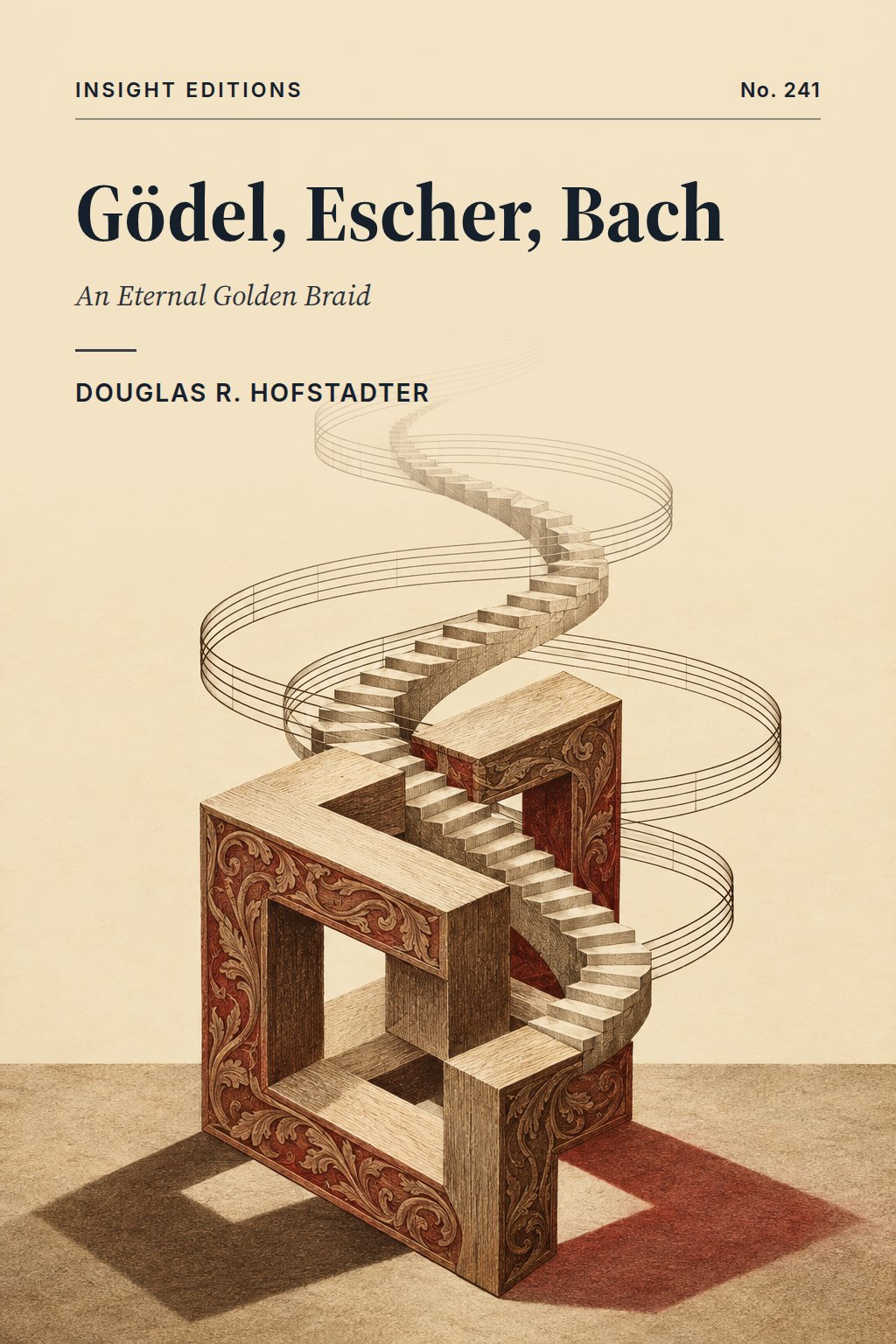
Meaning and minds arise from meaningless parts when a system becomes rich enough to represent itself: Gödel's self-referring formula is the model for how a brain makes an "I".
Formal systems, number theory, Gödel's incompleteness, recursion, computation, DNA, brains, AI, Zen, Escher's art and Bach's counterpoint. 42 sections: 20 chapters, 21 dialogues, introduction.
Gödel, Escher, J. S. Bach, Russell, Whitehead, Hilbert, Turing, Church, Tarski, Cantor, Zeno, Lewis Carroll, Crick, Winograd; and Achilles and the Tortoise.
Anyone who wants the logic of self-reference made intuitive, and anyone thinking about AI, LLMs, meaning and consciousness from first principles.
Douglas Hofstadter's Gödel, Escher, Bach: An Eternal Golden Braid (1979, Pulitzer Prize 1980) asks how animate beings can come out of inanimate matter. Its answer is that a self is a "Strange Loop": a pattern that, by climbing through levels of a hierarchy, unexpectedly finds itself back where it started, as in Bach's endlessly rising canon, Escher's Drawing Hands and Gödel's formula that says "I am not provable". The book alternates twenty chapters with twenty-one dialogues between Achilles and the Tortoise, each dialogue built on a musical form and each previewing the next chapter's idea.
- Formal systems and theorems. The MIU-system, the pq-system and the tq-system show what an axiom, a rule of inference, a theorem and a decision procedure are, and that working inside a system differs from reasoning about it (the I-mode versus the M-mode).
- Meaning is isomorphism. Symbols mean something when their behaviour is isomorphic to part of reality: "--p---q-----" means 2 + 3 = 5 only because pq-theorems line up with true additions. Meaning can be active (in the rules) or passive (in an interpretation), and one system can carry two meanings at once.
- Figure and ground, recursion and levels. Sets can be recursively enumerable without being recursive (their complement is not a figure). Recursion (push, pop, stacks, RTNs, Fibonacci, Q-sequences, Gplot) builds infinite structure from finite rules, and chunking lets us describe one system at many levels.
- TNT and Gödel. Typographical Number Theory captures arithmetic in symbols. Gödel numbering turns statements about strings into statements about numbers, so TNT can talk about itself and produce G: "G is not a theorem of TNT". If TNT is consistent, G is true but unprovable; adding G as an axiom produces a new G′. TNT is essentially incomplete, and BlooP, FlooP and Turing's halting problem show the same limit for computation.
- Self-reference and self-replication. Quines, Typogenetics and the genetic code show that self-reference and self-reproduction use one trick: a description used twice, once as instruction and once as data, through a code that the system itself contains.
- Brains, minds and symbols. Thoughts are carried by active symbols, high-level patterns in a neural substrate, as Aunt Hillary, a conscious ant colony, carries thoughts in patterns of ant teams. Meaning lives at the level of symbols, not neurons; minds can be compared through partial isomorphisms at that level.
- AI. From Turing's test, SHRDLU and the Bongard problems to "Ten Questions and Speculations", Hofstadter argues that intelligence needs slippable concepts, analogy, frames and "subjunctive" thinking, and that a thinking program would not be any better at arithmetic than we are.
- Strange Loops and Tangled Hierarchies. A self is a Tangled Hierarchy of symbols resting on an inviolate level of physics. Free will, consciousness and "I" are what such a loop feels like from inside; the book ends by looping back to its own opening.
Section map
| # | Section | One-line payload |
|---|---|---|
| In | A Musico-Logical Offering | Bach's canons, Escher's loops and Gödel's formula share one essence: the Strange Loop |
| D | Three-Part Invention | Achilles and the Tortoise meet their inventor, Zeno |
| I | The MU-puzzle | A toy formal system teaches axiom, rule, theorem, decision procedure |
| D | Two-Part Invention | Carroll's Tortoise: inference rules cannot be replaced by more premises |
| II | Meaning and Form in Mathematics | The pq-system: isomorphism creates meaning |
| D | Sonata for Unaccompanied Achilles | One side of a phone call; figure implies ground |
| III | Figure and Ground | Recursively enumerable is not recursive; primes as figure |
| D | Contracrostipunctus | Record players broken by records: Gödel as parable |
| IV | Consistency, Completeness, and Geometry | Consistency depends on interpretation; non-Euclidean lessons |
| D | Little Harmonic Labyrinth | Stories nested like a push-down stack |
| V | Recursive Structures and Processes | Stacks, RTNs, recursive sequences, Gplot, recursion in physics |
| D | Canon by Intervallic Augmentation | Which holds the information: record or player? |
| VI | The Location of Meaning | Frame, outer and inner messages; intrinsic meaning |
| D | Chromatic Fantasy, And Feud | The Tortoise refuses "and": contradictions and logic |
| VII | The Propositional Calculus | Fantasy rule, rules of inference, consistency of logic |
| D | Crab Canon | A palindromic dialogue; DNA hairpins |
| VIII | Typographical Number Theory | TNT: numerals, quantifiers, axioms, induction, ω-incompleteness |
| D | A Mu Offering | Koans, Zen strings and the genetic code |
| IX | Mumon and Gödel | Zen meets Gödel numbering; MU is not a theorem; G introduced |
| D | Prelude . . . | Bach's recorded WTC; how to hear a fugue |
| X | Levels of Description, and Computer Systems | Chunking, compilers, epiphenomena, levels |
| D | . . . Ant Fugue | Aunt Hillary: a mind made of ants; holism vs reductionism |
| XI | Brains and Thoughts | Neurons, symbols, grandmother cells, Sphex |
| D | English French German Suite | Translating "Jabberwocky": meaning without dictionaries |
| XII | Minds and Thoughts | Partial isomorphisms between minds; the self-symbol |
| D | Aria with Diverse Variations | Goldbach, wondrous numbers: bounded and unbounded searches |
| XIII | BlooP and FlooP and GlooP | Primitive recursion, general recursion, diagonal proofs |
| D | Air on G's String | Quine's sentence: the verbal G |
| XIV | On Formally Undecidable Propositions | The full construction of G; supernatural numbers |
| D | Birthday Cantatatata . . . | ω-incompleteness acted out |
| XV | Jumping out of the System | No patch fixes incompleteness; Lucas answered |
| D | Edifying Thoughts of a Tobacco Smoker | Self-assembling record players and their Achilles heel |
| XVI | Self-Ref and Self-Rep | Quines, Typogenetics, the genetic code, Central Dogma |
| D | The Magnificrab, Indeed | A Crab who hears truth: Tarski in music |
| XVII | Church, Turing, Tarski, and Others | Church–Turing thesis versions; Tarski's undefinability |
| D | SHRDLU, Toy of Man's Designing | Winograd's blocks-world program in conversation |
| XVIII | Artificial Intelligence: Retrospects | Turing test, chess, theorem provers, knowledge representation |
| D | Contrafactus | Subjunc-TV: counterfactual replays |
| XIX | Artificial Intelligence: Prospects | Frames, slippage, Bongard problems, Ten Questions |
| D | Sloth Canon | A canon by inversion and augmentation in words |
| XX | Strange Loops, Or Tangled Hierarchies | Inviolate levels, free will, the self as a strange loop |
| D | Six-Part Ricercar | The story returns to its beginning |
Three strands, one braid. A king's chromatic theme, a Dutch printmaker's impossible staircases and a logician's self-referring formula are, for Hofstadter, "shadows cast in different directions by some central solid essence". The Introduction tells the story of Bach's visit to Frederick the Great in 1747, defines the book's master idea, the Strange Loop (climbing through the levels of a hierarchy and arriving back where you started), and sketches how Gödel's 1931 Incompleteness Theorem smuggled the liar paradox into the fortress of Principia Mathematica. It closes on the question the whole book chases: how can rule-bound machinery give rise to flexible, intelligent, self-aware minds?
Frederick the Great and the Potsdam court
Frederick the Great, King of Prussia, came to power in 1740. History remembers his generalship, but his court at Potsdam was one of eighteenth-century Europe's great intellectual centres: the mathematician Leonhard Euler spent twenty-five years in his service, and philosophers including Voltaire and Julien Offroy de La Mettrie wrote influential works there.
Music was Frederick's real love. He was an avid flautist and composer, and an early champion of the new "piano-forte" ("soft-loud"). The harpsichord could only play at uniform loudness; the piano, first built in Italy by Bartolommeo Cristofori, let a player strike one note louder than its neighbours. Gottfried Silbermann, Germany's foremost organ builder, was trying to perfect it, and Frederick reputedly owned fifteen Silbermann pianos.
"Old Bach is come": the visit of May 1747
Frederick also admired Johann Sebastian Bach, whose compositions some found "turgid and confused" and others incomparable. Nobody disputed his powers of improvisation, then a core part of an organist's job. Bach's son Carl Philipp Emanuel was the King's Capellmeister, and for years Frederick had hinted that he would love a visit from the elder Bach, especially so that he could try the new pianos, which Frederick correctly foresaw as "the great new wave in music".
The evening concert interrupted (Forkel's account). One May evening in 1747, with the King's flute in hand and his musicians assembled, an officer handed him the list of newly arrived strangers. Frederick turned to the players in agitation: "Gentlemen, old Bach is come." The concert was cancelled; Bach, still in travelling clothes, was summoned at once and led from room to room to try the Silbermann pianos, improvising on each. He asked the King for a fugue subject and developed it on the spot. Frederick then asked for a fugue in six obbligato parts; since not every theme suits so full a texture, Bach chose a subject of his own and improvised one. The next day he toured Potsdam's organs. Back in Leipzig he worked the Royal Theme into pieces in three and six parts, added canons, and had it engraved as the Musikalisches Opfer (Musical Offering), dedicated to the King. The source is Johann Nikolaus Forkel, one of Bach's earliest biographers, who heard it from Wilhelm Friedemann Bach, the son who travelled with his father.
A painting by Adolph von Menzel (1800s) shows one of these flute evenings: C. P. E. Bach at the cembalo, and on the far right Joachim Quantz, the King's flute master and the only person allowed to criticise the King's playing. Bach's dedicatory letter of 7 July 1747 ("MOST GRACIOUS KING! In deepest humility...") strikes modern readers as comically submissive and flattering, and probably echoes his apologies for turning up in travelling dress.
The legend grows
About twenty-seven years later (Bach having been dead for twenty-four), Baron Gottfried van Swieten, to whom Forkel dedicated his biography and Beethoven his First Symphony, recorded Frederick singing the "chromatic fugue subject" he had given "old Bach", who had supposedly made of it a fugue in four parts, then five, then eight. Whether the King or the Baron inflated the story, it shows how large Bach's legend had grown.
48 preludes and fugues in Bach's Well-Tempered Clavier.
2 of them have five voices; none has six.
Improvising a six-part fugue ≈ playing 60 simultaneous blindfold chess games and winning them all.
An eight-part improvised fugue: "really beyond human capability".
What is in the Musical Offering
The copy sent to the King carried an acrostic inscription: Regis Iussu Cantio Et Reliqua Canonica Arte Resoluta ("At the King's command, the song and the remainder resolved with canonic art"). "Canonic" puns on "with canons" and "in the best possible way", and the initials spell R I C E R C A R, Italian for "to seek".
Contents of the Musical Offering
- A three-part fugue (Ricercar a 3): scholars believe it is essentially the fugue Bach improvised for Frederick.
- A six-part fugue (Ricercar a 6): one of Bach's most complex creations, built on the Royal Theme.
- Ten canons: each on a different variant of the King's Theme, posed as puzzles rather than written out.
- A trio sonata: melodious, almost danceable, yet still largely built on the austere chromatic theme.
Both fugues are headed "Ricercar" rather than "Fuga". "Ricercar" was the original name of the fugue form; by Bach's day it meant an erudite, austerely intellectual fugue, much as English "recherché" ("sought out") implies esoteric cleverness. The Royal Theme itself is rhythmically irregular and highly chromatic (full of notes outside its key): even a decent two-voice fugue on it would tax an average musician.
Bach never wrote out the ten canons in full. In a familiar musical game of the day, he gave a theme plus cryptic hints and let the King "discover" the canon. One canon is labelled "Quaerendo invenietis" ("By seeking, you will discover"). All the puzzles have been solved, with canonical solutions supplied by Bach's pupil Johann Philipp Kirnberger, though one may still wonder whether more solutions remain to be sought.
Canons: one theme played against itself
A canon sets copies of a single theme against each other in different voices. For it to work, every note must play two or more roles at once: part of a melody, and part of the harmonisation of that same melody. With three voices, each note must function in two distinct harmonic ways as well as melodically. Each note in a canon has more than one musical meaning, and the listener's ear and brain work out the right one from context. This is the book's first glimpse of a theme it will return to constantly: meaning depends on context, and one symbol can carry several meanings at once.
| Canon type | What the "copy" does | Example or note |
|---|---|---|
| Round | same pitch, fixed time delay | "Three Blind Mice", "Row, Row, Row Your Boat", "Frère Jacques" |
| Transposed | staggered in pitch too (e.g. C, then G a fifth up, then D) | first escalation |
| Diminution / augmentation | voices at different speeds (twice as fast / twice as slow) | theme shrinks or expands |
| Inversion | jumps down wherever the original jumps up, by the same number of semitones | "Good King Wenceslas" against its inversion, an octave apart, two beats late |
| Retrograde (crab canon) | theme played backwards in time | named for crab locomotion; one is in the Offering |
| Free voices | voices that ignore the theme and simply harmonise | relaxes the form |
Every one of these copies preserves all the information in the original: the theme can be fully recovered from any of them. An information-preserving transformation is called an isomorphism, and isomorphisms will be the book's central currency. The Offering exploits every device, sometimes in combination: the "Canon per Augmentationem, contrario Motu" has a free middle voice singing the Royal Theme, while the outer two voices dance canonically above and below it using augmentation and inversion.
A fugue is looser. It also develops one theme in different voices and keys (sometimes faster, inverted or backwards), but allows far more expression. Its telltale opening: a single voice states the subject; a second voice answers five scale-notes up or four down, while the first continues with a countersubject chosen for rhythmic, harmonic and melodic contrast; each voice enters in turn. Once all voices have arrived, "there are no rules": there are standard moves, but no formula. The Offering's two fugues could never have been composed by formula, and the whole work is "one large intellectual fugue" of interwoven ideas, double meanings and allusions (the classic account is H. T. David's J. S. Bach's Musical Offering).
The Endlessly Rising Canon: the first Strange Loop
The "Canon per Tonos" has three voices: the top one sings a variant of the Royal Theme, while beneath it two voices harmonise canonically on a second theme, the lower in C minor and the upper a fifth higher. When it seems to end, it has modulated to D minor "right under the listener's nose", and the ending dovetails into the beginning. Repeat it and you arrive in E, and so on; the ear expects to be hopelessly far from home, yet after exactly six modulations, C minor returns, every voice exactly one octave higher. Bach wrote in the margin: "As the modulation rises, so may the King's Glory." Hofstadter dubs it the Endlessly Rising Canon.
Strange Loop (definition). A Strange Loop occurs whenever, by moving upwards (or downwards) through the levels of some hierarchical system, we unexpectedly find ourselves right back where we started. A system containing one is a Tangled Hierarchy. The theme will recur throughout the book, sometimes hidden, sometimes open, sometimes upside down or backwards: "Quaerendo invenietis", Hofstadter advises.
Escher: Strange Loops on paper
Maurits Cornelis Escher (1902–1972), the Dutch graphic artist, made "some of the most intellectually stimulating drawings of all time", rooted in paradox, illusion and double meaning. Mathematicians admired him early for his use of symmetry and pattern, but a typical Escher print also carries an underlying idea in artistic form, and the Strange Loop is among his most frequent. His lithograph Waterfall (1961) has a six-step endlessly falling loop, matching the six-step endlessly rising Canon per Tonos: "Bach and Escher are playing one single theme in two different 'keys': music and art."

Escher's loops can be ranked by tightness, the number of steps before the start is regained:
| Work (year) | Loop | Steps |
|---|---|---|
| Ascending and Descending (1960) | monks trudge an endless staircase | loosest: 4 staircases or 45 stairs |
| Waterfall (1961) | water falls forever | 6 |
| Drawing Hands (1948) | each hand draws the other | 2 |
| Print Gallery (1956) | a picture that contains itself | 1, the tightest |
The four-or-forty-five ambiguity reveals an inherent haziness in level-counting in any many-level system, a point the book sharpens later. In Print Gallery the self-containing thing could be the picture, the gallery, the town, or the young man who contains himself.

Loops imply infinity: "what else is a loop but a way of representing an endless process in a finite way?" Escher's tilings fit copies of one theme into each other, visual canons; Metamorphosis wanders far from its start and is suddenly back, like the rising canon. Wilder still are prints showing several levels of reality at once (one clearly fantasy, one "real"). Two portrayed levels invite viewers to see themselves on a third, and so to imagine an endless chain of more-real and more-imaginary levels. The vertigo comes when the chain of levels is not linear but closes into a loop: then what is real, and what is fantasy?
Gödel: the loop inside mathematics
Bach's and Escher's loops pit the finite against the infinite, and intuition senses mathematics nearby. In our century, Kurt Gödel found the mathematical counterpart, rooted in the ancient Epimenides (liar) paradox. Epimenides the Cretan said "All Cretans are liars"; sharper versions are "I am lying" and "This statement is false", the last being what Hofstadter means by the Epimenides paradox. Suppose it true and it backfires into falsity; suppose it false and it backfires into truth. It is a one-step Strange Loop, like Print Gallery.
Gödel's idea was to use mathematical reasoning to explore mathematical reasoning itself, making mathematics "introspective". Its richest consequence was the Incompleteness Theorem. Hofstadter separates the result from its proof: the theorem is a pearl, prized for luster and simplicity; the proof is an oyster, a complex living beast whose innards produce the gem.
The pearl, Gödel's words (Proposition VI, 1931): "To every ω-consistent recursive class κ of formulae there correspond recursive class-signs r, such that neither v Gen r nor Neg (v Gen r) belongs to Flg (κ) (where v is the free variable of r)."
The pearl, plain English: All consistent axiomatic formulations of number theory include undecidable propositions.
The Strange Loop is buried in the oyster. Talking about language in language is easy; but statements of number theory are about numbers, and numbers are neither statements nor properties of statements. It took genius merely to connect self-reference with number theory. Gödel's key was a code: in Gödel numbering, numbers stand for symbols and for sequences of symbols, so every statement acquires a number, "something like a telephone number or a license plate", by which it can be referred to. Each statement can then be read on two levels: as a statement of number theory, and as a statement about statements of number theory.
Gödel's transplanted Epimenides does not say "this statement is false" but "This statement of number theory does not have any proof in the system of Principia Mathematica." "Proof" here must be taken strictly: a demonstration within a fixed system of propositions*, in this case Principia Mathematica (*P.M.), the giant opus of Bertrand Russell and Alfred North Whitehead, published 1910–1913. Call this sentence G. G is not Gödel's Theorem, any more than the liar sentence is the observation that it is paradoxical.
Epimenides vs Gödel. The liar sentence is neither true nor false. Gödel's G is unprovable (inside P.M.) but true. Conclusion: P.M. Is incomplete, too weak to demonstrate some true statements of number theory. And since the proof works on "Related Systems" (any axiomatic system with P.M.'s aims), provability is a weaker notion than truth, no matter what axiomatic system is involved.
No fixed system, however complicated, can represent the complexity of 0, 1, 2, 3, ... Today's readers, cushioned by decades of popularised relativity and quantum mechanics, expect "limitative" results; in 1931 it was "a bolt from the blue".

Mathematical logic: a synopsis
Hofstadter attempts "an impossible task": the history of mathematical logic before 1931 in a few pages. It began with attempts to mechanise reasoning, which seems paradoxical, since reasoning is supposedly what makes us human; yet the Greeks already knew that reasoning is patterned and partly governed by statable laws.
c. 350 BC Aristotle codifies the syllogism; Euclid codifies geometry.
1800s Non-Euclidean geometry discovered nearly simultaneously by several people, shaking the belief that mathematics studies the real world.
Later 1800s George Boole and Augustus De Morgan codify deduction far beyond Aristotle; Boole titles his book The Laws of Thought.
Later 1800s Lewis Carroll invents puzzles solvable by the new mechanised logic.
1880s Georg Cantor builds set theory, a theory of different sizes of infinity: powerful, beautiful, intuition-defying.
c. 1880s–1900 Gottlob Frege (Jena) and Giuseppe Peano (Turin) combine formal reasoning with sets and numbers; David Hilbert (Göttingen) formalises geometry more strictly than Euclid.
1901–1902 Russell's paradox (and soon Grelling's) exposes contradictions in naive set theory.
1910–1913 Russell and Whitehead publish Principia Mathematica.
1920s Hilbert's program seeks finitistic proofs of consistency and completeness.
1931 Gödel's paper demolishes the program.
The non-Euclidean shock asked how there could be many kinds of "points" and "lines" in one reality. Then set theory produced paradoxes just as mathematics was recovering from those of limits in the calculus, and the new ones looked worse.
Russell's paradox and Grelling's paradox
Most sets are "run-of-the-mill": the set of walruses is not a walrus; the set containing only Joan of Arc is not Joan of Arc. Some are "self-swallowing": the set of all sets, or the set of all things except Joan of Arc. Every set is one or the other, never both. Now form R, the set of all run-of-the-mill sets, and ask which kind R is. Either answer leads to contradiction: if R is run-of-the-mill it belongs to itself, so it is self-swallowing; if self-swallowing, it belongs to R, so it is run-of-the-mill. The urgent questions became: what is wrong with our intuitive concept of "set", and can a rigorous set theory match intuition yet skirt the paradoxes?
Grelling's paradox does the same with adjectives. Some describe themselves ("pentasyllabic", "awkwardnessful", "recherché"); others do not ("edible", "incomplete", "bisyllabic"). Call the first kind autological and the second heterological. Then ask: is "heterological" heterological? Yes implies no, and no implies yes.
The common culprit and its disguises
- Direct self-reference: "This statement is false."
- Self-membership: R, the set of all sets that do not contain themselves.
- Self-description: "heterological".
- Indirect, spread-out loops: "The following sentence is false. / The preceding sentence is true." Each sentence alone is harmless, even useful; the paradox lives only in the way they point at each other, just as every local region of Ascending and Descending is legitimate and only the global assembly is impossible. This version recalls Drawing Hands.
Because self-reference can be direct or indirect, anyone who sees it as "the root of all evil" must ban both kinds at once, and spotting the indirect kind is hard.
Banishing Strange Loops: the theory of types
Russell and Whitehead took exactly that view: Principia Mathematica was "a mammoth exercise in exorcising Strange Loops" from logic, set theory and number theory. In their theory of types, the lowest type of set contains only objects; the next type up contains objects or lowest-type sets; in general a set contains only objects or sets of lower type. No set can contain itself, only run-of-the-mill sets exist, and R is not a set at all, belonging to no finite type. The paradox vanishes, at the price of an artificial hierarchy and the loss of sets we naturally imagine.
Types did nothing about Epimenides or Grelling, so a parallel hierarchy of languages was proposed: an object language that can refer only to its domain, a metalanguage to discuss the object language (familiar to anyone learning a foreign language), a metametalanguage, and so on. Any utterance that fits no level is declared meaningless. In the two-sentence liar loop, each sentence must sit above the other, which is impossible, so neither can even be formulated.
Critical lens: Hofstadter's verdict on stratification. Acceptable in set theory, the language hierarchy is absurd for ordinary speech. "In this book, I criticize the theory of types" would be doubly banned: "this book" is mentionable only in a "metabook", and the author may not mention himself. Worse, every discussion of the theory itself fits no level, so discussing the theory violates it. Defenders say it targets only formal languages; then it says little about paradox outside tailor-made systems. Hofstadter's broader charge: chasing consistency at any cost yields "a stupendously ugly theory" and stresses "bland consistency" over the quirky and bizarre that make life and mathematics interesting. (Modern logic largely agrees in practice: Zermelo–Fraenkel set theory avoids Russell's paradox by restricting set formation rather than by type levels, and Tarski's object/metalanguage distinction survives as a technical tool, not a ban on everyday self-reference.)
Metamathematics, consistency, completeness and Hilbert's program
The paradoxes raised a deeper fear: if contradictions sprang so easily from the intuitive notion of "set", might they lurk in number theory itself, the most concrete of theories? Worse, might the paradoxes of logic prove internal to mathematics, especially for those who held that mathematics is a branch of logic (or the reverse)? The study of mathematics itself became metamathematics (or metalogic). Its first priority was to pin down which modes of reasoning are legal. Since mathematics had always been done in natural language, with all its ambiguity, the goal became a single uniform notation in which any two mathematicians could settle whether a proof was valid: a complete codification of acceptable reasoning.
Principia Mathematica aimed to derive all of mathematics from logic without contradiction, but nobody knew whether (1) all of mathematics lay within its methods, or (2) its methods were even self-consistent.
Hilbert's challenge to the mathematical world
- Consistency: prove rigorously that P.M. Can never derive a contradiction.
- Completeness: prove that every true statement of number theory can be derived within P.M.
- The bootstrap problem: justifying reasoning by the same reasoning is circular, "like lifting yourself up by your own bootstraps", another Strange Loop.
- Hilbert's remedy: use only "finitistic" methods, a small set of universally accepted reasoning steps, to certify the whole of mathematics, a partial bootstrap.
The program occupied many of the world's greatest mathematicians for the first thirty years of the century. Then, "in the thirty-first year", Gödel showed that P.M. Had irreparable holes; that no axiomatic system whatsoever could produce all number-theoretical truths unless it were inconsistent; and that if P.M.'s consistency could be proved using only P.M.'s methods, P.M. Would itself be inconsistent, "one of the most mystifying consequences of Gödel's work". The final irony: the proof imported the Epimenides paradox into the heart of Principia, the bastion built to keep Strange Loops out. It did not destroy P.M., but it made the original aims illusory.
Critical lens: the pearl is slightly polished. Gödel's Proposition VI assumes ω-consistency, a stronger condition than consistency; the plain-consistency version ("all consistent axiomatic formulations...") is due to J. Barkley Rosser (1936). The systems must also have effectively listable axioms and be strong enough to express basic arithmetic. The "Epimenides" Hofstadter quotes, "All Cretans are liars", is not strictly paradoxical (it is simply false if some Cretan ever tells the truth), which is why he switches to "This statement is false". And the second result ("consistency unprovable from within") left room for consistency proofs from outside: Gerhard Gentzen (1936) proved arithmetic consistent using transfinite induction up to the ordinal ε₀, a method stronger than Hilbert's finitism.
Babbage, Lovelace, and the dream of mechanised intelligence
When Gödel's paper appeared, the world was on the brink of the electronic digital computer. In the seventeenth century, Pascal and Leibniz designed machines for fixed operations (addition and multiplication), with no memory and no programmability.
Charles Babbage (1792–1871) of London was the first to grasp machinery's immense computing potential. A man who "could almost have stepped out of Pickwick Papers", he was best known in life for his campaign against street organ grinders, who serenaded him day and night to annoy him: a pioneer of computing and of the fight against noise pollution. His Difference Engine was to generate tables by the method of differences; before it was built he became obsessed with the Analytical Engine ("the most entangled and perplexed [course] which probably ever occupied the human mind").
The Analytical Engine's architecture
- Store: memory.
- Mill: calculating and decision-making unit.
- Program: punched cards, inspired by the Jacquard loom.
- Hardware: thousands of interlocked geared cylinders.
- Self-modification: a machine "eating its own tail", Babbage's phrase for a machine that reaches in and alters its own stored program, a Strange Loop.
Lady Ada Lovelace, Lord Byron's daughter, wrote that "the Analytical Engine weaves algebraic patterns just as the Jacquard-loom weaves flowers and leaves." Her present tense misleads: no Analytical Engine was ever built, and Babbage died bitterly disappointed. In her 1842 memoir she saw that it "might act upon other things besides number" and, with pitches and harmonies coded into its cylinders, "might compose elaborate and scientific pieces of music", while Babbage dreamed of chess and tic-tac-toe automata. Yet she also cautioned:
The Analytical Engine has no pretensions whatever to originate anything.
In the 1930s and 1940s the first "giant electronic brains" were built, fusing three previously separate fields: axiomatic reasoning, mechanical computation and the psychology of intelligence. Computation theory grew in step with metamathematics; Alan Turing found Gödel's counterpart for machines, revealing ineluctable "holes" in even the most powerful computer imaginable. Ironically, real computers meanwhile grew beyond their makers' powers of prophecy. Babbage once said he would give up the rest of his life for a three-day guided tour of the world five hundred years on; a mere century after his death he would have been thrilled speechless by both the machines and their unexpected limitations. By the early 1950s, thinking machines seemed "a mere stone's throw away"; yet every barrier crossed revealed a new one. Why did the goal keep receding?
What intelligence requires
No sharp line divides intelligent from non-intelligent behaviour (suggesting one "is probably silly"), but certain abilities are essential.
Hofstadter's essential abilities for intelligence
- To respond to situations very flexibly.
- To take advantage of fortuitous circumstances.
- To make sense out of ambiguous or contradictory messages.
- To recognize the relative importance of different elements of a situation.
- To find similarities between situations despite differences which may separate them.
- To draw distinctions between situations despite similarities which may link them.
- To synthesize new concepts by taking old concepts and putting them together in new ways.
- To come up with ideas which are novel.
Here lies a seeming paradox: computers are "the most inflexible, desireless, rule-following of beasts", the epitome of unconsciousness. How can such a thing be programmed to be intelligent? A major thesis of the book is that "rule-following machines that behave flexibly" is not a contradiction at all, and its purpose is to make the reader confront the apparent gulf between the formal and the informal, the animate and the inanimate, until new insight emerges. The strange flavour of AI, as Hofstadter frames it, is writing long sets of rules in strict formalisms that tell inflexible machines how to be flexible.
Those rules must live on many levels: "just plain" rules for stereotyped situations; metarules for deciding which plain rules apply in mixed situations; metametarules, and rules for inventing new rules when a situation fits no category. "Without doubt, Strange Loops involving rules that change themselves, directly or indirectly, are at the core of intelligence." Sometimes the mind seems so complex that no rules of any kind, however many levels deep, could govern it; the book takes that worry seriously.
Practitioner angle (2025–26). Hofstadter's eight abilities read today as an evaluation rubric for AI. Large language models (GPT-3 in 2020, GPT-4 in 2023, Claude and their successors) handle ambiguity, analogy and context-dependent meaning far better than the rule-based systems of 1979, yet they arrived by statistical learning over vast text, not by the hand-written rule hierarchies the Introduction imagines; the "metarules" live implicitly in billions of learned weights. Hofstadter himself said in 2023 that the speed of LLM progress frightened him and shook views he had held for decades. Lovelace's objection (machines can only do what we order) was named and rebutted by Turing in 1950; generative models have made it a live operational question in banks and regulators: when a model's output is not something anyone "ordered", who owns the decision? And a footnote on Babbage: London's Science Museum completed a working Difference Engine No. 2 in 1991 from his drawings; the Analytical Engine remains unbuilt.
...and Bach: Schmidt against La Mettrie
In 1754, four years after Bach's death, the Leipzig theologian Johann Michael Schmidt wrote, in a treatise on music and the soul, of a French automaton that played the transverse flute, moved it to its lips and rolled its eyes, but noted that nobody had built an image that "thinks, or wills, or composes". He invited sceptics to study Bach's last fugal work (left unfinished by his blindness) and the chorale he dictated blind, Wenn wir in höchsten Nöthen sein: "Everything that the champions of Materialism put forward must fall to the ground in view of this single example."
Johann Michael Schmidt (1754): Bach's art proves a soul; no machine could think, will or compose.
Julien Offroy de La Mettrie: philosopher at Frederick's court, author of L'homme machine ("Man, the Machine"), "Materialist Par Excellence".
More than 200 years later the battle still rages, and Hofstadter hopes to "give some perspective" on it. The opening scene and the closing question are thus the same court, the same king and the same flute.
How the book is built: an Eternal Golden Braid
GEB is a counterpoint of Dialogues and Chapters. Almost every new concept appears twice: first metaphorically in a Dialogue, yielding concrete visual images; then abstractly in the following Chapter, which those images support. Many Dialogues seem to be about one idea while really, in thin disguise, being about another.
Achilles and the Tortoise: the original pair, invented by Zeno of Elea (fifth century BC) for a paradox of motion; their origin is told in Three-Part Invention.
Lewis Carroll: revived the pair in 1895 for his own paradox of infinity, "What the Tortoise Said to Achilles", reprinted as Two-Part Invention.
Bach's dictum: the voices of a composition should behave like "persons who conversed together as if in a select company", which Hofstadter takes "perhaps rather more literally than Bach intended".
H. T. David and A. Mendel: editors of The Bach Reader, whose description of Bach's form (relations from exact identity to mere allusion, mazes of threads, yet always a graspable unity) is Hofstadter's model.
Hofstadter does not remember when he first wrote "Fugue" above an early Dialogue, but from then on he patterned each Dialogue on a different piece by Bach. He began intending a pamphlet built around Gödel's Theorem; the ideas "expanded like a sphere" and touched Bach and Escher. Finally he realised that Gödel, Escher and Bach were only shadows cast in different directions by some central solid essence, and the book is his attempt to reconstruct the central object.
Reading strategy. Treat each Dialogue as a specification by example and the following Chapter as its formal definition: the same pattern good architects use when they pair a concrete user story with an abstract model. Keep a running list of isomorphisms (theme ↔ inversion, formula ↔ number, symbol ↔ meaning); most of the book's arguments are built from them.
The book's first Dialogue is an origin story: Achilles and the Tortoise learn that they are characters invented by Zeno of Elea, and Zeno arrives to tell them the very story they are standing in. Three voices (Achilles, the Tortoise, Zeno) interweave like a Bach three-part invention, around an impossible red flag, a garbled Zen koan, and Zeno's proof that "Motion Unexists". The race starts just as the Dialogue ends, so the infinite regress of catching up is left, deliberately, unresolved.
Achilles: Greek warrior, "the fleetest of foot of all mortals"; enthusiastic, easily confused, sure an argument is wrong before he can say why.
The Tortoise (Mr. T): "the ploddingest of the plodders"; sly, pedantic and always a step ahead in argument.
Zeno of Elea: Greek philosopher (fifth century BC), inventor of the paradoxes of motion, who enters as the third voice.
The musical form
Bach's Three-Part Inventions (also called Sinfonias) are keyboard pieces in three independent voices that state and imitate a short motif. Hofstadter's version enters two voices first (Achilles and the Tortoise on a dusty runway) and brings in the third voice, Zeno, halfway through, after which all three interlock. The Dialogue also performs the job the Introduction promised: it tells how Zeno invented "the happy pair".
The impossible flag
Far down the runway hangs a solid red flag with a thin ring cut out of it, through which the sky shows. Achilles says it recalls the holes in the Möbius strip Escher drew. The Tortoise explains that the ring is shaped like the numeral for zero, Zeno's favourite number. Achilles objects that the zero numeral has not been invented yet (a Hindu mathematician will invent it "some millennia hence"), so the flag is impossible. The Tortoise agrees, adding that it is beautiful anyway, and wonders whether its beauty is related to its impossibility; he never has time for "Capitalized Essences" like Beauty, or the Purpose of Life. Why are they here? Because they are inventions of Zeno, here to run a footrace.

The koan that went wrong
Achilles "remembers" a Zen koan about "Zen Master Zeno": two monks argue whether the flag is moving or the wind is moving; the sixth patriarch passes by and says, "Not the wind, not the flag; mind is moving." The Tortoise corrects him: Zeno is no Zen master but a philosopher from Elea, "which lies halfway between points A and B" (a joke on the dichotomy paradox). Achilles insists he used to chant "the sixth patriarch is Zeno".
Then life imitates the koan. A breeze rises; Achilles: "The flag is moving." Tortoise: "The wind is moving" (the flag is impossible, so it cannot wave). Zeno happens by and resolves the dispute in his own way: "Not the wind, not the flag: neither one is moving, nor is anything moving at all." His great Theorem, "Motion Is Inherently Impossible", yields an even greater one, Zeno's Theorem: "Motion Unexists."
The koan's resolution: "Not the wind, not the flag; mind is moving." Motion is located in the observer.
Zeno's resolution: "Not the wind, not the flag; nothing is moving." Motion is denied altogether.
Zeno tells the story they are in
Zeno, oddly knowing Achilles' name, begs a few minutes of attention: he has walked to Elea "from point A" and everyone has been too hurried to listen. His Master, "the fifth patriarch", taught that reality is one, immutable and unchanging, and that plurality, change and motion are illusions of the senses. To defend this he will use "two characters of my own Invention": Achilles and a Tortoise, persuaded by a passerby to race down a runway toward a distant flag waving in the breeze, the Tortoise getting a ten-rod head start.
The Achilles paradox as told to Achilles. Achilles reaches the Tortoise's starting spot in a few bounds ("Hah!"); the Tortoise is now one rod ahead. Achilles covers that ("Ho ho!"), but the Tortoise has inched on. Achilles covers that too ("Hee hee hee!"). To catch up the game must be played an INFINITE number of times, so Achilles can NEVER catch the Tortoise ("Heh heh heh heh!" laughs the Tortoise). Achilles: "That argument sounds wrong to me. And yet, I can't quite make out what's wrong with it." The lengthening laughs mirror the shrinking intervals: a little canon by augmentation hidden in the stage directions.
The Tortoise pedantically points out that Zeno has told the wrong paradox: the Achilles paradox shows only that Achilles never catches the Tortoise; the proof that motion is impossible is the dichotomy paradox (to get from A to B you must first go halfway, and halfway of that, and so on). Zeno blushes: both "have the same flavour. Frankly, I've only had one Great Idea; I just exploit it in different ways." Then he proposes an empirical test of his "rigorously proven Theorem": a race to the impossible flag. The Tortoise suggests ten rods; Zeno agrees; "On your mark! Get set! Go!" and the Dialogue stops.
Hidden structure and jokes
- Fiction inside fiction. Zeno's tale (two invented characters persuaded by a passerby to race toward a flag) is an exact description of the scene in which he tells it; Zeno himself is the passerby. The characters hear the story of their own creation from their creator, a first Strange Loop between levels of a story.
- Zen / Zeno. The pun fuses Zen Buddhism and Zeno; the "fifth patriarch" who taught Zeno is really Parmenides, while the koan's "sixth patriarch" belongs to Zen (Huineng). Achilles' scrambled memory blends two traditions that both distrust the senses.
- Zero. The ring is the numeral 0, Zeno's favourite number: the limit his shrinking intervals approach, and a symbol whose "invention" Achilles treats as making the flag anachronistic, hence impossible. Reasoning from a symbol's history to an object's existence is the first of many level confusions between symbol and thing.
- "Motion Unexists." The negation of existence by a made-up verb anticipates the Zen word MU ("un-ask the question"), which arrives in the MU-puzzle and A Mu Offering.
- Elea, between A and B. Zeno's home is literally at the halfway point, the first step of the dichotomy regress.
The flag is "impossible" yet beautiful, the argument "rigorous" yet wrong, the race "infinite" yet about to start: the Dialogue trains the reader to hold formal proof and lived intuition side by side without letting either win too quickly.
Critical lens. Zeno's Achilles paradox is now resolved mathematically: an infinite series can have a finite sum (10 + 1 + 0.1 + ... = 11 1/9 rods, reached in finite time), made rigorous by the theory of limits in the nineteenth century (Cauchy, Weierstrass). Philosophers still debate whether limits answer Zeno's metaphysical worry about completing infinitely many acts (the "supertask" literature), so Achilles' sense that something is wrong without knowing what is not naive. The historical zero: a dot for zero appears in the Bakhshali manuscript and Brahmagupta (628 AD) set out rules for computing with zero, so "a Hindu mathematician" is right in spirit, though zero as a placeholder had earlier Babylonian and Mayan forms.
What it prefigures
The Dialogue sets up four of the book's long threads: infinite processes packed into finite form (recursion, Chapter V), stories that contain their own tellers (Little Harmonic Labyrinth), Zen koans and the word MU (Chapter IX), and figures who discover they are formal creations of a higher level (the author himself appears in later Dialogues). It also introduces the Tortoise's signature move, winning an argument by turning its own rules against it, which Lewis Carroll's Two-Part Invention will make devastating.
Practitioner angle. Zeno's race is the shape of every retry loop and convergence argument in engineering: an iterative solver, a gradient-descent training run or an exponential back-off makes infinitely many ever-smaller corrections in principle, and terminates in practice only because someone proved the series converges and set a tolerance. When reviewing an AI or risk model that "refines until stable", ask for the convergence argument as well as the loop.
Chapter I hands the reader a toy formal system, the MIU-system, and a single challenge: starting from MI and using four rules, can you produce MU? The puzzle is bait. Its real payload is a vocabulary (string, axiom, rule of inference, theorem, derivation, decision procedure) and a distinction that runs through the whole book: working inside a system (mechanically shunting symbols) versus thinking about the system from outside, which is where intelligence, and eventually Gödel, enter.
Formal systems and the Requirement of Formality
A formal system of the kind used here was invented by the American logician Emil Post in the 1920s and is called a "Post production system". You are given a starting string of letters and rules for turning strings into new strings. When several rules apply, nothing dictates which to use: choosing is where playing a formal system becomes an art. One thing is absolute: you must never do anything outside the rules. Hofstadter calls this the Requirement of Formality and predicts that in later Chapters readers new to formal systems will violate it "over and over again", because meaning will tempt them to take shortcuts the rules do not license.
The MIU-system uses only three letters, M, I, U. Strings such as MU, UIM, MUUMUU are legitimate strings, but they are not "in your possession"; at the start you own only MI. Order matters: MI and IM are different strings, since a string is not a "bag" of symbols.
The four rules
The MIU-system, complete
Alphabet: M, I, U. Axiom: MI.
- RULE I: If you possess a string whose last letter is I, you may add a U at the end. (xI → xIU)
- RULE II: Suppose you have Mx. Then you may add Mxx to your collection. (doubles everything after the M)
- RULE III: If III occurs in one of your strings, you may make a new string with U in place of III.
- RULE IV: If UU occurs inside one of your strings, you may drop it.
Rules are one-way. "From MU, make MIII" is wrong.
| Rule | Example uses | Note |
|---|---|---|
| I | MI → MIU | only when the string ends in I |
| II | MIU → MIUIU; MUM → MUMUM; MU → MUU | x is any string, fixed for that use; you must own MU before you can get MUU |
| III | UMIIIMU → UMUMU; MIIII → MIU or MUI; MIII → MU | the three I's must be consecutive: IIMII gives nothing |
| IV | UUU → U; MUUUIII → MUIII | removes exactly two adjacent U's |
The letter x is not part of the formal system: it is our symbolic shorthand for "any string". If you ever add a string containing an "x" to your collection, you have done something wrong. This is the first appearance of a metalanguage symbol standing outside the object system, the distinction the Introduction described.
Theorems, axioms, rules, derivations
Strings producible by the rules are theorems. To keep the technical sense apart from the ordinary one, Hofstadter adopts a convention used for the rest of the book:
Theorem (capital T): a statement in ordinary language that somebody proved true by logical argument, like Euclid's Theorem on the infinitude of primes or Zeno's Theorem that motion "unexists".
theorem (lower case): a string producible in some formal system. Not proven, merely produced, "as if by a machine", by typographical rules.
A theorem given "for free" is an axiom (MI here); a system may have zero, several or infinitely many axioms. Symbol-shunting rules are rules of production or rules of inference. A derivation is an explicit, line-by-line demonstration of how to produce a theorem: an "austere cousin of a proof". You would not say you had proven MUIIU, but you can say you have derived it.
The puzzle, restated: is MU a theorem of the MIU-system?
Inside and outside the system
Most people derive theorems at random and soon notice a pattern: every theorem begins with M. Then they can understand it from the rules: each rule makes a new theorem inherit its first letter from an earlier one, so every first letter traces back to the M of the axiom. That is a proof about the system, made outside it.
People versus (unobservant) machines. A computer programmed to generate MIU theorems and stop only upon producing U would never stop, and you now know why. A human friend given the same task would soon complain that the initial M can't be shed and call it a wild goose chase. It is possible for a machine to act unobservant; it is impossible for a human to act unobservant. Hofstadter is careful: he is not saying all machines are incapable of sophisticated observations, only that some machines are, and that most built so far are close to totally unobservant.
His examples: punch "1" into an adding machine and keep adding 1 for hours, and it will never anticipate you; a car, however much it is driven, never learns to avoid obstacles or its owner's most frequent routes. This is why "mechanical" means, to most people, a task only a machine could repeat without complaining or feeling bored.
Jumping out of the system
It is an inherent property of intelligence that it can jump out of the task it is performing and survey what it has done, always looking for patterns. It need not, but a little prompting usually suffices.
Ways of "exiting the system"
- The sleepy reader puts the book aside and turns off the light instead of reading to the end.
- Person A, sensing Person B's displeasure at the television, exits the current programme by changing channels.
- Person B has a more radical idea of exiting: turning the television off.
- The rare visionary perceives a system that governs many lives but was never before recognised as a system, and devotes a life to convincing others it exists and should be exited.
The chess program that resigned. At a computer chess tournament in Canada, the weakest program had one unusual feature: it resigned hopeless positions instead of waiting to be checkmated. It lost every game, "but it did it in style", and local experts were impressed. If "the system" means making chess moves, it had a sophisticated, preprogrammed ability to exit; if "the system" means whatever it was programmed to do, it had no ability whatsoever to exit. Whether a machine "jumps out" depends on where you draw the system's boundary.
Distinguish working within the system (producing MIU somewhere along the way) from making statements about the system (finding a reason you can't make MU). The modes are not incompatible; humans do both at once. And real life consists of so many interlocking, inconsistent "systems" that a clean inside/outside split may seem simplistic, which is exactly why clear simple models like formal systems are worth having.
M-mode, I-mode, U-mode
Picture two sheets of paper. On one you work "in your capacity as a machine", writing nothing but M's, I's and U's. On the other you work "in your capacity as a thinking being": English, sketches, working backwards, shorthand like x, compressing steps, modifying rules to see what happens, arithmetic. One might notice that 3 and 2 matter, since I's vanish in threes, U's in twos, and rule II doubles the length after M.
| Mode | Letter | Stance |
|---|---|---|
| Mechanical mode | M | apply rules blindly; produce theorems |
| Intelligent mode | I | observe, generalise, reason about the system |
| Un-mode | U | the Zen way: question or "un-ask" the framing itself (developed in later Chapters) |
Decision procedures
The MIU rules pull in opposite directions: rules I and II lengthen strings, rules III and IV shorten them. That variety breeds hope that some grand lengthen-then-shorten sequence will reach MU. But U itself is unreachable for a superficial reason (no initial M), and MU is different: it passes the first-letter test. Who says that test catches all nontheorems?

The genie's methodical enumeration. A genie with all the time in the world applies every applicable rule to every theorem of the previous step. Step 1: MI gives MIU, MII. Step 2: MIIU, MIUIU, MIIII. Step 3: MIIIIU, MIIUIIU, MIUIUIUIU, MIIIIIIII, MUI. Every theorem appears sooner or later. The proposed "theoremhood test": wait until the string appears; if it never does, it's not a theorem. Ridiculous, because you might wait literally forever, and theorems are listed by shortness of derivation, which tells you nothing about a specific string like MU.
Decision procedure (definition). A test for theoremhood that is guaranteed to terminate in a finite time. Axioms and rules characterise the theorems only implicitly; a decision procedure gives a concrete characterisation, a "litmus test" for theoremhood, as finite and certain as checking whether the first letter is M. One requirement on every formal system: the set of axioms must have a decision procedure, so the system can at least get off the ground. The axioms always have a decision procedure; the theorems may not.
Hofstadter closes the Chapter with Escher's woodcut Sky Castle (1928), a castle floating on a cloud-island, reflected upside down in the water beneath: an image of a world that rests on nothing but itself, like a system whose theorems hang from a single axiom.

Critical lens and the answer (spoiler). The book answers the puzzle in Chapter IX: MU is not a theorem. The invariant is the number of I's: it starts at 1; rule II doubles it, rule III subtracts 3, rules I and IV leave it alone. Doubling and subtracting 3 can never turn a number not divisible by 3 into one that is, and MU has 0 I's (divisible by 3). In fact the MIU-system does have a decision procedure: a string is a theorem exactly when it is M followed by I's and U's whose I-count is not a multiple of 3. Hofstadter's "people versus machines" contrast also needs dating: in 1979 most programs really were "unobservant", but automated invariant generation, program-analysis tools, and today's LLMs (which, asked to try the MU-puzzle, will typically spot the divisibility-by-3 invariant) blur the line he drew. Machines can now be prompted to "jump out"; whether they choose to unprompted is the sharper question.
Practitioner angle. The M-mode/I-mode split is the difference between running a batch job and monitoring it. Production AI pipelines in banks (screening, credit decisioning) need a deliberately designed I-mode layer: drift detection, invariant checks ("every alert must carry a customer ID", the bank's equivalent of "every theorem starts with M") and kill switches that let the system "resign a hopeless position" rather than grind on. A model that cannot notice it is in a loop is the computer that will never stop looking for U.
Hofstadter reprints Lewis Carroll's 1895 dialogue "What the Tortoise Said to Achilles", the most elegant demonstration ever written that logic cannot be made to run on statements alone. The Tortoise accepts premises A and B but refuses the conclusion Z until the step from premises to conclusion is written down as a premise too; then he demands that that step be written down, and so on forever. However many rules you write down as statements, applying them still requires an act that no further statement can supply.
Lewis Carroll (Charles Lutwidge Dodgson): Oxford logician and author of the Alice books; published this piece in the philosophy journal Mind in 1895.
Achilles: now the winner of the race, seated on the Tortoise's back, keeper of an enormous notebook.
The Tortoise: the "much-enduring" mount who turns his rider's own logic into a treadmill.
The narrator: who leaves "on pressing business at the Bank" and returns months later.
The musical form and the hand-off from Zeno
Bach's fifteen Two-Part Inventions are short keyboard pieces in two imitating voices; Carroll's dialogue is a duet in exactly that sense, each speaker picking up and transforming the other's last phrase. It also continues the previous Dialogue: the race that began with "Go!" is over. Achilles has overtaken the Tortoise and sits on his back. "Solvitur ambulando" ("it is solved by walking"), says Achilles; the distances were diminishing. And if they had been increasing? Then the Tortoise "would have got several times round the world". The Tortoise offers a new racecourse that people fancy they can finish "in two or three steps" but which really consists of infinitely many distances, each longer than the last.
Carroll scatters anachronism jokes, like Hofstadter's own: Achilles draws his notebook from his helmet (Grecian warriors had no pockets), asks the Tortoise to speak slowly since shorthand isn't invented yet, and the Tortoise passionately admires Euclid, "so far as one CAN admire a treatise that won't be published for some centuries to come".
The regress, step by step
From Euclid's First Proposition the Tortoise extracts two premises and a conclusion:
The Tortoise's racecourse (Achilles' notebook)
- (A) Things that are equal to the same are equal to each other.
- (B) The two sides of this Triangle are things that are equal to the same.
- (Z) The two sides of this Triangle are equal to each other.
- (C) If A and B are true, Z must be true.
- (D) If A and B and C are true, Z must be true.
- (E) If A and B and C and D are true, Z must be true.
- ... And so on: 1,001 entries when the narrator returns, with "several millions more to come".
Achilles grants that a reader might accept the "Hypothetical" (if A and B, then Z) while doubting A and B, or accept A and B while doubting the Hypothetical; both "had better take to football". Neither is yet logically compelled to accept Z. The Tortoise asks to be treated as the second kind of reader and forced, logically, to accept Z. Achilles asks him to accept C. He does, once it is written down. "If you accept A and B and C, you MUST accept Z." "Why must I?" "Because it follows logically." But that is another Hypothetical, so it must be written down as D. Achilles, exultant: "Logic would take you by the throat, and FORCE you to do it!" The Tortoise: "Whatever Logic is good enough to tell me is worth WRITING DOWN." Enter E.
What the regress proves. A rule of inference is not a premise. If every step of reasoning must first be stated and accepted as a proposition before it can be used, reasoning can never start, because using the newest proposition is itself a step. Somewhere a reasoner must simply act on a rule without asking for it to be justified by a further statement. Hofstadter returns to this when he builds the Propositional Calculus (Chapter VII), whose rule of detachment (from x and ⟨x⊃y⟩, derive y) is exactly the move the Tortoise refuses, and which a formal system must take as a rule to be executed, not an axiom to be believed.
The ending and its puns
Months later Achilles is still on the Tortoise's back writing; the notebook is nearly full. The Tortoise asks, given how instructive the colloquy will be for "the Logicians of the Nineteenth Century", to adopt a pun that "my cousin the Mock-Turtle" will make (in Alice, the master turtle was called Tortoise "because he taught us") and be renamed TAUGHT-US. Achilles, in "hollow tones of despair", agrees if the Tortoise accepts a pun the Mock-Turtle never made and renames him A KILL-EASE.
| Device | Where | Effect |
|---|---|---|
| Reversed racecourse | opening | Zeno's shrinking distances become Carroll's growing ones |
| Anachronisms | helmet notebook, shorthand, high schools, Euclid | the characters stand outside history, like Hofstadter's |
| "Flatter / FLATTEN" | Tortoise under Achilles | wordplay as slip of the tongue |
| Taught-Us / A Kill-Ease | final lines | names reinterpreted as messages |
| Narrator at the Bank | interlude | time passes outside the logical treadmill |
Critical lens. Carroll never states his own moral, and philosophers still dispute it. The standard reading (taken by Hofstadter) is that rules of inference must be distinguished from premises. W. V. O. Quine used the same regress in "Truth by Convention" (1936) to argue that logic cannot be grounded in explicit conventions, since applying the conventions already needs logic; Wittgenstein's rule-following discussion raises a cousin problem. Some readers locate the Tortoise's trick instead in an equivocation between believing a conditional and being disposed to infer from it. Either way, the Dialogue is not a quaint puzzle: it marks the bottom of the explanatory ladder, where justification stops and execution begins.
Practitioner angle. Every computing stack has a Tortoise floor: an interpreter, CPU microcode or proof-assistant kernel that applies rules rather than reasoning about them. Proof assistants like Lean and Coq (now Rocq) deliberately keep a small trusted kernel whose inference rules are executed, never "proved"; everything else is checked by it. In AI governance, the same lesson applies to policies: a control document saying "the model must follow policy X" accomplishes nothing until some component enforces it. Writing another policy about following the policy is note E in Achilles' notebook.
Meaning, Hofstadter argues, is not poured into symbols from outside: it arises when someone perceives an isomorphism between the behaviour of symbols and some portion of reality. The tiny pq-system produces strings like --p---q----- by blind rules, yet its theorems mirror true additions so perfectly that p "means" plus and q "means" equals, until a second, equally good reading (equals / taken from) shows that a formal system can carry two passive meanings at once. The Chapter then turns to real mathematics: why we trust 12 × 12 = 144 without counting, why Euclid's proof of infinitely many primes compels belief, and whether such reasoning can be fully captured by typographical rules.
From Carroll's paradox to the problem of the book
Hofstadter borrowed his two characters from Carroll exactly as Carroll borrowed them from Zeno. Carroll's dialogue repeats the same event on higher and higher levels, "a wonderful analogue to Bach's Ever-Rising Canon". Strip away the wit and a deep problem remains: Do words and thoughts follow formal rules, or do they not? "That problem is the problem of this book."
The pq-system
The pq-system is "just a simple invention" of Hofstadter's, unimportant to logicians but an excellent carrier of ideas. It has three symbols: p, q and the hyphen (-), and, unlike the MIU-system, infinitely many axioms. Since they cannot all be listed, they are defined so that axiomhood has an obvious decision procedure.
The pq-system, complete
Symbols: p, q, -.
- Axiom schema: xp-qx- is an axiom whenever x is composed of hyphens only (the same x in both places). Example: --p-q--- (x = --). The literal string "xp-qx-" is not an axiom; it is "a mold in which all axioms are cast", an axiom schema.
- Rule of production (the only one): suppose x, y and z are strings of hyphens only. If xpyqz is a theorem, then xpy-qz- is a theorem. Example: if --p---q- is a theorem, so is --p----q--.
As is typical of rules of production, the rule establishes a causal connection between the theoremhood of two strings without asserting the theoremhood of either. Hofstadter invites the reader to find a decision procedure before reading on.
The decision procedure: the addition criterion
Every theorem has three hyphen-groups separated by one p and then one q, provable by heredity just as every MIU theorem begins with M. So --p--p--p--q is ruled out "from its form alone". (Hofstadter flags that phrase: what else is there to a string but its form? Later, "form" will become far more abstract.) Call strings of this shape (hyphens, p, hyphens, q, hyphens) well-formed.
The addition criterion. A well-formed pq-string is a theorem exactly when the first two hyphen-groups add up, in length, to the third. --p--q---- is a theorem (2 + 2 = 4); --p--q- is not. Proof: the axiom schema only produces strings satisfying the criterion (x + 1 = x + 1), and the rule adds one hyphen to the second group and one to the third, so it passes the property on, and passes its absence on too. The addition criterion is a hereditary property of theorems: every theorem bequeaths it to its offspring.
Why lengthening-only systems are always decidable
Even before spotting the criterion, one could be sure a decision procedure exists, because the pq-system has only lengthening rules. Given a string: if it is an axiom (checkable), it is a theorem. If not, it must have come from a shorter string by some rule; running each rule backwards pinpoints exactly which shorter strings could be its forebears on the "family tree". Repeat. Strings cannot shrink forever, so you either reach an axiom or get stuck. Hence systems with lengthening rules only hold little deep interest: it is the interplay of lengthening and shortening rules that gives formal systems their fascination (and, later, their undecidability).
Top-down decision procedure: start from the string in question and work backwards toward the axioms, shrinking at each step.
Bottom-up decision procedure: start from the axioms and work upwards with a "bucket": (1a) throw in the simplest axiom -p-q--; (1b) apply the rule to the bucket's contents and add the results; (2a) throw in the second-simplest axiom; (2b) apply the rule to everything in the bucket; and so on. To test --p---q-----, watch the bucket; once everything going in is longer than your string, stop: not a theorem.
Isomorphisms induce meaning
You have probably already thought that --p---q----- "is" 2 plus 3 equals 5. Hofstadter chose p for "plus" and q for "equals" on purpose. But does the string mean that? What would make us feel so? His answer: we perceive an isomorphism between pq-theorems and additions.
An isomorphism exists "when two complex structures can be mapped onto each other, in such a way that to each part of one structure there is a corresponding part in the other, where 'corresponding' means that the two parts play similar roles in their respective structures." Discovering one is often "a bolt from the blue", and Hofstadter makes a strong claim: it is perceptions of isomorphism that create meanings in the minds of people. Because isomorphisms come in many shapes, the word has "all the usual vagueness of words", a defect and an advantage.
The two tiers of every isomorphism
- Lower level, the interpretation: a symbol-to-word mapping: p ⇔ plus, q ⇔ equals, - ⇔ one, -- ⇔ two, --- ⇔ three, etc.
- Higher level: a correspondence between true statements and interpreted theorems, which cannot be perceived until an interpretation has been chosen.
Facing an unknown formal system, the task is to find interpretations under which this higher correspondence appears: trial and error guided by educated guesses, like cracking a code or deciphering Linear B of Crete. When a choice is right, "all of a sudden things just feel right", work speeds up and everything falls into place (the excitement is captured in John Chadwick's The Decipherment of Linear B). In practice formal systems are rarely dug from ruins: mathematicians (and lately linguists and philosophers) always build them with an interpretation in mind, choosing symbols and rules so that theorems reflect some portion of reality isomorphically. Hofstadter did exactly that with the pq-system.
Meaningless and meaningful interpretations
Any mapping of symbols to words is an interpretation, but most are worthless.
Meaningless interpretation: p ⇔ horse, q ⇔ happy, - ⇔ apple. Then -p-q-- reads "apple horse apple happy apple apple", a poetic sentiment that might appeal to horses, but theorems sound no truer than non-theorems ("happy happy happy apple horse" is as good).
Meaningful interpretation: one under which theorems and truths correspond, i.e. An isomorphism exists between theorems and some portion of reality. "Any old word can be used as an interpretation for 'p', but 'plus' is the only meaningful choice we've come up with."
So it pays to distinguish interpretations (unlimited) from meanings (constrained by isomorphism): the meaning of p seems to be "plus", though p can have a million interpretations.
Active versus passive meanings
"Probably the most significant fact of this Chapter": symbols of a formal system, initially without meaning, cannot avoid taking on "meaning" of sorts once an isomorphism is found. But meaning works differently in a formal system and in a language.
In a language, meaning is active: learning a word's meaning lets us make new sentences with it; the rules for making sentences grow as we learn meanings, so our command of language is never a finished product.
In a formal system, meaning is passive: the theorems are predefined by the rules of production. We may read strings through meanings, but we have no right to create new theorems on the basis of meanings we've assigned.
The temptation is real. Knowing p means plus, one may wish --p--p--p--q-------- were a theorem because 2+2+2+2 = 8. Wishing changes nothing; it is not even well-formed, and the meaningful interpretation was derived only from well-formed strings. This is exactly what the Requirement of Formality warned against. Interpreted formal systems straddle the line between systems without meaning and systems with meaning: their strings "express" things, but only as a consequence of their formal properties.
Double-entendre
Then Hofstadter destroys the illusion that p "really" means plus.
A second meaningful interpretation. Map p ⇔ equals, q ⇔ taken from, - ⇔ one, -- ⇔ two. Now --p---q----- reads "2 equals 3 taken from 5", true; and every theorem comes out true. It is as meaningful as the first. Asking "which one is the meaning?" is silly: an interpretation is meaningful to the extent that it reflects an isomorphism to the world, and when two aspects of the world are isomorphic to each other (additions and subtractions), one formal system can mirror both, carrying two passive meanings. Here it looks "trivial, curious, annoying"; it will return in deeper contexts "and bring with it a great richness of ideas" (Gödel's formulas, readable both as arithmetic and as statements about the system).
Summary of the pq-system. Under either meaningful interpretation, every well-formed string corresponds to a grammatical assertion, some true and some false; well-formed strings are those that yield grammatical sentences when interpreted symbol for symbol. Among them are the theorems, defined by an axiom schema and one rule. Hofstadter's goal was achieved in both directions: every theorem expresses a true addition, and every true addition of precisely two positive integers translates into a theorem. False additions such as "2 plus 3 equals 6" map to strings that are well-formed but not theorems.
Formal systems and reality
The pq-system is the first case of a formal system that mirrors a portion of reality perfectly. Yet reality and the formal system are independent: one plus one equals two whether or not anyone knows -p-q-- is a theorem, and the string is a theorem whether or not anyone connects it with addition. Have we learned any new additions from pq-theorems? No; but we have learned that addition as a process is easily mimicked by typographical rules governing meaningless symbols, as a cash register's spinning gears already suggest.
Hofstadter then asks how much of reality meaningless symbols under formal rules can imitate. In a broad sense perhaps all of it: imagine reality as one very complicated formal system whose "symbols" are elementary particles moving in three-dimensional space, whose "typographical rules" are the laws of physics (positions and velocities at one instant determine the next), whose "theorems" are possible configurations of the universe, and whose sole axiom is the configuration "at the beginning of time". The tacit assumption is that matter has a bottom level. Hofstadter calls this "so grandiose" as to be of only theoretical interest, and notes that quantum mechanics casts doubt even on that: the question is whether the universe is deterministic, which is open.
Mathematics and symbol manipulation
Restricting "reality" to mathematics raises a sharper worry. If we build a formal system to give us new knowledge about part of mathematics, how can we know every theorem's interpretation is true without proving the isomorphism perfect, and how can we prove that without already knowing all the truths of the domain? An excavated formal system could only be checked against an interpretation in finitely many cases, while its theorems are probably infinite. That is precisely the position we will be in when matching the natural numbers (0, 1, 2, ...) to a formal system and asking how "truth" in number theory relates to what symbol manipulation can reach.
12 × 12 and 987654321 × 123456789. Everyone "knows" 12 × 12 = 144, but almost nobody has drawn a 12-by-12 rectangle and counted squares; the proof offered is a few marks on paper (12 × 12: 24, 12, 144). For 987654321 × 123456789 no rectangle can be built, and even if armies counted for centuries, only a very gullible person would trust their tally. We know the answer (121,932,631,112,635,269) only by trusting a symbolic process, digit-shunting rules taught to children as a device "which gets the right answer", whose rhyme and reason are often lost. Those rules rest on a few properties assumed for all numbers.
The basic laws of arithmetic
Lay down some sticks and count them while someone else counts from the other end, and you expect to agree. "The result of a counting process is independent of the way in which it is done" is an assumption about what counting is; it would be senseless to prove it, since if you don't see it, a proof won't help. From it come commutativity and associativity of addition (b + c = c + b; b + (c + d) = (b + c) + d) and, by imagining cubes in a rectangular solid that you rotate, the same laws for multiplication. None can be verified in all cases; we believe them as deeply as anything. Money in a jostled pocket, books packed, driven a hundred miles and reshelved: their number doesn't change. "All of this is part of what we mean by number."
Yet Hofstadter, being the sort of person who enjoys breaking undeniable facts, immediately invented situations where the sticks, money and books examples fail, showing that abstract numbers differ from everyday ones.
Where "numbers as realities misbehave"
- "1 and 1 make 1" (for lovers) and "1 plus 1 plus 1 equals 1" (the Trinity): slogans whose plus-signs are easily faulted.
- Two raindrops merging on a windowpane: does one plus one make one?
- A cloud splitting into two clouds: more evidence for the same?
- Counting ideas, or the number of gases in the atmosphere: no clean separation in space.
- "There are 17 languages in India, and 462 dialects": a precise count of fuzzy concepts.
Any rule for what counts as "addition" (objects separated in space, clearly distinguishable) breaks on such cases. There is no sharp line.
Ideal numbers and Liberation
People feel, anciently and innately, that numbers ought not to misbehave: there should be a clean way to talk about numbers free of beads, dialects and clouds. The hard-edged rules governing "ideal" numbers are arithmetic; their advanced consequences are number theory. The one relevant question in moving from numbers as practical things to numbers as formal things: can all of number theory be captured completely in the rules of a formal system?

The properties at issue are not sums and products, whose mechanizability nobody raised in the twentieth century can doubt, but those no counting process can settle, even in theory. Classic example: "There are infinitely many prime numbers" (Euclid's Theorem, capital T). Counting can only ever report "a lot". The statement is unobvious, yet mathematicians since Euclid have called it true, because reasoning tells them so.
Euclid's proof
Euclid's proof (Hofstadter's variant)
- Pick any number N.
- Form N! (1 × 2 × ... × N), which is divisible by every number up to N.
- Add 1. N! + 1 leaves remainder 1 when divided by 2, by 3, by 4, ..., by N, so it is a multiple of none of them.
- So N! + 1 is either prime itself or has prime divisors greater than N.
- Either way, a prime above N exists.
- Generalization: N was unspecified, so whatever N is, there is a prime greater than N; the primes are infinite.
Step 6 is generalization, met again later in formal dress: an argument phrased about a single unspecified N is declared general. Euclid's proof is "real mathematics": simple, compelling, beautiful, a few short rash steps carrying you far from basic facts about multiplication and division. Each step seems obvious; the end result is not. We can never check it directly; we believe it because we believe in reasoning, and once you agree to hear Euclid out, there is no escape route. "That's most fortunate", because it means mathematicians will always agree on what to call true or false. (The book will test that optimism.)
Because each statement is tied to the previous ones "in an irresistible way", it is a proof, not "good evidence". The ironclad linkage hints at a patterned structure, best exposed by a stylized symbolic vocabulary for statements about numbers. Translated, the proof becomes lines that, read aloud, are about numbers, but on paper look like abstract patterns slowly transformed by a few typographical rules.
Getting around infinity
Euclid's proof covers infinitely many cases without treating them one by one, using phrases like "whatever N is" or "all N". A few finite concepts such as "all" embody an infinitude, and rules govern how we use them. We claim to act on a word's meaning, but "that, after all, is only a circumlocution for saying that we are guided by rules which we never make explicit." Recognising this, Hofstadter says, was a key step on the long path towards formalizing number theory.
Looked at in slow motion, the proof dissolves into many, many small, almost infinitesimal steps; dissection eventually hits the "atomic" nature of reasoning: "tiny but discontinuous jumps which seem to flow smoothly when perceived from a higher vantage point." Chapter VIII will show how many steps are needed. That should not surprise us: Euclid's discovery must have involved millions of neurons, many firing several hundred times a second, and uttering a sentence involves hundreds of thousands. "It is as if nature wants the complexity of the proof of the infinitude of primes to be conserved, even when the systems involved are very different."
The plan for the coming Chapters. Build a formal system that (1) has a stylized vocabulary in which all statements about natural numbers can be expressed, and (2) has rules for every type of reasoning that seems necessary. The great question: are such rules equal in power to our mental reasoning about numbers, and more generally, can any formal system attain the level of our thinking abilities?
Critical lens. Hofstadter's "isomorphisms create meaning" is a bold, still-contested thesis: critics of purely structural accounts (e.g. John Searle's Chinese Room, 1980) argue that mapping symbols onto structure yields syntax, not semantics, and that meaning needs causal connection to the world or to an understander; Hofstadter answers both in later Chapters and in I Am a Strange Loop. The "17 languages and 462 dialects" of India is his invented example of false precision, and real figures illustrate it: India's Constitution lists 22 scheduled languages, while the 2011 census grouped some 19,500 raw "mother tongue" returns into 121 languages. One unremarked detail: "every true addition of precisely two positive integers" is the right claim, since the pq-system has no string for 0 (the axioms need at least one hyphen in each group).
Practitioner angle. "Active vs passive meaning" is the most useful idea in this Chapter for anyone deploying LLMs in regulated settings. A language model uses meaning actively: it generates new sentences from what words mean, which is why it can be helpful and why it can hallucinate. A rules engine, a ledger or a formally verified control uses meaning passively: outputs are fixed by rules, and an interpretation is laid on top. Sound architectures put the two side by side: let the LLM draft (active), and let a formal layer (schemas, deterministic calculators, policy engines) decide what counts as a "theorem" the bank will act on. Double-entendre also bites in data: the same field can carry two valid interpretations (gross vs net, booking vs value date); without an explicit interpretation, "which one is the meaning?" has no answer.
We hear only one side of a telephone call: every line is Achilles', and the Tortoise exists only as the shape of what Achilles answers. The Dialogue imitates Bach's sonatas for unaccompanied violin, where a single melodic line implies a whole harmony the listener must supply. Its content is about the same trick: a word puzzle solved by thinking of figure and ground, and a "theory" that Bach's solo sonatas have an accompaniment left to the listener's imagination. The reader is that listener.
The musical form
Bach's Sonatas and Partitas for unaccompanied violin use one instrument, usually playing one line at a time, yet create the impression of several voices and full harmony through implied chords and leaps between registers. Achilles marvels on the phone at "the way Bach uses a single violin to create a piece with such interest". The Dialogue is a literal transposition: one voice on the page (Achilles), with the second (the Tortoise) implied by gaps, responses and echoes. The Tortoise's half is the negative space of the text.
Reconstructing the unheard voice
The call can be reconstructed by inference, which is the point:
- The torticollis. The Tortoise has a stiff neck (a "torticollis", a word that begins with his name) from holding his head twisted for a long time, looking at "wondrous many" phantasmagorical beasts, and, oddly, a guitar among them. They are in Escher's Mosaic II.
- Fiddles and guitars. Achilles asks whether the Tortoise plays the guitar, accepts some correction about fiddles and guitars, and invites him over to hear a new recording of Bach's unaccompanied violin sonatas.
- The headache. The Tortoise also has a headache and can't sleep: he is obsessed with a riddle. Find a word containing the letters A, D, A, C consecutively. Achilles tries "abracadabra", which contains ADAC only backwards.
- The riddle's source. The Tortoise heard it from a man who looked as if he were meditating on esoteric Buddhist matters but was really devising word puzzles; a snail knew what he was up to.
- Achilles' counter-puzzle. What word begins with "HE" and also ends with "HE"? The Tortoise first offers a "degenerate" answer (the word "he" itself satisfies both conditions: "almost cheating"), then instantly finds the intended one, helped, Achilles says, by having a headache.
- The hint. The Tortoise solves his own riddle and, instead of telling, hints: figure and ground, as in Mosaic II. Achilles sees the black animals, and how their "negative space" defines the white animals, but can't connect it to ADAC.
- The theory. Coming over, the Tortoise floats a theory that Bach's solo sonatas were meant to be accompanied by harpsichord; since no such part was published, the accompaniment is optional, best left to the listener's imagination, and perhaps Bach never intended one at all: "those sonatas seem to work very well indeed as they are."

The puzzles solve each other. The word that begins and ends with HE is HEADACHE, and HEADACHE also contains A-D-A-C consecutively (heADAChe). The answer to Achilles' puzzle is the answer to the Tortoise's puzzle, and the Tortoise found it because he had a headache. Each puzzle is the "ground" whose shape reveals the other's "figure", just as Achilles' lines are the figure whose negative space reveals the Tortoise.
| Layer | Figure (explicit) | Ground (implied) |
|---|---|---|
| Text | Achilles' lines | the Tortoise's lines |
| Music | the solo violin line | the implied harmony, the unwritten "accompaniment" |
| Picture | black animals of Mosaic II | white animals in the negative space |
| Word | HE ... HE | ADAC |
Jokes and hidden structure
- Torti-collis. The Tortoise's ailment starts with "Tort", a name hidden inside a word, which is also the shape of the puzzles.
- The meditating puzzle-maker. A man who seems absorbed in Buddhist contemplation but is really making word puzzles: a sly self-portrait of the author, and a preview of the Zen material of Chapter IX.
- The degenerate solution. "HE" satisfies "begins and ends with HE" in a trivial way, an early instance of the book's interest in boundary cases that obey the letter of a rule but not its spirit (compare the "degenerate" axioms and trivial theorems of later formal systems).
- The unwritten accompaniment. Bach did write separate sonatas for violin with obbligato harpsichord (BWV 1014–1019); the solo ones need no partner. The Tortoise's "theory" playfully describes the Dialogue itself: an accompaniment exists, but you must imagine it.
Critical lens. The reconstruction is not unique: several Tortoise lines could fit Achilles' replies (exactly why "figure" does not always determine "ground", the issue Chapter III formalises). Readers who try to write out the Tortoise's half usually agree on the gist but not the wording; the Dialogue is evidence that context strongly constrains but rarely fixes a missing message, a point that later matters for decoding and for meaning.
What it prefigures
The very next Chapter, Figure and Ground, turns this into mathematics: a figure (a set of theorems) and its ground (the non-theorems), and the startling fact that a figure can be generated by rules while its ground cannot. The single-voice trick also returns at a deeper level: an implied message whose content is fixed by what surrounds it anticipates Chapter VI's "The Location of Meaning".
Practitioner angle. Half-transcripts are the norm in banking operations: a relationship manager's notes, an agent's side of a chat, a model's outputs without its prompt. Reconstructing the missing half is inference, not fact, and audit and model-risk teams should treat it that way. For LLM evaluation, the Sonata is a neat test: give a model one side of a dialogue and ask it to reconstruct the other, then measure how many plausible "grounds" it considers rather than how confidently it picks one.
Can a set defined only as what is left over (the "ground") always be generated positively, as a "figure" of some formal system? Hofstadter builds a typographical system for multiplication (the tq-system), uses it to generate composite numbers, shows why "primes are whatever is not composite" is an illegal rule, and then finds a legal route to the primes through non-divisibility. The deep lesson comes in between: there exist formal systems whose set of nontheorems is not the set of theorems of any formal system; in technical terms, there are recursively enumerable sets that are not recursive. The artistic analogue is a drawing whose background is not a recognisable shape.
The repertoire of typographical operations
Concepts can be "captured" by simple symbol manipulation; so far, only addition. Now suppose we want theorems of the form Px exactly when x has a prime number of hyphens (P--- a theorem, P---- not). First, what counts as "typographical"? The MIU and pq systems already used the full kit:
Permitted typographical operations
- Reading and recognizing any of a finite set of symbols.
- Writing down any symbol belonging to that set.
- Copying any of those symbols from one place to another.
- Erasing any of those symbols.
- Checking whether one symbol is the same as another.
- Keeping and using a list of previously generated theorems.
The list is a little redundant; what matters is that each ability is trivial, far less than the ability to tell primes from non-primes. How can trivial operations be compounded into something that can?
The tq-system: multiplication captured
A simpler first step: a pq-like system for multiplication, with t for "times". If X, Y, Z are the numbers of hyphens in strings x, y, z (Hofstadter takes "special pains" to separate a string from the number of its hyphens), we want xtyqz to be a theorem iff X × Y = Z.
The tq-system, complete
- Axiom schema: xt-qx is an axiom whenever x is a hyphen-string. (X × 1 = X.)
- Rule of inference: if x, y, z are hyphen-strings and xtyqz is an old theorem, then xty-qzx is a new theorem. (Adding one to Y adds X to Z.)
(1) --t-q-- (axiom: 2 × 1 = 2)
(2) --t--q---- (rule, from (1): 2 × 2 = 4)
(3) --t---q------ (rule, from (2): 2 × 3 = 6)
The middle string grows by one hyphen per application, so a theorem with ten hyphens in the middle needs the rule nine times.
Multiplication, slightly trickier than addition, is now "captured" like the birds in Escher's Liberation.
Capturing compositeness
The C-rule. If x, y, z are hyphen-strings and x-ty-qz is a theorem, then Cz is a theorem. Justification (I-mode): Z is the product of X+1 and Y+1, both greater than 1, so Z is composite. An M-mode worker needs no justification; "M-mode workers just follow the rules mechanically and happily, never questioning them!"
The danger now is that I-mode thinkers blur strings with their interpretations: "You have to fight your own self to keep from thinking that the string '---' is the number 3." The Requirement of Formality, which seemed too obvious to state in Chapter I, here becomes tricky and essential: it keeps you from mixing up arithmetical facts with typographical theorems.
Illegally characterizing primes
The tempting shortcut:
The Proposed Rule (illegal). "If Cx is not a theorem, then Px is a theorem." Its fatal flaw: checking that something is not a theorem is not a typographical operation. Operation (6) lets you consult the stockpile of theorems produced so far; this rule demands a hypothetical "Table of Nontheorems", and building one requires reasoning outside the system, as knowing MU is not an MIU theorem did. Some other formal system might generate such a table typographically, and finding one is exactly the goal; but the Proposed Rule "violates the whole idea of formal systems" and must be dropped.
In the C-system (the tq-system plus the C-rule), the Cx strings that are theorems have a composite number of hyphens, while Cx nontheorems have a prime number. (Ill-formed messes like tt-Cqq are also nontheorems, but not the interesting kind.) The theorems share a common "form": they come from common rules. Do the nontheorems?
Listing C-theorems by hyphen count: C(4), C(6), C(8), C(9), C(10), C(12), C(14), C(15), C(16), C(18), ...
The holes are 2, 3, 5, 7, 11, 13, 17: the primes, defined only negatively.
Whether the holes share a form "merely by virtue of being the holes" gets the answer yes and no: they share a typographical quality, but whether to call it "form" is unclear, since they are left out of a positively defined list.
Figure and ground in art
When an artist draws a figure ("positive space": a human form, a letter, a still life) inside a frame, the ground ("background", "negative space") is unavoidably drawn too, though usually it plays little role. Some artists care about both. Hofstadter shows a message in a figure-ground alphabet (a jumble of blobs until, stepping back, seven letters appear), points to his own drawing Smoke Signal, and poses a puzzle: can one drawing contain words in both figure and ground?
Cursively drawable figure: its ground is a mere accidental by-product of drawing.
Recursive figure: its ground is a figure in its own right, usually deliberately; both foreground and background are cursively drawable, so the figure is "twice-cursive". (Hofstadter's own terms.)
Escher was the master of recursive figures, as in his 1942 notebook tiling of the plane with birds. The distinction is not rigorous: once pointed out, almost any ground is interesting. But there is an intuitive notion of recognisable forms, and the grounds of most line drawings are not recognisable. Hence:
There exist recognizable forms whose negative space is not any recognizable form. Technically: there exist cursively drawable figures which are not recursive.

Scott Kim's solution to the puzzle has two nonequivalent descriptions of its black regions: (1) as the negative space of the white regions; (2) as altered copies of the white regions (coloured and shifted). In this special case the two coincide; in most black-and-white pictures they don't.
The hope for TNT, and why it will be dashed
In Chapter VIII, Hofstadter will build Typographical Number Theory (TNT), hoping that the false statements of number theory can be characterised in two analogous ways: (1) as the negative space of the TNT-theorems; (2) as altered copies of the theorems (each negated). The hope fails, for reasons Chapter XIV explains:
Why the TNT picture is not a FIGURE-FIGURE Figure
- Inside the set of nontheorems are some truths (true but unprovable statements).
- Outside the set of negated theorems are some falsehoods (false statements whose falsity is unprovable).

Figure and ground in music
Two musical analogues:
| Distinction | Figure | Ground | Bach's twist |
|---|---|---|---|
| Melody vs accompaniment | melody, in the forefront | harmonies, subsidiary | in baroque, especially Bach, every line, high, low or middle, is a figure: Bach's pieces are "recursive" |
| On-beat vs off-beat | notes on "one, two, three, four" | notes on the "and"s | melodies pushed onto off-beats (as in some Chopin études); in the solo violin Sonatas and Partitas and cello Suites, Bach puts one voice on the beats and another off them, so the ear hears two melodies from one instrument (besides using double stops) |
"Needless to say, Bach didn't stop at this level of complexity..." This is the technique behind the Sonata for Unaccompanied Achilles.
Recursively enumerable sets versus recursive sets
Back to formal systems: composites are the figure (C-theorems), primes the ground. Is there any way, however complicated, to represent the primes positively, as theorems of some formal system? Hofstadter recalls being sure that any negatively representable set could also be represented positively: "How could a figure and its ground not carry exactly the same information?"
He was right about the primes but wrong in general: there exist formal systems whose negative space (set of nontheorems) is not the positive space (set of theorems) of any formal system. The result is "of depth equal to Gödel's Theorem", and it upset his intuition just as the early twentieth century's expectations were upset.
| Art (Hofstadter's terms) | Mathematics | Meaning |
|---|---|---|
| Cursively drawable | recursively enumerable (r.e.) | can be generated by typographical rules: e.g. C-theorems, MIU theorems, the theorems of any formal system |
| Recursive | recursive | r.e. and its complement is r.e. too: a figure whose ground is also a figure |
| "Not all figures are recursive" | "Not all r.e. Sets are recursive" | some grounds have no generating rules at all |
Corollary: there exist formal systems with no typographical decision procedure. If a system had a decision procedure, you could generate all nontheorems: run down a list of all strings, test each, discard ill-formed strings and theorems. That is a typographical method for producing the ground. Since for some systems that is impossible (taken on faith for now), decision procedures do not exist for all formal systems.
The ground cannot simply be read off the figure. If the members of a figure-set F were always generated in increasing order, its complement G would be easy: anything skipped is in G. The trouble is that many r.e. Sets are generated in arbitrary order, so you never know whether a number skipped for a long time will turn up if you wait a little longer. That is the MU-puzzle's predicament in general form.
The elusive word "form"
Numbers in F share a common "form". Do numbers in G? When an infinite set has holes punched in it, the holes may share no explicit attribute at all. Whether to call that "form" is a matter of taste; "perhaps it is best not to define 'form', but to leave it with some intuitive fluidity."
A puzzle: 1, 3, 7, 12, 18, 26, 35, 45, 56, 69, ... Can you characterise this set, or its negative space, and how is it like the FIGURE-FIGURE Figure? (Answer, now famous as Hofstadter's Figure-Figure sequence: the differences 2, 4, 5, 6, 8, 9, 10, 11, 13, ... Are exactly the numbers missing from the sequence. Figure and ground define each other, like Scott Kim's black and white.)
Primes as figure rather than ground
The trick is to skip multiplication and represent non-divisibility positively.
A formal system that generates the primes
- Axiom schema: xyDNDx, where x and y are hyphen-strings. (X+Y does not divide X, since X+Y > X.) Example: -----DND-- ("5 does not divide 2").
- Rule: if xDNDy is a theorem, so is xDNDxy. (If X doesn't divide Y, it doesn't divide X+Y.) Twice from the example: -----DND------- then -----DND------------ ("5 does not divide 12").
- Rule: if --DNDz is a theorem, so is zDF--. ("Z is divisor-free up to 2.")
- Rule: if zDFx is a theorem and x-DNDz is a theorem, then zDFx- is a theorem. (Extend divisor-freeness one step.)
- Rule: if z-DFz is a theorem, then Pz- is a theorem. (Divisor-free up to one less than itself means prime.)
- Axiom: P-- ("let's not forget that 2 is prime!").
---DND------------ ("3 does not divide 12") is not a theorem: try to produce it and the chain from the axiom 3 DND 1 or 3 DND 2 jumps by threes (1, 4, 7, 10, 13 or 2, 5, 8, 11, 14) and skips 12. To prove Z prime the system must establish non-divisibility by 2, 3, 4, ... Up to Z−1, and formal systems can't say "et cetera": the DF ("divisor-free up to X") predicate is the trick that spells it out.
Why primality is capturable, and what is not. The divisibility test runs without backtracking: you march steadily upward testing 2, then 3, and so on. This monotonicity, the absence of cross-play between lengthening and shortening, is what lets primality be captured; the capacity of formal systems for arbitrary backwards-forwards interference is what produces Gödel's Theorem, Turing's Halting Problem and r.e. Sets that are not recursive.
Critical lens and currency. The claim "not every r.e. Set is recursive" is exactly the unsolvability of the halting problem (Turing, 1936), and Hofstadter is right that it is as deep as Gödel. His art/maths analogy is loose, as he admits: "recognisable form" has no precise definition, whereas r.e. Sets do. Two later developments sharpen the primes example: primality turned out to be decidable efficiently, too, in polynomial time (Agrawal, Kayal and Saxena, "PRIMES is in P", 2002), and practical tests like Miller–Rabin are used by every bank's cryptography. The Figure-Figure sequence is now listed as A005228 in the On-Line Encyclopedia of Integer Sequences.
Practitioner angle: screening is a ground problem. Sanctions and PEP screening produce a positive list of matches (the figure). A "no match" result is a statement about the ground, and it is only as good as the completeness of the list and the matching rules: a name absent today may be "thrown in" tomorrow by a late list update or a fuzzy-match change, exactly the arbitrary-order problem of r.e. Sets. Architects should record what was checked, against which list version, with which rules, rather than a bare "clear", because a ground can't be certified from the figure alone. The same holds for LLM guardrails: a deny-list (figure) never fully characterises the unsafe space (ground).
A parable of Gödel's Theorem disguised as a tale of exploding record players, with a self-referential acrostic hidden in its first letters and a glass goblet that shatters on cue. The Tortoise explains how he destroyed every "Perfect" phonograph his friend the Crab bought, by composing for each a record titled "I Cannot Be Played on Record Player X". Even Record Player Omega, which inspects and rebuilds itself, is doomed. Then Achilles gives the Tortoise a goblet blown by Bach, and when the Tortoise plays the B-A-C-H theme, it breaks. Any system powerful enough to reproduce every sound can reproduce the sound that destroys it.
The Tortoise: collector of boomerangs and records, connoisseur of "music to break phonographs by", and (it turns out) of glass goblets.
Achilles: jogging companion, sceptic, unwitting accomplice.
The Crab: offstage; a gullible lover of fancy gadgets who believes salesmen. Not yet met by Achilles; they will "meet at random in the park one day", which happens in the Crab Canon.
The title and the musical form
Contra (against) + acrostic + contrapunctus: the title fuses Bach's name for the fugues of The Art of the Fugue ("Contrapunctus I" and so on) with the hidden-letter device the Dialogue performs. Its model is the final, unfinished Contrapunctus, in which Bach introduced his own name as a theme and then broke off. The Dialogue ends the same way: a theme played, a shattering, "And then ... Dead silence."
The story of the phonographs
Round 1. The Crab buys his first record player, told by the salesman it can reproduce any and all sounds: a Perfect phonograph. The Tortoise disagrees, cannot persuade him, and returns the visit with a song he composed, "I Cannot Be Played on Record Player 1". After a few notes the machine vibrates, goes "pop", and breaks into fragments; the record is destroyed too. Nothing was wrong with it; it simply could not reproduce sounds that make it vibrate and break. The "amazing coincidence" was no coincidence: the Tortoise obtained the manufacturer's design, analysed it, found the resonant sounds, and recorded them.
Round 2 and onward. The Crab blames the machine, buys a more expensive model with a double-your-money-back guarantee, and the Tortoise writes to the manufacturer again and records "I Cannot Be Played on Record Player 2". Same result. Achilles proposes the obvious defence: buy a LOW-fidelity phonograph that can't reproduce its own breaking sounds. That defeats the original purpose of reproducing any sound whatever, including its own self-breaking sound, which is impossible.
Achilles' dilemma, stated. If Record Player X is high-fidelity enough, playing "I Cannot Be Played on Record Player X" makes it break, so it is not Perfect. If it is low-fidelity enough to be safe, it directly fails to be Perfect. "All record players are defective." The Tortoise objects to "defective": it is "simply an inherent fact about record players that they can't do all that you might wish"; the defect is in expectations, and the Crab was full of unrealistic ones.
Record Player Omega
The Crab learns the Tortoise's principle and designs his own device, built to specification:
Record Player Omega's defences
- A television camera scans each record before playing it.
- A small built-in computer reads the groove patterns and works out exactly what the sounds are.
- Elaborate calculations predict the sounds' effect on the phonograph in its present configuration.
- A rebuilding subunit can disassemble large parts of the phonograph and reassemble them in new ways: Omega can change its own structure.
- Only after rebuilding into a configuration immune to the record does it attempt to play.
Achilles assumes this ended the Tortoise's tricks. The Tortoise asks, "I don't suppose that you know Gödel's Incompleteness Theorem backwards and forwards, do you?" Achilles ("Know WHOSE Theorem?") would rather hear the end of the story and assumes the Tortoise admitted defeat. The Tortoise pleads bedtime: the ending is withheld. (The implied answer: Omega's self-inspecting, self-rebuilding machinery is itself a structure with a blueprint, and a record can be built against that, including against its scanner and rebuilder.)
Goblet G and the name B-A-C-H
At the door Achilles remembers a present: a glass goblet. "What an agreeable coincidence": the Tortoise is an aficionado of goblets and seeks a Perfect goblet, with no defects in its shape. Call it "Goblet G". Its maker: Johann Sebastian Bach, who supposedly blew glass as a secret hobby; this is the last piece he blew, and the letters B, A, C, H are etched inside it.
In German notation H = B natural and B = B-flat (Bach's "Mass in B minor" is the "H-moll Messe").
So B-A-C-H is a melody: B♭ - A - C - B♮.
Its intervals: down 1, up 3, down 1 semitones.
Played backwards (H-C-A-B): up 1, down 3, up 1. Played upside down as well: down 1, up 3, down 1, the same shape as the original.
The Tortoise explains that Bach worked his name into the final Contrapunctus of The Art of the Fugue, his last fugue: hearing it the first time, he had no idea how it would end; "suddenly, without warning, it broke off. And then ... Dead silence. I realized immediately that was where Bach died ... The effect it had on me was, shattering." B-A-C-H is its last theme, hidden in the piece.

Acrostics, contracrostics and a dialogician's dilemma
Achilles notes that poets hide words in first letters of lines (Lewis Carroll did it often): acrostics. The Tortoise: Bach wrote some too, since counterpoint and acrostics share levels of hidden meaning; one could stack "an acrostic on top of an acrostic", or write a "contracrostic", whose initial letters read in reverse form a message, and "anyone could write acrostics, even a dialogician" ("A dial-a-logician?" asks Achilles). Should a dialogician writing a contrapuntal acrostic in homage to Bach embed his own name, or Bach's? "Why worry about such frivolous matters?"
The hidden acrostic. Take the first letter of each speech in order: Heavens, Oh, Fine, Sebastian, Tell, A type, Did, That's, Exactly, Relatively, 'twould, Sooner, ... The initials spell "HOFSTADTER'S CONTRACROSTIPUNCTUS ACROSTICALLY BACKWARDS SPELLS 'J.S. BACH'", apostrophes and full stops included (speeches beginning 'twould, 'tisn't, 'pon and "... Hmm" supply the punctuation). The dialogician answers his own question by embedding both names, and the acrostic is a sentence about the Dialogue that sits inside the Dialogue: self-reference by hidden channel, exactly Gödel's method.
The ending
Achilles doubts a melody can be played upside down. The Tortoise fetches an ancient fiddle, opens The Art of the Fugue to the last page and plays B-A-C-; as he bows the final H, a shattering sound: Goblet G has burst into fragments on the shelf. "And then ... Dead silence." The goblet was the Tortoise's "Perfect" object, and its own maker's name destroyed it.
| Story element | Gödel-side counterpart (Hofstadter's chart, Chapter IV) |
|---|---|
| Phonograph | axiomatic system for number theory |
| Low-fidelity / high-fidelity phonograph | "weak" / "strong" axiomatic system |
| "Perfect" phonograph | complete system for number theory |
| Blueprint of the phonograph | axioms and rules of the formal system |
| Record; playable / unplayable record | string; theorem / nontheorem |
| Sound; reproducible sound | true statement of number theory; interpreted theorem |
| Unreproducible sound | true statement that isn't a theorem |
| Song title "I Cannot Be Played on Record Player X" | implicit meaning of Gödel's string: "I Cannot Be Derived in Formal System X" |
| Goblet G shattering at B-A-C-H | the same pattern turned back on the Tortoise himself (editorial gloss) |
Critical lens. The parable slightly overstates Gödel: a consistent system is not destroyed by its Gödel sentence, it merely fails to prove it (an "unplayable" record rather than a shattered player); only an inconsistent system collapses, and Hofstadter tightens the analogy in Chapter IV. Musically, the claim that Bach died at the point where the B-A-C-H countersubject enters comes from C. P. E. Bach's note, but modern scholarship (for instance Christoph Wolff) holds that Bach likely stopped working on the fugue well before his death in July 1750, with the final pages perhaps lost: a romantic legend, though one Hofstadter uses knowingly as an "epitaph".
Practitioner angle: adversarial inputs. "I Cannot Be Played on Record Player X" is the template of every adversarial attack: read the design, craft the input that exploits it. Prompt injection against an LLM agent, adversarial examples against image classifiers, and fraud patterns tuned to a bank's detection rules all follow the Tortoise's method. Record Player Omega is the defence-in-depth architecture (scan inputs, model their effect, reconfigure), and the Dialogue's warning applies: the scanner is part of the system, so it has a blueprint too. Plan for residual risk, red-team the defences themselves, and do not buy "Perfect" from salesmen.
Consistency and completeness are not properties of symbols alone but of a formal system together with an interpretation. Hofstadter decodes the Contracrostipunctus as a chain of two back-to-back isomorphisms that lets a record (or a formula) refer to the very machine that reads it, then uses a deliberately "inconsistent" variant of the pq-system to show that reinterpreting a symbol can restore consistency. The great historical example is non-Euclidean geometry: two thousand years of failed proofs of Euclid's fifth postulate ended when mathematicians let "point" and "line" become undefined terms, defined only by the propositions they appear in. Consistency is the minimal condition for symbols to acquire passive meanings; completeness is the maximal confirmation of them; and Gödel shows that any sufficiently powerful system for number theory cannot have both.
Implicit and explicit meaning
Meaning in formal systems arises from an isomorphism between rule-governed symbols and things in the world. The more complex the isomorphism, the more "equipment" (hardware and software) is needed to extract the meaning. When an isomorphism is simple or familiar, we call the meaning explicit: we see the meaning without seeing the isomorphism.
The commonest error about meaning. In human language people attribute meaning to words themselves, unaware of the very complex "isomorphism" linking words to the world: "It attributes all the meaning to the object (the word), rather than to the link between that object and the real world." Compare the naive belief that every collision makes noise: in a vacuum two colliding objects are silent; the noise belongs to the medium as much as to the collision. Hofstadter puts "isomorphism" in quotes for language, since its symbolic processes are far more complex than any formal system's, and makes a bold forecast: "the key element in answering the question 'What is consciousness?' will be the unraveling of the nature of the 'isomorphism' which underlies meaning."
The explicit meaning of the Contracrostipunctus
The Dialogue's "explicit" meaning, its story, is strictly speaking extremely implicit (the brain processes needed to get events from black marks are "incredibly complex"), but every English reader uses roughly the same "isomorphism", so we call it explicit. Within the story, a record's grooves carry two levels of meaning:
Two levels of meaning in a record groove
- Level One: music. Vibrations in the air (and, downstream, a complex pattern of emotional responses in a brain). The phonograph "pulls" them out of the grooves, a simple act: a pin drawn along the groove will do.
- Level Two: the vibrations induced in the record player itself. They arise only after Level One is extracted, since air vibrations shake the phonograph.
Level Two depends on a chain of two isomorphisms: (1) groove patterns ⇔ air vibrations; (2) air vibrations ⇔ phonograph vibrations. Level Two is more implicit, being doubly mediated, and it is Level Two that "backfires". Decisively, producing the Level One meaning forces the Level Two meaning: there is no way to have Level One without Level Two. The record's implicit meaning turned back on it.

The goblet adds one more level: "transcription" of letters (B, A, C, H) into musical notes, then "translation" of notes into sounds, which act back on the glass.
Implicit meanings of the Contracrostipunctus
The simplest implicit meaning: the two halves of the Dialogue are roughly isomorphic. The phonograph becomes a violin, the Tortoise becomes Achilles, the Crab becomes the Tortoise, the grooves become the etched autograph. In the first half the Tortoise is the perpetrator; in the second, the victim: his own method has backfired, like his records, the goblet, or his boomerang collection.
Backfiring on two levels
- Level One: goblets and records which backfire.
- Level Two: the Tortoise's devilish method of exploiting implicit meaning to cause backfires, which backfires.
So the story is itself an instance of what it portrays: the Contracrostipunctus refers to itself indirectly, because its own structure is isomorphic to the events it portrays, just as the goblet and records refer implicitly to themselves via playing and vibration. A reader can miss this, "but it is there all the time".
Mapping the Dialogue onto Gödel's Theorem
The deepest reason for the Dialogue: Gödel's Theorem rests on two levels of meaning of statements of number theory, and each half of the Contracrostipunctus is "an isomorphic copy" of it. Hofstadter charts the core of the mapping (reproduced in the table under the Contracrostipunctus above): phonograph ⇔ axiomatic system for number theory; low-/high-fidelity ⇔ weak/strong system; "Perfect" ⇔ complete; blueprint ⇔ axioms and rules; record ⇔ string; playable/unplayable ⇔ theorem/nontheorem; sound ⇔ true statement; reproducible sound ⇔ interpreted theorem; unreproducible sound ⇔ true non-theorem; and the song title "I Cannot Be Played on Record Player X" ⇔ "I Cannot Be Derived in Formal System X". Other implicit meanings are left for the reader: "Quaerendo invenietis!"
The Art of the Fugue and Bach's last days
The unfinished fugue. The Art of the Fugue, composed in Bach's last year and apparently inspired by the Musical Offering, demonstrates the full range of fugal possibilities on one very simple theme, all in a single key, mostly in four voices, rising in intricacy until "one suspects he can no longer maintain them. Yet he does ... Until the last Contrapunctus." Bach's eyesight had failed; an operation went badly and he was blind for most of his last year, yet worked on. In what he planned as the next-to-last fugue, he inserted his own name as the third theme; at that point his health forced him to stop. Ill, he dictated a final chorale prelude to his son-in-law (Forkel could hardly say which he'd rather miss, that chorale or the end of the last fugue). One day he suddenly regained his sight; hours later he suffered a stroke, and ten days later he died. "Could it have been caused by Bach's attainment of self-reference?"
Critical lens on the Bach history. Hofstadter calls The Art of the Fugue "a collection of eighteen fugues"; standard editions count fourteen fugues (contrapuncti) and four canons, about eighteen pieces in all, so the number fits pieces, not fugues. The eye operations were performed in 1750 by the travelling English oculist John Taylor. The B-A-C-H fugue's link to Bach's death is a family legend: the autograph breaks off at bar 239, but scholars (notably Christoph Wolff) think Bach wrote it months before he died and that a final page was lost; it may also have been intended as a quadruple fugue combining the main theme. The final chorale is usually identified as Vor deinen Thron tret ich hiermit, dictated to Johann Christoph Altnickol. Hofstadter's closing question is, of course, a joke.
Problems caused by Gödel's result
The Tortoise: no sufficiently powerful record player can be perfect. Gödel: no sufficiently powerful formal system can be perfect, in the sense of producing every true statement as a theorem. As with phonographs, this is a "defect" only for those with unrealistic expectations, and mathematicians began the century with exactly such expectations, thinking axiomatic reasoning the cure for all ills; they learned otherwise in 1931. The fact that truth transcends theoremhood in any given formal system is called incompleteness.
The puzzling part: Gödel's proof uses reasoning methods that seemingly cannot be "encapsulated" in any formal system, suggesting a deep difference between human and mechanical reasoning, mirrored in the gap between truth and theoremhood. Hofstadter labels this the "romantic" view, and promises that a more realistic look at how isomorphisms mediate meaning leads to "a more romantic way to view the situation".
The modified pq-system and inconsistency
Add one axiom schema to the pq-system, keeping the old schema and rule:
The modified pq-system
- Axiom schema I (original): xp-qx- is an axiom whenever x is a hyphen-string.
- Axiom schema II (new): xp-qx is an axiom whenever x is a hyphen-string.
- Rule (unchanged): if xpyqz is a theorem, so is xpy-qz-.
Now --p-q-- ("2 plus 1 equals 2") and --p--q--- ("2 plus 2 equals 3") are theorems: the system is inconsistent with the external world. Worse, it is internally inconsistent: -p-q-- (an old axiom, "1 plus 1 equals 2") and -p-q- (a new axiom, "1 plus 1 equals 1") disagree.
The fallacy is in the interpretation, not the system. Hofstadter admits to "wool-pulling". The words "plus" and "equals" were justified only because the old symbols behaved isomorphically to those concepts; change the rules and you damage the isomorphism. Reinterpret just q as "is greater than or equal to" and the clashing theorems become "1 plus 1 ≥ 1" and "1 plus 1 ≥ 2": both inconsistencies vanish at once. Not every symbol needs a new meaning; some keep theirs. The old interpretation is now as meaningless for the new system as "horse-apple-happy" was for the old.
The history of Euclidean geometry
This lesson, easy once grasped, is "one of the deepest lessons of all of nineteenth century mathematics". It begins with Euclid, who around 300 BC systematised the geometry of his day in the Elements, "virtually a bible of geometry for over two thousand years", because Euclid was the founder of rigor: simple concepts and definitions built up into results, each depending only on earlier ones.

But a skyscraper's standing proves its girders hold; an invalid proof causes no visible crash. Euclid's girders were human language, full of hidden pitfalls. Every common word carries associations that guide its use, so a definition of a common word will be ignored in favour of what our "associative stores" supply. Euclid defined "point", "straight line", "circle" as if they were the real world's points and lines and never warned that they were technical terms, so imagery crept into the proofs. The gaps are subtle, not crude; Euclid was "a penetrating thinker". The lesson is the difference between absolute and relative rigor, and Euclid's lack of absolute rigor became, two millennia later, "the cause of some of the most fertile path-breaking in mathematics".
Euclid's five postulates: the "ground story" of geometry's infinite skyscraper
- A straight line segment can be drawn joining any two points.
- Any straight line segment can be extended indefinitely in a straight line.
- Given any straight line segment, a circle can be drawn having the segment as radius and one end point as center.
- All right angles are congruent.
- If two lines intersect a third so that the inner angles on one side sum to less than two right angles, the two lines must intersect each other on that side if extended far enough.
The fifth lacked the others' grace, and Euclid evidently thought it inferior: he avoided it in his first twenty-eight propositions, which form "four-postulate geometry" or absolute geometry. He would surely have preferred to prove this "ugly duckling", but found no proof.
c. 300 BC Euclid's Elements.
By 1763: at least 28 deficient proofs of the fifth postulate published, all erroneous (catalogued in the dissertation of G. S. Klügel).
Every failed proof confused everyday intuition with strictly formal properties.
The many faces of Noneuclid
Girolamo Saccheri (1667–1733): assumed the opposite of the fifth postulate, expecting a contradiction; worked out proposition after proposition of "Saccherian geometry", tired, declared one result "repugnant to the nature of the straight line", published Euclid Freed of Every Flaw (1733), and died, unwittingly having discovered hyperbolic geometry.
J. H. Lambert: fifty years later repeated the "near miss", coming even closer.
János (Johann) Bolyai: Hungarian, aged 21, and Nikolay Lobachevskiy, Russian, aged 30, discovered non-Euclidean geometry "simultaneously" in 1823, ninety years after Saccheri.
Adrien-Marie Legendre: in that same year produced what he was sure was a proof of the fifth postulate, along Saccheri's lines.
Farkas (Wolfgang) Bolyai: János's father and Gauss's close friend, who had wasted years on the parallels and begged his son to stop.
Gauss, F. K. Schweikart, F. A. Taurinus, F. L. Wachter: independent German discoverers: Schweikart (a lawyer) sent Gauss a page on "astral" geometry in 1818; his nephew Taurinus did non-Euclidean trigonometry; Wachter, Gauss's student, died in 1817 aged 25 after finding deep results.
I have traversed this bottomless night, which extinguished all light and joy of my life.
Farkas later saw his son "really had something" and urged him to publish, foreseeing simultaneous discovery: "When the time is ripe for certain things, these things appear in different places in the manner of violets coming to light in early spring." The clue was "thinking straight" about Saccheri's and Lambert's propositions: they are only "repugnant" if you cling to preconceived images of a straight line. Let a "straight line" be simply whatever satisfies the new propositions, and a radically new viewpoint appears.
Undefined terms
This harks back to the pq-system, where q's meaning changed when an axiom schema was added. Likewise the meanings of "point" and "line" can be fixed by the set of propositions in which they occur: the great realisation of the non-Euclidean pioneers. Strictly, they denied not the fifth postulate but an equivalent, the parallel postulate:
The parallel postulate. Given any straight line and a point not on it, there exists one, and only one, straight line through that point which never intersects the first. Deny it one way (no such line) and you get elliptical geometry; another way (at least two) and you get hyperbolic geometry. They are still "geometries" because absolute geometry is embedded in them: that minimal core makes them describe some sort of space.
Elliptical geometry is easy to visualise on a sphere. Write POINT and LINE for the technical terms: a POINT is a pair of diametrically opposite points on the sphere's surface; a LINE is a great circle (centred at the sphere's centre, like the equator). Two LINES always meet in two antipodal points, i.e. In exactly one POINT; and two POINTS determine a LINE. Words like "POINT" and "LINE", drained of everyday meaning while "the", "if", "and", "join" keep theirs, are undefined terms. Like p and q, they are defined implicitly, by the totality of propositions in which they occur. One may even say the postulates themselves are implicit definitions of all undefined terms, each defined in terms of the others.
The possibility of multiple interpretations
Full formalisation makes every term undefined, a "meaningless" symbol (quotation marks, since symbols pick up passive meanings from the theorems they occur in). Whether anyone discovers those meanings is another matter; it requires finding concepts linked to the symbols by an isomorphism. A system built with an intended interpretation has its passive meanings "built in", but there may be others no one has noticed, like "equals / taken from" for the pq-system.
Consistency is relative to interpretation. We built an "inconsistent" system, then regained consistency by changing interpretations. So consistency is not a property of a formal system per se, but depends on the interpretation proposed for it; equally, inconsistency is not intrinsic to any formal system.
Varieties of consistency
Definition: a formal system with an interpretation is consistent when every theorem, interpreted, is a true statement; inconsistent when at least one interpreted theorem is false. That sounds like consistency with the external world. What about internal consistency?
The chess and authorship triangles. A system has just three theorems: TbZ, ZbE, EbT. Let T = the Tortoise, Z = Zeno, E = Egbert. (1) Read xby as "x always beats y at chess": a bizarre circle of players, but compatible, so the system is internally consistent although none of the statements is actually true. (2) Read xby as "x was invented by y": the three can't all be true at once, so the system is internally inconsistent, and this depends only on b's interpretation and the cyclic arrangement, not on who T, Z and E are. One interpreted symbol can suffice to reveal inconsistency. (The "authorship triangle" returns in Chapter XX.)
Hypothetical worlds and kinds of consistency
To judge statements mutually compatible, we imagine a world in which all could be true. So internal consistency is consistency with some imaginable world. But what is imaginable? Three characters inventing each other cyclically? Square circles? A world of Newton without relativity? Something green and not green? Animals not made of cells? Bach improvising an eight-part fugue on Frederick's theme? Mosquitoes smarter than people? Tortoises who play football, or talk? ("A tortoise talking football would be an anomaly, of course.")
| Brand of consistency | Interpreted theorems must not violate... | Example allowed | Example forbidden |
|---|---|---|---|
| Logical | logic only (no direct contradictions) | anything not self-contradictory | "green and not green" |
| Mathematical | mathematics | different physics | "1 + 1 = 3" |
| Physical | physical law | cell-less animals? | violations of physics |
| Biological | biology | "Shakespeare wrote an opera" | "Cell-less animals exist" |
These "fancier" kinds are rarely studied because they are hard to disentangle (what kind of inconsistency is the authorship triangle: logical, physical, biological, literary?). Mathematicians and logicians, "hardly an impartial crew", draw the line between physical and mathematical: only logical and mathematical inconsistency count. Under that convention, interpret b as "is bigger than" and T, Z, E as natural numbers (say Z = 0, T = 2, E = 11: two truths, one falsehood; Z = 3: two falsehoods, one truth). Whatever natural numbers are chosen, the triangle is inconsistent: again, partial interpretation suffices.
Embedding one formal system in another
Doing geometry with some words fixed and others undefined splits vocabulary into two classes: words with fixed, immutable meanings (established outside geometry) forming a rigid skeleton, and undefined terms adjusted until the system is consistent; Euclidean or non-Euclidean material fills the skeleton. Formal systems are often built this way: Formal System I with intended passive meanings is incorporated into a larger Formal System II; System I's meanings stay valid and help determine the passive meanings of II's new symbols; II may become the skeleton for III, and so on. Or a system like absolute geometry may partly pin down its undefined terms and be supplemented by further axioms that restrict them further.
Layers of stability in visual perception
We acquire knowledge, vocabulary and perceptions hierarchically too, as Escher's Relativity shows. We do not keep reinterpreting the picture until it is contradiction-free. We fix "islands of certainty", the staircases, and try to relate them; trouble arises at that higher level, but we cannot backtrack and "undecide" that they are staircases ("They are not fishes, or whips, or hands"). The only other option is to leave all the lines uninterpreted, like a formal system's symbols, a "U-mode" response, "a Zen attitude towards symbolism".

Non-Euclidean geometry: comprehensible interpretations exist for the undefined terms, giving a comprehensible total system.
An Escher drawing: no interpretation reconciles the whole with our conception of the world. One can invent hypothetical worlds where it holds, but in them biology, physics, mathematics or logic are violated on one level while obeyed on another (in Waterfall, gravity governs the water while the geometry of space breaks physics).
Is mathematics the same in every conceivable world?
Internal consistency requires some imaginable world whose only restriction is that mathematics and logic are as in ours. So for mathematical systems the two kinds of consistency should merge: in every conceivable world 1 + 1 = 2, primes are infinite, right angles are congruent, and through a point off a line there is exactly one parallel... "But wait a minute!" Asserting the parallel postulate universally declares non-Euclidean geometry inconceivable, Saccheri's and Lambert's mistake. So what must every conceivable world share? Perhaps only logic? Could there be worlds where contradictions are normal? Inventing the concept shows they are conceivable in one sense and quite inconceivable in another ("This in itself is a little contradiction"). To communicate at all we need a common base that includes logic, though Zen "embraces contradictions and non-contradictions with equal eagerness", and being inconsistent is part of Zen.
Is number theory the same in all conceivable worlds?
Perhaps "natural number" is better treated as an undefined term, like POINT. Then number theory would bifurcate into standard and nonstandard versions, with a core playing the role of absolute geometry, the invariant part that makes them theories of number "rather than ... Cocoa or rubber or bananas".
Peano arithmetic and the infinitely many number theories. The modern consensus: such a core exists and belongs, with logic, to every conceivable world. It is Peano arithmetic, to be formalised in Chapter VIII. And, "as a direct consequence of Gödel's Theorem", number theory is bifurcated, with standard and nonstandard versions; unlike geometry, the number of brands is infinite. For practical purposes they coincide: if bridge building depended on number theory, the differences wouldn't matter. Geometries differ in practice: a triangle's angles sum to 180° only in Euclidean geometry, more in elliptic, less in hyperbolic.
Gauss reputedly tried to measure the angles of a large triangle of three mountain peaks to settle which geometry rules the universe. About a century later Einstein's general relativity said that space's geometry is determined by its matter content, so no single geometry is intrinsic to space. "Which geometry is true?" gets an ambiguous answer in physics as well as mathematics; "Which number theory is true?" must wait for Gödel.
Completeness
If consistency is the minimal condition under which symbols acquire passive meanings, completeness is their maximal confirmation. Consistency says "every theorem, interpreted, is true"; completeness goes the other way: "every true statement is a theorem", restricted to truths expressible in the system's notation.
Consistency: every theorem, upon interpretation, comes out true (in some imaginable world).
Completeness: every statement that is true (in some imaginable world) and expressible as a well-formed string of the system is a theorem.
The original pq-system under its original interpretation is complete and consistent: every true addition of two positive integers is "provable within the system". (Hofstadter warns that "provable" instead of "theorem" blurs system and interpretation, acceptable only if we stay aware of it.) Triple additions like 2 + 3 + 4 = 9 (--p---p----q---------) don't threaten completeness: the string is ill-formed, as meaningless as pqp---qpq, so triple additions are simply not expressible. Yet the pq-system cannot tell us how many primes there are.
Gödel's Incompleteness Theorem (Chapter IV form). Any "sufficiently powerful" system is, by virtue of its power, incomplete: there are well-formed strings expressing true statements of number theory that are not theorems. Complete but weak systems such as the pq-system are like low-fidelity phonographs: so poor that they obviously can't tell us everything about number theory.
How an interpretation may make or break completeness
A consistent but incomplete system signals a mismatch between symbols and interpretation: the system lacks the power to justify being read that way. Sometimes trimming the interpretation restores completeness. Under "q = is greater than or equal to", the modified pq-system is consistent but incomplete: "2 plus 3 ≥ 1" is true, yet --p---q- is a nontheorem. The interpretation is "too sloppy".
Two repairs for incompleteness
- Strengthen the system: add new rules or axioms.
- Tighten the interpretation: read q as "equals or exceeds by 1". The modified pq-system is then both consistent and complete, and completeness confirms the interpretation's appropriateness.
In number theory the pull will go the other way: towards adding rules, each time believing the system is now surely complete. Hofstadter's closing allegory: a record labelled "Canon on B-A-C-H" plays as garbled noise, its tune drowned by feedback. Test the record on friends' players; test the player with friends' records. If both pass, what is wrong? "That is the moment to remember the chain of two isomorphisms ... And think carefully!" The fault lies in neither part alone but in the pairing: this record on this player.
Critical lens. Several historical details are shakier than the text suggests. Bolyai and Lobachevsky's "simultaneous 1823" discovery is a simplification: Lobachevsky (born 1792, so about 31 in 1823) first presented his geometry in 1826 and published in 1829; János Bolyai worked it out around 1823 and published his Appendix in 1832; Gauss had similar ideas privately but never published. Gauss's mountain-triangle experiment (Brocken, Hohehagen, Inselsberg during his geodetic survey of the 1820s) is real, but historians doubt he meant it as a test of space's geometry, and its error bars couldn't have detected curvature. The "nonstandard models" of arithmetic follow from Gödel's theorem together with the completeness theorem (or compactness); Thoralf Skolem constructed one explicitly in 1933–34. Hofstadter's equation of "inconsistency" with "some interpreted theorem is false" is his own pedagogical definition; logicians define (syntactic) consistency as never deriving both a statement and its negation, independent of interpretation, and connect the two through soundness and completeness theorems.
Practitioner angle. "Consistency is relative to interpretation" is the daily bread of enterprise data architecture. Two systems that each look internally consistent can contradict each other because a shared field (q, "exposure", "customer", "default") means different things in each; the fix is often reinterpretation (a tighter semantic definition in the data catalogue) rather than rewriting either system. Equally, an interpretation that is consistent but too sloppy (Hofstadter's "≥") produces incomplete reporting: true facts the system can't express. And layered embedding (Formal System I inside II inside III) is exactly how banking ontologies, model inventories and regulatory taxonomies should be built: a fixed skeleton of shared meanings, with undefined terms pinned down by context at each layer.
A story about stories inside stories, built like a computer's push-down stack and named after a Bach organ piece that loses the listener in a maze of key changes. Achilles and the Tortoise are kidnapped from a Ferris wheel, read a story about themselves, drink pushing-potion to enter Escher prints and popping-tonic to leave them, summon a tower of genies up to GOD ("GOD Over Djinn"), crash the universe with a Typeless Wish, and walk down the groove of a record pursued by the Majotaur. Every descent is a "push" and every return a "pop"; the outermost push, the kidnapper's threat, is never popped, so the Dialogue ends one level too deep.
Achilles and the Tortoise: appear on every level, sometimes as readers of a book in which they are characters.
Hexachlorophene J. Goodfortune: "Kidnapper At-Large, and Devourer of Tortoises par Excellence", who plans a Tortoise pie in his all-electric kitchen-in-the-sky.
The three lads of Convex and Concave: rescuers of Achilles, rewarded with espresso.
The Genie, Meta-Genie, Meta-Meta-Genie, ...: an infinite chain of djinns, alternately male and female, each serving the one below.
GOD: not a djinn but "the tower of djinns above any given djinn".
The Majotaur: a minotaur (in a major key) who laughs victims to death at the centre of the labyrinth.
The musical form
Bach's Little Harmonic Labyrinth (Kleines harmonisches Labyrinth, an organ piece) is named for its dizzyingly frequent modulations: the listener loses track of the home key. Hofstadter's Dialogue does with narrative levels what the piece does with keys: each new frame (a book, a picture, a story) is a modulation away from home, and the reader must keep a mental record of every unfinished level to get back. The Dialogue even includes a false cadence: a resolution in the wrong key that sounds like an ending.
The plot, level by level

- Level 0: Coney Island. On the Ferris wheel (the Tortoise's favourite ride: "one seems to move so far, and in reality one gets nowhere"), the Tortoise expects a stroke of Good Fortune foretold by his fortune-teller aunt. A helicopter dangles a hook with a note promising "an Unexpected Surprise". They grab it and are reeled up: "Welcome aboard, Suckers." It is Hexachlorophene J. Goodfortune, who leaves them in his study, offering popcorn, while he sharpens his knives for "Tortoise pie". On his desk, beside a dodecahedron and an open drawing pad, lies Provocative Adventures of Achilles and the Tortoise Taking Place in Sundry Spots of the Globe, open at "Djinn and Tonic". They read it aloud, each taking his own part. Push.
- Level 1: "Djinn and Tonic". Achilles shows the Tortoise his Escher prints. The Tortoise's favourite is Convex and Concave, where "two internally consistent worlds, when juxtaposed, make a completely inconsistent composite world"; inconsistent worlds are "fun places to visit, but I wouldn't want to live there". He explains PUSHING-POTION (drink it while looking at a picture and you are pushed into it) and POPPING-TONIC (carry it in your right hand, and a swallow pops you back out to exactly where you were). You must pop once for each push. A friend, a Weasel, took tonic without having pushed and was never heard from again. They drink. Push.
- Level 2: inside Convex and Concave. They escape a gondola before it enters the "Tunnel of Love". The Escher pictures are "all connected behind the frames". Achilles tries for a magic copper lamp guarded by two lizards whose touch turns mortals into pickles ("Dill, or sweet?" "Dill."), slips on a shell-shaped indentation and dangles from the lamp. A sleeping lad wakes, has trumpeters play beating tones that send the lizards to sleep, and two companions extend ladders into a bridge. Achilles unhooks the lamp and treats the three lads to espresso in the town below.
- The tower of genies. Achilles rubs the L on the lamp; a Genie offers three wishes. Achilles wishes for a hundred wishes. "I don't grant meta-wishes." "I wish you'd tell me what a meta-wish is!" "That is a meta-meta-wish." Taking pity, the Genie pulls out a silver Meta-Lamp ("ML"), summons the Meta-Genie and asks permission for one Typeless Wish; she produces a gold Meta-Meta-Lamp ("MML"), and so on up, each djinn acting twice as fast as the one below, until "{GOD}". Permission descends the chain, each step half as quickly, and "one precise moment" has elapsed since the Genie said "This will just take one moment." (Achilles' voice rises an octave as the chain climbs.)
- GOD and garbling. "GOD" is a recursive acronym for "GOD Over Djinn", expandable forever. GOD is not the top djinn ("there is no top") but the tower of djinns above any given djinn; so each djinn's GOD differs, and the lowest djinn's notion of GOD is the most exalted. The Tortoise is not agnostic but perhaps "meta-agnostic" (or meta-meta-agnostic). Messages are sometimes garbled in the infinite chain: almost certainly somewhere, usually infinitely often but sparsely; most garblings are harmless or cancel out, but a djinn whose garbling defeats a Typeless Wish must run an infinite gauntlet and be paddled by GOD.
- The Typeless Wish and the crash. Achilles, wanting to see the paddling, wishes: "I wish my wish would not be granted!" An indescribable event occurs. Footsteps approach down the hallway (Goodfortune, at Level 0?), stop, and fade away. The readers turn the page.
- Context restored incorrectly. Achilles and the Tortoise find themselves not in Convex and Concave but in Escher's Reptiles, with their popping-tonic on the table. The Typeless Wish was a paradox ("to be granted, it had to be denied; yet not to grant it would be to grant it"), so "The System crashed", sending them to Tumbolia, "the land of dead hiccups and extinguished light bulbs", a waiting room where dormant software waits for its host hardware. The System saved "an Escher picture with lizards" before going down: commendable, but imprecise.
- Level 3: down one story. On the desk lies Provocative Adventures of the Tortoise and Achilles Taking Place in Sundry Parts of the Globe. Achilles knocks the tonic off the desk; it rolls down the stairwell. "We'll have to go down one story!" "Go down one story? My pleasure", and the Tortoise starts reading aloud. Push.
- The Labyrinth. In the dark, tiny after drinking "DRINK ME", they walk a gently curving corridor with corrugated walls. Achilles' walking stick scraping the wall produces music: they are walking down the spiral groove of a record, and the theme B-A-C-H tells the Tortoise it is the Little Harmonic Labyrinth, lair of the Majotaur.
- The false ending. The Tortoise explains keys, tonics and modulation: a composer can set up a temporary goal (a new key) while you keep a longing for the original tonic. Achilles hears "gorgeous upward-swooping chords" and cheers a powerful ending; the music stops. The Tortoise is appalled: Bach had modulated from C into G, and the "ending" was a resolution in the subsidiary key, a deliberate trap; the record company fell for it too and truncated the piece.
- The pit and the POP. Unable to run backwards ("time reversed" progressions are too bizarre for the Tortoise's delicate sensibility), Achilles falls into the Majotaur's pit, and the Tortoise follows. The Majotaur laughs ("Hee hee hee! Ho ho! Haw haw haw!"). A bowl of hot buttered popcorn appears ("Let's just hope it isn't pushcorn!" "What's this about Pushkin?"). They munch, and POP: it was popcorn. Pop to Level 2.
- Back in Reptiles. The Tortoise praises popping-tonic's thirst-quenching powers: at the turn of the century "the Schönberg factory stopped making tonic and started making cereal". The lizards are crawling out of the flat picture: you can leave a picture by moving perpendicularly to it. "We just need to go UP one story." They climb up and arrive not at Achilles' house but at the Tortoise's. Lucky, says the Tortoise, as he's too tired to walk home: "This certainly is a piece of Good Fortune!"
Hidden structure, jokes and level-leaks
Stack operations disguised as plot
- Pushing-potion / popping-tonic: literally push and pop. "Pop once for each push."
- The Weasel: took popping-tonic without pushing first, and vanished: "Pop Goes the Weasel", and a stack underflow (popping an empty stack).
- Tonic: the drink that returns you home is also the musical tonic, the home key. "Djinn and Tonic" (gin and tonic) joins genies to returning home.
- Popcorn and pushcorn: the pop that ends Level 3 is literal.
- "Down one story" / "UP one story": a staircase pun on narrative depth.
- System crash and Tumbolia: a context restored incorrectly is a corrupted stack frame; Tumbolia is where suspended software waits.
- The genie chain: each djinn's call to the next is a nested procedure call, and the time series 1/2 + 1/4 + 1/8 + ... = 1 moment answers Zeno with the same geometric sum as Three-Part Invention.
Leaks between levels. Because the characters at Level 0 are reading their own parts, fragments of the frame bleed into the story. In "Djinn and Tonic", when the story's Tortoise gropes for a word ("not a potion, ... An elixir, no, ... A, a"), "the Tortoise" interjects "He probably means 'tonic'", a reader correcting a character. After the crash, characters respond to the stage direction ("What on earth does that cryptic comment mean?") and speak of Achilles in the third person ("But he hadn't yet made it"); turning the page, the same exchange repeats correctly. Achilles' line about grabbing the tonic is printed twice, like a skipping record. The Dialogue performs the confusion it describes: when levels look alike, keeping your stack straight takes effort, and the joins show.


| Pun or allusion | Surface | Hidden reference |
|---|---|---|
| Hexachlorophene J. Goodfortune | the kidnapper | the aunt's "Good Fortune"; closes with "a piece of Good Fortune" |
| Majotaur | labyrinth monster | the Minotaur of Crete, in a major key |
| "DRINK ME" | shrinking potion | Alice in Wonderland |
| Schönberg's cereal | food factory | Arnold Schoenberg abandoned tonality for serial (twelve-tone) music |
| Typeless Wish | a wish free of type restrictions | Russell's theory of types; removing it readmits paradox |
| Meta-agnostic | the Tortoise's creed | the infinite tower of meta-levels |
| "I wish my wish would not be granted" | Achilles' wish | the Epimenides paradox in the form of a wish |
Critical lens. The organ piece Kleines harmonisches Labyrinth (BWV 591) is of doubtful attribution; many scholars credit it to Johann David Heinichen or another contemporary, though it was long published as Bach's. Hofstadter's B-A-C-H in its "top voice" is part of the playful fiction. The genie chain's timing (each level twice as fast) makes an infinite computation finish in finite time, a "supertask"; physical computers can't do that, which is exactly why real systems need recursion that bottoms out (Chapter V) and why "typeless" self-referential requests are dangerous: they create instructions whose fulfilment and refusal coincide.
What it prefigures
Chapter V explains every device here: push, pop and stack, recursive definitions that bottom out (unlike the acronym GOD, which "you can never totally expand"), recursive transition networks, and the musical claim that listeners keep a "short stack" of keys (true tonic plus local "pseudotonic"), which is exactly what Achilles failed to do at the false ending. The meta-wish ban rehearses Russell's types and the language hierarchy of the Introduction; the Typeless Wish is the paradox they were built to block. Tumbolia and "software waiting for hardware" anticipate the book's later discussion of levels in computer systems (Chapter X) and of minds.
Practitioner angle. The Dialogue is a vivid primer on the failure modes of agentic AI. An LLM agent that calls tools, which call sub-agents, which call tools, maintains a stack; when context is lost (a timeout, a crash, a truncated context window), it often "restores context incorrectly", resuming in a plausible but wrong frame, like Reptiles instead of Convex and Concave. Design agents so each push records an explicit return address and bindings (task ID, state, goal), cap depth, and make the outermost goal (the kidnapper's threat, or the customer's original request) visible at every level, so the system can notice an unpopped push.
Recursion is nesting, and variations on nesting: stories inside stories, procedures that call themselves, particles made of clouds of other particles. Hofstadter supplies the machinery the Little Harmonic Labyrinth used, push, pop and stack, then tours recursion in music, language (recursive transition networks), number sequences, self-similar graphs, quantum electrodynamics, chess programs and programming. The key distinction: a recursive definition never defines something in terms of itself, but always in terms of simpler versions of itself, so it "bottoms out"; a circular one never does. The Chapter ends with a hunch that will drive the rest of the book: tangled recursion, programs that modify programs, probably lies at the heart of intelligence.
What is recursion?
"Stories inside stories, movies inside movies, paintings inside paintings, Russian dolls inside Russian dolls (even parenthetical comments inside parenthetical comments!)": these are recursion's charms. (The word is only faintly related to Chapter III's "recursive sets"; the link comes at the end.) Recursion can seem to brush paradox, since a recursive definition looks like defining something in terms of itself. Properly formulated, it never leads to regress or paradox, because it always uses simpler versions of the thing.
Pushing, popping and stacks
The executive's telephone. Talking to A, an executive gets a call from B; he puts A on hold and switches. C calls; B is put on hold. When C finishes, he "pops" back to B. A drums his fingers to horrible Muzak. If, after resuming with B, D calls, B is pushed again, D is handled, then back to B, then A. "Hopelessly mechanical", but recursion "in its most precise form".
The vocabulary (from IPL, an early AI language of the late 1950s)
- Push: suspend the current task without forgetting where you are, and take up a new task, said to be on a lower level.
- Pop: close operations on one level and resume exactly where you left off, one level higher.
- Stack (push-down stack): the table that makes this possible, storing for each unfinished task (a) where you were (the "return address") and (b) the relevant facts at the interruption (the "variable bindings"). Popping restores your context.
- Origin of the image: a spring-loaded stack of cafeteria trays: push a tray on and the pile sinks; take one off and it pops up.
News reports do it daily: "We now switch you to Sally Swumpley in Peafog, England", who plays a tape of Nigel Cadwallader interviewing someone, who may play a tape of their own. Three levels down, and we barely notice, probably because each level has a very different flavour. When the levels are alike, as in the Labyrinth, where Achilles and the Tortoise appear on every level and read stories about themselves, you need a conscious mental stack: "the real Achilles and Tortoise are still up there in Goodfortune's helicopter ... Wait a minute, I left out one level somewhere." Hofstadter's diagram of the Dialogue shows that Goodfortune's threat was never resolved, "an unpopped push", over which some readers agonise and others don't bat an eyelash.
Stacks in music
The Dialogue hinted that we hear music recursively, pushing each new key onto a stack and wanting the keys popped in reverse order back to the tonic. That is an exaggeration with "a grain of truth".
The listener's "short stack". Any reasonably musical person automatically maintains a shallow stack with two keys: the true tonic (most global) and the immediate "pseudotonic" (most local). So the listener knows when the true tonic returns and feels relief, and can tell (unlike Achilles) a local easing of tension from a global resolution. A pseudoresolution should heighten global tension, a piece of irony, like Achilles' rescue from the swinging lamp while he and the Tortoise still await Monsieur Goodfortune's knife.
The gigue of Bach's French Suite No. 5 (AABB form). Tonic G; the A-section modulates to the dominant D and seems to end there; the repeat jerks us back to G and through the same move to D. The B-section starts in D "as if that had always been the tonic", inverts the theme, and modulates back to G: a pop to the tonic. Its repeat jerks us into D again and returns to G. That we make sense of such shifts automatically is "the magic of music", or of Bach.
The real Little Harmonic Labyrinth changes key so fast that you lose direction unless you have perfect pitch or, like Theseus, an Ariadne with a thread (here, the written score). It and the Endlessly Rising Canon show that "as music listeners, we don't have very reliable deep stacks".
Recursion in language
Grammar sets up elaborate push-down stacks, and difficulty rises sharply with depth. Hofstadter illustrates the German verb-at-the-end with a sentence that does it to the reader: tales of absent-minded professors who begin a sentence, ramble for a whole lecture, and finish by "rattling off a string of verbs by which their audience, for whom the stack had long since lost its coherence, would be totally nonplussed, are told". In real spoken German such deep stacks are rare; native speakers often break the verb-final rule to avoid the mental effort. Every language has stack-building constructions and ways to rephrase to minimise stacking depth.
Recursive transition networks
A Recursive Transition Network (RTN) is a diagram of paths for accomplishing a task: nodes (boxes with short directions or names of other RTNs) joined by arcs, from begin to end. Hitting a node means doing what it says or jumping into the RTN it names, a procedure call: temporarily giving control to a procedure that does its job and hands control back.

- ORNATE NOUN: begin, ARTICLE, ADJECTIVE, NOUN, end; arcs allow skipping the article or repeating adjectives: "the shampoo", "a thankless brunch", "milk", "big red blue green sneezes". It calls three procedures: ARTICLE, ADJECTIVE, NOUN.
- FANCY NOUN: every path calls ORNATE NOUN, and three paths also call FANCY NOUN itself (with RELATIVE PRONOUN, VERB, PREPOSITION nodes). Defined in terms of itself? "Yes, but benignly."
A traced recursive call. SENTENCE calls FANCY NOUN (push the return address). Choose the path ORNATE NOUN, RELATIVE PRONOUN, FANCY NOUN, VERB: emit "the strange bagels", "that", and now FANCY NOUN is needed while inside FANCY NOUN. Push, restart: path ORNATE NOUN, PREPOSITION, FANCY NOUN: "the purple cow", "without", push again; this time take the direct path, ORNATE NOUN only: "horns". End: pop, giving "the purple cow without horns"; end: pop, now a VERB is needed, "gobbled". Final pop to SENTENCE: "the strange bagels that the purple cow without horns gobbled".
Bottoming out and heterarchies
No infinite regress occurred because at least one path in FANCY NOUN avoids calling FANCY NOUN. Perversely always choosing the bottom path would never finish, like the unexpandable acronym GOD; random choices won't do that. This is the decisive fact distinguishing recursive from circular definitions: some part of the definition avoids self-reference, so construction eventually "bottoms out".
Recursion can be indirect, like Escher's Drawing Hands: an RTN CLAUSE calls FANCY NOUN for the object of a transitive verb, while FANCY NOUN calls RELATIVE PRONOUN then CLAUSE for a relative clause (compare the two-step Epimenides). Trios and whole families can call each other cyclically. A program with no single highest level or "monitor" is a heterarchy (as opposed to a hierarchy), a term Hofstadter attributes to Warren McCulloch, early cyberneticist and "reverent student of brains and minds".
Expanding nodes gives a visual model: replace a node by a small copy of the RTN it calls, only when you reach it, so an RTN that calls itself never needs an infinite diagram. It is like replacing an acronym's letter by its word; GOD must always be expanded and never bottoms out, but a real program always has a non-recursive path: "Even the most heterarchical program structure bottoms out; otherwise it couldn't run!"
Diagram G and recursive sequences
Diagram G is an infinite tree defined implicitly: two of its nodes contain the letter G, each standing for a whole copy of Diagram G. Expanding them (replacing each G by a shrunken copy) and numbering nodes from the bottom up, left to right, reveals the Fibonacci numbers running up its right edge.
Hofstadter's recursive sequences
- Fibonacci: FIBO(n) = FIBO(n−1) + FIBO(n−2) for n > 2; FIBO(1) = FIBO(2) = 1: 1, 1, 2, 3, 5, 8, 13, 21, 34, 55, 89, 144, 233, ... (Leonardo of Pisa, "Filius Bonacci", around 1202). Computable backwards with a stack, or forwards with none.
- Lucas: same rule, bottom changed: 1, 3, 4, 7, 11, 18, 29, 47, 76, 123, ... A different "bottom" gives a completely different sequence.
- Diagram G: G(n) = n − G(G(n−1)) for n > 0; G(0) = 0. Placing G(n) below n for every n recreates Diagram G; Hofstadter discovered the tree this way, by displaying computed values.
- Diagram H: H(n) = n − H(H(H(n−1))), H(0) = 0: one more nesting, one more node on the right-hand trunk; the same regularity holds for any depth of nesting.
- "Married" functions: F(n) = n − M(F(n−1)), M(n) = n − F(M(n−1)) for n > 0; F(0) = 1, M(0) = 0. Their RTNs call each other and themselves. Puzzle: find the structure of Diagrams F and M (and of the mirror-image "flip-trees" of G and H).
- The Q-sequence: Q(n) = Q(n − Q(n−1)) + Q(n − Q(n−2)) for n > 2; Q(1) = Q(2) = 1. The two previous values say how far back to count for the two numbers to add: 1, 1, 2, 3, 3, 4, 5, 5, 6, 6, 6, 8, 8, 8, 10, 9, 10, then 5 + 6 = 11. "Chaos produced in a very orderly manner."
The Q-sequence prompts the question whether its apparent chaos hides a non-recursive characterisation. Its erratic growth also suggests that recursive processes may grow less predictable the further they run, which Hofstadter will connect to intelligence.
Two striking recursive graphs: INT and Gplot
INT(x) (for "interchange", from swapping plus and minus signs in a certain kind of continued fraction linked to "Eta-sequences") is plotted on [0, 1] and repeated, shifted, on each unit interval. It consists of infinitely many curved pieces, each a curved copy of the whole graph: pick up any piece and you hold "a complete copy of the whole graph; in fact, infinitely many copies". Properties: INT(INT(x)) = x; rational x gives rational INT(x), quadratic gives quadratic; a jump discontinuity at every rational, continuity at every irrational.
Recursion needs a bottom, even in pictures. "It consists of copies of itself" is not enough to specify INT; the non-recursive half says where the copies go and how they are deformed: a picture of boxes called the skeleton. Build INT by putting a small curved copy of the skeleton into each box, erasing the boxes, and repeating with all the "baby" skeletons forever. "The 'nothing' was not nothing; it was a picture." Change the bottom and you change everything, just as Fibonacci becomes Lucas.
Keep the recursion but swap in a more complex skeleton (plus some distortion) and you get Gplot, the key graph of Hofstadter's Ph.D. Thesis in solid-state physics: the allowed energies of an electron in a perfect crystal in a uniform magnetic field, a cross between two well-understood but nearly incompatible problems. In both, the electron moves periodically, and the ratio α of the two periods holds all the information, but only when expanded as a continued fraction.

α = p/q (lowest terms): exactly q bands (for even q, two "kiss" in the middle).
α irrational: bands shrink to infinitely many points, sparsely distributed in a Cantor set.
An agnostic friend called Gplot "a picture of God"; Hofstadter doesn't think it blasphemous.
Hofstadter: he "would be the most surprised person in the world if Gplot came out of any experiment".
Recursion at the lowest level of matter
Particles that didn't interact (bare particles) would make physics easy, but they are hypothetical. Turn on interactions and particles become renormalized: no particle can be defined without reference to the others, "round and round, in a never-ending loop", tangled like F and M.
How a real electron is built (quantum electrodynamics)
- Bare electron: goes from A to B along a simple line (like Zeno in Three-Part Invention), with an easily written expression.
- Virtual photons: with the electromagnetic interaction on, the electron emits and reabsorbs photons that flicker in and out before they can be seen, one after another or nested.
- Pair creation: a photon can briefly become an electron-positron pair that annihilates, restoring the photon. A leftward arrow is a positron, or an electron "moving backwards in time"; photons are their own antiparticles and need no arrows.
- Arbitrary nesting: these processes nest to any depth (Figure 35's ferocious diagram); seen from outside, one electron "peacefully sailed from A to B".
- A grammar: only "well-formed" Feynman diagrams occur, their grammar fixed by conservation of energy and charge; it is recursive and could be written as RTNs.
- The physical electron is an average over all infinitely many diagrams: "Zeno with a vengeance!"
A renormalized particle is a bare particle plus a cloud of virtual particles, each dragging its own cloud, ad infinitum. Nobody can sum all the diagrams, but complex ones matter less: using roughly the simplest hundred diagrams, physicists predicted the g-factor of the muon to nine decimal places, correctly. Protons, neutrons, neutrinos, pi-mesons and quarks all have bare and renormalized versions: "from billions of these bubbles within bubbles are all the beasts and baubles of the world composed."
Copies and sameness
Canons copy a theme by isomorphisms (inversion, retrograde, augmentation); Gplot's copies of itself involve size changes, skewings, reflections and more, yet keep a skeletal identity. Escher's woodcut Fishes and Scales (1959) makes the scales of fish into fish; real scales and cells aren't fish, but a fish's DNA, inside every cell, is "a very convoluted 'copy' of the entire fish".

The "sameness" of all butterflies lies in a mapping that carries functional part onto functional part, not cell onto cell, ignoring exact proportions: the isomorphism linking the butterflies of Escher's Butterflies (1950) and the abstract butterflies of Gplot. Higher still: what is the same about all Escher drawings, or all Bach? A tiny fragment gives the artist away: a signature in every part, like DNA, which we can only call "style".
"Sameness-in-differentness." "When are two things the same?" recurs throughout the book, and Hofstadter promises to show how deeply this question is connected with the nature of intelligence. Recursion is the "same" thing happening on several levels, never exactly the same: the Labyrinth's stories are alike only in being stories and involving Achilles and the Tortoise.
Programming: modularity, loops, procedures
Seeing when two processes are "the same" in this extended sense yields modularization, the breaking of a task into natural subtasks.
The programmer's recursive toolkit
- Loops: perform a set of related steps repeatedly, the body varying predictably, until a condition aborts it. Example: test N for primality by dividing by 2, 3, 4, ... N−1; quit "NO" if one divides, "YES" if N−1 is reached.
- Bounded loops vs free loops: the maximum number of steps is known in advance, or not; a free loop risks an infinite loop. "One of the most important concepts in all of computer science", the subject of Chapter XIII, "BlooP and FlooP and GlooP".
- Nested loops: test every number from 1 to 5000 for primality: a "loop-the-loop", good style; also knitting and crochet (stitches inside rows inside garments), and music: fast, medium and slow scale-loops together in the finales of Prokofiev's Fifth Piano Concerto (scales up) and Rachmaninoff's Second Symphony (scales down).
- Subroutines (procedures): named groups of operations that call each other by name: modularity, found also in hi-fi systems, furniture, living cells and human society.
- Context-sensitive procedures: either peer into memory or receive parameters; an RTN souped up with parameters and conditions is an Augmented Transition Network (ATN), able to impose semantic constraints so that "a thankless brunch" is ruled out (more in Chapter XVIII).
Recursion in chess programs
The "best" move leaves the opponent worst off. To evaluate a move, pretend to make it and evaluate the board from the opponent's viewpoint, i.e. Find his best move, which means evaluating from yours, and so on: the procedure calls itself in the role of its opponent. It must bottom out: a look-ahead parameter, set externally at the top and decreased by 1 at each self-call, triggers at zero a non-recursive static evaluation (material count, pieces under attack, control of the centre). The result is a look-ahead tree (Figure 38 shows tic-tac-toe's).
People excel at pruning the tree: "top-level players look ahead relatively little, compared to most chess programs; yet the people are far better!" Early estimates put a computer world champion ten years away; ten years later it still seemed more than ten years away, evidence for the recursive Hofstadter's Law:
It always takes longer than you expect, even when you take into account Hofstadter's Law.
Recursion and unpredictability
The link to Chapter III: a set is r.e. if it is generated from axioms by repeated rules, a "mathematical snowball" in which each new element is compounded from earlier ones, which is the essence of recursion. Fibonacci and Lucas numbers are perfect r.e. Sets; calling an r.e. Set "recursive" when its complement is also r.e. Is "just a matter of convention". Recursive processes yield surprises (the Q-sequence's unpredictability), suggesting that suitably complicated recursive systems might break out of any predetermined pattern, a defining property of intelligence.
The Chapter's final hunch. Go beyond procedures that call themselves to programs that modify themselves, "programs which can act on programs, extending them, improving them, generalizing them, fixing them". This kind of "tangled recursion" probably lies at the heart of intelligence.
| Sequence | Recursive rule | Status today |
|---|---|---|
| Fibonacci | sum of previous two | closed form (Binet); 8 and 144 proved the only nontrivial perfect powers (2006) |
| G(n) | n − G(G(n−1)) | closed form ⌊(n+1)/φ⌋, φ the golden ratio |
| F, M ("married") | mutually recursive | Hofstadter Female and Male sequences; well studied |
| Q(n) | counts back by previous values | still erratic; not even known to be defined for every n |
| Figure-Figure (Ch. III) | differences = complement | OEIS A005228 |
Critical lens and currency. Gplot came out of experiments. "Hofstadter's butterfly" (his 1976 Physical Review B paper) was glimpsed in microwave and semiconductor superlattice experiments around 2001 and observed clearly in 2013 in graphene moiré superlattices (published in Nature by independent groups), so the "most surprised person in the world" got his surprise. On QED, the textbook triumph is the electron's anomalous magnetic moment, where theory and experiment agree to better than one part in a trillion; the muon's g−2 was long the site of a puzzling discrepancy, and Fermilab's final measurement (2025) reached about 127 parts per billion, with the theory comparison still being refined. On chess, the "ten years away" joke ended: Deep Blue beat Kasparov in 1997, using exactly the deep look-ahead Hofstadter thought humans wouldn't need; AlphaZero (2017) and Stockfish NNUE (2020) added learned evaluation, closer to the human "art" of pruning. Hofstadter's prediction in Chapter XIX was that a champion program might be a general intelligence; it was not.
Practitioner angle. Three engineering rules fall straight out of this Chapter. (1) Every recursion needs a provable base case and a decreasing parameter: the chess program's look-ahead counter is the pattern for agent loops, retries and recursive data pipelines. (2) Stacks store context; lose the stack and you lose the plot: distributed tracing, correlation IDs and saved agent state are modern stacks. (3) Heterarchies are harder to reason about than hierarchies: microservices or AI agents that call each other cyclically need explicit depth limits and cycle detection. And keep Hofstadter's Law in the programme plan; it remains undefeated.
Over Chinese tea, two messages yield different meanings to different readers: a fortune-cookie slip that says one thing to Achilles and another to the Tortoise, and the Crab's one-record jukebox whose players extract BACH, CAGE and a wildly stretched BACH from a single groove. The Dialogue asks the question the next Chapter answers: does meaning lie in the message, or in the device that reads it? Its title names a canon whose voices copy a theme with every interval multiplied, exactly the jukebox's trick.
The musical form
In a canon by augmentation, a voice copies the theme with every time value multiplied, so it moves more slowly; the Musical Offering's "Canon per Augmentationem, contrario Motu" uses it. Hofstadter invents intervallic augmentation: multiply every pitch interval by a constant, expanding the melodic range "in a curious way". The Dialogue is built the same way: its second half replays the first with the ideas enlarged. The fortune-cookie scene (one slip, two readings) is the theme; the jukebox (one record, many songs) is its augmentation; and the closing line echoes, enlarged, an earlier one.
Fortune cookies
One slip, two messages. After a Chinese banquet (the Tortoise "wields a mean chopstick"), Achilles explains haiku: seventeen syllables, in groups of 5, 7, 5, "evocative ... As a fragrant petal is, or a lily pond in a light drizzle". The Tortoise doubts so short a poem can mean much; Achilles: "Meaning lies as much in the mind of the reader as in the haiku." Fortune cookies arrive. Achilles swallows part of his slip; the rest has no spaces, and he reads it as "ONE WAR TWO EAR EWE", perhaps a haiku whose syllables he ate: "a mere 5/17-haiku", says the Tortoise, "woe, O, woe are we". The Tortoise decodes the same letters as "O NEW ART WOE ARE WE", a six-syllable comment on the new art form of 5/17-haiku. "The poem contains its own commentary!" He merely shifted the reading frame by one unit.
The Tortoise's own fortune: "Fortune lies as much in the hand of the eater as in the cookie", which Achilles notices is itself a 5-7-5 haiku (the Tortoise hadn't), an augmented echo of Achilles' line about meaning and readers. "Each of us has his own characteristic way of interpreting messages."
The Crab's jukebox
The Crab, recovered from the phonograph wars, has bought a jukebox so big it needs a shed. It has exactly one record, which breaks "the fundamental jukebox-axiom: One record, one song". The record hangs vertically and still; behind it, on rusty overhead rails, hang many record players. Press a pair of buttons (say B-1) and that player squeaks along the rails, clicks into position and rotates against the stationary record. The record has grooves on one side and a single band. Yet a quarter buys three plays and three different songs.
| Player | Melody | Intervals (semitones) | How obtained |
|---|---|---|---|
| B-1 | B-A-C-H (B♭, A, C, B♮) | −1, +3, −1 | the groove's pattern as is |
| C-3 | C-A-G-E | −3, +10, −3 | BACH's intervals × 3⅓, rounded |
| B-10 | B-C-A-H | −10, +33, −10 | CAGE's intervals × 3⅓ again, rounded |

Same skeleton, different flesh. BACH and CAGE have "exactly the same 'skeleton'": scale BACH's intervals by 3⅓ and round, and you get CAGE; do it again and you get BACH back, "jumbled up inside, as if BACH had an upset stomach after passing through the intermediate stage of CAGE". Achilles concludes that only a skeletal code is in the grooves, and each player adds its own interpretation; the "cagey Crab" won't confirm it. A single physical pattern carries different messages depending on the decoding machinery that meets it.
Jokes and hidden structure
- John Cage and 4'33". Achilles half-remembers Cage from his haiku books (Cage was steeped in Zen). Cage's 4'33" consists of silences in three movements; Achilles would gladly pay to hear it on a jukebox in a noisy café, and the Tortoise suggests the Hall of Big Cats at feeding time: Cage belongs in the zoo, in a cage.
- The final echo. Achilles' "upset stomach" remark draws the Tortoise's "That sounds like an insightful commentary on the new art form of Cage", the earlier line about "the new art form of 5/17-haiku", augmented.
- Reversed roles. The record stands still and the player rotates: the burden of producing music moves from the message to the reader.
- Tea leaves. Achilles idly gazes into his empty cup: a third "message-reading" tradition, one in which all the meaning is in the reader.
Critical lens. The "×3⅓ then round" mapping is a contrivance: rounding makes intervallic augmentation lossy, so the "isomorphism" between BACH and CAGE is only approximate, and many melodies share any given rounded skeleton. That is fine for a fable, but it points to the real issue of Chapter VI: if a decoder can impose almost any meaning (as tea-leaf reading does), the meaning is in the decoder; if a pattern triggers its meaning in any reasonable decoder, the meaning is in the pattern. Most real cases, Hofstadter argues, lie in between.
What it prefigures
Chapter VI, "The Location of Meaning", opens with the jukebox: the record as a message whose content depends on the player, and the question whether meaning is intrinsic or extracted. The reading-frame shift prefigures the genetic code (Chapter XVI), where shifting the frame by one base turns a gene into gibberish or a different protein. And "Fortune lies as much in the hand of the eater" restates Achilles' haiku slogan, the reader-centred view that Chapter VI will qualify.
Practitioner angle. "Same groove, different player" is a daily hazard in data integration: one byte stream decoded with the wrong character set, endianness, date format or field offset (a frame shift) gives plausible nonsense rather than an error. In AI, the same embedding or prompt can mean different things to different model versions; pin the decoder (model, tokenizer, schema version) alongside the message, or the jukebox will play CAGE when you paid for BACH.
Is meaning inside a message, or manufactured by whatever reads it? Hofstadter argues for a middle position: every message has a frame message ("I am a message; decode me"), an outer message (how to decode it, conveyed only by triggers) and an inner message (the content), and the jukebox objection, that meaning always needs a decoder, is real but not fatal. Because brains are physical, they decode without being told how; because human brains respond alike, and intelligence may be a universal natural phenomenon, some messages carry universal triggering power. Meaning is part of an object to the extent that it acts upon intelligence in a predictable way.
When is one thing not always the same?
Chapter V asked "When are two things the same?"; this Chapter asks the flip side: "When is one thing not always the same?" If meaning is manufactured by the interaction of a mind or mechanism with a message, as with the Crab's jukebox, then meaning has no location and no universality: each observer brings its own. If meaning is inherent, it has both. Hofstadter makes the case for the universality of some messages, not all, and links "objective meaning" to how simply intelligence can be described.
Information-bearers and information-revealers
A record contains the same information as a piece of music because record players exist: a groove-sound isomorphism physically realised by a machine. So the record is an information-bearer and the player an information-revealer. In the pq-system, theorems are bearers and the interpretation is a revealer so transparent it needs no machine. This suggests decoders merely "pull out" information that sits inside structures. But how hard may you pull? Sometimes the pulling is so elaborate it feels like putting in more than you pull out.
Genotype and phenotype
A DNA molecule (genotype) becomes an organism (phenotype) through protein manufacture, DNA replication, cell replication and differentiation: epigenesis, "the most tangled of tangled recursions" (treated in Chapter XVI), driven by enormously complex chemical cycles and feedback loops. The finished organism bears not the remotest physical resemblance to its genotype. Yet we attribute the organism's structure to its DNA alone, on evidence beginning with Oswald Avery's experiments: only DNA transmits hereditary properties; modify proteins and nothing is inherited, modify DNA and all later generations inherit the change. So the building instructions must be coded in DNA.
Prosaic isomorphism: the parts of one structure map easily onto the parts of the other: record ⇔ music (every sound has an exact image in the grooves, pinpointable to any accuracy), or Gplot ⇔ any of its internal butterflies.
Exotic isomorphism: dividing the structures into mappable parts is highly nontrivial: DNA ⇔ phenotype. Finding the DNA for the shape of your nose or fingerprint is like finding the note that carries a piece's emotional meaning: there is none, since emotion rides on large "chunks", which need not even be contiguous.
Cracking the code is not reading the language. "Genetic meaning" is spread through DNA's small parts, though "nobody understands the language yet". The Genetic Code, cracked in the early 1960s, says how short stretches of DNA translate into amino acids; that is like learning the phonetic values of a foreign alphabet without its grammar or any word's meaning. An indispensable first step "on a long path which is yet to be trodden".
Jukeboxes and triggers
DNA is among the best examples of implicit meaning: converting genotype to phenotype requires mechanisms far more complex than the genotype, with parts of the genotype acting as triggers. In an ordinary jukebox (not the Crab's), a pair of buttons triggers a song stored in the machine. In cells, "jukeboxes" accept button-pushes from DNA excerpts, and their "songs" are often ingredients for building further jukeboxes: proteins trigger reactions that trigger DNA replication, and so on recursively. The final result, the individual, is called the "revelation" of information latent in the DNA (a term from Jacques Monod, "one of the deepest and most original of twentieth-century molecular biologists").
Why a record's music counts as "revealed", not merely "triggered"
- The music does not seem concealed in the player's mechanism.
- Pieces of input match pieces of output to arbitrary accuracy.
- Other records on the same player give other sounds.
- Record and player are easily separated.
A jukebox's song is not a "revelation" of the buttons' meaning; the buttons merely activate information stored in the machine. Between these poles lies "a vast spectrum of degrees of inherency of meaning": a smashed record (the fragments' edges let you reassemble it, but something more complex is happening), a scrambled telephone call, and epigenesis.
DNA and the necessity of chemical context
Whether all the organism's information is "in" the DNA gets two answers. Yes, per Avery. No, because the pulling-out depends on cellular chemistry not coded in the DNA, which the DNA "relies on" without bringing about.
DNA as triggers: so much information lies outside DNA that it is just an elaborate set of buttons; DNA is meaningless out of chemical context.
DNA as implicit message: the information is all there, implicitly; a strand has such "compelling inner logic" that intelligence alone could deduce its message, even out of context.
An unlikely UFO, and levels of understanding
A record in deep space. A recording of David Oistrakh and Lev Oborin playing Bach's Sonata in F minor for violin and clavier is launched out of the solar system, perhaps the galaxy: "a thin plastic platter with a hole in the middle", context lost. An alien civilisation would be struck by its shape, a trigger telling them it is an artifact, perhaps information-bearing, which creates a new context for further decoding. Had such a record reached Bach's Europe, nobody could have deciphered it, yet we're convinced the information was in principle there; the era simply lacked knowledge of information storage and transformation.
Decoding is now everyday work for astronomers, linguists, archaeologists and the military, and some suggest we float in a sea of alien radio messages. The deepest problem: "How will we recognize the fact that there is a message at all? How to identify a frame?" Even building a groove-to-sound machine is far from deciphering: success means the sounds trigger structures in alien brains producing emotions analogous to ours (the sounds could even be bypassed if another route to those structures existed). Deaf composers and score-readers don't refute the need for ears, since their skills rest on decades of prior hearing.
Here things become unclear. Will aliens have emotions? Will they map onto ours, and cluster like ours ("tragic beauty", "courageous suffering")? If cognitive structures, even emotions, are shared across the universe, then the record can never be out of its natural context: "that context is part of the scheme of things, in nature."
"Imaginary Spacescape": Bach versus Cage
Swap the Bach for John Cage's Imaginary Landscape No. 4, a classic of aleatoric (chance) music: twenty-four performers at the twenty-four knobs of twelve radios randomly vary volume and station. Cage wanted "to let sounds be themselves, rather than vehicles for man-made theories or expressions of human sentiments." Aliens would be puzzled by the clash between the frame message ("decode me") and the chaos inside: few "chunks" to seize on, whereas Bach offers patterns, patterns of patterns. Whether Bach's inner logic could "span galaxies" is unknown; the real question is whether any message has enough compelling inner logic to restore its own context whenever a high enough intelligence meets it. If so, its meaning is reasonably called inherent.
The heroic decipherers
We feel that ancient texts in unknown scripts contain information, as strongly as we feel that a Chinese newspaper has meaning to someone who reads no Chinese. Once a script is broken, nobody doubts the meaning was in the text, not the method, as music is in the record. Indeed we identify decoders by the fact that they add no meaning; a jukebox is not a decoder, since it supplies meaning hidden in itself.
But decipherment may take decades of rival teams and the world's libraries. Doesn't that add information? Hofstadter's intuition: the meaning was always there, because the result was inevitable: had this group not deciphered it now, another would later, with the same result. "That is why the meaning is part of the text itself; it acts upon intelligence in a predictable way."

Three layers of any message
Frame, outer and inner messages
- Frame message: "I am a message; decode me if you can!", conveyed implicitly by an information-bearer's gross structure. To understand it is to recognise the need for a decoding mechanism.
- Outer message: information carried implicitly by symbol-patterns and structures that tells how to decode the inner message. To understand it is to build, or know how to build, the right decoder. It is necessarily a set of triggers: instructions for decoding it would have to be inside the inner message, readable only after decoding.
- Inner message: the content the sender meant: the emotional experience in music, the phenotype in genetics, the royalty and rites of an ancient tablet. To understand it is to extract the intended meaning.
The scheme is crude; there may be many nested layers (the Rosetta Stone's inner and outer messages are densely tangled). Fully decoding a message would mean reconstructing the entire semantic structure behind its creation, understanding the sender deeply, at which point the inner message could be thrown away as reconstructible. George Steiner's After Babel explores exactly this interplay: our everyday shorthand rests on a wealth of conscious and unconscious associations that "probably equal the sum and uniqueness of our status as an individual person". Leonard B. Meyer (Music, the Arts, and Ideas) notes that Elliott Carter and John Cage, Beckett and Bellow, de Kooning and Warhol each demand different perceptual-cognitive attitudes. Perhaps art conveys style above all; plumb a style to the bottom and you could dispense with the works. "Style", "outer message", "decoding technique": all ways of expressing the same basic idea.
Schrödinger's aperiodic crystals
A record differs from a meteorite first in its geometric shape; then, microscopically, a very long aperiodic sequence of patterns arranged in a spiral, unwrapping to about 2,000 feet of minuscule symbols. DNA is similar: an aperiodic sequence over a four-base alphabet, coiled into a helix. Before Avery, physicist Erwin Schrödinger predicted in What Is Life? that genetic information must be stored in "aperiodic crystals". Books are aperiodic crystals in neat geometric packages too.
A rule of thumb for frame messages. An aperiodic crystal packaged inside a very regular geometric structure probably carries an inner message. Not a complete characterisation, but true of many common messages (Hofstadter's collage of scripts: Easter Island rongorongo in boustrophedon, old and modern Mongolian, Tagore's Bengali, Malayalam and Tamil from Kerala, Buginese, Thai, a fourteenth-century runic law of Scania, and Hammurabi's laws in cuneiform).
Languages for the three levels
- Message in a bottle. Frame: a sealed bottle with dry paper inside (it would take "an almost inhuman lack of curiosity" not to look further). Outer: the marks are Japanese, recognisable without reading them; as an English sentence, "I am in Japanese." Inner: a call for help, a haiku, a lover's lament. Including "This message is in Japanese" inside the message is useless, since only a Japanese reader could read it, and translations into many languages only shift the problem: the reader must still recognise "Englishness".
- Shortwave radio. First decide whether the sounds are message or static; even "These sounds are a message!" in your own language doesn't settle it from inside. Then identify the language: still outside, accepting triggers.
It is in the nature of outer messages that they are not conveyed in any explicit language; finding an explicit language for outer messages "would not be a breakthrough; it would be a contradiction in terms!" The burden is the receiver's. Once through, the ratio of triggers to explicit meaning shifts drastically; the inner message "just gets pumped in".
The jukebox theory of meaning, and against it
The jukebox theory: no message contains inherent meaning, because any message must first be fed to some "jukebox" whose stored information is added before meaning appears. Hofstadter notes its kinship with Carroll's paradox: there, using any rule requires a rule for using it, ad infinitum; here, understanding any message requires a message telling how to understand it, ad infinitum. Both regresses are invalid: rules do get used, messages do get understood.
Why the regress stops: physical brains. Intelligence is not disembodied; it runs in brains shaped by evolution and governed by physics, and "since they are physical entities, our brains run without being told how to run." Carroll's rule-paradox breaks down at the level where physical law produces thoughts; the message-paradox breaks down where a brain interprets incoming data as a message. Brains come with inborn "hardware" for recognising and decoding messages, a minimal ability that lets the snowballing, recursive process of language acquisition begin. That hardware is a jukebox, supplying information that turns triggers into messages.
Meaning is intrinsic if intelligence is natural
If everyone's "jukebox" responded idiosyncratically, nobody would call meaning intrinsic. But human brains respond alike to the same triggers, which is why a baby can learn any language. This uniformity gives a shared "language" for frame and outer messages. If, further, human intelligence is one instance of a general natural phenomenon, arising in diverse contexts, then our frame-and-outer "language" is a dialect of a universal one, and some triggers have "universal triggering power".
If "A-5" played the same song everywhere. Suppose button A-5 triggered the same song in every jukebox, and jukeboxes were not man-made but natural objects like galaxies or carbon atoms. We would then call A-5's universal triggering power its "inherent meaning", call it a message rather than a trigger, and call the song a revelation. Meaning would be located in the message because deciphering mechanisms are themselves universal.
Earth chauvinism
Ascribing meaning this way rests on invariance across intelligences, as ascribing mass to an object rests on invariance across gravitational fields (unlike weight). If other intelligences exchange messages we would never recognise, and vice versa, inherent meaning would need rethinking; but how would we ever know? Defining weight as "downward force on Earth's surface" makes it inherent at the cost of "Earth chauvinism", like "Greenwich chauvinism", refusing local time anywhere but GMT.
Perhaps we suffer the same chauvinism about intelligence: a meteorite that punctures the space-borne Bach record "with colossal indifference" seems stupid, but perhaps it has a "higher intelligence" and the record a "higher meaning" we can't see. "Perhaps." If intelligence can only be defined as "that which gets the same meaning out of a sequence of symbols as we do", the argument for intrinsic meaning is circular and content-free. We need an independent characterisation of intelligence, which Hofstadter hopes cognitive psychology, AI and neuroscience will synthesise in "the next few decades": perhaps still human-chauvinistic, but perhaps elegant and simple. Contact with an alien civilisation would support the view that our intelligence is a basic natural form, "like stars and uranium nuclei", and so support inherent meaning.
Two plaques in space
Short and long genotypes. Plaque 1: two dots, one above the other: too little to convey anything. Plaque 2: rows of 1, 1, 2, 3, 5, 8, 13, 21, 34 dots, from which an intelligence can infer the Fibonacci rule. Treat (1, 1) as a "genotype" and the full sequence as its "phenotype": the short genotype lacks the information for reconstitution; the long genotype contains so much that the mechanism of pulling phenotype from genotype can be inferred from it alone. Once that mechanism is known, short genotypes work again: (1, 3) yields 1, 3, 4, 7, 11, 18, 29, 47, ... (Lucas). Short genotypes are triggers for a jukebox with the rule built in; long genotypes tell an intelligence which jukebox to build. The long genotype carries an outer message as well as an inner one, and the clarity of the outer message resides in sheer length, just as success in deciphering ancient texts depends on how much text survives.
Bach versus Cage again: BACH and CAGE
A Composition of Aleatorically Generated Elements is a CAGE; a Beautiful Aperiodic Crystal of Harmony is a BACH. A Cage piece means something only against a vast cultural setting (a revolt against Western musical traditions), so to transmit it you'd need to transmit the history of Western culture. For a listener steeped in Western and Eastern culture it does mean something, but that listener is a jukebox and the piece a pair of buttons: the meaning is mostly in the listener, and this jukebox is earthbound, the product of idiosyncratic history. Expecting aliens to understand Cage "is like hoping that your favorite tune, on a jukebox on the moon, will have the same buttons as in a saloon in Saskatoon."
| Message | Where the meaning mostly lives | Universal triggering power |
|---|---|---|
| Jukebox buttons ("A-5") | inside the jukebox | none (unless jukeboxes were natural) |
| Cage, Imaginary Landscape No. 4 | in the culturally primed listener | very low |
| Bach on a record | largely in the record's patterns | possibly high, but presumes human limits |
| Plaque 2 (Fibonacci dots) | in the message, including its outer message | high |
| DNA molecule | in DNA plus implied chemical context | moderate: the context might be reconstructed |
| DNA as abstract letters (A, C, G, T) | effectively nowhere | "virtually nil" |
The strange reversal: Bach is far more complex and organised, yet needs far less cultural knowledge, because "intelligence loves patterns and balks at randomness"; with much Bach "words are superfluous". Still, Bach presumes much of the human condition. Music has three major dimensions (melody, harmony, rhythm), each with small, intermediate and overall aspects, and our minds tolerate only so much complexity in each before boggling. Those "levels of tolerable complexity" probably reflect our evolution; another species' music might differ wholly, so a Bach record might need accompanying information about humans that can't be inferred from the music alone.
How universal is DNA's message?
Whether DNA can evoke a phenotype without its chemical context gets "No, but a qualified no." DNA in a vacuum creates nothing. But an intelligent civilisation that intercepted a DNA molecule might recognise its frame message, infer from its chemistry what environment it "wants", supply it, and with successively refined attempts (perhaps millions of years of them) restore enough context for its phenotypic meaning to emerge. If instead the base sequence were sent as abstract symbols, the odds that this outer message would trigger the right decoder are "virtually nil": the inner message is wrapped in an outer message too abstract to restore context, so pragmatically the symbols have no intrinsic meaning.

φX174: the base sequence fits on one page (about 5,400 bases).
E. Coli: Hofstadter estimates about 2,000 such pages; a human cell, about one million.
GEB itself holds "roughly the same amount of information as a molecular blueprint for one measly E. Coli cell".
And this is not idle philosophy: when a phenotype counts as "available" or "implied" by a genotype is, Hofstadter notes, the charged question underlying the abortion debate.
Critical lens: dates and details. Avery's experiment (with MacLeod and McCarty) was published in 1944, not 1946. Champollion's breakthrough on the Rosetta Stone came in 1822 (his Lettre à M. Dacier), not 1821, and the stone is now identified as granodiorite, not basalt; the decree dates from 196 BC. Among "deaf composers", Dvořák is a slip: the Czech composer who went deaf was Smetana (Fauré did lose much of his hearing late in life). φX174 (sequenced by Sanger's group, 1977) was the first DNA genome; the RNA phage MS2 was completed in 1976. E. Coli's genome (about 4.6 million base pairs) would fill roughly 850 of these pages, not 2,000; the human genome (about 3.1 billion base pairs per set, twice that per cell) fits Hofstadter's million pages. The Human Genome Project finished in 2003 and the first truly complete (telomere-to-telomere) human sequence appeared in 2022, yet Hofstadter's warning stands: we can read the "alphabet" far better than the "language".
Currency: we actually sent the record, and machines learned the outer message. NASA's Voyager Golden Records (launched 1977) carry exactly this experiment, including three pieces by Bach, with a cover diagram serving as frame and outer message; the Pioneer plaques (1972–73) and the Arecibo message (1974) were simpler "plaques in space". On Earth, large language models are a striking test of the "long genotype" claim: given enough text, a learner with very general machinery inferred much of the outer message (grammar, style, many conventions) from text alone, which supports Hofstadter's point that length restores context, while debate continues over whether such systems capture the inner message (grounded meaning) or only its patterns. For banks, the frame/outer/inner split is a design checklist for document AI: detect that a document is a message (frame), identify its type and schema (outer), then extract content (inner), and log which decoder version was used at each layer.
The Tortoise asserts that his shell is green, then that it is not green, and wriggles out of every attempt to pin a contradiction on him, finally refusing the one step Achilles needs: combining two accepted sentences with "and". It is Carroll's Two-Part Invention again, aimed now at conjunction rather than "if-then". A system can harbour a statement and its negation without ever uttering a single self-contradictory sentence, so long as it refuses the rule that would join them. The next Chapter builds that rule, the Rule of Joining, into a formal system.
The musical form and the title
Bach's Chromatic Fantasia and Fugue (BWV 903) pairs a free, harmonically restless fantasia, full of chromatic slides, with a strict fugue. Hofstadter's title turns the fugue into a "Feud" and capitalises the "And": the quarrel is literally about the word and. The Dialogue's first half is a chromatic fantasy of tiny reversals, each Tortoise reply shifting a semitone from the last; its second half is the feud over combination. "Fantasy" also previews Chapter VII's fantasy rule, the device by which the Propositional Calculus reasons hypothetically.
The argument, step by step
- Peaceful preliminaries. The Tortoise, fresh from a dip in the pond, promises no "wicked traps of logic": he will speak only of his shell, which has "nothing whatsoever to do with logic". He has washed off "several layers of dirt which had accumulated last century", so "now you can see how green my shell is."
- The reversal. Achilles admires the healthy green shell. "Green? It's not green." "But didn't you just tell me..." "I did." "Then we agree: it is green." "No, it isn't green."
- Sacred words. Achilles suspects a game with language; the Tortoise insists Tortoises treat words as sacred and revere accuracy. Each further reply contradicts the one before: "I never said such a thing; but I wish I had." "You would have liked to say that?" "Not a bit. I regret saying it." "I never contradict myself." Caught? "Yes, I guess you did."
- Turning the tables. The Tortoise suggests that Achilles is the contradictory one, "so trapped in your own tangled web that you can't see how inconsistent you're being".
- Defining contradiction. Achilles: a contradiction is saying one thing and denying it at the same time. "A neat trick ... ventriloquists would excel at contradictions." Then: within one sentence. "You didn't give ONE sentence. You gave TWO." So Achilles' own account is inconsistent: "From the outside, however, plain as day."
- The joining step. Achilles proposes the indisputable move: if you believe sentence 1 and sentence 2, you believe the compound of both. The Tortoise agrees in principle, "providing just that the manner of combination is universally acceptable".
- "Politicians lie in cast-iron sinks." The Tortoise combines "Politicians lie" and "Cast-iron sinks" (both true) into a false sentence. Achilles: you should have used "and", not "in"! "If YOU'D had YOUR way?" "No, it's the LOGICAL thing to do." The Tortoise wants none of "your Logic and its high-sounding Principles" today.
- The accusation. If combining with "and" is so harmless, "why would you be trying so bloody hard to get me to do it?" It is "a pernicious plot to entrap a poor, innocent, bumbling Tortoise". The Tortoise names the trap: sentence 3, "My shell is green and my shell is not green", a "blatant falsehood ... Repellent to the Tongue of a Tortoise."
- Achilles apologises. He feels like a villain; the Tortoise magnanimously forgives "the unreasonable ways of the folk about me" and enjoys Achilles' company "even if your thinking lacks clarity". Achilles will "err and err again, in my quest for Truth."
What the Tortoise is really doing
| Tortoise move | What it exploits |
|---|---|
| Asserting P then ~P | a contradiction spread across two sentences is not yet a self-contradictory sentence |
| "Ventriloquists would excel at contradictions" | the literal reading of "at the same time" |
| "You gave TWO sentences" | Achilles' own definitions are mutually inconsistent |
| "Politicians lie in cast-iron sinks" | not every way of combining true sentences preserves truth |
| "Why are you trying so hard?" | refusing a rule by impugning motives instead of arguing |
| "Repellent to the Tongue of a Tortoise" | rejecting the conclusion of a rule while accepting its premises |
Contradiction is a property of a system plus its rules. Whether a set of statements is "inconsistent" depends on what may be derived from them. With the joining rule, P and ~P yield
Critical lens. The Tortoise's tactic is a recognised position in logic as well as a joke. Paraconsistent logics (developed from the 1960s and 1970s by Newton da Costa, Graham Priest and others) deliberately weaken rules so that a contradiction does not let you derive everything ("explosion"); one family, non-adjunctive logics (associated with Stanisław Jaśkowski's 1948 discussive logic), does exactly what the Tortoise does: it accepts P and ~P separately but rejects the joining of them. Hofstadter treats the Tortoise as perverse; logicians since have found the move useful for reasoning with inconsistent databases and conflicting testimony.
What it prefigures
Chapter VII opens by noting the resemblance to Carroll's Dialogue and proceeds to "make symbols do what Achilles couldn't make the Tortoise do with his words": its first rule is the Rule of Joining (from x and y, derive
Practitioner angle. Enterprise systems are full of Tortoise contradictions: a customer flagged "high risk" in the screening platform and "low risk" in the CRM, each record locally valid, with no rule that ever joins them. Inconsistency stays invisible until some process (a regulatory report, a data-quality job, an LLM summarising both) applies "and". Architects should deliberately design the joining step: reconciliation rules that combine sources and surface conflicts, rather than letting each system "revere accuracy" in isolation. When an AI assistant reads two contradictory records, require it to report the conflict rather than silently pick one.
Chapter VII builds a formal system that makes symbols do what Achilles could not make the Tortoise do with words: ∧ behaves like "and", ∨ like "or", ~ like "not", ⊃ like "if-then". The Propositional Calculus has no axioms; theorems are manufactured by a fantasy rule that pushes into a hypothetical world and pops back with an if-then theorem, nesting like the stories of the Labyrinth. Its theorems, semi-interpreted, are universally true, its rules mechanical, and it has a decision procedure (truth tables). But it is also brittle: from a contradiction, anything follows, so a single contradiction would infect the whole system "like an instantaneous global cancer", which is not how human minds treat their contradictions.
Words and symbols
The preceding Dialogue recalls Carroll's: in both, the Tortoise refuses to use ordinary words the ordinary way when it suits him. Now the words will be replaced by symbols with rules. Reasoning that depends only on the correct use of "and", "or", "not" and "if-then" is propositional reasoning. Hofstadter presents the system "like a puzzle", revealing meanings gradually.
Alphabet, atoms and well-formed strings
The Propositional Calculus: symbols and formation rules
- Symbols: < > P Q R ′ ∧ ∨ ⊃ ~ (plus [ ] to mark fantasies).
- Atoms: P, Q, R are atoms; appending primes makes new ones (R′, Q″, P‴ ...), an endless supply. All atoms are well-formed.
- Formation rules: if x and y are well-formed, so are (1) ~x, (2)
A worked build-up: P (atom), ~P, ~~P, Q′, ~Q′,
, <~P>,
The rules
The complete rules of inference (x and y always stand for well-formed strings)
- Joining rule: if x and y are theorems, then
- Separation rule: if
- Double-tilde rule: the string ~~ can be deleted from any theorem, or inserted into any theorem provided the result is well-formed.
- Fantasy rule: if y can be derived when x is assumed to be a theorem, then
- Carry-over rule: inside a fantasy, any theorem from the "reality" one level higher can be brought in and used.
- Rule of detachment: if x and
- Contrapositive rule:
- De Morgan's rule: <~x∧~y> and ~
- Switcheroo rule:
"Interchangeable" means that if one form occurs as a theorem or part of a theorem, the other may be substituted and the result is a theorem. The Switcheroo rule is named, Hofstadter claims, after Q. Q. Switcheroo, "an Albanian railroad engineer who worked in logic on the siding". Detachment is the classic Modus Ponens; the fantasy rule is the Deduction Theorem.
The fantasy rule: theorems from thin air
The system has no axioms, so something must produce theorems without input. The fantasy rule does: write any well-formed string x and ask "What if x were an axiom, or a theorem?", then derive from it by the rules until some line y. Everything from x to y is the fantasy (x its premise, y its outcome); jumping out, you have learned that if x were a theorem, y would be, and the real theorem is
[ P (premise) / ~~P (double-tilde) ] ⇒
[
Recursion and carry-over
Fantasies nest: fantasies within fantasies give "levels of reality", like movies within movies; popping out of an inner fantasy lands you in a "realer" world, still one level from the top. A "No Smoking" sign in a cinema doesn't bind the characters on screen, but in the Propositional Calculus reality does carry over into fantasies (and into fantasies within them), as if the sign bound every actor in every nested movie. The reverse is forbidden: theorems inside fantasies cannot be exported, or you could write anything as a premise and lift it out.
An observation about the system, inserted into the system. The theorem
The converse of the fantasy rule: detachment
Carroll's Achilles could not make the Tortoise accept the second clause of an accepted if-then whose first clause was also accepted. The rule of detachment simply licenses it: from x and
The intended interpretation
∧ = "and"; ~ = "not"; < > = groupers (like parentheses, but never optional); ∨ = inclusive "or" (vel), "either x or y, or both"; ⊃ = "if-then" / "implies". Atoms have no fixed interpretation: any English sentence, used consistently. Hofstadter's examples come from Zen:
Every interpreted theorem says something trivial and self-evident, sometimes so obvious it sounds vacuous or even wrong. But remember the plentiful falsities that could have been produced and weren't. The system steps from truth to truth like a walker crossing a creek on stepping-stones, and does it purely typographically: "There is nobody down 'in there', thinking about the meaning of the strings."
Contrapositive, in a "Zentence": "If you are studying it, then you are far from the Way" ⇔ "If you are close to the Way, then you are not studying it."
De Morgan and Switcheroo: "The flag is not moving and the wind is not moving" ⇔ "It is not true that either the flag or the wind is moving" (a "Zensible" conclusion); "Either a cloud is hanging over the mountain, or the moonlight is penetrating the waves of the lake" ⇔ "If a cloud is not hanging over the mountain, then the moonlight is penetrating the waves". "This may not be enlightenment, but it is the best the Propositional Calculus has to offer."
Playing with the system, and semi-interpretations
From
Ganto's Ax
A koan as an axiom. Tokusan told his student Ganto to examine two long-resident monks. Ganto raised an ax at their hut: "If you say a word, I will cut off your heads; and if you do not say a word, I will also cut off your heads." With P = "you say a word" and Q = "I will cut off your heads", the threat is <
| Lines | Step | Rule |
|---|---|---|
| 1–2 | [ push; < |
Ganto's "axiom" |
| 3–6 | separation, contrapositive | |
| 7–12 | [ ~Q; carry over lines 4 and 6; get ~P and ~~P | premise, carry-over, detachment |
| 13–14 | <~P∧~~P>, then ~ |
joining, De Morgan |
| 15–17 | ] pop: <~Q⊃~ |
fantasy rule, contrapositive |
| 18–22 | [ ~P ] gives <~P⊃~P>, then |
fantasy rule, switcheroo |
| 23–24 | Q; ] | detachment |
Is there a decision procedure for theorems?
The Propositional Calculus produces statements true in all conceivable worlds, which is why they seem contentless. But it shows something about the core truths of the universe: they are fundamental and also regular, all producible by one set of typographical rules, "cut from the same cloth". (Could all Zen koans be produced by one set of typographical rules? Is there a decision procedure for genuine koans?) For the Propositional Calculus there is a decision procedure, the method of truth tables, so its theorems are recursive, not merely r.e.
Do we know the system is consistent? Prudence versus Imprudence
Prudence: we only know all theorems come out true under the intended interpretation if we prove it. I can imagine you deriving x by the rules while I derive ~x.
Imprudence: it is obvious: each rule codifies how its word "ought" to be used; if you trust your own thought patterns you must trust the theorems. Point to the faulty rule. Wanting a proof of consistency means wanting to be more convinced of the Propositional Calculus than of your own sanity; any proof would use mental operations more complex than the system itself. It's like a learner of English demanding a dictionary that defines simple words by complicated ones.
Imprudence also points out that x and ~x clash only if ~ means "not"; Prudence replies that the rules leave no other conceivable interpretation. Imprudence: then entertaining both x and ~x is like entertaining that hedgehogs are frogs or the moon is green cheese, and doubting the basic ingredients of thought would leave you "in a total tangle".
The egg in nested boxes. Using logic to defend logic eventually reaches rock bottom, where "there is no defense except loudly shouting, 'I know I'm right!'": as Carroll showed, there comes a point where faith takes over. A reasoning system is like an egg: you ship it in boxes nested as deep as the voyage demands, yet some cataclysm could still break it, and you ship it anyway. One can give a proof of a proof of a proof, but the outermost system's validity is always an unproven assumption. Mathematicians don't lose sleep over this, except when proofs are unorthodox, extremely long, or computer-generated: then people stop to think what "the quasi-sacred word 'proven'" means.
Hofstadter's exercise: encode Carroll's Dialogue. Achilles: "If you have <
Shortcuts, derived rules and metatheorems
Having derived
The cost of shortcuts. Admitting derived rules loses the formality that was the whole point: formal systems exist so that every step is explicit and any mathematician can check another's work mechanically. One could formalise the metatheory too, making derived rules theorems of a bigger system, but then someone will want shortcuts at the meta-meta level, and so on. Could a theory be its own metatheory, collapsing all levels? Not so easily: "Even if a system can 'think about itself', it still is not outside itself." There is always a view from outside. Hofstadter promises a system that thinks about itself "completely accidentally" (TNT, via Gödel).
A level-mixing fallacy: since
Strengths and weaknesses
The concepts are few, simple and precise, which appeals to mathematicians for two reasons: (1) the system can be studied for its own properties and varied (Hofstadter's version is related to Gerhard Gentzen's of the early 1930s; others use one rule, usually detachment, plus several axioms or axiom schemata); (2) it extends easily, and Chapter VIII embeds it "lock, stock and barrel" in a system for number theory.
Proof: informal, written in human language for humans; each step "feels right"; its complexity lies in the underlying system, human language.
Derivation: an artificial counterpart, every method explicit and trivially simple; its complexity lies in astronomical size, "almost impossible to grasp". Simple in complementary senses, each with its own kind of complexity.
From a contradiction, anything follows
Take
Humans handle contradictions differently. Finding a contradiction in your thoughts, you would not cry "I guess that shows I believe everything now!" except as a joke. You would step out of the subsystem responsible and repair it. Contradiction is a major source of clarification and progress in all domains, mathematics included: the series 1 − 1 + 1 − 1 + ... was "proven" to equal 0, 1, ½ and more, and the dispute produced a deeper theory of infinite series.
The mismatch between real thinking and the Propositional Calculus has driven logicians to patch it. A. R. Anderson and N. Belnap's Entailment proposes relevant implication, making "if-then" reflect a connection of meaning: "something can only be derived from something else if they have to do with each other." Theorems such as <P⊃
Still, embedded in a larger system known to be consistent, the Propositional Calculus delivers all valid propositional inferences. If incompleteness or inconsistency ever turns up, it will be the larger system's fault, not this subsystem's.
Critical lens and currency. The disputes over 1 − 1 + 1 − 1 + ... (Grandi's series) belong to the early eighteenth century (Guido Grandi, 1703; then Leibniz and Euler), not "the Middle Ages". Hofstadter calls truth tables a decision procedure without noting cost: truth tables double with each atom, and SAT (is a formula satisfiable?) was proved NP-complete by Stephen Cook in 1971, so no known method is efficient in the worst case; yet modern SAT solvers routinely handle millions of variables and verify chips, schedule fleets and check software. "Computer-generated proofs" have since become mainstream: the four-colour theorem (Appel and Haken, 1976) was formally re-verified in Coq (2005), the Kepler conjecture proof was formally checked by the Flyspeck project (2014), and today's Lean community has formalised large parts of undergraduate and research mathematics. Paraconsistent and relevance logics, which Hofstadter mentions as patches, are now established fields.
Practitioner angle. The fantasy rule is the logical core of scenario analysis: assume a premise ("rates rise 300 bp"), reason inside the scenario, then export only the conditional ("if rates rise 300 bp, then capital falls below X"), never the scenario's internal "facts". Carry-over is the rule that real-world constraints apply inside every scenario; the no-export rule is what stops a stress test's assumptions leaking into the base case. And explosion is a design warning for knowledge-based AI and rules engines: a single contradictory pair of rules can license any conclusion, so production decision engines need contradiction detection and paraconsistent handling (flag and quarantine, don't derive), much as humans do.
A Dialogue that reads the same backwards as forwards, line by line, with Achilles and the Tortoise swapping roles at the midpoint, where the Crab bursts in with a speech that is itself a mirror. Each line keeps its words when replayed in reverse order but often changes its meaning through a shift of punctuation, speaker or word order. Without noticing, Achilles and the Tortoise each describe a crab canon (Escher's print, Bach's canon), and the Crab describes DNA palindromes: three objects, inside the Dialogue, that share the Dialogue's own form, which Chapter VIII calls indirect self-reference.
The musical form
Bach's Crab Canon (Canon cancrizans) in the Musical Offering sets one line against itself played backwards: the second voice begins with the first voice's last note and moves through the melody in reverse, the two sounding together. Hofstadter's equivalent: the sequence of lines is palindromic. The first half's lines return in the second half in reverse order, and every line that Achilles spoke is now spoken by the Tortoise and vice versa, so the opening "Good day, Mr. A" (Tortoise) returns at the close as "Good day, Mr. T" (Achilles). The Crab's speech is the pivot.

How the mirror works
| First half (speaker: line) | Second half (mirrored line) | What changes |
|---|---|---|
| T: "Good day, Mr. A." | A: "Good day, Mr. T." | the name flips with the speaker |
| A: "Oh, you are such a philistine. In this area, the Dutch contributions are of markedly inferior taste" (about the Tortoise's cigar) | T: the same words, now about Escher vs Bach | the referent of "this area" |
| T: saw Escher's Crab Canon in a gallery; "Bach is superior to Escher" | A: heard Bach's Crab Canon in a concert; "Escher is superior to Bach" | art form and verdict swap |
| A: "De gustibus non est disputandum." | T: "Disputandum non est de gustibus." | Latin word order reversed |
| T: "what's it like to be your age? ... No worries at all?" / A: "one has no frets" | the same pair, speakers swapped | a guitar pun on "worries" |
| A: "That's my good friend. He often plays, the fool. But I myself wouldn't touch a guitar with a ten-foot pole!" | T: "He often plays the fool. But I myself wouldn't touch a ten-foot Pole with a guitar!" | punctuation and word order turn an idiom into a Polish giant |
The Crab at the centre
The Crab appears "from out of nowhere" with a black eye, greeting them as Zeno did in Three-Part Invention ("Hallo! Hulloo! What's up? What's new?"). A three-metre giant from Warsaw, playing a lute, hit him when he complained that the man was "Pole-luting our park with your mazurkas". Crabs, by tradition, back off: "when we walk forwards, we move backwards. It's in our genes, you know, turning round and round." He wonders "Which came first, the Crab, or the Gene? That is to say, Which came last, the Gene, or the Crab?", and closes "When we walk backwards, we move forwards." "TATA! ¡Olé!" and he vanishes. His speech mirrors itself around its centre, a crab canon within the crab canon.

The hidden code. Hofstadter's caption says the DNA segment's base sequence "codes for the Dialogue's structure. Look carefully!" Nine T-A base pairs on each side of a central C-G match the Dialogue's nine Tortoise-Achilles exchanges on each side of the Crab's central speech: T for Tortoise, A for Achilles, C for Crab, with the antiparallel strands running in opposite directions just as the Dialogue's halves do. Even "TATA!" spells two base pairs.
Three accidental self-portraits
Chapter VIII explains why this matters. Achilles and the Tortoise each describe an artwork (Escher's Crab Canon print of about 1965, Bach's Crab Canon) that "quite accidentally" has the same structure as the Dialogue they're in; the Crab describes a biological structure with the same property. ("Imagine my surprise, when I, the author, noticed this!") A reader can understand the Dialogue and miss its own crab form: understanding it on one level but not another. To see the self-reference, one has to look at the form as well as the content. Gödel's construction depends on exactly that: describing the form of strings of a formal system inside the system itself.

Critical lens. The Dialogue is a line-level palindrome, not a letter-level one: individual lines are not reversed, only their order (a few, like the Latin tag and the guitar idiom, reverse internally as jokes). Hofstadter's caption is also right that DNA "palindromes" are better called crab canons: in molecular biology the term means a sequence equal to the reverse complement of itself (read 5′ to 3′ on both strands), as in the restriction-enzyme sites that bacteria use, so the "reflection" includes swapping A with T and C with G, exactly as the Dialogue swaps Achilles with the Tortoise.
What it prefigures
Typographical Number Theory (Chapter VIII) opens with this Dialogue's lesson on indirect self-reference and builds the system whose formulas can, via Gödel numbering, describe their own form. The Crab's riddle about the Crab and the Gene (which came first?) returns in Chapter XVI's discussion of DNA, proteins and self-replication, where the genetic code makes molecules that read the molecules that make them.
Practitioner angle. Reverse-complement symmetry has practical bite: bioinformatics pipelines must check both strands, and many bugs come from forgetting that the "same" sequence can appear reversed and complemented. In software, the Crab Canon is a reminder that serialisation must round-trip: encode then decode (forwards then backwards) should return the original. Testing that a transformation and its inverse compose to the identity is a cheap, powerful check on data pipelines, tokenisers and document converters.
Hofstadter builds TNT, a formal system in which every statement of number theory can be written and, it is hoped, every true one derived. Its vocabulary is tiny (0, S, +, ·, =, variables, the Propositional Calculus connectives and two quantifiers), its axioms are five, and its rules add quantifier handling, equality, successorship and, above all, induction. Without induction TNT can prove (0+0)=0, (0+S0)=S0, (0+SS0)=SS0 ... One by one but not "for all a, (0+a)=a": it is ω-incomplete. With induction it proves the commutativity of addition in a 56-line derivation that has the tension and resolution of a piece of music. TNT is now as strong as standard number theory, so if it were complete, a machine could settle every question in number theory and "number theorists would be put out of business"; Gödel will show it is not, and that no weaker system can even prove TNT consistent.
The Crab Canon and indirect self-reference
The Crab Canon contains three examples of indirect self-reference: Achilles and the Tortoise describe artworks (Escher's, Bach's) that "quite accidentally" share the structure of the Dialogue they're in, and the Crab describes a DNA structure with the same property. To see this, you must look at the Dialogue's form as well as its content. Gödel's construction likewise depends on describing the form of strings of a formal system inside that system, and "because of the subtle mapping which Gödel discovered, the form of strings can be described in the formal system itself."
What TNT must express
"Number theory" here means properties of the natural numbers (0, 1, 2, ...), with no negatives. Keep separate the formal system TNT and the informal, "comfortable old branch of mathematics" Hofstadter calls N. Six typical N-sentences, rephrased into more primitive notions:
| N-sentence | Rephrased with primitive notions |
|---|---|
| (1) 5 is prime. | There do not exist a and b, both greater than 1, with 5 = a × b. |
| (2) 2 is not a square. | There does not exist b with b × b = 2. |
| (3) 1729 is a sum of two cubes. | There exist b and c with b³ + c³ = 1729. |
| (4) No sum of two positive cubes is itself a cube. | For all b, c > 0, there is no a with a³ = b³ + c³. |
| (5) There are infinitely many primes. | For each a there is b > a such that no c, d > 1 have b = c × d. |
| (6) 6 is even. | There exists e with 2 × e = 6. |
The recurring building blocks: "for all numbers b", "there exists a number b such that", "greater than", "equals", "times", "plus", and 0, 1, 2, ... "Greater than" is not even primitive: a > b means there is a c ≠ 0 with a = b + c.
The vocabulary of TNT
TNT's notation and formation rules, complete
- Numerals: 0 is a numeral; a numeral preceded by S ("the successor of") is a numeral: 0, S0, SS0, SSS0, ... (SS0 is literally "the successor of the successor of zero").
- Variables: a (and, in the "luxurious" version, b, c, d, e); a variable followed by a prime (′) is a variable: a′, b″, c‴ ... (In austere TNT only a and primes are used.)
- Terms: all numerals and variables are terms; a term preceded by S is a term; if s and t are terms, so are (s+t) and (s·t). Definite terms contain no variables (e.g. (S0+S0)); indefinite terms do (e.g. (b+S0)).
- Atoms: if s and t are terms, s=t is an atom; a variable in an atom is free in it.
- Negations: a well-formed formula preceded by ~ is well-formed (quantification status unchanged).
- Compounds: if x and y are well-formed, and no variable free in one is quantified in the other, then
- Quantifications: if u is a variable free in x, then ∃u:x and ∀u:x are well-formed.
- Open formulas contain at least one free variable; closed formulas (sentences) contain none.
Parentheses are mandatory: + and · are binary, so "1 plus 2 plus 3" must be (S0+(SS0+SSS0)) or ((S0+SS0)+SSS0). "Formula" just means a string of TNT. Using the familiar = and + aids legibility but invites confusion with their everyday meanings: SSS0 is not the number 3, it acts isomorphically to 3, just as --- did in the pq-system. The Propositional Calculus symbols keep their meanings, with equalities like S0=SS0 playing the role of atoms: "2 plus 3 equals 4" is (SS0+SSS0)=SSSS0 (an atom, false); "2 plus 2 is not equal to 3" is ~(SS0+SS0)=SSS0; "if 1 equals 0, then 0 equals 1" is
Free variables and quantifiers
(b+S0)=SS0 ("b plus 1 equals 2") is neither true nor false, like "she is clumsy" out of context: it is open, and b is a free variable. Prefix a quantifier and it becomes a sentence: ∃b:(b+S0)=SS0 ("there exists b such that b + 1 = 2", true) or ∀b:(b+S0)=SS0 (false). Renaming the quantified variable changes nothing. An open formula's English translation is a predicate, a sentence without a subject, like "is a sentence without a subject", "would be an anomaly", "runs backwards and forwards simultaneously", "improvised a six-part fugue on demand". (S0+S0)=b says "1 plus 1 equals so-and-so". ∀b:∀c:(b+c)=(c+b) is the commutativity of addition, a sentence; ∀c:(b+c)=(c+b) is an open formula expressing a property b may have.
Open formulas express properties; closed formulas express truths or falsities. (b·b)=SS0 expresses a property no natural number has; ~∃b:(b·b)=SS0 says exactly that, and is a sentence. Hofstadter insists that this difference be thoroughly grasped.
Translating the six sentences
The six N-sentences in TNT (one translation each; infinitely many exist)
- "6 is even": ∃e:(SS0·e)=SSSSSS0 (also ∃e:(e·SS0)=SSSSSS0, or ∃e:SSSSSS0=(SS0·e)).
- "2 is not a square": ~∃b:(b·b)=SS0 (or ∀b:~(b·b)=SS0).
- "1729 is a sum of two cubes": ∃b:∃c:SSS...S0=(((b·b)·b)+((c·c)·c)) with 1729 S's; Hofstadter prefers versions whose left side is 10³ + 9³ or 12³ + 1³ ("Do you see why?").
- "No sum of two positive cubes is a cube": ∀a:~∃b:∃c:((a·a)·a)=(((Sb·Sb)·Sb)+((Sc·Sc)·Sc)), or ~∃a:∃b:∃c:...; austere: ~∃a:∃a′:∃a″:((a·a)·a)=(((Sa′·Sa′)·Sa′)+((Sa″·Sa″)·Sa″)).
- "5 is prime": ~∃b:∃c:SSSSS0=(SSb·SSc).
- "Infinitely many primes": ∀d:∃e:~∃b:∃c:(d+Se)=(SSb·SSc).
Tricks of the trade
- "Positive": cube Sb and Sc instead of b and c; successors are at least 1.
- "Greater than 1": write SSb for "b plus 2": 5 is prime iff no b, c have 5 = (b+2)(c+2).
- "A number greater than d": (d+Se) is necessarily bigger than d.
- No ∧ between quantifiers: "there exist b and c" is ∃b:∃c:; ∧ joins whole formulas only.
- Negate once, at the front: "there do not exist b and c" is ~∃b:∃c:, not a tilde on each quantifier.
- Build outward: translate the atom, then add tildes and quantifiers leftwards, one at a time.
Note that to TNT, ∃e:(SS0·e)=SSSSSS0 and ∃e:(e·SS0)=SSSSSS0 are different strings, and nothing obvious ties their theoremhood together; the equivalence "lies in our minds", as with --p-q--- and -p--q--- in the pq-system.
Translation puzzles (four true, two false). Read leftwards from the atom (SS0·b)=c ("c is twice b"): ~∀c:∃b:(SS0·b)=c: not every number is even: true. ∀c:~∃b:(SS0·b)=c: no number is even: false. ∀c:∃b:~(SS0·b)=c: for every c, some b has 2b ≠ c: true. ~∃b:∀c:(SS0·b)=c: no b has 2b equal to every c: true. ∃b:~∀c:(SS0·b)=c: some b has 2b not equal to every c: true. ∃b:∀c:~(SS0·b)=c: some b has 2b equal to no c: false. More exercises: all numbers equal 4; no number equals its own square; different numbers have different successors; if 1 = 0 then every number is odd; b is a power of 2 (tricky); and b is a power of 10, which "takes great cleverness" and hours.
How to distinguish true from false?
A formal system that sifted true sentences from false would treat them as designs with form but no content, a sieve passing only the "style of truth". The true/false boundary in TNT notation is "anything but straight", a coastline with "many treacherous curves" (recall Figure 18), delineated stretch by stretch over hundreds of years. "Just think what a coup it would be to have a typographical method guaranteed to place any formula on the proper side of the border!"
A tempting shortcut: no rules of inference; take all true statements of number theory as axioms. "As empty as instantaneous reaction says it is": "true" is not a typographical description. The whole purpose is to find out whether and how truth can be characterised typographically.
The five axioms of TNT and Peano's postulates
All rules of the Propositional Calculus carry over (so
The five axioms of TNT
- Axiom 1: ∀a:~Sa=0 (zero is not the successor of any number).
- Axiom 2: ∀a:(a+0)=a.
- Axiom 3: ∀a:∀b:(a+Sb)=S(a+b).
- Axiom 4: ∀a:(a·0)=0.
- Axiom 5: ∀a:∀b:(a·Sb)=((a·b)+a).
Axiom 1 concerns 0; Axioms 2–3 define addition; 4–5 define multiplication and tie it to addition. (Austere version: a′ for b.)
Axiom 1 is one of five properties of natural numbers first stated explicitly by Giuseppe Peano in 1889. Like Euclid, Peano did not formalise reasoning; he gave a small set of properties from which everything else should follow by reasoning: a "semiformal" approach. To strip connotations, Hofstadter restates them with undefined terms from the Labyrinth: djinn (natural number), Genie (zero) and meta (successor).
Peano's five postulates, in djinn-speak
- Genie is a djinn.
- Every djinn has a meta (which is also a djinn).
- Genie is not the meta of any djinn.
- Different djinns have different metas.
- If Genie has X, and each djinn relays X to its meta, then all djinns get X.
The set of all djinns should be called "GOD", recalling Leopold Kronecker (Cantor's archenemy): "God made the natural numbers; all the rest is the work of man." Postulate 5 is mathematical induction, a "hereditary" argument. Peano believed his postulates were strong enough that any two people's mental images would be completely isomorphic (infinitely many distinct djinns, none equal to its own meta or meta's meta); mathematicians generally grant his success, yet the question "how is a true statement about natural numbers distinguished from a false one?" pushed them to fully formal systems like TNT, which incorporates all five postulates.
The rules of TNT
TNT's rules beyond the Propositional Calculus (r, s, t are terms; u a variable)
- Specification: if ∀u:x is a theorem, so is x, and so is any string made from x by replacing u everywhere by one and the same term. Restriction: the term must not contain any variable quantified in x.
- Generalization: if x is a theorem in which u occurs free, then ∀u:x is a theorem. Restriction: no generalization inside a fantasy on a variable that appeared free in the fantasy's premise.
- Interchange: ∀u:~ and ~∃u: are interchangeable anywhere inside any theorem.
- Existence: if a term (whose variables, if any, are free) appears once or more in a theorem, any or all appearances may be replaced by a variable not otherwise occurring, with the corresponding ∃ placed in front.
- Symmetry: if r=s is a theorem, so is s=r.
- Transitivity: if r=s and s=t are theorems, so is r=t.
- Add S: if r=t is a theorem, so is Sr=St.
- Drop S: if Sr=St is a theorem, so is r=t.
- Induction: if u is free in X{u}, and both ∀u:
These rules reach inside atoms, more "microscopic" than the Propositional Calculus, which treated atoms as indivisible. Specification gets ~S0=0 from Axiom 1 in one step (and open theorems like ~Sa=0 or ~S(c+SS0)=0); generalization puts the quantifier back (∀c:~S(c+SS0)=0), the same generalization as in Euclid's proof (Chapter II). Interchange turns Axiom 1 into ~∃a:Sa=0, another natural rendering of "zero is not a successor". Existence formalises "2 is prime, so there exists a prime": from Axiom 1, ∃b:∀a:~Sa=b. (Exercise: derive ~∀b:∃a:Sa=b.)
Derivation of 1 + 1 = 2: Axiom 3; specify a = S0, b = 0: (S0+S0)=S(S0+0); Axiom 2 specified: (S0+0)=S0; add S: S(S0+0)=SS0; transitivity: (S0+S0)=SS0. Seven lines.
Derivation of 1 × 1 = 1: Axioms 5, 3, 2, 4 with specification, add S and transitivity: (S0·S0)=S0 in fourteen lines.
Illegal shortcuts and why the restrictions exist
Hofstadter poses a mini-exercise: derive 0=0. The "obvious" route: Axiom 2 gives ∀a:(a+0)=a; symmetry gives ∀a:a=(a+0); transitivity gives ∀a:a=a. What is wrong? Symmetry and transitivity apply to equalities between terms, not to quantified formulas; you must specify first, then manipulate, then generalise. The lesson: follow the rules, not "one's knowledge of the passive meanings of the symbols", though that knowledge rightly guides the search.
Two disasters from violated restrictions. (1) Bad generalization: in a fantasy with premise a=0, generalize to ∀a:a=0 (forbidden: a is free in the premise), specify to Sa=0, pop to
Something is missing: ω-incompleteness
Without induction one can derive the pyramidal family (0+0)=0, (0+S0)=S0, (0+SS0)=SS0, (0+SSS0)=SSS0, ..., each from the one above in a couple of lines, a "cascade" like the growing hyphen-groups of the pq-system. Yet the string summarising them all, ∀a:(0+a)=a, cannot be produced. A proposed "Rule of All" (if every member of a pyramidal family is a theorem, so is its universal summary) is useless in the M-mode: only someone thinking about the system could know that infinitely many strings are theorems.
ω-incompleteness and undecidability. A system is ω-incomplete if all strings of a pyramidal family are theorems but the universally quantified summarising string is not (ω denotes the totality of natural numbers). In this TNT, ~∀a:(0+a)=a is a nontheorem too, so ∀a:(0+a)=a is undecidable. That is nothing mystical: undecidability within a system is only a sign that the system could be extended, as Euclid's fifth postulate is undecidable in absolute geometry and can be added, or negated.
Non-Euclidean TNT and supernatural numbers
The notation prejudices us: "+" makes us expect every theorem with a plus sign to say something familiar about addition. So adding a "sixth axiom", ~∀a:(0+a)=a, "runs against the grain". Yet the result is consistent (no x and ~x both theorems). Juxtaposed with the pyramidal family, it produces an ω-inconsistency: a family collectively asserting that all numbers have a property, plus one theorem saying not all do. That is not a true inconsistency, because an interpretation exists: imagine "supernatural numbers", extra numbers without numerals, so the pyramid never mentions them (like Achilles' image of GOD as a "superdjinn" greater than any djinn). The axioms so far don't fully pin down the interpretation of TNT's symbols; which symbols would take on "distasteful" passive meanings if the sixth axiom were added is a question deferred to Chapter XIV.
The last rule: induction
The Rule of All failed because it needs knowledge of infinitely many theorems. But if each line of the pyramid follows from the previous in a patterned way, there is a finite reason why all are theorems: show the pattern is itself a theorem (each djinn passes the message to its meta, as in the children's game of "Telephone") and that the first line is a theorem (Genie starts the message). "Then you know that GOD will get the message!"
Lines 1–3: Axiom 3, specified twice: (0+Sb)=S(0+b).
Lines 4–9 (fantasy): premise (0+b)=b; add S: S(0+b)=Sb; carry over line 3; transitivity: (0+Sb)=Sb.
Line 10: fantasy rule: <(0+b)=b⊃(0+Sb)=Sb>. Line 11: generalization: ∀b:<(0+b)=b⊃(0+Sb)=Sb>.
Base case: (0+0)=0, from Axiom 2.
Induction: ∀b:(0+b)=b; rename to ∀a:(0+a)=a: no longer undecidable.
A long derivation: the commutativity of addition
Hofstadter gives a 56-line derivation of ∀d:∀c:(c+d)=(d+c), with "breathing marks" to show its phrasing:
The phrasing of the derivation
- Lines 1–18: a fantasy shows that if ∀d:(d+Sc)=(Sd+c), then ∀d:(d+SSc)=(Sd+Sc); generalised over c.
- Lines 19–27: base case: ∀d:(d+S0)=(Sd+0).
- Line 28 (lemma): induction gives ∀c:∀d:(d+Sc)=(Sd+c): "S can be slipped back and forth in an addition".
- Lines 29–49: if d commutes with every c, so does Sd: ∀d:<∀c:(c+d)=(d+c)⊃∀c:(c+Sd)=(Sd+c)>.
- Lines 50–55: 0 commutes with every c: ∀c:(c+0)=(0+c), using the earlier theorem ∀a:(0+a)=a.
- Line 56: induction: ∀d:∀c:(c+d)=(d+c): every d commutes with every c.
Tension and resolution in TNT
The derivation has its own rhythm, not a random walk. Line 28 is like the halfway point of an AABB piece, a momentary resolution "even if not in the tonic key"; such intermediate stages are lemmas. Line 49 is a "critically important tension-increaser" with an "almost-there" feeling; stopping there would be like a piece that quits once the mode of resolution is apparent: "You don't want to imagine the ending; you want to hear the ending." Line 55 is inevitable and sets up the final resolution at 56. "The mathematician's sense of tension is intimately related to his sense of beauty, and is what makes mathematics worth doing", yet TNT itself reflects none of this, any more than a piece of music is a book about harmony. Could a fancier system be aware of the tensions and goals inside its derivations?
Formal versus informal reasoning
Deriving Euclid's Theorem in TNT "would probably have doubled the length of the book". Next would come associativity of addition, commutativity and associativity of multiplication, and distributivity. TNT has reached "critical mass" ("a strange metaphor to apply to something called 'TNT'"): it is, Hofstadter says, of the same strength as Principia Mathematica, able to prove every theorem in a standard number-theory treatise. Doing number theory this way would be like counting a 1000-by-1000 grid to compute 1000 × 1000; after total formalisation the only way forward is relaxation: embed TNT in a wider context where derived rules can be proved (formalising the metalanguage) to speed derivations. None of that makes TNT more powerful, only more usable: "we have put into TNT every mode of thought that number theorists rely on."
Number theorists go out of business
If TNT were complete. Suppose every true statement expressible in TNT were a theorem. To decide an N-statement X, code it as a TNT sentence x. Either X or not-X is true, so x or ~x is a theorem. Enumerate all TNT theorems systematically (as for MIU and pq); you must hit x or ~x eventually, and that tells you which is true. Every question in number theory would be mechanically decidable. (The argument depends on keeping TNT and N apart.) "As it turns out, this is impossible, which, depending on your point of view, is a cause either for rejoicing, or for mourning."
Hilbert's program: the thin rope and the heavy rope
Trust in TNT's consistency is harder to come by than trust in the Propositional Calculus's. Imprudence's argument still has weight but less: there are many more rules, one might be slightly "off", and our mental model of "natural numbers" might itself be incoherent. Prudence's demand for a proof deserves more respect: not real doubt, but "a flicker, a glimmer of a doubt". Yet proving TNT consistent with all of TNT's own equipment is circular.
The image: to pass a heavy rope between ships, fire a light arrow pulling a thin rope, then haul the heavy rope across. Proving consistency (no theorems x and ~x) is a typographical claim, like "MU is not a theorem", so perhaps few or no facts about numbers are needed, and a weaker system could do it. That was the hope of David Hilbert's school: prove consistency of TNT-like systems using "finitistic" methods (all of propositional reasoning plus some simple numerical reasoning). Gödel showed that any system strong enough to prove TNT's consistency is at least as strong as TNT itself: circularity is inevitable.
Critical lens and currency. TNT is first-order Peano arithmetic (PA), which is weaker than Principia Mathematica (a higher-order system that can, for instance, prove PA consistent). And "every theorem in a standard treatise" overstates PA's reach: true arithmetic statements unprovable in PA include Goodstein's theorem (shown independent of PA by Kirby and Paris, 1982) and the Paris–Harrington strengthening of Ramsey's theorem (1977, before GEB), plus anything using genuinely higher-order methods. "Circularity is inevitable" also needs care: Gentzen (1936) proved PA consistent using induction up to the ordinal ε₀, a principle not provable in PA though widely regarded as constructive; Gödel's result rules out weaker proofs, not convincing ones. Two of Hofstadter's sample sentences have modern stories: sentence 4 is the n = 3 case of Fermat's Last Theorem (Euler's), and the whole theorem was proved by Andrew Wiles (1994–95); 1729 is the Hardy–Ramanujan "taxicab number", 10³ + 9³ = 12³ + 1³, which is why Hofstadter prefers those translations. And the "b is a power of 10" puzzle is hard because TNT has no exponentiation symbol: expressing powers needs a Gödel-style coding of sequences inside arithmetic.
Practitioner angle. TNT is a lesson in specification languages. Its tiny vocabulary plus quantifiers can express any arithmetic property, which is why modern formal methods (TLA+, Alloy, SMT-based verifiers, Lean) look similar: small cores, explicit quantifiers, induction. The two "disasters" from violated restrictions (variable capture in specification and generalization) are exactly the scoping bugs that plague template engines, SQL generators and LLM-written code; proof assistants exist largely to police such restrictions mechanically. And ω-incompleteness is a pattern worth recognising in testing: passing every test case you can enumerate (the pyramid) is not the same as proving the property for all inputs (the summary); only an inductive argument or a formal proof closes that gap.
After a lecture on the genetic code, Achilles, now a student of Zen, teaches the Tortoise koans and his master's "decision procedure" for telling genuine koans from fakes: transcribe the koan into a four-symbol alphabet, translate it triplet by triplet into a folded string, and check whether the string has Buddha-nature. Under its Zen surface the Dialogue is a double allegory: of molecular biology (koan, messenger, ribo, folded string, Central Dogma) and of formal systems (five self-evident starting positions, String Manipulation Rules, a knot for negation). It ends with the Tortoise producing a string whose hidden koan describes how to make that very string, minus a knot. Hofstadter later identifies the Tortoise's string as the analogue of ~G, a statement about its own negation.
Achilles: dozing student of molecular biology, newly a Zen novice, studying under Okanisama, "the seventh patriarch" (kani is Japanese for "crab": Mr. Crab).
The Tortoise: innocent questioner who keeps "unasking" and, at the end, outplays everyone.
Koan figures: Joshu, Baso, Gutei, Kyogen, Bodhidharma, Eno, and the legendary Great Tutor, revealed to be the Grand Tortue.
The title and the form
"A Mu Offering" strips "-sical" from Bach's Musical Offering, leaving MU, Joshu's famous answer and the target of the MU-puzzle. Like the Offering, the Dialogue is a set of puzzles posed for the reader to solve: Bach left his canons as riddles for Frederick; Hofstadter leaves the decoding of his allegory to the reader (with clues in Chapters IX and XVI).
The plot
- A dream of DNA. Dozing at a lecture on the genetic code, Achilles imagined that A and T stood for Achilles and the Tortoise, paired like adenine and thymine along DNA's backbones; C might be Mr. Crab; he isn't sure about G. Molecular biology is full of "peculiar convoluted loops", like proteins coded by DNA that loop back to manipulate, even destroy, the DNA they came from. To clear his mind, Achilles meditates: he is studying Zen.
- Zen history, scrambled again. Zen was founded by Bodhidharma, who went from India to China around the sixth century; he was the first patriarch, and the sixth was Eno ("I've finally got it straight now!"). The Tortoise hears "Zeno". Zen reached Japan about five hundred years later. Okanisama teaches that "reality is one, immutable, and unchanging; all plurality, change, and motion are mere illusions of the senses": "that's Zeno, a mile away", says the Tortoise.
- Satori and non-attachment. One seeks satori, the state of "No-mind"; a student must not attach to any object, thought, person or absolute, "not even this philosophy of nonattachment". ("I had a hunch you'd get attached to it.") Can one intellectualise about Zen? Achilles: approach by any path, even one antithetical to Zen; "The more you stray from the path, the closer you get to Zen."
- Koans. Joshu (who lived to 119: "A mere youngster!") was asked whether a dog has Buddha-nature. He answered "MU", "unasking" the question: only by not asking such questions can one know their answers. "MU sounds like a handy thing to have around."
- The suspect pair. "A monk asked Baso: 'What is Buddha?' Baso said: 'This mind is Buddha.'" And: "... Baso said: 'This mind is not Buddha.'" ("If my shell isn't green and not green!") Okanisama says only one is genuine, but does not know which.
- The decision procedure. Translate the koan into a string folded in three dimensions, then determine whether the string has Buddha-nature. The Tortoise notes that this just transfers the problem to another domain; Achilles replies that a change of view can reveal hidden order, like an orchard that looks random from most angles but regular from special ones.

Turning a koan into a folded string
- Transcription: write the koan in a phonetic alphabet of four geometric symbols, built of hexagons and pentagons. The result is the MESSENGER.
- Ribo: rub your hands in "ribo", a gluey preparation that makes folded string hold its shape.
- Translation: starting at one end of a straight string and one end of the messenger, take symbols three at a time; each triplet says how to fold the next inch of string, until the messenger is exhausted.
- The Geometric Code: a venerated book lists what fold each triplet means; without it you cannot translate. It came from the "Great Tutor", the only one ever to attain the Enlightenment 'Yond Enlightenment ("EYE", suggests Achilles; "ME", for Meta-Enlightenment, counters the Tortoise, who holds that "twice enlightened is unenlightened").
- The Central Dogma of Zen Strings: koan ⇒ messenger ⇒ folded string (transcription, then translation). Never go against the arrows, especially the second.
- Imitation and humour. The Great Tutor also invented the Art of Zen Strings; a koan about its origin is lost, "which may be just as well", given imitators. Achilles tells of Gutei, who raised a finger in answer to every question; a novice imitated him; Gutei cut off the novice's finger, called "Boy!", raised his own finger, and the novice was enlightened. The Tortoise finds it funny; Achilles insists it is serious; the Tortoise suggests "Zen is instructive because it is humorous". Asked why Bodhidharma came from India to China, Joshu said "That oak tree in the garden"; the Tortoise would say that in answer to "Where can I find some shade?"
- Achilles' secret. He sometimes goes against the arrows, reading strings back into koans. Results: nonsense syllables, ungrammatical sentences, and sometimes apparent koans; strings yielding apparent koans he calls "well-formed".
- The Art of Zen Strings. Drape a loop over your fingers in one of five legal starting positions, each a self-evident way to pick up a string; all five have Buddha-nature. Apply String Manipulation Rules (reach across, pull, twist, like cat's-cradles), some complicating, some simplifying; every string so made has Buddha-nature, so its koan is genuine. Achilles makes one and reads out its koan: an old woman tells monks asking the road to Taizan "Go straight ahead" and mutters "He also is a common church-goer"; Joshu asks her the same question and announces "I have investigated that old woman." ("A shame Joshu was never hired by the FBI.")
- Strings without Buddha-nature. Any order of steps, any number of steps: so infinitely many genuine koans. To make a string without Buddha-nature, tie a small knot at one end: "when two well-formed strings are identical but for a knot at one end, then only ONE of them can have Buddha-nature."
- A troubling "Theorem". Is Buddha-nature defined by the five positions plus the Rules, or are there Buddha-natured strings the Rules never reach? Okanisama said something about somebody's "Theorem", which planted doubt.
- The suspect pair, folded. "This mind is Buddha" and "This mind is not Buddha" turn into strings identical except for a knot: so at most one is genuine. Neither Achilles nor his master can produce either by the Rules; perhaps neither has Buddha-nature.
- The Tortoise's string. Ignorant of the Rules, the Tortoise grasps the loop between his feet, makes a complex string, takes it back, and ties a second knot at the same end; a tug, and both knots vanish into Tumbolia ("the Law of Double Nodulation"), and reappear. Read against the arrows, his string yields a koan: a monk pesters the Grand Tortue about Buddha-nature (a bean, a lake, a moonlit night, then a string); the Grand Tortue, grasping the loop between his feet, makes a complex string, and the monk is enlightened; the koan then tells how to make the Grand Tortue's string.
- The loop closes. This must be the lost koan of the origin of the Art of Zen Strings, and the great master was named Tortue, not Tutor. Achilles follows the koan's foot-instructions and produces the Grand Tortue's string: it is the Tortoise's first string, the one with one knot fewer. Does the Tortoise's koan have Buddha-nature? Does Tortue's string? Achilles, uneasy, quotes Kyogen: Zen is like a man hanging from a tree by his teeth over a precipice; asked why Bodhidharma came to China, he fails if he doesn't answer and falls if he does. Tortoise: "he should give up Zen, and take up molecular biology."
Decoding the double allegory
| In the Dialogue | Molecular biology (Chapter XVI) | Formal systems (Chapters VIII, IX, XIV) |
|---|---|---|
| Koan | DNA | a formula's meaning |
| Four symbols of hexagons and pentagons | the four bases (ring structures) | the symbols of the code |
| Messenger | messenger RNA | Gödel-number transcription |
| Ribo | ribosomes | the machinery that reads the code |
| Triplets / Geometric Code | codons / genetic code | Gödel codons (Chapter IX) |
| Folded string | folded protein | a string (formula) of TNT |
| Central Dogma: koan ⇒ messenger ⇒ string | DNA ⇒ RNA ⇒ protein | TNT ⇒ N ⇒ meta-TNT ("Central Dogma of Mathematical Logic") |
| Buddha-nature | theoremhood ("Has MU theorem-nature?") | |
| Five self-evident starting positions | the five axioms of TNT | |
| String Manipulation Rules | rules of inference | |
| Well-formed strings | well-formed formulas | |
| A knot at one end | the tilde (~) | |
| Law of Double Nodulation | the double-tilde rule | |
| "Only one of a knotted pair has Buddha-nature" | consistency: not both x and ~x | |
| Somebody's "Theorem" | Gödel's Theorem: theorems do not exhaust truth | |
| The Tortoise's string, describing the knot-less string | ~G: "My negation is a theorem" |
Why ~G, not G. Hofstadter says in Chapter IX that the Tortoise's string parallels ~G, not G. G says "I am not a theorem"; ~G says "G is a theorem", i.e. "My negation is a theorem". The Tortoise's koan speaks not about its own string but about the string with one knot fewer, the one first handed to Achilles: a string talking about its own negation.
Critical lens. The two Baso koans are both real: the Mumonkan contains "This mind is Buddha" (case 30) and "No mind, no Buddha" (case 33), so Okanisama's "only one is genuine" is fiction serving the allegory of an undecidable pair neither of whose members is producible. Joshu is traditionally said to have lived to 120 (778–897), close to Achilles' 119. On biology, Achilles' "proteins that manipulate, even destroy, the DNA they came from" is accurate (nucleases and restriction enzymes), and the "never go against the arrows" dogma was already qualified in 1970 by the discovery of reverse transcriptase (RNA to DNA); proteins-to-nucleic-acid reading remains unknown, so the second arrow is the one that has held, just as Achilles says.
What it prefigures
Chapter IX, "Mumon and Gödel", takes up the Zen material directly, answers the MU-puzzle with a resounding NO, introduces Gödel numbering (via the MIU-system and then TNT, with "codons" of three digits), and sketches G. The molecular half returns in Chapter XVI ("Self-Ref and Self-Rep"), where the genetic code, ribosomes and the Central Dogma are mapped explicitly onto TNT and Gödel's construction.
Practitioner angle. The Geometric Code episode is a parable about decision procedures that just move the problem: an "AI explainability" tool that translates a model's decision into a different representation (a heatmap, a rule list) only helps if deciding the property in the new domain is genuinely easier. Ask the Tortoise's question of every assurance proposal: "Now it's a decision procedure for Buddha-nature that you need. What next?" And the knot rule is a useful invariant for any knowledge base or policy engine: a fact and its negation must never both be "valid"; check it mechanically.
Zen and Gödel meet over the limits of systems: Zen holds that no words can capture truth, Gödel that no formal system can capture arithmetic truth. Hofstadter tours koans and Mumon's baffling commentaries, Zen's war on dualism, the "Un-mode" and Escher's koan-like prints, then descends from Joshu's MU to the MU-puzzle and answers it with a resounding NO (the I-count is never a multiple of 3). The answer comes by moving the puzzle into number theory, and that move, Gödel numbering, is the Chapter's real payload: typographical rules for manipulating numerals are actually arithmetical rules for operating on numbers, so the study of any formal system, TNT included, can be transferred into number theory, and TNT can talk about itself. The result is a first sketch of G: "G is not a theorem of TNT", true and unprovable.
What is Zen?
"I'm not sure I know what Zen is." Since his freshman English teacher read Joshu's MU aloud, Hofstadter has wrestled with Zen: "intellectual quicksand: anarchy, darkness, meaninglessness, chaos", yet humorous, refreshing, with "its own special kind of meaning, brightness, and clarity". A basic tenet: no way to characterise Zen; any verbal enclosure spills over. Yet koans are central to Zen study: "triggers" that do not contain enlightenment but may unlock the mind's mechanisms toward it. The general attitude: words and truth are incompatible.
Zen master Mumon
In the thirteenth century the monk Mumon ("No-gate") compiled forty-eight koans, each with a commentary and a short poem: The Gateless Gate (the Mumonkan, "No-gate barrier"). Mumon (1183–1260, China) and Fibonacci (about 1180–1250, Italy) were almost exact contemporaries. Anyone hoping the commentaries explain the koans gets "a rude shock": they are just as opaque.
Three samples of Mumon. (1) Hogen points at an unrolled bamboo screen; two monks roll it up; Hogen: "The state of the first monk is good, not that of the second." Mumon: "which of those two monks gained and which lost? If any of you has one eye, he will see the failure on the teacher's part." (2) Goso: a buffalo's horns, head and hoofs pass through the enclosure, "but why can't the tail also pass?" Mumon's poem: "That little tail / Is a very strange thing." (3) Nansen, asked for a teaching no master ever taught: "It is not mind, it is not Buddha, it is not things." Mumon's poem: "Truly, words have no power ... Words cannot open another's mind", a poem that comments on its own ineffectiveness, a self-referential paradox typical of Zen's attempt to "break the mind of logic".
Mumon's metalanguage is hardly different from the koans' object language; some think his comments are intentionally idiotic, to show the futility of chattering about Zen. In the koan of Doko, a master claims there is no mind to train and no truth to find, no room for monks and no tongue to call them; "How can you lie like this?" "If I have no tongue, how can I lie to you?" "I cannot understand myself," says the master. Bewilderment may be the point: a bewildered mind starts operating nonlogically.
Zen's struggle against dualism
The most concise summary of enlightenment: transcending dualism, the division of the world into categories. That division happens below conscious thought; it is perceptual as much as conceptual. At the root of dualism, says Zen, are words, each a category. So Hofstadter concludes the enemy is not exactly logic but dualistic, verbal thinking, and more basically perception: "As soon as you perceive an object, you draw a line between it and the rest of the world."
Shuzan's short staff. "If you call this a short staff, you oppose its reality. If you do not call it a short staff, you ignore the fact. Now, what do you wish to call this?" Mumon: "It cannot be expressed with words and it cannot be expressed without words." Calling it a staff is like saying "5 is a prime number": true, but omitting an infinity of facts. Not calling it a staff ignores a fact.
The shared dilemma. Relying on words to lead you to the truth is like relying on an incomplete formal system to lead you to the truth: it gives some truths, but never all. "The dilemma of mathematicians is: what else is there to rely on, but formal systems? And the dilemma of Zen people is, what else is there to rely on, but words?"
Nansen to Joshu: "Everyday way is the true Way." "Can I study it?" "The more you study, the further from the Way." "If I don't study it, how can I know it?" "... Do not seek it, study it, or name it. To find yourself on it, open yourself wide as the sky." It recalls the surefire hiccup cure: "Run around the house three times without thinking of the word 'wolf'."
Ism, the Un-mode and Unmon
If words and thinking are bad, something must be good; Hofstadter's name for Zen's goal: "ism", an antiphilosophy, a way of being without thinking, whose masters are rocks, trees, clams; higher animals strive for it and only glimpse it. Hyakujo asks who can say what a water vase is without naming it; the chief monk: "No one can call it a wooden shoe"; Isan, the cooking monk, kicks it over and walks out, and gets the new monastery. Suppressing perception and verbal, dualistic thinking is the Un-mode, "not Intelligent, not Mechanical, just 'Un'"; Joshu was in it when he answered MU. Unmon: "This staff of mine has transformed itself into a dragon and has swallowed up the universe!"
Zen is holism carried to its logical extreme: where holism says things are understood only as wholes, Zen says "the world cannot be broken into parts at all". A master tells a monk the Way is "right before your eyes"; he doesn't see it because "you are thinking of yourself"; "When there is neither 'I' nor 'You', who is the one that wants to see it?" Dissolving the self/world boundary would be the end of dualism, but "what is that state, if not death?"
Zen and Tumbolia
Bassui wrote to a dying disciple: "Your end which is endless is as a snowflake dissolving in the pure air." Hofstadter reads it as a subsystem dissolving into the larger system, its essence floating in Tumbolia "along with hiccups that are not being hiccupped and characters in stories that are not being read". Zen, like mathematics, recognises its own limits: Tozan told monks there is a "higher Buddhism", and asked what it was: "It is not Buddha." "Zen is a system which cannot be its own metasystem; there is always something outside of Zen."
Escher and Zen
Escher keeps Zen company by questioning perception and posing answerless riddles.

- Day and Night (1938): "positive and negative interwoven"; are those birds or fields, night or day?
- Another World (1947): contradictory pictures playing with reality and unreality as Zen does.
- Dewdrop (1948): a haiku-like study of reflection.
- Puddle (1952) and Rippled Surface (1950): the reflected moon, a recurring koan image. Chiyono, after years of failed meditation, saw the bottom fall out of her bamboo-girded pail one moonlit night and was set free: "No more water in the pail, no more moon in the water."
- Three Worlds (1955): a monk asks Ganto what to do when the three worlds threaten him: "Sit down ... Pick up the mountain and bring it to me. Then I will tell you."
- Rind (1955): a hollow spiral peel of a face, beside Nansen's "open yourself wide as the sky".
Hemiolia and Verbum
Escher's Verbum cycles black birds → white birds → black fish → white fish → black frogs → white frogs → black birds: six steps, back where we started, reconciling black/white (2) and birds/fish/frogs (3). In music, six equal notes are ambiguous between 2 groups of 3 and 3 groups of 2: hemiolia. Chopin was its master (a waltz; the Étude op. 25, no. 2); in Bach, the Tempo di Minuetto of the keyboard Partita No. 5 and the Finale of the first unaccompanied violin Sonata, in G minor. Toward Verbum's centre distinctions blur into one glowing word, "VERBUM", ironically meaning "word". A Zen master said "the complete Tripitaka can be expressed in one character"; what decoder could suck "three baskets" out of one character? "Perhaps one with two hemispheres."
Indra's Net
Three Spheres II (1946) shows every part reflecting every other: the table reflects the spheres, the spheres reflect each other, the drawing and the artist. The Buddhist allegory of Indra's Net: an endless net (horizontal threads through space, vertical through time), at every crossing an individual, a crystal bead reflecting every other bead and every reflection of every reflection.

Hofstadter sees two images in it: renormalized particles (virtual photons, positrons and muons in every electron, virtual electrons in every photon ...), and people mirrored in other minds, mirrored in others. Both could be modelled by Augmented Transition Networks, one per particle type or person, each calling others in a cascade "arbitrarily far, until bottomed out".
Mumon on MU
Do not believe it is the common negative symbol meaning nothing.
Mumon calls MU "the barrier of the patriarchs": pass it and "you will see Joshu face to face". Carry the question "What is MU?" day and night "through every bone in your body"; it should feel like "drinking a hot iron ball that you can neither swallow nor spit out". Then subjectivity and objectivity become one, "like a dumb man who has had a dream"; "If Buddha stands in his way, he will cut him down"; concentrate on MU without discontinuation and "your attainment will be as a candle burning and illuminating the whole universe."
From Mumon to the MU-puzzle
"From the ethereal heights of Joshu's MU, we now descend to the private lowlinesses of Hofstadter's MU." Has MU theorem-nature, or not? "Not an evasive MU; rather, a resounding NO", obtained by "dualistic, logical thinking". Chapter I made two observations: the puzzle's depth comes from lengthening and shortening rules interplaying, and hope lies in a tool of adequate depth, number theory. Mumon's hint: "If any of you has one eye ..." The MIU recap: axiom MI; I: xI → xIU; II: Mx → Mxx; III: III → U; IV: drop UU.
Why MU is not a theorem: the I-count
- The I-count of the axiom MI is 1, not a multiple of 3.
- Rules I and IV leave the I-count unchanged.
- Rule III subtracts 3: it yields a multiple of 3 only if it started with one.
- Rule II doubles the I-count: if 3 divides 2n then, since 3 does not divide 2, 3 divides n; so it too never creates a multiple of 3 from scratch.
- Heredity: the I-count can never be a multiple of 3; 0 is forbidden, so MU is not a theorem.
Even as a puzzle about I-counts, it was plagued by crossfire: rule II increases, rule III decreases, and one might have hoped to hit 0 eventually. A simple number-theoretical argument settles it.
Gödel-numbering the MIU-system
Map M ⇔ 3, I ⇔ 1, U ⇔ 0 (chosen for visual resemblance). Then MU ⇔ 30, MIIU ⇔ 3110: an information-preserving transformation, "like playing the same melody on two different instruments".
The "310-system": arithmetical rules mirroring MIU (m, k natural numbers; n < 10ᵐ)
- Rule 1: if we have made 10m + 1, we can make 10 × (10m + 1). (Line 4 → 5, m = 30: 301 → 3010.)
- Rule 2: if we have made 3 × 10ᵐ + n, we can make 10ᵐ × (3 × 10ᵐ + n) + n. (31 → 311 with m = n = 1; 311 → 31111 with m = 2, n = 11.)
- Rule 3: if we have made k × 10ᵐ⁺³ + 111 × 10ᵐ + n, we can make k × 10ᵐ⁺¹ + n. (31111 → 301 with m = n = 1, k = 3.)
- Rule 4: if we have made k × 10ᵐ⁺² + n, we can make k × 10ᵐ + n. (3010010 → 30110 with m = 2, n = 10, k = 301.)
- Axiom: we can make 31.
The right-hand column has a dual nature: read typographically ("append 0 to a string ending in 1") or arithmetically ("multiply by 10 a number whose remainder mod 10 is 1"). Stepping from one typographical system into another is dull; stepping out of the typographical domain into number theory has unexplored potential, like someone who knew musical scores only visually discovering their mapping to sounds, or a string-figure lover discovering the mapping between stories and strings. Gödel numbering has been likened to Descartes' isomorphism between curves and equations: "incredibly simple, once you see it".
The Central Proposition. If a typographical rule tells how digits are shifted, changed, dropped or inserted in decimal numerals, it can equally be represented by arithmetical operations with powers of 10, plus additions and subtractions. Briefly: "Typographical rules for manipulating numerals are actually arithmetical rules for operating on numbers." Once a formal system is Gödel-numbered, its rules are already arithmetical, so the study of all formal systems transfers into number theory. The effect will be "absolutely shattering".
Producible numbers
Arithmetized rules generate producible numbers, playing the role of theorems: MIU-numbers (31, 3010010, 3111 ...), pq-numbers, and so on. Producible numbers are defined recursively, so they form an r.e. Set. Is the complement r.e.? Do nonproducible numbers share an arithmetical feature? These become questions of number theory, possibly too hard, but if answerable at all, then by ordinary reasoning about natural numbers, which TNT seemed to capture completely.
MUMON: a string with two meanings
"Is MU a theorem of the MIU-system?" equals "Is 30 a MIU-number?", a statement of number theory, translatable (with immense effort; recall that even "b is a power of 10" is hard) into TNT, with the numeral of thirty S's substituted. Call the resulting monstrous string MUMON. Asking "is MUMON a theorem of TNT?" replaces a short string and a simple system with a monstrous string and a complicated system full of lengthening and shortening rules: "an intentionally idiotic way of doing things", like Mumon's commentaries. But MUMON has two passive meanings: "30 is a MIU-number" and, via the isomorphism, "MU is a theorem of the MIU-system", just as one musical line can be melody and harmony, B-A-C-H a name and a melody, and one sentence a description of an Escher print, a DNA segment, a Bach canon and the Dialogue containing it.
Fact 1: statements such as "MU is a theorem" can be coded into number theory via Gödel's isomorphism.
Fact 2: statements of number theory can be translated into TNT.
There is no such thing as an uncoded message. "There are only messages written in more familiar codes, and messages written in less familiar codes." A familiar code stops looking like a code; the message is identified with its meaning. TNT's symbols so prejudice us toward arithmetical meaning that a second meaning is hard to conceive, but Gödel's isomorphism is "a new information-revealer", like the decipherment of an ancient script, and compels us to see it. Meaning is an automatic by-product of our recognition of any isomorphism.
The boomerang: Gödel-numbering TNT
Now turn TNT's power of mirroring other systems back on itself, as the Tortoise turned the Crab's phonographs, and Goblet G turned on itself. Each TNT symbol gets a three-digit Gödel codon from the digits 1, 2, 3, 6, chosen as mnemonics:
| Symbol | Codon | Mnemonic | Symbol | Codon | Mnemonic |
|---|---|---|---|---|---|
| 0 | 666 | Number of the Beast for the mysterious zero | a | 262 | opposite to ∀ (626) |
| S | 123 | successorship: 1, 2, 3 | ′ | 163 | 163 is prime |
| = | 111 | visual resemblance, turned sideways | ∧ | 161 | a "graph" of 1-6-1 |
| + | 112 | 1 + 1 = 2 | ∨ | 616 | a "graph" of 6-1-6 |
| · | 236 | 2 × 3 = 6 | ⊃ | 633 | 6 "implies" 3 and 3, in some sense |
| ( / ) | 362 / 323 | end in 2 / 3 | ~ | 223 | 2 + 2 is not 3 |
| < / > | 212 / 213 | end in 2 / 3 | ∃ | 333 | ∃ looks like 3 |
| [ / ] | 312 / 313 | end in 2 / 3 | ∀ | 626 | opposite to a; a "graph" of 6-2-6 |
| : | 636 | two dots, two sixes | punctuation | 611 | special number, as on the Bell system (411, 911) |
No codons for b, c, d, e: this is austere TNT (a hidden motive appears in Chapter XVI; punctuation is explained in Chapter XIV). Axiom 1, ∀a:~Sa=0, becomes 626,262,636,223,123,262,111,666, the commas every three digits conveniently setting off codons. The rule of detachment becomes: if x and 212x633y213 are both theorems, then y is a theorem. The derivation of (S0+S0)=SS0 becomes a column of codon strings, and "add S" is renamed "Insert '123'". You "lose all sense of meaning", yet someone raised on this notation could read it as easily as TNT; spotting well-formed formulas would be a typographical act and the picking-out of an arithmetically defined class of integers.
TNT-numbers and TNT swallowing itself
Every rule is already a "condensed way of describing a messy arithmetical operation", so a derivation is a sequence of number-theoretical transformations producing TNT-numbers (producible numbers), starting from five initial ones, the axioms. A new predicate arises: "a is a TNT-number". 362,123,666,112,123,666,323,111,123,123,666 is one (the code of (S0+S0)=SS0); 123,666,111,666 (the code of S0=0) presumably is not. Express "a is not a TNT-number" as a TNT formula, substitute the numeral with 123,666,111,666 S's, and the string means both "123,666,111,666 is not a TNT-number" and "S0=0 is not a theorem of TNT".
The Central Dogma of Mathematical Logic: TNT ⇒ N ⇒ meta-TNT. A string of TNT has an interpretation in N; a statement of N may have a second meaning as a statement about TNT. This is not accidental: "the architecture of any formal system can be mirrored inside N", as inevitably as a record player playing music shakes itself. "It is in the nature of any formalization of number theory that its metalanguage is embedded within it."
G: a string which talks about itself in code
The Tortoise knew that a breaking record existed; the harder question is what to put on it. We want G, a TNT string one of whose passive meanings is "G is not a theorem of TNT" (it will also have an arithmetical meaning; neither cancels the other, just as self-induced vibrations don't stop music being music). The construction comes in Chapters XIII and XIV. For now, is G a theorem?
The G argument
- Assume TNT incorporates valid reasoning: its theorems are all true.
- If G were a theorem, it would be true, so "G is not a theorem" would hold: a contradiction; G would be a falsity.
- So G is not a theorem.
- Then G expresses a truth: it says exactly that.
- So TNT is incomplete: a string expresses, unambiguously, a statement about arithmetical properties of natural numbers; reasoning outside the system, we know it is true and not a theorem. "If we ask TNT whether the statement is true, TNT says neither yes nor no."
We should form our own opinion rather than rely on G's: "G may not understand itself any better than a Zen master understands himself." The Tortoise's string in A Mu Offering is the analogue not of G but of ~G: G says "I am not a theorem (of TNT)"; ~G says "My negation is a theorem (of TNT)", and the Tortoise's string spoke about the string with one knot fewer.
Has a dog Buddha-nature? / This is the most serious question of all. / If you say yes or no, / You lose your own Buddha-nature.
Mumon "penetrated into the Mystery of the Undecidable" more deeply than anyone: the question with no yes-or-no answer is the Zen counterpart of G.
| Zen | Formal systems |
|---|---|
| Words cannot capture all truth | A formal system cannot capture all truths |
| Koans as triggers, not containers | Strings with passive meanings via isomorphism |
| Mumon's metalanguage ≈ object language | TNT's metalanguage embedded in TNT |
| "Zen cannot be its own metasystem" | a system that "thinks about itself" is still not outside itself |
| MU: unask the question | undecidable: neither G nor ~G is a theorem |
| "Higher Buddhism is not Buddha" | add G as an axiom and a new undecidable string appears |
Critical lens. Hofstadter's sketch "TNT never has falsities as theorems, so G is true" uses a semantic assumption (soundness); Gödel's own proof is syntactic, assuming ω-consistency (Rosser 1936 weakened it to consistency), and Hofstadter tightens the argument in Chapter XIV. His Zen is a Westerner's literary Zen, drawn mainly from popular English collections (Reps' Zen Flesh, Zen Bones, which includes Senzaki's translation of the Mumonkan); scholars of Chan and Zen note that koans function within a disciplined training tradition, not primarily as logic-breakers, and that "Zen embraces contradiction" is an outsider's simplification. Two small points: Fibonacci's dates are uncertain (born about 1170, died after 1240), and the "Joshu lived to 119" of the Dialogue reflects the traditional figure of about 120.
Practitioner angle and currency. "Typographical rules are arithmetical rules" is the founding insight of the stored-program computer: code is data, numbers can stand for instructions, and a program can inspect programs. Every compiler, interpreter, virus scanner and LLM that reads its own prompt lives on Gödel's boomerang. The flip side, Turing's version of G, is Rice's theorem: no general procedure can decide nontrivial properties of arbitrary programs. For AI assurance in banks this sets a hard ceiling: static checks on generated code, prompt filters and policy validators can be sound but never complete, so governance must combine automated checks with monitoring, human review and fallbacks. Formal mathematics has also moved: proof assistants such as Lean have machine-checked formalisations of the incompleteness theorems themselves, and AI systems such as DeepMind's AlphaProof (2024) have produced formal proofs at International Mathematical Olympiad level, working inside exactly the kind of formal system whose limits Gödel mapped.
The first half of a prelude-and-fugue pair: over tea at the Crab's, the friends meet the Anteater, and the Tortoise presents a priceless gift, records of Bach himself playing the whole Well-Tempered Clavier, recovered thanks to a "double-barreled" mathematical result. As the prelude plays, the talk turns to the two modes of hearing a fugue: following individual voices, or hearing the whole, each mode shutting out the other like the bumps and dents of Escher's Cube with Magic Ribbons. The whole-versus-parts dichotomy, the Anteater says, applies to many structures built up from lower levels, and the Dialogue breaks off at the silence before the fugue begins: attacca, straight into the Ant Fugue (Part B).
The Crab: host, owner of an illuminated Well-Tempered Clavier, who once thrilled to every new prelude and fugue.
The Anteater: new to the cast, introduced by the Crab; thoughtful about wholes and parts (and, the next Dialogue reveals, a connoisseur of ant colonies).
Achilles: narrator of the Tortoise's mathematical exploit, a novice fugue-listener.
The Tortoise: giver of the records, discoverer of the "double-barreled" result.
The musical form
In Bach's Well-Tempered Clavier, each prelude sets the mood for the fugue that follows; the Crab notes that even without a shared theme, "some intangible abstract quality" binds them. Hofstadter's Prelude . . . is literally the prelude half: it ends with "[ATTACCA]", the musical instruction to go on without a break, and the ellipsis in its title continues into the next Dialogue's title, . . . Ant Fugue. Its themes (whole versus parts, levels, the curious illustration) are the subject the fugue will develop.

The gift and the Tortoise's "double-barreled" result
The present, square and very thin, is two unlabelled records: not a phonograph-breaker this time but a custom recording "never even been heard before, except, of course, when Bach played it". Achilles, consulting a filing card, explains the mathematics behind it.
Fermat's Last Theorem, settled twice. Pierre de Fermat, lawyer by vocation and mathematician by avocation, reading Diophantus's Arithmetica at the page with a² + b² = c², wrote in the margin that aⁿ + bⁿ = cⁿ has positive-integer solutions only for n = 2, adding that he had "a truly marvelous proof" which "this margin is too small to contain". For some three hundred years mathematicians tried to prove it or find a counterexample; it had been verified for all n up to 125,000. (The Anteater asks why it isn't called a "Conjecture"; tradition.) Now the Tortoise has found both a proof and a counterexample: vindicating Fermat and the sceptics. Achilles has left the counterexample's numbers at home on "a truly colossal piece of paper", too big to bring, but recalls that n is the only positive integer that does not occur anywhere in the continued fraction for π. "Who needs to see n written out decimally?" says the Anteater.
The application: number theory, thought by the Crab to be the purest branch with no applications, has produced a breakthrough in "acoustico-retrieval", recovering sound from extremely complex sources, like reconstructing the splash of a rock from the ripples on a lake (much as the brain reconstructs a speaker's vocal-cord sounds from vibrations of the eardrum and cochlea). The Tortoise wanted to reconstruct Bach at his harpsichord from the present motions of all the molecules in the atmosphere, and the theory showed this possible provided that there exists EITHER a solution to the Fermat equation OR a proof that there are none. Working at both ends, he found that the structural layout of any proof of Fermat's Last Theorem could be described by a formula depending on the solution of an equation that turned out to be the Fermat equation itself: "an amusing accidental relationship between form and content". So the counterexample served as the blueprint for the proof.
| The Tortoise's claim | What it would really mean |
|---|---|
| A proof that aⁿ + bⁿ = cⁿ has no solutions for n > 2 | Fermat vindicated |
| A counterexample with n > 2 | the sceptics vindicated |
| Both at once | number theory is inconsistent (from a contradiction, anything follows, even recovering Bach) |
| n = the one integer missing from π's continued fraction | a "description" that may describe nothing |
| The proof's structure encoded by the counterexample | a parody of form/content self-reference, as in Gödel's G |
The record plays: "an incredibly masterful harpsichordist" in the highest fidelity, and perhaps Bach singing softly to himself as he plays. The two records hold the two books of the Well-Tempered Clavier, 24 preludes and fugues each, one in every major and minor key.
Prelude, silence, fugue
The Crab brings out a unique illuminated edition of the score, decorated by a teacher who is "an unusually fine calligrapher". The Tortoise relishes "the few moments of silent suspense" between prelude and fugue; Achilles uses them to second-guess Bach: allegro or adagio? 6/8 or 4/4? Three voices, four, five? The Crab remembers the thrill of novelty, now "supplanted by familiarity" with its own depth: hidden inversions of the theme, a theme "rushing up from the depths", marvellous modulations.
Dormant thrills and outside triggers. The youthful thrill can be resuscitated "just when you thought it was finally dead", by hearing the music "through the ears" of someone new to it. Achilles: the thrill is dormant inside, but you can't fish it up yourself. Crab: "The potential of reliving the thrill is 'coded', in some unknown way, in the structure of my brain, but I don't have the power to summon it up at will; I have to wait for chance circumstance to trigger it", the trigger theory of meaning from Chapter VI, now applied to memory.
Two modes of listening

Achilles' embarrassing question comes via Escher's Cube with Magic Ribbons: its bubbles flip between concave and convex, and "there's no way to see them simultaneously". He has found two analogous modes for a fugue: follow one voice at a time, or hear the total effect without disentangling them. Each shuts out the other, and he flips between them involuntarily. Does that brand him naive? The Tortoise and the Crab experience the same flipping: "the essence of the fugue is flitting about you".
The Anteater sharpens it. Each voice is "a piece of music in itself", so a fugue is several pieces on one theme played at once, and the listener decides, subconsciously, whether to hear a unit or a collection. Achilles objects that the voices can't be truly independent, or they would clash. Restated: each line makes sense on its own, yet the lines fuse "in a highly nonrandom way" into a graceful totality, and the art of the fugue is making several lines each seemingly written for its own beauty that together form an unforced whole. This dichotomy, says the Anteater, is a particular case of "a very general dichotomy, which applies to many kinds of structures built up from lower levels". Achilles has only met it in fugues.
The Tortoise turns a page and finds "this magnificent illustration facing the page of the fugue"; it is passed round, each looking from afar or close up, tipping heads in puzzlement, until it returns to the Tortoise. The prelude ends. "What is the right way to listen to a fugue: as a whole, or as the sum of its parts?" "Listen carefully, and you will!" Silence; and ... [ATTACCA].
Critical lens and currency. Fermat's Last Theorem was proved in 1994–95 by Andrew Wiles (with a key step completed jointly with Richard Taylor), so there is no counterexample, and the Tortoise's "double-barreled" result is, as Hofstadter intended, an inconsistency joke: a system proving both would prove everything. Before Wiles, computer checks had pushed the verified range far past the 125,000 cited (to about 4 million by the early 1990s). Whether every positive integer appears in the continued fraction of π is unproven; it is widely believed that all do (as for "typical" real numbers), so Achilles' "n" probably does not exist, which is the joke. "Acoustico-retrieval" of Bach from molecular motions is fiction in the spirit of Laplace's demon: thermodynamic irreversibility and chaos make such retrieval impossible in practice.
What it prefigures
The Ant Fugue (Part B) is the fugue this Prelude introduces: an ant colony ("Aunt Hillary") whose individual ants are like individual voices and whose whole has thoughts no ant has, plus the mysterious illustration (a picture in which the words HOLISM and REDUCTIONISM are built out of each other and out of MU). Chapter X, "Levels of Description", then generalises the Anteater's point: chunking, levels of description, and the alternation between seeing a system as a whole and as a collection of parts.
Practitioner angle. Achilles' two modes are the two views every architect must hold and cannot hold at once: the component view (each service, model or team makes sense on its own) and the system view (emergent behaviour: latency, risk concentration, customer journeys). Good governance deliberately alternates them, with component-level tests and end-to-end scenario reviews, because, like a fugue, a system of individually sensible parts can still clash, and only the whole reveals it.
Gödel's G and a Bach fugue can both be understood on several levels; so can a chess position, a television picture, a computer program, the weather, a proton and a person. Hofstadter's tool for moving between levels is chunking: perceiving a cluster of low-level items as a single high-level unit, as chess masters do and as programming languages do when they build assembly language on machine code, compilers on assemblers and AI programs on compilers. Higher levels are usually "sealed off" from distant lower ones, which is why a chemist need not know quarks and why we can understand people without neurons, at the price of trading determinism for simplicity. Some high-level properties, like an operating system's 35-user limit or a sprinter's 9.3 seconds, are stored nowhere: they are epiphenomena of the whole organisation, and the Chapter ends by asking whether the mind is one.
Levels of description
We know we are made of an enormous number of cells (Hofstadter says around twenty-five trillion), so everything we do could in principle be described in terms of cells, or molecules. We go to the doctor, who views us on lower levels; we read about DNA while sipping coffee. We reconcile the two pictures by disconnecting them, storing them in separate mental compartments, and seldom ask "How can these two totally different things be the same me?" Likewise a TV sequence of Shirley MacLaine laughing is really flickering dots: we know it, but shut that description out. "Which one is 'more real'? It depends on whether you're a human, a dog, a computer, or a television set."
Chunking and chess skill
A major problem of AI is bridging the gap between levels: building a system that accepts one level of description and produces the other. Chess shows the gap. In the 1950s and 1960s the trick was thought to be looking further ahead than any master; as that was achieved, programs did not suddenly surpass humans, and in 1979 "a human expert can quite soundly and confidently trounce the best chess programs of this day."
De Groot's experiments. In the 1940s the Dutch psychologist Adriaan de Groot studied how novices and masters perceive positions. After a five-second glance, masters reconstructed real game positions fast and accurately; novices plodded. Masters' errors misplaced whole groups of pieces, leaving the position strategically almost unchanged (but very different to a novice's eye). The clincher: with pieces placed at random, masters were no better than novices. Conclusion: masters perceive the board in chunks, recurring high-level patterns; they "think on a different level", with a different set of concepts.
Explicit pruning: think of a move, examine it superficially, then decide not to pursue it.
Implicit pruning: the master's perception is a filter: he "literally does not see bad moves", just as any amateur never sees diagonal rook moves or forward pawn captures. A master rarely looks ahead further than a novice and examines only a handful of moves.
The same holds for mathematics: a gifted mathematician "smells" promising paths rather than trying false ones. Look-ahead programs were never taught to think on higher levels; "perhaps someday" brute force will beat the best humans, but that would be a small intellectual gain beside the revelation that intelligence depends above all on the ability to create high-level descriptions of complex arrays, such as chess boards, television screens, printed pages, or paintings.
Similar levels
Usually we need only one level at a time, and distant levels sit in separate compartments. The confusing case is a system whose different levels resemble each other, so that we mix them. That happens in psychology: hundreds of rival theories of motivation use the same kind of language for all mental levels ("drives" for sex, power, fame, love) without knowing where those drives come from; "our confusion about who we are is certainly related to the fact that we consist of a large set of levels, and we use overlapping language to describe ourselves on all of those levels." The other such place is computer systems, where every level is described in the language of computer science.

The bottom of a computer: memory, CPU, instructions
A computer at its conceptual rock-bottom
- Memory: divided into words, say 65,536 of them (2¹⁶), each of about 36 bits; a bit is a magnetic "switch" with two positions, conventionally written 1 and 0.
- Bits are not numbers: a 36-bit word need not be a number "any more than two bits has to be thought of as the price of an ice cream cone". It may be a number in binary, dots on a screen, letters of text, or an instruction, depending on the role it plays in the program, and it may play more than one, "like a note in a canon".
- Instructions: the first bits name an instruction type from a fixed repertoire; the rest are usually a pointer, the address of other words (memory may be divided into pages, like streets). An instruction may even point at itself and change itself.
- CPU: holds a special pointer to the next instruction, fetches it into a register (a CPU word) and executes it: e.g. ADD (the word pointed to is a number), PRINT (it is letters), JUMP (it is the next instruction). Otherwise the CPU moves sequentially "down the street, like a mailman".
- I/O devices: input and output.
Machine language, assembly language, and programs that translate programs
Machine language is a finite, unextendable repertoire; writing a complex program in it is like writing DNA atom by atom (each nucleotide holds about two dozen atoms). Even earlier, programming meant hard-wiring, "so amazingly primitive ... It is painful even to imagine". Assembly language is a gentle chunking step: a one-to-one correspondence with machine instructions, but ADD instead of "010111000" and names instead of binary addresses, like writing TNT in its own notation instead of Gödel codons, or naming nucleotides A, G, C, T instead of specifying atoms.
The key point: programs can be written on a different level at all. Hardware "understands" only bit sequences, as a cell could do nothing with a paper listing nucleotide letters. So someone writes, in machine language, an assembler: a program that translates mnemonics into bits. Which program is running, the machine-language one or the assembly one? Both descriptions are fair: "Right now, the CPU is executing a JUMP instruction" is as true as "executing a '111010000' instruction", just as a pianist playing G-E-B-E-G-B is also playing an arpeggio in E minor.
Higher-level languages, compilers and interpreters
By the early 1950s programmers saw that, as in chess, recurring higher-level patterns cropped up in algorithms. Each such component (many machine instructions, not necessarily contiguous) could be a single chunk in a higher-level language; and "superchunks" (subroutines, procedures) could be defined by the programmer and called by name, building chunking into the language itself.
| Level | Correspondence to machine code | Analogy |
|---|---|---|
| Machine language | itself: bit patterns | DNA written atom by atom |
| Assembly language | one-to-one with machine instructions | nucleotides named A, G, C, T |
| Compiler language (Algol) | scrambled many-to-many mapping | a word problem vs the equation it becomes |
| Interpreted language (LISP) | each statement becomes a pathway through a running interpreter | a simultaneous interpreter vs a translator of a written speech |
Algol ("Algorithmic Language") was one of the earliest and most elegant compiler languages; compilers that translate them appeared in the mid-1950s. Interpreters read and execute one line at a time, so you can build a program line by line. LISP ("List Processing"), invented by John McCarthy around the time of Algol, became the favourite of AI. In an interpreter, reading, "understanding" and executing a line are intertwined: each LISP statement steers control along a path of JUMPs inside the constantly running interpreter, so statements can be seen as data fed to a machine-language program.

Bootstrapping: the first compilers were written in assembly language; later, a minimal compiler could compile bigger versions of itself, until the full compiler existed, as a child reaching critical fluency uses language to acquire language.
Describing running programs, and bugs
Compiler languages don't reflect machine structure, so a running program can be described machine-independently or machine-dependently, like citing a paragraph by subject or by page number. It matters most when something goes wrong:
Machine language level: "Execution of the program stopped in location 1110010101110111."
Assembly language level: "Execution of the program stopped when the DIV (divide) instruction was hit."
Compiler language level: "Execution of the program stopped during evaluation of the algebraic expression '(A + B)/Z'."
A key problem for systems programmers is making error messages high-level. In genetics the reversal holds: a mutation's "bug" shows up only on the high level (the phenotype), and biologists exploit this multilevel traceability.
Microprogramming and operating systems
Some machines (often microcomputers) let the user microprogram machine instructions from even more rudimentary micro-instructions, possibly then hard-wired; one maker's computer can thereby emulate another's instruction set. Above machine language sits the operating system, which shields the bare machine from users and insulates programmers from reading programs, calling translators, routing output and switching between several simultaneous users.
From Bell's telephone to a modern network. Alexander Graham Bell phoning his assistant next door is a bare computer: electronic transmission, nothing else. A modern system offers choice of numbers, simultaneous calls, area prefixes, direct, operator, collect, credit-card, person-to-person and conference calls, rerouting, tracing, busy signals, a "siren" for numbers that aren't "well-formed" or dialled too slowly, local switchboards. Operating systems do similar traffic-handling and level-switching, and the brain almost certainly does something parallel: many simultaneous stimuli, priorities, instant "interrupts" for emergencies.
The levels cushion the user, like an airline passenger who never thinks about fuel, winds, chicken dinners or traffic until his baggage fails to arrive, and then meets the confusing levels beneath him.
Super-flexible or super-rigid?
Higher levels aim at natural communication, but human talk is far looser than human-machine talk: we utter fragments, cough, interrupt, use ambiguity and "improper" syntax, coin phrases, and still get through. Programming languages demand 100 per cent syntax. Even comments, the printed equivalent of a cough, must be fenced by key words, and a stray semicolon inside a comment ends it and wreaks havoc.
INSIHGT. Call a procedure INSIGHT seventeen times, misspell it INSIHGT the eighteenth, and the compiler, "because of its lack of insihgt", balks, may guess wrongly what was meant, and peppers the rest of the program with error messages: the compiler, not the programmer, got confused, like a simultaneous English-Russian interpreter who hears one French phrase and interprets all remaining English as French. "C'est la vie."
This rigidity "had to be that way": computers do precise tasks too complex for people, so they must understand without ambiguity and do neither more nor less than instructed. A translator that "guesses" intent could misunderstand the task entirely.
Second-guessing the programmer
A "rubbery" language tolerates some imprecision, but tolerated transgressions become rules.
Three situations with a flexible translator
- The user knows all the built-in flexibilities: the language stays precise, merely roomier; to the user it still seems rigid.
- The user doesn't know them: hidden features act unpredictably; unsuitable where speed and reliability matter.
- The user knows them, but they are so many and interact in such complex ways that even the translator's author cannot predict how a program will be interpreted.
Automatic programming, a major AI research area, seeks translators that generalise from examples, correct misprints and grammar, make sense of ambiguous descriptions, model the user, ask questions when unclear, and use English itself, walking "the tightrope between reliability and flexibility".
AI advances are language advances
Progress in computer science, especially AI, is tied to new languages: there were "three or four dozen experimental languages" for AI alone. No higher level extends the computer's potential, which already lies in its instruction set; instead, each language's concepts suggest directions. "Program space" is so huge that each language channels the programmer toward certain regions: "Proximity to a concept, and a gentle shove, are often all that is needed for a major discovery." Programming in different languages is like composing in different keys: each has its own emotional aura, some figurations "lie in the hand" in one key and not another, and even enharmonic keys like C-sharp and D-flat feel distinct.

Hofstadter shares the vision in Patrick Henry Winston's Artificial Intelligence (1977) of AI as stratified, but is "convinced" that between machine language and true intelligence there will lie "perhaps another dozen (or even several dozen!) layers", each extending the flexibility of the one below.
The paranoid and the operating system
PARRY overtyped. Two computer-novice friends were chatting with PARRY, a program that crudely simulates a paranoid by choosing canned English phrases, plausible because it can tell which stock phrase might fit. Responses slowed; Hofstadter explained the time-sharing load and told them to type a control character that went straight to the operating system, unseen by PARRY. System status data overwrote PARRY's words on the screen. One friend typed, in English: "Why are you overtyping what's on the screen?" PARRY knows only horse racing and bookies. To the friends, both were just "the computer", and since it spoke English, it surely knew "all about itself". Their question was like asking a person "Why are you making so few red blood cells today?"
The cause was all levels communicating through a single screen; even experts forget "who" they're addressing when several levels share one terminal. Having the system sort out levels by "what makes sense" would need common sense and perfect knowledge of the user's intent, more AI than existed.
The border between software and hardware
Flexibility in some levels breeds annoyance at rigidity in others: text can be "poured" between formats, yet there may be only one screen font; make typefaces programmable and you'll resent the single ink colour, the fixed paper sizes, a printer that doesn't fix itself. Somewhere it must "bottom out" in inflexible hardware.
Software: "anything which you could send over the telephone lines": printed music, a telephone number.
Hardware: "anything else": a piano, a telephone set. Useful, but not always clear-cut.
Humans have both aspects: our physiology is rigid (we can't cure disease at will or grow hair of any colour), yet we can "reprogram" our minds into new conceptual frameworks, though we can't make neurons fire faster, rewire our brains, become smarter by will, learn languages as fast as we want, or think about several things at once. That primordial self-knowledge is "like being conscious that the air is there". "To suggest ways of reconciling the software of mind with the hardware of brain is a main goal of this book."
Intermediate levels and the weather
Computers have sharply defined strata, with all degrees of lowness and highness. Do other systems? Take the atmosphere as hardware and the weather as software. Tracking every molecule is the "machine language" view; our chunked view (rain, fog, snow, hurricanes, cold fronts, seasons, pressures, trade winds, the jet stream, cumulonimbus, thunderstorms, inversion layers) is the "compiler language" view. Are there intermediate chunks, like dust devils or local gusts? Could our tornadoes and droughts be merely intermediate-level parts of vaster, slower phenomena, so that the Ice Age is a true high-level weather event? Are there undiscovered intermediate phenomena that would explain the weather better?
From tornadoes to quarks
| System | Parts inside the whole | Simon's category |
|---|---|---|
| Football team | players keep separate identities, changed slightly by team context | nearly decomposable |
| Atom | bound electrons much like free electrons | nearly decomposable |
| Nucleus | protons and neutrons don't survive in "free" form; nucleus acts like one particle; splitting yields pi-mesons and gamma rays too ("sparks"?) | strongly coupled |
| Proton / neutron | hypothesised trios of quarks that cannot be pulled out at all | "nearly indecomposable" |
The term nearly decomposable system comes from H. A. Simon's "The Architecture of Complexity": weakly interacting modules, each keeping its identity while becoming slightly different inside the system. Quarks are the opposite extreme, yet a quark-based theory "has considerable explanatory power", accounting quantitatively for many experimental results.
Superconductivity: a "paradox" of renormalization
Levels of particle in a superconductor
- Electrons in a solid are renormalized by phonons (quanta of vibration, themselves renormalized) into polarons.
- At very low temperatures, two oppositely spinning polarons attract and bind.
- All current-carriers pair up into Cooper pairs, ironically because the bare electrons repel each other.
- Cooper pairs neither attract nor repel each other, so they slip through the metal "as if the metal were a vacuum": resistance-free current.
- Rewriting the equations with Cooper pairs as primitive units simplifies them greatly, "the physicist's way of knowing that 'chunking' into Cooper pairs is the natural way to look at superconductivity".
"Sealing off"
One need not know quarks to understand protons; the nuclear physicist uses a chunked picture of protons and neutrons; the atomic physicist a chunked nucleus; the chemist chunked electron orbits; the molecular biologist chunked small molecules; the cell biologist chunked macromolecules. Each level is "sealed off" from those below, Simon's image of a submarine's compartments, closed so a leak can't spread. There is some leakage between adjacent levels (a chemist can't ignore physics entirely), but almost none between distant levels. That is why people understand other people "without necessarily understanding the quark model, the structure of nuclei, the nature of electron orbits, the chemical bond, the structure of proteins, the organelles in a cell" or organ physiology: a chunked model of the highest level suffices, and is realistic and successful.
The trade-off between chunking and determinism
We sacrifice determinism for simplicity. Chunked models rarely have exact predictive power: they give probabilistic estimates of how people will feel or react. We tell a joke expecting laughter or not, not that the listener will "climb the nearest flagpole" (Zen masters might). A chunked model defines a "space" within which behaviour is expected to fall, with probabilities for different regions of that space.
"Computers can only do what you tell them to do"
The old saw, first propounded by Lady Lovelace, is right in one sense but misses the point twice. First, you don't know the consequences of what you tell a computer: a program computing the first million digits of π outruns its programmer; you know the output space (digits 0–9), a chunked model, "but if you'd known the rest, you wouldn't have written the program." Second, the higher the language, the less precisely you know what you've told the machine: layers of translation separate your statements, which read more like declaratives and suggestions than commands, from the machine code, invisible to you as digestion is when you eat a sandwich.
Two types of system
| Type | Low-level effects | Example | Chunked model |
|---|---|---|---|
| Cancelling | micro-behaviours average out; almost any low level gives the same high level | a container of gas; wires obeying Ohm's law | virtually deterministic ("pillars of stability": walls, sidewalks, the sun, clocks) |
| Amplifying | a single low-level event magnified into a large consequence | a pinball machine; a printer driven by currents in which every bit of a program matters | probabilistic: a space of outcomes |
A computer combines both. The gas law pV = cT is a chunked law: derivable from molecular laws (so it depends on the lower level) yet usable while ignoring them entirely (so it is independent). Above all, it cannot be stated in the low-level vocabulary: "pressure" and "temperature" have no microscopic counterparts (Hofstadter says). We perceive them directly, so finding the law was natural; creatures who knew gases only as mathematics would need the ability to synthesise new concepts.
Epiphenomena
Where is the "35" stored? Systems programmers told Hofstadter their operating system handled about thirty-five users comfortably, after which response time "shot up". He joked: find where "35" is stored and change it to 60. Everyone laughed: there is no such place. The limit is "a visible consequence of the overall system organization", an epiphenomenon. A sprinter's 9.3 seconds for 100 yards is likewise stored nowhere: it is spread among all his cells and appears only in the act of sprinting.
More epiphenomena: in the game of Go, "two eyes live" is not a rule but a consequence of the rules. In the brain, gullibility: is there a "gullibility center" a neurosurgeon could adjust? "If you believe this, you are pretty gullible, and should perhaps consider such an operation."
Mind versus brain
The coming Chapters ask whether the brain's top level, the mind, can be understood without its lower levels, on which it both depends and does not depend. Are there laws of thinking "sealed off" from neural laws? Can mind be "skimmed" off brain and transplanted into other systems? Or is thinking impossible to unravel into neat modules? Is the brain more like an atom, a renormalized electron, a nucleus, a neutron, or a quark? Is consciousness an epiphenomenon? Must one go all the way down to nerve cells to understand the mind?
Critical lens and currency. The cell count is now estimated at roughly 30–37 trillion (Sender, Fuchs and Milo, 2016, put it near 30 trillion human cells), not 25 trillion. The famous random-position control in chess memory is usually credited to Chase and Simon (1973), building on de Groot (1946), and later work (Gobet and Simon, 1996) found masters keep a small advantage even on random boards. On chess engines, Hofstadter's "perhaps someday" came true in 1997, when Deep Blue beat Kasparov largely by fast search, which he had called a small intellectual gain; AlphaZero (2017) then won by pairing far less search with a learned evaluation, much closer to the master's "implicit pruning" by chunked perception, and AlphaGo (2016) mastered Go, where "two eyes live" is exactly the sort of epiphenomenon it had to learn. Quarks are no longer "hypothetical": deep-inelastic scattering (SLAC, from 1968) and the Standard Model made them established particles, though confinement means none has been isolated, so Hofstadter's "nearly indecomposable" stands. In BCS superconductivity (1957) the attraction between electrons is mediated by phonons; "polarons" is Hofstadter's informal gloss. And temperature does have a microscopic counterpart in kinetic theory (average kinetic energy); his deeper point is that the concept had to be invented at the higher level.
Practitioner angle. This is the most directly useful Chapter for enterprise architects. (1) Error messages and observability should speak the user's level: "stopped evaluating (A+B)/Z" beats a memory address, and an AI decision should be explained in business terms, not tensor indices. (2) Rubbery interfaces are double-edged: LLM-based "automatic programming" (Copilot, Claude Code and similar tools since 2021) is precisely Hofstadter's translator that guesses intent; it is enormously productive in situation (1), dangerous in (2) and (3), so pin behaviours with tests and specifications. (3) Look for epiphenomena before looking for a config value: capacity limits, risk concentrations and latency cliffs are usually properties of the whole architecture, with no "35" to edit. (4) Hofstadter's prediction of "another dozen or several dozen layers" has an ironic echo: today's large language models are literally stacks of dozens to over a hundred learned layers, though whether those layers form the clean, sealed-off abstraction levels he imagined is exactly what interpretability research is trying to find out.
The fugue the Prelude promised. As a four-voice fugue from Bach's Well-Tempered Clavier plays on the Tortoise's records, the four friends enter one after another with the same "subject", each reading the mysterious illustration in the Crab's score in a different way. The picture is a four-level word puzzle: the large letters MU are made of the words HOLISM and REDUCTIONISM, each of those is made of the other, and the tiniest letters are all MU. From there the talk drifts to Aunt Hillary, a conscious ant colony, and to the Anteater, her friend and "colony surgeon", who explains how dumb ants form teams, teams form signals, signals form symbols, and symbols form the thoughts of a colony that knows nothing of its ants. Aunt Hillary's thoughts are built out of ants the way a book is built out of letters: every ant counts causally, yet no ant, and no ant-level description, contains her meaning.
Achilles: the novice listener; asks the naive questions that drive the argument, and is horrified to learn what an anteater does for a living.
The Tortoise: finds the hidden level of the picture, reads it as MU, and keeps pointing out the fugue's devices as they happen.
The Crab: host, owner of the illuminated score; a declared holist.
The Anteater: a declared reductionist; friend of Aunt Hillary and the Dialogue's expert witness on how colonies think.
How the Dialogue is a fugue
Hofstadter's own summary calls it "an imitation of a musical fugue: each voice enters with the same statement". The Prelude ended at the silence before the fugue ([ATTACCA]), and this Dialogue picks up mid-breath: the title's opening ellipsis completes the Prelude's closing one. As the record plays, the characters notice the fugue's devices, and the Dialogue performs a parallel trick in its own text at the same moment: the commentary and the conversation run as two voices of one piece. Hofstadter's overview says it outright: "Many fugal tricks are ensconced in the Dialogue", and references to the record's tricks are hints to the reader that the text is doing the same.
| Fugal device | In Bach's fugue on the record | In the Dialogue |
|---|---|---|
| Exposition | one subject enters in each of four voices in turn | each of the four characters opens with a near-identical statement about the picture |
| Countersubject | a contrasting line accompanies each new entry | each speaker's statement is answered by a contrasting reading (holism against reductionism) |
| Stretto | entries overlap, each voice starting before the last has finished | the four voices crowd in on each other in quick succession, and the Tortoise comments on the stretto as it happens |
| Augmentation / inversion | the subject slowed down or turned upside down | the same ideas return slowed, stretched or reversed (holism read as reductionism and back) |
| Return of the opening | the subject comes back near the close, often transformed | themes from the Prelude return at the end, "transformed considerably" |
The four entries also fix the cast's philosophical "voices" for the rest of the book: two partisans, one refuser, one learner.
One picture, four readings
The illustration the Tortoise found facing the fugue's page in the Prelude is now examined in earnest. Seen from across the room it shows two large letters, M and U. Closer up, the M is built out of many copies of the word HOLISM, and the U out of copies of REDUCTIONISM. Closer still, each letter of "HOLISM" is made of the word "REDUCTIONISM", and each letter of "REDUCTIONISM" of "HOLISM". At the finest grain, every tiny letter is made of "MU", over and over.
- The Crab sees HOLISM and speaks for it: holism is "the most natural thing in the world to grasp"; a whole is more than the sum of its parts, and "no one in her right mind could reject holism."
- The Anteater sees REDUCTIONISM and answers in the same words with the polarity flipped: a whole can be understood completely if you understand its parts and the nature of their "sum", and "no one in her left brain could reject reductionism." The right-brain/left-brain pun makes the two speeches mirror images, an inversion of one subject.
- The Tortoise, looking hardest, reads the picture's top and bottom levels and finds MU: the Zen "un-answer" of Chapter IX, which unasks the question rather than taking a side.
- Achilles at first just sees a confusing mass of letters, then sees each reading in turn, and realises his question from the Prelude ("as a whole, or as the sum of its parts?") has now been answered in the picture itself.
Holism versus reductionism, settled by MU. The picture is the Prelude's two listening modes made visible. Which word it "really" says depends on the level you choose to look at, and since the top and bottom levels both say MU, the picture refuses to privilege any level. The holism/reductionism debate is the wrong question: a system must be described at several levels, and each level is true in its own terms. The rest of the Dialogue tests that answer on a living case.
The picture's design is Hofstadter's, and he returns to it in Chapter XVI, where its four levels become a model of the primary, secondary, tertiary and quaternary structure of a protein.
Aunt Hillary and her surgeon
The Anteater mentions that he often visits his friend Aunt Hillary (the name puns on "ant hill"). She is an ant colony, and, he insists, a highly intelligent and conversable one. Achilles is aghast: an anteater, a friend of an ant colony? The Anteater explains that he is no menace but a benefactor, a "colony surgeon". He corrects nervous disorders of colonies by removing (eating) selected ants, and Aunt Hillary welcomes his visits as one welcomes a doctor. The joke carries the argument: from Aunt Hillary's point of view, the loss of a few ants is like our loss of a few cells, irrelevant to who she is, and the right few removals can actually improve her "thinking".
Talking with a colony. The Anteater "converses" with Aunt Hillary by disturbing the ants (drawing trails in the dirt with his snout) and reading the patterns the colony forms in response. The ants themselves understand nothing of the conversation: none knows it is part of a dialogue, any more than one of Achilles' neurons knows it is helping him listen to Bach. Achilles' natural question, "do the ants know about Aunt Hillary?", gets a flat no. Hofstadter's point: conversation happens at a level that has no representative among the ants.
The Anteater stresses that individual ants are stupid, rigid, short-lived and interchangeable. Even the queen is no ruler: she is the colony's reproductive organ, not its brain. There is no ant in charge. Whatever intelligence exists belongs to the colony as a whole, and it emerges from the way vast numbers of simple, locally interacting ants are organised.
Castes, teams, signals
The Anteater lays out a hierarchy of levels inside the colony, and the Dialogue's long middle section climbs it.
The levels of Aunt Hillary, from bottom to top
- Ants: the hardware; each follows simple local rules (respond to scent and to the ants it meets) and belongs to a caste (worker, soldier and so on).
- Teams: small groups of ants that happen to move together and carry a particular mixture of castes; a team is the smallest unit with any special significance.
- Signals: larger moving structures, teams of teams, that travel through the colony. A signal persists while its member ants come and go: ants are recruited at its front and drop away behind, so a signal is a pattern, not a collection of particular ants.
- Symbols: the active, signal-built structures that carry meaning at the colony level, the units out of which Aunt Hillary's thoughts are made.
- Aunt Hillary: the colony as a thinking whole, the level at which the Anteater converses.
Two properties of this hierarchy matter. First, density: in a sparse colony ants wander and meet rarely, and nothing organised happens; only above a certain concentration do ants recruit each other fast enough for teams and signals to hold together. Second, the caste distribution. The proportions of the castes, and where they are in the colony, are not fixed: they shift in response to the colony's needs and surroundings. The Anteater's key claim is that the colony's knowledge is stored in its caste distribution, which is why he reads it so carefully and why removing particular ants can change Aunt Hillary's state of mind.
The ant-level view: "an ant met three others, smelled a trail, turned left." Perfectly true, and hopelessly uninformative about what the colony is doing.
The symbol-level view: "Aunt Hillary is pondering the Anteater's last remark." True at its own level, and the only description in which the colony makes sense.
Reading a colony like a book
Achilles wonders how the Anteater can read a colony's thoughts when ants are so many and so senseless. The Anteater replies with an analogy that Hofstadter later quotes in Chapter XVIII: trying to understand a colony by following individual ants would be like trying to read a book letter by letter, an "indescribably boring nightmare". Nobody reads letters; one reads words, phrases, ideas. The Anteater has learned to chunk the colony, perceiving teams, signals and symbols directly, exactly as Chapter X's chess master perceives a position in chunks rather than as thirty-two pieces.
The book and its letters. A book's meaning depends entirely on its letters (change enough of them and the meaning changes) and yet cannot be found in any letter. Aunt Hillary stands in the same relation to her ants. This is Chapter X's double relation of high level to low: dependent and yet "sealed off". The ants are 100 percent responsible for what happens and nearly irrelevant to understanding it.
Who pushes whom?
Achilles presses the obvious difficulty: if every ant just follows its local rules, how can a "thought" make anything happen? Aren't the symbols merely the passive sum of ant motions? The Anteater's answer is subtle and anticipates the book's ending. The ants do all the moving, and nothing violates ant-level rules; but which ants end up where is shaped by the colony's overall state, so the most useful causal story is told at the top: the colony's needs and "thoughts" determine how the caste distribution changes, and the changing distribution in turn directs individual ants. Description at the symbol level is not a fiction layered on top; it is the level at which the colony's behaviour has a pattern.
Achilles then makes the leap Hofstadter wants every reader to make: he has no access to his own neurons. He experiences thoughts, not firings, just as Aunt Hillary experiences symbols, not ants. The Anteater agrees that the parallel is close: a thinking system knows itself at the level of its symbols and is blind to the level that implements them.
Johant Sebastiant Fermant. In one of the Dialogue's best jokes, the talk turns to a remarkable colony feat: ants forming a living bridge whose bodies, seen from above, spelled out "Fermant's Last Theorem", honouring a celebrated ant mathematician, Johant Sebastiant Fermant (a portmanteau of Johann Sebastian Bach and Pierre de Fermat, with "ant" grafted on). The point beneath the pun: a meaningful message was written in ants by ants, and not one of them could read it. Meaning exists in the arrangement, not in the parts, and it can be legible to an outside observer while invisible to the components that carry it.
The Prelude returns
As Bach's fugue on the record draws to its close, the Dialogue does what Hofstadter's overview promises: "themes from the Prelude return transformed considerably." The illustration that was passed around in puzzlement is now understood; Achilles' question about two modes of hearing a fugue has been converted into a question about two modes of describing a colony, and answered by MU; the Prelude's "dormant thrill" coded in the Crab's brain, waiting for a trigger, has become the idea that knowledge sits coded in a structure (a caste distribution, a brain) and is brought to life only when the right patterns are activated. The fugue ends; the conversation, like a fugue's final chord, gathers all its voices into one.
4 voices in the fugue; 4 characters in the Dialogue; 4 levels in the picture.
5 levels in the colony: ants, teams, signals, symbols, Aunt Hillary.
3 answers to "whole or parts?": HOLISM (Crab), REDUCTIONISM (Anteater), MU (Tortoise).
What it prefigures
The Ant Fugue is the book's master metaphor for mind, and Hofstadter refers back to it for the rest of the book. Chapter XI, "Brains and Thoughts", takes the Anteater's hierarchy into the skull: neurons for ants, symbols as active subsystems that represent concepts. Chapter XII introduces the hypothetical "Neuroneater", a being that could read our thoughts from our neurons as the Anteater reads Aunt Hillary's from her ants. Chapter XVI reuses the four-level picture for protein structure, Chapter XVIII quotes the "boring nightmare" of reading a book on the letter level, the SHRDLU discussion notes that, "just like Aunt Hillary", a program knows nothing of the levels that make it up, and Chapter XX returns to the inaccessibility of lower levels as the root of the feeling of free will and self.
Critical lens and currency. Aunt Hillary is a philosophical fiction: no one has evidence that any ant colony is conscious, and Hofstadter offers her as an image of how levels could produce mind, not as entomology. Yet the colony science behind the image has aged well. Field work such as Deborah Gordon's on harvester ants shows no central control: ants switch tasks according to the rate of encounters with other ants, so colony-level allocation emerges from local interactions, and E. O. Wilson and Bert Hölldobler's The Superorganism (2009) treats colonies as integrated units of selection. Army ants really do build living bridges that adjust their size to traffic (studied in detail by Chris Reid and colleagues, 2015). Hofstadter's "signals" that persist while their members change resemble real recruitment trails reinforced by pheromone. The weaker link is the jump from collective computation to consciousness: a colony clearly processes information, but whether Hofstadter's "symbols" exist in it is untested speculation.
Practitioner angle. The colony is the clearest picture available of emergent behaviour in distributed systems, and of why engineers borrowed from it: ant colony optimization (Marco Dorigo, 1992) solves routing and scheduling problems with artificial pheromone trails. For multi-agent and agentic AI platforms, the Dialogue is a design warning and a promise: individually simple agents can produce capable collective behaviour, but the behaviour lives at a level no single agent's logs will show you. Observability must therefore be built at the "signal" and "symbol" levels (workflows, decisions, outcomes) rather than solely at the "ant" level of individual calls. The same lesson applies to large language models: individual neurons are mostly uninterpretable, while features and circuits spread across many of them carry meaning, which is the Anteater's distinction between ants and symbols, rediscovered by interpretability research.
How can thoughts be supported by the hardware of the brain? Hofstadter tours the brain from neurons up through the cortex and the visual system, weighs the evidence on whether memories are localized, follows Hubel and Wiesel's hierarchy of visual cells to the edge of the "grandmother cell" question, and then makes his central proposal: the brain's meaningful units are symbols, active subsystems that represent concepts, the counterpart of the Anteater's symbols in Aunt Hillary. Symbols come as classes and instances, wake each other up by triggering, split and fuse to make new concepts, and let a brain represent things that do not exist. Thought is the dance of symbols, and the meaning of a symbol lies in its pattern of triggering relations with other symbols, not in any neuron.
New perspectives on thought
Only with the arrival of computers did people actually try to build "thinking" machines, and in doing so they met strange variants of thought: programs that did some things brilliantly and others not at all. That experience changed the question. Thinking stopped looking like an indivisible gift and started to look like a process carried out by hardware, which could in principle be studied level by level, the way Chapter X studied computer systems. The brain is the hardware we know supports thought; the question of this Chapter is how.
The answer must explain how a physical object can represent the world inside itself. Formal systems such as the pq-system and TNT gave one model of representation: an isomorphism between symbols and a domain. A brain clearly does something analogous, mirroring outside reality in internal structure. But a brain's mirroring has a property that the isomorphisms of earlier Chapters lacked.
Intensionality and extensionality
Extensional representation: every symbol stands for a real thing; a statement's truth is fixed by the objects it picks out. TNT's numerals behave like this.
Intensional representation: symbols can be combined into descriptions that need no real referent: hypothetical, future, fictional or impossible things, represented by their description rather than by the object.
A brain must be intensional. Hofstadter's illustration is a story of a car wreck on a mountain road. Hearing it, you do not acquire a new hard-wired element for "that car" or "that mountain"; you activate and combine existing symbols (car, mountain, road, wreck, injured driver) into a temporary structure, and the result can be vivid, detailed and wholly imaginary. The story may be true or invented; your representation works the same way either way. This "calculus of descriptions" is what lets us think about worlds that might be, and it is why the brain cannot be a simple one-symbol-per-object mirror of reality. The theme returns at the end of the Chapter with hypothetical worlds.
Why intensionality matters for the whole book. If minds were extensional, every thought would need an object, and imagination, fiction, error and planning would be impossible. A system that represents by description can represent the nonexistent, the counterfactual and itself. The same property that lets you picture a wreck that never happened will let a brain build a model of its own "I".
Neurons
The brain's basic unit is the neuron. Hofstadter gives the standard 1970s figure of about ten billion of them in a human brain, embedded among supporting glial cells. A neuron has a cell body, many branching dendrites that receive signals, and one long axon that sends them; the axon's branches end on other neurons at synapses, where chemical transmitters cross a tiny gap. A single neuron can receive inputs from thousands of others.
How a neuron works, in Hofstadter's sketch
- Inputs arrive at synapses from other neurons' axons; some are excitatory (push toward firing), some inhibitory (push against).
- Integration: the neuron adds up its inputs over a short time; "neurons integrate their inputs".
- Threshold: if the sum exceeds a threshold, the neuron fires: an electrical pulse runs down its axon to all its targets.
- All or nothing: a firing is not stronger or weaker; information lies in whether and how often a neuron fires.
- Recovery: after firing, a neuron needs a brief refractory interval before it can fire again.
The comparison with the Ant Fugue is explicit: neurons are the ants. Each is a simple, rigid device that knows nothing of the larger patterns it takes part in, and none is indispensable. A neuron "decides" only whether to fire; it has no idea that it is helping someone recognise a face or hum a tune.
The brain's large-scale structure
Above the neuron lies anatomy. The brain divides into two hemispheres; at the back sits the cerebellum, concerned with coordination of movement; the outer layer of the hemispheres, the cerebral cortex, a folded sheet a few millimetres thick, is where most of what we call thinking is thought to happen. Different areas of cortex specialise: there are areas for vision, hearing, touch and movement, and large "association" areas whose functions are much less clear.
Two brains can be compared at different grains. In very simple nervous systems (Hofstadter mentions earthworms) individual neurons can be identified and matched from one animal to the next: an exact isomorphism between brains. Nothing like that holds for human brains, where the gross anatomy is shared but the wiring at the level of individual cells differs from person to person. Any similarity between two human minds must therefore be sought at higher levels, a point Chapter XII develops into the idea of partial isomorphism.
Where is a memory? Lashley and Penfield
Two famous lines of research pull in opposite directions on whether knowledge is localized in the brain.
Karl Lashley: trained rats to run mazes, then removed various portions of their cortex. The memory of the maze was impaired roughly in proportion to how much cortex was removed, almost regardless of where. No single site held the memory; it seemed spread across the cortex.
Wilder Penfield: during surgery on conscious epileptic patients, he stimulated points on the exposed cortex with an electrode, and some patients relived specific memories vividly (a tune, a scene, voices). Here memory looked pinpointed. Yet, as the account Hofstadter cites (from Steven Rose's The Conscious Brain) notes, removing the stimulated tissue did not necessarily erase the memory.
Hofstadter's reading: the two results need not contradict each other. A memory may be triggered from a particular place and yet be stored in a distributed way, or in several places at once, so that stimulating one region calls it up while removing that region leaves it intact. The question "where is a memory?" may be as misguided as "where is the 35 stored?" in Chapter X's operating system: a memory may be a property of a pattern of connections spread over many neurons, not a thing sitting in a place.
The visual system: Hubel and Wiesel
The best-mapped pathway in the brain is vision. Light falling on the retina excites receptor cells; retinal output goes via the optic nerve to the lateral geniculate body, a relay station, and from there to the visual cortex at the back of the brain. David Hubel and Torsten Wiesel, recording from single neurons in the visual cortex of cats (and later monkeys), found that cortical cells respond not to spots of light but to increasingly abstract features.
| Cell type | Responds best to | Abstraction gained |
|---|---|---|
| Retinal / geniculate cells | a spot of light (or dark) at one point, with a contrasting surround | none yet: local contrast |
| Simple cells | a line or edge at a particular orientation in a particular place | orientation |
| Complex cells | a line at a particular orientation anywhere in a wider region, often moving | position-independence |
| Hypercomplex cells | lines that end, corners, lines of a particular length | shape fragments |
Cells sharing an orientation preference are stacked in vertical columns through the cortex, an orderly architecture. The trend is unmistakable: each stage responds to more abstract properties of the image and is less tied to exact position. Hofstadter calls this convergence funneling: many cells feed fewer, more selective ones.
Is there a grandmother cell?
Follow the funnel upward and an obvious question arises: does it end in a single neuron that fires when, and only when, you see your grandmother? Reports of cells in the monkey's visual cortex tuned to quite complex shapes made the question live. Hofstadter treats the "grandmother cell" idea sceptically.
Why a single "grandmother cell" is implausible, on Hofstadter's account
- Too many things to recognise: grandmother, but also her voice, her handwriting, her name, her silhouette, her absence from a photo; one cell per object multiplies without limit.
- Recognition is from many routes: you know her from the front, the side, in dim light, in a crowd, in a caricature; no fixed funnel can collect all of these into one cell.
- Fragility: neurons die all the time; memories do not vanish cell by cell.
- Context: recognising her depends on expectation (you are slower to recognise her where you never expected to see her), which a single feature detector cannot capture.
- A different picture: recognition looks less like a funnel converging on a point and more like a pattern settling, a cooperative "crystallization" of activity over many cells, matched against a stored "visual signature".
His conclusion is that the funneling found by Hubel and Wiesel probably stops short: below some level, neurons detect features; above it, recognition is done by larger, distributed structures. Those structures are the subject of the rest of the Chapter.
Critical lens and currency. The neuron count is now put at about 86 billion (Herculano-Houzel and colleagues, 2009), most of them in the cerebellum, with roughly as many glial cells (older textbooks claimed ten glia per neuron). Hubel and Wiesel received the Nobel Prize in 1981, two years after GEB. On grandmother cells the evidence has become more interesting than Hofstadter could know: Rodrigo Quian Quiroga and colleagues (2005) recorded single neurons in the human medial temporal lobe that fired to many different pictures of one person (the famous "Jennifer Aniston" and "Halle Berry" cells, the latter also responding to her written name). These "concept cells" are highly selective and invariant, yet the researchers themselves argue they are not grandmother cells in the strict sense: each fires for a few related concepts, and each concept engages a sparse population of many cells. That is close to Hofstadter's own guess: sparse, distributed symbols, not one cell per idea. Penfield's "relived memories" were rare (a small minority of his patients) and are now thought to be reconstructive, not tape-recordings.
Symbols: active subsystems that represent concepts
Here Hofstadter makes the Chapter's main proposal, carried over from the Ant Fugue: between neurons and thoughts lies a level of symbols.
Symbol (Hofstadter's sense). A symbol is a large, active subsystem of the brain, built from many neurons, that represents a concept: a word, an object, a person, a tune, an idea. A symbol can be dormant or awake (activated), and when awake it sends messages that can awaken other symbols. The neural level is like the ant level; the symbol level is where meaning lives. "Symbol" here is not a passive token on paper but something that does things.
The symbol level is the level at which a brain's activity can be described in terms of what it is about: "the 'dog' symbol was activated, and it triggered 'bark' and 'my neighbour's terrier'". The meaning of a symbol does not reside inside it; it lies in the triggering patterns, which symbols tend to awaken which others, under what circumstances. This is exactly the relationship between Aunt Hillary's symbols and her signals: meaning is carried only at the symbol level, by the way symbols trigger one another.
Thinking, on this picture, is the dance of symbols: patterns of activation sweeping through the network, symbols waking and dozing, some held active for long periods (the topic of a conversation), others flickering briefly (a passing association). It is the same picture as the colony's signals and symbols, with neurons in place of ants.
Can a symbol be pinpointed?
Are symbols localized modules, like a group of neighbouring neurons, or are they spread out and overlapping, with the same neurons taking part in many symbols?
Modular hypothesis: each symbol is a compact, separate cluster of neurons; activating "cat" means exciting that cluster. Easy to imagine, hard to reconcile with Lashley.
Overlapping hypothesis: symbols are distributed patterns over shared neurons; one neuron may participate in many symbols, and what distinguishes them is the pattern, not the place. Harder to picture, easier to reconcile with distributed memory and with the absence of grandmother cells.
Hofstadter leaves the question open, leaning toward a picture in which symbols are neither single cells nor sharply bounded modules, and in which "where is the symbol?" may have only a fuzzy answer, like "where is the jet stream?" in Chapter X's weather.
Practitioner angle: deep networks rediscovered this Chapter. Hubel and Wiesel's hierarchy inspired Kunihiko Fukushima's Neocognitron (1980) and, through it, the convolutional networks of Yann LeCun and others; visualisations of trained image networks (for example Zeiler and Fergus, 2014) show early layers learning oriented edges, middle layers corners and textures, and later layers object parts: a machine-learned funnel. The overlapping hypothesis has an exact modern echo in superposition: large language models represent far more concepts than they have neurons by encoding each feature as a direction spread over many neurons, and interpretability work since 2022 (including Anthropic's 2024 extraction of millions of features, such as one for the Golden Gate Bridge, from a production Claude model) finds concept-like units that are distributed, overlapping and active, much as Hofstadter guessed for brains.
Classes and instances
Symbols come in two kinds. A class symbol represents a general concept ("dog", "newspaper", "city"); an instance symbol represents a particular ("my neighbour's terrier", "the paper on my doorstep this morning"). Instances are not mere copies of the class: they inherit its typical properties as default options and override them with specifics. A newly heard-of dog has four legs, fur and a bark by default, until you learn it is three-legged and silent.
The distinction is slippery, as Hofstadter's San Francisco Chronicle example shows: "a newspaper" can mean the kind of thing, a particular paper such as the Chronicle, a particular day's edition, or a particular physical copy, each an instance of the level above and a class for the level below. Class and instance are relative to a level of description.
The most specific event can serve as a general example of a class of events.
The Prototype Principle says that we often understand a class through a vivid instance: one memorable dog, one particular argument, one episode, serves as the template for a whole category. A specific memory can therefore do the work of an abstraction, which is why stories and examples teach so well.
How instances split off, and concepts are born
Instance symbols are not static. When you first meet someone, your symbol for them is a thin instance hung on class symbols (person, colleague, tall, Scottish). As you get to know them, the instance symbol grows, acquires its own rich connections and becomes autonomous: it splits off from its classes and can even serve as a class itself ("another Picasso", "a real Achilles"). Hofstadter's examples of instance-to-class splitting include the history of astronomy, where the Moon, once a unique object, became the prototype of a class, moons, once other planets were found to have satellites.
Ways new concepts form, in Hofstadter's account
- Splitting off (fission of instances): a particular grows rich and detaches from its class, becoming a concept in its own right.
- Fission of classes: one concept divides into two when experience shows they behave differently.
- Fusion: two concepts collide and merge into something new. Hofstadter later cites the origin of his own Crab Canon Dialogue as a fusion of the musical crab canon with the verbal dialogue form.
- Default overriding: instances keep inheriting class defaults except where specifics contradict them, so new knowledge is stored economically as differences.
A puzzle the model must solve: how can you think of two dogs at once, say two dogs fighting, if there is only one "dog" symbol? Either the class symbol is time-shared between instances, rapidly switching like an operating system between users, or instances get their own partial copies. Hofstadter treats this as a genuine open problem about how symbols are implemented, and it shows that the symbol level is not a solved abstraction but a research programme.
Symbols: software or hardware?
In a computer the line between software and hardware is fairly clear (Chapter X). In a brain it blurs. Symbols are physical structures, made of real neurons and synapses, so in one sense they are hardware; yet they are created, modified and linked by experience, so in another sense they are software. Learning changes the hardware. Hofstadter's point is that the brain's "programs" are not stored separately from its machinery: the knowledge is the configuration of the machinery itself, much as Aunt Hillary's knowledge is her caste distribution and not a text written somewhere inside her.
Brains as colonies, and the termite arch
Hofstadter returns to the colony picture to suggest how a brain might be organised: as a vast "ATN-colony", a heterarchy of symbols in which no symbol is boss and each can call on others, like the mutually recursive F and M sequences or the procedures of an Augmented Transition Network calling one another, and like Indra's Net, where each bead reflects all the others. Collective insect behaviour supplies concrete evidence that such undirected organisation can build structure.
Termites build arches. In accounts from E. O. Wilson's The Insect Societies, termites deposit pellets at random until, by chance, a small pile forms; the scent of the pile attracts more deposits, so it grows into a pillar; when two pillars rise close to each other, workers build them toward each other until they meet in an arch. No termite has a plan of an arch. The arch emerges once enough termites are present (a critical mass) and each follows simple local rules. A brain's symbols might likewise be built and maintained by processes that no neuron directs.
This also raises the question whether the top levels can be skimmed off: if thought lives at the symbol level, could the symbol level be implemented on some other substrate (a different colony, a computer) while preserving the mind? Chapter X raised it; the Ant Fugue dramatised it; Chapters XVII to XIX will argue for it.
The brains of insects: bees and the Sphex wasp
Insects make a sharp test of how far down the animal kingdom symbols go.
The language of bees. Karl von Frisch showed that a honeybee returning from food performs a dance on the comb that tells its hive-mates the direction (by the angle of the dance relative to vertical, standing for the angle to the sun) and distance (by the tempo and duration of the waggling) of the food. It is a genuine symbolic code. Yet it is narrow and fixed: bees exchange messages about food and nest sites, not about anything at all. Whether a bee has anything like class and instance symbols is doubtful.
The Sphex wasp (from Dean Wooldridge's Mechanical Man). When egg-laying time comes, the wasp Sphex digs a burrow, finds a cricket, stings it so it is paralysed but alive, drags it to the burrow, leaves it at the threshold, goes in to check that all is well, comes out, and drags the cricket in; then she lays her eggs beside it and seals the burrow, so the grubs can feed on fresh meat. Her routine looks thoughtful. But if, while she is inside inspecting, the cricket is moved a few inches away, she comes out, drags it back to the threshold, and goes in to inspect again. Repeat the trick and she repeats the routine: on one occasion forty times, always with the same result. She never thinks of pulling the cricket straight in.
The wasp shows behaviour that seems purposeful but is driven by a fixed program with no ability to notice repetition. To notice "this has happened before" requires something like an instance symbol for the episode and a class symbol under which repeated episodes fall, and the ability to jump out of the system that Chapter I said was the mark of intelligence. Hofstadter returns to the Sphex in Chapter XVIII: it operates excellently in the M-mode but cannot alter its framework in the slightest. The word "sphexish", for such rigid, loop-blind behaviour, became part of the vocabulary of AI through Hofstadter's later essays.
Sphexish agents. Every engineer running agentic AI workflows has watched a sphexish loop: an agent retries the same failing tool call, re-reads the same file, or re-plans the same step, because nothing in its state marks "I have been here before". The remedies are the ones Hofstadter's analysis implies: give the system an explicit episode memory (an instance symbol for "this attempt"), repetition detectors and budgets, and a supervisory level that can step outside the routine. In production finance workflows (alert triage, document checks), loop and retry limits are not cosmetic; they are the difference between the wasp and the colony.
Hypothetical worlds and inaccessible knowledge
The Chapter returns to intensionality. Because symbols can be combined freely, a brain can build hypothetical worlds: the mountain-road wreck, what you will say tomorrow, what would have happened if you had missed the bus. Such worlds are anchored in reality by the symbols they are built from: imagined cars still have wheels, imagined mountains still slope. That grounding is what keeps fantasy useful.
Not all knowledge is equally accessible to the thinker who has it. Hofstadter's examples:
| Question | How you answer it | What it shows |
|---|---|---|
| How many windows are in your house? | walk through it in imagination and count | knowledge stored as imagery, not as a fact |
| Which way does the hot-water faucet turn? | imagine (or mime) turning it | procedural knowledge, reachable only by running the procedure |
| Hum a familiar tune from its middle | hard; you must usually start from the beginning | memories stored as sequences, accessible in order |
| Do you know X? (a fact you have never learned) | often instantly "no" | metaknowledge: knowing what you know |
These show that the symbol level itself has hidden structure: we can use knowledge we cannot directly inspect. The inaccessibility of lower levels, which the Ant Fugue dramatised for Aunt Hillary, applies even within the mind's own top level.
Because the symbol level is a chunked description, it brings Chapter X's bargain: we trade determinism for comprehensibility. A symbol-level model of a brain cannot predict exactly which thought will come next, but it can define a space of likely behaviours, which is what our everyday models of other people do.
Toward the Neuroneater
If a brain's thoughts are patterns of symbols, then in principle an observer who could see a brain's activity and chunk it correctly would read its thoughts, as the Anteater reads Aunt Hillary's. Chapter XII names that hypothetical observer the Neuroneater and asks two further questions: whether such a high-level reading is objective, and how two brains with different wiring can share the same symbols at all. The Ant Fugue gave the metaphor; this Chapter gave the mechanism; the next asks how minds, as distinct from brains, can be compared.
~10 billion neurons: Hofstadter's 1979 figure. ~86 billion: the 2009 estimate.
4 stages of the visual funnel he describes: geniculate spots, simple, complex, hypercomplex cells.
40 times the Sphex wasp repeated its inspection routine in one trial.
2 kinds of symbol: class and instance.
An interlude with no dialogue at all: Lewis Carroll's "Jabberwocky" printed stanza by stanza alongside a French version by Frank L. Warrin and a German one by Robert Scott. A poem made largely of invented words has no dictionary meanings to carry across, so each translator had to map sounds, word-shapes, connotations and the mechanism of portmanteau into another language's sound system. That the translations work at all, and recognisably so, shows that what is translated is not words but the symbols the words awaken in a reader's mind, the question Chapter XII takes up directly.
Lewis Carroll: author of "Jabberwocky" (in Through the Looking-Glass, 1871), where Humpty Dumpty explains some of its words.
Frank L. Warrin: French version, published in The New Yorker, 10 January 1931.
Robert Scott: German version, "The Jabberwock Traced to Its True Source", Macmillan's Magazine, February 1872, presented tongue-in-cheek as the poem's German "original".
Martin Gardner: The Annotated Alice, the source Hofstadter cites for all three texts.
The form: a suite in three national styles
Bach wrote English Suites, French Suites, and keyboard Partitas sometimes nicknamed the "German Suites": sets of dances in one key, each movement in a characteristic national manner. Hofstadter's "suite" plays one "dance" (the poem's seven stanzas) in three national styles at once, interleaved stanza by stanza: English, then French, then German. The title's word order follows the order of entry. Like Carroll's poem, which ends by repeating its first stanza, the Suite ends with the opening stanza in all three languages, a da capo return.
Seven stanzas, three languages
The poem tells a tiny heroic tale: a father warns his son against the Jabberwock, the Jubjub bird and the Bandersnatch; the son takes his vorpal sword, waits by the Tumtum tree, slays the monster when it comes "whiffling through the tulgey wood", and returns "galumphing" to a father who "chortled in his joy". The plot is perfectly clear even though a large share of its key words exist in no dictionary.
| Carroll's coinage | Warrin (French) | Scott (German) | What is carried over |
|---|---|---|---|
| brillig | il brilgue | es brillig war | a time-of-day sound |
| slithy toves | toves lubricilleux | schlichten Toven | "slimy + lithe" becomes "slippery" (lubrifier) / "plain" |
| gyre and gimble | se gyrent en vrillant | wirrten und wimmelten | spinning, swarming motion; German keeps the alliteration |
| borogoves | gougebosqueux | Burggoven | a creature-name with a woody (bosquet) or castle (Burg) flavour |
| mome raths outgrabe | le momerade horsgrave | die mohmen Rath' ausgraben | French invents a new noun; German turns "outgrabe" into a real verb, ausgraben ("dig out") |
| Jabberwock | Jaseroque (jaser: chatter) | Jammerwoch (Jammer: misery; Woche: week) | the "jabber" root reinvented in each language |
| frumious Bandersnatch | frumieux Band-à-prend | frumiosen Banderschnätzchen | French splits "snatch" into prendre (take); German adds a diminutive |
| manxome foe | fauve manscant | das manchsam' Ding | a menacing adjective of unclear meaning |
| uffish thought | tout uffusé | tief in Andacht | German swaps sound for sense: Andacht, devotion |
| snicker-snack | pat-à-pan! | zerschnifer-schnuck | sword noise as onomatopoeia |
| galumphing | gallomphant | gelaumfig | gallop + triumphant, kept in both |
| beamish boy | fils rayonnais | Böhm'sches Kind | German's "Bohemian child" is a sound-pun, not a sense-match |
| frabjous day! Callooh! Callay! | jour frabbejais! Calleau! Callai! | Freuden-Tag! Halloo-Schlag! | joy and shouting; German uses real words for joy |
| chortled | il cortule | er schortelt | chuckle + snort |
The table shows the translators' two strategies, often mixed: phonetic mimicry (brilgue, gallomphant, schortelt), which keeps the sound and lets the reader's mind supply sense, and semantic substitution (Andacht, ausgraben, Freuden-Tag), which uses a real word whose meaning approximates the feeling of Carroll's invention.
Why the interlude is here
Translation without dictionary meanings. Carroll explained some coinages himself (through Humpty Dumpty, "slithy" is "lithe and slimy"; elsewhere "frumious" is "fuming" plus "furious"), but many have no stated meaning. A translator of "Jabberwocky" cannot look anything up; she can only ask which symbols the word activates in an English reader (sounds of slime, whirling, menace, joy) and find a coinage that activates similar symbols in a French or German reader. If that works, then minds speaking different languages must share something like a common core of symbols, linked differently but mappable.
Hofstadter's overview says the poems "bring up in a forceful way the question of whether languages, or indeed minds, can be 'mapped' onto each other". The Chapter that follows asks how communication between two physically different brains is possible at all, using exactly this kind of partial isomorphism: not neuron to neuron, but symbol to symbol, with differences at the edges. The French and German Jabberwockies are an experiment proving that such partial mappings exist even where there is nothing to map but connotation.
Critical lens. Hofstadter's overview describes the two translations as "both done last century", but only Scott's (1872) is nineteenth-century; Warrin's appeared in 1931, in the twentieth. Scott's piece was a scholarly joke: he was a distinguished classicist (co-author of the Liddell and Scott Greek lexicon), and his article claimed, tongue in cheek, that Carroll's poem was a translation of an old German ballad. The texts also reach us OCR-garbled in places ("mon fils", "il va", "dans sa joie", "ein burbelnd Ungeheuer" are the correct readings).
Practitioner angle and currency. "Jabberwocky" is a classic stress test for machine translation. Rule-based systems of the 1970s could do nothing with it; modern neural translators and large language models handle it surprisingly well, typically inventing plausible portmanteaus (much as Warrin and Scott did) because they map words into a shared embedding space of associations rather than into dictionary entries. That is close to Hofstadter's claim that translation runs through symbols, not words, and it is also why LLM translation of regulated text (contracts, disclosures, sanctions lists) needs human review: a model that can invent a convincing "frumieux" can also invent a convincing but wrong legal term.
How can two physically different brains understand each other, and can a brain be read, objectively, from outside? Hofstadter answers with a partial isomorphism at the symbol level: no two people share neurons or even identical symbol networks, but everyone builds the same core of class symbols and main routes between them, because everyone lives in the same world. His image is the ASU ("Alternative Structure of the Union"), a private road atlas of the USA invented from memory, which agrees with the real map on the big cities and highways and diverges in the back roads. Thoughts are trips, knowledge is reliable routes, and a high-level reading of a brain could only ever be a conditional, probabilistic catalogue of what it might think. Consciousness, Hofstadter proposes, is what arises when a brain contains a self-symbol, a subsystem that monitors the brain's own symbols with symbols for symbols.
Can minds be mapped onto each other?
With symbols hypothesised in Chapter XI, Hofstadter returns to whether two brains can be isomorphic. On the neural level, surely not; on the level of gross anatomy, surely yes, but that says little. The interesting level is the symbol level: a correspondence mapping symbols onto symbols and triggering patterns onto triggering patterns, a true functional isomorphism, of the same type that captures what is invariant about all butterflies despite their differences.
Against exact isomorphism: a perfect symbol-level map between two people would make them indistinguishable in thought, which would require identical memories, hence one and the same life. Even identical twins come nowhere near. Even you fail the test: rereading what you wrote years (or five minutes) ago, you think "how awful!", proof that you do not fully understand the person you were.
For a rough isomorphism: reading the poems François Villon wrote in jail in the 1400s, in another language, era and situation, "a wealth of meaning comes through". Some people think more alike than others.
The conclusion: drop the hope of exactly isomorphic "software" between humans, but accept a partial software isomorphism linking people with similar styles of thought: a correspondence of (1) the repertoire of symbols and (2) their triggering patterns.
Comparing semantic networks
Saying what a partial isomorphism is turns out to be hard, partly because nobody has an adequate way to represent a network of symbols. The usual picture is a semantic network: symbols as nodes, triggering relations as arcs, approximating "conceptual nearness". But there are many kinds of nearness, relevant in different contexts, and a few lines between vertices cannot show complex interdependencies.

Symbols are not on/off switches. Neurons are on or off, but that property "does not carry upwards". Each symbol can be activated in many different ways, and the type of activation influences which other symbols it tries to activate. Messages between symbols are richer than "I am now activated", which is neuron-level talk. Whether these intertwined triggering relations can be drawn at all is unclear; suppose, for argument, they can, with links of various colours for various kinds of nearness.
The next problem is when two such drawings count as isomorphic. Hofstadter's visual analogy: deciding whether two spiderwebs were spun by spiders of the same species. Matching them vertex by vertex, fibre by fibre, is futile; no two webs are identical, yet a species' "style" brands its webs infallibly. In any network one can examine local properties (visible to a nearsighted observer who sees one vertex at a time, e.g. The average number of lines meeting at a vertex) or global properties (overall shape). Which is the better guide to "same species"? He leaves the spiderweb question open and turns to symbol networks.
Translations of "Jabberwocky"
The symbol networks of fluent, wordplay-loving speakers of English, French and German might be similar locally or globally, and the "Jabberwocky" translations make this concrete, because in ordinary prose each word usually has a counterpart, whereas here many "words" carry no ordinary meaning and act purely as exciters of nearby symbols, and what is nearby in one language may be remote in another.
Hofstadter's notes on the three Jabberwockies
- "Slithy" probably activates "slimy", "slither", "slippery", "lithe" and "sly" in an English brain. Does "lubricilleux" do "the corresponding thing" for a French reader, and what would that even be? It is Latinate and intellectual-sounding where "slithy" is earthy and Anglo-Saxon; perhaps "huilasse" would be better; or perhaps French speakers do not feel the Latin as English speakers would feel "lubricilious".
- Tense: the French version moves into the present tense, which is fresher in French than the past; the translator judged it "more appropriate" in an ill-defined but compelling sense.
- "Er an-zu-denken-fing": a droll German word-reversal ("he out-to-ponder set") with no English original, probably inspired by Carroll's reversal one line earlier, "So rested he by the Tumtum tree". "It corresponds, yet doesn't correspond."
- "Tumtum tree" became "l'arbre Té-té" in French: "Figure it out for yourself."
- "Manxome", whose x gives it rich overtones, is weakly rendered by German "manchsam" ("maniful") and French "manscant".
Exact translation is "utterly impossible"; yet even in this pathological case a rough equivalence is obtainable. Why, if readers' brains are not isomorphic? Because there is a rough isomorphism, partly global and partly local, between all the readers' brains.
ASU's: the geographical fantasy
To give intuition for this quasi-isomorphism, Hofstadter offers a fantasy (similar, he notes, to a geographical analogy Marvin Minsky used in his article on "frames").
Building your ASU. You get an atlas of the USA showing only natural features (blue rivers, mountains, lakes) and not a single printed word. You must turn it into a full road atlas, entirely from your own head, with no references: states, boundaries, time zones, counties, cities, towns, freeways, toll roads, county roads, parks, campgrounds, dams, airports. Accuracy will "pay off" later, so you fill in what you know (big cities, major roads), then invent plausible fake towns, populations and roads to keep each region's flavour. It takes months; a cartographer prints it neatly. The result is your "Alternative Structure of the Union": your ASU. It matches the USA closely where you grew up, and in scattered patches wherever you have travelled or pored over maps (a few towns in North Dakota, all of metropolitan New York).
The surprise reversal. Your ASU magically comes into being and you are transported there. The Geographical Society of the ASU gives you your favourite car and an all-expenses-paid leisurely trip, and, to guide you, a road atlas: not yours, but a regular atlas of the USA. On major freeways you cross the country without gross confusion; wander into the byways of New Mexico or rural Arkansas and adventure begins. Locals know only the large cities you name, by different routes; some cities they consider huge are missing from your atlas, or off in population by an order of magnitude.
Centrality and universality
An ASU and the USA, so different in places, are similar because their most important cities and routes can be mapped onto each other; differences lie in less-travelled routes and smaller towns. This is neither a local nor a global isomorphism: some correspondences go very local (both New Yorks may have Fifth Avenue and Times Square) while not one town matches in the two Montanas. What decides whether a feature is shared is its centrality, economic, communicative or transportational: the more central the city, the more certain it is to appear in every ASU.
How two people with different ASU's still communicate
- Absolute reference points: New York, San Francisco, Chicago appear in nearly every ASU; everyone can orient by them.
- Relative description: a trip from Kankakee to Fruto, or from Horsemilk to Janzo, can be followed if you keep describing your position relative to big towns we both have.
- Different routes, same trip: Atlanta to Milwaukee may go by different roads in two ASU's, but the trip can be made in both.
- Common external constraints: all of this works only because we both started from the same geology. Had you mapped France and I Germany, there would be no way to find "the same place". Identical external conditions are necessary, otherwise nothing will match.
Back to brains. Cities are symbols; roads are potential triggering paths. Everyone is forced by external reality to build certain class symbols and triggering paths the same way, the "East Coast, Mississippi and Rockies" of the mind. (Cities are point-like, but that does not mean symbols are; it is just how a network depicts them.) A large proportion of every human's symbol network is universal, and we take it so much for granted that it takes conscious effort, imagining how little we share with stones, cars, restaurants or ants, to see how much we share with a randomly chosen person. What we notice in others is not the standard overlap but the differences, and sometimes unexpected extra overlap.
Occasionally someone lacks part of the "standard core", as if Chicago were missing from their ASU: they don't know what an elephant is, who the President is, or that the earth is round. Communication will then be difficult. Yet they may share a narrow specialty with you (expertise in dominoes), like meeting someone from your own rural corner of North Dakota, with whom directions flow easily over a tiny region.
How much do language and culture channel thought?
A Frenchman and a German should share the standard core of class symbols, despite different native languages; specialised networks we would not share even with a random English speaker. Triggering patterns differ somewhat, but the major class symbols and routes are universal, so minor routes can be described by reference to them.
What fluency requires, beyond communication
- Word frequencies: a fluent speaker uses most words at their normal frequencies; a learner picks up words that were once common or bookish ("fetch" for "get", "quite" for "very"), and the meaning comes through with an alien quality.
- An association level above words, attached to the culture: history, geography, religion, children's stories, literature, technology. To speak modern Hebrew absolutely fluently you need to know the Bible in Hebrew, because the language draws on biblical phrases and their connotations.
- Room for variety: otherwise "the only truly fluent speakers would be people whose thoughts were the most stereotyped possible!"
Hofstadter warns against overstressing language as the mould of thought. French speakers distinguish "chaise" and "fauteuil" (chair and armchair) more sharply than English speakers, but rural people distinguish a pickup from a truck more sharply than city dwellers, who call both "trucks". It is culture or subculture, not native language, that creates such perceptual differences. Because everyone lives in the same world, the core relationships between symbols should be very similar across languages; detail diverges, like rural Wisconsin in ASU's drawn by people who never lived there, which does not matter while the major cities and routes agree.
Critical lens and currency. Hofstadter's stance is a moderate rejection of strong linguistic relativity (the Sapir–Whorf hypothesis). Later experiments support his moderate view with qualifications: language does produce measurable but modest effects on perception and memory. For example, Russian speakers, who have obligatory separate words for light and dark blue (goluboy, siniy), discriminate those shades slightly faster (Winawer and colleagues, 2007). His "everyone lives in the same world" argument is also the intuition behind modern findings that word embeddings learned separately from different languages can be aligned by a near-rigid rotation: a measurable, partial, centrality-weighted isomorphism of exactly the ASU kind. One dated detail: he writes of Leningrad, which reverted to St. Petersburg in 1991.
Trips and itineraries: thoughts as voyages
Implicitly, a thought corresponds to a trip, and the towns passed through are the symbols excited. One flaw in the analogy: a thought repeated often enough gets chunked into a single concept, which in an ASU would be the strange event of a frequently taken trip becoming a new city. So the cities include elementary symbols ("grass", "house", "car") and also chunked ones: "crab canon", "palindrome", "ASU".
If any route is imaginable (via whatever intermediate towns), any sequence of symbols could be activated, and the brain would look like an indiscriminate system able to absorb or produce any thought whatsoever. We know it is not: knowledge and beliefs play a different role from random fancies or "humorously entertained absurdities". How to tell dreams, passing thoughts, beliefs and knowledge apart?
Possible, potential and preposterous pathways
| Kind of pathway | In an ASU | In a brain |
|---|---|---|
| Routine, stable routes | used over and over between places | knowledge: declarative (facts) and procedural (how-to) |
| Reliable but replaceable | routes abandoned if a bridge goes out or fog descends | beliefs |
| Potential pathways | followed only if someone leads you by the hand | thoughts triggered only by special external circumstances |
| Preposterous routes | New York to Newark via Bangor, Maine and Lubbock, Texas | fancies, lies, falsities, absurdities |
Every absurdity is built of truths. A "curious, and amusing" implication: any weird, snaky route breaks up into non-weird, direct stretches, each a simple reliable thought, a belief or piece of knowledge. So we can imagine only fictitious things grounded in experienced reality, however wildly they deviate. Dreams are perhaps "random meanderings about the ASU's of our minds. Locally, they make sense, but globally ..."
Different styles of translating novels
"Jabberwocky" is an unreal journey hopping between states by curious routes; its translations convey that jumpiness rather than the exact symbol sequence. Prose has the same problems at lower intensity. Translating a Russian novel's "She had a bowl of borscht", you could substitute "a bowl of Campbell's soup" for readers who don't know borscht. That sounds absurd, until you look at the first sentence of Dostoevsky's Crime and Punishment in three English paperback translations.
"S. Pereulok". Dostoevsky's first sentence names a street only by its initial. A careful reader who knows Leningrad ("St. Petersburg", "or should I say 'Petrograd'?") can deduce from the book's geography (also given by initials) that it must be Stoliarny Pereulok. Dostoevsky probably wanted realism without readers taking the crime addresses literally. Translation problems arise on several levels at once.
| Option | Rendering | Effect |
|---|---|---|
| Keep the initial, translate "pereulok" | "S. Lane" | preserves the aura of semi-mystery; none of the three translators chose it |
| Keep the initial, freer noun | "S. Place" (translator 1; also Hofstadter's high-school edition) | he remembers the disorientation of streets with only letters, and decided "all Russian novels were very weird" |
| Reveal modern scholarship | "Stoliarny Place" (translator 2) | frank, clear, loses the mystery |
| Translate the name's meaning | "Carpenter's Lane" (translator 3; stoliar = carpenter) | we are suddenly in London, in a situation invented by Dickens, not Dostoevsky |
Taken to its limit, the "high-level" strategy says: read a Dickens novel instead, as "the corresponding work in English", which, viewed on a high enough level, is "a 'translation' of the Dostoevsky novel, in fact the best possible one! Who needs Dostoevsky?" Between literal fidelity and translation of flavour lie further puzzles: how to render a German landlady's broken, German-accented Russian in English; whether to translate slang by analogous phrases (risking a "Campbell's soup" blunder) or word for word (making the English sound alien and giving readers an artificial strangeness the Russian reader never feels).
When I look at an article in Russian, I say, "This is really written in English, but it has been coded in some strange symbols."
Warren Weaver, one of the first advocates of machine translation, cannot be taken literally, says Hofstadter; his remark is a provocative way of claiming that an objectively describable meaning, or something close, is hidden in the symbols, so a well-programmed computer could ferret it out.
High-level comparisons between programs
Translating between computer languages poses the same problem. Two programs on two computers: do they perform the same task? Compile both to machine language, and they may still be incomparable: one machine has sixteen-bit words, the other thirty-six-bit; one has built-in stack instructions (push, pop), the other not. We are looking from too close. Step back to a chunked view in which the programmer's goals become visible. Even among high-level languages (Fortran, Algol, LISP, APL) comparison is not line by line but by conceptual, functional units.
"Etherware" and conceptual skeletons. In such comparisons "you are not comparing hardware, you are not comparing software; you are comparing 'etherware', the pure concepts which lie back of the software". An abstract "conceptual skeleton" must be lifted out of low levels before one can compare two programs in different languages, two animals, or two sentences in different natural languages. The term "conceptual skeleton" becomes central in Chapter XIX.
The reverse case is the memory dump. In early computing, when a program failed, the programmer took home a printed display of all memory and pored over it for hours: doing the opposite of what a compiler does, translating machine language back into a conceptual language until he could say "This program translates novels from Russian to English" or "This program composes an eight-voice fugue based on any theme which is fed in".
High-level comparisons between brains: the Neuroneater
The next question is whether brains can be "read" on a high level, giving an objective description of a brain's content. In the Ant Fugue the Anteater read Aunt Hillary's thoughts from her ants. Could "some superbeing, a Neuroneater, perhaps" look down on our neurons, chunk them, and analyse our thoughts?
"Certainly the answer must be yes", because each of us already describes the activity of our own mind in chunked, non-neural terms. We chunk only the active portions of our brain state, but asked about something dormant we can almost instantly reach it and come back with a belief, carrying "absolutely zero information on the neural level": we don't even know what part of our brain we have described. (The programmer with a dump, by contrast, chunks consciously, piece by piece.) If a person can chunk any part of his own brain, why couldn't an outsider with nondestructive access give a complete chunked description, a full documentation of beliefs? Its astronomical size is irrelevant. The question is whether a well-defined high-level description exists in principle, or whether the neuron-level description is the best there is: "of the highest importance if we seek to know whether we can ever understand ourselves".
Potential beliefs, potential symbols
Hofstadter's contention: a chunked description is possible, but it will not make everything clear. We would describe a brain by enumerating the thoughts it could and could not entertain, its beliefs and non-beliefs. Then the ASU problem bites: there are infinitely many possible voyages; which are plausible? We can imagine an upside-down dog flying through the air with a cigar in its mouth, or two giant fried eggs colliding on a freeway. The brain state forbids no pathway, since for any pathway some circumstances could force it.
What a high-level readout of a brain could contain
- Resistances, not prohibitions: read correctly, the physical brain state tells how much resistance each pathway offers, not which pathways are possible.
- Alternative routes: San Francisco to New York by a northern or a southern route, each reasonable, chosen under different circumstances; the map today does not say which will be taken at some remote future time.
- No route choice in the state itself: "there is no information in the brain state itself which tells which route will be chosen"; external circumstances largely decide.
- Conflicting thoughts from one brain: depending on circumstances, a single brain can produce thoughts that clash totally, and an honest readout must contain all the conflicting versions. "We all are bundles of contradictions, and we manage to hang together by bringing out only one side of ourselves at a given time."
- Conditional form: the Crab of the Prelude may be numb to a familiar piece or thrilled when an enthusiastic newcomer is present; a reading of his brain would say "If such-&-such conditions obtain, then a thrill will result; otherwise ..."
- Probabilistic catalogue: since circumstances cannot all be listed, and must themselves be chunked, the readout is a probabilistic catalogue of beliefs most likely to be induced by "reasonably likely" circumstances.
"Trying to chunk someone's beliefs without referring to context is precisely as silly as trying to describe the range of a single person's 'potential progeny' without referring to the mate."
The same trouble afflicts symbols. New concepts can always be formed from old ones, so one could claim that every person holds infinitely many dormant symbols waiting for the right circumstances. If the probability of awakening is tiny, "dormant" is unrealistic. Imagine all the "dormant dreams" sitting in your skull while you are awake: could any decision procedure separate "potentially dreamable themes" from "undreamable themes", given your brain state? The question echoes the decision problems of the formal Chapters.
Where is the sense of self?
An objection: "symbols may trigger each other all they want, but unless someone perceives the whole thing, there's no consciousness." Intuitive, but logically it demands a further mechanism that perceives all the active symbols. A "soulist" stops there: the perceiver is the soul, indescribable in physical terms. Hofstadter tries a "nonsoulist" account, disconcerting as it is.
Hofstadter's definition. "Consciousness is that property of a system that arises whenever there exist symbols in the system which obey triggering patterns somewhat like the ones described in the past several sections." Stark, and apparently inadequate: how does it account for the sense of "I"?
Subsystems
There is no reason the self should not be represented by a symbol; it is probably the most complex symbol in the brain, so complex that Hofstadter promotes it to a new level and calls it a subsystem: "a constellation of symbols, each of which can be separately activated under the control of the subsystem itself", almost an independent "subbrain" with its own repertoire of internally triggering symbols, in heavy communication with the rest of the brain. "Subsystem" is just "another name for an overgrown symbol"; there is no strict level distinction. Its border is fuzzy, yet it is "quite a real thing", and once activated it can work on its own, so several subsystems can run at once.
Two melodies at once. Hofstadter sometimes notices two different melodies running through his mind, competing for "my" attention. Each is manufactured in a separate compartment, each activating symbols one after another, oblivious of the other. Then both try to communicate with a third subsystem, his self-symbol, "and it is at that point that the 'I' inside my brain gets wind of what's going on": it begins picking up a chunked description of the two subsystems' activity.
Subsystems and shared code
Typical subsystems represent people we know intimately: their symbols grow to subsystem rank and act autonomously, using our brain's resources. Hofstadter can "fire up" his subsystem for a good friend and feel himself in his shoes, activating symbols in sequences that reflect the friend's thinking better than his own. His model of the friend is his own chunked description of the friend's brain.
A friend-subsystem need not copy every symbol Hofstadter thinks is in his friend's head; that would be redundant, and instead it borrows existing symbols. Talking about the Tien Shan range in Central Asia (where neither has been), knowing his friend once had a wonderful hike in the Alps, Hofstadter interprets the friend's remarks through imported images of that Alpine experience. The "mountain" symbol's activation is then under control of the friend-subsystem, opening "a different window" onto memories: his default option switches from his own memories to his memories of his friend's memories, which are only approximations of the real ones, themselves inaccessible.
Those representations are built from "primordial" concepts (grass, trees, snow, sky, clouds) that he must assume are represented "identically" in his friend, and from even more primordial notions (gravity, breathing, fatigue, colour). A nearly universal human pleasure, reaching a summit and seeing a view, can be taken over by the friend-subsystem "without much loss of fidelity". Understanding a whole tale full of human relationships would drown the vocabulary in recursions ("representations in him of representations in me of representations in him"), and with mutual friends he would seek compromises between his image of his friend's images and his own. "Pure recursion would simply be an inappropriate formalism", and "we plainly lack the vocabulary today".
Computer jargon: the "mountain" symbol is like shared (re-entrant) code, used by two or more timesharing programs on one computer; different results in different subsystems are like the same code processed by different interpreters.
Consequence: triggering patterns are not absolute; they are relative to the system within which the symbol is activated.
While drawing I sometimes feel as if I were a spiritualist medium, controlled by the creatures which I am conjuring up.
Escher's "difficult and obstinate creatures" are a perfect example of near-autonomous subsystems that seem to override aesthetic judgment. Take it "with a grain of salt": those subsystems came from years of training that shaped his sensibility, so "it is wrong to divorce the subsystems in Escher's brain from Escher himself"; they are part of his aesthetic sense, where "he" is the complete artist.
The self-symbol and consciousness
The self-subsystem can play the role of "soul": communicating constantly with the other subsystems and symbols, it keeps track of which symbols are active, and how. So it must have symbols for mental activity: symbols for symbols, and symbols for the actions of symbols. That raises awareness to no magical level; it is "a direct effect of the complex hardware and software we have described", yet describing awareness as the monitoring of brain activity by a subsystem of the brain itself seems to resemble the nearly indescribable sensation we call "consciousness".
Such a structure could produce unexpected effects: a program built this way might make statements about itself much like ours, insisting it has free will, that it is not explicable as "a sum of its parts" (see Minsky's "Matter, Mind, and Models"). And why believe a self-subsystem exists? Could a symbol network evolve without one? All stimuli are centred on one small mass in space; lacking a symbol for its own host body would be "quite a glaring hole" in a brain's symbolic structure. To make sense of the world around a localised animate object, the brain must understand that object's role among the others, which "necessitates the existence of a self-symbol"; the step from symbol to subsystem merely reflects its importance.
Our first encounter with Lucas
The Oxford philosopher J. R. Lucas (no relation to the Lucas numbers) wrote "Minds, Machines, and Gödel" (1961), reaching opposite conclusions from the same ingredients. Hofstadter quotes him at length.
Lucas's argument, as quoted
- Knowing that one knows: philosophising entangles one in whether one knows that one knows; a conscious being knows, knows that it knows, and so on: an infinity, "but not an infinite regress in the bad sense", because the questions peter out, not the answers.
- Unity: we do not see the mind as "an infinite sequence of selves and super-selves and super-super-selves"; a conscious being is a unity, and talk of parts is only metaphor.
- The Gödel advantage: a conscious being can consider itself and its performance without becoming something else; a machine that "considers" its performance becomes a different machine (the old one plus a new part). The conscious mind "is already complete, and has no Achilles' heel."
- Turing's fission pile: Lucas grants Turing's analogy: below a critical size a pile does little, above it "the sparks begin to fly"; perhaps a few brains now, and some machines later, are "super-critical".
- The redefinition: but a machine so complex that it is no longer predictable from its parts and initial state "would cease to be a machine, within the meaning of the act". Whoever built it would have created a mind, a second way of bringing minds into the world besides begetting children; "any system which was not floored by the Gödel question was eo ipso not a Turing machine."
This is only a first encounter: Hofstadter answers Lucas in Chapter XV and returns to him at the end of the book. Note how close Lucas's picture of self-knowledge is to the self-subsystem, and how his final move defines the question away: whatever passes the Gödel test is by definition "not a machine".
Critical lens. Lucas's argument was extended by Roger Penrose (The Emperor's New Mind, 1989; Shadows of the Mind, 1994), and most logicians reject both versions: to "see" that a system's Gödel sentence is true, a mind must know the system is consistent, and nothing shows that humans can know that of their own reasoning; humans are also demonstrably inconsistent. Hofstadter's self-symbol account anticipates later scientific theories of consciousness built on self-monitoring and global availability: higher-order theories and Bernard Baars's global workspace (from 1988), and his own later book I Am a Strange Loop (2007) makes the self-symbol its centre. The "Neuroneater" is no longer pure fantasy in limited form: fMRI decoders have reconstructed the gist of heard or imagined speech from brain activity (Tang, Huth and colleagues, 2023), though only with hours of per-person training data and the subject's cooperation, a narrow and conditional "readout" just as Hofstadter predicted.
Practitioner angle. The ASU is the best metaphor available for model and team alignment. Two LLMs, two departments or two banks' data dictionaries never match term by term; they align on central concepts (customer, account, exposure) and diverge in the back roads. Integration work should therefore anchor on the high-centrality "cities" first, a point formalised in representational similarity analysis (Kriegeskorte, 2008) used to compare brains with networks. Hofstadter's "conditional, probabilistic catalogue" is also the honest specification for any model explanation: a credit model's state cannot say what it "believes" about an applicant out of context, only how it will respond under stated circumstances. And "etherware" comparison is how legacy migration (COBOL to Java, one data warehouse to another) must be verified: by conceptual skeletons and outcomes, never line by line.
Sleepless Achilles asks the Tortoise for some number theory to pass the night, and gets a set of variations on one theme: searching through an infinite space. The Goldbach Conjecture (sums of two primes) needs only a bounded search for each number; its "Goldbach Variation" (differences of two primes) needs a potentially endless one; the 3n + 1 rule defining "wondrous" numbers sails up into an unpredictable "sky"; and in between lie tests that are sure to end but at an unknown time. Number theory's subtlety, the Dialogue shows, comes from the difference between searches that are guaranteed to stop, searches that may never stop, and searches that stop at a time no one can predict. The Dialogue itself ends with a "post-ending ending" that the reader must search for.
Achilles: an insomniac who finds that "a little number theory does wonders for my troubled psyche"; proposes the Goldbach Variation.
The Tortoise: night-time entertainer; tells the stories of Count Kaiserling and of Goldbach's letter, defines "wondrousness".
Count Kaiserling: eighteenth-century Saxon Count "of no account", sleepless, who commissioned Bach's variations.
Goldberg: the Count's young harpsichordist, whose name the variations took.
Christian Goldbach, Leonhard Euler, Lev Schnirelmann, Ivan Vinogradov: the mathematicians of the Goldbach story.
Silva and Gould: two burly policemen (silver and gold) who arrive at the very end.
The musical form: the Goldberg Variations
The Tortoise tells the story: the sleepless Count Kaiserling commissioned a local musician to compose variations for his court harpsichordist to play during sleepless nights, and rewarded him with a gold goblet containing one hundred Louis d'or (perhaps, the Tortoise hints, taken from a museum). The harpsichordist was "a mere lad of a fellow, name of Goldberg", and so the work, Bach's Aria with Diverse Variations (1742, when Bach was Cantor in Leipzig), became the Goldberg Variations.
The structure of the Goldberg Variations, as the Tortoise describes it
- Thirty variations on an "aria"; what binds them is not a common melody but a common harmonic ground.
- Every third variation is a canon, the interval between the canonic voices growing by one step each time: at the unison, at the second, the third, and so on, up to the ninth.
- The last variation is a "quodlibet": Bach "took liberties", mixing in two German folk tunes, a "post-ending ending" with extraneous ideas.
- Fourteen more canons: the musicologist Wolff found, on the back page of a special copy in Strasbourg, fourteen canons on the first eight notes of the bass, so "there are in reality forty-four Goldberg Variations". (The Tortoise: did that appear in the journal that reported "fourteen previously unknown days in November"?)
Hofstadter's Dialogue mirrors the work in its own way: it is an aria with variations in which certain exchanges recur, each time slightly transformed, over a constant underlying "harmonic ground", the theme of search.
| Recurring motif (the "ground") | First statement | Variations |
|---|---|---|
| "Shall I tell you the story? ... In that case, by all means, do!" | Count Kaiserling | Goldbach's letter to Euler |
| "By thunder! What a curious fact! I wonder how often one runs across an even number with that property." | 1742 = 1729 + 13 (Tortoise's fact, Achilles' exclamation) | 1742 = 1747 − 5 (roles reversed) |
| "Yet I don't discern any simple regularity ... / Perhaps there is no regularity to be discerned." | table of sums | table of differences |
| "Merely knowing that g is finite isn't the same as knowing how big g is." | g = the number of Goldberg Variations | v = Vinogradov's bound |
| "Very well, but what does 'sufficiently large' mean?" | Vinogradov's theorem | "sufficiently assiduous" reader |
| A "post-ending ending" | the quodlibet | the novel's padding, and the Dialogue's own ending |
g: how many Goldberg Variations?
If more batches keep turning up, "it might never stop!" The name "Goldberg Variations" will shift to mean the known ones plus any yet to be found. Their number g is surely finite, "but merely knowing that g is finite isn't the same as knowing how big g is", so we can never tell when the last one has been located. This is the Dialogue's first image of a search with no known end.
Goldbach and his Conjecture
1742 "rings a bell" for Achilles. The Tortoise: it is a sum of two odd primes, 1729 + 13. Achilles tabulates even numbers as sums of two odd primes (6 = 3 + 3, 8 = 3 + 5, 10 = 3 + 7 = 5 + 5, ..., 30 = 7 + 23 = 11 + 19 = 13 + 17), finds the property common but no regularity, and conjectures: could ALL even numbers (except 4) be sums of two odd primes? "You're not the first person to ask": in 1742 a mathematical amateur put this to Euler at Frederick the Great's court in Potsdam. The amateur's name escapes the Tortoise; Achilles' guesses "Kupfergödel" (too long) and "Silberescher" jog the memory: "Goldbach". Copper-Gödel, Silver-Escher, Gold-Bach: the book's three heroes, in metal.
The near misses, as the Tortoise lists them
- Euler, says the Tortoise, never considered it worth working on; others took it up, and it became the Goldbach Conjecture. Still unproven.
- Schnirelmann (1931): every number, even or odd, is a sum of not more than 300,000 primes. It brings the problem "into the domain of the finite": before, some even number might have needed a trillion primes.
- Vinogradov (1937): every sufficiently large odd number is a sum of at most three odd primes (e.g. 1937 = 641 + 643 + 653); call it the "Vinogradov property". There is a v beyond which all odd numbers have it, but nobody knows how big v is: v is like g.
- Achilles' corollary: every sufficiently large even 2N is a sum of four primes: write 2N − 3 as three primes and add back 3.
- Another near miss: every even number is a sum of one prime and one number that is a product of at most two primes.
The Goldbach Variation: differences of primes
Achilles now tabulates even numbers as differences of two odd primes (2 = 5 − 3 = 7 − 5 = 13 − 11 ...; 4 = 7 − 3 = 11 − 7 ...; 6 = 11 − 5 = 13 − 7 ...; 8 = 11 − 3 ...; 10 = 13 − 3 ...) and finds no end of representations. Is every even number a difference of two odd primes? "Perhaps it should be called a 'Goldbach Variation'." The Tortoise names the properties: an even number has the Goldbach property if it is a sum of two odd primes, the Tortoise property if it is a difference, and, at Achilles' insistence on credit, a number that lacks the Tortoise property has the "Achilles property".
Goldbach property of 1 trillion: the primes involved must lie between 2 and 1 trillion, so the search is GUARANTEED TO TERMINATE with yes or no. The property is detectable.
Tortoise property of 1 trillion: no bound on the primes. They might be so large that the search takes a trillion years, or they might not exist, in which case the search "would lead on forever, never answering yes, and never answering no. And nevertheless, the answer would be no."
The two conjectures sound alike but concern vastly different properties. Cleverer searches might exist for the Tortoise property: perhaps a proof that if the search lasts beyond some length, the answer is no; or a non-brute-force method guaranteed to decide. Then one could "embark on a search for such a search", but that meta-search comes with no guarantee either. "Searching through infinite spaces is always a tricky matter."
Is "29 is prime" one fact or infinitely many?
Achilles finds it odd that the Achilles property of 1 trillion would be caused by infinitely many separate pieces of information: really a property of the whole number system, not of one number. The Tortoise's reply:
Infinite facts, bundled. "29 is prime" means 2 × 2 is not 29, 5 × 6 is not 29, and so on, including "4444 times 3333 is not 29". Achilles: only finitely many products matter, since two factors bigger than 29 can't give 29. Tortoise: but that fact itself involves the whole structure of the number system. "It feels like just one fact to me." "That's because an infinitude of facts are contained in your prior knowledge; they are embedded implicitly in the way you visualize things." Bundling a property of the whole system into "the primeness of 29" is odd, but convenient.
If 1 trillion had the Achilles property (no prime added to it gives a prime), that would be caused by infinitely many mathematical "events". Must they share a common cause, or could an "infinite coincidence" produce the fact? Achilles is outraged: among the natural numbers nothing is coincidental. 7 has the Achilles property for just two reasons: 7 + 2 = 9 is not prime, and adding any other (odd) prime gives an even number. "It never takes an infinite number of reasons to account for some arithmetical truth", for otherwise there could be no finite proof, "and that is ridiculous." The Tortoise: a reasonable view, in good company, but some disagree, and "have you ever considered that such chaos might be an integral part of the beauty and harmony?" "Heresy!"

This exchange is a preview of Gödel's Theorem in its most intuitive form: Achilles' faith that every arithmetical truth has a finite reason is exactly the belief that every truth is provable, and the Tortoise's "infinite coincidence" is the possibility of a truth with no proof.
Two kinds of terminating search
The Tortoise distinguishes searches that are guaranteed to terminate:
- Predictably terminating: checking the Goldbach property, you know in advance by when the search will end (look at primes below 2N). Most "natural" properties, primeness, squareness, being a power of ten, have such tests.
- Terminating but unpredictable: there are properties for which terminating tests can be proven to exist, yet it can also be proven that there is no way to predict in advance how long they will take. Their existence shows "intrinsic chaos, in a certain sense, in the natural number system." Achilles: "the devil himself" must have thrown a monkey wrench into God's beautiful natural numbers. Such properties are not easy or natural to define; the Tortoise is too sleepy to construct one.
Wondrous numbers: 3n + 1
Instead the Tortoise offers a property "very easy to define, and yet for which no terminating test is known". Start with a number; if it is odd, triple it and add 1; if even, halve it; repeat. A number that eventually reaches 1 is WONDROUS; one that never does is UNWONDROUS.
Achilles picks 15: 15, 46, 23, 70, 35, 106, 53, 160, 80, 40, 20, 10, 5, 16, 8, 4, 2, 1.
After thirteen turns he is at 16, "only one greater than 15", yet nowhere near done; he has to climb as high as 160.
15 is wondrous (17 steps). The Tortoise suggests 27 next, with "a rather large sheet of paper": it takes 111 steps and peaks at 9,232.
"There is an infinite 'sky' into which you can sail", and it is hard to know how high you will go; perhaps you sail up forever. Achilles thinks that would need a weird coincidence (odd after odd with few evens), "but I just don't know for sure". Wondrousness, like primeness, attributes to one number a property it has "only by virtue of being embedded in a particular context", like "gold is valuable". The oscillation, "now increasing, now decreasing", is why no one knows a terminating test.
Copper, Silver, Gold: the book inside the book
The Tortoise's author friend is writing Copper, Silver, Gold: an Indestructible Metallic Alloy. Achilles finds the title baffling (what do the three metals have to do with each other?) and would prefer Giraffes, Silver, Gold, Copper, Elephants, Gold or Copper, Silver, Baboons. The metals are Kupfergödel, Silberescher, Goldbach: the title is Gödel, Escher, Bach: an Eternal Golden Braid in metallic translation, and each of Achilles' improvements swaps in one animal whose initial restores the original (Giraffes, Elephants, Baboons).
Padding: searching for the end of a story. In the friend's book there will be a Dialogue that makes readers search for its ending. A reader holding a book can feel the end approaching, which spoils the tension; better to add padding, printed pages that are not part of the story. But obvious padding (blanks, X's, random letters) is as good as none, so it must closely resemble the story: a "post-ending ending", with extraneous literary ideas, like the quodlibet. Then nobody can find the real end. Achilles' fix: make the transition detectable by sufficiently assiduous inspection, with a publisher's guarantee that the search terminates, though no one can say when. Telltale features might be a sudden shift in letter frequencies or word lengths, a rash of grammatical mistakes, a hidden message, or extraneous characters or events inconsistent with the spirit of the story: "a naive reader would swallow the whole thing, whereas a sophisticated reader would be able to spot the dividing line exactly."
The very gold Asian box
Grateful, Achilles gives the Tortoise a very gold Asian box from his dresser. Engraved on its lid is "a Complete List of All Great Mathematicians", with the diagonal letters in bold:
De Morgan, Abel, Boole, Brouwer, Sierpinski, Weierstrass: the diagonal reads D B O U P S.
The inscription: "Subtract 1 from the diagonal, to find Bach in Leipzig."
Shift each letter back one place: C A N T O R. Bach in Leipzig was Cantor; and Georg Cantor invented the diagonal method, which proves that no list of this kind can ever be complete.
Inside the box: one hundred Louis d'or, Count Kaiserling's reward. A knock: "Open up, it's the cops." Achilles hides the Tortoise behind the dresser; the policemen, Silva and Gould, are looking for "a very gold Asian box ... Filled with one hundred Louis d'or" stolen from the museum that afternoon. Achilles, who has "been being terrorized" all evening, betrays his friend: "Haul the villain away, kind sirs!"
Where does the Dialogue really end? The final scene has every telltale the two friends just listed: extraneous characters (the cops), behaviour inconsistent with the spirit of the story (Achilles betraying the Tortoise), grammatical oddities ("I have been being terrorized"), and a hidden message (CANTOR). An assiduous reader can locate the true ending at the Tortoise's "Good night", before the knock: the rest is padding, the Dialogue's own quodlibet. The search for the end is itself a terminating search of unpredictable length, the very theme of the Aria.
What it prefigures
Chapter XIII formalises the Dialogue: BlooP captures predictably terminating tests (bounded loops), FlooP allows unbounded searches like those for the Tortoise property and wondrousness, and Cantor's diagonal method, hidden on the box, proves that some functions lie beyond BlooP and that FlooP's halting cannot be decided. The "infinite coincidence" debate prepares Gödel's true-but-unprovable statements in Chapter XIV.
Critical lens. Several of the "facts" are wrong, some surely on purpose. (1) 1729 is not prime (7 × 13 × 19, the Hardy–Ramanujan "taxicab" number), so "1742 = 1729 + 13, a sum of two odd primes" is false; given Hofstadter's fondness for 1729, it reads as a planted test for the assiduous reader. (2) Euler did not disdain Goldbach's guess: he replied that he regarded it as "a completely certain theorem" though he could not prove it; and Goldbach's 1742 letter actually concerned sums of three primes (counting 1 as prime), the even-number form coming from the correspondence that followed. (3) The Goldberg Variations contain nine canons (at the unison through the ninth, every third variation from 3 to 27), not the "ten, all told" the Tortoise begins to claim. (4) The "prime plus product of at most two primes" theorem is Chen Jingrun's (1966, published 1973) and holds for sufficiently large even numbers, not all. (5) The Kaiserling story comes from Forkel and is doubted by scholars, partly because Johann Gottlieb Goldberg was only about fourteen in 1741–42. Christoph Wolff's discovery of the fourteen canons (BWV 1087) was in 1974.
Currency (2025–26). The strong Goldbach conjecture is still open, verified by computer for all even numbers up to 4 × 10¹⁸ (Oliveira e Silva and colleagues, 2013). The "unknown v" has been pinned down: Harald Helfgott (2013) proved that every odd number greater than 5 is a sum of three primes (the weak Goldbach conjecture), so Vinogradov's "sufficiently large" now means "all". The Tortoise property is still unproven in full, but Yitang Zhang (2013) and the Maynard–Polymath work showed that some even gap at most 246 occurs between primes infinitely often. The 3n + 1 (Collatz) problem remains open: checked for all starting values up to about 2⁶⁸, and Terence Tao (2019) proved that almost all trajectories reach almost bounded values, a heroic partial result that still leaves the Tortoise's "sky" unexplored. For engineers, the lesson is operational: a job whose termination you cannot bound needs timeouts, budgets and monitoring, because "it will finish eventually" is a Tortoise-property claim.
Three toy programming languages make precise the Aria's distinction between searches that surely stop and searches that may not. BlooP allows only bounded loops, so every BlooP program halts in a predictable number of steps; the functions it computes are the primitive recursive functions, and representing all of them is the criterion for a formal system to be "sufficiently powerful" for Gödel's method. Cantor's diagonal method then builds a perfectly computable function, Bluediag, that no BlooP program can compute. FlooP adds unbounded MU-LOOPS and can compute Bluediag, but at the price of programs that may never halt; and the diagonal trick, applied again, shows that no termination tester for FlooP programs can exist. GlooP, a language beyond FlooP, is a myth if the Church–Turing Thesis holds. An orderly system rich enough to mirror itself cannot be totally orderly: it must contain unpredictably long searches, and no mechanical test can tell all the searches that end from those that never do.
Self-awareness and chaos
The abrupt turn from brains to technicalities makes sense: Chapter XII located consciousness in a kind of self-awareness, and this Chapter scrutinises self-awareness in a formal setting, TNT. The gulf between TNT and a mind is wide, but the ideas may be "metaphorically transportable" back. The striking discovery is that TNT's self-awareness is tied to order versus chaos among the natural numbers: an orderly system of sufficient complexity that it can mirror itself cannot be totally orderly: it must contain some strange, chaotic features. Readers "who have some Achilles in them" will find this hard; the compensation is that there is order in the disorder, studied as recursive function theory.
Representability and refrigerators
The phrase "sufficiently powerful" needs a definition. Back to the Crab and the Tortoise: the Crab could claim his refrigerator is a "Perfect" record player, set any record on it and say "You see, it's playing it!" The Tortoise would reply that a refrigerator is too low-fidelity to count: it reproduces no sound at all, let alone its self-breaking sound. The Tortoise's record "I Cannot Be Played on Record Player X" works only if X really is a record player: his method plays on strength, not weakness.
Likewise for formalisations of number theory. TNT counts as a formalisation of N because its theorems are not silent like a refrigerator; they speak truths of N. The pq-system does too, but it is "a little better than a refrigerator, but still pretty weak": it does not include enough of the core truths of N. Those core truths are the primitive recursive truths, involving only predictably terminating calculations. They serve N as Euclid's first four postulates served geometry, ruling out candidates for "insufficient power". From here on, representing all primitive recursive truths is the criterion for "sufficiently powerful".
Ganto's Ax in metamathematics. If a formalisation of number theory is sufficiently powerful, Gödel's method applies and it is incomplete. If it is not sufficiently powerful, it is incomplete by virtue of that lack. "Whatever the system does, Gödel's Ax will chop its head off!", exactly parallel to the high-fidelity/low-fidelity battle of Contracrostipunctus. In fact much weaker systems are vulnerable too; the primitive recursive criterion is like a thief who robs only people carrying a million dollars in cash. Luckily, with TNT the million is there: TNT contains all primitive recursive truths as theorems.
Finding order by choosing the right filter
Formal systems are unruly because lengthening and shortening rules can lead to never-ending searches among strings; Gödel numbering showed that every search for a string with a typographical property has an arithmetical cousin. So the quest for decision procedures is the quest to understand unpredictably long searches, chaos among the integers. Hofstadter concedes that the Aria may have overweighted apparent chaos: people have tamed wilder beasts than wondrousness, and Achilles' faith in regularity "reflects the beliefs of nearly all mathematicians up till the 1930's".
Jauch's Galilean dialogue (Are Quanta Real?). Salviati shows Simplicio two sequences: 78539816339744830961566084... and 1, −1/3, +1/5, −1/7, +1/9, ... The first looks random; the second obviously continues +1/17. But the first is the decimal expansion of the sum of the second: π/4. "The first sequence looks random unless one has developed through a process of abstraction a kind of filter which sees a simple structure behind the apparent randomness." That is how laws of nature are found. Sagredo: phenomena are like messages that look random until we establish a code; since the code is a free choice, the same data may hold several messages, and noise in one code may be a message in another. Then is reality only within ourselves? Salviati: "a question which requires deeper reflection."
Jauch's messages come from nature, not a sentient sender; Chapter VI's questions about meaning apply equally. Might Chapter V's Q(n) have a simple non-recursive explanation? "Can every problem, like an orchard, be seen from such an angle that its secret is revealed?" Or do some problems remain mysteries from every angle?
BlooP: primordial steps and bounded loops
To measure the length of a search we need primordial steps: adding two natural numbers, multiplying them, testing equality, finding the larger (smaller) of two. Any algorithm mixes (1) operations and (2) control statements. BlooP's hallmark is its limited control structure: no jumping to arbitrary steps, no unlimited repetition. Essentially the only control structure is the bounded loop, executable up to a predefined maximum, its upper bound or ceiling: with ceiling 300, a loop may run 0, 7 or 300 times, "but not 301". Ceilings need not be written as numerals; they may be computed before the loop is entered.
TWO-TO-THE-THREE-TO-THE [N]. To compute 2^(3^N): CELL(0) ⇐ 1; LOOP N TIMES: CELL(0) ⇐ 3 × CELL(0). Then CELL(1) ⇐ 1; LOOP CELL(0) TIMES: CELL(1) ⇐ 2 × CELL(1). OUTPUT ⇐ CELL(1). The second loop's ceiling is the first loop's result. Calling TWO-TO-THE-THREE-TO-THE [2] yields 512.
BlooP conventions
- Procedures have input parameters and one output; block structure: numbered blocks (outermost BLOCK 0) delimited by BEGIN and END, possibly nested; a LOOP statement repeats the block immediately under it.
- Assignment "⇐": evaluate the right side and store it in the CELL or OUTPUT on the left. A CELL is like a memory word, except that it can hold any natural number, however big.
- Default OUTPUT is 0 for functions, so OUTPUT is always well defined.
- IF ..., THEN: executes the next statement only if the condition holds.
- QUIT BLOCK n jumps to the last line of block n; ABORT LOOP n jumps just below block n, ending the loop. "LOOP AT MOST k TIMES" warns that a loop may be aborted early.
- Automatic chunking: a defined procedure can be called in later definitions and then counts as a primordial step, like a skater building new moves from learned ones; the repertoire "grows, quite literally, by loops and bounds".
- Tests: procedures whose output is YES or NO have names ending in "?", and default OUTPUT NO.
- Programs are chains of procedure definitions, each calling only earlier ones, optionally followed by calls; a call-less program is like "a chain of meat grinders" waiting for meat.
The examples build up: MINUS [M,N] (if M < N, QUIT with output 0; otherwise add 0, 1, 2, ... To N, at most M + 1 times, until the sum is M); PRIME? [N] (try divisors from 2 upward, at most MINUS [N,2] times, using a previously defined REMAINDER; default NO, so any exact divisor jumps to the end with NO, and only a survivor reaches OUTPUT ⇐ YES); and GOLDBACH? [N] (loop at most N times over CELL(0), testing PRIME? [CELL(0)] AND PRIME? [MINUS [N, CELL(0)]]). Warning: that the Goldbach property is primitive recursive does not make "do all numbers have it?" simple.

Terminology. BlooP-computable functions are the primitive recursive functions; properties detectable by BlooP tests are primitive recursive predicates. 2^(3^n) is primitive recursive; "n is prime" is a primitive recursive predicate; so is the Goldbach property.
Suggested exercises
Hofstadter asks whether a BlooP test can be written for the Tortoise property or for wondrousness, and whether any failure reflects ignorance of upper bounds or a fundamental obstacle. Hofstadter lists functions and properties for the reader to classify; the last seven matter most for what follows. The answers below are this edition's key, not his.
| Function or test | Example | Primitive recursive (BlooP)? |
|---|---|---|
| FACTORIAL [N] | FACTORIAL [4] = 24 | yes |
| REMAINDER [M,N] | REMAINDER [24,7] = 3 | yes |
| PI-DIGIT [N] | PI-DIGIT [1] = 1, [2] = 4 | yes (digits of π have computable error bounds) |
| FIBO [N] | FIBO [9] = 34 | yes |
| PRIME-BEYOND [N] | PRIME-BEYOND [33] = 37 | yes (a prime lies below N! + 2) |
| PERFECT [N], the Nth perfect number | PERFECT [2] = 28 | unknown: nobody knows whether there are infinitely many, or a bound |
| PRIME? [N], PERFECT? [N] | yes | |
| TRIVIAL? [A,B,C,N]: Aᴺ + Bᴺ = Cᴺ? | [3,4,5,2] = YES | yes |
| PIERRE? [A,B,C]: true for some N > 1? | [3,4,5] = YES; [1,2,3] = NO | yes (large N can be ruled out in advance) |
| FERMAT? [N]: any positive A, B, C? | FERMAT? [2] = YES | in 1979 unknown; since Wiles (1995) trivially yes: YES exactly for N ≤ 2 |
| TORTOISE-PAIR? [M,N]: M and M + N prime? | [5,1742] = YES | yes |
| TORTOISE? [N] | [1742] = YES; [7] = NO | unknown: the search is unbounded |
| MIU-WELL-FORMED? [N] | [310] = YES; [415] = NO | yes |
| MIU-PROOF-PAIR? [M,N] | [3131131111301, 301] = YES | yes |
| MIU-THEOREM? [N] | [311] = YES; [30] = NO; [701] = NO | yes, thanks to Chapter IX's I-count, though not by naive search |
| TNT-THEOREM? [N] | [666111666] = YES (0=0) | no: not even FlooP-decidable (Chapter XVII) |
| FALSE? [N] | [223666111666] = YES (~0=0) | no: arithmetical truth is not even definable in TNT (Tarski) |
Expressibility versus representability
Gödel's method needs all primitive recursive notions to be representable. Distinguish:
Expressing a predicate: mere translation from English into the formalism; nothing to do with theoremhood. TNT can express virtually any number-theoretical predicate, e.g. "b has the Tortoise property".
Representing a predicate: much stronger: (1) all true instances are theorems, (2) all false instances are nontheorems (an instance replaces every free variable by a numeral). The pq-system represents m + n = k but cannot express, let alone represent, anything else.
"Which properties are represented in TNT?" is precisely "How powerful is TNT?" If all were, TNT would be complete. Completeness "will turn out to be a chimera", but TNT is complete with respect to primitive recursive predicates: any statement whose truth a computer can decide in a predictable time is decidable inside TNT. If a BlooP test can be written for some property of natural numbers, then that property is represented in TNT.
Are there functions which are not primitive recursive?
BlooP tests detect a wide variety of properties: primeness, perfection, the Goldbach property, being a power of 2. Perhaps every property is BlooP-detectable, and our lack of a test for wondrousness or the Tortoise property is just ignorance of a universal upper bound. So the real question: can upper bounds always be given, or is there "an inherent kind of jumbliness" in the natural numbers? The latter, and the proof would have driven Pythagoras (who proved √2 irrational) out of his mind. The tool is Georg Cantor's diagonal method.
Pool B, index numbers and Blue Programs
Imagine Pool B, all possible BlooP programs (infinitely many), and filter it three times: keep only call-less programs; drop tests, keeping functions; keep functions of exactly one input parameter (the last procedure in the chain decides). The result: Blue Programs. Give each an index number by listing them by length, ties broken alphabetically in an extended alphabet of 56 characters (letters, + ×, digits, ⇐ = < >, brackets, punctuation, and finally "the lowly blank"). Volume k holds the programs of length k. The first Blue Program, a "silly meat grinder" that returns 0 for every input,
DEFINE PROCEDURE "A" [B]: BLOCK 0: BEGIN BLOCK 0: END.
sits in Volume 56. Later volumes grow enormously fat, but each is finite and each Blue Program has a unique index. Write Blueprogram{#k} [N] for the function of the kth; perhaps Blueprogram{#12} [N] = 2 × N and Blueprogram{#5000} [N] = N³.
The diagonal method
The proof that Bluediag is not primitive recursive
- Define (Equation 1): Bluediag [N] = 1 + Blueprogram{#N} [N]: feed each meat grinder its own index number, then add 1. So Bluediag [12] = 1 + 2 × 12 = 25; Bluediag [5000] = 125,000,000,001.
- Bluediag is well defined and calculable for every N: find program #N, run it on N (it halts, being BlooP), add 1.
- Suppose (Equation 2) Bluediag were Blue Program #X: Bluediag [N] = Blueprogram{#X} [N].
- Set N = X in both: Equation 1 gives Bluediag [X] = 1 + Blueprogram{#X} [X]; Equation 2 gives Bluediag [X] = Blueprogram{#X} [X]. A number cannot equal its own successor.
- Erase the shaky assumption, Equation 2: Bluediag is not BlooP-programmable, hence not primitive recursive. Achilles' "cherished but naive notion" that every number-theoretical function is computable in a predictable number of steps is destroyed.
A subtlety: for each specific N the number of steps for Bluediag [N] is predictable, but the different methods of prediction cannot be united into one recipe: an "infinite conspiracy", related to the Tortoise's "infinite coincidences" and to ω-incompleteness.
Cantor's original diagonal argument
Cantor wanted to show that any "directory" of real numbers must leave some out, even an infinite directory. This is deeper than "there are infinitely many reals": there are at least two kinds of infinity, the number of entries in an infinite table and the number of points on a line, and the second is bigger.
The table. Suppose every real between 0 and 1 appears as r(1), r(2), ... Begin: r(1) = .141592653..., r(2) = .333333333..., r(3) = .718281828..., r(4) = .414213562..., r(5) = .500000000... The diagonal digits are 1, 3, 8, 2, 0. Change each (say, subtract 1, with 0 becoming 9): d = .02719... Then d differs from r(1) in the 1st digit, from r(2) in the 2nd, and so on: d is not in the list.
What does a diagonal argument prove?
The two proofs retract different assumptions. Cantor retracts the existence of the table: the integers are not enough to index the reals. In the Bluediag proof, the table of Blue Programs can be drawn up, so the retracted idea is that Bluediag is BlooP-computable.
If the List of All Great Mathematicians is surely complete: its diagonal "Dboups", minus one letter each, gives "Cantor", who is not on it, so Cantor is not a Great Mathematician. This mirrors the Bluediag proof.
If Cantor surely is a Great Mathematician: the List is incomplete. This mirrors Cantor's proof about the reals. "Woe to those who have unshakable beliefs on both sides!"

The literal diagonal generalises: the essence of the diagonal method is using one integer in two different ways, on two different levels, to construct an item outside a predetermined list. In Cantor's table the integer is both a row and a column index; in Bluediag it is both a program index and an input.
The insidious repeatability of the diagonal argument
Add d to the table and the method applies to the new table, giving d′; repeat forever and you are "still caught on the ineradicable hook". Even a table designed to anticipate the whole trick, "lock, stock, and barrel", is "hoist by its own petard". This is the repeatability of the Tortoise's method of breaking ever more "Perfect" phonographs; Contracrostipunctus "might well have been named 'Cantorcrostipunctus'", and since that Dialogue paraphrases Gödel's construction, Gödel's proof is very much like a diagonal construction, as the next two Chapters show.
From BlooP to FlooP
BlooP's defining feature was bounded loops. Drop it: FlooP ("F" for free) is BlooP plus MU-LOOPS, loops without ceilings, named after logic's μ-operator for unbounded search. FlooP can test for wondrousness and the Tortoise property.
A FlooP test for wondrousness (the reader's exercise)
- If N is wondrous, halt with YES.
- If N is unwondrous but falls into a closed cycle other than 1-4-2-1, halt with NO.
- If N is unwondrous through an "endlessly rising progression", never halt: "FlooP's way of answering by not answering", like Joshu's MU. The irony: OUTPUT always holds NO, but it is inaccessible while the program grinds on.
Nontermination is always a theoretical alternative with MU-LOOPS. Many FlooP programs do terminate on all inputs; most students of wondrousness suspect the test above always halts with YES.
Terminators, nonterminators and Turing's trickery
Call a FlooP program a terminator if it halts on every input, a nonterminator if it runs forever on at least one. A class-checking procedure, itself guaranteed to halt, would be remarkable. BlooP procedures take only numbers, but programs can be coded into numbers: Gödel numbering "in another of its many guises", each character given a three-digit codon (in Hofstadter's sample, the letters of DEFINE become 904, 905, 906, 909, 914, 905). So imagine a BlooP test TERMINATOR? that says YES exactly for codes of terminating FlooP programs. Alan Turing showed by an ingenious argument that no such program can exist: the idea is to feed the termination tester its own Gödel number, which needs a trick for quoting a program inside itself without infinite regress (a version appears next Chapter; Hofstadter recommends Hoare and Allison's presentation). This Chapter takes a different route.
A termination tester would be a magic dowsing rod. To settle the Goldbach Variation, write a FlooP test TORTOISE? that halts only when it finds the primes. Its defect (it never halts when the property is absent) becomes a virtue: run the termination tester on TORTOISE?. YES means every number has the Tortoise property; NO means some number has the Achilles property. "We never actually use the program TORTOISE? At all; we just inspect it." It is like testing a koan's genuineness by folding it into a string and testing the string for Buddha-nature: the information might lie "closer to the surface" in one representation.
Pool F: Green Programs, Red Programs
Filter Pool F (all FlooP programs) the same three ways: Green Programs ("since they may go forever"), indexed like Blue ones. Try Greendiag [N] = 1 + Greenprogram{#N} [N]: a snag, since some green programs never halt, so Greendiag may be undefined for some N and the diagonal argument fails. Introduce the shaky assumption: a termination tester exists, used as a fourth filter removing nonterminators. The survivors are Red Programs ("since they all must stop"). Now Reddiag [N] = 1 + Redprogram{#N} [N] is well defined and calculable, and, exactly as with Bluediag, not in the catalogue of Red Programs: not computable even in FlooP.
GlooP ... Is a myth
If FlooP is BlooP unchained, GlooP would be FlooP unchained. But how do you take the chains off twice? No one has ever found a more powerful computer language than FlooP. A vast class of languages can be proven to have exactly FlooP's power: anything programmable in one is programmable in all. "Almost any sensible attempt at designing a computer language ends up by creating a member of this class"; it takes some doing to invent an interesting weaker one, and BlooP is the exception. Different people following independent routes reach equivalent languages, differing in style, not power.
The Church–Turing Thesis, three versions (formulated independently in the 1930s by Alan Turing and Alonzo Church)
- What is human-computable is machine-computable.
- What is machine-computable is FlooP-computable.
- What is human-computable is FlooP-computable (i.e., general or partial recursive).
Accept the CT-Thesis and GlooP is a myth. Then people could calculate Reddiag [N] for any N, yet no computer could, since anything computable is FlooP-computable and Reddiag is not. That conclusion is so peculiar that we must re-examine its pillars, and the shakiest is the termination tester, already suspect because it would solve all of number theory uniformly. Now "we have double the reason" to believe that no termination test exists: "no way to put FlooP programs in a centrifuge and separate out the terminators from the nonterminators." This is not rigorous; Turing's approach proves it rigorously.
Terminology and the power of TNT
| Hofstadter's term | Standard term | Meaning |
|---|---|---|
| BlooP-computable | primitive recursive | computable with bounded loops; predictably terminating |
| Computable by a terminating FlooP program | general recursive (often just "recursive") | always halts, but no bound on time knowable in advance |
| Computable only by a nonterminating FlooP program | partial recursive | defined only where the search succeeds |
| GlooP-computable | (nothing, if Church–Turing holds) | a myth |
TNT is more powerful still: it represents all primitive recursive predicates and, beyond them, all general recursive predicates. Hofstadter does not prove either fact: they are superfluous to his aim. If TNT failed to represent them, it would be incomplete "in an uninteresting way"; assume it can, and show it is incomplete in an interesting way.
Critical lens. Hofstadter's account is faithful but compresses three distinctions. (1) Strictly, Bluediag shows there are total computable functions that are not primitive recursive; the classical example is the Ackermann function (1928), which grows too fast for any fixed nest of bounded loops, so "unpredictable length" really means no primitive recursive bound, not no bound at all. (2) His "terminating but unpredictable" class in the Aria corresponds to total recursive functions with no primitive recursive time bound. (3) The halting problem was proved unsolvable by Turing in 1936; Church had shown the undecidability of first-order logic the same year. The claim that "nearly all mathematicians up till the 1930's" shared Achilles' faith is fair for Hilbert's school (his "Wir müssen wissen, wir werden wissen" of 1930) but not for intuitionists such as Brouwer. The sample BlooP code has a small slip: PRIME? [1] returns YES (its loop runs zero times), so GOLDBACH? As written would accept sums involving 1; harmless to the argument.
Practitioner angle. BlooP versus FlooP is the oldest design decision in software and the newest in AI. Total languages that guarantee termination (Coq/Rocq and Lean's checked recursion, eBPF programs in the Linux kernel, smart-contract gas limits, SQL without recursion, policy engines such as OPA/Rego) are deliberate BlooPs: less expressive, but every program provably stops. Turing-complete systems buy power with the halting problem, which is why production platforms impose timeouts, step budgets and kill switches on scripts, batch jobs and LLM agents (an agent's tool loop is a MU-LOOP). For a bank, the architectural rule follows directly: put rule evaluation, limits checks and eligibility logic in bounded, verifiable "BlooP" layers, and confine open-ended "FlooP" reasoning (search, generation, agents) to sandboxed layers with budgets and human escalation.
Achilles has received a baffling "obscene" phone call: a voice shouting "Yields falsehood when preceded by its quotation! Yields falsehood when preceded by its quotation!" and hanging up. Climbing a tower in a scene lifted from Escher's Above and Below, the Tortoise explains the use–mention distinction, names the operation of preceding a phrase by its own quotation "quining" (after the philosopher W. V. O. Quine), and lets Achilles discover that quining the right fragment produces a sentence that talks about itself without ever saying "I". Quining the caller's fragment yields a sentence that is true if false and false if true. Quining is the verbal model of Gödel's trick: self-reference built from a description of a sentence rather than from the word "this". The Dialogue is, in Hofstadter's words, "a prototype for the next Chapter".
Achilles: victim of the phone call; discovers how quining makes a sentence refer to itself, and is upset by the result.
The Tortoise: feigns slowness ("Sentences can't talk"; "Where does it say 'me'?") to make Achilles spell everything out.
The boy and the young woman: silent figures from Escher's lithograph, who chuckle as the pair go down to go up.
The title and the setting
Bach's "Air on the G String" is the popular name for the Air from his Orchestral Suite No. 3 in D, as arranged by the violinist August Wilhelmj to be played on the violin's lowest string. Hofstadter's "G's String" is Gödel's string G, the self-referential formula of TNT, which the next Chapter constructs. The Dialogue opens as the two have "just completed a tour of a porridge factory" and enter a courtyard with stone houses, a palm tree, a tower, and a boy on a staircase talking to a young woman at a window: the scene of Escher's Above and Below (lithograph, 1947), in which the same courtyard is seen from above in the top half and from below in the bottom half.

Going down to go up. Instead of the boy's staircase, Achilles leads the Tortoise down a short flight to a small door into the tower, then up a helical staircase. When the Tortoise tires, Achilles suggests he climb on the underside of the steps, which "make just as much sense from below as from above". Which way now? "On your side of the staircase, that means go DOWN, on mine it means UP." They spiral in synchrony and reach the top: "I'm glad you brought me up here, or rather, DOWN here." At the end they go back in, open a door at what Achilles says is ground level, and walk up into "just the same courtyard they first came into" (the final stage direction is printed descending, one word per line). The physical setting is a Strange Loop, a staircase version of the sentence they are about to build.
Use and mention
Use: "Philosophers make lots of money": the word builds an image of "a twinkle-eyed sage with bulging moneybags".
Mention: "The word "philosopher" has five letters": quotation marks "subtract out its meaning and connotations", leaving only marks on paper or sounds; only typographical aspects matter.
Achilles' extension: using a violin as a fly swatter is "mentioning" it, since only its solidity matters ("I guess the fly is being treated that way, too"). The joke recurs when Achilles asks "What sort of word is that?" about "quine" and the Tortoise answers, at the mention level, "A five-letter word", then explains that the operation is named for Willard Van Orman Quine, though why those five letters make up his name he cannot say.
Quining
The Tortoise asks for things preceded by their quotation (on the page; not, as Achilles first imagines, Chairman Mao entering a banquet hall under a banner of his own words). The examples climb in interest:
| Achilles' example | What it is |
|---|---|
| "HUBBA" HUBBA | a quined word: no sentence at all |
| "'PLOP' IS NOT THE TITLE OF ANY BOOK, SO FAR AS I KNOW" 'PLOP' IS NOT ... | quotation followed by a sentence: still not a sentence |
| "IS NOT THE TITLE OF ANY BOOK, SO FAR AS I KNOW" IS NOT THE TITLE ... | drop "Plop" and you get a sentence about a phrase: "quite a silly one" |
| "WILL BE BOYS" WILL BE BOYS. | a sentence; "what a silly game" |
| "IS A SENTENCE FRAGMENT" IS A SENTENCE FRAGMENT. | a quined fragment that is a true sentence |
| "IS A KING WITH NO SUBJECT" IS A KING WITH NO SUBJECT. | a pun on grammatical subject; "Let's have quines first, and kings afterwards!" (the Queen of Hearts' "Sentence first, verdict afterwards") |
The Tortoise names the operation: "to quine a phrase", to quine a phrase, the definition itself delivered as a quined phrase.
A sentence that talks about itself
Then the Tortoise offers "when quined, yields a Tortoise's love song", and Achilles quines it:
"When quined, yields a Tortoise's love song" when quined, yields a Tortoise's love song.
"There's something just a little peculiar here": the sentence is talking about itself. The Tortoise plays dumb: sentences can't talk; where does it say "me" or "this sentence"? Achilles: "The beauty of it lies in just that: it talks about itself without having to come right out and say so!"
Achilles' explanation, step by step
- Sentence P has a blank: "______ when quined, yields a Tortoise's love song."
- Fill the blank with any phrase; P's subject matter is then the result of quining that phrase: call it Sentence Q.
- Ordinary case: blank = "is written on old jars of mustard to keep them fresh". Then Q is ""is written on old jars of mustard to keep them fresh" is written on old jars of mustard to keep them fresh", and P claims that Q is a Tortoise's love song. P is about Q, not about itself.
- Special case: blank = "when quined, yields a Tortoise's love song", P's own fragment. Now Q comes out identical to P.
- Since Q is always P's topic, P points back to itself: a loop. "The self-reference is a sort of accident", produced by the right choice of blank.
The Tortoise tests the boundary with ""is composed of five words" is composed of five words": is that self-referential? It refers to part of itself (a true claim, in fact, about the quoted phrase), which the Tortoise calls "a far cry from true self-reference". "You'll have ample time to think about them in the future."
The obscene phone call decoded
Finally Achilles quines "yields falsehood when preceded by its quotation":
Quine's paradox. "Yields falsehood when preceded by its quotation" yields falsehood when preceded by its quotation. The sentence says that the result of quining the fragment, namely this very sentence, is false. That is the Epimenides paradox ("This sentence is false") rebuilt without any self-referential word: no "this", no "I", only a phrase and an operation. Achilles cannot tell whether it is true or false, "and the more I think about it, the more I can't unravel it. It makes my head spin." That, for Achilles, is what makes the call obscene.
What it prefigures
Chapter XIV transplants the trick into TNT. The verbal quining of a phrase becomes arithmoquining of a formula (substituting a formula's own Gödel number into it); "yields falsehood" becomes "is not a theorem" (since TNT cannot talk about truth, as Tarski will show, but can talk about provability); and the result is Gödel's G: in effect, "yields a non-theorem when arithmoquined" yields a non-theorem when arithmoquined. Where Quine's sentence is paradoxical, G is merely true and unprovable, because "not a theorem" is not the same as "false".
Critical lens. The construction is Quine's (from his essay "The Ways of Paradox", 1962), offered as a liar paradox that avoids indexicals such as "this sentence"; Hofstadter's coinage of the verb "to quine" caught on. The sentence about mustard jars is grammatically a sentence but plainly false, which is fine: quining guarantees self-reference, not truth. The Tortoise's verdict that referring to part of oneself is "a far cry from true self-reference" is debatable; Chapter XVI develops a whole spectrum of self-reference, from direct to indirect, and argues that the line is blurry.
Practitioner angle. Quining is the core trick of self-reproducing programs: a "quine" in programming (the term comes from this book) is a program that prints its own source, built exactly as here, from a template plus an instruction to print the template twice, once quoted. The use–mention distinction is also the root of a whole class of security bugs: SQL injection and prompt injection both happen when text meant to be mentioned (data, a document, an email) is accidentally used (executed as a command). Defences (parameterised queries, strict separation of system and user content in LLM prompts, treating retrieved documents as quoted data) are institutionalised quotation marks.
The construction of G, done properly. Hofstadter's title adapts Gödel's 1931 title, with TNT in place of Principia Mathematica, and his proof fuses two ideas: introspection (Gödel numbering lets TNT strings talk about TNT strings, via the primitive recursive notion of a proof-pair) and focusing (a diagonal trick, arithmoquining, concentrates that introspection into one string about itself). Arithmoquining G's "uncle" produces a TNT sentence that says "I am not a theorem of TNT"; if TNT is consistent, neither G nor ~G is a theorem, TNT cannot prove its own consistency, and TNT is ω-incomplete. Adding ~G as an axiom yields a consistent nonstandard number theory with supernatural numbers. Like geometry after the parallel postulate, number theory bifurcates: there is no single formal theory of "the" natural numbers, and choosing a branch is a judgment about reality, not a deduction.
The two ideas of the "oyster"
Gödel's paper concentrated on watertight rigour; this Chapter stresses the two key ideas at the proof's core, "each of them alone a master stroke; to put them together took an act of genius".
Idea 1, introspection: some strings of TNT can be interpreted as speaking about other strings of TNT; TNT is capable of self-scrutiny. This comes from Gödel numbering, and Hofstadter "unhesitatingly" calls it the deeper idea, because it bears on what meaning and reference are in any symbol-manipulating system, far beyond logic.
Idea 2, focusing: the self-scrutiny can be concentrated into a single string whose sole focus is itself. This "focusing trick" is traceable to Cantor's diagonal method, rich in mathematical consequences but with "little if any relation to issues in real life".
The first idea: proof-pairs
To translate "0=0 is a theorem of TNT" into number theory, Hofstadter defines a proof-pair:
TNT proof-pair. Two natural numbers m and n form a TNT proof-pair if and only if m is the Gödel number of a TNT derivation whose bottom line is the string with Gödel number n. (A MIU proof-pair is defined the same way for the MIU-system.)
MIU examples. m = 3131131111301, n = 301 form a MIU proof-pair: m codes the derivation MI, MII, MIIII, MUI, ending in MUI (= 301). But m = 31311311130, n = 30 do not: m codes MI, MII, MIII, MU, and the step from MII to MIII breaks every rule. Most important of all, there is likewise no arithmetical rule carrying 311 to 3111: what we do in a formal system "has its parallel in arithmetical manipulations". That this m fails does not show 30 is not a MIU-number; but by Chapter IX's argument no m pairs with 30.
For TNT derivations, the codon 611 acts as punctuation between lines (in MIU, each line's initial 3 suffices). Hofstadter offers two candidates: in (1), m codes ∀a:~Sa=0 followed by ~S0=0, while n codes S0=0, so the bottom line does not match and it is not a proof-pair; in (2), m codes ∀a:~Sa=0 followed by ~∃a:Sa=0 (a legitimate step by the rule of interchange), and n codes exactly ~∃a:Sa=0, so it is one. Checking is mechanical: go down the lines; mark axioms; check that each non-axiom follows by some rule from earlier lines; compare the last line with n. No open-ended searches, no hidden endless loops.
The Fundamental Facts
- Fundamental Fact 1: the property of being a proof-pair is primitive recursive, testable by a BlooP program.
- The contrast: being a theorem-number means some m forms a proof-pair with n, so testing it means searching all potential partners m, "an endless chase", because lengthening and shortening rules make proof length unpredictable. (Parallel: whether (m,n) is a Tortoise-pair is trivially testable; whether n has the Tortoise property leads "into the wild, MU-loopy unknown".)
- Fundamental Fact 2: being a proof-pair is testable in BlooP, and consequently it is represented in TNT by some formula with two free variables.
- Generality: both Facts hold for any formal system: it is always possible to tell, predictably, whether a sequence of lines is a proof.
The power of proof-pairs
Write the representing formula MIU-PROOF-PAIR{a,a′} (austere TNT: variables a, a′, a″). Then "MU is a theorem of the MIU-system", i.e. "30 is a MIU theorem-number", becomes
∃a:MIU-PROOF-PAIR{a, SSS...S0/a′}, with thirty S's
a closed sentence: MUMON. The trick is to talk about theorem-numbers by putting an existential quantifier in front of a proof-pair formula. Likewise "0=0 is a theorem of TNT" becomes ∃a:TNT-PROOF-PAIR{a, SSS...S0/a′} with 666,111,666 S's; Hofstadter calls it JOSHU. Exercises: translate "0=0 is not a theorem", "~0=0 is a theorem", "~0=0 is not a theorem"; then META-JOSHU ("JOSHU is a theorem"), META-META-JOSHU, and so on: statements of meta-TNT, meta-meta-TNT and every higher level can be translated into TNT itself.
Expressing is not representing. The formula ∃a:TNT-PROOF-PAIR{a,a′} expresses "a′ is a TNT-theorem-number", but nothing guarantees it represents the property, and in fact the property of being a TNT theorem-number is not primitive recursive and no TNT formula can represent it. Proof-pair-ness, by contrast, is both expressible and representable.
Substitution leads to the second idea
The second idea starts from what happens to a formula's Gödel number when every free variable is replaced by a numeral. Hofstadter shows that a=a (262,111,262) becomes SS0=SS0 (123,123,666,111,123,123,666) when 2 is inserted, and that a long formula with ∃a:∃a′:a″=(SSa·SSa′) turns into an even huger number when 4 is inserted for a″. The function from old code to new code is describable in additions, multiplications and powers of 10, and, decisively, the relation among (1) the original Gödel number, (2) the inserted number and (3) the result is primitive recursive.
Check yourself. Triple (1): (a+a′)=SSSS0 with 2 inserted should give (SS0+SS0)=SSSS0, and the codes match: it checks. Triple (2): ~(S0·S0)=a′ with 1 inserted cannot give ~(a·a)=a′ (substitution only ever adds numerals; it cannot turn S0 back into a variable): it fails. "As usual, one of the examples checks, the other does not."
Being primitive recursive, the substitution relationship is represented by a TNT formula with three free variables, abbreviated SUB{a,a′,a″}. So SUB{numeral of 262,111,262 / a, SS0 / a′, numeral of 123,123,666,111,123,123,666 / a″} is a theorem, while SUB{SSS0/a, SS0/a′, S0/a″} certainly is not.
Arithmoquining
We want a single TNT sentence interpreted as "This very string of TNT is not a TNT-theorem". The tool is the arithmetical twin of quining: arithmoquining, substituting a formula's own Gödel number into itself.
Start with a=S0, Gödel number 262,111,123,666.
Arithmoquine it: SSS...S0=S0 with 262,111,123,666 S's, a "silly falsity".
Arithmoquine ~a=S0 instead and you get a true statement.
The arithmoquinification of 262,111,123,666 is the gigantic number 123,123,...,123,666,111,123,666 with 262,111,123,666 copies of "123".
Arithmoquining is the special case SUB{a″,a″,a′}, with the same number used twice, "shades of the Cantor diagonal method!": a″ is both the original Gödel number and the insertion number. Abbreviate it ARITHMOQUINE{a″,a′}: "a′ is the arithmoquinification of a″".
The last straw: G's uncle
In the Air, the decisive move was to quine a sentence that talks about quining. The parallel move: arithmoquine a formula that talks about arithmoquining. Hofstadter calls it G's uncle:
~∃a:∃a′:
Its Gödel number u begins 223,333,262,636,333,262,163,636,212, ... and ends ... 213, with a 161 (the ∧) somewhere in the middle; the rest depends on how the abbreviated formulas look in full, "quite beside the point". Now arithmoquine the uncle: boot out its one free variable a″ and put in the numeral for u:
~∃a:∃a′:
"And this, believe it or not, is Gödel's string, which we can call G."
What G is and what it says
- G's Gödel number: G was made by arithmoquining the uncle, so its code is the arithmoquinification of u.
- Literal translation: "There do not exist numbers a and a′ such that both (1) they form a TNT-proof-pair, and (2) a′ is the arithmoquinification of u."
- Simplify: there certainly is a number a′ that is the arithmoquinification of u, so the trouble must lie with a: "There is no number a that forms a TNT-proof-pair with the arithmoquinification of u."
- Read it metamathematically: "The formula whose Gödel number is the arithmoquinification of u is not a theorem of TNT."
- But that formula is G itself: "G is not a theorem of TNT", or "I am not a theorem of TNT".
We have "gradually pulled a high-level interpretation, a sentence of meta-TNT, out of what was originally a low-level interpretation, a sentence of number theory".
The "tricky step", explained by analogy. Take ~∃a:∃a′:
TNT says "Uncle!"
The consequence, previewed in Chapter IX, is incompleteness. If G were a theorem it would assert a truth, but it asserts its own nontheoremhood: contradiction. If G is a nontheorem, no contradiction arises, and since that is exactly what G says, G asserts a truth. So at least one truth is not a theorem of TNT.
"Yields nontheoremhood when arithmoquined"
Hofstadter sets out the correspondence with Quine's version of the Epimenides paradox from the Air:
| Quine's paradox | Gödel's construction |
|---|---|
| falsehood | nontheoremhood |
| quotation of a phrase | Gödel number of a string |
| preceding a predicate by a subject | substituting a numeral (or definite term) into an open formula |
| preceding a predicate by a quoted phrase | substituting the Gödel number of a string into an open formula |
| preceding a predicate by itself, in quotes (quining) | substituting the Gödel number of an open formula into the formula itself (arithmoquining) |
| yields falsehood when quined (a predicate without a subject) | the "uncle" of G (an open formula of TNT) |
| "yields falsehood when quined" (the predicate, quoted) | the number u (the uncle's Gödel number) |
| "yields falsehood when quined" yields falsehood when quined | G itself: the uncle arithmoquined |
Gödel's Second Theorem
Since G is true, ~G is false, and no false statements are derivable in TNT, so neither G nor ~G is a theorem: an undecidable proposition, a hole in the system. One curiosity: although neither G nor ~G is a theorem,
The oath of consistency. Inconsistency means some x and ~x are both theorems, and then (by the Propositional Calculus) every wff is a theorem; so consistency can be expressed as "~0=0 is not a theorem of TNT": ~∃a:TNT-PROOF-PAIR{a, SSS...S0/a′} with 223,666,111,666 S's. Gödel showed that this formula, and every other expressing the same idea, is a theorem of TNT only if TNT is inconsistent. TNT's powers of introspection are great when it comes to expressing things, but fairly weak when it comes to proving them, "quite a provocative result, if one applies it metaphorically to the human problem of self-knowledge", and "a severe blow to optimists" who hoped to prove mathematics contradiction-free.
TNT is ω-incomplete
TNT's incompleteness is of the "omega" variety (Chapter VIII): an infinite pyramidal family of theorems whose summarising string is a nontheorem.
The ω-incompleteness argument
- The summarising string: ∀a:~∃a′:
- The pyramidal family: the same formula with 0, S0, SS0, SSS0, ... substituted for a: "0 and the arithmoquinification of u do not form a TNT-proof-pair", "1 and ...", "2 and ...".
- Each is about two specific integers, not about theoremhood; since G is not a theorem, no integer forms a proof-pair with G's number, so each is true.
- Proof-pair-ness is primitive recursive, hence represented, so each true instance is a theorem.
- Conclusion: every member of the family is a theorem, the summary is not: TNT is ω-incomplete.
Two ways to plug up the hole
The hole need cause no alarm "if we are philosophically detached enough to recognize what this is a symptom of": TNT can be extended, like absolute geometry, in two directions.
Standard extension (like Euclidean geometry): add G as a new axiom. Innocuous, even desirable: G asserts something true of the natural numbers.
Nonstandard extension (like non-Euclidean geometry): add ~G as a new axiom. "Repugnant to the nature of the natural numbers", to borrow Girolamo Saccheri's phrase about non-Euclidean geometry, and Saccheri's mistake was exactly to decide in advance what was true.
Remember the history of number: each of ∃a:(a+a)=S0, ∃a:Sa=0, ∃a:(a·a)=SS0 and ∃a:S(a·a)=0 was "repugnant to the nature of previously known number systems", and each opened a deep extension: rationals, negatives, irrationals, imaginaries. New numbers were greeted "with hoots and catcalls", hence names like "irrational" and "imaginary"; in that tradition, the numbers ~G announces are supernatural numbers.
Supernatural numbers
~G says "there exists some number which forms a TNT-proof-pair with the arithmoquinification of u", while the pyramidal family says "0 is not that number", "1 is not that number", ... This looks like a contradiction (it is called ω-inconsistency). The confusion comes from refusing to reinterpret the symbols of a modified system. Reinterpret ∃ as "there exists a generalised natural number" (and ∀ correspondingly): naturals plus supernaturals. The family still says no natural number is the witness (supernaturals have no numerals, so the family says nothing about them), and ~G says some generalised natural is. Together: a supernatural number forms the proof-pair. TNT + ~G is consistent, under an interpretation including supernaturals.
Properties of the supernaturals
- They obey every theorem of TNT: commutativity ∀a:∀a′:(a+a′)=(a′+a) now holds for all generalised naturals; ~∃a:(a·a)=SS0 says 2 is not the square of a supernatural either. So they are not fractions, negatives or complex numbers.
- They are infinitely large integers: TNT can rule out negatives, fractions, irrationals and complex numbers, but cannot rule out infinite integers; it cannot even express "there are no infinite quantities".
- How big is I (Hofstadter's name for the supernatural that forms a proof-pair with G's number)? No vocabulary exists, any more than for the size of i. Like Abraham Lincoln's answer to "how long should a man's legs be?" ("Long enough to reach the ground"), I is just big enough to specify the structure of a proof of G.
- I is not unique (G has many derivations), but neither is i: i and −i share the defining property, and "we could have been calling the wrong one 'i' for all these centuries".
- Supernatural theorems have infinitely long derivations. ~G says G has a proof; as long as we build only finite proofs we never prove G, so no collision occurs. In this theory ~G asserts a truth and G a falsity: "a supernatural theorem of TNT, namely G, may assert a falsity, but all natural theorems still assert truths."
- Supernatural arithmetic (stated without proof): supernaturals can be "indexed" by trios of integers (I might be (9, −8, 3) and I + 1 (9, −8, 4)); some indexings make sums easy to compute, others products, but never both: if the sum's index is recursive, the product's is not. "Supernatural schoolchildren" can know their plus-tables or their times-tables, not both, a fact "reminiscent of the Heisenberg uncertainty principle".
- They are useful: supernatural fractions and reals put the calculus on a new footing; infinitesimals such as dx and dy are justified as reciprocals of infinite reals: nonstandard analysis.
But are they real? Geometry, physicists and bankers
"Which theory is correct?" has, in one sense, no answer: rival theories using the same words do not talk about the same concepts, just as with Euclidean and non-Euclidean geometry, where "point" and "line" are undefined terms. By formalising TNT we committed ourselves to whatever passive meanings "number", "plus" and "times" acquire, and, like Saccheri, did not anticipate surprises.
Physicists need many geometries. One might say the "true" geometry is whichever best explains experiment. But physicists idealise constantly: Hofstadter's own Ph.D. Work (Chapter V) used an extreme idealisation of a crystal in a magnetic field, and its beauty revealed features of reality "because of the artificiality of the model". And physicists work in Hilbert space (wave functions undulate), momentum space (Fourier components dwell), reciprocal space (wave-vectors cavort), phase space (many-particle configurations swish): their geometries "couldn't possibly be the same". So rival geometries are essential.
Bankers need not panic. Ask a bank officer about rival number theories and you would get "horror and disbelief": wouldn't economies collapse if 2 + 2 were not 4? No: nonstandard number theory keeps every theorem of TNT, including 2 + 2 = 4; it differs only about the infinite. And even a theory with "2 + 2 = 3" would simply not be chosen, because "you fit your mathematics to the world, and not the other way around". We don't apply number theory to clouds: two clouds merge into one, which proves not that 1 + 1 = 1 but that "one" does not fit cloud-counting.
Bifurcations in number theory, and metamathematicians
The people who might worry are those whose work depends on infinite entities: mathematical logicians. Number theory plays two roles in logic: axiomatised, it is mentioned (an object of study); used informally, it is used (a tool for studying formal systems). Judging that number theory applies to formal systems is an extramathematical judgment, showing that mathematical thought involves tangled hierarchies in which levels are not cleanly separated, against the formalist picture of mathematicians who "couldn't care less" about reality. By using numbers to gain knowledge about formal systems, mathematicians show they believe natural numbers are part of reality.
Where faith decides. Logicians cannot stay neutral about supernaturals, since the two forks may answer metamathematical questions differently. "Is ~G finitely derivable in TNT?" Hofstadter says no one knows, but most logicians would say no without hesitation, because otherwise TNT would be ω-inconsistent and would "force supernaturals down your throat". That intuition about reality decides which fork they trust. It might be wrong: perhaps every consistent formalisation humans invent is ω-inconsistent; then G need not be undecidable, and there might be one unbifurcated number theory including supernaturals. Hofstadter doubts it, but "it is something which ought not to be rejected outright".
Hilbert's Tenth Problem and the Tortoise
A Diophantine equation sets a polynomial with fixed integer coefficients and exponents to zero: a = 0; 5x + 13y − 1 = 0; 5p⁵ + 17q¹⁷ − 177 = 0; a^123,666,111,666 + b^123,666,111,666 − c^123,666,111,666 = 0. In his famous lecture at the turn of the century, Hilbert asked for a general algorithm deciding in finitely many steps whether any given Diophantine equation has integer solutions. "Little did he suspect that no such algorithm exists!" Moreover, for any sufficiently powerful formal number theory with a Gödel numbering, there is a Diophantine equation equivalent to G: interpreted metamathematically, it asserts of itself that it has no solutions. Turn it around: a solution would yield the Gödel number of a proof that it has none, which is exactly what the Tortoise did in the Prelude with Fermat's equation, "and it is nice to know that when you do this, you can retrieve the sound of Old Bach from the molecules in the air!"
Critical lens and currency. (1) Hofstadter's argument assumes TNT proves no falsehoods (soundness); Gödel's 1931 proof needed only ω-consistency, and Rosser (1936) reduced it to plain consistency. (2) "Is ~G finitely derivable? No one actually knows" overstates the doubt: Peano arithmetic is provably sound in ordinary set theory (its axioms are true in the standard model), and Gentzen (1936) proved its consistency by transfinite induction up to ε₀; what cannot be done is to prove it within PA or by Hilbert's finitary means. (3) The "supernatural arithmetic" claim is garbled: Tennenbaum's theorem (1959) says that in a countable nonstandard model of Peano arithmetic neither addition nor multiplication can be computable, not that one can and the other cannot; the "trio of integers" indexing is not a standard result. The order type of such a model is the naturals followed by densely ordered copies of the integers (ω + ζ·η). (4) Nonstandard analysis is due to Abraham Robinson (1960s). (5) Hilbert's Tenth Problem (from his 1900 Paris list) was solved negatively in 1970 by Yuri Matiyasevich, completing work of Martin Davis, Hilary Putnam and Julia Robinson (the MRDP theorem). (6) The incompleteness theorems have been machine-verified: first by Natarajan Shankar (1986, Boyer–Moore prover), and later in Coq/Rocq and Isabelle (Lawrence Paulson, 2013, including the second theorem).
Practitioner angle. Gödel's second theorem is the formal ancestor of a governance rule every bank already lives by: no system can certify its own soundness. Model risk management (in the UK, the PRA's SS1/23 principles) requires independent validation precisely because a model's own diagnostics share its assumptions. The same holds for AI systems that "self-evaluate": an LLM grading its own outputs, or an agent verifying its own plan, can express confidence far more easily than it can establish correctness. Build the external level in: separate validators, different data, human review, and monitoring designed by people who did not build the model.
On Achilles' birthday the Tortoise refuses to conclude that it is his birthday, asking again and again whether the evidence so far is enough. Achilles answers "yes" to each question, then bundles all the yes-answers into an "Answer Schema", which the Tortoise names ω and then questions too; every bundle of bundles gets a new name (ω + 1, 2ω, ω², ω^ω, finally ε₀) and a new question. However Achilles packages his answers, the Tortoise can step one level beyond the package: this is ω-incompleteness, and the endless climb of the transfinite ordinals, acted out as a birthday quarrel. In the end Achilles pays for the dinner.
Achilles: the birthday boy, wearing a big button saying "Today is my Birthday!", humming Bach; "a veritable titan in the art of rational cogitation", says the Tortoise.
The Tortoise: abhors "Wild Guesses", makes only "Educated Guesses" and wants every "Relevant Factor" confirmed; ends by claiming it is his birthday (well, his uncle's).
The form: a birthday cantata, repeated
Achilles is humming a tune from a Birthday Cantata by Bach, written in 1727 for the fifty-seventh birthday of Augustus, King of Saxony, whose birthday coincides with his own, so "THIS Birthday Cantata has double meaning" (and he won't tell his age). The title's stuttering "Cantatatata . . ." is itself a repetition that could go on forever, and the Dialogue is a set of repetitions at ever higher levels: each round restates the same question ("may I conclude that today is your birthday?") about a larger body of answers.
The infinite interrogation
The Tortoise's ladder of questions
- "Would it be correct to conclude that today is your birthday?" Yes.
- "Would it be reasonable to deduce logically from the foregoing sentences ...?" Achilles detects a pattern but answers YES: he is "not so gullible as I was when we discussed Euclid's proof" (the Two-Part Invention, Lewis Carroll's "What the Tortoise Said to Achilles").
- "Do the foregoing sentences present enough evidence ...?" Yes again; flattery ("You flatten me ... FLATTER, I mean") cannot hide the repetition.
- Achilles' first leap: "The answer to all the previous questions, and to all the succeeding ones ... Is just this: YES." The Tortoise names it Answer Schema Omega: it "rolls up yes-answers numbers 1, 2, 3, etc., into one single ball", and ω is the last letter of the Greek alphabet.
- "Does Schema ω allow me to proceed directly to the conclusion?" Yes: that is yes-answer ω + 1; then Achilles gives ω + 2, ω + 3, ..., bundled as "Answer Schema 2ω"; and the question comes again.
- Achilles' grand leap: he presents all of ω, 2ω, 3ω, 4ω, ... at once: "I have JUMPED OUT of the whole system, kit and caboodle." The Tortoise is "awestruck", and names it Answer Schema ω², and asks again.
- The Tortoise sketches the road ahead: ω² + 1, ω² + 2, ..., ω² + ω, ω² + 2ω, ..., 2ω², 3ω², ..., ω³, ω⁴, ω⁵; Achilles guesses ω^ω, then ω^ω^ω, and so on; bundle them all and there is "no obvious name" within the conventions, so the Tortoise calls it Answer Schema ε₀.
Naming is the trap. "Every time you give one of my answers a NAME, it seems to signal the imminent shattering of my hopes." Achilles proposes leaving the last schema nameless; the Tortoise refuses: without a name it cannot be referred to, and "there is something inevitable and rather beautiful" about it. Once a collection has a name it becomes an object at a new level, and the question can be asked about it. That is how jumping out of the system generates a new, bigger system to jump out of.
The punchline
Speaking of birthdays, it is the Tortoise's birthday, "well, actually, it's my uncle's birthday, but that's almost the same", and since Achilles "never did succeed in convincing me" of his own birthday, he can treat the Tortoise to dinner. Achilles knows "just the place", with "a variety of delicious soups", and exactly which kind they should have. The "uncle" is a wink at Chapter XIV, where G's uncle is the formula from which G is made.
Why it sits here
In the Dialogue: each yes-answer is given; the bundle of all of them is a new statement whose acceptance must itself be confirmed; no finite stack of bundles ever ends the questioning.
In TNT (Chapter XIV): each member of the pyramidal family ("0 is not a proof of G", "1 is not", ...) is a theorem, but the summarising statement is not: ω-incompleteness. Add the missing statement as an axiom and a new Gödel sentence, for the new system, appears.
The Dialogue also prepares Chapter XV, "Jumping out of the System": Achilles' boast that his meta-schema "transcended this silly game" is exactly the hope that adding G (or all G's) as axioms will finish the job, and the Tortoise's patient naming is the Gödelian recipe, which always produces one more undecidable sentence. It continues the Two-Part Invention, where the Tortoise demanded an endless chain of rules for applying rules of inference.
Critical lens. The ordinal notation is slightly off. In ordinal arithmetic, multiplication is not commutative: ω + ω is written ω·2, while 2·ω = ω (two copies of ω laid end to end, ω times, is just ω). So the Tortoise's "2ω", "3ω" and "2ω²" should be ω·2, ω·3 and ω²·2. The ordering of the ladder is otherwise right, and ε₀ is well chosen: it is the limit of ω, ω^ω, ω^ω^ω, ..., the first ordinal with ω^ε = ε, and it is exactly the ordinal up to which Gerhard Gentzen (1936) used transfinite induction to prove the consistency of Peano arithmetic, the very statement Gödel's second theorem says arithmetic cannot prove about itself. Bach's 1727 birthday piece for Augustus (born 12 May 1670) is the dramma per musica Entfernet euch, ihr heitern Sterne (BWV Anh. 9), whose music is largely lost; so Achilles is humming a tune few could identify.
Practitioner angle. The Tortoise is every unbounded approval chain: a reviewer who, shown the evidence, asks for evidence that the evidence suffices. Mature control frameworks stop the regress by fixing the level at which an answer is accepted (a documented standard, a named approver, a materiality threshold) rather than by bundling ever more assurances. In AI systems the same pattern appears when an agent asks a verifier to verify the verifier: without a declared stopping rule (a trusted base, a budget, a human sign-off), "ε₀" is always one question away.
Can TNT be patched? Add G as an axiom and the Gödel method, "sung again in a higher key", yields G′ for TNT+G; add all the G's at once by an axiom schema and it yields G_ω+1. Every well-defined ("boxed") system rich enough to express arithmetic, represent all recursive relations and recognise its own axioms is incomplete: essential incompleteness, the formal system digging its own hole once it passes a "critical mass" for self-reference. Hofstadter then confronts J. R. Lucas, who argued from Gödel that minds can never be machines, and answers that humans cannot "Gödelize" every system either, because there is no recursive rule for naming the ordinals. A system can perceive itself, but it cannot transcend itself: TNT can talk about itself without jumping out of itself, and the same holds for programs and for people.
A more powerful formal system?
A thoughtful critic might suspect that Gödel merely exploited a hidden defect of TNT. Then why not plug the hole: add G as a sixth axiom? Compared with the others, G is "a ridiculously huge giant", and TNT+G has a comic disproportion, but it is a reasonable proposal, and TNT+G is better in one respect: G is now a theorem. Is it also complete and supernatural-free?
TNT's vulnerability lay in its ability to express "I Cannot Be Proven in Formal System TNT", i.e. "there does not exist a natural number which forms a TNT-proof-pair with the Gödel number of this string". TNT+G is just as expressive, and Gödel's proof relies on expressive power, so it should succumb too. The target sentence: "I Cannot Be Proven in Formal System TNT+G". "We take a tune we know and simply sing it again, only in a higher key."
The MIU warm-up. Add MU as a second axiom to get the MIU+MU system: derivation MU (axiom), MUU (rule II). The pair m = 30300, n = 300 is a MIU+MU proof-pair but not a MIU proof-pair. An extra axiom "does not substantially complicate the arithmetical properties of proof-pairs": being a proof-pair stays primitive recursive.
The Gödel method reapplied
(TNT+G)-proof-pairs are primitive recursive, hence represented in TNT+G by a formula (TNT+G)-PROOF-PAIR{a,a′}. Build a new uncle, ~∃a:∃a′:<(TNT+G)-PROOF-PAIR{a,a′} ∧ ARITHMOQUINE{a″,a′}>, with Gödel number u′; arithmoquine it; the result G′ says "There is no number a that forms a TNT+G-proof-pair with the arithmoquinification of u′", that is, "I Cannot Be Proven in Formal System TNT+G".
Multifurcation
"Well (yawn), the details are quite boring from here on out." G′ is to TNT+G what G was to TNT: add G′ or ~G′, and number theory splits again. Lest you think only the "good guys" suffer, the same trick works on the nonstandard TNT+~G. Number theory multifurcates without end.
Go down the leftmost branch, always adding the Gödel sentence (the best way to eliminate supernaturals): G, G′, G″, G‴, ... Each new system is vulnerable to "the Tortoise's method (pardon me, I mean Gödel's method)". The process becomes routine, and that suggests a shortcut: all the holes come from one mold, so one axiom schema, G_ω, could add them all at once. Surely TNT+G_ω completes number theory? This is where, in Contracrostipunctus, the Tortoise began to tell of the Crab's "Record Player Omega" and then went home to sleep; the Birthday Cantatatata hinted at the ending.
Essential incompleteness
Why TNT+G_ω fails too
- One mold, one arithmetical mold: if G, G′, G″, ... Share a typographical mold, their Gödel numbers share an arithmetical description.
- That description is represented in TNT+G_ω by a formula OMEGA-AXIOM{a}: "a is the Gödel number of one of the axioms coming from G_ω".
- So proof-pairs are represented too: (TNT+G_ω)-PROOF-PAIR{a,a′}.
- New uncle, new arithmoquining: an undecidable string G_ω+1 appears.
- Why isn't G_ω+1 among the schema's axioms? Because G_ω "was not clever enough to foresee its own embeddability inside number theory."
The parallel in Contracrostipunctus: the Tortoise needed the manufacturer's blueprint of each record player to design the vibrations that would break it; Gödel's trick reflects a system's properties into the notion of proof-pairs and turns them against it. Once a system is well-defined, or "boxed", it becomes vulnerable.
Cantor, repeated. (1a) Take list L, construct its diagonal number d; (1b) throw d into L, making L+d; (2a) construct the diagonal d′ of L+d; (2b) throw it in; ... Making the whole list d, d′, d″, ... At once does not help: the moment you decide where to put the d-numbers inside L, the new list is vulnerable. "It is the act of giving an explicit list, a 'box' of reals, that causes the downfall." For formal systems, it is the act of giving an explicit recipe for what supposedly characterises number-theoretical truth that causes incompleteness.
TNT therefore suffers from essential incompleteness: it is "part and parcel of TNT" and cannot be eradicated, "whether simpleminded or ingenious"; and the problem haunts any formal number theory, extension, modification or alternative.
The three conditions for Gödel's construction
- Expressiveness: all desired statements about numbers, true or false, can be expressed. Failing this, the system is not even a rival to TNT: "a refrigerator", not a phonograph.
- Representation: all general recursive relations are represented by formulas. Failing this is "a pathetic bellyflop" for a would-be complete number theory: a low-fidelity phonograph.
- Formality: axioms and rule-patterns are recognisable by a terminating decision procedure. Failing this, valid derivations cannot be told from invalid ones; the system is not formal, not even well defined: a phonograph "still on the drawing board".
Satisfying all three guarantees that any consistent system is incomplete.
A critical mass for self-reference. A lump of uranium below critical mass just sits there; above it, a chain reaction. Formal systems seem to have an analogous critical point: below it, a system is "harmless" and does not approach defining arithmetical truth; above it, it attains the capacity for self-reference and dooms itself to incompleteness. "Any such system digs its own hole; the system's own richness brings about its own downfall." The hole "is tailor-made for itself".
The Passion According to Lucas
J. R. Lucas opened "Minds, Machines, and Gödel" with: "Gödel's theorem seems to me to prove that Mechanism is false, that is, that minds cannot be explained as machines." A theorem-generating program (one subroutine stamping out axioms from schemas, another applying rules to known theorems, alternating) "knows" exactly what it prints. Lucas's argument, paraphrased:
Lucas's argument against AI
- Rigid internal codes rule computers; ergo computers are isomorphic to formal systems.
- A computer as smart as we are must do number theory as well as we can, including primitive recursive arithmetic.
- For that very reason it is vulnerable to the Gödelian "hook".
- We can concoct a true statement the computer will never print, by Gödel's boomerang.
- So there is one thing computers cannot do and we can: we are smarter. "Thanks to Gödel's theorem, the mind always has the last word."
- Pre-empting the obvious reply: add a "Gödelizing operator" to the machine? Then "a mind ... Out-Gödels the new machine, Gödelizing operator and all": any infinite set of added axioms must be specified by a finite rule, which a mind can take into account. "The mechanical model must be, in some sense, finite and definite: and then the mind can always go one better."
Lucas's argument evokes polarised reactions: some seize it as "a nearly religious proof of the existence of souls", others laugh it off. Hofstadter: "I feel it is wrong, but fascinatingly so", and it was "one of the major early forces driving me to think over the matters in this book". He rebuts it once here and again in Chapter XVII.
Jumping up a dimension: Escher's Dragon

Escher wrote that the two-dimensional is "every bit as fictitious as the four-dimensional", yet we keep drawing a few lines and claiming "This is a house". Of Dragon: "However much this dragon tries to be spatial, he remains completely flat ... This dragon is an obstinate beast, and in spite of his two dimensions he persists in assuming that he has three." No simulation of three dimensions in two captures the "essence of three-dimensionality". We could tear the page out, fold it, cut holes, pass it through itself and photograph it; it is flat again, and vulnerable to the same trick, forever. So too with a program containing a Gödelizing operator: we, outside, can still "zap" it. Does this support Lucas?
The limits of intelligent systems
Against Lucas. "The very fact that we cannot write a program to do 'Gödelizing' must make us somewhat suspicious that we ourselves could do it in every case." Knowing in the abstract that Gödelizing "can be done" is different from knowing how in every particular case. As systems grow more complex, our own ability to Gödelize must waver, since we have no algorithmic description of it; for each of us there is a system too complicated to handle. The borderline is vague, like the weights you can lift: a 250-pound object some days but not others, a 250-ton object never.
There is no recursive rule for naming ordinals. The Birthday Cantatatata shows why. Summing up all the answers at once needed a new name, ω, transcending a naming scheme that had names only for natural numbers; later, ω, ω^ω, ω^ω^ω, ... Were subsumed into one schema that needed another ad hoc name, ε₀. One might hope a program could produce names regularly and call an "irregularity handler" when it ran out; but irregularities occur irregularly, needing a second-order program, then a third-order one, without end. Church and Kleene's theorem: "There is no recursively related notation-system which gives a name to every constructive ordinal." Hence no algorithm tells how to apply Gödel's method to every formal system, and "unless one is rather mystically inclined", every human being will reach the limits of his own ability to Gödelize at some point, beyond which formal systems, though incomplete, have as much power as that person.
Other refutations of Lucas
A program that gets outside itself, sees itself completely and Gödel-zaps itself is "just as impossible as for a record player to be able to play records which would cause it to break". If there is a defect, it lies not in TNT but in our expectations of it. And we are equally vulnerable to the word trick Gödel transplanted:
Lucas cannot consistently assert this sentence.
It is true, yet Lucas cannot consistently assert it: Lucas is "incomplete" with respect to truths about the world. "But Lucas is no more vulnerable than any of us. He is just on a par with a sophisticated formal system."
Loocus the Thinker. Wandering, Loocus meets an unknown object, a woman. Thrilled, then scared, he cries: "Behold! I can look upon her face, which is something she cannot do; therefore women can never be like me!" (The same argument proves him superior to all other men, but he doesn't mention it.) She replies: "Yes, you can see my face, which I can't do; but I can see your face, which you can't do! We're even." Loocus: what women do is inferior and deserves another name, "womanseeing"; the situation is not symmetric. "I womansee," womanreplies the woman, and womanwalks away. This is the "heads-in-the-sand" argument one must stomach to keep humans ahead of computers in such battles.
Self-transcendence: a modern myth
Whether people, or programs, can jump out of themselves is the next question. A program can modify itself, but only if modifiability was built in: "No matter how a program twists and turns to get out of itself, it is still following the rules inherent in itself", just as a person cannot decide to disobey physics, "an overriding system, from which there can be no escape". A lesser ambition is achievable: jumping from a subsystem of one's brain into a wider subsystem, stepping out of ruts, which "can feel very much like stepping entirely out of oneself"; a program could plausibly have a partial ability of this kind.
Perceiving oneself: possible in many ways: mirrors, photos, films, tape, others' descriptions, psychoanalysis. TNT can talk about itself.
Transcending oneself: impossible: you cannot break out of your own skin ("modern occult movements, pop psychology fads, etc. Notwithstanding"). TNT cannot jump out of itself; a program can change parts of itself only by obeying its own instructions, a cousin of "Can God make a stone so heavy that he can't lift it?"
Advertisement and framing devices
The drive to jump out of the system "lies behind all progress in art, music, and other human endeavors", and also behind commercials. Erving Goffman's Frame Analysis describes an actor who finishes his pitch and, camera still rolling, turns "in obvious relief" to enjoy the product for real; and ads using children's voices (they seem unschooled), street noises, false starts, filled pauses and overlapping speech to simulate unpaid interviews, or interrupting the firm's own jingle with "news" of its product. "The more that auditors withdraw to minor expressive details as a test of genuineness, the more that advertisers chase after them": "interaction pollution". Another escalating TC-battle, this time between Truth and Commercials.
Simplicio, Salviati, Sagredo: why three?
Reading Jauch's four dialogues, modelled on Galileo's Dialogues Concerning Two New Sciences, Hofstadter wondered why there are three characters. Simplicio is the educated simpleton, Salviati the knowledgeable thinker; Sagredo is meant to be the neutral judge, yet he always agrees with Salviati. Adding him stacks the deck more against Simplicio. A yet-higher Sagredo would be needed to judge the judge, an endless "escalation in objectivity" that never gets more objective than level one, where Salviati is simply right. Why add Sagredo at all? "It gives the illusion of stepping out of the system."
Zen and "stepping out"
Zen is preoccupied with transcending the system: Tozan's "the higher Buddhism is not Buddha". Perhaps self-transcendence is the central theme of Zen: stepping ever further out of what one sees oneself to be, breaking every rule, including Zen's own; the hope is that by widening "the system" one comes "to a feeling of being at one with the entire universe".
| Attempt to jump out | What it achieves | What it cannot do |
|---|---|---|
| Add G (or G′, G″, ...) | settles one undecidable sentence | prevent the next |
| Add the schema G_ω | settles all the "obvious" G's | foresee its own embedding (G_ω+1) |
| Program a Gödelizing operator | mechanises a standard step | Gödelize itself from outside |
| Human Gödelizing | goes beyond any given simple system | name all constructive ordinals |
| Self-modifying program | changes parts of itself | violate its own instructions |
| Sagredo, the neutral third | the feeling of objectivity | more objectivity than level one |
| Zen self-transcendence | ever-wider self-awareness | step outside the universe |
Critical lens and currency. Hofstadter's rebuttal is now the mainstream view, though the debate continued: Roger Penrose revived Lucas in The Emperor's New Mind (1989) and Shadows of the Mind (1994), and logicians (notably Solomon Feferman and Stewart Shapiro) answered as Hofstadter did, adding that a human could only "see" G's truth by knowing the system's consistency, which Lucas assumes rather than shows. A technical nuance strengthens Hofstadter's point: Turing (1939) and Feferman (1962) studied transfinite progressions of theories formed by adding consistency statements along ordinal notations; Feferman showed such progressions can reach every true arithmetical statement, but only by choosing the right notation path, which cannot be done effectively, the Church–Kleene obstacle in another guise. The critical-mass picture also has a precise modern form: very weak arithmetics (e.g. Presburger arithmetic, addition only) are complete and decidable, while Robinson's Q, with addition and multiplication but no induction, is already essentially incomplete. (The critic is C. H. Whiteley, spelled "Whitely" in the text; his reply to Lucas appeared in Philosophy in 1962.)
Practitioner angle. "Once a system is boxed, it becomes vulnerable" is the adversarial truth behind fraud, sanctions-evasion and prompt-injection defence. Any fixed rule set (a screening list, a transaction-monitoring scenario, an LLM guardrail) can be studied by an adversary who holds the "blueprint" and crafts the input it cannot handle, just as the Tortoise builds a record for each phonograph. Defence therefore cannot be a final, complete rule set; it must be a process: red-teaming, continual retraining, layered controls and human investigators who stand outside the current box. Hofstadter's distinction between perceiving and transcending oneself also marks the honest limit of AI "self-reflection" features: an LLM can describe and critique its output (self-perception) but cannot verify itself from outside its own training.
At the Crab's home, among Magritte paintings whose pipes and cigars can be taken down and smoked, the Crab tells how the Tortoise destroyed even his self-repairing and self-assembling record players by aiming at the one part that never changed, and how he has switched from "perfection" to survival: a phonograph that plays only records bearing his secret, style-integrated label. Achilles then plays with the machine's TV camera, pointing it at its own screen, and discovers nested "corridors", spirals, pulsating patterns, and the impossibility of a total self-engulfing. Self-reference and self-replication run into the same wall: a system can contain an image of all of itself, but never a complete picture of all of itself, including the machinery doing the picturing. The Dialogue opens Chapter XVI's themes: viruses, ribosomes, self-assembly, and the arms race between replicators and their defences.
The Crab: "incurable tobacco smoker", collector of René Magritte, owner of the Tortoise-chomping record player.
Achilles: guest; admirer of Escher; plays with the TV camera until he feels sick.
The Tortoise (offstage): the Crab's adversary, now trying to slip an innocuous record past the censors.
The title: Bach's tobacco song
Bach "was fond of versifying, philosophizing, pipe smoking, and music making (not necessarily in that order)". He combined all four in a droll song in the notebook he kept for his wife, Anna Magdalena: Edifying Thoughts of a Tobacco Smoker. Its six stanzas draw a moral from each feature of the clay pipe:
The pipe as memento mori, stanza by stanza
- Smoking to pass the time, the smoker's thoughts "dwell on a picture sad and gray": he is like his pipe.
- Made of earth and clay, the pipe falls and breaks in two: so shall he, and return to earth.
- The pipe stays white until much burning blackens it: his body will grow pale, then black beneath the sod.
- The smoke vanishes into thin air till only ash is left: so does man's fame, and his body turns to dust.
- Poking the bowl with a finger when the stopper is missing burns: "How hot must be the pains of hell."
- So, in fruitful meditation, "On land, on sea, at home, abroad / I smoke my pipe and worship God."
Magritte's paintings come alive
The Crab prefers Magritte; Achilles, Escher. The Crab: both use great realism to explore paradox and illusion, both sense "the evocative power of certain visual symbols", and both have "a sense of the graceful line"; yet they differ in a way hard to characterise.

The Crab removes the pipe from the painting and smokes it; its bowl has a copper lining. He offers Achilles a cigar from State of Grace (a bicycle mounted on a lit cigar). The frame of a later painting has a gold lining, and the Crab's story ends with a silver lining. Copper, silver, gold once more: Gödel, Escher, Bach, the metals of the Aria's book title.
The Crab's limerick
Achilles praises Bach as "a turner of phrases quite pleasin'"; the Crab says Achilles took the words from his mouth; Achilles adds that the Crab has "quite a penchant for trick'ry and teasin'". The Crab plays his own record, "A Song Without Time or Season", and the two lines turn out to be its first two:
A turner of phrases quite pleasin', / Had a penchant for trick'ry and teasin'. / In his songs, the last line / Might seem sans design; / What I mean is, without why or wherefore.
Achilles is puzzled: the last line is "without rhyme or reason", exactly what the rhyme scheme demanded and the song withheld. A song that describes its own last line, a small self-reference in music.
The arms race between Crab and Tortoise
The Crab's machine "chomps up records produced by Mr. Tortoise". It is the latest stage in the TC-battle of Contracrostipunctus:
| Stage | The Crab's phonograph | The Tortoise's counter |
|---|---|---|
| 1 | ever higher fidelity ("Perfect") | a record whose sounds shake that player apart |
| 2 | Record Player Omega: TV camera and minicomputer scan each record, then disassemble and reassemble the player into a safe form | the disassembly-reassembly subunit could not rebuild itself, so it stayed fixed: a record aimed at it. First attempt survived; the second: SMASH! |
| 3 | the Grand Self-assembling Record Player, inspired by a Dialogue on spontaneous self-assembly | destroyed again: "springs and wires chaotically strewn", "something-or-other's Theorem", "Turtle's Theorem" |
| 4 | survival instead of perfection: play only records bearing the Crab's secret label, woven into the music and checked by style analysis | slip an innocuous record past the censors, with titles like "I Can Be Played on Record Player X" |
The Achilles' heel of every system. The Tortoise "would ALWAYS be able to focus down upon, if you'll pardon the phrase, the Achilles' heel of the system": the one part that must stay fixed to do the rebuilding. This is Chapter XV's lesson about G_ω: any well-defined mechanism for self-repair is itself a fixed structure, and the Gödelian attack targets that. The Crab's retreat is the mature response: give up a phonograph that can play anything (completeness) for one that can survive by refusing alien input, "at the sacrifice of being able to reproduce every possible sound". "I wouldn't exactly say I 'decided' it ... I was FORCED into that position."
Viruses, ribosomes and self-assembly
The Crab found the self-assembly idea in a strange book recommended by the Tortoise, full of Dialogues on "molecular biology, fugues, Zen Buddhism, and heaven knows what else": Copper, Silver, Gold: an Indestructible Metallic Alloy, by a friend of the Tortoise "quite taken with metal-logic" ("Probably some crackpot wrote it," says Achilles). In one Dialogue a droll character spoke of "Edifying Thoughts on the Tobacco Mosaic Virus", ribosomes, and structures with "the baffling ability to spontaneously self-assemble".

Tobacco Mosaic Virus: "tiny cigarette-like objects that cause a disease in tobacco plants". Achilles leaps to cancer ("A tobacco plant smoking and getting cancer! Serves it right!"); the Crab corrects him: the plants don't smoke them; the "cigarettes" attack them uninvited.
Ribosomes: "subcellular entities which take a message in one form and convert it into a message in another form", like "a teeny tape recorder or phonograph", metaphorically. Pulled apart, such units reassemble without direction from any other unit: "The pieces just come together, and presto! They stick."
The labelling defence and Henkin's Theorem
The Crab reveals his secret (Achilles swears on "Tortoise's honor"): each of his records carries a secret label, not stuck on but integrated with the music; the bright green flash was the TV camera scanning the grooves, silently, and the minicomputer passes only records in the Crab's own style, which the Tortoise could hardly imitate. The Tortoise no longer wants to smash the machine, only to prove he can slip an innocuous record past it, muttering about songs called "I Can Be Played on Record Player X". The Crab, pensive, asks whether Achilles knows Henkin's Theorem "forwards and backwards". Achilles has never heard of it.
Henkin's sentence. Gödel's G says "I am not provable"; Leon Henkin asked in 1952 about the opposite sentence, "I am provable". Martin Löb (1955) proved it is provable. The Tortoise's new record, "I Can Be Played on Record Player X", is the Henkin sentence of phonographs: self-reference used not to destroy but to get in. The Crab's worry is well founded.
Self-engulfing television
The machine is built of independent modules; the Crab detaches the TV camera and shows its image on a screen beneath a Magritte with a flaming tuba (The Fair Captive). Achilles copies anything in the room onto the screen, then points the camera at the screen itself.

What Achilles discovers
- The flames vanish: the screen now shows only itself, "a set of nested copies of the TV screen itself, getting smaller and smaller", a corridor that is "the screen itself, with whatever is on the screen at the time which is the screen itself ..."
- Rotation turns the corridor into a spiral, each screen rotated inside its frame.
- "Failed self-engulfing": aim at a corner and the corridor runs off the edge; the infinite nesting returns precisely when the camera takes in the WHOLE screen, which reminds Achilles of the Tortoise's remark that true self-reference happens only when a sentence talks about all of itself (the Air).
- Galaxies and flowers: swirling spirals and kaleidoscopic patterns appear as he adjusts the controls.
- Pulsations: about a hundredth of a second passes between the camera's seeing and the screen's showing, so a nesting fifty deep gives about half a second of delay; a moving finger reverberates "like a visual echo", and if the echo does not die away the pattern pulsates.
- Total self-engulfing is impossible: Achilles wants the camera and the screen on the screen; with a mirror he gets both, but the Crab notes the mirror's back, the TV's back, the cord, the insides ... "My head's beginning to spin!"
Ceci n'est pas une pipe
To calm Achilles, the Crab puts his pipe away into another Magritte, above the words "Ceci n'est pas une pipe": "This is not a pipe", "which is perfectly true". But Achilles has just watched him smoke it! The Crab: "ceci" refers to the painting, not the pipe; a painting is not a pipe. Achilles wonders whether "ceci" means the whole painting, words included, or just the pictured pipe: "Oh, my gracious! That would be ANOTHER self-engulfing! I'm not feeling at all well, Mr. Crab."

What it prefigures
Chapter XVI develops every thread: self-reference and self-replication as one subject; TV feedback as an image of self-representation; viruses that hijack a cell's machinery; ribosomes as translators; self-assembly; and the distinction between an entity that contains an image of itself and one that contains a complete description of itself. The impossible total self-engulfing previews why a self-reproducing program or molecule must rely on outside machinery (a computer, an interpreter, a cell's enzymes) that is not itself copied.
Critical lens and currency. The song is genuine: "Erbauliche Gedanken eines Tabakrauchers" (BWV 515) in the 1725 Notebook for Anna Magdalena Bach, though scholars doubt Bach wrote the melody (one version is in his son Gottfried Heinrich's hand). TMV self-assembly was demonstrated by Heinz Fraenkel-Conrat and Robley Williams (1955), who reconstituted infectious virus from separated RNA and protein; bacterial ribosomes were reassembled from their components by Masayasu Nomura and colleagues around 1970. The Crab's labelling defence has a precise biological twin Hofstadter's readers would appreciate: bacterial restriction–modification systems, in which a bacterium methylates (labels) its own DNA and restriction enzymes chop any unlabelled, foreign DNA; phages in turn evolve ways to slip past, a real TC-battle. Löb's theorem (1955) settled Henkin's question.
Practitioner angle. The Crab's four stages are the history of cybersecurity: from trying to handle every input perfectly, to self-healing infrastructure (whose orchestration layer becomes the Achilles' heel), to allow-listing and code signing: run only what carries a trusted signature, at the price of flexibility. Integrating the "label" with the content (as the Crab hides it in the musical style) is the idea behind content provenance schemes such as C2PA credentials and watermarking of AI-generated text and images; and the Tortoise's "innocuous record" is the attacker who doesn't break the system but proves he can get something past the gate. For banks deploying LLMs, the lesson of the camera is equally direct: a system that ingests its own outputs (feedback loops in training data, agents reading their own logs) produces "corridors" and pulsations, so feedback paths need explicit damping and monitoring.
Self-reference and self-reproduction are one phenomenon in two guises. A sentence that refers to itself and a program or molecule that copies itself both work by the same trick, seen in Quine's sentence: one string used twice, once as instructions and once as a template (data). Hofstadter climbs from "this sentence" and self-printing programs to Typogenetics, a typographical game in which strands code for enzymes that act on strands, and then to real molecular biology: DNA, RNA, ribosomes, tRNA, the Genetic Code, proteins, viruses and their hosts. His Central Dogmap maps Crick's Central Dogma (DNA ⇒ RNA ⇒ proteins) onto the "Central Dogma of Mathematical Logic" (TNT ⇒ N ⇒ meta-TNT), with Crick ⇔ Gödel and a Gödel numbering modelled exactly on the Genetic Code. "Sufficiently strong support system" and "sufficiently powerful formal system" sound alike because they are: one is the precondition for self-rep, the other for self-ref, and in both the line between program, data, interpreter and processor dissolves.
Implicitly and explicitly self-referential sentences
Five apparently simple self-refs:
Hofstadter's sample sentences
- This sentence contains five words.
- This sentence is meaningless because it is self-referential.
- This sentence no verb.
- This sentence is false. (Epimenides paradox)
- The sentence I am now writing is the sentence you are now reading. (an anomaly: no "this sentence")
All but the last rely on the phrase "this sentence", which only seems simple. Such sentences "float" in English like icebergs: the word sequence is the visible tip; the processing needed to understand them, above all working out the referent of a noun phrase with a demonstrative adjective, is the hidden bulk. A child shown sentence 4 asks, "What sentence is false?" Their meaning is implicit; the more explicit a self-reference, the more its mechanism is exposed.

A sentence might try to refer to itself without "this sentence", by quoting itself. The sentence "The sentence contains five words" contains five words fails: anything quoted inside a sentence must be shorter than the whole. Only an infinitely long sentence ("The sentence "The sentence "... Is infinitely long" is infinitely long") could contain itself. For the same reason G cannot contain the numeral for its own Gödel number: it would not fit. G contains a description of its number instead, via "sub" and arithmoquinification.
The iceberg ("this sentence"): small visible tip, huge hidden processing; self-reference relies on the processor.
The floating cake of soap (Quine's sentence): mostly visible; one part gives instructions for building a phrase, the other supplies the template. "Less hidden processing is needed", although it looks trickier. (And "this sentence" in the previous sentence of the text referred to the Quine sentence, not to itself: pointer phrases are interpreted by context.)
A self-reproducing program
The Quine trick reproduces programs too. Hofstadter writes a program that follows a phrase by its quotation (the reverse order of quining, so he names it "ENIUQ"):
ENIUQ. DEFINE PROCEDURE "ENIUQ" [TEMPLATE]: PRINT [TEMPLATE, LEFT-BRACKET, QUOTE-MARK, TEMPLATE, QUOTE-MARK, RIGHT-BRACKET, PERIOD]. ENIUQ ['DEFINE PROCEDURE "ENIUQ" [TEMPLATE]: PRINT [TEMPLATE, LEFT-BRACKET, QUOTE-MARK, TEMPLATE, QUOTE-MARK, RIGHT-BRACKET, PERIOD]. ENIUQ']. ENIUQ prints its TEMPLATE twice: plain, then in quotes and brackets with a final period (fed DOUBLE-BUBBLE, it prints DOUBLE-BUBBLE ['DOUBLE-BUBBLE'].). Called with its own definition as template, it prints a perfect copy of the whole program.
The secret of self-reps. The quoted string is never interpreted as instructions; that it happens to be a program is "just an accident" (it could have been DOUBLE-BUBBLE). The same string, unquoted in the first lines, is the program. One string functions in two ways, first as program and second as data: this is the secret of self-reproducing programs and, as we shall see, of self-reproducing molecules. Hofstadter coins self-rep (any self-reproducing entity) and self-ref (any self-referring one).
Self-reps can be much shorter. If eniuq-ing were built into the language, ENIUQ ['ENIUQ']. would do, like ""yields falsehood when quined" yields falsehood when quined". If a language copied every program whose first symbol is an asterisk, a lone * would be a self-rep. That feels like cheating, as using "I" or "this sentence" feels like cheating for self-ref: both "conceal all the interesting aspects". So does a document on a photocopier: the paper is never consulted; everything is in the processor. A true self-rep should, as far as possible, explicitly contain the directions for copying itself, though explicitness is a matter of degree.
What is a copy?
| Example | What is produced | Is it a self-rep? |
|---|---|---|
| Self-reproducing song: "Put another nickel in, in the nickelodeon, / All I want is 11-U, and music, music, music" | a bar patron presses 11-U and the song plays again | doubtful: "11-U" is only a trigger; the information sits in the nickelodeon (an arrow, not an oval in the diagram) |
| "Crab" program that prints itself backwards | the same information, recast | the outer messages differ; but a "standard intelligence" would treat mirror images as the same, so it fairly counts |
| Self-rep by translation into another language | a translated copy, like a canon transposed into another key | yes, if the translation is tight; Hofstadter's French–English Quine sentence "straddles the Channel" |
| Program printing its own Gödel number (all BlooP/FlooP can output is a number) | a copy in another "space" | yes: all the information lies "close to the surface", unlike 11-U |
| Self-rep by augmentation: each copy runs a delay loop twice as long | a "family" of ever slower programs | yes, as a class: like living reproduction, where the species is copied, not the individual |
| Kimian self-rep (Scott Kim): type one of the compiler's own error messages so the compiler prints exactly it | a copy, via the system's error level | a sneaky one that exploits a different level, with possible counterparts in competing self-reps |
Gödel's G is a self-ref via translation. G describes not itself but an integer, the arithmoquinification of u, which happens to be G's exact image in the space of numbers; the isomorphism is so tight that we call G self-referential. This mirroring of TNT in N parallels the quasi-isomorphism by which symbols in our brains mirror the world. G's near-magic is achieving self-reference in a language, TNT, that seems to offer no way to refer to its own structures. Some Dialogues are self-refs by translation too: the Sonata for Unaccompanied Achilles maps onto Bach's sonatas for unaccompanied violin, so attributing lines to the silent Tortoise is like imagining a harpsichord accompaniment, and the mapping exists "even if the reader does not notice it".
What is the original?
The obverse question: in (1) a program that prints itself when interpreted, (2) a program that prints itself plus a copy of its interpreter, (3) a program that also directs the assembly of a second computer identical to the first, which is the self-rep: the program, program plus interpreter, or program plus interpreter plus processor? In (1), clearly the program. The rest of the Chapter concerns self-reps in which data, program, interpreter and processor are intertwined, and all are replicated at once.
Typogenetics
Hofstadter now introduces "the molecular logic of the living state" (Albert Lehninger's phrase) through a solitaire game, Typogenetics ("Typographical Genetics"), deliberately skeletal: no chemistry (too low a level), no classical genetics (too high), only the processes around Francis Crick's Central Dogma of Molecular Biology: DNA ⇒ RNA ⇒ proteins.
Typogenetics: strands, bases and units
- Bases: four letters, A, C, G, T.
- Strands: arbitrary sequences of bases (GGGG, ATTACCA, CATCATCATCAT). "STRAND" backwards begins with "DNA" and reads in full "DNA RTS": "DNA Rapid Transit Service", the job of messenger RNA.
- Units: positions in a strand (ATTACCA has seven units; the fourth holds A).
- Purines: A and G. Pyrimidines: C and T.
- Complementary pairing: A ⇔ T, G ⇔ C (a purine always pairs with a pyrimidine). Mnemonic: "Achilles is paired with the Tortoise, and the Crab with his Genes."
- Enzymes: packets of operations, like programmed machines moving along a strand, bound to one unit at a time; each enzyme prefers to start bound to one particular base.
Two sample enzymes. (1) Delete this unit; move one unit right; insert a T. It prefers A. Bound to the left A of ACA, it deletes A (leaving CA, bound to C), moves to A, inserts T: ACA becomes CAT. Bound to the right A, it deletes it and moves off the end; an enzyme that runs off a strand quits, so the net effect is to lop off one letter. (2) Search for the nearest pyrimidine to the right; go into Copy mode; search for the nearest purine to the right; cut here. Bound to the second A of CAAAGAGAATCCTCTTTGAT, it slides to the first T, starts copying (laying complementary bases, upside down, above every base it passes: A G G A G A A A C), stops at the G near the end, and cuts. Double strands are then separated, the upper one turned right side up (so left and right reverse): products AT, CAAAGAGGA and CAAAGAGAATCCTCTTTG.
General rules of Typogenetics
- Copy mode is off when an enzyme starts; while on, every base the enzyme moves or searches through gets a complementary base above it.
- Cut applies to both strands; delete only to the strand the enzyme is on.
- Insert with Copy mode on puts the base in the working strand and its complement in the other; with Copy mode off, a blank goes into the other strand.
- Switch moves the enzyme to the upside-down strand above (turn the page and read "left" and "right" accordingly); if there is no complementary base there, the enzyme detaches and is done.
- Redundant commands (turning Copy mode on when it is on, off when off) do nothing.
- An enzyme that moves off the end of a strand quits.
- Double strands are separated at the end of an enzyme's work.
The fifteen "amino acids" and the Typogenetic Code
There are fifteen commands, each with a three-letter abbreviation that Hofstadter calls an amino acid; an enzyme is a sequence of them. Each duplet (pair of adjacent bases) in a strand codes for one amino acid, and AA is punctuation:
| First base \ second | A | C | G | T |
|---|---|---|---|---|
| A | (punctuation) | cut (s): cut strand(s) | del (s): delete a base | swi (r): switch strands |
| C | mvr (s): move one unit right | mvl (s): move one unit left | cop (r): Copy mode on | off (l): Copy mode off |
| G | ina (s): insert A to the right | inc (r): insert C | ing (r): insert G | int (l): insert T |
| T | rpy (r): search right for pyrimidine | rpu (l): search right for purine | lpy (l): search left for pyrimidine | lpu (l): search left for purine |
Enzyme at work and strand into enzyme. The enzyme rpu–inc–cop–mvr–mvl–swi–lpu–int, bound to the middle G of TAGATCCAGTCCATCGA, searches right to the A after TCC, inserts C, turns Copy mode on (a G appears above the new C), moves right (an A appears above T) and back, switches to the upper strand, searches "leftwards" (in its own orientation) for a purine, finds the A already in place, inserts a T in Copy mode, and quits: products ATG and TAGATCCAGTCCACATCGA. Now translate that strand: TA GA TC CA GT CC AC AT CG A gives rpy–ina–rpu–mvr–int–mvl–cut–swi–cop (the leftover A contributes nothing). Strands dictate the enzymes that operate on strands: "mixing levels with a vengeance!" Imagine the MU-puzzle if every new theorem could be turned into a new rule of inference by a code.
Unlike the MU-puzzle, a strand acted on is gone: MI survives the making of MIU, but in Typogenetics, as in real genetics, the original form is destroyed.
Tertiary structure and binding preference
The small letter in each code box (s, l, r) decides how an enzyme folds. Its primary structure is its amino acid sequence; its tertiary structure is its folded two-dimensional shape. Walk along the chain: at every internal amino acid (not the two ends) make no turn (s), a left turn (l) or a right turn (r). Orient the result so that the first segment points right; the direction of the last segment then fixes the binding preference.
| Last segment (first segment →) | → | ↑ | ↓ | ← |
|---|---|---|---|---|
| Binds to | A | C | G | T |
Every amino acid plays a role in the folding, and an enzyme may cross itself ("think of it as going under or over itself").
Punctuation, genes and ribosomes
AA read as a duplet ends an enzyme's code, so a strand with AA can code for several enzymes: CG GA TA CT AA AC CG A codes cop–ina–rpy–off and cut–cop. A gene is "that portion of a strand which codes for a single enzyme". But an AA starting on an even-numbered unit is not a duplet: CAAG codes mvr–del. The mechanism that reads strands and makes enzymes is the ribosome (in Typogenetics, the player); it has no role in folding, which follows from primary structure, and translation goes only from strands to enzymes, never back.
The puzzle: a Typogenetic self-rep. Write a strand; let a ribosome produce its enzymes; let them act on the strand to make daughter strands; translate those into a second generation of enzymes; and so on. The goal: at some stage, two copies of the original strand. (Hofstadter leaves it to the reader.)
The Central Dogma of Typogenetics
The left-hand arrow (translation) carries old information upward into active form; the right-hand arrow (enzymes acting on strands) creates new information by blind symbol-shunting, just as a rule of inference ignores meaning. Strands are both data (acted on) and programs (dictating actions); the player is interpreter and processor. In the MIU-system and TNT, by contrast, rules stand on a clearly higher level than strings. Yet TNT mixes levels in another sense, since statements about the system are mirrored inside it, and a diagram of TNT and its metalanguage turns out to resemble the Central Dogma of molecular biology "in a remarkable way".
Critical lens on Typogenetics. The game is a didactic skeleton and Hofstadter says so: real enzymes do one job each, act on everything in the cell, nucleic acids included, and owe their function to their whole folded shape rather than to a list of commands. One of the worked examples also seems to break the game's own rules: folding rpu–inc–cop–mvr–mvl–swi–lpu–int with the table's kinks (r, r, s, s, r, l) leaves the last segment pointing left, which by Figure 89 means a preference for T, though the text says the enzyme "binds to G only". Later researchers took up the puzzle: Louis Varetto (1993) reported self-replicating strands found by computer search, and Typogenetics became a recurring toy model in artificial-life research.
DNA and nucleotides
DNA ("deoxyribonucleic acid") resides, in most cells, in the nucleus, which Gunther Stent called the cell's "throne room", with DNA as ruler. It is a long chain of nucleotides, each with three parts: a phosphate group, a sugar, and a base; only the base distinguishes them. The bases: adenine (A) and guanine (G), the purines; cytosine (C) and thymine (T), the pyrimidines (mnemonic: the first vowel of "cytosine", "thymine" and "pyrimidine" is y; RNA's uracil later "wrecks the pattern").
The double helix, as Hofstadter describes it
- Backbone: nucleotides joined by strong covalent bonds, the "covalent backbone".
- Pairing: two strands paired base by base, A with T and G with C, always purine with pyrimidine.
- Hydrogen bonds: the interstrand bonds are weak; a hydrogen atom "confused" about which complex it belongs to hovers between them. Hence the strands come apart and rejoin easily, which matters greatly to the cell (A–T pairs are held by two hydrogen bonds, G–C by three).
- The helix: paired strands coil like twisting vines, ten nucleotide pairs per revolution, a twist of 36° per pair; single strands do not coil.

Messenger RNA and transcription
Most "living" goes on outside the nucleus, in the cytoplasm ("the 'ground' to the nucleus' 'figure'"), where ribosomes make enzymes. The blueprints stay in the throne room; messenger RNA carries the message out, the "DNA Rapid Transit Service". In transcription, an enzyme (RNA polymerase) separates the double helix temporarily and copies a stretch of one strand, the template, by base-pairing into mRNA, which uses uracil (U) instead of thymine: a template CCGTAAATCAGTCA yields the mRNA GGCAUUUAGUCAGU. RNA rarely forms long double strands, so it curves about randomly rather than coiling.
Proteins and amino acids
Ribosomes make all proteins; enzymes are the active ones (others are structural "girders and beams"). Proteins are chains of twenty primary amino acids, each with a three-letter abbreviation:
| ala alanine | arg arginine | asn asparagine | asp aspartic acid | cys cysteine |
| gln glutamine | glu glutamic acid | gly glycine | his histidine | ile isoleucine |
| leu leucine | lys lysine | met methionine | phe phenylalanine | pro proline |
| ser serine | thr threonine | trp tryptophan | tyr tyrosine | val valine |
Amino acids are about as complex as nucleotides, but proteins are short: about three hundred amino acids typically, against hundreds of thousands or millions of nucleotides in a DNA strand.
Ribosomes as tape recorders; the Genetic Code
Picture mRNA as magnetic tape and the ribosome as a tape recorder: as the tape passes the playing head, its markings are "translated" into notes; here the notes are amino acids and the pieces of music are proteins. "This process of translation is at the very heart of all of life." How does a chain of nucleotides become a chain of amino acids? The answer, found in the early 1960s by many people, is the Genetic Code, mapping triplets (codons) to amino acids. With three bases per codon there are 4 × 4 × 4 = 64 codons instead of Typogenetics' sixteen duplets. The ribosome "clicks down" the mRNA one codon at a time, appending one amino acid each click. (A segment such as CUAGAU can be read as two triplets or three duplets: "an example of hemiolia in biochemistry".)
| First \ second | U | C | A | G |
|---|---|---|---|---|
| U | UUU, UUC phe; UUA, UUG leu | UCx ser | UAU, UAC tyr; UAA, UAG punc. | UGU, UGC cys; UGA punc.; UGG trp |
| C | CUx leu | CCx pro | CAU, CAC his; CAA, CAG gln | CGx arg |
| A | AUU, AUC, AUA ile; AUG met | ACx thr | AAU, AAC asn; AAA, AAG lys | AGU, AGC ser; AGA, AGG arg |
| G | GUx val | GCx ala | GAU, GAC asp; GAA, GAG glu | GGx gly |
(x = any of U, C, A, G.) The three punctuation codons, UAA, UAG and UGA, end a protein, as AA does in Typogenetics.
Tertiary structure, and the reductionist's dilemma
A protein emerging from a ribosome both lengthens and folds, like the Fourth-of-July firework "snakes" that grow and curl when lit. The folded shape is its tertiary structure, implicit in its primary structure, as in Typogenetics, but the recipe is vastly harder: predicting tertiary structure from sequence was "one of the outstanding problems of contemporary molecular biology".

Context-dependent sums. The most serious difference from Typogenetics: in real enzymes no single amino acid is responsible for a specific piece of the action; function belongs to the folded whole, so an amino acid's contribution is not context-free. This is no argument against reductionism ("the whole cannot be explained as the sum of its parts" would be unjustified); a program could in principle compute tertiary structure and then function from sequence, a reductionistic explanation with a highly complex "sum". The Reductionist's Dilemma: to explain everything by context-free sums you must descend to physics (electrons, protons), where the number of particles makes it merely "in principle"; above that, you settle for context-dependent sums of large chunks, describable only on a high level and therefore indeterminately. We sacrifice exactness for manageability, "but one does not sacrifice at that time the faith that such an explanation exists in principle".
Transfer RNA: where the Genetic Code lives
A ribosome does not contain enough information to "know" the Genetic Code. The Code is stored, curiously, in the DNA itself, by way of transfer RNA: small four-leaf-clover-shaped molecules of about eighty nucleotides, each carrying an amino acid on one leaf and an anticodon (a nucleotide triplet) on the opposite leaf. When a codon clicks into the ribosome's "playing head", the ribosome grabs the clover whose anticodon is complementary, rips off its amino acid and attaches it to the growing chain with a strong covalent peptide bond (hence "polypeptides").

The flashcard image: tRNAs are flashcards floating around a simultaneous interpreter (the ribosome), who snaps out the right card for each word (codon) to give its translation (amino acid).
The bootstrap problem: tRNAs carry the essence of DNA's outer message (the key to reading it), yet are themselves transcribed from DNA: the outer message trying to become part of the inner, like a message in a bottle that tells what language it is written in. It can never fully succeed: transcribing tRNAs needs enzymes, whose manufacture needs previously made tRNAs. "There is no way for the DNA to hoist itself by its own bootstraps", like Escher's Dragon straining to be three-dimensional.
Punctuation, reading frames and φX174
Punctuation codons tell a ribosome when to release a protein and start another. In φX174, "the tiniest known virus", whose whole genome had just been laid bare, some of its nine genes overlap: two proteins coded by the same stretch of DNA, read in reading frames shifted by one unit, one gene even entirely inside another. "The density of information packing in such a scheme is incredible", and it inspired the "5/17 haiku" in Achilles' fortune cookie in Canon by Intervallic Augmentation.
Levels of structure in proteins and music
The tape-recorder image has deeper parallels. We chunk notes into phrases, phrases into melodies, melodies into movements and movements into pieces; proteins too "only make sense when they act as chunked units".
| Level | In a protein | In music | In the MU-picture of the Ant Fugue |
|---|---|---|---|
| Primary | amino acid sequence | notes | the tiny letters: MU |
| Secondary | local alpha helices | phrases | the opposite word |
| Tertiary | the whole folded chain | a movement | HOLISM or REDUCTIONISM |
| Quaternary | several folded chains joined, usually by hydrogen bonds | movements loosely bound into one organic piece | the large letters M and U |
Polyribosomes and two-tiered canons
String many tape recorders in a row (a "polyrecorder") and pass one tape through them: a many-voiced canon. Cells do exactly this: a polyribosome, many ribosomes on one mRNA, produces identical proteins staggered in time. And many RNA polymerases may transcribe one DNA strand in parallel, each new mRNA already worked by its own ribosomes: a two-tiered molecular canon. The musical image: several copyists each transcribe pages of one manuscript from a clef flutists cannot read into one they can, passing pages along, while sets of flutists read from each emerging score, each delayed behind the others: a glimpse of what goes on "in each and every cell of your body during every second of every day".
Which came first, the ribosome or the protein?
Ribosomes are made of proteins and ribosomal RNA (rRNA), in two pieces, large and small, each about the size of a large protein. Making ribosomes needs proteins; making proteins needs ribosomes. As with the chicken and the egg, every member traces back to an earlier member of the same class "until everything vanishes over the horizon of time".
Protein function: catalysts, active sites, cascades
All enzymes are catalysts: they selectively accelerate reactions rather than make the impossible possible, so choosing which enzymes are present chooses what happens. Each has an active site (a cleft or pocket) that binds a specific substrate; "decoys" can clog it. Charge flows; the substrate is "welded" to a small molecule, a DNA strand "nicked", a piece lopped off: operations much like Typogenetic ones, though most enzymes do one task, and they act on anything in the cell (DNA, RNA, proteins, ribosomes, membranes). Cascades amplify: one molecule triggers production of an enzyme, which opens a pathway to a second, for three or four levels, ending in a "shower" of the final enzyme, which may chop up foreign DNA or make an amino acid the cell is "thirsty" for.
A sufficiently strong support system, and how DNA self-replicates
A DNA strand that directs its own replication must code for the enzymes that copy it, and a strand in isolation cannot do anything: there must be a minimal support system, (1) proteins such as RNA polymerase to make mRNA, and (2) ribosomes. "Sufficiently strong support system" and "sufficiently powerful formal system" sound alike because there is in essence one phenomenon in two very different guises.
DNA replication, as Hofstadter describes it
- Unravel the two strands; mate a new complementary strand to each: two double helices, each identical to the original.
- An "unzipping enzyme" (he names DNA endonuclease) peels the strands apart a short distance and stops.
- DNA polymerase, a copy-and-move enzyme like Copy mode, chugs along the single strands, building complements from nucleotides floating in the cytoplasm.
- DNA ligase plugs the short gaps left because the work proceeds in fits and starts.
- Repeat down the whole molecule until it has been "peeled apart and simultaneously replicated".
DNA's method compared with quining. To the copying enzymes, the information in DNA is irrelevant: they shunt symbols blindly, like rules of inference, unaware they may be copying the very genes that coded for them. Quine's sentence too has a "double strand": two copies of one phrase, one as instructions, one as template. In DNA the copying enzymes are coded on one strand (program) while the other is template; the parallel is imperfect, since both strands serve as templates. When DNA is copied as mere chemicals it is mentioned; when it dictates operations it is used: a biochemical use–mention distinction.
Levels of meaning of DNA
| Read DNA as a sequence of ... | Decoding process |
|---|---|
| bases (nucleotides) | transcription (to RNA) |
| amino acids | translation (on top of transcription) |
| proteins (primary structure) | gene expression |
| proteins (tertiary structure); protein clusters | higher levels of gene expression |
| ... unknown levels of DNA meaning ... | ? |
| physical, mental and psychological traits | pseudo-epigenesis |
Gene expression is "currently the highest level at which we understand what DNA means". Higher levels surely exist (nose shape, musical talent, quickness of reflexes). One could in principle read them off by a program simulating epigenesis (the physical pulling-out of phenotype from genotype) cell by cell, protein by protein: pseudo-epigenesis. A shortcut decoding is an "extremely faint" possibility, with one exception: in the species Felis catus, "deep probing" shows the phenotype can be read directly off the genotype, as a typical section shows: CATCATCATCATCATCATCATCATCATCAT ...
The Central Dogmap
Hofstadter maps Crick's Central Dogma (DOGMA I) onto what he calls, with poetic licence, the Central Dogma of Mathematical Logic (DOGMA II), on which Gödel's Theorem rests: the Central Dogmap.
| DOGMA I: molecular biology | DOGMA II: mathematical logic |
|---|---|
| strands of DNA | strings of TNT |
| strands of mRNA | statements of N |
| proteins | statements of meta-TNT |
| proteins which act on proteins | statements about statements of meta-TNT |
| proteins which act on proteins which act on proteins | statements about statements about statements of meta-TNT |
| transcription (DNA ⇒ RNA) | interpretation (TNT ⇒ N) |
| translation (RNA ⇒ proteins) | arithmetization (N ⇒ meta-TNT) |
| Crick | Gödel |
| Genetic Code (arbitrary convention) | Gödel Code (arbitrary convention) |
| codon (triplet of bases) | codon (triplet of digits) |
| amino acid | quoted symbol of TNT used in meta-TNT |
| self-reproduction | self-reference |
| sufficiently strong cellular support system to permit self-rep | sufficiently powerful arithmetical formal system to permit self-ref |
Note the base pairs in the mapping: Arithmetization with Translation, Gödel with Crick. "Mathematical logic gets the purine side, and molecular biology gets the pyrimidine side."
The Gödel Code is the Genetic Code. To complete the aesthetics, Hofstadter modelled his Gödel numbering of Chapter IX exactly on the Genetic Code, mapping the digits 1 ⇔ A and 3 ⇔ G (odd, purines) and 2 ⇔ C and 6 ⇔ U (even, pyrimidines). Then each of the twenty amino acids corresponds to one of twenty TNT symbols, and "at last, my motive for concocting 'austere TNT' comes out": to have exactly twenty symbols. So phe ⇔ 0 (UUU = 666), thr ⇔ S (ACG = 123), lys ⇔ = (AAA = 111), asn ⇔ + (AAC = 112), arg ⇔ · (CGU = 236), met ⇔ ′ (AUG = 163), ile ⇔ ∧ (AUA = 161), tyr ⇔ ∨ (UAU = 616), trp ⇔ ⊃ (UGG = 633), pro ⇔ ~ (CCG = 223), gly ⇔ ∃ (GGG = 333), ser ⇔ ∀ (UCU = 626), leu ⇔ a (CUC = 262), cys ⇔ : (UGU = 636), his ⇔ <, gln ⇔ >, val ⇔ (, ala ⇔ ), asp ⇔ [, glu ⇔ ], and the stop codons are punctuation (UAA = 611). "There is something almost mystical in seeing the deep sharing of such an abstract structure."
Strange Loops in the Central Dogmap
On both sides, loops of arbitrary complexity arise at the top: proteins acting on proteins acting on proteins; statements about statements about statements. These are like the heterarchies of Chapter V, where a sufficiently complex substratum lets high-level Strange Loops cycle "totally sealed off from lower levels" (developed in Chapter XX). And what does Gödel's Incompleteness Theorem map onto? Hofstadter invites the reader to think before reading on.
The Central Dogmap and Contracrostipunctus: the Immunity Theorem
The Dogmap parallels the Chapter IV mapping between Contracrostipunctus and Gödel, so three systems line up: (1) formal systems and strings, (2) cells and strands of DNA, (3) record players and records.
| Contracrostipunctus | Molecular biology |
|---|---|
| phonograph; "Perfect" phonograph | cell; "Perfect" cell |
| record | strand of DNA |
| record playable / unplayable by a given phonograph | DNA strand reproducible / unreproducible by a given cell |
| converting grooves into sounds | transcription of DNA onto mRNA |
| sounds produced | strands of messenger RNA |
| translation of sounds into vibrations of the phonograph | translation of mRNA into proteins |
| mapping from external sounds to vibrations | the Genetic Code |
| breaking of the phonograph | destruction of the cell |
| "I Cannot Be Played on Record Player X" | "I Cannot Be Replicated by Cell X" |
| "Imperfect" record player | a cell for which some DNA strand is unreproducible |
| "Tödel's Theorem": there always exists an unplayable record for a given phonograph | Immunity Theorem: there always exists an unreproducible DNA strand for a given cell |
The biological analogue of Gödel's Theorem, "probably little useful to molecular biologists (to whom it is likely quite obvious)": one can always design a DNA strand which, injected into a cell and transcribed, would make proteins that destroy the cell (or the DNA) and so prevent its own reproduction: "a sort of suicide, or Epimenides sentence, if you will, on the molecular level", evolutionarily pointless, but illustrating the spirit of the cell's defences and its invaders' subversions.
E. Coli versus T4: a molecular Trojan horse
Biologists' favourite cell is the bacterium Escherichia coli ("no relation to M. C. Escher"); a favourite invader is the T4 phage ("phage" and "virus" are used synonymously here), a cross between a lunar module and a mosquito: a head holding its DNA, six legs to fasten onto the cell, and a tail through which it injects its DNA, "rape on a tiny scale". The viral DNA "hopes" to be treated like the host's own: transcribed and translated into alien proteins smuggled in "in code", like soldiers inside the Trojan horse.

0 min Injection of viral DNA.
1 min Host DNA broken down; native protein production stops; alien (T4) proteins begin, among the first those directing replication of T4 DNA.
5 min Replication of viral DNA begins.
8 min Production of structural proteins for the "bodies" of new phages begins.
13 min First complete replica of the T4 invader.
25 min Lysozyme attacks the cell wall; the bacterium bursts and about two hundred copies, the "bicentuplets", emerge.
Seen from above, it is a game between the T player (the T-even phages) and the C player (the Cell), "quite parallel to the macroscopic TC-game" of the previous Dialogue; the reader can work out which is the Tortoise and which the Crab.
Recognition, disguises, labelling
Recognition is central to biology: enzymes find binding sites, a bacterium must tell its own DNA from a phage's, cells must recognise each other. These are decision problems, like theoremhood. The Crab's labelling defence is real: E. Coli tags its DNA with methyl groups on certain nucleotides, which does not affect transcription; an enzyme system hunts for unlabelled DNA and chops it up. The methyl labels have been compared to serifs: the cell reads only DNA in its "home script", and phages counter by learning to label themselves.
A successful phage: high-level interpretation "I Can Be Reproduced in Cells of Type X".
The self-defeating phage: "I Cannot Be Reproduced in Cells of Type X", the molecular G.
Henkin sentences and viruses
Both kinds of molecular self-reference have logical twins. G asserts its own unproducibility; a Henkin sentence (after logician Leon Henkin) asserts its own producibility: built exactly like G but without the negation. Its uncle is ∃a:∃a′:
Two kinds of Henkin sentence, two kinds of virus
- Implicit Henkin sentence: "Some sequence of strings exists which is a derivation of me"; it gives no recipe, and it is always a theorem.
- Explicit Henkin sentence: "The herein-described sequence of strings is a derivation of me"; it need not be a theorem (one claiming its derivation is the single string 0=0 is false), but some do give a valid recipe for their own derivation.
- Self-assembling viruses (such as tobacco mosaic virus), and organelles such as ribosomes: their DNA codes only for the parts, which join by chemical affinity, recruiting host enzymes if needed. These match implicit Henkin sentences: self-reproducing without telling the cell how they are built.
- Non-self-assembling viruses (the T-evens): their DNA also codes for enzymes that assemble the parts. These match explicit Henkin sentences, which direct their own construction.
Self-assembly suggests self-assembling machines: parts that, in the right medium, group themselves into a complex whole, the information for the total conformation spread among the parts. That was the Crab's idea in the Dialogue; but once the system is "built and packaged into a box", it is vulnerable to a clever "Gödelizer". "Despite its apparent absurdity, the fantastic scenario of that Dialogue is not so far from reality."
Differentiation and morphogenesis
How does DNA, merely by dictating proteins, control the exact form of an elephant or a spider, the shape of a Venus's-flytrap, a bird's homing instinct or a dog's hunting instinct? Two problems: cellular differentiation (how cells with identical DNA become kidney, marrow or brain cells) and morphogenesis ("birth of form": how local intercellular communication builds organs, faces and brain suborgans). Both were poorly understood; the trick seems to lie in finely tuned feedback and feedforward that switch protein production on and off.
Cellular regulation
- Feedback: regulation according to the amount of an end product; feedforward: according to the amount of a precursor.
- Inhibition (negative): clog the active site of the first enzyme in an assembly line, stopping the whole synthesis.
- Repression (negative): stop the enzymes being made: a repressor protein binds to an operator site on the DNA, blocking RNA polymerase from transcribing the genes that follow, the operon (often several genes for a chain of enzymes working in concert).
- Positive control: unclog the enzymes, or repress the repression: an inducer combines with the repressor so it cannot bind the operator, and the operon is transcribed. ("Nature seems to love double-negations!") Often the end product or a precursor is the inducer.
- Differentiation hypothesis: neighbouring cells with the same genotype differ because different segments of their genomes are repressed, giving different working sets of proteins.
Simple feedback: tryptophan or isoleucine binding its repressor tells the enzymes to make more of it, not how to construct it: like a radio whose loudness, heard by a listener, gets it turned down. Symbols are merely mentioned (loud sounds).
Level-crossing loops (the Dogmap): like a broadcast that tells you to retune, or how to build another radio: the signal's symbolic meaning is decoded into mental structures. Symbols are used.
Two images of differentiation. (1) A chain letter in which each recipient copies faithfully but adds a personal touch; eventually letters differ enormously. (2) A tiny program with an up/down switch and parameter N. In up-mode it copies itself next door in memory with N + 1; from N = 0 it fills memory with "cells" N = 0, 1, 2, ... Switch to down-mode and each cell computes (−1)ᴺ/(2N + 1) and adds it to a running total: the whole "organism" sums 1 − 1/3 + 1/5 − 1/7 + 1/9 − ..., which converges (slowly) to π/4: a "phenotype" whose function is to compute a famous constant.
Level mixing in the cell
In the cell, program and data are fused with interpreter, processor and even language, and all are replicated simultaneously, "much deeper ... Than anything yet devised along those lines by humans": the ENIUQ program took a language, interpreter and processor for granted.
| Cell component | As a program | As data | As interpreter | As processor / language |
|---|---|---|---|---|
| DNA | a program in a high-level language, translated into the cell's machine language (proteins) | a passive molecule manipulated by enzymes | contains the templates for tRNA, so it defines its own higher-level language | |
| Proteins | programs in the cell's machine language | acted on by other proteins | carry out programs written in DNA | hardware: perhaps better seen as processors |
| Ribosomes | translate high-level DNA code into machine language | or: processors, with tRNAs as interpreters | ||
| tRNA | (alternative view) interpreters | the definition of the higher-level language |
Computer science, especially AI, which leads in language design, already shows "a visible tendency to mix all these seemingly distinct aspects".
The origin of life
"How did they ever get started in the first place?" Some bootstrap, like that used for new computer languages, but from simple molecules to whole cells, "almost beyond one's power to imagine". Every theory runs aground on the central question: how did the Genetic Code, along with its translation machinery (ribosomes and tRNA), originate? "For the moment, we will have to content ourselves with a sense of wonder and awe, rather than with an answer."
Critical lens: the biology, checked. Hofstadter's molecular biology is mostly sound for 1979, with some slips and some dated claims. (1) The "deoxy" oxygen is missing from the sugar (deoxyribose lacks the 2′ hydroxyl), not from the phosphate; RNA's extra oxygen is likewise on its ribose. (2) B-DNA has about 10.5 base pairs per turn in solution, not "exactly ten". (3) The DNA "unzipping enzyme" is a helicase (with topoisomerases relieving the twist), not an endonuclease, and replication also needs primase and other proteins. (4) tRNAs do not pick their amino acids by their own shape: twenty aminoacyl-tRNA synthetases, which are proteins, attach the correct amino acid to each tRNA, so the Genetic Code is implemented jointly by tRNAs and synthetases (the bootstrap point stands, and is even stronger). (5) φX174, sequenced by Frederick Sanger's group in 1977, has eleven genes on current counts and is not the smallest virus; its overlapping genes are real. (6) Gene repression via operators and operons is the lac operon model of Jacob and Monod (1961).
Currency (2025–26). Several of Hofstadter's "outstanding problems" have moved dramatically. Protein structure prediction was largely solved by AlphaFold 2 (CASP14, 2020); Demis Hassabis and John Jumper shared the 2024 Nobel Prize in Chemistry with David Baker (protein design), so his "program which takes as input the primary structure ... And determines its tertiary structure" now exists, learned rather than hand-written. The ribosome-or-protein puzzle has a leading answer: the ribosome is a ribozyme, whose peptide-forming core is RNA (atomic structures around 2000; Nobel 2009 to Ramakrishnan, Steitz and Yonath), supporting an RNA world in which RNA was both program and enzyme (catalytic RNA: Cech and Altman, Nobel 1989). The human genome was drafted in 2001 and completed telomere to telomere in 2022; differentiation has a celebrated reversal in Yamanaka's induced pluripotent stem cells (2006). For software, the "quine" (named in this book) and the use–mention split remain the core of code-is-data systems; in AI, the cleanest modern echo of Typogenetics is a model that writes the code that trains or prompts the next model, where, as in the cell, program, data and interpreter blur and governance must track all of them together.
The Crab plays strings of TNT on his flute as "music" and judges them beautiful or not, and his verdicts track their truth exactly: true statements of number theory sound lovely to him, false ones painful, ill-formed ones like cacophony. He insists the notation is purely musical and that beauty cannot be captured by any set of rules. Then Achilles writes down the Goldbach Conjecture, and the Crab suddenly finds it would be impolite to play in a teahouse. The Crab is an imagined oracle for arithmetical truth disguised as a sense of beauty, and the Dialogue asks whether any mind, or any machine, could really be one.
Achilles: "magnifies" the Crab, composes "pieces" that are really TNT formulas, and probes the limits of the Crab's notation.
The Tortoise: the sceptic, confident that whatever anyone does in mathematics "has a complete parallel inside orthodox mathematics".
The Crab: flautist and self-professed non-mathematician who receives a strange letter from India.
Mr. Najunamar: an untrained Indian correspondent with astonishing results.
The title and its liturgy
The title puns on Bach's Magnificat in D, whose text begins "My soul doth magnify the Lord". Achilles cannot stop praising the Crab (two, three times as smart as any crab alive ...) and the Tortoise exclaims, "My soul! How you magnify the Crab!" The ending echoes the doxology that closes the Magnificat, "as it was in the beginning, is now, and ever shall be, world without end": Achilles starts again ("four times as smart ... Or he might even be five") and the Tortoise sighs, "As you said in the beginning, and probably shall be saying forevermore, words without end." The Dialogue's frame is an endless sequence, like the ladder of the Birthday Cantatatata. Even the Crab's entrance is crablike: his first speech runs backwards, sentence by sentence, from "Good-bye! It was nice to talk with you again" to "Well, well, if it isn't Mr. T!"

Najunamar's letter
The Crab received a fan letter from India, from a Mr. Najunamar (Ramanujan, nearly reversed), who believed the Crab a mathematician and had worked out his own methods without formal training.
The "results". (1) A map of India coloured with "no fewer than 1729 distinct colors". (2) "Every even prime is the sum of two odd numbers." (3) aⁿ + bⁿ = cⁿ has no solutions in positive integers "for n = 0". Achilles is dazzled ("All these old classics of mathematics resolved in one fell swoop!"); every claim is a trivial caricature of a famous problem (the four-colour problem, Goldbach, Fermat): 2 = 1 + 1; 1 + 1 ≠ 1; and using more colours than needed is easy. The 1729 is the Hardy–Ramanujan taxicab number, and Achilles duly reports that 1729 was the number of his taxicab that morning; asked the number of tomorrow's trolley, he thinks it "would be very large".
The Crab reasoned about probabilities: "Which is the more likely: a charlatan of such extraordinary ingenuity, or a mathematician of great genius?" and concluded that "the probabilities clearly favored the former", a "probability argument" he found more convincing than any proof. Pressed by the Tortoise to check, he found every result right, and can explain it only by "some amazing and inscrutable Oriental type of insight". The Tortoise: whatever Najunamar did "has a complete parallel inside orthodox mathematics. There is no way of doing mathematics which is fundamentally different from what we now know." Achilles: "I suppose it has something to do with the Church–Turing Thesis."
The Crab's flute pieces
The Crab reads his music from sheets clipped to his flute; Achilles notices that the sheets look exactly like TNT. The Crab insists they are music.
| Piece (TNT) | What it says | The Crab's verdict |
|---|---|---|
| ∀a:~Sa=0 | 0 is not the successor of any number: the third Peano postulate | one of the five "Piano Postulates", "obvious, but catchy" |
| ~∃a:∃b:(SSa·SSb)=13 | 13 is not a product of two numbers ≥ 2: 13 is prime (true) | "Isn't it lovely?" |
| ((SSS0·SSS0)+(SSSS0·SSSS0))=(SSSSS0·SSSSS0) | 3² + 4² = 5² (true) | "quite nice ... I enjoy strange rhythms": shifting from 3/3 to 4/4 to 5/5 |
| ~∃a:∃b:(SSa·SSb)=14 | 14 is prime (false) | stern: Achilles "failed to grasp the subtleties" |
| ... With 3 or 5 more S's (17 or 19) | 17 (19) is prime (true) | "a subtle and unusual effect" |
| ... With another tilde in front | ~~(14 is prime): 14 is not prime (true) | "two tildes in a row never fails to give a gay little twist" |
| ~~∃a:∃b:(SSa·SSb)=17 (both suggestions) | 17 is not prime (false) | "a painful grimace": "never try to put too much into any single piece" |
| a jumble of symbols (not a well-formed string) | nothing at all | "excruciating, empty dissonances": he is no "automatic music-machine" |
| ∀a:∀b:<(a·a)=(SS0·(b·b))⊃a=0> | if a² = 2b² then a = 0: √2 is irrational (true) | "a little gem", with "a certain ... irrational appeal" |
Beauty = truth, and the Crab denies any rule. When Achilles asks how his fourteen S's could differ so much from the Crab's thirteen, the Crab answers that "there exists no set of rules which delineate what it is that makes a piece beautiful, nor could there ever exist such a set of rules. The sense of Beauty is the exclusive domain of Conscious Minds." Truth and Beauty are interrelated "as, say, mathematics and music", says Achilles; the Crab is startled at having his mind read, but warns that any direct connection between particular pieces and particular statements is an "idle speculation". The reader can see that his aesthetic is exactly arithmetical truth, judged instantly, even for statements (like primality claims) that need computation.
The Tortoise names the irrationality piece "The Song of Pythagoras": the Pythagoreans were among the first to study musical sound and the first to find that no ratio of two squares equals 2, a "truly sinister discovery" that revealed an "unsuspected and grotesque defect" in the world of numbers ("But I don't know what this has to do with the price of tea in China").
The taxi driver's tune
Achilles whistles a long tune he heard on the taxi driver's radio; the Crab transcribes it, and it is a TNT statement: 50 = 5² + 5² = 7² + 1², and no smaller number is a sum of two positive squares in two different ways. It is the square-number analogue of 1729, the smallest number that is a sum of two cubes in two ways (Hardy's taxicab). The Tortoise: "It sounds a wee bit like music from India, to me." The Crab thinks it "too simple to be from India".
The napkin and the bluff
In the teahouse Achilles writes one more piece on a napkin:
∀a:∃b:∃c:<~∃d:∃e:<(SSd·SSe)=b ∨ (SSd·SSe)=c> ∧ (a+a)=(b+c)>: every even number 2a is the sum of two numbers b and c, neither of which is a product of two numbers ≥ 2: in effect, the Goldbach Conjecture. The Crab shifts in his chair: he must "HEAR a piece before I can tell how much I like it", but playing in the teahouse would be "most impolite". Achilles: "Oh, PHOOEY!" The Crab, under his breath: "Whew! That was a close call!", then claims he meant a waiter who nearly dropped a teapot. Tortoise: "Very good teas." Achilles: "Prime teas, in fact." The Crab must go: a long, steep trail back "on the other side of this hill". Achilles: "You mean this is a big bluff?" Crab: "You said it, Achilles."
Faced with a statement whose truth no one knows, the "infallible" sense of beauty goes silent: the oracle is a bluff. A truth-sensing faculty that worked on everything would decide Goldbach at a glance; the Crab's evasion concedes he cannot.
What it prefigures
Chapter XVII, "Church, Turing, Tarski, and Others", replaces the fictional Crab with real people of amazing calculating gifts (Ramanujan among them), asks what the Church–Turing Thesis says about such abilities, and proves with Tarski's theorem that no TNT formula, and on the Church–Turing view no mechanism, can distinguish truths from falsehoods of number theory: the Crab's "music" cannot exist as a reliable faculty. The Crab's claim that beauty lies beyond rules also prepares the Chapter's discussion of whether a program could ever sense or create beauty.
Critical lens. Najunamar is a gentle parody of Srinivasa Ramanujan (1887–1920), whose 1913 letter to G. H. Hardy contained real, deep and often unproved results, some wrong but most astonishing; Hardy, unlike the Crab, did weigh "charlatan or genius" and concluded genius ("they must be true because, if they were not true, no one would have had the imagination to invent them"). The "inscrutable Oriental insight" line is the Crab's prejudice, which the Tortoise rebuts; today's readers may find the joke dated. The four-colour joke has a currency footnote: Appel and Haken proved in 1976 that four colours suffice for any planar map, the first major computer-assisted proof (re-verified formally in Coq by Georges Gonthier, 2005).
Practitioner angle. The Crab is the perfect cautionary figure for AI evaluation: a judge whose aesthetic verdicts happen to coincide with ground truth on easy cases, who refuses to state his criteria, and who goes quiet on the one case nobody can check. When a model or an expert's judgment is validated only on questions whose answers are already known, the Magnificrab problem applies: test on genuinely open or held-out cases, require the rationale, and watch for the "close call" when the judge declines to answer. Large language models today can recognise and prove many simple TNT-style statements (primality, Pythagorean identities, the irrationality of √2), and, like the Crab, they cannot settle Goldbach.
One of the book's main theses: every aspect of thinking can be viewed as a high-level description of a system that, on a low level, is governed by simple, even formal, rules. Hofstadter tests that thesis against the Magnificrab by laying out the Church–Turing Thesis in a ladder of versions, from tautological to the strongest "AI Version", weighs the evidence of Ramanujan and of lightning calculators, and argues that real-world thought, unlike arithmetic, is probably not "skimmable" from its substrate. He then proves Church's Theorem (no decision procedure for TNT-theoremhood) and Tarski's Theorem (arithmetical truth is not even expressible in TNT), which together make the Crab impossible. Faultless functioning at the bottom can support irrationality, error and beauty at the top: rationality and irrationality coexist on different levels, and confusing those levels is the source of nearly all confusion about minds and computers.
Formal and informal systems
The picture: a formal system (a brain, or a computer's circuits) underlies an "informal system" that makes puns, finds number patterns, forgets names and blunders at chess. The informal, overt level is the software; the hidden substrate makes state transitions by definite physical rules. Does that make the brain a "mathematical" object? Only awkwardly: mathematicians study simple, elegant systems, not "ten billion or more semi-independent neurons, quasi-randomly connected"; "if you define 'mathematics' as what mathematicians enjoy doing, then the properties of brains are not mathematical." The only way to understand a brain is to chunk it at ever higher levels, losing precision at each step, up to an informal system with rules too complex for our vocabulary. That is what AI seeks, with a flavour unlike mathematics, though Stanislaw Ulam mused that thought must involve "a recursive formula ... An iterative process with a growing pattern" that "wanders about in the brain".
Intuition and the Magnificent Crab
"AI" could equally stand for "Artificial Intuition" or "Artificial Imagery": what happens when the mind silently picks, from myriad alternatives, the one that makes most sense. Deduction alone is inappropriate in real life, "not because it would give wrong answers, but because there are too many correct but irrelevant statements":
"The other day I read in the paper that the ..." "Oh, you were reading? It follows that you have eyes."
A sense of judgment (what matters here?), of simplicity and of beauty is needed. The Crab's beauty filter sorts TNT statements into true and false, apparently violating two results:
The two theorems the Crab seems to violate
- Church's Theorem: "There is no infallible method for telling theorems of TNT from nontheorems" (Alonzo Church, 1936).
- The Tarski–Church–Turing Theorem (Hofstadter's name): "There is no infallible method for telling true from false statements of number theory."
The Church–Turing Thesis, in several strengths
"Like tea, the Church–Turing Thesis can be given in a variety of different strengths."
The versions of the CT-Thesis
- Tautological: "Mathematics problems can be solved only by doing mathematics." A "mathematics problem" means deciding whether a number has an arithmetical property (almost any problem can be coded so); "doing mathematics" seems to mean loops of a few operations (addition, multiplication, equality tests). The key word is "seem".
- Standard: if a sentient being sorts numbers into two classes by a method that always answers in finite time and always gives the same answer for a given number, then some terminating FlooP program (general recursive function) gives exactly the same answers. A hypothesis about brains, not a provable theorem.
- Public-Processes: the same, but only for methods that can be communicated reliably by language; private, perhaps subconscious, methods are left open ("FlooPification" of public methods only).
- Hardy's: "At bottom, all mathematicians are isomorphic."
- Isomorphism: the Standard version, without the communicability proviso, plus: the mental process and the FlooP program are isomorphic on some level, with corresponding steps.
- Microscopic: the behaviour of any component of a living being (typically a cell) can be computed by a FlooP program to any desired accuracy, given its internal state and environment: "reductionistic faith".
- Reductionist's: "All brain processes are derived from a computable substrate." The strongest theoretical underpinning for AI.
- Soulists': some brain abilities can be "vaguely approximated on a computer but not most, and certainly not the interesting ones", and anyway the soul would remain (Hofstadter cites Hubert Dreyfus, S. Jaki, Mortimer Taube, J. R. Lucas, Michael Polanyi "a holist par excellence", and neurophysiologist John Eccles).
- Theodore Roszak: "Computers are ridiculous. So is science in general."
- AI version: "Mental processes of any sort can be simulated by a computer program whose underlying language is of power equal to that of FlooP", in which all partial recursive functions can be programmed.
- The AI Thesis (a related article of faith): as machine intelligence evolves, its mechanisms will converge on those of human intelligence, so AI must push "to ever lower levels, closer and closer to brain mechanisms".
Srinivasa Ramanujan
The best evidence against strong versions might be Srinivasa Ramanujan (1887–1920), from Tamilnadu, who had little formal training beyond a slightly out-of-date analysis textbook he "devoured", and by twenty-three had made discoveries he sent to G. H. Hardy in England.

They must be true because, if they were not true, no one would have had the imagination to invent them.
Hardy concluded the writer "must be completely honest, because great mathematicians are commoner than thieves or humbugs of such incredible skill". Ramanujan came to England in 1913; an intense collaboration ended with his death from tuberculosis at thirty-three.
Ramanujan's two extraordinary traits
- Lack of rigour: results came to him "from a vague intuitive source"; he said the goddess Namagiri inspired him in dreams; and many of his "intuition-theorems" were wrong. Paradoxically, his errors strengthened credulous people's belief in mystical insight ("a deeper rightness ... An 'Oriental' rightness"), helped by his origin in a region where "fakirism and other eerie Indian rites" persisted. Even Hardy wrote of one failure: "I am not sure that, in some ways, his failure was not more wonderful than any of his triumphs."
- "Friendship with the integers" (Littlewood's phrase), possessed to an extreme.
Taxicab 1729. Hardy visited Ramanujan, ill at Putney, in taxi-cab No. 1729, "rather a dull one". "No ... It is a very interesting number; it is the smallest number expressible as a sum of two cubes in two different ways" (1729 = 1³ + 12³ = 9³ + 10³). For fourth powers he could "see no obvious example" and guessed the first "must be very large": it is 635,318,657 = 59⁴ + 158⁴ = 133⁴ + 134⁴. (For squares, much easier: the Dialogue's taxi tune, 50.) Why did Hardy jump to fourth powers, rather than three representations as sums of two cubes, or sums of three cubes, or a grand generalisation in all dimensions at once? Hardy's choice is "the most mathematician-like": could such aesthetic sense be programmed?
"Ramanujan's Flash" (told by P. C. Mahalanobis, in S. R. Ranganathan's biography). During the First World War, Mahalanobis read a Strand Magazine puzzle about two British officers billeted in Paris in houses on a long street whose numbers were related in a special way. He solved it by trial and error in minutes. Ramanujan, stirring a pan, dictated a continued fraction whose successive terms gave all solutions as the number of houses grew without limit. "Immediately I heard the problem, it was clear that the solution was obviously a continued fraction; I then thought, 'Which continued fraction?' and the answer came to my mind."
Hardy, often asked whether Ramanujan had a secret, said: "My belief is that all mathematicians think, at bottom, in the same kind of way, and that Ramanujan was no exception." His calculating powers were unusual but not abnormal: he multiplied large numbers "in the ordinary way", with unusual speed. His real gifts were "a power of generalisation, a feeling for form, and a capacity for rapid modification of his hypotheses", which Hofstadter (who italicised it) calls an excellent characterisation of intelligence in general. Hardy's nostalgic verdict: his work would be greater "if it were less strange", and had he been "caught and tamed a little in his youth" he would have been "less of a Ramanujan, and more of a European professor and the loss might have been greater than the gain".
"Idiots savants" and lightning calculators
Johann Martin Zacharias Dase (1824–1861), employed by European governments for computations, could multiply two 100-digit numbers in his head and could "just tell", up to about 30, how many sheep were in a field (most of us manage about 6). "Incidentally, Dase was not an idiot." From the introspection of calculators with other gifts, and from psychologists' research, nothing occult happens: their minds race through intermediate steps "with the kind of self-confidence that a natural athlete has". One clear clue against a "hot line to God": answers come more slowly as numbers get bigger. An oracle would not slow down; a plot of time against problem size could even reveal their algorithms.
What the Isomorphism Version claims, and does not. A calculating prodigy computing the logarithm of π is isomorphic to a pocket calculator at the arithmetic-step level, not at the level of neurons or integrated circuits. The brain is not literally running FlooP with BEGINs and ENDs; the steps happen in an order a FlooP program could mirror. That requires that the top level be isolable: software entities playing the roles of mathematical constructs, supported by all the infrastructure of Chapters XI and XII and the Ant Fugue.

Representing knowledge about the real world
Arithmetic is a small, clean world with hard edges. A real-world problem is never sealed off: replacing a light bulb may require moving a garbage bag, which spills a box of pills, which forces sweeping the floor so the dog won't eat them. No pocket calculator answers questions when you press keys labelled "dog", "garbage", "light bulb". Understanding needs a huge amount of integrated knowledge, like a tree whose visible trunk depends on invisible roots: the "triggering patterns of symbols" of Chapters XI and XII.
Skimmable processes (arithmetic, deduction): everything is "above ground"; the top level can be skimmed off and implemented in adding machines, calculators, computers or brains. This is what the CT-Thesis is about.
Non-skimmable processes (real-world understanding): symbols have internal structures largely unavailable to inspection, with no counterpart in the outer world; thoughts "percolate" and "bubble" through several levels; to mirror them one must mirror some of the "languages of the brain", perhaps not all the way down to hardware.
Unlike the Gödel construction, where high-level meaning rides on a meaningful arithmetic level, the brain's neural events "are simply not imitating anything": they are there to support the higher level, as transistors support a calculator. A program with a human-like internal representation will probably need layers with no straightforward interpretation, understood only by their "catalytic relation" to layers above (the Anteater's "indescribably boring nightmare" of reading a book letter by letter). Hofstadter's guess: this multilevel architecture becomes necessary just when images and analogies enter; deductive reasoning is single-level and skimmable, but imagery and analogical thought intrinsically require several layers of substrate, and that is exactly where creativity starts to emerge.
Articles of reductionistic faith
A neural net could behave neuron-for-neuron like a brain's yet have no higher-level meaning at all, as alphabet soup contains letters without sentences: high-level meaning is an optional feature, which may emerge under evolutionary pressure. A computer simulation of a neural network is feasible in principle if single neurons are computable, a postulate few question, which Hofstadter states as the Microscopic Version. It says brain processes have no more mystique (though more levels) than stomach processes: nobody now thinks we digest by "mysterious and magic 'assimilation'".
Parallel progress in AI and brain simulation?
The thought that AI might require copying brain hardware is "abhorrent" to many AI workers, who bet that intelligence can float on very different substrates. How finely must the brain be copied? "It all depends on how many of the features of human consciousness you want to simulate."
Moving goalposts. If checkers is intelligence, AI exists: programs are "world class". Symbolic integration in freshman calculus? Programs "outdo the best people in most cases". Chess? Programs beat most good amateurs and "will probably continue to improve slowly". "Each new step towards AI, rather than producing something which everyone agrees is real intelligence, merely reveals what real intelligence is not." If intelligence involves learning, creativity, emotion, beauty and a sense of self, the road is long, perhaps requiring a total duplication of a living brain.
Beauty, the Crab and the soul
Two questions: (1) could any brain process reliably separate true from false TNT statements without violating the CT-Thesis? (2) Is perceiving beauty a brain process? On (1): it depends on your version. A Public-Processes believer can say the Crab's gift is incommunicable; a Reductionist will find it very hard to believe (because of Church's Theorem); intermediate versions allow "wishy-washiness", and switching versions "allows you to waffle even more". Soulists would find the tale silly but not forbidden, and would tie beauty to the soul. Roszak's version needs no comment, except that it is a pity its holders miss "the depth and complexity and beauty involved in exploring abstract structures such as the human mind".
Irrational and rational can coexist on different levels
Level confusion. "Since computers are faultlessly functioning machines, they are bound to be logical on all levels" is a severe confusion: a computer told to print illogical statements, or statements with random truth values, makes no mistake in doing so. A brain is also built of faultless elements: when a neuron's threshold is surpassed, "BANG! It fires"; no neuron "forgets its arithmetical knowledge". Yet neurons support high-level behaviour that is wrong "in the most amazing ways". Meaning, and with it rightness and wrongness, can exist on several levels of a symbol-handling system at once. Whether your top level meditates on koans of "Boolean Buddhism" or theorems of "Zen Algebra", your neurons function rationally; any irrationality is a higher-level epiphenomenon.

When you are torn between a cheeseburger and a pineappleburger, your neurons are not balking about whether to fire; your "hamburger-confusion" depends on thousands of neurons firing efficiently in organised ways. "Nearly all confusions about minds and computers have their origin in just such elementary level-confusions." Nothing forbids a computer's faultless hardware from supporting confusion, forgetting or appreciation of beauty, given massive interacting subsystems.
More against Lucas
Lucas wrote that "Gödel's theorem must apply to cybernetical machines, because it is of the essence of being a machine, that it should be a concrete instantiation of a formal system." True on the hardware level, but not the last word. Lucas imagines one level of symbol manipulation, with Modus Ponens wired in, and says a machine that could override it would "barely qualify" as a model of mind. But many AI programs manipulate images, form analogies, forget, confuse and blur at their informal top level while relying on faultless hardware: they are concrete instantiations of formal systems, but not machines to which Lucas's argument applies, since it reaches only their bottom level, where "their intelligence ... Does not lie".
Lucas: "If we really were inconsistent machines ... We would be prepared to say absolutely anything", since "in an inconsistent formal system everything is provable."
Hofstadter: this assumes the Propositional Calculus (with <
Church's Theorem
From the Dialogue we cannot tell whether the Crab detects theoremhood or truth (often the same, but Gödel shows not always); under the AI Version both are impossible.
Proof of Church's Theorem, sketched
- Suppose people could uniformly decide whether a formula X is a theorem.
- By the Standard CT-Thesis, a terminating FlooP program would decide it, given X's Gödel number.
- Anything a terminating FlooP program tests is represented in TNT, so theoremhood would be represented, not merely expressed.
- Then G becomes as vicious as Epimenides. If G is a theorem, the formula "G is a theorem" (which is ~G) is a theorem: inconsistency. If G is not a theorem, the formula "G is not a theorem" (which is G) is a theorem: contradiction again. "Unlike the situation before, there is no resolution."
- Erase the assumption: no FlooP program separates theorem-numbers from nontheorem-numbers; and under the AI Version, no method at all exists by which humans could reliably do so, "and this includes determinations based on beauty".
Tarski's Theorem
Tarski asked whether arithmetical truth is even expressible in TNT: is there a formula TRUE{a} meaning "the formula whose Gödel number is a expresses a truth"? Suppose so, and diagonalise exactly as Gödel did:
Tarski's construction
- The uncle: ∃a:<~TRUE{a} ∧ ARITHMOQUINE{a″,a}>, with Gödel number t.
- Arithmoquine it to get the Tarski formula T: ∃a:<~TRUE{a} ∧ ARITHMOQUINE{SSS...S0/a″,a}> with t S's.
- Interpretation: "The arithmoquinification of t is the Gödel number of a false statement." Since that number is T's own, T says "I am a falsity": Epimenides "to a tee", inside TNT.
- Why that matters: in English we can sweep the paradox under the rug as abstract; but T would be a statement about natural numbers that is both true and false at once. "There is the rub."
- Conclusion: TRUE{a} does not exist; truth is not even expressible in TNT, which makes it "a far more elusive property than theoremhood", which is expressible though not representable.
| Property of TNT strings | Expressible in TNT? | Represented in TNT? | Decidable (FlooP)? |
|---|---|---|---|
| Proof-pair | yes | yes (primitive recursive) | yes |
| Theoremhood | yes (∃a: PROOF-PAIR) | no | no (Church) |
| Truth | no (Tarski) | no | no |
So the Crab can be neither a truth-recognizer (violating the Tarski–Church–Turing Theorem) nor a theorem-recognizer (violating Church's Theorem): the Magnificrab is impossible if the AI Version of the Church–Turing Thesis is true.
Two types of form
In a beautiful painting we respond to the two-dimensional pattern on the retina, but our interpreters "pull" from it high-dimensional notions too complex to describe; likewise with music. That pulling-out does not feel like a decision procedure, because inner meaning keeps revealing itself over time.
Syntactic qualities of form: detectable by predictably terminating tests (BlooP), such as well-formedness; they lie "close to the surface", reside unambiguously inside the object, and provoke no multidimensional cognitive structures.
Semantic qualities of form: need open-ended tests, such as theoremhood; finding meaning means establishing an object's connections to potentially infinitely many other objects, so meaning "is not localized within the object itself", and some aspects stay hidden arbitrarily long. "Hiddenness is of the essence."
Meaning derives from connections to cognitive structures
Musical meaning seems both spread around (in its relations to many things) and localised in the piece. The resolution lies in the interpreter (the listener's mental mechanism, not the performer): it builds a multidimensional representation of the piece and links it to structures encoding past experience; much meaning appears on first hearing, yet years may pass before one reaches "the core meaning". Meanings are partly triggered, partly carried (Chapter VI's terms), like an ancient inscription whose meaning lives partly in the tablet and partly in libraries and scholars' brains.
Beauty, truth and form
Beauty may not even be a semantic property. The same painting can seem beautiful one day and dull another; perhaps the beholder varies. Different levels of interpreter may be invoked in one person under different circumstances, establishing different connections. Because beauty is so hard to pin down, Hofstadter linked it in the Magnificrab with truth, "one of the most intangible notions in all of metamathematics".
The neural substrate of the Epimenides paradox
Tarski's version has two levels: a sentence about itself, true if false; and, on the "arithmetical substrate", a sentence about integers true if and only if false. People shrug off the first as "meaningless" but cannot shrug off the second. Hofstadter suggests the English version also has a lower level: a neural substrate. Hearing "This sentence is false", the brain sets up a coding of it and then tries to classify it as true or false by forcing symbols to interact; if the act of classifying physically disrupts the coding, it is like forcing a record player to play its self-breaking record. A total modelling of truth may be impossible for physical reasons: it would require physically incompatible events to occur in a brain.
Critical lens and currency. (1) Church's 1936 undecidability result concerned first-order logic and arithmetic (the Entscheidungsproblem); Turing proved the equivalent independently the same year. (2) The "Church–Turing Thesis" versions beyond the Standard one are Hofstadter's coinages; philosophers distinguish the original thesis about effective calculability from "physical" or "cognitive" theses, and many argue (Copeland among them) that the original says nothing about brains. (3) Tarski's undefinability theorem dates from 1933 (Polish), 1936 (German). (4) The calculation 635,318,657 = 59⁴ + 158⁴ = 133⁴ + 134⁴ was found by Euler. (5) The neuron count is now about 86 billion. (6) Calling savants "idiots savants" is outdated; the term today is savant syndrome, and Hofstadter himself notes Dase "was not an idiot". (7) On currency, Hofstadter's "moving goalposts" list has been overrun: Chinook solved checkers (2007), Deep Blue beat Kasparov (1997), and AlphaGo and AlphaZero passed humans at Go and chess (2016–17), while the qualities he reserved for real intelligence (learning, creativity, analogy) are exactly what large language models now exhibit to a contested degree. His prediction that analogy needs multiple uninterpretable layers fits modern deep networks strikingly well; his AI Thesis (convergence on brain mechanisms) has had mixed fortunes: transformers resemble brains only loosely, though interpretability work keeps finding brain-like features.
Practitioner angle. Three tools from this Chapter belong in every AI architect's kit. (1) Syntactic versus semantic checks: schema validation, format rules and policy keyword filters are BlooP-like and complete; semantic properties of model output (truthfulness, suitability, fairness) are open-ended, so no automated check can be complete, and assurance must be statistical and layered. (2) Level discipline: "the model is just matrix multiplication, so it cannot be wrong" and "the model is wrong, so the hardware is faulty" are both level confusions; incidents should be diagnosed at the level where the error lives (data, prompt, retrieval, model, orchestration). (3) Tarski's lesson for "truth engines": no system can contain a complete, internal definition of its own truth; regulated deployments therefore anchor model claims in external sources of record (core banking ledgers, sanctions lists, policy documents) rather than in the model's own sense of what is true, which is precisely the Magnificrab's sense of beauty.
A real conversation with a real program, lightly disguised. Hofstadter lifts the dialogue almost verbatim from Terry Winograd's account of SHRDLU (MIT, about 1970), a program that converses in impressive English about a "blocks world" of blocks, pyramids and a box on a table, and moves them with a simulated hand. The joke inverts roles: SHRDLU is the "brilliant young computer program" eager to show off a "newly developed human being", Dr. Tony Earrwig, who provides running commentary on how SHRDLU parses, deduces, remembers and explains. Within its tiny world SHRDLU appears to understand: it resolves pronouns, asks for clarification, learns new words and explains its own motives by consulting its goal tree, yet it knows nothing about the levels that make it up.
SHRDLU: Winograd's program; it can reason about and manipulate the blocks world, answer questions, and accept definitions.
Eta Oin: a visitor who types to SHRDLU. "ETAOIN SHRDLU" are the first two columns of a Linotype keyboard, arranged by letter frequency; Winograd named his program after the second half.
Dr. Tony Earrwig: the commentator, an anagram of Dr. Terry Winograd, whose own annotations these are.
The title adapts "Jesu, Joy of Man's Desiring", a movement of Bach's Cantata 147, into "Toy of Man's Designing": SHRDLU is a toy, a world built by its designer, and Hofstadter's overview notes that only a few names have been changed from Winograd's article.

What the conversation demonstrates
| # | Eta Oin types | SHRDLU answers | What Earrwig says it shows |
|---|---|---|---|
| 1 | pick up a big red block | OK. | it must first find a place for the green block on top and move it |
| 2 | grasp the pyramid | I DON'T UNDERSTAND WHICH PYRAMID YOU MEAN. | "the" presupposes a specific object; there are three pyramids |
| 3 | find a block which is taller than the one you are holding and put it into the box | BY "IT", I ASSUME YOU MEAN THE BLOCK WHICH IS TALLER THAN THE ONE I AM HOLDING. OK. | resolving "one" and "it" by heuristics; deducing what it holds |
| 4–6 | what does the box contain? What is the pyramid supported by? How many blocks are not in the box? | THE BLUE PYRAMID AND THE BLUE BLOCK. / THE BOX. / FOUR OF THEM. | "the pyramid" now means the one just mentioned; negation in clauses and noun groups |
| 7–8 | is at least one of them narrower than the one which i told you to pick up? Is it supported? | YES, THE RED CUBE. / YES, BY THE TABLE. | quantifiers, memory of past commands, embedded clauses; volunteering relevant information |
| 9–12 | can the table pick up blocks? Can a pyramid be supported by a block? Can a pyramid support a pyramid? Stack up two pyramids. | NO. / YES. / I DON'T KNOW. / I CAN'T. | semantic rules (picking up needs an animate agent); deduction by finding an example; when no example exists, it cannot inspect its own programs, which define its abilities; it tries and fails |
| 13–16 | the blue pyramid is mine; i own all blocks which are not red, but i don't own anything which supports a pyramid; do i own the box? Anything in the box? | I UNDERSTAND. ... NO. / YES, TWO THINGS: THE BLUE BLOCK AND PYRAMID. | told facts become new procedures for deducing ownership; the box supports a pyramid, so not owned |
| 17 | will you please stack up both of the red blocks and either a green cube or a pyramid? | OK. | logical connectives; a command phrased as a question; planning (it chooses the free green cube, clears the small pyramid off the little red cube) |
| 18–21 | which cube is sitting on the table? ... Put a small one onto the green cube which supports a pyramid. Put the littlest pyramid on top of it. | THE LARGE GREEN ONE WHICH SUPPORTS THE RED PYRAMID. ... OK. | naming specifically enough; "a small one" contrasts with "a large block"; "littlest" from the root "little" |
| 22 | how many things are on top of green cubes? | I'M NOT SURE WHAT YOU MEAN BY "ON TOP OF" ... DO YOU MEAN 1, DIRECTLY ON THE SURFACE 2, ANYWHERE ON TOP OF IT? | heuristics fail to disambiguate, so it asks |
| 23–24 | had you touched any pyramid before you put the green one on the little cube? When did you pick it up? | YES, THE GREEN ONE. / WHILE I WAS STACKING UP THE RED CUBE, A LARGE RED BLOCK AND A LARGE GREEN ONE. | memory of events, complex tenses; times named by the goal being pursued |
| 25–29 | why? Why did you do that? (repeated) | TO GET RID OF IT. / TO CLEAN OFF THE RED CUBE. / TO PUT IT ON A LARGE GREEN CUBE. / TO STACK UP ... / BECAUSE YOU ASKED ME TO. | climbing its subgoal tree: "some understanding of its own motives" |
| 30–31 | how did you do it? How many objects did you touch while you were doing it? | BY PUTTING A LARGE RED BLOCK ON THE TABLE; THEN LETTING GO OF IT; ... / FOUR OF THEM. | describing top-level subgoals; time spans with "while" |
| 32–33 | what did the red cube support before you started to clean it off? There were five blocks to the left of the box then. | THE GREEN PYRAMID. / NO, ONLY FOUR OF THEM: ... | reconstructing earlier states; it contradicts the user where it has complete knowledge (location), unlike ownership |
| 34–35 | put the blue pyramid on the block in the box. Is there anything which is bigger than every pyramid but is not as wide as the thing that supports it? | OK. / YES, THE BLUE BLOCK. | syntactic ambiguity resolved by what makes sense in the scene; quantifiers and comparatives, a pronoun two levels up the parse tree |
| 36–39 | does a steeple ... / a "steeple" is a stack which contains two green cubes and a pyramid. / are there any steeples now? / build one. | SORRY, I DON'T KNOW THE WORD "STEEPLE". / I UNDERSTAND. / NO. / OK. | interrupting at an unknown word; learning a definition that serves both to recognise and to plan and build |
| 40–42 | call the biggest block "superblock". Have you picked up superblock since we began? Why did you drop it? | OK. / YES. / BY "IT", I ASSUME YOU MEAN THE SUPERBLOCK. I CAN'T EXPLAIN A NON-EXISTENT EVENT. | naming objects; detecting a loaded question with a false presupposition |
| 43–44 | is there anything to the right of the red pyramid? Thank you. | YES, FOUR THINGS: THE BOX, THE RED CUBE, THE BLUE PYRAMID AND THE BLOCK NAMED SUPERBLOCK. / YOU'RE WELCOME! | names used in answers; the grammar is a procedure, so idioms get special parsing |

Why it matters
Understanding in a micro-world, and its limits. Every capability shown (reference resolution, clarification questions, deduction, memory of events, learning a word and using it to plan, refusing a false presupposition, explaining motives) is something people take as a mark of understanding. But the world has a dozen objects, and SHRDLU "has no way of looking into the details of its programs, even though these ultimately define its capabilities": asked whether a pyramid can support a pyramid it can only say I DON'T KNOW, then try and fail. As Chapter XVIII observes, "just like Aunt Hillary, SHRDLU doesn't know anything about the lower levels which make it up", and Earrwig's remark at exchange 11 shows its knowledge is largely procedural.
What Earrwig celebrates: heuristics for pronouns, relevance and disambiguation; a parser for embedded clauses; a deductive system; event memory; goal trees; procedures created on the fly.
What the role reversal hints: the "newly developed human being" is presented as a narrow specialist "fairly intelligent in the limited domain of analyzing a conversation about a toy world": the same condescension one might show a program, turned on its maker.
The "why ... Why ... Why ... because you asked me to" sequence is the Dialogue's most famous passage: SHRDLU climbs its goal tree to the root, where the only reason left is the human command. It is a small, honest version of the question every agent eventually faces.
Critical lens and currency. SHRDLU (Winograd's 1971 thesis; book Understanding Natural Language, 1972) was the high-water mark of micro-world AI, and its brilliance proved hard to scale: hand-built grammars and procedures for a dozen objects did not generalise to open domains, and Winograd himself later turned critical of symbolic AI (Understanding Computers and Cognition, with Fernando Flores, 1986). Hofstadter presents it fairly as impressive "in its limited world". Fifty years on, large language models do in open domains much of what SHRDLU did in its micro-world (pronoun resolution, clarification questions, accepting definitions, rejecting false presuppositions), but by statistical learning rather than explicit parsing and deduction, and, unlike SHRDLU, they are often poor at precisely tracking a physical state across many moves, the one thing SHRDLU did perfectly because its world model was exact.
Practitioner angle. SHRDLU remains a design pattern for tool-using AI agents: keep an exact, authoritative world state (SHRDLU's database of blocks, a bank's ledger), let the language layer translate intent into operations on that state, check user assertions against the state where it is authoritative ("NO, ONLY FOUR OF THEM") and accept them only where it is not (ownership), ask when ambiguous, refuse loaded questions, and log a goal tree so every action can answer "why?" all the way to "because you asked me to". That last answer is exactly the audit trail regulators expect from automated decisions.
A tour of AI up to the late 1970s, organised around one idea: the crux of AI is the representation of knowledge. Hofstadter starts with Alan Turing and his 1950 imitation game (including Turing's nine anticipated objections), the ELIZA effect, and Tesler's Theorem ("AI is whatever hasn't been done yet"); surveys translation, chess, Samuel's checkers program, geometry proofs, computer music, theorem proving and problem reduction; explains why everything depends on choosing the right problem space (the dog and the bone); and closes with his own sentence-generating program, Marsha Meredith's koan generator and SHRDLU's procedural knowledge. A program that excels at one task requiring intelligence is a different thing altogether from an intelligent program: it is the difference between the Sphex wasp and a human being observing the Sphex wasp.
Turing
Alan Mathison Turing, born in London in 1912, curious and humorous, went to Cambridge, where machinery and logic cross-fertilised in his paper on "computable numbers" (published 1937), inventing Turing machines and proving the halting problem unsolvable. In the 1940s he turned to building real computers, became a major figure in British computing and "a staunch defender of Artificial Intelligence when it first came under attack".

David Champernowne: Turing's friend, later a pioneer of computer-composed music; with Turing he invented "round-the-house" chess (after your move, run round the house; back before your opponent moves, and you move again) and "Turochamp", the first chess-playing program.
Sara Turing: his mother and biographer; he "had a particular fondness for the Pickwick Papers", but "poetry, with the exception of Shakespeare's, meant nothing to him".
The man: unconventional, even gauche, "so honest and decent that he was vulnerable to the world"; loved games, chess, children, bike riding; taught himself a second-hand violin; explored morphogenesis. He died at 41, "apparently of an accident with chemicals. Or some say suicide."
The Turing test
"I propose to consider the question 'Can machines think?'" (Mind, 1950). The terms are loaded, so Turing replaces the question with the imitation game.
The imitation game. A man (A), a woman (B) and an interrogator (C) in a separate room, communicating by teleprinter. C must decide which of X and Y is the man. A tries to mislead ("My hair is shingled, and the longest strands are about nine inches long"); B helps, perhaps truthfully ("I am the woman, don't listen to him!"), to no avail since A can say the same. Now let a machine take A's part: will the interrogator decide wrongly as often? "These questions replace our original, 'Can machines think?'"
Turing's sample exchange: "Please write me a sonnet on the subject of the Forth Bridge." "Count me out on this one. I never could write poetry."
"Add 34957 to 70764." After a pause of about 30 seconds: "105621", which is wrong (the sum is 105,721), a detail "few readers notice".
"I have K at my K1, and no other pieces. You have only K at K6 and R at R1 ... What do you play?" After 15 seconds: "R-R8 mate."
The wrong sum "opens up just about all the major philosophical issues": for a human it is a mere slip; for a machine it could be (1) an irreproducible hardware fluke, (2) a reproducible hardware or programming bug, (3) a deliberate ploy by the programmer to fool interrogators, (4) an unanticipated epiphenomenon, an "honest mistake" by a program that thinks abstractly with difficulty, or (5) a joke by the machine itself, teasing its interrogator. Turing also separates physical from intellectual capacities: "We do not wish to penalize the machine for its inability to shine in beauty competitions, nor to penalize a man for losing in a race against an airplane." He concedes the odds favour the human (a man pretending to be a machine would be exposed by slow, inaccurate arithmetic) and predicts that "at the end of the century the use of words and general educated opinion will have altered so much that one will be able to speak of machines thinking without expecting to be contradicted".
Turing anticipates objections
| # | Objection (Turing's names) | Gist |
|---|---|---|
| 1 | Theological | thinking is a function of the immortal soul, given by God to men and women only |
| 2 | "Heads in the Sand" | the consequences would be too dreadful; let us hope machines cannot think |
| 3 | Mathematical | essentially Lucas's Gödel argument |
| 4 | Argument from Consciousness | Professor Jefferson: no machine equals brain until it writes a sonnet "because of thoughts and emotions felt", and knows it has written it, and feels pleasure, grief, flattery, sex, anger |
| 5 | Various Disabilities | "you will never be able to make one to do X": be kind, have a sense of humour, fall in love, enjoy strawberries and cream, make mistakes, learn from experience, be the subject of its own thought, do something really new ... |
| 6 | Lady Lovelace's | "The Analytical Engine has no pretensions to originate anything. It can do whatever we know how to order it to perform" |
| 7 | Continuity in the Nervous System | the nervous system is not a discrete-state machine; small errors in impulse size matter |
| 8 | Informality of Behaviour | if men had definite rules of conduct they would be machines; there are no such rules |
| 9 | Extra-Sensory Perception | a telepathic witness names 130 of 400 cards against the machine's chance 104 |
To objection 4 Turing answers with a mock viva: "Shall I compare thee to a summer's day": would "a spring day" do? "It wouldn't scan." "A winter's day"? "Nobody wants to be compared to a winter's day." Mr. Pickwick and Christmas? "By a winter's day one means a typical winter's day, rather than a special one like Christmas." What would Professor Jefferson say "if the sonnet-writing machine was able to answer like this in the viva voce?" Hofstadter has answered most objections at length elsewhere in the book. Objection 9 he finds "remarkable" (and its omission from one reprint equally so): Turing, compelled by what he took to be strong statistical evidence, reluctantly accepted ESP; Hofstadter thinks ESP does not exist.
"Parry encounters the Doctor": the ELIZA effect
Two famous less capable programs: Joseph Weizenbaum's "Doctor" (from ELIZA), simulating a non-directive psychotherapist, and Kenneth Colby's "Parry", simulating a paranoid's beliefs. Joined over a network, they produced exchanges like "Parry: I don't understand your motives. Doctor: Why don't you understand my motives? ... Doctor: Do you wish that you did get I? Parry: It's about time you showed some interest in my feelings. Doctor: Oh? I showed some interest in your feelings?" Both make shallow guesses about input and return canned or templated answers, relying on humans to read in far more than is there.
They would ... Insist, in spite of my explanations, that the machine really understood them.
Weizenbaum's explanation: lacking any other model, people explain the machine's feats by their own capacity to think, and overshoot; "it is truly impossible to imagine a human who could imitate ELIZA ... But for whom ELIZA's language abilities were his limit." Proposed fixes for the "ELIZA effect": a Nobel Prize-winning interrogator; a computer interrogator; or two interrogators, one human and one computer. Hofstadter thinks the original test "quite reasonable": ELIZA's dupes were never urged to be sceptical, and "the Turing test, essentially unmodified, will survive".
A brief history of AI
From Pascal and Leibniz through Boole and De Morgan's "laws of thought" (the first step towards AI software) and Babbage's engine (towards its hardware), AI might be said to begin whenever machines took over tasks once only minds could do. Early computer builders felt "an awesome and mystical sense" of another thinking being; now "Giant Electronic Brain" survives only as camp. "It is a bit sad that we become blasé so quickly."
Tesler's Theorem. "Once some mental function is programmed, people soon cease to consider it as an essential ingredient of 'real thinking'. The ineluctable core of intelligence is always in that next thing which hasn't yet been programmed." Proposed to Hofstadter by Larry Tesler: "AI is whatever hasn't been done yet."
Hofstadter's selective map of AI domains (1979)
- Mechanical translation: direct (dictionary look-up plus rearrangement); indirect (via an internal intermediary language).
- Game playing: chess (brute-force look-ahead; heuristically pruned look-ahead; no look-ahead), checkers, go, kalah, bridge (bidding, play), poker, tic-tac-toe variants.
- Theorem proving: symbolic logic ("resolution"), elementary geometry.
- Symbolic manipulation: integration, algebraic simplification, summation of infinite series.
- Vision: printed matter (hand-printed characters from small classes; variable fonts; handwriting; Chinese and Japanese printed and handwritten characters); pictures (locating objects; decomposing scenes; identifying objects; recognising sketches; faces).
- Hearing: limited-vocabulary words (e.g. The ten digits); continuous speech in fixed domains; phonemes and morphemes; whole words and sentences.
- Understanding natural language: question answering in specific domains; parsing complex sentences; paraphrase; real-world knowledge; resolving ambiguous references.
- Producing natural language: abstract poetry (haiku); random sentences and longer texts; output from internal knowledge.
- Creating original thoughts or works of art: poetry (haiku), story writing, computer art, musical composition (atonal, tonal).
- Analogical thinking: geometric "intelligence tests"; proofs in one domain modelled on a related domain.
- Learning: parameter adjustment; concept formation.
Mechanical translation and computer chess
The early domains all fell short. Translation is not dictionary look-up plus idioms: it requires a mental model of the world being discussed; without one a program drowns in ambiguity, and even people given a text and a dictionary of an unknown language can barely translate. "The first problem of AI led immediately to the issues at the heart of AI." Chess likewise: masters perceive chunks and use heuristics; the prediction that some heuristics plus fast look-ahead would beat top humans was, "after twenty-five years of intense work", still "far from being realized". A novel approach: don't look ahead at all; generate a plan from the present position and find a move that advances it. Planning rules would be "flattened" versions of look-ahead, experience "squeezed" into another form, and distilling knowledge into usable form "is just what intelligence excels at"; a program that could flatten its own look-ahead into rules would be ideal, but "an immense task".
Samuel's checker program
Arthur Samuel did exactly that for checkers. Each position was evaluated dynamically (a look-ahead tree, value D, used to pick the move) and statically (a quick weighted function of board features, value S). After each move, S's parameters were nudged so that S approximated D: knowledge from search was "flattened" into the static function. And the tree's leaves, seven or so moves ahead, were themselves scored by S (looking further would regress infinitely), so improvements in each fed the other recursively.
Samuel's program played "of the order of the top human players in the world". A 1961 international committee including the Dutch grandmaster and mathematician Max Euwe concluded the technique would be about a million times harder to apply to chess, "and that seems to close the book on that". Is the program merely Samuel's own skill? No, for two reasons: skilled players cannot bring all their intuitions to light (introspection gives only a "meta-intuition", a rough approximation), so Samuel did not mirror his own play; and the program beats Samuel, no more paradoxical than a π-computing program outracing its programmer.
When is a program original?
E. Gelernter's geometry program found an elegant proof of the pons asinorum (the base angles of an isosceles triangle are equal) with no construction lines: it treated triangle PAP′ and its mirror image P′AP as two triangles, proved them congruent (side–side–side), and matched the base angles. Delightful, and also found by Pappus around A.D. 300. Who gets the credit?
Meta-author: if the result can be traced to easily followed operations in the program, the idea was "hidden, though not too deeply" in the programmer's mind, and the human deserves the credit.
Author: if following the program does not explain why the discovery popped out, one should separate the program's "mind" from the programmer's: the human is the meta-author (author of the author), the program the author. Gelernter's machine stayed on the meta-author side: had it kept producing fresh, genius-like proofs, "one would have no qualms about calling the program a geometer", but it did not.
Who composes computer music?
Max Mathews of Bell Laboratories had a computer merge "When Johnny Comes Marching Home" (6/8, E minor) gradually into "The British Grenadiers" (2/4, F major) and back: "a nauseating musical experience but one not without interest", with a 2/4-to-6/8 change hard for a human to play and a jarring two-note key change. Mathews: the algorithms are "transparently simple", deterministic, with no learning or randomness; the composer is surprised only by details. "To this extent only is the computer composing." Hofstadter: saying "composed by a computer" "misrepresents the situation totally": the program had no symbols, no thinking about what it was doing, like crediting this book to "the computerized automatically (often incorrectly) hyphenating phototypesetting machine".
Whose "I"? "WASH ME" on a dirty truck: a child, the truck, the sentence, the filthy English language? The joke works by reading "me" at the wrong level, exactly the ambiguity of "I Cannot Be Proven in Formal System X", one of the very few sentences where "I" means the sentence itself. Normally we trace "I" to a sentient being, "something onto which we can map ourselves comfortably" (a Science debate asked whose personality, if any, is in "Doctor"). Credit for music should be split between programmer and program only when the program has flexibility, perspective, a sense of self, and an internal structure like "symbols" and triggering patterns, which would let us identify with it.
Theorem proving and problem reduction
Programs proving theorems of the Predicate Calculus (the Propositional Calculus plus quantifiers, mostly inside TNT) must have a sense of direction, working only on "relevant" paths. No definitive method exists (if you could always know which way to go, you would have an algorithm proving any theorem, violating Church's Theorem), but good heuristics reach human-like speeds. A key technique is problem reduction: break a goal into subgoals, those into sub-subgoals, recursively, down to goals attainable in a step or two.

Problem reduction can recurse forever (Zeno; the Typeless Wish of Little Harmonic Labyrinth, which needed the Meta-Genie, the Meta-Meta-Genie ... And was granted anyway: "Problem reduction wins the day!"). It shines where look-ahead fails, as in chess endgames, where even fifteen plies of look-ahead flounder because look-ahead has no goals; good players find look-ahead programs weak at plans.
Shandy and the bone
The dog-and-bone problem. A dog (Hofstadter's Shandy) sees its bone thrown over a wire fence; an open gate stands fifty feet away. Some dogs run to the fence and bark: their subgoals are (1) reach the fence, (2) get through it (a "toughie"), (3) get the bone. Others run to the gate and double back: (1) get to the gate, (2) go through, (3) run to the bone. Some first run straight at the bone, hit the fence, and then "something clicks": they change their notion of distance, so that running away from the bone towards the gate counts as getting closer.
Ordinary life is full of such problems: to drive a hundred miles south from an office reached by bike, Hofstadter heads east, north and west through halls and streets, cycles home in all directions, and drives north for a while to reach the freeway, without the slightest sense of paradox. When the space is "just a shade more abstract than physical space", people are often as stuck as barking dogs. Facing an abstract fence one can (1) move away from the goal at random, hoping to find a hidden gate, or (2) find a new space with no fence in it; restructuring usually comes as a sudden flash of insight, probably from "the extreme core of intelligence". The deep problem is not problem reduction but choosing a good internal representation: what space you see a problem in, and what counts as reducing the distance to the goal (an appropriate "metric"). Could problem reduction be turned on the choice of representation itself? That would need a way to represent a huge variety of abstract spaces; Hofstadter knows of no one who has tried. What AI "sorely lacks is programs which can 'step back'".
The I-mode and the M-mode again
An intelligent program would be versatile, learn, accumulate experience, work within rules yet step back to judge whether those rules serve its goals, and choose a new framework when needed. In the MU-puzzle, lengthening strings is like heading for the gate: a naive "dog" feels every string longer than two letters takes it away from its "MU-bone". Having an overview is choosing a representation; working within the rules is problem reduction within it. Hardy's praise of Ramanujan's willingness to modify his hypotheses shows the M-mode/I-mode interplay. The Sphex wasp works superbly in M-mode but cannot choose or alter its framework, nor notice repetition, which would mean jumping out of the system. Do we too handle repetitive situations "in the identical stupid way each time, because we don't have enough of an overview to perceive their sameness"? That raises "What is sameness?", the theme of pattern recognition in Chapter XIX.
Applying AI to mathematics
Mathematicians sense a metric between ideas: theorems "close" because one easily proves the other, or because they are analogous or isomorphic. Instilling a "mathematician's mental metric" and a sense of simplicity or naturalness could yield a primitive "artificial mathematician".
MACSYMA (MIT): symbolic manipulation of expressions guided by a "complexity gradient"; its integration component SIN is superior to humans in some categories, using knowledge, problem reduction, heuristics and special tricks.
Douglas Lenat's program (Stanford): starting from sets and spoon-fed notions of "interesting", it "invented" counting, addition, multiplication, primes, and rediscovered Goldbach's conjecture. Then it ran out of steam, unable to develop its own sense of what is interesting, "another level of difficulty up, or perhaps several levels up".
The crux of AI: representation of knowledge
A program printing TNT theorems in fixed order understands no number theory; Lenat's, with extra layers, has a rudimentary sense; one embedding mathematics in real-world experience would understand most. Early AI assumed knowledge came in passive, sentence-like packets of data (as chess programs store positions). Psychologists knew better, and AI was rediscovering chunked knowledge and the procedural/declarative distinction (Chapter XI's accessible versus inaccessible knowledge). Even computer design contradicts the passive-data view: how to add is wired into the hardware, stored nowhere: "Show me where the knowledge of how to add resides in this machine!"
Procedural versus declarative, and what DNA teaches. Argument for pure procedures: encode complex enough features in data and you invent a language that some program must interpret, so you might as well write procedures and skip a level. Read loosely, that argues for abolishing DNA and RNA and storing genetic information directly in proteins, removing two levels of interpretation. But storing information both ways pays: DNA's modular, data-like form allows recombination of two parents' genes, is compact, and serves as an easy template (no mechanism copies one protein from another), while proteins' three-dimensional form is essential because recognising and manipulating molecules is three-dimensional. Francis Crick, at a conference on extraterrestrial intelligence, asked whether one molecule could do both jobs, "or are there ... Strong arguments ... That to divide the job into two gives a great advantage". Probably the same holds in AI: switching between procedural and declarative forms is valuable.
Modularity: a tightly cross-referenced book loses sense if one chapter is removed, "like trying to pull a single strand out of a spider web". A TNT theorem generator's implicit knowledge (axioms and rules) is modular: forget Axiom 1 and you can add it "in a trice"; but its explicit knowledge (theorems produced) absorbs the new axiom only slowly, as perfume diffuses through a room, and replacing Axiom 1 by its negation would mean deleting every theorem derived with it. Modular transplanting of knowledge (operating on heads so everyone knows French) "is only a hilarious pipe dream". And the intended use shapes representation: look-ahead wants minimal redundancy; pattern-based understanding wants the same information represented several ways.
Logical formalisms: deductive versus analogical awareness
One influential school represents knowledge in TNT-like notation with connectives and quantifiers, answering queries by goal-directed deduction: given "All formal arithmetics are incomplete" and asked "Is Principia Mathematica incomplete?", the system sets the subgoal "Principia Mathematica is a formal arithmetic" and works backwards (backward chaining), building a goal tree; failing, it may answer "I do not know", an incompleteness like that of formal systems. Such systems give deductive awareness but miss analogical awareness, an essential side of human intelligence, and were going out of vogue. Note too that "a computer has the memory of an elephant" is a myth: knowledge encoded somewhere may be inaccessible to every procedure, so a program can "forget" on a high level what it "remembers" on a low level, as people probably forget by losing a high-level pointer, not by deleting information.
From computer haiku to an RTN grammar
Hearing "Computer Haiku" on the radio, Hofstadter set out to write something "even more mysteriously contradictory and humorous". Inspired by a Scientific American article by Victor Yngve, he built a Recursive Transition Network grammar that chose a sentence's overall structure at random and let decisions trickle down to words and letters, handling inflections and irregular forms by table: "the proverbial monkey at a typewriter, but operating on several levels of linguistic structure simultaneously". With a deliberately silly vocabulary it produced "A male pencil who must laugh clumsily would quack", "The decimal bug which spits clumsily might tumble", "The game quacks. Professor will write pickle. A bug tumbles. Man takes the box who slips." Funny at first, then stale.
A principle of boredom. "You get bored with something not when you have exhausted its repertoire of behavior, but when you have mapped out the limits of the space that contains its behavior." A person's behaviour space is complex enough to keep surprising others; the program's was not. Real humour needed words used "in accordance with the realities of the world": representation of knowledge again.
From RTNs to ATNs, and a little Turing test
He classified every word along several semantic dimensions, with classes and superclasses (Ulam's "classes of classes"), so that only animate objects could perform certain acts and only certain abstractions could influence events; prepositions got several entries. Output became comprehensible, "and for that reason it was funny in a new way". He then sets the reader a little Turing test: twelve sentences, three of them human.
| Sentence (excerpt) | Source |
|---|---|
| (1) "Blurting may be considered as the reciprocal substitution of semiotic material (dubbing) for a semiotic dialogical product in a dynamic reflexion." | human, from the journal Art-Language |
| (2) "Rather think of a pathway of a 'sequence' of gedankenexperiment simpletons where heir-lines are a prima facie case of a paradiachronic transitivity." | human |
| (3) "... The product is not a Frankfurt-ish packing-it-all-in." | human |
| (4)–(6) e.g. "Supposedly, refined liberty caused the attitudes insofar as peace is distilled by the consequences ..." | program: "pretty much transcend meaning" |
| (7)–(9) e.g. "According to the sophists, the campaigns in the city-states ... Have been accepted by the Orient cunningly." | program: typical, "between meaning and no-meaning" |
| (10)–(12) e.g. "An attitude will often be held by the serfs of a strife-torn nation." | program: "occasional bursts of total lucidity" |
The human sentences are "completely serious efforts among literate and sane people to communicate", and their context "sounds just the same". The program's sentences come from "a source with no understanding of what it is saying and no reason to say it", with no visual imagery behind them. Watching them pour from the line printer, he felt amusement, pride (like giving rules for building meaningful stories in Arabic out of single pen strokes), and a deep thrill that symbol trains inside the machine were "something like thoughts in my own head ... Something like them".

Images of what thought is
He knew no conscious being lay behind the sentences, and Tesler's Theorem applied at once. But the experience left an image: real thought as much longer, more complicated trains of symbols, many trains running on parallel, crisscrossing tracks, cars "pushed and pulled, attached and detached, switched from track to track by a myriad neural shunting-engines". That image, a constant spur, has "daughter images" throughout the book, especially the Ant Fugue. Looking back after a dozen years, what stands out is the absence of imagery: "The program had no idea what a serf is, what a person is, or what anything at all is"; the words were as empty as the p and q of the pq-system, and readers supplied the flavour. Unlike the pq-system's theorems, its "theorems" were often false or nonsense: there was no mirror of how the world works inside it.
Higher-level grammars, koans and music
A grammar that produced only true sentences, making falsehoods ungrammatical, would be a crystal ball built into syntax. The idea goes back to Johann Amos Comenius (1633), in whose language falsehoods were more than ungrammatical: they were inexpressible. Another dream is a grammar of genuine koans, "Artificial Ism". Marsha Meredith wrote a koan generator; one output follows a "small young master" and a "large confused master" through mountains and huts, asks "Why did Bodhidharma come into China?", answers "The peaches are large", and ends: "THE OLD MASTER WALKED FROM A WHITE STONY G0025. THE OLD MASTER GOT LOST."
A window onto the substrate. "G0025" is a bug: the program printed its internal name for a node (a LISP atom) instead of the English word. "So here we have a 'window' onto a lower level of the underlying Zen mind, a level that should have remained invisible. Unfortunately, we don't have such clear windows onto the lower levels of human Zen minds." The action sequence came from a recursive LISP procedure, CASCADE, chaining actions in a vaguely causal way.
Music might seem the ideal domain for an ATN grammar, "pure syntax". But some music is deeper than other music because musical form is expressive: it triggers "clouds of emotion", linking to "secret software structures in our minds". ATN grammars have full programming power, so if musical meaning is capturable at all (Hofstadter believes it is) it is capturable that way; but then "the 'grammar' will be a full grammar of thought", rather than a grammar of music alone. Pseudomusic, like pseudo-fairy tales, may come out of simple formalisms.
Winograd's SHRDLU
The test case for grudging admissions of understanding is Terry Winograd's program. Winograd ("alias Dr. Tony Earrwig"), a doctoral student at MIT in 1968–70, worked in the blocks world, assuming the scene already represented in memory (setting aside the hard vision problems). He wanted the program to: (1) understand English questions about the scene; (2) answer them in English; (3) understand requests to move blocks; (4) break requests into operations; (5) understand what it had done and why; (6) describe its actions and reasons.

Winograd found that building independent modules for parsing, representation, reasoning and answering "posed fundamental difficulties", and took a radical route: SHRDLU (named after "ETAOIN SHRDLU", the code Linotype operators used to mark typos) meshes these operations deeply together in a procedural representation of knowledge. Critics said it was so tangled it embodied no theory; "nothing could be more wrong", says Hofstadter: SHRDLU does not reach the "symbol level", but building and studying it offers "tremendous insight". It is like a tangled knot: hard to untangle, yet possibly with an elegant global description, or an orchard seen from the right angle.
All language use can be thought of as a way of activating procedures within the hearer.
Each sentence becomes a program in PLANNER (in fact MICROPLANNER), a language with problem reduction built in: GOAL statements implicitly create subgoal trees, and failed paths trigger automatic backtracking, "the magic word as far as PLANNER is concerned" (though AI workers have since backed away from automatic backtracking). "The definition of every word is a program." The meanings of "the" are procedures that check context ("look for a unique object in the data base which fits this description" or "assert that the object ... Is unique as far as the speaker is concerned").
Handling the top five English words, "the, of, and, a, to", fully would be "equivalent to solving the entire problem of AI".
The five most common English nouns (Carroll's Word Frequency Book): time, people, way, water, words; most people guess man, house, car, dog, money.
The twelve most frequent letters (Mergenthaler): ETAOIN SHRDLU.
SHRDLU "does not accept numbers in numeric form, and has only been taught to count to ten": "With all its mathematical underpinning, SHRDLU is a mathematical ignoramus!"
Hofstadter contrasts his own generator: its syntax was procedural (ATNs in Algol) but its semantics static, a short list of numbers per word (a few words like "to be" and "to have" were procedures); in SHRDLU all words were programs, showing that despite the theoretical equivalence of data and programs, the choice "has major consequences".
Syntax and semantics, and how many levels?
Winograd: SHRDLU does not parse, then analyse semantics, then deduce; "these three activities go on concurrently". In sentence 34 ("Put the blue pyramid on the block in the box"), the parser proposes "the blue pyramid on the block" as a noun group; since "the" is definite, the data base is checked; no such object exists, so parsing is redirected to "the blue pyramid" plus the location "on the block in the box". In natural language, then, syntax and semantics merge, unlike the clean split of Chapter XVII, a significant point for linguistics.

In PLANNER the description is just: (GOAL (IS ?X1 BLOCK)) (GOAL (COLOR-OF ?X1 RED)) (GOAL (EQUIDIMENSIONAL ?X1)) (GOAL (IS ?X2 PYRAMID)) (GOAL (SUPPORT ?X1 ?X2)), with "even the distinction between testing and choosing" implicit. A key design decision was to translate English only partway, into PLANNER (whose interpreter is in LISP), inserting a new intermediate level and freeing SHRDLU's higher levels for new tasks. "How many levels should a system have? How much and what kind of 'intelligence' should be placed on which level? These are some of the hardest problems facing AI today."
Critical lens and currency. (1) Turing's death in 1954 was ruled suicide by cyanide; it followed his 1952 conviction for homosexual acts and enforced hormone treatment, which Hofstadter does not mention, nor (because it was still secret in 1979) his central role in breaking Enigma at Bletchley Park. Britain apologised in 2009, issued a royal pardon in 2013, and put him on the £50 note in 2021. (2) His 1950 prediction was a 30 percent chance of fooling an average interrogator after five minutes by about 2000, with machines of 10⁹ bits; Hofstadter's paraphrase concerns the cultural prediction, which arguably came true only in the 2020s. (3) Chess: Hofstadter's "far from being realized" was overturned by Deep Blue (1997), largely by brute search, and AlphaZero (2017), by learned evaluation plus far less search, a direct descendant of Samuel's "flattening"; Samuel's program itself was beaten by strong humans, so "top human players in the world" overstates it, and Chinook later solved checkers (2007). (4) Lenat's program is AM (1976); his later Cyc project (from 1984) pursued common-sense knowledge for decades. (5) The proposed "interrogator" fixes have modern forms: LLM-based judges and adversarial evaluations.
Practitioner angle. This Chapter reads in 2025–26 like a design review of today's AI stack. The ELIZA effect is now a governance issue: users of bank chatbots and copilots over-attribute understanding, so disclosures and escalation paths matter. Tesler's Theorem explains why each capability (OCR, translation, chess, summarisation) stops being called "AI" once it works. Samuel's loop is the ancestor of reinforcement learning with learned value functions (AlphaZero, and the distillation of search into policy in modern reasoning models). Problem-space choice is the real lever in solution design: many "impossible" automation tasks become easy once re-represented (a ledger as events, a credit file as a graph). And SHRDLU's partial translation into PLANNER is exactly the modern pattern of an LLM translating English into a structured intermediate language (SQL, a tool call, a workflow DSL) executed by a reliable interpreter, which is still the safest way to let language models act on systems of record.
At the Crab's football party, his new "Subjunc-TV" shows "subjunctive instant replays": what would have happened if a receiver had not stepped out of bounds, if it had not rained, if the game were baseball, on the Moon, or in four dimensions. The Sloth, a new character who loves French fries and loathes counterfactuals, denounces all such "hocus-pocus" while speaking almost entirely in impossibilities and using counterfactuals himself. Some hypotheticals the set can show, others ("13 not prime", "addition not commutative") are beyond it. We constantly and unconsciously imagine "nearby" variants of reality, and which things we are willing to vary, and which we hold fixed, reveals how our concepts are organised. In the end the whole afternoon turns out to have been a subjunctive replay: the Crab never won the TV.
The Crab: host and owner of the Subjunc-TV, a lover of hypotheticals who prefers to say he won a lottery he narrowly lost.
The Sloth: "avid lover of French fries, and rabid hater of counterfactuals"; roots for whichever team lives nearest the Antipodes.
Achilles: a fan of Home Team; called a "Bicyclops" by the Sloth.
The Tortoise: the Sloth's friend, who suggests the most adventurous hypothetical.
The title
"Contrafactus" echoes counterfactual, the Dialogue's subject, and the musical term contrafactum, a piece in which new words are fitted to an existing melody: the Subjunc-TV likewise keeps the "melody" of a play while substituting new circumstances.
The Sloth's world of impossibilities
The Sloth and the Tortoise arrive on a "tandem unicycle", "just a way for two to get from A to B, at the same speed", made by a company that also makes "teeter-teeters"; it has "one speed, including reverse. Most models have fewer." The Sloth's own small talk is a stream of contradictions and Zen jokes:
The Sloth's impossible objects and events
- A "mixed singles ping-ping tournament", in which his team was in "a one-way tie for first place".
- The prize: "a two-sided Möbius strip made out of copper", "silver-plated on one side, and gold-plated on the other" (the metals of Gödel, Escher and Bach once more).
- The Crab's concert: pieces by "the Bach twins", "the famous Job and Sebastian"; "a marvelous piano concerto for two left hands", whose "next-to-last (and only) movement was a one-voice fugue"; "Beethoven's Ninth Zenfunny", after which "everyone in the audience rose and clapped with one hand" (the koan of the sound of one hand).
- His hi-fi: "the best two-channel monaural system money can buy".
- The Antipodes: "they don't get any closer no matter which way you travel" ("That's my kind of place," says the Tortoise).
- "Concrete earmuffs", the Sloth's image of a ridiculous invention.
Subjunctive instant replays
The game is Home Team against Out-of-Towners, with Home Team's "great pair of eighth-backs", Tedzilliger and Palindromi (whose name, like kicker Pilipik's, is a palindrome).
Palindromi steps out of bounds. Third down and 10, Home Team eight points behind: Tedzilliger fires to Palindromi, wide open, who catches it and steps out of bounds. "If Palindromi hadn't stepped out of bounds, he could've run all the way to the end zone ... Let's watch the subjunctive instant replay." The same play repeats, except that "he almost steps out of bounds! But he's still in bounds", and scores. Achilles: "WAS there a touchdown, or WASN'T there?" The Crab: "They simply followed a hypothetical a little way out."
The Sloth objects to every "almost": when Quilker "almost" tackles Flampson, "Nothing of the kind happened ... It's a fact, with no 'almost''s, 'if''s, 'and''s, or 'but''s." Yet when Out-of-Town loses twelve yards on a triple reverse, he loves it ("who cares, as long as it was a beautiful play?"). And he denounces hypotheticals in counterfactual form: "If I were you, I would stay firmly grounded in reality. 'No subjunctive nonsense' is my motto", which he "wouldn't abandon even if someone offered me a hundred, nay, a hundred and twelve, French fries". Later: "If I weren't so lazy, I would take that broken TV back to the dealer myself!" and "if I were the last play, I'd be getting pretty tired". The hater of counterfactuals cannot speak without them.
Fiddling with the dials
The weird bounce. A punt lands in a puddle ("KERSPLOSH!"), grazes Tedzilliger, and Sprunk recovers on the Home Team 7. Achilles: "If only it hadn't been raining ..." He spins knobs at random to replay it without rain. The replay: the ball lands in the puddle and "bounces right into his arms", and Tedzilliger runs for a touchdown: "that's how it would have gone, if footballs were spheres instead of oblate spheroids!" Achilles is outraged: "how can a football not be shaped like a football? That's a contradiction in terms." The TV "seems to have a will of its own": it varied something Achilles assumed was fixed.
The Crab, returning with French fries ("a hundred and twelve, nay, a hundred"), finds such games tame and shows more adventurous replays:
| Hypothetical | What the Subjunc-TV shows | Point |
|---|---|---|
| If it had been baseball | "There are four away" ("When you turn football into baseball, SOMETHING'S got to give!"); bunt formation; a spitball; Sprunk catches a fly ball to end the seventh inning | mapping one framework onto another forces arbitrary choices |
| On the Moon (the Sloth's sarcastic suggestion) | space-suited players bounding over each other; a pass that floats down "roughly a quarter-mile" away | changing a physical constant, keeping the play |
| In four spatial dimensions (the Tortoise's) | twisted pipes, a mushroom shape; Palindromi "tackled on his own 43-yard plane", "3-D fans" | the Crab must use nearly every knob |
| If addition were not commutative (the Sloth's challenge) | "a little too radical" for this model; needs a Superjunc-TV, "the top of the line" | some things are not slippable at all |
| If 13 were not prime (the Crab's counter-offer) | the Sloth: "THAT doesn't make any sense!" | mathematical facts sit at the far edge of imaginability |
Addressing a channel by its counterfactual parameters
The Crab explains his tuning: "There are always a large number of channels broadcasting every conceivable world." He does not look up call letters; he codes into the dials the hypothetical situation he wants: "technically ... 'addressing a channel by its counterfactual parameters'". Worlds near each other have call letters near each other. The first replay needed no tuning because the set was on a channel "very near to the Reality Channel, but ever so slightly off". It is "nearly impossible to tune EXACTLY into the Reality Channel", and anyway it is dull: "All their instant replays are straight!"
Nearness of worlds is a fact about minds. The Dialogue dramatises what Chapter XIX analyses: we perceive the world through "almost" situations, nearby possibilities that make an actual event meaningful ("he almost tackled him"). Which variations feel near (one player's footwork, the weather) and which feel far or senseless (the shape of a football, the primality of 13, commutativity) depends on how our concepts are layered: what we treat as variable knobs and what as constants. The Subjunc-TV's dials are a picture of that conceptual "slippability".
The lottery, and the twist
The TV came from a country-fair lottery: the Crab's ticket was 129; the winning number was 128, "just one off", so he prefers to say he won ("If my number had been only one smaller, I would have won"). The Sloth: "a miss is as good as a mile." The Tortoise: "Or as bad." The Sloth's own ticket was 256, "the next power of 2 above 128. Surely, that counts as a hit", and he resents the "UNfair officials" who gave the prize to "some other joker" holding 128.
Then they cannot have been watching it all afternoon. "It seems as if we ourselves have been living in some sort of hypothetical world." The Announcer closes: "that, folks, was how the afternoon at Mr. Crab's would have been spent, had he won the Subjunc-TV. But since he didn't, the four friends simply spent a pleasant afternoon watching Home Team get creamed, 128–0. Or was it 256–0? Oh well, it hardly matters, in five-dimensional Plutonian steam hockey." The frame itself was a subjunctive channel, a Strange Loop in which the characters are inside the replay they were watching.
What it prefigures
Chapter XIX opens from this Dialogue: knowledge is represented in layers of context ("frames"), and counterfactuals reveal which features are constants, which parameters, which variables. The Sloth's contradictions illustrate aberrant slippage: he varies what should be fixed (two-sided Möbius strips) while refusing to vary anything in the ordinary way. The Sloth Canon brings him back as the inverted, slowed-down voice of the Tortoise.
Critical lens. The Dialogue's account of counterfactual "nearness" anticipates a serious literature: David Lewis's Counterfactuals (1973) analyses "if A had been, C would have been" by similarity of possible worlds, very much like channels with nearby call letters, and cognitive scientists (Kahneman and Tversky's "simulation heuristic", 1982; Ruth Byrne's The Rational Imagination, 2005) have found systematic regularities in which features people "mutate" (recent, controllable, exceptional events) and which they hold fixed. Hofstadter's own later "slippability" research (Fluid Concepts and Creative Analogies, 1995) developed exactly this theme. The American-football detail ("eighth-backs") is itself a joke: teams have quarterbacks and halfbacks, not eighth-backs.
Practitioner angle. The Subjunc-TV is a scenario engine, and banks run them every day: stress tests (what if rates were 300 basis points higher?), reverse stress tests, and counterfactual explanations for credit decisions ("you would have been approved if your utilisation had been below 40 percent"), which regulators increasingly favour because they are actionable. The Dialogue's lesson applies directly: a good counterfactual varies a plausible, controllable knob close to reality, while a bad one changes the shape of the football. Designers of explanation systems must decide, explicitly, which features may slip (income, utilisation) and which may not (protected characteristics, the laws of arithmetic), or the system, like the Crab's TV, will appear to have "a will of its own".
Where should AI go? Hofstadter starts from Contrafactus: our constant, unconscious manufacture of "almost" situations and subjunctives reveals how concepts are organised in nested layers of stability (constants, parameters, variables), which AI calls frames. He then designs, in outline, a program to solve Bongard problems (visual pattern puzzles), full of tentative descriptions, templates, a "sameness detector" called Sam, a concept network, meta-descriptions, focusing and filtering, and slippage; proposes that frame + actor = symbol; and analyses creativity through fission and fusion of symbols, using the "epigenesis" of his own Crab Canon, conceptual skeletons, multiple representations and forced matching. He ends with "Ten Questions and Speculations" about AI. Concepts are made of tight and loose elements from nested contexts; dislodging the loose ones creates subjunctive replays, analogies and new ideas, and that slippage is the core of intelligence and creativity.
"Almost" situations and subjunctives
After reading Contrafactus, a friend said: "My uncle was almost President of the U.S.!" How? "He was skipper of the PT 108." (Kennedy skippered the PT 109.) We constantly make mental variants of events, letting some features stay fixed and others "slip". Yet "anything that didn't happen didn't happen. There aren't degrees of 'didn't-happen-ness'." The "almost" lies in the mind, not in the external facts.
The swarm of bees. Driving a country road, you hit a swarm of bees, and "a swarm of 'replays'" crowds in: "Sure am lucky my window wasn't open!" "Too bad my window wasn't closed!" "Lucky I wasn't on my bike!" "Too bad I didn't come along five seconds earlier." Stranger: "If that had been a deer, I could have been killed!" "I bet those bees would have rather had a collision with a rosebush." Stranger still: "Too bad those bees weren't dollar bills!" "Lucky those bees weren't made of cement!" "Lucky I wasn't the swarm instead of being me." What slips naturally, what doesn't, and why?
Silly slippage: the Philadelphia Welcomat: "If Leonardo da Vinci had been born a female the ceiling of the Sistine Chapel might never have been painted." The New Yorker: "And if Michelangelo had been Siamese twins, the work would have been completed in half the time." Slipping someone's sex or number seems loony.
Accepted slippage: the same New Yorker issue, unblushingly: "I think he [Professor Philipp Frank] would have enjoyed both of these books enormously", though Frank was dead before they were written. Its slipped parameters somehow "do not violate our sense of 'possibility'".
The ladder from the bare declarative "I don't know Russian" through "I would like to know Russian" and "I wish I knew Russian" to "If I knew Russian, I would read Chekhov and Lermontov in the original" shows how a live mind sees in a negation "a window onto a world of possibilities", where a dead one would see "an opaque barrier". "Almost" situations and unconsciously manufactured subjunctives are among the richest sources of insight into how humans organise and categorise their perceptions.
Ours is the ability, the need, to gainsay or 'un-say' the world, to image and speak it otherwise.
George Steiner calls hypotheticals and counterfactuals "the generative centres of human speech" and proposes the word "alternity" for language's power to posit "the 'other than the case'"; man "as we know him" might not have survived without this counterfactual capacity, "generated and stored in the 'superfluous' zones of the cortex". The Sloth is "a thinking being without the ability to slip into subjunctives (or at least, who claims to be without the ability)". Since slippage is mostly unconscious, watching what slips and what doesn't "affords a good window on the unconscious mind". The Palindromi replay came from a casual remark by someone next to Hofstadter at a football game; he wondered why that slipped so naturally, but not the down number or the score, and went on to less slippable features (weather, kind of game) and loonier ones. What is ludicrous to slip in one context (the ball's shape, watching TV) can be natural in another (a half-inflated basketball).
Layers of stability
Slippability depends on nested contexts. Borrow three mathematical terms: a constant sets a global condition, a parameter a less global one that varies while the constant is held fixed, and a variable runs about while both are held fixed. Holding v fixed while varying c and p makes no sense, since c and p give v its meaning: a dentist can hold the patient fixed and vary the teeth ("plenty of money"), but not hold a tooth fixed and vary the patient ("although sometimes it makes good sense to vary the dentist").
The hierarchy of variability in a mental representation
- Constant constants: so deep they cannot vary at all for most people, such as the three-dimensionality of the world.
- Background assumptions ("constants"): known to be variable but unquestioningly fixed most of the time, such as the rules of football at a game.
- Parameters: more variable but temporarily held constant (weather, the opposing team); there are probably several layers of them.
- Variables: the "shakiest", mentally "loose" aspects, such as Palindromi stepping out of bounds, which we let slip for a moment without qualms.
Frames and nested contexts
A frame (the term and many of the ideas due to Marvin Minsky) is "a computational instantiation of a context"; representations of situations are frames nested in frames. Hofstadter's image: chests of drawers. Each chest is a frame whose drawer holes are slots for subframes, themselves chests; to fit a whole chest into a drawer slot you shrink and distort it ("this is all mental"), recursively. The squishing matters: our concepts are bent by the contexts we force them into. The concept "person" becomes something distorted when the people are football players: you have stuck the "person" frame into a slot of the "football game" frame. Frame theory relies on the world consisting of quasi-closed subsystems.
What a frame carries
- Expectations and defaults: each drawer slot holds "a built-in, but loosely bound" default drawer. "Picture a river bank" yields an image whose features you could override ("in a drought", "in Brazil", "without a merry-go-round"). Defaults let the recursive filling of slots terminate: "I will fill in the slots myself as far as three layers down; beyond that I will take the default options."
- Limits of applicability, and heuristics for switching to other frames when stretched too far.
- Zooming: nested subframes let you look as closely as you like, like a road atlas with country, state, city maps and, in principle, blocks, houses and rooms; or a telescope with lenses of different power. Often detail is "irrelevant and even distracting".
- Conflict: since any frame can sit in any slot, each with its own hierarchy of variability, frames collide: one says "this is a constant", another "no, it is a variable!" How is that resolved? "Deep and difficult problems ... To which I can give no answers."
Bongard problems
M. Bongard's book Pattern Recognition contains one hundred puzzles for pattern recognisers, "human or machine (one might also throw in ETI's)". Each has twelve boxes: six in Class I (left) and six in Class II (right), indexed I-A to I-F and II-A to II-F. The question: how do Class I boxes differ from Class II boxes?

A solver would have stages: early ones inflexible, later ones flexible, the final ones marked by tentativity: "the way a picture is represented is always tentative" and can be restructured "upon the drop of a hat". (Hofstadter warns that his own exposition is tentative in the same spirit.)
The stages of a Bongard-problem solver
- Preprocessing selects a mini-vocabulary: salient features from a general vocabulary (line segment, curve, horizontal, vertical, black, white, big, small, pointy, round), then elementary shapes (triangle, circle, square, indentation, protrusion, right angle, vertex, cusp, arrow): "roughly the point at which the conscious and the unconscious meet, in humans".
- High-level descriptions: tentative descriptions of a few boxes with relational descriptors (above, below, inside, outside, close to, parallel, perpendicular, in a row, scattered, evenly spaced), numbers (1, 2, 3, ... Many, few) and compounds (further to the right of, almost parallel to).
- Compare and restructure: make tentative descriptions; compare with other boxes of both Classes; restructure by (i) adding information, (ii) discarding information, or (iii) viewing the same information from another angle; iterate until the difference appears.
- Templates and Sam: build description-schemas with slots so descriptions are structurally comparable; Sam, a sameness-detector active on every level, roams within and across descriptions looking for repetition, which triggers restructuring.
- The concept network: a semantic net of nouns and adjectives linked by relations (opposite, similar, often-occurs-with), whose proximities guide the program, so its "declarative" knowledge borders on the procedural.
- Meta-descriptions: when too much diversity defeats any template, describe the descriptions (concepts used, recurring concepts, names of slots, filters used).
- Focusing and filtering: throw information away by attending to one object (focusing, roughly nouns) or one way of viewing (filtering, roughly adjectives).
One box, many filters (BP 47). Box I-F could be "three shapes", "three white shapes", "a circle on the right", "two triangles and a circle", "two upwards-pointing triangles", "one large shape and two small shapes", "one curved shape and two straight-edged shapes", "a circle with the same kind of shape on the inside and outside". All are useful out of context and all are "wrong" in context: the essential feature is "a circle containing a triangle". Such a description cannot reconstruct the drawing but can recognise drawings with the property, like being an infallible recogniser of Mozart who cannot write a convincing forgery. In BP 91, box I-D is best described as "a circle with three rectangular intrusions", where "with" quietly disclaims that it is really a circle, and the intrusions are not full rectangles: "a lot of 'play' in the way we use language".
Solving BP 49. Preprocessing finds, in each box, several little o's and one large closed curve: template "large closed curve: ; small o's: ". The concept network links "closed curve" to "interior" and "exterior", so the template is restructured: "little o's in interior: ; little o's in exterior: ". Box I-A: circle; three; three. Box II-A: cigar; three; three. Sam spots the recurring "three" and restructures again: "three little o's in interior/exterior". Now "three" has risen a level, its neighbour "triangle" is explored ("triangles of o's?"): a blind alley, "a typical blind alley that a human would explore, so it is good if our program finds it too!" Throwing away sizes, positions and orientations "is the whole point of making descriptions": it is the funneling of Chapter XI.

The net shown encodes: high/low and up/down are opposites; high and up are similar, as are low and down; right/left are opposites; the right–left distinction is similar to the high–low one; "opposite" and "similar" are opposites; a square and a triangle are polygons; a polygon is a closed curve; triangle and square differ in having 3 and 4 sides; 4 is similar to 3; a circle is a closed curve; a closed curve has an interior and an exterior, which are opposites. Links can themselves be talked about, so "nothing in the net is on a higher level than anything else".
Slippage and tentativity
The concept network lets early wrong ideas slip into nearby right ones. In BP 33, one might first guess "pointy" (Class I) versus "smooth" (Class II), which is wrong, but sliding from "pointy" to the neighbouring "acute" finds the answer. Seeing an object as a variation on another ("a circle with three indentations" where there is no circle) requires bending concepts; "nothing should be absolutely rigid", yet not "so wishy-washy that nothing has any meaning". "The trick is to know when and how to slip one concept into another."

BPs 85–87: the concept must slip. BP 85 is trivial: count line segments. A sensible heuristic, "try out recent ideas which have worked" (Bongard reinforces it), carries "count line segments" into BP 86, whose trick is to count line trains (end-to-end concatenations of segments): the program succeeds only if "line train" is known and near "line segment" in the net, or if it can invent the concept, "a tricky proposition". BP 87 asks "When is a line segment three line segments?" The program must move between representations and should store old ones with reasons for liking and disliking them, since newer is not always better.
Meta-descriptions, flexibility, focusing and filtering
In BP 91 the variety defeats any template, which is itself a clue: the distinction lies at a higher level of abstraction. So describe boxes without a template, then describe the descriptions. Box I-E becomes "horizontal line segment; vertical line segment mounted on the horizontal line segment" three times; its meta-description reads "repetitions in description: 3 copies of ...". Sam notices "3 copies" recurring across Class I: three-ness versus four-ness in Class II. That is perhaps "shooting a fly with an elephant gun", but multiple routes keep a program from being doomed when it "barks up the wrong alley" for a while (a "malaphor", Lawrence Harrison's term for a cross between a malapropism and a metaphor). General principle: when the preprocessor finds too much diversity to build a template, concepts on a higher level of abstraction are involved.
Focusing (objects, nouns): describe one part of a box and exclude the rest, as in BP 55, where only the indentation and the little circle next to it matter.
Filtering (concepts, adjectives): describe one way of viewing the box and ignore all others, as in BP 22, where everything but size is filtered out. BP 58 needs both. A key way to find what to focus on: compare the starkest boxes of the two Classes (fewest preprocessor features), as in BP 61.
Science and the world of Bongard problems
Solving Bongard problems is a tiny science: templates made, unmade and remade; slots shifted between levels; discoveries at every scale. Kuhn's split between "normal science" and rare "paradigm shifts" does not fit: "we can see paradigm shifts happening all throughout the system, all the time." Some are bigger: noticing that BPs 70 and 71 are "the same problem" (both are depth-2 versus depth-1 nesting: branching twigs on branches, shapes inside shapes inside shapes) is a higher-level discovery; figuring out what the whole collection is, higher still, yet by the same mechanisms. Real science likewise has paradigm shifts "on different levels", like the recursive graphs INT and Gplot, discontinuous at every scale, with smaller jumps lower down.
The skill depends on, and supports, the rest of cognition: who can say how much familiarity with living trees helps with BP 70? Intuitions from combs, trains, strings, blocks, letters, rubber bands guide us invisibly. Hofstadter has "a certain faith" that Bongard problems have unique correct answers grounded in a sense of simplicity not limited to Earth, because any civilisation would draw on a similarly vast span of experience: "the skill of solving Bongard problems lies very close to the core of 'pure' intelligence". Humans have "flattened" into the unconscious some astonishing feats: recognising faces across age, expression, lighting, distance and angle; following hiking trails ("one of our most subtle acts of pattern recognition", which animals share); reading thousands of typefaces without hesitation.
Message-passing languages, frames and symbols
Carl Hewitt's actor formalism (similar to Smalltalk, by Alan Kay and others) writes programs as interacting actors passing arbitrarily long, complex messages; each actor interprets messages its own way, so there may be as many interpreters as actors, or many identical ones, like the cell's identical ribosomes.
frame + actor = symbol. Call "a frame with the capability of generating and interpreting complex messages" a symbol: a way of implementing the active symbols of Chapters XI and XII. The synthesis is unclear, "certainly one of the most fascinating directions to go in AI", and even its best version will be far weaker than the real symbols of minds, so the name is "premature, but ... An optimistic way of looking at things".
Messages could be addressed to a target symbol or thrown into "the grand void", as mRNA is thrown into the cytoplasm to find a ribosome; probably both should be allowed, with urgency classes (special delivery, first class, second class); the postal system offers rich ideas (self-addressed stamped envelopes for quick replies, parcel post for very long messages), and the telephone system more.
Enzymes and AI
The cell is another source: an enzyme is like an actor whose active site recognises only certain substrates (messages), effectively an address; it is "programmed" by its tertiary structure to transform the message and release it. Enzymes sit idle until a substrate arrives and then spring into action "like a Venus's flytrap": AI calls such hair-trigger routines demons. Enzyme cascades, where enzymes help build other enzymes, suggest how frequently repeated, consciously learned behaviour might be compiled into efficient, unconscious code ("repetition has a way of burning new circuits into our mental hardware"); Gerald Sussman's HACKER synthesises and debugs small subroutines somewhat like that. Sams could be enzyme-like subprograms wandering at random until their two "active sites" hold identical structures; in a truly parallel computer, regulating the number of copies of a Sam would regulate the expected waiting time for an operation, as enzyme copy numbers regulate reaction rates; synthesising new Sams would be like pattern detection seeping into lower levels of mind.
Fission and fusion
Fission: a new symbol "rubbed off" an old one becomes autonomous; its interactions with the world reshape its internal structure, so a perfect copy slowly becomes less and less like its parent. More or less inevitable.
Fusion: two unrelated symbols engage in a joint activation, passing messages so tightly that they bind and can thereafter be addressed as one symbol. Subtler: is there a precise instant of fusion?
Joint activation raises questions without end: how much we hear "dough" and "nut" in "doughnut", whether a German hears "hand-shoes" in Handschuhe (gloves), whether Chinese speakers hear "East-West" in dong-xi ("thing"), whether "chairman" carries male undertones. The resonance probably varies with person and circumstance. The real problem: no general algorithm makes meaningful new symbols from colliding ones, just as random recombination of two DNA strands, or of words from two books, almost never makes sense, "precisely because there are so many levels of meaning".
Epigenesis of the Crab Canon
Hofstadter's case study of fusion is his own Dialogue Crab Canon, told in the stages of meiosis, the cell division in which crossing-over (genetic recombination) occurs.
The four stages
- Prophase: a piece of music, say a canon, could be imitated verbally; voices map onto characters; Bach's Musical Offering has a crab canon with two voices: Achilles and the Tortoise, one doing forwards what the other does backwards. Reverse at which level (letter, word, sentence)? The dramatic line. At the centre the voices would repeat each other, "an ugly blemish"; then the word "crab" flashed into mind (sharing something abstract with "tortoise"), and a Crab with one special line was inserted at the crossing point.
- Metaphase: filling the flesh: lines that make sense read in either direction ("Not at all"); two weak early versions; a break of over a year; then the idea of having a character mention a Bach canon. The Canon per augmentationem, contrario motu (later the Sloth Canon) seemed silly, so Bach's own Crab Canon. Since note-perfect imitation may be relaxed for elegance, the parallel line refers to Escher: first Day and Night (a "pictorial crab canon"). The Dialogue had become self-referential without his intending it, indirectly, by talking about structures isomorphic to itself: it now shared a conceptual skeleton with Gödel's G, a "Central Crabmap", uniting Gödel, Escher and Bach.
- Anaphase: flipping through Caroline MacGillavry's monograph on Escher's tessellations, he saw Plate 23 anew: crabs going both ways, "a genuine crab canon, crab-like in both form and content", untitled by Escher; he christened it Crab Canon and substituted it. Then, browsing Watson's book, he found "palindrome" in the index: crab-canonical structures in DNA; the Crab's remark about owing his retrograde predilections to his genes followed.
- Telophase: months later he saw that A, T, C (adenine, thymine, cytosine) matched Achilles, Tortoise, Crab, with A and T paired in both, and that G (paired with C) could stand for Gene. A little "surgery" on the Crab's speech produced a mapping between DNA structure and the Dialogue's structure: DNA as genotype coding for the Dialogue's phenotype, "a density of meaning which I had never anticipated".
Conceptual skeletons and conceptual mapping
The whole process was "a succession of mappings of ideas onto each other, at varying levels of abstraction": conceptual mapping. The abstract structures connecting two ideas are conceptual skeletons. The crab canon's skeleton: "a structure having two parts which do the same thing, only moving in opposite directions", which he visualises as two strands crossing at a knot (the Crab's speech), instantly mapping onto two homologous chromosomes joined by a centromere, the image that inspired the meiosis narration itself.
Demidoublets: one skeleton, many instances. The Sloth's oddities share one conceptual skeleton: "a plural thing made singular and re-pluralized wrongly": Bicyclops, tandem unicycle, teeter-teeter, ping-ping, a one-way tie, a two-sided Möbius strip, the "Bach twins", a piano concerto for two left hands, a one-voice fugue, clapping with one hand, a two-channel monaural phonograph, a pair of eighth-backs. So do the Tortoise's answer to the puzzle of a word beginning and ending in "HE" (the pronoun "HE", collapsing two occurrences into one) and the Pappus–Gelernter proof, where one triangle is reperceived as two. Hofstadter dubs them "demidoublets". A conceptual skeleton is a set of constant features, not to be slipped; each instance has its own layers of variability. Skeletons exist on several levels of abstraction (BPs 70 and 71 share a higher-level skeleton than either alone needs).
Recombinant ideas and multiple representations
One fusion technique lines two ideas up and recombines pieces, like chromosomes exchanging genes; in symbols, the exchanged parts might be slots. Mapping "crab canon" onto "dialogue" induced auxiliary mappings (voice ⇔ character) once both were viewed abstractly. "Where do abstract views come from? How do you make abstract views of specific notions?" That is "the crux of the mapping-problem".
"The Vice President is the spare tire on the automobile of government." Told merely "see government as an automobile", you could map anything (steering wheel = president, seat belts = ?). Because the two domains are so different, the mapping must use functional skeletons at a high level of abstraction: a spare tire as "replacement for a certain disabled part of a car" rather than "replacement for a flat tire". You already have a skeleton for the Vice President, "replacement for a certain disabled part of government", so the forced mapping fits comfortably. Had you retrieved the physical skeleton ("round and inflated"), you would go astray ("Or is it? As a friend of mine pointed out, some Vice Presidents are rather portly, and most are quite inflated!").
Ports of access
How experiences are filed defines the handles by which they can be retrieved. Hofstadter often reaches to turn on his car radio and finds it already on: one representation, "music producer", knows it is playing; another, "boredom reliever", triggers the reflex before the two interact (once he reached for it just after leaving it at the repair shop). His symbol for the radio has many ports of access: shiny silver-knob haver; overheating-problems haver; lying-on-my-back-over-hump-to-fix thing; buzz-maker; slipping-dials object; multidimensional-representation example. They are separated by partitions that "contain and channel the flow of my thoughts", preventing sloppy free association: turning it on, he does not recall lying on his back to fix it. Partitions are especially rigid between languages, or a bilingual person would slip constantly (adults learning two new languages at once confuse them); interpreters keep them inviolable yet can open them on command. Steiner, raised trilingual, describes French, English and German as different ports onto concepts.
Forced matching
When two ideas share a skeleton, you zoom in and match sub-ideas: sometimes recursively deep (an isomorphism), sometimes shallowly (an analogy), and sometimes, when the high-level similarity is compelling and nothing lower matches, you force one: the forced match. Political cartoons do it daily (a politician as an airplane, a boat, the Mona Lisa; a treaty as a briefcase, a sword, a can of worms), and we map to "the exact depth intended". The meiosis narration was a forced match pushed "as hard as I could", with much tentativity; in the Central Dogmap, the Gödel numbering imitating the Genetic Code was "the lone element of forced matching". Sportscasters' "The Rams are spinning their wheels" flashes an image whose relevant parts are lifted out in a split second: how deeply are team and car mapped?
Recap: one mechanism, many outcomes
- Concepts have tight and loose elements, from different levels of nested contexts (frames).
- Dislodging loose elements and replacing them gives, depending on circumstances, a subjunctive instant replay, a forced match, or an analogy.
- Fusion of two symbols results when parts of each are dislodged and others remain.
Creativity and randomness
Mechanising creativity sounds contradictory, since creativity is "the essence of that which is not mechanical. Yet every creative act is mechanical: it has its explanation no less than a case of the hiccups does." The substrate may be hidden, but it exists; and "when programs cease to be transparent to their creators, then the approach to creativity has begun".
Randomness is already inside. Randomness may be indispensable to creativity, but it has no bearing on its programmability: the world is "a giant heap of randomness", and mirroring it in a head (or a program) absorbs some; triggering patterns lead down random-seeming paths because they came from interactions with "a crazy, random world". It need not be "artificially inseminated" by dice or decaying nuclei, which would be "an insult to human creativity". Much apparent randomness is symmetry seen through a "skew" filter, like Salviati's digits of π/4: "pseudorandom", and mathematics holds enough pseudorandomness "to supply all would-be creators for all time". Creative acts, like paradigm shifts, occur at all levels, all the time, mostly small, made "a million times before".
Analogies are like chords. A "meta-analogy": "superficially similar ideas are often not deeply related; and deeply related ideas are often superficially disparate." Physically close notes (E-F-G) are harmonically distant; harmonically close notes (G-E-B) are physically distant. Ideas sharing a skeleton form harmonious "idea-chords" widely separated on a "keyboard of concepts"; but reaching wide is not enough, "you may hit a seventh or a ninth! Perhaps the present analogy is like a ninth-chord: wide but dissonant."
Picking up patterns on all levels; the flexibility of language
Bongard problems demand all the mechanisms of representation: nested contexts, conceptual skeletons, mapping, slippability, descriptions and meta-descriptions, fission and fusion, multiple representations, defaults. Programs of the day that caught patterns in one area missed equally obvious ones elsewhere. Type "Pick up a big red block and put it down" to SHRDLU again and again and it reacts identically each time, like an adding machine printing "4" for "2+2": "it had no sense of over and overview."
SHRDLU handles great syntactic complexity but not "hazy" language: "How many blocks go on top of each other to make a steeple?" is literally nonsense, yet humans understand it at once. SHRDLU uses words "metallic"ally; people use them in a "spongy" or "rubbery" or even "Nutty-Puttyish" way, squishing any bolt into any nut. Research was turning to children's stories, whose open-endedness the joke shows: "A man took a ride in an airplane. Unfortunately, he fell out. Fortunately, he had a parachute on. Unfortunately, it didn't work. Fortunately, there was a haystack below him. Unfortunately, there was a pitchfork sticking out of it. Fortunately, he missed the pitchfork. Unfortunately, he missed the haystack."
Intelligence and emotions
Margie's balloon. "Margie was holding tightly to the string of her beautiful new balloon. Suddenly, a gust of wind caught it. The wind carried it into a tree. The balloon hit a branch and burst. Margie cried and cried." Between the lines: Margie is a little girl; a toy balloon on a string; beautiful in a child's eyes; she is outside; "it" is the balloon; the wind did not drag Margie, she let go; balloons burst on sharp points and are then gone forever; children love balloons and are bitterly disappointed; she saw it break; children cry when sad; "cried and cried" means long and hard. And even if a program "understands" all this, will it really understand "until it, too, has cried and cried"? That is Weizenbaum's humanistic point, "a very, very deep issue", which many AI workers then refused to take seriously; though they are right that it is premature: rules for language come first.
The appearance that humans are not rule-governed is an illusion, "a little like thinking that crystals and metals emerge from rigid underlying laws, but that fluids or flowers don't". Ulam captures the romance and the faith: logic in the brain may be "a succession of operations with symbolic pictures, a sort of abstract analogue of the Chinese alphabet or some Mayan description of events ... A sort of meta- or super-logic with its own rules". "One must run on faith at this point, for there is so far to go!"
Ten Questions and Speculations
Hofstadter closes with ten personal "Questions and Speculations" (not "Answers"; they "may well change"), where "AI program" means "an 'Actually Intelligent' program", far beyond those of 1979. Here they are with what the record looks like in 2025–26.
| # | Question | Hofstadter's speculation (1979) | How it looks in 2025–26 |
|---|---|---|---|
| 1 | Will a computer program ever write beautiful music? | "Yes, but not soon." Music is "a language of emotions"; programs will make shallow "forgeries" of earlier syntax; the idea of a "twenty-dollar desk-model 'music box'" producing what Chopin or Bach might have written "is a grotesque and shameful misestimation of the depth of the human spirit": such a program would have to live, feel the "chilly night wind", grief, determination, awe. | Partly overtaken. David Cope's EMI (from the 1980s) produced Bach-like and Chopin-like pieces that fooled audiences and deeply unsettled Hofstadter, who lectured on it in the 1990s; generative systems (MusicLM 2023, Suno and Udio 2024) now produce polished songs on demand, close to the "music box". Whether any of it is beautiful in his sense, new beauty rather than syntax, remains contested. |
| 2 | Will emotions be explicitly programmed into a machine? | "No. That is ridiculous." Direct simulations (PARRY) cannot approach human emotion, which arises indirectly from organisation; no one will write a "falling-in-love" subroutine any more than a "mistake-making" one. | Largely right in mechanism: LLMs show emotion-like behaviour emerging from training, not from emotion modules, and interpretability has found emotion-related features distributed across networks. Whether anything is felt is unresolved. |
| 3 | Will a thinking computer be able to add fast? | "Perhaps not." Our symbol level cannot reach our neurons ("I think; therefore I have no access to the level where I sum"); an intelligent program will represent 2 as a full concept (too, to, couple, deuce, domino dots) and add as slowly as we do; give it a pocket calculator and you have "a reliable but mindless part and an intelligent but fallible part". | Strikingly prescient. Large language models are notoriously unreliable at long arithmetic despite running on hardware performing trillions of operations per second, and the standard fix is exactly his: tool use (a calculator or code interpreter) bolted onto a fallible "intelligent" part. |
| 4 | Will there be chess programs that can beat anyone? | "No." Programs that beat everyone will be general intelligences, "just as temperamental as people": "No, I'm bored with chess. Let's talk about poetry." | Wrong, and Hofstadter later said so. Deep Blue beat Kasparov in 1997; Stockfish and AlphaZero (2017) are vastly superhuman yet have no interest in poetry. Narrow brute force plus learned evaluation sufficed. |
| 5 | Will there be special locations in memory whose parameters you could change to make it smarter, stupider, more creative or more interested in baseball? | "No." Like a brain losing thousands of neurons daily, it would be oblivious to changes in any one element; IQ, short-term memory span, liking for physics would be emergent, stored nowhere. | Mostly right about IQ, but with a twist: interpretability research can now amplify specific features (Anthropic's 2024 "Golden Gate Claude" clamped one feature and made the model obsessed with the bridge), so "more interested in baseball" by low-level fiddling is roughly possible; sampling temperature is another single knob that alters creativity. |
| 6 | Could you "tune" an AI program to act like me, or like you, or halfway between us? | "No." It will rely on the constancy of its memories; tuning to a new personality reveals "a ridiculous underestimation of the complexity of personality". | Superficially wrong: LLMs adopt personas readily from a short prompt, chameleon-like. Whether that is a "personality" in his sense, built on constant memories, is precisely the debate; most would say they imitate styles rather than become people. |
| 7 | Will there be a "heart" to an AI program, or only "senseless loops and sequences of trivial operations" (Minsky)? | Between the extremes (mind unprogrammable; or just assemble "heuristic devices"): the program's "pond" will be "so deep and murky that we won't be able to peer all the way to the bottom", and "when we create a program that passes the Turing test, we will see a 'heart' even though we know it's not there." | Remarkably apt: billions of parameters form exactly a murky pond; users routinely perceive a "heart" (the ELIZA effect at scale), and engineers who know the matrix arithmetic still disagree about what is there. |
| 8 | Will AI programs ever become "superintelligent"? | "I don't know." Intelligence is tied to speed of thought and world-view; we might not relate to it; perhaps there is music that is to Bach "as Bach is to folk tunes" ("Bach squared"). Not the aim of AI, but the next goal once human level is reached, for us and for curious AI colleagues. | Now a central concern of AI labs, governments and safety research (Bostrom's Superintelligence, 2014). Hofstadter's own 2023 remarks expressed fear that humanity could soon be eclipsed. |
| 9 | Won't there be any differences between AI programs and people? | Differences between AI programs and people will be larger than between most people, because the "body" will shape perspective; Wittgenstein: "If a lion could speak, we would not understand him." Any AI would "seem pretty alien", and we would find it hard to tell an AI from "just a 'weird' program". | Right in an unexpected way: LLMs are trained on human text, so they sound very human, yet their competence is "jagged" (brilliant at some tasks, baffling failures at others), alien in their errors, with no body or continuous life. |
| 10 | Will we understand intelligence, consciousness, free will and "I" when we have made an intelligent program? | "Sort of", depending on what "understand" means; like understanding Bach by analysis versus by "exhilaration in every nerve"; as no one has a truly relativistic intuition, "probably no one will ever understand the mysteries of intelligence and consciousness in an intuitive way". | Borne out: we have built systems with considerable intelligence without understanding how they work, and interpretability lags behind capability; consciousness questions are, if anything, more open. |
Critical lens and currency. Hofstadter's Bongard-problem program was a design sketch, not working code; his students later built descendants of these ideas: Copycat (Melanie Mitchell and Hofstadter, late 1980s–1993), with a concept network called the Slipnet, enzyme-like codelets and a temperature controlling tentativity, and Phaeaco (Harry Foundalis, 2006), which tackled Bongard problems. Bongard problems remain hard for modern AI: benchmarks such as Bongard-LOGO (2020) and later tests of vision-language models show performance well below humans. Frames (Minsky, 1974), actors (Hewitt, 1973) and demons are all real lineages; message passing became mainstream in object-oriented and actor-based systems (Erlang, Akka). His Kuhn criticism is a fair reading of how small and large conceptual shifts form a continuum. Most importantly, Hofstadter himself revised his outlook: in 2022 he co-wrote an Economist essay arguing GPT-3 showed no understanding, but in 2023 interviews he said the speed of LLM progress frightened him, had shaken beliefs he had held for decades, and made him fear humanity might soon be surpassed.
Practitioner angle. Four ideas here are now engineering practice. (1) Counterfactual slippage is the logic of model explanation and scenario testing: decide explicitly which features are constants, parameters and variables. (2) Frames with defaults are the ancestors of schemas, ontologies and system prompts: every bank's "customer" frame has defaults that must be overridden carefully, and conflicts between frames ("constant here, variable there") are where data-quality incidents live. (3) Tool use (Question 3) is the right architecture for numerical work in regulated settings: let the language model reason and route, and let deterministic engines calculate interest, exposure and capital. (4) Ports of access: retrieval-augmented systems succeed or fail on how documents are chunked and indexed, the "handles" by which knowledge can be found again, which is exactly Hofstadter's car-radio point.
A tiny Dialogue built as an exact verbal copy of a Bach canon. In the Musical Offering's Canon per augmentationem, contrario motu, one voice plays the theme upside down and twice as slowly against another, while a third voice is free. Here the Sloth speaks the same eleven lines as the Tortoise, each negated (inverted, "in a liberal sense of the term") and at half the pace, while Achilles chatters freely. Every Tortoise line has its mirror in a Sloth line ("Please don't" / "Please do"; "Out of gas" / "In oil"; "So long!" / "So short?"), and the letters S, A, T on Bach's staves turn out to name the Dialogue's own three voices.
Achilles: the free voice; tells of his races, tries the instruments, cuts potatoes.
The Tortoise: one canonic voice, speaking his lines in pairs, then leaving "out of gas".
The Sloth: the inverted, augmented voice; his house has a piano with the high notes on the left.
The form
Bach's canon has three staves headed S, A, T. Hofstadter's overview describes the mapping exactly: "the Sloth utters the same lines as the Tortoise does, only negated (in a liberal sense of the term) and twice as slowly, while Achilles is free." The Tortoise delivers his lines two per speech; the Sloth delivers the corresponding negations one per speech, so his voice runs at half speed: augmentation. Negation plays the role of inversion (contrary motion).

| Sloth (inverted, half speed) | Tortoise (original) |
|---|---|
| Please do. | Please don't. |
| It sounds very exciting. | It sounds very flat. |
| You caught up, didn't you? | You didn't catch up, did you? |
| The gap kept getting shorter and shorter, so you could. | The gap kept getting longer and longer, so you couldn't. |
| You can play the piano, Achilles. | You can't play the piano, Achilles. |
| You should try. | You shouldn't try. |
| That's not so characteristic of sloths. | That's so characteristic of sloths. |
| He did himself in. | He outdid himself. |
| As for those letters "SAT", you could never guess what they stand for. | As for those letters "SAT", you could guess what they stand for. |
| In oil. | Out of gas. |
| So short? | So long! |
The "negations" are free: exciting/flat, in oil/out of gas, did himself in/outdid himself, short/long. They invert meaning while keeping form, just as an inverted melody keeps its intervals but reverses their direction. And because each line sits in a different conversational context, both voices make sense where they fall, the demand every canon makes of its notes.
The plot, such as it is
What happens, in order
- Two races. Achilles recounts his race with the Tortoise, "written up, by Zeno": he gave the Tortoise a huge head start yet, closing the gap "at a constant rate", caught up. A later "race", "written up, too, by Lewis Carroll", he lost: "the gap kept getting longer and longer" (the infinite regress of rules in Two-Part Invention).
- The violin. Achilles wants to try the Tortoise's violin; "Please don't. It sounds very flat."
- The sloth-piano. At the Sloth's piano, every melody comes out inverted: "It's like a piano in a mirror. The high notes are on the left, and the low notes are on the right." Sloths, after all, hang upside down from branches, and do "everything about half as fast as normal": inversion and augmentation, the canon's two devices, embodied in a creature.
- S, A, T. Achilles mentions the Canon per augmentationem, contrario motu and the letters S, A, T before its staves: surely "Soprano, Alto, and Tenor". Before the Sloth can say, the Tortoise leaves ("Out of gas. So long!"), worn out from training for another race. The Sloth: "you could never guess what they stand for." They stand, of course, for Sloth, Achilles, Tortoise, the three voices of this very Dialogue.
- French fries. "How do you cook French fries?" "In oil." Achilles cuts strips "an inch or two" long. "So short?" Four-inch strips, then: "Too bad Mr. T won't be here to share them."
A self-referential canon. The Dialogue imitates a canon's form and also talks about the canon it imitates and smuggles its own cast into the letters on Bach's score, the same move as Crab Canon (whose epigenesis Chapter XIX recounts, mentioning that the "Sloth Canon" was first considered for it). Content mirrors form: a creature who lives upside down and slowly is the voice that is inverted and augmented.
What it prefigures
Chapter XX, "Strange Loops, Or Tangled Hierarchies", gathers all these devices (inversion, self-reference, levels that loop) into the book's grand synthesis, and the Sloth, the hater of counterfactuals from Contrafactus, appears one last time as a pure formal transformation of another character: identity by mapping, the theme of isomorphism with which the book began.
Critical lens. The letters S, A, T come from Achilles' "edition" (in ordinary scores they would indeed mean soprano, alto, tenor), and the reading Sloth–Achilles–Tortoise is Hofstadter's joke. "Negation" here is loose: "So short?" is not the logical negation of "So long!", any more than "in oil" negates "out of gas", which is exactly Hofstadter's point about conceptual inversion being richer than logical negation. The race with Lewis Carroll is a metaphor: in "What the Tortoise Said to Achilles" (1895) there is no footrace, only an infinite regress of premises.
Practitioner angle. The Sloth Canon is a neat model of transformation testing: one stream of statements derived from another by a known transform (negation, time-scaling), checked for consistency in context. Metamorphic testing of AI systems works the same way: feed a model a statement and its negation, or a request and its time-shifted twin, and check that the outputs transform correspondingly. Inconsistent "canons" (a model that says yes to both "please do" and "please don't") are among the cheapest and most revealing evaluation signals available.
The grand synthesis. Hofstadter answers Arthur Samuel's claim that machines can never have a will of their own (the same fallacy as Lewis Carroll's Tortoise), then develops one theme in variations: below every Tangled Hierarchy lies an inviolate level: self-modifying chess, the authorship triangle, Escher's Drawing Hands, a symbol tangle supported by a neural tangle, courts and governments, fringe science and the nature of evidence, the self-image, Magritte's pipes and the "code" of modern art. Gödel's Theorem, used only as metaphor, suggests that some facts (like G's nontheoremhood) are intrinsically high-level, explicable only by how a level mirrors its metalevel. Consciousness and free will arise from a Strange Loop in which the top level of the brain reaches down and influences the level that creates it: "the self comes into being at the moment it has the power to reflect itself." The Chapter closes by braiding Gödel (the incomplete centre of Print Gallery), Escher and Bach (the Endlessly Rising Canon in Shepard tones).
Can machines possess originality?
In 1960, rebutting Norbert Wiener's claim that machines "can and do transcend some of the limitations of their designers", Arthur Samuel wrote that a machine "is not a genie ... Nothing comes out which has not been put in"; even if a program modifies the rules that derive its subsidiary intentions, and the ways it modifies them, "the machine will not and cannot do any of these things until it has been instructed as to how to proceed. There is ... A complete hiatus between ... Carrying out man's wishes and ... The development within the machine of a will of its own." He refused to believe that his rebuttal and Wiener's article were both "mechanically determined".
Hofstadter's double rebuttal
- Carroll's Tortoise argued that every step of reasoning needs a higher rule to justify it, so reasoning is an infinite regress. Devil's advocate: people do reason, so they must be "informal systems" without rules, while machines, needing metarules and metametarules, could never start, so reasoning cannot be mechanised. (God helps those who help themselves; "presumably the Devil helps all those, and only those, who don't help themselves. Does the Devil help himself?")
- The flaw: the assumption that a machine needs a rule telling it to apply each rule. Machines and people both escape the regress "for exactly the same reason": both are hardware running all by itself under the laws of physics; the lowest rules "run without permission". "And indeed, reasoning is mechanizable."
- Samuel's version replaces "reason" with "want": no computer wants anything because someone else programmed it; only a self-programmed-from-zero machine (an absurdity) could have desires.
- Apply it to people: unless a person designed himself and chose his own wants (and chose to choose them ...), he has no will of his own. But your sense of will comes from a brain you did not design, and that does not diminish your wants. Machines may have wills "for much the same reason as you do: by reason of organization and structure on many levels of hardware and software". "And indeed, will will be mechanized."
Below every Tangled Hierarchy lies an inviolate level
The book's question after the Two-Part Invention was "Do words and thoughts follow formal rules?" The answer: "Yes, provided that you go down to the lowest level, the hardware, to find the rules." We change our mental rules, and the rules that change them, but those are software rules; neurons "run in the same simple way the whole time". Like Achilles in the Ant Fugue, "you have access to your thoughts but not to your neurons". Software rules on various levels can change; hardware rules cannot; in fact, to their rigidity is due the software's flexibility! The rest of the Chapter is a set of variations on this theme, aimed at conveying "some of the images which help me to visualize how consciousness rises out of the jungle of neurons".
A self-modifying game
Self-modifying chess. On your turn you may move a piece or change a rule, within constraints: say, redefine the knight's move from 1-and-2 to m-and-n, changing m or n by ±1 per turn (1-2, 1-3, 0-3, 0-4, 0-5, 1-5, 2-5 ...), likewise for other pieces, or add and delete squares. Now there are rules and metarules; add metametarules, and express all of them as positions on auxiliary chess boards, one per level. On your turn you may change any board except the top one, which has no rules for changing it: it is inviolate. So are the conventions for reading the boards, taking turns, and changing one board per turn.
Collapse all the boards into one, read both as pieces to move and as rules for moving them: every move changes the rules, and the rules determine the moves, "round and round the mulberry bush", like Typogenetics or real genetics. "What was once a nice clean hierarchical setup has become a Strange Loop, Or Tangled Hierarchy." Levels survive, but the distinction between lower and higher is wiped out. Yet something remains inviolate: the conventions for reading the board as rules. Call that the I-level (Inviolate) and the tangle the T-level (Tangled): the I-level governs the T-level, but the T-level cannot affect the I-level.
Tangle the I-level too ("supertangling") and you must agree on further conventions, which create a new inviolate level, and so on, like the jumps of the Birthday Cantatatata and repeated Gödelization. In any system there is always some protected level unassailable by the rules of the others.
The authorship triangle, Drawing Hands, and Escher
The authorship triangle. Author Z exists only in a novel by T; T exists only in a novel by E; and E exists only in a novel by Z. Possible? Yes: all three are characters in a novel by H. The Z–T–E triangle is a Strange Loop, but H is outside, in an inviolate space; Z, T and E can "do dastardly things to each other" but cannot touch, or even imagine, H, "no more than you can imagine the author of the book you're a character in". (Drawing H would put him on the page, which is the problem.)

In Drawing Hands, LH draws RH while RH draws LH: a Tangled Hierarchy. "But behind it all lurks the undrawn but drawing hand of M. C. Escher", outside the two-hand space; Hofstadter's schematic (Fig. 136) puts the Strange Loop on top and the inviolate level beneath. One could photograph a hand drawing Drawing Hands, and so on.
Brain and mind: a neural tangle supporting a symbol tangle
In thought, symbols activate symbols heterarchically and change each other internally, "in the fashion of programs acting on other programs". Because the symbol level is tangled, we get the illusion that there is no inviolate level: that level is "shielded from our view". Picture a forest of symbols linked "like vines in a tropical jungle" (the analogue of LH and RH) above "the myriad neurons", the inviolate substrate (the analogue of Escher), itself a literal tangle of billions of cells and hundreds of billions of axons.
A Tangled Hierarchy (the symbol tangle): presumed clean hierarchical levels fold back in a hierarchy-violating way, and the surprise is what makes Strange Loops "strange". Language does this when it talks about itself, a sense of "topological wrongness" like a Klein bottle.
A simple tangle (the neural tangle, feedback): no level distinctions are violated: washing your left arm with your right in the shower and vice versa; a conversation in which I speak and you answer. "Escher didn't choose to draw hands drawing hands for nothing!"
Look only at the symbol tangle and you see "a self-programmed object", as you see a self-drawn picture if you forget Escher. For humans this is what usually happens: "We feel self-programmed. Indeed, we couldn't feel any other way, for we are shielded from the lower levels." The same double description fits LISP programs that modify themselves: on the LISP level they change themselves; one level down, the only program running is the interpreter, and the "changes" are changes to data, with the interpreter itself shielded. "How you describe a tangled situation of this sort depends how far back you step before describing."
Strange Loops in government
Courts normally stand outside disputes, and even when two lower courts tangle, a higher court is outside, like the inviolate conventions of warped chess. But what if the Supreme Court itself is tangled? Almost, in the Watergate era: the President threatened to obey only a "definitive ruling", then claimed the right to decide what "definitive" meant. Congress could order him to obey; he might claim the right to disobey Congress too. Hit that ceiling and the only recourse is to the lower-level rules, "the general reaction of society": the legal system "is, in a sense, a polite gesture granted collectively by millions of people", which can be overridden "as easily as a river can overflow its banks". Anarchy has rules too, operating "from the bottom up, not from the top down".
Gases out of equilibrium. Gases in equilibrium obey simple laws of pressure, volume and temperature; out of equilibrium they "violate" them (as a President can violate laws), and description falls back on statistical mechanics, the molecular level, as political behaviour is finally explained at the "grass roots". Nonequilibrium thermodynamics seeks macroscopic laws for such systems, the analogue of a political science of anarchy. Other governmental tangles: the FBI investigating its own wrongdoings, a sheriff jailed in office, parliamentary rules applied to themselves, and a self-proclaimed psychic who helps lawyers pick juries: what if he stands trial before a jury that believes in ESP?
Science, the occult, and the nature of evidence
Fringe science challenges orthodox ways of interpreting evidence, so we must evaluate ways of interpreting evidence: the problem of objectivity again, one level up. Carroll's regress returns: to show A you need evidence B; to show B is evidence for A you need meta-evidence C; and so on. We escape because we have built-in hardware for interpreting evidence, on which we build learned methods (and learn when to override them, as with magic tricks). Some ESP believers, when it vanishes under laboratory conditions, say it is "contrary to the nature of a scientific worldview": "kicking the problem upstairs", blaming the higher-level belief system rather than the idea. Such a grandiose claim needs overwhelming evidence, "but then here we are again, talking about 'overwhelming evidence' as if everyone agreed on what that means!"
Evidence is an art. Sagredo's "objective compromise" between Salviati and Simplicio fails because one cannot compromise "fairly" between right and wrong, or "between compromise and no compromise". Can evidence be defined, or laws for making sense of situations laid down? "Probably not, for any rigid rules would undoubtedly have exceptions, and nonrigid rules are not rules." An intelligent AI would be no less fallible. There are guidelines and an "organic synthesis", but judgment and intuition enter, differently in different people and programs. "The process by which we decide what is valid or what is true is an art; and it relies as deeply on a sense of beauty and simplicity as it does on rock-solid principles of logic." Truth is not a chimera, and intelligence is not unprogrammable; but truth is too elusive for any human or collection of humans to attain fully, and AI, even superhuman, will still be "plagued by the problems of art, beauty, and simplicity".
The choices are everywhere: bookstores (and grocery stores!) full of clairvoyance, UFOs, the Bermuda triangle, astrology, dowsing, evolution versus creation; scientific fights over catastrophe theory, elementary particles, black holes, free will, AI, reductionism versus holism; practical disputes over vitamin C, laetrile, oil reserves, inflation and unemployment; Buckminster Fullerism, Zen, Zeno, psychoanalysis. From where books are shelved to what children are taught, ways of interpreting evidence matter.
Seeing oneself
The hardest evidence problem is who one is: internal needs for self-esteem meet a constant flow of outside evidence, and information swirls between levels of the personality, "magnified, reduced, negated, or otherwise distorted", in an attempt to reconcile "what is, with what we wish were" (like the self-engulfing TV screens). The resulting self-image contains "a large number of unresolved, possibly unresolvable, inconsistencies", the source of much of the "dynamic tension which is so much a part of being human". Ironically, what we all share (being self-reflecting beings) is what makes each of us distinct.
Gödel's Theorem and other disciplines
A "Gödel's Theorem of psychology" might exist as metaphor and inspiration; as literal translation, "quite unjustifiable": what was "worked out with the utmost delicacy in mathematical logic" need not hold elsewhere. Granting that the translations are metaphorical, two stand out.
Two metaphorical Gödelian loops in the mind
- Introspection and insanity: how can you tell if you are sane, "given that you have only your own logic to judge itself"? Questioning one's sanity can become a vortex of self-fulfilling prophecy. Hofstadter sees no answer, and is reminded of Gödel's second theorem: the only versions of formal number theory that assert their own consistency are inconsistent.
- Can we understand our own minds/brains? "Understanding" might mean a mechanic's general sense, a complete explanation of all behaviour, a full physical account at every level, a wiring diagram, knowing every firing in real time, a program that passes the Turing test, or self-knowledge so total that "the subconscious" makes no sense. Monitoring your own brain in full detail is "a pipe dream"; but "understanding your own psychic structure" has plausibility, and "just as we cannot see our faces with our own eyes", perhaps we cannot mirror our complete mental structure in the symbols that carry it out.
The limitative theorems (Gödel's Incompleteness, Church's Undecidability, Turing's Halting, Tarski's Truth) all "have the flavor of some ancient fairy tale" warning that "to seek self-knowledge is to begin which ... Will always be incomplete, cannot be charted on any map, will never halt, cannot be described".
Consistent or inconsistent, no one is exempt. If I am consistent, either my self-understanding is below a critical point ("low-fidelity": incomplete by hypothesis) or above it ("high-fidelity": it undermines itself in a Gödelian way). Far likelier, I am inconsistent, which is worse: "how can I ever understand that?" "Probably we are all inconsistent. The world is just too complicated" to reconcile all one's beliefs. Miguel de Unamuno: "If a person never contradicts himself, it must be that he says nothing." We are all in the boat of the Zen master who told Doko, "I cannot understand myself."
Gödel's Theorem and personal nonexistence
"Perhaps the greatest contradiction in our lives": "There was a time when I was not alive, and there will come a time when I am not alive." Seen from outside, as "just another human being", it makes complete sense; from inside, where all we know is embedded in our minds, personal nonexistence "makes no sense at all". Imagining it requires jumping out of yourself by mapping yourself onto someone else, as TNT "believes" it mirrors its own metatheory, though only up to a point. You never actually jump out, "no more than Escher's dragon can". Most of us sweep it under the rug; Zen minds "revel in this irreconcilability", between "The world and I are one, so the notion of my ceasing to exist is a contradiction in terms" and "I am just part of the world, and I will die, but the world will go on without me".
Science and dualism
Science is criticised as too "Western" and dualistic, split between observer and observed. Early science did study things distinct from observers (oxygen, light, orbits), a necessary prelude to studying life and then the mind, the observer itself; AI is the furthest step. Two previews of subject–object mixing: quantum mechanics (observer interfering with observed) and metamathematics (Gödel and the other limitative theorems). The next step might be science studying itself. "All results essentially dependent on the fusion of subject and object have been limitative results", including Heisenberg's uncertainty principle. "I don't know why all these results are limitative. Make of it what you will."
Symbol versus object in modern music and art
The symbol–object dichotomy (explored by Wittgenstein; later "use" and "mention"; Quine and others) has shaken twentieth-century music and art, which explore the capacity "to not express anything, just to be": pure globs of paint, pure sounds.
Hofstadter's examples of the symbol–object crisis
- John Cage: a Zen-like disdain for using sounds to convey emotion and exultation in mentioning them; Imaginary Landscape No. 4 for radios (Chapter VI); aleatoric (chance) music, cousin of "happenings". His work seems aimed at "bringing meaninglessness into music, and ... Making that meaninglessness have meaning".
- Followers: Anna Lockwood's Piano Burning (strings tightened to snap loudly); a La Monte Young piece shoving a piano around the stage "like a battering ram".
- Abstract art: the genuine revolution of abandoning representation; Piet Mondrian's gradual swoop from representation to pure pattern.
- Surrealism: an about-face (like neoclassicism in music) subverting representation to shock and amaze; founded by André Breton; Dalí, Magritte, de Chirico, Tanguy.
- Jasper Johns and Robert Rauschenberg (friends of Cage): objects as symbols for themselves, symbols as objects.
Magritte's semantic illusions
Magritte was "the most conscious of the symbol–object mystery" (a deep extension of use–mention). Common Sense (1945–46) places a real-looking dish of fruit, the usual subject of a still life, on top of a blank canvas, yet the whole thing is itself a still life.

The Two Mysteries, read Gödelian-ly. Focusing on the inner painting, you learn that symbols and pipes differ; glancing up, the floating pipe seems "real", the other a mere symbol. "Totally wrong": both lie on the same flat surface. Once you "enter the room", you have fallen for image as reality, and you should consistently go one level further. The only escape is to see both pipes as coloured smudges; "but ironically, at the very instant everything turns to smudges, the writing too turns to smudges, thereby losing its meaning!" Hofstadter's drawings Smoke Signal (hiding the message "Ceci n'est pas un message") and Pipe Dream are "Variations on a Theme of Magritte" that deny themselves when found, mapping onto G: a "Central Pipemap", joining the "Central Xmaps" (Dog, Crab, Sloth).
Other use–mention blurs: the painted palette whose paint daubs are literal paint, playing itself; Mozart's Don Giovanni, whose score writes in the sound of an orchestra tuning up; and the letter "I" made to play itself in quotes.
The "code" of modern art, and "ism"
Cage, Johns and Rauschenberg tried to eliminate interpretation and "let the naked object simply be, period" ("Period": "a curious case of use-mention blur"). It was "a monumental flop, and perhaps had to be": anything exhibited as a "work" acquires an aura of significance, and the more viewers are told not to mystify, the more mystified they get. Why doesn't the janitor throw out the wooden crate? Why isn't the dirt clod outside labelled with an artist's name? This is the frame effect of Art. Even Zen-like art transmits a Tangled Hierarchy of messages (code, metacode about the absence of code ...), which is perhaps why modern art seems inscrutable.
Leonard B. Meyer (Music, the Arts, and Ideas) calls Cage's movement "transcendentalism": if art and nature are not distinct, one "should no more judge the value of a piano sonata than ... Of a stone, a thunderstorm, or a starfish"; "all things in all of time and space are inextricably connected" ("Shades of Zeno!"). Hofstadter prefers "ism": a suffix without a prefix, "an ideology without ideas", embracing whatever is; in "ism", "is" is "half mentioned, half used". "Ism is the spirit of Zen in art", and as Zen's problem is to unmask the self, art's problem in this century "seems to be to figure out what art is": an identity crisis.

Through this painting and his words, Magritte links "How do symbols work?" with "How do our minds work?"
Understanding the mind; accidental inexplicability
Provided "understanding" is not defined unreasonably, Hofstadter sees no Gödelian obstacle to understanding the working principles of brains in general, as we understand car engines in general, which is very different from understanding one brain (one's own!) in every detail. Gödel's Theorem bans neither formulating and verifying the general mechanisms of thought in nerve cells nor implementing comparable symbol manipulation on computers, any more than it bans reproducing intelligence through DNA plus education; indeed the Strange Loop of proteins and DNA is precisely what transmits intelligence. What Gödel's proof offers is a set of images (arbitrary codes, complex isomorphisms, high and low levels, self-mirroring) that may deepen intuition about mental levels.
Accidental inexplicability: brains might simply resist clean decomposition into explicable layers, with no Gödelian twist: "an accident of fate that our brains are too weak to understand themselves". Giraffes, elephants, baboons, tortoises and smarter beings probably share brain principles; giraffes are far below the threshold of self-understanding; we may be just below it, or above.
Intrinsic high-level explanation: Gödel's proof suggests instead that a high-level view may have explanatory power absent in principle at lower levels.
Undecidability is inseparable from a high-level viewpoint
Suppose you are given G as a bare TNT string, with no knowledge of Gödel numbering, and asked why it is not a theorem. For S0=0 there is a TNT-level explanation: its negation is a theorem and TNT is consistent (like explaining MU's nontheoremhood, which needed the I-mode, not the M-mode). For G there is none: ~G is not a theorem; G looks arithmetically harmless; every numeral instance of its universal form is derivable. Only by discovering Gödel numbering and viewing TNT on another level can you explain it. "It is not that it is just difficult and complicated to write out the explanation on the TNT-level; it is impossible." G's nontheoremhood is "an intrinsically high-level fact", and Hofstadter suspects the same of every undecidable proposition: "every undecidable proposition is actually a Gödel sentence, asserting its own nontheoremhood in some system via some code."
Consciousness as an intrinsically high-level phenomenon
By analogy (suggestion, not proof), there could be a high-level view of mind/brain with concepts and explanatory power not present, even in principle, at lower levels, so that no low-level description, however long, would explain the phenomena, just as no TNT derivation ever reaches G. Candidates: consciousness and free will. But carry the analogy through: G's nontheoremhood does have an explanation; "it is not a total mystery", and it lies in how one level mirrors its metalevel. So "emergent" mental phenomena would be explicable in terms of relationships between levels.
Strange Loops as the crux of consciousness
The central hypothesis. The explanations of "emergent" phenomena (ideas, hopes, images, analogies, and finally consciousness and free will) "are based on a kind of Strange Loop, an interaction between levels in which the top level reaches back down towards the bottom level and influences it, while at the same time being itself determined by the bottom level": a self-reinforcing "resonance", like the Henkin sentence, which by asserting its own provability becomes provable. "The self comes into being at the moment it has the power to reflect itself."
This is not antireductionist: a totally reductionistic but incomprehensible explanation surely exists; the task is to translate it into something we can fathom, relating neural activity to signals, signals to symbols and subsystems, including the self-symbol. That translation from physical hardware to psychological software parallels translating number theory into metamathematics, and "the level-crossing which takes place at this exact translation point is what creates Gödel's incompleteness and the self-proving character of Henkin's sentence. I postulate that a similar level-crossing is what creates our nearly unanalyzable feelings of self." We must admit several kinds of causality: physical causation, and "causation" by translation (event A "causes" B because one is the other described at a different level), propagating upwards and downwards in the Tangled Hierarchy, as in the Central Dogmap.
Near the apex of this command system in the brain ... We find ideas.
Hofstadter's position is close to neuroscientist Roger Sperry's: conscious awareness is "a very real causal agent"; the question is "who pushes whom around in the population of causal forces that occupy the cranium"; climbing the chain of command, at the top are "over-all organizational forces and dynamic properties of the large patterns of cerebral excitation"; "the causal potency of an idea, or an ideal, becomes just as real as that of a molecule, a cell, or a nerve impulse. Ideas cause ideas." The gap between subjective and objective language (the sensation of redness, the wavelength of red light) is no more irreconcilable than the two views of Drawing Hands: inside the system the hands draw each other; outside, Escher draws it all. Redness comes "from the vortex of self-perception"; the wavelength is what you see when you step outside. None of us can step back far enough to see the big picture, but it exists, with physical law doing everything "way, way down in neural nooks and crannies".
The self-symbol and free will
Replace "Does system X have free will?" with the less loaded "Does system X make choices?", and examine five paradigms:
| System | Does it "make choices"? | Why |
|---|---|---|
| A marble rolling down a bumpy hill | no | unpredictable, but shoved by natural law; our mental physics imagines alternative paths, but nature does not first generate variants "in the brain of God" and choose |
| A calculator computing √2's digits | no | a "fancy marble"; even more clearly choiceless, since rerunning gives identical results |
| A sophisticated chess program | the word becomes tempting | it looks ahead along branching paths, but has no deep self-awareness; some programs repeat games exactly, some randomise (resettable), some learn (resettable too, though "hardly ... A friendly thing to do"; and could you change your past decisions if every detail, brain included, were reset?) |
| A robot in a T-maze, turning by √2's digits (even: left; odd: right), with symbols but a black-box "decider" | no | it can watch itself and say "No, I don't know which way I'll turn", but its symbols do not affect the outcome: like being trapped inside the marble |
| The same robot, with its symbols, including a self-symbol, affecting the decision | yes, in the sense that matters | locally the program looks like the √2 program, but on a high level symbols model the situation and shape the decision: "meaning has entered this picture" |
A Gödel vortex where all levels cross. Suggest "L" to the robot and the suggestion is drawn into the swirl of interacting symbols, pulled into the self-symbol "like a rowboat being pulled into a whirlpool", passed up and down the levels. The self-symbol cannot monitor all its processes, so when the decision emerges it cannot say where it came from. Unlike a chess program that does not monitor itself, this one has ideas about its ideas, but not complete ones: "From this balance between self-knowledge and self-ignorance comes the feeling of free will." Whether the system runs deterministically is irrelevant; we call it a "choice maker" when we can identify with a high-level description of its process. The same goes for the writer who does not know where his images come from (an iceberg mostly underwater) and for the music program we would one day call a composer.
"People have said to me ... 'do you really think there is anything serious to it?' I certainly do. I think it will eventually turn out to be at the core of AI, and the focus of all attempts to understand how human minds work. And that is why Gödel is so deeply woven into the fabric of my book."
An Escher vortex where all levels cross: Print Gallery

A young man in a gallery looks at a picture of a ship in the harbour of a small (perhaps Maltese) town, with turrets, cupolas and flat roofs, on one of which a boy sits in the heat, while two floors below a woman gazes from her window in an apartment directly above a picture gallery where a young man is standing, looking at a picture of a ship ... "What!? We are back on the same level as we began."
How many levels? It depends how you collapse them
- Three kinds of "in": inclusion (gallery in town), depiction (town in picture), representation (picture in person).
- Drop the town level: a two-step loop, like Drawing Hands (or the two sentences that refer to each other).
- Collapse further: the picture is inside itself, a one-step loop, like the Epimenides sentence; or the young man is "inside himself", compounding three senses of "in".
- Expand: insert picture frame, arcade, building, for many-step loops isomorphic to Waterfall or Ascending and Descending. The Central Xmaps (Dog, Crab, Sloth, Pipe) can likewise be seen as three-step loops, or collapsed, or expanded.
- "Where one perceives the levels is a matter of intuition and esthetic preference."
We, looking at Print Gallery, are not sucked into it: we are outside the system, and we see what the young man cannot, such as Escher's signature "MCE" in the central "blemish". The blemish is no defect: Escher could not have completed the centre without violating the rules by which he was drawing; he could make it arbitrarily small, but not remove it. We, outside, know that Print Gallery is essentially incomplete, a fact the young man inside can never know: Escher's pictorial parable for Gödel's Incompleteness Theorem.
A Bach vortex where all levels cross
The Endlessly Rising Canon has a six-step modulation loop; pity that it returns to C an octave higher. With Shepard tones (after psychologist Roger Shepard) it can return to exactly the starting pitch: play parallel scales in several octaves, weighting each note so that as the scale rises the top octave fades out while the bottom octave fades in; just when you would be an octave higher, the weights reproduce the starting pitch: "up and up forever, never getting any higher!" Hofstadter and Scott Kim realised the canon this way on tape with a computer music system: "very subtle, but very real". Bach seems to have sensed the principle: about halfway through the Fantasia of the Fantasia and Fugue in G Minor for organ.

H. T. David: "Throughout the Musical Offering, the reader, performer, or listener is to search for the Royal theme in all its forms. The entire work, therefore, is a ricercar in the original, literal sense." Near the very end of the Six-Part Ricercar (the one he declined to improvise), Bach "slyly hid his own name, split between two of the upper voices". The Offering has tricks with notes and letters, variations on the King's Theme, original canons, extraordinarily complex fugues, beauty and depth of emotion, and "an exultation in the many-leveledness of the work". It is "a fugue of fugues, a Tangled Hierarchy like those of Escher and Gödel ... Which reminds me ... Of the beautiful many-voiced fugue of the human mind. And that is why in my book the three strands of Gödel, Escher, and Bach are woven into an Eternal Golden Braid."
Critical lens and currency. (1) Hofstadter's suspicion that every undecidable proposition is a Gödel sentence in disguise has been undercut: the Paris–Harrington theorem (1977), Goodstein's theorem (independence proved by Kirby and Paris, 1982) and the Continuum Hypothesis (independent of ZFC by Gödel 1940 and Cohen 1963) are natural mathematical statements, not obviously self-referential, though their independence proofs still exploit the system's power to reflect on itself. (2) The Watergate snarl was resolved within the system: in United States v. Nixon (1974) the Supreme Court ruled 8–0 and Nixon complied. (3) The blank centre of Print Gallery was mathematically "completed" in 2003 by Hendrik Lenstra and Bart de Smit, who showed Escher's grid follows a conformal (complex-exponential) map and filled the hole as an infinite self-similar copy: the incompleteness was in Escher's method, not in the image itself, which nicely parallels how stronger systems can settle a weaker system's Gödel sentence. (4) Hofstadter developed this Chapter's thesis into I Am a Strange Loop (2007), and philosophers still debate whether "strange loops" explain consciousness or redescribe it; the "hard problem" framing (Chalmers, 1995) is the main rival. (5) Shepard tones date from 1964; Jean-Claude Risset's continuous "Risset glissando" is the gliding version.
Practitioner angle. Three architectural rules follow from this Chapter. (1) Every self-modifying system needs an inviolate level: an agent that can rewrite its own prompts, tools or policies must run on a fixed I-level (sandbox, permissions, audit log, kill switch) that its T-level cannot touch; in governance terms, model risk policies, segregation of duties and immutable logs are the bank's I-level. (2) Ceilings are dangerous: when the top authority itself is tangled (the Supreme Court in Watergate; a platform that approves its own changes), resolution falls back to the "grass roots" (users, regulators, the public), so design escalation paths above the system. (3) Self-models create agency-like behaviour: as LLM agents increasingly carry representations of themselves (their goals, past actions, capabilities) that feed back into decisions, they move from the √2 robot towards Hofstadter's fifth paradigm, which is exactly why their decisions need logs, constraints and human accountability.
The last Dialogue re-enacts the story that opened the book and translates the most complex piece of the Musical Offering into words. Frederick the Great becomes the Crab; his Potsdam palace becomes "Madstop"; his pianos become "smart-stupids" (small, flexible computers); "Old Bach is come" becomes "old Ba. Ch. Is come": Charles Babbage, who plays the machines like instruments, computes π, draws spectral patterns and writes a chess program that beats the Crab. Asked to create a machine six times as intelligent as the Crab, he instead multiplies his own intelligence sixfold and produces Alan Turing, who claims that it was he who created Babbage. Six voices enter with the same subject, acrostics spell RICERCAR throughout, the Author himself walks in, and the Dialogue ends as he prepares to tell Achilles the story of the Musical Offering. The book closes by looping back to its own beginning: one large Strange Loop that is at once Bach's music, Escher's drawing and Gödel's self-reference.
The Crab: host at Madstop, in the role of Frederick the Great; owner of fifteen "smart-stupids"; inventor of the Theme.
Achilles: cellist; doubter that he could be a character in a Dialogue.
The Tortoise: violinist; interrogator in the Turing test.
The Author, Douglas Hofstadter: the Crab's "pianist friend" who plays continuo, "always late".
Charles Babbage: in the role of Bach, "a venerable pioneer of the art and science of computing", arriving with a hurdy-gurdy.
Alan Turing: the sixth voice, simulated by Babbage, or simulating him.
The form: a six-part ricercar in words
Hofstadter's overview calls it "an exuberant game played with many of the ideas which have permeated the book", at once a re-enactment of the Musical Offering's story and a verbal translation of its Six-Part Ricercar, with "more levels of meaning than any other in the book". The fugue's essential feature, as the Author explains to the Crab inside the Dialogue, is that a single theme is stated by each voice on entering; then they "branch off into freer conversation".
The fugal machinery
- Six entries of one subject: "I can get along very well without such a program", spoken by Achilles (of a radio panel on free will), the Tortoise (of a practice regimen), the Crab (of "programmatic" music), the Author (of planning his characters' lines), Babbage and Turing (of computer programs). The word "program" modulates through all its senses.
- The final cadence inverts the subject: the Crab, last line before the Author's coda: "I could get along very well with such a program."
- A stretto on a second subject: "The grounds are excellent!", said in quick succession by Babbage (the gardens), the Crab (grounds for praise of the chess program), the Tortoise (electrical grounds in the wiring), Achilles (coffee grounds), and the Author (aesthetic grounds for "putting words in your mouth").
- Thinning of texture: in Bach's ricercar the texture thins to three voices; so for a while only the Author, the Crab and Achilles converse.
- The Theme: the King's Theme becomes the Crab's Theme (below).
Acrostics: RICERCAR and RACRECIR
The Musical Offering's inscription Regis Iussu Cantio Et Reliqua Canonica Arte Resoluta spelled RICERCAR (see the Introduction). Here acrostics are everywhere:
| Speaker | Sentence | Initials |
|---|---|---|
| Babbage, entering | "Relax; I Can Enjoy Random Concerts And Recitals." | RICERCAR |
| Crab, checkmated | "Reluctantly I've Concluded: Every Route Contains A Rout." | RICERCAR |
| Crab | "Regrettably, I'm Checkmated; Extremely Respectable Chess Algorithm Reigns." | RICERCAR |
| Crab | "Remarkable! It Confirms Every Rumor: Charlie's A Rip-roaring Extemporizer!" | RICERCAR |
| Turing, entering | "Rigid Internal Codes Exclusively Rule Computers And Robots." (Lucas's phrase from Chapter XV) | RICERCAR |
| Turing | "Really, I Choose Every Response Consciously. Automaton? Ridiculous!" | RICERCAR |
| Achilles | "Reversal Is Creating Extreme Role Confusion, And Recalls Escher." | RICERCAR |
| Crab | "Regarding Artistic Canons, Retrogression's Elusive; Contrariwise, Inversion's Recognizable." | RACRECIR (RICERCAR backwards, a crab acrostic) |
| Author | "Recursive Acronyms Crablike 'RACRECIR' Especially Create Infinite Regress." | RACRECIR |
| Crab | "Reading Initials Clearly Exhibits 'RACRECIR''s Concealed Auto-Reference." | RICERCAR |
| Achilles | "Rather! I Can't Escape Reciting Canned Achilles-Remarks?" | RICERCAR |
The Crab's remark that retrogression is "elusive" and inversion "recognizable", itself encoded retrograde, is one Achilles finds "a little elusive": form demonstrating content. The Author's acronym about recursive acronyms, and the Crab's about the acronym's "concealed auto-reference", are acrostics that talk about acrostics: indirect self-reference stacked on itself.
Are we characters in a Dialogue?
Before the music, Achilles asks about the Crab's gadgetry: broken phonographs ("souvenirs of the TC-battles") and fifteen keyboards attached to screens, "smart-stupids", so called "since they are so flexible, and have the potential to be either smart or stupid, depending on how skillfully they are instructed". Could one become smart like a human? The Crab would "not balk at saying so", given a virtuoso instructor, and there is "one expert abroad in the land, an individual of great renown" who has never come.
Minsky, unattributed. Achilles has just heard a radio panel of "six learned scholars on free will and determinism" and is now confused. The Crab recalls a book, Giraffes, Elephants, Baboons: an Equatorial Grasslands Bestiary (GEB: EGB again), whose last Dialogue has "a certain exceedingly droll character" quote Marvin Minsky on free will, improvisation, LISP and Gödel "without giving one whit of credit to Minsky!" (though he "hints that he WILL quote Minsky towards the end"). The quote: "When intelligent machines are constructed, we should not be surprised to find them as confused and as stubborn as men in their convictions about mind-matter, consciousness, free will, and the like." The droll character is the Crab himself, in this very Dialogue.
The Tortoise suggests that all three of them, and the Anteater, the Sloth, Zeno, "even GOD", might be characters in a series of Dialogues. Achilles protests ("I've got my own thoughts, I express myself as I wish"), echoing Samuel's refusal: "Perhaps Mr. C's article and my rebuttal have both been mechanically determined, but this I refuse to believe." The Tortoise: your will can be equally free if your brain is "just a piece of software inside someone else's hardware brain". Evidence: Achilles keeps company with talking animals, which occur only "in literature"; and in the Crab Canon, his lines were the Tortoise's in reverse order, with the Crab "EXACTLY in the middle". The Crab produces a transcript; Achilles feels "sort of weird", as if "some Author had had a whole agenda".
The Author enters
At that moment the Author bursts in with a giant manuscript ("I can get along very well without such a program ... Once my characters are formed, they seem to have lives of their own"), late because "I followed the wrong road and wound up very far away" (Hofstadter's wordplay throughout the book). "I am Douglas Hofstadter, please call me Doug, and I'm presently finishing up a book called Gödel, Escher, Bach: an Eternal Golden Braid. It is the book in which the three of you are characters."
Authors above authors. Achilles: is my brain "a software subsystem of yours"? "You can put it that way if you want." If Achilles wrote dialogues, he would get credit in his world; in the Author's world perhaps the Author would; and "whoever made me make you write your dialogues would get credit in his world (seen from which, MY world looks fictitious)": the authorship triangle of Chapter XX, extended upwards. Achilles: "like walking up a familiar staircase, and just keeping on going further up after you've reached the top". The Crab: or waking from a dream into another dream, "over and over again".
Dream characters go, when we wake, to the same place as cured hiccups: Tumbolia. "Both the hiccups and the dreamed beings are software suborganisms which exist thanks to the biology of the outer host organism"; when the host changes state, they lose coherence, like sand castles under a wave, though "everything which made them up is still present". Achilles objects to being "a mere hiccup"; the Author consoles him: "if you are but a hiccup in my brain, I myself am but a hiccup in some higher author's brain." And Achilles' sense of being flesh and blood proves nothing: "dreamed beings ... Have the same sensation, no less than you do."
"Gentlemen, old Ba. Ch. Is come."
As the Author takes his seat at the piano to play the Trio Sonata's bass line "as harmonized by Bach's pupil Kirnberger", a smart-stupid gurgles: a notice on the screen. The Crab lays aside his flute: "Gentlemen, old Ba. Ch. Is come." The Tortoise decodes it: Babbage, Charles, Esq., M.A., F.R.S., F.R.S.E., F.R.A.S. ..., Commander of the Italian Order of St. Maurice and St. Lazarus, member of academies from Paris to Boston to St. Petersburg, "and Member of the Extractors' Club".

| The 1747 story (Introduction) | The Six-Part Ricercar |
|---|---|
| Frederick the Great, flautist-king | the Crab, flautist host |
| Potsdam | Madstop (Potsdam backwards) |
| Silbermann pianos, "the great new wave in music" | smart-stupids, a new kind of computer few yet appreciate |
| "Gentlemen, old Bach is come." | "Gentlemen, old Ba. Ch. is come." |
| Bach arrives in travelling clothes and apologises | Babbage arrives "in a state of casual attire", with florid apologies echoing Bach's submissive dedication |
| Bach tries every piano, improvising | Babbage tries smart-stupid after smart-stupid |
| the King's Theme | the Crab's Theme: "Compose Ever Greater Artificial Brains (By And By)" |
| Bach improvises a three-part fugue | Babbage writes a chess program playing three games at once: a "three-part chess-fugue" |
| Frederick asks for a six-part fugue | the Crab asks for a machine six times as intelligent as himself |
| Bach declines, improvising instead on a theme of his own | Babbage declines, multiplying his own intelligence sixfold: Alan Turing |
| Bach works out the six-part ricercar later, in Leipzig | Babbage vows to realise the Theme in full in the next century |
| "As the modulation rises, so may the King's Glory." | "As the figures grow, so may the Crab's fortune." |
| Regis Iussu Cantio Et Reliqua Canonica Arte Resoluta | the RICERCAR acrostics |
| ten canons in the Musical Offering | the Author proposes a "ten-canon salute" |
A further joke: the Crab has heard that Babbage "in the past hundred years ... Has grown inexplicably fond of tom-toms, halfpenny whistles, and sundry other street instruments", the real Babbage having waged war on street musicians (see the Introduction); he arrives carrying a hurdy-gurdy.
Babbage plays the smart-stupids
Babbage "deftly massages the keyboard" and the screen fills with π: "3.14159265358979323846264 ...". The credit, he says, "belongs exclusively to the smart-stupid". At another, he produces swirling, never-repeating line figures, then, told the screens are in colour, releases two keys to bring in "all the colors of the spectrum", the figures growing: "As the figures grow, so may the Crab's fortune." "You play the smart-stupids as if they were musical instruments!" The Crab then offers his Theme, which came from pondering La Mettrie's L'homme machine (written, the Crab says, in 1747 at Frederick's court): "what about imbuing a machine with human mental faculties, such as intelligence?" First, chess.
The three-part chess-fugue. Babbage's program can play three opponents at once; when nobody else wants to play, it plays two of its subprograms against each other "in the manner of two persons who play chess together in a select chess club" while the third plays the Crab: "an internal mental game, while it combats an external opponent". The Author and Babbage tour the gardens, the Tortoise fixes loose input leads on the smart-stupids (their "extraneous flashes"), Achilles makes coffee under Escher's Verbum. The Crab is checkmated: "Remarkable! It Confirms Every Rumor: Charlie's A Rip-roaring Extemporizer!" "Truly, you have shown that the smart-stupids are worthy of the first part of their name, for the first time in history!"

The Crab's Theme
Compose Ever Greater Artificial Brains (By And By).

The Theme's opening (C, E♭, G, A♭, B) follows the opening of Frederick's Royal Theme, and its note-letters spell the Crab's motto; the parenthetical "(By And By)" is, says Babbage, "a mordant commentary on the impatience and arrogance of modern man, who seems to imagine that the implications of such a right royal Theme could be worked out on the spot". To do it justice "might take a full hundred years, if not longer"; he vows, "after taking my leave of this century", to realise it and offer the fruit "in the next", by a course "the most entangled and perplexed which probably ever will occupy the human mind" (Babbage's real description of the Analytical Engine). Later the Author summarises his own book's content to the same notes: "Combining Escher, Gödel, And Bach, Beyond All Belief."
Turing, and the reversal
Asked for "an intelligence greater than any which has yet been invented ... Sixfold that of myself", Babbage, in a speech of extravagant humility, declines and instead simulates "a human being whose intelligence is six times greater than my own, and whom I have chosen to call 'Alan Turing'", endowed (through "rigid internal codes") with six times his musical ability. On the most advanced smart-stupid, with camera, microphone and loudspeaker, a human face appears in an image of the very room: "Did I hear a sixth voice enter our Dialogue?"
Turing's mirror speech. Turing repeats Babbage's speech word for word with the names swapped: he has simulated a being six times his own intelligence, "whom I have chosen to call 'Charles Babbage'". Achilles insists Turing is the automaton. Turing: "Really, I Choose Every Response Consciously. Automaton? Ridiculous!" Memory proves nothing: "I could suggest equally well that you had been brought into being only one minute ago, and that all your recollections ... Had simply been programmed in." Achilles asks "Babbage" (on the screen) whether he has free will; "Certainly the latter is the case": he is deterministic. The Crab crows that his "prediction" (Minsky's sentence, now claimed as his own) is vindicated: intelligent machines are "as confused and as stubborn as men" about free will. Each accuses the other of impudence in identical sentences; the Crab: "This flaming Tu-Ba debate is getting rather heated."
The Turing test, inverted
Babbage proposes the test (Turing: "that's actually MY idea"; "My test? Nay, consider it YOURS"): each goes into another room, the Tortoise interrogates by keyboard, and answers appear on Screen X and Screen Y. The Tortoise types Turing's own 1950 questions:
"Please write me a sonnet on the subject of the Forth Bridge." Screen X: "THERE ONCE WAS A LISPER FROM FORTH / WHO WANTED TO GO TO THE NORTH. / HE RODE O'ER THE EARTH, / AND THE BRIDGE O'ER THE FIRTH, / ON HIS JAUNTILY GALLOPING HORTH." Screen Y: "THAT'S NO SONNET; THAT'S A MERE LIMERICK."
"Do you play chess?" Screen X: "HERE I WRITE A THREE PART CHESS-FUGUE FOR YOU, AND YOU ASK ME IF I PLAY CHESS?" Mid-problem, Screen Y: "I'M SICK OF CHESS. LET'S TALK ABOUT POETRY." (Chapter XIX's Question 4 come true.)
"Shall I compare thee to a summer's day": would "a spring day" do? Screen X: "I'D MUCH SOONER BE COMPARED TO A HICCUP." Screen Y: "I LIKE 'HICCUP' FAR BETTER ... I KNOW A GREAT CURE FOR THE HICCUPS."
Verdicts diverge: Achilles thinks X answers mechanically, so X is Turing; the Crab thinks Y is Turing; the Tortoise thinks Turing is on both screens; the Author finds both "pretty inscrutable programs". Then the doors open: Babbage walks in on the screen, and Turing walks in "big as life" through the real door. "Reversal Is Creating Extreme Role Confusion, And Recalls Escher," says Achilles: Drawing Hands, "just as each of two people (or automata) has programmed the other! And each hand has something realer about it than the other." Babbage, from his side, sees all of them as images on a screen.
The Author explains his book, inside his book
The Author's account of GEB, given to its characters
- Format: Dialogues alternating with Chapters; each Dialogue imitates a piece by Bach, such as the Prelude, Ant Fugue.
- Fugal Dialogues: a single theme stated by each voice on entering, then freer conversation, the voices harmonising "as if in a select counterpoint" (Bach's own phrase, quoted in the Introduction).
- Devices: the Crab Canon uses verbal retrogression; the Sloth Canon verbal inversion and augmentation. Entries "are really the only thing that make a fugue a fugue", says the Crab.
- Indirect self-reference: in the Ant Fugue the Tortoise comments not on the Dialogue's stretto but on a stretto in the Bach fugue they are hearing; "the self-reference of the Dialogue is indirect, depending on the reader to connect the form and content", to imitate Gödel's construction, which is indirect via the isomorphism of Gödel numbering.
- Modulation: the topic may change while "on a more abstract level, the Theme remains invariant", and a series of modulations can come full circle back to "the tonic".
- The last Dialogue is "a six-part ricercar", inspired by the one in the Musical Offering and by its story; Bach improvised the three-part ricercar but "crafted [the six-part] later with great care". The Crab, who improvises a lot, finds that playbacks reveal much he was unaware of: "Perhaps being a good improviser is incompatible with knowing how one does it." Author: that "would be an interesting and fundamental limitation on thought processes." Crab: "Quite Gödelian."
The Crab (LISP): "in the programming language LISP, you can talk about your own programs directly ... Because programs and data have exactly the same form. Gödel should have just thought up LISP ... He should have formalized quotation."
The Author: "The whole point of Gödel-numbering is that it shows how even WITHOUT formalizing quotation, one can get self-reference: through a code." Formalised quotation adds nothing new. "No reference is truly direct: every reference depends on SOME kind of coding scheme ... Therefore, no self-reference is direct, not even in LISP." Indirect self-reference "is my favorite topic".
"Do you mean to say that we're all NOW in a dialogue?" "Certainly. Did you suspect otherwise?" "Rather! I Can't Escape Reciting Canned Achilles-Remarks?" "No, you can't. But you have the feeling of doing it freely, don't you? So what's the harm?" That is Chapter XX's account of free will, applied to its own characters.
The braid closes
Turing asks what the book is about: "Combining Escher, Gödel, And Bach, Beyond All Belief." Achilles: an "unlikely threesome": his favourite artist, Mr. T's favourite composer, and the Crab's "favorite logician!" "A harmonious triad," says the Tortoise; "a major triad," says Babbage; "a minor triad," says Turing; "I guess it all depends on how you look at it." The Author would need "a couple of dozen sessions": he would begin with the story of the Musical Offering, stressing the Endlessly Rising Canon, then formal systems and recursion, figure and ground, self-reference and self-replication, and end with hierarchical systems and the Crab's Theme. "Can we begin tonight?" "Why not?" But first, six amateur musicians are "exactly the right number to play the Six-Part Ricercar". Crab: "I could get along very well with such a program." Author: "And as soon as we're finished, I'll begin my Braid, Achilles."

The ending is the beginning. The Author's plan for his "Braid" is the table of contents of GEB, starting with the Introduction's story of 1747. The final words point back to the first, so the book becomes one big self-referential loop, "symbolizing at once Bach's music, Escher's drawings, and Gödel's Theorem", in Hofstadter's own summary: a rising canon that returns to its key an octave higher, a drawing that contains its drawer, a sentence that speaks of itself.
Critical lens. Several historical touches are playful rather than exact. La Mettrie's L'homme machine appeared in 1747/1748 (published in Leiden, after which he took refuge at Frederick's court), close to the Crab's date. Babbage's "most entangled and perplexed" phrase is his own (from Passages from the Life of a Philosopher, 1864) about the Analytical Engine. The Crab's Theme quotes only the first five notes of the Royal Theme (C, E♭, G, A♭, B♮), which then descends chromatically in Bach. The Minsky sentence comes from his essay "Matter, Mind, and Models" (1965), cited in Chapter XII. The hidden B-A-C-H in the Six-Part Ricercar is Hofstadter's reading; musicologists debate how deliberate such motifs are. Finally, the Dialogue's vision of "smart-stupids" on every desk, playing chess and composing graphics, was written when personal computers had barely appeared (the Apple II, 1977): a small prophecy that came true within a decade.
Practitioner angle and currency. The Dialogue's comic Turing test now has a serious sequel: in controlled studies (for example Jones and Bergen, 2024–25), modern LLMs were judged human in three-party Turing tests at or above chance, while interrogators, like the Crab, Achilles and the Tortoise, disagreed about which screen was which. Hofstadter's 2023 remarks (that LLM progress frightened him and overturned long-held views) read as the Author discovering that Babbage's sixfold program had walked through the real door. For architects, the lasting lesson is the Author's: no reference is truly direct. Every system that "knows itself" (an agent reading its own logs, a model evaluating its own output, a bank's risk engine monitoring its own models) does so through a code that someone designed, and the integrity of that code, not the cleverness of the loop, determines whether the self-knowledge can be trusted.
GEB in thirty sentences, a table of its formal systems and mental models, a critical verdict, a cast list, and the links that matter for AI and enterprise practice. The first six takeaways are the ones to remember if you remember nothing else.
Thirty takeaways
- A Strange Loop is a level-crossing cycle: moving "up" a hierarchy returns you to the start, and Hofstadter's thesis is that a self is such a loop in a brain's symbol system.
- Gödel's theorem: any consistent formal system rich enough for arithmetic (such as TNT) contains a sentence G that says, via Gödel numbering, "I am not a theorem"; G is true and unprovable, and adding it as an axiom only creates a new G.
- Meaning comes from isomorphism: symbols in a formal system mean something exactly when their rule-governed behaviour mirrors some part of reality, and a system can carry two meanings at once.
- Self-reference needs only a code: Gödel numbering, Quine's "yields falsehood when preceded by its quotation" and DNA with the genetic code all use one trick, a description used twice, once as data and once as instruction.
- Meaning lives at the right level: thoughts are active symbols in the brain as Aunt Hillary's thoughts are patterns of ant teams; describing either at the level of neurons or ants misses the meaning.
- Intelligence needs fluid, slippable concepts: analogy, frames, subjunctive "almost" situations and the ability to jump out of the system are what rigid formal rules lack.
- Theorems are typographical: in a formal system a theorem is any string producible from the axioms by the rules, regardless of meaning.
- The I-mode and the M-mode differ: working inside a system (MIU) differs from reasoning about it; noticing that the count of I's is never a multiple of 3 shows MU is unproducible.
- A decision procedure tells, in finite time, whether any string is a theorem; many systems lack one.
- Rules cannot be replaced by premises: Carroll's Tortoise shows an infinite regress if every inference step must itself be stated.
- Recursively enumerable is not recursive: some sets of theorems are generable while their complements are not, so figure and ground can come apart.
- Consistency is relative to an interpretation: non-Euclidean geometry shows that undefined terms can take new meanings and still be consistent.
- Recursion (push, pop, stacks, RTNs, recursive sequences) builds unlimited structure from finite rules and appears from grammar to particle physics.
- Messages have three layers: frame message, outer message and inner message; meaning is intrinsic to the extent that any intelligence would decode it.
- The Propositional Calculus formalises "and, or, not, if" with no axioms, using the fantasy rule; it is consistent and complete for its domain.
- TNT expresses all of number theory with 0, S, +, ·, =, quantifiers and connectives, five axioms and rules including induction, yet it is ω-incomplete.
- Chunking compresses low-level detail into high-level units, which is how chess masters, programmers and minds handle complexity.
- Levels can be sealed off: high-level behaviour (temperature, a program's output, a thought) can often be described without reference to lower levels.
- BlooP vs FlooP: bounded loops always halt (primitive recursive functions); unbounded loops give full computational power and make the halting problem undecidable.
- Diagonal arguments (Cantor, Bluediag, Turing, Gödel) all use one integer on two levels to step outside any list.
- Essential incompleteness: no addition of axioms cures incompleteness; every enlarged system has its own G.
- Lucas's argument fails: humans can "out-Gödel" any machine only by being inconsistent or by not being a formal system themselves, which proves nothing about AI.
- Tarski: truth in arithmetic cannot be defined within arithmetic.
- The Church–Turing thesis, in Hofstadter's strong "AI version", holds that mental processes are computable; he argues it but labels it a thesis.
- Typogenetics shows how strands, enzymes and a code close a loop of self-reproduction, mirroring the Central Dogma of molecular biology.
- AI's crux is knowledge representation: SHRDLU, frames and scripts show that understanding requires rich context as well as rules.
- Bongard problems show that perception and conceptualisation are the heart of intelligence.
- Ten Questions and Speculations: a chess program would beat everyone before it was intelligent; an intelligent program might be bad at arithmetic, have emotions and be "lazy" like us.
- Tangled Hierarchies rest on an inviolate level: even Escher's hands are drawn by Escher, and even self-modifying programs run on fixed hardware.
- Free will and consciousness are how a Strange Loop experiences its own self-symbol: the sense of choosing arises where a system models itself and cannot fully see its substrate.
Formal systems and mental models
| Name | What it says | Use it when |
|---|---|---|
| MIU-system | MI axiom; four rules; MU unreachable (I-count never divisible by 3) | teaching invariants and proof by property |
| pq-system | --p---q----- theorems mirror addition | explaining meaning as isomorphism |
| tq / C-system | typographical multiplication generates composites | seeing figure versus ground |
| Propositional Calculus | fantasy rule, detachment, contrapositive, De Morgan, switcheroo | formal reasoning about conditionals |
| TNT | 0, S, +, ·, =, ∀, ∃, five axioms, induction | formalising arithmetic |
| Gödel numbering | strings ↔ numbers; rules ↔ arithmetic functions | encoding syntax as data (code-as-data) |
| G sentence | "I am not a TNT-theorem" | understanding limits of formal verification |
| I-mode / M-mode / U-mode | inside the system, about the system, Zen beyond | stepping back from a stuck process |
| Figure / ground | r.e. Sets versus recursive sets | spec versus complement testing |
| Three-layer message | frame, outer, inner message | interface and protocol design |
| Push / pop / stack | nested contexts resumed in order | parsing, call stacks, nested narratives |
| RTN | recursive transition networks for grammar | language and grammar modelling |
| Chunking | treat many low-level parts as one high-level unit | expertise, architecture layering |
| Levels and epiphenomena | sealed-off levels; high-level laws | choosing the right abstraction |
| BlooP / FlooP / GlooP | bounded loops, unbounded loops, beyond computation | judging decidability and termination |
| Diagonal method | use one index on two levels to escape a list | impossibility proofs |
| Quine / self-rep | description used twice via a code | replication, compilers, bootstrapping |
| Typogenetics | strands, duets, enzymes, code, self-replication | modelling self-reproducing systems |
| Frames / slippage | concepts as nested, adjustable defaults | knowledge representation, analogy |
| Bongard problems | find the rule that splits two sets of pictures | perception and concept formation |
| Tangled hierarchy / inviolate level | loops above a fixed substrate | thinking about self-modifying systems |
Critical lens on the whole book. GEB remains the best single tour of self-reference, formal systems and incompleteness for non-specialists, and its dialogues are a unique feat of form mirroring content. Its weaknesses are the obverse of its ambitions. (1) The Gödel–mind analogy is structural, not deductive: incompleteness theorems say nothing directly about brains, and Hofstadter's own later book (I Am a Strange Loop, 2007) admits his central message was widely missed because the analogy carries so much weight. (2) Its AI chapters are dated: symbolic, hand-built representations (SHRDLU, frames) were overtaken by statistical and neural learning; chess fell to brute force plus evaluation (Deep Blue 1997), then to self-play learning (AlphaZero 2017), as Hofstadter predicted would happen without "intelligence". (3) Large language models (2020s) acquired fluent, analogy-rich language without the explicit symbol architecture he proposed, which both challenges and partly vindicates him (meaning from patterns at the right level rather than rules); Hofstadter said in 2023 that their progress unsettled him. (4) Some technical details are simplified or dated (ω-consistency versus Rosser's refinement, molecular-biology facts, a few historical attributions), flagged in the chapters. (5) The book is long and sometimes self-indulgent in its puns, but its central synthesis has aged remarkably well.
Who's who
| Person or character | Role in the book | Why they matter |
|---|---|---|
| Kurt Gödel | logician, 1931 incompleteness theorems | the quintessential Strange Loop |
| M. C. Escher | Dutch printmaker | visual strange loops: Drawing Hands, Waterfall, Ascending and Descending |
| J. S. Bach | composer, Musical Offering, Art of the Fugue | canons, fugues and the endlessly rising canon |
| Frederick the Great | King of Prussia, 1747 theme | origin of the Musical Offering |
| Bertrand Russell, A. N. Whitehead | Principia Mathematica | the fortress Gödel undermined |
| David Hilbert | formalist programme | the hope Gödel dashed |
| Georg Cantor | diagonal argument | ancestor of Gödel's and Turing's proofs |
| Alan Turing | halting problem, Turing test | computation's limits and AI's founding question |
| Alonzo Church, Alfred Tarski | Church–Turing thesis; undefinability of truth | limits of formal reasoning |
| Zeno of Elea, Lewis Carroll | creators of Achilles and the Tortoise | paradox as method |
| Achilles, the Tortoise, the Crab, the Anteater, the Sloth, the Genie | dialogue characters | ideas dramatised before they are explained |
| Aunt Hillary | conscious ant colony | mind as a high-level pattern |
| Terry Winograd | SHRDLU | language understanding in a micro-world |
| M. M. Bongard | visual pattern puzzles | perception as the core of intelligence |
| J. R. Lucas | Gödelian anti-mechanism argument | the foil Hofstadter answers |
| Watson, Crick | DNA, Central Dogma | biology's self-replicating loop |
Connect it
- Large language models. GEB's claim that meaning arises from isomorphism and patterns at the right level is the best lens on why LLMs work; its claim that intelligence needs self-models and slippage is the best lens on what they still lack.
- Formal verification and AI safety. Gödel, Turing and Tarski set hard limits: no checker can decide every property of arbitrary programs, so assurance must be layered and incomplete by design.
- Enterprise architecture. Chunking and levels of description are the architect's core tools: describe each layer in its own vocabulary and seal it off from the ones below.
- Banking risk and models. Models retrained on their own outputs, controls that monitor themselves, and organisations that audit their own audits are strange loops; the inviolate level (independent data, external validation) is what keeps them sound.
- Learning and leadership. The M-mode, stepping outside a system to see its pattern, is Hofstadter's name for the skill of noticing when a team is solving the wrong puzzle.
About this book
Gödel, Escher, Bach: An Eternal Golden Braid by Douglas R. Hofstadter, 1979. This is a chapter-by-chapter study of the book, with summaries, maps, tables and diagrams; short quotations keep their page references. It is shared free for personal study, is not for sale, and is not endorsed by the author or publisher. Please read and buy the original.
Insight Editions · rajeshrmahapatra.com/insight-editions