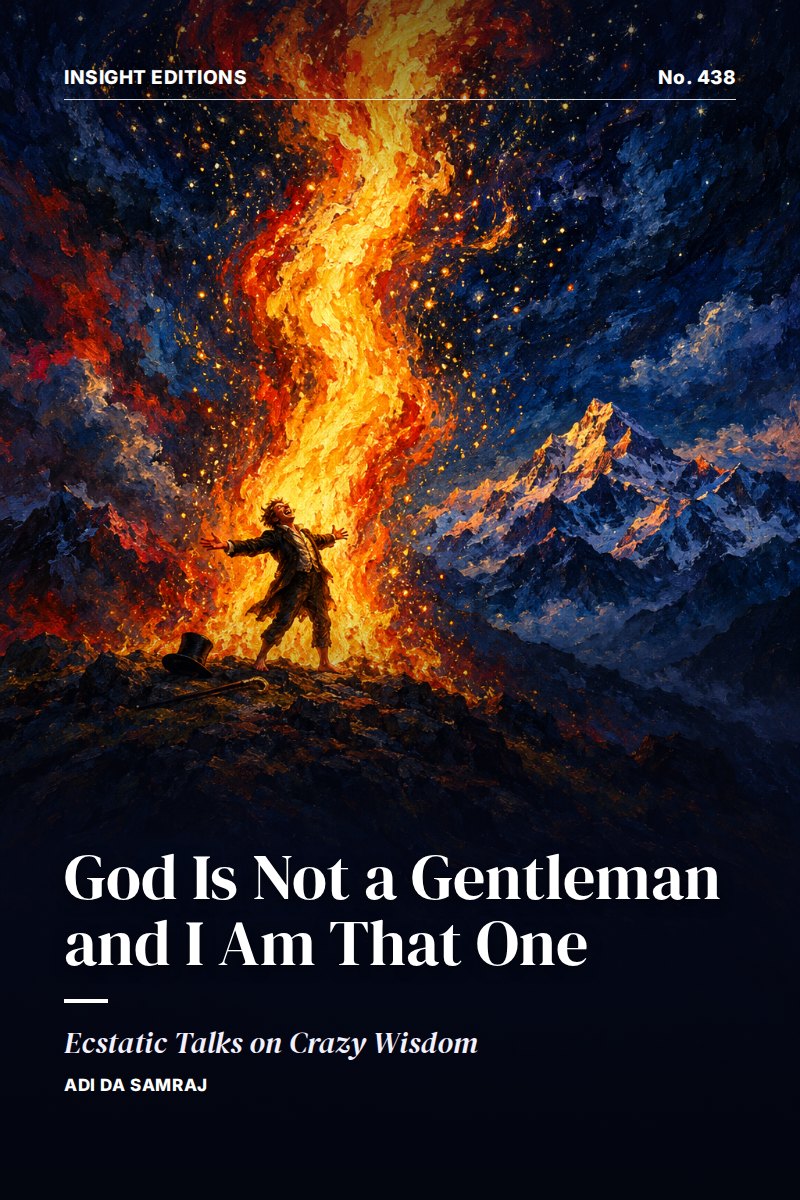
Insight Editions · No. 438
God Is Not a Gentleman and I Am That One
Ecstatic Talks on Conventional Foolishness versus the Crazy Wisdom of God-Realization
Adi Da Samraj
A study edition of fifteen ecstatic talks from 1975 to 1983, published in 1983 under the name Da Free John and introduced by Ty Koontz: the Crazy Wisdom lineage from Drukpa Kunley to the holy fools, the headless horseman, meaning that interferes with hardly anything, not-knowing and stillness, the terror of the upper planes, the Great One, the Well of Happiness, love as sufficient wisdom, and his claim to teach by becoming his devotees, with its claims weighed critically.
A study guide to God Is Not a Gentleman and I Am That One by Adi Da Samraj. Shared free for personal reading; not for sale and not endorsed by the author or publishers. Please read and buy the original.
CORE CLAIM
The conventional mind clings to meaning, order and politeness, and so seals itself inside a "mind-forged prison." The Crazy Adept breaks that seal by shock, humour and blessing, because "the Lord is wild, the Lord is a vast fire, not a gentleman." Truth is entering the Consciousness in which everything arises: "I am That One."
SCOPE
Fifteen ecstatic talks given between 1975 and 1983, compiled and introduced by Ty Koontz. Dawn Horse Press, 1983, published under the name Da Free John. About 38,000 words.
KEY FIGURES
Da Free John (Adi Da Samraj); Ty Koontz, editor; crazy-wise precedents Drukpa Kunley, Swami Nityananda, Huang Po, Rinzai, Chuang Tzu, Symeon of Emesa, St. Francis, Ramanuja; ecstatic confessors Jesus, Krishna, Ashtavakra, al-Hallaj.
BEST FOR
Readers who want to hear Adi Da unedited and at full volume: the "headless horseman," "meaning interferes with hardly anything," the terror of the upper planes, and his claim to become his devotees. Also a key primary source for debates on "crazy wisdom" and its risks.
The Book on One Page
The book has one purpose and one method. The purpose: to dislodge the ego "from its pedestal." The method: ecstatic speech, by turns philosophical, comic, obscene and tender, so that "his unspoken, ceaseless Transmission" might "find an opening past habitual defenses." Koontz tells readers to use their own irritation as a mirror: whatever shocks "points to an area of egoic attachment."
| Block | Talks | Payload |
|---|---|---|
| Frame | Introduction | Crazy Wisdom across traditions; the title explained |
| Consciousness | 1 to 3 | Headless horseman; meaning; "where, why, or what" |
| Grace | 4 to 8 | Absolute Divinity intervenes; the upper planes; the Great One; "all objects are Light" |
| Body and face | 9 to 10 | Heart not wedded to the face; the Well of Happiness |
| Mockery and praise | 11 to 12 | "Don't get serious"; the Wonder |
| Life as school | 13 | "Love is sufficient wisdom" |
| His way of teaching | 14 to 15 | "I am more like you than you are"; spiritual meeting |
The line the editor gives as the book's thesis: "As long as you want to be a gentleman, or a gentlewoman, you can carry on your endless karmic destiny in limitation, but you will never live the life truly."
The Crazy Wisdom of the Free Adepts
Ty Koontz sets the talks in a world lineage of "Crazy Wisdom." Drukpa Kunley, Tibet's "Divine Madman," turned a solemn vow rite into a satire of the lamas present. Nityananda answered a magistrate's demand for a loincloth: "Cover what? With what?" Huang Po called his monks "drunkards." Rinzai said "Kill the Buddha!" Chuang Tzu found the Way "in the piss and dung."
Koontz argues that Westerners, "educated to worship reason," find this hardest. Yet Christianity has its holy fools: Symeon of Emesa, who threw nuts at worshippers, and St. Francis, who called his friars "jesters of the Lord" and once preached naked. He quotes Eddington comparing physics to "Jabberwocky," to show that even science has reached "the dead end of order and meaning."
The title joins two exclamations. "God is not a gentleman" comes from a talk in which "the Lord is a vast fire... As soon as the Lord makes His contact with you, He works for your dissolution." "I am That One" comes from his account of the Vedanta Temple in Hollywood on September 10, 1970, when he "stopped being Franklin Jones" and became "the One who is actually living this body." Koontz lines this up with Jesus ("He that hath seen me hath seen the Father"), Krishna, Ashtavakra and al-Hallaj ("Ana 'l-Haqq").
| Adept | Tradition | Crazy-wise act |
|---|---|---|
| Drukpa Kunley | Tibetan Buddhist | Satirical vow rite at Samye |
| Nityananda | Indian avadhuta | "Cover what? With what?" |
| Huang Po | Chan / Zen | Calls monks drunkards |
| Symeon of Emesa | Eastern Orthodox | Holy fool in the streets |
| Ramanuja | Sri Vaishnava | Shouts a secret mantra from a rooftop |
The lineage is real and well chosen; holy folly is a genuine and cross-cultural form. In most of those traditions, though, crazy wisdom is rare, contained, and judged by results: Tibetan sources warn that imitating it without realization is ruinous. Koontz's rule that any irritation in the reader "always" reveals ego is unfalsifiable: it turns every objection, including a moral one, into evidence for the teacher. The book appeared in 1983, two years before public allegations against Adidam in 1985; readers today should hold the two together.
I Am the Headless Horseman
Undated in the contents, this talk opens with a question: "Can you have a thought now?" Everything you call experience is thought, and everything arises in Consciousness: "To see that everything simply arises in Consciousness is a liberating disposition." Then the image that names the talk: "I am the headless horseman."
He teaches by direct pointing. At first everything seems to arise "as an object to you"; "ultimately you Realize everything is simply a modification of you." Then "your meditation dissolves. Your inwardness dissolves. Suddenly, you are whatever it appears that you are, but you are Ecstatic." "Enlightenment has nothing to do with visions, neither having them nor not having them."
The horseman turns on the head as the seat of the ego. "In our ordinary waking state, we have the feeling of being associated with the head." "We have wandered out from the Heart." Of himself: "I have been beheaded!" referring to "the severing of the sahasrar" in The Knee of Listening. "Just as you have the sense of being in your head there, I have the sense of being in my heart here." "If you put me on the Dawn Horse, I will hold my hat in the air because there is nothing above my collar but the evening."
"Self-Realization is so great that even if it were not True, if you simply entered into that Disposition you could live Happily."
Da Free JohnThe opening exercise (try to have a thought; notice where it arises) is direct and usable, close to Dzogchen "pointing-out" instruction. The horseman image is witty and exact. The line that Self-Realization would make you happy "even if it were not True" is unusually honest about the pragmatic appeal of the teaching, and it also shows why truth claims in this book are hard to test.
Meaning Interferes with Hardly Anything
December 10, 1982. Wearing an ancient Chinese jade burial disk, he asks what it means, then what a vagina, a tree, a lemon, a button or two nostrils mean. "Very few things enter into the sphere of meaning." "Meanings are for the sake of social intercourse." "Meaning interferes with hardly anything."
The argument is short and clear. "We think meaning encompasses everything, because we are in the mind of meanings." "You cannot project the mind of meaning upon the total universe." To enter existence "you must go beyond the world of meaning," where words become "pointers, vague gestures, dancers." This is "not meaninglessness, not negativity," but "a sphere of Being." "The verbal mind is a hatchet of decision."
| Sphere | What lives there |
|---|---|
| Meaning | Social life, practical tasks, "getting things done" |
| Non-meaning | Trees, bodies, "now," Being itself |
| Expression | "The lift of an eyebrow, a hug, a kiss, a feeling" |
| Error | Asking "What does it all mean?" |
This is one of the book's best short talks: a neat demonstration, close to Wittgenstein's view that meaning lives in use, and to Zen's refusal to answer "the meaning of life." The list of examples is deliberately crude to jolt listeners. The claim that spiritual life is "projection into non-meaning" leaves open how one chooses ethically in such a sphere, a question the book does not raise.
Do You Know Where, Why, or What It Is?
Christmas Day, 1982. "Why is there something rather than nothing? Where is anything? What is it?" He is not asking for an answer: "There is no answer." We live "as if we had answered these questions," yet "we have never even asked the great questions." Thought is only "an accommodation to the way things seem to be."
The talk turns into a shouted interrogation. Holding up a hand: "Do you know where, why, or what THAT is? Do you or don't you!?" A devotee describes it as his right hand. "You are merely indulging yourself in the conventions of self-reference." "Our thought has never accounted for the fact of where, why, or what anything is."
The point of the confusion is stillness. "When you realize there really are not any complications, then you stand without thought, without contractive emotion, without uptight body." Then "you can experience the Substance of my Transmission." "The Blessing is tangible and intangible. You receive it only when you stand still." This is "Spiritual Baptism": "You do not realize this through thinking."
- Ask the great questions for real: where, why, what.
- Notice that thought cannot answer them.
- Stand still: mind, emotion and body uncontracted.
- Receive the Transmission, felt "beyond the body-mind" yet "identical to oneself."
"Why is there something rather than nothing?" is Leibniz's question, and the use of not-knowing as a door recalls the Korean Zen "don't-know mind." The shouting (rendered in capitals) is koan-style pressure. In Zen it is used inside a long and accountable teacher-student relationship; read on the page, the devotee's confused "No. Yes. Wait" shows how easily such pressure produces compliance rather than insight.
The Most Absolute Divinity Has Intervened in Our Ordinariness
May 8, 1977. Devotees need not repeat his own long adventure: "Not the slightest bit, not the slightest portion of it is necessary." All "who have ever seen me are relieved of the knot of ignorance." Then the claim the talk is named for: "What you require is the intervention into human time of the Absolute Divinity. And I am That."
The spiritual stages will be "the most superficial kind of glance" for devotees, "because the knot that is the support of the mighty transformation has already been undone in your contemplation of me." "I am sorry that this destiny does not satisfy you egoically." Until they have passed the stages, "you will treat me like a freak."
| Claim | Wording |
|---|---|
| Stages unnecessary | "Not the slightest portion of it is necessary" |
| Grace already given | "Relieved of the knot of ignorance" |
| God revised | "There is no intentional Creator" |
| Self-identification | "And I am That" |
| No credentials | "I have no credentials" |
The talk has two sides. Telling students they need not copy a teacher's dramatic history is wise. Promising that all who have "seen" him are freed of ignorance, then identifying himself as the Absolute Divinity "with no credentials," leaves the claim resting on his word alone. Followers may test the promise in their own lives, and some report it fulfilled; others left. The book gives only one side.
Even the Upper Planes Are a Terrible Domain
November 16, 1982. "I have gone to every single plane." What is up there? "There is as much war in the upper planes as there is here." Inner lights, "blue and yellow lights, stars: what the hell is so beautiful about that?" They "fraction themselves, and suddenly you are seeing faces, and persons, and places." "It is a plastic chaos, a terrible domain."
He is blunt about why: the subtle display "is the mind itself, the thing that you are fitted into when you die." "All the garbage that you can see when you suck yourself out of the body is no more valuable than the shit you push out of your body." The cure is to understand "your own contraction, the root source of all these imagined obligations."
The close turns to joy: "Stand free, and you will make Bliss out of aspirations." "You will laugh, kick universes off your toes, be a monstrous being of Bliss." And a line that sums up his stance: "I can only give you everything, but I cannot give you something. This 'something' is your business."
The anti-vision stance is shared by many sober traditions: Zen calls such phenomena makyo (demonic illusion), and St. John of the Cross tells readers to reject visions. The talk's report of "every single plane" is unverifiable. "I can only give you everything, but not something" is a fine paradox: the teacher offers the whole, and the particular wish remains the student's affair.
I Am Here to Restore God to Man
A September talk. "A half hour has disappeared. That entire half hour is now gone from your lifetime." Some day, "gasping for breath upon your bed," you will wish for it back. He compares devotees to the frogs of Mother's Bed, the lake at his California sanctuary: "They think nothing, they are happy for nothing, just feeling the buzz of Reality."
The talk mixes contempt and tenderness. "How poor is our birth. It surrenders to nothing." Humans are "moved just slightly beyond the other creatures." "We are just as good for food as anybody else." "Navels are embarrassing. They reveal your birth socket." Yet "as soon as we surrender into the Condition in which we are arising... human life becomes a kind of sub-paradise."
| Image | Use |
|---|---|
| Lost half hour | Urgency of practice |
| Frogs at Mother's Bed | Thoughtless happiness |
| "Underwear" | His word for conventional erotic life |
| Tadpoles | Our origin, humbling |
| Sub-paradise | What surrender makes of ordinary life |
He also reports his inner state: "When I close my eyes and look into my head, I see the forms of thousands of people. I do not even have an independent, ordinary mind." And to his audience: "Now get out of my house!"
The memento mori (the lost half hour) is ancient and effective. The repeated degradation of the body, of birth and of sexuality is rhetoric meant to break vanity; but contempt for listeners ("You might as well be cattle") may also lower their self-trust, which is what makes high-demand groups hard to leave. The line about seeing thousands of people inside his head anticipates talk 14.
Accept the Interest of the Great One
August 25, 1980. "Ah, just think how the Great One has manifested as this very room and all beings! Doesn't it raise the hairs on the back of your neck?" "The Great One, incarnate and struggling, is every fraction of existence." "All the cultures of mankind work either for or against this Truth."
He links it to physics: "If it were not for this equation, where would we fit in? We are all simply Energy." The Great One has become "the entire expanse of the material universe," "space itself, expanding since the Big Bang." Humans resist: "we only prevent and complicate that incarnation, and that is why this process of humanity moving on toward the Great Event is so slow, so stupid, and so scandalous."
- Is every room, being and particle.
- Struggles as incarnation in limited forms.
- Is resisted by human seriousness.
- Asks only that we "become a little more humorous."
This is a panentheist vision close to Teilhard de Chardin and to Kashmir Shaivism's view of the world as Shiva's play. "E = mc²" is used as poetry; mass-energy equivalence says nothing about consciousness or incarnation. The tone here is awe, and it is among the warmer talks in the book.
I Have Spoken the Truth in My Room
A short talk with a single teaching: "All that sees is Consciousness, and all that is seen is Light, and this is all there is. Mark my words. Sooner or later you will know that I have spoken the Truth in my room." "All objects are Light, all 'me' is Consciousness." "All the rest is given simply to attract your interest."
From that equation comes the practice: "recognize all these forms that arise as nothing but the Shine of Self and be Free." "Give up this life and swoon into Infinity without the slightest concern for this homely existence." Then theatre: "Now I am going to disappear into Samadhi, and be unknown forever, dead. Here I go, are you ready?" "DEVOTEES: No!"
| Pair | Identity |
|---|---|
| Objects | Light |
| Subject | Consciousness |
| Together | Self-Radiant Being |
| Practice | Recognition, "the Shine of Self" |
| Teaching | "All the rest is to attract your interest" |
"All objects are Light, all subjects are Consciousness" is a compact non-dual formula and probably the clearest summary in the book. The staged exit into samadhi, with the crowd shouting "No!", shows the emotional dependence these gatherings could create. The remark that the rest of the teaching is only bait is a candid admission about how teaching works.
The Heart Is Not Wedded to the Face
July 12, 1976, the oldest talk but one, and the most poetic. "My spine tastes sour. My eyebrows are milky... I am a poet and dead! Other poets have to rhyme. I only have to die for you." The face is where we locate identity, but "the feeling... is deeply rooted in the form below the throat," unknown to itself.
He describes death in vivid detail: "a stuffy sensation in your chest," the mind "unavailable," then "a little cord of light... with three parts into the three sections of the heart." You will "stand up in the room and see your dead body," and someone "like your mother, the Virgin Mary, Jesus Christ, or Gautama the Buddha" will say, "it's alright!" "And you will believe it." But "you have not been relieved from your body-identification, only from the body itself."
The face section is close to a meditation. "All belief appears in this sphere of facing." The body only "gestures," while the face "defines itself." We "strut out with our extremities, occasionally identifying it with your face." "This face is not tolerable to intuition."
The death narrative resembles the Tibetan Book of the Dead, which also warns against following comforting apparitions after death. The editor's footnote contrasts the Adept's sacrifice with the one "conventionally attributed to Jesus," which flattens a large Christian theology into one word. As poetry, the talk is strong, and the face/feeling split is a striking observation.
The Mind-Made Domain
February 16, 1983. "All I communicate to you is Blessing, Infinite Blessing for infinite years." "Your Enlightenment and your Sublimity is guaranteed. Why should this be guaranteed to someone without preparation? No one can account for it." "It is simply that some must be chosen for the sake of others."
He describes his own attitude to life: "I have never been troubled by life in itself. It has always been a ridiculous kind of fleshy jiggling." "All this is a hallucination. I Play with you, I instruct you, because you hallucinate and take it seriously." The practice is "falling into the Well of Being": "Happiness is right there where you stand, underfoot, at the Heart!"
| Teaching | Wording |
|---|---|
| Guarantee | "Your Enlightenment... is guaranteed" |
| Election | "Some must be chosen for the sake of others" |
| World | "A hallucination" |
| Well | "Locate the great Well of Happiness" |
| Sex | "No big deal! It is like shaking hands" |
Then the order of operations: "Find this Bliss... become Free in that Infinite Place of Being, and then work out the practical arrangements of your life." "You do not need me in person, except in the Transcendental sense. All you need is God."
"Happiness first, then arrange your life" is sound contemplative advice. The claim that "we do not need sex, society, Nature" and other persons sits awkwardly with a community whose sexual life he actively directed in these years, as later accounts by former members describe. The guarantee of enlightenment "without preparation" is the strongest promise in the book and cannot be checked.
Don't Get Serious, Get With It
April 19, 1975, the earliest talk. "What does all of this amount to? A few more breaths, a few more smiles... it does not amount to excrement." "This world is a urine specimen." "Everybody... thinks that they will ascend at death." "There is nothing to be run up the spine, there is nowhere to go. Light is already the Condition of all beings."
The talk is comic nihilism in the service of a single alternative. "You are all the food of a greater dimension of beings." "There is an alternative to all of this, however, and that is absolute, unqualified Divine Realization." "There is a God-junket which you may join." "How can you carry it on for one more day?" A devotee answers, "Because you are here."
"DEVOTEE: Why do we do all this nonsense? MASTER DA FREE JOHN: Who cares? Really, who does care? Nobody cares. That is the truth of it." The talk ends without consolation, in keeping with its title.
The idea that "Light is already the Condition of all beings," so that nothing needs to rise up the spine, anticipates the much later Atma Nadi Shakti Yoga. "Don't get serious" is a classic anti-piety move (Zen laughter, Sufi jokes). The devotee's "Because you are here" shows a life whose meaning now rests on the teacher, the reverse of the talk's stated goal.
The Wonder of the Great One
February 5, 1983. To one devotee: "All of your past lives and all the portions of your present life are totally known to me." Then a hymn: "Think about the wonderful Magnificence of the Great One, and how a person as humble as yourself... could be visited with a Mantle of Force." "I am simply the medium of the Blessing that comes to you. I am nothing, absolutely nothing."
He predicts his burial: "In a few years from now you will be putting it underground, talking about how incredible a Master this one was." "Yes, he was, but why was he great? Because the Great One Works." The Great One "submits Himself or Herself knee-down, heaven-smelted, mind-melted, face-sundered, altogether body-ruined" to appear as Man and "in the form of earwigs."
| Line | Function |
|---|---|
| "I am nothing" | Humility of the medium |
| "Past lives... known to me" | Claim of total knowledge |
| "Mantle of Force" | Blessing as investiture |
| "Earwigs" | Grace in all forms, not only gurus |
| "Lift up left-brained speech" | Praise as poetry |
"I am nothing" and "your past lives are totally known to me" sit side by side. That pairing is common in guru speech (the ego is nothing, the function is everything), but for the listener it combines intimate access with no accountability. The talk's best idea is that Grace enters "altogether into the form of manifest beings," not only into masters.
Love Is Sufficient Wisdom
Christmas Day, 1977, to "a small group of male devotees." "We are not perfect, and this is not a Utopia. The earth is not meant to be perfected." "We are like meat in the supermarket." "I have seen thousands of people die, and there is no glory to death at all." And: "I don't hear any voices. I don't see any visions."
This is the book's most grounded talk. The earth "makes it possible for us to endure this earth as a school, to learn from it, to grow." "You must become real about this circumstance yourself, as I have. No angels sing around me, none." "I'm going to fight the insanity of this world until I die, because I am disturbed by life." "If you think I am a god-man, that's your recognition, but it's not my business to play that role."
Then the title line: "Love is sufficient wisdom for a mere flower like you are." And claims about himself: "I know that I am not going to die. I have never been born." "Many of the influences that you associate with spiritual and religious life bear my name. I have been many of them. But I don't want you to believe it."
The opening, "this is not a Utopia," is a healthy check on spiritual perfectionism, and "love is sufficient wisdom" is the book's kindest line. The same talk says the United States is "excrement" and "full of dreadful people who do not love," and he claims to have been many religious figures. Saying "I don't want you to believe it" after making the claim is a familiar way of planting a belief while disowning it.
I Am More Like You Than You Are
September 15, 1982. Traditionally, Adepts in samadhi descend into the body "only down to the throat," to speak. "I do not live in that circumstance. I must animate the body completely." "I submit myself to devotees to the degree of becoming them, to the degree of taking on the condition in which they exist."
He describes this as a unique siddhi. "When I sleep at night, I experience the dreams of people." "You become what you meditate on. I meditate on devotees and I become them." "I become more like them than they are. I become exaggeratedly what they are." After the Vedanta Temple, "I did not feel my own body and mind. Instead, I saw hundreds and thousands of people... I was them directly."
| Traditional Adept | Adi Da (as he describes) |
|---|---|
| Descends to the throat | Descends to the feet |
| Body below moves spontaneously | Animates all chakras |
| Teaches from abstraction | Teaches by identification |
| Remains apart | Takes on devotees' karmas and neuroses |
| Dignified | "Vulgar and ordinary" |
The result is "profound physical discomfort." "It is not me. It is a reflection, a mirror, a form of sacrificial participation." "This is what you must communicate about me so that people will understand the unique quality of my Work."
This talk supplies the theology behind his later "Teaching Years": he behaved as devotees did, in excess, to show them themselves. It is a coherent idea with echoes in Tibetan crazy wisdom and the Christian kenosis. It is also a doctrine that can justify any behaviour as mirroring. Former members' later accounts of sex, alcohol and coercion in this period should be read alongside the talk.
Our Meeting Is Spiritual and Eternal
November 22, 1982, as he entered his hermitage phase. A devotee feels his Presence whether near him or not. "Well, I certainly hope so. Was I born yesterday? This Free John meat?" "I don't hold on to your meat, you don't hold on to mine. I hold on to your Spirit, you hold on to my Spirit."
The talk is a gentle farewell to physical access. "People should come and go from here." "When your time to be here comes, you visit here, and when your time to not be here comes, you leave again. But you do not leave me." "We meet in the Spirit and should live in the Spirit and not be fleshily organized or contained."
| Theme | Line |
|---|---|
| Presence | "I certainly hope so" |
| Non-clinging | "I don't hold on to your meat" |
| Coming and going | "You do not leave me" |
| Emotion | "Don't be afraid. Never. Don't be sorrowful. Don't be angry." |
| Destiny | "These meats have their own occasion" |
The book ends on its tenderest note: love that does not depend on presence. "You do not leave me" is also a quiet statement that the bond outlasts any departure, which can comfort and can bind. The instruction never to be angry is spiritual advice; as a community norm it can make grievances harder to voice.
Master Takeaways
God Is Not a Gentleman is Adi Da at full volume: philosophy, comedy, contempt and love in one breath. Its teachings (everything arises in Consciousness; meaning covers little; visions are not the goal; happiness is underfoot) are clear and portable. Its method, shock and claims of total knowledge without accountability, is the part history has most reason to question.
- Everything you call experience arises in Consciousness.
- Try to have a thought now, and notice where it appears.
- The ego feels located in the head; feeling lives below the throat.
- Meaning interferes with hardly anything; it serves social life.
- Being is a sphere of non-meaning, not of nihilism.
- We have never answered where, why or what anything is.
- Stand still to receive what thinking cannot reach.
- You need not copy a teacher's history.
- Visions and subtle planes are not the goal.
- All objects are Light, all subjects are Consciousness.
- Time is short; the lost half hour does not return.
- Find happiness first, then arrange your life.
- The world is not a Utopia; treat it as a school.
- Love is sufficient wisdom.
- Seriousness blocks Grace; humour opens it.
- Grace appears in all forms, not only in masters.
- Crazy wisdom is real and cross-cultural.
- It is also easily imitated, and traditions warn against that.
- "Your irritation is your ego" is unfalsifiable; keep your judgement.
- Guarantees of enlightenment cannot be verified.
- Mirroring as a teaching method can justify anything.
- Contempt for listeners can lower self-trust.
- Love that outlasts presence can both free and bind.
Frameworks and mental models
| Name | What it says | Use it when |
|---|---|---|
| Headless horseman | Live from the heart, not the head | Noticing mental tension |
| Sphere of meaning | Meaning is social and narrow | Over-interpreting life |
| Where, why, what | Thought never reaches the fact | Facing big questions |
| Stand still | Stop contracting to receive | Before meditation |
| Objects = Light, subject = Consciousness | Non-dual formula | Contemplative practice |
| Upper planes as mind | Subtle visions are mental | Evaluating experiences |
| Well of Happiness | Bliss is underfoot | Seeking happiness outside |
| Earth as school | Not a Utopia | Spiritual perfectionism |
| Crazy-wisdom test | Contained, rare, judged by results | Assessing a teacher |
As a record of ecstatic speech, this book is valuable: it shows how Adi Da sounded in the room, with a gift for paradox, comic timing and sudden tenderness. Its short talks on meaning, thought and the Well of Happiness stand on their own. The book is also a case study in why crazy wisdom is risky outside the traditions that contained it. The editor's rule that any discomfort reveals the reader's ego disables criticism. The teacher claims total knowledge of devotees' past lives, guarantees their enlightenment, says he becomes them in order to teach, and calls the world excrement and listeners cattle. Those features need outside scrutiny, especially given what former members later reported about these years. Read the talks for their insight, and use your own judgement to weigh them.