Insight Editions · No. 417
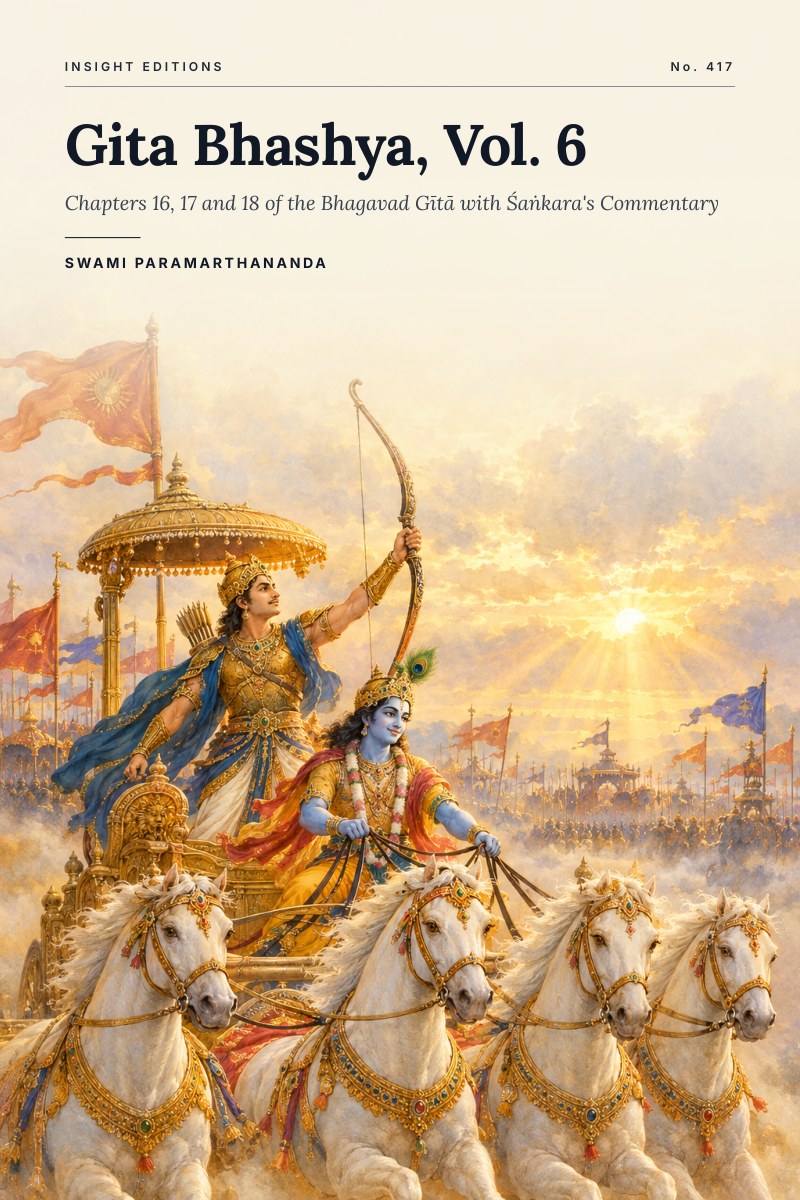
Gita Bhashya, Vol. 6
Chapters 16, 17 and 18 of the Bhagavad Gītā with Śaṅkara's Commentary
Swami Paramarthananda
Insight Edition of Swami Paramarthananda's 131 classes on Śaṅkara's Bhagavad Gita Bhashya, Volume 6: Chapters 16, 17 and 18, with Śaṅkara's concluding Upasaṁhāra.
A study guide to Swami Paramarthananda's classes on the Bhagavad Gītā Śaṅkara Bhāṣyam, Vol. 6 (Arsha Avinash Foundation, transcribed by SwayamJyothi, Sri Vancheeswaran and others; copyright Vedanta Vidyarthi Sangha; not verified by Swamiji). Shared free for personal reading; not for sale and not endorsed by the author or publishers.
CORE CLAIM
Cultivate sattva, renounce the doer by knowledge, and take refuge in the Lord as one's own Self.
SCOPE
131 classes on Gītā Chapters 16, 17 and 18: divine and demonic natures, three faiths, two renunciations, naiṣkarmya, 18.66 and Śaṅkara's concluding Upasaṁhāra.
KEY FIGURES
Śaṅkara against Mīmāṁsā, Vaiśeṣika, Nyāya and Sāṅkhya; Kṛṣṇa, Arjuna and Sañjaya; Swami Paramarthananda as teacher.
BEST FOR
Students finishing Śaṅkara's Gītā commentary, and anyone wanting Advaita's full case that knowledge alone liberates.
The Book on One Page
This is the final volume of Swami Paramarthananda's course on the Bhagavad Gītā with Śaṅkara's bhāṣya. Its 131 classes (470 to 600) cover Chapters 16, 17 and 18: divine and demonic natures, the three kinds of faith, and the long last chapter in which the Gītā sums itself up. Twenty-seven of the classes go to Śaṅkara's Upasaṁhāra, his concluding essay on the purport of the whole text.
Chapter 16 sets divine wealth (daivī sampat) against demonic wealth (āsurī sampat). Śaṅkara notices that the virtues are listed as abstractions and the vices as portraits of people, so we can recognise and avoid them. The whole demonic list condenses to three gates of hell: desire, anger and greed. The chapter ends by making śāstra the authority for what to do.
Chapter 17 retells the same lesson through the three guṇas. "As a person's faith is, so is the person." Food, worship, austerity and giving each come in three grades, and Paramarthananda reads the chapter as a manual for karma-yoga as sāttvic living. He insists niṣkāma action is the one religious act with a guaranteed result, and calls Om Tat Sat "the Vedic spell-check".
Chapter 18 opens with saṁnyāsa and tyāga. Śaṅkara separates secondary renunciation (the karma-yogī's, of fruit) from primary renunciation (the knower's, of doership), and warns that "an unprepared mind and saṁnyāsa is a deadly combination". The five factors of action show the Self is not the doer. Then knowledge, action, doer, understanding, will and happiness are each graded by guṇa, and svadharma is set by nature.
The volume's peak is 18.50 and after. "Naiṣkarmya" turns out to mean dropping the relationship with action, not action itself. Self-knowledge is not acquiring the Self but sorting it from what it is mixed with. Parā bhakti is knowing God as myself. And 18.66, "give up all dharmas and take refuge in me alone", becomes in Śaṅkara's reading the surrender of the doer by knowledge. Mokṣa is not produced, reached, modified or purified; it is known.
The Upasaṁhāra then argues at length, against the Mīmāṁsakas, that mokṣa cannot come from ritual or from simply exhausting karma, and that the Veda's ritual portion assumes doership without teaching it. The Gītā ends with Arjuna's "naṣṭo mohaḥ": delusion destroyed. The edition keeps the commentary's force visible and marks where it pushes against the text's plain sense, above all at 18.66 and at Arjuna's decision to act.
| Ch | Title | Payload |
|---|---|---|
| 1 | Divine and Demonic Wealth | Virtues as ideas, vices as people; 16.8 |
| 2 | Endless Worry and the Three Gates of Hell | Kāma, krodha, lobha; śāstra as authority |
| 3 | Three Kinds of Faith, Food and Worship | Faith makes the person; sāttvic living |
| 4 | Austerity, Giving, and Om Tat Sat | Will-based calm; guaranteed growth |
| 5 | Saṁnyāsa or Tyāga? | Gauṇa and mukhya saṁnyāsa |
| 6 | Three Kinds of Renunciation | Fruit over act; sattva uncovered |
| 7 | The Five Factors of Every Action | Kośa mapping; durmati |
| 8 | The Central Message and the Engine of Action | Tātparya-liṅgas; roasted seed |
| 9 | Everything Has Three Grades | Separate people from ideas; three joys |
| 10 | Varṇa, Svadharma and Proper Attitude | Action plus attitude |
| 11 | Svadharma and the Meaning of Naiṣkarmya | Drop the relationship, not the act |
| 12 | The Culmination of Knowledge | Sorting, not acquiring |
| 13 | Nididhyāsana and Supreme Devotion | God as myself |
| 14 | Surrender: Sarva-dharmān Parityajya | Two surrenders |
| 15 | Why Knowledge Alone Liberates | Mokṣa is not a product |
| 16 | The Self Is Not the Doer | Mukhya, mithyā, gauṇa "I" |
| 17 | Delusion Destroyed: The Gītā Ends | Higher worlds are not mokṣa |
Divine and Demonic Wealth
Chapter 16 divides human tendencies into daivī sampat, divine wealth, and āsurī sampat, demonic wealth. Śaṅkara connects it back to Chapter 9, "like Āñjaneya making a big jump", and Paramarthananda reads the list of divine qualities as the qualification for knowledge and the demonic list as its obstacle.
The Chapter 9 connection
In 9.12 Kṛṣṇa called the rākṣasī and āsurī natures "of vain hopes, vain actions, vain knowledge": an extroverted, materialistic life that never turns to God or śāstra. In 9.13 he praised the great souls of daivī nature. Chapter 16 expands that contrast.
| Classification | Used in |
|---|---|
| Sāttvika, rājasika, tāmasika | Chapters 14, 17, 18 |
| Daivī, rākṣasī, āsurī | Chapters 9 and 16 |
| Mapping | Rākṣasī and āsurī are rājasic; "mohinī" is tāmasic |
The divine qualities (16.1–3)
Fearlessness, purity of mind, steadfastness in knowledge and yoga, charity, self-control, sacrifice, study, austerity, straightforwardness, non-violence, truth, freedom from anger, renunciation, peace, compassion, gentleness, modesty, vigour, forgiveness, fortitude, purity, no hatred, no pride.
Jñāna-yoga-vyavasthiti first. Śaṅkara treats "steadfastness in knowledge" as the chief divine quality and the others as aids to citta-śuddhi. "You should go on reminding yourselves; otherwise you have side-tracked from the sampradāya."
Two kinds of yajña
| Type | Prescribed by |
|---|---|
| Śrauta | The Veda (śruti) |
| Smārta | Other scriptures: smṛti, purāṇa, āgama |
Dhṛti: the will to finish
10 pm to 11.30 pm. Dhṛti is "the capacity of the mind to re-energise the body when the body is already tired". You've done 70 percent of a task, the body wants to stop, and the mind pushes it to complete the work by 11.30. "And next day getting up at 10 am is no good."
Two kinds of non-discrimination
Both the qualified and the unqualified seeker lack satya-anṛta viveka: neither knows absolute reality yet. What separates them is dharma-adharma viveka: the daivī person knows and follows what is right; the āsurī person does not.
Abstract virtue, concrete vice
Śaṅkara notes a "very minute observation": the divine qualities are listed as abstract virtues, but the demonic ones are described through people who have them. Why? So we can recognise and avoid them: "pratyakṣīkaraṇena" (by making it visible).
Verse 8: the materialist creed
"They say the world is without truth, without basis, without God." Śaṅkara: "without truth" means without a valid means of knowledge, the Veda. Then "without basis" follows: no dharma and adharma, since they are known only from the Veda. And "without God": no Īśvara, author of the Veda.
Divine wealth is listed as virtues to cultivate; demonic wealth is shown as people, so we can recognise ourselves.
"Demonic" is a dangerous label. The chapter's portrait of the āsura (16.8: denies the Veda and God, lives for desire) has been used to brand atheists, critics and other faiths as demonic. Śaṅkara's own reading, that these are tendencies in everyone to be reduced, is much healthier, and Paramarthananda follows it. But the text's categories invite projection onto others, and a reader should keep the inward application primary.
Endless Worry and the Three Gates of Hell
The demonic portrait continues: endless anxiety, life lived for pleasure, "I am rich, I am well-born, who is equal to me?" Kṛṣṇa says he casts the cruel into cruel births, and condenses the whole of demonic wealth into three: desire, anger and greed, the three gates to hell. The chapter ends by making śāstra the authority on what to do.
Endless worry (16.11)
They are "beset by immeasurable anxiety that ends only with death". Paramarthananda quotes Sadāśiva Brahmendra's song about the opposite kind of person:
Cintā nāsti kila teṣām, cintā nāsti kila: for them there is no worry at all. Full of calm, control and compassion; in the company of the good; having conquered desire in all three times; their mind on the feet of the paramahaṁsa guru; intoxicated with the nectar of Brahman's bliss.
Sadāśiva Brahmendra, quoted by Paramarthananda"Kāma-upabhoga-paramāḥ": they take sense pleasure as the highest goal.
The boast (16.13–15)
"This I have gained today; this desire I shall fulfil... I am the lord, I am the enjoyer, I am successful, strong and happy. I am rich and well-born; who else is like me? I will sacrifice, I will give, I will rejoice." Śaṅkara: even the sacrifice is meant "to overpower others", the gift to entertainers, the joy excessive. "Deluded by ignorance."
Five features of bhakti
Rejecting God, rejecting scripture, or both, is the mark of the āsura. Paramarthananda recalls a Śivarātri talk on the five features of bhakti, and gives two.
| Feature | What it means |
|---|---|
| Reverence for scripture | Appreciating śāstra as the words of God |
| Attempt to follow | Not merely saying "it is good", but trying: build daivī sampat, give up āsurī |
| Sincerity | "How far I succeed Bhagavān does not ask; do I sincerely try?" |
Verses 19–20: cruel births
"These cruel haters, the lowest of men, I cast again and again into demonic wombs." Śaṅkara: wombs of "tigers, lions and the like", animals that kill cruelly. "If you see Animal Planet you will know how lions and tigers hunt; if you see them often you will lose your sleep."
Verse 21: three gates
"Therefore one should give up these three." Whenever "therefore" comes, "ask wherefore". Śaṅkara: because they destroy the self. "Hell" here means spiritual downfall.
Desire for the eternal is allowed. The kāma to be dropped is desire for impermanent objects. "Nitya-kāma in the Vedāntic model is called mumukṣā", the desire for liberation.
Verses 23–24: śāstra is the authority
"He who sets aside the injunctions of scripture and acts on impulse attains neither perfection, nor happiness, nor the supreme goal. Let śāstra be your authority in deciding what to do and what not to do."
Desire, anger and greed are the whole of demonic wealth in three words.
Rebirth as a tiger is a moral claim, not a fact. Verses 19–20 say the Lord himself casts the cruel into cruel births. Paramarthananda presents this straightforwardly, with a light touch. But the idea that an animal's nature reflects a past human's sin, and that God assigns such births as punishment, is a belief from tradition, not something the commentary argues for, and it sits awkwardly beside the Gītā's own image of an impartial Lord (9.29).
Three Kinds of Faith, Food and Worship
Arjuna asks about those who worship with faith but ignore scriptural rules: is their state sattva, rajas or tamas? Kṛṣṇa answers that faith follows nature, and Chapter 17 replaces Chapter 16's divine and demonic with the three guṇas. Paramarthananda reads the chapter as a practical manual for karma-yoga as sāttvic living.
Same lesson, new model
| Chapter 16 model | Chapter 17 model |
|---|---|
| Increase daivī sampat | Increase sāttvic tendencies |
| Reduce āsurī and rākṣasī sampat | Reduce rājasic and tāmasic tendencies |
Verse 1: the question
The group Arjuna asks about is ignorant but sincere: they do not know the rules, but have faith. Śaṅkara: a question about such a general group "cannot be answered without sub-division", so Kṛṣṇa divides them by the type of worship, deity and motive.
Verses 2–3: faith follows nature
"The faith of each is according to his nature (sattva). A person is made of faith: as his faith is, so is he."
Religious-materialistic and religious-spiritual
Two kinds of religious people. Most worshippers are "religious-materialistic": they pray for worldly results. Rare are the "religious-spiritual" who ask for less ego and possessiveness, more of the fourfold qualification, and "opportunity for śravaṇa and manana": "jñāna-vairāgya-siddhy-artham bhikṣāṁ dehi ca Pārvati."
17.5–6 condemn those who do terrible austerities not enjoined by scripture, "tormenting the elements in the body, and me who dwells within".
Four things to watch
Karma-yoga, says Paramarthananda, is sāttvika jīvana: "tamas avoided, rajas reduced, sattva dominant". Kṛṣṇa takes up four areas.
| Area | Watch for |
|---|---|
| Āhāra (food) | Quality and quantity |
| Yajña (worship) | Motive and manner |
| Tapas (discipline) | Instrument and guṇa |
| Dāna (giving) | Time, place, recipient, attitude |
"Anything in excess is not good": yuktāhāra-vihārasya (6.17), moderate in food, recreation, sleep and waking.
Verses 8–10: food by guṇa
Verses 11–13: worship by guṇa
Sāttvic yajña is done as a duty, without desire for fruit; rājasic yajña for reward or ostentation; tāmasic yajña without rules, without food distributed, without mantras, fee or faith.
As a person's faith is, so is the person.
The food lists are culturally specific. Classifying onions, chillies or "stale" food by guṇa, and reading character from diet, comes from a particular regional tradition and has been used to rank communities by what they eat. Paramarthananda's own emphasis, watching quantity and the attitude of eating, is more defensible than the specific lists, which readers should hold loosely.
Austerity, Giving, and Om Tat Sat
Kṛṣṇa classifies tapas by the instrument used and by guṇa, then dāna by guṇa, and ends the chapter with the threefold name of Brahman, Om Tat Sat, which Paramarthananda calls "the Vedic spell-check". His theme: niṣkāma action gives a guaranteed result, kāmya action does not.
Tapas by instrument (17.14–16)
| Kind | Content |
|---|---|
| Physical | Worship of gods, the twice-born, teachers and the wise; purity, straightforwardness, celibacy, non-violence |
| Verbal | Speech that causes no agitation, true, pleasant and beneficial; regular study |
| Mental | Serenity, gentleness, silence, self-control, purity of feeling |
Manaḥ-prasāda: will-based calm
Śaṅkara glosses mental serenity as svacchatā-āpādana, "bringing about clarity". The word āpādana implies will.
Knowledge does not work automatically. "Why should I think of 1978 events now, and allow them to disturb me?" Watch involuntary thoughts "on your radar all the time" and neutralise them by pratipakṣa-bhāvanā (cultivating the opposite), bhakti or self-confidence. "Vedāntic knowledge will not automatically work; we have to use the will and the knowledge together."
Tapas by guṇa (17.17–19)
Definite and uncertain results
The grandchild's admission. "I do a pūjā for getting admission in the college. Not for me, but my grandchild. I might do a very elaborate pūjā, but nobody can guarantee the result." Kāmya action is calam adhruvam, "unstable and uncertain" (17.18). Niṣkāma action always gives inner growth: "100 percent guaranteed", as 2.40 says, "no effort is lost".
Giving by guṇa (17.20–22)
Sāttvic dāna is given because it ought to be given, to one who cannot return it, at the right place and time, to a worthy person. Rājasic dāna expects a return or is given grudgingly; tāmasic dāna is given at the wrong time and place, to the unworthy, with disrespect.
Om Tat Sat (17.23–28)
"Om Tat Sat is the threefold designation of Brahman." Śaṅkara: its use is "sādguṇya-karaṇa", making perfect what was imperfect through an unintended omission.
The Vedic spell-check. "Inbuilt rectification process; śāstra itself provides. You have to press that button. Spell-check in Word is computer Om-Tat-Sat."
| Word | Meaning |
|---|---|
| Om | Name of the Lord, uttered before acts |
| Tat | "That": the Lord beyond the senses (parokṣa) |
| Sat | Existence, coming-into-existence, goodness, praiseworthy action, steadiness in sacrifice |
17.28: whatever is done without faith is "asat", of no value here or hereafter.
Niṣkāma action guarantees inner growth; nothing else in religion comes with a guarantee.
"Guaranteed" is a strong word. The claim that selfless action always produces inner purification is unfalsifiable as stated: any lack of visible growth can be put down to insufficient selflessness. It is a useful motivational frame, and 2.40 supports it, but it is a matter of faith in the scheme rather than something a practitioner can check.
Saṁnyāsa or Tyāga? The Last Chapter Opens
The final chapter, which Śaṅkara treats as the summary of the whole Gītā and the whole Veda, opens with Arjuna asking the difference between saṁnyāsa and tyāga, renunciation. Kṛṣṇa reports rival views and gives his own: sacrifice, charity and austerity should not be given up. Śaṅkara has to fit this into his defence of monastic renunciation.
The essence of the whole Veda
The Gītā dhyāna verse calls the Gītā milk from the Upaniṣad cows: the essence of Vedānta. Śaṅkara "improves that": in his introduction the Gītā is "samasta-vedārtha-sāra-saṅgraha", the essence of the whole Veda, ritual portion included, and here too he says "vedārtha", not "vedāntārtha".
Verses 1–2: the two terms
"The sages know saṁnyāsa as giving up desire-prompted acts; the wise call tyāga giving up the fruit of all acts."
Two results of daily duties
Nitya and naimittika karmas (the five daily yajñas) must be done. They can give either svarga in the next life or citta-śuddhi, but not both. "Who will decide which result comes? The performer should decide," by the attitude with which he acts.
Verse 3: the rival views
Verse 4–5: Kṛṣṇa's verdict
"Sacrifice, charity and austerity are purifiers of the wise; they should not be abandoned." Śaṅkara insists the verse addresses only those ready for karma-yoga.
| Kind of saṁnyāsī | Who | Renounces |
|---|---|---|
| Gauṇa (secondary) | The karma-yogī | Ego- and possessiveness-centred prayers; prays only for the world's welfare |
| Mukhya (primary) | The knower | All karma, by knowing "I am akartā" |
The opponent says 18.4–5 apply to all seekers. Śaṅkara says no: they address only those not ready for primary renunciation.
Unprepared renunciation
A deadly combination. Those who renounce out of delusion (tāmasa tyāga) or to avoid bodily hardship (rājasa tyāga) are criticised here. "Unprepared mind and saṁnyāsa is a deadly combination. They suffer inside and they will give problems to others."
Mental renunciation
"Sarva-karmāṇi" cannot mean physically giving up all action, which is impossible; it means renouncing through knowledge: "the guṇas act among the guṇas; I, the ātmā, am akartā, abhoktā." This is the jñāna-karma-saṁnyāsa of Chapter 4.
Not a philosopher. Śaṅkara keeps saying the rival views "have been well discussed in the śāstras". Paramarthananda: "I am only a commentator; I am not a philosopher at all." Independent philosophy is tarka-based, and "naiṣā tarkeṇa matir āpaneyā" (Kaṭha 1.2.9): this understanding is not reached by logic.
Renounce the doer by knowledge; renounce rituals only when the mind is ready.
Śaṅkara narrows a verse that sounds universal. 18.5 says sacrifice, charity and austerity "purify even the wise" and should not be given up. Read plainly, this goes against the idea that knowers leave all ritual. Śaṅkara restricts it to karma-yogīs and keeps primary saṁnyāsa supreme, as he did in Chapters 5 and 6. Rāmānuja, Tilak and most modern readers see the final chapter as Kṛṣṇa's clearest preference for active renunciation within life.
Three Kinds of Renunciation
Kṛṣṇa now grades renunciation by guṇa, in reverse order: tāmasic, rājasic, then sāttvic. Śaṅkara uses the passage to refute the Mīmāṁsaka claim that daily duties have no result, and to show that renouncing the fruit is superior to renouncing the act. The mature karma-yogī is "sattva-samāviṣṭa", saturated with sattva.
"Pāvanāni" proves the audience
How do we know 18.5–6 address unprepared people? Kṛṣṇa calls sacrifice, charity and austerity pāvanāni, purifiers. "May you do them so that you can prepare your mind: it indicates your mind is not prepared."
Daily duties do have a result
The Mīmāṁsaka says nitya-naimittika karmas produce no result; they are done only to avoid the sin of omission. Śaṅkara rejects this: "nityānām api karmaṇām phalavattvasya upapāditatvāt", even daily duties have been shown to bear fruit (purification), as 18.5 itself says.
Three tyāgas
| Kind | Verse | What it is |
|---|---|---|
| Tāmasa | 18.7 | Giving up obligatory duty out of delusion |
| Rājasa | 18.8 | Giving it up "because it is painful", fearing bodily strain: no fruit of renunciation follows |
| Sāttvika | 18.9 | Doing obligatory duty as duty, giving up attachment and fruit |
Both wrong saṁnyāsas are unprepared saṁnyāsas. In tāmasa and rājasa tyāga an unprepared person renounces nitya karma, "either remaining in gṛhasthāśrama or wrongly entering saṁnyāsa-āśrama". Only the sāttvic kind is legitimate, and it is a renunciation of fruit, not of action.
Why list fruit-renunciation alongside act-renunciation?
The opponent objects: the first two give up karma, the third gives up only karma-phala; how can they be grouped? Śaṅkara: all three share "tyāgatva-sāmānyam", the common feature of renunciation. And the dissimilarity is deliberate: karma-phala-saṁnyāsa is placed beside the others to show its superiority.
Sattva-samāviṣṭa (18.10)
"The renouncer, pervaded by sattva, wise, with doubts cut, does not hate unpleasant work nor cling to pleasant work."
Sattva is already there. "We need not acquire sattva-guṇa", since the whole creation, being māyā's product, has all three guṇas. "Then what is our problem? That sattva-guṇa is overpowered by rajo-guṇa", by extroverted desire. Karma-yoga lets the existing sattva dominate.
Dehabhṛt: who cannot give up action (18.11)
"It is impossible for an embodied one to give up action entirely." The dictionary meaning of dehabhṛt is "one who has a body", which fits everyone, wise or not. Śaṅkara does not take that meaning: dehabhṛt is "deha-ātma-abhimānī", one who identifies with the body. Only for him is full renunciation impossible.
Three fruits (18.12)
Sattva need not be acquired; it needs only to be uncovered from rajas.
The grading lets the monk off lightly. Rājasa tyāga, giving up duty because it is hard, describes many people who leave household life as well as those who neglect it. Śaṅkara's scheme blames the unprepared for wrong renunciation but keeps the monastic ideal untouched. Whether an institution should take in people it admits are often unready is a question the commentary does not raise.
The Five Factors of Every Action
From verse 13 Kṛṣṇa moves from karma-yoga to jñāna-yoga. He gives the five factors that bring about every action: the body, the doer, the instruments, the life functions and daiva. Paramarthananda maps them to the kośas, and Śaṅkara calls anyone who sees the pure Self as the doer "durmati", of perverted understanding.
Structure of Chapter 18
| Verses | Topic | Other name |
|---|---|---|
| 1–12 | Karma-yoga | Sāttvika saṁnyāsa |
| 13–17 | Jñāna-yoga | Ātma-anātma viveka |
| 18 onward | Guṇa classifications, then summaries | Consolidation |
No shortcut for the karma-yogī
"Can a karma-yogī become jīvan-mukta and videha-mukta directly? Never." Only through jñāna-yoga (śravaṇa, manana, nididhyāsana). "As long as I don't have jñānam, I will mistake myself only as body-mind-sense complex", which is ahaṅkāra, and ahaṅkāra binds.
Scriptural roaming-about. When an interpretational doubt arises in a verse, "we will have to travel all over", to the next verse, other chapters and the Upaniṣads. "That is why the first chapter of the Brahma-sūtra is the resolution of interpretational doubts."
Five factors (18.14)
Daiva is not the ānandamaya kośa. "Very careful, we tend to say daivam is ānandamaya kośa; no." Daiva is the presiding deity of each organ, the total Hiraṇyagarbha. Śaṅkara glosses adhiṣṭhāna as "the locus where desire, aversion, pleasure, pain and knowledge manifest".
Durmati (18.16)
"Whoever, through untrained understanding, sees the pure Self as the doer, that perverse person does not see." Śaṅkara's three glosses for duṣṭā matiḥ are kutsitā (low), viparītā (wrong) and "the cause of repeated birth and death".
The right to be wrong. "What is wrong in seeing wrongly?" Dayananda Swamiji said free will is that which can do the wrong thing too. But Śaṅkara says this wrongness is of grave consequence. "It is not an ordinary consequence of losing Rs. 100 or losing the demonetised Rs. 500."
Verse 17: the knower does not kill
"He who is free of the notion 'I am the doer' and whose understanding is not tainted, though he kills these people, he does not kill, nor is he bound."
Action is the work of five factors; the Self is not among them.
"Though he kills, he does not kill." Śaṅkara takes 18.17 as praise of knowledge, not a licence. But a verse saying that the right inner state makes even killing non-binding has been quoted to excuse violence by people sure of their own detachment. Paramarthananda answers elsewhere that a knower's actions stay within dharma. That safeguard comes from the wider tradition, not from this verse, and the reader needs to keep it in view.
The Central Message and the Engine of Action
Śaṅkara pauses at verse 17 for one of the most important paragraphs in his whole commentary: proof, by the rules of textual interpretation, that self-knowledge is the Gītā's central message. Then Kṛṣṇa turns to what drives action (18.18) and announces the guṇa classification of knowledge, action and doer.
The knower's mind as upādhi
In Vedānta, "whenever the word ātmā comes we have to translate it as jñānī". The knower does not claim the mind as himself but as "my upādhi", "a temporary incidental instrument" through which I operate. "I use the mind; I am not the mind." So his buddhi "na lipyate", is not tainted.
Is the Self a doer in partnership?
"A team work, not an individual work." The opponent reads "kevalam ātmānam" in 18.16 to mean: the Self alone is not the doer, but joined with the five factors it is. Śaṅkara refutes it: the Self is unchanging, and what does not change cannot join a team. The "kevala" only stresses the Self's purity.
How to find a text's purport
Of the six tātparya-liṅgas, the clues to a text's intent, Śaṅkara highlights two.
| Clue | What it is | In the Gītā |
|---|---|---|
| Upakrama-upasaṁhāra | Beginning and conclusion agree | 2.11ff and Chapter 18 both teach the actionless Self |
| Abhyāsa | Repetition through the text | 2.19, 2.21, 3.27, 4.18, 5.8, 13.29 and others |
Roasted seed. A knower's action is karma-ābhāsa, a semblance of action. "Like a roasted seed", it looks like a seed but cannot sprout: it produces no new karma.
Verse 18: what drives action
"Knowledge, the known and the knower are the threefold impulse to action; the instrument, the act and the agent are the threefold constituent."
The śāstra divides the factors of action as kārakas:
| Kāraka | Example |
|---|---|
| Kartā (doer) | The person |
| Karaṇa (instrument) | The body: the leg |
| Upakaraṇa (external instrument) | The pen, the car |
| Adhikaraṇa (locus) | The place |
| Sampradāna (beneficiary) | The one it is done for |
Verse 19: two rails
"Hear these too, properly": yathāvat = "according to śāstra and logic". "It is always like a railway journey; there are two rails. We go by śruti as well as yukti. Vedānta never accepts an illogical or irrational approach."
The Gītā begins, repeats and ends with the actionless Self; that is how we know its message.
Śaṅkara chooses the verses that count. The tātparya-liṅga argument is strong, but the Gītā also begins its practical teaching with karma-yoga (2.47) and ends with surrender to Kṛṣṇa (18.66). Rāmānuja and Madhva use the same interpretive rules and find bhakti as the purport. The method is shared; what counts as the "beginning" and the "repetition" is itself an interpretive choice.
Everything Has Three Grades
Kṛṣṇa now classifies knowledge, action, doer, understanding, will and happiness by the three guṇas. Paramarthananda draws sharp lessons: belief in many separate selves is rājasic, a personal God taken as ultimate is tāmasic, and sāttvic happiness is "poison at first, nectar at the end". He also insists we separate people from ideas when judging other ācāryas.
Three kinds of knowledge (18.20–22)
| Grade | Sees |
|---|---|
| Sāttvic | One imperishable reality in all beings, undivided in the divided |
| Rājasic | Many distinct selves, one per body: "prati-śarīram anyatvena" |
| Tāmasic | One small thing as if it were the whole, without reason |
Tāmasic Īśvara-darśana. Treating a limited personal God as the ultimate is tāmasic knowledge, "which is the most unfortunate degradation of Hinduism now". Śaṅkara says only "avivekinām prāṇinām", confused beings, take such a God as final.
Three kinds of action (18.23–25)
Sāttvic action is obligatory, free from attachment, done without love or hate, by one not seeking fruit. Śaṅkara argues over whether "free from" means free from doership too: if doership were gone, there would be no action at all, so sāttvic action is karma-yoga, not knowledge.
Turn binding likes into preferences. Giving up rāga-dveṣa means converting binding likes into non-binding preferences. "Oh Lord, this is my preference, but I am willing to accept anything you give according to the law of karma." Everyone wants anāyāsena maraṇam, an easy death; keep it as a preference.
Three kinds of doer (18.26–28)
The tāmasic doer is ayukta (unintegrated, "will get up whenever he wants"), uncultured, stubborn ("bends to no one, like a stick"), deceitful, malicious, lazy, despondent and dīrghasūtrī: "what should be done today or tomorrow, he will not do in a month."
Understanding and will (18.29–35)
Sāttvic understanding knows action and withdrawal, what to do and what not to do, both for visible and invisible results.
Separate the people from the idea. On other schools: "Our respect for ācāryas can continue and should continue; but when we analyse the ideas, we should separate the people from the idea." Dvaita and viśiṣṭādvaita "can be a preparatory discipline"; "both of them cannot be accepted as the final conclusion."
Sāttvic will keeps one steadfast on the spiritual path. Rājasic will is just as strong, but for worldly goals: sports, music, service, "all the Padma award winners, I mean legitimate winners".
Three kinds of happiness (18.36–39)
| Sāttvic joy | Source |
|---|---|
| Vairāgyānanda | Deepening detachment and contentment, the Taittirīya scale of ānanda "even without self-knowledge" |
| Yogānanda | Quietude in meditation, even jaḍa-samādhi |
| Vidyānanda | Joy of any knowledge: Archimedes running out of his bath |
Whatever depends on myself (discipline, detachment, knowledge) gives "finer joy, deeper joy, long-lasting joy".
Respect the teacher; judge the idea.
Calling a personal God "tāmasic" is sectarian. Paramarthananda's view that personal-God devotion taken as final is a "degradation of Hinduism" fits Advaita's hierarchy, but most living Hindu traditions (Vaiṣṇava, Śaiva Siddhānta, Śākta) hold exactly that view as the highest truth. His own principle, separate people from ideas, applies here too: the verse says nothing about personal gods; that reading is Advaita's.
Varṇa, Svadharma and Proper Attitude
Having covered the whole universe of kriyā, kāraka and phala by guṇa, Kṛṣṇa turns to how one gets free of it: karma-yoga first, then jñāna-yoga. Karma-yoga is proper action (one's own duty, set out by the four varṇas) plus proper attitude. "Better one's own duty imperfectly done than another's done well."
The universe in three segments
Karma-yoga = karma + yoga
| Part | Meaning | Content |
|---|---|---|
| Karma | Proper action | Svadharma: niyata, vihita, nitya-naimittika karma, the pañca mahā-yajñas |
| Yoga | Proper attitude | Īśvara-arpaṇa for the action, Īśvara-prasāda for the result |
Four groups by guṇa (18.41–44)
Duties are "divided according to the qualities born of nature". Kṛṣṇa gives each group's natural virtues.
| Group | Natural duties |
|---|---|
| Brāhmaṇa | Calm, control, austerity, purity, forbearance, uprightness, jñāna and vijñāna, faith |
| Kṣatriya | Valour, vigour, steadiness, skill, not fleeing in battle, generosity, leadership |
| Vaiśya | Agriculture, cattle, trade |
| Śūdra | Service |
Jñāna and vijñāna. Jñāna is parokṣa (indirect) knowledge of Brahman as the cause of the world; vijñāna is aparokṣa, knowing Brahman as myself. For the brāhmaṇa, Kṛṣṇa "gives no choice": "others can study Vedānta if they want; brāhmaṇas have to know what Vedānta is."
Two results, choose one
Nitya-naimittika karma has a result, and two possible results: svarga or sādhana-catuṣṭaya-sampatti (fitness for knowledge). "You can choose only one." Choose material benefit, and sandhyāvandana becomes kāmya; choose spiritual benefit, and it becomes niṣkāma.
Verse 46: worship by one's work
"By worshipping him, from whom all beings arise and by whom all this is pervaded, through one's own work, a person attains perfection."
Even the atheist's karma goes to God. A pūjā done for artha (wealth) will not bring citta-śuddhi: "for what purpose I do that is so important." "Whether we like it or not, even the karma of an atheist who denies the existence of God goes to Bhagavān," because Bhagavān is karma-phala-dātā, the giver of results. The karma-yogī only acknowledges what is already true.
Verse 47: svadharma
"Better is one's own dharma, though imperfect, than another's well performed. Doing the duty ordained by one's nature, one incurs no sin."
Proper action plus proper attitude is karma-yoga; neither alone will do.
Varṇa by guṇa or by birth. The verses say duties are divided by qualities born of nature, which modern teachers read as aptitude. Śaṅkara and the tradition he represents took varṇa as birth-based, and the class's line that brāhmaṇas "have to" know Vedānta assumes the same. Svadharma as personal calling is an attractive reading; the historical reading supported a hereditary hierarchy, and a reader should keep both in view.
Svadharma and the Meaning of Naiṣkarmya
Kṛṣṇa says no work is free of defect, "as fire is covered by smoke", so keep to your own. Then 18.49 introduces naiṣkarmya-siddhi, the perfection of actionlessness. Śaṅkara stops for a long debate with the Vaiśeṣika and Sāṅkhya schools on causation, to show that actionlessness cannot mean physically dropping action.
Distant pastures
The flat and the house. "I live in an independent house; it is boring and I go for a flat, and the flat becomes a headache, then I feel the independent house is better. Distant pastures are always greener." Svadharma too appears boring after a while. "Never fall for the attraction of para-dharma. Stick to the field you work in"; but "innovate and improve also".
Every path has a defect (18.48)
| Choice | Result |
|---|---|
| Give up svadharma | Doṣa: pratyavāya, the sin of omission |
| Take up para-dharma | Doṣa too, and "bhayāvaha", fraught with fear: a greater defect |
| Keep svadharma | Defect remains, but the least |
"All undertakings are clouded by defect, as fire by smoke": so the defect of one's own work is no reason to leave it.
What "renouncing all action" means
You cannot renounce what you never had. "How can you renounce a Benz car which is not there?" From the Self's view nothing is done, so nothing can be renounced. Then what is advaita's "sarva-karma-saṁnyāsa"?
A shift of "I". When an ignorant person becomes a knower, he shifts the meaning of "I" from ahaṅkāra to ātmā: from "I am the doer" to "I am not the doer". This is figuratively called renouncing all action. "In advaita, sarva-karma-saṁnyāsa = jñānena kartṛtva-saṁnyāsa": renouncing doership by knowledge.
The Vaiśeṣika objection
The Vaiśeṣika says the Self really acts, is related to action, and can drop action. Śaṅkara refutes the causal theory underneath.
Prior non-existence. Of the four kinds of abhāva (non-existence), only prāg-abhāva, the not-yet-existence of what will be created, could relate to a cause. The example: before a son is born, the doctors already report the pregnancy. "If you do not remember last class, last class is abhāva, and the present discussion will also become abhāva."
Śaṅkara's unique argument, not found elsewhere, says Paramarthananda: on deeper enquiry sat-kārya-vāda turns out to be another form of asat-kārya-vāda.
Naiṣkarmya-siddhi
"Na karma-tyāgaḥ, parantu karma-sambandha-tyāgaḥ." Even an ignorant monk only replaces householder duties with monastic ones; he still has karma. "Brahmacārī, gṛhastha or saṁnyāsī, he has to study Vedānta. There is no choice."
Naiṣkarmya is dropping the relationship with action, not the action.
This quietly concedes the householder's case. If actionlessness is a change of identification, and an ignorant monk still has karma, then monastic life is neither necessary nor sufficient for liberation. Śaṅkara still treats saṁnyāsa as the proper setting for knowledge, but the logic of these classes supports Paramarthananda's frequent message that Vedānta is open to all āśramas more than it supports the bhāṣya's monastic emphasis.
The Culmination of Knowledge
"Learn from me in brief how one who has attained perfection attains Brahman, the supreme culmination of knowledge (jñānasya parā niṣṭhā)." Śaṅkara's commentary on this one verse is a treatise in itself: how can the Self, which is never an object, be known? His answer: it is already evident, and liberation is a matter of sorting it out from what is mixed with it.
What "siddhi" is
Siddhi is niṣkriya-ātma-svarūpa-avasthāna: abiding as the actionless Self. "Abiding means claiming": I am not the gross, subtle or causal body, nor the reflected consciousness (cidābhāsa); I am the original consciousness.
From knowledge to steadiness
Kṛṣṇa assumes karma-yoga, śravaṇa and manana are done and "Ahaṁ Brahmāsmi" knowledge is gained. The topic now is converting jñāna into jñāna-niṣṭhā through nididhyāsana.
Kālidāsa's difference. In Vikramāditya's court, other scholars were as learned as Kālidāsa; the king wanted to show what made him greater. Paramarthananda's point: the content of knowledge is the same in the knower and the established knower. "The same statement comes with a lot of conviction", but "the difference is not in the nature of the knowledge".
The objection: the Self cannot be known
Ordinary knowledge needs three steps: mind meets object, a vṛtti of the object's form arises, knowledge results. The opponent says the Self is not an object, so none of the steps can happen.
Śaṅkara's answer: already evident
Sorting, not acquiring. In the statement "I am", consciousness belongs to ātmā; the thought "I am", location and limitation belong to anātmā. We have transferred anātmā's features to ātmā (adhyāsa). "Mokṣa requires not acquiring ātma-jñānam but sorting out ātmā and anātmā, which are both simultaneously evident."
Exclusion is understanding. Claiming awareness, the mind will be evident along with it. "Don't try to physically exclude the mind." Exclusion is mithyātva-niścaya: the firm understanding that the mind is mithyā, so its limits never belong to me.
Every transaction reveals knowledge
"Without pot-knowledge I will not transact with the pot." Every known object proves the presence of knowledge, so knowledge (consciousness) is evident in all transactions, and it is not the same as ahaṅkāra, which is a doer and enjoyer.
| The opponent's worry | The answer |
|---|---|
| Self-evident ahaṅkāra is not the Self | Agreed: what is self-evident is the awareness in it |
| Then self-knowledge is impossible | True, for those without guru-sampradāya |
| Who are they? | Those who have not heard Vedānta, or whose mind is "outside the class" |
The Self is not to be found; it is to be sorted from what it is mixed with.
"Impossible without the tradition" protects the tradition. Śaṅkara grants that self-knowledge is impossible for those without a guru lineage. This is coherent if the Self can only be pointed out by words, but it also makes the school's own teaching method a condition of liberation and puts critics who have not studied with a teacher outside the debate. The same claim appears across rival traditions, and each uses it for its own lineage.
Nididhyāsana and Supreme Devotion
Three verses describe sitting meditation for the established seeker: pure intellect, withdrawn senses, solitude, light food, controlled speech, body and mind. Two give its fruit: becoming Brahman and gaining parā bhakti, by which "he knows me as I am". Paramarthananda reads parā bhakti as non-dual devotion: knowing God as myself.
Preparation for sitting
Nididhyāsana here is sitting nididhyāsana: "I drop all the other activities and exclusively spend some time invoking my higher nature." "Yata-vāk-kāya-mānasaḥ syāt": the "syāt" shows this is preparation to be practised before meditation, not meditation itself.
Not an overnight change. Withdrawal of all organs "from the external world, including the family", is a lifestyle "closer to saṁnyāsa āśrama so that the format conversion can take place in a smooth and successful manner".
The two halves of nididhyāsana
Picture with gum. Remove the three bodies and the reflected consciousness, and the original consciousness is left. "Just as the picture will naturally stick to the paper, because the picture already has gum in it," original consciousness needs no expansion, transformation or purification to be Brahman.
Claim the saguṇa glory too: "aham annam, aham annādaḥ" (Taittirīya). "With māyā, I am Īśvara."
Parā bhakti (18.54–55)
| Devotee | Knows |
|---|---|
| Ārta, arthārthī, jijñāsu | Saguṇa Īśvara only: chosen deity or cosmic form |
| Advaita bhakta (jñānī) | Saguṇa and nirguṇa; knows saguṇa is mithyā, nirguṇa alone satya |
If God is other than me. "If God is someone other than me, God will become anātmā, and God will become mithyā. If God has to be satya, God should not be anātmā; God has to be myself." Parā bhakti, though it sounds dual, "does not convey the idea of duality; it is jñāna-niṣṭhā."
Two sub-schools
Śaṅkara does not settle it, but this passage gives "a clue".
Is renunciation useless?
The opponent: "No pain, no gain"; without karma no benefit comes, and saṁnyāsa in the Veda is only arthavāda (praise). Śaṅkara replies that saṁnyāsa cannot be called useless, and that the Veda enjoins it directly.
Parā bhakti is knowing God as myself; anything less leaves God mithyā.
"Parā bhakti" is redefined almost out of recognition. In the plain text of 18.54–55 the devotee "enters into me" after knowing Kṛṣṇa, which bhakti schools read as the soul's eternal loving relation to a personal God. Śaṅkara turns devotion into non-dual knowledge in which God and devotee are not two. The Advaita reading is consistent, but it removes the very duality that most devotees mean by bhakti.
Surrender: Sarva-dharmān Parityajya
The Gītā's final teaching moves from jñāna-yoga back to bhakti-yoga and ends with its most famous verse: "Give up all dharmas and take refuge in me alone; I will free you from all sins; do not grieve." Śaṅkara reads two kinds of surrender here, karma-yoga surrender and jñāna-yoga surrender, and 18.66 as the second.
Why praise bhakti now?
Śaṅkara: "In the section concluding the teaching, the bhakti-yoga of worshipping the Lord through one's own work is now praised, to make the conclusion firm." Its result is fitness for jñāna-niṣṭhā, which ends in mokṣa.
Triangular and binary
Two formats. In the triangular format (karma-yoga: jīva, world, Īśvara), "Bhagavān is my support; we accept we are weak; we accept that we need a walker called Bhagavān. What is wrong in it?" In the binary format (jñāna-yoga: ātmā and anātmā), "I do not need a support, because I am the support of the entire creation."
Svabhāva is not fatalism (18.59–60)
"Your nature will compel you." But "if my svabhāva forces me to adharmic karma, I should not say this is my svabhāva: robbing is my svabhāva and Kṛṣṇa asked me to follow it; no." Use free will and choose karma by two coordinates.
| Coordinate | Question |
|---|---|
| Svabhāva | What suits my nature? |
| Dharma-śāstra | Is it in keeping with dharma? |
Bhakti gives endurance
Silent suffering. Declare to the Lord, "without murmuring, grumbling", that I am willing to go through pleasures and pains, while doing all I can (take treatment for disease). "Bhakti is a powerful source of titikṣā. Greater the bhakta, greater the endurance." Suffer silently "without transferring the pain to the dear and near ones; what can they do."
A doubt about 18.62
"Take refuge in him alone; by his grace you will gain supreme peace and the eternal abode": jīvan-mukti and videha-mukti. "If the student is listening carefully, a doubt should come": how can karma-yoga surrender give liberation? Śaṅkara's answer: indirectly, through purification and knowledge.
Two surrenders (18.65–66)
Śaṅkara's reading of 18.66. The words jñāna and jñāna-yoga do not occur in the verse, but from context Śaṅkara takes "sarva-dharma-parityāga" as jīva-svarūpa-ajñāna-nivṛtti: removing ignorance of my own nature, which carries all dharma and adharma. "Take refuge in me alone" means knowing Īśvara as not other than myself.
Surrender of the doer, by knowledge, is the surrender of 18.66.
The most famous verse, the most disputed reading. For Rāmānuja, 18.66 is the carama śloka, the final word on surrender (prapatti) to a personal Lord who saves. For Madhva it is devotion to Viṣṇu. Śaṅkara's reading, admitted to rest on context because "jñāna" is not in the verse, turns refuge into self-knowledge. Each school finds its own centre in this verse, which says more about its depth than about any one reading's correctness.
Why Knowledge Alone Liberates
After 18.66 Śaṅkara writes his Upasaṁhāra, a long concluding essay on the purport of the whole Gītā. Its thesis: knowledge alone gives mokṣa, because mokṣa is not a product. Most of the first part answers a Mīmāṁsaka theory that one can get free just by doing daily duties and avoiding the rest, letting old karma run out by itself.
Two surrenders, again
| Surrender | What is given up | Text |
|---|---|---|
| Karma-yoga śaraṇāgati | Resistance: everything is accepted as Īśvara-prasāda | 2.14, "titikṣasva": learn to endure |
| Jñāna-yoga śaraṇāgati | Ignorance: "I am the Paramātmā beyond the five sheaths" | 13.2, "know me as the knower in all fields" |
18.66's promise, "I will free you", is for "evaṁ niścita-buddhi", one of firm advaita knowledge.
Duality is insecurity
"Dvitīyād vai bhayaṁ bhavati" (Bṛhadāraṇyaka): fear comes from a second. In another language, it is the sense of insecurity, and constant insecurity "is otherwise called saṁsāra". So duality is the cause, non-dual vision the cure, and the Gītā opens on that note: "the wise grieve neither for the dead nor the living" (2.11).
Mokṣa cannot be produced
Understood and convinced. Self, non-duality and mokṣa as my nature "are revealed by śāstra, and I should ask: have I understood, and am I convinced? If I have understood, śravaṇa is over; if convinced, manana is over." Then the knowledge needs no further karma to give mokṣa.
The opponent: "after eating, you still act"
A visible result like a full stomach is still followed by other karma. So why not karma after knowledge too? And some say svarga is eternal, and is mokṣa. Paramarthananda answers: svarga is karma-phala, so non-eternal, and Chāndogya 8.1.6 says it: "as the world won by work perishes, so the world won by merit perishes."
The "one-life" theory
The aika-bhavika-vāda: avoid forbidden and desire-driven acts, do your daily duties, and your prārabdha will be used up in this life. The stored-up sañcita karma will either be worked off or cancelled by nitya karma. Then liberation comes without knowledge.
Emptying the ocean with a blade of grass. Śaṅkara's two main arguments: sañcita from countless lives cannot be exhausted in one, "like emptying the ocean with a blade of grass: dip, throw, dip". And it is too varied: working it off would need "almost all types of body: deva, human, animal, bird, mosquito".
| Argument | Point |
|---|---|
| Too much | Countless past lives cannot be repaid in one |
| Too varied | Different karmas need different bodies |
| Self-contradiction | Nitya karma is said to have no result, then to destroy sañcita: "saphalatva-niṣphalatva-virodha" |
| Prāyaścitta parallel | Expiation and nitya karma are both naimittika, yet expiation removes only specific sins |
What daily duties do give
Done without desire, nitya agnihotra gives sādhana-catuṣṭaya-sampatti (6.1: "he who does his duty without depending on the fruit"). The Gītā grades means, "each lower than the last", ending with giving up the fruit of all actions (12.11), which lets even desire-driven acts be offered for purification.
Mokṣa is not produced, reached, modified or purified; it is known.
The arguments against "one-life" liberation rest on rebirth. Śaṅkara's strongest replies, too much and too varied karma from countless past lives, are only as strong as the doctrine of beginningless rebirth and stored karma, which both sides here accept. For a reader who does not, the argument shifts to the simpler claim that what is eternal cannot be an effect, which is the part that still works.
The Self Is Not the Doer
The second part of the Upasaṁhāra is the most technical stretch of the volume. A jīvātma-vādī, who believes in a soul that acts and enjoys, uses the Veda's own ritual portion to argue that the Self is a doer. Śaṅkara answers that the karma-kāṇḍa assumes doership without teaching it, and that the Self is a doer only figuratively, "by mere presence".
Golden shackles
Desire is the ground floor, karma the first floor. The śāstra first allows actions and then negates them all: the pūrṇa-kumbha welcome for a saṁnyāsī begins "na karmaṇā na prajayā dhanena tyāgenaike amṛtatvam ānaśuḥ": not by work, progeny or wealth, by renunciation alone is immortality gained.
Iron and gold. As far as binding goes, forbidden acts and obligatory acts are equally binding. "One may be an iron shackle and the other a golden one."
Partly a knower
The jīvātma-vādī knows he is not the gross body, which a materialist does not. So from the gross body's angle he is a jñānī. But he takes himself to be the subtle and causal bodies, so from their angle he is still ajñānī: "partially jñānī, partially ajñānī".
Three kinds of "I"
Paramarthananda works out his own version of Śaṅkara's linguistic analysis, using the rope-snake.
| Kind | Snake | Self |
|---|---|---|
| Mukhya (real) | An actual snake | The real I: actionless consciousness |
| Mithyā (false) | The snake seen in the rope | The I mistaken for body and mind |
| Gauṇa (figurative) | "He is a snake" said of a person | The "I" used in daily life, knowing it is borrowed |
How the knower thinks. "All the actions done by the body, senses and mind do not belong to the real I; they belong to the gauṇa-ātmā." So he remembers "paśyan śṛṇvan spṛśan... naiva kiñcit karomi" (5.8–9): seeing, hearing, touching, I do nothing at all.
The great debate
Śaṅkara also briefly refutes the Naiyāyika theory of a Self that acts through contact with the mind. Then the main debate: "what would have been the debate" between Śaṅkara and the Mīmāṁsaka Maṇḍana Miśra, who lost and became a saṁnyāsī (Śaṅkara-vijaya). The Mīmāṁsaka argues: advaitins accept the whole Veda, and the karma-kāṇḍa treats the Self as a doer.
Three kinds of ignorant person. The karma-kāṇḍa converts an unqualified ajñānī into a qualified one, with the fourfold qualification. "Only when an ajñānī becomes an adhikārī-ajñānī does jñāna-kāṇḍa become a pramāṇa." The knower is the third.
Doer by mere presence
The opponent compares the Self to a king who "acts" by presence. Śaṅkara: a doer by sannidhi-mātra is a gauṇa (figurative) doer, and figurative doers get no puṇya or pāpa, "just as we say Bhagavān does everything". Three of the opponent's four examples are also mismatched (viṣama-dṛṣṭānta).
The ritual portion of the Veda allows the doer-notion; it never establishes it.
A heavy argument for a lay audience. Paramarthananda admits "the whole discussion will go several feet above the head" unless students hold many earlier points in mind. The distinctions are precise, but they rest on Mīmāṁsā categories few readers now share, and the source transcription (garbled Sanskrit, broken compounds) makes these classes the hardest to check in the volume. This chapter is a guide to the argument's shape, not a full reconstruction.
Delusion Destroyed: The Gītā Ends
The Gītā closes with rules for who may receive it, praise for its teacher and its reader, and the question "Has your delusion gone?" Arjuna answers, "Naṣṭo mohaḥ smṛtir labdhā": delusion is destroyed, memory regained. Sañjaya, who heard it all "by the grace of Vyāsa", ends with the promise of victory where Kṛṣṇa and Arjuna stand.
Two conclusions
Śaṅkara notes that the Gītā concludes twice: a general conclusion across Chapter 18 and a brief one at 18.66. Why? "Śāstrārtha-dārḍhyāya": to make the message firm, that karma never gives mokṣa and knowledge alone does. Bhakti gives purity and leads to knowledge.
Who should not hear it (18.67)
Not to one without austerity, without devotion, unwilling to listen, or who finds fault with the Lord. This is not secrecy but readiness: the teaching does not work for an unprepared mind.
Teacher, reader, listener (18.68–71)
| Who | Promise |
|---|---|
| Teacher (sampradāya-kartā) | Comes to me; "none dearer to me" |
| Reader | Worships me with the yajña of knowledge |
| Listener with faith | Freed, reaches the auspicious worlds of the virtuous |
"Sampradāya" here means upadeśa: consistent, systematic teaching.
Higher worlds are not mokṣa. "Gajendra-mokṣa and Jaṭāyu-mokṣa are not real mokṣa; it is going to a superior loka only." Real mokṣa comes only one way: "advaita-jñānād eva mokṣaḥ. There is no compromise."
"Has your delusion gone?" (18.72–73)
"Naṣṭo mohaḥ smṛtir labdhā tvat-prasādān mayācyuta": delusion is destroyed, memory of my true nature regained, by your grace.
Self-knowledge destroys all three; "vipra-mokṣa" means their destruction.
Sañjaya's divine eye (18.74–78)
Sañjaya heard the dialogue "directly from Kṛṣṇa, not through a chain of transmission", by the grace of Vyāsa, who gave him divya-cakṣus: "a divine eye which can see what is beyond sense range".
Yatra yogeśvaraḥ kṛṣṇo yatra pārtho dhanurdharaḥ, tatra śrīr vijayo bhūtir dhruvā nītir matir mama: where there is Kṛṣṇa, lord of yoga, and Arjuna, the archer, there are prosperity, victory, welfare and firm justice. This is my conviction.
Sañjaya, 18.78Real mokṣa is advaita-jñāna; better worlds are only better worlds.
Arjuna's answer is to fight. The Gītā's last word from its student is "kariṣye vacanaṁ tava", I will do as you say, and he goes into battle. Śaṅkara's reading makes the conclusion knowledge and renunciation. The text's narrative ends with a knower acting in the world, which is the strongest internal evidence for the activist readings Śaṅkara opposes throughout this volume.
What to Keep from Gītā Bhāṣya, Vol. 6
A hundred and thirty-one classes on the Gītā's last three chapters, and on Śaṅkara's concluding essay, come down to a set of claims, a toolkit of frameworks, and some honest doubts. This section collects them.
Master Takeaways
- Virtues are ideas; vices are people. The demonic list is drawn as portraits so we can recognise ourselves.
- Desire, anger and greed are the whole of demonic wealth. Handle these three and the rest follow.
- Let śāstra be the authority. Impulse is not a guide to what to do.
- As your faith is, so are you. Worship, food and giving reveal the guṇa behind them.
- Karma-yoga is sāttvic living. Watch the quality and quantity of food, worship, discipline and giving.
- Knowledge needs will. It does not work automatically against involuntary thoughts.
- Niṣkāma action is the one guaranteed result. Kāmya rites are uncertain; inner growth is not.
- An unprepared mind and saṁnyāsa are a deadly combination.
- Renouncing the fruit beats renouncing the act.
- Sattva need not be acquired. It needs only to be uncovered from rajas.
- Five factors act; the Self is not among them.
- Read a text by its beginning, end and repetitions. That is how Śaṅkara finds the Gītā's purport.
- Go by śruti and yukti together. Two rails, one journey.
- Respect the teacher; judge the idea.
- Turn binding likes into preferences. "This is my preference; I accept what comes."
- Proper action plus proper attitude is karma-yoga.
- Keep to your own field. Distant pastures are always greener.
- Naiṣkarmya is dropping the relationship with action, not action.
- Mokṣa is sorting, not acquiring. Separate awareness from the mind it appears with.
- Exclusion is understanding. Know the mind as mithyā; do not fight it.
- If God is other than me, God is mithyā. Parā bhakti is knowing God as myself.
- Surrender has two forms. Accept outcomes as prasāda; then give up the doer by knowledge.
- Mokṣa cannot be produced. So no action can be its means.
- Forbidden and obligatory acts both bind. Iron shackle and golden shackle.
- Higher worlds are not mokṣa. Advaita-jñāna alone frees.
Frameworks
| Name | What it says | Use it when |
|---|---|---|
| Daivī and āsurī sampat | Two clusters of tendencies, both in everyone | Taking a moral inventory |
| Three gates | Kāma, krodha, lobha | Locating the root of a lapse |
| Four areas of sāttvic living | Āhāra, yajña, tapas, dāna | Planning daily discipline |
| Kāmya and niṣkāma | Uncertain result versus guaranteed growth | Deciding why to perform a rite |
| Gauṇa and mukhya saṁnyāsa | Renouncing fruit versus renouncing doership | Judging readiness to renounce |
| Five factors | Body, doer, instruments, functions, deity | Explaining why the Self does not act |
| Tātparya-liṅgas | Beginning, end, repetition, and more | Finding a text's main message |
| Svabhāva and dharma | Two coordinates for choosing work | Career or duty choices |
| Triangular and binary | Jīva-world-Īśvara versus ātmā-anātmā | Moving from karma-yoga to jñāna-yoga |
| Two halves of nididhyāsana | Weaken jīva-bhāva, strengthen Brahma-bhāva | Structuring contemplation |
| Four karma-phalas | Produce, reach, modify, purify | Showing mokṣa is not a result |
| Mukhya, mithyā, gauṇa "I" | Real, false and figurative self | Speaking of action after knowledge |
A great conclusion that the text does not wholly give. Śaṅkara's reading of Chapter 18 is the most complete argument in his Gītā commentary: renunciation by knowledge, naiṣkarmya as a shift of identity, mokṣa as unproduced, the Upasaṁhāra against the Mīmāṁsakas. Paramarthananda teaches it with care and good humour. But several of its key moves are interpretive choices: restricting 18.5 to the unprepared, reading 18.66 as self-knowledge when "jñāna" is not in the verse, turning parā bhakti into non-duality, and setting aside the fact that Arjuna's last word is "I will do as you say" before going to fight. The varṇa verses carried a birth-based hierarchy in Śaṅkara's world; the food and "demonic" lists invite projection onto others. Several memorable tools (spell-check, triangular and binary, golden shackles, the walker) are Paramarthananda's own. The source is an unedited class transcription, not verified by Swamiji, with dropped letters, page headers inside the text and garbled Devanagari, so quotations are approximate, especially in the Upasaṁhāra.
Who's who
| Name | Role |
|---|---|
| Kṛṣṇa | Teacher of the Gītā |
| Arjuna | Student whose questions open Chapters 17 and 18 |
| Sañjaya | Narrator, who heard the dialogue by Vyāsa's grace |
| Vyāsa | Author of the Mahābhārata; gave Sañjaya the divine eye |
| Śaṅkara (Śaṅkarācārya) | Author of the bhāṣya and its Upasaṁhāra |
| Swami Paramarthananda | Teacher whose 131 classes this edition follows |
| Swami Dayananda | His guru, quoted on free will |
| Madhusūdana Sarasvatī | Advaita commentator: Gītā as essence of Vedānta |
| Sadāśiva Brahmendra | Saint-composer of "cintā nāsti kila" |
| Rāmarāya Kavi | Later commentator cited on 16.19 |
| Maṇḍana Miśra | Mīmāṁsaka in Śaṅkara's famous debate |
| Kālidāsa, Vikramāditya | Story on knowledge and conviction |
| Mīmāṁsaka, Vaiśeṣika, Naiyāyika, Sāṅkhya | Rival schools in the debates |
| Bhāmatī and Vivaraṇa schools | Advaita sub-schools on śravaṇa and nididhyāsana |
Connect it
- Guaranteed and uncertain returns. The kāmya and niṣkāma distinction maps onto a sound rule for any professional: outcomes like promotions are uncertain, but the skill and character built by doing the work well are not, so anchor motivation in the second.
- Judge the idea, not the person. Paramarthananda's rule for disagreeing with other ācāryas works for any architecture or design review: keep respect for colleagues fixed while testing their proposals on evidence alone.