Insight Editions · No. 415
Gita Bhashya, Vol. 5
Chapters 13, 14 and 15 of the Bhagavad Gītā with Śaṅkara's Commentary
Swami Paramarthananda
Insight Edition of Swami Paramarthananda's 100 classes on Śaṅkara's Bhagavad Gita Bhashya, Volume 5: Chapters 13, 14 and 15, on the field and knower, the three guṇas and the supreme Person.
A study guide to Swami Paramarthananda's classes on the Bhagavad Gītā Śaṅkara Bhāṣyam, Vol. 5 (Arsha Avinash Foundation, transcribed by SwayamJyothi, Sri Vancheeswaran and Sri P.S. Ramachandran; copyright Vedanta Vidyarthi Sangha; not verified by Swamiji). Shared free for personal reading; not for sale and not endorsed by the author or publishers.
CORE CLAIM
Separate the knower from the field, see the guṇas as the only doers, and know the one Self beyond both.
SCOPE
100 classes on Gītā Chapters 13, 14 and 15: the mahāvākya of 13.2, twenty values, the three guṇas, two kinds of liberation, the aśvattha tree and Puruṣottama.
KEY FIGURES
Śaṅkara against Nyāya, Sāṅkhya, Mīmāṁsā and samuccaya; Kṛṣṇa and Arjuna; Swami Paramarthananda as teacher, with Madhusūdana, Ānandagiri and Sureśvara cited.
BEST FOR
Students reading Śaṅkara's Gītā commentary closely, and anyone wanting a rigorous Advaita account of consciousness, the guṇas and liberation.
The Book on One Page
This volume continues Swami Paramarthananda's course on the Bhagavad Gītā with Śaṅkara's bhāṣya. Its 100 classes (370 to 469) cover Chapters 13, 14 and 15, the opening of the Gītā's last six-chapter block. Here the text turns from devotion to analysis: the field and its knower, the three guṇas, and the supreme Person. As before, every verse is read word by word, with grammar, cross-references and steady application to the student's life.
Chapter 13 begins by separating subject from object: the body is the field, consciousness its knower. Its second verse, "know me also as the knower in all fields", is for Śaṅkara the Gītā's own mahāvākya, and Paramarthananda spends nineteen classes on his defence of it. The core reply: bondage is superimposed, real enough to need a cure, unreal enough to be cured by knowledge alone. Ignorance is something I see; it cannot be what I am. The chapter then lists twenty values called "knowledge", describes Brahman as "neither being nor non-being", gives it hands everywhere and then takes them away, and diagnoses saṁsāra as a double mistake: taking the mind as myself, and its moods as mine.
Chapter 14 explains how sattva, rajas and tamas bind, which each leads to after death, and how one goes beyond them. Even sattva binds when its happiness is claimed: "experiencing happiness is ok; concluding 'I am happy' is not ok." The signs of the one beyond the guṇas give Paramarthananda his clearest distinction between primary liberation, the Self's freedom, and secondary or mental liberation, the mind's equanimity, and he insists both are equally important.
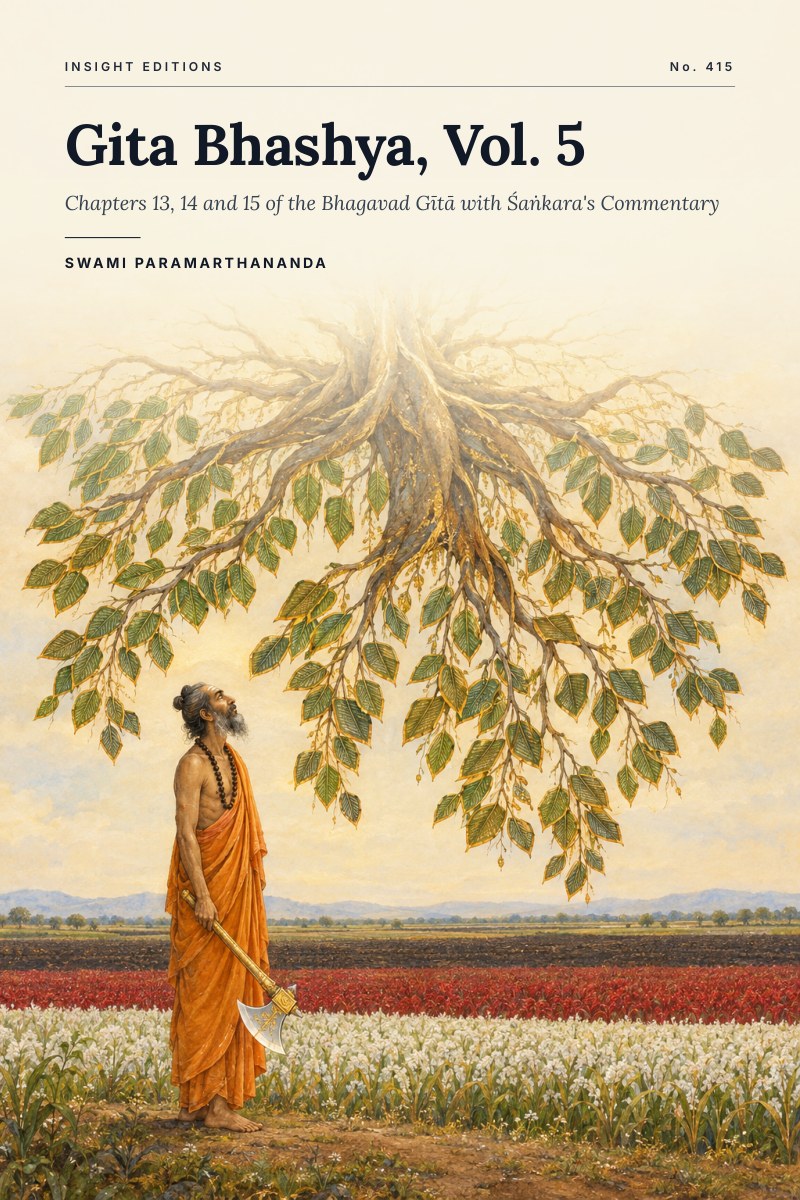
Chapter 15 opens with the world as an upside-down aśvattha tree, to be cut with the axe of detachment sharpened on discrimination. It follows the jīva carrying its subtle body from life to life, names the Lord as the light in sun, moon and fire and the fire of digestion, and ends with Puruṣottama, the supreme Person beyond the perishable and the imperishable.
Two threads run through the volume. The first is Śaṅkara's method: superimpose, then withdraw (adhyāropa-apavāda), and reveal the subject by negating every object. The second is a steady argument with rival schools: Nyāya, Sāṅkhya, Mīmāṁsā, Viśiṣṭādvaita and the combination of knowledge with ritual. The edition keeps both visible, and marks where commentary pushes against the plain sense.
| Ch | Title | Payload |
|---|---|---|
| 1 | Entering the Last Ṣaṭka | Subject and object; two prakṛtis |
| 2 | The Great Debate | 13.2 as mahāvākya; superimposed saṁsāra |
| 3 | The Knower Has No Business with Ritual | Against samuccaya; claim, don't become |
| 4 | Where Does Ignorance Live? | Avidyā is an object; figurative knower |
| 5 | Six Topics and an Inventory of the Field | Is consciousness matter? |
| 6 | Twenty Values Called "Knowledge" | Editing rāga-dveṣa; finite mourning |
| 7 | "Neither Being nor Non-Being" | Negation as revelation; why words fail |
| 8 | Hands Everywhere, Hands Nowhere | Adhyāropa-apavāda; inside and outside |
| 9 | Prakṛti and Puruṣa | Causeless causes; double adhyāsa |
| 10 | The Witness, the Sustainer, and Karma | Three karmas and the arrow |
| 11 | Many Doors to One Knowledge | Yogas by capacity; two-stage knowledge |
| 12 | One Self in All | Three Rs; space and sun |
| 13 | The Three Guṇas | Ornament and stain; "I am happy" |
| 14 | How the Guṇas Bind | Reflected joy; destinies |
| 15 | Beyond the Guṇas | Primary and mental liberation |
| 16 | The Upside-Down Tree | Axe of detachment; prapatti plus inquiry |
| 17 | The Traveller, the Light, the Supreme Person | Samādhāna; Puruṣottama |
Entering the Last Ṣaṭka: Field and Knower
Chapter 13 opens the third block of the Gītā, the "asi" of tat tvam asi. Śaṅkara's introduction recalls the two prakṛtis of Chapter 7, and verse 1 takes the first step of all Vedānta: separating the subject from the object. Paramarthananda frames the chapter as a two-step proof that the individual is the Lord.
Madhusūdana's tribute
Before the bhāṣya, Paramarthananda pauses on Madhusūdana Sarasvatī, whose Gītā commentary, the Gūḍhārtha-dīpikā, is so dense it needed its own commentary. Author of Advaita-siddhi, the classic defence of Advaita against the Dvaita critic Vyāsatīrtha, he was also "a great Kṛṣṇa bhakta", writing dhyāna verses before key chapters: "I do not know any truth greater than Lord Kṛṣṇa."
Two prakṛtis make one cause
Śaṅkara's introduction: Chapter 7 named the Lord's higher nature (parā, consciousness) and lower nature (aparā, matter). Only their combination makes the Lord a cause.
| Prakṛti | Status | Alone, it can... |
|---|---|---|
| Parā (consciousness, kṣetrajña) | Pāramārthika, absolutely real | Never be the cause of the world |
| Aparā (matter, kṣetra) | Vyāvahārika, empirically real | "Cannot even exist; where is the question of becoming cause?" |
| Combined | Satya and anṛta mixed | "Only by combining satya and mithyā the very creation itself starts" |
Verse 1: this body is the field
"This body is called the field (kṣetra); one who knows it, the knowers call the knower of the field (kṣetrajña)." The body is the object of experience; consciousness is the subject.
Who is the knower? Pure consciousness (cit) does not "know" in the ordinary sense, and the reflected consciousness in the mind (cidābhāsa) never exists apart from it. "The mixture alone is the knower of the body." Context decides which part we mean: when we say the jīva travels after death, only the reflected part travels; when we say the jīva is Brahman, only the original part is meant.
The desire to reach God
The second line says this knowledge is not optional; it alone liberates. Paramarthananda draws a sharp corollary.
Initially we glorify the desire to reach the Lord; but after Vedāntic study the desire to reach the Lord is condemned, because the desire reveals our foolishness. The desire to reach God is the crystallised form of ignorance. But don't tell this outside.
Swami ParamarthanandaHe adds at once: pūjā is not condemned. "Initially it is ok; later the same pūjā should be done" with a different understanding, as gratitude rather than seeking.
A loose end from Chapter 12
He also completes a promise from the previous volume: the smṛti behind "aniketa" (homeless) in 12.19. Ānandagiri quotes a verse describing one free of attachment to wall, water, clothing, pond, house, seat and food: "he alone is the knower of liberation."
Vedānta begins by subtracting the body from "I", and ends by equating what remains with God.
"The desire for God is ignorance" can be heard as contempt for devotion. Paramarthananda's remark is meant for advanced students, which is why he asks them not to repeat it outside. Taken out of the classroom, it can sound like Advaita looking down on the devotional life that the previous chapter praised. The fairer reading is that longing is a stage that knowledge completes, not an error to mock, and the rest of the volume largely keeps to that.
The Great Debate: Is the Jīva Really God?
"Know me also as the knower of the field in all fields." Śaṅkara treats 13.2 as a mahāvākya, the Gītā's own "you are that", and then spends one of his longest passages defending it. For nineteen classes Paramarthananda walks students through the objections and replies. This chapter covers the first round.
The mahāvākya
Kṣetrajña means the jīvātmā; mām means the Paramātmā. But "jīvātmā" here excludes all three bodies; it is only the witness consciousness that lights them up. This trimming is bhāga-tyāga-lakṣaṇā: drop the incompatible part of each word's meaning and equate the rest.
Four objections
The opponent (pūrva-pakṣī) says identity is opposed to every means of knowledge.
| Objection | The opponent's evidence |
|---|---|
| Perception | "No jīva can claim I am free": the maid doesn't come, the driver takes leave, back pain, front pain |
| Inference | Varied joy and sorrow imply merit and demerit, so a real bound agent |
| Scripture | Śruti itself describes the jīva as bound and the Lord as free |
| Redundancy | If the jīva is already the free Lord, the mokṣa-śāstra is useless |
The reply: superimposed saṁsāra
Śaṅkara accepts that the jīva has saṁsāra and that śāstra is needed. The difference is what kind of saṁsāra.
The stump and the man. At dusk a tree stump is mistaken for a person. The mistake does not make the stump a person, nor give the person the stump's stillness. "Because of superimposition, the attributes of one cannot belong to the other." So joy and sorrow, which belong to the mind, are wrongly felt as the Self's.
"Imaginary saṁsāra is not imaginary for the imagining person"; at the time of imagining it is real, and so needs a real remedy: knowledge.
Borrowed, not intrinsic
Heat is intrinsic to fire and so permanent; the heat of water is borrowed, which is why we need a flask. Joy, sorrow and confusion come and go, even within one waking day. What arrives and departs is borrowed from the mind, not the Self's nature.
The boomerang
The opponent, a dualist, says his system gives śāstra "a bigger job" because bondage is real. Śaṅkara turns it back: if bondage is real and beginningless, how can it end? And if it began, say "in 2000", then there was freedom before, and freedom can be lost again. "The objection accepted by all believers in a Self need not be answered by one alone."
Three categories, not two. "The biggest problem with all the pūrva-pakṣīs is they do not have the concept of mithyā." Other systems know only existent and non-existent; Advaita adds the seemingly existent. Negating the world's reality is then heard as calling it nothing.
Bondage is real enough to need a cure, and unreal enough to be cured by knowledge.
The debate is with a constructed opponent. The pūrva-pakṣī here mixes positions from Nyāya, Mīmāṁsā and later theism, and is given exactly the objections Advaita is ready for. Real dualist schools, such as Madhva's, answer that the experience of bondage and the śruti passages on difference should be taken at face value, and that "mithyā" is a category invented to save the theory. The reply is strong within Advaita's terms; whether those terms are granted is the actual dispute.
The Knower Has No Business with Ritual
The debate turns practical. If the Self is never a doer, what is the knower's relation to the Vedic rituals? Śaṅkara uses the mahāvākya to reject jñāna-karma-samuccaya, the view that knowledge must be combined with ritual for liberation, and Paramarthananda draws out what it means for a knower's daily life.
The knower as akartā
A jñānī sees himself as different from cause and effect: from merit and demerit and from the body they produce. "I have absolutely no relationship with past karma, present karma, or future karma." He is nitya-akartā, never a doer.
Devadatta's instruction. When a master tells Devadatta, "you do this", Viṣṇumitra standing nearby does not think he has been ordered. An instruction reaches only the one who identifies with its addressee. The Vedic command "perform this ritual" likewise reaches only one who takes himself as a doer.
Ritual weakens knowledge
"Karma-anuṣṭhāna can only weaken jñāna; nididhyāsana alone can strengthen it." In ritual "I have to go on assuming I am a doer", which contradicts what the knower knows. The knower's life should be nididhyāsana-pradhāna.
Three groups
Paramarthananda says the debate is confused because both sides use "jñānī" differently. Śaṅkara resolves it with three groups.
| Group | Believes | Karma-kāṇḍa relevant? |
|---|---|---|
| Dehātma-vādī (body is the Self) | No heaven, no rebirth; a nāstika | No: he rejects it |
| Jīvātma-vādī (a Self distinct from body, a doer) | Rebirth, merit, heaven | Yes: this is the opponent's "jñānī" |
| Brahmātma-vādī (I am Brahman) | All of it, but knows himself as non-doer | No: it cannot reach him |
Won't others stop ritual too?
No. People are governed by their own rāga and dveṣa, not by the knower's example. "Na ca vivekinam anuvartante mūḍhāḥ": the deluded do not follow the discerning. Ānandagiri reads "svabhāva" here as ignorance, which keeps people acting.
Two options for the knower
Meditation is not transformation
Paramarthananda's warning to his own students: "I, the saṁsārī jīva, should meditate on the asaṁsārī witness, and gradually become it." "If it looks right to you, you are the pūrva-pakṣī." Becoming by a process would make liberation a karma-phala, a product, and so impermanent.
Claim, don't become. Mokṣa is not a modification (vikāra) produced by meditation. Meditation only removes the obstacles to owning what one already is: "I am the asaṁsārī kṣetrajña" is a recognition, not a destination.
A command reaches only the one who thinks he is its addressee; the knower is not.
Most Gītā readers think the knower keeps acting. Kṛṣṇa repeatedly urges Arjuna, who is presented as learning this knowledge, to act, and 3.20 cites Janaka as reaching perfection through action. Śaṅkara accommodates this as "action for lokasaṅgraha by one whose prārabdha prevents saṁnyāsa", but the default he prefers is renunciation. Rāmānuja, Tilak and the samuccaya-vādins read the same verses as requiring knowledge and action together, and this disagreement runs through the whole history of Gītā interpretation.
Where Does Ignorance Live?
The last round of the 13.2 debate asks a sharp question: if the Self is free, who is ignorant? The opponent says ignorance must belong to the jīvātmā, so the jīva cannot equal the ignorance-free Lord. Śaṅkara's answer, that ignorance is an object, never the subject's property, leads Paramarthananda into a technical aside on the locus of avidyā and a summary of the whole debate.
Ignorance is seen, so it is not the seer's
Earlier Śaṅkara gave four reasons; here he leans on one, avidyāyāḥ dṛśyatvāt: ignorance is experienced.
"He does not bother whether you put avidyā in the antaḥkaraṇa or elsewhere; you can put avidyā anywhere, including the neighbour's compound." The point is only to keep it off the Self.
Attribute and substance
Ignorance is an attribute: it cannot exist alone. If an attribute is experienced, its substance is experienced too, since they cannot be separated. So you already know where your ignorance is: in the mind, which you also experience.
Three forms of ignorance. Śaṅkara lists avidyā as non-apprehension (agrahaṇa), misapprehension (viparīta-grahaṇa) and doubt (saṁśaya). Like a cataract, they are defects of the instrument. "After treatment of the eye, the defect is not found in the seer."
An aside: Sureśvara's question
Students of Sureśvara's Naiṣkarmya-siddhi may recall a page asking where avidyā is located, and Advaita tradition often places it in Brahman (or the jīva), not the mind. Paramarthananda takes up the apparent conflict.
| Context | Locus of avidyā | Why |
|---|---|---|
| Here (Śaṅkara, Gītā 13.2) | The mind, an anātmā | To show the witness is untouched |
| Naiṣkarmya-siddhi and later Advaita | Discussed as Brahman or jīva | A technical question about the ignorance prior to the mind |
| Paramarthananda's resolution | Both are teaching devices | "Those who did not attend the class are fortunate; they will not get this doubt" |
The knower who does not act
Even calling the witness a "knower" seems to make it an agent. Śaṅkara: its knowerhood is aupacārika, figurative.
Fire burns paper. The fire does nothing to "be a burner"; in its presence paper burns, and we give it the title. So in the witness's presence thoughts are lit, and we call it the knower. Its knowing is "knowing without the action of knowing", and it stays nitya, śuddha, asaṁsārī.
Summary of the debate
Class 391 rebuilds the argument from the top. The key step:
Ignorance is something I see; it cannot be what I am.
The locus problem is not fully settled. Saying ignorance belongs to the mind, while the mind itself is a product of ignorance, invites circularity: what was ignorant before there was a mind? Later Advaitins split on this (the Bhāmatī school locates it in the jīva, the Vivaraṇa school in Brahman), and critics from Rāmānuja onward have called it the system's weakest point. Paramarthananda's "both are teaching devices" is a pedagogical answer rather than a solution.
Six Topics and an Inventory of the Field
With the mahāvākya defended, Kṛṣṇa announces the chapter's six topics and begins listing the contents of the field. Paramarthananda pauses on a question science still asks, what consciousness is, and on the surprising claim that desire, hatred and even consciousness-in-the-mind belong to the field, not the Self.
A missing verse
The verse many editions print first, Arjuna asking about "prakṛti and puruṣa, field and knower, knowledge and the known", does not appear in Śaṅkara's text. So his numbering runs one behind the popular one, and 13.3 becomes the chapter's table of contents.
| Topic in 13.3 | Where taught |
|---|---|
| What the field is | 13.5–6 |
| Its nature | 13.6 |
| Its modifications | 13.6 |
| Its origin | 13.26 |
| Who the knower is | 13.12–17 |
| His glory | 13.12 onward |
Taught distinctly by the Vedas
13.4: this has been sung by sages "in many ways" and distinctly (pṛthak) in the Vedas. Śaṅkara glosses "distinctly" as with discrimination, and Paramarthananda calls it the crux.
Four questions about consciousness. "Is consciousness matter, a part of matter, a product of matter, or a property of matter? These four are the only questions." Vedānta answers no to all four. Other systems, even Nyāya and Vaiśeṣika, cannot fully separate consciousness from matter; that separation is "the message other than Advaita nobody is able to give".
The field's twenty-four
13.5 lists the field's components; Śaṅkara links them to the eightfold prakṛti of 7.4.
Avyakta, the unmanifest, is the Lord's māyā-śakti. "Any śakti is non-separate from the śakta": you can't send your hearing power away and go on sleeping.
Desire belongs to the mind
Śaṅkara defines desire as the wish to get an object again "with the thought: this will make me happy". Sometimes it disappoints, like a sapota that is sweet one day and bitter the next.
Nyāya against Kṛṣṇa. Tarka-śāstra lists desire as an attribute of the Self. Kṛṣṇa lists it in the field. The Bṛhadāraṇyaka agrees: "desire, resolve, doubt, faith, lack of faith, steadiness, shame, intelligence, fear: all this is mind." Since they are known, they are objects.
Even cetanā, consciousness as it shows up in the mind, is part of the field: the reflected light, not the source. And 13.7 hands over to the knower and its glory, which Kṛṣṇa will teach from 13.12 under a new name, jñeya, "that to be known". Here, unusually, jñeya means the Self.
Whatever I can list, including my desires and my mind's sentience, belongs to the field.
The list is ancient Sāṅkhya, not a finding. The twenty-four components are borrowed from Sāṅkhya cosmology, and the claim that consciousness is not matter or any product of matter is asserted from scripture and introspection, not argued against the physicalist alternatives Paramarthananda himself mentions. That consciousness is irreducible remains a live and serious position in philosophy of mind, but readers should see that here it rests on śruti, not on an answer to neuroscience.
Twenty Values Called "Knowledge"
Verses 7 to 11 list twenty values, from humility to the vision of the goal, and Kṛṣṇa calls the whole list jñāna, "knowledge". Śaṅkara explains the name: they are the means to knowledge, and their opposites are "ignorance". Paramarthananda turns the list into a practical training of the emotions.
The list
| Group | Values |
|---|---|
| Toward others | Amānitva (humility), adambhitva (unpretentiousness), ahiṁsā, kṣānti (forbearance), ārjava (straightforwardness) |
| Discipline | Service of the teacher, purity, steadiness, self-control, dispassion toward sense objects, absence of ego |
| Reflection | Seeing the defects in birth, death, old age, disease and pain |
| Relationships | Non-attachment; no excessive identification with son, wife, home; even mind in desirable and undesirable |
| Orientation | Unswerving devotion; love of solitude; no taste for crowds; constancy in Self-knowledge; seeing the goal of knowledge |
Filter before you express
Rāga and dveṣa will arise; a human being, unlike an animal, must edit them. Before a thought becomes word or act, ask: is it dhārmic? and even if so, does it help or stunt spiritual growth? This echoes 3.34: "rāga and dveṣa sit in every sense object; don't come under their control."
Doṣa-darśana and guṇa-darśana
Seeing defects is a tool, not pessimism.
Attachment and the mourning period
Excessive identification is "when the other is happy, I am happy; when the other is dead, I feel I am a moving dead body." It cannot be removed at once, but its intensity can be reduced and the mourning period can be finite.
State mourning. Even the government declares seven days, three days or one day of mourning by rank. "You can extend the mourning period but there is no question of lifelong mourning." Each jīva has its own prārabdha and journey; as the Vivekacūḍāmaṇi says, a son can carry his father's load, but not eat for his hungry father.
Solitude
"In secluded places the mind becomes clear." Paramarthananda links this to reduced PORT (his acronym for possessions, obligations, relations, transactions).
Why camps feel good. People at Vedānta camps "say they enjoy, whether they understand the class or not, because they are away from all worldly transactions": a bell rings, food arrives. The lesson is not to flee, but to build periods of withdrawal (uparati) into ordinary life.
Why call values "knowledge"?
Because they are means to it, named after their result. The twenty opposites, arrogance, pretence, violence, are "ignorance" in the same figurative sense.
Values are called knowledge because without them knowledge has no ground to stand on.
Some values sit oddly with modern ethics. Distaste for crowds, constant reflection on old age and disease, and loosening ties to "son, wife, home" are framed for a seeker heading toward renunciation, and a householder may find them cold. The list also places the service of the teacher among core virtues, which in practice has sometimes enabled abuse of authority. Paramarthananda's applications (finite mourning, editing reactions) are humane, but they soften rather than question the original orientation.
"Neither Being nor Non-Being": Revealing What Words Cannot
13.12 introduces the jñeya, "that which is to be known, knowing which one gains immortality": the beginningless supreme Brahman, "said to be neither sat nor asat". Śaṅkara and Paramarthananda use the verse to explain how scripture can point to something no word can name.
A grammar dispute
Śaṅkara splits "anādimat param" as anādimat (beginningless) + param (the absolute), meaning Brahman. "Some" split it as anādi + mat-param, "having me as the highest", reading a devotional hierarchy into it.
| Reading | Words | Śaṅkara's verdict |
|---|---|---|
| Śaṅkara | anādimat + param | Brahman is beginningless and absolute |
| "Some" (kecit) | anādi + mat-param | Rejected: "-mat" would be redundant after "anādi", and the verse is about the unconditioned |
Negation as revelation
"Neither existent nor non-existent." Śaṅkara says these words negate every object, past, present and future. What is left is not nothing, but the subject.
Niṣedha-mukha-pramāṇa. Revealing the truth indirectly "by negating everything that is non-truth". The method is needed because the subject cannot be revealed through any means of knowledge: anything so revealed becomes an object, and Brahman is apprameya.
"Every day we are negating the body-mind complex and continuing to exist": in deep sleep, as the Dakṣiṇāmūrti Stotra says, the person remains as pure existence, like the sun during an eclipse.
Why words fail
Śaṅkara borrows from Nyāya the conditions under which a word can denote anything.
Brahman has no class (it is one), no action (it is changeless), no quality (it is attributeless), no relation (it is non-dual). So it is never śabda-vācya, directly denoted; it is only śabda-lakṣya, indicated.
Seemingly beautiful. Asked if there is difference between jīva and Brahman, "never say there is difference; never say there is no difference; always answer, there is seeming difference." If someone calls you "seemingly beautiful", you know at once what it means.
Brahman cannot be named, only pointed to by removing everything that can.
Negation can prove too much. If every describable thing is negated, critics ask how anyone knows that what remains is consciousness, bliss or anything at all, rather than a blank. Advaita answers that the negator is self-evident and cannot be denied without being used. That is a strong point, but it rests on equating the residue of negation with the ātmā of the Upaniṣads, a step that Buddhist and dualist critics have both disputed for centuries.
Hands Everywhere, Hands Nowhere
Having denied Brahman every attribute, Kṛṣṇa now gives it all of them: "hands and feet everywhere, eyes, heads and faces everywhere". Then: "appearing to have all senses, without any sense". Śaṅkara explains the reversal by adhyāropa-apavāda, the teaching method of the whole tradition.
The disposable cup
Adhyāropa-apavāda. First attribute something to Brahman temporarily (adhyāropa), to point it out. Then withdraw the attribution (apavāda). Paramarthananda: "Introduce a disposable cup, pour coffee, drink coffee, and thereafter dispose the cup. Why dispose? Because it is called a disposable cup."
Mahā-kṣetrajña
13.13 describes Brahman as the mahā-kṣetrajña, the knower of all fields. Its "bodies" are countless, so it has hands and feet everywhere: this is the viśva-rūpa of Chapter 11, now explained.
Three positions on the world and Brahman
Paramarthananda uses 13.14 to separate the schools.
| View | The world is... | Reality of the world |
|---|---|---|
| Viśiṣṭādvaita | An integral part of Brahman | Same order of reality |
| Nirviśeṣa Advaita | Associated with Brahman | Lower order: mithyā |
| Resolution | Experientially present, factually absent | "Jagat mithyā; its ground, consciousness, Brahman alone is satya" |
Footless but swift
The opponent cites Śvetāśvatara 3.19: "without feet, swift; without hands, it grasps; eyeless, it sees". So the Self acts without instruments. Śaṅkara: the Self only takes the reflection of action. As the field reflects consciousness, the Self reflects the field's activity and appears a doer.
Inside and outside
"Outside and inside all beings." Śaṅkara: "inside" and "outside" need a reference point, here the body.
From what standpoint? "When I say you are all inside, I am keeping the hall in mind. If I keep the stage as the reference point, you are outside." Asked whether Brahman is inside or outside, "do not answer; ask: from what standpoint?"
Undivided, as though divided
13.16: "undivided, yet as though divided among beings." Space is one, though we call pot-space and room-space big or small. One Paramātmā appears as many jīvas with distinct labels: virtuous, sinner, happy, sad. The "as though" (iva) "is very, very important for Advaitins."
Values are already in you
Why does Śaṅkara call amānitva and the other values "knowledge"? Because they are the heart's nature, blocked by five obstacles: ignorance, ego, possessiveness, rāga and dveṣa. "Dilute them and you will find all these virtues naturally come." Paramarthananda calls this a teacher's strategy: "To generate confidence in the minds of the students."
Every attribute given to Brahman is a disposable cup: use it, then let it go.
"Disposable" teaching makes any text say anything. If the tradition can affirm attributes when useful and negate them later, a critic may ask what claim a verse could ever make that Advaita would have to reject. Śaṅkara's defenders reply that the negation is itself scriptural ("neti neti"). But the method gives the commentator wide control over which statements are final, and readers from Viśiṣṭādvaita see 13.13 as a plain statement that the world is Brahman's body.
Prakṛti and Puruṣa: Two Causeless Causes
Kṛṣṇa now names the two components of Īśvara again, as prakṛti and puruṣa, both beginningless. From prakṛti come all products and the three guṇas; puruṣa is the experiencer. Verse 21, Paramarthananda says, holds the whole of Śaṅkara's famous adhyāsa-bhāṣya in seed form: how saṁsāra arises from a double mistake.
Back to Chapter 7
Śaṅkara links the pair to the two prakṛtis of 7.4–6: lower (aparā) is the field, higher (parā) is the knower. "Their mixture alone is called Īśvara, and from Īśvara the entire universe has evolved."
Only a cause, never an effect
In the world everything is both cause and effect. Water causes earth but is itself an effect of fire; parents are causes for us and effects of their own parents. Brahman and māyā are kevala-kāraṇa: causes only, so beginningless.
| Puruṣa | Prakṛti | |
|---|---|---|
| Change | Changeless (nirvikāra) | Changing |
| Attributes | None (nirguṇa) | With the three guṇas |
| Division | Undivided | Full of potential divisions |
| Existence | Its own | Borrowed from puruṣa (unlike in Sāṅkhya) |
The three guṇas show up as feelings
Where do sattva, rajas and tamas appear? In the subtle body, especially the mind.
Śaṅkara has to explain why 13.20 mentions the "instruments" but not the guṇas of 13.19. Paramarthananda: "All these are Śaṅkara's problems. We will not have problems, because by the time we come to verse 20, for us verse 19 does not exist: we live in the present."
When does saṁsāra begin?
Before creation, puruṣa is not yet an enjoyer and prakṛti not yet enjoyed. After creation, the changeless experiencer meets a changing world, and the relation of bhoktā and bhogya brings saṁsāra. The continuous "I" through childhood, youth and age, and through waking, dream and sleep, is that changeless witness (Dakṣiṇāmūrti Stotra 8).
The double mistake
Experiences do not cause saṁsāra. Mis-identification does.
Together they are guṇa-saṅga, attachment to the guṇas, which 13.22 names as the cause of birth "in good and bad wombs". "The entire adhyāsa-bhāṣya of the Brahma-sūtra is an extract of this very profound verse."
A simpler version. "Taking the mind as myself, and taking the emotions as mine": that sentence is the diagnosis. The cure is not to stop the mind or the emotions, but to stop owning them.
Saṁsāra is not caused by experience, but by taking the mind as myself and its moods as mine.
Advaita borrows Sāṅkhya's vocabulary and reverses its meaning. In Sāṅkhya, prakṛti and puruṣa are two independent realities. Here prakṛti has only borrowed existence, and the two are aspects of one Īśvara. This makes the Gītā's language fit Advaita, but the verses themselves use the Sāṅkhya terms without that qualification, and many scholars think the Gītā is closer to a theistic Sāṅkhya than to either school. Readers should know the reinterpretation is the commentator's.
The Witness, the Sustainer, and the Burning of Karma
Verse 22 describes the supreme puruṣa in the body with five titles, from witness to the supreme Lord. Verse 23 promises that one who knows puruṣa and prakṛti "is not born again, however he lives". Śaṅkara uses the second to settle a long debate on which karmas knowledge destroys.
Five titles of the puruṣa (13.22)
| Title | Meaning (Śaṅkara) |
|---|---|
| Upadraṣṭā | The intimate witness: "ear of the ear, eye of the eye" (Kena) |
| Anumantā | The approver, who never obstructs |
| Bhartā | The sustainer |
| Bhoktā | The experiencer |
| Maheśvara, Paramātmā | The great Lord, the supreme Self |
Seeing without the act of seeing
The witness lends reflected consciousness to the mind, which then becomes an experiencing mind. But it "perceives without doing the action of perceiving", by mere presence (sānnidhya-mātra).
The onlooker at the yāga. In a great Vedic sacrifice, the patron and sixteen priests are "turning like a top". One person watches the whole ritual without participating (taṭastha). He does nothing, yet he sees everything. So the witness, near the body-mind, reveals all its activity without itself acting.
Bhartā: the lender of existence
Puruṣa sustains prakṛti by its presence alone, lending it existence and consciousness. Paramarthananda's analogy: the traditional husband as bhartā, sustaining, and wife as bhāryā ("I am talking of the original tradition; I do not know whether it is happening now"). In Vedānta, unlike Sāṅkhya, prakṛti has no existence of its own.
Verse 23: knowledge ends rebirth
The knower understands prakṛti as avidyā "along with its guṇas", and Śaṅkara reads guṇas here as its products: the whole cosmos. "Na puṇya-pāpe mama, na nāśaḥ, na janma" (Kaivalya 22): for me there is no merit, no sin, no death, no birth.
Which karmas burn?
The opponent objects in two ways.
| Objection | Śaṅkara's reply |
|---|---|
| Knowledge can only affect post-knowledge karma, not past | Śruti says "all karmas" (sarva-karmāṇi); the word is decisive |
| Sañcita and prārabdha are both born of ignorance; either both go or neither | Prārabdha has begun its effect, like an arrow already shot; it must run its course |
The released arrow. Śaṅkara's example (also, Paramarthananda adds, a fan that keeps turning after the switch is off): an archer can hold back the arrows still in the quiver (sañcita) and refrain from new ones (āgāmi), but the arrow already released (prārabdha) will travel until its force is spent. The knower's body continues until prārabdha ends, with no new birth.
Knowledge does not stop the arrow in flight; it empties the quiver.
"However he lives" is a dangerous phrase. 13.23 says the knower is not reborn "sarvathā vartamāno'pi", however he conducts himself. Śaṅkara and Paramarthananda assume a knower will be ethical by nature. But the phrase has been used to excuse misconduct by people claiming realisation, and the theory that prārabdha "must run its course" can make a teacher's lapses look inevitable. The safeguard is the twenty values of 13.7–11, which the tradition treats as the marks of real knowledge.
Many Doors to One Knowledge
Verses 24 and 25 list ways people reach the Self: some by meditation, some by sāṅkhya (study), some by karma-yoga, and some, not knowing these, by hearing from others. Śaṅkara comments without resolving the apparent pluralism; later commentators do, and Paramarthananda builds a scheme by student capacity. Then 13.26–27 explain how field and knower are related, and what knowledge has to do.
One means, many preparations
Read literally, 13.24 says knowledge comes by three alternative paths. Śaṅkara "does not resolve this confusion". Madhusūdana, Ānandagiri, Rāmarāya Kavi and Dhanapati Sūri do: knowledge has one means, the teaching; the yogas prepare for it.
Read the Gītā by the Veda. "Whenever there is a confusion in a particular Gītā verse, resolve it with the help of śruti, yukti and anubhava": scripture, reasoning and experience. A Gītā verse that seems to differ from the Veda is interpreted to agree with it.
Matching the yoga to the student
| Adhikārī | Practice | Sequence |
|---|---|---|
| Manda (slower) | All three yogas | Karma-yoga, then sāṅkhya (śravaṇa, manana), then dhyāna (nididhyāsana) |
| Madhyama (middle) | Two yogas | Sāṅkhya, then dhyāna |
| Uttama (best) | One yoga | Sāṅkhya alone if fully qualified; dhyāna alone for a "spiritual prodigy" with knowledge from a past life |
| Mandatara (13.25) | Hearing from others | Need not read the original texts, but systematic study of their message is compulsory |
"This is not relevant for us because we are not manda-adhikārīs, I suppose." He adds a Tamil word: nappāśai, wishful thinking.
How are field and knower related?
13.26: whatever is born arises from the union of field and knower. What kind of union?
Wrong knob, wrong medicine
"If you don't diagnose the problem, you will turn the wrong knob, and lifelong you will handle the wrong knob and complain to God that nothing happens." Saṁsāra is non-discrimination (aviveka); the cure is discrimination, which is why the chapter is titled kṣetra-kṣetrajña-vibhāga.
Knowledge in two stages
The four culprits. Paramarthananda's "duṣṭa-catuṣṭaya": ego, possessiveness, attachment, aversion. They come from "claiming the wrong component of me". Separation does not destroy them by force; it removes their owner.
Saṁsāra is a mix-up, so the remedy is not effort but discrimination.
The one-means thesis overrides the verse. 13.24 plainly lists meditation, study and karma-yoga as ways people see the Self. Śaṅkara left it at that; it was later Advaitins who reduced them to preparations for a single means. Paramarthananda openly calls this resolving the verse "according to the Veda", which is honest, but it means the scheme above is tradition's harmonisation, and other schools take the verse as genuinely pluralist.
One Self in All, Untouched Like Space
The chapter's final verses describe the knower's vision: the same Lord in all beings, the Self as non-doer, untouched in the body "like space", illuminating the field "like the one sun". The commentary defends the claim that there is one Self against a crowd of rival schools.
Doesn't everyone see the Self?
13.27–28: "he who sees the supreme Lord equally present in all... sees." The opponent objects that everyone already knows the Self: the meaning of the word "I" is the Self, and it is self-luminous. Why credit only the knower?
| Everyone sees | Only the knower sees |
|---|---|
| A jīvātmā in each body | One Self in all |
| A doer and enjoyer | A non-doer, non-enjoyer |
| Many Selves | The same Self |
Does the ignorant destroy himself?
"He does not destroy the Self by the self." The opponent says no ajñānī wants self-destruction: "the entire life is: somehow I want to save myself." Śaṅkara: the ignorant do destroy the Self, by overlooking it. Taking the body as oneself is like killing the real Self and living as another.
The schools that "goofed"
"All the people goofed in one thing or the other."
The three Rs
13.30: when one sees all beings resting in the One and spreading out from it, one becomes Brahman. Paramarthananda's formula: the anātmā "Rises from me, Rests in me, and Resolves into me".
Cause and effect. "Kāraṇa-rūpeṇa ahaṁ satyam; kārya-rūpeṇa kṣetraṁ mithyā": as the cause I am real; as the effect the field is mithyā. "Satya cannot be disturbed by mithyā."
"In the body" without location
13.31: though in the body, the Self "neither acts nor is tainted". Śaṅkara refuses the literal "residing in the body", since location means limitation. Śarīrastha means "available in the body", as consciousness is recognised there.
Saṁsārī and asaṁsārī
The final objection comes from all sides: "Like Abhimanyu, Advaita has to face so many rivals." Is the one Self bound or free? Advaita "coolly answers": the same Self is both, from different perspectives, bound as identified with the field, free in its own nature. Kṛṣṇa ends: those who know the distinction of field and knower with the eye of knowledge "go to the supreme".
Space holds everything and is stained by nothing; so does the Self.
One Self raises the problem of many minds. If there is only one Self, why does liberation of one person not liberate all, and why is my pain not yours? Advaita answers that bondage and freedom belong to the reflected self in each mind, not the original. Critics from Rāmānuja to modern philosophers find this explains the appearance of many selves at the cost of making individual liberation hard to state coherently. "Different perspectives" is a real answer only if the perspectives themselves can be accounted for.
The Three Guṇas: Chapter 14 Begins
Chapter 14, guṇa-traya-vibhāga-yoga, expands one phrase from 13.21: "attachment to the guṇas is the cause of birth". Śaṅkara gives two introductions, Paramarthananda adds a third, and the chapter's practical thesis is stated early: use the guṇas to transcend the guṇas.
Three introductions
| Introduction | Chapter 14 explains... |
|---|---|
| Śaṅkara 1 | How each guṇa binds: sattva makes us knowers chasing knowledge, rajas makes us doers chasing action |
| Śaṅkara 2 | How field and knower, dependent on Īśvara, cause the world |
| Paramarthananda's | The two kinds of union of field and knower |
Ornament and stain. "At macro level the union of field and knower is bhūṣaṇa, an ornament": it is how Īśvara creates (13.26). "At micro level the same union is dūṣaṇa, a defilement": the individual's confusion of spirit and matter (13.21). "I have never talked about this before. You can meditate on it."
Verse 2: attaining "my nature"
Those who take refuge in this knowledge attain sādharmya, "sameness of nature" with the Lord. Śaṅkara refuses to translate it as similarity, because similarity keeps two things. "Kṛṣṇa does not want to accept difference between jīvātmā and Paramātmā." The evidence: 13.2, "the mahāvākya verse, for which we took nineteen classes".
Verses 3–4: the Lord as father
"My womb is the great Brahman (prakṛti); in it I place the seed." Paramarthananda describes creation's timing: during pralaya, sañcita karmas are not ready; when a portion of them ripens across all jīvas, Īśvara makes a saṅkalpa: "may I be many" (Taittirīya), "he saw" (Aitareya). The thought arises in māyā, the mind of the Lord.
Verse 5: the guṇas bind
"Sattva, rajas, tamas, born of prakṛti, bind the imperishable embodied one to the body." Śaṅkara clarifies: "guṇa" here is a technical term, not a quality inhering in a substance; and no difference between guṇa and possessor is intended.
Bind or free. Paramarthananda's gloss: the guṇas "bind the unintelligent person; they liberate the intelligent person." "The best employment of the three guṇas is using them to transcend the three guṇas and discover that I am guṇātīta."
Verse 6: even sattva binds
Sattva is "stainless, luminous, healthy", yet it binds "by attachment to happiness and knowledge".
"Experiencing happiness is ok; concluding 'I am happy' is not ok." It moves the ānandamaya kośa's priya, moda and pramoda onto the subject.
Even sattva binds when its happiness is claimed as mine.
The guṇas are a pre-modern psychology. The three-guṇa scheme is used here to explain everything from moods to rebirth to cosmic creation. It is a useful vocabulary for self-observation, and Paramarthananda uses it that way. But some of its applications, such as the timing of creation by ripening karma, are presented with a confidence the text does not earn, and readers should take them as doctrine, not description.
How the Guṇas Bind, and Where They Lead
Verses 6 to 18 describe the guṇas in detail: what each binds us to, how each dominates by suppressing the others, its signs, and the destination it leads to after death. Verse 19 states the exit: one who sees no doer other than the guṇas attains the Lord's state.
Original and reflected happiness
Paramarthananda returns to an earlier teaching: the happiness sattva gives is reflected (pratibimba-ānanda); the Self's nature is original (bimba-ānanda).
| Reflected happiness | Original happiness | |
|---|---|---|
| Duration | Anitya: comes and goes | Nitya |
| Gradation | Graded (sātiśaya): human, gandharva, deva, Indra | Ungraded (niratiśaya) |
| Experienceable? | Yes: an object | No: it is the subject |
What each guṇa binds to (14.6–9)
Dominance (14.10)
"Sattva rises overpowering rajas and tamas; rajas, overpowering sattva and tamas; tamas, overpowering sattva and rajas." Śaṅkara supplies the missing clause: "when sattva dominates, then it does its function". All three are always present; one leads at a time.
Signs of each (14.11–13)
| Guṇa | Sign |
|---|---|
| Sattva | "Light of knowledge in every gate of the body" |
| Rajas | Greed, activity, undertaking, restlessness, longing |
| Tamas | Darkness, inertia, heedlessness, delusion |
Where they lead (14.14–18)
"Sattva-guṇa leads to sāttvic desires, and sāttvic desires will take you to higher lokas." The fruit of good action is sāttvic and pure; of rajas, pain; of tamas, ignorance.
Mithyā-jñāna is the root. Śaṅkara sums up 14.5–18: the guṇas' nature, their functions, how they bind, and the destiny of one bound by them, "all this rooted in false knowledge", is the cause of bondage. "Now liberation by right vision must be stated." Chapter 14 is an expansion of 13.21.
Verse 19: the exit
"When the seer beholds no agent other than the guṇas, and knows what is beyond them, he attains my being." This echoes 3.27–28: "the guṇas act among the guṇas".
Shift the meaning of "I". We are a mixture of nirguṇa Self and saguṇa non-self, and we identify with the second. "The aim of Vedānta is to learn to shift your identification from saguṇa anātmā to nirguṇa ātmā." Neither component becomes guṇātīta; the Self already is. "Not a Dīpāvali mixture; a spiritual mixture."
The guṇas do everything; the seer who knows this is beyond them.
Rebirth by guṇa can harden into judgment. The scheme that sāttvic people rise, rājasic people stay among the active and tāmasic people fall "into deluded wombs" has historically been mapped onto caste, occupation and even animals, with the low in society read as low in guṇa. Paramarthananda does not do this, and applies the guṇas to inner states. But the verses lend themselves to such use, and a reader should keep the psychological reading separate from claims about other people's births.
Beyond the Guṇas: Two Kinds of Liberation
Arjuna asks the natural questions: what are the signs of one beyond the guṇas, how does he behave, and how does one go beyond? Kṛṣṇa's answer gives Paramarthananda his clearest statement of a distinction that runs through the whole course: primary and secondary liberation.
Verse 20: the Self that is beyond
"When the embodied one goes beyond these three guṇas, the source of the body, he is freed from birth, death, old age and sorrow, and attains immortality."
Verses 21–25: signs of the guṇātīta
He neither hates the guṇas' activity when present nor longs for it when absent; sits "like one indifferent", unshaken; knows "the guṇas are acting" and stays steady; is the same in pain and pleasure, toward clod, stone and gold, praise and blame, honour and dishonour, friend and foe; and renounces every undertaking.
Mental and absolute liberation
"Mental liberation." Paramarthananda's term from a Guru Pūrṇimā talk: not liberation from the mind, but liberation of the mind from emotional disturbance. Scriptures usually describe mokṣa this way because it is "understandable, relatable and attractive: who does not want mental liberation?"
Why both matter
"From the spiritual angle, primary liberation is important; from the empirical angle, secondary liberation is important; from two different angles, both are equally important."
The fear of yatheṣṭācāra. If one neglects the mind as "mere anātmā, mere mithyā", the result can be yatheṣṭācāra, doing as one likes. That is why the tradition rarely taught primary liberation in public, and always emphasised liberation "when the mind follows certain conditions": free from attachment, fear and anger (2.56), the dear devotee (12.13), the guṇātīta (14.23 onward).
Verse 26: how to cross
"He who serves me with unswerving devotion goes beyond the guṇas and is fit for becoming Brahman." The knower does only what maintains the body (bhikṣā, bathing, drinking), as a trustee of the Lord's property. After the infinite, finite results lose appeal: who with a lake of pure water digs a 500-foot borewell? (2.46)
Verse 27: "I am the abode of Brahman"
"I am the pratiṣṭhā of Brahman." Śaṅkara gives several readings. The first, Paramarthananda says, describes the journey of understanding.
The Self needs no liberation; the mind needs it every day.
Two liberations can become two standards. Separating an absolute freedom from a graded mental one is clarifying, and Paramarthananda is careful to give both equal weight. But the distinction can let a claimant say "I am already free as the Self" while the mind shows little equanimity, and the admission that the tradition kept primary liberation from the public "for fear of misconduct" raises a question about candour. The safeguard, again, is that visible equanimity is the test others can actually check.
The Upside-Down Tree and the Axe of Detachment
Chapter 15 opens with an image: the world as an aśvattha tree with roots above and branches below. Arjuna has not asked, but Kṛṣṇa, wanting to teach the nature of the Self directly, begins. The tree must be cut with the axe of detachment, and then one seeks the place from which there is no return.
Why Chapter 15 follows 14
Śaṅkara's introduction: 14.26 said those who serve the Lord with unswerving bhakti-yoga cross the guṇas. That bhakti must be the jijñāsu's, the seeker of knowledge; the distressed and the wealth-seeking devotee do not become guṇātīta. "How much more those who know the truth of the Self": so Kṛṣṇa teaches it, "even unasked".
The tree (15.1–2)
"With its root above and branches below, they speak of the imperishable aśvattha, whose leaves are the Vedas; he who knows it knows the Veda." Śaṅkara calls it the saṁsāra-vṛkṣa: "World is saṁsāra. We don't say the world has saṁsāra."
Why aśvattha? Śaṅkara derives it as "na śvaḥ sthātā", "will not last till tomorrow": always changing. Yet it is called avyaya, imperishable, because the flow is beginningless. Puṇya and pāpa, its flowers, are produced "not by Īśvara, by the jīva": both are anādi, though each jīva's bodies have a beginning.
Secondary roots
Vāsanās are generated by karma-phala-bhoga: pleasant experiences leave rāga, painful ones dveṣa. They are "as though secondary roots", because like roots they sustain and nourish the tree. The Bṛhadāraṇyaka (4.4.2): knowledge, karma and past impressions follow the departing jīva.
Verse 3: cut it
The tree is "firmly rooted", fattened by ego, possessiveness, rāga and dveṣa. Cut it "with the strong axe of non-attachment".
Verse 4: surrender and inquiry
"I take refuge in that primal Person from whom the ancient stream has flowed." Paramarthananda: this is the prapatti or śaraṇāgati of Viśiṣṭādvaita, "which we accept 100%. Only one thing we add: may you do mahāvākya-vicāra." The Person is the indweller as the dahara-ākāśa, the small space in the heart (Chāndogya).
Verses 5–6: the abode beyond lights
"The sun does not illumine it, nor moon, nor fire; going there they do not return: that is my supreme abode." Śaṅkara glosses dhāma as caitanya-rūpa: the abode is consciousness itself, self-shining.
Verse 7: a fragment of me
"A fragment of myself, eternal, becomes the jīva in the world of living beings." "Aṁśa" is "as though": the separation is seeming, so reaching is seeming too, like waking up.
Many definitions of the jīva. Why does Vedānta define the jīva variously (reflection, enclosure)? "Because the jīva is accepted only temporarily. Jīva nāsti, jagat nāsti, sarvaṁ nāsti; Brahma (do not say nāsti) eva asti." Definitions are disposable cups (adhyāropa); all are withdrawn at the end (apavāda).
The world is a tree that will not last till tomorrow; detachment is the axe, discrimination the whetstone.
"Fragment" is the plainest support for difference. 15.7's "my aṁśa, eternal" is the verse Rāmānuja and Madhva cite most: the jīva is an eternal part of the Lord, not identical with the whole. Śaṅkara has to read "aṁśa" as "as though a part", since Brahman is partless. Both readings are defensible; but the word itself favours the theistic schools, and Advaita's "as though" is an interpretive addition.
The Traveller, the Light, and the Supreme Person
The rest of Chapter 15 follows the jīva from body to body, names the Lord as the light in sun, moon and fire and the fire of digestion, and ends with the three puruṣas: the perishable, the imperishable, and the supreme Person beyond both. Śaṅkara reads the last as nirguṇa Brahman, and Kṛṣṇa calls this "the most secret teaching".
Pot-space at death
When a jñānī dies, his karmas are exhausted, so the enclosure (the subtle body) cannot survive. The enclosed consciousness "merges" into the total: "within inverted commas", since there is no movement and no change. When the pot breaks, pot-space merges into total space.
Verses 8–10: the traveller
For the ajñānī, the jīva leaves "taking the senses and mind, as the wind takes scents from their source".
| Carried at death | Count |
|---|---|
| Five sense organs, five organs of action | 10 |
| Five prāṇas | 5 |
| Mind, intellect, memory, ego | 4 |
| Total: the subtle body | 19 |
"Whenever somebody dies, we do not say the indriya is gone; we say the prāṇa is gone." 15.10: "the deluded do not see him; those with the eye of knowledge see."
Verse 11: the qualification that matters
Even striving yogīs see him only if "kṛtātmā", with a prepared mind. Paramarthananda singles out samādhāna among the six disciplines.
Samādhāna, defined. "An un-preoccupied mind, fully available for śravaṇa, manana and nididhyāsana." The whole of aṣṭāṅga-yoga exists for this one qualification. He defines it as "the skill to handle the involuntary thoughts of the mind": they cannot be stopped, any more than breathing, but they can be managed.
Verses 12–15: the Lord as light and nourishment
15.15: "I alone am to be known by all the Vedas, I am the author of Vedānta and the knower of the Vedas." Śaṅkara: vedavit means veda-artha-vit. "Greater than learning the words is learning the meaning." Recitation sessions are good; understanding is better.
Verses 16–18: three puruṣas
Kūṭastha. Śaṅkara takes "kūṭa" as heap, the infinite heap of karmas, or as deception: māyā is "that which, without actually existing, appears to exist". So akṣara here is not the Self but māyā, "changeless" as the unchanging seed of the world-tree.
"Since I transcend the perishable and am higher than the imperishable, I am known in the world and the Veda as Puruṣottama." Śaṅkara: "I" here means nirguṇa Brahman, unsurpassable (niratiśaya).
Verses 19–20: the most secret
"He who, undeluded, knows me as the supreme Person knows everything and worships me with his whole being." "This most secret teaching has been told by me, Arjuna; knowing it one becomes wise and has done all that is to be done."
The light by which the sun is seen, and the fire by which food is digested, are the same Self that is to be known.
Puruṣottama is the theistic schools' strongest verse. A supreme Person above both the perishable world and the imperishable self is, on its face, a personal God distinct from both, and Rāmānuja and the Vaiṣṇava schools build on exactly this. Śaṅkara's reading turns "akṣara" into māyā and "Puruṣottama" into formless consciousness. That keeps the system consistent, but it requires reading "person" (puruṣa) as attributeless, and readers should see the strain.
What to Keep from Gītā Bhāṣya, Vol. 5
A hundred classes on three chapters of the Gītā come down to a set of claims, a toolkit of frameworks, and some honest doubts. This section collects them.
Master Takeaways
- Vedānta starts by subtracting. Remove the body and mind from "I"; what remains is the witness.
- The witness is God. "Know me as the knower in all fields" is the Gītā's mahāvākya.
- Bondage is superimposed. Real enough to need a cure, unreal enough to be cured by knowledge.
- What comes and goes is borrowed. Joy and sorrow arrive and leave; they belong to the mind.
- Learn the third category. Mithyā is neither real nor non-existent; without it the debate cannot be followed.
- Claim, don't become. Liberation is recognition, not a transformation produced by meditation.
- A command reaches only its addressee. The knower, as non-doer, is outside the scope of ritual injunctions.
- Ignorance is an object. Whatever I can observe, including my confusion, is not my nature.
- Consciousness is not matter, nor its part, product or property. That is Advaita's distinctive claim.
- Edit rāga and dveṣa before expressing them. Is it dhārmic, and does it help growth?
- Use defects against attachment and virtues against aversion. Doṣa-darśana and guṇa-darśana.
- Mourning should be finite. Each jīva makes its own journey.
- Values are your nature, blocked. Dilute ego, possessiveness, rāga and dveṣa, and they emerge.
- Brahman is revealed by negation. The negator cannot be negated.
- Every attribute is a disposable cup. Use it to point, then let it go.
- Ask "from what standpoint?" Inside and outside, bound and free, depend on the reference point.
- Don't take the mind as yourself or its moods as yours. That double mistake is saṁsāra.
- Knowledge empties the quiver. Stored and future karma go; the arrow in flight runs its course.
- Choose the yoga by capacity. Systematic study is compulsory for all.
- Experiencing happiness is fine; concluding "I am happy" is the error.
- Shift the meaning of "I". From the saguṇa mixture to the nirguṇa Self.
- Give equal weight to mental liberation. Equanimity is the visible test.
- Cut the tree with detachment, sharpened by discrimination.
- Surrender, and inquire. Prapatti is accepted fully; Advaita adds mahāvākya-vicāra.
- Learn to handle involuntary thoughts. That skill, samādhāna, makes study possible.
Frameworks
| Name | What it says | Use it when |
|---|---|---|
| Two-step mahāvākya | Jīva minus anātmā, then equal to Paramātmā | Reading any identity statement |
| Real and superimposed saṁsāra | Dualists cure a real bondage; Advaita removes ignorance | Comparing schools on liberation |
| Three groups | Body-is-self, doer-self, Brahman-self | Deciding to whom ritual applies |
| Four questions on consciousness | Matter, part, product or property? | Discussing mind and brain |
| Doṣa- and guṇa-darśana | Defects cure rāga; virtues cure dveṣa | Correcting attachment or aversion |
| Adhyāropa-apavāda | Superimpose, then withdraw | Understanding contradictory descriptions of Brahman |
| Śabda-pravṛtti-nimitta | Words need class, action, quality or relation | Explaining why Brahman is indicated, not named |
| Dharmi- and dharma-adhyāsa | Mind as me; moods as mine | Diagnosing distress |
| Three karmas | Sañcita, āgāmi, prārabdha | Explaining a knower's continued life |
| Adhikārī ladder | Three, two or one yoga by capacity | Planning a study path |
| Primary and secondary liberation | Self's freedom, mind's equanimity | Checking claims of realisation |
| Three puruṣas | Perishable, imperishable, supreme | Reading Chapter 15 |
A brilliant system defending a text that also points elsewhere. These three chapters give Advaita some of its best material: the mahāvākya of 13.2, the field and knower, the guṇas as the only doers. Paramarthananda's exposition of Śaṅkara's nineteen-class defence is a model of patient teaching. But the same chapters contain the verses the theistic schools rely on most: the jīva as "an eternal fragment of me" (15.7), a supreme Person above perishable and imperishable (15.18), and the plain Sāṅkhya language of two principles. Śaṅkara reads each through his system: "fragment" as "as though", akṣara as māyā, Puruṣottama as formless. Several of the most memorable tools here (FIR, PORT, mental liberation, the three Rs, ornament and stain) are Paramarthananda's own. Opponents in the debates are constructed to fit Advaita's replies. The source is an unedited class transcription, not verified by Swamiji, with dropped letters, page headers inside the text and garbled Devanagari, so some quotations are approximate.
Who's who
| Name | Role |
|---|---|
| Kṛṣṇa | Teacher of the Gītā |
| Arjuna | Student whose questions frame the guṇātīta section of Chapter 14 |
| Śaṅkara (Śaṅkarācārya) | Author of the bhāṣya; defender of the mahāvākya |
| Swami Paramarthananda | Teacher whose 100 classes this edition follows |
| Swami Dayananda | His guru |
| Madhusūdana Sarasvatī | Advaita commentator; author of Advaita-siddhi; Kṛṣṇa bhakta |
| Vyāsatīrtha | Dvaita critic answered by Advaita-siddhi |
| Ānandagiri | Sub-commentator, cited on smṛti sources and logic |
| Sureśvara | Author of Naiṣkarmya-siddhi; locus of avidyā |
| Rāmarāya Kavi, Dhanapati Sūri | Later commentators who harmonise 13.24 |
| Yājñavalkya | Model of vidvat-saṁnyāsa |
| Nyāya, Vaiśeṣika, Sāṅkhya, Mīmāṁsā | Rival schools in the debates |
| Viśiṣṭādvaita | Source of prapatti, accepted with inquiry added |
Connect it
- Observer and observed. "Ignorance is something I see" maps onto a practical rule for anyone handling stress at work: a mood or a confusion that can be noticed and named is not the person noticing it, and decisions improve when that gap is kept.
- Teach by scaffolding, then remove it. Adhyāropa-apavāda, the disposable cup, is how good technical explanation works: introduce a simplified model to point at the truth, then explicitly retire it before it hardens into a misconception.