Insight Editions · No. 414
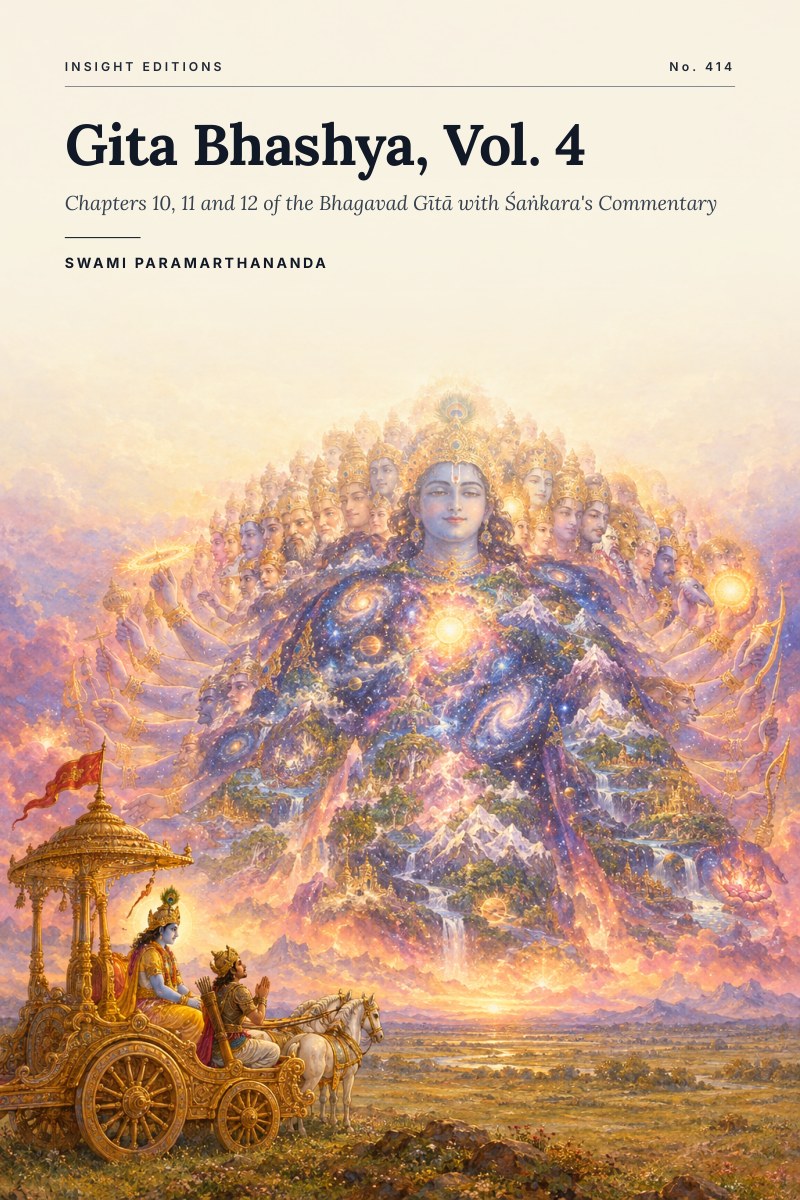
Gita Bhashya, Vol. 4
Chapters 10, 11 and 12 of the Bhagavad Gītā with Śaṅkara's Commentary
Swami Paramarthananda
Insight Edition of Swami Paramarthananda's classes on Śaṅkara's Bhagavad Gita Bhashya, Volume 4: Chapters 10, 11 and 12, on the Lord's glories, the cosmic form and devotion.
A study guide to Swami Paramarthananda's classes on the Bhagavad Gītā Śaṅkara Bhāṣyam, Vol. 4 (Arsha Avinash Foundation, transcribed by SwayamJyothi and Sri Vancheeswaran; copyright Vedanta Vidyarthi Sangha; not verified by Swamiji). Shared free for personal reading; not for sale and not endorsed by the author or publishers.
CORE CLAIM
The whole world is the Lord's glory; seeing it so is devotion, and knowing oneself as its source is freedom.
SCOPE
48 classes on Gītā Chapters 10, 11 and 12: the Lord's glories, the cosmic form, "I am time", the five-rung ladder and the devotee dear to the Lord.
KEY FIGURES
Kṛṣṇa and Arjuna; Śaṅkara as commentator; Swami Paramarthananda as teacher, with Madhusūdana, Śrīdhara, Ānandagiri and Swami Dayananda cited.
BEST FOR
Students reading Śaṅkara's Gītā commentary closely, and anyone wanting an Advaita account of devotion, the cosmic form and spiritual maturity.
The Book on One Page
This volume continues Swami Paramarthananda's course on the Bhagavad Gītā with Śaṅkara's bhāṣya. Its classes (321 to 369) cover Chapters 10, 11 and 12: the Lord's glories, the vision of the cosmic form, and the chapter on devotion. As in earlier volumes, every verse is read word by word, with grammar, cross-references and steady application to the student's life.
Chapter 10, vibhūti-yoga, renames the universe. Whatever is glorious, powerful or beautiful is the Lord's glory, and a glory can belong to the Lord only because he is its cause. Paramarthananda reads the three six-chapter blocks of the Gītā as tat tvam asi, and grades devotion as eka-rūpa (one form), aneka-rūpa (all forms) and arūpa (formless). The long list of "I am the Himalaya, I am Arjuna among the Pāṇḍavas" is, Kṛṣṇa says, only a sample: "the whole universe is a fraction of me."
Chapter 11 turns that teaching into sight. Arjuna asks to see the viśva-rūpa, and Paramarthananda insists the change is one of attitude, not new data: the same world, seen as the Lord. The divine eye works like induced magnetism. The reaction passes through three stages: wonder, then fear at the "mouths of time" consuming the warriors, then devotion. At its peak Kṛṣṇa says "I am time, the destroyer of worlds" and asks Arjuna to be merely the instrument. A God who creates must also withdraw, and mature devotion accepts both. Śaṅkara calls the chapter's last verse the essence of the entire Gītā.
Chapter 12 asks which devotee is best: the one who worships the Lord with form, or the one who seeks the formless imperishable. Śaṅkara builds a five-rung ladder from sakāma karma-yoga to nirguṇa knowledge and reads the "if you cannot, then..." verses as alternatives by capacity, not a combination. The chapter ends with the qualities of the devotee "dear to me", which Śaṅkara reads as the marks of the knower and Paramarthananda reads as a lifelong programme. Mokṣa gets a working definition: freedom from elation, envy, fear and anxiety.
Two threads run through the volume. The first is Paramarthananda's ladder of bhakti: one form, all forms, no form, with the rule that each higher stage adds without displacing the lower. The second is Śaṅkara's steady move from devotion to knowledge, even in chapters whose plain sense favours devotion. The edition keeps both visible and marks where commentary pushes against the verse.
| Ch | Title | Payload |
|---|---|---|
| 1 | The Universe Renamed as Glory | Vibhūti needs causality; tat tvam asi |
| 2 | From Universal Devotee to Knower | Buddhi-yoga; the lamp of knowledge |
| 3 | Arjuna Asks for a Mall of Supports | Dvaita to Advaita as a ladder |
| 4 | Prahlāda, the Dvandva and a Sample List | Greatness not borrowed; "a fraction of me" |
| 5 | The Request That Cannot Be Granted | Antaryāmī vs adhiṣṭhāna; the divine eye |
| 6 | Wonder: Extended and Exalted Vision | Three stages of response |
| 7 | Fear: The Mouths of Time | Moths to the flame; inclusive vision |
| 8 | "I Am Time" | Kāla; nimitta-mātra; informed bhakti |
| 9 | Apology, the Familiar Form, and the Essence | Only by devotion; 11.55 |
| 10 | Which Devotee Is Best? | Saguṇa and nirguṇa; stream of oil |
| 11 | The Harder Path and the Five-Rung Ladder | Mind and intellect fixed on God |
| 12 | Coming Down the Ladder | Karma is indirect; arthavāda |
| 13 | The Devotee Dear to Me | Definition of freedom |
The Universe Renamed as Glory
Chapter 10 is vibhūti-yoga, the Lord's manifestations. Śaṅkara's opening sentence links it to Chapters 7 and 9, where the Lord's nature and glories were already revealed, and explains why it is said again: it is "hard to understand". Paramarthananda's key move is a change of vocabulary: call the effect not "the universe" but "the glory of the Lord".
One word replaced
Chapters 7 (verses 8–11) and 9 (verses 16–19) each gave four verses on the Lord as the world. "Instead of saying kāraṇam is Bhagavān and kāryam is universe, we are changing the language: kāraṇam is Bhagavān and kāryam is the glory of Bhagavān." Paramarthananda calls it "very important because as we assimilate this language, viśva-rūpa-darśanam we get."
Vibhūti needs kāraṇatva. Everything can be seen as the Lord's glory only if the Lord is the cause of everything. "Without establishing kāraṇatvam, vibhūti can never be established." So verses 1–6 first prove causality, then the vibhūtis follow.
The Gītā as one mahāvākya
Within the middle six, the Lord is learned in three stages.
| Stage | Form | Where in the Gītā |
|---|---|---|
| Eka-rūpa Īśvara | One form: the chosen deity (iṣṭa-devatā) | Starting point of devotion |
| Aneka-rūpa Īśvara | Many forms: the whole creation as the Lord | Chapter 10 builds it, Chapter 11 culminates |
| Arūpa Īśvara | Formless: nirguṇa brahman | Seeded in 12.3, taught from Chapter 13 |
"I retain the name of my iṣṭa-devatā, but I see the iṣṭa-devatā as the entire creation": sarvaṁ Rāma-mayaṁ jagat, sarvaṁ Kṛṣṇa-mayaṁ jagat. And "through viśva-rūpa Īśvara alone we can reach arūpa Īśvara."
Verses 4–5: the inner world is also his
Kṛṣṇa lists the faculties of the mind as his creation: intelligence, knowledge, asammoha, patience, truth, self-control, calm, pleasure and pain, birth and death, fear and fearlessness. Paramarthananda's glosses are precise.
| Term | Gloss |
|---|---|
| Asammoha | Capacity for instant, objective decisions without being swayed |
| Kṣamā | Not agitated even when insulted or struck |
| Satya | Speech that conveys one's own experience as seen and heard |
| Dama / śama | Restraint of the outer senses / of the mind |
Parā and aparā in a rose
The Lord is cause through two natures, named in Chapter 7. A blooming rose is the glory of aparā-prakṛti, variable and with attributes. But "the existence is not a fading existence": the non-variable existence and consciousness in it, and even the joy of seeing it, belong to parā-prakṛti.
The jīva's secret leverage
Paramarthananda adds a point "which Kṛṣṇa does not mention": the Lord is only the general cause (sāmānya-kāraṇa). He cannot create "even a blade of grass" without the particular cause, the karma of jīvas. So creation is "a joint venture between Īśvara and jīva", and the jīva, like Īśvara, is beginningless.
Who gets the credit. "Whenever wonderful things come we give the credit to Bhagavān, and whenever terrible problem comes we say it is because of our karma. How Bhagavān is smart, see." The innocent word in the bhāṣya, svakarmānurūpeṇa ("according to their own karma"), carries this whole doctrine.
Verse 6 turns to the outer world: the seven sages and four Manus, born of the Lord's mind, from whom all creatures descend. The Lord delegates; he does not plant each plant.
When the effect is renamed as glory, every object becomes a reminder of its cause.
The joint-venture doctrine solves one problem and raises another. Making the jīva's karma a co-cause frees the Lord from blame for suffering, which answers the charge of cruelty. But it also means the Lord's omnipotence is bounded by beginningless karma he did not create, and it pushes the origin of inequality into an infinite regress. Advaita accepts this because both Īśvara and jīva are finally mithyā; a reader who stops at the theistic level of this chapter is left with a limited God.
From Universal Devotee to Knower: The Lamp of Knowledge
Verses 7 to 11 give the benefit of seeing the world as the Lord's glory, and describe how a devotee of the cosmic form becomes a knower of identity. Paramarthananda is blunt: however advanced, the viśva-rūpa bhakta is still classed by Vedānta "ruthlessly" as ignorant, until he can say of himself what he says of God. The section ends with Śaṅkara's ten-part comparison of knowledge to a lamp.
Two benefits, one limit
"I may keep away from certain things, but I cannot hate anything. Keeping away is physical, hating is mental."
The penultimate state
The viśva-rūpa bhakta knows the Lord is both intelligent and material cause and sees the creation as his manifestation; his values are high, his ego "heavily diluted". Yet: "If I am comfortable in saying Īśvara is everything, but I am not comfortable in saying that I am everything, then the knowledge is incomplete."
Two supports for the last step. Conversion from viśva-rūpa bhakta to aikya-jñānī needs one's own effort ("lift yourself by yourself", 6.5; "go to a guru", Muṇḍaka 1.2.12) and Īśvara-anugraha, the Lord's grace. Neither alone is enough.
Verse 10: avikampa-yoga decoded
Verse 7 promised the devotee "unshaken yoga". Kṛṣṇa defines it himself in verse 10: "I give the buddhi-yoga by which they come to me." Śaṅkara's chain of equations:
"Bhagavān does not bless the bhakta with sādhana." Here yoga means connection: buddhi-yoga is buddhi-prāpti, gaining right knowledge. And attaining knowledge of the Lord is attaining the Lord, since he is not elsewhere.
Verse 11: the lamp
"Out of compassion, dwelling in their hearts, I destroy the darkness born of ignorance with the shining lamp of knowledge." Śaṅkara packs one long compound with the parts of the lamp. Paramarthananda counts ten points of comparison; the main ones:
| Part of the lamp | In Self-knowledge |
|---|---|
| Protected enclosure | Vairāgya, detachment |
| Oil holder | The mind |
| Oil | Īśvara-prasāda, grace |
| Wick | Prajñā, intelligence |
| Flame | Akhaṇḍākāra-vṛtti (Śaṅkara: viveka-pratyaya) |
| Glow | Consciousness reflected in that thought: samyag-darśana, "the hero" |
| Favourable air | Abhiniveśa: intense yearning for knowledge of the Lord |
Why the glow, not the flame. A thought is only a modification of the mind; what removes ignorance is consciousness reflected in that thought (vṛtti-pratibimba-caitanya). The lamp image makes the abstract point visual: the flame is necessary, but it is the light that dispels the dark.
Grace and effort, again
Kṛṣṇa says he gives knowledge out of compassion (anukampā). Paramarthananda insists this does not cancel the student's work: guru-prāpti, śravaṇa and the rest are the student's effort, and grace is the oil that keeps the flame burning.
Seeing God in everything is the last stage before seeing oneself as that everything.
"Ruthlessly ignorant" is a hard verdict on devotion. Classing a devotee who sees God in all things, with high values and little ego, as ajñānī reflects Advaita's insistence that only identity-knowledge liberates. Theistic schools reading the same chapter (Rāmānuja, Madhva, the bhakti traditions) treat that devotee as the goal, not the penultimate stage, and Kṛṣṇa's words in 10.10, "they come to me", fit their reading at least as naturally. The Advaita hierarchy is a system-level claim, not something the verses force.
Arjuna Asks for a Mall of Supports
The teaching of the chapter was complete in eleven verses. Now Arjuna speaks: four verses praising the Lord, three asking for a list of his glories. His purpose, Paramarthananda says, is practical: each glory can serve as an ālambana, a support on which to meditate on the whole Lord, and Arjuna wants "a mall of ālambanas, a wide choice to choose from."
The whole bhakti journey in eleven verses
"Desire without opportunity is useless, opportunity without desire is equally useless. Bhagavān will provide both." The four kinds of devotee of 7.16, ārta, arthārthī, jijñāsu and jñānī, are the stages of that journey.
Verses 12–15: praise from the sages and from Kṛṣṇa
Arjuna calls the Lord param brahma and the supreme abode, and notes that Nārada, Asita, Devala and Vyāsa say so. "The ṛṣis' declaration may be trustworthy or not, but more than the ṛṣis, you yourself are saying so." Testimony from the source settles it.
Verse 17: why the list is wanted
"How shall I know you, O yogin, always meditating on you? In what forms are you to be thought of?" Śaṅkara reads yogin as māyin, the wielder of māyā, the Lord as intelligent and material cause.
Not incorrect, incomplete. "During viśva-rūpa-dhyāna I am a Viśiṣṭādvaitin." In that meditation the Lord is the whole and I am a part (aṁśa-aṁśi-bhāva). "We don't say Viśiṣṭādvaita is incorrect, we only say it is incomplete." Everyone is a dualist in worship of the iṣṭa-devatā, a qualified non-dualist in cosmic-form meditation, and an Advaitin in identity-knowledge.
| Stage of practice | Implicit philosophy |
|---|---|
| Iṣṭa-devatā worship | Dvaita: God and I are different |
| Viśva-rūpa dhyāna | Viśiṣṭādvaita: I am part of God |
| Abheda-jñāna | Advaita: I am that |
Verse 20: Consciousness first
Kṛṣṇa begins: "I am the Self dwelling in the heart of all beings." Paramarthananda notes the list opens with consciousness and ends with existence (10.39, "nothing moving or unmoving exists without me"), with the saguṇa glories between. Those two alone "can be one of the meditations."
For students who have done śravaṇa and manana, this meditation is nididhyāsana; for others, it is an upāsana that prepares them.
Verses 21–25: samples from the Purāṇas
Arjuna asked for divine glories, so many entries are Purāṇic, each with its story: Viṣṇu among the Ādityas, the moon among stars, Bṛhaspati among priests, Skanda among generals, the ocean among waters (dug by the sons of Sagara, part of the Bhagīratha story). Verse 25 has some of the most quoted lines.
| Among | "I am" | Gloss |
|---|---|---|
| Great sages | Bhṛgu | |
| Words | The one syllable, Om | "Ekam akṣaram": the monosyllabic word |
| Yajñas | Japa-yajña | Repetition of a mantra, distinct from pārāyaṇa (recitation) |
| Immovables | The Himalaya |
Why japa is the best yajña. Paramarthananda's gloss: pārāyaṇa means recitation, japa means repetition. Japa needs no materials, no priest, no fire and no fixed place, and can run alongside other activity. It is the most accessible worship, which may be why it heads the list.
Any single glory, rightly seen, is a window on the whole Lord.
The ladder places other schools below Advaita. Calling Viśiṣṭādvaita "incomplete" is gentler than calling it wrong, but it still makes Rāmānuja's mature position a stage that Advaitins pass through. Viśiṣṭādvaitins would reverse the order and see Advaita's identity claim as an error about the part-whole relation. The ladder is a useful way to integrate practices; it is not a neutral description of the schools.
Prahlāda, the Dvandva and a Sample List
The list of glories continues with figures from myth, grammar and the Mahābhārata itself. Paramarthananda draws lessons from the choices: a devotee born among asuras, the grammatical compound that includes all its members, and Kṛṣṇa naming himself and Arjuna. The chapter ends by calling the whole list a sample: the glories are endless, and the real teaching is "a fraction of me pervades the universe."
Verse 30: greatness is not borrowed
"Among the Daityas I am Prahlāda." He is first in the morning list of devotees (Prahlāda, Nārada, Parāśara, Puṇḍarīka), yet he was born in an asura family. "Greatness does not depend upon the family, that is only borrowed greatness; the real greatness depends upon who I am." True to his name, from √hlād, he was happy and made others happy.
Also in 10.30: "Among reckoners I am time." Paramarthananda's gloss: among accountants, the one who never commits an error.
13 wives of Kaśyapa. Among them Diti, mother of the Daityas (asuras), and Aditi, mother of the Ādityas (devas). Asura and deva are half-brothers in the Purāṇic family tree.
Verse 33: the inclusive compound
"Among letters I am a; among compounds, the dvandva." Paramarthananda takes the word Rāmeśvara to show why.
| Compound type | Reading of "Rāmeśvara" | Refers to |
|---|---|---|
| Tatpuruṣa | Lord of Rāma (Śiva) | One entity |
| Bahuvrīhi | One whose Lord is Rāma (Śiva as devotee) | One entity |
| Karmadhāraya | Rāma who is himself Īśvara | One entity |
| Dvandva | Rāma-and-Lakṣmaṇa (Rāma-lakṣmaṇau) | All members |
"Dvandva will give importance to every member... therefore that is considered to be śreṣṭha. Nowadays inclusive is supposed to be good."
Verse 33 continues: "I am imperishable time; I am the dispenser (dhātā) of the fruit of action." Śaṅkara glosses "time" as either the familiar time of moments, or "the Lord who is time of time".
Verse 37: you are standing in the list
"Among the Vṛṣṇis I am Vāsudeva; among the Pāṇḍavas, Dhanañjaya; among sages, Vyāsa; among seers, Uśanā." Śaṅkara: "the very same me who is your friend", and "Dhanañjaya is you yourself."
Kavi here is not "poet" but krānta-darśin, one who sees past and future. And the best seer named is again the asuras' teacher.
Verses 40–41: no end, only samples
"There is no end to my divine glories; this is only an indication." Śaṅkara's reason is the adjective sarvātman: because the Lord is the content of everything, to list his glories "you will have to talk about every bacterium, every virus, every ant, every mosquito." So verses 20 to 39 are uddeśataḥ, a sample, "based on that you can make your own vibhūti list."
The vibhūti test (10.41). Whatever is glorious, prosperous or powerful, "know it as born of a fraction of my splendour." Excellence anywhere, in a scientist, an athlete or a mother, is a vibhūti. The list is a training set; the rule is what the student keeps.
Verse 42: why all this detail?
"What is the use of knowing all this in detail, Arjuna? I stand supporting this entire universe with a single fraction of myself." The whole creation is only a part of the Lord's glory; the Lord is not exhausted in it. This prepares for the vision of the cosmic form in Chapter 11.
The list is a sample; the lesson is to recognise the Lord in whatever excels.
"A fraction of me" pulls against Advaita's monism. Verse 42 says the universe is supported by one part of the Lord, which sounds like a real part-whole relation, the Viśiṣṭādvaita picture. Śaṅkara has to read "fraction" as an appearance on brahman that does not divide it. The text, taken alone, is at least as friendly to a theistic reading in which God both pervades and transcends a real world.
The Request That Cannot Be Granted
Chapter 11 is viśva-rūpa-darśana, the vision of the cosmic form. Paramarthananda's reading turns on one observation: Arjuna asks to see the cosmic form, but it is already in front of him, and in front of everyone, including the atheist. What Arjuna needs, and what the Lord gives, is a change of attitude, granted for a while by grace.
What caught Arjuna's attention
Śaṅkara's introduction says Arjuna was struck by the last line of Chapter 10: "I stand supporting this whole universe with a fraction of myself." Paramarthananda shows why it is different from everything before it.
Lying on the snake. The Viṣṇu Sahasranāma dhyāna verse begins "śāntākāraṁ bhujaga-śayanam", lying on the serpent, which makes the Lord seem smaller than the snake. The verse then corrects the picture: the Lord is the support of everything, the snake included. That shift, from contained to container, is what Arjuna wants to see.
Verses 1–3: Arjuna's summary
Before asking, Arjuna sums up the teaching: verse 1 covers Chapters 1–6, verse 2 Chapters 7–10. Paramarthananda maps them onto the mahāvākya.
| Section | Topic | Technical name |
|---|---|---|
| Chapters 1–6 | Ātmā and anātmā distinguished | Tvam-pada vācyārtha and lakṣyārtha |
| Chapters 7–12 | The Lord as cause and as pure being | Tat-pada vācyārtha and lakṣyārtha |
| Chapters 13–18 | The two pointed meanings are one | Aikya |
He uses the occasion for a reminder: karma-yoga is not the tātparya of the Gītā, because it is already taught in the karma-kāṇḍa and so lacks apūrvatā (novelty), one of the six marks of intent. "If you nod the head always the same way", the teacher cannot tell whether a point has landed.
Verse 4: an impossible request
"If you think I can see it, O Lord of yoga, show me your imperishable Self." Logically, "the question itself is wrong": the world Arjuna sees every day is the cosmic form.
Viśva-darśana versus viśva-rūpa-darśana. "Arjuna has viśva-rūpa-darśana all the time, but he takes it as viśva-darśana." The problem is not availability but attitude. In English: divinisation of the world. Arjuna "never can want viśva-rūpa-darśana; he wants an attitudinal change."
Verses 5–6: wonders not seen before
"Behold the Ādityas, Vasus, Rudras, Aśvins, Maruts, many wonders never seen before." Heavenly things look wonderful "until you go there and settle down". Paramarthananda's analogy: the Empire State Building on a first trip to the US; and those who live on the bank of the Gaṅgā "even during Dīpāvali, whether they take bath or not, doubtful."
Verse 8: the divine eye
"You cannot see me with these eyes; I give you a divine eye." The qualification for the vision is a mind with reduced ahaṅkāra, mamakāra, rāga and dveṣa. That can come by long sādhana, or "artificially and temporarily" by the Lord's grace.
Induced magnetism. Paramarthananda borrows from physics: a piece of iron near a magnet becomes magnetic, but loses it when the magnet is removed. The vision given by grace is like that: real while it lasts, but not permanent. Only advaita-jñāna removes ego and possessiveness completely.
The cosmic form is never hidden; what is missing is the eye that sees the world as the Lord.
The attitudinal reading tames a spectacular text. Chapter 11 describes a terrifying, supernatural vision with thousands of arms and mouths, and Arjuna trembling. Reading it as "learning to see the ordinary world as divine" is spiritually useful and fits Advaita, but it plays down the text's insistence that the form is unseen before and visible only with divine eyes. A reader should keep both: the chapter as an image of an attitude, and the chapter as a narrative of an extraordinary event.
Wonder: Extended and Exalted Vision
With the divine eye granted, the vision begins. Sañjaya describes it first, then Arjuna, hair standing on end, bows and speaks. Paramarthananda gives two keys for reading every verse: extended vision, which reaches other worlds and the future, and exalted vision, which sees this very world as the Lord. He also traces Arjuna's emotions through three stages: wonder, fear, devotion.
How did Sañjaya see it?
Kṛṣṇa gave the divine eye to Arjuna, not Sañjaya. Since Sañjaya describes the form, "we have to assume" Vyāsa had already blessed him with the same capacity, by arthāpatti (postulation from what is otherwise unexplained). Sañjaya received his sight before the war began.
Two kinds of divine sight
Paramarthananda prefers to read the "many uplifted divine weapons" of 11.10 as the weapons of the soldiers on both sides, seen as the Lord's, rather than Viṣṇu's weapons in Vaikuṇṭha.
3 stages of Arjuna's mind. Wonder (11.9–11.20), fear (11.21–11.31) and devotion (from 11.35). Paramarthananda notes the transitions are gradual and sometimes alternate: "wonder-fear, wonder-fear, it is coming on and off."
Verse 14: the response
"Then Dhanañjaya, filled with wonder, hair standing on end, bowed his head to the Lord and spoke with joined palms." Śaṅkara specifies that the añjali here is for namaskāra, not for tarpaṇa (libation), which also joins the palms. Paramarthananda adds a ritual detail: the palms should not be tightly pressed, "there must be some gap"; "it is not an exercise, it is expression of devotion."
Grammar break: the elephant-faced
In 11.17 the Lord shines "with the brilliance of blazing fire and sun". Śaṅkara insists on the correct compound analysis, and Paramarthananda gives the classic example.
| Vigraha (analysis) | Verdict |
|---|---|
| "Gajasya ānanaṁ yasya": one who has the elephant's head | Wrong: only the elephant has the elephant's head |
| "Gajasya ānanam iva ānanaṁ yasya": one whose head is like an elephant's | Right: this is Gajānana |
"All these headaches are only for the Sanskrit and that too samāsa students; others can enjoy samosa and drop the samāsa."
Verses 15–19: the forms
Arjuna sees Brahmā on the lotus, Śiva, the sages and serpents; arms, bellies, mouths and eyes without number, "no end, no middle, no beginning"; crown, mace and discus; a mass of light "hard to look at", immeasurable (aprameya, "whose measurement cannot be arrived at").
Upanayana and spectacles. Śaśi-sūrya-netra, "moon and sun as eyes", leads Paramarthananda to a joke: someone said "upanayana" means spectacles, since upa is "close by" and nayana is "eye". "Nowadays we are not taking regular upanayanam and not doing solar worship; your eyes become weaker; therefore you have got upanayanam."
Verse 20: the turn
"The space between heaven and earth and all the quarters are filled by you alone. Seeing this wonderful, terrible form, the three worlds tremble." The fire that reveals is also the fire that consumes, and here the mood begins to change.
The same divine eye that sees other worlds also sees this one, and the second sight is the one that matters.
The two-vision scheme is an interpretive tool, not a textual one. The Gītā never distinguishes extended from exalted vision; Paramarthananda introduces it to keep the chapter relevant to a student who will never see celestials. It works well, but deciding which verse belongs to which category is the teacher's call, and the reading of the weapons in 11.10 as soldiers' weapons is openly his preference.
Fear: The Mouths of Time
The vision now shows its other side. The cosmic form is "a mixture of both positive and negative", and when Arjuna sees the negative, wonder turns to fear. He sees the warriors of both armies rushing into the Lord's mouths "like moths into a flame". Paramarthananda draws two lessons: maturity means accepting both sides as sacred, and a religion that sees the world as God has no reason to convert anyone.
The case against conversion
Paramarthananda ends the previous class with a pointed claim: "Any converting religion is missing viśva-rūpa-darśana." If the whole universe, all peoples included, is the Lord, there is no one outside to be brought in. "Even if you don't come to Advaitam, it is OK; progress to viśva-rūpa; there will be peace in the world; religious quarrels will end the moment all religions come to viśva-rūpa-Īśvara."
Verse 22: wonder and fear among the gods
"Rudras, Ādityas, Vasus, Sādhyas, Viśvedevas, Aśvins, Maruts... all look at you amazed." Arjuna adds that this is not his alone; the celestials also alternate.
Maturity is accepting both. "If one is not mature enough, one will not be able to accept both as sacred Bhagavān only." Arjuna sees one side and wonders, sees the other and trembles. The cosmic form tests whether devotion survives the sight of death.
Verses 23–25: lost directions
"Seeing your mouths, terrible with tusks, like the fire of dissolution, I do not know the directions; I find no peace." East and west are defined relative to the sun; "when you go to the Sun itself, east, west become meaningless". Paramarthananda's modern images: in the Arctic the sun circles without rising or setting; callers from America now say "good day" because morning and night no longer match; "when you are in the date line you cannot even know the date."
Verses 26–28: the armies enter
Arjuna sees Bhīṣma, Droṇa, Karṇa, the sons of Dhṛtarāṣṭra and "our chief warriors too", rushing into the Lord's mouths; some are caught between the teeth, heads crushed. Like rivers rushing toward the ocean, the heroes enter the flaming mouths.
Verse 29: moths to a flame
"As moths rush into a blazing fire to their destruction, so the worlds rush into your mouths." Madhusūdana says śalabha would be a better word than pakṣin (winged thing); here it means winged insects, not birds.
Rainy-season insects. When small winged insects appear in swarms after rain, we switch off the light. At a tube light they survive; at an oil lamp, "the attraction becomes suicidal". The image is of people inviting their own destruction, drawn by the very thing that consumes them.
Verses 30–31: time devours
The Lord's mouth stands for kāla, time. The vision here is "extended", of the future: those who will die in the war are shown already dying. Arjuna, terrified, asks: "Tell me who you are, so fierce in form. I wish to know you, the primal one; I do not understand your purpose."
The Lord who is health and birth is also disease and death, and devotion must hold both.
The anti-conversion claim is a value judgement presented as a corollary. Seeing the world as divine does support tolerance. But a converting religion could reply that its mission comes from love for others, not from failing to see God in them, and Hindu traditions themselves have converted people and absorbed rival sects. Paramarthananda's point is better taken as an ideal than as a diagnosis of what other faiths are "missing".
"I Am Time": From Fear to Informed Devotion
Arjuna's fear has reached the point where his devotion is threatened: the Lord he thought compassionate is "munching Bhīṣma and Droṇa, smacking his lips". Kṛṣṇa's answer is the most famous line of the chapter, "I am time, the destroyer of worlds", and the lesson Paramarthananda draws is that a mature mind meets the whole creation with neither attachment nor aversion, but reverence.
Every devotee's crisis
"All devotees will face the crisis at one time or the other: is God really there, and if there is God, is he really compassionate?" Only scriptural education answers it, and the devotion that follows is not blind. "Informed bhakti is the most glorious bhakti, a bhakti enjoyed by all jñānīs in spite of trouble and suffering in the world."
Reversing the logic
The cosmic form has a wonderful side and a terrible side. Paramarthananda asks students to use each to cancel the opposite reaction.
Viśva-rūpa-bhakti. If the world deserves neither attachment nor hatred, what does it deserve? "A mature mind says world deserves bhakti: reverential, objective appreciation", neutral toward both wonderful and terrible. Lacking it, Arjuna swings between wonder and fear.
Verse 32: kālo'smi
"I am time, grown mighty, the destroyer of worlds, here engaged in withdrawing them. Even without you, none of the warriors arrayed in the opposing armies will survive." The definition Paramarthananda recalls from the Vicāra-sāgara: kāla is the relation between māyā and brahman.
| Aspect of kāla | Role |
|---|---|
| Sṛṣṭi-kartā | Brings things into being |
| Laya-kartā | Withdraws them, according to the law of karma |
| Lesson for Arjuna | "Learn to accept the creator me, and also the destroyer me" |
Verses 33–34: be the instrument
"They have already been slain by me; be merely the instrument (nimitta-mātra), Arjuna." Kṛṣṇa names four warriors Arjuna fears, and Śaṅkara explains why each is formidable.
| Warrior | Why feared (Śaṅkara) |
|---|---|
| Droṇa | Teacher of archery and Arjuna's own guru: "guru always knows his śiṣya's weaknesses" |
| Bhīṣma | Can choose his own death; fought Paraśurāma in single combat undefeated |
| Jayadratha | Protected by his father's boon (Śaṅkara's sub-commentators) |
| Karṇa | Equal to Arjuna, with divine weapons |
Whether the arrow hits or not, they will fall; "your job of killing them is easier, and you will get the credit also."
Time is part of the creation
Kāla is not a separate container in which creation happens. "Even modern science says when the entire creation is resolved, you cannot talk about time, even space." Space, time and the world go unmanifest together in pralaya and manifest together in creation.
Verses 35–40: devotion arrives
Arjuna, "trembling, frightened again and again", bows and praises. In 11.37 Śaṅkara gives two readings of "the world rejoices in glorifying you": underline the devotees, who rejoice, or underline you, the one who truly deserves glory. He prefers the second. In 11.38 Arjuna names the Lord as both causes: as nirguṇa brahman, the unchanging vivarta cause; as saguṇa Īśvara, the pariṇāmi cause that becomes the world.
Don't hate the other god. A verse Paramarthananda quotes: the Viṣṇu devotee who hates Śiva and the Śiva devotee who hates Viṣṇu "both will go to naraka as long as the sun and moon endure". "Be a Viṣṇu bhakta, alright, but don't hate Śiva and Śiva temple and vibhūti... be an inclusive one."
The God who creates must also withdraw; seeing both is the beginning of mature devotion.
"Be the instrument" has been read as licence. The idea that the Lord has already slain the enemy and the human is only an instrument removes personal guilt for killing. In context it serves a dharmic war against wrongdoers, and Śaṅkara ties it to karma. But taken out of that frame, the same reasoning can justify any violence as "God's will", and readers have rightly worried about it. The verse's protection lies in its setting: an instrument of dharma, acting without hatred, as 11.55 will require.
Apology, the Familiar Form, and the Essence of the Gītā
Having seen who his friend really is, Arjuna apologises for years of casual familiarity and asks to see the gentle form again. Kṛṣṇa withdraws the cosmic vision, says it cannot be gained by Vedas, gifts or rituals but only by single-minded devotion, and closes the chapter with a verse Śaṅkara calls the essence of the entire Gītā.
Ignorance of God as an offence
Arjuna says he did not know the Lord's greatness, and treats that ignorance itself as a fault. Paramarthananda contrasts this with a modern trend: parents told to raise children "secularly" and let them choose later.
The vacation rule. A mother in Chennai told him her son in America sent the grandchildren for the holidays with one condition: "you can do anything except God and Gītā." Paramarthananda's Vedic alternative: start with faith in God out of obedience to parents; when that faith is shaken later, teach the scriptures so that blind faith becomes informed understanding.
Verses 41–42: forgive my offence
"Whatever I said rashly, 'O Kṛṣṇa, O Yādava, O friend'... whatever disrespect I showed in jest, while playing, resting, sitting or eating, alone or before others, forgive me." Paramarthananda notes the grammar: Arjuna asks the Lord to pardon the offence (kṣāmaye), not "pardon me".
Higher devotion adds, it does not replace
Arjuna's devotion is now to the cosmic Lord, not only the personal one. But "becoming a graduate does not mean the knowledge gained during under-graduation is displaced." Even Advaita commentators begin their works with a verse to their iṣṭa-devatā.
| Level of bhakti | Status after the next level |
|---|---|
| Eka-rūpa (personal deity) | Continues |
| Aneka-rūpa (cosmic form) | Continues |
| Arūpa (formless, identity) | Added on top |
Verse 44: real regret
Arjuna prostrates, "placing the body down" (praṇidhāya kāyam). Paramarthananda's point on apology: the newspaper's "error is regretted" box is not regret. Paścāttāpa, sincerely feeling the pain of the mistake, is the first prāyaścitta; compensation and damage control are the next level. The prostration is sāṣṭāṅga, all eight limbs touching the ground.
Verses 45–50: back to the gentle form
Arjuna, "delighted and fearful", asks for the form with crown, mace and discus. Kṛṣṇa says (11.47) the cosmic form "has not been seen by anyone but you". Śrīdhara softens this: "except a few like you".
Trim your curiosity. Did Arjuna then see Kṛṣṇa with four arms or two? Madhusūdana argues it from the verse; Śaṅkara, who comments on every "ca" and "api", "never enters into that debate". The lesson: "Don't waste your time and energy debating on issues which will not contribute to your spiritual growth."
Verses 53–54: only by devotion
"Not by the Vedas, not by austerity, not by gifts, not by sacrifice can I be seen in this way; by single-minded devotion (ananya-bhakti) alone can I be known, seen and entered into."
Verse 55: the essence
"He who works for me, has me as the supreme goal, is devoted to me, free from attachment, without enmity toward any being, comes to me."
| Phrase | Śaṅkara's gloss |
|---|---|
| Mat-karma-kṛt | Action offered to the Lord: all of karma-yoga |
| Mat-parama | Unlike a servant, who works for the master but whose real goal is his family, the devotee takes the Lord as both master and goal |
| Saṅga-varjita | Not attached to "wealth, children, friends, spouse, relatives": "love them, do duty to them, but emotionally don't hold on" |
| Nirvaira | No enmity, "even toward those who are harming us"; protect yourself, but don't hate |
Śaṅkara says this verse is the essence of the whole Gītā śāstra: jñānena mokṣaḥ, liberation through knowledge, with all else supportive. Kṛṣṇa calls it "my favourite instruction", and Paramarthananda adds: "Vairāgya is always a disturbing message. That is the message I like to give you."
The cosmic vision is withdrawn, but its lesson remains: work for the Lord, hold nothing too tightly, hate no one.
Śaṅkara finds knowledge in a verse about devotion. Verse 55 lists action, devotion, detachment and non-enmity; the word "knowledge" does not appear, and 11.54 explicitly names bhakti as the means. Śaṅkara's claim that its essence is "liberation through knowledge" depends on reading single-minded devotion as the jijñāsu's devotion that culminates in knowledge. Theistic commentators read the same verse as proof that devotion itself is the goal, and the immediate context supports them at least as well.
Which Devotee Is Best? Saguṇa and Nirguṇa
Chapter 12 opens with Arjuna's comparison question. Śaṅkara first summarises eleven chapters: Kṛṣṇa has taught both the pursuit of the attribute-free, imperishable brahman and the meditation on the Lord with attributes. Which practitioner is superior? Kṛṣṇa's answer is subtle, and Śaṅkara's reading of it decides the shape of the whole chapter.
Why "from the second chapter"
Śaṅkara says the two pursuits are taught "from the second chapter to the end of the vibhūti chapter". Why not the first? "Because first chapter is Arjuna's chapter; Kṛṣṇa was not allowed to talk." Teaching begins only when Arjuna surrenders.
| Pursuit | What "upāsana" means here |
|---|---|
| Nirguṇa-brahma-upāsana | Śravaṇa, manana, nididhyāsana: study and assimilation of formless brahman |
| Saguṇa-Īśvara-upāsana | Learning about and meditating on the Lord with attributes |
Verse 2: the cosmic-form meditator
Kṛṣṇa says those who fix the mind on him, ever devoted, with supreme faith, are "most yoked" (yuktatamāḥ). Śaṅkara identifies them as meditators on the viśva-rūpa just shown. Their mark: God is both the means and the end. For the sakāma devotee with a crisis at home, God is the means and crisis-removal the end.
Three kinds of dependence. "World (family) dependence, to God dependence, to Self dependence is spirituality." Ask the elderly devotee what supports him in old age and he names the Lord, not son or daughter-in-law. Ask the jñānī and he says, with the Kaivalya Upaniṣad, "in me everything is born, in me it rests, in me it resolves."
Verses 3–4: the akṣara-upāsaka
"But those who meditate on the imperishable, indefinable, unmanifest, all-pervading, unthinkable, unchanging, immovable, constant, with senses restrained, even-minded everywhere, delighting in the welfare of all beings, they reach me alone."
Upāsana defined. Śaṅkara's general definition: take an object prescribed by śāstra, bring it close (objectify it if saguṇa, subjectify it if nirguṇa, "so close that the deity is myself"), and keep the thought flowing like a stream of oil. Oil, being thick, pours without break; water breaks into drops. Paramarthananda's gradations: one thought is dhāraṇā, a broken flow is dhyāna, an unbroken flow is samādhi.
Only what śāstra prescribes
Invented meditations give only the visible result, concentration. The unseen result (adṛṣṭa-phala) comes only from a meditation "yathā-śāstram".
Character is non-negotiable
"Sarva-bhūta-hite ratāḥ": the seeker must be a person of character. "Without character, Vedānta alone will not work." And of the nirguṇa practitioner Kṛṣṇa says "they reach me", meaning they are me: "don't compare them with other dvaita bhaktas."
The saguṇa meditator is called "most yoked"; the nirguṇa seeker is simply called the Lord.
The commentary reverses the plain sense. Read directly, 12.2 ranks the saguṇa devotee highest and 12.5 calls the nirguṇa path harder. Rāmānuja and most theistic readers take that as the verdict: devotion to the personal God is best. Śaṅkara's separation (the saguṇa group is "best" only against lower groups still to come, while the nirguṇa seeker is beyond comparison) is coherent but imports a structure the verses do not state. Readers should know they are getting one school's resolution of a real ambiguity.
The Harder Path and the Five-Rung Ladder
Kṛṣṇa now admits the nirguṇa path is harder for the embodied, and promises to lift the saguṇa devotee "quickly out of the ocean of mortal saṁsāra". Paramarthananda uses this section to set out Śaṅkara's five rungs of sādhana, which organise the rest of the chapter, and to defend emotional bonding with a personal god.
Verse 5: harder for the body-identified
"Greater is the difficulty for those whose minds are set on the unmanifest; the goal of the unmanifest is hard for the embodied to reach." The obstacle is not intellect but dehābhimāna, identification with the body.
Five groups, not two
If the saguṇa meditators are "best", best compared to whom? Not the nirguṇa seekers, who have been set apart. Kṛṣṇa will describe three lower groups, and the cosmic-form meditators top those.
A forty-year plan. Paramarthananda's rough timetable: "Ten years of karma-yoga, ten years of upāsana, ten years of śravaṇa and ten years of manana", and after that nididhyāsana becomes "effortless niṣṭhā."
Verses 6–7: the Lord as rescuer
Those who surrender all actions to the Lord and meditate with single-minded devotion, "I become their deliverer from the ocean of death and saṁsāra, before long." The rescue is gradual: the Lord gives them the fitness for knowledge.
Verse 8: fix mind and intellect
"Fix your mind on me alone, place your intellect in me." Śaṅkara splits the two faculties.
| Faculty | What to fix in God | Paramarthananda's gloss |
|---|---|---|
| Manas (emotional mind) | Emotional bonding with the iṣṭa-devatā | "You can scold as Tyāgarāja does"; the Gopīs did it toward Kṛṣṇa |
| Buddhi (intellect) | Adhyavasāya: firm, convinced knowledge of what God is | "Mere emotional devotion is not enough" |
The jñānī keeps his iṣṭa-devatā. Advaita does not abolish the personal god. At the transactional level a knower "can continue the emotional bonding with his iṣṭa-devatā", but "he will enjoy with gratitude rather than cry as a saṁsārī. Gratitude will be there without the crying."
Emotion fixed on a personal god and intellect fixed on the truth of God are two halves of one practice.
The ladder flattens real lives. The five rungs, and the forty-year timetable, assume a long, orderly, largely male and householder-then-renunciate life with access to a teacher. Many sincere seekers never get the ten years of śravaṇa, and the scheme risks telling them their devotion is only a lower rung. Paramarthananda softens this by saying no rung is discarded, but the hierarchy remains the frame, and it is a scholastic construction more than a statement in the verses.
Coming Down the Ladder: "If You Cannot..."
Verses 9 to 11 descend step by step: if you cannot fix the mind, practise; if you cannot practise, work for me; if you cannot do that, give up the fruits of all action. Then 12.12 praises the lowest step as giving "peace immediately". Śaṅkara treats that praise as arthavāda, and uses the "if you cannot" grammar to argue that the dualistic rungs and the knowledge path do not combine.
The descent
Karma never gives mokṣa directly
Where Kṛṣṇa says "working for me, you will attain perfection", Śaṅkara adds a phrase not in the verse: through purification of mind, yoga, and the gaining of knowledge.
| Step | What it gives |
|---|---|
| Service (karma) | Sattva-śuddhi, purity of mind |
| Eka-rūpa and viśva-rūpa upāsana | Yoga: sharpness (ekāgratā) and expansiveness (viśālatā) of mind |
| Jñāna (śravaṇa, manana, nididhyāsana) | Mokṣa |
Previously you were impurely ignorant, and now after the service activity you are purely ignorant. There is only a change in adverb; the adjective "ignorant" will never go by service activities.
Swami Dayananda, quoted by Paramarthananda"Whenever Kṛṣṇa says karma will give mokṣa, remove the full stop, put a comma, and add indirectly, never directly."
Verse 12: the praise that cannot be literal
"Knowledge is better than practice, meditation better than knowledge, renunciation of the fruits better than meditation; from renunciation, peace immediately." Taken literally, the lowest rung gives instant liberation.
Arthavāda. Śaṅkara: the verse is praise by exaggeration, like hyperbole. Renunciation of fruit is commended for "the ignorant engaged in action who cannot do the earlier means", not as the first or best. He even admits in his introduction that the Gītā is confusing "in spite of several commentaries", and lines like this are why.
No samuccaya
The rule "if you are incapable of three, follow two" shows the rungs are alternatives by capacity, not a combination. Rungs one to four keep dvaita: the jīva distinct from Īśvara and the world. So, Śaṅkara argues, karma-yoga does not suit the seer of non-difference, and the karma-yogī is not yet fit for the akṣara path.
Every path that keeps God separate prepares the mind; only knowledge of non-difference frees it.
Exaggeration is a convenient category. When a verse says renunciation gives immediate peace and that contradicts the system, Śaṅkara calls it arthavāda. This is a recognised Mīmāṁsā principle, and Paramarthananda is right that laws must be read together. But the move is available only to the interpreter who already knows which verses are literal. A reader from a karma-yoga or bhakti school can apply the same tool in reverse, and nothing in the text alone settles who is right.
The Devotee Dear to Me
The chapter ends with one of the Gītā's best-loved passages: the qualities of the devotee Kṛṣṇa calls "dear to me". Śaṅkara reads them as the marks of the advaita-bhakta, the knower, which a seeker must practise deliberately until they become natural. Kṛṣṇa closes by calling the whole teaching "immortal dharma".
Verses 13–14: no hatred, no "mine"
"He who hates no being, is friendly and compassionate, free from 'mine' and 'I', even in pain and pleasure, forgiving, content, self-controlled, of firm conviction, mind and intellect offered to me, he is dear to me."
Deliberately or naturally. Śaṅkara glosses "yatātmā" as disciplined in body and senses. Paramarthananda: the fourfold qualification (sādhana-catuṣṭaya) taught in Tattva-bodha is not a beginner's syllabus to be forgotten. "It must be there in me either deliberately or naturally. There should be no time when it is absent." What the seeker practises, the knower simply has.
Lifelong Vedānta
The "yogī" here is one whose mind is absorbed in nididhyāsana, which can take the form of attending class, reading, writing, sharing or listening: "the mind must be devoted to Vedānta, lifelong, in one way or the other."
Verse 15: freedom, defined
"He from whom the world does not shrink, and who does not shrink from the world, free from elation, envy, fear and anxiety, he is dear to me."
"Whenever we talk about mukti we translate it as freedom, often without knowing freedom from what. It is worth remembering: harṣa-amarṣa-bhaya-udvegaiḥ mukta is called mokṣa." The jñānī is like a lion, which has none of these four even in dream.
Verse 16: independent and capable
| Quality | Śaṅkara's gloss | Paramarthananda's application |
|---|---|---|
| Anapekṣa | Free from craving for body, senses, objects | As ātmā, absolutely independent; as a person, depend less and less on things to be comfortable |
| Śuci | Clean, outer and inner | Hygiene and purity of mind together |
| Dakṣa | Able to respond rightly, at once, to what arises | Competence is a spiritual quality |
| Udāsīna | Takes no side | Neutral, not indifferent |
"Sarvaṁ para-vaśaṁ duḥkham": everything dependent on another is sorrow.
Verses 17–20: the closing verses
The list continues: one who neither rejoices nor hates, the same to friend and foe, in honour and dishonour, heat and cold, "silent, content with whatever comes, homeless, steady-minded". Then 12.20: those who follow this immortal dharma with faith, holding me supreme, are exceedingly dear to me.
Two readings of the list. For the seeker, the qualities are sādhana: a programme to practise. For the knower, they are lakṣaṇa: a description of how freedom shows. The same list therefore serves the beginner and the finished student, which is why the chapter ends the middle ṣaṭka.
Mokṣa has a working definition: freedom from elation, envy, fear and anxiety.
"Homeless" and "taking no side" sit uneasily with ordinary life. Śaṅkara reads several qualities, such as aniketa (homeless) and giving up all undertakings, as pointing toward saṁnyāsa. That narrows the "dear devotee" to renunciates and leaves the householder, to whom the Gītā was spoken, a lesser place. Paramarthananda applies the list to everyday conduct, which is more useful, but it is a softening of Śaṅkara rather than his plain reading.
What to Keep from Gītā Bhāṣya, Vol. 4
Forty-eight classes on three chapters of the Gītā come down to a set of claims, a toolkit of frameworks, and some honest doubts. This section collects them.
Master Takeaways
- The world is the Lord's glory. Nothing needs to be added to the universe; it needs to be renamed.
- Glory requires causality. Something is the Lord's vibhūti only because he is its cause.
- The Gītā is tat tvam asi in three blocks. Six chapters on "you", six on "that", six on their identity.
- Devotion has three levels. One form, all forms, no form.
- Higher devotion adds, it does not replace. A knower can keep his iṣṭa-devatā.
- Dvaita is incomplete, not incorrect. Dualistic views are rungs below Advaita, not errors to attack.
- Greatness is never borrowed. The glory in any great person is the Lord's.
- The list of glories is only a sample. The whole universe is a fraction of the Lord.
- The cosmic vision is an attitude change. The same world, seen as the Lord, not new information.
- Wonder, fear, devotion. The three stages of meeting the whole of reality.
- Time is the Lord. The creator must also be the destroyer.
- Ask for informed bhakti, not blind bhakti. Scriptural education carries faith through suffering.
- Be the instrument. Act as part of a larger order, without claiming its results.
- Don't hate another god. Exclusive devotion that despises others is condemned.
- Real apology is felt. Regret first, then compensation; a printed "error regretted" is not enough.
- Don't waste energy on debates that don't help growth. Four arms or two does not matter.
- Work for the Lord, hold nothing tightly, hate no one. Śaṅkara's summary of the whole Gītā in 11.55.
- Move from world-dependence to God-dependence to Self-dependence. That migration is spirituality.
- Meditate like a stream of oil. Dhāraṇā, dhyāna and samādhi differ by continuity.
- Without character, Vedānta will not work. Delight in the welfare of all is a requirement.
- Fix both mind and intellect. Emotional bonding and convinced knowledge together.
- Karma gives mokṣa only indirectly. Service purifies; it never removes ignorance.
- Practise the knower's qualities until they are natural. Deliberately first, naturally later.
- Freedom has a definition. Free from elation, envy, fear and anxiety.
Frameworks
| Name | What it says | Use it when |
|---|---|---|
| Eka, aneka, arūpa Īśvara | Devotion to one form, to all forms, to the formless | Placing a practice or a tradition |
| Three ṣaṭkas | Gītā 1–6 tvam, 7–12 tat, 13–18 asi | Reading any chapter in context |
| Vibhūti by kāraṇatva | Glory belongs to the cause | Seeing greatness without pride or envy |
| Antaryāmī and adhiṣṭhāna | God within things, or God as the ground of things | Moving from theism toward Advaita |
| Three stages of response | Wonder, fear, devotion | Facing loss and the terrible side of life |
| Using one side against the other | The terrible cures rāga; the wonderful cures dveṣa | Correcting attachment or aversion |
| Three dependences | World, God, Self | Measuring spiritual maturity |
| Five-rung ladder | Sakāma karma-yoga to nirguṇa knowledge | Choosing a practice by capacity |
| Purity, yoga, knowledge | Service gives purity; upāsana gives focus and breadth; knowledge frees | Explaining why karma is indirect |
| Harṣa, amarṣa, bhaya, udvega | The four emotions mokṣa frees one from | Checking progress honestly |
Devotional chapters read through a knowledge lens. These three chapters are the most theistic in the Gītā. Kṛṣṇa calls the saguṇa devotee "most yoked", says the cosmic form is seen only by devotion, and lists the qualities of the devotee dear to him. Śaṅkara reads each of these as pointing past devotion to knowledge of non-difference: 11.55 becomes "liberation through knowledge", the nirguṇa seeker is placed beyond comparison, and inconvenient praise is labelled arthavāda. The reading is consistent and Paramarthananda presents it with care and humour, but Rāmānuja, Madhva and the bhakti schools read the same verses as proof that devotion is the goal, and the plain sense often favours them. Several of the most useful tools here (the three-level ladder, three dependences, "incomplete, not incorrect") are Paramarthananda's own systematisations. The source is an unedited class transcription, not verified by Swamiji, with dropped letters, page headers inside the text and garbled Devanagari, so some quotations are approximate.
Who's who
| Name | Role |
|---|---|
| Kṛṣṇa | Teacher of the Gītā; reveals the cosmic form |
| Arjuna | Student who asks for the vision and the comparison of devotees |
| Śaṅkara (Śaṅkarācārya) | Author of the bhāṣya; reads devotion as preparation for knowledge |
| Swami Paramarthananda | Teacher whose classes this edition follows |
| Swami Dayananda | His guru; "impurely ignorant to purely ignorant" |
| Madhusūdana Sarasvatī | Later Advaita commentator, cited on four arms or two |
| Śrīdhara | Commentator who softens "seen by no one but you" |
| Ānandagiri | Sub-commentator, cited on yatātmā |
| Rāmānuja | Viśiṣṭādvaita teacher; a rung on the ladder |
| Prahlāda | Asura-born devotee named as a glory (10.30) |
| Droṇa, Bhīṣma, Jayadratha, Karṇa | Warriors the Lord has "already slain" (11.34) |
| Tyāgarāja | Composer cited for scolding his god in song |
| The Gopīs | Model of emotional bonding with Kṛṣṇa |
Connect it
- Instrument, not owner. "Be merely the instrument" maps onto how mature leaders handle large outcomes they did not fully control: act fully, take responsibility for one's part, and avoid both inflated credit and paralysing blame.
- Choose a practice by capacity. The "if you cannot, then..." ladder is a sound design rule for any learning programme: offer a clear lower step for people not yet ready for the higher one, without treating it as failure.