Insight Editions · No. 413
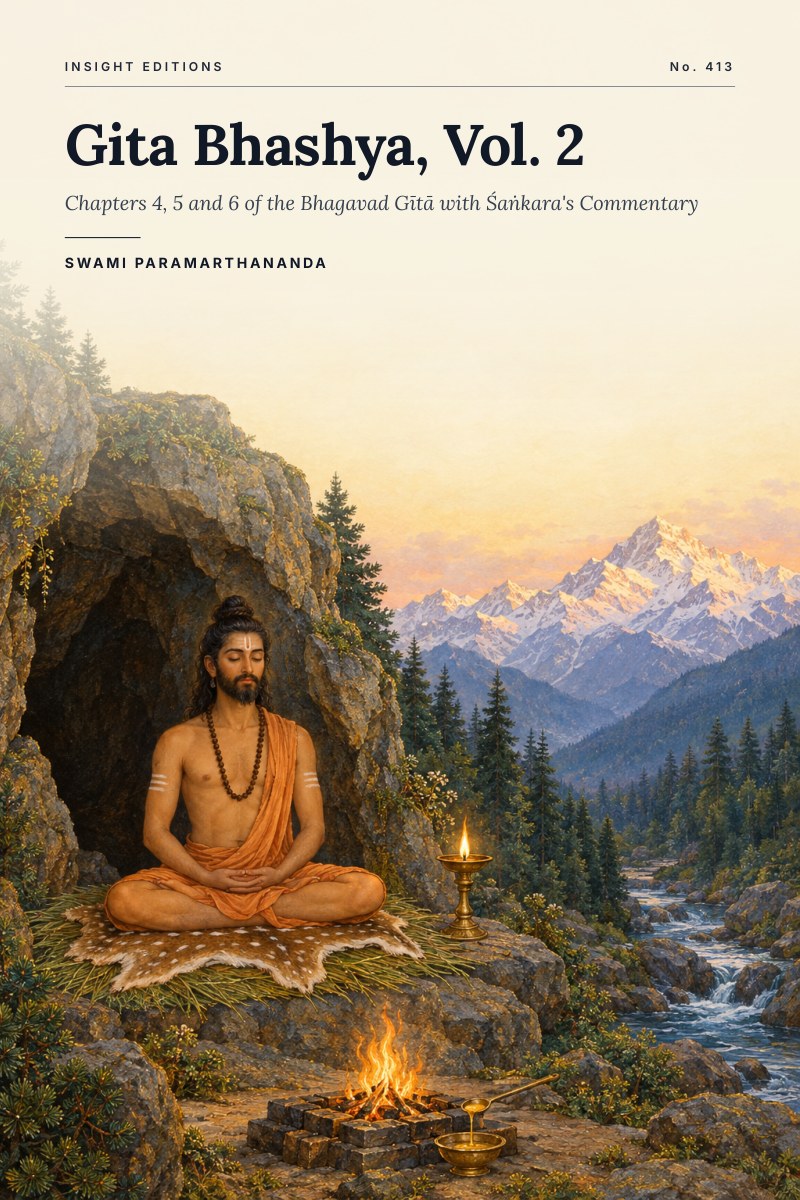
Gita Bhashya, Vol. 2
Chapters 4, 5 and 6 of the Bhagavad Gītā with Śaṅkara's Commentary
Swami Paramarthananda
Insight Edition of Swami Paramarthananda's 139 classes on Śaṅkara's Bhagavad Gita Bhashya, Volume 2: Chapters 4, 5 and 6, on knowledge, renunciation and meditation.
A study guide to Swami Paramarthananda's classes on the Bhagavad Gītā Śaṅkara Bhāṣyam, Vol. 2 (Arsha Avinash Foundation, transcribed by SwayamJyothi, Sri V.K. Vancheeswaran and Sri P.S. Ramachandran; not verified by Swamiji). Shared free for personal reading; not for sale and not endorsed by the author or publishers.
CORE CLAIM
Knowledge renounces doership, not activity; karma-yoga prepares the mind, and meditation stabilises the knowledge that the Self never acts.
SCOPE
139 classes on Gītā Chapters 4, 5 and 6: the avatāra, action in inaction, brahmārpaṇam, two sannyāsas, the city of nine gates, meditation and the fallen yogī.
KEY FIGURES
Śaṅkara against the vṛttikāra, Vaiśeṣika and samuccaya; Kṛṣṇa and Arjuna; Swami Paramarthananda as teacher, with Madhusūdana, Ānandagiri and Swami Dayananda cited.
BEST FOR
Students reading Śaṅkara's Gītā commentary closely, and anyone wanting a practical Advaita account of renunciation and Vedāntic meditation.
The Book on One Page
This volume continues Swami Paramarthananda's long course on the Bhagavad Gītā with Śaṅkara's bhāṣya. Its 139 classes (124b to 263) cover Chapters 4, 5 and 6 of the Gītā: knowledge as the true renunciation, the choice between household and monastery, and meditation as the last stage of the journey. Every verse is read word by word, with grammar, cross-references and constant application to the student's life.
Chapter 4 begins with lineage and the avatāra: the teaching is ancient, and the Lord who teaches it takes a body "as though" born, by māyā, not by karma. Its centre is 4.18, "inaction in action and action in inaction", on which Paramarthananda spends twelve classes. The thesis: the ego is never free from action and the Self is never touched by it, and one may claim either as oneself. Brahmārpaṇam (4.24) reads a whole ritual as brahman, twelve yajñas follow, and Kṛṣṇa sends Arjuna to a teacher with prostration, inquiry and service.
Chapter 5 opens with Śaṅkara's longest introduction, separating two sannyāsas: renunciation to seek knowledge (vividiṣā) and renunciation after knowing (vidvat). Only the first can be compared with karma-yoga, and Kṛṣṇa's verdict is that karma-yoga is better. Paramarthananda is candid that Śaṅkara "has difficulty in accepting this verdict", and the chapter shows how he makes room for it. The rest describes the knower: the city of nine gates, equal vision toward the brāhmaṇa and the outcaste, three kinds of joy, and obedient desires.
Chapter 6 is dhyāna-yoga. Śaṅkara argues it is addressed to the renunciate, and the commentary on 6.1 shows him inserting one word to keep the monk on top. The practical teaching is generous: lift yourself by yourself, the middle way in food and sleep, withdrawal "slowly, slowly", converting a distraction into an object of meditation, and the role-reversal test of 6.32. Arjuna's objection that the mind is "as hard to hold as the wind" gets the reply practice and dispassion, and the chapter ends with the consolation that the fallen yogī is never lost.
Two threads tie the volume together. The first is Paramarthananda's triangular and binary formats: "I, the world, God" for the karma-yogī, "I am brahman, the rest is mithyā" for the meditator, with nididhyāsana defined as negating the seven attitudes karma-yoga cultivated. The second is Śaṅkara's defence of renunciation against a text that often praises the active life. The edition keeps both visible and marks where commentary pushes against the plain sense of the verse.
| Ch | Title | Payload |
|---|---|---|
| 1 | Renouncing Action by Knowledge | Title decoded; lineage; two bodies |
| 2 | Avatāra, Free Will and the Pull of Results | 4.7–4.12; why few seek mokṣa |
| 3 | The Doer Who Does Nothing | Varṇa by guṇa and karma; anxiety as test |
| 4 | Action in Inaction: The Paradox Verse | 4.18; two actionlessnesses |
| 5 | Śaṅkara Against the Vṛttikāra | Ritual reading refuted; vikarma |
| 6 | The Knower at Home and in Robes | Roasted seeds; trustee of the body |
| 7 | Brahmārpaṇam | Bādha, not upāsana; vivarta |
| 8 | Twelve Yajñas and the One That Liberates | Proximate and remote means |
| 9 | Approach the Teacher | 4.34; four definitions of mokṣa |
| 10 | Faith, Commitment and the Worst Obstacle | Falsified prārabdha; the doubter |
| 11 | Two Sannyāsas: Vividiṣā and Vidvat | Seven attitudes reversed |
| 12 | Household or Monastery? Kṛṣṇa's Verdict | Karma-yoga better; tongue and teeth |
| 13 | Two Shifts of Mindset and the City of Nine Gates | Karmī vs karma-yogī; 5.13 |
| 14 | Svabhāva Acts, and the Wise See the Same in All | Māyā as doer; 5.18 |
| 15 | One Self, Three Joys | Against Vaiśeṣika; viṣaya to padārtha |
| 16 | Managing Desire and Anger | Obedient desires; seed of Ch. 6 |
| 17 | Whom Is Chapter 6 For? | Guilt and formal sannyāsa; the camel |
| 18 | The Climber and the One Who Has Climbed | Means and end, 6.3–6.4 |
| 19 | Lift Yourself by Yourself | FIR and triple C; the fourth match |
| 20 | Posture, Moderation and the Highest Gain | No world to avoid; four moderations |
| 21 | Slowly, Slowly | Gradual withdrawal; one slipper |
| 22 | Role Reversal and the Restless Mind | 6.32; practice and dispassion |
| 23 | The Fallen Yogī Is Never Lost | Rebirth; Ramana; be a meditator |
Renouncing Action by Knowledge
The fourth chapter is titled jñāna-karma-sannyāsa-yoga, and Śaṅkara's first move is to fix the grammar of the title: it means renouncing action through knowledge, not renouncing both knowledge and action. Kṛṣṇa then glorifies the teaching through its lineage, and Arjuna's doubt about that lineage opens the topic of the avatāra.
Reading the title correctly
Paramarthananda warns against the obvious split, "jñāna and karma, their renunciation". Take karma-sannyāsa first, then ask how it is done: jñānena, by knowledge. Renunciation of action itself comes in two kinds.
| Kind | What is given up | Why it is incomplete or complete |
|---|---|---|
| Vaidika karma-sannyāsa | Vedic rituals, family, property, ordinary dress; one takes the fourth āśrama | Partial: bathing, begging, japa and study continue, "so many karmas are there even in sannyāsa" |
| Sarva-karma-sannyāsa | All action at once | Impossible at body level (3.5, 3.8, 18.11), yet Vedānta speaks of it "in a peculiar way" |
| Jñāna-karma-sannyāsa | Doership, not activity | Total: actions belong to the anātmā, "I am the asaṅga ātmā" |
"The only difference is if you are a gṛhastha you will call it annam and if you are a sannyāsi you will call it bhikṣā." The body keeps eating. What changes is who claims the eating.
Total renunciation is cognitive. Activity cannot be stopped, but the ownership of activity can be dropped by knowing the Self is not a doer. This is why the chapter belongs in a mokṣa-śāstra and not in a manual of monastic rules.
The Veda is finished; now the praise
Śaṅkara's introduction says the whole Vedic teaching is complete in Chapters 2 and 3: jñāna-yoga taught, karma-yoga given as its means. So Kṛṣṇa now glorifies it, because praise (arthavāda) is one of the six marks for finding a text's intent (upakrama-upasaṁhāra, abhyāsa, apūrvatā, phala, arthavāda, upapatti).
"Imaṁ yogam" is singular. For the Advaitin that single word rules out all three kinds of samuccaya (action-led, knowledge-led, equal). Karma-yoga is anuvāda: mentioned, already taught in the karma-kāṇḍa, but not the Gītā's own teaching. "Just as Taittirīya says the body survives by food, we won't say the Upaniṣad is teaching that."
27 catur-yugas. Paramarthananda's reckoning of the gap between Kṛṣṇa teaching the sun and Kṛṣṇa teaching Arjuna. The impossibility of that gap is what provokes Arjuna's question in 4.4.
Why Arjuna was chosen
The tradition never fully dies, but in materialist times people chase artha and kāma and neglect dharma and mokṣa; then the Lord sends ācāryas or comes himself. Why Arjuna? He asked as a disciple, he has śraddhā (trust) and anasūyā (non-cavilling), and he is a friend. Paramarthananda quotes Bhartṛhari's definition: a friend "dadāti kāle", gives what is needed at the right time. In a crisis, what is needed is not money but teaching.
Two bodies, three differences
Arjuna asks how Kṛṣṇa, born recently, taught the sun. Kṛṣṇa answers (4.5): we have both had many bodies; "I know them all, you do not." Then (4.6) the Lord, though unborn, of undiminished knowledge and ruler of all, "comes into being by my own māyā", "dehavān iva, jāta iva", as though embodied, as though born.
Kṛṣṇa, Vivasvān, Manu, Ikṣvāku carry the lineage. Bhartṛhari supplies the friendship verse. Paramarthananda keeps returning to the samuccaya-vādin, Śaṅkara's opponent from Volume 1.
The singular noun carries a heavy load. Ruling out every form of samuccaya because Kṛṣṇa says "this yoga" in the singular is a thin grammatical base. "Yoga" could name a single combined discipline as easily as knowledge alone, and the same chapter goes on to praise action at length. Śaṅkara's reading is coherent within his system, but it is supported more by the whole Advaita framework than by the grammar of 4.1, and a reader should notice when exegesis works backwards from a settled conclusion.
Avatāra, Free Will and the Pull of Results
Verses 7 and 8 give the time and purpose of the avatāra; verse 9 says that knowing the avatāra's true nature liberates as surely as knowing one's own. Verses 11 and 12 then answer an awkward question: if mokṣa is on offer, why do so few take it, and is the Lord partial?
When and why the Lord descends
"Yadā yadā hi dharmasya glāniḥ": whenever there is a waning of dharma. Śaṅkara defines that dharma as the varṇāśrama scheme and as the means to both abhyudaya (dharma, artha, kāma) and niḥśreyasa (mokṣa). The avatāra comes for "paritrāṇāya sādhūnām", protection of the good, and to destroy wrongdoing.
Hetu, svarūpa, kārya. Paramarthananda's three-point grid for any embodiment: cause, nature, purpose. Applied to the jīva and to the Lord, every point differs, even though "taking a body" looks the same from outside.
Verse 9: the corollary nobody states
"He who knows my birth and work as they truly are does not take birth again." Paramarthananda draws the conclusion: jīva-svarūpa-jñāna liberates and avatāra-svarūpa-jñāna liberates, so the two natures must be one and the same. And the language of "no rebirth" is for others: "in the jñāni's language he will say I don't have janma at all, where is the question of punar-janma."
Verse 10: an ancient path, not a new invention
"Freed from attachment, fear and anger, absorbed in me, many have attained my being, purified by the austerity of knowledge." The path is as eternal as the Veda, which arises with creation and lasts with it. "It has worked for all of them, therefore there is no reason why it won't work for you."
Verse 11: the Lord gives what is sought
"As they approach me, so I serve them." Kṛṣṇa's answer to the charge of partiality: what a person gets depends on what he seeks, because a human being has free will. Animals receive according to prārabdha; humans according to choice. Some Purāṇic devotees refuse mokṣa and want to remain servants; "a giver can be a giver only when there is a receiver."
| Term | Paramarthananda's gloss |
|---|---|
| Prayer | Not standing and asking; a saṅkalpa attached to a prescribed action, upāsana or inquiry |
| Karma | Can be bodily, verbal (chanting a stotra) or mental |
| "My path" (1) | The path leading to me: every pursuit, even an atheist's, moves toward the Lord, since "sarvaṁ viṣṇumayaṁ jagat" |
| "My path" (2) | The path revealed by me in the Veda |
Medicine plus prayer. The Lord provides two kinds of means: laukika (the intellect that does medical research, available to the atheist too) and śāstrīya (kāmya rituals). The believer may use both; "let the combination of medicine plus kāmya-karma together give the benefit."
Verse 12: why results win
People worship the gods "desiring success in action", because in the human world such success comes quickly. Karma-phala is māyika, visible and fast; jñāna-phala is non-māyika and demands long preparation. Śaṅkara quotes 7.19: the one who sees "vāsudevaḥ sarvam" is "very rare". Vāsudeva here means nirguṇa brahman appearing as everything, not the son of Vasudeva.
The Lord is not partial; people simply prefer the result they can see this year to the one that ends seeking altogether.
Free will answers partiality only if choice itself is free. The argument says the Lord gives mokṣa to those who want it. But the same tradition holds that desire for mokṣa arises from puṇya earned over many births, and that grace guides who meets a teacher. If wanting liberation is itself a result of past karma and grace, the charge of unequal treatment moves back a step rather than disappearing. Śaṅkara's later appeal to beginningless karma (anādi) is the real answer, and it explains inequality without justifying it.
The Doer Who Does Nothing
Verse 13 has two halves that seem unrelated. The first says the Lord created the four varṇas by quality and work; the second says, "know me as the non-doer, though I am the doer." Paramarthananda calls the second line a hidden mahāvākya, and verses 14 to 17 turn it into a lesson for Arjuna: act, do not run away, and learn what action really is.
Why the Vedic path, and why only here
Śaṅkara finds two links back to the previous verses. Why do people follow only the Lord's path? And why is the varṇāśrama scheme limited to the human world ("mānuṣe loke")? One verse answers both: "Cāturvarṇyaṁ mayā sṛṣṭam guṇa-karma-vibhāgaśaḥ." The scheme exists only among humans, so only there do Vedic duties apply.
Guṇa and karma, not birth. Paramarthananda points out that Kṛṣṇa names character (guṇa) and occupation (karma) as the basis of the four groups and "doesn't mention the birth-based" criterion. The classification is presented as a description of temperaments and roles.
The objection: a doer must be an enjoyer
The opponent says "hanta", alas. If the Lord is the maker of so huge a work as dividing society, then "whoever is a doer is also an enjoyer"; he gains puṇya and pāpa, sañcita and prārabdha, and "in short He also will become a saṁsāri". That contradicts his titles ever-free and ever-Lord.
The answer: the Lord is a doer from the transactional standpoint, but he has no abhimāna, no ownership of that role. "Īśvara's Īśvara-status belongs to Īśvara's ahaṅkāra only", which is vyāvahārika. Since Kṛṣṇa says "I am not even Īśvara, aham brahma asmi", doership produces no enjoyership.
The litmus test. How do you know if you own your actions? Anxiety about results. "Whether I have abhimānam or not is indicated by anxiety with regard to karma-phalam." Anxiety is already suffering, and the same action also leaves invisible puṇya and pāpa.
Verse 15: Janaka did it, so can you
"Knowing this, the ancients also acted, seeking liberation; so do action alone." Kṛṣṇa's encouragement: self-knowledge can be gained in this life, by a householder, even by a kṣatriya householder, and the forefathers are the proof.
Śaṅkara reads the "alone" (eva) as a double exclusion:
| What "karma eva kuru" excludes | Meaning for Arjuna |
|---|---|
| Sitting quiet (tūṣṇīm āsanam) | Do not evade the dharma-yuddha |
| Taking sannyāsa | Stay in the householder stage |
And the reason splits by who Arjuna is: "if you do not know the Self, act for purification; if you know it, act for the welfare of the world (loka-saṅgraha)."
Verses 16–17: the sages are confused
"What is action, what is inaction? Even the wise are confused here." Arjuna's imagined reply: "Karma means activity of body, speech and mind; akarma means not doing it. Where is the scope for confusion?" Kṛṣṇa answers that the nature of action is deep (gahanā karmaṇo gatiḥ). The point being prepared: what looks like inaction can be action, and the reverse.
Kṛṣṇa's own position is the model: full activity at the level of the world, no doership at the level of the Self.
"Not by birth" is a modern-friendly reading Śaṅkara does not fully share. Paramarthananda notes that the verse names guṇa and karma, not birth. But in the same commentary Śaṅkara treats varṇa duties as Vedic injunctions that bind specific groups, and elsewhere in his works he excludes śūdras from Vedic study. Readers should keep apart three things: what the verse says, how Śaṅkara applied it, and how a contemporary teacher frames it for a modern audience. The verse alone does not settle whether varṇa was meant as hereditary.
Action in Inaction: The Paradox Verse
"He who sees inaction in action and action in inaction is wise among men; he is a yogī who has done all his work." Paramarthananda spends twelve classes on this one verse. His summary comes first: the ahaṅkāra is never free from action, the ātmā is never touched by it, and you may claim either as yourself.
The bottom line before the details
"Whether we understand the paradoxical language or not, the essence is simple." The ego is an eternal saṁsārī; the Self is an eternal asaṁsārī. "If you want to be asaṁsārī, learn to claim the ātmā. The choice is yours."
Two kinds of actionlessness
Śaṅkara gives a technical point Paramarthananda had skipped in his verse class. Absolute actionlessness belongs to the ātmā and is known only through Vedānta. Empirical actionlessness is what lay people mean: a temporary rest, anitya. Someone who says "I am inactive" has not reached the first; he has only switched the body's activity off and kept the doer.
Why the lazy man is not a jñānī. Both say "aham akartā". But the idler says it as the body-mind, which has merely stopped moving: "I am sitting quiet, I am happy." The jñānī says it as the witness, while the body may be fully busy. Same words, different speaker.
Is Kṛṣṇa teaching a mistake?
The opponent's charge: seeing one thing as another (atasmin tad-buddhiḥ) is the very definition of error, and the verse asks for two such errors. Śaṅkara's reply uses the rope and snake: telling someone to "see the snake as a rope" sounds like bad advice, but not if he already mistook the rope for a snake. Then it is a correction.
| Step | Śaṅkara's argument |
|---|---|
| Charge | The verse prescribes double misperception |
| Reply 1 | It corrects an existing double error, so it only looks like error |
| Charge 2 | Action is always action, inaction always inaction; no error is possible |
| Reply 2 | The error is real: actions of body and mind are superimposed on the Self |
| Proof | People say "I am the doer, this is my action, I will enjoy its fruit" |
Why teachers repeat
Paramarthananda pauses on a trait of every ācārya from the Lord onward: repetition. Strictly it is a fault, but it is deliberate reinforcement, because "the student nods his head and again goes back to his own saṁsārika ways." Śaṅkara's phrase: the world, deluded, "forgetting again and again", keeps descending into the life of body-identification. Kṛṣṇa taught the same idea in 2.12–25 and in Chapter 3, and teaches it again here in new language.
Since the student repeats the mistake, the ācārya will have to repeat the teaching also.
Swami ParamarthanandaThe two misconceptions named
Withdrawal from action is not freedom from action, because the one who withdraws is still the doer.
The correction model makes the verse unfalsifiable. Any instruction that sounds wrong can be redescribed as "correcting a prior error" once you assume the prior error exists. Śaṅkara does argue for the error, from the ordinary sense of "I am doing", but the argument works only if one already accepts that the Self is distinct from the body-mind. A reader who does not share that premise will see 4.18 as a plain paradox about detachment in work, which is how many non-Advaita commentators read it.
Śaṅkara Against the Vṛttikāra
Having explained 4.18, Śaṅkara does something rare: he quotes another commentator on the same verse and refutes him at length. The rival, a vṛttikāra close to Pūrva Mīmāṁsā, reads the verse as praise of daily ritual. The debate shows why Śaṅkara treats any action-centred reading of the Gītā as a "red rag".
Who has "completed all duties"?
The verse calls the knower kṛtsna-karma-kṛt, one who has done all work. Śaṅkara says this is glorification, not a stated result. Paramarthananda draws out the consequence: in the six marks of intent, arthavāda (praise) is distinct from phala (result), and praise is not a literal fact. So the knower has not literally completed his duties.
Duties never end for the ego. "As ahaṅkāra, nobody in the world can complete the duties, even Bhagavān." Completion means distancing oneself from the ahaṅkāra, not ticking off a list. The buddhimān and paṇḍita here mean ātma-jñānī, as in 2.11.
Message analysis and text analysis
Paramarthananda explains why a bhāṣya does both. Message analysis states what is taught; textual analysis shows that the message comes from the text, not the commentator. "Every textual analysis is getting a signature from the author", here Kṛṣṇa himself. Śaṅkara's authority is borrowed from the Gītā, so he must prove the Gītā says it.
The rival reading
Paramarthananda is frank about motive: "Throughout the Gītā Śaṅkara's aim is to bring in the concept of sannyāsa." The Gītā looks action-oriented on the surface; Śaṅkara argues it is sannyāsa-oriented underneath.
Where the rival goes wrong
| Vṛttikāra claim | Śaṅkara's response |
|---|---|
| Omitting nitya-karma creates sin | Accepted: śruti ("akaraṇe pratyavāyaḥ") and Manu 11.44 say so. Not the issue |
| Calling ritual "inaction" is figurative (gauṇa) | Then the wise man's "seeing" is just a figure of speech, and no knowledge results |
| Fruitless ritual still gives mokṣa | Self-contradiction: "having accepted that nitya-karma is fruitless, he says it gives mokṣa" |
| The verse is about ritual | No liberating knowledge can come from viewing ritual one way rather than another |
The missing third term. Verse 4.17 promised to explain karma, akarma and vikarma (forbidden action), but 4.18 covers only two. Madhusūdana Sarasvatī and the sub-commentators say it is homework: read the verse again with vikarma. Even when the ego does wrong, the knower does not transfer that action to the Self; "vikarma also belongs to ahaṅkāra".
Back to the true reading
Śaṅkara closes by saying his own reading stands "not because it is my commentary" but because it agrees with śruti, reasoning and experience. Verse 19 then begins the description of the knower: one whose undertakings are "free from desire and intention", whose actions are "burnt in the fire of knowledge".
For Śaṅkara, a verse about seeing must yield knowledge, and seeing ritual as fruitless yields none.
The vikarma homework is an admission. If a verse promised three topics and covers two, a commentator who must supply the third is filling a gap, however plausibly. It is equally possible that 4.17's "vikarma" means something other than forbidden action (some read it as "varied action"), or that the verse is not a strict syllabus. Śaṅkara's polemic against the vṛttikāra is strong on internal contradictions; it is weaker as proof that the verse could not have a practical, action-centred sense alongside the metaphysical one.
The Knower at Home and in Robes
Verses 19 to 24 form a mini sthita-prajña section, a shorter version of the portrait of the steady knower in Chapter 2. The outer verses describe the householder-knower, the middle two the renunciate-knower. One point runs through all six: the knower's actions produce no new puṇya or pāpa.
Freedom from one's own biography
Paramarthananda's definition of liberation here is worth keeping: the knower is identified with the witness and has "falsified" the ego costume, so he is free from obsession with one ego's biography, or with "a bunch of ahaṅkāras called family biography". "Freedom from these two preoccupations alone is called mukti."
Two kinds of renunciate-knower
Śaṅkara accepts that a householder can be a jñānī, but adds that such cases are rare. Among renunciates he distinguishes two paths.
| Path | Who | Route |
|---|---|---|
| Vividiṣā-sannyāsa | A brahmacārī who already has the four qualifications, perhaps from past lives | Skips household life, renounces to seek knowledge through śravaṇa and manana |
| Vidvat-sannyāsa | One who gained knowledge first, often as a householder | Renounces after knowing, as the natural expression of it |
Why skip the household? Household life serves dharma, artha, kāma or purification of mind. If a student needs none of these, "all the four purposes of gṛhasthāśrama have become irrelevant to him."
Roasted seeds. The knower's actions are jñāna-agni-dagdha, burnt in the fire of knowledge. Like roasted seeds, they look like actions (karma-ābhāsa) but cannot sprout as future results. Sañcita is destroyed, āgāmi does not arise, and only prārabdha runs on, and even that only from the world's standpoint.
A note on Tattva-bodha
Tattva-bodha says a knower's future merit goes to those who serve him and his future sin to those who insult him. But if the knower has no āgāmi, what is distributed? Paramarthananda cites the Brahma-sūtra answer: the statement is arthavāda. Its real message is simply "worship a jñānī, don't insult a jñānī."
The renunciate's single duty
The renunciate has cut family, social, national and even religious ties, having removed the sacred thread and tuft. If he serves the world, it is svabhāva, not duty. One duty remains: the body, which "is Bhagavān's property" until it falls.
The trustee of the body. Four tasks only: clothing, feeding, cleaning and treating. Done without body-identification, they produce no āgāmi. Śaṅkara then analyses "śārīraṁ karma" grammatically: is it action done by the body, or action for the body? He takes the second, because the first would let any bodily act, even a forbidden one, escape consequences.
Bhikṣā as the test case
Verse 22, "content with what comes by chance, beyond the pairs, without envy, the same in success and failure", is read in context as the monk on his alms round. Good food or poor food, alms or none, no comparison with another monk who got better. The world sees him acting; he holds "I am the actionless Self" like the tamburā drone behind music.
Whether householder or monk, the lifestyle differs but the freedom from new karma is the same.
The theory of no new karma is unverifiable from outside. The claim that a knower's actions are "roasted seeds" cannot be checked: no one can observe whether an action leaves puṇya or pāpa. It also risks a moral hazard that Śaṅkara himself guards against by reading "śārīraṁ karma" narrowly. The safeguard depends on the knower's goodness being guaranteed by his knowledge, an assumption history has not always supported among those claiming realisation.
Brahmārpaṇam: Everything in the Ritual Is Brahman
"The offering is brahman, the oblation is brahman, poured by brahman into the fire of brahman; brahman alone is reached by one absorbed in brahman-as-action." The verse is chanted before meals across India. Śaṅkara gives it eight classes and reads it as falsification of the world, then refutes a rival who reads it as a meditation.
The householder-knower returns
Verse 23 comes back to the householder who knows. Śaṅkara says the natural course for him is vidvat-sannyāsa: he "sees no purpose for himself" in being a ritual doer, since household life has already given its fruits. The model is Yājñavalkya, who tells Maitreyī (Bṛhadāraṇyaka 2.4.1) that he is leaving home.
Chapter title, decoded. Knowledge of the Self as non-doer falsifies all action, and that falsification is called karma-sannyāsa. So "jñāna-karma-sannyāsa" equals "jñānena karma-mithyātva-niścaya", the firm knowledge, by knowledge, that action is mithyā.
Seeing the ritual as brahman
A ritual has kārakas (accessories: ladle, ghee, fire, doer), kriyā (the act) and phala (the result). The ignorant householder sees a family man using rituals for family problems. The knower has sarvatra-brahma-darśana: "I am Brahman, my wife is Brahman, my children are Brahman, problems are Brahman, solution is Brahman."
The title brahma-karma-samādhi means one whose mind is absorbed in the vision "karma is brahman", that "the karma I am doing now doesn't really exist at all", only brahman appearing with mithyā names and forms.
Two readings for two knowers
| Reader | What 4.24 means |
|---|---|
| Householder-knower | His daily rituals are seen as brahman, so they yield no āgāmi |
| Renunciate-knower | No ritual at all; the verse describes a nididhyāsana: seeing doer, act and result as mithyā |
For the renunciate, even "sādhaka-I" and "mumukṣu-I" must be falsified. "Up to a particular level talking about citta-śuddhi is wonderful; after a particular level talking about citta-śuddhi also becomes an obstacle."
Surgeon and robber. Both cover their faces, both use a knife, both cause a death. One goes to prison, the other does not. "What made the difference? Not the extraneous physical tangible factors but the internal bhāvanā." If mindset changes the status of a worldly act, it changes the status of a ritual too.
Four ways to read "A is B"
The verse is built from statements of co-reference (sāmānādhikaraṇya): "arpaṇam brahma". Paramarthananda lists four kinds.
| Kind | Example sense | Used here? |
|---|---|---|
| Aikya (identity) | "This is that Devadatta" | No |
| Viśeṣaṇa-viśeṣya (qualifier) | "Blue lotus" | No |
| Upāsana (meditative) | "Meditate on the name as brahman" (Chāndogya 7.1.5) | The rival's reading |
| Bādha (sublation) | "The snake is the rope" | Śaṅkara's reading |
Pariṇāma or vivarta
The rival reading rests on a view of causation. Does brahman become the world, as gold becomes ornaments (pariṇāma), or appear as the world without change (vivarta)? If brahman becomes the world, the world is as real as brahman. Since the Upaniṣads call brahman kūṭastha and changeless, Advaita takes the second.
Śaṅkara's arguments: an upāsana is a form of action, and action cannot give mokṣa; the context is knowledge, so a meditation would be out of place. Even granting krama-mukti, it breaks the chapter's theme.
Chanted before a meal, the verse is a reminder; understood as Śaṅkara reads it, it is a sublation of the whole meal.
Context decides, and context is disputed. Śaṅkara's main argument against the meditative reading is that the chapter is about knowledge. But 4.25 onward lists many yajñas, including meditative and ritual ones, so the immediate context is also about kinds of offering. The upāsana reading fits that list well. Śaṅkara's choice is strongest if one already reads the chapter as Advaitic; it is not forced by the verse.
Twelve Yajñas and the One That Liberates
Having made brahmārpaṇam the model of knowledge as offering, Kṛṣṇa lists twelve spiritual disciplines, each described as a yajña. Śaṅkara's thesis for the section: all of them are valuable, but they are remote means; only jñāna-yajña is the proximate means to liberation.
Proximate and remote
| Term | Sanskrit | Role |
|---|---|---|
| Proximate means | Sākṣāt upakāraka | Knowledge, which directly removes ignorance |
| Remote means | Ārāt upakāraka | Every other discipline, which prepares the mind for knowledge |
Paramarthananda insists the others are "not optional or avoidable"; they are "indirectly contributing sādhanas".
The monk's daily fire ritual
On the second reading of 4.24, the renunciate does not perform the Vedic agnihotra. He replaces it with a nididhyāsana ritual, done "twice a day or thrice a day, until this becomes a niṣṭhā". Verse 25's second half describes it: the knowers "offer the yajña by the yajña into the fire of brahman".
Why should "yajña" mean jīvātmā? Śaṅkara says some lexicon lists it as a synonym for ātmā. Madhusūdana identifies the source as Yāska's Nirukta, the ancient Vedic etymology that historians place in the sixth century BCE or earlier, and which itself cites still earlier scholars.
Five names for one practice. Jñāna-yajña of a sannyāsī = nididhyāsana-yajña = seeing the world as mithyā = seeing act, factors and result as mithyā = seeing the jīva as mithyā. The image is the rope-snake: the snake's "reality" is sublated by seeing the rope.
The list of twelve
Paramarthananda distinguishes svādhyāya from jñāna-yajña: in the first we learn to chant the Veda with its accents and do not learn the meaning; in the second we learn the meaning and need not chant.
3 kinds of breath control. Pūraka (inhalation prominent), recaka (exhalation longer) and kumbhaka (retention). Verse 29 names all three; "prāṇāpāna-gatī ruddhvā" is kumbhaka, restraining both upward and downward movements of breath.
What makes an act a yajña
"The word yajña can be used only when Bhagavān is involved." With the attitude of offering (īśvarārpaṇa-bhāvanā) and of receiving as grace (prasāda-bhāvanā), the most worldly act becomes yajña, as 9.27 says: "whatever you do, eat, offer, give". Without that attitude, "even a Vedic ritual will become a non-yajña."
Pāpa redefined
Verse 30 says all these practitioners have their sins destroyed. Paramarthananda gives the Vedāntic definition: pāpa is any obstacle to Vedānta. Wealth that leaves no time for study counts as pāpa; loving relatives who prevent practice count as pāpa. Poverty can be a blessing, as Kucela found, since "when I am poor relatives won't come", echoing Bhaja Govindam 10.
The test of a discipline is not its outer form but whether it carries the mind toward knowledge.
The hierarchy may be built into the reading. Kṛṣṇa does praise jñāna-yajña in 4.33. But the list of twelve is presented as parallel offerings, and nothing in 4.25–4.30 by itself ranks them as remote. Śaṅkara's reading of "yajña" as jīvātmā in 4.25 also relies on a rare lexical sense, which a reader may find convenient. The section can be read as a pluralist catalogue of valid paths, a reading many devotional schools prefer.
Approach the Teacher: Means and Fruit of Knowledge
Kṛṣṇa now names the method. After the twelve yajñas comes the glory of knowledge (4.33), the means of gaining it (4.34: go to a teacher), and its fruit, which Paramarthananda reads as four definitions of mokṣa in verses 35 to 37.
No yajña, no world
"For one who offers no yajña, not even this world exists; how then the other?" Śaṅkara applies the kaimutika-nyāya, the "how much less" principle: if a person who follows none of the twelve disciplines cannot get even worldly well-being, the higher goals, heaven and mokṣa, are out of the question.
The architecture of Chapter 4
Paramarthananda shows that every section of the chapter is about knowledge.
| Verses | Topic | Sanskrit label |
|---|---|---|
| 4.18–4.24 | What knowledge is: right seeing of action and inaction | Jñāna-svarūpa |
| 4.25–4.32 | Supporting disciplines | Jñāna-sahakāri-sādhana |
| 4.33 | Knowledge is the direct and only means | Jñāna-stuti |
| 4.34 | How to gain it: guru and śāstra | Jñāna-sādhana |
| 4.35–4.37 | What it gives | Jñāna-phala |
Why 4.33 is the climax. "Better than material offering is the offering of knowledge; all action culminates in knowledge." Every benefit the other yajñas give is "included in jñāna-sādhana". 4.24 to 4.32 were only "preparatory ground" for this verse.
Verse 34: the method
"Know it by prostration, by inquiry, by service; the wise who have seen the truth will teach you."
"If it is studied in a disorderly and unprogressive manner, even after twenty-five years fundamental doubts will continue." A śrotriya knows the scriptural techniques of teaching, because each method suits a different stage.
Why a teacher at all? A conviction that has only been transferred from book to student is fragile. The brahma-niṣṭha condition requires that "from the scriptures it must have come to the heart of the ācārya, and from the heart of the ācārya the teaching must go." Self-study cannot supply the teacher's own clarity or his skill at matching method to student.
Four definitions of mokṣa
Bheda-nivṛtti works in stages: first remove the difference between jīva and paramātmā, making one ātmā; then the difference between that one ātmā and the anātmā.
Boat and fire
Why two examples? Verse 36 says knowledge carries you across sin like a boat across an ocean. A thoughtful student will ask: what about puṇya? Puṇya also keeps the cycle of birth and death going. So verse 37 gives a second image: all karma is a heap of logs, sandalwood (puṇya) and ordinary wood (pāpa) together, and knowledge is fire that burns them all.
Merit is not a reward to keep; for the seeker of freedom it is another log on the pile.
The guru requirement concentrates authority. Verse 34 makes a qualified teacher the primary means, and Paramarthananda adds that study without one leaves doubts after decades. This protects students from self-made doctrine, but it also gives teachers a structural monopoly on interpretation and makes it hard for a student to test a teacher's claim to be brahma-niṣṭha. The tradition's own safeguard, the śrotriya condition, checks method, not realisation, which no outsider can verify.
Faith, Commitment and the Worst Obstacle
The chapter ends with a purification more complete than any ritual, three qualifications for the seeker, three obstacles in rising order of harm, and a final command to Arjuna: cut doubt with the sword of knowledge and stand up.
Falsified prārabdha
Knowledge burns sañcita and āgāmi. What about prārabdha, the karma already running this body? Śaṅkara narrows "all" (sarva-pada-saṅkoca): prārabdha is not destroyed. But it does not block jīvan-mukti, because knowledge falsifies it.
Two kinds of prārabdha. "Unfalsified prārabdha is the cause of saṁsāra; falsified prārabdha doesn't obstruct jīvan-mukti." Only the knower knows which kind he has. "The society thinks that poor jñānī is going through prārabdha."
Muṇḍaka 3.1.3 confirms the double freedom: the knower, "shaking off puṇya and pāpa, stainless, attains supreme equality".
Verse 38: the greatest purifier
"There is no purifier equal to knowledge." Because it removes delusion, difference, sin and all karma, knowledge is the highest maṅgala. And "the one perfected in yoga finds it in time, in himself": karma-yoga ripens into knowledge, not at once.
Verse 39: three qualifications
Śaṅkara's reason for the second item is psychological. A person may have plenty of śraddhā and still be manda-prasthāna, a slow mover: "we will do it next year, maybe Tamil New Year", attending one class and skipping three. Paramarthananda's English: "a slow-coach, a passenger train."
Yathokta-kārī: one who does what the guru says.
Vivekacūḍāmaṇi, quoted by Swami ParamarthanandaVerse 40: three obstacles, graded
"The ignorant, the faithless and the doubting self perish; for the doubter there is neither this world nor the next, nor happiness."
| Obstacle | What he loses | Degree (Śaṅkara) |
|---|---|---|
| Ajña (ignorant) | Mokṣa | Pāpī: bad |
| Aśraddadhāna (faithless in the Veda) | Mokṣa and heaven | Pāpīyān: worse |
| Saṁśayātmā (doubts every means of knowledge) | Mokṣa, heaven and worldly pleasure | Pāpiṣṭha: worst |
The doubter is worst because he doubts all pramāṇas, including ordinary perception and testimony in worldly matters, so even everyday enjoyment collapses.
Verses 41–42: the summary of the chapter
"He doesn't renounce the actions physically. Very important." The word ātmavān adds a third element: the knower practises this "binary format" with alertness in daily life, which is nididhyāsana. Together they give the three stages of jñāna-yoga.
Renouncing doership, not activity, is the sannyāsa this chapter is named for.
Ranking the doubter as worst can protect the doctrine from scrutiny. Doubt about every pramāṇa is indeed paralysing. But the verse and commentary can easily be heard as condemning any doubt about scripture, which is how questioning students are sometimes silenced. Śaṅkara's own method uses manana, reasoned reflection, to remove doubt, so he values examined doubt. A careful reader should separate radical scepticism, which the verse attacks, from honest inquiry, which the tradition claims to welcome.
Two Sannyāsas: Vividiṣā and Vidvat
Before Chapter 5 begins, Śaṅkara writes one of his longest introductions, and Paramarthananda spends ten classes on it. Its purpose: to make Arjuna's opening question, "sannyāsa or karma-yoga, which is better?", a sensible question. The answer turns on a distinction Śaṅkara draws but never names: renunciation to seek and renunciation after knowing.
Chapter 4 in two words
Śaṅkara's summary of the previous chapter: sannyāsa (from 4.18 on: "inaction in action", "burnt in the fire of knowledge", "brahmārpaṇam", "yoga-sannyasta-karmā") and karma-yoga (4.15, 4.42: "stand up and fight"). Kṛṣṇa praised both. Hence 5.1: "You praise renunciation of action and then yoga; tell me decisively which one is better."
The objection from a neutral party
A madhyastha, a middle party, objects: the renunciation of Chapter 4 belongs to the knower, karma-yoga to the non-knower. They apply to different people, so asking which is better is like asking whether childhood is better than old age. Śaṅkara accepts this for one pair and rejects it for another.
Which pairs can be compared? Vidvat-sannyāsa and karma-yoga "should never be paired or compared", since they belong to different stages. Vividiṣā-sannyāsa and karma-yoga are both options for the non-knower, both lead to the same destination (śravaṇa and manana), and cannot be practised at once. So Arjuna's question is valid only about this second pair.
The seven attitudes, reversed
The most practical part of the introduction is Paramarthananda's account of what nididhyāsana changes. Karma-yoga cultivates seven bhāvanās; nididhyāsana must deliberately negate them, "not even forget, deliberately negate".
| Karma-yoga cultivates | Nididhyāsana replaces with |
|---|---|
| Kartṛtva: I am the doer | Akartṛtva: I am not the doer |
| Karma-sambandha: action is mine | Karma-asambandha |
| Īśvarārpaṇa: I offer it to God | No offerer, no offering |
| Bhoktṛtva: I am the enjoyer | Abhoktṛtva |
| Phala-sambandha: the result is mine | Phala-asambandha |
| Prasāda: I receive it as grace | No receiver |
| Dāsatva: I am the Lord's servant | "Aham brahma asmi" |
"Sādhakatva-buddhi should be replaced with bādhakatva-buddhi": what was a means must now be seen as an obstacle. That is why nididhyāsana is defined as removal of contrary attitudes (viparīta-bhāvanā-nivṛtti).
How do I know my level?
Paramarthananda's test is disarming: "Am I understanding Swamiji's teaching or not?" If yes, you are ready for nididhyāsana. "And suppose you say: I do not understand even a bit and Swamiji keeps on saying something. Then don't worry, even attending the class will become another type of karma-yoga."
Karma-yoga of the knower is impossible even in a dream.
Śaṅkara, introduction to Chapter 5Here "knower" means one with knowledge from study but not yet established in it. Since karma-yoga rests on doership, it is opposed to right knowledge.
The same seven attitudes that purify the beginner become the bondage the advanced student must undo.
The two-sannyāsa scheme is a commentarial construction. Paramarthananda notes that Śaṅkara never uses the words vividiṣā and vidvat; they came later. Kṛṣṇa uses "sannyāsa" without qualification, and the commentator supplies the adjective each time to keep the text consistent. That is legitimate exegesis, but it means Śaṅkara's harmony between Chapters 4 and 5 depends on a distinction the Gītā itself does not draw. A reader taking the text plainly may conclude Kṛṣṇa simply ranks karma-yoga above renunciation for everyone.
Household or Monastery? Kṛṣṇa's Verdict
Arjuna asks which is better, and Kṛṣṇa answers plainly: both lead to the highest good, but karma-yoga is better than mere renunciation. Read as Śaṅkara reads it, this means the householder's life is more conducive to the spiritual journey than the monk's. Paramarthananda notes that Śaṅkara "has difficulty in accepting this verdict", and watching him handle it is the drama of these classes.
The verdict of 5.2
"Renunciation and karma-yoga both lead to the highest good; but of the two, karma-yoga excels renunciation of action." Śaṅkara reads the "renunciation" here as kevala sannyāsa, renunciation without knowledge: vividiṣā-sannyāsa, the monastic āśrama. So Kṛṣṇa ranks the gṛhastha-āśrama above the sannyāsa-āśrama for most seekers, including Arjuna.
Śaṅkara's courage. Throughout his Upaniṣad commentaries Śaṅkara champions formal renunciation. Here he "doesn't want to endorse this verdict" even from Kṛṣṇa. He limits it: the praise of karma-yoga is valid for the non-knower choosing between the two, and only because karma-yoga is a better preparation.
How can opposites reach one goal?
The objection: the householder is busy and the monk passive; one has plenty of possessions and relations, the other none. "Like two different factories, one a soap factory and another an iron gadget factory": different infrastructure, ingredients and process. How can both produce mokṣa?
Tongue and teeth. From one set of embryonic cells come the softest organ and the hardest. "When you bite the tongue you will know!" If opposite products can come from the same source, opposite lifestyles can lead to the same goal, because the goal is reached through the knowledge both prepare for.
Sāṅkhya and yoga are one
Verses 4–5: "Children, not the wise, call sāṅkhya and yoga different... He who sees them as one, sees." Śaṅkara shifts the meaning of sāṅkhya between verses.
| Verse | "Sannyāsa" / "Sāṅkhya" means | Claim |
|---|---|---|
| 5.2 | Vividiṣā-sannyāsa | It and karma-yoga share a goal; karma-yoga is better |
| 5.4–5.5 | Vidvat-sannyāsa | The karma-yogī reaches the vidvat-sannyāsī's goal, through it |
| 5.6 | Vidvat-sannyāsa, "the real yoga" | Hard to attain without karma-yoga |
The primary meaning of yoga, Śaṅkara says, is vidvat-sannyāsa itself (paramārtha-yoga). Karma-yoga, bhakti-yoga, haṭha-yoga, japa-yoga, even "music yoga" are yoga only secondarily, because each eventually leads there.
The catalyst
"Renunciation is hard to attain without yoga; the sage practised in yoga soon reaches brahman" (5.6). Paramarthananda's image is chemical.
"If karma-yoga is not there, śravaṇa and manana will take a very very very long time to come to nididhyāsana."
Verses 8–9: nididhyāsana all day
"'I do nothing at all,' so thinks the knower of truth, while seeing, hearing, touching, smelling, eating, walking..." This is vidvat-sannyāsa, also called kartṛtva-sannyāsa or ahaṅkāra-sannyāsa. Two forms of nididhyāsana:
Not "get up at three o'clock, chant 'mano-buddhy-ahaṅkāra cittāni nāham' for five minutes, all the time thinking I have to do this, I have to do that."
Kṛṣṇa tells a warrior that home is the better ashram, and his greatest commentator has to make room for that.
Shifting meanings across adjacent verses is a warning sign. Śaṅkara reads "sannyāsa" as vividiṣā in 5.2 and "sāṅkhya" as vidvat in 5.4–5.5, a switch the text does not mark. It lets him keep both Kṛṣṇa's verdict and his own preference for renunciation. The simpler reading, that Kṛṣṇa means the same contrast throughout and genuinely ranks active life higher, is what Rāmānuja and most modern readers adopt. Paramarthananda's candour about Śaṅkara's discomfort is itself the strongest evidence for it.
Two Shifts of Mindset and the City of Nine Gates
Nididhyāsana is "the final and the toughest stage". Paramarthananda names the two changes of mindset it requires, then follows Kṛṣṇa's contrast between karma-yoga and mere karma, and arrives at 5.13: the knower sits at ease in the city of nine gates, neither acting nor causing action.
Two profound changes
The conviction for both must come from sufficient śravaṇa and manana. "If it is not possible by you, come back": Śaṅkara's own advice, in effect, is to return to karma-yoga if the binary format will not hold.
Verses 10–11: the lotus leaf
"One who acts offering actions to brahman, abandoning attachment, is untouched by sin as a lotus leaf by water." Karma-yogīs act "with body, mind, intellect and even the senses alone, for purification of mind".
Verse 12: karma-yoga versus karma
The ranking now has three rungs: jñāna-yoga (direct) above karma-yoga (indirect) above mere karma (leads nowhere spiritually). The difference between the last two is at two levels.
| Level | Karma-yogī | Karmī |
|---|---|---|
| Type of action | Mostly nitya and naimittika (obligatory, occasional) | More kāmya, prāyaścitta and even forbidden action |
| Attitude | Niṣkāma: for purification, offered to the Lord | Sakāma: for results, "attached to the fruit" |
| Fruit | "Peace born of steadiness" | "Bound by desire" |
One theme, three chapters. Chapter 4's jñāna-karma-sannyāsa, Chapter 5's vidvat-sannyāsa and Chapter 18's mokṣa-sannyāsa are the same inner renunciation. Paramarthananda adds the grammar: "mokṣa-sannyāsa" is not "renunciation of mokṣa" (genitive) but "renunciation for mokṣa" (dative).
Both householder and monk follow their āśrama-dharma for purification and both practise śravaṇa and manana for knowledge; then they "converge into vidvat-sannyāsa".
Five things not to renounce
The condition for vidvat-sannyāsa is renouncing ahaṅkāra-abhimāna, identification with the five anātmās: profession, possession, family, body and mind. "Very careful. We don't say pañca-anātmā-tyāga; we need not renounce the anātmā, and we cannot." This renunciation "will not be seen externally; it is a pure intellectual phenomenon."
Liberation as the ego's last hiding place. "Our ahaṅkāra hides behind these two muktis," jīvan-mukti and videha-mukti. The more a seeker holds on to them as goals, the more the ego survives. The tātparya of Vedānta is nitya-mukti: "na dharmo na cārtho na kāmo na mokṣaḥ... śivo'ham." Even fear of rebirth must be dropped "this very minute".
Verse 13: the city of nine gates
"Renouncing all actions by the mind, the embodied one sits happily in the city of nine gates, neither acting nor causing action."
The opponent, drawing on Nyāya and Vaiśeṣika where the Self is a real doer, asks whether the ātmā might at least have its own actions. Kṛṣṇa: "na eva kurvan na kārayan." The ātmā, like space, cannot act "even if it wants to", and it does not instigate the organs either.
Renunciation in Chapter 5 is not leaving the city but recognising that you never ran it.
"Drop mokṣa as a goal" can be premature. Telling students that seeking liberation is the ego's hiding place is sound for those already convinced of the teaching. Said to beginners, it can produce a verbal non-dualism that skips the discipline Kṛṣṇa has just recommended. Paramarthananda guards against this ("if not possible, come back"), but the safeguard depends on honest self-assessment, which is exactly what the ego is good at distorting.
Svabhāva Acts, and the Wise See the Same in All
If the Self neither acts nor enjoys, who does? Kṛṣṇa's answer in 5.14 is "svabhāva", nature, which Śaṅkara reads as māyā. The verses that follow move from inner withdrawal to open-eyed nididhyāsana: seeing the same brahman in the learned brāhmaṇa, the cow, the elephant, the dog and the outcaste.
The doer by elimination
"The Lord (prabhu) creates neither doership nor actions nor the link with results; svabhāva acts." Prabhu here means the ātmā. Since the ātmā cannot be the doer and enjoyer, by elimination (pariśeṣa-nyāya) it must be the anātmā, the product of māyā: the three bodies with their vāsanās.
| Term | Nature | Standpoint |
|---|---|---|
| Svarūpa | Parā-prakṛti: consciousness, the higher nature | Pāramārthika |
| Svabhāva | Aparā-prakṛti: māyā, the lower nature (as in Chapter 7) | Vyāvahārika |
Ātmā in the third person
Kṛṣṇa calls the ātmā a non-doer and also calls the jñānī a non-doer. Paramarthananda draws the message "between the lines": the jñānī is the ātmā, and is a jñānī only when he identifies with it. Otherwise "we will keep on repeating like a parrot, ātmā is akartā, and we will keep on saying I am exhausting my prārabdha."
Three fears last as long as the third person does. Pāpa-bhaya (fear of sin), naraka-bhaya (fear of hell) and punar-janma-bhaya (fear of rebirth) remain while we speak of the ātmā as "it". Nididhyāsana is the practice of saying "I am akartā, so I have no sañcita, āgāmi or prārabdha."
Pūjā and the five daily yajñas continue. "Śaṅkara is not asking us to drop the pūjā. The idea is pūjā driven by bhaya is gone."
Verses 15–16: the sun of knowledge
"The Lord takes on no one's sin or merit; knowledge is covered by ignorance, and so beings are deluded." For those whose ignorance is destroyed, "knowledge, like the sun, reveals the supreme."
Verse 17: four steps to no return
Paramarthananda reverses the verse's order to fit the sādhana. The first step needs worldly success seen as empty: "one should see the vacuum in spite of worldly success." Without that, a person asks, "Vedānta teaches aham brahma; what is the benefit? I have so many worldly issues."
Verse 18: the same in all
"The wise see the same in a brāhmaṇa endowed with learning and humility, in a cow, an elephant, a dog and an outcaste." Śaṅkara maps the list onto the guṇas.
From closed eyes to open eyes. Early Vedānta says the ātmā is inside and the world is anātmā: "don't look outside" (Kaṭha 2.1.1; Lalitā Sahasranāma 162). Here the teaching matures. Nididhyāsana is "not a fifteen minutes exercise"; it continues "with open eyes, even during our transactions". The senses keep seeing differences, since they see only the mithyā; the intellect keeps aware of the one existence behind them.
Verse 19: conquering creation here
"Even here, creation is conquered by those whose mind rests in sameness; brahman is flawless and the same." Dakṣiṇāmūrti Stotram 3 gives the image: existence shines in every object, "sad-ātmakam".
The test of the knower is not how long he sits with closed eyes but how evenly he sees with open ones.
Spiritual equality is not social equality. The verse places a learned brāhmaṇa and an outcaste (śvapāka) at opposite ends of a scale, and Śaṅkara maps that scale onto sattva and tamas. The sameness taught is of the Self, while the hierarchy of the anātmā is left intact and even reinforced by the guṇa mapping. Modern readers who cite 5.18 as an argument against caste are using it in a direction the commentary does not take.
One Self, Three Joys
Two debates and one practical teaching fill these classes. Śaṅkara refutes the Vaiśeṣika view of many Selves with attributes, then answers a charge that equal vision contradicts the Gautama Dharma-sūtra. Paramarthananda then turns to the support every nididhyāsana-yogī needs: a sound relationship with joy.
Against many Selves
The Vaiśeṣika holds that ātmās are many and carry attributes: desire, aversion, merit, demerit, pleasure, pain, consciousness, impressions. Since these differ between people, Selves differ. Kṛṣṇa's "brahman is flawless and the same" (5.19) rules this out, and Śaṅkara replies from the Gītā itself.
The attributes belong to the field. Gītā 13.6 lists "desire, aversion, pleasure, pain, the aggregate, consciousness (cetanā), steadiness" as the kṣetra, the field, not the knower of the field. The variable features are those of the subtle body. What varies is anātmā; the ātmā is one.
Equal vision and the sacrificial hall
The opponent quotes the Gautama Dharma-sūtra: honouring unequal people equally is a sin. At a Vedic ritual, priests must be honoured by rank, and "if you give equal dakṣiṇā to all, it is a pāpa." Paramarthananda's aside on rank: scholars arrive at functions "wearing the shawl, not because it is winter but because they want to display their qualification." Śaṅkara's reply is a matter of domains.
"Why are you mixing up Gautama Sūtra and the fifth chapter of the Gītā?"
Verse 20: two eyes and a third
"Not elated on getting the pleasant, not agitated on getting the unpleasant." Pleasant and unpleasant are causes of joy and grief for those who take the body as Self. Paramarthananda's model is the śāstra-cakṣus, the third eye of scripture.
| Eye | What it shows | Error it prevents |
|---|---|---|
| Māṁsa-cakṣus (eye of flesh) | The world is clearly there | Treating the world as a mental projection (prātibhāsika) |
| Śāstra-cakṣus (eye of scripture) | The world is negated | Treating the world as absolutely real (pāramārthika) |
| Together | The world is vyāvahārika | Both mistakes at once |
A student may "afford to get upset" during practice, "but even at that time we cannot afford to forget the teaching". "Guṇāḥ guṇeṣu vartante" should run in the background.
Three kinds of ānanda
The nididhyāsana-yogī should depend less and less on the first and more on the other two.
From viṣaya to padārtha
Attachment arises from śobhana-adhyāsa: projecting onto an object the power to give peace, security and happiness. The word viṣaya itself is derived as "that which binds" (visinoti). The remedy is not to dismiss the objects but to see them as padārtha, plain things in Īśvara's creation.
Peace at home. "Convert wife from viṣaya to padārtha." But "you need not tell them that you are not the source of happiness; don't tell, then they will all come attacking me." You can tell them, "when you go away I become miserable", "even though it may be vice versa!" In the heart, keep the second capsule of Vedānta: I am the only source of permanent peace, security and happiness.
Verse 22: pleasures born of contact "are wombs of sorrow, with a beginning and an end". Śaṅkara: "there is not even the smell of happiness in saṁsāra", so withdraw the senses from the mirage.
Dispassion is not a loss of joy but a shift to the two joys that do not run out.
"No smell of happiness in saṁsāra" overstates the case. The teaching distinguishes reliable from unreliable joy, which is defensible. But Śaṅkara's absolute claim that worldly life contains no happiness at all contradicts ordinary experience and Paramarthananda's own humour about family life. Taken literally, it can breed contempt for relationships; taken as rhetoric (arthavāda, the tradition's own category), it simply means worldly joy cannot be relied on.
Managing Desire and Anger, and the Seed of Meditation
The last verses of Chapter 5 give the support every stage needs, handling kāma and krodha; then describe the fruit, brahma-nirvāṇa here and hereafter; and close with a capsule of meditation that Chapter 6 will expand. Paramarthananda's most usable idea here is the obedient desire.
Verse 23: bear the surge until the body falls
"One who can withstand the surge of desire and anger here, before release from the body, is a yogī, a happy person." Vairāgya is needed at all five levels of the journey: karma-yoga, upāsana, śravaṇa, manana and nididhyāsana. The verb soḍhum (from √sah) means to put up with, to manage; the surge will keep "battering a person throughout the life".
Not relying on objects
The knower does not depend on objects for joy for two reasons: the risk ("pleasures born of contact are wombs of sorrow") and the deeper fact that objects are not the source at all. Even enjoying good alms, the monk knows "the bhikṣā is only helping in the manifestation of my own happiness." So losing it "is not a big issue".
Verses 24–26: the fruit of nididhyāsana
"Whose happiness is within, whose delight is within, whose light is within: that yogī, become brahman, attains brahma-nirvāṇa." Jñāna-niṣṭhā means finding peace, security and happiness in the ātmā instead of the anātmā.
Verse 25 as the complete syllabus. Paramarthananda finds all five stages in one verse: - Kṣīṇa-kalmaṣa (sins destroyed): karma-yoga. - Yatātmā (self-controlled): upāsana. - Sarva-bhūta-hite rata (devoted to the welfare of all): values, summed up as ahiṁsā. - Ṛṣi (seer): śravaṇa. - Chinna-dvaidha (doubts cut): manana. Nididhyāsana is the theme of the whole chapter.
"All beings" includes humans, animals, plants and the five elements, the same scope as the five daily yajñas.
Karma-yoga and jñāna-yoga, together
Introducing 5.27, Śaṅkara sums up Chapters 2 to 5: the two yogas are not independent means. Paramarthananda's formula is worth memorising.
| Without the other | |
|---|---|
| Jñāna-yoga without karma-yoga | Impossible: the mind is not ready |
| Karma-yoga without jñāna-yoga | Incomplete: purification without liberation |
The capsule of meditation (5.27–5.28)
"Shutting out external contacts, gaze between the eyebrows, balancing in-breath and out-breath in the nostrils..." Śaṅkara calls these verses sūtra-sthānīya, the seed text of the dhyāna-yoga taught "elaborately" in Chapter 6. Dhyāna here means nididhyāsana, the inner limb (antaraṅga) of right knowledge.
Obedient desires
"Vigata-icchā-bhaya-krodha": free from desire, fear and anger. Does that mean no rāga or dveṣa at all? No. Kṛṣṇa already said (3.34) attachment and aversion sit in every sense; "do not come under their sway."
Let rāga be there, let dveṣa be there, let kāma be there, but let them be invoked when you want, and exvoked when I say please stand aside. That is called non-binding desire.
Swami ParamarthanandaVerse 29 closes the chapter: knowing me as enjoyer of all offerings, Lord of all worlds and friend of all beings, one attains peace.
The goal is not to have no desires but to have desires that leave when asked.
The obedient desire is easier to describe than to verify. Paramarthananda's formula is psychologically sensible and gentler than outright suppression. But a person whose desires are still binding can easily believe they are "obedient" until a real loss tests them. The tradition's practical check, calm when the object goes, is the right one, and readers should apply it to themselves rather than rely on the reassuring label.
Whom Is Chapter 6 For?
Chapter 6 is the dhyāna-yoga chapter, the expansion of the three capsule verses that ended Chapter 5. Śaṅkara's long introduction argues one thesis: the meditation taught here, and the yoga-bhraṣṭa (fallen yogī) section that ends the chapter, are addressed to the renunciate. Paramarthananda follows the argument closely and, at verse 1, catches Śaṅkara letting a camel into the tent.
Reading "the preceding chapter"
Śaṅkara writes "atīta-anantara adhyāya". Why two words? "Atīta" alone means any chapter gone by, like the riddle "which month has twenty-eight days?" (all of them). Anantara, immediately preceding, narrows it to Chapter 5, whose verses 27 to 29 were the sūtra-bhūta capsule of dhyāna-yoga, the antaraṅga (inner, direct) means to right knowledge.
Against samuccaya again
Verse 6.3 will say: for the one wishing to climb (ārurukṣu), action is the means; for the one who has climbed (ārūḍha), quietude is the means.
Why the two adjectives matter. If Kṛṣṇa meant action and meditation to be combined by everyone, lifelong, he would not need to distinguish the unprepared from the prepared. "Then viśeṣaṇam and vibhāga-karaṇam would be anarthaka", pointless. The very split in 6.3 is Śaṅkara's argument against jñāna-karma-samuccaya.
Guilt and formal sannyāsa
Why does formal renunciation matter if inner renunciation is what liberates? Paramarthananda's answer is psychological. Religion "causes more fear than jñāna": a man who drops his Subrahmaṇya aṣṭottaram fears "Murugan will punish him", and that his children and grandchildren will suffer.
| Source of guilt | How formal sannyāsa removes it |
|---|---|
| Dropping daily rituals | The śāstra that prescribed them now absolves him; no pratyavāya |
| Leaving a spouse | The same śāstra permits it |
| Duty to parents | "Make sure the parents are taken care of by other children" |
"Guilt based on duty is a very powerful guilt in Indian culture." Without formal renunciation, a householder keeps "skeleton karmas" and is never fully free for study. And "generally somehow people enjoy giving guilt."
Why the fallen yogī must be a monk
The opponent: the yoga-bhraṣṭa could be a householder who did only nitya-karma (which, on the Mīmāṁsā view, produces no merit), did no kāmya-karma, and failed in Vedānta. He has neither merit nor mokṣa, so Arjuna's worry about him makes sense.
Śaṅkara replies that nitya-karma does produce puṇya and heaven, and karma-yoga has secondary fruits (success "may be a little delayed but it will come"). A householder never ends with nothing. Only a renunciate, who has given up karma-yoga, can.
Paramarthananda: Śaṅkara says "three more clues", but there are four. ("Yata-cittātmā" applies to anyone.)
Verse 1 and the camel
"One who does his duty without depending on its fruit is a sannyāsī and a yogī, not the one without fire (niragni) and without action." Niragni is the technical term for the ochre-robed monk. Kṛṣṇa seems to say the monk is not a sannyāsī.
Like that camel which was allowed inside. First he wants to bring in the other sannyāsī, and once you give place to him, he knocks off the gṛhastha-sannyāsī.
Swami ParamarthanandaAdding one word, "only", turns a verse that demotes the monk into one that crowns him.
The inserted "kevalam" reverses the plain sense. Verse 6.1 explicitly says the fireless, actionless man is not the true sannyāsī. Śaṅkara supplies a word the text lacks, and the result supports his prior commitment to formal renunciation. Paramarthananda's "camel" image shows he sees the manoeuvre clearly. Readers should register that on this verse, the plain meaning favours the householder karma-yogī, and the commentary is defending a position against its text.
The Climber and the One Who Has Climbed
The opening verses of Chapter 6 praise the householder karma-yogī as a "sannyāsī and yogī", then state the relation between karma-yoga and meditation. Paramarthananda summarises it as means and end: for the one climbing toward yoga, action is the means; for the one who has climbed, quietude is.
Where the Gītā recommends sannyāsa
Śaṅkara collects verses that support formal renunciation as an option: 5.13, 12.19 (aniketa, "homeless"), 2.71, 12.16 (sarvārambha-parityāgī, renouncing all undertakings). Paramarthananda adds 18.49, "naiṣkarmya-siddhi through sannyāsa", from which Sureśvara took the title of his treatise. "I am not explaining all these quotations... I know you are all busy people and I am the only unemployed person!"
Gṛhastha means "one with a house". The traditional monk is a parivrājaka, a wanderer with nothing to claim. Paramarthananda's dry aside: "modern sannyāsīs are also gṛhasthas."
What the praised householder actually does
"Who does his duty (kāryaṁ karma) without depending on its fruit." The karma-yogī is allowed one desire only: purification of mind. So he performs the five daily yajñas predominantly and reduces kāmya-karma.
The fireless and actionless
"Not the one without fire, not the one without action." Śaṅkara glosses niragni as without fire-rituals and akriya as without even fireless disciplines like japa, austerity and saguṇa-upāsana. A vividiṣā-sannyāsī may keep some saguṇa-upāsana if his qualifications are weak. But in nididhyāsana even that must go: "saguṇa-upāsana is promotion of triangular format and nididhyāsana is demolition of it", a "square peg in a round hole".
Verse 2: figurative sannyāsa
"What they call sannyāsa, know that as yoga." The student objects: a figure of speech needs some similarity (a fat man called "pumpkin", a tall thin one "drumstick"), but household and monastery are opposites, like light and dark. Kṛṣṇa's answer: they share renunciation of saṅkalpa. "No one becomes a yogī without renouncing saṅkalpa", the fancies of the mind about results.
Verse 3: means and end
"Not merely external karma-yoga, internal karma-yoga: renouncing anger, irritability, anxiety, stress." This explains why a dhyāna chapter opens by praising action: it is the prerequisite.
Triśaṅku's wealth. Paramarthananda reads Taittirīya 1.10 as a karma-yogī's values: wealth that is truthfulness, śīla (the 26 divine virtues of 16.1–3), sthiti (steadiness, as in 13.7) and daṇḍa-nidhāna. Ānandagiri reads the last as laying down the rod of punishment, ahiṁsā. Paramarthananda pauses to honour Ānandagiri: without sub-commentators, "prasthāna-trayam will be under lock and key."
Verse 4: when has one climbed?
"When one is attached neither to sense objects nor to actions, renouncing all saṅkalpas, then he is called yogārūḍha." The vision behind alms: the Veda says one handful of bhikṣā equals a thousand aśvamedhas, "intelligent, because if that is not said sannyāsīs will have to starve to death." The exchange at the door also teaches the householder something of Vedānta.
| Not attached to | Meaning |
|---|---|
| Indriyārtha | The goals: dharma, artha, kāma (preyas) |
| Karma | The means to those goals |
| Saṅkalpa | The fancies about them, "of this world or the other" |
"In simple language, when I see myself as a misfit in the society I am ready for nididhyāsana."
Meditation is not where one starts; it is what one earns after years of living karma-yoga inwardly.
"Ten to fifteen years" is a teacher's rule of thumb, not a scriptural figure. It usefully deflates the hope of quick results, but it also has no textual basis and could discourage those who are ready earlier or reassure those who have merely accumulated years. The verse's own criterion is inner: no attachment to objects, actions or fancies. Readers should test themselves against that, not against the calendar.
Lift Yourself by Yourself
"Lift yourself by yourself; do not let yourself sink. You alone are your friend, you alone your enemy." Śaṅkara places this famous verse at the start of the renunciate's meditation, and Paramarthananda reads it as a lesson in self-motivation for someone who has left the support of family. The verses that follow describe the established knower and the outer conditions of sitting practice.
Verse 5: the monk's insecurity
Household life is "designed to mutually support"; when one member is low, another lifts him. The monk has no one. "People come only to talk about their problems to a sannyāsī." So sannyāsa "can become a terrible insecurity problem", and 9.22 ("I carry the welfare of those who worship me") becomes his support, with Īśvara-kṛpā, guru-kṛpā and śāstra-kṛpā.
Dayananda Swamiji calls it pyjama mind: when it is pressed it looks better, and gradually it will become loose.
Swami ParamarthanandaVerse 6: friend and enemy
The logical problem: one substance cannot have opposite attributes. Śaṅkara's answer is that friendship and enmity are relational, depending on condition. One who has conquered himself is his own friend; one who has not is his own enemy.
Verse 7: the measure of a calm mind
"For the self-controlled and serene, the supreme Self is samāhita." Paramarthananda's yardsticks for serenity:
| Decrease (FIR) | Increase (triple C) |
|---|---|
| Frequency of disturbance | Calmness |
| Intensity of disturbance | Cheerfulness |
| Recovery period after disturbance | Self-confidence |
Samāhita is not trance. Literally it would mean "in nirvikalpa-samādhi". Śaṅkara instead reads it as "available as I am, directly". "Don't imagine mysticism and trance." All prayers to escape to some god in some loka "and never return back to Chennai" should disappear: I am the brahman in which the fourteen worlds arise and resolve (9.4).
Verse 8: jñāna and vijñāna
"Satisfied by knowledge and realisation." Vijñāna is svānubhava-karaṇa, making the teaching one's own: "I will never judge myself based on the conditions of the mind." The result is tṛpti, "I am full", "I am no more a wanting person."
The fourth match. A five-match series; we have already won three and the cup. The fourth is still played, tickets sold, records to break, and we want to win. But inside there is one thought: "we have won the series; when we go home we will get a reception." The knower lives life like the fourth match: effort without anxiety about the outcome.
Verse 9: same toward all, no cynicism
Toward friend, foe, the neutral, the hateful, the good and the wicked, the knower has sama-buddhi. Paramarthananda's application is to cynicism: "During British time everything was wonderful... all the time read the newspaper, criticise society; this is called sāttvic saṁsāra." (Even Rāvaṇa put on a sannyāsī's dress to take Sītā, so fake monks predate the Kali-yuga.)
Verses 10–12: the setting
"Alone (ekākī), in solitude, mind controlled, without expectation, without possessions (aparigraha)." The opponent sees a repetition: if ekākī already means monk, and a monk owns nothing, why add aparigraha? Śaṅkara: some monks accumulate, "an extra rudrākṣa-mālā standby, an extra pādukā stand, too many clothes", especially from gifts at cāturmāsya. Kṛṣṇa warns them.
Verse 12 says meditation is "for self-purification". But this meditator already has direct knowledge from mahāvākya-vicāra. What purification? Only removal of viparīta-bhāvanā: the habit of "looking upon myself as a jīva, looking upon some Bhagavān as my saviour."
At this stage, purifying the mind means unlearning the habit of thinking one needs purifying.
Universalised, 6.5 sounds like self-help; read with Śaṅkara, it is narrower. The verse is widely quoted as a general call to self-reliance. Śaṅkara places it in the renunciate's meditation, after years of karma-yoga, which limits its intended audience. Either reading is defensible, but the self-help reading drops the context of grace (9.22) that Paramarthananda pairs with it, and can turn a teaching about inner freedom into one about individual willpower.
Posture, Moderation and the Highest Gain
These verses give the mechanics of sitting meditation: body, gaze, mind and lifestyle. Śaṅkara's commentary can be surprisingly detailed ("a very elaborate commentary is written on the nose tip"), and Paramarthananda keeps steering it back to the point: in Vedāntic meditation one does not escape the world, one sees there is no second thing to escape.
Verse 13: not at the nose tip
"Holding body, head and neck erect and still, as though gazing at the tip of the nose, not looking around." Śaṅkara supplies the word "iva", "as though", because Kṛṣṇa will say in 6.25 to fix the mind on the ātmā. So it means a blank look with eyes resting, not a deliberate stare. "Never deliberately look at the tip of the nose." Chapter 6 is not about cakra-dhyāna.
Verse 14: mat-citta and mat-para
"Mind on me, devoted to me as the highest." The opponent says the second implies the first, so Kṛṣṇa repeats himself and "is not a good teacher, therefore don't read the Gītā." Śaṅkara denies the rule: a person can hold the Lord as the goal while the mind thinks of something else. "If you do not understand the question, no problem, you need not understand the answer also."
Verses 16–17: the middle way
"Yoga is not for one who eats too much, nor for one who does not eat at all; not for one who sleeps too much, nor one who stays awake." With overeating, "yogaḥ nāsti, nidrā asti": "a sitting snoring exercise". With strict fasting, medical caution: after a certain age, upavāsa "must be done in consultation with the doctor".
The thirty prime years. Paramarthananda singles out ceṣṭā, vocational effort: from about 25 to retirement, people "toil sixteen hours a day just for earning their money", with no time for themselves. Balance in work is part of the meditator's discipline, not a luxury. His simplest check for food: "regularly watch your weight."
Verse 18: no world to avoid
"When the disciplined mind rests in the Self alone, free from longing for all desires, then one is called yukta." Śaṅkara reads kevale ātmani as advitīye ātmani: the Self without a second.
Not escapism. The meditator withdraws "not because of escapism but because he doesn't have either rāga or dveṣa towards the world." He is niḥspṛha toward all desires, seen and unseen, this world and the next.
Verses 19–20: the lamp and the grazing cow
"Like a lamp in a windless place that does not flicker." The mind's natural tendency is to "graze in the anātmā like the cow grazing all over"; Paramarthananda notes the mind is even called paśu. Through yama, niyama and the other steps the grazing is restrained, and family, body and profession worries are "pushed aside" while the Self is invoked.
Verses 21–22: the highest gain
"Having gained which, one considers no other gain greater; established in which, one is not shaken even by great sorrow." Paramarthananda's caveat: the ātmā cannot be attained, since an attained thing would be an object, hence anātmā. "Attainment of ātmā is nothing but claiming I am the ātmā."
| After ātma-lābha | Consequence |
|---|---|
| Dharma, artha, kāma, even the fourteen worlds | Appear insignificant |
| Future worldly results | No anxiety about them |
| Ego-centred duties | Still done, for family and society |
The Self is called the highest gain precisely because it was never lost.
The Vedānta-versus-Yoga contrast is drawn from one side. Śaṅkara's description of Patañjali's yoga as world-avoidance serves his argument, but practitioners of classical yoga would describe kaivalya differently, and the Gītā's own verses here borrow heavily from yoga vocabulary. The postural and dietary guidance in 6.10–6.17 is essentially yogic. A balanced reading credits yoga with the method Kṛṣṇa uses even while accepting Śaṅkara's metaphysical reframing of its goal.
Slowly, Slowly: The Practice of Withdrawal
Kṛṣṇa now defines yoga by what it removes, disconnection from the connection with sorrow, and then gives practical instructions: withdraw gradually, and when the mind wanders, convert the distraction into an object of meditation. The fruit is the twofold vision of the knower: the Self in all beings and all beings in the Self.
Verse 23: yoga as dis-union
"Know that as yoga: the severance of union with sorrow." Paramarthananda's analysis: the knower distances himself from ahaṅkāra in the mind and mamakāra toward the mind's sorrow. "Manaḥ na aham, therefore mano-duḥkham api na mama."
The sorrow even God cannot avoid. One ācārya distinguishes one's own sorrow from duḥkha-darśana-duḥkha, the pain of seeing another suffer. Imagine a devotee screaming before the Lord, "Am I a doll in your hands?" If Bhagavān has a mind and compassion, his mind too must feel it. He is free of sorrow only as ātmā. Paramarthananda credits the point to Rāmarāya Kavi's Śaṅkara-Śaṅkara-bhāṣya-vimarśa.
Verse 25: śanaiḥ śanaiḥ
"Little by little, let him withdraw, with intellect held by steadiness; having fixed the mind in the Self, let him think of nothing else." The mind "can never travel from the grossest to the subtlest in one shot." Two classical analogies name the method: śākhā-candra-nyāya (pointing to the moon via a branch) and arundhatī-darśana-nyāya (finding the faint star via brighter ones).
Verse 26: convert the enemy
"Wherever the restless mind wanders, from there restrain it and bring it back to the Self." The danger is real: meditation is going well, then "like a bear entering a Śiva-pūjā hall", a relative comes to mind, and "meditation turns into worry".
One slipper. A singer was so bad that a slipper came flying from the audience. "What will I do with one slipper? So I sang one more song." Paramarthananda's moral: if a person or object distracts you, use it. Convert that very object into a meditation-friendly object, "convert the enemy into a friend."
"You get bail and come out of the prison called family for twenty minutes." Permanent release comes only when the mithyātva of the five anātmās is held all the time, and they are handed over to the viśvarūpa Īśvara, as 18.66 says.
Verses 27–28: brahma-bhūta
"Supreme happiness comes to the yogī whose mind is calm... who has become brahman, free from stain." One does not become brahman; one has "the conviction that everything is Brahman, including I".
| Angle | What the knower is |
|---|---|
| His own | Nitya-mukta: ever free |
| Society's | Jīvan-mukta: liberated while living, since society is "very much in triangular format" |
| Akalmaṣa | Free from adharma "and the rest": pāpa, puṇya and mixed |
Verses 29–30: wave and water
"He sees the Self in all beings and all beings in the Self." Water is the content of every wave; every wave rests in water as adhiṣṭhāna. The knower sees the satya-mithyā relation between himself and the world. And 6.30, "I am never lost to him", joins bhakti and jñāna: "Since he admires the Lord he is called bhakta; since he admires himself he is called jñānī. God admiration is Self admiration."
The body is called the temple; the jīva is the eternal deity. Discard the wilted flowers of ignorance and worship with the attitude "I am He."
Verse quoted by Swami ParamarthanandaA distraction handled with understanding becomes the next object of meditation, not the end of it.
"Self-admiration as worship" is easily misheard. Paramarthananda means that the Self worshipped is the universal ātmā, not the personality. Without that context, "learn to admire Myself" and "arcanā to myself" can be taken as licence for spiritual narcissism, a known hazard in non-dual communities. The safeguard in the text is the knower's equal vision toward all beings (6.29), which leaves no room for a special, admired ego.
Role Reversal and the Restless Mind
The knower's vision is stated once more, then given an ethical form: treat every being as you would want to be treated. Then Arjuna voices the objection every student has: the mind is restless, turbulent, strong and obstinate, "as hard to hold as the wind". Kṛṣṇa agrees, and gives the remedy: practice and dispassion.
Verse 31: not intimate with the Lord
"He who, established in oneness, worships me dwelling in all beings, lives in me however he lives." The right knowledge is jīvātma-paramātma-ekatva. Paramarthananda is pointed: the ārta, arthārthī and jijñāsu devotees may say they are "intimate" with the Lord. In the binary format, "with the eraser thoroughly wipe it out. I am not intimate with the Lord but I am the Lord."
Verse 32: the role-reversal test
"Who sees with equality everywhere, by comparison with himself, in pleasure or pain, he is the highest yogī." Śaṅkara reads ātmaupamyena as a test of empathy: what is pleasant to me is pleasant to all; what is painful to me is painful to all.
Especially when you hold the power. "When you are in a disadvantageous position you have no choice; but when I have an upper hand... the powerful person must be a considerate person, otherwise abuse of power is a serious problem." Tulya, equal, means avoiding double standards.
The daughter-in-law question. "Whenever you wonder how to treat your daughter-in-law, ask how you want your daughter to be treated by her in-laws." Then Paramarthananda's aside on modern families: "Nobody need take sannyāsa; children give us a forced sannyāsa in senior citizens' āśrama."
Verse 32 again: pain in the knee
The knower does not love pain; "whenever there is a choice, jñānī also will avoid duḥkha". When choiceless pain comes from prārabdha, he applies two things.
"So the pain in the joint is matsthāni, and keeping the hand on the knee joint he will say with tears, na ca matsthāni." Experience cannot contradict knowledge: "my sukha-satyatva-jñāna cannot be challenged by mithyā-duḥkha-anubhava."
Verses 33–34: Arjuna's objection
"I do not see this yoga of sameness lasting, because of restlessness." Paramarthananda puts it as a student's complaint: "Knowledge arises in the class, Swamiji, but its continued existence I don't experience."
The order of the four qualifications
Why does Arjuna struggle? Paramarthananda's reading of Tattva-bodha: the four qualifications are listed in causal order.
| Order | Qualification | Relation |
|---|---|---|
| 1 | Viveka (discrimination) | Father of vairāgya |
| 2 | Vairāgya (dispassion) | Child of viveka |
| 3 | Śamādi-ṣaṭka-sampatti (six disciplines) | Produced by viveka and vairāgya together |
| 4 | Mumukṣutva (desire for freedom) | Follows |
If the six disciplines are weak, reinforce viveka and vairāgya. For one who skipped upāsana: "take some nāma of Bhagavān, Namaḥ Śivāya, Nārāyaṇāya", and sit daily; 10.25 says "among yajñas I am japa-yajña."
Two tracks, together
Vākya-vṛtti 49 gives the regime: until "aham brahma asmi" becomes firm, continue śravaṇa and the rest along with the disciplines. Paramarthananda's division of labour:
Cinmayananda used to say of students boasting "I have gone through ten Upaniṣads": have the Upaniṣads gone through you?
Understanding happens in an hour; steadiness takes discipline over years, and the two must run side by side.
The two-track rule protects the institution as much as the student. The advice to keep attending classes until knowledge is spontaneous is sound pedagogy, but it also has no clear end point and keeps students dependent on teachers indefinitely. The tradition's own criterion, firm, spontaneous conviction, is inner and self-assessed. A reader should take the regime as a means and watch for when continued study has become habit rather than inquiry.
The Fallen Yogī Is Never Lost
Arjuna's last worry is the one Śaṅkara's introduction prepared for: what happens to the renunciate who fails, who has left rituals behind and dies before knowledge ripens? Kṛṣṇa's answer is one of the Gītā's most consoling: "No one who does good comes to a bad end." The chapter closes by ranking the meditator above all others and pointing toward the next six chapters.
Verses 37–39: the question
"One who has faith but does not strive, whose mind slips from yoga at the end: does he perish like a scattered cloud, fallen from both?" Paramarthananda's yoga-bhraṣṭa slipped from the attempted binary format back to the triangular, because of bhraṣṭa-smṛti: "Gītā classes, Upaniṣad classes, Naiṣkarmya-siddhi classes, all the classes gone to the winds."
The Veda which gave you the crutch, the very same Veda is asking you to drop the crutch.
Swami ParamarthanandaSwitching from God-dependence to Self-dependence "appears as though I was becoming a nāstika", but faith in oneself is faith in the Upaniṣad.
Verse 40: the merit of even limited study
"Neither here nor hereafter is there destruction for him." Even limited Vedānta-śravaṇa produces great puṇya. Madhusūdana quotes Laghu-yoga-vāsiṣṭha 17.34: one whose mind rests even for a moment in inquiry into brahman has bathed in every sacred river, given the whole earth in gift, performed a thousand sacrifices, worshipped all the gods and lifted his ancestors out of saṁsāra.
"People ask for holidays on festival days. I do not give holidays for the class, because whatever pūjā you are going to do, you will get hundred times more if you come to the class."
Verses 41–42: two rebirths
| Rebirth (Śaṅkara) | Who | Circumstance |
|---|---|---|
| Heaven, then a pure family | One who slipped later | "Born in the house of the pure and prosperous" (śuci: those of right conduct and ritual) |
| A family of wise yogīs | One who slipped nearer the goal | "Rarer in this world" |
On "pure", Paramarthananda explains why the tradition joins religiosity and spirituality: "religious life alone creates an ambience for spiritual growth." He asks students to come to class with candanam, kuṅkumam or vibhūti: "Being religious is cool."
Verses 43–45: brought forward
"There he regains the understanding of his previous body." The image is an account book: a fresh page shows Rs 10,73,496.37, and you wonder how; "turn the previous page".
Ramana Maharshi and the missing guru. He had no teacher in this life, so people quote him to argue that a guru is unnecessary. Paramarthananda: "either he is a yoga-bhraṣṭa or, some believe, an avatāra", but "don't quote him for all the people." If knowledge came without a teacher now, it was gained from a śrotriya brahma-niṣṭha guru in a previous life; this life only removes the obstacles.
Verse 44: "by that former practice he is carried on, even against his will." Material saṁskāras weaken after "knocks and falls" ("so long money is there all will come"), and then spiritual ones "start functioning by themselves". Yogaja-saṁskāras are never destroyed, "even after millions of janmas"; "even terrorists will come around." Once the boat is in the current, slight free will is enough.
Verses 46–47: become a meditator
"Therefore, Arjuna, be a yogī", a nididhyāsana-yogī. The last verse is the seed of the next six chapters: among all meditators, the one who worships me with faith is the best. Do not meditate on limited deities like Rudra or Āditya; meditate on the pūrṇa Īśvara.
No sincere effort toward knowledge is wasted; what is not finished in one life is carried forward to the next.
Rebirth does real work in this argument. Kṛṣṇa's consolation, and Paramarthananda's explanation of Ramana Maharshi, depend on accepting rebirth and the carry-over of knowledge between lives. That makes the guru rule unfalsifiable: any teacherless sage must have had a teacher before. For readers who do not accept rebirth, the section still offers something, that spiritual effort leaves lasting traces in character, but the strong claims here rest on a premise that cannot be tested.
What to Keep from Gītā Bhāṣya, Vol. 2
A hundred and thirty-nine classes on three chapters of the Gītā come down to a set of claims, a toolkit of frameworks, and some honest doubts. This section collects them.
Master Takeaways
- Total renunciation is cognitive. Activity cannot be stopped; ownership of activity can be dropped by knowing the Self is not a doer.
- The avatāra's body is māyika. Its cause is duty, not karma; knowing its true nature is knowing one's own.
- The Lord gives what is sought. People choose quick, visible results over the one result that ends seeking.
- Anxiety reveals ownership. Worry about results is the test of whether you still claim your actions.
- Withdrawal is not freedom from action. The one who rests is still the doer; the Self is neither doer nor resting.
- Teachers repeat because students forget. Repetition is reinforcement, not a fault.
- A knower's actions are roasted seeds. They look like karma but cannot sprout.
- Brahmārpaṇam is sublation, not visualisation. The ritual and its parts are seen as brahman appearing, not imagined as brahman.
- Every discipline is a remote means. Only knowledge removes ignorance directly; the rest prepares.
- Learn from a teacher, systematically. Disorderly study leaves basic doubts for decades.
- Merit is another log on the fire. Knowledge burns puṇya and pāpa alike.
- Doubting every means of knowledge is the worst obstacle. It costs mokṣa, heaven and ordinary enjoyment.
- Two sannyāsas, two stages. Renounce to seek, or renounce after knowing; only the first competes with karma-yoga.
- Nididhyāsana negates karma-yoga's attitudes. What was a means becomes an obstacle.
- For most seekers, home is the better ashram. Kṛṣṇa ranks karma-yoga above early renunciation.
- Karma-yoga is a catalyst. Without it, study takes "a very very very long time" to settle.
- You never ran the city of nine gates. The Self sits; the organs work.
- See the same in all, with open eyes. Meditation must continue during transactions as well as in a seat.
- Shift from viṣaya to padārtha. See people and things as plain parts of creation, not as sources of happiness.
- Let desires be obedient. They may come when invited and leave when asked.
- Lift yourself by yourself. Track serenity by falling FIR and rising calmness, cheerfulness and confidence.
- Live like the fourth match. Full effort, no anxiety, because the series is already won.
- Convert the distraction. Whatever pulls the mind away can become the next object of inquiry.
- Apply the role-reversal test. Treat others as you would want to be treated, especially when you hold the power.
- No sincere effort is lost. Spiritual impressions carry forward until they ripen.
Frameworks
| Name | What it says | Use it when |
|---|---|---|
| Triangular and binary formats | "I, the world, God" versus "I am brahman, the rest is mithyā" | Placing a practice at the right stage |
| Seven bhāvanās | Doer, ownership, offering, enjoyer, result, grace, servant | Checking what karma-yoga builds and nididhyāsana undoes |
| Vividiṣā and vidvat sannyāsa | Renounce to seek; renounce after knowing | Reading any Gītā verse on renunciation |
| Proximate and remote means | Knowledge acts directly; disciplines prepare | Ranking practices without dismissing any |
| Four definitions of mokṣa | No delusion, no difference, no sin, no karma | Stating what knowledge actually gives |
| Hetu, svarūpa, kārya | Cause, nature and purpose of embodiment | Comparing the jīva and the avatāra |
| FIR and triple C | Fewer, milder, shorter disturbances; more calm, cheer, confidence | Measuring progress honestly |
| Viveka to śama | Discrimination breeds dispassion, which breeds discipline | Diagnosing a restless mind |
| Four-step distraction handling | Two components; name-form is mithyā; drop rāga-dveṣa; release | Meditation turns into worry |
| Two-track regime | Dhyāna at home, mahāvākya-vicāra in class | Planning practice until knowledge is firm |
A coherent system that sometimes argues against its text. This volume shows Śaṅkara at his most inventive. To keep renunciation supreme in three chapters that often praise action, he supplies unmarked distinctions (two sannyāsas he never names), inserted words ("only" in 6.1), shifting meanings across adjacent verses (5.2 and 5.4) and rare lexical senses ("yajña" as jīvātmā in 4.25). Paramarthananda is admirably frank about this, calling Śaṅkara's handling of 6.1 a camel entering the tent. Rāmānuja, Tilak, Gandhi and most modern readers take Chapters 5 and 6 as a defence of the active, disciplined life, and the plain sense often supports them. Several of the most useful tools here (FIR, triple C, formats, obedient desires) are Paramarthananda's own, not Śaṅkara's. The source is an unedited class transcription, not verified by Swamiji, with dropped letters and garbled Devanagari, so some quotations and references are approximate.
Who's who
| Name | Role |
|---|---|
| Kṛṣṇa | Teacher of the Gītā; avatāra whose birth is "as though" |
| Arjuna | Student whose questions open Chapters 4, 5 and 6 |
| Śaṅkara (Śaṅkarācārya) | Author of the bhāṣya; champion of renunciation |
| Swami Paramarthananda | Teacher whose 139 classes this edition follows |
| Swami Dayananda | His guru; source of the "pyjama mind" image |
| The vṛttikāra | Earlier commentator who read 4.18 as praise of ritual |
| Madhusūdana Sarasvatī | Later Advaita commentator, cited on 4.17 and 6.40 |
| Ānandagiri | Sub-commentator, cited on daṇḍa-nidhāna as ahiṁsā |
| Sureśvara | Śaṅkara's disciple; Naiṣkarmya-siddhi |
| Vivasvān, Manu, Ikṣvāku | First links in the lineage of 4.1 |
| Janaka | Householder who reached the goal through action (4.15) |
| Yājñavalkya | Model of vidvat-sannyāsa, leaving home after knowing |
| Vaiśeṣika and Nyāya | Schools holding many Selves with attributes, refuted in 5.13 and 5.19 |
| Gautama (Dharma-sūtra) | Source of the rule on honouring unequals, answered in 5.19 |
| Rāmarāya Kavi | Modern commentator cited on the sorrow even God cannot avoid |
| Ramana Maharshi | Teacherless sage, explained as a yoga-bhraṣṭa or avatāra |
| Swami Cinmayananda | Quoted on students who "went through" the Upaniṣads |
Connect it
- Process over outcome. The fourth-match image and "anxiety reveals ownership" fit how good teams separate controllable inputs from outcomes: people judged only on results learn to game them.
- Role reversal and power. Śaṅkara's reading of 6.32, that the test of equal vision is how you act when you hold the upper hand, is a usable rule for managers, lenders and anyone who sets terms for others.