Insight Editions · No. 410
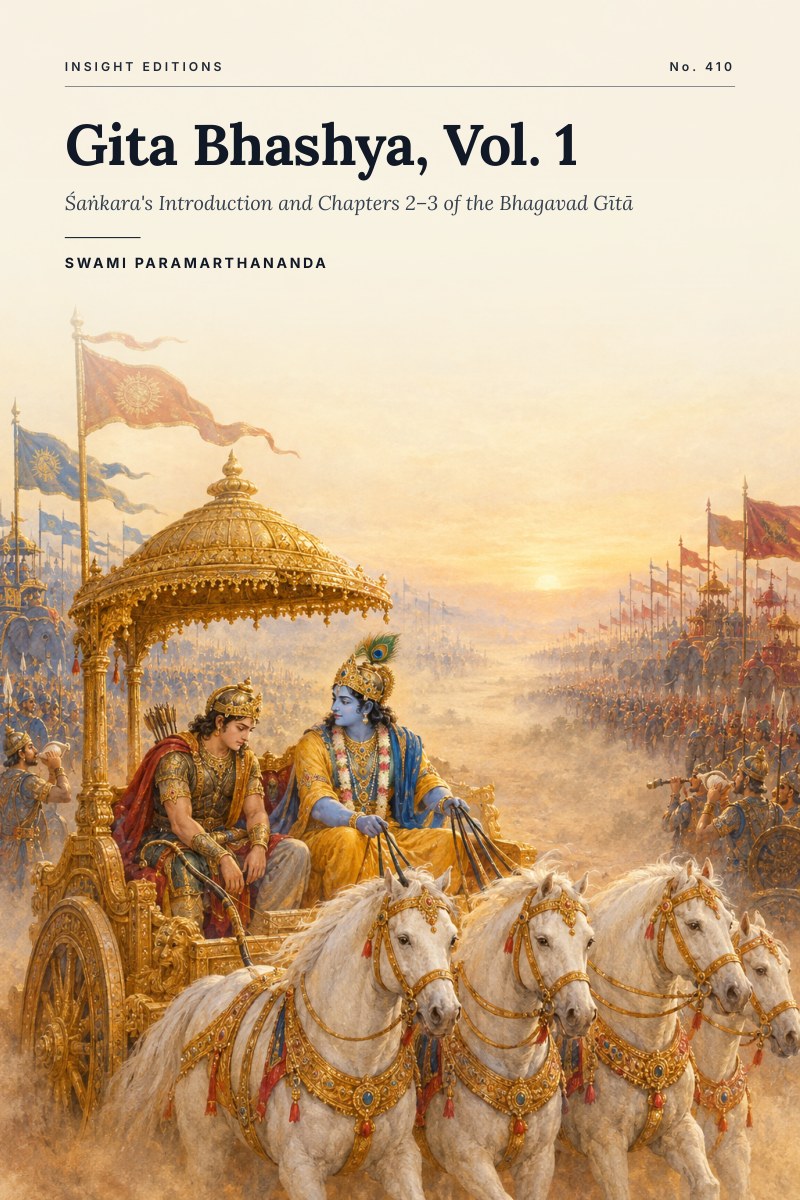
Gita Bhashya, Vol. 1
Śaṅkara's Introduction and Chapters 2–3 of the Bhagavad Gītā
Swami Paramarthananda
Insight Edition of Swami Paramarthananda's 124 classes on Śaṅkara's Bhagavad Gita Bhashya, Volume 1: the introduction and Chapters 2 and 3, on the Self, karma yoga and the steady knower.
A study guide to Swami Paramarthananda's classes on the Bhagavad Gītā Śaṅkara Bhāṣyam, Vol. 1 (Arsha Avinash Foundation, transcribed by SwayamJyothi, Sri V.K. Vancheeswaran and Sri P.S. Ramachandran; not verified by Swamiji). Shared free for personal reading; not for sale and not endorsed by the author or publishers.
CORE CLAIM
Self-knowledge alone liberates; action, done as karma yoga, prepares the mind for it, and the two can be combined only in sequence, never at once.
SCOPE
124 classes on Śaṅkara's introduction and Gītā Chapters 2 and 3: the Self, karma yoga, the steady knower, two niṣṭhās, the wheel of yajña and the conquest of desire.
KEY FIGURES
Śaṅkara against the samuccaya-vādin; Kṛṣṇa and Arjuna; Swami Paramarthananda as teacher, with Swami Dayananda, Sureśvara, Ānandagiri and Rāmānuja cited.
BEST FOR
Students who want to read Śaṅkara's Gītā commentary closely, and householders looking for a practical, Advaita-based way to work, pray and renounce.
The Book on One Page
This volume is the first of Swami Paramarthananda's long course on the Bhagavad Gītā with Śaṅkara's bhāṣya: 124 classes covering Śaṅkara's introduction and Chapters 2 and 3 of the Gītā, read word by word with grammar, cross-references and constant application to a student's life. It is less a book about the Gītā than a book about how Śaṅkara reads it, and why.
Śaṅkara's introduction sets the frame. The Veda has two dharmas, pravṛtti (action, for prosperity) and nivṛtti (withdrawal, for liberation), and the Gītā was taught to revive the second. Its subject is the supreme good, liberation, through Self-knowledge with renunciation. Arjuna's collapse in Chapter 1 shows the cause of saṁsāra, grief and delusion, rooted in ignorance of the Self.
At 2.10 Śaṅkara stops for a long debate with the jñāna-karma-samuccaya-vādin, who holds that knowledge and Vedic ritual must be combined for liberation. That opponent never leaves the volume. Śaṅkara's answer, repeated in many forms, is that knowledge and action rest on opposite self-understandings: action needs a doer; knowledge reveals that the Self is not a doer at all. They can be combined in sequence, never at the same moment.
Chapter 2 then teaches the Self: neither born nor dying, untouched by weapons and fire, the self-evident knower that needs no proof. "The unreal has no being; the real never ceases to be" (2.16) is read through the broken pot: the clay is real, the pot only borrows existence. From 2.39 Kṛṣṇa turns to karma yoga, which Paramarthananda makes concrete: work for success, pray for strength to accept any result. The chapter ends with the sthitaprajña, whose perception "no longer seeds" liking and dislike.
Chapter 3 begins with Arjuna's confusion: if knowledge is superior, why act? Śaṅkara's reading: there are two niṣṭhās for two kinds of people, one path to liberation, and karma yoga prepares for it. The wheel of yajña, Kṛṣṇa as a model of action without need, the micro-second of freedom between impulse and act, and desire as a spiritual immune disorder complete the volume.
Two kinds of voice run through it. Śaṅkara's is polemical and exact. Paramarthananda's is practical and humane: his PORT reduction, triangular and binary formats and CLASP renouncer let a householder take the teaching home. The edition tries to keep both voices visible, and to note where the modern teacher extends the medieval commentator.
| Ch | Title | Payload |
|---|---|---|
| 1 | Where the Gītā Stands, and What It Revives | Two dharmas; the avatārikā's three points |
| 2 | Grief, Delusion, and the Grandfather Rule | Cause of saṁsāra; sannyāsa as no Vedic karma |
| 3 | Seven Links of Saṁsāra, and the Case for Combining | Samuccaya pūrvapakṣa stated |
| 4 | The Householder Knower, and the Half-Done Agnihotra | Four arguments; PORT; Janaka |
| 5 | Dharma Text or Mokṣa Text? The Teaching Begins | 2.11–13; prior and posterior absence |
| 6 | Endure Without Bitterness; the Unreal Has No Being | Titikṣā; asat as borrowed existence |
| 7 | Variable and Invariable: The Broken Pot | Mithyā versus tuccha |
| 8 | The Unknowable Knower, and a Gītā Without Commands | Aprameya; no karma-vidhi |
| 9 | Six Changes Denied, and Who Is the Knower | 2.20–21; method switch |
| 10 | Two Kinds of Knowledge, and What Sannyāsa Really Means | Karmicide; PORT and format; 5.13 |
| 11 | Untouched by the Elements, and a Wonder That Never Fades | Repetition as nididhyāsana |
| 12 | The Worldly Argument, and the Turn to Karma Yoga | Svadharma as svabhāva; grace |
| 13 | Work for Success, Pray for Strength | No kāmya prayer; two kinds of puṇya |
| 14 | Equanimity as Yoga, and the Question of the Steady Knower | Two readings of buddhi yoga |
| 15 | The Tortoise, the Seedless Perception and the CLASP Renouncer | Three disciplines |
| 16 | A Tranquil Mind, False Pleasure and the Night of the Wise | Object shapes thought |
| 17 | No Command Can Make You Act, and the Peace You Already Are | Jñāpaka not kāraka |
| 18 | One Yoga at a Time | Krama versus sama samuccaya |
| 19 | Why Liberation Cannot Be Produced | Four results of action; pratyavāya |
| 20 | One Path, Not Four, and What Actionlessness Means | Naiṣkarmya; three sannyāsas |
| 21 | The Hypocrite, the Sedentary Life and the Wheel of Yajña | Five sūnās; the cycle |
| 22 | The Veda as Breath, and the Self-Content Knower | Karma-ābhāsa; the fake note |
| 23 | Kṛṣṇa as Model, the Victim Triangle and the Servant's Attitude | Dāsa-bhāva; don't unsettle |
| 24 | The Micro-Second of Freedom | Vāsanā to action; own svadharma |
| 25 | Desire, the Spiritual Immune Disorder | Three coverings; first aid and hospital |
Where the Gītā Stands, and What It Revives
Swami Paramarthananda opens the course by placing the Bhagavad Gītā within Indian philosophy, within the three foundational texts of Vedānta, and within Śaṅkara's famous introduction (avatārikā bhāṣya). The Gītā is smṛti: its authority is borrowed from the Veda, and its business is liberation, which comes only through knowledge.
Six topics every darśana must face
Any system of philosophy (darśana, "vision") must take a position on six topics: the individual, the world, God ("even an atheist must establish there is no God"), bondage, liberation, and the means from one to the other. Paramarthananda groups the twelve classical systems by how they treat reasoning.
| Group | Systems | Role of reasoning (tarka) | Role of the Veda |
|---|---|---|---|
| Tarka-based | Cārvāka, Jaina, four Buddhist schools | Sole source | Rejected |
| Tarka-dominant | Sāṅkhya, Yoga, Nyāya, Vaiśeṣika | Primary | Accepted, given "step-motherly treatment" |
| Tarka-supported | Pūrva Mīmāṁsā, Uttara Mīmāṁsā (Vedānta) | A filter, not a source | The source of knowledge |
Pūrva Mīmāṁsā reads the ritual portion and ends at heaven; Vedānta reads the end of the Veda. Its key texts are the prasthāna traya: the Upaniṣads (śruti), the Gītā (smṛti) and the Brahma Sūtras (nyāya).
Three points of the introduction
Śaṅkara's introduction is ranked with his adhyāsa bhāṣya on the Brahma Sūtras and the sambandha bhāṣya on the Bṛhadāraṇyaka as one of his three classic introductions. It makes three claims.
- Smṛti borrows its authority. "When śruti and smṛti conflict, śruti is stronger." A smṛti sentence that contradicts the Veda is reinterpreted or set aside. Kṛṣṇa himself says (4.1–3) he is restating the teaching he gave the Sun.
- The main fruit is liberation. Management courses and "blood pressure reduction" are by-products (avāntara phala). "In reducing the student's blood pressure, the guru's may go up."
- Knowledge alone frees. If any text says there are four paths to mokṣa, "we won't accept it." There is one direct means, "which is not a path; it is an understanding", and the others lead to it.
How to read "bhakti gives mokṣa". Karma yoga maps onto the Veda's ritual portion and jñāna yoga onto its knowledge portion. Bhakti, an Āgamic word, is mapped onto saguṇa upāsana (meditation on God with attributes). That meditation leads to knowledge in this life (sadyo-mukti) or in Brahmaloka, where "you can choose your faculty, Prof. Viṣṇu or Prof. Śiva, and both will teach tat tvam asi" (krama-mukti).
Two dharmas from the beginning
Before creation the Veda already exists in potential as the Lord's breath (Bṛhadāraṇyaka 2.4.10). At creation the Lord makes thinking beings first, Marīci and the other Prajāpatis, and Paramarthananda notes that Śaṅkara's order "negates" an evolutionary sequence ending in man. The Lord is creator and first teacher, and he sets up two lineages:
Spiritual desire "never happens in the beginning", so the Lord teaches healthy material pursuits first. Practised by people according to varṇa and āśrama, dharma sustains the world (including "flora and fauna") and gives both abhyudaya, material well-being, and niḥśreyasa, the highest good.
Duties go to designations, not persons. "It is always the duties of the managing director, the duties of the research analyst." The Veda prescribes by varṇa and āśrama, so "if I have to know my duty, I have to know my designation. Now we have duty confusion. Why? Designation confusion."
Why Kṛṣṇa came
When dharma weakened, the Lord took birth "by a part" (aṁśena, meaning through māyā) as Kṛṣṇa, son of Vasudeva, to protect "bhauma brahma", a phrase Śaṅkara borrows from the Śānti Parva. The Mahābhārata commentator glosses it as the Vedas, the brāhmaṇas and the sacrifices. Protecting the brāhmaṇa means protecting the duty of teaching: "scripture-based value education was the department of the brāhmaṇas", and once values are taught, life itself becomes a yajña. The avatāra adds nothing new; he revives what the Veda already says.
Authority settled in advance. Paramarthananda is admirably explicit: the Gītā will be read so that it agrees with the Veda as Śaṅkara reads it, and any verse suggesting other routes to liberation will be reinterpreted. That makes the commentary consistent, but it means the conclusion (knowledge alone) governs the reading instead of emerging from it. Rāmānuja and Madhva, using the same three texts, reach different conclusions, so the "one direct means" is a school's thesis. The asides on evolution and varṇa-based duty also rest on traditional premises that a modern reader will want to examine separately.
Grief, Delusion, and the Grandfather Rule
Śaṅkara now says why the Gītā was taught and what it delivers. Arjuna was sunk in grief and delusion, and the teaching aims at the total end of saṁsāra with its root. The means is knowledge free of Vedic ritual, and ritual relates to liberation only indirectly, "like grandfather and grandchild".
An avatāra with nothing to gain
The Lord "needs nothing" from his birth, being ever-complete; he comes out of a wish to bless beings. Arjuna receives the teaching directly and humanity through him. "If human beings are alright, other living beings benefit too, since they are all suffering in human hands only."
Śoka and moha: grief that suppresses knowledge
Arjuna was "drowned in the great ocean of grief and delusion". Paramarthananda separates two kinds of delusion, the inability to tell duty from non-duty:
| Kind of moha | Cause | Duration | Example |
|---|---|---|---|
| Ignorance-based | No scriptural education | Permanent until taught | The uneducated |
| Sorrow-based | Grief overriding what one knows | Temporary | Arjuna, who knew the war was legitimate |
"Ignorance suppresses knowledge permanently; sorrow suppresses it temporarily." Either way delusion leads to adharma, sin and rebirth, which is why the śāstra treats sorrow as dangerous: it disables discrimination.
What the Gītā gives
Śaṅkara defines the fruit as niḥśreyasa: complete happiness together with "the total cessation of saṁsāra with its cause".
In plain words: happiness preceded by removal of sorrow, both permanent because ignorance is gone.
Knowledge "with renunciation"
The means is "knowledge established in the Self, preceded by renunciation of all actions". Paramarthananda gives a technical key: in Śaṅkara, "sannyāsa" means the absence of Vedic ritual.
Four equivalent phrases. sannyāsa-sahita jñāna = vaidika-karma-rahita jñāna = kevala jñāna = jñāna-mātra. All mean knowledge without ritual as a co-cause. The point is aimed at the then "raging philosophy" that Vedic ritual contributes directly to liberation. Even when a householder knower continues rituals, "liberation is caused by the knowledge part only", and the rituals serve only purity.
The renunciate is the prime candidate, but "others are not barred". Śaṅkara cites the Anugītā (Āśvamedhika Parva, 36 chapters, 1,043 verses), a second Gītā Kṛṣṇa gave the same student "because Arjuna forgot the teaching, unlike you".
The grandfather rule
Two direct links, one indirect. Karma is the means to jñāna; jñāna is the means to mokṣa. Karma and mokṣa are related too, but only through jñāna, "just as grandfather and grandchild are cause and effect, but through the son". At no time do karma and jñāna work simultaneously: "when karma is operational one is not ready for jñāna; when jñāna is operational, karma has exhausted itself."
Gītā 5.11 says yogīs act "for self-purification", and "ātmā" there means the mind: "ātmā need not be purified."
The four-fold frame
With this the introduction yields the Gītā's anubandha catuṣṭaya, the four things any text must state:
- Subject (viṣaya). Karma yoga as means to knowledge, jñāna yoga as means to liberation, and, above both, Brahman called Vāsudeva.
- Fruit (prayojana). Niḥśreyasa, as defined above.
- Relation (sambandha). The text reveals; the subject is revealed.
- Student (adhikārī). One who seeks that fruit.
Karma and knowledge are partners in sequence, never in combination.
A polemic folded into a definition. Making "sannyāsa" mean "no Vedic ritual" turns a debate into a definition. Śaṅkara's opponents (the samuccaya-vādins who combined knowledge and ritual) would not grant that reading of "sarva-karma-sannyāsa", and the Gītā's own emphasis on continued action (3.8, 3.20, 18.6) is the strongest text against it. Paramarthananda presents the opposing view fairly in later classes, but here the outcome is built into the vocabulary.
Seven Links of Saṁsāra, and the Case for Combining
Before the teaching proper (2.11), Śaṅkara stops to diagnose. Arjuna's collapse shows the seven-stage chain by which self-ignorance becomes rebirth. Since the root is ignorance, only self-knowledge ends it, and Śaṅkara immediately meets the strongest rival view: the samuccaya-vāda, which says knowledge must be combined with Vedic ritual for life.
The seven products of ignorance
Arjuna says "I belong to these people, they are mine." Paramarthananda calls this product number one: the ātmā is relationless (asaṅga), so "claiming any relationship is self-ignorance". The rest follow:
Saṁsāra comes from sam + √sṛ, "to move", and means helpless travel from body to body, "not out of choice". Even the pleasures count on the pain side: "pleasures born of contact are wombs of sorrow" (5.22).
The banyan tree. Grief and delusion are called "the seed of saṁsāra", but Paramarthananda adds a qualifier: grief and delusion together with ignorance. Ignorance is the main root; grief and delusion are the aerial roots that drop from the branches and strengthen the tree, pushing a person into more desire-driven action. "Avidyā initiates the cycle; śoka-moha give it a further push."
Hence Śaṅkara's sentence: their removal comes "from nowhere else" than self-knowledge preceded by renunciation. Kṛṣṇa begins with "the wise do not grieve" (2.11), and the paṇḍita of the Gītā is the paṇḍita of Bṛhadāraṇyaka 3.5.1.
The opponent: one Veda, one combined path
The Vedānta ekadeśin ("a sub-group of Vedāntins") makes a two-part case:
- Reality is dvaita-advaita. The Veda's first part shows duality, its last part non-duality, so reality is both, "as one man is one, yet has many limbs".
- The means is combined. "Mere knowledge can never liberate." The rituals of the first part (agnihotra and others) must be joined with knowledge for life. A corollary: sannyāsa has no place.
They read the Gītā as knowledge plus smārta duty (war is a kṣatriya's svadharma), and by implication plus śrauta ritual too.
Paramarthananda answers the first part briefly. If the karma portion were teaching duality, people who never studied it would not know duality, and "they would all be advaitins". Duality is already known, so the Veda does not set out to teach it.
"Tad asat": the answer in two words
Śaṅkara's style is to give "the answer in a nutshell" and then expand it, and "each letter is worth a lakh". The nutshell: the view is wrong because of vibhāga-vacana and buddhi-dvaya-āśraya.
| Phrase | Meaning | Kind of proof |
|---|---|---|
| Vibhāga-vacana | The Lord states two distinct lifestyles (niṣṭhās): one of knowledge, one of action (3.3) | Scripture (śruti) |
| Buddhi-dvaya-āśraya | The two rest on two opposite mindsets: "I am the doer" and "I am not the doer" | Reasoning (yukti) |
In this passage niṣṭhā means a lifestyle, not assimilated knowledge. Jñāna-niṣṭhā is a life designed for śravaṇa, manana, nididhyāsana; karma-niṣṭhā is a life given to action, which Paramarthananda calls a "PORT-pradhāna lifestyle", heavy in possessions, obligations, relationships and transactions.
Opposites cannot share one person. All action, secular or Vedic, rests on "I am a doer". Knowledge rests on "I am not a doer". To combine them for mokṣa is to hold both thoughts at once. The issue is not whether a person may act, but whether action can be a co-cause of liberation.
A strong argument with a soft spot. The doer and non-doer argument is clear, but it trades on two senses of "combining". The samuccaya-vādin can reply that he means sequence within one life (act, then know, then keep acting), not two contradictory thoughts in one instant. Śaṅkara himself later allows the knower to keep performing rituals as an appearance of action, which shows that the coexistence of knowledge and action in one person is not impossible. What is impossible is action being the cause of liberation, and that is the narrower thesis really in dispute.
The Householder Knower, and the Half-Done Agnihotra
Śaṅkara expands his reply: two mindsets produce two lifestyles, the Upaniṣad prescribes them separately, and Arjuna's own questions presuppose a choice. Then comes the passage Paramarthananda calls essential for every householder: Śaṅkara does accept knowledge and liberation for a gṛhastha, whose continued rituals become only an appearance of action.
Mindset first, lifestyle second
Śaṅkara uses buddhi for the mindset and niṣṭhā for the life it produces. Sāṅkhya-buddhi suits study; yoga-buddhi suits action. One needs the non-doer, non-dual mindset, the other the doer, dualistic one, so combining them is "like heat and ice". His technical words for samuccaya are eka-puruṣa-āśrayatva and eka-puruṣa-anuṣṭheyatva, "coexistence in, or practice by, one person": "note this in your mental dictionary".
Four reasons the lifestyles differ
The Bṛhadāraṇyaka sentence is decisive for Śaṅkara: those "desiring the Self alone as their world" renounce the desire for sons, wealth and worlds and leave home. Here "loka" means consciousness: ātmaloka is liberation. The seeker has passion for that one world and dispassion for the other three.
Arjuna's questions prove a choice
Paramarthananda calls this "very textual" and takes the complaint as a compliment: "study of śāstra means study of text."
- Gītā 3.1, "If you hold knowledge superior to action...". Comparing two things presupposes a choice, and a choice rules out combination. If Kṛṣṇa had taught combination, Arjuna's question would "falsely attribute" an unstated comparison to him.
- Gītā 5.1, "Tell me decisively the one that is better". A request for one of two makes no sense if both must be done together.
The pitta patient. If an Āyurvedic doctor prescribes "eat what is sweet and cool" to calm excess pitta, no patient asks, "Which one of the two calms pitta?" The question only arises if the doctor has offered alternatives. Arjuna asks exactly that question, so Kṛṣṇa must have presented alternatives.
"Not even a wee bit" (īṣan-mātra) of combination, śrauta or smārta, can be shown in the Gītā.
The householder who knows
Then the turn. "Many people argue that Śaṅkara does not accept knowledge and liberation for a gṛhastha. It is not at all true." Śaṅkara imagines a man who entered ritual life "out of ignorance or attachment" (in his vocabulary, a married man), purified himself by sacrifice, charity and austerity, and gained the knowledge "all this is one non-acting Brahman".
That man may go on doing rituals outwardly, but in his understanding they are "mirage water". His acts are karma-ābhāsa, an appearance of action, producing neither new puṇya nor mokṣa, "because he is already free". So this is not samuccaya either.
The half-done agnihotra. The Mīmāṁsakas themselves accept that one ritual can have two statuses by inner intention (saṁyoga-pṛthaktva nyāya). A man begins the agnihotra for heaven; halfway his desire leaves him; at once the same act becomes a daily duty with a new fruit, purity. If an inner change can change a ritual's status, then gaining knowledge can turn all a householder's rituals into mere appearances.
Then why insist on sannyāsa?
Both routes are open, but sannyāsa is the better option: possessions, obligations, relationships and transactions are obstacles to study, "like old age, when every joint tells you it is there". If the household life suited jñāna yoga equally, the Veda would never have created a fourth āśrama, and "not by action, not by progeny, not by wealth; by renunciation alone" would be meaningless.
Śaṅkara's rule is sannyāsa as the general rule, with householder knowers fully recognised.
Gītā 3.20 ("Janaka and others reached perfection by action") is read accordingly. If Janaka was a knower, "perfection" is mokṣa, the means is knowledge (to be supplied), and "by action" is a sāhacarya instrumental: "along with action", that is, while remaining householders.
Grammar doing heavy work. Reading "karmaṇā" in 3.20 as "along with action" instead of "by means of action" is grammatically possible but not the plain reading, and Śaṅkara supplies "by knowledge" from outside the verse. The move protects the thesis that action never causes liberation. It is consistent with his system, and Paramarthananda says openly that the alternative must be avoided "or the samuccaya-vādin will come in". A reader should see that the verse is being fitted to the doctrine, though the generous recognition of the householder knower is a real and important corrective to a common misreading of Śaṅkara.
Dharma Text or Mokṣa Text? The Teaching Begins
Arjuna asked to be told his duty, not for self-knowledge, so why does Kṛṣṇa answer with ātma-vidyā? Śaṅkara's reply shapes the whole Gītā: Arjuna's confusion came from attachment born of self-ignorance, not from ignorance of dharma. Verses 11 to 13 then open the teaching with the eternity of the Self, proved with the tools of logic.
The question we usually skip
"In the Upaniṣad the path is clear: the student asks for brahman and the teacher gives." Arjuna instead says (2.7) "confused about dharma, I ask you what is good for me." So the Gītā should have been a dharma-śāstra. Paramarthananda uses the point to make a remark on method: there are two ways to study, "listening to what I want" and understanding whatever the text actually raises. "It should not be selective study."
Diagnosis before prescription. If confusion came from not knowing dharma, the cure would be dharma teaching. But the Pāṇḍavas were educated in dharma; Arjuna even quotes it. His problem was attachment to Bhīṣma and Droṇa, and attachment comes from self-ignorance. So the cure is self-knowledge. Arjuna's saving grace is that he asked for "śreyas", which, as in Kaṭha 1.2.1–2, can mean the highest good, mokṣa.
Verse 11: the whole text in one line
"You grieve for those not to be grieved for, and you speak the words of the wise. The wise grieve neither for the dead nor the living." Paramarthananda reads the four elements of a text out of the verse:
| Element | Where in 2.11 |
|---|---|
| Problem: grief (śoka) | "You grieve for those not to be grieved for" |
| Problem: delusion (moha) | "You speak the words of the wise", "teasing him": quoting the wise, not being wise |
| Subject | The paṇḍita, who in Vedānta means knower of the Self, not "a Hindi paṇḍit or a Sanskrit paṇḍit" |
| Fruit | "The wise do not grieve": end of saṁsāra |
The student is Arjuna, who has surrendered after discovering his limits.
Three standpoints on Bhīṣma's death
Kṛṣṇa can argue from the body (it is mortal anyway), from the reflected consciousness (only hinted at by Śaṅkara), or from the Self (nothing dies). He concentrates on the third: the ātmā is eternal, changeless and real, so "neither is Bhīṣma killed nor are you a killer".
Verse 12: eternity by logic
"Never was I not, nor you, nor these kings; nor shall we ever cease to be." The first line removes prior non-existence, the second posterior non-existence. "Your homework: define the eternal from the definition of the temporary."
Verse 13: from middle changes to the last one
The Veda lists six modifications: being born, existing, growing, changing, decaying, dying. Death cannot be studied ("even during death we are not available"). So Kṛṣṇa argues from the three middle changes, which we can observe:
If the Self is untouched by the changes we can watch, it is untouched by the one we cannot. The dehin ("one who has a body") persists, so "the wise are not deluded" by the passing of a body.
Why logic here? Śaṅkara and Paramarthananda use Nyāya vocabulary (pratiyogin, prāg-abhāva) not to prove the Self from reasoning alone, but to show the teaching is not unreasonable. Reason is the filter for the Upaniṣadic claim, as set out in the first class.
The example proves less than the conclusion. Continuity through childhood, youth and age shows only that something persists while one body changes. Applying it to a change of bodies at death assumes what is to be proved: that the persisting subject is independent of the body. The Nyāya definitions show what eternity would mean, not that the Self has it. Śaṅkara accepts this, since for him the Self is known from the śruti and reasoning removes objections. But readers who take 2.12–13 as a standalone proof of survival are asking more of the verses than the commentary claims.
Endure Without Bitterness; the Unreal Has No Being
Having shown the Self is eternal, Kṛṣṇa answers a practical objection: the pain is real now. Verse 14 traces every pleasure and pain to sensory contact, which comes and goes, so it can be endured. Verse 15 promises that balanced endurance makes one fit for liberation. Verse 16 then gives one of the Gītā's most compressed philosophical lines: "The unreal has no being; the real never ceases to be."
Verse 14: contact, not the senses
Śaṅkara takes the words apart grammatically. Mātrā, from √mā "to know", is an instrument of knowing, a sense organ. Sparśa, from √spṛś "to touch", is contact. Mātrā-sparśa is then "the contact of the senses with sound, touch, form, taste and smell."
- It is the contact that gives experience. "You should never say the sense organs generate; only the contact of the organs generates." Kṛṣṇa is careful, and so is Śaṅkara.
- Cold and heat are samples. Extend them to every sense: good and bad tastes, smells, sights, all of which give comfort and discomfort.
- They come and go (āgamāpāyin). So: "endure them, Arjuna" (titikṣasva).
Verse 15: titikṣā is not castor oil
| Misreading | Śaṅkara's reading |
|---|---|
| "Pleasure and pain are equal" | Their natures are different; to see them as equal would be delusion |
| Equanimity in the objects | Equanimity in the response: "samatva is not at the objective level" |
| "What cannot be cured must be endured", said with "depression, frustration, bitterness, castor oil" on the face | Endurance "without elation or dejection", a healthy balance, with no anger or hatred |
The verse's "dhīra" is glossed by Śaṅkara as dhīmat, the wise one, steady "because of seeing the eternal Self". The direct fruit of titikṣā is knowledge, and its final fruit is mokṣa: such a person "becomes fit for immortality".
The working test of endurance. If the face during endurance shows bitterness, it is suppression, not titikṣā. Real titikṣā means accepting what comes and goes without adding resentment to the pain. Paramarthananda presents this as a practical, checkable form of samatva.
Verse 16: what "asat" refers to
"Of the unreal (asat) there is no being (bhāva); of the real (sat) there is no non-being." Śaṅkara connects the verse to Verse 14:
"Has no being" cannot mean "is not experienced"; a non-existent thing cannot be experienced at all. It means the world has no intrinsic existence (svarūpa-sattā), only borrowed existence, "and possessing borrowed existence is as good as being non-existent". This is not seen by glancing at the world but by enquiring into it with the means of knowledge.
Every experience is a double experience
Paramarthananda prepares the argument of the next classes:
Substance plus attribute, in one place. Seeing a red chair is two experiences, chair and its colour, felt as one because both are in the same locus (sāmānādhikaraṇya). Every object also has one attribute in common with every other: existence. "Chair is, mic is, book is." So every experience is "object-experience plus is-experience", and the "is" is the screen on which the changing "movie" of the world plays (Dakṣiṇāmūrti Stotra 3).
We experience Brahman all the time as "is", and lose sight of it as we lose sight of the screen in a film.
Two senses of "existence". The step from "everything is" to "there is one existence that all things borrow" assumes that "is" names a shared substance instead of a shared predicate. Many philosophers would say that "the chair exists" and "the pen exists" share a word, not a stuff. Śaṅkara addresses one version of the objection (the broken pot, next chapter), but the underlying move, treating existence as an entity that persists independently of things, is the premise the whole argument depends on, and it is not itself argued here.
Variable and Invariable: The Broken Pot
Paramarthananda spends six classes on Verse 16, and these four carry the argument. Using six technical terms, Śaṅkara shows that the objects of experience vary while existence does not, answers the objection from the destroyed pot, explains how the real and the unreal coexist, and defines the "seers of the truth" with whom the verse ends.
Six terms
| Term | Sanskrit | Location |
|---|---|---|
| Object | asat (the "unreal") | Outside |
| Existence | sat | Outside, as an attribute |
| Object-experience | asad-buddhi | Inside the mind |
| Existence-experience | sad-buddhi | Inside the mind |
| Variable | vyabhicārin | Comes and goes, deviates |
| Invariable | avyabhicārin | Never deviates |
The argument
Since there is an invariable substratum, the conclusion is not śūnyavāda, the Buddhist emptiness an opponent had threatened.
The objection: the destroyed pot
"When the pot is broken we say 'the pot is not'. There is no existence-experience for the non-existent pot. So existence-experience also varies."
Attributive existence and pure existence. Śaṅkara replies that existence is still there where the pot was. But the mind can experience existence only when it appears as the attribute of some object: pot-is-ness, man-is-ness. When the pot goes, existence does not stop, since "how can existence stop to exist?" It only loses its attributive status, because there is no longer a substance for it to qualify, and becomes pure existence, which the mind does not register as an object. The experience changes; existence does not.
Two meanings of "asat"
- Tuccha. Totally non-existent, like a hare's horn. It can never be experienced and cannot coexist with anything.
- Mithyā. "Really non-existent" in the sense of unreally existent: neither real nor non-existent (sad-asad-vilakṣaṇa). This is the sense in 2.16.
The real and the mithyā "are such close friends that they can never be separated", because the unreal borrows its existence from the real. Sand and mirage water, rope and snake, waker and dream: "mutually supporting and supported, they coexist; where is the problem?"
The harder question, hinted. If mithyā appears only when the real is covered (the adhyāsa bhāṣya), how can the experience of the real and of the unreal coexist? Paramarthananda raises it because "it should come". His answer, developed over the following passages, is that only the real's true nature is covered; its "is" aspect remains manifest in every experience, which is why the world appears as existent at all.
"Seers of the truth"
The verse ends: this was seen by the tattva-darśins. Śaṅkara glosses grammatically and then "quietly shifts from grammar to Vedānta":
- Tat is a pronoun, a sarva-nāma, "name of everything". Everything is Brahman, so "tat" is the name of Brahman (Gītā 17.23, "Om tat sat").
- Tattva = "that-ness" = Brahman's own nature: satyaṁ jñānam anantam.
- Tattva-darśin = one whose habit (śīla) is to see that, "not that they recognise Brahman during scriptural classes and forget the rest".
Knowing Brahman is not a class-hour event; it has to become one's habitual way of seeing.
An unfalsifiable "is". The reply to the broken pot saves the thesis by positing an existence that is present even where nothing is experienced. That cannot be checked by experience, the very ground the argument started from ("existence-experience is invariable"). The argument is valid within Vedānta, where śruti establishes pure existence and reasoning only shows it is not contradicted. Read as an independent proof, it slides from a claim about experience to a claim beyond experience at exactly the point where the objection presses.
The Unknowable Knower, and a Gītā Without Commands
Verses 17 and 18 state what the Self is: imperishable, undecaying, and "aprameya", not an object of any means of knowledge. Śaṅkara's key insight is that the Self is not unknown but self-evident: no one seeks proof of himself before seeking to know other things. Then Śaṅkara reads "therefore fight" as a restatement, not a command, and draws a far-reaching conclusion: the Gītā issues no injunction to act.
Verse 17: no decline of any kind
"That by which all this is pervaded is indestructible; no one can destroy the imperishable." Avyaya means free from apakṣaya, the fifth modification, decline, and from both kinds of change in quantity, "even bloating in old age". Śaṅkara distinguishes two kinds of decline, as with death:
| Kind | Cause | Why the Self is free |
|---|---|---|
| Internal (svataḥ) | A part of the system fails | It is partless: "no heart for a heart attack, no kidney to stop functioning, no teeth to lose" |
| External (parataḥ) | An outside event: "son not alright, daughter not alright" | Nothing exists apart from it to act on it |
The verse can say "Brahman" though the word has not appeared because sat in 2.16 already meant Brahman: "sad eva somya idam agra āsīt" (Chāndogya 6.2.1).
Verse 18: when does the body end?
"These bodies are said to have an end." Śaṅkara's gloss is philosophical: the body's existence is a notion, and when enquiry under the Vedānta pramāṇa is complete, the notion that the body has existence of its own snaps. "End of the notion is the end of the body", as the end of the mirage is the end of its supposed water. So the waking body is "like a dream body or a magician's body", ending "not at the time of death but when you gain knowledge".
Apramеya: unknowable because always known
The knower never seeks himself. "A knower does not first fail to know himself as 'I am so and so' and then go looking for objects." Every search for knowledge presupposes the searcher already known to himself. "If there is one thing most popular in a person's life, it is 'I' myself." The Self is never "aprasiddha", never unknown; it is svataḥ-siddha, self-established, "ever experienced as aham, aham" through childhood and through all three states (Dakṣiṇāmūrti 8). The Self needs no proof because it is the one doing the proving.
If the knower (pramātā) is self-evident, then "what to talk of the witness (sākṣin)?" Paramarthananda adds the extension Śaṅkara leaves implicit.
"Therefore fight": restatement, not command
Śaṅkara's conclusion is sweeping: the Gītā-śāstra is for withdrawal from the causes of saṁsāra (grief, delusion and attachment), not for prompting action. It "doesn't ask anyone to do karma", so jñāna-karma-samuccaya cannot be found in it.
The killer and the killed. "If you think 'Bhīṣma and the others are killed by me in battle; I alone am their slayer', that idea of yours is false." Verse 19, which is Kaṭha 1.2.19, says that both the one who thinks "I kill" and the one who thinks "I am killed" do not know. Kṛṣṇa does not need to persuade Arjuna to act; he needs to remove the false idea of doership that is paralysing him.
A Gītā with no commands? Saying the Gītā contains no injunction to act is one of Śaṅkara's boldest moves, and it sits uneasily with the text's insistent imperatives: "fight" (2.18, 2.37), "do your prescribed duty" (3.8), "perform action, giving up attachment" (3.19), "therefore at all times remember me and fight" (8.7). Treating all of these as restatements of commands found elsewhere is consistent within Mīmāṁsā hermeneutics, but most readers, ancient and modern, have taken karma yoga as the Gītā's own teaching. Paramarthananda presents Śaṅkara's view faithfully; it remains an interpretation readers should weigh against the plain force of the verses.
Six Changes Denied, and Who Is the Knower
Verse 20, borrowed from the Kaṭha Upaniṣad, denies the Self all six modifications of a living thing, and Śaṅkara bends one word's meaning to make the list complete. Verse 21 draws the conclusion: one who knows the Self as changeless "how can he kill, whom can he cause to kill?" These are not questions but denials, so the knower is free of all action. To say "the Self knows", Śaṅkara also quietly shifts methods.
Verse 20: birth and death denied
"It is never born, nor does it ever die; having been, it will not again cease to be." Śaṅkara splits "bhūtvā bhavitā" as bhūtvā abhavitā, "having existed, becomes non-existent":
- Death, conventionally defined. "Whatever exists and then becomes non-existent is said to die. This is the convention of the world." It does not apply to the Self.
- Birth, by the reverse. The words "vā" and "na" negate the reverse process too: from non-existence to existence. So it has no birth.
Making the list complete
Why "is not killed" means "is not changed". The dictionary meaning of √han is "kill". But "is not killed" would merely repeat "does not die" (the fault of punarukti), and the fifth modification, vipariṇāma (change), would be left undenied. So Śaṅkara takes "na hanyate" as "is not modified", gaining two advantages at once. "When somebody asks you to bring milk and you bring water, communication fails." Śaṅkara knows this and justifies the departure from the plain sense.
The image: normally a container affects its content ("when the pot is shaken, the water is shaken"), but the body cannot affect the Self within it, whether in physical change or in thought.
Verse 21: questions that are denials
"One who knows this to be indestructible, eternal, unborn and changeless, how can that person kill, whom can he cause to kill?" The structure decides the reading:
| Part | Content |
|---|---|
| Proposition | The Self is actionless |
| Reason (2.20) | The Self is changeless |
| Conclusion (2.21) | Therefore the knower is actionless |
A conclusion cannot be a new question, so "how" and "whom" are rhetorical negations. And "killing" is only an example: the meaning intended by the Lord is "the negation of all action for the wise", including daily and occasional rituals. The target, again, is the samuccaya-vādin.
Who knows "I am Brahman"?
Two methods for two purposes. In the Māṇḍūkya method, the intellect is the knower and the Self is a non-knower witness. Here Śaṅkara "very invisibly, subtly changes the method": the Self is the knower and the intellect its instrument. The relationship is real only empirically: "I, the real ātmā, am connected falsely with a false intellect, gaining a false knowerhood, then false knowledge, then false liberation, which is more than enough to negate false bondage."
A mithyā liberation is enough, because the bondage it removes is also mithyā. Paramarthananda's advice: when explaining the empirical event of gaining knowledge, "never use the Māṇḍūkya method" that the Self is not a knower; start from "I am the knower".
Reinterpretation as a habit. In two classes Śaṅkara changes the meaning of han, reads two questions as denials, extends "kill" to all action, and switches teaching methods to fit the context. Each move is defended, and Paramarthananda shows the reasoning honestly. Taken together, though, they show how far the commentary is prepared to shape the verses to a settled doctrine. A reader who wants Kṛṣṇa's argument on its own terms should notice that 2.21 in context is about killing in a just war, not about a knower's freedom from ritual.
Two Kinds of Knowledge, and What Sannyāsa Really Means
Paramarthananda spends seven classes on Śaṅkara's long debate attached to Verse 21. The samuccaya-vādin asks why Vedic knowledge should not support ritual. Śaṅkara answers that ritual knowledge promotes action while Self-knowledge destroys it. Paramarthananda then gives his own most usable redefinition: sannyāsa = PORT reduction plus format conversion, open to householders too. The debate ends with a close reading of Gītā 5.13.
Two students, two kinds of knowledge
| Student 1 | Student 2 | |
|---|---|---|
| Starts as | Ignorant | Ignorant |
| Studies | Karma-kāṇḍa | Jñāna-kāṇḍa |
| Becomes | A knower of ritual | A knower of the Self |
| His knowledge says | You are a doer, of this varṇa, āśrama, gotra, sūtra; you have these sacrifices to do | You are not a doer; you have no varṇa, āśrama, gotra |
| Relation to karma | Promotes it: "a couple made for each other" (Sureśvara's prayojya-prayojaka) | "Karmicide, like insecticide": it destroys karma |
The first three stages are identical; "hereafter alone there is a major difference which the opponent refuses to understand".
Same proof for both portions
The Mīmāṁsaka's own standard. Puṇya, pāpa, rebirth, heaven, hell and God "are not scientific", and anyone who claims scientific proof for them is "neither traditional nor scientific". The traditional answer is that they are apauruṣeya matters known only from the Veda. Śaṅkara turns this against the ritualist: if the karma portion is a valid source for dharma, then the knowledge portion is an equally valid source for "I am Brahman". To say that such knowledge cannot arise from study is "sāhasa", foolhardy: "If the student says knowledge cannot arise and I am the proof, the guru will say it can, and I am the proof."
Once knowledge arises it necessarily removes ignorance, and with ignorance go the doership and designations that ritual needs.
Sannyāsa redefined
Sannyāsa you can practise. "Hereafter, wherever Śaṅkara uses the word sannyāsa, don't think of saffron robes." It is reducing possessions, obligations, relationships and transactions together with converting one's inner format to "I am the free Self". "If for private life we can use the ātmā-anātmā format, we are sannyāsins even in gṛhasthāśrama." Śaṅkara's two types are vidvat-sannyāsa (for the knower) and vividiṣā-sannyāsa (for the seeker).
The householder knower: a change of bhāvanā
The knower who stays a householder does not change his lifestyle; "all religious activities continue". What changes is the attitude, reinforced daily: "two minutes of meditation before the saṅkalpa and two minutes after the pūjā: I am no more a seeker, karmas are no more a means for me, mokṣa is no more a goal; I am ever free." Let the world, including the family, benefit from the actions.
Gītā 5.13: "renouncing all actions mentally"
The opponent says the word "manasā" limits renunciation to the mind, so physical rituals and recitation must continue. Śaṅkara's replies:
- "Sarva" qualifies it. "You underline 'manasā'; I underline 'sarva-karmāṇi'." All actions cannot mean only mental ones.
- A redundant negation. If the knower's actions were renounced only at death, "neither acting nor causing to act" would deny what is impossible anyway, the fault of aprāpta-pratiṣedha, "like saying you should not drink fire". You forbid alcohol because it is possible.
- The word does not mean "place". "Nyāsa" alone means placing (aṅga-nyāsa, kara-nyāsa); "sannyāsa" means renouncing, not "depositing actions in the body".
For Śaṅkara, renunciation is total in understanding, whatever the outward form of life.
Robes or attitude? Paramarthananda's "PORT reduction plus format conversion" is humane and practical, and it does justice to Śaṅkara's recognition of householder knowers. But it softens Śaṅkara, who in these same passages argues for formal renunciation of all Vedic rites and reads 5.13 as prescribing it. The two readings coexist in the class: Śaṅkara's "sannyāsa as the better āśrama" and the teacher's "sannyāsa as an inner format anyone can use". A reader should notice when the modern teacher is extending the commentator rather than reporting him.
Untouched by the Elements, and a Wonder That Never Fades
These verses restate the nature of the Self in fresh images: weapons, fire, water and wind cannot affect it. Then Kṛṣṇa argues from the opponent's ground: even if the Self were born and died constantly, grief would be pointless. Śaṅkara defends the repetition as a teaching method, and Paramarthananda turns it into a practice of nididhyāsana. The section ends with the Self as a permanent wonder.
Verse 23: four elements, four ways of destroying
| Element | How it destroys | Why the Self is immune |
|---|---|---|
| Weapons (earth) | Cutting into parts | It has no parts |
| Fire | Burning | Nothing combustible |
| Water | Wetting, dissolving | Nothing to soak |
| Wind | Drying the sneha, the glue that holds parts together | Nothing glued |
Sneha: glue and love. "Cello tape loses its power after some years: that is sneha-śoṣaṇa, drying of the glue." That is why love is also called sneha: "love is also glue; that is why it is called attachment". When the wind dries it, "the joint family disintegrates", even husband and wife. Space, the fifth element, is not mentioned because it "does nothing", much like the Self.
Why Kṛṣṇa repeats himself
Verses 24 and 25 say much the same as earlier verses. Śaṅkara anticipates the charge of repetition: the Self is hard to understand (durbodha), so the teacher "invents an opportunity" to repeat it in other words: now ātmā, now Brahman, now "I". The Chāndogya repeats "tat tvam asi" nine times.
Listen twice, the second time as meditation. "If a student feels 'I have understood it', let him listen a second time as nididhyāsana." The exercise: "wherever the word ātmā is used, listen to the sentence replacing ātmā with 'aham'". The first hearing is śravaṇa; the second, owned in the first person, is nididhyāsana. For an advanced student, the same class becomes meditation by changing one word.
Verse 26: even on the opponent's assumption
"Atha ca" signals temporary acceptance for argument: suppose the Self is "nitya-jāta, constantly born, and constantly dying". Here "nitya" is adverbial, "continually", not "eternal". Paramarthananda notes this resembles the Buddhist doctrine of momentary consciousness, though neither Kṛṣṇa nor Śaṅkara names it. The popular view is the same: "When the body is born, they take it that the jīva itself is born." Even then, "you should not grieve", since what is born must die.
Verse 28: unmanifest, manifest, unmanifest
"Ādi" cannot mean "beginning", because matter is beginningless; it means "the condition before manifestation". Here "bhūtāni" means bodies, not the five elements, though Madhusūdana Sarasvatī allows that reading as a second option. Paramarthananda adds the doctrinal point: Vedānta is close to Sāṅkhya in treating both consciousness and matter as beginningless, but "consciousness is of a higher order, satya; matter is of a lower order, mithyā; while counting you can count only one, therefore we are advaitins".
Verse 29: three people and one wonder
The wonder that does not wear off. A wonder is a wonder the first time: "At Tirupati we wait seven hours for one minute of darśana; let us sit there all day, and by the third minute we are watching who is coming." But the knower sees the Self as a wonder and keeps seeing it so; the teacher speaks of it with wonder after thirty years; the student hears it with wonder. "Drivers ask: this lady has attended classes for twenty-five years, God alone knows what she is studying." The reason is the Kena paradox: the Self is "neither known nor unknown", because it is the subject, not an object.
Is repetition always teaching? Śaṅkara's defence of repetition (the subject is hard, so the teacher repeats) is sound pedagogy, but it also lets the commentary read every repetition as deliberate and every variation as significant. Textual scholars more often see the Gītā's recurring phrases as features of an oral, composite text. Both can be true. Readers should notice that "Kṛṣṇa repeats on purpose" is a principle of charity supplied by the commentator, not something the verses claim.
The Worldly Argument, and the Turn to Karma Yoga
After the philosophical argument, Kṛṣṇa gives Arjuna worldly reasons to fight: duty, honour and the ridicule of enemies. Śaṅkara labels this whole section incidental: it is meant to remove grief, not to state the Gītā's purport. Two of his glosses deserve attention: svadharma is read as svabhāva, one's character, not one's birth; and karma yoga frees from bondage only indirectly, through grace and knowledge.
Verse 31: duty from character, not caste
"Considering your own dharma, you should not waver." Śaṅkara supplies what Arjuna should not waver from: "svābhāvikāt dharmāt", the duty that comes from ātma-svābhāvya, where ātmā means the mind, and svābhāva means its guṇas.
A note on caste. "Śaṅkara doesn't say your duty is to fight because you belong to the kṣatriya jāti." If he were endorsing duty by birth, "he should have said here: according to your caste you are a kṣatriya. Instead of jāti he says svābhāvya, according to your character." Paramarthananda places this in "a big debate going on now" over whether career should follow heredity or inclination, and offers it as "just notes we get from the bhāṣya". On this verse, Śaṅkara grounds duty in disposition rather than birth.
War is dharmya, "in keeping with dharma", because through winning the earth it serves dharma and the protection of the people. "There is nothing better for a kṣatriya than a righteous war."
Verses 32–37: honour and ridicule
They will say fear, not compassion. "The great warriors, Duryodhana and the rest, will think you withdrew out of fear." Śaṅkara names Duryodhana and his allies deliberately: "Bhīṣma may not think like that, Droṇa may not; Duryodhana and company would love to think in that pattern" and spread the story. And having been "bahu-mata, highly regarded as endowed with many virtues", Arjuna will become "light" in their eyes: losing respect hurts more than never having it.
A grammar note in 2.38 shows the class's method: "sukha-duḥkhe samē kṛtvā" uses the neuter "samē" because, in Sanskrit, when genders mix "neuter is strongest, then masculine, then feminine".
Verse 39: what was incidental, what is the point
| Section | What it gives | Status (Śaṅkara) |
|---|---|---|
| 2.11–30 | Paramārtha-darśana: the vision of the real Self | The actual topic (prakṛta) |
| 2.31–38 | Laukika nyāya: worldly ethics, honour and prestige | Incidental, "not the purport" (na tu tātparyeṇa); only to remove grief |
| 2.39 onward | Buddhi of yoga: karma yoga | Taught next as the means to fitness |
"This wisdom of sāṅkhya has been told to you; now hear about yoga." Śaṅkara says the verse shows the division of subjects in the śāstra.
How karma yoga removes bondage
"Karma" here means not actions but the puṇya and pāpa they produce. Karma yoga does not directly destroy them; its immediate result is grace, because a karma yogī's saṅkalpa asks only "for the removal of my sins and the pleasure of the Lord", and does not go on to "grain, wealth, cattle, many sons, employment".
How do we know what Kṛṣṇa meant? Śaṅkara admits the steps of purification, finding a teacher and knowledge "are not said by Kṛṣṇa"; they are his "abhiprāya", intention. "He is not even here in front of you. How do you know his intention?" Because Kṛṣṇa says he teaches "the same ancient yoga" (4.3), so the Veda is the key: "Veda will tell what Kṛṣṇa's intention is."
"Incidental" by whose measure? Calling 2.31–38 mere worldly persuasion removes from the Gītā's core the very verses where Kṛṣṇa argues from duty and honour, the arguments that move Arjuna in the narrative. The Veda-as-key principle is consistent, but it decides in advance that the Gītā can only say what the Upaniṣads say. Paramarthananda's caste observation is valuable, yet Śaṅkara elsewhere (for example, on the Brahmasūtra apaśūdra section) upholds birth-based restrictions on Vedic study. Reading one gloss as a stance on caste needs that wider context.
Work for Success, Pray for Strength
This is the most practical stretch of Volume 1. Śaṅkara reads 2.41 as saying the seeker has one desire, liberation, while worldly desires are endless and themselves saṁsāra. From 2.45 Paramarthananda draws a demanding rule for karma yogīs: never use prayer or ritual to secure worldly results. Verse 47 adds a Mīmāṁsā principle: the same duty can earn material or spiritual puṇya, and one must choose.
Verse 41: one resolve, many desires
"The resolute understanding is one; the understandings of the irresolute are many-branched and endless." Śaṅkara, "ruthless, with no consideration for materialistic people", makes the point plain: karma yoga is not for professional success; it is for detachment. The "resolute understanding" is a single clear desire: mokṣa. Śaṅkara then adds what Kṛṣṇa does not say: every other desire is a cause of saṁsāra, "endless, shoreless, without respite, from birth to birth". The rule is anvaya-vyatireka: "the more the materialistic desires, the greater the saṁsāra".
Verses 42–44: the flowery speech
Those who "delight in the words of the Veda" speak a "flowery speech" full of rituals for heaven, cattle and sons. Its real fruit, unknown to them, is "janma-karma-phala": rebirth itself. "Not only are they misguided; they even guide others."
Verse 45: the karma yogī's hardest rule
Never pray for results. Giving up kāmya (desire-driven) and prāyaścitta (problem-solving) rites means: "don't use prayers and rituals for getting favourable results in your worldly ventures." "The moment you pray for success it becomes kāmya karma." "Work for success but pray for the mental strength to accept any result. This is karma yoga." Paramarthananda calls it "a very, very tough decision to make in life". God is invoked only for strength and growth, never as a tool for worldly outcomes.
| Reason to prefer general over special pūjās | |
|---|---|
| 1. Binding | Kāmya rites keep one in saṁsāra |
| 2. Risky | Imperfect performance brings pratyavāya, negative results |
| 3. Weak | Limited power to purify the mind |
| 4. Stronger alternative | The same effort in general prayer gives more purification |
| 5. By-product | General prayers also bring worldly well-being |
| 6. Safe | "Even if you chant wrongly", no negative result |
"The wisest course is reduce special pūjās and increase general pūjās," directed at spiritual growth and universal well-being.
The refined triangle. Karma yoga uses the jīva-jagat-Īśvara format, but a refined one. "The ordinary format: I use Īśvara for worldly purposes. The refined format: I refuse to use Īśvara for any worldly purpose." Only after this can one "graduate to the binary format of ātmā-anātmā"; fail in the refined triangle, and the binary is out of reach.
Verse 47: two kinds of puṇya
Daily and occasional duties, dedicated to the Lord, produce puṇya, and by the Mīmāṁsā saṁyoga-pṛthaktva-nyāya one act can be applied to one of two results:
Choosing one is renouncing the other. The third principle: "I am asked to do the duty and I am doing it, full stop", with no directed prayers. The rules add up: avoid kāmya, prāyaścitta and forbidden acts; do obligatory duties; don't ask for material puṇya.
A counsel of perfection. "Never pray for the cure" asks people to give up the most common form of prayer in every tradition, and Paramarthananda admits it is "very tough". It also rests on Mīmāṁsā mechanics (pratyavāya from mispronounced kāmya rites, puṇya that can be "spent" or "saved") which only a reader who accepts that ritual metaphysics will find binding. The psychological core survives without the mechanics: effort aimed at results, prayer aimed at equanimity. Readers can adopt that core while noting the larger framework is assumed, not argued.
Equanimity as Yoga, and the Question of the Steady Knower
Verses 48 to 53 define karma yoga twice: as equanimity ("samatvaṁ yoga ucyate") and as skill in action. Śaṅkara guards both against a misreading: karma yoga leads to liberation only in due course, through purity and knowledge. He then offers a second reading in which "buddhi yoga" means jñāna yoga itself. Verse 54 opens Arjuna's question about the sthitaprajña, the person of steady wisdom.
Verse 48: success and failure redefined
| Term | Meaning in Śaṅkara's gloss |
|---|---|
| Siddhi | Jñāna-prāpti, attaining knowledge, born of mental purity (sattva-śuddhi), which makes śravaṇa possible |
| Asiddhi | Failure of purity, from action done with thirst for results: "some prosperity may come; spiritually he does not get much benefit" |
| Samatva | Even-mindedness towards both |
"Karma gives material success, not spiritual success; karma yoga gives spiritual success; it may or may not give material success. You decide which one you want to vote for." And "another rigorous condition": the karma yogī should not be anxious even about spiritual progress.
Two names for one discipline
From the standpoint of the action it is called karma yoga, and from the standpoint of the attitude it is called buddhi yoga.
Swami Dayananda, as quoted by ParamarthanandaVerse 50: "The one endowed with this understanding gives up both puṇya and pāpa here. Therefore take to yoga; yoga is skill in action." If karma yoga removed all merit and demerit, "who will come to jñāna yoga?" So Śaṅkara adds "in due course": "Not by action, not by progeny, not by wealth; by renunciation alone some attained immortality" (Kaivalya 1.3).
Verse 52: locating the problem
The problem is not the world. Crossing "the mire of delusion", the karma yogī gains a first, modest discrimination: "the problem is not with the world or anātmā; the problem is my dependence on anātmā," and that dependence comes from "my own weakness, finitude". People "either let me down, or threaten to, or I imagine they will; either way, saṁsāra is definite". So "what is required is a correction in me rather than in the world: not loka-jaya but ātma-jaya". One must be convinced that Self-ignorance is the problem before Self-knowledge can look like the solution.
This is discrimination "at the level of sādhana", "sufficient to identify the problem", not yet the knowledge that solves it.
Verse 54: what is a sthitaprajña?
Parsing one question. Śaṅkara takes "sthitaprajña" as a bahuvrīhi: "the one whose wisdom is steady". Sthitā means firm, free of doubt and of the habitual error of identifying with body and family. Prajñā is the knowledge "I am the supreme Brahman". And "what is his bhāṣā?" asks not how he speaks but how others (the śāstra) describe him. "Samādhi" here means the Self, "that in which the mind is placed", as the previous verse established.
Two readings, one conclusion. Offering alternative interpretations is honest scholarship, and Śaṅkara does it often. But here both readings lead to the same place: karma yoga is preparatory, and knowledge alone liberates. When "yoga is skill in action" is read so that action is always secondary, the verse's most quoted line loses much of its plain sense. Readers in the yoga and karma-yoga traditions (Tilak, Aurobindo, Gandhi) took 2.47–50 as the Gītā's centre. Śaṅkara's subordination of action is a position, carefully defended, not the only possible one.
The Tortoise, the Seedless Perception and the CLASP Renouncer
Kṛṣṇa's answer to Arjuna begins: the steady knower is content in the Self, by the Self. Paramarthananda organises the following verses as three disciplines the knower must keep alive: sense control, thought control and staying in touch with the śāstra. Śaṅkara's gloss on 2.59 gives a precise test of freedom: perception that no longer seeds liking and dislike. Paramarthananda adds a householder's definition of the renunciate: the CLASP renouncer.
Verse 55: full to the brim
"When one gives up all desires of the mind and is content in the Self by the Self, he is called sthitaprajña." "By the Self" means without depending on anything external (bāhya-lābha-nirapekṣa). Its source is "the nectar of the vision of the real". "Suppose this nectar occupies only three-fourths of his heart; for the remaining fourth he would go to external sources." Here it fills him, so he has "alaṁ-pratyaya", the sense of "enough", towards sense pleasures. Steadiness shows most "when there are temptations outside".
Three disciplines for the knower
| Discipline | Verses | What it means |
|---|---|---|
| Dama: sense control | 2.58–61 | Withdraw the senses from provoking situations, before and after study |
| Śama: thought control | 2.62 onward | "Watch the inner dialogue" and make the thought pattern "Vedānta-friendly" |
| Nididhyāsana: contact with śāstra | throughout | Repeated hearing, reflection, teaching others: "thinking of it, speaking of it, explaining it to one another" (Yogavāsiṣṭha) |
The tortoise. The tortoise keeps moving, but "whenever it finds a threat outside, it withdraws its legs and head into its shell". So the seeker, in situations that can provoke rāga, dveṣa, kāma and krodha, "should learn to withdraw". "The tortoise does it out of fear"; the seeker does it from understanding.
Verse 59: perception without seeds
The test of inner freedom. Even after the senses are withdrawn, the taste (rasa) for objects remains. It goes "on seeing the supreme", which Śaṅkara glosses not as an experience ("Brahman is not an object of experience") but as understanding "I am That". Then "the perception of an object becomes nirbīja, a non-seed". For the knower, sense perception stops with sense perception. In Paramarthananda's terms, "Īśvara-sṛṣṭi, the way things are, is not converted into jīva-sṛṣṭi", the coloured version that disturbs the mind.
Verse 61: devotion without two
"Matparaḥ", "intent on me", becomes in Śaṅkara "I am not different from him": advaita bhakti. In nididhyāsana, and even more "during difficult situations", one uses the binary format: "I, the ātmā, am witness of the crisis, unaffected by the crisis."
The CLASP renouncer. Śaṅkara "doesn't lose the opportunity" to call this person a yati, a renunciate. Paramarthananda's definition: one who renounces CL, claiming ownership and controllership; A, anxiety about oneself or the family; and SP, all special prayers. In Sanskrit: abhimāna, cintā and viśeṣa-prārthanā tyāga. "Whoever renounces these three, even if he is a gṛhastha, is entitled to be called yati. One need not change the clothes."
Verse 62: where memory comes from
A short lesson in psychology prepares for "dwelling on objects breeds attachment": experience (anubhava) lays down impressions (vāsanā), across this life and past lives, since "this body alone is new; my mind existed before". Impressions produce memory. Since impressions are infinite, some trigger must decide which arise, and this is where vigilance begins.
An ideal described or achieved? The sthitaprajña verses describe someone wholly free of rāga and dveṣa, and Paramarthananda is careful to say these are disciplines a knower must keep practising. That honesty raises a question the text does not settle: if steadiness needs constant vigilance, how is the knower different from an advanced seeker? The CLASP definition is useful, but it also shows how much the modern teaching redefines traditional terms (yati, sannyāsa) to fit householders. Readers should keep both the classic ideal and its humane adaptation in view.
A Tranquil Mind, False Pleasure and the Night of the Wise
These verses describe how the knower lives among objects without being disturbed. Śaṅkara notices a puzzle in the wording of 2.64 that most readers miss. Then comes a simple psychology: the object shapes the thought, and the thought shapes the mind. Sense pleasure is called pseudo-pleasure, and 2.69 gives the famous paradox: what is day for the wise is night for others.
Verse 64: senses cannot have likes
Śaṅkara notices the problem. Kṛṣṇa speaks of "senses free from rāga and dveṣa". But likes and dislikes belong to the mind; the senses have none. "Generally we don't notice. What to talk of the solution, we do not even notice the problem." Śaṅkara's remedy: the senses' natural (svābhāvika) activity is led by rāga and dveṣa; "freedom" means they move instead under śāstra (dharma and adharma), in activities that are "not against the śāstra and unavoidable".
| Discipline | Definition (2.62–64) |
|---|---|
| Indriya-nigraha (sense control) | Avoid natural, rāga-dveṣa-driven activity; follow śāstra-guided activity |
| Mano-nigraha (mind control) | Avoid dwelling on objects (viṣaya-dhyāna) |
| Result | Citta-prasāda: a mind "available for nididhyāsana" (Muṇḍaka 3.1.8) |
Verse 65: as the object, so the thought
The object determines the thought. "When you see violence on television, the object is violent, the thought becomes violent, and the mind becomes turbulent." So "the object determines the nature of the thought, and the thought determines the condition of the mind". When the object is the changeless Self, the mind takes on its stillness. To change the state of the mind, change what it dwells on.
Verses 66–67: the thumb-sucking child
Real happiness is withdrawal from the senses' thirst, "every sense organ is all the time thirsty: eyes for sights, ears for music, tongue for eating", together with abiding in the Self. Pleasure from the pursuit of objects "is not happiness at all".
Pseudo milk. "The child sucks its thumb and enjoys it; it is not getting the mother's milk, only its own saliva, and even that pseudo milk comes from itself." So with sense pleasure: what joy there is comes from oneself, and it carries sorrow, the "womb of sorrow" (duḥkha-yoni) Kṛṣṇa calls it later.
Verse 68: the strong-armed one
Kṛṣṇa calls Arjuna mahābāhu, "strong-armed": "you may restrain one strong horse with one hand, but that is not the real strength; in spirituality the strength is to restrain the horse called the mind." The "therefore" refers back to the harm of the senses' unrestrained activity, not their activity as such: "If the functioning of the senses were bad, we would have to close them permanently."
Verse 69: day and night reversed
"What is night for all beings, in that the self-controlled one is awake; where beings are awake, that is night for the seeing sage." Śaṅkara asks how Brahman, self-luminous like daylight, can be called darkness. The answer: for night creatures, "the very day is night". So "the non-dual reality", the subject matter of the knower, is darkness for those "whose intellect does not reach it". And the world of division, bright to the ignorant, is "night" for the knower.
Is the senses' world really false pleasure? The thumb-sucking image is vivid, but it generalises from craving to all enjoyment, and many readers (including traditions within Hinduism that honour artha and kāma) will resist the claim that music or food "is not happiness at all". The careful point Paramarthananda makes, that only unrestrained sense activity is the problem, is more defensible than the blanket rhetoric. Readers can test the claim against their own experience: is the joy in the object, or in the stilled desire?
No Command Can Make You Act, and the Peace You Already Are
Śaṅkara's comment on 2.69 grows into a debate: if the knower renounces all action, where is the scriptural injunction that allows it? His answers include one of the deepest points in the volume: no pramāṇa can make anyone act; knowledge reveals, desire drives. Verse 70 gives the image of the ocean that rivers enter without disturbing. Paramarthananda ends Chapter 2 with practical advice: stop chasing peace of mind and claim the peace of the Self.
Verse 69: action belongs to ignorance
"Karma is enjoined only in the state of ignorance, not in the state of knowledge." Action needs the triangle: a doer, a world, and an Īśvara who gives results. In the binary format "the doer himself is removed". When knowledge arises, ignorance goes "like the darkness of night when the sun rises", and duality goes with it. This does not mean duality is no longer perceived; it is "reduced to the dream example", seen but not taken as significant.
Is renunciation allowed?
Revealer, not commander. "A pramāṇa can only reveal; it can never force you to do something. Action is always caused by desire. If desire is there, no commandment is required; if desire is not there, no commandment will work." "Eyes can reveal water; they can never make you drink. It is thirst that makes you drink." Śaṅkara says this is universal ("in the world"), for knower and ignorant alike, for Veda and perception alike. Knowledge is jñāpaka, a revealer, never kāraka, a maker of action.
The knower's renunciation, Paramarthananda adds, is again a change of bhāvanā: "Either I drop karmas or I do them only for lokasaṅgraha, the welfare of the world; I do not look upon myself as a beneficiary."
Verse 70: the ocean and the rivers
Non-binding desires. "As the waters enter the ocean, which is full and unmoved", desires enter the knower "without disturbing" him. Fulfilled or not, "it is ok, because his fullness does not depend" on them. They "do not enslave him", with no anxiety about "will I fulfil these before I close my eyes"; "I am ready to close my eyes at any time." And they "dissolve in the Self": objects and desires still appear, but are seen as mithyā, with no existence apart from the Self. The "desirer of desires" (kāma-kāmī) does not attain this peace.
Verses 71–72: two kinds of peace
| Manaḥ-śānti: peace of mind | Ātma-śānti: peace of the Self | |
|---|---|---|
| Source | Karma yoga, upāsanā, study, reflection, nididhyāsana | One's own nature |
| Nature | Relative, improvable, always fluctuating with prārabdha, guṇas and the body | Absolute, non-fluctuating |
| If made the goal | "My struggle will be eternal"; I can never claim liberation | Can be claimed now |
The trap of measuring peace. "As long as the word peace means peace of mind, I will always feel I am a sādhaka: sādhaka, sādhaka, sādhaka." The seeker never knows "what level of peace of mind will give liberation". So "gradually shift from manaḥ-śānti to the eternal ātma-śānti, which is my nature". Verse 72 calls this the brāhmī sthiti, the Brahman-state: "attaining it, one is not deluded".
Convenient for the knower? "No pramāṇa compels" is a powerful point about the psychology of action, but Śaṅkara uses it selectively: he relies on Vedic injunctions heavily when they support renunciation (Jābāla) while denying they bind the knower. And shifting from "peace of mind" to "the peace I already am" can become a way of calling an unsettled mind liberated. Paramarthananda's own caution, that mental peace still matters and still improves, is the needed balance: claiming ātma-śānti should not excuse neglect of the mind.
One Yoga at a Time
Śaṅkara opens Chapter 3 by restating the Gītā's two lifestyles and insisting a seeker can follow only one at a time. The agreement with his opponents is wider than it looks: both say karma yoga and jñāna yoga are needed. The quarrel is over sequence versus simultaneity. Śaṅkara takes on a named school, the followers of the Bodhāyana-vṛtti as Paramarthananda identifies it, and its ingenious redefinition of "knowledge alone".
Yogī and sāṅkhya
| Yogī (karma yoga) | Sāṅkhya (jñāna yoga) | |
|---|---|---|
| Format | Triangular: jīva, jagat, Īśvara | Binary: ātmā (satya), anātmā (mithyā) |
| Self-image | A seeker (sādhaka) | "The Self for whom mokṣa is its very nature" |
| Actions are | A means to future mokṣa | Never a means, even if performed |
| Skill to perfect | Īśvara-smaraṇa: remembering the Lord | Ātma-smaraṇa: remembering the Self |
| Perfected when | When worship is steady | Self-remembrance "comes naturally in crises" |
Why not both at once. "At any time you can either be a yogī or a sāṅkhya; you cannot simultaneously be both." The formats, the remembrance and the way one regards action are all different. A sāṅkhya "need not take sannyāsa by wearing robes; remaining in the family itself", the moment the format is changed and Self-remembrance deliberately cultivated, "that person is called sāṅkhya". The two yogas are combined in sequence, never at the same moment.
Krama or sama samuccaya
"We don't question him when he says both yogas are required. Where is our difference? Sequentially versus simultaneously." Śaṅkara refers to them as "some" (kecit): commentators before or contemporary with him, a group with "subtle subdivisions", each "with his own followers". He accuses them of inventing a meaning for Arjuna's question and then giving Kṛṣṇa an answer that contradicts it.
The redefinition of "knowledge alone"
A clever escape. The samuccaya-vādin has said that sannyāsins gain liberation by "knowledge alone", while householders do not. Śaṅkara points out the contradiction with his own theory, then supplies the opponent's imagined reply: "Knowledge alone means knowledge combined with smārta karma (duties from the smṛtis)." So for sannyāsins, "knowledge alone" = knowledge + smārta karma; for householders, that is not enough: they also need śrauta (Vedic) rites. Paramarthananda: "You have to be imaginative; only then can you enjoy" this kind of argument.
Sannyāsa is prescribed
Śaṅkara's answer rests on scripture: sannyāsa is explicitly prescribed as a limb of knowledge, and the Jābāla Upaniṣad allows both āśrama-samuccaya and āśrama-vikalpa:
"Having completed studentship, become a householder; having been a householder, become a forest-dweller; then renounce. Or otherwise: renounce from studentship itself, or from the house, or from the forest." The first is sequential combination; the second is optional skipping of one or two stages. If sannyāsa is a prescribed means to knowledge, a theory that makes rites compulsory for all cannot be the Gītā's.
Whose Bodhāyana? Paramarthananda names the Bodhāyana-vṛtti as the target, a traditional identification, but no such Gītā commentary survives, and Śaṅkara himself only says "some". Readers should take the attribution as tradition, not established history. The argument also shows how the debate depends on Brāhmaṇical āśrama law (śrauta versus smārta rites, prescribed stages of life) which few modern readers live under. The psychological claim, that one cannot hold "I am a seeker" and "I am already free" in the same moment, is the part that travels.
Why Liberation Cannot Be Produced
Having given scripture, Śaṅkara gives logic: liberation is not a product, so action cannot contribute to it. He also redefines a Mīmāṁsā idea, pratyavāya, the sin of omitting duties, in a way that removes much of its sting. Then Arjuna's opening questions in Chapter 3 become evidence: he asks Kṛṣṇa to name one path, which makes sense only if the two were never meant to be combined.
Liberation is akārya
One word carries the argument. "See how the śāstra uses every word." Kārya means all four kinds of result together. If liberation were a kārya, action could contribute; but liberation, being eternal, is akārya. So "laukika or vaidika karma, physical or mental (upāsanā), none of them has relevance to mokṣa." "Very, very careful: we never say they are totally useless." They prepare the mind. Action can make the seeker fit; it cannot make the Self free.
The fuller treatment, Paramarthananda notes, is in the Brahmasūtra bhāṣya on "tat tu samanvayāt" (1.1.4).
What the sin of omission really is
| Pūrva Mīmāṁsā | Śaṅkara (Advaita) | |
|---|---|---|
| Pratyavāya means | Production of new āgāmi pāpa by not performing duty | Non-reduction of existing prārabdha pāpa |
| Why | Omission is a cause | "Absence cannot produce anything": against śruti, reason and experience |
| Example | Skipping sandhyā creates fresh sin | Sandhyā "would have removed a chunk" of past sin; skipping it, that chunk stays |
"If the Veda declared that something impossible, sin from mere omission, follows, it would be harmful and not a valid source." The disagreement "is not about pratyavāya; it is about its definition".
Arjuna asks for one
The patient with two tablets. "When the doctor prescribes two tablets and asks the patient to take both, how can the patient ask which tablet is better?" If Kṛṣṇa had taught Arjuna to combine knowledge and action in Chapter 2, Arjuna's question, "if you consider knowledge superior to action, why do you engage me in this terrible deed?" (3.1), and his request, "tell me decisively the one by which I may attain the good" (3.2), would make no sense.
Paramarthananda adds a modern note: Arjuna "has the luxury" of asking Kṛṣṇa to decide for him, but "for the regular Vedāntic student it is not the guru who chooses; the student alone should decide whether I am fit for the triangular or the binary format."
Śaṅkara points ahead to 4.15, "therefore you do action alone", where Kṛṣṇa's emphatic "alone" will show that jñāna-niṣṭhā was not possible for Arjuna at that stage.
Arguing from the questioner's confusion. Using Arjuna's question as proof of what Kṛṣṇa meant is clever, but it cuts both ways: Arjuna is confused throughout, and his questions can show his misunderstanding rather than the teaching's structure. The pratyavāya redefinition is persuasive, but it is Śaṅkara's philosophical correction of Mīmāṁsā, not something the Gītā states. And "liberation is not a product" holds only if one accepts in advance that the Self is already free: the very point the samuccaya-vādin disputes.
One Path, Not Four, and What Actionlessness Means
Arjuna complains that Kṛṣṇa's "mixed words" confuse him. Kṛṣṇa answers with two niṣṭhās, two committed ways of life for two kinds of people. Śaṅkara then blocks a conclusion "a majority of people" draw: that these are independent paths to liberation. For Advaita there is one path, knowledge, and karma yoga is its preparation. Paramarthananda's gloss on naiṣkarmya, "actionlessness", is one of the clearest in the volume.
Verse 2: "you seem to confuse me"
"Even though the Lord is a clear communicator, to me, whose intellect is dulled, his words appear mixed." Arjuna is generally bright, but after the trauma of Chapter 1, "the Gāṇḍīva slipping from my hand, my skin burning", "my intellect has become dulled by emotion." And he is careful: "You are teaching me only to remove confusion; you will not intend to confuse me. But I feel confused." The fault is located in the listener, not the teacher.
Two mindsets
| Shift | Karma yogī (yoga-buddhi) | Jñāna yogī (sāṅkhya-buddhi) |
|---|---|---|
| Self-view | "I am a seeker of liberation" (mumukṣutva-bhāvanā) | "I am the ever-free Self" (nitya-mukta-bhāvanā) |
| Actions | Every karma is a means (sādhanatva-buddhi) | No karma is a means |
| Who switches | Stays a seeker until ready | "By the student's own choice; the guru should not impose", "after five, ten, twenty-five or thirty years" |
"The difference is not much external; the difference is more in the internal mindset."
Verse 3: who gets which niṣṭhā
Without outer or at least inner renunciation, the binary mindset "cannot be promoted". For those whose "āśā-pāśa", the noose of hopes, is too strong, Kṛṣṇa says "postpone it" and follow karma yoga.
Verse 4: one path or two?
Against the four paths. The natural doubt: two niṣṭhās for two groups means two independent routes to one destination. "In fact, a majority of people have concluded this way." Many go further: "for active people action liberates, for emotional people crying liberates, for intellectuals knowledge, for the mystic, meditation." Śaṅkara's reading of 3.4: "We don't accept many paths for liberation." There is one path, jñāna; karma yoga is a preparatory step: "without undertaking action, a person does not attain actionlessness". Two niṣṭhās are two stages on one road, not two roads.
Naiṣkarmya: actionlessness without stopping
The "million-dollar note". Śaṅkara equates karma-śūnyatā, freedom from action, with jñāna-yoga-niṣṭhā: "abiding as the actionless Self". Paramarthananda: actionlessness is "remembering I am the ever-actionless ātmā even though the mithyā ahaṅkāra continues and performs all duties in keeping with varṇa and āśrama". The remembrance lives "not in the conscious mind, which is occupied with worldly activities, but in the subconscious mind". This is jīvanmukti; this is the binary format.
Three renunciations
| Type | Taken by | Purpose | Status |
|---|---|---|---|
| Vidvat sannyāsa | One who has gained knowledge, like Yājñavalkya | Nididhyāsana: knowledge into steadiness | Permitted, useful |
| Vividiṣā sannyāsa | One with the fourfold qualifications | Śravaṇa and manana under a guru | Permitted, useful |
| Kevala sannyāsa | One who leaves "because the spouse said something", or some problem | Escape | "A lowly sannyāsa" |
Neither of the first two is "compulsory", but both are "permitted, and very good and useful".
One path, by definition. Śaṅkara's "only knowledge liberates" follows from his premise that bondage is ignorance. Readers who hold that devotion or disciplined action liberates in their own right (Rāmānuja, Madhva, and the popular "four yogas" teaching popularised by Vivekananda) are not making a simple error; they begin from a different account of what bondage is. And locating the knower's actionlessness "in the subconscious mind" makes it hard to test: a claim that no observable behaviour can confirm or disconfirm.
The Hypocrite, the Sedentary Life and the Wheel of Yajña
Kṛṣṇa first criticises false renunciation: hands still, mind busy with objects. Then he argues for action from plain experience: "action is better than inaction". The rest of the section introduces yajña, which Paramarthananda reads throughout as the householder's five great daily offerings (pañca mahāyajña). Their logic is a cycle of mutual nourishment and a moral account: the householder's unavoidable harms need regular repayment.
Verses 5–6: the mithyācāra
Still hands, busy mind. The kevala sannyāsī "restrains the organs of action, hands and the rest, but sits thinking of sense objects with the mind". Sannyāsa exists for contemplating Brahman, which is "soundless, touchless, formless" (Kaṭha 1.3.15). "Thinking of sense objects by themselves is not wrong," but after taking vows it is vrata-bhaṅga, the breaking of vows, with sin and "a spiritual fall". Kṛṣṇa's title for such a person is mithyācāra, "false in conduct": a hypocrite.
Verse 8: you don't need scripture for this
"Do your prescribed action; action is better than inaction; even the maintenance of your body would not be possible without action." Śaṅkara adds "a nice note": the difference between action and inaction "is seen in the world". Compare a sedentary group and a group doing even "minimum walking": "you don't require inference, you don't require śāstra, you don't require Kṛṣṇa's upadeśa." "Comfort-wise, inaction may be superior; health-wise, benefit-wise, action is superior." Paramarthananda adds that psychologists recommend exercise as an antidote even to depression and worry.
Verse 9: action as offering
| Term | Meaning (Śaṅkara, Paramarthananda) |
|---|---|
| Yajñārtha karma | Action done for Īśvara, as worship: the five daily offerings |
| Mukta-saṅga | "Free from attachment to results": don't convert nitya karma into kāmya karma |
| By-product | "Yoga-kṣema", basic needs, is provided "as a by-product; but don't look at the by-product" |
| A second rule | "Just because it produces no material benefit, don't become slack" |
Verses 10–14: the wheel
"Nourish the gods with this; may the gods nourish you; nourishing one another, you will attain the highest good" (3.11). Śaṅkara gives two readings of "the highest good": mokṣa, indirectly, through purity and study; or svarga, "supreme" only compared with this world's pleasures. Śaṅkara takes parjanya as rain, "timely rain" (sakāla-vṛṣṭi), "not the cloud: what is the use of the cloud remaining in the sky if the rain doesn't come?"
The thief and the five slaughter-places. "One who enjoys what the gods give without offering to them is a thief" (3.12). And "the good who eat the remnants of yajña are freed from all sins" (3.13). Paramarthananda explains through Manu 3.68: a householder has five sūnās, places of unavoidable harm: mortar, grindstone, hearth, water pot, broom, where small creatures die. "Today it's the mosquito bat: thousands of mosquitoes killed like Rāma killed Khara and Dūṣaṇa." He extends sūnā to "all the moral and ethical compromises" a householder's work forces in business, profession and home. The daily offerings are the householder's way of repaying what living unavoidably takes.
Seeing the cycle. Śaṅkara notes that "beings are born from food" is pratyakṣa, directly seen: food becomes the body and "in the maternity ward we see the child come out of the mother", a "biochemical transformation" no laboratory can reproduce. The rest of the cycle is not seen; it is accepted on the Veda's word.
Experience, then scripture. Śaṅkara's appeal to the sedentary life is persuasive because anyone can check it. The yajña cycle mixes that kind of observation (food makes bodies) with claims that cannot be checked (yajña produces rain). Paramarthananda is honest about the boundary. A modern reader can keep the ethics, that one owes something back for what one takes, and the idea of repaying unavoidable harm, without the cosmology. Whether that keeps the teaching or merely borrows its tone is a fair question.
The Veda as Breath, and the Self-Content Knower
The cycle of yajña rests on the Veda, and Śaṅkara explains its origin with a striking Upaniṣadic image: the Veda is the breath of the Lord. Whoever refuses to keep the wheel turning lives "in vain". But Kṛṣṇa makes an exception: the one content in the Self has nothing to gain by action. The section closes on Janaka (3.20), with Paramarthananda's memorable analogy of a genuine note and a fake one.
Verse 15: the Veda as effortless breath
Breath, not authorship. The Veda is "born of the imperishable" "like the breath of a person" (Bṛhadāraṇyaka 2.4.10). "If an author has to write a book, he must do research to gather ideas and then think about presentation: two huge processes." For Īśvara, producing the Veda is effortless, like healthy breathing. This places Śaṅkara between two schools: Nyāya-Vaiśeṣika say God is the Veda's author; Pūrva Mīmāṁsā say the Veda is authorless and eternal. Breath comes from the person without being composed by him.
Verse 16: three charges against the one who breaks the wheel
| Charge | Meaning |
|---|---|
| Indriyārāma | Given to sense pleasure: selfish |
| Mogham jīvati | Lives in vain: no spiritual growth, so "his whole life becomes a waste" |
| Aghāyu | "Consuming pāpa": while the body consumes pleasures, the jīva accumulates the sin of omitting the five offerings |
"In this manner the wheel of the world is set going by Īśvara", through the Veda and yajña. "Bhagavān creates; human beings have to maintain."
Paramarthananda adapts the teaching: "Nowadays Vedic rituals are not that popular", so he speaks of laukika karma yoga: "any type of karma you do in the form of the five offerings". Vedic karma yoga requires the householder stage; laukika karma yoga suits any āśrama: "even sannyāsins do it as service to society".
Verses 17–18: the exception
"For him there is nothing to be done." He has "no goal to accomplish by depending on any being, human or divine like Indra or Varuṇa", because he no longer sees himself as a seeker. "If there were a goal, there would be a means; since there is no goal, there is no means." He may still perform the five offerings, but their merit is "for the welfare of the world", with one prayer: "sarve bhavantu sukhinaḥ", may all be happy.
Verse 20: Janaka and the fake note
Combining a genuine note with a fake one. "Janaka and others attained saṁsiddhi through action alone." Does this mean a knower can combine knowledge and karma? Śaṅkara's answer, in Paramarthananda's words: once a householder has come to jñāna yoga, his rituals are not a means for him, so "they can never be called karma or karma yoga. They should be called karma-ābhāsa", semblance of karma. "It is like combining a ₹500 genuine note and a ₹500 fake note. You have combined them, but you can never buy anything worth ₹1,000." So no real samuccaya.
Paramarthananda adds a third interpretation Śaṅkara does not give: take saṁsiddhi as citta-śuddhi, purity of mind, as in 18.46 ("worshipping him with one's own action, a person attains siddhi"), and "there is no problem at all".
A third reading that dissolves the debate. Paramarthananda's own interpretation of 3.20, that Janaka gained purity through action, is simpler than either of Śaṅkara's and removes the need for "karma-ābhāsa". That it is available, and that Śaṅkara did not choose it, suggests how much his readings are shaped by the anti-samuccaya polemic. The breath image for the Veda is beautiful, but it is a doctrine of revelation that readers outside the tradition will treat as a claim to be weighed, not a demonstrated fact.
Kṛṣṇa as Model, the Victim Triangle and the Servant's Attitude
Kṛṣṇa now offers himself as the example: he has nothing to gain, yet he is busier than anyone. The knower likewise acts for others' sake. Verse 27 states the Advaita core of the chapter: actions are done by prakṛti's products, the body-mind, while the deluded ego thinks "I am the doer". Kṛṣṇa warns the wise not to unsettle those still in karma yoga. For those who are, Śaṅkara gives an attitude: "I act for the Lord, like a servant."
Verse 22: right under your nose
"There is nothing in the three worlds I must do, nothing unattained to attain; yet I engage in action." Śaṅkara's framing: if you doubt that a knower should act for the world's welfare, "why can't you see the one right under your nose?" Kṛṣṇa is a householder who regularly performs the five offerings. With none of the four goals left to achieve, "no goal, therefore no means", his actions are karma-ābhāsa, neither means nor goal.
Verses 25–26: the same act, two attitudes
| Karma yogī | Jñāna yogī | |
|---|---|---|
| Three bhāvanās (seeker, means, goal) | Nourished (poṣaṇa) | Negated (dūṣaṇa) |
| Self-image | Sādhaka | Kṛtārtha: "mokṣa is already my nature" |
| Daily pūjā | Done as a means | Done, preceded by "this is not a sādhana for me" |
| Purpose | Purity, growth | Parānugraha, others' good: "sarve bhavantu sukhinaḥ" |
"You can choose to become a jñāna yogī, but you will still continue your duties; only the attitude changes."
Verse 27: who acts
The victim triangle. The confusion of the ego "expresses itself as a thought pattern: I am the doer". From that follows "I am a seeker", mokṣa becomes "a distant goal", and the seeker "must go on struggling". "So the karma yogī also is a confused person, because he looks on himself as a seeker." Paramarthananda's name for the triangular format seen this way: "victim mode. I am a victim, victimised by the world, and Bhagavān has to rescue me: the victim-victimiser-rescuer triangle." The triangle that serves karma yoga is, from the binary view, the shape of bondage.
Verse 29: don't unsettle them
Triśaṅku. Those who "know everything" (kṛtsna-vid, since "everything is the Self", Bṛhadāraṇyaka 2.4.6) "should not unsettle the dull who do not know the whole". Those "dull" are karma yogīs who accept the Veda's ritual portion on trust, puṇya they never experienced, but "have difficulty accepting the Vedānta portion". Unsettled too early, they become "ubhaya-bhraṣṭa", fallen from both, dropping karma yoga before ready for jñāna yoga: like Triśaṅku, suspended between heaven and earth.
Verse 30: the servant's attitude
"I act for the Lord, like a servant." "Offering all actions to me with a mind on the Self." For the karma yogī, Śaṅkara glosses "adhyātma-cetasā" not as mumukṣutva but as dāsa-bhāva: "I, the doer, act for Īśvara like a servant." The Lord's orders are already given, in the Veda: "Śruti and smṛti are my commands; one who violates them hates me; even if my devotee, he is no Vaiṣṇava." That violation brings "the prison of saṁsāra".
Verses 31–32: those who carp
Those who follow this teaching with faith and without carping are freed. Those who "carp and do not follow" are "deluded in all knowledge", "lost". Kṛṣṇa's harsh words, Paramarthananda insists, come "out of compassion", not "because he is losing some clients". The Kena warns: "If one knows it here, there is truth; if not, great is the loss" (2.5).
Faith as a filter. Verses 31–32 make faith and non-carping conditions of benefit, and treat critics as "lost". Read within a teaching relationship, this asks for openness long enough to understand. Read as doctrine, it insulates the system from criticism, since objection itself is diagnosed as the problem. The servant-and-commands verse goes further: it makes śruti-smṛti law God's personal orders. Readers can value the humility of dāsa-bhāva while asking which "smṛti" commands, historically including caste and gender rules, that framing would make sacrosanct.
The Micro-Second of Freedom
"Even the wise act according to their own nature; what can restraint do?" Verse 33 seems to make discipline pointless. Śaṅkara and Paramarthananda answer by mapping how past impressions become action, and locating a small but real space for free will: the moment between a thought and its expression. Verse 35 refines svadharma into a question each seeker must answer for themselves. Arjuna's next question highlights the enemy, and Śaṅkara stops to define "Bhagavān".
Verse 33: what "nature" means
Prakṛti defined. "Prakṛti is the saṁskāra of dharma, adharma and the rest done in the past, manifesting at the start of the present life." Four words are synonyms here: prakṛti = svabhāva = saṁskāra = vāsanā, impressions "registered in the citta", the memory component of the inner instrument. "Our past influences our present lifestyle", and "not only our immediate past but the remote past of several janmas." What we call our nature is the residue of what we have done.
From impression to action
| Stage | Visibility | Where freedom works |
|---|---|---|
| Vāsanā | Unmanifest, not perceived | Only through long-term study and practice |
| Vṛtti (liking or disliking thought) | Manifest, witnessed (sākṣi-pratyakṣa) | Here: before it crystallises |
| Action (words, deeds) | Visible to others | Too late |
"For every sense object, rāga and dveṣa are inevitable" (3.34): "as my senses are scanning the world, my vāsanā is classifying it as iṣṭa and aniṣṭa".
Prevention, not cure. "The gap between thought and action is perhaps a micro-second. During that micro-second, free will enlightened by śāstra has to intervene." Śaṅkara's "pūrvam eva", "before" it becomes word or deed, is the key. But "preparation can never be done during provocation." "Prevention is always better than struggling to cure." The only preventive: "Śāstric study alone. Intellect alone is the king." The Kaṭha calls the intellect the charioteer (1.3.3).
Verse 35: whose dharma?
Agnihotra is not for everyone. One governed by rāga-dveṣa "misunderstands even the śāstra": he thinks "all śāstric prescriptions should be followed by all people". Agnihotra is prescribed, but "only for certain people". So "each one has to individually decide", depending on svabhāva and spiritual level: "Am I karma-yoga-pradhāna, upāsanā-pradhāna or jñāna-pradhāna? Am I in the triangular format or the binary?" Once decided, that is your svadharma, and "another's dharma is dangerous" (bhayāvaha).
Verses 36–37: the highlighting pen
Arjuna asks: "By what is a person impelled to sin, even unwillingly, as if forced?" Śaṅkara explains why: the root of the problem was mentioned (2.62, 3.34), but "generally and non-specifically", among many topics. "Like a travel agency's papers: mark with a highlighting pen the date, the time and the flight number." Now kāma and krodha are to be highlighted.
Before the answer, Śaṅkara "suddenly gets inspired" to define Bhagavān, quoting the Viṣṇu Purāṇa: bhaga is the sixfold wealth of lordship, dharma (or valour), fame, prosperity, knowledge and dispassion in fullness. "Dharma" must mean dhārmika actions, not merit, since a knower gains no puṇya.
How much freedom is a micro-second? Paramarthananda's model is psychologically sharp, close to modern accounts of the gap between impulse and response. But it leaves most of behaviour determined by impressions from past lives, a claim no one can check, and it makes śāstric study "the only" remedy, which overlooks the many other ways people learn self-command. The svadharma point is welcome, since it makes the choice individual, but it sits uneasily with the varṇa-based reading of svadharma that the Gītā's own 18th chapter gives.
Desire, the Spiritual Immune Disorder
Kṛṣṇa's answer to "what drives us to wrong?" is kāma, desire, which turns into krodha, anger, when blocked. Śaṅkara supplies the causal steps the verse leaves out: desire becomes greed, and greed leads to wrong. Paramarthananda's image for its power is memorable: desire is a disease that attacks the immune system itself, our power of discrimination. The volume ends with Kṛṣṇa's two-stage remedy and a clear disagreement between Śaṅkara and Rāmānuja over one pronoun.
Verse 37: three descriptions of desire
"Kāma wants to consume through all five senses"; "initially normal eating, later gluttony": desire turns into lobha, greed. "Ataḥ eva", "for that very reason", "looks like an innocent statement", but it carries the argument: greed cannot be satisfied "legitimately, since our capacity for effort is limited", so one moves from legal to illegal means. Desire is called a "sinner" figuratively, because it makes a person one. Kṛṣṇa does not say this; Śaṅkara does.
Not all desire is the enemy: "here Kṛṣṇa is criticising impure desires (aśuddha kāma)". The adjective must be "supplied by us".
Verse 38: three coverings
| Image | Type of desire | Character |
|---|---|---|
| Smoke over fire | Instinctive desires | Universal; thin cover |
| Dust on a mirror | Acquired desires | Vary person to person |
| Womb around a foetus | Subconscious desires (kaṣāya, vāsanā) | Deepest; hardest to remove |
Desire becomes an enemy by covering our friend, viveka-śakti, the power of discrimination, "like a torch in the darkness". With the intellect covered, "the senses are like wild horses for the charioteer" (Kaṭha 1.3.5), and "he does not reach the goal but goes on in saṁsāra" (1.3.7).
Spiritual AIDS. Desire is "the enemy of all", even of the scripturally educated like Rāvaṇa and Duryodhana. How? "Other diseases are weaker because our body has a built-in immunity. The danger with AIDS is that it attacks not the person but the immunity system itself." Our spiritual immunity is viveka, and "kāma attacks the immunity system itself". Desire is dangerous because it disables the very faculty that could resist it.
Verses 40–41: knowing the enemy's bases
"Only when the enemy's bases are known can it be destroyed": like "an intelligent king", Kṛṣṇa names them: the senses, mind and intellect (3.40). So "first control the senses, and destroy this sinful thing that ruins jñāna and vijñāna" (3.41). Śaṅkara glosses these as knowledge from the śāstra and its own direct appropriation: Paramarthananda's "practising to use the word I", "changing into the binary format".
Your own desire first. "Give up the kāma belonging to yourself", since ātmanaḥ is reflexive: "somebody else's kāma you cannot handle and need not handle. Better handle your kāma: that is the best service you can do to others."
Verses 42–43: first aid and hospital
Two stages of treatment. Controlling the senses, mind and intellect is "first aid at the accident site": it "will reduce and weaken kāma, but total destruction is not possible". "Then we must go for the main treatment in the hospital", which is Self-knowledge. Verse 42 ranks the faculties: body, senses, mind, intellect, and beyond the intellect "he" (saḥ).
| Reading of "saḥ" in 3.42 | Refers back to | Result |
|---|---|---|
| Rāmānuja | Kāma, the subject of 3.41 | Desire is beyond the intellect; 3.43 tells how to destroy it |
| Śaṅkara | The dehin, the embodied Self of 3.40 | The Self is beyond all; knowing it is the final remedy |
"There are several differences, but this is one occasion where the difference is very patent." "Knowing what is beyond the intellect, steady the self by the Self and slay the enemy in the form of desire, so hard to conquer" (3.43).
One pronoun, two theologies. On grammar alone, Rāmānuja's reading is arguably the more natural: the nearest antecedent of "saḥ" is kāma in 3.41. Śaṅkara reaches back a verse to the dehin because his system needs the Self, not desire, at the top of the scale. Paramarthananda presents the disagreement fairly, which is to his credit. Readers should note how often in this volume a doctrinal requirement decides an ambiguous construction, and that the AIDS analogy, vivid in 1990s Chennai, may read differently to audiences today.
What to Keep from Gītā Bhāṣya, Vol. 1
A hundred and twenty-four classes on Śaṅkara's introduction and two chapters of the Gītā come down to a set of claims, a toolkit of frameworks, and some honest doubts. This section collects them.
Master Takeaways
- The Gītā revives nivṛtti dharma. Śaṅkara reads it as a mokṣa-śāstra whose purpose is liberation through Self-knowledge, not a manual of duty.
- Grief and delusion are the disease. Arjuna's collapse shows the cause of saṁsāra, rooted in ignorance of the Self; the teaching starts only when he surrenders as a student.
- Knowledge and action cannot be combined at once. Action needs a doer; knowledge reveals there is none. They combine only in sequence.
- The unreal borrows existence. "Asat" is not non-existence but dependent existence, like the pot's on the clay; the real is what never varies.
- The knower needs no proof. The Self is never unknown; every act of knowing already presupposes it.
- No pramāṇa compels action. Knowledge reveals; desire drives. "Eyes reveal water; thirst makes you drink."
- Self-knowledge is a karmicide. Ritual knowledge promotes action; Self-knowledge removes the doer, the caste and the stage of life that ritual needs.
- Sannyāsa is PORT reduction plus format conversion. Fewer possessions, obligations, relationships and transactions, and an inner shift to "I am free", open to householders.
- Work for success, pray for strength. The karma yogī never uses God for worldly results, only for the strength to accept whatever comes.
- Reduce special pūjās, increase general ones. Desire-driven rites bind and carry risk; general prayer purifies and is safe.
- Don't encash your puṇya. The same duty can buy material comfort or spiritual growth, not both.
- Karma yoga liberates only in due course. Its direct fruit is purity and grace; knowledge alone frees.
- Repeat the teaching as "I". Hearing a class a second time with "aham" in place of "ātmā" turns study into nididhyāsana.
- Perception should stop with perception. For the steady knower, a sense object no longer seeds liking and dislike.
- The object shapes the thought, the thought shapes the mind. Change what the mind dwells on to change its state.
- Claim the peace you are, beyond peace of mind. Mental peace stays relative; making it the goal keeps one a seeker forever.
- Liberation is not a product. Action can reach, produce, purify or change; the Self needs none of these.
- Two niṣṭhās, one path. Karma yoga and jñāna yoga are stages, not alternative routes.
- Actionlessness is a remembrance, not a stopping. The body-mind acts; one remembers "I am the actionless Self".
- Repay what living takes. The five daily offerings answer the householder's unavoidable harms.
- Freedom lives in a micro-second. Between impulse and act, a mind trained by study can intervene; preparation happens before provocation.
- Desire attacks discrimination itself. Like an immune disorder, it disables the faculty that could resist it; control is first aid, knowledge the cure.
Frameworks
| Name | What it says | Use it when |
|---|---|---|
| Pravṛtti and nivṛtti dharma | The Veda teaches action for prosperity and withdrawal for liberation | Placing any practice by its goal |
| Krama vs sama samuccaya | Yogas combined in sequence, not simultaneously | Judging claims that action and knowledge must go together |
| Triangular vs binary format | Jīva-jagat-Īśvara versus ātmā-anātmā | Deciding which self-understanding a practice assumes |
| PORT | Possessions, obligations, relationships, transactions | Measuring how much of life you are carrying |
| CLASP | Claiming ownership, anxiety, special prayers | Testing inner renunciation as a householder |
| Pray for strength, not results | Effort for outcomes, prayer for equanimity | Facing illness, exams, business, family crises |
| Two kinds of puṇya | Material or spiritual, choose one | Deciding what to ask of your duties |
| Four results of action | Reaching, producing, purifying, changing | Asking whether action can deliver a goal |
| Jñāpaka, not kāraka | Means of knowledge reveal; they don't compel | Separating information from motivation |
| Vāsanā, vṛtti, action | Impression, then thought, then deed | Catching a reaction before it becomes speech |
| Manaḥ-śānti vs ātma-śānti | Relative peace of mind, absolute peace of Self | When progress feels endless |
| First aid and hospital | Sense control weakens desire; knowledge removes it | Planning discipline realistically |
| Karma-ābhāsa | A knower's action, neither means nor goal | Understanding how knowers keep doing their duties |
A brilliant reading, not the only one. This volume shows Śaṅkara at full strength: precise, consistent and relentless. But nearly every contested verse is read so that action is secondary, "therefore fight" is a restatement, "yoga is skill in action" is preparation, the yogī's attitude in 3.30 is servitude, and the "saḥ" of 3.42 is the Self rather than desire. Karma-yoga readers (Tilak, Gandhi, Aurobindo) and theistic commentators (Rāmānuja, Madhva) read the same verses very differently, and the textual case is not always on Śaṅkara's side. Paramarthananda is honest about the method, but his own innovations (PORT, CLASP, formats, "pray for strength") often soften Śaṅkara toward the householder, and readers should notice where the teacher is speaking rather than the bhāṣya. The text is an unedited class transcription, not verified by Swamiji, so some citations and Sanskrit forms are approximate.
Who's who
| Name | Role |
|---|---|
| Kṛṣṇa | Teacher of the Gītā; offers himself as the model of action without need |
| Arjuna | The student whose grief and delusion begin the teaching |
| Śaṅkara (Śaṅkarācārya) | Author of the bhāṣya; the commentator whose reading the volume follows |
| Swami Paramarthananda | Teacher whose 124 classes this edition follows |
| Swami Dayananda | His guru; source of "karma yoga from the action, buddhi yoga from the attitude" |
| Ānandagiri | Sub-commentator on Śaṅkara, cited on difficult passages |
| Sureśvara | Śaṅkara's disciple; Naiṣkarmya-siddhi on why ritual knowledge promotes action |
| Madhusūdana Sarasvatī | Later Advaita commentator, cited for alternative readings |
| Rāmānuja | Viśiṣṭādvaita commentator; differs on 3.42 |
| The samuccaya-vādin | Opponent who holds knowledge and ritual must be combined; tradition links one group to the Bodhāyana-vṛtti |
| Pūrva Mīmāṁsaka | Ritualist school whose ideas of injunction and pratyavāya Śaṅkara revises |
| Janaka | Householder king who reached saṁsiddhi through action (3.20) |
| Bhīṣma, Droṇa, Duryodhana | Kauravas whose opinion of Arjuna is at stake in 2.34–36 |
| Yājñavalkya | Knower who took formal renunciation; model of vidvat sannyāsa |
Connect it
- Effort versus outcome. "Work for success, pray for strength to accept any result" maps closely onto the separation of controllable inputs from uncontrollable outcomes in risk management: a team judged only on outcomes learns to game them, while one judged on process learns to improve.
- Revealers and drivers. Śaṅkara's point that knowledge reveals but does not compel is the familiar lesson of dashboards and analytics: better information does not change behaviour unless incentives and desire change with it.