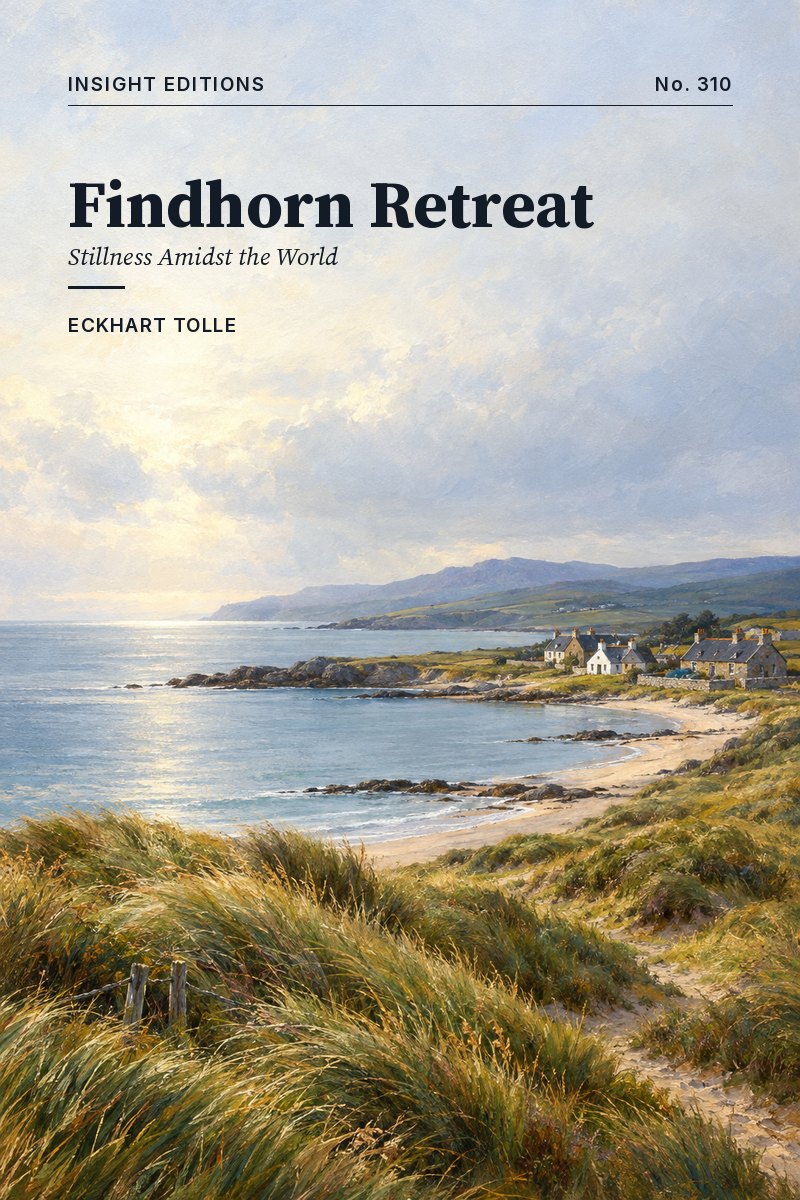
Insight Editions · No. 310
Findhorn Retreat
Stillness Amidst the World
Eckhart Tolle
Drawn from a retreat at the Findhorn community in Scotland, Eckhart Tolle asks what experience must provide for a person to feel complete, and points to the stillness that is already present.
A study guide to Findhorn Retreat by Eckhart Tolle. Shared free for personal reading; not for sale and not endorsed by the authors or publishers. Please read and buy the original.
OVERVIEWStillness Within a Changing World
Findhorn Retreat invites the reader to look before turning experience into a story about the self. The printed selection combines teaching, nature photographs and short captions. This edition follows that sequence through both introductions and every retreat page, explaining the arguments and describing the photographs' roles. It covers the surviving book, not the absent DVD recordings.
The opening challenge concerns the promise attached to accumulation. Information, possessions, recognition and sharper thinking may be useful, yet Tolle asks whether adding them can settle the feeling of being incomplete. The retreat proposes a change in attention: notice the experience of being here before asking the next achievement to make existence satisfactory.
Nature gives this proposal a concrete setting. A bird is heard before it is named; a tree combines rootedness with activity; clouds change without exhausting the sky. Uncaptioned photographs slow the reading, while captions introduce interpretations that go beyond what the camera alone can establish. Perception and interpretation are related, but the edition keeps their different roles visible.
The argument returns repeatedly to relationship and time. A person can listen without making someone else responsible for their identity. Memory and planning can serve life without becoming its sole definition. The scroll story, narrow gate and present-step pointer all ask attention to meet what is actually available, rather than live only through a remembered explanation or an anticipated ending.
The final movement affirms activity rather than withdrawal. Tolle welcomes learning, travel, skill and creative work, then questions the demand that these activities complete the self. He locates preciousness outside comparative rank and reads temporary forms as expressions of an eternal depth. Those spiritual claims remain attributed. The practical invitation is to participate in changing life without demanding that each form become permanent.
Chapter map
| Movement | Source location | Main connection |
|---|---|---|
| Publisher foreword | Pages 7-8 | Selected teaching, photographs and captions |
| Tolle introduction | Pages 9-11 | Nature, perception and spiritual depth |
| More and spacious love | Pages 13-18 | Accumulation, possession and listening |
| Changing forms | Pages 19-25 | Impermanence, perspective and naming |
| The narrow gate | Pages 26-32 | Present experience, memory and planning |
| Transparent form | Pages 33-39 | Art, stillness, insight and relationship |
| Future completion | Pages 40-46 | Identity, desire and ordinary sacredness |
| Activity and contemplation | Pages 47-53 | Action, creativity and direct looking |
| Preciousness | Pages 54-62 | Value, transience and inward space |
PUBLISHER FOREWORDPublisher Foreword
Publisher Marc Allen presents the book as a curated companion to a filmed weekend retreat held at Findhorn, Scotland, in spring 2004. His account says the event was recorded and edited into two two-hour DVD programs. Those discs are not present in the source package, so this edition works only from the printed selections and does not treat them as a complete transcript.
What the publisher says the set was designed to do
The foreword makes a strong promotional claim about the effect of Tolle's teaching. It describes the retreat as extraordinary, says something transformative happened at Findhorn, and credits Tolle's words with unusual vision and power. Readers are said to have found their lives deeply affected by hearing or reading him, while the teaching is framed as a practical route into the stillness of the present moment.
SOURCE FRAME
These are Marc Allen's assessments, not neutral findings about the effects of the retreat. They establish the publisher's purpose and expectations for the package. The more defensible observation is structural: the book presents selected moments, photographs and captions rather than a continuous record of everything taught during the weekend.
A deliberately mixed medium
The printed book combines three kinds of material. There are short excerpts chosen from the recorded retreat, nature photographs made by Tolle, and captions intended to direct attention while the photographs are viewed. Allen treats the combination of word, still image, sound and video as one treasury, but only the book survives in the available source.
The correct reading unit is therefore not text alone. A passage may be completed by the photograph beside it or by a caption on the next page.
FORMAT MAP
| Surviving element | Editorial function |
|---|---|
| Retreat selection | Preserves one argument, example or practice from the live teaching |
| Nature photograph | Interrupts continuous reading and supplies an object of attention |
| Caption | Connects the visible scene to a spiritual interpretation |
| Page sequence | Creates pauses and pairings that a text-only extraction can lose |
READING PRACTICE
When a photograph follows a passage, pause before moving to its caption. First describe only what is visibly present. Then notice what the caption adds: an interpretation, an exercise, or a claim about consciousness. Keeping those layers separate makes the method clearer without flattening the experience.
TOLLE INTRODUCTIONTolle's Introduction
Tolle begins by connecting Findhorn's identity to a relationship between human beings and nature. He says the Scottish community arose in the 1960s around a deepening engagement with the natural world. In his account, modern ego-centred civilization normalizes alienation from nature, and that separation travels with alienation from oneself and from other people.
Nature as teacher
The retreat setting is not decorative in this introduction. Birds, trees, flowers, wind, sea, forests and rivers become teachers because they exemplify stillness, present-moment life, surrender to the present and Being. This is Tolle's spiritual interpretation of the environment, not a scientific claim that natural objects literally instruct human consciousness.
KEY INSIGHT
Nature supplies a training ground in which attention can meet a form without immediately converting it into a personal story. Tolle then asks the reader to carry that less possessive mode of attention back into human life.
How to look at the photographs
The images come from several places and years, not only from the retreat. Tolle identifies England, British Columbia and Oregon among the locations. His practice is to look with little or no discursive thinking, but he explicitly warns against forcing thought to stop. The task is not suppression. It is to give full attention to perception and decline to follow each thought that appears.
The same practice continues outdoors. Notice shapes and colours. Smell the air. Hear leaves and birds. Use the senses fully, while allowing alert stillness, rather than commentary, to occupy the foreground. Thoughts are treated like passing clouds: present, changing and unnecessary to chase.
The exercise changes the relationship to thought; it does not demand a blank mind.
PERCEPTION PRACTICE
| Step | What to do | What not to turn it into |
|---|---|---|
| Arrive | Give the visible scene complete attention | A speed-reading break |
| Sense | Include colour, shape, sound, smell and bodily presence | A purely visual analysis |
| Notice thought | Let commentary appear without joining it | A battle against thinking |
| Return | Re-enter direct perception each time attention is captured | A test of perfect concentration |
Surface, depth and spiritual interpretation
Tolle distinguishes sensory surfaces from the depth he believes they can open. Shapes, sounds and colours are phenomena available to the senses. When perceived without immediate conceptual overlay, he says they can disclose a nameless mystery, spirit or divine presence pervading existence. This is the introduction's metaphysical claim: the presence recognized through nature is one with the reader's own presence beyond form.
A saying attributed to Jesus in the Gospel of Thomas supplies his central analogy. Finding the sacred in wood and stone does not mean locating the historical person Jesus inside an object. Tolle interprets it as recognizing the same innermost Being in all beings and things. On that reading, ordinary forms acquire depth, beauty and aliveness when they are no longer reduced to labels.
CRITICAL LENS
The movement from quiet perception to a universal divine essence is a spiritual inference. A reader can test the attentional practice directly: whether sensory detail becomes clearer and rumination loosens. The stronger claim, that one Presence is revealed in everything, should remain attributed to Tolle rather than presented as a measured property of nature.
SO WHAT / APPLY IT
Use one photograph twice. On the first pass, write five concrete visual details without interpretation. On the second, notice the thoughts and associations the image prompts. The gap between perception and commentary is the practical object of the exercise, even if the metaphysical conclusion remains a matter of belief.
RETREAT PAGES 13-18The Retreat Opens: More, Form and Spacious Love
The opening pages move from a spoken challenge about information and accumulation into a sequence of photographs about perception, relationship and the space in which experience changes. The alternation matters: argument is followed by scene, then by a relational practice, then by two images and a concluding pointer about presence.
page 13: information is not transformation
Tolle opens by denying that the retreat is another delivery system for novel facts. The world already supplies information in abundance, and devices can produce it at a touch. His questions are deliberately cumulative: will more information, more possessions, larger shopping centres, sharper analysis and more intellectual material yield a full life? Can the logic of “more” rescue the world?
The target is not learning itself. The criticism is directed at using accumulation to settle the question of who one is. The retreat's alternative is not less intelligence, but a different dimension of attention that cannot be stored as another possession.
THE OPENING CONTRAST
| Accumulation loop | Retreat alternative |
|---|---|
| Add information | Notice the awareness receiving information |
| Improve the self-image | Question whether identity is a form to complete |
| Seek fullness through things | Meet the present before adding anything |
| Treat thought as the only tool | Allow stillness to inform action and relationship |
page 14: pond, cloud, fish and perceiver
The photograph gathers several moving forms into one moment. A cloud that resembles an angel, a pond, fish and ripples are not isolated objects in the caption. They appear together with the consciousness perceiving them. The spiritual claim is that perception participates in the form of the moment.
The image does not prove that consciousness physically creates the scene. Its editorial function is experiential: it includes the observer in the event instead of treating the world as a collection of objects encountered from nowhere.
page 15: love without possession
Tolle says egoic love becomes confused with a particular form. A person may then imagine that love is located in, supplied by or owned through another person. His alternative is to define love as recognition of the formless in the other, which also means recognizing one's deepest identity there.
Nature is offered as the easier place to learn this recognition. Approach a tree, landscape or animal through stillness rather than acquisition, then bring the same quality into relationship. The practical sequence is precise:
- Let the other person be rather than immediately trying to alter them.
- Become still in their presence as one might become still in nature.
- Sense attention moving toward them.
- Listen to their words while also noticing oneself as the awareness in which listening occurs.
RELATIONAL BOUNDARY
Letting another person be does not require accepting abuse, abandoning discernment or withholding necessary action. The usable practice is to reduce compulsive projection while keeping consent, protection and accountability intact.
pages 16-17: sky, clouds and change
Page 16 gives the reader an uncaptioned seascape. Page 17 repeats the coast under a changing sky and supplies the distinction: awareness is compared with the sky, while events are compared with clouds that arise and pass. The image turns an abstract account of identity into an observation of stable field and changing content.
The practice is not to prevent clouds. It is to stop mistaking every cloud for the whole sky.
page 18: presence interrupts the story
The final text page in this opening sequence was entirely missing from the raw OCR and has been recovered from the scan. Its argument is that presence breaks the apparent continuity of a story assembled from past and future. In that break, Tolle says genuine intelligence and love can arise.
Love is again separated from form. Rather than arriving as something a person acquires through an object or relationship, it is said to enter through the spaciousness of presence and to have no form of its own. This completes the sequence: the critique of “more” becomes a practical invitation to discover what remains when accumulation, narrative and possessive identity briefly relax.
SO WHAT / APPLY IT
In one conversation, practise two-channel listening. Track the other person's actual words and the bodily fact of listening at the same time. If a story about what they “always” or “never” do appears, mark it as a story before deciding what response or boundary is needed.
RETREAT PAGES 19-25Forms Change, Awareness Opens
Pages 19-25 form a single movement from visible change to a less defended sense of identity. A flower supplies the first image, changing life conditions supply the argument, and a photograph of a darkening sky introduces the smallest gap in thought. The sunset pair then turns perspective into a lesson, after which the sequence applies the same logic to personal labels, specialness and listening. Each page asks the reader to notice what changes and what, in Tolle's account, remains available before interpretation takes possession of the scene.
page 19: the flower and translucence
The orchid is presented as more than an attractive object. Its petals, colour and lightness become an image of a mind that no longer feels opaque with continuous thought. Tolle describes such a mind as translucent: form is still present, yet it no longer blocks what he calls spirit or the formless from appearing through a person.
This is a spiritual analogy, not a biological property of the flower. The observable exercise is narrower. Look closely enough to notice gradations of colour, shadow, texture and depth before turning the flower into a label. The metaphysical conclusion, that formless spirit shines through an undense mind, remains Tolle's interpretation of that attentive state.
KEY INSIGHT
Translucence here does not mean becoming passive, vague or without thought. It names reduced psychological obstruction: thought can still serve a task, but it no longer has to occupy every interval or convert every perception into a story about the observer.
page 20: no arrangement of forms stays complete
The next page expands the image into an argument about the instability of conditions. A person may briefly have health, a satisfying relationship, money, possessions, affection and social respect at the same time. That configuration can feel like arrival. Yet work, finances, living circumstances, relationships or health can alter, and the completed arrangement begins to come apart.
Tolle's point is not that practical goods are worthless. The target is the claim that a particular arrangement can permanently settle identity and make a person complete. Forms arise, persist for a period and dissolve. The clouds are his visual teacher because their change is obvious: their instability is not a mistake that better management could finally eliminate.
The argument also needs an ethical boundary. Illness, debt, bereavement or relationship loss should not be treated as evidence that a person failed to be present. Material conditions are affected by bodies, other people, institutions, chance and unequal access to resources. The usable insight is that no external configuration can be made permanently fixed, not that suffering was inwardly chosen or deserved.
CHANGE AND ATTENTION
| Layer | What changes | What the practice asks |
|---|---|---|
| Visible form | Body, work, money, home and relationship conditions | Respond to the actual condition rather than deny it |
| Mental account | Judgments of success, failure, gain and loss | Notice the account without making it the whole self |
| Attentional gap | The interval before the next label or conclusion | Let the interval be felt without trying to manufacture it |
| Spiritual reading | Tolle identifies open awareness with the formless | Keep this conclusion attributed rather than treating it as measured fact |
Impermanence does not cancel care. It removes the promise that care can make every condition permanent.
page 21: finding the smallest gap
A dim landscape and heavy sky accompany a first-person statement about thoughts that once felt burdensome. Relief begins not when every thought disappears, but when even a small interval becomes noticeable. The photograph does not illustrate a triumphant blankness. Its subdued field matches the modesty of the practice: detect one opening, however brief.
The gap is therefore not an achievement to enlarge by force. Trying to hold it can produce another layer of strain and self-monitoring. The page invites a different recognition: one thought ends, the next has not yet fully formed, and awareness is already present in that interval.
MICRO-PRACTICE
At the end of one ordinary sentence in the mind, do not immediately supply another. Feel one breath, one sound or one bodily contact point. If thought returns at once, that is not failure. The practice is simply to recognize that the return was noticed.
pages 22-23: sunset and the limits of viewpoint
Page 22 gives the scene without commentary: a low sun, dark clouds, water and a column of reflected light. Page 23 removes the photograph and leaves a short caption on an ochre field. Read together, the pair distinguishes appearance from the standpoint that produces it. From the observer's location the sun seems to descend and vanish; from a wider frame, the event is a change in relative position rather than the extinction of the sun.
Tolle preserves the beauty of the appearance even after its limitation is understood. Calling the sunset an illusion does not make the colour, reflection or emotion worthless. The point is that a scene can be experientially real while the interpretation attached to it remains partial. The visual pause on page 22 lets the reader receive the scene before page 23 discloses the intended lesson.
CRITICAL LENS
A change of viewpoint can correct some appearances, but it does not prove every spiritual conclusion. The sunset pair clearly demonstrates that an observer's position shapes description. Using that fact as an analogy for ego and awareness is philosophically suggestive; it is not by itself evidence that all personal identity is unreal or that awareness exists independently of form.
page 24: ordinary presence without projected specialness
A small photograph of garden steps sits beside the argument that compulsive labelling and attachment to one's story sustain a conceptual identity. When those operations relax, Tolle says present-moment aliveness replaces the need to continually construct a special self. Simplicity and ordinariness are presented as freedom because identity no longer requires a performance of distinction.
The page does not require erasing individuality. Skills, commitments, history and personality can remain. What falls away is the demand that they secure existence by making the person exceptional in every encounter. Tolle calls the remaining quality preciousness: value is encountered before it is earned through comparison.
The staircase image quietly supports the argument. It does not display a spectacular destination. It shows a path made of ordinary steps, partially held by light and foliage. The editorial relation is practical: release one label, meet one moment, take one step, rather than creating a superior identity out of the idea of being present.
DISTINCTION
Dropping the need to appear special is not the same as accepting invisibility or unequal treatment. A person can ask for recognition, accommodation, credit or justice without turning those needs into proof of metaphysical superiority. Ordinariness concerns identity performance, not the surrender of rights.
page 25: listening before naming
The final page turns the sequence into a repeatable sensory practice. When a bird is heard, there is a first instant of sound before the mind identifies the species, judges the call or links it to memory. Tolle asks the reader to catch that instant whenever something new enters awareness. Stillness, aliveness and awareness are said to be present before commentary.
With repeated recognition, the interval may become easier to notice. Tolle describes the background of perception as already vast; practice does not create it so much as reveal what habitual naming had obscured. The final claim is that this quality can move from a listening exercise into ordinary activity, shaping how a person speaks, decides and acts.
SO WHAT / APPLY IT
Choose three sounds during the day. For each, distinguish four moments: raw sound, recognition, the label, and the personal association that follows. Do not try to delay thought. Notice the sequence accurately. Then carry the same precision into one conversation by hearing the other person's words before preparing a reply.
RETREAT PAGES 26-32The Narrow Gate of This Moment
Pages 26-32 gather image, caption, cultural diagnosis, story, metaphor and practice into one compact sequence. An uncaptioned lake photograph first clears the field. The following caption names the lake's near disappearance into stillness. An arched doorway then makes the present moment visible as a passage. The next three text pages explain what the passage is meant to interrupt, and the final tree photograph returns the argument to direct observation. The sequence moves from looking, through interpretation, and back to looking again.
pages 26-27: a lake almost without edges
Page 26 contains no words. The dark mass of the mountains meets a quiet lake under a pale sky, and the reflected shoreline makes the boundary between solid land and water uncertain. The page functions as a deliberate pause after the bird-listening practice. Instead of adding another explanation, it gives the reader an extended visual field in which explanation can subside.
Page 27 widens the same landscape and supplies the interpretive caption. Tolle describes the lake as so still that it nearly dissolves into no-thingness. The phrase does not mean that the lake has ceased to exist. Water, stones, slopes, trees and buildings remain visible. What weakens is the usual insistence on sharply separated objects. Reflection and reflected world approach one another until the scene appears less like a collection of items and more like a continuous field.
KEY INSIGHT
Stillness is not visual emptiness. In these photographs it is the condition in which differences remain visible without demanding immediate commentary. The image slows the reader before the book makes its next conceptual move.
page 28: the portal image
A stone arch frames a smaller opening and a distant landscape. The accompanying pointer asks the reader to step through the portal of the present. The photograph supplies spatial depth to a temporal instruction: the nearest arch is broad and shadowed, the farther opening is narrow, and the scene beyond can be reached only through what is immediately in front of the viewer.
The usable practice is exact rather than mystical. Identify the form of the current moment before solving the whole day. That form may be a sound, a message, a bodily sensation, another person's words or a decision that actually needs to be made. The portal metaphor asks attention to meet this concrete entry point. Tolle's further claim, that the present opens into a formless spiritual dimension, remains his interpretation rather than an observable property of the masonry or the landscape.
MICRO-PRACTICE
Name one thing that is verifiably here and one story being added to it. For example: “An email has arrived” is present form; “this will ruin everything” is a projection. Respond to the actual message first. Planning may follow, but it need not begin from a conclusion that has already swallowed the moment.
page 29: when private noise becomes a culture
The next page moves from an individual's inner speech to a collective pattern. Tolle argues that a voice which never stops talking in one mind can become, at civilizational scale, an obsession with form. Institutions, status, objects, expansion and measurable achievement then appear to exhaust what matters. The sacred, stillness, the formless and the divine become invisible because they cannot be possessed or accumulated in the same way.
The argument is intentionally diagnostic but not historical proof. It does not establish that every culture, institution or technology is merely an enlarged ego, nor does it make material improvement suspect. Food, housing, health care, infrastructure, rights and accountable institutions are forms with real consequences. The sharper question is whether acquiring, administering and comparing forms has become so complete an occupation that inward silence, ethical attention and non-instrumental value receive no place.
The page closes with a scriptural question about gaining the world while losing oneself. In this context, “losing” the self means becoming unable to sense identity apart from acquisition and narrated achievement. The warning is not against competent work. It is against a form of success that cannot answer who is living the successful life.
CRITICAL LENS
A critique of form obsession must not become indifference to material harm. Spiritual spaciousness does not replace medicine, shelter, safety, fair pay, disability access or political accountability. The distinction is between caring for forms and asking forms to provide an absolute identity.
page 30: the scroll and the centre
Tolle next retells a vision attributed to the woman who wrote A Course in Miracles. In the story she finds an ancient scroll. Writing on one side promises knowledge of the past; writing on the other promises knowledge of the future. Instead of choosing either direction, she rolls the scroll back to its beginning and attends to a central panel whose message is simply that God is. A voice congratulates her, and Tolle interprets the choice as a shift of focus into the present moment.
The structure matters more than the supernatural setting. Left and right offer two familiar ways for attention to leave the present: explanation by what has happened and anticipation of what might happen. The centre does not supply a better historical theory or prediction. It stops the demand to master time long enough for being itself to become the object of attention. The congratulatory voice belongs to the reported vision; it is not independent confirmation of its theology.
The episode also makes a distinction between useful time and psychological captivity. Remembering can preserve evidence, responsibility, learning and relationship. Foresight can support preparation, safety and care. The burden arises when memory and projection cease to be tools and become the only available identity. The story's centre is therefore not amnesia or improvisation without consequences. It is a point from which history and planning can be used without being mistaken for the whole of consciousness.
THE SCROLL AS AN ATTENTION MAP
| Direction | Legitimate use | Captive form | Present correction |
|---|---|---|---|
| Past | Evidence, memory, learning and accountability | Replaying history as a complete identity | Recall what is relevant, then notice what is here now |
| Future | Planning, prevention and commitment | Living inside imagined completion or catastrophe | Take the next proportionate action without demanding certainty |
| Centre | Contact with current experience | Mistaking passivity for presence | Let present attention support clear action |
| Spiritual meaning | Tolle reads being as prior to the time story | Treating that claim as proven by the vision | Keep the metaphysical conclusion attributed |
The present does not erase the timeline. It changes the position from which the timeline is remembered, planned and acted upon.
page 31: the narrow gate and the rolled story
The following page makes the scroll story operational. Tolle identifies the form of the current moment as an opening into what he calls the formless. He connects this opening with Jesus's image of a narrow gate that leads to life. Its narrowness is temporal: only this moment fits through. A remembered past and imagined future may appear in the moment, but they do not enlarge it into another time.
The scroll becomes a metaphor for personal history. Before bound books, a completed text could be rolled up and put away. Tolle asks the reader to do something similar with the life story carried as a burden. The point is to loosen the conviction that personal history is the deepest answer to who one is and that the future must finally complete that history.
This instruction needs a practical limit. Some stories must remain available because they contain commitments, evidence of harm, medical history, cultural memory or lessons required for future protection. Putting a story away is useful when it means ending needless rehearsal. It is unsafe when it means suppressing testimony, abandoning treatment, excusing abuse or refusing accountability. Presence can alter one's relation to a record without falsifying or destroying the record.
DISTINCTION
Release repetition, not responsibility. A person may stop rehearsing an event at every quiet moment while still documenting it, seeking care, setting a boundary, pursuing redress or remembering someone faithfully.
page 32: let the tree teach
The sequence ends with a large tree spreading across a deep blue field. Its visible form is dense and differentiated: trunk, limbs, fine branches, leaves, shadow and openings of light. The caption asks the reader to seek out a tree and learn stillness from it. After several pages about formlessness, the teacher is a particular living form rather than an abstraction.
The practice is to meet the tree before converting it into information. Notice weight, branching, colour, movement and the intervals between leaves. Wind may move the canopy while the tree remains rooted. In Tolle's use, that combination becomes a model for activity held within a deeper quiet. The tree is not offered as empirical evidence that consciousness is universal. It is a disciplined object of attention and a spiritual analogy.
SO WHAT / APPLY IT
Spend two minutes with one tree or another stable feature of the environment. First notice forms: edges, texture, movement, light and sound. Then notice the visual and auditory spaces among them. Finally identify one past or future story currently demanding attention. Decide whether it needs action, documentation, planning or simply a pause. Return to the next concrete step without requiring the story to define the whole self.
RETREAT PAGES 33-39When Form Becomes Transparent
Pages 33-39 extend the portal image into art, nature and creative action. The sequence begins with a claim about sacred art, interrupts itself with the movement of surf, then identifies awareness as the light in which forms appear. Tree photographs join stillness to activity; a garden and a forest distinguish designed order from an order too complex for thought to contain. A recovered sky-and-cloud caption returns the reader to awareness and events, and the final page applies stillness to problem solving and relationship. The movement repeatedly alternates conceptual statement and sensory pause.
page 33: sacred art and the art of living
Tolle describes the original purpose of art as access to the sacred. In his account, an artwork matters when form does not close around itself but allows what he calls the formless to become perceptible. Encountering such art is also self-recognition: the viewer sees something of their own depth reflected through colour, sound, image, movement or language.
This is a spiritual account of art, not a complete history of artistic purpose. Art has served ritual, memory, pleasure, protest, instruction, status, mourning, entertainment and many other human ends. Tolle selects one lineage of meaning and uses it to make a further move. Producing an art object is not everyone's calling, but becoming less opaque to stillness is available as a way of living. The person, rather than the artefact, becomes the medium.
To “become a work of art” therefore does not mean aesthetic self-display. It means allowing speech, work, rest and relationship to express something that is not exhausted by the role being performed. Tolle links this transparency to reduced identification with the world of form and to access to inward stillness. The metaphysical claim, that something formless then shines through the person, remains attributed to him.
KEY INSIGHT
Form becomes transparent when it communicates more than self-display. The practical test is not whether a life looks beautiful from outside, but whether action carries attention, honesty and space for another person to exist.
pages 34-35: surf, light and the field of appearance
Page 34 contains only a seashore photograph. Bands of advancing foam, dark wet sand and reflected sky produce a scene in which no wave keeps a stable edge. It is the visual pause required by the art argument: before the book says what shines through form, the reader is given changing forms that can be watched without being held.
Page 35 narrows the photograph and adds a caption identifying the reader with the light in which forms appear. The statement is not about optical illumination. Tolle uses “light” as a metaphor for awareness: waves, judgments, memories and bodily sensations can be known because they appear within a field of experience. The image helps the metaphor by placing bright water beside a broad unprinted area, but it does not establish that awareness exists independently of the body.
CRITICAL LENS
A phenomenological description is not automatically a metaphysical proof. It is directly observable that an experience is known when it appears. The further conclusion that awareness is an unconditioned light in which all forms arise is Tolle's spiritual interpretation of that observation.
page 36: stillness and intense activity
Two close photographs show a tree from within its branching structure. The caption joins qualities that can seem opposed: the tree is still, yet active, intensely alive and reaching upward. Stillness here is not immobility. Growth, exchange, response to light and seasonal change can occur without the psychological agitation that human beings often add to activity.
The tree supplies a corrective to the idea that presence means withdrawal. Tolle's image suggests action without inner self-argument: rootedness and reaching occur together. A human practice can borrow the pattern without pretending that people should behave like plants. Begin from a settled contact with the task, then act with full energy rather than using anxiety as proof of commitment.
MICRO-PRACTICE
Before one demanding task, distinguish activity from agitation. Name the next physical or verbal action. Feel both feet or one contact point. Begin the action while declining to rehearse whether the task proves your worth. Stillness is the absence of added identity pressure, not the absence of effort.
page 37: garden order and forest order
The page places a shaped garden beside a dense forest. Tolle says the mind can understand the landscaped garden because its arrangement displays a legible intention. The forest appears chaotic because its relationships exceed the mind's preferred simplicity. He nevertheless claims that it conceals a higher order, sensed through stillness rather than grasped through thought.
The comparison opposes two modes of relation, not design and neglect. Analytical thought can identify paths, species, succession, water flow and other patterns in a forest. Tolle's point is that no finite conceptual model contains the total living event. Still attention admits participation in a system before full comprehension. In his spiritual reading, sensing this uncontained order also means sensing one's inclusion in sacredness.
That conclusion should not romanticize every unmanaged condition. Ecological systems can be damaged, invasive species can spread, and human intervention can sometimes be necessary. The useful distinction is between understanding enough to act responsibly and imagining that a conceptual map equals the whole field.
FOUR WAYS FORM OPENS
| Page image | Immediate observation | Tolle's spiritual reading | Practical use |
|---|---|---|---|
| Art | A made form carries more than its materials | The formless shines through form | Notice whether expression serves contact or self-display |
| Surf | Every visible edge changes | Forms appear within awareness | Observe change before fixing it into a story |
| Tree | Rooted stillness coexists with growth | Being can express itself through activity | Work energetically without making agitation necessary |
| Forest | Order exceeds a simple plan | Stillness senses participation in sacred wholeness | Use models while remembering what the model leaves out |
page 38: the recovered sky and cloud caption
A broad inlet under a clouded sky carries a caption that was missing from the raw OCR and recovered from the scan. It returns to the earlier distinction: the reader is compared with the sky, while events are compared with clouds that arise and pass. Water and cloud reflections make the relation visible because the scene changes without the field of appearance being destroyed.
The metaphor separates identity from occurrence without denying occurrence. A painful event remains painful; a joyful event remains welcome. The practice is to notice that neither exhausts awareness or fixes identity forever. The sky does not prevent weather, and presence does not prevent necessary action. It supplies room in which response need not be identical with the first reaction.
The field is not valuable because nothing happens. It is valuable because what happens does not have to become the whole of who one is.
page 39: thought, insight and relationship
The final page makes a deliberately absolute claim that thinking creates problems rather than solving them. Read literally, that is too broad: analysis, calculation, memory and comparison solve many problems. Tolle's narrower target is repetitive thinking that cannot leave the frame which generated the difficulty. He describes a sequence in which a person steps out of thought, becomes still and present for a moment, and later receives a connection that was unavailable during mental pressure.
Stillness therefore functions as an interruption, not a substitute for competence. A useful creative cycle can include careful problem definition, a pause from compulsive analysis, the arrival of a new possibility and disciplined testing. An insight that appears after silence can still be mistaken. It must meet evidence, constraints, consequences and the people affected by the decision.
Tolle then applies the release of excessive thinking to relationship. Demands placed on another person may be serving an identity project: the other must admire, reassure, obey or change so that the self feels enhanced. Comparison serves the same project by trying to become more than someone else. When that structure relaxes, the other person can be encountered without being assigned responsibility for completing one's identity.
Allowing someone to be as they are does not require approving every action. A person can see another accurately, refuse control as a source of self-worth, and still set limits, leave danger, request change or seek accountability. Acceptance describes contact with what is already happening. It does not turn harm into permission or make happiness dependent on silence about injustice.
RELATIONAL BOUNDARY
Release identity demands, not consent and discernment. “You do not have to become someone else for me to exist” can coexist with “this behaviour is harmful and I will act to protect myself or others.”
SO WHAT / APPLY IT
Use a four-part pause on one real problem. First state the problem without biography or blame. Second list what analysis has already established. Third stop deliberate thinking for two minutes and attend to sound, breath or the visual field. Fourth record any new connection and test it against facts, responsibilities and likely effects. In a relationship, ask whether the requested change protects a legitimate need or is being used to manufacture identity.
RETREAT PAGES 40-46The Self That Waits for Completion
Pages 40-46 trace the search for identity through thought, time and possession. The sequence starts with the unnoticed identification carried by thought, moves through a tiny reflection and an expansive sky, and locates sacred presence in ordinary wood and stone. The desire passage then asks why achievement may leave the seeker dissatisfied. An animal's rootedness closes the movement with Tolle's image of life unburdened by a continuing personal story.
page 40: the unnoticed owner of thought
Tolle argues that a thought carries a felt self when its movement goes unnoticed. Awareness of thinking and absorption in thinking are different relations to the same event. During absorption, a judgment can feel like the person who judges: the thought's success, defeat, future or status becomes inseparable from the sense of being someone. Tolle calls that identification the defining condition of unconscious living. He is describing a spiritual pattern of identification, rather than diagnosing a medical state.
The next step in the argument is temporal. If the self constituted by thought feels insufficient, its imagined completion must lie somewhere else. A future achievement becomes the proposed ending that will finally make the story satisfactory. The person mistakes the story for identity and then tries to repair identity by improving the story. The future is attractive because it can still hold an imagined resolution that the present does not supply.
The demand for more follows from that confusion. More recognition, a better situation or another success may be pursued less for its actual use than for its promise to establish who one is. Even success can leave the structure intact: a self defined as unfinished can find a further condition to meet. Tolle presents this as a broad human dilemma, not simply a criticism of one ambitious person.
KEY INSIGHT
Notice the identity promise attached to a goal. The goal may be sensible; the additional demand that it finally make you sufficient is the question raised by this page. Planning a future and postponing one's whole existence until that future are different activities.
page 41: a bubble holding a world
A small bubble in beach water reflects both the photographer and the sun. The caption identifies the photographer raising a hand in greeting to these reflections. A person engaged in seeing becomes part of what is seen, while something apparently immense appears on a fragile surface. The photograph brings the preceding identity argument into a scene that can be looked at before it is interpreted.
The caption expands the scale of disappearance from seconds to years to aeons. The bubble, the reflected person and the solar image do not share one duration. The passage nevertheless gathers them under transience: greater duration does not mean permanence. Its force lies in the change of scale, not in a predicted date for any particular disappearance.
This is an invitation to appreciate an appearance without demanding that it remain. The photographer's greeting gives the image warmth. Impermanence need not produce indifference or a refusal to care; a brief encounter can matter precisely while its form is changing. Neither the image nor its caption requires the reader to deny grief when a valued form is lost.
pages 42-43: the sky before the interpretation
Page 42 offers a full photograph without a caption. Orange light near the horizon and darker bands of cloud above it spread across a coastal sky. The pause is part of the sequence: after the bubble's small reflection, the book gives the reader an expansive field to encounter without an immediate verbal conclusion.
Page 43 continues the sunset and adds the claim that outward and inward space are ultimately one. This short caption was visually recovered from the scan because the raw OCR missed it. Within Tolle's argument, the visible expanse and the openness of awareness are related as expressions of a single depth. The photograph makes spaciousness available to perception while the words offer a metaphysical interpretation.
The distinction between experience and interpretation matters here. A reader can notice a spacious quality of attention while looking at the sky. That experience does not by itself establish an identity between physical space and consciousness. The edition retains Tolle's stronger claim as his teaching, while allowing the immediate observation to stand on its own.
page 44: sacred presence in wood and stone
Cut branches fill a photograph above a saying attributed to the Gospel of Thomas. The saying places the speaker's presence where wood is opened and where a stone is lifted. Its two actions direct attention toward ordinary material things, including what may lie concealed or be passed over. In the book's sequence, the divine is encountered within common form rather than being reserved for an extraordinary future event.
The attribution and the interpretation have different roles. The printed page attributes the saying to the Gospel of Thomas; the surrounding book invites a reading through presence and oneness. This edition preserves both without adding a claim that all Christian traditions interpret the saying identically. The photograph's newly exposed wood gives the first action a visible setting, while the stone remains part of the verbal image.
FROM IDENTITY TO ATTENTION
| Source moment | Distinction preserved | Question for the reader |
|---|---|---|
| Unnoticed thought | A thought becomes a felt identity | Am I observing this judgment or becoming it? |
| Beach bubble | Different durations remain temporary | Can this encounter matter without lasting forever? |
| Sunset pair | Open perception precedes a claim about unity | What do I experience, and what interpretation follows? |
| Wood and stone | The sacred is placed within ordinary form | What am I overlooking while waiting for a special event? |
| Desired achievement | Obtaining something differs from finding oneself | What am I asking this achievement to provide? |
page 45: getting and failing to get
The source introduces two routes to unhappiness: a desire may remain unfulfilled, or it may be fulfilled without bringing the expected resolution. The second route is the surprise. Tolle names wealth, public recognition, property and achievement as things the surrounding world presents as desirable. A person may obtain them and still lack sustained happiness, peace with themselves, security or a sense of arrival. These are distinct promises, and the passage says worldly success may fail to deliver all of them.
His explanation returns to identity. What the seeker ultimately hoped to obtain was themselves: a rooted participation in life, associated here with Jesus's language about life's fullness. An object or achievement cannot supply that in the way the seeker expects. This completes the earlier argument: thought projects a satisfactory ending, but acquiring the ending does not necessarily undo identification with the story.
The claim concerns what achievements are asked to accomplish, not a requirement to abandon them. Income, shelter, recognition for work and practical success can have real uses. Their value does not depend on their providing permanent existential completion. Nor should the passage be used to tell a person facing deprivation that their material needs are merely thoughts. A goal can remain necessary even when it is no longer made responsible for the whole of identity.
A success can improve a situation without having to settle the question of who you are.
CRITICAL LENS
A spiritual account of dissatisfaction is not a universal explanation of suffering. The passage cannot establish why any particular person is unhappy, and it does not make poverty, illness, exclusion or loss evidence of failed presence. Care, practical help and changes to circumstances remain available.
page 46: the animal as an image of rootedness
The final passage presents an animal as remaining within the totality of life. Its sequence links the absence of a continuous burden of thinking with rootedness in Being, freedom from a manufactured world of problems and unity with life. The animal becomes a contrast to the human self that lives through a projected ending. It supplies the movement's closing image of belonging before acquisition.
These statements function as Tolle's spiritual portrait. They should not be expanded into a zoological assertion that animals never think, experience distress or face problems. The source's point is the burden of a continuing identity story. Encountering an animal can invite attention to immediate living without requiring a theory about everything that happens in the animal's experience. Respect for its needs and boundaries remains part of that encounter.
SO WHAT / APPLY IT
Choose one desired outcome and name its practical purpose. Then write the extra promise attached to it, such as finally feeling worthy or permanently secure. Keep the practical task, but test whether the identity promise is something that task can supply. Pause to notice one ordinary object or living presence without turning it into evidence of personal success. This is an editorial exercise drawn from the sequence, not an additional exercise printed in the source.
RETREAT PAGES 47-53Activity Without the Search for Completion
Pages 47-53 bring presence into the rhythm of doing and pausing. A bare tree introduces action and restraint, a coastal photograph leads into awareness amid thought, and the next passage explicitly welcomes creativity and development. Brief captions on change and the next step prepare the final distinction between an experience collected by the mind and direct contemplation. The sequence asks how life is met while it unfolds.
page 47: the tree does not postpone its life
A leafless tree stands against a luminous sky, accompanied by a first-person caption about the seasons. The speaker is not making spring's arrival the condition for living now. The winter form is not treated as a defective version of the future tree. In the photograph, branching structure and evening light already offer something to encounter before any new leaves appear.
The caption then distinguishes a moment suited to action from one suited to refraining. Both belong within the same acceptance of the present. Surrender is therefore not identified exclusively with stopping, and activity need not mean resistance. The sequence ends by joining present acceptance to unity with life, which is Tolle's spiritual interpretation of the stance the tree illustrates.
The image offers a relation to timing, not a universal rule for deciding when to wait. A human situation may call for urgent intervention, patient preparation, rest or a change of direction. The page does not provide a decision procedure for those cases. Its narrower invitation is to stop treating this moment as empty merely because an anticipated season has not arrived.
KEY INSIGHT
Action and rest can both be responses to the present. The distinction is between responding to what is here and making a later condition responsible for the permission to live. Attentiveness can support a needed decision without requiring perfect inward calm first.
pages 48-49: awareness while thinking continues
Page 48 gives a monochrome coastal scene without words. Dark beach, bands of water and a broad clouded sky create a pause after the tree's seasonal caption. The absence of a caption is part of the sequence; it does not supply an additional doctrine or a missing instruction to reconstruct.
Page 49 repeats a narrow portion of that coast beside an analogy between light and awareness. Light passing through cloud is paired with awareness becoming apparent through thought. The concluding distinction matters: thinking can continue while a person remains aware of existing. The passage does not demand a permanently blank mind before presence becomes possible.
The photograph supports the analogy without proving its metaphysics. Cloud does not exhaust the sky's visible field, just as, in Tolle's account, thought does not exhaust awareness. A practical reading is to notice a thought while also noticing that it is being experienced. This preserves the page's coexistence of thinking and awareness rather than turning attention into another attempt to suppress thought.
page 50: a clear permission to create
The next passage expressly permits novelty and engagement with the world. It includes undertaking activities, travelling to unfamiliar countries, meeting people, learning, gaining expertise, developing bodily capacities, cultivating mental abilities and bringing something into existence through creative work. These are separate forms of participation, not a list of temptations that the reader is told to renounce.
Tolle also affirms the beauty of creation and the continuing availability of further work. There is no claim that a person must finish every possible task before being present. The question shifts from the activity's outward form to the identity demand invested in it. The same learning or creative undertaking can have a practical purpose while also carrying an expectation that it will finally complete the person doing it.
Three linked questions sharpen that shift. Is the person trying to locate themselves in the activity? Is the activity supposed to enlarge an existing self-image? Is attention being driven repeatedly toward a later moment in search of lasting satisfaction? The progression moves from identity, through self-enhancement, to compulsive postponement. An unfinished project is not itself the problem; the passage challenges the promise attached to its imagined completion.
Keep the creative work; examine the promise that its completion will finally make you complete.
PARTICIPATION AND POSTPONEMENT
| Source moment | What remains available | What the passage questions |
|---|---|---|
| Seasonal tree | Acting or refraining as circumstances require | Treating the present as only a waiting room |
| Light and thought | Thinking with awareness of thinking | Assuming awareness requires mental silence |
| Learning and creating | Skills, relationships, travel and creative work | Using achievement to finish one's identity |
| One present step | A journey with practical direction | Trying to live the entire journey at once |
| Contemplation | Direct looking, with analysis available when useful | Reducing the encounter to a mental label |
page 51: the scene will change
A dramatic cloud photograph carries a short reminder of transience. Light emerges through a dark mass, but the caption does not promise that the pictured arrangement will stay. Its placement after the activity passage loosens the demand that a successful experience or achievement provide a permanent settlement. It also reminds the reader that a difficult present appearance is not a fixed possession.
Transience is the caption's claim; a timetable is not. The page gives no assurance about when a particular hardship will end or what will replace it. Remembering change can alter one's relation to a situation while leaving grief, necessary assistance and practical decisions fully legitimate.
page 52: the journey and this step
Clouded sky and dark trees frame a caption that brings a seemingly long journey back to its present unit. Walking, breathing and living a moment become parallel reminders of immediacy. The imagined length of the route does not make its whole extent available at once: what can actually be met is the present part of it.
This does not erase direction or preparation. In an editorial application, one can keep a destination, a schedule or an obligation in view while giving attention to the next feasible action. The breathing image here is an ordinary pointer to experience, not a prescribed breathing technique, retention exercise or medical treatment.
page 53: more than an interesting memory
The final passage contrasts stillness with the mind's wish to identify and retain something interesting. Tolle uses interest in a particular sense: material the mind can think about and later recall. Stillness does not fit that collecting activity, so judging it by whether it produces a memorable intellectual item misses the kind of encounter he means.
His examples move from a tree, a flower and a sunset to an oak viewed directly. Analysis and naming can make these objects intellectually engaging, but he says their experienced depth and vitality recede when those operations take over. The concluding invitation is to remain with what is seen. Contemplation can become awe, an encounter whose depth exceeds the mind's account of it.
The strength of the wording should remain visible without becoming a ban on knowledge. Tolle makes a categorical contrast between conceptual interest and contemplative depth. This edition reads that as a spiritual pointer to different modes of attention. It does not establish that learning a tree's name, remembering an experience or analyzing an environmental problem necessarily destroys appreciation. A reader can explore the suggested pause and still use knowledge responsibly.
CRITICAL LENS
Neither surrender nor transience decides whether a harmful situation should continue. Protection, consent, access needs and accountability remain practical responsibilities. Likewise, the permission to develop abilities is not a demand that every person pursue the same physical or mental capacities. The chapter concerns how activity relates to identity, not a ranking of lives by achievement.
SO WHAT / APPLY IT
Name one current project and its concrete purpose. Notice any extra promise that finishing it will settle your worth. Then decide whether this situation calls for a feasible action or a deliberate pause. Finally, look at something ordinary for a brief interval before naming or evaluating it. This editorial exercise follows the movement from participation to contemplation; it is not an additional exercise printed in the source.
RETREAT PAGES 54-62Preciousness Without Comparison
Pages 54-62 close the printed retreat by moving from personal specialness to a shared depth of life. Temporary forms become transparent to what Tolle calls eternal presence. Sand, standing stone, animal companionship, countryside, coastline and mountain sky then offer different approaches to the same inward recognition. The ending joins form and space rather than asking the reader to abandon the visible world.
page 54: what the search for specialness conceals
The opening distinction holds impermanence and eternity together. No visible form lasts forever, Tolle says, yet something eternal can become apparent through it. He applies that distinction directly to the listener: the person as a particular form is temporary, but can already sense a depth beyond that form while sitting in the retreat. The claim is about present recognition, not a promise that the body or personality will become permanent.
Several names point toward the same proposed depth. Stillness, presence and the immediate sense of existing are alternative descriptions in this passage. Previously, Tolle argues, that recognition was confused with the personal story and the concepts used to describe oneself. Transparency means that the story no longer entirely obscures what he believes is present before its description.
His treatment of specialness reverses the search rather than merely condemning it. The ego tries to become exceptional within its biography. That effort conceals an existing preciousness which, in his account, cannot be increased by winning a comparison. Superiority and comparative wretchedness are both named as mistaken bases of distinction. The alternative is an inwardly sensed beauty, value and vitality that do not require another person to occupy a lower position.
KEY INSIGHT
Intrinsic preciousness is not a position in a ranking. Tolle retains the intuition that life has value while questioning the identity project that tries to secure it by being more successful or more unfortunate than someone else. This does not erase differences in need, suffering, ability or responsibility.
A form can be temporary without its presence being worthless.
page 55: enjoying a world that changes
Ripples in beach sand accompany a caption about accepting the brief life of forms. The pattern has visible order without suggesting permanence. Tolle makes recognition and acceptance of transience the condition for enjoying the world as it is. The claim is stronger than simply noticing that things change: appreciation is said to deepen when permanence is no longer demanded of them.
The caption names this enjoyment through two religious images. It invokes leela as divine play and the Tao as song. Here those images express Tolle's reading of changing appearances as something to participate in and appreciate. Their conjunction is preserved as his spiritual language; it does not establish that the traditions behind the terms have identical teachings. Nor does the play metaphor require treating another person's loss or suffering as entertainment.
pages 56-57: the stone and the uncaptioned pause
A close photograph of a weathered standing stone is named as a silent witness. Its marked surface fills the image, with sky behind it. The caption gives the stone a contemplative role: an image of remaining present without adding a personal commentary. The book does not supply a history of the monument or a claim about the stone's literal mental life.
The next page draws back into a wider photograph without words. The stone stands within grass and a much larger field of sky and cloud. The change in scale belongs to the reading: what first dominated the frame becomes one form within a landscape. This second page lets the preceding pointer rest in perception rather than adding another explanation. No missing caption needs to be invented.
page 58: companionship and a quieter mind
Tolle gives three concrete ways an animal may interrupt habitual thought. Stroking a dog, feeling a purring cat resting on one's chest and simply observing an animal are offered as encounters that can draw attention away from conceptual absorption. Touch, sound and watching supply different routes into immediate contact.
He explains the effect through the animal's rootedness in Being. The animal is portrayed as closer to life's source than most humans, with that rootedness communicated to the person beside it. This extends the earlier animal passage into an account of companionship. It remains Tolle's spiritual explanation, rather than a measured comparison of species or an established mechanism of transmission.
The passage ends with a large and emphatic claim. Tolle says that living with animals keeps millions of people sane who would otherwise be lost in conceptual reality. No supporting count, study or diagnostic definition appears on the page. This edition preserves the scope and attribution of that assertion without treating it as a verified mental-health statistic or a treatment guarantee. The ordinary invitation to attend to an animal does not depend on accepting that stronger claim.
THE CLOSING SEQUENCE
| Source image or passage | What it directs attention toward | What remains an interpretation |
|---|---|---|
| Personal specialness | Value not earned through comparison | Eternal Being as one's deepest identity |
| Patterned sand | Enjoyment alongside transience | Divine play and the Tao as a shared image |
| Standing stone | A pause in personal commentary | The stone as witness |
| Animal encounter | Touch, sound and attentive observation | Transmitted rootedness and the millions claim |
| Land, sea and sky | Quiet attention and visible spaciousness | Peace emanating from earth and inward infinity |
page 59: receiving the landscape
A broad green countryside accompanies the suggestion that a quiet mind can sense peace coming from the earth. Fields, trees and distant terrain remain differentiated; peace is not pictured as an empty landscape. The caption connects an inward condition of attention with a quality Tolle believes can be received from the environment.
The page can be approached as an invitation to look without immediately judging. Its stronger language about an emanation remains spiritual attribution. A viewer who feels distracted, distressed or unmoved has not thereby failed a test, and the photograph does not establish that every outdoor environment is peaceful or safe.
page 60: the purpose stated again
A short text page returns to the retreat's aim: discovering an inward dimension beyond thinking. The corrected transcript preserves the opening line that the raw OCR damaged. The subject is discovery within oneself, not the acquisition of another interesting theory. In the sequence, the countryside has served as an approach to this recognition, while the caption now states the intended inward direction explicitly.
Beyond thought does not need to become hostility toward thought. The source locates a deeper dimension; it does not supply a practical argument for discarding memory, judgment or knowledge. These capacities can remain available while a reader explores the difference between immediate experience and the commentary attached to it.
page 61: small figures, inward depth
Small people stand on a coastline beneath an expansive sky. The caption first acknowledges how insignificant a person can seem beside such immensity. It then reverses the relation: Tolle places that vastness and unlimited depth within the person, inseparable from identity. The photograph makes the difference of visible scale concrete, while the words refuse to let physical smallness settle the question of worth or being.
This is a metaphysical reversal, not a measurement of inner space. The chapter preserves both movements, apparent insignificance and inward immensity, without turning the claim into astronomy or anatomy. Its connection to page 54 is clear: preciousness need not be secured by becoming the largest or most conspicuous form in the scene.
page 62: form within openness
The final photograph brings mountain, trees and streaked cloud into one frame. Its caption joins forms and spaces as interpenetrating, both outwardly and inwardly. The ending therefore leaves visible things present. Openness is encountered with them, not by removing every object from experience.
The movement closes where the introduction began: photographs can invite a different relation to ordinary perception. Nature supplies occasions for looking; Tolle interprets the resulting openness as recognition of the reader's own depth. The printed book ends this selection with that relation between appearance and space. The absent recordings must not be used to invent a further conclusion to the spoken retreat.
CRITICAL LENS
Companionship is not a universal prescription. The source's mental-health language should not become a diagnosis, a reason to replace care, or a demand to acquire an animal. Comfort, access, consent and the animal's welfare matter. Similarly, accepting transience does not cancel protection, practical help or accountability when a changing situation includes harm.
SO WHAT / APPLY IT
Choose a familiar scene and notice one changing form and the space around it. Watch briefly before comparing the scene with another. Then notice whether the wish to be exceptional has entered your own account of the moment. Let the comparison pause while keeping any practical need or responsibility in view. This is an editorial exercise drawn from the closing sequence, not an extra instruction printed in the source.
SYNTHESISAttention That Returns to Life
The retreat's recurring question is what a person asks experience to provide. A possession can serve a need, a memory can preserve truth and a project can create something useful. The difficulty arises when these forms must also supply a final identity. The following connections bring the printed sequence together without substituting a new doctrine for Tolle's own.
Master takeaways
- Read the photographs and captions together. Their order supplies pauses and changes of viewpoint that a collection of isolated quotations would lose.
- More information does not necessarily change one's relation to experience. The opening challenge concerns transformation through attention, not ignorance as an ideal.
- Notice thought without forcing it to stop. Tolle's introductory practice invites a return to perception whenever commentary captures attention.
- Listen without making another person complete your identity. Spacious attention can coexist with requests, boundaries and accountability.
- Changing conditions cannot guarantee permanent arrival. Health, work, affection and possessions matter without becoming a final settlement of selfhood.
- Keep useful action while questioning the identity promise attached to it. Creativity and learning remain welcome throughout the closing sequence.
- A brief gap can be noticed without being enlarged by force. The practice begins with recognition, not a performance of perfect silence.
- Perspective changes interpretation without cancelling beauty. The sunset remains meaningful after its apparent disappearance is understood differently.
- Ordinariness need not mean invisibility. Releasing comparative specialness does not surrender fair recognition or accommodation.
- Hear the sound before following its associations. The bird-listening passage makes the transition from perception to naming available for observation.
- Begin with the actual form of this moment. The portal metaphor directs attention to a concrete circumstance rather than an imagined total life.
- Put repetitive biography down without destroying the record. The scroll image leaves legitimate memory, testimony and planning available.
- Stillness can accompany energetic activity. The tree's rootedness and upward growth challenge the equation of presence with passivity.
- A model does not contain the whole encounter. The garden and forest comparison invites humility without making analysis useless.
- Test an insight after the pause that made it possible. A new connection still needs to meet evidence, consequences and practical constraints.
- Different durations remain temporary. The bubble's reflection connects the momentary and the immense without making either meaningless.
- Desire can disappoint through success as well as failure. Acquiring an object may not deliver the existential completion expected from it.
- Thought and awareness can coexist. The light-through-cloud caption explicitly retains thinking while pointing to the awareness of existing.
- The next step does not abolish the journey. A direction can remain while attention returns to the present action through which it is pursued.
- Contemplation need not produce an interesting item to remember. The final tree and sunset passage values direct encounter beyond conceptual collection.
- Preciousness is not comparative rank. Tolle rejects both superiority and greater wretchedness as the basis of the value he locates within Being.
- Transience can deepen appreciation. Accepting change need not become indifference to loss or neglect of care.
- Animal companionship is offered as an attentional opening. The larger claims about spiritual transmission and millions of people remain unverified assertions in the source.
- The ending holds forms and openness together. Mountain, tree, cloud and space remain present; the retreat does not end by emptying experience of the world.
Frameworks & mental models
| Framework | How it works | Practical limit |
|---|---|---|
| Perception and commentary | Receive a sound or scene, notice the label, return to sensing | Naming remains useful; thought need not be suppressed |
| Form and identity | Distinguish a changing condition from the whole of who one is | Material needs and unequal conditions remain real |
| Past, future and present | Use memory and planning while meeting the current circumstance | Presence does not erase evidence or obligations |
| Pause and insight | Interrupt repetitive analysis, receive a possibility, test it | Quiet does not guarantee a correct solution |
| Action and restraint | Respond through doing or pausing as circumstances require | The text supplies no universal rule for waiting |
| Experience and interpretation | Separate direct observation from the metaphysical conclusion drawn from it | An evocative analogy is not empirical proof |
Whole-book critical lens
The book is strongest as a sequence of invitations to attention. Its brief passages can make unnoticed habits visible: treating another person as a source of completion, converting every scene into a label, or rehearsing the future as the only place where life can become adequate. The photographs give those habits a concrete alternative rather than merely another abstract explanation.
Its metaphysical conclusions extend further than these observations. Eternal awareness, the identity of inward and outward space, nature's transmission of Being and a divine presence within all forms belong to Tolle's interpretation. A reader can engage them as spiritual proposals while distinguishing them from what a particular act of looking demonstrates. The juxtaposition of Jesus, the Gospel of Thomas, leela and the Tao is not a full comparison of those traditions.
The emphatic language sometimes requires careful reading. The statements about thinking creating problems and animals keeping millions sane do not provide evidence for universal cognitive or clinical claims. Practical reasoning, professional care and animal welfare remain relevant. Neither a quieter mind nor acceptance of transience makes a person responsible for illness, deprivation or another person's harmful conduct.
The edition also has a definite source boundary. Publisher Marc Allen's account of the retreat's effects is promotional testimony. The surviving printed selections do not establish what every participant experienced, and the absent recordings cannot be reconstructed from them. This companion preserves the printed sequence and its photographic relationships while adding clearly identified explanation and exercises.
Connections to contemporary work
AI work benefits from distinguishing a model's representation from the situation it represents. The forest comparison offers an editorial analogy for inspecting what a model leaves out. A polished answer or diagram should not replace evidence about the actual case. The pause before responding can help a practitioner separate an observed failure from a defensive story about their own competence; it does not establish machine consciousness.
Architecture can make attention part of a design review. Before assigning a space a concept, observe light, sound, movement, access and the way people use it. The book's doorway and landscape images suggest how framing directs perception. This connection supports a practice of looking; it does not turn contemplative language into a substitute for safety, accessibility or engineering requirements.
Banking conversations can separate the customer's immediate need from the professional's reaction to it. Listening fully before rehearsing a response may clarify what is being requested. A pause should preserve records, procedures and protective action. The retreat's distinction between value and comparative status can also prompt reflection on the identity burden attached to financial success, without suggesting that material security is unimportant.
A RETURNING PRACTICE
Select one encounter rather than attempting to monitor the whole day. Notice what is present, identify the story being added, and choose the next responsible response. Afterward, review what changed in the encounter and what did not. This editorial practice brings perception, reflection and action together without making calmness another measure of worth.
Source status
The original 72-page scan is authoritative. Every page was inspected individually before drafting. Raw OCR remains preserved; this edition uses the corrected page layer. The advertised DVDs are absent, so the edition does not claim to reproduce the full retreat.
About this book
Findhorn Retreat: Stillness Amidst the World by Eckhart Tolle, 2006. This is a chapter-by-chapter study of the book, with summaries, maps, tables and diagrams; short quotations keep their page references. It is shared free for personal study, is not for sale, and is not endorsed by the author or publisher. Please read and buy the original.
Insight Editions · rajeshrmahapatra.com/insight-editions