Insight Editions · No. 112
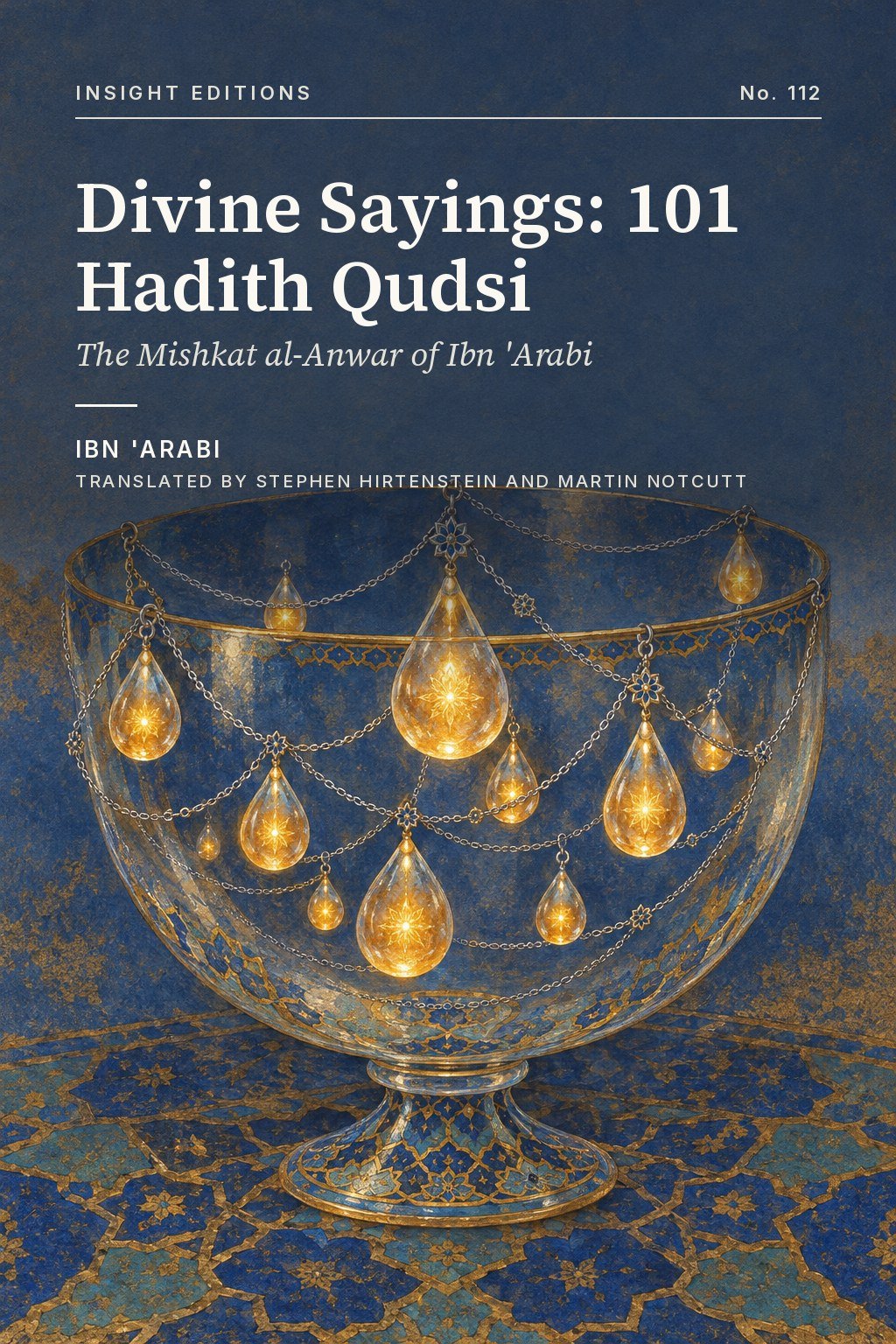
Divine Sayings: 101 Hadith Qudsi
The Mishkat al-Anwar of Ibn 'Arabi
Ibn 'Arabi · Translated by Stephen Hirtenstein and Martin Notcutt
Ibn 'Arabi's collection presents 101 divine sayings transmitted through the Prophet, arranged by source and chain of authority with explanatory introductions and notes.
A study guide to Divine Sayings: 101 Hadith Qudsi by Ibn 'Arabi, translated by Stephen Hirtenstein and Martin Notcutt. Shared free for personal reading; not for sale and not endorsed by the authors or publishers. Please read and buy the original.
Overview
Argument Map
Chapter Map
| Section | Voice | Core claim |
|---|---|---|
| Introduction | Editors | A third kind of revelation, collected by a muhaddith and Sufi |
| Preface | Ibn 'Arabi | Preserve forty sayings for the next world; the plan of 40 + 40 + 21 |
| Part One (1-40) | God, full chains | All depends on Him; mixed motives are returned |
| Part Two (41-80) | God, named sources | He wants you for yourself; mercy over anger |
| Part Three (81-101) | Prophet reporting God | Motive is audited; the Name outweighs all; the vision of the Face |
| Notes, App. A-B | Editors | Glosses, chains, manuscripts |
What the book is
A hadith qudsi is a saying in which God speaks in the first person through the Prophet's words, distinct both from the Qur'an and from ordinary prophetic hadith. Ibn 'Arabi gathered 101 of them in Mecca in 599/1203, shortly after arriving from the West, as a classical "forty hadith" collection stretched to an odd hundred and one. The three parts form a descending scale of transmission: chains he holds himself, sources he names without a chain, and chains borrowed from the standard collections.
Densify scope
This dense A5 edition thickens the lean guide from the Hirtenstein and Notcutt Anqa 2004 English and Arabic edition only.
Introduction: What a Divine Saying Is, and Why Ibn 'Arabi Collected 101
The translators, Stephen Hirtenstein and Martin Notcutt, open with the genre, the compiler and the book. Their thesis is that the Mishkat al-anwar is not a scholar's anthology but a master's selection, finished in Mecca on 16 February 1203, and that passing on these sayings is "more akin to a succession of prostrations" than a transfer of information.
Three kinds of revealed speech
A hadith is a "news" or "report"; William Graham notes that no one English word fits. Technically it reports what the Prophet said, did or tacitly approved. A hadith qudsi ("sacred saying", also ilahi or rabbani) reports words spoken by God Himself, with the Prophet as transmitter. A few are addressed to other prophets, to angels, to "the children of Adam" or to people in the next world.
| Qur'an | Hadith qudsi | Prophetic hadith (nabawi) | |
|---|---|---|---|
| Speaker | God | God, in the Prophet's words | The Prophet |
| Channel | Gabriel | Gabriel, inspiration or a dream | The Prophet's own speech and acts |
| Status | Inimitable; recited in ritual prayer | Not inimitable; not recited in prayer | Sunna, the complement to the Qur'an |
| Preservation | Memorized and written; 'Uthmanic codex within about twenty years | Like other hadith, with chains assessed for strength | Six major collections, third century AH |
Hadith qudsi have no separate section in the canonical books. The first known collection devoted to them, by Zahir al-Shahhami (d. 1138), came about 500 years after the Prophet; Ibn 'Arabi's is the second oldest Graham records, and unusual in giving one section of forty with full chains starting from his own teachers. Their quality is that of jawami' al-kalim, "the synthesis of the words": few words, a wealth of meaning. Of the 101, by the translators' count, 5 are addressed to Muhammad, 8 to other prophets, 12 to the angels, 18 to the child of Adam and 20 to people in the next world.
The compiler as muhaddith
At about fifteen, in retreat in Seville, Ibn 'Arabi saw Jesus, Moses and Muhammad; Muhammad rescued him, saying, "My beloved, hold fast to me and you will be safe." "It was from that time on that I occupied myself with the study of hadith." Modern scholars, the translators note, have favoured his metaphysics and Qur'anic exegesis over his hadith work, yet he was known in his lifetime as a reliable transmitter: a disciple calls him "the master, imam, man of knowledge, transmitter of hadith".
| Teacher | What he transmitted |
|---|---|
| 'Abd al-Haqq al-Ishbili (d. 1185) | All his own hadith works; friend of Abu Madyan |
| 'Abd al-Samad al-Harastani (d. 1217) | Muslim's Sahih, in the Umayyad Mosque |
| Yunus b. Yahya al-'Abbasi (d. 1211) | Bukhari's Sahih; named in twenty chains of the Mishkat; gave him the khirqa received from 'Abd al-Qadir al-Jilani |
| Nasr b. Abu Faraj al-Hashimi (d. 1222) | Abu Da'ud's Sunan, in Mecca |
| Abu Shuja' Zahir bin Rustem | Tirmidhi; the man in Mecca most "enamoured of observing the daily changes in his state" |
The title and the plan
The title comes from the Light Verse (Q. 24:35): a niche, a lamp, a glass, a star kindled from an olive "neither of the East nor of the West". For his teacher al-Mahdawi, the niche is Muhammad's body, the lamp his heart, the glass his mind, the star his secret heart. For Ibn 'Arabi the niche is also the heart's protective covering against the passions, and the glass is the heart made pure, transparent to the lamp. Here the lights are the Divine Sayings, shining in the niche of the Prophet. The title echoes al-Ghazali's Mishkat al-anwar, but where Ghazali builds a metaphysics of light, Ibn 'Arabi simply collects.
| Part | Count | Chain |
|---|---|---|
| I. Hadith musnada | 40 | Full, unbroken chain to God via the Prophet, from Ibn 'Arabi's own teachers |
| II. Khabar (marfu'a) | 40 | Back to God without a complete chain; from Muslim, Tirmidhi and al-Naqqash's Abodes of the Resurrection |
| III. Hadith mursala | 21 | From books, the last with a direct chain recited facing the Ka'ba |
How the book lived on
The sayings recur across his works: Hadith 31 on the divided Fatiha anchors the Chapter of Muhammad in the Fusus; the 101st appears in full in Futuhat chapters 64-65.
The new Arabic edition, from early Turkish manuscripts, reveals two originals: a dated autograph from Mecca and a later revision, with changes mostly in Part II (Khabar 7 entirely different; additions to Khabars 24 and 34). Ibn 'Arabi revised the Futuhat the same way.
Transmission as prostration
In the English the chains are cut to a minimum and moved to Appendix A so that the sense shows clearly. But for Ibn 'Arabi, receiving was personal: "Most of them I have collected from my companions", whose names he kept in the chains so that they too "might be accounted learned and knowing." Two names recur: his disciple of twenty-four years, 'Abdallah Badr al-Habashi, "a pure light", in nine chains, and Yunus b. Yahya, who heard the final hadith read to him "in the interior of the Sacred Precinct and facing the most venerated Ka'ba".
Deepening: Hirtenstein and Notcutt framing
The translators open by calling the collection a gift whose themes recur: complete dependence on God, and His readiness to forgive those who truly turn. Although the sayings "wear the clothes of time and place", they are "universal in nature". The Mishkat appears to be one of the earliest dedicated hadith-qudsi collections and the only of Ibn 'Arabi's hadith books to be widely copied. Their thesis is that this is not a scholar's dump but a master's selection, finished in Mecca on 16 February 1203 (3 Jumada al-akhira 599), and that passing the sayings on is "more akin to a succession of prostrations" than a transfer of information.
Deepening: hadith qudsi as a third kind of speech
A few hadith qudsi are addressed to other prophets, to angels, to "the children of Adam" or to people in the next world. Of the 101, by the translators' count: 5 to Muhammad, 8 to other prophets, 12 to the angels, 18 to the child of Adam, 20 to people in the next world. Their quality is jawami' al-kalim: few words, a wealth of meaning. Hadith qudsi have no separate section in the Six Books; the first dedicated collection Graham records is Zahir al-Shahhami's (d. 1138); Ibn 'Arabi's is the second oldest, unusual in giving forty with full chains from his own teachers.
Deepening: Mecca 598-599 and the other hadith books
When he arrived in Mecca in 598 he found "a group of most eminent men and women". Among them: Abu Shuja' Zahir bin Rustem, imam of the Station of Abraham, "enamoured of observing the daily changes in his state", who transmitted Tirmidhi; and his sister Fakhr al-Nisa'. In the same Meccan years he also wrote al-Mahajjat al-bayda' (on fiqh/hadith), Hilyat al-Abdal, Taj al-rasa'il and the Ruh al-quds. The Fihrist lists further hadith books: Miftah al-sa'ada (Muslim, Bukhari, some Tirmidhi), al-Misbah (synthesis of the six), Kanz al-abrar (prayers and invocations), the Arba'in of meeting and long hadith (already written when the Mishkat cites it), and Mishkat al-ma'qul (rational vs traditional gifts).
- Ka'b via Ibn 'Abbas (Tabari): niche = Muhammad; lamp = his heart; glass = his chest.
- al-Mahdawi: niche = body (also Throne macrocosmically); lamp = heart (or light of Muhammad); glass = mind (or bodies of the prophets); star = secret heart (sirr).
- Ibn 'Arabi: niche = the heart's protective covering against the passions; glass = the heart at the station of purity (safa'); lights = the Divine Sayings shining in the Prophet's niche.
- Against Ghazali's Mishkat: Ghazali builds a metaphysics of light; Ibn 'Arabi simply collects.
Deepening: how the sayings live in his other works
The translators stress the discipline of two kinds of soundness: elsewhere he quotes "I was a hidden treasure" as sound by unveiling (kashf) but not established by transmission (naql); no saying of that kind is in the Mishkat. The new Arabic edition from early Turkish manuscripts reveals two originals: a dated Mecca autograph and a later revision, with changes mostly in Part II (Khabar 7 entirely different; additions to Khabars 24 and 34).
- Hadith qudsi is a third kind of speech: God in the first person, not recited in ritual prayer.
- The plan 40 + 40 + 21 answers the "forty hadith" promises and the love of the odd.
- Transmission is personal and moral: emptying of self, lamps passing a flame.
- The Mishkat is a Meccan-year book that later feeds the Fusus and the Futuhat's final counsels.
Part One: Forty Sayings with Full Chains
The first forty are Ibn 'Arabi's own: each reached him person to person with an unbroken chain back through the Prophet to God. They open with dependence and justice, move through remembrance, mercy and the Day of Resurrection, and close with God repeating the believer's testimony back to him. The texts are short; their force is in the turns of phrase.
| Theme | Hadith | Thread |
|---|---|---|
| Dependence and justice | 1, 9, 25, 39 | All is from Him; He gains and loses nothing; give and you will be given |
| Sincerity and association | 2, 14, 15, 22, 32, 35 | Shared deeds are rejected; pride is His alone; purity is "Secret of My secret" |
| Remembrance and nearness | 8, 10, 13, 27, 30, 38, 40 | He is "in My servant's thought of Me"; He answers in kind and more |
| Mercy and forgiveness | 4, 6, 16, 23, 28 | Forgiveness "without minding in the slightest"; the last man into Paradise |
| Love and companionship | 12, 33 | Those who love one another for His sake are shaded and raised |
| The next world | 5, 11, 18, 19, 21, 26, 36, 37 | Veiled Paradise, the vision, God in a form they do not recognize |
| Creation and the human | 7, 24, 29 | Adam's greeting, David's years, rain and the stars |
| Ritual and conduct | 3, 17, 20, 31, 34 | The Fatiha divided; religion befits generosity and good character |
The opening saying: total dependence
The pairing is the book's backbone. God is wholly independent; man is wholly dependent; and yet deeds are fully his own responsibility. Ibn 'Arabi called this saying a "remedy" for those who misunderstand "there is no thing like Him". Hadith 9 adds the economy of grace: "Provide [for others], and I shall provide for you"; "The Hand of God is full", undiminished "night and day".
Sincerity: God will not share
The lightest sufferer in Hell is told he was asked "something easier" than the whole earth as ransom, "when you were still in the loins of Adam: that you should not associate anything with Me" (H14). "Pride is My cloak, and Grandeur is My loincloth"; whoever wrestles over them is cast down (H15).
Purity itself is beyond technique. Asked about ikhlas, the Prophet asked Gabriel, who asked God: "Secret of My secret, which I entrust to the heart of the one whom I love among My servants" (H32). Hadith 22 gives the chain of consequence in four lines: hope in another means not knowing Him; not knowing Him means not worshipping Him; that brings His displeasure; and "He who fears other than Me, My Vengeance befalls him."
Remembrance: He answers more than He is asked
Figure 16. "If he comes to Me walking, I come to him running."
"I am present in My servant's thought of Me" (H13, H27): God meets each person in the form of their expectation of Him, a principle Ibn 'Arabi built much of his theology on. Mention Him in yourself and He mentions you in Himself; mention Him in company and He mentions you "in a better assembly". Remember Him and you are grateful; forget Him and you are unfaithful (H8). He is "with My servant ... when his lips move in mention of Me" (H10). In prayer, the imam's "God hears him who praises Him" is God's own speech "through the mouth of His Prophet" (H30), and the testimony is answered phrase by phrase: "There is no god but God alone; He has no partner" is returned as "There is no god but Me alone, and I have no partner" (H40).
| The servant says | God says |
|---|---|
| Praise be to God, Lord of the universes | My servant has praised Me |
| The All-Compassionate, the Most Merciful | My servant has repeated My praises |
| Sovereign King of the Day of Judgement | My servant has glorified Me (or: has given himself over to Me) |
| It is You whom we adore and You whom we ask for help | This is between Me and My servant |
| Guide us along the straight path ... | This belongs to My servant, and he shall have what he asks |
Mercy outruns the law
I shall never again be displeased with you" (H16). "Were your sins to reach up to the clouds of Heaven," He forgives, "without minding in the slightest", if you meet Him without associating (H28).
The next world and the human story
Paradise was veiled with hateful things and the Fire ringed with desires, until Gabriel feared no one would enter one or escape the other (H5). Two fears are never joined: fear Him here and be secure there (H11). Hadith 18 makes the vision of the Lord the gift beyond all gifts, "the best, and more besides". Hadith 26 is among Ibn 'Arabi's favourites: God comes "in a form different to that form of His which they recognise"; they take refuge from Him until He comes in the form they know. Hadith 19 is the hardest: nine hundred and ninety-nine in every thousand for the Fire, softened as the Prophet raises his hopes from a quarter, to a third, to half the people of Paradise.
Hadith 25 ranks creation by strength: mountains steady the earth, iron beats mountains, fire iron, water fire, wind water, and stronger than wind is "the child of Adam, who gives charitably with his right hand whilst concealing it from his left." Hadith 29 makes a rainfall a test of belief: rain "by the Blessing and Mercy of God", or because of a star.
- God loses nothing by any deed; you gain or lose everything by yours.
- A mixed motive is not half accepted; it is handed over.
- Your thought of God is where He meets you, so think well of Him.
- Approach returns multiplied; prayer is a dialogue.
- Pardoning is the price of Paradise.
- Hidden charity outranks the strongest forces in creation.
- Write things down: forgetting is inherited.
Deepening: argument map of Part One
Deepening: sincerity, pride and the secret
Hadith 2: of all associates He is "the most able to dispense with association"; a mixed deed is left entirely to the partner. Hadith 14: the lightest sufferer in Hell was asked something easier than the earth as ransom, "that you should not associate anything with Me". Hadith 15: "Pride is My cloak, and Grandeur is My loincloth". Hadith 32: ikhlas is "Secret of My secret", entrusted to the beloved's heart. Hadith 35 warns of men in sheep's clothing whose tongues are "sweeter than honey" and hearts "of wolves": a trial aimed at religious performance, not at unbelief.
Deepening: prayer as dialogue and the next world
Hadith 31's divided Fatiha is the saying placed at the centre of the Chapter of Muhammad in the Fusus. Hadith 30: the imam's "God hears him who praises Him" is God's own speech "through the mouth of His Prophet". Hadith 40 returns the testimony phrase by phrase: "There is no god but God alone" becomes "There is no god but Me alone".
- H5: Paradise veiled with hateful things; Fire ringed with desires; Gabriel fears no one will enter or escape.
- H11: two fears are never joined: fear Him here, be secure there.
- H18: the vision of the Lord is "the best, and more besides".
- H26: God comes "in a form different to that form of His which they recognise"; among Ibn 'Arabi's favourites.
- H19: nine hundred and ninety-nine in every thousand for the Fire; the Prophet raises hopes from a quarter to a third to half of Paradise.
- Act as if everything depends on your deeds, because for you it does (H1).
- Ask who the act is really for before counting it (H2, H32).
- Think well of Him: He meets you in your thought of Him (H13, H27).
- Begin small: a hand's breadth is answered by an arm's length (H27).
- Pardon: it is the price of the palace (H4).
- Hide charity: it outranks the strongest forces (H25).
- Write it down: forgetting is inherited (H24).
Part Two: Forty Sayings Without Full Chains
The second forty (41-80) are each called a khabar, a report. Ibn 'Arabi names a source for each, a book, a collector or an early authority, but not his own unbroken chain back to God. The register changes with it: more speeches to Abraham, David and Moses, more lines Ka'b al-Ahbar says were "taken from the Torah", and a run of addresses to the people of Paradise drawn from al-Naqqash's Abodes of the Resurrection.
| Source family | Khabar | Character |
|---|---|---|
| al-Harawi, Degrees of Those Who Repent | 41-44, 75-77 | Prophets' conversations; love and seclusion; humility |
| Ka'b al-Ahbar via al-Raba'i ("from the Torah") | 48, 50, 52, 54, 58, 59, 61, 65, 67, 68 | "O child of Adam": provision, contentment, being wanted |
| al-Naqqash, Mawaqif al-qiyama | 49, 53, 55, 60, 66, 69, 78 | God greets the people of Paradise |
| Canonical collections (Muslim, Tirmidhi, Bukhari, Nasa'i) | 45-47, 51, 56, 57, 62, 64, 79 | Mercy over anger, the night descent, intention, Time |
| Teachers and companions | 64 addendum, 72, 73, 74, 80 | Ablution and prayer, the five pillars of religion, 'Arafa |
Fear, desire and the lover's seclusion
The part opens with Abraham's terror: if Adam, made by God's Hand and honoured by the angels, was cast out for "a single act of disobedience", who is safe? The answer is not a threat but a lover's complaint: "do you not know how hard disobedience against the Beloved is for the Beloved?" (41). The tone is set. Disobedience is a breach of intimacy before it is a breach of law.
David is told to warn Israel against "eating out of desire, for when the heart is attached to desire, the mind is veiled from Me" (42). Moses asks whether God is far, to be called, or near, to be confided in, and hears: "I keep company with him who remembers Me"; the work most loved is to "propagate My Remembrance in every state" (43). Khabar 44 draws the conclusion: "He who pretends to love Me and neglects Me is a liar. Does not every lover seek to be secluded with his beloved?"
Provision and contentment
Ten of the forty come through Ka'b al-Ahbar, the Yemeni convert credited with knowledge of earlier scriptures, and most of them address one anxiety: will there be enough? The arguments are short and logical. Your creation from dust and sperm "cost Me no effort", so why should bread? (52). I make no demands about what you will do tomorrow; make none on Me about tomorrow's provision (59). "You owe Me obligations, and I owe you nourishment"; even if you betray the first, He will not betray the second (61). "My treasuries are full" (65); "My Power is permanent" (67), so do not fear those who hold power.
The counterweight is generosity. Hoarding until death and then promising charity earns the retort, "is that the time for charity?" (63). Giving from surplus is good, withholding bad, sufficiency blameless, and "the highest hand is better than the lowest" (64). Four prostrations at the start of the day and "I shall suffice you until the end of it" (62).
Mercy that outruns reckoning
Khabar 47 carries the line Ibn 'Arabi built much of his thought around: "My Mercy and Compassion prevail over My Anger." The rest of this cluster applies it. Intending good counts as a good deed; doing it counts tenfold; intending evil and refraining is forgiven; doing it counts "as it is" (57). When the angels report a servant planning evil who then abstains, it is recorded as good, "for truly, he only abandons it for My sake" (71). On the Day of Resurrection gaps in obligatory prayer are filled from voluntary prayer (72). In the last third of the night He descends: "Who is there that calls out to Me, that I may answer him?" (56).
The ruse and the five sayings
Mercy is not complacency. "You shall not be safe from My ruse until you have traversed the Path" (68), reinforced by the Qur'an: none feels safe from God's ruse "except those who are lost." The sayings to Moses gathered under Khabar 74 make this the frame of a whole religion.
- Until My Kingdom has ended, do not abandon obedience.
- Until My Treasuries are exhausted, do not worry about nourishment.
- Until your enemy is dead, do not think yourself safe from attack.
- Until you know I have forgiven you, do not criticise sinners.
- Until you have entered Paradise, do not feel safe from My ruse.
Two further reports restrain the pilgrim and the critic. The pilgrim with unlawful wealth who cries "Here am I, Lord" hears, "There is no 'here am I' until you have cast aside what you have in your hands" (74). "Whoever demeans one of My Saints has declared war on Me" (76); "the act of worship most beloved to Me is the giving of good counsel" (77). The Prophet, offered the choice of being prophet-king or prophet-servant, takes Gabriel's advice to be humble and chooses servant (75). And the believer who curses the times is told: "I am Time! In My Hand is the Order" (79).
The addresses to Paradise
Seven reports from al-Naqqash give the speeches God makes to the people of Paradise, and they rise in intimacy. First a greeting: "Peace be upon you, My servants! Welcome" (49). Then the Names shared: "You are the faithful who rest in security, and I am God the Faithful"; "I have broken open for you a Name from among My Names" (55), and "You are the surrendered, and I am Peace" (60), puns the notes trace to shared Arabic roots (mu'min, salam and muslimun). Then the veil lifted: "When I reveal Myself to you, and I raise the veils from My Face, praise Me" (66). Then nearness: "sit down around Me, so that you may look upon Me" (69). Last comes the open invitation: "All that you wish, I wish, so ask Me. Do not be shy or reticent" (78).
Khabar 51 pairs the wealthiest of the damned and the most wretched of the blessed: one dip in the Fire erases every memory of pleasure; one dip in Paradise erases every memory of hardship. The part ends at 'Arafa, God showing the angels the pilgrims "dishevelled, dust-covered", and overruling their objection that this one and that one did wrong: "I have already forgiven them" (80). Ibn 'Arabi closes by explaining the odd total: twenty-one more will follow, because "God is Odd and loves the odd."
- Disobedience is first a wound to a relationship.
- Only God wants you for yourself; everyone else wants something from you.
- Contentment changes the one who receives, not what he receives.
- Good intentions count; evil intentions abandoned count as good.
- Never feel safe, and never judge a sinner: both rest on facts you cannot know.
- Paradise culminates not in things but in the lifted veil.
Deepening: source families and the Torah reports
The register changes with the missing full chain: more speeches to Abraham, David and Moses; more lines Ka'b al-Ahbar says were "taken from the Torah"; a run of Paradise addresses from al-Naqqash's Abodes of the Resurrection. Ka'b was a Yemeni convert, present (as reported) at the Prophet's last sermon, companion to 'Umar, known for traditions of earlier prophets. The book says so openly; the A closer look keeps Part Two's standing distinct from Part One's.
Deepening: provision, contentment and the order of ends
Ten of the forty come through Ka'b and address one anxiety: will there be enough? Creation from dust "cost Me no effort", so why should bread? (52). No demands about tomorrow's deeds, so make none about tomorrow's provision (59). "You owe Me obligations, and I owe you nourishment" (61). "My treasuries are full" (65); "My Power is permanent" (67). Khabar 58 supplies the order of ends: created for My sake; things created for your sake; do not disgrace the first with the second.
Deepening: mercy, ruse and the five conditionals
Deepening: Paradise addresses rising in intimacy
The notes trace the puns: mu'min is both believer and Divine Name; salam and muslimun share a root. Khabar 51: one dip in the Fire erases every memory of pleasure; one dip in Paradise erases every memory of hardship. The part ends at 'Arafa (80): God shows the angels the dishevelled pilgrims and overrules their objections: "I have already forgiven them." Twenty-one more will follow because "God is Odd and loves the odd."
- Treat disobedience first as a wound to a relationship (41).
- Seek seclusion with the Beloved if you claim love (44).
- Receive what is decreed with contentment; the share does not change (48).
- Keep the order of ends: means for you, you for God (58).
- Credit restraint: evil abandoned for His sake is recorded as good (71).
- Never feel safe; never condemn a sinner (74).
- Aim past gifts at the lifted veil (66, 69, 78).
Part Three: Twenty-One Sayings from the Collections
The last twenty-one (81-101) are framed as the Prophet's words, "God says", and each is attributed to a named collection: Muslim, al-Bukhari, al-Tirmidhi, al-Nasa'i, Abu Da'ud, Malik, al-Daraqutni and others, with the Companion who reported it. Ibn 'Arabi uses their chains rather than his own "for the sake of brevity". The narratives grow longer and more dramatic, and the part ends with the longest text in the book, God's address to the people of Paradise, completed in Mecca on 16 February 1203.
| Movement | Hadith | Thread |
|---|---|---|
| Those who give their lives | 81-83 | The fighter guaranteed; God "wonders"; the martyr asks to die ten times |
| Invocation and love | 84-89 | Angels seek the circles of dhikr; "There is no god but God" outweighs the heavens; love announced through Gabriel |
| Forgiveness and nearness | 90-91 | "Do what you will"; "I become his hearing" |
| Sincerity on trial | 92, 96, 99 | Sealed scrolls rejected; the reciter, the rich man and the martyr exposed |
| Weighing and witness | 94, 95, 97, 98, 100 | The card that outweighs ninety-nine scrolls; limbs that testify |
| Service and the needy | 93, 98 | "O world, serve the one who serves Me"; "I was sick, and you did not visit Me" |
| The final vision | 101 | "This is My Face, which discloses Itself to you forever" |
Going forth and giving one's blood
The part opens on the hardest subject in the book. God pledges Paradise or a safe return "with reward or booty" to whoever goes forth "except for My sake" (81); the wound will appear at the Resurrection with "the colour of blood" and "the odour of musk". God "wonders at" the man who, routed with his companions, turns back "until his blood is shed" (82). A man already in Paradise asks only to be sent back to be killed "ten times over" (83). Read with Part One's warnings on motive, they are an extreme case of the rule that only what is "for My sake" counts.
The circles of remembrance
Moses asks for a special formula and is given the common one, "There is no god but God", three times, until told that the seven heavens, the seven earths and their people placed in one pan of the Balance would be outweighed by it (85). For every blessing on the Prophet God gives ten (86). Kinship, rising at the end of creation, is promised that God will join those who join it and cut those who cut it (87). Divine love is "by necessity" for those who love, sit, give and visit "in Me" (88), and it travels down a hierarchy: God tells Gabriel, Gabriel tells heaven, and "acceptance is accorded him on earth"; loathing descends the same way (89).
Repeated forgiveness and the beloved servant
Hadith 91. The "hadith of supererogatory works": obligations bring the servant nearest, voluntary acts continue the approach "until I love him. And when I love him, I become his hearing with which he hears, his sight with which he sees, his hand with which he grasps, and his foot with which he walks." It ends with a divine hesitation: "In nothing do I hesitate so much as I hesitate [to take] the soul of a believer. He has a horror of death, and I have a horror of harming him."
Hadith 91 is the textual root of the school's teaching on nearness through voluntary works, in which the servant's faculties become the site of divine action without the servant ceasing to be a servant.
The audit of motive
Three hadith form a court scene in which deeds are judged by intent rather than appearance. (92). The recording angels testify for a servant, and God answers: "You are the guardians of My servant's deeds, but I am the Watcher over that which is in his heart" (96).
Scales, cards and witnesses
The counterpoint is Hadith 95, the card (bitaqa): ninety-nine scrolls of sins, each as long as sight, uncontested, against one slip of paper bearing the testimony of faith. "The scrolls will appear to be lighter and the sheet of paper will weigh heavily. For nothing has weight in relation to the Name of God." Hadith 85 and 95 together make the same claim at two scales: the Name outweighs the cosmos and outweighs a lifetime.
Other scenes complete the court. Three petitions are never refused: the fasting person's, the just ruler's and the oppressed person's, which God raises "beyond the clouds", promising help "even though it may take a while" (97). Whoever is given health and plenty and lets five years pass "without coming to Me" is debarred (94). The world is ordered: "serve the one who serves Me, and wear out the one who serves you" (93). On the day "We shall call all men with their leader", one man receives his book in his right hand, a crown of pearl and a lengthened body, and the unbeliever receives a crown of fire; to one who never expected the meeting God says, "Today I shall forget you just as you forgot Me" (98). In Hadith 100 the hypocrite recites his prayers and fasts, his mouth is sealed, and his legs, flesh and bones speak of what he did.
The hundred and first saying
The final hadith is God's address in Paradise, and it is built to stop desire short of its object. God names Himself the lavish Giver, opens the Abode, the Garden and Himself ("This is My Self, and I have let you see Me"), says "I gaze upon you, without ever turning My Eyes away from you" and invites them to ask. They answer: "Our Lord, it is not this that we hoped and longed for. What we want of You is the sight of Your Generous Face for all eternity, and Your good-pleasure with us." Only then: "This is My Face, which discloses Itself to you forever and ever. Rejoice, for I Myself am well-pleased with you." What follows is a deliberately concrete litany of spouses, children, chambers, mounts, rivers (Kawthar, Kafur, Tasnim, Salsabil, Zanjabil), couches and shade.
- The Name outweighs both the cosmos and a lifetime of sin.
- Through love the servant's faculties become the means of divine action.
- The highest gift is the Face; everything else is given because of it.
Deepening: from the collections, for brevity
Ibn 'Arabi attributes each saying to a named collection (Muslim, Bukhari, Tirmidhi, Nasa'i, Abu Da'ud, Malik, Daraqutni and others) with the Companion who reported it, using their chains "for the sake of brevity". The narratives grow longer. The part ends with the longest text in the book, completed facing the Ka'ba on 16 February 1203.
Deepening: dhikr, the Name and descending love
Hadith 86: for every blessing on the Prophet, God gives ten. Hadith 87: kinship, rising at the end of creation, is joined or cut as people join or cut it. Hadith 88-89: love "by necessity" for those who love, sit, give and visit "in Me"; acceptance descends from God to Gabriel to heaven to earth, and loathing the same way.
Deepening: nearness, audit and the Face
- Sit with the people of remembrance; grace spills (H84).
- Return: knowing you have a forgiving Lord is itself the virtue (H90).
- Draw near by obligations, then by voluntary works, without leaving servanthood (H91).
- Ask who the act is for; display is paid in display (H92, H99).
- Trust the weight of the Name against both cosmos and scrolls (H85, H95).
- Visit the sick; feed the hungry: that is where He is found (H98).
- Want the Face before the gifts (H101).
Transmission: Preface, Notes and Appendices
The apparatus around the hundred and one sayings is a record of who handed what to whom. Ibn 'Arabi's own preface states the plan; the translators' notes, two appendices of chains and manuscripts, and the bilingual Arabic edition show how the book itself was handed on.
The author's preface
Ibn 'Arabi signs himself "the servant who is in utter need of God" and cites two prophetic promises: intercession for whoever "preserves for my community forty hadith of the Sunna", and enrolment among the learned for whoever preserves forty "of which they stand in need". Since "man stands more in need of the other world ... than this world", he chose sayings that go back to God Himself, collected "at Mecca ... during the months of the year 599". Forty with his own chains, forty without, twenty-one more: a hundred and one.
Appendix A: the chains
- Yunus b. Yahya al-'Abbasi, a Baghdadi descendant of the Prophet's family and probably the main influence on the work; he invested Ibn 'Arabi with the Qadiri khirqa in Mecca in 1202 and appears in some twenty chains.
- Muhammad b. Qasim al-Tamimi of Fez, a Sufi hadith scholar who gave him the khirqa there.
- Abu Tahir al-Silafi of Alexandria, from whom he may have received hadith in writing at fifteen or sixteen, the year al-Silafi died (576/1180).
- 'Abdallah Badr al-Habashi, his close disciple and servant from 593/1197 until his death in Malatya.
- Ibn Sukayna of Baghdad, named in a chain written two years before their recorded meeting, which suggests they had already met in Mecca.
Two observations matter more than the names. First, many of these transmitters were also Sufis, "men who followed a spiritual path and teaching as well as the discipline of hadith". Almost all of Yunus's sayings come from one man, Abu al-Waqt al-Sajzi, at whose funeral 'Abd al-Qadir al-Jilani led the prayer. Second, five of the six canonical collections (al-Bukhari, Muslim, al-Tirmidhi, al-Nasa'i, Abu Da'ud) account for 45 of the 101 sayings. The full chains, which take up most of the appendix, are presented as recorded and form the formal backbone of Part One.
Appendix B: the manuscripts
The new Arabic text replaces two printed editions, Aleppo 1927 ("unreliable") and Cairo 1951, used by Muhammad Valsan's 1983 bilingual version, with readings from seven Istanbul manuscripts.
| Siglum | Manuscript | Date and note |
|---|---|---|
| A | Veliyuddin 1686 | 667/1268, copied by a disciple of Sadruddin al-Qunawi |
| B | Beyazit 817 | Undated; same hand dated 690/1291 |
| C | Esad Efendi 312 | Pupil of al-Razi of Aksaray; probably within forty years of the author's death |
| D | Veliyuddin 1800 | c. 715/1315, with works by direct disciples |
| E | Shehit Ali 1340 | 789/1387, copied at the Ka'ba by al-Jabarti, teacher of al-Jili |
| F | Carulla 2070 | 962/1555, apparently from an autograph original |
| G | Fatih 5322 | Probably sixteenth century |
The notes
The notes are brief and of three kinds. Glosses: the needle in the sea leaves no lessening; athna means both "to double" and "to praise"; mu'min is both the believer and a Divine Name. Variants: some manuscripts add a creation scene for Hadith 25 and a different saying for Khabar 47, a warning on "how little is left of your appointed time" traced to Wahb b. Munabbih. Parallels: Psalm 93 for the robe of Grandeur, Isaiah 64 and 1 Corinthians 2 for "what no eye has seen", and the Futuhat passage in which Adam's sneeze and praise become the self-praise of the Form in the mirror of the Essence.
Deepening: preface plan in his own words
He signs himself "the servant who is in utter need of God, Muhammad ibn 'Ali ibn Muhammad ibn al-'Arabi al-Ta'i al-Hatimi al-Andalusi". The criterion: sayings with a chain "going directly back to God". Then forty without a chain through the Messenger, from what he has "passed on orally and recorded in writing". Then twenty-one to make one hundred and one.
Deepening: selective map of Appendix A (not a dump)
- Yunus b. Yahya al-'Abbasi (d. 1211): Baghdadi sharif; main influence; Qadiri khirqa in Mecca 1202; ~20 chains; almost all his sayings from Abu al-Waqt al-Sajzi (funeral led by 'Abd al-Qadir al-Jilani).
- Muhammad b. Qasim al-Tamimi of Fez: Sufi hadith scholar; gave him the khirqa there.
- Abu Tahir al-Silafi of Alexandria: possibly written transmission at fifteen or sixteen (year of al-Silafi's death, 576/1180).
- 'Abdallah Badr al-Habashi: disciple and servant from 593/1197 until death in Malatya; nine chains; "a pure light".
- Ibn Sukayna of Baghdad: named in a chain written two years before their recorded meeting (suggests earlier Mecca meeting).
Deepening: Appendix B manuscripts and the notes
The new text replaces Aleppo 1927 ("unreliable") and Cairo 1951 (basis of Valsan 1983). MS C was written by a pupil of Zaynuddin al-Razi of Aksaray, probably within forty years of Ibn 'Arabi's death. MS E was copied at the Ka'ba by al-Jabarti, teacher of al-Jili. MS F seems taken from an original in Ibn 'Arabi's handwriting.
- Glosses: needle leaves no lessening; athna means both "to double" and "to praise"; mu'min / salam puns; Hudaybiya as the place of the pledge.
- Variants: some MSS add a creation scene for Hadith 25; a different saying for Khabar 47 (Wahb b. Munabbih: "how little is left of your appointed time").
- Parallels: Psalm 93 for the robe of Grandeur; Isaiah 64 and 1 Corinthians 2 for "what no eye has seen"; Futuhat II.190 on Adam's sneeze and praise in the Mirror of the Essence.
- The preface is a moral act: preserve for the community what the next world needs.
- Many links were Sufis and hadith men at once; the flame passes through persons.
- Seven Istanbul manuscripts underwrite the Arabic; two printed editions are superseded.
- Notes are light: hard sayings still need the tradition's interpretations.
Synthesis
A revision map of the Mishkat: takeaways, frameworks, closer look, Who's Who, and practice points that stay inside the book's own spiritual distinctions.
Across the book
The introduction places hadith qudsi as a third kind of revealed speech, the Mishkat as a master's Meccan selection (599/1203), and transmission as a flame passed from lamp to lamp. Hirtenstein and Notcutt stress taste, the two kinds of soundness kept apart, and the three-tier plan.
Part One (1-40) sets the asymmetry of Hadith 1, the refusal of mixed motives, remembrance answered more than asked, mercy that outruns the law, and prayer as dialogue.
Part Two (41-80) shifts register: lover's complaint, being wanted for yourself, contentment, the intention ledger under "My Mercy prevails", the five conditionals, and Paradise addresses that rise toward the Face.
Part Three (81-101) borrows the collections' chains: circles of dhikr, the Name at two scales, returning as virtue, faculties as means of divine action, the audit of motive, and the hundred-and-first saying that stops desire short of its object.
Transmission keeps the preface plan, a selective map of the eleven links, seven Istanbul manuscripts, and light notes (including the Q.17:70 / Q.47:23-5 numbering note).
Frameworks and mental models
| Framework | Source | Use |
|---|---|---|
| Asymmetry of benefit | H1 | Act as if everything depends on your deeds |
| Reciprocal approach | H8, 10, 13, 27 | Effort is answered disproportionately; begin small |
| Purity of motive | H2, 92, 96, 99 | Ask who the act is really for |
| Intention ledger | Kh 57, 71 | Credit restraint, not just action |
| Order of ends | Kh 58 | Means serve the person; the person is for God |
| Five conditionals | Kh 74 | Keep working; do not worry; stay alert; do not judge; do not presume |
| Weight of the Name | H85, 95 | Small sincere essentials outweigh large records |
| Hierarchy of love | H89 | Acceptance on earth follows heaven |
| Presence in need | H98 | Service to the sick and hungry is service to God |
| Three tiers of authority | Parts I-III | Mark each claim by how it reached you |
| Lamp to lamp | Introduction | Empty the self so the flame passes clean |
| Face before gifts | H101 | Want vision and good-pleasure before the litany |
- Authenticity is uneven by design. Part One rests on Ibn 'Arabi's own chains; Part Two often on Ka'b's "Torah" reports or al-Naqqash, treated with caution by hadith critics. Keep the tiers in mind.
- Two kinds of soundness. Elsewhere he accepts some sayings as sound "by unveiling" rather than by chain; the editors note that no saying of that kind is in the Mishkat. A hadith scholar would treat unveiling as a separate, non-transferable criterion.
- Fighting and martyrdom. Hadith 81-83 need the book's own qualification: only what is "for My sake" counts; Hadith 99 condemns the fighter whose motive was reputation.
- The literal Paradise. Hadith 101's concrete litany reflects the social world of the text; the book's own emphasis falls on the Face, placed before every pleasure.
- Light apparatus. Notes give little commentary on hard sayings such as Hadith 19 or Hadith 90; readers must supply the tradition's interpretations.
- Verse numbering. Q.17:70 and Q.47:23-5 in Part Three notes follow an older division (page image p.104); not counted as errors.
Who's Who
| Figure | Role |
|---|---|
| Ibn 'Arabi (560-638/1165-1240) | Andalusian master; compiler, Mecca, 599/1203 |
| Yunus b. Yahya al-'Abbasi | Meccan teacher; main transmitter; final chain |
| Muhammad b. Qasim al-Tamimi | Sufi hadith scholar of Fez |
| Abu Tahir al-Silafi | Alexandrian hadith master; early written transmission |
| 'Abdallah Badr al-Habashi | Disciple and companion; nine chains |
| Ibn Sukayna | Baghdadi Sufi hadith scholar |
| Ka'b al-Ahbar | Yemeni convert; reports "from the Torah" |
| al-Raba'i, al-Naqqash | Collectors behind many Part Two reports |
| Isma'il al-Harawi | Author of the Degrees of Those Who Repent |
| al-Kinani | Surgeon near Tunis, companion of Abu Madyan |
| Abu Hurayra | Companion; reporter of most Part Three hadith |
| Abu Shuja' Zahir bin Rustem | Meccan muhaddith; Tirmidhi; Station of Abraham |
| Hirtenstein and Notcutt | Translators and editors of the Arabic text |
Applying It (inside the book's own distinctions)
2. Begin small. Approach returns multiplied.
3. Purify the motive. Display is paid in display.
4. Return and refrain. Knowing the Forgiving Lord; credit restraint.
5. Keep the order of ends. You for God; things for you.
6. Never feel safe; never condemn. The five conditionals still hold.
7. Want the Face. Vision and good-pleasure before every pleasure.
Glossary of Key Terms
Terms as used in the Hirtenstein and Notcutt translation, with brief meanings drawn from the book and its notes.
| Term | Meaning |
|---|---|
| 'Arafa | Plain east of Mecca where pilgrims halt on the 9th of Dhu'l-Hijja (Kh 80) |
| arba'in | "Forty": the genre of forty-hadith collections; two promises of intercession and learning |
| athna | Arabic: both "to double" and "to praise" (notes on H31) |
| bitaqa | The card bearing the testimony of faith that outweighs the scrolls (H95) |
| dhikr | Remembrance or invocation of God; angels seek its circles (H84) |
| hadith qudsi | "Holy saying": God speaking in the first person through the Prophet (also ilahi, rabbani) |
| hadith nabawi | Prophetic hadith: the Prophet's own speech, acts or tacit approval |
| Hudaybiya | Village at the edge of the Sacred Precinct; place of the pledge (notes) |
| ijaza | Licence to transmit; also Ibn 'Arabi's list of his teachers |
| ikhlas | Purity of sincerity; "Secret of My secret" (H32) |
| isnad | Chain of named transmitters; judged by reliability and continuity |
| jawami' al-kalim | "Synthesis of the words": few words, a wealth of meaning |
| kashf | Unveiling; a criterion of soundness kept apart from naql in the Mishkat |
| Kawthar | River or pool of Paradise named in the final litany (H101) |
| khabar | "Report": the term for each saying in Part Two (also marfu'a) |
| khirqa | Cloak of investiture given by a master (Yunus; Tamimi) |
| makr (ruse) | God's stratagem; no one is safe from it before the Path is crossed (Kh 68, 74) |
| matn | The text of a hadith, as distinct from its chain |
| Mawaqif al-qiyama | "Abodes of the Resurrection", al-Naqqash's source for Paradise addresses |
| Mishkat al-anwar | "Niche of Lights", the book's Arabic title (Light Verse, Q. 24:35) |
| muhaddith | Hadith scholar and transmitter |
| mukaththirun | The seven Companions who each reported over a thousand hadith |
| mu'min | Believer; also the Divine Name "Giver of security" (notes) |
| mursala | Part Three's frame: sayings drawn from the books without his own full chain |
| musnada | Part One's frame: full unbroken chain via his teachers |
| naql | Transmission by chain; kept distinct from unveiling in this collection |
| nawafil | Supererogatory acts that bring the servant to be loved (H91) |
| shirk | Association of another with God, including in motive |
| sirr | Secret heart; in al-Mahdawi's Light Verse reading, the star |
| Sunan, Sahih | Titles of the canonical hadith collections |
| witr | "Odd": "God is Odd and loves the odd", hence 101 |
| wasiyya | Counsel; Futuhat ch. 560 repeats sixty Mishkat sayings as counsels |
About this book
Divine Sayings: 101 Hadith Qudsi: The Mishkat al-Anwar of Ibn 'Arabi by Ibn 'Arabi, 2004. This is a chapter-by-chapter study of the book, with summaries, maps, tables and diagrams; short quotations keep their page references. It is shared free for personal study, is not for sale, and is not endorsed by the author or publisher. Please read and buy the original.
Insight Editions · rajeshrmahapatra.com/insight-editions