Insight Editions · No. 110
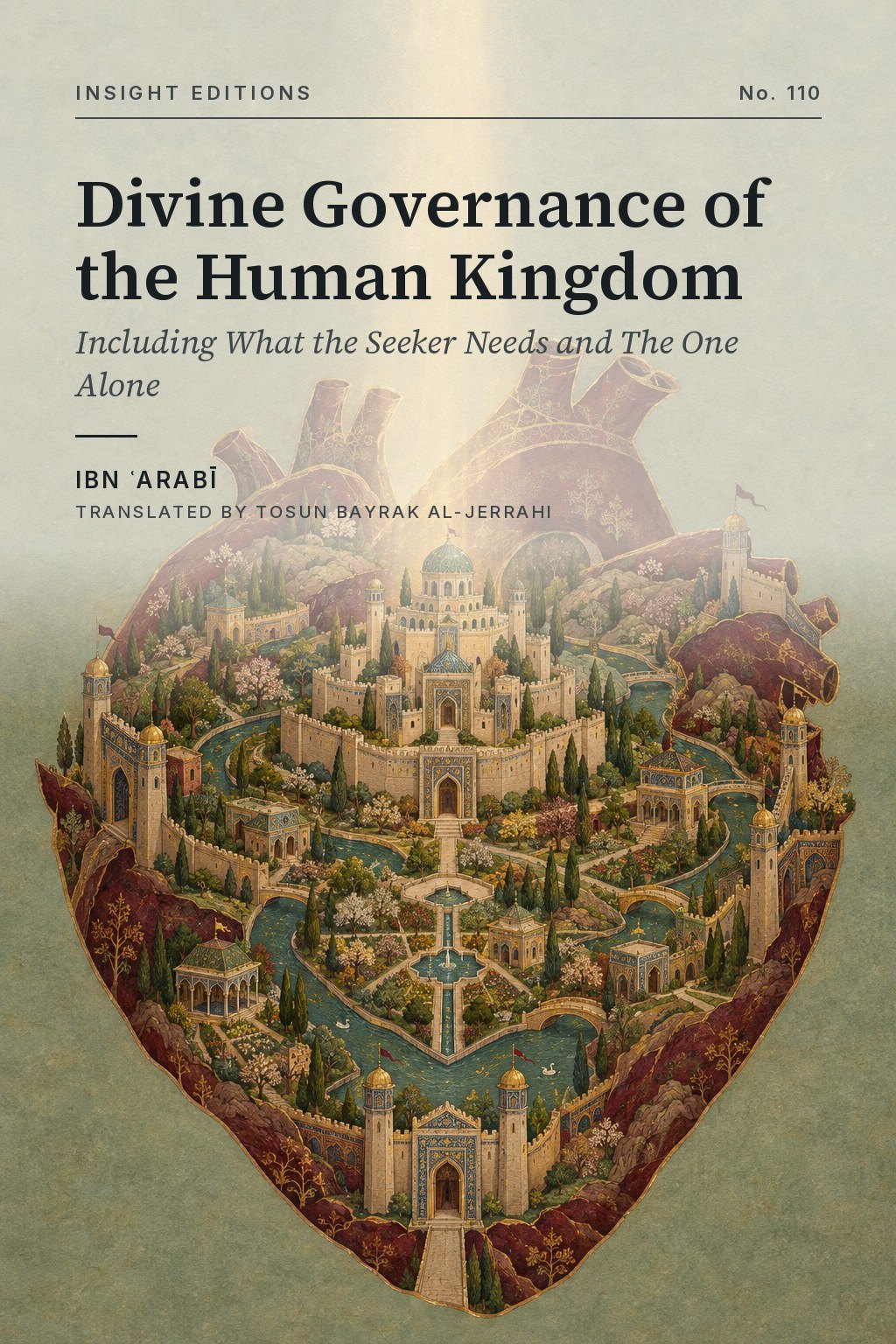
Divine Governance of the Human Kingdom
Including What the Seeker Needs and The One Alone
Ibn ʿArabī · Translated by Tosun Bayrak al-Jerrahi
Ibn ʿArabī presents the human soul as a divinely governed kingdom, then turns to practical guidance for seekers and a teaching on the sole reality of God.
A study guide to Divine Governance of the Human Kingdom by Ibn ʿArabī, translated by Tosun Bayrak al-Jerrahi. Shared free for personal reading; not for sale and not endorsed by the authors or publishers. Please read and buy the original.
Overview
The volume holds three works by or attributed to Ibn 'Arabi, translated from Ottoman Turkish versions, framed by the translator's own Introduction, Afterword and Epilogue.
Argument Map
From political allegory to practice, and from practice to the dissolution of the self.
What the book is
Ibn 'Arabi wrote the treatise in Andalusia, by his own account in under four days, after a host showed him the pseudo-Aristotelian Secret of Secrets, a mirror for princes. He answered with a mirror for the self: every office of a medieval state (king, prime minister, scribe, tax collector, ambassadors, generals, physician) has an inner counterpart. The soul is God's deputy; the body is its city; Intellect is its minister; the ego is the rebel queen and enemy. Two shorter works follow. What the Seeker Needs (Mosul, 1204) is a beginner's rule of belief and practice. The One Alone dissolves the whole political picture into a single statement: there is no being but God's.
| Part | Author | Register | Covered in |
|---|---|---|---|
| Introduction (the life) | Tosun Bayrak | Devotional biography | Translator's Introduction |
| Origin and Foreword | Ibn 'Arabi | Thesis: man as microcosm | Foreword |
| Chapters 1-21 | Ibn 'Arabi | Political allegory, then esoteric teaching | Three parts |
| What the Seeker Needs | Ibn 'Arabi | Practical manual | One part |
| The One Alone | Attributed to Ibn 'Arabi in this volume | Metaphysics of unity | One part |
| Afterword and Epilogue | Tosun Bayrak | Doctrinal summary; discipleship rule | One part |
Chapter Map
| Section | Inner office or theme | Core claim |
|---|---|---|
| 1. The soul | King, deputy | The soul is the centre of the circle of existence |
| 2. Scholars on the soul | Debate | Views differ; all affirm God's oneness |
| 3. The city of man | Body as city | The heart is the palace; the self is a rival queen |
| 4-5. Intellect, ego, imam | Succession | Two rulers ruin a kingdom; the qualified one leads |
| 6. Justice | The balance | The middle course, applied to yourself first |
| 7. Prime minister | Intellect | Moon to the soul's sun; beware imitators |
| 8. Insight | Choosing officials | Inborn insight corrected by religious insight |
| 9. Scribe | Memory, record | Faithful, unambiguous transmission |
| 10. Tax collector | Knowledge | One collector; take only what can be paid |
| 11. The Lord's due | Audit | Deeds are checked against the Qur'an |
| 12. Ambassadors | Diplomacy | Answer Ambition with questions |
| 13-15. War | Generals, command, codes | Four flanks; lead from the heart; avoid haste |
| 16. Diet | Physician | Each season of life feeds the soul differently |
| 17. Secrets | Correspondences | Man holds 99 names; inspiration informs only |
| 18-20. Lights, veils, Tablet | Inner eye | Eye of certainty; faith as the daily pen |
| 21. Whirling | Practice | Measure and cool reason over ecstasy |
| Seeker Needs | Beginner's rule | Belief briefly, practice daily |
| One Alone | Unity | Self-knowledge, not self-annihilation |
| Afterword, Epilogue | Translator | Pillars read inwardly; obedience to a master |
Translator's Introduction: The Life as Told by Tosun Bayrak
Shaykh Tosun Bayrak opens with a devotional portrait of Ibn 'Arabi, "ash-shaikh al-akbar" to admirers and "ash-shaikh al-akfar", greatest of heretics, to his enemies. It is a life told through stories, visions and miracles, closing with an Ottoman legal ruling in his defence.
Bayrak writes that for seven hundred years Islam has argued over the Shaikh, and that Asin Palacios and others found Dante drawing on him for the design of Hell and Paradise and the woman who guides to the divine. He credits him with perhaps five hundred books, many short, some like the Futuhat and Fusus vast, and warns that their thought cannot be digested by intelligence "not supported by pure and believing hearts". He describes him physically (thin, middle-sized, small hands, white beard) and morally: patient, generous, detesting violence. "Although according to religious law the punishment for murder is death, it is better to forgive." "On the Day of Judgment, I will intercede for those who deny me."
One man, two titles: the argument Islam has carried on for seven centuries.
The life in stories
| Date (as given) | Event |
|---|---|
| 7 Aug 1165 (27 Ramadan 560H) | Born in Murcia; descendant of Hatim at-Ta'i; educated in Seville from age eight |
| Youth | Meets Ibn Rushd, who marvels that the boy knows by vision what he learned by study; meets Khidr; two women among his guides |
| 1199 | Sees Ibn Rushd's coffin carried to Cordoba, balanced on the camel by his books |
| 1201 | Leaves Seville for good after a vision of the prophets interceding for al-Hallaj, and of his own whole life |
| Fez, Tunis, Egypt | Takes Muhammad al-Hasar east, per a dream; nine months of worship without food; meets the qutb in Egypt |
| Mecca | Nizam inspires the Tarjuman al-ashwaq; marries Fatimah bint Yunus; son 'Imaduddin; begins the Futuhat |
| 1204 | Twelve days in Baghdad; wears the cloak left for him by 'Abd al-Qadir al-Jilani |
| 1210 | Konya; marries Sadruddin Qunawi's widowed mother; son Sa'duddin (b. 1220), daughter Zaynab |
| 1211 | Silent meeting with Shihabuddin 'Umar as-Suhrawardi: "Ibn 'Arabi is the ocean of truth" |
| 1223 | Settles in Damascus at al-Malik al-'Adil's invitation; meets the young Jalaluddin Rumi: "an ocean is following a small lake!" |
| 16 Nov 1240 | Dies at seventy-six, buried in Salihiyyah |
The places of the life, on the dates Bayrak gives.
The recluse's daily rule in the marsh, kept for thirty years.
At a feast of the Egyptian sages all the cooking pots broke. Ibn 'Arabi's reading, which the qutb approved: "May your heart break in a thousand pieces if you put in it the love of others after the love of Allah has entered it!" Writing the Futuhat felt forced on him: "I receive such powerful inspiration that it burns my very being. Only writing it down extinguishes the fire." At the Kaaba he met a man who had died forty thousand years earlier and spoke of one hundred thousand Adams.
Bayrak's lesson from the fisherman: seclusion is a stage, not a place to stay.
Death, the grave and the edict
Ibn 'Arabi disliked the Damascus scholars for selling knowledge; money had become their veil. He gave a gifted palace to a beggar. Calling into a mosque of money-lovers, "I am treading upon the god you worship; he is under my feet!", he was beaten, and some say he died of it. His grave later became a garbage dump until Sultan Selim I took Damascus, guided by a prophecy, "When the letter 'S' enters the letter 'Sh', Muhyiddin's tomb will be discovered." Selim built a tomb and mosque, commissioned Shaikh Makki's defence and forty commentaries on the Fusus, and dug at the spot of the outburst, where gold coins were found.
The fate of the grave, from neglect to Selim's tomb.
Origin and Foreword: The Human Being as a Kingdom
Ibn 'Arabi wrote the Tadbirat in Andalusia, probably around 1194, in under four days. A host showed him the pseudo-Aristotelian Secret of Secrets, a manual for ruling the world, and asked for a book on governing the self instead. His foreword states the thesis: the human being is a microcosm, ruled by the soul as God's deputy.
Creation of the human sovereign
God created man "as an atom in the shape of a beautiful jewel"; under His loving gaze it melted into water, each drop bursting with knowledge, which watered a sapling He named Human Being. God hid man's origin within the Names the Gentle and the Mighty. When man felt pride and fled from God's grandeur, God "dipped him time after time into the waters of the azure ocean of hope". He made him His deputy, had the angels prostrate, and gave him Intellect as his prime minister, the staff that swallows the sorcerers' snakes, and the measuring stick. All creation flows "between God's two feet", fear and hope; under the right is written Q 99:7, under the left Q 99:8.
The creation of the human sovereign in the foreword.
All creation flows between God's two feet.
Microcosm and macrocosm
"Tiny though we may be, we are the microcosm of the macrocosm" (Q 51:20-21, 41:53). God made everything in pairs so that He alone is One; humankind is like a fruit tree that feeds others, ages and is reborn from its seed.
| In the universe | In the human being |
|---|---|
| Forests | Body hair |
| Sweet, bitter and poisonous waters | Saliva, tears, nasal secretions |
| Earth, water, air, fire | Dust, clay, dried mud, "sounding [fired] clay" |
| Four winds | Four powers: attraction, repulsion, retention, digestion |
| Wild and tame animals | Anger and vengeance; work, marriage, children |
| Angels | Sincerity, faithfulness, worship |
| Visible and invisible; heavens and earth | Exterior and interior; ascending and descending |
| Eclipse of the moon by the earth | Love of the world interrupting the soul's ascent |
One line of the microcosm table drawn out: the winds of the world as the powers of the body.
The method is to read every outer thing for its essential meaning and find its counterpart inside. The Quran itself speaks figuratively: "my head caught fire" (Maryam) means grey hair; "like ashes hurried by wind" (Ibrahim) means the deeds of unbelievers. So we call a stubborn man a donkey and a strong one a lion: human character "may be as base as a donkey or as high as the sun".
The reading method of the foreword.
The threat: that choosing right or wrong decides this life and the next.
Following the soul that made the promise means obeying God's commands; everything else in creation follows its destiny without choice. Prophethood has ended, but every age has a hidden Pole, the guide of the time: "When you meet him you will know him. If you do not know him, then he is not there. To indicate the way to find him is the purpose of this book."
The two birthrights every soul carries.
Against the questioning mind
The first obstacle is the urge to question the guide: Why? What is the proof? Junayd: a new thing compared to the past will vanish. "Do not listen to a teacher if there is an inconsistency between what he says and what he is." Proof lies in experience: "What is the proof of the taste and sweetness of honey?" An expert builder who has inspected a hidden house need not prove it exists; those who believe him can ask the owner to enter. The Prophet did not answer why the sunset prayer has three cycles and the night prayer four; such questions, the foreword says, show "lack of faith". Pray instead, "O my Lord, increase me in knowledge."
Chapters 1-5: The King, the City and the Ministers
The first chapters lay out the constitution of the human kingdom. The soul is God's deputy and king; scholars dispute what it is; the body is a city with walls, gates and markets; Intellect and ego fight over the throne; and the king is told how to rule its ministers and people.
1. The soul: the divine deputy
"Behold, Thy Lord said to the angels, 'I will create a deputy on earth'" (Baqarah, 30). As man is central to the universe, the soul is central to man and is the Lord's deputy. Against philosophers who say only one thing can come from One, Ibn 'Arabi insists God could have created many beings at once; to deny it limits His will. The rationalists have called the soul the Clear Book, the Divine Throne or the Mirror of Truth. With al-Ghazali he holds that the soul is "not created, it is directly from the realm of God's command", citing "The spirit is from the realm of my Lord's command" (Bani Isra'il, 85).
The thinkers called the Intellect the first created thing and the Throne of God, the centre to which all is connected, placed on the ninth heaven. "God, most gracious, is firmly established on the Throne" (Ta Ha, 5) has an inner sense: the Throne is where man's soul resides, and only by ascending there is God's magnificence realized. "God created man in His own image", meaning in the image of His Grace. Some Sufis call the soul the first teacher: as Adam taught the angels the Names, so the soul teaches the microcosm. The angels' prostration to Adam was "the respect and humbleness of the student toward the teacher", just as prostration toward the Kaaba is not worship of the Kaaba.
The circle of existence: the hand does not move, the circumference rotates.
The primordial chaos, hayula', before things were named, is in its origin man, the mirror of the Lord. "The faithful is the mirror of the faithful," yet "There is nothing whatever like unto Him" (Shura, 11): humanity at its purest shows all God's attributes, not His Self. "You yourself are the source of divine wisdom," which Sufis call the centre of the circle: "You ask about the ocean; it is within the drop."
Man as the mirror of the Lord.
2. Scholars on the reality of the soul
| View | Holder | Difficulty raised |
|---|---|---|
| Seed of the personality, non-material, with a place | Some scholars | Makes essences many kinds, ignores the common Intellect |
| A being beyond the senses that links perception to the body; perception leaves when it leaves | Others | No account of its nature |
| Fine created matter, liquid, spreading through the body; an ethereal double with eyes, ears, hands and feet | 'Abdul-Malik ibn Habib | How can a meaning feel pain? Are souls reincarnated? |
| Neither inside nor outside the body, without place, total in influence; "it puts things in order" | Al-Ghazali | "Exists without form or place, as God does, yet it is not He" |
Chapter 2's survey; all four holders believe in the oneness of the Lord.
Ibn 'Arabi declares several of these opinions false but closes irenically: all these scholars believe in the oneness of the Lord. God made the soul His mirror, in which He saw all He had created and His own Names, and sent man "not to support tyranny but so that mankind might rule in justice", responsible for all that happens in creation.
3. The city of man
God built a city for His deputy, named it Human Being, on four walls of earth, water, air and fire, and set the deputy's seat at its centre: the heart. Some say the mind; "I insist that it is the heart, although no one has evidence or proof." "I do not fit into the heavens and the worlds which I created, but I fit into the heart of My faithful servant." "It is not their eyes which are blind, but their hearts" (Hajj, 46). The bodily heart, "a small piece of meat" on which the whole being's health depends, is the deputy's palace and safe. If the ruler is right, the people are right: "If you are God-fearing, just, and righteous, so is your soul."
Chapter 3's map of the human city.
In the tower of Mind, sense data and dreams fill the Vault of Inspiration; the Vault of Intellect weighs them, keeping the right and returning the wrong. Al-Ghazali: "The human being is that child whose father is the soul and whose mother is the self." The Sufis hold that all states of the self are predestined; only the soul is not, and they follow it. Selfhood can be ordered and enlightened (Shams, 7-8) but leans toward the Evil-Commanding Self; when rational and heedful it becomes the Self-Assured Self. God gave His perfect deputy a strong opponent so that he would learn he is weak without his Lord.
How the tower of Mind sorts what comes in.
The allegory of the king and his wife, step by step.
The war runs until the Day of Judgement. Erring believers lose their deserts but keep the capital; hypocrites lose the capital and keep the deserts; unbelievers lose the whole kingdom. "Division is incidental. Unity is principal": a sick branch falls or is cured by the tree's sap, but a few green leaves cannot save a dead tree. The citizens are of four kinds: the pure faithful, the faithful apt to revolt, hypocrites, and the unfaithful "who take themselves to be God".
Three ways to lose the war with the self.
4. Why Intellect and ego fight
Falsehood shows only when mind and ego fight and the whole kingdom is caught in the crossfire. A kingdom cannot have two rulers: "If, in a single nation, men swear allegiance to two rulers, eliminate one of them." But applied inwardly, the reader in his present state "is liable, by error, to try to eliminate your Intellect" and hand the kingdom to the ego. So the contest is settled as the choice of an imam is: whoever best meets the conditions leads.
Chapter 4 settles the contest as the choice of an imam is settled.
| Condition of an imam | Inner reading: why the soul qualifies |
|---|---|
| 1. Adult | Mature enough to be addressed: "Am I not your Lord?" "Indeed." |
| 2. Rational | Intellect is the soul's minister, letting it answer its Lord |
| 3. Free | Independent of all but its Creator, so free to serve the whole being |
| 4. "A man" | Used as a figure: "a woman" here "represents someone who is a slave to his desires", in need of protection; inwardly a place of disharmony |
| 5. Of Quraysh | Bears the marks of the Seal of the Prophets, sent to the whole universe as the soul rules the whole person |
| 6. Sound in senses | The eye that seeks reality, the ear that hears truth: "I become their ears ... and their eyes" |
| 7-10. Acquired | Desire to serve, competence in social and legal matters, knowledge, fear of God |
Ego is fire and soul is light. The ego, pained by light, covers the kingdom with veils of unconsciousness, imagination and desires; the soul tries to spare it the pain of fire. Both pull Intellect to their side. If either would listen to the voice "always coming from the outside", it would see who truly moves them both, and peace would be possible. The ego is "the source of all conflict", yet its existence is a secret God opens to some: "If the Lord had so willed, He could have made mankind one people."
Fire and light, both pulling at Intellect.
5. The name and station of the imam
The imam is "none other than the Law where God's decrees are preserved", one of the four pillars of Islam. God is unique in the name of His essence: no one asked who Allah was, but they asked who "the Merciful" was. "Your Lord will create a deputy" is proof that two rulers cannot exist: two gods would sooner or later disagree, subjects would split between contradictory orders, and war would ruin the country of the human being. The plural "inheritors of the earth" (An'am, 165) means deputies in succession, one at a time; a rival claimant "becomes the Dajjal of the time". Each successor must take on the name, attributes and morals of the one he replaces.
Why two rulers cannot exist.
- Protect your religion and serve it; "if the whole is aware, its parts are aware".
- Control anger, seek no revenge; respect the old, love the young; do not look at others' errors.
- "Don't talk unless your talk means something." Repent, for wrong not regretted invites wrath.
- No age or fame is a spiritual level; deeds are what count.
- Before signing an edict, consider its end.
- Give the right work to the right authority; show a success just as it is completed.
- Care for those in your trust, know their ranks and needs, keep them within their limits, teach them to teach.
Generosity as the middle course in chapter 5.
Generosity is meeting a need fully, not short (avarice) or beyond (a spendthrift). Outwardly the deputy is known by limited actions; inwardly by knowledge, which has no borders. The citizens divide again and again: old and new, those guided by ego who obey despite it or revolt, and those guided by reason, exposed or hidden. The exposed ones are "the brides of the Lord", treasuries veiled by His jealousy: "They are the heart of the city of man. Seek them." Attribute nothing to yourself, since "God has created you and your deeds" (Saffat, 96); pass on gifts to the needy. The Prophet seated the wise in the front ranks; they spoke little, for "every excess has poison in it".
Chapters 6-10: Justice, the Minister, Insight, the Scribe and the Tax Collector
With the constitution in place, Ibn 'Arabi staffs the government. Justice is the balance by which the kingdom stands; Intellect is the prime minister; insight is the faculty that picks good officials; the Scribe records what descends from above; and Knowledge collects the kingdom's taxes, which are good deeds.
6. Justice and the authority of the imam
The imam applies the law, dispenses justice and is the final authority. Justice "does not age"; it is the divine balance by which everything in the material world is weighed and by which right and wrong will be weighed on the Day of Judgement. "Greater is the benefit of justice than all the gold in the treasuries of a kingdom." Against the fraudulent who take full measure and give short (Tatfif, 1-3), the Qur'an commands the middle: neither loud nor silent in prayer (Bani Isra'il, 110), neither tight-fisted nor spendthrift (Bani Isra'il, 29).
The same correction, given in opposite directions.
Justice means balance, equality, the middle course, in outward expression and inner meaning alike, and its order of application is fixed: first yourself, then those closest (your ministers), then all under your authority.
The fixed order in which justice is applied.
| Excess | Mean | Deficiency |
|---|---|---|
| Loud prayer | A middle course (Bani Isra'il, 110) | Silent prayer |
| Spendthrift hand | Measured giving (Bani Isra'il, 29) | Hand tied to the neck |
| Too sweet | Balanced manner | Too sharp |
| Exacting full measure | Equal measure | Giving short (Tatfif, 1-3) |
The chapter is short because the principle is simple, but it carries the rest of the book. Every later office is judged by it: the minister by whether he keeps the king's balance, the Scribe by whether his record is exact, the tax collector by whether he takes neither too much nor too little, the general by whether he keeps the sap of justice flowing to the branches. Justice is not one virtue among the others but the measure of all the offices.
Justice as the measure of every later office.
7. The prime minister: Intellect
A tie must join owner and owned; that tie is the minister, and his name is Intellect. He records, analyses and retains the continuous flow of divine messages, exposing the kingdom to some influences and shading it from others, "just as a horse must be tied up in the shade ... on a hot day."
The minister as the tie between king and kingdom.
Intellect as moon to the soul's sun.
Abu Madyan, "one of the two spiritual guides of this world in his time", read "the ruler of mankind" (Nas) through Mulk, 1, and "the god of mankind" as the station of the spiritual pole. God wrote all knowledge on the deputy's forehead, yet man cannot match solution to problem without a helper. "What you seek is in your own selves. Will you not then see?" (Zariyat, 21). Intellect solves a problem by looking at the Imam's face; it need only be near enough to hear his voice, and the exchange is wordless, heart to heart. That is why mind sits in a tower next to the treasury of memory.
Three rules follow: consult Intellect before every decision, act only with his agreement, protect him, for "as long as Intellect is safe, you are safe." The danger is impersonation: imagination, doubt and conjecture disguise themselves as the minister, "more subservient, obedient, and agreeable than he." The chapter closes with a portrait for recognizing the real one, from "His personality is justice" to "His wealth is in his poverty. His name is Intelligence."
Three rules for the prime minister.
| Feature of the true minister | Quality it carries |
|---|---|
| Personality; head; face | Justice; divine inspiration; beauty |
| Eyebrows; eyes; mouth; tongue | Protection; conscience; trustworthiness; wisdom |
| Chest; biceps and thighs; palms | Forbearance; valour; generosity |
| Heart; clothes; crown | Ever awake; humility; love and fear of God |
| Lamp in his hand; wealth | Faith; poverty |
Make such a one prime minister and night companion, "to tell you the tales of other places and times", so that he helps you "distinguish right from wrong and the possible from the impossible." The portrait is a body read as a list of virtues, and it prepares the next chapter, where bodies are read as signs.
8. Insight, inborn and taught by religion
"Beware of the insight of the faithful, for he sees with the light of his Lord." Inborn insight isolates realities one by one, reasoning from association, theory, experience and logic, which are veils; religious insight sees the whole. Since man is social and must know who is good for him, Ibn 'Arabi offers signs for choosing ministers: medium stature, dark untroubled eyes, calm dignity, open hands, careful speech, no appetite for possessions or domination. The Prophet and his teacher Abul-Qasim had these traits.
The two kinds of insight in chapter 8.
| Sign (as the text gives it) | Reading |
|---|---|
| Medium, straight nose; even teeth; medium neck | Intelligent, dependable, sincere |
| Dark, inset, medium eyes | Sympathetic, trustworthy; able to read hidden meanings |
| Blue or protruding eyes; shifty look | Bad character, envy, deceit |
| Excess hair; blond hair; tiny ears | Depravity, lack of intelligence, foolishness |
| Long strides at a medium pace | Calculates outcomes, apt to succeed |
| Speaks little, laughs rarely | Contemplative |
Religious insight is the real subject. The angelic world moves the visible: an animal's motion comes from an instinct "which receives its orders from the invisible world." The veils blinding the inner eye are arrogance, egotism, lust and the influence of the afflicted; "we are like the blind who feel the warmth of the sunshine, but are unable to see the light." The abdal see distant places (the author says he has: "I myself have experienced this"), and when this vision is taken away it marks the higher state of true servanthood. Even a perfect man sees only what he is shown (An'am, 50); knowledge is vast but finite, against the inexhaustible words of God (Kahf, 109; Luqman, 27). The visible sign of insight is beautiful character in action.
What blinds the inner eye.
Ibn 'Arabi insists this is "a science like any other science, dependent upon trials, experiments, and continued efforts", against the materialists who deny it. Its glimmers are given even to people of weak faith "so that their hearts will be strengthened," as 'Uthman told a man in whose eyes he saw "the glimmer of this divine light". But the glimmer fades unless it is protected by the prescriptions of the Qur'an: inborn insight sees the signs; religious training reads them. Without that training, "you may be accused, even by your own self, of seeing only sorcery or illusion."
Insight treated as a science that needs training.
Three kinds of person, from best to worst.
9. The Scribe
God swears by a guarded Tablet and a grand Pen. Inwardly, a command is felt in the heart, rationalized by the mind, then dictated to the Scribe of memory, who writes it on the tablet of the self and distributes it to every organ: "the heart knows the truth by being the truth. The mind learns from the heart by seeing the truth. The rest learn the truth through the Scribe, by hearsay." He stands above the self, below the Footstool, by the soul (Shams, 7-8), and receives his orders from one source, "the treasury of the Prophet Muhammad".
The chain of transmission from heart to body.
The Scribe's qualifications are a communicator's: good character, discretion, patience, eloquence, recording orders "as received, without interpretation", and making a single meaning of what might bear two, because an instruction open to doubt has no value. He opens each register with praise of the Imam before the edicts; orders seen as fair are welcomed, imposed ones breed opposition. There are two Books, like two sides of one page: the upper side in God's language, the lower in ours. The Qur'anic lawyers live by the lower side, which "does nothing for their hearts"; the Scribe, uniting mind and heart, senses the upper.
The heavenly writing is not "hidden far above". It is the sacred Tablet within, "right here with us": instructions keep arriving, disappear as they are acted on, and keep coming, "a secret which enters the heart, and once there, bursts into flames and exhausts itself." When a secret is revealed to the Scribe "one hears his screams of awe and fear", and asked what he was told, he can only say: the truth. Those who carry this book in their hearts "speak to each other through the book in their hearts."
| Where the Scribe finds you | What he is ordered to do |
|---|---|
| With your Lord | Stay unseen; the Lord is already your guide |
| Under your ego | Come secretly; urge you to act on what you know; warn that the ego will testify against you. Avoid even the merely tolerated; eat, sleep and marry for His sake, so "your goal is not the sustenance, but the Sustainer" |
| In vain prayer, attached to the world | Stop the "useless pretense of contemplation" and push you back to work |
| With Satan | Step between you, befriend you, appear as your master |
| Under Satan's command | Test you with every evil; strip away imagined piety; fight self and Devil together |
Success or failure, he acts "only in the name of your Lord".
The Scribe also has a public role. Because "he acts and speaks in your name, assumes your nature and your character", whoever loves and serves him belongs to the king; neglect him and he "can cause the worst disharmony and mischief in your kingdom." Intellect needs him too, since the king's decrees reach the provinces "by his efforts, not yours", and discord near the throne spreads everywhere. So value the Scribe and give generously into his hand, "for generosity and gifts seal friendship and prevent hostility".
10. Taxes and the tax collector
Rulers will be asked whether they ruled justly; the ruled will be witnesses, and one's own hearing, sight and skin will testify (Nur, 24; Fussilat, 20-22). The chain of command runs senses, Conception, Thinking, Intellect, the Sacred Soul.
- Justice is calibration, applied from the inside out.
- Delegate to Intellect, but test it against its imitators.
- Insight that judges by appearance must be corrected by insight that sees the whole.
- Transmission degrades; the recorder must be faithful and unambiguous.
- Demand only what each faculty can give, through one competent collector.
Chapters 11-21: Revenue, War, Diet, Secrets and Whirling
The second half of the treatise turns from staffing to operations: how deeds rise to God, how to negotiate with and fight the ego, how to feed the soul through the seasons of life, and then, in a sharp change of register, the inner secrets: correspondences of heaven and man, the lights of the heart, the Hidden Tablet and the whirling of the dervishes.
11. Paying the Lord His due
The book is "not intended for your theoretical education ... It is a warning about your actions." Every wrong act that comes through the deputy "vexes Him"; yet "He does not wish to lose you."
The audit trail of a good deed.
Counterfeit experiences can also enter memory, so Thought tests anew with the senses before passing anything to Intellect. The soul carries the treasure to the Lord's door, swoons, and drops it; the Lord orders the deeds compared word by word with "what I have written before I created him", the Qur'an, under the Lotus Tree. Then a subtler danger: when the soul grows content with its rewards "and is not desiring Him, He hides Himself from it", and when it takes its deeds as its own level, He keeps their spirit and leaves it "only the exterior beauty of the good deeds". Hence "Give the due of your deeds": do not overvalue them. Choose deeds "that will pierce the heavens", and knowledge that does not change.
12. Diplomacy with the ego
Ambassadors show the character of whoever sends them. Send to the evil-commanding ego honour, sincerity, understanding, perseverance, precaution, good intention, patience, courage, experience, consideration, fear of God and justice, and even egotism may turn friend. Receive the enemy's envoys kindly; answer tyranny, greed and cursing "not ... in their own style, but in a different mode", with Intellect as translator.
Some of the envoys sent to the evil-commanding ego.
The same method works on the other envoys, "the treacherous one, the lying one, and the spreader of mischief", in arguments worded to fit each one's convictions. The aim is not victory but conversion: to bring them all to submission, which "is the origin of all and everything. And everything returns to its origin." If enemy envoys seem disloyal to their master, put it down to inexperience in diplomacy rather than treachery. The chapter opens with a sharp line: divine wisdom is given only to leaders "who have rejected the temptations of intellect", meaning cleverness used for advantage rather than the minister Intellect.
Diplomacy with the ego: the aim is conversion, not victory.
13. Four generals
The kingdom is a house on four foundations, your attributes. A number speculation (Four contains Ten: 4+3+2+1) grounds the choice of four. Satan attacks "from before them and behind them and from their right and their left" (A'raf, 16); above is the Lord's, a domain of destiny "we are forbidden to penetrate".
| Flank | Enemy forces | General |
|---|---|---|
| Right (towards Paradise) | Lust and love of the world, infiltrating as friends | Love and fear of God |
| Left (towards Hell) | Hopelessness, despair, hatred, spite, doubt | Mercy: kindness, forgiveness, compassion |
| Front | Praise, self-aggrandizement, arrogance | Knowledge, held between the hands |
| Rear | Perverse imaginations, "replacing reality with dreams" | Intelligence and heedfulness |
Armies may grow to ten, "never more than ten".
Satan's four approaches (A'raf, 16) and the generals posted against them.
The most insidious attacks come from right and rear. Lust and love of the world "infiltrate through your ranks as friends", so only fear of God recognizes them; any other force "will be fooled by them". The rear attack comes "under the smoke and camouflage of imagination, which imitates reality, enhanced." The enemy is cruel but not brave: he enters only where a path is left undefended.
14. Command post and the parting sea
Set the banner of honour in the safest place, the Footstool, the heart, and never fight in the front line: a tree survives a lost branch, not a cut trunk, and its sap is justice, whose absence is instantly filled by tyranny, "the instrument of death". In final retreat, strike the sea of knowledge with the staff of Faith; it parts for you and closes on Satan, as on Pharaoh. If the enemy tempts you to learn for vanity, learn anyway: "The one who works hard even without conviction is always better than a trusted friend who is lazy." The enemy's main tactic is to lure you out of the castle by haste.
Why the king never fights in the front line; the sap is justice.
15. Secret codes of number
Two to Twelve frame all creation; Four is perfect. The rules of combat are coded: against rebellion within, "the even will have to defeat the odd"; against evil outside, the odd defeats the even. Fight "not with violence, but in ways ... made permissible by God". Absolute oneness defeats everything false at all times; personal oneness, the unity sought from inner multiplicity, does not always; when it fails, take refuge in the absolute. "A sign suffices for those who know."
| Absolute oneness | Personal oneness | |
|---|---|---|
| What it is | The oneness of all and everything, true even for those who see it only as a number | The unity sought out of inner multiplicity: the oneness of the prophets and the goal of the wise |
| Power | Defeats everything false, everywhere, always | Sometimes saves, sometimes cannot defend |
| Rule | Use it before the enemy uses it against you | Choose the right circumstances; if it fails, fall back on the absolute |
16. A spiritual diet by season
Man is "the ultimate consumer", and food conditions behaviour. Each season of the year, and of life, feeds the soul a different contemplation.
| Season | Nature | Stage and meaning | Food for the soul |
|---|---|---|---|
| Spring | Warm, humid | Youth; climate of Paradise | Let your people roam fields and rivers; turn their energy to lightened work |
| Summer | Warm, dry (fire) | Ageing; reminder of Hell | Contemplate the Reckoning; the heat is "fiery food" for the ego |
| Autumn | Cold, dry | Death | Will you die remembering Him? "This world is pregnant with you" |
| Winter | Cold, humid | Purgatory | Measure the time left; repentance still converts evil to good (Furqan, 70) |
The seasons of the year as the seasons of life.
Thought and action are two foods eaten together. The Lord is the great doctor; the bitterest medicines are night prayer, repeated ablution, the walk to the mosque, fasting and alms, yet "Honey tastes bitter to the one who is sick."
The great doctor's bitterest prescriptions.
No one else can chew your food: eating and digesting lawfully is itself service.
Two witnessesare needed on the Day: good deeds and thankfulness. Michael sustains bodies, Israfil joins bodies to souls, Gabriel feeds souls with knowledge; the Prophet's dream of milk meant knowledge. "Two kinds of people are never satiated": lovers of the world and seekers of knowledge. "The knowledge under your feet is not worth picking up": seek not the knowledge of things but
the truth of things.
17. The secrets God entrusted to man
The author disclaims anything "added from himself". The saints light their lamps from the Prophet's heart. "He who knows himself knows his Lord" points to an active path (annihilation of self) and an easier passive path through the divine Names placed in man.
How the 98 attributes become 99 names, and the hundredth.
| Cosmos | In man | Cosmos | In man |
|---|---|---|---|
| Throne | Body | Mars | Mind and lungs |
| Footstool | Ego | Sun | Reason |
| Kaaba of 7th heaven | Heart | Venus | Imagination, animal soul |
| Saturn | Strength of knowledge | Mercury | Creativity |
| Jupiter | Memory | Moon | The five senses |
| Fire, air, water, earth | Bile, blood, phlegm, liver | Seven earths | Skin, fat, flesh, veins, nerves, muscles, bones |
Revelation came to the Prophet in waves "like bells", directly to heart and mind. Saints' inspiration begins in thirst and ends in peace.
Then the most practical passage of the book:
- Inspirations "have no power to command or to forbid. They can only inform."
- Anything against the Qur'an's prescriptions: reject.
- Disconnected images: suspect; coherent yet odd: still beware.
- A voice inside saying "I am your Lord": the Devil, or your own ambition. The Lord speaks "neither with letters or with sound".
- Group excitement in a dhikr circle with senses intact: demonic and "contagious".
- True signs: awe without visions, a teaching clarified, better morals, needs answered, inner unity.
- "Any inspiration which does not bring you or those around you any real knowledge or benefit, is false."
Chapter 17's discernment test as a sequence.
At the heart's centre is a black dot, the jewel of awe and marvel, like the hidden hour of Friday: a mirror all the faculties watch. Jewels symbolize verses: emerald, remembrance (which blinds Satan); ruby, "nothing whatever like unto Him"; sapphire, irreversible command; topaz, "God has created you and your handiwork"; diamond, water and transformation; red sulphur, which none finds in himself. Without a guide, seclude yourself in remembrance and fasting for seven to forty days.
Jewels as verses.
18-20. Lights, veils and the Hidden Tablet
Ch. 18: Sun, Earth and Moon form a triangle: heart-light falls on the coarse body and reflects to the mind, where the inner eye sees; then "light upon light" a second eye opens, the eye of certainty, which can look at the book. Two lights, of knowledge and of guidance; two eyes, of understanding and of salvation. Ch. 19: A third light, of life, is weakened by a deafening noise and two blinding veils. When the ego sickens the heart, the mind's beam burns ego and heart together, and the smoke cuts heart from mind. What darkens certainty is insincerity, mistrust, faithlessness and the inability to tell right from wrong, all curable. Ch. 20: The Hidden Tablet of green emerald is where prophets and saints meet and are distinguished. Your pen is your faith, writing differently each day: today's writing erases yesterday's, "the proof of the reality and truth of the moment of Now."
Chapter 18's pairs of lights and eyes.
| Light | Function | What weakens it |
|---|---|---|
| Light of life | Energizes the animal self | A deafening noise, a veil on the eye, a veil on the mind, from the world's pull on the ego |
| Light of the mind | Reflects heart-light so the inner eye sees; its beam can burn the ego | The smoke of a burning heart, which cuts mind from heart |
| Light of certainty | Second eye of the heart, which can look at the book | Insincerity, mistrust, faithlessness, inability to tell right from wrong |
21. Whirling
| Mode | Verdict |
|---|---|
| Ecstatic, carried by music, graceful, aware of one's own motion | "a clown in the hands of the Devil"; at best, unconscious whirling shows only a self under its own influence |
| Mind-led, to hear the Lord, conscious that all is whirling | Possible; the sign is a body "frozen like a statue while whirling" |
| Losing oneself in God | Not produced by effort or knowledge; claiming so proves one did not lose oneself |
Knowledge is given to one attached to God sincerely and "with a totally cool rationality": the cool heart descends, the warm mind rises, and they meet like thunder. Fire trapped in heart and lungs can kill; driven to the head, it makes the whirler jump. The right motion is measured turning on the body's axis, "for man is created round". The perfect state is silent, with only "a slight smile on the face".
Where they meet, like thunder, knowledge is given.
- Audit deeds before they rise, and do not fall in love with them.
- Answer the ego's envoys with questions, not insults.
- Map threats by direction and assign each its specific defence.
- Lead from a protected centre; haste is the enemy's lure.
- Inspiration informs, never commands, and is judged by fruit.
- Even ecstatic practice is subordinate to cool reason and measure.
What the Seeker Needs (Kitab Kunh ma la budda minhu lil-murid)
Written in Mosul in 1204 for someone who asked what a beginner "should believe in and what he should do in the beginning, before anything else", this short manual trades the allegory of the treatise for plain instruction. Its unspoken theme is that belief must be settled quickly so that time can go to practice. Earlier translations, the note says, appeared in Turkish (1898), Spanish (excerpts, 1931) and English (1962).
Belief: settle it and move on
| Article | Instruction | Ground given |
|---|---|---|
| Oneness | Ascribe no partner to God. Do not debate those who do; "Let them prove, if they can, the existence of His associates" | Many creators' wills would cancel each other (Anbiya', 22) |
| Incomparability | Do not picture God as human | "Nothing is like Him" (Shura, 11); "At the beginning was Allah, and none with Him", to which later teachers added, "It is now as it was" |
| Ambiguous texts | Accept allegorical verses and hadith without needing to understand them | Their meanings belong to those close enough to see His attributes |
| Prophets and saints | Believe all the prophets, rank none above another, accept saints' miracles | The prophets' own words |
Conduct toward others
Look on all creation, mankind above all, "accepting, approving, forgiving, serving, loving." Serve those who hide their poverty, and thank them for accepting your help. Bear ingratitude patiently. Mend friendships; "Faith is a seed" watered by faithful friends. Seek a perfect teacher with sincerity, which is "such a catalyst that it turns lead into gold", even turning the seeker's devil, his ego, into an angel of inspiration.
The five attitudes toward others.
The daily rule
- Lawful bread first: "the foundation of your faith". Travel light; never be a burden; take nothing from "people whose hearts are dead".
- Earn efficiently: Ahmad al-Sabti, a son of Harun al-Rashid, worked as a labourer on Saturday and lived on it all week, giving six days to God.
- Prayer as audit: at each of the five prayers, account for what you did since the last.
- Sleep, food, dress at the minimum: do not sleep until you cannot stay awake, eat until hungry, or dress except for cover.
- Qur'an daily: aloud, just audible, slowly; at each praised quality ask whether you have it, at each fault whether you share it.
- Live in the present moment: every moment has its own duty. Order of priority: obligations, then the Prophet's practice, then voluntary good.
- Treat each act as your last, which makes you heedful and sincere.
| Time | Voluntary practice recommended |
|---|---|
| Dawn prayer to sunrise; afternoon prayer to sunset | Stay with your Lord: "spiritual powers and enlightenment flow in abundance" |
| Between afternoon and evening, evening and night | Twenty extra cycles of prayer |
| Before noon; before and after afternoon; after evening | Four cycles each |
| After the night prayer | Ten cycles in pairs, then the three of witr |
| After every ablution | Two cycles, except at sunrise, high noon and sunset (Friday noon excepted) |
: "It is not to act in the same way on every occasion towards everyone", but whatever brings salvation, comfort and peace to as many as possible, done for God's sake. "I have been sent to perfect good behavior." Forgo your rights rather than demand them; anger is a great sin when it is for yourself and right only on God's behalf. Keep away from opponents of your faith without thinking badly of them.
| When the verse describes | Do this |
|---|---|
| Mercy | Wish for it |
| Warning | Promise to act, repent, take refuge |
| Qualities of the faithful | Check yourself; thank God for what you have, feel shame for what you lack |
| Faults of unbelievers and hypocrites | Ask whether you share them; if so, drive them out; if not, give thanks |
| Past prophets and peoples | Draw the lesson |
Dependents, generosity and anger
Treat those in your care, including workers, family, animals and garden plants, "as you want the One in whose care you are to treat you." Teach children patience and dislike of luxury, but never let austerity become miserliness toward them. "A miser is a coward": the Devil tells him that death is far off, the world hostile and giving ruinous. Moses' curse on Pharaoh was miserliness (Yunus, 88). The miser implicitly charges God with stinginess, which comes close to associating partners with Him. "No one who has been generous has ever perished in destitution." Holding back anger bridles the ego "like a mean wild animal" and disarms the adversary better than punishment; "Your forgiving will be rewarded by His forgiving you."
Inner disciplines
| Discipline | Definition and method |
|---|---|
| Benevolence (ihsan) | "To pray ... as if you see Him ... For if you are unable to see Him, He certainly sees you." Its fruit is conscience: "Conscience is total good" |
| Dawn repentance and remembrance | Repentance erases sin; remembrance mends the heart scattered "like a mirror broken into a thousand pieces" |
| Untying the knots | Reason with the self that tied them: "Are you sure, as you inhale, that this is not your last breath?" Deathbed repentance comes too late (Nisa', 17) |
| Fear of God | Armour no harm penetrates; "I take refuge in You from You" |
| Chastity (wara') | "Leave that which is doubtful and reach for that which is sure", even in need |
| Contentment | Prefer less; you receive exactly your apportioned lot (Zukhruf, 32) |
The world: a field, not an enemy
"This world is not bad ... it is the field of the hereafter." Worldliness is "Everything that makes you heedless and causes you to forget your Lord." The world-preferring suffer three things: a load never lightened, a poverty never enriched, a hunger never satisfied. Yet withdrawal is no virtue: "Allah likes the one who has a craft."
Desires are "like sea water. The more you drink of them, the more you thirst." The hadith qudsi to Moses: accept your portion and your heart rests; refuse it and the world gets power over you, "as a wild beast races in the desert", and you still receive only your lot.
Desires as sea water.
Afterword to the treatise
"Make your accounting before it is made for you." The self is a cashier distributing what passes through it from countless hands, and it is answerable for the books. Three dangers block self-examination: heedlessness, the flood of the ego's desires, and habit, "in fact all habits, which make one like a machine." A closing verse fragment rebukes those who theorize religion: "All this learned talk is ignorance."
- Settle belief briefly; spend time on practice.
- Lawful income and lightness are the foundation.
- Use the prayer times as a recurring audit.
- Right conduct is contextual, judged by benefit to others.
- Generosity is a form of trust; miserliness is a form of unbelief.
- Work in the world; renounce attachment, not effort.
The One Alone (Kitab al-ahadiyyah)
The last text in the volume is the most radical. Where the treatise builds a hierarchy of soul, Intellect and Scribe, this short work removes every hierarchy: there is no existence but God's, so there is no self to rule, annihilate or unite with God. Its single text is the hadith "He who knows himself, knows his Lord", read word by word.
The thesis
God is "One without oneness and Alone without loneliness"; His only name is "He". He is the First, Last, Visible and Hidden (Hadid, 3, echoed), present in every letter yet unaffected by any.
The opening is a cascade of negations. With Him "there is no end. Neither is there nearness or farness; nor is there a will or wish, or time, or above, or below, or place; neither is there a universe." "That which hides Him is His oneness": no prophet, saint or angel sees Him, "for they are not apart from Him." Even the sending of messengers is internal to Him: "He sent His essence, from His essence, by His essence, to His essence."Two errors are ruled out at once:
The opening negations of The One Alone.
| Error | Claim | Rejoinder |
|---|---|---|
| Infusion (Hululiyyah) | God or another soul can enter and dwell in a person | "He is never in anything, nor is anything in Him" |
| Annihilation as method | To know God you must strip away and extinguish your self, then extinguish the extinction | "How could a thing that is not, become nothing?" Seeking annihilation assumes a second existence, which is itself associating partners with God |
Two analogies
When the image speaks, the voice belongs to the original.
So al-Hallaj's "I am the Truth" and al-Bistami's "Praise be to Me" are to be heard "from Him, from Allah"; they were permissible because these men saw their attributes and essence as God's, "without their attributes and essence being either in Allah or out of Him." A couplet of Shabistari's Gulshan-i Raz sums it up: "He is the One who sees: He is the eye. He is the One who is seen."
Proof texts and consequences
| Text | Reading in the treatise |
|---|---|
| "Everything is perishing but His Face" (Qasas, 88) | Only His essence is; nothing ever ceases because nothing else ever was |
| "Do not curse Time, for Allah is Time" | His being is manifest in eternal time |
| "I was ill and you didn't come to visit me" | The being of the sick and the hungry is His; therefore yours is too |
| "Every moment He manifests Himself in another glorious state" (Rahman, 29) | "Allah creating nothing forever": things are momentary self-disclosures |
| "Die before dying" | "Know yourself before you die"; then He becomes hearing, sight, tongue and hands (hadith of nearness) |
| "The eyes cannot see Him but He sees all eyes" (An'am, 104) | No eye reaches Him because there is no other eye; He sees Himself by Himself |
There is therefore no union and no separation: union needs two. "Close without nearness and far without distance." Knower and known, seer and seen, joiner and joined: "The Knower is His attribute; the Known is His essence." La ilaha illa 'Llah then reads: there is no being but His.
| Position | What it assumes | Verdict |
|---|---|---|
| "I exist beside God" | Two beings | Associating partners |
| "I must annihilate myself in God" | Two beings, one to be removed; then annihilation of the annihilation | Still associating partners |
| "I never had a being of my own" | One being only | Knowledge of self, hence of the Lord |
The objection follows: if the knower of himself is other than God, how can another know God? The answer is that such a knower "knows that his being exists neither by its own existence nor by the existence of anything other than himself." So "the knowledge of oneself is nothing other than Allah's knowledge of Himself." Union and separation both lapse, since "Nothing unites with Him but Him." The Prophet's prayer, "O my Lord, show me the reality of things", asked whether things are He or other than He; he was shown that "all that appeared as other than Allah was His being."
The treatise also redefines dying. Physical death ends a borrowed term and strips a body of its qualities, good and bad. Spiritual death strips the same qualities while life goes on, "In their place Allah comes to be." "Die before dying" thus means "Know yourself before you die," and the hadith of nearness (I become his hearing, his sight, his tongue, his hands) describes not a merger but the recognition of what was always the case. God "does not need His creation to be Creator; nor does He need the ones He rules to be Lord."
Two kinds of dying.
- Self-knowledge is the discovery of having no independent being, not an act of self-destruction.
- Spiritual effort aimed at "getting rid of the self" still assumes the self is real.
- Realization changes what you know, not what is.
- Ecstatic sayings are reflections; judge them by their source, not their grammar.
Afterword and Epilogue: The Translator's Restatement
Both closing pieces are Tosun Bayrak's, not Ibn 'Arabi's. The Afterword speaks of Ibn 'Arabi in the third person ("In his monumental work The Meccan Revelations, Ibn 'Arabi claims ...") and quotes him; the back cover states that "In an Epilogue, Shaykh Tosun restates Ibn 'Arabi's teachings on Sufi practice and the strict duties binding a disciple to his master." Read them as a twentieth-century Jerrahi shaykh's summary and rule, not as further primary text.
Afterword
Why man was created
Why man was created, in the Afterword.
Finding God through creation
Against a rationalist route (attributed to Avicenna), God is found only in His continuously renewed creation, which never repeats: the sky shows the All-Covering Vastness, a doctor the All-Healing, the human being the All-Uniting. Opposed Names (the Guide, the One Who Hinders) alternate, making prosperity or hardship in a person or a world. Rumi: "Leave your animal nature behind so that you can rise above the angels!"
| Theme | The Afterword's formulation |
|---|---|
| Self-knowledge | Many Sufis try to obliterate their many "I's"; but "there is no 'I' other than God ... How can one manage to give up something that never was?" (the One Alone's thesis) |
| Unity of being | Three unities: essence, attributes, action. Jami: "There is only one light, but under that light different things are seen" |
| Worship of creation | Everything praises Him (Isra', 44). Pebbles in the Prophet's hand cried "Allah"; submission is complete in stone, less in plant, less in animal, least in man |
| Morals | "The essence of morality is compassion"; do not overload animals or ride them proudly; daily written self-accounting, as one of his teachers did, extended by Ibn 'Arabi to thoughts and feelings |
| Rights | "The right of the man of knowledge is respect, the right of the ignorant one is advice, the right of the heedless one is to be awakened, the right of the child is compassion and love" |
The pillars read inwardly
Lacking one wall, the house falls; without the roof, it gives little shelter.
Two further passages complete the portrait. On the Prophet: the light of God's first creation was placed in Muhammad, and when it is reflected in a believer's heart, that person "becomes blind to the cognizance of himself", like the women of Egypt who cut their fingers at the sight of Joseph. Ibn 'Arabi is reported to have seen him in ecstasy "and that he had no shadow". On Islam's truth: Bayazid al-Bistami was "only conscious three times": once of the world, once of the Hereafter, and once of his Lord, from whom he asked nothing, "for He is the Only One". The truth of Islam requires dropping worry about both worlds.
On the Kaaba, Ibn 'Arabi is said to describe three columns, for divine inspiration, angelic qualities and carnal promptings; the fourth side, facing Iraq, stands for the possibility of evil. "The heart of the believer is the real Kaaba", four-sided in most people and three-sided in those who know their Lord, "the seductions of evil are absent."
Three failures by level: the ordinary person knows but cannot act; the better person acts without sincerity; the advanced person divulges inspired knowledge "without the license of the Lord".
Three failures, one for each level.
Epilogue: the disciple's rule
The seeker's first task is to find a master "who will see your faults and show them to you", now, "because whatever one has now is better than the best one imagines one will have tomorrow." Then: "behave like a dead body in the hands of the one who gives it its last ablution."
| Domain | Representative rules |
|---|---|
| Attitude | "You are not a judge seeking someone guilty; you are someone guilty seeking a judge who is just." Hide nothing; tell dreams without asking for interpretation |
| Obedience | Never ask his reasons; "All disaster that befalls a student comes from interpreting the indications of the master"; when consulted, say "You know best" |
| Etiquette | Do not sit in his seat or wear his clothes; do not look him in the eye; do not travel, even to your father, without permission |
| Worship | Each step of ablution has an intention (hands pulled from worldly affairs, face washed of arrogance, feet cleaned "so that you don't stain the sands of Paradise") |
| Eating | Eat what a poor person would eat; leave unfilled; never show hunger; explain nothing |
| Livelihood | Trust God but do not sit idle; refuse gifts from those "trying to buy you"; "the most lawful sustenance ... is that which you have gained with your own two hands" |
| Possessions | Give away clothes or rooms you like "until you have nothing that pleases you"; "God will not enter a heart where anything else resides" |
| Company | Leave old friends, stay near the master; "he who praises you is your enemy ... he who condemns you is your friend" |
| Other circles | Attend only with permission and do not join their dhikr; move only if truly taken out of your senses, and sit as soon as they return |
| Road | Remove obstacles, set lost goods visibly aside, guide the lost, help the burdened |
Repentance is the beginning of the path: make even your enemies pleased with you, and "shed tears for the time that you have spent fighting anything but your ego." Public confession staged for the master is "hypocritical and dangerous"; the sign of repentance is simply to stop, and from then on be "heedful, sincere, industrious, and pure." In another master's dhikr circle, ask: "What is being said? Who is saying it, what are his intentions?" Feeling your own movements means you are descending; losing all sense of them means the heart is ascending. Seek friends, if you must, "in lonely places, in ruined little mosques." Change your place in the prayer rows and even your mosque from time to time, so nothing becomes habit.
Synthesis
The volume in takeaways, frameworks, a critical reading, the main figures and the few places where its ideas genuinely touch present-day work.
Key Takeaways
- The self is a state to be governed, not a thing to be found. The treatise answers a manual for kings with a manual for the soul: every office of government has an inner counterpart.
- One sovereign at a time. Two rulers ruin a kingdom; the struggle of Intellect and ego is settled by qualification, as the choice of an imam is.
- Justice is calibration. The middle course, applied first to yourself, then to your ministers, then to all under you.
- The minister shines by borrowed light. Intellect is moon to the soul's sun, indispensable when the king is hidden, nothing when he appears.
- The deadliest counterfeit is the agreeable one. Imagination and doubt impersonate Intellect by being "more subservient, obedient, and agreeable than he."
- Judge only what you can see; protect what you cannot. The man sitting out the prayer keeps his life and property.
- Transmission degrades with distance. Heart knows by being, mind by seeing, organs by hearsay; hence the Scribe's duty to record "as received" and without ambiguity.
- Take only what can be paid. One competent collector, Knowledge, gathers good deeds without extortion.
- Audit before you submit. Experiences are re-tested by Thought before Intellect certifies them; deeds are checked against the Qur'an before they rise.
- Do not overvalue your deeds. A soul content with its rewards loses their spirit: "Give the due of your deeds."
- Meet hostility in a different register. The envoy Ambition is disarmed by respect and questions, not insults.
- Defend by direction. Each flank faces a specific enemy and needs a specific general: fear of God, mercy, knowledge, intelligence.
- Lead from a protected centre. The king never fights in the front line; the enemy's main tactic is haste.
- Thought and action are eaten together. Neither nourishes alone; each season of life asks for its own reflection.
- Inspiration informs; it never commands. Anything against scripture is rejected; inspiration without benefit "is false."
- Ecstasy is subordinate to measure. True whirling is silent, axial and cool-headed; graceful self-aware rapture is "a clown in the hands of the Devil."
- Settle belief, then spend time on practice. What the Seeker Needs treats doctrine as a foundation, not an occupation.
- Lawful work is worship. Earn efficiently, travel light, never be a burden; 'Umar's rebuke of idle "trusters" is the norm.
- Generosity is trust; miserliness is a kind of unbelief. "No one who has been generous has ever perished in destitution."
- Self-knowledge is not self-destruction. The One Alone: the Prophet said "knows himself", not "eliminates himself"; trying to annihilate a self assumes it exists.
- Realization changes knowledge, not being. Mahmud loses the false name Mehmed without losing anything.
- Habit is a danger in itself. Heedlessness, desire and "all habits, which make one like a machine" block self-examination.
- Know which voice is speaking. Ibn 'Arabi's treatises are framed by the translator's Introduction, Afterword and Epilogue, which summarize, restate and add.
Reading the Three Works Together
| Question | Divine Governance | What the Seeker Needs | The One Alone |
|---|---|---|---|
| What is the self? | A kingdom with a king, ministers, people and a rebel | A servant with duties for every moment | Nothing of its own; a reflection of His being |
| What is the problem? | Misrule: the ego usurps, imagination impersonates reason | Heedlessness, unlawful gain, miserliness, habit | Believing there is a second being |
| What is the remedy? | Right appointments, justice, audit, defence | Lawful work, prayer as audit, generosity, a teacher | Knowing, not annihilating |
| Role of effort | Constant government | Constant practice | Effort aimed at self-removal is itself the error |
| Typical image | The centre of the circle | The cashier, the seed of faith | The mirror, Mahmud and Mehmed |
The three are best read as stages, not rival doctrines. The treatise gives the seeker an inner state to run; the manual gives the daily discipline that keeps it running; the last treatise tells the one who has run it well that the ruler was never other than the Ruler. The book's own sequence supports this: Chapter 1 already calls the soul "the mirror of the Lord" and the Foreword says the whole universe is in man, so the political allegory was always a teaching device pointing past itself. What holds the three together is accountability without self-importance: govern, audit and work as if everything depended on you, while knowing that nothing you have is yours.
Frameworks and Mental Models
| Name | What it says | Use it when |
|---|---|---|
| Inner state | Soul as king, Intellect as minister, Scribe as memory, Knowledge as treasurer, ego as rebel | Mapping which faculty is making a decision |
| Centre of the circle | All radii equal; the circle exists by its centre | Thinking about legitimacy that comes from position, not force |
| Sun and moon | Delegated authority shines only in the principal's absence | Designing delegation and escalation |
| Imam's conditions | Leadership by qualification checklist, not seniority or fame | Resolving contested authority |
| Counterfeit minister | The adviser that agrees most readily may be imagination in disguise | Testing advice that flatters your wishes |
| Heart, mind, Scribe chain | Each transmission step loses directness | Writing instructions that will be read far from their source |
| Single collector | Competing collectors over-extract and impoverish | Setting demands on limited capacity |
| Revenue audit trail | Senses, memory, Thought (re-test), Intellect (certify), Soul (submit), review | Deciding what counts as verified |
| Four flanks | Threats by direction, each with a matched defence | Building a threat model |
| Protected command post | Lose branches, never the trunk; justice is the sap | Prioritizing what must never fail |
| Discernment test | Informs only; scripture as touchstone; coherence and fruit as signs | Evaluating intuitions and "revelations" |
| Seasons of the soul | Spring energy, summer reckoning, autumn mortality, winter accounting | Matching reflection to stage of life |
| Prayer-time audit | Five daily checkpoints to review conduct since the last | Building a review rhythm |
| Mahmud and Mehmed | Correcting a false identity removes nothing real | Separating changes of knowledge from changes of fact |
| The cashier | What passes through you is not yours, but you keep the books | Thinking about stewardship and accountability |
A closer look
- A translation of a translation. Bayrak worked from Ottoman Turkish versions, not the Arabic, and his English is devotional and free. Wording, especially gendered and legal terms, should not be pressed as Ibn 'Arabi's own.
- The translator's framing. Introduction, Afterword and Epilogue present the Shaykh as a Jerrahi shaykh sees him: miracles reported as fact, the Afterword's "Morals" section largely repeating What the Seeker Needs as Ibn 'Arabi's sayings, and an Epilogue of absolute obedience to a master that the treatise itself does not demand.
- Attribution of The One Alone. The volume presents it as Ibn 'Arabi's without discussion. Its uncompromising denial of any self sits awkwardly beside the treatise's careful hierarchy, and readers should treat the attribution as the volume's, not as settled.
- Physiognomy and gender. Chapter 8's verdicts on blue eyes, blond hair and body types, and Chapter 4's "a man" condition, reproduce period assumptions. The text's own correction (the aim is the median, not praise or blame) should be weighed against the catalogue it gives.
- Opaque numerology. Chapters 13 and 15 present arithmetic as a secret and decline to explain; nothing practical follows from it.
- Printed Qur'an references. Checked against the page images, six citations are misprinted as they appear in the book: "Sad, 270" (printed p. 10; 38:27), "Hud, 18-19" (p. 59; 11:118-119), "Bani Isra'il, 6" (p. 131; 17:36), "Al-i 'Imran, 213" (p. 158; 3:13), "Ya Sin, 365" (p. 162; 36:65). "Sajda, 53" (p. 10) uses the old name Ha Mim Sajda for Fussilat (41:53) and is correct in substance. Several references one verse behind standard numbering (A'raf 11, 16 and 200; Nisa' 170; Al 'Imran 27) follow an older verse count and are not errors.
- Chronology in the Afterword. Avicenna (d. 1037) and al-Dabbagh (eighteenth century) are called contemporaries of Ibn 'Arabi (1165-1240); Anas is called the Prophet's "adopted son".
- Tension left open. "You do not exist" (The One Alone) and "you will be judged for every breath" (Seeker, Afterword) are juxtaposed without reconciliation; the book assigns that work to a guide.
Lines Worth Keeping
| Quotation | Where | Why it matters |
|---|---|---|
| "The hand of God does not move, but the circumference rotates." | Ch 1 | Stability at the centre, change at the edge |
| "Only at his defeat does he know the value" of his Lord's help | Ch 3 | Weakness as the beginning of dependence |
| "It is only when the king is in seclusion that his minister is in view." | Ch 7 | The limits of delegated reason |
| "The heart knows the truth by being the truth." | Ch 9 | Three grades of knowing |
| "Like trying to collect water in a hole in the sand." | Ch 10 | Unjust gain does not stay |
| "Give the due of your deeds." | Ch 11 | Against inflating your own merit |
| "What is Ambition for?" | Ch 12 | A question that ends an argument |
| "Any inspiration which does not bring you or those around you any real knowledge or benefit, is false." | Ch 17 | The fruit test |
| "Time is valuable: you cannot be careless with it." | Seeker | Belief settled, practice begun |
| "No one who has been generous has ever perished in destitution." | Seeker | Generosity as trust |
| "He did not say: He who eliminates himself knows his Lord!" | One Alone | The whole treatise in a sentence |
| "You are not a judge seeking someone guilty; you are someone guilty seeking a judge who is just." | Epilogue | The disciple's posture |
Who's Who
| Name | Role in the book |
|---|---|
| Ibn 'Arabi (1165-1240) | Author of the treatise and What the Seeker Needs; the Shaykh al-Akbar |
| Shaykh Tosun Bayrak al-Jerrahi | Translator; author of Introduction, Afterword and Epilogue |
| Abu Madyan | Ibn 'Arabi's master, "one of the two spiritual guides of this world in his time"; reads the Nas sura (Ch 7) |
| Abul-Qasim | Ibn 'Arabi's teacher, born with the outward marks of inner perfection (Ch 8) |
| Al-Ghazali | Cited on the uncreated soul and the soul as father, self as mother |
| 'Abdul-Malik ibn Habib | Holder of the "subtle body" view of the soul (Ch 2) |
| Abu Yazid al-Bistami | "If Allah so wills, it happens!" (Ch 9); "Praise be to Me" (One Alone) |
| Mansur al-Hallaj | "I am the Truth", read as a reflection in the mirror |
| Abu Bakr and 'Umar | Raise your voice, lower your voice; all versus half of one's wealth; 'Umar against idle "trusters" |
| 'Uthman | On the insight of the faithful after revelation ended |
| Ahmad al-Sabti | Son of Harun al-Rashid who worked one day to live seven |
| Luqman | Sage whose counsel to his son models moderation |
| Shabistari, Rumi, Jami | Persian poets quoted for the eye that sees itself, the angel and animal, the single light |
| Bilal | Caller to prayer chosen for his voice (Afterword) |
Glossary of Key Terms
Terms as used in this translation, with brief meanings.
| Term | Meaning |
|---|---|
| abdal | "Substitutes": saints of elevated state who see distant places (Ch 8) |
| ahadiyya | Oneness as sole being; title of The One Alone |
| 'aql (Intellect) | The soul's prime minister; reason that consults the heart |
| dajjal | Deceiver; any rival claimant to the single deputyship (Ch 5) |
| dhikr | Remembrance of God; also the group ceremony |
| Footstool (kursi) | Below the Throne; inwardly the station of the self or ego |
| hayula' | Primordial matter before things were named |
| Hidden Tablet (lawh mahfuz) | The guarded Tablet on which the Pen writes all decrees |
| Hululiyyah | Doctrine of divine infusion into a creature, rejected in The One Alone |
| ihsan (benevolence) | Worshipping as if you see God, knowing He sees you |
| imam | Leader; inwardly the soul as sovereign, or the Law it applies |
| insight (firasa) | Inborn reading of signs, perfected by religious insight |
| khalifa (deputy) | God's vicegerent; the human soul in its kingdom |
| Lotus Tree (sidra) | Boundary in the seventh heaven where deeds are reviewed |
| murid | Seeker, disciple |
| nafs ammara | The evil-commanding self, the ego |
| nafs mutma'inna | The self-assured, tranquil self |
| Pen (qalam) | First-created writer of the decrees; your own pen is faith |
| pole (qutb) | The spiritual axis present on the world at all times |
| Red sulphur | Rare alchemical agent; the most precious, unpossessable secret |
| Sacred Soul | Title of the soul at the head of the chain of faculties |
| Scribe (katib) | Faculty that records divine commands on the tablet of the self |
| shaykh / master | Guide to whom the disciple submits (Epilogue) |
| Tadbirat | "Governances": dispositions or arrangements |
| Throne ('arsh) | Seat of divine rule; inwardly the soul's station or body |
| wara' (chastity) | Scrupulous avoidance of the doubtful |
| witr | The odd-numbered closing prayer of the night |
| wahdat al-wujud | Unity of being, as the Afterword uses the term |
About this book
Divine Governance of the Human Kingdom: Including What the Seeker Needs and The One Alone by Ibn ʿArabī, 1997. This is a chapter-by-chapter study of the book, with summaries, maps, tables and diagrams; short quotations keep their page references. It is shared free for personal study, is not for sale, and is not endorsed by the author or publisher. Please read and buy the original.
Insight Editions · rajeshrmahapatra.com/insight-editions