Insight Editions · No. 59
Democracy in What State?
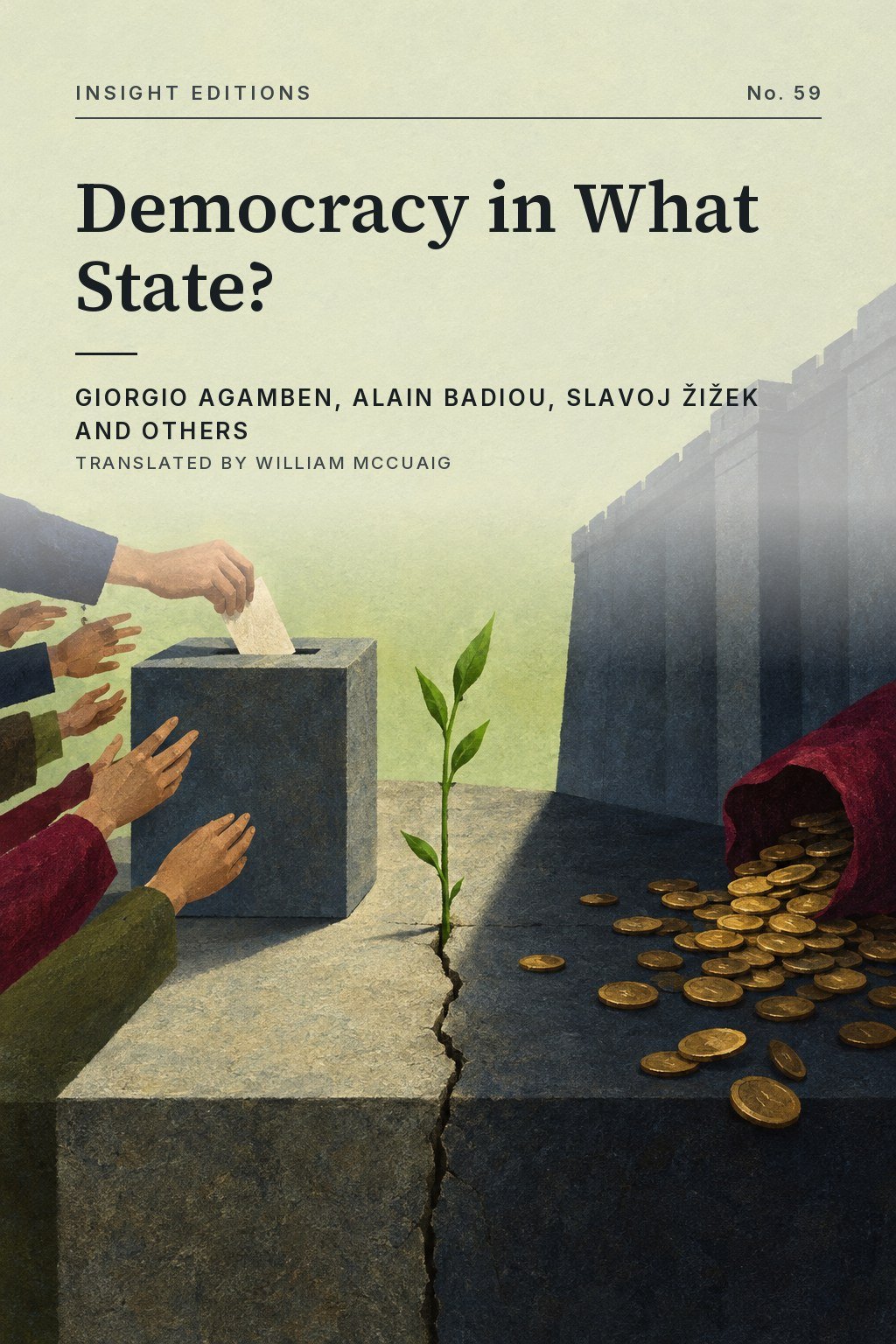
Giorgio Agamben, Alain Badiou, Slavoj Žižek and others · Translated by William McCuaig
Eight contemporary thinkers examine democracy’s meanings, its entanglement with state power and capitalism, and the possibilities for reclaiming or moving beyond democratic politics.
A study guide to Democracy in What State? by Giorgio Agamben, Alain Badiou, Slavoj Žižek and others, translated by William McCuaig. Shared free for personal reading; not for sale and not endorsed by the authors or publishers. Please read and buy the original.
The Book in Brief
The argument in brief
- The word is split. Agamben and Nancy trace a double meaning (constitution vs government; finite rule vs infinite meaning); Rancière and Ross a split between oligarchic "democracies" and the power of anyone.
- The diagnosis converges. Brown's six engines, Ross's revote machine and Žižek's parliamentary passivity show rule by the people hollowed by capital, experts and supranational bodies.
- The remedies diverge. Badiou and Žižek pass beyond democracy to communism and divine violence; Bensaïd wants permanent democratic revolution through parties; Brown stays uncertain.
Argument map: one question, three families of answer, eight contributors.
How the answers cluster
The eight replies fall into three families, not a single left consensus. Reject / go beyond: Badiou dislodges the emblem and names communism as democracy's real opposite; Žižek keeps the word only if it can carry divine violence and a transformed state. Reclaim / reinvent: Bensaïd wants permanent democratic revolution through parties and institutions; Rancière and Ross recover the power of anybody against oligarchic "democracies"; Nancy wants politics to stay finite so infinite spheres of meaning can open. Diagnose / suspend: Agamben refuses debate until the double machine is disarticulated; Brown lists six engines of hollowing and ends uncertain whether people still want freedom.
Shared diagnosis, diverging remedies
- Hollow consensus. All eight treat "everyone is a democrat" as a symptom, not a victory: the word covers oligarchy, markets, empire and emergency.
- Split meanings. Constitution vs government (Agamben); finite vs infinite (Nancy); regime vs emancipatory practice (Rancière, Ross); parliamentary form vs popular power (Žižek, Bensaïd).
- Capital and experts. Brown's six engines, Ross's Lisbon revote, Žižek's Czech radars and Badiou's monetary nonworld converge: popular sovereignty is drained by capital, technocracy and supranational bodies.
- Organisation fight. Bensaïd alone defends parties as necessary mediation; Weil, Rancière and Badiou (as he reads them) underrate organisation; Ross and Rancière keep democracy as capacity, not form.
Shared pressure: capital and experts vs the organisation fight.
| Cluster | Authors | Keep the word? | What replaces or salvages it |
|---|---|---|---|
| Beyond | Badiou, Žižek | Only as communism / transformed state | Idea, divine violence, part of no part |
| Reclaim | Bensaïd, Rancière, Ross, Nancy | Yes, against oligarchy | Parties; equality; power of anybody; access |
| Diagnose | Agamben, Brown | Suspended / uncertain | Disarticulate machine; face de-democratization |
| Ch | Essay (contributor) | In one line |
|---|---|---|
| F | Foreword (La Fabrique) | One surrealist-style question to eight thinkers |
| 1 | Introductory Note (Agamben) | Constitution and government form a double machine; disarticulate it |
| 2 | The Democratic Emblem (Badiou) | Democracy is a monetary nonworld; its true opposite is communism |
| 3 | Permanent Scandal (Bensaïd) | Politics needs mediation and parties; democracy must exceed its forms |
| 4 | We Are All Democrats Now (Brown) | Six forces hollow democracy; maybe no one wants freedom |
| 5 | Finite and Infinite Democracy (Nancy) | Ungrounded politics must give access to spheres of meaning |
| 6 | Democracies Against Democracy (Rancière) | The power of those with no title to rule |
| 7 | Democracy for Sale (Ross) | From Lisbon revotes to Rimbaud: the word must be reinvented |
| 8 | From Democracy to Divine Violence (Žižek) | Only a transformed state can touch sovereignty's excess |
About this book
Democracy in What State? by Giorgio Agamben, Alain Badiou, Daniel Bensaïd, Wendy Brown, Jean-Luc Nancy, Jacques Rancière, Kristin Ross, and Slavoj Žižek, 2011. This is a chapter-by-chapter study of the book, with summaries, maps, tables and diagrams; short quotations keep their page references. It is shared free for personal study, is not for sale, and is not endorsed by the author or publisher. Please read and buy the original.
Insight Editions · rajeshrmahapatra.com/insight-editions
A Question Put to Eight Philosophers
Those questionnaires, answered by Artaud, Crevel, Pierre de Naville, Ernst and Buñuel, lit worn topics (love, suicide, the devil's bargain) with "intersecting beams" that, the foreword says, still surprise "close to a century later". The present collection is homage to that model. Because democracy enjoys near-universal approval (debates rage over its meaning, but the valence stays positive), each contributor received the same question. Some were already collaborators; others were known only through writings that suggested distance from the consensus.
The publisher expected and counted on contradiction. The book supplies no textbook definition, no user's manual for democrats, and "least of all a verdict pro or con". What it attests is that the word need not be scrapped: it still functions as "a pivot around which core controversies of politics and political philosophy turn". The translator capitalises "the State"; Brown, Ross and Žižek wrote in English; the others were translated from French.
La Fabrique, to all eight contributors
Introductory Note on the Concept of Democracy
One word, two meanings
Democracy can mean a form of constitution (public law: how power is legitimated) or a technique of government (administrative practice: how power is exercised). The second meaning now prevails, so those who use the first feel a malaise. The two fields, the juridico-political and the economic-managerial, have been tangled since the Greek polis.
Politeia, rendered as Plato's Republic, is translated sometimes "constitution", sometimes "government". In Aristotle's Constitution of Athens (ch. 27) a standard translation renders one sentence on Pericles' demagogy as "the constitution became still more democratic" and the next as "brought all the government more into their hands". When one concept slides between the two, we are past ambiguity and into amphibology, the grammarians' term for indeterminate meaning.
- Aristotle, Politics 1279a. Politeia and politeuma "signify the same thing", and the politeuma is the supreme (kyrion) power: constituent and constituted power bind into a sovereign.
- Rousseau. Foucault's 1977-78 Collège de France course showed Rousseau trying to reconcile contract, general will and sovereignty with an art of government. His "Political Economy" article separates sovereignty (legislating) from government (executive power), yet he denies any division within the sovereign, which is both one term and the link.
One Greek word, two English ones, stitched by sovereignty.
Agamben's double machine: two rationalities joined by a sovereign that may hide a void.
The error and the task
Today government and economy overwhelm popular sovereignty, an expression "drained of all meaning". Treating government as mere executive power is, for Agamben, "one of the most consequential errors ever made" in Western politics: it lets modern thought chase empty abstractions (law, general will, popular sovereignty) while ignoring how government actually articulates with the sovereign.
He ends with questions. What if the sovereign that guarantees their union is a fiction, a screen hiding a void at the centre? Then the task would be to disarticulate them and expose the "ungovernable", "simultaneously the book and the vanishing point of any and all politics".
Politeia, politeuma and kyrion in full
Agamben walks the reader through the Greek and modern knots with more philological care than a slogan. When classical writers list forms of politeia, they usually name three (monarchy, oligarchy, democracy) or six with the parekbaseis (deviant forms). Translators flip between "constitution" and "government" because English lacks a single word that holds both. In Aristotle's Constitution of Athens ch. 27, the same translator who renders Pericles' demagogy as making the constitution "still more democratic" must then say the people "brought all the government more into their hands"; writing "constitution" in the second clause would expose the amphibology.
Aristotle's Politics 1279a 25 ff. tries to heal the split: because politeia and politeuma "signify the same thing", and the politeuma is the kyrion (supreme) power, that power sits with one, few or many. Modern translations flatten this to "constitution and government signify the same thing". Agamben's paraphrase in modern terms: constituent power (politeia) and constituted power (politeuma) bind into a sovereign (kyrion) that both dramatises and papers over the fissure. The unanswered question: why is politics riven by this fissure that kyrion both stages and heals?
Rousseau: Sovereignty, government and the article on Political Economy
Foucault's 1977-78 Collège de France course (Sécurité, territoire, population) showed Rousseau trying to reconcile contract, general will and sovereignty with an art of government. Agamben's own focus is the distinction and its forced knitting. In the Encyclopédie article "Political Economy", Rousseau begs readers to distinguish public economy / government from supreme authority / sovereignty: sovereignty has le droit législatif; government has "purely executive power".
In The Social Contract the same distinction returns as general will / legislative capacity versus government / executive, yet Rousseau must portray them as distinct and articulated. At the moment he posits the distinction he denies any division within the sovereign. As with Aristotle, what is kyrion is at once one of the two terms and the indissoluble link between constitution and government.
The double governmental machine
Today government and economy overwhelm anything called popular sovereignty, "an expression by now drained of all meaning". Western democracies pay for a philosophical heritage they have not inspected: treating government as simple executive power is "one of the most consequential errors ever made" in Western politics. Modern thought then chases law, the general will, popular sovereignty while failing to address government and its articulation to the locus of sovereignty.
Agamben points to his then-recent book (Le Règne et la gloire, Seuil 2008; English The Kingdom and the Glory): the central mystery of politics is "not sovereignty but government; not God but his angels; not the king but his minister; not the law but the police", or rather the double governmental machine they form. The Western system couples two heterogeneous elements, a politico-juridical rationality and an economic-governmental one, a "form of constitution" and a "form of government". Incommensurable as they may be, they legitimate and confer mutual consistency on each other.
Kingdom and Glory: government, not sovereignty, is the mystery.
Final questions and the ungovernable
Why does politeia stay trapped in ambiguity? What gives the sovereign the power to guarantee their union? What if the sovereign is a fiction, a screen over a void at the centre, and no articulation between the two rationalities is possible? Then the task is to disarticulate them and force into the open the "ungovernable", "simultaneously the book and the vanishing point of any and all politics". Until thought tackles this knot, debate on democracy as constitution or as technique of government collapses into "mere chatter".
The Democratic Emblem
The emblem and its walls
An emblem is the "third rail" of a symbolic system. You may denounce the "economic horror" with any zeal, provided you do it in the name of democracy, asking "how can a democratic society do this?" "Be seeing you at the next election." Badiou calls the rule that "everyone" (tout le monde) is democratic the axiom of the emblem.
But le monde, the actual world, is larger. Outside the democrats' zone lie war, hunger, walls and delusions; those who flee it meet papers, borders, detention camps and demands to be "integrated". "A democrat loves only another democrat": political endogamy. Seen this way, democracy is "a word for a conservative oligarchy" guarding its territory "as animals do, under the usurped name world".
Plato's two theses
Badiou returns to book 8 of Plato's Republic, where the emblem was first dislodged, and to Lenin, for whom democracy is only a form of State. Both care more about the subjective type it moulds, whose defining traits are egoism and desire for petty enjoyments. Lin Piao was "perfectly Platonic" when he called the motive of the reactionary democrat fear of death. Plato's remedy was reactionary myth; its modern twin is French "republicanism": which republic, Badiou asks, the one born of the massacre of the communards, of Clemenceau the strikebreaker, or the one that handed power to Pétain? Nostalgia "is always nostalgia for something that never existed".
Badiou's chain from the emblem to the subject it moulds.
Youth, time and tyranny
"Homo democraticus is an avaricious old fellow grafted onto a craving adolescent. The adolescent makes the wheels turn, and the old fellow reaps the profits." the old play at "modernity" like an aging rock star. Outside capitalist circulation it turns into terror: Red Guards, Khmer Rouge, teenage militias. In the West the maxim becomes "Have fun", hence "the profound stupidity of contemporary democratic societies".
Homo democraticus: an old miser grafted onto a craving adolescent.
Plato's thesis is that such indiscipline of time, with its State form, representative democracy, ends in tyranny: "the democratic nonworld is a leakage of time. Consumption is consuming it." Youth is "the emblem of the emblem".
The real opposite: communism
If democracy equals monetary abstraction equals an organised death wish, its opposite is not totalitarianism. Negatively, circulation must no longer follow money, nor accumulation capital, nor may private property dictate outcomes. Positively, politics gains independent value, like art and science, and becomes the force of the assembled people "driving the State and its laws to extinction". Plato kept this for his propertyless guardians; Badiou, after Antoine Vitez, wants "aristocratism for everybody", which is communism. In the literal sense, the power of peoples over their own existence, "we will only ever be true democrats... when we become communists again."
Emblem, endogamy and the usurped name "world"
Badiou's opening move is tactical as well as theoretical. As long as critique stays inside the emblem, even fierce denunciation of "economic horror" earns pardon and the label citizen rather than barbarian: "Be seeing you at the next election." The axiom of the emblem equates tout le monde ("everyone") with the democrats. Against that, he sets le monde, the world that "evidently exists". Outside the democrats' zone, people pack bags between "bursts of lead, landings by humanitarian paratroopers, famine, and disease", study an "integration manual", and still meet papers, borders, detention camps, police surveillance, denial of family reunion. Globalisation is for those who prove they "deserve to come inside". Democracy as emblem is thus "a conservative oligarchy" whose "main (and often bellicose) business is to guard its own territory as animals do, under the usurped name world".
Plato, Lenin, Lin Piao and French republican nostalgia
Book 8 of Plato's Republic and Lenin both treat democracy as a form of State, yet both care more about the subjective type it moulds: egoism and desire for petty enjoyments. Lin Piao, at the height of the Cultural Revolution, called the essence of false (Russian) communism egoism and the motive of the reactionary democrat fear of death: "perfectly Platonic", says Badiou. Plato's own remedy was aristocratic myth (philosopher-guardians who never existed). Its French twin is idolatrous "republicanism" among the "intellectual petite bourgeoisie". Badiou's list of which republic: the one born of the massacre of the Communards (1870-71); colonial conquest; Clemenceau the strikebreaker; the shambles of 1914-18; the republic that handed power to Pétain. "Nostalgia is always nostalgia for something that never existed."
He dares the ancient dilemma for the West: either reinvent communism or undergo "some reinvented form of fascist barbarity". The Greeks got the Macedonians and then the Romans: "servitude, not emancipation."
Two theses extended: nonworld and pleasure
Thesis 1. A world appears only through differences: first truth vs opinion, then truths of more than one type (love, politics, art, science). Plato's democracy "dispenses an equality of sorts indiscriminately among the equal and the unequal"; Badiou translates that into the monetary principle, universal fungibility that bars the heterogeneous. Anarchy, in Plato's sense here, is when value is mechanically attributed to what is without value: an "anarchic whirl of eidola", not a world.
Thesis 2. The democratic subject is constituted only by pleasure-seeking. Two ages of the relation to pleasure: youthful Dionysiac enthusiasm ("Untrammeled pleasure!" of '68; "My clothes, my Nikes, and my hash" from the banlieues), and elderly indifference that sees only money and its apparatus (police, justice system, prisons). "From prodigious avidity fancying itself freedom to budgetary avarice with a strong security presence."
Badiou Thesis 2: from avid freedom-fantasy to secured avarice.
Youth as emblem of the emblem; terror and "Have fun"
Homo democraticus "reflects the substitutability of everything for everything else". The old absorb that wisdom (monetary nullity) but must pretend to fight for "modernity, change, rapidity, fluidity" like "an aging millionaire rock star". The pump is youthful desire. Outside high gear of monetary circulation: Red Guards, Khmer Rouge, and African adolescent gangs "manipulated by outside powers or warlords", "adolescent democratism unplugged" except for "the circulation of lethal firearms". Inside: the maxim "Have fun" as social duty even for those least able to comply: "the profound stupidity of contemporary democratic societies."
Plato's ironic portrait (which Badiou rewrites with "a certain liberty") ends in the claim that indiscipline of time plus representative democracy manifests a despotic essence: "the real content of all that youth and beauty is the despotism of the death wish." Trajectory: delights of democracy → nightmare of tyranny. "The democratic nonworld is a leakage of time. Consumption is consuming it." Youth constructs bodies from immediacy, fashion, and stationary movement (on se bouge).
Aristocratism for everybody
Negatively: circulation must no longer follow money, accumulation capital, or private property dictate outcomes. Positively: politics gains independent value like science and art, "subjective mastery... over the future of humanity", "driving the State and its laws to extinction". Plato reserved propertyless community and rule by the Idea for guardians. Antoine Vitez wanted theater "elitist for everybody"; Badiou wants "aristocratism for everybody", which is communism. Nineteenth-century worker revolutionaries already read Plato as communism's first philosophical spokesman. Hegel: communism "absorbs and surmounts the formalism of the age of restricted democracy."
Coda on the literal meaning: "the power of peoples over their own existence", politics immanent in the people, withering of the State "in open process". "We will only ever be true democrats, integral to the historic life of peoples, when we become communists again." "Roads to that future are gradually becoming visible even now."
Permanent Scandal
Theater of shadows
Around the mid-1970s the world shifted: the long postwar boom ended, the Gulag and Cambodia were exposed, the Iranian Revolution broke out and the neoliberal reaction began. Cold war pairs gave way to a staged duel of democracy vs totalitarianism, a "threadbare mantle" over "an interminable Thermidor". The liberals kept their old dread of popular sovereignty; Tocqueville wrote in 1853: "I dearly love liberty and respect for rights, but not democracy." Market despotism works democratic talk like a ventriloquist's dummy.
The irony is that democracy "won" just as the postwar link between constitutional freedom and free enterprise came apart. The 1973-74 crisis sapped the Fordist (Keynesian) compromise and the welfare state; after "real" socialism collapsed, democracy became a floating signifier for the victorious West; privatisation shrank public space.
Good shepherds and market malaise
- The new Tocquevilles. Alain Finkielkraut and Jean-Claude Milner revived elitist complaints about the "common herd". A "holy league" of republican democrats signed "Have No Fear!" in Le Monde on 4 September 1998, calling for "deference to breeding, competence, leadership": dread of the fragile legitimacy of all power.
- Pierre Rosanvallon. He diagnosed democratic malaise (irrelevant elections, disrespected officials). His society of victims and communities lets social class evaporate, leaving "a democracy without quality for humans without qualities"; his cure is more appointed office and "independent authorities".
- Aron and Lefort. Raymond Aron defined democracy minimally as "the organization of peaceful competition to hold the reins of power"; Claude Lefort called it linked to capitalism yet distinct.
Marx's 1843 Kreuznach manuscript gives the alternative. Against Tocqueville's "democratic State", the young Marx holds that "in real democracy, the political State would disappear". Politics becomes the strategic art of mediation, and "true democracy" survives, says Miguel Abensour, as a latent dimension.
Against the radical critics
Liberal globalisation has revived Carl Schmitt's attack on parliamentary impotence alongside left critiques with opposite aims. Badiou contrasts politics with "the clash without truth" of opinions; Rancière contrasts democracy as expansive movement with democracy as regime. Both treat politics as rare, intermittent and evental ("There is not a lot of it"), and both reject elections as reducing the people to statistics. Necessary, but not sufficient.
- Philosopher king. Badiou rightly says a majority never proves truth, but ignores convention and juridical form, without which law is pure force. He identifies democracy with capitalism and calls electoral democracy "the consensual representation of capitalism". For Marx and Lenin, though, "dictatorship" of the proletariat was not the opposite of democracy.
- Event without history. Badiou imagines discrete sequences of fidelity to an event and seeks a "second sequence" of the communist Idea with "nonmilitary discipline". Resting on what? The revolution weaves event and history: "we are always beginning again in the middle".
- Stalin. Badiou's remark that workers fared better "in Stalin's time" and his "tip of the hat" ("he threw a scare into the capitalists") are "a tip of the hat too many". The scare came from the struggles of the 1930s, the militias of Asturias and Catalonia, the Popular Front; Stalin helped capitalists in Barcelona (May 1937), the Hitler-Stalin pact, Yalta and the disarming of the Greek resistance. Blaming "the party form" for a counterrevolution "costing millions of dead" is shallow; what if the party were part of the solution?
- Rancière's excess. His "democratic excess" is no Ségolène Royal-style participation; democracy is "the mode of subjectivation" of political subjects; at Cerisy he said he had "never taken an interest in the organizational forms" of collectives. Politics is "anarchic": without primordial foundation.
Withering away, Rousseau and the institution
Agnes Heller and Ferenc Fehér reject "the Utopian vision of the total abolition of the State"; their critique served 1980s eurocommunism but exposes the murk in Marx. After six weeks of the Commune (1871) Marx called State power "henceforth abolished", yet against Proudhon and Bakunin he denied abolition by decree. Withering away is a process: shorter hours, new property relations, reorganised work. Central functions stay, as public functions under popular control; Engels (1891) has the proletariat "gnawing" at the State until a generation raised in freedom can drop its "bric-a-brac".
Withering away as process, not decree (Marx, Engels 1891).
Rousseau's aporias, ending in a miraculous legislator.
Where Rousseau stops, Saint-Just takes over on the eve of Thermidor: "without institutions, the strength of a republic rests either on the qualities of fragile mortals, or on precarious means." Neither he, Che Guevara nor Lumumba solved this "democratic equation". Castoriadis names its terms: the social-historical is the tension between instituting and instituted society.
Uncertainty, secular democracy, representation
Lefort calls democracy a society that consents to live "under the stress of uncertainty"; the remedy is to "laicize" democracy, not dream of a transparent social totality. Walter Lippmann ("Society does not exist") and John Dewey reject any transcendence; Dewey accused Trotsky of a factitious transcendence in judging ends by class struggle. Lippmann would "put the public in its place", as spectator.
| Position | Representation is... |
|---|---|
| Rancière | "Fully and overtly an oligarchic form", "the exact opposite of democracy" |
| Castoriadis, Lefort | A needed "scene" once power is disincorporated: it stages conflict and the differentiation of spheres |
| Bensaïd | A gearbox for discordant times, a mobile ladder between spaces; farce (Arendt's "operetta") when public space withers |
Bensaïd's mediation model: why parties and representation stay necessary.
- Delegation is inevitable "in a city, during a strike, in a party"; the task is close control of mandatories and limits on professional power.
- The 1921 debate. Aleksandra Kollontay saw the bureaucratic danger early but blamed "heterogeneous" society; her dream of a pure proletarian body led paradoxically to the single party and bureaucratic Bonapartism.
- Number. "Number has nothing to do with truth." Majority ends debate by convention; appeal stays open. Sortition, Rancière's "absence of any title to govern", is a "least-bad" option; substituted for representation, it would abolish deliberation itself.
- Parties. Lefort called parties corporatism in 1975 but by 1993 held that only party competition brings out general aspirations, a Leninist conclusion. Bourdieu found "an antinomy inherent in politics": the dominated need representation to exist as a group. Bensaïd calls this a false problem: workers, women and slaves do speak; the issue is their political speech.
Permanent democratic revolution
Marx did not scorn "formal" freedoms; as a jurist he knew forms have efficacy. Political emancipation "is a great advance" but not human emancipation; the task, practical since 1848, is to revolutionise democracy. Democracy must "keep pushing further, permanently transgress its instituted forms", contest private property and the State's grip on public goods, and extend equality and citizenship everywhere: it "is not itself unless it is scandalous right to the end."
Theater of shadows: the mid-1970s shift in full
Bensaïd dates the billboard change to around the mid-1970s: end of the long postwar boom, Gulag revelations, Cambodia, the Iranian Revolution, onset of neoliberal reaction. Cold-war pairs (capitalism/communism, imperialism/national liberation) were replaced by a publicity duel of democracy vs totalitarianism, "more like the restoration of the French monarchy", a "threadbare mantle of soft legitimacy" on an "interminable Thermidor". Liberals kept their mistrust of popular sovereignty. Tocqueville (1853): "I accept the intellectual rationale for democratic institutions, but I am instinctively an aristocrat... I dearly love liberty and respect for rights, but not democracy." Market despotism works democratic talk "the way a ventriloquist manipulates his dummy".
Hannah Arendt was "more circumspect": similarities between regimes do not erase essential differences. Trotsky could call Hitler and Stalin "twin stars" and think étatisation as bureaucratic totalitarianism ("La société, c'est moi"), yet he "never lost sight of the social and historical differences without which no concrete politics is possible." Irony: democracy "triumphed" just as the postwar link between constitutional freedom and free enterprise came apart. The 1973-74 crisis sapped the Fordist-Keynesian compromise and the welfare state; after "real" socialism collapsed, democracy floated as signifier of the victorious West; privatisation shrank public space.
Good shepherds: Finkielkraut, Milner, "Have No Fear!"
After the fall of the Wall, "good shepherds of the flock" formed ranks to dispel dread that democracy might be "the very principle of politics" grounded on "its own absence of ground" (Bensaïd quoting Rancière's line of attack). The "holy league" of "republican democrats" published "Have No Fear!" in Le Monde, 4 September 1998, fearing "organized blocs" and "enraged" social groups, invoking "deference to breeding, competence, leadership" and nostalgia for "father" and "lieutenant". Their hatred of democracy, Bensaïd says, betrays "giddy fear at the fragile legitimacy of all power".
Rosanvallon, Aron, Lefort; Marx 1843
Pierre Rosanvallon diagnosed malaise: irrelevant elections, declining administrative centrality, disrespect for officials. "Never has there been such a thin line between a positive outlook for democracy and the chance that it might go off the rails." His society of communities bonded by adversity, compassion and victimhood lets social class evaporate, leaving "a democracy without quality for humans without qualities". Cure: more appointed office and "independent authorities".
Raymond Aron (minimal definition): democracy as "the organization of peaceful competition to hold the reins of power". Claude Lefort: democracy "linked to capitalism yet distinct". Against Tocqueville's "democratic State", Marx's 1843 Kreuznach manuscript holds that "in real democracy, the political State would disappear". Politics becomes the strategic art of mediation; "true democracy" persists, says Miguel Abensour, as a latent dimension linking the youthful texts to the Commune writings and the Critique of the Gotha Program.
Bensaid's map: minimal definitions vs Marx disappearing State.
Badiou under fire: philosopher-king, event, Stalin tip of the hat
Liberal globalisation revived Carl Schmitt's attack on parliamentary impotence alongside left critiques with opposite aims. Badiou contrasts politics with "the clash without truth" of opinions; Rancière contrasts expansive democracy with the political-science "regime". Both treat politics as rare, intermittent, evental ("There is not a lot of it"); both reject elections as reducing the people to statistics. Necessary critiques, Bensaïd says, but not sufficient.
- Majority and truth. A majority never proves truth, but without convention and juridical form law is pure force. Badiou identifies democracy with capitalism ("consensual representation of capitalism"). For Marx and Lenin, "dictatorship" of the proletariat was not the opposite of democracy.
- Second sequence. Badiou wants a new communist sequence with "nonmilitary discipline", "end of socialist separations", "repudiation of vindictive egoism". Resting on what? Absent democratic agreement on a common project, only "religious faith or a philosophical doctrine". Marx stands inside the contradiction of the democratic theme; Badiou discards it. Revolution weaves event and history: "we are always beginning again in the middle".
- Stalin tip of the hat. Badiou's anti-Sarkozy pamphlet: workers fared better "in Stalin's time"; a "tip of the hat" because "he threw a scare into the capitalists". Bensaïd: "a tip of the hat too many". The scare came from 1930s struggles, Asturias and Catalonia militias, the Popular Front; Stalin helped capitalists in Barcelona May 1937, the Hitler-Stalin pact, Yalta, disarming the Greek resistance. Blaming the "party form" for a counterrevolution "costing millions of dead" is shallow. What if the party were part of the solution?
Rancière's democratic excess and Cerisy
Journalists who likened Rancière's "democratic excess" to Ségolène Royal-style participation committed "utter nonsense". For Rancière democracy is "the paradoxical condition of politics", "action that unceasingly robs oligarchic government of the monopoly of public life", "the mode of subjectivation through which political subjects exist". At Cerisy he said he had "never taken an interest in the organizational forms" of collectives. Politics is "anarchic": without primordial foundation. Bensaïd grants the force of the critique of foundations and still insists that mediation cannot be wished away.
Withering away: Heller/Fehér, Commune, Engels 1891
Agnes Heller and Ferenc Fehér reject "the Utopian vision of the total abolition of the State"; their critique served 1980s eurocommunism but exposes murk in Marx. After six weeks of the Commune (1871) Marx called State power "henceforth abolished", yet against Proudhon and Bakunin he denied abolition by decree. Withering away is a process: shorter hours, new property relations, reorganised work. Central functions remain as public functions under popular control. Engels (1891): the proletariat "gnawing" at the State until a generation raised in freedom can drop its "bric-a-brac".
Rousseau's seven faults and Saint-Just's institutions
Bensaïd unpacks Rousseau as the classical knot of democratic theory:
- Total alienation: "in giving oneself over to all, one gives oneself over to no one" (holism vs liberal contract).
- Property: subordinated to the community; Hegel: "the right of distress overrides property rights".
- No binding law: not even the social contract binds the people; constituent power stays inalienable.
- No representation: the will cannot be delegated (immediate democracy).
- Deception: the general will "is always right" but the people can be deceived, so partial associations (parties) are banned.
- The legislator: a "superior intelligence" like Laplace's demon, plus civic religion and "the great soul of the legislator" as miracle.
Where Rousseau stops, Saint-Just on the eve of Thermidor warns: "without institutions, the strength of a republic rests either on the qualities of fragile mortals, or on precarious means." Neither he, Che Guevara nor Lumumba solved this "democratic equation". Castoriadis: instituting vs instituted society.
Institutions after Thermidor: the unsolved democratic equation.
Uncertainty, Lippmann/Dewey, "put the public in its place"
Lefort: democracy lives "under the stress of uncertainty"; remedy, "laicize" democracy, stop searching for a mythical lost Gemeinschaft. Totalitarian experience shows the impossibility of "a point of fulfillment of the social, where all relations would be seeable and sayable." Rancière, from another angle, also rejects "the ideal reduction of the political by the social."
Walter Lippmann ("Society does not exist" as mystical whole) and John Dewey reject transcendence; Dewey accused Trotsky of factitious transcendence in judging ends by class struggle. Lippmann: there is "not the slightest reason to think, as mystical democrats do, that the sum of individual ignorances" can direct public affairs. Conclusion: "put the public in its place" as spectator in the grandstand.
Representation, Kollontay/Shlyapnikov 1921, number, parties
For Rancière, representation is "fully and overtly an oligarchic form", "the exact opposite of democracy". For Castoriadis and Lefort, disincorporation of power implies a "scene of representation": visibility, controversy, recognition of conflict and differentiation of spheres. Bensaïd: a gearbox for discordant times, a mobile ladder between spaces; farce (Arendt's "operetta") when public space withers.
- Delegation is inevitable "in a city, during a strike, in a party"; task: close control of mandatories.
- 1921 worker opposition. Aleksandra Kollontay (and partner Shlyapnikov; source OCR "Chliapnikov") denounced "variegation" and "mixed social composition". Dream of a sociologically pure proletarian body led paradoxically to the single party and bureaucratic Bonapartism. Lenin fought a corporatist conception that juxtaposed localities and trades without a hegemonic project.
- Number. "Number has nothing to do with truth." Majority ends debate by convention; appeal stays open (minority, future, legitimacy, morality). Sortition is a "least-bad" option; as substitute for representation it would abolish deliberation.
- Parties. Lefort in 1975 called parties corporatism; by 1993 he held that only party competition brings out general aspirations (a "Leninist" conclusion by irony). Bourdieu's late "antinomy inherent in politics": the dominated need representation to exist as a group. Bensaïd: false problem. Workers, women, slaves do speak; the issue is their political speech, which (after Lenin) is not a faithful reflection of the social.
Simone Weil's war on parties (expanded)
In her Note on the General Suppression of Political Parties, after Spain, the Hitler-Stalin pact and the Stalinist "big lie", Weil called every party "a machine for fabricating collective passion", "totalitarian in origin". Under her scheme, magazine readers forming a group would face criminal charges ("Every time a milieu attempted to harden into a group... criminal charges would be laid"). Her "unconditional desire for truth" rests on grace ("Truth is one"), ending in authoritarian individualism: à chacun sa vérité. Remove parties and you get "the single party... of the 'partyless'". Bureaucracy comes from the division of labour, not one organisational form. Illusory flights from politics "perpetuate impotence".
Permanent democratic revolution
Marx did not scorn "formal" freedoms; as a jurist he knew forms have efficacy. Political emancipation "is a great advance" but not human emancipation. The task since 1848 is to revolutionise democracy. Democracy must "keep pushing further, permanently transgress its instituted forms", contest private property and the State's grip on public goods, extend equality and citizenship everywhere: it "is not itself unless it is scandalous right to the end."
Scandalous to the end: democracy as permanent transgression.
"We Are All Democrats Now . . ."
An empty signifier
Democracy enjoys "historically unparalleled global popularity" yet is "conceptually footloose or substantively hollow". Brown offers three guesses: like Obama, it is an empty signifier for any hope; or capitalism, democracy's "nonidentical birth twin" and the wilier of the two, has made it a brand severed from content; or it has become a new world religion, an altar that legitimates Western imperial crusades. The Left too is mesmerised ("democracy to come"). Berlusconi and Bush, Derrida and Balibar, Italian communists and Hamas: "we are all democrats now".
Demos + cracy = rule of the people, opposed to aristocracy, oligarchy, tyranny and colonial occupation. Nothing in the word entails representation, constitutions, markets, rights or even equality. It is an unfinished principle: it says the whole, not a part, is sovereign, but not which powers must be shared or how.
Six engines of de-democratization
| Force | How it hollows rule by the people |
|---|---|
| Corporate power | Corporate and state power merge: outsourced prisons and militaries, CEOs as ministers, bailouts for capital |
| Marketed elections | Campaigns as fund-raising and targeted "mobilization"; voting like choosing electronics; policies sold as consumer goods |
| Neoliberal rationality | Cost/benefit and efficiency replace constitutionalism and equality; the state run as a firm |
| Juridification | Domestic and international courts move from prohibiting to legislating, in arcane language; adjudication overrides legislation |
| Globalisation | Flows of capital, people, violence and fealty erode the Westphalian (1648) sovereignty that gave democracy a bounded container |
| Securitization | Anti-terror states (Israel, India, Britain, US) suspend movement and information rights, profile by race, widen secrecy, wage permanent undeclared wars |
The demos cannot follow, let alone contest, most of this. Executive power expands as state sovereignty declines, and states detached from sovereignty become "rogue states" at home and abroad; citizens become "passive stockholders". The 2008 meltdown made this glaring; anti-terror policy is likewise a sign of sovereignty's loss.
Six engines of de-democratization against Brown's two conditions.
Democratic paradoxes
- Exclusion at the cradle. Athens excluded 80-90 percent of the adult population of Attica: women, slaves, resident foreigners. Every democracy has an occluded inside (slaves, natives, women, the poor, today "illegals") and a constitutive outside (barbarians, communism, colonies, now "Islamicism").
- Freedom, not equality. Ancient democracy promised ruling in common; modern democracy promises freedom. Its normative supremacy rests on Rousseau's wager: surrender ungoverned liberty for collective power to become free. The a priori free moral subject of Kant, Rousseau and Mill makes democracy incontestable, but its white, masculine, colonial face licensed its exclusions.
The impossibility of freedom
Self-legislation of what? Liberals stress elected lawmaking and limits on power; Marxists collective ownership of the means of existence; radical democrats participation; libertarians minimal government. Once the Kantian subject gives way to Foucauldian and Derridean accounts of powers that fabricate us, consent and voting cannot deliver self-rule. Yet ruling every power that constructs us is "pulling ourselves up by our own bootstraps". Democracy must reach deeper into power than ever and "give up freedom as its prize": an unreachable aim, a perpetually unfinished project. Subordinating global capital to democratic rule looks like fantasy.
Why consent and voting cannot deliver self-legislation.
Do humans want freedom?
The deepest challenge: do people want "freedom rather than bread", in Dostoyevsky's phrase? The last century suggests most Westerners prefer "moralizing, consuming, conforming, luxuriating, fighting, simply being told what to be", the conundrum Herbert Marcuse posed. Plato feared licentiousness; the worse danger now is "fascism authored by the people". Free peoples elect theocracies, ethnic cleansers and technocracies, preferring short-run gratification to an enduring planet. Rousseau's "forcing someone to be free" suspends freedom to realise it; today nothing obvious could compel people to rule themselves.
Brown leaves options open: new forms, an unrealisable ideal, or demotion "from a form of governance to a politics of resistance". Without answers, democracy risks becoming "a gloss of legitimacy for its inversion".
Empty signifier: three guesses and the Left's enchantment
Brown opens with the LSE Beaver headline after Obama's election (6 November 2008): "Welcome Back, Democracy!" Democracy has "historically unparalleled global popularity" yet is "conceptually footloose or substantively hollow". Three guesses: (1) like Obama, it is an empty signifier for any hope; (2) capitalism, "nonidentical birth twin" and "always the stronger and wilier", has made it a "brand" severed from content (late twist on commodity fetishism); (3) it has become a new world religion, an altar legitimating Western imperial crusades while godheads war with an intensity modernity was supposed to have vanquished.
The enchantment crosses the spectrum: regime changers, post-Soviet entrepreneurs, neoliberals, never-say-die liberals, and the Euro-Atlantic Left ("democracy to come", "democracy of the uncounted", democracy as what communism "meant all along"). Hence the roll call: Berlusconi and Bush, Derrida and Balibar, Italian communists and Hamas. "We are all democrats now."
Etymology and unfinished principle
Demos + cracy = rule of the people, opposed to aristocracy, oligarchy, tyranny, colonial occupation. Nothing in the word entails representation, constitutions, markets, rights or even equality. It is an unfinished principle: the whole, not a part, is sovereign, but the word does not say which powers must be shared or how. That openness, Brown suggests, also lets enthusiasm "eschew the extent to which its object has been voided of content".
Six engines unpacked
- Corporate-state merger. Not only wealth buying politicians or a corporatised media. Outsourcing of schools, prisons, militaries; CEOs as ministers; states as owners of huge finance-capital stakes; tax, environmental, energy, labour, fiscal and monetary policy harnessed to capital accumulation, plus "an endless stream of direct supports and bailouts". The demos "cannot fathom or follow" most of this.
- Marketed elections. Campaigns as fund-raising and targeted "mobilization"; voting like choosing electronics; policies sold as consumer goods.
- Neoliberal rationality. Cost/benefit and efficiency replace constitutionalism and equality; every institution, including the constitutional state, modelled as a firm; "market democracy" once a term of derision, now ordinary descriptor for a form with "precisely nothing to do with the people ruling themselves". This also expands executive power as state sovereignty declines.
- Globalisation. Flows of capital, people, violence and fealty erode the Westphalian (1648) bounded container. Democracy "detached from a bounded sovereign jurisdiction... is politically meaningless". States detached from sovereignty become "rogue states" internally and externally; people become "passive stockholders" in governmentalised states that act as weak managers of global capital. The 2008 meltdown made this glaring.
- Securitization. Anti-terror states (Israel, India, Britain, US) suspend movement and information rights, profile by race, widen secrecy, wage permanent undeclared wars. Anti-terror policy, like the bailouts, is a sign of sovereignty's loss, not its strength.
Brown engines 5-6: globalisation and securitization as loss of sovereignty.
Key idea restated"For the people to rule themselves, they must be a people and they must have access to the powers they would democratize." Globalisation undermines the first; unchecked capital removes the second. Executive power expands as sovereignty declines.
Exclusion, freedom vs equality, Kantian subject
Athens excluded 80-90 percent of the adult Attican population (women, slaves, free foreigners, strict lineage). Every democracy has an occluded inside (slaves, natives, women, the poor, races, religions, today "illegals") and a constitutive outside (barbarians → communism → colonies → "Islamicism" as comfort that the West is still democratic "especially in the face of de-democratization"). An "overt antiuniversalism" sits at democracy's heart: universalising it would not yield democracy.
Ancient/republican democracy centred equality (rule in common); modern democracy promises freedom. Normative supremacy rests on Rousseau's wager: surrender ungoverned liberty for collective power. The a priori free moral subject of Kant, Rousseau and Mill makes democracy incontestable, yet its white, masculine, colonial face licensed exclusions.
Self-legislation after Foucault and Derrida
Liberals: elected lawmaking + limits on power. Marxists: collective ownership of the means of existence. Radical democrats: participation. Libertarians: minimal government. Once the Kantian subject yields to Foucauldian and Derridean accounts of powers that fabricate us, consent and voting cannot deliver self-rule. Yet ruling every constructing power is "pulling ourselves up by our own bootstraps". Democracy must reach deeper into power than ever and "give up freedom as its prize": unreachable aim, unfinished project. Subordinating global capital looks like fantasy.
Dostoyevsky, Marcuse, fascism authored by the people
Do people want "freedom rather than bread" (Dostoyevsky)? The last century suggests most Westerners prefer "moralizing, consuming, conforming, luxuriating, fighting, simply being told what to be" (Herbert Marcuse's conundrum). Plato feared licentiousness; the worse danger now is "fascism authored by the people". Free peoples elect theocracies, ethnic cleansers and technocracies, preferring short-run gratification to an enduring planet. Rousseau's "forcing someone to be free" suspends freedom to realise it; today nothing obvious could compel people to rule themselves.
Brown's closing wager: do people still want to rule themselves?
Open endings and the practitioner test
Brown leaves options open: new forms; an unrealisable ideal; or demotion "from a form of governance to a politics of resistance". Without answers, democracy risks becoming "a gloss of legitimacy for its inversion". Calls to "deepen" or "take back" democracy help only if they reckon with the powers destroying it: what minimal power sharing counts; whether democracy fits this century; whether there are "nonchilling alternatives"; whether freedom can be taught; what boundaries it needs.
Finite and Infinite Democracy
The court of reason
Democracy "means everything (politics, ethics, law, civilization) and nothing". As Kant had to separate knowledge of an object from knowledge of "a subject without object", we must separate two senses jumbled in the word. In the mode of "understanding", democracy is the set of conditions under which government is possible without any transcendent regulating principle. In the mode of "reason", it names the Ideas of Mankind and World, which postulate unlimited transcendence and full autonomy after "God is dead". This second sense clings: democracy promises the liberty of the whole human being, so Rousseau's contract "produces mankind itself".
The confusion comes from politics itself, which has always meant both the mere regulation of common life and a "heavenly assumption" into its meaning. The great twentieth-century projects followed the second, sublimating administration into common being ("the people", "the community").
Politics was invented, and without ground
Power has always existed; politics has not. Like philosophy it is a Greek invention, born as the numinous declined: mythos gives way to logos, the god-king recedes. Democracy is first theocracy's "other" and must invent law while inventing itself. Modern democracy, by moving sovereignty to the people, exposed what "divine right" had barely veiled: sovereignty rests on neither logos nor mythos. From birth, democracy "knew itself to be without foundation", a blessing and a defect at once.
- Civic religion. Democracies invented a functional equivalent of law from on high: the religions of Athens and Rome, which wore out (Socrates died for impiety), and modern versions in America and France, "more civic than religious".
- Plato's charge. His hostility is not an aristocratic quirk: he held democracy illegitimate because ungrounded in truth, opening the search for a foundation in logos or a single theos.
- Two paths since. Politics either stays ungrounded, content with motives like security and mutual interest, or seeks a Leibnizian "sufficient reason" (divine right, reason of State, national myth), which "unfailingly" turns shared assumption into domination.
- Suspended revolution. Democracy demands a revolution (accepting no foundation), but a full 360-degree revolution returns to a foundation; democracy suspends it. Thinkers of "continual harassment rather than overthrow of the State" are right but must go further.
Democracy as theocracy's ungrounded 'other', and its two paths.
| Suffix | Implies | Examples |
|---|---|---|
| -cracy | Force, domination, imposition | Plutocracy, aristocracy, theocracy, technocracy, autocracy, bureaucracy, ochlocracy (mob) |
| -archy | Grounded power, a founding principle | Monarchy, anarchy, hierarchy, oligarchy |
There is no "demarchy": democracy carries "principled anarchy", "a principle lacking a principate". There is no human nature: humankind is the subject of a denaturation, so the only ground of democracy is an absence.
Power, society and communism
Councils or soviets with recallable delegates might suit "some godlike race" in permanent assembly and work at small scale, but not for a whole society. Beyond scale, society exists through exteriority, beginning where kinship and myth stop; the society/community split is tied to democracy, as is the move from village to polis and megacity. In exteriority, power shows only one face: "legitimate violence".
From community to communism's demand for meaning, redistributed.
Nancy refuses easy anti-statism: "no matter how 'communist' we may wish we were", we need the State. Power is also desire: domination and submission, but also "the ardor of assuming control", shaping toward a form. No "impulse police" can sort bad dominations from good domestications (Spinoza's conatus, Nietzsche's will to power). Power serves ends over which it is powerless, "the endless ends of meaning".
The common and the spheres of meaning
We know two things: existence has no prior design, and it is neither individual nor collective, only plural. Meaning is sending, circulation, sharing, an opening onto the infinite, and it happens only in the common (l'en-commun), which is neither public nor private. Democracy admits the arts, thought, desire and the affects to a community that deploys rather than unifies them.
The borders of the other spheres (the modern invention of "art") and of politics (where does cultural policy stop?) are not fixed. Democracy is the "utterly inadequate" name for a humanity exposed to the absence of any given end, yet "not less exposed to the infinite".
Both answers and the Kantian split
Nancy answers no (one can no longer call oneself anything else) and yes (plutocracies, technocracies, "mafiocracies" threaten equality and liberty). The word has lost power to signify. As Kant separated knowledge of an object from knowledge of "a subject without object", we must separate two senses. In the mode of "understanding", democracy is government without any transcendent regulating principle. In the mode of "reason", it names the Ideas of Mankind and World, unlimited transcendence and full autonomy after "God is dead". The second sense clings: democracy promises liberty of the whole human being, so Rousseau's contract "produces mankind itself".
The confusion is older than the word: politics has always meant both mere regulation of common life and a "heavenly assumption" into its meaning. Twentieth-century projects sublimated administration into common being ("the people", "the community").
Politics invented; democracy without foundation
Power has always existed; politics has not. Like philosophy it is a Greek invention, born as the numinous declined: mythos → logos, the god-king recedes. Democracy is first theocracy's "other" and must invent law while inventing itself. Modern democracy, moving sovereignty to the people, exposed what "divine right" barely veiled: sovereignty rests on neither logos nor mythos. From birth, democracy "knew itself to be without foundation", a blessing and a defect at once.
- Civic religion. Functional equivalent of law from on high: Athens and Rome (Socrates died for impiety); modern America and France, "more civic than religious".
- Plato. Hostility is not a quirk: democracy is illegitimate because ungrounded in truth, opening the search for foundation in logos or a single theos.
- Two paths. Stay ungrounded (motives like security and mutual interest), or seek Leibnizian "sufficient reason" (divine right, reason of State, national myth), which "unfailingly" turns shared assumption into domination.
- Suspended revolution. Democracy demands a revolution (no foundation), but a full 360-degree turn returns to a foundation; democracy suspends it. Thinkers of "continual harassment rather than overthrow of the State" are right but must go further.
Nancy: two paths of democracy and the suspended revolution.
-cracy vs -archy and the absence of human nature
-cracy implies force and imposition (plutocracy, aristocracy, theocracy, technocracy, autocracy, bureaucracy, ochlocracy). -archy implies grounded power (monarchy, anarchy, hierarchy, oligarchy). There is no "demarchy": democracy carries "principled anarchy", "a principle lacking a principate". There is no human nature: humankind is subject of a denaturation. The only ground of democracy is an absence.
Power, soviets, society/community, communism as longed-for name
Councils or soviets with recallable delegates might suit "some godlike race" in permanent assembly, and work at small scale for comanagement, but not for a whole society. Society exists through exteriority, beginning where kinship and myth stop; the society/community split is tied to democracy, as is the move from village to polis and megacity. In exteriority, power shows "legitimate violence".
Democracy is reluctant to wield bare exterior power without the symbolism of feudal allegiance, nation or religion. Hence its longed-for name for 150 years was communism: society's drive to be a community with a symbolic truth. Communism raised the meaning of being-together, but its horizon was never "the political", and it never understood that. Denouncing "betrayal" of the ideal is "very inadequate". Nancy refuses easy anti-statism: "no matter how 'communist' we may wish we were", we need the State.
Conatus, will to power, endless ends of meaning
Power is also desire: domination and submission, but also "the ardor of assuming control", shaping toward a form. No "impulse police" can sort bad dominations from good domestications (Spinoza's conatus, Nietzsche's will to power). Barbarism and civilization are in "dangerous proximity". Political power protects social life and may alter arrangements, but serves ends over which it is powerless: "the endless ends of meaning" (les fins sans fin du sens).
The in-common and finite politics
Existence has no prior design and is neither individual nor collective, only plural. Meaning is sending, circulation, sharing, opening onto the infinite, and happens only in the common (l'en-commun), neither public nor private. Democracy admits arts, thought, desire and affects to a community that deploys rather than unifies them.
Politics: gives access, not foundation; "supreme service"; reaches only "plateaus of transient equilibrium"; pertains to indefinition; imposes form on power. Art, love, thought, knowledge: ends in themselves; each can proclaim accomplishment, "a finishing off of the infinite", only in its own sphere, with no claim to make law. The trap is confusing the stable State (lo Stato) with a form of all forms ("everything is political"). Rimbaud's brass "awakes as bugle" because it was not a violin: no form absorbs the others.
Borders of spheres (modern invention of "art"; where "cultural politics" stops) are not fixed. Democracy is the "utterly inadequate" name for a humanity exposed to the absence of any given end, yet "not less exposed to the infinite". Nancy concedes the argument may seem to legitimate existing democracies, and leaves open who decides where politics ends.
Nancy's concession: inadequate name, infinite exposure, open border.
Democracies Against Democracy
No universal assent, only a split word
Since the Berlin Wall fell, the dominant discourse in "the democracies" has been mistrustful or derisive, as his Hatred of Democracy argued. Around France's 2002 elections and the 2005 referendum on the European constitution, commentators mocked little consumers choosing a nation "as though they were shopping for perfume"; the constitution was not resubmitted to the vote. Daniel Cohn-Bendit repeated that democracy brought Hitler to power; from Finkielkraut to Tikkun intellectuals see "mediocracy", the rule of the media. The Trilateral Commission once called democrats a threat to the democracies.
The split goes back to the start. Plato: democracy is the whim of licentious people. Aristotle: fine, if the democrats are kept from exercising it. Churchill: the worst regime except all the others. So there is "only universal consensus that it means two different things".
Rancière's two democracies: oligarchic bloc versus egalitarian wrench.
Why keep the word
Hazan asks if the word is used up, like "republican", a capital offence in 1825 France and now meaningless. Rancière answers that being fought over makes a notion political: "the political struggle is also the struggle for the appropriation of words." For the French intellectual, democracy is a shopper slumped before the TV; in Korea, a dictatorship until twenty years ago, people occupy the streets for a collective power separate from the State. "Democracy: that's the equality already there at the core of inequality."
Not a thinker of the event
Hazan quotes Disagreement ("politics... is rare. It is always local and provisional") and asks if this is a bleak vision. Rancière rejects "punctuated equilibrium": he is "not a thinker of the event" but of emancipation as a tradition, an ongoing effort to create forms of the common different from those the State offers. Events open temporalities: the "July Days" of 1830 opened the terrain of workers' associations, 1848 and the Commune. Italy's revolutionary visionaries produced, "the result? Berlusconi."
Emancipation as an interrupted tradition, not isolated eruptions.
Archives taught him that "history is made by people who have only one life", not by an entity called History; he fought historical necessity and the tradition "confiscated by the strategic visionaries, Lenin and the like". Transmission breaks and heals: the 1960s were reviled for decades until a new generation rediscovered Maoism and reinvested old words.
Hazan's triangle and the worn-word question
Hazan sketches a triangle: constitutional liberties, the parliamentary system, and Rancièrean democracy (power of those with no special entitlement). Is a word that polysemic worn out, like "republican" (capital offence in 1825 France, now empty)? Rancière: being fought over is what makes a notion political. "The political struggle is also the struggle for the appropriation of words." Analytic philosophy dreams of perfect definition; he refuses that dream. Dropping a word means knowing "what forces you might be activating or deactivating".
For the French intellectual, democracy is a shopper slumped before the TV; in Korea (a dictatorship until roughly twenty years before the interview), people occupy the streets for a collective power separate from the State. Egalitarianism is "not exactly the same thing". "Democracy: that's the equality already there at the core of inequality."
Jacotot, Rousseau, the wrench of equality
Democracy is not an unattainable ideal and not only a battering ram. Following Joseph Jacotot, equality is a presupposition, not a goal. The power of those with no special title is "the very basis of what makes politics thinkable". If power goes to the wisest, strongest or richest, "it is no longer politics". Rousseau: the strongest need not present strength as a right. Even an oligarchic regime "like the one we have" must seek some legitimation from the egalitarian presupposition. Democracy is "the wrench of equality jammed (objectively and subjectively) into the gears of domination", what keeps politics from becoming law enforcement.
Rancière: equality presupposed; democracy as wrench, not ideal.
Not a thinker of the event; July Days; Berlusconi; archives
Hazan quotes Disagreement ("politics... is rare. It is always local and provisional") and hears punctuated equilibrium. Rancière clarifies: equality exists only as the ensemble of practices that trace its domain. He is "not a thinker of the event, of the upsurge", but of emancipation as a tradition: ongoing effort to create forms of the common different from those the State and democratic consensus offer. Events open temporalities: the "July Days" of 1830 opened the terrain of workers' associations, 1848 and the Commune. Italy's revolutionary visionaries produced, "the result? Berlusconi." He wants prognosticators "called to account".
Archives taught him that "history is made by people who have only one life", not by an entity called History. He fought historical necessity and the tradition "confiscated by the strategic visionaries, Lenin and the like". Transmission breaks and heals: the 1960s were denigrated for decades until a generation rediscovered Maoism and reinvested old words "in different contexts and with differing, indeed aleatory, forms of transmission".
Democracy for Sale
Cuchulain vs. Kouchner: the Irish vote
In June 2008 Ireland, the only country to put the EU treaty to popular referendum, voted no. Valéry Giscard d'Estaing, a principal author, admitted the 312-page text barely differed from the constitution the French and Dutch rejected in 2005: "The tools were exactly the same. They just had been rearranged in the tool box."
- Colonial tropes. French foreign minister Bernard Kouchner said it would be "very, very annoying for the right-thinking people" if the Irish, who had "counted heavily on Europe's money", voted no. Sarkozy reportedly called them "bloody fools" who had been "stuffing their faces at European expense". The new twist: a yes vote as repayment on an investment.
- A real vote. The Irish treated a rubber stamp as a real choice, a formerly colonised minority echoing Bandung. One no voter said the treaty "was purposefully drafted to defy our understanding", telling voters to leave governance to the technocracy.
- Revote. Officials blamed "populism". Giscard on radio: "We spend our time revoting. If we didn't, the president of the Republic would be elected for all eternity." Yet in 2000 (Bush/Gore) there was no time even to recount, and in Ross's Hudson Valley county rejected school budgets return month after month: "No" doesn't mean no.
862,415 Irish no voters, under 0.2 percent of Europe, were said to hold 500 million Europeans hostage:
| Speaker | The "hostage" claim |
|---|---|
| Axel Schäfer (SPD) | "A minority of a minority of a minority" must not dupe Europe |
| Wolfgang Schäuble | "A few million Irish" cannot decide for 495 million |
| Jean Daniel | Four or five million cannot hold 490 million hostage |
The silent majority
The numbers revived a figure from the elite panic of the 1960s: the "silent majority", in which the largest number is spoken for rather than speaks and minorities lose legitimacy. Frédéric Bas traces it to Nixon and Agnew against the Vietnam protests, the French 1970 loi anti-casseurs and Giscard himself on 19 May 1968. In 1968 that silence was a reserve army to be released by voting; in 2008 it must be eternal: "democracy as voiceless assent".
Ross's revote machine: from No to voiceless assent.
"Governability", promoted in the 1990s, means "the most unlimited wielding of power by the most powerful and wealthy classes", through distant supranational bodies no workers' organisation can fight directly. The Irish were asked to vote away the right to vote, or to keep voting until assent. Where 1968 saw elections as Sartre's "trap for fools", today universal suffrage itself is dismantled, "socializing of people into silence". Yet even a ballot box can become a weapon, an instance of "fugitive democracy", Sheldon Wolin's term for the political capacities of ordinary citizens.
Democracy as the capacity to do things
Following Rancière's The Ignorant Schoolmaster and Joseph Jacotot, Ross recovers the older sense: democracy as "the capacity to do things", not a form of government and not a matter of number. Josiah Ober: only demokratia does not answer "how many?"; it is the power of anybody. It presupposes a division between "the best people" (by birth, race, might, wealth or expertise, notes Immanuel Wallerstein) and the rest, and refuses it.
How 'democracy' changed sides, from 1789 to the cold war.
Rimbaud: "Democracy", "Movement", "Sale"
Ross proposes Rimbaud, not Baudelaire, as the century's poet, with the colonial soldier beside the flâneur. "Démocratie" gives voice to conscripts heading for "the languid, scented lands" promising to "destroy all logical revolt".
The poems foresee the bourgeois triumph, "a little world, pale and flat", and its apocalyptic death ("Barbare"). "Démocratie" marks the moment the word stops voicing the people in national class struggle and starts justifying the West against the rest. "Movement" pictures "the conquerors of the world". From them to Woodrow Wilson's "safe for democracy" and Truman's recoding of democracy as development economics "requires no leap at all".
"Sale" is one long advertising spiel in which revolutionary cry and slogan merge: "For sale: Priceless bodies, beyond race or world or sex or lineage!" The twentieth century completed the equation of inverted democracy with consumption: "democracy as the right to buy", lived as a depoliticised ambience. The cold war let Western governments seize "the entire word": free markets, anticommunism and the right to intervene all called democracy. In France, François Furet recast the Revolution as a precursor of Stalin and Pol Pot.
Can I call myself a democrat?
Incremental critique is not enough: it condemns Mugabe rigging elections but stays powerless before IMF exactions that respect democratic rituals. Today's "advanced industrial democracies" are oligarchic democracies, world government by great wealth that wins legitimacy through elections with limited options. Ross holds two things together: recognise that democracy is absent or inverted in reality, and keep its expansive sense. As a form of government, the word must be surrendered to the enemy; as the power of anybody, it is "another name for the specificity of politics", a moment or project. Like love in Rimbaud's slogan, democracy, the struggle against privatising public life, "must be reinvented".
Blanqui 1852 and the Irish "quirk"
Auguste Blanqui (1852) to Maillard: "Democrat" is "a vague and banal word... a rubbery word." "Everyone claims to be a democrat, even aristocrats." "Beware of words without definition, they are the preferred instrument of schemers." In June 2008 Ireland alone held a popular referendum on the EU treaty and voted no. Giscard d'Estaing admitted the 312-page English text barely differed from the constitution France and the Netherlands rejected in 2005: "The tools were exactly the same. They just had been rearranged in the tool box." Other states now used deputies; Ireland's constitution kept the "quirk" of a popular vote. The European press treated that quirk as an occasion for "irrational and destructive" behaviour: the Irish, "like the third world", might "not be ready for democracy".
Kouchner, Sarkozy, revote as structure
French foreign minister Bernard Kouchner: "very, very annoying for the right-thinking people" if the Irish, who had "counted heavily on Europe's money", voted no. Sarkozy reportedly: "bloody fools" who had been "stuffing their faces at European expense". A yes vote framed as repayment on an investment. One no voter: the treaty was "purposefully drafted to defy our understanding", telling voters to leave governance to technocracy. Giscard on radio: "We spend our time revoting. If we didn't, the president of the Republic would be elected for all eternity." Interviewer Nicolas Demorand found revoting "deeply shocking"; Giscard did not. Contrast: 2000 Bush/Gore, no time even to recount; Ross's Hudson Valley county, rejected school budgets return month after month.
862,415 Irish no voters (< 0.2% of Europe) allegedly held ~500 million hostage (Axel Schäfer, Wolfgang Schäuble, Jean Daniel). Among the "hostages" were French and Dutch who had themselves voted no.
Silent majority: 1960s vs 2008
Frédéric Bas traces the figure to Nixon and Agnew against Vietnam protests, the French 1970 loi anti-casseurs, and Giscard on 19 May 1968. In the 1960s, silence was a reserve army to be released by voting; in 2008 silence must be eternal: "democracy as voiceless assent". "Governability" (promoted in the 1990s) means "the most unlimited wielding of power by the most powerful and wealthy classes" through distant bodies no workers' organisation can fight directly. The Irish were asked to vote away the right to vote, or keep voting until assent. Where 1968 saw elections as Sartre's "trap for fools", today suffrage itself is dismantled, "socializing of people into silence". Yet a ballot box can become a weapon: "fugitive democracy" (Sheldon Wolin).
Ross: from Blanqui's rubbery word to Ireland's revote machine.
Capacity to do things; Ober; Wallerstein; Blanqui's letter
Following Rancière's The Ignorant Schoolmaster and Joseph Jacotot, Ross recovers democracy as "the capacity to do things", not government and not number. Josiah Ober: of monarchia, oligarchia, demokratia, only the last does not answer "how many?"; it is the power of anybody. It presupposes a division between "the best people" (by birth, race, might, wealth or expertise: Immanuel Wallerstein) and the rest, and refuses it.
Blanqui warned Maillard against "neither bourgeois nor proletarian, but democrat". Even Communards (1871), in "the most renewed commitment to democratic politics in modern times", rarely called themselves democrats; they said républicains, peuple, yet kept "democratic" procedures while replacing hierarchical structures. After May 1871, Rimbaud's "Démocratie" turns the word into a colonial banner.
Semaine sanglante and Rimbaud's cluster
An eyewitness: shootings on street corners, under the Pont Neuf for eight days, at the Collège de France / Monnaie / Observatoire; six courts-martial near the Panthéon; over a thousand at the Luxembourg; elegant couples watching "as they would a play". Tens of thousands of Communards shot. Luciano Canfora: "the furious hostility of the majority" and the defeat of democracy that gave birth to the Third Republic.
Ross proposes Rimbaud, not Baudelaire, as the century's poet, with the colonial soldier beside the flâneur. "Démocratie": conscripts to "the languid, scented lands" promising to "destroy all logical revolt". "Movement": "the conquerors of the world". Futurist poems see "a little world, pale and flat" and apocalyptic death ("Barbare", "Métropolitain", "Soir historique"). From Rimbaud to Wilson's "safe for democracy" and Truman's recoding as development economics "requires no leap at all".
"Sale": one long advertising spiel: "For sale: Priceless bodies, beyond race or world or sex or lineage!" A sonnet "Paris" is storefront pitches. Twentieth century completed democracy as the right to buy, lived as depoliticised ambience. Cold war let Western governments seize "the entire word". In France François Furet recast the Revolution as precursor of Stalin and Pol Pot.
Ross via Rimbaud: from class massacre to democracy for sale.
Can I call myself a democrat?
Incremental critique condemns Mugabe but stays powerless before IMF exactions that respect democratic rituals. Today's "advanced industrial democracies" are oligarchic democracies: world government by great wealth that wins legitimacy through elections with limited options. Hold two things: democracy is absent or inverted in reality, and keep its expansive sense. As a form of government, surrender the word to the enemy; as the power of anybody, it is "another name for the specificity of politics". Like love in Rimbaud's slogan, democracy, the struggle against privatising public life, "must be reinvented".
From Democracy to Divine Violence
Ideology and the parliamentary form
In a self-proclaimed postideological era, ideology is a struggle over appropriating traditions. Martin Luther King is the model case: as Henry Louis Taylor says, everyone knows "I have a dream" and nothing more. After 1963 King took on poverty and militarism, following Badiou's "axiom of equality" beyond segregation, lost support and was killed in April 1968 backing striking sanitation workers. In the 1920s-30s only the Communists demanded full racial equality.
Accused of undermining democracy, one should answer like the Communist Manifesto: as market freedom is unfreedom for those selling labour power and the bourgeois family is "legalized prostitution", democracy is undermined by its parliamentary form, with its passivization of the majority and the spreading executive privileges of the emergency state.
The Czech radar affair of fall 2007 shows it. About 70 percent of Czechs opposed US Army radars on their soil; the government refused a referendum, saying security belongs to military experts, while citing US help in 1918, 1945 and 1989 as a debt. Followed to its end, the logic asks: what then is there to vote about? Why not leave the economy to economists?
Knowledge without a master
Where Foucault varied the conjunction of knowledge and power, Lacan stressed their disjunction: knowledge has outgrown power's effects. With ecological crisis we know too much and cannot quilt it with a Master-Signifier (S1 over S2); knowledge is acephalous, "a power that is not that of mastery". Modernity is the rise of the "university discourse": everyone serves, even the king as "highest servant of the people" (Frederick the Great). Under Stalinism all serve a People that is "the abyssal Moloch".
Žižek on the parliamentary form: everyone serves, the people sidelined.
China: our forgotten past, or the future?
Analysts wait for democracy to follow capitalism in China. Žižek says China repeats Europe: early modern states were brutal dictatorships that expropriated peasants into proletarians; unions, suffrage and a free press were won by nineteenth-century struggles. The Catholic Church, a late convert whose Index (kept until the early 1960s) banned Descartes to Sartre, cheats the same way posing as democracy's champion.
- Dahrendorf's "valley of tears". Painful transition lasts longer than an electoral cycle; postcommunist publics blame democracy for missing abundance. Žižek asks the opposite: should an enlightened elite rule non-democratically for a decade?
- Zakaria's sequence. Fareed Zakaria: "prematurely democratized" countries slide into populism; Taiwan, South Korea, Chile democratised after authoritarian growth.
- China vs Russia. Russia's "shock therapy" under Yeltsin brought bankruptcy; China, like Chile and Korea, used authoritarian power to manage the costs and grew "not in spite of authoritarian communist rule but because of it".
- Mao and capital. Maoist permanent revolution mirrors capitalism's dissolution of all life-forms (after Brecht's bank joke): "iron foundry into every village" becomes "a skyscraper into every street". Is capitalism one big NEP (1921-28)?
Haiti: damming the flood
Lavalas means "flood" in Creole, the flood of the expropriated over the gated communities; Peter Hallward's Damming the Flood ties it to the walls rising after 9/11. Haiti was exceptional from its independence in January 1804: "Only in Haiti was the declaration of human freedom universally consistent." Under Toussaint Louverture it was the first colonial revolt for modern freedom and equality. Talleyrand called an independent Haiti "a horrible spectacle for all white nations".
Haiti's double extortion: exploited, then billed for freedom.
US-French cooperation in toppling Aristide in 2004 followed their quarrel over Iraq and reaffirmed the alliance; even Lula condoned it. Death squads, humanitarian NGOs and US-funded "radical left" groups branded Lavalas mob rule. Aristide noted the left's "secret satisfaction" in saying what powerful whites want: ruling ideology as the left's Ego-Ideal.
Banks of rage and the missing subject
Western Marxism's defining problem is the missing revolutionary subject: why the working class never becomes a class "for itself". Understudies were sought: peasants, students, the excluded. Peter Sloterdijk sees leftist movements as "banks of rage" that collect rage investments and promise global revenge; since satisfaction never comes, a second revolution is demanded: 1792 after 1789, October after February.
Revolutions occur "against the current", in the brief windows when the system malfunctions and power "lies on the street". Then the victors entrench. Yugoslavia's communists monopolised the resistance, then cheated in the 1946 elections they could have won, fearing the next ones. Žižek wants to break this waiting, which may hide fear of finding the agent.
The waiting may also hide the new class division. Gated superrich: "members-only" lives, an Indian passport, a Scottish castle, a Caribbean island; contact with the world through business and humanitarianism; ruling attitude fear. Slums: the "white spots" of public space. São Paulo has 250 heliports downtown, a Blade Runner city with the rich in the air.
Divine violence
Lavalas took state power in the worst conditions, under US and IMF "readjustments", combining schools, hospitals and minimum wages with occasional popular violence. Most controversial was Aristide's condoning of Père Lebrun ("necklacing" with a burning tyre); on 4 August 1991 he told a crowd to remember "when to use it and where to use it". Liberals equated his chimères with Duvalier's tontons macoutes; Aristide called them victims of "structural injustice".
- Benjamin's divine violence. Such acts stand "beyond good and evil", a politico-religious suspension of the ethical; one has "no right to condemn them", since they answer centuries of state and economic violence. Jean Améry (and Fanon): "In the punch I was myself."
- Hegel's rabble. A class denied recognition owes no duties to the order; Robin Wood: when an order fails its own principles, those principles self-destruct. Marx's proletariat is this "part of no part".
- The obscene excess. Badiou's excess of representation: beneath the law's message of service lies the superego message "I can do to you WHATEVER I WANT". Divine violence targets this excess of sovereignty.
Divine violence against the excess of sovereign power.
Dictatorship of the proletariat in democratic form
"Take the state or resist from a distance" is a false alternative: both assume the state-form will stay. Lenin's State and Revolution says revolution must transform the state. Bülent Somay: the proletariat's mission lies in its "structural inability to organize itself into yet another ruling class"; it abolishes itself in abolishing its opposite. So the "dictatorship of the proletariat" is a necessary oxymoron, not a state where the proletariat rules.
Democracy presupposes minimal alienation, a distance of re-presentation; "totalitarianism" cancels it, and the empirical people become alienated from themselves in the leader. Yet it has a moment of truth: for Hegel, representatives formulate what the people know only "in itself". Democracy cannot exceed "servicing the goods", and as there is no self-analysis without an analyst, a leader may be needed to "transubstantiate" followers. The real question is not legitimacy but the social content of power's totalitarian excess: in the dictatorship of the proletariat it lies with the part of no part. Chávez and Morales come close, respecting elections while drawing legitimacy from the dispossessed of the favelas.
- Iran and the left. The left ignores Iran's liberal "renaissance" (readers of Habermas and Arendt) as not anti-American enough; yet are fundamentalist regimes a symptom of liberal democracy, as Algeria and Palestine suggest?
- Rosa Luxemburg. "Dictatorship consists in the way in which democracy is used and not in its abolition": the procedural frame carries a class bias, so radical leftists elected to power rightly move to "change the rules".
Liberal MLK; Foucault's knowledge/power; university discourse
Henry Louis Taylor: everyone knows "I have a dream"; "No one can go further than one sentence." King moved from 1963 moral leader to pariah by taking on poverty and militarism; he was in Memphis for striking sanitation workers when killed (April 1968). In Badiouan terms he followed the axiom of equality past segregation. Today racial equality is celebrated as American Dream while the next step (poverty, war) is repressed. This is liberal appropriation of a radical.
Foucault in The History of Sexuality: knowledge's growth outstrips power's effects; we know too much (ecology) and lack a Master-Signifier. Lacan: modernity as university discourse; "to serve the people" reinvents the king as highest servant. Science as acephalous drive. The Church offers itself as Master of human limits: vain.
Natural capitalism-democracy; Index; Chinese path; Haiti
Workers' gains (unions, vote, education, press) were won by struggle, not natural capitalism. In the 1920s-30s Communists alone argued full racial equality in the U.S. The Church presents itself as democracy's natural advocate though it accepted democracy "with teeth clenched" late in the nineteenth century. Mental experiment: until the early 1960s, the Index banned ordinary Catholics from much modern culture. Those who say democracy "catches on" only in developed economies (Taiwan, South Korea, Chile after authoritarianism) underwrite the Chinese path: authoritarian control of transition costs vs Yeltsin's "shock therapy" and bankruptcy (were Western advisers "serving U.S. interests"?). What if those who "worry" about Chinese democracy really worry about China as next superpower? What if democracy is becoming an obstacle to development, not its driver?
Lavalas, dirt cookies, unholy alliance
Peter Hallward, Damming the Flood: Haiti as exception from January 1804. Only Haiti sustained human freedom "in direct opposition to the social order and economic logic of the day"; "no single event... more threatening to the dominant global order." Toussaint L'Ouverture: premature, doomed, perhaps the true French Revolution. After Aristide's overthrow, AP reports dirt cookies (dried yellow mud; five dollars for dirt for 100 cookies) in Cité Soleil. U.S.-French cooperation after Iraq discord; even Lula condoned 2004. An "unholy alliance" of death squads, U.S. "democratic fronts", NGOs and some radical left financed by the U.S. denounced Aristide. Aristide: "somewhere, somehow, there's a little secret satisfaction" among those who want the left to fail so their purity remains intact.
Žižek/Hallward: Haiti from universal freedom to dammed flood.
Rage capital; Stolypin; members-only world
Global rage once banked in the working class; now Islam, youth outbursts, Latin American populism, ecologists. Porto Alegre failed for lack of positive vision. Lenin's art: peasant "rage potential"; Stolypin's land reform, if successful, would have killed the chance for decades. All successful socialist revolutions co-opted national-liberation rage. Hegemony theory normalises this; Žižek wants to break the circle of waiting for disintegration. Maybe that waiting is "fear of finding" the agent. Meanwhile a new global class (Indian passport, Scottish castle, New York pied-à-terre, Caribbean island) locks life behind doors: private concerts, after-hours shopping, vetted neighbours: a "lifeworld of their own" (Todd McGowan).
Père Lebrun, divine violence, sovereignty's excess
Aristide's most controversial act: occasional condoning of Père Lebrun ("necklacing"; named for a local tire dealer; later any popular violence). Speech 4 August 1991: remember "when to use it and where". Liberals equate chimères with Duvalier's tonton macoutes; Critchley even makes al Qaeda a Leninist reincarnation. Aristide: chimères are the impoverished confronting beneficiaries of structural violence. These acts are Benjaminian "divine violence": politico-religious suspension of the ethical, "beyond good and evil".
Badiou: excess of representation over the represented. At Law, power serves subjects; at the superego underside, "I can do to you WHATEVER I WANT". That excess constitutes sovereignty. People's divine violence is its counterpart. False alternative: seize the State (become the enemy) vs resist at a distance: both share that State-form is the ultimate horizon. Democracy needs minimum alienation (representation); "totalitarianism" cancels the distance and alienates the empirical people from themselves. Hegel: people know interests "in itself"; the representative makes them "for itself". Totalitarianism makes that split explicit. Democracy "cannot reach beyond pragmatic utilitarian inertia"; the leader figure carries a truth that pure proceduralism represses.
Luxemburg; class bias of the empty frame
Rosa Luxemburg: "dictatorship consists in the way in which democracy is used and not in its abolition" - not that the frame is neutral (Hitler also won elections), but that a "class bias" is inscribed in the procedural frame. When radical leftists win elections, their signe de reconnaissance is to change the rules of the political space (movements, local self-organisation) to secure hegemony of their base: right intuition about that bias. The left that ignores "boring" topics (division of powers, rights) when "anti-imperialism" is the only test fails Algeria / Palestine cases where free elections bring "fundamentalists": are those regimes symptoms of liberal democracy itself?
Main Points
Main Points
- Democracy is an amphibology. It names both how power is legitimated and how it is exercised, and the second now dominates (Agamben).
- Representative democracies are oligarchies. Wealth wins legitimacy through elections with narrow options (Ross, Rancière, Badiou).
- Rule by the people needs a people and access to power. Globalisation erodes the first; unchecked capital removes the second (Brown).
- A No vote is rarely final. Elites revote, invoke the "silent majority" and call for governability until assent arrives (Ross).
- Democracy has no foundation. It is theocracy's "other", grounded only in the absence of human nature (Nancy).
- Politics needs mediation. Rejecting parties and representation ends in the single party of the partyless (Bensaïd on Weil).
- The power of anybody is democracy's oldest meaning: demokratia alone does not answer "how many?" (Ross, Rancière).
- Equality is a presupposition, not a goal, and even oligarchies must borrow legitimacy from it (Rancière after Jacotot).
- Capitalism did not bring democracy. Unions, suffrage and free presses were won by struggle, and China may show capitalism thriving without them (Žižek).
- Experts shrink the vote. If security goes to generals and the economy to economists, "what then is there to vote about?" (Žižek).
- Democracy's history includes massacre and empire. The Third Republic was born of the Commune's slaughter; the word became a colonial banner (Ross, Badiou).
- Freedom may not be wanted. People prefer consuming and conforming, risking "fascism authored by the people" (Brown).
- Politics should give access, not meaning: art, love and thought carry the infinite (Nancy).
- Haiti shows what freedom costs: 150 million francs to France for recognition, paid until 1947 (Žižek).
- Democracy lives by scandal, pushing past its instituted forms toward equality everywhere (Bensaïd).
Frameworks and mental models
| Name | What it says | Use it when |
|---|---|---|
| Double machine | Sovereignty and government legitimate each other over a void | Asking where real decisions sit |
| Democratic emblem | An untouchable symbol that disarms critique | Critique ends in "how can a democracy...?" |
| Six engines | Capital, marketing, neoliberalism, courts, globalisation, security | Auditing how hollow an institution is |
| -cracy vs -archy | Force versus grounded principle | Reading political vocabulary |
| Revote machine | No → stigma, "silent majority" → revote | A result is "wrong" for elites |
| Banks of rage | Movements collect rage and promise revenge | Judging populist mobilisation |
| Excess of sovereignty | Beneath service lies "I can do whatever I want" | Emergency powers expand |
Cross-essay map of the volume's shared problems
Eight answers to one editorial question diverge, yet they share a diagnosis. Agamben dismantles the Greek lexical inheritance (kratos as power-over, demos as demography) and ends with destituent power. Badiou treats "democrat" as today's pontifical predicate and demands a communist Idea against capitalo-parliamentarism. Bensaïd refuses both the liberal apologue and the pure antidemocratic sneer; he recovers democracy as strategic wager and unfinished egalitarian invention (with the OCR-flagged Year II / 1793 hinge). Brown tracks homo oeconomicus eating the demos from within neoliberal reason. Nancy thinks demos as shared being without a final substance (note: Nancy died 23 August 2021). Rancière keeps democracy as presupposition of equality and wrench in oligarchy's gears. Ross follows the word from Blanqui through Ireland 2008 and Rimbaud to "democracy for sale". Žižek pushes from liberal MLK to divine violence and Haiti's flood.
Synthesis map: keepers of the word, abandoners, and staged friction.
Agreements without consensus
Almost all refuse to equate democracy with today's parliamentary-capitalist form. Almost all treat the word as a battlefield, not a settled brand. Several (Rancière, Ross, Badiou) separate capacity / equality / Idea from government by number. Brown and Bensaïd supply the political-economic pressure the more ontological essays risk underplaying. Žižek and Badiou keep the revolutionary wager that Nancy and Rancière dilute into ontology or tradition. Agamben's destituent path and Žižek's divine violence are not the same strategy; the volume stages their friction rather than resolving it.
What the volume does not settle
No author offers a blueprint for institutions after oligarchy. The Haitian, Irish, Chinese and French cases circulate as allegories more than as comparative political science. Gender and race appear (King, Haiti, Communards) but are not systematically theorised across the set.
Read each essay under its author's name; use the overview and this synthesis as a map, not a substitute. Tables and diagrams compress frameworks (Greek terms, neoliberal toolkit, Rimbaud cluster, divine-violence schema) so the prose can keep evidence and counterargument. Bio notes mark deaths that post-date the 2010 English Columbia edition (Bensaïd 12 Jan 2010 already near the French dossier's horizon; Nancy 23 Aug 2021). Where OCR garbles a name or date, the A closer look names the slip; the body does not silently "correct" the book into a different claim.
State path: Žižek rejects both seizure-as-identity and pure withdrawal; Brown shows the State already marketised; Nancy looks past State form to being-in-common.
History: Bensaïd and Ross load archives (1793, 1871, 2008); Nancy and Agamben load ontology.
- Democracy is an amphibology. It names both how power is legitimated and how it is exercised, and the second now dominates (Agamben).
- Representative democracies are oligarchies. Wealth wins legitimacy through elections with narrow options (Ross, Rancière, Badiou).
- Rule by the people needs a people and access to power. Globalisation erodes the first; unchecked capital removes the second (Brown).
- A No vote is rarely final. Elites revote, invoke the "silent majority" and call for governability until assent arrives (Ross).
- Democracy has no foundation. It is theocracy's "other", grounded only in the absence of human nature (Nancy).
- Politics needs mediation. Rejecting parties and representation ends in the single party of the partyless (Bensaïd on Weil).