Insight Editions · No. 383
Commentary on the Preliminaries
Tulku Urgyen Rinpoche on the Kunzang Tuktig Ngondro, Nagi Gompa 1982
Tulku Urgyen Rinpoche
A study guide to Tulku Urgyen Rinpoche's 1982 line-by-line commentary on the preliminary practices of Chokgyur Lingpa's Kunzang Tuktig, the Pure Gold Great Perfection: the four mind-changings, refuge, bodhichitta, Vajrasattva, mandala and guru yoga, with tables, diagrams and practice notes.
A study guide to Tulku Urgyen Rinpoche's oral commentary on the Kunzang Tuktig preliminary practices (Nagi Gompa, April 1982), on the liturgy compiled by Khenpo Rinchen Dargye. Shared free for personal reading; not for sale and not endorsed by the publishers. Please read the original teaching, and practise with proper transmission.
CORE CLAIM
The preliminaries are not a warm-up but the whole path in miniature: the four thoughts turn the mind, refuge and bodhichitta set its direction, and Vajrasattva, mandala and guru yoga prepare it for Trekcho and Togal.
SCOPE
A line-by-line oral commentary given at Nagi Gompa in April 1982 on the ngondro liturgy of Kunzang Tuktig, "the Pure Gold Great Perfection." Eleven sections, from the homage to the verses of auspiciousness.
KEY FIGURES
Tulku Urgyen Rinpoche; Padmasambhava; Chokgyur Lingpa, the revealer; Vajrasattva; Samantabhadra; Garab Dorje; Khenpo Rinchen Dargye, who arranged the liturgy.
BEST FOR
Practitioners beginning or counting the four hundred thousand, and readers who want to know what each line of a ngondro means and why the sequence runs as it does.
The Ngondro on One Page
Kunzang Tuktig is the Heart Essence of Samantabhadra revealed by Chokgyur Lingpa. Its preliminaries have two parts: the general mind-changings with refuge and bodhichitta, and the special practices that purify, gather merit and receive blessing. Rinpoche explains each line plainly, with stories from old Tibet.
The Argument in Brief
- Turn the mind first. Freedoms, impermanence, karma and suffering make Dharma feel urgent rather than optional.
- Set the direction. Refuge separates Buddhist from non-Buddhist; bodhichitta separates Mahayana from Hinayana.
- Clear, gather, receive. Vajrasattva removes negative conditions, the mandala adds positive ones, guru yoga lets blessing enter.
- End in the view. Each practice dissolves into unfabricated awareness, and the whole sequence opens onto Trekcho and Togal.
Rinpoche's repeated point is that the meaning must be assimilated, "don't just get the theory."
Map of the Commentary
| No. | Section | Payload |
|---|---|---|
| 1 | The Pure Gold Great Perfection | Where the text sits; two parts |
| 2 | The Precious Human Body | Eight freedoms, ten advantages, kalpas |
| 3 | Impermanence and Death | Four ends; the single breath |
| 4 | Karma and the Five Senses | Shadow image; moth, deer, bee, fish, elephant |
| 5 | The Three Sufferings | Hair on the palm, hair in the eye |
| 6 | Refuge | The tree, the five branches, Dzogchen refuge |
| 7 | Bodhichitta | Relative and absolute |
| 8 | Vajrasattva | Four powers, nectar through the crown |
| 9 | The Mandala Offering | Thirty-seven heaps; four mandalas |
| 10 | Guru Yoga | Seven branches, lineage, four empowerments |
| 11 | Simplicity and Dedication | All-ground and dharmakaya; auspiciousness |
The Pure Gold Great Perfection
The homage places the text precisely. It is "the heart essence of Padmasambhava", and within Dzogchen it belongs to the most secret part of the instruction section, "like totally purified or refined gold."
Where the Text Sits
Dzogchen has three sections: mind, space and secret instruction. Kunzang Tuktig belongs to the last, and within it to "the most secret unsurpassable section." That is the source of the name Pure Gold Great Perfection.
Two Parts
The preliminary practice has two parts: the four general mind-changings and the special "four times one-hundred thousand." The general part itself has three sections: changing attitude through renunciation, refuge, and bodhichitta.
Rinpoche defines each general practice by what it separates. Renunciation is the thought "What is the use of samsara?" Refuge is "the difference between Buddhists and non-Buddhists," like laying a foundation when building a house. Bodhichitta is "the difference between Hinayana and Mahayana."
The commentary quotes Guru Rinpoche's terma Tukdrub Barchey Kunsel: having the freedoms and favourable conditions, being weary of impermanence, with intense renunciation, endeavour in accepting and rejecting what concerns cause and effect. The four mind-changings unpack these lines.
The Precious Human Body
The first mind-changing is the difficulty of finding the freedoms and riches. Rinpoche counts them one by one and adds a teaching on the ages of the world, to show how rare a moment with Dharma is.
Eight Unfree States
Dalwa means being free: free from the unfree states and free to practise. Born in any of the eight, "we never have any free time." Those without the intelligence to practise are not a suitable vessel: "If you don't have a container where can you pour your tea?"
| Unfree state | Why practice fails |
|---|---|
| Hells | Suffering of heat and cold |
| Pretas | Hunger and thirst |
| Animals | "Too dumb and stupid" to know how |
| Barbarians | No Dharma at the borders |
| Long-life gods | Distracted by luxury for aeons, then fall "like rain" |
| Wrong views | "Who has come back from the hells?" |
| No buddhas | No teaching in the age |
| Unable to communicate | Not a fit vessel |
The Ages of the World
A kalpa has four equal phases: creation, abiding, destruction and void. Dharma is heard only in the abiding phase. In this good kalpa a thousand buddhas will appear and only four have come. The destruction ends with seven suns drying rivers and burning mountains.
- 8 freedoms, 10 advantages (five from oneself, five from others).
- 1,000 buddhas in this kalpa; 4 so far.
- 18 intermediate aeons plus two long ones make 20, a mahakalpa.
Five From Oneself
The five advantages from oneself are to be human, born in a central country where Dharma spreads, with senses intact, an unperverted livelihood, and confidence in the Three Jewels. With these, the body is "a supreme wishfulfilling human life." Others are common humans: human, but without the fortune to practise.
In the liturgy the freedoms adorn the body "just like ornaments of diamonds, pearls and gold." Having obtained it, one must "make use of it and take advantage of it" through development and completion.
Impermanence and Death
The precious body is "like having an old piece of chinaware in our hand, the moment it hits a stone it shatters." Rinpoche works through impermanence from the universe down to a single breath.
Five Ways to Contemplate
Consider the universe, destroyed by the suns at the end of the kalpa. Consider supreme individuals: how many buddhas have come and gone. Consider the powerful, such as the four wheel-turning monarchs who sat with Indra: "Nowadays only their names remain." Consider the many causes of death, 404 sicknesses and 80,000 evil forces. Consider that death is unavoidable: an iron chamber guarded by 100,000 soldiers will not help.
The Four Ends
| End | Rinpoche's example |
|---|---|
| Birth ends in death | Milarepa: only one breath between alive and corpse |
| Hoarding ends in dispersion | Norbu Sangpo's mules, Lhasa to China like a rosary |
| Meeting ends in separation | Customers in a market place; people in a dream |
| Building ends in destruction | No house lasts beyond a few thousand years |
Of the four, the most important is the first: no one born from a womb has escaped death.
"The Lord of Death is like the mountain shadow coming closer and closer." The month spent together in Germany "never comes back." One day the time is up, and Rinpoche snaps his fingers.
What Weariness Means
Nothing is permanent except buddha nature, self-existing wakefulness. Weariness is like the grief when a parent dies or a cow whose calf has died. Here it is the felt thought: "Now my time is running out, what is the use if I don't practice Dharma."
In the liturgy, "without wasting time" means we have no time: death is certain, its time is not, and only Dharma helps when it comes.
Karma and the Five Senses
Renunciation means seeing that nothing in samsara has solidity. Rinpoche shows how the five senses deceive, then how karma follows like a shadow, and what alone can end it.
Five Animals
| Sense | Animal | How it dies |
|---|---|---|
| Sight | Moth | Dives into a butter-lamp flame |
| Hearing | Deer | Lured by a hunter's sweet flute |
| Smell | Bee | Trapped when the flower closes at evening |
| Taste | Fish | Takes the bait on an iron hook |
| Touch | Elephant | Sinks in a pool of mud |
"If one clings to the five sense objects they become enemies."
The Shadow
Karma is infallible. Pointing at his hand's shadow, Rinpoche asks if anyone can stop it. No one, not even the strongest man, has cast off cause and effect. White karma is practising the true teachings; black is negative action.
Only self-existing wakefulness ends karma, because rigpa is not produced by cause and effect. White or black clouds cannot change the sky: "Is there anybody who can paint the sky red or white?"
Accepting and Rejecting
Take up the ten virtues, three of body, four of speech and three of mind. Rinpoche adds a useful point: nonvirtue is automatic if virtue is not practised, and giving up the ten negative actions automatically produces the ten virtues: "we don't have to add the ten virtuous on top."
Conviction in karma works like sight: a person with eyes does not jump off a cliff. Without certainty, the root of Dharma is cut. Virtue leads to "truly high position" among humans and gods, and to "true goodness," buddhahood.
The Three Sufferings
The fourth thought: wherever one is born, high or low, there is "the trap of the three unbearable sufferings." The lower states have only suffering; the higher have suffering mixed with brief joy.
Three Kinds
- Suffering upon suffering. Last year's earthquake in Italy: houses fall, parents die, and you walk "around with a stick in your hand" begging, then sickness on top.
- The suffering of change. Luxury last year, nothing this year.
- All-pervading suffering of formation. With each passing moment one draws closer to death, and ordinary beings do not notice.
A man in old Tibet wore a sad face all his life. He was not suffering; he was thinking that life was running out, and the worry pierced his heart. "So, we should think deeply along these lines."
Why Enlightenment
"Trap" translates mudra, as in Mahamudra: all beings are sealed in the three sufferings. So one aims at perfect enlightenment for everybody. A buddha "doesn't have even a tip of a hair of self-interest"; his only work is helping the six classes of beings.
The liturgy closes the four thoughts with "assimilate the meaning in your mind and train in it until you gain certainty." Rinpoche: don't just get the theory.
Refuge
Refuge is "the root of all nine vehicles" and the root of the path. The person who takes it has faith upward toward the Three Jewels and compassion downward toward the six classes of beings.
The Tree in the Lake
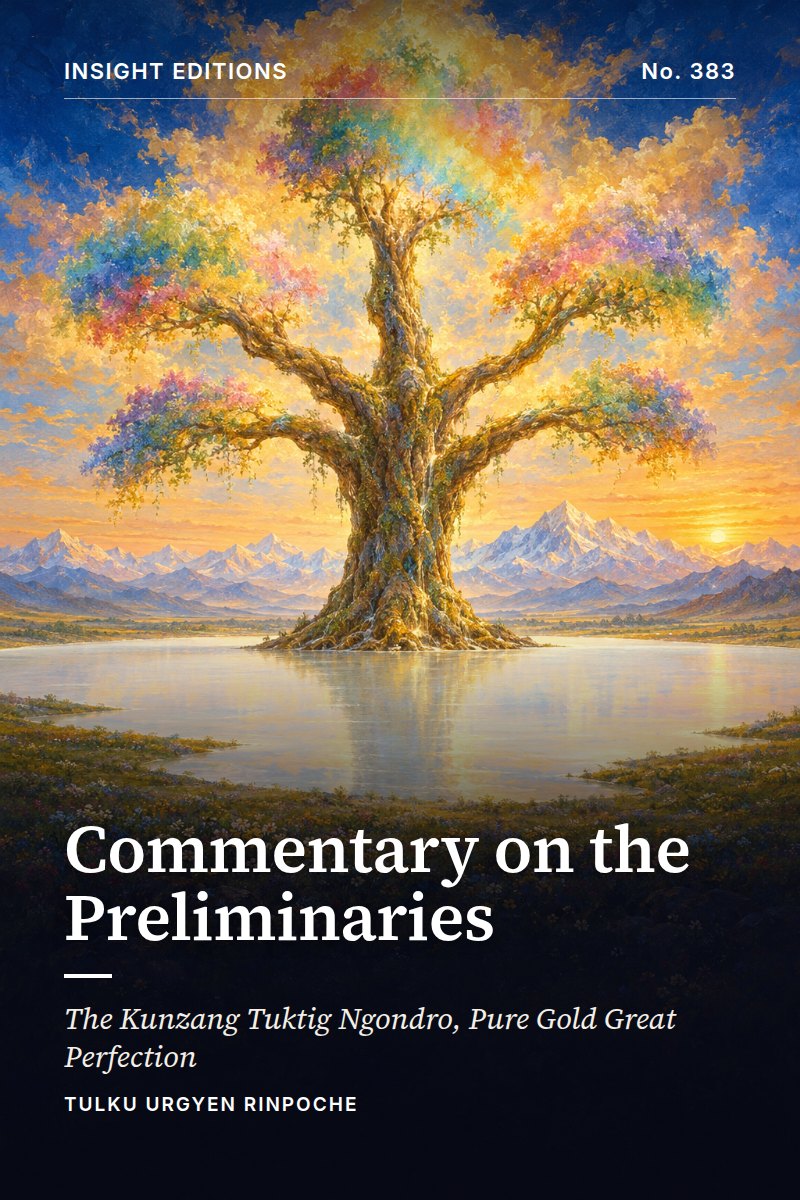
The universe is smooth like a vast mirror, strewn with flowers. In its centre is a milk-white lake of nectar with eight qualities; in the lake grows a wish-granting sandalwood tree from the north slope of Sumeru, with five branches.
| Position | Who | Surrounded by |
|---|---|---|
| Centre | Root teacher as Guru Padma | Mind, sign and hearing lineages |
| Right | Shakyamuni | Buddhas of ten directions and three times |
| Behind | Nine vehicles | Golden letters on lapis, self-resounding |
| Left | Manjushri | Eight close sons, shravakas, pratyekabuddhas |
| Front | Vajrasattva | Deities of the outer and inner tantras |
| Between | Dakinis, guardians | "Like cloud banks" |
The texts are self-resounding: "the AH is saying AH AH AH and the OM is saying OM OM OM."
Who Takes Refuge
Before the field sit you and your parents, fathers on the right, mothers on the left, enemies in front as "the support for cultivating patience," and all beings around. One multiplies oneself "a million-fold." The mood is of someone begging clemency before an executioner, with samsara as a prison.
The Kunzang Tuktig verse takes refuge in the empty essence, dharmakaya, the cognizant nature, sambhogakaya, and the manifold capacity, nirmanakaya. The ninefold object (Three Jewels; lama, yidam, dakini; three kayas) is included in the three kayas.
Refuge lasts until the level of a great bodhisattva. "Then you are a refuge and protector to yourself, that is the final guideline." At the session's end, light purifies all beings and the field dissolves into Guru Rinpoche, whose mind mixes with yours.
Bodhichitta
"Turning away from the lower paths, the root of the Mahayana path is developing bodhichitta." The refuge field stays as witness, and the verse aims at the dharmakaya of self-existing awareness through the Great Perfection.
Two Kinds
Rinpoche calls the two bodhichittas "the essence of the path."
Equal to Space
Kha-nyam, "equal to space": as far as space reaches, it is filled with beings, and "as far as sentient beings pervade there are karmas and disturbing emotions." The aim is not only to free them but that they realize the self-existing wakefulness they already have. That wish is the ultimate bodhichitta.
- Recite as many times as possible.
- Receive light from the field, purifying you and all beings.
- Absorb: beings into the field, the field into you.
- Rest in equanimity, then dedicate.
Refuge protects one from wrong paths; bodhichitta turns away from the lower paths. Hinayana has refuge, but Mahayana "is superior in having the development of bodhichitta."
Vajrasattva
The special preliminaries begin by clearing away negative circumstances, meaning evil deeds. The method is Vajrasattva with the four powers, of which the commentary names object, remorse and applied antidote.
The Visualization
AH, "the syllable of nonarising, the letter of dharmadhatu," opens the practice. Above the head on a lotus and moon is Vajrasattva, the wisdom form of all buddhas. Vajra means emptiness and sattva compassion; their unity is great bliss. He is white like the autumn moon, the most radiant moon of the year.
- Vajra and bell. The vajra of awareness-emptiness in the right hand, the bell of appearance-emptiness in the left.
- Atopa. He embraces the consort, "his own light."
- Legs. Means and knowledge in vajra posture, in a sphere of bindus and rainbow light.
Remorse and Antidote
Remorse is feeling "sick at heart" about past actions. The applied antidote is mantra plus visualization, "like washing away dirt." At his heart, on a moon, is HUNG ringed by the Hundred Syllables, written counter-clockwise like a coiled snake but turning clockwise.
The nectar enters through the aperture of Brahma (Rinpoche points to his crown) and clears damaged samayas and the three obscurations: cognitive, emotional and habitual. This is the special inner purification of mantra called "the downpour and purification by nectar."
After the apology, Vajrasattva smiles and says: "Son of noble family, all your actions, obscurations, and failings are purified." He melts into you and blesses your nature. The long form uses the Lamenting Apology of Rudra.
The Mandala Offering
Vajrasattva removes the negative; the mandala increases the positive. The field is visualized as in refuge, and the plate in your hand with its five heaps stands for the whole universe.
Thirty-Seven Heaps
The extensive offering has thirty-seven heaps, starting OM VAJRA BHUMI AH HUNG: the golden ground, the ring of iron mountains, Sumeru, the four continents and eight subcontinents, the seven royal possessions and treasure vase, eight offering goddesses, sun, moon, parasol and banner. Rinpoche credits it to the Sakya master Chogyal Rinpoche; it later spread through all four schools. Atisha wrote the short form, "The earth is perfumed with scented water."
- Guru, root of blessings.
- Yidam, root of accomplishment.
- Protectors, root of activity.
Four Mandalas
The mandala that is counted is a terma verse with "tremendous blessing," offering the three worlds, vessel and contents, body, luxuries and all virtues. Material and imagined offerings go together: the plate is the example, and one offers as much as one can imagine.
| Mandala | What is offered |
|---|---|
| Outer, "of the perceived" | The universe: Sumeru, continents, wealth of gods and humans |
| Inner, "of the holder" | The bodies and speech of yourself and all beings |
| Secret | All discursive thoughts, 84,000 in each being |
| Thatness | Rigpa, the self-existing wakefulness every mind has |
Body is purified by prostrations, speech by the Hundred Syllables, mind by the mandala. Guru yoga then purifies all three together. The offering is unceasing like the sky: "not something that you sometimes offer and sometimes don't."
Guru Yoga
Guru yoga is "the root of blessings." The root guru appears as Vajrasattva, embodiment of all families, holding a whole mandala within his body, and the practice proceeds from supplication to mantra to empowerment.
The Field in One Body
The guru as white Vajrasattva sits in the playful posture. In his heart is Samantabhadra with the peaceful deities; in his throat, Padma Gargyi Wangchuk (Avalokiteshvara) with five dakas and five dakinis; in his skull, "the bone palace," Palchen Heruka with the wrathful ones. Padmakara sits above with the Dzogchen lineage. The Eight Sadhana Teachings fill the eight directions, and protectors of male, female and nondual classes are below.
All appear as "the appearing, yet empty display of the Magical Net," gyutrul drawa: gyu, magical, the male aspect; trul, creation, the female; drawa, net, the countless retinue and emanations. Like a rainbow, they are visible yet without self-nature.
Seven Branches
| Branch | Remedies, by Rinpoche's count |
|---|---|
| Homage, offering, apology, rejoicing, request, asking to remain, dedication | Seven main disturbing emotions: ignorance, passion, aggression, delusion, arrogance, envy, greed |
To practise all seven "is equal to performing a lengthy ritual." Then comes absolute bodhichitta: "I and all beings of the six classes are buddhas from the very beginning," which means to remain in the continuity of the view.
Lineage and Four Visions
The supplication runs from Samantabhadra, Vajradhara ("the sixth," sambhogakaya adorned) and Vajrasattva through Garab Dorje, "the teacher of human beings," Manjushrimitra, Shri Singha, Padmasambhava, Mandarava, Yeshe Tsogyal, Damdzin, son of King Trisong, later Chokgyur Lingpa, to the root guru.
- Elaborate: outer accomplishment by supplication, the short form counted 110,000 times.
- Unelaborate: inner accomplishment by recitation, OM AH HUNG GURU SHRI VAJRA SATTVA HUNG.
- Very unelaborate: the ultimate guru yoga of simplicity.
Four Empowerments
The retinue dissolves into Vajrasattva. From his four places, marked OM AH HUNG HOH, light enters your crown, throat, heart and navel: the vase, secret, knowledge and precious word empowerments, called path empowerments.
Simplicity and Dedication
The last move is the simplest. The master "who embodies all objects of refuge" dissolves into you, and you rest in awareness and emptiness free of the three times. Dedication and auspiciousness close the session.
All-Ground or Dharmakaya
Rinpoche's gloss is short and exact. "When there is fixation, it then turns into the all-ground and when there is no fixation, it is called dharmakaya." The contrived all-ground is neutral; here the all-ground is unfabricated, and the mind free of fixation is rigpa, nondual awareness.
After this one enters the development stage, detailed or brief, or the main practice of Trekcho and Togal. "You have to do all of these." The preliminaries end exactly where the main practice begins: in awareness.
Dedication and Auspiciousness
"Unexcelled" dedication is beyond dedicator, dedicated and object, the threefold purity. One aspires to exhaust the two obscurations, perfect the two accumulations of conceptual merit and nonconceptual wisdom, and awaken as unified Vajradhara, where kaya as base and wisdom as based are one. The four lines of auspiciousness name essence, nature, capacity and their indivisibility, Samantabhadra, which all beings already have.
The colophon credits Khenpo Rinchen Dargye, a disciple of the tertön, who composed the liturgy at Riwoche at Jedrung Rinpoche's request. Its last instruction: pass the breaks in activities that accord with Dharma, "as many virtuous activities as possible."
Master Takeaways
One 1982 talk covers the whole ngondro. Its method is plain glosses and vivid examples, and its constant thread is that every step rests on self-existing wakefulness.
Twenty Takeaways
- The preliminaries are two parts: general and special.
- Refuge, bodhichitta, renunciation each mark a dividing line.
- Freedom means free time to practise.
- Dharma exists only in the abiding kalpa.
- The body is old chinaware.
- One breath separates you from a corpse.
- All gathering disperses, like Norbu Sangpo's mules.
- The senses are bait: moth, deer, bee, fish, elephant.
- Karma follows like a shadow.
- Only rigpa ends karma; no one paints the sky.
- Drop nonvirtue and virtue appears by itself.
- The noble feel the hair in the eye.
- Enemies in the refuge field train patience.
- The three kayas contain every refuge.
- You end as your own refuge.
- Absolute bodhichitta is staying in the view.
- Vajrasattva clears, mandala gathers, guru yoga blesses.
- Thoughts themselves are an offering.
- Seven branches answer seven emotions.
- No fixation, and the all-ground is dharmakaya.
Frameworks in the Text
| Framework | Content | Sec. |
|---|---|---|
| Two parts | General and special preliminaries | 1 |
| Eight freedoms, ten advantages | Conditions for practice | 2 |
| Four phases of a kalpa | Creation, abiding, destruction, void | 2 |
| Four ends | Birth, hoarding, meeting, building | 3 |
| Five sense traps | Moth, deer, bee, fish, elephant | 4 |
| Three sufferings | Suffering upon suffering, change, formation | 5 |
| Refuge tree | Five branches | 6 |
| Two bodhichittas | Relative and absolute | 7 |
| Four powers | Object, remorse, antidote | 8 |
| Four mandalas | Outer, inner, secret, thatness | 9 |
| Three roots | Blessing, accomplishment, activity | 9 |
| Seven branches | Remedy for seven emotions | 10 |
| Four empowerments | Vase, secret, knowledge, word | 10 |
This is a transcript of tape recordings with gaps ("tape shift," "one line not understood"), and only three of Vajrasattva's four powers are named. Several claims, such as the eight unfree states and kalpa arithmetic, come from the traditional cosmology and are presented without discussion. The guide assumes empowerment and a teacher; it explains the liturgy but does not replace transmission.
Who's Who
| Name | Role |
|---|---|
| Padmasambhava | Source of the terma; centre of the refuge field |
| Chokgyur Lingpa | Revealer of Kunzang Tuktig; rebirth of Prince Damdzin |
| Vajrasattva | Purification deity; form of the guru |
| Samantabhadra | Dharmakaya buddha at the guru's heart |
| Garab Dorje | First human Dzogchen teacher |
| Manjushrimitra, Shri Singha | Early Dzogchen lineage masters |
| Mandarava, Yeshe Tsogyal | Consorts of Padmasambhava |
| Milarepa | Quoted on the single breath |
| Chogyal Rinpoche (Sakya) | Credited with the 37-heap mandala |
| Atisha | Author of the short mandala verse |
| Khenpo Rinchen Dargye | Compiler of the liturgy |
Connect It
The Leyjang commentaries explain the main sadhana these preliminaries prepare for, in the same Kunzang Tuktig cycle. Ultimate Dzogchen shows Rinpoche's view of why purification is still needed even after recognition.