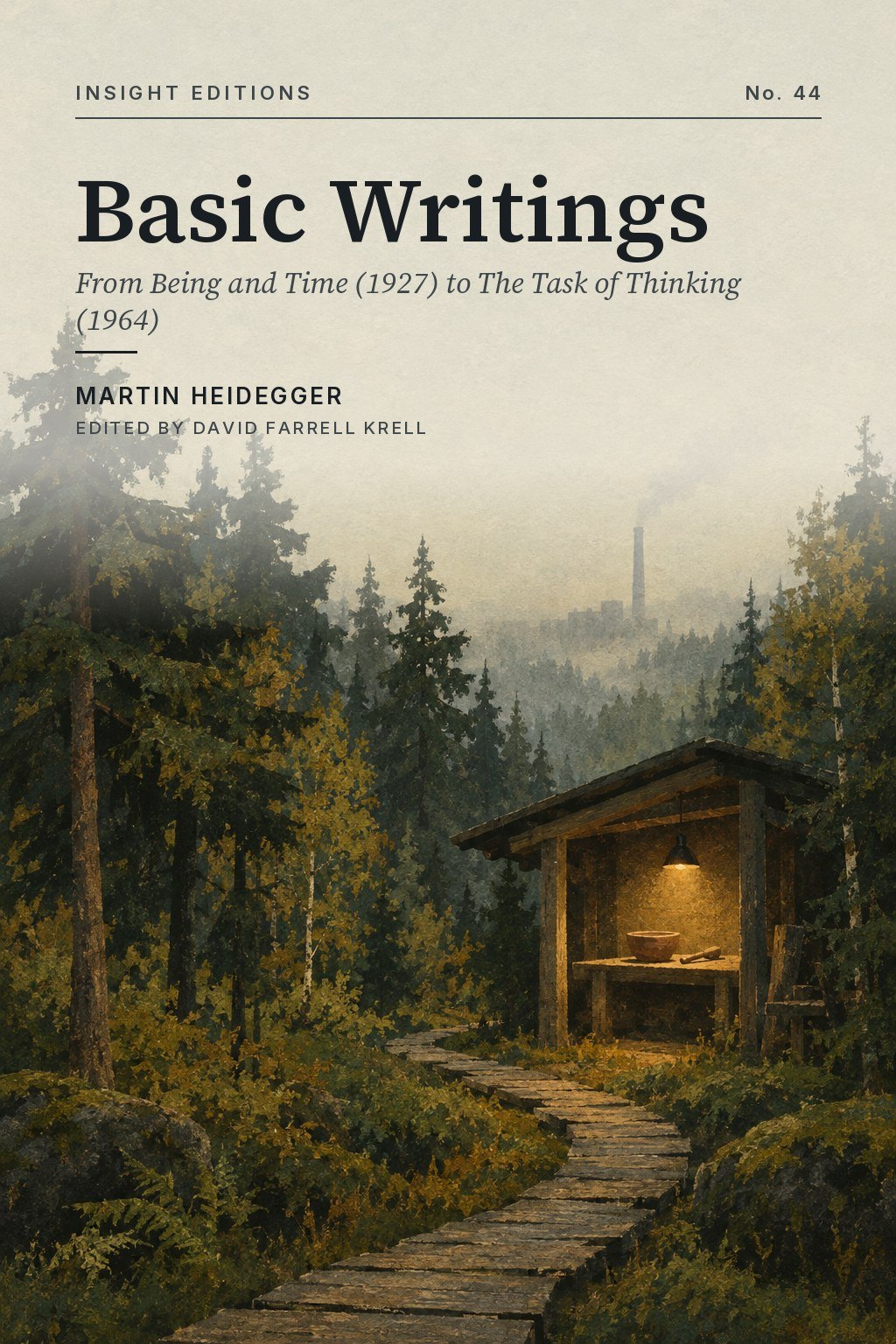
Insight Editions · No. 44
Basic Writings
From Being and Time (1927) to The Task of Thinking (1964)
Martin Heidegger · Edited by David Farrell Krell
Martin Heidegger’s essays trace the question of Being through human existence, truth, art, language, dwelling, science, and modern technology.
A study guide to Basic Writings by Martin Heidegger, edited by David Farrell Krell. Shared free for personal reading; not for sale and not endorsed by the authors or publishers. Please read and buy the original.
The Book in Brief
The argument in brief
- Ask the question again. Being and Time (Reading I) revives "the question of the meaning of Being", starting from Dasein, the being that understands Being, and plans a "destructuring" of the history of ontology.
- The nothing and the whole. In anxiety beings as a whole slip away and the nothing shows itself; metaphysics asks "Why are there beings at all, and why not far rather Nothing?" (Reading II).
- Truth as freedom and unconcealment. Correctness rests on openness; "the essence of truth is freedom", letting beings be, and untruth and errancy belong to truth (Reading III).
- Art and the world. A great work "sets up a world and sets forth the earth"; truth happens in it (Reading IV).
- Against humanism, for the human. Every humanism is metaphysical; man is "the shepherd of Being", and "language is the house of Being" (Reading V).
- Science, technology, dwelling. Modern science is a mathematical projection (VI); technology is enframing, which turns everything into standing-reserve (VII); building rests on dwelling within the fourfold (VIII).
- Thinking, language, clearing. "We are still not thinking" (IX); language is a saying that shows (X); philosophy has reached its end, and the task is to think the clearing (XI).
The argument map: one question carried from Dasein through truth, art and technology to language and the clearing.
How the book is built
Krell's Preface and long General Introduction set out Heidegger's life, the unfinished Being and Time project and the "turning". The readings then run chronologically by composition, except Reading VI, a 1935-36 lecture placed after the 1946 Letter. Each opens with Krell's headnote, which often raises the sharpest objections itself.
| Ch | Title | In one line |
|---|---|---|
| Pref. | Preface | How the selection was made, with Heidegger's advice, 1974-75. |
| Intro. | The Question of Being (Krell) | Life, Being and Time, the turning, and the political record. |
| I | Being and Time: Introduction | The question of Being, Dasein, phenomenology, destructuring. |
| II | What Is Metaphysics? | Anxiety reveals the nothing; metaphysics asks why there is anything. |
| III | On the Essence of Truth | Correctness rests on freedom, letting beings be, and errancy. |
| IV | The Origin of the Work of Art | The work sets up a world and sets forth the earth. |
| V | Letter on Humanism | Against Sartre: ek-sistence, the shepherd of Being, ethics as abode. |
| VI | Modern Science, Metaphysics, and Mathematics | The mathematical projection, Newton's first law, Descartes. |
| VII | The Question Concerning Technology | Enframing, standing-reserve, the danger and the saving power. |
| VIII | Building Dwelling Thinking | To be is to dwell; the bridge gathers the fourfold. |
| IX | What Calls for Thinking? | We are still not thinking; memory, the hand, the call. |
| X | The Way to Language | Language as a saying that shows, grounded in propriation. |
| XI | The End of Philosophy and the Task of Thinking | Philosophy completed in the sciences; the clearing remains to be thought. |
Coverage map: eleven readings, one question
The Being-question is the spine; Being and Time's Introduction (Reading I) states it; Readings II-XI relocate it after the "turn" into truth, art, humanism, science, technology, dwelling, thinking, language and the end of philosophy.
Companion volume
Use it whenever Readings I, II, IV or V gesture at care, death, equipment or Mitsein without rehearsing the full analytic. This No. 21 volume is the anthology path from 1927 to 1964.
How the Selection Was Made
- What is in it. Eight complete essays, two uncut excerpts from larger works and one abridged piece, arranged in order of composition except Reading VI ("Modern Science, Metaphysics, and Mathematics").
- What is new in the revised edition. "The Way to Language" (Reading X) is added as Heidegger's most concise account of language and Ereignis; "The Origin of the Work of Art" now appears complete with its Epilogue and 1956 Addendum; key terms are made consistent, so Lichtung is "clearing" and Ereignis is "propriation".
- Who approved it. Heidegger studied the plan in the winter and spring of 1974-75 and suggested inclusions, but Krell insists the plan is not "authorized". J. Glenn Gray served as the volume's general editor and "tutelary genius".
- What was left out. The essays on the history of Being and on the great thinkers (Heraclitus, Parmenides, Plato, Aristotle, Leibniz, Kant, Hegel, Nietzsche) were cut for space. Krell's anthologist's plea: gatherers "cannot know or cull the entire garden".
| If your field is | Krell suggests starting with |
|---|---|
| Natural sciences | VI Modern Science, then VII Technology, then II and I |
| Fine arts | IV Origin of the Work of Art, then VIII Building Dwelling Thinking |
| Languages and literature | X The Way to Language |
| Theory of knowledge | III On the Essence of Truth |
| History or politics | V Letter on Humanism |
| No teacher, no plan | IX What Calls for Thinking? |
Krell argues that the later essays refine the project announced in Being and Time (1927), so reading in printed order up to "The End of Philosophy" (1964) is best. Yet Heidegger discouraged biographical fixation and asked readers to question "for the sake of thinking" (zur Sache des Denkens), so the sequence is not a matter for strict observance. Five translations were made for this volume: Being and Time Introduction (Joan Stambaugh with Gray and Krell), What Is Metaphysics? (Krell), On the Essence of Truth (John Sallis), Letter on Humanism (Frank A. Capuzzi with Gray and Krell) and The Way to Language (Krell). "Man" renders der Mensch, "the human being".
What this guide includes and leaves out
Krell's preface stresses that the volume grew from conversations with Heidegger and aims at the essays Heidegger himself wanted English readers to meet. It is not a collected works and not a substitute for Being and Time as a whole. For politics and notebooks outside the selection, trust the critical lenses more than the preface's pre-2014 frame.
The Question of Being (Krell's General Introduction)
A gift too difficult: Brentano and Aristotle (1907)
In summer 1907 the pastor of Trinity Church in Constance gave the seventeen-year-old Heidegger Franz Brentano's dissertation On the Manifold Meaning of Being according to Aristotle (1862). Heidegger later called it "the chief help and guide of my first awkward attempts to penetrate into philosophy". Brentano built his study on Metaphysics VI, 1 (1026a 33ff.), which reduces the many senses of "being" to four.
The 1907 gift: Brentano's dissertation on Aristotle's manifold senses of being.
- Essential and inessential being (being per se and accidental being).
- Being in the sense of the true.
- Being as potentiality and actuality.
- Being according to the schema of the categories.
Elsewhere the Metaphysics multiplies the list (being as substance, property, privation, movement, generation and corruption). Yet Aristotle insisted all these senses point to one dominant sense, the way everything "healthy" relates to health, and that one science should study "being insofar as it is being". The question "ti to on, What is being?" was, in Aristotle's words, raised "in earliest times" and "will always be raised". Heidegger's version: "If being is predicated with manifold significance, then what is its leading, fundamental signification?"
Krell adds the human detail: the boy was the firstborn son of the Messkirch sacristan, rang the church bells, was studious and devout, and preferred swimming and skiing to almost everything else.
An untimely question
The question was what Nietzsche called untimely. Auguste Comte's Discours sur l'esprit positif (1844) had declared that reason, after theology and metaphysics, was entering its positive third phase, which dismissed ontology as "chimerical, arbitrary, vague, and idle". Critics attacked from within too: Kierkegaard scorned Hegel's system as between "a fairy tale and a swindle"; Dostoevsky's heroes asked whether God could be forgiven a world where innocents are murdered; and Nietzsche (in Twilight of the Idols, written in 1888) called metaphysics' highest concepts "the last wisps of evaporating reality".
Apprenticeship: theology, logic, Husserl (1909-1919)
1909-10 Borrows Husserl's Logical Investigations from the library, hoping for help with being; the hope fails, but "phenomenology" intrigues him.
1911 After four semesters, makes philosophy his major; reads Hölderlin, Rilke, Trakl, Dostoevsky, Kierkegaard and Nietzsche's Will to Power.
1912 First article attacks epistemology-obsessed modern "schools"; backs a tentative "critical realism" between Mach's sensationism and Berkeley-Kant immanentism.
1913 Doctorate under Heinrich Rickert: The Doctrine of Judgment in Psychologism, against reducing logic to psychology.
1914 Enlists; discharged after two months for health reasons.
1915 Completes the Habilitationsschrift on Duns Scotus' Doctrine of Categories and Theory of Meaning; lecture "The Concept of Time in the Science of History" (27 July).
1916 Rickert leaves for Heidelberg; Husserl takes the Freiburg chair.
1917 Marries Elfride Petri; serves in military mail, then a meteorological station near Verdun until the Armistice. Sons born 1919 and 1920.
Apprenticeship: from theology through logic to Husserl's phenomenology.
The dissertation's real interest was not psychologism but the being of validity, especially in negative and impersonal statements. Krell stresses that the young Heidegger already doubted that scientists needed epistemology at all: no researcher in microbiology or astronomy worried that they studied "mere sensations" or shadows cast by an evil genie. He wanted "positively progressive work" that would pose new problems for the natural and historical sciences.
The Scotus thesis pointed forward to Being and language: "doctrine of categories" names the Being of beings, and its "theory of meaning" belonged to grammatica speculativa. The text Heidegger studied was by Pseudo-Scotus, now known to be Thomas of Erfurt. Its 1916 conclusion said logic needs a "translogical" context where philosophy meets history, and that "the epistemological Subject does not express the most meaningful sense of Spirit". The opponent in view was now Hegel, "the German Aristotle". Krell's image: a Thesean struggle of Greek ontology against "the Cartesian minotaur".
Husserl's workshop and the turn to the Greeks
Husserl taught in a "workshop" through "a step-by-step training in phenomenological 'seeing'", refusing appeals to authority. That method shed light on Aristotle's on hos alethes, "being in the sense of the true", which Heidegger later called "the presence of what is present in unconcealment"; the decisive help was Husserl's distinction between sensuous and categorial intuition in the Sixth Investigation. But as Husserl built transcendental phenomenology (Ideas I, 1913), the paths split. From 1919 Heidegger saw in Husserl's "transcendental subjectivity" the inheritance of Descartes, and he concluded that what phenomenology calls self-manifestation was "thought more originally by Aristotle ... as aletheia". The decisive matter: "consciousness and its objectivity, or the Being of beings in its unconcealedness and concealment?"
Marburg, 1923-1928: "one can perhaps learn to think"
The Marburg years: lecture courses that fed straight into the 1927 book.
A premature birth: Being and Time (1927)
In winter 1925-26 the dean burst in: "You have to publish something, right now." The Berlin ministry had refused Heidegger the chair vacated by Hartmann because he had published no book in a decade. Two sets of proofs of Sein und Zeit, dedicated to Husserl, came back marked "Inadequate". When the book appeared in February 1927, the ministry relented. It was incomplete: only Part One appeared, and that without its third division.
- Phenomenological seeing. From Husserl: loyalty to "the things themselves" and careful description; the logos of phenomenology must "make manifest" how phenomena show themselves (BT §7).
- Truth as unconcealment. From Metaphysics IX, 10 and Nicomachean Ethics VI: making manifest is uncovering, so truth (aletheia) is not correctness of assertions but the self-showing that makes assertions possible.
- Being as presence. Unconcealment shows that the leading sense of Being, from Aristotle onward, is presence (Anwesenheit). So the question of Being requires an inquiry into time.
Where should the inquiry start? With the being that asks the question. In 1935 Heidegger admitted it could start with "an elephant in the jungles of India or combustion on Mars", yet only one being is always available: the human questioner, named Dasein. The book refuses to describe Dasein with categories fit for elephants and combustion. Dasein has logos in the sense of the power to gather and preserve what is manifest, and this happens first in ordinary dealings: we lift a hammer to drive a nail so rain won't penetrate, signal a left turn so the driver behind can brake. These implicit contexts, visible when the hammer breaks or the bulb burns out, are world.
Jaspers and the need for method
Between 1919 and 1921 Heidegger reviewed Karl Jaspers's Psychology of Worldviews. Jaspers described limit situations (struggle, death, accident, guilt) that drive the psyche to extremes. Heidegger admired the analyses of guilt and death, which shaped famous sections of Being and Time, but charged that Jaspers "failed to recognize the genuine methodological problem": he used Spirit, totality and infinity without examining their history. The lesson: because Dasein is historical, its ontology must be hermeneutical and must destructure (dismantle) the inherited conceptual apparatus of a tradition that "has all the answers but no longer experiences the questions". The review's word for self-concern, Bekümmerung, anticipates care (Sorge).
Care as the unity of three temporal moments; death is the possibility that gathers them into a whole.
Each structure of care has a temporal sense, and Division Two reads all of Division One through time, grasping Dasein whole "from birth to death". Death "invades my present, truncates my future, and monumentalizes my past". Heidegger defines it as "the most proper, nonrelational, insurmountable possibility" (SZ §50, p. 250).
The finitude was not merely academic. While Heidegger lectured on death on 2 May 1924, his father died in Messkirch after a stroke; he brought one of the first printed copies of Sein und Zeit to his mother's sickbed nine days before her death on 3 May 1927. Gadamer notes that Heidegger described human existence positively, not as "merely finite" against an infinite Being. For Krell, this is why the later work does not abandon Dasein: it studies "the limits within which beings as a whole come to appear".
Freiburg, Davos and the rectorate
In 1928 Heidegger succeeded Husserl at Freiburg. Kant and the Problem of Metaphysics (1929) confronted the neo-Kantian reading of Kant, and at the Davos Disputation (April 1929) the urbane Ernst Cassirer denied "essential differences" while Heidegger insisted on them. Krell sides with Heidegger: Cassirer could never accept the "basic experience" of "What Is Metaphysics?".
From Freiburg chair to rectorate and resignation.
3-4 May 1933 Local papers announce his entry into the NSDAP; Kampf, "military service" and "the destiny of the German Volk" enter his addresses.
Nov 1933 Speaks for Hitler's policies before the Reichstag elections of 12 November, after Germany left the League of Nations.
1933-34 Becomes "instrumental" in the Gleichschaltung (synchronization) of the university with the party-state.
Feb 1934 Resigns the rectorship after administrative and political wrangles.
Mid-1930s Criticizes Blut und Boden ideology in lectures; party critics restrict his publishing and travel.
Summer 1944 Declared the most "expendable" faculty member, sent to dig trenches on the Rhine, then drafted into the Volkssturm.
1945-1951 French occupation and the faculty senate bar him from teaching; the ban is lifted in 1951, a year before retirement.
Krell's judgment: the active collaboration lasted ten months, followed by passive support and disillusionment. His postwar silence about atrocities against Jews and other peoples, while he lamented his divided fatherland, has "shocked and confused everyone". "That his early engagement in the Nazi cause was a monstrous error all concede; that his silence is profoundly disturbing all agree"; whether both sprang from his thought "remains a matter of bitter debate". He warns against two easy exits: purging the shelves of "difficult authors from Plato through Hegel and Nietzsche", or closing one's eyes.
Timeline of the path this volume follows
Krell's General Introduction is itself a short intellectual biography.
How to use the lenses while reading Krell
Krell wrote before the Black Notebooks (GA 94-96, 2014) and softens some chronologies. Read the Introduction for the gift of the Being-question; read the lenses for the costs of the path.
Teaching to the end
From 1928 to 1945 Heidegger lectured on Kant, Hegel and Schelling, on Hölderlin (1934-35; Rome lecture "Hölderlin and the Essence of Poetry", 1936), and gave five courses on "the essence of truth" between 1931-32 and 1940, yielding Plato's Doctrine of Truth and On the Essence of Truth (1942-43). Late in the 1930s came five courses on Nietzsche, his largest publication, then Heraclitus, Parmenides and Aristotle again. He taught Aristotle more than anyone else. After the war he wrote on technology and language, visited Provence (1958, 1969) and Greece (1962, 1967), and kept friendships with Heisenberg, Bultmann, Binswanger, Boss, Frankl, Arendt, René Char and Braque. He died in Freiburg on 26 May 1976, still working on this volume and the Gesamtausgabe (begun 1975).
One way, many woodpaths
One question, many woodpaths: the readings as paths through a single forest.
Otto Pöggeler pictured a single way "into the neighborhood of Being"; Walter Biemel stressed restlessness: "Every resting point is shaken", and where Descartes sought an unshakable foundation, Heidegger puts that foundation in question. The double theme is Sein (coming to presence, shadowed by absence) and aletheia (unconcealment, shadowed by Lethean concealment); the propriative event (Ereignis) is always also expropriative (Enteignis).
Heidegger's own image is Holzwege, "woodpaths": forest tracks that "end quite suddenly in an impenetrable thicket", known to woodcutters and foresters. The French title Chemins qui ne mènent nulle part ("ways that lead nowhere") is not quite right: they always lead somewhere, but not predictably. Krell closes on why the question is not bloodless: to ask what is happening with man on earth "not in terms of headlines", to keep a critical spirit that can say No without puncturing its Yes, and to see that surrendering Being's many senses to "a sterile uniformity" makes us immeasurably poorer.
Being and Time: Introduction (1927)
Krell's headnote compares the Introduction to Hegel's Preface to the Phenomenology of Spirit: it opens a path to all the later work. He reads Dasein (from Dass-sein, "the that-it-is") as human existence "in the emphatic sense (as standing out)", and stresses that the destructuring of the tradition, planned for Part Two, took more of Heidegger's later energy than any other task. It starts with the moderns (Descartes, Kant) and works back to Aristotle.
§1 Why the question must be recovered
The question that drove Plato and Aristotle, a "Battle of Giants concerning Being" (Sophist 245e), went silent after them and survived only in "camouflaged" forms down to Hegel's Logic. A dogma now blocks it, built on three prejudices, each of which Heidegger turns into a reason for asking.
Three prejudices that let the question of Being fall silent.
| Prejudice | Source | Heidegger's reply |
|---|---|---|
| Being is the most universal concept | Aristotle; Aquinas: being is what "first falls under apprehension" | Its universality is not that of a genus ("Being is not a genus"); it is a transcendens with the unity of analogy. So it is the most obscure concept, not the clearest |
| Being is undefinable | Definition by genus and specific difference; Pascal: to define being you must say "It is ..." | This shows only that Being is not a being. Undefinability compels the question rather than dismissing it |
| Being is self-evident | Everyone understands "The sky is blue", "I am happy" | Average comprehensibility shows an enigma a priori; Kant called such "covert judgments of common reason" the business of philosophers |
The translator's note explains the key word Wiederholung: not mere repetition but fetching something back as a new beginning, like a musical recapitulation; "retrieval" or "reprise" would also serve.
§2 The formal structure of the question
Every question is a seeking guided beforehand by what is sought. Heidegger splits any explicit question into three moments, and maps each onto the question of Being.
The formal structure of any question, applied to Being.
- What is asked about (das Gefragte): Being, "that which determines beings as beings". The first step is to avoid "telling a story" (mython tina diegeisthai, Sophist 242c), that is, explaining beings by tracing them to another being.
- What is interrogated (das Befragte): beings, questioned with respect to their Being. Which being should be interrogated first?
- What is to be ascertained (das Erfragte): the meaning of Being, which needs its own kind of concepts, distinct from those for beings.
- The questioner. Questioning is itself a way of being of a being, we ourselves: Dasein.
We already live in a vague, average understanding of Being: when we ask "What is 'Being'?" we stand in an understanding of the "is" we cannot define. This vagueness is a positive phenomenon. Being is found in thatness and whatness, reality, Vorhandenheit, subsistence, validity, existence and the "there is" (es gibt).
The editor's note on Dasein: since Christian Wolff (1679-1754) it meant existence (Dass-sein) as opposed to essence (Was-sein); around 1860 Darwin's "struggle for life" became Kampf ums Dasein. Heidegger reserves it for the existence that understands its Being, never for things at hand (Vorhandenheit, Zuhandenheit), and later hyphenates it Da-sein, "there being". Around 1700 the word meant simply presence (Anwesenheit).
§3 The ontological priority: sciences rest on ontology
Sciences carve out regions (history, nature, space, life, human being, language) using fundamental concepts that prescientific experience has already shaped. "A science's level of development is determined by the extent to which it is capable of a crisis in its basic concepts." Heidegger lists the crises of his day.
Ontological priority: sciences rest on regional ontologies, which rest on fundamental ontology.
- Mathematics. A "crisis in its foundations": formalism versus intuitionism over access to its proper object.
- Physics. Relativity seeks nature's coherence "in itself" and faces the problem of matter.
- Biology. Getting behind mechanism and vitalism to redefine "organism" and "life".
- History and the humanities. Literary history is to become the history of critical problems.
- Theology. Recovering Luther's insight that dogma rests on a foundation that distorts faith's own questions.
- Upshot. Real progress lies not in handbooks of results but in revising basic concepts.
Ontology must leap ahead ("productive logic") into a region of Being and hand the sciences "lucid directives", as Plato and Aristotle did, rather than "limping along behind" as a logic of method. Kant's real achievement was an a priori logic of the region of Being called nature, not a theory of knowledge. But every ontology, however rich its categories, "remains fundamentally blind" if it has not first clarified the meaning of Being.
§4 The ontic priority: Dasein is the being that understands Being
Dasein's threefold priority makes it the being to interrogate first.
- Existence. The Being to which Dasein relates is existence; Dasein's essence lies not in a what but in having "always to be its Being as its own".
- Existentiell versus existential. Choosing, stumbling into or growing up in possibilities is existentiell (an ontic affair, settled by living). Analysing the structures of existence is existential; the nexus of structures is existentiality.
- Three priorities. Ontic: Dasein is defined by existence. Ontological: it is in itself "ontological". Ontic-ontological: it understands the Being of beings unlike itself, so it is the condition of all ontologies. Hence fundamental ontology must be sought in the existential analysis of Dasein.
- Roots. The existential analysis is itself rooted in the existentiell: philosophy must be grasped as a possibility of each existing Dasein.
Aristotle saw this early: "the soul is in a certain way beings" (De anima III, 8; Krell notes the Teubner edition drops the usual "all"). Aquinas derived the transcendental verum by appeal to the soul as "the being whose nature it is to meet with all other beings". Heidegger warns that this priority has "nothing in common with a vapid subjectivizing" of beings.
§5 Dasein as the horizon, and time as the answer
Dasein is "ontically closest to itself, while ontologically farthest away": it reads itself back from the world it is absorbed in. So no dogmatic idea of reality may be forced onto it; it must show itself "on its own terms", in its average everydayness. The analysis is incomplete (only "parts" for a possible anthropology) and preliminary: it must be repeated on a higher ontological basis.
The argument of §5: from everyday Dasein to the Temporality of Being.
- Thesis. "The meaning of the Being of that being we call Dasein proves to be temporality."
- Against the common concept. The ordinary notion of time, from Aristotle to Bergson, must be derived from temporality, which restores its "rightful autonomy", contrary to Bergson's thesis that common time "is really space".
- Time as a naive criterion. We sort beings into temporal (nature, history), atemporal (space, number) and supratemporal (the eternal), and separate timeless meaning from temporal statements, without ever asking why time sorts regions of Being.
- "Temporal." If Being itself is grasped from time, even the atemporal is temporal in its Being. Heidegger reserves temporale and Temporalität des Seins for this.
- No free-floating result. The answer is no "blind proposition"; it is positive only if it is "old enough" to let us learn possibilities prepared by the ancients.
§6 Destructuring the history of ontology
Temporality grounds historicity, which is prior to world history. Dasein "is its past", which "does not follow after Dasein but rather always goes already ahead of it". Tradition both feeds and uproots this: it hands its contents over to obviousness, blocks the "wellsprings" of the categories, and pushes us toward exotic "types and standpoints" of philosophy to veil its lack of foundation.
Destructuring runs backward through the tradition to its Greek source.
Descartes leaves undetermined "the meaning of the Being of the sum"; his ego is still the medieval ens creatum, so the "new beginning" carries "a fatal prejudice".
Medieval ontology Greek ontology becomes fixed doctrine, passing via Suárez's Disputationes metaphysicae into modern metaphysics and Hegel.
Greek ontology Being as parousia/ousia, which means "presence": beings are understood from one mode of time, the present; noein and legein (Parmenides, Plato's dialectic, Aristotle) are a pure making present.
Aristotle's treatise on time (Physics IV, 10-14) is the first detailed account of time and governs every later one, Kant and Bergson included.
§7 The phenomenological method
Phenomenology names a method ("the how" of research), not a standpoint or content. Its maxim: "To the things themselves!", against free-floating constructions, borrowed concepts and pseudo-problems. Heidegger rebuilds the word from its two Greek parts.
Phenomenology as a method: two Greek terms, one maxim.
| Term | Meaning | Example or note |
|---|---|---|
| Phenomenon | What shows itself in itself, the manifest (from phainesthai; root pha-, as in phos, light) | The original, positive sense |
| Semblance (Scheinen) | Showing itself as what it is not; a privative modification of phenomenon | phainomenon agathon, a good that only looks good |
| Appearance (Erscheinung) | Something makes itself known through something that shows itself, without showing itself | Symptoms of illness; indications, symbols |
| Mere appearance | What makes known is an emanation that veils what is in itself | Kant's double use of "appearance" |
| Logos | Deloun, apophainesthai: speech that lets something be seen from itself | Not primarily judgment; requesting (euche) reveals differently |
The tangle resolves once one sees that appearance and semblance are both grounded in the phenomenon: "phenomena are never appearances, but every appearance is dependent upon phenomena". A flushed face under certain light seems feverish; redness that makes known fever indicates a disturbance in the organism.
Logos as synthesis means letting something be seen "as something", not connecting mental representations. It can mean reason (letting be apprehended), ground or ratio (legomenon as hypokeimenon), and relation.
- Formal meaning. Apophainesthai ta phainomena: "to let what shows itself be seen from itself, just as it shows itself from itself".
- "Descriptive" phenomenology. Description is a prohibition on nondemonstrative claims, not botanical morphology.
- Its distinctive theme. What does not show itself at first and for the most part yet grounds what does: the Being of beings. "Ontology is possible only as phenomenology."
- Three kinds of covering up. Undiscovered; buried over (once discovered, now hidden); distorted into semblance, "the most frequent and the most dangerous". Each can be accidental or necessary, and any genuine concept can degenerate into a free-floating thesis.
- Hermeneutics, three senses. Phenomenology of Dasein is interpretation (hermeneuein); it works out conditions of all ontological inquiry; and, primarily, it analyses the existentiality of existence. The methodology of the humanities is hermeneutics in a derivative sense.
Being is "the transcendens pure and simple", and Dasein's transcendence carries "the possibility and necessity of the most radical individuation"; phenomenological truth is veritas transcendentalis. Philosophy is "universal, phenomenological ontology" starting from the hermeneutic of Dasein. Heidegger thanks Husserl, whose Logical Investigations made the "breakthrough", and adds: "Higher than actuality stands possibility." He apologizes for the "inelegance" of his language: for grasping beings in their Being, "not only most of the words are lacking but above all the grammar". Compare Plato's Parmenides or Metaphysics VII, 4 with Thucydides' narrative.
§8 The outline of a treatise never finished
| Part | Division | Fate |
|---|---|---|
| One: Dasein interpreted by temporality; time as transcendental horizon | 1. Preparatory fundamental analysis of Dasein | Published 1927 |
| 2. Dasein and temporality | Published 1927 | |
| 3. Time and Being | Never published; partly taken up in Basic Problems of Phenomenology (1927) | |
| Two: destructuring on the guideline of Temporality | 1. Kant's schematism and time | Developed in Kant and the Problem of Metaphysics (1929) |
| 2. Descartes's cogito sum and medieval ontology | Not written as planned | |
| 3. Aristotle's treatise on time | Treated in Basic Problems, §19 |
The planned two-part treatise; only Part One, Divisions 1-2 appeared.
Mineness (Jemeinigkeit) and the existentialia
Reading I's §§4-5 name Dasein as the being that we ourselves "in each case" are. The German term behind that phrase is Jemeinigkeit, mineness: Being is always mine to be, never a specimen of a genus "human" first. From mineness follow the formal marks Heidegger calls existentialia (structures of existence), as opposed to categories (structures of present-at-hand things):
| Existentiale (Dasein) | Category (things) | Point |
|---|---|---|
| Existence (to-be) | Vorhandenheit (presence-at-hand) | Dasein is its possibilities, not a finished object |
| Mineness | Instance of a class | Being is in each case mine |
| Authenticity / inauthenticity | Property present or absent | Modes of existing, not moral stickers |
| Being-in-the-world | A subject inside a container | Unitary phenomenon, not two items glued |
The Introduction only announces these. The published Divisions I-II work them out as care, being-toward-death, conscience and temporality. This anthology stops where Heidegger's own "Introduction" stops.
From Reading I's plan to the unfinished treatise.
Death, care and why the Introduction points ahead
§5 already says the meaning of the Being of Dasein will show itself as temporality, and that Dasein's "average everydayness" is the right first field. What the Introduction does not yet spell out, but what every later reading in this volume presupposes, is the care-structure toward which Division I climbs: ahead-of-itself (existence), already-in (facticity), alongside (falling). Being-toward-death is the existential that makes "ahead-of-itself" concrete: Dasein is not a thing that later ends; it is possibility up to the end. When Reading V calls man the shepherd of Being, or Reading IX says we are "still not thinking", they speak to a being already characterized in Reading I as the one for whom Being is at issue.
Cross-reference map for this volume
| This volume | What Reading I supplies | Where to go deeper |
|---|---|---|
| Reading II (Metaphysics) | Nothing and anxiety begin from Dasein's disclosedness | No. 20 on Angst and care |
| Reading IV (Art) | Worldhood without "earth" | No. 20 on equipment; this vol. on strife |
| Reading V (Letter) | Dasein vs animal rationale | Letter's "reversal" claim, critically |
| Reading VII (Technology) | Ready-to-hand vs standing-reserve | Gestell as a late destiny of the forgetting Reading I opens |
What Is Metaphysics? (1929)
Krell's headnote sets the lecture against Being and Time: knowledge is only one kind of disclosure, and a more basic one happens in moods (joy, boredom, excitement, anxiety), which we cannot explain because "the possibilities of disclosure that belong to knowledge do not extend far enough" (§29). Following Kierkegaard, Heidegger singles out anxiety: "That in the face of which one has anxiety is being-in-the-world as such" (§40). Anxiety is not pathology. Metaphysics is "interpretation of beings and forgetfulness of Being", and so neglect of the nihil; with Nietzsche, Heidegger calls its history nihilism, which only the question of the nothing can counter.
Unfolding the question: science and its "nothing"
Every metaphysical question has a twofold character: it always encompasses the whole of metaphysics, and it puts the questioner in question. So Heidegger starts with his audience, whose existence "in the community of researchers, teachers, and students" is determined by science. The disciplines are held together only by the technical organization of universities; their "rootedness ... in their essential ground has atrophied".
Science attends to beings and nothing else, and so already raises the nothing.
- Relation to the world. Every science seeks beings themselves; none takes precedence. "Mathematical knowledge is no more rigorous than philological-historical knowledge"; it is merely exact, and demanding exactness of history "violates" the humanities' own rigor.
- Attitude. A freely chosen stance that gives "the matter itself" the first and last word, a "submission to beings" that grounds a "limited leadership" in human existence.
- Irruption. Through science, one being, man, irrupts into the whole of beings so that they break open and show what and how they are.
Each of the three lines ends the same way: beings themselves, and nothing besides; nothing further; beyond that nothing. Science "wishes to know nothing of the nothing", treats it as "an outrage and a phantasm", yet calls upon the nothing whenever it states its own essence.
Elaborating the question: logic blocks the way
The question looks self-defeating. To ask "what is the nothing?" treats it as a being; every answer must say "the nothing is this or that". The law of non-contradiction, "logic" itself, rules it out. The textbook definition, "the complete negation of the totality of beings", makes the nothing a product of negation, an act of the intellect.
Logic's objection, and Heidegger's reversal of the order.
Moods that reveal the whole
We can never comprehend beings as a whole, but we constantly find ourselves in the midst of beings as a whole. Two moods show this.
- Profound boredom. Not boredom with this book or that play, but "one is bored": it drifts "like a muffling fog" and removes all things, people and oneself into indifference.
- Joy in a loved one. Joy "in the presence of the Dasein, and not simply of the person", of someone we love.
- Attunement. Mood (Befindlichkeit der Stimmung) is no epiphenomenon of thinking or willing; it is "the basic occurrence of our Da-sein". But these moods hide the nothing even as they show the whole.
| Fear | Anxiety |
|---|---|
| In the face of this or that particular being | In the face of nothing determinate: not a lack of determination but the impossibility of determining it |
| Fear for something in particular | Anxiety for ... but not for this or that |
| The frightened person "loses his head" | "A peculiar calm pervades it"; a "bewildered calm" |
| Common, quickly comes over us | Rare, "only for a moment", but always ready to spring |
In anxiety "one feels ill at ease" (es ist einem unheimlich, uncanny). Beings recede as a whole and in receding turn toward us; "we can get no hold on things". We ourselves slip away, so it is not "you" or "I" but "some one" who hovers: "pure Da-sein is all that is still there". Anxiety robs us of speech; our compulsive talk proves the nothing is present. Afterwards we say that what we were anxious about was "properly" nothing. "Anxiety reveals the nothing."
The response: the nothing nihilates
Heidegger's chain: from anxiety to the 'why?' that drives science.
- Not annihilation, not negation. Anxiety neither destroys beings nor negates them; any negation "comes always too late". The nothing is met "at one with" beings slipping away.
- Nihilation. The nothing repels, and this repulsion is "a parting gesture" toward beings in retreat. "The nothing itself nihilates." It discloses beings "in their full but heretofore concealed strangeness".
- "And not nothing." In "the clear night of the nothing of anxiety" beings appear as beings, "and not nothing". This is no appended remark; it makes the revelation of beings possible in advance.
- Transcendence and freedom. Holding itself into the nothing, Dasein is already beyond beings as a whole. "Without the original revelation of the nothing, no selfhood and no freedom."
The nothing is not chosen: we are "so finite that we cannot even bring ourselves originally before the nothing through our own decision and will". Heidegger calls man "a lieutenant of the nothing". And: "the nothing is the origin of negation, not vice versa", so "the idea of 'logic' itself disintegrates in the turbulence of a more original questioning".
The nothing and the whole of metaphysics
Metaphysics (meta ta physika) is "inquiry beyond or over beings" to regain them as a whole. The old dictum ex nihilo nihil fit shows how each epoch conceives beings.
From the old formula to Heidegger's reinterpretation of nothing.
| Tradition | The nothing as | Conception of beings |
|---|---|---|
| Ancient metaphysics | Nonbeing: unformed matter that cannot show an eidos | To be is to be a self-forming form shown in an image |
| Christian dogma | Ex nihilo fit ens creatum: complete absence of beings apart from God | Created beings against God as ens increatum; but if God is Absolute, how can He know the nothing? |
| Hegel | "Pure Being and pure Nothing are the same" | Same because both are indeterminate and immediate |
| Heidegger | Ex nihilo omne ens qua ens fit: from the nothing all beings as beings come to be | Being and nothing belong together because Being itself is essentially finite |
The question then turns on the audience. Science, with its "lordly wave of the hand", exists only because it holds itself out into the nothing: "only because the nothing is manifest can science make beings objects of investigation". Its task is not "to amass and classify bits of knowledge" but to disclose "the entire region of truth in nature and history". Metaphysics is no academic subject: "Metaphysics is the basic occurrence of Dasein. It is Dasein itself." Living near "the deepest error", it is more serious than any rigor, so "philosophy can never be measured by the standard of the idea of science".
Philosophy gets under way when we allow space for beings as a whole, release ourselves into the nothing (freeing ourselves from idols "to which they are wont to go cringing"), and let our suspense swing back into the basic question: "Why are there beings at all, and why not rather nothing?"
Science's "nothing" and logic's veto
Each science, Heidegger says, is determined by its relation to beings and by the way it cuts into its region. About the nothing, science wants to know nothing - yet in dismissing it, science still invokes it. The lecture's first move is to take that invocation seriously. Logic then blocks the way: "nothing" looks like a noun made from a negation, a pseudo-object. Heidegger accepts that question and answer look "inherently absurd" under logical grammar, and answers by claiming that logic is not the highest court for this question. Carnap's 1932 attack (closer look) treats that demotion as the scandal; the lecture treats it as the price of asking what metaphysics has always circled.
Anxiety, boredom and the nothing that nihilates
Two moods can disclose beings as a whole: deep boredom (when "it is boring for one") and anxiety (Angst). Fear has an object; anxiety does not. In anxiety, beings as a whole slip away and we hover. What presses in is the nothing. The nothing does not "nihilate" as a thing among things; it nihilates in the sense that it makes the slipping-away of beings possible and, in that slipping, first discloses them as beings. Dasein's being held out into the nothing is the ground of the revelation of beings. Hence the lecture's bridge back to metaphysics: the nothing is not an add-on; asking about it is asking about the Being of beings. The closing line is Leibniz's question, unattributed: why are there beings at all, and not rather nothing?
From science's dismissal to Leibniz's question.
Cross-reference: Reading I and clinical anxiety
Reading I already set Dasein as the being for whom Being is at issue; Reading II shows a mood in which that issue becomes acute. The DSM-5-TR update distinguishes fear (imminent threat) from anxiety (anticipation); Heidegger's anxiety is still stranger: anxiety about no particular entity.
On the Essence of Truth (1930, published 1943)
Krell's headnote returns to Brentano: being "in the sense of the true" was Aristotle's second sense, and "true" is itself said of judgments, perceptions, dreams, things (pragmata) and people. Correspondence descends from Aristotle's homoiosis through Jewish and Arab philosophers to Aquinas's adaequatio intellectus et rei, Kant's "agreement of knowledge with its object" and the positivists' "empirical verifiability". Being and Time §44 already argued that every correspondence presupposes a discovery of beings, grounded in disclosedness, and that Dasein is "equally in truth and in untruth". Krell's one-line summary of the task of Heidegger's thinking: "To let unconcealment show itself." Wesen (essence) is to be heard verbally, as "essential unfolding".
Why ask about essence at all?
The question ignores whether truth is practical, economic, technical, political, scientific, artistic or religious, and asks what makes any truth true. Common sense objects that this is "the most unessential and superfluous" question when we need "the actual truth" for today. Heidegger's reply: philosophy "can never refute common sense", which is deaf to it, yet we cannot call for actual truth without already knowing what truth means, and our vague "feeling" for it is "more desolate than sheer ignorance".
§1-2 From correctness to open comportment
- True things. "A true joy", genuine gold: counterfeit gold is just as actual, so "true" means the thing accords with what we mean in advance by "gold" ("Die Sache stimmt").
- True statements. A statement is true when what it says accords with the matter.
- Double formula. Veritas est adaequatio rei et intellectus: the matter fits knowledge (material truth) and knowledge fits the matter (propositional truth). Both think truth as correctness (Richtigkeit).
- Theological root. In medieval thought, things are true because they match ideas in the divine intellect (ens creatum), and the human intellect, also created, matches things; the plan of creation guarantees the fit.
- Secular remainder. Drop God and a "worldly reason" that plans all objects takes over; correctness looks self-evident, and untruth (incorrectness, nongenuineness) is set aside as mere nonaccord.
The usual concept of truth traced back to the openness it presupposes.
Then the decisive example. Two five-mark coins on the table accord because they look alike. But "this coin is round" accords with the coin while being utterly unlike it: the coin is metal, round, and can buy things; the statement is immaterial, nonspatial and "never a means of payment". If the statement became like the coin, it would cease to be a statement.
§3-4 Freedom as letting beings be
Where does open comportment get its binding standard? Only by being free for what is opened up. Hence: "The essence of truth is freedom." Heidegger raises the obvious worry: does this hand truth to "human caprice", the "wavering reed"? The worry rests on the prejudice that freedom is a property of man and that "everyone knows what man is".
Truth's essence as freedom: letting beings be what they are.
| Ordinary notion | Heidegger's freedom |
|---|---|
| "Letting be" as leaving alone, neglect, indifference | Letting be as engaging oneself with beings and the open region |
| Management, preservation, planning of beings | Withdrawing "in the face of beings in order that they might reveal themselves" |
| Negative freedom: absence of constraint | Prior to both: engagement in the disclosure of beings as such |
| Positive freedom: readiness for what is required | Ek-sistence: standing out, exposure to disclosedness |
| Man possesses freedom | "Freedom ... possesses man" |
Translating aletheia as "unconcealment" is "not merely more literal"; it directs us to rethink correctness from disclosure. History begins "when the first thinker takes a questioning stand" toward the unconcealment of beings by asking what are beings?, and beings as a whole show themselves as physis, "upsurgent presence". The disclosure of beings, the question of beings and the beginning of Western history "are the same". "Only ek-sistent man is historical. 'Nature' has no history."
§5-6 Attunement and concealment: the mystery
Freedom has always attuned comportment to beings as a whole. Attunement (Stimmung, which the German links to stimmen, "to accord") is not "experience" or "feeling". Strikingly, the openness of the whole can prevail more where beings are barely known than where "technical mastery over things bears itself without limit": in the "leveling and planing" of omniscience, beings as a whole are simply forgotten.
- Letting-be conceals. Because it lets particular beings be, letting-be conceals beings as a whole. Concealment is not a gap in our knowledge; it is "older than every openedness".
- Untruth proper. This concealment is "the untruth that is most proper to the essence of truth". It does not deprive aletheia (steresis); it preserves what is its own.
- The mystery. The concealing of what is concealed as a whole is "the mystery": not this or that riddle, but "the one mystery" that holds sway through Da-sein. "The proper nonessence of truth is the mystery."
- In-sistence. Man clings to the readily available and controllable, takes his standards from "the latest needs and aims", and is "all the more mistaken the more exclusively he takes himself, as subject, to be the standard for all beings". Ek-sistent Dasein also in-sists.
§7 Untruth as errancy
The essay's regress: each layer makes the one above it possible.
Concealment and errancy as the counter-essence within truth.
Turning toward the available and turning away from the mystery are "one and the same". Man's flight "onward from one current thing to the next, passing the mystery by" is erring (from Latin errare, "to wander from the right way").
Caught between the rule of the mystery and the oppression of errancy, Dasein is "a turning into need". When letting-be is taken up in its primordial essence, "resolute openness toward the mystery" (Ent-schlossenheit, read by Sallis as un-closedness, not closed-minded resolve) sets out into errancy, and the question of truth becomes the question of the Being of beings, a question "essentially misleading" and still unmastered.
§8 Philosophy, sophistry and Kant
Philosophy and the dominance of common sense (sophistry) begin at the same time; sophistry treats thoughtful questioning as an attack on the obvious. Because truth includes concealing, philosophy is "intrinsically discordant": a "gentle releasement that does not renounce the concealment" and a "stern and resolute openness" that entreats it into understanding. Heidegger cites Kant's Groundwork (Ak. IV, 425): philosophy stands in a "precarious position", depending on nothing "in heaven or on earth", and must prove itself "the keeper of its laws". Kant, who "introduces the final turning of Western metaphysics", saw this only from subjectivity, but far enough to reject philosophy as a mere "expression of culture" (Spengler) or "an ornament of productive mankind".
§9 Note (1949): the truth of essence
The planned second lecture, "On the Truth of Essence", failed, for reasons given in the Letter on Humanism. Heidegger admits the essay "apparently remains on the path of metaphysics", yet its steps from correctness to ek-sistent freedom and on to concealing and errancy belong to "the overcoming of metaphysics": it thinks from Dasein, leaving anthropology and subjectivity behind.
From adaequatio to the open region
The textbook trail runs Aristotle's homoiosis → medieval adaequatio intellectus et rei → Kant's agreement of knowledge with its object → positivist verifiability. Heidegger's first move is to notice a double formula: the matter can "fit" knowledge (material truth) and knowledge can "fit" the matter (propositional truth). Both already think truth as correctness. Drop the theological guarantee (things true because they match ideas in the divine intellect) and a "worldly reason" that plans objects takes over; correctness looks self-evident and untruth is demoted to mere nonaccord.
The five-mark coin example (statement and coin are unlike) is only a wedge. The real claim is that a true statement presents the thing across an open field of opposedness it does not create. Comportment must already stand open to beings and take from them the directive to speak of them "such-as they are". Correctness is possible only through that openness. Hence Reading III's hinge sentence: "Truth does not originally reside in the proposition." Being and Time §44 had already said every correspondence presupposes discovery; this essay digs the presupposition to freedom.
Mystery, errancy and resolute openness
Freedom as letting beings be is not indifference. It is engagement in the disclosure of beings as such. Because disclosure always happens against concealment, the essence of truth includes untruth:
- Mystery: the concealment of beings as a whole - forgotten when we cling only to accessible beings.
- Errancy (Irre): the turning away and wandering among beings that "belongs to the inner constitution of the Da-sein". Everyday mistakes and "venturing too far" in essential decisions are modes of it; incorrect judgment is only the most superficial mode.
Caught between mystery and errancy, Dasein is "a turning into need". Resolute openness toward the mystery (Ent-schlossenheit heard as un-closedness) does not abolish errancy; it experiences it without being wholly led astray. Cross-read Reading XI: Heidegger later calls the story of a historical "transformation" from aletheia to orthotes untenable - so keep the analysis of openness and errancy even if the grand history of truth is withdrawn.
Essence of truth: from correctness to errancy.
The Origin of the Work of Art (1935-36)
Krell's headnote: a Frankfurter Allgemeine Zeitung reviewer found the lectures as strange as deserted, unfamiliar country. Heidegger avoids the easy answer that the artist is the origin; Krell cites Merleau-Ponty on Cézanne, that the work is the artist's existence and the source of his life. The headnote supplies two keys: "world" is the whole of significant relations from Being and Time §§14-18; "earth" has almost no precedent there (except the myth of Cura, §42) and probably comes from Hölderlin's "Germania" and "The Rhine", lectured on in 1934-35, and from the Homeric Hymn "To Earth, Mother of All", which Krell prints in full.
The circle: artist, work, art
The hermeneutic circle of artist, work and art.
Part 1: Thing and Work
Works are, first of all, things. "The picture hangs on the wall like a rifle or a hat." Van Gogh's painting travels between exhibitions; works are "shipped like coal from the Ruhr and logs from the Black Forest"; Hölderlin's hymns went to the front in soldiers' knapsacks "together with cleaning gear"; Beethoven's quartets lie in storerooms "like potatoes in a cellar". Even aesthetic experience meets the stony, the wooden, the coloured, the spoken. The tradition calls the extra element allegory (allo agoreuei, saying something other) or symbol (symballein, bringing together) built on a thingly substructure.
Three traditional interpretations of the thing, all found wanting.
| Traditional thing-concept | What it says | Heidegger's objection |
|---|---|---|
| Bearer of traits (substance and accidents) | A core (hypokeimenon) with properties (symbebekota), mirrored in subject and predicate | Holds of any being, so it cannot single out things; "keeps the thing at arm's length"; an "assault" on it |
| Unity of a manifold of sensations | What the senses deliver (aistheton), as sum, totality or Gestalt | We never hear sensations: we hear "the storm whistling in the chimney", "the three-motored plane", "the Mercedes in immediate distinction from the Volkswagen"; it presses the thing "too physically" on us |
| Formed matter (hyle and morphe) | Matter given shape; the standard schema of aesthetics | Its home is equipment: usefulness dictates form and the choice of matter (impermeable for a jug, hard for an ax, firm yet flexible for shoes) |
Matter and form look universal because in equipment man himself is the maker, and because biblical faith, read through Thomistic materia and forma, pictures all beings as made. Equipment is "half thing" (it is thingly) and "half artwork" (it is produced), yet lacks the work's self-sufficiency. A "mere thing" is just equipment stripped of usefulness, so all three concepts obstruct the thingly, the equipmental and the workly alike. The "unpretentious thing evades thought most stubbornly"; perhaps that refusal is its essence.
- Reliability. Usefulness rests on a deeper being of equipment, reliability (Verlässlichkeit): through it the peasant woman is "privy to the silent call of the earth" and "sure of her world".
- Wearing away. Use wears equipment into "boringly obtrusive usualness", "blank usefulness", which makes it look as if equipment were just form stamped on matter.
- What the painting did. We learned this not from real shoes, shoemaking or observing use, but "only by bringing ourselves before Van Gogh's painting. This painting spoke." Our description was not projected into it: "the equipmentality of equipment first expressly comes to the fore through the work and only in the work".
| Mere thing | Equipment | Work | |
|---|---|---|---|
| Example | Granite block, clod of earth | Shoes, jug, ax, hammer | Temple, Van Gogh painting, Hölderlin hymn |
| Origin | Self-contained, not made | Made for a use | Created, not merely made |
| Material | Is its material | Material used up and vanishes into service | Material comes forth: stone bears, colour glows |
| Having-been-made | None | Disappears in use | Stands out as "that it is" (factum est) |
| What it opens | Nothing: "worldless" | A world of use, through reliability | World and earth in strife: truth happening |
Two results close Part 1: the dominant thing-concepts fail for the work, and the "thingly substructure" does not belong to the work in that way. Looking for a substructure treats the work as equipment with an aesthetic value attached. The road runs "not from thing to work but from work to thing".
Part 2: The Work and Truth
Can the work be met in itself? In great art "the artist remains inconsequential", "almost like a passageway that destroys itself in the creative process". But in museums works are objects of an art industry: official agencies, connoisseurs, critics, dealers, art historians. The Aegina sculptures in the Munich collection and Sophocles' Antigone "in the best critical edition" are "torn out of their own native sphere". Even visiting the temple at Paestum or Bamberg cathedral on site does not help: "World-withdrawal and world-decay can never be undone."
The ground on which man dwells, which the Greeks called physis, Heidegger calls earth: not "a mass of matter" or "the astronomical idea of a planet", but "that whence the arising brings back and shelters everything that arises". The statue of the god is not a portrait but "the god himself"; tragedy does not stage the battle of new gods against old, it fights it, deciding holy and unholy, great and small, master and slave (Heraclitus, Fragment 53).
The work's two essential features and the strife between them.
- Setting up a world. "Setting up" in the sense of dedication and praise, not placing in a gallery. "The world worlds": it is "the ever-nonobjective to which we are subject". "A stone is worldless"; plant and animal have only a surrounding; the peasant woman has a world. Even "the god remaining absent" is a way world worlds.
- Setting forth the earth. Equipment uses up its material (stone vanishes into the ax). The work makes material come forth for the first time: "metals come to glitter and shimmer, colors to glow, tones to sing, the word to say". The sculptor uses stone "but he does not use it up".
- Earth's self-seclusion. Break a stone and its fragments show nothing inward; weigh it and "the weight's burden has escaped us"; measure colour's wavelengths "and it is gone". Calculating mastery is "an impotence of will". Earth is "essentially self-secluding".
- Strife. "The world grounds itself on the earth, and earth juts through world." Strife is not discord: "In essential strife ... the opponents raise each other into the self-assertion of their essential natures." The work instigates the strife and keeps it a strife; its repose is "the intimacy of strife".
Truth as clearing and double concealment
Correctness depends on beings already standing in the unconcealed; truth as certainty since Descartes is just a variation on correctness. Greek thought itself never thought aletheia through: "Unconcealment is, for thought, the most concealed thing in Greek existence." It is not we who presuppose unconcealment: unconcealment "puts us into such a condition" that we always stand in it.
Part 3: Truth and Art
The work is created. Greek techne names both craft and art, but it is "a mode of knowing", a bringing forth of beings into unconcealment, never "the action of making". Great artists prize craftsmanship, yet "what looks like craft in the creation of a work is of a different sort".
Art as truth setting itself into work.
- Rift and figure. Truth wills to be set as the strife of world and earth in a being brought forth. The strife becomes a rift (Riss), which is both cleft and design: Krell notes reissen is cognate with English "writing", and Grundriss means ground plan: "The rift is writ." Set back into "the gravity of stone, the mute hardness of wood, the dark glow of colors", the rift becomes figure (Gestalt); "createdness of the work means truth's being fixed in place in the figure".
- "That it is." Equipment's having-been-made disappears in use: the handier a hammer, the less we notice that it is. In the work the plain "factum est", "that such a work is at all rather than is not", stands out, not "N. N. fecit". Where the artist is unknown, this thrust shows "most purely".
- Preservers. A work needs preservers as much as creators. Preserving is "a sober standing-within the awesomeness of the truth"; it is knowing as willing, the Being and Time sense of resoluteness as un-closedness, not a subject's deliberate act. Even oblivion "is still a preservation". The "art business" begins when "the thrust into the awesome is parried" by connoisseurship.
- Dürer. "For in truth, art lies hidden within nature; he who can wrest it from her, has it." Yes, says Heidegger, but that hidden art "becomes manifest only through the work".
- All art is poetry (Dichtung), "clearing projection" of truth; poesy (poetry in words) holds a privileged place because "language alone brings beings as beings into the open for the first time". Where there is no language ("stone, plant, and animal") there is no openness.
- Language is not communication first. By naming, language "nominates beings to their Being". "Projective saying is poetry": it prepares the sayable and brings "the unsayable as such" into a world.
- Founding as bestowing. What art founds "can never be ... made up for by what is already at hand": "an overflow, a bestowal".
- Founding as grounding. Projection draws up what a historical people already is, "as of water from a spring"; modern subjectivism misreads this as "the sovereign subject's performance of genius".
- Founding as beginning. A genuine beginning "prepares itself for the longest time and wholly inconspicuously"; it is a leap that "already contains the end", unlike the "futureless" primitive.
Middle Ages Beings became God's creation.
Modern age Beings became objects "controlled and penetrated by calculation".
Each time "a new and essential world irrupted", fixed in figure by art.
History here is "the transporting of a people into its appointed task". "Art is history in the essential sense that it grounds history." Ursprung literally means "primal leap". The question is whether art can be an origin for us or only "a routine cultural phenomenon". Hölderlin names the sign: "Reluctantly / that which dwells near its origin abandons the site."
Epilogue: the riddle and Hegel's verdict
The task is "to see the riddle", not solve it. Aesthetics treats the work as an object of aisthesis, now lived experience; "perhaps lived experience is the element in which art dies", slowly, over "a few centuries". Talk of "immortal works" and "eternal value" is cliché "for fear that ... to be precise would call for, thinking".
New works since Hegel do not refute him; he never denied them. The question is whether art is still "an essential and necessary way in which that truth happens which is decisive for our historical existence". Heidegger's chain shows how Western art follows the change in the essence of truth: eidos fits into morphe; the ergon is energeia; this becomes the actualitas of the ens actu; "Actuality becomes objectivity. Objectivity becomes lived experience."
Addendum (1956): fixing in place and letting happen
The Addendum also traces Ge-stell: here the gathering of bringing-forth into the outline, but later "the explicit key expression for the essence of modern technology" (Reading VII), which "derives from the Greek way of experiencing letting-lie-forth", now turned into "commandeering everything into assured availability". Art "belongs to the propriative event [Ereignis]". The definition "setting-into-work of truth" hides an ambiguity: truth is both subject (truth sets itself to work) and object (human creating and preserving), which Heidegger calls "a distressing difficulty, which has been clear to me since Being and Time".
Reading the essay beside Being and Time
The essay keeps much of Being and Time and moves past it. The hammer and the ready-to-hand return in the shoes, but the analysis now asks what equipment rests on (reliability) and finds that only a work can show it. "World" keeps its 1927 sense as the web of significance, while "earth" is new: in 1927 the ground of Dasein's projects was its own thrownness; here it is a self-secluding ground that no project masters. Truth as disclosedness (Being and Time §44) becomes truth as clearing plus concealment, the line already drawn in Reading III. And resoluteness, once Dasein's authentic choice, is now read as "un-closedness", openness to what the work opens. The circle that opens the essay echoes the hermeneutic circle of 1927: one does not avoid it but enters it rightly.
- Vincent van Gogh (1853-1890). Painted shoes several times in Paris, 1886-87; Heidegger's example is the painting now in Amsterdam.
- Friedrich Hölderlin (1770-1843). The poet behind "earth", "The Rhine" and the closing lines from "The Journey"; Heidegger's lectures on him ran from 1934-35 onward.
- Conrad Ferdinand Meyer (1825-1898). Swiss poet of "Roman Fountain", chosen because it copies nothing.
Createdness, the rift and poetry as founding
Part 3 asks what createdness (Geschaffensein) contributes to the work. Unlike a tool, whose readiness hides its having-been-made, the work lets its "that it is" thrust forth. Createdness is not a biography of the artist; it is the work's own standing as something brought forth into the opening of truth. Creation and createdness are both defined from the work, not from a craftsman's psychology.
The rift (Riss) is the essay's densest figure. Strife between world and earth is not a tear that destroys; Riss also means a plan or drawing. The rift is the sketch that holds opponents in the figure (Gestalt): outline, measure, boundary (peras). Beauty is one way this setting-into-work of truth happens, not a free-floating aesthetic property.
Art as poetry (Dichtung) in the broad sense is founding (Stiftung) in three joined ways:
- Bestowing - the work gives a new open that was not already on hand as a stock of cultural goods.
- Grounding - it sets a historical people upon its earth (the political vocabulary the closer look flags).
- Beginning - it opens a history rather than decorating an existing one.
Poetry in the narrow sense (linguistic work) has priority because language first brings beings as beings into the open; architecture, sculpture and music are poetry in the broad sense. Hegel's epilogue claim that art is "for us a thing of the past" is left as a riddle the essay will not dissolve: if truth's absolute need has left the sensory, art's highest vocation may be over even while artworks continue. Heidegger neither affirms nor refutes Hegel; he keeps the question open.
Createdness to poetry as founding.
Beauty and the art business
When the thrust into the awesome is parried by connoisseurship, the art business begins: works become objects of collection, trade and expertise. Preserving can sink into oblivion and still, strangely, remain a mode of preservation; but the business that treats the work as a work-thing has already left the happening of truth. Cross-read Reading VII: museum ordering and tourist ordering of the Rhine are cousins under enframing.
Homeric Hymn and the Cura myth: sources of "earth"
Krell's headnote places the essay's strange word earth beside two older sources. The other is one of the most ancient Homeric Hymns, Eis Gen Metera Pantōn ("To Earth, Mother of All"). Its opening praise names earth as "firm-grounded nourisher of everything", of whatever "traverses holy earth or the seas". Heidegger does not quote the hymn in the essay body, yet the vocabulary of protection, nourishment and shelter that he later gives the peasant shoes and the Greek temple echoes that hymn's tone. "World" was already a technical term in Being and Time; "earth" is almost without precedent there. Poetry, not ontology textbooks, is where the word first thickens.
Two sources behind the essay's 'earth'.
Equipment, reliability and the shoes as a detour
Part 1's path runs thing → equipment → work. A mere thing (stone, clod, piece of wood) is present-at-hand; equipment (Zeug) is ready-to-hand, defined by serviceability. What the Van Gogh shoes make visible is not serviceability alone but reliability (Verlässlichkeit): the silent assurance by which the wearer is "sure of her world". In the shoes "vibrates the silent call of the earth"; the equipment "belongs to the earth" and is "protected in the world of the peasant woman". World and earth "exist for her" through reliability, not through a theory of objects.
Heidegger then treats the painting as a detour: art lets us see what equipment is, yet the work of art is not itself equipment. The shoes example opens equipmentality; the Greek temple will open the work. Readers who stop at the shoes miss the essay's real turn.
| Stage | What shows | Limit |
|---|---|---|
| Mere thing | Presence-at-hand (stone, wood) | No world disclosed |
| Equipment | Serviceability + reliability | Worn out or broken; world can withdraw |
| Work of art | Truth setting itself to work | Not used up in a task |
Preserving: who keeps the work's truth open
Part 3's often-skipped claim is that a work needs preservers. Creating brings the work forth; preserving (Bewahrung) keeps the clearing open so that those who come later can still stand in the truth the work set into the figure. Without preserving, the work becomes a mere object in a collection, a "work-thing". Preserving is not passive looking and not private taste. It is a knowing that "lets the work be a work". When museums, markets or ideology seal a work into cultural goods, preserving fails even if the object survives.
Cross-reference: the temple, the shoes and Being and Time
The temple "opens a world" and "sets this world back onto earth" so that earth first becomes earth as native ground. That double movement (worlding / earthing) is the essay's answer to what Being and Time called the worldhood of the world, now thickened by a term the earlier book lacked. Equipment analysis in Reading I's companion themes (ready-to-hand, involvements) returns here as the shoes' reliability, then is surpassed: the work is not for use. This anthology's Reading I only gives the Introduction; the art essay is where world and earth become a strife, not a tool-totality.
Letter on Humanism (1946, published 1947)
Krell's headnote starts a century earlier, with Marx's second thesis on Feuerbach (Brussels, spring 1845): whether thought reaches objective truth "is not a question of theory but a practical question". Since then, especially in France, the relation of philosophy to political practice has been "a burning issue". Sartre had defined existentialism as the view "that existence precedes essence", that "one must take subjectivity as one's point of departure": man is "nothing more than how he acts", "defined by action", with the Cartesian cogito as the only possible starting point for a humanism. Hannah Arendt liked to call the Letter Heidegger's Prachtstück, his most splendid effort.
Thinking as action: language as the house of Being
The Letter opens by turning the question of action around. We see action only as causing an effect, valued by utility; its essence is accomplishment, unfolding something "into the fullness of its essence" (producere). Only what already is can be accomplished, and what "is" above all is Being. Thinking "accomplishes the relation of Being to the essence of man"; it does not make it. "Language is the house of Being. In its home man dwells." Thinkers and poets are "the guardians of this home". So "thinking acts insofar as it thinks": the simplest and highest action.
Language as the house of Being, guarded by thinkers and poets.
- Thinking of Being. The genitive is double: thinking belongs to Being (propriated by it) and listens to Being.
- The quiet power of the possible. Being is "the enabling-favoring", the "may be" (das Mög-liche): to favour something is "to bestow essence as a gift", not potentia opposed to actus.
- The dictatorship of the public. When thinking slips from its element it becomes "-isms" competing on the "market of public opinion". The "they" of Being and Time §§27 and 35 was in no way meant as "an incidental contribution to sociology"; mere "private existence" only negates the public and so "testifies ... to its subservience".
- Devastation of language. Under this dictatorship of the public, language becomes "an instrument of domination over beings"; its downfall is "not the grounds for, but already a consequence of" the dominance of subjectivity.
- The nameless. To come near Being again, man "must first learn to exist in the nameless", risking that "he will seldom have much to say".
Every humanism is metaphysical
Humanism means caring "that man be human and not inhumane". But where does the essence of man come from? Marx finds it in society ("social" man is "natural" man, with needs secured); the Christian in man as child of God against Deitas; Sartre in subjectivity. "Humanitas, explicitly so called", begins in the Roman Republic: homo humanus against homo barbarus, Roman virtue embodying Greek paideia learned in Hellenistic schools.
14th-15th c. Italy The Renaissance as "renascentia romanitatis"; the barbarian is now gothic Scholasticism.
18th c. Germany Winckelmann, Goethe, Schiller; Hölderlin "does not belong" because he thought man's destiny more originally.
1844-45 Marx's "human man" (der menschliche Mensch, Paris Manuscripts) and the Feuerbach theses.
1945-46 Sartre: "existence precedes essence".
All of them agree on one thing: "the humanitas of homo humanus is determined with regard to an already established interpretation of nature, history, world, and the ground of the world". Hence "every humanism remains metaphysical", and humanism even impedes the question of the truth of Being. The standard definition, animal rationale, is "not simply the Latin translation of the Greek zoon logon echon" but a metaphysical interpretation of it. "This essential definition of man is not false. But it is conditioned by metaphysics."
- Animal rationale. Locates man "within being as one being among others", a living creature plus a specific difference (soul, mind, subject, person, spirit). "We will thereby always be able to state something correct about man," but this abandons him to animalitas.
- Ek-sistence. "Standing in the clearing of Being", proper only to man; the ground of reason, not an addition to it. "The human body is something essentially other than an animal organism."
- The abyss. Living creatures are "most closely akin to us" yet "separated from our ek-sistent essence by an abyss"; perhaps the divine is "closer to us than what is so alien in other living creatures".
- Language. Animals lack language because they are never "placed freely in the clearing"; language is not "the utterance of an organism" but "the clearing-concealing advent of Being itself".
Sartre's reversal is still metaphysics
Being and Time italicized "The 'essence' of Dasein lies in its existence", with "essence" in quotation marks. It does not mean existentia as actuality against essentia as possibility. It means man is "the 'there'", the clearing of Being. The sentence is not a secularized version of the theological "Deus est suum esse", and projection is not "an achievement of subjectivity".
Reversing a metaphysical statement leaves it metaphysical.
| Thinker | How existentia is understood |
|---|---|
| Medieval philosophy | Actualitas |
| Kant | Actuality as the objectivity of experience |
| Hegel | The self-knowing Idea of absolute subjectivity |
| Nietzsche | The eternal recurrence of the same |
| Sartre | Existence before essence: Plato's order reversed |
| Heidegger (ek-sistence) | "Ecstatic inherence in the truth of Being": neither actuality nor possibility |
"The reversal of a metaphysical statement remains a metaphysical statement." Sartre's slogan does justify the name "existentialism", but it "has nothing at all in common" with the sentence from Being and Time. Sartre says "we are precisely in a situation where there are only human beings"; thought from Being and Time it should say "principally there is Being". Being and Time wrote cautiously es gibt, "it gives" Being, to avoid saying "Being is", since "is" is said of beings; Parmenides' esti gar einai, "for there is Being", is "still unthought today".
The shepherd of Being
From the clearing to the shepherd: how the Letter recasts the human being.
- Being is not God. "'Being': that is not God and not a cosmic ground." It is "farther than all beings and yet nearer to man than every being", "be it a rock, a beast, a work of art, a machine, be it an angel or God".
- Not a product of man. "Only so long as Dasein is, is there Being" does not say "Being is the product of man": that Dasein's clearing happens is "the dispensation of Being itself". "What throws in projection is not man but Being itself."
- Ensnarement. Verfallen (falling) is not the theological Fall but forgetting Being "in favor of the pressing throng of beings"; "authenticity" and "inauthenticity" are not moral but name "an 'ecstatic' relation".
- History of Being. There is no "systematic" thinking beside a history of opinions. Hegel's history of Spirit "is not untrue"; "All refutation in the field of essential thinking is foolish." Strife among thinkers is "the 'lovers' quarrel' concerning the matter itself".
Homelessness, Marx and technology
- Homeland. Heidegger's Hölderlin lecture "Homecoming" (1943) calls nearness to Being "the homeland", meant "not patriotically or nationalistically". "German" is spoken "to the Germans" so they might become world-historical "along with" other nations.
- Homelessness. "Homelessness is coming to be the destiny of the world." It "consists in the abandonment of Being by beings". Nietzsche was the last to experience it, and found only "a reversal of metaphysics", "the height of futility".
- Marx. His idea of estrangement reaches "an essential dimension of history", so "the Marxist view of history is superior to that of other historical accounts". Neither Husserl nor Sartre recognizes "the essential importance of the historical in Being".
- Materialism. Not "everything is matter" but a view in which "every being appears as the material of labor", anticipated in Hegel's Phenomenology; its essence is "concealed in the essence of technology", which derives from Greek techne "as a mode of aletheuein".
- Nationalism. "Every nationalism is metaphysically an anthropologism, and as such subjectivism." Internationalism only expands it into "a system"; collectivism is "the subjectivity of man in totality".
"Humanism" kept, or resisted?
Is this then "humanism in the extreme sense"? "Certainly." It thinks man's humanity "from nearness to Being". But it is a humanism in which "not man but man's historical essence is at stake". The name becomes "lucus a non lucendo", a grove named for the light that does not penetrate it. Heidegger prefers "open resistance" that "could for the first time cause perplexity".
| "Because we speak against ..." | "... people conclude" | Heidegger's reply |
|---|---|---|
| Humanism | A defence of the inhuman | Humanism sets man's dignity too low |
| Logic | Irrationalism | Seek the logos, lost already in Plato and Aristotle; the real irrationalism rules "unnoticed" in the defence of logic |
| Values | Everything is valueless | Valuing "does not let beings: be"; calling God the "highest value" is "the greatest blasphemy imaginable against Being" |
| Being-in-the-world | Man is merely terrestrial | "World" means the openness of Being, the "beyond" within existence |
| "God is dead" (Nietzsche) | Atheism | Nothing is decided "about the 'existence of God' or his 'non-being'" |
| All these together | Nihilism | "Against" need not mean pure negation |
On God the Letter is careful. The 1929 essay "On the Essence of Ground" said that being-in-the-world decides nothing "concerning a possible being toward God". This is not indifference. The order is: from the truth of Being, the essence of the holy; from the holy, the essence of divinity; from divinity, what "God" means. "Perhaps what is distinctive about this world-epoch consists in the closure of the dimension of the hale. Perhaps that is the sole malignancy." Thinking overcomes metaphysics not by climbing higher but "by climbing back down into the nearness of the nearest".
Ethics as abode
"Soon after Being and Time appeared a young friend asked me, 'When are you going to write an ethics?'" The demand is understandable at a time when "technological man, delivered over to mass society" must be kept "reliably on call". But logic, ethics and physics first appear "in the school of Plato", when thinking became "philosophy" and science "a matter for schools". Earlier thinkers had no ethics, "yet their thinking was neither illogical nor immoral"; Sophocles' tragedies "preserve the ethos ... more primordially than Aristotle's lectures on 'ethics'".
Ethos as abode: Heraclitus's 'here too the gods are present'.
- Original ethics. If ethics "ponders the abode of man", then thinking the truth of Being "is in itself the original ethics". Yet this thinking is "neither ethics nor ontology"; the terms of Being and Time "were bound to lead immediately and inevitably into error".
- Neither theory nor practice. Such thinking "comes to pass before this distinction". "It has no result. It has no effect. It satisfies its essence in that it is." It "towers above action and production" through "the humbleness of its inconsequential accomplishment".
- Healing and rage. Evil is not "the mere baseness of human action, but rather the malice of rage"; both healing and raging occur "only in Being". Nihilation "unfolds essentially in Being itself", not in a subject's no-saying.
- Nomos as assignment. Nomos is "more originally the assignment contained in the dispensation of Being"; otherwise "all law remains merely something fabricated by human reason". The truth of Being "offers a hold for all conduct".
Roman humanitas and why every humanism is metaphysical
The Letter's brief history is load-bearing, not ornamental:
| Stage | What "humanism" meant | Heidegger's verdict |
|---|---|---|
| Roman Republic | Humanitas as translated Greek paideia; homo humanus vs homo barbarus | First humanism is "a specifically Roman phenomenon" |
| Renaissance Italy | Renascentia romanitatis; barbarian = gothic Scholasticism | Still measured by an established interpretation of nature and world |
| 18th c. Germany | Winckelmann, Goethe, Schiller (Hölderlin "does not belong") | Hölderlin thought destiny more originally |
| Marx 1844-45 | "Human man"; Feuerbach theses | Estrangement reaches an essential historical dimension |
| Sartre 1945 | Existence precedes essence | Reversal of Plato that remains metaphysical |
All stages share one structure: the humanitas of homo humanus is fixed by an already established reading of nature, history and world-ground. That is why "every humanism remains metaphysical" and can even impede the question of the truth of Being. The Latin animal rationale is "not false" but "conditioned by metaphysics"; it locates man as one being among others plus a difference, and so abandons him toward animalitas. Ek-sistence (standing in the clearing) is offered as the higher dignity: "Humanism is opposed ... because it does not set the humanitas of man high enough."
Action at the end: thinking as the highest doing
Beaufret's engagement question returns at the close. Against the usual reading of Marx's eleventh thesis (philosophers have only interpreted the world), Heidegger claims that thinking that thinks Being is already the highest action - not a retreat from history but the engagement that first lets a clearing be guarded. "Doing" that only effects changes among beings, without that guarding, remains blind to homelessness. Whether this answer evades political responsibility after 1933-45 is exactly what the closer look asks; the Letter's text itself offers thinking-as-action as its last word.
Every humanism stays inside metaphysics.
Beaufret's questions and the Letter's path
Jean Beaufret wrote after Sartre's "Existentialism Is a Humanism" lecture (29 October 1945) and after reading Marx's Theses on Feuerbach. Krell's headnote notes that Beaufret raised several questions; the printed Letter answers them by keeping one in the foreground and letting the others surface along the way:
- How can we restore meaning to the word "humanism"? (Comment redonner un sens au mot "Humanisme"?) - the guiding question Heidegger quotes and then resists.
- What is the relation of ontology to a possible ethics? - answered late, when ethics is read as ēthos, abode, not as a catalogue of rules.
- How should we understand the "engagement" of thought in history? - met by redefining thinking itself as the highest action, against Marx's eleventh thesis as usually read.
Heidegger says the questions "would have been better discussed in conversation" and that he will "grapple with only one", trusting the rest will open with it. The Letter's wandering form (house of Being → every humanism is metaphysical → Sartre → shepherd → homelessness / Marx → ethics as abode → return to action) follows that wager.
Beaufret's letter and Heidegger's reply path.
Values, nihilism and the Anaximander / Zarathustra notes
When humanism ranks man as a value, Heidegger hears the completion of nihilism: Being itself is not thought, and what is highest is relocated into a subject that posits values. The Letter's chain runs roughly: forgetting of Being → beings as objects → man as lord of beings → values as the last glue → homelessness. Against this he sets man as shepherd of Being, poorer in force and richer in the dignity of guarding the clearing.
Two related postwar pieces sit beside the Letter in Krell's apparatus and in Heidegger's 1940s path:
- The Anaximander fragment essay (in Holzwege, "wood paths" / "paths that lead nowhere" as the book title's sense): early Greek dikē and the claim of beings against one another, read from the oblivion of Being rather than from later ethics.
- The lecture on Nietzsche's Zarathustra and related Nietzsche work of the 1930s-40s: the overman and the last man as symptoms of the same metaphysical close the Letter diagnoses when it refuses Sartre's "existence precedes essence" as still Cartesian.
Holzwege (1950) gathers the art essay and other wood-paths; the Letter (1946/47) is the public hinge between the Nietzsche confrontation and the later technology / language essays in this volume.
Nomos, abode and what "ethics" can still mean
When Heidegger recovers ēthos as abode / dwelling place, he also touches nomos: not first "law" as a statute book, but the assignment that lets beings belong in an open region. Heraclitus's fragment about ēthos anthrōpōi daimōn ("man's abode is the daimon for man") is the Letter's famous scene: visitors find Heraclitus at a baking oven; he says "here too the gods are present". Ethics, on this reading, begins as staying near the open, not as a professional add-on to ontology. That is why Heidegger can say that thinking which thinks the truth of Being is already "original ethics", and why he still refuses to write an "ethics" in the textbook sense.
Cross-reference: "Here everything is reversed" and Reading I
The Letter's self-commentary on Being and Time ("Here everything is reversed") claims that the early book already approached from Being toward beings, not from a human subject outward. The Introduction already says Dasein is the being that understands Being; it does not yet say "language is the house of Being". That formula is postwar.
Modern Science, Metaphysics, and Mathematics (1935-36)
Krell's headnote recalls that Being and Time measured a science by its readiness for a crisis in basic concepts, and that the "Scientific Revolution" of the fifteenth to seventeenth centuries was such a crisis. The change runs from "bodies" to "mass", "places" to "position", "motions" to "inertia", "tendencies" to "force": things become calculable mass on a grid of space-time, "a transparency laminated on the 'things'". Krell adds that later physics (quantum mechanics, relativity) and the formalist versus intuitionist debate in mathematics do not change this basic structure, and that the reading carries out part of the unwritten second part of Being and Time: the destructuring of the history of ontology.
A. Three false contrasts
| Usual claim about modern science | Why it fails | What really differs |
|---|---|---|
| It starts from facts, not speculative concepts | Ancient science observed facts; Galileo was himself reproached for being "abstract" | How facts are conceived: "there are no mere facts" |
| It experiments | Testing through ordered events is as old as crafts and tools | The manner and intent of setting up the test |
| It calculates and measures | Ancient science used measurement and number | What importance measure has for defining objects |
The sixteenth and seventeenth centuries were great because "all the scientists were philosophers": a fact "is only what it is in the light of the fundamental conception". Positivism, by contrast, thinks it can manage with facts and treats concepts as "mere expedients"; the comedy, "or rather the tragedy", is the hope "to overcome positivism through positivism". Yet in genuine research nothing has changed: "Niels Bohr and Heisenberg think in a thoroughly philosophical way".
B. What "mathematical" means
Kant: "in any particular doctrine of nature only so much genuine science can be found as there is mathematics to be found in it". But what is the mathematical? Not something we can learn from mathematics, which is "only a particular formation of the mathematical". The Greek ta mathemata means what can be learned and so taught (manthanein, to learn).
Ta mathemata: what we already know in advance about things.
- Ta physica. Things that come forth from themselves.
- Ta poioumena. Things produced by the human hand.
- Ta chremata. Things in use, at our disposal, natural or made.
- Ta pragmata. Things we deal with at all (praxis in the widest sense, including poiesis).
- Ta mathemata. Things insofar as we take cognizance of what we already know them to be: "the body as the bodily, the plant-like of the plant ... the thingness of the thing".
Learning is "an extremely peculiar taking, a taking where one who takes only takes what one basically already has". So teaching "does not mean anything else than to let the others learn", and "Teaching is more difficult than learning": "In all teaching, the teacher learns the most." The hardest learning is "coming to know ... what we already know". A Sophist back from a lecture tour mocks Socrates: "Are you still ... saying the same thing about the same thing?" Socrates: "But you who are so extremely smart, you never say the same thing about the same thing."
The mathematical is "that evident aspect of things within which we are always already moving", "the fundamental presupposition of the knowledge of things". Hence the words said to be over Plato's Academy: "Let no one who has not grasped the mathematical enter here!"
C and D. Newton's First Law against Aristotle
Newton's Principia (1686-87) begins with definitions, a scholium on absolute and relative space, time and motion, and then "Axiomata, sive leges motus". The first: "Every body continues in its state of rest, or uniform motion in a straight line, unless it is compelled to change that state by force impressed upon it." Roger Cotes, in the 1713 second edition, called it "a law of nature universally received by all philosophers". Yet a century earlier it was unknown: Galileo discovered it but used it only in late works, the Genoese Baliani first stated it generally, Descartes tried to ground it metaphysically, and Leibniz treated it as a metaphysical law. For the preceding fifteen hundred years it "would have been senseless".
Newton's first law against Aristotle's account of motion.
- Shared method. Aristotle sought "saying what corresponds to that which shows itself" (De caelo III.7); Newton's Rule IV accepts propositions "inferred by general induction from phenomena". The procedures look alike; what counts as appearing does not.
- Aristotle. Natural bodies are "in themselves movable with respect to location". Each has its place: earth below, fire above, so a rock falls kata physin, a slung rock moves para physin (violently). Circular motion is complete and highest, so the moon does not fall. Violent motion slows and stops; "Operari sequitur esse": motion follows being.
- Newton. Motion is presupposed; one asks only for the cause of change in uniform straight motion. The moon should fly off along a tangent; its circle now needs a reason, which Newton found in gravity, the same force that makes bodies fall on earth.
| No. | What changes with "corpus omne" |
|---|---|
| 1 | Every body: the split between earthly and celestial bodies becomes obsolete |
| 2 | The priority of circular motion disappears |
| 3 | Distinguished places disappear: place is only a position relative to other positions |
| 4 | Force is defined by the law of motion: whatever causes deviation from uniform straight motion |
| 5 | Motion becomes change of position, measured as distance; mass becomes weight |
| 6 | Natural versus violent vanishes: impact, pressure, centripetality are all just force |
| 7 | Nature is no longer an inner principle but the variety of changing relative positions in space and time |
| 8 | The manner of questioning nature is reversed |
E. The mathematical project
The First Law speaks of "a body which is left to itself". "Where do we find it? There is no such body." No experiment could ever show it. A law about "a thing that does not exist" stands at the head of the science that claims to rest on experience.
Heidegger's six features of the mathematical project, from projection to measurement.
- Experiment follows from projection. "Modern science is experimental because of the mathematical project." "The experimenting urge to the facts is a necessary consequence of the preceding mathematical skipping of all facts." Where the skipping weakens, "mere facts as such are collected, and positivism arises."
- Mathematics follows too. Descartes' analytic geometry, Newton's infinitesimal calculus and Leibniz's differential calculus "first became possible and above all necessary" because thinking was already mathematical.
- Still open questions. Is motion only "change of location"? Is force only an external cause? Should inertia fall under conservation of energy, whose terms "expenditure", "consumption" and "work" show "a notable accord with economics"? And how does mathematical formalism relate to intuitively given nature? Not "an either/or".
F. The metaphysical meaning: Descartes
Before the mathematical rose, authoritative truth was that of Church and faith, and natural knowledge had "no independent foundation". The mathematical project carries "a specific will to a new formation and self-grounding of the form of knowledge". It is a liberation and also "a binding with obligations that are self-imposed". Science, mathematics and modern metaphysics "sprang from the same root", and metaphysics, reaching farthest, "must dig down to the bedrock".
The mathematical turns into metaphysics with Descartes.
- Rule III. Pursue "not what others have thought, nor what we ourselves conjecture, but what we can clearly and insightfully intuit, or deduce with steps of certainty".
- Rule IV. "Method is necessary for discovering the truth of nature": method "decides in advance what truth we shall seek out", the "primary component" of science.
- Rule V. Lead complex propositions back step by step to the simpler, then ascend again.
- The aim is not mathematica vulgaris but mathesis universalis.
The cogito. A mathematical metaphysics needs one first axiom that presupposes nothing given. Only "where thinking thinks itself" is it absolutely mathematical. Every asserting is an "I think", and in it lies "I am": "Cogito, sum" is not an inference ("ergo" misleads), since the sum is the ground of the thinking. The "I" becomes the subjectum, the hypokeimenon of all positing, and things become objects standing over against it.
- Before Descartes. Every thing present for itself was a "subject" (subjectum, what underlies). An "objectum" was what one cast before oneself in fantasy, such as "a golden mountain".
- After Descartes. The "I" is the special subject; everything else is an object set over against it. A golden mountain is now merely "subjective".
- Why it matters. This "is no mere affair of usage; it is a radical change of Dasein", of the clearing of Being "on the basis of the predominance of the mathematical".
With the "I think", the old animal rationale shifts its weight to reason. With the I-principle comes a second axiom: an assertion must not contradict its subject, so "'I think' signifies that I avoid contradiction". Reason drawn solely from the "I think" is "pure reason", whose principles become "the axioms of pure reason", the court of appeal for "the thingness of things". The path leads straight to Kant.
Aristotle's natural motion: places, elements, violence
Before Newton's axiom can look "self-evident", Heidegger reconstructs the Aristotelian world it displaced. Natural bodies (ta physika sōmata) are "in themselves movable with respect to location" (kath hauta kinēta kata topon). Motion in the wide sense is metabolē (alteration); locomotion is phora. Each body has a place (topos) according to its kind:
- Earth belongs below, toward the center (epi to meson); a rock falls kata physin (according to nature).
- Fire belongs above, away from the center (apo tou mesou); flame rises.
- Water and air fill the middle shells.
- Celestial bodies move in a circle (kyklōi) around the center; circular motion is complete and perpetual, higher than straight-line motion because "the complete precedes the incomplete".
A throw that sends a rock upward is para physin, against nature, and therefore biai, violent. Violent motion needs an external force and slows to a stop once that force no longer drives it. Natural motion speeds as the body nears its place. The scholastic tag Heidegger cites, operari sequitur esse ("action follows being"), fits this cosmos: how a body moves follows from what it is.
Newton's axiom: eight contrasts (compressed)
Heidegger lists what is new in Newton's first law under eight headings.
- Every body (corpus omne): no split between earthly and celestial kinds.
- Straight-line motion is basic; circular motion loses priority.
- Place becomes a position relative to other positions, not a natural home.
- Motion as such is presupposed; we ask for causes of change of motion, not of continuance.
- Force is what deflects a body from uniform straight motion (moon's fall toward earth = gravity).
- Inertia names the body's persistence in its state; rest and uniform motion are equivalent states.
- Nature becomes the domain of the uniformly measurable, not of inner natures seeking places.
- The mathematical (what we skip ahead to bring to the phenomena) now sets the project within which facts can appear as facts.
Projectile motion is the textbook bridge: for Aristotle a thrown stone's continued flight is a puzzle (antiperistasis and related accounts); for Newton it is inertia plus forces. Galileo's inclined-plane and free-fall work sit between the two worlds as the projection becomes thinkable.
Aristotle's cosmos versus Newton's axiom.
Universality, experiment and what "fact" already contains
Heidegger's further claim is that modern science's "universal" laws and its "experimental" method do not float free of the mathematical project. A fact is already read as a case under a law the projection has made possible. That is why he can say the same falling stone is "seen" differently by Aristotle and by Galileo: the seeing is guided. The MICROSCOPE update in this chapter shows the projection's empirical reach; it does not cancel the philosophical point that measurement answers a prior sketch of what belongs to bodies.
The Question Concerning Technology (1949, 1953)
Krell's headnote notes that the question is usually left to technicians, and that historians date modern technology to coal, steam and power machinery in eighteenth-century England, a tangle of "factors" nobody can sort into causes. Heidegger's "most daring thesis" is that technology's essence precedes the Scientific Revolution. Krell also notes a shift since 1935: the work of art now matters more than ever, while "the deed that founds the political state" has gone into "total eclipse". Not praxis but poiesis appears as the saving power, which "ought to disturb us".
The instrumental definition: correct, not true
"Questioning builds a way." The aim is "a free relationship" to technology. "When we are seeking the essence of 'tree,' ... what pervades every tree, as tree, is not itself a tree." We are unfree whether we "passionately affirm or deny" technology, and "delivered over to it in the worst possible way when we regard it as something neutral".
- The standard answer. Technology is "a means to an end" and "a human activity": the instrumental and anthropological definition. It even fits modern technology: "the power plant with its turbines", the jet aircraft, the radar station (less simple than "a weather vane").
- What follows from it. "Everything depends on our manipulating technology in the proper manner as a means." We will "master it", a will that grows "the more technology threatens to slip from human control".
- Why it is not enough. "The merely correct is not yet the true." Only the true "brings us into a free relationship". So we must "seek the true by way of the correct": what is the instrumental itself?
Four causes as four ways of being responsible
Where means and ends rule, causality rules. Philosophy teaches four causes, illustrated by a silver chalice: matter (silver), form (chaliceness), end (the sacrificial rite) and efficient cause (the silversmith). But why four, and what makes them all "causes"? We now take the causa efficiens as the standard. Causa comes from cadere, "to fall", to turn out as a result; the Greek aition means "that to which something else is indebted".
The four causes of the silver chalice as four ways of being responsible.
| Greek "cause" | Responsible for the chalice as | Heidegger's note |
|---|---|---|
| Hyle (matter) | The silver it consists of | The chalice "owes thanks" to the silver |
| Eidos (aspect) | Chaliceness, not brooch or ring | Silver and aspect are co-responsible |
| Telos | What confines it within consecration and bestowal | Not "aim" or "purpose": bounds from which the thing begins |
| The silversmith | Gathers the other three by careful consideration (legein, logos) | "Not a causa efficiens": Aristotle has no word for it |
Together the four "let it come forth into presencing"; they are an occasioning (Ver-an-lassen). Plato's Symposium (205b) names what unites them: "Every occasion for whatever passes beyond the nonpresent and goes forward into presencing is poiesis, bringing-forth." Physis is poiesis "in the highest sense": a blossom bursts into bloom "in itself"; the chalice has its irruption "in another", the craftsman. Bringing-forth brings "out of concealment into unconcealment", which the Greeks called aletheia. So "Technology is therefore no mere means. Technology is a way of revealing."
Modern technology: the challenging that sets upon nature
Modern technology too is a revealing, but not a bringing-forth. It is a challenging (Herausfordern), "which puts to nature the unreasonable demand that it supply energy which can be extracted and stored as such".
- Windmill. Its sails "are left entirely to the wind's blowing"; it "does not unlock energy from the air currents in order to store it".
- Field. The peasant's sowing "places seed in the keeping of the forces of growth". Now "Agriculture is now the mechanized food industry"; air yields nitrogen, earth yields ore, ore yields uranium, uranium yields atomic energy "either for destructive or for peaceful purposes".
- The Rhine. The old wooden bridge joined bank to bank "for hundreds of years"; the hydroelectric plant dams the river into itself, so "What the river is now, namely, a water-power supplier, derives from the essence of the power station". Compare "The Rhine" of the power works with "The Rhine" of Hölderlin's hymn. Is it still a river in the countryside? Only as "an object on call for inspection by a tour group ordered there by the vacation industry".
Challenging works in five steps: energy is unlocked, transformed, stored, distributed and switched about ever anew. The process never simply ends; it is governed by regulating and securing. What results is "standing-reserve" (Bestand): everything "ordered to stand by, to be immediately on hand ... on call for a further ordering". It no longer even stands over against us as object. An airliner on the runway is an object only if we represent it so; revealed, it is standing-reserve, "on call for duty, i.e., ready for takeoff". Even Hegel's machine as "autonomous tool" fails: within the order the machine is "completely nonautonomous".
The chain of challenging-forth that turns nature into standing-reserve.
Man inside the order: enframing
Who does the challenging? Man. But man "does not have control over unconcealment itself": that the actual showed itself "in the light of Ideas ever since the time of Plato, Plato did not bring about". Man is already challenged, so does he not belong to the standing-reserve even more originally than nature? "The current talk about human resources, about the supply of patients for a clinic, gives evidence of this."
- The word. As Gebirg gathers mountains into a range and Gemüt gathers our moods, Ge-stell names "the challenging claim that gathers man with a view to ordering the self-revealing as standing-reserve". In ordinary German a Gestell is a bookrack or a skeleton; the new usage is "almost harmless" next to Plato's daring use of eidos.
- Not technological. Rods, pistons and chassis belong to the technological; enframing is the way of revealing they answer to. "The merely instrumental, merely anthropological definition of technology is therefore in principle untenable."
- Echo of poiesis. Stellen also recalls the producing and presenting of poiesis, such as "erecting a statue in the temple precinct" (Reading IV); both are ways of aletheia.
- Physics first. "Modern physics is the herald of enframing." Chronologically science (seventeenth century) precedes power technology (later eighteenth); "from the point of view of the essence", technology is "historically earlier". The Greeks knew this: what rules earliest shows itself to us last.
- Information. Physics, even giving up visualizable objects, "will never be able to renounce" that nature "remain orderable as a system of information"; causality shrinks into "a reporting" of standing-reserves (citing Heisenberg).
Destining, danger and the saving power
Enframing sends man on a way of revealing: a destining (Geschick), from which history (Geschichte) takes its essence. But destining "is never a fate that compels": man "becomes truly free only insofar as he ... becomes one who listens, though not one who simply obeys". So we need neither "push on blindly with technology" nor "curse it as the work of the devil".
Hölderlin's line: where danger is, the saving power grows.
Hölderlin ("Patmos"): "But where danger is, grows / The saving power also." To save is not just to preserve, but "to fetch something home into its essence". To see how, Heidegger rethinks "essence" itself. Not quidditas or genus: the steam turbine, the radio transmitter and the cyclotron are not instances of enframing, nor are "the man at the switchboard" and "the engineer in the drafting room". "Essence" as a verb (wesen) means how a thing holds sway and endures, as in Hebel's old word die Weserei, the city hall where village life gathers. With Goethe's fortgewähren, Heidegger hears enduring and granting together: "Only what is granted endures."
Art as the place of confrontation
Silver chalice: four ways of being responsible
The instrumental definition of technology (means to ends) is correct but not true, because it rests on an unclarified idea of causality. Heidegger recovers the Greek aition as "that to which something else is indebted", not Roman causa as what "brings about" an effect. The silver chalice (sacrificial vessel) shows four co-responsible ways at once:
| Way (Greek) | In the chalice | Not to be heard as |
|---|---|---|
| Matter (hylē) | Silver out of which it is made | Bare stuff waiting for form |
| Aspect (eidos) | Chalice-look, not brooch or ring | A blueprint in a mind only |
| Bounds (telos) | Consecration and bestowal that complete it as sacrificial vessel | A later "purpose" stuck on |
| Logos of the smith | Silversmith gathers the three into appearance | Causa efficiens that "makes" an effect |
Aristotle, on this reading, does not know a causa efficiens in the modern sense. The smith is co-responsible as the one from whose careful considering (legein) the vessel's coming forth takes its departure. Modern thought lets the efficient cause swallow the others and then drops the final cause altogether. Instrumentality becomes obscure once that happens.
Poiesis versus challenging
What unites the four ways is bringing-forth (poiesis): "Every occasion for whatever passes over and goes forward into presencing is poiesis." Physis is poiesis in the highest sense (the blossoming forth of itself); craft and art are poiesis too. Modern technology is also a revealing, but not a bringing-forth in the sense of poiesis. It is a challenging (Herausfordern) that sets upon nature to supply energy that can be extracted and stored. The old windmill still turned with the wind; it did not unlock energy from air in order to stockpile it. The Rhine becomes a water-power supplier; even the river, framed for tourists, is set up for the tourist industry. Beings appear as standing-reserve (Bestand): on call, orderable, replaceable.
Two modes of revealing: poiesis and challenging.
Danger, saving power and art's confrontation
Enframing (Ge-stell) is the destining that gathers man into this challenging. The danger is not the machine as such but that enframing may drive out every other mode of revealing and block man from seeing himself as anything but orderer of the reserve - or, worse, from seeing that a clearing of revealing is at stake at all. Yet where the danger is, Hölderlin says, grows the saving power. The saving is not a tech fix; it is a reawakening to revealing as such. Art (techne in the Greek sense) once was a revealing that was not challenging; Heidegger ends by asking whether art could still be the place where we confront the essence of technology. Cross-read Reading IV: the temple's world/earth strife is the counter-image to the Rhine as power station.
Building Dwelling Thinking (1951)
Krell's headnote sets the lecture beside "The Thing" and "Poetically Man Dwells", early-1950s texts ruled less by technical philosophy than by "figures of myth and poetry", seeking the "saving power" of Reading VII. It opens with Rilke: "Now it is time that gods emerge from things by which we dwell." The Cartesian ich bin, floating in thought, is now "required to build on the earth", because bin and bauen share an old root meaning to dwell.
I. What is it to dwell?
Not every building is a dwelling: bridges and hangars, stadiums and power stations are not. Yet "the truck driver is at home on the highway", "the working woman is at home in the spinning mill", "the chief engineer is at home in the power station", without lodging there. Today's houses "may even be well planned, easy to keep, attractively cheap, open to air, light, and sun, but ... do the houses in themselves hold any guarantee that dwelling occurs in them?" Treating dwelling as the end and building as the means "has something correct in it" but "blocks our view": "to build is in itself already to dwell".
The word bauen traces building back to dwelling.
- Building is dwelling. Old High German buan means to dwell, to remain in a place. A trace survives in Nachbar, neighbor: the Nachgebauer, "the near-dweller".
- Dwelling is how mortals are. Bauen, buan, bhu, beo are our bin: "ich bin, du bist mean I dwell, you dwell". "To be a human being means to be on the earth as a mortal. It means to dwell."
- Two kinds of building. Bauen also means to cherish and protect, to till the soil, "to cultivate the vine" (Latin colere, cultura); and to raise edifices (aedificare). Dwelling, being habitual (das Gewohnte), recedes behind both, and its meaning "falls into oblivion".
- Dwelling is sparing. Gothic wunian means to be at peace; Friede (peace) is linked to das Frye, the free, "preserved from harm". "To free actually means to spare": to leave something "in its own essence". "The fundamental character of dwelling is this sparing."
"Language remains the master of man", yet man "acts as though he were the shaper and master of language", and "perhaps it is before all else man's subversion of this relation" that drives him into alienation.
The fourfold
"On the earth" already means "under the sky", "remaining before the divinities", and "belonging to men's being with one another". "By a primal oneness the four ... belong together in one": the Geviert.
The fourfold dwellers preserve: earth, sky, divinities and mortals.
| The four | Heidegger's description | How mortals dwell toward it |
|---|---|---|
| Earth | "The serving bearer, blossoming and fruiting, spreading out in rock and water" | They save it: "set something free into its own essence"; not to "master the earth", "merely one step from boundless spoliation" |
| Sky | "The vaulting path of the sun", the moon, stars, seasons, "the gloom and glow of night" | They receive it: "they do not turn night into day nor day into a harassed unrest" |
| Divinities | "The beckoning messengers of the godhead" | They await them: "do not make their gods for themselves and do not worship idols" |
| Mortals | Human beings, "capable of death as death" | They initiate themselves into it, "so that there may be a good death", not "blindly staring toward the end" |
Each time, "we are already thinking of the other three along with it, but we give no thought to the simple oneness of the four". And dwelling is "always a staying with things": the fourfold is kept in things, which mortals nurture (things that grow) and construct (things that do not).
II. How does building belong to dwelling? The bridge
The bridge as a thing that gathers the fourfold and makes a locale.
- Locale before space. Before the bridge there are only spots along the stream; "a locale comes into existence only by virtue of the bridge". Raum (space) once meant "a place freed for settlement and lodging", within a boundary (peras), and "the boundary is that from which something begins its essential unfolding". So "spaces receive their essential being from locales and not from 'space'".
- From place to pure extension. Places can be treated as positions with measurable distance (stadion, spatium), then abstracted to three dimensions (extensio), then to "analytic-algebraic relations" with "an arbitrary number of dimensions". That "space" "contains no spaces and no places".
- Man and space. "Space is not something that faces man." Thinking now of the old bridge in Heidelberg, "we are there at the bridge", not at "some representational content in our consciousness"; we may be nearer to it than a daily commuter. "When I go toward the door of the lecture hall, I am already there." Even depression, a loss of rapport with things, is "still ... a staying with things".
The real plight of dwelling
"On all sides we hear talk about the housing shortage, and with good reason." But "the proper plight of dwelling does not lie merely in a lack of houses"; it is "older than the world wars with their destruction, older also than the increase of the earth's population and the condition of the industrial workers". It lies in this: "mortals ever search anew for the essence of dwelling, that they must ever learn to dwell." Once man thinks of his homelessness, "it is a misery no longer". The answer is to "build out of dwelling, and think for the sake of dwelling".
Fourfold kept in things: how the bridge gathers
The fourfold (earth, sky, divinities, mortals) is not four objects side by side. "By a primal oneness the four belong together in one." Dwelling is staying with things so that the fourfold is kept in things. The bridge is the lecture's worked example of a thing that gathers:
- It lets the banks emerge as banks (they are not "there" as banks before the crossing).
- It gathers earth around the stream into a countryside and stands ready for the sky's weather.
- It grants mortals ways to and fro - and, symbolically, the way "to the last bridge".
- It can bear a saint or leave the divinities pushed aside, yet still belongs in their region.
Before the bridge there are only spots along the stream; a locale arises only with the bridge. Space (Raum) once meant a place freed for settlement within a boundary; spaces receive their being from locales, not from an empty container called "space". Thinking of the old bridge in Heidelberg, Heidegger says, we are there at the bridge - nearer, sometimes, than the daily commuter.
From word 'bauen' to the plight of dwelling.
Housing need versus the plight of dwelling
Speaking in 1951, Heidegger names the housing shortage "hard and bitter" and still insists the real plight is that mortals must ever learn to dwell. Building as letting-dwell differs from production as a result-yielding activity. The Black Forest farmhouse case shows a building that once gathered generations, altar, childbed and coffin under one roof - and he immediately blocks nostalgia: we cannot simply go back to building such houses. The Destatis update (206,600 completions in 2025 vs a 400,000 goal) shows the numbers debate still crowds out the dwelling question. Cross-read Reading VII: a housing stock can be standing-reserve too.
What Calls for Thinking? (1951-52)
Krell's headnote: we "call" thinking calculating, planning, problem solving, daydreaming, even "Hamlet brooding". But "What calls on us to think?" asks us to "assert less, listen more". Calculative thinking, however necessary to the sciences, does not fulfil "all the requirements of man's thinking nature"; poets ask for a thinking "less exact but no less strict". The first half of the course centres on memory, "the gathering of thought"; the second on the call. Krell cites Derrida (Of Grammatology, 1967): "Thinking is that which we already know we have not yet begun to do."
We are still not thinking
Man is "the rational animal", so he must be able to think "if he really wants to". "Still, it may be that man wants to think, but can't." We are capable only of what we incline toward, and we incline only toward what inclines toward us. "Memory is the gathering of thought" upon what holds us.
- Not a delay. If not thinking were only "a slowness, a delay ... a neglect on man's part", it could be "remedied in human ways". What makes it most thought-provoking is that what must be thought turns away, and "keeps itself turned away from man since the beginning".
- Science does not think. "This is a shocking statement. Let the statement be shocking." Science "does not think, and cannot think", which is "its good fortune", the assurance of "its own appointed course". Between thinking and the sciences "there is no bridge here, only the leap".
- Unlearning. "We can learn thinking only if we radically unlearn what thinking has been traditionally."
- Not polemic. "The role of thinking is not that of an opponent." Heidegger speaks "not against but for" the sciences, though "today's sciences belong in the essence of modern technology, and nowhere else".
Withdrawal and the sign
"Withdrawal is an event." What withdraws "may even concern and claim man more essentially than anything present". "What withdraws from us draws us along by its very withdrawal", so that we are "caught in the draft" like (and unlike) "migratory birds". Drawn toward what withdraws, man points toward it; "man is a sign", but one that points "into the withdrawal", and so "remains without interpretation".
Heidegger's chain from withdrawal to memory and poetry.
Mnemosyne, in myth "the daughter of Sky and Earth", bears Zeus the nine Muses in nine nights: "Drama and music, dance and poetry are of the womb of Mnemosyne." Memory here is not "the psychologically demonstrable ability to retain a mental representation" but "the gathering of recollection, thinking back". So poetry "wells up only from devoted thought thinking back", and "poesy is the water that at times flows backward toward the book".
- The textbook story. Philosophy began when logos replaced mythos; "historians and philologists ... imagine that mythos was destroyed by logos".
- Heidegger. For the Greeks, mythos is "the telling word" that "lets appear". "Logos says the same": Parmenides (Fragment VIII) uses both in one sense. They split only "in Plato's work", when neither could keep its "pristine essence".
- The verdict. "Nothing religious is ever destroyed by logic; it is destroyed only by the god's withdrawal."
The leap, the teacher and the hand
The course promises only "a few steps" to "the foothills of thought", where "only the leap will help further". Unlike steady progress, the leap takes us "abruptly" to where everything is "so different that it strikes us as strange". "The matter of thinking is always confounding."
Thinking as handicraft: the cabinetmaker's apprentice.
- Why teaching is harder. Not because the teacher knows more, but because "what teaching calls for is this: to let learn". "The proper teacher lets nothing else be learned than learning."
- The teacher's advantage. He "has still far more to learn than they: he has to learn to let them learn"; he "must be capable of being more teachable than the apprentices".
- No authority. There is "never a place" for "the authority of the know-it-all or the authoritative sway of the official".
- The decline. "Nobody wants any longer to become a teacher today, when all things are downgraded and graded from below (for instance, from business)."
The hand. Thinking "is a craft, a 'handicraft'". "Apes, too, have organs that can grasp, but they do not have hands." The hand differs from "paws, claws, or fangs" "by an abyss of essence": "Only a being who can speak, that is, think, can have hands." The hand "reaches and extends, receives and welcomes", holds, carries, "designs and signs", "presumably because man is a sign"; "two hands fold into one". "And only when man speaks, does he think, not the other way around, as metaphysics still believes." So "thinking itself is man's simplest, and for that reason hardest, handiwork".
Socrates, "all through his life and right into his death", held himself in "this draft, this current". "This is why he is the purest thinker of the West. This is why he wrote nothing." Those who write "must inevitably be like those people who run to seek refuge from any draft too strong for them". Thinking "entered into literature", and literature, via medieval doctrina, became modern scientia: the sciences "come out of philosophy, because they have to part with her".
Four ways to ask the question
| Way | "What is called thinking?" asks | Rank |
|---|---|---|
| 1 | What do the words "thought" and "thinking" signify? | Derivative |
| 2 | How has traditional doctrine defined thinking for two and a half thousand years, and why is it called "logic"? | Derivative |
| 3 | What do we need in order to think with essential rightness? | Derivative |
| 4 | What calls us into thinking? What commands us to think? | First in rank: "it sets the standard" |
Four senses of 'What calls for thinking?'
The four are not "a roof to four walls"; they "belong together by virtue of a union that is enjoined by one of the four". Asked the fourth way, the question is not about "a process that occurs in man" but about us: "We ourselves are in the text and texture of the question." It "strikes us directly, as a lightning bolt".
- The obvious objection. This is "a mere play with words": "What do you call that village up there on the hill?" asks only for a name.
- The older sense. Heissen can mean to summon, direct, get under way. Matthew 8:18: Jesus "called" the crowd to cross the sea (Luther: hiess; Vulgate iussit; Greek ekeleusen, from keleuein, to set on the way; keleuthos means way). It was not an order but "an anticipatory reaching out".
- To command is to commend. "To command" basically means "to commend, entrust, give into safekeeping". Naming itself is "to call something into its word", so the everyday sense is "rooted in" the older one.
- Language plays with us. "It is not we who play with words; rather, the essence of language plays with us", letting speech "drift away into the more obvious meanings". "Floundering in commonness" is "part of the high and dangerous game ... in which, by the essence of language, we are the stakes".
What calls on us to think "needs thinking because what calls us wants itself to be thought about". It "first gives thought and thinking to us, it entrusts thought to us as our essential destiny".
Memory, thanking and the will to power
The course's first half gathers memory (Gedächtnis) as the gathering of thought, not as a psychological store of traces. To think is related to thanking (Danken): a retaining that keeps what gives itself. Against this stands the modern reduction of thinking to representing and calculating, which Heidegger ties to the history that culminates in Nietzsche's will to power as the last metaphysical name for Being. The lecture does not "refute" Nietzsche; it treats him as the one who ends the line within which thinking was called logic and method. Part II then turns from "what is called" to "what calls": the withdrawal that draws us after it.
Four ways, one rank order
"What is called thinking?" can be heard four ways (table in the chapter). Only the fourth - what calls us into thinking - sets the standard. The other three (dictionary sense; traditional logic; the requisites we must fulfil) remain derivative until the call is heard. That is why the course can say we are "still not thinking" even while universities hum with research: research can be busiest precisely where the call is not heard. "Science does not think" is meant in this precise sense (science does not operate in the mode of the thinking that answers the call), not as a slur on laboratories. The closer look already flags misuse of the line.
Teaching after the ban: let learn
The teacher passage belongs to Heidegger's first university course after the teaching ban (emeritus from 1951). "To let learn" and to be "more teachable than the apprentices" is offered as the essence of teaching against the "know-it-all" and against grading "from below" (from business). Read it beside the UNESCO update: a world short 44 million teachers by 2030 has a recruitment crisis; Heidegger names a dignity crisis inside the role itself. Whether his own rectorate record undercuts the lesson is a question the closer look keeps open.
The Way to Language (1959)
Krell's headnote calls this "the most difficult" of the Basic Writings because of its simplicity. Heidegger does not run "an analytical vacuum cleaner over language", formalize it "to make it fit to occupy the House of Science", or build a meta-language, unlike Russell, Wittgenstein, Carnap, Quine and Austin. Being and Time had put discourse (Rede) before assertion and stressed listening and silence. Krell's key warning concerns eigen (own) and its family (eigentlich, eignen, das Eigene, Ereignis): propriation "smacks of property and appropriation", but "the owning is not ours". English "to own" also means to acknowledge: "not a commandeering of language but a responding to it".
The formula and the weft
Novalis, in a text called Monologue: "Precisely what is peculiar to language, that it concerns itself purely with itself alone, no one knows." Do we need a way to language? Man is "the creature who can speak", and "the essence of man consists in language". Yet "are we there?" Perhaps the way to language "constitute[s] the farthest stretch for our thought".
I. Language as speech: from Aristotle to Humboldt
We know language as speech, but it is not a secure possession: one person is speechless with astonishment, another, after an accident, mute, "nor is he silent". Speech uses "mouth, lips, the 'barricade of the teeth' (Homer's herkos odonton), tongue, and larynx", which is why Western words for language (glossa, lingua, langue) mean tongue.
Aristotle's classical construction of language as a chain of showing (On Interpretation 1).
Hellenistic and Stoic period "As the convention becomes sheer stipulation, the sign comes to be an instrument for designating." This shift rests on "a transformation in the essence of truth".
1836 Wilhelm von Humboldt's Introduction to his work on the Kawi language of Java, published by his brother Alexander a year after his death: On the Diversity of the Structure of Human Language. It has shaped "all subsequent linguistics and philosophy of language".
1959 Information theory: language as information, formalization as "the goal and the standard".
- Humboldt. "Language itself is not a work (ergon), but an activity (energeia)", "the eternally self-repeating labor of spirit to make articulated sound capable of being an expression of thought". Language is "a true world, which spirit must posit between itself and objects".
- Heidegger's reading. This speaks "the language of the metaphysics of his age": energeia read through Leibniz's Monadology as an activity of the subject, language as one "view upon the world" elaborated by human subjectivity. Humboldt passes "through language on its way to something else": the "intellectual development of mankind". He was after "a conception of the world in its individuality and totality" (1816).
- What is missing. Such accounts "do not of themselves show language in its essence", the way it "remains gathered in what it grants itself".
II. The rift-design and the saying
To follow language as language, we must stop subsuming it under "energy, activity, labor, force of spirit, view upon the world, or expression". In speech, the speakers have their presencing; they speak about things and fellow humans; what is spoken "derives in manifold ways from the unspoken", whether not yet said or "denied speech". The unity of these elements has no name. Heidegger calls it the "rift-design" (Aufriss), from Riss and ritzen, "to notch, carve", as farmers still say aufreissen for plowing a field "that it may harbor seed and growth" (Reading IV: "the rift is writ").
From speech to saying: language as showing.
- Speaking is not saying. "One can speak, speak endlessly, and it may all say nothing. As opposed to that, one can be silent, not speak at all, and in not speaking say a great deal."
- Saying is showing. Old sagan means "to show, to let something appear, let it be seen and heard" (Krell: Latin dico once meant "I show through words"). To speak to one another is "a mutual showing"; what must stay unspoken "is mystery".
- Die Sage and die Zeige. The whole essence of language is "the saying" (die Sage), not hearsay or saga but as in Trakl's "venerable saying of the blue font"; its core is "the pointing" (die Zeige), as in Latin grammar's "little indicator" and Jean Paul's "spiritual index finger".
- Signs come later. Showing "does not culminate in a system of signs. Rather, all signs arise from a showing."
- Not ours alone. Things let themselves be shown: "Self-showing as appearing characterizes the coming to presence or withdrawal to absence of every manner and degree of thing present."
"Speech, taken on its own, is hearing." It is not that speaking and hearing happen together; speaking is a hearing "in advance". "We not only speak language, we speak from out of it." So "it is language that speaks", by saying, by showing. We hear the saying "only because we belong to it". Is this hypostasizing language "to a phantasm"? Language "remains unmistakably bound up with human speech. Certainly," but it is "not the mere contrivance of our speech activities".
III. Propriation and the way-making movement
"What bestirs in the showing of saying is owning." Owning "conducts what comes to presence and withdraws into absence ... into its own"; Heidegger calls it propriating (Ereignen). It is "never the effect of a cause, nor the consequence of a reason"; "What propriates is propriation itself, and nothing besides." It cannot be represented "as an event nor as a happening". It grants the "There is / It gives" (es gibt) that even "being" needs. It is "the most inconspicuous of inconspicuous things, the simplest of simple things, the nearest of things near and most remote of things remote".
Propriation as the way-making movement that brings saying to speech.
- Goethe. Faust II: "It owns itself, it shows itself, it warns", spoken of Sorge, Care (Krell notes the link to Being and Time).
- Adalbert Stifter. Propriation is "the most candid and most gentle of laws, gentler still than ... 'the gentle law'", not "a norm that hovers over us".
- Hölderlin. "Celebration of Peace": "Since we became a conversation and hear from one another ... but soon (we) will be song."
- Novalis. The Monologue that frames the essay; Heidegger says Novalis still thought language "dialectically in terms of subjectivity".
Propriation "remands" mortals to the saying so that they "go to encounter" it: "Every spoken word is already a response." The Alemannic-Swabian dialect calls clearing a path through a snowfield wegen, "waying": not travelling an existing way but making it. "The way is propriating." So the formula now reads: the way-making brings "language (the essence of language) as language (the saying) to language (to the resounding word)". The way has turned from "some deed of ours" into "the propriated essence of language". In a footnote Heidegger says he had used Ereignis in his manuscripts "for more than twenty-five years".
Monologue, solitude and silence
"Language is monologue" says two things: "it is language alone that properly speaks; and it speaks in solitude". But "only one who is not alone can be solitary": einsam comes from Gothic sama, Greek hama, "the selfsame". "We can therefore never step outside it in order to look it over." That we cannot know language as an object "is certainly not a defect; it is rather the advantage". The saying "demands of us a telling silence ... without any talk about silence". Its mode is musical, "the melos, the song that says by singing". "Every thinking that is on the trail of something is a poetizing, and all poetry a thinking", and that thinking "is a thanking". The needed "transformation of language" cannot come from "neologisms and novel phrases"; Humboldt saw how time can put "a variant sense" into "the old husk".
| Term | German | Plain sense in this essay |
|---|---|---|
| Rift-design | Aufriss | The unified structure of language: speakers, things, spoken and unspoken |
| The saying | die Sage | Language as a whole, understood as showing |
| The pointing | die Zeige | The core of saying: letting something appear |
| Propriation | Ereignis | What brings each thing into its own; grants "there is" |
| Remanding | vereignen | Propriation handing mortals over to the saying |
| Way-making | Be-wegung | Making the way, not travelling it: language's movement to the word |
Novalis's monologue and Heidegger's twofold sense
The essay opens by hearing Novalis (Friedrich von Hardenberg): language "concerns itself purely with itself alone", and no one knows this. Novalis titles the note Monologue. Heidegger accepts the word and then twists it. For Novalis, on Heidegger's reading, the claim stays inside a dialectical representation of language. For Heidegger, "language is monologue" now says something twofold:
- Language speaks solely with itself - but that "itself" is the saying that grants world, not a human speaker talking to himself.
- Language is solitary in the sense that nothing else (no metalanguage, no information theory) stands behind it as a more original speaker.
So monologue is not narcissism of speech. It is the claim that saying is not first conversation between subjects. Conversation, information and linguistics arrive later.
"House of Being": the Letter's formula returns
Near the end Heidegger recalls that language was once called the "house of Being" - the formula coined in Reading V's Letter. Here the house is guarded by the way-making of Ereignis: language is the "guard" of the clearing in which beings can appear. Reading X thus closes a loop with Reading V. What the Letter announced as humanism's missing ground (man's ek-sistence in the clearing of Being, housed in language) becomes, in 1959, a meditation on how language's own way grants that housing. Cross-read the two essays: Letter for the ethical-political stakes; Way to Language for the linguistic topology.
From Letter to Way to Language.
Gesture, the unspeaking and what formalization misses
Along the path Heidegger distinguishes speaking from a wider showing. Gesture (Gebärde) and the unspoken belong to saying's way; they are not mere lack of words. When information theory treats language as a stock of signals, it can count transmission and still miss what calling and naming first open. The Oct 2026 update notes that large language models process natural language without a completed formal semantics - a twist Heidegger did not foresee, yet one that still leaves his question about saying vs signal on the table: statistical success is not yet an account of what it is for world to be said.
The End of Philosophy and the Task of Thinking (1964)
Krell's headnote stresses that the French renders "end" as achèvement, completion: the "full" more than the "ending". Completed philosophy is "a world civilization based on the Western technological model", in which the Platonic idea becomes "a monadic carrier of information, a unit of cybernetic science". Krell adds that the self-criticism "has nothing to do with Heidegger's 'turn' as it is normally interpreted": Heidegger here turns back toward Being and Time §44 and away from his 1940s talk of "the truth of Being". The essay ends with Socratic wonder, whose daughter is "iridescent speech" (Theaetetus 155d).
I. Philosophy has entered its end
"Philosophy is metaphysics." It thinks beings as a whole "with respect to Being", in "a representational thinking that gives grounds". Being has shown itself since the beginning as ground (arche, aition, principle), which "shows itself as presence".
Philosophy's end as its completion in the sciences.
| Epoch of metaphysics | How the ground grounds |
|---|---|
| Ancient and medieval | "The ontic causation of the actual" |
| Kant | "The transcendental making possible of the objectivity of objects" |
| Hegel and Marx | "The dialectical mediation of the movement of absolute spirit and of the historical process of production" |
| Nietzsche | "The will to power positing values" |
- The sciences take over. Already in Greece philosophy opened fields for the sciences, whose separation is part of its completion: psychology, sociology, cultural anthropology, logic as symbolic logic and semantics. Philosophy "turns into the empirical science of man".
- Cybernetics. "No prophecy is necessary to recognize that the sciences now establishing themselves will soon be determined and regulated by the new fundamental science that is called cybernetics." It "transforms language into an exchange of news"; "the arts become regulated-regulating instruments of information".
- Truth as efficiency. The sciences treat their categories as working hypotheses: "scientific truth is also equated with the efficiency of these effects". Theory now means "supposition of the categories, which are allowed only a cybernetic function, but denied any ontological meaning".
- World civilization. "The end of philosophy proves to be the triumph of the manipulable arrangement of a scientific-technological world"; it "means the beginning of the world civilization that is based upon Western European thinking".
II. A thinking less than philosophy
Is there "a first possibility" that philosophy could not adopt, alongside the last possibility, its dissolution into technologized sciences? A thinking "neither metaphysics nor science" sounds arrogant, but it "necessarily falls short of the greatness of the philosophers. It is less than philosophy": its public effect is smaller, and "its task is only of a preparatory, not of a founding character". It does not predict whether world civilization "will soon be abruptly destroyed" or "stabilized for a long time", a stability resting on "a sequence of changes, each presenting the latest novelty".
- Hegel. Preface to the System of Science (1807). Rejects mere talk about philosophy's aims and mere reporting of results; "theme and method coincide" in the idea. The matter is subjectivity: "The true ... is to be understood and expressed, not as substance, but, just as much, as subject." Since Descartes, says Hegel, philosophy stands on firm ground.
- Husserl. "Philosophy as Rigorous Science" (Logos, 1910-11), against naturalistic psychology and historicism: "The stimulus for investigation must start, not with philosophies, but with issues and problems." The "principle of all principles" (Ideas, 1913, §24): every originary intuition is "a source of legitimation for knowledge", accepted "only within the limits in which it gives itself". Transcendental subjectivity is "the sole absolute being" (1929).
- What they share. Their methods are "as different as they could possibly be", but the matter is the same, subjectivity, decided "from the outset". In both, "the method ... is the matter itself".
The clearing
What remains unthought in both? Speculative dialectic and originary intuition both need appearance, which needs brightness, which "rests upon something open, something free". "We call this openness that grants a possible letting appear and show 'clearing.'"
- The word. Lichtung is said to be formed from French clairière, like Waldung and Feldung; a forest clearing contrasts with dense forest (Dickung). Lichten means "to make it light, free and open", "to make the forest free of trees at one place". Heidegger insists this "light" has "nothing in common" with "light" meaning bright (Krell's note: English also has two different "light"s, as in lightening a ship's cargo).
- Prior to light. "Light never first creates the clearing. Rather, light presupposes it." The clearing is open also "for resonance and echo, for sound and the diminishing of sound". Even darkness needs it: "How else could we happen into darkness and wander through it?"
- A primal phenomenon. In Goethe's sense, an Urphänomen: "Look for nothing behind phenomena: they themselves are what is to be learned." Perhaps "pure space and ecstatic time" have their place only in the clearing.
- Evidence. Cicero's evidentia translates Greek enargeia, "the same root as argentum (silver)", that which "radiates and brings itself to light"; it too needs openness. "Philosophy does speak about the light of reason, but does not heed the clearing of Being." The lumen naturale "needs it".
Heidegger's order of conditions in the late essay: clearing first, truth as correctness last.
Parmenides (Fragment 1, 28ff.): "... but you should learn all: the untrembling heart of unconcealment, well-rounded, and also the opinions of mortals who lack the ability to trust what is unconcealed." Aletheia is "well-rounded" because in its circle "beginning and end are everywhere the same". Its "untrembling heart" is "the place of stillness" from which "the belonging together of Being and thinking" can arise. "Aletheia is nothing mortal, just as little as death itself."
The self-correction
Heidegger's self-correction about aletheia.
Why does the clearing stay unheeded? Perhaps because "self-concealing, concealment, lethe, belongs to a-letheia, not as a mere addition, not as shadow to light, but rather as the heart of aletheia". Then the clearing is "the clearing of a self-concealing sheltering".
Is this "unfounded mysticism or even bad mythology", "a ruinous irrationalism"? Heidegger answers with questions: what do ratio, nous, noein, ground and "principle of all principles" mean? "The technological-scientific rationalization ... justifies itself every day more surprisingly by its immense results." But "is the manifest character of what is exhausted by what is demonstrable?" Perhaps there is "a thinking more sober-minded than the incessant frenzy of rationalization and the intoxicating quality of cybernetics", "outside of the distinction of rational and irrational".
"We all still need an education in thinking." The title of the task would then read, "instead of Being and Time: Clearing and Presence". "But where does the clearing come from and how is it given? What speaks in the 'There is / It gives'?" The task: "the surrender of previous thinking to the determination of the matter for thinking".
Philosophy's end as cybernetic completion
"End" here means completion, not crash. Philosophy ends when its possibilities are exhausted in the sciences that sprang from it, now coordinated by a theory of steering and information - what the 1960s called cybernetics. Philosophy becomes empirical science of man plus logic of calculation. The task of thinking is therefore less than philosophy: not a new system, but a step back to what philosophy's history depended on and never thought as such - the clearing (Lichtung) in which beings can appear.
Clearing, Parmenides and the withdrawn grant
Lichtung is heard from the forest clearing (and, etymologically as Heidegger offers it, beside French clairière), not from "light" as a bulb. The clearing is the open that gives presence. Early Greek words - Parmenides' aletheia, the claim of Being - still speak near that open, yet even they, Heidegger now admits, did not think the clearing as clearing. The essay's famous self-correction withdraws the thesis that truth once was unconcealment and later became correctness: if Homer already hears aletheia as correctness of representation, the grand transformation story fails. What remains is the task: to pay attention to the clearing and to the withdrawal that belongs to it.
From end of philosophy to the task of thinking.
Cross-reference: Readings III, VII and X
Reading III's path from correctness to freedom assumed a history of truth this essay partly takes back. Reading VII's enframing is the technological form of the completion named here. Reading X's saying / Ereignis is one name for the granting the clearing names another way. Read XI last, as Krell placed it: it is the volume's brake pedal on Heidegger's own earlier plots.
Main Points
Twenty-two takeaways
- Being is not a being. The "ontological difference" separates what is from its being; metaphysics thinks beings in their being but never Being itself (I, V, XI).
- Truth starts as unconcealment. Before a statement can be correct, beings must already show themselves in an open region; correctness is derived (III, IV, XI).
- Technology is a way of revealing. Its essence, enframing, sets everything up as standing-reserve to be ordered; the danger is that this becomes the only way things can appear (VII).
- Art is where truth happens. A great work sets up a world and sets forth the earth, and their strife keeps truth open; the temple, not the museum piece, is the model (IV).
- Humanism sets human dignity too low. Defining man as rational animal misses ek-sistence, standing in the clearing of Being; man is "the shepherd of Being" (V).
- Philosophy has ended in the sciences. Its completion is the technological-scientific world civilization, steered by information; what remains is a smaller, preparatory task of thinking (XI).
- Dasein is the way in. The question of Being starts from the being that already understands Being, vaguely and in its everyday dealings (I).
- Anxiety reveals the nothing. In anxiety beings as a whole slip away, and that slipping lets beings appear as beings at all (II).
- The essence of truth is freedom. Freedom is letting beings be, and it belongs with concealment and errancy, so untruth is part of truth (III).
- Modern science is a projection. Its "mathematical" core is what we already know in advance about things; Newton's first law decides what counts as a body (VI).
- Descartes made the subject the ground. The "I think" becomes the first certain principle, and subjectivity sets the measure of what is (VI, XI).
- Dwelling comes before building. "To be a human being means to dwell"; a bridge gathers earth, sky, mortals and divinities into a place (VIII).
- Thinking is called, not willed. What is most thought-provoking is that "we are still not thinking", because what must be thought withdraws (IX).
- Language speaks by showing. Saying is pointing, letting something appear; human speech responds to that showing, which rests on propriation (X).
- Information is a narrowing. Formalized and calculable language is one imposed mode; it does not explain how language first lets things appear (X, XI).
- The clearing comes first. Light, evidence and intuition all presuppose an open region; Heidegger names it Lichtung (XI).
- Concealment is the heart of unconcealment. Lethe belongs to aletheia; the clearing shelters as much as it reveals (III, XI).
- He withdrew his history of truth. In 1964 he called "untenable" the thesis that Greek truth turned from unconcealment into correctness (XI).
- Etymology carries too much weight. Many arguments rest on contested word histories (bauen, tikto, Lichtung), which linguists often reject (IV, VIII, XI).
- Silence is part of the record. The Letter's silence on the Extermination, the cut Bremen sentence and the Black Notebooks belong in any reading (Intro, V, VII).
- The turning is a deepening. Krell reads the later work as following the same question from Being's side, not as a break with Being and Time (Intro, V).
- Not everything needs proof. Aristotle's warning against demanding proof everywhere frames the late work: some matters must be seen, not derived (XI).
Frameworks and mental models
These are the reusable tools the readings leave behind, each a way of asking what must already be open before something can show up.
| Name | What it says | Use it when |
|---|---|---|
| Ontological difference | Being is not itself a being | Separating what a thing is from how it shows up |
| Truth as unconcealment | Correctness needs a prior openness | Asking what must be in place before a claim can be checked |
| Enframing | Everything is revealed as an orderable resource | Spotting when people or nature become "inventory" |
| World and earth | A work opens meaning while its material resists full disclosure | Reading art, architecture or product design |
| The fourfold | Things gather earth, sky, mortals and divinities | Thinking about places and buildings as more than space |
| Mathematical projection | Science decides in advance what counts as a fact | Questioning the hidden assumptions of a model |
| Clearing | An open region precedes light and evidence | Asking what makes a field of inquiry possible at all |
Who's who
| Person | Role in the book |
|---|---|
| Martin Heidegger (1889-1976) | Author of all eleven readings |
| David Farrell Krell | Editor; Preface, General Introduction and headnotes |
| Edmund Husserl | Teacher; phenomenology's "principle of all principles" (I, XI) |
| Jean-Paul Sartre, Jean Beaufret | Sartre's humanism lecture is the foil of the Letter; Beaufret its addressee (V) |
| Rudolf Carnap | Logical positivist critic of "What Is Metaphysics?" (II) |
| Vincent van Gogh, Meyer Schapiro | The shoes painting and its most famous critic (IV) |
| Friedrich Hölderlin | Poet behind "poetically man dwells" and the saving power (IV, VII, VIII) |
| Galileo, Newton, Descartes | Figures of the mathematical projection (VI) |
| Hegel, Nietzsche, Marx | Thinkers of metaphysics in its completion (V, XI) |
| Parmenides, Heraclitus | Early Greek sources for aletheia and ethos (V, XI) |
Cross-reading rules for the whole volume
- Start with Reading I's question-frame, not with a definition of "Being". Mineness, existentialia and Destruktion are announced there; filled elsewhere (No. 20).
- Pair IV with VII: temple vs power station; poiesis vs challenging; preserving vs ordering as standing-reserve.
- Pair V with X: "house of Being" announced, then language as monologue / way-making.
- Pair III with XI: openness and errancy remain; the history-of-truth plot is partly withdrawn in 1964.
- Pair VIII with the Destatis numbers: housing units vs learning to dwell.
- Never skip the critical lenses: source errors (Pisa, apes' hands, dating slips, Bremen sentence, Black Notebooks) are part of reading Heidegger in 2026, not optional extras.
Six cross-reading pairs across the volume.
About this book
Basic Writings: From Being and Time (1927) to The Task of Thinking (1964) by Martin Heidegger, 1993. This is a chapter-by-chapter study of the book, with summaries, maps, tables and diagrams; short quotations keep their page references. It is shared free for personal study, is not for sale, and is not endorsed by the author or publisher. Please read and buy the original.
Insight Editions · rajeshrmahapatra.com/insight-editions
- Being is not a being. The "ontological difference" separates what is from its being; metaphysics thinks beings in their being but never Being itself (I, V, XI).
- Truth starts as unconcealment. Before a statement can be correct, beings must already show themselves in an open region; correctness is derived (III, IV, XI).
- Technology is a way of revealing. Its essence, enframing, sets everything up as standing-reserve to be ordered; the danger is that this becomes the only way things can appear (VII).
- Art is where truth happens. A great work sets up a world and sets forth the earth, and their strife keeps truth open; the temple, not the museum piece, is the model (IV).
- Humanism sets human dignity too low. Defining man as rational animal misses ek-sistence, standing in the clearing of Being; man is "the shepherd of Being" (V).
- Philosophy has ended in the sciences. Its completion is the technological-scientific world civilization, steered by information; what remains is a smaller, preparatory task of thinking (XI).