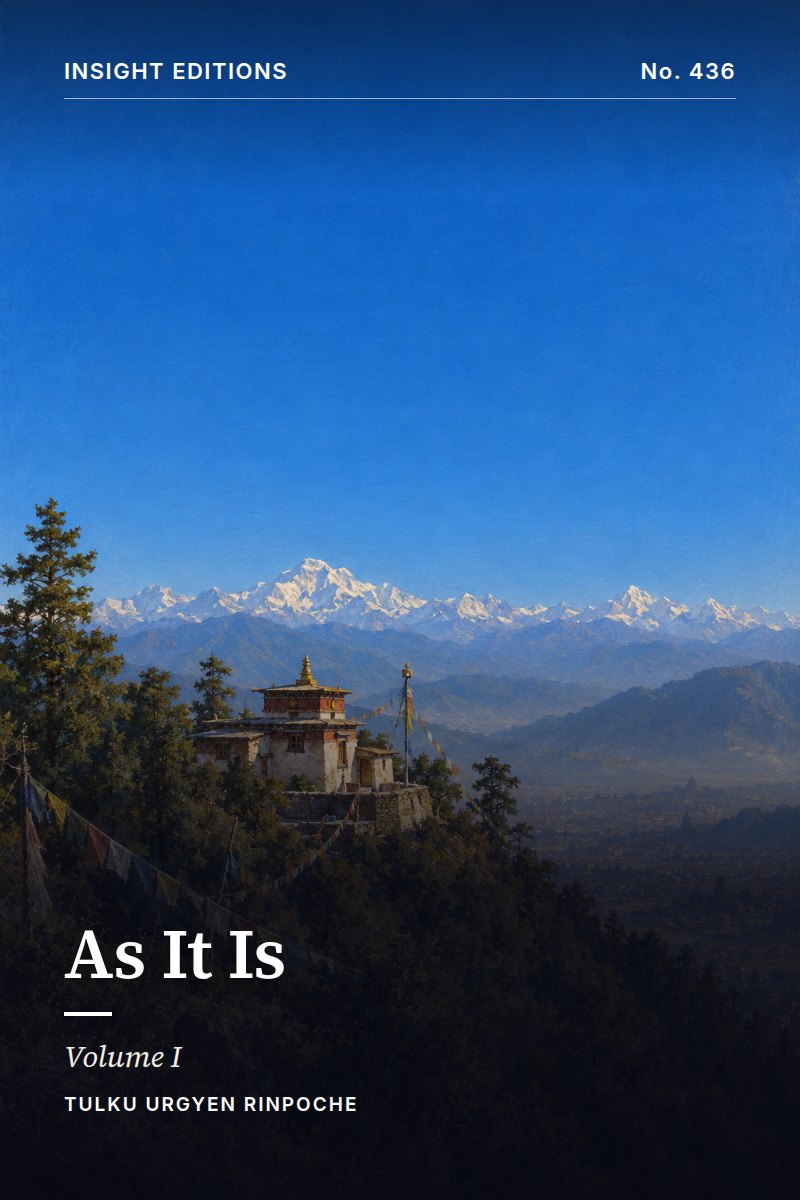
Insight Editions · No. 436
As It Is, Volume I
Talks from the last two years: buddha nature, the development stage and the view
Tulku Urgyen Rinpoche
A study guide to As It Is, Volume I by Tulku Urgyen Rinpoche: buddha nature, the Four Dharmas of Gampopa, mind beyond existence and nonexistence, short moments of recognition, the three samadhis, the unity of development and completion, capturing the life-force of all deities, obstacles and maras, essence and expression, sadhana structure, all-encompassing purity, indivisibility, the two demons of ignorance and uninvolved rigpa, with tables, diagrams and practice notes.
A study guide to As It Is, Volume I by Tulku Urgyen Rinpoche, introduction by Chökyi Nyima Rinpoche, Tsikey Chokling Rinpoche, Tsoknyi Rinpoche and Mingyur Rinpoche; translated by Erik Pema Kunsang (Erik Hein Schmidt); compiled by Marcia Binder Schmidt, edited with Kerry Moran (Rangjung Yeshe Publications, 1999). Shared free for personal reading; not for sale and not endorsed by the publishers. Please read the original book, and practise with proper transmission.
CORE CLAIM
Buddha is nowhere else: the empty, cognizant nature of your own mind is already the three kayas. Development stage is seeing gold as gold, a training in how things already are, and it works only when it unfolds from recognition, like a rainbow in the sky.
SCOPE
Fourteen talks given by Tulku Urgyen Rinpoche at Nagi Gompa in 1994 and 1995, the last two years of his life, weighted toward buddha nature, the development stage and the view; with an Introduction by his four sons. Translated by Erik Pema Kunsang, compiled by Marcia Binder Schmidt (Rangjung Yeshe, 1999).
KEY FIGURES
Samten Gyatso; Padmasambhava; Yeshe Tsogyal; Gampopa; Longchenpa; the Third Karmapa; Sakya Pandita; Mipham Rinpoche; the 16th Karmapa; Chökyi Nyima, Tsikey Chokling, Tsoknyi and Mingyur Rinpoche.
BEST FOR
Practitioners doing a daily sadhana who want it to rest on recognition, students who have received pointing-out and need plain advice on short moments, and readers preparing for sleep, death and the bardo.
The Book on One Page
As It Is collects talks from Nagi Gompa, often to small groups of visitors, so the same few points return from many angles. Volume I moves from buddha nature and the Four Dharmas of Gampopa through the development stage to the two demons of ignorance, ending with "This is the time to practice."
The Argument in Brief
- Buddha is here. Buddha nature is in every being like oil in a sesame seed; "we don't need to seek a buddha elsewhere."
- Mind is beyond both extremes. Not existent, since even a buddha does not see it; not nonexistent, since it is the basis of samsara and nirvana.
- Recognize in short moments. "Short moments, many times", like ringing a bell once; don't keep pressing the light switch.
- Development is gold seen as gold. The mandala is "an exact replica of the original state of all things," not wood imagined as gold.
- Suchness comes first. Without the samadhi of suchness, development stage has "no head and no tail" and becomes brick-laying.
- One deity holds all. Recognizing mind essence captures the life-force of all deities; a thousand bulbs, one current.
- The demon is thought. Obstructers, maras and the twelve links all rest on ignorance, and only recognition ends it.
- Essence never changes. Confusion and liberation happen in the expression; the gold never fell in the dirt.
- Use this life. Train now while the body tethers the mind; at death, recognition and liberation can be simultaneous.
The one sentence beneath every talk: the difference between buddhas and sentient beings is the difference between knowing and not knowing.
Map of the Chapters
| No. | Chapter | Payload |
|---|---|---|
| 1 | Preface and Introduction | Four sons on his life; death under a cloudless sky |
| 2 | The Basis: Buddha Nature | The ground present in all beings |
| 3 | The Four Dharmas of Gampopa | Table, cup and tea; jewel in the mud |
| 4 | Buddha Nowhere Else | Pandita and kusulu; three seconds at death |
| 5 | Existence and Nonexistence | Gold as gold; the sun in your pocket |
| 6 | Experience | Inner deity; one monkey, five windows |
| 7 | Unity of Development and Completion | Billionfold worlds; tangka in a mirror |
| 8 | Capture the Life-Force of All Deities | Thousand bulbs; Chili Chilaya |
| 9 | Overcoming Obstacles and Demons | Four maras; torma for thoughts |
| 10 | Expression of Awareness | Infant rigpa; sleeping lion; Samantabhadra without a back |
| 11 | Various Applications | Sadhana structure; Samten Gyatso's day |
| 12 | All-Encompassing Purity | Three seats; Yamantaka's horns |
| 13 | Indivisibility | Rainbow and sky; namshey and yeshe |
| 14 | Two Demons | Match and mountain; nonmeditation |
| 15 | Involved | Mercury and mud; scientist in the bardo |
Ways Through the Book
| Reader | Start with | Then |
|---|---|---|
| New to Vajrayana | The Four Dharmas of Gampopa | Buddha Nowhere Else, then Existence and Nonexistence |
| Doing a daily sadhana | Unity of Development and Completion | Capture the Life-Force, Various Applications, Indivisibility |
| Meditator after pointing-out | Experience and Expression of Awareness | Two Demons, then Involved |
| Facing obstacles or illness | Overcoming Obstacles and Demons | Involved on overwhelming pain |
| Preparing for death | Buddha Nowhere Else (three seconds) | Expression of Awareness (bardo and sleep) |
| Resembling | Real | |
|---|---|---|
| Starts from | A mantra that "makes" things empty | Recognized suchness, which was always empty |
| Builds by | One thought after another, head then legs | Instantaneous recollection, like a mirror |
| Feels like | Construction work, a sandcastle | A rainbow that never harms the sky |
| Its worth | "Better than nothing at all" | The swift path of means and knowledge |
Key Terms
| Term | Meaning in this book |
|---|---|
| Rigpa | Nondual awareness, the recognized nature of mind |
| Sem | Dualistic, conceptual mind that reaches out and labels |
| Ngowo and tsal | Essence and expression, like the sun and its light |
| Namshey and yeshe | Consciousness with subject and object; wakefulness without an object |
| Three samadhis | Suchness, illumination, seed-syllable: the three kayas as the start of every sadhana |
| Development stage | Visualizing deity, mantra and samadhi; training in spontaneous presence |
| Completion stage | Recognizing mind essence; realizing primordial purity |
| Trekchö | Cutting through; the view of the samadhi of suchness |
| Tukdam | A master's meditative state after death, the body upright |
| Ngöndro | The preliminaries of four times one hundred thousand |
| Yidam | The personal deity of one's practice |
| Four Dharmas of Gampopa | Mind turns to Dharma, Dharma becomes the path, the path clarifies confusion, confusion dawns as wisdom |
| Four maras | Aggregates, emotions, death and the son of the gods, all rooted in ego-clinging |
| Torma | A ritual offering cake, given to the obstructers who are one's own thoughts |
| Kunzang Tuktig | The Heart Essence of Samantabhadra, the terma cycle behind several sadhana talks |
| Svabhavikakaya | The essence body: the three kayas as one identity |
How the Book Reads
These are spoken talks, lightly edited, and they keep Rinpoche's teasing voice: the uneducated old man on the hill, the meditator whose horns stuck in the door, the scientist without gadgets in the bardo. Repetition is deliberate; each return to sun and sunlight or space in Kathmandu's houses adds a detail. The compilers removed the actual pointing-out, so the book describes recognition and assumes a living teacher for it.
Preface and Introduction
The compilers explain that As It Is gathers talks from 1994 and 1995, the last two years of Tulku Urgyen Rinpoche's life, with Volume I weighted toward the development stage. Then his four sons, each a master in his own right, describe his life, his teaching style and his death under a clear, cloudless sky.
What the Compilers Intend
The talks were given at Nagi Gompa, from large assemblies in the main temple to one or two people in Rinpoche's private room, and to listeners of many nationalities; yet the same themes run through all of them. Volume I emphasizes the development stage, Volume II the completion stage. Rinpoche died on February 15, 1996, and during the forty-nine days that followed, his four sons were interviewed; parts of those interviews form the Introduction.
The compilers left out every teaching in which Rinpoche directly gave the pointing-out instruction, which "must be received in person from one of his lineage-holders." "In no way are these books meant to substitute for direct contact with qualified masters. No book is able to do so." For those who have recognized buddha nature the book is an offering; for others it is "a taste of what is yet to come."
The compilers close with a tantra verse Rinpoche often recited as one of the foremost ways to attain stability in Dzogchen:
"Indescribable innate wakefulness / Depends only upon the practices of gathering the accumulations and purifying the obscurations / And upon the blessings of a realized master. / To follow other methods should be known as delusion."
Chökyi Nyima Rinpoche: Indivisible Nature
| Fact | Detail |
|---|---|
| Born | Nangchen, in the eastern province of Kham |
| First recognition | Age four, listening as his father Chimey Dorje of Tsangsar guided followers |
| Root guru | His uncle Samten Gyatso, a pure monk and accomplished practitioner |
| Retreat | More than twenty years in total, in Kham, Central Tibet, Sikkim and Nepal |
| Style | Dzogchen view at the core, adept in Mahamudra and the Six Doctrines |
The 15th Karmapa Khakyab Dorje once joined his palms after Samten Gyatso left the room: "In these times, perhaps only Samten Gyatso has a totally perfect realization of the view of the Innermost Essence of Dzogchen." From him Tulku Urgyen received most of his lineage and semtri, guidance on the nature of mind. The view pointed out at four could not in essence be enhanced, since "within the view there is no 'thing' to be further developed," but one's experience of it can deepen with oral instruction.
In later life he described his retreats as "I'm just staying here chanting the mani," the way great practitioners refer to simply sustaining awareness. Tarthang Rinpoche called him "a very hidden yogi... a scholar in the ultimate nature. Yet he hid all his qualities within." He taught the indivisibility of the three great traditions: Dzogchen's primordial purity, Mahamudra's mental non-doing, and the Middle Way's freedom from constructs.
Not only practitioners were moved. Someone told Chökyi Nyima: "I don't know anything about Dharma, but I do know that he was a very nice man... He was the best friend one could have, easy-going, mild, and reliable, very open-minded." His advice reduced disturbing emotions and let compassion, love and insight grow, "proven in actual experience by many, many people."
At his death he was very relaxed, sat up twice, exclaimed "AH," and then his signs of life stopped; he remained in tukdam. The best Dzogchen sign, "a cloudless, clear sky above, with dust-free air beneath," appeared in the often-polluted Kathmandu Valley.
Tsikey Chokling Rinpoche: Realization Blazing Forth
Chokling Rinpoche gives the outer, inner and innermost life story. His father was warm, open-minded and without other intentions than helping beings. He wept on hearing the names of Milarepa and Longchen Rabjam.
| Teacher | Connection |
|---|---|
| Samten Gyatso, Chimey Dorje, Kyungtrül Rinpoche | Root gurus from his early years |
| Jamgön Karsey Kongtrül | Gave him the entire Rinchen Terdzö |
| 16th Karmapa Rangjung Rigpey Dorje | Root guru, seen as the Buddha in person |
| Dilgo Khyentse Rinpoche | "Indivisible minds like father and son"; each saw the other as Guru Chöwang and Manjushri |
| Dudjom Rinpoche | Received Dzogchen Desum from him in Lhasa |
He served the Karmapa as Naropa served Tilopa, who once said "Someone who was truly my disciple would jump off this cliff!" and Naropa jumped. The Karmapa, in turn, placed Tulku Urgyen's letters on top of his head before opening them, and insisted that he and no one else perform certain ceremonies. Dudjom Rinpoche said he had "gone through the four visions and arrived at the final stage known as 'the exhaustion of phenomena and concepts.'" Yet he ate simple food, wore simple clothes and sat on a low seat.
Pointing-out is traditionally given to small groups, so how did hundreds recognize mind nature at his seminars with Chökyi Nyima Rinpoche? Masters explained the "threefold blazing forth" of experience, realization and samadhi: the strength of his awareness, combined with the openness of students' faith, let many "regardless of their level or capacity, recognize the nature of mind in a single instant."
His main practice, judged from his advice: "No matter what you do... walking, sitting, eating or lying down, always suspend your attention within the nature of nondual awareness. That's it!" Asked to accept ceremonies for his health, he smiled: "I won't die for a couple of years." His teaching structure was the Four Dharmas of Gampopa, identical with Longchenpa's Four Teachings, giving pointing-out at the fourth.
- Devotion and compassion are the most important: "A closed-up person gives rise to no good qualities, just like a scorched seed will never sprout."
- Do the ngöndro fully: "the ngöndro is even more profound than the main part." A glimpse without purification is "rapidly covered up again and forgotten. So don't delude yourselves."
- View as high as the sky, conduct as refined as tsampa.
- Vajra friends go to enlightenment as one mandala: keep harmony.
- Recognize, decide, gain confidence; then develop strength and attain stability.
Receiving pointing-out from him is "like having the end of the golden garland of the lineage placed in your hand." "The guru is not outside, but within": you meet the true guru the moment you recognize the nature of mind. To book readers: "Don't concentrate only on the words on the pages!"
Tsoknyi Rinpoche: A Clear, Cloudless Sky
Tsoknyi Rinpoche was struck by the simple fact that even such a yogi dies: "then what about the rest of us?" The morning after, the valley, usually fogged in winter, had not a single wisp of cloud for several days. He took it as the perfect example of primordial purity and proposes that disciples use unobscured space as their reminder for mingling their minds with Tulku Urgyen. "It is not enough to merely chant words like 'primordial purity': we still die."
Five days before he died, Rinpoche said looking well might not be good: his father and three uncles looked radiant in their last months, and Samten Gyatso's white hair turned almost black. Remaining in tukdam is "in itself not that astonishing"; contrived meditators can do it. At death the white and red essences join at the heart in an instant of unconsciousness that can open up again right away. He clapped his hands, then opened his palms wide: "In one instant the difference is made; in one instant complete enlightenment is attained." It need not bring rainbows or thunder; dharmakaya is shown as a clear, cloudless sky.
Mingyur Rinpoche: Equalizing Life and Practice
| Vehicle | Guru seen as |
|---|---|
| Hinayana | A spiritual guide |
| Mahayana | An emanation of the buddhas |
| Vajrayana | The embodiment of all awakened ones |
Tukdam lasted just over a day, ending with red and white bodhichitta from the nostrils, a sign the tantras attribute to great masters. Masters with attributes may leave rainbows, sounds and relics; a master beyond attributes shows "no other sign but a clear sky," a point on which Sarma and Nyingma tantras agree. He never spoke of his realization; "some people even perceived the Buddha as ugly!"
The guru's mind and ours are both empty, both cognizant, both an indivisible unity: "The very moment you acknowledge the reality of this, your mind is said to have mingled with the guru's." At death we leave "like pulling a hair out of butter." Endless projects are disguised laziness; Milarepa: "There is no end to worldly pursuits; they only end when you stop."
Mingyur Rinpoche on Realization and Laziness
Dilgo Khyentse and Nyoshul Khen Rinpoche both said Tulku Urgyen "wasn't an ordinary person" but had reached "culmination of awareness." Short tukdam is not a weak sign: one who has not perfected the strength of experience and realization can remain a long time, while one who has need not.
"I'll practice tomorrow or the next day," and then life runs out. "Striving so hard to score small successes, we disguise the fact that we are actually being lazy." Better: "I may die soon anyway, so what's the use of planning to do all these tasks?" A three-year retreat practised authentically can bring "seeing the innate nature in actuality." Mingyur Rinpoche resolves to spend the rest of his life in meditation.
An enlightened master remains unchanged. Aging, sickness and death are "a drama played out for us that takes place in our minds." We see him eat, move about, go to the toilet and think "aren't we the same? Actually, we aren't." Trust in karma makes practice wholehearted; without it, "however much practice you try to do will only end up leading in the wrong direction." A buddha's omniscience is like knowing every leaf on every tree in the world, holding no conceptual thoughts.
| Person | Role |
|---|---|
| Chökyi Nyima Rinpoche | Eldest son; abbot of Ka-Nying Shedrub Ling; co-teacher at the seminars |
| Tsikey Chokling Rinpoche | Son; gives the outer, inner and innermost life story |
| Tsoknyi Rinpoche | Son; reads the cloudless sky as the final teaching |
| Mingyur Rinpoche | Youngest son; equalizing life and practice |
| Samten Gyatso | Uncle and root guru |
| 16th Karmapa | Root guru, seen as the Buddha in person |
| Dilgo Khyentse, Dudjom, Nyoshul Khen | Masters who attested to his realization |
The parting line is practical: "If you do not reach enlightenment in this very life, then you will either at the moment of death or in the bardo." "One way or another, you are not far away from the omniscient state of a buddha."
The Basis: Buddha Nature
Everything rests on dharmadhatu, the "space of all things," which holds samsara and nirvana alike. Tulku Urgyen explains buddha nature as the three vajras, reads "emptiness" as empty cognizance, and compares delusion to possession by a spirit that vanishes the moment mind recognizes itself.
The Space of All Things
Physical space is the container in which earth, water, fire and wind appear, abide and dissolve; "Is there any place where earth, water, fire and wind can go that is outside space?" Dharmadhatu is the same for all phenomena of samsara and nirvana: it does not include only nirvana and exclude samsara.
| Term | Like | Role |
|---|---|---|
| Dharmadhatu | A place | The basic environment |
| Dharmakaya | A person in that place | Its nature |
| Dharmadhatu wisdom | That person's mind | Its knowing quality |
Three Vajras and Their Expression
| Awakened (nirvana) | Deluded expression (samsara) | |
|---|---|---|
| Body | Essence that simply is; unchanging | Perishable flesh and blood |
| Speech | Nature, vividly present; unceasing | Intermittent utterances |
| Mind | Capacity, radiant; unmistaken | Thoughts "like beads on a rosary" |
Buddha nature is present "just as the shining sun is present in the sky," and beings' body, speech and mind are its rays. "All sentient beings are buddhas, but they are covered by their temporary obscurations," and these obscurations "are our own thinking." As space pervades, so awareness pervades.
The difference between buddhas and beings is narrowness of scope: beings are like the space held in a tightly closed fist, buddhas are fully open. Basic space is the absence of constructs; awareness is knowing that absence. "When the mother, the basic space of dharmadhatu, does not stray from her awareness child, have no doubt that they are forever indivisible." Otherwise we might think Samantabhadra and consort are "an old blue man and woman who lived aeons ago."
Emptiness, Not Empty
The Great Perfection is beyond pigeon-holing, "utterly open, beyond categories." Its destination is the kayas and wisdoms: "Although everything is empty, the special quality of the Buddhadharma is to not be empty of the kayas and wisdom."
The Prajnaparamita lists ("outer things are emptiness, inner things are emptiness...") should be read as "empty cognizance": the suffix "-ness" implies the cognizant quality. Read as mere "empty or void," it leans to nihilism, "a big, blank void... a serious sidetrack." The Buddha first taught "all things are empty" to dismantle our fixation on permanence.
Experience has no form, sound, colour, taste or texture. What you see with eyes open is "illuminated matter"; eyes closed, "dark matter": both are mere presence. "Without a perceiver, how could an appearance be an appearance?" When the samadhi of suchness dawns, "reality loses its solid, obstructing quality," which is why yogis cannot be burnt or drowned. Yet all experience is individual: one yogi's liberation does not end everyone's delusion. In the "general experience" of beings (Rinpoche knocks on his bed) nothing material survives the fire at the end of the kalpa, and "this fire then vanishes by itself" (he chuckles). Nangjang training shows that unfixated experience is unreal and insubstantial.
Possession and Its End
"It is the mind itself that creates this whole delusion, but it is also the mind itself that can let the whole delusion collapse." (Rinpoche laughs.) Buddha nature is the basis for delusion and what dissolves it; "It is basically a matter of recognizing it or not."
A yogi is like a formerly possessed person whom the spirit has left: the very moment you recognize the nature of mind, the possession immediately vanishes.
The Four Dharmas of Gampopa
Tulku Urgyen's master structure, identical with Longchenpa's four teachings, holds a complete path to enlightenment in one lifetime: turn the mind, make practice the path, let the path clarify confusion, and let confusion dawn as wisdom.
| Dharma | Contains |
|---|---|
| 1. Turn the mind to Dharma | The four mind-changings |
| 2. Practice becomes the path | Preliminaries of four times 100,000 |
| 3. Path clarifies confusion | Development stage, recitation, completion stage |
| 4. Confusion dawns as wisdom | The three great views: ground Mahamudra, path Middle Way, fruition Great Perfection |
Turning the Mind
The human body with eight freedoms and ten riches comes "once in a hundred aeons," like a wish-fulfilling jewel. Death is not "like water drying out or a flame being extinguished": karma follows us "just as our shadow follows our body." "We are all really just standing in line" for death. These are facts, not fantasy.
Practice Becomes the Path
Refuge opens the way; bodhichitta, the resolve "I will personally take responsibility to lead all sentient beings to enlightenment," marks the Mahayana follower. Every insect has been our mother many times.
| Practice | Function |
|---|---|
| Refuge and bodhichitta | Foundation of the path |
| Vajrasattva | Four remedial powers: support, antidote, remorse, resolution; purifies karma as huge as Sumeru |
| Mandala offering | Outer, inner, innermost mandalas; gathers merit and wisdom, prevents obstacles |
| Guru yoga | Blessings from Samantabhadra to your root guru, like the pipe from the water source to your faucet |
People who call themselves only Theravada or only Vajrayana "expose their lack of understanding." To drink tea you need a table (Hinayana refuge), a cup (Mahayana attitude) and the tea (Vajrayana). Enlightenment for oneself alone "would be totally shameless": Hinayana is the puddle in a cow's hoof-print, Mahayana the ocean. Every sadhana practises all three vehicles in one sitting.
The Path Clarifies Confusion
We are a wish-fulfilling jewel fallen in the mud: it must be acknowledged, cleaned, then used. The cleaning is deity, mantra and samadhi, after dissolving the ordinary world into emptiness. "We are not imagining that we are something that we are not." Development practice is "knowing the jewel to be the wish-fulfilling jewel it actually is," not imagining a stone to be a jewel.
Confusion Dawns as Wisdom
"I don't have the ability to make up my own teachings... I would rather repeat the words of the Buddha." Buddhas cut the movement of dualistic mind at the start and reached the dry land of enlightenment; we still have not got our heads out of the water.
"The essence becomes obscured by the expression." The sun's own heat evaporates water into the clouds that hide it; our own attention becomes the confused thinking that hides buddha nature. Confusion is "taking what isn't for what is," like the drug datura, which makes people seem to have fifty heads or thirty hands.
The body of flesh covers vajra body, intermittent words cover vajra speech, and the train of thoughts covers vajra mind. If we have received teachings and do not apply them, we are "far more stupid than an animal," since animals cannot help it.
The Four Mind-Changings
| Thought | Fact it states |
|---|---|
| Precious human body | Eight freedoms and ten riches, from former merit and pure aspiration; it only seems easy |
| Impermanence | "Nothing lasts", so material perfection in this life is impossible |
| Karma | Results follow like a shadow; they ripen in the six realms |
| Defects of samsara | No place in samsara with permanent happiness |
"They are not fiction or fantasy. They are facts." Before practising, take them to heart.
- Gampopa: Milarepa's disciple, whose Four Dharmas frame the talk.
- Longchen Rabjam (Longchenpa): gave four instructions identical with them.
- Vajrasattva: the buddha of the purification practice.
- Samantabhadra: the dharmakaya source of the lineage that reaches your root guru.
Why Now
Rinpoche opens with the bodhichitta motivation: "I will study the Dharma and correctly put it into practice in order to establish all my mothers... in the state of liberation." The talk closes with the same urgency. "Unless we do it in this lifetime, it is not going to happen all by itself." "Wouldn't that be better than continuing to act like an animal, concentrating only on eating and sleeping?" We owe the chance to the great kindness of the Buddha's appearance and an unbroken lineage of great masters. "If we are going to die tomorrow, we are ignorant of that today."
The three vehicles are never separate: refuge is Hinayana, bodhichitta Mahayana, deity, mantra and samadhi Vajrayana, and "it is impossible to practice Vajrayana without also being a practitioner of Hinayana and Mahayana." The preliminaries are not low teachings but how obstacles are cleared so the path can work.
Buddha Nowhere Else
All 84,000 sections of the Dharma come down to one subject: how mind seems to be and how it really is. Tulku Urgyen sets out the real and the seeming, the three kayas in one moment, the thorough cut of Trekchö, and why even a few seconds of recognition at death can bring enlightenment.
The Scholar and the Simple Meditator
Because people differ (sharp, average, dull, each again threefold), there are nine vehicles: shravaka, pratyekabuddha, bodhisattva for the least capacity, Kriya, Upa, Yoga for the medium, Maha, Anu, Ati for the highest.
The Real and the Seeming
| The real | The seeming | |
|---|---|---|
| What | Mind is empty, "one hundred percent so," like space with no creator | There is a nature that cognizes, ever-knowing |
| Kaya | Empty essence: dharmakaya | Cognizant nature: sambhogakaya |
| Unity | Their indivisible capacity: nirmanakaya | All three as one: svabhavikakaya |
"Intrinsic mind essence is dharmakaya; intrinsic experience is the radiance of dharmakaya," like sun and sunshine, body and limbs, sky and clouds. If we recognize this as our natural face, "we don't need to seek a buddha elsewhere. If you do... there isn't any to find!" Hence the line "Although my mind is the buddha, I fail to see it."
Buddha nature is in everyone as oil is in a sesame seed, from Samantabhadra to the tiniest insect, with no increase or decrease: it is not that "a dog or a pig has an inferior buddha nature." What differs is the body and mind-set it is connected to; even elephants and tigers cannot realize it, and only humans among the six classes can. "When the age of degeneration is rampant, the Vajrayana teachings will spread like wildfire," because strong poisons make the antidote easier to acknowledge; in the form and formless realms, without emotions, the remedy has no real force.
You cannot deny appearances, since mind experiences; but they are empty in that they can be destroyed: water dries, fire burns out, the universe ends in seven fires and one deluge. Mind is empty differently: "you can't change it, wash it away, bury it, or burn it." Appearances are "a magical display, just like when demons conjure up some magic to fool you," so "we really don't have to worry about them or analyze them too much."
Theory Versus Taste
Recognizing wakefulness is not noticing "Now I am happy, now I am sad" and then getting involved again.
| Theory | Experience |
|---|---|
| A hundred lectures on Indian or Chinese cuisine | One bite touching tongue and palate |
| "The lama says such-and-such about emptiness" | Recognizing the nature of your own mind |
| An idea that may breed "good or evil are empty, so what does it matter?", a severely wrong view | "Experience is the adornment of rigpa" |
"Are you enlightened by simply believing yourself to be enlightened?"
Even this ultimate teaching begins with refuge and bodhichitta and supplication to the root guru at the crown. The lineage runs from Samantabhadra (dharmakaya), the five buddhas (sambhogakaya) and Manjushri, Avalokiteshvara and Vajrapani (nirmanakaya), like water from a mountaintop reaching your tap if nothing breaks along the line.
The Thorough Cut
Trekchö cuts like a string severed into two disconnected pieces. "The moment you think, 'Now it is empty,' a thought has already snuck in." It is also called "four parts without three": free of past, present and future thoughts, the fourth is the timeless great moment, where the link of consciousness, sense organ and object is cut and the chain of samsara breaks. The Buddha: "No form, no sound, no smell, no taste, no texture, no mental object."
Space is empty: it cannot see itself. Mind is emptiness: there is no thing to see, and that which sees is the cognizant quality. The Third Karmapa: "When looking again and again into invisible mind, the fact that there is no thing to see is clearly and vividly seen as it is." Empty and cognizant are a unity as water is wet and fire hot, with no observer and observed. "Transcendent knowledge is beyond thought, word and description."
"We can blow up all the nuclear bombs we like, and mind will still churn out thoughts. There is only one way to dissolve thinking, and that is to recognize your nature." Honestly, recognition "doesn't last longer than a couple of seconds" at first, because of beginningless habit.
Naturalness
A river needs no one to push it. The wood of Rinpoche's table was natural on the mountainside, then a carpenter made it artificial: "We need to avoid shaping our awareness into something artificial." Do not sit thinking "I mustn't be distracted"; let instants of nondistraction unfold.
| Term | Meaning |
|---|---|
| Empty essence | Dharmakaya: nothing to see |
| Cognizant nature | Sambhogakaya: the knowing that this is so |
| Capacity suffused with awareness | Nirmanakaya: their unity, known |
| Rang-rig yeshe | Self-knowing original wakefulness |
All beings' minds are empty cognizance, but "suffused with unawareness." "The difference between buddhas and sentient beings is the difference between knowing and not knowing." Thinking "I want to be free of thought" or checking "Is there a thought now?" is just another thought.
A hair, however thick, moves in the slightest breeze; a needle, however thin, cannot be bent by the wind. Be naturally stable in emptiness, "not in keeping a thought, but in the absence of thought." "Meditating is conceptual, being distracted is confusion"; the way is undistracted nonmeditation. To know what losing awareness is like, Rinpoche suggests, "have somebody knock you out with an iron bar."
Three Seconds at Death
Even with only short moments, many times, the value shows at death. When body and mind separate, all thought-states dissolve in the ground luminosity of full attainment.
- Breath ceases; gross and subtle thought-states dissolve and nothing covers the basic state.
- Ground luminosity (mother) and path luminosity (child) meet: mother and child always recognize each other.
- Sustain recognition for three seconds, the time to wave a long Tibetan sleeve or white scarf three times.
- Strong familiarity: like space in a broken vase merging with outer space, one taste with dharmakaya.
- Slight familiarity: rebirth in a natural nirmanakaya buddhafield, beholding the Buddha and clearing remaining obscurations.
This works because in the bardo mind is not connected to a body, so the obscuration of the body is gone. The goal is non-regression. In this life the benefit is that "wherever we go, the sun of happiness shines," instead of being depressed when unhappy and overjoyed when happy.
Why the Buddha Taught So Much
Not-doing is "entirely against our usual habits"; we would rather build something and put ourselves through hardship, which may be why the Buddha did not teach Dzogchen and Mahamudra openly. "People couldn't leave well enough alone... human nature loves complications," so there are nine vehicles "to make everybody happy." Yet the essence is so simple it is hard to believe; when it becomes easy, you have "established the natural state." The step-by-step tradition (mind-changings, ngöndro, yidam) is still necessary.
As a boy Tulku Urgyen listened in on Samten Gyatso's pointing-out. People leaving would say "How can it be that easy?" and he would answer "Why do you think it has to be difficult? Just let be!" His uncle called him in: "It seems you are talkative, as well as someone who thinks that it is totally easy... I think that in the future you will be like this as well." "And he was right. Maybe I'm just fooling everybody... But this is really how it is!"
The Seed and the Sunrise
The three steps are recognizing, developing the strength, attaining stability. Recognition is like a flower seed: it shows no colours yet, but with water and soil the bloom is inevitable. A baby born yesterday is not grown today; "the span of time from first recognition until total stability is itself the path." Nondistraction is simply not forgetting.
The Nine Vehicles at a Glance
| Capacity | Vehicles | Relation to the view |
|---|---|---|
| Least | Shravaka, pratyekabuddha, bodhisattva | Causal teachings; cause and effect in detail |
| Medium | Kriya, Upa, Yoga | Outer tantras; the deity above or beside you |
| Highest | Maha, Anu, Ati | Inner tantras; recognition as the path |
The pandita needs all nine; the kusulu needs one point. Tulku Urgyen does not rank them as rivals. He says the Buddha taught so many because people "couldn't leave well enough alone", and the step-by-step tradition is still necessary. What he refuses is the idea that understanding a vehicle is the same as tasting its point.
- Samten Gyatso: Rinpoche's uncle, whose pointing-out sessions the boy overheard and commented on.
- The Third Karmapa, Rangjung Dorje: "When looking again and again into invisible mind..."
- Samantabhadra, the five buddhas, Manjushri, Avalokiteshvara, Vajrapani: the three-kaya lineage that runs like water to your tap.
- The young Tulku Urgyen: "Why do you think it has to be difficult? Just let be!"
Common Misreadings
| Misreading | What the chapter says |
|---|---|
| "Emptiness means nothing matters" | A severely wrong view; experience, not theory, is the adornment of rigpa |
| "Recognition should last" | At first it is a couple of seconds; repeat it |
| "Animals have lesser buddha nature" | No increase or decrease; only the body and mind-set differ |
| "I must stop thoughts" | "I want to be free of thought" is another thought |
"Although my mind is the buddha, I fail to see it." The chapter's whole effort is to close that gap with one look, then many more.
The first moment of empty cognizance already holds omniscience, compassion and activity, present but not fully manifest. "When the sun rises in the morning, do we have to wait for it to shine for it to be warm and brilliant?" The qualities are not a new achievement; thoughts and fixation are momentary, like clouds, so they can be cleared away.
Existence and Nonexistence
Framed by the three excellences, this talk to visitors at Nagi Gompa shows development stage as seeing gold as gold, then turns to mind: neither existent nor nonexistent, the sun whose reflections are thoughts, and recognition trained in short moments, like the ring of a bell.
The Three Excellences
| Excellence | Content | Vehicle |
|---|---|---|
| Excellent preparation | Bodhichitta and refuge | Refuge holds all Hinayana, bodhichitta all Mahayana |
| Excellent main part beyond concepts | Development and completion | Vajrayana |
| Excellent dedication | Merit and aspiration for all beings | All |
Every being has been our father and mother, so enlightenment for ourselves alone would mean abandoning all our parents. Can we really help them now? "At present we don't." Only the Buddha, Dharma and Sangha are "a reliable and authentic source of protection."
Gold Seen as Gold
The celestial palace and deity seem imagined, yet they are "an exact replica of the original state of all things," the great mandala of the manifest ground.
Development stage "is not like imagining a piece of wood to be gold. No matter how long you imagine... it never truly becomes gold." It is regarding gold as gold. All appearances are the mandala of deities, all sounds the mandala of mantra, all thoughts the mandala of enlightened mind. A sadhana manifests what is originally present rather than superimposing something artificial. Sutra and tantra differ in how close they are to the original nature; Vajrayana is closest.
| Aspect | Vajra quality | Practice | Kaya |
|---|---|---|---|
| Body | Unchanging | Deity | Dharmakaya |
| Speech | Unceasing | Mantra | Sambhogakaya |
| Mind | Unmistaken | Samadhi | Nirmanakaya |
The principle: tantras are contained in the statements, statements in the oral instructions, oral instructions in the application of the sadhana.
The Uneducated Old Man
"This old man here who lives up on this hill" says he only repeats what he was fortunate to receive. Schooling is useful for life, "yet it has not brought us even one inch closer to enlightenment." "I can easily say this since I am not educated at all! So I can smile and act big about this. Don't be angry, please." Riches and fame belong to the first half of life; "in the second half... life starts being less fun. I speak from experience here." A saying from his home: "Take advice where it is closest; fetch water where it is nearest."
Mind Is the Boss
Body and voice are mind's servants. The five elements and five sense organs do not perceive: a corpse has all five senses but no mind; "the term corpse means that the mind has departed." Only mind knows pleasure and pain, so the lower realms are ranked by pain and higher realms by pleasure.
"Not existent, since even a buddha does not see it; not nonexistent, since it is the basis of both samsara and nirvana." Search for a billion years and you will not find mind as something that exists or doesn't. The absence of contradiction between these is the Middle Way. Shunye means empty; -ta means able to cognize. "If you believe there is a thing called mind, it is just a thought. If you believe there is no thing called mind, it's just another thought."
Involvement in thinking is a heavy chain; shatter it and you are free from the three realms. Sift the whole world piece by piece through a sieve and you would find nothing more precious than knowing how to break it.
Busy Times, Direct Teaching
Traditionally pointing-out came after ngöndro and yidam retreat; "nowadays... people are so busy." Samten Gyatso told him different times were coming: "If they have the karmic readiness, they will understand... It's all right."
People see sunlight on the western peaks and know the sun has risen. "What they have to do is turn around and see the sun rising in the east." When told, they say "Well, yeah, the sun is actually rising in the east!" "That is how I have been teaching, and that is how I will continue to teach."
The Sun and Its Reflections
Thinking has gone on through countless lives and continues in the bardo without a body. Yet "the very nature of all this thinking is buddha nature."
"If you take the sun and put it in your pocket, you automatically control all eighty-four thousand reflections." Namtok: nam is the perceived form, tok the concept formed about it. "Can you throw away your shadow?" A nuclear bomb "will kill you, sure, but your thoughts will continue in the bardo." "Use the thought as its own antidote." See the sun once, and you know what it looks like forever.
Short Moments, Like a Bell
"Not seeing a thing is the supreme sight." It is seen the moment you look, perhaps for three snaps of the fingers. In Mahamudra, Dzogchen or the Middle Way it is called ordinary mind. Disconnect from the present thought; "Do you need to imagine anything to imagine space?"
You do not need to prolong recognition; repeat it: "short moments, many times." Ring a bell once and the sound continues by itself until it fades; "if you keep striking the bell, the sound is interrupted by the effort." "Once distracted, again recognize. That is the training."
| Obstacle | Level | Remedy |
|---|---|---|
| Outer | Environment | Preliminaries; deity, mantra and samadhi |
| Inner | Physical body | Three Jewels; guru, yidam and dakini |
| Innermost | Thought patterns | Same, plus enhancement |
Why "Existence and Nonexistence"
The title names the two extremes every view must pass between. Eternalism believes mind is a thing; nihilism believes there is no thing at all. "If you believe there is a thing called mind, it is just a thought. If you believe there is no thing called mind, it's just another thought." The Middle Way here is not a theory but the moment of looking, where "not seeing a thing is the supreme sight."
- "This old man who lives up on this hill": Tulku Urgyen on himself, uneducated and smiling about it.
- Samten Gyatso: foresaw busy times and approved direct teaching.
- The Third Karmapa: "In the moment of love, the empty essence dawns nakedly."
- The visitors to Nagi Gompa: the audience who see sunlight on the western peaks and must turn around.
- Three excellences: preparation, main part, dedication.
- Three snaps of the fingers: how long recognition may last at first.
- 84,000: reflections controlled when the sun is in your pocket.
- A billion years: the search that never finds mind as a thing.
The best enhancement is devotion to the enlightened ones and compassion for beings. The Third Karmapa: "In the moment of love, the empty essence dawns nakedly." When either is felt from the core of our heart, "there is really nothing to obscure us any longer."
Experience
Only mind experiences, so realizing mind is the whole practice. Tulku Urgyen shows how the three kayas are faced in one moment, why the inner Chakrasamvara outranks a vision of the deity, how a cow herder can be liberated while a scholar stays deluded, and why the teaching fails mainly because it is too easy.
Face to Face With the Three Kayas
Mind is like space but not the same: "Empty space cannot become enlightened, nor does it experience happiness and suffering." The Heart Sutra's "No form, no feeling... no mind" describes dharmakaya.
| Aspect | Kaya | Like |
|---|---|---|
| No concrete thing | Dharmakaya | Open sky |
| Knowing that it is no thing | Sambhogakaya | Sunlight |
| Their indivisibility | Nirmanakaya | Water and wetness, fire and heat, sugar and sweetness |
| All three inseparable | Svabhavikakaya | The sunlit sky |
Each time the three kayas are faced, the three poisons are "not merely pushed to the background; they are totally dissolved," like a hair in fire or darkness at sunrise. Thoughts are "merely empty movements, not stable in themselves."
Pure and Impure Phenomena
Impure phenomena are our own deluded thinking, the same as dream phenomena, gone on waking. Pure phenomena are what remain when the habit of fixating on solid reality disperses into basic space; from that, buddhafields and wisdom qualities begin to manifest. "Actually being those qualities is not like when you think of deities."
"Short moment repeated many times. There is no other way." A short duration guarantees it is authentic mind essence, by itself; many times ensures we grow used to it. Trying to keep long moments "will simply corrupt the natural experience with a conceptual state of mind." When the past has gone and the future hasn't arrived, your present wakefulness is right here; "if we don't have it, we are corpses!"
The Inner Deity
Chakrasamvara is the cognizant quality, Vajra Varahi the empty quality; their indivisibility is the true inner deity.
All yidams, male or female, are included within empty cognizance: "knowing one liberates all."
- Refuge three times in the Buddha, Dharma and Sangha.
- Bodhichitta: "I will do this practice for the benefit of all beings."
- Imagine yourself as a buddha, "whichever one you like best," and chant its mantra.
- While chanting, recognize who imagines and what chants: seeing there is no thing to see, without formulating a philosophy.
- Dedicate the goodness to all beings.
| Duration of nonconceptual wakefulness | Level |
|---|---|
| One hour | Arhat |
| Throughout the day | Bodhisattva |
| Uninterrupted day and night | Fully enlightened buddha |
"If you train in this, you could be a cow herder and still be liberated. If you don't train in this, you might be a great scholar and still remain in delusion." The Buddha saw the three times "as clearly as if held in the palm of his own hand," so we need not judge his words; systems from partially insightful teachers give only a portion of the truth.
The Light Switch
Asked how not to be distracted, Rinpoche says: recognize, then let be until it slips. "It's like switching on a light in a room: you press the switch once... If you keep pressing the switch, something gets disturbed." This is "naturalness without technique." Mind is like an empty room. "Seen in the moment of looking, freed in the moment of seeing." "Our mind is not completely beyond us: we know when we get distracted." Recognize the thinker, and the thought vanishes like a bubble in water, "executed on the spot."
Samsara is mind extroverting through the five senses. A monkey in a room with five windows jumps from one to the next; an observer thinks there are many monkeys, but there is only one. Tie it up and the jumping stops. Or: smoke pours from every opening of a house; throw a bucket of water on the central fire and smoke vanishes in all directions. Thoughts are the smoke, the expression of dharmakaya, not dharmakaya itself.
The instruction is never just to notice dualistic mind, which all beings do constantly, but to recognize its essence: the key difference. The Kagyü vajra-holders: "Intrinsic mind essence is dharmakaya; intrinsic experience is the radiance of dharmakaya."
| Poison | Creates |
|---|---|
| Attachment | The desire realms |
| Aversion | The form realms |
| Indifference | The formless realms |
"How can there be any negative karma besides the three poisons?"
Too Easy to Trust
Masters say the fault is not that it is complicated, but that it is too simple. People think "This is just my present state of being awake... I want something astounding... with amazing lights and great splendor." "They are right: this present state is not that special. But by sitting and hoping like that, they turn their backs to the innate three kayas."
Recognizing is not the problem; habit from innumerable lives is. We keep looking away from mind essence, even in dreams, with a body "created out of habitual tendencies." The body is "a temporary dwelling place, like a hotel," and the man living in it is the mind; hell and bardo are "only more thinking." Sleep is a subsidiary of ignorance; "the real stupidity is not knowing our own awareness wisdom."
No drug, not even the strongest anaesthesia, eliminates deluded thinking; it only pauses it, and it blocks the wisdom qualities, leaving mindlessness. The Ngakso confers "the unimpededness of Samantabhadra, entwined with the non-arising quality of Samantabhadri... may your perceiver and perceived dissolve into basic space." Yeshe is free of perceiver and perceived, "the single sphere of dharmakaya"; namshey reaches out through the five senses. "As long as duality does not become oneness, there is no enlightenment."
Dreams, the Bardo and Buddhafields
In dreams and the bardo we believe we have eyes, yet everything is mind experience. Unenlightened beings also share "general experience": mountains, roads and sky. A yogi sees experience as the eight analogies of illusion: reflections, the moon in water, echoes, rainbows, dreams, a city of gandharvas, mirages and magical illusions. Then solidity vanishes and he moves through matter, not by force but by realizing its insubstantiality; others still see walls. Gotsangpa sang "The rock behind my back is transparent," and left an imprint of his back in it.
A huge, heavy rope 100 metres thick lies in a lake: you cannot lift it all at once, but catch one end and pull the rest in slowly. The recognition of rigpa from a qualified master is that end; complete realization is the other end.
| Destination | Description |
|---|---|
| Best | Dharmadhatu buddhafield, "our real home, beyond increase and decrease" |
| Next best | Buddhafields of the five buddhas: travel freely by day, return to Sukhavati by evening |
| To avoid | The summit of existence, "neither presence nor absence of perception," for those who want only voidness |
How the Talk Builds
| Step | Claim | Image |
|---|---|---|
| 1 | Only mind experiences | A corpse has senses but no experience |
| 2 | Mind is faced as three kayas in one moment | The sunlit sky |
| 3 | The real deity is inner | Chakrasamvara and Vajra Varahi |
| 4 | Recognize once, then let be | The light switch |
| 5 | Habit, not difficulty, is the obstacle | One monkey, five windows |
| 6 | Recognition leads beyond the six realms | One end of the rope |
- Chakrasamvara and Vajra Varahi: the cognizant and empty qualities as the inner deity.
- Gotsangpa: sang "The rock behind my back is transparent" and left his back's imprint in it.
- The Kagyü vajra-holders: "Intrinsic mind essence is dharmakaya."
- The cow herder and the scholar: the pair showing that training, not learning, decides liberation.
All beings notice dualistic mind all the time: "Now I'm angry, now I'm happy." That changes nothing. Recognizing its essence is different in kind: the thought "vanishes like a bubble in water." "Our mind is not completely beyond us: we know when we get distracted," and that knowing is the doorway.
"It's very important not to think that everything is voidness." Samsara is empty but not empty of dharmadhatu wisdom. Stable recognition leads to buddhafields, and "I am one hundred percent sure that you won't have to go to any of the six realms," though you can return to benefit beings.
Unity of Development and Completion
Every development stage begins with the samadhi of suchness, which is Trekchö, so pointing-out is required for authentic visualization. Tulku Urgyen describes the vast scale of the three kayas, the difference between unfolding from rigpa and a sandcastle "dismantling stage," and the deity as a tangka reflected in a mirror.
Space, Sunlight, Rainbow
"Within the all-pervasive space of dharmakaya, / Sambhogakaya manifests distinctly, like the light of the sun, / While nirmanakaya, like a rainbow, acts for the welfare of beings."
Sun and moon shine from within space; when moisture meets sunlight and the shade of clouds, a rainbow automatically appears. Development stage follows this exact principle.
| Samadhi | Kaya | Image | Without recognition |
|---|---|---|---|
| Suchness | Dharmakaya, primordial purity | Space | A mantra used to imitate emptiness |
| Illumination | Sambhogakaya, cognizance, "magical compassion" | Sunshine | Not present, since cognizance is not recognized |
| Seed-syllable | Nirmanakaya, their unity | Rainbow, a sun or moon rising | A mental fabrication |
From the seed-syllable emanate E YAM RAM LAM BAM SUM, becoming space, wind, fire, water, earth and Mount Sumeru, with the celestial palace on top. "There is no way to practice development stage separate from the completion stage."
The Scale of the Three Kayas
"Never visualize the yidam as being in your own room, in your little house, in your own country."
- One world-system: from the eighteen hells through the six desire-god abodes, sixteen form abodes and four formless spheres.
- × 1,000 = first-order; × 1,000 again = second-order; × 1,000 again = one billion, the reach of one supreme nirmanakaya buddha like Shakyamuni or Padmasambhava.
- In Vajrayana: a hundred times a hundred billion universes in each pore of a sambhogakaya buddha.
- Immense Ocean Vairochana holds a lapis bowl with an ocean, a lotus tree and twenty-five lotuses; our world is in the thirteenth, at his heart, which is why Dzogchen teachings are available here.
Dharmakaya is like space: no individual dharmakaya for each buddha, as there is no individual space for each country. The five Immense Ocean Buddhas (Vairochana at centre, Akshobhya, Amitabha, Ratnasambhava, Amoghasiddhi) form the greater sambhogakaya.
Yeshe Tsogyal begged Padmasambhava to show her the real extent. "All right, I won't show you the whole thing, but I will show you one fraction." He showed her Shakyamuni's billion world-systems; she fainted, and he threw water on her to revive her: "If you can't even grasp the extent of the one billion universes of a nirmanakaya buddha, there is no way you can experience the extent of the greater sambhogakaya world."
"For sentient beings in general, there is no end to samsara. But for each sentient being individually, there is an end." Everything takes place within the three kayas, so all is originally pure, "yet what help is this, if individual sentient beings do not recognize" it?
Sunlit Space in Many Houses
The Kathmandu Valley has thousands of houses, each with space no different in quality. Lit by the morning sun, space and sunlight cannot be separated: that is dharmakaya and sambhogakaya in each being. "All beings are in fact buddhas, but they are covered by temporary obscurations." Only the Innermost Unexcelled Section of the Dzogchen Instruction Section describes this fully.
Two Ways to Unite the Stages
Without pointing-out, we imagine emptiness, then light, then the syllable: "an imitation of the real development stage... definitely better than nothing at all." The mantra OM MAHA SHUNYATA JNANA VAJRA SVABHAVA ATMA KOH HANG says "I am of the nature of indestructible wakefulness in which everything perceived is a great emptiness." Starting and finishing without emptiness is "like the development stage having no head and no tail."
"Development stage is not something false; it is not self-deception, because primordial purity is naturally endowed with spontaneously present qualities." If our nature were merely empty, there would be no qualities; it is empty while being original wakefulness.
The Mind That Cannot Be Killed
"Enlightenment is what we actually need. Suffering is what we already have." A corpse chopped into a hundred pieces, shot or burned feels nothing; only mind feels. "What we should kill is dualistic mind, but there is no way to do that. You can kill its temporary dwelling place, but the present house guest... is impossible to kill."
You could tell yourself sternly "You have been so bad... Now don't do it any more!" "Will your mind listen?" "The confused state of mind is its own best remedy": recognize the nature of anger or attachment and it vanishes completely. "Nobody else can do it for you." When the three poisons are absent, "what is left over but the three kayas?"
We work to gather and guard wealth, then die; others say "He had no chance to enjoy everything he had, oh well, now we will!" The dead person's spirit, with conditioned clairvoyance in the bardo, watches and becomes furious. Miserliness and resentment are a direct cause for lower rebirth. "It would be better not to see anything!"
Sandcastle or Mirror
Omitting the samadhi of suchness is like a body with no head: "How many people do you know without heads?" If you start from thought and add completion, recognizing who thinks this collapses the construction: "like a child building a sandcastle on the beach. A wave comes, whoosh, and everything is gone. The name for this is not development stage; it is dismantling stage!"
The most profound of four visualization methods (with the fivefold true perfection, the four vajras and the threefold ritual) is instantaneous recollection, where everything appears from suchness "without having to think of it." The sadhana text is "using words to bring the meaning to mind": one line for each samadhi, chanted without leaving rigpa.
| Element | Stands for |
|---|---|
| A clear, bright mirror | Samadhi of suchness, completion stage |
| Its brightness | Samadhi of illumination |
| A whole tangka reflected at once | Development stage |
| A drawing of a mirror | Dualistic mind, which cannot reflect |
The mirror does not reach out, the tangka does not move, and the whole image appears, "not just the faces and arms minus the legs." Conceptually, "when we think of the legs, we forgot the head." A white reflection does not make the mirror white.
"Can a tangka be reflected in a piece of wood?" Development stage without rigpa becomes construction work, like making something out of clay or wood. Here the unity of development and completion is the unity of appearance and emptiness. "First understand, then experience, then realize. Try first of all to be a good mirror."
Four Ways to Visualize
| Method | How it works | Depth |
|---|---|---|
| Fivefold true perfection | The most elaborate, stepwise build-up of the deity | Elaborate |
| Four vajras | A shorter sequence of stages | Medium |
| Threefold ritual | A brief sequence | Brief |
| Instantaneous recollection | The whole mandala appears at once from suchness, "without having to think of it" | Most profound |
The first three are stepwise, so each needs one thought after another. The fourth relies on recognition already being present, which is why Tulku Urgyen keeps returning to pointing-out as the precondition. Each line of the sadhana is a reminder, not a building instruction: one line calls up suchness, the next illumination, the next the seed-syllable, and the practitioner simply does not leave rigpa while the words pass.
- Padmasambhava: the nirmanakaya whose reach equals one billion world-systems; shows Yeshe Tsogyal a fraction of it.
- Yeshe Tsogyal: his consort and chief disciple, who faints at the sight.
- Shakyamuni: the supreme nirmanakaya of our billionfold universe.
- Immense Ocean Vairochana: the sambhogakaya whose lapis bowl holds the lotus on which our world sits.
The practical point of the cosmology is proportion. If the deity sits in your little room, the practice stays as small as your idea of the room. If it fills space without edge, the visualization starts to match the measureless palace the texts describe, and there is less to cling to.
Capture the Life-Force of All Deities
The Sarma habit of keeping a link with each deity by daily recitation contrasts with the Kagyü and Nyingma principle of "condensing all into one." Recognize mind essence while doing one yidam, and you capture the life-force of all buddhas. Tulku Urgyen's examples: a thousand light bulbs, an airplane, OM AH HUNG, and Sakya Pandita's misspoken mantra.
One Sky, Many Forms
| Approach | Practice |
|---|---|
| Sarma, especially Sakya | Keep each empowerment's link alive by daily samaya recitation; some lamas carry a thick book of daily practices |
| Kagyü and Nyingma | "Realize one buddha and you realize them all"; one deity includes all others |
All buddhas are one in the expanse of original wakefulness, like one sky over the whole world. "It is not as if there were thirty people and you had to maintain a good friendship with each and every one of them." Wisdom beings have no thoughts and don't discriminate whether someone likes them. We too share one buddha nature but differ in how it expresses itself as thoughts.
- Recognize emptiness.
- Practise out of compassion for all beings.
- Be free from hope and fear.
"I wish I could obtain such-and-such" postpones the accomplishment: "You will never realize the deity through hope and fear." A tangka gives a visual impression, but the real deity is visible yet intangible, like a reflection in a mirror.
Completion as Life-Force
Completion means what is completely present as your nature. Body is the empty essence, unchanging; speech is the cognizant nature, unceasing; mind is the unconfined capacity, unmistaken. In delusion these become beings' body, voice and mind: "one identity with two aspects."
Of the two stages, completion is the most important, like the life-force: we already have it. "There is mind and mind essence": mind thinks and imagines; in essence nothing is thought of. Even if one does not know mind nature, development and completion are still a unity, since mind essence is unconfined empty cognizance.
Sadhana steps (offerings, mantra, light rays, praises, apologies, requests, dedication) are "different ways of removing the clouds in the sky," gathering merit and purifying obscurations. "Never regard development stage as meaningless."
Completion stage is like an electric light bulb in the centre of your heart; development stage is like painting an image of a light bulb on the wall. "The painted light can never really be switched on," but it reminds you there is a real light. Enlightenment is possible through completion alone, never through development alone, yet the swiftest path unites them.
The Airplane and the Bulbs
Vajrayana is swift because it unifies means (development) and knowledge (completion).
Wire a thousand bulbs and nothing lights until you switch on the electricity; then all light at once, and the light is the same in identity. Coloured bulbs (yellow, blue, green, red) are the five wisdoms: colours differ, the original wakefulness is one. Visualize a hundred thousand yidams as clearly as if present, and without completion it is still airplane parts without know-how.
Without recognition we recite OM SVABHAVA SHUDDHO SARVA DHARMA SVABHAVA SHUDDHOH HANG and imagine everything becomes emptiness, but "all things were already emptiness." That is "a second-rate development stage." Without completion it becomes "like the building work going on outside my room... visible, but also tangible."
OM AH HUNG
Receive the Rinchen Terdzö (four months of empowerments) and practise Sarma-style, and you chant from morning to evening: "Whew, today I made it... they haven't left me." Miss one day: "Oh no! I've broken my samaya, and for sure I will go to hell." "Then you're really in trouble."
| Syllable | Buddha | Aspect |
|---|---|---|
| OM | Vairochana, "Manifester of Forms" | Body: everything perceptible, even bardo sounds, colours and lights |
| AH | Amitabha, "Boundless Light" | Speech: all teachings in one syllable |
| HUNG | Akshobhya, "the Unshakable" | Mind: nondual awareness free of thought |
Chant OM AH HUNG while recognizing mind essence and you keep samaya with every yidam. The Kangyur, Tengyur and tantras fill hundreds of volumes, but "when applying this comprehension to your experience, condense everything." Deity is "the recollection that 'I am such-and-such deity,'" mantra is OM AH HUNG, samadhi is recognition.
Black Thoughts, White Thoughts
Rinpoche shows a cup (nice: desire), a used handkerchief (aversion) and an unused toothpick (indifference). "There is no state of dualistic mind which is not mixed with the three poisons."
Imagining Mount Sumeru, the palace on a vajra-cross, the deity, offerings, and the three sattvas (samaya, jnana and samadhi beings, the last a seed-syllable at the heart ringed by the spinning mantra) turns thought white; recognizing what imagines all this dissolves even the whitest thoughts.
The Real Vision of the Deity
"I want a vision of the deity" externalizes it. Instead of ringing the bell and beating the drum expecting it up there in the sky, recognize what imagines all this. "I wish the deity would come" is training in hope and fear and pushes the true deity farther away. So is the rigid attitude "If I forget, he will be upset."
"Recognizing mind essence captures the life-force of thousands of buddhas. When you take hold of the life-force they cannot escape you." To touch space, how far must you move your finger? It touches the moment you stretch it out; recognition is the same. "Without looking in the mirror, the face is not seen": so do imagine "I am Vajra Kilaya," since aggregates and elements are already the mandala. Instantaneous recollection is the highest visualization. "Maybe I'm being too simple here. On the other hand, maybe it is true."
Wisdom deities have no thoughts, "still, its oathbound retinue sees the faults of people": mamos, tsen, dü, and earth, fire and water gods are drawn like iron to a magnet, and offerings do matter to them. Practise within the three samadhis while recognizing, and "I can guarantee that within this one lifetime you can accomplish both the common siddhis and the supreme siddhi."
Sakya Pandita, clairvoyant through sound, heard in a mountain stream the Vajra Kilaya mantra mispronounced: OM BENZA CHILI CHILAYA. He climbed to a little meditation hut to correct the lama: the meaning of Kilaya with consort, the Ten Sons and the Eaters and Slayers lies in KILI KILAYA. The meditator: "Pure mind is more important than pure sound. I said CHILI CHILAYA in the past and that's what I will continue to say... You, on the other hand, will need my phurba." Later at Kyirong, debating the Hindu master Shangkara at nine parasols each, Shangkara levitated; Sakya Pandita raised the dagger chanting "OM BENZA CHILA CHILAYA...", Shangkara fell to the ground, and Sakya Pandita won the tenth. It's said Buddhism in Tibet survived because of that.
Too Many Deities
"Tibetans ruin it for themselves by having too many deities," whereas an Indian meditator would practise one deity all his life and reach supreme accomplishment. A tantra line: "I apologize for accepting and rejecting the yidam deity." Choose whoever inspires you most, since inclination shows your connection, and practise it continuously. All yidams belong to the five families; the hundred peaceful and wrathful deities include everyone. Like sunrise, warmth and light come together.
Why One Deity Is Enough
Tulku Urgyen is careful not to dismiss the Sakya approach. "While it's never said that one who misses daily practice will go to hell," the Sarma schools keep the link through recitation. His point is that wisdom beings are not people with moods; "They are not like normal people." The Kagyü and Nyingma view removes the bookkeeping without removing the practice.
| Element | Condensed practice |
|---|---|
| Deity | The single thought "I am Vajra Kilaya" (or whichever yidam) |
| Mantra | The yidam's mantra, or simply OM AH HUNG |
| Samadhi | Recognize what imagines and what chants |
"Whenever you visualize a deity... the basis of that is completion stage." If you visualize after recognizing mind essence, "there is basically no difference between which deity you practice," because each is simply allowed to be displayed within the same state. If you visualize with dualistic thought, "the thought of one automatically excludes the thought of another."
- Four months: time to receive all the Rinchen Terdzö empowerments.
- Nine parasols each: the score between Sakya Pandita and Shangkara before the last round.
- Seventy-four: deities in Vajra Kilaya's full mandala.
- Five families: the set that includes every yidam, so none is better or worse.
Identifying the deity to be accomplished means knowing that the ultimate deity is completion stage itself. "The buddhas never teach that we can attain enlightenment only by means of the development stage."
We are an unlit butter lamp; the masters are lit ones. "The one that is as yet unlit has to bow to the other in order to get the light." Mipham became a great pandita through a vision of Manjushri; many mahasiddhas practised Tara. "You never hear of anyone saying, 'I achieved accomplishment and didn't use any deity.'" Yidam practice is like adding oil to the fire of practice; it blazes up even higher and hotter.
Overcoming Obstacles and Demons
Obstacles come at three levels, and the four maras hold everyone who is not enlightened. Tulku Urgyen traces all of them to one demon, ignorance, and to one remedy, stability in self-existing wakefulness. The talk covers the torma for obstructers, why the seductive voice is hardest to notice, and the front and back of a hand.
Three Levels of Obstacles
| Level | What it is | Remedy |
|---|---|---|
| Outer | Imbalances in the elements: earthquakes, floods, fires, hurricanes | Move away, or practices to pacify the elemental forces |
| Inner | Imbalances in nadis, pranas and bindus: constricted channels, reversed winds, deranged white and red essences | Medicine, yogic exercises (mainly Mahayoga and Anu Yoga) |
| Innermost | Fixating on perceiver and perceived, from instability in empty cognizance | Recognize, train, attain stability in rangjung yeshe |
The innermost obstacle is "the very core of samsaric existence." "Until duality dissolves into oneness, there is no enlightenment." No one is beyond obstacles.
Our original state is emptiness and cognizance, indivisible. Lean slightly more on the empty quality and dullness sets in; lean too much on cognizance and agitation sets in. Stability in self-existing wakefulness gives them "no sort of hold whatsoever."
The Four Maras
- Lord of death: everyone dies, which interrupts practice.
- Aggregates: from birth you are encased in a material body subject to change; overcome by rainbow body, as with Padmasambhava and Vimalamitra.
- Disturbing emotions: overcome by stability in mind essence.
- Son of the gods: the demon of seduction, "the little voice that whispers... Why not do it later, like next month or next year... Right now, there is something more important." It is by far the most difficult to notice and overcome.
One Big Demon
"If you want to blame one big demon for all of samsara, then blame ignorance." The difference between samsara and nirvana is "between knowing and not knowing"; there are not two basic natures. Recognition is like the sun that vanquishes all darkness; sustaining it, there is no formation, no consciousness, no name-and-form and so on down the chain.
"Sustaining the natural face" means "allowing its continuity without something being sustained or someone to sustain it." It is not "Oh, now I've got it; this is what I should keep... I won't do this, but I will do that." Accepting and rejecting as meditation is itself formation, the second of the twelve links.
The Torma for Obstructers
Obstructing forces (those that won't give up the mandala site, steal accomplishments, sneak off with offerings) "are nothing other than conceptual thinking." The three poisons appear as three evil spirits with 84,000 followers:
| Poison | Spirit |
|---|---|
| Anger | Gyalpo, male |
| Attachment | Dremo, female |
| Closed-mindedness | Maning, neuter |
"One gives this obstructer the gift of a torma." (Rinpoche laughs.) A beautiful torma with sweet music, fragrance, flavour and texture arises from emptiness, consecrated with RAM YAM KHAM and OM AH HUNG. Three methods follow: summon, give and request them to leave; command: "Take this torma and get out, or you will feel the heat of the herukas"; or emanate tiny herukas like a hurricane, blowing obstructers away "as though they were a pile of ashes." Yet "the real demon is our conceptual thinking."
Questions and Answers
On subtle hope of awakening: "You need to let both hope and fear collapse." Our nature is already Samantabhadra with consort; "Why should one hope for some other buddha than that?" "The moment of knowing, of rigpa, is enough."
On the son of the gods: "What fools or seduces us, is our own thinking." "Simply don't do anything to this present wakefulness. Then the mara won't pop his head out." "Vivid" means transparent, wide-open, unobscured like crystal. "To yearn for some extra superior state than this present wakefulness is simply fooling yourself."
"If you recognize it, you are buddha; if not, you are a sentient being." Like the line between light and shadow. (Rinpoche shows his hand.) "This is the front, this is the back." Undistracted day and night, you have "earned the name Buddha"; one undistracted hour and "you are already an arhat."
"Death is not really death; for a yogi, death is a small enlightenment," said the old Kagyü masters. In the bardo, recognition, training and stability can happen in the time it takes to wave a long sleeve three times; alive we are like a bird tied by a chain. Once you recognize, the three worlds can turn upside down and "not even a hair on your body will move in fright."
| Sensitivity to change | Image |
|---|---|
| Buddhas and yogis | An eyelash in the eye: they feel the all-pervasive suffering of conditioning |
| Ordinary beings | An eyelash on the palm: the pain is imperceptible |
On why we get carried away: innate ignorance is simply to forget; conceptual ignorance comes the moment after, as thought follows thought. The Tibetan for enlightenment, sangye, means "cleared up and perfected": ignorance needs clearing, wisdom is already perfect. "If this task was easy, all sentient beings would have attained enlightenment long ago."
Ignorance in Practice
| Ignorance | Moment | Effect |
|---|---|---|
| Innate (coemergent) | Simply forgetting | Recognition slips away |
| Conceptual | The moment after forgetting | Thought after thought, a long train |
| Both purified | Buddhahood | No more borderline between confusion and nonconfusion |
"Since we have not yet attained enlightenment, why shouldn't samsara be difficult?" Practise slowly and steadily, not merely for a few months. Samsara needs our thinking to keep itself alive: "only our own thoughts can keep samsara alive. There is nothing else."
Wisdom beings and buddhas are stable in the unity of sky and sunshine; for us, the sun temporarily set and it became pitch-dark. That darkness is the first of the twelve links. In the case of the buddhas, ignorance was cleared up in the ground; in ours, we did not recognize, and the twelve links and samsara came about.
- Padmasambhava and Vimalamitra: examples of rainbow body, which overcomes the mara of the aggregates.
- The old Kagyü masters: source of "for a yogi, death is a small enlightenment."
- The student: asks about subtle hope, the son of the gods and why we get carried away.
"The more you try, the more your natural face is covered. The more you let go, the more your natural face is cleared." Any mental effort is dualistic mind; what is left over is unobstructed nondual awareness, there for everyone, though beings "don't know how to look, and they don't trust it even if they do see."
Expression of Awareness
Essence and expression, ngowo and tsal, relate like the sun and its light: the essence never changes, and recognition happens only in the expression. The talk moves from one taste and infant rigpa through white thoughts, devotion and compassion, the ringing bell of recognition, bardo terrors and the AH-in-the-heart sleep practice, to Samantabhadra without a back.
Sun and Sunlight
"When the expression moves as knowledge, it is liberated. When the expression moves as thought, it is deluded." The essence "doesn't increase or decrease" whether recognized or not. A sentient being is like an idiot who never sees the sun and thinks the light itself is the sun.
Mind essence is unconfined empty cognizance: empty is dharmakaya, cognizance sambhogakaya, unconfined nirmanakaya, together the svabhavikakaya. In Mahamudra this is one taste: "you never hear two tastes." But believing in "a state of nonduality" is still a fixation and should also be let go of.
Infant Rigpa
Rinpoche: "Are you recognizing mind essence?" Student: "It's difficult; it is very short." Rinpoche: "What is the problem in repeating it many times? Is this short moment something you create by meditating?" "No." "Then it's not really difficult, is it?" Only if you want it to last and "immediately become an arhat" is it hard: beginningless habit cannot be undone in five or six years.
The essence was never lost; it "slipped out of sight by being preoccupied." Our rigpa right now is like a small infant, while deluded thinking is a strong grown-up trickster who carries it on his back and runs around everywhere doing all kinds of scams, day and night.
White Thoughts
| Thought | Content | Result |
|---|---|---|
| Black | The three poisons, 84,000 emotions | The three lower realms |
| White | Devotion to the enlightened, compassion for the unenlightened, honesty | Goodness, virtue, a pure path |
| Expression of rigpa | Development stage like images in a clear mirror | Only after fully recognizing rigpa |
"In the moment of love, the empty essence dawns nakedly." When devotion brings tears and hairs standing on end, or compassion for beings who "circle endlessly and yet never seem to get enough. What a pity!", recognize: that mind is unmixed with the three poisons or deceit.
Buddhas are called rishis, upright, straightforward ones; beings "practice a sly path and attain the state of trickster." Lip service ("Poor sentient beings") does not count; it should be almost overwhelming. "With a good heart, all paths and levels are good; with an evil heart, all paths and levels are evil."
Recognize your own nature, then devotion upwardly, compassion downwardly, diligence in between. Diligence is constancy, "like the proper tension of a bowstring," a gentle nondistraction. Add ngöndro. Avoid debate until "sweat appears on your forehead, your hands shake and your lips quiver": Gampopa warns Dharma practised wrongly "can become a cause for rebirth in the lower realms."
The Bell and the River
Student: recognition in session is easy, mixing it with daily life is hard. Rinpoche: the switch must be flipped (pointing-out), but you don't keep pressing it.
Ring a Tibetan bell once and the sound continues, then wears off. Don't sit going "ding, ding, ding": "I should be undistracted, I should be undistracted" only creates more thoughts. When it fades, notice distraction, feel a slight regret, and recognize what feels sorry. Without noticing there is only "the black diffusion of samsara."
Recognition continues like a tree that grew on its own or a river nobody pushes. "Don't lose the continuity!" means don't do anything to it: alter it and "you lose it entirely." "Uncontrived ordinary mind is the highway of the victorious ones." Hunting for "another emptiness, the real emptiness" is like putting on more and more clothes; naked awareness is simply not altering.
The Body as Tether
"The great wisdom dwells in the body." The body is a wild horse tied to a stake: it circles but can't run away. After death the tether breaks. Yet for a trained yogi, recognizing and liberation are simultaneous at death, like a garuda hatching from its egg. Stability of twenty or thirty consecutive minutes means success in the bardo, "no doubt about this."
Behind you: four terrifying enemies, the elements. Earth: an avalanche; water: an ocean flood; fire: a blazing mountain; wind: a bellows pumped at an ant. In front: the threefold abyss: desire a vast ocean, aversion a bottomless pit, dullness immense darkness. Recognize, and aggregates are the five wisdoms, elements the five female buddhas. "If emptiness is all right, everything is all right."
Train, and the twofold knowledge (knowing the nature as it is, seeing all that exists) overflows from within. Even a cow herder would be liberated, "we would all fight with each other for the privilege of drinking his urine!"
Recognizing in Sleep
Ordinary state is delusion; dream is double delusion. "If you recognize nondual awareness seven times during sleep, there is no doubt that you will be liberated in the bardo." Work with daytime first.
The AH's light is manifest luminosity (traditionally a butter lamp inside a vase); recognized rigpa is empty luminosity. Lie on the right side, the sleeping lion posture, pressing the channels where emotions flow, as you exhale stale breath first through the right nostril. The body is a city like Kathmandu: countless channels, 21,600 wind movements a day, 84,000 mental states and uncountable microbes. Recognition turns karmic wind into wisdom wind, "the winds dissolving into the central channel."
Samantabhadra Has No Back
A student describes an experience. Rinpoche: Samantabhadra, the Ever-Excellent, "has no front and no back"; from any of the ten directions you see his face. (He touches the eastern wall.) "I've reached the limit right there," but in space "for a billion aeons... you will never reach the limit." All-pervasive openness marks rigpa; confined narrowness marks dualistic mind.
Wherever there is space there are beings, emotions and karma, and therefore buddha nature. The deity's mansion is "immeasurable palace"; "You never heard about the palace of fixed measure." Rigpa is prajnaparamita, knowledge gone beyond thinker and thought.
A crazy man lost in the Kathmandu bazaar looks for himself until someone says "You are you": "Oh, ah, yes." That is the master's job. Padmasambhava's words from the Lamrim Yeshe Nyingpo: "Empty cognizance of one taste, suffused with knowing, / Is your unmistaken nature, the uncontrived original state."
The Wild Horse and the Garuda
"Right now, in this city of an illusory body... there is something very precious." It has not yet begun to flounder around in the bardo. Twenty or thirty consecutive minutes of stable recognition is enough, even without having exhausted delusion day and night.
- Seven: recognitions during sleep that guarantee liberation in the bardo.
- 21,600: movements of wind in one day and night.
- 84,000: types of mental states or disturbing emotions.
- Four petals: on the red lotus at the heart for the sleep practice.
- Twenty to thirty minutes: stability that ensures success in the bardo.
Diligence is not looking, looking, looking again, like pressing the switch to keep the light on. The moment of recognizing has a natural duration. "When you point towards space, you touch space from the first instant." As beginners we do forget; "the way to remember again is by noticing that you have forgotten."
"What is wrong is that it is too easy, so easy that it's hard to trust." If mind essence waved back, "Yes, my son. You got it!", you would believe. It has "not even as much as a single atom of concreteness." Mahasiddhas flying and passing through rock are not strong men forcing through matter: they reveal appearances are like dreams.
Various Applications
Using Kunzang Tuktig (the hundred peaceful and wrathful deities) as the example, Tulku Urgyen describes the structure of a sadhana, how the tantras view the deity, the body as a mandala, and why ritual is not childish play. He ends with Samten Gyatso's four-session day and a sadhana that frames a working day.
A Practice for a Lifetime
"The main emphasis in Dzogchen practices is to recognize mind essence." A sadhana is a support for that, and "a sufficient path for one's entire life", never finished, carried whether you sit or walk. It contains the tantras of Mahayoga, the scriptures of Anu Yoga and the instructions of Ati Yoga.
| Part | Contents |
|---|---|
| Preparation | Refuge, bodhichitta; torma to obstructers ("bandits who steal the blessings"), wrathful expulsion; protection circle; showering resplendence; consecrating offerings |
| Main: body | Mandala from the three samadhis (the samaya being); wisdom beings invoked from dharmadhatu; seat, offerings, praises |
| Main: speech | Essence mantra with the fourfold recitation intent; four activities |
| Ganachakra (optional) | "Thank you very much" to the deities; receiving accomplishment, apology, hundred-syllable mantra |
| Completion | Dissolve into primordial purity; re-emerge as the chief figure |
| Conclusion | Dedication, aspirations, auspiciousness |
- Approach: "a moon with a garland of stars."
- Full approach: "a revolving firebrand."
- Accomplishment: "emissaries of the king."
- Great accomplishment: "the beehive breaking open."
Dissolving and re-emerging removes eternalism and nihilism. Afterward: sights are divine form, sounds are mantra, thoughts are the play of wakefulness.
The Deity Across the Vehicles
| Vehicle | The deity is like |
|---|---|
| Shravaka, pratyekabuddha | Deity, mantra and samadhi not taught |
| Mahayana | Taught to some extent |
| Kriya | A king, you the subject |
| Upa | An older brother |
| Yoga | An equal, but still a duality |
| Inner tantras | All-encompassing purity from the outset |
The Body as Mandala
- Five aggregates: the five male buddhas; five elements: five female buddhas; sense bases and objects: male and female bodhisattvas.
- Heart: the forty-two peaceful deities, including the buddhas of the six realms.
- Skull, "the bone mansion": the wrathful deities. Throat: the vidyadharas. Navel: Vajra Yogini.
- Secret chakra: Vajra Kilaya with his mandala of seventy-four.
Mind, the doer, is Samantabhadra; objects, the deed, are Samantabhadri. Vajrayana has "plenty of methods with only minor hardships." Finally no separation between inside and outside.
The Four Gates
The four great gates: utterance reminds of the ultimate, mantra invokes the samayas, samadhi keeps focus, mudra links gesture with meaning. Moving hands, "chanting different tunes... wearing costumes" "can look completely contrived," and some say "The real thing... is only to recognize mind essence." "Those who say this lack a true understanding of Vajrayana." If the inner tantras lose their melodious tunes, the tradition will fade away.
Vajrasattva, One Moon
Student: Is there an uncomplicated way to practise a single deity? All deities are embodied in Vajrasattva, all mantras in his mantra, all samadhi in uncontrived mind. One moon reflects in a hundred thousand waters; when the waters vanish, the reflections return to the source.
Buddhas attain dharmakaya for "themselves" and show form-bodies only for others: "It is not that they are happy in their houses and merely slam the door," nor that they are "restless and need to go out for a hike." Sambhogakaya is rainbow light, seen only by high bodhisattvas; Shakyamuni was visible to pigs and dogs as well.
Because we don't know "I am Samantabhadra," the teacher comes: "You are me. I pervade everything... In order for you to know you are me I will teach the view, meditation and conduct." "If you could make the dharmakaya you would also be able to create space." "Vajrasattva is vast space" (suchness); "As ungraspable as the moon in water" (illumination). Vajra and bell: appearance and emptiness indivisible. A gold lodestone yields gold; wood never will.
Anything that turns our mind toward recognizing our nature, a spiritual friend, an image or whatever, is an emanation of the dharmakaya buddha showing us tremendous kindness.
Samten Gyatso's Day
- On waking: "awakening from the sleep of ignorance" (Barchey Künsel); sang smoke offering; torma for hungry ghosts before breakfast.
- Dawn, from 4 a.m.: complete ngöndro for Chetsün Nyingtik and Kunzang Tuktig, by heart. Great lamas did ngöndro every morning for life.
- Morning to about 11: Kunzang Tuktig sadhana, mostly mantra, then the closing.
- Afternoon, 2 p.m. onward: sadhana; mending-and-apology; gift to protectors (Maza Damsum).
- Dusk: sadhana; Chö, when ghosts, gods and demons are out travelling.
- Sleep: seizing the luminosity of deep sleep.
- Throughout: Trekchö; Tögal at dawn and dusk.
Inside and Outside
| Level | Practice |
|---|---|
| External | Regard sights as deity, sounds as mantra, mental activity as samadhi |
| Internal | Train in undivided empty cognizance, the three kayas |
| Final | No separation between inside and outside in development and completion |
Mind, the doer, is in essence Samantabhadra; objects, the deed, are Samantabhadri. Their nonduality "is the primary source or root of all tantric deities." To use a sadhana is "to acknowledge things as being as they really are."
- Samten Gyatso: Tulku Urgyen's uncle and root guru, whose four-session day is the model.
- Vajrasattva: the deity who embodies all deities.
- Buddha Shakyamuni: one of thousands of nirmanakayas of this aeon, visible to everyone.
- Samantabhadra: the dharmakaya emanation base, identical with our buddha nature.
One should never think practice happens only at the puja table. "Whether these activities become practice or not depends on whether you remind yourself to recognize mind essence." In free moments, recite the mantra; if something must be done, do it, and "again and again remind yourself to recognize."
Why Ritual Is Not Superficial
The chapter answers a modern objection. If only recognition counts, why bells, drums, tunes and mudras? Tulku Urgyen's answer has three parts. The words are "reminders of the great, naturally existing mandala." The steps purify obscurations and gather merit on a scale that sitting alone may not. And the structure trains how reality actually unfolds and dissolves, which is why dissolution and re-emergence close every session. "In short, sadhana application is an incredibly practical and simple way to embody the intent of the inner tantras."
For working people: in the morning, practise until the recitation, then go to work without leaving the sadhana behind. In the evening, vowels and consonants, offerings, praises, purification, then conclude: "your entire day is part of the sadhana." Practice is recognition "while walking, while talking, while eating, while working."
All-Encompassing Purity
Vajrayana is not a clever set of invented techniques: the deities are the pure nature of our aggregates, elements and sense bases, the three seats of completeness. Tulku Urgyen shows that all-encompassing purity is "knowing gold as gold," not imagining that wood is gold, and warns against a materialistic, brick-laying development stage.
The Three Seats of Completeness
"The hosts of the empowerment deities of the three seats of completeness, VAJRA SAMAYA!" is said in Mahayoga invocations, but the actual meaning is the pure aspect of our current state.
| Aggregate | Male buddha | Element | Female buddha |
|---|---|---|---|
| Consciousness | Akshobhya | Earth | Lochana |
| Form | Vairochana | Water | Mamaki |
| Sensation | Ratnasambhava | Fire | Pandara Vasini |
| Perception | Amitabha | Wind | Samaya Tara |
| Formation | Amoghasiddhi | Space | Dhatvishvari |
- Second seat: sense bases are the eight male bodhisattvas, their objects the female bodhisattvas.
- Third seat: four male gatekeepers (Amrita Kundali, Hayagriva, Achala, Vijaya) as the four beliefs of permanence, nothingness, self and conceptions ("earth is earth; water is water"); four female gatekeepers as past, present, future and unfixed time.
- Details are in the Guhyagarbha Tantra and its commentaries.
"Rigpa lives in the mansion of light," says a tantra: primordial purity indivisible from spontaneous presence. These deities manifest at death in the bardo and again in Tögal's four visions. "Completion stage is primordial purity; development stage is spontaneous presence," and the key point is that they are indivisible. A person with neither practice "is not much different from an ox."
Nested Containers
Even a sadhana of a few pages holds all the key points. Our nature is not a nihilistic void: "we would be like empty space, experiencing nothing, which is definitely not the case."
Gold as Gold
The Buddha knew this from the start; it isn't in the Sutra system "only because it wouldn't fit into that type of individual's perspective," not because some teachings are better.
Ordinary development stage is "like the painting of Padmasambhava here on my wall": he really lives on the Glorious Copper-Colored Mountain, but "it is his likeness, isn't it?" It is a resemblance, yet "not exactly false," because it trains seeing things as they are. Completion is the true thing.
The Sadhana Mirrors Reality
All sadhanas follow how everything evolves, remains and vanishes, in Nyingma (Maha, Anu, Ati) and Sarma (father, mother, nondual tantras: Kalachakra, Hevajra, Guhyasamaja, Chakrasamvara, Mahamaya) alike.
- Seal the samaya sattvas with OM AH HUNG; crown them with OM HUNG TRAM HRIH AH.
- Invite jnana sattvas from Akanishtha with JAH HUNG BAM HO; they dissolve "like water dissolving into water."
- Offerings: outer (Universal Excellence's cloud), inner (amrita, rakta, torma), secret (bliss and emptiness), thatness (dharmadhatu indivisible from awareness). Offered by goddesses emanated from oneself, as in the god world Mastery Over Others' Creations of Garab Wangchuk, chief of the maras.
- Praises purify the habit of inviting an important person, flattering him, then asking for what you want.
- Hayagriva's threefold neigh proclaims awakened mind beyond past, present and future.
- Dissolve mandala into palace, palace into deities, retinue into the chief, chief into the heart syllable, then re-emerge.
Bricks and Horns
Without mind essence, development stage "is like laying bricks. It becomes a lot of hard work!" or "a flight of fantasy." Some imagine building a mansion and inviting over beautiful rich people in silk garments, then "dish out exotic offerings, flatter them... then they give you something in return." Deities of rainbow light have no concept of near and far and are not pleased by praise; it is done for our own benefit.
A man visualized himself as Yamantaka and could not leave his cave. When his guru called, he sent back: "Sorry! I can't come out! My horns get stuck in the doorway."
Vairochana is manifest form indivisible from emptiness; Amitabha speech; Akshobhya cognition; Ratnasambhava all qualities; Amoghasiddhi all activities. Every mind is Samantabhadra in union with Samantabhadri.
Two Stages, Two Purities
| Stage | Realizes | Without the other |
|---|---|---|
| Completion | Primordial purity | A void where nothing takes place |
| Development | Spontaneous presence | Brick-laying or fantasy |
| Their unity | The deity itself | Not separable |
"Although they manifest from within our own nature, we still visualize them as being outside." That is one of the skillful methods for those of higher capacity. "Our basic state is not like physical space, a complete nothingness from which there is nothing to accomplish. The deities can be realized because they are our own light."
There is no difference between Old and New Schools in what a deity really is; "there is not a single deity that isn't included in the five buddha families of Vajra, Ratna, Padma, Karma, and Buddha." Only one's own tradition differs. The aim is to accomplish the deity, and "if one doesn't know mind essence, development stage is essentially blocked."
- The five male and five female buddhas: the pure aggregates and elements.
- Garab Wangchuk: chief of the maras in the god world where beings conjure their own pleasures.
- Padmasambhava: present only as a painting on Rinpoche's wall, a likeness.
- The Yamantaka meditator: whose horns got stuck in the cave door.
Primordial purity is not achieved through practice; it is an uncovering of how things actually are to begin with. Sentient beings "have conceptualized and labeled the pure as being impure," only temporarily. "Once the sun begins to shine in a dark place, the darkness doesn't remain." Development and completion are contained within Trekchö and Tögal.
Indivisibility
Development and completion are one, because primordial purity and spontaneous presence are one. Tulku Urgyen sets out three grades of practice, the image of a rainbow that never harms the sky, the claim that our nature is "not empty of the kayas and wisdoms," and the key distinction between consciousness (namshey) and wakefulness (yeshe). He closes with gold that never fell in the dirt.
From HRIH to the Palace
The samadhi of suchness is primordial purity, dharmakaya; illumination is its compassionate flavour, sambhogakaya; their unity appears as the seed-syllable, nirmanakaya, the deity's "spiritual life-force." For Guru Rinpoche it is HRIH.
HRIH descends "like a shooting star" to the throne. "The development stage is allowed to develop... without harming the primordial purity one bit."
Ordinary thinking: each new thought interrupts the previous one. Visualized this way, "development stage steals the completion stage," and later "you have to kick out the development stage": "a battle between dharmakaya and sambhogakaya." True expression is unobstructed: illumination never cuts off suchness. A saying: "Some say development stage is right. Others say completion stage is right. They pitch development against completion."
Rainbow in the Sky
"When a rainbow appears in the sky, it doesn't damage the empty sky at all, and yet the rainbow is totally visible." Sky is suchness, rainbow is illumination: "There is no fight between space and a rainbow, is there?" Without suchness, we "might even think the wrathful deities were literally angry!"
| Grade | Method |
|---|---|
| Best | Visualization unfolds as expression while recognizing, like a rainbow |
| Medium | Think one detail at a time (head, arms, legs, attributes); now and then recognize what visualizes; alternate |
| Minimum | OM MAHA SHUNYATA..., imagine all becomes empty; "From emptiness such-and-such appears"; dissolve at the end |
"There is no law that one has to think of one thing after another." It is not like brick-laying.
The Five Mothers
The five elements are empty, the five female buddhas, so the world is already their mandala; within it the five aggregates are the five male buddhas. The perceiving quality is yab, Samantabhadra; the empty quality is yum, Samantabhadri. "We are not inventing anything here." The same unity appears in the bardo and in Tögal, as five-coloured lights: "Your own deities appear to yourself."
| Aspect | Is |
|---|---|
| Nonexistence, absence | Primordial purity, completion |
| Existence, presence | Spontaneous presence, development |
| Their unity | Our essence; "There is no thing, and yet there is something" |
Rainbows only appear in the sky, not in wood or in stone.
Not Empty of Kayas and Wisdoms
"All the scriptures say that everything is empty, but the fact that our nature is not empty of the kayas and wisdoms, that is the real tradition of the Buddha."
The second turning said all, "up to and including omniscient enlightenment," is empty: correct but not the full truth. "Like space, the empty aspect cannot get liberated." "If the kayas and wisdoms are empty, there is no fruition." The twenty-five attributes of fruition (five kayas, five speech, five wisdoms, five qualities, five activities) would be absent. Dharmakaya is "dissolved yet unobscured," the dharmakaya of basic brilliance.
Namshey and Yeshe
"Nondualistic wakefulness destroys dualistic fixation. When dualistic fixation is destroyed, deluded experience falls apart, and all conceptual activity collapses." Trekchö reveals this state.
"We can pretend to be a buddha, but still we will not be enlightened by thinking, 'I am a buddha.'" Ordinary development stage is a pretense, yet a valid one, because what appears already is the mandala. The six Munis (Dharmaraja for hells, Khala Mebar for pretas, Senge Rabten for animals, Shakyamuni for humans, Taksangri for demigods, Shakra for gods) make each of the six worlds a nirmanakaya buddhafield, "even though... beings don't know it."
The Kunzang Tuktig ultimate bodhichitta verse: "I and the six classes of beings... / Are buddhas from the very beginning. / By the nature of knowing this to be as it is, / I form the resolve towards supreme enlightenment." Confusion is like jaundice, seeing a white conch as yellow.
Gold in the Dirt
Buddhas' gold never fell in the dirt: "you cannot really say that buddhas become liberated," since liberation depends on having been confused. Our gold is the same but fell in the dirt of thinking. Acting as if we are clean gold doesn't make it true; view, meditation, conduct and fruition are "the special chemicals that clean away dirt from gold."
"Nirmanakaya recognizes sambhogakaya, which in turn recognizes dharmakaya." When the expression recognizes itself, it dawns as sherab, real prajnaparamita, not learning, reflecting and meditating, and dissolves back into awareness.
Dharmakaya and Rupakaya
| Body | Nature | Seen by |
|---|---|---|
| Dharmakaya | A body of space, free from constructs, "dissolved yet unobscured" | No one as form |
| Sambhogakaya | A body like a rainbow; the five families as five lights (white, red, yellow, green, blue) | High bodhisattvas |
| Nirmanakaya | Flesh and blood with six elements | Everyone |
"If we claim everything is empty, then who would there be to know that?" There would be no wisdom, no original wakefulness. Dualistic consciousness is also empty and cognizant, but suffused with ignorance; yeshe is empty cognizance suffused with knowing.
- Guru Rinpoche: whose life-force syllable is HRIH.
- Samantabhadra and Samantabhadri: the yab and yum of perceiving and empty qualities.
- The six Munis: one for each of the six, making every one a nirmanakaya buddhafield.
At that moment of rigpa, experience itself is already the mandala of male and female buddhas, without us having to think it is. When there is no recognition, "then it isn't, even though it is essentially."
Confusion and liberation take place only in the expression; the essence itself was never confused and never liberated, never different from any buddha. "There is no real development stage practice possible without the samadhi of suchness," and suchness is not recognized without pointing-out.
Two Demons
All appearances are a magical display experienced only by mind, and the two demons that keep us fooled are coemergent ignorance (forgetting) and conceptual ignorance (thinking). Tulku Urgyen describes the outer and inner three kayas, the match that can burn a mountain, the Lamrim Yeshe Nyingpo on temporary stains, and "capturing the stronghold of nonmeditation."
Outer and Inner Three Kayas
When dharmakaya is realized, "it is as if all the walls fall away" between the rooms of Nepal's houses. All buddhas are a thousand butter lamps in a room: flames distinct, light one.
| Kaya | Outer | Inner |
|---|---|---|
| Dharmakaya | Like space, one essence; the shared light of the lamps | Empty essence |
| Sambhogakaya | Distinct forms of rainbow light, like the flames | Cognizant nature |
| Nirmanakaya | "Magical apparition": the thousand buddhas of this aeon, six buddhas for six realms | Their indivisible unity |
Space in this room and daylight: "Can you separate the daylight from the space?" The sun never goes anywhere but space. "Gently" recognize: not staring as if your essence were some other thing. "When looking, no thing is seen; it is inconcrete. In this absence, rest loosely."
"It is not possible to be enlightened and still have deluded thinking. To claim that is absurd." "Even if you blow up a nuclear bomb, will that stop thinking? You can destroy countries or cities... but it won't stop minds from thinking." Only seeing the indivisible three kayas does that: "when seeing the three kayas, the three poisons disappear."
The Match and the Mountain
Strike a match: a moment of flame. Put it to straw at the foot of a huge mountain and the whole mountain burns. One instant of recognition burns whatever poison is present; how much burns depends on training and how soon the flame dwindles. Unbroken, it obliterates past karma and interrupts new karma. Each moment of wakefulness is the same; only the stretch differs. Until then, we do mending-and-apology rituals.
Obscuration is not intrinsic, or enlightenment would be impossible: a room dark for ten thousand years is lit the moment you switch on the light. Like a mountain river pure at its source, dirt mixes in along the way.
"The ground to be understood is the all-pervasive sugata essence. / Unformed, luminous and empty, it is the natural state of awareness... / Due to the great demons of coemergent and conceptual ignorance... / The six classes of beings appeared as a dream. / Although this is so, you have never moved and will never move / From the original condition of the essence. / Endeavor, therefore, in purifying the temporary stains."
| Route | Training |
|---|---|
| Long | The ten virtuous actions |
| Shorter | Vajrayana: deity, mantra and samadhi |
| Fastest | The wish-fulfilling jewel of mind nature: recognizing mind essence |
The sun evaporates water into clouds that hide the sun, yet sky and sun don't change; leave a cloud as it is and it disperses.
The Two Demons
"Even though we see our own essence, we still get distracted." "Still there are the two demons of ignorance. Don't forget that!"
The Stronghold of Nonmeditation
"Don't project, don't focus, don't keep a state. Don't think of anything." "Capture the stronghold of nonmeditation"; "It is never said we should capture the stronghold of meditation." Objects stay vividly present; otherwise you fall into inert shamatha. "Be like a child in a temple hall" who gazes in wonder without labelling.
Doubt is another thought. Don't think "The three kayas must be... some sort of impressive, enormous spectacle... this state of mind... will definitely be left behind." "It is mind that hears, not the ears. Corpses have ears, yet a corpse doesn't hear." "Yesterday... a good practice session! Today... My meditation is lousy!" These are "simply two other thoughts." Great bliss is unconditioned, not pleasure that wears off.
A real yogi recognizes again and again until the gap between thoughts grows longer; unbroken day and night is "the exhaustion of phenomena and concepts." Before that, every sight brings a startled "What's that?"
Three Mistakes About Recognition
| Mistake | Correction |
|---|---|
| Two entities, a watcher and a watched | "Actually there never were two"; in the moment of looking, let be |
| Recognition as an outcome of meditation | The three kayas are not an outcome; you are face to face with them on recognizing |
| One glimpse is enough | Poisons return later; only unbroken recognition ends them for good |
"Our nature is always present, and yet we don't see it." What seems to interrupt the continuity is first, not knowing how to recognize, and second, being caught up in thoughts about "that over there." "If the three poisons are incessant, samsara is endless."
"In this nowness, past thought has vanished, and future thought hasn't come yet. Don't correct your present wakefulness; simply acknowledge it." "This buddha mind has never forsaken you for even an instant."
"Perhaps this training is actually something incredibly easy. You don't have to meditate... Because it is simply too easy, most people don't believe it." They'd rather "imagine some really magnificent-looking deity." Yet you must flick the switch of genuine recognition; then just let be with the light on.
Involved
The last talk contrasts rigpa, which does not reach out, with sem, which gets involved. Through the mirror, mercury and mud, short moments repeated many times, how to investigate overwhelming pain, two armless men in a river, and a scientist in the bardo, Tulku Urgyen ends on the precious human body and "stop stitching up our own mouths."
Mirror, Mercury and Mud
A polished mirror at the hermitage reflects the whole Kathmandu Valley without chasing after the images. Sem reaches out, labels and gets involved; rigpa lets reflections appear. Capacity is the medium for arising, not the arising itself; when the arising is apprehended, that is thinking. Longchenpa's Dharmadhatu Kosha: "Utterly uninvolved, and yet this naked state of dharmakaya is inconceivable."
Present Thought
Past thought has ceased, future hasn't come; "the main problem is the involvement in present thoughts," always affirming or denying from hope and fear, including wanting to keep "this excellent state of rigpa" and get rid of "nasty dualistic mind." Recognize, and the present thought has no foothold.
Not "practicing a few times for long stretches" until you dedicate the merit and stand up. "The real practice is short moments repeated many times during the day."
When Pain Overwhelms
The thought process ("I can't stand to face it... I can't bear it any longer!") becomes overwhelming, rather than the painful object. "The way to deal with a thought is the same, regardless of the content." It returns; recognize again. "We are still on the path."
When recognizing is hard, examine the feeling and the "me" who feels it:
- Where was it first noticed? From what physical location?
- Where exactly is it now? Does it have form, sound, smell, taste?
- When it vanishes, where does it go?
- Is there a solid mind that notices it?
"Can you grab the pain? No? That proves it is empty!" Past masters never found an emotion's source, dwelling or disappearance.
"Oh, poor guy" without emptiness has no real capacity. "If there were two people swept away by a raging river and both have no arms, how are they going to help each other?" Compassionate emptiness is like having two arms. Hence the supplication: "Grant your blessings that we may realize emptiness suffused with compassion!" Trained, you can benefit all beings of the three realms, down to the deepest pit of hell, in a single instant.
Mind is "the maker, the doer and the deed." When attention moves, does the object move after the mind? Let "the perceiving mind... unoccupied, unemployed, free."
The Scientist in the Bardo
"Let me tease you a little." Science is "this side of the shore of knowledge": amazing devices to talk across the world and fly through the skies. "How many scientists do you know who have become enlightened?" "In the bardo he no longer has any gadgets... no spy satellites or jet planes." Prajnaparamita is transcendent knowledge, the other shore.
We work with "no time to even sit down and enjoy one cup of tea," sweat constantly on our forehead, all wasted the moment we die. "I have really fooled myself." A Kham saying: "Like having stitched up your own mouth."
From Own Confusion to All Beings
"If you don't have the blessings and the compassionate power to save or benefit others, the place to start is to at least clear up your own confusion." Our own deluded state is close at hand. If suffering were a concrete thing in a particular place, "it would be real," not called delusion.
- Longchenpa: the Dharmadhatu Kosha on rigpa as "utterly uninvolved... utterly flawless."
- The scientist: Rinpoche's teasing example of knowledge on this shore.
- The person overwhelmed by others' pain: given the investigation method.
"Whether you hear about this in a thousand different ways or a hundred different ways, it is simply this." First understand and get the taste, then bring it into actuality: recognize, train, attain stability. That is "the purified and perfected awakened state."
The precious human body with eight freedoms and ten riches is "as valuable as a nirmanakaya," found once or twice in an aeon, with the risk of returning empty-handed from the island of jewels. "You have the reins, so to speak. This is the time to practice and attain enlightenment!"
Master Takeaways
Volume I keeps returning to one look into mind and to a development stage that grows out of it. These are the points that stay with a reader after the stories fade.
Twenty-Two Takeaways
- Buddha nature is in every being, like oil in a sesame seed, with no increase or decrease.
- The Four Dharmas of Gampopa hold a complete path in one lifetime.
- The three vehicles are one sitting: table, cup and tea.
- Buddha is nowhere else: search elsewhere and "there isn't any to find."
- Mind is neither existent nor nonexistent; both beliefs are just thoughts.
- Put the sun in your pocket and you control all its reflections.
- Short moments, many times: ring the bell once.
- The inner deity outranks a vision of the outer one.
- Suchness first: without it, development has "no head and no tail."
- Never visualize the yidam in your little room; the scale is billionfold.
- Be a good mirror, and the whole tangka appears at once.
- Completion is the bulb in your heart, development a painting of a bulb.
- One yidam, done well, includes all: a thousand bulbs, one current.
- Pure mind matters more than pure sound: Chili Chilaya.
- The real demon is conceptual thinking; give it a torma and recognize it.
- "The more you try, the more your natural face is covered."
- Infant rigpa is carried off by the grown-up trickster of thought.
- Devotion upward, compassion downward, diligence between.
- Recognize seven times in sleep and the bardo is assured.
- The deities are our own light, not rich guests to flatter.
- Confusion and liberation happen only in the expression; the essence never changed.
- One spark can burn a mountain, if the flame is kept.
Frameworks in the Text
| Framework | Content | Chapter |
|---|---|---|
| Four Dharmas of Gampopa | Turn mind, path, clarify confusion, confusion as wisdom | 3 |
| Four mind-changings | Human body, impermanence, karma, samsara's defects | 3 |
| Four preliminaries | Refuge, Vajrasattva, mandala, guru yoga | 3 |
| Nine vehicles | Three causal, three outer tantras, three inner tantras | 4 |
| Real and seeming | Empty essence and cognizant nature | 4 |
| Three excellences | Preparation, main part, dedication | 5 |
| Three samadhis | Suchness, illumination, seed-syllable | 7, 13 |
| Four visualization methods | Up to instantaneous recollection | 7 |
| Deity, mantra, samadhi | OM AH HUNG | 8 |
| Three levels of obstacles | Outer, inner, innermost | 9 |
| Four maras | Death, emotions, aggregates, son of the gods | 9 |
| Essence and expression | Ngowo and tsal | 10 |
| Fourfold recitation intent | Approach to great accomplishment | 11 |
| Three seats of completeness | Buddhas, bodhisattvas, gatekeepers | 12 |
| Namshey and yeshe | Consciousness and wakefulness | 13 |
| Two ignorances | Coemergent and conceptual | 9, 14 |
The compilers removed every pointing-out instruction, so the book keeps saying "recognize" while withholding the recognition itself. A reader who has not met a qualified master can easily turn "short moments" into a technique of blanking the mind, or "all-encompassing purity" into a belief to hold. Tulku Urgyen warns against both: imagined emptiness is "an imitation," and pretending to be a buddha does not make one. The repeated claim that one lifetime is enough also rests on stability day and night, which he himself says takes slow and steady training, not a few months. The book is strongest as a companion to practice under a teacher, weaker as a self-help manual.
Common Misreadings
| Misreading | Correction in the text |
|---|---|
| "Development stage is make-believe" | It is gold seen as gold, "not self-deception" |
| "Only mind essence counts; ritual is childish" | Those who say this "lack a true understanding of Vajrayana" |
| "Emptiness is a blank void" | Our nature is "not empty of the kayas and wisdoms" |
| "I must keep recognition going" | Don't keep pressing the switch; notice distraction and recognize again |
| "More deities, more protection" | "Tibetans ruin it for themselves by having too many deities" |
| "A vision of the deity is the goal" | Recognizing what imagines is the real vision |
Practice Notes
- Begin every sadhana with suchness: recognize, then let the visualization appear as expression.
- Use instantaneous recollection: "I am the deity," mantra, recognition.
- Frame a working day as one sadhana: start in the morning, conclude in the evening.
- Fall asleep in the AH, on the right side, recognizing what visualizes.
- When pain overwhelms, investigate where it is, or recognize what feels it.
- Keep the ngöndro as part of the morning, as many great lamas did for life.
A Day of Practice
- Morning session: take refuge and arouse bodhichitta, then open with the three samadhis: suchness as recognition, illumination as compassion, the seed-syllable as the start of the deity.
- Development stage: let the deity, mantra and samadhi arise as a mirror image, vivid but empty, without building a sandcastle of thought.
- Completion stage: dissolve the visualization and rest in mind essence for short moments, repeated many times.
- Between sessions: treat sights as the deity, sounds as mantra and thoughts as wakefulness, and recall the view whenever you notice you have drifted.
- Evening session: dedicate the merit, sealed by the view free of the three concepts, and confess what was lost through ignorance and uninvolved rigpa.
- Night: fall asleep within recognition where possible, the way Samten Gyatso structured his day in four sessions.
Stories at a Glance
| Story | Point | Chapter |
|---|---|---|
| The talkative nephew | "Why do you think it has to be difficult? Just let be!" | 4 |
| Turning around to the sunrise | Look at the source, not the lit peaks | 5 |
| Gotsangpa's transparent rock | Matter is insubstantial to realization | 6 |
| Yeshe Tsogyal faints | The scale of the kayas exceeds imagination | 7 |
| The angry spirit in the bardo | Miserliness leads to lower rebirth | 7 |
| The sandcastle and the wave | Thought-made development is a "dismantling stage" | 7 |
| Chili Chilaya | Pure mind over pure sound; the tenth parasol | 8 |
| Two butter lamps | The unlit lamp bows to the lit one | 8 |
| The torma for obstructers | Give your own thoughts a gift, then recognize them | 9 |
| The crazy man in the bazaar | "You are you": the master's job | 10 |
| Samten Gyatso's day | Four sessions with practice in between | 11 |
| Yamantaka's horns | Materialistic visualization traps you | 12 |
| Two armless men in a river | Compassion needs emptiness to help | 15 |
| The scientist in the bardo | Worldly knowledge stays on this shore | 15 |
Who's Who
| Name | Who they are | Where |
|---|---|---|
| Tulku Urgyen Rinpoche | The teacher, at Nagi Gompa, died 1996 | Throughout |
| Samten Gyatso | His uncle and root guru | 1, 4, 11 |
| Chökyi Nyima, Tsikey Chokling, Tsoknyi, Mingyur | His four sons and lineage holders | 1 |
| 16th Karmapa | Root guru, seen as the Buddha | 1 |
| Gampopa | Author of the Four Dharmas | 3 |
| Longchenpa | Dharmadhatu Kosha; four teachings | 3, 10, 15 |
| The Third Karmapa | "In the moment of love..." | 4, 5, 10 |
| Padmasambhava | Lamrim Yeshe Nyingpo; billionfold reach | 7, 10, 14 |
| Yeshe Tsogyal | Fainted at the billion worlds | 7 |
| Sakya Pandita | Chili Chilaya and the tenth parasol | 8 |
| Mipham Rinpoche | Vision of Manjushri | 8 |
| Gotsangpa | Transparent rock | 6 |
Connect It
- As It Is, Volume II turns to the completion stage, picking up the Trekchö material here.
- Repeating the Words of the Buddha gives Rinpoche's compact overview of the same view.
- Rainbow Painting covers samaya, straying and the bardo in the same voice.
- Vajra Speech gathers short pith sayings that echo "short moments, many times."
- Blazing Splendor, his memoir, tells the stories of Samten Gyatso and Chokgyur Lingpa behind these talks.