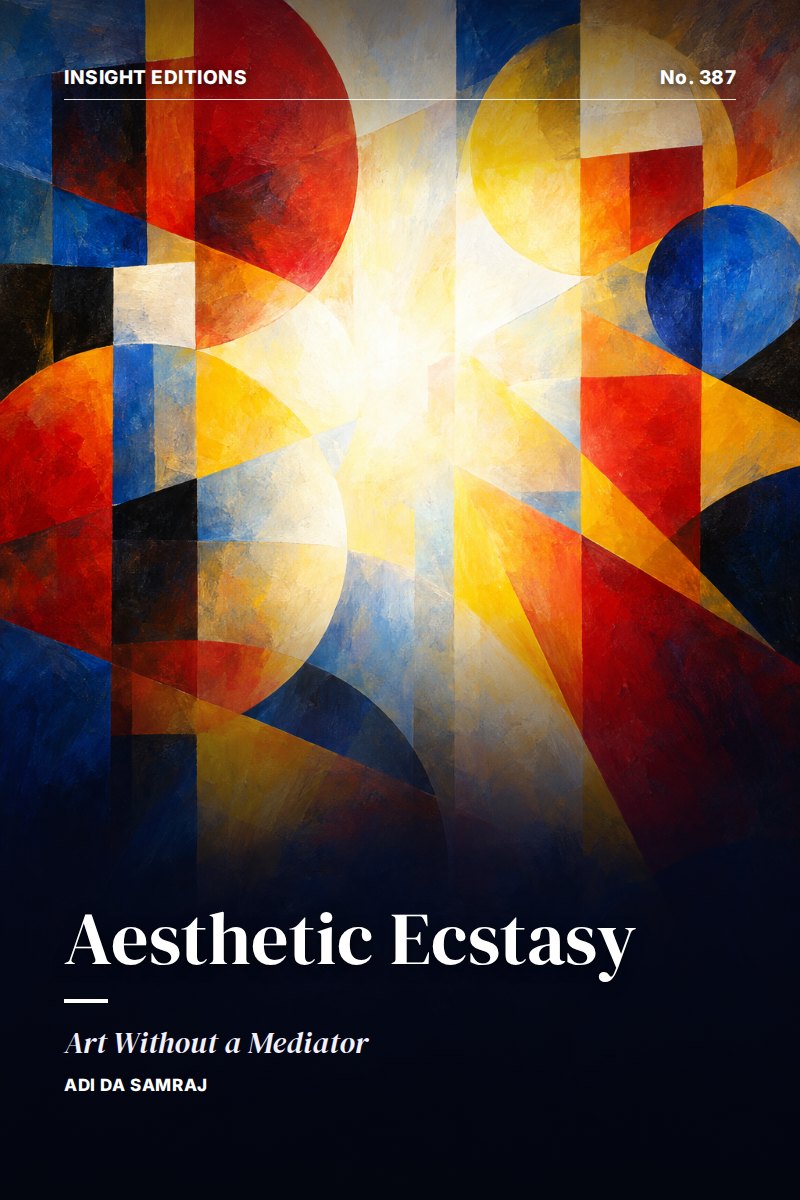
Insight Editions · No. 387
Aesthetic Ecstasy
Art Without a Mediator
Adi Da Samraj
A study edition of Adi Da Samraj's 2007 Venice Biennale booklet: five essays on viewing image-art without mediators, the 'surface space' as Reality Itself, the tree and the human form, and Orpheus versus Narcissus.
A study guide to Aesthetic Ecstasy by Adi Da Samraj. Shared free for personal reading; not for sale and not endorsed by the author or publishers. Please read and buy the original.
CORE CLAIM
The primary use of image-art is aesthetic ecstasy: unmediated, whole-body feeling-participation in which the viewer and the image are not two. Art history, the market and politics are secondary uses that now block that.
SCOPE
Five essays by Adi Da Samraj, written in 2007 as additions to Transcendental Realism for his collateral exhibition at the 52nd Venice Biennale. A 52-page booklet with a short glossary; about 10,000 words of essay text.
KEY FIGURES
Leon Battista Alberti (the painting as "window"), the modernist "surface-alone" critics, Mondrian and Picasso, the Renaissance masters, Orpheus and Narcissus, and the Emperor's "traitorous tailor."
BEST FOR
Viewers of Adi Da's Geome One and Spectra suites, and anyone interested in an argument against the museum culture of explanation and in favour of art as ego-transcendence.
The Book on One Page
The booklet makes one argument five times. Viewers have been trained to stand apart from art and talk about it. Adi Da asks them to stop explaining and feel, until the separate "point of view" drops and only the image, as Reality Itself, remains.
| Essay | Pages | Payload |
|---|---|---|
| The Cover Images and Introduction | 7 to 9 | Square, circle, triangle; red, yellow, blue plus black and white; "Reality Itself Is Truth Itself Is The Beautiful Itself" |
| Aesthetic Ecstasy: Art Without A Mediator | 13 to 27 | Against art history, the market and the audio-guide; music as the model; monumental scale |
| How To Be The Surface Space of My Image-Art | 28 to 29 | The surface is "Subjective Space"; the ego cannot enter it |
| You Are The Surface Space of My Image-Art | 30 to 39 | Alberti's Window; abstract versus figurative; the twenty-foot gorilla |
| The Tree of Human Shape | 40 to 41 | Human form is pre-made, the tree is made by living; art as an indivisible summary |
| The Eternal War Between Orpheus and Narcissus | 42 to 49 | Modernity is not uniquely dark; retrieve beauty; "Narcissus must die" |
The Cover Images
The front cover carries a circular handwritten aphorism: ". . . Reality Itself Is Truth Itself Is The Beautiful Itself Is . . ." The editors call it "the philosophical essence of his art."
- Structure. Three geometric figures, square, circle and triangle, are "the structural basis of his art."
- Colour set. The three primaries red, yellow and blue, with the "binary pair" of black and white, generate every colour he uses.
- Two kinds of content. The back cover pairs a Spectra Three image with familiar forms (a pear, a hand, parts of a woman's face) and a fully abstract Geome One image.
The introduction says the first three essays treat viewing as active participation, the fourth treats the human form and the tree, and the last calls for the "retrieval" of inspired art, using Orpheus and Narcissus as metaphors for an art "wholly sacred and yet beyond the confines of any specific religious iconography."
The aphorism has no beginning or end because it is written in a circle. Reality, Truth and Beauty are presented as one thing read from three sides, which is the thesis of the whole booklet.
The booklet is promotional as well as philosophical: it was produced by Adi Da's own publisher for his own exhibition, and its back pages advertise the catalogue. That does not cancel the argument, but readers should note that no independent voice appears in the essays themselves.
Aesthetic Ecstasy: Art Without A Mediator
The longest essay opens against a modernist doctrine: that visual art is "surface-alone," a mere "thing" in space with neither objective reference nor subjective depth. Adi Da calls this "a 'dead-end' understanding." Even purely geometric work, he argues, is never surface-only.
The culture of explanation
Viewers now meet art "rather exclusively from the perspective of the art historian," placing each work in a scheme of movements. That is "one of the conventions of cultural 'ownership'," like the market's pricing of art as "commodities." Both turn participation into description.
The ultimate liability of art-historical criticism is represented by the vision of people wandering through museums with earpieces installed, always waiting to hear what the tape-recorded "expert" has to say.
Adi Da SamrajWhen the mediator becomes "not only valuable but also necessary," people feel they have "no inherent ability to relate" to what is in front of them. Image-art "has become subordinate to the culture of explanation." He grants critics "an outstandingly important discriminative and educational function," but insists the image "stands, just as it is, in front of (or even all around) the viewer."
What art is for
- Use-less, in the best sense. "Any true moment of participation in a work of art is ... 'use-less,' for the viewer. Right and true image-art has no conventional uses."
- No politics, no doctrine. "My image-art has no political purpose or function ... does not represent any particular doctrine or 'method.'"
- Money blinds. A visitor who knows a canvas is worth millions experiences "fame" and "money" and "cannot give themselves to the image."
- No evolution of art. All image-art does "the same thing," which is the aesthetic experience. So "there really is no evolution of image-art," and comparing Mondrian with Picasso is "not primary."
Ecstasy as the human motive
The human being is a self-organizing, self-correcting, self-rightening system that, unless obstructed, "will inevitably move into the attitude and state that is 'self'-transcending, or ecstatic." Hence: "Ecstasy is the primary and fundamental human motive and event." The aesthetic experience is "about ecstasy, or the experiential transcending of the psycho-physical limits of egoity."
- How well the image is made, judged by "fundamental laws associated with the brain and nervous system."
- How much free energy and attention the viewer brings: "If the viewer brings only a modest capability ... that is all the viewer gets."
- Freedom to participate, which the culture can grant or withhold.
- Coincidence with egolessness: the closer participation comes to "the egoless nature of Reality Itself," the more ecstatic it is.
The concert hall and the gallery
| At a concert | In a gallery | |
|---|---|---|
| Body | Eyes closed, swaying, whole-body feeling | Standing still, checking nameplates |
| Mind | A "concentrated feeling-space" | "Merely thinking," talking explanations |
| Permission | Culturally expected and accepted | Viewers need to be told a work is great |
| Result | "Getting with it" | A glance, then "walking by" |
"Why is it not the case that people go into a museum ... and start swooning in the image-art?" Visual art, he says, "has been put into a circumstance in which people do not participate in it to the point of ecstasy," while music and dance still do.
Much present-day art "is, essentially, political art. It indoctrinates people." He compares it to "the programmed image-art of totalitarian regimes, the official 'realism' of the state." Its fault is not its views but that "it suppresses ecstasy."
Monumental scale is his practical answer: "the viewer is drawn into a space that is beyond his or her ability to contain and limit the images by means of explanations."
The essay treats explanation as a barrier, yet it is itself a long explanation that tells viewers how to look. Adi Da acknowledges the tension only indirectly ("people need to feel they have permission"). The concert analogy is also partial: much music is heard through programme notes, and many gallery-goers do feel deeply without swaying.
How To Be The Surface Space of My Image-Art
A two-page, almost aphoristic piece. "The 'surface' space of the images I make and do is not 'objective' space." The viewer need not "enter into" it, "as if the 'viewer' is not always already 'there.'"
- No vehicle needed. No human likeness or familiar element is required "to un-'lock' the 'surface' space" and "escort" the viewer in.
- Subjective Space. The surface "is Subjective Space," the "Inherently egoless, Non-separate, and Indivisible" space of Reality Itself.
- The ego cannot go there. The ego-"I," always "space-time-'located,'" cannot itself enter that space, because the space is egoless.
- The means. The viewer discovers it "entirely by means of tacit (or pre-mental, and purely perceptual) feeling-participation."
The essay's title says "how to be," not "how to see." The instruction is not to look harder but to stop occupying a separate viewing position, so that the viewer "sympathetically Be" the space of the image.
The claim is unfalsifiable by design: if a viewer feels nothing, the explanation is that they are still standing in the ego-position. That protects the doctrine but gives a sceptical viewer no way to test it against the images themselves.
You Are The Surface Space of My Image-Art
Some viewers say they are "drawn in" by Adi Da's figurative images but not by the abstract ones. He says that reaction comes from relating "from the 'position' of the 'viewer' who presumes to be separate," which is also how people "look at one another, and even everything altogether."
Replacing Alberti
Leon Battista Alberti (1404 to 1472) described the painting as a "window" onto the outer world. Adi Da calls that "art based on 'point of view.'" He named the suite Geome One "Alberti's Window" to point out that his work "is, in fact, not Alberti's kind of space."
- Method. He photographed "the view through a window" as "a sketchbook, and a key to unlock feeling-memory," then made "complex abstractions in response."
- Not landscape. The work "represents the transcending of conventional notions of landscape." It ignores perspective and the subject-object orientation.
- Subject matter. The imagery is "about the perceiver, the 'knower,' the 'experiencer,'" and the transcending of the ego's "impulse to 'objectify' all perceptions."
How to view
- No study required. "I do not expect people to undertake a lengthy course of study."
- Feel, don't figure. "Take the time to simply, tacitly feel them, without trying to think of something to say."
- Treat intellect as a defence. The intellectual approach is "a 'method' for keeping the art 'objectified,' and keeping yourself separate from it."
- Let it change you. Allow yourself to be "positively and deeply affected (and, at least for the moment, changed)."
He calls the work sacred in the root sense of "set apart," "not in the 'religious' sense, not at all." Set apart means "rightly protected," with access "granted only under right and appropriate conditions."
A reproduction at 8 by 10 inches can be "consumed" or "controlled." Being "suddenly confronted by a twenty-foot gorilla immediately cancels anything you might want to say." His monumental prints work the same way, except that the right response is not "fight or flight" but "the ecstatic response of non-separate ... coincidence."
The essay ends in short lines: "Reality Itself is always the 'surface' of existence." "The ego-'I' is always one foot (or more) away from the 'Surface' that Is Reality Itself." "My image-art is not made and done to reflect and entertain the ego-'self.'"
The rejection of Alberti is clear as a slogan but loose as art history. Modernists from Cézanne to Rothko had already rejected the window model and often spoke of immersion and presence. Adi Da's distinctive claim is metaphysical (the surface is Reality Itself), not formal.
The Tree of Human Shape
The shortest essay contrasts two ways a form comes to be. A tree's structure "is the direct formal evidence" of its whole life in space and time. A human body is "pre-formed for life" and only shows life's effects as marks against that form.
| Human entity | Tree | |
|---|---|---|
| Start | Leaves the womb pre-formed | Emerges as a seed |
| Womb | The mother's body | "The world (of elements, and of space, and of time) is its lifetime womb" |
| Life's effect | Reactions "on and against its pre-formed structure" | Structure is "made in and by the life-process" |
He proposes art that "begins with ... the appearances, conditions, and experiences of human life" and "responsively generates forms that are a unified, integrated, and indivisible formal demonstration of the totality-all-at-once." "The 'human' is the source, and the 'tree' is the idea."
The essay is a statement of method in about 300 words and depends on the reader having the images (such as the Spectra and Geome works) in view. Without them, "the totality-all-at-once" stays abstract.
The Eternal War Between Orpheus and Narcissus
The final essay turns from the gallery to culture at large. Its target is the assumption that modern life is uniquely dark, so artists may no longer "do" beauty, and art must be anti-art reflecting "never-before-seen negativity."
The historical argument
- The past was as bad. Earlier centuries had "horrific plagues" and "virtually constant dreadful wars," and in some respects were "even worse."
- Yet they used beauty. People then "always made intensive use of both daily and rare beauty," and cultures acknowledged "the human need for beauty."
- Modernity's real novelty is an "agreement," or propaganda, that the great possibilities of existence "are no longer either relevant or acceptable."
- The tailor. That propaganda is "like the naked Emperor's traitorous tailor, utterly false."
If humankind "ceases to make use of the disposition to transcend limitations," the present difficult time "can, indeed, become an 'end-time'," ending in "the unconscionable ... annihilation of humankind and the inexcusable destruction of all of the natural domain of Earth."
A global, post-religious culture
The needed culture is "necessarily global." Institutionally obligatory "Christian" art is a mark of Western "tribalism, provincialism"; Eastern traditions likewise rest on "local" mythologies. What must be "universally retrieved" is "the disposition to exceed the limitations of mortality, egoity, and gross existence."
Narcissus (or the ego-"I") must die. Orpheus (or the will to ego-transcending Perfection) must win. Or else, the human being, or even the total culture of humankind, will die in contemplation of the mirror that is its own and mortal mind.
Adi Da SamrajHis art "is not 'religious' art" and uses the free means of the modern and post-modern periods, but in "a unique disposition" aimed at the "radical" ("at-the-root") uplifting of humanity. The essay closes in incantatory prose: "Death to the Archetypal tailor ... Narcissus" and "Let Orpheus be Emperor of all of art and culture's Lighted Happen."
| Orpheus | Narcissus |
|---|---|
| A being of light who descends to save the beloved | Self-enamoured, loves only his reflection |
| Culture of ego-transcendence | Anti-culture of ego-reflection |
| Beauty and the aesthetic experience | Gross "realism," anti-beauty |
| Leads beyond mortality | Leads to "nothingness, death, and darkness" |
The essay paints contemporary art in one colour. Much recent art pursues beauty, spirit or transcendence (Agnes Martin, James Turrell, Bill Viola), and much political art is not nihilist. The broad target makes the call for beauty easy to agree with but hard to apply.
Master Takeaways
The booklet compresses Adi Da's philosophy of art into a single demand: be with the image, not apart from it.
- The primary use of art is aesthetic ecstasy, not information, status or politics.
- Mediators (art history, the market, the audio-guide) have become barriers when treated as necessary.
- The "surface-alone" doctrine is a dead end; even geometric abstraction is a meaning-space.
- True art is "use-less" in the positive sense: it serves only the moment of participation.
- There is no evolution of art; all good art does the same thing.
- Comparison of styles is interesting but not fundamental.
- Ecstasy is the primary human motive, built into a self-organizing body-mind.
- What a viewer brings (energy, attention, freedom) sets what the viewer receives.
- Visual art has lost the participatory culture that music still has.
- Much contemporary art is political indoctrination that suppresses ecstasy.
- Monumental scale disarms the "explanation-mind."
- The surface is Subjective Space; the ego cannot enter it, only drop away.
- Feeling, not intellect, is the means of right viewing.
- Alberti's window is the model of point-of-view art that his work replaces.
- Sacred means "set apart," rightly protected, not religious.
- A tree's form records its life; art can summarise a human life the same way.
- Modernity is not uniquely dark; the refusal of beauty is a choice.
- A global culture must retrieve the disposition to transcend limits, beyond local religious iconography.
- Narcissus must die so that Orpheus, ego-transcendence, can lead culture.
Frameworks and mental models
| Name | What it says | Use it when |
|---|---|---|
| Primary vs secondary uses | Participation first; history, money, politics after | Planning a gallery visit or exhibition |
| Concert-hall test | Would you engage music this way? | Noticing how you guard against art |
| Four factors | Image quality, viewer energy, freedom, egolessness | Asking why a work did or did not move you |
| Alberti's window vs surface space | Picture as view onto a world, or as the space you already are | Looking at abstract work |
| Twenty-foot gorilla | Scale that cancels commentary | Choosing how to show or see work |
| Orpheus vs Narcissus | Culture that transcends the ego, or reflects it | Judging an art or media culture |
As a manifesto for unmediated looking, the booklet is direct and persuasive: its picture of visitors walking past paintings with earpieces is accurate, and its call to slow down and feel is useful for any art. Its weaknesses are that it is written to frame one artist's work as uniquely capable of delivering Reality Itself, that it gives no criteria for a viewer who feels nothing other than to blame the ego, and that its portrait of contemporary art is too sweeping to engage the many artists already pursuing the same aims.