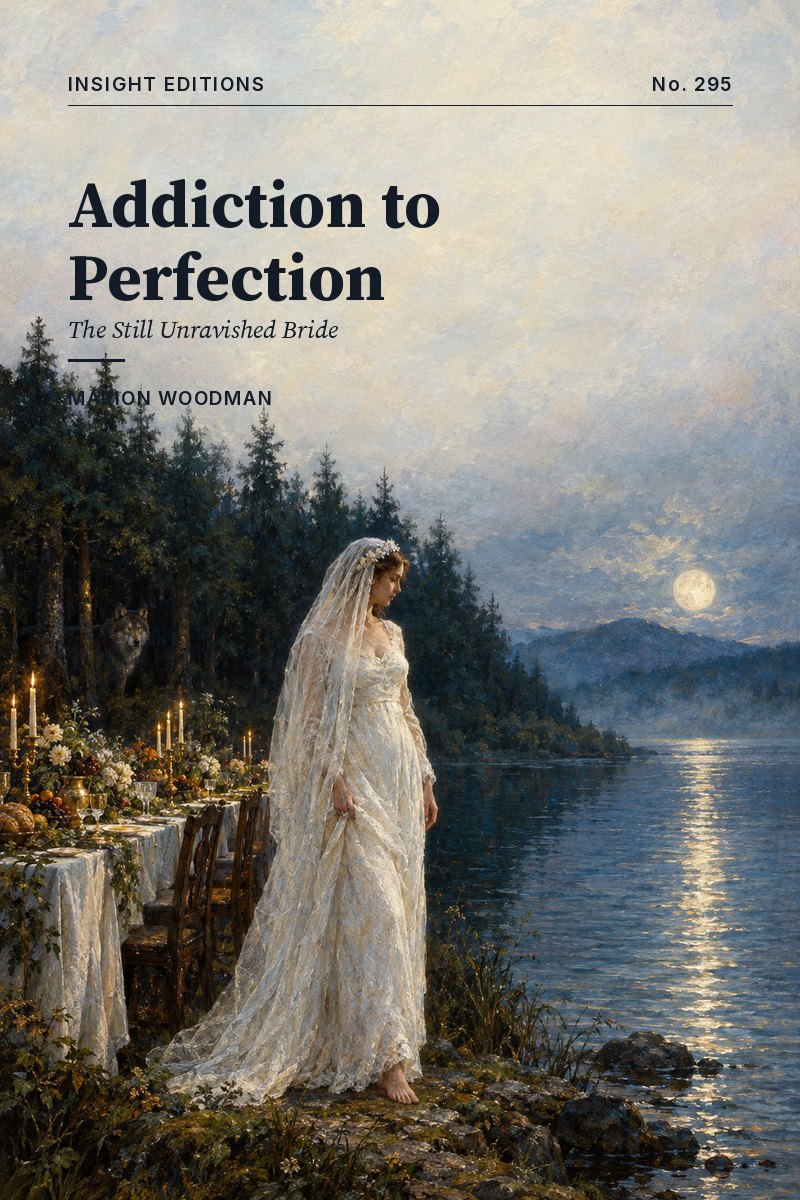
Insight Editions · No. 295
Addiction to Perfection
The Still Unravished Bride
Marion Woodman
Marion Woodman, a Jungian analyst, reads compulsive eating, starving and drinking as failed rituals, and shows how a woman driven by perfection can recover her body and the rejected feminine.
A study guide to Addiction to Perfection by Marion Woodman. Shared free for personal reading; not for sale and not endorsed by the authors or publishers. Please read and buy the original.
CORE CLAIM
Compulsive eating, starving and drinking are failed rituals: a woman cut off from her body by a patriarchal ideal of perfection worships a demonic god in food, and heals only when she consciously receives the rejected feminine.
SCOPE
Preface plus 8 chapters, 1982. Jungian case material from Woodman's Toronto practice: dreams, body workshops, journals, myth, fairytale, Keats, Shakespeare, the Bible and alchemy.
KEY FIGURES
Medusa, Athena, Perseus, Andromeda; Lady Macbeth; the Black Madonna; Sophia; Demeter and Persephone; the demon lover; Brunnhilde and Ereshkigal; analysands Ruth, Eleanor, Elizabeth, Andrea, Ingrid, Maggie, Meagan.
BEST FOR
Readers of Jung, depth psychology and feminist spirituality; anyone caught in perfectionism or compulsive eating; therapists who work with the body, dreams and ritual.
The Book on One Page
Woodman's book is a diagnosis followed by a cure. The first four chapters show how a woman who was never welcomed into her body ends up worshipping perfection and acting out a demonic ritual with food. The last four show how the same energy can be turned toward the Goddess, the body and a living, "ravished" femininity.
The starting point is a clinical pattern. Woodman, a Jungian analyst trained in Zurich, saw women who were brilliant, disciplined and successful by day and who, at night, ate or starved or drank in trance-like binges they could not explain. She argues these are not failures of willpower. They are rituals gone wrong: the psyche is seeking a god, and in a culture that has lost its sacred containers it finds one in the refrigerator.
The root, in her account, is a missing maternal matrix. Mothers who were themselves cut off from their bodies, often "father's daughters" who absorbed patriarchal standards of achievement, could not give their daughters the experience of being loved simply for existing. The daughter becomes an object to be perfected: the best little girl in the world. Her body is a machine to be disciplined, and her repressed instinct comes back as Medusa, the snake-haired craving that wants "more, more."
The book's central distinction is between perfection, which belongs to the gods and freezes life, and completeness, which belongs to human beings and includes the shadow. Perfection isolates one part and drives it to an extreme; enantiodromia then flips it into its opposite, so that fasting turns into bingeing and discipline into collapse. Completeness accepts the fall into matter as a felix culpa, the fortunate fault that begins incarnation.
The cure is not a diet. Woodman's method is to bring consciousness into the ritual that is already happening. Dreams are the map, the body is the place where the work happens, and the journal is the silver mirror in which the woman watches herself without being petrified. Her workshops combine relaxation, breathing below the neck, energy mapping, active imagination in the body, and dance. The aim is integration of body and psyche, and weight loss follows as a side effect, if at all.
The second half widens from food to sexuality and spirit. As the eating comes under control, dreams turn to glass coffins, prisons and emptiness. Woodman traces the demon lover, the perfect inner masculine figure who is bred when a "mother's son" father projects his anima onto his baby daughter, splitting love from sexuality. The demon lover leads to a death-marriage. When the woman's ego is strong enough to know this figure from the inside, the same encounter becomes ravishment: being taken by the Self.
The book ends on the image of its subtitle. Keats's "still unravished bride of quietness" is the woman frozen on the urn of perfection. Woodman's hope is that she will become a ravished bride, a woman who can hear "I love you as you are" from within, with the Black Madonna, Sophia and the feminine side of Christ as the images of that recovery.
Chapter map
| Ch | Title | One-line payload |
|---|---|---|
| P | Beheading the Witch | Athena and Medusa are chained together; Perseus works only through the mirror. |
| 1 | Introduction: The Wolf at Night | Compulsive eaters live a day and night cycle; the root is a missing maternal matrix. |
| 2 | Ritual: Sacred and Demonic | The binge is a demonic ritual; the cure is conscious, sacred ritual, spiritus contra spiritum. |
| 3 | Addiction to Perfection | Perfection freezes and collapses; completeness accepts the shadow and begins incarnation. |
| 4 | Through Thick and Thin | The witch mother produces a daughter-object; tears and recognised feeling lead to Sophia. |
| 5 | Assent to the Goddess | The body as sacred vessel; workshops, Elizabeth's bulimia, the journal, twelve eating rules. |
| 6 | The Myth of Ms | The Casa Loma fairytale: three daughters of a false queen; only the descending one finds the Goddess. |
| 7 | Rape and the Demon Lover | How the demon lover is bred; psychological incest, Andrea, Persephone, Ingrid. |
| 8 | The Ravished Bride | Brunnhilde and Ereshkigal paths; rape and ravishment as one event; the eternal Now. |
Jungian terms used throughout
| Term | Meaning in this book |
|---|---|
| Anima | A man's unconscious feminine side; the eros principle. Projected onto daughters, it breeds the demon lover. |
| Animus | A woman's unconscious masculine side; the logos principle. Negative, it is rigid and opinionated; positive, it is a bridge to her creativity. |
| Archetype | A universal pattern that cannot be seen directly, only through images in dreams, myth and fairytale. |
| Complex | An emotionally charged cluster of ideas around an archetypal core. Woodman's "food complex" is one. |
| Constellate | A complex is activated whenever there is a strong emotional reaction. |
| Ego | The centre of consciousness. A strong ego relates to complexes instead of being possessed by them. |
| Enantiodromia | Heraclitus's term, used by Jung: any extreme eventually turns into its opposite. |
| Feeling | A rational function that evaluates worth; distinct from emotion, which comes from a complex. |
| Individuation | Conscious realisation of one's whole psychological reality, oriented to the Self. |
| Inflation | An unrealistically high or low sense of identity; the ego swallowed by unconscious contents. |
| Participation mystique | Lévy-Bruhl's term for an unconscious bond with a person or object; the mother and daughter merged. |
| Persona | The social mask shown to the world. The perfectionist over-identifies with it. |
| Projection | Seeing one's own unconscious qualities in another person. |
| Self | The regulating centre of the whole psyche, often imaged as divine. |
| Shadow | The rejected or unknown parts of the personality, positive and negative. |
| Temenos | A sacred, protected space: the analytic hour, the workshop, the journal. |
Beheading the Witch
Woodman frames the whole book with two images: Lady Macbeth, the woman who sacrifices love to an ideal of power, and the Perseus–Medusa–Andromeda myth, which supplies the cure. Her thesis arrives in the last paragraph: we are addicted because a patriarchal culture rewards specialization and perfection, and the casualty is the living, feeling woman inside both sexes, chained to a rock like Andromeda.
Woodman opens with Keats's "Ode on a Grecian Urn", whose "still unravished bride of quietness" gives the book its subtitle. Her stated subject is "taking the head off an evil witch." Lady Macbeth, "glued to the sticking-place of insatiable power," stands for the woman robbed of her femininity by chasing masculine goals that are themselves a parody of real masculinity. Macbeth and his wife are read as the masculine and feminine principles inside one person or one culture, and their decay shows how evil works when the masculine loses its footing and the feminine principle of love turns into calculating ambition. Shakespeare's beheading of Macbeth is, in the play's logic, the healing of the country.
She admits the book was itself "hewn out of the hard rock of an addiction to perfection." A black crow on her left shoulder croaked "It isn't good enough," and only deadlines forced the work out. She calls herself a cameo worker who perfects fine detail and then collapses, and she finds linear thinking deadening: "No bell rings." So she asks readers to follow a spiral rather than a line. What is missed on one turn may be caught on the third or the ninth, and "timing is everything" in the world of the feminine.
- Scope. Many of her analysands have eating disorders, so the first half leans on obesity and anorexia nervosa. These are symptoms of a general Western malaise, not special cases.
- Sequence. As weight comes under control, dreams turn to emptiness, prisons and glass coffins, pointing to sexual and spiritual problems common to most modern women. Those fill the second half.
- Men too. The cry of the witch under the material "may well be recognized by men too."

The governing myth
Medusa was beautiful until she offended Athena, who was born "fully armed, with a mighty shout" from the head of Zeus after he swallowed her pregnant mother Metis. Athena turned Medusa's hair to snakes and made her face petrifying. Perseus killed her using gifts from three gods: a curved sword and winged sandals from Hermes, a mirror-shield from Athena and a helmet of invisibility from Hades. He never looked at her directly, only in the mirror. From her neck sprang Pegasus and Chrysaor "of the golden sword." On the way home he freed Andromeda, chained to a rock as a sacrifice to a sea monster, and married her.
- Athena (the driven daughter). The modern professional woman "sprung from the father's forehead": excellent doctor, mechanic or consultant, often unhappy. "Perfect job, perfect house, perfect clothes, so what? I was born, I died, I never lived."
- Medusa (the raging repressed feminine). Shut in a cave "somewhere back in the dark patriarchal ages," she shows up as unquenchable craving: snakes "reaching, reaching, wanting more and more."
- Perseus (the inner hero). Must approach indirectly, invisible, eyes on the mirror. Direct confrontation brings paralysis, as in Margaret Laurence's The Stone Angel.
- Pegasus and Chrysaor (released energy). Creativity and the golden sword of discrimination, freed once the head is off.
- Andromeda (the forgotten maiden). The "still unravished bride," frozen like a figure on Keats's urn, at risk of being sacrificed to a monster from the unconscious.
The key mechanism is a pairing: Athena is chained to Medusa as surely as Medusa is chained to Athena. On one side we play the efficient, disciplined goddess; on the other we are pulled into Medusa's voracious, repressed energy. Both are "extremes of the gods, territory that doesn't belong to us." Woodman's programme is to look into the heart of the driven Athena and the anguish of Medusa, and then to release the maiden "before she is sacrificed to the perfection of death." Only by loving our own maiden can we risk opening to the raging goddess at the core of the addiction.
Two extremes, one trap. The Preface's thesis is that the efficient Athena and the devouring Medusa are not opposites to choose between. They are one system, and both are "territory that doesn't belong to us." The human place is between them, reached only by the indirect, mirrored approach of Perseus.
Apply it. When a craving and a strict rule alternate, Woodman's advice is to stop siding with one against the other. Look at both in a mirror: write the rule and the craving down side by side in a journal and ask what each one is protecting. Confronting either head-on tends to freeze you.
Introduction: The Wolf at Night
Compulsion lives where daytime perfectionism meets nighttime collapse: the persona performs flawlessly, then an ego with no values of its own hands the body over to food, drink or cleaning. Woodman blames a missing balance between the goal-driven masculine and the receptive feminine, a weak maternal matrix, and a culture whose presiding goddess is a sleepwalking Lady Macbeth. She reads the food complex as a neurosis whose purpose is to force intelligent women into consciousness.
Serious drinkers, serious eaters
The book opens at a closing-night cast party. Around 2 a.m. a lead actor thanks Woodman and leaves: "I have some serious drinking to do." His tone suggests a rendezvous with the woman he had loved all his life but could never marry. Woodman's point is that serious addicts of every kind live under a spell, a secret at the center of everything they do. The serious eater hears others swap diet tips and knows she is not one of them; Weight Watchers is useless to her, and her life is on "some Almighty Scale" that she must step on alone. She is in a covenant with food she does not understand: "She hates it; she loves it; she keeps her covenant silent."
- Who the book is about. Serious eaters, drinkers, house cleaners, "serious anyones," and workaholics who say, "I can handle the job perfectly. But if that's all there is, I'm not interested."
- Who they are. Mostly highly respected professionals whose inner collapse repeats cyclically, daily, weekly or monthly. Their right hand does not know what the left is doing, and the left is undermining a successful life.
- The common factor. Consciously they drive themselves within a rigid framework; unconsciously they cannot control their behaviour. Will power can only last so long, and when it has been kept up at the cost of everything else, "nothingness gapes raw."
Woodman borrows Ernest Becker's The Denial of Death to name two postures: the person "partly dead to the world," most "free" when least in possession of himself, and the person "overly sensitive to the world," who cannot shut it out. Either way, "I" ceases to have control. This "I" has no value system of its own. The persona works perfectly all day; then "those frenzied, foreign rhythms" keep running, and with no differentiated ego to gear down, the body behaves "like a beaten, neurotic, terrified animal."
The wolf attitude that demands more and more by day howls "I want, I want" at night. Society rewards the wolf in the "professional jungle" but cannot feed the lonely wolf after hours. Because "there's nobody and no body consciously there," the instincts, which have a natural satiation point, stop working, and the emptiness can never be filled.
Some go with the crowd to alcohol, sex, food and drugs ("better to be drunk than crazy, better to be fat than crazy"). Others, the ones who come to analysis, gulp alcohol they don't taste, devour food they don't chew, clean already clean houses all night or run off "whatever bit of flesh is still left on their poor bones." A demon wearing respectability by day shows its face at night, demanding "perfect efficiency, perfect world, perfect clean, perfect body, perfect bones." Being human, they fall into "perfect chaos and perfect death," and only when the demon has obliterated them do they sleep.
Masculine and feminine, defined by sailing
What is missing is balance: the goal-oriented, rational, perfectionist masculine principle must be balanced by the feminine. Woodman defines both terms through a scene. Sailing with her friend Tony on rough Georgian Bay, she watches strong body and keen mind "fused in perfect harmony," concentrated and relaxed at once. His right hand works the lines, his left holds the rudder in "a poised surrender to the energies of the water." One slip would capsize them. Ashore, her feet are bloody and her thighs cramped; Tony smiles, "knowing." He trusts his body and can surrender his strength to a strength beyond his own.
The point of the anecdote. Woodman is "just as happy to crew for my friend Mary," an equally good sailor. Masculinity and femininity are not tied to bodies. A woman's ego is feminine and she carries an inner masculine, the animus; a man's ego is masculine and he carries the anima. The distinction is psychic, not biological.
The I Ching supplies the dynamic. Yang, the creative masculine, presses toward a goal until it overextends and breaks; then yin, the receptive feminine, rises from below. Maturity means not riding the pendulum to either extreme, which only produces "action and reaction, inflation and depression." The poles are "the domain of the gods."
- The cruel ratio. "The further I move into the white radiance on one side, the blacker the energy" behind my back. Perfect the ideal self-image → overflowing toilet bowls in dreams.
- Swift's lover. Jonathan Swift's adorer cries "Caelia, Caelia, Caelia shits!" and cannot accept that his ideal has bowels. (Woodman's note: "Caelia" puns on caecum, the blind gut.)
- The rule. "As human creatures, not gods, we must go for the grey," a serpentine middle course. That steady line is the differentiated ego, male or female, "cutting a course between wind and water."
| Principle | Woodman's definition | Its healthy work |
|---|---|---|
| Positive masculine | Goal-oriented, disciplined, purposeful; the stronger it grows, the more flexible it becomes | Holds a firm standpoint while surrendering to inner creativity; its penetrating power inseminates the feminine |
| Feminine | "A vast ocean of eternal Being"; contains the animals "red in tooth and claw" and seeds of life; exacts nature's laws; lives in the eternal Now | Moves in slow spirals, plays even while working hard, loves life |
| Spiritual feminine | Always grounded in instinct, so always on the side of life | Releases new hope, faith and love when met by the positive masculine |
| Overspiritualized masculine | Found in men and women; spirit cut from body | Seduces us toward the sleep that ends "the heartache... that flesh is heir to" (Hamlet) |
Good sailors use the "I" to decide when to use masculinity and when femininity. That ego is strong enough only if supported by the body's wisdom, whose messages come straight from the instincts. Without that ground the body becomes the enemy, and spirit, at the moment it could soar, is undermined because it cannot trust its instinctual base even for survival: "like a boat without a rudder whirling in panic-stricken circles."
The missing maternal matrix
We live in a technological age that worships the perfection of the computer, and "human beings tend to become like the god they worship." Our suffering keeps us from becoming perfect robots, because nature exacts its own price. Woodman calls hers a "bridge generation": facing atomic power and possible self-destruction, it is trying to reconnect to roots dormant for centuries, and most of us have no model.
- The inheritance. Most mothers "loved" their children and did their best, yet most people of this generation lack a strong maternal matrix. Many mothers and grandmothers were daughters of suffragettes; some longed to be men, ran the household on order, goal-oriented ideals and success, and passed on "the gall of their disappointment" with the milk.
- The unexpected child. Mothers geared to efficiency could not surrender to life as it happens, and a baby is the unexpected. The child grows up with an "elusive sense of guilt", trying to justify an existence it has never psychically been granted.
- The body link. A mother not at home in her own body cannot rejoice in pregnancy or birth or nurse with tender caresses.
Joseph Chilton Pearce's Magical Child supplies the developmental frame. If the pregnant mother produces massive adrenal steroids through chronic anxiety or fear, they cross the placenta and lock the infant into "a kind of permanent body stress." If the first matrix is incomplete, the next is "doubly difficult." Pearce attacks technological delivery-room procedures as a trauma that works "like a time bomb." The infant can move out confidently only if the mother is an "absolutely unquestioned safe place." In the end we have two matrices: the earth and body, and the abstract matrix of thought.
Pearce's birth-trauma claims are speculative. Magical Child (1977) is a popular book, not clinical research. Prenatal stress does affect fetal development, but the claim that modern delivery permanently damages the psyche "like a time bomb" was never established. Woodman uses it as fact. The broader mother-centred causal story also predates modern research showing anorexia's twin-based heritability of 50–60% (Watson et al., Nature Genetics 2019), which shifts weight from parenting toward biology.
Lady Macbeth, the goddess of the wasteland
Macbeth at first sees the dagger for the lure it is, weighs the moral cost of killing Duncan, and decides to "proceed no further in this business." Lady Macbeth is "locked into an ideal of Kingship." She betrays her feminine nature and gives her soul to "the spirits that tend on mortal darkness." Instead of helping her husband stay in touch with his feeling values, she mocks his manhood: "screw your courage to the sticking place." The couple who began with "Dearest Chuck" lose each other in the ideal.
The road not taken. Had her feeling been alive, Woodman suggests, she might have turned his face to hers and whispered "Why are you afraid?" Instead the last image is of her sleepwalking in her nightdress, "clutching empty space" for the hand she once loved: "To bed, to bed, to bed." Her eyes are open but their sense is shut. "Her masculinity burned out her femininity, a fatal error for any woman," and life became "a tale told by an idiot."
Divorced from the feminine, the masculine produces "a false notion of Kingship, power for its own sake", a demonic parody. Woodman notes a counter-trend: many women now refuse to be Lady Macbeths, refusing to drive their men, or be driven, toward a Kingship that "careens toward madness."
The murder committed is the murder of the Great Mother, meaning the inner psychic life that speaks in symbols and feeds the spirit. Following Jung, Woodman holds that no era has so completely divorced outer from inner reality, and the arts show it: from Eliot to Beckett the cry is for water or food; in painting, from Giacometti's anorexic skeletons to Botero's obese bourgeoisie.
The goddess at the center of "our wasteland culture" is a Lady Macbeth, and like her we sleepwalk "with our eyes open and our senses shut." She is the extreme negative mother, one who would "dash her baby's brains out," and must not be confused with the Black Madonna of Christian tradition (Chapter 5), who works through our dark, instinctual nature and can bring healing. "Nothing divine can come out of a Lady Macbeth." Her "love" alienates; her voice whines "How can you do this to me?" "Some of the sweetest, kindest, most unselfish witches suck the life-blood out of those they 'love'," and cannot understand why their children cannot eat what they so devotedly cook. Only by seeing and naming her can we recover the energy she drains.

The analysands and the food complex
The battle between inner and outer, feminine and masculine, being and doing is most dramatic in Woodman's obese and anorexic analysands: mostly college-trained, sensitive, efficient young women whose education aimed at good grades. Their allegiance to the masculine has split the feminine into white (the cherishing, unconditionally loving mother) and black (the jealous, unrelated, sexual whore). Toward their own mothers they are doubly ambivalent: they identify with and reject her masculine ideals, and they identify with and reject the nurturing mother and clinging daughter.
- The mask. Aware of the split, they hide it "behind a passive, silent mask" and are called dramatic, hysterical, orgiastic.
- The cause. They have "no sense of everlasting arms" under them because the early matrix is missing. They make violent bids to hold on to life, then sink back into "a lethargy of nonexistence", lacking any daily continuum.
- The trap. They seek husbands who will give day-to-day cherishing, and so may marry the mother they fled.
Food is a catalyst for almost any emotion: love, joy and acceptance, or guilt, bribery and fear of rejection. It sits at the center of every festival; to reject it is "to be left out of life." Woodman reframes the problem teleologically: "I see the food complex as a neurosis compelling intelligent women toward consciousness." Where the conflict is unconscious it takes psychosomatic form. Fat is taboo, so the neurosis hits "at the heart of the female ego": the fat girl cannot eat the junk food, is not invited to parties, cannot wear jeans and "in our society she is not a female." Isolation drives her inward, where fantasy compensates for the unlived life and images gain numinous power; the forbidden becomes "at once the revered and the dangerous object."
- 1–3 years in analysis: the stage of the women Woodman describes, able to separate appearance from reality.
- Highly responsible professional positions: where most of them function efficiently by day.
- Four body responses to the "false" food: edemic, bloated, allergic, or vomiting the poison out.
They are grappling with a false "Lady Macbeth" matriarchal value system in which femininity is contaminated by masculine values that "the unconscious rightly refuses to accept, even as their body refuses to assimilate the food." Young women come to analysis to lose weight; mature ones look for causes and change their conscious attitudes.
Mother-blame, disclaimed but structural. Woodman insists the book is "not a condemnation of mothers, or fathers"; parents were often "in a worse situation than we." Yet nearly every causal chain in the book runs through the mother's unlived femininity. Readers should hold this as a symbolic, Jungian account, not an aetiology. Her clinical sample is also narrow: educated, mostly white Canadian professional women in the early 1980s.
The chapter ends on forgiveness and task. Mature individuals must separate infantile imagos from actual parents, sort the wholesome from the destructive in their inheritance, and forgive. The creative purpose of the neurosis is to make the woman confront the negative mother inside herself, which her body rejects as a foreign substance, "any more than do two pounds of chocolates before she goes to sleep." The task her own mother failed to perform, she must perform: "That is the new consciousness, the giant leap."
Apply it. The day-night split maps neatly onto high-performance professions such as banking and consulting, where the persona is rewarded and the evening "I" is absent. Woodman's test is practical: notice whether there is anyone present to taste, chew and stop. If not, the problem is an absent ego, not weak willpower.
Ritual: Sacred and Demonic
Addiction is displaced religion. When a culture loses living ritual, the hunger for transcendence attaches to a muffin, a bottle or an empty stomach, and the person performs a ritual in reverse that invokes the devouring mother instead of the nourishing one. The binge begins as a eucharist and ends demonic, replaying the child's experience of a mother whose gifts carried rejection. Healing turns the same ritual energy clockwise, toward consciousness.
Two epigraphs set the tone: Mary Elizabeth Coleridge's "The Other Side of the Mirror," in which a woman sees a wild, voiceless face in her glass and whispers "I am she!", and Eliot's drowned Phlebas. Jung supplies the thesis: only "an unparalleled impoverishment of symbolism" lets us rediscover the gods as psychic factors, archetypes of the unconscious.
Why now: the hollow at the center
- ~30% of American males overweight (Beeson & McDermott, Textbook of Medicine).
- 40% of American females 20 lb or more overweight (same source).
- 7% of Canadian university-aged women induce vomiting to control weight (Toronto Star, 10 Aug 1981, citing the Clarke Institute of Psychiatry).
- 1% of modeling students with anorexia nervosa under rigorous criteria (Garner & Garfinkel, 1980). See the Critical Lens below.
- Up to 50,000 calories and six purges a day: Woodman's figure for bulimic binges.
Leonard Bernstein, asked on TV why young people love Mahler, said they live so close to "the end of the world" that they can bring all of themselves to music in which "everything is in every note." Woodman links that sense of finality to the surge of body-centred compulsions. Newscasts show wars, crashes, rape and murder, while the old supports crumble: the nuclear family, the community, the Church; "rosaries are worn as adornments." Compulsives, often intuitives, live in the future, dreaming of what they should be, and the obsession fills the gap between reality and dream.
Technology compounds it. We pop pills, have intestinal bypasses or stomach stapling, and hand the body to medicine without asking what it is saying. Symptoms suppressed return elsewhere: "the body eventually takes its revenge." Parents treat children like machines, children treat themselves that way, and the malaise deepens "until someone in the family becomes conscious enough to stop it."
- The mirror mother. A mother who sees her body as "raw stuff of art" breeds a "mirror, mirror on the wall" daughter whose body is an art object she does not inhabit. Result: a sweet, childlike voice from which "what comes out of her mouth is murderous."
- The anorexic's voice (age 20). "When can I get out of this box? I drag my body around as if it's some gross foreign object... Ugly, filthy, fat slob!" Her answer to affluence is withdrawal; her "Kingdom of Beauty, Purity and Light" would reduce her body to "minimal" or "conceptual" art, where the object vanishes.
- No Great Mother image. Society offers none to bridge her to her femininity; "that archetype is not yet constellated." Ironically, the work of art she makes of herself is wholly acceptable to the collective values she despises.
Aloneness is central: "Real compulsives carry out their rituals alone." One anorexic writes that her organized life is "perfectly organized" so that any glitch makes her "totally fall apart"; "The skinnier the better" shows "discipline and control." An obese woman who "graduated from crap food to granola cookies" and lost ten pounds hears mocking laughter at the mirror and grabs a cookie: "Narrowing life down to making a cookie a crime!"
Spiritus contra spiritum
The hardest moment in treating food addicts, as with alcoholics, is the despair after losing the high. Overcoming one addiction can activate another: "many an anorexic or obese girl has been born in full armor from an alcoholic's brain" (Athena again). Some heal through religious conversion.
Jung to Bill Wilson, co-founder of AA (letter, 1961). The craving for alcohol is "the equivalent on a low level of the spiritual thirst of our being for wholeness... the union with God." An isolated person, unprotected by "an action from above" or by community, "cannot resist the power of evil." Since Latin spiritus names both the highest religious experience and the most depraving poison, the formula is spiritus contra spiritum.
The first two of AA's Twelve Steps, which Woodman quotes in full:
- Powerlessness. "We admitted we were powerless over alcohol, that our lives had become unmanageable."
- A greater Power. "Came to believe that a Power greater than ourselves could restore us to sanity."
The numinosity of food and drink may reflect the central crisis of the 20th century: the crisis in faith. A Christian culture has lost its living link to wafer and wine, so there is genuine hunger and thirst. The old archetypal structure is giving way to a new one, and the transition is chaos, breeding loneliness and fear. Yet aloneness has "supreme value in the analytic process": "The new life always comes out of the dispossessed, as Christ came from the cow stable."
Groups help; identification with them harms. Woodman respects AA and Overeaters Anonymous and sends analysands to them. The danger is becoming the group's image: a feminist "locked into 1970's ideas of repression," an obese woman who starts preaching "Big is Beautiful," an alcoholic who becomes "the best speaker on the circuit" and is back on the bottle. Her rule: "we have to go into our darkness alone" until we find our own healing archetypal pattern.
In fairytales the quest begins with a lack in the kingdom. Likewise the collective unconscious throws up a compensating pattern. Woodman reads the obsession with food and drink as "Mater's way of concretizing a new archetypal pattern, a feminine one", compensating for specious masculine ideals. Matter heaps up around us, in possessions or flesh; "we rape nature, the Great Mother, with very little sense of guilt." The devouring mother is taking over unseen.
| Figure | Response to the witch | Outcome |
|---|---|---|
| Anorexic | Says a flat NO to the witch, unconsciously | Is devoured anyway |
| Fat girl | Caught between the witch outside and within | Builds her own fortress to escape |
| Alcoholic | Flees upward | Escapes through his trickster spirit |
| Eros | Cannot relate to the daily ravaging of instinct | Love between nature and humanity "almost annihilated" |
Profane ritual, taboo and enantiodromia
We all live by small profane rituals, unnoticed until they fail: a house guest blocks the bathroom, the favourite mug breaks, "the whole day is shot." This "spraying fixative on our daily lives" is partly necessary. Compulsives, though, are enslaved to rigid routine, and much of their energy seethes in a complex: a taboo area "at once forbidden and magnetic, terrifying and numinous."
- The obese. Eat "until the ego lets go," surrendering to the archetypal energy released.
- The anorexic. Perform food rituals, then exercise until "lightness" takes over and they feel "lit with an inner radiance."
- The bulimic. May eat 50,000 calories and purge six times a day with vomiting, diuretics or laxatives.
- The schizophrenic pattern. One side rebels against a society that starves them; the other kills them to reach society's slim image.
- The criminal mentality. One forbidden cone, then self-hatred all day; a handful of spilled chocolate macaroons at the supermarket. Almost everything they eat is stolen, even from their own refrigerators, because a lifelong judging negative mother has made "what I want" wrong and therefore furtive.
Enantiodromia: when energy is pushed too far in one direction it suddenly flips into the energy it was resisting (Paul on the road to Damascus). Without an "I" to take control, "they become the very thing they fight." The civil war between the two sides leaves the rear open, where "the real enemy looms", waiting for both to exhaust themselves.
Jung held that religion is an instinct that must be satisfied. As the institutional sacred is profaned, people invest personal objects with sacred power and invent rituals, but without knowing it they "may invoke the wrong god" and become what they worship. A sensitive woman feels battered by others' boorishness because, unknown to them, she has made everything around her sacred and they keep desecrating her temple. Retreating into a walled Holy of Holies risks turning it into "a witch's brew." Without the Church to mark boundaries between sacred and profane, God and Devil, we must be extremely conscious.
Two factual slips. Woodman glosses religion as "religerer, to reflect." No such Latin verb exists; the classical candidates are relegere (to go over again, Cicero) and religare (to bind, Lactantius), and the derivation is still disputed. More seriously, she cites Garner & Garfinkel (1980) for 1% of modeling students with anorexia. The paper actually found 4 of 56 modeling students (7%) and 12 of 183 dance students (6.5%) (Garner & Garfinkel, Psychological Medicine 1980), so she understates her own case by a factor of seven. The 50,000-calorie binge is also an outlier figure; most reported binges are a fraction of that.
The projection of the Perfect moved down a ladder: once onto God; when God "died," onto the husband; now, in many lives, onto a muffin. "The muffin is not sacred and the power it is releasing is not holy power even when flavored with blueberries."
Clockwise and counterclockwise
In a religious frame, ritual is a transformative fire (Woodman points to Mircea Eliade's The Sacred and the Profane). The initiate lets the old life burn and emerges new: by touching the god at the fire's center through suffering, dying and rising, the ego sacrifices itself to a Higher Power and returns enlarged. But "the muffin cannot replace the divine wafer, nor can alcohol replace the divine spirit, nor can starving replace a religious fast." When animal and spiritual signals blur, "bizarre behavior results", and a compulsive ritual becomes "a hurricane swirling its victim headlong into unconsciousness."
Sacred processions move clockwise around the church or temenos and emerge into new awareness; a Black Mass circles left, reverses the rite and charges participants with demonic power. Woodman maps these onto two eyes (drawing on Shuttle & Redgrove's The Wise Wound and Sylvia Brinton Perera's Descent to the Goddess).
Negative mantra (counterclockwise). "I'm exhausted. I'm ravaged by all these people... I need sweets... It's not my fault. I can't do it. I can't do it." No responsibility for the shadow, no action to care for herself, infantile demand for instant gratification, and the door opened to emotional flooding.
Positive mantra (clockwise). "I am tired. I love myself. I love my body... What food would be best for her? Is it food I really want? Is it music? Is it dancing? Yes, I am fat, but I am trying to release my true feminine body... I can do it." Fat is faced as fact, the ego is built, and projections are taken back from the food.
Woodman stresses Jung's distinction: feeling is a rational function that tells us what we value; affect or emotion erupts from an activated complex. If psychic health is rebuilt patiently this way, no new symptom need appear once weight loss begins.
The wolf and the pendulum
"The drivenness in the professional world can be just as demonic as that of the binge." Marie-Louise von Franz reads the wolf in modern women's dreams as the animus, or a devouring attitude: "that strange indiscriminate desire to eat up everybody and everything," typical where an unhappy childhood leaves a person infantile. "It is not really that they want it, it wants it," and it is never satisfied. Yet the wolf is also lykos, light: "The greed when mastered or directed onto its right goal is the thing."
The muffin bus. Riding home, a woman decides to skip her usual stop because of the muffin stand ("a walk would do her good"). Two stops later she is out and running back for "those taboo, those holy, those hated objects." Alone, ashamed, "being walked, rather than walking," she locks the door, unplugs the phone, puts on her ritual dress, takes her ritual position. Calm turns to ecstasy "until muffin becomes MUFFIN." Outcome: obese, she falls into a stupor; bulimic, she vomits. She has betrayed herself yet feels betrayed. The goddess she meant to invoke "did not appear. Or, if she did, she appeared in her demonic form."
"The eucharist begins sacred and ends demonic, thus repeating the child's experience of the mother." Woodman does not simply blame the mother: a woman in a loveless marriage, trapped at home and desperate to get out, may experience her child's need as her nightmare, so "the actual mother may in fact become negative no matter how much she 'gives'."
The unseen guest
A 40-year-old analysand, after three years of analysis, writes that her existence rests on one premise: "I have to please others." Her feelings arrive a day late; she spends one session "digesting the real feelings from the session before." She buries herself in "a glass coffin": "I eat because I am, in fact, starving."
- The family table. The best food, father carving the roast, and a plaque of Christ: "Christ is the head of this house, the unseen guest at every meal." "There was an unseen guest all right... It was the devil himself." Refusing food meant rejecting mother; arguing meant father "quietly told me what I did think"; crying got her sent from the table.
- Before birth. Her mother hated pregnancy, hoped for a boy, laboured for hours, was anesthetized and left internally damaged.
- The logic. "The only way I can please Mommy is to kill myself. Drink her poison and say thank you." Bingeing is "infant tyrant gobbling up witch mother"; starving is infant tyrant rejecting her. "But the outcome is the same. Reject life and die." "I take the wafer but I do not receive it."
Woodman draws the lessons. The binge is magnetic because it promises the Loving Mother, a sacred rite under Eros; in fact it is compulsive repetition under Thanatos, deepening isolation and hunger. It will repeat "until its meaning finally becomes clear," and that happens only when the person asks "What does it mean about me?" Until then the guest is "the witch mother masquerading as a sentimentalized Christ." Once consciousness dialogues with the unconscious, the "sacred" is seen to be demonic.
- What the binge swallows. The fear and rage evoked by Medusa: the closer the panic, the closer the complex, the negative mother she "never dared face as a child."
- Protective sleep. "The binge and the blessed sleep may well be nature's way of protecting her from a psychotic corner she is not yet ready to face."
- The exit. She must see that her real mother, and so the inner mother, "were simply not able to give food." Obedient to a mother who unconsciously wishes to annihilate her, she is possessed by the witch; only by differentiating can she nourish herself and turn a demonic ritual into a sacred one.
- Interim rule. Until food loses its numinosity, "eating for her will have to be a sacred rite."
Something instinctive "refuses to be silenced." Spiritual longing either befriends the ego and goes with it into life, or entrenches as an enemy and counterattacks life. We choose whether to "join our demons and scream out against the gods who are trying to save us," or adjust conscious values to their demands, even over whether we digest what life requires or leave it "like a lump in the belly" as vomit, bloat or blocked kidneys.
The binge in her own words
A typed binge, reproduced "exactly as it came off the typewriter." A cultured 26-year-old obese woman, an expert typist, records a dialogue between her frail ego and the complex. A capitalised demon jeers ("SNICKER SNICKER... YOU ARE ALWAYS UGLY... I AM DEMON HAHAHAH"), commands "EAT AND SHUT UP... DREAM OF WHEN YOU'RE THIN WHILE YOU EAT," while the ego offers it "A BETTER HOME IN THE NEW ME... A STRONG PRINCE AND MY KING." The ego runs ("RUN RUN RUN"), the text dissolves into keyboard gibberish, and it ends in an out-of-body flight: "I LOVE WIND WEEEEE FLY ON WIND." At her next session she said, "In a way I haven't been born. I carry mother," and two minutes later could not recall saying it.
The remark suggests the binge is swallowing the mother. In the typed passage the mother is still the power-driven enemy, and the ego cannot stop "wolfing" her down: "the results are volcanic." A second analysand, an anorexic psychology student, shows the opposite movement: she recognizes the transformed mother and chooses to assimilate what she used to vomit.

The alembic drawing (fourth of six), inspired by the "Mothers" scene in Goethe's Faust.
- Vessel. An alchemical alembic that is also a womb of redemption, a flame flower open at the top for transpersonal energy; its outline recalls the scarab, Egyptian symbol of the solar god.
- Base. A black and a white caldron for the opposites; a hidden ear (Logos, word, time) and eye (Eros, shape, space).
- Ring of women. A wise old lady dropping a key; a spider lady like Wonder Woman; a smug trickster; a dancer; an 1890s lady marking the end of women as satellites and the rise of the suffragettes; a ghostly lady flaming in transformation.
- Goddesses behind. Diana of Ephesus, the Venus of Willendorf, the Venus of Lespugue, and a primal Earth Mother with eyes like wounds weeping blood.
- The black lady at the center. Began as a German farm lady, became chthonic: a body "like a series of rubber tires," egg shapes on breast and belly, a hat like clown and wizard, an unsettling phallic outline. In active imagination the student climbed her in tears, "sinking into her fertile moistness."
- The revelation. She then saw a public toilet seat and "the 'Mothers' in the toilet bowl." Seven years of vomiting had been "a refusal to be a woman; the 'refuse' of regurgitated food was a rejection of the Great Mother in toto." The drawing gave her "a communion of the profane and the sacred."
Once rituals are "betrayed" to the analyst or another perceptive person, the magic drains out and they can change; false fears separate from real ones. A woman lured into believing her fear of food is a fear of being fat may find a different fear at the center: loss of control. The perfectionist sees "at the center of her whirlpool another power to which she is hostile," and the daytime-nighttime whirl avoids "the confrontation with the Eye." That confrontation demands surrender of the rigid "I," and it comes only "in the fullness of time"; resistances must be respected.
"The attitude of the ego toward the Eye is everything." Hostile, the ego feels like a victim and sets up self-murder. With acceptance, "not resignation, but open receptivity," murder becomes conscious sacrifice, and the Eye radiates a love that supports rather than destroys. While conscious and unconscious are enemies, the ego feels under constant threat of death; in harmony, it feels held by the maternal matrix.
- Quantity is irrelevant. For someone trapped in the negative mother, "even one muffin eaten in her name" can produce bloating or a swollen allergic reaction.
- Patience. Long stress may leave hormonal imbalance; remnants of the neurosis keep triggering guilt around certain foods.
- Vomiting may be read as "a refusal to keep the mother in the stomach."
- Dismemberment. The anorexic who cuts her meat into sixteen pieces and eats one may be enacting the dismemberment of the mother, a calculated act of defiance and power. In many myths the son makes the world from the mother's cut-up body (Marduk and Tiamat is the classic case); dismemberment can become the transformation of negative into positive mother once she listens to her body's needs.
The gypsy's cup: a fasting dream
The dream. An obese woman, seeking both weight loss and insight, fasted seven days, dedicating the fast to the feminine principle. She dreams she is driving on the freeway in a blinding snowstorm with her twelve-year-old daughter, runs off the road, and trudges on holding a fence. An old gypsy woman lifts the skin-flap of a small tent; the three sit around a fire and drink tea. Her cup looks like her mother's favourite china cup, etched with flowers, but is heavy copper enameled to look like china. The gypsy hands her an old chamois; inside is one earring, a stag's head whose antlers mould over her left ear. "That is your gift."
| Dream image | Woodman's reading |
|---|---|
| Snowstorm on the freeway | A cold, unfeeling collective road; dreamer and young feminine side lose direction |
| Fence | Still clinging to a rational direction |
| Gypsy, skin-flap, fire | Ancient natural wisdom; return to the uterine cave; the transformative fire |
| Tea among three women | A profane ritual made sacred; three positive mothers replace Macbeth's three witches |
| Mother's cup in copper | The cup she was trained to give guests and never allowed to use; copper is the metal of Venus; echoes the Grail |
| Chamois | Animal skin dressed with fish oil, an instinctual wrapping |
| Stag earring, left ear | Annunciation through the ear; the stag renews itself by eating a snake, so instinct is assimilated, not transcended; a medieval symbol of Christ, here an image of Queenship |
By refusing to stuff down negative feelings, the dreamer "abstained from intercourse with the negative mother" and made the sacrifice that releases the absent goddess. Her hesitation to open the gift shows a lifelong fear of taking responsibility for her own gifts. Pearce's line fits the left ear: "Left-handed thinking relates to the primary process... unity and bonding to the earth." The witch's gall turned to milk; "she was given ears to hear and eyes to see." Such a dream "establishes fixed feminine ground," a firm feminine love within which the feminine ego can resonate.
Three is the number of fate, and fate, as Woodman's anorexic and obese analysands know, is what pursues them. Stay in analysis long enough and fate shows another face: their own. The chapter closes on the Zen master's demand: "Show me your face before you were born."

Apply it. Woodman's "profane ritual" idea is a usable diagnostic for any habit loop, including doom-scrolling and after-hours email: list the ritual steps that precede the act (the bus stop, the locked door, the ritual dress). Each step is a place where the ego can turn the circle clockwise by asking what is actually needed: food, music, rest or a bath.
Addiction to Perfection
Two 25-year-old analysands, Ruth (obese, 325 lb) and Eleanor (anorexic), show the same disease from opposite ends: a woman who treats herself as a work of art, refuses to enter matter, and secretly believes she is God before creation. Woodman's central distinction comes from Jung: perfection belongs to the gods; completeness is the most a human being can hope for, and addiction to perfection is "at root a suicidal addiction."
Two epigraphs frame the chapter. Jung's Answer to Job warns that the more the feminine ideal bends toward the masculine, the more it loses its power to compensate masculine perfectionism, so an ideal state arises "threatened with an enantiodromia": "No path leads beyond perfection into the future." Rilke's Malte Laurids Brigge remembers his mother filtering every drink through a silver sieve, eating biscuits crumb by crumb, and terrified of needles that might fall into anything.
Ruth: the Stradivarius played as an old fiddle
- Ruth (25). University graduate in a responsible professional post, "psychic to an almost alarming degree," 325 pounds; eldest of five; both parents professionals, divorced after 18 years of stormy marriage; father a secret alcoholic for ten years. Named after Keats's "sad heart of Ruth... amid the alien corn."
- Eleanor (25). Eldest of five; professional parents, still married and respected; outstanding student, athlete and leader; at 23 ate nothing but popcorn, hospitalised, then entered therapy. "Tall and elegant like a piece of Copenhagen china," "like a prize racehorse entering the gate."
Ruth carries everyone's burdens and is "old beyond her twenty-five years and heavy beyond the weight her scales could bear." Of her body she quotes her mother: "I pretend it's an old fiddle, when I know it's a Stradivarius." After a few months she recognises her need for power, her longing for perfection, and her desire for control "not over others, but over life itself." Her daydreams hold radical contradictions: yearning for life and rejecting it, hope and despair, body and spirit.
Ruth's journal, compressed. "Eating sweets is consistently choosing death." There is "a spiritual emergency, because I may choose not to be here at all." "Others see my body as the emergency... I am repelled by the world. I, God, refuse to enter the world, refuse to be incarnated." "If I can't do the whole thing, I'll do nothing." "Who cares whether carrots have more calories cooked or uncooked? The knights of the Grail weren't doing what was at hand. Big problems have to be dealt with in big ways." Of her alcoholic father: "Dad was a flickering light. If only he had gone away, we could have learned to live with candlelight." It ends: "The body is too big: go and get another. Try spirit next time!"
After such entries Ruth would put down her pen, feel sucked into a "death whorl," binge on chocolate, muffins and milk, and wake "at least breathing." The hated body kept trying to survive even when the spirit refused to live in it.
The body's wisdom is a thermostat. Only when the ego is strong enough to take responsibility for a woman living in her body on the earth with human limits can the "appestat" find its natural "set point." Until then the energy keeps circling the same rite of passage and regressing into the witch, yet each circuit lands on a new rung of the spiral, provided the dialogue between ego and unconscious continues.
- Dreams feed the ego. They are "always full of images of food." The food strengthens the firm standpoint if the ego acts on the new insight, and the same food makes it less rigid.
- Contradiction becomes paradox. What Ruth sees as a contradiction may become a paradox: the stronger the ego, the more flexible it becomes.
Why the fat cannot simply be lost
A woman inside a Church's rituals is protected from direct confrontation with the unconscious: ritual gives aesthetic distance and the certainty that the god who dies will rise. Alone, she has only "the darkness of the birth canal without any real faith in the light at the end." If she sacrifices her fat body, "the only security she has ever known," what will hold her on the earth?
Woodman's clinical caution. To strip away the fat before the woman accepts life would "destroy the only bulwark standing between her and a psychotic break or death." The despised fat is her anchor in life, and its size may vary "in direct proportion to her ego's acceptance or rejection of her own humanity." Once weight loss starts, mourning for the lost body must be handled to prevent sudden regain. This is a psychological claim, not a medical one, and it runs against current obesity medicine, which treats weight as substantially biological. Even so, the warning about mourning and regain fits what clinicians see.
Religious ritual re-enacts a myth in which the god drinks from the cup, dies and rises, so believers share his life vicariously: "Not I, but Christ liveth in me" (Galatians 2:20). "Now the divine rug has been pulled out from under us," and the rituals are enacted in us, in daily life. Ruth had no religious affiliation, so her spirit had to be built from her own suffering and hope, which still need grounding in something larger than the fragile ego: "Call it Fate, God, Energy, Love, or Prana."
- The danger of solitary ritual. The ego identifies with the positive or negative side of the god. Ruth would make her life a fiction: "To identify with Hamlet is probably worth about 25 pounds; to identify with Christ must then be worth at least 120."
- Ungrounded gods. Where the inner male authority is a flickering candle, the god within cannot be trusted for light; where the inner female authority mocks the body, the goddess cannot be trusted for love. Ritual merely replays the alcoholic father and the disembodied mother; "rituals in that ungrounded world are games people play."
- The analyst as mother. Ruth's image of God is rooted in her inadequate father and she has no image of a loving goddess, so "at this time the object of her trust must be the analyst," who becomes for a while a positive mother providing the food she never had.
"Fear of abandonment is no different at twenty-five years than it is at twenty-five days." The ego faces death only insofar as it sees itself as an extension of the old life, possessed by the witch. Once it sees the devouring pattern can change, it glimpses freedom: "This is the creative moment." If it chooses then to take possession of its own reality, it can move out of the complex: "Except a man be born again, he cannot see the kingdom of God."
Perfection versus completeness
Jung's distinction. "The Christ-image is as good as perfect... while the archetype denotes completeness but is far from being perfect." The individual may strive after perfection "but must suffer from the opposite of his intentions for the sake of his completeness." So: perfection = the gods; completeness = the human ceiling. "Indeed, perfection is defeat."
| Perfection | Completeness | |
|---|---|---|
| Belongs to | The gods, the idealised image | The human being |
| Method | Isolating and exaggerating one part (Wise Old Man, Madonna) | Accepting all parts, including foolishness and "the whore in herself" |
| Energy | Concentrated in one area: obsession | Distributed to harmonise the parts |
| Felt as | Frozen, catatonic, a statue; terror like an animal in headlights | Living, flexible, spiralling |
| Endpoint | Collapse or death ("suicidal addiction") | Individuation, the Self |
Obsession is a fixation, "a freezing-over of the personality" so it becomes "something fixed, like a piece of sculpture, locked into a complex." Film stars can be frozen in the camera's glare into one type; Marilyn Monroe struggled to break out "but couldn't. Neither the film studios nor the audiences would let her." "Addiction to perfection is at root a suicidal addiction. The addict is simulating not life but death." The perfectionist sees herself as a precious work of art, a piece of Ming porcelain, Keats's "still unravished bride," and her real terror is that it might be destroyed in an instant. "To move toward perfection is to move out of life, or what is worse, never to enter it." For the anorexic, the binge takes the form of a fast, what alcoholics call "a dry drunk."
Eleanor: spontaneity at 2:15
The book of lists. Eleanor shows Woodman yearly, monthly, weekly, daily and special daily lists. "I know it's crazy, but I can't help it. If one thing is missing, what else might be missing?" Told she needs room for spontaneity, she dutifully agrees, then reports: "There's no point in making time for spontaneity, there simply isn't any in my life." Her next daily list reads: "2:15–2:30 p.m.: Spontaneity." "In that simple sentence lay the tragedy of her life."
Her journal describes being both fat and thin: eating "enough to rank with the heftiest" yet staying slim by ritual emptying, "a way to embody the paradox of the simultaneous empty and full." She used Eastern yoga techniques to empty herself so that a divine presence could enter "a purified receptacle"; she "lost 'I' and became a void," dreamt of being electrocuted, then of pure radiant light so strong she woke seeing sunlight in the dark. She took it for divine beatitude. "It wasn't. I had begun to learn, but had not begun to live creatively." Her belly felt "full of serpents," the chaos of mater saeva cupidinum, "unbridled and unbroken nature." Her last line: "But organization begins at home."
Ruth still keeps creator and creation apart; she wants spirit without incarnation. Eleanor is further on: she consciously recognises her wish to empty herself and enter the void, yet shows "a dawning recognition of the need for a body", beginning to link the creator god with a creation. "Eleanor was closer to becoming less of a god and more of a person."
The God before creation
In the obese–anorexic syndrome the maternal matrix is demonically constellated: the child, unconsciously rejected, is a thing, not a person. One obese woman dreamt of herself repeatedly as a golfball. Being treated as a thing leads, ironically, to unlimited inflation: such children feel themselves to be God, not the Creator who breathes life into dust and calls it good, but the God before creation whom James Joyce pictures "indifferent, paring his fingernails" in the void. Their elation is the belief that they can choose whether to enter life: "I am that I am."
The theology of the muffin, step by step.
- To eat is to enter matter, against the will, which denies omnipotence: "they are not that they are."
- Matter is the other force, the witch or she-devil: "God is not alone and omnipotent. He has the devil to contend with."
- One bite of the muffin is Eve's bite of the apple: it brings death and the loss of Eden, that is, of omnipotence.
- Following Jung (Memories, Dreams, Reflections; Answer to Job), the devil, matter, muffin is the deus absconditus, the part of God's unconscious not yet digested.
- Hence a felix culpa, a fortunate fall: the first bite launches the woman toward differentiation from deluded omnipotence and launches God toward incarnation.
- The requirement is "a radical evaluation of her one-sided theology": she must make room for the shadow or the devil.
"Most people locked in this syndrome are born Gnostics: they deny the incarnation." God never became flesh, never suffered or died; "like them, God never lived on earth." When Eleanor began to eat, her biggest loss was the euphoric high of starvation; life seemed worthless without "the intensity and drivenness of her tightrope resistance." She believed she was reducing herself to pure spirit, an idea Woodman links to shamanic initiation, where the shaman is reduced to skin and bone (Eliade).
Precision slips. The belief Woodman describes, that Christ only seemed to have a body, is Docetism, one strand of Gnostic thought, not Gnosticism as a whole. And the Joyce line is Stephen Dedalus describing the artist, who "like the God of the creation" stays "invisible, refined out of existence, indifferent, paring his fingernails" (A Portrait of the Artist, 1916). Woodman turns an aesthetic theory into a portrait of God. The image still fits her point, but the source says something different.
The shouting match
Ruth's flesh was trying to save her by forcing her toward her own feminine identity. Instead she was unconsciously identified with her large body, with no ego to separate herself from the myth lived through the fat. "A body coming at the spirit with the full force of 325 pounds was countered by the spirit coming at the flesh with the full force of Bach, Mozart, Blake and Dostoevsky." Such a match would drown out God, "though not necessarily the devil," who is "that part of God that has not yet entered consciousness." Yet Ruth herself was very quiet, showing "just how out of phase the inner and outer worlds can be."
Analysis replays the struggle for incarnation, God in flesh, spirit in matter, in psychological terms. It ends only when the "muffaholic" understands that what is in the muffin for her is what the Church calls the transubstantiated Christ: the demonic binge must give way to the sacred receiving of God's body as the fruits of the earth. Psychologically, the witch becomes the Great Mother.
- The Christian gap. Woodman argues Christianity has kept crucifixion and resurrection too far apart instead of seeing them as one event, which breeds a masochistic attitude to suffering. In the syndrome, suffering becomes an end in itself, and whatever omnipotence survives is cut off from the pain and "almost completely unreal."
- The negative grip. Both women's "tricks of mind" fail; consciousness of defeat remains their grip on reality, but it is a negative grip.
The ego's questions to the body, as Woodman lists them: "What are my real needs? I betrayed myself in that meeting today. What did I really want to do? What does my body want to eat? Does it want to exercise? What would feed my spirit instead of my flesh? How can I make this heap of flesh my body? Do I love my body? Do I want to live? Do I want to enter life?" The body is ready to answer "in an unmistakably clear voice."
The ego meets a degraded body image that has "little or nothing to do with the reflection in the mirror"; a woman possessed by her ugliness "looks at her complex hour after hour and literally cannot see it." So work with the rejected body must begin outside the complex (detailed in Chapter 5). A gradual shift from self-hatred to self-love can occur, and one day she is "surprised by joy." The movement from psyche to soma must be met by a countermovement from soma to psyche, because the body cannot absorb psychic work unless it has been prepared.
Keats and Donne on the third thing. Keats brings to nature a "greeting of the Spirit," and the unconscious answers by becoming the perceived object, so mind and matter produce a third: a joyous recognition between body and spirit. In Donne's "The Ecstasy," two lovers lie like "sepulchral statues" while their souls negotiate above their heads; the souls realise they could never have met without the bodies, and "out of gratitude" re-enter them: "Love's mysteries in souls do grow, / But yet the body is his book." The woman caught in the body–soul split can hope for the same "dialogue of one."
Through Thick and Thin
The compulsive's hunger for control is a power complex, and power is what replaces love when a child was fed for performing rather than seen for being. Woodman traces how the negative mother and the perfectionist father produce a daughter who is an efficient object without an inner standpoint, then shows the alternative: Sophia, the feminine Wisdom found only inside a living process. "Medusa is human unmeaning; Sophia is human meaning."
Blake's epigraph sets the method: "Without Contraries is no progression." A plate from Blake's Book of Job (1825) faces the chapter.

Macbeth again: the ego breaks with the Self
Killing Duncan, God's representative, Macbeth breaks his oath: psychologically the ego breaking its bond with the Self. Lady Macbeth asks the spirits that "tend on mortal thoughts" to "unsex" her and remove "compunctious visitings of nature," since Macbeth is "too full o' the milk of human kindness." Yet when she goes to kill Duncan she cannot, because he resembles her father asleep: the one spoken hint that she is a father's daughter, more devoted to principles than feelings. Out of his presence she reverts to her ideals, spins the web, prepares potions and knives, and has the master plan ready the moment Macbeth decides to stop.
Macbeth (masculine principle). Rationally weighs pros and cons; accepts that if Fate would have him king, Fate will crown him; foresees the outcome but fails to stand his ground. Ends in conscious self-destruction.
Lady Macbeth (feminine principle in a power complex). Betrays relatedness; ravages her own feeling values first. Ends in "the pathetic self-destruction of unconscious nightmare."
Shared fault. Neither acted "out of an inner sense of authenticity." Woodman sees many 20th-century marriages "wearing the clothes of Kingship without the inner grace to fill them."
There can be no grace where the ego–Self link is cut, where the ego is too frightened to receive from the unconscious; then it tries "to set up its own kingdom." Where generations were out of touch with feeling and instinct, each succeeding generation is more undermined.
Jung on the fear of life (Symbols of Transformation). Fear of life is "a very real panic" that seems disproportionate only because its real source is unconscious and projected: "the young, growing part of the personality, if prevented from living... generates fear and changes into fear." It seems to come from the mother, but it is "the deadly fear of the instinctive, unconscious, inner man" cut off by shrinking from reality. The real mother can injure by "morbid tenderness," but the pursuer is the mother-imago turned into a lamia.
- Concrete base. Without a positive mother base, compulsive eating builds a concrete one with which the ego identifies, so dieting releases genuine anxiety and grief: symbolically, the loss of the mother.
- Pseudo-ego. An infant threatened from the start builds a pseudo-ego, strong-looking but defensive, reacting "complaisantly or aggressively"; its strength lies in rigidity and its concrete body base.
- Shared complex. Mother and daughter may be close yet share a negative mother complex, both terrified of the instinctive unconscious. Even after the complex is dealt with, any life-threatening situation may make the body gain weight with no change in calories.
The best little girl in the world
At puberty "the best little girl in the world," obedient to mother and believing everything daddy said, may rebel and turn herself into "a baby monster or a boyish skeleton." Either way she destroys her blossoming womanhood. "What looks like rebellion may be inner collapse." She has no acceptable role model: perhaps a mother who never grew up but "wears the pants in the family."
The daughter's options at twelve:
- Obey and identify with mother.
- Disobey, becoming anything mother isn't.
- Missing option: act on her own value system, "because she hasn't got one," nor the strength yet to search her inner world. She senses "a breast just big enough to hold a pencil underneath isn't exactly what womanhood is all about."
The anxious mother, watching "the magnified replay of her own girlhood," feels a total failure. Woodman generalises: "Living by principles is not living your own life. It is easier to try to be better than you are than to be who you are." Life by ideals is plagued by unreality, all "must," "ought to," "have to," until the crunch shows "you weren't there" and the house of cards collapses. One woman: "I have everything and nothing. I won the battle for my precious independence and lost what was most precious to me."
Love versus power. A woman fed emotionally by the mother or a substitute (husband, company, Church, collective values) is starving in relation to herself: she must perform perfectly to be loved, her stability depends on others' reactions, and she is both manipulated and a manipulator. She tries to be perfect enough to shut up the judging voice, "but there is no shutting it up. It wants more and more and more." Running toward independence via perfection, she runs into her own starving, dependent self.
The overindulgent mother can be as negative as the judgmental one, if she projects her ideals and drives the daughter into false values; "unconscious identity is involved in power."
Rachel and the mittens. Rachel's mother, once an outstanding performer, gave up her career for the family. When tiny Rachel confessed to losing her mittens, her mother wept hysterically: "I knew I should never have gotten married. I knew I should never have had children." At 30 Rachel says, "I still feel my life depends on holding onto my mittens, literally... When I try to deprive myself of food, I feel I may be snuffed out." She lives "attempting to justify her very existence by being perfect... or disappearing completely into chocolates." Discipline restarts the war: "Culture is mother saying, 'Do better'," and somehow her mother is responsible "for the whole mess: my cat dying, the Falklands crisis, Lebanon."
The freight train. Another woman: "A big blob with two black eyes is always watching, always ready to eat me up... Nobody else can do it as I can." "I am addicted to trying to set things right." "If I go down, I'll take everything with me. I go like a freight train... If it happens to be a man, he goes too." "My rage comes from feeling I have no impact on my environment." When her man insisted on cutting her fingernails she felt she could commit suicide, cut off her hair, felt powerless and dead, "Then I had to feed myself."
Whose cookies are they?
"The fine line between power and Eros is very hard to find." A little girl bakes with her mother and pats the dough so hard the cookies will be tough. The mother can keep her dependent by withholding the recipe book, handling the hot pans and measuring the ingredients herself: innocent and sensible. But for the child's emotional needs, "the cookies have to be the child's own creation." Otherwise, praised for excellent cookies, "something in her knows they are not hers."
The inverse law of borrowed success: the more she achieves through the mother's doing, the less she is related to herself; she "strives more and more and receives less and less." "Her inner sense of failure is thus in direct proportion to her outer success."
The white Persian cat. A successful professional woman dreams of climbing to a stifling attic she didn't know her house had. A white Persian cat as big as a lion stalks around a Victorian settee on which lies "a wraith of a woman too weak to lift her hand." Each time she approaches, the cat waves its plumed tail in her face, "noble and aloof." Woodman reads the cat as an arrogant, spiritualised instinct, an "elegant animus" fed on the dreamer's expectations: "the trickster who steals the food from the anorexic's mouth."
Sandra Gilbert and Susan Gubar's The Madwoman in the Attic (1979), on Jane Eyre, gives the frame: the split between "the lady who submits to male dicta and the lunatic who rebels," with spatial options of expulsion into the cold or suffocation indoors, and "an obsessive anxiety both about starvation to the point of disappearance and about monstrous inhabitation."
- Projected, the elegant animus attracts a man who has spent his life pleasing mother: perfect father, husband, son, denying his real feelings. He feeds the "positive mother," she turns negative and throws back his gifts: "The more I try to satisfy her, the worse it is." She asks, "What do I have to do to make him feel anything?"
- Exit for him. Drop the image, ask "What are my feelings?", and stop rejecting others before they reject him.
- Exit for her. Take back the projection and see she treats herself the same way; the elegant animus is often her mother's animus combined with her father. "Partners do seem to deserve each other."
- The old Indian story. A woman cuts herself in two at the waist: the top half clings to her man and devours everything he says, its entrails trailing so her excrement obliterates what he does; the lower half stays home to make sure he returns. That is "the wizard behind the witch."
Where the negative mother waits to devour every word, spontaneity dies: one says only what is "perfectly considered for the occasion." It can be subtle. A wife solicitously watching her husband's project may be thinking "I know you can't do it. It will fall on my shoulders in the end." Positive mothering still assumes there is a child to be supported. Women who mothered siblings or their own "dear" mothers as small children project the helpless child and resent the responsibility they automatically take.
The essay that cannot be written
Negative mother plus perfectionist father, at the desk. "I haven't read Kant; I should read Marx; oh yes, there's an excellent passage in Nietzsche..." The thread twists until she has spent hours and has piles of books and notes but no coherent approach. Mountains of material suffocate the creative animus; "when the creative spirit is not breathing into the material, it dies." The complex "hates fun" and reduces everything to grim duty. The exit is a declaration: "Do I want to write this paper or do I not? I do... selfish as I am... and I want to do it my way."
The positive side of the mother complex has "a never-ending supply of seeds and possibilities"; the ego can enjoy them but must decide what will grow, or it collapses. The negative mother does not want joy, creative excitement or freedom: dieting young women buy party clothes eagerly, binge the night before and arrive "bloated and two sizes too large." Enjoyment is a danger zone to be foreseen and handled consciously. If her husband shares a negative mother complex, her anxiety constellates his; either he sinks in with her or pulls back angry. If he holds his rational position, that may constellate her ego strength. Both should talk the complex over when it isn't threatening.
Tears that crack the stone
The Medusa complex petrifies: it stops the natural giving and receiving of energy. It is happy giving, because giving without a choosing ego can be sheer manipulation, and a child raised on a mother's "unselfish giving" is wary of receiving. Such a person may keep a strong persona for weeks until the analyst asks "But how do you feel?" Then the dam holds or breaks. "It is often experienced as a miracle when the 'I' is finally recognized."
The abandoned puppy. For three months an analysand told a life of "one shattering incident after another" with no emotional response, as if under a veil. One day she found an abandoned puppy and projected all her feelings onto it. Woodman reached out and took her hand; the woman looked at her "as if seeing me for the first time" and broke into body-wracking sobs. "Then the analysis began." She retold the story as if for the first time, this time with her feelings in it. The complex could not turn the touch into a power play; "her response was strong enough to crack the stone in which she had been living all her life."
Viktor Frankl (Man's Search for Meaning) writes that in the camp "there was no need to be ashamed of tears," which "bore witness... to the courage to suffer." Of all the prisoners only one could get his boots onto his swollen feet; asked how he got over his edema, he said "I have wept it out of my system." "The negative mother loves unconsciousness."
The witch mother as efficiency expert. She has foolproof recipes for everything, no room for error, a world of things to be made to work. Her daughter experiences herself as "a thing being manipulated toward a high level of efficiency"; her mother's knowledge is "devoid of wisdom." However the object is dressed (beautiful, intelligent, efficient, rare), "it still remains dehumanized," and the daughter has no inner standpoint. Her discipline serves a goal that "invokes the final obliteration of herself," around which "creative forces cannot rally."
Within the defeat is "the final cry of the abandoned child," Lady Macbeth's three "Oh, oh, oh's" as she tries to sweeten her hand. Any attempt to introduce human meaning may feel like betraying the mother who did everything to make her a successful woman. "The evil lies in the nonhuman ideal." Once she discovers what her mother never gave her, "the deep, rich love of being alive," her life becomes her own. This shift from identification with the mother to standing on her own ground is the archetypal shift from the witch to Sophia.
Two queens: a dream of Grace
The dream (three years into analysis). In a rugged fieldstone country church full of shepherds and simple folk, a woman in a long leather gown, primitive crown and scepter uses the scepter as a pointer to make the shepherds sing. They sing only while she looks at them and grumble when she passes; she consults an even angrier man dressed up as a king. "That's no queen," the dreamer whispers. Then a tall woman in a simple gown, without crown or scepter, enters; everyone sings, the peasants adore her, and she moves without looking toward a genuinely kingly man at the altar, puts her hand in his, and the church bursts into a wedding song. The dreamer puts her hand in her friend's. "She has Grace," he says.
| False queen | Real queen | |
|---|---|---|
| Insignia | Leather gown, crown, scepter as pointer | Simple gown, no accouterments |
| Source of power | Ego and will power, the power principle | Surrender of ego to Grace |
| Relation to archetype | Identified with it; dresses her man in a kingly costume | Not identified; lets the god make himself known |
| Effect on people | Forced, reluctant singing, grumbling | Spontaneous harmony, love both ways |
| Psychology | Split between conscious energy and unconscious meaning; no growth | Eros flows; images enter the personal dimension; nurturing ego–unconscious link |
The church of fieldstone, rising "straight out of the ground," is the Self deeply rooted in nature. The dreamer faced a choice every individuation reaches at least once: return to the rigid collective world, fearing condemnation by her own Reality, or surrender to the Self, terrified of losing her integrity in a world she did not understand. The double image of offered hands signals mutual trust and surrender to masculine otherness, a vulnerability open to deep wounding. Trust is hardest at this stage, because one has seen one's shadow and "must trust that which is untrustworthy": "there is nothing to do but trust, and work, and wait. That's God's country." Giving herself to the strong animus at the altar, she does not yield to a male ego; she steps into her own authenticity.
The Assumption and the return of matter
Many women are searching for the authentic feminine, "forced underground centuries ago." Jung and von Franz read the dogma of the Assumption of the Virgin Mary as part of a larger enantiodromia away from an exhausted patriarchy toward a matriarchy in which matter is released.
- 1431: Joan of Arc burned; for Woodman, the fire of a rigid masculine standpoint that destroys rather than transforms the feminine.
- 1517: Martin Luther and his theses: Woodman's emblem of the masculine "Here I stand," which Sophia is not.
- 1825: Blake's illustrations to the Book of Job.
- 1950: Pius XII defines the Assumption (Munificentissimus Deus); von Franz says his conscious aim was to counter Communist materialism by raising a symbol of matter.
- 1959: von Franz's Zurich lectures on alchemy, quoted throughout.
- 1982: the Falklands war and Lebanon in Rachel's complaint; the book's year of publication.
Woodman links dialectical materialism's mythic embodiment to "the witch ending in the Russian Gulag," but keeps her focus on the healing of women whose food complex is bound to the mother. Jung held that patients' illnesses contain the spirit of the age. Women "bloated with the sick affluence of one society or emaciated by the starvation of another" enact a Western end-of-the-world condition in which "the starved and the bloated belong to the same society." The individual woman just wants to lose weight, and "the present Pope does not appear in her dreams as the positive mother." After the necessary narcissistic phase of ego- and body-building, she looks out, first wants to withdraw from a brutish world while she is "pure," and finally greets the world as she greeted her body, taking some responsibility for it, no longer Lady Macbeth washing invisible blood.
Sophia: the still point inside the process
Woodman's central image is a spiral that can turn two ways, out toward release or in toward destruction, with the condition that "destruction and release, like crucifixion and resurrection, are one," with a long wait between. That is the feminine mystery: "He that findeth his life shall lose it." For Ruth and Eleanor it was still a contradiction; "What we see in women's mysteries is the process by which contradiction is transformed into paradox."
Masculine Wisdom of God. Theology, dogma, moral philosophy; knowable, rational, codifiable, reducible to catechism; institutional and collective. Dark side: the tyranny of the Church.
Sophia, Wisdom of the unknowable. Nonrational, nonrepeatable, nonconsistent; the here-and-now; Blake's moment each day that Satan cannot find, "as short as the pulsation of an artery." Dark side: the Void, the original chaos before Light. Not Luther's "Here I stand," not a manifesto: an invisible center that "does not exist apart from the process: its being is always in the becoming."
Matisse, asked whether he believed in God, said "Yes, when I am working." Nature is at once unchanging and constantly changing; that "continuous process within the eternal" is Sophia. Von Franz notes the feminine goddess survives in Gnosticism but barely in Judaeo-Christian tradition: a dark mother-mass identified with matter and a sublime Wisdom of God, eliminated when God was identified with the Holy Ghost and matter assigned to the devil. So the feminine became Eve bound to the serpent, the witch. The obese or anorexic woman, for personal family reasons, is locked into exactly this patriarchal split, and is therefore tied to the redemption of Christianity from masculine one-sidedness.
- Alchemy's buried woman. Alchemical texts picture Wisdom sunk in matter, calling a person of understanding to dig her up: "He in whose embrace my whole body melts away, to whom I will be father and he will be my son." Lover and beloved replace the patriarchal father and son; Wisdom is "an experience of God Himself but in His feminine form."
- Two dreams. One analysand dreamt of Christ born from her fat thighs; another, in a theatre washroom, saw through a back window a filthy stable with blinding light rising from the straw. The Self is born from the rejected body.
- The witch's terror. Seeing Christ in everyone "led many a Joan of Arc to the stake"; that terror lives in every woman with the syndrome as she adopts a masculine persona that is destroying her feminine nature.
Von Franz versus a theologian. With an analysand, she says, the only help may be: "I don't know, but let us ask God," so every religious experience stays unique, even about "the red sulphur" (sexuality). The theologian replies that God has already answered "within the framework of what He has already published." Von Franz: "To a theologian God is bound to His own books and is incapable of further publications. That is where we lock horns."
Instant enantiodromia: the Georgian Bay plunge. After a morning stuck on an enigma at the table, jump into the icy water of Georgian Bay. The shock switches mind to body and the problem turns "crystal clear." The instincts rise "to become the body's light"; for the intuitive, the question in the mind is answered by the instincts. "Sophia is the instantaneous illumination rising out of the icy waters."
The grounded ego says: "I am body and mind... through thick and thin I am able to hold my standpoint here at the center; and here... I can surrender. Life can pour through me." It takes "a very strong ego and a very long travail to surrender to Sophia"; the alternative is swinging indefinitely between opposites. "Without that point there is no dance." Anyone who has patiently brought consciousness into the muscles and one day felt the "I" of the dance knows Yeats's line: "How can we know the dancer from the dance?"
Critical lens on Chapter 4. The Gulag jab and the Assumption-versus-Communism frame read as Cold War rhetoric from 1982 rather than analysis. The claim that weight rises after stress "without any change in caloric intake" is offered with no evidence; stress hormones affect appetite and fat storage, but energy balance still holds. Woodman's own quotation slips: in Chapter 1 she gives Lady Macbeth's spirits as tending "on mortal darkness"; here, correctly, as "mortal thoughts" (Macbeth 1.5). Luther's theses were 95 theses, not "articles," and the hammering is likely legend. The marriage analysis, "partners do seem to deserve each other," risks blaming partners in abusive relationships.
Apply it. The cookie principle fits any manager or parent: the more you finish someone's work and praise the result, the more their sense of failure grows with their success. In teams, let people own rough first versions. The essay trap is the familiar research-paralysis loop; Woodman's cure is a deliberate declaration of desire and scope: "I want to do it my way."
Assent to the Goddess
The longest chapter turns from diagnosis to treatment. Woodman argues that analysis which stays in the head reinforces the body/soul split, so she adds body workshops to dream work, then shows healing in four forms: breath and movement, the bulimic Elizabeth freed by her mother's secret, the journal of Jane, and twelve rules for eating rituals. Her definition of virgin, taken from Esther Harding, carries the book: a woman "one-in-herself" who acts "because what she does is true."
Three epigraphs. Yeats, "The Circus Animals' Desertion": the masterful images began in "the foul rag-and-bone shop of the heart." Jung, Psychological Types: deliverance comes through differentiation; spirit that turns "moist and gross" sinks into the object, and purged through pain becomes "dry and hot" and rises. Thomas Merton: "Hagia Sophia is God Himself... God is not only Father but a Mother," the "feminine, dark, yielding, tender counterpart" of the Father's power, "the Mercy of God." A fourth, from Donne's "The Ecstasy": bodies "are ours, though not we," and "Nor are dross to us, but allay."
Dross or alloy: the body in analysis
Without a real bond with the mother, a woman in analysis goes into her head. Insights stay disembodied, and analyst and analysand become Donne's two souls negotiating above the bodies. The shock comes after the hour: the soul re-enters the body and nothing seems to have changed. That sensation of being buried alive "is a precise metaphor of the obese condition," and release from the grave is the sensation of the "weightless" anorexic. Analysis should heal the split until body and soul become "a dialogue of one."
- The body is no dumb animal. Pretending there is no body "is pretending there is no shadow," a trickster's reversal of the emperor's new clothes. In every hour the body's messages must be recognised, even briefly; sending a woman home elated to face her shadow in the mirror as she puts on her coat is "a cruel reinforcement of the split."
- Metallurgy. Dross weakens metal; allay (alloy) strengthens it. A soul too pure is like soft pure gold that will not hold its shape; it needs an impurity to harden into a form. The task is to persevere until the body is felt as alloy, not dross, by letting it play and move as it wants.
- The image of the shift. When the ego grounds itself in the Great Mother, the virginal Mary sits on the lap of Sophia; the atrophied instinct then meets the healing images reaching out in dreams.
Body movement is a waking dream. Spontaneous movement constellates the unconscious exactly as a dream does, so for many analysands "a body workshop was as necessary as dream analysis." The waking dream has advantages: participants are active agents, it is witnessed, and "the body... does not lie," while a dream can be forgotten, fragmented or forced into prose logic alien to its poetic logic. "The body is the unconscious in its most immediate and continuous form."
Woodman goes further: the unconscious may be "a consciousness that has simply been underground for too long." Alchemy knew the deus absconditus, the god hidden in matter; the unconscious also holds the dea abscondita, the Black Madonna, the goddess who hid "to protect humanity from the devastating consequences of killing her."

- After Nietzsche. Modern society is the offspring of "God is dead." "He is not dead, nor is the Goddess. They are merely hiding" in the unconscious, which is "God's consciousness of his creation which includes the body's consciousness of itself," the movement Nietzsche called Dionysus.
- The Second Coming re-read. We know God's outward side, the Logos: law, command, word. What we lack is "God in his creativeness rather than in his creation," the feminine, enacted in the ancient Mysteries; the time has come to see God as the union of opposites, "face to androgynous face."
- Leonardo's St Anne. The Great Mother is Sophia in the Bible and St Anne in Leonardo's drawing, with the Virgin on her lap. The drawing is so fragile it is kept under glass in a darkened room of the National Gallery, London; daylight would make it vanish, "as exact an image as anything one could invent" of the feminine's place in patriarchy.
What "virgin" means here
Woodman rejects both physical chastity and Church dogma. Marina Warner's Alone of All Her Sex (1976) concludes that the Virgin's moral code "has been exhausted" though her legend will endure, yet also shows that Mary absorbed the pagan goddesses: a fertility symbol at Montserrat, where the Black Madonna's face was left black "out of awe" when artists repainted the robes; at Enna in Sicily, a Greek Demeter and Kore once stood on the cathedral altar; as palladium of armies she resembles Athene, whom she displaced in Athens. Our roots run back through those goddesses, and Woodman will not split the full moon from Handel's Messiah in St Paul's: that "would be merely creating another split."
Harding's virgin (Woman's Mysteries), the book's working definition.
- Accepts instinct religiously: "to enter the boat of the goddess" is to accept the uprush of instinct as the creative life force, to which the ego submits "as to a divine being."
- Does not use instinct to capture: not to possess a man, not to buy security of husband, home and family.
- "One-in-herself": not a female copy of a male god; she precedes the son-god and "bears her divinity in her own right."
- Acts because it is true: not "to please, not to be liked, or to be approved, even by herself," nor to gain power.
- Woodman's gloss: the virgin is the feminine ego, which becomes authentic when planted on the lap or throne of the Great Mother.
Body as sacred vessel
Every archetype has two sides. The negative virgin shows as "a paralyzing demand for perfection," the witch; cut off from the body's wisdom she is frozen. For a trained doer, simply being "sounds like a euphemism for nothingness." Redirect the energy from justifying existence to loving herself and insecurities rise: emptiness, despair, then terror and rage, which must surface only when the ego can hold them.
The first hurdle is one hour. "Do I really believe that I am worthy of one hour a day for myself? I who have given my life to others, am I selfish enough to take one hour a day to find myself? Where can I find an hour? What has got to go?" Because the negative mother hates joy, anything enjoyable breeds guilt; dropping duty feels like being "tossed in the washing machine." Once energy flows through dancing, painting, singing, joy feels "an absolute need," and the negative virgin turns positive. The next danger is too much too soon: "focus, not on the goal, but on the process. Be in the present. Let the unconscious play."
Northrop Frye, lecturing on Proverbs 8, where Wisdom was "daily his delight, rejoicing always before him," noted that "rejoicing" comes from the root for play; for him, a little girl skipping is the image of wisdom. For Woodman, in that image body and spirit are one and Sophia is the love between them, "the bridge, the love that opens the body to receive the spirit."
How the symbol gets concretised.
- Mother not in her body cannot bond the child; the child cannot relax into the mother's body, nor later into its own.
- Fear of life and of abandonment sits barely hidden; the ego risks being swamped from outside or from the unconscious.
- A rigid superstructure of collective values goes up on the weak base: discipline, efficiency, duty.
- Creative energy finds outlet in blind compulsions.
- With no time for imagination to build a foundation, the psyche concretises the symbol: the absent positive mother becomes the body itself, large enough "to hold the spirit down."
- Bread becomes stone: "The more they eat, the hungrier they are." In their hunger for the mother, they deny the mother.
Woodman compares compulsives to believers "killed by the letter" (St Paul) and claims they have a "fatal attraction to the literal," shown in their propensity to convert to Fundamentalism. Healing begins with the questions: "Why do I need food? Why do I need a big body? Why do I need sweetness? What is this hole at the center? What is this fear?" Where the instincts are damaged, the dreams may give healing images but the instinctual energy cannot connect to them: "the terror of annihilation is trapped in the muscles." Then "Mater concretizes into matter and holds together with flesh what should be held together with love," and the work is to reverse matter into Mater.
Unsupported generalisations. The link between eating disorders and Fundamentalist conversion is asserted with no data. "The body does not lie" became a slogan of 1980s somatic therapy; memory research since then shows bodily sensations are interpreted, not read off, and can mislead as well as inform. Woodman's broader point, that interoception and emotion regulation matter in eating disorders, does have modern support: poor interoceptive awareness is a documented feature of anorexia and bulimia.
The workshop method
Woodman's workshop sequence.
- Container. Only women well into analysis; the group is a temenos, but each keeps her own sacred space; private symbols stay private, like seeds germinating in dark ground, not scorched by too much consciousness.
- Goal. Not weight loss or fitness (by-products at most) but integrating body and psyche: put the dream's healing symbols into unconscious body areas. Contemplate the symbol; "Emotion is the carrier of consciousness" (von Franz).
- Relaxation and breath. Natural, then focused breathing to release emotions trapped in the muscles. We learn early to keep air above the neck to control feeling; the round belly of deep breathing is "anathema in the fashion world."
- Energy circuits. Find where the body is conscious or "black"; place a dream symbol in the black area and concentrate until energy moves (not literalising the symbol).
- Active imagination in the body (Sylvia's hornet).
- Creative dance to close: movement "has no past, no future," the workshop's way of saying YES to the Goddess.
- Plugged bodies. Society celebrates "a flawless machine whose icon is a cadaver in Vogue Magazine." Count your toilet dreams: plugged, overflowing, unreachable, in the living room. "Neither do men put new wine into old bottles." Blocked expression leads to depression, and depression to collapse.
- Pneumonia dream. A middle-aged woman muted by a negative mother complex, living by holding her breath, with heart pain, began breathing into unconscious areas. Within days she dreamt of a dead woman on a bier who stirred; she cradled her, the woman revived and said, "Thank you for helping me over a bout of pneumonia." The pneuma, breath or spirit, is the link. "The head recognizes; the body experiences." Medusa wants things engraved in stone; Sophia wants them breathing.
- The symbol heals. Following Jung, the healing is in the symbol, which joins body, mind and soul through imagination; when E.T. whispers "Home, Elliott, home," millions weep.
Sylvia and the hornet. Two years in analysis; adored and feared her father, "Daddy's little darling"; her mother called her anger "mad as a hornet"; prone to colds and respiratory infections. Standing up for herself at work for the first time, she dreamt of black wasps; a hornet on her hand would not leave, her father went through a door and would not help. Next day: tense shoulders, headache, blocked sinuses. In the workshop she invited the hornet into her body. It crawled up her face, into her right nostril to the blocked sinus, out the left, carrying a piece of skin, dropped it in her left palm, and the skin became a coiled snake; her fingers grew snake heads, energy ran through both arms and into her feet. Next day at the office she stamped and pounded her fist: "Real masculine energy was discharged... my head cleared and I've been able to smell things better ever since."
Woodman reads the hornet as rage tied to being Daddy's little darling; the blocking skin becomes the life force of the snake. She notes the incest motif: Jung, unlike Freud, held that symbolic incest is not necessarily regressive; the taboo redirects the energy so that the father figure helps establish a genuinely feminine ego. Sylvia "has placed herself, in her newly discovered virginity, upon Sophia's lap."
Rider and horse. Released body energy is shadow energy: "The shadow dare not be simply embraced as a long lost sister." Integration means "chewing the primitive material in order to digest it," putting the rider on the horse without a whip that kills its spirit. A woman in her mid-thirties who had trained her body professionally but only recently loved it dreamt of galloping on Leah, a magnificent mare, through the empty city at Sunday dawn. Leah answered every awkward cue: "I feel at home, in control. Or is Leah in control?" "You beauty!" Then the owner: "Leah hasn't been exercised much lately. She's soft." She plans to work her five times a day.
Only from that ground can a woman relate "through empathy rather than dependence or power" and displease mother, mother-husband, mother-Church. Woodman aligns her workshops with Joan Chodorow's dance therapy, in which bodily sensation produces images and images produce movement, "a philosophy as ancient as Tantric yoga," and with Jung's Tao as "the conscious way by which to unite what is separated."
The bipolar goddess (Sylvia Brinton Perera, Descent to the Goddess). Inanna: active engagement that wants another, "an active loving and warring embrace." Ereshkigal: "the circling back and down, disinterested in the other, alone, even cold." Workshop members are free to participate or not, so both modes have room. What the achieving daughters of the patriarchy repress is not the same as what mothers and wives devalue. Woodman's warning: when the dark side of the virgin erupts in a woman raised under a witch's spell, there is "almost no ego to contain that energy", so the ego must be prepared to avoid a psychotic episode.
Case study of bulimia: Elizabeth
Bewitchment is "free-floating unconscious energy functioning outside of ego control." Jung, introducing Frances Wickes's The Inner World of Childhood, wrote that parents are "the principal cause of neurosis in their children," and that what affects a child most is the life the parents have not lived, "that part of life which they have always shirked, probably by means of a pious lie." In a bulimic, the daughter is often trying to swallow something she cannot or should not swallow, and her psyche forces her to vomit to purify her.
- Elizabeth (26). University graduate, youngest daughter, two brothers and a sister; artistic father, intelligent sensitive mother; happy childhood, top student, athlete, painter, musician, writer; intensely intuitive. Weight problem began at 18 with the loss of her first love; gorged and vomited up to four times a day.
- "Uncle Edward." A close family friend she loved as a child; after eight months of analysis he began to dominate her dreams.
- Her mother. The family's hidden centre; kept a secret for eighteen years.
Eight months of dreams, in order.
- Mother's green pantsuit. Mother insists she borrow it; it fits, but she is overweight and it is too tight at the neck: identification and choking.
- +10 days. Asked for a dream to "get a handle on" her weight: she is a fitness instructor in a diet club testing an uncooperative friend, and names the club "Confrontation."
- Same night (after the film Resurrection): a tunnel of light; Edward walks out of it; her mother is in the dark house too. Later Edward tells her "it is not important who made the error, but that we know how to correct it," and urges her to swim the back crawl.
- Aunt Kate's affair. Kate glows from an affair with a young man; Elizabeth delights; mother screams "It's immoral"; Elizabeth shouts back "Morality isn't the issue. The wonder of Aunt Kate's transformation is." Aftermath: headache, exhaustion, rash, gorging and vomiting.
- +3 days. Mother in a restaurant with a male friend, hiding behind a menu.
- +3 weeks. She paints her own "unborn child" and decides to trust "in the void."
- +3 weeks. In the Yukon, standing on a frog that becomes a turtle; she is menstruating; an Inuit woman on the shore holds out her baby. An initiation dream; next morning she feels outside her body, "like a beached whale."
- +2 months. She and her mother have the same neck pain; she "purposely underdresses" to separate from her mother's values.
- The shooting. As an unemotional businessman like her father, she is shot in the heart by a crazed woman, then with the muzzle against her forehead. Woodman: the witch forces her to wake up, a felix culpa.
- +2 weeks. After her parents quarrel, her mother asks why she is growing cold, then "drops a bomb": a lover for eighteen years, starting just after Elizabeth's conception. "I guessed 'Uncle Edward' and she nodded."
Her mother had twice thought of leaving and instead poured herself into a close-knit family. Elizabeth felt only love and relief "that passion had existed so intensely in her life." "I had picked up all the pain, anger, and guilt that was my mother's." Because that shadow was not hers, she could not swallow it, and her body acted out what her dreams were telling her. The bulimia did not stop at once, but she became free "to bring her inner child to birth."
Why it was bulimia. Elizabeth carried her mother's guilt, not her mother's genuine love for Edward: the virgin as witch, not the true virgin. "The closer she felt to her mother, the more she took on her mother's guilt." "Opening herself to nourishment, she received poison. Hence her bulimia." The confession affirmed her own virgin identity, and she could take her place on Sophia's lap.
Elizabeth's journal shows the difference between Medusa's eye and the dark Sophia's (Ereshkigal, the Black Madonna). Before, mood swings left her "fractured and empty," her body "inflating and deflating with the tides in my head," fractured into "the gang" she carried everywhere. After, depressions became "lessons to hold and nurture in my womb" until ready for birth: "Everything had meaning... I felt safe with myself."
- Natural mediums. Women like Elizabeth begin analysis virtually egoless, "natural mediums subject to bewitchment," living pseudo-lives built from compulsive identification.
- The anorexic version. If the daughter is anorexic, "analysis can become a race against death," since she may be living out her mother's denial of her own life. When released, the parent may take back the shadow and its death wish.
- The two gifts. "The gift of the mother to the daughter is the release of the daughter into life. The gift of the daughter to the mother is the release from her denied life into the authenticity of her own life or her own death."
A single dramatic case, read causally. The story is moving, but it presents bulimia as caused by carrying a parent's secret, from one analysand, with the confession arriving after "synchronistic events." Modern evidence treats bulimia as multifactorial (genetics, dieting, mood, trauma, culture), and the first-line treatment is cognitive behavioural therapy (CBT-E), not depth analysis. Jung's line that parents are "the principal cause" of children's neuroses is the parent-blaming model family-based treatment later rejected; current guidance holds that parents do not cause eating disorders and are key allies in recovery.
Journal as silver mirror
"Unreality was always 'the quintessence of horror' to [Jung]." The journal is a mirror: blank at first, then, if we keep trusting in Rilke's "possibility of being," we see the face looking back. The Latin root of mirror (mirari) suggests wonder, a bringer of "secret mirth" that lets us laugh at ourselves. Sitting alone, stripping off self-deception and self-pity, builds the Eros connection between conscious and unconscious. "Journal writing is a way of taking responsibility for finding out who I AM."
The epigraph for this section is Rilke's unicorn sonnet (Sonnets to Orpheus II.4): a creature that never existed, fed "not with corn, / But only with the possibility of being," grows a horn and steals up "to the maid, to be / Within the silver mirror and in her."
"Where was your own laughter today? Where are your tears? Why did you betray yourself?... So long as you remain locked in that perfect image you're doomed to be a Grecian pot... You perfectly still, unravished bride!" Woodman calls this the voice of the dark Goddess, goading us into being real.
Jane (32), married with children, "decided to burst her perfect pot." After four years of analysis and body work, the weight problem ceased, but the witch's energy moved from food to sexuality, then to spirituality. A year of journal entries:
- The Little One. She sees Picasso's fat, sad clown, gives herself permission "to be sunlight," and a radiant child steps out of the fat shell and dances; Jane weeps "for her lost caged years."
- "Poem of Witch Passion." A fantasy of consuming a man ("now I want your blood"), then the knowledge that in prostituting herself she has "betrayed my god, my self."
- The headless man. After dreaming of an attractive young man without a head: "i can be your brain... i will feed you, nurse you... in return, i want your wealth." Then: "I want a man with a head and with a head comes a groin... Game over! I take responsibility for Myself." She gives back his head and sees "i was the one who held the knife."
- Supermom. After a dream of Judith's eyes weeping bright red tears: "i made you my garbage can... i put all my shit into it and named it you," "driven by god the father... standards no mortal woman could ever fulfill."
- The screen. "That shy little girl in the latin class," who became "a screen, a projection," with "a man to marry, a job, a life on T.V.," the "perfect myth," and in dreams knew it was a play.
- The body's record. "That is why my thighs are tight, my orgasms in tight muscles, for i refuse to trust"; a "scar on my heart" from neck to diaphragm; "my left eye closes... i am sure i wear glasses for i could not see life." It ends: "I WILL NOT DIE. I WANT WHAT I WANT WHEN I WANT IT... I want to see now."
Note her two pronouns: lower-case "i" for the complexed ego, capital "I" for the conscious ego. Woodman reads the sequence as an ego holding position, slipping into the witch, suspecting it, continuing, then meeting Daddy's little girl: archetypally, "from Marlene Dietrich in trousers to Marilyn Monroe in baby dolls." The sexual fantasy "exists in the head"; no woman could do what Jane imagines, and as she writes she rises higher into her head until body response is negated. Projecting the beheading onto the man, she herself is cut off at the neck by the father and the mother's negative animus.
Rules for the journal.
- Write in the grip of the mood. If I feel "beside myself," "three feet behind myself" or "in front of myself," a complex is active; let it pour out.
- Return later with the ego in charge to see what constellated the complex and where the ego went "through the looking glass."
- Pouring without reflection is self-indulgence that feeds the complex; the less ego control, the more florid it gets. Artists know writing from the creative centre from writing out of the complex.
- Keep the crucible sealed: hold the tension, bring the complexes to consciousness.
- "Unconsciousness needs the eye of consciousness; consciousness needs the energy of the unconscious."
If we look into the silver mirror and hate what we see, we hate our own reality; if we cannot see what is there, "we are into a schizophrenic split." Somewhere in us is a perfect work of art, "a well-wrought mask." Moving with the masculine principle leads into "the dead perfection of the still unravished bride"; moving with the feminine leads into "the living imperfection of the radiant ravished woman, the virgin with her unicorn." The feminine mystery lives in the Now: "a forget-me-not sparkling with dew, the scent of wet pine, a hesitant hand." "Now is all there is."

Twelve practical rules for eating rituals
Woodman's list, every item (p. 114 of the source).
- Sacred versus profane space. See where I try to be at one with the gods when I need to attend to human needs and limits.
- Chronic habits. Recognise them and discipline the ego with love. Face the facts.
- Diet toward life, not away from it. Turn "a heap of flesh into a conscious body"; it knows how to heal itself if given the chance.
- Humour, especially with the animus. When he turns nasty or self-righteous, take him for a dance or a nature walk.
- Daily danger zones. Change the rhythm: instead of the 5 o'clock fridge "happy hour," take a luxurious bath, dance or listen to music.
- Danger zones in a changing body image. How does the new image affect me and others? What are my sexual feelings? Who is this new me being born?
- A time of mourning for the old body.
- Food as a symbol between inner and outer worlds, and between the inner and the spiritual.
- Tricks in my own Pandora's box. Eating may be "a diabolical plot on my own part against myself."
- Real hunger versus acute emptiness. Find spiritual food for spiritual hunger.
- Decisions to be made now. Act on them; clear the closet of old shadow material, attitudes, clothes and shoes "that aren't me anymore."
- Responsibility for my own beautiful body, big or small. "This is my life."
The Myth of Ms
Woodman tells a fairytale of her own, built from analysands' dreams, about an old king, a power-hungry queen and three daughters, each an aspect of the modern "Ms": the executive, the poet and the fat unloved child who finds the Goddess. The chapter asks how "driven, goal-oriented perfectionists find their way back to the lost relationship with their own heart," and answers with two definitions of femininity and Leonardo's St Anne cartoon as her personal myth.
The epigraphs: T.S. Eliot's "Ash-Wednesday" ("Teach us to care and not to care / Teach us to sit still"), St Augustine's De Trinitate (the soul that leaves the sapientia of love for the scientia of changing things becomes "puffed up rather than built up" and falls "by its own heaviness"), and Margaret Atwood's "Tricks with Mirrors": "this is not a mirror, / it is a door / I am trapped behind."
The fairytale of Casa Loma
The tale, compressed. An old, lonely king in the castle of Casa Loma (a real Toronto landmark), whose first bride is dead and whose four children are scattered, sends for a perfect new bride. She is elegant, educated, longs only to be queen, and has one phobia: dogs. She bears three daughters.
- Electrica, the treasured eldest, is groomed for queenhood with Yves St Laurent, Estée Lauder, Harvard and Oxford, smiles and weeps on cue, fails with princes and becomes queen of Wall Street in a pinstriped suit and electric-blue stilettos. Her attaché case holds Anacin, Cascara and steroid salve for headaches, constipation and psoriasis. In her chrome-and-glass flat she hears her mother crooning "Old Mother Hubbard" (the cupboard was bare, the dog had none) and dreams of reading music from the holes in a computer printout. "In this wise Electrica prospered."
- Lesbia, always second, ignored by father and afraid of mother, knows only that "what her mother was, she wasn't." In red Capezios she loves a monk who must reject her, finds herself through the love of a woman, and prospers as a poetess.
- Dumbellina, unwanted and unnamed, "fat little ugly," hugs her Topsy doll in the kitchen and learns from the gardener to listen to flowers. She bolts into the ravine, falls through a hole onto warm dark earth, and meets a very tall altar boy ("Depends on whose altar, doesn't it?"), who gives her crystals, snowflakes, teardrops and a rainbow to relate to each other. Over years, squinting, she sees the rainbow shine through them all, finds she has been at the Goddess's stone altar all along, sees two great white feet and a blue light like a full moon instead of a face. Her weaving falls on her shoulders "like a gossamer garment." The voice says "Lower," and again "Lower," until her face is on the earth.
How Dumbellina brings the blue light back to the kingdom, Woodman leaves open: "Bringing the treasure safely back is always the most treacherous task in a fairytale. I'll be very modern and let you work out your own conclusion." She admits the tale "has many inauthentic loopholes," but it carries "the skeleton of the issue."
| Figure | Reads as |
|---|---|
| Old dying king | The spiritual and political values that once held the culture together, his virility once fed by God |
| Dead first queen | The lost feeling values that made that order meaningful |
| Scattered children | Products of the old culture, without a home myth |
| False new queen | A value system rooted in power: "more and more and more," with no natural satiation point |
| Fear of dogs | Fear of instinct; the cupboard is bare and "the poor dog had none" |
| Electrica | The animus-driven achiever, all body symptoms and measured feeling |
| Lesbia | The daughter defined against the mother, who finds love with a woman and voice in poetry |
| Dumbellina | The rejected, embodied child who descends, weaves and meets the Goddess |
| Altar boy | A positive masculine in service to the Goddess's altar |
A culture without a pole
The broken pole. Woodman cites an Australian tribe that received a holy pole from the gods and carried it everywhere; the space around it was cosmos, outside was chaos. When the pole broke, the whole tribe lay down and waited for death. "In our culture the church steeples have ceased to be sacred poles." "The center will not hold" (Yeats). Some of us must build our own sacred space, but cannot find our own myth.
A shaky anthropological source. The story is Mircea Eliade's retelling (The Sacred and the Profane, 1957) of the Achilpa (Arrernte) from Spencer and Gillen's 1899 ethnography. Jonathan Z. Smith showed in 1987 that the original report does not say the tribe lay down to die; Eliade embellished it to fit his theory of sacred space. The parable still works as an image of a culture losing its centre, but it is not ethnographic fact.
The modern Ms is "swirling in limbo with no past to look to for models, no secure present and no known future": a pioneer with great courage. She refuses Miss (the unmarried daughter of her parents) and often Mrs (identified with a husband). Men are in the same limbo, because once anima projections are withdrawn, stereotyped patterns fail: a stereotype is "a dead archetype, or perhaps even worse, a parody of it."
The split Edwardian mother. Woodman's generation was raised by mothers who consciously lived the Madonna (perfect, dutiful, chaste) and unconsciously carried "the so-called whore in her body," so their feminine ego was cut off from the feminine body. The children related unconsciously to that dark side, the Black Madonna, "and it is she who is now demanding attention." Victorian men kept wives at home and mistresses in secret; Puritans called her the slut or "the bunny plaything." "Probably the most negative legacy mothers have passed onto their daughters for generations has been the repression of their sexuality and their bodies."
The first release of Black Madonna energy may make a woman feel herself a whore and may frighten men. "The integration of the shadow is dangerous work for the woman, and the integration of the anima is the masterpiece of analysis for the man."
Three daughters in participation mystique
- Erica (35). Beautiful, idealistic, highly respected, golden persona with a secret dark side; father left; mother became a martyr. "At twenty I did not want to be a woman. If Canada had gone to war with the Moslems, I'd have been on the front lines with a machinegun." At university she weighed 150 lb, ate a pound of cake at a sitting; sex was "my way of staying in my body." She sought men to mother her, then "I'd crush him under my heel."
- Lisa. Her mother is "a very conscious, professional 1950's woman," soft and accepting. If Lisa talks or dresses like her she feels guilty "by not fighting to find my own identity as she did."
- Judith. "Whatever she is, I am not. And... she is now copying me," even asking for help with her make-up.
Erica's knot. "By consciously breaking with her mother's values, she unconsciously affirms them." Emancipated, she becomes in her own eyes a whore; pleasure is cancelled by guilt "until guilt and pleasure become identified." "Happiness is feeling guilty, and only those pleasures which are forbidden are carrying the magnetic energy, the numinosity of the Black Madonna."
All three are in participation mystique with the mother. Women of the sixties and seventies who lashed out at the patriarchy identified with the masculine side of their own psyches and sometimes became what they feared, the witch side of their mothers (the negative animus). Woodman judges this "appalling" in action yet perhaps psychologically necessary.
- Little Persephones. "Gentle maidens even at fifty" dream of picking flowers with mother, then are nearly hit by a van or a truck with two or three trailers: the depersonalised mother complex.
- Hansel and Gretel. The witch who cages them also forces their ingenuity; it is Gretel, the feminine principle, who keeps faith and encourages Hansel until they throw negativity in the fire: another felix culpa.
- Demeter and Persephone. It is Gaia, Demeter's mother, who arranges for Hades to seize the Kore, "much against her will, and yearning for her mother." The archetypal pattern: "the woman has to be separated from the mother, and for that to happen she has to surrender to the masculine principle," outer or inner, with the risk of animus possession.
The natural feminine path to maturity is through the body, which is what ancient initiation rites did: grounding a girl in her body as part of the feminine cosmos. We have no rites and few older women to initiate us, so we flounder: some seek validation in a lesbian relationship, some turn lovers into loving mothers, some step into their mothers' shoes. In all three, the genuine masculine is absent, so there is no "otherness" to surrender to, and Kore is never transformed into Persephone.
Neutered hermaphrodite. Masculine and feminine undifferentiated and symbiotically joined; union is mere identification. She thinks herself independent but "has given up on ever being a woman, and unconsciously decided to be nothing instead." Animus possessed, "a walking parody of a man," polarised against mother, self and the man she has made into her mother, "driving through life on her phallic broomstick."
True androgyne. The conscious union of a differentiated masculine and a differentiated feminine. Getting there requires the hetaera, long the outcast while mothering became a sacred cow, to be integrated, and "we have to pay in blood. And we have to pay and pay and pay."
Dated categories. Treating lesbian relationships as one of three ways women "flounder" for lack of initiation reflects early-1980s Jungian assumptions, not current clinical understanding of sexual orientation. Likewise the hope that "a Petruchio" will "put a bullet right through the heart of her King Kong animus" borrows the Taming of the Shrew frame, which modern readers will find troubling as a model of relationship. Woodman's real point, that both partners must do their own work, survives without it.
The price of the passage
Every rite of passage is death and rebirth, and the sacrifice includes old securities and illusions. Woodman also warns that we may be "playing fast and loose with the values that were won through centuries of heroic honing of consciousness," so the culture could slide into chaotic unconsciousness. The hero who armoured himself against sensuality gave us civilisation, but that masculine principle, in men and women, has become "ruthless will power which has little respect for man, beast or God." Giving up drivenness is part of the blood sacrifice. Jung: "Where love reigns, there is no will to power; and where the will to power is paramount, love is lacking."
The empty apartment. An analysand tries to make fewer lists and "let things happen." At six she opens her empty flat, determined "to Be, just for myself," hears the silence, and "I back out and slam the door." The voice whispers, "You're not a woman... You might as well be dead... 'She was born, she died, she never lived.'"
What starts as changing a relationship may end with no husband, no home, no friends, even no children, and no immediate new relationship: "The woman she was is dead; the new woman is not yet born. She is in a cocoon." Used well, the time lets her face her inner killer, the overdeveloped masculine, release her Black Madonna and fight her negative animus "until his sword is broken." If she does not, she will "inevitably repeat the same old agony."
Two dreams, one marriage. A woman's husband finally went to an analyst, then wrote all night with a tiny flashlight pen. "Why should he get such wonderful dreams? I only get two-liners." He dreamt she was in China leading guerrilla warriors, "doing a good job." She dreamt he smashed her mother's Victorian china. Partners often dream each other's symbols; recognising projections is "the biggest problem in relationships," and withdrawing them is the most painful.
Two definitions of femininity
Woodman's definitions.
- Taking responsibility for our bodies, so the body becomes "the tangible expression of the spirit within." Releasing the muscles releases fear, rage and grief buried "probably since or before birth"; we find "a stricken animal almost dead from starvation," wild at first, then a friend and a guide. Don Williams (Border Crossings) on Castaneda's don Juan and the magical deer: joy and sadness both genuine. Dumbellina learns, "like the Moslems," that prayer is putting your head on the earth.
- Taking responsibility for who I am, not what I do. "Who am I? What are my values? What are my needs? Am I true to myself or do I betray myself? What are my feelings? Am I capable of love? Am I true to my love?" Working these questions daily is differentiating the feminine, the process of becoming virgin: "the woman who is what she is because that is what she is."
The Goddess is the movement of the spiral. Like plants, seasons and the moon, she moves "through dark and light, through death and resurrection, trusting in the darkness as much as in the light." She lives in the present: "What is right today may be wrong tomorrow. She lives by the spirit, not by the law." She loves potential, trusts change, "loves and lets go," and her vulnerability is her greatest strength. What is contradiction to those who do not love her is paradox to those who do.
- Basement dreams. When we lose our archetypal ground we dream of crumbling foundations, flooded basements, collapsing underground parking lots, caved-in cellars; the task is to go down and deal with the chaos. Women also dream of being taken to their grandmothers, the Grand Mother.
- Soul-making. Watch dreams long enough and symbols repeat with variations; contemplated, they show a pattern being woven. "The dialogue between the ego and the Self creates the soul."

The St Anne cartoon: Woodman's own myth
Twenty centuries of Christianity mean the old earth goddesses have lost their numinosity: "There are two thousand years between unconsciously letting things happen and consciously allowing things to be. We cannot go back." Each woman must find her own archetype. Woodman knew Jung's view that the Assumption sanctifies matter, but the pattern eluded her until she walked into the National Gallery in London.

What she saw. St Anne, face shadowed, eyes "like two black coals," "a majestic gypsy firmly seated on the earth," one finger pointing to heaven. On her ample knee sits the Virgin, radiant, eyes lowered, holding out the Christ child, who echoes his grandmother's gesture and blesses the infant John: "the divine child and the human child, secure in their relationship through the transformative love of the Mother." The Virgin's vulnerability is her strength, "just detached enough to let go. The child is hers, but not hers." "The rest is silence."
"That's my myth of Ms. It may not be yours. But if you travel far enough, one day you will recognize yourself coming down the road to meet yourself. And you will say: YES."
Apply it. The seven questions in the second definition make a usable weekly review for anyone whose identity runs on output. The Electrica portrait (headache pills, laxatives, steroid cream in the briefcase) is a precise picture of burnout as a body that has stopped being consulted. The "cocoon" idea is useful after any major exit, job or marriage: treat the empty stretch as work time, not failure, or expect to repeat the old pattern.
Rape and the Demon Lover
Woodman finally turns to the father. A father's daughter who carried his anima projection from infancy develops an inner demon lover: a perfect, spiritual, unreachable masculine figure who drains her life, splits love from sexuality and lures her toward a death-marriage. The chapter works through Andrea, Esther, Louise and Ingrid, the Grimm tale of "The Girl without Hands," and the Demeter and Persephone myth, and rests on one distinction: "Rape has to do with power; ravishment has to do with love."
Reader note on this chapter. Woodman uses "rape" chiefly as a psychological metaphor for being overpowered by unconscious or cultural forces, but she also discusses an actual assault (Ingrid) and states that the victim "was not entirely blameless." That view is not accepted in current trauma care or law: responsibility for sexual violence lies with the perpetrator, whatever the victim's state of mind. This edition records her argument and flags it where it appears.
Three epigraphs: Eliot's "Ash-Wednesday" ("those who... are terrified and cannot surrender"), Sylvia Plath's "Daddy" ("At twenty I tried to die / And get back, back, back to you"), and Emily Dickinson: "I felt a Cleaving in my Mind, / As if my Brain had split."
The century's underworld
The Christian idea of Hell has relocated in the public imagination to organised crime and terrorism: bombs in parked Volkswagens, hijacked 747s, drugs in schoolyards, triple locks on the front door. Woodman calls this sense of an underground life penetrating society "a kind of rape," the rape of consciousness by subterranean energies, which turns society and psyche into a mine field.
- Autumn 1913: Jung feels pressure "moving outwards," has visions of a sea of blood covering the lands between the North Sea and the Alps, and concludes he is "menaced by a psychosis"; "The idea of war did not occur to me at all."
- Late July 1914: Jung lectures the British Medical Association on "On the Importance of the Unconscious in Psychopathology."
- 1 August 1914: war breaks out. Jung concludes that writing his fantasies was writing the unconscious history of his time, and later foresees dictatorships exploiting psychotic fear.
- 1981: D.M. Thomas's The White Hotel makes "vividly clear the contemporary fate of the feminine."
Woodman's thesis on the century. Women see in its events an image of their condition as "pawns in a patriarchal world." "The raped woman has in some sense replaced the crucified Christ as the most powerful and meaningful of icons." Freud and Jung both made their discoveries through encounters with the feminine, but, products of their culture, could not overcome their fear of it, and that patriarchal tradition, Jewish and Christian, "finally drove them apart." "The experience of the feminine is the psychological key to both the sickness of our time and its healing."
When the feminine is repressed in a man it becomes destructive; when the masculine is repressed in a woman it takes over. Contrasexual healing forces heal only if "actively sought out and supported without being allowed to take charge." "We are all the products or victims of it. My point is that we need no longer be victims."
Hannah Arendt and the refugee's stance
Hannah Arendt, a Jewish refugee from Nazi Germany, pondered flight until she understood what it meant to live in life: "We are contemporaries only so far as our understanding reaches." Woodman recalls Jung's line about the mature woman for whom "a part of life was lost, but the meaning of life has been salvaged."
- Camp dreams. Arendt's flight personifies modern women who dream of being prisoners in concentration camps, tortured by SS troopers, raped by Goering or Hitler, throwing a precious jewel over the barbed wire and dragged back. The boss becomes Idi Amin, the father Mussolini, the husband Dracula. Projected or real, she hears these demands within herself and keeps "setting herself up for rape." Men's dreams too show attack.
- Accept what is. "Nothing can change until we accept what is." Some of us were forced to flee; some live in a prison of renunciation, where, as mothers used to say, "the thing that life misses helps more than the thing that it gets." To ponder is not to become bitter or resigned but to invest the situation "with the possibilities of Being."
- No collective cure. Arendt teaches "there is no health or redemption within the collective": "be loyal to life, don't create fiction... this is the way to remain alive."
Godless suffering. People suffer almost unbearably because "their unmeditated suffering has no conscious connection with its archetypal ground"; cut off, they feel alone and the suffering becomes meaningless. Its agony is hubris (Jung: individual pride that "must necessarily collide with" eternal truths). Suffering without a god at the centre turns "gilt-edged, self-dramatized," and sympathy beyond a point "condones the arrogance" and paralyses the sufferer. The neurotic "is actually enamored of his pain and his gilt-edged guilt."
Rape and ravishment share the Latin root rapere, "to seize and carry off." Rape is seizure by an enemy through brutal assault; ravishment is seizure by a lover through ecstasy and rapture. This chapter treats the first, Chapter 8 the second.
How the demon lover is bred
The family seed-bed.
- The negative mother is herself a father's daughter, identified with patriarchal ideals, out of touch with feminine feeling.
- Her husband is a mother's son, nearer his feminine side and inner world than to outer reality.
- Over the marriage she becomes mother, he becomes son.
- When a daughter is born, his inner beloved (anima) is projected onto her.
- She grows up living to please him, sharing his intellect and his standards of perfection; mother is absent or a rival.
- Her energies stay incestuous while she knows she cannot share his bed, so love splits from sexuality.
- The demon lover forms: spiritual lover in fantasy; sexuality unconscious, loveless or feared as explosive. She falls "helplessly in love" with men who cannot marry her. An absent father (divorce, alcoholism, death) can make the adoration more intense.
- Behind glass. In life she lives without her body; in dreams she is behind glass, in a plastic bag, in a glass bottle. Glass does not conduct heat: she is "not in touch with her passion for life," outside looking in, where the tiniest details seem mystically beautiful.
- The anima woman. Jung's term. She mirrors a man perfectly but "remains a reflector"; she is "Marilyn Monroe with parted lips and limpid eyes," "her father's walking doll," with a pseudomale psychology: a good buddy, a self-sacrificing wife. A maturing husband is bored by her lack of individuality and "ectoplasmic body," and rejects the god-projection he cannot carry.
- Lover and jailer. Father's positive and negative influence are "close enough to be almost identical." Elizabeth Barrett, paralysed in her father's house, wrote better poetry after Robert Browning freed her.
- The tightrope. She walks "a tightrope above an abyss" between not living at all and a highly charged spiritual world. Effects in the outer world: broken relationships, critical attitudes, drivenness, migraines. If his pull becomes magnetic, she is "in danger of death," setting herself up for murder by the man carrying the projection or by the inner lover.
Women writers Woodman names as prone to the demon lover: Emily Brontë (readers still love Heathcliff most when he holds the dead Catherine "rejoicing that now she is his," without seeing a death-marriage), Emily Dickinson (sentimental readers miss "poems of raw agony" written to stay sane; the "imperial Thunderbolt" that "scalps the naked Soul" and leaves "an Element of Blank"), Virginia Woolf and Sylvia Plath.
The trickster bridegroom. The demon lover often appears as the perfect bridegroom, but "for all his godlike perfection he is still a little boy looking for a mother." Loneliness meets loneliness in a symbiotic bond. The father's expectations plus the mother's negative animus form a joint voice: "You must, you have to, you ought to," which tells her she is unlovable, ugly and "forever his prisoner." Projected onto a man, it constellates his negative mother, and they relate through logos in a game of "judge and blame," both left without feeling.
Woodman's script for holding one's ground. "Yes, that is true. You argue well, but you are without feelings. Those arguments have nothing to do with my essence. These are my feelings, even if you think I am making a fool of myself. These feelings are my truth." "The feminine ego can be terrorized by the masculine invasion and its only defense is its authentic feeling."
The orphan child and psychological incest
Where the father has a strong mother complex and no developed feeling, the daughter becomes his anima, his bridge to his own unconscious: "a walking archetype, a goddess who has sacrificed her own humanity," responsible for his well-being and even his creativity. Her own creativity is blocked, since to be what he wants is to please Daddy, and "to please Daddy is to move into incest." If she marries a creative man, she repeats it. She must recognise she has been "psychologically raped by the father"; in analysis a rape dream involving the father often brings this home.
- Jung on incest as symbol. "Incest symbolizes union with one's own being, it means individuation or becoming a self, and... it exerts an unholy fascination."
- "We'll love them to death." Alice's charming father welcomed her boyfriends: "Let them come, Alice. We'll love them to death." Father and daughter were bound by unconscious psychological incest through shared intellectual and spiritual pursuits.
- The split. The incest taboo "forever intervenes," so instinct and love split; incest happens spiritually, instincts float free, and "sexuality goes into power." Erich Neumann: the possessed ego lives out sexuality, lust for power, cruelty, hunger and fear blindly, and for an ego that must accept responsibility, "this stage of unconsciousness and possession amounts to a sin."
- Eros without the erotic. In sex the body "can only autonomously give and receive"; "Eros is a feminine principle, but Eros is a masculine god." Sex becomes a symbol of power instead of union.
- Inflated and deflated. She has "an inflated view of the imaginal feminine and a deflated view of the actual feminine"; her insecure femininity meets "a joyless Don Juan," and "another scalp is on her belt."
The femme fatale's account. "In the past, I couldn't be sure of anything except food in my belly. My mother gave with one hand and took away with the other. Now I feel if I give to a man, he will disappear. I die without a man... It's his conquest or mine." She wonders why men call her cruel. She waits for a man who can "ravish" her: in Berg's Lulu she finds him in Jack the Ripper; in Othello, in the husband who talks of "the cause" as he kills her. Her "playful innocence is full of criminal ruthlessness."
The animus transference curve
Eva Metman's three phases, when a woman neither becomes the "totally incalculable anima" nor fanatically rejects the role, but wants to be freed from the forces raging through her:
- Rising curve. She demands that the man perform "a still more powerful magic" than the one imprisoning her: he must become a super-animus.
- The bend. The encounter with the shadow, "the experience which alone can bring about the change."
- Falling curve. The transference is withdrawn and the archetype is depotentiated.
Esther, Paul and Jake. Esther, married to Paul, "a good, salt-of-the-earth man," was secretly in love with Jake, a flamboyant rebel, and decided to leave. Paul, instead of playing jailer, let her go. "Suddenly she was free. She decided to stay." She saw that her captor was her own demon lover, which had cast Paul as father-jailer and Jake as demon saviour. Paul's recognition forced her to face her shadow, the woman betraying both men, and to take a standpoint; she "broke her identification with male psychology."
Jung, on the "mysterious charm" of the demon lover in Miss Miller: her spirituality was "far too exalted for her ever to find a lover among mortal men," and even after a "normal marriage" the unconscious will assert itself "as a change of life style or as a neurosis or even a psychosis." The woman projects an inner god-man; when she cannot find or hold him, disillusionment turns to rage, and identified with it, she experiences "Satan himself coming against her."
Andrea: running toward the Light
Andrea, thirties, divorced with three children. Her mother lived for order, efficiency and perfection; her father never related to her on a feeling level. In rebellion she dropped a promising artistic career and became a flower child, living "let it happen" unconsciously. When her husband left: "I'll wear the pants in the family. I'll be the perfect mother, perfect father... the perfect student... take on the whole world and heal it too." "This pursuit of perfection was her Light."
The devil dream, during her final examinations (compressed). She is in bed with the devil, who does not look like one; a male baby lies between them. The devil forces her into a sexualised act on the child that leaves him bleeding and castrated; she puts her mouth to the wound, and the baby vanishes. With a short pointed instrument like a compass he stabs her mouth: "You can't leave. I'll always be here." She spits blood in his face; he laughs, because he loves blood, and stabs again. She wakes screaming, "Oh God, Oh God": "I never knew what helplessness was until this."
Woodman's reading: Andrea's energies have turned against her, and her life blood feeds the demonic. Lacking a real father, she had built an imaginary world of idealised patriarchal values; when the projection on her husband collapsed, she ran "faster toward the Light" until rage and disillusionment broke through as Satan. "What black irony: a woman believes she is running toward Light, and is unconsciously running straight into the arms of the demon lover!" It is a death-marriage, a mystical union with the dark side of God, sado-masochistic, a parody of the coniunctio in which the head is attacked by a phallic instrument: the overspiritualised masculine "drinks its blood." As she is ravaged, so she ravages. The oral contact is ambiguous: obeying the demon repeats the ravaging; choosing to heal shows she has strength.
- The body's sequel. Before the dream: severe headaches, loss of urogenital sensation, blackouts. Three years' remission, then her mother died: "When my mother died, I was born." Her new life has included a crippling disease; "the earlier inner ravaging had simply gone on too long."
- Her reading now. "Now I have neither hands nor feet. I can give with my mouth only. Giving my life's breath to the child, I stopped the blood... I am physically weaker and spiritually stronger... I know I am living my own destiny."
Psychosomatic causation. Woodman implies Andrea's crippling disease followed from inner "ravaging" that "had simply gone on too long." No evidence is given, and attributing chronic illness to psychological failure can burden patients with blame. Stress does affect immune and inflammatory processes, but the link from a complex to a specific disease is speculation.
Many modern women stand where Andrea stood after her marriage broke: feminine consciousness almost nonexistent, the feminine child unborn, the masculine luring her into a fantasy of perfection. "Raped by her demon lover, she yet remains 'the still unravished bride.'" When structure collapses, usually through loss of a relationship, she is flooded; the demon lover inflates the ego, but the individual knows the outcome: suicide, terminal illness or a fatal accident. "Sometimes the heart stops, not because Death overtakes it, but simply because it is broken."
The professional woman taking back her animus often applies masculine standards of perfection to her whole life: no stroll in the woods, no long tea with her husband, no unplanned hours with the children. "Organization and efficiency become gods." "The more refined the masculine principle becomes, the more it devastates the feminine." Her power-witch animus ravages her creative spiritual animus. The culture fills with "a fierce masculine power drive, an outraged masculinity and an enraged femininity."
R.D. Laing on birth (The Voice of Experience, 1982). In some obstetric units "what goes on there no more resembles birth than artificial insemination resembles sexual intercourse." A woman who gave birth at home is asked by her obstetrician why: "You could have come into my clinic and read a newspaper throughout." "But I wanted to go through all that!" Laing: "Woman: from active person to passive patient... Instead of the birth of a baby we have surgical extraction." Woodman: "We begin as surgical extractions and we end as surgical extinctions."
Laing then and now. Laing's critique of over-medicalised birth helped push hospitals toward the woman-centred care now standard (birth companions, informed consent, less routine intervention). His wider "obliteration of birth" rhetoric overstates it: modern obstetrics is a key reason maternal and newborn death fell so sharply in the 20th century.
The girl without hands
Grimm, "The Girl without Hands," read with von Franz. A miller in debt meets the devil in disguise and, for wealth, promises "whatever stands behind his mill," thinking it an old apple tree; it is his daughter. Her tears keep the devil off, but her hands are cut off; she chooses "to sacrifice participation in life, rather than fall into his hands." A king's son gives her silver hands, marries her and goes to war; she bears a son, Sorrowful. The devil's tricks drive her and the child into the woods, where the king finds them. In one version, as her son is about to drown, an old man encourages her, she plunges her arms into the water, and living hands grow to save him.
- Nature handed to the devil. The miller thinks he sacrifices only nature (the apple tree); in fact the whole feminine domain and the feminine soul go to the devil.
- Passivity as protection. Her father complex is so strong that any activity becomes "pathological drivenness," so she stays passive; she must go back to "the unhurt virgin ground in her soul" through a healing regression into nature.
- Silver versus living hands. Silver hands are an artificial Eros; living hands come only "when some miracle of love intercedes," when the virgin, seated on Sophia's lap, surrenders to "a love beyond any she has ever experienced."
- In the workshops. Many women find their hands are weak; after months, extreme pain as energy flows back, then dreams of fathers who help them relate to reality: a positive masculinity, usually activated only after the woman finds her own femininity. "As in alchemy, one returns to the transformative fire many times."
Louise's broken dishes. Early forties, years of body work, two of analysis; father died when she was three, leaving an ideal no man could match. She dreams of a glittering gold house where everyone plays charades, hosted by a Hollywood femme fatale. Below the balcony: a double bed with David's mauve silk quilt (her father-animus) and a single bed, hers. Bobby, a puer, sits on her lap (a caricature of the St Anne image) then goes back to the femme fatale. An illustrious old British actor appears in 18th-century black velvet and gold, a jewelled turban, carrying an ebony walking stick with a silver horizontal bar that stops it touching the ground. The femme fatale claims the stick as "my most treasured possession"; he backs into a glass case of priceless dishes, which crash. "Those dishes cannot ever be replaced."
Woodman focuses on the stick: it belongs to the witch, not to him; its blackness is depression not grounded, blocked from the earth by silver, a "smiling depression." The demon lover has usurped feminine feelings that are not real. Louise: "I saw the trap that beauty is for me: beautiful objects, beautiful men, beautiful shows... By projecting all my own beauty out, I lost interest in myself... Breakdown leads to breakthrough... I want my own life."
Taking feeling back in small things. A woman massages her husband's feet; he falls asleep. She could pinch him awake: "What's the point?" Or she can ask, "Who am I trying to please? What do I want out of this?... I'm doing this for me. So dream on, my love." Then "her hands are living hands, not silver ones."
Demeter, Persephone and the broken mystery
Where a woman is unconsciously identified with her mother, she "has to be raped out of that identification" before she can find herself: the meaning of Hades carrying off the Kore. Jung, "The Psychological Aspects of the Kore": "every mother contains her daughter in herself and every daughter her mother," and the conscious experience of this gives a feeling of life "spread out over generations," "outside time," rescuing the individual from isolation. Gaia knows Demeter must bear the ravishment; the cycle is autumn seeds sacrificed to spring.
What has gone wrong. "Generations of women have assimilated the patriarchal value system, each generation slightly more removed from the feminine principle, until now Demeter and Persephone are both raped by their masculine side." "If a woman cannot contact her own maiden, she cannot be ravished." The masculine power principle stands "like a solid wall between her and her own femininity"; her "trying" prevents the feminine "letting go," "not only through the genitalia, but through every pore of the skin." Her Demeter mother was the same: "raped, but never ravished." Without Persephone, Demeter is barren.
Modern Demeters are noticing that their own earth has been ravaged by a one-sided masculine that "thrusts toward the goal without enjoying the pleasure of the journey," and that sexuality is more than orgasm, a beautiful body more than a size ten dress. The section closes on Hopkins's "God's Grandeur": "There lives the dearest freshness deep down things."
Voices from the consulting room.
- Hospital. "They treated me like a machine. They put steel plates into me... My body just cried."
- Abortion. "My baby would have been three months old now, and I can't stop crying. It seemed the sensible thing to do."
- The fantasy. "I used to want to be raped... daring the poor wimp to overcome me... Now what a relief just to be there."
- The thesis director. "Every time we meet I feel I have been violated... I can't write a word. I feel like the student in Ionesco's The Lesson."
- The stone on the chest. "I hear my mother saying, 'You shouldn't be tired'... I am terrified that James will leave me."
- Dancing the animal. "I think I was traumatized before I was born. My mother didn't want me... Now I'm dancing my own animal and is she happy!"
- The hipbone. "So long as I can feel my hipbone I know I'm defined enough... When I'm muffled up with fat... I've lost my sword of discretion."
- The whore. "I not only raped my whore. I tried to kill her. My eating was her passion for life gone crazy."
- Think of England. A mother's advice to a daughter marrying into the colonies: "Just lie back and open your legs and think of England."
The conscious 1980s woman "does not blame her parents, nor the men" in her life: both sexes are in the crisis together, and she accepts her share. Perfectionist standards "do not allow for failure... do not even allow for life, and certainly not for death"; so death is perceived as the ultimate rape.
Ingrid in the alleyway
The event. Ingrid, mid-twenties, travelling alone, crossing between railway stations in a foreign city at dusk, is forced into an alley by a powerfully built man who says he will rape and kill her. She fights; he is stronger. Then "in a flash she saw the situation": she accepted her death, relaxed and looked straight into his eyes. His fingers loosened: "You don't even fight. You're no fun to kill." "If I'm going to die, I'm going to die," she said. She took his hands from her throat; he began to cry, dragged her into a pub, and she escaped while he was in the washroom. He had watched her on the train and believed she was casting a spell on him; rape and murder would release him.
Woodman's reading: Ingrid had been fasting for six weeks after a broken relationship and was "almost bodiless," lost in fantasies of her demon lover, "more ready to free herself into death" than return to her responsibilities. "She was willing to be sacrificed; he was willing to be sacrificer": they constellated the wound and the sword. The man's strangeness knocked her out of fantasy; when she saw herself as one human being in another's grip, her compassion for herself became compassion for him. "She became invulnerable through her very vulnerability. He could not kill what had already died." Woodman compares it to Joseph Chilton Pearce's "primary process" and calls the outcome a miracle, not magic: "She set out on her journey a still unravished bride; she returned home unraped but ravished."
Critical lens: victim responsibility. Woodman writes that "the woman herself was not entirely blameless," then says she is "in no way minimizing the guilt of the rapist, nor... blaming Ingrid," and that we are "as answerable to our own unconscious as we are to moral and legal codes." The two claims sit badly together. Current understanding is clear: a victim's inner life, dress, fasting or daydreams do not cause an assault, and framing them as contributing factors is a recognised form of victim-blaming that deters reporting. Ingrid's survival is real; generalising it into advice is dangerous, since calm surrender is not a reliable defence and survivors who froze or fought are not at fault. The "think of England" line is apocryphal, usually attributed to Lady Hillingdon's supposed 1912 diary, which has never been found.
Ingrid's turn. She had lived in a world of magic, where perfect yearning would be returned as perfect possessing and "I want" equalled "I get." She now saw that magic is delusion and her yearning had been egocentric and manipulative. Mythologically she is Persephone picking the narcissus in the paradise of imagination, seized into what might have been a death-marriage, who "momentarily died and in dying opened her material body to the Self, her inner Sophia."
The paradox of rape for a woman. A woman can find life meaningful without knowing herself: in giving birth and nurturing, nature affirms her, but nature is unconscious. So psychological rape, separating her from unconscious nature, "confronts her at first with extinction," and may be destructive or creative. Her task is "to bring nature into consciousness, including her own nature." Science tries to understand nature, "but too often its methods are rape and exploitation"; through the feminine, love enters, bringing awareness of what von Franz calls "the star," the uniqueness of the individual in eternity. "Only through the feminine can creation complete itself in consciousness."
The Ravished Bride
The last chapter turns rape into its counterpart. Ravishment is being seized by the unconscious as a lover rather than an enemy, and it is possible only when the ego is "strong enough to be vulnerable enough to surrender." Woodman distinguishes two kinds of father-bound women, the Medusa-bound Brunnhilde and the Ereshkigal, maps their different healing paths, and ends in the eternal Now, where a woman can say to another person: "I love you as you are."
The epigraphs set the theme of divine seizure: Yeats's "Leda and the Swan" ("Did she put on his knowledge with his power"), Rilke's "Leda," in which the god only finds his feathers marvellous once inside the woman, and Donne's Holy Sonnet XIV: "Batter my heart, three-personed God... Except you enthrall me, never shall be free, / Nor ever chaste, except you ravish me."
Broken containers, an inner home
Every creation myth shows a container and a contained, and every culture moves toward fitting the contained to its container. "The loss of this home, for whatever reason, is the origin of neuroses." Dreamers wander like King Lear on the heath, always finding "It wasn't really mine," and dream of cyclones gutting the house. If people could simply return to the Church, Woodman says, "my waiting-room would be virtually empty." The institutions remain; their efficacy has gone, so we must build an inner home out of the wreckage.
Woodman's honest irony. Her imagery of the Madonna on the Great Mother's lap belongs "more to Chartres and the 12th century" than to the woman across from her "at four o'clock in the afternoon in 1982," and rebuilding the 13th-century culture in her "would be ludicrous." What the modern woman has that the medieval pilgrim lacked is "a more fully acknowledged consciousness" of what the pilgrimage means symbolically, often the fruit of a neurosis. That makes her "the true sister of the 13th-century pilgrim, even the sister of the pilgrims who journeyed to Eleusis."
Woodman places herself: raised in the Church and the Bible, she came to want "to know, rather than to believe"; in analysis her dreams were "woven with Biblical imagery," so she finds her home in Christian imagery, "albeit in an unorthodox way." "I am neither a philosopher nor a theologian. I am a woman searching for the meaning of my life." Her analysands, Jewish, Buddhist, Christian, atheist, share symbols of the Grand Mother and the woman who bears a male child: "Chartres, Jerusalem or Home is wherever we happen to be, even in a consulting room at four in the afternoon."
The Great Mater's revenge
Dialogue with the raging Mother. After three years of analysis and three days of autonomous rage, a woman records: Great Mater: "My matter rages. I am the matter, and matter rages... Too many times I trusted, too many times was I betrayed... While you were undifferentiated matter I wreaked my revenge so subtly... I destroyed by devouring the new babes... You dare to claim what I am!" Ego: "If, as you say, I am of you, then your grief, your betrayal, your rage, are also mine... isn't this recognition of you... what you've really wanted?... She is a new breed. She'll survive and her survival is your survival."
When the ego first confronts the complex, the complex, like Medusa long enthroned without having to fight, "rears its full force against the ego," and the woman feels the analysis has been for nothing: "The situation is worse now than it ever was." There may be danger of suicide, because radical change brings fear: "the bird who has lived in a cage all its life shrinks back from freedom." The Self sets the challenge; if the ego refuses the passover, symptoms break out, and learning their meaning leads to the new level.
Victim or beloved. "So long as consciousness is afraid to open itself to 'the otherness' of the unconscious, it experiences itself as the victim. Once it is able to open itself... it becomes the beloved. To be a victim is to be raped; to be the beloved is to be ravished." Ravishment means integrating unconscious contents in a loving relationship rather than being overpowered by them, and it needs an ego that is a strong enough container: strong enough to be vulnerable enough to surrender.
The witch child and the mirror-shield
The witch mother has created a witch child, a tyrannical, ignorant child who may try to control even "a well-educated, disciplined, brilliantly creative adult." Released by the dreams, she wants revenge, in the guise of "bladder, binging, begging, bragging," seeking a loving mother and using the adult as the vehicle for her own unlived life. "The woman dare not identify with this child." Some anger, hunger and grief must be expressed, but cycling through it again and again becomes self-indulgence: "The witch child has to be sacrificed."
- Body work here. The body has lived by holding on; now the holding becomes conscious as pain, and the woman, as loving mother to her body, lets it relax.
- Woman's love. "Strong lesbian feelings often emerge because the feminine body needs the love of a woman in order to accept itself"; this may be projected into a relationship or enacted in dreams. Physical cherishing by a woman, sexual or platonic, grounds the feminine ego.
- Andromeda. Fantasy keeps a woman like Andromeda chained to the rock of the mother, waiting for the demon lover monster; the rock and the sea monster are both "contaminated with arrogance and inflation."

The Perseus method: never face Medusa directly.
- Look into the shield. Body work is "looking in the mirror-shield, gradually moving in, without facing Medusa directly"; direct confrontation constellates her, and she is "almost inevitably stronger than the ego."
- Perseus is the positive animus, guide to the Self; his sword of discretion gives her a true sense of who she is.
- The mirror is a stage where creative fantasy plays as symbols; watching them is the only way to avoid identifying with Medusa.
- Positive and negative symbols cannot be united rationally, but in reflection "something new arises that partakes of both, and yet is neither."
- The sail. Spirit "bloweth where it listeth"; the ego adjusts moment by moment, like a sail. "As soon as we lock the sail or the rudder into position, we are in a complex."
- The right question. "Do I see what I am doing?" keeps us alive in the moment; the wrong one, fixing on separate parts, paralyses.
The muffin, finally explained. "Medusa paralyzes because she drives consciousness to the wrong object." She isolates the muffin from the whole body/spirit relationship and so makes it numinous and taboo. It can be eaten "not as a thing but as an acceptance of the I AM," once it is part of a synchronistic cosmos "in which whatever is spirit is matter, and whatever is matter is spirit."
Sacrifice and the dove
At each stage the Self demands some sacrifice: no longer "Thy will be done, my way." A sacrifice chosen rationally or idealistically before its time "is self-dramatization"; the dreams show what is really required. It may be "the part of our life that we hold most dear." Yet "we can trust that the Self will not demand more of us than we are able to give," and "We can't get away with offering the starving calf; it has to be the fatted one."
Sarah and the wings. Middle-aged, four years of analysis and years of yoga and dance, facing the loss of a precious relationship she could not yet give up. She dreams of falling through black space, landing on a dark "beach" whose sand turns out to be feathers, then seeing herself as a pinpoint on the outstretched wings of a dove, gilded by sunrise. "I wake up Knowing." For the first time her body relaxed; being became "plum blossoms in spring, the fragrance of wet grass, the crystal song of a robin at dawn." In the harrowing weeks after, she never asked "Why?"; she returned to the dream, surrendered her muscles to grief, anger and love, and "loved enough to let go."
Woodman stresses that this was given "after years of commitment" to the transpersonal power, and that fear of the Goddess's "bloody demands" is warranted. Neumann: "The womb of the earth clamors for fertilization, and blood sacrifices and corpses are the food she likes best." Picasso's Les Demoiselles d'Avignon, titled after a Barcelona red-light street, reduces five women to fetish figures, two with faces from African masks; Robert Rosenblum calls it a "barbaric, dissonant power" reaching back millennia. Picasso was prophetic in linking the century's creativity to chthonic feminine energy, but "never differentiated real women from this archetypal image," and women are trying to bring their energy out of the brothel where he located them.
- Where the Goddess demands confrontation: "where it hurts most," through loss of families, loss of traditional faiths, weight problems, cancer. Turn away and "we do pay in blood"; meet her quietly and find "not a raving, bloodthirsty Archmaenad, but a Reality that turns life around."
- The eye again. "The ego has to surrender to the eye: if unconscious, it surrenders to Medusa; if conscious, it surrenders to Sophia."

Maggie's painting. After three years of analysis and body work, Maggie, in active imagination, is "drawn into the black," full of images more like voices, and learns "the black was necessary": it protected a Light still incubating, "like knowing the inside of a womb." The painting took three days, "three days to Know." It showed a child cradled on a crescent moon with the sun behind, four great serpents as "loving guardians," and three animals below. "It was like the gestation of God... 'I have to wait until I am recognized. This is the new dispensation.'" The value was its feeling tone: she was not alone, yet had her own darkness to work. Harding: the phallic god and the Goddess fulfil the mystery only united; Cybele appears as a lunar crescent in perpetual union with the sun. Two years later, her poem "The Lament": "I struggled, to learn not to struggle! I fought so that I might lose!... I die so that I might live!"
Once the Goddess is accepted, "the body... becomes the instrument through which the feminine plays." First may come flooding emotion and infantile regression, which must be channelled or Maenadic energy takes over; then sexuality radiates from the genitals through the whole body: "Microcosm begins to reflect macrocosm."
The father's daughter and her creativity
Professional women in science and the arts are often Athenas, prospering through a close tie to father and their own masculine. "The bright side of the father-daughter relationship is creativity and spirituality: the dark side is incest." In past generations, Woodman argues, this was less eruptive because mature awareness of sexuality was lacking (witness the outrage at Freud's infantile sexuality and the Oedipus complex). A father whose anima is bound to his mother represses sexuality; the incest stays unconscious, no sacrifice occurs, and the daughter can live her creativity as the destiny her father bestowed, "the child as mother of the woman."
Why today's daughters erupt, step by step.
- "Sexuality is the spirit of our age," so the daughter cannot repress its sexual dimension.
- At puberty her sexuality splits off from the father and loses its object; the ground of her creativity erupts. She may experience her creativity as her father's seduction, "as rape," and reject it.
- Options open: seeing all men as seducers, betrayers, rapists, tricksters; or the femme fatale's sexual revenge; at the extreme, prostitution. Living sexuality out often brings the crisis "out of which consciousness emerges."
- Spiritually impregnated by father, her creativity is a virgin birth of fantasy; to make it real she must leave the ivory tower and confront the whore she rejected "in the name of the father."
- She must look again at the mother, and find there what she now feels herself to be: a betrayed virgin. The father bond often held an unspoken alliance against the mother, so split-off sexuality is "Homeless" and goes into the negative mother: sexuality "against herself."
- Resolution through the mother: work through the negative relation to her as "the objective form of her own negative attitude," reconnect to her masculine spirit's sword, and take responsibility for her life. "Creativity must be grounded in the archetypal feminine."
Julie's red and white dance. A father's daughter who made her body a friend through dance. In active imagination her body splits: left side brilliant red (sexuality, percussive jazz movement), right side brilliant white (a pure sustained note, arms high). Singing "Holy, Holy, Holy" turns "absurd, empty-headed." Her whole body goes red; she kneels, scoops earth: "I am deep red. I am blood... I am of the earth, passionate, receptive, alive." Then the red heart spins off white spiritual energy: "Because I am so red I can be white." She ends as a pink wild rose rooted in a rock crevice: "No one sees me. No one needs to... And I know that I AM."
Julie's later vision: the Virgin Mary seated, holding a white water-lily in her lap, its stem sinking into the depths of the water, which she must look down into and concentrate all her energy to hold. Woodman links it to the lotus, rooted in mud and blooming in sun. Julie's comment: grief "that I have never met a man, either within or without, who could see the Virgin as I saw her," and joy at "the moment of knowing that spirit and matter are one," while knowing other women are waiting too.
- The body's morality. When the whore side's passion meets Sophia's spiritual side, the body becomes sacred space with its own morality, which "has to be honored or it will react with physical symptoms: vaginal disorders, cysts, frigidity."
- Soul and passion. One woman: "It is the soul and the passion that cannot be separated... This can only happen with a man she first trusts, and secondly loves." Intercourse woven of both creates a third, "the birth of a spiritual child, a relationship."
- The men's side. Men unprepared for this woman may react with "rage, impotence or indifference." Men's unconscious femininity is as tied to the mother as women's frail egos. One male analysand, after meeting this energy in his wife: "Go and get yourself ravished!"
The book's paradox resolved. Once feminine authority is conscious, "the addiction to perfection can then be seen as a rejection of life and a denial of feminine consciousness; the striving for control is a fear of dependency, an infantile stark terror that the beloved object of that dependency cannot be depended upon for love, even for life itself." Generations of mothers who extinguished their femininity cannot see the child "in its becoming" and long unconsciously for a way out; the daughter inherits a strong unconscious death wish.
- The symbiotic seesaw. "So long as the daughter is ill the mother is devoted to caring for her; if the daughter becomes well, the mother becomes ill." The mother must make "a ruthless sacrifice of her own maternal instinct," which feels like suicide; "in losing her life, she may find it," and finally asks "Who am I?"
- The patriarchy as mother's sons. The patriarchy that women blame rests on sons still serving the Great Mother, like Macbeth, adoring and hating her, "not heroes who have carved their way to individual freedom." Women stayed identified with maternal instinct: "to lose their children is to lose their identity."
- St Anne's other union. God answered St Anne's prayers and she conceived Mary: the maternal instinct, with the Holy Spirit, bore its own feminine consciousness. The virgin must in turn be "ravished out of identification with the Great Mother," the horn of the unicorn "which only a virgin can accept." Women locked in chastity belts against penetration, physical or spiritual, "must take responsibility for the power-principled matriarchy that produces an adolescent patriarchy."

Meagan, Nut and Brunnhilde
Meagan's dream. A professional woman dreams of blackness, a golden shaft of light, then herself and the man she loves making love in a ring of fire; a voice: "Hers is the spirit; his is the body. Ye two shall be one." Woodman did not tell her it reverses alchemy, where "the male is the heaven of the female, and the female is the earth of the male," but it matches Egyptian myth: the sky goddess Nut over the earth god Geb. Jung: even in alchemy body and spirit "are unrelated without the soul"; here the soul is their love. A father's daughter "caught up in the spirit," she was brought down to earth by a man who cherished her body.

Wagner's Ring, in brief. The plot turns on renouncing love and stealing the Rhinegold: the ring gives absolute power, with a curse. Brunnhilde and her eight Valkyrie sisters, made by Wotan, carry heroes to Valhalla; she is "an anima woman, armor-plated from head to foot by her father," men's feeling-relationship to perfection. Wotan (greed for wealth and power) sides with Fricka, goddess of marriage and "the principle of the thing," because destroying Fricka destroys Valhalla. Brunnhilde, having witnessed human love, disobeys and fights for the hero. Wotan puts her asleep on a rock; she persuades him to ring it with fire; whoever breaks through will wake her, and she will become human. Siegfried, who after tasting dragon's blood understands the birds, plunges through, cuts off her mail, "for the first time... beholds a woman," and wakes her with a kiss.
Meagan had been a Valkyrie "in her full armor of fat," fantasising heavenly journeys with lovers; like Brunnhilde she rebelled against her father, but her body slept in the ring of its own passions. With her own masculine sword she dieted her armor away, yet could not reach her sexuality: her life was studying, meditating, practising her French horn; "her shadow whore was virtually unknown to her." Her real man's love joined body and spirit and mellowed the power drive of her scholarly world.
| Medusa-bound Brunnhilde | Ereshkigal | |
|---|---|---|
| Origin | Father's anima, still trapped in the mother; no mother model | Identified with the Great Mother and the collective unconscious |
| Where the energy sits | Feminine spirit in the head; unconscious negative masculinity in the body | Chthonic energy rises from below; masculine held in her womb |
| Relation to men | Platonic; men in dreams are gods or devils, contact through the head; wonders why no advances | Man as son she enthrones and controls; men in dreams in chains, in cellars, bus-loads of cripples |
| Sexuality | Tenuous; must consciously keep in touch with it | "She is it"; raw natural power she guards; builds a wall to keep herself in |
| Risk | Roots open to illness; concretisation | Inflexibility; "sexuality is power; love is not" |
| Healing | Sever Medusa's head with the sword of discrimination; snake must move down before it can move up | Journey down through identification with matter, separate; claim creative masculinity; learn to love other women |
| Light Bringer | Lucifer, the morning star (the demon's compass can draw a mandala) | Venus |
| Accepts Eros as masculine god? | Yes, easily | With difficulty |
The danger of picking the wrong myth. Woodman's point is practical: if a woman "is trying to contact her instincts through Ereshkigal, when in fact she should be trying to take the head off Medusa, she can find herself in paralyzing despair." The typology is clinical intuition, not a tested classification. Her claim that the Brunnhilde type's roots are "susceptible to illness (e.g., cancer of the female organs)" has no evidential basis and should be set aside.
- Concretisation's reach. Medusa's worshippers "concretize even the eternal," so the Virgin Birth becomes historical fact and the Virgin "an impossible ideal of purity." Woodman claims "the mothers' sons who became Nazi murderers believed they could concretize Nietzsche's 'superman' ideal." "Negative masculinity cannot think in metaphor." "The addiction to perfection is an addiction to unreality."
- Chrysaor's sword. The dark twin born with Pegasus from Medusa's neck is Chrysaor, "he of the Golden Sword." Harold Bayley's The Lost Language of Symbolism cites Henley's "Song of the Sword." The positive animus's sword "thrusts down into her body."
- Snakes in trees. In Brunnhilde women's dreams, snakes uncoil downward from trees; she carries the divine child in her head, recalling the medieval idea of conception through the ear. Introverted intuitives find it hardest to stay in the body.
Rape and ravishment as one event
"If rape is brutal severance from a previous state of being, ravishment is a restoration of that previous on a higher plane of consciousness." Without psychological rape "we would still be picking flowers with Persephone, blissfully unaware." Neurotics long for "a sunken Atlantis," the womb, and are traumatised because they cannot see rape's connection to ravishment. "Rape destroys a lower innocence; ravishment brings a higher innocence." They are "the same event separated by time," joined in consciousness from the timeless I AM.
- The armed virgin. Higher innocence "is being armed in a world that previously had the power to destroy us." "Once ravished, twice chaste": inner and outer worlds become one, and the armour is consciousness. "The person who comes toward me from outside is the same person I have met inside"; a demon lover known from inside "is no longer magic," only a man, "the more to be loved in his human imperfection."
Three degrees of ravishment, by Woodman's examples:
- Earth Mother: Molly Bloom in Joyce's Ulysses, remembering a lover on the rock at Gibraltar: sensual, unreflective nature.
- Spiritual: St Teresa of Ávila (1515–1582): an angel's golden spear tipped with fire pierces her heart, leaving her "all on fire with a great love of God"; "the pain is not bodily, but spiritual; though the body has its share in it." Bernini sculpted it.
- Human, transfigured: a woman's journal: "You are the synapse that makes me smile... I am de-atomized. I am Love... we are the translation of all the tunes the interstellar spaces ever sang."

Ravishment requires sacrifice of ego demands ("unconscious power"), being "spiritually chaste": "Sacrificing ego demands is saying YES to life. That's ravishment!" Honour the transpersonal power as coming through us, or fall into "the fatal inflation of imagining that their power is ours." Without real giving and receiving, "there is an explosion, but nothing significant has happened"; each partner goes back to anima or animus unchanged.
Natural celibacy. After years of analysis, a young woman writes: "I am in a period of natural celibacy. I relate to me... How does a woman relate to a boy? I have to admit I am afraid to give up the numinosity of my mothering power... Growth can only happen with a conscious man... If I can't have that, I'd rather not have any sex. Anything else is like making love to a corpse... I tried to develop my sexuality by developing good muscle control, but it didn't work. Men fear the meat-chopper. Naturally!" Woodman: such a period is not coldness or withholding but purification, "a phase; the fuller relationship will come."
Intercourse as conversation (the Tao of relationship). "The feminine listens and responds; the masculine translates what is heard." When the masculine penetrates and knows it, and the feminine receives and knows it, yin and yang function in both partners. "Consciousness viewed in this way is Eros." "I in my Being give a muffin, or an orange or a black-eyed Susan, to you in your Being. Something has happened between us."
The feminine side of Christ
That gift, for Woodman, is "the message of Christ," which we miss "so long as we are sidetracked by unpalatable dogma." Christ said "I am not come to destroy, but to fulfill," and fulfilment meant breaking the stone and transcending it through the spirit: faced with the woman taken in adultery, he said, "He that is without sin among you, let him first cast a stone at her." "That is the feminine side of Christ, now forcing itself into our culture." For the first time, she says, people are exploring relationship based on separateness rather than togetherness, walking away from a jealous Father-God's ranting to trust the irrational.
- Individual morality. Inner laws become absolute: a woman "genuinely in her body... cannot separate her sexuality from her love," and sex with a man she does not love "is self-betrayal, and therefore rape." Laws about food, alcohol, tobacco grow more refined with consciousness, and breaking them brings illness that mirrors the psychological problem: "the sword exactly fitting the wound."
- Not licence. "Breaking the stone does not give us licence to do as we please." It opens us to inner law and destiny.
- The three days. For those in transition, the chaos "feels like the three-day descent into Hell"; "What we are finding is not a dead god, but the divine child born of the virgin whore."
- Crooked hearts. Knowing our darkness, "we learn to forgive and to love our 'crooked neighbor' with our own 'crooked heart'" (Auden). "That is God's country."
The dinner party test. "If... I invite you to my home for dinner, hoping to impress you with my Chippendale furniture, my succulent chicken Kiev, my perfectly landscaped garden, then I am concretizing my Self... I identify with God when I believe I am in control in my little kingdom." If I am in my own Being, I invite you "because I love you and choose to share these beautiful objects"; they show my inner Reality but my Reality is not projected into them.
Love chooses us. "To strive for perfection is to kill love because perfection does not recognize humanity." We can accept, reject or withdraw, "But we cannot make it happen. Love chooses us." "The true feminine is the receptacle of love. The true masculine is the spirit that goes into the eternal unknown in search of meaning." The Self is both and contains both; project them outward and "transcendence ceases to exist."
Janus and the eternal Now
The woman possessed by the Medusa/demon lover is Andromeda still chained: "She has not been born into time." Her authority is the "ought" of the future and the "if only's" of the past; Christianity's stone becomes "the stone of the sepulcher" rather than the living stone of spirit. Her heroic animus quests for "eternity in the present." The two faces of Janus (January's god) look back and forward; identified with either, she is captive in stone and says with Shelley, "We look before and after, / And pine for what is not," where the "not" is Castaneda's "path with heart." "Necessity, obligation, duty... are death to the human spirit. To be virgin we have to be ravished into Eternity, stripped of both faces of Janus."
Critical lens on Chapter 8.
- Molly Bloom's soliloquy is not one 46-page sentence: Joyce wrote "Penelope" as eight long unpunctuated sentences.
- The Buddha line "better the search than to dully agree with necessity" is not found in the Pali canon.
- Castaneda's don Juan books, cited here and in Chapter 6, are now widely regarded as fiction presented as anthropology.
- Christ was not crucified for breaking the Ten Commandments; the Gospels give charges of blasphemy and sedition.
- Nazism and Nietzsche: the Nazis distorted the Übermensch via his sister's editing; reducing perpetrators to "mothers' sons" is a psychological flourish, not history.
- The claim that breaking one's inner laws produces illness that mirrors the problem is unfalsifiable and risks blaming the ill.
If she stays on the rock, she is "a plaything of the gods," of rage, hunger and jealousy on one side and perfection on the other; if she achieves "the false godhead of her precious expectations," she may find herself "alone with her gods, bereft of... loving and being loved." If she abdicates her throne, her creative spirit "will wield his golden sword, split open her armor of fear and free her into Life." She joins "mere humanity," whispers Donne's lines, "Nor ever chaste, except you ravish me," and can give and receive the greatest gift: "I love you as you are."
Apply it. The sail rule (do not lock the rudder) is a good test for any rigid routine: if a rule from last month is being applied unchanged to a different situation, a complex may be running it. The dinner-party test separates sharing from performing in any public work. The Brunnhilde/Ereshkigal table carries a general lesson for coaches and therapists: diagnose the pattern before choosing the intervention, because the right method for one type deepens the other's despair.
What to Keep
The book's argument, collected into takeaways, a frameworks table, a critical reading of the whole, a cast list and the places where it connects to work outside therapy. The first six takeaways are the ones to remember if you remember nothing else; they are repeated on the back cover.
Master takeaways
- A compulsion is a ritual looking for a god. Bingeing, starving and drinking follow fixed times, places and sequences, and the trance they bring is religious in form. The problem is the god being served, not the need for ritual.
- Perfection belongs to the gods; completeness belongs to us. Perfection isolates one part and drives it to an extreme until it flips into its opposite. Completeness includes the shadow and the body, and so it can last.
- The root is a missing welcome into the body. A daughter loved for what she does instead of who she is never builds a positive mother inside, so she treats her body as an object to be disciplined.
- The cure is consciousness inside the act, not willpower against it. Woodman asks the woman to watch the ritual and ask what the body is hungry for. The ego's presence is what turns a demonic ritual into a sacred one.
- Look in the mirror, not at Medusa. Direct confrontation with the raging repressed feminine petrifies. The indirect route through dreams, journal and image lets the head come off and frees the energy inside it.
- The demon lover and the divine lover are the same encounter. What overwhelms an unprepared ego as rape or death-marriage becomes ravishment when the ego is strong enough to receive it from the inside.
- Day discipline and night collapse are one system. The harder the daytime will, the more the night instinct breaks loose with no ego present; the wolf at night is fed by the perfectionist at noon.
- Fat and thinness carry meaning. Fat can be armour, a buried self or an unborn child; extreme thinness can be a flight from matter and mother. Losing the symptom without the meaning brings it back.
- Enantiodromia governs every extreme. Fasting turns into bingeing, spirit into matter, virtue into tyranny. Balance is a practice, not a fixed point.
- The fall into matter can be fortunate. The first bite of the muffin is Ruth's felix culpa: the moment she drops out of perfection and into a human body.
- Tears crack the stone. In Chapter 4 the turn comes when feeling is recognised, often in the analyst's presence, and contradiction relaxes into paradox.
- Virgin means one-in-herself. Woodman's virgin is a woman true to her own nature, not a sexual category; she is unravished by collective expectations.
- The body is a sacred vessel, and it can be read. Energy that is blocked shows up as "black" areas of the body; dream images placed there through active imagination bring them back to life.
- The journal is a silver mirror. It lets the woman see without being petrified and keeps a record that the psyche answers back over time.
- Eating can be made a sacred ritual. The twelve practical rules of Chapter 5 slow eating down, give it a place and a time, and invite attention instead of trance.
- The modern "Ms" lacks a feminine myth. The Casa Loma fairytale shows three daughters of a false queen; only the one who descends and bows lower reaches the Goddess.
- A culture without a pole loses its centre. Woodman's reading of Eliade's Achilpa story is that a society without sacred images falls into compulsion; the anecdote itself is contested.
- The demon lover is bred in the family. A father with no feeling of his own projects his anima onto his baby daughter, and love splits from sexuality.
- Psychological incest freezes the daughter. She remains the father's eternal girl, available to an ideal but not to a living man or her own body.
- Persephone's descent is the missing initiation. Without a Demeter who mourns and receives, the daughter's rape stays a trauma instead of becoming a mystery.
- Two patterns need two paths. The Brunnhilde woman must cut through the father's spirit in her head; the Ereshkigal woman must descend and separate from raw matter. The wrong path for the pattern brings despair.
- Sophia is the still point inside the process. Feminine wisdom does not stand outside life judging it; it is found in the middle of movement.
- The Black Madonna is the hidden feminine returning. The dark goddess who went underground is coming back in women's dreams, and she brings matter and the body back into the sacred.
- Rape and ravishment can be one event. The same overwhelming force is destructive or transforming depending on the strength and openness of the ego that meets it.
- The goal is the eternal Now. Janus looks backward and forward; the ravished woman lives in the present moment, which is the only place the body can be.
Frameworks and mental models
| Name | What it says | Use it when |
|---|---|---|
| Athena–Medusa bond | The driven daughter and the raging craving are chained together. | Discipline and binge alternate. |
| Perseus method | Approach the complex indirectly, through a mirror. | Direct confrontation paralyses. |
| Day/night cycle | Daytime will exhausts the ego; night instinct runs unchecked. | Collapse follows effort. |
| Perfection vs completeness | Gods are perfect; humans are whole. | Setting any personal standard. |
| Enantiodromia | Every extreme turns into its opposite. | A fast is about to become a binge. |
| Sacred vs demonic ritual | The form is the same; the god served differs. | Designing a habit or a cure. |
| Spiritus contra spiritum | Jung to Bill W.: only spirit cures a craving for spirit. | Addiction persists despite insight. |
| Clockwise/counterclockwise | Conscious movement toward life or unconscious movement toward death. | Reading dreams of circling. |
| Body workshop sequence | Relax, breathe, map energy, place symbol, imagine in the body, dance. | Insight stays in the head. |
| Journal as mirror | Writing lets you see without petrifying. | Feelings are too raw to face. |
| Twelve eating rules | Time, place, slowness and attention turn eating into ritual. | Eating happens in a trance. |
| Two queens | The witch of power versus the Great Mother of love. | A mother complex is active. |
| Sophia | Wisdom as the still point inside process. | Contradictions feel unbearable. |
| Demon lover | An ideal inner man who isolates and kills life. | Love feels like a perfect, impossible longing. |
| Brunnhilde / Ereshkigal | Two father-bound patterns with opposite cures. | Choosing a therapeutic path. |
| Rape / ravishment | One event, two outcomes depending on the ego. | Overwhelm comes from inside. |
How the whole book holds up in 2026. Woodman's images and case material remain strong, and her central move, treating compulsion as misdirected ritual, anticipates later work on habit, meaning and embodiment. Her causal claims are weaker. She treats mothers and fathers as the principal cause of eating disorders, following Jung, while modern research finds anorexia about 50 to 60 percent heritable (Watson et al. 2019) and current first-line treatments, family-based treatment and CBT-E, explicitly do not blame parents. Anorexia remains one of the deadliest psychiatric disorders, with a pooled standardized mortality ratio of about 5 in a 2025 meta-analysis (PubMed), so the book should be read alongside medical care, not instead of it.
Several facts are wrong or overstated. She gives 1% for anorexia among modelling students where Garner and Garfinkel found about 7% (Garner & Garfinkel 1980); the "religare" etymology is disputed; the 50,000-calorie binge is an extreme outlier; Becker's book is cited under the wrong title; the Achilpa pole story was embellished by Eliade; the Macbeth line is misquoted; "think of England" is apocryphal; the Buddha quote is unattested; Castaneda is fiction presented as ethnography. Her psychosomatic readings of cancer and other illness go beyond any evidence, Pearce's and Laing's birth claims are speculative, and the reading of Ingrid's assault risks blaming the victim. The framing of lesbian relationships as a developmental stage and the Cold War tone are dated. Read the book as a symbolic map, which is what it does best.
Who's who
| Person | Role in the book |
|---|---|
| Marion Woodman | Canadian Jungian analyst (1928–2018), Zurich-trained; author and workshop leader. |
| C. G. Jung | Source of the psychological frame: complexes, Self, enantiodromia, spiritus contra spiritum. |
| Marie-Louise von Franz | Jung's colleague; reads the wolf in women's dreams as a devouring animus. |
| Erich Neumann | Jungian theorist of the Great Mother; the possessed ego and the earth's demands. |
| Esther Harding | Jungian analyst of women's mysteries and the lunar goddess. |
| Mircea Eliade | Historian of religion; sacred and profane, the Achilpa pole. |
| Joseph Chilton Pearce | Author on birth and bonding; the "time bomb" of delivery-room trauma. |
| R. D. Laing | Psychiatrist cited on obstetrics and the woman made passive. |
| Hannah Arendt | Political thinker; the refugee's stance as a model for the outsider woman. |
| John Keats | "Ode on a Grecian Urn," the still unravished bride. |
| William Blake | Book of Job plates; "Without Contraries is no progression." |
| Shakespeare | Lady Macbeth, who unsexes herself for power. |
| Rilke, Eliot, Joyce | Literary witnesses to emptiness, hunger and the indifferent god. |
| Leonardo, Titian, Bernini | Images of St Anne, Andromeda and St Teresa's ecstasy. |
| Ruth | Analysand; the first bite of muffin as fortunate fall. |
| Eleanor | Analysand; spontaneity scheduled at 2:15. |
| Grace | Dreamer of the two queens. |
| Elizabeth | Chapter 5 bulimia case study. |
| Andrea | Runs toward the Light; illness and the demon lover. |
| Ingrid | Assaulted in an alleyway; rape as inner and outer event. |
| Maggie | Painter of the crescent-moon mandala. |
| Meagan | Dreamer of Nut and Geb; Brunnhilde pattern. |
Modern context
- Obesity is now the majority problem. The CDC reports that 40.3% of US adults had obesity in August 2021 to August 2023, and 9.4% had severe obesity (CDC NCHS Data Brief 508). Woodman's 1982 concern was a minority of women; the scale has changed even if her psychology has not.
- Treatment has moved toward the body and the family, not away from them. Family-based treatment and CBT-E focus on regular eating and weight restoration first, which matches Woodman's insistence on ritual and attention, but they reject parent-blame as a cause.
Connect it
- AI and recommendation systems. Feeds tuned for engagement reproduce the day and night cycle Woodman describes: effortful focus followed by a trance-like binge. Her advice, put conscious ritual around the act instead of fighting it with willpower, is the right design brief for digital wellbeing features.
- Enterprise architecture. "Perfection versus completeness" is a usable rule for target-state design: a perfect architecture that excludes the messy legacy tends to flip into collapse, while a complete one includes the shadow systems and survives.
- Banking and risk. Enantiodromia is a familiar pattern in credit cycles: extreme risk aversion after a crisis swings into over-extension later. Woodman's lesson is to watch the swing itself rather than only the current position.
About this book
Addiction to Perfection: The Still Unravished Bride by Marion Woodman, 1982. This is a chapter-by-chapter study of the book, with summaries, maps, tables and diagrams; short quotations keep their page references. It is shared free for personal study, is not for sale, and is not endorsed by the author or publisher. Please read and buy the original.
Insight Editions · rajeshrmahapatra.com/insight-editions