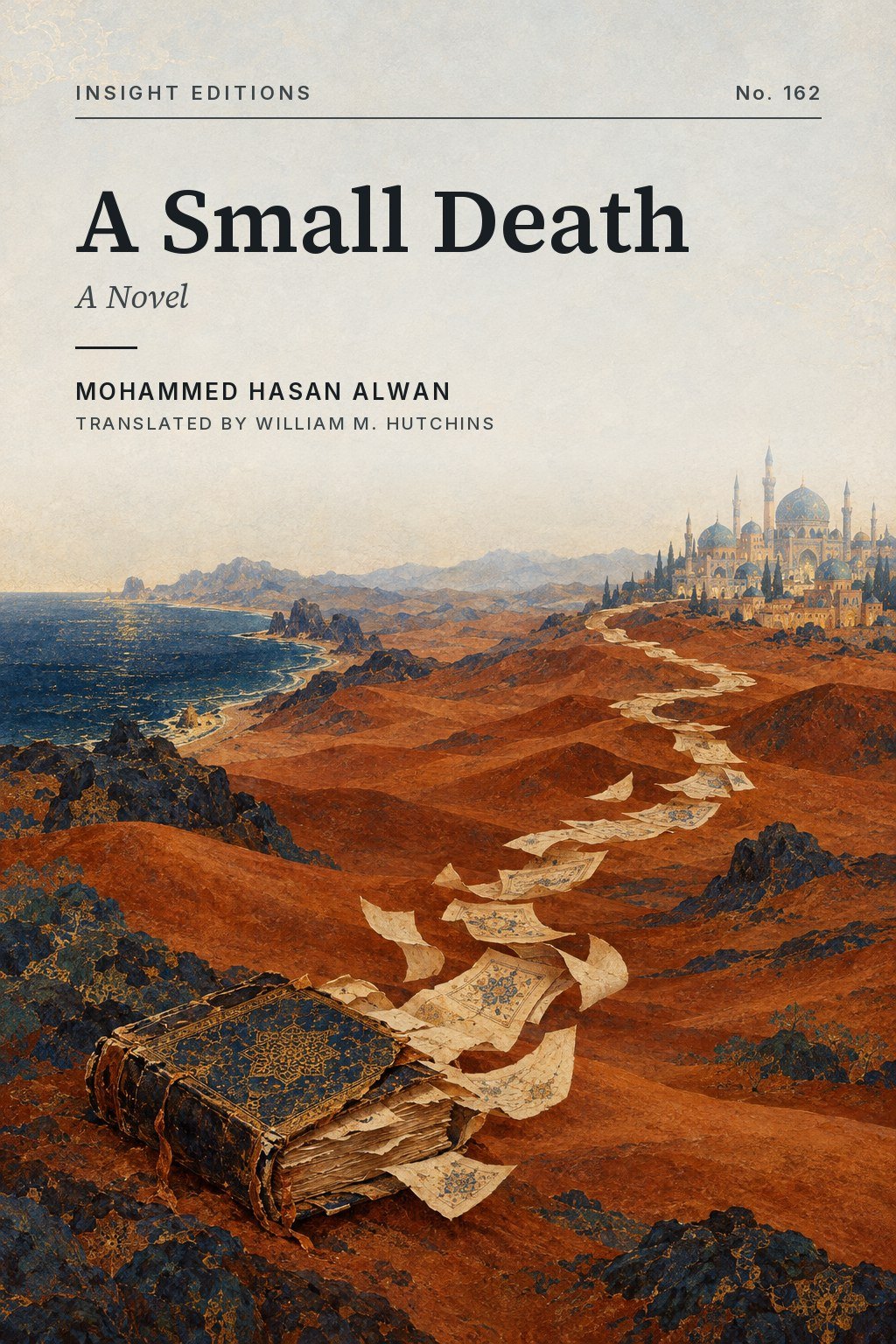
Insight Editions · No. 162
A Small Death
A Novel
Mohammed Hasan Alwan · Translated by William M. Hutchins
Mohammed Hasan Alwan’s novel follows the Sufi mystic Ibn Arabi from his birth in al-Andalus through his travels and death in Damascus, alongside the history of his manuscript.
A study guide to A Small Death by Mohammed Hasan Alwan, translated by William M. Hutchins. Shared free for personal reading; not for sale and not endorsed by the authors or publishers. Please read and buy the original.
About the Book
Mohammed Hasan Alwan's Ibn Arabi's Small Death, in William M. Hutchins's English translation (Center for Middle Eastern Studies, University of Texas at Austin, 2021), is a novel told mostly in the first person by Muhyi al-Din Ibn Arabi himself. It follows him from a besieged Murcia to a grave in Damascus, and between his chapters it follows a single manuscript, his own life story, across eight centuries of owners.
In one sentence: the novel turns Ibn Arabi's search for his four "pillars" into the spine of a travel story, sets beside it the drifting fortunes of the book he writes about himself, and lets both lines show the same lesson, voiced in the title epigraph of Chapter 54, "Love is a small death."
A historical novel of one hundred chapters. Eighty-eight are narrated by Ibn Arabi, who begins with his own birth seen from a liminal state and ends with his burial heard from inside the grave. The other twelve carry place names and double dates, from "AZERBAIJAN 1212 CE/610 AH" to "BEIRUT 2012 CE/1433 AH", and each is told by a different narrator who holds, seeks, hides or sells the manuscript of the Shaykh's life. Nearly every Ibn Arabi chapter opens with a maxim credited to him.
Readers who want to follow a long novel without losing the thread of its many cities, teachers and wives; book groups looking for the structure behind the episodes; and readers of Ibn Arabi who want to see which parts of his life and teaching the novelist chose to dramatize, and how.
The novel at a glance
| Edition part | Novel | Main movement |
|---|---|---|
| Part 2 | Ch. 1 to 15 (opening, Tome One, Tome Two) | Birth in Murcia under siege, move to Seville, schooling, first shaykh |
| Part 3 | Ch. 16 to 29 (Tome Three) | Cordova and Ibn Rushd, wine and poetry at Frederick's, the cemetery, marriage, the Caliph's court, the first pillar |
| Part 4 | Ch. 30 to 46 (Tomes Four and Five) | Father's death, Marrakech, Badr, the fall of Abu Madyan and Ibn Rushd, al-Hassar, Egypt and the second pillar |
| Part 5 | Ch. 47 to 63 (Tomes Six and Seven) | Mecca, Zaher and Fakhr al-Nisa', Nizam, the Tarjuman, Ishaq, Damascus and the scandal |
| Part 6 | Ch. 64 to 84 (Tomes Eight and Nine) | Cairo and prison, the dead pillar, Baghdad, Nizam the third pillar, Mosul, the Bekaa hermit, Badr's leg |
| Part 7 | Ch. 85 to 100 (Tome Ten to Last Tome) | Malatya, Konya, Badr's leprosy, Shams al-Tabrizi, Damascus, old age and death |
| Part 8 | Ch. 1, 8, 15, 29, 38, 46, 55, 63, 74, 84, 93, 98 | The life story written in Azerbaijan, then carried from Aleppo to Beirut |
Read Part 1 first: the frame chapters make sense only once one sees that each closes a tome. Keep the pillars diagram in Part 10 at hand while reading Parts 4 to 7, since the novel names a pillar, withdraws the name and names another. The Who's Who gives the dates the book prints, which are few: the novel dates its frame chapters precisely and its hero's life hardly at all.
How the two plots lock
The novel's design is a hinge. One leaf is the Shaykh's life from barzakh to burial. The other is the manuscript's life from Azerbaijan to Beirut. Each frame chapter closes a tome of the life; each life chapter fills the space the frame will later risk. Readers who keep that hinge in view will not lose the thread when cities, wives and keepers multiply.
- The four pillars, named, withdrawn and renamed across Parts 3 to 7.
- The twelve keepers of Part 8, each dated.
- The maxims that open nearly every Ibn Arabi chapter, collected again in the chapter guide.
Part 1. How the Novel Is Built
Before the plot, the architecture. Alwan's novel is a long first-person life braided with a short chain of other lives, and the braid is regular enough to draw. Knowing the pattern makes the hundred chapters far easier to follow.
1.1 Twelve tomes and a prologue
The table of contents divides the book into an opening chapter and twelve "tomes": Tome One to Tome Eleven and a Last Tome. Each tome is a run of Ibn Arabi's own chapters, and every tome except the last ends with a chapter that leaves him altogether. These closing chapters bear a city's name in capitals and a date in both calendars. The first of them, Chapter 1, stands before Tome One, so the reader meets a frame narrator before meeting the boy in Murcia.
| Tome | Ibn Arabi chapters | Closing frame chapter |
|---|---|---|
| (opening) | Ch. 1, Azerbaijan, 1212 CE/610 AH | |
| One | Ch. 2 to 7 | Ch. 8, Aleppo, 1248 CE/646 AH |
| Two | Ch. 9 to 14 | Ch. 15, Aleppo, 1259 CE/657 AH |
| Three | Ch. 16 to 28 | Ch. 29, Damascus, 1260 CE/658 AH |
| Four | Ch. 30 to 37 | Ch. 38, Kerak, 1309 CE/708 AH |
| Five | Ch. 39 to 45 | Ch. 46, Samarqand, 1401 CE/804 AH |
| Six | Ch. 47 to 54 | Ch. 55, Amasya, 1409 CE/811 AH |
| Seven | Ch. 56 to 62 | Ch. 63, Istanbul, 1617 CE / 1026 AH |
| Eight | Ch. 64 to 73 | Ch. 74, Damascus, 1873 CE/1290 AH |
| Nine | Ch. 75 to 83 | Ch. 84, Damascus, 1925 CE/1344 AH |
| Ten | Ch. 85 to 92 | Ch. 93, Hama, 1982 CE/1402 AH |
| Eleven | Ch. 94 to 97 | Ch. 98, Beirut, 2012 CE/1433 AH |
| Last | Ch. 99 to 100 | none: the novel ends with Ibn Arabi's burial |
The rhythm is steady: six to thirteen chapters of the Shaykh's life, then a jump of decades or centuries. The jumps grow wider as the hero ages. When Ibn Arabi is a child the frame stays within a few years of his death (1248, 1259, 1260); when he is old the frame has reached the French bombardment of Damascus, the destruction of Hama and a café on the Beirut Corniche.
1.2 Two narrators of one life
The first sentence of Chapter 1, "This hut has a conical roof", is spoken by a man on a mountain in Azerbaijan in 1212. His closing lines reveal that he is Ibn Arabi himself, at work on a book: "This is the life story of one of God's friends". He lights his lamp and writes the opening formula, and the chapter ends: "The wayfarer Muhyi al-Din Ibn Arabi said. . . ." From Chapter 2 onward, then, the reader is reading the book the hermit began. The novel never shows its hero writing it again, but in Chapter 94 he returns to Malatya after a year in which, as he says, no one saw him but the Azeri herdsman who brought him food and water. The prologue and Chapter 94 are the same retreat seen from either end.
This device gives the main narrative an unusual voice. The Ibn Arabi who narrates knows how his life ends. He says in Chapter 4 that his life ran "From the time God created me in Murcia till my death in Damascus" and in Chapter 2 that during his second barzakh "I watched my son bury me." He can tell his own story as remembered life, as written record and as something seen from beyond death.
1.3 The maxims at the chapter heads
Almost every Ibn Arabi chapter opens with a sentence in quotation marks signed "IBN ARABI". The first, at Chapter 2, is "Wombs are homelands we quit at birth." The last, at Chapter 100, is "Subsistence not followed by annihilation should not be trusted." Many share a single grammatical shape, a warning against trusting something: "No pious act that doesn't relieve misfortunes should be trusted" (Ch. 3), "No recurring state is trustworthy" (Ch. 24), "Any love that comes with a request is unreliable" (Ch. 60). Others are definitions: "Time is liquid space, and space is congealed time" (Ch. 16), "Love is a divine secret" (Ch. 50), "Love is a small death" (Ch. 54), which gives the novel its title.
The maxims work as a second, compressed narrative. They usually announce the moral weather of the chapter beneath them: "Carelessness leads to a fall" heads the chapter of the infant's first steps; "Don't trust a dream that doesn't bring good news" heads the chapter in which a dream foretells a daughter; "Settlers aren't lovers" heads the chapter in which the wanderer Shams al-Tabrizi is finally recognized. Part 13 sets out a selection of them by theme, and Part 16 lists them all.
They supply what a first-person narrator cannot: what happened after him. Through them the reader learns that Ibn Arabi's disciple Sawdakin kept the manuscript until his death, that his tomb in Damascus is tended by servants of the family of Judge Ibn al-Zaki, that his books were carried off by conquerors, sorted by librarians and copied by admirers, and that in the twenty-first century a single copy could still be offered for sale. The life story becomes a relic, a trust, a commodity and a danger by turns.
1.4 Places and dates as signposts
The novel prints dates only in its frame headings and in the two documents quoted inside them: the Samarqand professor's note on "the Great Khan's conquest of Hama in the year 803" (Ch. 46) and Emir Abdelkader's will "Dated Damascus, 1290" (Ch. 74). The Shaykh's own chapters measure time instead by age (he turns fifteen in Ch. 16, counts "Forty years" in Ch. 58, speaks of "my fifty years" in Ch. 82, turns "sixty-three today" in Ch. 97 and feels "The seventy years" in Ch. 100) and by events: the Almohad entry into Murcia, the Caliph's campaigns, the coming of Qatada to power in Mecca, the death of Caliph al-Nasir in Baghdad. It gives ages and events as the book gives them and adds no dates of its own.
- Chapters with a city and a date: a frame chapter. Ask who holds the manuscript and what threatens it.
- Chapters with a maxim: Ibn Arabi narrating. Ask which teacher or pillar is in view and where he is travelling.
- The first and last chapters touch: the hermit of Chapter 1 writes the life; the dying man of Chapter 100 is carried to the grave the hermit foresaw in Chapter 2.
Part 2. Murcia and Seville: Childhood (Chapters 1 to 15)
The first two tomes take Ibn Arabi from a liminal state before birth to the moment a shaykh seats him at his right hand. They are dense with family, servants and politics, and they plant almost every motif the novel will later harvest: the siege and the walls, the uncle's dirt map, the surah "Ya Sin", the female completing the male.
2.1 The prologue on the mountain (Ch. 1)
The hut on the mountain is so small that its occupant curls up to sleep and is choked by smoke when he stands. Grit, wind, rain and insects come through its cracks, and "When I leave the door open, an errant cloud may enter." His belongings are listed with care: a pallet of uncarded wool, a basin with a comb, bundles of papers, a lamp, threads and an inkwell in which the ink freezes in winter, a flour bin, a water jug, salt, dates and dried figs. Even so, he finds these few things a distraction. The outward life is almost empty; the inward one is not: "Yet my heart's activities are multifarious, and the turbulence within me is dangerous."
At the chapter's end he describes the stars and the darkness, takes shelter, lights the lamp "and sat down to write what only I can write and what only I will value." The book he begins is the one the reader is about to read, opened with the basmala and the words "The wayfarer Muhyi al-Din Ibn Arabi said. . . ." The word wayfarer will recur as the novel's chosen title for its hero.
2.2 Two barzakhs and a birth (Ch. 2)
Tome One opens with the maxim "Wombs are homelands we quit at birth." Ibn Arabi explains that "God granted me two barzakhs", a liminal period before his birth and another after his death. In the first he watched his mother give birth to him; in the second he watched his son bury him. In that double vision he saw "the Almohads snuff out the wick of the Almoravid state in Murcia before I was born and the Tatars raze Baghdad after my death", and saw saints rejoice at the birth of the Sultan of the Gnostics while jurists celebrated the death of "the imam of the freethinkers". The novel thus opens with the two judgments that will follow its hero through life.
The birth itself is domestic. His mother labours in Ramadan, prays for a son and an easy delivery, and the midwife Fatima wipes her brow. Fatima's face is the first he sees, and he compares it with the thousands of faces of saints, pious people and ascetics he has seen in the barzakh: of all of them, hers "was the most compassionate."
The chapter moves through small scenes of infancy. A fall from the almond tree cuts his chin, and the court physician declares it will heal by itself. Then comes a scene that sets the father's dilemma in a single image. The stern preacher Abdallah al-Qattan, invited to dine, seizes the father's chin and rebukes him for keeping company with tyrants in their courts and palaces. The father weeps for show. A moment later the preacher reaches for the food and remarks, "What a plump pigeon, Ali! Would you believe that I first thought it was a little chicken?" Piety and appetite share the same table.
2.3 The besieged city (Ch. 3 to 6)
Murcia is ruled by Ibn Mardanish, who seized the city in the gap between the collapse of the Almoravids and the rise of the Almohads and made himself king. The novel shows his rule through the boy's family. When the father sacrifices a sheep for his son's twenty-first day, the judge Ibn Urjun and the preacher Ibn Fatah eat only the vegetables, whispering that the sheep came from the king's pen, where swine are kept. Ibn Arabi calls them pious men but cowards, and draws a general rule: "When a ruler is corrupt, corruption runs rampant through the community."
Ibn Mardanish grows paranoid. He stops visiting his women, then evicts them, then builds a tower in which soldiers, bodyguards and his most trusted slaves sleep on successive floors while he sleeps at the top.
Chapter 4 ("Carelessness leads to a fall") tells of the boy walking before his first birthday. Fatima predicts he will travel far, and the narrator confirms it: his life from Murcia to Damascus was a continuous journey under Almohads, Ayyubids, Abbasids and Seljuqs. A sentence states the theme of the whole novel: "Anyone born in a city under siege has an unruly desire to venture outside its walls." His uncle Abdallah, a seller of oils, spices, herbs and medicines, draws a map in the dirt of the cities beyond Murcia, Cartagena, Valencia, Cordova, Seville and Granada, and "The image of that dirt map was etched into my mind". Inside the walls the siege bites. No one builds; the poor eat from rubbish; Ibn Mardanish posts his fiercest mercenaries on the wall to keep citizens from letting the Almohads in.
Chapter 5 brings Sallum into the household after the mother scalds her foot. He is a short slave in his thirties who recites a long list of dishes he can cook, and the mother has to remind him how little meat they have. He becomes the family's steady servant and, years later, the boy's rescuer. The chapter ends with the father returning shaken from the palace, praying and reciting: "When God's victory and conquest come. . . ."
The next morning, as Chapter 6 puts it, God granted victory "to the Almohads of course, not to Ibn Mardanish." A herald announces a treaty in the king's grand style; at noon the gates open on crowds of poor people driven out to greet the conquerors. The family hosts Almohad soldiers like everyone else. Then the father brings two pieces of news: "King Ibn Mardanish has died." "And we're moving." The destination is Seville.
2.4 The road and the new city (Ch. 7 to 14)
Chapter 7 is a caravan chapter, the first of many: the dawn prayer, the grooms hitching camels, women lifted into howdahs, the route along the Guadalentín to Lorca. The chapter ends with a traveller's praise of Seville, which has land like the Ghouta of Damascus "but without the lions" and a river like the Nile "but without the crocodiles."
Tome Two opens at Seville's gate with the maxim "People are the souls of houses." Officials question the caravan; the father helps the governor choose gifts for the Caliph's arrival and is granted the use, not the ownership, of a house in an elite quarter. In Chapter 10 the Caliph surprises everyone by marrying Safiya, daughter of Ibn Mardanish. The mother is appalled; the father explains, laughing, that caliphs are clever this way: with both of the dead king's daughters in Almohad households, all his offspring are hostages. The father then finds his son a teacher, insisting "My son is an Arab, one hundred percent."
The new house has a pine tree visible from the start of the street, which the boy uses as a landmark. The father, a man of exoteric duties, tries to harden him and once forces him to swim the river and back, throwing stones when he hesitates. Sallum leaps in and pulls him out. The boy walks home trembling and wet, sees "our pine tree and passed out."
The fever that follows (Ch. 12, "How wary I am of my wariness") is one of the novel's great set pieces: paving stones that widen and then close on his feet like fetters, rising water, a crocodile's tail, Norman ships with dragon figureheads sailing on flame, a Norman with filthy toenails about to club him. He struggles to remember what to recite before dying. What saves him is the surah "Ya Sin", and the chapter ends: "The fever lifted from my bones, but "Ya Sin" lingered in my breast." He vows to stand by "the walls of this surah" for as long as he lives. The surah returns at every deathbed he attends.
Chapter 13 sets the boy in the crowded Ibn Addis Mosque, where rumour says the spirit of Archbishop Isidore haunts a minaret built from his sepulchre and kills its muezzins. Uncle Abdallah prays in rows that reach his shop door. The chapter ends in violence. One of the uncle's sons demands money, insults him as a "senile old coot", throws him to the floor and straddles him. The wounded father utters what he insists is not a prayer but an unveiling: "He will die before me. I will die forty days after him."
2.5 The first shaykh (Ch. 14)
The maxim "Any place that is not feminine in gender is untrustworthy" opens the chapter in which Yusuf al-Kumi arrives from Fez. He scowls at the world but laughs when he sees a pauper, seats him beside him and empties his purse to him. The father, without knowing it, sets his son on the path by enrolling him: "God in heaven had destined this, and my father on Earth had executed His will." Al-Kumi seats Muhyi on his right and another boy, Ahmad al-Hariri, on his left; the two become lifelong friends. A first retreat with the shaykh follows over a book the novel calls al-Risala.
The chapter ends with an unveiling Ibn Arabi writes down at once. On Mount al-Mantiar he attained the "makana" of the shaykh. In Arabic "makan", place, is masculine, and "makana", spiritual rank, feminine; Adam was completed only by Eve, and the mountain only by the shaykh. The passage plays on grammar to make a claim that the novel will extend to love, marriage and the third pillar: "Place (makan) without a spiritual rank (makana) is insufficient."
Chapter 8 jumps to Aleppo in 1248: the disciple Sawdakin dies listening to his son Tahir read from the manuscript. Chapter 15 jumps to 1259: Sawdakin's grandson flees the Mongols with his family and the book. Both are traced in Part 8.
- Walls and the longing to cross them: Murcia's siege, Seville's walls, the hut in Azerbaijan.
- Two kinds of father: the courtier who obeys the exoteric and the uncle who sees by unveiling.
- "Ya Sin" as the surah of crossing between life and death.
- The feminine as what completes: Eve, makana, and later the women who teach and the woman who is a pillar.
Part 3. Seville, Cordova and the Court (Chapters 16 to 29)
Tome Three is the longest tome and the most worldly. Its young hero reads banned books, drinks with a Castilian bibliophile, debates Ibn Rushd, breaks down in a cemetery, marries, serves a caliph and is finally told by his shaykh that the shaykh is his first pillar. The maxim at its head is one of the novel's most quoted: "Time is liquid space, and space is congealed time."
3.1 Books and the stationers' lane (Ch. 16 and 17)
At fifteen the young man has seen only Murcia and Seville. His father, called to Marrakech, leaves him behind with a promise: when he returns he will take him to Cordova. Ahmad al-Hariri, whose brother Muhammad sews together the pages copyists bring him, leads him to the book dealers, and the market "became my second home." He insists on paying for everything he reads. The only two shops he never visits belong to copyists of Castilian and Greek manuscripts, whose translators charge a tenth of a manuscript's weight in silver to put it into Arabic.
In one of them he meets Frederick, a Castilian-looking man in his sixties with kind eyes, who offers to pay half the translation of a Greek book if he may borrow it to copy. Frederick "proved to be God's answer to my prayer to remove boredom from my heart". He knows Greek, Frankish, Indian and Chinese books, and he keeps a house and a farm where men and women gather to read, play music and drink. The chapter ends at his table, with al-Hariri calling for more wine so they can travel to the East like Ibn Jubayr.
3.2 Cordova and Ibn Rushd (Ch. 18 and 19)
His father keeps his promise after taking a new companion, Durra. They travel along the Guadalquivir in the governor's caravan in the first days of Ramadan. Before the journey the father and son quarrel bitterly: the son wants learning and the shaykhs, not the court, and the father kicks him and curses him. The son goes instead to Fatima bint al-Muthanna, an old woman living in a single room by the smoking city dump, who wraps him in her blanket like a mother. She tells him his heart is half purified, filled with virtues and good intentions. When he asks how to complete the other half, she answers, "By allowing it to receive every type of form."
Chapter 19's maxim, "Covert meanings are conveyed overtly", heads the meeting with Ibn Rushd. Their arrival coincides with the death of Cordova's chief jurist Ibn Bashkuwal, and the boy is surprised to find mourners in white, since in Cordova white is worn for mourning. He becomes convinced Cordova is the opposite of Seville in every respect. Ibn Rushd enters the wake to general respect, with a tear in his eye.
In Seville the young man had heard shaykhs quote Ibn Rushd and curse him; one condemned his saying that beauty and ugliness are what the intellect judges them to be, and asked, what about God's judgment and law? The young man's own silent response was different: what of the heart's dictate and the Lord's unveiling? He is summoned to Ibn Rushd's house, small and shaded by trees. The philosopher is explaining diagrams to two students, then turns to him with warmth. The debate the novel stages is between law and will. The young man says the philosophers explain what has happened but not what is to come, "that's what kashf—unveiling—does". Ibn Rushd answers that they offer a law that whatever occurs will not violate. The young man's reply closes the chapter: "There is no such law." "No such law?" "Yes, there is no law. There exists only a creation totally dependent on the will of God the Exalted."
3.3 Death of the uncle and the coming war (Ch. 20 and 21)
They return to find Uncle Abdallah dying of a swelling no physician can relieve. He entrusts himself to God with the words "In God's hands. When He spreads them open, He is compassionate. When He clenches them, He is merciful." In Chapter 8 the dying Sawdakin remembers his master describing him as the uncle who was preoccupied by commerce for seventy years and died a saint with many charisms.
Seville prepares for war against Portugal. Muslims sharpen swords; Christians store grain, oil and raisins. Al-Qattan, the preacher of Chapter 2, marches with the army on foot, saying his feet deserve God's reward more than horses do. Meanwhile, at Frederick's, Ibn Arabi recites a maxim that God unveiled to him: "Love's true reality is that love is caused by love. If our hearts were devoid of love, love would not exist." Frederick calls on the saqi to pour drinks for everyone "so we can toast this magnificent statement!"
The juxtaposition is typical of the tome. While the Caliph's army surrounds Santarém, the friends surround Guido, a woman of the circle, who reads a prayer of Shankara asking forgiveness for three sins: walking toward God, forgetting He is everywhere; thinking of Him, forgetting He is deeper than thought; praying to Him, forgetting He is higher than prayer. Earlier the drinkers had asked whether their prayer counted when they were drunk, and the young man answered with the verse forbidding prayer only when one is too drunk to know what one is saying.
3.4 Bans, wine and the fugue (Ch. 22 to 24)
Chapter 22 ("A soirée without conversation is pointless") shows the pleasures of Frederick's estate: a room over a rose garden grown from Gothic seeds, breakfasts that cure headaches, rides with bows that rarely hit anything, a prayer carpet spread at every prayer time, drums at night. It ends with the other side of Seville. The father writes down a list for the police, who will make the rounds of the mosques to enforce a new ban from the Caliph.
The next chapter opens in rage: "What did we have to read now except Zahiri books, which stirred neither the heart nor the mind?" Frederick has shipped his books to his brother in Marseilles for fear they would be burned; his gatherings are now rare and serve only bitter date syrup. Ibn Arabi drinks bottle after bottle, silences the company, and walks out. He wanders beyond the walls in a shepherd's clothes and ends in a cemetery, where he crouches in a crumbled tomb and recites the Qur'an.
Sallum finds him on the fifth morning. The governor has lent ten soldiers to search for him, and al-Hariri has told the father everything, "even about our clinking glasses and the singer's performance." The mother collapses; the father threatens to have him watched: "By God, if I hear anything I dislike about you, I'll make sure you regret it."
3.5 Secretary and husband (Ch. 25 to 27)
The maxim "You are a cloud concealing your sun; so, know your Self" opens four years compressed into a page. "I became a secretary for the Caliph and a husband for Maryam bint Abdun." The novel credits both to forces beyond him: the King of Portugal's peace overtures, which bring the Caliph to Seville, and his sisters' and mother's plan to marry him off "to keep me from sitting in cemeteries." His summary is a rueful list: "No cemeteries. No Sufism."
The Caliph asks him about philosophy, and he answers, "Commander of the Believers, philosophy is the love of wisdom, and not every love is requited." Delighted, the Caliph orders him to attend his assemblies. In Chapter 26 ("The manifestation of reality reaches perfection in woman") the young secretary tells the Caliph that a letter in his hand complains about Ibn Rushd, which God unveiled to him. The Caliph asks why God has not unveiled what will happen with Castile. Ibn Arabi's answer is the novel's clearest definition of kashf: "God discloses to me what He wishes, not what I want. This is an unveiling, a kashf. It isn't astrology, intuition, divination, or sorcery." Asked whether a Sufi is a philosopher or a jurist, he answers, neither. The Caliph tells him, in a play on God's creative command, "Be in my assembly", and invites him to Marrakech.
Chapter 27 ("Truth runs in a straight circle") opens with Maryam's tearful farewell. She has travelled to Bejaïa and Tlemcen and pleads to come; he wants her to care for the bedridden Fatima bint al-Muthanna and wants his first long journey unencumbered. In Marrakech he joins Sufis whose practice the chapter describes in their vocabulary: when one experiences a "nafth", a spiritual inhalation, the others clasp his hands so that what enters him enters them; each wears another's patched cloak; they return to the world each "at a new station, a higher maqam than he had ever reached before."
3.6 Zaynab and the first pillar (Ch. 28)
A dream of Maryam's belly opening like an oyster with a pearl tells him the child will be a girl. The Caliph grants leave, money and two camels; Zaynab is born within a month of his return to Seville. He adores her round face and coal-black hair.
He returns to the cemetery, and this time al-Kumi finds him there. "People back on the streets are really dead but don't realize it," the shaykh says, and keeps him company for seventy-six nights of dhikr, recitation and meditation. On the twenty-seventh night of Ramadan he arrives late and severe and poses a question: when two gnostics meet in a single presence of witnessing with God, what is its property? Ibn Arabi answers that the Presence does not embrace two persons, but that the case can be hypothesized through disclosure, since each gnostic has his own taste. Al-Kumi then tests him: who lies in the thirteenth grave from the wall? "The poet Ibn Zaydun." And he gives the announcement that drives the next six tomes: "I am your first pillar. Your second watad is in North Africa. Seek him there so he may strengthen your heart."
Chapter 28 converts a spiritual biography into a quest narrative. The word "watad", pillar or tent-peg, appears in al-Kumi's mouth for the first time here, and from now on each new city is entered with the question: is my pillar here? Part 10 traces the four.
| Ch. | Maxim (as printed) | What happens |
|---|---|---|
| 16 | "Time is liquid space, and space is congealed time." | Left behind; the stationers' market |
| 17 | "Never trust piety that comes with strings attached." | Frederick and the first wine |
| 18 | "A gnostic's consciousness colors reality the way a glass vessel colors water." | Quarrel with the father; Fatima bint al-Muthanna |
| 19 | "Covert meanings are conveyed overtly." | Ibn Rushd |
| 20 | "Light that does not dissipate darkness is unreliable." | The uncle dies |
| 21 | "Reality cannot be confined." | War with Portugal; love caused by love |
| 23 | "No glimmer a man discerns is reliable, unless it affords him learning." | Bans; the cemetery grotto |
| 24 | "No recurring state is trustworthy." | Found by Sallum |
| 28 | "Don't trust a dream that doesn't bring good news." | Zaynab; the first pillar |
Chapter 29, Damascus 1260: the eighty-year-old servant of the Ibn al-Zaki family sepulchre, drenched in wine by Christian youths under Mongol rule, resolves to leave for Kerak. See Part 8.
Part 4. Marrakech, Loss and the Road East (Chapters 30 to 46)
Tomes Four and Five turn on the destruction of two great men by one ruler. The Caliph whose assembly Ibn Arabi joined in Seville burns Ibn Rushd's books and summons Abu Madyan to his death. Ibn Arabi, who believes he contributed to both disasters, leaves the West for good with a stranger who has been waiting four years for him.
4.1 The father's death (Ch. 30)
The maxim "Travel that doesn't enlighten is pointless" opens with a detour. Ibn Arabi cannot go to Fez until Ibn Rushd's "fraught situation" is resolved, so he heads for Bejaïa, convinced that his second pillar must be Abu Madyan al-Ghawth: "Was any man in all the Maghrib better qualified to be a watad?" He joins a perfume caravan from the goldsmiths' market and plans to sail from Almería to Oran.
The chapter ends instead at his father's bedside. He recites "Ya Sin" until his father regains consciousness and recognizes him, then tells him, "Father, I will be at the mosque till word of your death reaches me." He has barely finished praying when Sallum stands behind him in tears with the news. In the next chapter he speaks of the guilt he carries for missing his mother's funeral and causing his father's illness.
4.2 The burning of Ibn Rushd's books (Ch. 31 and 32)
"Certainty colored by emotion is not reliable." A herald orders anyone who owns Ibn Rushd's books on logic or philosophy to burn them, on pain of the lash; books on medicine, mathematics and astronomy are exempt. Booksellers throw the banned books into a huge pile in the market square, which "showed how many of Ibn Rushd's books had been copied during the last few years." The philosopher is released from prison and banished to the Jewish village of Lucena.
Ibn Arabi's guilt now has a third object: "I had an inkling that I bore some responsibility for the Caliph's punishment. He had asked my opinion of philosophers and scholastic theologians." Even so, he accepts a place in the Caliph's service; a secretary records his stipend of ten dinars a month plus housing and payment for lessons.
Chapter 32 ("You are your own best shield") stages a contrast. The Caliph's messenger needs a single night to win Ibn Arabi to Marrakech and thirty nights to coax the saint al-Sabti out of the cave on Mount Guéliz where he had spent forty years in retreat. Crowds at Bab Agnaou throw down their prayer rugs for his mule to step on and carry them forward so she will step on them again. Al-Sabti gives away the Caliph's purse of dinars to the poor at once. The chapter closes on war: the Caliph leads two hundred thousand troops, Sudanese, Berbers, Arabs, Slavs, Muwallads and Oghuz Turks, to Andalusia.
4.3 Badr (Ch. 33)
"Don't rely on hunches." Ibn Arabi admits he was never so wrong about anyone as about an Ethiopian student whom he expected to fail. Badr is the freed slave of Abu al-Futuh al-Harrani and has lived in Cairo, Damietta, Mecca, Bejaïa, Marrakech and Fez, "So I don't know precisely where I'm from." He rises from jurisprudence to the exegesis class in months and secretly collects his teacher's hints and unveilings into an organized book. The narrator's verdict looks ahead to the whole novel: "I guessed he would stay at most a few days, but instead he spent twenty-five years with me." He calls him an Ethiopian moon, one of the most perfect and luminous; Badr's name means full moon.
The chapter ends with the start of the catastrophe. An old man tells the Caliph that people in Bejaïa say Abu Madyan resembles the Mahdi. The Caliph, still cautious, refuses to act on rumour: "When you see the smoke with your own eyes, tell me. I don't act on rumors. Fear God!"
4.4 The summons and two deaths (Ch. 34 to 37)
In Chapter 34 the novel shows the Caliph at work: hearing a Sanhaja delegation, lowering barley prices, sending a dispute over broken ostrich eggs to a judge, hearing soldiers' complaints. When an official, al-Janfisi, tries to warn him about Abu Madyan's condition, the Caliph cuts him short and orders the shaykh summoned: "And be quick!"
Chapter 35, under the maxim "I fear the heart's beliefs!", is a chapter of dread. Ibn Arabi cannot sleep. If harm befalls al-Ghawth, he believes, God will never grant him sainthood or rank, "and my pillars would desert me like gazelles fleeing predatory beasts." No unveiling comes. Then the news: Abu Madyan has died on the road and been buried in Tlemcen. "Ibn Rushd was in exile and Abu Madyan was in the grave." He feels sure the circle will widen to include him.
In Chapter 36 the Caliph blames the minister Abu Hafs for advising the summons. A delegation from Bejaïa confronts him without greeting: he has harmed one of God's special friends and will meet his Lord after opposing him. Then Ibn Rushd himself appears before the Caliph and addresses him by name. When the Caliph protests that he is not led by the riffraff, Ibn Rushd replies, "Ya'qub, God will judge between us on Judgment Day", and walks out, leaving the ruler silent. Within weeks the philosopher is dead too, and the Caliph, struck by both deaths, withdraws to his palace at Salé by the sea.
Chapter 37's epigraph comes from a couplet: "This imam and his accomplishments: If only I knew whether his hopes were fulfilled." Ibn Arabi accompanies Ibn Rushd's body to Cordova with a small caravan of mourners, hoping "to address my guilty feelings in hopes of burying with him the shears of regret that kept snipping at my heart." Afterward, with Badr, he gives away food in the market. The chapter ends with a premonition: "A man's waiting for me there . . . but I don't know who."
4.5 The vanished Caliph (Ch. 39)
Tome Five opens with "Possibility is a liminal state between existence and nonexistence" and a mystery: "The Caliph has disappeared!" Servants search the palace at Salé, guards the gardens and shore, messengers the homes of ministers and boon companions, soldiers the markets and port. There is no trace. His son, fearing he will be suspected of making his father vanish, hides the fact and sends horsemen into the desert as though on a hunt. In the end the chief justice and a vizier persuade him to accept allegiance. In the mosque his uncles rise one after another to pledge, and Ibn Arabi pledges with them. The novel leaves the old Caliph's fate hanging for forty chapters. He reappears in Part 6 as a hermit in the Bekaa Valley, the "Caliph Ya'qub ibn Yusuf" who leads the travellers in prayer and gives them directions.
4.6 Al-Hassar and the departure (Ch. 40 to 42)
"Trust anyone who befriends you for your essence." Ibn Arabi pictures the stranger linked to his destiny as a student, a beggar, a soldier, a merchant, "a Jew in a blue cloak, or a wali on a distant mountain." He gives his sisters their shares from the sale of their father's house and tells Maryam they will go "East." The stranger arrives, studies his face and weeps: "O my Andalusian! Oh! Four years. . . . I've been waiting for you for four years!" He is al-Hassar, who had the same vision of a throne and a sapphire bird with a long tail.
Chapter 41's maxim reads "No form of knowledge that isn't multifaceted is reliable." Ibn Arabi sells the slaves Sallum and Addad, dividing Sallum's price between his sisters and buying camels with Addad's, and sets out with Maryam, Zaynab, Badr and al-Hassar for Bejaïa. Al-Hassar rides ahead on a chestnut stallion, "surrounded by a halo only I could see", an "emissary of the divine throne". The two exchange books. Ibn Arabi names al-Hassar's book al-Bayan wa'l-Tadhkar fi Ilm Masa'il al-Ghubar; al-Hassar names his Insha' al-Dawa'ir wa-l-Jadawil, The Creation of Circles and Tables, a title Ibn Arabi dislikes but will not second-guess.
In Chapter 42, when it is time to sail, Maryam asks to stay in Bejaïa with her cousins. He is upset, then relieved. A Genoese ship carries him through a three-day storm to Alexandria, where he lodges at the Maghribi House and eats bread distributed to travellers. Badr explains that Salah al-Din liked Maghribis in Egypt because they are Sunnis and Sufis whom God used to cleanse Egypt of Fatimid influence. So it is hospitality, not charity, and Ibn Arabi eats.
4.7 Egypt and the second pillar (Ch. 43 to 45)
Under "You'll achieve nothing in religion unless you respect all creatures", al-Hassar measures Alexandria's streets with outstretched arms, marvelling that a Fez house with alleys on both sides would fit in one of them, and records the dimensions of a throwing stick after it wounds him. The scene gives the mathematician a life of his own in a few lines.
In Cairo (Ch. 44) they find the childhood friends al-Khayyat and al-Hariri in a room attached to a Sufi khanqah with a doorway so low the visitors must stoop. Al-Khayyat is paralyzed. Ibn Arabi lies down beside him, cradles his head and recites "Ya Sin". In Chapter 45 ("When the heart is bereaved of its spoils, only sorrow remains") he moves into their room, buys pallets, food and physicians, and feeds his friend himself. Al-Khayyat improves; then, suddenly, al-Hassar dies. "I buried al-Hassar in a cemetery, assisted by Badr, al-Hariri, and the gravediggers."
The tome ends with a reversal. Ibn Arabi, humbled, swallows "an astonishing lump of regret and humiliation" at his bedside, and al-Khayyat, smiling with his whole mouth, tells him: "I am your second pillar." The friend he came to nurse is the man he crossed the sea to find.
Chapter 38, Kerak 1309: Abu al-Fida', who has come from Hama, takes the manuscript from the castle library of a deposed sultan. Chapter 46, Samarqand 1401: a paper-maker sees it listed among books carried off from Hama by the Great Khan. See Part 8.
- Ibn Arabi leaves the Maghrib for good, and with it his father, the court, his slaves and, in effect, his first wife.
- He learns that a pillar need not be the man he expects: not Abu Madyan, but a paralyzed childhood friend.
- Badr enters the story and will stay until his death in Malatya.
Part 5. Mecca: Nizam and the Interpreter (Chapters 47 to 63)
Tomes Six and Seven are the novel's love story and its title. In Mecca Ibn Arabi studies with a Persian shaykh and his learned sister, falls in love with the shaykh's daughter, writes a collection of love poems, loses his first marriage and is refused by the woman he loves. The chapter heads for these tomes are almost all about love, culminating in "Love is a small death."
5.1 Across Sinai to a changing Mecca (Ch. 47 and 48)
"Travel is a bridge into our selves." With Badr, Ibn Arabi crosses Sinai in a caravan of soldiers whom al-Malik al-Adil is moving between Egypt and Syria. The desert takes sixteen days; there are two watering holes; mules die sunk to their bellies in sand; travellers steer by stone posts from the Fatimid era and small Ayyubid garrisons. At Ayla, where Egyptian and Syrian pilgrim caravans meet, they pray in a mosque roofed with trellises.
They reach Mecca just as power changes hands. A crier goes round the tents: "People, Qatada ibn Idris is king." Badr, who had once entered the house of the old ruler Ibn Musa with his former master, cannot believe anyone but God could take his kingdom from him. "God did wrest it from him, Badr," Ibn Arabi replies. The chapter's maxim, "What can be described but not comprehended is majestic", hangs over a hero more concerned with his ruined feet than with politics. He sends Badr back to Bejaïa to fetch Maryam and Zaynab, with a warning not to go near the sea, which he fears for his little girl.
5.2 Zaher and Fakhr al-Nisa' (Ch. 49 and 50)
He rents a house so close to the street that "When I opened the door of my room, I was on the street." He attends Hanbali classes such as he never found in Andalusia and sits with Sufis from East and West. One day a new face appears among his students: "His forehead was so broad it resembled an open book. His beard was so white he resembled a vertical lamp." This is Shaykh Zaher al-Isfahani, who becomes his teacher and friend.
Maryam arrives with Badr, but the reunion fails; he senses that their child has made her forget her longing for him, and he finds her weeping in a corner. He tells her to stay until she has performed the obligatory pilgrimage "and then depart, if you wish."
Ramadan in Mecca (Ch. 50, "Love is a divine secret") is drawn with drums, new reed mats, candles and torches, and lamps lit in the minarets from the breaking of the fast until it resumes. Ibn Arabi's dawn class grows to nearly a hundred students. He and Zaher sit in on each other's lessons, Western teaching for Eastern. When a question perplexes Zaher, he promises an answer the next day after consulting his sister, Fakhr al-Nisa'. Ibn Arabi asks to study with her; she no longer teaches publicly because of her age, but he persists and is admitted.
There he meets Nizam, Zaher's daughter. The chapter ends with him writing all night on paper that an Iraqi merchant imported from Mosul, which keeps ink from seeping through: "I called this poetry collection: "Tarjuman al-Ashawq," or "The Passions' Interpreter."" (The spelling and English title differ in later chapters; see the Slips.)
5.3 Maryam leaves (Ch. 51)
"Any love with a cause known to be transient is not trustworthy." The farewell is cold. Maryam turns her cheek away, shakes his hand and kisses it; he gives her money for the journey home via Jidda and Aydhab but no advice. "She left my heart, and I left hers without any farewell." His explanation is one of the novel's quiet sentences about love and place: "some loves flourish only in their homeland. Our love was a fountain that flowed only in Andalusia." He half expects her to climb down from the howdah when the camel stops after a few strides. She does not. The chapter ends with a humiliation in the Holy Mosque, where he is cursed in a crowd and leaves with one shoe lost.
5.4 Nizam (Ch. 52 to 54)
Chapter 52's maxim gives the image for the whole affair: "Passion resembles tendrils twisting around a grape vine." After a lesson at Fakhr al-Nisa's house, Nizam seizes his wrist and tells him to wait outside. When she opens the door again she is unveiled for the first time, her hair "like a cascade of almonds", the scar on her temple transformed in his eyes into a nest from which a sparrow peeks. They sit through the evening an arm's length apart. When she goes to sleep at her aunt's, she teases him: "And you too . . . Gnostic of your age!"
Chapter 53 sets the love story against the city's tension. A herald summons builders and blacksmiths to the Emir; Ibn Arabi, nursing a cupping wound and a headache, learns that the Emir plans to build a wall around Mecca. He protests that the One who protected the city against Abraha still protects it. His informant fears war, because the Emir of Medina has not conceded Mecca to Qatada.
In Chapter 54, "Love is a small death", Nizam's image never leaves him. Poems "would descend on me—without any prior thought—like raindrops falling from a summer cloud". He chooses the finest paper, dips his pen in gum arabic and then long in ink, and finally carries a notebook to record verses wherever they come. When people ask what he is writing, he is afraid to tell them. The chapter ends with Nizam holding his hand to her face, inhaling its scent and closing her eyes, and he knows it is time to go.
The lessons at Fakhr al-Nisa's house become courtship. When the aunt retires, the two read on, debate, and talk. He tells her of Andalusia's rivers, bridges and trees; she tells him of Baghdad, with Karkh on one side of the Tigris and Rasafa on the other, so that the lovers meet in Mecca from "the two distant edges of God's land". She answers his poems with love spoken in Farsi and refuses to translate: "Translation would smother my words." "Love must be expressed in one's native tongue, Muhyi." The detail matters later, when the woman from the far east of the Muslim world is revealed in her own city as his third pillar.
5.5 Ishaq and the refusal (Ch. 56 to 58)
Tome Seven opens with the maxim "You, Man: You are the lamp, the wick, the niche, and the glass." The leader of the pilgrim delegation from Konya, Ishaq, wins Ibn Arabi's love at first sight. He is short, broad-shouldered, white-haired, with narrow eyes; he speaks Arabic with a Turkmen accent, which Ibn Arabi unconsciously copies. Ishaq tells him of a garden he planted around a lonely pine tree with seeds gathered on his missions for the Seljuq Sultan Kaykhusraw: his house shelters his body, the garden his spirit. He warns against dreams kept too long in the chest: "Dreams, Brother, when they sit too long in your chest, spoil."
In Chapter 57, sensing that Zaher and Fakhr al-Nisa' want him for Nizam, Ibn Arabi dresses in his best clothes, circles the Ka'ba asking for guidance, and proposes. The proposal fails, and he returns to break down weeping like a child. The refusal is given in the language of perfection. Walking with him, Nizam asks why, if his love has reached perfection, he needs marriage at all, "if there is no room for further advancement?" and, if it has not, "what need have I for an imperfect love." He answers that his love "was destined before us and will persist after us", created perfect. At her door she draws him inside and they kiss, "as silently as night meeting first light"; but she does not consent. Ishaq puts him to bed: "Yes, you will sleep. I entreated God that you would."
Chapter 58 ("The measure of every man is his heart's discourse") opens at forty: "Forty years had flowed through my veins like a long caravan that began in Murcia and ended at some murky horizon beyond my ken." He sees his life as a caravan of camels bought, sold, ridden and left behind, "Devoid of wisdom or hope." He frets about his unfound pillar. Ishaq answers with a principle the novel will prove three times: "Muhyi, you don't find the pillar. He finds you."
5.6 Leaving Mecca, scandal in Damascus (Ch. 59 to 62)
Ishaq departs after the pilgrimage, inviting him to Konya. Ibn Arabi weeps the same tear he wept for al-Kumi and al-Hassar, and says he wept with it "all the Red Sulphur that turns rusty hearts into lustrous gold", using the alchemical title that Badr and others later shout as the hero's own. When he asks Badr where they should go, Badr chooses: "Damascus."
In Chapter 60 ("Any love that comes with a request is unreliable") Zaher, his smile gone, confides "My time has come, my son", and fears for Nizam, who has no one else. Ibn Arabi keeps silent, though he wants to say he would have been her husband had she not rejected him. Leaving, he reflects that "Mecca had been necessary", and that every joy or grief is one of our breaths, without which "We would have vanished and returned to nonexistence."
Damascus welcomes him with the scent of peach, plum and almond blossom from the Ghouta, and a khanqah where "Books traveled from room to room, and our Sufi cloaks passed from back to back." A year later (Ch. 62) a pilgrim brings a letter from Zaher. He forgives Ibn Arabi before blaming him, but reports that in Mecca no one speaks of anything but "your Interpreter of Passions": he has been insulted, his daughter slandered, and they must leave the city. The chapter's maxim is bitterly apt: "You are safe from everything when everything is safe from you." Badr pleads that only riffraff blame him; Ibn Arabi can only say, "Don't leave me, Badr. Give me your hand."
Chapter 55, Amasya 1409: the sons of Timur present the Ottoman ruler with gifts, among them a box of "The works of the Grand Shaykh". Chapter 63, Istanbul 1617: a palace librarian under a mad sultan disperses the library and sends the Sufi books to Rumi's tomb in Konya. See Part 8.
- Teaching leads to love: the shaykh, his sister, his daughter.
- Love leads to poetry, and poetry to scandal.
- Love refused is not explained here. The explanation comes ten chapters later in Baghdad (Part 6), when Nizam reveals why she cannot marry him.
Part 6. Cairo, Baghdad and the Bekaa (Chapters 64 to 84)
Tomes Eight and Nine are the novel's darkest and strangest stretch. Ibn Arabi is driven out of one city by gossip and imprisoned in another, is freed by a dead man, finds in Baghdad that the woman who refused him is his third pillar, marries a widow, follows a stubborn mule to a hermit who was once a caliph, and watches Badr lose a leg.
6.1 The commentary and the fools (Ch. 64 and 65)
Tome Eight opens with the maxim "One can wander through a wilderness endlessly." Badr unties a ream of paper and Ibn Arabi tests five reed pens. Badr asks whether he will at last finish al-Fath al-Makkiy; no, he answers, this is a new book, an explanation of the Tarjuman al-Ashwaq. People take the poems for love poetry written to court Nizam: "They haven't understood the book consists of signs and metaphors for divine inrushes, spiritual descents, and lofty interrelationships." Badr asks whether the commentary will put out the fire or feed it.
It feeds it. Hostile men call him a writer of love poems, and Badr wants to complain to the governor. Ibn Arabi wants to buy supplies for a journey instead: "They're a sign that we should travel, Badr." He misses al-Hariri and al-Khayyat, so they go to Cairo.
Chapter 65 takes its epigraph from a couplet: "What fault of mine is it, if I said what I believe? Let the ignoramus assume that truth is his enemy." He had hoped to leave the fools behind in Aleppo, but "I found them waiting for me." His class at al-Azhar grows until it sits in the shadow of the pulpit. Then a man in a dangling yellow turban and a shabby cloak, with a basket of dates under his arm, rises at the edge of the circle and calls on the students to leave him "before he spoils your religion" and go to the madrasas, where they will find benefits, lodgings and useful knowledge. Some of them go.
6.2 Prison and the dead pillar (Ch. 66 to 68)
Two days later police lead him away from the mosque door. Badr runs after them shouting, "This is the Grand Shaykh! This is the Red Sulphur!" He finds himself in a stone cell with six other men. At his hearing the judge is unwilling to look past outward meaning. "All we have is the external," the judge says. Ibn Arabi answers that this is what the masses say, not judges, refuses to retract, and declares, "God alone judges."
Back in prison (Ch. 67, "What comes to you from an anonymous source isn't reliable") he feels his fate is uncertain because "the judge did not himself seem to have an opinion, and my adversary lacked a face." In a vision he rises to Ibn Rushd, who vanishes into fog; Abu Madyan will not open his door; al-Kumi, found praying among the heavenly waystations, points to his mouth and recites, "Your Lord has not forsaken you, nor does He despise you."
His release comes from a stranger, Abu al-Hasan al-Bija'i, who seems to walk on a layer of air. He explains that he interceded with al-Malik al-Adil: "I told him you're a Sufi, and that a Sufi in seclusion is far more dangerous than a Sufi out in public. Then he immediately ordered your release." Then he tells Ibn Arabi to go to Baghdad, "Because your third pillar is waiting for you there", and reveals who he is: "I was your second pillar, Son." When Ibn Arabi objects that al-Khayyat is his second pillar, the old man replies, "He only became your pillar on my death." He is returning to his grave. His last words point to his chest: "Don't forget, my son: purify this . . . then follow it."
Chapter 68 bears the maxim "Blessed is the Perplexed." Ibn Arabi sits in the road and sobs out the fear of rotting in prison. At the khanqah his friends weep on his shoulders, and a young man he does not recognize airs his room. This is Sawdakin, who asks to come along though he has "no money and no camel." The answer echoes the words the dying Sawdakin of Chapter 8 repeats: "The whole earth belongs to God. The station is wide, and the Master of the House is generous." Ibn Arabi tells Badr, "Hire another camel."
6.3 Baghdad (Ch. 69 to 73)
"Sorrow that doesn't haunt a person isn't trustworthy." Baghdad greets him like "someone who loves you but has never met you". He learns to walk by the Tigris without losing his heart to it, through Rasafa without each palm stopping him with a story, through the markets of Karkh. He buys an ebony inkwell, papers of every kind, oil ink, gallnut ink from Syria for parchment, vitriol ink for his pocket notebook and a stick of Iraqi red ochre for titles. Sawdakin serves him with devotion, bringing water for ablutions, clipping his nails, attending his lessons.
In Chapter 70 ("Glorifying His creation glorifies Him") he moves house four times out of curiosity and settles near the mosque of Bab al-Taq, where Qur'an reciters sit along the outer wall on Saturdays. A letter arrives from his sister Umm Sa'd, in Maghribi script, lamenting the death of her son, "both elegizing him and chastising me." He walks out with no destination and ends in a fenced lot of sick animals, where he sleeps with his turban for a pillow. He wakes clear-headed (Ch. 71), writes to his sister, and slowly retreats from the city's pleasures into his books.
In his third year (Ch. 72) Badr interrupts a lesson: a funeral is leaving a mosque, that of "Shaykh Zaher al-Isfahani." Ibn Arabi follows the procession to the house and knocks three times, "and that was once too often." Chapter 73, under the maxim "Everything in existence falls into one of two categories: lover or beloved", brings the climax. An old woman confirms it is Zaher's house and tells him Fakhr al-Nisa' has also died. Then Nizam appears. Each swears the other is the person most loved under sun and moon. Why, then, does she refuse him? "Because I am your third pillar. . . ." "Pillars marry the earth, Darling." She tells him: "Your fourth and final pillar is in Malatya. Go to him and strengthen your heart."
Nizam's refusal in Mecca (Ch. 57) and Zaher's sorrow (Ch. 60) are answered here. The woman the scandal-mongers called the subject of profane verse is revealed as one of the four supports of his heart. The novel's earliest metaphysical joke, that the masculine "makan" is perfected by the feminine "makana" (Ch. 14), finds its human form.
6.4 Mosul, a dream and a bride (Ch. 75 and 76)
Tome Nine opens with "A traveler who does not bring provisions isn't a proper role model" and with reluctance. Three years and nine months in Baghdad have given him a peace he has never had. He sends Sawdakin and Badr to buy supplies for Malatya, but war closes the road: the King of Mosul is assembling an army. The journey bends toward Aleppo. There he dreams of an oven from which balls of ice emerge, a shirt punctured over his heart, and the shirt rising to become a woman who embraces him. Sawdakin consults five dream interpreters; two say the oven is the punishment of adulterers, another that ice from the heart means an empty heart. The city's king celebrates a son's birth with new gates and a wall. Ibn Arabi knows his wish: "My God, choose a bride for me."
The answer comes at his door in Chapter 76 ("Abstaining from a lawful act is not advisable"). Yunus ibn Yusuf, a man from Mardin who visits Aleppo every summer, says his daughter married an Aleppine man who has died. When her waiting period ends, Ibn Arabi marries her: Fatima "soon blossomed in my breast like a jasmine garden". When trouble rises against him there, Badr proposes Damascus, where Chief Justice Ibn al-Zaki will protect him.
6.5 The mule and the hermit (Ch. 77 to 79)
"No volition that makes no difference should be trusted." The travellers never reach Damascus. "Glory to the One Who brought me out of Baghdad heading to Malatya only to land me in Aleppo." A day or two short of the city, his she-mule bites through her halter and turns west into the Bekaa Valley. He has heard a voice and seen a shaykh; he resolves to stay on her "even if that meant traversing the entire earth." The voice comes as he whirls. Hearing an elderly man praying that his companions cannot hear, he closes his eyes and turns in a circle, arms raised, until a wave of light shows him the man completing his prostrations, who looks at him and says: "Exile, Brother!" Sawdakin, who has been hovering to catch him, breaks his fall.
Badr's back gives out (Ch. 78). Lying under a tree he groans, "My Lord, be benevolent! I can't take any more." Ibn Arabi tells him a story about two shaykhs who gave opposite advice: one showed the path, the other said, "I have shown you the Traveling Companion." His conclusion consoles both of them: "Badr, if God is our Traveling Companion, what is there for us to complain about?"
After two days the mule circles a small hill on a treeless plain near Frankish territory (Ch. 79, "Avoid people, so they are saved by you instead of vice versa"). A hermit kneading dough by a fire in a cave teaches him the novel's definition of retreat: "Brother, spiritual retreat is the most refined degree of exile. Spiritual retreat is a retreat from solitude." He confesses, "I lived my entire life ruled by fantasy. I was never able to control my fantasy till I entered a spiritual retreat with God in this cave." When Badr arrives and looks at his face, his words stick in his throat. In the next chapter the hermit is named: he is "Caliph Ya'qub ibn Yusuf", the ruler who vanished from Salé in Chapter 39, who leads them in the dawn prayer and sends them off with landmarks and tears.
6.6 Badr's leg and Malatya (Ch. 80 to 83)
"Loss is inevitable. Grief is inevitable!" At a caravanserai on the road to Baalbek an attendant pulls thorns from Badr's feet. A month and a week later, when they reach Malatya, Badr's right foot "had turned into a black, bloodless lump". He refuses amputation until the leg is lost, and finally the doctor cuts it off below the knee and cauterizes the wound. Badr wakes raving and weeping, then falls silent.
Chapter 81 ("Patience can't be trusted if you haven't complained to God about it") shows Badr adapting: a crutch, cushions, weaving, carving, and at last copying manuscripts. Ibn Arabi begins a chapter "concerning what is known about chivalry, jihadi knights, their centers, their classes, and the secrets of their poles."
In Chapter 82 ("Injudicious wisdom is unreliable") he decides to stay. Badr has one foot, Fatima has come from Mardin and is pregnant, "and my fifty years had accumulated like rust on my joints." He loves her but is not sure she loves him; he senses she is still fond of her dead husband, a soldier in the King's special forces. The chapter ends with a gesture that reads like the hermit's lesson applied: to a beggar he hands the paper from his belt: "All I have is this house," I said. "It's yours."
Chapter 83 ("Give the child his due") brings Ishaq back with his wife and two-year-old son Muhammad, who throws an apricot at his father's chest. Ibn Arabi lifts the boy and gives him the name he will carry: "He is Sadr al-Din, God willing." Ishaq's wife Safiya is in the house the night Fatima gives birth to a son. Ibn Arabi asks her leave to name him Imad al-Din, after her martyred first husband, and hears her weep.
Chapter 74, Damascus 1873: Emir Abdelkader waits seventy-three days by a ribat door for a student bringing copies from Konya, and receives the original in the Shaykh's own hand. Chapter 84, Damascus 1925: the keeper of the Shaykh's mausoleum, under French bombardment, entrusts the books to a neighbour leaving for Hama. See Part 8.
Part 7. Malatya, Konya and Damascus: The Last Years (Chapters 85 to 100)
The final tomes settle the hero and strip him. A husband returns from the dead; Ishaq and Badr die; the fourth pillar passes unrecognized and is found again by an onion seller's stall; a year of solitude in Azerbaijan closes the circle opened in Chapter 1; and the old man dies in a Damascus orchard, narrating his own burial.
7.1 The husband who was not dead (Ch. 85 and 86)
Tome Ten opens with "No transitory love is true" and a picture of contentment. "Like the apricot trees that grow everywhere in Malatya and bear fruit only in their fourth year, my life came to full fruition too". Imad is a sickly, moody child who first speaks at four in a mixture of Arabic and Turkmen; he shares a garden room with Sadr al-Din, Ishaq's son, who at six has memorized half the Qur'an and beats his elders to the dawn prayer through the snow.
Then a stranger arrives and falls wailing to his knees: Fatima's first husband, the soldier believed martyred. "He tried me by bringing to me my wife's husband, whom I thought had died!" The man insists the marriage is void. Ishaq, who arrives by arrangement to work on an epistle about Sufi technical terms, is struck dumb. Ibn Arabi goes to the judge, swearing to accept "whatever the judge rules to be God's decree."
Chapter 86 ("A gift you must request is not worth having") is a night of weighing. Ibn Arabi admits that Fatima gives him what any wife gives any husband, food, service and sex, and that he is not impressed by her learning as he was by Maryam's. Before the judge he offers divorce on one condition, that they live near him in Malatya until Imad reaches puberty. Fatima asks only, "My son." "Your son stays with you," he answers. Everyone agrees. Ishaq invites him to Konya.
7.2 The Sultan in Konya (Ch. 87 and 88)
The oath is easy to keep: the Sultan dies before the end of winter, and Kayqubad goes "straight from prison to the throne" (Ch. 88, "After my life with you, there will be nothing but annihilation"). Ibn Arabi tours the Seljuq emirates with Ishaq to take oaths of fealty. In a bathhouse an attendant notices a growth on Ishaq's neck, and before the chapter ends Ishaq is dead. Ibn Arabi lists the friends he has lost, "Al-Khayyat, al-Hassar, al-Uraybi, al-Sabti, al-Ghawth, Zaher, and now Ishaq, who was a purer spirit than any other person I had known." The governor of Malatya raises a condolence pavilion as if for a Seljuq prince. Back in Malatya Fatima has remarried her first husband and lives nearby; the nanny goat has frozen to death; the house is quiet without Imad's crying. Badr shows him a book in his own hand, Awakening on God's Path, gathering sayings that are not in his master's books. "The erudition is yours, and the handwriting is mine, Master."
7.3 Badr's death (Ch. 89 and 90)
Chapter 90's epigraph is the longest maxim in the book: "Because I love you, I love all Ethiopians. Because I cherish your name, Badr, 'Full Moon,' I cherish your namesake, the resplendent moon." The colony lies outside Malatya, downwind and downstream: a few dozen tents, a small mosque and a bathhouse built by a benefactor, lepers nursing lepers. Ibn Arabi and Sawdakin clear the ground for Badr to crawl between them. When he dies, Ibn Arabi shakes so violently at the grave that Sawdakin finishes the burial alone. "How could I be 'okay' after my resplendent full moon has set? Who am I to bury someone like Badr?"
7.4 Safiya and the fourth pillar (Ch. 91 and 92)
Ishaq's widow Safiya is now Ibn Arabi's wife, and she raises Ishaq's son Sadr al-Din in his house. "Truth is concealed only by its clarity." She is serene, tall and strong, from a farming family, and fills the house with carpets and the garden with flowers and fruit; "She served me as if she had been born for that." The chapter turns on a khanqah dervish who sits with his cap over his eyes. Asked why he stays in a khanqah if he wants seclusion, he answers, "For the food! It's delicious and wholesome." He vanishes, and Ibn Arabi later scolds himself: "Your fourth pillar passed before you, and you didn't know it!"
Chapter 92's maxim is "Settlers aren't lovers." Back in Malatya he finds Imad in his house: Fatima has left him with Safiya and gone with her husband to Mardin. Then Sawdakin reports a dervish sitting "Near the onion vendors, by the mosque." Ibn Arabi watches him tell a sleepless man that his pains are labour pains, "Your spirit" giving birth. He follows him and asks why, of all his pillars, this one gave him no time together. The answer gives the novel its last doctrine: "Love. It fills your heart like a sweet-water ocean where you will live peacefully despite all its breakers." "I will be with you wherever you settle and wherever you travel, because you are a Believer. Our religion is a religion of love, and all people are bound by a chain of hearts." Pressing his hands to his chest, the dervish names himself: "I am Shams. Shams al-Tabrizi!"
7.5 The year alone, and Damascus (Ch. 94 to 96)
Tome Eleven opens with "Every man is a minor scholar. A scholar is a major man." A year has passed in which no one has seen him but an Azeri herdsman; he has spent all four seasons in retreat with God and "realized that He is the Companion on the Path that leads to Him." This is the retreat of Chapter 1, and the life story the reader holds is its fruit. He returns to Malatya unrecognized, long-haired, lean and dark, and then moves to Damascus, where he takes a house with three rooms so as never to be separated from Sawdakin, who soon marries and leaves.
In Chapter 95 news comes that Caliph al-Nasir has died after forty-six years. The Chief Justice tells Ibn Arabi he can do little to restrain the jurists' madrasas, but asks that Sufis moderate their claims and stop provoking the masses. Ibn Arabi, angry, says only, "You're right, Judge. I will reflect on what you have said."
Damascus is also, for a time, a place of room. King al-Mu'azzam Isa greets him with "Welcome to our Shaykh! Welcome, welcome, welcome!", and Ibn Arabi wonders whether the king remembers that his father imprisoned him in Cairo: "When the entire world was represented in my heart, what difference was there between houses and prison cells?" He visits all the schools of law when a question perplexes him, the Shafi'is, the Hanafis, the Malikis in the Grand Mosque and the Hanbalis, and teaches weekly in the small khanqahs. When a plague of locusts covers the city but spares his khanqah, people read it each according to his bias: "Even the locusts avoid the filth of the Sufis," say some; others, that locusts will not harm Sufis, "who are God's guests on this earth." The King and the Chief Justice come unescorted to sit at the edge of his lesson.
Chapter 96 ("When I grew serious about inquiry and verification, they left me no friend among men") opens with Sawdakin placing his newborn son in his master's arms. Each blessing Sawdakin proposes, Ibn Arabi corrects: "No, Sawdakin. The path to reality takes as many forms as there are travelers." "No, Sawdakin. Existence is all one big doubt. You yourself are all you know of it." When excrement is thrown at the khanqah and he complains, the King tells him the breach between Sufis and jurists is too wide for any punishment to repair. Ibn Arabi answers that he came to Damascus to die "where Jesus—may God grant him peace—will descend", and that if restricted he will leave.
7.6 Sixty-three and seventy (Ch. 97 to 100)
"I turned sixty-three today", the age at which the Prophet died, and no one notices. He resolves not to squander the extra years. A ruler he knew dies of dysentery and, at his own wish, is buried in the desert among paupers without a monument.
The Last Tome opens with "Sufism devoid of morality is worthless." He sends the adolescent Sadr al-Din to study with Kirmani, but first pinches his ear hard and warns him that Kirmani, an excellent Sufi with true taste, "is smitten with the beauty of young men!" Imad has become a boy interested only in ball games and backgammon, who taunts the holy fools at the khanqah door until one of them, a simpleton named Ya'qub, drags him into the middle of a lesson and threatens to crush his bones; afterward the fools take their revenge with pepper, and Imad gives them a wide berth.Holy fools pour hot pepper on Imad. Then a greater grief strikes Damascus: "The king, al-Kamil, had ceded Jerusalem to the Frankish Emperor in a peace treaty." A loss in battle would have been easier, the narrator says, than a gift.
The final chapter carries the maxim "Subsistence not followed by annihilation should not be trusted." "The seventy years that had descended heavily on my back had sharp claws." His memory fails him in the middle of errands; his joints crack; Safiya rubs his knees with meadow saffron and camphor oil. Poverty arrives: "Ibn al-Zaki and his brothers had stopped bankrolling me" after complaints multiplied, and a flood has destroyed the khanqah's waqf. One night the household sleeps hungry after giving the last loaf to Sa'd al-Din. He takes work tending an orchard. On his way there he is caught in a riot, struck by a whip and trampled, and his head hits a wall.
He finishes the chores with a broken rib, drops an egg, lets water into the channels, and falls: "My eyes fixed on a yellow leaf I hadn't swept up, and I died." The rest is told from the second barzakh of Chapter 2: "Life in the barzakh, in the liminal state before and after life, is easy." Strangers carry him to an unfamiliar house; he is washed under Ibn al-Zaki's instructions; Safiya weeps. At the grave "The imam leads the prayer", and he does not recite "Ya Sin". The last sound he hears is "a fiery scream Sawdakin released involuntarily." The novel is signed "Toronto 2016".
- Chapter 2 announced two barzakhs; Chapter 100 narrates the second.
- Chapter 1's hermit in Azerbaijan is the man of Chapter 94's year alone.
- "Ya Sin", recited at his own fever, his father's deathbed and al-Khayyat's sickbed, is pointedly absent at his own burial.
- Sawdakin, whose death opens the frame line in Chapter 8, closes the main line with his scream.
| Ch. | Age or event as printed | Household |
|---|---|---|
| 58 | "Forty years" | Badr; Ishaq a visitor |
| 82 | "my fifty years" | Badr (one leg), Sawdakin, Fatima pregnant |
| 85 | Imad speaks at four | Fatima, Imad, Sadr al-Din, Badr, Sawdakin |
| 91 to 92 | after Ishaq's and Badr's deaths | Safiya, three boys, Sawdakin |
| 97 | "sixty-three today" | Safiya, Sadr al-Din |
| 100 | "The seventy years" | Safiya, Sa'd al-Din and the boys; Sawdakin nearby |
Part 8. The Manuscript's Journey: The Twelve Frame Chapters
Read on their own, the twelve frame chapters form a second novel of almost twenty thousand words: a relay of strangers across eight centuries, each of whom holds the Shaykh's life story for a moment. Several are historical rulers or scholars; most are ordinary people. Each frame is shaped by a catastrophe, a siege, a conquest or a purge, and each ends with the book passing on.
8.1 Azerbaijan, 1212 CE/610 AH (Ch. 1)
The chain begins with the author. On a mountain, alone, Ibn Arabi writes the life story "of one of God's friends" by "the light of the lamp that never lies, even if people have different opinions about me and disagree with me on various matters." The frame thus announces its subject before any keeper appears: a book written in solitude, destined to pass through quarrelsome hands.
8.2 Aleppo, 1248 CE/646 AH (Ch. 8): Sawdakin
The disciple Sawdakin lies coughing blood in Aleppo after a cold journey from Jerusalem. His son Tahir is out. Asleep, he dreams of basil sprouting from a large hand until it becomes a white beard, and meets his master, who greets him: "Join me, then. The station here is vast, and the Lord of the House is generous." These were the words with which the Shaykh had accepted him as a companion in Cairo.
Sawdakin recalls his complaint that Tahir cared for trade, not asceticism, and the master's reply: "The path is God's path, and He draws along it whomever He wishes." He tells Tahir to give all his books to al-Firdaws Madrasa as a trust for students, with one exception, the manuscript that "has never left me since my master died." Tahir must keep it "as if it were your eye in its socket" and bequeath it to his children. Sawdakin asks him to open it at random and read, and dies hearing his master's words in his son's voice: "The wayfarer said: 'The station here is vast, and the Lord of the House is generous.'"
8.3 Aleppo, 1259 CE/657 AH (Ch. 15): flight from the Mongols
The narrator, Sawdakin's grandson, opens with a bargain he thinks brilliant: "I traded nineteen cows for one camel". Riding animals have soared in price and livestock collapsed as the Mongols approach. Christians gather at the Antioch Gate, removing the sashes that marked them and putting on crosses; goldsmiths follow the buyers. His father Tahir loads eleven mules and decides to leave by night, since "there will be no brigands between Aleppo and Damascus! Aleppo's going to be a deserted area in a few days." His mother, Umm Isma'il, recites a traveller's prayer: "Conceal us, Concealer, and preserve us, Preserver."
In Damascus Tahir carries a beautiful box to "Our Master's Mausoleum" among the tombs of the Al al-Zaki on Mount Qasioun. He tells the custodian it is a book in the Supreme Shaykh's own hand, entrusted to him on his father's deathbed, and asks to place it in the tomb. The custodian weeps over the gleaming pages of Aleppo paper: "Yes. You have upheld your trust. We shall return the trust to its owner."
8.4 Damascus, 1260 CE/658 AH (Ch. 29): the old custodian
A year later the custodian, now eighty, is drenched in wine by Christian youths at a gate where passersby are forced to bow beneath a cross. Under the Mongol emir the Christians have been emboldened; Judge Yahya ibn al-Zaki reports that when the judges complained, the emir asked the priests whether the complaint was founded, and expelled them all. Yahya tells him the Khan's mother is a Christian and that Hülegü has left the army under Kitbuqa, "a Christian."
The old man, who has served the family's sepulchre for more than forty years and says "I buried the Supreme Shaykh and his two sons there", asks leave to depart for Kerak: he can no longer protect the tombs. The chapter ends with a crowd chanting in the alleys, "True religion has come. The Messiah's religion has won."
8.5 Kerak, 1309 CE/708 AH (Ch. 38): Abu al-Fida'
In the castle of Kerak the deposed sultan al-Malik al-Nasir Muhammad lives in exile, ordered by Baybars al-Jashnakir to hand over Kerak's wealth and insulted by his messenger Mughaltay. The narrator, who has come from Hama, drafts the sultan's humble reply. Exhausted, he asks to take one book from the library to Hama. The distracted sultan waves him away: "Is this the time, Abu al-Fida'? Take it. . . . Take anything you want." The custodian of Chapter 29 had planned to flee to Kerak; the book has evidently gone with him and stayed there half a century.
8.6 Samarqand, 1401 CE/804 AH (Ch. 46): paper and plunder
A paper-maker named Taqtanish has never sold so much paper; slaves are cheap after the Khan's conquests, and he buys an Arab paper-maker from Hama out of a line of seventy men. Delivering paper to a madrasa, he finds the superintendent, Professor Targhay, cataloguing mountains of books brought by "the Mighty Khan's caravans." Leaving, he hears the professor tell a student: "Jalal, add this book to your list. The author is Muhyi al-Din Muhammad Ibn Arabi al-Hatimi al-Andalusi. It comes to us from the Great Khan's conquest of Hama in the year 803 since the hegira of our noble Prophet."
8.7 Amasya, 1409 CE/811 AH (Ch. 55): a gift between princes
Four sons of "the mighty Khan Timur" refuse to bow as the Ottoman ruler, "Mehmet Beyazid Bey", enters with his small son tottering under a heavy turban. They present gifts: a relic the ruler kisses and touches to his forehead, a Qur'an announced as "The Qur'an of our Master Uthman", three boxes of agates, emeralds and rubies at which his reverence turns to self-importance, and finally a huge box: "The works of the Grand Shaykh, the Red Sulphur, Muhyi al-Din Ibn Arabi the Andalusian, Your Majesty."
8.8 Istanbul, 1617 CE / 1026 AH (Ch. 63): the dispersal
Osman Effendi, a palace librarian, rides furiously to arrive before the new sultan reaches the library: two months into the reign, officials are "falling like autumn leaves". The sultan inspects the library in silence. Then comes an order to vacate it. Osman sorts everything in two weeks: Latin, Greek and Armenian books to a cellar; medicine and science to schools and hospitals; history to the new Sultan Ahmed Mosque; poetry to the harem; geography to Bursa and Edirne. "For all the Sufi books I can think of no better place than the tomb of Maulana Jalal al-Din Rumi, may God sanctify him, in Konya." The chapter ends with news shouted in the streets: the Shaykh al-Islam has issued a fatwa removing Sultan Mustafa.
8.9 Damascus, 1873 CE/1290 AH (Ch. 74): the Emir
Emir Abdelkader sits by the door of a ribat, counting seventy-three days, waiting for his student Tantawi, sent to copy The Meccan Revelations. Children ask him about Paris, his war against the French and steamships; Christians whose district was violated thirteen years before come weekly to his lessons. Tantawi returns late: in Rumi's mausoleum he found another book and copied it twice, writing on each cover that it belonged to the library of the Emir. The custodian kept the copies and gave him the original. "Tantawi! This isn't your handwriting!" The Emir adds to his will that he be buried near the Supreme Shaykh "in his blessed tomb in al-Salihiya."
8.10 Damascus, 1925 CE/1344 AH (Ch. 84): the bombardment
Abu Hatim, servant of the Shaykh's mausoleum, rises before the four o'clock French shelling that has come every morning for three days. "These Frenchmen are punctilious and elegant even in their destruction of our city." He has given his father's rifle to the revolutionaries; his neighbour Faruq is surrendering his own so his family may leave for Hama. Abu Hatim wraps the books, locks his door and asks Faruq to carry them. "To whom should I deliver them?" "To someone who will keep them safe, Faruq. No matter who he is."
8.11 Hama, 1982 CE/1402 AH (Ch. 93): the burned city
"The city has burned to the ground." For twenty-seven days the narrator's city has been destroyed by units he lists by name, "devils clad in different shades of khaki." He finds his elderly aunt, whose flat is full of images of the Virgin and a home-made cross so that soldiers will think her Christian. "Not even Tamerlane did this to Hama," he says, and she hushes him: the walls have ears. He hides the books among volumes proving loyalty to the Baath Party, passes twenty-nine checkpoints, stripped and bribing, and in Damascus places nine books on the desk of the Director of the War Museum, housed in the Suleimaniya Tekkiye: "you alone will recognize the value of these books." Then he walks to the Barada, writes these pages, and takes a revolver from the lining of his valise.
8.12 Beirut, 2012 CE/1433 AH (Ch. 98): the sale
A fifty-three-year-old woman waits in a Corniche café for a Syrian refugee selling a manuscript online. She spent her first, Catholic, half of life in a nuns' school and her Muslim half as a wife; she defended a doctoral thesis in Paris on Ibn Arabi and announced her conversion to Islam. What first drew her to him was a passage on the four bodies, Adam's, Eve's, their children's and Jesus's: "He created Jesus from a female without a male." The seller found the manuscript in his late brother's locked box and does not know if it is genuine. She pays, planning carbon-dating in Paris. He writes his number on a napkin: "I don't want to do anything that would stain the honor of my late brother."
| Ch. | Narrator | Threat | Status of the book |
|---|---|---|---|
| 8 | Sawdakin | illness, death | a disciple's treasure, "as if it were your eye in its socket" |
| 15 | Sawdakin's grandson | Mongol advance | a family trust returned to its owner's tomb |
| 29 | tomb custodian | Mongol rule, humiliation | a charge too heavy to defend |
| 38 | Abu al-Fida' | Mamluk power struggle | a scholar's request granted in passing |
| 46 | Taqtanish, paper-maker | Timur's conquest | plunder entered in a catalogue |
| 55 | a son of Timur | diplomacy between dynasties | a diplomatic gift beside relics and gems |
| 63 | Osman Effendi | a mad sultan | a library item to be disposed of |
| 74 | Emir Abdelkader | old age | a beloved's handwriting |
| 84 | Abu Hatim | French bombardment | a trust handed to anyone safe |
| 93 | a man of Hama | the destruction of Hama | contraband smuggled through checkpoints |
| 98 | a Paris-trained scholar | doubt of authenticity | a commodity at two thousand dollars |
The frame chapters mirror the main story. Ibn Arabi spends his life travelling from city to city in search of pillars who strengthen his heart; his book travels from city to city in search of keepers who will protect it. Both journeys are driven by violence and politics, and both depend on strangers. The book, like its author, is repeatedly mistaken for something else: a curiosity, plunder, poetry, a gift, contraband.
- Why does the novel give the frame narrators so little time with the book itself and so much with their own crises?
- Three of the frame chapters are set in Damascus and two touch Hama. What does the repetition suggest about the cities' place in the story?
- The last keeper doubts the manuscript is genuine. How does that doubt sit beside Chapter 96's "Existence is all one big doubt"?
Part 9. Cities and Places
The novel is as much a book of cities as of people. Each city has a character, a weather and a lesson, and the narrator often compares one with another. This part gathers what the book says about the places that matter, in the order the hero meets them, and notes their role in the frame line.
9.1 Murcia
The birthplace is a city under siege, ruled by a paranoid king, its streets filled with the hungry and patrolled by mercenaries. The boy strokes its stone walls and wonders whether beyond them lie "Another country like our own? Cities larger than ours?" The city is also the home of the uncle's spice shop and the almond tree. In his forties the narrator looks back on his life as a caravan "that began in Murcia". Murcia is the first wall the novel breaks, when the gates open to the Almohads.
9.2 Seville
Seville is described before the family enters it, by a storyteller in the caravan who calls it a land of fine villages, fortresses, markets and baths, whose people "are wealthy, but they are licentious and seize the opportunities of the age, hour by hour", as the speaker puts it in part. Inside, it is a city of mosques and teaching circles, booksellers and translators, a river that nearly drowns the boy, a pine tree that guides him home, a cemetery that shelters him. It is also a city of bans and police, where the Caliph's orders leave only "Zahiri books" to read. Its walls become a prison for a young man who has seen nowhere else. Seville gives him his first shaykh, his first wife, his first daughter and his first pillar.
9.3 Cordova
Cordova is Seville's opposite "in every respect", the young visitor decides; even its mourners wear white. It is the city of Ibn Rushd, his tree-shaded house and his students with their diagrams, and of the wake for Ibn Bashkuwal. Ibn Arabi returns to Cordova once more, behind Ibn Rushd's coffin.
9.4 Marrakech and Salé
Marrakech is the Caliph's capital. There Ibn Arabi draws a stipend, teaches, meets Badr, watches al-Sabti's mule tread on prayer rugs at Bab Agnaou, and waits for a stranger he cannot name. Salé, by the sea, is where the stricken Caliph retires and from which he disappears.
9.5 Bejaïa and the sea
Bejaïa is the home of Abu Madyan's followers and later of Maryam's cousins; Maryam chooses to stay there. The voyage east on a Genoese ship brings three days of storm, and from then on the narrator fears the sea for his daughter.
9.6 Alexandria and Cairo
Alexandria is broad and level, so unlike Fez that al-Hassar measures its streets with his arms. Its harbour is divided into a western half for passengers and trade and an eastern half for other ships; its Maghribi House feeds travellers. Cairo is the city of friends and danger: al-Khayyat and al-Hariri in their low-doored room by a khanqah; al-Hassar's grave; the class at al-Azhar; the man with the basket of dates; the prison cell shared with six men.
9.7 Mecca
Mecca is the city of the heart's education. It changes rulers as the hero arrives, builds a wall while he writes, and fills its mosque with candles in Ramadan. Its houses open straight onto the street; its Sufis come from East and West. It is where he meets Zaher, Fakhr al-Nisa', Nizam and Ishaq, writes the Tarjuman, loses Maryam, and is refused. Leaving, he decides that "Mecca had been necessary."
9.8 Damascus
Damascus appears more often than any other city, in both lines. To the tired traveller of Chapter 61 it is a promise, its Ghouta sending the scent of peach, plum and almond blossom. It is the city of the Ibn al-Zaki family, protectors and then withholders of support; of the khanqah where cloaks pass from back to back; of the jurists' hostility, the excrement thrown at the khanqah and the riot in which the old man is trampled. He chooses to die there "where Jesus" will descend.
In the frame, Damascus holds the tomb on Mount Qasioun, three frame chapters (1260, 1873, 1925) and the end of the Hama narrator's journey. It is humiliated under the Mongols, honoured by Emir Abdelkader, shelled by the French.
9.9 Aleppo
Aleppo is where Sawdakin dies and from which his family flees the Mongols. In the main story it is a city of hostile "fools" in Chapter 64, and of dream interpreters and a celebrating king in Chapter 75, where Ibn Arabi marries Fatima.
9.10 Baghdad
Baghdad is the one city that welcomes him without conditions. "I entered this city a mess, and it organized me. I was a stranger, and it sheltered me." He contrasts it with "the other lands that had cast me out", naming Andalusia, Morocco, Mecca, Syria and Egypt. He stays three years and nine months, moves house four times for pleasure, settles by the mosque of Bab al-Taq, and finds there both Zaher's funeral and Nizam's revelation.
9.11 The Bekaa Valley
A broad plain lined with low hills, few trees and no sign of people, bordering Frankish land. It is not a destination but a diversion, chosen by a mule. In its cave the vanished Caliph has found his retreat.
9.12 Malatya
Malatya is the city of settling. It has apricot trees that fruit only in their fourth year, a cold winter that keeps him indoors writing, long nights for prayer, and "an Arab minority distinguished by their huge turbans and brown complexions." It holds the leper colony, downwind and downstream, where Badr dies. Here he marries twice, has a son, divorces, loses Ishaq and Badr, and finds his fourth pillar.
9.13 Konya
Konya is the Seljuq court, with icy roads, a coughing Sultan and chestnuts on a brazier. In the frame it is the home of Rumi's tomb, where an Istanbul librarian sends the Sufi books in 1617 and where Tantawi finds the original manuscript before 1873.
9.14 The frame-only places
| Place | Frame chapter | What the novel shows |
|---|---|---|
| Azerbaijan | Ch. 1 | A mountain hut where clouds wander in; the year of retreat |
| Kerak | Ch. 38 | A castle where a deposed sultan lives on half his revenues |
| Hama | Ch. 38, 46, 84, 93 | Home of Abu al-Fida' and of paper-makers; conquered "in the year 803"; refuge in 1925; burned in 1982 |
| Samarqand | Ch. 46 | A paper mill and a madrasa heaped with plundered books |
| Amasya | Ch. 55 | An Ottoman throne room where Timur's sons refuse to bow |
| Istanbul | Ch. 63 | A palace library emptied on a mad sultan's order |
| Beirut | Ch. 98 | A Corniche café, a sea breeze, a sale |
Hama appears in four frame chapters. Abu al-Fida' takes the book there from Kerak; the Great Khan takes it from there to Samarqand; a neighbour carries the books there from bombarded Damascus; and in 1982 a man smuggles books out of the burned city. The narrator of Chapter 93 says, "Not even Tamerlane did this to Hama", linking the last two catastrophes across six centuries.
Part 10. Characters
The novel has well over a hundred named figures. This part groups the ones that matter by the role they play in Ibn Arabi's life as the novel tells it: family, teachers and pillars, companions, women, and rulers. Descriptions are drawn only from the book.
10.1 The narrator
Muhyi al-Din Ibn Arabi, called Muhyi by intimates, "Abu Zaynab" by al-Khayyat, "the Grand Shaykh" and "the Red Sulphur" by Badr, and "the wayfarer" by himself. The novel's Ibn Arabi is not a serene sage but an anxious, curious, often guilty man. He is easily bored by Seville's walls, quick to drink and to love, tormented by his share in the ruin of Ibn Rushd and Abu Madyan, prone to fugues in cemeteries and to weeping. He receives unveilings but insists they come only as God wills: "God discloses to me what He wishes, not what I want." He loses arguments to his servant and learns from a hermit, a dervish and a woman. His self-mockery is part of his portrait: "Bravo, bravo, Great Shaykh, Red Sulphur ... Your fourth pillar passed before you, and you didn't know it!"
10.2 Family
- His father, Ali, a courtier who serves Ibn Mardanish and then the Almohads. He is practical, ambitious for his son, capable of cruelty (the river swim) and of a lasting promise (the trip to Cordova). He kicks his son for wanting the shaykhs over the court. The novel's comparison of father and son is explicit: "My father embraced the exoteric meanings while God disclosed the esoteric ones to me."
- His mother, Nur, whose fears frame the early chapters; she collapses at her son's return from the cemetery. He later reproaches himself for missing her funeral.
- Uncle Abdallah, the spice seller who draws the dirt map, prays in rows that reach his shop, foresees his son's death and his own forty days after, and dies a saint.
- Two younger sisters, one of whom, Umm Sa'd, writes to Baghdad lamenting her son.
- Zaynab, daughter of Maryam, born in Seville, foretold by a dream of a pearl.
- Imad al-Din, son of Fatima, named after her first husband; sickly as a child, returned to his father when his mother leaves Malatya.
- Sa'd al-Din, his son by Safiya, "because I was so happy with him."
- Sadr al-Din, Ishaq's son, named by Ibn Arabi as a toddler, raised in his house after Ishaq's death, a serious boy who memorizes half the Qur'an by six and is later sent to study with Kirmani.
10.3 The four pillars
The novel's quest hangs on the "awtad", the pillars who strengthen the heart. Al-Kumi announces the scheme; each new pillar announces the next.
| Pillar | Where | How revealed | Who points onward |
|---|---|---|---|
| 1. Yusuf al-Kumi | Seville cemetery (Ch. 28) | After seventy-six nights of vigil: "I am your first pillar." | Al-Kumi: the second is in North Africa |
| 2. Abu al-Hasan al-Bija'i, then al-Khayyat | Cairo (Ch. 45, 67) | Al-Khayyat on his sickbed: "I am your second pillar." Later a dead man frees him from prison: "I was your second pillar, Son." | Abu al-Hasan: the third is in Baghdad |
| 3. Nizam | Baghdad (Ch. 73) | At her father's door: "Because I am your third pillar. . . ." | Nizam: the fourth is in Malatya |
| 4. Shams al-Tabrizi | Malatya region (Ch. 91, 92) | First missed in a khanqah, then found by the mosque: "I am Shams. Shams al-Tabrizi!" | none: the quest is complete |
The pillars are deliberately unlike one another: a stern shaykh, a paralyzed childhood friend backed by a dead stranger, a woman he loves, and an eccentric dervish who likes khanqah food. Ishaq's rule, "you don't find the pillar. He finds you", holds for all four. None is found by searching; each is recognized late.
10.4 Teachers and guides
- Abdallah al-Qattan, the street preacher who rebukes the father at dinner, marches to war on foot and keeps the road clear for passersby.
- Fatima bint al-Muthanna, the old woman by the city dump who mothers him and teaches that a heart is purified fully only by "allowing it to receive every type of form."
- Ibn Rushd, the philosopher who receives the young man warmly, debates the existence of law in creation, is banished and dies after rebuking the Caliph by name.
- Abu Madyan al-Ghawth, whom Ibn Arabi expects to be his second pillar, summoned by the Caliph and dead on the road.
- Al-Sabti, the saint of Mount Guéliz who gives away the Caliph's purse.
- Zaher al-Isfahani and Fakhr al-Nisa', the Persian brother and sister who teach him in Mecca.
- Ishaq of Konya, envoy of the Seljuq court, gardener, friend and consoler; dies in Malatya.
- The hermit of the Bekaa, the vanished Caliph, who teaches that retreat is "a retreat from solitude."
- Kirmani, a companion of Sadr al-Din's father, to whom the boy is sent with a warning.
10.5 Companions
- Badr al-Habashi, the Ethiopian freed slave who serves him twenty-five years, chooses their caravans and cities, collects his sayings into a book, loses a leg and dies a leper. The novel's most loving portrait. He is "my resolve" (Ch. 59).
- Sawdakin, who joins him after the Cairo prison with no money and no camel, nurses Badr, buries him, marries in Damascus, has a son and screams at his master's burial. In the frame he is the first keeper of the manuscript.
- Ahmad al-Hariri and al-Khayyat, the friends of al-Kumi's circle who move to Cairo; al-Hariri betrays the drinking parties to the father, al-Khayyat becomes the second pillar.
- Al-Hassar, the mathematician from Fez who waits four years for "my Andalusian", measures Alexandria's streets and dies in Cairo.
- Sallum, the slave cook who rescues the boy from the river, finds him in the cemetery, announces his father's death, and is sold in Marrakech.
- Frederick, the Castilian bibliophile whose house and farm are the young man's refuge, with Guido, Ghala and al-Samh among his guests.
10.6 The women he marries or loves
| Woman | Where | What the novel shows |
|---|---|---|
| Maryam bint Abdun | Seville to Mecca | Learned, well travelled, loving; mother of Zaynab; stays in Bejaia, comes to Mecca, returns West. "Our love was a fountain that flowed only in Andalusia." |
| Nizam | Mecca, Baghdad | Daughter of Zaher; the love of the Tarjuman; refuses marriage; the third pillar. |
| Fatima of Mardin | Aleppo, Malatya | Widow of a soldier believed dead; mother of Imad; divorced when the husband returns; leaves Malatya. |
| Safiya | Malatya, Damascus | Ishaq's widow; serene gardener; mother of Sa'd al-Din; with him at his death. |
10.7 Rulers and officials
- Ibn Mardanish, king of besieged Murcia, paranoid in his tower.
- The Almohad Caliph, named Ya'qub by Ibn Rushd and "Caliph Ya'qub ibn Yusuf" in the Bekaa. Just in small matters, ruthless in large; vanishes from Salé and reappears as a hermit.
- Qatada ibn Idris, the new ruler of Mecca, and the Emir who walls the city.
- Al-Malik al-Adil, who imprisons Ibn Arabi on a rumour and frees him on a dead man's word.
- Caliph al-Nasir of Baghdad, whose death after forty-six years unsettles Damascus.
- The Seljuq Sultan in Konya who burns traitors alive, and his brother Kayqubad, who goes from prison to throne.
- Chief Justice Ibn al-Zaki and his family in Damascus, first his protectors, later the patrons who stop "bankrolling" him; their family tomb receives his body.
- Al-Kamil, who cedes Jerusalem to the Frankish Emperor.
Part 11. Themes
Six themes run through both lines of the novel, the life and the manuscript. Each is stated in the book's own images, which return across many chapters.
11.1 Walls, sieges and travel
The novel begins inside walls and keeps returning to them. "Anyone born in a city under siege has an unruly desire to venture outside its walls" (Ch. 4). The boy strokes Murcia's stones and wonders what lies beyond; at fifteen "the walls of Seville were closing in on me to form a fearsome stone prison" (Ch. 16); married and employed, he counts "two additional fetters" (Ch. 25). His fever dream turns paving stones into shackles. In Mecca an Emir builds a wall the hero thinks unnecessary; in Damascus he is told a Sufi in seclusion is more dangerous than one in public. Even the khanqah becomes a wall of a kind for the people who "laid siege to themselves constantly and therefore did not feel the external siege" (Ch. 99).
Travel answers walls. The maxims say so repeatedly: "Travel not accompanied by some triumph is untrustworthy" (Ch. 7), "Travel that doesn't enlighten is pointless" (Ch. 30), "Travel is a bridge into our selves" (Ch. 47), "A traveler who does not bring provisions isn't a proper role model" (Ch. 75). Yet the novel never romanticizes the road. Caravans are slow, deserts kill mules, seas terrify, Badr's foot rots after thorns on the way to Baalbek. The most decisive journey of all is the one Ibn Arabi does not choose, when his mule bites through her halter and carries him into the Bekaa. "How many a traveler does not reach his destination or attain his goal!" (Ch. 77).
The frame line repeats the theme in harsher form. Every keeper of the manuscript is caught by a siege or a flight: the Mongols at Aleppo and Damascus, the Mamluk squeeze on Kerak, Timur at Hama, the French guns at Damascus, the checkpoints out of Hama.
11.2 Love and its small death
The title comes from the maxim of Chapter 54, "Love is a small death", and the novel tests the claim on every kind of love. The young man's verse at Frederick's, "Love's true reality is that love is caused by love", is philosophy over wine. His marriage to Maryam is real love that cannot survive a change of country. Nizam is the love that makes poetry, scandal and finally revelation. Fatima is a dutiful marriage shadowed by a man everyone thought dead. Safiya is quiet devotion at the end.
The maxims of Tomes Six and Seven form a little treatise on love: "Love that isn't comprehensive isn't reliable" (Ch. 49), "Love is a divine secret" (Ch. 50), "Any love with a cause known to be transient is not trustworthy" (Ch. 51), "Passion resembles tendrils twisting around a grape vine" (Ch. 52), "Any love that doesn't cause a lover to prefer his beloved's will to his own is phony" (Ch. 57), "Any passion that subsides when lovers meet is not reliable" (Ch. 59), "Any love that comes with a request is unreliable" (Ch. 60). Read in sequence they move from love as all-embracing to love as renunciation, which is exactly the movement of the Nizam story.
Shams al-Tabrizi gives the last word: what a pillar can give is "Love", and "Our religion is a religion of love, and all people are bound by a chain of hearts." Love here is a small death because each love costs the lover his own will, and because every love in the novel ends in loss: Maryam departs, Nizam refuses, Fatima returns to her first husband, friends die one after another. "How many people have I loved only to have them vanish!" (Ch. 88).
11.3 Unveiling and its limits
Kashf, unveiling, is the novel's word for the hero's gift, and the book is careful about it. It comes unasked and is withheld when wanted. When the Caliph demands to know about Castile, Ibn Arabi has "no knowledge about that"; when he fears for Abu Madyan, "God unveiled nothing to me"; on his first proposal, "I closed my eyes but received no unveiling." He foresees a daughter in a dream and fails to recognize Shams in a khanqah.
The novel sets this gift against two rivals. Against philosophy, in the person of Ibn Rushd, it argues that unveiling knows what reason cannot, the future, because creation has no fixed law but only God's will. Against the jurists it argues that outward meaning is not all: when the Cairo judge says "All we have is the external", the prisoner answers, "That's what the masses say—not what qadis say", and is sent back to his cell. In both debates the hero wins the argument and loses the worldly contest.
11.4 The feminine that completes
From the grammatical joke on Mount al-Mantiar, where "makan" needs the feminine ending to become "makana", the novel builds a sustained claim about women. Chapter 26's maxim states it outright: "The manifestation of reality reaches perfection in woman." The women who shape the hero are teachers as well as lovers: Fatima bint al-Muthanna, who teaches the heart that receives every form; Fakhr al-Nisa', whose answers Zaher fetches overnight; Nizam, who is a pillar; Maryam, whose learning he admired. Even the frame line ends with a woman, the scholar in Beirut whose search for Jesus led her through Ibn Arabi.
11.5 Guilt, power and the friends of God
The middle of the novel is a study in complicity. Ibn Arabi takes the Caliph's stipend, attends his assemblies and gives his opinion of philosophers, and then watches the Caliph burn Ibn Rushd's books and summon Abu Madyan to his death. He carries his guilt to Ibn Rushd's grave. The novel's rulers are never simply villains. The Caliph lowers barley prices and refuses to act on rumour, then acts on rumour; the Konya Sultan eats chestnuts with his guests and burns traitors alive; the vanished Caliph becomes a saint in a cave. But the lesson is consistent with the maxim of Chapter 87: "Anyone who seeks to rule over people will find that God has burdened his heart." The friends of God are safest away from courts, a conclusion the old man reaches when he swears never to enter the Sultan's assembly again.
11.6 Annihilation, subsistence and the barzakh
The book opens and closes in the barzakh, the liminal state before birth and after death, and its last maxim pairs two Sufi terms: "Subsistence not followed by annihilation should not be trusted." In between, the novel keeps placing its hero in thresholds: the cemetery where "People back on the streets are really dead but don't realize it", the prison, the cave, the leper colony outside the city's air and water. The epigraph of Chapter 39 generalizes the idea: "Possibility is a liminal state between existence and nonexistence." The manuscript too lives in a kind of barzakh, neither lost nor safe, passing between owners who cannot keep it.
In the last chapter they converge. The old man, poor because the Damascus patrons withdrew and the waqf was flooded, is trampled in a riot between parties he cares nothing for, finishes his chores with a broken rib, dies looking at a yellow leaf, and narrates his own burial from the barzakh he described in Chapter 2. Walls, love lost, the limits of foresight, the women who care for him, the indifference of power and the passage beyond death all appear on its last pages.
Part 12. Faiths and Neighbours
The novel's world is never only Muslim. Christians, Jews, Franks, Mongols and converts appear in both lines of the story, sometimes as friends, sometimes as threats, and the book's treatment of them shapes its picture of Ibn Arabi's teaching that the paths to God are many.
12.1 Andalusia: neighbours and enemies
In Seville the narrator's world is mixed from the start. At the city gate officials ask whether anyone in the caravan comes from outside Andalusia or the Maghrib and whether it carries goods belonging to Genoese or Sardinians. In the Ibn Addis Mosque the rumour concerns the ghost of an archbishop whose sepulchre stone went into the minaret. When war with Portugal comes, Muslims sharpen swords while Christians store grain, oil and raisins, each "according to his own assumptions." The Portuguese are called "the toughest and most determined Franks", and the father's circle discusses a convert whose father once commanded the Greek army that served the Almoravids.
Frederick, the Castilian-accented bibliophile, is the novel's portrait of a friend across faiths. His house mixes Greek, Frankish, Indian and Chinese books; his servant spreads a prayer carpet at every prayer time; his gatherings include men and women of more than one background. When the bans tighten, he ships his books to his brother in Marseilles. When the Caliph shows him a book by Ibn Baklarish, the narrator identifies its author at once: "he was a Jewish pharmacist from Almería", and pictures his destined stranger as possibly "a Jew in a blue cloak".
Ibn Rushd's banishment to "the Jewish village in Lucena" shows the other side: exile among a minority as a punishment for a Muslim philosopher.
12.2 Wider horizons
At Frederick's, Guido reads a prayer of Shankara asking pardon for walking toward a God who is everywhere, thinking of a God deeper than thought, praying to a God higher than prayer. The narrator answers with a reflection on God's compassion shown in creation. The novel lets an Indian prayer and an Andalusian Sufi agree without comment.
In Malatya the household speaks Arabic at home while the children learn Turkmen from neighbours. In Mecca the Sufis' faces look "Eastern, Western, Syrian, or Yemeni". In a market city he visits with Ishaq, merchants are Arabs, Kipchaks, Georgians, Armenians and Turkmen, each speaking his own language through hired translators.
12.3 Damascus under the Mongols
The frame of Chapter 29 is the novel's harshest scene between communities. Under a Mongol emir, Christian youths force Muslims to bow beneath a cross and pour wine on an eighty-year-old. Judge Yahya reports that the emir consults priests before Muslims. The old man recites under the cross the Qur'an's words on Jesus, "'they did not kill him or crucify him but they thought they did.'" The chapter ends with a chant: "True religion has come. The Messiah's religion has won." The novel shows humiliation without excusing it and places it in a moment of conquest, when power, not faith, decides who bows.
12.4 Crusade and Jerusalem
The Franks are a constant horizon. Rumours spread in Seville of Andalusia surrendering to them and of Crusader fleets in Portuguese harbours. A judge fears crucifixion for having approved an alliance with them. In Damascus, late in life, the narrator reports the deepest grief of the city: "The king, al-Kamil, had ceded Jerusalem to the Frankish Emperor in a peace treaty." He ends his classes with a prayer for Jerusalem's return.
12.5 Jesus
Jesus runs through the book. The old Shaykh wishes to die in Damascus because it is where Jesus "will descend and where his noble feet will alight first." The Beirut scholar, raised Catholic, says Ibn Arabi "had brought me to Jesus by another path", and quotes the passage on the four bodies, in which God "created Jesus from a female without a male." She recalls, in reported form here, that he always said he was guided by Jesus. In the 1982 frame Muslims in Hama wear crosses as a sign of innocence and neutrality, and an aunt fills her flat with images of the Virgin so soldiers will take her for a Christian.
12.6 Emir Abdelkader's lesson
In the 1873 frame, Christians whose district, monastery and churches were violated thirteen years earlier come every week with their priest to hear the Emir's lessons. The keeper of the Shaykh's book is thus shown as a teacher whose audience crosses the lines that the 1260 frame showed being enforced by force.
| Ch. | Community | What the novel shows |
|---|---|---|
| 9, 13 | Christians of Seville | Officials, the archbishop's legend, a mixed city |
| 17 to 23 | Frederick's circle | Friendship across faiths, books from many lands |
| 21 | Muslims and Christians at war's approach | Each prepares in his own way |
| 29 | Christians under Mongol rule | Humiliation of Muslims; a chant of victory |
| 31 | Jews of Lucena | Ibn Rushd's place of exile |
| 74 | Christians of Damascus | Attend the Emir's lessons |
| 93 | Muslims of Hama | Wear crosses to survive |
| 98 | A Catholic convert | Comes to Islam through Ibn Arabi and Jesus |
| 99 | Franks | Receive Jerusalem by treaty |
Where faiths meet as people, over books, at a farm, in a lesson, the novel shows friendship. Where they meet as power, under a conqueror's emir, in war, in a destroyed city, it shows humiliation. The doctrine voiced by Shams, a religion of love binding "all people", is set against that background.
12.7 What the double plot does with faiths
In the hero's chapters, neighbours appear as people: stationers, translators, a farm, a lesson, a marriage across lines the city watches. In the frame chapters, faiths and empires appear as forces that move the manuscript: Mongol flight, Crusade treaty, Ottoman dispersal, French guns, the burning of Hama, a sale in Beirut. The novel therefore refuses a single answer to "how faiths meet." Friendship and humiliation are both staged, and the reader is left to hold both.
Shams's saying that the religion is a religion of love, and that people are bound by a chain of hearts, sits inside that double staging. It is spoken by a vagrant pillar in a market, not by a ruler.
Part 13. The Novel's Use of Ibn Arabi's Life and Teachings
What it can do is show, from the text alone, which elements of the Shaykh's life and thought the novel puts on stage, how it turns them into scenes, and where it lets its hero state doctrine in his own words.
13.1 The life as the novel presents it
The novel builds its hero's life from a sequence of meetings rather than a sequence of books. Of the works it names, most appear as objects in a scene rather than as ideas:
| Work as named in the novel | Where | How it appears |
|---|---|---|
| The life story begun in Azerbaijan | Ch. 1, frame | The manuscript of the frame chapters, opening "The wayfarer Muhyi al-Din Ibn Arabi said" |
| al-Bayan wa'l-Tadhkar fi Ilm Masa'il al-Ghubar and Insha' al-Dawa'ir wa-l-Jadawil | Ch. 41 | Books named by Ibn Arabi and al-Hassar for each other on the road |
| "Tarjuman al-Ashawq" / Tarjuman al-Ashwaq | Ch. 50, 62, 64 | Love poems for Nizam, then a scandal, then a commentary explaining them as signs |
| al-Fath al-Makkiy | Ch. 64 | A long work Badr asks whether he will finish |
| A chapter on chivalry | Ch. 81 | Begun in Malatya while Badr recovers |
| An epistle about Sufi technical terms | Ch. 85 | Drafted with Ishaq |
| Awakening on God's Path | Ch. 88 | Badr's collection of his master's sayings |
| The Meccan Revelations | Ch. 74, frame | The work Emir Abdelkader sends Tantawi to copy |
The novel's Ibn Arabi lives through the major political changes of his world, and the book marks them: the Almohads' entry into Murcia, the war with Portugal and Castile, the coming of Qatada in Mecca, Salah al-Din's favour toward Maghribi Sufis in Egypt as Badr reports it, the Seljuq succession in Konya, the death of Caliph al-Nasir, the cession of Jerusalem by al-Kamil. The hero is near rulers throughout, from his father's court to the Caliph's assembly and the Sultan's chestnut brazier, yet each time the novel brings him close to power it sends him away wiser and poorer.
13.2 Teachings dramatized as scenes
The novel rarely lets its narrator lecture. It prefers to embed a teaching in a scene and let a minor character carry the punch line. The table sets out the main cases.
| Teaching (in the novel's words) | Scene | Ch. |
|---|---|---|
| Two barzakhs, before birth and after death | The narrator watches his own birth and his burial | 2, 100 |
| Place perfected by rank: makan and makana | An unveiling on Mount al-Mantiar | 14 |
| The heart that receives "every type of form" | Fatima bint al-Muthanna under her blanket | 18 |
| No fixed law, only God's will | Debate with Ibn Rushd | 19 |
| "Love's true reality is that love is caused by love" | A verse recited at Frederick's | 21 |
| Unveiling is not astrology or divination | Questioned by the Caliph | 26 |
| Two gnostics in one presence | Al-Kumi's test in the cemetery | 28 |
| The pillars, "awtad", who strengthen the heart | Al-Kumi's announcement and each later revelation | 28 to 92 |
| The poems as "signs and metaphors for divine inrushes" | Badr cuts reed pens for the commentary | 64 |
| Outward and inward meaning | Trial before the Cairo judge | 66 |
| God as the "Traveling Companion" | Consoling Badr under a tree | 78 |
| Retreat as "a retreat from solitude" | The hermit Caliph's cave | 79 |
| "Our religion is a religion of love" | Shams al-Tabrizi by the onion sellers | 92 |
| As many paths as travellers | Blessing Sawdakin's newborn | 96 |
| Subsistence and annihilation | Death in the orchard | 100 |
Several of these lessons are given to the hero rather than by him. Fatima, al-Kumi, the hermit and Shams teach him; Badr outruns his expectations; Ishaq corrects his impatience. The novel's Ibn Arabi becomes a master by being a disciple many times over.
13.3 Many paths
One teaching recurs more than any other: that the paths to God are as many as the souls who travel them. The novel states it first through the master's words remembered by Sawdakin in Chapter 8: "God's path is a public path; there are as many paths to God as there are creatures' souls." It applies it to trade ("commerce is one of the prophets' professions"), to Badr's slave origins, to a woman of Frederick's circle reading Shankara, to Fatima's quiet dutifulness. It is repeated in the blessing scene of Chapter 96: "No, Sawdakin. The path to reality takes as many forms as there are travelers."
The frame line extends the same idea across faiths. The Beirut scholar says Ibn Arabi "had brought me to Jesus by another path", and she quotes the passage on four bodies that first attracted her. The old Ibn Arabi wants to die in Damascus because Jesus will descend there. In the frame of Chapter 74, Christians whose district was attacked attend Emir Abdelkader's lessons every week.
13.4 Love as doctrine
The novel takes the poems of the Tarjuman at the heart of its plot and dramatizes the controversy that surrounds them. In Chapter 50 the poems are what they seem, the overflow of love for Nizam. In Chapter 62 Zaher's letter reports that Mecca speaks of nothing else and that people repeat sayings attributed to the poet that he would never have said. In Chapter 64 Ibn Arabi writes a commentary to explain that the poems are signs. The novel does not choose between the readings. It makes both true: the poems are love poems to a real woman, and that woman is a pillar of the divine order. The title maxim, "Love is a small death", carries the same double sense.
13.5 The maxims as a reading of Ibn Arabi
The hundred chapter heads offer a compressed portrait of the thinker the novel imagines. Grouped by subject, they look like this:
| Subject | Maxims (as printed, with chapter) |
|---|---|
| Trust and testing | "Never trust piety that comes with strings attached." (17); "No recurring state is trustworthy." (24); "Don't trust an affliction that isn't also a trial." (44); "What comes to you from an anonymous source isn't reliable." (67) |
| Knowledge | "Trust no skill that is not a learning experience." (11); "No form of knowledge that isn't multifaceted is reliable." (41); "Every man is a minor scholar. A scholar is a major man." (94) |
| Self | "You are a cloud concealing your sun; so, know your Self." (25); "You are your own best shield." (32); "You, Man: You are the lamp, the wick, the niche, and the glass." (56) |
| Reality | "Reality cannot be confined." (21); "Truth runs in a straight circle." (27); "Truth is concealed only by its clarity." (91) |
| Bewilderment | "The bewilderment of bewildered people serves a purpose." (36); "Blessed is the Perplexed." (68); "One can wander through a wilderness endlessly." (64) |
| Freedom and power | "A free man possesses only what doesn't possess him." (34); "You can achieve more by leniency than you can by force but cannot achieve by force what you can by leniency." (95) |
| Ethics | "You'll achieve nothing in religion unless you respect all creatures." (43); "Glorifying His creation glorifies Him." (70); "Sufism devoid of morality is worthless." (99) |
| Love | "Love is a divine secret." (50); "Love is a small death." (54); "Everything in existence falls into one of two categories: lover or beloved." (73) |
Judged from its own pages, the novel foregrounds the experiential side of its hero: unveiling, dreams, love, retreat, teachers and friends. Technical doctrine appears in compressed sayings (the barzakh, makana, the heart of every form, many paths, annihilation and subsistence) rather than in exposition. Long works are glimpsed as stacks of paper, a request to finish, a reed pen being cut. The novel's argument is that the thought grows out of the life, and it shows the life.
Part 14. Key Passages
Ten passages that carry the novel's weight, quoted exactly as printed, each with a short note on what it does. They are arranged in the order of the book.
14.1 The hut (Ch. 1)
"When I leave the door open, an errant cloud may enter. The gusts of wind are frequently fierce enough to knock off a plank or two." And then: "Yet my heart's activities are multifarious, and the turbulence within me is dangerous."
The first page establishes the contrast that governs the whole novel: an almost empty outer life and a crowded inner one. The novel will spend ninety-nine chapters filling the inner life with people, so that by the end the reader understands what the hermit is trying to write down.
14.2 Two barzakhs (Ch. 2)
"God granted me two barzakhs. The first liminal period preceded my birth, and the second followed my death. During the initial one, I witnessed my mother give birth to me. During the second I watched my son bury me."
The opening of Tome One gives the narrator his vantage: he speaks from outside his life on both sides. It also makes a promise the last chapter keeps.
14.3 Makan and makana (Ch. 14)
"Adam was male and was completed exclusively by Eve. Al-Mantiar was a mountain that was completed only by the shaykh. Adam without Eve would have been a single individual who lacked any offspring. The mountain without the shaykh is a worthless ridge."
A grammatical observation becomes a principle of completion. The passage is the seed of the novel's treatment of women and of the third pillar.
14.4 No such law (Ch. 19)
"Yes, they do not offer prophecies about the unknown; but they do provide a law that whatever occurs will not violate." "There is no such law." "No such law?" "Yes, there is no law. There exists only a creation totally dependent on the will of God the Exalted."
The young man's boldest statement is made to the philosopher he will later mourn. The novel gives Ibn Rushd the gentler voice and the young Sufi the absolute one; the rest of the book tests whether that absolutism can survive experience.
14.5 The first pillar (Ch. 28)
"Tell me, Muhyi: who resides in the thirteenth grave from the wall?" "The poet Ibn Zaydun." "Then listen to me, my son." "As you command, Shaykh." "I am your first pillar. Your second watad is in North Africa. Seek him there so he may strengthen your heart."
The scene's oddity, a quiz about a poet's grave before a revelation, is typical of how the novel handles the sacred: by surprise, in ordinary words.
14.6 Love's fountain (Ch. 51)
"She left my heart, and I left hers without any farewell. That was what God willed. It was also what Mecca wanted; some loves flourish only in their homeland. Our love was a fountain that flowed only in Andalusia."
The end of the first marriage is told without blame. The passage links love to place, one of the novel's quiet arguments: people change when their cities change.
14.7 The caravan of forty years (Ch. 58)
"A caravan! Each camel followed the one before her, bound together by time's halter. One scrawny riding camel and another powerful one. A camel sold and a camel purchased. A camel ridden and a camel left behind."
The novel's commonest scene, the caravan, becomes an image of a life that seems to have no plot. The irony is that the reader, holding the book, can see the plot the narrator cannot: every camel left behind is a pillar not yet found.
14.8 Pillars marry the earth (Ch. 73)
"How much do you love me, Muhyi?" "By God, the sun has never risen or set on a person I love more than you." "By God, the moon has never risen nor set on a person I love more than you." "Then why do you refuse to marry me?"
Her answer, "Because I am your third pillar", turns a love story into a revelation without cancelling the love. Sun and moon, his oath and hers, are the masculine and feminine of the Mount al-Mantiar passage.
14.9 Retreat from solitude (Ch. 79)
"For a few years I continued to avoid people—to ward off their evil, blame, and censure—but didn't achieve my goal." "Brother, spiritual retreat is the most refined degree of exile. Spiritual retreat is a retreat from solitude."
The vanished Caliph, who once judged the friends of God, has become one. His definition distinguishes avoiding people, which is about them, from retreat, which is about the self and God. It anticipates the hero's own year alone in Chapter 94.
14.10 The religion of love (Ch. 92)
"I will be with you wherever you settle and wherever you travel, because you are a Believer. Our religion is a religion of love, and all people are bound by a chain of hearts."
The fourth pillar gives the last and simplest teaching, and he gives it to a man who failed to recognize him. The chapter's maxim, "Settlers aren't lovers", explains why the wanderer had to find the settled Shaykh.
Read 14.2 with Chapter 100, 14.3 with 14.8, and 14.9 with Chapter 1. Each pair shows how the novel plants an idea early and pays it back late.
Part 15. How the Novel Tells Its Story
A note on voice, imagery and technique, for readers who want to see how the effects described in earlier parts are made. All examples are from the translation.
15.1 A confessing voice
The Ibn Arabi of this novel narrates with candour about his failures. He admits he misjudged Badr ("I was never so wrong about anyone"), that he drank until he silenced his friends, that he felt relief when his wife chose to stay behind, that he did not know whether Fatima loved him, that a dervish he dismissed was his pillar. He often turns his own titles against himself, as in the bitter "Bravo, bravo, Great Shaykh" of Chapter 91. The effect is to make the saint a character: someone who can be wrong, and whose authority is earned in the reader's eyes by his honesty about being wrong.
15.2 Short sentences at turning points
At decisive moments the prose contracts. "The Caliph has disappeared!" (Ch. 39). "King Ibn Mardanish has died." "And we're moving." (Ch. 6). "I am your second pillar." (Ch. 45). "I am Shams. Shams al-Tabrizi!" (Ch. 92). "My eyes fixed on a yellow leaf I hadn't swept up, and I died." (Ch. 100). Each comes at a chapter's end or turn, and each changes the direction of the story in a handful of words.
15.3 Images that return
The novel works by recurring images rather than by explicit commentary.
| Image | Appearances | What it gathers |
|---|---|---|
| Walls | Murcia (Ch. 4), Seville (Ch. 16), "the walls of this surah" (Ch. 12), the wall of Mecca (Ch. 53) | Confinement and the urge to cross |
| Caravans | Ch. 7, 23, 47, 58 and throughout | Travel, community, and a life seen as a line of camels |
| Pine trees | The Seville house (Ch. 11); Ishaq's garden (Ch. 56) | A landmark for home, a lonely tree given company |
| The surah "Ya Sin" | Ch. 12, 30, 44, 45, 100 | The threshold between life and death |
| Ink and paper | The frozen inkwell (Ch. 1); Mosul paper (Ch. 50); Baghdad inks (Ch. 69); Aleppo paper (Ch. 15); the Samarqand mill (Ch. 46) | Writing as the hero's and the book's life |
| Cemeteries and graves | Seville (Ch. 23, 28); al-Hassar's grave; Abu al-Hasan "returning to my grave" (Ch. 67); the tomb on Qasioun | The dead as companions and guides |
| Moon and sun | Badr's name (Ch. 33, 90); Nizam's oath (Ch. 73); "a cloud concealing your sun" (Ch. 25) | Love, light and the self |
15.4 Similes from daily life
The narrator's figures are drawn from kitchens, markets and journeys rather than from learned sources. A heavy head is "a skin filled with buttermilk" (Ch. 22). Seville's walls close in "to form a fearsome stone prison" (Ch. 16). The fleeing city of Aleppo sheds its inhabitants "like someone shaking snakes from her bedcovers" (Ch. 15). Nizam's hair falls "like a cascade of almonds" (Ch. 52). Ishaq lights his friend's path "like a candelabra set in a tower to illuminate roads for strangers" (Ch. 58). The effect keeps the mystical story grounded in bodies and things.
15.5 Comedy among the solemn
The book is often funny. Al-Qattan rages at the father and then admires the pigeon. Drinkers debate whether a drunk man's prayer counts and find a verse that permits it. The Caliph mocks unveiling: why hasn't it told you about Castile? Al-Hassar measures streets with his arms. A dervish stays in a khanqah "For the food!" Sadr al-Din's ear is pinched hard before he is told why. These moments do not undercut the spiritual line; they make it human.
15.6 Documents inside the story
Several chapters embed documents: the herald's proclamation of the treaty with the Almohads (Ch. 6), the father's list of banned teachings (Ch. 22), the stipend record (Ch. 31), Zaher's letter (Ch. 62), the opening of the chapter on chivalry (Ch. 81), Badr's book (Ch. 88), the deposed sultan's reply to Baybars (Ch. 38), the Samarqand catalogue entry (Ch. 46), Emir Abdelkader's will (Ch. 74), the Hama narrator's notebook (Ch. 93). The novel is itself presented as such a document, the manuscript begun in Chapter 1, so these embedded papers mirror the book's own claim to be a written thing passed from hand to hand.
15.7 The translator's apparatus
The English edition adds a short translator's note on technical terms, endnotes identifying Qur'anic verses and other sources, and a brief bibliography. Superscript note numbers appear in the text, as in Chapter 29's quotation of the verse on the crucifixion or the reference to Ayla in Chapter 47.
- Watch the last sentence of each chapter: many carry a reversal or a revelation.
- Compare how the frame narrators speak: a merchant's son, an old servant, a prince, a paper-maker, a librarian, an emir, a mausoleum keeper, a man of Hama, a scholar. Each voice is distinct, and each is anxious.
- Notice where the hero is silent: before the Chief Justice in Chapter 95, before Zaher in Chapter 60, at Badr's grave.
15.8 Why the double plot matters for style
The life chapters speak in one continuous "I". The frame chapters break that voice twelve times. Style is therefore not only confession; it is also interruption. Each keeper brings a new diction: merchant haste, servant care, princely gift-speech, paper-maker craft, librarian inventory, emir decree, mausoleum piety, wartime smuggling, scholarly purchase. The reader hears the manuscript change owners by hearing the language change around it.
That design keeps the novel from settling into a single Sufi memoir tone. Just when the hero's voice might become solemn, a frame chapter returns with anxiety about paper, fire, Mongols or sale. The technique matches the theme: love preserves and endangers the book in the same motion.
Hutchins's translation keeps short sentences at turning points and lets longer periods carry memory and doctrine.
Part 16. Chapter-by-Chapter Guide
A compact guide to all one hundred chapters. For Ibn Arabi's chapters the heading is the maxim printed at its head, given exactly as printed; for the frame chapters it is the place and date. The summaries are the editor's.
Opening and Tome One (Ch. 1 to 8)
| Ch. | Heading | What happens |
|---|---|---|
| 1 | Azerbaijan 1212 CE/610 AH | Frame. A hermit in a cramped hut on an Azerbaijani mountain lists his few possessions, watches the stars and begins writing the life story of one of God's friends: his own. |
| 2 | "Wombs are homelands we quit at birth." | Ibn Arabi describes his two barzakhs, sees his birth in Murcia and the midwife Fatima's face, is cut by the almond tree, and watches al-Qattan rebuke his father over a pigeon dinner. |
| 3 | "No pious act that doesn’t relieve misfortunes should be trusted." | The sacrifice for the newborn; a judge and preacher refuse meat from the king's pen; Ibn Mardanish's corrupt, besieged Murcia; the king's paranoia and his tower. |
| 4 | "Carelessness leads to a fall." | He walks before one year old; Fatima predicts travel; Uncle Abdallah's shop and dirt map of distant cities; hunger and mercenaries in the besieged city. |
| 5 | "A man who lacks wisdom will also lack self-control." | The mother scalds her foot and the slave cook Sallum joins the household; the father returns shaken from the palace and recites the verse of victory. |
| 6 | "You should not trust an hour that neither benefits nor harms you." | The Almohads enter Murcia by treaty; the poor are driven out to greet them; Ibn Mardanish dies and the family is ordered to Seville. |
| 7 | "Travel not accompanied by some triumph is untrustworthy." | The caravan to Seville along the Guadalentin to Lorca; travellers' lore; Seville praised as Damascus without lions and the Nile without crocodiles. |
| 8 | Aleppo 1248 CE/646 AH | Frame, Aleppo. The dying Sawdakin dreams of his master, gives his books to a madrasa, entrusts the manuscript to his son Tahir and dies hearing it read. |
Tome Two (Ch. 9 to 15)
| Ch. | Heading | What happens |
|---|---|---|
| 9 | "People are the souls of houses." | Arrival at Seville's gate and its questioning officials; the father helps choose gifts for the Caliph and is granted the use of a house. |
| 10 | "If we lacked aspirations, nothing would interest us." | The Caliph marries a daughter of Ibn Mardanish; the father finds his son a teacher of Arabic. |
| 11 | "Trust no skill that is not a learning experience." | The new house with its pine tree and the shouting neighbour; the father forces the boy to swim the river; Sallum rescues him; he faints at home. |
| 12 | "How wary I am of my wariness." | Fever dream of fetters, flood, crocodile and Norman raiders; recovery through the surah Ya Sin, which stays in his breast. |
| 13 | "The first take is never a mistake." | The Ibn Addis Mosque and its haunted minaret; the uncle's prayer at his shop; a cousin attacks his father; the uncle foretells two deaths. |
| 14 | "Any place that is not feminine in gender is untrustworthy." | Yusuf al-Kumi arrives from Fez; Muhyi and Ahmad al-Hariri sit at his right and left; first retreat; the unveiling of makan and makana on Mount al-Mantiar. |
| 15 | Aleppo 1259 CE/657 AH | Frame, Aleppo. Sawdakin's grandson flees the Mongols with his family; in Damascus his father gives the manuscript to the custodian of the Shaykh's tomb. |
Tome Three (Ch. 16 to 29)
| Ch. | Heading | What happens |
|---|---|---|
| 16 | "Time is liquid space, and space is congealed time." | At fifteen he is left behind when his father sails to Marrakech; al-Hariri introduces him to the stationers. |
| 17 | "Never trust piety that comes with strings attached." | Book hunting; the translators' shops; he meets Frederick, a Castilian bibliophile, and drinks wine at his house. |
| 18 | "A gnostic’s consciousness colors reality the way a glass vessel colors water." | The father takes a new companion, Durra; quarrel over court versus learning; Fatima bint al-Muthanna teaches the heart that receives every form. |
| 19 | "Covert meanings are conveyed overtly." | Cordova: the death of Ibn Bashkuwal and mourning in white; the meeting with Ibn Rushd and the debate over law and God's will. |
| 20 | "Light that does not dissipate darkness is unreliable." | Uncle Abdallah dies with words of trust in God; news of the Caliph's war against Portugal. |
| 21 | "Reality cannot be confined." | Seville arms for war; al-Qattan marches on foot; at Frederick's he recites that love is caused by love. |
| 22 | "A soirée without conversation is pointless." | Days at Frederick's estate, rides, prayers and music; the father writes the Caliph's list of banned teachings for the police. |
| 23 | "No glimmer a man discerns is reliable, unless it affords him learning." | Rage at the bans; Frederick ships his books to Marseilles; a drunken evening; he wanders into a cemetery and recites in a ruined tomb. |
| 24 | "No recurring state is trustworthy." | Sallum finds him on the fifth morning; the family's grief; the father's threat to have him watched. |
| 25 | "You are a cloud concealing your sun; so, know your Self." | Four years later: secretary to the Caliph and husband to Maryam bint Abdun; he defines philosophy for the Caliph. |
| 26 | "The manifestation of reality reaches perfection in woman." | Twenty-six days in the Caliph's assembly; he explains unveiling and is invited to Marrakech. |
| 27 | "Truth runs in a straight circle." | Farewell to Maryam; journey to Marrakech; spiritual companionship with the Sufis there. |
| 28 | "Don’t trust a dream that doesn’t bring good news." | A dream foretells Zaynab's birth; seventy-six nights with al-Kumi in the cemetery; al-Kumi reveals he is the first pillar. |
| 29 | Damascus 1260 CE/658 AH | Frame, Damascus. The aged tomb custodian is drenched in wine under Mongol rule and asks Judge Yahya ibn al-Zaki's leave to go to Kerak. |
Tome Four (Ch. 30 to 38)
| Ch. | Heading | What happens |
|---|---|---|
| 30 | "Travel that doesn’t enlighten is pointless." | Seeking Abu Madyan as a possible pillar, he sets out east; called back, he recites Ya Sin at his father's deathbed. |
| 31 | "Certainty colored by emotion is not reliable." | Ibn Rushd's philosophical books are burned and he is banished to Lucena; guilt; a stipend from the Caliph. |
| 32 | "You are your own best shield." | The saint al-Sabti leaves his cave for Marrakech; the Caliph leads a great army to Andalusia. |
| 33 | "Don’t rely on hunches." | Badr the Ethiopian joins his classes; rumours that Abu Madyan resembles the Mahdi. |
| 34 | "A free man possesses only what doesn’t possess him." | A day in the Caliph's assembly; despite a warning about his health, Abu Madyan is summoned. |
| 35 | "I fear the heart’s beliefs!" | Sleepless dread; no unveiling; Abu Madyan dies on the road and is buried in Tlemcen. |
| 36 | "The bewilderment of bewildered people serves a purpose." | A Bejaia delegation rebukes the Caliph; Ibn Rushd confronts him and dies weeks later; the Caliph withdraws to Sale. |
| 37 | "This imam and his accomplishments: If only I knew whether his hopes were fulfilled." | Ibn Arabi escorts Ibn Rushd's body to Cordova; alms in the market; a premonition of a man waiting in Marrakech. |
| 38 | Kerak 1309 CE/708 AH | Frame, Kerak. Abu al-Fida' drafts a deposed sultan's letter and is given a book from the castle library to take to Hama. |
Tome Five (Ch. 39 to 46)
| Ch. | Heading | What happens |
|---|---|---|
| 39 | "Possibility is a liminal state between existence and nonexistence." | The Caliph vanishes from Sale; his son hides it, then receives allegiance. |
| 40 | "Trust anyone who befriends you for your essence." | He imagines the destined stranger; tells Maryam they will go east; al-Hassar arrives after waiting four years. |
| 41 | "No form of knowledge that isn’t multifaceted is reliable." | Slaves sold, camels bought; the journey to Bejaia with al-Hassar; the two name each other's books. |
| 42 | "Fear not attributable to the essential self can be discounted." | Maryam stays in Bejaia; storm at sea; Alexandria's Maghribi House and its bread. |
| 43 | "You’ll achieve nothing in religion unless you respect all creatures." | Al-Hassar measures Alexandria's streets; a throwing stick wounds him. |
| 44 | "Don’t trust an affliction that isn’t also a trial." | Cairo: al-Khayyat paralyzed in a room by a khanqah; Ya Sin at his side. |
| 45 | "When the heart is bereaved of its spoils, only sorrow remains." | Nursing al-Khayyat; al-Hassar dies and is buried; al-Khayyat reveals he is the second pillar. |
| 46 | Samarqand 1401 CE/804 AH | Frame, Samarqand. A paper-maker sees the Shaykh's book catalogued among loot from Hama. |
Tome Six (Ch. 47 to 55)
| Ch. | Heading | What happens |
|---|---|---|
| 47 | "Travel is a bridge into our selves." | With Badr across Sinai in a soldiers' caravan to Ayla and the pilgrim road. |
| 48 | "What can be described but not comprehended is majestic." | Mecca changes rulers to Qatada ibn Idris; sore feet; Badr is sent to fetch Maryam and Zaynab. |
| 49 | "Love that isn’t comprehensive isn’t reliable." | A house on the street; Hanbali classes; Zaher al-Isfahani appears; Maryam arrives estranged. |
| 50 | "Love is a divine secret." | Ramadan in Mecca; lessons with Fakhr al-Nisa'; love for Nizam; the Tarjuman is written. |
| 51 | "Any love with a cause known to be transient is not trustworthy." | Maryam leaves for the West without farewell; humiliation in a crowd at the mosque. |
| 52 | "Passion resembles tendrils twisting around a grape vine." | Nizam unveils herself at her aunt's house; an evening together. |
| 53 | "Nothing esoteric that does not show you its exoteric form is reliable." | Headache and cupping; the Emir orders a wall around Mecca; fear of war with Medina. |
| 54 | "Love is a small death." | Poems for Nizam descend like rain; a pocket notebook; a silent farewell of hands. |
| 55 | Amasya 1409 CE/811 AH | Frame, Amasya. Timur's sons give the Ottoman ruler relics, jewels and the works of the Grand Shaykh. |
Tome Seven (Ch. 56 to 63)
| Ch. | Heading | What happens |
|---|---|---|
| 56 | "You, Man: You are the lamp, the wick, the niche, and the glass." | Ishaq of Konya arrives with the pilgrims; love at first sight; his garden around a pine tree. |
| 57 | "Any love that doesn’t cause a lover to prefer his beloved’s will to his own is phony." | He proposes for Nizam and is refused; Ishaq comforts him. |
| 58 | "The measure of every man is his heart’s discourse." | At forty he sees his life as a broken caravan; Ishaq says the pillar finds you. |
| 59 | "Any passion that subsides when lovers meet is not reliable." | Pilgrimage; Ishaq departs for Konya; Badr chooses Damascus. |
| 60 | "Any love that comes with a request is unreliable." | Zaher foresees his death and fears for Nizam; leaving Mecca, he judges it was necessary. |
| 61 | "Pain disappears when its cause disappears . . . or lingers." | Arrival in Damascus and a year of fellowship in a khanqah. |
| 62 | "You are safe from everything when everything is safe from you." | Zaher's letter: the scandal of the poems drives his family from Mecca; Badr consoles his master. |
| 63 | Istanbul 1617 CE / 1026 AH | Frame, Istanbul. A palace librarian disperses the library and sends the Sufi books to Rumi's tomb in Konya. |
Tome Eight (Ch. 64 to 74)
| Ch. | Heading | What happens |
|---|---|---|
| 64 | "One can wander through a wilderness endlessly." | He begins a commentary on the Tarjuman; hostility rises; they leave for Cairo. |
| 65 | "What fault of mine is it, if I said what I believe? Let the ignoramus assume that truth is his enemy." | At al-Azhar a man with a basket of dates turns students against him. |
| 66 | "When I focused on research and verification, They left me without a human friend." | Arrest, a crowded cell, and a hearing on outward meaning before a judge. |
| 67 | "What comes to you from an anonymous source isn’t reliable." | Visions in prison; Abu al-Hasan al-Bija'i frees him, claims to have been his second pillar, and sends him to Baghdad. |
| 68 | "Blessed is the Perplexed." | Tears in the road; Sawdakin joins the company. |
| 69 | "Sorrow that doesn’t haunt a person isn’t trustworthy." | Baghdad's welcome; the Tigris, Rasafa and Karkh; new inks and an ebony inkwell. |
| 70 | "Glorifying His creation glorifies Him." | Teaching near Bab al-Taq; his sister's letter about her dead son; a night among sick animals. |
| 71 | "Only someone who has opposed his own caprices wins His satisfaction." | A letter to his sister; habit dulls Baghdad; withdrawal into writing. |
| 72 | "Don’t count on a sudden rush of inspiration." | Zaher's funeral procession; he knocks at the house of the dead. |
| 73 | "Everything in existence falls into one of two categories: lover or beloved." | Nizam reveals she is his third pillar and sends him to Malatya. |
| 74 | Damascus 1873 CE/1290 AH | Frame, Damascus. Emir Abdelkader receives the manuscript in the Shaykh's hand from his student Tantawi. |
Tome Nine (Ch. 75 to 84)
| Ch. | Heading | What happens |
|---|---|---|
| 75 | "A traveler who does not bring provisions isn’t a proper role model." | Leaving Baghdad; war closes the road; a dream of oven, ice and a woman; a prayer for a bride. |
| 76 | "Abstaining from a lawful act is not advisable." | Yunus ibn Yusuf of Mardin offers his widowed daughter Fatima; marriage; trouble leads toward Damascus. |
| 77 | "No volition that makes no difference should be trusted." | The mule turns off the road into the Bekaa Valley. |
| 78 | "Any exile that does not benefit a person isn’t trustworthy." | Badr's back fails; God as the Traveling Companion. |
| 79 | "Avoid people, so they are saved by you instead of vice versa." | A hermit in a cave teaches retreat from solitude; Badr recognizes him. |
| 80 | "Loss is inevitable. Grief is inevitable!" | The hermit, Caliph Ya'qub ibn Yusuf, sends them on; Badr's foot rots and his leg is amputated in Malatya. |
| 81 | "Patience can’t be trusted if you haven’t complained to God about it." | Badr learns to live with a crutch and copies books; a chapter on chivalry is begun. |
| 82 | "Injudicious wisdom is unreliable." | Settling in Malatya at fifty with Fatima pregnant; he gives his house to a beggar. |
| 83 | "Give the child his due." | Ishaq visits with his son, whom Ibn Arabi names Sadr al-Din; Imad al-Din is born. |
| 84 | Damascus 1925 CE/1344 AH | Frame, Damascus. Under French shelling the mausoleum's servant sends the books to Hama with a neighbour. |
Tome Ten (Ch. 85 to 93)
| Ch. | Heading | What happens |
|---|---|---|
| 85 | "No transitory love is true." | Imad grows; Fatima's first husband returns alive; the case goes to the judge. |
| 86 | "A gift you must request is not worth having." | Divorce on condition that Imad stay near him; Ishaq invites him to Konya. |
| 87 | "Anyone who seeks to rule over people will find that God has burdened his heart." | The ailing Sultan in Konya; Ishaq's secret mission to Kayqubad; a dangerous remark. |
| 88 | "After my life with you, there will be nothing but annihilation." | Kayqubad succeeds; Ishaq dies; Fatima remarries; Badr's book of sayings. |
| 89 | "True patience is what you display at first blush. No subsequent patience is genuine." | Badr is declared a leper and goes to the colony smiling. |
| 90 | "Because I love you, I love all Ethiopians. Because I cherish your name, Badr, ‘Full Moon,’ I cherish your namesake, the resplendent moon." | Life and death in the leper colony; Badr's burial. |
| 91 | "Truth is concealed only by its clarity." | Marriage to Safiya; a dervish in a khanqah who was the fourth pillar unrecognized. |
| 92 | "Settlers aren’t lovers." | Imad returned; the dervish found again: Shams al-Tabrizi and the religion of love. |
| 93 | Hama 1982 CE/1402 AH | Frame, Hama. After the city's destruction a man smuggles books to Damascus, leaves them at a museum and takes his life. |
Tome Eleven (Ch. 94 to 98)
| Ch. | Heading | What happens |
|---|---|---|
| 94 | "Every man is a minor scholar. A scholar is a major man." | A year of solitary retreat; return to Malatya; the move to Damascus. |
| 95 | "You can achieve more by leniency than you can by force but cannot achieve by force what you can by leniency." | Caliph al-Nasir dies; the Chief Justice asks Sufis to moderate. |
| 96 | "When I grew serious about inquiry and verification, they left me no friend among men." | Sawdakin's son is born; excrement at the khanqah; the King's warning; the wish to die in Damascus. |
| 97 | "No listless body is trustworthy." | He turns sixty-three; a king dies and is buried among paupers. |
| 98 | Beirut 2012 CE/1433 AH | Frame, Beirut. A Paris-trained convert buys a manuscript from a Syrian refugee whose late brother kept it. |
Last Tome (Ch. 99 to 100)
| Ch. | Heading | What happens |
|---|---|---|
| 99 | "Sufism devoid of morality is worthless." | Sadr al-Din and Kirmani; holy fools; the cession of Jerusalem. |
| 100 | "Subsistence not followed by annihilation should not be trusted." | Old age, poverty, a riot, death in an orchard, and burial heard from the barzakh. |
Who's Who
The figures needed to follow the novel, grouped by role. Dates appear only where the book prints them; the Ibn Arabi chapters print none, so most entries give ages, chapters or the frame date of the chapter in which a person appears. Descriptions say what each figure does in the novel.
Ibn Arabi's family and household
| Name | Dates or ages as printed | Role in the novel |
|---|---|---|
| Muhyi al-Din Ibn Arabi | turns fifteen (Ch. 16); "Forty years" (Ch. 58); "sixty-three today" (Ch. 97); "The seventy years" (Ch. 100) | Narrator of 88 chapters; author of the life story in the frame |
| Ali, his father | Courtier in Murcia and Seville; dies as his son recites Ya Sin (Ch. 30) | |
| Nur, his mother | Dies while her son is away; he misses her funeral | |
| Uncle Abdallah | "preoccupied by commerce for seventy years" (Ch. 8) | Spice seller; draws the dirt map; foretells deaths; dies a saint (Ch. 20) |
| Fatima, the midwife | First face he sees; predicts his travels | |
| Sallum | "in his thirties" on arrival (Ch. 5) | Slave cook and rescuer; sold in Marrakech (Ch. 41) |
| Umm Sa'd | His sister; her letter reaches Baghdad (Ch. 70) | |
| Maryam bint Abdun | First wife; mother of Zaynab | |
| Zaynab | Daughter, born in Seville (Ch. 28) | |
| Fatima of Mardin | Second wife; mother of Imad; divorced (Ch. 86) | |
| Imad al-Din | first speaks at four (Ch. 85) | Son by Fatima |
| Safiya | Ishaq's widow, later his wife; with him at the end | |
| Sa'd al-Din | Son by Safiya | |
| Sadr al-Din | two years old when named (Ch. 83); six in Ch. 85 | Ishaq's son, raised in his house; sent to Kirmani |
Teachers, pillars and companions
| Name | Dates or ages as printed | Role in the novel |
|---|---|---|
| Abdallah al-Qattan | Severe street preacher | |
| Yusuf al-Kumi | First shaykh; first pillar (Ch. 28) | |
| Ahmad al-Hariri | Lifelong friend from al-Kumi's circle; later in Cairo | |
| Al-Khayyat | Childhood friend; paralyzed in Cairo; second pillar | |
| Abu al-Hasan al-Bija'i | A dead man who frees him from prison and calls himself the second pillar (Ch. 67) | |
| Fatima bint al-Muthanna | Aged woman teacher in Seville | |
| Frederick | "in his sixties" (Ch. 17) | Castilian bibliophile and host |
| Ibn Rushd | Philosopher; banished to Lucena; dies after rebuking the Caliph | |
| Abu Madyan al-Ghawth | Saint of Bejaia; summoned by the Caliph; dies, buried in Tlemcen | |
| Al-Sabti | forty-year retreat (Ch. 32) | Saint of Mount Gueliz |
| Badr al-Habashi | "spent twenty-five years with me" (Ch. 33) | Ethiopian companion; dies a leper (Ch. 90) |
| Al-Hassar | waited "four years" (Ch. 40) | Mathematician; dies in Cairo (Ch. 45) |
| Zaher al-Isfahani | Persian shaykh in Mecca; father of Nizam; dies in Baghdad (Ch. 72) | |
| Fakhr al-Nisa' | Zaher's learned sister | |
| Nizam | Zaher's daughter; beloved; third pillar | |
| Ishaq | Envoy of the Seljuq court; friend; dies in Malatya (Ch. 88) | |
| Sawdakin | dies in the chapter dated 1248 CE/646 AH; his master died "eight years ago" (Ch. 8) | Companion from Cairo; first keeper of the manuscript |
| Shams al-Tabrizi | Wandering dervish; fourth pillar (Ch. 92) | |
| Kirmani | Sufi to whom Sadr al-Din is sent |
Rulers and officials
| Name | Dates or ages as printed | Role in the novel |
|---|---|---|
| Ibn Mardanish | King of Murcia; dies after the Almohad entry | |
| The Almohad Caliph, Ya'qub ibn Yusuf | Employs, then disappoints, Ibn Arabi; vanishes; found as a hermit | |
| Qatada ibn Idris | New ruler of Mecca (Ch. 48) | |
| Al-Malik al-Adil | Orders Ibn Arabi's imprisonment and release in Cairo | |
| Caliph al-Nasir | "caliph for forty-six years" (Ch. 95) | His death unsettles Damascus |
| Sultan Kaykhusraw | Seljuq sultan whom Ishaq serves as envoy (Ch. 56) | |
| Kayqubad | Brother of the ailing Konya sultan; goes from prison to the throne (Ch. 87, 88) | |
| Chief Justice Ibn al-Zaki | Protector, then withholder of support, in Damascus | |
| Al-Kamil | King who cedes Jerusalem to the Frankish Emperor (Ch. 99) |
Frame narrators and keepers
| Name | Date as printed | Role |
|---|---|---|
| Tahir, son of Sawdakin | 1248 CE/646 AH; 1259 CE/657 AH | Inherits the manuscript; gives it to the tomb |
| Sawdakin's grandson | 1259 CE/657 AH | Narrates the flight from Aleppo |
| Yahya ibn al-Zaki | 1260 CE/658 AH | Judge of Damascus, patron of the old custodian |
| The tomb custodian | 1260 CE/658 AH, "eighty years" | Leaves for Kerak |
| Abu al-Fida' | 1309 CE/708 AH | Takes the book to Hama |
| Al-Malik al-Nasir Muhammad | 1309 CE/708 AH | Deposed sultan at Kerak |
| Taqtanish; Professor Targhay | 1401 CE/804 AH; Hama taken "in the year 803" | Paper-maker and cataloguer in Samarqand |
| Sons of Timur; Mehmet Beyazid Bey | 1409 CE/811 AH | Gift of the works in Amasya |
| Osman Effendi | 1617 CE / 1026 AH | Istanbul librarian |
| Emir Abdelkader; Tantawi | 1873 CE/1290 AH; will "Dated Damascus, 1290" | Receive the original from Konya |
| Abu Hatim; Lutfiya; Faruq | 1925 CE/1344 AH | Mausoleum servant, his wife, his neighbour |
| The man of Hama | 1982 CE/1402 AH | Smuggles books to Damascus |
| The Beirut scholar | 2012 CE/1433 AH, aged "fifty-three" | Buys the manuscript |
Synthesis
What the novel adds up to, in the editor's reading, and how its parts fit.
The design in five sentences
- A man on a mountain writes the life of a friend of God, which is his own (Ch. 1).
- The life is a search for four pillars, each found only when the seeker has been emptied a little more: of his father's ambitions, of the court, of a marriage, of a refused love, of his health and his friends.
- Each pillar is unlike the one before, a shaykh, a crippled friend backed by a dead man, a woman, a vagrant, so that the seeker learns to recognize support where he least expects it.
- Meanwhile his book passes through eleven keepers in eight centuries, protected by love and endangered by power, exactly as he was.
- The novel ends where it began, in the barzakh, with a burial heard rather than seen.
The life in sequence
The novel gives no dates for its hero's life, so this sequence uses only the order of events and the ages the book prints.
| Stage | Events | Ch. |
|---|---|---|
| Before birth | The first barzakh: he sees his own birth in Murcia | 2 |
| Infancy | Siege of Murcia; walks before one year old; Sallum joins the house | 3 to 5 |
| Childhood | Almohad entry; move to Seville; fever and "Ya Sin"; al-Kumi's circle | 6 to 14 |
| Fifteen | Left behind; the stationers; Frederick; Cordova and Ibn Rushd | 16 to 19 |
| Youth | Uncle's death; war; wine; bans; the cemetery fugue | 20 to 24 |
| Four years later | Secretary to the Caliph; marriage to Maryam; Marrakech; Zaynab; first pillar | 25 to 28 |
| Maturity | Father's death; Ibn Rushd's books burned; Badr; deaths of Abu Madyan and Ibn Rushd; the Caliph vanishes | 30 to 39 |
| Leaving the West | Al-Hassar; Bejaia; Alexandria; Cairo; second pillar | 40 to 45 |
| Mecca | Zaher, Fakhr al-Nisa', Nizam; the poems; Maryam leaves; Ishaq; "Forty years" | 47 to 60 |
| Wandering | Damascus; scandal; Aleppo; Cairo prison; Sawdakin; Baghdad; third pillar | 61 to 73 |
| Settling | Marriage to Fatima; the Bekaa hermit; Badr's leg; Malatya; "my fifty years"; Imad born | 75 to 83 |
| Losses | Fatima's husband returns; Konya; Ishaq dies; Badr dies a leper; marriage to Safiya; Sa'd al-Din born; fourth pillar | 85 to 92 |
| Last years | Year alone; Damascus; Sawdakin's son born; "sixty-three today"; Jerusalem ceded | 94 to 99 |
| Seventy | Poverty, riot, death in the orchard; the second barzakh | 100 |
What the novel argues
That a teaching grows from a life. The doctrines the novel quotes, the heart that receives every form, the many paths, love as a religion, are always attached to people: an old woman under a blanket, a merchant's son, a dervish by the onion stalls.
That love is the engine and the cost. The title maxim, "Love is a small death", governs both lines. Every love the hero knows ends in loss; every keeper who loves the book loses it.
That power is a danger to the friends of God. The Caliph, the judge in Cairo, the Seljuq sultan, the Mongol emir, the mad Ottoman sultan, the French guns, the destroyers of Hama: each threatens either the man or the book. The two figures who escape power, the hermit Caliph and the man who gives away his house, are the novel's models.
That doubt is not the enemy of faith. "Existence is all one big doubt," the old Shaykh tells Sawdakin. The novel's last keeper cannot tell if the manuscript is genuine, and the novel declines to settle it for her.
Lines to remember
| Line (as printed) | Ch. |
|---|---|
| "Wombs are homelands we quit at birth." | 2 |
| "Anyone born in a city under siege has an unruly desire to venture outside its walls." | 4 |
| "Time is liquid space, and space is congealed time." | 16 |
| "Commander of the Believers, philosophy is the love of wisdom, and not every love is requited." | 25 |
| "Love is a small death." | 54 |
| "Muhyi, you don't find the pillar. He finds you." | 58 |
| "Pillars marry the earth, Darling." | 73 |
| "Spiritual retreat is a retreat from solitude." | 79 |
| 92 | |
| "Subsistence not followed by annihilation should not be trusted." | 100 |
- Track one keeper of the manuscript against the tome he closes. What does the frame chapter add to the chapters before it?
- Compare the four pillars. What does each give that the others cannot?
- List the deathbeds where "Ya Sin" is recited. Why is it missing at the hero's own burial?
- Choose three maxims and test them against the chapter they head. Which fit closely, and which seem ironic?
Frameworks at a glance
| Framework | What it organises | Where it shows |
|---|---|---|
| Two lines | Life of the Shaykh beside the life of his manuscript | Parts 2 to 8 |
| Four pillars | Supports found only after emptying: shaykh, friend, woman, vagrant | Parts 3 to 7, Part 10 |
| Twelve keepers | Eight centuries of owners who love or endanger the book | Part 8 |
| Love as small death | Every attachment costs; every keeper who loves loses | Title maxim, themes, synth |
| Power versus friendship | Faiths meet as people or as conquerors | Part 12 |
| Maxims as chapter keys | Nearly every Ibn Arabi chapter opens with a saying | Part 1, Part 16 |
A closer look
The novel's strength is structural: two parallel journeys, life and manuscript, that rhyme without forcing allegory. The pillars teach by contrast, not by catalogue. The frame chapters give the book a second plot that carries history the hero's chapters refuse to date.
Its limits are also clear. The historical Ibn Arabi's vast written corpus is sampled through scenes and maxims, not argued as doctrine. Readers who want a guide to the Futuhat or the Fusus will not find one here. Dates for the hero's life are almost never printed, so the sequence table above is order and age, not a calendar.
Glossary
Terms as the novel uses them, with the sense its own pages give. Where the translator glosses a word in the text, the gloss is followed here.
| Term | Sense in the novel |
|---|---|
| barzakh | The liminal state before birth and after death; the narrator had "two barzakhs" (Ch. 2, 100) |
| dhawq | Taste, a gnostic's personal experience of the divine; Kirmani "possesses the type of taste called dhawq" (Ch. 99) |
| dhikr | Remembrance of God by repeated praise, practised in khanqahs and in the cemetery vigil |
| hadra shuhudiya | A witnessing presence in which two gnostics might join, discussed with al-Kumi (Ch. 28) |
| hal | State; with "minwal", mode, the condition in which unveiling may come (Ch. 26) |
| howdah | Covered seat on a camel in which women travel |
| hukm | Property or ruling, as in al-Kumi's question (Ch. 28) |
| kashf | Unveiling: knowledge God discloses as He wills; "It isn't astrology, intuition, divination, or sorcery" in the narrator's account (Ch. 26) |
| khanqah | A Sufi lodge where dervishes live, pray and study, in Cairo, Damascus and Malatya |
| makan, makana | Place (masculine) and spiritual rank (feminine), the pun of Mount al-Mantiar (Ch. 14) |
| maqam | Station, a level reached on the path (Ch. 27) |
| nafth | A spiritual inhalation shared by clasping hands (Ch. 27) |
| qutb | Pole; the narrator says God chose him "as a qutb for some mission" (Ch. 94) |
| Red Sulphur | Alchemical title for the Shaykh, that "turns rusty hearts into lustrous gold" (Ch. 59) |
| ribat | A religious house; Emir Abdelkader waits at its door (Ch. 74) |
| ru'ya | A vision in a dream, paired with kashf (Ch. 35) |
| tajalli | Disclosure; each gnostic's taste is disclosed separately (Ch. 28) |
| tekkiye | A Sufi lodge in the later frame chapters, as at the Suleimaniya Tekkiye in Damascus (Ch. 93) |
| wali, walaya | Friend of God and friendship with God, sainthood |
| waqf | Religious trust fund; the khanqah's waqf is destroyed by a flood (Ch. 100) |
| watad (pl. awtad) | Pillar, a person who strengthens the seeker's heart; four are revealed to Ibn Arabi |
| Ya Sin | The surah recited at the narrator's fever and at deathbeds; not recited at his burial |
| Tarjuman | The poems for Nizam; the novel stages their writing and the scandal that follows |
| khanqah | Sufi lodge; its waqf is destroyed by flood near the end |
| qadi | Judge; appears in bans, prison and the Cairo trial scenes |
| futuwwa | Young-man chivalry and guild ethic; colours some Maghrib and Egyptian scenes |
About this book
A Small Death: A Novel by Mohammed Hasan Alwan, 2021. This is a chapter-by-chapter study of the book, with summaries, maps, tables and diagrams; short quotations keep their page references. It is shared free for personal study, is not for sale, and is not endorsed by the author or publisher. Please read and buy the original.
Insight Editions · rajeshrmahapatra.com/insight-editions