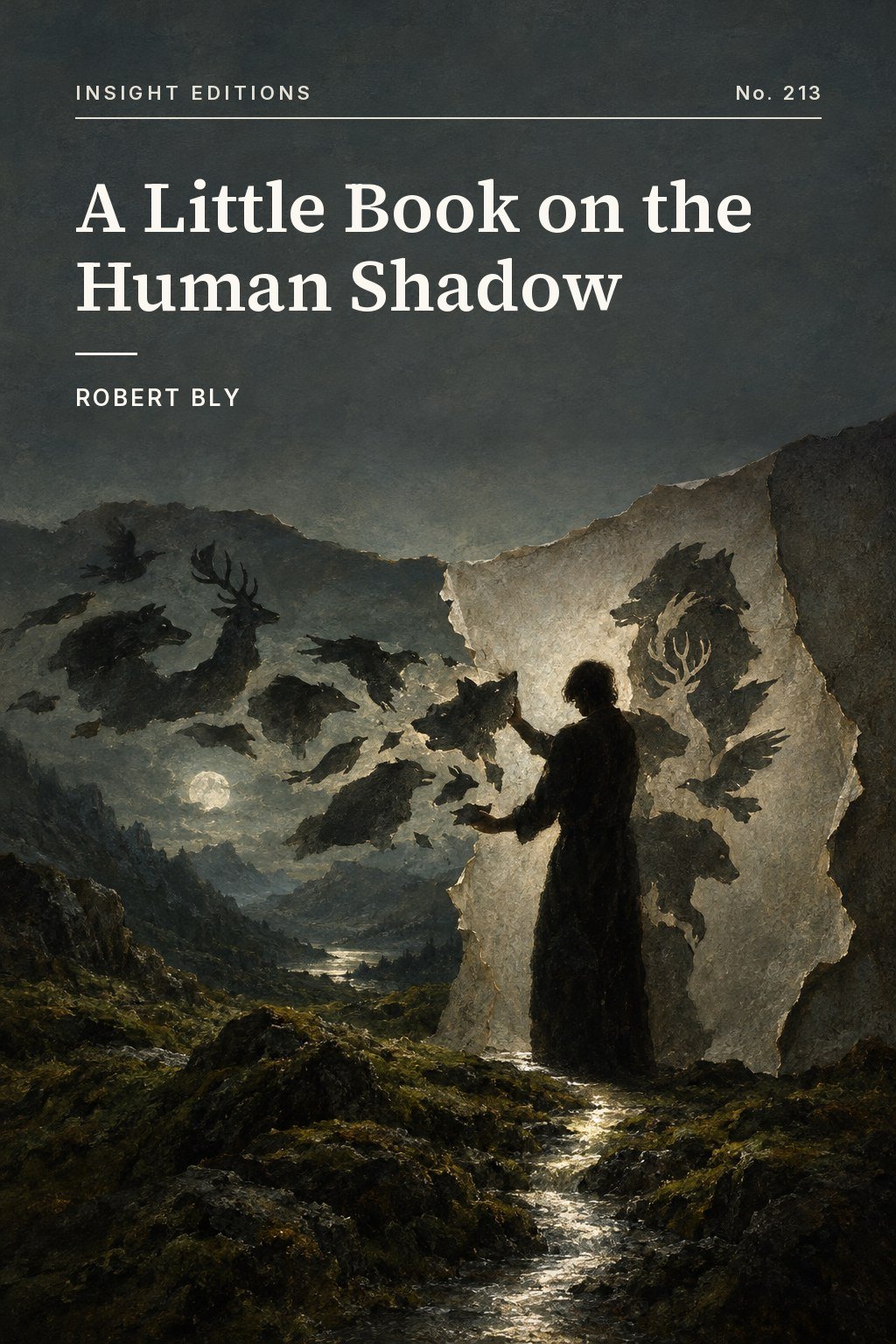
Insight Editions · No. 213
A Little Book on the Human Shadow
Robert Bly
Robert Bly uses Jungian images, poetry, and literary examples to describe how disowned parts of the self become projections and how shadow work can restore them.
A study guide to A Little Book on the Human Shadow by Robert Bly. Shared free for personal reading; not for sale and not endorsed by the authors or publishers. Please read and buy the original.
The Book in Brief
The argument in brief
- Boehme’s gate. Do not read unless you will change your life; otherwise the book harms you. Booth opens with that condition; Stevens closes it.
- Bright light, starved dark. Culture pushes mathematics, success, Yang; the dark side starves. Bly’s early answer: send out a crow that finds new mud.
- Ark politics. American founding hatred of Yin (Puritan thread) feeds later numbness: Vietnam body counts, Cambodia bombing, Little Crow / ear-cutting image. The crow never lands while the split stays.
- The long bag. Child starts as 360-degree energy; parents, school, peers stuff disliked parts until ~age 20 leaves a thin slice. Sealed contents regress toward ape and hostility.
- Film can and projection. Psyches project sealed film onto spouses, celebrities, nations. Projection can be a bridge; the crime is leaving it out too long. Mourning (Alice Miller) precedes retrieval.
- Five stages. Exile → rattle → moral intelligence repairs the mask → sensation of diminishment → eating the shadow (ask, write, paint, play witch/giant, sharpen senses).
- Honor, do not confuse. Track irrational hatred; third way neither represses nor kindergarten-discharges; wild man ≠ savage; shadow ≠ evil.
- Stevens caution. Sensory intelligence can open the bag; idealist “One truth” reseals it; American pattern is art-only retrieval that later thins into black marigolds.
Argument map: Ark names the split; Bag and projection name the mechanism; Five Stages and Honor name practice; Stevens tests whether art alone is enough.
Chapter map
| Ch | Title | In one line |
|---|---|---|
| 1 | Foreword: by William Booth | Contents contract: five essays in order |
| 2 | Foreword | Boehme gate; Jung/von Franz definitions; how readings became essays |
| 3 | Problems in the Ark | Bright light / crow; Puritan Yin-hate; Vietnam numbness |
| 4 | The Long Bag We Drag Behind Us | 360° to slice; film can; projection; mourning; nested bags |
| 5 | Five Stages… | Exile, rattle, moral fix, diminishment, eating the shadow |
| 6 | Honoring the Shadow | Path of attention; third way; wild ≠ savage; shadow ≠ evil |
| 7 | Wallace Stevens and Dr. Jekyll | Sensory rise; James vs the One; art without life-change |
Reading paths
- Practice first. Ch5 Five Stages → Ch6 Honoring (path of attention, third way) → return to Ch4 bag metaphors.
- Image and politics. Ch3 Ark → Ch4 Bag (national bag) → Synthesis A closer look.
- Literary caution. Ch2 Boehme gate → Ch7 Stevens → close the loop: change or the reading harms.
- Full pass. Overview → Ch1-7 in order → Synthesis frameworks table.
Foreword: by William Booth
William Booth edited the collection and signed the longer foreword that follows. The extracted “Foreword: by William Booth” page is the book’s contents list, not a separate essay. Treat it as the structural contract of the volume.
| Part | Title | Role in the book |
|---|---|---|
| 1 | Problems in the Ark | Light / dark split; crow as helper; Puritan and political shadow |
| 2 | The Long Bag We Drag Behind Us | Personal bag, film can, projection |
| 3 | Five Stages… | Exile, rattle, moral repair, diminishment, eating the shadow |
| 4 | Honoring the Shadow | Interview: how to find, honor, and not confuse shadow with evil |
| 5 | Wallace Stevens and Dr. Jekyll | Sensory shadow in poetry; living vs. writing the shadow |
Foreword
You must change your life
What Bly’s poetry readings say, Booth writes, is “You must change your life.” To hear serious poems and resist all change is worse than wasted time; it is dangerous. Booth cites Jacob Boehme: a note before one of Boehme’s books asks the reader not to go further unless willing to make practical changes; otherwise the book will be bad for him.
That warning resurfaces in part five, “Wallace Stevens and Dr. Jekyll.” Bly praises Stevens’s sensory intelligence, then judges the poet’s failure to change his life as disastrous for the late work. Stevens brought the shadow into poetry but shut it out of everyday life. Bly’s verdict on the later poems: they are “as weak as is possible for a genius to write.”
What “shadow” means here
Shadow is one of Carl Jung’s most useful terms because it is already a visual image. Marie-Louise von Franz, in Shadow and Evil in Fairy Tales, offers the familiar phrasing: the dark, unlit, repressed side of the ego complex. She immediately corrects the purely negative reading. Jung, impatient with Jungians, once dismissed nit-picking with: “This is all nonsense! The shadow is simply the whole unconscious.” Von Franz’s workable definition for early approach: a mythological name for all that within me of which I cannot directly know.
Three working definitions Booth stacks:
1. Dark / unlit / repressed side of the ego complex (von Franz, provisional).
2. Jung’s impatient expansion: the whole unconscious.
3. Neutral entry: mythological name for what I cannot directly know in myself.
Bly’s stake and the book’s method
Bly’s interest goes back to lonely years in New York City. One of the first things he understood clearly for himself: if help were going to lift him from misery, it would come from the dark side of his personality. That line comes from the 1971 poetry reading where he first chose the shadow as thematic image. He returned to the theme in three later readings; poems and commentary shifted each time.
This collection prefers poetry and storytelling over doctrinaire psychology. Bly moves image to image, anecdote, fairy tale:
- The shadow as “the long bag we drag behind us,” heavy with parts parents or community refused.
- The shadow as thin gray film in a can, ready to throw lifelike images onto a giant screen or onto a spouse’s face.
- The repressed side of Dr. Jekyll rising as Mr. Hyde: deformed, ape-like, glimpsed against an alley wall.
Part three (Five Stages…) goes past evocative images into practice: how to change one’s life, call up energy lost in the shadow, bring back the witch and the giant.
How the book was made
The first plan was simple: transcribe two or three readings, sharpen focus, print them.
When Bly saw the transcriptions, he was more distressed than Booth and Easson about what the page had lost: voice, music, gesture, audience interchange. Extensive revision followed. Substance of the first three sections stays faithful to the readings; form moves closer to the essay.
- 1971. Studio reading for “Contemporary American Poets Read Their Works” (Cassette Curriculum) → basis of Part 1, “Problems in the Ark.”
- 30 Jan 1983. San Francisco conference “The Face of the Enemy” → Parts 2 and 3 adapted.
- ~1984. Booth-Bly conversation on the shadow → Part 4 interview.
- 1976. “Wallace Stevens and Dr. Jekyll” first in American Poetry, ed. William Heyen → Part 5.
William Booth: editor and interlocutor; signs this foreword.
Roger Easson: bibliographer of Bly’s publications and recordings.
Marie-Louise von Franz: Jungian analyst; shadow definitions Booth leans on.
Jacob Boehme: mystic whose “change or don’t read” note becomes the book’s ethical gate.
Booth’s foreword chain: ethical gate → definition → image → practice.
Problems in the Ark
Bright body, starved dark
When sunlight hits the body, the body turns bright and throws a dark shadow. The brighter the light, the darker the shadow. Each person has a personality part hidden from them. Parents and teachers push the light side: mathematics, geometry, success. The dark part starves. Bly’s answer to what one does then: send out a crow.
His early poem (two or three years after college) reworks Noah through an earlier Babylonian version with three birds. The dove finds no resting place over shaken seas; swallows leave and return; on the third day the crow shall fly, the spider-colored crow that finds new mud to walk upon.
Birds as political typology
Bly reads national leadership through the poem’s birds:
- Adlai Stevenson: too much like a swallow.
- Bertrand Russell: too much light in the personality.
- Eugene McCarthy: a little more dark, still a swallow unable to find mud.
- Pattern: the United States elects doves or swallows, or white crows like Nixon.
Birds have become a problem for the United States: the ark’s helper never arrives as crow.
Handfuls of darkness
Years later, watching snow fall on long grass, he felt “positive dark” return. The poem sequence (The grass is half-covered with snow…) moves from little grass houses growing dark, to handfuls of darkness near the earth, to a barn full of sealed government corn moving toward the house like a hulk in a storm, sailors on deck blind for many years.
Farm facts under the image: first snow while grass is still green bends it into little houses; that year’s barn was empty of animal but full of corn sealed in a government program, a kind of treasure belonging to his father. “Handfuls of darkness” alone does not make a shadow poem; the poem approaches shadow at the end, when the writer gets more darkness than he bargained for.
Yin-Yang and plant time
Ancient Chinese culture, via the Yin-Yang symbol, shows white and black of personality united in a circle. Bly’s spring poem (Oh, on an early morning I think I shall live forever!) wraps joyful flesh like grass in green clouds, survives the night bathed in dark water, then follows box-elder leaves into the wilds to sit at a plant’s foot and live forever, like the dust.
Speculation: Chinese poets who tried to reconcile dark and light kept more feeling for plants and animals. Plants live always in the dark side while leaves reach for light. Each backyard weed unites dark and light as the rose window of Chartres does, and sitting by weeds is cheaper than flying to France.
Yang / father side: action, commerce, Empire; right-thinking, well-lit admiration.
He admits the description itself encourages polarization; he longed for a poem that would make the split clear.
The Busy Man Speaks
In “The Busy Man Speaks,” the speaker refuses the mothers of solitude, love, conversation, art, tears, ocean, sorrow, downcast face, death’s suffering, cricket night, open fields, Christ. He gives himself to the father of righteousness, cheerfulness, rocks, perfect gestures. From the Chase National Bank an arm of flame draws him to desert, parched places, landscape of zeros: stones of cheerfulness, steel of money, father of rocks.
Culture, from infancy, teaches the split Bly names mother/father. Some people cut themselves off from darkness by decision. The poem’s speaker is an extraordinarily conscious father-type who chooses that cut.
Pilgrim village: hatred of Yin as American thread
The Pilgrim-village poem sets heavy rain, smiling fish heads, “Samson” hanging from rafters, chickens on Calvinist ground, women borne down by skirts like drowning men, strange white perfect eggs, and the Mattapoiset Indian in league with rotting wood, salamander, cold fish heads. Closing lines name him enemy and outcast: the one whose dark hair hides us from the sun.
Bly’s judgment: most Puritans did not distinguish darkness from Satan. They feared swarthy Indians, likely distrusted dark-feathered turkeys, walked uneasily in pitchy pine woods; for women they advised stockings, hoods, obedience, silence. Hatred of the Yin side begins as a small thread in the first American cloth. It gave New England fierce energy at the start; three hundred years later the same hatred drains people toward spiritual death.
Shadow move: Darkness fused with Satan; Native person cast as conspiracy with rot and cold blood.
Outcome in Bly’s arc: Founding energy that later becomes national numbness and body-count warfare.
After forty-five: speechless men and Vietnam
A short poem: dentist’s waiting room, life run out; at forty-five the threshing floor sinks, speech stops; he sits under trees while his wife gathers faggots. Bly generalizes: some American men enter a witchlike mythical space after forty-five. In many primitive cultures, and among Buddhist priests, men stay spiritually alive into seventies and eighties; here speechlessness takes over. That dead space inside older American men connects to how the Vietnam War was pursued: numb, dead, with body counting as emblem.
The body-count poem pushes the logic to grotesque scale: make bodies the size of skulls for a moonlight plain; fit a year’s kill on a desk; fit a body into a finger ring for a keepsake forever.
If the American drama begins with Puritans killing turkeys, Kissinger’s and Nixon’s bombing of Cambodia is third act. South Asians, from a civilization more reconciled to moist dark, merge in the psyche with ghostly Cherokees or Crows. Daily brutalizing tallies felt like repetition of earlier massacres, Sisyphus still pushing the stone.
Little Crow under the Pentagon
The longer political poem hears voices praising Tshombe and the Portuguese in Angola: these are the men who skinned Little Crow. We are their sons, skulking, selling nails with trembling hands. Distrust of every person with black hair; teams to overthrow Chief Joseph’s government; natives trained to kill presidents with blowdarts; men loosening the nails on Noah’s ark. State Department men float in heavy jellies like exhausted crustaceans, sending beams of black light, fighting fraternal feeling for great landlords. Violet rays light jungles to show “friendly populations”; forest children taught to overcome longing for life; sparks of black light fit holes in generals’ eyes. Under Pentagon cement: a drop of Indian blood preserved in snow, trail from the stockade now lost.
Historical gloss Bly adds: Sioux leader Little Crow led a brief Minnesota rebellion during the Civil War; years later a white farmer shot him picking blackberries; recognition by skunk fur wrist bands; farmers beheaded and skinned him; Minnesota Historical Society held the skin for a time. The detail rhymes with ear-cutting in Vietnam.
Closing question of the essay
A private decision to fight one’s dark side (Protestant recommendation especially) can set conscious and unconscious in adversary positions; those positions can spread into foreign policy. The crow does not arrive. We divide animals in the Ark into good and bad; seat male porcupines right and females left; forbid heron dance; force crowded mice to full term: still no crow. Yin and Yang halves do not join.
The dark/light division here is stark by design. That is how he chooses to begin.
Problems in the Ark: personal and national light-worship blocks the bird that finds mud.
The Long Bag We Drag Behind Us
Remembering, not inventing
An old Gnostic claim: we do not invent; we remember. Europeans who remember the dark side best, for Bly: Robert Louis Stevenson, Joseph Conrad, Carl Jung. He will call up their ideas and add his own, beginning with the personal shadow.
From globe to slice
At one or two years old we might visualize a 360-degree personality: energy from all body and psyche; a running child as living globe. Then parents dislike parts of the ball: “Can’t you be still?” “It isn’t nice to try and kill your brother.” Behind us sits an invisible bag. To keep parental love, we put the disliked parts in. By school age the bag is large. Teachers add: “Good children don’t get angry over such little things.” Anger goes in. By twelve in Madison, Minnesota, Bly and his brother were “the nice Bly boys”; bags already a mile long.
High school continues stuffing, now under peer pressure more than grownups. Bly lied automatically to resemble basketball players; slow parts went in the bag. He watched daughters suffer as much damage from other girls as from men, often deciding on fashion and collective beauty. Parents could not stop the stuffing.
Bag chronology:
1. Ages 1-2: full globe of energy.
2. Early childhood: parental dislikes → first bag contents.
3. School: teacher rules (esp. anger) → bag grows.
4. High school: peer fashion and speed → more stuffing.
5. ~Age 20: a thin slice left; the rest is bagged.
6. Rest of life: trying to get contents out again.
Marriage of two slices
Imagine a twenty-four-year-old man and woman, each with a thin elegant slice left. They marry. Even together the two do not make up one person. Large bags mean honeymoon loneliness; everyone lies about how wonderful it was.
- 360 degrees: starting radiance Bly asks you to visualize.
- ~20 years: stuffing phase; thereafter, retrieval phase.
- 15-20 years sealed: typical regression window before hostile reopening.
- Mile-long bag: Bly brothers as “nice Bly boys” by age twelve in Madison, Minnesota.
Culture fills different bags
Christian culture typically bags sexuality and much spontaneity. Von Franz warns against sentimentalizing “primitives” as bagless: they may bag individuality or inventiveness. Participation mystique can mean everyone knows the same thing and no one knows anything else. Bags for all humans may be about the same size.
We spend life until twenty deciding what to bag; the rest trying to retrieve. Sometimes the bag feels sealed.
Jekyll, Hyde, and regression
Stevenson’s dream, urged into writing by his wife, became “Dr. Jekyll and Mr. Hyde.” In idealistic culture the nice side grows nicer: liberal doctor, always thinking of others’ good, morally wonderful. Substance in the bag takes on its own personality. One day it appears elsewhere in the city, angry, shaped and moving like an ape.
Rule of the story: what we put in the bag regresses; it de-evolves toward barbarism. Seal at twenty, open at thirty-five or forty: sexuality, wildness, impulsiveness, anger, freedom return primitive in mood and hostile to the opener. The ape’s shadow on the alley wall rightly frightens.
Interior woman / interior man
Most males bag feminine side / interior woman. When they try to reclaim her around thirty-five or forty, she may be hostile; meanwhile outer women may show hostility too. Rule: the outside has to be like the inside on this globe. A woman who bags masculine side / internal male for feminine approval may meet him twenty years later as unfeeling, brutally critical. Finding a hostile outer man to blame eases pressure but does not open the bag. Double rejection follows. Every part of our personality that we do not love will become hostile to us. It may move to a distant place and revolt: Shakespeare’s kings endangered by Hotspur “in Wales”; the king at the center always at risk.
Bali versus American lawns
In Bali, Hindu culture works mythologically to bring shadow into daily view: almost daily Ramayana temple plays; fierce toothy figures outside houses; a mask maker’s child carving hostile faces. Ideal is not acting aggression out as in football or bullfighting, but bringing it upward into art. Balinese can be brutal in war yet seem less violent in daily life than Americans who put helpful lawn figures and serene deer out front, want Renoir over the sofa and John Denver on the stereo, then watch aggression escape the bag and attack everyone.
The film can and the projector
Miniaturize parts of the self, flatten them, store them in a dark can. At night the shapes return huge; we cannot look away: outdoor drive-in figures lighting cigarettes, threatening with guns. Psyches are natural projection machines. A man’s twenty-year anger may one night appear on his wife’s face; a wife may see hero then tyrant on her husband’s face (Nora in A Doll’s House).
Midas, advertising men, and rewriting “Unrest”
Bly’s 1956 diary struggle: a poem attacking advertising men via Midas (everything touched turns to gold / money; starved souls). Years later he saw the movie he had been running: he had long known how to eat so that nourishment never arrived; food from friend, woman, or child turned to metal on the way to his mouth. Midas fit him; the interior film stayed rolled in the can while evil ad men played on the large screen. He composed Poems for the Ascension of J. P. Morgan (poems alternating with culpable ads); nobody published it; mostly projection anyway.
In “Unrest,” bankers and businessmen fell on their knees in dungeons of sleep. About five years before the essay, suspicion rose: rephrase “banker” as someone who plans very well (he plans well); “businessman” as someone with a stiff face (mirror check). Rewritten close: good planners dream of burial by black stones; men with stiff faces like me fall on their knees. At parties, meeting a faintly apologetic stockbroker, he feels something deep inside standing next to him, sometimes a funny longing to hug.
Projection is not only a crime
Von Franz: why assume projection is always bad? “You are projecting” becomes Jungian accusation; sometimes projection is helpful and right. Bly’s starvation knowledge could not move bag → conscious directly; it had to go into the world first. Without projection we might never connect with the world. Men project ideal feminine onto women; without that, how leave mother’s house? Issue is less that we project than how long we leave projections out there.
Mass example: millions of American men projected internal feminine onto Marilyn Monroe. Projection without personal contact damages the receiver; she died. She also called for projections as power longing, with childhood victimization behind it. Mass media knocks tribal face-to-face recall out of whack. In psychic economy her death was inevitable and even “right”: no one carries that much unconsciousness and survives. Each person must bring their own back.
Alice Miller and mourning the nice child
Why bag so much so young? With so much exiled, how live? Alice Miller, Prisoners of Childhood / The Drama of the Gifted Child: we arrive trailing clouds of glory, mammal appetites, tree-life spontaneities, tribal angers, 360-degree radiance, and offer the gift to parents. They wanted a nice girl or nice boy. Immigrant second-generation mothers may need children to make the family look classier; we do the same to ours. Rejection before speech stores pain in a pre-verbal place.
Reading Miller, Bly fell into depression for three weeks. Miller’s counsel: we betrayed ourselves, but blame is wrong; children who opposed parents in ancient times were set out to die; we did the only sensible thing. Proper attitude: mourning. Construct an acceptable personality, then mourn what was lost.
Energy, town bag, national bag
Bigger bag, less available energy. Sexuality bagged → energy lost; woman’s masculinity bagged → energy lost; “I am not creative” means creativity is in the bag and “experts” are hired guns. Everyone in the audience should write their own poems.
Bags nest:
| Bag type | What it holds / does |
|---|---|
| Personal | Private exiles; unavailable energy |
| Town / community | Collective psychic decision; Greek town ≠ Minnesota farm town; interferes with private retrieval |
| School / guild | Jungians bag vulgarity and love of money; Freudians bag religious life |
| National | Long U.S. bag; hear it when State Department criticizes Russia (Reagan: we are noble; others have empires, stagnated leadership, brutal minorities, brainwashed youth, broken treaties). Russians read theirs in Pravda on the U.S. |
Network of shadows meet somewhere in the air. Distinguish personal, town, and national clearly.
Three metaphors, one mud
Bag, film can, projection. Because contents stay dark, we see them only by throwing them into the world: evil spiders, cunning snakes, oversexed goats, linear men, weak women, unprincipled Russians, Chinese who “all look alike.” Through this expensive, damaging mud-slinging we eventually touch the mud the crow found on its feet.
Personal shadow path: globe to bag to can to recalled projection.
Five Stages in Exiling, Hunting, and Retrieving the Shadow
Giving powers away
To project is to give away energy or power that belongs in one’s treasury. A man may give feeling / relationship mode to his wife, then let her handle feeling problems with children. He may also project onto women: animal sexuality (she feels wicked), spirituality (she feels elevated), weakness, insanity, worldly competence, or the witch. A woman may project onto men: interior hero (he feels overly noble), Saturn (he rigidifies while she stays whimsical), tyrant, spirituality, hatred of relationship, or the giant.
The talk follows a man who gave his witch away and a woman who gave giant or tyrant away; the reabsorbing process is similar for qualities projected on the other sex, children, parents, teachers, races, nations.
Stage 1: Successful exile
Shadow material rests outside the owner’s psyche, handled by “trained conspirators,” likely to stay out. Inside remains only thin gray wispy substance, hardly noticeable by day.
Male child may begin projecting interior witch by two or three months, mother as good hook. Some observers: baby’s first refused breast, rage-powered, sees fangs and skulls. Witch stories prove children they are not insane. The child lives with the secret that the publicly caring mother has a witch face at times, and he is too small to act.
Many men let mother carry the witch for life; most, at marriage, transfer it to the bride. During the wedding, Booth-style, another exchange happens “in the basement”: mother hands son’s witch to bride. An hour later it is in place; neither bride, mother, nor groom knows. After arguments and money fights he notices something witch-like; she feels bitchier. Bly to one woman: “You’ve been eating for two.” He grows sweeter; that enrages her further. She carries impulsive irritability, greediness, unfairness, unexplainable hostility, underground rage for both.
Parallel exchange: bride’s father passes giant / tyrant (and perhaps spiritual guide, interior bluebeard) to the groom in the “garage” while bodies stand in church. Bride receives from groom’s mother his helplessness, deviousness, Kali-like rage. Both leave heavier in opposite directions. Stage 1 may last years: wedding silver lasts a long time.
Stage 2: The rattle
Sooner or later a projection rattles (von Franz’s word). Wife acts witchy only sometimes; generosity shows through half-closed eyes. Confusing. He may come home late, forget anniversaries, hoping she takes it personally so the mask fits again.
Woman with giant’s mask on husband feels painful relief; if he fails to be negative patriarch, trouble. She may overdraw, dent fenders, play victim/little girl, or get “revved” at a feminist meeting that reframes men’s kindness as oppression, until the patriarch mask returns.
Archibald Cox with Orange County fundamentalists: they expected CIA-flavored confirmation that Russians break every treaty; detailed report of meticulously followed treaties upset them more than news of imminent invasion.
Guru projections rattle when sleeping with young girls or buying Rolls-Royces by the dozen; ashrams may live years in second-stage anguish.
Onto children: Alice Miller’s For Your Own Good on nineteenth-century German child-rearing: around 1850, “exuberance” named as potential evil; severity of punishment often unrelated to offense (spill milk → three days silence). Ashley Montague: aggressive instincts genetic; violence learned in the family. What adults project onto children is wicked weakness: secret belief that our childhood weakness was wicked, we should have been stronger. Salem considered children evil. Anger at one’s own-sex children often exceeds the offense; children’s eyes show fear. When we can no longer believe they are wicked, stage 2 arrives and substance threatens return. Violence can spike when return threatens.
Five stages (Bly):
1. Successful exile : shadow parked outside; thin gray wisps inside.
2. Rattle : mask fits inconsistently; nervous repair attempts.
3. Moral intelligence repairs the mask : ethics used to restore unconsciousness.
4. Diminishment : eyes break contact; feel how reduced one has been.
5. Eating the shadow : retrieve and metabolize projected powers.
Stage 3: Moral intelligence as tool of sleep
Distress calls on moral intelligence to repair the rattle. Scary because we need moral intelligence, yet here it serves continued unconsciousness. People with it can be dangerous: when the mask slips, they step forward to replace it.
Vietnam example: Walt Whitman Rostow, the Alsop brothers; Lyndon Johnson casting Asians as ignoble and us as noble; when saturation bombing, napalm on civilians, village massacre cast doubt, Johnson compared himself to Lincoln and Rostow spoke of moral fiber and peace-giving duties. Child-abuse parallel: every parental cruelty is interpreted as love; moral intelligence redefines abuse as love.
Anti-war side fell into stage 3 too: when not all police were pigs, Ho Chi Minh was not Albert Schweitzer, Humphrey had honor as VP, moral intelligence rejected Humphrey and helped elect Nixon; “America spelled with a ‘k’.” Left bag is long; awesome moral intelligence keeps projection going “for your own good.” Bly admits hearing police called pigs and saying nothing.
Parent voice when anger exceeds offense: “You’re here to give discipline….” Ashram students justify guru via “crazy wisdom” or challenging the Western ego.
A Doll’s House recapitulation: Nora gave hero to Torvald, he gave childishness to her; wobble; she planned a moral-intelligence crisis to prove him magnificent hero; it failed. Stage 3 refits only briefly.
Stage 4: Sensation of diminishment
Exhausted, one stops forcing the mask onto the other. Eyes break contact; one looks inward and sees diminishment: how reduced one has been for years.
Man who gave witch to mother then wife, around thirty-five or forty, feels soft and diminished. Witch blocks growth yet also knows what she wants (“separate these seeds by sunset or I eat you”); she does not check the I Ching. Rise of agreeable “soft males” in the U.S.: brave development of feminine selves, yet fault is absent witch. Ask what he wants: “What would you like?” “I’ll ask my girlfriend.” At Lama Commune, every serious relationship broken in three years was broken by the woman. Soft male often lacks witch enough to say “Enough!” When witch reenters, crispness enters. He may be skilled at empathy and going with the flow, yet lack the witch’s wanting.
Woman who gave hero feels diminished; giving negative patriarch is no better: give the negative and you give the positive too. Consensus politics among interior beings fails; interior critic or bluebeard may dismember her. Same inside men. Insisting patriarchal authority is primary evil while claiming none of it can leave a woman brutalized by strong inner forces, as soft male’s absent witch leaves him enslaved in relationships.
Thirty given-away parts → diminishment in thirty ways. Students take spiritual guide back from guru when diminished enough; giving it was not necessarily wrong, but alertness to diminishment must match alertness to elevation.
Friends matter: do not cheer away the pain (“you’re just a drip by nature”). Friends used to the old self may dislike retrieved patriarch or witch. Children may freeze parents as ethically strong by staying “wickedly weak.” J. B. Yeats to W. B.: in Europe children discipline themselves so parents can have a good time; in America parents discipline themselves so children can. Many U.S. parents feel diminishment as a new parenting style, not as loss. Reagan, projecting madness and super-cleverness onto Russians, lets them set the tone and the budget, as with children.
We live in all five stages at once for different qualities on different schedules.
Women who have projected the patriarch often practice consensus in meetings: endless process, reluctance to decide, because decisive/tyrant energy was handed to a man. Giving the negative also gives the positive; reclaiming the giant restores both.
Stage 5: Eating the shadow
Retrieve giant, hero, witch, wicked child, brutal national character. The process is eating the shadow: slow, repeated hundreds of times, closer to diet than conversion. Puritanism blocked eating the “wicked child”; literature thinned. The witch-burning craze, driven by monks who had forgotten how to eat the witch, turned retrieval hunger onto others. Churchill: had to eat many of his own words; found the diet nourishing.
Puritan insistence that the child is truly wicked blocked eating that shadow; malnourishment shows in their literature. Witch-burning craze (ignorant monks who forgot mythological thought) prevented administrators from eating their own witch; church still undernourished there.
As one grows wiser: mother feeds, but witch eats; witch must return for significant shadow-eating. Retrieving projected authority brings Saturn: passion deepens, melancholy (Saturn’s mark and retrieved shadow’s mark), sorrow, opening to spirit, sense of limits as natural.
Poems of the fifth-stage mood
“Snowbanks North of the House”: snow stops six feet from the house; thoughts that go so far; son stops calling; wife loves husband no more at a party; energy leaves the wine; man in black coat turns back down the hill; no one knows why he came or turned away. Melancholy of stage 5.
“For My Son Noah, Ten Years Old”: anger flying toward sons, passed grandfather → father → Bly; aim not to pass it unconsciously further. Advocate of darkness not lost; what is primitive not to be shot into night; kind man loses rage, sits at table; pride only in days of undivided tenderness, tea carefully poured, calm and delighted. Spontaneity returns with children when one lives in the grief of the return.
Two stories
- Mulla Nasrudin: duck shits in his eye; students want toilet paper; “you couldn’t catch him now.”
- George Docsi (architect, The Power of Limits), childhood Hungary: dining room filled with Jews fleeing a Russian pogrom; child screams for supper, throws down bread; grandfather picks up bread, kisses it, gives it back; child eats. Not the usual shout about starving Africans. Kiss does not accuse bread or child of wickedness; act is spontaneous, decisive, full of true authority and genuine grief. Docsi later: “there’s a little of my grandfather in me now.”
Person who has eaten shadow spreads calmness, shows more grief than anger. If ancients were right that darkness holds intelligence, nourishment, information, then shadow-eaters are more energetic and more intelligent.
Practical retrieval
How, practically?
Daily life suggestions: sharpen smell, taste, touch, hearing; make holes in habits; visit primitive tribes; play music; create frightening clay figures; play drum; alone for a month; regard yourself as a genial criminal. Woman: try being patriarch playfully at odd hours. Man: try being witch playfully; develop witch laugh and tell fairy stories (she: giant laugh and stories).
Direct ask: man goes to woman holding his witch, greets cordially, “I want my witch back. Give it to me.” Curious smile; she may hand it back; he turns left to the wall and eats it. Woman may ask mother for witch, father for giant, teacher or ex for negative patriarch. Even if the carrier is dead, encounter can help.
Richest method: careful language, accurate, with physical base. Language as rope and net to pull floating energy back. Write the witch, write the spiritual guide rather than only living them in others. Language holds ancestors’ retrieved shadow (Singer, Shakespeare). Or paint/sculpt/watercolor the witch until you know whose house she is in. Stage 5 is activity, imagination, hunting, asking. “Always cry for what you want.”
- Sharpen smell, taste, touch, hearing; punch holes in habits.
- Visit cultures that stage shadow daily; play music; drum; clay monsters.
- One month alone; regard yourself as a genial criminal.
- Play patriarch (women) or witch (men) at odd hours; invent the laugh; tell fairy tales.
- Ask the carrier aloud for witch / giant / negative patriarch back; turn left and eat it; works with the dead too.
- Write or paint the figure with conscious intention until you know whose house it occupies.
- Use careful, physically based language as rope and net: “Always cry for what you want.”
Political close: passivity toward projected material feeds nuclear danger; unused energy floats above the country for politicians’ “energy sweeper” (Reagan named). Journals and art help the whole world; no guilt required, but Blake: “No person who is not an artist can be a Christian” meaning one who refuses to approach life actively with language, music, sculpture, painting, drawing is a caterpillar in Christian clothes. Blake engaged shadow with painting, music, language; no spare energy for politicians to aim at other countries. Americans should eat shadows individually so energy is not released against Russia, China, or South American countries.
Five stages of exile and retrieval; stage 5 is active eating, not a single conversion event.
- 2-3 months: early witch projection onto mother (Bly’s cited observers).
- ~1850: German child-rearing literature treats “exuberance” as gateway evil.
- Hundreds of times: shadow-eating is repetitive diet, not one meal.
- 3 years / Lama: all serious breaks initiated by women in the soft-male anecdote.
Honoring the Shadow: An Interview with William Booth
Where to look if you feel shadowless
Booth: the shadow is hidden by definition; where does an unaware person look?
Bly passed the question to an experienced Jungian analyst in public. First answer: unless a thirty-five-year-old Minnesota woman meets a teacher who understands shadow, she doesn’t have a chance. Harsh. Second way: the psyche hints daily by picking people to hate irrationally. Obsess over a “too loose” woman → sexual area of shadow. Hate the successful fakey PTA president → unused power impulses in the bag. Path of attention: notice precisely where anger goes and whom we become obsessed with, even virtual strangers. Metaphor: maintain eye contact and damage them with hatred; break eye contact, look down quickly to the right, see your own shadow. Hatred helps. Old tradition: love God and become holy in twenty years; hate God and do the same work in two.
Literature likes and hates also map the bag. Bly obsessed against eighteenth-century Pope and Johnson as neoclassical feeling-haters; looking down to the right showed unused classical side. Effects: could not sustain hatred of Johnson (essay on Milton now magnificent); must admit others see in him what he saw in Johnson.
Nice-person culture and the Celtic contrast
Booth: we are sensitive to qualities we bury. Bly: yes; peculiarity of shadow lies in what we bury. He longs to be nice: responsible, decent, thoughtful. Old Celts in Cuchulain’s time were told to be daring, brave, never whine, joke at death; their shadow likely lay in cowardice and melancholy. Ours, trained in unselfishness, tends toward greedy, sneaky, fame without desert, being an operator. Men’s groups hit the Widow Douglas / Aunt Sally problem from Huck Finn: civilize him; Huck can’t stand it, been there before.
Coffee anecdote: Bly measured equal coffee for Ruth and himself; something inside reached back for an extra half spoonful for his. It wasn’t me; I noticed it happen.
Can anyone lack a shadow?
A man said a placid young woman had no shadow. Bly: ever see someone walk in sun with shadow missing? Would need to be terribly thin, transparent. Old Zen people may do greedy things in daylight and laugh, bringing greed from shadow into play; some stop dreaming because dreams remind of unabsorbed shadow. A sixty-five or seventy-year-old might be transparent; a woman in her twenties: no chance. Even if she claims no dreams, REM would show otherwise.
Threefold shadow map
It is inconceivable at twenty-eight to have lived out everything. Bly’s threefold map:
- Sexual area : greediness, brutality; pornography makes it clear.
- Hunter / hermit area : primitive impulses not about sex: woods, blood on face, Aboriginal religious withdrawal from the profane.
- Hatred / fear / anger / jealousy store : larger at birth than we can live out (airline clerk mistakes).
Psychology Today on China: children not allowed to speak or act negative emotions; mother says “Shame!” to anger, competitiveness, greed; politeness and noncompetitiveness taught; little feeling talk with parents or siblings, sometimes with cousins. Jung: successful repression makes feeling-talk hard. Chinese shadow foothold in area three.
U.S. permissive rearing: some kindergarten teachers want anger “out of his system.” That part becomes visible by day. Booth hears antidote to bag-stuffing; Bly: intended as antidote, worked poorly. Electrical paths in the brain make next tantrum easier; ego experiences explosive anger as defeat; ego’s job is making a social being. Adult may still fire along kindergarten grooves at forty or fifty, humiliated not strengthened.
Express (permissive discharge): grooves deepen; ego humiliated; adult kindergarten anger.
Third way (later in interview): neither; burn with the feeling in meditation, then choose expression that serves play and organized psyche.
Sex, primitivism, and the dissolving ego
Booth: child needs freedom of expression and ego strengthening. Bly: game between ego and shadow. Permissive educators give shadow fifteen balls and structure none. George Leonard, The End of Sex: once enthusiastic about complete sexual expression in the sixties; later saw humiliation of ego and loss of eros interest.
Culture longs for primitive modes against repression. Nazi youth back-to-nature primitivism involved state insanity (not all back-to-nature does); Kurtz in Heart of Darkness shows Western longing for the primitive can dissolve the ego in mass movements, sugar in water.
Wild man versus savage man
“Shadow” and “dark side” slide toward evil in common talk. After Bly’s New Age interview with Keith Thompson on the Grimm Iron John (hairy man under the pond), responses showed failure to distinguish wild man from savage man. Spectrum people know: tame obedient man ↔ savage (pool-table rapists); no room for wild man who is neither. Some men took wild man as permission for savagery.
German-born woman psychoanalyst in L.A. Free Press: the underwater person is a killer. But Iron John behaves gently, courtly. She imposed German historical grasp; savage had broken walls and occupied the wild man’s room.
Distinguishing details for wild man: spontaneity, presence of female side, positive male sexuality; none implies violence or domination. Underwater man resembles Zen priest more than grunting “primitive.” Narrative reminds of northern European initiation: older males teach younger how to meet shadow as play, not fight, so ego is not overwhelmed.
When shadow is absorbed, person loses much darkness and becomes playful in a new way (Bly first said “light”; Booth objects that Bly once damned Bertrand Russell for too much light). Bly withdraws “light.” Von Franz: work with shadow yields condensation, thickening; others grant moral authority without demand. Teacher with crow present: discipline easy; teacher without can lecture discipline all day and never get it.
Politics, humor, the sixties misread
Reagan: not condensed; still projects onto evil empire Russia and Salvadoran farmers as puppets; draws on Americans’ wise-father longing. Churchill absorbed shadow; natural authority; infantile streak faced and eaten. Booth names Lincoln: moral authority without sanctimony or illusion. Bly adds Lincoln humor: little influence in this administration; ugly-man train story told on himself.
Late-sixties exhilaration (long hair, rock, Snyder, Kinnell: “returning to the shadow”) looks different now. If true absorption had occurred, some shift toward admitting national dark side would show. No such change.
Joseph Campbell at Ojai to Krishnamurti people hoping Vivekananda’s seed had already begun a new world stage: cannot assure that; popular culture never gets above the power chakra. Matches Nashville power-over lyrics and Bond-movie power obsession versus love or spirit. Mass culture will not teach shadow absorption; that requires move toward heart. People under thirty-five cannot teach eating the shadow; Iron John initiations suppose old men. Reagan teaches younger males to project, not eat: genial commercial paranoia. Outlook not hopeful.
Third possibility: neither express nor repress
Baker Roshi: West has two ideas, express or repress (Strauss repressing vs punk expressing). Neither more admirable. Pairing of opposites destroys soul: defeat Communism or be defeated; dominate women or be dominated. Campbell’s two horns: hooked on either, we die. In Zen meditation one may let anger fill the whole body for hours: neither expressed nor repressed. Afterward ego chooses whether and how to express: perhaps a twenty-second phone witticism remembered five years, honoring anger, supporting play, not scarring brain grooves.
California women’s conference story: rounds of increasing honesty, floor weeping, felt victory; days later drained, defeated, nothing changed. Expression alone more savage than wild.
Three honorings of anger (and other shadow)
Honoring means not leaving animal/sexual/angry sides mistrusted, closeted, or naked-screaming. Greatest church harm often said to be mistrust of instinct; who taught mistrust of anger?
- Sympathetic anger while listening: capture it in words: “I feel some anger listening to this story.”
- Talk to anger as a person (von Franz): turn face and body to it: “What do you want from me?” Same for sexuality, infantilism.
- End the Mafia subcontract: shady under-table deal where anger does dirty jobs while we look calm under Robert’s Rules; anger then angry at us for shabby treatment, never introduced to friends as “my friend Anger, a lowly-paid assistant.”
Energy loss is one cost; the other is anger planning to fix you.
Shadow is not evil
Shadow energies belong to the 360-degree human psyche; destructive mainly when ignored; they belong to the human community. Ancestors sensed evil as different: from beyond human community, archaic principle (some Gnostics), or from the dead. Evil can be recognized, not absorbed. Humanistic confidence that all destructive energy can be befriended is too optimistic. Conversation stays about shadow.
Closing poem “The Moon”: after writing all day, sits against a pine; moon has porches turned to face the light, but the deep part of her house is in darkness.
Interview path: find via hatred, hold via third way, metabolize via honoring.
Marie-Louise von Franz · condensation and talking-to-anger counsel.
Baker Roshi · neither express nor repress.
Joseph Campbell · power chakra ceiling of mass culture.
Keith Thompson · Iron John / wild man interview partner.
Lincoln, Churchill, Reagan · absorbed vs projecting political types in Bly’s ranking.
Wallace Stevens and Dr. Jekyll
Earth literature versus nation literature
Literature of the American earth is many thousands of years old; rhythms still rise from serpents buried in Ohio, from shells Yakuts ate and threw aside. Literature of the American nation is about two hundred years old. How much under-earth darkness has risen into poems and stories in that time?
All literature, primitive and modern, can be thought of as creations by the dark side so it can rise and join sunlit consciousness. Matriarchal religions and the Mysteries often brought dark side up slowly over twenty to thirty years. Christianity, historically, polarized dark and light personalities and suppressed the dark. Centuries of that suppression yield the split of Dr. Jekyll and Mr. Hyde: dominant Western personality idealistic, compassionate, civilized, orderly; shadow deformed, fast “like a monkey,” younger, near vast energy, no morality, feeling rage from centuries of suppression.
We spend the first twenty or twenty-five years deciding what to push into shadow, the next forty trying to touch it again. Cultures exile different contents. Generally the shadow is all that is instinctive: whatever has a tail and lots of hair. Secular and Puritanical cultures push sexual desire, fear of death, ecstasy, old cave impulses, longings to eat the whole world; what remains on top looks respectable.
Conrad, Twain, Ahab, Dimmesdale
Conrad masters shadow literature. The Secret Sharer heals the split Stevenson could not; sometimes shadow rejoins only if one accepts a serious task (captaining a ship). Heart of Darkness is failure. After the invasion of Africa, Europeans solved the shadow problem less often: financial interest in suppression. Kurtz: a white man recovering shadow while exploiting Blacks is a task beyond human power.
American echo: Mark Twain in Huckleberry Finn. Sometimes the decent man is hidden in the U.S. shadow; he rejoins only if you refuse to sell Jim.
Most literature shows rise-attempts that fail. Ahab fails despite Hebrew-prophet rhetoric. Dimmesdale’s shadow fails; fear of women blocks rise. Bly prefers “shadow” to “evil” in literary talk: “evil” parks energy permanently outside in some other powerful being; “shadow,” though clumsy, keeps energies inside us.
Alexandra David-Neel’s monk
Tibetan teachers had Alexandra David-Neel externalize life-energy / libido as a visualized thought-form, not into objects. She refused a skull-necklace Tibetan figure (too easy to dismiss as transfer) and chose a medieval English monk. After weeks he appeared on the road, then greeted her, showed eyes; he vanished if “unthought,” then grew bolder, drew energy without her will, took on life. Frightened, she learned a long ritual to dismiss him. Someone who talks of evil in Moby Dick is the kind of person who would believe that monk was real.
What: Visualized English monk as externalized libido.
Outcome: Thought-form gained autonomy; required ritual dismissal.
Lesson for Bly: Do not reify literary “evil” as if it walked the road independently of the psyche that fed it.
The 1875-1890 poets as shadow workers
American poets born 1875-1890 (Stevens, Frost, Eliot, Williams, Marianne Moore, Pound, Jeffers) are shadow poets who did much shadow work. Nineteenth-century shadow work favored the novel; twentieth century favors poetry. Stevens is rarely cast as shadow writer; Bly takes him as stand-in for the group.
Compare Kenneth Rexroth (whose family, in the autobiography, tended to live out the shadow, unlike Stevens’s upper-middle-class German-American repressors)’s family (lived the shadow out, per autobiography) with Stevens’s upper-middle-class German American family (successful repressors). Bly admits speculation: he does not understand shadow return well. Channels differ. Eliot’s sharp griefs (marriage, wife’s insanity) linked to rising shadow energy; Stevens shows no such violent anguish. In Stevens, shadow rises in perfect serenity via awakening senses, especially hearing and smell. Senses bridge to animal past and thus to shadow; safety and schoolrooms numb them. Practical reawakening: Stevens, early in insurance work, ended travel days in New England towns with museums and spent hours looking at pictures; walks beat reading for multi-sense return.
Sensory intelligence in the poems
Bly walks through Stevens’s sense-work with short citations (study note: keep the argument, not every line):
- Sight disciplined, not monopolized: “Among twenty snowy mountains, / The only moving thing / Was the eye of the blackbird.” West overloads eyes via reading; other senses weaken; old five-sense harmony broken.
- Hearing: prefer inflections or innuendoes, blackbird whistling or just after; evening-all-afternoon snow light sensed with the body.
- Color joined to smell: night the color of a woman’s arm; obscure, fragrant, supple; pool like a bracelet shaken in a dance.
- Eyes joined to touch: light like a spider; webs of eyes fastened to flesh and bones as to rafters or grass; filaments on water and snow edges.
- Weather merged with emotion: passions of rain, moods in falling snow, grievings, elations, gusty emotions on wet autumn roads.
- Merge with surroundings: “I am what is around me.” Women understand; one is not duchess a hundred yards from a carriage.
- Pure shadow instant: glass coach over Connecticut; fear mistaking equipage shadow for blackbirds. Shadow shooting up often brings knowledge of death; ants crawling in and out of one’s shadow carry the same news.
Translation and newspaper-coarsened English miss the auras around Stevens’s words. Salty fishes arching like tree-branches: senses intersect; opposite of academic or philosophic diction. Scholars better think hard in dark cuffs of voluminous cloaks.
Basho as ally: temple bell stops but sound keeps coming out of flowers; sea grows dark, wild ducks’ voices turn white. American haiku poets miss the point: unless shadow has risen into the haiku, it is not haiku; seventeen syllables and nature scene are least important.
Harmonium, the title Stevens wanted for his Collected Poems, names union of the five senses and perhaps eight or nine more known to Australian hunters or Basho.
Stevens’s sensory bridge back to shadow (Bly’s sequence):
1. Reawaken hearing and smell (and touch), not eyes alone.
2. Unite cross-sense pairs (color-smell, sight-touch, weather-emotion).
3. Merge self with surroundings (“I am what is around me”).
4. Allow shadow instants (coach/blackbirds; ants in shadow = mortality).
5. Aim at Harmonium: full-sense chord, not idea-juggling.
William James against the mind-set of the One
Bly’s surprise helper for Stevens: William James. We treat senses and thought as opposites; James shows a mind-set that erases physical detail.
James warned students of an approaching Western mind-set (hardly thought) that notices no fingernails, trees in parking lots, hair in the ear. It loves the One, the Absolute, interchangeable equivalences. Stevens’s poem of twenty men crossing a bridge becomes, for Bly, a serious process poem (once loved as zany high spirits): twenty men / twenty bridges / twenty villages, or one man / one bridge. Opening song of Ph.D. candidates, politicians, planning experts: “One thing equals another thing.” Remedy in the poem: stop juggling ideas; go with the body; senses forward, sound first, then sight, then smell; boots clump on boards; white wall rises through fruit-trees; “Of what was it I was thinking? So the meaning escapes.” A Purgatory / guru poem laying a road.
James’s sideways associations from the mind-set:
- Boston upper class: dislike sordid details (hair in religion’s ear, Irish entryway smells); prefer religion of the One; become Unitarians. Upper (spiritual) and lower (sensual) halves part; educated class keeps Pure One; working class left with pipe spit, wash tubs, boot slush, cold-room lovemaking, now unpenetrated by religion and proving to the unconscious that “religion is a nullity.” For them only the Emperor of Ice Cream remains. Middle class is now working class; majority in the West worse off than in the Middle Ages.
- Vedanta boredom: Indian engineer in Ananda Marga circles asked every holy man how his path related to India’s poor; ten or twelve times husky men escorted him out. For most, the poor are hair in India’s ear; they prefer the hairless One. Stevens would understand.
- German idealists: Bradley in England; Josiah Royce and Anglo-Hegelians in the U.S.: specialists in the One, middle-class castles, Usher houses, boring commencement speeches, creepy otherworldly types, academics like gray jars who could live in a valley for years and never become the valley. Antonio Machado on academics in offstage clothes who watch, say nothing, think they know because they do not drink wine in ordinary bars; mankind owns four things no good at sea: rudder, anchor, oars, and fear of going down.
Idealists, in Jungian terms: people who do not want to go down; plan to die with shadow still repressed; shadow-haters; end like Jekyll with monkey Hyde scurrying among back buildings. Exclusive interest in “the truth” exiles the shadow. Stevens against perfect Paradises, abstract churches, statistical mentality, easy transcendentalizing: “The imperfect is our paradise… delight… Lies in flawed words and stubborn sounds.”
Feminine invited; Vincentine; many truths
Stevens did not make Dimmesdale’s mistake: he invited the feminine in (Florida, moon, convolvulus, coral, glade-boats, sombreros, soles of feet, grape leaves, Carolina cabins, sound). Only the shadow understands ecstasy of sound. Return sign: joyful primitive music of Vincentine, Mozart energy, Australian-drum insistence; white animal turns heavenly Vincentine.
He learned to go home: idealist-Christian-Hebraic insistence on one truth blocks shadow rise forever in frail psychic process. Masterpiece “On The Way Home”: say “there is no such thing as the truth” and grapes seem fatter, fox runs from hole; “many truths, but they are not parts of a truth” and the night tree begins to change; “words are not forms of a single word… world must be measured by eye”; idols have seen poverty, snakes, gold, lice, but not the truth; then silence largest, night roundest, autumn fragrance warmest.
After Harmonium: black marigolds
Why, after such a masterpiece guided by James’s secret knowledge, is there no more story? Sometimes the tale’s end that should hold marriage feasts holds only black marigolds and a silence.
Critics usually accept the poet’s world; if he says east is north they wonder why they never thought of it. Stevens critics see constant development. Bly dissents: some good poems, but no further marriages. Yeats gathered more detail; sensual shadow rose; instinctual energy threw off clown clothes and filled consciousness. That did not happen to Stevens.
Boehme’s gate and the American artist pattern
Look to the life. Boehme’s note: do not read farther unless willing to make practical changes; otherwise reading is dangerous. Stevens’s pattern, familiar among American artists: bring shadow into art, make no changes in how he lives. Europeans Bly names (Yeats, Tolstoy, Gauguin, Van Gogh, Rilke) better understood that shadow must be lived as well as accepted in art. Each time language becomes that rich and dark, one must live differently; life-change answers language-change.
Rilke before an Apollonian statue: every inch of the body looking at you, diving toward genitals; by tomorrow morning, change how you live. Yeats laughed at in college for journaling that slack rhythms meant he should sleep on a board: same doctrine as Rilke.
Stevens would not change life despite gifts and advice in his own poems: fanatically neat house; separate bedroom for thirty or forty years; living made through statistical mentality; business life and poetry life kept separate (= dominant personality and shadow kept separate daily). At his club with literary visitors he conversed as businessman and warned against eccentric behavior.
The Latimer letter (1935)
During Mussolini’s attack on Ethiopia, Stevens at 56 wrote Ronald Latimer: Italians have as much right to take Ethiopia from the “coons” as the “coons” had to take it from boa-constrictors. Bly: intended partly playful; not a crime to lay solely on him; yet every lover of the poems must face it sooner or later. It suggests he was not living his shadow intensely. He urged shadow into Harmonium; where it might disturb life’s even tenor or appropriate opinions, he shut the door.
Against New Criticism’s shadow-hatred
Commenting on poems via life details violates New Criticism canons still alive when Bly wrote. He calls exclusive work-only insistence another shadow-hatred: idealist position. James’s and Stevens’s warnings on the mind-set were rejected; by the 1940s idealist literary position dominated. Writers starting in the ’40s and ’50s felt it. Assumption: author’s life has no bearing on the poem. Eliot helped create the attitude, yet Bly heard him complain ~1957 in a St. Paul hockey stadium that an anthology of eight long poems gave no nationality or century; all dead except him; opening the book made him feel dead too. Anthologist mentality = Stevens’s white nightgown mentality. By 1950 idealist criticism housed itself well; it gave little help bringing personal or national shadow into poems.
What “change your life” is not
Stevens at the club (don’t talk poetry too wildly) opposes late Tolstoy, ready to free serfs, blocked by wife and daughters who treated them as dowry; he left in a blizzard with Alexandra and died in a railway station. Willing to change that late.
Bad example if it implies change must be catastrophe, divorce, slamming Ibsen doors. Often the contrary: divorce usually rebuilds similar life with a different person. Confessional poetry storms achieved little for the poets; shadow still miles away after the book. Plath, Sexton, Berryman: death energy still waiting to pounce on the unintegrated soul.
Rilke’s “You must change your life” is subtler; Bly admits he does not understand it fully. Specimens:
- Conrad: used shadow information by ceasing to be Congo ship captain / low-level Africa exploiter.
- Rilke: interrupted poetry; months watching zoo animals and blind men; years alone; asked less of the world, not more.
- Taoist wu-wei: not playing a role; doing nothing. Wang Wei: decisions too complicated; took small jobs that came; soon found doing nothing a great joy.
A man affects “the world” mainly through institutions; second-half-of-life counsel: sever institutional links. More complicated for women; Bly does not claim to understand; conceivably women’s change involves accepting more responsibility for affecting the world. U.S. habit is opposite: men embed deeper in insurance company or university in forties and fifties. John Barth as contemporary parallel: brings shadow into work, refuses to live it; path like Stevens, ascent into vacuity and intellectualist complexity, critiquing dry reason from inside its palace.
If gifts are not acted on, shadow retreats
Unused, shadow returns to earth. It gives writer or person ten or fifteen years to change life in response to visions (perhaps only deepening interior male-female marriage). If not, shadow abandons him; last state worse than first.
Rilke on the retreat (Bly’s closing citation): ripening barberries red, asters hardly breathe; man not rich as summer goes will wait and never be himself; man who cannot close eyes certain of vision after vision waiting in darkness is already an old man; nothing else will come; even God becomes a stone drawing him daily deeper into the depths.
Stevens arc as Bly draws it: sensory rise, Harmonium marriage, refusal to live the gift, retreat.
William James: teacher against the detail-erasing mind-set of the One.
Rilke, Yeats, Conrad, Tolstoy: artists who altered life when language darkened.
Alexandra David-Neel: thought-form monk as warning against reifying “evil.”
Jacob Boehme: change-or-be-harmed gate that opened the foreword and closes this essay.
Table: lived shadow vs written-only shadow
| Lived (Bly’s exemplars) | Written-only (Bly’s caution) |
|---|---|
| Rilke changes life when art speaks | Stevens keeps business/poetry split |
| Yeats sleeps on a board for rhythm | Club manners: don’t talk poetry wildly |
| Conrad leaves Congo exploitation | Barth: critique dry reason from inside it |
| Tolstoy risks household over serfs | Confessional books without integration |
| Result: deeper marriages in the work | Result: late vacuity, black marigolds |
- 1875-1890 cohort: Stevens and peer “shadow poets.”
- Early insurance years: museum stops to reawaken senses.
- Harmonium era: sensory marriages; Jamesian stand against the One.
- 1935 (age 56): Latimer letter on Ethiopia.
- ~1957: Eliot’s St. Paul complaint about dehistoricized anthology.
- Grace window: ~10-15 years after shadow gifts before retreat, per Bly.
Institutions and the second half of life
A person mainly affects the world through institutions. Bly’s speculative counsel for the second half of life: sever or loosen the link with the institution that once required the bag, so the returned shadow has room. In the United States the usual path is the opposite: deeper embedding with age. Stevens stayed inside insurance and club manners; the poems kept asking for a life change he would not make. That is the American artist pattern the essay names, not a universal law.
Main Points
Main Points
- Boehme’s gate: read only if you will change practice; otherwise the book worsens the split.
- Brighter light, darker shadow: success-and-righteousness culture starves the unlit side.
- Send the crow: help comes from dark intelligence that finds mud, not from more elegant swallows of light.
- Yin-hate as founding thread: Puritan fusion of darkness with Satan becomes national numbness and body-count politics (image claim, not single-cause history).
- 360° to thin slice: childhood stuffing under parents, teachers, peers leaves a mile-long bag by twenty.
- Sealed contents regress: anger, sexuality, wildness return ape-like and hostile after 15-20 years.
- Every unloved part turns hostile: outer revolt often mirrors unreclaimed inner revolt.
- Marriage of two slices is lonely: two elegant remnants do not make one whole person.
- Film can / projector: sealed miniatures return huge on spouse, celebrity, or national enemy.
- Projection can be a bridge: the issue is how long you leave it out, not that you projected.
- Mourn the nice-child bargain: Alice Miller path: blame is wrong; mourning precedes retrieval.
- Nested bags: personal, town/guild, national; distinguish which screen you are watching.
- Stage 1 Exile: park witch/giant/hero outside (often via mother→bride or father→groom exchange).
- Stage 2 Rattle: mask fits inconsistently; nervous repair; violence can spike when return threatens.
- Stage 3 Moral fix: ethics recruited to restore unconsciousness (Vietnam moral fiber; “crazy wisdom”; abuse-as-love).
- Stage 4 Diminishment: stop forcing the mask; feel how reduced you have been; soft male lacks witch; consensus can hide given-away giant.
- Stage 5 Eat the shadow: repetitive diet, not conversion; ask carrier; write/paint; play witch or giant; sharpen senses.
- Giving negative gives positive too: reclaim the tyrant/giant and you reclaim decisive authority with it.
- Path of attention: track irrational hatred; break eye contact, look down right, see your own shadow.
- Threefold map: sexual greed/brutality; hunter/hermit primitivism; hate/fear/anger store.
- Third way: neither repress nor express; burn with the feeling, then choose a short honorable expression.
- Wild man ≠ savage man: spontaneity, female side present, positive male sexuality; not pool-table violence.
- Shadow ≠ evil: shadow belongs to the human psyche; evil is not something you absorb as a friend.
- Honor anger three ways: name it while listening; ask it what it wants; end the Mafia subcontract.
- Condensation and humor: absorbed shadow thickens presence; authority arrives without demand.
- Stevens’s sensory bridge: hearing, smell, touch reopen instinct; Harmonium is full-sense chord.
- James against the One: detail-erasing Absolute, Unitarian upper half, Vedanta boredom, German idealists reseal the bag.
- Imperfect is paradise: flawed words and stubborn sounds beat hairless One-truth.
- Art without life-change fails: American pattern (Stevens caution): shadow welcomed in poems, refused in insurance/club life; 10-15 year grace, then retreat.
- Institutions in the second half: loosen the link that required the bag; deeper embedding is the usual U.S. mistake.
Frameworks and mental models
| Name | What it says | Use it when |
|---|---|---|
| Boehme gate | Change practice or reading harms | Starting any shadow study |
| Bright light / dark shadow | Success starves the unlit side | Over-optimized public self |
| Crow vs dove/swallow | Help from dark intelligence, not more light | Stuck “positive” culture |
| Long bag chronology | 360° → parental → school → peer → slice by ~20 | Life-energy shortage |
| Regression rule | Sealed parts de-evolve toward hostility | Midlife ape-feelings |
| Film can / projector | Sealed film lands on others’ faces | Marriage fights; celebrity hate |
| Nested bags | Personal / town / guild / national | Political projection storms |
| Five stages | Exile → rattle → moral fix → diminish → eat | Stuck projections |
| Retrieval toolkit | Ask, write, paint, play, senses, cry for want | Practical stage-5 work |
| Path of attention | Irrational hate maps the bag | “I have no shadow” |
| Threefold shadow map | Sex / hunter-hermit / hate-fear-anger | Inventory work |
| Third way | Neither repress nor kindergarten express | Anger / sex discharge culture |
| Wild vs savage | Initiatory play ≠ domination | Men’s work misreads |
| Shadow ≠ evil | Absorb shadow; recognize evil without befriending | Humanistic overreach |
| Sensory bridge (Stevens) | Cross-sense awakening → Harmonium | Numb professional life |
| Mind-set of the One | Absolute erases detail and exile | Idealism, planning-speak |
| Art vs lived shadow | Language darkens → life must answer | Artist / executive split |
| Grace window | ~10-15 years then retreat | Late thinning work |
Who's who
| Person / figure | Role in the book |
|---|---|
| Robert Bly | Poet-essayist; sole authorial voice across readings and Stevens essay |
| William Booth | Editor; foreword; interview interlocutor |
| Carl Jung / Marie-Louise von Franz | Shadow definitions; condensation; talking-to-anger |
| Jacob Boehme | Change-or-don’t-read ethical gate |
| Alice Miller | Nice-child bargain; mourning over blame |
| Robert Louis Stevenson | Jekyll / Hyde regression image |
| Wallace Stevens | Sensory shadow rise; art-without-life caution |
| William James | Against detail-erasing mind-set of the One |
| Joseph Conrad | Shadow literature success/failure (Secret Sharer / Heart of Darkness) |
| Baker Roshi | Neither express nor repress |
| Joseph Campbell | Mass culture stuck at power chakra |
| Lincoln / Churchill / Reagan | Absorbed vs projecting political types in Bly’s ranking |
| Little Crow | Historical image tied to Vietnam ear-cutting motif |
| Alexandra David-Neel | Thought-form monk: do not reify “evil” |
| Rilke / Yeats / Tolstoy | Artists who altered life when language darkened |
About this book
A Little Book on the Human Shadow by Robert Bly, 1988. This is a chapter-by-chapter study of the book, with summaries, maps, tables and diagrams; short quotations keep their page references. It is shared free for personal study, is not for sale, and is not endorsed by the author or publisher. Please read and buy the original.
Insight Editions · rajeshrmahapatra.com/insight-editions